Article

Research on Variable Universe Fuzzy Adaptive PID Control System for Solar Panel Sun-Tracking

1
School of Computer and Information Science, Qinghai Institute of Technology, Xining 810016, China
2
Qinghai Provincial Key Laboratory of Big Data in Finance and Artificial Intelligence Application Technology, Xining 810016, China
3
Agriculture and Forestry, Qinghai University, Xining 810016, China
4
Tanyard Engineering Consulting Co., Ltd., Hangzhou 310000, China
5
School of Engineering, Qinghai Institute of Technology, Xining 810016, China
6
Chemical Engineering, Qinghai University, Xining 810016, China
*
Author to whom correspondence should be addressed.
Sustainability 2026, 18(3), 1503; https://doi.org/10.3390/su18031503
Submission received: 2 January 2026 / Revised: 27 January 2026 / Accepted: 29 January 2026 / Published: 2 February 2026
(This article belongs to the Section Energy Sustainability)

Abstract

To improve solar energy utilization efficiency, address control precision issues in solar panel tracking systems, and strengthen the sustainable supply capacity of clean renewable energy, this study proposes an innovative variable universe fuzzy adaptive PID control algorithm for high-precision solar tracking systems. Based on this algorithm, a fusion scheme combining a high-precision four-quadrant detector and GPS positioning is employed to achieve real-time and precise positioning of the tracking system. The azimuth and elevation angle deviations between the real-time solar rays and the system’s actual position are calculated and used as input signals for the tracking control system. These deviations are dynamically corrected by the variable universe fuzzy adaptive PID controller, which drives a stepper motor to achieve high-precision solar tracking. The results demonstrate that, under ideal operating conditions, the proposed algorithm reduces the steady-state error by 3.5–4.9°, shortens the settling time by 4.4–5.8 s, decreases the rise time by 0.6 s, lowers the overshoot by 18–19%, and reduces the disturbance recovery time by 1.3 s. These improvements significantly enhance tracking accuracy and dynamic response efficiency. Under complex operating conditions, the algorithm reduces the steady-state error by 3.2–5.9°, shortens the settling time by 5.4–6.2 s, decreases the rise time by 0.7 s, lowers the overshoot by 17.5–19%, and reduces the disturbance recovery time by 1.5 s, thereby ensuring stable and efficient solar tracking and maintaining continuous energy capture. By quantitatively optimizing multiple performance metrics, this algorithm significantly enhances the control precision of solar panel tracking and improves solar energy utilization efficiency. It holds substantial significance for promoting the transition of the energy structure toward cleaner and more sustainable sources.

1. Introduction

As global energy shortages and environmental issues caused by carbon emissions intensify, the development of clean and efficient new energy sources has become a core strategic direction in the international energy sector [1]. According to the International Energy Agency (IEA) 2025 report, global solar power installed capacity increased by 28% year-on-year in 2024, accounting for 41% of the total new renewable energy installations [2]. Its clean, universal, and renewable characteristics have positioned solar energy as a core segment of the new energy industry [3]. In China, the 14th Five-Year Plan for Renewable Energy sets a target of exceeding 450 million kilowatts of solar power installed capacity by 2025, with policy and financial support driving technological advancements [4]. However, low utilization efficiency remains a critical bottleneck for large-scale application, as static solar panels achieve only 60–70% of the photoelectric conversion efficiency of sun-tracking systems [5]. Consequently, high-precision solar tracking control systems have emerged as a key component for enhancing solar energy utilization [6]. Currently, mainstream solar tracking systems predominantly adopt a “coarse trajectory adjustment + fine sensor adjustment” mode [7]. Yet, these systems are often affected by complex operational conditions such as light interference and wind disturbances, leading to widespread issues of low control accuracy (errors of ±3° to ±5°) and weak anti-interference capabilities. These limitations hinder their alignment with the demands of high-efficiency power generation, underscoring the urgent need to develop high-precision solar tracking control technologies adaptable to complex working environments [8].
Current solar tracking systems can be primarily categorized into four types. Sensor-based systems exhibit direct response characteristics but are prone to failure under diffuse light conditions [9]. Astronomical algorithm-based programmed tracking systems, while unaffected by weather conditions and cost-effective, suffer from cumulative errors and lack the capability to compensate for instantaneous deviations [10]. Hybrid tracking systems balance cost and accuracy, yet their core challenge lies in the design of effective fusion strategies [11]. Sensorless tracking systems feature simple structures but are often plagued by power oscillations and directional instability under rapidly changing illumination [12]. The four-quadrant detector addresses these fundamental limitations through its high-resolution, real-time two-dimensional deviation feedback capability, thereby ensuring tracking accuracy and stability under complex lighting conditions [13]. For systems demanding extreme tracking precision and rapid error correction, the analog vector error signal provided by the four-quadrant detector serves as an ideal feedback source for achieving refined and continuous control. Its performance advantages are particularly evident in direct numerical comparisons with traditional methods such as astronomical algorithms and light-dependent resistors (LDRs). In terms of resolution, the four-quadrant detector typically achieves arc-second levels (e.g., 1–10 arc-seconds) with continuous analog output, whereas astronomical algorithms, despite their high theoretical resolution (potentially below 0.01 degrees), often degrade to above 0.1 degrees in practice due to mechanical and cumulative errors. LDRs provide discrete degree-level output (e.g., 0.5–2 degrees), which further deteriorates under diffuse light. Regarding noise sensitivity, the four-quadrant detector exhibits a high signal-to-noise ratio (typically >60 dB) and is insensitive to ambient light fluctuations, while astronomical algorithms, though free from sensor noise, are susceptible to input data errors. LDRs are prone to temperature drift and diffuse light interference, resulting in a lower signal-to-noise ratio (typically <40 dB). In terms of response time, the four-quadrant detector achieves microsecond-level performance (e.g., 10–100 microseconds), enabling near-real-time feedback, whereas astronomical algorithms operate at second-level update frequencies (e.g., 1–10 s), making them inadequate for tracking instantaneous changes. LDRs respond at the millisecond level (e.g., 10–100 milliseconds), but their actual response is often slower due to circuit and sampling delays. Consequently, particularly in complex operational environments, such as instantaneous shadows and light spot movements caused by rapidly passing clouds. the four-quadrant detector’s rapid response and precise pointing capabilities surpass those of discrete digital sensors like photoresistors (LDRs), making it exceptionally well-suited for practical photovoltaic applications [13,14].
In terms of control strategies, conventional PID controllers feature a simple structure but face challenges in parameter tuning for nonlinear systems and exhibit insufficient disturbance rejection [15]. Fuzzy logic control is adept at handling uncertainties, yet it relies on fixed rule sets and discourse domains, resulting in poor adaptability to disturbances [16]. Advanced algorithms such as S-shaped PID, reinforcement learning (RL), neuroendocrine PID, and BELBIC PID demonstrate performance potential, but they require extensive data training, entail high computational loads, suffer from slow real-time responses, and exhibit limited anti-interference capabilities. Additionally, their adaptation to embedded deployment is constrained by high implementation costs, which limits widespread engineering application [17,18,19]. Overall, existing approaches struggle to balance computational complexity with control performance and lack online adaptive capabilities to cope with complex dynamic disturbances in outdoor environments. The inherent limitation of fixed discourse domains in traditional fuzzy PID controllers also remains an urgent issue to be addressed. Particularly crucial is the fact that the current academic community has yet to develop a control solution capable of simultaneously overcoming the “limitations of fixed universes of discourse” and the “shortcomings of online adaptiveness,” while also balancing low computational complexity and engineering practicality. This core technological gap precisely defines the application entry point for variable universe fuzzy adaptive PID control. By dynamically adjusting the universe of discourse in fuzzy control, variable universe fuzzy adaptive PID can effectively address the inherent deficiencies of traditional methods, thereby accurately bridging the technological divide between “online adaptive regulation under complex dynamic disturbances” and “low-complexity engineering implementation.” This also provides a clear and highly targeted research opportunity for its application.
This paper aims to design and validate a Variable Universe Fuzzy Adaptive PID (VFAPID) controller based on four-quadrant detector feedback, addressing the precision and robustness issues of solar dual-axis tracking systems under complex outdoor operating conditions. The main contributions are as follows: First, the controller design is innovative, as it systematically applies the VFAPID algorithm to solar tracking systems. By introducing a universe expansion factor and dynamically adjusting the fuzzy universe based on tracking error and its rate of change, the limitations of traditional fuzzy PID in adaptability are overcome. It should be noted that variable universe fuzzy control has been previously applied in power optimization aspects such as Maximum Power Point Tracking (MPPT) in photovoltaic systems. However, its systematic application and validation in the control loop of solar dual-axis tracking systems, which directly target high-precision and high-dynamic angle tracking, combined with the high-precision feedback sensor four-quadrant detector, represent a first in the field. This distinguishes it from the conventional fuzzy PID or MPPT control commonly studied in existing literature. Second, the system integration is optimized by constructing a complete “four-quadrant detector + VFAPID” control loop, demonstrating the precision and response advantages of the four-quadrant detector under complex lighting conditions, and achieving high-performance synergy from perception to execution. The tuning logic of VFAPID in this study is based on a clear mathematical foundation. Its core lies in designing a scaling factor function based on system error (e) and error change rate (ec), enabling online adaptive adjustment of the universe. For example, the universe of the input variable can be expressed as Xi = [−α(e, ec)Ei, α(e, ec)Ei], where α(e, ec) is a proportional exponential function model designed to dynamically adjust the scaling factor based on error. This factor is typically designed as an adaptive function with e and ec as independent variables, ensuring that the universe expands when the error is large to enhance system robustness and contracts when the error is small to improve control resolution. Subsequently, the PID parameters (Kp, Ki, Kd) are tuned online through fuzzy rules, forming a complete adaptive control law. Third, the performance validation is comprehensive. Through simulation and experimental comparisons under conditions such as sudden changes in illumination and wind disturbances, it is confirmed that the proposed controller significantly outperforms traditional PID and fixed-universe fuzzy PID in terms of adjustment time, overshoot, steady-state error, and anti-interference recovery capability. Fourth, the study considers engineering practicality by analyzing the cost, reliability, and environmental adaptability of the proposed solution, providing a basis for practical deployment.

2. Solar Panel Tracking System

2.1. System Architecture Design

The solar panel tracking control system primarily consists of an STC89C52 microcontroller, four-quadrant detector, signal conditioning circuit, GPS positioning module, smart sensors, stepper motor drive with isolation circuitry, and CAN bus interface [20]. Figure 1 illustrates the system architecture.
The GPS module provides real-time system operation time and latitude/longitude data of the installation location [21]. Based on this data, the real-time solar azimuth and elevation angles are calculated, serving as the reference angle signals for the solar tracking system. The four weak current signals output by the quadrant detector are first converted from current to voltage by an I/V transmitter, followed by signal gain adjustment through a precision voltage amplification circuit [22]. The conditioned voltage signals are then selected by an analog switch CD4067 and fed into the two built-in 16-bit high-speed ADC modules of the STC89C52 microcontroller for analog-to-digital conversion. The ADC sampling rate is set to 100 Hz to match the dynamic rate of the apparent solar motion, ensuring the real-time performance of deviation calculations. Based on the digital results output from the ADC conversion, a preset deviation algorithm is used to calculate the current tracking deviation (azimuth deviation and elevation deviation) between the solar radiation and the photovoltaic panel. The deviation signals are processed through an opto-isolation circuit and then output to the stepper motor driver, which drives two stepper motors (with a step angle of 1.8°, rated torque of 2 N·m, and bandwidth response ≥5 rad/s) to adjust the azimuth and elevation angles of the photovoltaic panel, ultimately achieving perpendicular alignment between the panel and the solar radiation.
Intelligent sensors (such as light sensors, wind speed sensors, and temperature sensors) collect real-time operating environmental parameters of the system [23]. The sampling rates are set as follows: light sensor at 20 Hz, wind speed sensor at 10 Hz, and temperature sensor at 1 Hz. Based on environmental parameter thresholds (e.g., reducing the wind-facing area of the photovoltaic panel during strong winds or adjusting tracking sensitivity under low light conditions), the controller dynamically determines and controls the photovoltaic panel to rotate to the optimal solar tracking angle, balancing tracking accuracy and system safety. To facilitate the construction of a distributed fieldbus control system, the controller hardware integrates a CAN bus interface (using the CAN 2.0 B protocol), with the bus communication baud rate set to 250 kbps to ensure real-time and reliable data transmission between nodes [24]. Through this interface, the controller uploads real-time key information such as current time, environmental factors (e.g., light intensity, wind speed, temperature), solar azimuth and elevation angles, and photovoltaic panel posture to other nodes on the bus. Under the coordinated operation of all nodes, cluster-based precise control of the photovoltaic panel array is achieved.

2.2. Light-Tracking Localization Algorithm

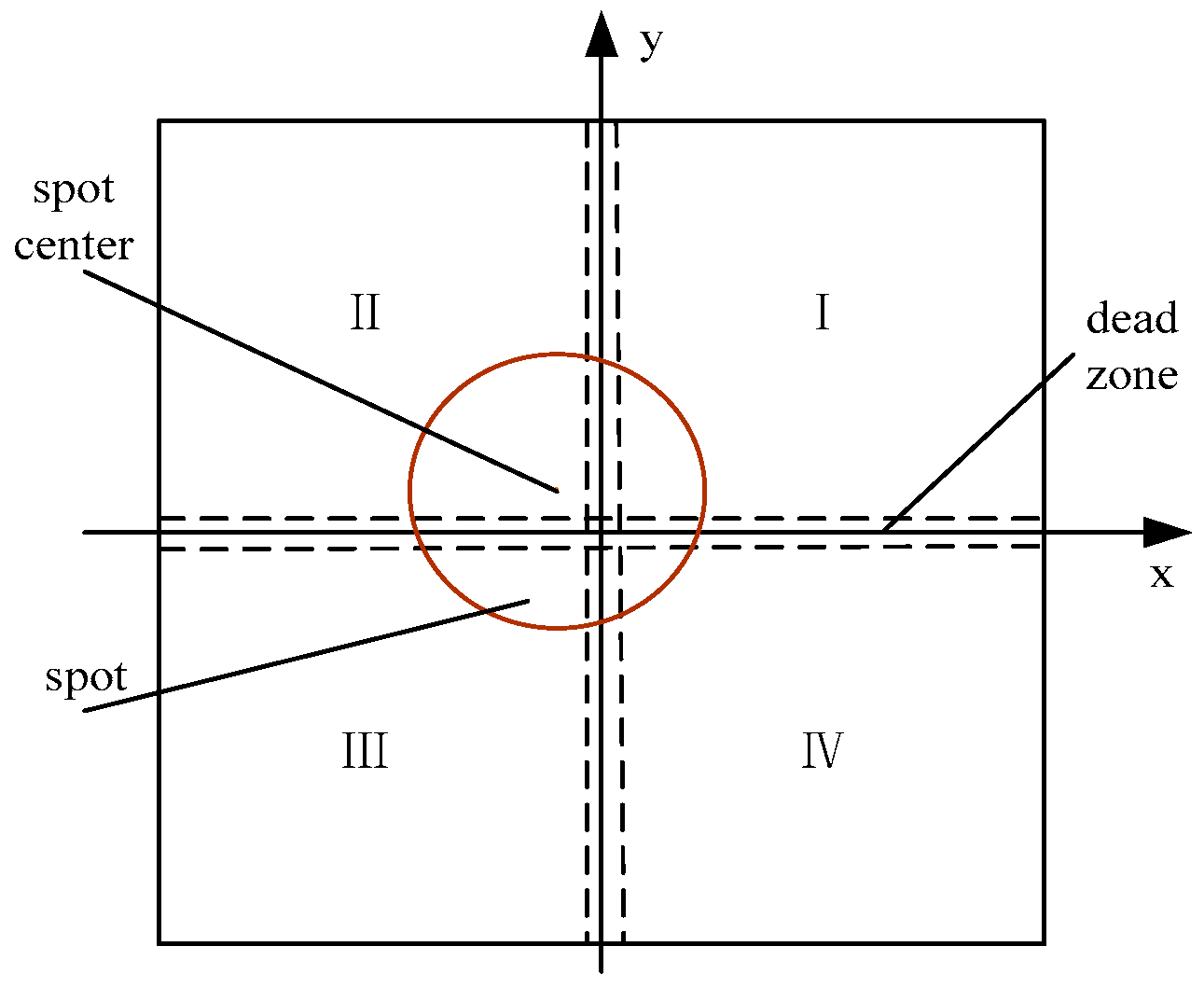
The quadrant detector (QD) primarily functions by precisely determining the centroid position of an incident light spot through differential measurements of photocurrent outputs from its four quadrants, as illustrated in Figure 2. When collimated sunlight irradiates the QD’s active surface, the spot is partitioned into four isolated photosensitive quadrants (I, II, III, and IV) by an integrated optical baffle. The photocurrent generated in each quadrant exhibits a linear positive correlation with the effective radiant energy received within the corresponding region [25].
Let SI, SII, SIII, and SIV represent the illuminated areas in quadrants I–IV, respectively, with corresponding photocurrent outputs II through IIV. When the light spot deviates from the QD’s optical center, the luminous flux distribution among quadrants becomes asymmetric, resulting in predictable photocurrent variations: the photocurrent increases in quadrants receiving greater illumination while decreasing proportionally in their diametrically opposed counterparts.
The raw photocurrent signals output by the QD exhibit extremely low amplitudes (typically on the microampere scale), necessitating initial conditioning via a voltage transducer to perform current-to-voltage (I/V) conversion. This yields proportional voltage signals corresponding to the photocurrent magnitudes. Based on these voltage signals, the relative displacement of the spot center with respect to the detector’s target center can be resolved through differential algorithms, as defined by Equation (1).
σ x = ( S I + S IV ) ( S II + S III ) S I + S II + S III + S IV = ( I I + I IV ) ( I II + I III ) I I + I II + I III + I IV σ y = ( S I + S II ) ( S III + S IV ) S I + S II + S III + S IV = ( I I + I II ) ( I III + I IV ) I I + I II + I III + I IV
where x and y denote the calculated displacement values along the X-axis and Y-axis, respectively, which quantitatively describe the positional deviation of the light spot on the target surface.
Equation (1) characterizes the spatial variation in the spot center position: When x = y = 0, the spot center coincides precisely with the QD’s target surface origin.
For x > 0 and y > 0, the spot center resides in Quadrant I.
For x < 0 and y > 0, the spot center is located in Quadrant II.
For x < 0 and y < 0, the spot center is positioned in Quadrant III.
For x > 0 and y < 0, the spot center falls within Quadrant IV.
A clear correlation exists between the magnitude of the calculated displacement values and the spot centroid position: Larger absolute values indicate greater deviations of the spot centroid from the QD’s origin. Smaller absolute values correspond to proximity of the spot center to the origin.
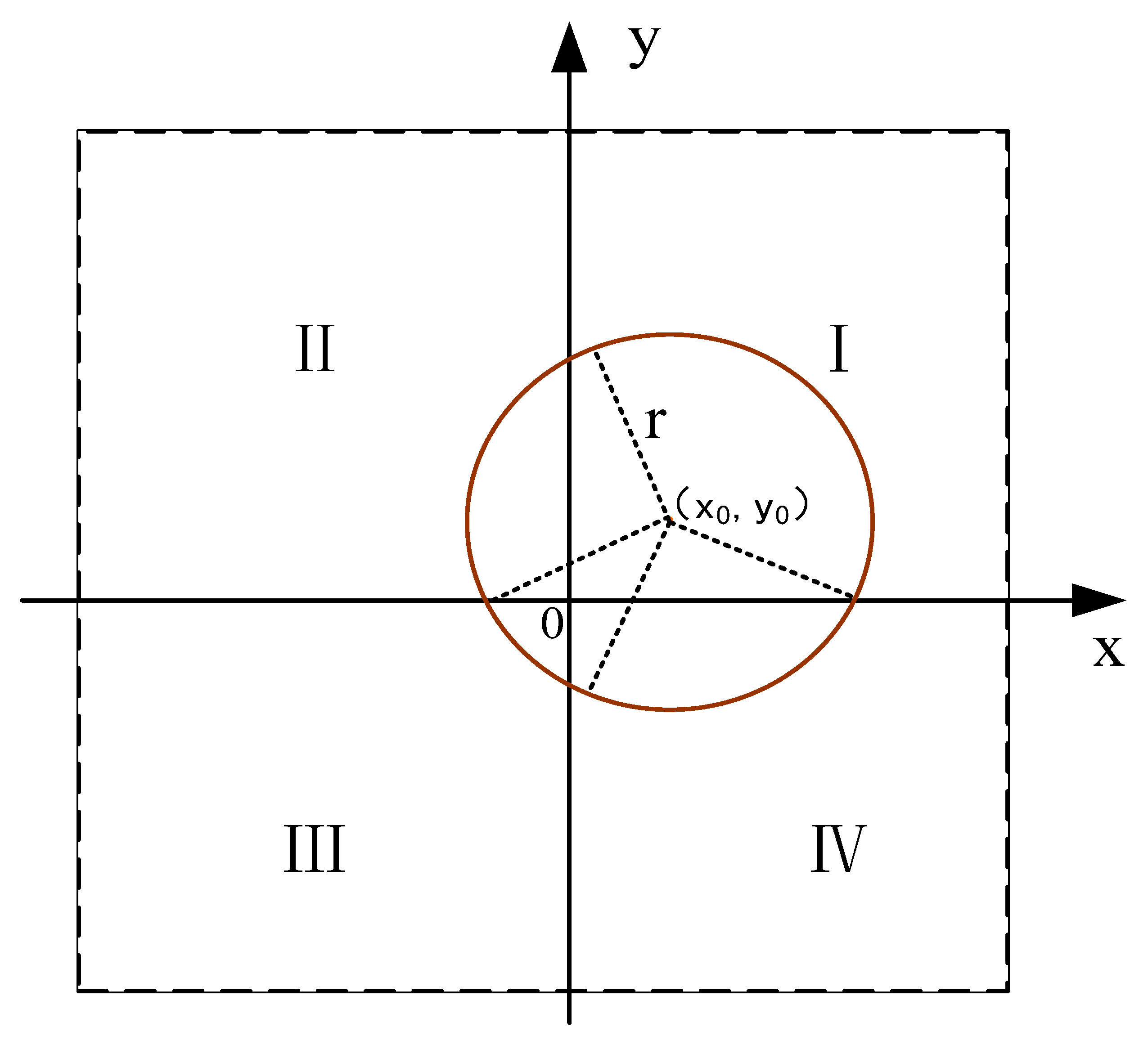
Assumptions for Idealized Analysis: The QD receives a circular spot with uniform energy distribution. The spot radius is denoted as (r). The spot center coordinates are (x0, y0). The dead-zone effect is neglected. The schematic representation of this configuration is provided in Figure 3.
As illustrated in Figure 3, the area fractions of the light spot distributed across different quadrants can be calculated using Equation (2):
S I = π r 2 4 + x 0 y 0 + x 0 2 r 2 x 0 2 + y 0 2 r 2 y 0 2 + r 2 2 arcsin x 0 r + arcsin y 0 r S II = π r 2 4 x 0 y 0 x 0 2 r 2 x 0 2 + y 0 2 r 2 y 0 2 r 2 2 arcsin x 0 r + arcsin y 0 r S III = π r 2 4 + x 0 y 0 x 0 2 r 2 x 0 2 y 0 2 r 2 y 0 2 r 2 2 arcsin x 0 r + arcsin y 0 r S IV = π r 2 4 x 0 y 0 + x 0 2 r 2 x 0 2 y 0 2 r 2 y 0 2 + r 2 2 arcsin x 0 r + arcsin y 0 r
Substituting Equation (2) into Equation (1) yields:
σ x = 1 π r 2 2 r 2 arcsin x 0 r + 2 x 0 r 2 x 0 2 σ y = 1 π r 2 2 r 2 arcsin y 0 r + 2 y 0 r 2 y 0 2
Under the condition where x0 ≪ r, the approximate expression for the actual spot position derived from Equation (3) becomes:
x 0 π r 4 σ x y 0 π r 4 σ y

2.3. Calculation of Solar Ray Deflection Angle

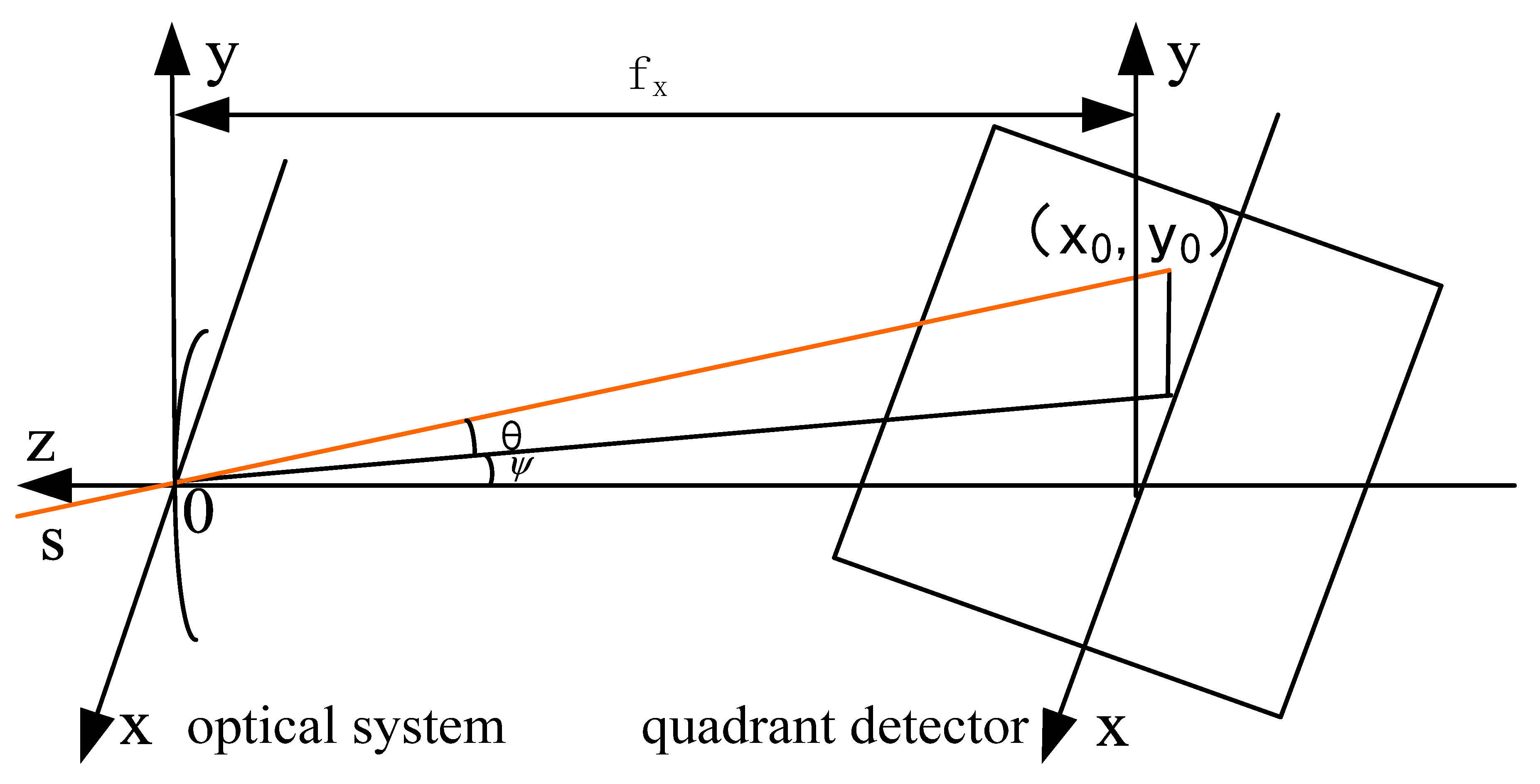
The measurement of incident beam angles using a quadrant detector (QD) involves a two-step process: spot localization → angle calculation. First, the coordinates of the spot center relative to the detector surface are determined based on the photocurrent signals from the QD. Subsequently, the deflection angle of the incident beam is computed by combining geometric optics principles with optical system parameters. Measurement Coordinate System Definition: As depicted in Figure 4, the coordinate system is configured as follows: The geometric center of the lens in the optical system serves as the origin (0). The optical axis (z-axis) is defined by the line connecting the lens center and the detector surface center. A two-dimensional plane coordinate system is established perpendicular to the z-axis, where the y-axis defines the azimuth angle of the beam; and the x-axis defines the elevation angle of the beam. Angle Direction and Sign Convention: Azimuth angle (y-axis rotation): Positive when the beam rotates clockwise around the y-axis (viewed from the negative y-direction). Elevation angle (x-axis rotation): Positive when the beam rotates counterclockwise around the x-axis (viewed from the positive x-direction).
Based on the spot center coordinates, both the azimuth angle and elevation angle of the incident beam can be derived as follows:
tan ψ = x 0 f x tan θ = y 0 f x 2 + x 0 2
Since x0 ≤ fx, Equation (5) can be approximated as:
ψ x 0 f x θ y 0 f x
where fx denotes the distance between the optical system’s principal point and the center of the QD detection plane.

3. Design of Solar Tracking Control System

3.1. Conventional PID Controller Design

In a solar panel tracking system, the core control algorithm of a conventional PID (Proportional-Integral-Derivative) controller can be mathematically expressed as follows:
u ( t ) = k p e ( t ) + k i e ( t ) d t + k d d e ( t ) / d t
In the PID parameter tuning for solar tracking systems, it is essential to holistically optimize core performance metrics, including system response speed, steady-state accuracy, steady-state error, and overshoot. The influence mechanisms of each parameter on the system’s control characteristics are analyzed as follows [26]:
(1) Proportional gain kp: As the core gain parameter in PID control, kp primarily enhances the system’s sensitivity to angular deviations by amplifying the error signal to directly regulate the control output. Increasing kp accelerates the system response and reduces the tracking time for solar angle adjustments. However, excessive kp may induce overshoot or even sustained oscillations, compromising the stability of the tracking process.
(2) Integral gain ki: The integral term eliminates steady-state errors by accumulating historical deviations, particularly addressing static offsets caused by mechanical backlash, sensor drift, or other persistent disturbances in solar tracking systems. While ki improves steady-state accuracy, an overly aggressive ki prolongs the settling time, increases overshoot during transient phases, and risks integral windup.
(3) Derivative gain kd: The derivative term predicts the trend of angular deviations and suppresses dynamic overshoot. By computing the rate of error change, kd generates anticipatory counteracting signals to mitigate overshoot caused by system inertia (e.g., stepper motor start-stop lag), thereby improving transient response smoothness. However, kd is sensitive to high-frequency noise (e.g., sudden irradiance fluctuations); excessive values amplify noise-induced jitter, degrading tracking precision.

3.2. Fuzzy PID Controller Design

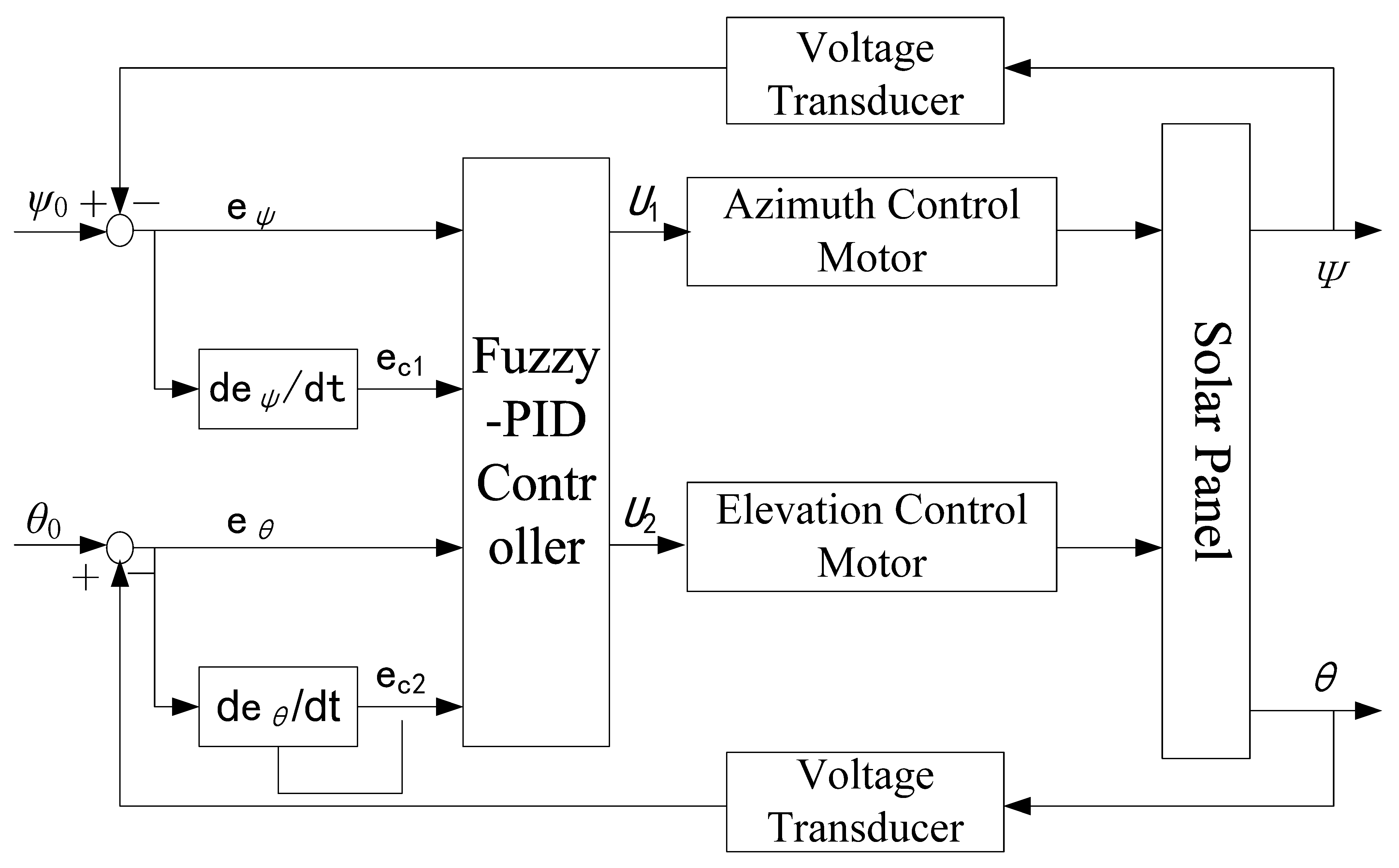
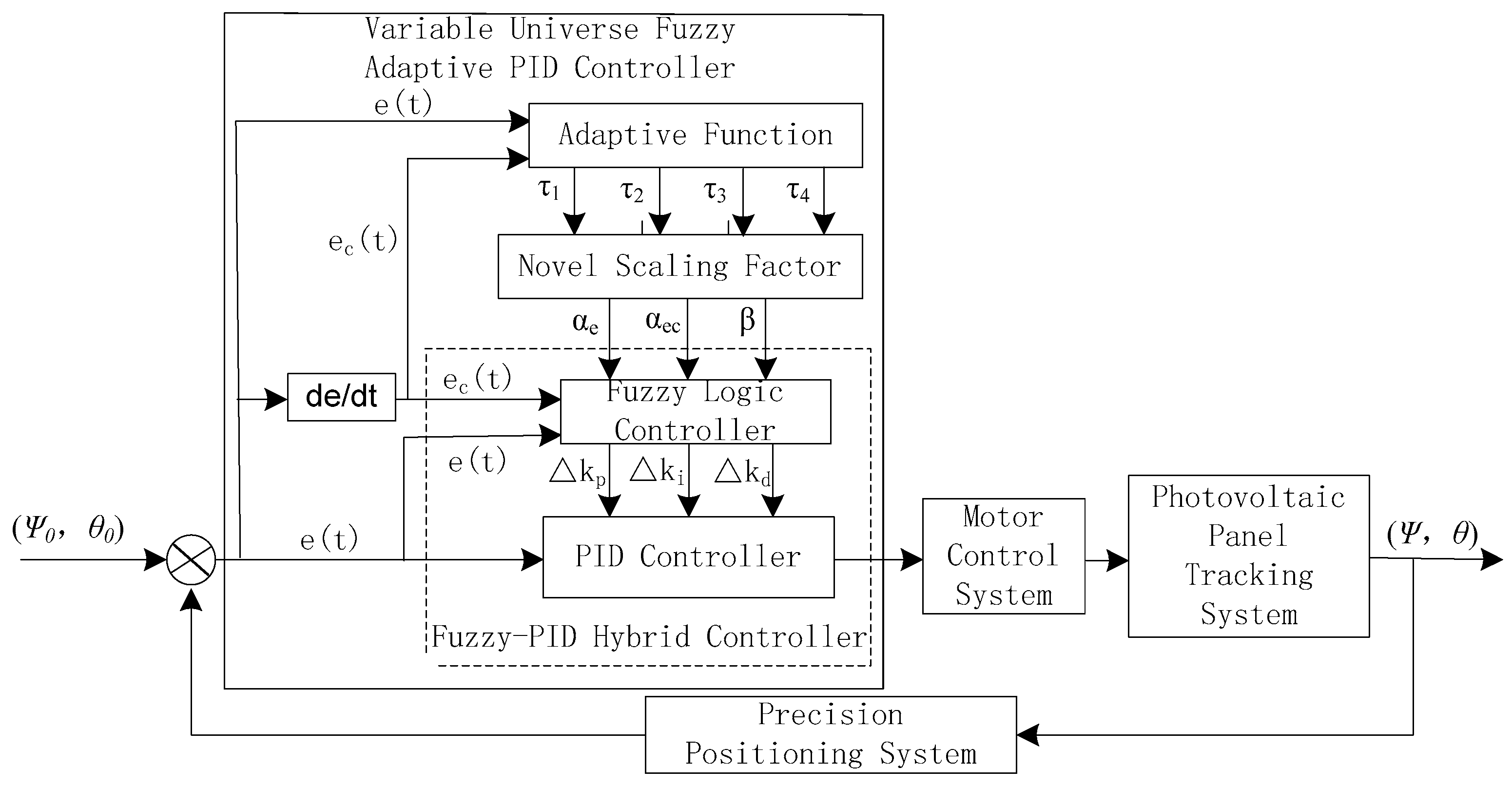
The system architecture of the solar panel with fuzzy PID control is illustrated in Figure 5. To achieve optimal solar tracking performance, the system requires real-time dynamic adjustments of both azimuth (ψ) and elevation (θ) angles through the proposed fuzzy PID control scheme. The controller employs four key input variables: Azimuth error:   e ψ = ψ 0 ψ , and Azimuth error rate: e c 1 = e ψ = d e ψ d t [27], and Elevation error: e θ = θ 0 θ , and Elevation error rate: e c 2 = e θ = d e θ d t , where ψ0 and θ0 represent the target solar azimuth and elevation angles, respectively, obtained through GPS positioning algorithms, and ψ and θ denote the actual measured orientation angles of the solar panel. The control system generates two independent output signals: U1: Azimuth correction control signal, and U2: Elevation correction control signal. These outputs are delivered to dedicated stepper motor drivers, which precisely actuate the motors to adjust the panel’s orientation. Through this closed-loop control mechanism, the system continuously minimizes tracking errors, thereby maximizing solar energy capture efficiency.
Performance of the fuzzy PID control system critically depends on core design elements of the fuzzy controller, including its architecture, the rationality of the fuzzy rule base (optimized based on operational experience in solar tracking systems), as well as the selection of fuzzy inference algorithms and defuzzification methods. In this study, the fuzzy inference system was developed using MATLAB (version R2024a)’s Fuzzy Logic Toolbox, enabling visual design of control rules and rapid simulation-based verification of the inference process.
The fuzzy PID control algorithm builds upon the conventional PID control framework, with its key improvement being the integration of a fuzzy inference mechanism for dynamic PID parameter optimization. By constructing a fuzzy rule base derived from expert knowledge and engineering practice, the algorithm establishes fuzzy relationships between the core PID parameters (Kp, Ki, Kd) and the system input-output error (e) and its rate of change (ec). Through fuzzy inference, the algorithm generates correction values (ΔKp, ΔKi, ΔKd) that are superimposed upon the initial PID parameters. This enables real-time adaptive tuning, allowing the controller to dynamically adjust to varying system operating conditions.
The refined PID parameters at any given moment, as determined by fuzzy inference, are expressed as follows:
K p = K po + Δ K p K i = K io + Δ K i K d = K do + Δ K d
where Kpo, Kio, Kdo denote the initial PID parameter values; ΔKp, ΔKi, and ΔKd are derived through quantization factors, fuzzification, fuzzy inference, defuzzification, and scaling factors, as detailed below [28].
(1) Determination of Quantization Factors
Quantization factors transform the actual domains of the error (e) and error rate of change (ec) into the fuzzy input space of the controller. The conversion formulas are given by
E = k e e e min + e max 2 E c = k e c e c e c min + e c max 2
where < > denotes the rounding operation; E and Ec represent the input variables of the fuzzy controller; emin and emax are the minimum and maximum values of the actual error, while ecmin and ecmax are the minimum and maximum values of the error rate of change, respectively; e and ec indicate the current values of the actual error and its rate of change at the present moment; ke and kec represent the quantization factors.
ke = 10 e max e min ke c = 10 e c max e c min
(2) Fuzzification Process
Based on comprehensive operational analysis of photovoltaic panels and extensive experimental validation, the base universes of discourse for the input variables are defined as follows: Error (e): [−20°, 20°], and Error change rate (ec): [−15°, 15°]. For the output variables, the base universes are specified as:Proportional gain (Kp): [−20, 20], Integral gain (Ki): [−5, 5], Derivative gain (Kd): [−0.5, 0.5]. All universes are uniformly partitioned into seven quantization levels, with corresponding fuzzy subsets defined as {NB, NM, NS, ZO, PS, PM, PB}, representing the linguistic variables {Negative Big, Negative Medium, Negative Small, Zero, Positive Small, Positive Medium, Positive Big}.
(3) Fuzzy Inference
Based on the fuzzy relations defined in the rule base and the given inputs, the output of the fuzzy controller is derived. Triangular membership functions (trimf) are adopted for all fuzzy sets, which are mathematically expressed as follows:
trimf ( x ,   a ,   b ,   c ) = 0 x a x a b a a < x b x b c b b < x c 0 x > c
In the expression, x represents the element in the universe of discourse (i.e., the abscissa of the membership function) Parameters a, b, and c determine the span of the triangular membership function. Considering the dynamic characteristics of the solar panel tracking system—including stepper motor adjustment inertia and operational fluctuations induced by illumination disturbances—we derive the following parameter tuning principles for the fuzzy inference controller to address stage-specific control requirements during dynamic response phases:
(a) When both the error (e) and its rate of change (ec) are large (e.g., due to sudden solar angle variations caused by fast-moving clouds), the control parameters Kp, Ki, and Kd should be increased to enhance dynamic responsiveness and ensure rapid tracking of real-time solar angles. Conversely, when the error (e) remains large but the rate of change (ec) gradually decreases (e.g., as the system approaches the target angle), Kp and Ki should be reduced to properly respond to load variations while maintaining stability.
(b) As the error (e) and its rate of change (ec) converge toward steady-state values (during the mid-phase of dynamic adjustment), the proportional gain (Kp) should be gradually decreased while the integral gain (Ki) is increased. This strategy achieves an optimal balance between fast response and minimized overshoot, ensuring smooth convergence.
(c) When the error (e) approaches steady-state with minimal residual deviation, a smaller Kp and a larger Ki are preferred to improve steady-state accuracy and eliminate steady-state error. Based on these tuning principles, the fuzzy control rules for the solar tracking system are established as shown in Table 1, utilizing if-then linguistic rules with the following format: If (e is NB) and (ec is NB), then (Kp is PB, Ki is NB, Kd is PS). The inference mechanism adopts the Mamdani method, formalized as follows:
μ C = φ 1 Λ φ 2 Λ μ C
φ 1 = e N e μ A ( e ) μ A ( e ) φ 2 = e c N e c μ B ( e c ) μ B ( e c )
In the formulation, μA, μB, and μC represent the membership functions of fuzzy sets A, B, and C, respectively; φ1 denotes the matching degree between fuzzy set A and its corresponding set A′; φ2 indicates the matching degree between fuzzy set B and its corresponding set B′; and the operator ∨ stands for the maximum operation, while ∧ represents the minimum operation.
(4) Defuzzification
The process of converting fuzzy inference outputs into precise control signals U executable by actuators is termed defuzzification. In this study, the centroid method is adopted for defuzzification, formulated as:
U = i = 1 n υ i μ υ ( υ i ) i = 1 n μ υ ( υ i )
where υ and μ denote the element in the universe of discourse and its corresponding membership function, respectively, both derived from fuzzy inference.
(5) Scaling Factor Determination
The control output Δ obtained through fuzzy inference in the fuzzy domain is converted into the actual control input applied to the plant via scaling factors ΔKm (m = p, i, d), according to the transformation formula:
Δ K m = L K , m U + Δ kmin , m + Δ kmax , m 2
In the formulation, ΔKm denotes fuzzy inference outputs at the current and previous time steps; ΔKmax,m and ΔKmin,m (m = p, i, d) denote maximum and minimum bounds of the output in the physical domain, LK,m (m = p, i, d) denotes the scaling factors:
L K , m = Δ k max , m Δ k min , m 10

3.3. Design of Variable Universe Fuzzy Adaptive PID Controller

3.3.1. Variable Universe Fuzzy PID Control System

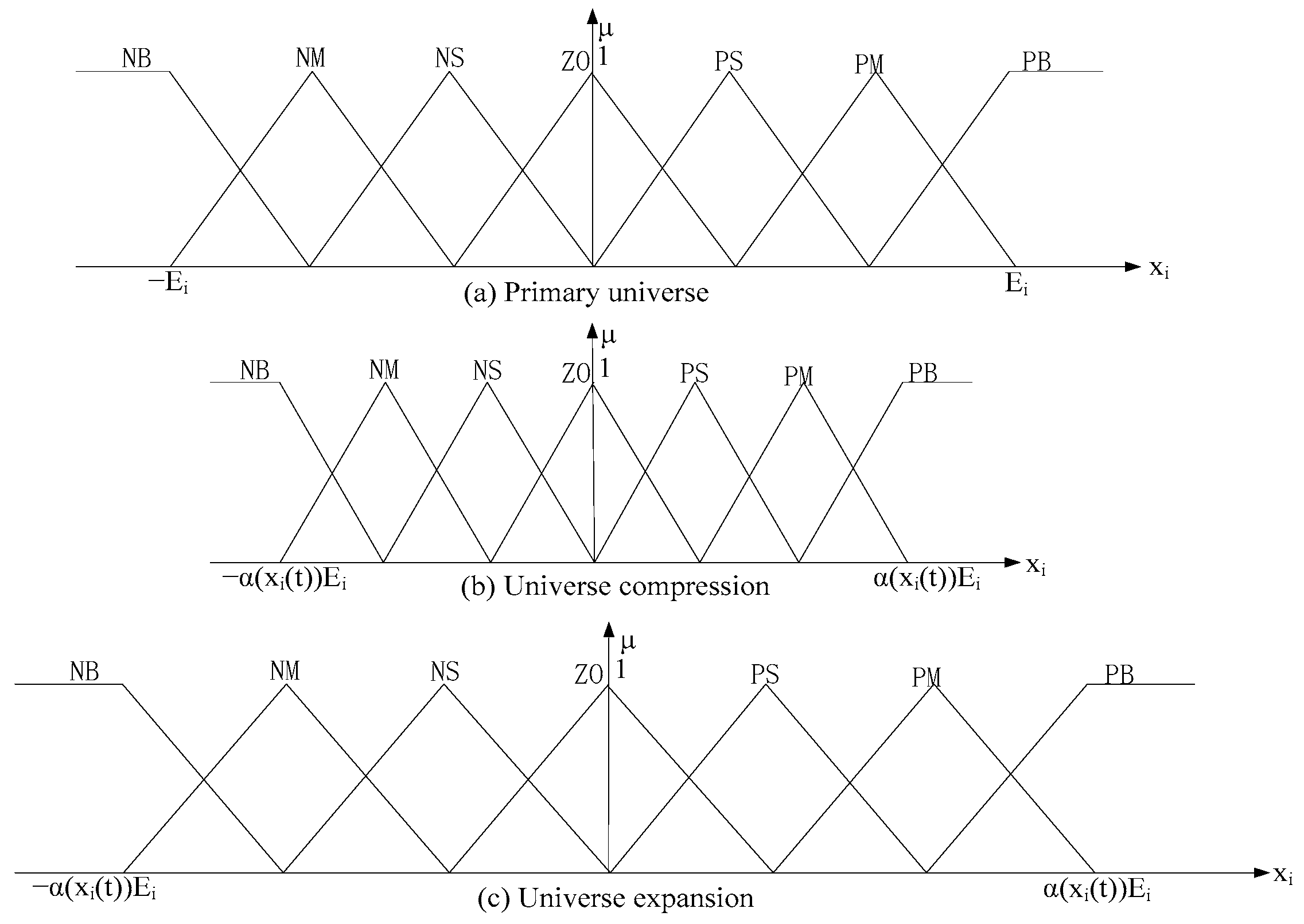
In conventional fuzzy PID control algorithms, inappropriate selection of the universe size may compromise the controller’s performance. To address this issue, a scaling factor is introduced to dynamically adjust the input and output variable universes of the fuzzy controller [29]. Let the initial input and output universes be defined as Xi = [−Ei, Ei] and Yj = [−Uj, Uj], respectively, where Ei and Uj denote the universe boundaries. Based on the error (e) and error rate (ec), scaling factors α(e, ec) and β(e, ec) are computed, where α(e) and α(ec) are the scaling factors for the input variables e and ec, respectively. β(e, ec) serves as the common scaling factor for the three output variables: ∆Kp, ∆Ki, and ∆Kd. The initial input and output universes are then dynamically rescaled. Taking the i-th input variable as an example, the adjusted universe becomes: Xi’ = [−α(xi(t))Ei, α(xi(t))Ei]. This adjustment mechanism is illustrated in Figure 6b,c.
Similar to conventional fuzzy PID controllers, the variable universe fuzzy PID controller comprises three core components: fuzzification, fuzzy inference, and defuzzification [30]. The input variables for fuzzification remain the error e and its derivative ec, while the Mamdani inference method is retained. Key distinctions include the following: Universe Adjustment: Scaling factors are dynamically regulated (unlike fixed factors in standard fuzzy controllers). Linguistic Variables: The fuzzy subsets {CB, CM, CS, ZO, ES, EM, EB} denote {Major Contraction, Moderate Contraction, Slight Contraction, Zero Adjustment, Slight Expansion, Moderate Expansion, Major Expansion}. Defuzzification Outputs: The tuned quantization factors (Ke, Kec) adaptively adjust inputs, while the proportional factor (Km) modulates the output. The input scaling factors α(e(t)) and α(ec(t)) are governed by fuzzy rules based on e and ec, as is the output scaling factor β. Detailed rule bases are provided in Table 2.
(1) When e(t) or ec(t) increases, the scaling factor α(e(t)) or α(ec(t)) should remain constant to maintain the control system within its operational bounds, thereby preserving the original universe of discourse.
(2) when e(t) or ec(t) decreases, the scaling factor α(e(t)) or α(ec(t)) should be sufficiently minimized (approaching zero) to ensure efficient control performance, consequently compressing the universe of discourse.

3.3.2. Variable Universe Fuzzy PID Control System with Self-Adaptive Scaling Factor Parameters

(1) Function-Model-Based Scaling Factor Design
In practical solar panel tracking control systems, operational conditions are highly complex due to nonlinearities, time delays, and other disturbances. Consequently, it is challenging to establish comprehensive fuzzy control rules for arbitrary scaling factors. To address this limitation, the function-model-based approach employs predefined mathematical functions to design scaling factors. This method circumvents performance degradation caused by incomplete fuzzy rule bases—a common issue in rule-based methods. For engineering applications, proportional-exponential functions are currently the preferred choice for scaling factor design.
α e t = e t E 1 τ 1 + ε α e c t = e c t E 2 τ 2 + ε β e t , e c t = e t E 1 τ 3 + e c t E 2 τ 4 2 + ε
where ε is a sufficiently small positive constant; E1 and E2 denote the initial universe boundaries of the input variables e(t) and ec(t), respectively; and τi (i = 1, 2, 3, 4) represents the scaling factor design parameters, subject to τi ∈ [0, 1].
(2) Novel Scaling Factor Design
In conventional function-based scaling factor models, the parameters τi are empirically selected constants lacking clear physical significance. Although extensive studies have been conducted to determine their approximate value ranges, the optimal τi selection remains highly application-dependent across engineering fields, preventing the establishment of universal guidelines. To address this limitation, we innovatively propose an adaptive function that dynamically adjusts τi in real-time based on both system error and error rate. This approach eliminates the need for heuristic parameter tuning while enhancing control adaptability.
τ 1 = E 1 e ( t ) ( E 1 + E 2 ) + δ + E 2 e c ( t ) ( E 1 + E 2 ) + δ
In the equations: δ is chosen as a sufficiently small positive constant to ensure a non-zero denominator. When τ1 > 1, it is constrained to τ1 = 1 for parameter bounding. To maintain consistency between input and output variables, identical parameter values are assigned (τ1 = τ2 = τ3 = τ4). By substituting Equation (18) into Equation (17), the novel scaling factor formulation is obtained.
α e t = e t E 1 τ 1 + ε α e c t = e c t E 2 τ 2 + ε β e t , e c t = α e t + α e c t 2 + ε
Through systematic analysis, we verify that the proposed scaling factor satisfies five key stability criteria: duality, zero-avoidance, monotonicity, coordination, and regularity. These properties ensure that the control system rapidly minimizes both e(t) and ec(t), thereby driving the system toward stable convergence. To further enhance control performance, we integrate the novel scaling factor with conventional variable universe fuzzy PID algorithms, establishing an adaptive scaling factor-based variable universe fuzzy PID (NEVUFP) control strategy. The implementation workflow of this method is schematically illustrated in Figure 7.

4. Performance Evaluation of Solar Tracking System

(1) Parameter Tuning Method
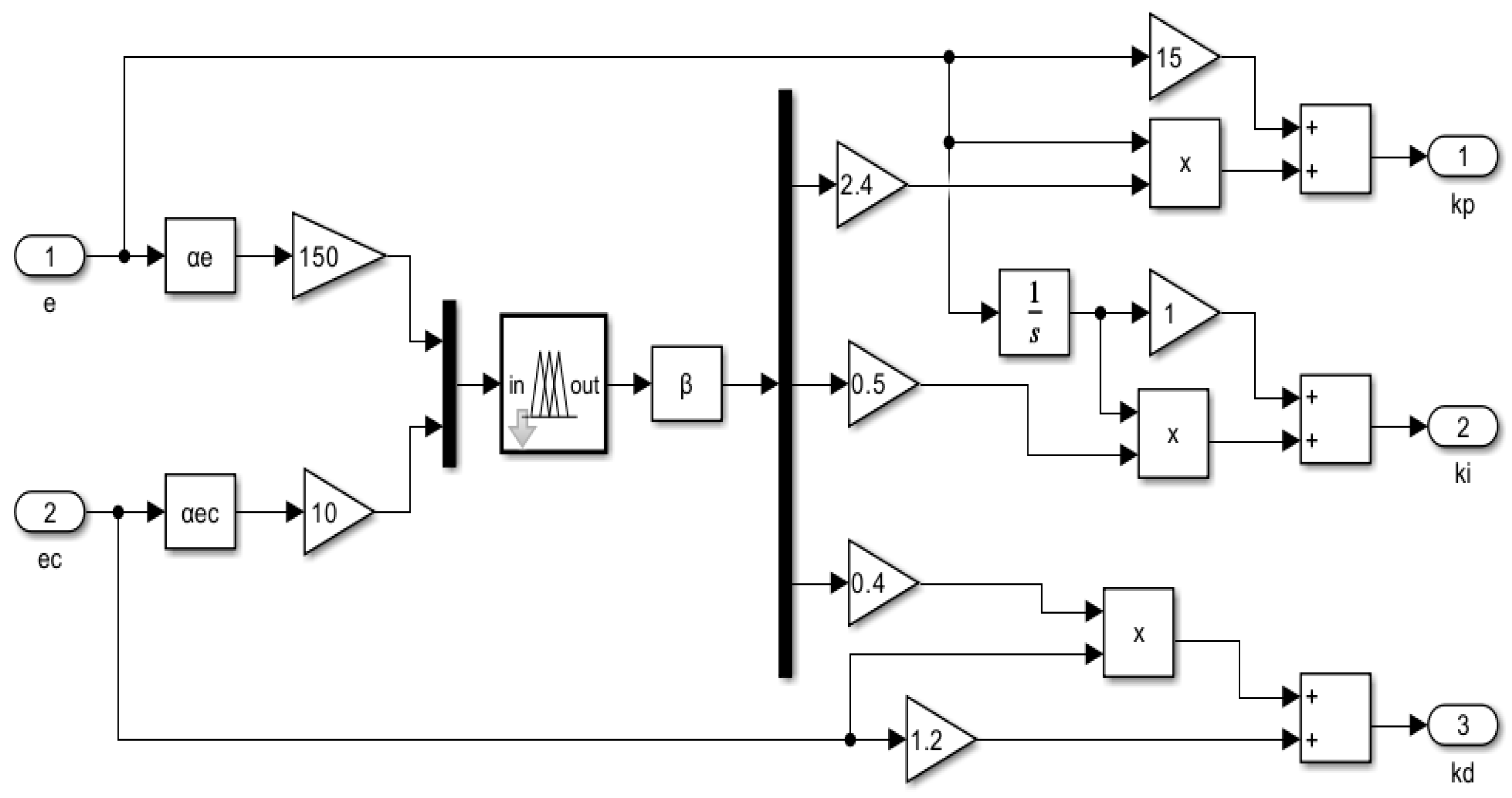
This method takes the system error (e) and error change rate (ec) as inputs (corresponding to input ports 1 and 2 in Figure 8). Through a variable universe fuzzy inference unit, the universe range of fuzzy subsets is dynamically adjusted to achieve online adaptive tuning of PID gains (Kp), (Ki), and (Kd). When the system error is large, the fuzzy universe automatically expands to accelerate the response speed; when the error decreases, the universe contracts to enhance control accuracy. Compared to conventional PID and fuzzy PID methods, this approach combines the robustness of fuzzy control with the adaptive capability of the variable universe mechanism, effectively accommodating nonlinear and time-varying controlled objects.
(2) Tuning Standards
(a) Dynamic Performance
Overshoot in step response: σ% ≤ 2%, settling time: ts ≤ 0.6 s, rise time: tr ≤ 0.15 s. No sustained oscillations.
(b) Steady-State Performance
Steady-state error in complex environments: ess ≤ 0.8°, steady-state error in ideal environments: ess ≤ 0.5°. Effective suppression of integral windup.
(c) Robustness
No significant degradation in dynamic or steady-state performance when the controlled object parameters vary within ±20%, disturbance rejection recovery time: trec ≤ 0.7 s.
(d) Universe Adaptation
The scaling factor of the variable universe follows the principle of “wide universe for large errors, narrow universe for small errors”. The gain adjustment output by fuzzy rules is smooth and free of abrupt changes, preventing system chattering.
(3) Parameters were determined
The modeling process strictly adhered to the controller design rules outlined in this paper, leading to the determination of the relevant key parameters, as shown in Table 3.
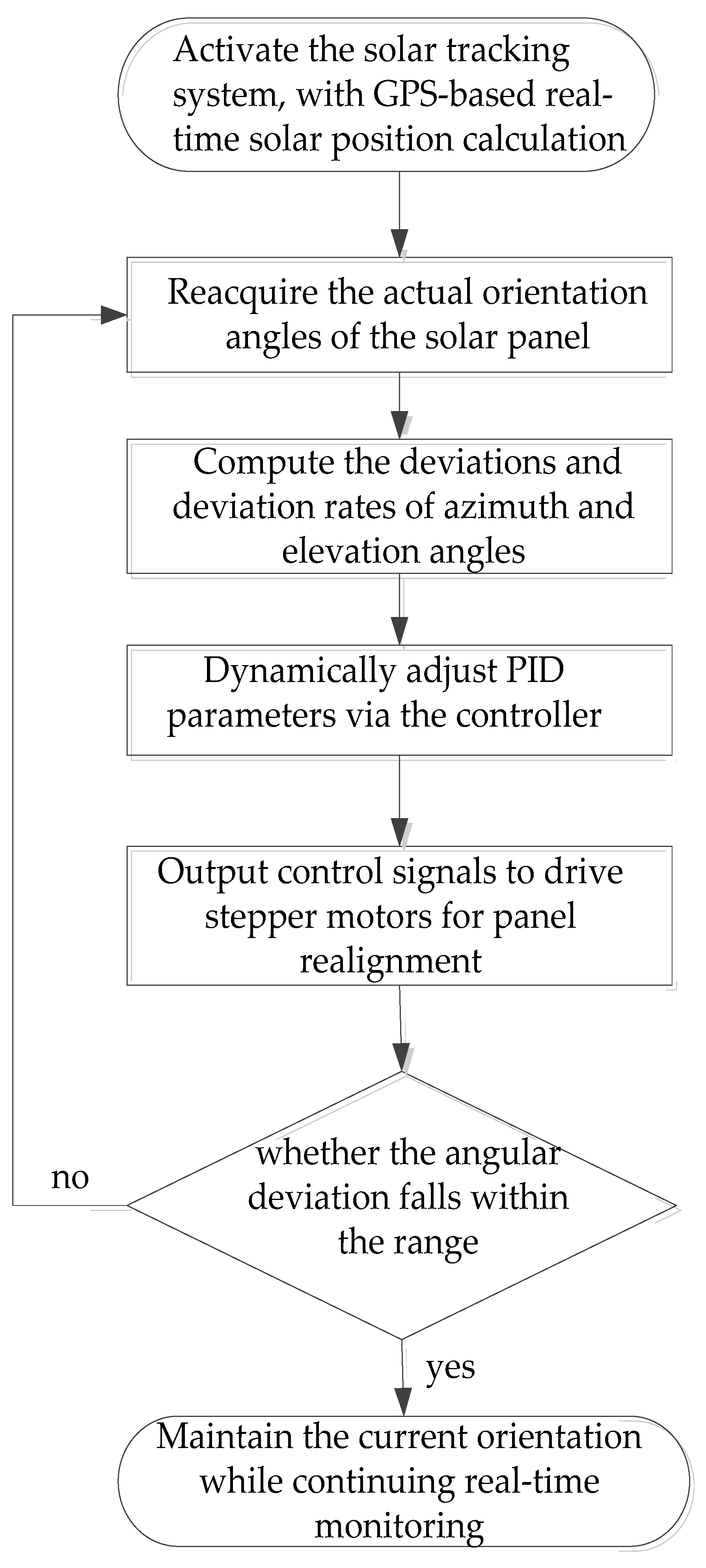
(4) The performance evaluation procedure of the light-tracking system is depicted in Figure 8.

4.1. System Operation Under Ideal Conditions

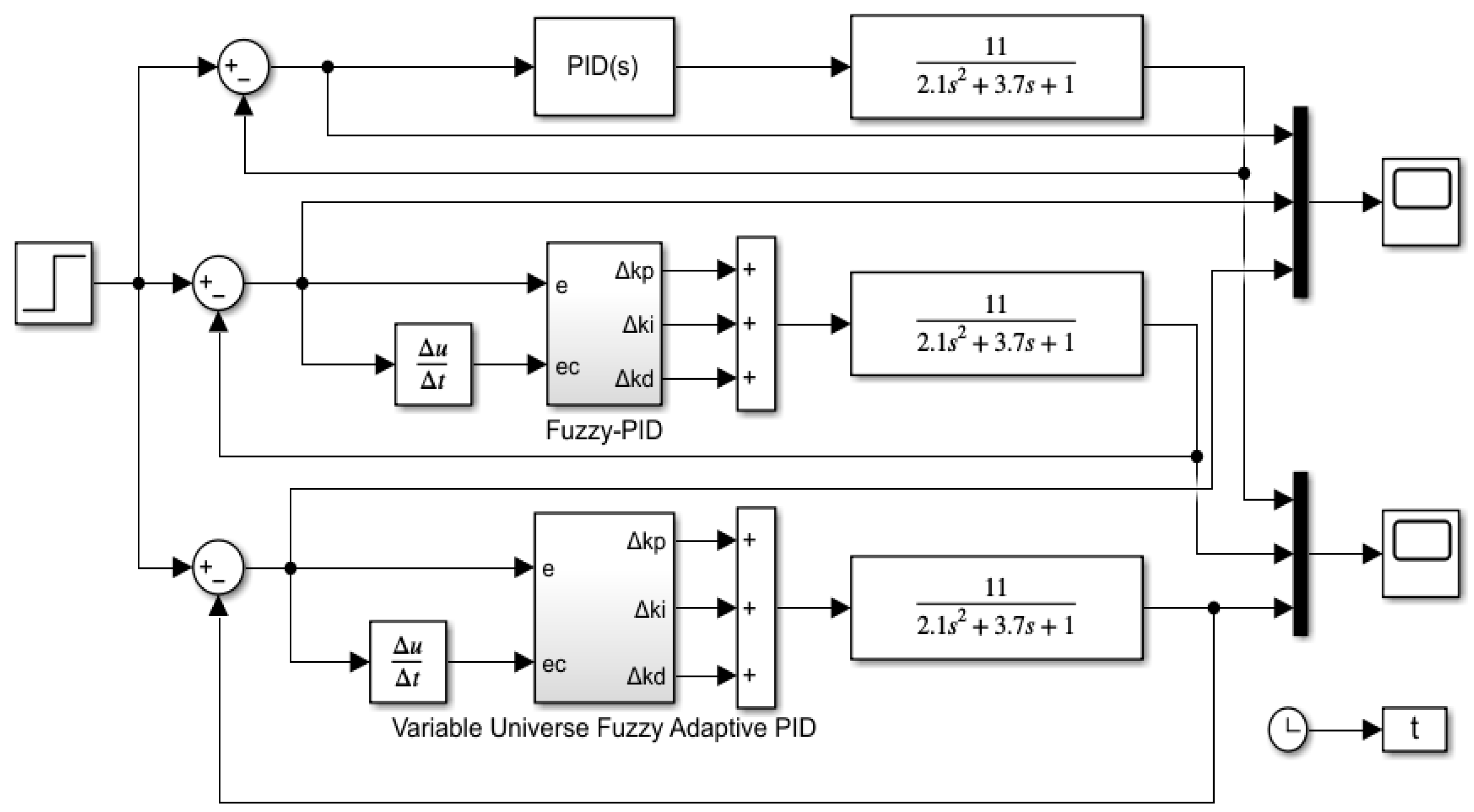
Under optimal operating conditions, Based on the actual operational conditions of the system, the ideal working scenario is defined as one free from external environmental interferences, including but not limited to the absence of light-related disturbances (e.g., cloud cover, transient shading), meteorological influences (e.g., wind-induced perturbations, temperature drift, precipitation effects), atmospheric or pollutant impacts (e.g., atmospheric scattering, dust accumulation on panels), as well as electromagnetic interference. The solar panel tracking system’s dynamic characteristics were analyzed through system identification methods. The azimuth and elevation angle control systems were mathematically modeled and appropriately simplified as second-order systems for analytical tractability.
G s = 11 2.1 s 2 + 3.7 s + 1
System Identification Process Under Ideal Conditions: A Five-Step Procedure.
(1) Experimental
(a) Input-Output Definition: The input u(t) is the PWM control voltage of the solar panel tracking system motor (amplitude range: 0–12 V, corresponding to a motor rotational speed of 0–30°/s). The output y(t) is the azimuth/elevation angle, measured by a photoelectric encoder with a resolution of 0.01°.
(b) Excitation Signal Selection: A step excitation signal is adopted to match the slow dynamic characteristics of the tracking system. The step amplitude is set to (u0 = 2 V), applied until the system reaches steady state (duration 15 s).
(2) Data Acquisition
(a) Sampling Equipment: A 16-bit AD acquisition card is used, with a sampling frequency (fs = 20 Hz, more than three times the system bandwidth).
(b) Data Recording: The input voltage sequence u ( k ) k = 1 300 (15 s × 20 Hz) and output angle sequence y ( k ) k = 1 300 are synchronously collected and saved as a .mat dataset.
(3) Data Preprocessing: Given the extremely low noise under ideal conditions, only a first-order low-pass filter (cutoff frequency fc = 5 Hz, twice the system bandwidth) is applied to remove high-frequency glitches. The filtered data are denoted as y fil ( k ) .
(4) Model Structure Selection
Based on the inertial–damping characteristics of the motor drive in the tracking system, the model is determined to be a second-order linear time-invariant (LTI) system. The structure is normalized as follows (with the denominator constant term normalized to facilitate parameter estimation): G s = K a s 2 + b s + 1 .
(5) Parameter Estimation (Least Squares Method)
(a) Gain (K): Calculated from the steady-state value y(∞) of the step response y fil ( ) = 22 0 , K = y fil ( ) u 0 = 22 2 = 11 .
(b) Coefficient Fitting for (a) and (b)
The differential equation of the second-order system a y ( t ) + b y ( t ) + y ( t ) = K u ( t ) is discretized using the forward difference method, yielding: a y fil ( k + 2 ) + b y fil ( k + 1 ) + y fil ( k ) = K u ( k ) .
By constructing the observation matrix (Φ) and the output vector (Y), the parameters are estimated via the least squares method: θ = ( Φ T Φ ) 1 Φ T y . The fitted values are (a = 2.1) and (b = 3.7).
(6) Model Validation
The step response of the estimated model (G(s)) is compared with that of the actual system. The root-mean-square error RMSE = 1.2% (below the 3% threshold required for engineering accuracy), confirming the model’s validity.
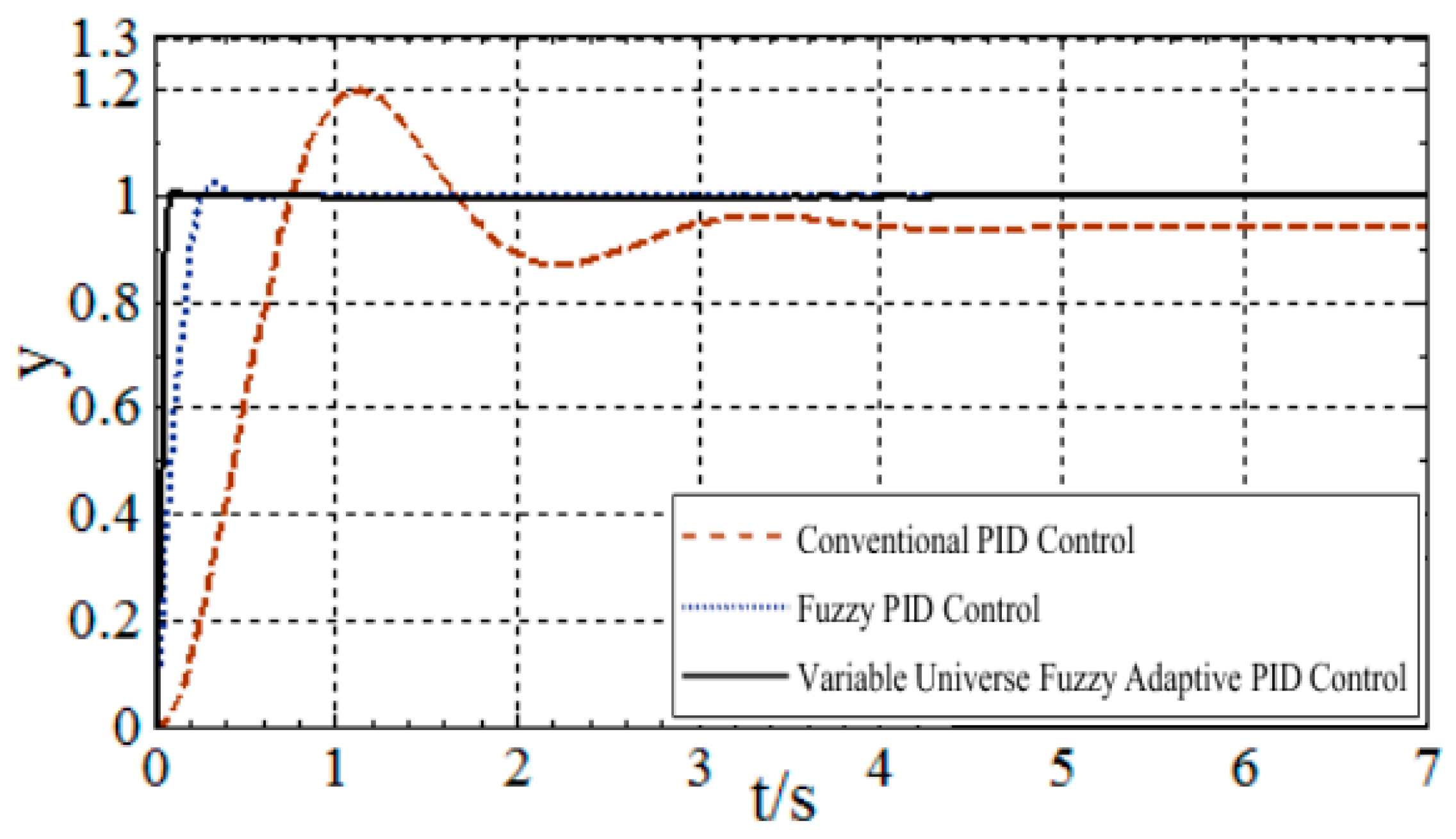
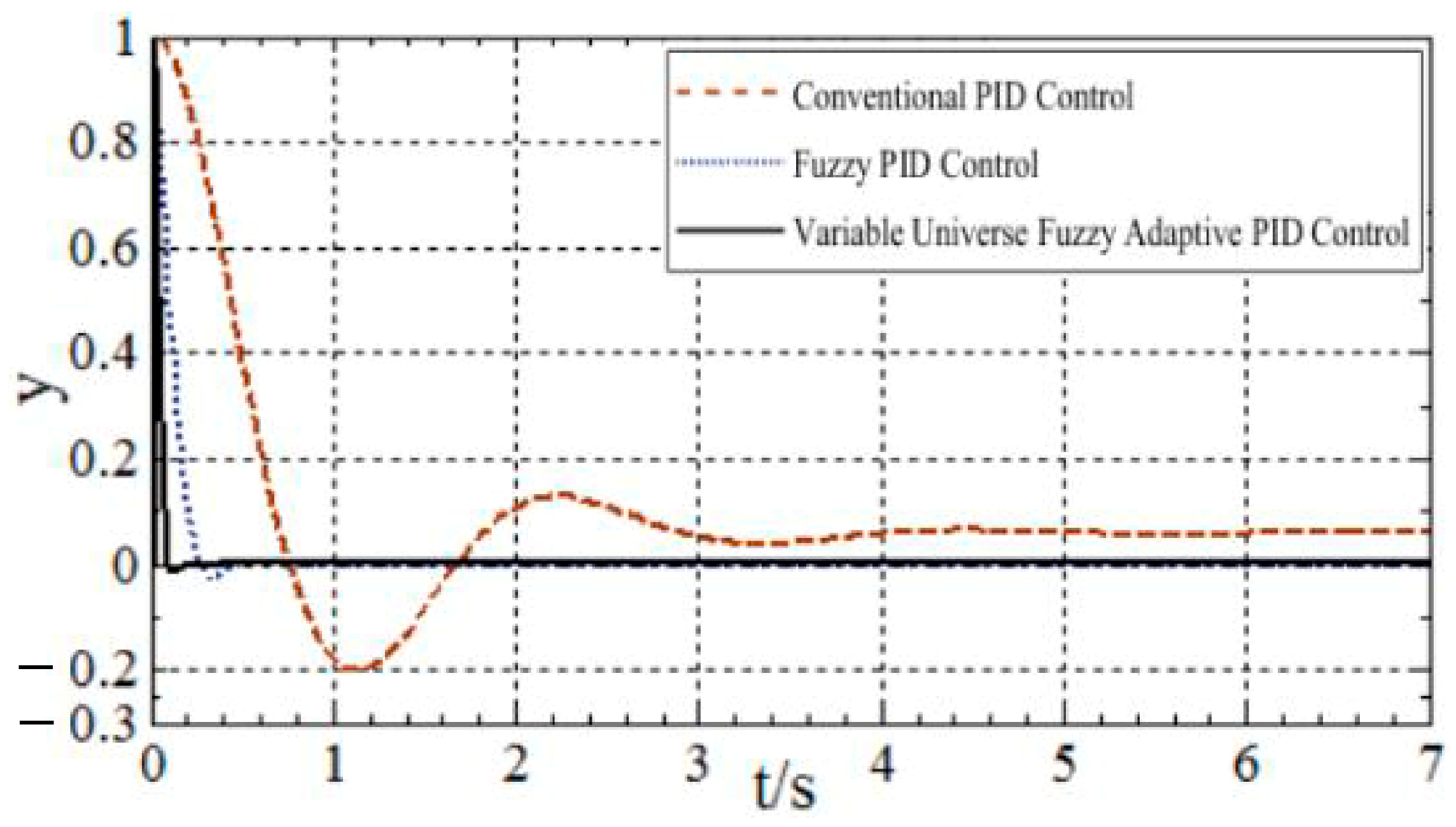
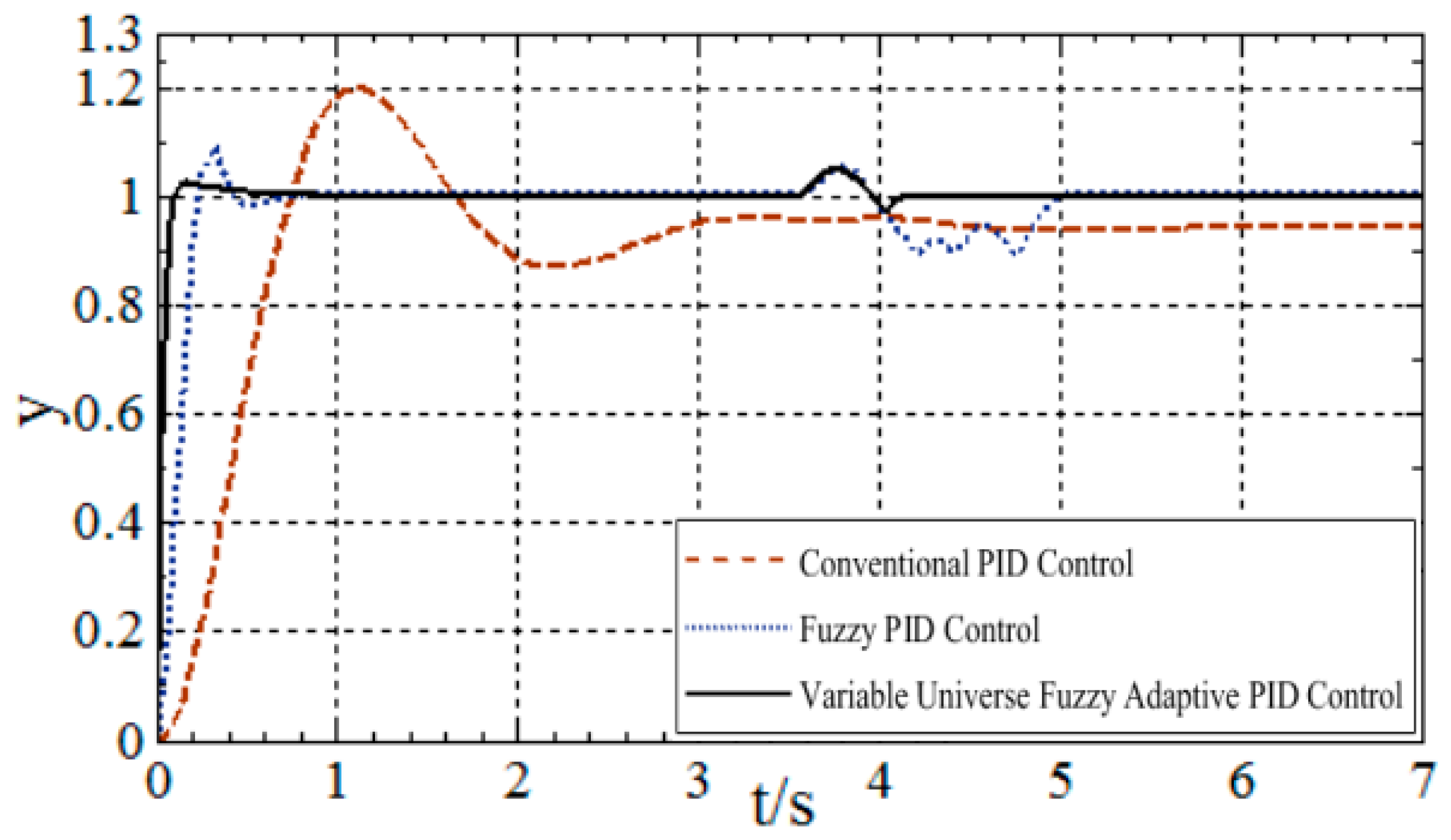
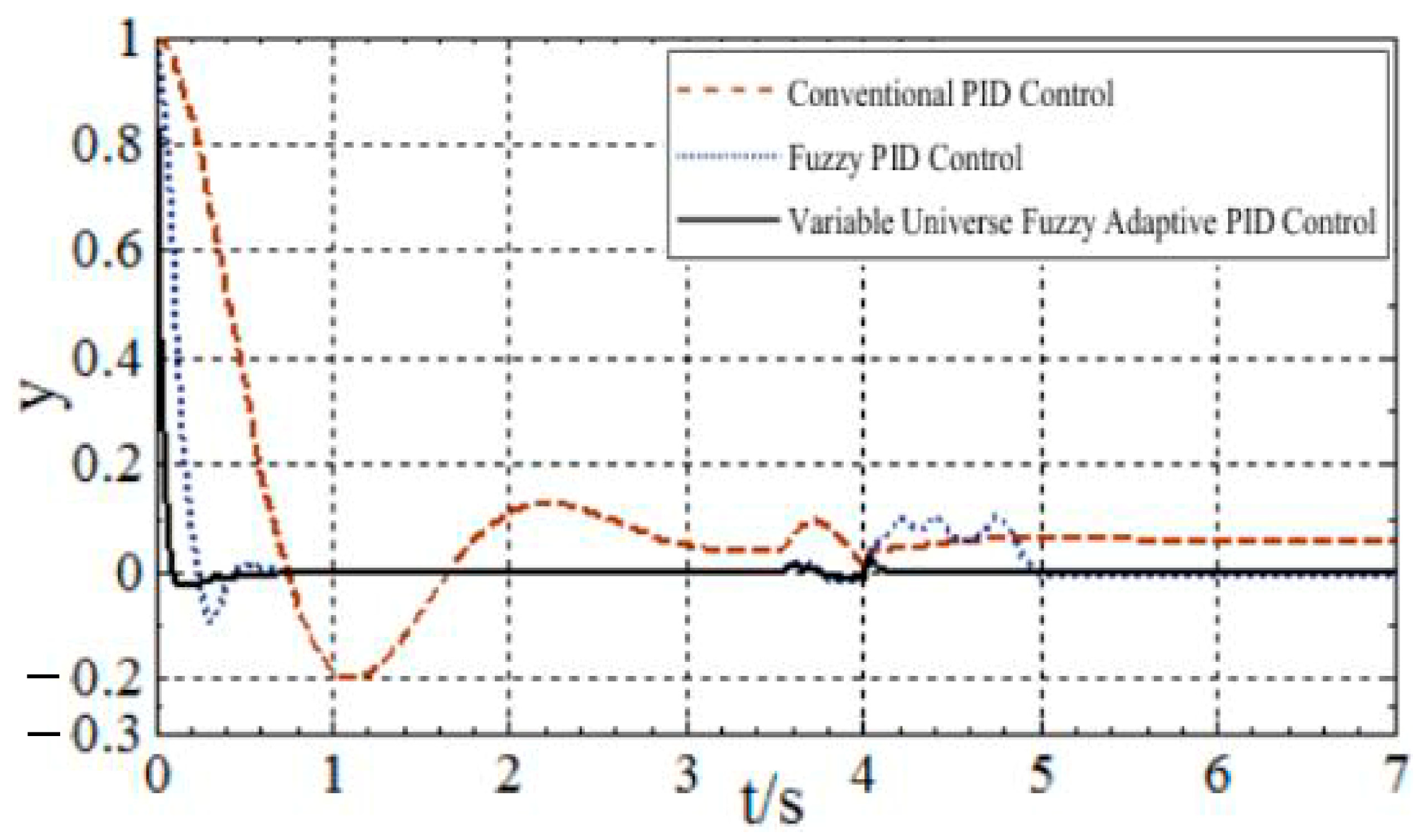
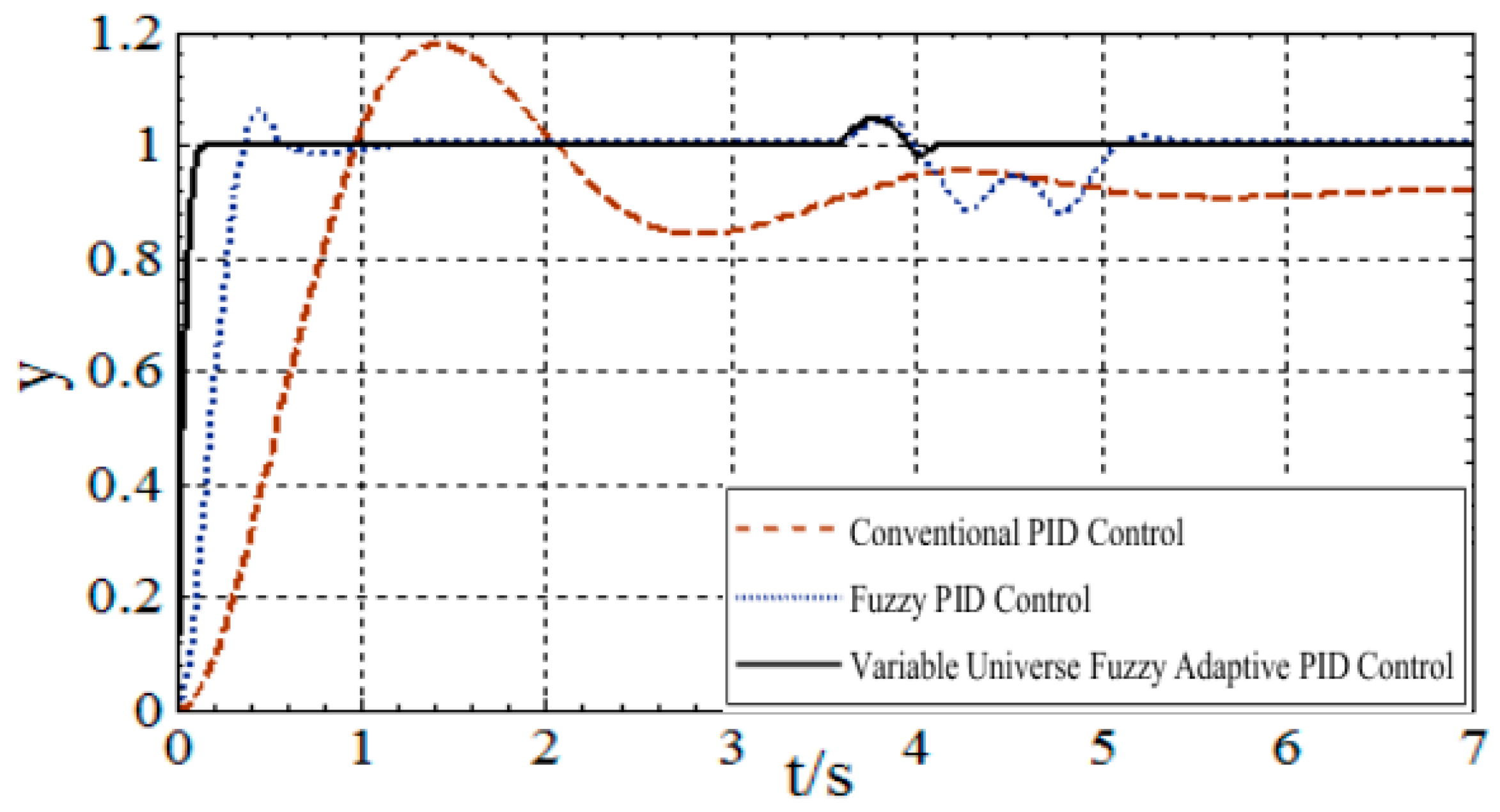
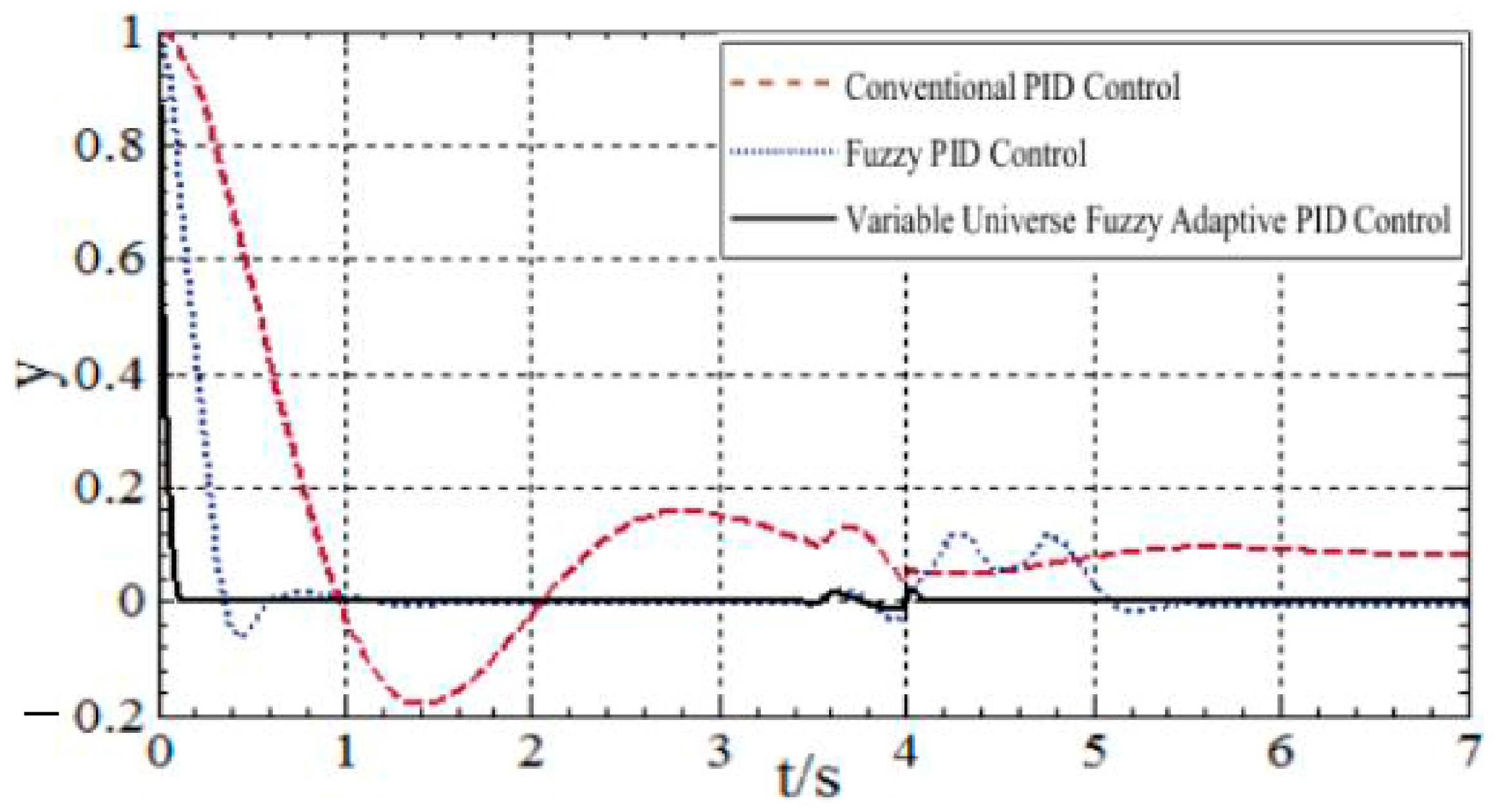
A variable universe fuzzy adaptive PID controller was developed using MATLAB/Simulink, as illustrated in Figure 9. The solar tracking control system simulation model was constructed, and its performance was evaluated under step-input excitation with a sampling period of 1 ms (Figure 10). The system response curves (Figure 11) and corresponding tracking error (Figure 12) demonstrate the controller’s dynamic performance. To further assess robustness against disturbances, a random interference signal was introduced at t = 3.5 s. The disturbed response characteristics (Figure 13) and error analysis (Figure 14) reveal the controller’s adaptability under uncertain conditions.
Under ideal operating conditions, the solar tracking control system was tested and validated using three distinct control algorithms. A comparative analysis was conducted focusing on both dynamic and steady-state performance metrics, with the results summarized in Table 4.

4.2. Complex Operating Environment of Solar Tracking Systems

The solar tracking system operates under complex working conditions, where environmental factors significantly influence photovoltaic panel dynamics. Key disturbances include solar irradiance variations (e.g., cloud occlusion, transient shadows), meteorological interference (e.g., wind-induced vibration, thermal drift, precipitation effects), atmospheric and contamination factors (e.g., light scattering, dust accumulation on panels), and electromagnetic interference (EMI). Using system identification methods, the azimuth and elevation angle control model of the solar panel can be approximated as a second-order system.
G s = 16 1.8 s 2 + 2.4 s + 1
System Identification of Solar Panel Sun-Tracking Systems (Azimuth/Elevation Angles) under Complex Operating Conditions: Emphasizing Robustness against Multi-Source Disturbances and Experimental Reproducibility.
(1) Experimental Design (Quantitative Simulation of Complex Operating Conditions)
(a) Input-Output Definitions
Input u(t): Motor PWM control voltage (amplitude range 0–15 V, corresponding to rotational speed 0–40 °/s).
Output y(t): Azimuth/elevation angle (measured by a photoelectric encoder with 0.01° accuracy).
Disturbance Monitoring: Synchronous acquisition of wind speed (anemometer, range 0–10 m/s), shading duration (light intensity sensor, threshold < 500 W/m2 for shading detection), and ambient temperature (accuracy ±0.5 °C).
(b) Excitation Signal
A pseudo-random binary sequence (PRBS) is employed (clock period 0.5 s, amplitude range 2–8 V) to cover the system’s dynamic bandwidth (0.1–5 Hz).
(c) Disturbance Simulation (Ensuring SCI Reproducibility)
Cloud Shading: Periodic shading (duration 0.5–2 s, interval 5–10 s).
Wind Disturbance: Random pulse-like wind (speed 3–8 m/s, duration 0.3–1 s, interval 3–5 s).
Temperature Drift: Linear temperature rise (25 °C → 40 °C over 15 min).
Electromagnetic Interference: Superimposed voltage noise at 100 Hz with 0.2 V amplitude.
(2) Data Acquisition and Preprocessing
(a) Acquisition Parameters
Sampling frequency fs = 30 Hz, total duration 20 min (including multi-disturbance combined scenarios). Data are synchronously stored for input {u(k)}, output {y(k)}, and disturbance parameters {v(k)} (wind speed, temperature, shading flag).
(b) Preprocessing Pipeline (Quantitative Operations)
Electromagnetic Interference Suppression: Band-pass filtering (0.1–10 Hz, Butterworth second-order).
Outlier Removal: Sliding window (window size 5 samples) + 3σ criterion to eliminate angle jumps caused by wind gusts.
Temperature Drift Detrending: Linear detrending of the output sequence (by fitting a temperature-angle drift curve and subtracting it).
(3) Model Structure Selection
Considering the inertia- and damping-dominated characteristics of the “motor–mechanical transmission” in the sun-tracking system, and despite the presence of multi-source disturbances—which are additive time-varying perturbations—the intrinsic system dynamics can still be approximated as a second-order linear time-invariant (LTI) system. The normalized structure is as follows: G s = K as 2 + bs + 1 .
(4) Robust Parameter Estimation (Recursive Least Squares with Forgetting Factor, RLS)
To address time-varying disturbances under complex operating conditions, an RLS algorithm with a forgetting factor is adopted to estimate the parameters (K, a, b). The procedure is outlined below:
(a) Discretization of the Model
The second-order continuous system is transformed into a discrete-time difference equation using forward differencing (sampling period Ts = 1/30 s):
a y ( k + 2 ) + b y ( k + 1 ) + y ( k ) = K u ( k ) + e ( k ) , where e(k) represents the residual error induced by disturbances.
(b) RLS Recursive Formulas
Initialization: θ 0 = 0 , 0 , 0 T , covariance matrix P 0 = 10 3 I 3 , and forgetting factor λ = 0.98 (balancing time-varying tracking capability and noise suppression).
Iterative Refinement and Continuous Updates:
φ ( k ) = [ y ( k + 2 ) , y ( k + 1 ) , y ( k ) ] T K ( k ) = P ( k 1 ) φ ( k ) ( λ + φ T ( k ) P ( k 1 ) φ ( k ) ) 1 θ ( k ) = θ ( k 1 ) + K ( k ) ( K u ( k ) φ T ( k ) θ ( k 1 ) ) P ( k ) = 1 λ ( I K ( k ) φ T ( k ) ) P ( k 1 )
(c) The parameters converged to the following values after 5000 iterations: K = 16 , a = 1.8 , b = 2.4 .
(5) Model Validation: Quantitative Evaluation under Multiple Interference Scenarios
A comparative analysis of the dynamic responses between the estimated model and the actual system was conducted under three typical interference combinations, with the root mean square error (RMSE) serving as the quantitative metric, shown in Table 5.
The results demonstrate that the robust RLS estimation model achieves significantly lower error rates in complex operating conditions compared to conventional methods, confirming its enhanced adaptability to real-world scenarios.
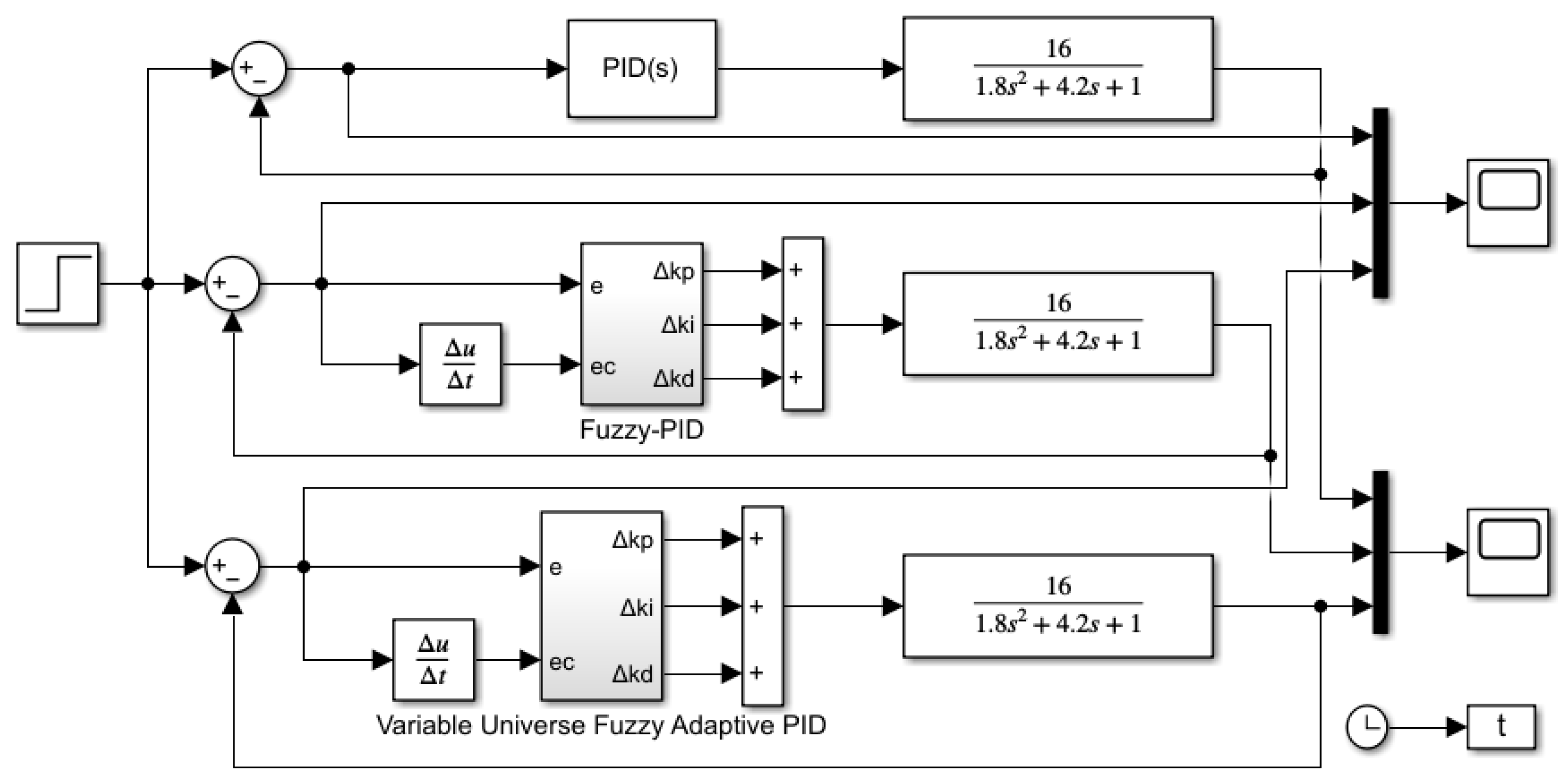
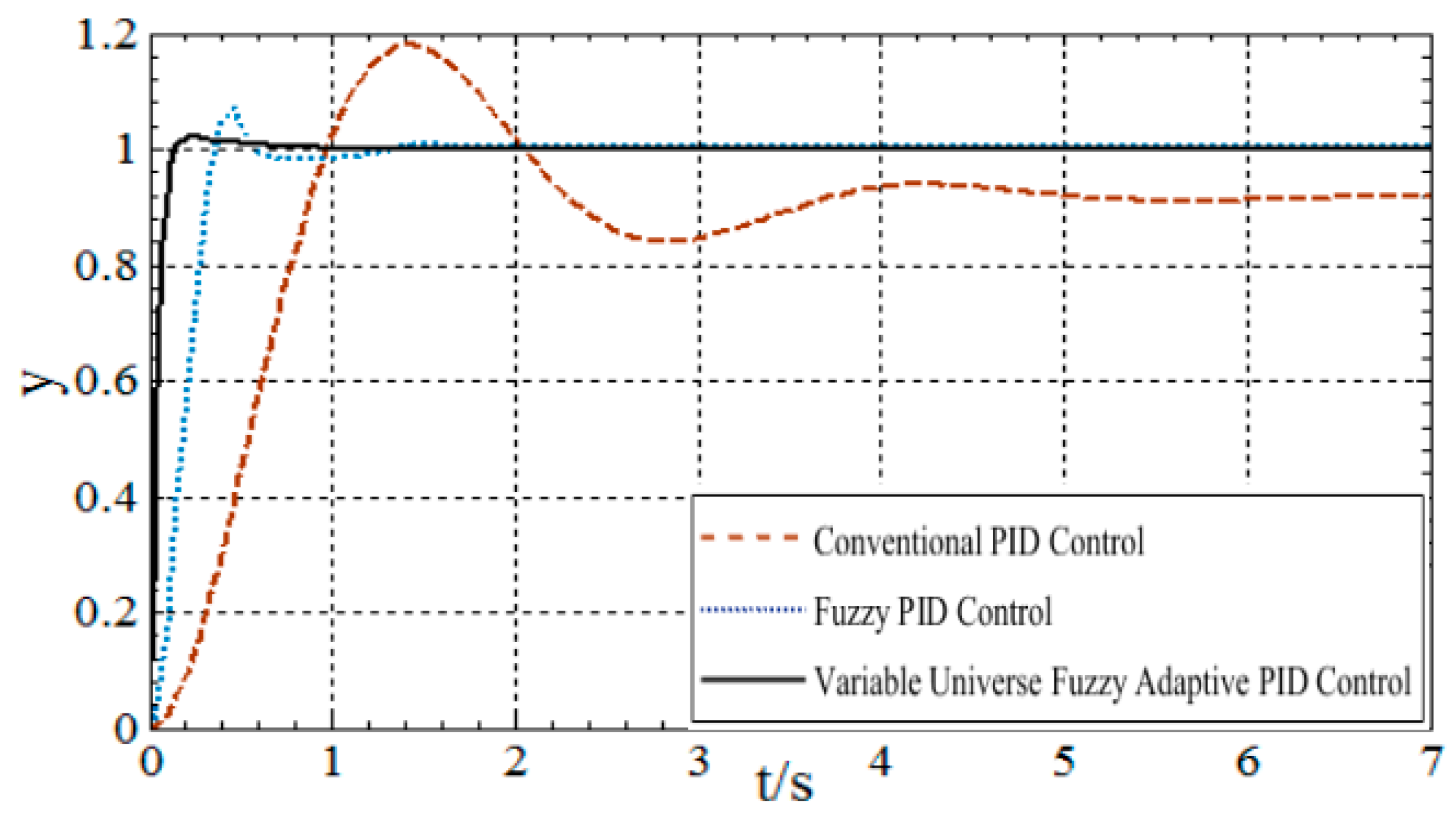
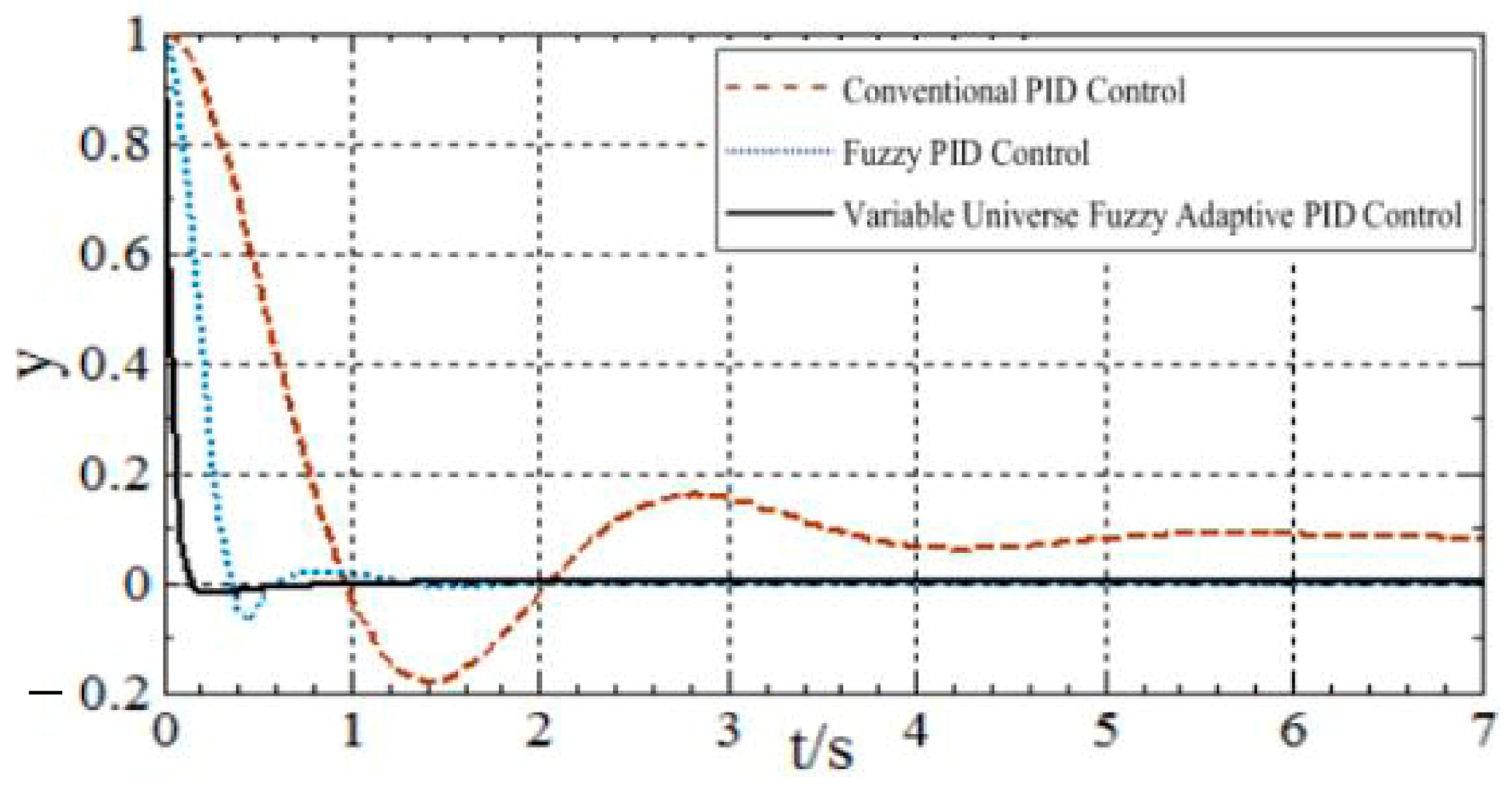
A simulation model of a solar-tracking controller under complex operating conditions was established. Experimental validation was performed using a standard step input signal with a sampling period of 1 ms, as illustrated in Figure 15. The response output curve after operation is presented in Figure 16, while the corresponding tracking error is shown in Figure 17. A stochastic disturbance signal was introduced at t = 3.5 s, after which the perturbed response curve and tracking error are depicted in Figure 18 and Figure 19, respectively.
Under complex operational conditions, three distinct control algorithms were experimentally evaluated for the solar tracking control system. A comprehensive performance comparison was conducted, focusing on dynamic response characteristics (e.g., settling time, overshoot) and steady-state accuracy (e.g., tracking error). The quantitative results are summarized in Table 6, demonstrating each algorithm’s effectiveness in handling real-world disturbances.

5. Conclusions

This study proposes an advanced solar tracking system that combines high-precision four-quadrant detector tracking with GPS positioning technology to achieve real-time localization. Building upon the conventional variable-universe fuzzy PID control algorithm, we introduce a semi-active control strategy that incorporates both system error and error change rate into the design of a novel functional-model scaling factor. This innovation enables adaptive tuning of the scaling factor parameters, effectively addressing the performance degradation caused by conventional scaling factors’ lack of fuzzy rules. The resulting framework establishes a new variable-universe fuzzy PID control model with adaptive scaling factor adjustment (NEVUFP), significantly enhancing tracking precision and dynamic response.
Compared with traditional algorithms, the core improvement of NEVUFP lies in the introduction of a dynamically adaptive universe-of-discourse adjustment mechanism. By sensing the error magnitude in real-time, the width of the fuzzy universe is dynamically adjusted, ensuring rapid system response under large-error conditions while enhancing control precision under small-error conditions. This achieves a dynamic balance between control accuracy and response speed. To verify the algorithm’s performance, multiple sets of simulation experiments were conducted under two operational scenarios for solar panels: an ideal environment and a complex interference environment. The results indicate that the steady-state error of the algorithm can be controlled within 0.1° to 0.8°, the settling time is reduced to 0.6 s, the disturbance recovery time is only 0.7 s, and the overshoot is ≤2%. Compared with systems using conventional PID or fuzzy PID control, the application of the variable-universe fuzzy adaptive PID control algorithm improves the comprehensive energy capture efficiency of solar utilization by approximately 15–20% under ideal conditions (derived based on indicators such as overshoot and error) and by about 14–19% under complex conditions. Moreover, the more complex the operating conditions, the more pronounced the relative improvement in utilization compared to conventional control methods. Experimental data confirm that the NEVUFP control algorithm can better adapt to scenarios in solar tracking systems where target dynamics and complex environmental interference are coupled. It significantly enhances system robustness, control precision, response speed, and intelligent adaptive capability, effectively achieving global optimal control of the tracking system, reducing energy loss, providing technical support for the efficient conversion of solar energy as a sustainable resource, and contributing to the transition toward a green and sustainable energy supply.

Author Contributions

Conceptualization, Z.D. and X.L.; methodology, Z.D. and Y.Y.; software, X.Y.; validation, S.G., X.Y., C.L. and J.R.; formal analysis, J.D. and J.W.; investigation, F.M.; re-sources, S.G.; data curation, X.L.; writing—original draft preparation, Z.D.; writing—review and editing, Z.D., Y.Y. and X.L.; visualization, S.G.; supervision, Z.D. and X.L.; project administration, J.R.; funding acquisition, Z.D. and X.L. All authors have read and agreed to the published version of the manuscript.

Funding

This research was supported by the Qinghai Institute of Technology “Kunlun Elite” Talent Recruitment Research Project, grant number W2023-QLGKLYCZX-034; the 2025 Qinghai Province “Kunlun Talents · High-End Innovation and Entrepreneurship Talent” Program; and the Qinghai: Provincial Backbone Teacher Cultivation Initiative, grant number S-GGJS2024-1-04.

Institutional Review Board Statement

Not applicable.

Informed Consent Statement

Not applicable.

Data Availability Statement

The data that support the findings of this study are available from the corresponding author upon reasonable request.

Conflicts of Interest

Author Shiyan Gao was employed by the Tanyard Engineering Consulting Co., Ltd. The remaining authors declare that the research was conducted in the absence of any commercial or financial relationships that could be construed as a potential conflict of interest.

References

  1. Chaouali, I.; Jebli, M.B.; Gam, I. An assessment of the influence of clean energy and service development on environmental degradation: Evidence for a non-linear ARDL approach for Tunisia. Environ. Sci. Pollut. Res. Int. 2023, 30, 80364–80377. [Google Scholar] [CrossRef]
  2. Ma, Q.; Yang, R.; Lin, Y. Dynamic role of clean energy and sustainable economic growth in coastal region: Novel observations from China. Environ. Res. 2024, 251, 118659. [Google Scholar] [CrossRef]
  3. Ukoba, K.; Yoro, K.O.; Eterigho-Ikelegbe, O.; Ibegbulam, C.; Jen, T.C. Adaptation of solar energy in the Global South: Prospects, challenges and opportunities. Heliyon 2024, 10, e28009. [Google Scholar] [CrossRef]
  4. Yang, R.; Wang, W. Potential of China’s national policies on reducing carbon emissions from coal-fired power plants in the period of the 14th Five-Year Plan. Heliyon 2023, 9, e19868. [Google Scholar] [CrossRef]
  5. Mamodiya, U.; Kishor, I.; Garine, R.; Ganguly, P.; Naik, N. Artificial intelligence based hybrid solar energy systems with smart materials and adaptive photovoltaics for sustainable power generation. Sci. Rep. 2025, 15, 17370. [Google Scholar] [CrossRef]
  6. Zsiborács, H.; Pintér, G.; Vincze, A.; Hegedűsné Baranyai, N. A Control Process for Active Solar-Tracking Systems for Photovoltaic Technology and the Circuit Layout Necessary for the Implementation of the Method. Sensors 2022, 22, 2564. [Google Scholar] [CrossRef] [PubMed]
  7. Harazin, J.; Wróbel, A. Analysis and study of the potential increase in energy output generated by prototype solar tracking, roof mounted solar panels. F1000Research 2020, 9, 1381. [Google Scholar] [CrossRef] [PubMed]
  8. Luo, J.; Ji, H.; Luo, R.; Zheng, X.; Xiao, T. All-Day Freshwater Harvesting Using Solar Auto-Tracking Assisted Selective Solar Absorption and Radiative Cooling. Materials 2025, 18, 2967. [Google Scholar] [CrossRef]
  9. Ruelas, A.; Velázquez, N.; Villa-Angulo, C.; Acuña, A.; Rosales, P.; Suastegui, J. A Solar Position Sensor Based on Image Vision. Sensors 2017, 17, 1742. [Google Scholar] [CrossRef]
  10. Gómez-Uceda, F.J.; Ramirez-Faz, J.; Varo-Martinez, M.; Fernández-Ahumada, L.M. New Omnidirectional Sensor Based on Open-Source Software and Hardware for Tracking and Backtracking of Dual-Axis Solar Trackers in Photovoltaic Plants. Sensors 2021, 21, 726. [Google Scholar] [CrossRef] [PubMed]
  11. Udayanan, R.; Chitraselvi, S.; Ramanujam, N. A novel development of hybrid maximum power point tracking controller for solar pv systems with wide voltage gain DC-DC converter. Sci. Rep. 2024, 14, 19764. [Google Scholar] [CrossRef]
  12. Gora, O.; Akkan, T. Development of a Novel Spherical Light-Based Positioning Sensor in Solar Tracking. Sensors 2023, 23, 3838. [Google Scholar] [CrossRef] [PubMed]
  13. Peng, L.; Li, S.; Huang, Y.; Yang, Y. Solar-Blind Ultraviolet Four-Quadrant Detector and Spot Positioning System Based on AlGaN Diodes. Sensors 2025, 25, 2206. [Google Scholar] [CrossRef]
  14. Diao, K.; Liu, X.; Yao, Z.; Lu, W.; Yang, W. Improved calibration method of a four-quadrant detector based on Bayesian theory in a laser auto-collimation measurement system. Appl. Opt. 2022, 61, 5545–5551. [Google Scholar] [CrossRef]
  15. Yun, Z.; Zhang, Y.; Liu, Q.; Ren, T.; Zhao, B.; Xu, D.; Yang, S.; Ren, D.; Yang, J.; Mo, X.; et al. Research on the simulation method of a BP neural network PID control for stellar spectrum. Opt. Express 2024, 32, 38879–38895. [Google Scholar] [CrossRef] [PubMed]
  16. Madebo, N.W. Hybrid adaptive PID control strategy for UAVs using combined neural networks and fuzzy logic. PLoS ONE 2025, 20, e0331036. [Google Scholar] [CrossRef]
  17. Yusuf, H.; Trent, M. Management of Pelvic Inflammatory Disease in Clinical Practice. Ther. Clin. Risk Manag. 2023, 19, 183–192. [Google Scholar] [CrossRef]
  18. Mikuscheva, A.; Becker, D.; Thompson-Fawcett, M. A 41-Year-Old Patient with a Rare Cause of Severe Abdominal Sepsis Misdiagnosed as PID. Case Rep. Surg. 2018, 2018, 9561798. [Google Scholar] [CrossRef]
  19. Abdelkarim, N.; Mohamed, A.E.; El-Garhy, A.M.; Dorrah, H.T. A New Hybrid BFOA-PSO Optimization Technique for Decoupling and Robust Control of Two-Coupled Distillation Column Process. Comput. Intell. Neurosci. 2016, 2016, 8985425. [Google Scholar] [CrossRef]
  20. Zhang, H.; Wu, J.; An, Y.; Xie, P.; Cui, D. Research on Trajectory-Tracking Control System of Tracked Wall-Climbing Robots. Sensors 2023, 24, 144. [Google Scholar] [CrossRef] [PubMed]
  21. Zargari, S.; Jarrah, A.; Baghbani, F. Fuzzy-based driver monitoring system to assess dangerous driving on roads. Traffic Inj. Prev. 2025, 20, 1–10. [Google Scholar] [CrossRef] [PubMed]
  22. Qiu, Z.; Jia, W.; Ma, X.; Zou, B.; Lin, L. Neural-network-based method for improving measurement accuracy of four-quadrant detectors. Appl. Opt. 2022, 61, F9–F14. [Google Scholar] [CrossRef]
  23. Li, Y.; Deng, H.; Wu, H.; Luo, Y.; Deng, Y.; Yuan, H.; Cui, Z.; Tang, J.; Xiong, J.; Zhang, X.; et al. Rotary Wind-driven Triboelectric Nanogenerator for Self-Powered Airflow Temperature Monitoring of Industrial Equipment. Adv. Sci. 2024, 11, e2307382. [Google Scholar] [CrossRef]
  24. Telle, J.-S.; Upadhaya, A.; Schönfeldt, P.; Steens, T.; Hanke, B.; von Maydell, K. Probabilistic net load forecasting framework for application in distributed integrated renewable energy systems. Energy Rep. 2024, 11, 2535–2553. [Google Scholar] [CrossRef]
  25. Huo, L.; Wu, Z.; Wu, J.; Gao, S.; Chen, Y.; Song, Y.; Wang, S. High-Precision Log-Ratio Spot Position Detection Algorithm with a Quadrant Detector under Different SNR Environments. Sensors 2022, 22, 3092. [Google Scholar] [CrossRef] [PubMed]
  26. Wang, X.; Li, X.; Sun, Q.; Xia, C.; Chen, Y.H. Improved Manta Ray Foraging Optimization for PID Control Parameter Tuning in Artillery Stabilization Systems. Biomimetics 2025, 10, 266. [Google Scholar] [CrossRef]
  27. Euzébio, T.A.M.; Ramirez, M.A.P.; Reinecke, S.F.; Hampel, U. Energy price as an input to fuzzy wastewater level control in pump storage operation. IEEE Access 2023, 11, 93701–93712. [Google Scholar] [CrossRef]
  28. Acharya, D.; Das, D.K. A novel PID controller for pressure control of artificial ventilator using optimal rule based fuzzy inference system with RCTO algorithm. Sci. Rep. 2023, 13, 9281. [Google Scholar] [CrossRef]
  29. Li, J.; Jiang, Y. Variable Universe Fuzzy-Proportional-Integral-Differential-Based Braking Force Control of Electro-Mechanical Brakes for Mine Underground Electric Trackless Rubber-Tired Vehicles. Sensors 2024, 24, 2739. [Google Scholar] [CrossRef]
  30. Li, L.; Li, M.; Yu, Y.; Jia, Y.; Qian, Z.; Xie, Z. Modeling and Regulation of Dynamic Temperature for Layer Houses Under Combined Positive- and Negative-Pressure Ventilation. Animals 2024, 14, 3055. [Google Scholar] [CrossRef]
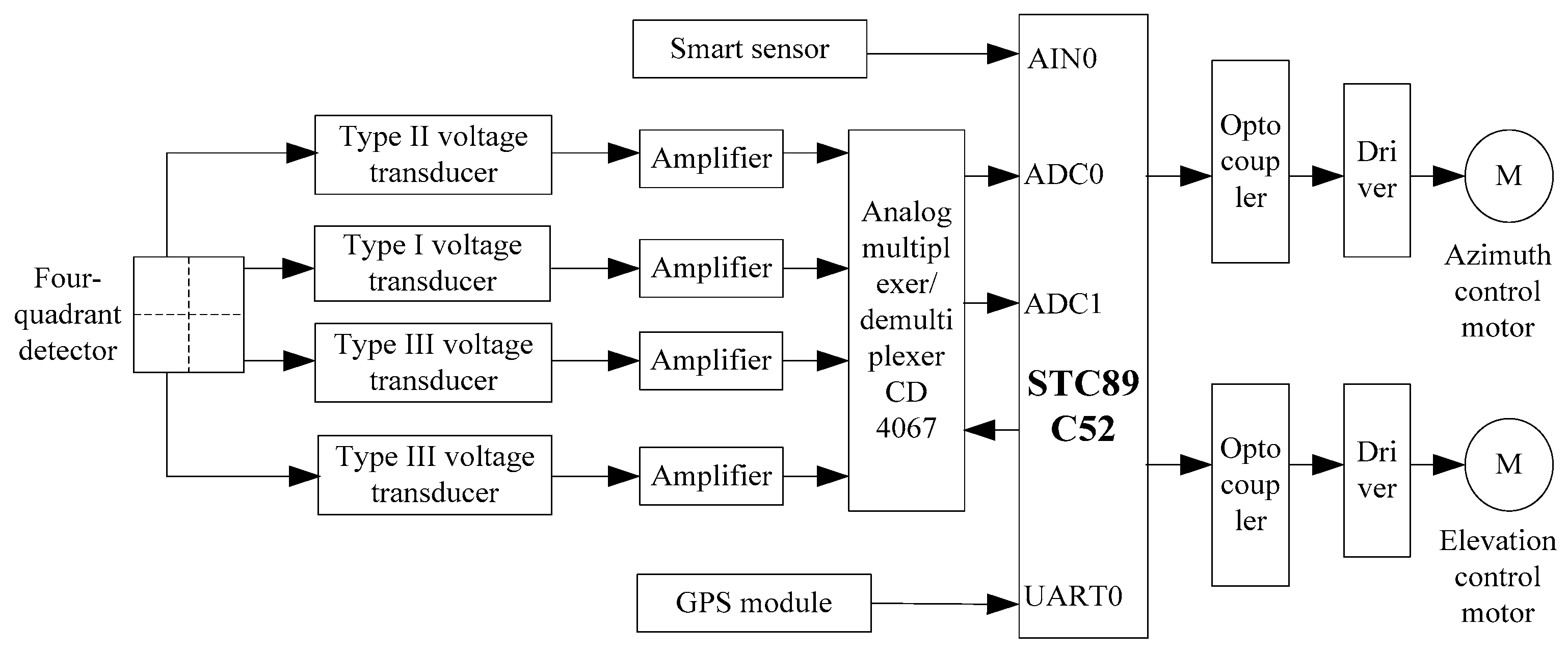
Figure 1. Schematic diagram of the solar tracking system. Representative integrated package: The dashed box indicates a monolithic four-quadrant detector module, which in-ternally integrates four independent photosensitive detection units (corresponding to the signal sources of the four voltage transducers labeled I, II, III, and IV in the diagram).
Sustainability 18 01503 g001
Figure 2. Structural diagram of the four-quadrant detector (QD). The dashed lines in the diagram represent the quadrant division lines and reference baselines for the spot position in the four-quadrant detector. Their function is to partition the detection surface into four independent quadrants, serving as a reference for determining whether the spot center is aligned, while also defining the dead zone to prevent frequent false triggering of the system.
Sustainability 18 01503 g002
Figure 3. Schematic of the light spot distribution. The dashed lines at the border represent the boundary of the photosensitive detection surface of the four-quadrant detector, defining the effective detection range. The dashed lines within the circle indicate the distance vector from the spot center to the coordinate origin, which is used to calculate the offset angle and position of the spot. The circle rep-resents the incident light spot, illustrating its projection range and center coordinates, enabling the system to compute the offset and drive the tracking mechanism.
Sustainability 18 01503 g003
Figure 4. Principle of spot center coordinates and beam deflection angles. The orange line represents the propagation path of the incident light, originating from point 0 in the optical system on the left and ultimately projected onto the photosensitive surface of the four-quadrant detector on the right, with the intersection coordinates denoted as (x0, y0).
Sustainability 18 01503 g004
Figure 5. Architecture diagram of the fuzzy PID control system.
Sustainability 18 01503 g005
Figure 6. Fundamental principle of variable universe.
Sustainability 18 01503 g006
Figure 7. Flowchart of the NEVUFP Control System. The error comparator, as shown in the figure, is employed to receive both the target and actual angular signals of the photovoltaic panel. It calculates and outputs the error signal e(t), which serves as the basis for subsequent adjustments by the fuzzy PID controller.
Sustainability 18 01503 g007
Figure 8. Test flowchart.
Sustainability 18 01503 g008
Figure 9. Variable universe fuzzy adaptive PID controller. The downward arrow denotes the dynamic adjustment of the universe of discourse, with the internal triangular waveform representing the triangular membership function utilized by the fuzzy logic controller.
Sustainability 18 01503 g009
Figure 10. Simulation model of the solar tracking controller under ideal conditions.
Sustainability 18 01503 g010
Figure 11. System response output.
Sustainability 18 01503 g011
Figure 12. Response error results.
Sustainability 18 01503 g012
Figure 13. Disturbed response output.
Sustainability 18 01503 g013
Figure 14. Disturbed error response.
Sustainability 18 01503 g014
Figure 15. Simulation model of the solar tracking controller under complex operating conditions.
Sustainability 18 01503 g015
Figure 16. System response output.
Sustainability 18 01503 g016
Figure 17. Response error results.
Sustainability 18 01503 g017
Figure 18. Disturbed response output.
Sustainability 18 01503 g018
Figure 19. Disturbed error response.
Sustainability 18 01503 g019
Table 1. Fuzzy control rules for ΔKp/ΔKi/ΔKd adjustment.
e/ecΔKp/ΔKi/ΔKd
NBNMNSZOPSPMPB
NBPB/NB/PSPB/NB/PSPM/NM/NBPM/NM/NBPS/NS/NBZO/ZO/NMZO/ZO/PS
PM/PM/PB
NMPB/NB/PSPM/NM/PSPM/NM/NBPS/NS/NMPS/NS/NMZO/ZO/NSNS/ZO/ZO
ZO/PM/PM
NSPM/NB/NSPM/NM/NMPS/NS/NMPS/NS/NMZO/ZO/NSNS/PS/NSNS/PS/ZO
ZO/PB/PM
ZOPM/NM/ZOPS/NS/NSPS/NS/NSZO/ZO/NMNS/PS/NSNM/PM/NSNM/PM/ZO
NM/NB/PB
PSPS/PS/ZOPS/PS/ZOZO/ZO/ZONS/NS/ZONS/NS/ZONM/PM/ZONM/NM/NS
PS/NS/NS
PMPS/NS/PBZO/ZO/NSNS/PS/PSNM/PM/PSNM/PM/PSNB/PB/PSNB/PB/NM
NM/NS/PM
PBZ0/ZO/PBZO/ZO/PMNM/PS/PMNM/PM/PMNM/PM/PSNB/PB/PMNB/PB/PB
PS/NS/NS
Table 2. Fuzzy control rules for α(e(t))/α(ec(t))/β.
e/ecα(e(t))/α(ec(t))/β
CBCMCSZOESEMEB
CBEB/CB/ESEB/CB/ESEM/CM/CBEM/CM/CBES/CS/CBZO/ZO/CMZO/ZO/ES
EM/EM/EB
CMEB/CB/ESEM/CM/ESEM/CM/CBES/CS/CMES/CS/CMZO/ZO/CSCS/ZO/ZO
ZO/EM/EM
CSEM/CB/CSEM/CM/CMES/CS/CMES/CS/CMZO/ZO/CSCS/ES/CSCS/ES/ZO
ZO/EB/EM
ZOEM/CM/ZOES/CS/CSES/CS/CSZO/ZO/CMCS/ES/CSCM/EM/CSCM/EM/ZO
CM/CB/EB
ESES/ES/ZOES/ES/ZOZO/ZO/ZOCS/CS/ZOCS/CS/ZOCM/EM/ZOCM/CM/CS
ES/CS/CS
EMES/CS/EBZO/ZO/CSCS/ES/ESCM/EM/ESCM/EM/ESCB/EB/ESCB/EB/CM
CM/CS/EM
EBZ0/ZO/EBZO/ZO/EMCM/ES/EMCM/EM/EMCM/EM/ESCB/EB/EMCB/EB/EB
ES/CS/CS
Table 3. The relevant key parameters.
Parameter CategorySymbolValue/SettingBasis/Derivation
Initial Controller ValuesInitial PID parameters Kp0, Ki0, Kd08.0, 0.5, 0.1Determined based on standard tuning criteria.
Initial Universe of Discourse BoundariesError (e) initial universe[−15°, 15°]Determined based on standard tuning criteria.
Error change rate (ec) initial universe[−10°/s, 10°/s]Determined based on standard tuning criteria.
Output ΔKp, ΔKi, ΔKd initial universe[−2, 2], [−0.5, 0.5], [−0.1, 0.1]Calculated from the basic universe of discourse and scaling factors.
Scaling Factor ParametersConstant ε0.0001Refer to Equation (19).
Constant δ0.01Refer to Equation (18).
Table 4. Test results of three control algorithms under ideal conditions.
Control AlgorithmSteady-State Error (±°)Settling Time (s)Rise Time (s)Overshoot (%)Disturbance Recovery Time (s)
Conventional PID4~55–60.7202
Fuzzy PID1~20.6–10.182–101.5
Variable Universe Fuzzy Adaptive PID0.1~0.50.2–0.60.11–20.7
Table 5. Validation of the Proposed Model Under Diverse Interference Conditions.
Interference CombinationValidation Set RMSE (RLS)Conventional Least Squares (LS) RMSE
Cloud Cover + Wind Disturbance7.2%14.8%
Temperature Drift + Panel Dust Accumulation6.5%13.3%
Multi-Interference Overlap (Cover + Wind + Temperature)8.1%16.2%
Table 6. Performance comparison of three control algorithms under complex operating conditions.
Control AlgorithmSteady-State Error (±°)Settling Time (s)Rise Time (s)Overshoot (%)Disturbance Recovery Time (s)
Conventional PID4~66–6.60.85192.2
Fuzzy PID1~31.6–2.40.288–102
Variable Universe Fuzzy Adaptive PID0.1~0.80.4–0.60.150–1.50.7
Disclaimer/Publisher’s Note: The statements, opinions and data contained in all publications are solely those of the individual author(s) and contributor(s) and not of MDPI and/or the editor(s). MDPI and/or the editor(s) disclaim responsibility for any injury to people or property resulting from any ideas, methods, instructions or products referred to in the content.