Determinants of Sustainable Organizational Performance: A Systematic Literature Review


Abstract
1. Introduction
2. Literature Review
Sustainable Organizational Performance
3. Research Methods
3.1. Determining Eligibility Criteria
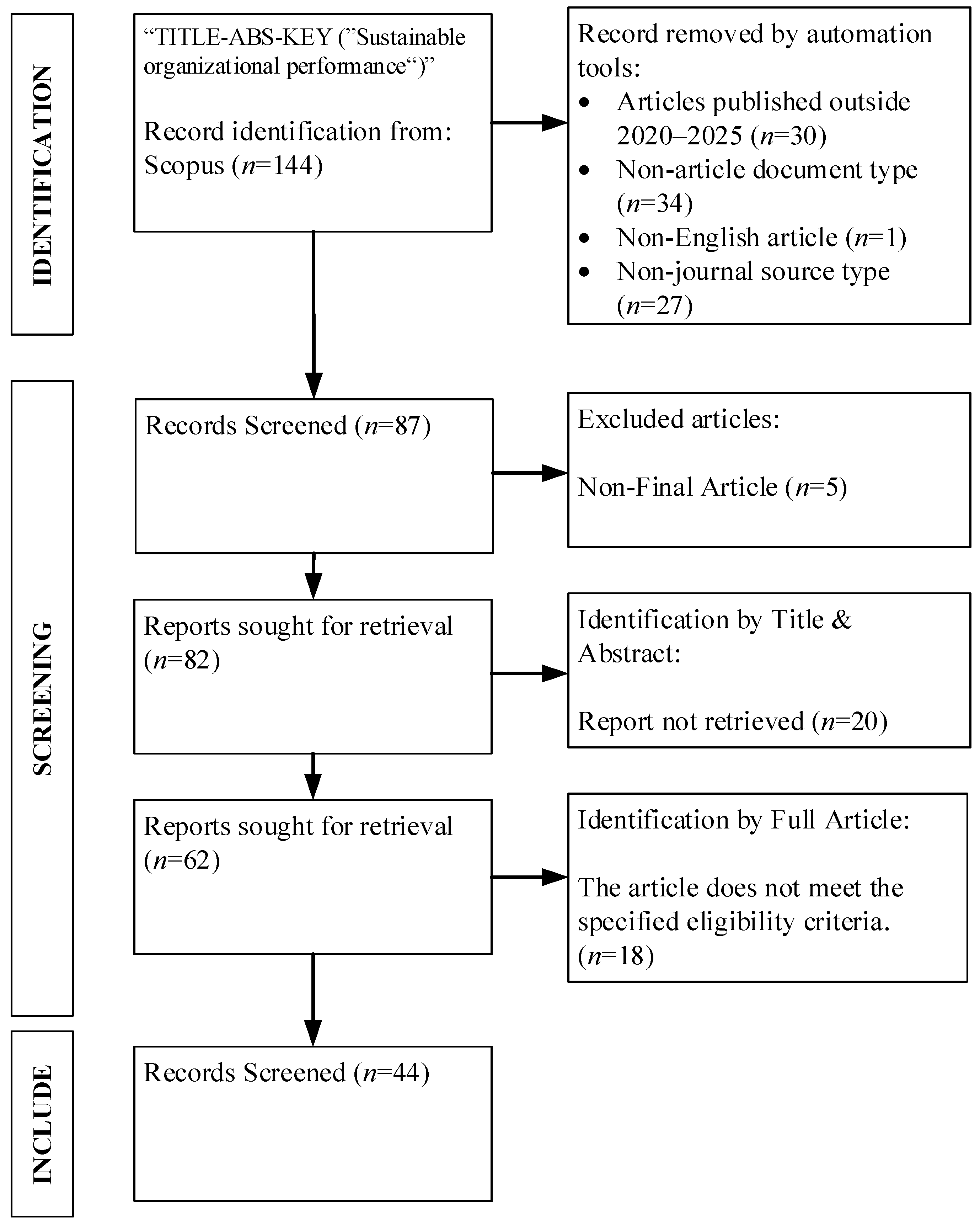
3.2. Source and Identification of Articles
3.3. Articles Deleted Before Screening
- The document is not a journal article (e.g., proceedings, book chapter).
- The article was still in the publication process.
- The source was not a peer-reviewed journal.
- The article was written in a language other than English.
3.4. Screening
3.5. Analysis of the Article Content
3.6. Articles Analyzed
- Subject areas in research articles related to sustainable organizational performance.
- Analyzing factors that can influence sustainable organizational performance in articles that have passed the selection process.
- Examining the theoretical framework used in the research.
- Examining the overall results of the selected articles.
- Examining the conclusions and limitations of the research.
4. Results
4.1. Distribution of Articles
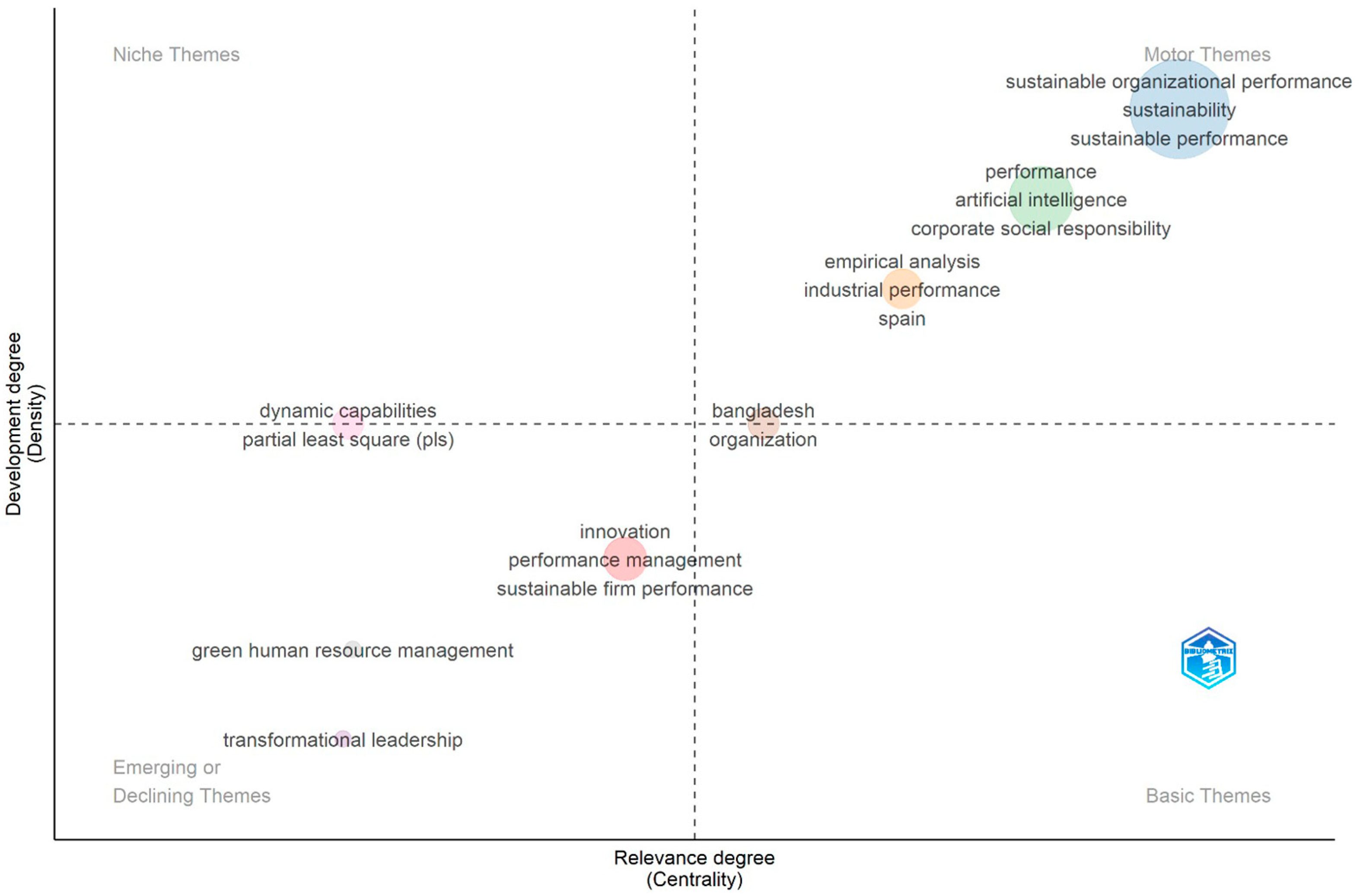
4.1.1. Thematic Analysis
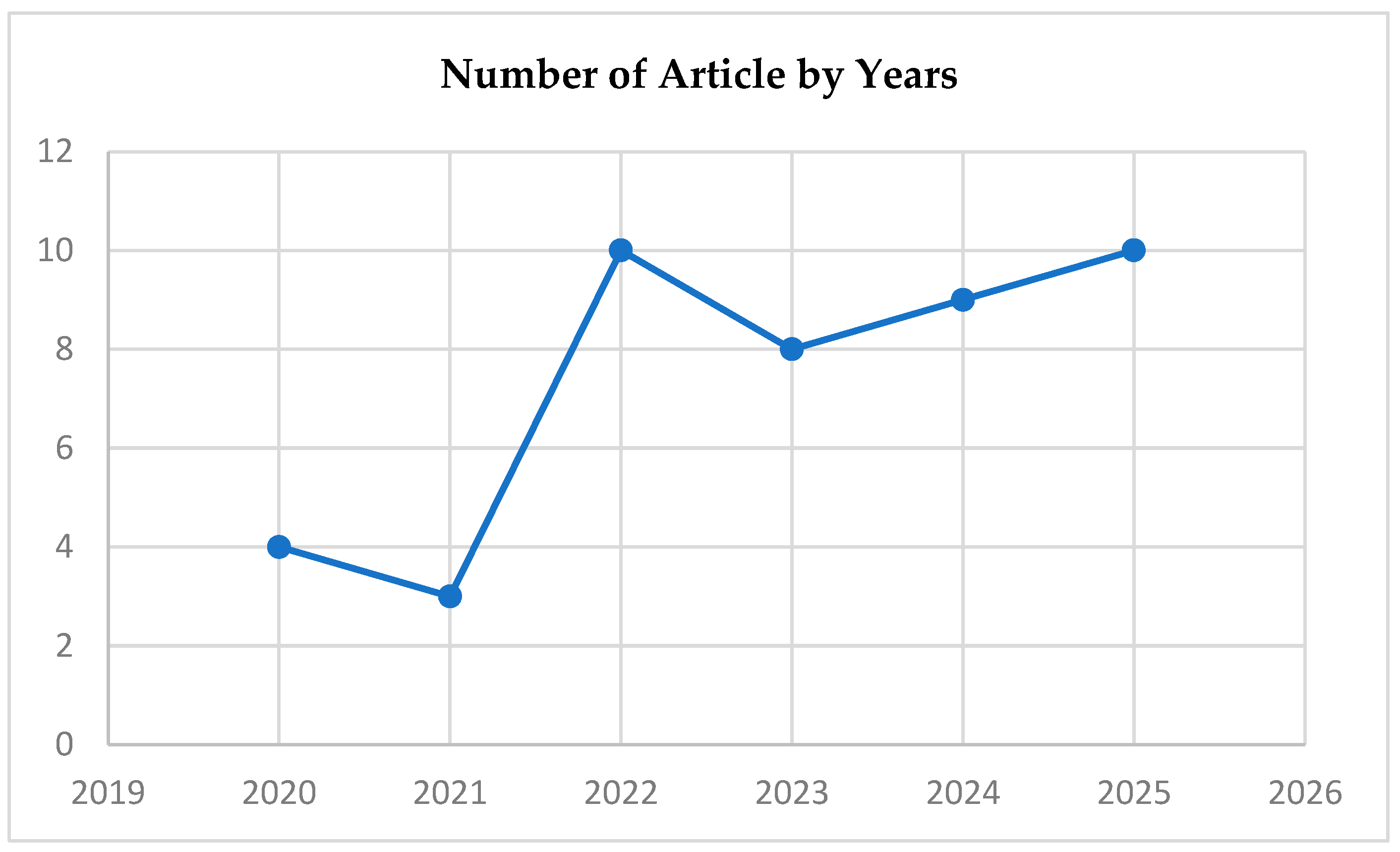
4.1.2. Articles by Years
4.1.3. Articles by Source
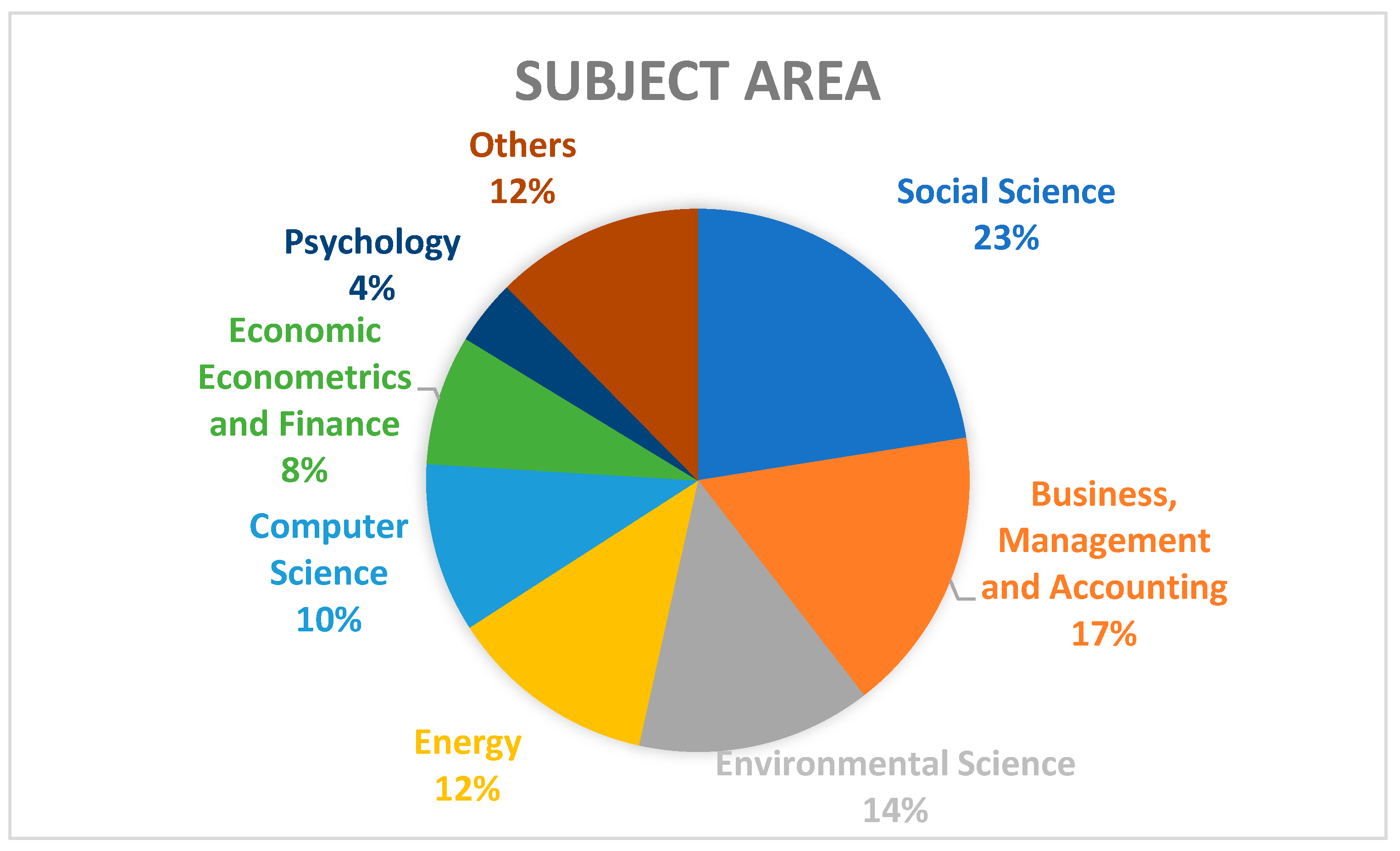
4.1.4. Articles by Subject Area
4.1.5. Theories Used
4.2. Determinants of Sustainable Organizational Performance
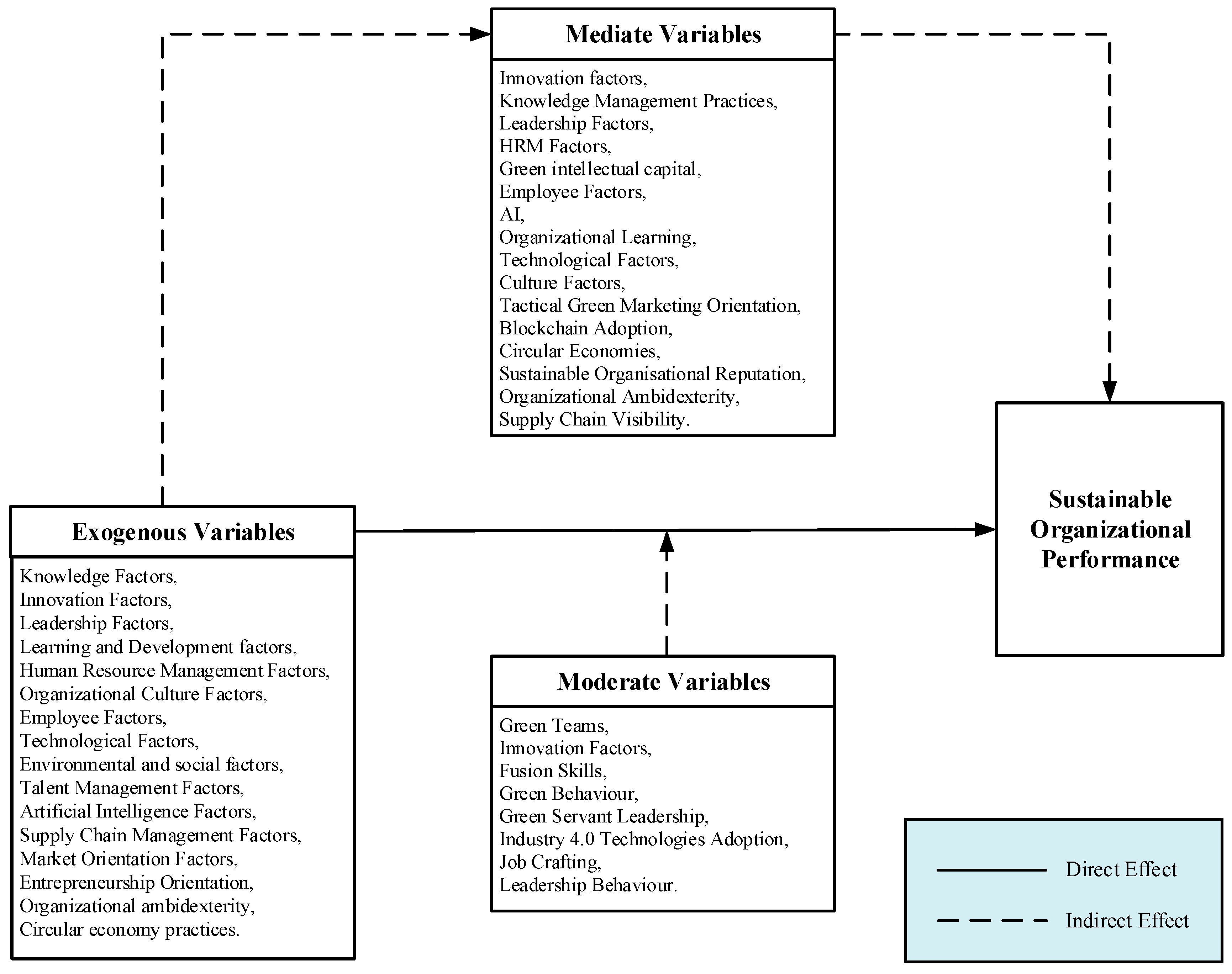
4.2.1. Direct Effect
4.2.2. Mediating Effect
4.2.3. Moderating Effect
5. Discussion
6. Conclusions and Recommendations for Future Research
Author Contributions
Funding
Institutional Review Board Statement
Informed Consent Statement
Data Availability Statement
Conflicts of Interest
Appendix A

| No | Authors | Purpose | Key Finding |
|---|---|---|---|
| 1 | Aina and Atan [37] | Investigating the influence of talent management practices on sustainable organizational performance in real estate companies in the United Arab Emirates. | The research findings indicate that talent attraction and retention do not impact sustainable performance. Conversely, aspects of learning and development, as well as career management, have been proven to impact organizational performance positively. Therefore, management is advised to maximize training programmes, coaching, and job rotation as key strategies in achieving sustainable performance. |
| 2 | Al-Ayed [62] | Measuring the role of AI-based HR construction (AI in HR, strategic HRM, and technological competence) in improving sustainable organizational performance. | This study found a significant positive relationship between the use of AI in HR, the implementation of strategic HRM, and the development of technological competencies with organizational sustainable performance. AI is deemed capable of transforming HRM practices by enhancing decision-making, workforce capabilities, innovation, efficiency, and long-term growth, thereby directly contributing to organizational sustainability in the digital era. |
| 3 | Alnamrouti et al. [38] | Testing the influence of organizational learning and corporate social responsibility on the sustainability of NGO performance, with the mediating role of strategic resource management and AI. | The study results indicate that organizational learning, AI implementation, strategic HRM, and CSR collectively enhance NGOs’ sustainable performance. Furthermore, strategic resource management and AI were found to mediate the relationship between organizational learning and CSR on sustainable performance, suggesting that HR strategies and technology can serve as key connectors in achieving sustainability in the nonprofit sector. |
| 4 | Amin et al. [70] | Investigating the relationship between circular economy practices and sustainable performance (environmental, financial, social) in environmentally friendly garment organizations in Bangladesh. | This study demonstrates that circular economy practices have a significant positive impact on a company’s sustainable performance. Implementing these practices helps address environmental issues, maximize resource utilization, improve energy efficiency, and support the achievement of sustainability across environmental, social, and economic dimensions simultaneously. |
| 5 | Ayad and Al-Sabi [17] | Analyzing the role of organizational culture as a mediator between sustainable leadership practices and sustainable performance in five-star hotels in Egypt, Jordan, and Saudi Arabia. | This study shows that all dimensions of sustainable leadership—foundation practices, higher-level practices, and key performance drivers—significantly influence sustainable performance in economic, social, and environmental aspects, and impact the formation of organizational culture. Additionally, organizational culture is proven to mediate the relationship between sustainable leadership and organizational performance, strengthening the connection between leadership strategies and sustainability. |
| 6 | Bashir et al. [48] | Assessing the role of change leadership in maintaining sustainable growth in Pakistan’s tourism industry and its contribution to poverty reduction. | The research findings confirm that the presence of change leaders helps organizations adapt to crisis situations such as financial crises, pandemics, and climate change. Change leadership promotes employee resilience, maintains organizational performance, and prevents turnover. These findings indicate that a sustainable tourism mindset can moderate this relationship, making change leadership a key factor in achieving the sustainability goals of the tourism sector. |
| 7 | Bhastary et al. [50] | Analyzing the impact of talent management implementation on the sustainable performance of the palm oil industry in Indonesia and the moderating role of green behaviour. | This study reveals that talent management has a significant positive impact on the sustainable performance of the palm oil industry. Additionally, green behaviour acts as a moderating factor that strengthens this relationship, meaning that talent management combined with environmentally friendly behaviour can be an essential strategy in maintaining the sustainability of this industry. |
| 8 | Chen et al. [39] | Investigating the influence of ESG strategies on the sustainable performance of multinational companies, with the mediating role of internal market-oriented culture (IMOC) and the moderating role of job crafting. | The research findings indicate that ESG strategies significantly enhance sustainable performance through the mediating role of IMOC. Job crafting also strengthens the relationship between IMOC and sustainable performance, particularly in collectivist cultures such as China and Japan. Meanwhile, in individualist cultures like the United States and Germany, performance improvements are more dependent on incentives and feedback mechanisms. |
| 9 | Daniel Akinsola et al. [55] | Analyzing the relationship between knowledge risk management and sustainable performance, with the mediating and moderating roles of leadership behaviour. | This study found that knowledge risk management and leadership behaviour both have a positive effect on sustainable performance. In addition, leadership behaviour acts as both a mediator and a moderator in the relationship between knowledge risk management and sustainable performance, emphasizing the importance of leadership in managing knowledge to achieve sustainability. |
| 10 | Elzek et al. [56] | Assessing the impact of talent management practices on the sustainable performance of travel agencies, with green intellectual capital (GIC) as a mediator and green servant leadership (GSL) as a moderator. | The research findings indicate that talent management practices significantly influence the formation of GIC, which in turn positively impacts sustainable performance. GIC mediates the relationship between most dimensions of talent management and sustainable performance, except for the talent retention dimension. However, the moderating role of GSL was not found to be significant, suggesting that green servant leadership does not continually strengthen the relationship between GIC and sustainable performance. |
| 11 | Eniola et al. [52] | Investigating the effect of high-performance work systems (HPWS) on organizational performance sustainability in SMEs, with the mediating role of innovative work behaviour of employees. | This study found that the implementation of HPWS in SMEs in Nigeria can enhance sustainable performance when employees are encouraged to exhibit innovative work behaviour. This behaviour emerges when employees feel a sense of well-being at the workplace, thereby motivating them to contribute creatively. The findings reinforce the view that investing in the development of innovation skills, inspiration, and freedom of expression can simultaneously enhance productivity and organizational sustainability. |
| 12 | Gadekar et al. [73] | Testing the relationship between Industry 4.0 drivers, risk reduction, adoption, and organizational sustainability performance in the manufacturing industry, with a focus on the mediating role of I4.0 adoption. | The results show that both I4.0 adoption and I4.0 risk reduction have a positive impact on sustainability performance. Additionally, I4.0 adoption mediates the relationship between risk reduction and sustainable performance. This study serves as an initial contribution mapping the interconnections between drivers, risk mitigation, technology adoption, and sustainability. It provides practical guidance for manufacturing managers in developing progressive and sustainable business models. |
| 13 | Gupta et al. [60] | Investigating the relationship between the implementation of Cloud ERP as a pillar of Industry 4.0 and the sustainable performance of organizations, taking into account control variables such as company size and type of cloud service. | Research findings indicate that the use of Cloud ERP contributes significantly to improving sustainable performance in technology companies. Cloud ERP strengthens process integration, resource efficiency, and operational flexibility, thereby helping organizations achieve long-term sustainability targets in the context of Industry 4.0. |
| 14 | Hassan et al. [40] | Exploring the influence of information security policies, IT infrastructure, and information security culture on organizational sustainability performance, with a focus on the mediating role of information security culture. | The results of the study indicate that information security policies, IT infrastructure, and information security culture significantly influence sustainability performance. Information security culture plays an essential role as a mediator that connects technology and policies with operational sustainability, especially in the context of transition economies in developing countries. |
| 15 | Hossin et al. [41] | Analyzing the relationship between perceived organizational support (POS) and sustainable performance with the mediation of sustainable organizational reputation (SOR). | This study found that POS is positively related to sustainable performance and sustainable organizational reputation. SOR was also found to have a positive effect on sustainable performance and mediates part of the relationship between POS and sustainable performance. This emphasizes the importance of building strong organizational support to maintain reputation and long-term sustainability. |
| 16 | Ingram et al. [42] | Testing the relationship between entrepreneurial orientation and sustainable performance, mediated by innovation, in family and non-family firms in Poland. | This study shows that entrepreneurial orientation influences innovation and sustainable performance, with the dimension of proactivity being a key factor. There are differences in influence between family and non-family firms, indicating the importance of organizational context in translating entrepreneurial orientation into sustainability. |
| 17 | Inthavong et al. [9] | Analyzing the role of organizational learning on sustainable performance, with the role of organizational network intervention and innovation. | This study found that organizational learning plays a vital role in improving sustainable performance. Organizational networks moderate the relationship between innovation and performance, where innovation can be disruptive if not supported by the right information. These findings confirm that sustainability requires structured and informed learning. |
| 18 | Jangbahadur et al. [58] | Testing the influence of AI-based HRM dimensions on sustainable performance through the mediation of employee engagement and the moderation of fusion skills. | This study found that AI-based HRM dimensions have an indirect effect on sustainable performance through employee engagement as a full or partial mediator, while fusion skills do not moderate this relationship. This indicates that employee engagement is the key link between AI-enabled HRM and sustainability. |
| 19 | Jacobs and Maritz [74] | Assessing the relationship between ambidexterity (exploration and exploitation) and organizational sustainable performance, as well as the moderating effect of environmental turbulence. | The results show a strong positive relationship between exploration and exploitation and sustainable performance. However, environmental turbulence was not found to moderate this relationship. This study suggests that organizations in developing countries should adopt ambidextrous strategies to maintain sustainability in rapidly changing environments. |
| 20 | M. H. Khan and Muktar [64] | Assessing the role of green employee empowerment mediation in the relationship between green HRM and sustainable performance of hospitals in Pakistan. | This study reveals that green HRM practices have a positive impact on hospital sustainability performance, with green employee empowerment serving as a significant mediator. Qualitative analysis supports the quantitative findings, indicating that the combination of environmentally friendly HRM policies and employee empowerment can foster green behaviour that strengthens operational sustainability. |
| 21 | F. A. Khan et al. [71] | This study investigates the influence of stakeholder pressure, corporate social responsibility (CSR), tactical green marketing orientation (TGMO), and service innovation competence on the sustainable business performance of SMEs in Pakistan. It examines the mediating role of TGMO and the moderating role of service innovation competence. | This study found that stakeholder pressure and CSR have a positive impact on TGMO and sustainable business performance. TGMO mediates the influence of stakeholder pressure and CSR on sustainable performance, while service innovation competence strengthens the relationship between TGMO and sustainable performance. These findings confirm that green marketing strategies aligned with service innovation can be an important driver of SME sustainability. |
| 22 | T. Khan et al. [51] | Analyzing the relationship between green supply chain management (GSCM) practices and sustainable organizational performance in construction companies in Pakistan. | This study shows that eco-design has a positive impact on economic, social, and environmental performance; green purchasing has a positive impact on social and environmental performance, while green production and green logistics influence environmental performance. Collaboration with customers was found to have a positive effect on social performance. These results confirm that the implementation of GSCM can enhance multidimensional sustainability in the construction sector. |
| 23 | Kokkaew et al. [43] | Assessing the role of knowledge management (KM) and organizational learning (OL) in the relationship between human resource management (HRM) and sustainable organizational performance in the Thai construction industry. | This study confirms the existence of a positive relationship between HRM, KM, OL, and organizational performance. However, KM and OL were not found to mediate the relationship between HRM and sustainable performance. These results indicate the need for stronger integration between HRM, KM, and OL to enhance competitiveness and sustainability in the construction sector. |
| 24 | Kordab et al. [22] | Testing the role of full-cycle knowledge management mediation (acquisition, creation, storage, sharing, and application) in the relationship between organizational learning and sustainable organizational performance in the knowledge-based sector in the Middle East. | The results indicate that organizational learning has a positive effect on all knowledge management processes (except knowledge creation) and sustainable performance. This study emphasizes the importance of implementing the full knowledge management cycle to maximize the impact of organizational learning on sustainability. |
| 25 | López-López et al. [44] | Testing the role of firm effects and industry effects in explaining sustainable performance, particularly in small businesses in Spain. | This study found that firm effects have a dominant influence on sustainable performance regardless of company size. Although industry effects are relatively small, their influence is greater in small businesses. These findings emphasize the importance of building internal resources while choosing the right sector to support sustainability. |
| 26 | Mollah et al. [45] | Investigating the influence of digital leadership on IT capabilities, organizational learning, and sustainable performance in South Korea. | This study found that digital leadership has a direct impact on sustainable performance, fully mediated by proactive IT attitudes and organizational learning. However, IT infrastructure and business spanning do not mediate this relationship. These findings suggest that digital leadership competencies that drive proactive IT learning and innovation are key to addressing digital challenges. |
| 27 | Nasution et al. [61] | Examining the influence of digital business intensity and digital transformation on organizational ambidexterity and sustainable performance in Indonesian insurance companies. | The results show that digital business transformation and government intervention increase organizational ambidexterity, which then mediates the relationship between digital business intensity and sustainable performance. Digital business intensity also positively moderates this relationship, strengthening the role of ambidexterity in performance sustainability. |
| 28 | Nawangsari et al. [63] | Testing the influence of Green Intellectual Capital (GIC), which consists of Green Human Capital, Green Relational Capital, and Green Structural Capital, on sustainable performance with the mediation of green innovation behaviour and the moderation of perceived green organizational support. | The results indicate that increases in Green Structural Capital and green innovation behaviour are key factors in achieving sustainable performance among millennial managers. Green Human Capital and Green Relational Capital contribute to sustainable performance through enhanced green innovation. However, green organizational support does not moderate the relationship between green innovation and performance, necessitating a more holistic approach to promoting sustainability. |
| 29 | Nguyen et al. [67] | This study examines the impact of knowledge application, government policies, and green market orientation on sustainable performance in Vietnam, with green innovation playing a mediating role. | This study reveals that government policies play a crucial role in facilitating green innovation that enhances sustainable performance. The application of knowledge and green market orientation drives green innovation, although their direct effects on sustainable performance are not significant. Green innovation has proven to be the primary link between these factors and organizational sustainability. |
| 30 | Olan et al. [65] | Exploring the relationship between artificial intelligence (AI), knowledge sharing, and sustainable organizational performance. | This study found that the implementation of AI alone is insufficient to enhance sustainable performance. The integration of AI with complementary knowledge-sharing practices provides a more effective strategy for improving the sustainability of organizational performance in the digital age. This synergy enables the optimization of business processes, better utilization of resources, and sustainable innovation. |
| 31 | Ooi et al. [72] | Investigating the moderating role of Industry 4.0 technology adoption in the relationship between lean production (LP) and sustainable organizational performance in the manufacturing industry. This study identifies ten dimensions of LP, such as supplier feedback, just-in-time delivery, supplier development, customer involvement, continuous flow, set-up time reduction, statistical process control, total productive maintenance, and employee involvement. | The results indicate that the adoption of Industry 4.0 technology positively moderates the relationship between five LP dimensions—namely supplier feedback, supplier development, continuous flow, set-up time reduction, and total productive maintenance—and sustainable performance. These findings provide practical insights for synergistically integrating LP and Industry 4.0 technology to achieve environmental, social, and economic goals. |
| 32 | Qin et al. [18] | Testing the influence of learning organization practices on sustainable performance, with the mediation of knowledge management practices and innovation capabilities. | The results indicate that learning organization practices significantly influence knowledge management and innovation capabilities, both of which positively contribute to sustainable performance. Knowledge management was found to mediate part of this relationship, while innovation capabilities also acted as a significant mediator. This study confirms that the combination of organizational learning, knowledge management, and innovation is a key driver of sustainability in the IT sector. |
| 33 | Salama [53] | Analyzing the contribution of management by objectives (MBO) implementation to the sustainable performance of five-star hotels. | This study found that MBO improves profitability, employee performance, operational effectiveness, and service quality. Both managers and employees showed support for the implementation of MBO because it aligns personal and organizational goals. The activation of MBO is recommended to strengthen sustainability in the hospitality sector. |
| 34 | Sapta et al. [57] | Testing the mediating role of knowledge management in the relationship between organizational culture and leadership style with sustainable performance in traditional organizations based on local culture. | The results show that organizational culture and transformational leadership have a positive effect on knowledge management, which in turn mediates the relationship between the two and sustainable performance. This study confirms the importance of knowledge management in achieving sustainability, primarily in organizations that uphold local cultural values. |
| 35 | Shayegan et al. [59] | Examining the impact of green HR management methods supported by new technology on environmental performance and sustainability in the Iranian automotive industry. | This study shows that recruitment, training, and performance management based on green principles significantly improve environmental performance. Its effectiveness increases when combined with new technologies such as LMS, cloud computing, and AI. This approach strengthens corporate sustainability strategies and corporate image, while also opening up new career opportunities for employees. |
| 36 | Shin et al. [46] | Assessing the influence of digital leadership on sustainable performance, mediated by digital culture and employee digital capabilities. | This study found that digital leadership has a direct and indirect influence on sustainable performance through digital culture and employee digital capabilities. This confirms the strategic role of digital leadership in shaping a sustainability-oriented work ecosystem in the era of digital transformation. |
| 37 | Sinaga et al. [68] | Identifying personal and organizational factors that influence employee environmental behaviour and its relationship to sustainable performance in the tourism sector. | This study found that environmental literacy, environmental empowerment, and environmental leadership significantly influence employee environmental behaviour, which in turn has a positive impact on environmentally friendly organizational performance. However, religiosity, environmental self-efficacy, and environmental training did not show a significant influence. |
| 38 | Skalli et al. [54] | Investigating the effects of CE, Lean Six Sigma (LSS), and Industry 4.0 technology (I4.0T) separately and in combination on sustainable manufacturing performance. | The results indicate that CE, LSS, and I4.0T each have a positive effect on sustainable performance. I4.0T also has a positive impact on LSS and sustainable performance, but does not significantly affect CE. LSS mediates the relationship between I4.0T and sustainable performance, indicating its important role as a strategic link. |
| 39 | Somwethee et al. [75] | Examining the role of intellectual capital, co-creation of value, and organizational agility in building social entrepreneurship capabilities and sustainable community performance. | This study found that intellectual capital drives the creation of shared value and organizational agility, which in turn strengthens social entrepreneurship capabilities. These capabilities have been proven to contribute to long-term success, confirming that the integration of intellectual capital, shared value, and agility is a critical strategy for sustainability. |
| 40 | Sun et al. [69] | Investigating the relationship between knowledge management, blockchain adoption, supply chain visibility, and sustainable performance in the Chinese manufacturing industry. | The results indicate that knowledge management has a positive effect on blockchain adoption and sustainable performance. Blockchain adoption enhances supply chain visibility, which in turn strengthens sustainable performance. Serial mediation analysis confirms that the combination of blockchain and supply chain visibility serves as a key mediator between knowledge management and sustainability. |
| 41 | Umar et al. [47] | Investigating the influence of change management dimensions—change readiness, change climate, and change process—on the sustainable performance of private universities in Malaysia, with the mediation of transformational leadership and knowledge management, and testing the moderation of green teams. | This study found that climate change and change process significantly influence knowledge management, while only climate change positively influences transformational leadership. Knowledge management mediates the relationship between change climate and change process with sustainable performance, whereas transformational leadership mediates the relationship between change climate and sustainable performance. Green team moderation was not found to be significant. These findings emphasize that integrating change management with knowledge management and transformational leadership is crucial for enhancing the sustainability of higher education institutions. |
| 42 | Wang et al. [49] | Examining the influence of efficient resource management practices on the sustainable performance of oil and gas companies in China, with the moderating role of innovative culture. | The results of the study show that practices such as CSR, process and equipment improvement, human resource management, product design, and production planning have a significant positive effect on sustainable performance. Innovative culture strengthens these relationships, indicating that the combination of efficient resource management and innovation promotion can substantially enhance corporate sustainability. This study provides a theoretical and practical foundation for integrating resource management and innovative culture in building sustainable organizations. |
| 43 | Wibowo dan Widodo [19] | Developing a new conceptual model that leverages social innovation agility to enhance organizational sustainability performance, taking into account the role of learning organizations. | This study identifies that high organizational agility and learning leadership have a positive effect on social innovation agility and sustainability performance, while institutional reflexivity has a negative correlation. The resulting model, which consists of six constructs including innovative performance and sustainability, shows interrelated relationships. These results expand our understanding of how organizations can leverage agility and learning to strengthen social innovation that supports sustainability. |
| 44 | Zhang et al. [66] | Examining the synergistic effects of GHRM and GSCM on the sustainability performance of large infrastructure projects, mediated by environmental and social responsibility perceptions (ESRP), using the China–Laos Railway case study. | This study found that both GHRM and GSCM are significantly positively associated with sustainability performance. ESRP mediates part of this relationship, with GSCM showing a more substantial direct effect than GHRM. These results suggest that institutionalizing green management practices and integrating ESRP into decision-making can enhance the long-term viability of projects, as well as provide a framework for policymakers to align the governance of large projects with the SDGs. |
References
- Matakanye, R.M.; Van Der Poll, H.M.; Muchara, B. Do companies in different industries respond differently to stakeholders’ pressures when prioritising environmental, social and governance sustainability performance? Sustainability 2021, 13, 12022. [Google Scholar] [CrossRef]
- Sheehy, B.; Farneti, F. Corporate social responsibility, sustainability, sustainable development and corporate sustainability: What is the difference, and does it matter? Sustainability 2021, 13, 5965. [Google Scholar] [CrossRef]
- Kavadis, N.; Thomsen, S. Sustainable corporate governance: A review of research on long-term corporate ownership and sustainability. Corp. Gov. Int. Rev. 2023, 31, 198–226. [Google Scholar] [CrossRef]
- Nurcahyani, R.D.; Situngkir, T.L. Dampak Rasio Likuiditas, Solvabilitas dan Profitabilitas terhadap Potensi Kebangkrutan Perusahaan. J. Manaj. Univ. Singaperbangsa Karawang 2021, 13, 324–331. [Google Scholar]
- Ngoc-Tan, N.; Gregar, A. Knowledge Management and Its Impacts on Organisational Performance: An Empirical Research in Public Higher Education Institutions of Vietnam. J. Inf. Knowl. Manag. 2019, 18, 1950015. [Google Scholar] [CrossRef]
- Hutahayan, B.; Firera, F.; Al Musadieq, M.; Solimun, S. Exploring the nexus of leadership style, purchasing efficiency, and sustainable economic performance: Fiscal term as moderator. Cogent Bus. Manag. 2025, 12, 2490602. [Google Scholar] [CrossRef]
- Rehman, S.U.; Bhatti, A.; Kraus, S.; Ferreira, J.J.M. The role of environmental management control systems for ecological sustainability and sustainable performance. Manag. Decis. 2020, 59, 2217–2237. [Google Scholar] [CrossRef]
- Hans, D.; Böhm, G. Sustainability seen from the perspective of consumers. Int. J. Consum. Stud. 2011, 36, 678–687. [Google Scholar] [CrossRef]
- Inthavong, P.; Rehman, K.U.; Masood, K.; Shaukat, Z.; Hnydiuk-Stefan, A.; Ray, S. Impact of organizational learning on sustainable firm performance: Intervening effect of organizational networking and innovation. Heliyon 2023, 9, e16177. [Google Scholar] [CrossRef]
- Mohd Zawawi, N.F.; Abd Wahab, S. Organizational sustainability: A redefinition? J. Strateg. Manag. 2019, 12, 397–408. [Google Scholar] [CrossRef]
- Zhang, F.; Zhu, L. Enhancing corporate sustainable development: Stakeholder pressures, organizational learning, and green innovation. Bus. Strateg. Environ. 2019, 28, 1012–1026. [Google Scholar] [CrossRef]
- Shmelev, S.E.; Gilardi, E. Sustainable Business as a Force for Good in the Context of Climate Change: An Econometric Modelling Approach. Sustainability 2025, 17, 1530. [Google Scholar] [CrossRef]
- Hubbard, G. Measuring Organizational Performance: Beyond the Triple Bottom Line. Bus. Strateg. Environ. 2009, 19, 177–191. [Google Scholar]
- Al Musadieq, M.; Riza, M.F.; Hutahayan, B. Leveraging intellectual capital and knowledge management to drive innovation and organizational performance. Int. J. Eng. Bus. Manag. 2024, 16, 1–18. [Google Scholar] [CrossRef]
- Amimakmur, S.A.; Rahayu, S.M.; Damayanti, C.R.; Hutahayan, B. A Systematic Literature Review: Determinant of Company Value in Financial Companies. WSEAS Trans. Bus. Econ. 2024, 21, 475–487. [Google Scholar] [CrossRef]
- Page, M.J.; McKenzie, J.E.; Bossuyt, P.M.; Boutron, I.; Hoffmann, T.C.; Mulrow, C.D.; Shamseer, L.; Tetzlaff, J.M.; Akl, E.A.; Brennan, S.E.; et al. The PRISMA 2020 statement: An updated guideline for reporting systematic reviews. BMJ 2021, 372, n71. [Google Scholar] [CrossRef]
- Ayad, T.H.; Al-Sabi, S.M. Effect of Sustainable Leadership Practices on Sustainable Organizational Performance in the Hospitality Sector. Does Organizational Culture Matter? J. Tour. Serv. 2025, 16, 278–301. [Google Scholar] [CrossRef]
- Qin, J.; Nagamatsu, M.; Panyasiri, C.; Submahachok, P. The analysis of a causal model of learning organization on sustainable organizational performance of public IT companies in China: Knowledge management practices and innovation capability as multiple mediators. J. Infrastruct. Policy Dev. 2024, 8, 1–21. [Google Scholar] [CrossRef]
- Wibowo, M.A.; Widodo. The Approach of Social Innovation Agility: A Dynamic Capability Strategy. Qual. Access Success 2022, 23, 188. [Google Scholar] [CrossRef]
- Zhou, S.S.; Zhou, A.J.; Feng, J.; Jiang, S. Dynamic capabilities and organizational performance: The mediating role of innovation. J. Manag. Organ. 2019, 25, 731–747. [Google Scholar] [CrossRef]
- Schaltegger, S.; Wagner, M. Managing the Business Case for Sustainability: The Integration of Social, Environmental and Economic Performance; Routledge: Abingdon, UK, 2017. [Google Scholar]
- Kordab, M.; Raudeliūnienė, J.; Meidutė-Kavaliauskienė, I. Mediating role of knowledge management in the relationship between organizational learning and sustainable organizational performance. Sustainability 2020, 12, 10061. [Google Scholar] [CrossRef]
- Dilrukshi, M.H.S.; Aluthge, C. Influence of Green Human Resource Practices on Sustainable Organizational Performance: A Review of Literature. Sri Lankan J. Bus. Econ. 2024, 13, 1–21. [Google Scholar] [CrossRef]
- Moloney, W.; Cheung, G.; Jacobs, S. Key elements to support primary healthcare nurses to thrive at work: A mixed-methods sequential explanatory study. J. Adv. Nurs. 2024, 80, 3812–3824. [Google Scholar] [CrossRef]
- Wang, Y.; Zhang, H. Achieving sustainable new product development by implementing big data-embedded new product development process. Sustainability 2020, 12, 4681. [Google Scholar] [CrossRef]
- Elkington, J. The triple bottom line. Environ. Manag. Read. Cases 1997, 2, 49–66. [Google Scholar]
- Barney, J.B. Resource-based theories of competitive advantage: A ten-year retrospective on the resource-based view. J. Manag. 2001, 27, 643–650. [Google Scholar] [CrossRef]
- Lubis, N.W. Resource Based View (RBV) in Improving Company Strategic Capacity. Res. Horiz. 2022, 2, 587–596. [Google Scholar] [CrossRef]
- Kitchenham, B.; Pretorius, R.; Budgen, D.; Brereton, O.P.; Turner, M.; Niazi, M.; Linkman, S. Systematic literature reviews in software engineering-A tertiary study. Inf. Softw. Technol. 2010, 52, 792–805. [Google Scholar] [CrossRef]
- Carrera-Rivera, A.; Ochoa, W.; Larrinaga, F.; Lasa, G. How-to conduct a systematic literature review: A quick guide for computer science research. MethodsX 2022, 9, 101895. [Google Scholar] [CrossRef]
- Putra, R.W.Y.; Sunyono; Haenilah, E.Y.; Hariri, H.; Sutiarso, S.; Nurhanurawati; Supriadi, N. Systematic Literature Review on the Recent Three-Year Trend Mathematical Representation Ability in Scopus Database. Infin. J. 2023, 12, 243–260. [Google Scholar] [CrossRef]
- Saleh, Y.; Mahat, H.; Hashim, M.; Nayan, N.; Suhaili, S.; Ghazali, M.K.A.; Hayati, R.; Utami, R.K.S. A systematic literature review (SLR) on the development of sustainable heritage cities in Malaysia. J. Reg. City Plan. 2021, 32, 290–310. [Google Scholar] [CrossRef]
- Ed-Dafali, S.; Patel, R.; Paltrinieri, A. Factors influencing the success and failure of crowdfunding campaigns: A systematic review and bibliometric analysis. Ventur. Cap. 2025, 00, 1–66. [Google Scholar] [CrossRef]
- Sitompul, H.; Saifi, M.; Hutahayan, B.; Sunarti. Use of Renewable Energy to Enhance Firm Performance: A Systematic Review. Sustainability 2024, 16, 9157. [Google Scholar] [CrossRef]
- Deshpande, P.; Srivastava, A.P. A study to explore the linkage between green training and sustainable organizational performance through emotional intelligence and green work life balance. Eur. J. Train. Dev. 2023, 47, 615–634. [Google Scholar] [CrossRef]
- Ed-Dafali, S.; Adardour, Z.; Derj, A.; Bami, A.; Hussainey, K. A PRISMA-Based Systematic Review on Economic, Social, and Governance Practices: Insights and Research Agenda. Bus. Strateg. Environ. 2025, 34, 1896–1916. [Google Scholar] [CrossRef]
- Al Aina, R.; Atan, T. The impact of implementing talent management practices on sustainable organizational performance. Sustainability 2020, 12, 8372. [Google Scholar] [CrossRef]
- Alnamrouti, A.; Rjoub, H.; Ozgit, H. Do Strategic Human Resources and Artificial Intelligence Help to Make Organisations More Sustainable? Evidence from Non-Governmental Organisations. Sustainability 2022, 14, 7327. [Google Scholar] [CrossRef]
- Chen, K.S.; Lin, S.T.; Chuang, C.J. ESG Strategies and Sustainable Performance in Multinational Enterprises. Sustainability 2025, 17, 751. [Google Scholar] [CrossRef]
- Hassan, Y.; Ghazal, T.M.; Yasir, S.; Al-Adwan, A.S.; Younes, S.S.; Albahar, M.A.; Ahmad, M.; Ikram, A. Exploring the Mediating Role of Information Security Culture in Enhancing Sustainable Practices Through Integrated Systems Infrastructure. Sustainability 2025, 17, 687. [Google Scholar] [CrossRef]
- Hossin, M.A.; Hosain, M.S.; Frempong, M.F.; Adu-Yeboah, S.S.; Mustafi, M.A.A. What drives sustainable organizational performance? The roles of perceived organizational support and sustainable organizational reputation. Sustainability 2021, 13, 12363. [Google Scholar] [CrossRef]
- Ingram, T.; Bratnicka-Myśliwiec, K.; Kraśnicka, T.; Steinerowska-Streb, I. Entrepreneurial Orientation as a Determinant of Sustainable Performance in Polish Family and Non-Family Organizations. Sustainability 2022, 14, 16393. [Google Scholar] [CrossRef]
- Kokkaew, N.; Peansupap, V.; Jokkaw, N. An Empirical Examination of Knowledge Management and Organizational Learning as Mediating Variables between HRM and Sustainable Organizational Performance. Sustainability 2022, 14, 13351. [Google Scholar] [CrossRef]
- López-López, V.; Iglesias-Antelo, S.; Fernández, E. Is sustainable performance explained by firm effect in small business? Sustainability 2020, 12, 10028. [Google Scholar] [CrossRef]
- Mollah, M.A.; Choi, J.H.; Hwang, S.J.; Shin, J.K. Exploring a Pathway to Sustainable Organizational Performance of South Korea in the Digital Age: The Effect of Digital Leadership on IT Capabilities and Organizational Learning. Sustainability 2023, 15, 7875. [Google Scholar] [CrossRef]
- Shin, J.; Mollah, M.A.; Choi, J. Sustainability and Organizational Performance in South Korea: The Effect of Digital Leadership on Digital Culture and Employees’ Digital Capabilities. Sustainability 2023, 15, 2027. [Google Scholar] [CrossRef]
- Umar, S.B.; Ahmad, J.; Mohd Bukhori, M.A.B.; Ali, K.A.M.; Hussain, W.M.H.W. Transforming Higher-Education-Intitutes: Impact of Change Management on Sustainable Performance Through Transformational Leadership and Knowledge Management. Sustainability 2025, 17, 2445. [Google Scholar] [CrossRef]
- Bashir, F.; Tahir, Z.; Aslam, A. Role of change leadership in attaining sustainable growth and curbing poverty: A case of Pakistan tourism industry. Front. Psychol. 2022, 13, 934572. [Google Scholar] [CrossRef] [PubMed]
- Wang, Y.; Zhang, S.; Xu, S. Impact of Efficient Resource Management Practices on Sustainable Performance: Moderating Role of Innovative Culture-Evidence From Oil and Gas Firms. Front. Psychol. 2022, 13, 938247. [Google Scholar] [CrossRef]
- Bhastary, M.D.; Lubis, A.R.; Utami, S.; Kesuma, T.M. Implementation Of Talent Management as An Effort to Realize Sustainable Performance of The Palm Oil Industry in Indonesia. Qual.-Access Success 2023, 24, 255–262. [Google Scholar] [CrossRef]
- Khan, T.; Ali, A.; Khattak, M.S.; Arfeen, M.I.; Chaudhary, M.A.I.; Syed, A. Green supply chain management practices and sustainable organizational performance in construction organizations. Cogent Bus. Manag. 2024, 11, 2331990. [Google Scholar] [CrossRef]
- Eniola, A.A.; Kenzhin, Z.; Chimwai, L.; Kairliyeva, G.; Adeyeye, M.M.; Chidoko, C.; Mutsikiwa, M. High-performance work system on sustainable organizations performance in SMEs. Bus. Theory Pract. 2023, 24, 447–458. [Google Scholar] [CrossRef]
- Salama, W.M.E. Impact of Management by Objectives in Enhancing Sustainable Organisational Performance in Hotels. Afr. J. Hosp. Tour. Leis. 2021, 10, 805–820. [Google Scholar] [CrossRef]
- Skalli, D.; Charkaoui, A.; Cherrafi, A.; Garza-Reyes, J.A.; Antony, J.; Shokri, A. Analyzing the integrated effect of circular economy, Lean Six Sigma, and Industry 4.0 on sustainable manufacturing performance from a practice-based view perspective. Bus. Strateg. Environ. 2024, 33, 1208–1226. [Google Scholar] [CrossRef]
- Daniel Akinsola, G.; Farmanesh, P.; Madhy Mwamba, N. The Relationship Between Knowledge Risk Management and Sustainable Organizational Performance: The Mediating and Moderating Role of Leadership Behavior. Economics 2023, 17, 20220047. [Google Scholar] [CrossRef]
- Elzek, Y.S.; Soliman, M.; Al Riyami, H.; Scott, N. Talent management and sustainable performance in travel agents: Do green intellectual capital and green servant leadership matter? Curr. Issues Tour. 2024, 27, 3115–3130. [Google Scholar] [CrossRef]
- Sapta, I.K.S.; Sudja, I.N.; Landra, I.N.; Rustiarini, N.W. Sustainability performance of organization: Mediating role of knowledge management. Economies 2021, 9, 97. [Google Scholar] [CrossRef]
- Jangbahadur, U.; Ahlawat, S.; Rozera, P.; Gupta, N. The effect of AI-enabled HRM dimensions on employee engagement and sustainable organisational performance: Fusion skills as a moderator. Evid.-Based HRM 2025, 13, 85–107. [Google Scholar] [CrossRef]
- Shayegan, S.; Bazrkar, A.; Yadegari, R. Realization of Sustainable Organizational Performance Using New Technologies and Green Human Resource Management Practices. Foresight STI Gov. 2023, 17, 95–105. [Google Scholar] [CrossRef]
- Gupta, S.; Meissonier, R.; Drave, V.A.; Roubaud, D. Examining the impact of Cloud ERP on sustainable performance: A dynamic capability view. Int. J. Inf. Manag. 2020, 51, 102028. [Google Scholar] [CrossRef]
- Nasution, H.; Muafi, M.; El-Qadri, Z.M.; Suprihanto, J. Impact of digital business transformation on organizational ambidexterity and performance in Indonesian insurance firms. Intang. Cap. 2025, 21, 1–20. [Google Scholar] [CrossRef]
- Al-Ayed, S. Role of artificial intelligence in human resource to achieve sustainable organizational performance. Int. J. Innov. Res. Sci. Stud. 2025, 8, 1613–1621. [Google Scholar] [CrossRef]
- Nawangsari, L.C.; Siswanti, I.; Arijanto, A.; Wahyu, M. From Knowledge to Action: Exploring Green Intellectual Capital’s Role in Sustainable Organizational Performance for Millennials. Int. Rev. Manag. Mark. 2025, 15, 82–90. [Google Scholar] [CrossRef]
- Khan, M.H.; Muktar, S.N. Green employee empowerment: The missing linchpin between green HRM and sustainable organizational performance. J. Clean. Prod. 2024, 434, 139812. [Google Scholar] [CrossRef]
- Olan, F.; Ogiemwonyi Arakpogun, E.; Suklan, J.; Nakpodia, F.; Damij, N.; Jayawickrama, U. Artificial intelligence and knowledge sharing: Contributing factors to organizational performance. J. Bus. Res. 2022, 145, 605–615. [Google Scholar] [CrossRef]
- Zhang, M.; Panichakarn, B.; Shen, S. Impact of Green Human Resource Management and Green Supply Chain Management Practices on Sustainable Organizational Performance-A Case of China-Laos Railway. J. Chin. Hum. Resour. Manag. 2025, 16, 3–21. [Google Scholar] [CrossRef]
- Nguyen, N.T.T.; Van Nguyen, P.; Vrontis, D.; Vo, N.T.T. Enhancing organizational sustainable performance through green innovation: The roles of knowledge application, government policy, and green market orientation. J. Knowl. Manag. 2025, 29, 870–890. [Google Scholar] [CrossRef]
- Sinaga, E.K.; Suryadi, E.; Goeltom, A.D.L.; Rakhman, C.U.; Susanto, E. Personal and Organizational Factors Supporting Green Hrm Performance in the Tourism Industry. J. East. Eur. Cent. Asian Res. 2024, 11, 272–289. [Google Scholar] [CrossRef]
- Sun, Y.; Shahzad, M.; Razzaq, A. Sustainable organizational performance through blockchain technology adoption and knowledge management in China. J. Innov. Knowl. 2022, 7, 100247. [Google Scholar] [CrossRef]
- Bin Amin, M.; Asaduzzaman, M.; Debnath, G.C.; Rahaman, M.A.; Oláh, J. Effects of circular economy practices on sustainable firm performance of green garments. Oeconomia Copernic. 2024, 15, 637–682. [Google Scholar] [CrossRef]
- Khan, F.A.; Sheikh, A.A.; Zainab, F.; Sciences, M.S.M. The Impact of SMEs Capability for Service Innovation and Its Tactical Green Marketing on Sustainable Business Performance. J. Small Bus. Strateg. 2024, 34, 95–108. [Google Scholar] [CrossRef]
- Ooi, L.L.; Teh, S.Y.; Cheang, P.Y.S. The impact of lean production on sustainable organizational performance: The moderating effect of industry 4.0 technologies adoption. Manag. Res. Rev. 2023, 46, 1802–1836. [Google Scholar] [CrossRef]
- Gadekar, R.; Sarkar, B.; Gadekar, A. Investigating the relationship among Industry 4.0 drivers, adoption, risks reduction, and sustainable organizational performance in manufacturing industries: An empirical study. Sustain. Prod. Consum. 2022, 31, 670–692. [Google Scholar] [CrossRef]
- Jacobs, M.; Maritz, R. Dynamic strategy: Investigating the ambidexterity- performance relationship. S. Afr. J. Bus. Manag. 2020, 51, a1643. [Google Scholar] [CrossRef]
- Somwethee, P.; Ru-Zhue, J.; Aujirapongpan, S.; Chanthawong, A.; Usman, B. Developing social entrepreneurial capability in Thai community enterprises: The roles of intellectual capital, creating shared value, and organizational agility on sustainability. Soc. Sci. Humanit. Open 2025, 11, 101269. [Google Scholar] [CrossRef]
- Teece, D.J.; Pisano, G.; Shuen, A. Dynamic capabilities and strategic management. Knowl. Strateg. 2009, 18, 77–116. [Google Scholar] [CrossRef]
- Harden, G.; Boakye, K.G.; Ryan, S. Turnover Intention of Technology Professionals: A Social Exchange Theory Perspective. J. Comput. Inf. Syst. 2018, 58, 291–300. [Google Scholar] [CrossRef]
- Grant, R.M. Knowledge-Based View. Strateg. Manag. 2015, 12. [Google Scholar] [CrossRef]
- Dacin, M.T.; Goodstein, J.; Scott, W.R. Institutional theory and institutional change: Introduction to the special research forum. Acad. Manag. J. 2002, 45, 45–57. [Google Scholar] [CrossRef]
- Mahajan, R.; Lim, W.M.; Sareen, M.; Kumar, S.; Panwar, R. Stakeholder theory. J. Bus. Res. 2023, 166, 114104. [Google Scholar] [CrossRef]
- Rulianti, E.; Nurpribadi, G. Model AMO (Ability, Motivation, Opportunity) dalam Pemberdayaan SDM UKM Batik: Strategi Peningkatan Produktivitas dan Daya Saing. Lentera Pengabdi. 2025, 3, 280–287. [Google Scholar]
- Islam, J.; Hu, H. A review of literature on contingency theory in managerial accounting. Afr. J. Bus. Manag. 2012, 6, 5159–5164. [Google Scholar] [CrossRef]
- Yufriadi, F.; Syahriani, F.; Afifi, A.A. Trade Transformation In The Digital Era: Agency Role, Opportunities And Challenges. AL-IMAM J. Islam. Stud. Civiliz. Learn. Soc. 2024, 5, 13–23. [Google Scholar] [CrossRef]
- Page, M.J.; McKenzie, J.E.; Bossuyt, P.M.; Boutron, I.; Hoffmann, T.C.; Mulrow, C.D.; Shamseer, L.; Tetzlaff, J.M.; Moher, D. Updating guidance for reporting systematic reviews: Development of the PRISMA 2020 statement. J. Clin. Epidemiol. 2021, 134, 103–112. [Google Scholar] [CrossRef] [PubMed]
- Afrianty, T.W.; Putriwahyuni, S. Analisis Keadilan Prosedural Dalam Penilaian Kinerja: Perspektif Social Exchange Theory. E-J. Ekon. Bisnis Univ. Udayana 2020, 3, 227. [Google Scholar] [CrossRef]
- Salam, A.; Oktapiani, S.; Mandasari, J. Peran Implementasi Modal Intelektual terhadap Peningkatan Keberlanjutan Kemajuan Usaha Mikro Kecil Menengah (UMKM) di Kabupaten Sumbawa. Owner 2023, 7, 3643–3659. [Google Scholar] [CrossRef]
- Hutahayan, B.; Astuti, E.S.; Raharjo, K.; Hamid, D. Praktik Kepemimpinan Transformasional di BUMN (Kajian Empiris Karyawan PT Barata Indonesia (Persero)); Deepublish: Sleman, Indonesia, 2020. [Google Scholar]
- Hutahayan, B. Perilaku Organisasi: Untuk Bisnis Berkelanjutan; Deepublish: Sleman, Indonesia, 2024. [Google Scholar]
- Wijaya, I.; Rahardjo, K.; Abdillah, Y.; Riza, M.F. Sustainability performance in business: A systematic review of leadership, culture, capability and digital marketing contributions. Cogent Bus. Manag. 2025, 12, 2543049. [Google Scholar] [CrossRef]
- Wijaya, I.; Rahardjo, K.; Abdillah, Y.; Riza, M.F. The Influence of Sustainable Leadership, Organizational Culture, and Digital Marketing on Sustainable Performance: A Study on Tourism Sector Companies in Indonesia. Sustainability 2025, 17, 6238. [Google Scholar] [CrossRef]


| Eligibility Criteria | Exclusion Criteria |
|---|---|
| The article is a final manuscript that has undergone peer review | Articles that do not examine the direct influence of “Sustainable organizational performance” or “Sustainable Performance” |
| The article is an empirical study | Articles that do not discuss “Sustainable organizational performance” or “Sustainable Performance” |
| The article uses a quantitative or mixed approach | Incomplete articles |
| It examines factors that influence “Sustainable organizational performance” or “Sustainable Performance” | Pre-print articles |
| The article is written in English |
| Authors | Purpose | Reason |
|---|---|---|
| Deshpande and Srivastava [35] | This study aims to examine the role of green training and green work-life balance on sustainable organizational performance. | Based on the abstract, this study examines the relationship using a qualitative approach. |
| Wang and Zhang [25] | This study aims to examine the role of internal organizational stakeholders in viewing sustainable intellectual capital in terms of sustainable organizational performance (economic, social, and environmental dimensions). | Based on the title and abstract, this study employs a qualitative case study approach. |
| Source | Number of Articles | Authors |
|---|---|---|
| Sustainability | 12 | Aina and Atan [37]; Alnamrouti et al. [38]; Chen et al. [39]; Hassan et al. [40]; Hossin et al. [41]; Ingram et al. [42]; Kokkaew et al. [43]; Kordab et al. [22]; López-López et al. [44]; Mollah et al. [45]; Shin et al. [46]; Umar et al. [47] |
| Frontiers in Psychology | 2 | Bashir et al. [48]; Wang et al. [49] |
| Quality—Access to Success | 2 | Bhastary et al. [50]; Wibowo and Widodo [19] |
| Cogent Business and Management | 1 | T. Khan et al. [51] |
| Business: Theory and Practice | 1 | Eniola et al. [52] |
| African Journal of Hospitality, Tourism and Leisure | 1 | Salama [53] |
| Business Strategy and the Environment | 1 | Skalli et al. [54] |
| Economics | 1 | Daniel Akinsola et al. [55] |
| Current Issues in Tourism | 1 | Elzek et al. [56] |
| Economies | 1 | Sapta et al. [57] |
| Evidence-based HRM: a Global Forum for Empirical Scholarship | 1 | Jangbahadur et al. [58] |
| Foresight and STI Governance | 1 | Shayegan et al. [59] |
| International Journal of Information Management, | 1 | Gupta et al. [60] |
| Heliyon | 1 | Inthavong et al. [9] |
| Intangible Capital | 1 | Nasution et al. [61] |
| International Journal of Innovative Research and Scientific Studies | 1 | Al-Ayed [62] |
| International Review of Management and Marketing | 1 | Nawangsari et al. [63] |
| Journal of Cleaner Production | 1 | Khan and Mukhtar [64] |
| Journal of Business Research | 1 | Olan et al. [65] |
| Journal of Chinese Human Resources Management | 1 | Zhang et al. [66] |
| Journal of Knowledge Management | 1 | Nguyen et al. [67] |
| Journal of Infrastructure, Policy and Development | 1 | Qin et al. [18] |
| Journal of Eastern European and Central Asian Research | 1 | Sinaga et al. [68] |
| Journal of Innovation and Knowledge | 1 | Sun et al. [69] |
| Oeconomia Copernicana | 1 | Amin et al. [70] |
| Journal of Tourism and Services | 1 | Ayad and Al-Sabi [17] |
| Journal of Small Business Strategy | 1 | F. A. Khan et al. [71] |
| Management Research Review | 1 | Ooi et al. [72] |
| Sustainable Production and Consumption | 1 | Gadekar et al. [73] |
| South African Journal of Business Management | 1 | Jacobs and Maritz [74] |
| Social Sciences and Humanities Open | 1 | Somwethee et al. [75] |
| Theory | Number of Articles | Authors |
|---|---|---|
| Resource-Based View | 10 | Amin et al. [70]; Eniola et al. [52]; Ingram et al. [42]; F. A. Khan et al. [71]; López-López et al. [44]; Nguyen et al. [67]; Shin et al. [46]; Sun et al. [69]; Chen et al. [39]; Umar et al. [47] |
| Dynamic Capability | 5 | Gupta et al. [60]; Nasution et al. [61]; Wibowo dan Widodo [19]; Alnamrouti et al. [38]; Gadekar et al. [73] |
| Social Exchange Theory | 5 | Hossin et al. [41]; Jangbahadur et al. [58]; M. H. Khan and Muktar [64]; Olan et al. [65]; Sinaga et al. [68] |
| Knowledge-Based View | 3 | Mollah et al. [45]; Sapta et al. [57]; Sun et al. [69] |
| Institutional Theory | 3 | Umar et al. [47]; Wang et al. [49]; Nguyen et al. [67] |
| Stakeholder Theory | 3 | Alnamrouti et al. [38]; Chen et al. [39]; F. A. Khan et al. [71] |
| Ability, Motivation, Opportunity | 3 | Jangbahadur et al. [58]; M. H. Khan and Muktar [64]; Sinaga et al. [68] |
| Contingency Theory | 2 | Gadekar et al. [73]; Qin et al. [18] |
| Practice-Based View Theory | 1 | Skalli et al. [54] |
| Information System Strategies | 1 | Hassan et al. [40] |
| Intellectual Capital-Based View | 1 | Elzek et al. [56] |
| Organizational Learning Theory | 1 | Inthavong et al. [9] |
| Talent Management | 1 | Aina and Atan [37] |
| Triple Bottom Line | 1 | Ooi et al. [72] |
| Digital Leadership Behaviour | 1 | Mollah et al. [45] |
| Lean Production Theory | 1 | Ooi et al. [72] |
| Marketing Theory | 1 | Chen et al. [39] |
| No | Variable Related | Term Used | Number of Articles | Result | Authors |
|---|---|---|---|---|---|
| 1 | Knowledge Factors | Knowledge Risk Management | 8 | Sig. + | Daniel Akinsola et al. [55] |
| Dimensions of Knowledge Management Process | Inconsistent | Kordab et al. [22] | |||
| AI + Knowledge Sharing | Sig. + | Olan et al. [65] | |||
| Knowledge Management Practices | Sig. + | Qin et al. [18]; Sun et al. [69]; Umar et al. [47]; Sapta et al. [57] | |||
| Knowledge Application | Not. Sig. | Nguyen et al. [67] | |||
| 2 | Innovation Factors | Innovative Work Behaviour | 8 | Sig. + | Eniola et al. [52] |
| Innovation Output | Sig. + | Ingram et al. [42] | |||
| Organizational Innovation | Sig. + | Inthavong et al. [9] | |||
| Green Innovation Behaviour | Sig. + | Nawangsari et al. [63] Nguyen et al. [67] | |||
| Innovation Capability | Sig. + | Qin et al. [18] | |||
| Social Innovation Agility | Sig. + | Wibowo and Widodo [19] | |||
| Innovative Performance | Sig. + | Wibowo and Widodo [19] | |||
| 3 | Leadership Factors | Sustainable Leadership Practices | 7 | Sig. + | Ayad and Al-Sabi [17] |
| Change Leadership | Sig. + | Bashir et al. [48] | |||
| Leadership Behaviour | Sig. + | Daniel Akinsola et al. [55] | |||
| Digital Leadership | Sig. + | Mollah et al. [45] Shin et al. [46] | |||
| Transformational Leadership | Sig. + | Umar et al. [47] | |||
| Leadership Style | Sig. + | Sapta et al. [57] | |||
| 4 | Learning and Development factors | Learning and Development Factors | 7 | Sig. + | Aina and Atan [37] |
| Organizational Learning | Sig. + | Alnamrouti et al. [38]; Intavong et al. [9]; Kokkaew et al. [43]; Mollah et al. [45]; Kordab et al. [22] | |||
| Learning Organization | Sig. + | Qin et al. [18] | |||
| 5 | Human Resource Management Factors | Strategic HRM | 7 | Sig. + | Al-Ayed [62]; Alnamrouti et al. [38] |
| Green HRM Practices | Sig. + | Khan dan Muktar [64]; Zhang et al. [66]; Shayegan et al. [59] | |||
| HRM | Sig. + | Kokkaew et al. [43] | |||
| Green Human Capital | Not. Sig. | Nawangsari et al. [63] | |||
| 6 | Organizational Culture Factors | Organizational Culture | 6 | Sig. + | Sapta et al. [57]; Ayad and Al-Sabi [17] |
| Internal market-oriented culture | Sig. + | Chen et al. [39] | |||
| Digital Culture | Sig. + | Shin et al. [46] | |||
| Innovation culture | Sig. + | Wang et al. [49] | |||
| Information security culture | Sig. + | Hassan et al. [40] | |||
| 7 | Employee Factors | Employee Resilience | 5 | Sig. + | Bashir et al. [48] |
| Employrre digital capabilities | Sig. + | Shin et al. [46] | |||
| Green Employee Empowerment | Sig. + | Khan dan Muktar [64] | |||
| Employee Engagement | Sig. + | Jangbahadur et al. [58] | |||
| Green Employee Behaviour | Sig. + | Sinaga et al. [68] | |||
| 8 | Technological Factors | Technology Competence | 5 | Sig. + | Al-Ayed [62] |
| IT infrastructure | Sig. + | Hassan et al. [40] | |||
| IT Capabilities | Sig. + | Mollah et al. [45] | |||
| New Technology | Sig. + | Shayegan et al. [59] | |||
| Industry 4.0 Technologies | Sig. + | Skalli et al. [54] | |||
| 9 | Environmental and social factors | Environment and Social Responsibility Perception | 4 | Sig. + | Zhang et al. [66] |
| ESG Strategies | Sig. + | Chen et al. [39] | |||
| Corporate Social Responsibility | Sig. + | Alnamrouti et al. [38]; FA Khan [71] | |||
| 10 | Talent Management Factors | Talent Attraction | 3 | Not. Sig. | Aina and Atan [37] |
| Talent Retention | Not. Sig. | Aina and Atan [37] | |||
| Talent Management | Sig. + | Bhastary et al. [50] | |||
| 11 | Artificial Intelligence Factors | Artificial Intelligence Human Resources | 3 | Sig. + | Al-Ayed [62] |
| Artificial Intelligence | Inconsistent | Alnamrouti et al. [38]; Olan et al. [65] | |||
| 12 | Supply Chain Management Factors | Supply Chain Visibility | 3 | Sig. + | Sun et al. [69] |
| Green Supply Chain Management | Sig. + | T Khan et al. [51]; Zhang et al. [66] | |||
| 13 | Market Orientation Factors | Tactical Green Marketing Orientation | 2 | Sig. + | Fa Khan et al. [71] |
| Green market orientation | Not. Sig. | Nguyen et al. [67] | |||
| 14 | Entrepreneurship Orientation | Entrepreneurship Orientation | 2 | Not. Sig. | Ingram et al. [42] |
| Social Entrepreneurial Capability | Sig. + | Somwethee et al. [75] | |||
| 15 | Organizational ambidexterity | 2 | Sig. + | Jacobs and Maritz [74]; Nasution et al. [61] | |
| 16 | circular economy practices | 2 | Sig. + | Amin et al. [70]; Skalli et al. [54] | |
| No | Exogenous Variables | Mediate Variable | Number of Articles | Result | Authors |
|---|---|---|---|---|---|
| 1 | High Performance Work System | Innovation factors | 10 | Sig. | Eniola et al. [52] |
| Entrepreneurship Orientation | N.S. | Ingram et al. [42] | |||
| Organizational Learning | Sig. | Intavong et al. [9] | |||
| Green Human Capital | Sig. | Nawangsari et al. [63] | |||
| Green Structural Capital | N.S. | Nawangsari et al. [63] | |||
| Green Relational Capital | Sig. | Nawangsari et al. [63] | |||
| Learning Organization | Sig. | Qin et al. [18] | |||
| Knowledge Application | Sig. | Nguyen et al. [67] | |||
| Government Policy | Sig. | Nguyen et al. [67] | |||
| Green Market Orientation | Sig. | Nguyen et al. [67] | |||
| 2 | Learning Organization | Knowledge Management Practices | 6 | Sig. | Qin et al. [18] |
| Organizational Culture | Sig. | Sapta et al. [57] | |||
| Leadership Style | Sig. | Sapta et al. [57] | |||
| Change Readiness | N.S. | Umar et al. [47] | |||
| Climate for Change | Sig. | Umar et al. [47] | |||
| Change Process | Sig. | Umar et al. [47] | |||
| 3 | Knowledge Risk Management | Leadership Factors | 4 | Sig. | Daniel Akinsola et al. [55] |
| Change Readiness | N.S. | Umar et al. [47] | |||
| Climate for Change | Sig. | Umar et al. [47] | |||
| Change Process | N.S. | Umar et al. [47] | |||
| 4 | Organizational Learning | HRM Factors | 4 | Sig. | Alnamrouti et al. [38] |
| Corporate Social Responsibility | Sig. | Alnamrouti et al. [38] | |||
| AI HR | Sig. | Al-Ayed [62] | |||
| New Technologies | Sig. | Shayegan et al. [59] | |||
| 5 | Talent Attraction | Green intellectual capital | 4 | Sig. | Elzek et al. [56] |
| Talent Retention | N.S. | Elzek et al. [56] | |||
| Learning and development | Sig. | Elzek et al. [56] | |||
| Career management | Sig. | Elzek et al. [56] | |||
| 6 | Change Leadership | Employee Factors | 3 | Sig. | Bashir et al. [48] |
| Digital Leadership | Sig. | Shin et al. [46] | |||
| Ai-enabled HRM dimension | Sig. | Al-Ayed [62] | |||
| 7 | Organizational Learning | AI | 2 | Sig. | Alnamrouti et al. [38] |
| Corporate Social Responsibility | Sig. | Alnamrouti et al. [38] | |||
| 8 | HRM | Organizational Learning | 2 | N.S. | Kokkeaw et al. [43] |
| Digital Leadership | N.S. | Mollah et al. [45] | |||
| 9 | AI HR | Technological Factors | 2 | Sig. | Al-Ayed [62] |
| Digital Leadership | N.S. | Mollah et al. [45] | |||
| 10 | Sustainable Leadership Practices | Culture Factors | 2 | Sig. | Ayad and Al-Sabi [17] |
| ESG Strategies | Sig. | Chen et al. [39] | |||
| 16 | CSR | Tactical Green Marketing Orientation | 2 | Sig. | F A Khan et al. [71] |
| Stakeholder Pressure | Sig. | F A Khan et al. [71] | |||
| 11 | Knowledge management | Blockchain Adoption | 1 | Sig. | Sun et al. [69] |
| 12 | Industry 4.0 Technologies | Circular Economies | 1 | Sig. | Skalli et al. [54] |
| 13 | Perceived Organizational Support | Sustainable Organisational Reputation | 1 | Sig. | Hossin et al. [41] |
| 14 | Digital Business Transformation | Organisational Ambidexterity | 1 | Sig. | Nasution et al. [61] |
| 15 | Knowledge management | Supply Chain Visibility | 1 | Sig. | Sun et al. [69] |
| No | Exogenous Variable | Moderate Variable | Result | Authorz |
|---|---|---|---|---|
| 1 | Transformational Leadership | Green Teams | Not | Umar et al. [47] |
| Knowledge Management | Not | Umar et al. [47] | ||
| 2 | Organizational Learning | Innovation Factors | Sig. | Intavong [9] |
| Energy, waste, and resource management | Sig. | Wang et al. [49] | ||
| 3 | Employee engagement | Fusion Skills | Not | Jangbahadur et al. [58] |
| 4 | Talent Management | Green Behaviour | Sig. | Bhastary et al. [50] |
| 5 | Green Intellectual Capital | Green Servant Leadership | Not | Elzek et al. [56] |
| 6 | Lean Production Dimension | Industry 4.0 Technologies Adoption | Inconsisten | Ooi et al. [72] |
| 7 | internal market-oriented culture | Job Crafting | Sig. | Chen et al. [39] |
| 8 | Knowledge Risk Management | Leadership Behaviour | Sig. | Daniel Akinsola et al. [55] |
Disclaimer/Publisher’s Note: The statements, opinions and data contained in all publications are solely those of the individual author(s) and contributor(s) and not of MDPI and/or the editor(s). MDPI and/or the editor(s) disclaim responsibility for any injury to people or property resulting from any ideas, methods, instructions or products referred to in the content. |
© 2026 by the authors. Licensee MDPI, Basel, Switzerland. This article is an open access article distributed under the terms and conditions of the Creative Commons Attribution (CC BY) license.
Share and Cite
Gustantini, L.M.; Utami, H.N.; Riza, M.F.; Imamah, N. Determinants of Sustainable Organizational Performance: A Systematic Literature Review. Sustainability 2026, 18, 1465. https://doi.org/10.3390/su18031465
Gustantini LM, Utami HN, Riza MF, Imamah N. Determinants of Sustainable Organizational Performance: A Systematic Literature Review. Sustainability. 2026; 18(3):1465. https://doi.org/10.3390/su18031465
Chicago/Turabian StyleGustantini, Lussy Messiana, Hamidah Nayati Utami, Muhammad Faisal Riza, and Nur Imamah. 2026. "Determinants of Sustainable Organizational Performance: A Systematic Literature Review" Sustainability 18, no. 3: 1465. https://doi.org/10.3390/su18031465
APA StyleGustantini, L. M., Utami, H. N., Riza, M. F., & Imamah, N. (2026). Determinants of Sustainable Organizational Performance: A Systematic Literature Review. Sustainability, 18(3), 1465. https://doi.org/10.3390/su18031465