1. Introduction
Global climate change is widely acknowledged as one of the most critical environmental challenges faced globally. The growing frequency of extreme weather events, rising sea levels, and ecosystem degradation threaten global biodiversity and present significant risks to human survival and sustainable development. In response, the urgent imperative to mitigate climate change has prompted nations to accelerate the transition to clean energy. Although rural households account for only approximately 9% of terminal energy consumption, they contribute 11–14% of energy-related carbon emissions, mainly because of their dependence on high-emission solid fuels. These fuels emit roughly 2.3–4.1 times more carbon per unit than electricity [
1], underscoring their substantial potential for emission reduction.
Recent statistical data further emphasize the paradoxical characteristics of rural household energy consumption in China. On the one hand, between 2000 and 2020, the energy intensity of rural households—measured by standard coal consumption per 10,000 yuan of expenditure—declined from about 0.3 tons to 0.2 tons, indicating a clear downward trend. In contrast, the energy intensity of urban households has consistently remained at a lower level, around 0.1–0.15 tons of standard coal per 10,000 yuan of expenditure [
2]. On the other hand, rural regions in China possess abundant renewable energy resources, such as wind, solar, and biomass energy. Estimates indicate that the annual potential supply of renewable energy in rural regions amounts to approximately 7.3 billion tons of standard coal equivalent, nearly 12 times the current total rural energy consumption. Nevertheless, traditional fuels continue to dominate rural energy consumption. For instance, rural natural gas consumption rose from nearly zero in 1990 to 803,700 tons of standard coal equivalent in 2020, accounting for only 0.56% of total rural energy consumption that year. Over the past three decades, coal has constituted more than 50% of the total energy consumption of rural residents on average. Using survey data from 6000 rural households across 25 provinces, Wang and Jiang [
3] found that although natural gas has achieved a certain level of penetration in economically developed rural areas, coal remains the dominant household energy source for most rural households. Similar findings were also reported by Yao et al. [
4] and Do and Burke [
5]. Promoting the transition of rural energy toward cleaner and low-carbon sources is crucial for achieving national emission reduction goals and optimizing the energy structure, serving as a vital component in realizing China’s “carbon peaking and carbon neutrality” objectives.
Similar imbalances in rural energy structures are widespread across many developing countries. Traditional biomass fuels (such as firewood and crop residues) and coal continue to serve as the main energy sources for cooking and heating in these regions [
6]. Therefore, investigating clean energy adoption within the representative context of rural China not only carries significant implications for national policymaking but also provides valuable insights for other developing economies facing similar challenges.
An expanding body of research indicates that merely increasing the supply of clean energy does not necessarily result in higher adoption rates, as rural energy choices are influenced by multiple interrelated factors [
7]. Walekhwa et al. [
8] found that the adoption of biogas technology in Uganda is constrained by technical, financial, and socio-cultural factors. Marie et al. [
9] argued that institutional factors play a crucial role in shaping Ethiopian farmers’ adoption behavior toward biogas technology. Hojnik et al. [
10] emphasized that demographic characteristics—such as gender, education, income, and age—serve as key determinants of individuals’ willingness to pay for green energy. Gu [
11] demonstrated that neighborhood effects—mediated by social norms and a “multiplier mechanism”—exert significant influence on the intra-village adoption of clean cooking fuels. Echoing these findings, Li et al. [
12] further emphasize the crucial role of demographic structure and institutional context in China, particularly observing that population aging intensifies rural reliance on non-clean energy sources such as firewood, thereby hindering the transition to cleaner energy structures. Furthermore, previous studies have demonstrated that low-carbon pilot policies significantly promote rural households’ adoption of clean energy through mechanisms such as income effects, infrastructure enhancement, and heightened low-carbon awareness [
13]. Meanwhile, the digital economy has played a crucial role in facilitating clean energy adoption in rural areas, as higher levels of regional digital development are positively associated with a greater likelihood of clean energy use among rural households—an effect particularly evident among non-elderly populations, female-headed households, and low-income groups [
14].
Overall, the existing literature provides valuable insights into the determinants of clean energy adoption among rural residents. However, most studies have primarily focused on whether clean energy is adopted or have examined its use in specific contexts [
15], while comparatively little attention has been given to how households configure their energy use across multiple daily scenarios in an integrated manner. Moreover, limited research has systematically explored the combined influence of internal household endowments and external accessibility conditions on rural energy consumption behavior within a unified analytical framework. Addressing this gap, the present study employs a dual-perspective analytical framework that considers both internal household endowments and external proximity effects to investigate how these factors jointly shape rural households’ energy choices. This study aims to investigate the structural drivers underlying clean energy use among rural households in China, using 2018 as the observation period to capture key influencing factors during the mid-stage of China’s rural energy transition.
This study offers three principal contributions. First, although Sun et al. [
2] and Li et al. [
16] observed a general decline in rural households’ reliance on traditional fuels, existing studies have largely overlooked variations across specific household energy-use scenarios. This study focuses on three specific scenarios—cooking, heating, and bathing—and simultaneously investigates both the adoption and intensity of clean energy use, thereby advancing beyond conventional approaches that characterize energy-use behavior solely through binary indicators. Second, building upon the studies of Li et al. [
13] and Zhang et al. [
14], this research investigates clean energy adoption behavior through the dual perspectives of household endowment effects and proximity effects. The findings indicate that proximity effects—measured by transportation accessibility and infrastructure development—exert the strongest influence on the intensity of clean energy adoption, followed by household endowments effect, which manifest through economic capacity, modernity, and identification mechanisms. Third, this study reveals substantial intergenerational differences in clean energy adoption: younger cohorts are more responsive to factors such as modernity and accessibility, while older cohorts tend to depend more on economic capacity and logistical convenience. These findings enhance the understanding of the behavioral mechanisms underlying rural energy transitions and offer empirical evidence to inform the formulation of stratified and targeted rural clean energy policies.
2. Theoretical Framework and Hypotheses
2.1. Household Endowments Effect
This study investigates the determinants of rural households’ clean energy adoption across three daily energy-use scenarios—cooking, heating, and bathing. In rural contexts, household energy choices are typically shaped by the collective resources available to family members rather than by individual characteristics alone [
17,
18]. Accordingly, examining household endowments provides a useful analytical framework for understanding clean energy adoption behavior. Following the relevant literature [
19,
20], household endowments are understood as the combined set of resources accumulated and mobilized by household members, encompassing both inherited and acquired attributes. These endowments influence households’ capacity to access information, bear costs, and adapt to new technologies. In this study, household endowments are conceptualized along three dimensions—human capital, social capital, and economic capital—which give rise to three corresponding mechanisms through which household characteristics may affect clean energy adoption decisions and usage intensity.
2.1.1. Modernity Mechanism
Human capital, distinct from “physical capital,” encompasses the skills and competencies of family laborers and is closely linked to family income [
21]. Current studies suggest that variations in household human capital are reflected in shifts in attitudes and behaviors [
22]. Thus, as a sustainable alternative to traditional energy sources, clean energy is more likely to be adopted as household human capital increases.
Existing literature underscores that modern families are characterized by both educational attainment and labor socialization. This implies that ensuring access to education and fostering equal employment opportunities in human capital development [
23,
24]. It is evident that well-developed education and employment systems enhance the modernity in rural contexts, subsequently advancing clean energy adoption. Specifically, well-educated rural households are more receptive to the clean energy knowledge, and more likely to recognize its environmentally friendly, efficient, and sustainable features.
Conversely, as rural residents shift from traditional agrarian roles to urban-based non-agricultural employment, they become immersed in more modernized environments. This transition facilitates exposure to modern insights, catalyzing a shift away from their conventional lifestyles. Broader exposure, improved skills, and economic advancement collectively enhance rural residents’ adaptability to innovations, particularly the adoption of clean energy. Supporting this argument, Wang et al. [
25] assert that non-farm employment intensifies low-carbon energy utilization among farming households both in short and long term. Therefore, this paper proposes the following hypothesis:
H1. Education and non-agricultural employment experience (modernity mechanism) are positively associated with clean energy adoption and usage intensity.
2.1.2. Identification Mechanism
Family social capital is defined as a relational network based on mutual trust and regulation, encompassing family members. Existing studies show that a family’s socio-economic status profoundly influences the education and income trajectories of its descendants [
26]. Viewed from this perspective, there is also a correlation between the clean energy application behavior of residents in rural households and their social capital. As noted by [
27], rural cadre households and entrepreneurial families possess roughly equivalent income advantages. Thus, when rural family members attain a distinguished social identity within their village, aligning their behaviors with this identity becomes paramount.
Furthermore, aligning with the Marx-Weber social stratification standard and Yan [
28] stratification approach for the Chinese peasantry, this study also considers whether variations in social status, measured in terms of “political power” and “prestige,” influence rural residents’ clean energy adoption behaviors. Rural elites are defined as individuals who hold influential positions within village communities, particularly members of the Communist Party of China or those serving as village cadres. Empirical data suggest that disparities at individual, familial, and city scales, as reflected by city-level Gini coefficients, positively correlate with perceived well-being [
29]. Within the governance structure of rural China, Party members and village cadres are commonly recognized as community elites whose behaviors exert a demonstrative influence on others. To preserve social prestige and maintain consistency with their social identity, these households are more inclined to adopt clean energy sources aligned with green development principles. Supporting this, Zhou et al. [
30] identified that village cadres displaying higher agreeableness and neuroticism were more inclined towards environmental stewardship. Accordingly, this cadre identity potentially influences their energy behaviors. Therefore, this paper proposes the following hypothesis:
H2. Party membership and village cadre status (identification mechanism) are positively associated with clean energy adoption and usage intensity.
2.1.3. Capacity Mechanism
Family economic capital refers to the tangible benefits, in monetary or asset terms held collectively by family members, reflecting the family’s capacity. Echoing Marx’s foundational premise that “material conditions shape consciousness, and economic foundations drive superstructures,” it can be argued that clean energy adoption, despite its higher associated costs relative to labor- intensive or low-cost traditional energy sources like firewood or straw, is more likely to resonate with economically advantaged rural households. Thus, economic capability might be pivotal in influencing rural residents’ transition to clean energy. Although “income” or “expenditure” are widely recognized proxies for assessing rural economic capacity, this study encounters data constraints regarding household income data. Given the multifaceted nature of rural individual enterprises within socialist economic structures and their diverse operational models, rural residents’ economic capacity may be better understood through their family’s involvement in entrepreneurial ventures. Therefore, this paper proposes the following hypothesis:
H3. Engagement in self-employed commercial/industrial activities (capability mechanism) is positively associated with clean energy adoption and usage intensity.
2.2. Proximity Effects
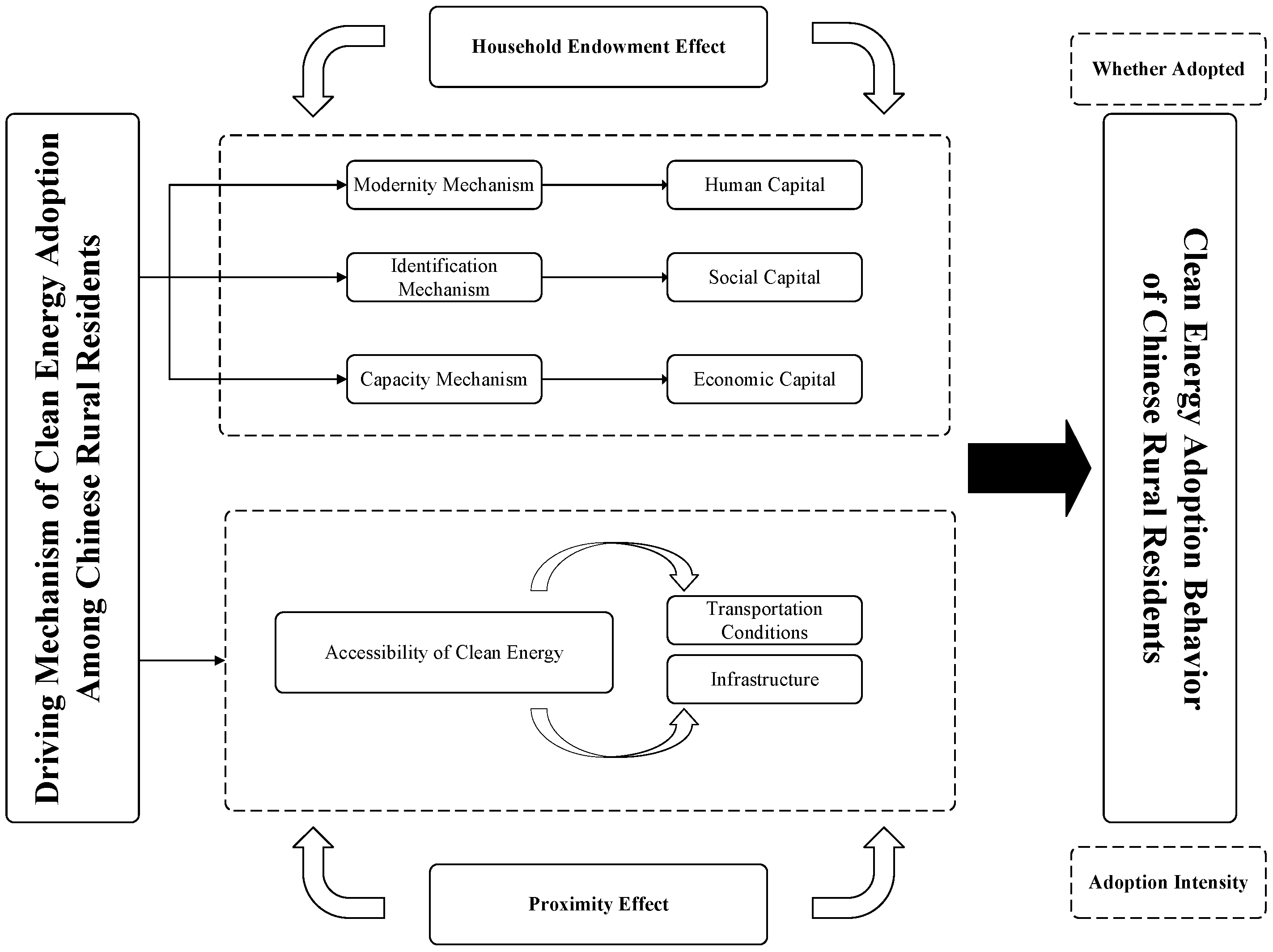
The household endowments effect encompasses modernity mechanism, identification mechanism, and capacity mechanism reflected in human capital, social capital, and economic capital. When considering the driving mechanisms behind clean energy adoption by rural residents, it is essential to analyze whether rural residents’ external conditions affect their clean energy application behavior. As discussed above, in addition to internal factors, the driving mechanisms influencing rural residents’ adoption of clean energy should be analyzed considering external conditions. Previous studies have shown that differences in the means of obtaining various goods lead to inequality in urban living standards [
31]; therefore, it is believed that rural residents may also actively adopt clean energy behaviors through the path of “increased access, reduced marginal cost of application, and increased marginal benefit of application.”
Further, in context of the concept of “convenience,” the degree of convenience for rural residents to access clean energy must consider factors such as efficiency, safety, cost, and infrastructure conditions [
32]. Jiao et al. [
33] found that improved transportation conditions significantly promote “regional accessibility.” Given that rural households often depend on external markets to procure liquefied gas or install solar energy systems, a well-developed road network can substantially reduce both transportation and maintenance costs. Therefore, this paper uses the dual indicators of “road types in front of rural residents’ homes” and “whether small cars can access roads in front of rural residents’ homes” to represent the transportation convenience.
On the other hand, modern clean energy systems typically depend on centralized installation and supporting pipeline infrastructure. Since the questionnaire did not directly capture information on energy infrastructure, this study uses residence in an apartment building as a proxy variable. Such housing is typically planned by village collectives or property developers and is more likely to be equipped with clean energy facilities. Thus, this paper proposes the following hypothesis:
H4. Transportation accessibility and infrastructure conditions (proximity effects) are positively associated with clean energy adoption and usage intensity.
Figure 1 summarizes the theoretical framework of driving mechanisms for rural residents’ clean energy adoption.
3. Methodology
3.1. Model Specification
Based on the previous theoretical analysis, this paper adopts the household endowments effect and proximity effects to analyze the driving mechanisms behind clean energy adoption in rural areas. Due to the involvement of two indicators, “whether to adopt clean energy” and “clean energy usage intensity,” in the daily lives of rural residents, two separate empirical models have been established for analysis. When the dependent variable is “whether rural residents adopt clean energy (
),” a binary Probit model is used for empirical analysis. The specific model setup is as follows:
where
represents different interviewed residents,
indicates the probability of
resident choose to adopt clean energy,
is the cumulative normal distribution,
shows the variable of household endowments,
denotes the clean energy availability,
represents the age and gender of the surveyed sample,
is the constant term, and
is the random disturbance term.
When the dependent variable is the “clean energy use intensity index (
)” for rural residents, this index is an ordinal variable with values ranging from 0 to 3. A higher value indicates a greater clean energy use intensity. Therefore, the ordered Probit model is used for empirical analysis. The specific model setting is as follows:
where
is dependent variable, indicating the intensity of clean energy application in the households where the surveyed samples are located, with other variables explained as in Equation (1). In addition, the function represents
F (·) a nonlinear function in the following form:
where (3),
represents the thresholds, and
, all of which are parameters to be estimated.
is an unobservable continuous variable that exists behind
, commonly referred to as a latent variable, in line with the equation:
3.2. Data
The data used in this study are drawn from the 2018 tracking survey of the “Hundred Villages and Thousand Households” Rural Revitalization Project in Jiangxi Province. This dataset originates from the China Rural Revitalization Strategy Think Tank Data Platform Construction Project, jointly conducted by the College of Agricultural Science at Peking University and Jiangxi Agricultural University. Owing to its high data reliability and validity, the data has attained an authoritative standing in the field of micro-level farmer research within Jiangxi Province and is widely recognized as a representative sample dataset [
34].
The survey adopted a multi-stage stratified random sampling design to ensure both the randomness and representativeness of the collected data. Specifically, the fieldwork was organized into six teams, each responsible for two counties. At the county level, 12 counties across Jiangxi Province were selected through equal interval stratified random sampling based on per capita industrial value added. Within each county, six townships were randomly selected through stratification by per capita public fiscal revenue. Subsequently, eighteen administrative villages were chosen to reflect balanced coverage of geographic and topographic variation. Finally, at the household level, 180 rural households were sampled using systematic random steps across village groups and natural settlements.
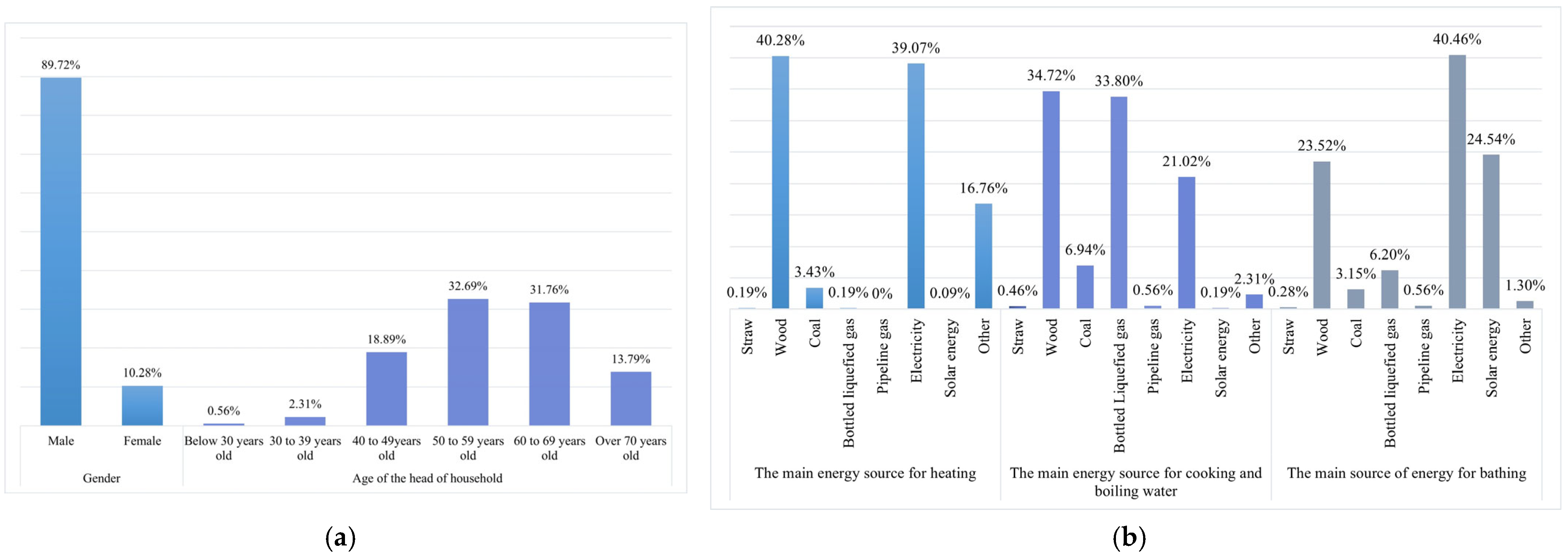
This multi-layer random design ensures that households from different economic zones, terrain types, and development levels are proportionally represented, thereby guaranteeing the dataset’s statistical reliability and external validity for analyzing rural household behaviors in Jiangxi Province. In total, 1080 rural households were successfully surveyed, covering multiple dimensions of rural life, including household demographics, employment, agricultural production, living environment, and energy consumption behaviors. In particular, it records the primary energy sources used for cooking, heating, and bathing, providing a robust micro-level foundation for examining the patterns and determinants of clean energy adoption among rural households in China. The basic characteristics of the sample are presented in
Figure 2.
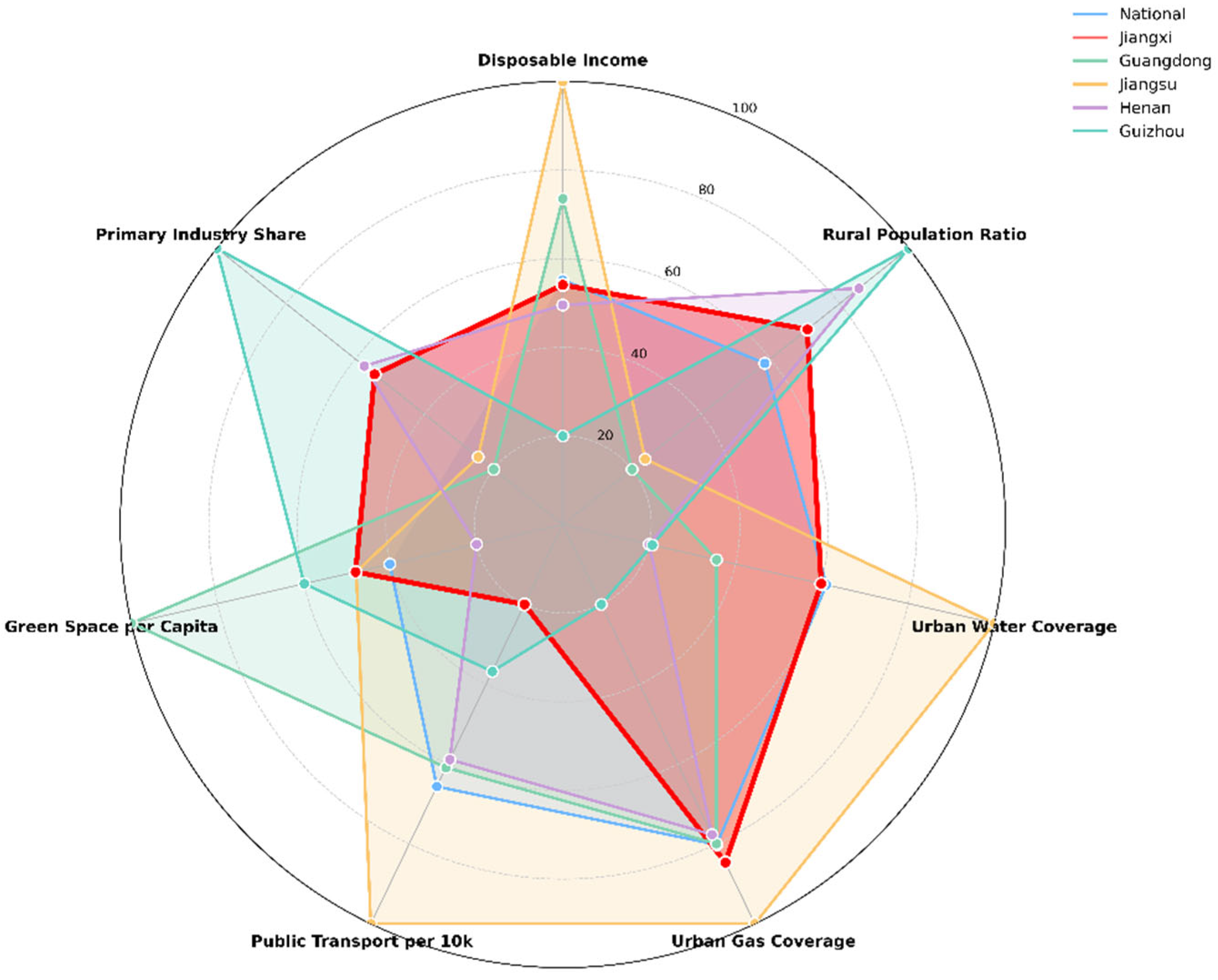
It is important to note that Jiangxi Province was selected as the analytical sample not only because of data availability, but also because it serves as a typical and representative case in China’s rural energy transition. To systematically assess its representativeness, this study compares Jiangxi with the national average and with several representative provinces, including Guangdong and Jiangsu (economically developed coastal provinces), Henan (a major agricultural province in central China), and Guizhou (a less developed province in western China), along four dimensions: demographic structure, economic characteristics, infrastructure conditions and energy consumption patterns. The comparative results are reported in
Figure 3.
In terms of demographic and economic structure, the rural population share in Jiangxi Province reached 43.98% in 2018, which is substantially higher than that in eastern coastal provinces such as Jiangsu (30.39%) and Guangdong (29.30%), but comparable to major agricultural provinces in central and western China such as Henan (48.29%) and Guizhou (52.48%). The value added by the primary industry accounted for 8.5% of the province’s GDP, a share that lies within the typical range observed for rural regions nationwide. These patterns suggest that Jiangxi exhibits the characteristic profile of an inland agricultural province and is broadly representative of rural regions in China.
With respect to infrastructure, Jiangxi had 9.72 public motor vehicles and electric vehicles per 10,000 residents and an average urban road area of 19.37 square meters per capita in 2018. Although these indicators exceed those of western provinces such as Guizhou, they remain well below the levels observed in more developed regions such as Jiangsu and Guangdong. Such moderately underdeveloped transportation and logistics conditions constitute an important constraint on the distribution and maintenance of clean energy sources, such as bottled liquefied gas and electrical equipment. This context also provides real-world support for the “proximity effects” mechanism emphasized in this study.
From a historical perspective, Jiangxi, once a major revolutionary base in China, has long shouldered the national mission of advancing rural development and promoting social equity. Its ongoing energy transition therefore reflects not only technological upgrading, but also a microcosm of broader national efforts to improve rural livelihoods and advance the “dual carbon” goals at the grassroots level.
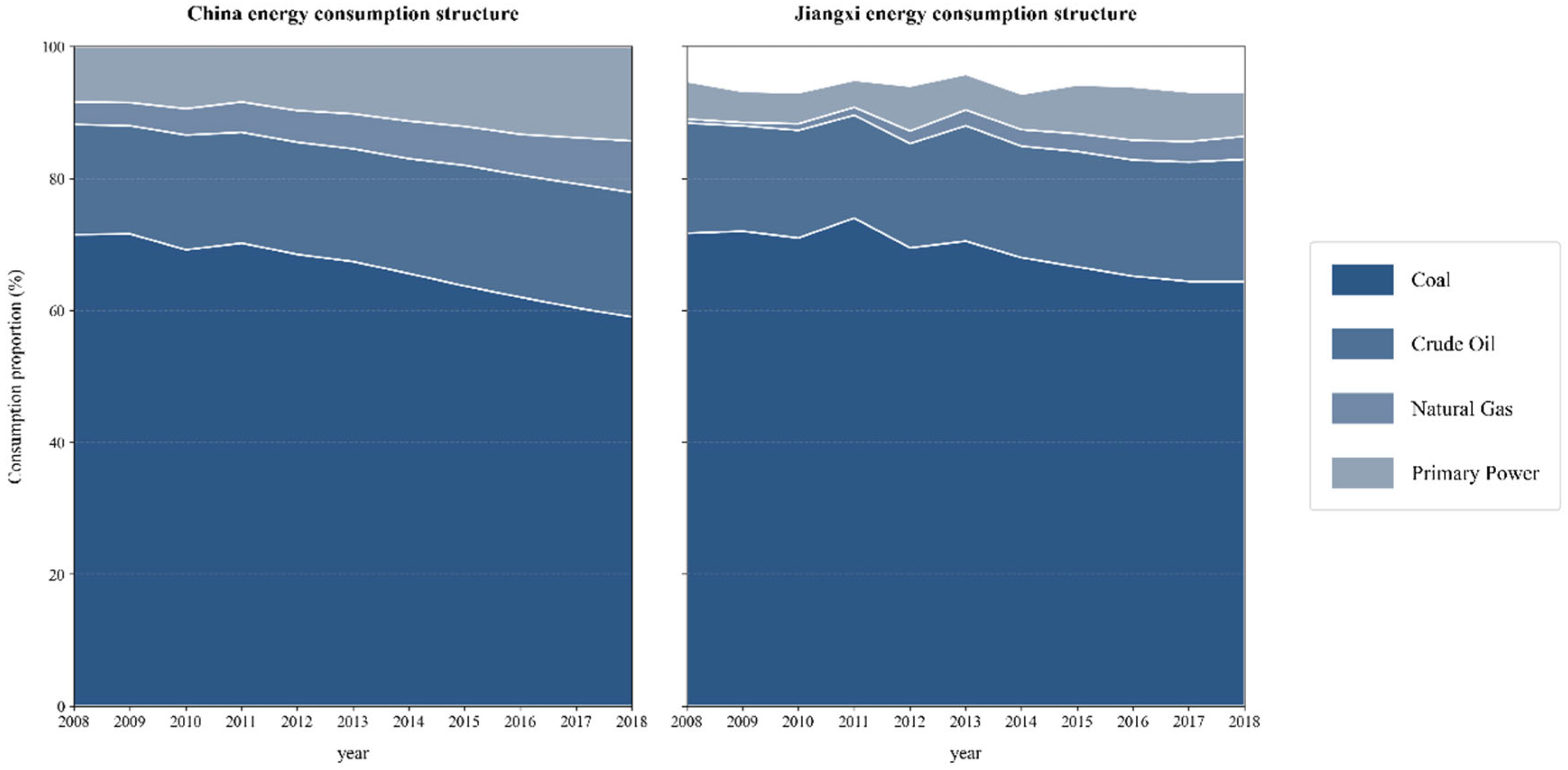
As illustrated in
Figure 4, a comparison of energy consumption structures shows that Jiangxi’s reliance on traditional fossil fuels closely tracks the national pattern. In 2018, coal accounted for 64.4% of Jiangxi’s primary energy consumption, considerably higher than other energy sources, while the national average share of coal stood at 59.0% in the same year. This structural similarity indicates that the energy challenges faced by rural Jiangxi are largely representative of those confronting rural China as a whole.
Taken together, these comparisons indicate that Jiangxi Province constitutes a research sample that combines typical, representative and policy-salient characteristics in terms of population, economic structure, energy composition and infrastructure. The household endowment effects and proximity effects identified using this sample therefore have meaningful external validity and can offer useful insights for the design of clean energy promotion policies targeting rural areas across China. The data used in the figures are drawn from the China Statistical Yearbook, the China Rural Statistical Yearbook, and the Jiangxi Statistical Yearbook.
3.3. Dependent Variable
This study examines rural households’ clean energy use from two dimensions: whether clean energy is used in daily life () and the intensity of clean energy use ().
Firstly, based on the questionnaire, bottled liquefied petroleum gas (LPG), pipeline gas, electricity, and solar energy are classified as clean energy, while straw, firewood, coal, and other traditional fuels are classified as non-clean energy [
35]. It should be noted that although bottled LPG is a fossil fuel, it is treated in this study as a transitional cleaner energy source in rural end-use contexts, given its higher combustion efficiency and substantially lower pollutant emissions compared with traditional biomass and loose coal. This classification is consistent with its practical role in China’s ongoing rural energy transition.
Secondly, in response to the respondents’ answers regarding the most used energy types for cooking, heating, and bathing, a value of 1 is assigned to each response that uses clean energy and a value of 0 to each response that uses non-clean energy. Therefore, this paper defines rural residents’ use of clean energy in daily life as choosing clean energy for at least one household energy use, which is assigned a value of 1. Conversely, if the primary energy source for all three energy uses is non-clean energy, a value of 0 is assigned.
Finally, the usage intensity of clean energy for rural residents is the cumulative value of dummy variables indicating whether the main energy source for the three purposes is clean energy. If the value ranges from 0 to 3, a higher value indicates a higher level of clean energy use in rural households.
3.4. Core Independent Variable
3.4.1. Household Endowments Effect (Family)
The household endowments effect is a crucial perspective in analyzing the driving mechanisms of clean energy application in rural areas, typically represented by human capital, economic capital, social capital, and others, and plays an important role in personal growth and decision-making behavior.
For modernity mechanism indicator, “years of education” and “non-farm employment experience” at the level of household human capital are selected for measurement. For the identification mechanism indicator, “whether the household is a party member,” “whether there is experience of serving as village cadres in the local village,” and “whether the family is engaged in self-operated industry and commerce in the local area” in family social capital are selected for measurement.
3.4.2. Accessibility of Clean Energy (Available)
In this study, the proximity effects are examined through external transportation conditions and clean energy infrastructure. Transportation accessibility is measured using indicators including road type at the household entrance, whether the road is accessible by car, and whether the household resides in an apartment.
It is important to clarify that, in the context of this rural survey, “living in an apartment” does not refer to urban commercial housing. Rather, it typically denotes multi-story residential buildings constructed within villages under government-led or collectively planned development initiatives. Such residential arrangements are commonly associated with more centralized infrastructure provision, including electricity, gas, and internet access, and therefore reflect a process of in situ residential modernization at the village level.
Accordingly, this study treats “living in an apartment” as a proxy for proximity-related infrastructure accessibility and micro-level urbanization. Nevertheless, due to data limitations, this variable cannot fully disentangle infrastructure effects from confounding factors such as household economic capacity or residential preferences. This limitation is explicitly acknowledged and should be addressed in future research through more refined infrastructure indicators.
In addition, this paper incorporates the age and gender characteristics of the respondents as additional control variables. The variable descriptions and definitions are in
Table 1.
Given the numerous variables and measurement complexity, the variable descriptions and descriptive statistics are displayed separately.
Table 2 presents the descriptive statistics of each variable.
4. Results
4.1. Benchmark Analysis
Based on the model above,
Table 3 reports the results of the binary Probit and Oprobit model regarding whether rural residents apply the clean energy driving mechanism. Based on the results in
Table 3, the analysis will focus on the driving mechanisms of clean energy application among rural residents in China from two perspectives: the household endowment effect and the Proximity effects.
4.1.1. Household Endowment Effect
Firstly, this paper analyzes whether rural residents use clean energy and its adoption intensity based on family endowment characteristics. The specific regression results are shown in
Table 3.
The regression results reveal that, first, regarding the adoption of clean energy, the results in column (2) indicate that years of education and non-agricultural employment experience significantly increase the likelihood of rural households adopting clean energy. Additionally, engagement in self-employed industrial and commercial activities also exerts a significant positive influence on clean energy adoption. By contrast, identity-related variables—such as Party membership or village cadre status—do not exhibit statistically significant effects on the adoption of clean energy. Second, with respect to the intensity of clean energy use, the main influencing factors are largely consistent with those identified in the adoption analysis. In addition to education, non-agricultural employment, and engagement in self-employed commercial or industrial activities, village cadre status also shows a statistically significant effect on the intensity of clean energy use. It is worth noting that the variable Par, which proxies for identity-based mechanisms, fails to exhibit a significant positive effect in either model, indicating that political affiliation does not translate into a behavioral advantage in the context of energy transition. This finding deviates from certain prior expectations and may reflect that, under the current rural governance structure, grassroots cadres or Party members, while possessing certain advantages in access to policy information, appear to make energy choices primarily based on economic capacity and the level of lifestyle modernization, rather than by identity itself. Accordingly, Hypotheses 1 and 3 are supported, whereas Hypothesis 2 receives only partial support.
4.1.2. Proximity Effects
Secondly, this paper focuses on the influence of the proximity effects on whether rural residents use clean energy and its adoption intensity. The specific regression results are shown in
Table 4.
Regression results indicate that proximity effects play a significant role in both the adoption and intensive use of clean energy among rural households. First, regarding clean energy adoption, transportation accessibility and housing type emerge as key determinants. Households that own private vehicles, have paved access roads, and reside in apartment-style housing are more likely to adopt clean energy. This suggests that favorable transportation conditions not only enhance access to energy but also signal a higher degree of household modernization in terms of market participation and lifestyle. Moreover, rural households residing in modern apartment-style buildings are significantly more likely to adopt clean energy. This can be attributed not only to easier access to modern kitchen, heating, and bathing facilities, but also to the broader advantages associated with centralized residential arrangements, including integrated public utility services, community-level management, and peer demonstration effects. Although the variable “apartment-style housing” may also reflect other factors—such as the intensity of village planning or the relative socioeconomic status of households—in the absence of detailed household-level infrastructure data, it remains a relatively valid proxy for capturing a set of external structural conditions that facilitate clean energy adoption. Moreover, with regard to the intensity of clean energy use, the effects of the aforementioned proximity-related variables remain significant, and their impact on usage intensity is even more pronounced. This finding provides empirical support for Hypothesis 4.
4.2. Marginal Probability Effect Analysis
To better illustrate the magnitude and direction of the core explanatory variables’ impact on the probability of clean energy use among different segments of rural residents, it is essential to calculate the marginal effects within the household endowments and proximity effects mechanisms on the dependent variable. Given that the binary Probit model used for “whether to use clean energy” is unsuitable for marginal probability effect analysis, this paper conducts marginal probability effect analysis exclusively using the ordered Probit (Oprobit) model with “clean energy use intensity” as the dependent variable.
4.2.1. Household Endowment Effect
Firstly, this paper provides a detailed analysis of the marginal effect influencing the intensity of clean energy application for rural residents from the household endowment effect, with the specific regression results shown in
Table 5.
The results indicate that, when controlling for the individual characteristics of rural residents and other factors, the marginal effects of the core explanatory variables, except for “whether the family is a party member” are insignificant. The marginal effects of education level, non-agricultural employment, village cadres experience, and engaging in self-employed industrial and commercial businesses are all significant at a level above 5%. Overall, considering the magnitude and significance levels of the marginal effects of the driving mechanism variables, the driving mechanisms influencing the “intensity of clean energy use” among rural residents’ rank as follows, from strongest to weakest, capacity mechanism, modernity mechanism, and identification mechanism. The results in
Table 5 further corroborate these basic conclusions.
4.2.2. Proximity Effects
Secondly, this paper analyzes the marginal effect on rural residents’ clean energy adoption intensity, with the specific regression results shown in
Table 6.
According to the regression results in
Table 6, regarding the proximity effects of clean energy use, the better road type at the doorstep or the stronger the traffic accessibility related to the external transportation conditions for farmers to obtain clean energy, and the more modern the housing conditions related to the level of rural clean energy infrastructure, the greater the intensity of clean energy use by rural residents. This indicates that an important prerequisite for promoting the clean energy adoption in rural China is the construction of rural clean energy infrastructure, enabling rural residents to use clean energy. Furthermore, it is essential to consider how to mobilize residents’ own endowment conditions to enhance their initiative in converting traditional energy to clean energy. This is consistent with the Chinese government’s emphasis on “strengthening rural infrastructure construction,” as highlighted in several rural revitalization and agricultural modernization documents issued in recent years, such as
National Rural Revitalization Strategy Plan (2018−2022),
Opinions on Comprehensive Advancement of Rural Revitalization and Accelerating Agricultural and Rural Modernization (2021), 14th Five-Year Plan for Advancing Agricultural and Rural Modernization, and Opinions of the CPC Central Committee and the State Council on Key Tasks for Comprehensive Advancement of Rural Revitalization in 2022.
4.3. Robustness Checks
4.3.1. Alternative Empirical Model
Previous studies have found no significant difference in the significance and direction of the core independent variable coefficients, regardless of whether the dependent variable is an ordered discrete or binary variable or whether a Probit model, OLS model, or Logit model is used [
36]. To further ensure the robustness of the benchmark regression results,
Table 7 re-estimates the driving mechanisms of “whether to use clean energy” and “intensity of clean energy use” among rural residents using OLS and Logit models.
The results show that, with regard to clean energy adoption, education, non-agricultural employment experience, and engagement in self-employed industrial and commercial activities all exert significant positive effects on adoption decisions at the 1% or 5% significance level, indicating that human capital, market participation, and economic dynamism serve as key drivers of the clean energy transition. Additionally, road type and vehicle accessibility both have significantly positive effects on clean energy adoption and usage intensity across both model specifications, suggesting that improved transportation infrastructure enhances both access to and frequency of clean energy use. By contrast, party membership and village cadre status do not exhibit statistically significant effects, suggesting that political identity does not translate into behavioral advantages in energy decision-making. The variable indicating apartment residence is statistically significant only in the logit model.
With regard to usage intensity, the influencing factors largely align with those affecting clean energy adoption; however, the effect of apartment residence is significantly positive across both models.
4.3.2. Replacement Dependent Variables
In the previous analysis, this paper comprehensively considered the energy application situations for cooking, heating, and bathing among rural residents. Based on the clean energy application situations for these three different purposes, the paper summed the values to establish the two dependent variables for this study. To ensure the reliability of the baseline results, this paper uses whether rural residents applied clean energy for three living purposes as dependent variables and conducts binary Probit regressions to explore whether the driving mechanisms for clean energy adoption remain consistent across different livelihood purposes.
Table 8 demonstrates the regression results of the clean energy application driving mechanisms in rural residents after replacing the dependent variables. In the context of cooking energy use, household endowments such as education level, non-agricultural employment experience, and engagement in self-employed industrial and commercial activities significantly promote the use of clean energy, indicating that the transition in this domain is highly dependent on human capital accumulation, income gains from market participation, and lifestyle modernization. By contrast, political identity variables (e.g., Party membership, village cadre status) do not exhibit statistically significant effects, suggesting that informational advantages conferred by political identity play a limited role in this high-frequency, routine energy-use scenario. In terms of proximity effects, having a paved access road and residing in an apartment-style dwelling significantly promote the adoption of clean energy for cooking, while vehicle accessibility shows a positive but statistically insignificant effect. This suggests that basic transportation infrastructure remains a critical enabling condition for clean energy transition in cooking, whereas higher-tier infrastructure and amenities have yet to emerge as decisive factors. For heating purposes, education level and non-agricultural employment experience continue to exert significant positive effects, with self-employed business engagement and village cadre status also demonstrating significant positive associations. In terms of proximity effects, both vehicle accessibility and apartment residence exhibit significant positive effects, whereas the type of access road is not statistically significant. The results for bathing purposes are largely consistent with those observed for heating.
4.3.3. Subsample Regression
The robustness testing method adopted in this part involves dividing the survey data from 1080 households used in the study based on the geographical locations of the interviewed farmers and conducting regression analysis again. Jiangxi Province is geographically divided into northern, central, and southern regions. Most respondents are from areas in North Jiangxi, such as Nanchang, Shangrao, Jiujiang, Pingxiang, Yichun, and Jingdezhen. The major areas in Central Jiangxi include Fuzhou and Ji’an. Southern Jiangxi mainly comprises the Ganzhou region. Due to the small sample sizes in central and southern Jiangxi, respondents from these two regions are combined for regression analysis.
Table 9 presents the partial sample regression results of the driving mechanisms for the application of clean energy by rural residents.
Research found that regardless of whether households are located in the northern, central, or southern regions of Jiangxi, the mechanisms of modernity and capacity within the household endowments effect are key factors influencing clean energy application by rural residents. Additionally, the regression results indicate slight regional variations in the proximity effects on clean energy accessibility. Specifically, rural families in North Jiangxi are more significantly affected by the positive influence of external transportation conditions facilitating access to clean energy, while rural families in Central and South Jiangxi are more strongly affected by the positive influence of clean energy infrastructure. Regarding the proximity effects, transportation accessibility—measured by road paving and connectivity—exerts a stronger influence on households in northern Jiangxi, whereas infrastructure factors—such as residence in apartment buildings—play a more prominent role in the central and southern regions of the province.
4.4. Heterogeneity Analysis
According to the benchmark regression results, the control variable “age” exhibits a significant negative association with the adoption of clean energy among rural households, indicating that older households are less likely to use clean energy in daily life. This pattern may reflect long-established energy-use habits among older rural residents, who tend to rely more on traditional energy sources such as firewood, straw, or coal. In contrast, younger rural residents are more likely to be exposed to information and promotion related to clean energy technologies, which may contribute to higher acceptance of modern energy options. Accordingly, this section examines whether the driving mechanisms of clean energy adoption differ across age groups.
The sample is divided into a younger group (aged below 60) and an older group (aged 60 and above), using 60 years old as the age threshold, and separate regression analyses are conducted for each group. Although energy-related decisions in multigenerational households may involve multiple family members, the age of the household head remains the most practical proxy for generational classification in cross-sectional survey settings, given current data constraints. This approach is also consistent with common practice in large-scale household surveys, such as CFPS and CHARLS, which define “elderly households” based on the household head’s age. Accordingly, this study adopts the age of the household head as the primary proxy for the household’s generational attribute. The heterogeneity analysis results are reported in
Table 10.
The regression results reveal significant heterogeneity in the driving mechanisms of clean energy adoption across different age groups. Among younger households, adoption behavior is primarily driven by modernity-related factors (educational attainment and non-agricultural employment) and proximity effects (transportation accessibility and infrastructure), reflecting heightened sensitivity to information access, technological adoption, and external convenience. In contrast, older households exhibit significant responses only to economic capacity—measured by participation in local self-employed industrial and commercial activities—and transportation accessibility, whereas education and identity-related variables show no statistical significance.
Given the number of hypotheses and the relative complexity of the empirical results,
Table 11 summarizes the validation outcomes for each hypothesis.
5. Discussion
Drawing on micro-level household survey data from Jiangxi Province, this study systematically compares the relative influence of two key mechanisms on rural clean energy adoption. The first is the household endowment effect, which includes capability, modernity, and identity mechanisms. The second is the proximity effects, represented by transport accessibility and infrastructure conditions. The results indicate that transport accessibility and infrastructure conditions exert the strongest influence on the intensity of clean energy adoption. Overall, these findings are consistent with previous studies documenting the continued dominance of traditional fuels and the constrained diffusion of clean energy, including Wang and Jiang [
3], Yao et al. [
4], and Do and Burke [
5].
Compared with existing work, this study advances the literature in terms of empirical identification and analytical depth. By employing binary and ordered Probit models across multiple household energy-use scenarios, including cooking, heating, and bathing, and leveraging micro-level data, the analysis distinguishes between adoption decisions and adoption intensity. This approach captures substantial heterogeneity in household behavior.
Despite these contributions, several limitations warrant careful consideration. First, the sample is confined to rural households in Jiangxi Province. Differences in economic structure, energy endowments, and policy environments across regions may limit the external validity of the findings. Second, although binary and ordered Probit models are used to analyze adoption behavior and intensity, potential endogeneity concerns related to unobserved household characteristics or local policy environments cannot be fully addressed with cross-sectional data. Third, the reliance on cross-sectional data restricts the analysis to static patterns of household energy use and limits the characterization of fuel-stacking behaviors and other unobserved factors.
In addition, data timeliness constitutes an important limitation of this study. Due to data availability constraints, the empirical analysis relies on a household survey conducted in 2018, which represents the most recent micro-level dataset available for our analysis. Since then, China’s rural energy transition has accelerated substantially, accompanied by continuous policy efforts to expand renewable energy deployment, improve rural energy infrastructure, and enhance energy service accessibility. The 14th Five-Year Plan for Renewable Energy Development (2021) explicitly advocates the coordinated deployment of distributed photovoltaic systems on suitable rural rooftops or collectively allocated village land, with strengthened policy support. Since 2022, the central government has further increased subsidies for rural clean heating, electrified kitchens, and smart grid development. In 2023, the “Rural Energy Revolution Pilot Demonstration Program” was launched to promote the integrated application of biomass, solar, and geothermal energy at the county level. Meanwhile, the deepening implementation of the “Digital Village” strategy has significantly enhanced rural residents’ access to energy services and information. Taken together, these policy advances suggest that the institutional and infrastructural context of rural clean energy adoption has evolved considerably since the survey period, and the findings of this study should therefore be interpreted as reflecting the underlying behavioral mechanisms operating under the policy environment prevailing at the time of data collection, rather than the current level of adoption.
Overall, this study is not intended to depict the prevailing level of clean energy adoption at a specific point in time. Rather, it focuses on identifying the micro-level mechanisms underlying rural household energy choices. By systematically examining the roles of household endowments and proximity effects across multiple energy-use scenarios, the study highlights the persistent importance of factors such as transport accessibility, infrastructure conditions, human capital, and economic capacity in shaping adoption behavior.
Looking ahead, future research could build on this study in several directions that directly address its limitations. The use of multi-province or nationally representative data would help assess external validity. Panel or longitudinal data would allow researchers to capture dynamic transitions and better address endogeneity concerns. With more recent data, future studies could further examine whether the mechanisms identified in this study evolve alongside rapid policy expansion and infrastructure development in rural China.
6. Conclusions and Policy Implications
Promoting the adoption of clean energy in rural areas is essential for optimizing rural energy structures, improving living environments, and advancing an inclusive energy transition. Based on micro-level household survey data from rural areas in Jiangxi Province, this study examines rural household energy choices from the dual perspective of household endowments and external proximity-related factors. By distinguishing both adoption decisions and usage intensity across daily scenarios such as cooking, heating, and bathing, the analysis provides a more nuanced understanding of rural household energy transitions. Based on these findings, this section highlights several targeted policy implications for promoting clean energy adoption in rural areas.
From a policy perspective, the empirical results indicate that external accessibility factors, particularly transportation infrastructure and basic utility provision, play a more decisive role in promoting clean energy adoption than internal household characteristics. Marginal effects analysis further suggests that proximity effects exert a stronger influence than household endowment mechanisms, including economic capacity, modernity, and social identity. These findings imply that adequate infrastructure constitutes a fundamental prerequisite for the widespread and intensive adoption of clean energy in rural areas. Accordingly, policy efforts should prioritize integrated investments in energy and transport infrastructure, especially in villages facing pronounced accessibility constraints. Improving last-mile connectivity, strengthening county-level logistics systems, and establishing regular clean energy delivery and recovery mechanisms can help reduce practical barriers to adoption. Moreover, subsidy schemes should adopt a regionally differentiated investment approach, directing fiscal resources toward areas with the most significant structural constraints rather than focusing exclusively on household-level income support.
With respect to policy design across demographic groups, the results also reveal pronounced age-based heterogeneity in the mechanisms underlying clean energy adoption. Younger households are more responsive to factors associated with modernity and accessibility, such as education, non-agricultural employment, and transport conditions, reflecting greater adaptability to emerging technologies and information environments. In contrast, older households are primarily constrained by economic capacity and physical accessibility and are less responsive to informational or identity-based factors. This implies that promotion strategies targeting elderly rural households should focus on reducing usage costs and operational barriers, rather than relying solely on technical promotion or behavioral persuasion. Practical measures may include tiered energy subsidies for elderly-only households, the promotion of age-friendly clean energy technologies, and the integration of clean heating initiatives with rural eldercare services through collective service platforms. By contrast, for households led by middle-aged or younger adults, policy interventions could place greater emphasis on skills training and green credit support to strengthen endogenous incentives for clean energy transition.
Author Contributions
C.X.: Conceptualization, Methodology. W.L.: Data curation, Review and Editing. N.L.: Data curation, Writing—Original draft preparation, Project administration, Funding acquisition. R.P.: Writing—Review and Editing, Project administration. All authors have read and agreed to the published version of the manuscript.
Funding
This research was funded by Jiangxi Provincial Key Research Base Project for Humanities and Social Sciences in Higher Education Institutions (JD24036) and Guizhou Provincial Philosophy and Social Sciences Planning Program (23GZQN60).
Institutional Review Board Statement
The study was approved for exemption by School of Economics, Guizhou University of Finance and Economics (30 October 2025).
Informed Consent Statement
All participants were informed of the purpose of the study and voluntarily participated in the survey. Written informed consent was not required in accordance with institutional ethics guidelines.
Data Availability Statement
The data that support the findings of this study are available from the corresponding authors, upon reasonable request.
Conflicts of Interest
The authors declare that they have no conflicts of interest.
References
- Li, C.; He, L.; Cao, Y.; Xiao, G.; Zhang, W.; Liu, X.; Yu, Z.; Tan, Y.; Zhou, J. Carbon emission reduction potential of rural energy in China. Renew. Sustain. Energy Rev. 2014, 29, 254–262. [Google Scholar] [CrossRef]
- Sun, X.; Mi, Z.; Zhang, J.; Li, J. Driving factors of carbon emissions from household energy combustion in China. Energy Policy 2024, 186, 114013. [Google Scholar] [CrossRef]
- Wang, R.; Jiang, Z. Energy consumption in China’s rural areas: A study based on the village energy survey. J. Clean. Prod. 2017, 143, 452–461. [Google Scholar] [CrossRef]
- Yao, C.; Chen, C.; Li, M. Analysis of rural residential energy consumption and corresponding carbon emissions in China. Energy Policy 2012, 41, 445–450. [Google Scholar] [CrossRef]
- Do, T.N.; Burke, P.J. Phasing out coal power in a developing country context: Insights from Vietnam. Energy Policy 2023, 176, 113512. [Google Scholar] [CrossRef]
- Fan, L.; Dong, H.; Xiao, C.; Feng, Z.; Yan, J. Energy consumption, structural transformation and related carbon dioxide emissions of rural households on the Tibetan plateau. Energy 2024, 308, 132789. [Google Scholar] [CrossRef]
- Kar, A.; Pachauri, S.; Bailis, R.; Zerriffi, H. Using sales data to assess cooking gas adoption and the impact of India’s Ujjwala programme in rural Karnataka. Nat. Energy 2019, 4, 806–814. [Google Scholar] [CrossRef]
- Walekhwa, P.N.; Mugisha, J.; Drake, L. Biogas energy from family-sized digesters in Uganda: Critical factors and policy implications. Energy Policy 2009, 37, 2754–2762. [Google Scholar] [CrossRef]
- Marie, M.; Yirga, F.; Alemu, G.; Azadi, H. Status of energy utilization and factors affecting rural households’ adoption of biogas technology in north-western Ethiopia. Heliyon 2021, 7, e06487. [Google Scholar] [CrossRef]
- Hojnik, J.; Ruzzier, M.; Fabri, S.; Klopčič, A.L. What you give is what you get: Willingness to pay for green energy. Renew. Energy 2021, 174, 733–746. [Google Scholar] [CrossRef]
- Gu, J. Importance of neighbors in rural households’ conversion to cleaner cooking fuels: The impact and mechanisms of peer effects. J. Clean. Prod. 2022, 379, 134776. [Google Scholar] [CrossRef]
- Li, T.; Lu, H.; Li, J.; Chen, J.; Hong, Y.; Liu, H. Population ageing and clean energy transition: Evidence from rural China. Energy 2025, 335, 138207. [Google Scholar] [CrossRef]
- Li, Z.; Meng, F.; Wu, S.; Afthanorhan, A.; Hao, Y. Guiding clean energy transitions in rural households: Insights from China’s pilot low-carbon policies. J. Environ. Manag. 2024, 370, 122782. [Google Scholar] [CrossRef]
- Zhang, S.; Sang, X.; Yang, W.; Luo, X. Empowering household energy transition: The impact of digital economy on clean energy use in rural China. Energy 2025, 324, 136016. [Google Scholar] [CrossRef]
- Zhang, X.-B.; Hassen, S. Household fuel choice in urban China: Evidence from panel data. Environ. Dev. Econ. 2017, 22, 392–413. [Google Scholar] [CrossRef]
- Li, L.; Xia, H.; Chen, Z.; Duan, M.; Pei, J. Spatiotemporal characteristics and driving mechanisms of household energy transition in rural China: Micro-evidence from 2005 to 2017. Sci. Total Environ. 2024, 909, 168554. [Google Scholar] [CrossRef]
- Du, J.; Song, M.; Xie, B. Eliminating energy poverty in Chinese households: A cognitive capability framework. Renew. Energy 2022, 192, 373–384. [Google Scholar] [CrossRef]
- Mozaffari, Z.; Amani, R. Social Capital and Energy Consumption: An Evidence for Iran. Environ. Energy Econ. Res. 2023, 7, S057. [Google Scholar] [CrossRef]
- Painter, G.; Yang, L.; Yu, Z. Heterogeneity in Asian American Home-ownership: The Impact of Household Endowments and Immigrant Status. Urban Stud. 2003, 40, 505–530. [Google Scholar] [CrossRef]
- Fan, J.; Liang, Y.-T.; Tao, A.-J.; Sheng, K.-R.; Ma, H.-L.; Xu, Y.; Wang, C.-S.; Sun, W. Energy policies for sustainable livelihoods and sustainable development of poor areas in China. Energy Policy 2011, 39, 1200–1212. [Google Scholar] [CrossRef]
- Fafchamps, M.; Quisumbing, A.R. Human Capital, Productivity, and Labor Allocation in Rural Pakistan. J. Hum. Resour. 1999, 34, 369–406. [Google Scholar] [CrossRef]
- Deming, D.J. Four Facts about Human Capital. J. Econ. Perspect. 2022, 36, 75–102. [Google Scholar] [CrossRef]
- Hansen, H.K.; Winther, L. Employment growth, human capital and educational levels: Uneven urban and regional development in Denmark 2002–2012. Geogr. Tidsskr.-Dan. J. Geogr. 2015, 115, 105–118. [Google Scholar] [CrossRef]
- Conti, M.; Sulis, G. Human capital, employment protection and growth in Europe. J. Comp. Econ. 2016, 44, 213–230. [Google Scholar] [CrossRef]
- Wang, P.; Li, S.-L.; Zou, S.-H. Does Off-Farm Employment Promote the Low-Carbon Energy Intensity in China’s Rural Households? Energies 2023, 16, 2375. [Google Scholar] [CrossRef]
- Li, H.; Meng, L.; Shi, X.; Wu, B. Does having a cadre parent pay? Evidence from the first job offers of Chinese college graduates. J. Dev. Econ. 2012, 99, 513–520. [Google Scholar] [CrossRef]
- Walder, A.G. Income Determination and Market Opportunity in Rural China, 1978–1996. J. Comp. Econ. 2002, 30, 354–375. [Google Scholar] [CrossRef]
- Yan, Y. The Impact of Rural Reform on Economic and Social Stratification in a Chinese Village. Aust. J. Chin. Aff. 1992, 27, 1–23. [Google Scholar] [CrossRef]
- Jiang, S.; Lu, M.; Sato, H. Identity, Inequality, and Happiness: Evidence from Urban China. World Dev. 2012, 40, 1190–1200. [Google Scholar] [CrossRef]
- Zhou, M.; Qiu, M.; Huang, L.; Nuse, B. Personality traits and village cadre adoption of rural environmental protection measures: A case study from China. J. Environ. Plan. Manag. 2020, 63, 1758–1770. [Google Scholar] [CrossRef]
- Fan, J.; Tang, L.; Zhu, W.; Zou, B. The Alibaba effect: Spatial consumption inequality and the welfare gains from e-commerce. J. Int. Econ. 2018, 114, 203–220. [Google Scholar] [CrossRef]
- Hou, Q.; Li, S.-M. Transport infrastructure development and changing spatial accessibility in the Greater Pearl River Delta, China, 1990–2020. J. Transp. Geogr. 2011, 19, 1350–1360. [Google Scholar] [CrossRef]
- Jiao, J.; Wang, J.; Zhang, F.; Jin, F.; Liu, W. Roles of accessibility, connectivity and spatial interdependence in realizing the economic impact of high-speed rail: Evidence from China. Transp. Policy 2020, 91, 1–15. [Google Scholar] [CrossRef]
- Wang, L.; Liu, F.; Gao, J. Examining Whether Participation in Industrial Integration Can Enhance Farmers’ Income Based on Empirical Evidence from the “Hundred Villages and Thousand Households” Survey in Jiangxi Province. Agriculture 2025, 15, 1872. [Google Scholar] [CrossRef]
- Li, N.; Zhang, G.; Zhang, L.; Zhou, Y.; Zhang, N. Improving rural women’s health in China: Cooking with clean energy. Environ. Sci. Pollut. Res. 2022, 29, 20906–20920. [Google Scholar] [CrossRef]
- Ferrer-I-Carbonell, A.; Frijters, P. How Important is Methodology for the Estimates of the Determinants of Happiness? Econ. J. 2004, 114, 641–659. [Google Scholar] [CrossRef]
| Disclaimer/Publisher’s Note: The statements, opinions and data contained in all publications are solely those of the individual author(s) and contributor(s) and not of MDPI and/or the editor(s). MDPI and/or the editor(s) disclaim responsibility for any injury to people or property resulting from any ideas, methods, instructions or products referred to in the content. |