Analysis of Power System Power and Energy Balance Considering Demand-Side Carbon Emissions



Abstract
1. Introduction
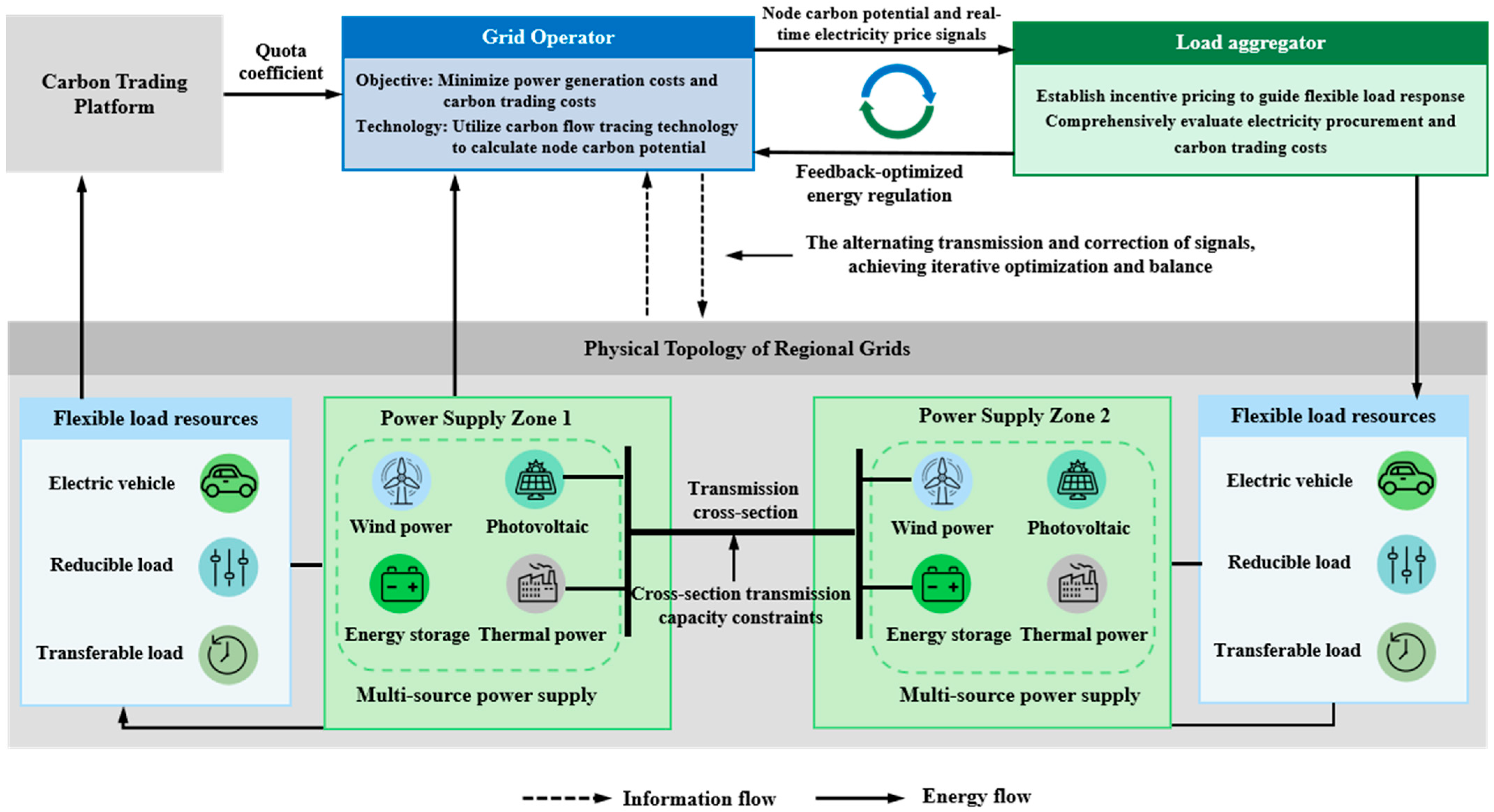
2. Power and Energy Balance Analysis Framework
3. Power and Energy Balance Model Based on Carbon Flow Guidance
3.1. Carbon-Flow-Tracking-Driven Demand Response Model
3.1.1. Carbon Flow Tracking Model Grounded in the Principle of Proportional Sharing
3.1.2. Flexible Load Response Model Based on NCP
- 1.
- Carbon Emission Model of EVs
- 2.
- Carbon Emission Model of Curtailable/Transferable Loads
- 3.
- Stepwise Carbon Trading Model Based on NCP
3.2. Regional Power and Energy Balance Optimization Model with Source–Load Coordination
3.2.1. Economic Dispatch Model for the System Operator with Multiple Energy Sources
- 1.
- Objective Function
- 2.
- Constraints
3.2.2. Demand-Side Optimal Dispatch Model Responding to Carbon Signals
- 1.
- Objective Function
- 2.
- Constraints
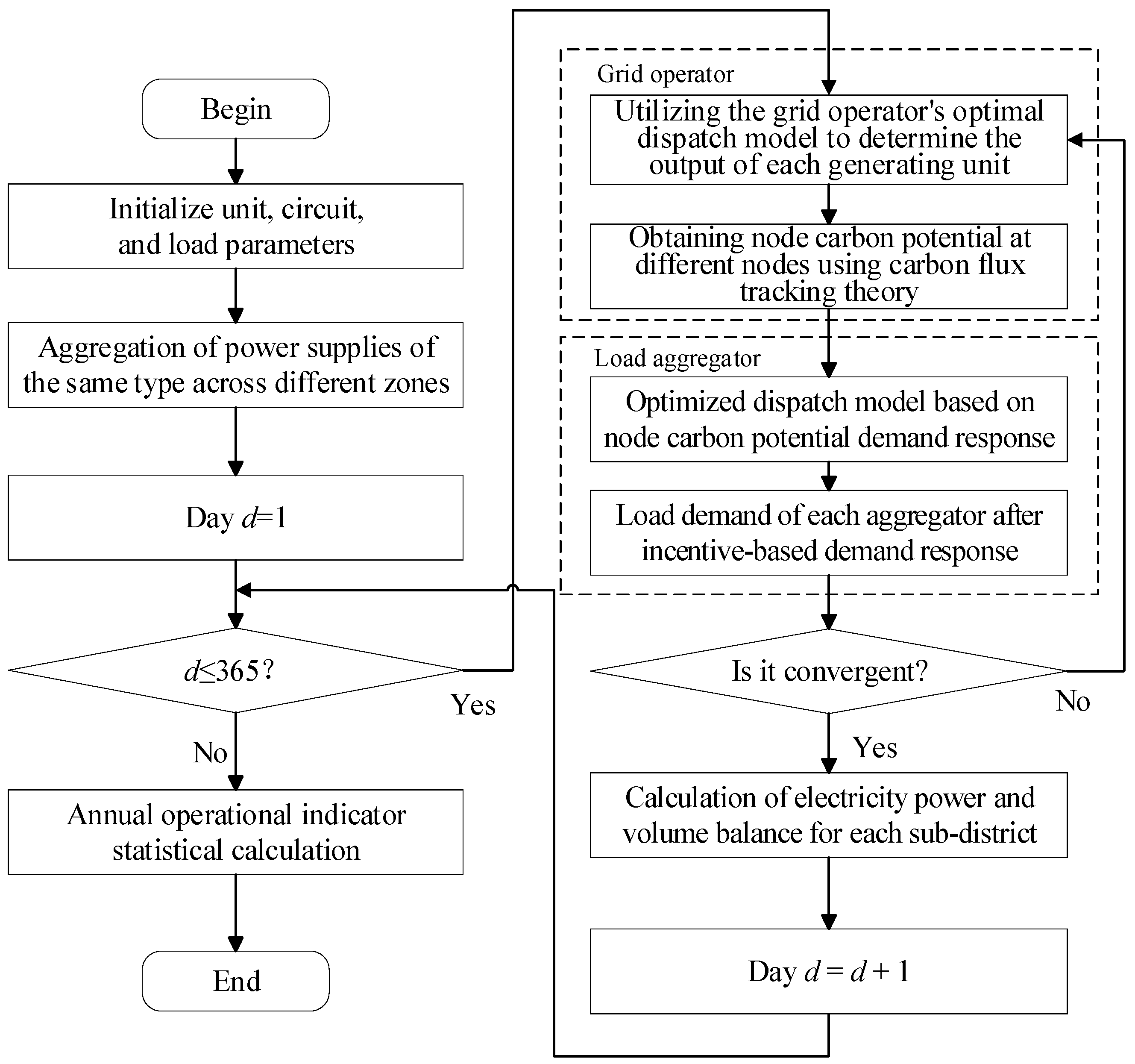
4. Power and Energy Balance Model Based on Carbon Flow Guidance

5. Case Studies
5.1. Basic Data
5.2. Case Study Scenario Settings
5.3. Case Study Results and Analysis
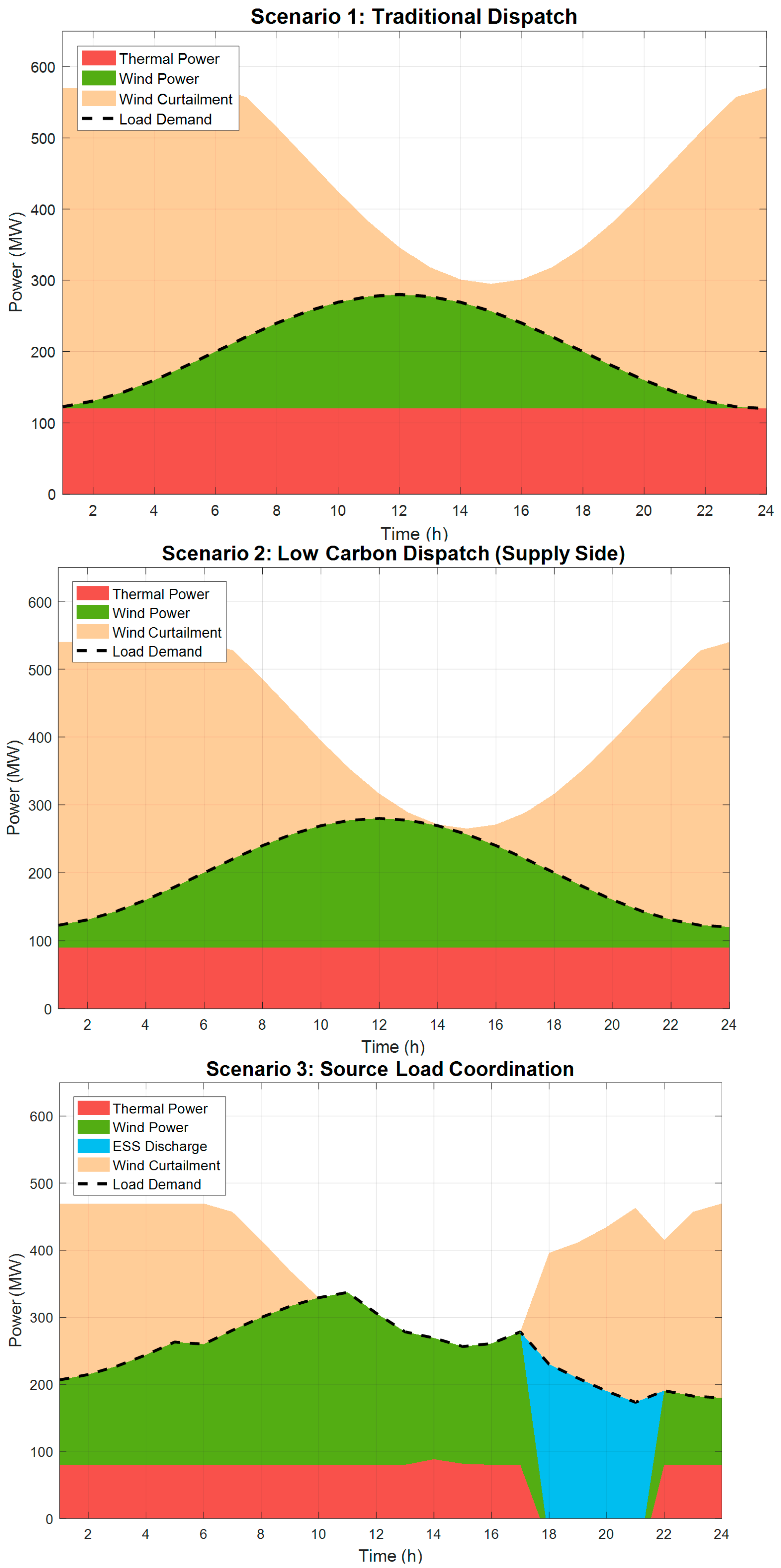
5.3.1. Power and Energy Balance Analysis
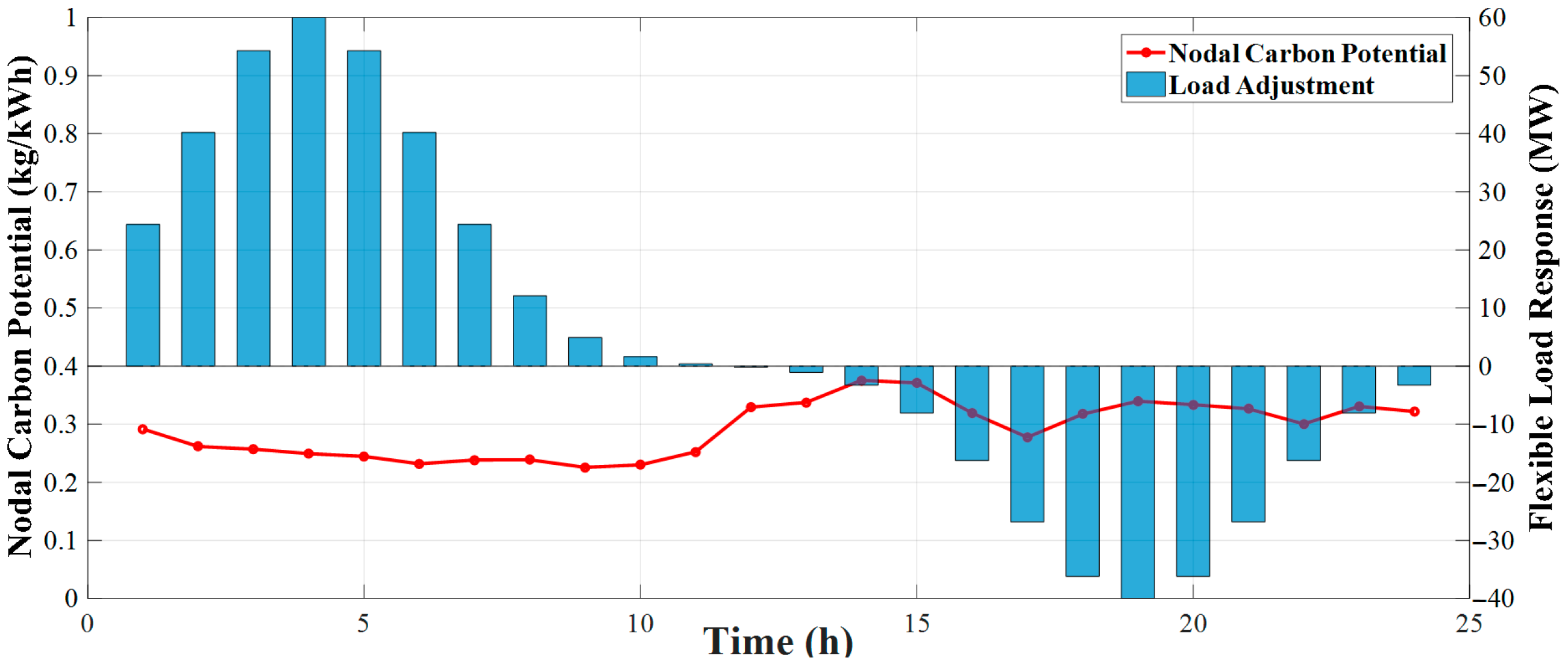
5.3.2. Analysis of Nodal Carbon Marginal Signals and Flexible Load Response Characteristics
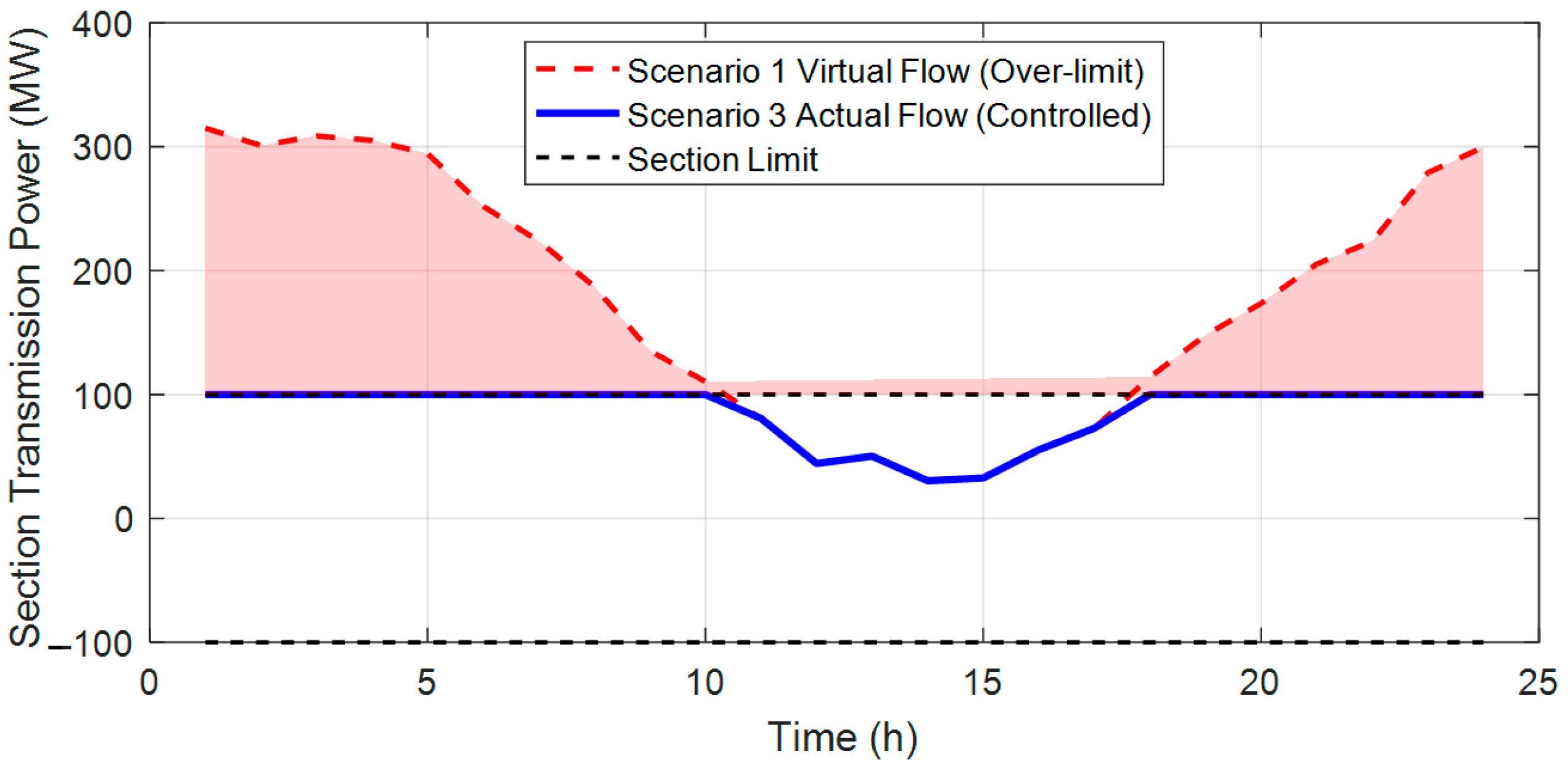
5.3.3. Impact of Transmission Corridor Constraints on Power–Energy Balance
5.3.4. Comparative Analysis and Statistical Evaluation of Integrated Indicators
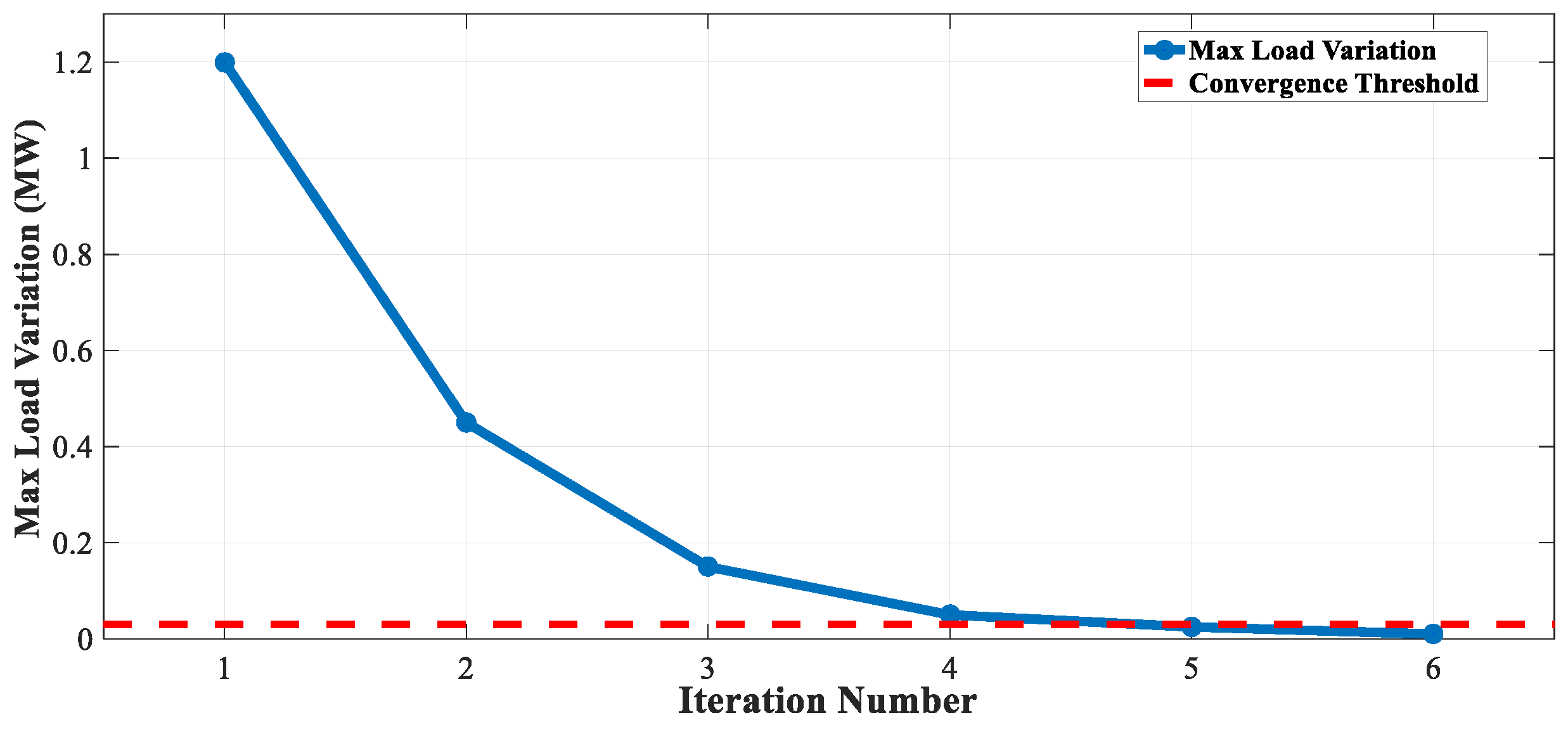
5.4. Convergence Analysis and Model Effectiveness Evaluation
6. Conclusions
Author Contributions
Funding
Institutional Review Board Statement
Informed Consent Statement
Data Availability Statement
Conflicts of Interest
Nomenclature
| Acronyms | ||
| NCP | Nodal carbon potential | |
| CEF | Carbon emission flow | |
| EVs | Electric vehicles | |
| DR | Demand response | |
| SOC | State of charge | |
| Symbols | ||
| Symbol | Description | Unit |
| i | Index of regions/zones | |
| t | Index of time periods | |
| m | Index of power grid nodes | |
| l | Index of transmission sections | |
| s | Index of branch | |
| n | Index of EVs | |
| T | Set of scheduling periods | |
| The number of EVs | ||
| The collection of branches delivering power to node m | ||
| The set of zones | ||
| The set of regions connected with thermal power/wind power | ||
| The set of regions connected with photovoltaic power | ||
| The set of regions connected with energy storage devices | ||
| The load reserve margin | ||
| The price escalation coefficient | ||
| The power transfer factors of generation and load in region i with respect to section l | ||
| The charging and discharging efficiencies | ||
| The arrival and departure times of the EV | ||
| The minimum and maximum allowable states of charge | ||
| Time step duration | h | |
| The coal consumption cost coefficient of thermal units in region i | CNY/kW2, CNY/kW, CNY | |
| The generation cost factor of wind and photovoltaic power | CNY/kW | |
| The depreciation cost factor and operation and maintenance cost factor of energy storage device | CNY/kW | |
| The fundamental price for carbon trading | CNY/kg | |
| The compensation coefficient for electric vehicle discharging | CNY/kWh | |
| The tariff rate within the time-of-use scheme | CNY/kWh | |
| The compensation coefficient per unit of curtailed load | CNY/kWh | |
| The unit compensation factors of transferred-in and transferred-out load | CNY/kWh | |
| The penalty coefficients for forward and reverse transmission-section violations. | CNY/kWh | |
| The carbon flow density along branch s | kg/kW2h | |
| The NCP of node m at time t | kg/kWh | |
| The carbon emission intensity per unit of electricity produced alongside the initial carbon quota coefficient | kg/kWh | |
| The carbon allowance coefficient | kg/kWh | |
| The unit carbon quota coefficient | kg/kWh | |
| The duration of the carbon emission interval | kg | |
| The carbon output of EVs | kg | |
| The carbon emissions from curtailable and transferable loads | kg | |
| The carbon emissions of all loads | kg | |
| The baseline carbon quota allocated to the load | kg | |
| The actual carbon emission trading volume of the demand side | kg | |
| Carbon trading cost of the grid operator | kg | |
| The expenses related to coal usage in thermal generation units | CNY | |
| Wind–solar–storage/energy storage device costs | CNY | |
| Penalty terms for transmission-section power violations | CNY | |
| The cost of electricity purchased from the grid on the demand side | CNY | |
| Compensation for users participating in low-carbon initiatives | CNY | |
| Economic compensation for EV discharge | CNY | |
| The active power of branch s | kW | |
| The output of thermal units in region i at time t | kW | |
| The actual output generated by wind and PV units within region i at time t | kW | |
| The charge/discharge power rates of energy storage devices | kW | |
| The power violation amounts in forward and reverse directions for section l at time t | kW | |
| The minimum and maximum generation bounds of thermal power units in region i | kW | |
| The ramping power limit of thermal units in region i | kW | |
| The maximum output of wind power/photovoltaic units in region i | kW | |
| The rated power of energy storage devices in region i | kW | |
| The transmission power flowing on section l at time t | kW | |
| The total generation and load of region i at time t | kW | |
| The power supplied by the upper-level grid to region i | kW | |
| The relaxation variables | kW | |
| The electricity purchased from the grid operator | kW | |
| The aggregate charge/discharge power of all EVs | kW | |
| The power drawn or injected by the n-th EV | kW | |
| The power limits for electric vehicles charging or discharging | kW | |
| The transferred-in and transferred-out load of transferable loads | kW | |
| The initial load and the load amount shed | kW | |
| The minimum and maximum generation bounds of thermal power units | kW | |
| The maximum transmission capacity limits in the forward and reverse directions | kW | |
| Insufficient adjustable capacity in the entire area | kW | |
| The adjustable capacity provided by all types of power sources | kW | |
| The adjustable capacity provided by the upper-level grid | kW | |
| The contingency reserve capacity | kW | |
| The adjustable capacity provided by thermal power/wind power | kW | |
| The adjustable capacity provided by photovoltaic power/energy storage | kW | |
| The energy stored in the n-th EV at time t | kWh | |
| The rated battery capacity | kWh | |
| The expected energy required for the next trip | kWh | |
| The charging/discharging status of the n-th EV at time t | 0/1 | |
References
- Fang, G.; Meng, A.; Wang, Q.; Zhou, H.; Tian, L. Analysis of the Evolution Path of New Energy System Under Polymorphic Uncertainty—A Case Study of China. Energy 2024, 300, 131543. [Google Scholar] [CrossRef]
- Zhuo, Z.; Du, E.; Zhang, N.; Nielsen, C.P.; Lu, X.; Xiao, J.; Wu, J.; Kang, C. Cost Increase in the Electricity Supply to Achieve Carbon Neutrality in China. Nat. Commun. 2022, 13, 3172. [Google Scholar] [CrossRef] [PubMed]
- Ali, J.S.; Khan, B.; Alhelou, H.H.; Mahela, O.P. Power System Stability with High Penetration of Renewable Energy Sources: Challenges, Assessment, and Mitigation Strategies. IEEE Access 2025, 13, 39912–39934. [Google Scholar] [CrossRef]
- Yin, Y.; He, C.; Liu, T.; Wu, L. Risk-Averse Stochastic Midterm Scheduling of Thermal-Hydro-Wind System: A Network-Constrained Clustered Unit Commitment Approach. IEEE Trans. Sustain. Energy 2022, 13, 1293–1304. [Google Scholar] [CrossRef]
- Li, Y.; Han, M.; Shahidehpour, M.; Li, J.; Long, C. Data-Driven Distributionally Robust Scheduling of Community Integrated Energy Systems with Uncertain Renewable Generations Considering Integrated Demand Response. Appl. Energy 2023, 335, 120749. [Google Scholar] [CrossRef]
- Du, M.; Zhang, J.; Gu, C.; Zhang, X. Resilience Improving Strategy for Power Systems with High Wind Power Penetration Against Uncertain Attacks. IEEE Trans. Sustain. Energy 2024, 15, 2625–2637. [Google Scholar] [CrossRef]
- Li, Z.; Sun, H.; Xue, Y.; Li, Z.; Jin, X.; Wang, P. Resilience-Oriented Asynchronous Decentralized Restoration Considering Building and E-Bus Coresponse in Electricity-Transportation Networks. IEEE Trans. Transp. Electrific. 2025, 11, 11701–11713. [Google Scholar] [CrossRef]
- Du, B.; Jia, H.; Zhang, B.; Li, Y.; Wang, H.; Yan, J.; Du, E.; Zhang, N. Evaluating the Carbon-Emission Reduction Potential of Employing Low-Carbon Demand Response to Guide Electric-Vehicle Charging: A Chinese Case Study. Appl. Energy 2025, 397, 126196. [Google Scholar] [CrossRef]
- Zhai, X.; Li, Z.; Li, Z.; Xue, Y.; Chang, X.; Su, J.; Jin, X.; Wang, P.; Sun, H. Risk-Averse Energy Management for Integrated Electricity and Heat Systems Considering Building Heating Vertical Imbalance: An Asynchronous Decentralized Approach. Appl. Energy 2025, 383, 125271. [Google Scholar] [CrossRef]
- Zhang, H.; Li, Z.; Xue, Y.; Chang, X.; Su, J.; Wang, P.; Guo, Q.; Sun, H. A Stochastic Bi-Level Optimal Allocation Approach of Intelligent Buildings Considering Energy Storage Sharing Services. IEEE Trans. Consum. Electron. 2024, 70, 5142–5153. [Google Scholar] [CrossRef]
- Stover, O.; Karve, P.; Mahadevan, S. Reliability and Risk Metrics to Assess Operational Adequacy and Flexibility of Power Grids. Reliab. Eng. Syst. Saf. 2023, 231, 109018. [Google Scholar] [CrossRef]
- Wang, Z.; Bu, S.; Wen, J.; Huang, C. A Comprehensive Review on Uncertainty Modeling Methods in Modern Power Systems. Int. J. Electr. Power Energy Syst. 2025, 166, 110534. [Google Scholar] [CrossRef]
- Chang, L.; Li, Z.; Tian, X.; Su, J.; Chang, X.; Xue, Y.; Li, Z.; Jin, X.; Wang, P.; Sun, H. A Two-Stage Distributionally Robust Low-Carbon Operation Method for Antarctic Unmanned Observation Station Integrating Virtual Energy Storage and Hydrogen Waste Heat Recovery. Appl. Energy 2025, 400, 126578. [Google Scholar] [CrossRef]
- Cheng, Y.; Li, C.; Xu, Y.; Liu, J.; Deng, X. Extreme Impacts on Electric Power Systems from Non-Catastrophic Meteorological Conditions. Innov. Energy 2024, 1, 100008. [Google Scholar] [CrossRef]
- Li, J.; Ge, S.; Liu, H.; Yu, Q.; Zhang, S.; Wang, C.; Gu, C. An Electricity and Carbon Trading Mechanism Integrated with TSO-DSO-Prosumer Coordination. Appl. Energy 2024, 356, 122328. [Google Scholar] [CrossRef]
- Xu, W.; Ma, G.; Yao, Y. Multi-Energy Optimal Scheduling of Industrial Parks Considering Green Certificate-carbon Trading Mechanism and Hydrogen Compressed Natural Gas. Electr. Power 2025, 58, 154–163. [Google Scholar]
- Wang, Y.; Qiu, J.; Tao, Y. Optimal Power Scheduling Using Data-Driven Carbon Emission Flow Modelling for Carbon Intensity Control. IEEE Trans. Power Syst. 2022, 37, 2894–2905. [Google Scholar] [CrossRef]
- Xia, Y.; Sun, G.; Wang, Y.; Yang, Q.; Wang, Q.; Ba, S. A Novel Carbon Emission Estimation Method Based on Electricity-Carbon Nexus and Non-Intrusive Load Monitoring. Appl. Energy 2024, 360, 122773. [Google Scholar] [CrossRef]
- Hua, H.; Qin, Y.; Hao, C.; Cao, J. Carbon Emission Flow Based Energy Routing Strategy in Energy Internet. IEEE Trans. Ind. Inform. 2024, 20, 3974–3985. [Google Scholar] [CrossRef]
- Lee, S.; Prabawa, P.; Choi, D.-H. Joint Peak Power and Carbon Emission Shaving in Active Distribution Systems Using Carbon Emission Flow-Based Deep Reinforcement Learning. Appl. Energy 2025, 379, 124944. [Google Scholar] [CrossRef]
- Leibowicz, B.D.; Zhang, N.; Carvallo, J.P.; Larsen, P.H.; Carr, T.; Baik, S. The Importance of Capturing Power System Operational Details in Resource Adequacy Assessments. Electr. Power Syst. Res. 2024, 228, 110057. [Google Scholar] [CrossRef]
- Davi-Arderius, D.; Jamasb, T.; Rosellon, J. Network Operation Constraints on the Path to Net Zero. Appl. Energy 2025, 382, 125170. [Google Scholar] [CrossRef]
- Rahmani-Sane, G.; Azad, S.; Ameli, M.T.; Haghani, S. The Applications of Artificial Intelligence and Digital Twin in Power Systems: An In-Depth Review. IEEE Access 2025, 13, 108573–108608. [Google Scholar] [CrossRef]
- Ndrio, M.; Bose, S.; Tong, L.; Guo, Y. Coordinated Transaction Scheduling in Multi-Area Electricity Markets: Equilibrium and Learning. IEEE Trans. Power Syst. 2023, 38, 996–1008. [Google Scholar] [CrossRef]
- Shen, Y.; Wu, W.; Wang, Q.; Li, Y.; Li, S.; Teng, W. Hierarchical Coordinated Automatic Generation Control Involving Distributed Energy Resources: An Aggregation Approach. IEEE Trans. Smart Grid 2025, 16, 1379–1391. [Google Scholar] [CrossRef]
- Xu, X.; Qiu, Z.; Zhang, T.; Gao, H. Distributed Source-Load-Storage Cooperative Low-Carbon Scheduling Strategy Considering Vehicle-to-Grid Aggregators. J. Mod. Power Syst. Clean Energy 2024, 12, 440–453. [Google Scholar] [CrossRef]
- Dong, Z.; Hu, C.; Zhang, X.; Shen, Y.; Shen, X.; Leon, J.I. Optimal Energy Management of Buildings Using Neural Network-Based Thermal Prediction and Economic Model Predictive Control. Adv. Eng. Inform. 2026, 71, 104278. [Google Scholar] [CrossRef]
- Chen, L.; Liu, K.; Zhao, K.; Hu, L.; Liu, Z. Optimal Scheduling of Electricity-Hydrogen-Thermal Integrated Energy System with P2G for Source-Load Coordination Under Carbon Market Environment. Energy Rep. 2025, 13, 2269–2276. [Google Scholar] [CrossRef]
- Chen, X.; Sun, A.; Shi, W.; Li, N. Carbon-Aware Optimal Power Flow. IEEE Trans. Power Syst. 2025, 40, 3090–3104. [Google Scholar] [CrossRef]
- Zhao, R.; Song, Z.; Xu, Y.; Lu, J.; Guo, W.; Li, H. Low-Carbon Demand Response Program for Power Systems Considering Uncertainty Based on the Data-Driven Distributionally Robust Chance Constrained Optimization. IET Renew. Power Gener. 2025, 19, e13021. [Google Scholar] [CrossRef]
- Song, Y.; Mu, N.; Li, N.; Wang, H.; Kong, X. Optimal Scheduling of Zero-Carbon Integrated Energy System Considering Long- and Short-Term Energy Storages, Demand Response, and Uncertainty. J. Clean. Prod. 2024, 435, 140393. [Google Scholar] [CrossRef]
- Xiong, Z.; Zhang, D.; Wang, Y. Optimal Operation of Integrated Energy Systems Considering Energy Trading and Integrated Demand Response. Energy Rep. 2024, 11, 3307–3316. [Google Scholar] [CrossRef]
- Zhang, W.; Xu, C. Capacity Configuration Optimization of Photovoltaic-Battery-Electrolysis Hybrid System for Hydrogen Generation Considering Dynamic Efficiency and Cost Learning. Energy Convers. Econ. 2025, 5, 78–92. [Google Scholar] [CrossRef]
- Li, Z.; Sun, H.; Xue, Y.; Chang, X.; Su, J. A Stochastic Optimization Method for Coordinated Restoration of Electricity-transportation Systems Considering Demand-side Resources: A Case Study of Building Energy. Proc. CSEE 2025, 45, 8024–8039. [Google Scholar]
- Mukherjee, B.; Sossan, F. Optimized Planning of Chargers for Electric Vehicles in Distribution Grids Including PV Self-consumption and Cooperative Vehicle Owners. Energy Convers. Econ. 2023, 4, 36–46. [Google Scholar] [CrossRef]
- Li, B.; Wang, H.; Tan, Z. Capacity Optimization of Hybrid Energy Storage System for Flexible Adjusting Power Systems. Energy 2024, 288, 129846. [Google Scholar]
- Huang, B.; Song, K.; Jiang, S.; Zhao, Z.; Zhang, Z.; Li, C.; Sun, J. A Robust Salp Swarm Algorithm for Photovoltaic Maximum Power Point Tracking Under Partial Shading Conditions. Mathematics 2024, 12, 3971. [Google Scholar] [CrossRef]



| Zone | Buses | Thermal Installed Capacity (MW) | Wind Installed Capacity (MW) | PV Installed Capacity (MW) | Storage Configuration (MW/MWh) |
|---|---|---|---|---|---|
| 1 | 1–8 | 600 | 300 | 100 | 30/60 |
| 2 | 9–20 | 200 | 100 | 200 | 40/80 |
| 3 | 21–30 | 200 | 100 | 300 | 30/60 |
| Zone | Rated Capacity (MW) | Minimum Output (MW) | Ramp Rate (MW/h) | Fuel Cost Coefficient a (CNY/MW2) | Fuel Cost Coefficient b (CNY/MW) | Fuel Cost Coefficient c (CNY) |
|---|---|---|---|---|---|---|
| 1 | 600 | 180 | 100 | 0.0022 | 120 | 500 |
| 2 | 200 | 60 | 100 | 0.0025 | 180 | 400 |
| 3 | 200 | 60 | 100 | 0.0025 | 210 | 400 |
| Category | Parameter | Value |
|---|---|---|
| Load Characteristics | System Peak Load | 1200 MW |
| Load Spatial Distribution | Z1: 20%; Z2: 50%; Z3: 30% | |
| Flexible Resources | EV Fleet Size | 5000 units |
| Maximum EV Charging/Discharging Power | 7 kW | |
| Curtailable Load Ratio | 5% | |
| Transferable Load Ratio | 10% | |
| Carbon Emission Parameters | Thermal Unit Carbon Emission Intensity | 0.85–0.95 kg/kWh |
| Carbon Emission Intensity of Purchased Electricity | 0.58 kg/kWh | |
| Renewable Energy (Wind/PV) Carbon Emission | 0 kg/kWh | |
| Carbon Trading Parameters | Base Carbon Trading Price | 50 CNY/t |
| Unit Quota Coefficient | 0.7 kg/kWh | |
| Price Escalation Coefficient | 1.2 |
| Indicator Category | Specific Metric | Scenario 1 | Scenario 2 | Scenario 3 |
|---|---|---|---|---|
| Economic Efficiency | Total system operating cost (CNY 10,000) | 425.6 | 423.1 | 410.8 |
| Fuel cost of thermal units (CNY 10,000) | 280.4 | 265.4 | 248.3 | |
| Wind curtailment penalty cost (CNY 10,000) | 28.5 | 0 | 0 | |
| Low-Carbon Performance | Total carbon emissions (t) | 6850 | 6340 | 5870 |
| Average carbon marginal signal (kg/kWh) | 0.68 | 0.62 | 0.51 | |
| Renewable Utilization Level | Renewable energy utilization rate (%) | 82.5% | 88.1% | 100.0% |
| Operational Flexibility | Total flexible resource utilization (MWh) | - | - | 480 |
| Co-benefits | Carbon intensity reduction rate (%) | - | 8.8% | 25% |
| Unit carbon emission reduction cost (CNY/t) | - | −49.02 | −151.02 |
| Time (h) | 1 | 2 | 3 | 4 | 5 | 6 | 7 | 8 | 9 | 10 | 11 | 12 |
| Scenario 1 | 60.00 | 60.00 | 60.00 | 60.00 | 60.00 | 60.00 | 58.42 | 52.10 | 45.30 | 38.60 | 32.50 | 30.20 |
| Scenario 2 | 60.00 | 60.00 | 60.00 | 60.00 | 60.00 | 60.00 | 58.15 | 51.80 | 44.90 | 38.20 | 32.10 | 29.80 |
| Scenario 3 | 60.00 | 60.00 | 60.00 | 60.00 | 60.00 | 60.00 | 56.30 | 48.50 | 42.10 | 35.40 | 28.90 | 26.50 |
| Time (h) | 13 | 14 | 15 | 16 | 17 | 18 | 19 | 20 | 21 | 22 | 23 | 24 |
| Scenario 1 | 35.40 | 48.90 | 55.60 | 59.80 | 60.00 | 60.00 | 60.00 | 60.00 | 58.20 | 54.30 | 58.90 | 60.00 |
| Scenario 2 | 35.10 | 48.50 | 55.20 | 59.50 | 60.00 | 60.00 | 60.00 | 60.00 | 57.90 | 54.10 | 58.60 | 60.00 |
| Scenario 3 | 31.20 | 45.30 | 52.80 | 58.10 | 59.50 | 58.80 | 57.20 | 58.40 | 55.60 | 52.30 | 58.10 | 60.00 |
Disclaimer/Publisher’s Note: The statements, opinions and data contained in all publications are solely those of the individual author(s) and contributor(s) and not of MDPI and/or the editor(s). MDPI and/or the editor(s) disclaim responsibility for any injury to people or property resulting from any ideas, methods, instructions or products referred to in the content. |
© 2026 by the authors. Licensee MDPI, Basel, Switzerland. This article is an open access article distributed under the terms and conditions of the Creative Commons Attribution (CC BY) license.
Share and Cite
Hao, J.; Zhu, W.; Ma, Q.; Niu, H.; Wang, P.; Zhao, F.; Li, Z. Analysis of Power System Power and Energy Balance Considering Demand-Side Carbon Emissions. Sustainability 2026, 18, 1421. https://doi.org/10.3390/su18031421
Hao J, Zhu W, Ma Q, Niu H, Wang P, Zhao F, Li Z. Analysis of Power System Power and Energy Balance Considering Demand-Side Carbon Emissions. Sustainability. 2026; 18(3):1421. https://doi.org/10.3390/su18031421
Chicago/Turabian StyleHao, Junqiang, Wenzhuo Zhu, Qian Ma, Hangyu Niu, Pengshu Wang, Fei Zhao, and Zening Li. 2026. "Analysis of Power System Power and Energy Balance Considering Demand-Side Carbon Emissions" Sustainability 18, no. 3: 1421. https://doi.org/10.3390/su18031421
APA StyleHao, J., Zhu, W., Ma, Q., Niu, H., Wang, P., Zhao, F., & Li, Z. (2026). Analysis of Power System Power and Energy Balance Considering Demand-Side Carbon Emissions. Sustainability, 18(3), 1421. https://doi.org/10.3390/su18031421