Article

Enhancing Grid Sustainability Through Utility-Scale BESS: Flexibility via Time-Shifting Contracts and Arbitrage


Department of Electrical, Electronic and Information Engineering, University of Bologna, Viale del Risorgimento 2, 40136 Bologna, Italy
*
Author to whom correspondence should be addressed.
Sustainability 2026, 18(3), 1404; https://doi.org/10.3390/su18031404
Submission received: 16 December 2025 / Revised: 23 January 2026 / Accepted: 28 January 2026 / Published: 30 January 2026
(This article belongs to the Special Issue Sustainability Analysis of Renewable Energy Storage Technologies)

Abstract

The increasing penetration of renewable energy introduces significant challenges to grid stability and economic performance due to the intermittent and non-dispatchable nature of solar and wind generation. These fluctuations contribute to grid congestion, frequency control issues, and price volatility, reducing revenue predictability for renewable producers. It is then clear that the challenge of energy transition can be addressed by making the introduction of renewable sources into the electricity grid sustainable. Battery Energy Storage Systems (BESSs) have emerged as a flexibility resource providing time-shifting, frequency and voltage support, congestion management, and energy arbitrage. In response, several Transmission System Operators (TSOs), such as Terna in Italy in cooperation with photovoltaic (PV) and wind power producers, have initiated flexibility projects. However, these projects are limited and should be accompanied by liberalization measures that allow BESSs to be economically sustainable only under market conditions. This study evaluates the techno-economic feasibility of utility-scale BESSs either integrated into large PV/wind farms or stand-alone for providing grid flexibility services and profit increase for the producers. Both market conditions and TSO incentives will be considered. A two-step mixed integer linear (MILP) optimization approach is employed: first, an optimization schedules BESS charge and discharge operations based on historical generation and market data; second, the Net Present Value (NPV) is maximized to determine optimal system sizing and profit. The model is validated through real case studies and sensitivity analyses including BESS degradation, market volatility, and regulatory factors. The developed model is ultimately applied to compare the study cases, and the analysis shows that, under specific conditions, the arbitrage of a stand-alone BESS can be as profitable as the incentives offered by TSOs.

1. Introduction

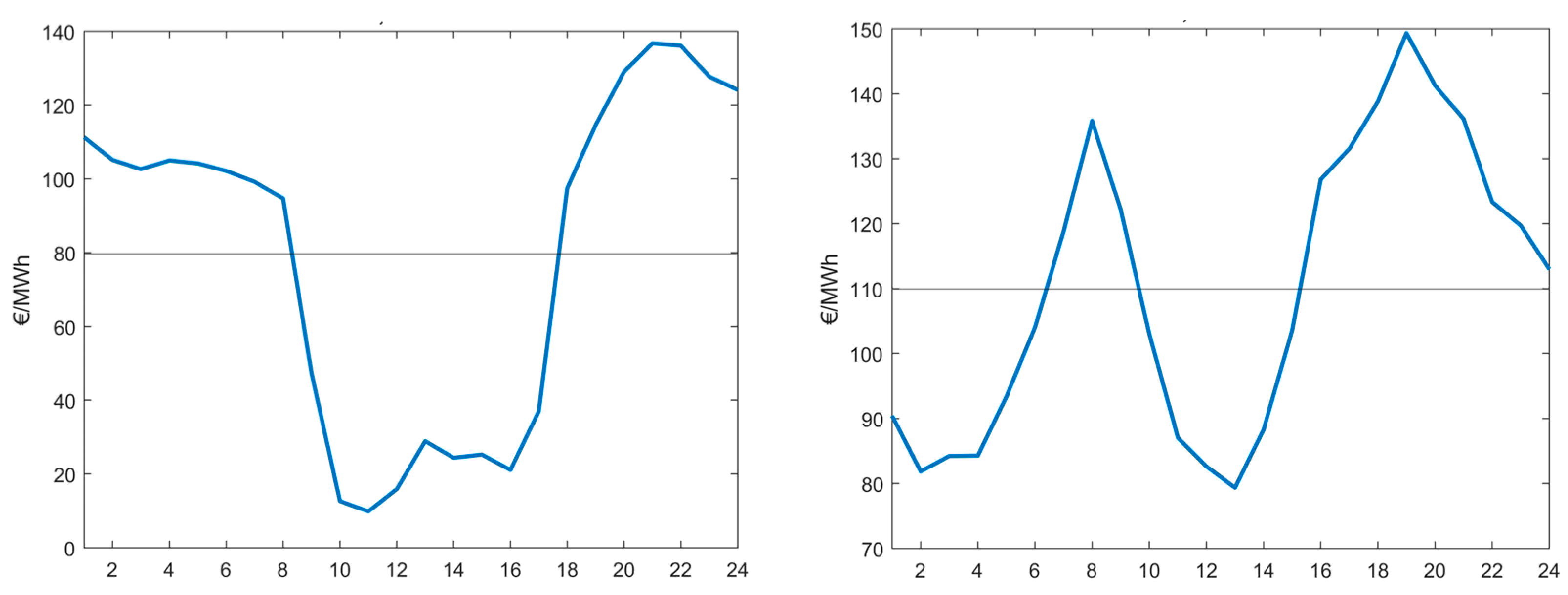
The transition to low-carbon power systems has led to a rapid deployment of variable renewable energy sources (vRES), in particular, utility-scale photovoltaic (PV) and wind generation. While these technologies are essential to decarbonization goals, their increasing share is changing power–system dynamics: the intermittent and non-dispatchable output of solar and wind plants reduces the predictability of net load, increasing the occurrence of rapid power ramps, exacerbating congestion at specific network nodes, and elevating wholesale price volatility, so much so that in some countries, a price of zero or negative is becoming common in periods of high PV or wind power production. Figure 1 shows the trend of the National Single Price (NSP) in Italy in two recent typical days: the profile has very wide price ranges and with low prices in some hours of the day characterized by significant PV production. These effects complicate system operation and market participation by renewable producers, undermining revenue certainty and increasing balancing costs for system operators [1,2].
From a technical perspective of the grid, high vRES penetration also reduces production from synchronous generators directly connected to the grid and therefore diminishes system inertia and primary frequency response. Converter-interfaced generation (wind and PV), unless specific control schemes are implemented, does not significantly contribute to the system inertia, resulting in more frequent large frequency deviations and faster rates of change in frequency (RoCoF) following disturbances [4].

1.1. The Role of Battery Energy Storage

In response, various forms of network flexibility and adaptation have been proposed and analyzed [5]. Among these, Battery Energy Storage Systems (BESSs) have emerged as key flexibility resources that, when used in conjunction with renewable generation systems, can transform non-dispatchable units into dispatchable ones [6]. BESSs can provide a broad set of flexibility services, economically valuable for both grid operators and asset owners: BESSs can deliver very fast active power injections or absorptions for frequency regulation [7]; they can effectively emulate inertia and provide fast frequency support, thereby mitigating the instability risks in low-inertia systems. Therefore, it is possible to obtain improvements in frequency nadir, RoCoF, and post-disturbance damping when BESSs are co-located with converter-interfaced plants or connected at strategic grid nodes [8].
Furthermore, BESSs can provide voltage support through reactive power control, enable congestion management, and perform energy arbitrage, a time-shifting strategy that offers significant revenue potential. In parallel, BESS technologies and control strategies have matured rapidly and are now cost-competitive across multiple value streams, particularly when revenues are stacked, meaning that a single BESS simultaneously participates in energy markets, ancillary services, and local network services [9,10,11,12].
Moreover, the evolving role of system operators—Transmission System Operators (TSOs) and Distribution System Operators (DSOs)—is now including flexibility-markets and services (e.g., [13]). Therefore, the integration of flexible resources like BESSs (alone or through aggregators) is essential to enable secure, cost-effective operation under rising vRES penetration. In several countries, e.g., Italy, Germany, France, the UK and the Netherlands, the TSOs and DSOs are actively promoting dedicated flexibility projects in support of the transition (e.g., [13,14]). Table 1 provides a summary of the main active flexibility projects in Italy.
European TSO and DSO technical regulations generally allow BESSs to be connected at specific network buses, either as stand-alone units or co-located with generation facilities for the provision of time-shifting services. The contracts are activated following specific auctions based on an incentive (or premium tariff) that the participants receive from the TSOs or DSOs to provide the service (e.g., [15,16]). Therefore, the availability of BESSs is strictly dependent on the market value of the technologies used. The most popular BESS technology today is lithium-ion, and its cost has been falling in recent years, allowing for the financial feasibility of several projects [19]. The coupling of lithium-ion BESSs with utility-scale PV and wind is technically feasible and becomes economically viable in many market conditions, driven by multiple revenue stream stacking and operational benefits such as reduced curtailment and higher effective capacity factors for the hybrid plant [20]. Table 2 presents the market range of capacity expenditure (CapEx) including design and installation, and operational expenditure (OpEx) values for BESSs. The range is variable depending on the size and the BESS C-rate (measure of how quickly a battery can be charged or discharged relatively to its capacity).
Key caveats include the location of the project within the network and the manner in which it participates in electricity markets, encompassing price signals and market design, as well as the accurate valuation of stacked services and project-specific risks. Uncertainties related to market access and remuneration must be carefully considered, as many markets still fail to adequately value storage-enabled flexibility or capacity, thereby constraining viable revenue stacking. In addition, factors such as technological degradation and delays associated with permitting and grid interconnection procedures require thorough assessment. In Italy, permitting timelines have lengthened over the past decade, interconnection queues have expanded, and network upgrade costs have increased. Single revenue sources, such as energy arbitrage, could rarely be enough to justify the initial investment. The effectiveness of pure energy arbitrage heavily depends on market volatility and the spread between peak and off-peak prices [19,21,22,23,24,25].
To enhance the financial sustainability of BESSs, several initiatives have been implemented worldwide [26]. However, a key issue concerns how the energy used to charge the battery in such operating schemes is priced. In most regulatory frameworks, this energy is treated as final consumption and therefore subject to the same charges applied to conventional consumers. From an economic efficiency perspective, it would be more appropriate to apply wholesale energy prices to both the charging and discharging phases (i.e., under a net-settled pricing condition) while reducing or exempting non-energy components of the bill—such as network charges, system fees, and taxes—which, in many countries (e.g., Italy), account for more than half of the total electricity cost. Therefore, a specific and favorable regulatory framework is needed.
Reviews of the economic indicators and methods for the assessment of the economic viability of BESSs co-located with utility-scale vRES (PV or wind farms) or as stand-alone grid-connected systems are available in [27,28,29]. Net Present Value (NPV) analysis is a standard financial metric used to evaluate the long-term economic feasibility of BESS investments. Most studies integrate BESS performance indicators, CapEx, OpEx, and degradation models into the NPV calculations. The high initial capital cost of batteries has been a major barrier to achieving positive NPVs and a viable internal rate of return (IRR) in the past, particularly in markets with low price volatility [28,30,31,32,33,34].

1.2. Contributions of This Paper and Methodology

This paper addresses key questions that are highly relevant to current industry challenges. Specifically, it investigates whether the profitability of utility-scale renewable generation plants (e.g., PV and wind farm facilities) can be increased by integrating the BESS units and identifies the optimal storage capacity. Furthermore, this study evaluates the economic viability of BESS installations that are incentivized to provide grid support services to TSO. Finally, this paper examines the market conditions under which stand-alone BESS projects engaged in energy arbitrage could be financially sustainable investment by comparing market arbitrage and TSO incentives.
To achieve this goal, this paper presents an optimization-based framework to assess the technical and economic feasibility of integrating BESSs into utility-scale renewable energy plants, as well as stand-alone. The objective is to evaluate the profitability of such systems from the perspective of the BESS owner. In addition, the methodology incorporates a dedicated model to quantify the revenue of participating in TSO-operated grid-support schemes—such as time-shifting services procured through competitive auctions—allowing for a comparison between market-based and incentive-based scenarios. No comparisons between market conditions and Italian TSO incentive program have been found in the literature (e.g., [35,36,37]).
Most economic assessments evaluate BESS profitability through static economic indicators (e.g., Levelized Cost of Energy, LCOE, or Levelized Cost of Storage, LCOS), using simplified dispatch rules (e.g., fixed charge/discharge profiles), by operational optimization without subsequent economic sizing, or by performing capacity optimization without fully coupling revenue scheduling with economic sizing. In contrast, this study integrates an annual revenue scheduling model, formulated as a MILP problem, with an NPV-based sizing optimization. This two-stage framework ensures that the economic assessment reflects realistic dispatch behavior under actual historical price and generation conditions, linking operational performance directly to investment decisions.
Several studies have highlighted the strengths and limitations of scheduling strategies for grid-connected PV-BESS systems (e.g., [28,29,30]). Among the documented approaches, a Mixed-Integer Linear Programming (MILP) formulation is chosen for the study presented in this paper due to its robustness, ease of implementation, and relatively low computational burden. Furthermore, a MILP formulation is adopted to ensure a transparent and computationally efficient optimization framework that guarantees globally optimal solutions for the problem under study, which is particularly suitable for investment-oriented techno-economic analyses (e.g., [38,39,40,41]).
The methodology is validated using real-world case studies and is designed to be flexible and adaptable to different market conditions and regulatory frameworks. The implemented model assumes the perfect knowledge of electricity prices and renewable generation, which corresponds to a best-case operational scenario, without considering forecasting uncertainties. This model allows for the evaluation of the economic feasibility—using NPV as indicator—and the identification of the optimal capacity for BESSs either co-located with utility-scale renewable plants or deployed as stand-alone grid-connected units. Cost assumptions are derived from actual market offers to ensure realistic estimates.
For co-located systems, revenues from energy arbitrage in wholesale electricity markets are considered. Moreover, since current Italian regulation allows a portion of the BESS to be dedicated to TSO time-shifting services, while the remaining capacity can participate in market activities, a hybrid case is examined in which total revenues derive from a combination of market arbitrage and time-shifting incentives. For stand-alone BESSs, the analysis focuses on revenues stemming solely from participation in time-shifting services.
The proposed methodology follows a two-step optimization structure. First, a MILP model computes the optimal charge–discharge schedule over one year, using historical generation and market price data, considering operational constraints and capacity degradation. This step is repeated for a predefined set of BESS sizes, starting from zero (baseline system without storage) and increasing up to a maximum threshold. The obtained annual revenues are the inputs to the second optimization step, in which the NPV is evaluated to identify the economically optimal BESS size.

2. Procedure and Models

The system comprises a PV or a wind farm facility, a BESS (coupled or stand-alone), and main grid. The optimization algorithm aims to define the NPV in the different configurations and the optimal size of the BESS that maximizes the NPV.
The input data consists of deterministic production profiles for PV and wind generation facilities. For PV systems, variability in solar irradiance is addressed by adopting an average production profile derived from the last 18 years of historical data. Wholesale electricity price profiles (Italian NSP) from three representative years are considered in order to capture distinct market conditions: low prices (2020), high prices (2022), and intermediate prices (2024). The analyzed BESS capacities span the utility-scale range, from 1 MWh up to several hundred MWh [19]. The assessment is conducted from the perspective of the asset owner downstream of the delivery point; therefore, physical network constraints and the operational impacts on the electricity grid are not explicitly modeled.

2.1. Input Data

The following data is used as inputs to the algorithm.
For the PV scenario, hourly profiles represent a 36 MWp ground-mounted plant in Ravenna, Italy, characterized by a 30° slope and 0° azimuth. These profiles were generated using an 18-year average of hourly irradiation data from the JRC PVGIS database. To ensure accuracy, the model incorporates system losses and a 0.5% annual aging factor, with all data normalized to 1 MWp.
The wind farm inputs consist of hourly generation data from a 16.5 MW facility in Agrigento, Sicily, based on 2024 operational records provided by the plant owner.
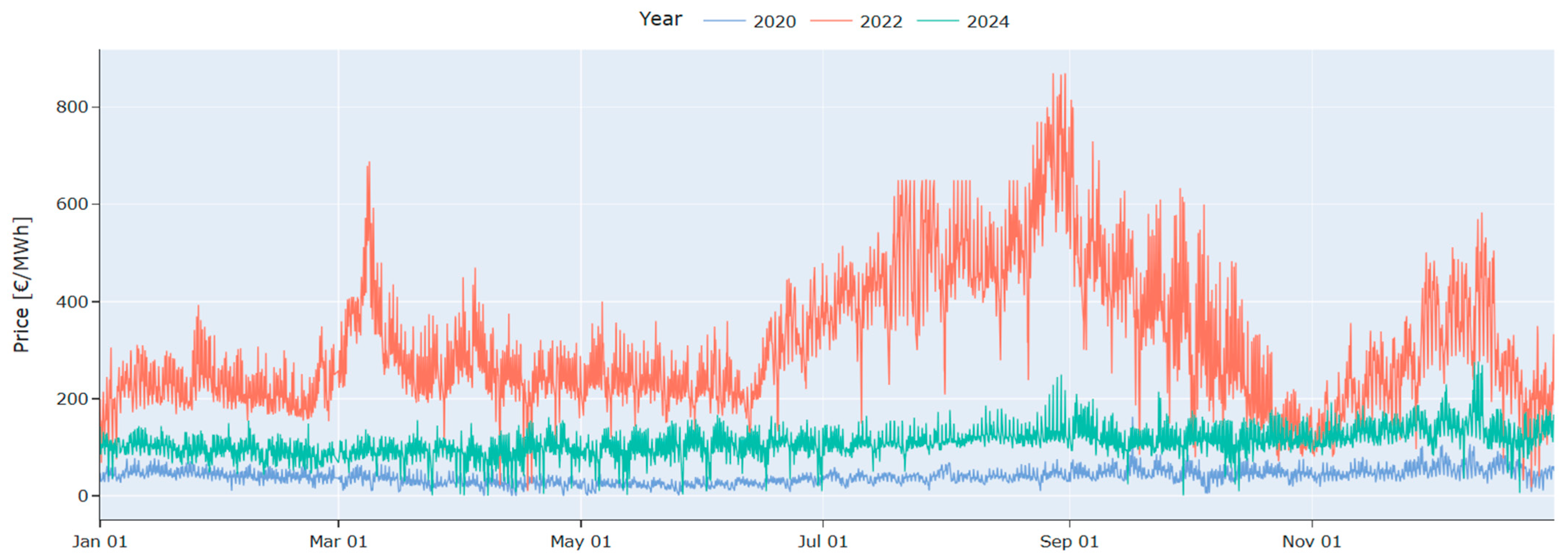
The analysis is based on the hourly time series of the Italian NSP [3] for the years 2020, 2022, and 2024, as illustrated in Figure 2.
These years are selected to capture three distinct market price regimes relevant to the analysis: 2020 represents a low-price regime, 2024 an intermediate price regime, and 2022 a high-price regime, thereby enabling a comparative assessment of BESS performance across differing market conditions (Table 3). Moreover, the following assumptions are considered: the energy injected into the grid is valued at the hourly NSP; the energy adsorbed from the grid is valued at the hourly NSP under net-settled conditions (K = 1) when the BESS is used to provide TSO grid services; for a BESS operated purely for market arbitrage, the hourly NSP is increased by system, regulatory and tax charges, resulting in K values ranging from 1 to 2.3, as Italian regulations do not allow for tariff discounts for arbitrage operations; adequate efficiency for converters and BESSs is considered.
The procedure is composed of two steps. In the first step, the optimization determines the hourly charging and discharging schedule of the BESS over a full year, identifying the periods in which energy is injected into the grid based on wholesale price volatility (NSP) and thereby defining the annual revenue. This scheduling procedure is iteratively repeated for increasing BESS capacities, with increments of 0.2 MWh. The resulting marginal revenues constitute the input to the second step of the methodology, where the corresponding cash flows are aggregated and the Net Present Value (NPV) is computed. The NPV is evaluated for all considered BESS sizes, and the optimal capacity is finally selected as the one that maximizes the NPV.

2.2. BESS Scheduling, Optimization Constraints and of (Step 1)

The following constraints are considered. The power balance is expressed as follows:
P B E S = P g r i d + P P V
The BESS power (PBES) is assumed to be positive during the charging phase. To avoid simultaneous injection and absorption of power from the grid in the same period, a binary variable v is introduced:
P g r i d _ i n v P g r i d _ i n _ M A X P g r i d _ e x ( 1 v ) P g r i d _ e x _ M A X
Additional constraints for the BESS are introduced: the net power exchanged with the BESS is as in (3), considering the efficiency η B E S (equal for charging and discharging), with binary variables u included in (4) to avoid charging and discharging in the same period:
P B E S = P B E S _ c h η B E S P B E S _ d i / η B E S
P B E S _ d i u P B E S _ d i _ M A X P B E S _ c h ( 1 u ) P B E S _ c h _ M A X
The SOC model and its limits (complaint with the manufacturer’s datasheet), with initial/final values, are as follows:
S O C t = S O C t 1 + ( P B E S / E B E S , max ) Δ t
0.1 S O C t 1 ,   S O C 0 = S O C t e n d = 0.5
To avoid premature aging of the BESS, a maximum number of charge and discharge cycles MAC in one year is imposed (one per day on average is used):
t = 0 T P B E S _ c h η B E S + P B E S _ d i / η B E S 2 E B E S , max M A C
The following OF is maximized for the annual scheduling of the BESS:
max R = t = 0 T ( P g r i d _ e x , t π e x , t P g r i d _ i n , t π i n , t ) Δ t
with:
π i n , t = K π e x , t
where π i n , t , π e x , t are the profile of import and export prices relevant to P g r i d _ e x , t , P g r i d _ i n , t , respectively, i.e., the power injected to and absorbed from the grid.
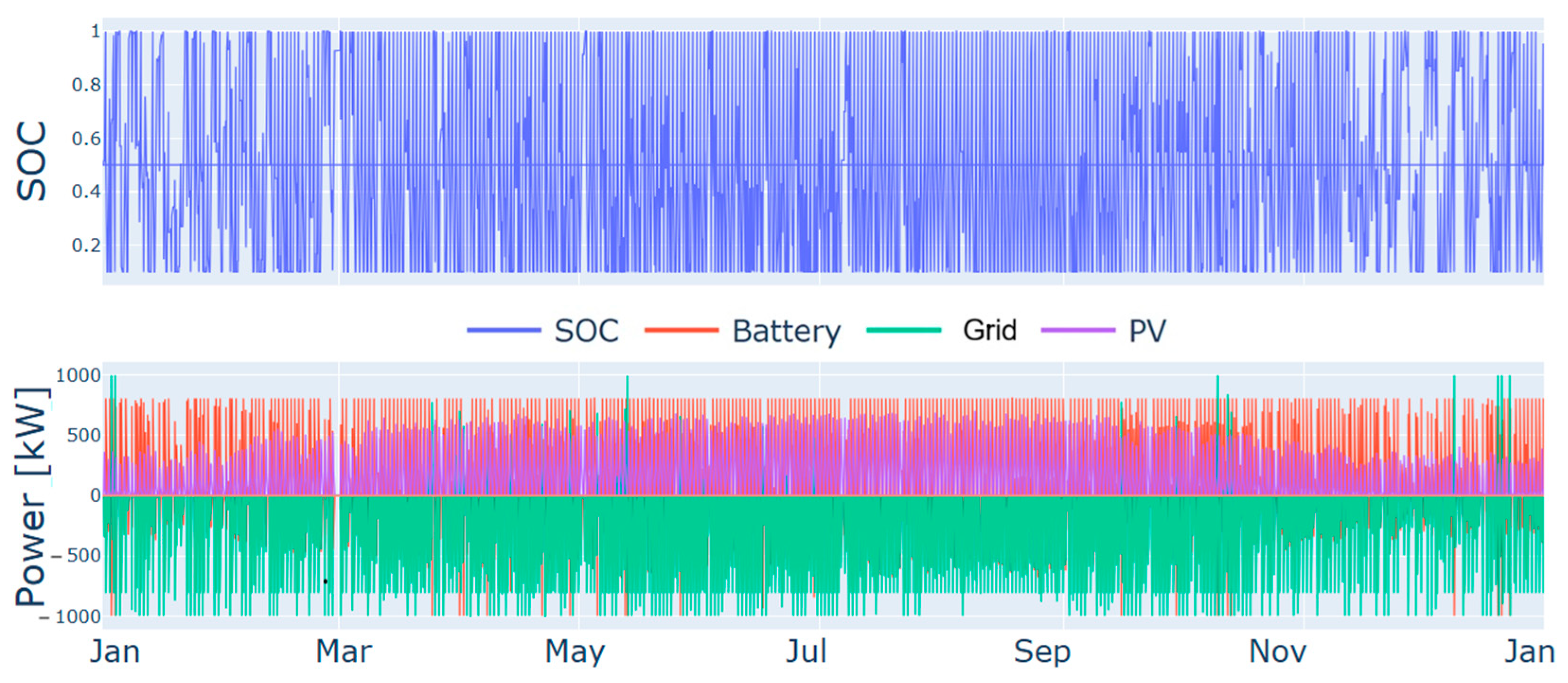
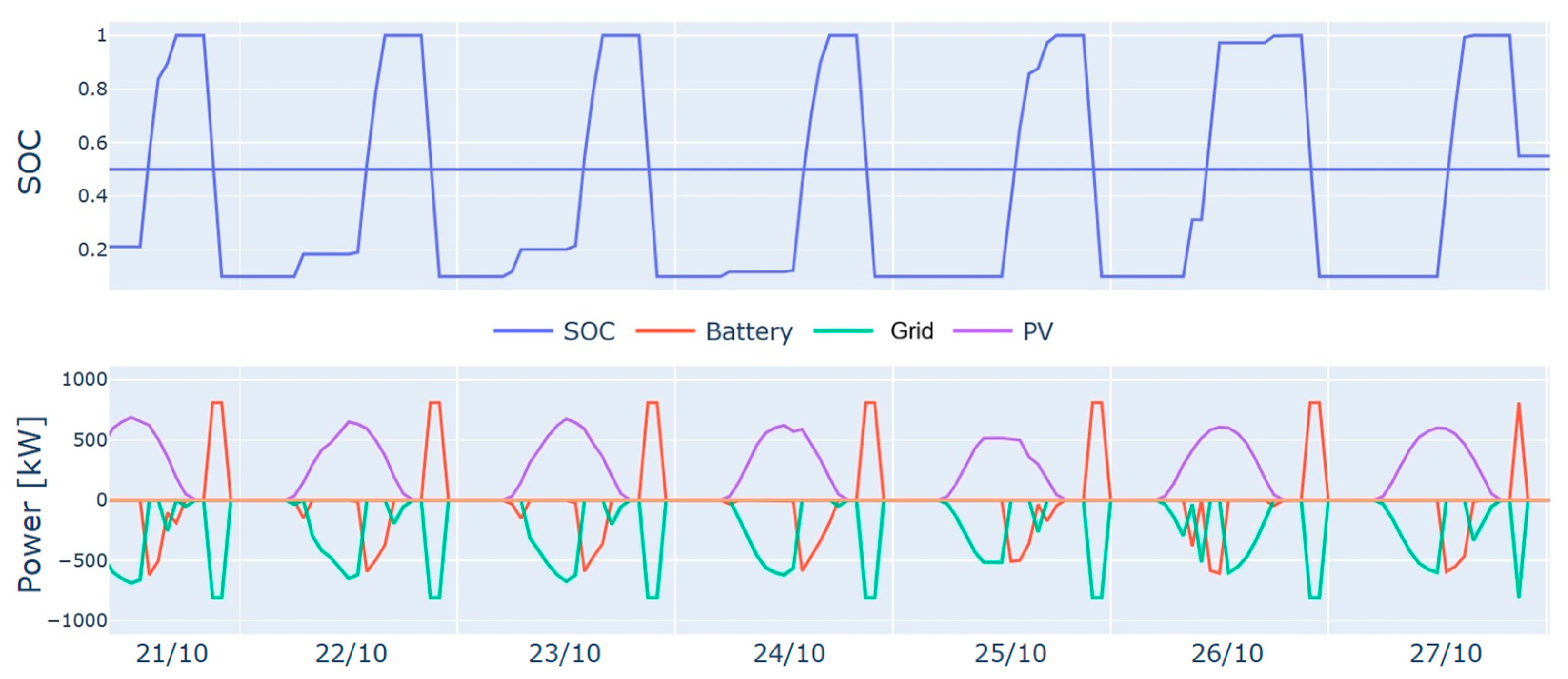
No explicit constraints are imposed on the source of energy used to charge the BESS. Instead, economic signals implicitly govern charging behavior through price differentials. Specifically, PV generation is assumed to have zero prices (marginal cost tends to zero), while energy injected into the grid is valued at the wholesale market price (NSP). Conversely, energy absorbed from the grid is priced at 2.3 times the NSP, reflecting system charges, network fees, and taxes. Under these assumptions, purchasing energy from the grid to charge the BESS is economically unattractive; consequently, the optimization naturally favors charging from on-site PV generation and subsequently discharging to the grid. This behavior is clearly illustrated in the scheduling results shown in Figure 3 and Figure 4 (typical week), where only energy injections into the grid are observed and no grid withdrawals occur. The main quantities involved in the annual scheduling performed with MIP optimization are the SOC (Figure 3) and the BESS power, power exchanged with the grid and power produced (Figure 4), where PBES is positive during discharging and Pgrid is positive if absorbed.

2.3. NPV and BESS Size for Increasing Profit of PV and Wind Facilities (Step 2)

The BESS is assumed to be a private investment intended purely for-profit maximization. While the owner receives no external incentives and maintains no formal grid obligations, they benefit directly from energy arbitrage and the resulting stabilization of the plant’s output profile.
Before determining the NPV, the revenue curve is modeled as a function of BESS size, incorporating the annual marginal revenue achieved by progressively increasing the BESS capacity (with step of 0.2 MWh) and defined for each BESS size as follows:
P B E S _ S I Z E = R B E S _ S I Z E R P V
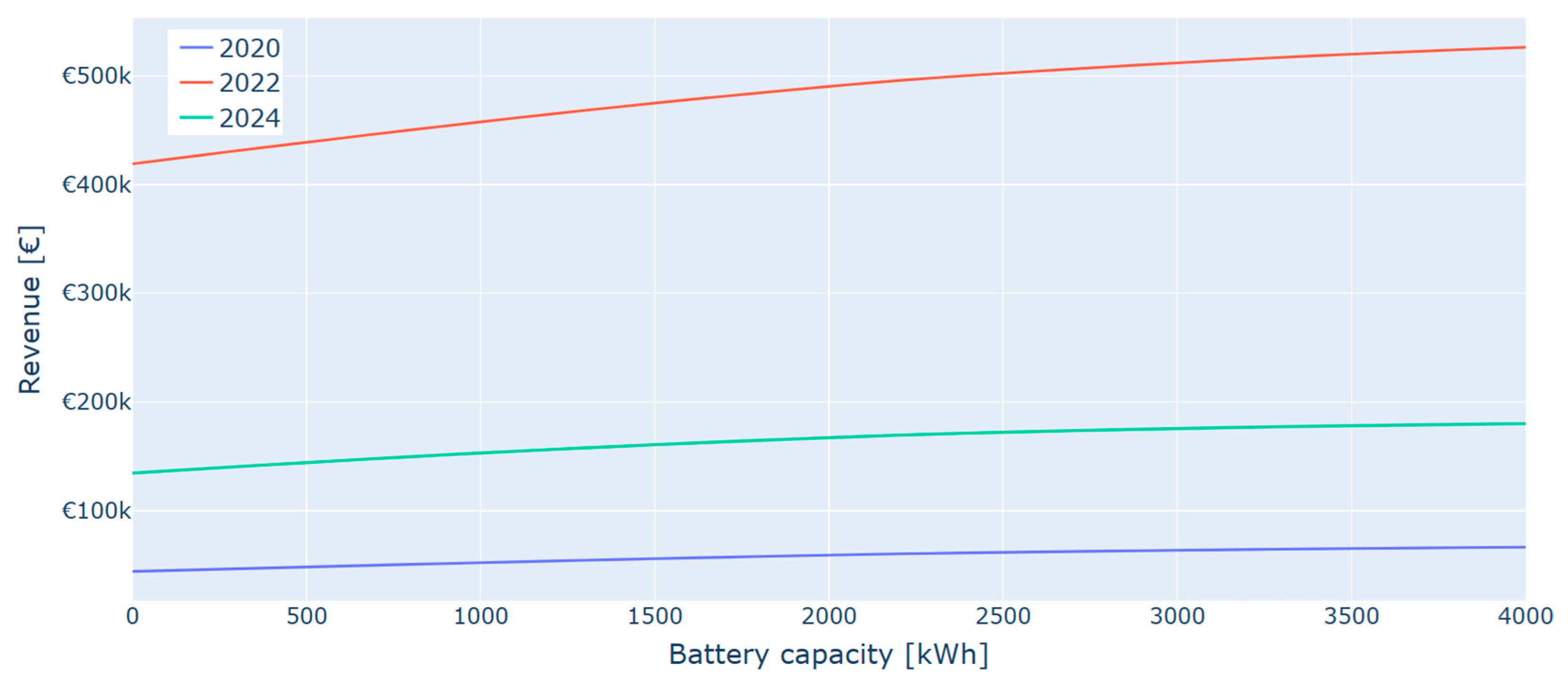
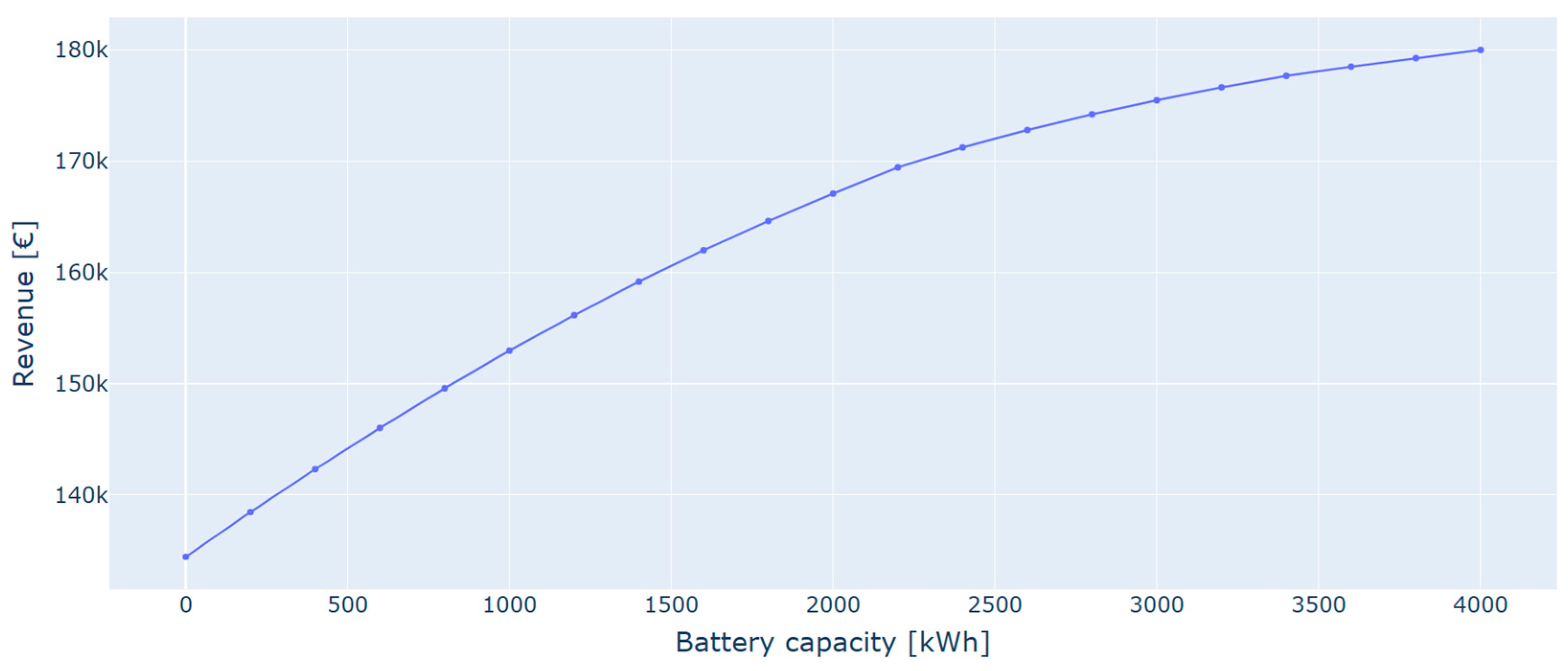
where P B E S _ S I Z E is the profit from electricity sales as a function of the BESS size, and R P V , R B E S _ S I Z E are the total annual revenues from PV electricity sales, with and without the BESS, respectively. To obtain the revenue curves, the BESS power scheduling is simulated for each BESS size and for one year per time by assuming the deterministic knowledge of PV production and prices along the three considered years and maximizing OF (8). An example of the BESS scheduling referred to normalized size of 1 MW of the production facility for 2024 is depicted in the Figure 3 and Figure 4, which illustrate the trend of the main quantities involved, while the corresponding revenues are presented in Figure 5. The resulting revenue curve obtained from step 1 is typically non-linear (Figure 5).
To preserve the linearity of the problem formulation and to maintain a unified and extensible MILP framework, the revenue curve is approximated by using a piecewise linear function, as in [33]:
P i B E S _ S I Z E = m i B E S S i S I Z E + q i
For each segment i, slope (m) and intercept (q) are defined as follows:
m i = ( P i + 1 B E S _ S I Z E P i B E S _ S I Z E ) / ( B E S S i + 1 S I Z E B E S S i S I Z E ) q i P i S I Z E m i B E S S i S I Z E
Interval constraints, following the big-M method, are defined to guarantee that the PBES_SIZE value remains within the bounds of the active segment. Specifically, PBES_SIZE must lie between the limits of the i-th segment of the piecewise linear characteristic, selected by the binary variable bi
P i B E S _ S I Z E B E S S i S I Z E b i P i B E S _ S I Z E B E S S i + 1 S I Z E b i + ( 1 b i ) M
To ensure that only one segment is active at a time, the following constraint is imposed:
P i B E S _ S I Z E m i B E S S i S I Z E + q i + ( 1 b i ) M P i B E S _ S I Z E m i B E S S i S I Z E + q i ( 1 b i ) M
where M is a sufficiently large constant. To ensure that BESS size stays in exactly one segment, the following constraint is added:
i = 0 N b i = 1
In the second optimization (step 2), the BESS size corresponding to the maximum NPV is determined as a function of the annual marginal revenue P, utilizing the following OF:
max N P V M A R K E T = t = 0 T _ B E S R B E S _ S I Z E ( 1 d ) R P V C O & M ( 1 + r ) t C 0 _ B E S
where d is the BESS revenue degradation rate.
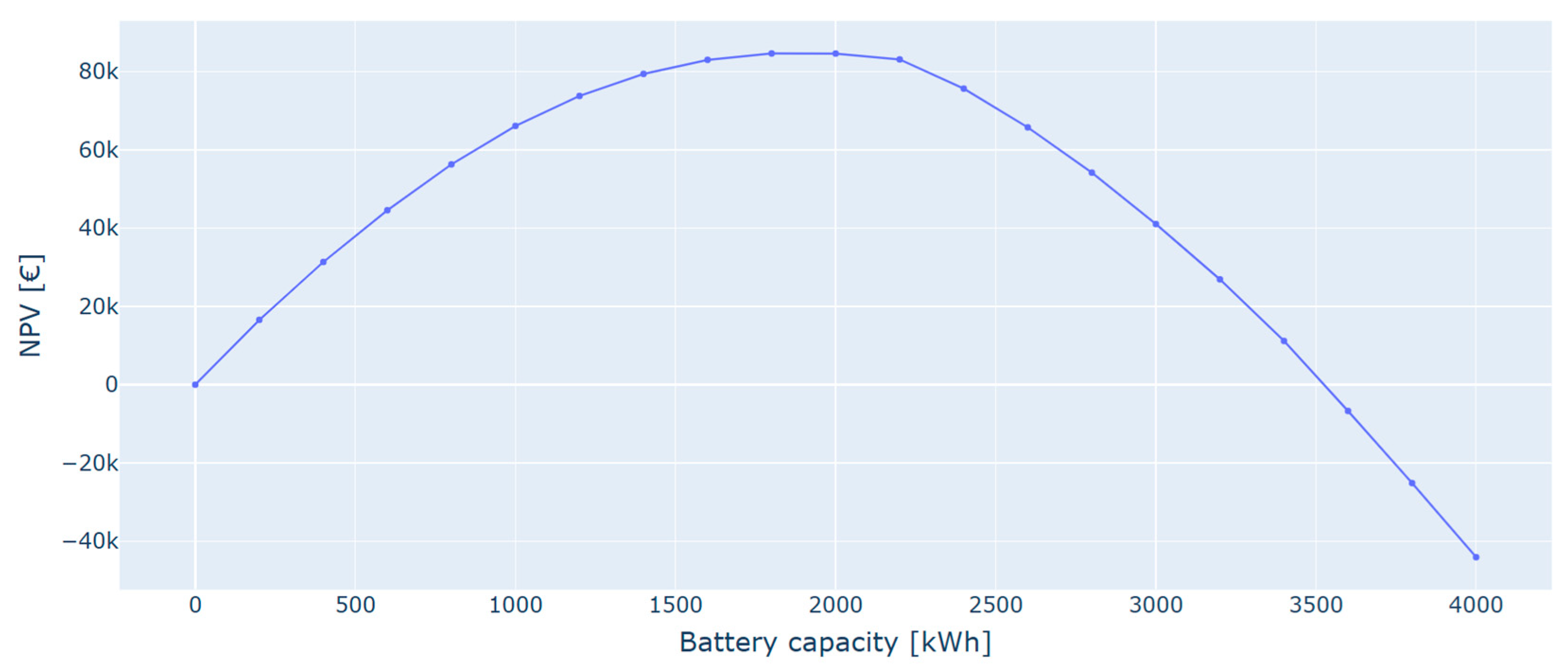
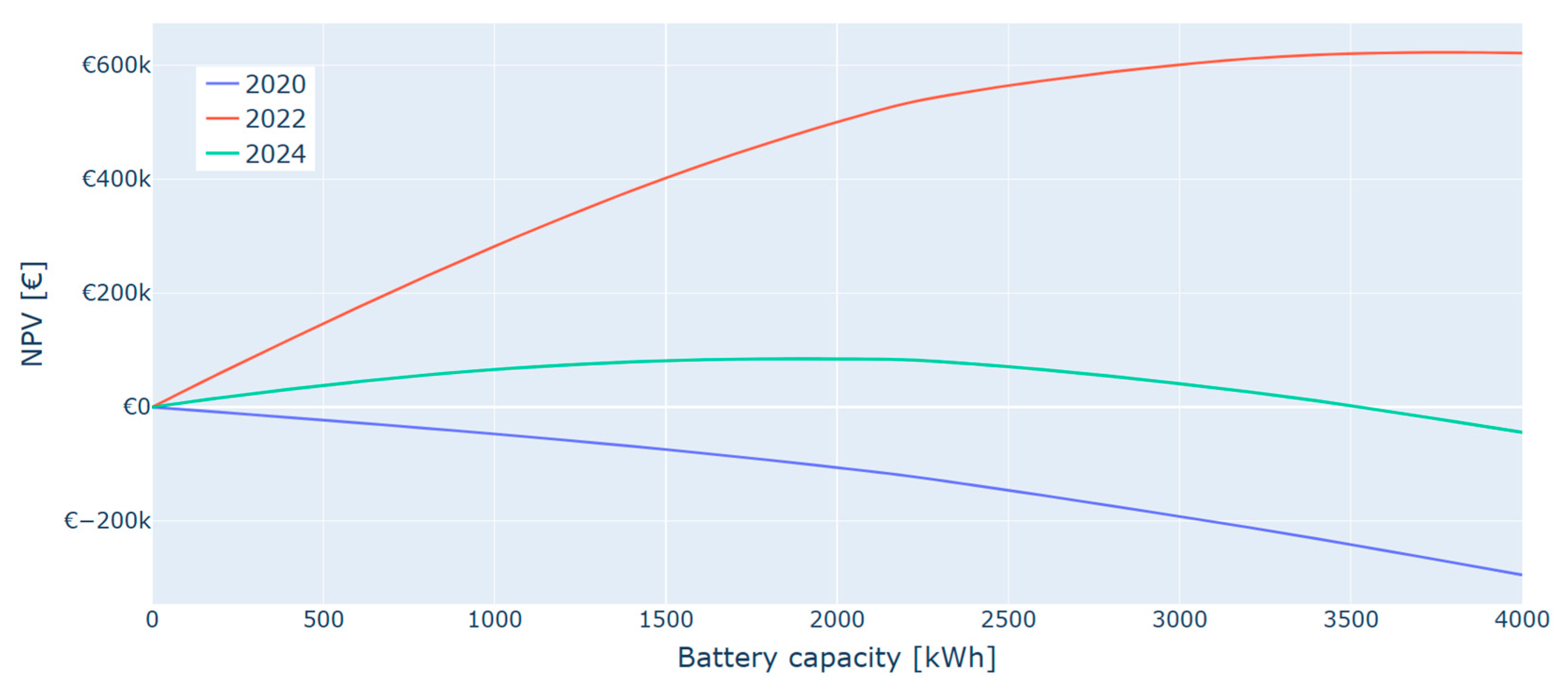
In the end, the algorithm returns the BESS size that corresponds to the maximum NPV. An example of the NPV as a function of BESS size is shown in in Figure 6, with a peak corresponding to a BESS size of 1.8 MWh.

2.4. NPV and BESS Stand-Alone for Arbitrage Service (Step 2)

The stand-alone BESS purchased for the exclusive purpose of performing arbitrage operations is now considered. In this case, the same model described above is used. The only difference is that the production profile is not included in the calculations. Therefore, the OF becomes:
max N P V M A R K E T = t = 0 T _ B E S R B E S _ S I Z E ( 1 d ) C O & M ( 1 + r ) t C 0 _ B E S

2.5. NPV for the BESS as a TSO Service for Time-Shifting

We assume the plant operator owns the BESS and provides time-shifting services to the TSO in return for an incentive. The following considerations and calculations refer to the Italian rules of the MACSE (Meccanismo di Approvvigionamento di Capacità di Stoccaggio Elettrico) scheme managed by the Italian TSO (Terna) [15].
When the BESS is contracted for time-shifting, the capacity committed to the TSO must always remain fully available and must be able to respond to dispatch instructions within short notice. Consequently, the portion of the BESS reserved for time-shifting cannot be reliably used for other market services, such as energy arbitrage. Under MACSE, the TSO remunerates the BESS through periodic payment determined via competitive auctions. Simplifying, the premium consists of a fixed portion (covering CapEx and OpEx) and a small variable portion tied to the energy exchanged with the grid. The fixed portion relates to OpEx is revalued based on the CPI index. The variable portion is estimated at 20% of the fixed portion. In addition, the exchanged energy is net-priced (net-settled): the cost of absorbed energy is equal to the value of injected energy.
In addition, the owner may install, on the same site, generation units or additional BESS capacity dedicated to market services. However, the scheduling of the MACSE-committed portion is entirely dictated by the TSO. For this reason, the NPV calculation is independent of system optimization strategies (therefore, step 1 of the algorithm is skipped) and depends on the regulatory and economic parameters that define costs and revenues. The following specific parameters (referring to 1 MWh) are considered:
C O _ B E S (CapEx) is the current market cost for medium and large BESS plants.
C O & M (OpEx) is the operations and maintenance (O&M) cost declared in TSO studies.
I is the annual premium (or incentive) granted by the TSO to the BESS for 15 years (T_BES). The value refers to the average of the requests of the BESS winners in the concluded auction.
CPI (Consumer Price Index) is the periodic revaluation index of the incentive, only in the part linked to the OpEx cost, to the extent established by the TSO, equal to 20% of I.
r is the discount rate.
Therefore, the NPV for the TSO time-shifting service is calculated as follows:
N P V T S O = t = 0 T _ B E S ( 0.8 I + 0.2 I ( 1 + C P I ) ) + ( 0.20 I ) C O & M ( 1 + r ) t C 0 _ B E S

2.6. Hybrid BESS Operation: TSO Time-Shifting Services and Market Arbitrage

As mentioned above, in a utility-scale facility, production and BESSs can coexist, divided into two sections: one for market use (arbitrage) and one serving the TSO for time-shifting. In this case, once the sizes of the two BESS sections have been defined, the total NPV is the sum of the two contributions, putting together (17) and (18) as follows:
N P V T O T = N P V M A R K E T + N P V T S O
A hybrid BESS operation combining TSO time-shifting services and market arbitrage generally requires a clear separation between reserved and merchant capacity to ensure service availability. While partial or temporal stacking is technically feasible and implemented in some markets (e.g., the UK), its application to time-shifting services remains limited and highly dependent on regulatory frameworks. Allowing for controlled stacking could significantly enhance BESS profitability but would require advanced SOC management, clear priority rules, and revised TSO contracting schemes.

3. Results

The models have been implemented in Python 3.12 and tested by applying the library CVXPY [42,43] and SCIPY [44] as a solver of the MILP program on a 4.7-GHz Intel-i7 computer with 16 GB of RAM, running 64-bit Windows 11. All the calculations for the annual scheduling of the BESS refer to a time window of 1 year, split into 8760 periods of 1 h each. Below, the results obtained for the different cases are represented.

3.1. NPV and BESS Size for Increasing Profit of PV and Wind Facilities

3.1.1. BESSs for PV Facility

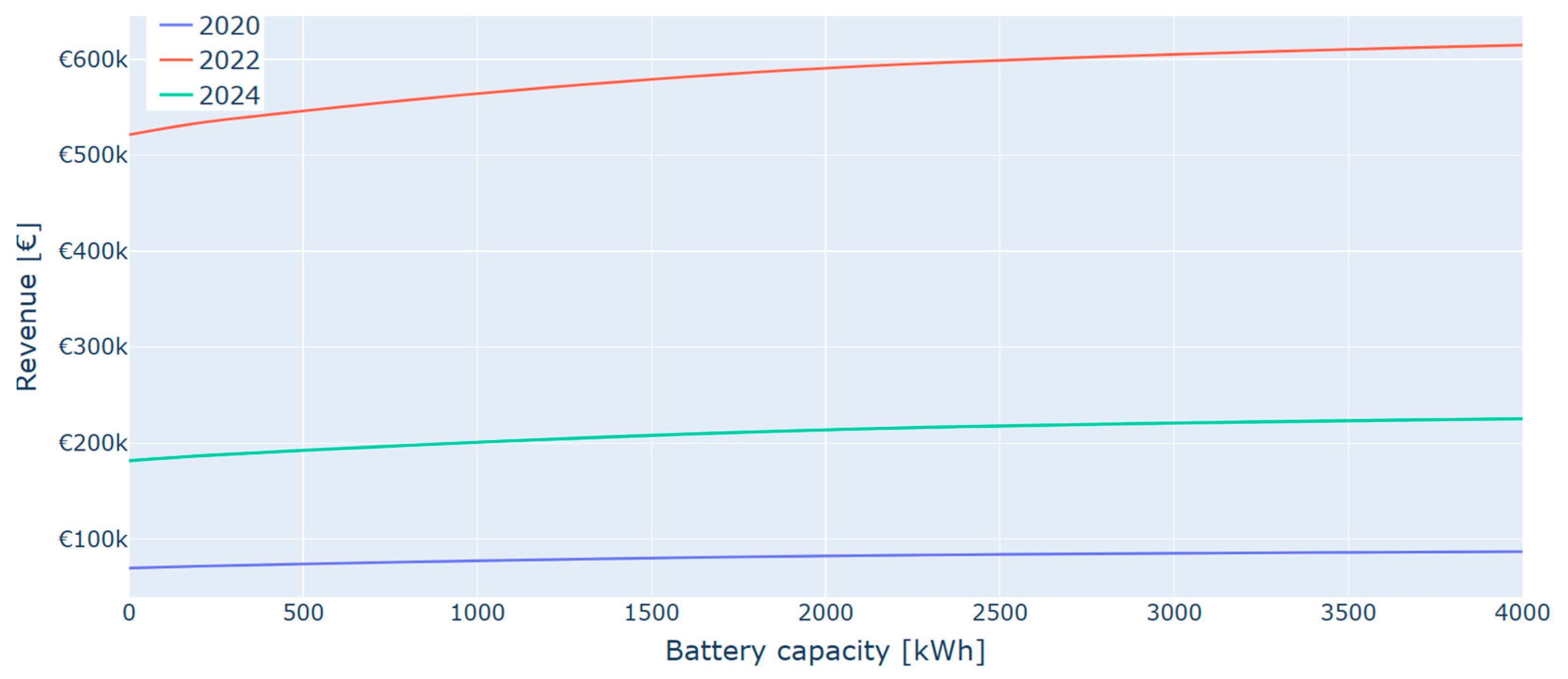
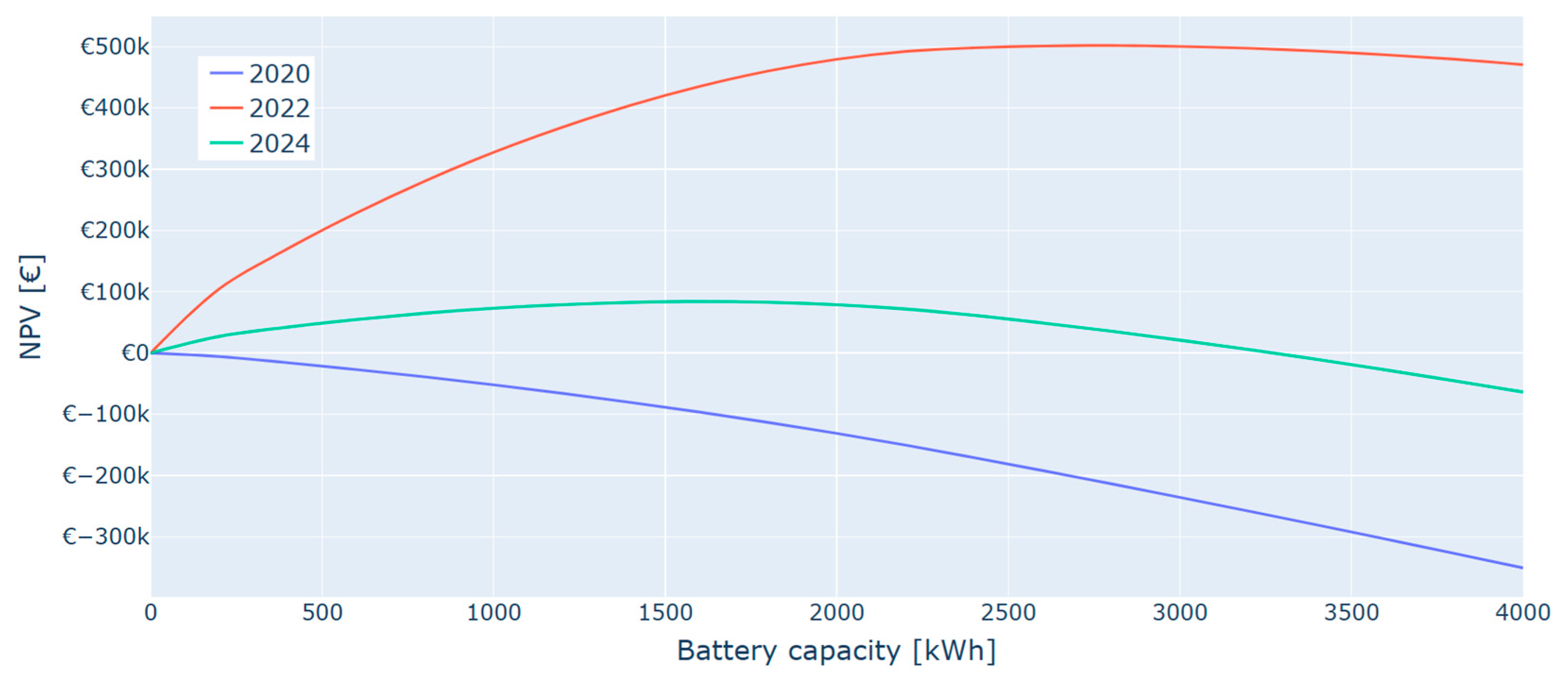
The schedules obtained in Step 1 of the optimization, using the parameters reported in Table 4, generate the revenue and NPV curves shown in Figure 7 and Figure 8, respectively, for the three considered years. The subsequent NPV maximization in Step 2 identifies the optimal BESS size for each case.
As shown in Figure 7 and Figure 8, the BESS size that maximizes the NPV varies across the three representative years: 1.8 MWh in 2024 (NPV = 84.64 kEUR) and 3.8 MWh in 2022 (NPV = 622.39 kEUR), while in 2020, the NPV remains negative for all storage sizes, preventing the identification of an optimal value. Since 2022 is influenced by exceptionally generous revenues and NPVs driven by NSP prices, and 2020 exhibits low revenues and negative NPVs due to depressed NSP levels, 2024 is selected as the reference for the optimal BESS size.

3.1.2. BESSs for Wind Farm Facility

As in the case of PV facility, Figure 9 and Figure 10 show the revenue and NPV curves over the three considered years. The parameters used in the optimization are those shown in Table 4, and in this case, the size of the production plant has been normalized to 1 MW.
As shown in Figure 9, the BESS size that maximizes the NPV differs across the three representative years: 1.6 MWh in 2024 (NPV = 84.15 kEUR) and 2.8 MWh in 2022 (NPV = 502.01 kEUR). In 2020, the NPV is negative for all storage sizes and therefore no optimal size can be selected. Similar considerations to the case of PV can be made. The year 2022 is characterized by exceptionally high revenues, and 2020 exhibits low revenues and negative NPVs due to low NSPs; the year 2024 is taken as the reference for the optimal BESS size.

3.1.3. BESSs for PV and Wind Farm: Sensitivity Analysis

To broaden the application range of this study, a sensitivity analysis of the NPV and optimal BESS size as a function of CapEX, OpEx and discount rate r was performed. As shown in Table 5 and Table 6, the size results vary between +12.5% and −25% for the wind farm facility and from +22.2% and −22.2% for PV facility.
Table 7 shows the NPV values as a function of the discount rate r. Furthermore, the limit values at which the NPV becomes zero were calculated as follows:
PV facility: CapEx = 165 kEUR/MWh, OpEx = 8.5 kEUR/MWh and r = 11%.
Wind facility: CapEx = 176 kEUR/MWh, OpEx = 8 kEUR/MWh and r = 9.5%.

3.1.4. Stand-Alone BESSs for Arbitrage

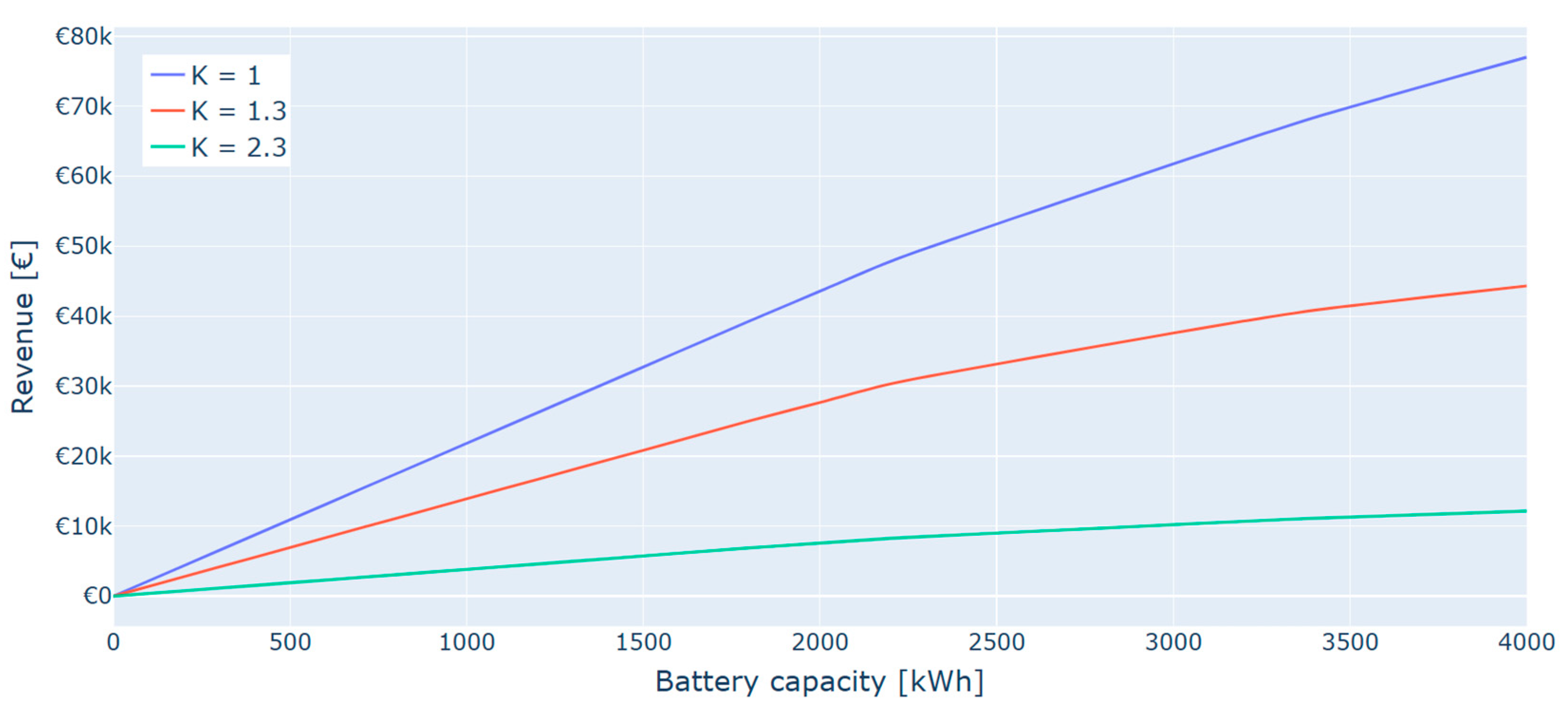
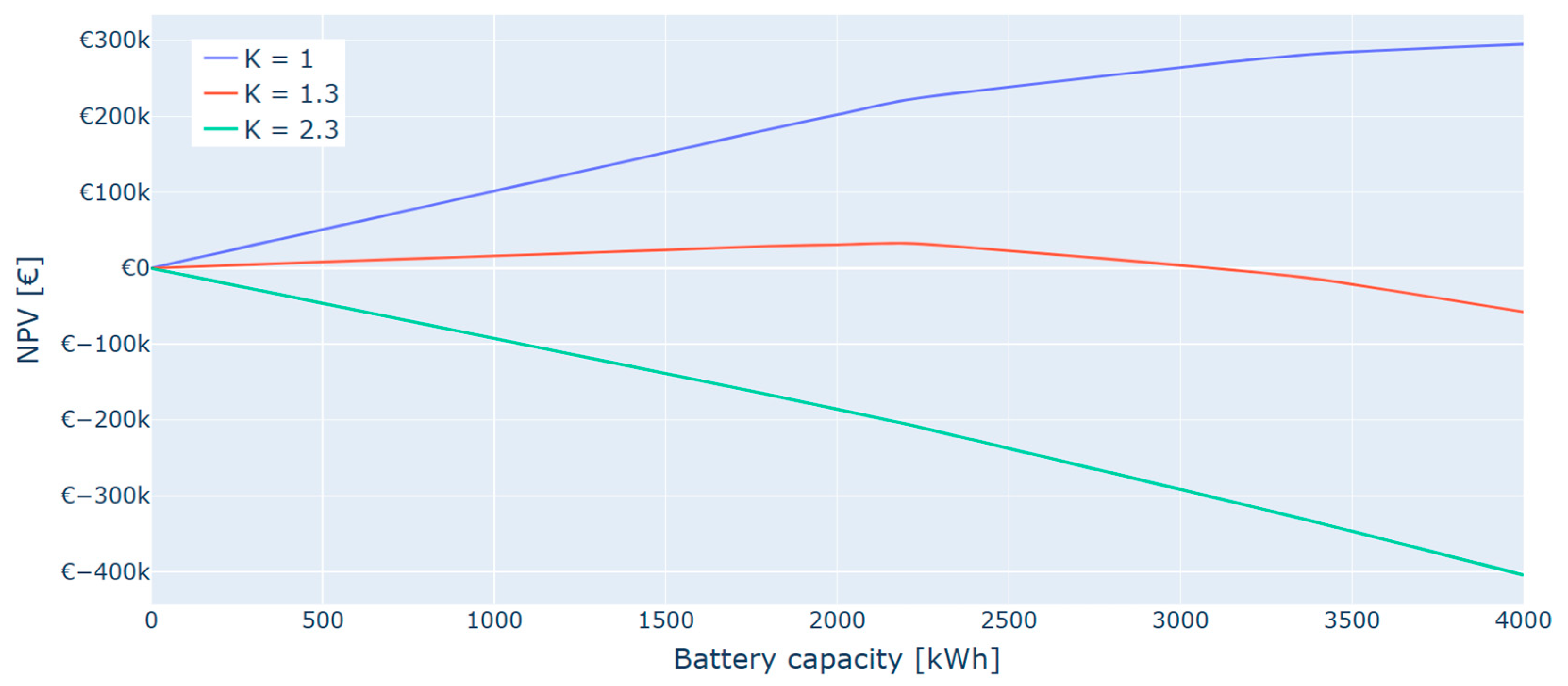
In the case of using BESSs for arbitrage service, the same model (including constraints and parameters) described above has been used with the energy production profile set equal to zero. The analysis was carried out as a function of the K ratio between the cost of charged energy withdrawn and that of the discharged energy. The results are presented in the Figure 11 and Figure 12.
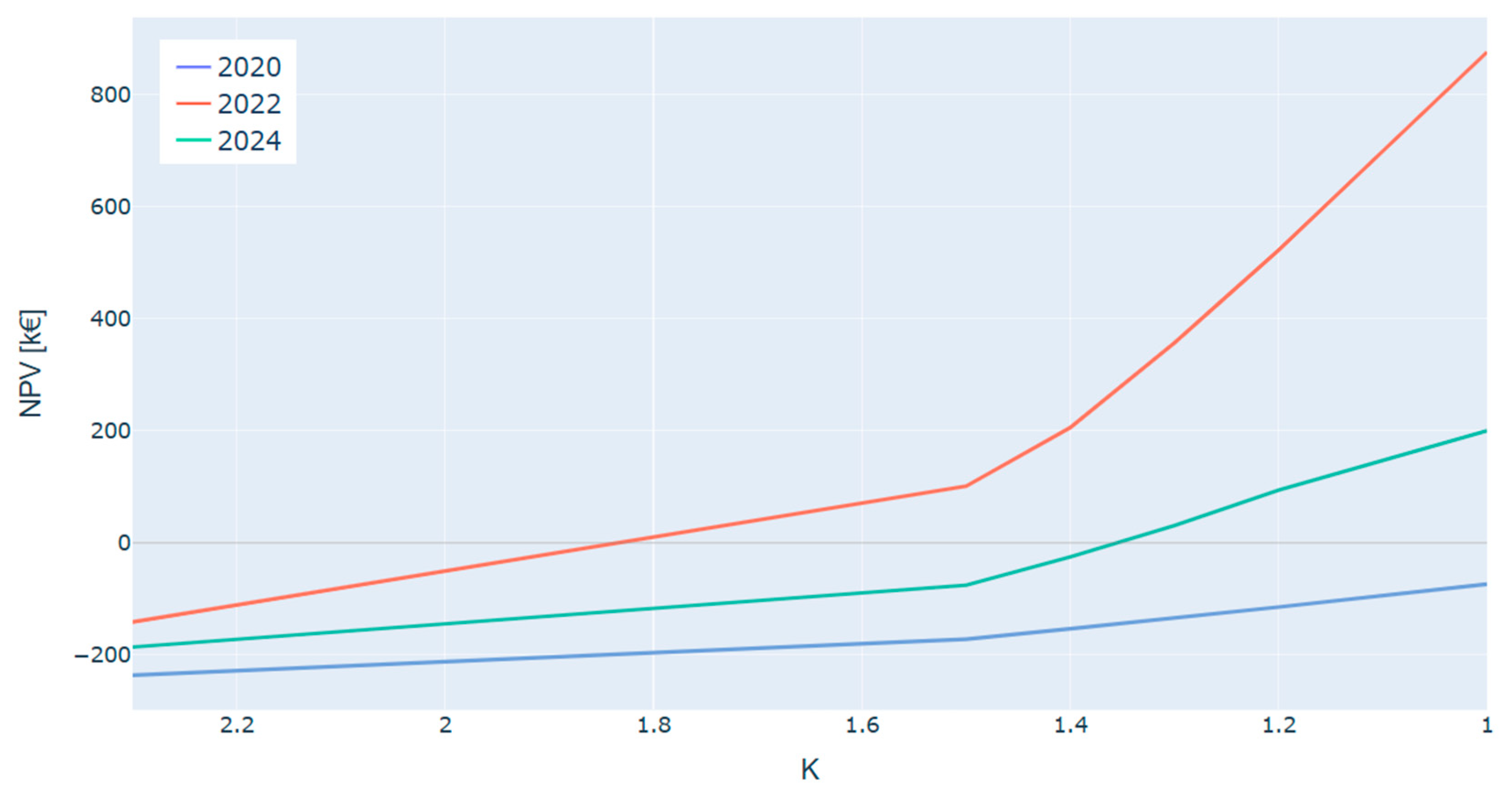
Figure 13 shows the NPV for different values of K, corresponding to the BESS size of 2 MWh over the three years considered. NPV becomes positive for K ≤ 0.68 in 2020, K ≤ 1.81 in 2022 and K ≤ 1.35 in 2024. The average value over the three years is K = 1.28. In 2020, arbitrage is not profitable even considering net-settled prices; only a further discount on the wholesale price (i.e., K < 1) could achieve a positive NPV. While in 2022, a small discount on the market price would be enough to obtain positive NPV. The optimal BESS size where the NPV is positive (K = 1.28 ÷ 1) in 2024 varies between 1.8 MWh (K = 1.28 average value) and 4.4 MWh (K = 1).

3.1.5. BESSs as a TSO Service for Time-Shifting with Premium

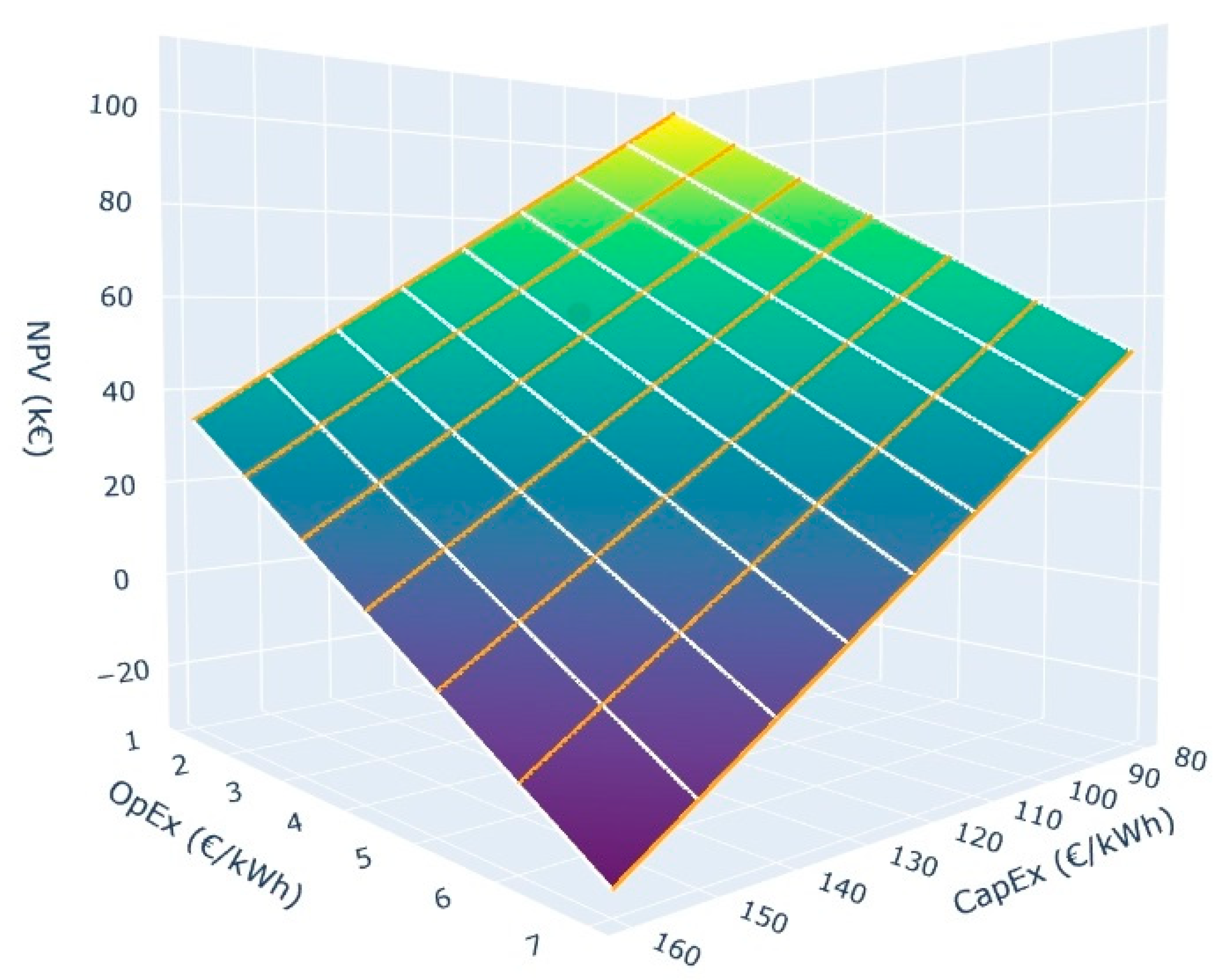
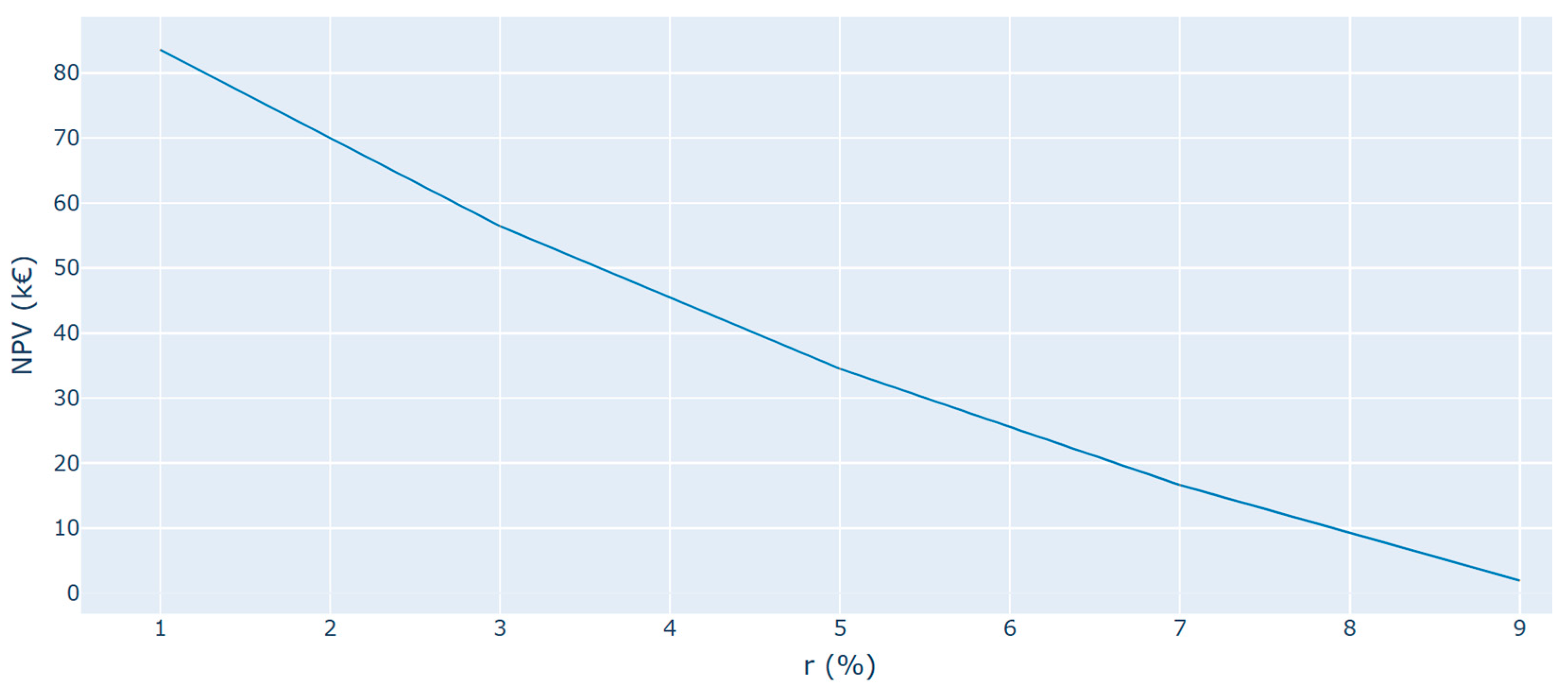
The services to the TSO (referring to the Terna MACSE Project) do not depend on the price of energy. The model is used with the parameters shown in Table 8 to perform a sensitivity analysis varying CapEX, OpEX and discount rate r values. The NPV is equal to 56.43 kEUR when Table 8’s parameters are used. Figure 14 and Figure 15 show that the NPV is positive when CapEx ≤ 170 kEUR/MWh, OpEx ≤ 7 kEUR and discount rate r ≤ 9%.

3.1.6. BESSs for Combining Private and TSO Services

The results show that the least risky choice in economic terms is achieved by devoting part of the BESS to market service (arbitrage) and part for the TSO service so as to have some revenue not dependent on energy price fluctuations. In this case, the revenue and the total NPV is given by the sum of the individual revenues.

4. Discussion

The revenue curves shown in Figure 7, Figure 9 and Figure 11 are fully consistent with the expected behavior of the model. Increasing the BESS capacity leads to progressively lower marginal revenues; consequently, the revenue function exhibits a monotonically increasing but asymptotic trend, gradually approaching a saturation level. This indicates that beyond a certain storage capacity, additional BESS capacity yields negligible economic benefit.
Similarly, the NPV curves presented in Figure 8, Figure 10 and Figure 12 accurately reflect the underlying economic dynamics. Excluding cases where the NPV remains negative over the entire capacity range—corresponding to non-profitable investment scenarios (e.g., year 2020)—the NPV initially increases due to high marginal revenues that outweigh capital and operating costs. As the BESS capacity continues to grow, the impact of CapEx and OpEx becomes dominant, leading to a decline in the NPV. The maximum of the NPV curve therefore identifies the economically optimal BESS size.
The NPV results (Figure 8 and Figure 10) and the optimal BESS size for PV and wind farm show that the convenience of a BESS depends substantially on the NSP price and its daily fluctuation. In 2020, a year with low energy prices and low fluctuation (Table 3), the revenue from a BESS (Figure 7 and Figure 9) was so low that it did not compensate for the purchase and maintenance costs, resulting in a negative NPV despite the CapEx fall.
In 2022, energy prices were high, with significant fluctuations (Table 3), meaning that revenues from the introduction of a BESS are generous. The NPV is also high, resulting in an optimal BESS size of 3.8 MWh for PV and 2.8 for wind farm, per MW of installed generation, respectively. However, this favorable condition cannot be taken as a benchmark.
The intermediate year, 2024, represents a reasonable benchmark for prices (Table 3), and a similar NSP level is also found in Italy during 2025. In this case, positive NPV values are obtained, and at the maximum, the optimal BESS size is obtained: 1.8 MWh for PV and 1.6 MWh for wind farm, respectively, per MW of installed generation. The results are summarized in Table 9.
Given that this study is standardized to 1 MW of installed power, the overall BESS size is obtained by multiplying by the size. In the case of the PV system (36 MWp), the BESS optimization result is 1.8 MWh per MWp, which overall becomes 64.8 MWh. Meanwhile, in the case of the wind farm (16.5 MW), the resulting capacity of 1.6 MWh leads to a BESS capacity of 26.4 MWh.
Similar considerations also apply to the case in which a stand-alone BESS is devoted to arbitrage. The simulation results show a strong dependence on the cost of energy absorbed from the grid. As previously mentioned, under current market conditions, the cost of energy absorbed from the grid is equal to the retail price, much larger than the revenue rate obtained by injecting energy into the grid (equal to the whole-sale market price); therefore, arbitrage operations are not profitable. Although positive revenue is obtained, it is not possible to cover all the expenses and the NPV is negative (Figure 10 and Figure 11). The arbitrage case would instead become profitable if a net-settled scheme is adopted, i.e., if it were possible to buy and sell energy at the wholesale market price. The results show that with the full cost of energy, indicated in the model with K = 2.3, the NPV is negative in all three years considered, while it becomes positive for K ≤ 1.28 (average value in the three years), that is, in net-settled conditions (K = 1) or in conditions with a substantial bill discount.
Using the BESS for TSO services, a positive NPV is obtained. However, the value of the NPV is smaller than that of other considered cases (Table 10). The results of the optimization calculation are summarized in Table 10, where BESS capacity is considered equal to 1 MWh (year 2024).
For BESSs co-located with generation facilities (PV or wind), the proposed analysis has general applicability, as it is based on prevailing market conditions and explicitly excludes the net-settled pricing case. Similarly, the assessment of a stand-alone BESS operating under arbitrage strategies is broadly transferable, since system charges, network fees, and taxes—summarized by a charging price multiplier of approximately K = 2.3 —exert comparable influence in many countries. In contrast, recently introduced TSO-led flexibility schemes require country-specific considerations, as their regulatory frameworks differ significantly. Only in a few countries (Table 11) is the net-settled mechanism, typically adopted for the consumption of power plant auxiliary services, envisaged for BESSs as part of the regulation of ancillary services provided to TSO. We are not aware of any cases where the net-settled mechanism is also valid in the case of arbitrage use. Yet, if we consider the NPV in the case of pure arbitrage, the results show that, from the perspective of the plant owner, the revenues will be larger than those obtained from TSOs incentives. Also, from a network perspective, there would be significant benefits if the net-settled rule were introduced since it would provide a stimulus for further BESS installations.

5. Conclusions

This paper examined the technical and economic feasibility of utility-scale BESSs integrated with PV and wind farms or deployed as stand-alone units. Two-step MILP optimization was used to schedule annual operation and to identify the BESS size capable of maximizing the NPV. The model was tested with real production and market data and with the regulatory conditions relevant to the Italian system.
The results show that BESSs can increase the revenues of renewable plants through both energy arbitrage and TSO time-shifting programs. The optimal BESS size varies with market conditions: higher price volatility increases the value of arbitrage-relevant NPV and leads to larger optimal capacities. When coupled with PV and wind farms, the BESS can reduce curtailment and shift production to higher-price hours, improving the yearly revenue and, under favorable conditions (e.g., NSP in 2024), delivering a positive NPV.
A stand-alone BESS used only for arbitrage shows mixed results based on market conditions and the cost of energy exchange, which have been quantified. Profitability is strongly dependent on the ratio between charging and discharging prices. When charging costs follow market prices without discounts, the NPV often remains negative. If charging is valued at net-settled prices, profitability improves and may exceed the value of TSO incentives. This result indicates that regulatory rules on charging costs play a major role in investment performance.
BESS participation in TSO time-shifting programs offers stable revenues. The NPV becomes positive for a range of discount rates and cost assumptions, confirming that the mechanism can support new investments. It is confirmed that combining a BESS section dedicated to arbitrage with another section contracted to the TSO provides diversified revenue streams and reduces investment risk for plant operators. Overall, this study quantifies the extent to which market-based and incentive-based schemes can support BESS deployment, considering that the economic outcome depends on market volatility, BESS costs, and regulatory rules for charging. Under certain conditions (e.g., wholesale energy prices for both the charging and discharging phase, e.g., with K ≤ 1.28), stand-alone arbitrage can reach profitability comparable to TSO incentives. The practice of allowing for net-settled charging outside TSO schemes could further increase the economic value of BESSs and could stimulate additional installations without dedicated support programs, depending on how close the charging cost is to the net-settled condition.
In summary, the main findings of this study can be outlined as follows:
BESSs can enhance the revenues of utility-scale renewable energy plants through energy arbitrage under the current regulatory framework, which does not allow for net-settlement of exchanged energy. In addition, BESSs can generate further income by participating in TSO auctions for time-shifting and grid flexibility services.
The economically optimal BESS capacity is strongly dependent on market conditions, particularly electricity price volatility. Considering the year 2024—characterized by intermediate price levels—the analysis of both photovoltaic and wind-based case studies indicates that the optimal storage capacity ranges between approximately 1.5 and 2 times the nominal capacity of the associated generation plant.
A stand-alone BESS deployed exclusively for energy arbitrage may represent a viable pathway for accelerating large-scale adoption of storage technologies. However, their economic sustainability would require a reduction in the effective cost of charging energy, expressed by a price ratio K ≤ 1.28. In the case of net settlement (K = 1), where the price of the absorbed energy equals that of the energy injected into the grid, arbitrage-based business models become significantly more attractive.
From a regulatory point of view, the net-settled condition could be achieved through a simple yet substantial regulatory change, whereby the energy used to charge the battery is classified as consumption associated with the provision of the power station auxiliary service, rather than as an energy cost borne by a conventional end consumer.
This study has some limitations. Rather than adopting a stochastic price modeling framework, the analysis considers the electricity market prices from three representative years (2020, 2022, and 2024), the average PV production profile of the last 18 years, and, for the wind farm case study, the available generation data for a single year. Battery degradation was modeled using a simplified approach. Additionally, the analysis does not explicitly account for the physical constraints and operational impacts of the electricity grid.
Future work will address these limitations by extending the analysis through stochastic modeling of electricity prices and renewable generation. The analysis will also consider the adoption of more accurate battery degradation models and the optimization of the hybrid system for private arbitrage and TSO services. From a strategic perspective, it will be crucial to assess the timing and trajectories of large-scale BESS deployment. In particular, the widespread use of energy arbitrage could lead to flattened wholesale price spreads, which could reduce profitability after investments are made. Furthermore, incorporating grid-level analyses—especially within distribution networks more prone to congestions—would enable the evaluation of spatially targeted BESS deployment scenarios and their system-wide benefits.

Author Contributions

Conceptualization, S.L.; methodology, S.L. and F.T.; software, S.L. and M.M.; validation, F.T. and A.B.; formal analysis, S.L.; investigation, S.L. and A.B.; resources, M.M.; data curation, M.M.; writing—original draft preparation, S.L.; writing—review and editing, S.L., A.B., C.A.N. and F.T.; visualization, M.M.; supervision, A.B. and C.A.N.; project administration, S.L.; funding acquisition, C.A.N. All authors have read and agreed to the published version of the manuscript.

Funding

The activity has been funded by the Italian Ministry for University and Research through “Network 4 Energy Sustainable Transition—NEST” project (MUR project code PE000021, Concession Decree No. 1561 of 11 October 2022), in the framework of the NextGenerationEu PNRR plan (CUP J33C22002890007).

Institutional Review Board Statement

Not applicable.

Informed Consent Statement

Not applicable.

Data Availability Statement

The original contributions presented in this study are included in the article. Further inquiries can be directed to the corresponding author.

Acknowledgments

The authors gratefully acknowledge Tozzi Green S.p.A. for providing data and technical support.

Conflicts of Interest

The authors declare no conflicts of interest. The funders had no role in the design of this study; in the collection, analyses, or interpretation of data; in the writing of the manuscript; or in the decision to publish the results.

Abbreviations

The following acronyms, nomenclatures and abbreviations are used in this manuscript:
BESSBattery Energy Storage System
CapExCapacity Expenditure
OpExOperational Expenditure
LCOELevelized Cost of the Energy
LCOSLevelized Cost of the System
MACSEMeccanismo di Approvvigionamento di Capacità di Stoccaggio Elettrico
MILPMixed Integer Linear Programming
NSPNational Single Price
NPVNet Present Value
PVPhotovoltaic
OFObjective Function
RoCoFRates of Change in Frequency
TSO/DSOTransmission System Operator/Distribution System Operator
vRESVariable Renewable Energy Source
T set of optimization periods t, each of duration Δ t (1 h)
T _ B E S years of investment
π exp , π i n selling and purchasing energy prices
K ratio between the price of energy withdrawn and the price of energy injected
P g r i d _ e x , P g r i d _ i n exchange meter, power injection–absorption P g r i d grid power exchange, limited between P grid _ min , P grid _ max
P P V power injection by PV production
B E S s i z e size of the BESS facility
P B E S _ d i , P B E S _ c h discharge and charge BESS power
P B E S BESS power, limited between P BES , min , P BES , max
E B E S , max BESS capacity
S O C BESS state of charge
M A C maximum annual cycles
η B E S storage charging and discharging efficiency
R annual revenue from electricity sales
R P V total annual revenue from PV electricity sales, without BESS
R B E S total annual revenue from electricity sales with PV and BESS
R B E S _ S I Z E , P B E S _ S I Z E total annual revenue and profit from electricity sales as a function of the BESS size
T B E S is the useful life of the BESS system in years
C O _ B E S initial cost to install BESS system (CapEx)
C O & M annual cost for operations/maintenance BESS systems (OpEx)
d revenue degradation rate due to capacity degradation
r discount rate (e.g., Weighted Average Cost of Capital)

References

  1. Papailiou, K.O. (Ed.) Springer Handbook of Power Systems; Springer: Singapore, 2021; ISBN 9789813299375. Available online: https://link.springer.com/book/10.1007/978-981-32-9938-2 (accessed on 3 November 2025).
  2. Natale, N.; Pilo, F.; Pisano, G.; Soma, G.G. Applied Sciences Quantitative Assessment of Flexibility at the TSO/DSO Interface Subject to the Distribution Grid Limitations . Appl. Sci. 2022, 12, 1858. [Google Scholar] [CrossRef]
  3. GME Gestore Mercati Energetici (GME). Available online: https://www.mercatoelettrico.org/en/ (accessed on 3 November 2025).
  4. Prevedi, A.; Napolitano, F.; Tossani, F.; Rios-pe, J.D.; Borghetti, A.; Prodanovic, M. A Two-Stage Online Inertia Estimation: Identification of Primary Frequency Control Parameters and Regression-Based Inertia Tracking. Sustain. Energy Grids Netw. 2024, 40, 101561. [Google Scholar] [CrossRef]
  5. Rahman, M.M.; Dadon, S.H.; He, M.; Giesselmann, M.; Hasan, M.M. An Overview of Power System Flexibility: High Renewable Energy Penetration Scenarios. Energies 2024, 17, 6393. [Google Scholar] [CrossRef]
  6. Liu, Z.; Du, Y. Evolution towards Dispatchable PV Using Forecasting, Storage, and Curtailment: A Review. Electr. Power Syst. Res. 2023, 223, 109554. [Google Scholar] [CrossRef]
  7. Zhao, T.; Parisio, A.; Milanović, J.V. Location-Dependent Distributed Control of Battery Energy Storage Systems for Fast Frequency Response. Int. J. Electr. Power Energy Syst. 2021, 125, 106493. [Google Scholar] [CrossRef]
  8. Paiva, P.; Castro, R. Effects of Battery Energy Storage Systems on the Frequency Stability of Weak Grids with a High-Share of Grid-Connected Converters. Electronics 2024, 13, 1083. [Google Scholar] [CrossRef]
  9. Rancilio, G.; Bovera, F.; Merlo, M. Revenue Stacking for BESS: Fast Frequency Regulation and Balancing Market Participation in Italy. Int. Trans. Electr. Energy Syst. 2022, 2022, 1894003. [Google Scholar] [CrossRef]
  10. Garttan, G.; Alahakoon, S.; Emami, K.; Jayasinghe, S.G. Battery Energy Storage Systems: Energy Market Review, Challenges, and Opportunities in Frequency Control Ancillary Services. Energies 2025, 18, 4174. [Google Scholar] [CrossRef]
  11. Andreotti, D.; Spiller, M.; Scrocca, A.; Bovera, F.; Rancilio, G. Modeling and Analysis of BESS Operations in Electricity Markets: Prediction and Strategies for Day-Ahead and Continuous Intra-Day Markets. Sustainability 2024, 16, 7940. [Google Scholar] [CrossRef]
  12. Marnell, K.; Obi, M.; Bass, R. Transmission-Scale Battery Energy Storage Systems: A Systematic Literature Review. Energies 2019, 12, 4603. [Google Scholar] [CrossRef]
  13. e-Distribuzione EDGE. Available online: https://www.e-distribuzione.it/progetti-e-innovazioni/il-progetto-edge.html (accessed on 3 November 2025).
  14. Terna, SpA. MACSE. Available online: https://www.terna.it/it/sistema-elettrico/mercato-termine-stoccaggi (accessed on 3 November 2025).
  15. ARERA Autorita di Regolazione per Energia Reti e Ambiente. Deliberazione 6 Giugno 2023 247/2023/R/EEL; ARERA: Milano, Italy, 2023; Available online: https://www.arera.it/atti-e-provvedimenti/dettaglio/23/247-23 (accessed on 3 November 2025).
  16. ARERA Autorita di Regolazione per Energia Reti e Ambiente. DELIBERAZIONE 3 DICEMBRE 2024 516/2024/R/EEL; ARERA: Milano, Italy, 2025; Available online: https://www.arera.it/fileadmin/allegati/docs/24/516-2024-R-eel.pdf (accessed on 3 November 2025).
  17. ARERA Autorita di Regolazione per Energia Reti e Ambiente. DELIBERAZIONE 17 DICEMBRE 2024 555/2024/R/EEL; ARERA: Milano, Italy, 2025; Available online: https://www.arera.it/fileadmin/allegati/docs/24/555-2024-R-eel.pdf (accessed on 3 November 2025).
  18. ARERA Autorita di Regolazione per Energia Reti e Ambiente. DELIBERAZIONE 8 MAGGIO 2025 197/2025/R/EEL; ARERA: Milano, Italy, 2025; Available online: https://www.arera.it/fileadmin/allegati/docs/25/197-2025-R-eel.pdf (accessed on 3 November 2025).
  19. International Energy Agency. World Energy Outlook Special Report: Batteries and Secure Energy Transitions; IEA: Paris, France, 2024; pp. 1–159. Available online: https://www.iea.org/reports/batteries-and-secure-energy-transitions (accessed on 3 November 2025).
  20. Saldarini, A.; Longo, M.; Brenna, M.; Zaninelli, D. Battery Electric Storage Systems: Advances, Challenges, and Market Trends. Energies 2023, 16, 7566. [Google Scholar] [CrossRef]
  21. Cole, W.; Ramasamy, V.; Turan, M. Cost Projections for Utility-Scale Battery Storage: 2025 Update; NREl/TP-6A40-93281; National Renewable Energy Laboratory: Golden, CO, USA, 2025. Available online: https://docs.nrel.gov/docs/fy25osti/93281.pdf (accessed on 3 November 2025).
  22. IRENA. Electricity Storage Valuation Framework: Assessing System Value and Ensuring Project Viability; International Renewable Energy Agency: Abu Dhabi, United Arab Emirates, 2020. Available online: https://www.irena.org/-/media/Files/IRENA/Agency/Publication/2020/Mar/IRENA_Storage_valuation_2020.pdf (accessed on 3 November 2025).
  23. Núñez, F.; Canca, D.; Arcos-Vargas, Á. An Assessment of European Electricity Arbitrage Using Storage Systems. Energy 2022, 242, 122916. [Google Scholar] [CrossRef]
  24. Zhang, X.; Qin, C.; Loth, E.; Xu, Y.; Zhou, X.; Chen, H. Arbitrage Analysis for Different Energy Storage Technologies and Strategies. Energy Rep. 2021, 7, 8198–8206. [Google Scholar] [CrossRef]
  25. Feng, L.; Zhang, X.; Li, C.; Li, X.; Li, B.; Ding, J.; Zhang, C.; Qiu, H.; Xu, Y.; Chen, H. Optimization Analysis of Energy Storage Application Based on Electricity Price Arbitrage and Ancillary Services. J. Energy Storage 2022, 55, 105508. [Google Scholar] [CrossRef]
  26. Framework, D.R.; Filho, R.D.; Monteiro, A.C.M.; Costa, T.; Vasconcelos, A.; Rode, A.C.; Marinho, M. Strategic Guidelines for Battery Energy Storage System Deployment: Regulatory Framework, Incentives, and Market Planning. Energies 2023, 16, 7272. [Google Scholar] [CrossRef]
  27. Bade, S.O.; Meenakshisundaram, A.; Tomomewo, O.S. Current Status, Sizing Methodologies, Optimization Techniques, and Energy Management and Control Strategies for Co-Located Utility-Scale Wind–Solar-Based Hybrid Power Plants: A Review. Eng 2024, 5, 677–719. [Google Scholar] [CrossRef]
  28. Rotella Junior, P.; Rocha, L.C.S.; Morioka, S.N.; Bolis, I.; Chicco, G.; Mazza, A.; Janda, K. Economic Analysis of the Investments in Battery Energy Storage Systems: Review and Current Perspectives. Energies 2021, 14, 2503. [Google Scholar] [CrossRef]
  29. Agajie, T.F.; Ali, A.; Fopah-lele, A.; Amoussou, I.; Khan, B.; Lil, C.; Tanyi, E. A Comprehensive Review on Techno-Economic Analysis and Energy Storage Systems. Energies 2023, 16, 642. [Google Scholar] [CrossRef]
  30. Bahloul, M.; Daoud, M.; Khadem, S.K. A Bottom-up Approach for Techno-Economic Analysis of Battery Energy Storage System for Irish Grid DS3 Service Provision. Energy 2022, 245, 123229. [Google Scholar] [CrossRef]
  31. Kelly, J.J.; Leahy, P.G. Optimal Investment Timing and Sizing for Battery Energy Storage Systems. J. Energy Storage 2020, 28, 101272. [Google Scholar] [CrossRef]
  32. Zerbinatti Sato, H. Market Design and Public Policy for Battery Energy Storage System Penetration: Case Study Brazil. J. World Energy Law Bus. 2025, 18, jwae023. [Google Scholar] [CrossRef]
  33. Lilla, S.; Tavagnutti, A.A.; Bosich, D.; Napolitano, F.; Prevedi, A.; Tossani, F.; Sulligoi, G.; Marega, G.; Nucci, C.A. DC Microgrids for Industrial DC Application: Focus on Energy Management and Storage Optimization. In Proceedings of the 2025 AEIT HVDC International Conference (AEIT HVDC), Genova, Italy, 29–30 May 2025; pp. 1–6. [Google Scholar]
  34. Lopez-Lorente, J.; Liu, X.A.; Best, R.J.; Makrides, G.; Morrow, D.J. Techno-Economic Assessment of Grid-Level Battery Energy Storage Supporting Distributed Photovoltaic Power. IEEE Access 2021, 9, 146256–146280. [Google Scholar] [CrossRef]
  35. Scrocca, A.; Pisani, R.; Andreotti, D.; Rancilio, G.; Delfanti, M.; Bovera, F. Optimal Spot Market Participation of PV + BESS: Impact of BESS Sizing in Utility-Scale and Distributed Configurations. Energies 2025, 18, 3791. [Google Scholar] [CrossRef]
  36. Fioriti, D.; Pellegrino, L.; Lutzemberger, G.; Micolano, E.; Poli, D. Optimal Sizing of Residential Battery Systems with Multi-Year Dynamics and a Novel Rainflow-Based Model of Storage Degradation: An Extensive Italian Case Study. Electr. Power Syst. Res. 2022, 203, 107675. [Google Scholar] [CrossRef]
  37. Paolacci, A.; Falvo, M.C.; Bonazzi, F.A. Large-Scale Energy Storage Systems: A Comparison on Strategies and Policies in European Countries. In Proceedings of the 2024 IEEE International Conference on Environment and Electrical Engineering and 2024 IEEE Industrial and Commercial Power Systems Europe (EEEIC/I&CPS Europe), Rome, Italy, 17–20 June 2024; pp. 1–6. [Google Scholar] [CrossRef]
  38. Li, B.; Liu, Z.; Wu, Y.; Wang, P.; Liu, R.; Zhang, L. Review on Photovoltaic with Battery Energy Storage System for Power Supply to Buildings: Challenges and Opportunities. J. Energy Storage 2023, 61, 106763. [Google Scholar] [CrossRef]
  39. Peñaranda, A.F.; Romero-Quete, D.; Cortés, C.A. Grid-Scale Battery Energy Storage for Arbitrage Purposes: A Colombian Case. Batteries 2021, 7, 59. [Google Scholar] [CrossRef]
  40. Constante-Flores, G.E.; Conejo, A.J. Optimization via Relaxation and Decomposition; Springer Nature: Cham, Switzerland, 2025; ISBN 9783031874048. [Google Scholar] [CrossRef]
  41. Li, C.; Conejo, A.J.; Liu, P.; Omell, B.P.; Siirola, J.D.; Grossmann, I.E. Mixed-Integer Linear Programming Models and Algorithms for Generation and Transmission Expansion Planning of Power Systems. Eur. J. Oper. Res. 2022, 297, 1071–1082. [Google Scholar] [CrossRef]
  42. Diamond, S.; Boyd, S. CVXPY: A Python-Embedded Modeling Language for Convex Optimization. J. Mach. Learn. Res. 2016, 17, 1–5. [Google Scholar]
  43. Agrawal, A.; Verschueren, R.; Diamond, S.; Boyd, S. A Rewriting System for Convex Optimization Problems. J. Control Decis. 2018, 5, 42–60. [Google Scholar] [CrossRef]
  44. Virtanen, P.; Gommers, R.; Oliphant, T.E.; Haberland, M.; Reddy, T.; Cournapeau, D.; Burovski, E.; Peterson, P.; Weckesser, W.; Bright, J.; et al. SciPy 1.0: Fundamental Algorithms for Scientific Computing in Python. Nat. Methods 2020, 17, 261–272. [Google Scholar] [CrossRef]
  45. Terna SpA. Pilot Projects. Available online: https://www.terna.it/en/electric-system/pilot-projects-pursuant-arera-resolution-300-2017-reel (accessed on 3 November 2025).
  46. Terna SpA. Grid Code. Available online: https://www.terna.it/en/electric-system/grid-codes/italian-grid-code (accessed on 3 November 2025).
  47. Gailani, A.; Crosbie, T.; Al-Greer, M.; Short, M.; Dawood, N. On the Role of Regulatory Policy on the Business Case for Energy Storage in Both EU and UK Energy Systems: Barriers and Enablers. Energies 2020, 13, 1080. [Google Scholar] [CrossRef]
  48. AEMO, Market Ancillary Service Specification. Australian Energy Market Operator AEMO. 2024. Available online: https://www.aemo.com.au/energy-systems/electricity/national-electricity-market-nem/system-operations/ancillary-services/market-ancillary-services-specification-and-fcas-verification-tool (accessed on 3 November 2025).
Figure 1. Hourly NSP during the days 29 June 2025 and 29 September 2025 in Italy [3].
Sustainability 18 01404 g001
Figure 2. Italian NSP hourly profile in 2020 (blue), 2022 (red) and 2024 (green).
Sustainability 18 01404 g002
Figure 3. One year BESS scheduling for 2024, 1.8 MWh capacity BESS. SOC in the upper graph, in the bottom graph: 1 MWp PV power production (purple), energy injected into the grid (green) and BESS power (red).
Sustainability 18 01404 g003
Figure 4. One week SOC in the upper graph, in the bottom graph PV power production (purple), energy injected into the grid (green) and BESS power (red).
Sustainability 18 01404 g004
Figure 5. Energy revenue as a function of the BESS size (from 0 to 4 MWh) considering NSP of 2024.
Sustainability 18 01404 g005
Figure 6. The NPV as a function of the BESS size (from 0 to 4 MWh) considering NSP of 2024.
Sustainability 18 01404 g006
Figure 7. PV facility: revenue as a function of the BESS size over three typical years.
Sustainability 18 01404 g007
Figure 8. PV facility: NPV as a function of the BESS size over three typical years.
Sustainability 18 01404 g008
Figure 9. Wind farm facility: revenue as a function of the BESS size over three typical years.
Sustainability 18 01404 g009
Figure 10. Wind farm facility: the NPV as a function of the BESS size over three typical years.
Sustainability 18 01404 g010
Figure 11. Stand-alone BESS. Revenues for K = 1, 1.3 and 2.3 as a function of the BESS size over the year 2024.
Sustainability 18 01404 g011
Figure 12. Stand-alone BESS. NPV for K = 1, 1.3 and 2.3 as a function of the BESS size over the year 2024.
Sustainability 18 01404 g012
Figure 13. Stand-alone BESS. NPV in 2020, 2022 and 2024, for capacity BESS 2 MWh and K = [1 ÷ 2.3].
Sustainability 18 01404 g013
Figure 14. BESS for TSO service. The NPV as a function of BESS CapEx and OpEx.
Sustainability 18 01404 g014
Figure 15. BESS for TSO service. The NPV as a function of the discount rate r.
Sustainability 18 01404 g015
Table 1. Approved TSO and DSO flexibility pilots in Italy.
TSO/DSO—Project
(Region)
ObjectiveMinimum Power Market
Platform
Source
Terna S.p.A. (TSO)
MACSE [15]
(Italy South and is-lands)
10 GWh
(by 2028)
74 MW
(Referring to the first auction)
PCE (GME)BESS (lithium ions)
E-Distribuzione (DSO)
EDGE [16]
(Province: Arezzo, Bari, Cagliari, Cuneo, Fermo, Macerata, Padova, Reggio Emilia)
19 MW (total)100 kW
(Modulation 20 kW
aggregators admitted)
PICLORenewable and not renewables generation; BESS; loads
Areti (DSO)
RomeFlex [17]
(Rome)
20 MW (by 2025)
(At least 250 GWh by 2032)
3 kW
(aggregators admitted)
GME
Local Flexibility Market (MLF)
Renewable and not renewables generation; BESS; loads
Unareti (DSO)
MiNDFlex [18]
(Milan)
25 MW (by 2025)3 kW
(aggregators admitted)
GME
Local Flexibility Market (MLF)
Renewable and not renewables generation; BESS; loads
Table 2. CapEx and OpEx for stationary BESS market.
CapEx80–150 kEUR/MWh
OpEx1–10 kEUR/MWh
Table 3. NSP average, standard deviation and maximum value in the three years.
Energy Price\Year202020222024
Average (EUR/MWh)38.89303.97107.46
Standard deviation (EUR/MWh)14.64133.1128.45
Maximum value (EUR/MWh)162.57870.00277.00
Table 4. Parameter used in PV with BESS optimization.
Parameter/ValueParameter/ValueParameter/ValueParameter/Value
T = 8760PV size = 1 MWp π exp = N S P CapEx = 110 kEUR/MWh
Δt = 1 h BESS C-rate_max = 0.5,
η B E S = 0.9
π i n = 2.3 N S P
(K = 2.3)
OpEx = 2 kEUR/MWh
T_BESS = 15 yearsMAC = 365d = 1.5%/yearr = 3%
Table 5. NPV sensitivity analysis as a function of the CapEx. Reference values in bold and percentage changes in brackets.
PV FacilityWind Farm Facility
CapEx (kEUR/MWh)NPV
(kEUR)
Capacity
(MWh)
CapEx
(kEUR/MWh)
NPV
(kEUR)
Capacity (MWh)
90127.122.2 (+22.2%)90118.891.8 (+12.5%)
100105.122.2 (+22.2%)100100.881.8 (+12.5%)
11084.631.811084.151.6
12066.641.6 (−11.1%)12068.781.4 (−12.5%)
13051.421.4 (−22.2%)13055.011.2 (−25%)
Table 6. NPV sensitivity analysis as a function of the OpEx. Reference values in bold and percentage changes in brackets.
PV FacilityWind Farm Facility
OpEx
(kEUR/MWh)
NPV
(kEUR)
Capacity
(MWh)
OpEx
(kEUR/MWh)
NPV
(kEUR)
Capacity (MWh)
1109.392.2 (+22.2%)1104.371.8 (+12.5%)
284.631.8284.151.6
363.921.6 (−11.1%)366.071.4 (−12.5%)
445.991.4 (−22.2%)450.351.2 (−25%)
Table 7. NPV sensitivity analysis as a function of the discount rate r. Reference values in bold and percentage changes in brackets.
PV FacilityWind Farm Facility
Discount Rate
r (%)
NPV
(kEUR)
Capacity
(MWh)
Discount Rate
r (%)
NPV
(kEUR)
Capacity (MWh)
1132.952.2 (+22.2%)1125.941.8 (+12.5)
384.631.8384.151.6
550.721.6 (−11.1%)553.251.4 (−12.5)
727.061.2 (−33.3%)731.521 (−37.5)
Table 8. Parameters used in TSO time-shifting service model.
Parameter/ValueParameter/Value
CAPEX = 110 kEUR/MWhFix incentive (I) = 13 kEUR/MWh
OPEX = 2 kEUR/MWhRevalued portion = 20% I
CPI = 2%/yearVariable portion = 20% I
r = 3%T_BESS = 15 years
Table 9. NPV and optimal capacity BESSs for PV and wind facilities (for each MW of installed power).
Case\Year202020222024
PV with BESS NPV (kEUR)negative622.3984.63
Optimal Capacity (MWh)---3.801.80
Wind with BESSNPV (kEUR)negative502.0884.15
Optimal Capacity (MWh)---2.801.60
Table 10. Cases studies’ results: NPV for 1 MWh BESS.
SimulationNPV (kEUR) for Capacity BESS = 1 MWhDifference TSO-Market
TSO service (K = 1)56.43Reference
Arbitrage (K = 1)101.57+80%
PV + BESS (K = 2.3)66.13+17%
Wind + BESS (K = 2.3)73.12+29%
Table 11. Partial overview of net-settled charging BESS in some countries related to specific projects.
CountryNet-Settled BESSRegulatory References
ItalyYesTerna—Fast Reserve (MACSE) Project [45]
ARERA (Italian energy authority) resolution 300/2017/R/eel
Terna Grid Code—Annex A.72 [46]
UKYesNational Grid ESO—Dynamic Containment/Moderation/Regulation (DC/DM/DR) National Grid Balancing Mechanism (BM) Guidance
Ofgem—Electricity Storage Licensing Exemption [47]
AustraliaPartialUnder certain TSO and FCAS (Frequency Control Ancillary Services) rules
AEMO (Australian Energy Market Operator) (FCAS) Market Rules: MASS [48]
USAPartialPJM, PJM Manual 28, PJM Regulation Market (Reg D) rules
CAISO, Non-Generating Resource (NGR) Model, Regulation Energy Management (REM) program
GermanyLimitedBundesnetzagentur (BNetzA) and TSO pilot projects under “Netzengpassmanagement”
Primary Control Reserve (FCR) under Transmission Code 2020
Disclaimer/Publisher’s Note: The statements, opinions and data contained in all publications are solely those of the individual author(s) and contributor(s) and not of MDPI and/or the editor(s). MDPI and/or the editor(s) disclaim responsibility for any injury to people or property resulting from any ideas, methods, instructions or products referred to in the content.