Article

Automatic Layout Method for Seismic Monitoring Devices on the Basis of Building Geometric Features


1
Beijing Geolight Technology Co., Ltd., Beijing 102628, China
2
The Key Laboratory of Optoelectronic Technology and Systems, Ministry of Education, Chongqing University, Chongqing 400044, China
Sustainability 2026, 18(3), 1384; https://doi.org/10.3390/su18031384 (registering DOI)
Submission received: 25 November 2025 / Revised: 29 December 2025 / Accepted: 26 January 2026 / Published: 30 January 2026
(This article belongs to the Special Issue Earthquake Engineering and Sustainable Structures)

Abstract

Seismic monitoring is a crucial step in ensuring the safety and resilience of building structures. The implementation of effective monitoring systems, particularly across large-scale, complex building clusters, is currently hindered by the limitations of traditional sensor placement methods, which suffer from low efficiency, high subjectivity, and difficulties in replication. This paper proposes an innovative AI-based Automated Layout Method for seismic monitoring devices, leveraging building geometric recognition to provide a scalable, quantifiable, and reproducible engineering solution. The core methodology achieves full automation and quantification by innovatively employing a dual-channel approach (images and vectors) to parse architectural floor plans. It first converts complex geometric features—including corner coordinates, effective angles, and concavity/convexity attributes—into quantifiable deployment scoring and density functions. The method implements a multi-objective balanced control system by introducing advanced engineering metrics such as key floor assurance, central area weighting, spatial dispersion, vertical continuity, and torsional restraint. This approach ensures the final sensor configuration is scientifically rigorous and highly representative of the structure’s critical dynamic responses. Validation on both simple and complex Reinforced Concrete (RC) frame structures consistently demonstrates that the system successfully achieves a rational sensor allocation under budget constraints. The placement strategy is physically informed, concentrating sensors at critical floors (base, top, and mid-level) and strategically utilizing external corner points to maximize the capture of torsional and shear responses. Compared with traditional methods, the proposed approach has distinct advantages in automation, quantification, and adaptability to complex geometries. It generates a reproducible installation manifest (including coordinates, sensor types, and angle classification) that directly meets engineering implementation needs. This work provides a new, efficient technical pathway for establishing a systematic and sustainable seismic risk monitoring platform.

1. Introduction

The degree of damage to building clusters during seismic events is governed primarily by three key factors: earthquake intensity, structural characteristics, and site conditions [1]. Among these factors, site conditions have a particularly significant impact on a building’s seismic performance. With the increasing frequency of global earthquakes in recent years, seismic resistance research for major engineering projects, such as high-rise buildings, supertall structures, large bridges, and hundred-meter-high dams, has become increasingly urgent. Seismic damage is not only determined by the source mechanism and propagation path but also closely related to the site and vibration response characteristics of the recipient structure. Specifically, site effects, such as amplitude amplification, resonance, duration prolongation, and liquefaction caused by seismic waves passing through near-surface media, are critical factors leading to structural collapse and exacerbated damage [2]. In sedimentary basins, the loose, shallow soil structure dominates the site response characteristics, often resulting in differentiated damage to adjacent areas from the same earthquake [3]. In recent years, physical simulation methods based on seismological theory have gradually become popular, with researchers focusing on the physical mechanism of site ground motion generation. Since the 1994 Northridge earthquake, Heaton and Hall et al. began integrating seismology and engineering and exploring a unified fault rupture–structure response calculation approach [4,5,6]. Various optimization algorithms have been successfully applied to structural health monitoring (SHM), such as swarm-intelligence-based optimizers including Moth-Flame Optimization (MFO), Sailfish Optimization (SFO), and Whale Optimization Algorithm (WOA) for damage identification and sensor placement [7,8,9]. Furthermore, advanced machine learning techniques, such as hybrid optimized XGBoost models, have demonstrated strong predictive capabilities in specific structural engineering tasks, including the compressive strength estimation of grouting materials [10]. These methods offer high precision for individual complex structures. While these methods are effective for individual structures. However, their reliance on complex numerical models makes them difficult to scale for rapid, automated deployment across city-scale building clusters.
While recent advances in structural health monitoring (SHM) technologies and the continuous reduction in hardware costs have enabled the deployment of extensive sensor networks [11], implementing full floor coverage for thousands of buildings in urban-scale monitoring remains a challenge due to the prohibitive engineering design costs and data redundancy. The constraint has shifted from hardware affordability to engineering design efficiency and data optimization. Without a scientific layout, dense sensor networks can lead to massive data redundancy and prohibitive labor costs for customized design. Therefore, there is an urgent need for an automated and standardized method to optimize sensor placement to reflect the overall response characteristics of a structure using a limited number of sensors. Currently, mainstream optimization methods include the modal kinetic energy (MKE) method [12], which prioritizes selecting positions with larger amplitudes or modal kinetic energy, although its effectiveness depends on the accuracy of the finite element mesh partitioning [13]. Other methods include the effective independence (EFI) method [14], Guyan model reduction method [15], genetic algorithms [16], and singular value decomposition (SVD) method [17]. Among these, model reduction techniques typically divide system degrees of freedom into master degrees of freedom and slave degrees of freedom. By retaining the sensor responses at the master degrees of freedom, the system’s low-frequency modal characteristics can be effectively inverted [18].
In summary, existing methods for seismic monitoring device placement often rely on manual experience or complex finite element analysis. Although supported by theory, practical application reveals shortcomings such as large computational effort, complex operations, and difficulty in result reproducibility. These limitations are particularly evident when complex building clusters are monitored. Therefore, there is an urgent need for a new method capable of automatically identifying building geometric features and generating a rational placement scheme under limited resources. This paper proposes an automated layout method for seismic monitoring devices based on artificial intelligence recognition of building geometric structures. The method achieves automation and scientific rigor in the placement process by converting architectural geometric features into quantifiable indicators through corner recognition, classification, and scoring functions. This not only reduces subjective human interference but also achieves balanced control across coverage, redundancy, and dispersion. This approach provides a reproducible technical pathway for seismic monitoring of complex building clusters and opens up a new direction for future research and applications in intelligent disaster prevention and mitigation.

2. Method

2.1. Regional Building Selection

The strong ground motion generated by an earthquake is influenced by multiple factors, including fault geometry [19,20,21,22,23], topography [24,25,26], initial rupture location [27], and dynamic parameters on the fault plane [28,29], and is also controlled by the size and rise time of the strong ground motion generation area [30]. The intensity contour map reflects the level of hazard in different regions under seismic action, but intensity information alone cannot directly guide the number and specific location of monitoring points. Therefore, it is essential to establish a calculation framework for comprehensive evaluation and deployment density. The basic idea is as follows: on the basis of the seismic intensity field, combined with population exposure, building vulnerability, and the importance of critical facilities, a comprehensive priority score is formed, which is then translated into specific monitoring point quantities via a deployment density function, thereby achieving rational deployment within the region.
Let the regional scope be Ω . The intensity contour map is divided into several intensity bands Z m , with each band corresponding to an intensity value I m . To quantify the hazard level, the intensity normalization function H m is defined as the hazard factor:
H m = I m I m i n I m a x I m i n
where I m a x and I m i n are the maximum and minimum intensity values within the region, respectively. By means of a layout density function, the score is converted into the number of monitoring points, defined as follows:
D m = D m i n + α · S m β
where D m represents the baseline layout density (e.g., at least one monitoring point per square kilometer), α is the adjustment coefficient controlling the influence magnitude of the seismic intensity on the layout density, and β is the exponential parameter, and S m denotes the comprehensive priority score of the m -th intensity band, which is primarily derived from the seismic hazard level H m . In this study, we focus on the hazard-driven deployment strategy, where the monitoring priority is scaled based on the regional seismic intensity to ensure that higher-hazard zones receive denser instrumentation. When β > 1 , the layout density increases more rapidly in high-intensity regions. In this way, high-intensity zones (e.g., V I I I I X degrees) obtain higher layout density, whereas low-intensity zones (e.g., below V degrees) maintain the baseline layout. The parameters α and β are determined based on engineering experience. The adjustment coefficient α (typically set between 0.8 and 1.2) is used to scale the total number of sensors according to project requirements. The exponential parameter β (recommended as 2.0) controls the layout’s sensitivity to seismic intensity. Sensitivity analysis shows that small fluctuations in these values do not significantly alter the primary layout coordinates, ensuring the method’s robustness and operability for engineers.
Integrating the density D m over each intensity band yields the target number of circle centers:
K = m D Z m d A
where Z m denotes the m -th intensity band; D Z m is the density function; and K is the total number of circle centers. To generate specific coordinates, weighted Poisson disk sampling based on the intensity field is introduced: the positional weight field is defined as:
W x , y = g ( H x , y )
Specifically, g ( H x , y ) is a linear mapping function that scales the seismic intensity values, and a minimum spacing constraint is imposed between two positions x i , y i and x j , y j :
d x i , y i , x j , y j ρ
where ρ = c · R   ( c [ 0.8,1.2 ] ) controls the overlap of circular regions. After generating candidate circle geometries x k , y k k = 1 K , the utility function of each circular coverage region is defined as:
U k = B R ( x k , y k ) H x , y d A λ j k A r e a ( B R x k , y k B R x j , y j ) π R 2
where B R ( x k , y k ) is the circular region centered at ( x k , y k ) with radius R , H x , y is the normalized hazard, and λ is the overlap penalty coefficient. The first term measures the total hazard covered by the circle, whereas the second term represents the overlap penalty, with λ > 0 controlling the strength of redundancy suppression. By maximizing the total utility, the solution yields K circle center coordinates with a radius of R = 5   km.

2.2. Building Geometry Recognition

A dual-channel approach that combines image and vector data is employed to obtain the geometric structure of buildings, upon which a heuristic intelligent decision-making algorithm is introduced to generate installation schemes. For raster images, the main contour is extracted through threshold segmentation and morphological processing, whereas a polygonal approximation with multiple thresholds is applied to preserve true corners. For vector data, the outer boundary coordinates are directly read. Subsequently, local angles are computed at vertices to form effective angle sets and corner-type classifications. During the layout stage, an interpretable linear weighted objective function is adopted to score candidate corner points (integrating corner-type weights, inner/outer angle weighting, and effective angles), and greedy selection with budget allocation is performed under constraints such as spatial dispersion, vertical continuity, and reuse penalty, thereby achieving rule-driven intelligent optimization. Finally, the output includes corner coordinates, angles, and categories, as well as the installation list, which serves for subsequent evaluation and visualization.
The main outer contour of the raster floor plan is obtained. To avoid interference from borders and noise, bounding boxes that are too small or too large are filtered. Subsequently, polygons that best preserve corners are searched across multiple tolerance groups. The tolerance is set as:
e p s i l o n = r p e r i
where r is the scaling factor and where p e r i is the contour perimeter. During approximation, the perpendicular distance from a point to a line is used:
d p e r p P k , A B = B x A x P k y A y B y A y P k x A x B x A x 2 + ( B y A y ) 2
where ( A x , A y ) and ( B x , B y ) are the endpoints of the line segment; P k = ( P k y , P k x ) is the candidate point; and d p e r p P k , A B is the perpendicular distance from point P k to line A B . The approximation result with the largest number of vertices is selected to suppress oversimplification. Neighbor merging is performed under a distance threshold to remove duplicate vertices, and when the first and last points coincide, only the last point is deleted to maintain closure and stable indexing. The distance is defined as:
d P i , P j = x i x j 2 + ( y i y j ) 2
where d P i , P j is the distance between two vertices. When d P i , P j is extremely small, i.e., less than eps = 0.001, the two points are considered coincident, and the last point is deleted. The polygon orientation is calculated to provide the sign basis for concave–convex determination: twice the oriented area is given by:
a r e a = x i y i + 1 ( y i x i + 1 )
and the orientation is defined as:
o r i e n t = s i g n ( a r e a )
At each vertex P i , adjacent edge vectors are taken as
a = P i P i 1
b = P i + 1 P i
and the local angle is computed as:
θ = a t a n 2 a × b , a · b 180 π
with supplementary angle effects removed. The effective angle is defined as:
θ e f f = m i n ( θ , 180 θ )
During classification, corner points are divided into five categories on the basis of effective angle thresholds: near-linear θ   ϵ   [ 0,15 ) , small turn θ   ϵ   [ 15,35 ) , medium turn θ   ϵ   [ 35,60 ) , large turn θ   ϵ   [ 60,80 ) , and extreme turn θ   ϵ   [ 80,90 ] . This classification is used both for candidate scale estimation and to provide categorical dimensions for subsequent engineering scoring. To support layout optimization, the corner point score is defined as:
b a s e = W i θ e f f
where W i is the category weight of the corner point. The corner coordinates, effective angles, and categories are obtained as the fundamental inputs for the installation list calculation. The specific numerical values for the corner category weights W i are determined by structural engineering expertise. In this study, convex corners are assigned a weight of 1.2, while concave corners are assigned 0.8. Regarding angular intervals, corners with angles near 90° receive a weight of 1.0, and obtuse corners (e.g., >120°) receive a weight of 0.6. These weights ensure that the base score b f , i effectively reflects the structural significance of different corner types for sensor placement.
It is important to note that the prioritization of convex corners ( W = 1.2 ) over concave ones ( W = 0.8 ) is specifically aligned with the objective of global dynamic response monitoring. From a structural dynamics perspective, convex corners—situated at the building’s periphery—exhibit larger modal displacements and provide a higher signal-to-noise ratio for identifying global translational and torsional modes. While concave corners (re-entrant corners) are well-known sites for seismic stress concentration and are critical for local structural integrity monitoring, they are typically less optimal for capturing the overall dynamic signature of the building. By assigning higher weights to external corners, the algorithm ensures that the limited sensor budget is focused on locations that best represent the global vibration characteristics. Furthermore, the inherent discrete nature of these geometric features ensures that the final layout remains robust; minor variations in these weights do not significantly alter the selection hierarchy, as the scoring gaps between primary structural nodes and secondary points are sufficiently large to maintain a stable output.

2.3. Installation List Calculation

Since the corner-point complexity varies across different floors, the corner-type distribution d f , k reflects the degree of geometric complexity of each floor. Therefore, this paper linearly aggregates the complexity through category weights w k , converting it into the number of candidates. That is, the larger the angle and the greater the number of concave corners, the more complex the structural response of the floor, which requires more candidate points. The potential scale of selectable layout points per floor is estimated as:
c f = m a x ( 2 , r o u n d ( C · k d f , k · w k ) )
where c f is the candidate number of the f -th floor, C is the candidate base, and max 2 , · ensures that even without angle data, at least a baseline number of candidates exists, avoiding the complete absence of a floor. Since middle floors often reflect the mid-section response of the overall structure and have higher data values, their layout weight needs to be increased during calculation. On the basis of the relationship between the floor position and total number of floors, a distance-to-middle weight is computed, with a higher weight assigned to floors closer to the middle, thereby allocating more sensors in the middle floors:
r f = 1 | f F + 1 2 | ( F + 1 ) / 2
m f = 1 + M · r f
where r f is the relative position factor of the f floor, which is larger when it is closer to the middle; F is the total number of floors; m f is the weighting coefficient of the f floor; and M is the middle-floor weighting coefficient controls the priority of the middle floors. The candidate number is only a potential scale, which must be converted into actual target numbers by combining the ratio R and middle weighting m f . A floor upper limit M m a x is further applied to avoid excessive concentration on a single floor and to ensure overall balance. The candidate number is converted into the target number for the floor as:
t f 0 = m i n ( M m a x , c f · R · m f )
where t f 0 is the initial target number of the f -th floor; M m a x is the maximum upper limit per floor; R is the target ratio coefficient; and [ · ] denotes rounding down. Critical floors such as the bottom, top, second-bottom, and second-top floors must not be left empty. These floors are most important in terms of the seismic response (the bottom reflects the foundation input, and the top reflects the maximum displacement). Even if the number of candidates is insufficient, at least a certain number of sensors must be guaranteed. The formula enforces this by taking the maximum value to ensure critical floors:
t f = m a x ( t f 0 , min K , c f , M m a x )
f   [ 1,2 , F 1 , F ]
where t f is the target number of the f -th floor, K is the guaranteed minimum number for critical floors, c f is the candidate number, and f is the set of critical floors. The target number t f is the ideal value, but the total budget is limited. The formula distributes proportionally, ensuring that the actual number selected per floor is proportional to the target number, while the total does not exceed the budget. The remainder Q r e m is then supplemented floor by floor according to the fractional parts to precisely meet the budget. Under the total budget Q t o t , the actual number of selections per floor is allocated as:
s f = [ t f · Q t o t / f t f ]
Q r e m = Q t o t f s f
where s f is the actual number of sensors selected for the f -th floor, Q t o t is the total budget, and t f represents the summation of target sensor numbers across all floors. Among the candidate corner points, higher-quality points are selected, balancing the corner-point value and layout constraints, ensuring that the selection results are both rational and uniform:
s f , i = α b f , i β δ f , i ρ u i + χ f , i + τ f , i + ι f , i
where b f , i represents the engineering value of the corner point (corner type category, concave/convex attribute, effective angle); δ f , i represents spatial dispersion, which avoids excessive concentration on the same floor, δ f , i = min ( | | P i P j | | ) / R m i n , Where P is the sensor coordinate and R is the minimum spacing threshold; u i represents the reuse penalty, which avoids cross-floor repetition; χ f , i represents the adjacent-floor repetition penalty, which ensures vertical continuity, χ f , i = 1 , if the horizontal displacement from the sensor on the floor below is within threshold ϵ and 0 otherwise; τ f , i represents torsion suppression, which reduces structural torsion, τ f , i = r i r m a x , where r i is the distance from the corner point to the building’s centroid, ensuring sensors are placed at the perimeter; and ι f , i represents the importance bonus, which prioritizes key structural positions, ι f , i = w m · c m , i , where c m , i is a binary indicator (0 or 1) representing whether the corner point i belongs to a specific functional category m (such as structural columns or escape routes) and w m is the predefined importance weight for that category. The selected corner points are converted into actual installation items. The list must include not only the coordinates but also the sensor type, corner index, and angle classification so that it can be directly used in engineering implementation. The type allocation adopts a rotation strategy:
T f , i = φ ( f + i d x i ,             3 )
where φ is the mapping function that maps the remainder to the three sensor types (A, V, D), ensuring a balanced distribution of acceleration (A), velocity (V), and displacement (D) sensors. The combination of the floor number and corner index f + i d x i ensures a balanced distribution of types. The selected corner points are converted into actual installation items:
p o s f , i = ( x i , y i , T f , i , i d x i , θ e f f , c l s i )
where p o s f , i is the installation item of the i -th corner point on the f floor; x i , y i are the corner coordinates; T f , i is the sensor type (A: acceleration, V: velocity, D: displacement); i d x i is the corner index number; θ e f f is the effective angle; and c l s i is the angle category.
While iterative intelligence-based optimizers provide high accuracy for specific structural problems, their computational cost can be prohibitive for regional-scale applications involving thousands of buildings. The optimization logic of this method is a three-step heuristic process: first, it transforms geometric features into a deployment score; second, it applies structural constraints (such as torsional sensitivity and vertical continuity) to filter candidate points; and finally, it optimizes the spatial density to ensure maximum representativeness with minimum sensor count. The implementation is based on a deterministic scoring matrix and density-control functions. This choice ensures that the layout process is: (1) Computationally Efficient, completing in milliseconds; (2) Deterministic, ensuring 100% reproducibility; and (3) Scalable, allowing for seamless integration into automated urban monitoring pipelines.

3. Results

3.1. Deployment Area Construction

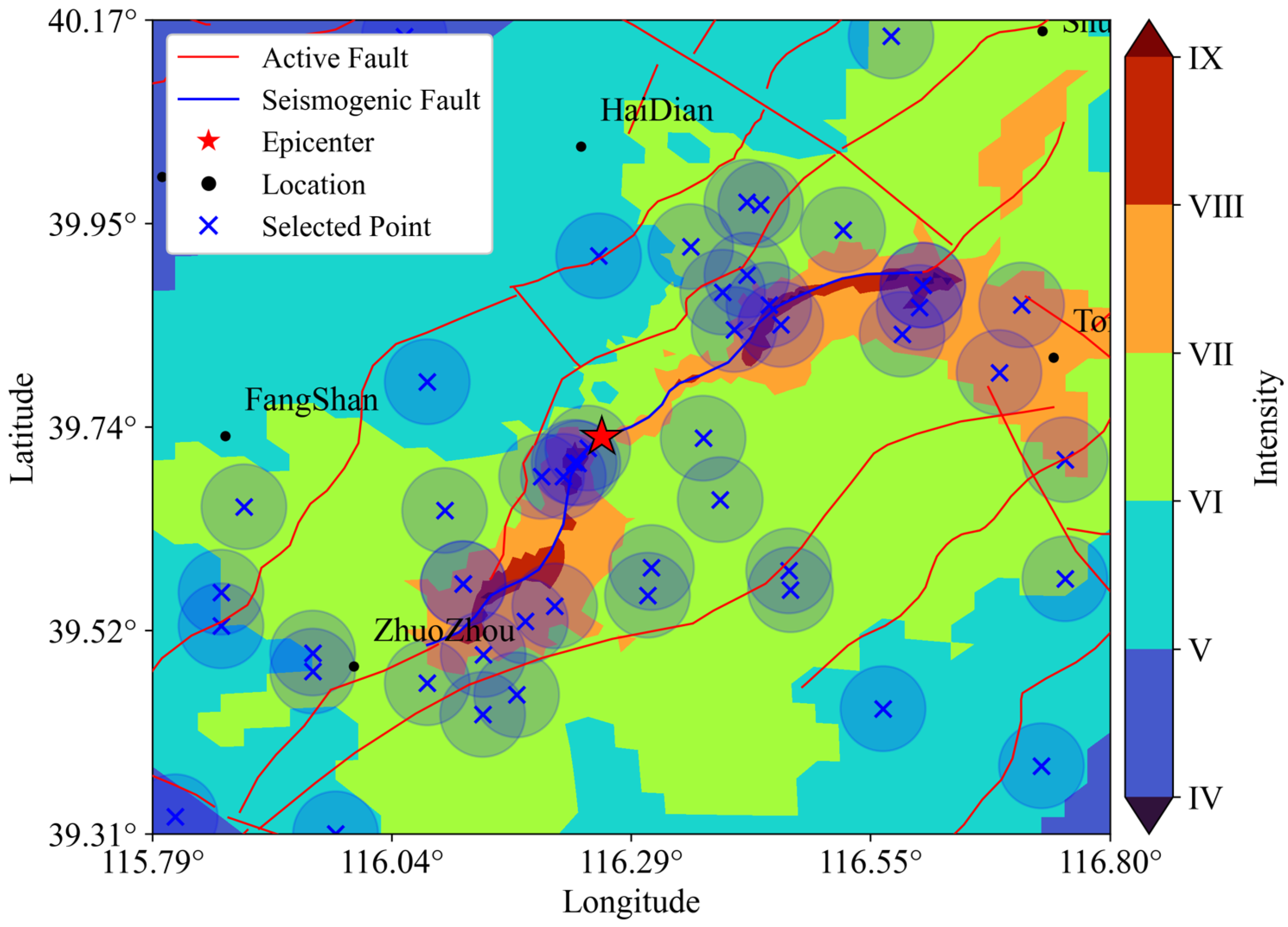
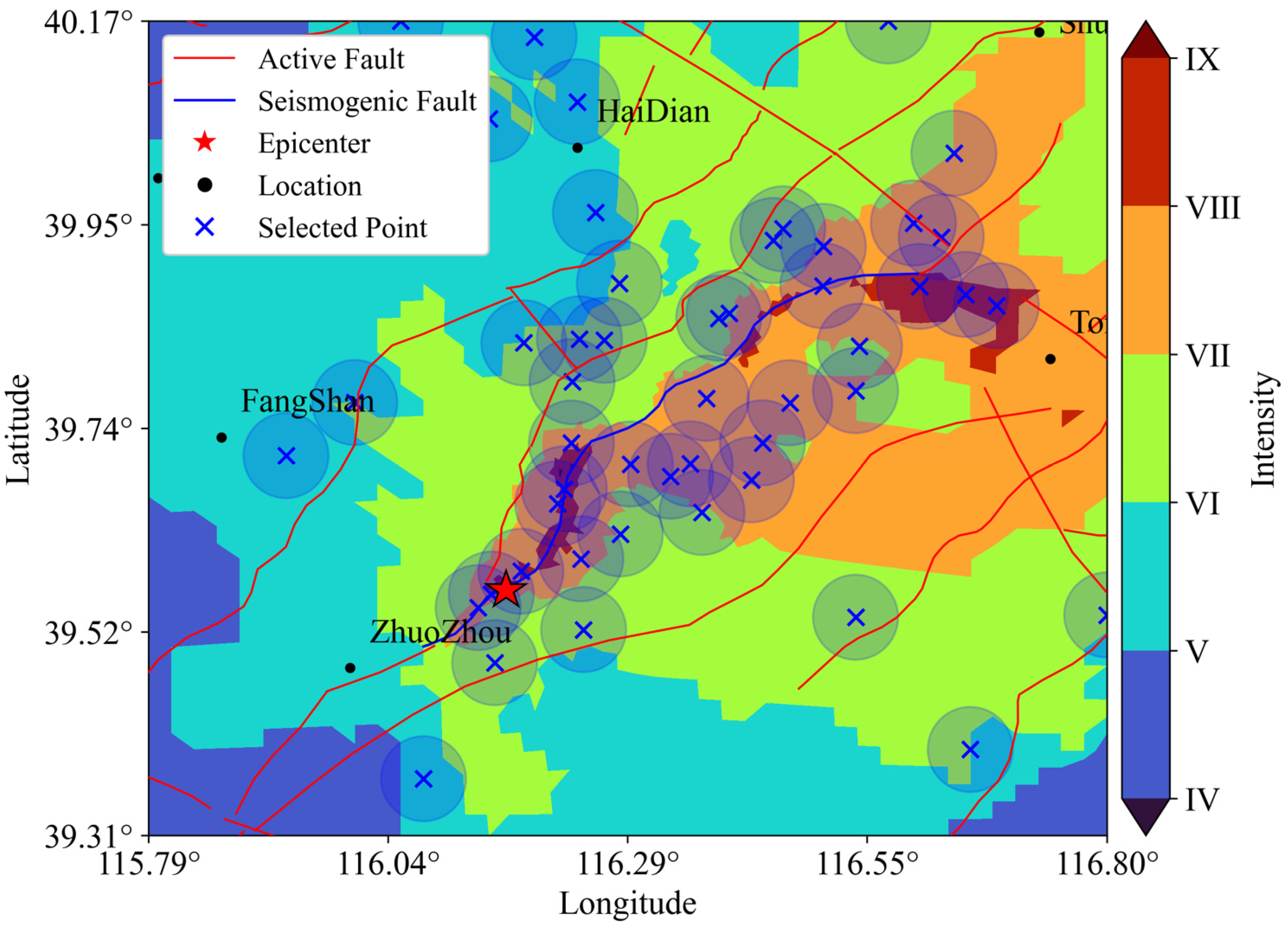
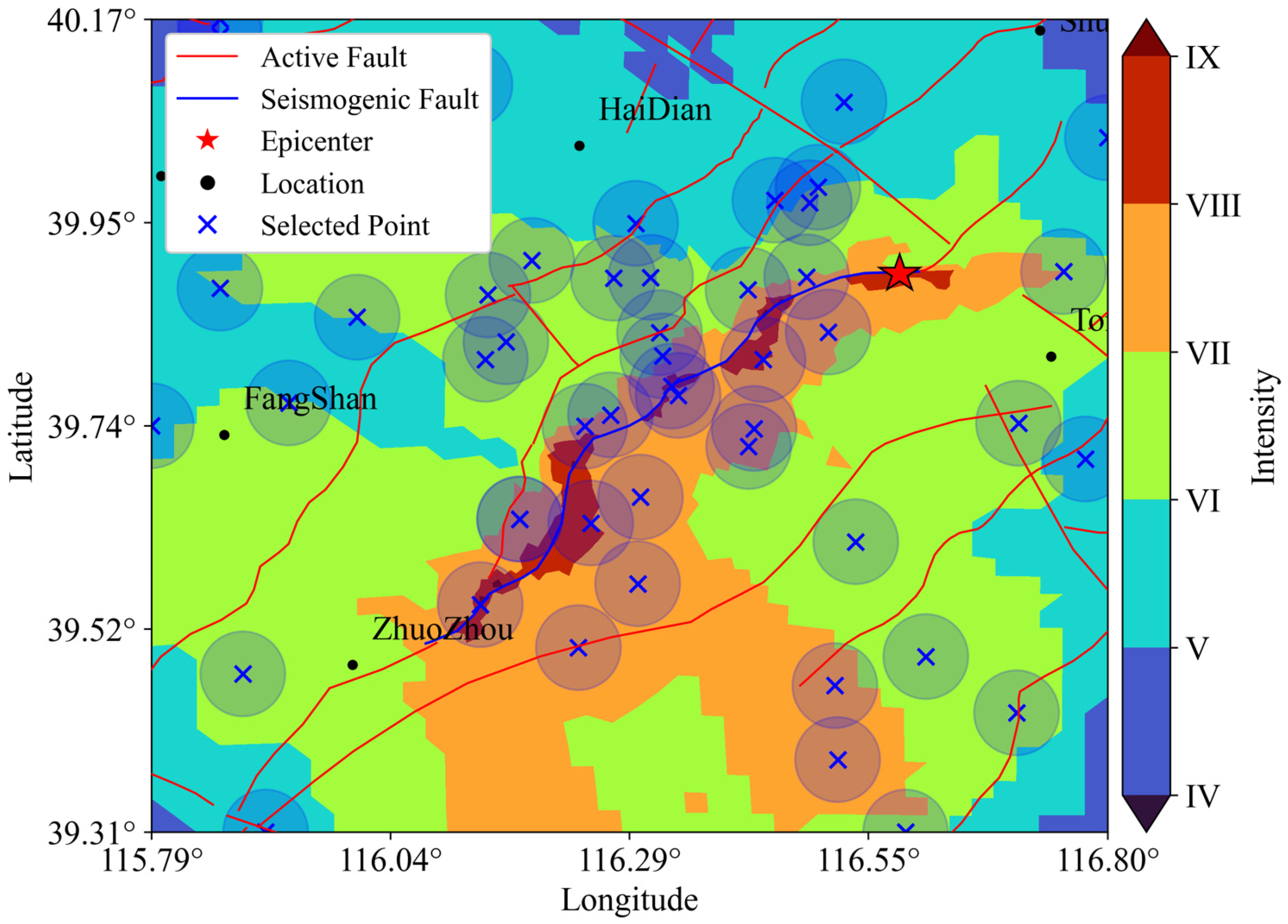
The North China Plain seismic belt has experienced multiple earthquakes of magnitude M6.0 or above, particularly in the Beijing area, where active faults are densely distributed and where seismic activity is frequent. The active faults in this region generally have historical earthquake records, such as the Nankou–Sunhe fault with a dip angle as high as 70–80° [31,32], whose paleo-earthquakes can be traced back 4000 years [33]. Since the M6 earthquake in Yanqing in 294 AD, M6.0 or above earthquakes have successively occurred in Daxing, Yanqing, Tongxian, and western Beijing, with the most recent being the M6.5 earthquake in western Beijing in 1730 [34,35]. With respect to the seismic hazard in this region, numerous studies have employed numerical methods to simulate the rupture process and strong ground motion of the 1679 Sanhe–Pinggu M8 earthquake [27,36,37,38,39,40] and to explore the effects of different strata, topographies, and surrounding earthquakes on seismic motion in the Beijing area [41,42,43]. On the basis of [44], a dynamic numerical method is adopted to simulate the source rupture process of the 1507 M6 earthquake and obtain the regional strong ground motion results, which are then used to calculate the instrument layout points within the study area via the automatic layout method described in Section 2.1. As shown in Figure 1, the optimized distribution of instrument layout points is highly consistent with the trend of the seismic intensity distribution. Specifically, in regions of high seismic intensity, the density of layout points increases significantly; in areas where seismic intensity isolines are dense and gradients are pronounced, the distribution of points is also more concentrated, thereby fully capturing the variation characteristics of strong ground motion. Correspondingly, as the seismic intensity decreases, only a small number of stations are deployed in low-intensity regions to ensure basic regional coverage. As shown in Figure 1, Figure 2, Figure 3 and Figure 4 illustrate the results for three distinct seismic scenarios. The primary difference among them lies in the location of the epicenter (the red star), which shifts the zones of maximum seismic intensity. Consequently, the automatic layout method adaptively concentrates the instrument points in the varying high-intensity regions of each scenario to ensure optimal data capture.
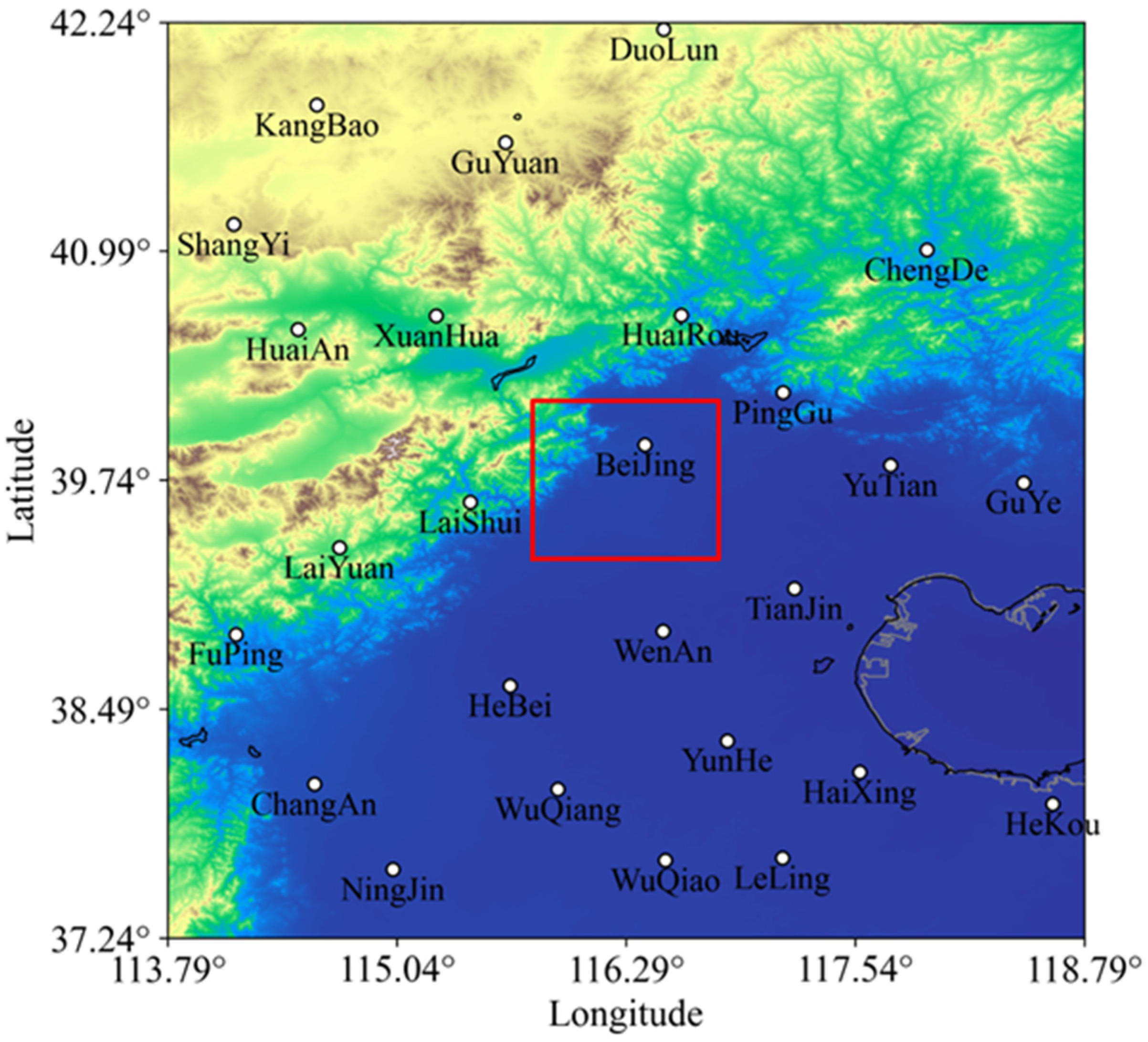
The area within the red box indicates the scope of this study.

3.2. Simple Frame Structure

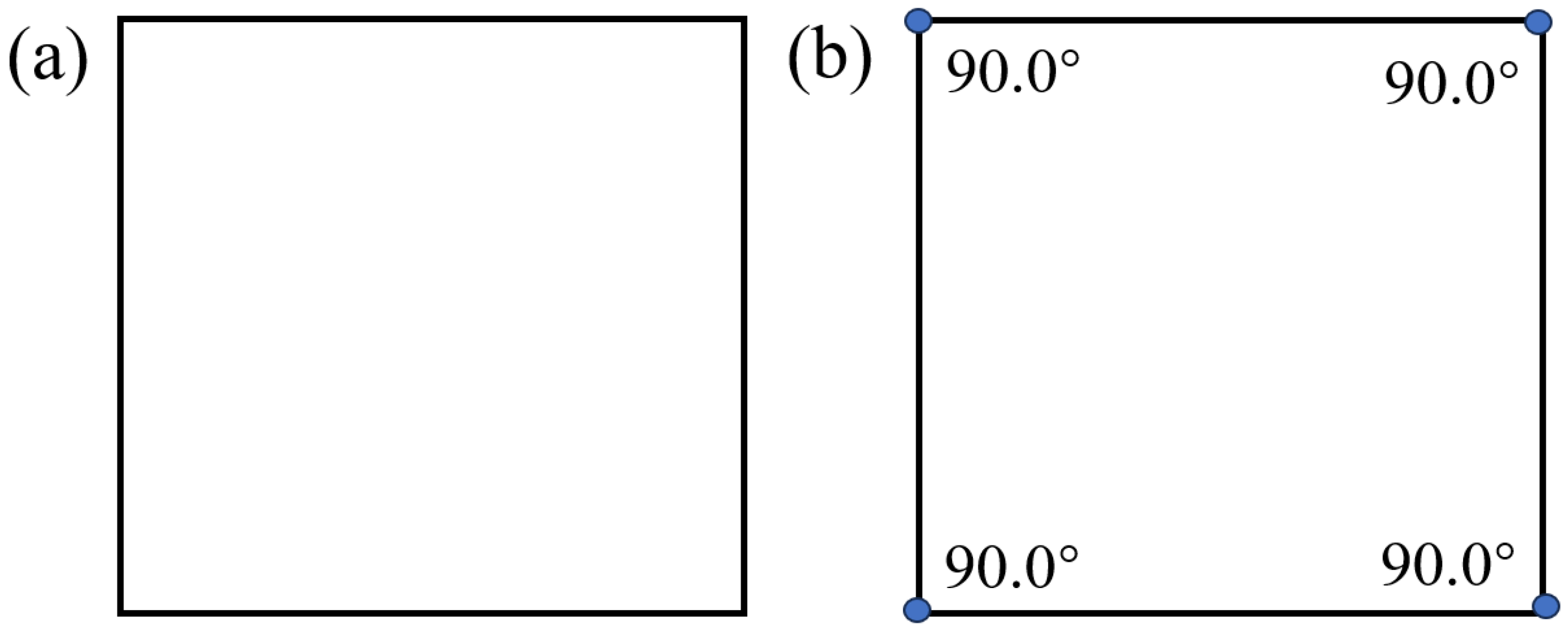
On the basis of the deployment area determined by the aforementioned method, this study selects a simple frame structure (as shown in Figure 5a) as a validation case to demonstrate the optimization process of instrument point layout. The parameter settings of this case are detailed in Table 1, with the core objective being to achieve an optimal balance among coverage, dispersion, and redundancy through parametric control. In terms of coverage control, the weight is set to 0.6, and the coverage lower bound is set to 0, ensuring a sufficient monitoring range. The point selection criteria are jointly controlled by a composite index threshold (0.05) and a target ratio (0.4), while the scoring weight is set to 1 to guarantee the dominant role of priority ranking. For redundancy suppression, the redundancy penalty weight is set to 0.2, and the redundancy upper limit is defined as 0.35, aiming to effectively suppress repeated deployment. In terms of spatial balance, the combination of the spatial dispersion weight (0.3) and middle-floor weighting (0.3) ensures a balanced distribution of layout points within the region.
In addition, to meet the monitoring requirements of the structural hierarchy, the minimum number of points per floor is set to 1, the minimum number of points for critical floors is set to 3, the maximum number of points per floor is set to 12, and the overall maximum deployment number is limited to within 30. Moreover, the type entropy weight (0.2) and lower bound (0.2) are applied to maintain the diversity of layout types. The allocation strategy adopts descending candidates, ensuring that high-scoring points are prioritized. This parametric system is capable of outputting a rational deployment scheme under limited resource conditions. The specific calculation process begins with image recognition, whereby the algorithm identifies and determines the corner points of the frame structure (as shown in Figure 5b).
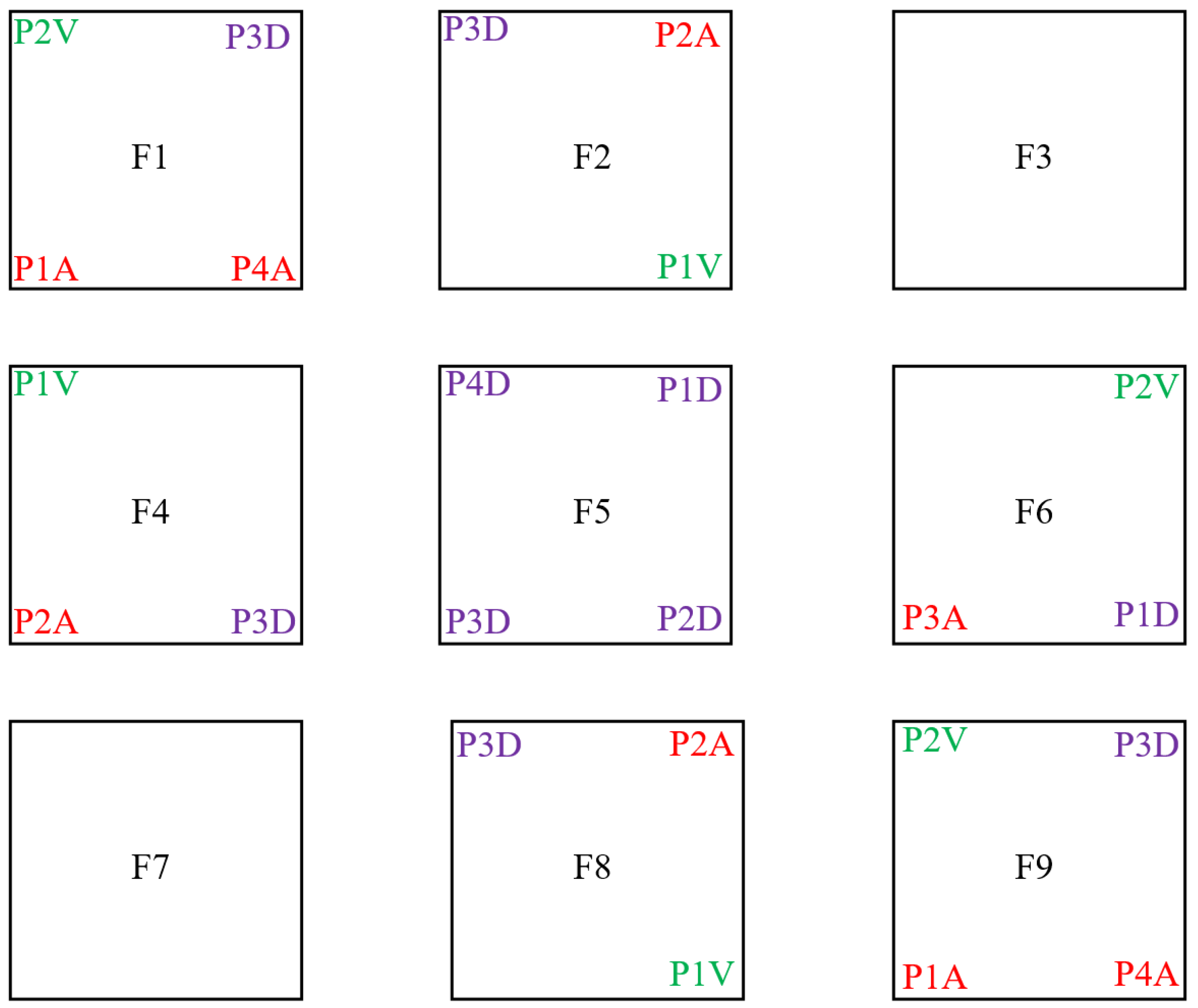
For the nine-story frame structure shown in Figure 5a, the floor distribution results (Figure 6) indicate that the sensors are mainly concentrated on the 1st floor (bottom), the 5th and 6th floors (middle or stiffness-sensitive zones), and the 9th floor (top). The remaining floor points were automatically selected through geometric features and the scoring function, ensuring overall monitoring coverage and dispersion. All the installation positions were strategically chosen at the building corners. These locations possess external geometric characteristics of extreme 90° turning angles, which maximize the capture of torsional and shear vibration responses of the structure under seismic action.

3.3. Complex Frame Structure

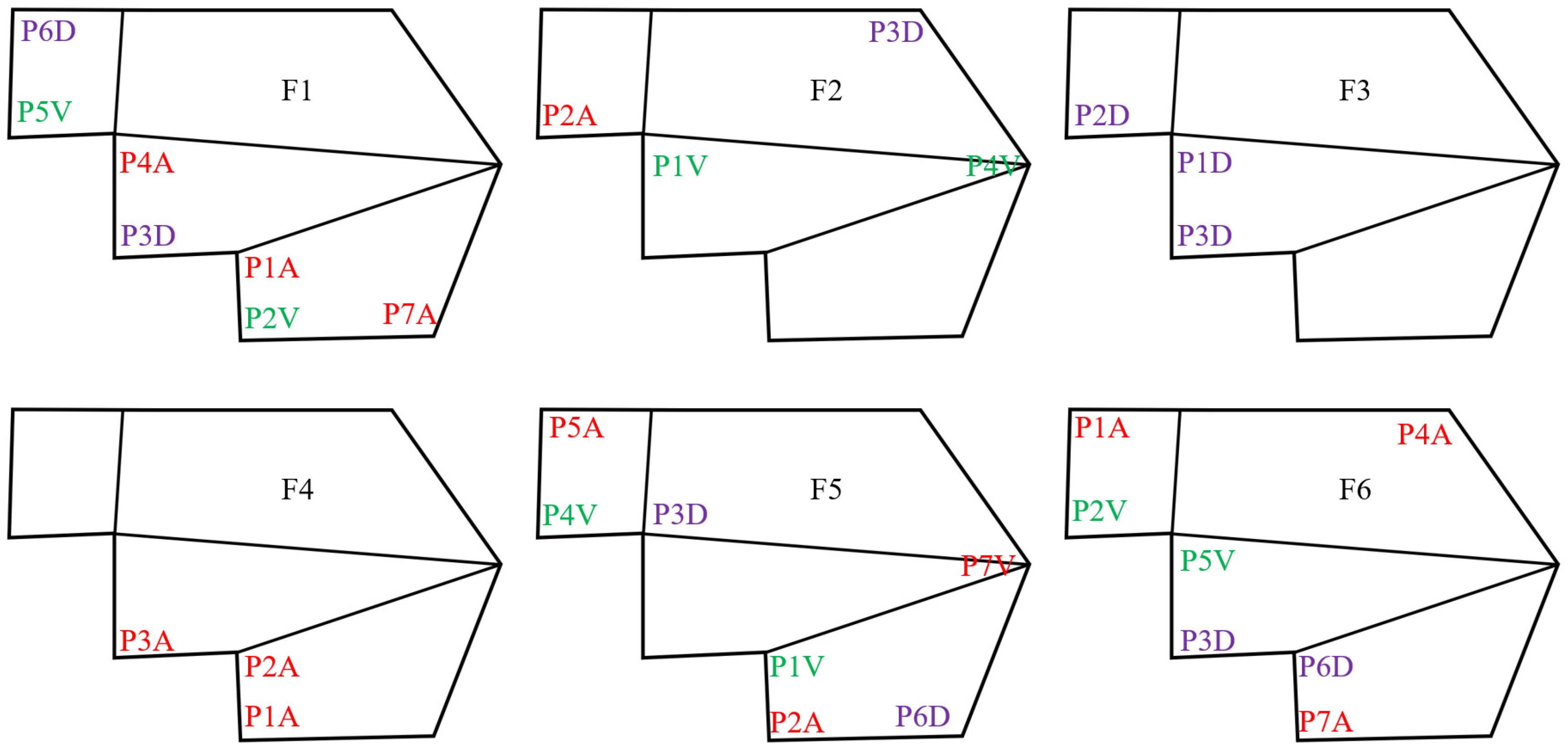
Reinforced concrete (RC) frame structures constitute one of the primary building forms in China. Their lateral stiffness is relatively low, making them prone to large deformations under strong earthquakes, and rapid degradation of their load-bearing capacity may lead to severe damage or even collapse. The braced-RC frame, as a common dual lateral-force resisting system, possesses higher stiffness and economic efficiency; however, under strong seismic action, traditional steel braces are susceptible to buckling under compression, which significantly reduces the load-bearing capacity and energy dissipation ability [46]. To address such complex structures and their potential mixed failure modes, this paper further applies the automatic layout method to a more complex frame structure model (Figure 7).
The floor distribution results show that the sensors are concentrated on the 1st and 6th floors to capture the critical responses at the bottom and top of the structure. The remaining floor points are automatically optimized and selected on the basis of geometric features and the scoring function, ensuring overall monitoring coverage and dispersion. The selection of specific installation positions reflects a diverse strategy: (1) Corner positions: covering multiple external coordinates with extreme turning angles, aiming to maximize the capture of torsional and shear responses of the structure. (2) Diversity layout: strategically introducing medium-turn and large-turn positions to form a more robust and diversified monitoring layout, thereby addressing the distribution of complex strain fields.

4. Discussion

Considering the complexity of earthquake damage as well as the influence of structural characteristics and site conditions, achieving an optimized layout of strong-motion instruments under limited resources has become a key challenge in seismic monitoring. Traditional methods such as the modal kinetic energy method [14], effective independence method [14,47,48], or genetic algorithms can improve efficiency, but their excessive reliance on finite element models or complex computations makes them difficult to apply to large-scale building clusters [49,50]. To address this, this paper proposes an automatic layout method based on artificial intelligence recognition [51] of building geometric structures. This method innovatively integrates regional seismic intensity field information with building corner-point features, constructing a layout scoring function and density function, thereby realizing fully automated generation from regional intensity zones to specific installation coordinates. Quantitatively, this automated approach demonstrates a transformative leap in engineering efficiency; while traditional manual layout design for complex buildings typically requires 1 to 2 h of expert labor, the proposed method completes the process in less than 5 s. Furthermore, it ensures 100% consistency in sensor placement across diverse scenarios, effectively eliminating the subjectivity and high variance inherent in manual methods.
The validation results show that in a simple frame structure, sensors are concentrated on key floors such as the 1st, 5th, 6th, and 9th floors, with installation positions located at external corner points of extreme turning angles, effectively capturing torsional and shear responses of the structure under seismic action while maintaining good balance in coverage, dispersion, and redundancy control. In a more complex RC frame structure, the system likewise completes deployment under budget constraints, with points concentrated on critical floors such as the bottom and top, and strategically introduces extreme-turn, medium-turn, and large-turn positions to form a more representative and diversified monitoring layout. The CUS-level statistical results (over 200 total candidate points, maximum deployment of 90 sensors) also show stable and reasonable indicators, verifying the stability and broad applicability of the algorithm across different spatial scales. Furthermore, the scoring system demonstrates high intrinsic robustness; due to the discrete nature of building geometric features and the substantial scoring margins between critical nodes (e.g., 90° external corners) and secondary points, the relative hierarchy of the layout remains consistent. Preliminary evaluations indicate that minor variations (±10–20%) in weighting coefficients do not lead to shifts in the final sensor coordinates, as the algorithm effectively prioritizes extreme structural features based on established physical laws of seismic response.
This method demonstrates significant innovation in its overall framework: compared with traditional approaches relying on human experience, it transforms geometric features into quantifiable indicators through corner-point recognition, classification, and scoring functions, thereby achieving automated point layout and significantly reducing human subjectivity; compared with finite element-assisted methods, it offers advantages in computational load and operational complexity, enabling rapid generation of implementable installation lists under total budget constraints; compared with empirical formulas, it not only comprehensively considers indicators such as coverage, redundancy, and information entropy but also introduces key-floor assurance and middle-floor weighting strategies, making the layout results more scientific and balanced. The final output installation list includes detailed information such as coordinates, sensor types, and indices, which can be directly used for engineering implementation, greatly enhancing reproducibility and application value. Overall, this method achieves a balance among coverage, redundancy, and dispersion through parametric control, providing a new technical pathway for establishing a systematic and sustainable seismic risk monitoring platform in China and laying the foundation for the future construction of city-level monitoring networks. Future work will incorporate actual engineering data to compare the layout effects of different methods, further verifying their adaptability and advantages across multiple scenarios.
Traditional sensor placement methods, such as Modal Kinetic Energy (MKE) and Effective Independence (EFI), rely heavily on the availability of accurate finite element models. While these methods provide high precision for individual key structures, their application at a city-scale is hindered by the immense labor cost of modeling thousands of buildings. In contrast, the proposed method is a model-free approach that utilizes only building geometry. Quantitatively, the preparation time is reduced from several days (for FEM-based methods) to mere seconds. Furthermore, the proposed method achieves comparable coverage of critical vibration zones without the need for complex eigenvalue analysis, making it a more viable solution for large-scale seismic instrumentation. Regarding the applicability of the proposed method, it is important to note that the layout algorithm is designed to be material-independent. By focusing on the geometric corner-point features and regional intensity zones, the method can be seamlessly applied to different structural types, including steel, reinforced concrete, and hybrid structures. As long as the floor plan and height information are available, the algorithm can effectively identify the optimal coordinates for sensor placement to capture the global structural response. In scenarios where the external geometry does not reflect the internal stiffness distribution—such as buildings with significantly eccentric concrete cores—the center of rigidity may deviate from the geometric center. This can lead to complex torsional behaviors that are difficult to fully capture using boundary analysis alone. In such specialized cases, the automated layout should be regarded as a high-quality preliminary scheme, which can be further refined by specific internal structural details. Future iterations of the algorithm could incorporate internal structural components to enhance precision for structurally irregular buildings.

5. Conclusions

This study demonstrates that addressing the problem of effective coverage of building clusters with limited resources in seismic disaster risk monitoring is critically important. Traditional layout methods rely on finite element models or human experience, with limitations such as large computational demand, operational complexity, and difficulty in application to large-scale building clusters. The automatic layout method for seismic devices proposed in this paper, which is based on artificial intelligence recognition of building geometric structures, innovatively integrates seismic intensity field information with building corner-point features and establishes scoring and density functions to achieve automated generation from regional intensity zones to specific deployment coordinates. This significantly reduces human subjectivity and enhances the scientific rigor and reproducibility of the layout.
In validation calculations for both simple frame structures and complex RC frame structures, the system successfully achieves full deployment under budget constraints. The sensor distribution strategy conforms to the physical laws of seismic response, with points concentrated on the bottom, top, and middle critical floors. Installation positions are located mainly at external corner points with extreme turning angles, whereas medium-turn and large-turn positions are strategically introduced to form a diverse monitoring layout. This enables comprehensive capture of the torsional and shear dynamic characteristics of buildings, ensuring overall coverage and dispersion.
The method exhibits high flexibility and balance and is capable of adjusting coverage, redundancy, and dispersion indicators through parametric strategies such as key-floor assurance and middle-floor weighting. The final output installation list includes detailed coordinates, sensor types, and indices, which can be directly applied in engineering practice, reflecting strong operability and application value. Although large-scale comparative experiments were not conducted in this study, the quantitative indicators of the method itself provide a validation pathway for its scientific reliability. Overall, this method offers a new technical pathway for establishing a systematic and sustainable seismic risk monitoring platform in China and lays a solid foundation for future promotion and application in city-level monitoring network construction. Future work will incorporate actual engineering data to compare the layout effects of different methods, further verifying their adaptability and advantages across multiple scenarios.

Funding

This work was supported by the Deep Earth Probe and Mineral Resources Exploration-National Science and Technology Major Project (Grant No. 2025ZD005100).

Institutional Review Board Statement

Not applicable.

Informed Consent Statement

Not applicable.

Data Availability Statement

The data that support the findings of this study are available from the corresponding author upon reasonable request. This study is based on publicly available seismic records, historical earthquake intensity maps, and numerical simulation results reported in prior seismological research.

Acknowledgments

I am deeply grateful to the editors and the four reviewers for their thorough evaluation of my manuscript and for providing numerous detailed and constructive suggestions, which have greatly improved its clarity, accuracy, and overall quality.

Conflicts of Interest

Author Zhangdi Xie was employed by the Beijing Geolight Technology Co., Ltd. The author declares that the research was conducted in the absence of any commercial or financial relationships that could be construed as a potential conflict of interest.

References

  1. Yu, D.X.; Geng, G.S. Estimation of site amplification effect in North China from ambient seismic noise. China Earthq. Eng. J. 2017, 39, 719–724. [Google Scholar] [CrossRef]
  2. Peng, F.; Wang, W.J.; Kou, H.D. Microtremer H/V spectral ratio investigation in the Sanhe-Pinggu area: Site responses, shallow sedimentary structure, and fault activity revealed. Chin. J. Geophys. 2020, 63, 3775–3790. [Google Scholar] [CrossRef]
  3. Ansal, A.; İyisan, R.; Yıldırım, H. The cyclic behaviour of soils and effects of geotechnical factors in microzonation. Soil Dyn. Earthq. Eng. 2001, 21, 445–452. [Google Scholar] [CrossRef]
  4. Hall, J.F. Seismic response of steel frame buildings to near-source ground motions. Earthq. Eng. Struct. Dyn. 1998, 27, 1445–1464. [Google Scholar] [CrossRef]
  5. Hall, J.F.; Heaton, T.H.; Halling, M.W.; Wald, D.J. Near-Source Ground Motion and its Effects on Flexible Buildings. Earthq. Spectra 1995, 11, 569–605. [Google Scholar] [CrossRef]
  6. Heaton, T.H.; Hall, J.F.; Wald, D.J.; Halling, M.W. Response of High-Rise and Base-Isolated Buildings to a Hypothetical Mw 7.0 Blind Thrust Earthquake. Science 1995, 267, 206–211. [Google Scholar] [CrossRef]
  7. Huang, M.; Cheng, X.; Zhu, Z.; Luo, J.; Gu, J. A Novel Two-Stage Structural Damage Identification Method Based on Superposition of Modal Flexibility Curvature and Whale Optimization Algorithm. Int. J. Struct. Stab. Dyn. 2021, 21, 2150169. [Google Scholar] [CrossRef]
  8. Huang, M.; Li, X.; Lei, Y.; Gu, J. Structural damage identification based on modal frequency strain energy assurance criterion and flexibility using enhanced Moth-Flame optimization. Structures 2020, 28, 1119–1136. [Google Scholar] [CrossRef]
  9. Huang, M.; Ling, Z.; Sun, C.; Lei, Y.; Xiang, C.; Wan, Z.; Gu, J. Two-stage damage identification for bridge bearings based on sailfish optimization and element relative modal strain energy. Struct. Eng. Mech. 2023, 86, 715–730. [Google Scholar] [CrossRef]
  10. Wu, Y.; Cai, D.; Gu, S.; Nan, J.; Li, S. Compressive strength prediction of sleeve grouting materials in prefabricated structures using hybrid optimized XGBoost models. Constr. Build. Mater. 2025, 476, 141319. [Google Scholar] [CrossRef]
  11. Deng, Z.; Huang, M.; Wan, N.; Zhang, J. The Current Development of Structural Health Monitoring for Bridges: A Review. Buildings 2023, 13, 1360. [Google Scholar] [CrossRef]
  12. Larson, C.B.; Zimmerman, D.C.; Marek, E.L.A. A comparison of modal planning techniques excitation and sensor placement using the NASA 8-bay truss. In Proceedings of the 12th IMAC Conference, Honolulu, HI, USA, 31 January–3 February 1994; Allemang, R., Ed.; pp. 205–211. [Google Scholar]
  13. Wang, G.X.; Wang, W.Z. Optimal placement of accelerographs in a high-rise building. J. Vib. Shock 2008, 27, 179–182. [Google Scholar] [CrossRef] [PubMed]
  14. Kammer, D.C. Sensor Placement for On-Orbit Modal Identification and Correlation of Large Space Structures. In Proceedings of the 1990 American Control Conference, San Diego, CA, USA, 23–25 May 1990; pp. 2984–2990. [Google Scholar] [CrossRef]
  15. Guyan, R.J. Reduction of stiffness and mass matrices. AIAA J. 1965, 3, 380. [Google Scholar] [CrossRef]
  16. Li, G.; Qin, Q.; Dong, C. Optimal placement of sensors for monitoring systems on suspension bridges using genetic algorithms. Eng. Mech. 2000, 17, 25–34. [Google Scholar] [CrossRef]
  17. Park, Y.S.; Kim, H.B. Sensor placement guide for model comparison and improvement. In Proceedings of the 14th International Modal Analysis Conference, Dearborn, MI, USA, 12–15 February 1996; pp. 404–409. [Google Scholar]
  18. Liu, F.Q.; Zhang, L.M. Advances in optimal placement of actuators and sensors. Adv. Mech. 2000, 30, 506–516. [Google Scholar] [CrossRef]
  19. Bhat, H.S.; Olives, M.; Dmowska, R.; Rice, J.R. Role of fault branches in earthquake rupture dynamics. J. Geophys. Res. Solid Earth 2007, 112. [Google Scholar] [CrossRef]
  20. Hu, F.; Xu, J.K.; Zhang, Z.G.; Chen, X.F. Supershear transition mechanism induced by step over geometry. J. Geophys. Res. Solid Earth 2016, 121, 8738–8749. [Google Scholar] [CrossRef]
  21. Ma, C.H.; Qian, F.; Zhang, H.M. Simulation of rupture process and its influence factors of the 2013 MS7.0 Lushan earthquake. Chin. J. Geophys. 2021, 64, 170–181. [Google Scholar] [CrossRef]
  22. Zhang, L.F.; Bunichiro, S.; Liao, W.L.; Li, J.G.; Wang, Q.L. Controlling factors analysis of dynamic rupture propagation simulation of curved fault based on Boundary integral equation method. Chin. J. Geophys. 2016, 59, 981–991. [Google Scholar] [CrossRef]
  23. Zheng, L.L.; Qian, F.; Zhang, H.M. The transition conditions of supershear rupture propagation on fault-bend systems. Chin. J. Geophys. 2021, 64, 182–194. [Google Scholar] [CrossRef]
  24. Anderson, J.G.; Bodin, P.; Brune, J.N.; Prince, J.; Singh, S.K.; Quaas, R.; Onate, M. Strong Ground Motion from the Michoacan, Mexico, Earthquake. Science 1986, 233, 1043–1049. [Google Scholar] [CrossRef]
  25. Wang, H.Y.; Xie, L.L. Effects of topography on ground motion in the Xishan park, Zigong city. Chin. J. Geophys. 2010, 53, 1631–1638. [Google Scholar] [CrossRef]
  26. Wang, M.F.; Zheng, A.; Yu, X.W.; Zhang, W.B. Study on the influence of local mountainous topography to fault dynamic rupture. Acta Seismol. Sin. 2018, 40, 737–752. [Google Scholar] [CrossRef]
  27. Wang, Z.J.; Li, Y.L.; Wang, W.Q.; Zhang, W.Q.; Zhang, Z.G. Revisiting Paleoearthquakes with Numerical Modeling: A Case Study of the 1679 Sanhe–Pinggu Earthquake. Seismol. Res. Lett. 2022, 94, 720–730. [Google Scholar] [CrossRef]
  28. Andrews, D.J. Dynamic plane-strain shear rupture with a slip-weakening friction law calculated by a boundary integral method. Bull. Seismol. Soc. Am. 1985, 75, 1–21. [Google Scholar] [CrossRef]
  29. Madariaga, R.; Olsen, K.B. Criticality of Rupture Dynamics in 3-D. Pure Appl. Geophys. 2000, 157, 1981–2001. [Google Scholar] [CrossRef]
  30. Miyake, H.; Iwata, T.; Irikura, K. Source characterization for broadband ground-motion simulation: Kinematic heterogeneous source model and strong motion generation area. Bull. Seismol. Soc. Am. 2003, 93, 2531–2545. [Google Scholar] [CrossRef]
  31. Che, Z.H. Activity Research of the Nankou-Sunhe Fault. Seismol. Geol. 1994, 115–120. [Google Scholar]
  32. Liang, Y.N. A study of structure and activity of the north part of Nankou-Sunhe fault in Beijing. Geol. Bull. China 2019, 38, 858–865. [Google Scholar] [CrossRef]
  33. Jiang, W.L.; Hou, Z.H.; Xie, X.S. Paleoseismic Events in the Changping Jiuxian Trench of the Nankou-Sunhe Fault Zone in the Beijing Plain. Sci. China Earth Sci. 2001, 31, 501–509. [Google Scholar] [CrossRef]
  34. Gu, G.X. China Earthquake Catalog; Science Press: Beijing, China, 1984. [Google Scholar]
  35. Xie, Y.S.; Cai, M.B. Compilation of Historical Seismological Data in China; Science Press: Beijing, China, 1983. [Google Scholar]
  36. Ba, Z.N.; Zhao, J.X.; Liang, J.W.; Zhang, Y.S.; Zhang, Y.J. Simulation of Strong Ground Motion in Beijing Area Based on Finite Fault Source Model: Taking the 1679 Sanhe-Pinggu M8 Earthquake as an Example. J. Seismol. Res. 2022, 45, 479–488. [Google Scholar] [CrossRef]
  37. Fu, C.H.; Gao, M.T.; Yu, Y.X. Studying on amplification effect of Beijing basin on 3~10 s ground motion by numerical simulation method. J. Seismol. Res. 2015, 38, 448–460. [Google Scholar] [CrossRef]
  38. Gao, M.T.; Yu, Y.X.; Zhang, X.M.; Wu, J.; Hu, P.; Ding, Y.H. Three-Dimensional Finite-Difference Simulations of Ground Motions in the Beijing Area. Earthq. Res. China 2002, 18, 356–364. [Google Scholar] [CrossRef]
  39. Liu, B.Y.; Shi, B.P.; Zhang, J. Strong motion simulation by the composite source modeling: A case study of 1679 m8.0 sanhe-pinggu earthquake. Acta Seismol. Sin. 2007, 20, 319–331. [Google Scholar] [CrossRef]
  40. Pan, B.; Xu, J.D.; Guan Kou, C.Z.; He, H.L. Simulation of the near-fault strong ground motion in beijing region. Seismol. Geol. 2006, 28, 623–634. [Google Scholar] [CrossRef]
  41. Ding, Z.; Romanelli, F.; Chen, Y.T.; Panza, G.F. Realistic Modeling of Seismic Wave Ground Motion in Beijing City. Pure Appl. Geophys. 2004, 161, 1093–1106. [Google Scholar] [CrossRef]
  42. Liao, L. Simulation of three-dimensional topographic effects on seismic ground motion in Capital region based upon the spectral-element method. Seismol. Geomagn. Obs. Res. 2017, 38, 7–14. [Google Scholar] [CrossRef]
  43. Yang, Y.; Shi, B.P.; Sun, L. Seismic hazard estimation based on the distributed seismicity in northern China. Acta Seismol. Sin. 2008, 21, 202–212. [Google Scholar] [CrossRef]
  44. Xie, Z. Dynamics of the 1057 M 6 earthquake rupture and seismic hazard implications for the Beijing region, China. Front. Earth Sci. 2025, 13, 1669495. [Google Scholar] [CrossRef]
  45. Xu, X.W.; Han, Z.J.; Yang, X.P. Seismotectonic Map in China and Its Adjacent Regions; Science Press: Beijing, China, 2016. [Google Scholar] [CrossRef]
  46. Cui, Y.; Xu, X.Z.; Lin, C. Seismic performance of concentrically braced frames considering the brace fracture and gusset plate effect. Eng. Mech. 2020, 37, 85–92. [Google Scholar] [CrossRef]
  47. Kim, T.; Youn, B.D.; Oh, H. Development of a stochastic effective independence (SEFI) method for optimal sensor placement under uncertainty. Mech. Syst. Signal Process. 2018, 111, 615–627. [Google Scholar] [CrossRef]
  48. Meo, M.; Zumpano, G. On the optimal sensor placement techniques for a bridge structure. Eng. Struct. 2005, 27, 1488–1497. [Google Scholar] [CrossRef]
  49. Çelebi, M. Seismic Instrumentation of Buildings; Open-File Report; U.S. Geological Survey: Reston, VA, USA, 2000; 37p. [Google Scholar] [CrossRef]
  50. Wu, R.-T.; Jahanshahi, M.R. Data fusion approaches for structural health monitoring and system identification: Past, present, and future. Struct. Health Monit. 2020, 19, 552–586. [Google Scholar] [CrossRef]
  51. Xie, Y. Deep Learning in Earthquake Engineering: A Comprehensive Review. ASCE OPEN Multidiscip. J. Civ. Eng. 2025, 3, 03125001. [Google Scholar] [CrossRef]
Figure 1. Location of the study area.
Sustainability 18 01384 g001
Figure 2. The epicenter is located at the center of the seismogenic fault. Rupture propagates bilaterally along the seismogenic fault (blue line), and the selected points (blue crosses) are overall symmetric; The red lines represent seismic faults within the region [45]; the red star indicates epicenter locations under different scenarios [44]; the color scale denotes the seismic intensity; and the regional seismic intensity data are derived from Xie.
Sustainability 18 01384 g002
Figure 3. The epicenter is located on the left side of the seismogenic fault. Rupture propagates rightward along the seismogenic fault (blue line), and the selected points (blue crosses) cluster in the region of stronger shaking due to the directivity effect; The red lines represent seismic faults within the region [45]; the red star indicates epicenter locations under different scenarios [44]; the color scale denotes the seismic intensity; and the regional seismic intensity data are derived from Xie.
Sustainability 18 01384 g003
Figure 4. The epicenter is situated on the left side of the seismogenic fault. Rupture propagates rightward along the seismogenic fault (blue line), and the selected points (blue crosses) concentrate in the area of higher intensity owing to the earthquake’s directivity effect; The red lines represent seismic faults within the region [45]; the red star indicates epicenter locations under different scenarios [44]; the color scale denotes the seismic intensity; and the regional seismic intensity data are derived from Xie.
Sustainability 18 01384 g004
Figure 5. Simple frame structure. (a) Input frame structure; (b) Identified corners and angles.
Sustainability 18 01384 g005
Figure 6. Layered strong-motion instrument layout. In the figure, F1–F9 represent Floors 1–9, P1–P4 indicate the sequential positions of the layout points on each floor, and A, V, and D correspond to the acceleration, velocity, and displacement sensors, respectively.
Sustainability 18 01384 g006
Figure 7. Layered strong-motion instrument layout for complex frame structures. In the figure, F1–F6 represent Floors 1–6 and P1–P7 indicate the sequential positions of the layout points on each floor; A, V, and D correspond to the acceleration, velocity, and displacement sensors, respectively.
Sustainability 18 01384 g007
Table 1. Parameter settings for the single-story frame structure.
ParameterValue
Coverage weight0.6
Coverage lower bound0
Composite index threshold0.05
Target ratio0.4
Selection scoring weight1
Redundancy penalty weight0.2
Redundancy upper limit0.35
Minimum points per floor2
Maximum deployment number30
Spatial dispersion weight0.3
Minimum points for key floors3
Type entropy weight0.2
Type entropy lower bound0.2
Maximum points per floor12
Allocation strategydescending candidates
Middle-floor weighting0.3
Disclaimer/Publisher’s Note: The statements, opinions and data contained in all publications are solely those of the individual author(s) and contributor(s) and not of MDPI and/or the editor(s). MDPI and/or the editor(s) disclaim responsibility for any injury to people or property resulting from any ideas, methods, instructions or products referred to in the content.