Dynamic Capabilities and Sustainable Competitive Advantage in SMEs: The Roles of Innovation and Organizational Learning


Abstract
1. Introduction
2. Literature Review
2.1. Dynamic Capabilities
2.2. Innovation
2.3. Organizational Learning
2.4. Sustainable Competitive Advantage
2.5. Theoretical Foundations and Integration
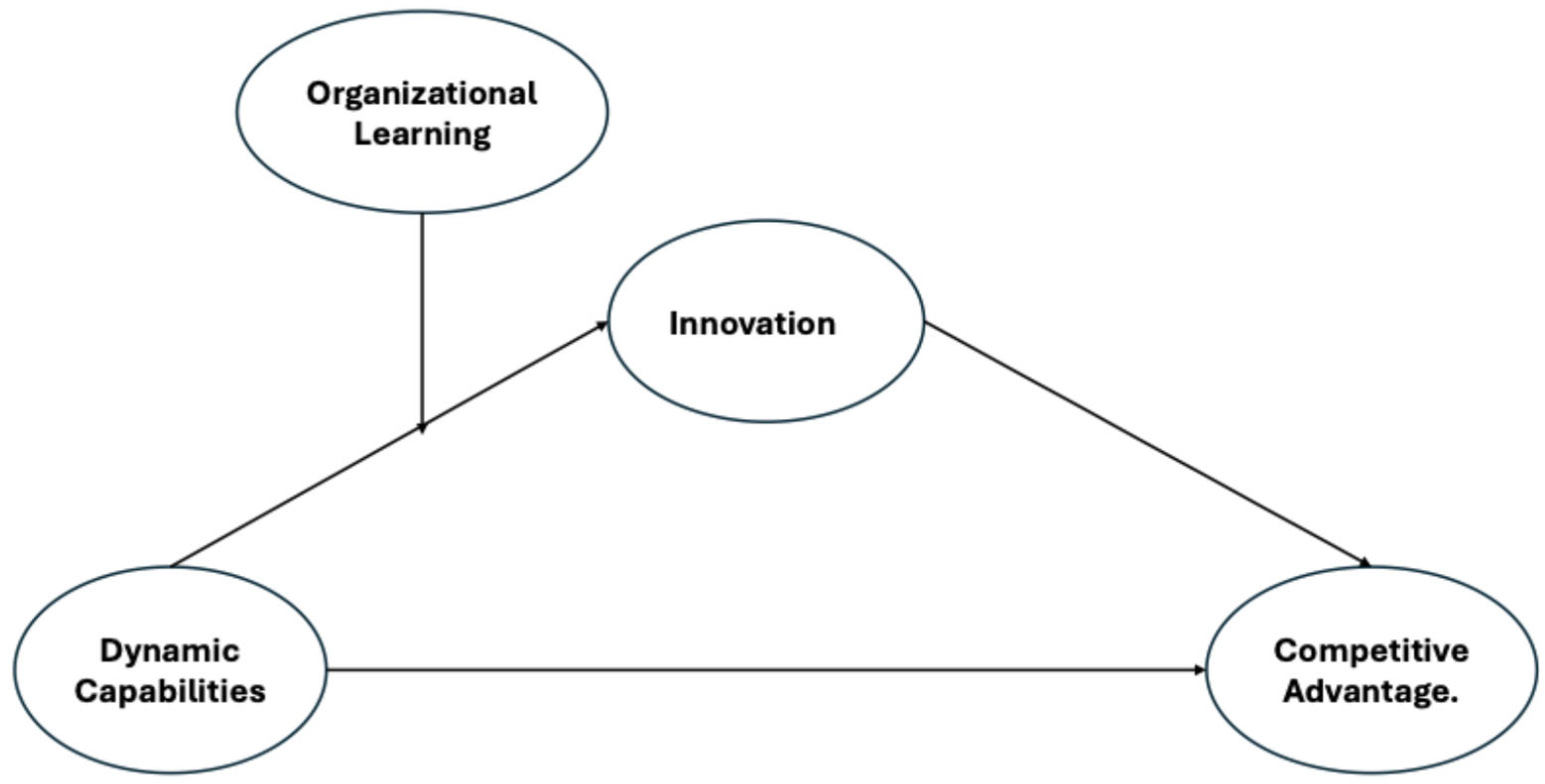
3. Hypothesis Development and Research Model
Research Model
4. Research Methodology
4.1. Research Design
4.2. Population and Sample
4.3. Measures
4.3.1. Dynamic Capabilities
4.3.2. Innovation
4.3.3. Organizational Learning Capability
4.3.4. Sustainable Competitive Advantage

| Demographic Profile | Category | Frequency | Percent (%) |
|---|---|---|---|
| gender | male | 113 | 45.4 |
| female | 136 | 54.6 | |
| age | Under 25 | 17 | 6.8 |
| 25–34 | 79 | 31.6 | |
| 35–44 | 84 | 33.6 | |
| 45 and above | 70 | 28.0 | |
| Under 25 | 17 | 6.8 | |
| 25–34 | 79 | 31.6 | |
| Years of experience | Less than 1 year | 22 | 8.8 |
| 1–3 | 41 | 16.4 | |
| 4–6 | 35 | 14.0 | |
| 7–10 | 67 | 26.8 | |
| Education Level | High school | 11 | 4.4 |
| Diploma | 22 | 8.8 | |
| Bachelor’s | 158 | 63.2 | |
| Master’s | 40 | 16.0 | |
| PhD | 18 | 7.2 | |
| Other | 1 | 0.4 |
4.4. Statistical Analysis
5. Results
5.1. Measurement Model Assessment
5.2. Structural Model Assessment
5.2.1. Descriptive Statistics
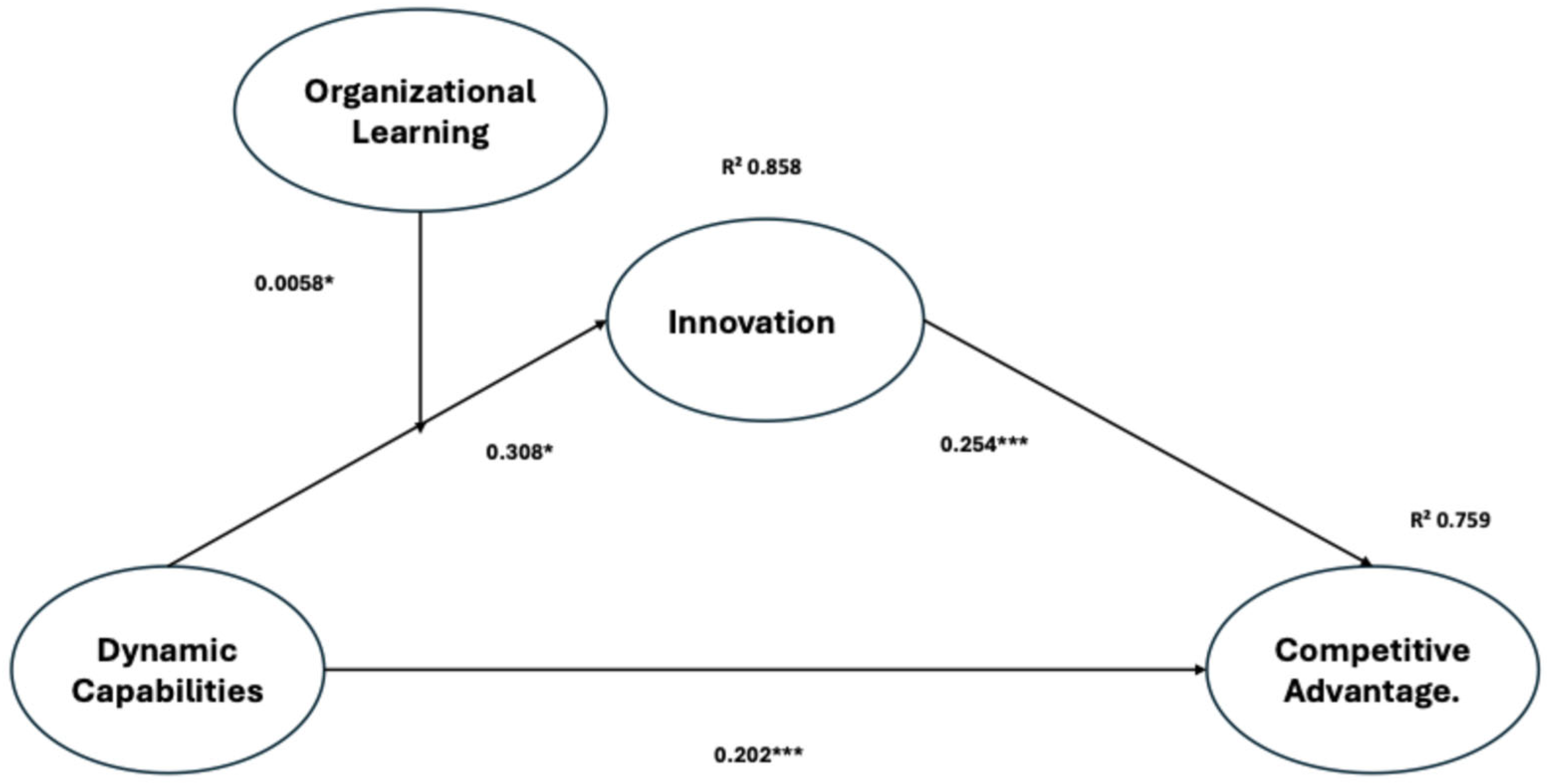
5.2.2. Hypothesis Testing
6. Discussion
7. Implications
Limitations and Future Research
Author Contributions
Funding
Institutional Review Board Statement
Informed Consent Statement
Data Availability Statement
Conflicts of Interest
Appendix A. Scale Items
- Dynamic Capabilities Scale (DC)
- Our company actively monitors changes in the business environment.
- Our company continuously scans the market to identify emerging trends.
- Our company has a system to collect and analyze external information for decision-making.
- Our company effectively integrates new technologies or processes when needed.
- Our company encourages collaboration between teams to exploit market opportunities.
- Our company is flexible in reallocating resources based on strategic needs.
- Our company continuously modifies its capabilities to respond to industry changes.
- Innovation Scale (IN)
- Our company frequently introduces new or significantly improved products.
- Our company invests in research and development for product innovation.
- Our company adopts advanced technology to enhance product quality.
- Our company regularly updates operational procedures for efficiency.
- Our company integrates automation and digital tools to enhance productivity.
- Our company continuously explores new revenue streams.
- Our company adopts innovative strategies to differentiate itself from competitors.
- Organizational Learning Capability Scale (OCL)
- Our company actively seeks external knowledge to improve operations.
- Our company encourages employees to stay updated on industry trends.
- Our company invests in training and development programs.
- Employees in our company frequently exchange ideas and insights.
- Management promotes a culture of collaboration and learning.
- Employees are encouraged to experiment with new methods based on acquired knowledge.
- Our company fosters a culture that values continuous learning.
- Mistakes are treated as learning opportunities within the company.
- Innovation is driven by knowledge-sharing, feedback, and the exchange of ideas.
- Sustainable Competitive Advantage Scale (SCA)
- Our company implements strategies to reduce production and operational costs.
- Our company offers unique value propositions that set it apart from competitors.
- Our company maintains a strong brand reputation due to its unique offerings.
- Our company quickly adapts to changing customer preferences.
References
- Li, D.; Liu, J. Dynamic abilities, environmental dynamism, and competitive advantage: Evidence from China. J. Bus. Res. 2012, 67, 2793–2799. [Google Scholar] [CrossRef]
- Teece, D.J.; Pisano, G.; Shuen, A. Dynamic Capabilities and Strategic Management. Strateg. Manag. J. 1997, 18, 509–533. [Google Scholar] [CrossRef]
- Mansouri, M.; Malainine, C.; Souti, H.; Cadimi, I. Dynamic Capabilities, Competitiveness, and Performance of Small and Medium-Sized Enterprises: A Systematic Literature Review. Int. J. Account. Financ. Audit. Manag. Econ. 2022, 10, 321–335. [Google Scholar]
- Obeidat, B.Y.; Ayman, B.A.; Noor, A.; Abdel, H.O.M.A.; Mahmoud, M. The effect of intellectual capital on organizational performance: The mediating role of knowledge sharing. Commun. Netw. 2016, 9, 1–27. [Google Scholar]
- Brix, J. Innovation capacity building: An approach to maintaining balance between exploration and exploitation in organizational learning. Learn. Organ. 2019, 26, 12–26. [Google Scholar] [CrossRef]
- Ferreira, J.; Cardim, S.; Coelho, A. Dynamic capabilities and mediating effects of innovation on the competitive advantage and firm’s performance: The moderating role of organizational learning capability. J. Knowl. Econ. 2021, 12, 620–644. [Google Scholar] [CrossRef]
- Bari, N.; Chimhundu, R.; Chan, K.-C. Dynamic capabilities to achieve corporate sustainability: A roadmap to sustained competitive advantage. Sustainability 2022, 14, 1531. [Google Scholar] [CrossRef]
- Ali, M.A.; Hussin, N.; Abed, I.A.; Nikkeh, N.S.; Mohammed, M.A. Dynamic capabilities and innovation performance: A systematic literature review. Technol. Rep. Kansai Univ. 2020, 62, 5989–6000. [Google Scholar]
- Teece, D.J. Business models and dynamic capabilities. Long Range Plan. 2018, 51, 40–49. [Google Scholar] [CrossRef]
- Teece, D.J. Explicating dynamic capabilities: The nature and microfoundations of (sustainable) enterprise performance. Strateg. Manag. J. 2007, 28, 1319–1350. [Google Scholar] [CrossRef]
- Eisenhardt, K.M.; Martin, J.A. Dynamic capabilities: What are they? Strateg. Manag. J. 2000, 21, 341–363. [Google Scholar]
- Kump, B.; Engelmann, A.; Kessler, A.; Schweiger, C. Toward a dynamic capabilities scale: Measuring organizational sensing, seizing, and transforming capacities. Ind. Corp. Change 2019, 28, 1149–1172. [Google Scholar] [CrossRef]
- Pavlou, P.A.; El Sawy, O.A. Understanding the elusive black box of dynamic capabilitie. Decis. Sci. 2011, 42, 239–273. [Google Scholar] [CrossRef]
- Schilke, O. On the contingent value of dynamic capabilities for competitive advantage: The nonlinear moderating effect of environmental dynamism. Strateg. Manag. J. 2014, 35, 179–203. [Google Scholar] [CrossRef]
- Protogerou, A.; Caloghirou, Y.; Lioukas, S. Dynamic capabilities and their indirect impact on firm performanc. Ind. Corp. Change 2012, 21, 615–647. [Google Scholar] [CrossRef]
- Liu, C.-H.; Horng, J.-S.; Chou, S.-F.; Yu, T.-Y.; Huang, Y.-C.; Lin, J.-Y.; Lapuz, M.C.B. Discovery of the mutual relationships among dynamic capabilities and intellectual capital: The moderating roles of service innovation. Asia Pac. J. Tour. Res. 2023, 28, 1147–1165. [Google Scholar] [CrossRef]
- Wakrim, S.; Khaldi, S. Fostering Global Resilience through Cross-cultural Collaboration. In Proceedings of the 2nd International Conference on Humanities and Social Sciences, Porto, Portugal, 27–28 November 2023. [Google Scholar]
- Lin, Y.-H.; Qin, Z.; Kim, C.J.; Zhang, Y.; Xia, N. Dynamic Capabilities, Eastern Relationships, and Competitive Advantages: An Empirical Assessment of Chinese and South Korean International Contractors. Eng. Manag. J. 2022, 34, 671–688. [Google Scholar] [CrossRef]
- Fainshmidt, S.; Wenger, L.; Pezeshkan, A.; Mallon, M.R. When Do Dynamic Capabilities Lead to Competitive Advantage? The Importance of Strategic Fit. Strateg. Manag. J. 2022, 56, 758–787. [Google Scholar] [CrossRef]
- Apascaritei, P.; Elvira, M.M. Dynamizing human resources: An integrative review of SHRM and dynamic capabilities research. Hum. Resour. Manag. Rev. 2022, 32, 100878. [Google Scholar] [CrossRef]
- Cao, B.; Han, Z.; Liang, L.; Liu, Y.; Wang, J.; Xie, J. Independent Innovation or Secondary Innovation: The Moderating of Network Embedded Innovation. Sustainability 2022, 14, 14796. [Google Scholar] [CrossRef]
- Jin, J.; Li, M. Innovate with whom? The bridging effect of organizational learning capability for knowledge-intensive SMEs. Asian J. Technol. Innov. 2023, 31, 657–683. [Google Scholar] [CrossRef]
- Agyapong, A.; Acquaah, M.; Abiew, G.E.; Zan, H.N. Dynamic pathways to SMEs performance: Unraveling the influence of organizational learning capability, innovation, market dynamism, and market responsiveness in an African emerging economy. Afr. J. Manag. 2024, 10, 50–74. [Google Scholar] [CrossRef]
- Crossan, M.M.; Apaydin, M. A multi-dimensional framework of organizational innovation: A systematic review of the literature. J. Manag. Stud. 2010, 47, 1154–1191. [Google Scholar] [CrossRef]
- Gunday, G.; Ulusoy, G.; Kilic, K.; Alpkan, L. Effects of innovation types on firm performance. Int. J. Prod. Econ. 2011, 133, 662–676. [Google Scholar] [CrossRef]
- Damanpour, F.; Aravind, D. Managerial innovation: Conceptions, processes, and antecedents. Manag. Organ. Rev. 2012, 8, 423–454. [Google Scholar] [CrossRef]
- Denicolai, S.; Cotta Ramusino, E.; Sotti, F. The impact of digital transformation on dynamic capabilities and innovation: A multiple case study. Technol. Forecast. Soc. Change 2021. [Google Scholar]
- Jerez-Gómez, P.; Céspedes-Lorente, J.; Valle-Cabrera, R. Organizational learning capability: A proposal of measurement. J. Bus. Res. 2005, 58, 715–725. [Google Scholar] [CrossRef]
- Yi, C.; Xu, X.; Chen, C.; Wu, Y.J. Institutional distance, organizational learning, and innovation performance: Outward foreign direct investment by Chinese multinational enterprises. Emerg. Mark. Financ. Trade 2020, 56, 370–391. [Google Scholar] [CrossRef]
- Huynh, T.M.; Nguyen, H.H. Evaluating the relationship between corporate social responsibility, digital transformation, reputation, and sustainable competitive advantag. Int. J. Innov. Res. Sci. Stud. 2025, 8, 741–752. [Google Scholar] [CrossRef]
- Rifqi, H.; Díez, I.D.L.T.; Montero, E.C.; Alvarado, E.S. The Interplay of Lean Six Sigma, Industry 4.0, and Dynamic Capabilities: Pathways to Sustainable Competitive Advantage in North African Context. IEEE Access 2024, 12, 67641–67664. [Google Scholar] [CrossRef]
- Alchalabi, A.S.; Chitheer, S.H. The Role of Technology-Based Customer Relationship Management in Sustainable Competitive Advantage—A Field Study of Iraqi Banks. J. Econ. Adm. Sci. 2024, 30, 86–101. [Google Scholar]
- Barney, J.B. Firm resources and sustained competitive advantage. J. Manag. 1991, 17, 99–120. [Google Scholar] [CrossRef]
- Porter, M.E. What is strategy? Harv. Bus. Rev. 1996, 74, 61–78. [Google Scholar]
- Newbert, S.L. Value, rareness, competitive advantage, and performance: A conceptual-level empirical investigation of the resource-based view of the firm. Strateg. Manag. J. 2008, 29, 745–768. [Google Scholar] [CrossRef]
- Sirmon, D.G.; Hitt, M.A.; Ireland, R.D. Managing firm resources in dynamic environments to create value: Looking inside the black box. Acad. Manag. Rev. 2007, 32, 273–292. [Google Scholar] [CrossRef]
- Barney, J.B.; Ketchen, D.J., Jr.; Wright, M. Resource-based theory and the value creation framework. J. Manag. 2021, 47, 1936–1955. [Google Scholar] [CrossRef]
- Teece, D.J. The evolution of the dynamic capabilities framework. Artif. Sustain. Entrep. 2023, 113, 238. [Google Scholar]
- Anand, A.; Brix, J. The learning organization and organizational learning in the public sector: A review and research agenda. Learn. Organ. 2022, 29, 129–156. [Google Scholar] [CrossRef]
- Ferreira, J.; Coelho, A.; Moutinho, L. Strategic alliances, exploration and exploitation and their impact on innovation and new product development: The effect of knowledge sharing. Manag. Decis. 2021, 59, 524–567. [Google Scholar] [CrossRef]
- Ambrosini, V.; Bowman, C. What are dynamic capabilities and are they a useful construct in strategic management? Int. J. Manag. Rev. 2009, 11, 29–49. [Google Scholar] [CrossRef]
- Albort-Morant, G.; Leal-Rodríguez, A.L.; Fernández-Rodríguez, V.; Ariza-Montes, A. Assessing the origins, evolution and prospects of the literature on dynamic capabilities: A bibliometric analysis. Eur. Res. Manag. Bus. Econ. 2018, 24, 42–52. [Google Scholar] [CrossRef]
- Wamba, S.F.; Gunasekaran, A.; Akter, S.; Ren, S.J.-F.; Dubey, R.; Childe, S.J. Big data analytics and firm performance: Effects of dynamic capabilities. J. Bus. Res. 2017, 70, 356–365. [Google Scholar] [CrossRef]
- Leih, S.; Linden, G.; Teece, D.J. Business model innovation and organizational design: A dynamic capabilities perspective. In Business Model Innovation: The Organizational Dimension; Oxford University Press: Oxford, UK, 2015. [Google Scholar]
- Satar, A.; Al Musadieq, M.; Hutahayan, B.; Solimun, S. Creating a sustainable competitive advantage: The roles of technological innovation, knowledge management, and organizational agility. Glob. Bus. Organ. Excell. 2025, 44, 11–23. [Google Scholar] [CrossRef]
- Ngo, L.V.; O’Cass, A. In search of innovation and customer-related performance superiority: The role of market orientation, marketing capability, and innovation capability interactions. J. Prod. Innov. Manag. 2012, 29, 861–877. [Google Scholar] [CrossRef]
- Zehir, C.; Vural, S.Ç. Dynamic capabilities and firm performance: Moderated mediation model with product innovation as mediator and technology uncertainty as moderator. J. Strategy Manag. 2025, 18, 326–348. [Google Scholar] [CrossRef]
- Cepeda-Carrión, I.; Leal-Millán, A.G.; Martelo-Landroguez, S.; Leal-Rodríguez, A.L. Absorptive capacity and value in the banking industry: A multiple mediation model. J. Bus. Res. 2016, 69, 1644–1650. [Google Scholar] [CrossRef]
- Jiménez-Jiménez, D.; Sanz-Valle, R. Innovation, organizational learning, and performance. J. Bus. Res. 2011, 64, 408–417. [Google Scholar] [CrossRef]
- Chiva, R.; Alegre, J.; Lapiedra, R. Measuring organizational learning capability among the workforce. Int. J. Manpow. 2007, 28, 224–242. [Google Scholar] [CrossRef]
- Baier, J.; Sviokla, J. Turbocharging Organizational Learning with GenAI. MIT Sloan Manag. Rev. 2025, 2–6. [Google Scholar]
- Zada, M.; Khan, S.; Zada, S.; Dhar, B.K. Driving sustainable development through CSR leadership: Insights into organizational learning and technological innovation. Sustain. Dev. 2025, 33, 4060–4074. [Google Scholar] [CrossRef]
- Cui, J. The Explore of Knowledge Management Dynamic Capabilities, AI-Driven Knowledge Sharing, Knowledge-Based Organizational Support, and Organizational Learning on Job Performance: Evidence from Chinese Technological Companies. arXiv 2025, arXiv:2501.02468. [Google Scholar]
- Zollo, M.; Winter, S.G. Deliberate learning and the evolution of dynamic capabilities. Organ. Sci. 2002, 13, 339–351. [Google Scholar] [CrossRef]
- Hu, L.; Bentler, P.M. Cutoff criteria for fit indexes in covariance structure analysis: Conventional criteria versus new alternatives. Struct. Equ. Model. Multidiscip. J. 1999, 6, 1–55. [Google Scholar] [CrossRef]
- Luzuriaga, E.W.R. A Moderated Model of Digital Transformation in SMEs: Digital Competencies, Digital HRM, and Organizational Culture. Ceniiac 2025, 1, e0010. [Google Scholar] [CrossRef]


| x2 | df | CFI | p | GFI | AGFI | SRMR | 90% CI for RMSEA | ||
|---|---|---|---|---|---|---|---|---|---|
| RMSEA | PCLOSE | ||||||||
| Model | 803.933 ** | 454 | 0.955 | 0.000 | 0.916 | 0.759 | 0.047 | 0.055 | 0.000 |
| Construct | Items | Factor Loadings | CR | AVE |
|---|---|---|---|---|
| Dynamic Capabilities (DC) | A1 | 0.753 | 0.928 | 0.622 |
| A2 | 0.791 | |||
| A3 | 0.777 | |||
| A4 | 0.849 | |||
| A5 | 0.812 | |||
| A6 | 0.757 | |||
| A7 | 0.718 | |||
| Innovation (IN) | B1 | 0.766 | 0.943 | 0.675 |
| B2 | 0.768 | |||
| B3 | 0.746 | |||
| B4 | 0.808 | |||
| B5 | 0.762 | |||
| B6 | 0.770 | |||
| B7 | 0.774 | |||
| Organizational Learning Capability (OLC) | C2 | 0.735 | 0.958 | 0.693 |
| C3 | 0.818 | |||
| C4 | 0.857 | |||
| C5 | 0.846 | |||
| C6 | 0.854 | |||
| C7 | 0.859 | |||
| C9 | 0.825 | |||
| Sustainable Competitive Advantage (SCA) | D1 | 0.687 | 0.893 | 0.656 |
| D2 | 0.772 | |||
| D3 | 0.798 | |||
| D4 | 0.830 |
| Variables | Mean | SD | DC | IN | OCL | SCA |
|---|---|---|---|---|---|---|
| DC | 28.02 | 4.28 | 0.911 | |||
| IN | 28.13 | 4.0 | 0.845 ** | 0.916 | ||
| OLC | 35.95 | 5.55 | 0.767 ** | 0.768 ** | 0.907 | |
| SCA | 16.24 | 2.38 | 0.724 ** | 0.734 ** | 0.784 ** | 0.861 |
| Hypothesis | Paths | Direct Effects | Indirect Effects | Total Effects | Result |
|---|---|---|---|---|---|
| H4 | DC → IN → SCA | 0.202 *** | 0.167 *** | 0.369 *** | Supported |
| Relationships | Standardized Coefficients |
|---|---|
| DC → SCA (H1) | 0.202 *** |
| DC → IN (H2) | 0.308 * |
| IN → SCA (H3) | 0.254 *** |
| DC*OLC → IN (H5) | 0.0058 * |
Disclaimer/Publisher’s Note: The statements, opinions and data contained in all publications are solely those of the individual author(s) and contributor(s) and not of MDPI and/or the editor(s). MDPI and/or the editor(s) disclaim responsibility for any injury to people or property resulting from any ideas, methods, instructions or products referred to in the content. |
© 2026 by the authors. Licensee MDPI, Basel, Switzerland. This article is an open access article distributed under the terms and conditions of the Creative Commons Attribution (CC BY) license.
Share and Cite
Dukhaykh, S.; Alangri, N. Dynamic Capabilities and Sustainable Competitive Advantage in SMEs: The Roles of Innovation and Organizational Learning. Sustainability 2026, 18, 1320. https://doi.org/10.3390/su18031320
Dukhaykh S, Alangri N. Dynamic Capabilities and Sustainable Competitive Advantage in SMEs: The Roles of Innovation and Organizational Learning. Sustainability. 2026; 18(3):1320. https://doi.org/10.3390/su18031320
Chicago/Turabian StyleDukhaykh, Suad, and Nourah Alangri. 2026. "Dynamic Capabilities and Sustainable Competitive Advantage in SMEs: The Roles of Innovation and Organizational Learning" Sustainability 18, no. 3: 1320. https://doi.org/10.3390/su18031320
APA StyleDukhaykh, S., & Alangri, N. (2026). Dynamic Capabilities and Sustainable Competitive Advantage in SMEs: The Roles of Innovation and Organizational Learning. Sustainability, 18(3), 1320. https://doi.org/10.3390/su18031320