Article

Stochastic–Fuzzy Assessment Framework for Firefighting Functionality of Urban Water Distribution Networks Against Post-Earthquake Fires

1
China National Institute of Standardization, Beijing 100191, China
2
School of Safety Science, Tsinghua University, Beijing 100084, China
*
Authors to whom correspondence should be addressed.
Sustainability 2026, 18(2), 949; https://doi.org/10.3390/su18020949 (registering DOI)
Submission received: 5 December 2025 / Revised: 9 January 2026 / Accepted: 12 January 2026 / Published: 16 January 2026
(This article belongs to the Section Hazards and Sustainability)

Abstract

Post-earthquake fires often cause more severe losses than the earthquakes themselves, highlighting the critical role of water distribution networks (WDNs) in mitigating fire risks. This study proposed an improved assessment framework for the post-earthquake firefighting functionality of WDNs. This framework integrates a WDN firefighting simulation model into a cloud model-based assessment method. By combining seismic damage and firefighting scenarios, the simulation model derives sample values of the functional indexes through Monte Carlo simulations. These indexes integrate the spatiotemporal characteristics of the firefighting flow and pressure deficiencies to assess a WDN’s capability to control fire and address fire hazards across three dimensions: average, severe, and prolonged severe deficiencies. The cloud model-based assessment method integrates the sample values of functional indexes with expert opinions, enabling qualitative and quantitative assessments under stochastic–fuzzy conditions. An illustrative study validated the efficacy of this method. The flow- and pressure-based indexes elucidated functionality degradation owing to excessive firefighting flow and the diminished supply capacity of a WDN, respectively. The spatiotemporal characteristics of severe flow and pressure deficiencies demonstrated the capability of firefighting resources to manage concurrent fires while ensuring a sustained water supply to fire sites. This method addressed the limitations of traditional quantitative and qualitative assessment approaches, resulting in more reliable outcomes.

1. Introduction

Disasters cause frequent and significant losses to cities and communities owing to unregulated population growth and urbanization, as well as inadequate disaster reduction management [1]. Establishing disaster-resilient infrastructure and communities has become a Sustainable Development Goal for the United Nations [2,3]. Earthquakes are one of the most severe disaster threats to cities and communities. Alongside the large-scale damage to infrastructure and buildings caused by earthquakes, post-earthquake fires (PEFs) can occur, often causing greater losses than the earthquakes themselves. The economic losses of the 1906 San Francisco earthquake fire amounted to USD 400 million, accounting for 80% of the total loss [4]. The 1923 Kanto earthquake fire spread over 36 km2 and caused the destruction of 450,000 houses [5]. Cities and communities must enhance their capability in PEF risk reduction to mitigate such potentially significant damage.
In addition to reducing fire hazards caused by the shorting of electrical circuits and leakage of flammable substances [6,7], improving the capacity of urban water distribution networks (WDNs) is one of the most effective methods of reducing the risk of PEFs. WDNs are the only stable water source in firefighting [8,9,10]. Indoor firefighting systems and fire trucks must draw water from WDNs through pipes and hydrants, respectively, to ensure stable firefighting flow. However, large-scale seismic damage to water pipes often degrades the water supply capacity, resulting in deficient firefighting flow and thus an inability to control fires [11]. Given the significant role of WDNs in mitigating PEFs, this study focused on the firefighting functionality of WDNs against PEFs.
The assessment of post-earthquake WDN functionality has long been a popular research topic. HAZUS [12] and ALA [13] provide both the form and probabilistic information for seismic damage to water distribution infrastructure, as well as guidelines for the assessment methods. Using these guidelines and the open-source hydraulic simulation tool EPANET [14], most studies completed this assessment by constructing stochastic damage scenarios for WDNs and hydraulic simulations [15,16,17,18,19]. In recent years, researchers developed more advanced methods, including surrogate measures [20], approximation techniques [21,22], scenario reduction techniques [23,24], and machine learning techniques [25,26,27]. However, only a handful of studies focused on the capability of WDNs against PEFs. Kanta et al. [28,29] proposed a multi-objective optimization method and a dynamic programming method to optimize post-earthquake firefighting functionality. Rokstad [30] proposed a pressure-reduction zoning method to ensure both adequate firefighting flow and the safety of the pipe system. Nerantzis and Stoianov [31] developed an optimal real-time controlling method for firefighting flow to ensure the flow requirement while mitigating the leakage caused by high pressure. Li et al. [8] assessed the satisfaction levels of post-earthquake domestic water and firefighting use and revealed the impact of concentrated firefighting flow on water supplies. Hou and Li [9] analyzed the supply of firefighting flow in response to simultaneously occurring fires. Li et al. [10] investigated the influence of pipe aging and corrosion on firefighting functionality. Chu and Ketterer [32] analyzed the impact of concentrated firefighting flow on the water use of consumers under both high and low tank water levels. In most of these studies, the functional indexes were defined as the average satisfaction ratio of firefighting flow demand. From this perspective, three issues require further investigation in this study.
First, the functionality assessment is characterized by stochasticity and fuzziness. The stochasticity of WDN seismic damage and fire events renders the functional index stochastic. The Monte Carlo (MC) method is used to quantitatively assess the functional index under this stochasticity. However, the mean satisfaction values exclude the probabilistic information of the functional index and fail to reflect fuzziness in the transformation from index values to conceptual cognitions. Furthermore, the fuzzy boundary of functionality assessment criteria renders this transformation a stochastic–fuzzy problem. Aligning the random index values with the qualitative criteria with fuzzy boundaries renders the assessment result more reliable and easier to interpret.
Second, the degradation of firefighting functionality needs to be explained. Simultaneously occurring fires result in excessive flow in water pipes, significantly increasing head loss and resulting in deficient firefighting flow. In such cases, fire hazards in gas networks, power-transmission equipment, and facilities that store flammable or explosive materials must be eliminated to prevent PEFs. Large-scale damage to pipes decreases the supply capacity of WDNs. Urban managers need rehabilitation measures to upgrade water supply capacities and anti-seismic retrofitting measures in order to mitigate seismic damage. An explanation of these two causes is beneficial for encouraging decisions regarding PEF risk reduction.
Third, the severity of the shortage in firefighting flow at each fire site needs to be quantified. Slight shortages can be supplemented by firefighting trucks that draw water from other areas. However, severe shortages are more difficult to overcome, particularly when the availability of trucks is limited. The severity of flow shortage encompasses both spatial and temporal features. Trucks must transport water continuously to sites experiencing severe flow shortage during a fire event. However, trucks must also transport water to multiple fire sites during such periods. Therefore, the spatiotemporal characterization of severity is to assess the adequacy of firefighting resources.
This study contributes to improving assessment methods by addressing the above issues. For the first issue, the simulation model of post-earthquake firefighting functionality is integrated into a stochastic–fuzzy assessment framework. This framework is a cloud model-based method [33]. Fuzzy set theory [34] enables the conversion of quantitative indexes into qualitative concepts [35]. The cloud model extends this theory and carries out qualitative–quantitative conversion under fuzzy concept boundaries [36,37]. Hence, this technique is selected as the solution to the proposed stochastic–fuzzy problem resulting from the fuzzy boundaries of the assessment criteria [38]. For the second and third issues, a single functional index is decomposed into multi-dimensional indexes that leverage the spatiotemporal characteristics and severity of deficiencies in firefighting flow rate and pressure. The flow- and pressure-based indexes explain functionality degradation in terms of excessive firefighting flow and the degraded supply capacity of a WDN, respectively. The spatiotemporal characteristics of severe flow and pressure deficiencies measure the capability of firefighting resources to manage concurrent fires and ensure a sustained water supply to fire sites. These indexes explain the causes of firefighting functionality degradation and the adequacy of firefighting resources to respond to fires or potential fire hazards.
The remainder of this study is organized as follows. Section 2 details the assessment method. This method comprises a simulation model of firefighting functionality, multi-dimensional functional indexes, and cloud model-based assessment methods. Section 3 validates the efficacy of this method through an illustrative case study. In Section 4, a comparison with classical assessment methods demonstrates the advantages of the proposed method. Implications learnt from the case study and the limitations of the proposed method are also discussed. Concluding remarks are given in the final section.

2. Method

2.1. Overview

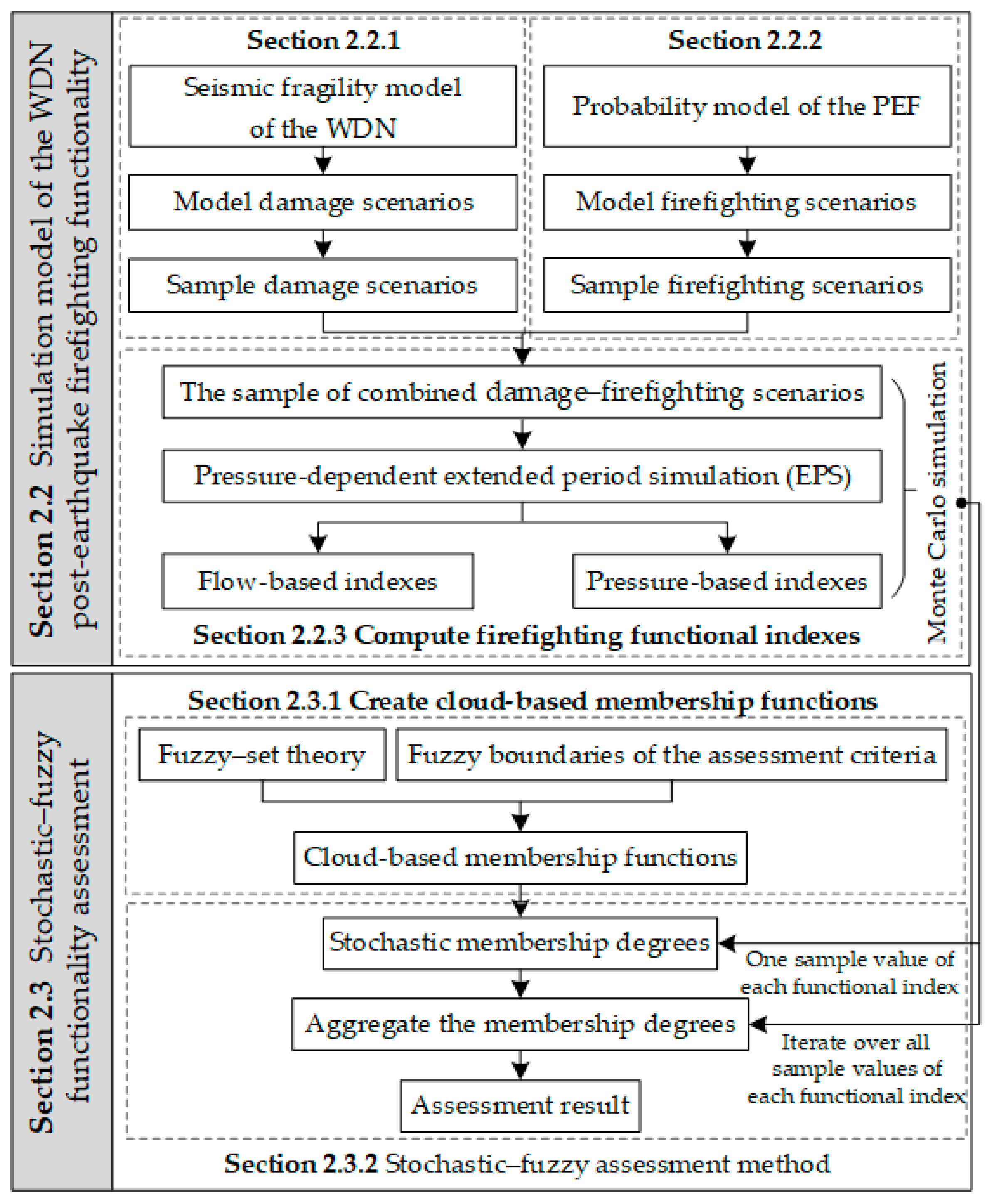
The proposed method comprises two parts, as illustrated in Figure 1.
The first part utilizes an open-source analysis tool, WNTR (Version 1.4.0) [16], to establish a simulation model for post-earthquake firefighting functionality. Section 2.2.1 and Section 2.2.2 detail the construction of seismic damage and firefighting scenarios. Damage scenarios characterize the damage inflicted on WDN facilities. Firefighting scenarios specify the required firefighting flow rate and duration. Random samples of these two types of scenarios were generated and combined pairwise to form a seismic damage–firefighting scenario sample. As shown in Section 2.2.3, the functional indexes were defined according to flow rate and pressure values, and they are calculated via extended-period simulations (EPSs) under pressure-driven conditions. The MC-based sample values of these indexes were applied to the following stochastic–fuzzy assessment.
The second part of the method utilizes cloud models to assess firefighting functionality under the stochastic–fuzzy condition. Based on the basic concept of the cloud model, Section 2.3.1 details the mechanism of defining stochastic membership functions under the fuzzy boundaries of the assessment criteria. Section 2.3.2 details the process of integrating the MC-based sample values of each index into the cloud-based membership functions to yield the assessment results.

2.2. Simulation Model of the Post-Earthquake Firefighting Functionality

2.2.1. Sampling of the Seismic Damage of the WDN

The seismic fragility model forms the basis for modeling damage scenarios. The model quantifies the probability of facilities in a WDN reaching specific damage states under specific seismic intensities. Compared with other types of facilities, it is more difficult to avoid placing buried water pipes in high-risk seismic zones due to their extensive coverage. Consequently, seismic damage to water pipes is significantly more prevalent than damage to other types of facilities [13,39]. Therefore, this study focused extensively on the seismic fragility of pipes.
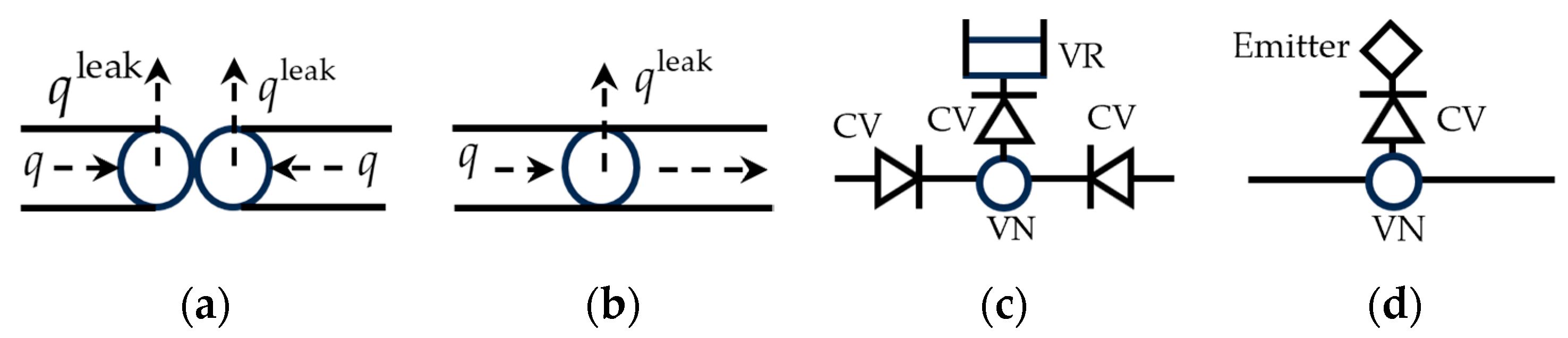
Pipe damage can be categorized as breakage or leakage. Excluding permanent ground displacement, breakage and leakage typically account for 20% and 80% of pipe damage, respectively [12]. Broken pipes cannot transport water, whereas leaking pipes remain partially functional. q leak at the damage point represents the leakage rate (m3/s). Figure 2 presents the illustration and simulation models of these two types of damage [40]. This study creates a virtual node (VN) at the damage point, and for each broken pipe, the VN connects to a virtual reservoir (VR) with checking valves (CVs) on both sides, rendering the pipe nonfunctional. For each leaking pipe, the VN connects to an emitter. The friction in the virtual pipe linking the VN to the VR or the emitter is negligible. The flow rate in the virtual pipe denotes the leakage rate, and the CV prevents reverse flow under negative pressure. The leakage coefficient C leak at the emitter is defined as follows [16]:
C leak = C D · A L · 2 ρ ,
where C D = 0.75 , ρ represents the density of water, and A L represents the leakage area, which relies on the rupture form. Table 1 shows the form and probability of the rupture of ductile iron pipes, where D and L C represent the diameter (mm) and longitudinal crack length (mm), respectively.
This study assumes that the seismic damage location on each pipe follows a Poisson distribution. The location of the damage point is defined using (2) [15], and the repair rate, r R , which represents the number of failures per kilometer of pipe, is defined using Equation (3) [41]:
L i = L i 1 ln 1 μ L r R ,           ( L i L , i 1 , L 0 = 0 ) ,
r R = C R × 2.88 × 10 6 × 980 × p g a 100 1.97
where L i denotes the distance (m) from the ith damage point to the starting end of the pipe; L denotes the length (m) of the pipe; μ L [ 0 , 1 ] denotes a random number; p g a denotes the peak ground acceleration (gravitational acceleration, g); and C R denotes the correction coefficient dependent on the pipe’s material, diameter, and geological conditions. A sample of the seismic damage scenarios of a WDN can be created as follows:
Step 1. Calculate r R for each pipe using Equation (3).
Step 2. Select one pipe and initialize the counter number i = 1 . Create a random number μ L and calculate L i using Equation (2). If L i < L , create the ith damage point and let i = i + 1 .
Step 3. Create a random number μ 1 ( 0 , 1 ) . If μ 1 > 0.8 , construct the breaking model at the ith damage point. Otherwise, construct the leaking model at this point and create another random number μ 2 ( 0 , 1 ) to determine the type of rupture. For instance, the rupture types for ductile iron pipes are circular looseness, longitudinal cracking, and pipe breach when μ 2 < 0.8 , 0.8 μ 2 < 0.9 , and μ 2 0.9 , respectively.
Steps 2 and 3 are repeated until L i L for all pipes, thereby creating a damage scenario. The sample is created by repeating this process N S times.

2.2.2. Sampling of Post-Earthquake Firefighting Scenarios

Post-earthquake firefighting scenarios are created based on the time and location of the PEFs. This study models the scenarios through a macroscopic and static ignition estimation model, as presented in previous studies [8,9,10,16,32]. A probabilistic model proposed by Zhao et al. [42], which was calibrated using historical earthquake fire records from the United States, Japan, and China, was utilized to determine the time and spatial distribution of fire occurrences in this study.
First, the model extracts PEFs as a series of discrete events following a Poisson distribution. The probability of the occurrence of n F fires is calculated using Equation (4):
P n = n F = r I · A F n F ! · exp r I · A F ,
where A F denotes the unit building area (105 m2), and r I denotes the ignition rate per building area. This rate is strongly correlated with p g a and is defined as
r I = 0.0042 + 0.5985 · p g a .
The ignition time is modeled as a Weibull distribution model. For the kth PEF, a random number μ T ( k ) ( 0 , 1 ) is created to determine the ignition time using Equation (6):
t F ( k ) = 15 ln μ T ( k ) 1 0.7 .
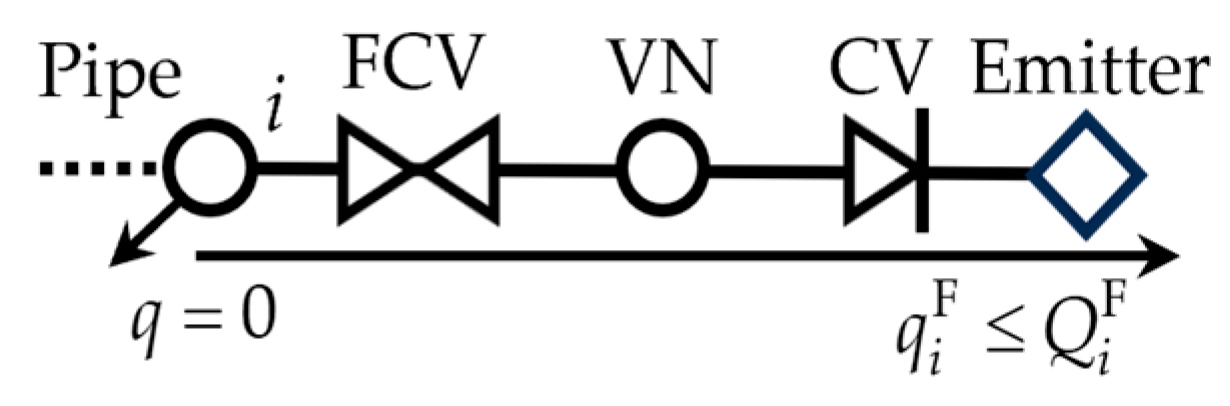
A firefighting scenario is characterized by the demand and duration of the firefighting flow. The fire spread dynamics dependent on the detailed built environment (for example, building density, structural materials, and scaffolding configurations) and natural conditions (for example, wind and humidity) [43] are not included. Therefore, the influence of fire spread on the required flow rate and duration for firefighting operations is not considered. Figure 3 presents the simulation model of firefighting flow [8]. The node at which the fire ignites is connected sequentially to an emitter through a flow control valve (FCV) and CV. Suppose that the kth fire ignites at node i at time t F ( k ) with duration Δ t F ( k ) , where the flow rate q i F ( t ) from the node to the emitter in period t [ t F ( k ) , t F ( k ) + Δ t F ( k ) ] denotes the firefighting flow rate (m3/s). The FCV restricts q i F ( t ) within the design flow rate (m3/s) Q i F ( t ) , and the CV prevents reverse flow owing to the negative pressure. The elevation (m) of the emitter is the sum of the elevation of node i and the minimum pressure (m) required for firefighting, P F , respectively. During this period, the domestic water supplied at this node is set to zero to maximize firefighting flow.
A sample of the post-earthquake firefighting scenarios can be created as follows:
Step 1. Calculate the probability P ( n F ) using Equations (4) and (5).
Step 2. Create a random number μ F ( 0 , 1 ) . If μ F < P ( n F ) , no fire incidents occur. If P ( n F 1 ) μ F < P ( n F ) , n F fire incidents occur.
Step 3. Create an array of random numbers μ T ( k ) ( k = 1 , 2 , , n F ) and determine the ignition time t F ( k ) ( k = 1 , 2 , , n F ) for each fire incident using Equation (6).
Step 4. Randomly assign the fire incidents to nodes in the WDN.
The sample is created by repeating Steps 2–4 N S times.

2.2.3. Computation of Firefighting Functional Indexes

The MC-based sample values of firefighting functional indexes are computed as follows. First, a sample of seismic damage–firefighting scenarios was created by combining each pair of seismic damage and firefighting scenarios. Second, for each scenario in the sample, a pressure-dependent EPS was performed to compute the nodal pressure and flow rate. The period in the EPS was divided into a series of equal, short intervals. Finally, the indexes were computed by comparing the pressure and flow rate with the respective required values. The indexes were defined based on the following considerations.
First, the indexes should be defined in terms of flow rate and pressure. Flow-based indexes quantify the shortage of firefighting flow at fire nodes to reflect fire control conditions. Pressure-based indexes quantify the satisfaction of nodal pressure with the firefighting requirement to reflect the exposure of fire risks across the WDN. Both the Chinese and U.S. technical codes [44,45] for firefighting and hydrant systems specify the minimum pressure for any node in a WDN at the maximum flow rate (including firefighting flow), P min . Insufficient pressure is associated with high exposure to fire hazards.
Second, the flow rate should be quantified in terms of average and severe shortages. Limited firefighting resources (for example, crews, trucks, and water reserves) cannot offset severe flow shortages, which substantially increase the risk of fire escalation. Severe shortages can occur at certain fire nodes during specific periods. Hence, severity should be quantified based on spatiotemporal characteristics. Furthermore, flow-based indexes should emphasize the degree of prolonged severe shortages because their impact is more substantial than that of intermittent shortages. The pressure-based indexes were defined based on the same concerns.
The functional index, F , was first decomposed into an index for deficient flow, F F , and an index for deficient pressure, F P . The two secondary indexes are detailed in the tertiary indexes shown in Table 2.
The functional indexes (defined as follows) were normalized, with a lower value indicating superior performance:
F F 1 = 1 | V F | · | T F | i V F , t T F Q i F ( t ) q i F ( t ) Q i F ( t ) ,
F F 2 = 1 V F count i V F i t T F q i F ( t ) t T F Q i F ( t ) < θ F ,
F F 3 = 1 | T F | count t T F t i V F q i F ( t ) i V F Q i F ( t ) < θ F ,
F F 4 = 1 V F count i V F i count   t , t 0 T F t q i F ( t ) Q i F ( t ) < θ F ,   t t 0 , t 0 + Δ t CF > 0 ,
F P 1 = 1 | V | · | T | count t T , i V t p i ( t ) < P min ,
F P 2 = 1 | V | count i V i 1 T count t T t p i ( t ) < P min > θ PT ,
F P 3 = 1 T count t T t 1 | V | count i V i p i ( t ) < P min > θ PN ,
F P 4 = 1 V count i V i count t , t 0 T t p i ( t ) < P min ,     t t 0 , t 0 + Δ t CP > 0 ,
where V , T , V F , and T F represent the sets of nodes, time intervals, fire nodes, and fire time intervals, respectively; “count” is utilized to calculate the cardinality of these sets; q i F ( t ) and Q i F ( t ) represent the actual and design flow rates on fire node i at time t, respectively; p i ( t ) and P min represent the pressure of node i and the aforementioned minimum pressure, respectively; θ F , Δ t CF , θ PT , θ PN , and Δ t CP are the thresholds for determining the severe or prolonged severe deficiencies of flow and pressure. As the firefighting flow supplied by firefighting resources increases, θ F decreases while Δ t CF increases, respectively. θ PT , θ PN , and Δ t CP characterize the capability of firefighting resources to mitigate fire hazards under pressure deficiency conditions. The stronger this capability, the higher the values of these thresholds.
Equations (7)–(10) define the flow-based indexes. In F F 1 , ( Q i F ( t ) q i F ( t ) ) / Q i F ( t ) denotes the flow shortage of node i at time t. This index quantifies the average flow shortage. In F F 2 , t q i F ( t ) / t Q i F ( t ) < θ F denotes the severe flow shortage at node i in the period of PEFs. A higher value of F F 2 indicates a greater number of areas suffering from severe flow shortage, and firefighting trucks must continuously transport water to these areas. In F F 3 , i q i F ( t ) / i Q i F ( t ) < θ F denotes severe flow shortage in the network at time t. A higher value of F F 3 indicates a greater number of time periods suffering from severe flow shortage. During such periods, a greater number of firefighting trucks are needed to transport water. In F F 4 , q i F ( t ) / Q i F ( t ) < θ F , where t [ t 0 , t 0 + Δ t C 1 ] , denotes the continuous severe flow shortage of node i in this period [40]. The node is considered to suffer from prolonged severe flow shortage once this situation occurs. The threshold θ F is set as a constant, assuming that the required flow is equal across time intervals.
Equations (11)–(14) define the pressure-based indexes. F P 1 defines the average pressure deficiency of a WDN. In F P 2 , count { t p i ( t ) < P min } denotes the time of deficient pressure at node i. A ratio of the time above the threshold θ PT implies severe pressure deficiency at this node. A higher value of this index signifies that more nodes are exposed to potential fire hazards. In F P 3 , count { i p i ( t ) < P min } denotes the number of nodes suffering from deficient pressure at time t. A ratio of nodes of this type above the threshold θ PN indicates severely deficient pressure during this time period. A higher value of this index signifies that more time periods are exposed to fire hazards. In F P 4 , p i ( t ) < P min , where t [ t 1 , t 1 + Δ t CP ] , denotes the continuous deficient pressure at node i during this time period. The node is considered to suffer from prolonged severe pressure deficiency once this situation occurs.
Flow rate and pressure are generic and basic technical indicators of WDNs. Therefore, comparing the flow rate (or pressure) with the required flow rate (or pressure) is generic for quantifying a WDN’s firefighting functionality [28,29,30,31,32]. However, the required pressure P F and P min ; required demand Q i F ( t ) ; and thresholds θ F , Δ t CF , θ PT , θ PN , and Δ t CP vary with respect to urban contexts. Parameters P F , P min , and Q i F ( t ) are typically configured based on firefighting technical codes [44,45]. P F and P min are dependent on firefighting equipment performance. Q i F ( t ) depends on the built environment (for example, the flammability of building materials and structural types). The equipment performance and built environment significantly vary between countries and regions. Therefore, P F , P min , and Q i F ( t ) must be uniformly configured based on the same set of technical codes to ensure the consistency and rationality of their values. There is currently no definite standard for defining these thresholds. On one hand, variations in these thresholds can introduce significant uncertainties in the assessment result. On the other hand, unlike the fixed physical attributes of firefighting equipment and the built environment, these thresholds can be easily varied based on the availability of firefighting resources. Sensitivity analysis can be utilized to reveal the uncertainty in the assessment result and the influence of resources on functionality via flexibly adjusting these thresholds within a reasonable range. The results are of great assistance for urban managers to prepare the resources.

2.3. Stochastic–Fuzzy Assessment of the Firefighting Functionality

Fuzzy set theory can be used to qualitatively convert the MC-based sample values of functional indexes. The cloud model transforms definite membership functions in this conversion into stochastic ones by characterizing the fuzzy boundaries of the assessment criteria. The mechanism of linking the MC method, fuzzy set theory, and cloud model can be detailed as follows: (1) The cloud model establishes stochastic membership functions based on the fuzzy boundaries of the assessment criteria, (2) the combination of these stochastic membership functions and definite functional index values yields the index grade, and (3) the iteration of stochastic membership functions over all sample values of all indexes achieves the stochastic-conditioned fuzzy assessment.

2.3.1. Creating Cloud-Based Membership Functions

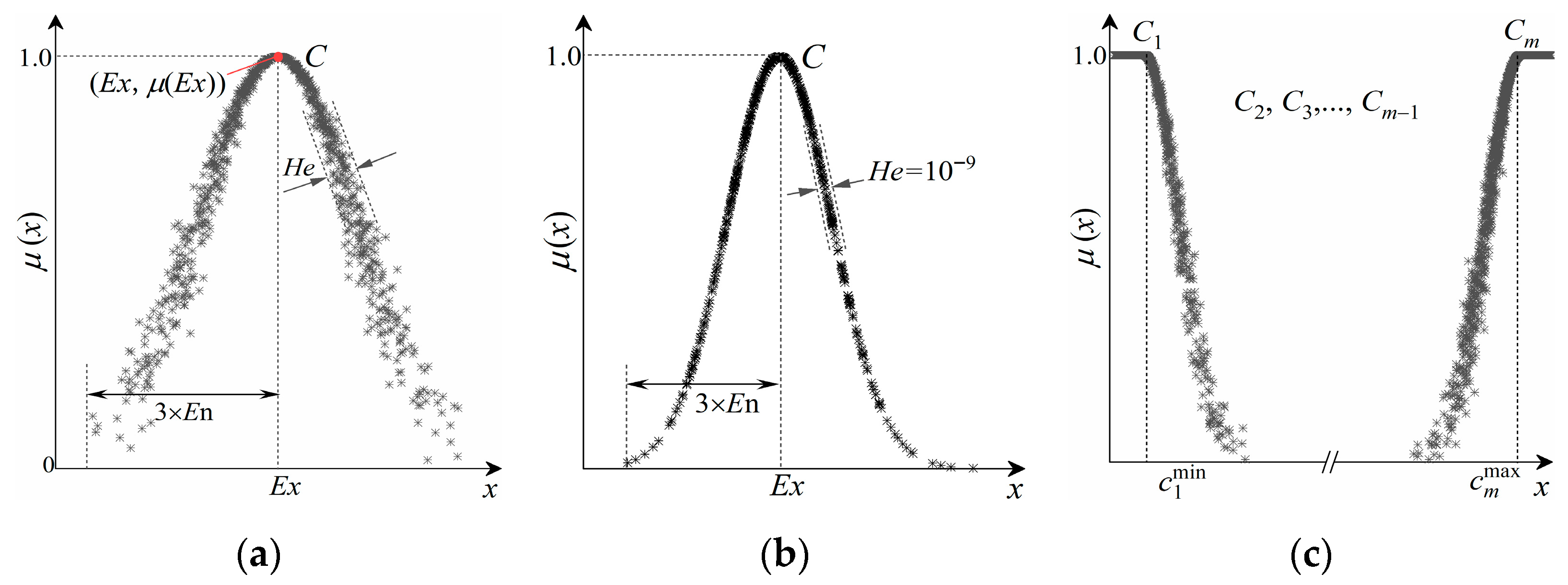
Li et al. [33] proposed a cloud model based on fuzzy sets and probability statistics. Let U be a quantitative universe and C be its qualitative concept. If the values x U and x are random realizations of C , the degree of membership of x with respect to C , μ ( x ) , is a random number with a stable tendency; in other words, μ : U [ 0 , 1 ]   , x U , x μ ( x ) . As shown in Figure 4a, the distribution of x on U forms a cloud, and ( x , μ ( x ) ) is a droplet.
The concept C is characterized in the form of a cloud as C ( E x , E n , H e ) , where the expected value E x , entropy E n , and hyper-entropy H e are digital characteristics. Droplet ( E x , 1 ) is located at the center of the cloud, indicating that the degree of membership of x = E x is the highest. Entropy determines the measurable range of a concept and is reflected in the span of a cloud. A larger E n results in a greater span and increases the fuzziness in this concept. Hyper-entropy characterizes the fuzziness in concept boundaries. A higher H e increases the uncertainty of E n , resulting in more dispersed cloud droplets in the stochastic realization of x μ ( x ) . H e determines cloud thickness. As illustrated in Figure 4b, the boundary of a concept becomes definitive as H e 0 , and the cloud degrades into a membership function.
Here, U represents the universe of the functional index, C represents the assessment grade, and x represents the value of the index. This study classified the results of all indexes into m grades. Because all the functional indexes were of the “lower-is-better” type, grades C 1 to C m are used to represent the best to worst performance. By inviting experts to determine the ( E x , E n , H e ) of each grade, μ ( x ) with respect to each grade can be computed using the forward cloud generator (FCG). This study employed the normal distribution-based cloud model (as illustrated in Figure 4a) due to its generality. In many problems, μ ( x ) = 1.0 under x [ 0 , c 1 min ] [ c m max , + ) causes C 1 and C m to form a semi-trapezoidal cloud, as illustrated in Figure 4c. The algorithm proposed in [37] solves this problem.
The expected value E x is calculated as
E x i = c i min + c i max 2 ,         ( i = 2 , 3 , , m 1 ) ,
E x 1 = c 1 min ,
E x m = c m max ,
where c i max and c i min ( i = 2 , 3 , , m 1 ) denote the upper and lower bounds of C i , respectively, and c 1 min and c m max denote the thresholds that render μ ( x ) = 1 into C 1 and C m , respectively. To enable a smooth transition of μ at the boundary c of two adjacent grades, the degree of membership of c i with respect to C i can be set to 0.5. Hence, the entropy E n i is calculated as follows:
exp c i E x i 2 2 E n i 2 = 0.5 ,
E n i = c i E x i 2 ln 2 ,
where c i denotes c i min or c i max when i = 2 , 3 , , m 1 , and c 1 and c m denote c 1 min and c m max , respectively. Hyper-entropy E n i is defined as follows:
H e i = λ E n ,
where λ can be adjusted to reflect the fuzziness of the grade boundaries. This study set λ = 0.1 .
The membership degree μ i ( x ) ( i = 1 , 2 , , m ) is defined as
μ i ( x ) = exp x E x i 2 2 · E n i 2 , if           x c 1 min , c m max 1 ,                                     if           x 0 , c 1 min c m max , + ,
where E n i is a random number of the normal distribution N ( E n i , H e i 2 ) . Repeating this process for all grades creates a vector of membership degrees, R :
R x i = μ 1 ( x i ) μ 2 ( x i ) μ m ( x i ) ,
where x i represent the value of a functional index in a seismic damage–firefighting scenario.

2.3.2. Stochastic–Fuzzy Assessment

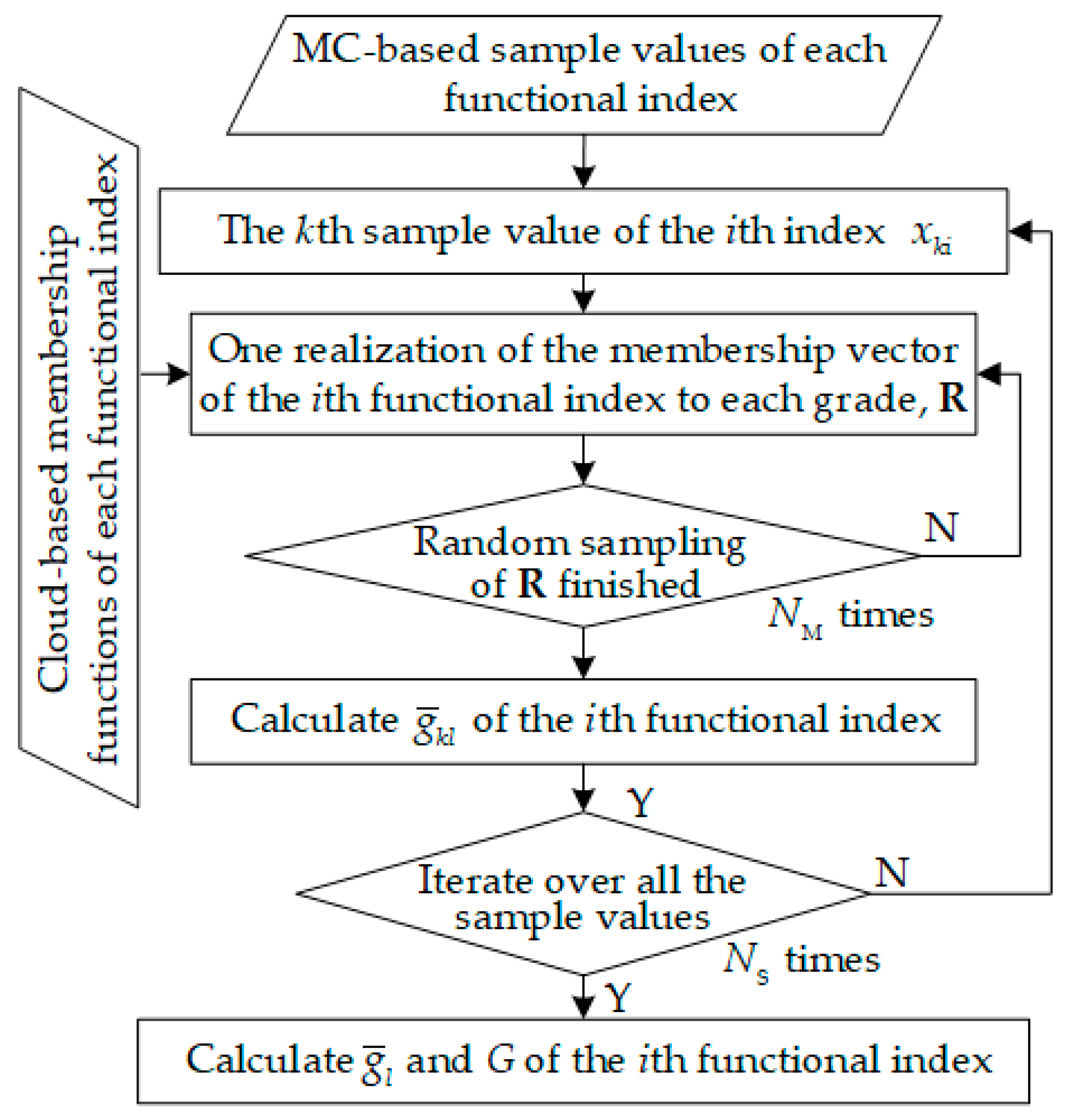
Due to the fuzzy grade boundary, the degree of membership of x i with respect to each grade is stochastic. Equation (22) is a stochastic realization of the membership vector under x i . Hence, this study conducted the experiment N M times and calculated the expected value of the outcome. Furthermore, x i was the result of a single MC simulation. The above process was repeated over all sample values of the MC simulations, and the expected value of the outcome was calculated as the assessment result. As illustrated in Figure 5, the assessment process can be divided into the following steps:
Step 1. Prepare sample values of all functional indexes. Let k = 1 .
Step 2. Select the kth sample value of the ith functional index, x k i .
Step 3. Calculate the jth realization of the membership degree of x k i with respect to C l ( l = 1 , 2 , , m ), g k l j , as
R j = μ 1 j ( x k i ) μ 2 j ( x k i ) μ m j ( x k i ) ,
where μ l j ( l = 1 , 2 , , m ) denotes the jth realization of the membership degree.
Step 4. Independently repeat Step 3 N M times (in this study, N M = 100 ). Calculate the average degree of membership g ¯ k l ( l = 1 , 2 , , m ) as follows:
g ¯ k l = 1 N M j μ l j ( x k i ) ,
Step 5. Check whether k has reached size N S for the sample of seismic damage–firefighting scenarios. If so, proceed to Step 6. Otherwise, let k = k + 1 and return to Step 2.
Step 6. Calculate the average membership degree of the complete set of sample values with respect to each grade, g ¯ l ( l = 1 , 2 , , m ):
g ¯ l = 1 N S k g ¯ k l .
Step 7. Normalize the vector of the membership degree ( g ¯ 1 , g ¯ 2 , , g ¯ m ) T and compute the score of the functional index, G , as
G = l = 1 m g ˜ l · l 1 ,
where g ˜ l denotes a normalized g ¯ l , and l 1 denotes the characteristic value of grade C l . The score G [ 0 , m 1 ] is used, and a smaller value is preferable. As described in Table 3, the grade of an index is determined by rounding G to the nearest characteristic grade value.

3. Experimental Case Study

3.1. Overview of the Case

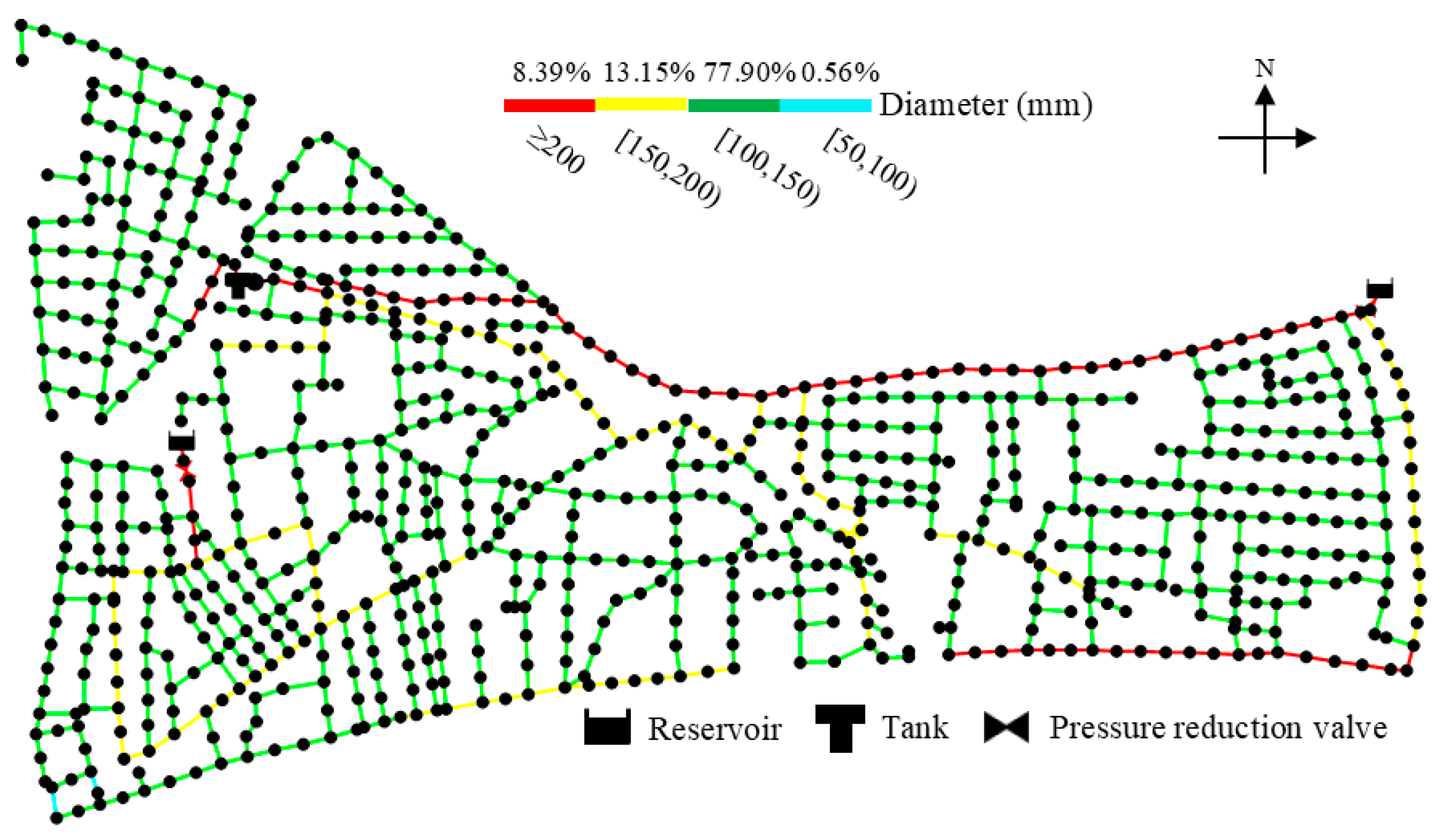
This study employed an L-Town network [46], as illustrated in Figure 6, to demonstrate the efficacy of the proposed method. This network comprises 701 nodes, two fixed-head sources, and 905 pipes—predominantly with diameters of 100–200 mm. All pipes were assumed to be composed of ductile iron, and the site geology consisted of a non-liquefiable, hard alluvial plain. In line with a previous study [36], this study considered an earthquake with magnitudes between M7.0 and M8.0 ( p g a [ 0.10 g , 0.20 g ] ) and assumed a spatially uniform pga. The sample size was N S = 10,000 , and the time step for the EPS was 15 min.
The parameters for modelling the firefighting scenarios were uniformly configured based on Chinese standards. First, the population was estimated based on per capita water consumption, which was then used to calculate the total building area AF. The per capita water consumption and building area were set to 0.12 m3/day [47] and 100 m2 [48], respectively. Both P F and P min were set at 0.1 MPa (10 m) [44]. The firefighting flow rate is strongly correlated with the population size, as presented in Table 4 [44]. The town has an estimated population of 80,000; thus, the required flow rate was set to 35 L/s. The flow duration was 2–4 h [16]. This study focused on firefighting functionality within the first 24 h after the earthquake. The majority of PEFs occur within this period [12,42], and damage detection and repair preparations can also be completed [40]. This study aimed to maximize firefighting flow rates while ensuring basic domestic demand. Because a supply of 0.02 m3/day can satisfy basic individual needs [49], the base domestic demand for all nodes was reduced to 20% of the normal level. Water demand for industrial and commercial operations was set at zero.
This study utilized a sensitivity analysis, as mentioned in Section 2.2.3, to address the following two issues: (1) revealing the uncertainty in the assessment result introduced by the subjective configuration of threshold values and (2) investigating the influence of the reserve of firefighting resources on firefighting functionality. This study invited three professionals with over ten years of work experience at the Beijing Firefighting and Emergency Management Department to set the initial values of the five thresholds. These values were configured based on their experience in firefighting operations at the small-scale township level in order to be consistent with the situation in L-Town. The firefighting flow rate should be at least 70% of the design flow rate, and the duration of the flow rate below this threshold should not exceed 1 h. The total duration of a pressure value below P min at any node must be less than 4 h, and during any single period, the percentage of such nodes must remain below 10%. The pressure at any node must not remain below P min for more than two consecutive hours. Therefore, θ F , Δ t CF , θ PT , θ PN , and Δ t CP were set as 0.7, 1, 0.167, 0.1, and 2 h, respectively.
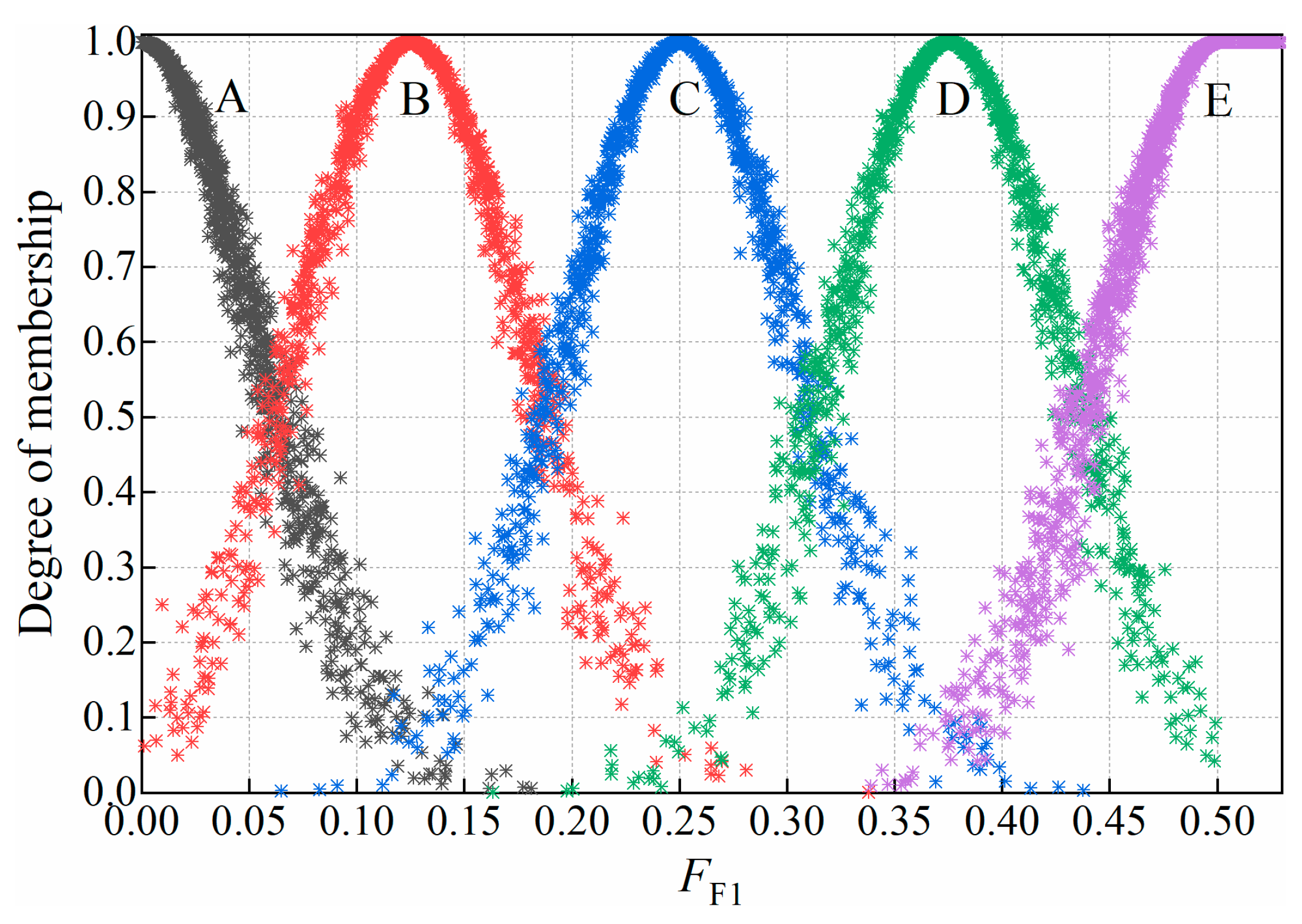
The grades were divided into five levels ( m = 5 ): Excellent (A), Good (B), Fair (C), Poor (D), and Fail (E). Experts were invited to define c A min and c E max for each functional index. The interval [ c A min , c E max ] was equally divided [50] to form the digital characteristics of the standard cloud, as presented in Table 5. As the absence of both deficit flow and pressure is the most ideal condition, c A min = 0 . For conservative purposes, c E min 1.0 . For instance, c E min = 0.3 for F F 2 indicates that the grade decreases to “E” when the ratio of fire nodes suffering from severely deficient flow reaches 30%. For F F 4 , this ratio decreases to 0.1 ( c E max = 0.1 ). For pressure-based indexes, the assignment of c E max was more conservative for three reasons. First, the pressure indexes were computed using all nodes and all time periods. A high c E max indicates that an excessive number of nodes and time periods suffering from severely deficient pressure is permissible. Second, an increase in the percentage of nodes with deficient pressure increases the percentage of nodes with deficient flow. Third, the occurrence and spread of PEFs are often highly unpredictable. A high proportion of nodes with deficient pressure significantly elevates the risk of uncontrollable fires. Hence, the c E max of each pressure-based index was recommended as half that of its corresponding flow-based index. Figure 7 shows the standard cloud created through the FCG by taking F F 1 as an example.

3.2. Results and Analysis

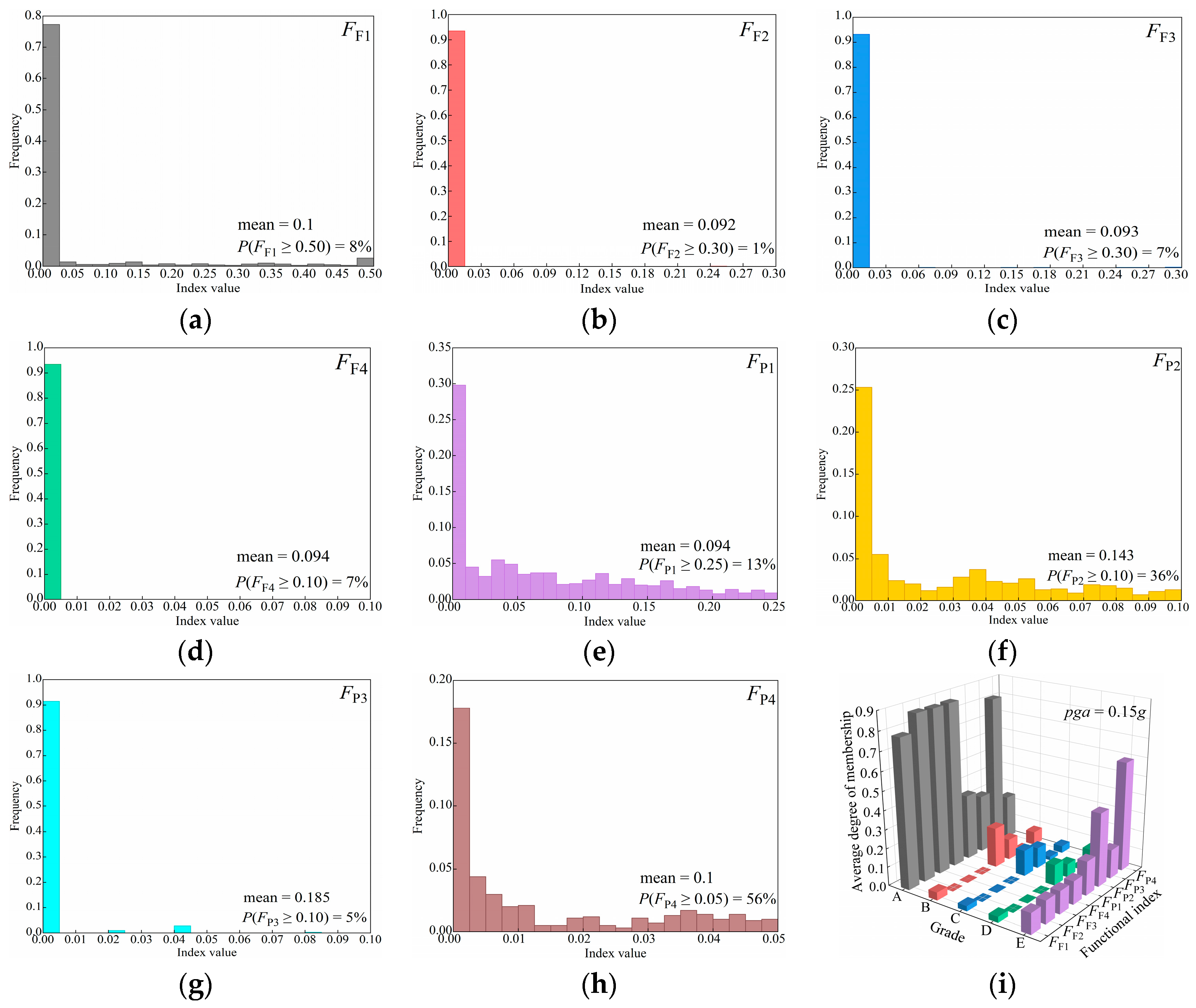
Before displaying the grades across different seismic intensities, the assessment process was illustrated by taking p g a = 0.15 g as an example. Figure 8a–h illustrate the MC-based frequency distributions of all functional indexes under x c E max . Figure 8i shows the average membership degrees of each index to each grade. The membership distributions closely resembled the frequency distributions, demonstrating the effective integration of probabilistic sample characteristics with fuzzy decision preferences. Indexes { F F 1 , F F 2 , F F 3 , F F 4 , F P 3 } peaked at the Grade A membership because their sample values were typically zero. For indexes F P 1 , F P 2 , and F P 4 , the significant decreases in the proportion of zero samples decrease their membership degrees to Grade A. Indexes F P 2 and F P 4 peaked at Grade E membership. Based on these results, F F 1 , F F 2 , F F 3 , F F 4 , and F P 3 were assigned to Grade A; F P 1 was assigned to Grade B; and F P 2 and F P 4 were assigned to Grade C (as shown in Figure 9a). In contrast, grades determined using the mean and results in Table 5 were notably inaccurate. Indexes F F 1 to F F 4 and F P 1 shifted from Grade A to C. The mean value of F P 3 reached 0.185, resulting in its downgrade from Grade A to E. With a mean value of 0.134, F P 2 decreased from Grade B to E, and index F P 4 decreased from Grade C to E.
Figure 8 reveals two observations under the condition of p g a = 0.15 g . First, seismic damage severely weakened the supply capacity of this network, but the number of PEFs is relatively low. Hence, the flow-based indexes outperformed the pressure-based indexes, and the resources for supplementing firefighting flow are relatively sufficient. Second, the nodes with deficient pressure highly possibly suffered from prolonged severely deficient pressure, resulting in similar grades with respect to indexes F P 2 and F P 4 . However, the proportion of these nodes was not high in each period; thus, F P 3 outperformed these two indexes. The mean-based indexes excluded the probability distribution of the sample values and were influenced by extreme values in the sample. Hence, the mean index values that approximately ranged from 0.1 to 0.2 cannot reveal the above observations.
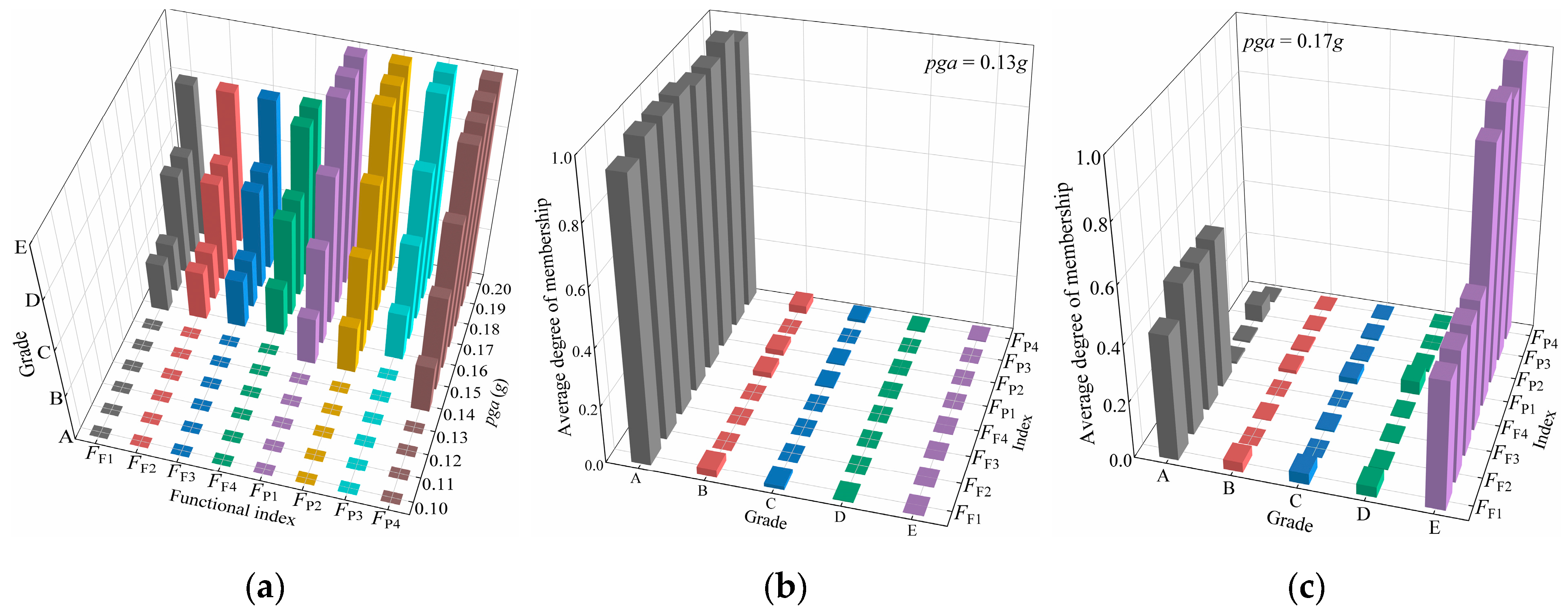
Figure 9a illustrates the grades of the first to tertiary functional indexes across different seismic intensities. Most indexes shown in Figure 8i exhibited high membership in Grades A and E but low membership in intermediate grades. Two p g a levels, 0.13g (low) and 0.17g (high), were selected to examine this phenomenon, as shown in Figure 9b and Figure 9c, respectively.
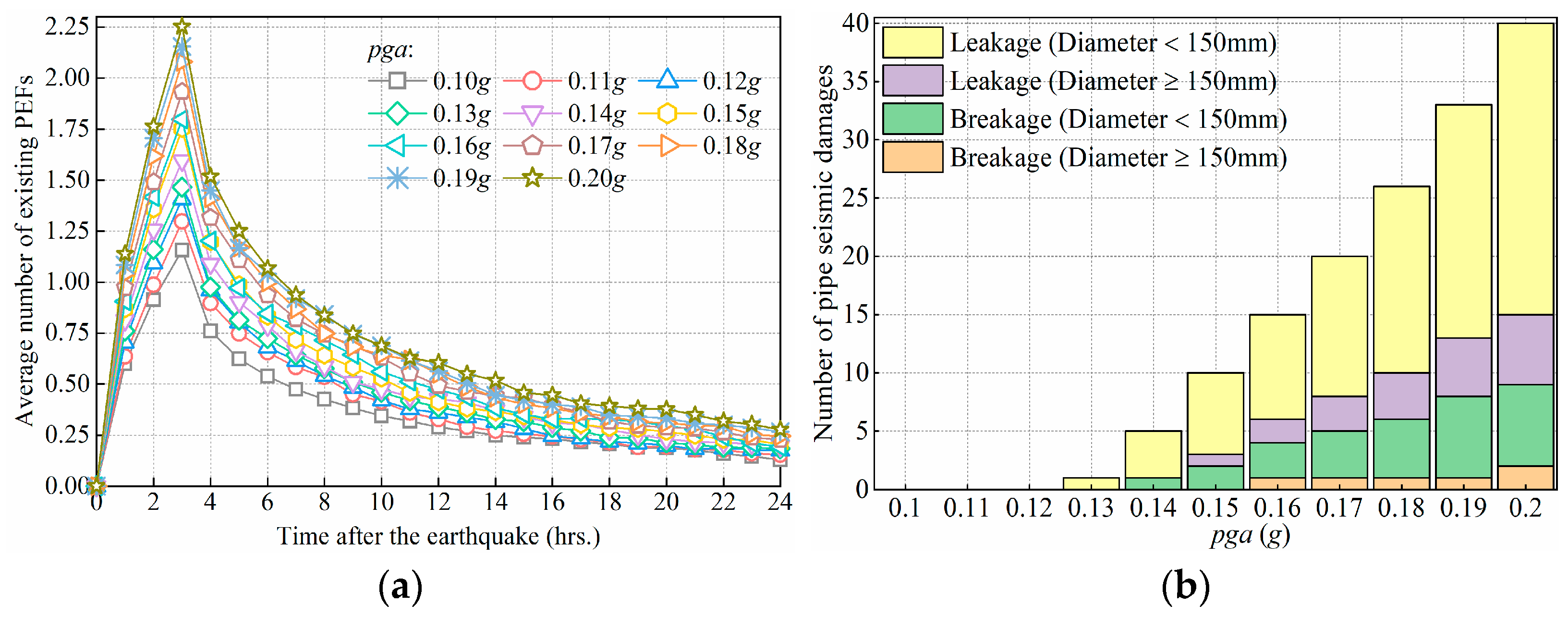
Figure 9a indicates that the grades for flow- and pressure-based indexes degraded sharply when pga exceeds 0.15g. Furthermore, the grades of the pressure-based indexes were lower than those of the flow-based indexes. It can be reasonably inferred that the low number of fires caused the flow-based indexes to outperform the pressure-based indexes. To verify this inference, Figure 10a and Figure 10b show the mean number of PEFs across time periods and the mean number of damaged pipes, respectively. The number of PEFs was generally low and showed no significant variation across different seismic intensities. The mean fire counts when p g a = 0.1 g and p g a = 0.2 g were only 1.2 and 2.2, respectively, even at the peak level of PEF numbers during the third hour after the earthquake. The number of damaged pipes increased rapidly from p g a = 0.14 g . This result corresponded to a rapid decline in the grades of the pressure-based indexes. A significant drop in pressure as a result of pipe damage dominated the degraded firefighting functionality. Low pressure caused flow shortages in the affected areas, thus downgrading the flow-based indexes. As shown in Figure 6, pipes with diameters greater than 150 mm accounted for only 20% of the total. Most nodes were connected by pipes with a diameter of 100 mm. Therefore, the top priorities for improving firefighting functionality are improving the supply capacity by increasing pipe diameter and reducing pipe damages through seismic retrofitting.
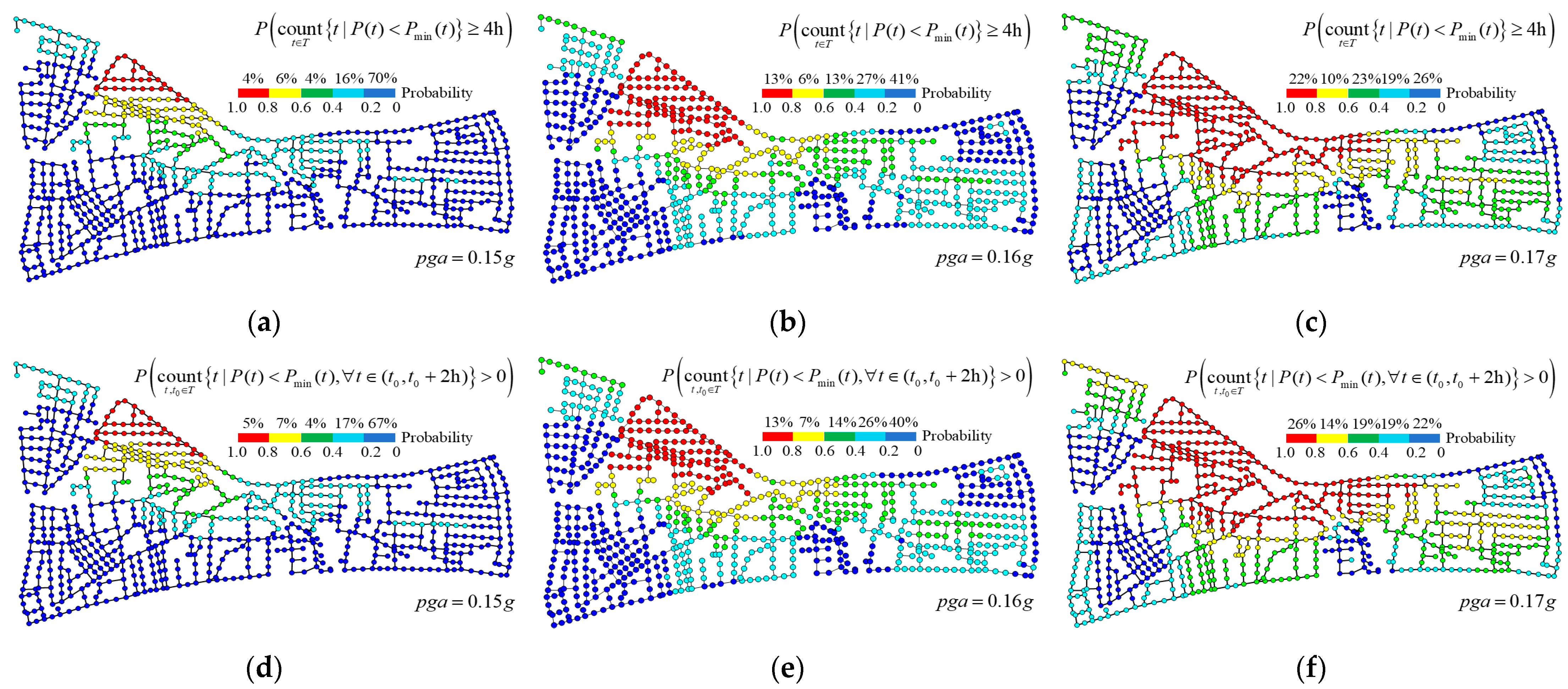
Second, the results revealed the spatiotemporal characteristics of deficient flow and pressure. The grade of F F 4 was lower than that of F F 2 when p g a = 0.15 g , 0.17 g , and 0.19 g . This suggested that nodes with prolonged severe flow shortages accounted for a high proportion of nodes with severe flow shortages. The grade of F P 4 was lower than that of F P 2 when p g a [ 0.14 g , 0.17 g ] . This suggested that a high proportion of nodes had prolonged severe pressure deficiency. Figure 11 depicts the probability of each node having severe and prolonged severe pressure deficiencies when p g a [ 0.15 g , 0.17 g ] . The legend shows the proportion of nodes belonging to each probability interval. This figure reveals a close alignment between the probabilities of severe and prolonged severe pressure deficiencies, thus supporting the inference that the proportion of nodes with prolonged severely deficient flow and pressure was high.
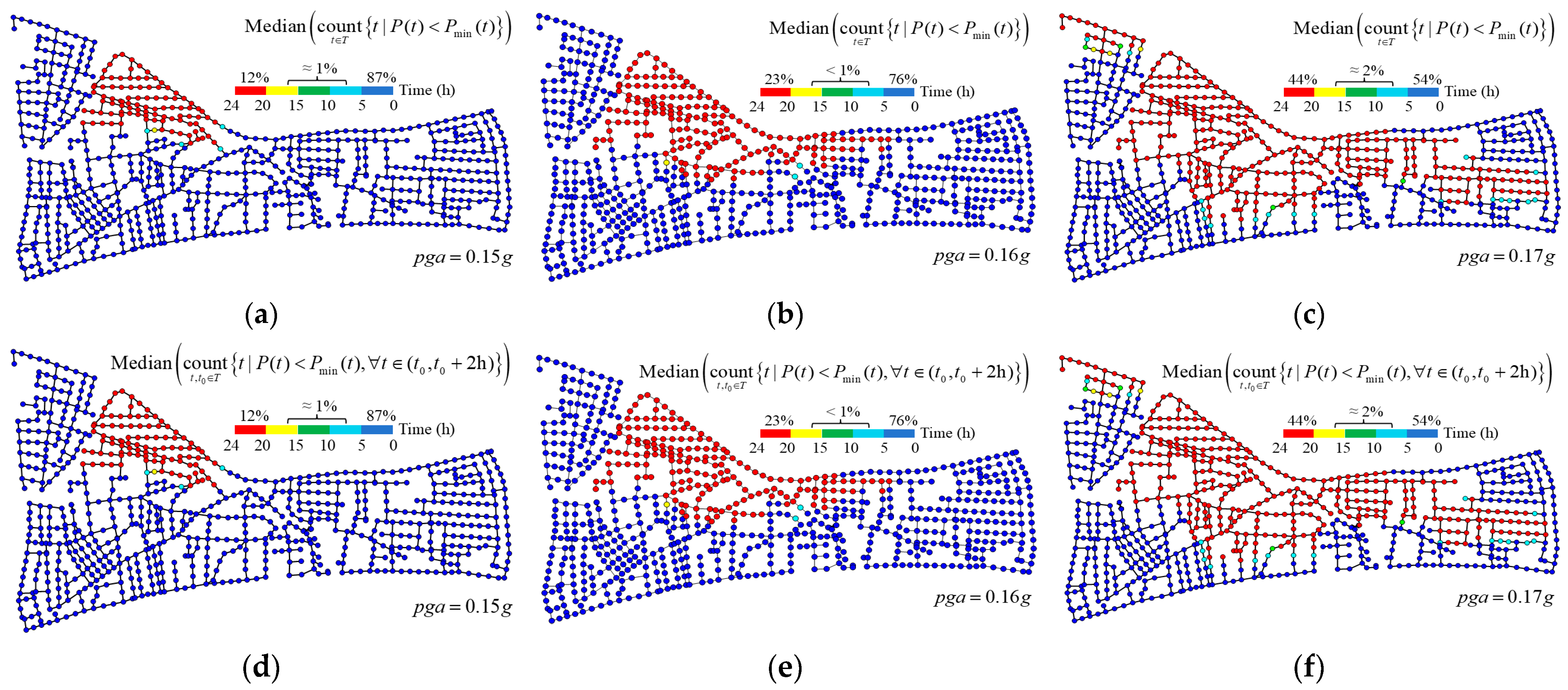
To characterize temporal pressure deficiency, Figure 12 shows the median duration of pressure deficiency and prolonged pressure deficiency for each node, revealing the following two phenomena. First, a close alignment between the duration of severely and prolonged severely deficient pressure implied that pressure deficiency was typically prolonged. Second, nodes with high probabilities of severely or prolonged severely deficient pressure (marked red/yellow in Figure 11) typically experienced the deficiency for 24 h. The prolonged deficiency significantly worsened the overall network pressure conditions. Consequently, F P 1 and F P 2 had similar ranks, and F P 3 performed better.
Further analyses of Figure 11 and Figure 12 revealed that the nodal pressure and flow rates exhibited prolonged and severe deficiencies in some scenarios while remaining normal in others. The sample values of the functional indexes tended to be extremely large or small and, thus, easily clustered in intervals corresponding to Grades A and E. The probability of a pressure deficiency was low when p g a = 0.13 g . The majority of index values were clustered within the interval corresponding to Grade A. Increased seismic intensity increased the probability of pressure deficiency, leading to a shift in the sample values from Grade A to E. This explains why the indexes in Figure 8i and Figure 9b,c exhibited significantly high membership degrees with respect to Grades A and E.
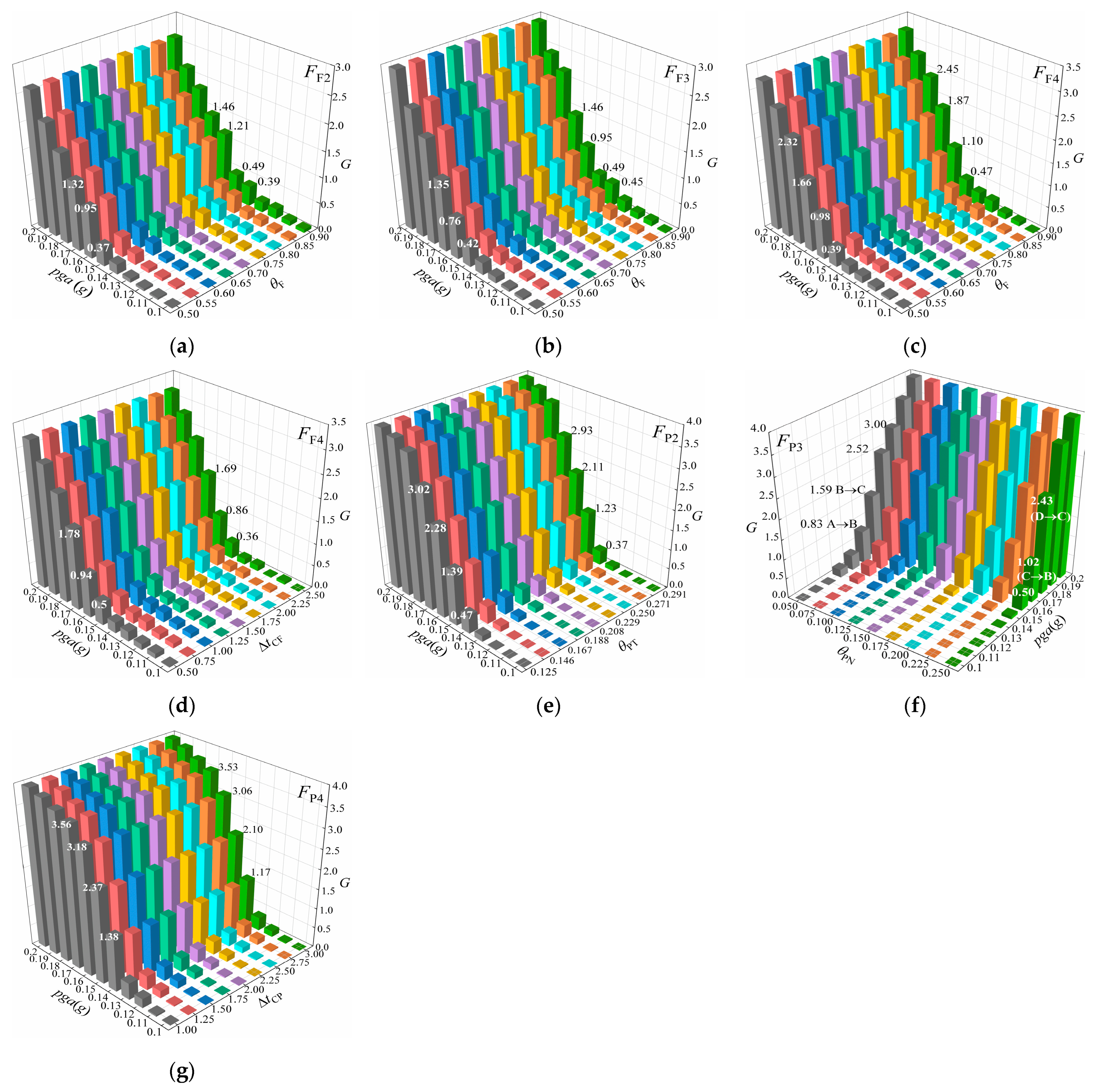
Figure 13 shows how variations in thresholds θ F , Δ t CF , θ PT , θ PN , and Δ t CP influence the index score G. The results showed that there was little variation in G across the indexes, except for F P 3 when 0.14 g p g a 0.17 g . Prior analysis has indicated that severely deficient pressure was, with a high probability, a prolonged one lasting 24 h. Hence, θ PT and Δ t CP had little effect on indexes F P 2 and F P 4 , and θ F and Δ t CF had little effect on the flow-based indexes that are dependent on pressure. The proportion of nodes with deficient pressure when 0.14 g p g a 0.17 g was not high. An increase in θ PN significantly reduced the number of time periods with severely deficient pressures, thereby significantly affecting F P 3 . Furthermore, the results indicated that increasing firefighting resources cannot compensate for the degradation of the functionality resulting from severe damage to the network. As seismic intensity increases, the area with low pressure lasting for 24 h expands, and the PEF number increases. Firefighting trucks must continuously replenish water at multiple fire nodes simultaneously, potentially inducing a severe shortage of resources in this town.

4. Discussion

4.1. Comparison with Backward Cloud-Based Assessment

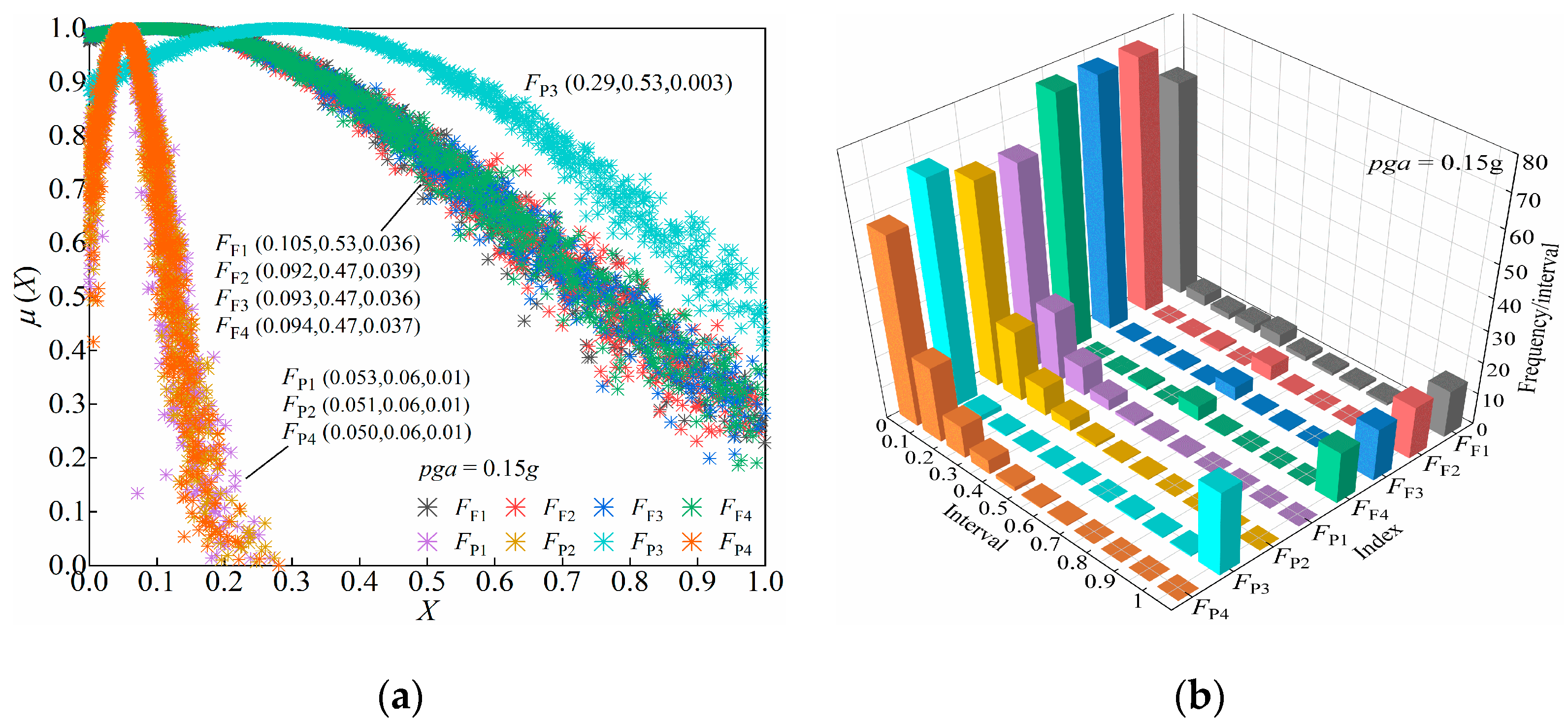
Previous studies often employed backward cloud generator (BCG) algorithms [33] to transform the sample values of each functional index into digital cloud characteristics: C ( E x , E n , H e ) [36,37]. The grade of this index is assigned based on the standard cloud (as defined in Table 5) closest to C ( E x , E n , H e ) . To compare this algorithm with the proposed method, the digital characteristics of all functional indexes at p g a = 0.15 g were obtained using the most widely used normal-distribution-based BCG. Figure 14a and b illustrate the cloud figures and frequency distribution histograms of these indexes, respectively.
In Figure 14a, all index clouds exhibit narrow thickness, reflecting low uncertainty in the grade boundary. However, the cloud span shows significant differences. For F P 1 , F P 2 , and F P 4 , the span of the clouds was narrow, and their grades can be easily assigned based on the closeness criteria. For other indexes, however, cloud droplets with μ 0.9 almost covered the entire range of [ c A min , c E max ] , with F P 3 deviating significantly from the standard clouds of all grades. Under these circumstances, accurately assessing the indexes becomes difficult. A similar phenomenon was reported in a previous study [36]. The scarce consideration of the distributional congruence of the BCG with the actual sample values caused this problem. As shown in Figure 14b, the sample values of these five indexes significantly deviated from a normal distribution. Hence, the cloud created using the normal-distribution-based BCG resulted in substantial inaccuracies. To determine the probability distribution based on sample values, necessary assumptions and simplifications may introduce errors in the assessment result. In comparison, the proposed method proves to be simpler and more reliable.

4.2. Extension of the Fuzzy Set Theory

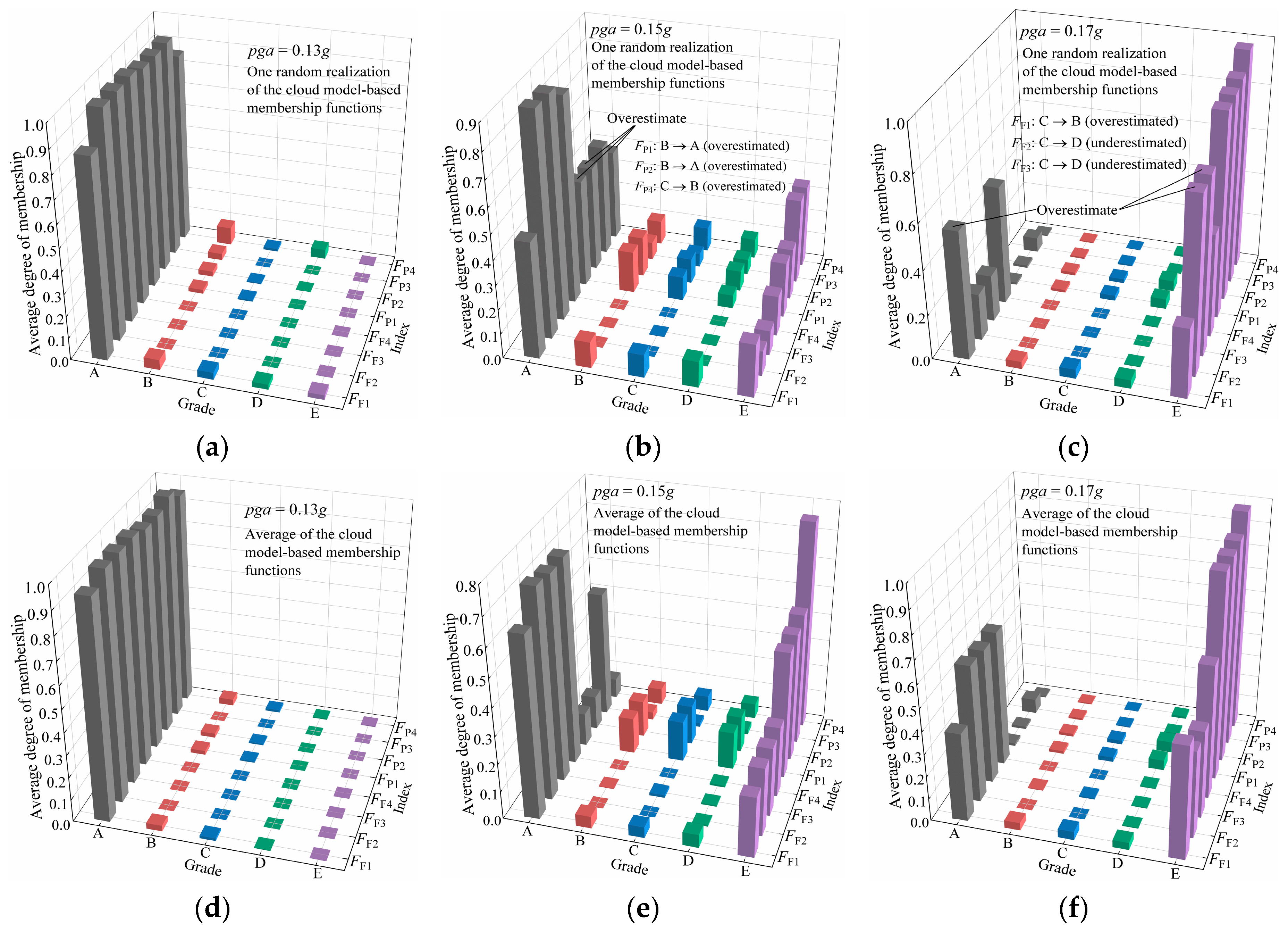
A membership function curve in fuzzy set theory is a specific instance of a cloud. The cloud, based on the random sampling of membership functions, incorporates all instances. Therefore, the cloud-based assessment results reflect the average level under fuzzy cognition regarding the boundary of the assessment criteria. To investigate the errors potentially arising from particular cognitive instances, definite membership functions were created under the following conditions: (1) random instantiation of the cloud membership function and (2) the deterministic mean of the cloud membership function. Taking p g a = 0.13 g , 0.15 g , and 0.17 g as examples, Figure 15 shows the degree of membership of each index to each grade.
Assessments based on random instances of the membership functions can result in significant errors. The sample values of all indexes approached zero when p g a = 0.13 g . Hence, the degree of membership of each index to Grade A remained the highest. Indexes F P 1 , F P 2 , and F P 4 were overestimated by a single grade when p g a = 0.15 g . When p g a = 0.17 g , F F 1 was overestimated, and F F 2 and F F 3 were underestimated, each by a single grade. The results based on the average of the cloud-based membership functions were aligned with those based on the proposed method. These function curves imply consensus among experts and decision-makers regarding the boundaries of the assessment criterion, but they require sufficient information for their determination. In cases of limited information regarding the boundaries, the cloud-based membership functions enable flexible boundary adjustments by tuning H e , thereby enhancing the reliability of the results. Furthermore, the computational process demonstrates how the assessment results are derived under stochastic–fuzzy conditions. Therefore, the proposed method warrants further investigation and popularization.

4.3. Implications and Limitations

The findings of the illustrative study will aid in assessing the firefighting functionality of WDNs under real PEF scenarios and guide further research.
First, the proposed functional indexes enable explanations of the cause of firefighting functionality degradation and considerations of the capability of firefighting resources to respond to fires or potential fire hazards. The flow- and pressure-based indexes revealed that the insufficiently designed capacity is the main cause of the functionality degradation of the L-Town network. The increasing severity of seismic damage compromises the capacity of the network to cope with even a minimal number of PEFs. Potential fire spread induced by wind, combustible building materials, and high building density can easily increase the actual flow rate and duration of firefighting flow. Under such circumstances, the risk of fire escalation would be markedly higher. According to the spatiotemporal severe deficiency of these indexes, there is a high probability that a specific proportion of nodes will suffer from deficient pressure within a 24 h period. Fire trucks must continuously provide water to fire events that occur in these areas. As seismic intensity increases, this low-pressure area expands, and the PEF number rises. Under such circumstances, fire trucks may need to continuously provide water to multiple PEFs simultaneously, potentially confronting this town with a severe shortage of firefighting resources. In summary, decision-makers should prioritize investment in sustaining the post-earthquake supply capacity of the WDN.
Second, the assessment result presented in Figure 9a was derived from particular decision preferences presented in Table 5. Changes in preferences can alter the result. However, this example was intended to demonstrate the efficacy of the proposed method in two aspects: (1) The process of the sample values of functional indexes aligns with the decision preferences to yield the assessment result, and (2) the advantage of the proposed method can be observed through a comparison of different methods under the same criteria. The mean values of the indexes failed to align their probability distributions with the preferences and could be significantly influenced by extreme values within the sample. If the sample values are clustered near the extremes of the value range (as shown in Figure 8 and Figure 14b), the mean value will fail to represent the sample, and substantial errors will occur in the assessment result. The BCG algorithm requires selecting an appropriate cloud type based on the probability distribution of the index sample values. Otherwise, this method produces invalid results. Fuzzy set theory determines membership functions based on insufficient and limited expertise and decision preferences, potentially resulting in significant deviations in the assessment results.
Third, addressing the following gaps will facilitate the practical use of the proposed method:
(1)
The construction of seismic damage scenarios of WDNs should incorporate spatial correlations in seismic intensity. For a WDN with a small footprint, similarly to the L-Town network, the assumption of spatially uniform seismic intensity is applicable [23,24,36]. For large WDNs, characterizing this correlation using historical ground motion maps and site environments can yield more accurate damage scenarios, thereby rendering the assessment result more reliable [18].
(2)
PEF scenarios should incorporate fire spread dynamics and more flexible strategies for firefighting water supply. Fire spread can significantly increase the required flow rate and duration for firefighting operations. The proposed method needs to incorporate fire spread dynamics based on detailed data of the built environment and natural conditions. More advanced techniques, such as cellular automata or computational fluid dynamics, are promising for this type of modeling.
(3)
This study focused exclusively on firefighting and restricted domestic water use to the absolute minimum. Future efforts should optimize water rationing plans based on the water supply priorities, demand elasticity, and temporal use patterns of different consumers [51]. These plans determine water allocation to different consumers across time periods, thereby increasing firefighting flow rates while mitigating the impact of water shortages on consumers.
(4)
The determination of thresholds θ F , Δ t CF , θ PT , θ PN , and Δ t CP should incorporate static subjective judgement into a dynamic process of data-driven calibration. Empirical thresholds with prior probabilistic distributions will first be established based on sensitivity analysis, historical firefighting data, and expertise. Subsequently, Bayesian updating can be utilized to iteratively refine these thresholds as new firefighting evidence becomes available [52,53]. This adaptive process enhances both the accuracy and credibility of these thresholds.

5. Conclusions

This study integrated a post-earthquake firefighting functionality simulation model of WDNs with a cloud model-based assessment method. The functionality emphasized the spatiotemporal characterization and severity of deficiencies in firefighting flow and pressure. The cloud model-based method achieved a stochastic–fuzzy functionality assessment. An illustrative study applied to the L-Town network validated the efficacy of this method, as summarized as follows:
(1)
The flow- and pressure-based functional indexes revealed the cause of firefighting functionality degradation in terms of excessive firefighting flow and degraded water supply capacities, respectively. The indexes assisted in the decision of mitigating fire hazards or enhancing the supply capacity and anti-seismic capability of a WDN. For the L-Town network, these indexes indicated that enhancing supply capacity and anti-seismic resilience is more effective for reducing the risk of PEFs.
(2)
The spatiotemporal characteristics of severe flow and pressure deficiency revealed the capability of firefighting resources to cope with concurrent fires and ensure sustained water replenishment to fire zones. For the L-Town network, water must be continuously supplemented within 24 h to specific areas with severely deficient pressure. This situation worsened with an increase in seismic intensity, inflicting a severe shortage of firefighting resources on the network.
(3)
The cloud model-based assessment method aligns the MC-based sample values of the functional indexes with qualitative assessment criteria with fuzzy boundaries. By overcoming the shortcomings of the mean MC-based values, the BCG algorithm, and fuzzy set theory, the proposed method can render the assessment result more reliable.
Future efforts should address the following key areas for the practical application of this method. First, seismic damage scenarios should incorporate spatial correlations in seismic intensities using historical ground motions and site environments. This improvement aids to yield more accurate damage scenarios. Second, firefighting scenarios should incorporate fire–spread dynamics and water rationing plans. The spread dynamics based on built environment and natural conditions aids to calibrate firefighting flow rates and duration. The rationing plans based on supply priorities and demand elasticity aid to increase firefighting flow rates while mitigating domestic water shortage. Finally, model parameters need to be calibrated. The Bayesian-based calibrating process can refine the parameters using updated firefighting evidences, thereby rendering the parameters more accurate and credible.

Author Contributions

Conceptualization, X.H.; Methodology, X.H. and C.Z.; Software, X.H. and F.X.; Validation, F.X. and C.Z.; Formal analysis, H.H., F.X. and C.Z.; Writing—original draft, X.H.; Writing—review and editing, H.H. and C.Z.; Visualization, X.H.; Supervision, H.H. and T.Q.; Project administration, T.Q.; Funding acquisition, X.H. and C.Z. All authors have read and agreed to the published version of the manuscript.

Funding

This research was funded by the Central Public-Interest Scientific Institution Basal Research Fund (Grant No. 512025Y-12521) and the National Natural Science Foundation of China (Grant No. 72274181).

Institutional Review Board Statement

Not applicable.

Informed Consent Statement

Not applicable.

Data Availability Statement

The data presented in this study are available on request from the first author.

Acknowledgments

The authors appreciate the reviewers for their help in highlighting deficiencies in this study.

Conflicts of Interest

The authors declare no conflicts of interest, and the funders had no role in the process of the study.

Abbreviations

The following abbreviations are used in this manuscript:
WDNWater distribution network
MCMonte Carlo
PEFPost-earthquake fire
EPSExtended period simulation
FCGForward cloud generator
BCGBackward cloud generator

References

  1. Arrighi, C.; Tanganelli, M.; Cristofaro, M.T.; Cardinali, V.; Marra, A.; Castelli, F.; De Stefano, M. Multi-risk assessment in a historical city. Nat. Hazards 2023, 119, 1041–1072. [Google Scholar] [CrossRef]
  2. Yan, M.M.; Yang, F.; Li, C.; Guo, D.H. Constructing a standard system of city sustainable development assessment technology based on the SDGs. Chin. J. Popul. Resour. 2024, 22, 275–290. [Google Scholar] [CrossRef]
  3. Grozdanić, G.; Cvetković, V.M.; Lukić, T.; Ivanov, A. Sustainable earthquake preparedness: A cross-cultural comparative analysis in Montenegro, North Macedonia, and Serbia. Sustainability 2024, 16, 3138. [Google Scholar] [CrossRef]
  4. Scawthorn, C.; O’rourke, T.D.; Blackburn, F.T. The 1906 San Francisco earthquake and fire—Enduring lessons for fire protection and water supply. Earthq. Spectra 2006, 22, 135–158. [Google Scholar] [CrossRef]
  5. Behnam, B. Post-Earthquake Fire Analysis in Urban Structures: Risk Management Strategies, 1st ed.; CRC Press Taylor & Francis Group: Boca Raton, FL, USA, 2016. [Google Scholar] [CrossRef]
  6. Lou, T.; Wang, W.; Izzuddin, B.A. A framework for performance-based assessment in post-earthquake fire: Methodology and case study. Eng. Struct. 2023, 294, 116766. [Google Scholar] [CrossRef]
  7. Baser, B.; Behnam, B. An emergency response plan for cascading post-earthquake fires in fuel storage facilities. J. Loss Prev. Process Ind. 2020, 65, 104155. [Google Scholar] [CrossRef]
  8. Li, Y.Z.; Gao, J.L.; Zhang, H.Y.; Deng, L.Q.; Xin, P. Reliability assessment model of water distribution networks against fire following earthquake (FFE). Water 2019, 11, 2536. [Google Scholar] [CrossRef]
  9. Hou, G.J.; Li, Q.W. Firefighting capacity evaluation of water distribution system subjected to multi-ignitions of post-earthquake fires. Struct. Saf. 2021, 88, 102035. [Google Scholar] [CrossRef]
  10. Li, W.N.; Mazumder, R.K.; Bastidas-Arteaga, E.; Li, Y. Seismic Performance Evaluation of Corroded Water Distribution Systems Considering Firefighting. J. Water Resour. Plan. Manag. 2024, 150, 04023075. [Google Scholar] [CrossRef]
  11. Jeon, S.S.; O’Rourke, T.D. Northridge earthquake effects on pipelines and residential buildings. Bull. Seismol. Soc. Am. 2005, 95, 294–318. [Google Scholar] [CrossRef]
  12. Federal Emergency Management Agency (FEMA). HAZUS97 Technical Manual; FEMA: Washington, DC, USA, 1997. [Google Scholar]
  13. American Lifelines Alliance. Seismic Fragility Formulations for Water Systems Part 1 Guideline; American Lifeline Alliance: Washington, DC, USA, 2001. [Google Scholar]
  14. Rossman, L.A. EPANET 2: Users’ Manual; U.S. Environmental Protection Agency (EPA): Cincinnati, OH, USA, 2000.
  15. GIRAFFE. GIRAFFE User’s Manual; School of Civil and Environmental Engineering, Cornell University: Ithaca, NY, USA, 2008. [Google Scholar]
  16. Klise, K.A.; Bynum, M.; Moriarty, D.; Murray, R. A software framework for assessing the resilience of drinking water systems to disasters with an example earthquake case study. Environ. Model. Softw. 2017, 95, 420–431. [Google Scholar] [CrossRef]
  17. Yoo, D.G.; Jung, D.; Kang, D.; Kim, J.H.; Lansey, K. Seismic Hazard Assessment Model for Urban Water Supply Networks. J. Water Resour. Plan. Manag. 2016, 142, 04015055. [Google Scholar] [CrossRef]
  18. Hou, B.W.; Xu, Q.Y.; Zhong, Z.L.; Han, J.Y.; Miao, H.Q.; Du, X.L. Seismic reliability evaluation of spatially correlated pipeline networks by quasi-Monte Carlo simulation. Struct. Infrastruct. Eng. 2024, 20, 498–513. [Google Scholar] [CrossRef]
  19. Long, L.; Yang, H.P.; Zheng, S.S.; Cai, Y.L. Seismic resilience evaluation of urban multi-age water distribution systems considering soil corrosive environments. Sustainability 2024, 16, 5126. [Google Scholar] [CrossRef]
  20. Emamjomeh, H.; Jazany, R.A.; Kayhani, H.; Hajirasouliha, I.; Bazargan-Lari, M.R. Reliability of water distribution networks subjected to seismic hazard: Application of an improved entropy function. Reliab. Eng. Syst. Saf. 2020, 197, 106828. [Google Scholar] [CrossRef]
  21. Liu, W.; Zhao, Y.G.; Li, J. Seismic functional reliability analysis of water distribution networks. Struct. Infrastruct. Eng. 2015, 11, 363–375. [Google Scholar] [CrossRef]
  22. Miao, H.Q.; Li, J. Serviceability evaluation of water supply networks under seismic loads utilizing their operational physical mechanism. Earthq. Eng. Eng. Vib. 2022, 21, 283–296. [Google Scholar] [CrossRef]
  23. Jia, R.; Du, K.; Song, Z.G.; Xu, W.; Zheng, F.F. Scenario reduction-based simulation method for efficient serviceability assessment of earthquake-damaged water distribution systems. Reliab. Eng. Syst. Saf. 2024, 246, 110086. [Google Scholar] [CrossRef]
  24. Hou, B.W.; Yang, C.X.; Wu, S.; Miao, H.Q.; Xu, C.S. Seismic retrofit optimization of water distribution systems based on the reduction of uncertain damage scenarios. Int. J. Disaster Risk Reduct. 2024, 112, 104756. [Google Scholar] [CrossRef]
  25. Wu, J.; Baker, J.W. Statistical learning techniques for the estimation of lifeline network performance and retrofit selection. Reliab. Eng. Syst. Saf. 2020, 200, 106921. [Google Scholar] [CrossRef]
  26. Hu, Z.; Zhu, J.C.; Jiao, H.M.; Zeng, W.; Yang, Z.J. Risk assessment of water distribution networks through an integrated model based on machine learning and statistical methods. Reliab. Eng. Syst. Saf. 2025, 264, 111338. [Google Scholar] [CrossRef]
  27. Wang, Q.A.; Chen, J.; Ni, Y.Q.; Xiao, Y.F.; Liu, N.B.; Liu, S.K.; Feng, W.S. Application of Bayesian networks in reliability assessment: A systematic literature review. Structures 2025, 71, 108098. [Google Scholar] [CrossRef]
  28. Kanta, L.; Brumbelow, K. Vulnerability, risk, and mitigation assessment of water distribution systems for insufficient fire flows. J. Water Resour. Plan. Manag. 2013, 139, 593–603. [Google Scholar] [CrossRef]
  29. Kanta, L.; Zechman, E.; Brumbelow, K. Multiobjective evolutionary computation approach for redesigning water distribution systems to provide fire flows. J. Water Resour. Plan. Manag. 2012, 138, 144–152. [Google Scholar] [CrossRef]
  30. Rokstad, M.M. Optimisation of fixed-outlet and flow-modulated pressure reduction measures in looped water distribution networks constrained by fire-fighting capacity requirements. Int. J. Environ. Res. Public Health 2021, 18, 7088. [Google Scholar] [CrossRef]
  31. Nerantzis, D.; Stoianov, I. Adaptive model predictive control for fire incidents in water distribution networks. J. Water Resour. Plan. Manag. 2022, 148, 04021102. [Google Scholar] [CrossRef]
  32. Chu-Ketterer, L.J.; Murray, R.; Hassett, P.; Kogan, J.; Klise, K.; Haxton, T. Performance and resilience analysis of a New York drinking water system to localized and system-wide emergencies. J. Water Resour. Plan. Manag. 2023, 149, 05022015. [Google Scholar] [CrossRef]
  33. Li, D.Y.; Liu, C.Y.; Gan, W.Y. A new cognitive model: Cloud model. Int. J. Intell. Syst. 2009, 24, 357–375. [Google Scholar] [CrossRef]
  34. Zadeh, L.A. Fuzzy sets. Inf. Control 1965, 8, 338–353. [Google Scholar] [CrossRef]
  35. Shen, Y.Y.; El Naggar, M.H.; Zhang, D.M.; Li, L.Y.; Du, X.L. Fuzzy-based method for seismic soil structure interaction and performance evaluation of subway stations. Soil Dyn. Earthq. Eng. 2025, 191, 109225. [Google Scholar] [CrossRef]
  36. Zhang, J.; Zhang, M.Y. Seismic robustness computational methodology of community building portfolio coupled with water supply network based on probability-cloud model. Comput.-Aided Civ. Infrastruct. Eng. 2024, 39, 1676–1698. [Google Scholar] [CrossRef]
  37. Tan, F.; Wang, J.; Jiao, Y.Y.; Ma, B.C.; He, L.L. Suitability evaluation of underground space based on finite interval cloud model and genetic algorithm combination weighting. Tunn. Undergr. Space Technol. 2021, 108, 103743. [Google Scholar] [CrossRef]
  38. Zhang, W.; Huang, Z.; Zhang, J.B.; Zhang, R.F.; Ma, S.K. Multifactor uncertainty analysis of construction risk for deep foundation pits. Appl. Sci. 2022, 12, 8122. [Google Scholar] [CrossRef]
  39. Tabucchi, T.; Davidson, R.; Brink, S. Simulation of post-earthquake water supply system restoration. Civ. Eng. Environ. Syst. 2010, 27, 263–279. [Google Scholar] [CrossRef]
  40. Zhang, Q.Z.; Zheng, F.F.; Chen, Q.W.; Kapelan, Z.; Diao, K.G.; Zhang, K.J.; Huang, Y. Improving the Resilience of Postdisaster Water Distribution Systems Using Dynamic Optimization Framework. J. Water Resour. Plan. Manag. 2020, 146, 04019075. [Google Scholar] [CrossRef]
  41. Isoyama, R.; Ishida, E.; Yune, K.; Shirozu, T.; IWA. Seismic damage estimation procedure for water supply pipelines. In Anti-Seismic Measures on Water Supply; IWA Publishing: London, UK, 2000; Volume 18, pp. 63–68. [Google Scholar]
  42. Zhao, S.J.; Xiong, L.Y.; Ren, A.Z. A spatial–temporal stochastic simulation of fire outbreaks following earthquake based on GIS. J. Fire Sci. 2006, 24, 313–339. [Google Scholar] [CrossRef]
  43. Mascheri, G.; Chieffo, N.; Tondini, N.; Pinto, C.; Lourenço, P.B. Assessing the cascading post-earthquake fire-risk scenario in urban centres. Sustainability 2024, 16, 9075. [Google Scholar] [CrossRef]
  44. GB 50974-2014; Technical Code for Fire Protection Water Supply and Hydrant Systems. Ministry of Housing and Urban-Rural Development PRC, The State Bureau of Quality and Technical Supervision PRC: Beijing, China, 2014.
  45. American Water Works Association (AWWA). Distribution System Requirements for Fire Protection; American Water Works Association: Denver, CO, USA, 1998. [Google Scholar]
  46. Vrachimis, S.G.; Eliades, D.G.; Taormina, R.; Kapelan, Z.; Ostfeld, A.; Liu, S.M.; Kyriakou, M.; Pavlou, P.; Qiu, M.N.; Polycarpou, M.M. Battle of the leakage detection and isolation methods. J. Water Resour. Plan. Manag. 2022, 148, 04022068. [Google Scholar] [CrossRef]
  47. GB 5749-2022; Standards for Drinking Water Quality. Administration for Market Regulation and Standardization Administration of China: Beijing, China, 2022.
  48. GB 50137-2011; Code for Classification of Urban Land Use and Planning Standards of Development Land. Ministry of Housing and Urban-Rural Development of the People’s Republic of China, General Administration of Quality Supervision, Inspection and Quarantine of the People’s Republic of China: Beijing, China, 2011.
  49. Yang, Y.S.; Tatano, H.; Huang, Q.Y.; Liu, H.; Yoshizawa, G.; Wang, K. Evaluating the societal impact of disaster-driven infrastructure disruptions: A water analysis perspective. Int. J. Disaster Risk Reduct. 2021, 52, 101988. [Google Scholar] [CrossRef]
  50. Bai, M.H.; Liu, Q. Evaluating urban fire risk based on entropy-cloud model method considering urban safety resilience. Fire 2023, 6, 62. [Google Scholar] [CrossRef]
  51. Jeong, H.S.; Abraham, D.M. Water Rationing Model for Consequence Minimization of Water Infrastructure Destruction. J. Water Resour. Plan. Manag. 2009, 135, 80–89. [Google Scholar] [CrossRef]
  52. Wang, Q.A.; Liu, Q.; Ma, Z.G.; Wang, J.F.; Ni, Y.Q.; Ren, W.X.; Wang, H.B. Data interpretation and forecasting of SHM heteroscedastic measurements under typhoon conditions enabled by an enhanced Hierarchical sparse Bayesian Learning model with high robustness. Measurement 2024, 230, 114509. [Google Scholar] [CrossRef]
  53. Wang, Q.A.; Huang, X.Y.; Ni, Y.Q.; Feng, W.S.; Wang, J.F.; Qiu, S.; Zhou, P.; Li, J.P.; Luo, Y. Uncertainty-awarded, high-precision multi-step prediction of structural health monitoring sensor streams under extreme typhoon events: An enhanced Bayesian dynamic linear model leveraging the kernel regression basis function for severe environmental adaptation. Measurement 2026, 262, 120050. [Google Scholar] [CrossRef]
Figure 1. Method framework.
Sustainability 18 00949 g001
Figure 2. Illustration and simulation models of pipe seismic damage. (a) Illustration of broken pipes. (b) Illustration of leaking pipes. (c) Simulation model of broken pipes. (d) Simulation model of leaking pipes.
Sustainability 18 00949 g002
Figure 3. Simulation model of firefighting flows.
Sustainability 18 00949 g003
Figure 4. Instances of cloud figures. (a) Instance of normal cloud figures. (b) Instance of normal cloud figures when He = 10−9. (c) Instance of semi-normal, semi-trapezoidal cloud figures.
Sustainability 18 00949 g004
Figure 5. Process of the cloud model-based assessment method.
Sustainability 18 00949 g005
Figure 6. L-Town water distribution network.
Sustainability 18 00949 g006
Figure 7. Illustration of standard cloud of F F 1 .
Sustainability 18 00949 g007
Figure 8. Frequency distribution and assessment results of the indexes when pga = 0.15g. (ah) Frequency distribution of the indexes. (i) Average membership degree of the indexes with respect to each grade.
Sustainability 18 00949 g008
Figure 9. (a) Grade of the functional indexes when p g a [ 0.1 g , 0.2 g ] . (b) Average degree of membership of the indexes with respect to each grade when pga = 0.13g. (c) Average degree of membership of the indexes with respect to each grade when pga = 0.17g.
Sustainability 18 00949 g009
Figure 10. (a) Average of existing fire events. (b) Average of pipe damage.
Sustainability 18 00949 g010
Figure 11. Probability of severe and prolonged severely deficient pressure at each node. (ac): Probability of severely deficient pressure at each node. (df): Probability of continuous severely deficient pressure at each node.
Sustainability 18 00949 g011
Figure 12. Median duration of severe and prolonged severely deficient pressure at each node. (ac): Median time of severely deficient pressure at each node. (df): Median time of prolonged severely deficient pressure at each node.
Sustainability 18 00949 g012
Figure 13. Results of the sensitivity analysis of the thresholds. (a) Sensitivity of FF2 to θF. (b) Sensitivity of FF3 to θF. (c) Sensitivity of FF4 to θF. (d) Sensitivity of FF4 to ΔtCF. (e) Sensitivity of FP2 to θPT. (f) Sensitivity of FP3 to θPN. (g) Sensitivity of FP4 to ΔtCP.
Sustainability 18 00949 g013
Figure 14. (a) Cloud figures. (b) Frequency distribution histograms.
Sustainability 18 00949 g014
Figure 15. (ac): Assessment results based on one random realization of cloud-based membership functions. (df): Assessment results based on the average of the cloud-based membership functions.
Sustainability 18 00949 g015
Table 1. Form and probability of rupture of ductile iron pipes.
Form of RuptureLeaking AreaProbability
Circular looseness 3 π D 0.8
Longitudinal cracking 0.1 L C D 0.1
Pipe breach 0.0025 π D 2 0.1
Table 2. Post-earthquake firefighting functionality indexes.
Primary IndexSecondary IndexTertiary Index
Firefighting
functionality
F
Flow deficiency F F Average level of deficient flow, F F 1
Number of nodes with severely deficient flow, F F 2
Duration of severely deficient flow, F F 3
Level of prolonged severely deficient flow, F F 4
Pressure deficiency F P Average level of deficient pressure, F P 1
Number of nodes with severely deficient pressure, F P 2
Duration of severely deficient pressure, F P 3
Level of prolonged severely deficient pressure, F P 4
Table 3. Determination of the firefighting capacity grade.
GGrade
[ 0 , 0.5 ) C 1
[ i 1.5 , i 0.5 ) C i ( i = 2 , , m 1 )
[ m 1.5 , m 1 ) C m
Table 4. Design firefighting flow rate per fire.
Number of Residents (×104)Flow Rate (m3/s)Number of Residents (×104)Flow Rate (m3/s)
≤1.00.01520.0~30.00.060
1.0~2.50.02030.0~40.00.075
2.5~5.00.03040.0~50.00.075
5.0~10.00.03550.0~70.00.090
10.0~20.00.045≥70.00.100
Table 5. Digital cloud characteristics of each functional index.
ABCDE
F F 1 (0, 0.053, 0.005)(0.125, 0.053, 0.005)(0.250,0.0531, 0.005)(0.375, 0.0531, 0.005)(0.5, 0.053, 0.005)
x F 1 0.5
μ x F 1 = 1 x F 1 > 0.5
F F 2 (0, 0.032, 0.003)(0.075, 0.032, 0.003)(0.15, 0.032, 0.003)(0.225, 0.032, 0.003)(0.3, 0.032, 0.003)
x F 2 0.3
μ x F 2 = 1 x F 2 > 0.3
F F 3 (0, 0.032, 0.003)(0.075, 0.032, 0.003)(0.15, 0.032, 0.003)(0.225, 0.032, 0.003)(0.3, 0.032, 0.003)
x F 3 0.3
μ x F 3 = 1 x F 3 > 0.3
F F 4 (0, 0.011, 0.001)(0.025, 0.011, 0.001)(0.05, 0.011, 0.001)(0.075, 0.011, 0.001)(0.1, 0.011, 0.001)
x F 4 0.1
μ x F 4 = 1 x F 4 > 0.1
F P 1 (0, 0.027, 0.003)(0.063, 0.027, 0.003)(0.125, 0.027, 0.003)(0.188, 0.027, 0.003)(0.25, 0.027, 0.003)
x P 1 0.25
μ x P 1 = 1 x P 1 > 0.25
F P 2 (0, 0.016, 0.002)(0.0375, 0.016, 0.002)(0.075, 0.016, 0.002)(0.1125, 0.016, 0.002)(0.15, 0.016, 0.002)
x P 2 0.15
μ x P 2 = 1 x P 2 > 0.15
F P 3 (0, 0.016, 0.002)(0.0375, 0.016, 0.002)(0.075, 0.016, 0.002)(0.1125, 0.016, 0.002)(0.15, 0.016, 0.002)
x P 3 0.15
μ x P 3 = 1 x P 3 > 0.15
F P 4 (0, 0.005, 0.0005)(0.0125, 0.005, 0.0005)(0.025, 0.005, 0.0005)(0.0375, 0.005, 0.0005)(0.05, 0.005, 0.0005)
x P 4 0.05
μ x P 4 = 1 x P 4 > 0.05
Disclaimer/Publisher’s Note: The statements, opinions and data contained in all publications are solely those of the individual author(s) and contributor(s) and not of MDPI and/or the editor(s). MDPI and/or the editor(s) disclaim responsibility for any injury to people or property resulting from any ideas, methods, instructions or products referred to in the content.