Article

Dynamic Capabilities and Signal Transmission: Research on the Dual Path of Water Utilization Reduction Impacting Firm Value


1
School of Finance and Business, Shanghai Normal University, Shanghai 200234, China
2
College of Public Finance and Investment, Shanghai University of Finance and Economics, Shanghai 200433, China
*
Author to whom correspondence should be addressed.
Sustainability 2026, 18(2), 938; https://doi.org/10.3390/su18020938
Submission received: 25 November 2025 / Revised: 10 January 2026 / Accepted: 13 January 2026 / Published: 16 January 2026

Abstract

Driven by the national policy of total water resources control and efficiency improvement, the behavior of water resource utilization reduction by firms is widespread, which may have an impact on the value of firms. This study integrates dynamic capability theory and signaling theory to construct a dual-path analytical framework, systematically investigating the impact of water utilization reduction on firm value and its intrinsic mechanisms. Based on data from Chinese A-share listed companies spanning 2012–2023, fixed-effect models, mediation-effect tests, and heterogeneity analysis are employed for empirical verification. The results reveal that water utilization reduction exerts a significant dual-path promoting effect on firm value: it enhances financial performance (ROA) primarily through technological innovation, reflecting the process of resource orchestration and dynamic capability construction; concurrently, it boosts market performance (Tobin’s Q) mainly by improving ESG performance as a signaling channel, mirroring the capital market’s positive pricing of green signals. Further heterogeneity analysis indicates that these effects are more pronounced during the policy deepening stage, in non-water-intensive industries, and in humid/sub-humid regions. This study contributes theoretical support and empirical evidence for firms’ green transformation and the formulation of differentiated water resource policies by the government, highlighting the synergistic development of high-quality economic growth and ecological civilization construction.

1. Introduction

Water resources are a lifeline for economic and social development, and their strategic importance has become increasingly prominent amid global climate change and deepening industrialization [1,2]. However, water scarcity and uneven distribution have emerged as core bottlenecks restricting sustainable development globally, particularly in China [3,4]. As one of the world’s major water consumers, China faces a severe reality where per capita water resources are far below the global average [5]. This has prompted the national government to successively implement the strictest water resource management system centered on the “Three Red Lines” and establish “Water Conservation First” as a national strategy. Driven by these robust policies, firms’ water resource utilization reduction behaviors—proactively reducing total water consumption and improving utilization efficiency in production and operations—have shifted from an option to a necessity, becoming a common corporate practice.
A critical subsequent question arises: at the micro level, how will such environmentally sustainable reduction behaviors affect firms’ own sustainability? In other words, how does reduction behavior affect firm value? Existing literature provides preliminary insights but lacks a systematic answer. From the perspective of legitimacy theory and cost analysis, some studies argue that water-saving investments under environmental regulations increase corporate burdens and may inhibit financial performance in the short term [6]. In contrast, other research based on stakeholder theory suggests that active fulfillment of environmental responsibilities helps build a green image and may gain market recognition [7]. However, existing literature tends to focus on single perspectives such as compliance costs or risk management, presenting a fragmented state: it either emphasizes macro-level assessments of policy effectiveness or discusses only isolated aspects of the impact of water conservation on corporate costs or reputation. There is a lack of an integrated theoretical framework to reveal the complete transmission pathways and underlying mechanisms through which it affects firm value. At the same time, research on the mediating role of technological innovation is often static or overly general, lacking a detailed examination of its dynamic evolutionary process. Furthermore, there is insufficient micro-level empirical evidence supporting the role of ESG performance as a key signaling channel between specific environmental practices and capital market valuation. Additionally, most studies use static level values or single absolute change measures to assess corporate water use behavior, which makes it difficult to accurately capture the level of water-saving effort relative to business growth or its decoupling effect, nor does it reflect the continuity of management practices.
To address these research gaps, this study constructs a dual-path analytical framework incorporating dynamic capabilities and signaling to systematically examine the mechanism and effects of water resource utilization reduction on corporate value. This study aims to answer two core questions: First, what impact does firms’ water resource utilization reduction have on their financial and market performance? Second, through what micro-mechanisms is this impact achieved, relying on the arduous construction of internal dynamic capabilities or benefiting from effective signals sent to the external capital market?
Using data from Chinese A-share listed companies over 2012–2023, the empirical results show that water resource utilization reduction has a significant dual-path impact on corporate value: it exerts a linear promoting effect on both financial performance (measured by ROA) and market performance (measured by Tobin’s Q). Mechanism analysis reveals that the promotion of financial performance by water resource utilization reduction is mainly achieved through technological innovation, confirming the process of resource orchestration and dynamic capability building. In contrast, the market promotion effect is primarily realized through improving ESG performance as a signaling channel, reflecting the capital market’s positive pricing of green signals. Further heterogeneity analysis indicates that the above effects are more pronounced in the deepening stage of policy implementation, non-water-intensive industries, and humid/sub-humid regions. These findings provide important empirical evidence for the implementation of targeted and differentiated policies.
The marginal contributions of this study are manifested in the following dimensions: First, theoretically, by integrating the dynamic capability view and signaling theory, this research offers a unified theoretical account for the dual effects of water-saving behavior, transcending the constraints inherent in prior single-perspective inquiries. Second, in the realm of indicator development, by constructing a ratio metric that captures the change rate of firm-level water consumption relative to the change rate of operating revenue, this study quantifies the dynamic process of corporate water resource utilization behavior. This metric enables a more intuitive depiction of the quantitative dimensions of firms’ water resource utilization reduction practices. Third, regarding mechanism exploration, this research deepens the understanding of the mediating role of technological innovation, uncovers its dynamic evolutionary traits, and clarifies the function of ESG performance as a pivotal signaling pathway. Finally, in practical terms, via rigorous heterogeneity analysis, this study elucidates how policy, industry, and regional factors moderate the value returns of water-saving behavior, thereby providing more actionable decision-making insights for firms and governmental entities.

2. Institutional Background and Literature Review

2.1. Institutional Background

China’s water conservation policies have roughly evolved from an embryonic stage to a gradual systematization and legalization, and then to close integration with ecological civilization construction. The first stage (1949–1990) was an embryonic stage focusing on ensuring water supply. In the early years of the People’s Republic of China, accelerated industrialization prompted the state to implement the strategy of “determining supply based on demand and vigorously increasing supply sources.” This translated into a practical focus on supply-side infrastructure expansion through extensive development of local water resources. With economic development, China gradually recognized the importance of water conservation and began advocating water-saving ideas. However, to meet the needs of rapid economic and social expansion, water resource policies still prioritize development. For example, in 1979, Shanghai issued the Measures for the Administration of Deep Wells in Shanghai, taking the lead in proposing the collection of water resource fees for groundwater. In 1980, China began levying urban groundwater resource fees in Shenyang, which was later extended to other regions nationwide. In 1988, China promulgated the Water Law of the People’s Republic of China for the first time, explicitly incorporating the collection of water resource fees into legal supervision. The collection adopted a progressive differential method, with differentiated rates based on regional water resource reserves and the industry and nature of water users. Although this approach restrained the unreasonable water use of firms to a certain extent, the low and regionally variable water resource fee standards led to the persistence of inefficient water use by firms. During this stage, China’s water resource policies included basic water-saving concepts but remained dominated by extensive development, lacking systematic water-saving methods.
The second stage (1991–2010) marked a systematic phase where comprehensive measures were adopted to achieve the sustainable utilization and protection of water resources. In 1991, the General Office of the State Council issued the Notice on Further Improving Urban Water Conservation Work, emphasizing the use of scientific and technological means to improve water-saving effects and incorporating water conservation into key scientific research plans. In addition, the government actively promoted the application of new water-saving irrigation technologies by providing discounted loans for water-saving irrigation to foster water-saving agriculture. Meanwhile, the State Council issued a series of regulations to strictly standardize the water abstraction licensing system, formally establishing the ownership and right to the use of water resources. In the early 21st century, China implemented a sustainable water resource development strategy, emphasizing the strengthening of water resource protection and management, promoting the establishment of a water-saving society, and comprehensively revising the Water Law of the People’s Republic of China to consolidate the legal foundation for water resource management. During this stage, the government strengthened investment and management in water conservation through legal and economic means. However, water resource use and management in China are still focused on water supply, remaining in a stage of incremental water resource utilization.
The third stage (2011–2015) saw China’s water resource policies enter a phase of reduction-oriented utilization. In 2011, the Central No. 1 Document Decision on Accelerating the Reform and Development of Water Conservancy first proposed the “Implementation of the Strictest Water Resource Management System”. The Ministry of Water Resources issued a supporting “Three Red Lines” assessment system, establishing a strict water resource management system centered on strictly controlling total water use, improving water use efficiency, strengthening water pollution prevention and control, and optimizing water resource allocation. During this stage, China intensified efforts to protect and restore the water-soil ecosystem, increased investment in water conservancy infrastructure, and strengthened water resource protection and management. Focusing on the demand side of water resource utilization, under the background of controlling the total amount of water resource development and utilization and reducing the negative externalities of water use, the main approaches were optimizing the structure of water resource utilization and improving water use efficiency to meet the needs of high-quality economic and social development.
The fourth stage (2016–2023) has witnessed the deepening of China’s water resource utilization reduction policies through the coordinated advancement of intelligence and marketization. In 2016, “Water Conservation First” was incorporated into China’s national strategy. Subsequently, the 14th Five-Year Plan proposed the requirement to implement “the National Water Conservation Action” and establish a rigid constraint system for water resources. In 2024, China fully implemented the water resource fee-to-tax reform, using taxation as a lever to promote industrial green transformation through a dual mechanism of rigid constraints and flexible incentives. Meanwhile, driven by the dual carbon goal and the development of digital technologies, technological empowerment has enabled the refined management of water-energy coordination, forming a systematic policy system closely integrated with ecological civilization construction.

2.2. Literature Review

The research context of corporate water resource management clearly reflects the deepening of academic understanding: from initially viewing water as an exogenous risk factor, to focusing on government regulatory tools, and then evolving to regarding water management as a strategic issue linked to core corporate value and market mechanisms. Following this context, this study reviews existing literature.

2.2.1. Evolution of Research Context: From Risk Perspective, Regulatory Perspective to Value Co-Creation Perspective

Early research primarily adopted a risk management perspective, focusing on how physical risks such as water scarcity and water pollution translate into operational and financial risks for firms. For instance, Deng et al. (2022) systematically identified the physical, regulatory, and reputational risks faced by firms and constructed an assessment framework for water risk and water value [8]. This body of work revealed the potential threats posed by water risks to firms, emphasizing management motives rooted in passive compliance and risk aversion. However, its perspective was relatively singular, failing to adequately explain why, under equivalent risks, some firms can transform challenges into opportunities and achieve value enhancement.
With the introduction of policies such as the “Strictest Water Resources Management System”, the academic focus expanded to encompass the influence of policy regulation. A substantial body of literature has evaluated the environmental and economic effects of market-based instruments like water rights trading and water resource taxes. For example, the water resource fee-to-tax policy has been shown to enhance corporate R&D efficiency [9] and promote the performance of water-saving innovation. Furthermore, by boosting innovation compensation and investment effects, this policy can improve the ESG performance of high-water-consumption firms [10]. Similarly, water rights trading policies alleviate water scarcity by improving water use efficiency [11] and can positively influence water conservation and wastewater reduction [12]. Research from this phase affirms the crucial role of the government’s visible hand in guiding corporate behavior. However, it largely portrays firms as passive respondents to policy, leaving the black box of how policies reshape firm value by influencing micro-level mechanisms insufficiently opened.
In recent years, alongside the surge in ESG investing and the deepening of sustainable development concepts, scholars have begun to examine corporate water management from a value-creation perspective and emphasized that firms need to address critical issues in water use, including water quality, quantity, usage, sustainable resource management, and corporate and industry governance. Broadly, changes in corporate water use practices are categorized into source reduction within the production process and end-of-pipe treatment outside production [6,13]. This perspective repositions water management from a cost center to a strategic issue, providing an important starting point for this study. Nevertheless, research in this vein lacks systematic theoretical integration and empirical testing of the specific transmission pathways for value creation.
Regarding the technological innovation mechanism, the proposition that resource constraints and regulatory pressures can drive corporate technological innovation is a classic thesis in environmental economics [14]. In the water domain, some studies confirm the incentive effect of policy pressure on firms’ water-saving technological innovation [8,9]. Moreover, the positive impact of technological innovation on corporate financial performance is widely recognized by scholars [15]. However, most studies treat technological innovation as a static or homogeneous mediating variable, lacking a detailed investigation into the dynamic evolutionary process of water-saving-related technological innovation. Organizational learning theory points out that firms’ innovation activities follow an evolutionary path from exploratory to exploitative [16,17]. In the context of water management, a firm’s water-saving efforts are likely to trigger a similar dynamic: initial broad exploratory R&D gradually shifts toward the deep utilization and process integration of mature water-saving technologies as the technological path becomes clearer, thereby more sustainably releasing cost-reduction and efficiency-improvement benefits. The existing literature has not yet systematically incorporated this dynamic perspective into the analytical framework for the relationship between water management and firm value.
Regarding the ESG performance mechanism, it plays a crucial signaling role in the process through which water management influences a firm’s market value. Signaling theory [18] posits that, in markets with information asymmetry, firms must undertake observable, costly actions to convey their true value to external investors. Proactive water management, requiring dedicated investment and operational changes, constitutes a powerful green signal. Firstly, water management is a material issue within the environmental dimension of ESG ratings. Tangible water-saving performance can enhance a firm’s ESG score [19]. Secondly, a higher ESG rating itself serves as a standardized, comparable signal, conveying positive information to the capital market about a firm’s superior risk management capabilities, long-term compliance, and sustainable governance [20]. Strong ESG performance can attract long-term oriented investors, optimize shareholder structure, thereby lowering the firm’s cost of equity capital and ultimately boosting market valuation [21]. However, existing research focuses on the relationship between ESG ratings and the cost of capital or firm value, lacking micro-empirical evidence on how specific environmental practices are transmitted to market value through the ESG signaling channel.

2.2.2. Contributions and Limitations of Existing Research

The aforementioned studies provide a solid foundation for understanding corporate water resource management, but still have three aspects that need to be deepened, which is where this study seeks to make breakthroughs.
First, existing research mostly approaches from a single perspective, such as risk, policy, or value, lacking an integrated theoretical framework to systematically depict the complex transmission mechanism by which water resource utilization reduction behavior affects firm value. In particular, there is a lack of a unified theoretical explanation for the “dual effect” of short-term financial restraint and long-term market promotion.
Second, in terms of mechanism discussion, although some studies have touched on technological innovation and ESG performance, the reasoning is often insufficiently in-depth. For technological innovation, most of the literature only focuses on the output scale and quantity of firm innovation, and fails to reflect the quality, influence, and technical value of innovation. For ESG performance, studies mostly focus on it as an outcome variable, ignoring its theoretical role as a key signaling channel connecting corporate environmental performance and market value.
Third, at the empirical level, heterogeneity analysis often remains at the level of phenomenon description. There is a lack of in-depth mechanistic explanation based on resource orchestration theory and dynamic capability theory for why the value effect of water-saving behavior is more significant in non-water-intensive industries, humid/sub-humid regions, and the deepening stage of policy implementation.
Based on this, the marginal contributions of this paper are as follows: First, at the theoretical level, this paper constructs an integrated analytical framework, addressing the explanatory limitations of single theoretical perspectives. Existing research often analyzes the economic consequences of corporate environmental behavior in isolation, primarily from the perspectives of the resource-based view or institutional pressure. This makes it difficult to explain why water-saving behavior can both enhance internal financial performance and garner external market premiums. This study innovatively combines the dynamic capability perspective with signaling theory, systematically explaining, within a unified framework, the complete logic of how water-saving behavior influences firm value through the dual pathways of building internal operational capabilities and transmitting external credible signals. This theoretical integration not only offers a new lens for observing the efficiency-signal dual effects of corporate green practices but also deepens the understanding of how firms transform environmental constraints into strategic advantages.
Second, in terms of metric construction, this paper captures the dynamics of corporate water resource use by constructing a ratio metric comparing the change rate of corporate water consumption to the change rate of operating revenue. This approach integrates dynamic changes in corporate water use behavior with scale changes in its economic activities. It moves beyond the limitations of existing studies, which often rely on static level values or single absolute change measures. This metric allows for a more intuitive and precise quantification of the effort level and decoupling effect associated with corporate water resource utilization reduction behavior. More importantly, it captures and characterizes corporate water-saving as a continuous, comparative, and dynamic management process relative to adjustments in business scale.
Third, regarding the investigation of impact mechanisms, this paper sheds light on the black box of key mediating processes, providing more nuanced evidence of their roles. On the one hand, this paper further uses the number of citations to firm patents as an alternative indicator of technological innovation. Compared with the number of patent applications, the number of patent citations focuses more on measuring the technical influence and recognized value of innovation achievements, which can more accurately capture those that make substantive contributions to the industry’s knowledge base, reduce the interference of “patent bubbles” on the results, and more clearly examine the transmission path from innovation to firm value. Simultaneously, this paper explicitly demonstrates and empirically tests the crucial role of ESG performance as an independent signaling channel. It verifies its function as a core bridge between the specific environmental practice of water resource management and capital market valuation, addressing a gap in the existing literature regarding micro-level evidence connecting concrete environmental actions with abstract ESG ratings.
Finally, at the level of empirical evidence, this paper provides findings with greater relevance for policy and practice, based on heterogeneity analysis within China’s unique institutional and resource context. This study systematically examines and reveals the synergistic moderating effects of three key contextual factors—policy development stage, industry water-intensity attributes, and regional water resource endowment—on the value returns of corporate water-saving efforts. These findings offer direct and concrete empirical grounds for governments to implement differentiated and targeted environmental regulations and industrial policies, as well as for firms to formulate context-specific green transition strategies.
To intuitively show the positioning and innovations of this study, the evolutionary context of core literature and the contributions of this study are summarized in Table 1.

3. Theoretical Analysis and Research Hypotheses

Water is an indispensable production factor and strategic resource for firms [6]. Against the backdrop of stringent natural resource constraints and policy regulations driven by the “Dual Carbon Goals”, corporate implementation of water resource utilization reduction has transcended passive compliance. It has evolved into a comprehensive strategic decision that integrates cost control, legitimacy acquisition, and the construction of long-term competitive advantage [22]. However, existing research tends to focus either on macro-level policy evaluations or on isolated discussions of its unilateral impacts, lacking an integrated micro-level theoretical framework to reveal the complete transmission pathways through which it affects firm value. This section will integrate dynamic capability theory and signaling theory to construct a dual-path analytical framework of internal capability building—external signal transmission, systematically explaining how water reduction behavior differentially affects corporate financial performance and market performance.

3.1. Water Resource Utilization Reduction and Corporate Financial Performance: From the Perspective of Resource Orchestration and Dynamic Capabilities

Corporate water reduction initiatives typically involve initial strategic investments in dedicated assets such as water-saving equipment and process R&D. According to resource orchestration theory [23], firms need to structurally orchestrate financial resources to transform them into specific assets and capabilities. From a long-term perspective, the strategic purpose is to build and enhance the firm’s green dynamic capabilities. Dynamic capability theory [24] emphasizes an organization’s ability to integrate, build, and reconfigure internal and external resources to adapt to rapidly changing environments. Water reduction constitutes a key strategic action through which firms respond to environmental regulations and resource constraints, triggering internal systemic change [25]. This paper posits that water reduction serves as the specific practical trigger for firms to build water-saving dynamic capabilities. This process prompts a reconstruction of existing production models: First, it drives technical efficiency improvements. Direct investment in water-saving processes can reduce water consumption per unit of output, leading to significant operational cost savings [26]. Second, it induces managerial synergy effects. The refined management of water resources often extends to the coordinated optimization of other inputs like energy and materials, enhancing the robustness of the entire production system [27]. Finally, it helps build a green competitive advantage. Superior water resource management capability not only helps avoid regulatory and supply chain risks but also assists firms in obtaining green subsidies, accessing high-end supply chains, and exploring new growth avenues [28].
Therefore, the promotion of financial performance by water resource utilization reduction is essentially a dynamic process where strategic investment triggers capability building, ultimately yielding efficiency returns. Thus, we propose the following.
H1: 
The implementation of water resource utilization reduction by firms promotes corporate financial performance.
Furthermore, the dynamic evolution of technological innovation is the core mechanism explaining the aforementioned value-creation process. It is crucial to clarify that the logical starting point of this hypothesis is that external pressures and internal strategies, such as water-saving investment, drive technological innovation, not that innovation spontaneously leads to reduced water usage. This unidirectional driving relationship is particularly significant during the initial stages of policy-driven transformation [14]. A firm’s water-saving investments and target setting create a clear pull for innovation. In this process, the firm’s innovation activities exhibit a dynamic evolutionary path from exploratory to exploitative. This evolution allows the initially high innovation investment to transform into sustained and reliable cost-saving and efficiency benefits as the technological path becomes clear and learning effects accumulate, thereby robustly supporting the improvement of financial performance [29]. Based on this, we propose the following.
H2: 
Water resource utilization reduction promotes corporate financial performance by improving firms’ technological innovation level.

3.2. Water Resource Utilization Reduction and Corporate Market Performance: From the Perspective of Signaling and ESG Premium

Compared to financial performance, which reflects historical profitability, corporate market performance better embodies investors’ expectations and valuation of its future cash flows.
Corporate market performance (Tobin’s Q) reflects investors’ expectations of future cash flows. In capital markets characterized by information asymmetry, signaling theory [18,30] indicates that firms need to transmit credible signals to demonstrate their intrinsic value. This study argues that in the current context, where ESG investing has become a mainstream trend, substantive water-saving actions constitute a costly and difficult-to-imitate green signal that can effectively mitigate information asymmetry.
First, water resource management is a key material issue within the environmental dimension of ESG ratings. Proactive water conservation that achieves quantifiable reduction, requiring investment in dedicated assets and process changes, entails high signaling costs, making it a more credible signal that can significantly enhance a firm’s ESG performance [31]. Second, the improved ESG rating acts as a standardized, comparable signal carrier, conveying to the market positive information about the firm’s excellence in environmental risk management, long-term strategic compliance, and sustainable governance [32]. This can attract ESG investors who adhere to long-termism and value investment philosophies, optimizing the investor structure, thereby lowering the firm’s cost of equity capital and directly boosting market valuation [21]. Therefore, water reduction does not directly affect market valuation; instead, it triggers a re-evaluation of firm value by investors through the key signaling channel of enhancing ESG performance, forming an ESG premium. Thus, we propose the following.
H3: 
The implementation of water resource utilization reduction by firms significantly promotes corporate market performance.
H4: 
Water resource utilization reduction promotes corporate market performance by improving firms’ ESG ratings.
In addition, we acknowledge a potential alternative explanation rooted in signaling theory: the Management Capability Signaling Hypothesis. This hypothesis posits that superior environmental performance, such as effective water-saving, may not convey a distinct green signal but rather serve as a proxy for a firm’s underlying, overall superior management quality, and that the market rewards this general efficiency rather than the specific environmental action itself [33]. While this explanation has some merit, we contend that within the specific institutional context where ecological civilization construction is a national strategy and water resource constraints are continuously tightening, water resource management capability has become an increasingly important and independent dimension for measuring comprehensive corporate management capability. By introducing the ESG rating—a globally recognized, comprehensive evaluation system—as a mediating variable, this study aims to more precisely capture the specific environmental value signal triggered by water-saving behavior, thereby empirically controlling for the aforementioned alternative explanation to a certain extent. The ESG rating system itself incorporates an assessment of a firm’s overall management level. Therefore, the path using ESG as a mediator has, to a considerable extent, internalized the factor of overall management capability, allowing us to better isolate the signaling value of water resource management itself [33].
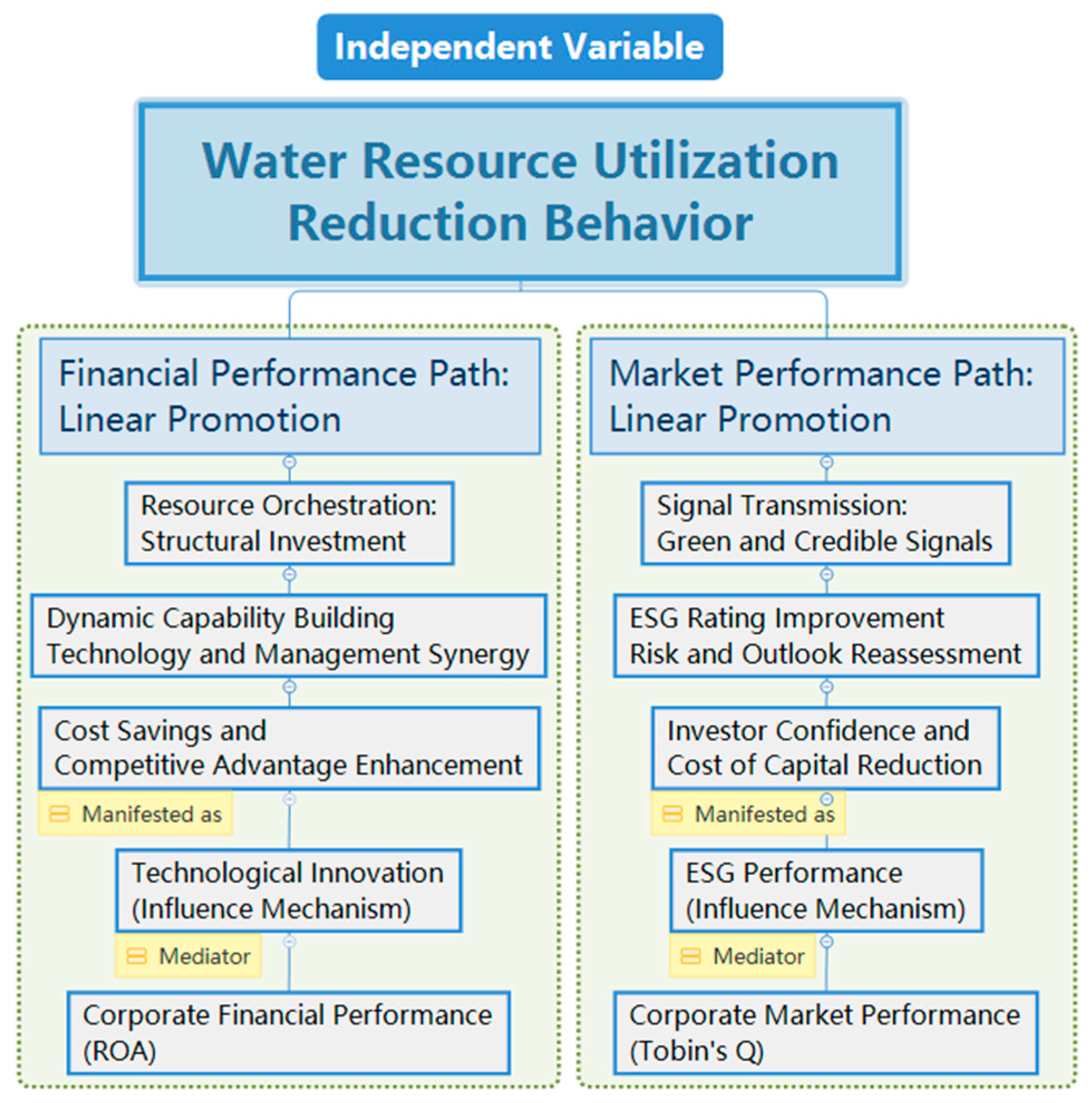
Based on the above theoretical analysis, the conceptual framework constructed in this paper is illustrated in the Figure 1. It clearly outlines the logical pathways through which water resource utilization reduction behavior affects corporate financial performance and market performance via the two mechanism paths of technological innovation and ESG premium.

4. Research Design

4.1. Variable Construction and Measurement

4.1.1. Dependent Variable: Corporate Value

The improvement of corporate value is the goal of firms’ production and operation activities. Existing literature mainly measures corporate value from two dimensions: market performance and financial performance. Market performance is usually measured by Tobin’s Q [34,35], while financial performance is often measured by return on equity (ROE) [36], return on assets (ROA) [37,38], and net interest margin (NIM) [39]. Among these, Tobin’s Q reflects the ratio of a company’s market value to its asset replacement cost, used to measure whether corporate value is overvalued or undervalued. Return on assets reflects the net profit generated per unit of assets of a company, which can better reflect the company’s asset utilization efficiency and profitability. Based on this, this study analyzes corporate value from two dimensions: market performance and financial performance, using Tobin’s Q to measure market performance and ROA to measure financial performance. The Tobin’s Q selected in this study consists of two parts: equity value and debt value. Equity value includes tradable market value and non-tradable market value, while debt value is measured by the book value of liabilities.

4.1.2. Independent Variable: Water Resource Use Intensity

Water resource utilization reduction behaviors refer to a series of policy actions implemented to reduce total water consumption and improve water use efficiency. To accurately measure firms’ reduction efforts, this study constructs the core independent variable, water resource use intensity. This study takes the ratio of the growth rate of a company’s water consumption to the growth rate of its operating income as an indicator to measure the dynamic process of a company’s reduction behavior. The calculated samples are divided into the following cases.
As shown in Table 2, in general, the smaller the value of water resource use intensity, the more significant the success of firms’ water resource utilization reduction. Specifically, when the operating income growth rate is less than zero, and the water consumption growth rate is greater than or equal to zero, although the water resource use intensity indicator is negative, the firms’ water resource utilization reduction behavior is not achieved.
To address the above issue, this study adopts the following methods for benchmark regression: First, set a dummy variable water resource utilization reduction (WS) and assign a value of one to samples where firms’ water resource utilization reduction behavior is achieved, and zero to those where it is not, to verify that water resource utilization reduction promotes corporate value improvement. Second, exclude samples that do not meet the expected scenario, i.e., samples where the operating income growth rate is less than or equal to 0, and the water consumption growth rate is more than zero, to analyze the impact of the intensity of reduction on corporate value.

4.1.3. Mediating Variables

To verify the two transmission mechanisms proposed in the theoretical part, we set the following mediating variables.
In terms of the technological innovation mechanism, we focus on the output and quality of firms’ innovation. Therefore, this paper refers to Cao and Zhang (2020) to construct an innovation quality index [40]. That is, taking the natural logarithm of the number of citations of the patents applied for by the firm plus one as the indicator of the firm’s innovation achievement transformation.
In terms of ESG performance, to test the signaling and ESG premium mechanism, this study uses the Huazheng ESG score as the mediating variable. Considering the time lag in information integration and market response of ESG ratings, in line with theoretical logic, lagged two-period data is used in the model. In addition, in order to better identify the environmental signals of firms, this paper simultaneously uses the lagged second-phase data of the environmental dimension scores in ESG as mediating variables for regression.

4.1.4. Instrumental Variable

To test the endogeneity between variables, this study uses the comprehensive groundwater production capacity of the city where the firm is located as an instrumental variable for GMM estimation. The comprehensive groundwater production capacity refers to the maximum stable water supply capacity that groundwater can provide during the urban planning period. This variable directly affects water resource availability, thereby influencing firms’ water use efficiency decisions. Moreover, it is usually determined by natural geographical and hydrogeological conditions, making it relatively exogenous and not easily directly affected by individual economic decisions.

4.1.5. Control Variables

To control the impact of other factors on corporate value, we introduce the following control variables: firm size, firm age, solvency, cash holdings, growth, fixed asset ratio, ownership concentration, and media attention. The definition of each variable is shown in Table 3.

4.2. Model Construction

4.2.1. Benchmark Regression Model

To test the impact of water resource utilization reduction on corporate value, this study first conducts a Hausman test on the samples. The p-values of the chi-square statistical significance for corporate financial performance and market performance are both 0.0000, which are significant at the 1% significance level. Based on the test results, this study selects the following fixed effects models to test the impact of water resource utilization reduction on corporate value [41,42]:
R O A i t   =   β 0 + β 1 × W S i t + β 2 ×   Controls i t +   μ i + δ t + ε i t
R O A i t = β 0 + β 1 × W U i t + β 2 × Controls i t + μ i + δ t + ε i t
T o b i n Q i t = β 0 + β 1 × W S i t + β 2 × Controls i t + μ i + δ t + ε i t
T o b i n Q i t = β 0 + β 1 × W U i t + β 2 × Controls i t + μ i + δ t + ε i t
Specifically, R O A i t represents the financial performance of firm i in year t, T o b i n Q i t represents the market performance of firm i in year t, W S i t represents the dummy variable of water resource utilization reduction of firm i in year t, and W U i t represents the change rate of water resource use intensity of firm i in year t. The larger the value, the weaker the firms’ water resource utilization reduction behavior.   Controls i t represents the set of control variables. μ i represents the firm fixed effect, δ t represents the year fixed effect, and ε i t represents other unobservable random disturbance terms.

4.2.2. Impact Mechanism Model

We adopt the stepwise test method supplemented by the Bootstrap method for verification, and refer to Baron and Kenny (1986); Yang et al. (2025) constructed the following mediation model to test H2 and H4 [43,44].
(1)
Technological Innovation Mechanism
This path aims to test how water-saving behavior ultimately affects financial performance through a dynamic innovation process. To address the valid concern that corporate technological innovation might act as a common confounding factor rather than a true mediator, this paper employs a dynamic mediation model. The critical design feature of this model is its temporal sequencing: the mediating variable (Inn) is placed after the core explanatory variable (WS) and before the ultimate outcome variable (ROA) in the time-series structure. This sequential ordering is intended to provide more robust, time-anchored evidence for the proposed causal chain of water-saving → innovation → financial performance. The following mediating effect model is constructed:
Inn it   =   β 0 + β 1 × W S i , t 1 + β 2 × C o n t r o l s i t +   μ i + δ t + ε i t  
R O A i t = β 0 + β 1 × Inn i , t 1 + β 2 × Controls i t + μ i + δ t + ε i t
Among them, Model (5) is used to test whether firms’ water resource utilization reduction behavior affects technological innovation, and Model (6) is used to test the impact of innovation on financial performance. W S i , t 1 represents the firm water resource reduction data lagging behind by one period. Inn it and Inn i , t 1 respectively represent the current and lagging technological innovation levels of the firm. The definitions of other variables are consistent with those in the above models and will not be repeated here.
(2)
ESG Performance Mechanism
This study uses the Huazheng ESG rating to measure firms’ ESG performance and uses the environmental dimension score to measure the green signals conveyed by firms. The following mediating effect model is constructed:
ESG it   =   β 0 + β 1 × W S i , t 2 + β 2 × C o n t r o l s i t +   μ i + δ t + ε i t  
T o b i n Q i t = β 0 + β 1 × ESG i , t 2 + β 2 × Controls i t + μ i + δ t + ε i t
Environment it =   β 0 + β 1 × W S i , t 2 + β 2 × C o n t r o l s i t + μ i + δ t + ε i t  
T o b i n Q i t = β 0 + β 1 × Environment i , t 2 + β 2 × Controls i t + μ i + δ t + ε i t
This path aims to test whether water-saving behavior improves market value by enhancing ESG ratings as a signal. Considering the time lag in signaling and rating updates,   ESG i , t 2 and Environment i , t 2 respectively represents the ESG score and the environmental dimension score of firm i in year t − 2, and W S i , t 2 represents the reduction in water resource utilization of firm i in year t − 2. The definitions of other variables are consistent with those in the above models.

4.3. Sample and Data Sources

Considering data availability, this study selects basic data of Chinese A-share listed companies from 2012 to 2023 as the sample. The required company data are obtained from the CSMAR and the RESSET Database; the required resource-related data are sourced from the National Bureau of Statistics Statistical Yearbook, China Urban Statistical Yearbook, Public Environmental Research Center, and listed companies’ annual reports; the required technological innovation data are from the China Research Data Service Platform (CNRDS). To maintain the validity and rationality of the sample data, this study screens the data as follows: (1) Exclude firms with serious missing data, such as those that do not disclose any water resource use information, making it impossible to judge whether they have implemented water resource utilization reduction behaviors. (2) Exclude all sample companies that were designated as ST or *ST during 2012–2023. (3) Exclude companies with abnormal data. After the above screening steps, this study finally obtained data from 1391 firms over 12 years, totaling 16,692 data observations. To reduce the impact of outliers on the empirical results, 1% extreme values at both ends of the variables are excluded.

5. Empirical Analysis

5.1. Descriptive Statistics

Descriptive statistical analysis is conducted on each variable, and the results are shown in Table 4.
According to the descriptive statistical results, the minimum water use intensity (WU) of listed companies in China is −6185.4120, the maximum is 1305.6980, and the standard deviation is 57.7093. This indicates that there are significant differences in water use intensity levels among listed companies in China, which may be related to factors such as regional policies, industry characteristics, and resource endowment. To mitigate the impact of extreme values on the stability of regression results, the samples were winsorized during the empirical testing process. The mean value of water resource utilization reduction is 0.5766, indicating that a majority of firms have implemented water resource utilization reduction behaviors. The characteristic values of other variables are shown in Table 4 and will not be repeated here.

5.2. Impact of Water Resource Utilization Reduction on Corporate Value: Benchmark Regression

To test whether water resource utilization reduction can affect firms’ financial and market performance, this study first sets a dummy variable for water resource utilization reduction, assigning a value of 1 to samples where water resource utilization reduction is achieved and 0 to those where it is not, and conducts benchmark regression. The regression results reported in Table 5 show that the regression coefficient of financial performance is 0.0145, and the regression coefficient of market performance is 0.0893, both significant at the 1% significance level. This indicates that water resource utilization reduction has a significant promoting effect on both firms’ financial and market performance.
Subsequently, this study excludes some samples that do not meet the expected scenario and conducts benchmark regression using unbalanced panel data. Table 6 reports the estimation results based on Models (2) and (4).
Column (1) represents the relationship between water resource utilization intensity and corporate financial performance. The regression results show that the regression coefficient of financial performance is −0.0005, which is significant at the 1% level. This indicates that the reduction in water resource utilization intensity brought about by water resource utilization reduction can significantly promote corporate financial performance. This finding is consistent with the expectations of the “Porter Hypothesis” and the resource-based view, that is, appropriate environmental regulation pressure can stimulate an innovation compensation effect, ultimately enhancing corporate competitiveness. Although the water resource utilization reduction behavior of firms may be accompanied by high initial investment, with the emergence of learning effects, the dynamic capabilities of firms begin to manifest. This capability is reflected in two aspects: first, direct operational cost savings, as the improvement in water resource utilization efficiency directly reduces water fees, sewage fees, and related tax expenditures, which is in line with the empirical conclusion that resource efficiency can enhance corporate profitability. Second, indirect management spillover effects, as the refined management of water resources often leads to the coordinated improvement of the utilization efficiency of all factors, such as energy and raw materials, enhancing the robustness and risk resistance of the entire production system. Therefore, when water-saving behavior is internalized as part of the core capabilities of a firm, its positive impact on financial performance can exceed short-term cost pressure, which empirically supports the theoretical proposition of incorporating environmental strategy into the framework of core competitive advantages of firms.
Column (2) represents the relationship between water resource utilization intensity and corporate market performance. The regression results show that the regression coefficient of market performance is −0.0037, which is significant at the 5% level. This indicates that the reduction in water resource utilization intensity brought about by water resource utilization reduction can also significantly promote corporate market performance. In essence, the capital market functions to price expected future cash flows. Therefore, firm valuation is fundamentally a reflection of investor expectations. In the current era led by the dual carbon goals and the prevalence of ESG investment concepts, the environmental performance of firms, especially their management capabilities of strategic scarce resources like water, has become a key dimension for investors to assess the long-term risks and growth potential of firms. The conclusion of this study deepens the application of signaling theory in this field. The water-saving behavior of firms conveys a strong compound signal to the capital market: first, it indicates that the firm has strategic foresight in conforming to the national green policy orientation and can effectively avoid policy risks in the future due to water resource constraints or environmental penalties; second, it demonstrates the firm’s outstanding internal management capabilities and technological innovation potential, as successful water conservation is often the result of systematic management and technological progress. Therefore, investors are willing to pay a premium for firms that can better navigate the future green economic wave, which directly echoes the extensive empirical research on the ability of ESG performance to reduce capital costs and enhance market valuation. At the same time, this profoundly indicates that in the new era of ecological civilization construction, the fulfillment of positive environmental responsibilities is no longer merely a cost center but can directly transform into a source of market confidence.

5.3. Mechanism Test: Unveiling the Black Box of Value Creation

The benchmark regression confirms the overall impact. Next, we delve into the underlying transmission mechanism to verify the theoretical framework.

5.3.1. Technological Innovation Mechanism: Dynamic Capability Building and Time Lag of Financial Effects

The test results in Table 7 reveal the core mediating role of technological innovation in the relationship between water resource utilization reduction and firms’ financial performance. Column (1) shows the relationship between one-period-lagged water use reduction behavior and corporate technological innovation. The regression coefficient for corporate water-saving performance is 0.0065, significant at the 10% level, indicating that water-saving behavior is typically accompanied by technological innovation. Column (2) presents the relationship between one-period-lagged corporate technological innovation and corporate financial performance. The regression coefficient between corporate innovation performance and financial performance is 0.0109, also significant at the 1% level. This suggests that technological innovation generates cost-saving and efficiency-enhancing benefits, thereby driving the improvement of corporate financial performance.

5.3.2. ESG Performance Mechanism: Bridge from Environmental Responsibility to Market Confidence

The test results in Table 8 strongly support the ESG signaling mechanism. Columns (1) and (3), respectively, present the relationships between corporate water resource utilization reduction behavior in the two lagging periods (L2.WS) and firms’ overall ESG performance and environmental dimension performance. The regression coefficients for corporate water-saving performance are 0.2371 and 0.0033, significant at the 1% and 5% levels. This indicates that substantive water-saving actions by firms can effectively enhance their ESG ratings and environmental dimension ratings. Against the backdrop of increasingly stringent information disclosure requirements, firms’ water-saving achievements are captured and assessed by professional rating agencies through channels such as ESG reports and social responsibility reports, being translated into quantifiable, comparable ESG scores. This process effectively translates internal environmental management efforts into the green language commonly understood by capital markets.
Columns (2) and (4), respectively, show the impact of the ESG performance (L2.ESG) and environmental performance (L2.E) of the two lagging periods on the market performance of the firm. The regression coefficient for corporate ESG performance is 0.0031, significant at the 10% level; the coefficient for environmental performance is 0.3506, significant at the 1% level. This suggests that higher ESG ratings, particularly higher environmental ratings, directly lead to an increase in firm market valuation, which aligns with findings in existing research. Underlying this is a profound shift in investment logic. A growing number of institutional investors now regard ESG risk as a core systemic risk and use ESG performance as a key criterion for asset allocation. A superior ESG rating signifies that a firm is perceived as an investment target with lower risk, better governance, and greater potential for long-term sustainable development. Therefore, by elevating the ESG rating, water resource utilization reduction successfully attracts the attention of long-term value investors, optimizes the investor structure, ultimately lowers the firm’s cost of capital, and drives up its stock price. This mechanism pathway clearly indicates that, for listed companies, translating environmental management practices such as water conservation into high-quality ESG information disclosure is a crucial step in converting environmental performance into financial value.

5.4. Robustness Test and Endogeneity Treatment

To ensure the reliability of the benchmark regression results, a series of robustness tests and endogeneity treatments are conducted. First, robustness tests are performed by replacing the measurement methods of the dependent variables: (1) Using return on equity (ROE) as an alternative measure of firms’ financial performance; (2) Using the ratio of earnings before interest and taxes (EBIT) to operating income as an alternative measure of firms’ financial performance; (3) Excluding intangible asset net amount and goodwill net amount from total assets to calculate firms’ Tobin’s Q value; (4) Using the difference between the total share capital and the share capital of foreign-invested B shares listed domestically as A-share capital to calculate the ratio of current market value to total assets as firms’ Tobin’s Q value. The regression results are shown in Table 9. Second, this paper uses the water use efficiency (WUE) of firms as the explanatory variable for regression; that is, the ratio of the logarithmically processed water consumption of firms to the logarithmically processed operating income of firms is used as the substitute variable. The larger the value of this variable, the weaker the degree of water resource utilization reduction of the firm. The regression results are shown in Table 10. Finally, industry control variables are added to Models (2) and (4) for regression again, and the results are shown in Table 11. The robustness regression results show that the signs and significance of the core variables have not changed.
To mitigate potential endogeneity issues, such as reverse causality where firms with better performance may have more resources to invest in water-saving initiatives, this study selects the comprehensive groundwater production capacity indicator as an instrumental variable and employs the GMM estimation for endogeneity testing. In selecting the instrumental variable, this paper considers both relevance and exogeneity. In terms of relevance, the comprehensive groundwater production capacity directly influences the availability and cost of water resources in the location of a firm, thereby significantly affecting its water usage decisions and efficiency. From the perspective of exogeneity, the groundwater production capacity of a city is primarily determined by natural geographical and hydrogeological conditions, making it relatively independent of the microeconomic behavior of individual firms. Additionally, to address systematic biases arising from industrial agglomeration, industry variables were controlled for in the regressions. The test results are presented in Table 12. The findings indicate that, after controlling for potential endogeneity, the promoting effect of water resource utilization reduction on both corporate financial performance and market performance remains statistically significant. This substantially strengthens the causal inference and robustness of our research conclusions.
It is important to note that the effective estimation samples differ between the two model specifications. This discrepancy arises because the system GMM estimator requires continuous and balanced panel data to construct its internal instrument matrix from lagged variables. As a result, even when estimated on the same initial dataset, the sequencing integrity and lag depth requirements for constructing instruments are evaluated model-by-model, leading to slight variations in the final usable sample for ROA and Tobin’s Q regressions.

5.5. Heterogeneity Analysis: Theoretical Basis for Targeted Policies

5.5.1. Policy Stage Heterogeneity: Evolution from Mandatory Compliance to Endogenous Drive

Due to the varying stringency of water resource policies in different development stages, this study divides the research samples into the strengthening stage (2012–2015) and the deepening stage (2016–2023) by sorting out the development context of China’s water resource utilization reduction policies and referring to plans and management regulations issued by the State Council, the Ministry of Water Resources, and other relevant departments. This is to study the heterogeneous impact of water resource utilization reduction policies on corporate value in different stages. The empirical results are shown in Table 13.
Columns (1) and (3) of Table 13, respectively, show the impact of firms’ implementation of water resource utilization reduction on their financial and market performance during the policy strengthening stage. Columns (2) and (4), respectively, show the impact of firms’ water-saving behavior on their financial and market performance during the policy deepening stage. The stage-specific test results show that during the deepening stage of policies, the positive impact of water resource utilization reduction on firms’ financial and market performance is enhanced. This reflects the successful evolution of China’s water resource policies. Early policies were more rigid constraints, and firms’ behaviors were mostly passive compliance with prominent cost attributes. With Water Conservation First becoming a national strategy and the improvement of market-oriented tools such as the water resource tax, the policy environment has provided firms with clearer expectations and more flexible incentives. Firms have begun to examine water saving from a strategic perspective, regarding it as an endogenous development demand. Investment decisions have become more rational, and technological path choices have been optimized, thereby shortening the cycle of financial returns. At the same time, the capital market’s understanding of ESG has deepened during this period, and the pricing efficiency of green signals has been higher.

5.5.2. Industry Heterogeneity: Dual Growth Opportunities for Non-Water-Intensive Industries

According to the Guidelines for the Classification of Listed Companies (revised in 2012) and the classification standards of the National Bureau of Statistics, the research samples are divided into high-water-consuming industries and non-water-consuming industries based on water use intensity and industry attributes (The specific classification is shown in Appendix A), to study the heterogeneous impact of water resource utilization reduction on corporate value among firms in different industries. The empirical results are shown in Table 14.
Columns (1) and (3) of Table 14, respectively, show the impact of water resource utilization reduction on the financial and market performance of firms in non-water-intensive industries. Columns (2) and (4), respectively, show the impact of water resource utilization reduction on the financial and market performance of firms in high-water-consuming industries. The industry-specific heterogeneity test results show that compared with high-water-consuming industries, firms’ water resource utilization reduction has a more significant promoting effect on the financial and market performance of firms in non-water-intensive industries, highlighting the industry symmetry of water resource risks and opportunities.
This study believes that the possible reasons are: for high-water-consuming industries, due to the high policy risks and supply chain risks they face, they have invested heavily in water-saving technologies in their production processes. Further reduction often requires substantial capital investment, thereby inhibiting the improvement of their financial performance. Moreover, the water resource utilization reduction behavior of firms in high-water-consuming industries is often regarded as a compliance requirement, leading to limited investor perception of their brand premium and thus a relatively weak role in driving market valuation.

5.5.3. Regional Heterogeneity: Differences in Performance Improvement Driven by Resource Endowments

There are significant differences in water resource endowments among various regions in China [45], and the uneven distribution of water resources will exacerbate economic and environmental balance issues among different regions [46]. Therefore, this study tests the heterogeneous impact of water resource utilization reduction on corporate value in different regions. Based on the 400 mm isoprecipitation line, the samples are divided into firms in arid/semi-arid regions and humid/sub-humid regions according to the location of the firms. The empirical results are shown in Table 15.
Table 15, column (1) and column (3), respectively, represent the impact of water resource utilization reduction behaviors of firms in humid and semi-humid regions on their financial performance and market performance; column (2) and column (4), respectively, represent the impact of water resource utilization reduction behaviors of firms in arid and semi-arid regions on their financial performance and market performance. The results of the regional heterogeneity test show that compared with arid and semi-arid regions, the water resource utilization reduction behaviors of firms in humid and semi-humid regions have a more significant promoting effect on their financial performance and market performance.
This paper believes that the reason for the regional heterogeneity difference lies in the fact that, from the economic logic of resource benchmark differences, local firms in humid and semi-humid regions have a higher benchmark level in water resource usage. Therefore, the cost savings and profit increases brought by their water-saving behaviors are significantly greater than those of firms in arid and semi-arid regions. Moreover, in regions where water resources are relatively abundant, investors have a lower risk pricing for water resources of firms in humid regions. The water-saving behaviors of these firms are regarded as proactive sustainable development measures, which can further reduce potential regulatory or reputation costs in the future, thereby improving the ESG scores of firms, attracting institutional investors, and further boosting the market performance of firms. However, in arid and semi-arid regions, water risks have already been digested by the market, and the additional signal value of water-saving is relatively limited, thereby restricting the promoting effect of water-saving behaviors on the market value of firms.

6. Research Conclusions and Policy Implications

6.1. Research Conclusions

Based on the data of Chinese A-share listed companies from 2012 to 2023, this paper integrates the dynamic capability theory and the signaling theory into a unified analytical framework to deeply examine the impact of firms’ water resource utilization reduction behaviors on their value and the underlying mechanisms. The main conclusions are as follows.
First, the impact of water resource utilization reduction on corporate value exhibits a significant dual-path mechanism. On one hand, it significantly promotes financial performance (ROA), corroborating the theories of resource orchestration and dynamic capability building. Specifically, a firm’s water-saving capabilities can foster dynamic water conservation capacities, thereby achieving financial returns through cost savings and efficiency gains. Against the macro backdrop of deepening supply-side structural reforms and tightening resource and environmental constraints, firms can effectively build green dynamic capabilities through proactive water-saving management and technological innovation, leading to cost reduction, efficiency improvement, and operational optimization. This essentially represents a concrete manifestation of how micro-level firms respond to the national call for efficiency transformation and implement the conservation-first principle, transforming resource pressures into tangible competitiveness. On the other hand, it directly enhances market performance (Tobin’s Q), indicating that in the new capital market ecosystem of China, characterized by the rapid rise in ESG investment concepts and the accelerated development of a green financial system, a firm’s environmental performance has become a key signal influencing valuation. Substantive water-saving actions by firms are more readily identified and rewarded with a premium by the capital market, forming a distinctive Chinese green signal-capital allocation linkage mechanism.
Second, the finding that technological innovation and ESG performance serve as core mechanisms of influence precisely aligns with China’s two major policy thrusts of innovation-driven development and building a robust ESG system. Technological innovation acts as the core mediator driving the enhancement of financial value. Firms gradually transform water conservation pressures into genuine dynamic capabilities through an innovation process ranging from exploratory to exploitative. This not only responds to the national advocacy for technological innovation to lead industrial upgrading but also leverages China’s accumulated engineering dividend and industrial digitalization foundation in areas like next-generation information technology and smart manufacturing. This makes the research, development, and application of water-saving technologies more feasible and economical. The mediating role of ESG performance highlights that within the ongoing construction of an ESG discourse system with Chinese characteristics, the fulfillment of corporate environmental responsibilities is increasingly intertwined with regulatory evaluations, financing costs, and market reputation. As a quantifiable and verifiable environmental performance indicator, water conservation helps firms improve their ESG ratings. This enables them to better align with policy requirements, secure lower-cost financing, and gain favor from a growing pool of responsible investors, thereby bridging the critical pathway from environmental practice to market value.
Third, the conclusions from the heterogeneity analysis provide empirical evidence for implementing differentiated water resource management policies and industrial green transformation strategies in China. The value effect of water resource utilization reduction is not one-size-fits-all; its intensity is moderated by a triple interplay of policy stage, industry attributes, and regional endowment. The enhancing effect of water-saving behavior on corporate value is more pronounced during mature policy stages, in non-high-water-consumption industries, and in humid and semi-humid regions. This profoundly validates that the increasing maturity and depth of China’s water governance system, the differences in industry resource sensitivity and transformation foundations, and the imbalance between China’s water resource endowment and regional economic development levels jointly constitute the decisive factors influencing the return on investment for corporate green transition.

6.2. Policy Implications

Based on the above conclusions, to better guide firms to achieve value enhancement through sustainable water resource management and promote the coordination of high-quality economic development and ecological civilization construction, this paper proposes the following policy implications.
At the firm management practice level, first, firms should reshape their strategic cognition. Firm managers should reposition water resource management from a passive compliance cost to a strategic investment for building a green competitive advantage. They need to face the financial pressure in the initial stage of transformation, formulate scientific long-term plans, and patiently cultivate dynamic capabilities related to water conservation. Second, firms should strengthen innovation management and accelerate innovation transformation. Specifically, firms should focus on improving the efficiency of water-saving R&D expenditures, establish a fast channel from technological exploration to technology transfer, and shorten the cycle of dynamic capability construction. Finally, firms should make good use of ESG communication to convey green signals to the capital market. For example, listed companies should proactively and standardly disclose water consumption per unit of output, the utilization rate of reclaimed water, and other water resource management performance, and clearly convey their efforts and achievements in sustainable development to the capital market through high-quality ESG reports, in order to obtain a fairer market valuation.
In terms of government policy formulation, first, differentiated and precise industrial water policies should be implemented. Specifically, for high-water-consuming industries, a combination policy of rigid constraints and flexible incentives should be adopted. While strictly implementing the dual control of total water use and intensity, a special support fund for water-saving technology transformation should be established, and firms adopting international advanced water-saving technologies should be given a larger tax credit to alleviate their initial financial pressure in transformation. For arid and semi-arid regions, it is suggested that the central government establish a water resource resilience special fund in the transfer payment, focusing on supporting the water recycling facilities and unconventional water source utilization projects of firms in these regions, and transforming the local water resource disadvantages into advantages of green technology innovation.
Secondly, it is necessary to deepen the market-oriented mechanism and innovate policy tools. On the one hand, local governments should comprehensively deepen the water resource tax reform, implement more differentiated tax rates based on the sensitivity of different industries and regions, and explore the use of water-saving benefits as the basis for tax reduction and exemption, forming a strong economic driving force. On the other hand, relevant government departments should actively explore the connection mechanism between water rights trading and green finance, encourage financial institutions to develop financial products such as water-saving loans and green bonds linked to water-saving performance, and allow firms to use the saved water rights or future water-saving benefits as credit enhancement measures for financing.
Thirdly, it is necessary to build an enabling service system and optimize the implementation environment. For example, led by the departments of industry and information technology and water resources, and in collaboration with research institutions, a dynamic database and best practice case library of water-saving benefits should be constructed based on industry–technology–region, providing public goods support for firms in terms of technology path selection and investment return prediction. Moreover, it is necessary to strengthen the regulation and guidance of ESG information disclosure by firms, especially by including key performance indicators related to water resources in the disclosure guidelines, enhancing the comparability and credibility of information, and laying a solid foundation for the effective transmission of market signals.

7. Research Limitations and Future Prospects

This paper systematically examines the dual impact paths and underlying mechanisms of water resource utilization reduction on firm value by integrating the dynamic capability perspective and signaling theory. However, there are still some limitations.
Firstly, at the measurement level, although this paper strives for rigor in the measurement of core variables, the data on firm water consumption relies on their voluntary disclosure. Different companies may have different statistical standards and levels of detail in their disclosures, which may affect the measurement accuracy of the core explanatory variables to some extent. Meanwhile, as a key mediating variable, the ESG rating, which is generated by third-party institutions based on multi-dimensional information, although authoritative, has different methodological approaches and focuses on different rating systems, inevitably carrying a certain degree of subjectivity and heterogeneity in its evaluation results. Secondly, there are endogeneity challenges in mechanism identification. Although this study introduces instrumental variables to alleviate the endogeneity problem and attempts to distinguish between water resource management signals and general quality signals by introducing the ESG rating as a comprehensive signal, it is still difficult to completely isolate the independent effect of water-saving behavior itself. Additionally, there may be a complex two-way causal relationship between technological innovation and water-saving behavior in theory. Although this paper emphasizes the unidirectional path driven by water-saving investment in theoretical analysis and empirical design and attempts to identify it using instrumental variable methods, completely solving the endogeneity problem in causal inference remains an eternal challenge. Finally, limitations also exist concerning the research context and external validity. This study primarily focuses on the general reaction of the capital market to water-saving signals but does not delve into the differences in signaling effects across firms with different customer market types. Theoretically, firms facing end consumers may be more sensitive to reputational signals. However, due to the generally complex customer structures of listed companies, conducting clear classification faces practical difficulties such as data unavailability, subjective standards, and reduced sample size, which limit the examination of this potentially important moderating effect.
To address the above limitations, future research can be deepened and expanded in the following aspects: Firstly, future studies can evaluate firm water usage information based on the life cycle or utilize real-time water usage data monitored by Internet of Things sensors, thereby more accurately quantifying the water-saving behaviors and environmental performance of firms and fundamentally improving the measurement quality of core variables. At the same time, to more cleanly identify the net effect of water resource utilization reduction, subsequent research can actively seek and utilize opportunities for quasi-natural experiments, such as focusing on the sudden implementation of exogenous strict water consumption quota policies in a certain region, or using regression discontinuity design and other methods, thereby more effectively stripping the influence of other confounding factors and strengthening the reliability of causal inference. Additionally, future research can attempt to more precisely identify the customer market types of firms through in-depth case studies, questionnaires, or obtaining business data, and then compare and analyze the transmission efficiency and market response differences in water resource signals in B2B and B2C firms, deepening the understanding of the boundary conditions of signal theory.

Author Contributions

Conceptualization, H.L.; Data curation, S.W.; Formal analysis, S.W.; Funding acquisition, H.L. and K.W.; Methodology, H.L. and S.W.; Project administration, H.L.; Resources, K.W.; Supervision, H.L.; Visualization, S.W.; Writing—original draft, S.W. and H.L.; Writing—review and editing, H.L. All authors have read and agreed to the published version of the manuscript.

Funding

This research was funded by the Key Project of the National Social Science Foundation of China: “Theoretical and Empirical Research on Measurement, Influencing Factors, and Performance of Comprehensive Reduced Utilization of Natural Resources (CRUNR)”, grant number 22AGL027; Shanghai Social Science Planning Project: “Theoretical, Measurement, and Impact Mechanisms and Policy Research on Multi Low Efficiency Land Use Reduction (MLELR)”, grant number 2023ZGL003.

Institutional Review Board Statement

Not applicable.

Informed Consent Statement

Not applicable.

Data Availability Statement

The datasets presented in this article are not readily available because the data are part of an ongoing study. Requests to access the datasets should be directed to the corresponding author. This research was supported by a key project funded by the National Social Science Fund of China. The findings presented in this paper form part of the outcomes of that project. However, as the project has not yet been concluded, the underlying raw data related to the empirical section of this study cannot be made available to the journal at this time.

Conflicts of Interest

The authors declare no conflicts of interest.

Appendix A

According to the Guidelines for Industry Classification of Listed Companies (revised in 2012), high water-consuming industries include: coal mining and washing, petroleum and natural gas extraction, black metal mining and selection, non-ferrous metal mining and selection, auxiliary activities for mining, processing of agricultural and sideline products, food manufacturing, manufacturing of wine, beverages and refined tea, tobacco product manufacturing, textile industry, textile and apparel manufacturing, leather, fur, feather and their products and footwear manufacturing, paper and paper products manufacturing, printing and reproduction of recorded media, manufacturing of cultural, sports and entertainment goods, petroleum processing, coking and nuclear fuel processing, chemical raw materials and chemical products manufacturing, black metal smelting and rolling processing, non-ferrous metal smelting and rolling processing, metal products manufacturing, power and heat production and supply, and gas production and supply.

References

  1. Rogers, P.; Silva, D.R.; Bhatia, R. Water Is an Economic Good: How to Use Prices to Promote Equity, Efficiency, and Sustainability. Water Policy 2002, 4, 1–17. [Google Scholar] [CrossRef]
  2. Sabine, O.; Kakovitch, T.S. Water as Driver of Economic Capacity: Introducing a Physical Economic Model. Ecol. Econ. 2023, 208, 107811. [Google Scholar] [CrossRef]
  3. Sun, C.; Liu, W.; Zou, W. Water Poverty in Urban and Rural China Considered Through the Harmonious and Developmental Ability Model. Water Resour. Manag. 2016, 30, 2547–2567. [Google Scholar] [CrossRef]
  4. Zuo, Q.; Guo, J.; Ma, J.; Cui, G.; Yang, R.; Yu, L. Assessment of Regional-Scale Water Resources Carrying Capacity Based on Fuzzy Multiple Attribute Decision-Making and Scenario Simulation. Ecol. Indic. 2021, 126, 107634. [Google Scholar] [CrossRef]
  5. Song, M.; Tao, W.; Shang, Y.; Zhao, X. Spatiotemporal Characteristics and Influencing Factors of China’s Urban Water Resource Utilization Efficiency from the Perspective of Sustainable Development. J. Clean. Prod. 2022, 338, 130649. [Google Scholar] [CrossRef]
  6. Agana, A.B.; Reeve, D.; Orbell, D.J. An Approach to Industrial Water Conservation—A Case Study Involving Two Large Manufacturing Companies Based in Australia. J. Environ. Manag. 2013, 114, 445–460. [Google Scholar] [CrossRef]
  7. Jatmiko, W.; Smaoui, H.; Hendranastiti, N.D. Competing Institutional Logics in Corporate ESG: Evidence from Developing Countries. Bus. Strateg. Environ. 2025, 34, 6184–6209. [Google Scholar] [CrossRef]
  8. Deng, M.; Gong, X.; Luo, W. Research on Corporate Water Risk Management from the Perspective of Value Creation. China Environ. Manag. 2022, 14, 93–100. [Google Scholar] [CrossRef]
  9. Koh, L.S.; Saad, S.; Arunachalam, S. Competing in the 21st Century Supply Chain Through Supply Chain Management and Enterprise Resource Planning Integration. Int. J. Phys. Distrib. Logist. Manag. 2006, 36, 455–465. [Google Scholar] [CrossRef]
  10. Huang, S.; Lin, H.; Zhou, Y.; Ji, H.; Zhu, N. The Influence of the Policy of Replacing Environmental Protection Fees with Taxes on Enterprise Green Innovation—Evidence from China’s Heavily Polluting Industries. Sustainability 2022, 14, 6850. [Google Scholar] [CrossRef]
  11. Xu, L.; Li, Z.; Fang, J.; He, Z.; Zhang, X. Can the Water Resources Tax Promote the Water-Saving Innovation Performance of High Water Consumption Companies?—Empirical Analysis from the Pilot Provinces in China. J. Clean. Prod. 2024, 451, 141888. [Google Scholar] [CrossRef]
  12. Mu, L.; Liu, Y.; Chen, S. Alleviating water scarcity and poverty through water rights trading pilot policy: A quasi-natural experiment based approach. Sci. Total Environ. 2022, 823, 153318. [Google Scholar] [CrossRef]
  13. Du, M.; Huang, C.; Chen, Z. Evaluating the water-saving and wastewater-reducing effects of water rights trading pilots: Evidence from a quasi-natural experiment. J. Environ. Manag. 2022, 319, 115706. [Google Scholar] [CrossRef]
  14. Porter, M.E.; van der Linde, C. Toward a new conception of the environment-competitiveness relationship. J. Econ. Perspect. 1995, 9, 97–118. [Google Scholar] [CrossRef]
  15. Ho, P.L.K.; Nguyen, C.N.; Adhikari, R.; Miles, P.M.; Bonney, L. Exploring market orientation, innovation, and financial performance in agricultural value chains in emerging economies. J. Innov. Knowl. 2017, 3, 154–163. [Google Scholar] [CrossRef]
  16. Sullivan, J.; Nonaka, I. The Application of Organizational Learning Theory to Japanese and American Management. J. Int. Bus. Stud. 1986, 17, 127–147. [Google Scholar] [CrossRef]
  17. Li, L.; Hou, Y.; Chen, L.; Liu, Y.; Trindade, M.A.M. Unlocking sustainable performance with blockchain technology: Insights from organizational learning theory. Int. J. Prod. Econ. 2025, 283, 109555. [Google Scholar] [CrossRef]
  18. Spence, M. Job market signaling. Q. J. Econ. 1973, 87, 355–374. [Google Scholar] [CrossRef]
  19. Guo, Y.; Chen, C.; Luo, X.; Martek, I. Critical drivers and barriers of digital twin adoption in water infrastructure: An environmental, social, governance, and financial perspective. Sustain. Dev. 2025, 33, 1623–1648. [Google Scholar] [CrossRef]
  20. Leggerini, C.; Percuoco, M.; Ricciardi, I.; Prisco, A. Circular Economy Disclosure and ESG Performance: Signal, Substance, or Symbol? Bus. Strateg. Environ. 2025, 1–19. [Google Scholar] [CrossRef]
  21. Tarnaud, C.A.; Zakriya, M. CSR Performance and Firm Value: Disentangling the Role of ESG Rating Providers. Br. J. Manag. 2025, 36, 1553–1577. [Google Scholar] [CrossRef]
  22. Xu, X.; Lv, Z.; Song, Y.; Bin, L. Water System Integration and Optimization in a Yeast Enterprise. Resour. Conserv. Recycl. 2015, 101, 96–104. [Google Scholar] [CrossRef]
  23. Sirmon, D.G.; Hitt, M.A.; Ireland, R.D.; Gilbert, B.A. Resource Orchestration to Create Competitive Advantage: Breadth, Depth, and Life Cycle Effects. J. Manag. 2011, 37, 1399–1412. [Google Scholar] [CrossRef]
  24. Teece, D.J.; Pisano, G.; Shuen, A. Dynamic Capabilities and Strategic Management. Strateg. Manag. J. 1997, 18, 509–533. [Google Scholar] [CrossRef]
  25. Hart, S.L.; Dowell, G. A Natural-Resource-Based View of the Firm: Fifteen Years After. J. Manag. 2011, 37, 1464–1479. [Google Scholar] [CrossRef]
  26. Alkaraan, F.; Elmarzouky, M.; Hussainey, K.; Vankatesh, G.V.; Shi, Y.; Gulko, N. Reinforcing green business strategies with Industry 4.0 and governance towards sustainability: Natural-Resource-Based view and dynamic capability. Bus. Strateg. Environ. 2024, 33, 3588–3606. [Google Scholar] [CrossRef]
  27. Lyu, Y.; Liu, Y.; Guo, Y.; Tian, J.; Chen, L. Managing water sustainability in textile industry through adaptive multiple stakeholder collaboration. Water Res. 2021, 205, 117655. [Google Scholar] [CrossRef]
  28. Bansal, P.; Roth, K. Why Companies Go Green: A Model of Ecological Responsiveness. Account. Rev. 2000, 43, 717–736. [Google Scholar] [CrossRef]
  29. Czerny, A.; Letmathe, P. The productivity paradox in carbon-intensive companies: How eco-innovation affects corporate environmental and financial performance. Bus. Strateg. Environ. 2024, 33, 5900–5919. [Google Scholar] [CrossRef]
  30. Connelly, B.L.; Certo, S.T.; Reutzel, C.R.; DesJardinem, M.R.; Zhou, Y. Signaling Theory: State of the Theory and Its Future. J. Manag. 2025, 51, 24–61. [Google Scholar] [CrossRef]
  31. Dhaliwal, D.S.; Li, O.Z.; Tsang, A.; Yang, Y.G. Voluntary nonfinancial disclosure and the cost of equity capital: The initiation of corporate social responsibility reporting. Account. Rev. 2011, 86, 59–100. [Google Scholar] [CrossRef]
  32. Eccles, R.G.; Ioannou, I.; Serafeim, G. The impact of corporate sustainability on organizational processes and performance. Manag. Sci. 2014, 60, 2835–2857. [Google Scholar] [CrossRef]
  33. Gillan, S.L.; Koch, A.; Starks, L.T. Firms and social responsibility: A review of ESG and CSR research in corporate finance. J. Corp. Financ. 2021, 66, 101889. [Google Scholar] [CrossRef]
  34. Islam, T.; Arunachalum, M.; Wellalage, N.; Benjamin, S. Corporate Environmental Performance Leading Financial Performance: Impacts of Social Media Sentiment and Corporate Reputation. Bus. Strateg. Environ. 2025, 34, 4274–4290. [Google Scholar] [CrossRef]
  35. Yadav, A.; Asongu, S. The Role of ESG Performance in Moderating the Impact of Financial Distress on Company Value: Evidence of Wavelet-Enhanced Quantile Regression with Indian Companies. Bus. Strateg. Environ. 2025, 34, 2782–2798. [Google Scholar] [CrossRef]
  36. Woon, L.L.; Chong, C.S.; Wong, S.K.K. Sustainable Development Goals and Corporate Financial Performance: Examining the Influence of Stakeholder Engagement. Sustain. Dev. 2024, 33, 2714–2739. [Google Scholar] [CrossRef]
  37. Cornett, M.; Marcus, A.; Tehranian, H. Corporate Governance and Pay for Performance: The Impact of Earnings Management. J. Financ. Econ. 2008, 87, 357–373. [Google Scholar] [CrossRef]
  38. Ma, Z.; Zhang, S.; Li, X.; Guo, J.; Yang, L.; Cao, S. Can the New Model of Shared Property Rights Promote Better Corporate Financial Performance in China? Financ. Innov. 2025, 11, 75. [Google Scholar] [CrossRef]
  39. Adu, A.D.; Abedin, Z.M.; Saa, Y.V.; Boatong, F. Bank Sustainability, Climate Change Initiatives and Financial Performance: The Role of Corporate Governance. Int. Rev. Financ. Anal. 2024, 95, 103438. [Google Scholar] [CrossRef]
  40. Cao, C.; Zhang, C. The Division of Property Rights Bundles and Innovation in State-owned Enterprises: Evidence Based on the Incentive Reform of Dividend Rights in Central Enterprises. Manag. World 2020, 36, 155–168. [Google Scholar] [CrossRef]
  41. Mundlak, Y. On the Pooling of Cross Section and Time Series Data. Econometrica 1978, 46, 69–85. [Google Scholar] [CrossRef]
  42. Wei, J.; Sun, J.; Li, Y.; Du, Y. Does Greater Knowledge Complexity Promote Structural Upgrading? Evidence From Chinese Cities. J. Reg. Sci. 2025, 65, 1058–1076. [Google Scholar] [CrossRef]
  43. Baron, R.M.; Kenny, D.A. The Moderator-Mediator Variable Distinction in Social Psychological Research: Conceptual, Strategic, and Statistical Considerations. J. Pers. Soc. Psychol. 1986, 51, 1173–1182. [Google Scholar] [CrossRef] [PubMed]
  44. Yang, F.; Dang, Y.; Chen, L. How does neighbourhood satisfaction impact relocation intentions? The mediating effects of housing costs and socioeconomic status. Urban Stud. 2025, 62, 2473–2490. [Google Scholar] [CrossRef]
  45. Zhao, K.; Wu, C.; Liu, J.; Liu, Y. Green Finance, Green Technology Innovation and the Upgrading of China’s Industrial Structure: A Study from the Perspective of Heterogeneous Environmental Regulation. Sustainability 2024, 16, 4330. [Google Scholar] [CrossRef]
  46. Wei, Z.; Huang, K.; Chen, Y.; Wang, D.; Yu, Y.; Xu, M.; Kapelan, Z. Unveiling the Inequalities in Virtual Water Transfer in China: The Environmental and Economic Perspectives. Sustain. Prod. Consum. 2023, 42, 63–73. [Google Scholar] [CrossRef]
Figure 1. Theoretical Framework.
Sustainability 18 00938 g001
Table 1. Evolutionary Context of Core Literature and Contributions of This Study.
Research StageCore PerspectiveRepresentative Literature and FindingsProgress and Innovations of This Study
Risk PerspectiveTreating water as an exogenous riskIdentifying three types of water risks (physical, regulatory, and reputational) and establishing a risk assessment framework.Shifting the focus from risk avoidance to value creation by exploring how risk response can be transformed into a corporate advantage.
Regulatory PerspectiveFocusing on the driving role of government policiesFinding that the water resource “fee-to-tax” reform improves ESG through innovation and investment effects.Going beyond validating policy effectiveness to investigate the underlying firm-level behavior and its dual-pathway mechanism driven by policy.
Value Co-Creation PerspectiveRegarding water management as a strategic issue linked to market valueProposing that water’s value is embedded in intangible assets such as business continuity and reputation.Proposing and empirically testing two specific value creation paths—dynamic capabilities and signaling—and concretizing abstract value.
Table 2. The situation of Water Resource Use Intensity (WU).
Operating Income Growth Rate
&
Water Consumption Growth Rate
Relative RelationshipWUIs Water Reduction Achieved?Sample Size
Operating income growth rate > 0, water consumption growth rate ≥ 0Operating income growth rate < water consumption growth rateWU > 1No2778
Operating income growth rate > water consumption growth rate0 < WU < 1Yes6121
Operating income growth rate > 0, water consumption growth rate < 0/WU < 0Yes2572
Operating income growth rate ≤ 0, water consumption growth rate ≥ 0/WU < 0No4063
Operating income growth rate ≤ 0, water consumption growth rate < 0Operating income growth rate < water consumption growth rate0 < WU < 1Yes227
Operating income growth rate > water consumption growth rateWU > 1No931
Table 3. Definition and Explanation of Variables.
Variable TypeVariable SymbolVariable NameUnitTheoretical Corresponding and Calculation Explanation
Dependent VariableTobin’s QMarket PerformanceCNY/CNYOutcome of signaling and market valuation. (Market value + Liabilities)/Total assets
ROAFinancial PerformanceCNY/CNYOutcome of resource orchestration and dynamic capabilities. Net profit/Average total assets
Independent VariableWUWater Resource Use Intensity Change Rate%Quantifies firms’ water resource utilization reduction behavior. Firm water consumption change rate/Operating income change rate; the larger the value, the weaker the firm’s water resource utilization reduction behavior
WSWater Resource Utilization Reduction/Assign 1 to samples where firms’ water resource utilization reduction behavior is achieved, and 0 to those where it is not
Mediating VariableInnTechnological Innovation%Comprehensive indicator of technological innovation: Ln (The average number of citations by others for a company’s patent applications + 1)
ESGESG Performance/Carrier of signaling. Use the lagged two-period Huazheng ESG score
EnvironmentThe environmental dimension in ESG performance/The carrier for green signal transmission. Use the environmental dimension score in the lag Phase II Huazheng ESG score after logarithmic processing
Control VariableSizeFirm SizeCNY 100 millionLn (Total assets)
AgeFirm AgeYearLn (Observation year − Establishment year + 1)
LevSolvencyCNY/CNYTotal liabilities/Total assets
CashCash HoldingsCNY/CNYMonetary funds/Total assets
FIXEDFixed Asset RatioCNY/CNYFixed assets/Total assets
Top1Ownership Concentration%Shareholding ratio of the largest shareholder
MediaMedia Attention/Ln (1 + Total number of annual news articles)
Instrumental VariableGCPCComprehensive Groundwater Production Capacity/Data disclosed in the Urban Statistical Yearbook; missing values are supplemented using linear interpolation
Table 4. Descriptive Statistics Results.
Variable SymbolSample SizeMeanStd.DevMinMax
WU16,692−0.302457.7093−6185.41201305.6980
WS16,6920.57660.494101
ROA16,6920.03590.0624−1.08970.7586
Tobin’s Q16,6921.93131.41770.611331.4002
Size16,69222.69651.366318.927228.6969
Lev16,6920.44030.19940.00801.5923
Cash16,6920.17370.12160.00080.9359
Age16,6922.56980.59010.69313.5264
FIXED16,6920.21910.167800.9542
Top116,6920.34200.15140.00290.8999
Media16,6925.27031.3340010.1827
Inn13,4150.46540.291402.8904
ESG16,6924.21120.872817.7500
Environment16,6924.11360.12393.44844.5250
Table 5. Benchmark Regression Results: Water Resource Utilization Reduction and Corporate Value.
Variables(1) ROA(2) Tobin’s Q
WS0.0145 ***0.0893 ***
(20.52)(7.78)
Size0.0165 ***−0.4686 ***
(10.14)(−12.08)
Lev−0.1476 ***0.2256 *
(−23.07)(1.73)
Cash0.0458 ***0.1734
(6.87)(1.41)
FIXED−0.0457 ***−0.1869
(−6.25)(−0.02)
Top10.0444 ***−0.0842
(5.01)(−0.49)
Media0.0033 ***0.1634 ***
(6.44)(14.64)
Age0.00400.4389 ***
(1.21)(7.20)
Constant−0.3049 ***10.0621 ***
(−8.51)(12.18)
Company FEYESYES
Year FEYESYES
N16,69216,692
R20.20980.2911
Note: *** and * respectively indicate significance at the significance levels of 1% and 10%. The values in parentheses are the standard errors of the regression coefficients.
Table 6. Benchmark Regression Results: Water Resource Use Intensity and Corporate Value.
Variables(1) ROA(2) Tobin’s Q
WU−0.0005 ***−0.0037 **
(−5.25)(−2.00)
Lev−0.1310 ***0.2082
(−19.30)(1.46)
Size0.0119 ***−0.4641 ***
(7.03)(−11.41)
Cash0.0368 ***0.1827
(5.41)(1.26)
FIXED−0.0433 ***−0.2013
(−5.73)(−1.21)
Top10.0448 ***−0.0326
(4.88)(−0.17)
Media0.0047 ***0.1795 ***
(8.09)(13.76)
Age0.0060 *0.3766 ***
(1.65)(4.85)
Constant−0.2075 ***10.1093 ***
(−5.50)(11.52)
Company FEYESYES
Year FEYESYES
N12,49712,497
R20.16200.2677
Note: ***, **, and * respectively indicate significance at the significance levels of 1%, 5%, and 10%. The values in parentheses are the standard errors of the regression coefficients.
Table 7. Technological Innovation Mechanism Test Results.
Variables(1) Inn(2) ROA
L.WS0.0065 *
(1.84)
L.Inn 0.0109 ***
(5.77)
Lev−0.0509 *−0.1495 ***
(−1.86)(−20.32)
Size0.0274 ***0.0162 ***
(3.33)(9.92)
Cash0.01370.0358 ***
(0.47)(4.48)
FIXED−0.0179−0.0572 ***
(−0.45)(−6.15)
Top10.01220.0387 ***
(0.27)(3.88)
Media0.00370.0033 ***
(1.54)(5.99)
Age−0.1229 ***−0.0179 ***
(−5.85)(−5.88)
Constant0.2606−0.2498 ***
(1.42)(−7.46)
Company FEYESYES
Year FEYESYES
N12,40113,415
R20.61100.1608
Note: *** and * respectively indicate significance at the significance levels of 1% and 10%. The values in parentheses are the standard errors of the regression coefficients.
Table 8. ESG Performance Mechanism Test Results.
Variables(1) ESG(2) Tobin’s Q(3) Environment(4) Tobin’s Q
L2.WS0.2371 *** 0.0033 **
(3.66) (2.01)
L2.ESG 0.0031 *
(1.67)
L2.E 0.3506 ***
(2.71)
Lev−3.2286 ***0.3196 ***−0.0370 ***0.3671 *
(−6.01)(4.00)(−4.48)(1.71)
Size1.1660 ***−0.5082 ***0.0328 ***−0.5855 ***
(7.78)(−25.12)(20.80)(−7.63)
Cash2.1150 ***0.5522 ***−0.01260.9092 **
(3.41)(5.72)(−1.17)(2.38)
FIXED−1.08750.17600.00550.1814
(−1.40)(1.57)(0.55)(0.62)
Top10.0547−0.2735 **−0.0597 ***−0.5096 *
(0.05)(−2.03)(−5.29)(−1.73)
Media−0.0877 **0.1820 ***−0.0047 ***0.2176 ***
(−1.99)(23.29)(−5.48)(12.76)
Age−0.2699−0.2730 ***0.0298 ***−0.2201 ***
(−0.98)(−7.17)(8.73)(−2.90)
Constant49.4375 ***12.9006 ***3.3520 ***13.1640 ***
(15.85)(30.39)(107.19)(8.17)
N13,91013,91013,91013,910
R20.02480.10190.08020.1482
Note: ***, **, and * respectively indicate significance at the significance levels of 1%, 5%, and 10%. The values in parentheses are the standard errors of the regression coefficients.
Table 9. Robustness Test I.
Variables(1) ROE(2) EBIT(3) Tobin’s Q(4) Tobin’s Q
WU−0.0010 ***−0.0009 ***−0.0050 *−0.0057 *
(−5.14)(−2.99)(−1.83)(−1.76)
Lev−0.1614 ***−0.2671 ***−0.02230.1451
(−10.67)(−5.39)(−0.11)(0.66)
Size0.0269 ***0.0494 ***−0.4417 ***−0.5406 ***
(7.74)(4.76)(−7.82)(−8.45)
Cash0.0642 ***0.0941 ***−0.13410.6498 *
(5.17)(3.03)(−0.41)(1.88)
FIXED−0.0671 ***−0.2013 **−0.5803 **−0.3077
(−4.07)(−2.36)(−2.45)(−1.21)
Top10.1095 ***0.1257 ***−0.23350.5009
(5.56)(3.33)(−0.86)(1.45)
Media0.0088 ***0.0078 ***0.2403 ***0.2681 ***
(7.49)(2.81)(11.90)(12.11)
Age0.0221 ***−0.01140.3940 ***−0.1286
(3.00)(−0.75)(3.76)(−1.03)
Constant−0.5649 ***−0.8756 ***9.6881 ***12.3976 ***
(−7.40)(−3.69)(7.70)(8.43)
Company FEYESYESYESYES
Year FEYESYESYESYES
N12,49712,49712,49712,497
R20.10140.05950.20150.2320
Note: ***, **, and * respectively indicate significance at the significance levels of 1%, 5%, and 10%. The values in parentheses are the standard errors of the regression coefficients.
Table 10. Robustness Test II.
Variables(1) ROA(2) Tobin’s Q
WUE−0.9133 ***−3.6407 *
(−8.51)(−1.89)
Lev−0.1390 ***0.1272
(−20.49)(0.90)
Size0.0166 ***−0.4841 ***
(9.71)(−11.76)
Cash0.0421 ***−0.0877
(5.96)(−0.66)
FIXED−0.0452 ***−0.0360
(−5.25)(−0.20)
Top10.0470 ***−0.0496
(4.91)(−0.27)
Media0.0031 ***0.2569 ***
(5.99)(18.97)
Age0.00060.6112 ***
(0.20)(9.79)
Constant−0.3139 ***9.9385 ***
(−8.22)(11.33)
N14,80214,802
R20.16890.1306
Note: ***and * respectively indicate significance at the significance levels of 1% and 10%. The values in parentheses are the standard errors of the regression coefficients.
Table 11. Robustness Test III.
Variables(1) ROA(2) Tobin’s Q
WU−0.0005 ***−0.0034 *
(−5.26)(−1.78)
Lev−0.1305 ***0.1714
(−18.76)(1.27)
Size0.0119 ***−0.4799 ***
(6.75)(−12.03)
Cash0.0356 ***0.1577
(5.24)(1.07)
FIXED−0.0428 ***−0.1642
(−5.58)(−1.05)
Top10.0442 ***−0.0330
(4.94)(−0.19)
Media0.0047 ***0.1781 ***
(8.17)(13.69)
Age0.0064 *0.3565 ***
(1.76)(4.53)
Constant−0.2068 ***10.8208 ***
(−5.39)(12.39)
Company FEYESYES
Year FEYESYES
Industry FEYESYES
N12,49712,497
R20.16630.2745
Note: *** and * respectively indicate significance at the significance levels of 1% and 10%. The values in parentheses are the standard errors of the regression coefficients.
Table 12. Endogeneity Test.
Variables(1) ROA(2) Tobin’s Q
WS0.0256 ***0.2723 **
(5.24)(2.36)
Lev−0.1408 ***−1.8520 ***
(−7.94)(−4.21)
Size0.0170 ***−0.2120 **
(3.70)(−2.51)
Cash0.0460 **−0.3177
(2.36)(−0.87)
FIXED−0.0611 **−0.2538
(−1.98)(−0.48)
Top1−0.0012−1.4237 **
(−0.03)(−2.06)
Media0.0109 ***0.3659 ***
(4.53)(7.20)
Age0.0199 ***0.3960 ***
(2.91)(2.94)
Constant−0.5906 ***11.7317 ***
(−3.54)(4.28)
Company FEYESYES
Year FEYESYES
Industry FEYESYES
N913011,694
Note: *** and ** respectively indicate significance at the significance levels of 1% and 5%. The values in parentheses are the standard errors of the regression coefficients.
Table 13. Heterogeneity Test by Stage.
Variables(1) ROA(2) ROA(3) Tobin’s Q(4) Tobin’s Q
WU−0.0002 *−0.0005 ***−0.0020−0.0056 ***
(−1.84)(−3.40)(−0.42)(−2.71)
Lev−0.0720 ***−0.1572 ***0.20040.3258
(−5.45)(−16.62)(0.72)(1.61)
Size0.00370.0215 ***−0.7453 ***−0.4282 ***
(0.77)(9.93)(−9.36)(−6.75)
Cash0.00110.0286 ***−0.18480.4062 **
(0.09)(3.40)(−0.62)(2.12)
FIXED−0.0353 ***−0.0628 ***−0.7858 ***0.1249
(−2.74)(−5.94)(−2.77)(0.52)
Top10.01830.0379 ***−0.2334−0.1477
(0.98)(3.12)(−0.67)(−0.65)
Media0.0076 ***0.0033 ***0.4969 ***0.1040 ***
(6.47)(5.33)(11.76)(8.70)
Age−0.0203 ***−0.0309 ***2.8877 ***−0.1902 **
(−3.09)(−7.77)(20.17)(−2.49)
Constant−0.0001−0.3172 ***9.7300 ***11.4747 ***
(−0.00)(−7.26)(6.34)(8.77)
N3959853839598538
R20.07330.15660.41580.0878
Note: ***, **, and * respectively indicate significance at the significance levels of 1%, 5%, and 10%. The values in parentheses are the standard errors of the regression coefficients.
Table 14. Heterogeneity Test by Industry.
Variables(1) ROA(2) ROA(3) Tobin’s Q(4) Tobin’s Q
WU−0.0006 ***−0.0004 **−0.0055 **0.0019
(−4.70)(−2.13)(−2.37)(0.58)
Lev−0.1160 ***−0.1659 ***0.2189−0.0650
(−14.82)(−11.88)(1.45)(−0.25)
Size0.0095 ***0.0207 ***−0.5121 ***−0.3045 ***
(4.43)(7.52)(−11.23)(−4.70)
Cash0.0345 ***0.0379 ***0.2590 *−0.0339
(4.43)(2.95)(1.74)(−0.09)
FIXED−0.0412 ***−0.0365 ***−0.0087−0.2401
(−4.50)(−2.69)(−0.05)(−0.83)
Top10.0514 ***0.0202−0.0048−0.2809
(4.84)(1.12)(−0.02)(−0.82)
Media0.0040 ***0.0070 ***0.1670 ***0.2087 ***
(6.13)(5.11)(11.71)(6.65)
Age0.00690.00070.4260 ***0.1902
(1.64)(0.09)(4.80)(1.15)
Constant−0.1617 ***−0.3806 ***11.0290 ***7.1159 ***
(−3.38)(−6.27)(11.23)(5.27)
N9225327292253272
R20.15440.21330.29490.2029
Note: ***, **, and * respectively indicate significance at the significance levels of 1%, 5%, and 10%. The values in parentheses are the standard errors of the regression coefficients.
Table 15. Heterogeneity Test by Region.
Variables(1) ROA(2) ROA(3) Tobin’s Q(4) Tobin’s Q
WU−0.0006 ***−0.0002−0.0034 *−0.0097
(−5.26)(−0.72)(−1.80)(−1.00)
Lev−0.1294 ***−0.1512 ***0.2195−0.4419
(−18.52)(−5.15)(1.48)(−1.17)
Size0.0122 ***0.0059−0.4607 ***−0.4950 ***
(7.00)(0.76)(−11.05)(−3.46)
Cash0.0381 ***0.00860.2000−0.2159
(5.46)(0.26)(1.34)(−0.61)
FIXED−0.0438 ***−0.0488−0.1792−0.5601
(−5.57)(−1.56)(−1.02)(−1.45)
Top10.0451 ***0.0484−0.05930.1779
(4.72)(1.60)(−0.30)(0.48)
Media0.0046 ***0.0064 **0.1803 ***0.1082
(7.81)(2.16)(13.66)(1.34)
Age0.0074 **−0.02000.3761 ***0.1078
(1.98)(−0.86)(4.73)(0.23)
Constant−0.2158 ***−0.011010.0261 ***12.2380 ***
(−5.57)(−0.07)(11.12)(4.36)
N12,04445312,044453
R20.16190.24080.27050.2918
Note: ***, **, and * respectively indicate significance at the significance levels of 1%, 5%, and 10%. The values in parentheses are the standard errors of the regression coefficients.
Disclaimer/Publisher’s Note: The statements, opinions and data contained in all publications are solely those of the individual author(s) and contributor(s) and not of MDPI and/or the editor(s). MDPI and/or the editor(s) disclaim responsibility for any injury to people or property resulting from any ideas, methods, instructions or products referred to in the content.