Article

The Impact of Electric Charging Unit Conversion on the Performance of Fuel Stations Located in Urban Areas: A Sustainable Approach


by
Merve Yetimoğlu
1,*,
Mustafa Karaşahin
2 and
Mehmet Sinan Yıldırım
3
1
Civil Engineering Program, Institute of Graduate Studies, Istanbul Gelisim University, 34520 Istanbul, Turkey
2
Department of Civil Engineering, Faculty of Engineering and Architecture, Istanbul Gelisim University, 34310 Istanbul, Turkey
3
Department of Civil Engineering, Faculty of Engineering, Manisa Celal Bayar University, 45140 Manisa, Turkey
*
Author to whom correspondence should be addressed.
Sustainability 2026, 18(2), 893; https://doi.org/10.3390/su18020893
Submission received: 10 December 2025 / Revised: 8 January 2026 / Accepted: 10 January 2026 / Published: 15 January 2026
(This article belongs to the Section Sustainable Transportation)

Abstract

The rapid increase in electric vehicle (EV) ownership necessitates the adaptation of fuel stations to charging infrastructure and the re-evaluation of capacity planning. In the literature, demand forecasting and installation costs are mostly examined; however, station-scale queue analyses supported by field data remain limited. This study aims to examine the integration of EV charging in fuel stations through simulation-based capacity analyses, taking current conditions into account. In this context, a scenario in which one and two dual-hose pumps at a fuel station located on the Turkey–Istanbul E-5 highway side-road is converted into a charging unit has been evaluated using a discrete-event microsimulation model. The analyses were conducted using a discrete event-based microsimulation model. The simulation inputs were derived from field observations and survey data, including the hourly arrival rates of internal combustion engine vehicles (ICEVs), the dwell times at the station, and the charging durations of EVs. In the study, station capacity and service performance were evaluated under scenarios representing EV shares of 5%, 10%, and 20% within the country’s passenger vehicle fleet. Within the scope of the study, the hourly arrival rates and dwell times of ICEVs were determined through field measurements, while EV charging durations were assessed by jointly analyzing field observations and survey data. Simulation results showed that the average number of waiting vehicles increases as the EV share rises; for example, in the 10% EV share scenario, 15.6 (±0.84) EVs were observed waiting within the station, while 34.06 (±1.23) EVs were identified in the 20% scenario. These queues constrict internal circulation within the station, limiting the maneuverability of ICEVs and causing delays in overall service operations. Furthermore, when two dual-hose pumps are replaced with charging units, noticeable increases in waiting times emerge, particularly during the evening peak period. Specifically, 5.88% of ICEVs experienced queuing between 17:00–18:00, rising to 12.33% between 18:00–19:00. In conclusion, this study provides a practical and robust model for short- and medium-term capacity planning and offers data-driven, actionable insights for decision-makers during the transition of fuel stations to EV charging infrastructure.

1. Introduction and Literature Review

In recent years, although the risks posed by climate change have become increasingly evident, fossil fuel-based emission levels (particularly in the transportation sector) continue to remain above critical thresholds [1]. The high share of transportation in global greenhouse gas emissions [2,3] has rendered the electrification of mobility an essential transformation. The rapid growth of electric vehicles (EVs) necessitates not only comprehensive planning and capacity adjustments in energy infrastructure and transportation systems, but also the effective design of policy instruments that support this transition. In this context, the more than 30% increase in public charging stations worldwide in 2024 demonstrates that this process is not merely a technological shift, but a multidimensional transformation in which infrastructure, service planning, and public policies must be addressed in an integrated manner [4].
However, when evaluated on a country-by-country basis, the diffusion of electric vehicles (EVs) exhibits significant variation due to factors such as high purchase costs, insufficient charging infrastructure, and limited policy support. The literature indicates that, particularly in countries at the early stages of electromobility, incentive programs play a crucial role in accelerating EV adoption and investments in charging infrastructure. This highlights the necessity of addressing incentive policies in conjunction with the technical and operational requirements of EV systems to ensure a sustainable transition [5].
The increasing adoption of EVs directly affects multiple components, including the location and capacity of charging stations, station dwell times, queue formation and waiting times, as well as users’ waiting behavior [6,7,8]. Although the literature indicates that EVs can achieve a driving range comparable to that of internal combustion engine vehicles (ICEVs) under suitable conditions, insufficient and unevenly distributed charging infrastructure remains the primary barrier to widespread EV adoption [9]. Therefore, ensuring that charging units are installed in the appropriate number, capacity, and locations is critical for the balanced and sustainable development of the EV ecosystem. Research in this field can generally be classified into two main categories. The first category includes studies focusing on charging station location selection and capacity sizing, primarily based on optimization and network-oriented models [10,11]. These studies aim to achieve the most efficient spatial planning of charging infrastructure by considering factors such as driver behavior, traffic density, demand distribution, and accessibility. The second category comprises studies based on queueing theory and discrete-event simulation approaches, which focus on evaluating waiting times, service levels, unit utilization rates, and overall system performance at charging stations [12,13]. While location-oriented models primarily target the optimization of driver behavior and demand patterns at a macroscopic scale, simulation-based studies enable a more realistic assessment of station efficiency, unit utilization, and service durations at a microscopic operational level [10,14].
The rapid adoption of EVs is driving a significant increase in charging demand within transportation systems. This trend not only necessitates the establishment of new charging stations but also requires the adaptation of existing fuel stations to provide services compatible with EVs. Studies conducted in Europe and Asia have shown that equipping fuel stations with fast-charging units, battery energy storage systems, and renewable energy sources can both alleviate sudden grid loads and reduce overall investment costs [15,16]. Similarly, a 2018 study on sustainable transition demonstrated that fast-charging units could be integrated into an existing fuel station with battery energy storage and smart load management without increasing the contracted grid capacity. However, this analysis primarily focused on grid integration and power quality, while operational aspects such as variability in charging duration, demand surges, and user waiting behavior were not explicitly addressed [17].
Research in major cities in the United States indicates that the locational advantages of fuel stations play a critical role in mitigating range anxiety and ensuring the rapid and balanced deployment of charging infrastructure [18]. Meanwhile, policy reports from Asia and studies in the United Kingdom primarily focus on technical feasibility, spatial coverage, or macro-scale transition scenarios; operational impacts at the station level (such as capacity utilization, dwell times, and changes in vehicle flow) remain insufficiently explored [19,20].
This trend is also reflected in international policy frameworks and roadmaps. The International Energy Agency (IEA) Global EV Outlook 2025 report identifies the transformation of existing fuel stations as a critical strategy for the deployment of high-power charging infrastructure along highway corridors, emphasizing that capacity planning and siting decisions should be evaluated using simulation-based analytical approaches [21].
The rapid expansion of EV charging infrastructure in Turkey necessitates the adaptation of existing conventional fuel stations to this new service type. As of September 2025, the number of publicly accessible charging sockets in Turkey has reached approximately 35,000, while the total number of EVs has increased to around 321,000 [22,23]. These developments particularly highlight the need to redesign fuel stations located along major transportation corridors and at high-traffic locations.
In densely populated urban areas where home charging opportunities are limited, long charging durations place significant pressure on station capacity, charger utilization rates, and vehicle waiting times [24,25]. This situation underscores the necessity of integrated planning approaches that simultaneously address both residential and commercial charging infrastructure [25].
Data regarding fuel stations in Turkey are primarily based on license records and annual sector reports published by the Energy Market Regulatory Authority (EMRA). According to these sources, there were approximately 12,600 active fuel stations nationwide as of the end of 2024. However, comprehensive, up-to-date, and publicly available quantitative data on the extent to which these stations provide EV charging services or have been converted into hybrid facilities remain unavailable [26].
Furthermore, the widespread deployment of home charging infrastructure presents technical and service-related risks. Concurrent charging during peak hours can result in grid overloads, voltage drops, and capacity constraints [27,28,29,30,31]. For long-distance travel, the availability of safe and accessible fast-charging options along travel routes is a decisive factor [32,33,34]. Accordingly, supporting existing fuel stations with EV charging units is becoming increasingly important in the Turkish context.
The literature indicates that transforming existing fuel stations into EV charging infrastructure is gaining global importance. In particular, the high power demand of fast-charging units, grid connection costs, load fluctuations during peak hours, and long charging durations are key components that need to be considered in the redesign of existing stations [25,26,27,28,29,30,31,32,33,34].
The literature review presented above clearly indicates that integrated analyses combining real traffic data, location-specific charging durations, and user behavior remain very limited in the current literature. This gap becomes even more pronounced when considering hybrid stations that serve both EVs and ICEVs simultaneously. In particular, studies examining the effects of converting fuel pumps into charging units on station performance are scarce. Given that stations located along high-traffic urban corridors serve as strategic service points during journeys, it is critical to evaluate in detail how such conversions impact station capacity and dwell times.
To address this gap, the present study investigates the effects of converting one and two dual-hose fuel pumps into EV charging units at a fuel station situated along the E-5 highway side corridor in Istanbul, Turkey. Using comprehensive field data collected in February 2025, scenarios representing 5%, 10%, and 20% EV penetration were developed and analyzed. Arrival rates of EVs and ICEVs, as well as waiting and charging times, were modeled based on probability distributions derived from field observations. These scenarios were evaluated using a discrete-event simulation model implemented in Arena simulation software. This approach enabled a quantitative analysis of station capacity, service durations, waiting patterns, charger utilization, and changes in vehicle flow.
The remainder of this paper is organized as follows. Section 2 defines the core problem addressed in the study and clearly formulates the research questions based on the existing literature and field observations. Section 3 describes the study area, data collection process, survey methodology, and the discrete-event simulation model developed using Arena simulation software (Version 14.0, Rockwell Automation, Milwaukee, WI, USA). Section 4 presents and analyzes the simulation results obtained under different EV penetration scenarios, focusing on station capacity, waiting behavior, and service performance. Finally, Section 5 summarizes the main findings of the study and discusses their implications for sustainable fuel station planning, along with recommendations for future research.

2. Problem

The rapid growth of EVs raises critical questions regarding whether the existing charging infrastructure can adequately meet demand, which varies significantly by time of day, location, and driver characteristics [35,36]. National and international data indicate considerable uncertainty as to whether current charging infrastructure possesses sufficient capacity to accommodate increasing EV penetration levels [15,37]. Moreover, changes in user profiles, increasing battery capacities, the growing prevalence of long-distance travel, and modifications in electricity tariffs that reduce the economic advantage of home charging are expected to substantially increase the demand for public fast-charging services in the medium term [37,38,39].
In this context, fuel stations located near highways play a strategic role, as they are uniquely positioned to serve both dense urban traffic and the high-power charging requirements of long-distance travelers [18,40]. However, the operational implications of integrating fast-charging units into existing fuel stations (where EVs and ICEVs share the same physical space) remain insufficiently understood.
The core problem lies in the lack of quantitative evidence regarding how the integration of fast-charging units affects station operational performance, queue formation, waiting times, and service quality, as well as how these impacts vary under different EV penetration rates. This knowledge gap hinders accurate forecasting of future demand on existing station infrastructure, limits the objective identification of potential capacity bottlenecks, and constrains the development of scientifically grounded strategies for sustainable fuel station planning during the transition to electric mobility.
Accordingly, this study addresses the following problem: (i) to determine how the integration of fast-charging units into fuel stations sharing physical space with ICEVs influences operational performance, queue dynamics, and service quality, and (ii) to examine how these effects change under varying EV penetration scenarios. Addressing this problem provides a critical framework for predicting future infrastructure demand, identifying capacity constraints, and supporting data-driven and sustainable planning decisions for fuel stations during the EV transition.

3. Methodology

The dataset used in this study originates from a fuel station located along the Istanbul E-5 side-road and includes hourly vehicle arrivals (between 06:00–24:00) as well as refueling and dwell times recorded on site. Within the framework of the EV ownership growth scenario, a simulation model was developed to analyze the waiting times occurring at the station.
Arena simulation software was selected due to its suitability for modeling complex queue dynamics observed in fuel stations serving both EVs and ICEVs, which operate under stochastic conditions and capacity constraints. The discrete-event simulation approach enables explicit representation of key parameters such as vehicle arrivals, service processes, and queue formation. In addition, the use of probability distributions based on field measurements allows the model to realistically capture the significant variability observed in refueling and charging processes.
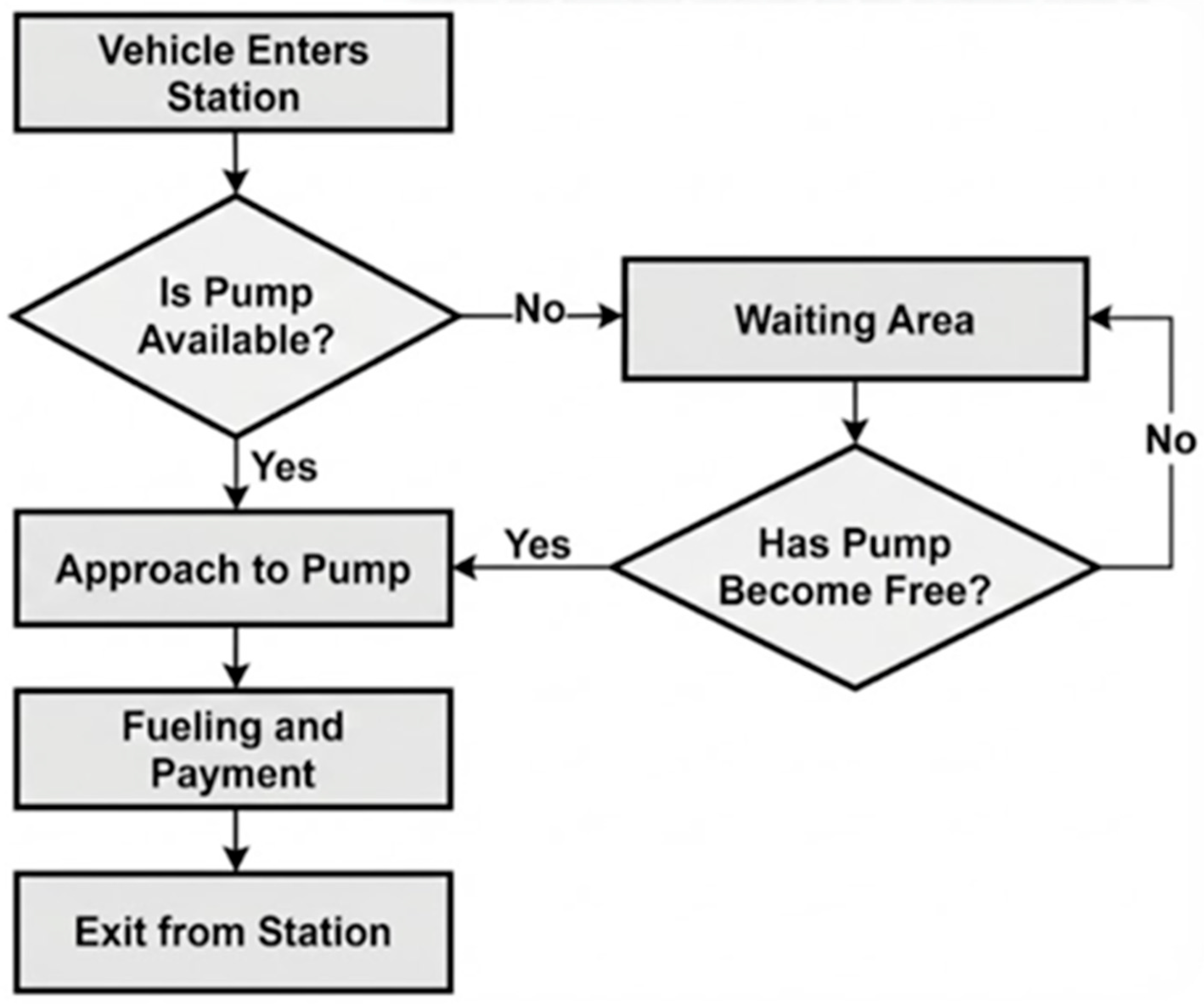
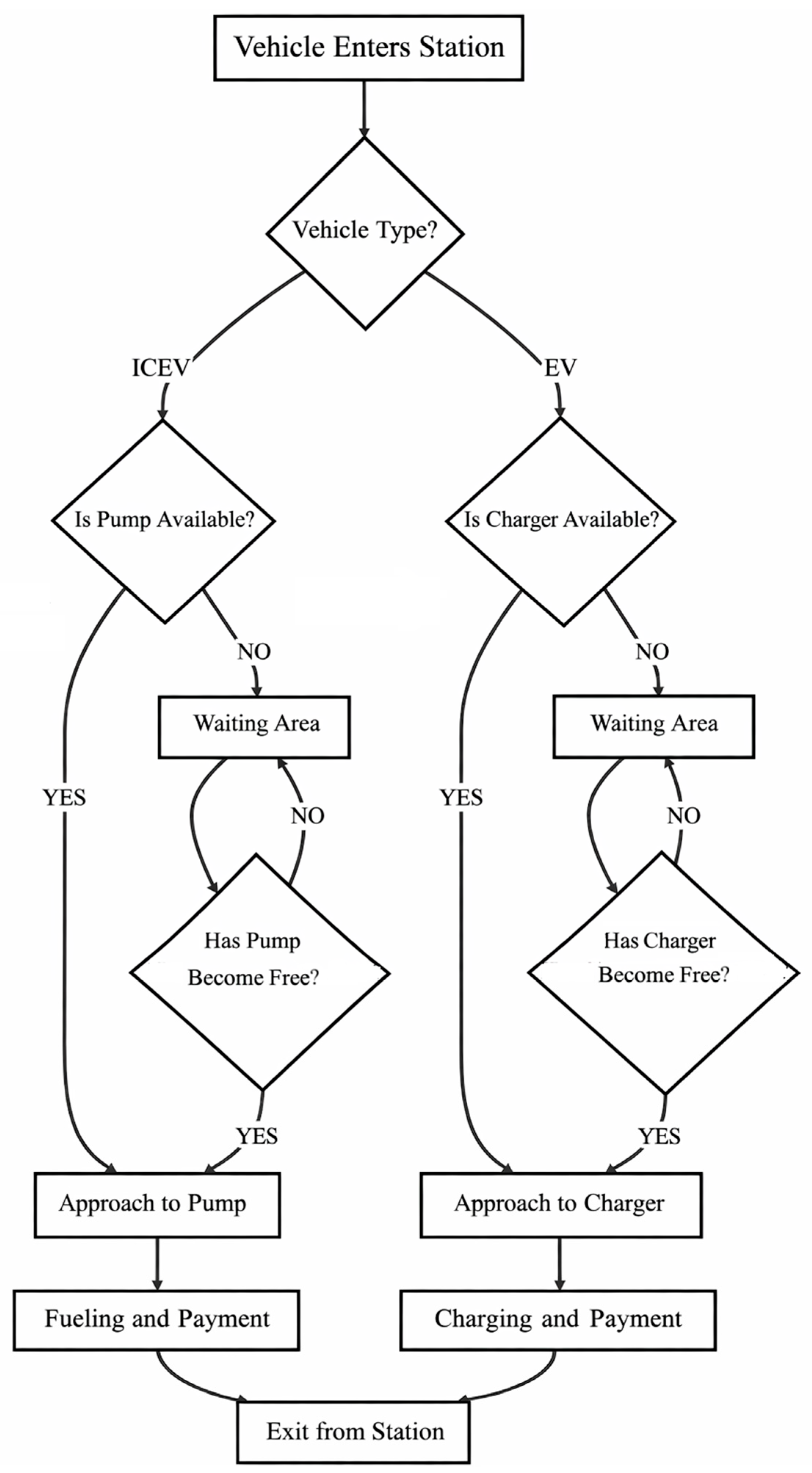
To ensure that the dwell times employed in the simulation realistically reflect the operational behavior of the station, the methodological procedure for the study was structured step-by-step in the flowchart in Figure 1.
The methodological flow of the research consists of the following steps: First, field data was collected to obtain real measurements of both refueling and EV charging operations. Subsequently, the statistical distribution of dwell times (refueling and EV charging) analyzed using these data, and the distribution models that best represent conventional refueling durations were identified. Following these data-driven preparations, a comprehensive simulation model was developed, and various scenarios reflecting different levels of EV penetration were executed on this model. Finally, the model outputs were examined comparatively to evaluate the potential impacts on station performance, queue dynamics, and overall service quality.

3.1. Study Area and Characteristics

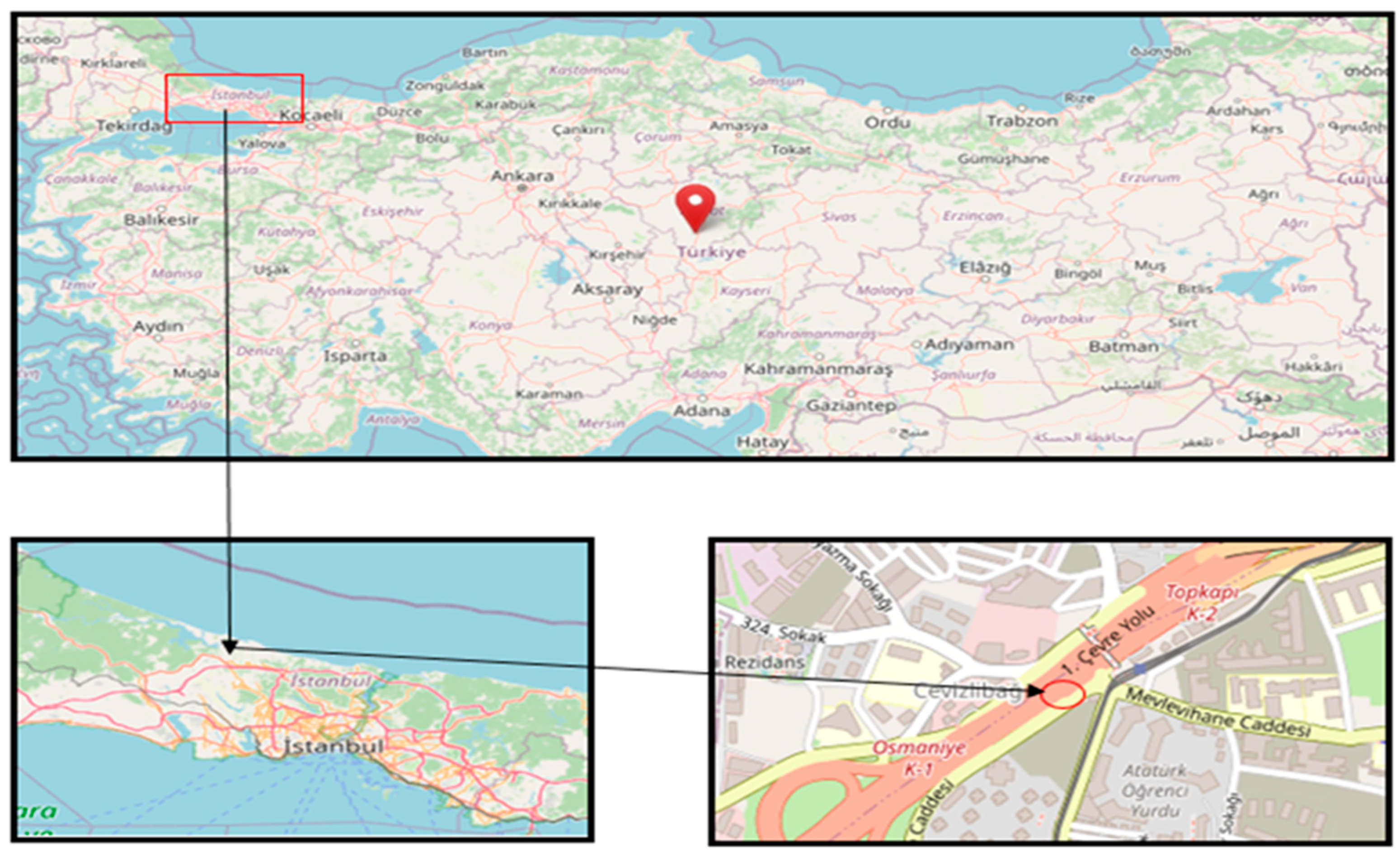
The fuel station under examination is located on the side-road of the E-5 highway, one of the busiest transportation corridors in Istanbul, Turkey, specifically in the Merter–Topkapı section (see Figure 2). To minimize operational variability, the study focused on a station that exclusively serves gasoline and diesel, excluding LPG services to avoid the queue uncertainty caused by the longer dwell times and strict safety protocols associated with LPG. The station, situated centrally within the urban network and servicing substantial regional and long-distance traffic, offers an appropriate framework for examining the operational dynamics of high-demand energy supply points.
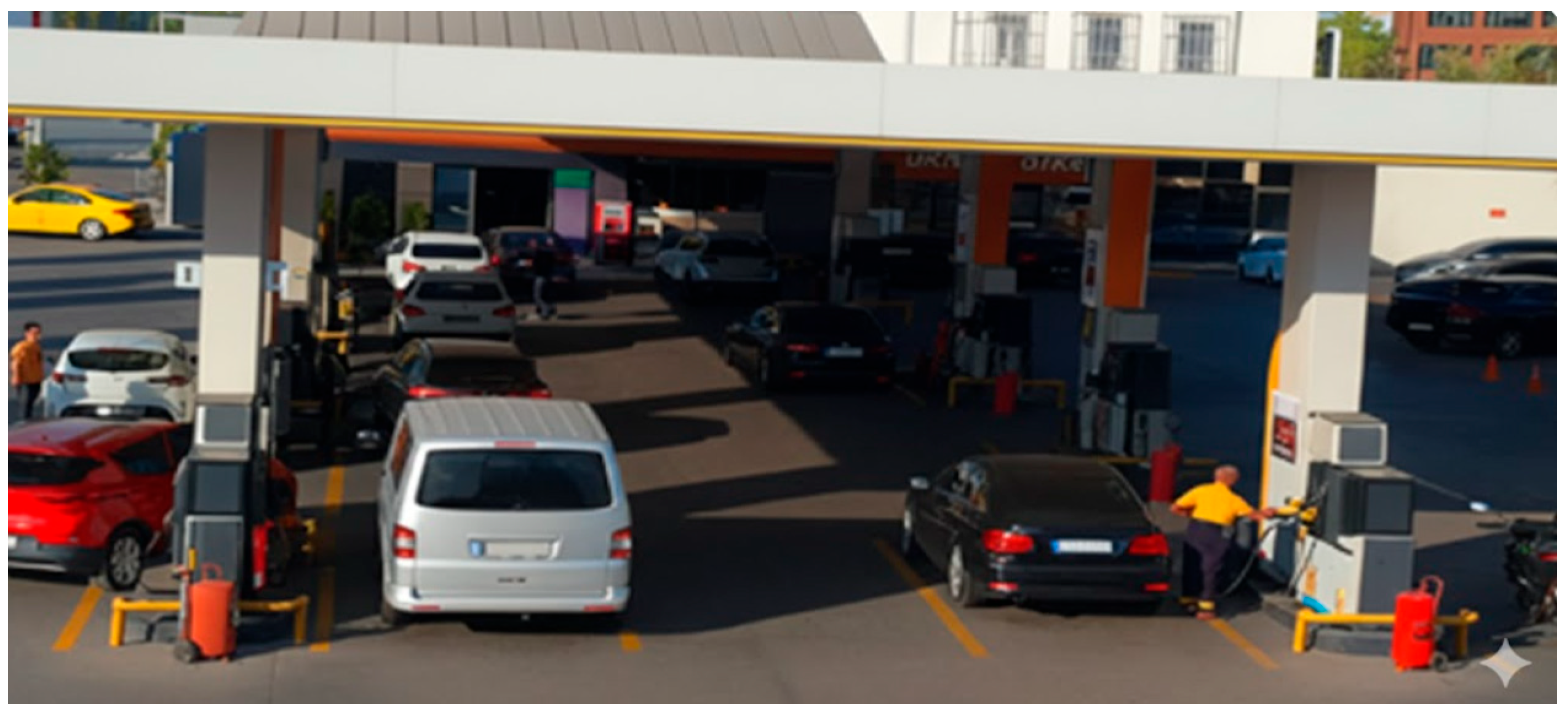
The infrastructure of the station consists of eight dual-hose fuel dispensers, the capacity to serve up to 16 ICEVs simultaneously (see Figure 3). This capacity is important for maintaining service flow during peak hours and forms a basis for modeling queue formation, dwell times, and overall system performance. This approach ensures that the resulting model is more coherent and analytically manageable.

3.2. Collection of Field and Survey Data

This study used a combined dataset derived from direct field measurements and user surveys, providing the essential inputs needed to model EV charging behavior and to conduct realistic scenario analyses within the simulation framework.

3.2.1. Fuel Station Data

Comprehensive field investigations were conducted to realistically model the operational dynamics of the station and to enhance the accuracy of the simulation inputs. Field observations and traffic counts were conducted during the station’s service hours, between 06:00 and 24:00, covering an 18 h period. This timeframe was chosen to represent the full range of daily traffic flow (morning peak, mid-day activity, evening congestion, and the decline during late hours). Throughout the defined period, all vehicles entering the station were systematically recorded, creating the dataset used for modeling queue behavior and service processes (vehicle arrival intervals, counts, and dwell times).

3.2.2. Total Occupancy Time at DC Fast Charging Stations: A Realistic Dataset for Modeling

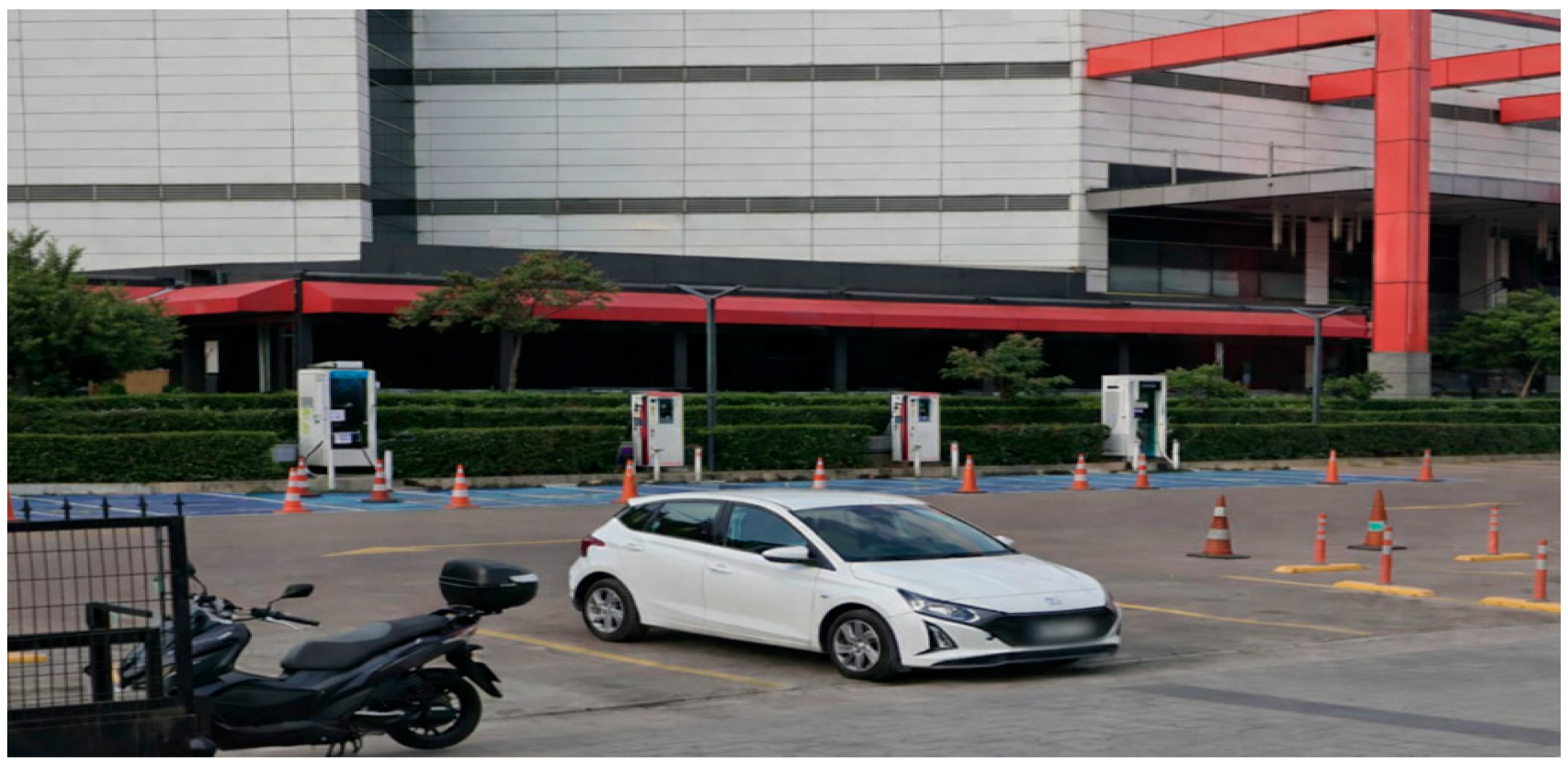
To realistically model EV charging operations, six DC fast charging stations operated by three different companies and located in a shopping mall parking area, as shown in Figure 4, were examined. These stations were found to be equipped with units providing maximum power levels of 200 kW, 150 kW, and 120 kW, respectively; each station includes two DC charging ports. The charging durations of vehicles using these units were measured and recorded in detail. The measurements were based on the total time (dwell time) from the vehicle’s approach to its departure, covering not only the battery charging time but also all processes such as power fluctuations depending on the vehicle model, connection procedures, and payment operations. This approach is important because it accurately reflects the full duration during which the charger is physically occupied, even if the actual charging has not yet begun.
In addition to the operational measurements obtained from DC fast-charging stations, a complementary dataset was collected through a structured user survey. The survey was designed to capture behavioral and perceptual aspects of EV charging that cannot be directly observed in field measurements (such as users’ typical charging duration expectations, waiting tolerance, preferred charging locations, and daily mobility patterns). These survey-based insights were incorporated to enhance the representativeness of the charging duration distributions and to support the development of more realistic simulation scenarios.

3.2.3. Survey Methodology for Examining EV User Behavior and Future Adoption Tendencies

In this study, a survey-based research method was employed to analyze EV users’ charging behaviors, station preferences, and the future EV adoption tendencies of all participants. The sample encompassed a broad group of drivers, including current EV owners, individuals with potential future interest in acquiring an EV, and those who stated that they do not prefer to use EVs. A total of 385 participants completed the survey, of whom 39% reported already owning an EV. The sample size (n = 385) was determined to represent the demographic diversity of the target population.
The survey form included questions on demographic characteristics such as gender, age, education level, and income, as well as participants’ expectations regarding charging points, their usage and preference patterns related to conventional fuel stations, and their future EV ownership plans. The collected responses were systematically analyzed, and the resulting data provided important inputs for the modeling processes conducted within the scope of the study.

3.3. Simulation-Based Modeling of the Fuel Station

In this section, information is provided regarding the method used in the simulation model developed with a discrete event simulation approach and the Arena simulation software. Within the scope of the field study, all field data were recorded separately for each hour, and the real-time arrival–departure data obtained formed the main inputs of the model. The interarrival time between vehicles was taken as the time between the arrival of one vehicle at the station and the arrival of the next vehicle. The dwell times were calculated as the total time from the moment the vehicle arrived and stopped in front of the dual-hose fuel dispenser until it completed its process and left the station, thereby making the fuel dispenser available again. The reason for this approach is that the vehicle physically occupies the pump area regardless of whether refueling has started or not. Since the data were obtained through systematic counts and precise measurements carried out in the field, they reflect the real operating conditions of the days on which measurements were conducted in February 2025.
After the preparation of the dataset, vehicle interarrival times and dwell times observed at the fuel station were fitted to appropriate statistical distributions using the Arena simulation input analyzer. During the distribution selection process, the Kolmogorov–Smirnov (K–S) goodness-of-fit test was employed as the primary statistical evaluation tool at a 95% confidence level (α = 0.05). Within this framework, the null hypothesis (H0) assumes that the sample data follow the selected theoretical distribution. When the resulting p-value exceeds 0.05 (p > 0.05), the null hypothesis is not rejected, indicating that the corresponding distribution is statistically consistent with the observed field data. Conversely, when p ≤ 0.05, the null hypothesis is rejected, and such distributions are considered incompatible with the data at the 95% confidence level and are therefore excluded from further analysis.
Nevertheless, for certain time intervals, it was observed that multiple candidate distributions yielded p-values greater than 0.05, or that some p-values were close to, or slightly below, this threshold. In such cases, the distribution selection was not based solely on the p-value. The test statistics and significance levels were treated as supportive rather than decisive criteria, and a holistic evaluation approach was adopted by jointly considering squared error measures and histogram-based visual goodness-of-fit assessments. Within this framework, as shown in Table 1 and Table 2, the distributions deemed to best represent the empirical behavior of vehicle arrival and service processes were selected for subsequent simulation analyses.
As shown in Figure 5, the distributions identified through this process were incorporated into the hourly based Arena simulation model to define vehicle interarrival and dwell times.
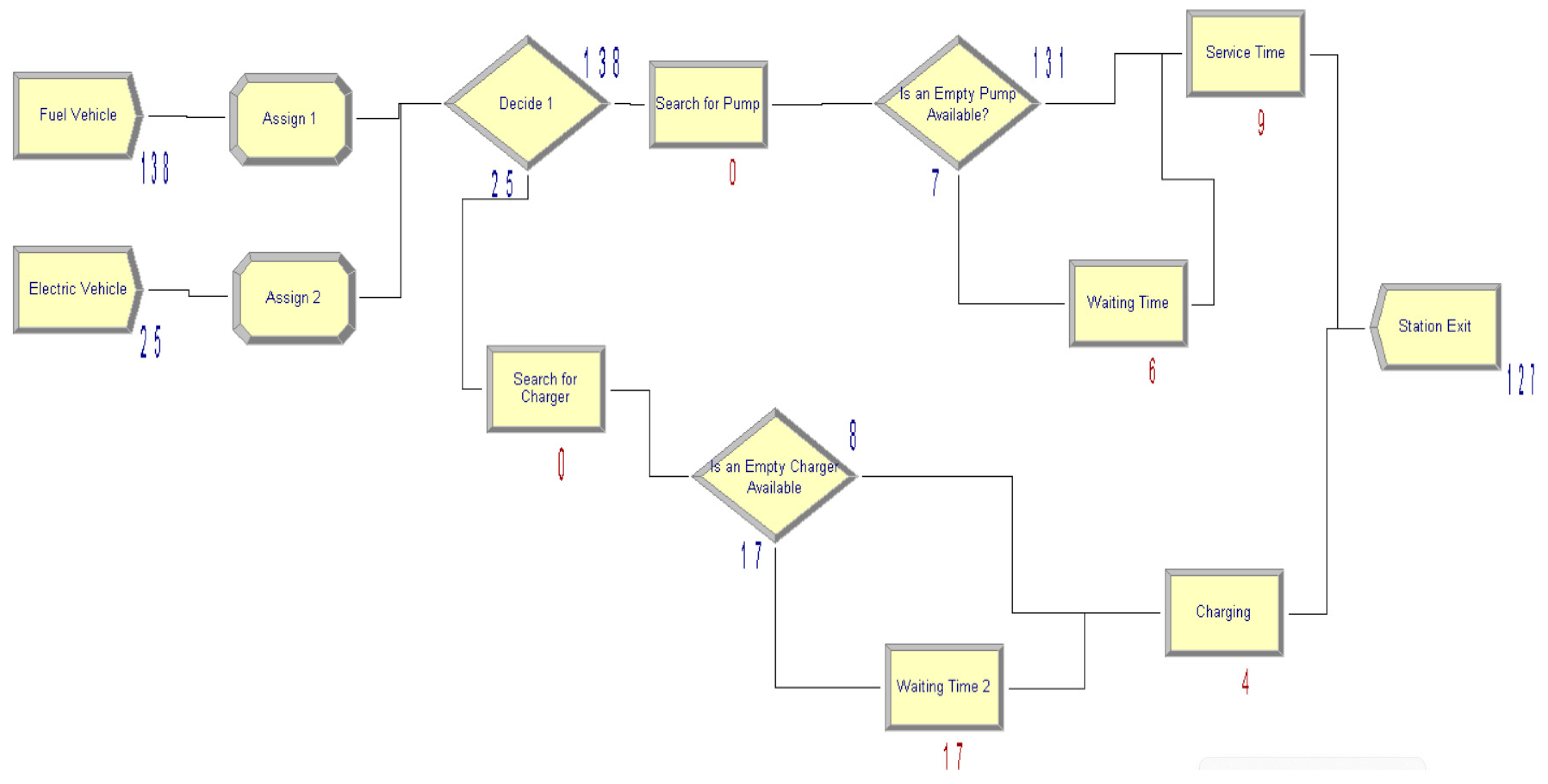
In the second phase of the study, an extended version of the baseline station model was developed to incorporate EV demand. In this structure, referred to as Model 2, one of the existing dual-hose fuel dispensers was replaced with a dual-port DC fast-charging unit. This configuration allows a detailed examination of the operational impacts of integrating EV charging into a conventional fuel station while accounting for capacity limitations. The model was constructed within the Arena simulation environment in accordance with the process flow presented in Figure 6.
In Model 2, EV charging durations were derived from a synthesis of field measurements and survey data. Consistent with the methodology applied in earlier stages, this dataset underwent distribution-fitting analysis to establish valid simulation inputs. The resulting probability distributions were then integrated into the hourly simulation framework to accurately represent charging dwell times.
It was assumed that there would be no change in the number of ICEVs entering the station and that their arrival distributions would also remain unchanged. Additionally, within the simulation model, the physical capacity limitations of fuel pumps and charging units were defined as critical system constraints. In this context, a decide block was utilized to verify resource availability against the maximum station capacity prior to the initiation of the refueling or charging process. This logic mechanism ensures that the number of simultaneous operations does not exceed the physical limits of each resource type, thereby maintaining consistency with real-world operational conditions.

3.4. Growth Scenarios for EV Penetration in Turkey

The EV and Charging Infrastructure Projection report published by the Energy Market Regulatory Authority (EMRA) in April 2024 presents low-, medium-, and high-scenario-based forecasts for the number of EVs in Turkey. According to these scenarios, the number of EVs by the end of 2025 is expected to reach 202,030 in the low scenario, 269,154 in the medium scenario, and 361,893 in the high scenario. However, as of September 2025, the actual number of EVs reached 319,155, surpassing both the medium- and low-scenario estimates and approaching the high-scenario projection. Therefore, the analyses conducted within the scope of this study are based on the high-scenario data.
Furthermore, as shown in Table 3 of the same report, long-term projections estimate that the number of EVs will reach 1,679,600 in 2030 and 4,214,273 in 2035 [15]. In contrast, the Mobility Vehicles and Technologies Roadmap: Strategy and Analysis Report outlines different targets for the year 2030. These targets include increasing the percentage of EVs to at least 75%, achieving a 35% market share for EVs, and raising the national EV stock to approximately 2.5 million units [41].
The EV projections used in this study were developed by jointly evaluating national market growth trends, sectoral capacity expansions, policy targets, and vehicle ownership tendencies derived from the survey results. Following these assessments, the projections generated through this process constituted one of the fundamental inputs for the scenario modeling. According to these estimates, both the number of EVs and their share within the total vehicle fleet are expected to increase significantly in the coming years. A summary of these projections is presented in Table 4.
Based on the estimated values obtained from the projection table, three separate scenarios were created in which 5%, 10%, and 20% of the vehicles arriving at the station were assumed to be EVs. These conversion rates were integrated into the corresponding hourly demand patterns, and for each defined scenario, a separate simulation experiment was conducted to assess the station’s operational efficiency (see Figure 7). In this manner, the impacts of different EV penetration levels on station capacity, queue lengths, waiting times, and resource utilization rates were comparatively analyzed.

4. Results

The current usage profile of the station, alternative scenarios for EV integration, and the resulting waiting behaviors under these scenarios have been examined in a comprehensive and systematic manner. The findings provide important indicators of how the station performs both under current conditions and in the face of potential future increases in demand, thereby revealing critical decision areas for subsequent planning stages.

4.1. Fuel Stations and DC Fast-Charging Stations

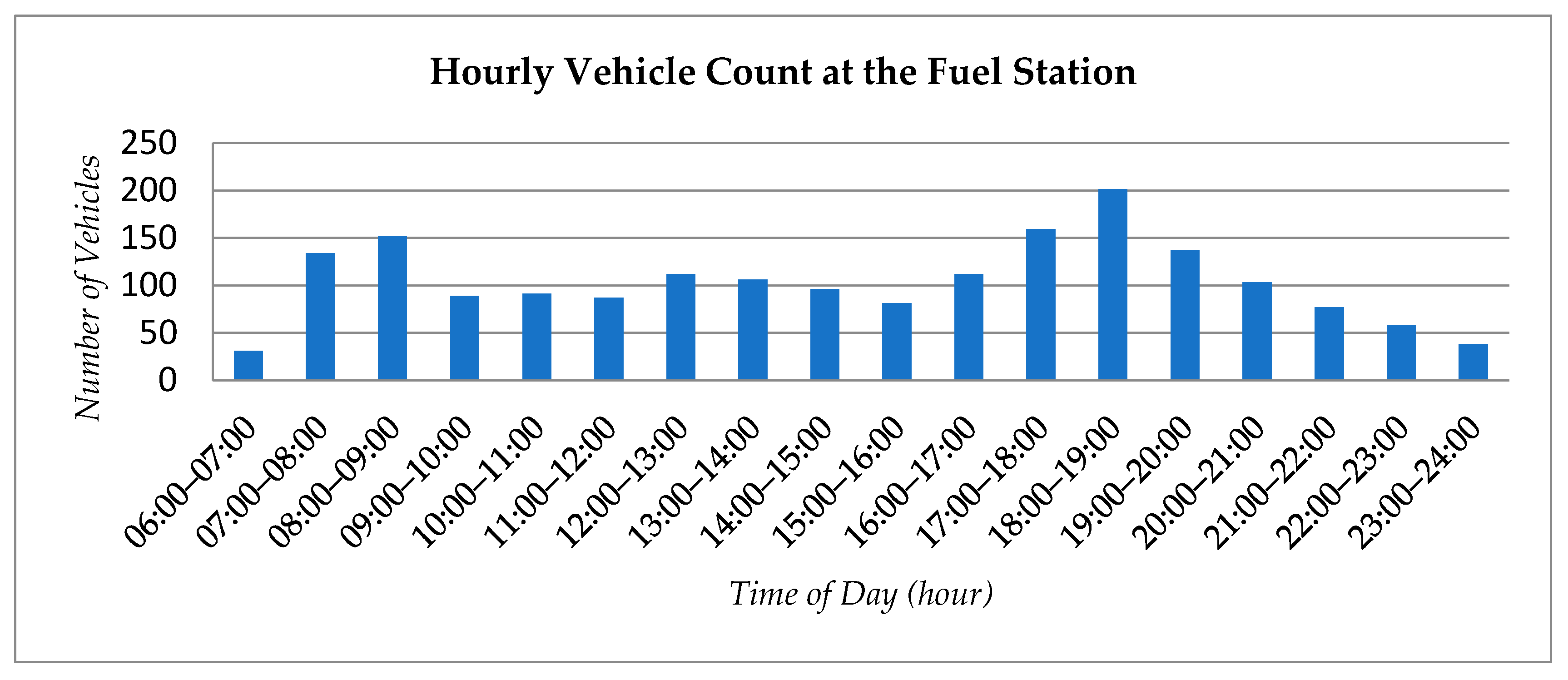
As shown in Figure 8, measurements revealed that a total of 1864 vehicles entered the station between 06:00 and 24:00. Traffic volume increased significantly during the morning hours between 07:00 and 09:00, with 134 vehicles using the station between 07:00–08:00 and 152 vehicles between 08:00–09:00. Around midday, traffic decreased to 87 vehicles between 11:00–12:00, but rose again during the 12:00–14:00 period, particularly between 13:00–14:00 with 106 vehicles. The highest daily demand occurred between 17:00 and 19:00, when 159 vehicles entered the station between 17:00–18:00 and 201 vehicles between 18:00–19:00, marking the peak service period. Toward the late evening, demand gradually declined and reached its lowest level after the 06:00–07:00 time period, with 38 vehicles recorded between 23:00 and 24:00.
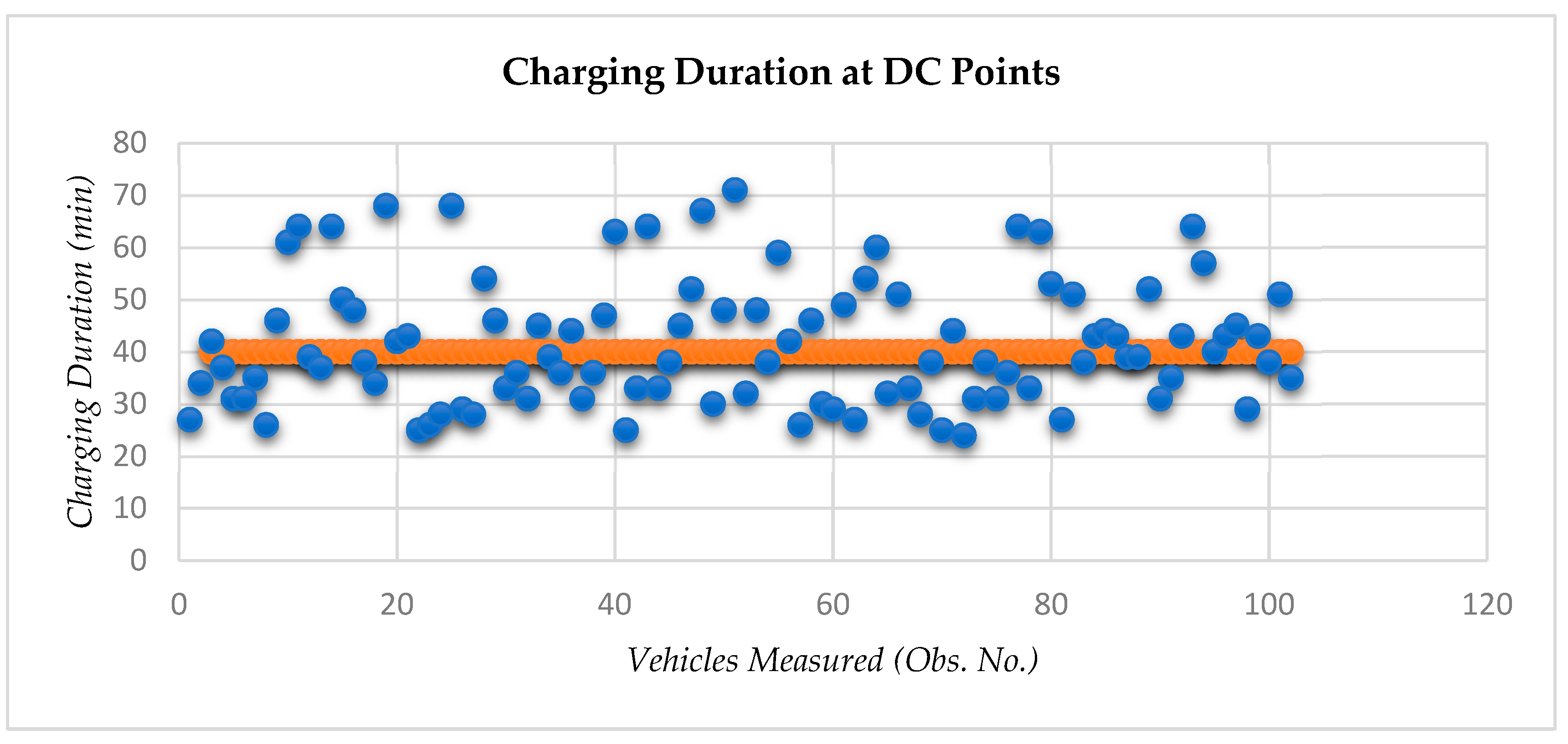
Field measurements conducted at DC fast-charging stations revealed a total occupancy time dynamic that differs from the theoretical information reported in the literature [42]. As shown in Figure 9, evaluations based on a total of 102 vehicles indicated that the total time from when a vehicle arrived at the station until it departed ranged from 24 to 71 min, with the majority of the distribution concentrated between 32 and 48 min. These data demonstrate that the per-vehicle occupancy time at DC fast-charging points is longer and more variable than expected.
The primary reason for these extended and variable durations is that charging time is not solely determined by the physical process of battery charging. The overall process is significantly influenced by connection procedures, payment operations, power fluctuations depending on the vehicle model, and software-related synchronization issues. Furthermore, after reaching the target state of charge, drivers were granted additional tolerance periods of 5, 10, or 15 min, and some drivers did not immediately depart after charging was completed; these behavioral factors further extend the total occupancy time.
Due to this complex field reality, this study adopts total occupancy time as the primary charging time metric. Total occupancy time encompasses the entire duration from when a vehicle docks at the station to when it departs, capturing all operational components such as connection procedures, power fluctuations, software delays, and driver behavior. This approach more accurately and practically reflects the real usage dynamics and user behavior at DC fast-charging stations, providing a reliable dataset for station capacity planning and queueing analysis.

4.2. User Preferences, Charging Behaviors, and EV Adoption Tendencies

In this section, the survey findings that reveal users’ expectations regarding charging stations, their demand trends for traditional stations, and the impacts of the EV transition process on existing infrastructure are presented.
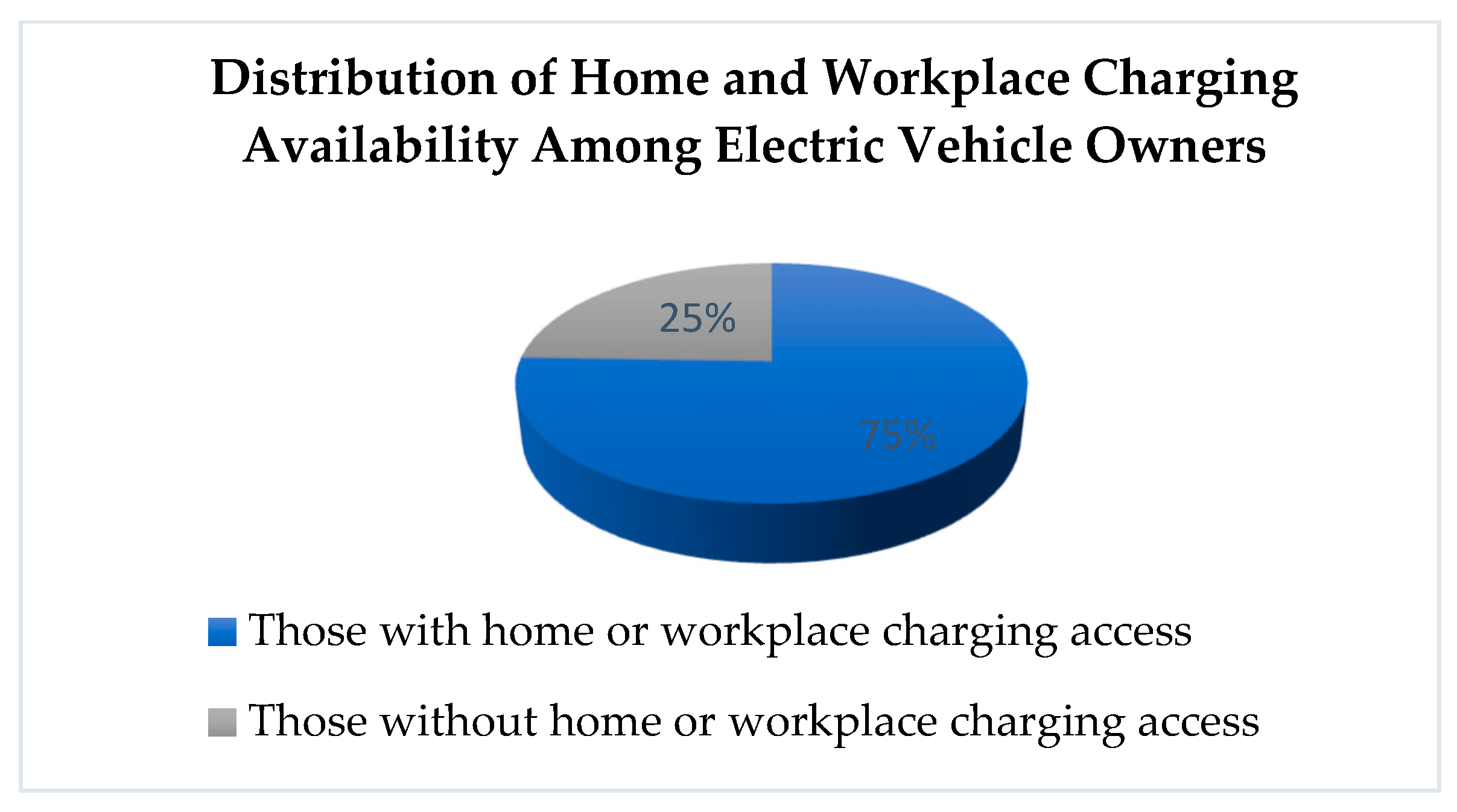
To establish the foundation for the analysis scenarios, the first step involved assessing users’ current charging access in order to determine their level of dependence on public charging infrastructure. As shown in Figure 10, 75% of participants reported having charging facilities at home or in the workplace. This finding indicates that a substantial proportion of users are already able to meet their daily charging needs in private settings, thereby suggesting that reliance on publicly accessible charging infrastructure remains relatively low.
It should be noted that, in order to capture the behaviors and expectations of EV users, the survey specifically targeted current EV owners as well as individuals with potential interest in adopting an EV in the future. While the survey included a broad cross-section of drivers, this purposeful sampling approach inherently attracts participants with higher EV awareness or interest, introducing a potential selection bias. Therefore, the reported low dependence on public charging infrastructure should be interpreted within the context of this EV-aware user group rather than generalized to the entire driving population.
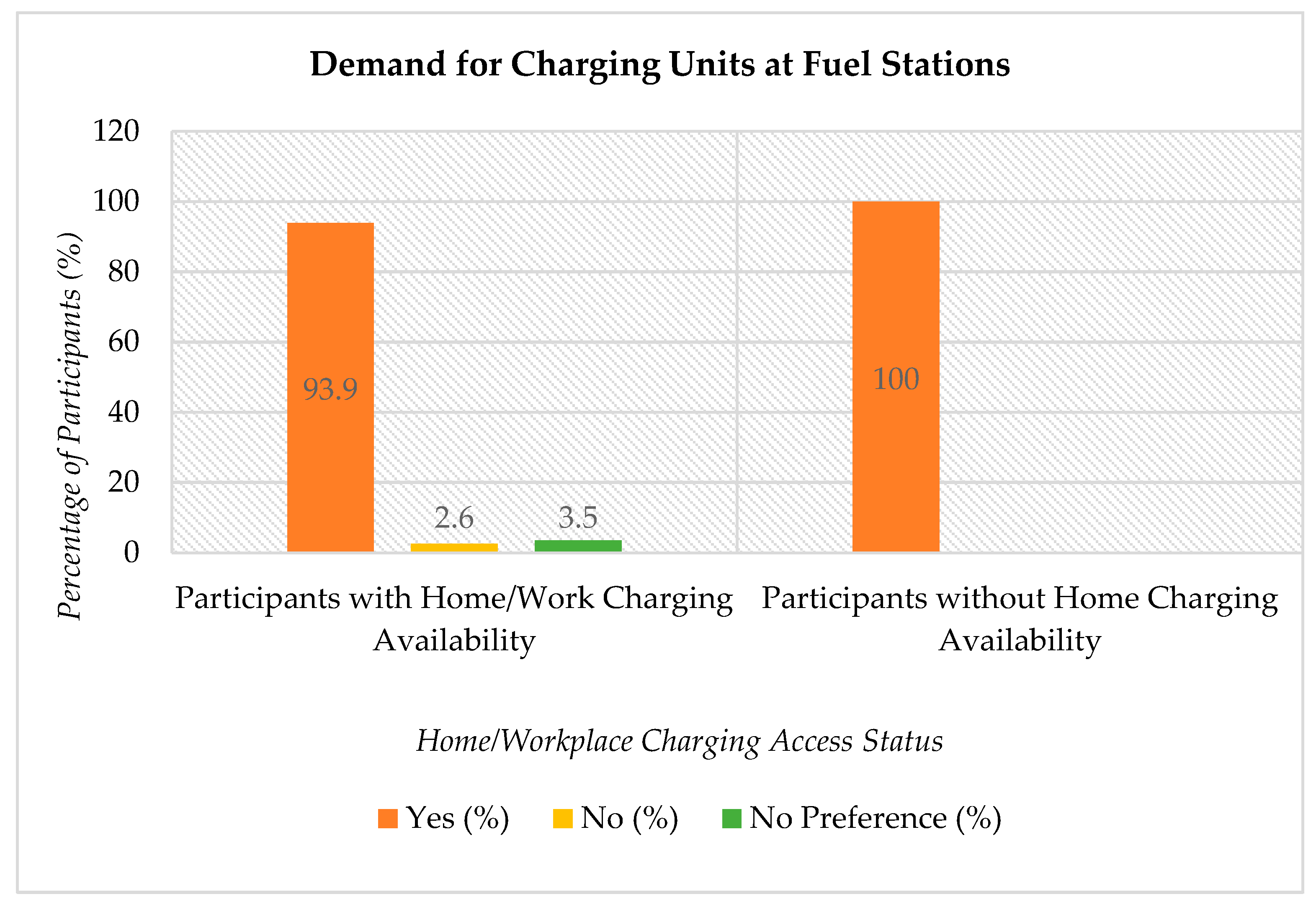
To account for the integration of charging units into stations within the analysis scenarios, participants’ preferred charging locations were examined. As shown in Figure 11, 94% of respondents with home or workplace charging access and 100% of those without home charging facilities stated that they demand charging services at stations.
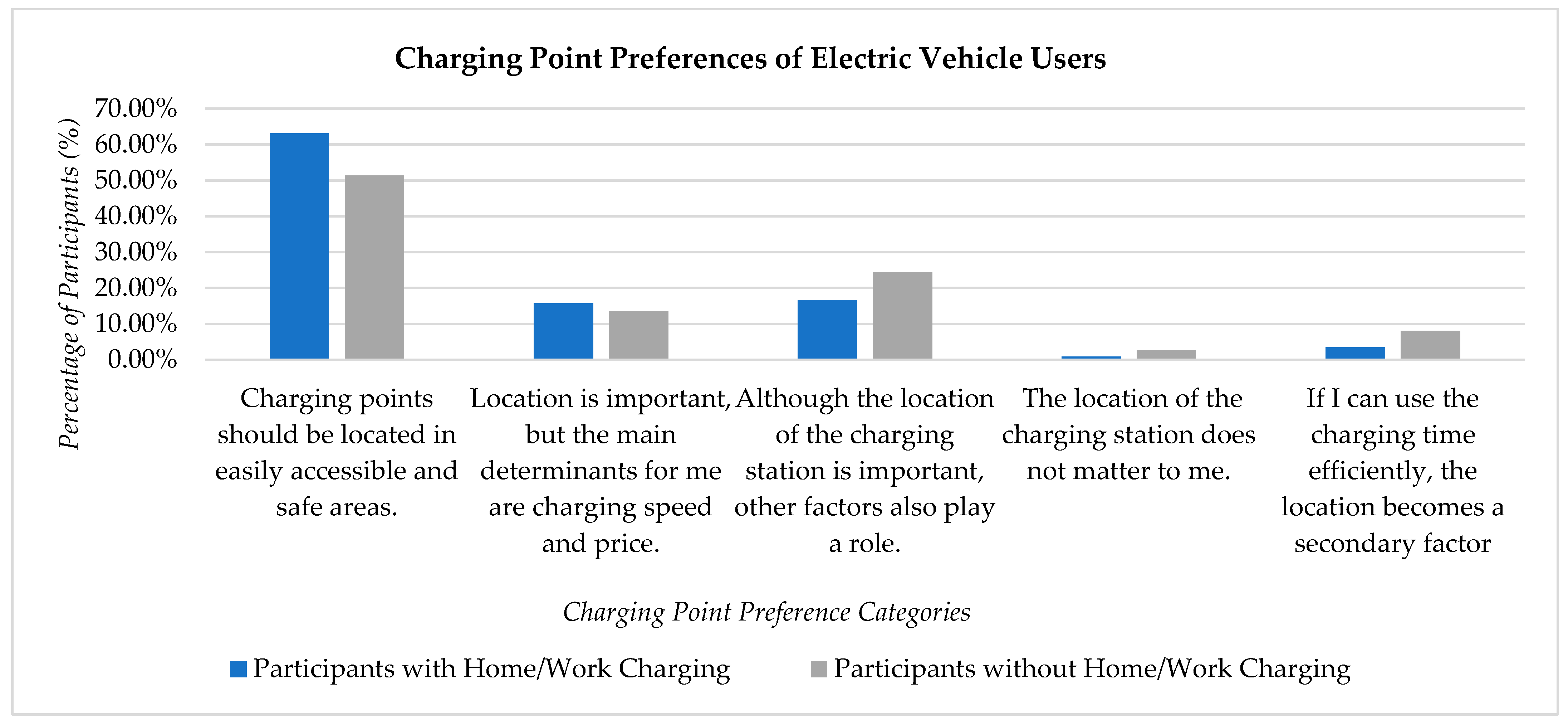
Furthermore, EV users’ charging station preferences largely reflected established behavioral patterns associated with traditional stations. Among participants with home or workplace charging, 63.2% indicated that easily accessible and safe locations were the most important criterion when choosing a charging point, while 51.4% of users charging at public locations shared this view. Among users of publicly accessible charging stations, 24.3% agreed with the statement “location is important, but other factors also matter,” highlighting that station choice is based not only on location but also on charging speed, price, waiting comfort, and service variety. In the same user group, 8.1% indicated that when they can use charging time efficiently, location becomes a secondary factor (Figure 12).
This data collection approach enables a comprehensive evaluation of both users’ preferences regarding charging infrastructure and the influence of home and workplace charging availability.
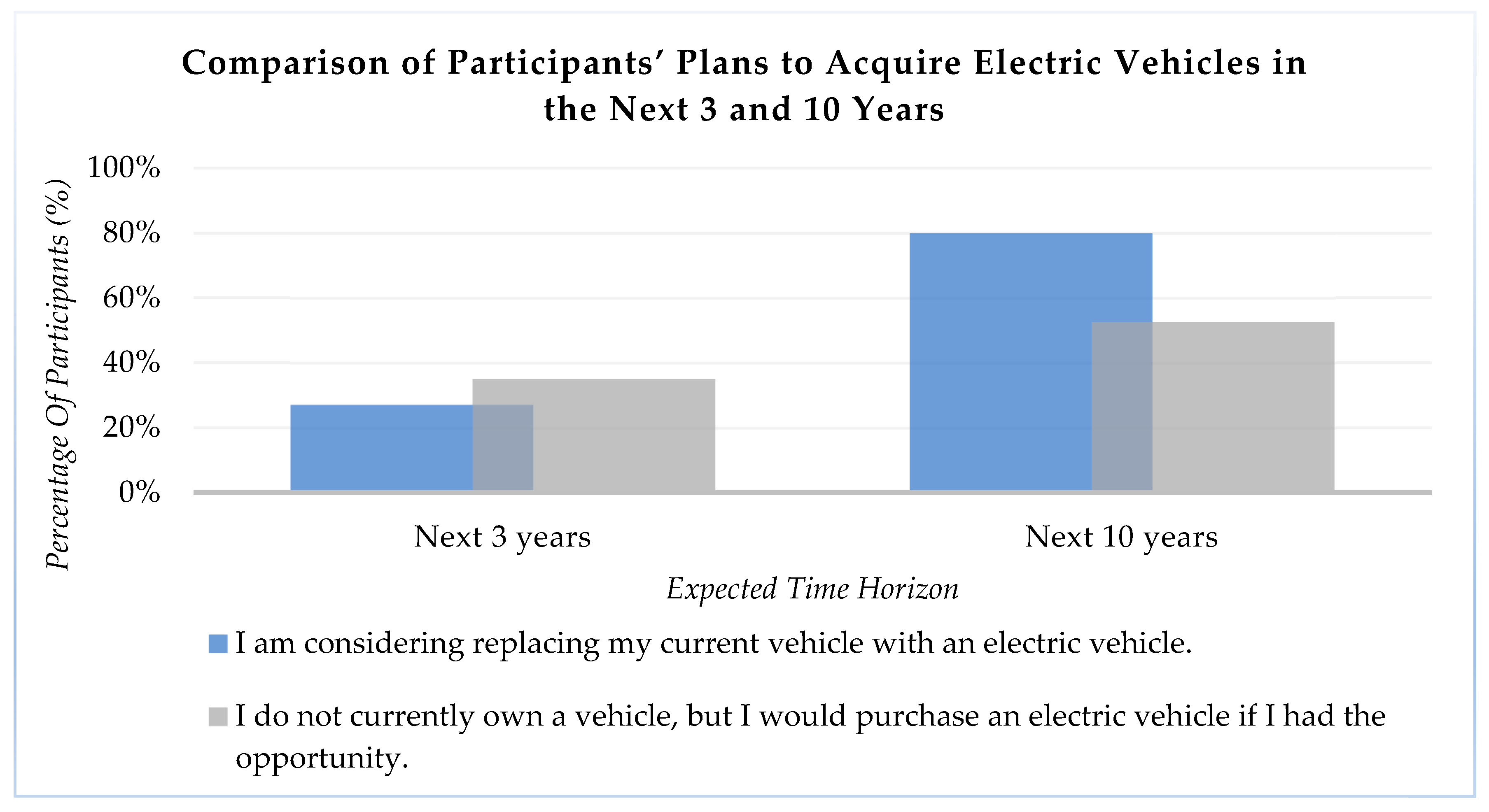
The significance of these preferences in terms of market dynamics becomes evident when participants’ intentions to transition to EVs are examined. The projections presented in Figure 13 indicate that the adoption rate is expected to change substantially over time. In the short term (the next three years), only 26% of current vehicle owners plan to switch to EVs, whereas in the medium to long term (the next ten years), this rate rises to 80%. Similarly, among individuals without a vehicle, the intention to adopt EVs is 35% in the short term, increasing to 52.5% over a ten-year horizon.
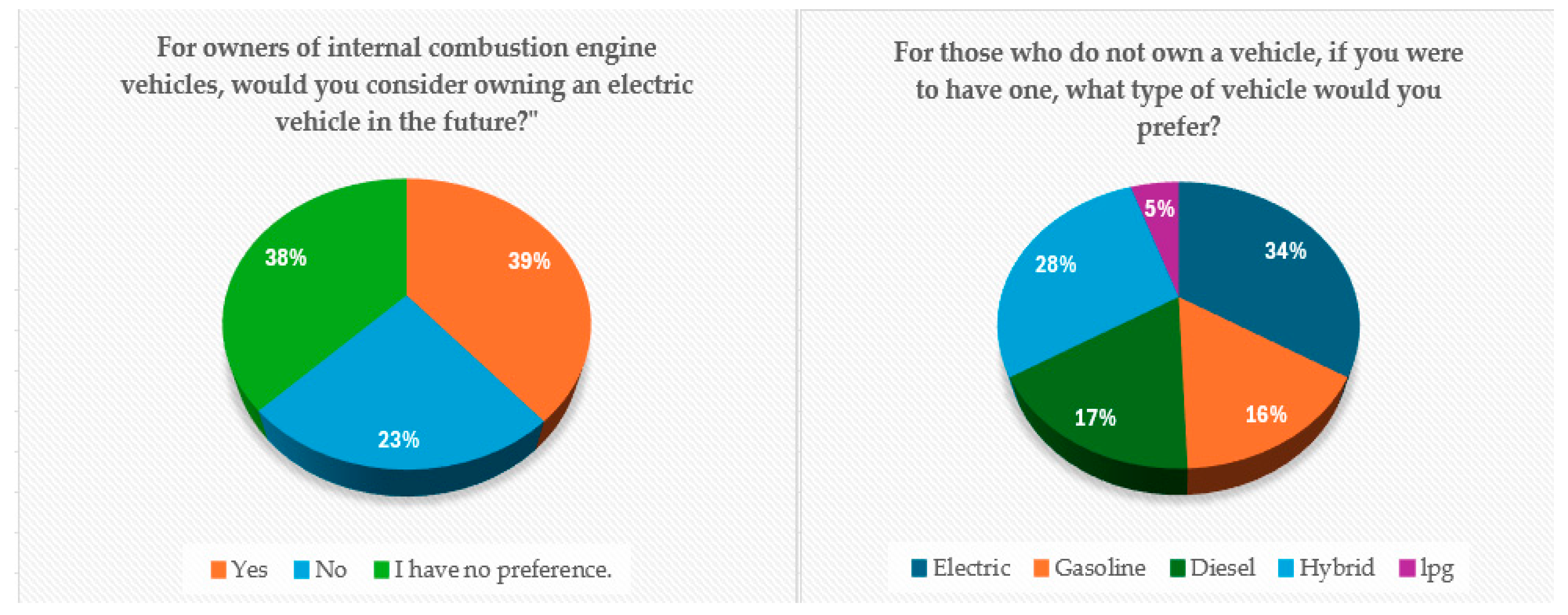
As shown in Figure 14, according to the survey results, participants without a vehicle were asked, “If you had a vehicle, which type of vehicle would you prefer?” Among them, 34% indicated a preference for EVs, 28% for hybrid vehicles, 16% for gasoline vehicles, 17% for diesel vehicles, and 5% for LPG vehicles.
Participants who already owned a vehicle were asked, “Do you consider owning an EV in the future?” Among these participants, 39% expressed that they are considering owning an EV, 23% indicated that they are not, and 38% were undecided.
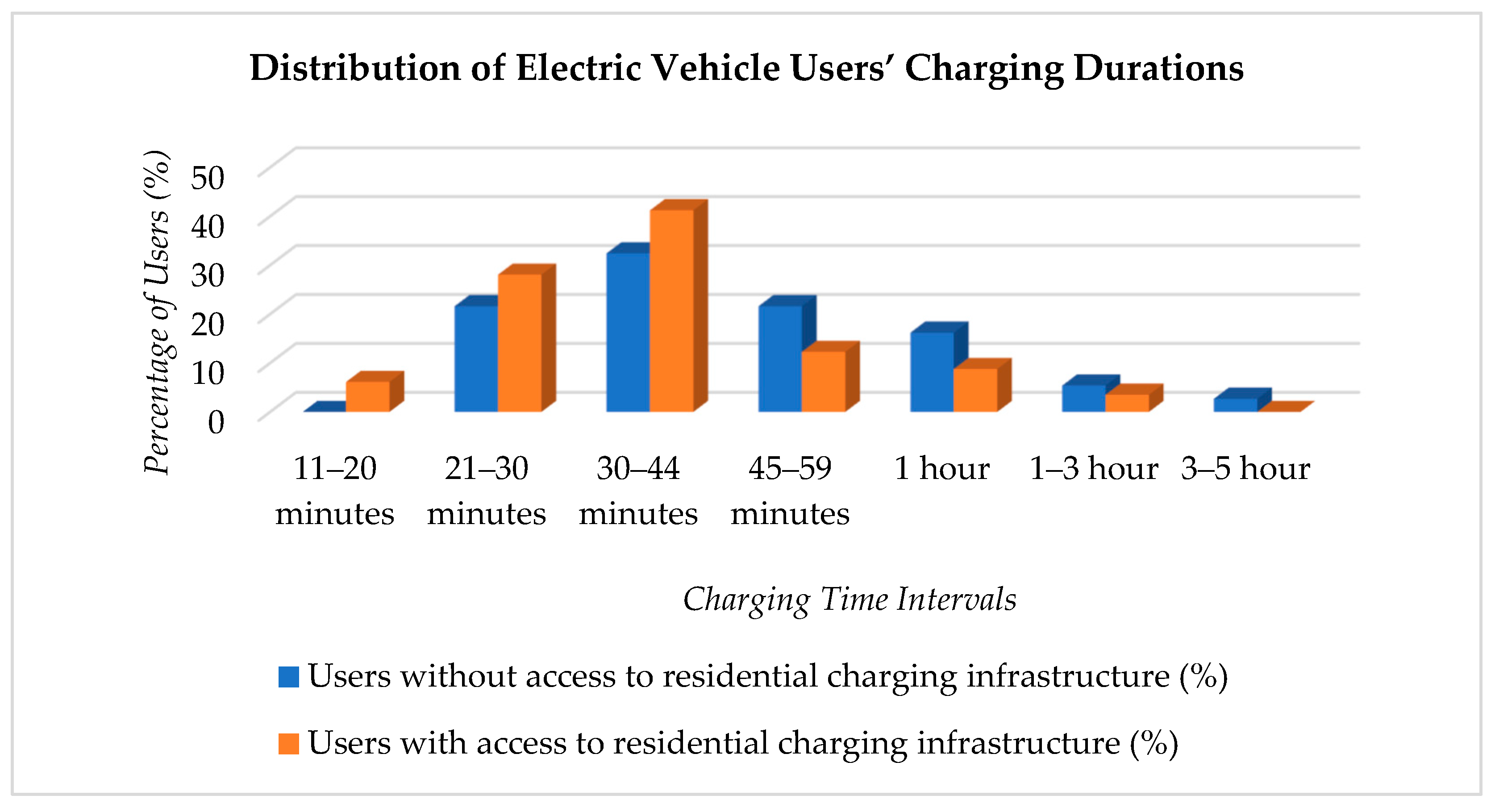
Additionally, as shown in Figure 15, the charging behaviors and usage habits of EV owners were evaluated. It was found that users without home charging facilities mostly carried out charging sessions lasting 30–44 min (32%) and 45–59 min (22%), whereas users with home charging facilities predominantly charged for 21–30 min (28%) and 30–44 min (41%).

4.3. Baseline Assessment of Current Pump Utilization Profile and EV Integration

The process of determining (fitting) the input distributions used in the model development is described in detail in Section 3.3 (Methodology), with summarized results presented in Table 1 and Table 2. In brief, raw field data (vehicle interarrival times and dwell times) were analyzed on an hourly basis using the Arena input analyzer software (Version 14.0).
This section focuses on testing the statistical validity (validation) of the defined model and presenting the results. For validation purposes, each scenario (time interval) was executed with 100 independent replications, and performance measures (average vehicle arrivals and average dwell times) were calculated within 95% confidence intervals.
The validity of the model was assessed based on whether the field measurements fell within the confidence intervals generated by the simulation. As shown in Table 5, for all time intervals, field observations (Field Vehicle Arrivals and Field Dwell Time) lie within the 95% confidence intervals of the model. For instance, during the 08:00–09:00 interval, the observed average of 152 vehicles falls within the model’s 153 ± 1.18 interval, while the observed average dwell time of 254.3 s also lies within the model’s 249.3 ± 7.46 s range.
This high level of agreement demonstrates the effectiveness of the distribution fitting process summarized in Table 1 and Table 2 and confirms that the model accurately represents the real system. Variability in dwell times (standard deviation) was incorporated through appropriately fitted input distributions, allowing the simulation outputs to reliably reflect the real system’s performance within statistically meaningful confidence intervals. Moreover, the half-widths of the confidence intervals, indicated by the “±” values in Table 5, are less than 5% of the mean values, demonstrating the statistical stability and reliability of the model outputs.
In conclusion, the validation results clearly indicate that the developed discrete-event simulation model is a valid and reliable tool for analyzing the performance of a station providing both conventional fuel refueling for ICEVs and charging services for EVs.

4.3.1. Current Fuel Pump Utilization Profile and Fundamental Assessment for EV Integration

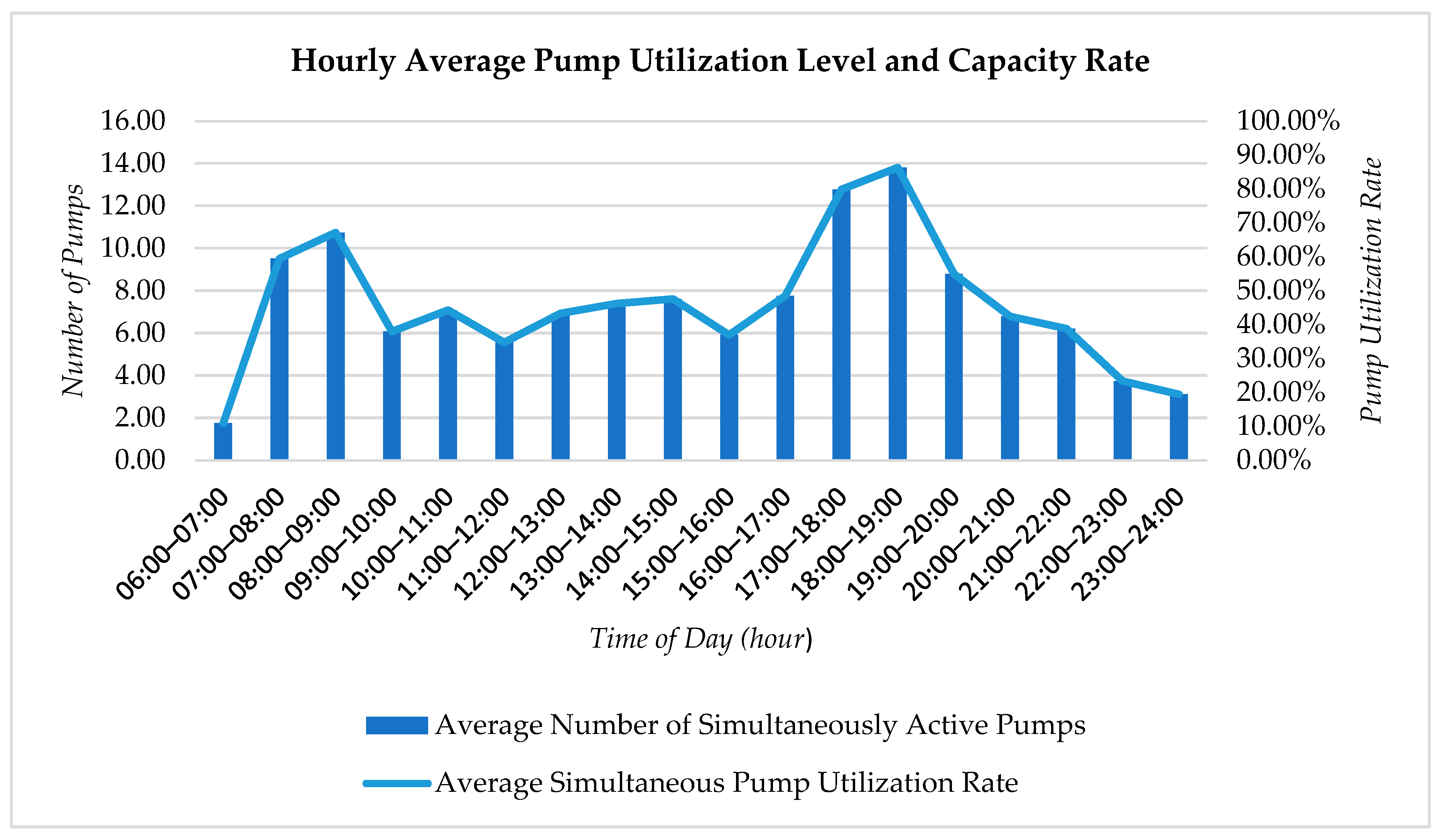
Following the development of the model in alignment with the field data, the utilization profile of the existing pump infrastructure was comprehensively examined prior to the integration of EV charging units, as illustrated in Figure 16. For each hourly interval, the average number of simultaneously active pumps was identified, and the corresponding utilization rate was calculated. Based on the resulting hourly data, the demand dynamics and capacity utilization patterns of the station were evaluated as follows.
During the early morning hours (06:00–07:00), the pump utilization rate was approximately 11%, representing a low-demand period. However, between 07:00 and 09:00, utilization rates increased substantially to 60% and 67%, respectively, in parallel with rising traffic volumes, indicating a high level of operational activity during this interval.
During the late morning and midday period (09:00–14:00), utilization rates ranged between 35% and 46%. Although some fluctuations in demand were observed, this timeframe generally corresponded to a moderate level of capacity usage. In the afternoon (14:00–17:00), utilization remained within the 37–49% range, reflecting a relatively stable usage pattern.
The highest demand of the day occurred between 17:00 and 19:00. During this period, the utilization rate reached 80% between 17:00 and 18:00, and increased further to 86% between 18:00 and 19:00, representing the peak values observed throughout the day. This indicates that the existing pump capacity was utilized near its maximum level during the evening peak.
Between 19:00 and 22:00, utilization rates ranged from 38.80% to 54.87%, suggesting a relatively high yet stable demand level. In the final hours of the day (22:00–24:00), utilization rates decreased to 19–23%, marking a period of significantly reduced demand.

4.3.2. Analysis of EV Percentage-Change Scenarios and Vehicle Waiting Queues

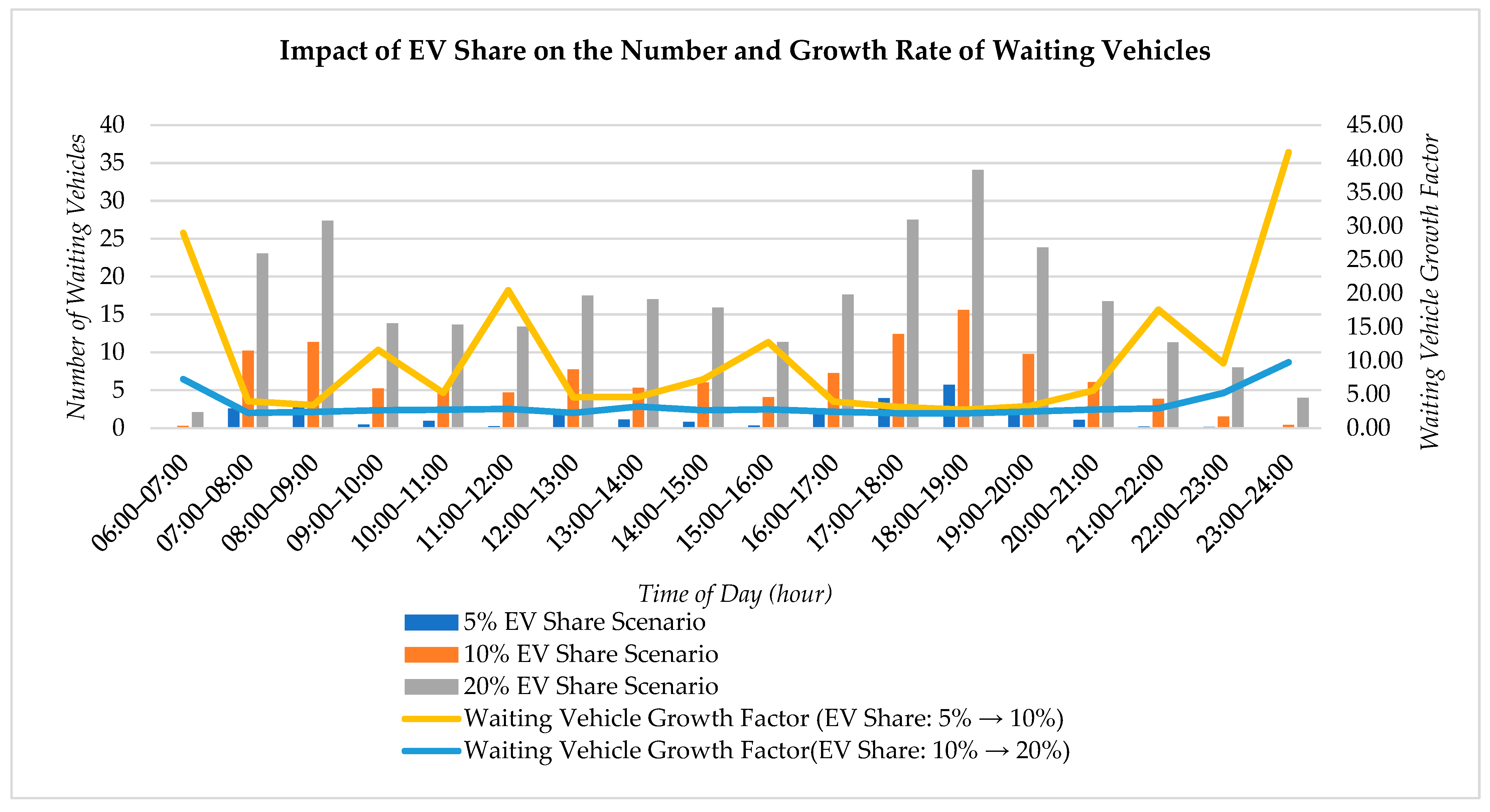
Following the detailed analysis of the existing demand profile, the outputs of the simulation scenarios developed based on national vehicle fleet projections for the 2025–2040 period were evaluated. The resulting findings are presented in Figure 17. Figure 17 illustrates the hourly variation in the number of waiting vehicles under three different scenarios with EV penetration rates of 5%, 10%, and 20%, together with the corresponding waiting vehicle growth factors. The results indicate that the impact of increasing EV share on station performance is non-linear; rather, once certain threshold values are exceeded, waiting behaviors deteriorate rapidly.
Under the 5% EV scenario, the system exhibits a generally stable and predictable performance throughout the day. The number of waiting vehicles remains within the range of 0–5 vehicles during most time periods, with only limited and short-term fluctuations observed. This suggests that the current station layout and charging capacity are largely sufficient to accommodate low EV demand without causing capacity exceedance. However, when the EV share increases to 10%, a pronounced vulnerability in system performance emerges. In particular, during the morning (08:00–09:00) and evening (17:00–20:00) peak periods, the number of waiting vehicles increases significantly, reaching average values of approximately 8–15 vehicles. This increase can be attributed to the relatively long charging durations of EVs, which reduce service rates and disrupt the balance between demand and capacity.
The scenario with a 20% EV share represents a critical condition in which the system reaches its operational limits and performance deteriorates rapidly. During both morning and evening peak hours, the number of waiting vehicles frequently exceeds 25, and reaches values above 30 in the 18:00–19:00 interval, indicating that demand remains well above the station’s capacity. This finding clearly demonstrates that the existing charging infrastructure configuration is unable to accommodate such a level of EV demand and that the system has entered a saturation regime. Moreover, the fact that the increase in waiting vehicles is well above twofold when the EV share rises from 10% to 20% indicates a high sensitivity of the station to EV demand, with queue formation growing rapidly in a non-linear manner.
The waiting vehicle growth factor presented on the secondary axis clearly reveals the nonlinear behavior observed in the system. When the share of EVs increases from 5% to 10%, the growth factor reaches exceptionally high values during certain time periods. In particular, it approaches 30 during low-demand hours such as 06:00–07:00 and exceeds 40 in the 23:00–24:00 time interval. These extraordinary values occur despite the fact that average waiting levels in the reference scenario are relatively low, indicating that the system is highly sensitive to even small increases in EV demand when operating under low baseline demand conditions.
By contrast, when the EV share rises from 10% to 20%, the growth factors are generally lower; however, these increases occur at much higher absolute waiting levels. This indicates that the system has already reached a saturated state around the 10% EV share threshold. Consequently, additional EV demand no longer results in disproportionately large relative increases, but instead further exacerbates already excessive queue lengths.
From a sustainable transportation and infrastructure planning perspective, these findings point to a critical capacity threshold. Once the EV share exceeds approximately 10%, the existing charging capacity and waiting area configuration become insufficient, substantially increasing the risk that queues will spill beyond the station boundaries and encroach onto adjacent arterial roads.
Note: The growth factor (GF) is defined as the ratio of the average waiting time calculated for a given EV scenario to that of the reference scenario G F W scenario / W reference .
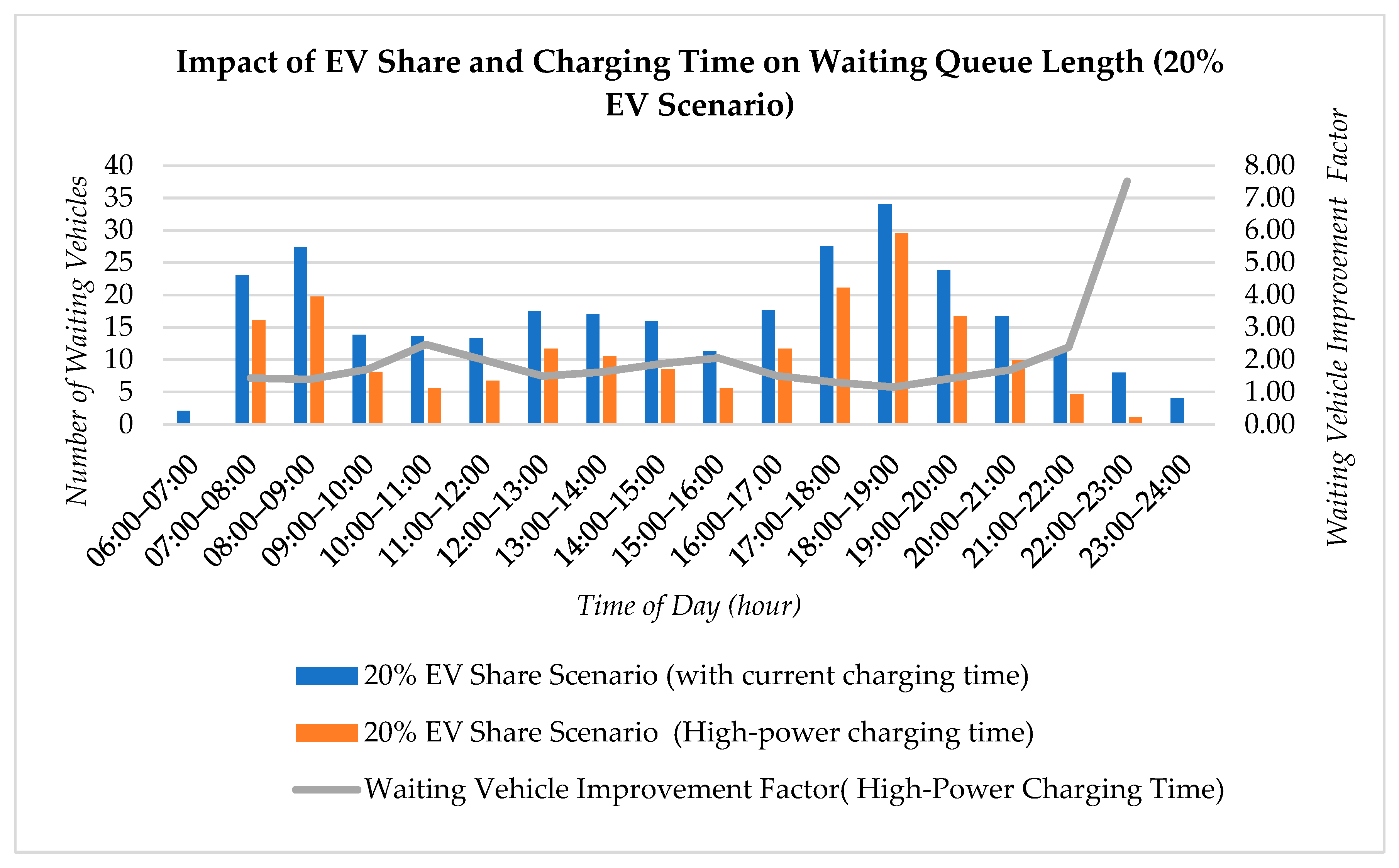
Building on the capacity saturation observed under the 20% EV share scenario, the analysis is extended at this stage to assess the potential impacts of technological advancements in charging infrastructure. In this context, a configuration based on the use of high-power charging units rated at 230 kW and above is assumed, under which EVs are considered to complete the charging process and depart from the station within approximately 10–20 min. Based on this assumption, the number of waiting vehicles was recalculated and comparatively presented against the current charging time scenario in Figure 18.
The results indicate that, under the high-power charging scenario, a reduction in the number of waiting vehicles is observed across all time intervals. This reduction is particularly pronounced during low-demand periods, with the number of waiting vehicles approaching zero during the 06:00–07:00 and 23:00–24:00 time intervals.
By contrast, absolute waiting levels remain high during the morning and especially the evening peak periods. For instance, during the 18:00–19:00 time interval, the number of waiting vehicles decreases from 34.06 under the current charging time scenario to 29.53 under the high-power charging scenario, corresponding to an improvement factor of only 1.15. This relatively low value indicates that the system operates close to saturation during these hours and that reductions in charging time lead to only limited decreases in queue lengths rather than fully eliminating them. Similarly, improvement factors generally remain within the range of 1.15–1.30 during the 17:00–20:00 period, suggesting that under high-demand conditions the effectiveness of technological improvements is constrained by structural capacity limitations.
Overall, while high-power charging technologies are shown to reduce waiting queues under near-saturated conditions such as the 20% EV share scenario, their effectiveness remains limited during peak hours. In other words, a single technological intervention based solely on shortening charging durations is insufficient to substantially reduce waiting vehicle numbers under high EV penetration levels. These findings highlight the necessity of complementing fast-charging technologies with additional measures, such as capacity expansion, an increase in the number of charging points, or demand management strategies.
Note: The improvement factor ( I F ) is defined as the ratio of the average waiting time calculated for a given EV scenario to that of the reference scenario I F W reference / W s c enario .
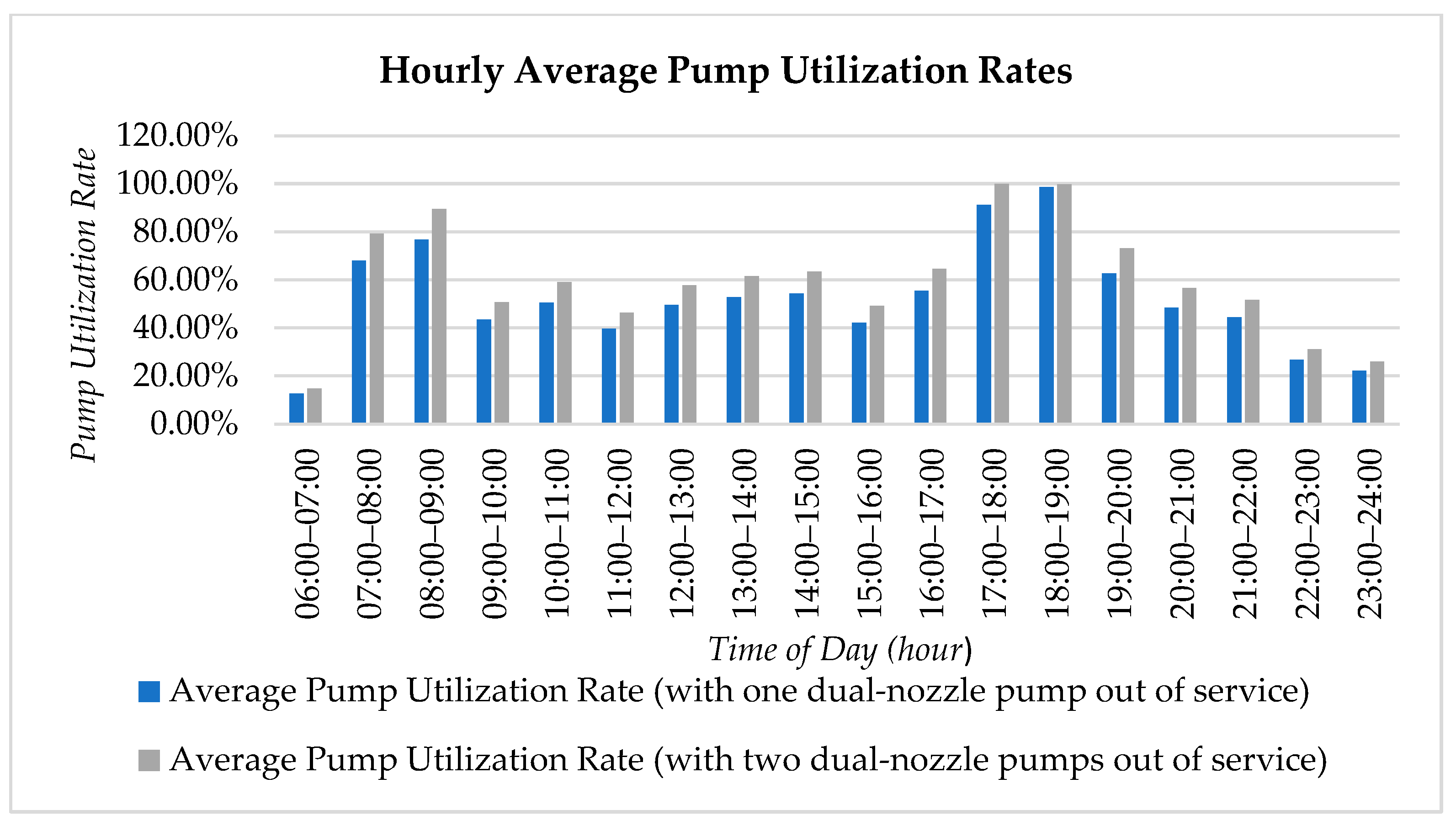
Following the assessment of operational impacts under the single dual-hose fuel dispenser conversion scenario, the analysis was extended to examine the effects of converting two dual-hose fuel dispensing units into EV charging units. This step allows for a clearer observation of how incremental reductions in conventional refueling capacity influence overall station performance.
The conversion of two dual-hose fuel dispensing units into EV charging units led to a distinct and continuous increase in the hourly utilization rates of the remaining fuel dispensers across all time periods. The simulation results clearly demonstrate a systematic rise in utilization compared to the scenario in which only one dual-hose unit was taken out of service (Figure 19). During the morning hours, utilization increased from 12.58% to 14.67% between 06:00–07:00, from 67.95% to 79.27% between 07:00–08:00, and from 76.70% to 89.48% between 08:00–09:00. This upward trend continued through the late morning, with utilization rising from 43.40% to 50.63% between 09:00–10:00, from 50.61% to 59.05% between 10:00–11:00, and from 39.68% to 46.29% between 11:00–12:00. Similar increases were observed during the noon and afternoon periods, where utilization rose from 49.51% to 57.77% between 12:00–13:00, from 52.81% to 61.62% between 13:00–14:00, from 54.35% to 63.41% between 14:00–15:00, from 42.22% to 49.25% between 15:00–16:00, and from 55.44% to 64.67% between 16:00–17:00. During the evening peak, the station operated nearly at full capacity, with utilization increasing from 91.25% to 99.93% between 17:00–18:00 and from 99.31% to 99.86% between 18:00–19:00, resulting in significant queuing of ICEVs. In these periods, an average of 9.65 vehicles were observed waiting between 17:00–18:00, rising to 26.29 vehicles between 18:00–19:00. In the post-evening hours, utilization increased from 62.71% to 73.16% between 19:00–20:00, from 48.49% to 56.57% between 20:00–21:00, and from 44.34% to 51.73% between 21:00–22:00. Although more moderate during late-night hours, utilization still rose from 26.70% to 31.15% between 22:00–23:00 and from 22.19% to 25.89% between 23:00–24:00. Overall, these findings indicate that converting two dual-hose fuel dispensing units into EV charging units imposes a substantial strain on the station’s fuel dispensing capacity.
Overall, these results demonstrate that converting two pumps into charging units produced a consistent, widespread, and measurable increase in the station’s hourly utilization dynamics.

5. Discussion and Implications

The primary rationale for selecting a high-traffic urban corridor in this study lies in the fact that urban areas with high population density are predominantly characterized by multi-storey building stock, which significantly constrains individual EV users’ access to residential or privately owned charging facilities. In such urban contexts, it is expected that EV charging demand will increasingly need to be met through shared and publicly accessible charging infrastructure in the coming years. In contrast, in rural areas with lower population density, the prevalence of detached housing types that more readily accommodate private charging options, together with relatively lower ICEV and EV ownership rates, is anticipated to limit the pressure exerted by EV adoption on station capacity in the short to medium term. Accordingly, while the findings of this study are particularly critical for high-density urban stations, the proposed methodological framework remains adaptable and transferable to station types characterized by different demand profiles.
Current evidence indicates that a large proportion of EV users are still able to charge their vehicles in private spaces. According to survey results incorporating ChargeLab data, 86.0% of EV users have access to home charging; however, 59.6% of these users continue to utilize public charging stations on a weekly basis despite having residential charging access [43]. Similarly, field observations and survey data obtained in this study reveal that approximately 75% of drivers have access to home charging. These findings suggest that even under present conditions, residential charging does not eliminate demand for public charging infrastructure; rather, public facilities serve a complementary function.
With the widespread adoption of electric vehicles, it is anticipated that users lacking access to charging facilities in private spaces will also increasingly opt for electric vehicles, leading to a gradual expansion of this user group. This trend, together with shifts in lifestyle patterns and the availability of accessible public fast-charging infrastructure, is expected to increase demand for public charging networks [44,45,46,47]. Operational analyses conducted at a hybrid station located on the service road of Istanbul’s E-5 corridor (serving both ICEVs and EVs) clearly demonstrate how these trends materialize at the station scale. Simulation results indicate that even under scenarios with an EV penetration rate as low as 10%, queue lengths and resource utilization increase rapidly, particularly during morning and evening peak periods. This finding underscores that national or regional EV adoption rates cannot be directly translated into station-level infrastructure adequacy and highlights the critical importance of micro-scale planning [12,13].
In the scenarios developed within this study, it was assumed that drivers do not abandon queues, thereby enabling the analysis of waiting times and bottlenecks under the most unfavorable operational conditions. While survey-based studies conducted among EV drivers in California indicate that the likelihood of choosing a given station decreases as waiting times increase [48], growing vehicle volumes and limited alternatives in dense urban areas may leave drivers with little opportunity to avoid waiting. Consequently, queue abandonment behavior was excluded from the model in order to explicitly reveal potential capacity constraints and to assess worst-case scenarios.
Unlike many studies that rely on standardized or nominal charging durations, this study demonstrates that total dwell time is not limited to the technical charging process alone. Vehicle connection, authentication, payment procedures, and auxiliary activities related to software and user interaction substantially extend the actual service duration. This constitutes one of the key factors constraining station efficiency and highlights the necessity of using dwell-time distributions based on real field data rather than nominal values in capacity analyses [49,50]. Although the widespread deployment of ultra-fast charging points is anticipated in the coming years, actual charging durations are not solely determined by the nominal kW rating of the charger. Instead, they are shaped by electrical grid capacity, concurrent usage conditions, vehicle–charger compatibility, and software-related processes. Accordingly, it becomes evident that idealized charging times assumed in theoretical planning frameworks may fail to accurately reflect real-world operational conditions.
Although charging location choice is often treated as a secondary factor in the literature [51,52,53], survey results obtained in this study indicate a clear user preference for the availability of charging units at conventional fuel stations (Figure 11). This tendency is expected to strengthen further in urban contexts where residential charging access is limited and EV ownership is rapidly increasing. Beyond fuel supply, traditional fuel stations function as urban nodes offering complementary services such as retail facilities, restroom access, vehicle maintenance, and 24/7 secure operation. These attributes render the conversion of existing stations into EV charging hubs an attractive option for both users and operators, with demand anticipated to grow alongside increasing EV adoption.
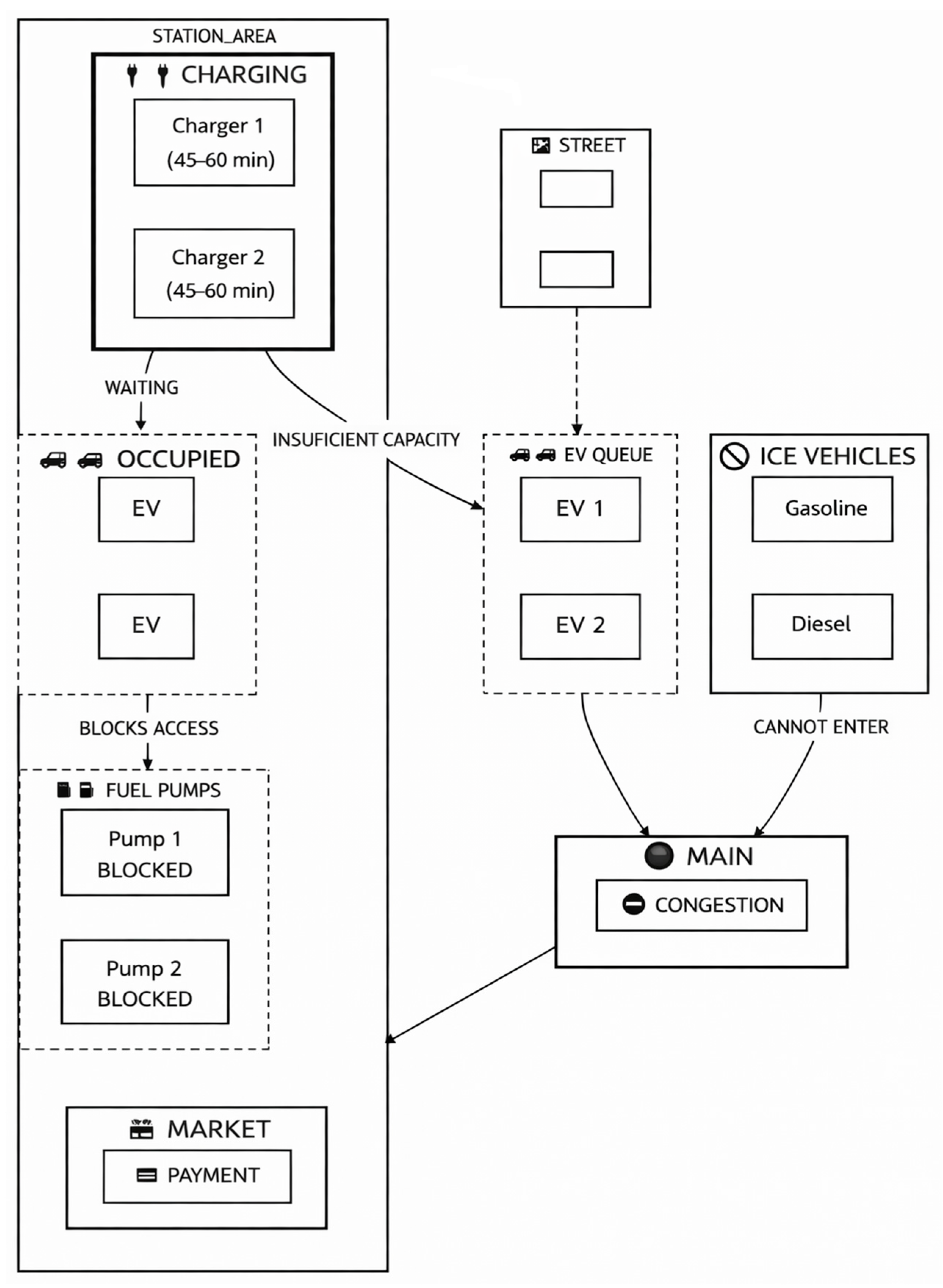
From an urban planning perspective, converting existing fuel stations rather than developing entirely new sites represents a more feasible and sustainable approach [54]. However, such conversion processes require the integrated consideration of traffic conditions, user behavior, charging durations, and spatial layout in order to prevent unintended operational conflicts. In particular, EV-ready charging units impose distinctly different physical and operational space requirements compared to conventional fuel dispensers. Longer vehicle dwell times, cable management constraints, increased turning radii, and the need for additional buffer and queuing space are expected to directly affect internal circulation within the station. As illustrated in Figure 20, insufficient spatial allocation may cause queues formed by EVs entering the station to obstruct not only charging operations but also access for ICEVs seeking refueling. Moreover, the larger spatial footprint of charging units relative to fuel pumps, together with technical constraints such as cable routing and safety clearances, may require the removal of two conventional fuel dispensers to accommodate a single charging unit, thereby directly reducing overall station capacity and operational flexibility. Studies examining the adverse effects of roadside vehicle accumulation and parking-related spillback on traffic flow and internal circulation further support these findings [55]. Taken together, these considerations highlight the critical importance of explicitly accounting for the physical and operational space requirements of EV charging infrastructure in the spatial design and conversion planning of hybrid fuel stations.
The literature indicates that increasing EV ownership may have impacts not only on energy infrastructure but also on overall traffic patterns and travel behavior. For instance, the spatial distribution of EVs within the traffic system and the concentration of charging demand in specific areas can directly influence traffic congestion and vehicle flow dynamics; integrated traffic–charging models demonstrate that EV usage can generate significant effects on traffic density and flow conditions [55,56]. Moreover, the relationship between EV charging behavior and conventional traffic patterns reveals that daily charging demand profiles tend to align with regular travel routines, highlighting the need to adapt planning and traffic management strategies to explicitly account for EV-related demand. In this context, conducting sensitivity analyses to assess the impacts of EV growth on travel behavior and traffic flow can provide valuable insights for the integrated planning of charging infrastructure and traffic management strategies [57].
The economic sustainability of station operators constitutes an important complementary dimension of the conversion process. Rather than providing a full financial feasibility or profitability assessment, this study qualitatively highlights the key economic factors that may influence conversion decisions. When EV charging demand levels, potential revenues from charging services, reductions in ICEV refueling capacity due to spatial reallocation, electricity price variability, and infrastructure investment requirements are considered collectively, it becomes evident that the economic outcomes of conversion may vary substantially across stations [58]. These interacting factors may, in turn, affect operators’ willingness to invest in EV charging infrastructure. Accordingly, the operational performance indicators identified in this study (such as waiting times, queue lengths, and capacity losses) should be interpreted as critical inputs for future, station-specific economic evaluations rather than as direct measures of profitability.
Overall, the simulation findings clearly indicate that public fast-charging infrastructure must be carefully planned and deployed in a phased manner. Integrated planning approaches that jointly consider traffic demand, user behavior, software and auxiliary processes, and actual service durations are of paramount importance. It is recommended that real field-based dwell time distributions be used instead of nominal values when estimating charging durations. Particularly in high-demand urban corridors, appointment-based or dynamic charging management systems offer significant potential to reduce peak-hour queues and improve internal station circulation. In addition, the development of spatial design and operational standards for hybrid stations would contribute to a more controlled and efficient transition process.
From a sustainability perspective, the manner in which the increasing electricity demand generated by the conversion of conventional fuel stations into EV charging facilities is met constitutes a critical concern. The environmental benefits of electric vehicles are not solely determined by vehicle technology itself but are strongly dependent on the structure of the electricity generation mix supplying the charging infrastructure. In countries where electricity production remains partially dependent on fossil fuel-based sources, the short-term decarbonization potential of electric vehicles may be limited, and EV deployment does not automatically translate into carbon neutrality. This issue is particularly relevant for Turkey, where a considerable share of electricity generation is still derived from coal and natural gas. Nevertheless, the growing penetration of renewable energy sources in the national electricity mix indicates a gradual transition toward lower-carbon electricity generation. In this context, the integration of EV charging infrastructure with renewable energy systems (such as on-site photovoltaic generation, energy storage solutions, and smart load management) emerges as a key strategy to mitigate indirect emissions and ensure that the expansion of charging demand contributes effectively to long-term sustainability goals. Therefore, the conversion of fuel stations into hybrid EV charging facilities should be evaluated not only from an operational and capacity perspective but also within an integrated energy–transportation planning framework that aligns charging demand growth with the decarbonization of electricity supply [15,16,17].
By combining field measurements, survey data, and microsimulation, this study offers a comprehensive evaluation framework that contributes to the existing literature. It quantitatively identifies operational tipping points that emerge once EV shares at hybrid stations exceed certain thresholds and emphasizes the decisive role of user behavior and spatial configuration in charging infrastructure performance. The findings demonstrate that purely technical solutions (such as increasing charging power or the number of connectors) are insufficient on their own to meet future public charging demand. Instead, operational improvements, optimization of software processes, and user behavior considerations are at least as critical as technical factors. Overall, this study highlights the necessity of addressing the design, strategic placement, and operation of hybrid stations through an integrated approach grounded in both technical and behavioral evidence, offering concrete insights for policymakers and planners.

6. Conclusions

This study quantitatively analyzed the operational impacts of integrating EV charging units into a conventional fuel station located along the Istanbul E-5 side-road using a discrete-event simulation model supported by field data. The model was developed based on 1864 observed vehicle arrivals recorded between 06:00 and 24:00 and was validated within 95% confidence intervals.
Simulation results indicate that under a 5% EV penetration scenario, the existing station configuration remains largely sufficient from an operational perspective. In this scenario, the number of vehicles waiting within the station generally remains within the range of 0–5 vehicles throughout the day, and no significant capacity exceedance is observed. However, once the EV share reaches 10%, a clear degradation in system performance emerges. During morning and evening peak periods, the number of waiting EVs increases to approximately 8–15 vehicles, indicating growing pressure on internal circulation and service processes.
The 20% EV penetration scenario represents a critical saturation condition. In this case, during the evening peak hour (18:00–19:00), the average number of EVs waiting within the station reaches 34.06 (±1.23) vehicles. By comparison, the corresponding value in the 10% EV scenario is 15.6 (±0.84) vehicles for the same time interval. This sharp increase demonstrates that queue formation accelerates in a nonlinear manner once the EV share exceeds approximately 10%, clearly signaling the transition of the system into a saturated regime.
In the second stage of the analysis, the effects of converting two dual-hose fuel dispensers into EV charging units were examined. This conversion results in substantial waiting for ICEVs, particularly during evening peak hours. Simulation outputs show that an average of 9.65 ICEVs wait between 17:00–18:00, and this number increases to 26.29 ICEVs between 18:00–19:00. These findings quantitatively demonstrate that EV integration directly affects ICEV service performance and should be evaluated as a system-wide operational change rather than a standalone infrastructure upgrade.
To assess the influence of charging duration, a high-power charging scenario was also evaluated, assuming that EVs complete charging within 10–20 min. Although this scenario leads to a reduction in waiting queues, the improvement remains limited during peak hours. Specifically, during 18:00–19:00, the number of waiting EVs decreases from 34.06 vehicles to 29.53 vehicles, indicating that shorter charging times alone are insufficient to eliminate congestion under high-demand conditions.
In conclusion, this study quantitatively identifies approximately 10% EV penetration as a critical operational threshold for hybrid fuel stations. Once this threshold is exceeded, waiting queues increase rapidly, leading to a significant deterioration in service quality for both EVs and ICEVs. The findings highlight that the conversion of conventional fuel stations into EV-ready hybrid facilities is not merely a technological intervention but a comprehensive capacity planning and spatial management challenge. Field data-driven simulation approaches provide a robust and practical framework for identifying operational tipping points and supporting data-informed decision-making in the transition toward sustainable urban charging infrastructure.

Author Contributions

Conceptualization, M.Y.; Methodology, M.Y.; Software, M.Y.; Formal analysis, M.Y.; Resources, M.Y.; Data curation, M.Y.; Writing—original draft, M.Y.; Supervision, M.K., M.S.Y. All authors have read and agreed to the published version of the manuscript.

Funding

This research received no external funding.

Institutional Review Board Statement

The study was conducted in accordance with the Declaration of Helsinki, and approved by the Institutional Review Board (Etik Kurul) Istanbul Gelisim University (protocol code 2025-14 and date of approval 18 July 2025).

Informed Consent Statement

Informed consent was obtained from all subjects involved in the study.

Data Availability Statement

The original contributions presented in this study are included in the article. Further inquiries can be directed to the corresponding author.

Acknowledgments

We would like to express our gratitude to the editors and reviewers for their valuable comments and support towards the publication.

Conflicts of Interest

The authors declare no conflicts of interest.

Abbreviations

The following abbreviations are used in this manuscript:
EVElectric Vehicle
ICEVInternal Combustion Engine Vehicle
DCDirect Current
EMRAEnergy Market Regulatory Authority
K–S TestKolmogorov–Smirnov goodness-of-fit test
CIConfidence Interval
SDStandard Deviation
GFGrowth Factor
IFImprovement Factor

References

  1. Raihan, A.; Rashid, M.; Voumik, L.C.; Akter, S.; Esquivias, M.A. The dynamic impacts of economic growth, financial globalization, fossil fuel, renewable energy, and urbanization on load capacity factor in Mexico. Sustainability 2023, 15, 13462. [Google Scholar] [CrossRef]
  2. Mo, T.; Lau, K.; Li, Y.; Poon, C.; Wu, Y.; Chu, P.K.; Luo, Y. Commercialization of electric vehicles in Hong Kong. Energies 2022, 15, 942. [Google Scholar] [CrossRef]
  3. European Environment Agency (EEA). Greenhouse Gas Emissions from Transport; EEA: Copenhagen, Denmark, 2025; Available online: https://www.eea.europa.eu/en/analysis/indicators/greenhouse-gas-emissions-from-transport (accessed on 9 July 2025).
  4. TrendForce. Global Public EV Charging Piles Growth to Slow Significantly in 2024, Led by China and South Korea, Says TrendForce. Available online: https://www.trendforce.com/presscenter/news/20241120-12370.html (accessed on 25 May 2025).
  5. Macioszek, E. The role of incentive programs in promoting the purchase of electric cars—Review of good practices and promoting methods from the world. In Research Methods in Modern Urban Transportation Systems and Networks; Macioszek, E., Sierpiński, G., Eds.; Springer: Cham, Switzerland, 2021; pp. 41–58. [Google Scholar] [CrossRef]
  6. Mousa, M.M.; Saleh, S.M.; Samy, M.M.; Barakat, S. Optimizing grid-tied hybrid renewable systems for EV charging in Egypt: A techno-economic analysis. Results Eng. 2025, 27, 106103. [Google Scholar] [CrossRef]
  7. Oladigbolu, J.; Bakare, M.S.; Motlagh, S.G.; Mujeeb, A.; Li, L. A review on transport and power systems planning-operation integrating electric vehicles, energy storage, and other distributed energy resources. J. Energy Storage 2025, 135, 118419. [Google Scholar] [CrossRef]
  8. Krishnamurthy, N.K.; Sabhahit, J.N.; Jadoun, V.K.; Pandey, A.K.; Rao, V.S.; Saraswat, A.A. Grid-interfaced DC microgrid-enabled charging infrastructure for empowering smart sustainable cities and its impacts on the electrical network: An inclusive review. Smart Cities 2025, 8, 176. [Google Scholar] [CrossRef]
  9. Capar, I.; Kuby, M.; Leon, V.J.; Tsai, Y.-J. An arc cover–path-cover formulation and strategic analysis of alternative-fuel station locations. Eur. J. Oper. Res. 2013, 227, 142–151. [Google Scholar] [CrossRef]
  10. Yuvaraj, T.; Devabalaji, R.K.; Kumar, J.A.; Thanikanti, S.B.; Nwulu, N.I. A comprehensive review and analysis of the allocation of electric vehicle charging stations in distribution networks. IEEE Access 2024, 12, 5404–5461. [Google Scholar] [CrossRef]
  11. Daşcıoğlu, B.G.; Tuzkaya, G.; Kılıç, H.S. A model for determining the locations of electric vehicles’ charging stations in Istanbul. Pamukkale Univ. J. Eng. Sci. 2019, 25, 1056–1061. [Google Scholar] [CrossRef]
  12. Adamova, V.; Popov, S.; Baeva, S.; Hinov, N. Design scenarios and risk-aware performance framework for modular EV fast charging stations. Energies 2025, 18, 6043. [Google Scholar] [CrossRef]
  13. Mangini, A.M.; Fanti, M.P.; Silvestri, B.; Ranieri, L.; Roccotelli, M. Modeling and simulation of electric vehicles charging services by a time colored Petri net framework. Energies 2025, 18, 867. [Google Scholar] [CrossRef]
  14. Sevin, A.; Yaman, G.; Atılgan, D. Analysis of queue models in simulation applications. Sak. Univ. J. Comput. Inf. Sci. 2025, 8, 123–135. [Google Scholar] [CrossRef]
  15. Ghosh, N.; Bhagavathy, S.M.; Thakur, J. Accelerating electric vehicle adoption: Techno-economic assessment to modify existing fuel stations with fast charging infrastructure. Clean Technol. Environ. Policy 2022, 24, 3033–3046. [Google Scholar] [CrossRef]
  16. Majumdar, D.; Majhi, B.K.; Dutta, A.; Mandal, R.; Jash, T. Study on possible economic and environmental impacts of electric vehicle infrastructure in public road transport in Kolkata. Clean Technol. Environ. Policy 2015, 17, 1093–1101. [Google Scholar] [CrossRef]
  17. Fernández, G.; Torres, J.; Cervero, D.; García, E.; Alonso, M.Á.; Almajano, J. EV charging infrastructure in a petrol station: Lessons learned. In Proceedings of the 2018 International Symposium on Industrial Electronics (INDEL), Banja Luka, Bosnia and Herzegovina, 1–3 November 2018; IEEE: Piscataway, NJ, USA. [Google Scholar] [CrossRef]
  18. Bayram, I.S.; Zafar, U.; Bayhan, S. Could petrol stations play a key role in transportation electrification? A GIS-based coverage maximization of fast EV chargers in urban environment. IEEE Access 2022, 10, 18789–18802. [Google Scholar] [CrossRef]
  19. Arup; National University of Singapore (NUS). The Future of Petrol Stations in an Electric Vehicle World; Arup: London, UK, 2024. [Google Scholar]
  20. Smith, S.D. The Future of Gas Stations: Converting to EV Charging Stations? Carscoops. 8 April 2023. Available online: https://www.carscoops.com/2023/04/gas-stations-to-turn-into-charge-ports-suggests-new-study (accessed on 20 November 2024).
  21. International Energy Agency (IEA). Global EV Outlook 2025: Prospecting the Transition to 2035; IEA: Paris, France, 2025. [Google Scholar]
  22. Energy Market Regulatory Authority (EMRA). Turkey Electric Vehicle Charging Infrastructure Report; Energy Market Regulatory Authority: Ankara, Turkey, 2025. [Google Scholar]
  23. Anadolu Agency (AA). Gasoline and Diesel Car Sales Decline While Electric and Hybrid Sales Continue to Rise; Anadolu Agency (AA): Çankaya, Turkey, 2025; Available online: https://www.aa.com.tr/tr/ekonomi/benzinli-ve-dizel-otomobil-satislari-duserken-elektrikliyle-hibritte-yukselis-suruyor/3706357 (accessed on 10 September 2025).
  24. Mohammed, A.; Saif, O.; Abo-Adma, M.; Fahmy, A.; Elazab, R. Strategies and sustainability in fast charging station deployment for electric vehicles. Sci. Rep. 2024, 14, 283. [Google Scholar] [CrossRef]
  25. Tarafdar, S. Integrated Planning of Residential and Commercial Electric Vehicle Charging Infrastructure: A Strategic Bi-Level Optimization and Queuing Framework Approach. Ph.D. Thesis, University of Maryland, College Park, MD, USA, 2025. [Google Scholar]
  26. Energy Market Regulatory Authority (EMRA). Petroleum Market License Statistics; Energy Market Regulatory Authority: Çankaya, Turkey, 2025. Available online: https://lisans.epdk.gov.tr/epvys-web/faces/pages/lisans/petrolIstatistik/petrolIstatistik.xhtml (accessed on 15 December 2025).
  27. Azin, B.; Yang, X.; Marković, N.; Liu, M. Infrastructure enabled and electrified automation: Charging facility planning for cleaner smart mobility. Transp. Res. Part D Transp. Environ. 2021, 101, 103079. [Google Scholar] [CrossRef]
  28. Datta, U.; Kalam, A.; Shi, J. Smart control of BESS in PV integrated EV charging station for reducing transformer overloading and providing battery-to-grid service. J. Energy Storage 2020, 28, 101224. [Google Scholar] [CrossRef]
  29. Roy, P.; Ilka, R.; He, J.; Liao, Y.; Cramer, A.M.; Mccann, J.; Delay, S.; Coley, S.; Geraghty, M.; Dahal, S. Impact of electric vehicle charging on power distribution systems: A case study of the grid in Western Kentucky. IEEE Access 2023, 11, 49002–49023. [Google Scholar] [CrossRef]
  30. Sundstrom, O.; Binding, C. Planning electric-drive vehicle charging under constrained grid conditions. In Proceedings of the 2010 International Conference on Power System Technology, Hangzhou, China, 24–28 October 2010. [Google Scholar] [CrossRef]
  31. Wang, G.; Xu, Z.; Wen, F.; Wong, K.P. Traffic-constrained multiobjective planning of electric-vehicle charging stations. IEEE Trans. Power Deliv. 2013, 28, 2363–2372. [Google Scholar] [CrossRef]
  32. Neaimeh, M.; Salisbury, S.D.; Hill, G.A.; Blythe, P.T.; Scoffield, D.R.; Francfort, J.E. Analysing the usage and evidencing the importance of fast chargers for the adoption of battery electric vehicles. Energy Policy 2017, 108, 474–486. [Google Scholar] [CrossRef]
  33. Figenbaum, E.; Kolbenstvedt, M. Learning from Norwegian Battery Electric and Plug-in Hybrid Vehicle Users—Results from a Survey of Vehicle Owners; Institute of Transport Economics Norwegian Centre for Transport Research: Oslo, Norway, 2016. [Google Scholar]
  34. Kang, J.E.; Recker, W. Strategic hydrogen refueling station locations with scheduling and routing considerations of individual vehicles. Transp. Sci. 2015, 49, 767–783. [Google Scholar] [CrossRef]
  35. Tayri, A.; Ma, X. Grid impacts of electric vehicle charging: A review of challenges and mitigation strategies. Energies 2025, 18, 3807. [Google Scholar] [CrossRef]
  36. LaMonaca, S.; Ryan, L. The state of play in electric vehicle charging services—A review of infrastructure provision, players, and policies. Renew. Sustain. Energy Rev. 2021, 152, 111733. [Google Scholar] [CrossRef]
  37. Xylia, M.; Olsson, E.; Macura, B.; Nykvist, B. Estimating charging infrastructure demand for electric vehicles: A systematic review. Energy Strategy Rev. 2025, 59, 101753. [Google Scholar] [CrossRef]
  38. McKinsey & Company. The Future of EV Charging Infrastructure; McKinsey: New York, NY, USA, 2023. [Google Scholar]
  39. Beefull. Will Charging My Electric Car at Home Become More Expensive? What Does EMRA’s Last Resort Supply Tariff (LRST) Regulation Bring? Available online: https://beefull.com/blog/elektrikli-aracimi-evden-sarj-etmek-artik-daha-mi-pahali-olacak-epdknin-sktt-duzenlemesi-ne-getiriyor (accessed on 12 September 2025).
  40. Gönül, Ö.; Duman, A.C.; Güler, Ö. A comprehensive framework for electric vehicle charging station siting along highways using weighted sum method. Renew. Sustain. Energy Rev. 2024, 199, 114455. [Google Scholar] [CrossRef]
  41. Republic of Turkey Ministry of Industry and Technology. Mobility Vehicles and Technologies Roadmap (2022–2030); Republic of Turkey Ministry of Industry and Technology: Ankara, Turkey, 2022. Available online: https://www.sanayi.gov.tr/assets/pdf/plan-program/MobiliteAracveTeknolojileriYolHaritasi.pdf (accessed on 2 April 2025).
  42. Smappee. AC vs. DC EV Charging: What’s the Difference and Why It Matters. Smappee. 1 December 2025. Available online: https://www.smappee.com/blog/ac-vs-dc-ev-charging/ (accessed on 15 December 2025).
  43. ChargeLab. 86% of EV Drivers can Charge at Home, But over Half Still Rely on Public Chargers, ChargeLab Survey Finds; PR Newswire: Manhattan, NY, USA, 2024. [Google Scholar]
  44. Mahmud, I.; Medha, M.B.; Hasanuzzaman, M. Global challenges of electric vehicle charging systems and its future prospects: A review. Res. Transp. Bus. Manag. 2023, 49, 101011. [Google Scholar] [CrossRef]
  45. Facilities Managers Federation (TEYFED). Risks of Charging Infrastructure for Electric Vehicles; TEYFED: Tuzla, Turkey, 2024; Available online: https://teyfed.org/elektrikli-araclarda-sarj-altyapisi-riskleri/ (accessed on 10 September 2025).
  46. Araujo, A.; Araujo, D.; Vasconcelos, A.; Rosas, P.; Medeiros, L.; Conceicao, J. A proposal for technical and economic sizing of energy storage system and PV for EV charger stations with reduced impacts on the distribution network. In Proceedings of the CIRED 2021 Conference, Online, 20–23 September 2021. [Google Scholar]
  47. Muzir, N.A.Q.; Mojumder, M.R.H.; Hasanuzzaman, M.; Selvaraj, J. Challenges of electric vehicles and their prospects in Malaysia: A comprehensive review. Sustainability 2022, 14, 8320. [Google Scholar] [CrossRef]
  48. Walford, L. EV, Battery & Charging News: Drivers Willing to Pay Extra for Fast Chargers. Auto Connected Car News (Press Coverage by Next10). 15 September 2024. Available online: https://www.next10.org/press-coverages/ev-battery-charging-news-drivers-willing-pay-extra-fast-chargers (accessed on 25 May 2025).
  49. Hecht, C.; Figgener, J.; Sauer, D.U. Analysis of electric vehicle charging station usage and profitability in Germany based on empirical data. iScience 2022, 25, 105634. [Google Scholar] [CrossRef]
  50. Fang, L.H.; Romli, M.I.F.; Abd Rahim, R.; Aziz, M.E.A.; Abd Rahman, D.H.; Mokhtaruddin, H.H. Development of an advanced current mode charging control strategy system for electric vehicle batteries. Int. J. Power Electron. Drive Syst. (IJPEDS) 2024, 15, 2639–2650. [Google Scholar] [CrossRef]
  51. Erce, M.I.; Dönmez, B.B.; Sanlı, Y.B.; Güven, E.; Eren, T. Charging station location selection for electric vehicles. Bursa Uludag Univ. J. Sci. 2025, 12, 421–434. [Google Scholar] [CrossRef]
  52. Gulbahar, I.T.; Sutcu, M.; Almomany, A.; Ibrahim, B.S.K.K. Optimizing electric vehicle charging station location on highways: A decision model for meeting intercity travel demand. Sustainability 2023, 15, 16716. [Google Scholar] [CrossRef]
  53. Joint Office of Energy and Transportation. Public EV Charging Station Site Selection Checklist. DriveElectric.gov; 2023. Available online: https://driveelectric.gov/files/ev-site-selection.pdf (accessed on 17 August 2025).
  54. Kok, N.; Monkkonen, P.; Quigley, J.M. Land use regulations and the value of land and housing: An intra-metropolitan analysis. J. Urban Econ. 2014, 81, 136–148. [Google Scholar] [CrossRef]
  55. Hrytsun, O.; Lanets, O.; Solodkyy, S. Impact of street parking on delays and the average speed of traffic flow. Transp. Technol. 2020, 1, 33–44. [Google Scholar] [CrossRef]
  56. Srivastava, K.; Kumar, A. Critical analysis of road side friction on an urban arterial road. Eng. Technol. Appl. Sci. Res. 2023, 13, 10261–10269. [Google Scholar] [CrossRef]
  57. Andrenacci, N.; Valentini, M.P. A literature review on the charging behaviour of private electric vehicles. Appl. Sci. 2023, 13, 12877. [Google Scholar] [CrossRef]
  58. Albatayneh, A.; Juaidi, A.; Abdallah, R.; Jeguirim, M. Preparing for the EV revolution: Petrol stations profitability in Jordan. Energy Sustain. Dev. 2024, 79, 101412. [Google Scholar] [CrossRef]
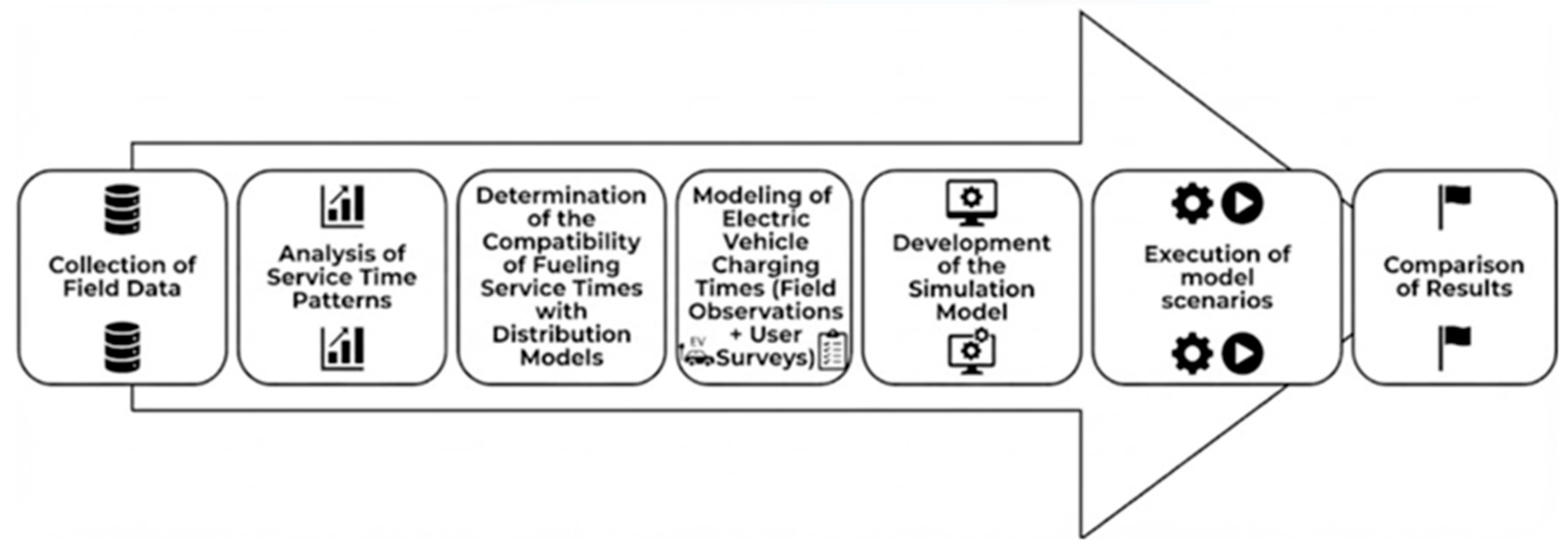
Figure 1. Flowchart for the development of the simulation model.
Sustainability 18 00893 g001
Figure 2. Spatial representation of the investigated fuel station (source: OpenStreetMap).
Sustainability 18 00893 g002
Figure 3. View of the fuel station under real-time operational conditions.
Sustainability 18 00893 g003
Figure 4. Examined DC fast-charging stations.
Sustainability 18 00893 g004
Figure 5. Flowchart used in the simulation model.
Sustainability 18 00893 g005
Figure 6. Flowchart of the Simulation Model Developed with the Inclusion of EV Arrivals.
Sustainability 18 00893 g006
Figure 7. Process modeling block of the Arena simulation model.
Sustainability 18 00893 g007
Figure 8. Number of vehicles arriving at the station between 06:00 and 24:00.
Sustainability 18 00893 g008
Figure 9. Scatter plot of charging durations at measured DC points.
Sustainability 18 00893 g009
Figure 10. Users’ charging access availability based on survey data.
Sustainability 18 00893 g010
Figure 11. Preferences of EV owners regarding the conversion of stations into charging points.
Sustainability 18 00893 g011
Figure 12. Charging station preference priorities of EV users by home/work charging availability.
Sustainability 18 00893 g012
Figure 13. Comparison of participants’ plans to acquire EVs in the next 3 and 10 years.
Sustainability 18 00893 g013
Figure 14. Participants’ percentage trends regarding future vehicle ownership.
Sustainability 18 00893 g014
Figure 15. Distribution of charging durations among EV users.
Sustainability 18 00893 g015
Figure 16. Hourly concurrent pump operation and utilization rates in the current station configuration.
Sustainability 18 00893 g016
Figure 17. Number of waiting vehicles at the station and their relative increase rates under different EV share scenarios.
Sustainability 18 00893 g017
Figure 18. Impact of EV Share and Charging Time on Waiting Queue Length under the 20% EV Scenario.
Sustainability 18 00893 g018
Figure 19. Hourly distribution of pump utilization for ICEVs (single and double dual-hose fuel dispenser).
Sustainability 18 00893 g019
Figure 20. Conceptual flow diagram illustrating the operational impacts of EV charging demand on internal station circulation, queue formation, and fuel refueling operations of ICEVs in a hybrid fuel station.
Sustainability 18 00893 g020
Table 1. Time-interval-based probability distributions and goodness-of-fit statistics for interarrival times.
Time
Interval
Sample Size (n)Suitable
Probability
Distribution for Interarrival Times (s)
Squared ErrorK–S Statisticp-Value
06:00–07:003127 + WEIB (80.9, 1.27)0.05835100.1310.0901
08:00–09:001520.999 + WEIB (23, 1.02)0.00823600.1010.0867
10:00–11:009157 + 483 × BETA (1.6, 2.29)0.00464000.0503>0.15
11:00–12:0087NORM (39.5, 23.7)0.03085400.1640.0647
14:00–15:0096NORM (246, 70.6)0.04085200.1430.0478
17:00–18:001596 + 116 × BETA (1.44, 2.66)0.03219300.0107>0.15
18:00–19:00201−0.5 + GAMM (13.6, 1.34)0.00158550.104>0.15
19:00–20:001375.5 + WEIB (21.1, 1.27)0.00388000.0686>0.15
22:00–23:0058TRIA (4, 56.5, 109)0.00757700.112>0.15
23:00–24:003843.5 + 96 × BETA (1.06, 0.807)0.03225500.117>0.15
Note: WEIB = Weibull distribution; BETA = Beta distribution; NORM = Normal distribution; GAMM = Gamma distribution; TRIA = Triangular distribution; K–S statistic = Kolmogorov–Smirnov statistic; p-value = significance level of the K–S test, where each distribution was fitted using the hourly interarrival time data.
Table 2. Time-interval-based probability distributions and goodness-of-fit statistics for dwell times.
Time
Interval
Sample Size (n)Suitable Probability Distribution for Dwell Time
(s)
Squared ErrorK–S Statisticp-Value
06:00–07:0031129 + EXPO (75.5)0.02593100.1340.119
08:00–09:00152150 + 398 × BETA (0.883, 2.48)0.04478600.11>0.15
10:00–11:009191 + GAMM (139, 1.36)0.00936300.1040.0601
11:00–12:0087NORM (44.3, 23.8)0.04178800.150.0485
14:00–15:009681 + WEIB (159, 1.64)0.02036200.1150.0963
17:00–18:00159102 + WEIB (163, 1.77)0.04119100.1390.082
18:00–19:00201102 + ERLA (48.4, 3)0.01557600.0752>0.15
19:00–20:0013778 + WEIB (169, 1.69)0.00803000.08940.149
22:00–23:005886 + ERLA (73, 2)0.00585200.0629> 0.15
23:00–24:0038TRIA (56, 361, 478)0.01375300.110.0472
Note: WEIB = Weibull distribution; EXPO = Exponential distribution; BETA = Beta distribution; NORM = Normal distribution; GAMM = Gamma distribution; ERLA = Erlang distribution; TRIA = Triangular distribution; K–S statistic = Kolmogorov–Smirnov statistic; p-value = significance level of the K–S test, where each distribution was fitted using the hourly dwell time data.
Table 3. EMRA Electric Vehicle and Charging Infrastructure Projections (2025–2035).
YearLow ScenarioMedium ScenarioHigh Scenario
2025202,030269,154361,893
2030776,3621,321,9321,679,600
20351,779,4883,307,5774,214,273
Table 4. EV penetration projections in Turkey (2030–2040).
YearTotal Vehicles
(Million)
EVs
(Million)
EV Share (%)
203041.22.76.6%
203542.24.210.0%
204043.27.217.0
Table 5. Comparison of Field and Simulation Results with 95% Confidence Intervals.
Time
Interval
Field Vehicle Arrivals95% CI—Model Vehicle ArrivalsField Dwell Time (s)SD95% CI—Model Dwell Time (s)
06:00–07:0031 31   ±   1.54 204.594.6 202.8   ±   5.02
07:00–08:00134 132   ±   2 . 33255.6107.1 259.6     ± 4.98
08:00–09:00152 153   ±   1 . 18254.383.8249.3 ±   7.46
12:00–13:00112 110   ±   2 . 85224.586.3 231.7   ±   10.59
13:00–14:00106 108   ±   1.98 251.190.5 248.1   ±   6 . 41
15:00–16:0081 82   ±   1.64 262.892.2 269.6   ±   8 . 48
19:00–20:00137 137   ±   2.88 230.788.6 228.2   ±   4.02
20:00–21:00103 101   ±   3.24 237.392.2 240.4   ±   4.33
23:00–24:0038 38   ±   0.47 294.387.0 295.1   ±   8 . 33
Note: SD = standard deviation of field-measured dwell times; CI: 95% confidence interval.
Disclaimer/Publisher’s Note: The statements, opinions and data contained in all publications are solely those of the individual author(s) and contributor(s) and not of MDPI and/or the editor(s). MDPI and/or the editor(s) disclaim responsibility for any injury to people or property resulting from any ideas, methods, instructions or products referred to in the content.