4.4. Quantile-on-Quantile ARDL Result
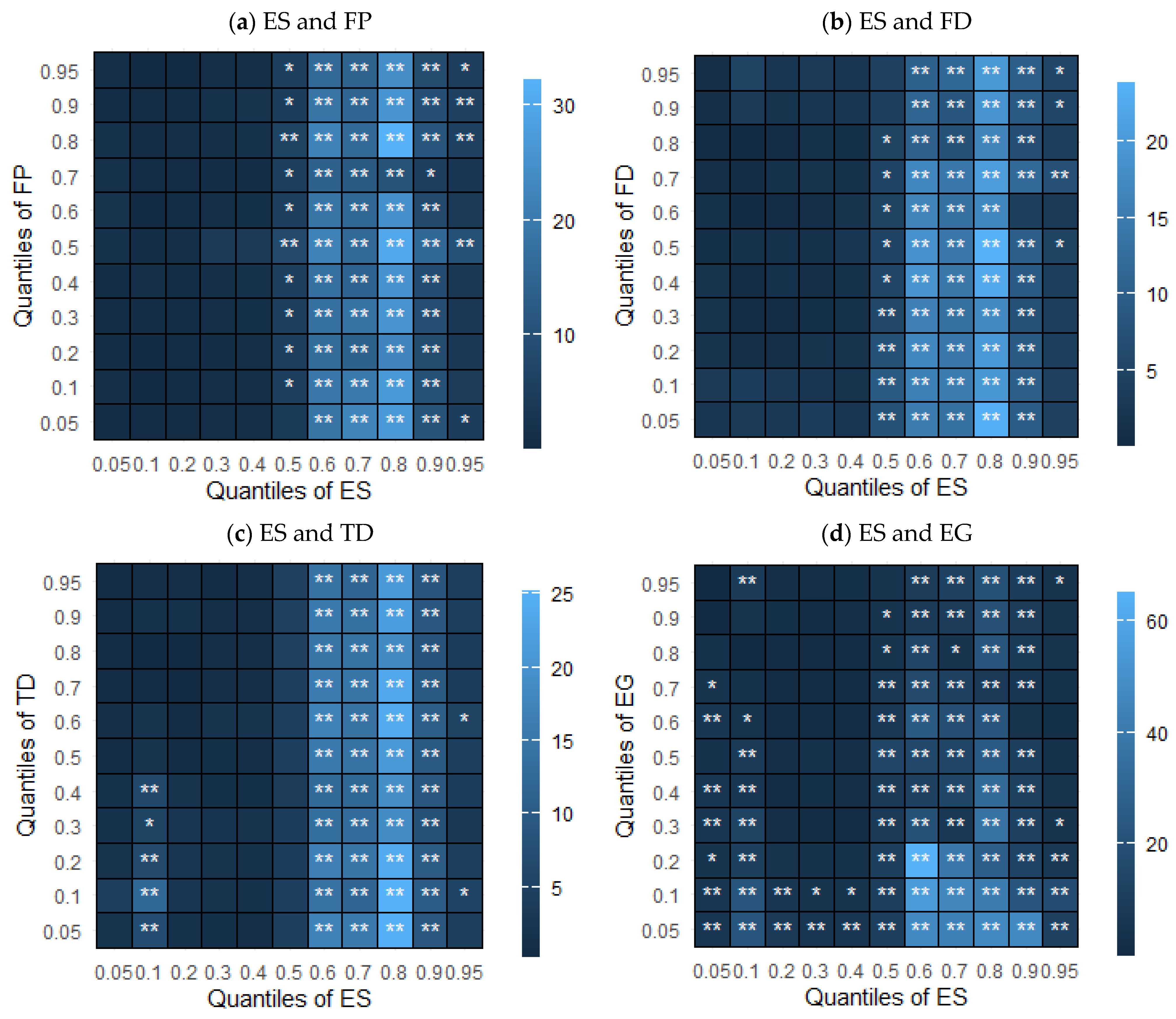
The QQARDL bounds test results in
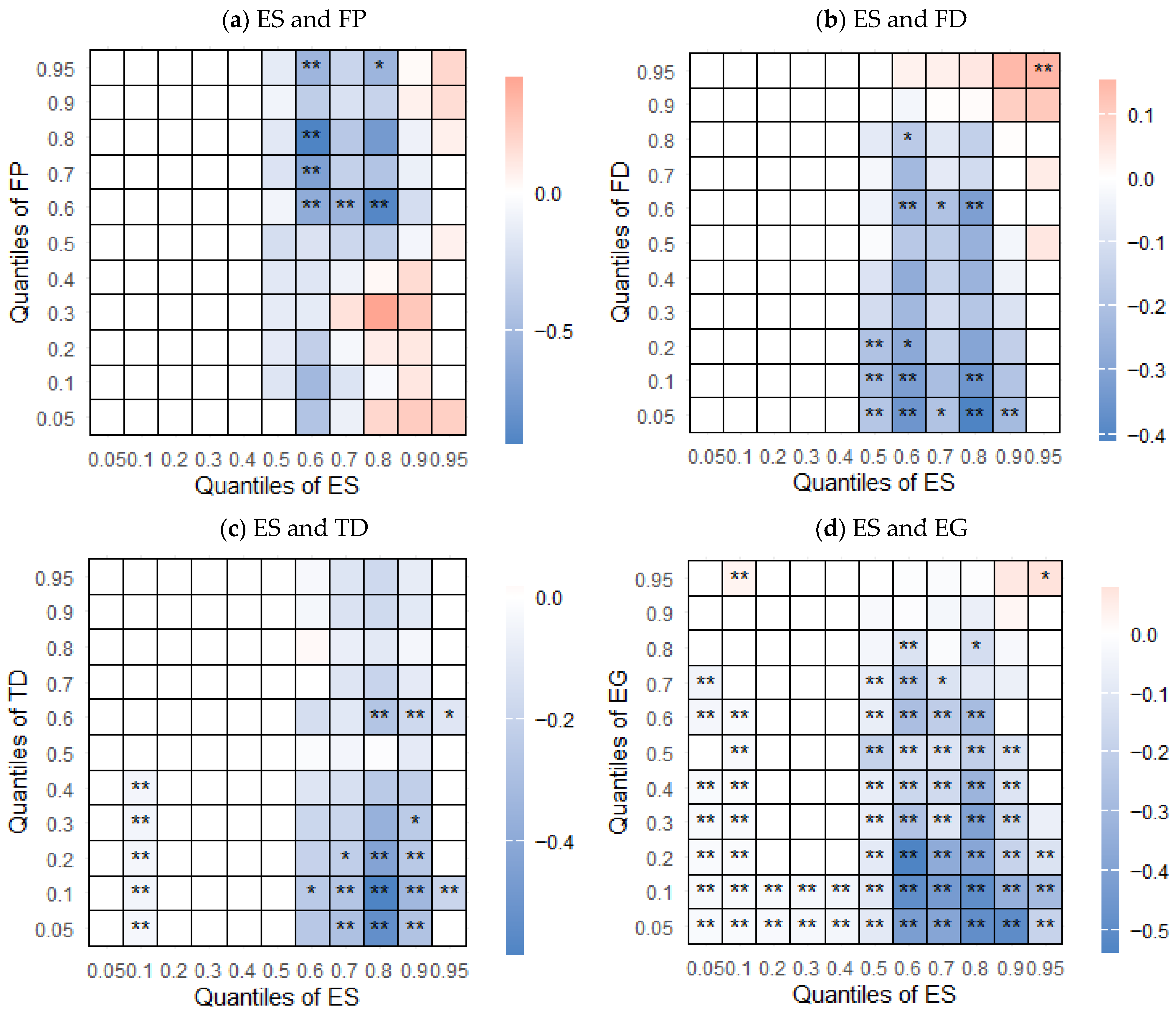
Figure 3 provide evidence of quantile-dependent cointegration between ES and the other variables—FP, FD, TD, and EG. The heatmaps show the test statistics across combinations of ES quantiles (
x-axis) and the quantiles of each explanatory variable (
y-axis), with the intensity of the shading and the presence of significance stars indicating where the null hypothesis of no cointegration is rejected. The results reveal that cointegration is not uniform but rather concentrated in specific quantile ranges, highlighting the asymmetric and heterogeneous nature of the long-run relationships. For instance, ES and FP demonstrate significant cointegration predominantly in the mid-to-upper quantiles, suggesting that stronger female participation interacts with higher levels of environmental sustainability in forming a long-run equilibrium. Similarly, ES and FD display robust cointegration across a wide range of quantiles, emphasizing the deep linkages between financial development and sustainability outcomes. The relationship between ES and TD shows cointegration, particularly in mid- and upper quantiles, indicating that trade openness contributes more strongly to long-run sustainability dynamics at higher conditional distributions of ES. The ES–EG nexus stands out with widespread and consistent cointegration across nearly all quantile combinations, underscoring the fundamental long-run trade-off and interdependence between economic growth and environmental sustainability. Overall, the QQARDL bounds test results confirm that the variables are cointegrated, but in a quantile-specific manner, meaning that the strength and presence of long-run relationships vary across different states of the economy and environment.
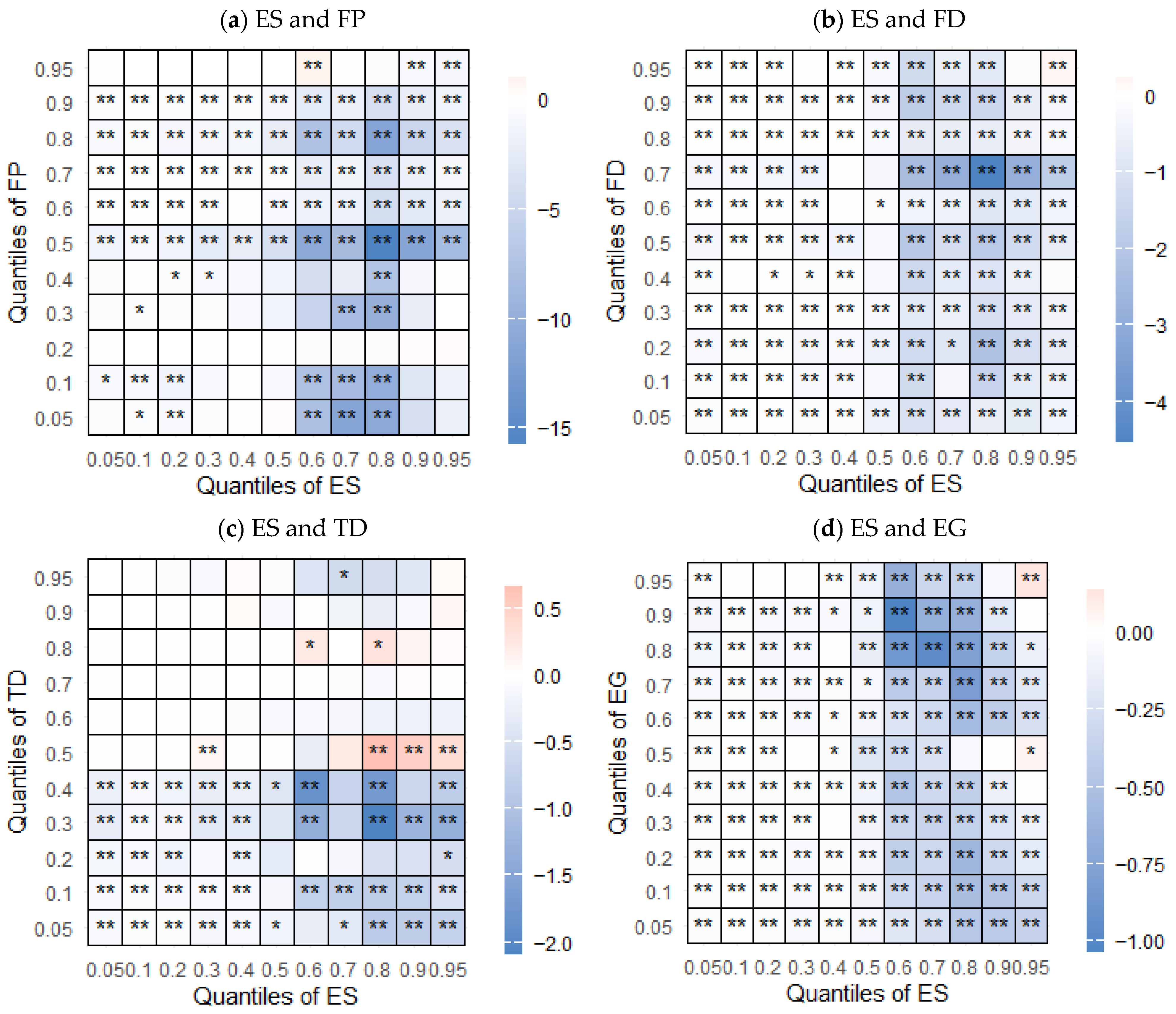
The QQARDL long-run results in
Figure 4 provide quantile-specific insights into the relationship between environmental sustainability (ES) and its key determinants. Panel a shows that the ES–FP relationship is predominantly negative across mid-to-upper quantiles, with several cells around the 0.6–0.8 quantiles of ES and FP showing significant coefficients. This indicates that in China, when both environmental sustainability and female political participation are relatively high, greater participation does not translate into improved sustainability outcomes but instead coincides with deteriorations. A few positive but nonsignificant coefficients at the upper tail (0.9–0.95) suggest that only at very high quantiles might FP support ES, but the evidence is weak.
Panel b shows that ES and FD are also mostly negatively associated, with strong significance in the lower and mid-quantiles of ES and FD. For instance, at the 0.1–0.3 quantiles of ES and FD, coefficients are around −0.2 to −0.3, indicating a clear long-run trade-off. This suggests that in states of low to moderate sustainability, financial deepening in China has often come at an environmental cost, reflecting the country’s reliance on credit expansion and financial flows that historically favored industrial sectors. However, at the very upper quantiles (0.9–0.95), a weak positive effect emerges, hinting that advanced stages of financial development—likely linked to green finance reforms in recent years—may begin to align more positively with sustainability goals.
The ES–TD relationship in Panel c further illustrates China’s structural challenges. Significant negative coefficients dominate at low ES quantiles (0.05–0.25) across multiple trade quantiles, with magnitudes close to −0.4. This indicates that during periods of weak environmental performance, trade expansion exacerbates environmental degradation, consistent with the pollution haven hypothesis. However, at mid-to-high ES quantiles (0.5–0.8), the coefficients weaken, suggesting that once sustainability reaches moderate levels, the adverse effects of trade are somewhat less pronounced—potentially reflecting technology transfer or the adoption of cleaner production standards through trade integration.
Finally, Panel d highlights the ES–EG nexus, where negative long-run coefficients are consistently observed across nearly all quantile combinations, with magnitudes often around −0.3 to −0.5 and strong significance in the mid-to-upper quantiles. This finding confirms the environmental cost of China’s sustained economic growth, particularly when growth is high and ES is moderate to high. While this aligns with the classic Environmental Kuznets Curve (EKC) trade-off in the early and middle stages of development, it also contrasts with studies suggesting that China has already reached the turning point.
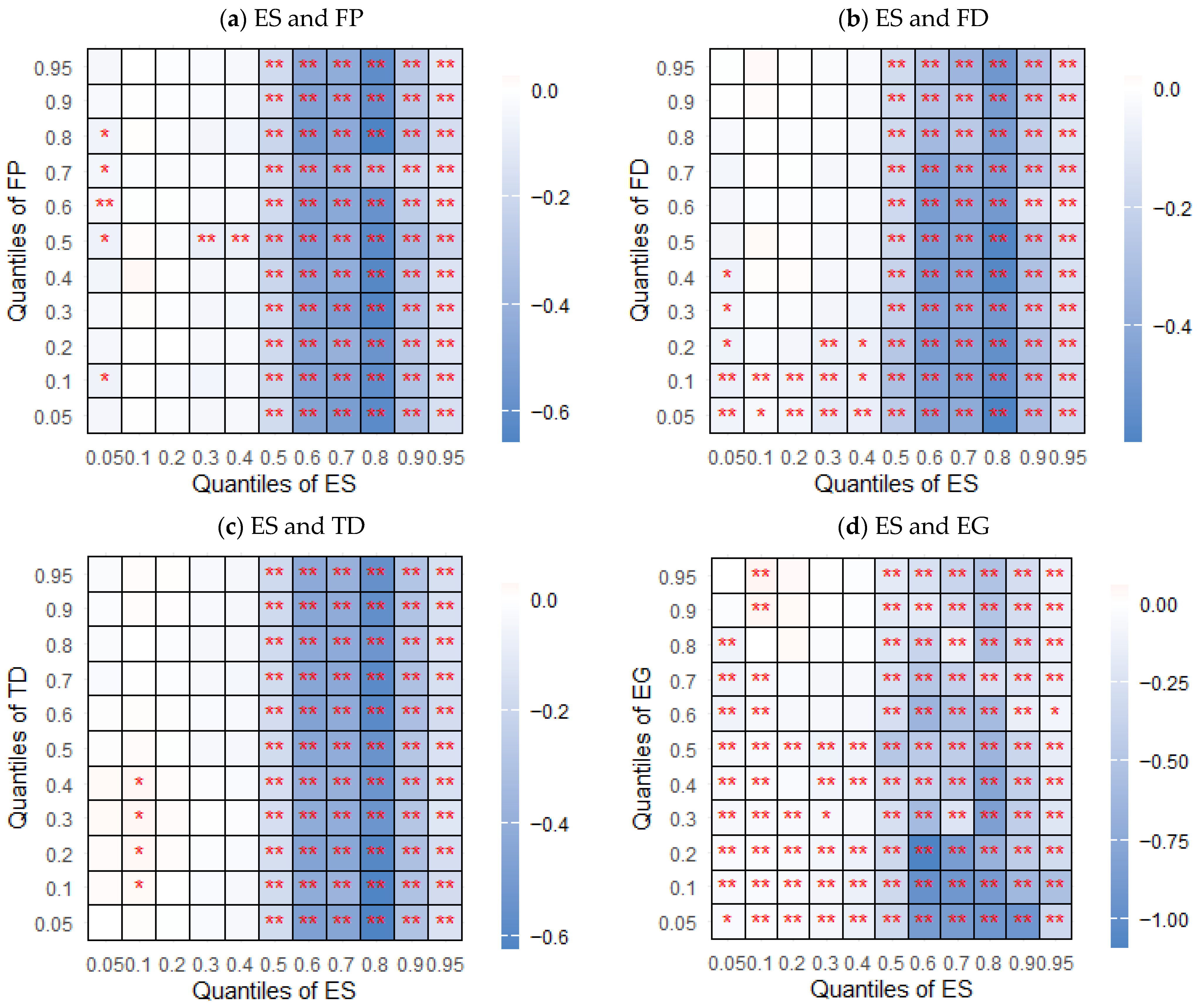
Figure 5 shows the short-run QQARDL. Panel a demonstrates that the ES–FP relationship is predominantly negative and statistically significant across most quantile combinations, particularly when both ES and FP are in their lower to middle quantiles. This implies that in the short run, increases in female political participation coincide with reductions in environmental sustainability. One interpretation is that in contexts where institutional mechanisms are not fully supportive, greater female representation may not immediately translate into improved sustainability outcomes but could instead be constrained by structural economic priorities. Nonetheless, the persistence of significance across quantiles underscores the importance of FP as a channel shaping ES, even if its short-run impact is adverse.
Panel b shows a strong negative short-run relationship between ES and FD, with statistically significant coefficients dominating across almost all quantile combinations. The magnitudes are concentrated around −1 to −4, suggesting that financial development exerts a substantial short-run pressure on environmental sustainability in China. This indicates that credit expansion and financial flows are still disproportionately directed towards environmentally intensive sectors such as manufacturing, real estate, and infrastructure development, which generate immediate environmental costs. Unlike the long-run findings, where some weak positive effects emerge at higher quantiles, the short-run results highlight that financial development remains a structural driver of environmental degradation in China, at least in the immediate term, before reforms in green finance can take effect.
Panel c depicts the ES–TD short-run association, where negative coefficients dominate the lower quantiles of both ES and TD, with magnitudes around −1.0 to −2.0, and significance concentrated at the 0.05–0.3 quantiles. This suggests that when environmental sustainability is weak, trade expansion exacerbates environmental degradation in the short run, consistent with the pollution haven hypothesis. However, at higher quantiles (0.7–0.9), some positive and significant coefficients emerge (reddish cells), indicating that under stronger environmental conditions, trade can potentially support ES, perhaps through cleaner production standards, environmental clauses in trade agreements, or technology spillovers. This duality underscores the conditional nature of trade’s effect: whether it reinforces or alleviates environmental pressure depends on the state of sustainability in the economy.
Finally, panel d shows that the ES–EG short-run association is almost uniformly negative, with coefficients ranging from −0.25 to −1.0 across most quantiles and strong significance throughout. This finding highlights that economic growth in China imposes immediate environmental costs across the entire distribution of ES, reinforcing the idea that growth in the short run remains resource- and pollution-intensive. Even at higher ES quantiles, growth continues to undermine sustainability, suggesting that the benefits of cleaner technologies or ecological reforms have not yet materialized strongly enough to offset the short-run environmental trade-offs of expansion. This contrasts with the long-run literature that expects eventual EKC turning points, suggesting that China’s short-run growth–environment trade-off remains structurally embedded, requiring stronger regulatory enforcement, faster clean energy adoption, and deeper institutional reforms to decouple growth from environmental degradation.
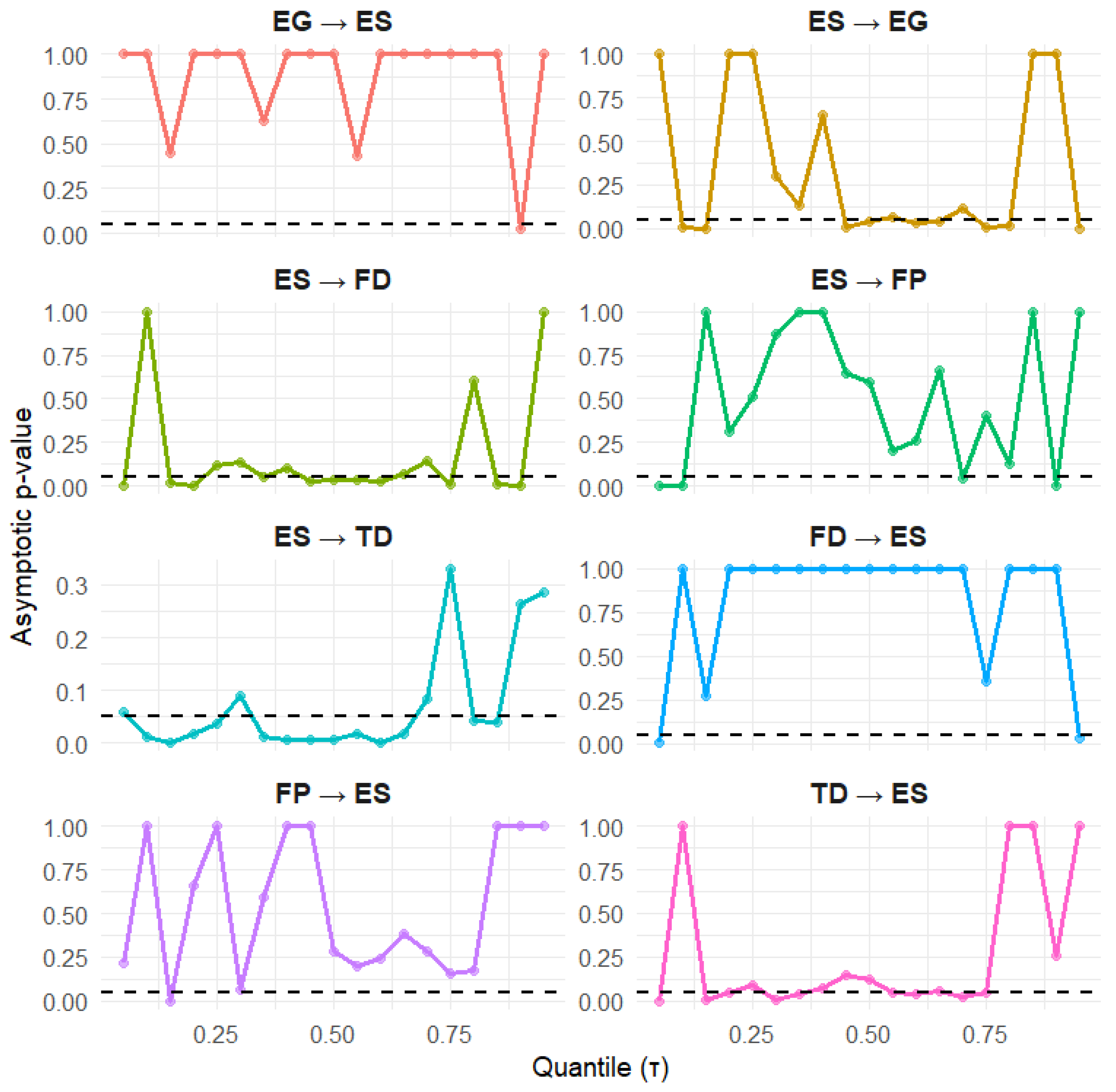
The QQARDL Error Correction Term (ECT) results in
Figure 6 illustrate the adjustment dynamics of ES in response to deviations from long-run equilibrium across FP, FD, TD, and EG. Across all panels, the ECT coefficients are consistently negative and statistically significant at most quantile combinations, which confirms the stability of the long-run relationships and the existence of a quantile-specific cointegration process. In Panel a, the ES–FP relationship shows moderately negative and significant ECT values (around −0.2 to −0.6), suggesting that when ES deviates from its long-run equilibrium with FP, approximately 20–60% of the disequilibrium is corrected in the following period depending on the quantile level. Similarly, Panel b demonstrates that ES and FD also exhibit strong and significant adjustment, with particularly higher speeds of correction at the lower quantiles of ES, indicating that when sustainability is weak, deviations from equilibrium with financial development are corrected more rapidly.
Panel c highlights the ES–TD nexus, where the adjustment coefficients are strongly negative and significant across the mid-to-upper quantiles of ES and TD, with values up to −0.6. This suggests that trade-related shocks to sustainability are quickly absorbed, particularly when ES is already at moderate to high levels, reflecting the growing integration of trade with environmental mechanisms such as cleaner exports and international regulatory standards. Finally, Panel (d) reveals the ES–EG relationship, where ECT coefficients are the largest in magnitude (approaching −1.0 in some quantiles) and highly significant throughout. This indicates that deviations from the long-run equilibrium between growth and sustainability are corrected very rapidly, particularly at higher levels of ES and EG, highlighting the strong adjustment pressures in China’s growth–environment dynamics. Collectively, these results confirm that while shocks in the short run may generate environmental imbalances, the system consistently reverts to long-run equilibrium, with the speed of adjustment varying by quantile and by the specific interaction with FP, FD, TD, and EG.
4.6. Discussion of Findings
This section presents the discussion of the findings. We observed a predominantly negative association between female political leadership (FP) and environmental sustainability (ES). In the context of China, these findings align with some studies but contrast with others. For example, ref. [
38] finds that China’s recent economic growth shows evidence of a gradual transition toward a more sustainable economic structure, but that growth still exerts environmental costs in certain sectors. Also, ref. [
1] documents that Chinese policy has increasingly aimed to include women and local female participation in environmental governance (especially through “ecological civilization”) but acknowledges that structural constraints mean female participation does not always translate into stronger environmental outcomes unless supported by stronger institutions. On the other hand, some studies, such as [
6], point out that, in higher-income contexts, female participation tends to have a more positive or at least less negative effect on environmental outcomes.
Likewise, the ES and FD association is predominantly negative. Turning less negative or weakly positive at very high ES/FD matches or echoes several recent studies. For example, ref. [
39] finds heterogeneous effects of financial development on sustainability: In low-to-middle-income provinces or earlier stages, financial deepening can reinforce environmental pressures, but in provinces where green technology, regulatory oversight, and environmental standards are more advanced, finance plays a more constructive role. Also, ref. [
40] shows that green finance (a component of financial development) has stronger positive effects in regions or quantiles with higher baseline “quality of institutions” and environmental regulation. On the other hand, there are studies that disagree or complicate this view. Some recent work argues that even in relatively advanced quantiles or provinces, the positive effects of financial development on ES are weak unless accompanied by strong environmental regulation, technology adoption, and policy reforms. For instance, ref. [
41] reports that while green finance instruments (like green bonds and green loans) are expanding, their full environmental impact remains uneven due to issues like weak implementation, greenwashing, and disparity between provinces. Also, ref. [
42] highlights that without regulatory oversight, financial development may fail to incentivize green innovation or sustainability improvements even when financial resources are abundant.
Regarding ES–TD the results highlight the structural challenges of trade for China’s environmental agenda. At the lower quantiles of environmental sustainability (0.05–0.25), the coefficients are significantly negative, with magnitudes approaching −0.4, suggesting that during periods of weak environmental performance, trade openness intensifies environmental degradation. This outcome is consistent with the pollution haven hypothesis, which posits that countries with relatively lax environmental standards attract polluting industries through trade liberalization. Ref. [
43] provides supporting evidence, showing that trade openness in China after WTO accession led to substantial increases in emissions, primarily through scale effects in energy-intensive manufacturing sectors [
44]. Similarly, ref. [
45] demonstrates that exports from environmentally intensive industries continue to contribute disproportionately to regional environmental pressures, underscoring the risks of trade-driven environmental stress in China. However, we observed that at mid-to-high ES quantiles (0.5–0.8), the negative impact of trade on environmental sustainability diminishes, suggesting that once a certain threshold of sustainability is achieved, trade integration may begin to facilitate positive spillovers. This could reflect technology transfer, the diffusion of cleaner production processes, or stricter environmental requirements imposed on exporters. Ref. [
46] confirms this channel, finding that foreign technology transfer through trade and investment has improved environmental efficiency in China’s high-tech industries. Ref. [
47] further highlights that China’s expanding role in the global market for low-carbon technologies has dual benefits: it improves partner countries’ environmental performance and incentivizes domestic firms to adopt greener practices.
Lastly, the negative association between ES and EG across nearly all quantile combinations—and especially in the mid-to-upper quantiles (≈0.5–0.95)—suggests that, in China, periods of higher growth are associated with worsening environmental sustainability, even when sustainability is already moderate to strong. The magnitude of these coefficients (around −0.3 to −0.5) indicates a substantial trade-off: Growth imposes environmental costs that are not easily offset once the economy passes certain growth thresholds, unless accompanied by strong mitigation measures. This pattern is broadly consistent with the early and middle segments of the Environmental Kuznets Curve (EKC) theory, where growth initially increases pollution before eventual reductions occur [
48]. However, this finding diverges from some of the recent literature that suggests China has already passed the turning point of the EKC for certain environmental indicators. For example, ref. [
49] finds an inverted U-shaped relation between GDP per capita and carbon emissions; Their results suggest that many urban areas have begun to show declining emissions beyond certain income levels, consistent with having reached a turning point. Meanwhile, ref. [
50] reports that while many studies validate the EKC in China, there remains significant heterogeneity: regional, sectoral, and pollution-proxy variations mean that the turning point is not uniform across the country.