
Article

The Dynamics Between Green Innovation and Environmental Quality in the UAE: New Evidence from Wavelet Correlation Methods
by
Yahya Sayed Omar
* and
Ahmad Bassam Alzubi
Institute of Graduate Research and Studies, University of Mediterranean Karpasia, Mersin 33010, Turkey
*
Author to whom correspondence should be addressed.
Sustainability 2026, 18(2), 713; https://doi.org/10.3390/su18020713 (registering DOI)
Submission received: 20 November 2025 / Revised: 23 December 2025 / Accepted: 25 December 2025 / Published: 10 January 2026
(This article belongs to the Special Issue Environmental Economics in Sustainable Social Policy Development)

Abstract

Environmental sustainability has emerged as a global imperative in the context of accelerating climate change, rapid industrialization, and increasing ecological stress. Ecological quality is necessary for countries to pursue because of its overall benefits to the entire ecosystem. Therefore, due to the significant role that the United Arab Emirates (UAE) plays in the global environment, this research examines the role of Green Innovation (GI), Financial Globalization (FG), Economic Growth (GDP), and Foreign Direct Investment (FDI) in influencing Environmental Quality (EQ) in the UAE from 1991–2022. The UAE is well known for these economic indices. Furthermore, this study employed the innovative Quantile Augmented Dickey–Fuller (QADF) test, Wavelet Quantile Regression (WQR), Wavelet Quantile Correlation (WQC), and Quantile-on-Quantile Granger Causality (QQGC). WQR is able to identify connections between series over a range of quantiles and periods. WQC evaluates the co-movement between variables at different quantile levels and across several scales. The QQGC captures the causal effect of the regressors on EQ. These methods are quite advanced compared to other traditional econometric methods. Based on the outcome of the WQR and WQC methods, evidence shows that GI contributes to EQ across all quantiles in the short, medium, and long term, while FG, GDP, and FDI reduces EQ across all quantiles in the short, medium, and long term. The QQGC results also affirm causality among the variables, implying that GI, FG, GDP, and FDI can predict EQ across all quantiles. This research recommends that the UAE should improve on its environmental policies both domestically and internationally by making them more stringent, and continue to promote clean energy investments.

1. Introduction

Achieving environmental quality (EQ) is one of the Sustainable Development Goals’ (SDGs’) primary objectives since the degradation of the environment has emerged as the world’s biggest obstacle to economic sustainability [1,2]. The threat of climate change and ecological degradation is increasing due to global warming [3]. Thus, it is essential to monitor EQ comprehensively to identify the responsible variables for a sustainable ecosystem.
To measure EQ, various studies have employed different indices, such as carbon dioxide emissions (CO2) [4,5], ecological footprint (EF) [6,7], and load capacity factor (LCF) [8,9]. Other types of greenhouse gases (GHGs) are also used to proxy for EQ. However, this research uses CO2 to proxy for EQ because it is central to today’s global economic issues [10,11]. Therefore, reducing emissions can support countries’ socio-economic growth, provide access to clean energy, and combat climate change [12].
In 2024, total energy-related CO2 rose by 0.8%, reaching a record peak of 37.8 Gt CO2. Some of the factors responsible for the surge in emissions are increased demand for energy driven by economic expansion, infrastructural development, and increasing population. In addition, the longstanding pattern of decoupling emissions increased from economic development, which had been interrupted in 2021, was resumed when emissions growth was less than global GDP growth [13].
Different factors that can drive EQ, some of which include urbanization, population growth, institutional quality, political stability, geopolitical risk, and income inequality, among others. This research focuses on pertinent drivers such as green innovation (GI), financial globalization (FG), economic growth (GDP), and foreign direct investment (FDI).
New strategies or developments in production methods or management to reduce environmental costs are also included in the concept of “green innovation.” According to [14], ecological innovation is the use of contemporary methods by businesses in their procedures and regulations to reduce ecological harm. “Present or novel manufacturing procedures that ensure environmental security” is how some economists characterize green or environmental innovation [15]. Ref. [16] distinguished between three types of ecological innovation: green organizational, green process, and green product innovation. Eco-friendly products are a part of green product innovation [17]. Green process innovation describes the application of creative techniques and strategies to lower ecological costs in the production process [18,19]. To improve the organization’s total environmentally friendly practices, green system innovation is associated with creativity in the management of organizations [20,21]. It is important to note that the way green innovation is being adopted varies from country to country. Furthermore, a nation’s unique green initiatives can expand due to FG.
FG can be categorized as one of the dimensions of economic globalization, which takes into account global assets and liabilities, FDI, investments in portfolios, and related regulations. Consequently, FG is a useful gauge of financial development [22]. By giving businesses access to green capital and bringing them into compliance with environmental regulations, FG may support the growth of domestic financial markets and make businesses more ecologically conscious. Globalization-driven financial development can also increase green financial assets and institutions that implement ecological laws [23].
International capital flows have increased in frequency as a result of the acceleration of economic globalization, particularly FDI, which not only helps host nations’ economies thrive but also causes a sharp rise in CO2 [24]. FDI has helped produce high-tech and innovative items during the past few decades. The technological advancements of the host nations are significantly impacted by FDI [25]. Scholars as well as policymakers have identified FDI as the main driver of economic expansion and acknowledged it as a reliable source of jobs and a conduit for technology transfer to host countries [26,27]. This enables businesses to adopt eco-friendly products and technologies that reduce CO2 and improve EQ, confirming the Pollution Halo Hypothesis (PHL). However, although FDI has traces of economic benefits, its adverse effects may have detrimental consequences on the environment [28]. Sometimes, the ecological cost of FDI is more than its financial gains. This supports the Pollution Haven Hypothesis (PHH).
A combination of FG and FDI can lead to economic expansion. Economic growth is a metric that shows the productive capacity of a country. Although this is a valid metric, the environmental cost of economic growth needs to be put into perspective. This can be further explained by the scale, composite, and technique effect proposed by [29]. The scale effect asserts that economies will favor economic expansion above ecological concerns to be able to meet the needs of the populace and grow their revenue. As the economy develops, economies begin to adopt cutting-edge technologies that can contribute to EQ, confirming the composite and technique effect.
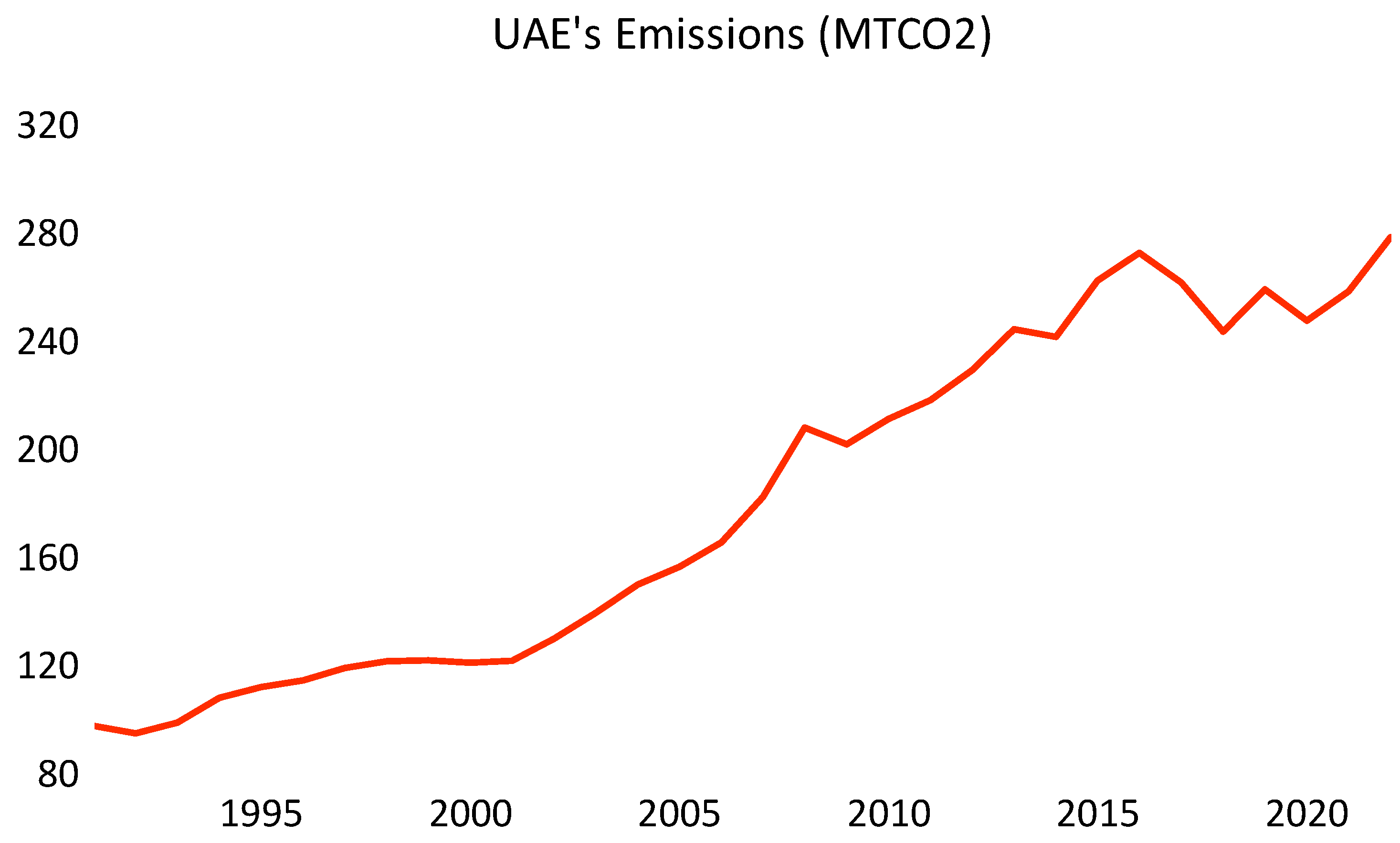
Therefore, if the dimensions of the variables discussed are well managed, the UAE can progress economically, while EQ will also improve. The UAE is employed in this research for various reasons: Firstly, the UAE has a high-income, resource-dependent economy that is expanding quickly and is diverse, which puts it in a unique position regarding its EQ. In addition, the UAE is one of the Gulf Cooperation Council (GCC) economies, playing a significant role in the Middle East. Secondly, the UAE has pledged to reduce its emissions level by 2030, and achieve net zero by 2050. However, it is estimated that the UAE might not be able to fulfill its revised National Determined Contribution (NDC) target of reducing CO2 by 182 MTCO2 (Figure 1) because its emissions are still expected to rise by 2030 [30]. The UAE has achieved a prominent position in the global energy and oil markets and is one of the biggest producers of OPEC. Thirdly, the UAE aims to establish itself as an international epicenter and an effective example of the new green economy under the Green Economy for Sustainable Development project.
Thus, based on the UAE’s climate objectives, this research investigates the impact of GI, FG, GDP, and FDI on EQ in the UAE from 1991 to 2022 using the Quantile Dickey–Fuller (QADF) test, Wavelet Quantile Regression (WQR), Wavelet Quantile Correlation (WQC), and Quantile-on-Quantile Granger Causality (QQGC) methods.
The gaps and contributions of this research are as follows: First, it is observed that there are limited studies being carried out on the interconnection between GI, FG, GDP, FDI, and EQ in the UAE. Therefore, since the link between the research variables is yet to be examined in the context of the UAE, this is a conceptual and empirical addition to the existing literature. Second, other studies have used methods such as Autoregressive Distributed Lag (ARDL), Cross-sectional Autoregressive Distributed Lag (CS-ARDL), Augmented Mean Group (AMG), Fully Modified Ordinary Least Squares (FMOLS), Dynamic Ordinary Least Square (DOLS), and Method of Moments Quantile Regression (MMQR). Therefore, as a significant contribution, this research adopted the QADF unit root, WQR, WQC, and QQGC, as used by some studies such as [31,32,33]. The QADF was employed because the entire conditional distribution of the series is not taken into account by the conventional unit root tests. Unlike conventional Quantile Regression (QR), WQR is able to identify connections between series over a range of quantiles and periods [34]. According to [35], WQC is a relatively advanced method that evaluates the co-movement between variables at different quantile levels and across several scales by combining the wavelet methodology with quantile correlation. Lastly, considering the conditional distribution of the variables, the QQGC is a significant improvement over conventional Quantile Granger Causality (QGC) techniques. In order to capture the causal effect of the regressors on EQ, this paper introduces the QQGC, which fills a significant gap in the literature [31]. This research is methodologically strong which is a contribution to existing studies.
This research is organized as follows: Section 1 expands on the current events related to promoting a sustainable environment. Section 2 presents the diverse arguments based on the research questions. Section 3 explores the data and proposed methodologies used in this study. Section 4 shows the findings and discussions, while Section 5 shows the conclusion of the study.

2. Literature Review

Section 2 shows the link between GI, FG, GDP, FDI, and EQ.

2.1. GI and EQ

Employing the DOLS and FMOLS methods, ref. [18] established that South Asia’s EQ is greatly enhanced by GI. The outcome of a Positive GI and EQ nexus is also confirmed by [36]. Adopting the AMG estimators, ref. [37] found that economic expansion and FDI contribute to the degradation of the environment, while there is a notable negative relationship between GI and CO2. The study also showed that there is a bi–directional causal association between GI and CO2. A positive association between GI and EQ was also found in the Brazilian economy, using the dynamic ARDL approach [38]. In top ten green future economies, using methodologies such as, AMG, Common Correlated Effect Mean Group (CCEMG), and CS-ARDL, ref. [39] opined that GI enhances EQ. Furthermore, incoming FDI greatly enhances EQ, supporting the idea of a “pollution halo.” Ref. [40] ascertained that green financing strikes a balance between innovation, energy, the environment, and climate change. In China, based on wavelet analysis, ref. [41] found that urbanization and GI were found to have a negative link with EF, while FG and GDP showed a favorable correlation. Ref. [42] revealed that while the positive aspects of GI are insignificant in terms of causing pollution to the environment due to the low number of patents in GI compared to all technologies in Saudi Arabia, its adverse effects are the cause of an increase in pollutant emissions over the long and short term due to the low prevalence of GI. In addition, pollutant emissions are influenced by the volume of trade, energy consumption, and economic expansion, while financial development insignificantly influences the environment. In Japan, ref. [43] demonstrated how EQ is enhanced by financial development, clean energy use, and GI. Furthermore, globalization of trade and digitalization have marginally favorable benefits on EQ, although economic expansion has a negative impact [44]. According to [45,46] the incorporation of GI in SMEs that successfully support the community and environmental-related UN SDGs is strongly influenced by stakeholder pressure, including that from the government, competing companies, consumers, and producers. Furthermore, the complex connections between GI and SDGs provide empirical validation for the moderating effect of government support. Based on the discussed literature, the a priori expectation or hypothesis is as follows:
H1. 
GI has a positive relationship with EQ.

2.2. FG and EQ

In emerging economies, ref. [47] established that FG contributes to EQ. For E7 economies, the outcome of the impact of FG on EQ varies from country to country, according to [48]. In Brazil, China, India, and Turkey, FG contributes to the degradation of the environment, confirming the pollution haven hypothesis, while in Indonesia, Russia, and Mexico, FG spurs EQ. This confirms the pollution halo hypothesis. Ref. [49] affirmed that FG is a significant element in promoting EQ in the sample West Asian and the Middle East (WAME) nations because it lowers EF, according to the long-run estimates from continuously updated fully modified (CUP–FM) and continuously updated bias corrected (CUP–BC) tests. In Asian economies, employing the FMOLS and DOLS techniques, ref. [50] established that FG causes EQ to rise. Employing the CS-ARDL approach for G11 economies, ref. [51] stated that while rent increases EF, the transition to clean energy and FG have a strong and negative relationship with EF. Furthermore, the results show that EF is reduced by FG through the switch to clean energy. Utilizing the Quantile-on-Quantile Kernel-Based Regularized Least Squares (QQKRLS) method for USA, ref. [52] ascertained that FG and GDP spur EQ. Ref. [53] ascertained that FG contributes to the degradation of the environment in Nigeria, using the wavelet tools analysis and frequency domain causality approach. In top natural resource rent economies, ref. [54] opined that FG and clean energy contribute to EQ, while GDP degrades the quality of the environment. In the UAE, studies have identified that financial development contributes to the degradation of the environment [55,56]. It is important to mention that the heterogeneous impact of FG on EQ across various economies is dependent on the way international capital flows are used, which can be dependent on quality of institutions, structure of the economy, and the stage of development. Based on the investigations above, the hypothesis that shows the link between FG and EQ is as follows:
H2. 
The relationship between FG and EQ can either be positive or negative.

2.3. GDP and EQ

In the UAE, using the ARDL and Vector Error Correction Model (VECM) causality approach, ref. [57] discovered an inverse U–shaped link between GDP and CO2, meaning that GDP initially increases CO2 before declining once per capita income reaches a threshold. In the GCC region, employing the MMQR technique, ref. [58] demonstrated how crucial technical advancements are to guaranteeing the end of ecological degradation. The findings also demonstrate that, over time, openness to trade and natural resource rents, respectively, significantly slow down environmental damage. Nonetheless, the findings indicate that financial progress, globalization, and economic expansion are detrimental to the region’s ecological sustainability. Also, for GCC economies, ref. [59] stated that income growth is detrimental to EQ. In countries with abundant natural resources, employing the MMQR, FMOLS, and DOLS methods, ref. [54] confirmed that economic expansion degrades the environment. This outcome is also confirmed for Mexico, Indonesia, Nigeria and Turkey (MINT) economies according to [60]. Ref. [61] argued that when financial inclusion and institutional quality interact with one another, it fosters economic expansion and EQ. EQ and economic progress are enhanced by a more efficient and inclusive financial system. The first results of [62] for G20 economies support the EKC theory, which holds that pollution to the environment first increases with economic expansion, but then declines after certain income levels are reached. However, the declining trajectory predicted by the inverted U-shaped hypothesis was found to be statistically non-significant when per capita energy use was included in the analysis. This calls into question the EKC hypothesis’s claim that developed countries with high per-capita incomes are primarily responsible for lower levels of ecological pollution. Based on these discussions, this research proposes the following:
H3. 
A rise in GDP will reduce EQ.

2.4. FDI and EQ

Ref. [24] discovered that inflows of FDI have a positive correlation with CO2, and that the negative effects of FDI influx on EQ are reduced by both regulatory quality and economic development. It suggests that while FDI inflows typically result in increased CO2, they are more likely to reduce CO2 in nations with more developed economies and better regulatory frameworks. Ref. [32] asserted that the impact of FDI varies, with robust governance counteracting short-term shocks. Ref. [63]’s findings support the PHH in Africa by demonstrating that FDI dramatically raises CO2. However, at larger quantiles, the effects of economic expansion and FDI on the environment diminish. According to these findings, African governments ought to enact common ecological requirements and tighten environmental laws to promote environmentally friendly technologies. In 112 economies, using the Bayesian Quantile Regression, ref. [64] established that FDI enhances the environment in nations with low to medium CO2 quantiles (0.05–0.45), but degrades the environment in nations with medium to high CO2 quantiles (0.50–0.95). Ref. [65] stated that FDI and EQ have a non-linear (N-shaped) connection, with the PHL and PHH effects occurring based on the stage of FDI entry. In 45 Sub-Saharan African economies, the first stages of FDI considerably reduce CO2 by using the percentage of the population that has access to electricity as the threshold measurement. However, there is a much weaker positive correlation between CO2 and subsequent phases of FDI. At the same time, GDP drives ecological degradation [66,67]. From these discussions, the hypothesis is as follows:
H4. 
FDI can have a positive or a negative association with EQ.

2.5. Gap in the Literature

From the investigated literature, it is observed that most studies [35,60] have focused on the impact of technological innovation on EQ in the UAE, thus, neglecting the role of GI in fostering EQ. In addition, studies have affirmed that GI can spur EQ. However, there are instances where the impact of GI on EQ is insignificant. This necessitates further investigations, which this research captures. Secondly, the existing research on the connection between FG and EQ is generally unclear. The lack of conclusive findings calls for additional scholarly research, possibly employing a more robust scientific methodology. Finding the interaction’s path could give decision-makers more knowledge to aid in the development of suitable environmental regulations in a globalized world. Another gap identified is that more studies have focused on how financial development as a whole contributes to EQ in the UAE, thus neglecting the role of FG in promoting EQ. This research also observed methodological limitations in other studies. Methods that are being used are parametric in nature, such as ARDL, FMOLS, and DOLS, which overlook the non-linear relationship between variables.

3. Data and Methodology

3.1. Data

To investigate the impact of GI and FG on EQ, while controlling for GDP and FDI, the variables employed and their sources include Emissions (MTCO2) (EQ), Development of Environment-Related Technologies (Patents) (GI), Financial Globalization (FG), GDP (Constant 2015 USD), and Foreign Direct Investment, Net Inflows (% of GDP) (FDI).
The data used in this study were obtained from highly credible and internationally recognized databases to ensure reliability, consistency, and comparability across variables and time. The selection of the data sources was guided by their reputation for data accuracy and frequency of updates. Specifically, time-series data for environmental quality (CO2 emissions) were collected from the Energy Institute Statistical Review [62], while green innovation data—measured through the development of environment-related technology patents—were extracted from the OECD Data Explorer [63]. The data on financial globalization were sourced from the KOF Swiss Economic Institute [64], which provides a comprehensive index capturing real financial flows, investment regulations, and restrictions. Economic growth (GDP) and foreign direct investment (FDI) data were collected from the World Bank Open Data repository [61].
The data were retrieved for the period 1991–2022 through direct extraction from each database’s online portal using official query tools and verified through cross-checking with annual statistical publications to ensure internal consistency. All data were subsequently cleaned and transformed into logarithmic form to normalize distribution and reduce the influence of outliers. Missing data points were handled through linear interpolation, and all variables were converted into consistent units to facilitate comparability. This procedure ensured that the dataset accurately reflects temporal dynamics while minimizing statistical bias.
It is essential to note that patent-based GI is adopted in this study because it has the capacity to drive EQ, and at the same time, foster economic growth. In addition, patents serve as a bridge between innovative ideas, market incentives, and environmental policy goals. The data period is from 1991–2022. The data begin from 1991 because of the inadequacy of the GI data, and end at 2022 because of the GI and FG data. The basic summary of the data employed can be seen as follows (Table 1):
The model of this research, adopted from the studies of [18,37,41], is presented as follows:
E Q t = f ( G I t , F G t , G D P t , F D I t )
Equation (1) is transformed into log form to mitigate the influence of outliers and extreme values [72]. Equation (1) can be re-written in its log form as:
L E Q t = γ 0 + γ 1 L G I t + γ 2 L F G t + γ 3 L G D P t + γ 4 L F D I t + ε t
The intercept and constant term are denoted by γ 0 ; the regressors’ coefficients are γ 1 ,   γ 2 ,   γ 3 , and γ 4 ; ε is the error term, and t is time.

3.2. WQR and WQC

Wavelet is an approach that is non-parametric which allows fluctuating frequencies to be separated into high- and low-frequency components by recursively breaking down the variables into low- and high-pass filters. Additionally, quantile correlation calculates the conditional quantile’s overall sensitivity to the factors [73].
An effective method for reliably estimating the data’s multiple-scale dependence is to combine wavelet estimation with QR, which is known as WQR. WQR can detect moving averages at various time frames. By taking into account quantiles and periods—short, medium, and long—WQR makes it possible to analyze how the connection between variables evolves in other areas of the distribution [74]. WQR’s flexibility in modeling linear and non-linear interactions at various scales improves its applicability for encapsulating complex data structures [34]. WQR adds versatility in capturing a wide variety of non-linear patterns, although regular QR is adept at managing non-linear correlations. The WQR proposed by [75] is an enhancement of the Quantile-on-Quantile Regression (QQR) proposed by [76]. The WQR equation is presented as follows in Equation (3):
( Գ ) d j [ Y ] d j [ X ] =   Ɓ 0 ( Գ ) +   Ɓ 1 ( Գ )   d j [ X ]
( Գ ) is the precise decomposition of level j; [ Y ] is the dependent variable, and [ X ] is the independent variable. Ɓ 0 is the intercept term, and Ɓ 1 is the slope coefficient.
According to [35], WQC is a rather advanced method that evaluates the co-movement between the variables at different quantiles and scales by combining the wavelet methodology with quantile correlation. The WQC is presented in Equation (4), which can be defined as the WQC for two time series X and Y at a given decomposition level J, and quantile τ [35].
W Q C ( τ ) d j [ X ] d j [ Y ] = q c o v ( τ ) d j [ X ] d j [ Y ] v a r   τ   d j Y Q τ d j Y   v a r d j [ X ]  
When combined, WQR and WQC offer the ability to investigate and assess the effects of notable occurrences and support better environmental monitoring, risk assessment, and policy development [74].
Lastly, considering the conditional distribution of the variables, the QQGC is a significant improvement over conventional Quantile Granger Causality (QGC) techniques. It captures the causal effect of the regressors on EQ.
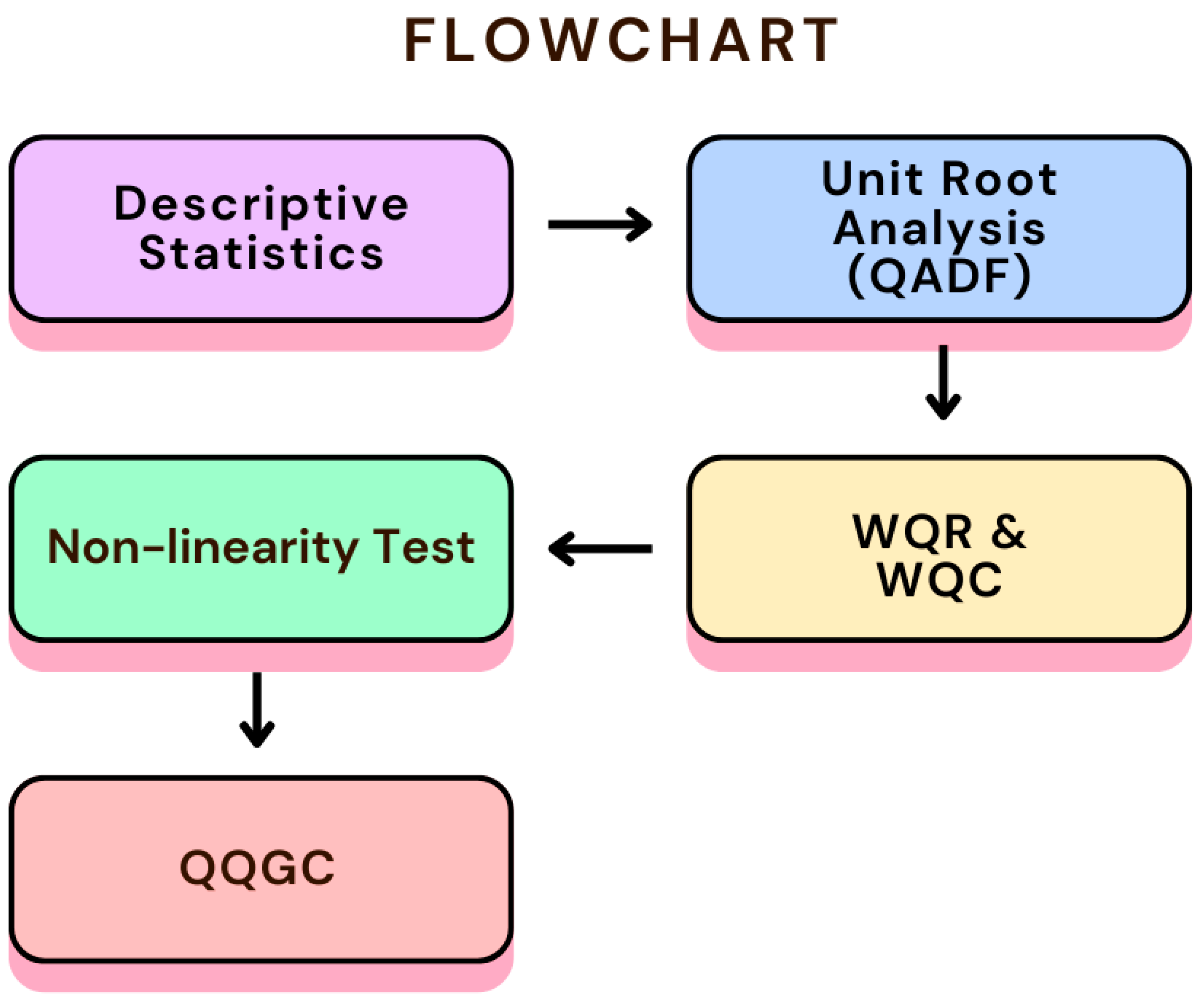
The methodological flow of this research can be seen in Figure 2. The flow process entails descriptive statistics, unit root analysis, non-linearity test, WQR, WQC, and QQGC. Ref. [77] opined that to prevent spurious regression, it is crucial to carry out some pre-estimation checks. Descriptive statistics summarizes the essential features of a dataset. Determining the stationarity conditions of variables can contribute to the statistical importance of the variables [78]. The BDS non-linearity test is used to confirm the asymmetric nature of the variables. Due to the asymmetric characteristics of the variables, the WQR, WQC, and QQGC methods are employed. Using methods that are symmetric could lead to results that are biased [77].
The use of the Wavelet Quantile Regression (WQR), Wavelet Quantile Correlation (WQC), and Quantile-on-Quantile Granger Causality (QQGC) in this study provides several methodological merits over conventional econometric techniques.
Capturing Multi-Scale and Non-linear Relationships: Unlike traditional parametric models such as ARDL or FMOLS, the WQR and WQC techniques can examine both linear and non-linear dynamics across different quantiles and time frequencies. This allows the model to detect short-, medium-, and long-term relationships, making it more robust for dynamic datasets.
Robustness Against Distributional Assumptions: Wavelet-based quantile methods do not assume a normal distribution, allowing them to handle data heterogeneity and outliers effectively. Studies such as [34,74] confirm that WQR enhances robustness by addressing varying conditional dependencies across scales.
Time–Frequency Domain Decomposition: The wavelet transform’s ability to decompose series into localized time-frequency components enhances the precision of identifying co-movements and causality, as noted by [35].
Improved Interpretability of Causality: The QQGC method improves upon traditional Quantile Granger Causality by allowing bidirectional causal inference across conditional quantiles, which captures complex asymmetric interactions [75].
Despite their advantages, wavelet quantile methods have some limitations. First, they require large time-series data for effective wavelet decomposition and may be computationally intensive compared to standard econometric techniques. Second, while WQR and WQC capture non-linearity effectively, interpreting multi-dimensional interactions can be complex and demands careful visualization and validation. Lastly, these techniques, though statistically powerful, rely heavily on the quality and stationarity of the input data.
The combined use of WQR, WQC, and QQGC provides methodological rigor that aligns with recent empirical advancements in environmental econometrics [75,77], offering an enhanced framework for uncovering nuanced relationships in the UAE’s environmental quality analysis.
Figure 2 presents the overall methodological flowchart that guides this research, showing the sequential and logical steps followed in analyzing the relationship between Green Innovation (GI), Financial Globalization (FG), Economic Growth (GDP), Foreign Direct Investment (FDI), and Environmental Quality (EQ) in the UAE. The workflow begins with the data collection and descriptive statistics, which summarize the key characteristics of each variable. This is followed by the unit root analysis using the Quantile Augmented Dickey–Fuller (QADF) test, aimed at determining the stationarity properties of the variables across different quantiles. The next step involves the BDS non-linearity test, which checks for asymmetries and non-linear structures within the data, thereby justifying the use of advanced non-linear models.
After verifying the data characteristics, the study proceeds with the Wavelet Quantile Regression (WQR) and Wavelet Quantile Correlation (WQC) analyses. These methods jointly examine the strength, direction, and dynamics of the relationships among variables across multiple time horizons (short-, medium-, and long-term) and quantile distributions. The Quantile-on-Quantile Granger Causality (QQGC) analysis is then employed to identify the direction and intensity of causal interactions among the variables.
Finally, the methodological process culminates in robust interpretation and policy implications, ensuring that the results are not only statistically significant but also practically relevant for sustainable policy design. Thus, Figure 2 provides a comprehensive visualization of how the study’s empirical strategy progresses—from data preparation to advanced econometric analysis and policy interpretation—enhancing the transparency and reproducibility of the research.

4. Results and Discussions

4.1. Descriptive Statistics

In Table 2, it is evident that FDI has the lowest mean, followed by GI. The highest mean can be ascribed to GDP, with a mean of 2.850945. The median values also show that GDP has the highest value, while the variable with the lowest value is GI. In addition, the variables with the least minimum values are FDI (−0.398833) and GI (−0.120130), respectively. For skewness, all the variables are negatively skewed, except GI, with a positively skewed value of 0.550630. For kurtosis, the values of EQ, FDI, FG, GDP, and GI are less than 3, which confirms a platykurtic distribution. The probability values of the Jarque–Bera show that all the variables are not normally distributed because they are less than 5%. Non-linearity shows that the traditional mean-based, distribution-assuming techniques are likely to produce biased outcomes. Thus, non-parametric methods like WQR, WQC, and QQGC are employed for their distributional flexibility.

4.2. QADF Unit Root Test

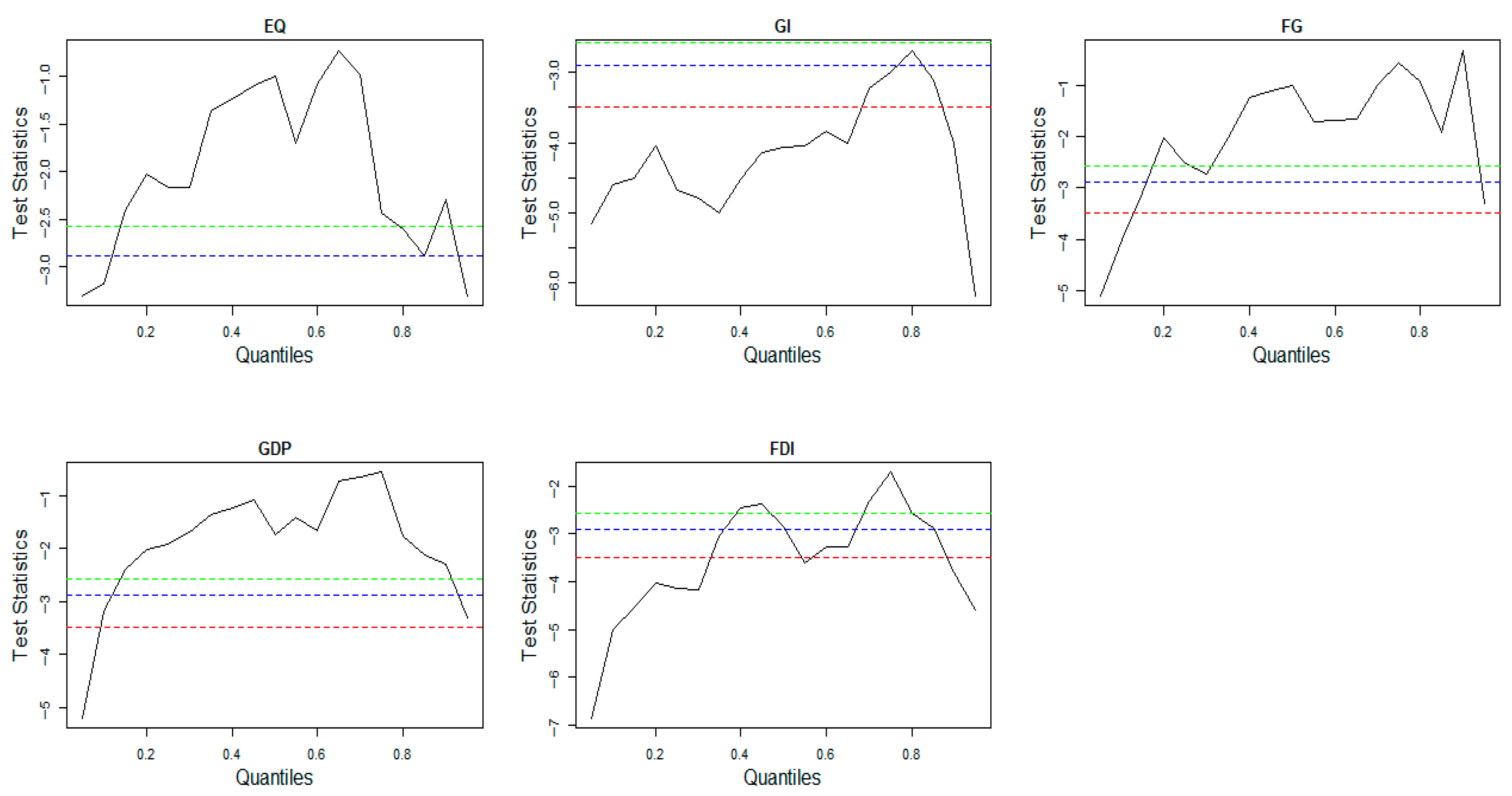
Figure 3 shows the Quantile Augmented Dickey–Fuller (QADF) unit root test proposed by [31], which is used to test for the stationarity of the variables. It is commonly recognized that the entire conditional distribution of the series is not taken into account by the conventional unit root tests, such as Phillips–Perron [79], and Augmented Dickey–Fuller [80]. As a result, this study integrates the ADF with the approach of examining the stationarity of the whole conditional distributions of the study variables. Across all the variables, the QADF test results exhibit stationarity conditions in some quantiles, and non-stationarity in other quantiles. The dashed lines are the critical values at 10% (green), 5% (blue), and 1% (red). To confirm stationarity, the solid line should be above the critical values, shown by the dotted lines.

4.3. Non-Linearity Test

This research uses the BDS test (Table 3) proposed by [81] to investigate the non-linearity characteristic of the series under examination. It is crucial to examine the non-linear characteristics of the series even when the non-normal distribution has been proven. The outcome of the test confirms non-linearity, as Table 3 illustrates. Utilizing linear approaches for series that are non-linear will yield inaccurate findings, as [4,82] have confirmed. Consequently, this study avoids these situations by employing non-linear wavelet-based quantile techniques.

4.4. Wavelet Quantile Regression (WQR)

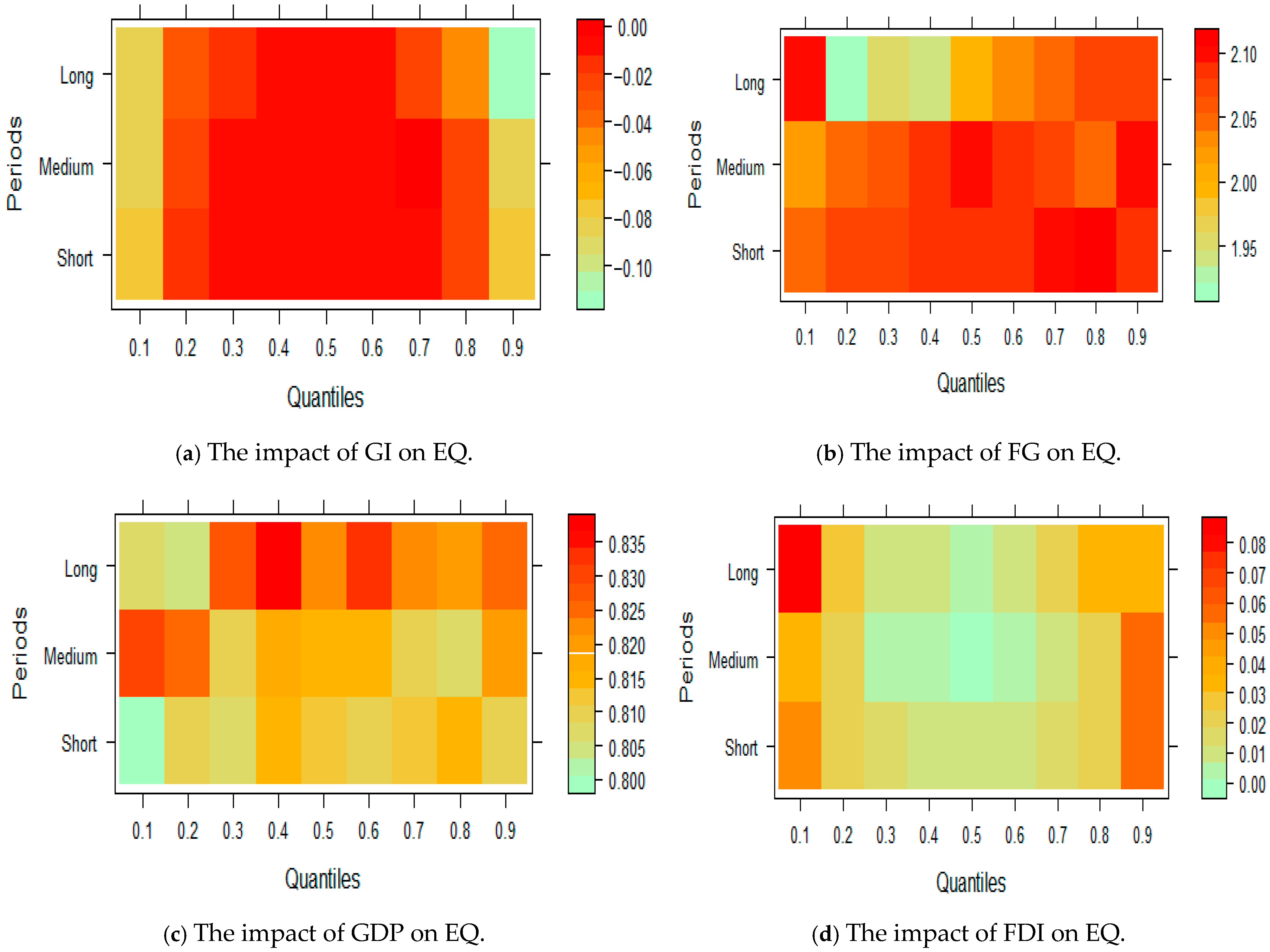
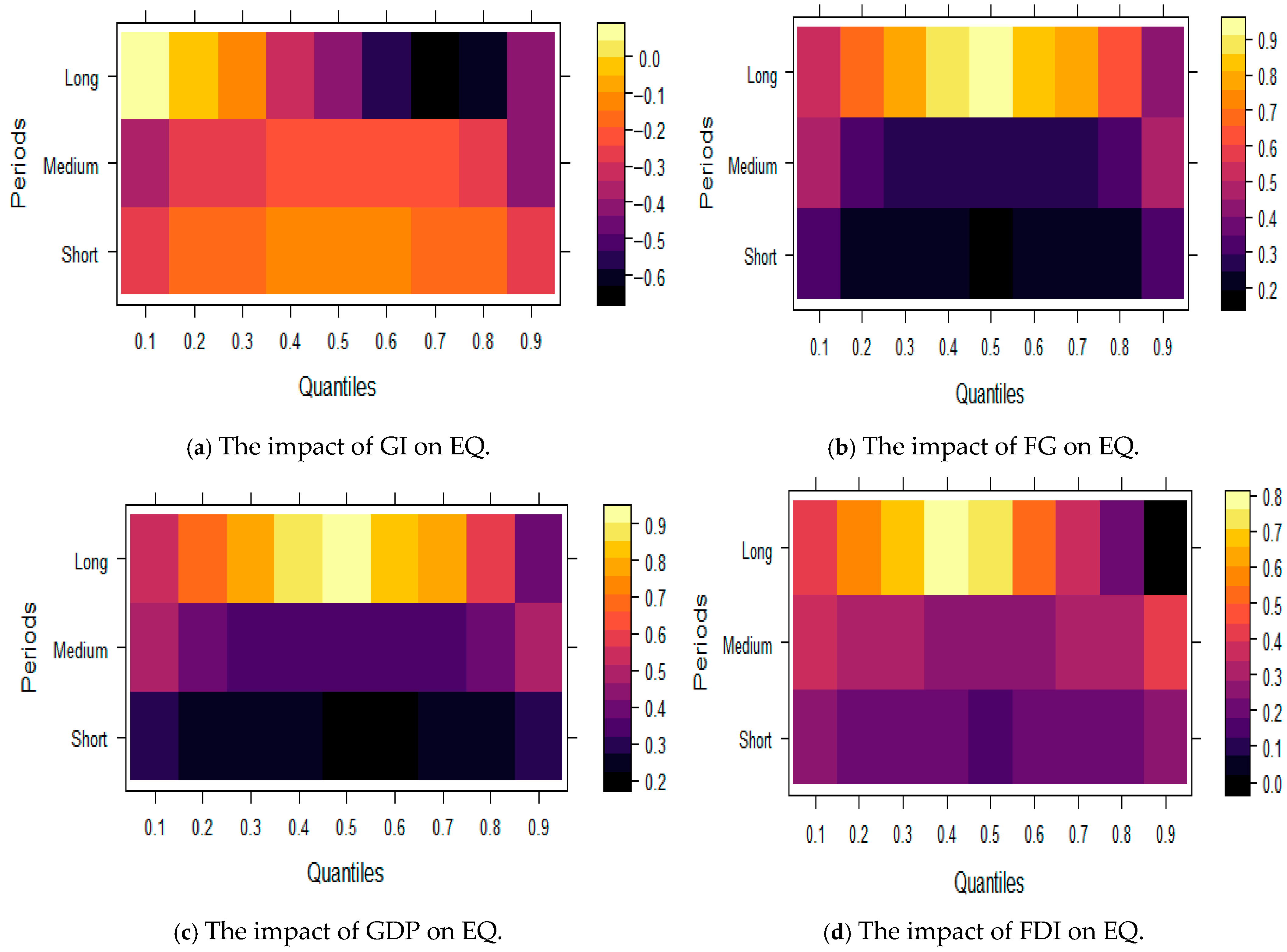
Figure 4a–d captures the WQR between GI, FG, GDP, FDI, and EQ. The heatmap in the graph has different colors, ranging from light green to red. The light green color shows a weak relationship, while the dark orange and red colors show a moderate and strong relationship, respectively.
The WQR in Figure 4a confirms that GI reduces ecological degradation. In the short, medium, and long term, at the 0.1 quantile, the strength of the relationship is moderate. In the 0.9 quantile, the strength of the relationship is moderate in the short and medium term. However, in the long term, the association is weak. Between the 0.2 and 0.7 quantiles, across the short, medium, and long term, the relationship is very strong. At the 0.8 quantile, in the short and medium term, the association is very strong, while in the long term, the link is moderately strong. Overall, in most of the quantiles and periods, GI fosters EQ. In Figure 4b, in the short and medium term, across all quantiles, FG reduces EQ. In the long term, at the 0.1, 0.7, and 0.8 quantiles, the relationship is strong. Between 0.2 and 0.4, the connection is weak, while from 0.5 to 0.6, the connection is moderate. In Figure 4c, across all quantiles, in the short and medium term, there are elements of weak and strong connections, implying that GDP contributes to ecological degradation. However, in the long term, the connection starts with a weak relationship at the 0.1 and 0.2 quantiles, and ends with a moderate relationship. Figure 4d shows that FDI contributes to the degradation of the environment. In the majority of the quantiles, in the short, medium, and long term, the connection is weak. However, in the long term, at the 0.1 quantile, the connection is strong, and between 0.2 and 0.7 quantiles, the relationship is weak. At the 0.8 and 0.9 quantiles, the relationship is moderate.

4.5. Wavelet Quantile Correlation (WQC)

In Figure 5a–d, the results show that GI contributes to EQ, while FG, GDP, and FDI reduce EQ. Regarding the GI and EQ nexus in Figure 5a, in the short and medium term across all quantiles, the connection between GI and EQ ranges from moderate to strong. However, in the long term, between 0.1 and 0.3 quantiles, the relationship is very strong. Nevertheless, in the 0.7 and 0.8 quantiles, the relationship is weak (black color). In Figure 5b, in the medium and short term, across all quantiles, the relationship between FG and EQ is weak, while in the long term, the association is strong. Figure 5c also follows the same pattern. The relationship between GDP and EQ is weak in the short and medium term across all quantiles, while in the long term, the association is very strong from 0.2 to 0.7 quantiles. Figure 5d also shows the strong association between FDI and EQ in the long term, and weak and moderately strong association in the short and medium term.

4.6. QQGC

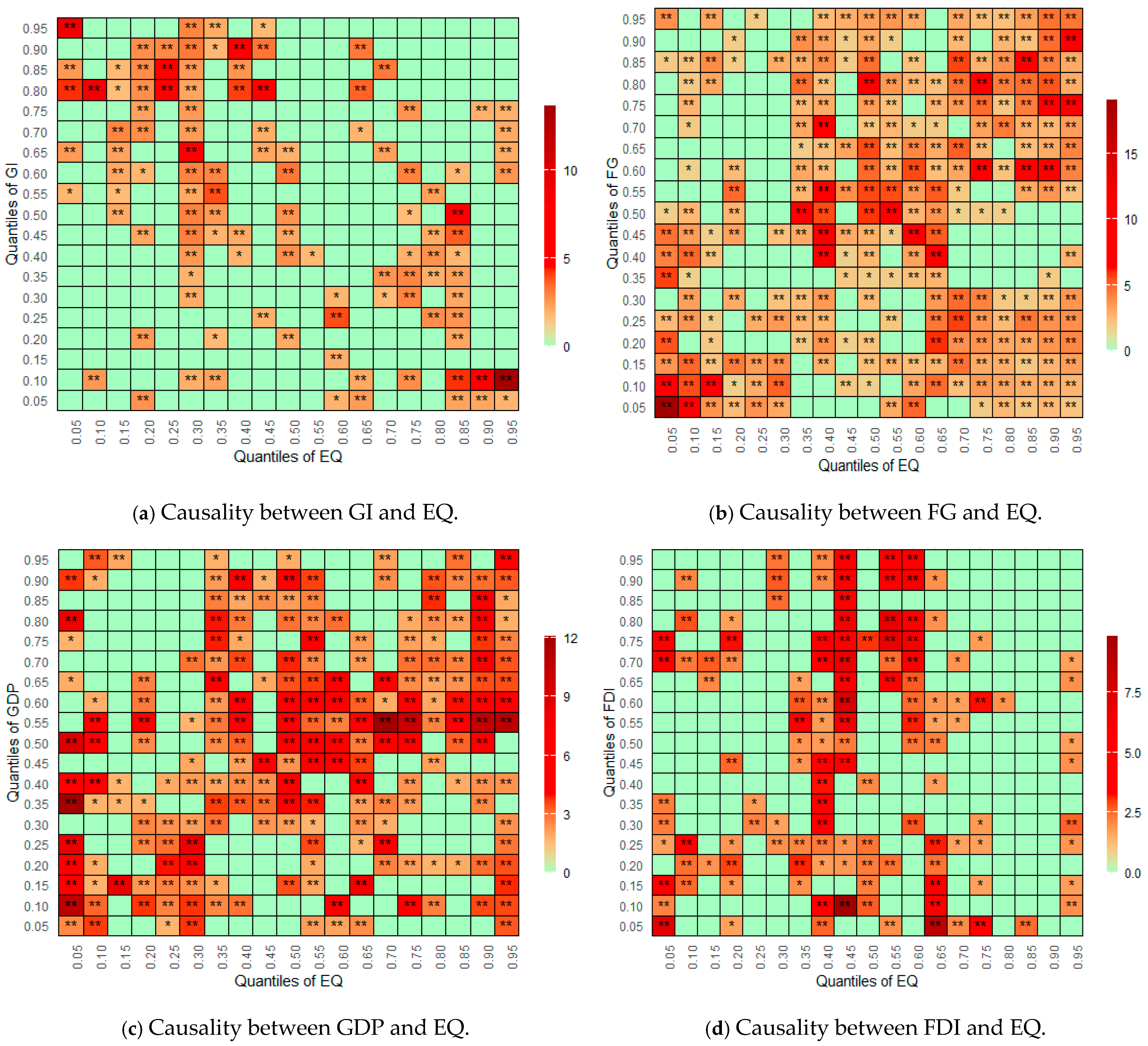
Figure 6a–d shows the direction of causality from GI, FG, GDP, FDI, to EQ. The colors show the strength of the relationship between the variables. The light green or lemon green shows no relationship or a weak relationship, while the orange color and red color show a moderate relationship and very strong relationship, respectively. The 5% and 10% levels of statistical significance are shown by the ** and * symbols. In Figure 6a, it is observed that GI has a strong causal link with EQ, especially at the higher quantiles. As for the FG and EQ nexus in Figure 6b, there is a strong causal impact across all quantiles. Furthermore, the causal impact of GDP on EQ is very strong across all quantiles, as seen in Figure 6c. Figure 6d also confirms causality across all quantiles between FDI and EQ.

4.7. Discussion

Firstly, GI significantly augments the UAE’s EQ by cutting back on conventional high-emission activities, like the use of fossil fuels, and boosting resource efficiency, by adopting smart and clean technologies, such as renewable energy sources. A good example of this is the Mohammed Bin Rashid Al Maktoum Solar Park, one of the biggest renewable energy projects, which has significantly reduced the carbon footprint from power generation, improved the quality of air, and lessened the effects of climate change. Furthermore, the UAE is reducing CO2 in a practical way by implementing the Carbon Capture and Storage (CCS) initiative, which captures CO2 from industrial sources. It is important to state that the building and transportation sectors are not excluded from this innovation. Ref. [83] asserted that, in general, eco-innovation helps economies make the shift to new and improved ways of generating energy from different sources, as well as to reduce emissions and conserve energy. The positive link between GI and EQ is supported by [18,37,43].
Secondly, the relationship between FG and CO2 is observed to be positive, implying that FG contributes to ecological degradation. FG in the UAE, which is marked by an expansive credit market with significant capital mobility, speeds up large-scale, increased energy use, and capital-intensive development. Increasing urbanization, massive infrastructural development, and the expansion of industries, which are driven by the infusion of local and international financing, demand an enormous amount of energy. Additionally, FG boosts consumers’ disposable income and makes it easier to obtain credit, which encourages the purchase of carbon-intensive goods and other ecologically damaging consumption patterns. The positive link between FG and CO2 is supported by [53,55,56]. On the contrary, studies such as [47,49,51] established that FG promotes EQ.
Thirdly, as expected, rising GDP, brought about by political stability, development in infrastructure, globalization, and innovations in technology [84], contributes to a decline in the quality of the environment. This is quite justifiable if examined from the scale, composite, and technique effects. It is quite evident that the UAE is pursuing a robust economic expansion, and this type of progress comes with certain features, such as increased energy use, especially from fossils, and a rise in intensive industrialization, urbanization, and resource extraction. These activities put a lot of pressure on ecological resources, thus degrading the environment. This confirms the scale effect. Furthermore, as the UAE moves to the composite and technique effect, it designs policies and adopts cleaner technologies that will contribute to EQ. This means that the UAE technologically progresses. However, in spite of this technological progress, prosperous countries like the UAE continue to have larger CO2 [85]. There are several structural reasons for this unexpected outcome. First, increases in energy efficiency may lead to the rebound effect, in which higher overall consumption balances off decreases in energy use per unit of production. Second, despite innovation, many high-income countries like the UAE continue to rely on infrastructure based on fossils, which slows down the pace of clean energy transitions. Third, energy-intensive consumption—such as bigger living areas, more travel, and higher consumption of goods—is frequently a part of wealthy lives in these nations, all of which contribute to long-term emissions. These results imply that without extensive adjustments to infrastructure, policy, and consumption patterns, economic expansion, driven by an innovation in technology, might not be enough to reduce emissions. This outcome is confirmed by the studies of [57,59,62,86].
Fourth, the association between FDI and EQ in the UAE confirms the PHH. This means that FDI degrades the quality of the environment. One of the factors responsible for this could be less stringent ecological policies. If ecological policies that protect EQ are relaxed, it will attract industries with unclean production processes, or that are energy-intensive. Of course, increased FDI comes with some economic benefits, such as driving economic expansion; it can also lead to increased ecological pressure due to a larger scale of economic activities. It is also worth noting that, while the UAE is diversifying its economy away from oil, the non-oil FDI it attracts may still be resource-intensive, adding to environmental deterioration. Ref. [87] confirmed that, in addition to increasing CO2, FDI inflows have drawn capital from large polluting corporations and multinational corporations. This assertion is further confirmed by the studies of [24,63,66], and contradicts the findings of [32,64].

4.8. Policy Recommendations

  • The UAE is on the right track regarding its green investments and towards its SDGs. For GI to continuously drive EQ, more spending on Research and Development (R&D) is needed. Additionally, the UAE government and other stakeholders ought to promote a system of green finance, prioritize green initiatives during approval processes, and expedite the application process for environmentally conscious, low-carbon, and green enterprises;
  • It is irrational to suggest that the UAE government pass legislation to slow the growth of the economy because economic growth hurts its environment. As a result, the UAE should examine its national growth strategy from a green growth perspective. Green growth is simply growth that occurs without or with reduced environmental degradation. To achieve this, the UAE should promote ecologically friendly production and consumption practices by reducing its dependency on fossil fuels and increasing its use of renewable resources;
  • Regarding the FDI and EQ nexus, enforcing strict ecological norms and laws pertaining to foreign investments should be a top priority for the UAE policymakers. This means that to support investment, it is necessary to require adherence to emission reduction targets, clean industrial methods, and eco-friendly programs. Establishing policies and procedures to help investors prioritize and assess projects according to their environmental impact is also crucial;
  • Lastly, in addition to FG being one of the major drivers of FDI, the UAE will need to adopt a stringent green financial regulation. Under this policy, all internationally integrated financial institutions doing business in the United Arab Emirates would have to reveal and stress-test their portfolios against climate-related risks. Additionally, a mandatory portion of foreign capital flows would have to go toward approved green and sustainable projects in the UAE’s economy. This will bring global capital into line with national sustainability objectives, like the UAE’s 2050 net-zero objective.

5. Conclusions and Future Research Suggestions

Ecological quality is necessary for countries to achieve because of its overall benefits to the entire ecosystem. Therefore, due to the significant position that the UAE plays in the global environment, this research examines the role of GI, FG, GDP, and FDI in influencing EQ from 1991–2022. The UAE is well known for these economic indices. In addition, the study employed the innovative QADF test, WQR, WQC, and QQGC. These methods are quite advanced compared to other traditional econometric methods. Based on the outcome of the WQR and WQC methods, evidence shows that GI contributes to EQ across all quantiles in the short, medium, and long term, while FG, GDP, and FDI reduces EQ across all quantiles in the short, medium, and long term. The QQGC results also affirm causality among the variables. This means that GI, FG, GDP, and FDI can predict EQ across all quantiles. It is important to state that the strength of the relationships between the variables varies across quantiles, some appearing weak, while others appear strong.
This study focuses on the UAE economy, while excluding other GCC economies. The GCC economies were excluded to focus the core research questions on the UAE economy. Thus, other studies can incorporate GCC economies into their research and can consider other regions or individual economies. Furthermore, other types of globalization can be considered, such as social globalization and political globalization. The methods of WQR, WQC, and QQGC can be maintained because they are robust and innovative. Lastly, other metrics of EQ can be considered, such as the LCF. It is important to state that a global event occurred between 2019 and 2022 (COVID-19 pandemic). Thus, other studies should factor in this occurrence in their analysis. While this study provides valuable insights into the dynamics between Green Innovation (GI), Financial Globalization (FG), Economic Growth (GDP), Foreign Direct Investment (FDI), and Environmental Quality (EQ) in the UAE, several avenues for future research can be explored.
First, future studies could extend the scope beyond the UAE by conducting comparative analyses across Gulf Cooperation Council (GCC) or MENA countries to capture the regional heterogeneity in environmental policies, institutional quality, and globalization patterns. Such cross-country studies would help determine whether the patterns observed in the UAE are generalizable across similar economies [31].
Second, subsequent research can incorporate additional dimensions of globalization, such as social and political globalization, to better understand how information flows, international governance, and sociocultural integration influence environmental outcomes [49,88].
Third, future scholars may expand the methodological framework by integrating Machine Learning (ML)-driven predictive models or Dynamic Panel Quantile regressions to assess the robustness of non-linear causal relationships over time. The combination of AI-based analytics and econometric methods could offer deeper insights into the dynamic interplay of economic and environmental factors [34].
Fourth, future studies should incorporate environmental shocks or crises such as the COVID-19 pandemic, oil price volatility, and geopolitical risks, as these events have substantial implications for both economic performance and ecological transitions [77]. Finally, the use of alternative proxies for environmental quality, such as the Ecological Footprint (EF), Load Capacity Factor (LCF), or Environmental Sustainability Index (ESI), could improve the understanding of sustainability from a multidimensional perspective [9].

Author Contributions

Writing—original draft, Y.S.O.; Writing—review & editing, Y.S.O.; Supervision, A.B.A.; Project administration, A.B.A. All authors have read and agreed to the published version of the manuscript.

Funding

This research received no external funding.

Institutional Review Board Statement

Not applicable.

Informed Consent Statement

Not applicable.

Data Availability Statement

The data presented in this study are available on request from the corresponding author.

Conflicts of Interest

The authors declare no conflict of interest.

References

  1. Farooq, U.; Gillani, S.; Subhani, B.H.; Shafiq, M.N. Economic Policy Uncertainty and Environmental Degradation: The Moderating Role of Political Stability. Environ. Sci. Pollut. Res. 2022, 30, 18785–18797. [Google Scholar] [CrossRef]
  2. Guo, J.; Zhou, Y.; Ali, S.; Shahzad, U.; Cui, L. Exploring the Role of Green Innovation and Investment in Energy for Environmental Quality: An Empirical Appraisal from Provincial Data of China. J. Environ. Manag. 2021, 292, 112779. [Google Scholar] [CrossRef]
  3. Rihal, J.; Alzubi, A.; Aljuhmani, H.Y.; Berberoğlu, A. From Ethics to Ecology: How Ethical Leadership Drives Environmental Performance through Green Organizational Identity and Culture. PLoS ONE 2025, 20, e0336608. [Google Scholar] [CrossRef]
  4. Kirikkaleli, D.; Sowah, J.K.; Addai, K.; Altuntaş, M. Energy Productivity and Environmental Quality in Sweden: Evidence from Fourier and Non-linear Based Approaches. Geol. J. 2023, 58, 3452–3465. [Google Scholar] [CrossRef]
  5. Kumar, P.; Fatima, N.; Khan, M.K.; Alnafisah, H. Deciphering the Drivers of CO2 Emissions in Haryana: A Comprehensive Analysis from 2005 to 2023. Front. Environ. Sci. 2025, 13, 1391418. [Google Scholar] [CrossRef]
  6. Akash, M.A.; Riaz, M.H.; Uddin, M.N.; Ridwan, M.; Akinpelu, A.A.; Akter, R. Analyzing the Drivers of Ecological Footprint Toward Sustainability in BRICS+. Environ. Innov. Mgmt. 2025, 1, 2550017. [Google Scholar] [CrossRef]
  7. Waaje, A.; Roshid, M.M.; Islam, S.; Chandra Bhowmik, R.; Rahaman, M.A.; Hassan, M.M. Tourism, Trade, Energy, and Economic Development: Drivers of Ecological Footprint in the World’s Top Tourist Destinations. Innov. Green Dev. 2025, 4, 100249. [Google Scholar] [CrossRef]
  8. Raihan, A.; Rashid, M.; Voumik, L.C.; Akter, S.; Esquivias, M.A. The Dynamic Impacts of Economic Growth, Financial Globalization, Fossil Fuel, Renewable Energy, and Urbanization on Load Capacity Factor in Mexico. Sustainability 2023, 15, 13462. [Google Scholar] [CrossRef]
  9. Somoye, O.A.; Akinwande, T.S.; Mar’I, M.; Ozdeser, H. The Determinants of Load Capacity Factor: Evidence from GCC Countries. Sustain. Econ. 2025, 3, 1424. [Google Scholar] [CrossRef]
  10. Lamb, W.F.; Wiedmann, T.; Pongratz, J.; Andrew, R.; Crippa, M.; Olivier, J.G.J.; Wiedenhofer, D.; Mattioli, G.; Khourdajie, A.A.; House, J.; et al. A Review of Trends and Drivers of Greenhouse Gas Emissions by Sector from 1990 to 2018. Environ. Res. Lett. 2021, 16, 073005. [Google Scholar] [CrossRef]
  11. Khalifa, R.; Aljuhmani, H.Y. Interplay of Industrial Robots, Education, and Environmental Sustainability in United States: A Quantile-Based Investigation. Sustainability 2025, 17, 10255. [Google Scholar] [CrossRef]
  12. Mehmood, K.; Saifullah; Qiu, X.; Abrar, M.M. Unearthing Research Trends in Emissions and Sustainable Development: Potential Implications for Future Directions. Gondwana Res. 2023, 119, 227–245. [Google Scholar] [CrossRef]
  13. IEA. Global Energy Review, 2025; IEA: Paris, France, 2025. [Google Scholar]
  14. Kemp, R. Eco-innovation: Definition, Measurement and Open Research Issues. Econ. Politica 2010, 27, 397–420. [Google Scholar] [CrossRef]
  15. Beise, M.; Rennings, K. Lead Markets and Regulation: A Framework for Analyzing the International Diffusion of Environmental Innovations. Ecol. Econ. 2005, 52, 5–17. [Google Scholar] [CrossRef]
  16. Chen, Y.-S. The Driver of Green Innovation and Green Image—Green Core Competence. J. Bus. Ethics 2008, 81, 531–543. [Google Scholar] [CrossRef]
  17. Antonioli, D.; Mancinelli, S.; Mazzanti, M. Is Environmental Innovation Embedded within High-Performance Organisational Changes? The Role of Human Resource Management and Complementarity in Green Business Strategies. Res. Policy 2013, 42, 975–988. [Google Scholar] [CrossRef]
  18. Wen, J.; Ali, W.; Hussain, J.; Khan, N.A.; Hussain, H.; Ali, N.; Akhtar, R. Dynamics between Green Innovation and Environmental Quality: New Insights into South Asian Economies. Econ. Polit. 2022, 39, 543–565. [Google Scholar] [CrossRef]
  19. Younes, S.; Adedokun, M.W.; Alzubi, A.B.; Aljuhmani, H.Y. Impact of Supply Chain Management on Energy Transition and Environmental Sustainability: The Role of Knowledge Management and Green Innovations. Sustainability 2025, 17, 9249. [Google Scholar] [CrossRef]
  20. Enbaia, E.; Alzubi, A.; Iyiola, K.; Aljuhmani, H.Y. The Interplay Between Environmental Ethics and Sustainable Performance: Does Organizational Green Culture and Green Innovation Really Matter? Sustainability 2024, 16, 10230. [Google Scholar] [CrossRef]
  21. Ageli, R.; Alzubi, A.B.; Aljuhmani, H.Y.; Iyiola, K. How and When Entrepreneurial Leadership Drives Sustainable Bank Performance: Unpacking the Roles of Employee Creativity and Innovation-Oriented Climate. Sustainability 2025, 17, 9259. [Google Scholar] [CrossRef]
  22. Dhingra, V.S. Financial Development, Economic Growth, Globalisation and Environmental Quality in BRICS Economies: Evidence from ARDL Bounds Test Approach. Econ. Change Restruct. 2023, 56, 1651–1682. [Google Scholar] [CrossRef]
  23. Gaies, B.; Nakhli, M.S.; Sahut, J.-M. What are the Effects of Economic Globalization on CO2 Emissions in MENA Countries? Econ. Model. 2022, 116, 106022. [Google Scholar] [CrossRef]
  24. Huang, Y.; Chen, F.; Wei, H.; Xiang, J.; Xu, Z.; Akram, R. The Impacts of FDI Inflows on Carbon Emissions: Economic Development and Regulatory Quality as Moderators. Front. Energy Res. 2022, 9, 820596. [Google Scholar] [CrossRef]
  25. Sivalogathasan, V.; Wu, X. The Effect of Foreign Direct Investment on Innovation in South Asian Emerging Markets. Glob. Bus. Organ. Excell. 2014, 33, 63–76. [Google Scholar] [CrossRef]
  26. Ali, N.; Xialing, L. Foreign Direct Investment, International Trade and Economic Growth in Pakistan’s Economic Perspective. Am. J. Econ. 2017, 7, 211–215. [Google Scholar]
  27. Olorogun, L.A.; Salami, M.A.; Bekun, F.V. Revisiting the Nexus between FDI, Financial Development and Economic Growth: Empirical Evidence from Nigeria. J. Public Aff. 2022, 22, e2561. [Google Scholar] [CrossRef]
  28. Demena, B.A.; Van Bergeijk, P.A.G. Observing FDI Spillover Transmission Channels: Evidence from Firms in Uganda. Third World Q. 2019, 40, 1708–1729. [Google Scholar] [CrossRef]
  29. Grossman, G.; Krueger, A. Environmental Impacts of a North American Free Trade Agreement; National Bureau of Economic Research: Cambridge, MA, USA, 1991; p. w3914. [Google Scholar]
  30. Climate Action Tracker. UAE; Climate Action Tracker: Berlin, Germany, 2024. [Google Scholar]
  31. Adebayo, T.S.; Özkan, O. Evaluating the Role of Financial Globalization and Oil Consumption on Ecological Quality: A New Perspective from Quantile-on-Quantile Granger Causality. Heliyon 2024, 10, e24636. [Google Scholar] [CrossRef] [PubMed]
  32. Li, X.; Aghazadeh, S.; Liaquat, M.; Nassani, A.A.; Sunday Eweade, B. Transforming Costa Rica’s Environmental Quality: The Role of Renewable Energy, Rule of Law, Corruption Control, and Foreign Direct Investment in Building a Sustainable Future. Renew. Energy 2025, 239, 121993. [Google Scholar] [CrossRef]
  33. Somoye, O.A.; Ayobamiji, A.A. Can Energy Intensity, Clean Energy Utilization, Economic Expansion, and Financial Development Contribute to Ecological Progress in Iceland? A Quantile-on-quantile KRLS Analysis. Nat. Resour. Forum 2024. [Google Scholar] [CrossRef]
  34. Liu, L.; Adebayo, T.S.; Hu, J.; Irfan, M.; Abbas, S. Exploring Resource Blessing Hypothesis within the Coffin of Technological Innovation and Economic Risk: Evidence from Wavelet Quantile Regression. Energy Econ. 2024, 137, 107802. [Google Scholar] [CrossRef]
  35. Kumar, A.S.; Padakandla, S.R. Testing the Safe-Haven Properties of Gold and Bitcoin in the Backdrop of COVID-19: A Wavelet Quantile Correlation Approach. Financ. Res. Lett. 2022, 47, 102707. [Google Scholar] [CrossRef] [PubMed]
  36. Khan, K.A.; Cong, P.T.; Thang, P.D.; Uyen, P.T.M.; Anwar, A.; Abbas, A. From Brown to Green: Are Asian Economies on the Right Path? Assessing the Role of Green Innovations and Geopolitical Risk on Environmental Quality. Environ. Sci. Pollut. Res. 2024, 32, 19225–19237. [Google Scholar] [CrossRef] [PubMed]
  37. Ali, N.; Phoungthong, K.; Techato, K.; Ali, W.; Abbas, S.; Dhanraj, J.A.; Khan, A. FDI, Green Innovation and Environmental Quality Nexus: New Insights from BRICS Economies. Sustainability 2022, 14, 2181. [Google Scholar] [CrossRef]
  38. Kirikkaleli, D.; Adebayo, T.S. Political Risk and Environmental Quality in Brazil: Role of Green Finance and Green Innovation. Int. J. Financ. Econ. 2024, 29, 1205–1218. [Google Scholar] [CrossRef]
  39. Wei, S.; Jiandong, W.; Saleem, H. The Impact of Renewable Energy Transition, Green Growth, Green Trade and Green Innovation on Environmental Quality: Evidence from Top 10 Green Future Countries. Front. Environ. Sci. 2023, 10, 1076859. [Google Scholar] [CrossRef]
  40. Ben Belgacem, S.; Khatoon, G.; Alzuman, A. Role of Renewable Energy and Financial Innovation in Environmental Protection: Empirical Evidence from UAE and Saudi Arabia. Sustainability 2023, 15, 8684. [Google Scholar] [CrossRef]
  41. Zhang, H.; Khan, K.A.; Eweade, B.S.; Adebayo, T.S. Role of Eco-Innovation and Financial Globalization on Ecological Quality in China: A Wavelet Analysis. Energy Environ. 2024, 36, 0958305X241228518. [Google Scholar] [CrossRef]
  42. Islam, M.S. Linking Green Innovation to Environmental Quality in Saudi Arabia: An Application of the NARDL Approach. Environ. Dev. Sustain. 2025, 27, 19741. [Google Scholar] [CrossRef]
  43. Adebayo, T.S. Transforming Environmental Quality: Examining the Role of Green Production Processes and Trade Globalization through a Kernel Regularized Quantile Regression Approach. J. Clean. Prod. 2025, 501, 145232. [Google Scholar] [CrossRef]
  44. Almuammari, K.; Iyiola, K.; Alzubi, A.; Aljuhmani, H.Y. AI-Powered Insights: How Digital Supply Networks and Public–Private Alliances Shape Socio-Economic Paths to Sustainability. Systems 2025, 13, 691. [Google Scholar] [CrossRef]
  45. Mostepaniuk, A.; Nasr, E.; Awwad, R.I.; Hamdan, S.; Aljuhmani, H.Y. Managing a Relationship between Corporate Social Responsibility and Sustainability: A Systematic Review. Sustainability 2022, 14, 11203. [Google Scholar] [CrossRef]
  46. Ahmad, S. The Role of Government Support in Advancing Green Innovation and Achieving SDGs in SMEs: Evidence from GCC Nations. MSAR 2025. [Google Scholar] [CrossRef]
  47. Ulucak, Z.Ş.; İlkay, S.Ç.; Özcan, B.; Gedikli, A. Financial Globalization and Environmental Degradation Nexus: Evidence from Emerging Economies. Resour. Policy 2020, 67, 101698. [Google Scholar] [CrossRef]
  48. Adebayo, T.S. Impact of Financial Globalization on Environmental Degradation in the E7 Countries: Application of the Hybrid Nonparametric Quantile Causality Approach. Probl. Ekorozwoju 2022, 17, 148–160. [Google Scholar] [CrossRef]
  49. Kihombo, S.; Vaseer, A.I.; Ahmed, Z.; Chen, S.; Kirikkaleli, D.; Adebayo, T.S. Is There a Tradeoff between Financial Globalization, Economic Growth, and Environmental Sustainability? An Advanced Panel Analysis. Environ. Sci. Pollut. Res. 2022, 29, 3983–3993. [Google Scholar] [CrossRef] [PubMed]
  50. Wang, J.; Ramzan, M.; Salahodjaev, R.; Hafeez, M.; Song, J. Does Financial Globalisation Matter for Environmental Quality? A Sustainability Perspective of Asian Economies. Econ. Res.-Ekon. Istraživanja 2023, 36, 2153152. [Google Scholar] [CrossRef]
  51. Ahmad, M.; Dai, J.; Mehmood, U.; Abou Houran, M. Renewable Energy Transition, Resource Richness, Economic Growth, and Environmental Quality: Assessing the Role of Financial Globalization. Renew. Energy 2023, 216, 119000. [Google Scholar] [CrossRef]
  52. Adebayo, T.S.; Saeed Meo, M.; Eweade, B.S.; Özkan, O. Examining the Effects of Solar Energy Innovations, Information and Communication Technology and Financial Globalization on Environmental Quality in the United States via Quantile-On-Quantile KRLS Analysis. Sol. Energy 2024, 272, 112450. [Google Scholar] [CrossRef]
  53. Akadiri, S.S.; Olasehinde-Willams, G.; Haouas, I.; Lawal, G.O.; Fatigun, A.S.; Sadiq-Bamgbopa, Y. Natural Resource Rent, Financial Globalization, and Environmental Degradation: Evidence from a Resource Rich Country. Energy Environ. 2024, 35, 2911–2934. [Google Scholar] [CrossRef]
  54. Zhang, Y.; Radmehr, R.; Baba Ali, E.; Samour, A. Natural Resources, Financial Globalization, Renewable Energy, and Environmental Quality: Novel Findings from Top Natural Resource Abundant Countries. Gondwana Res. 2025, 145, 170–182. [Google Scholar] [CrossRef]
  55. Shahbaz, M.; Haouas, I.; Sohag, K.; Ozturk, I. The Financial Development-Environmental Degradation Nexus in the United Arab Emirates: The Importance of Growth, Globalization and Structural Breaks. Environ. Sci. Pollut. Res. 2020, 27, 10685–10699. [Google Scholar] [CrossRef]
  56. Yang, B.; Jahanger, A.; Usman, M.; Khan, M.A. The Dynamic Linkage between Globalization, Financial Development, Energy Utilization, and Environmental Sustainability in GCC Countries. Environ. Sci. Pollut. Res. 2021, 28, 16568–16588. [Google Scholar] [CrossRef] [PubMed]
  57. Shahbaz, M.; Sbia, R.; Hamdi, H.; Ozturk, I. Economic Growth, Electricity Consumption, Urbanization and Environmental Degradation Relationship in United Arab Emirates. Ecol. Indic. 2014, 45, 622–631. [Google Scholar] [CrossRef]
  58. Salim Omar, S.A.; Khalifa, W.M.S.; Kareem, P.H. The Influence of Trade, Technology and Economic Growth on Environmental Sustainability in the Gulf Cooperation Countries—New Evidence with the MMQR Method. Sustainability 2025, 17, 419. [Google Scholar] [CrossRef]
  59. Ulussever, T.; Kartal, M.T.; Kılıç Depren, S. Effect of Income, Energy Consumption, Energy Prices, Political Stability, and Geopolitical Risk on the Environment: Evidence from GCC Countries by Novel Quantile-Based Methods. Energy Environ. 2025, 36, 979–1004. [Google Scholar] [CrossRef]
  60. Adebayo, T.S.; Kartal, M.T.; Ağa, M.; Al-Faryan, M.A.S. Role of Country Risks and Renewable Energy Consumption on Environmental Quality: Evidence from MINT Countries. J. Environ. Manag. 2023, 327, 116884. [Google Scholar] [CrossRef]
  61. Boussaidi, R.; Hakimi, A. Financial Inclusion, Economic Growth, and Environmental Quality in the MENA Region: What Role Does Institution Quality Play? Nat. Resour. Forum 2025, 49, 425–444. [Google Scholar] [CrossRef]
  62. Alakbarov, N.; Gündüz, M.; Şaşmaz, M.Ü. Exploring the Link between Economic Growth, Energy Consumption, and Environmental Pollution in G20. Nat. Resour. Forum 2025, 49, 1445–1461. [Google Scholar] [CrossRef]
  63. Achuo, E.; Ojong, N. Foreign Direct Investment, Economic Growth and Environmental Quality in Africa: Revisiting the Pollution Haven and Environmental Kuznets Curve Hypotheses. JES 2025, 52, 673–691. [Google Scholar] [CrossRef]
  64. Le Quoc, D. Reassessing the Impact of Foreign Direct Investment on Environmental Quality in 112 Countries: A Bayesian Quantile Regression Approach. Int. Soc. Sci. J. 2025, 75, 641–659. [Google Scholar] [CrossRef]
  65. Al Numan, A.; Tahrim, F.; Esquivias, M.A.; Biswas, M.K.; Primanthi, M.R. Testing the Pollution Haven and Inverted N-Shaped EKC Hypotheses in the ASEAN Region: The Impact of FDI and Energy Mix on Environmental Quality. Environ. Sustain. Indic. 2025, 26, 100698. [Google Scholar] [CrossRef]
  66. Ganda, F.; Panicker, M. Does Access to Energy Matter? Understanding the Complex Nexus among Energy Consumption, ICT, Foreign Direct Investment and Economic Growth on Carbon Emissions in Sub-Saharan Africa. Energy Nexus 2025, 17, 100346. [Google Scholar] [CrossRef]
  67. Tabash, M.I.; Farooq, U.; Hassen, M.; El Refae, G.A. Do Technological Innovation and Financial Development Determine Environmental Quality? Empirical Evidence from Arab Countries. RAF 2025, 24, 177–192. [Google Scholar] [CrossRef]
  68. World Bank. World Bank Open Data; World Bank: Washington, DC, USA, 2025. [Google Scholar]
  69. Energy Institute. Emissions (MTCO2); Energy Institute: London, UK, 2025. [Google Scholar]
  70. OECD. Patents: Development of Environment-Related Technologies (Index); OECD: Paris, France, 2025. [Google Scholar]
  71. KOF. KOF Globalization Index; KOF: Osaka, Japan, 2025. [Google Scholar]
  72. Satrovic, E.; Somoye, O.A.; Olaleye, B.R.; Lekunze, J.N. Reconciling Fiscal Decentralization, Environmental Protection Expenditures, and Stringent Regulations with the Ecological Priorities of the European Union. Front. Environ. Sci. 2025, 13, 1600303. [Google Scholar] [CrossRef]
  73. Jalal, R.; Gopinathan, R. Time-Frequency Relationship between Energy Imports, Energy Prices, Exchange Rate, and Policy Uncertainties in India: Evidence from Wavelet Quantile Correlation Approach. Financ. Res. Lett. 2023, 55, 103980. [Google Scholar] [CrossRef]
  74. Hasan, M.M.; Li, L. Do Supply Chain and Digitalization Foster China’s Advancement in Green Development? An Evidence from Wavelet Quantile Regression and Wavelet Quantile Correlation Analysis. Energy Econ. 2025, 142, 108099. [Google Scholar] [CrossRef]
  75. Adebayo, T.S.; Özkan, O. Investigating the Influence of Socioeconomic Conditions, Renewable Energy and Eco-Innovation on Environmental Degradation in the United States: A Wavelet Quantile-Based Analysis. J. Clean. Prod. 2024, 434, 140321. [Google Scholar] [CrossRef]
  76. Sim, N.; Zhou, H. Oil Prices, US Stock Return, and the Dependence between Their Quantiles. J. Bank. Financ. 2015, 55, 1–8. [Google Scholar] [CrossRef]
  77. Zaman, U.; Chishti, M.Z.; Hameed, T.; Akhtar, M.S. Exploring the Nexus between Green Innovations and Green Growth in G-7 Economies: Evidence from Wavelet Quantile Correlation and Continuous Wavelet Transform Causality Methods. Environ. Sci. Pollut. Res. 2023. [Google Scholar] [CrossRef]
  78. Chishti, M.Z.; Iqbal, J.; Mahmood, F.; Azeem, H.S.M. The Implication of the Oscillations in Exchange Rate for the Commodity-Wise Trade Flows between Pakistan and China: An Evidence from ARDL Approach. Rev. Pac. Basin Financ. Mark. Policies 2020, 23, 2050030. [Google Scholar] [CrossRef]
  79. Phillips, P.C.B.; Perron, P. Testing for a Unit Root in Time Series Regression. Biometrika 1988, 75, 335–346. [Google Scholar] [CrossRef]
  80. Dickey, D.A.; Fuller, W.A. Distribution of the Estimators for Autoregressive Time Series with a Unit Root. J. Am. Stat. Assoc. 1979, 74, 427–431. [Google Scholar] [CrossRef] [PubMed]
  81. Broock, W.A.; Scheinkman, J.A.; Dechert, W.D.; LeBaron, B. A Test for Independence Based on the Correlation Dimension. Econom. Rev. 1996, 15, 197–235. [Google Scholar] [CrossRef]
  82. Tiwari, A.K.; Mutascu, M.I.; Albulescu, C.T. Continuous Wavelet Transform and Rolling Correlation of European Stock Markets. Int. Rev. Econ. Financ. 2016, 42, 237–256. [Google Scholar] [CrossRef]
  83. Jiang, Q.; Rahman, Z.U.; Zhang, X.; Islam, M.S. An Assessment of the Effect of Green Innovation, Income, and Energy Use on Consumption-Based CO2 Emissions: Empirical Evidence from Emerging Nations BRICS. J. Clean. Prod. 2022, 365, 132636. [Google Scholar] [CrossRef]
  84. Irwin, D. Globalization Enabled Nearly All Countries to Grow Richer in Recent Decades. Peterson Inst. Int. Econ. 2022, 16, 2022. [Google Scholar]
  85. Dharmapriya, N.; Gunawardena, V.; Methmini, D.; Jayathilaka, R.; Rathnayake, N. Carbon Emissions across Income Groups: Exploring the Role of Trade, Energy Use, and Economic Growth. Discov. Sustain. 2025, 6, 621. [Google Scholar] [CrossRef]
  86. Somoye, O.A. Assessing the Link between Energy Intensity, Renewable Energy, Economic Growth, and Carbon Dioxide Emissions: Evidence from Turkey. Environ. Qual. Mgmt. 2024, 34, e22220. [Google Scholar] [CrossRef]
  87. Acharyya, J. FDI, Growth and the Environment: Evidence from India on CO2 Emission during the Last Two Decades. J. Econ. Dev. 2009, 34, 43. [Google Scholar] [CrossRef]
  88. Mamash, A.; Iyiola, K.; Aljuhmani, H.Y. The Role of Circular Economy Entrepreneurship, Cleaner Production, and Green Government Subsidy for Achieving Sustainability Goals in Business Performance. Sustainability 2025, 17, 3990. [Google Scholar] [CrossRef]
Figure 1. The UAE’s emissions (MTCO2).
Sustainability 18 00713 g001
Figure 2. Methodological workflow.
Sustainability 18 00713 g002
Figure 3. QADF unit root. The red, blue, and green lines represent 0.1, 0.05, and 0.01 significance levels, respectively.
Sustainability 18 00713 g003
Figure 4. Plots of WQR.
Sustainability 18 00713 g004
Figure 5. Plots of WQC.
Sustainability 18 00713 g005
Figure 6. Plots of QQGC. The color gradient ranges from green to red, representing the ascending values of the test statistics. * and ** indicate statistical significance at the 10% and 5% levels, respectively.
Sustainability 18 00713 g006
Table 1. Data summary.
SymbolsVariablesDescriptionSources
GDPEconomic GrowthGDP (Constant 2015 USD)[68]
FDIForeign Direct InvestmentNet Inflows (% of GDP) [68]
EQEmissions (MTCO2)Measures Environmental Quality[69]
GIGreen InnovationDevelopment of Environment-Related Technologies (Patents) [70]
FGFinancial GlobalizationReal flows, which include FDI, Portfolio Investment, income payments to foreign nationals, and trade[71]
Table 2. Descriptive statistics.
EQFDIFGGDPGI
Mean0.5593020.0305650.4570462.8509450.044408
Median0.5609040.0905950.4680432.8647420.030182
Maximum0.6159220.2164450.4840242.9120420.228524
Minimum0.496971−0.3988330.4265632.775178−0.120130
Std. Dev.0.0388180.1466890.0215220.0413030.082103
Skewness−0.116398−0.817918−0.195031−0.3450780.550630
Kurtosis1.4537652.7978961.2722211.7919082.813455
Jarque–Bera13.0401914.4896416.7326410.324286.653711
Probability0.0014740.0007140.0002330.0057290.035906
Table 3. BDS test (non-linearity test).
DimensionsEQGIFGGDPFDI
M20.203851 *0.169952 *0.200226 *0.205573 *0.161282 *
(0.0000)(0.0000)(0.0000)(0.0000)(0.0000)
M30.345322 *0.281472 *0.337828 *0.348750 *0.261803 *
(0.0000)(0.0000)(0.0000)(0.0000)(0.0000)
M40.443714 *0.351014 *0.432132 *0.448777 *0.321508 *
(0.0000)(0.0000)(0.0000)(0.0000)(0.0000)
M50.512556 *0.392301 *0.497318 *0.519058 *0.355730 *
(0.0000)(0.0000)(0.0000)(0.0000)(0.0000)
M60.560980 *0.414668 *0.543945 *0.569206 *0.376081 *
(0.0000)(0.0000)(0.0000)(0.0000)(0.0000)
Note: * denotes 1% level of significance.
Disclaimer/Publisher’s Note: The statements, opinions and data contained in all publications are solely those of the individual author(s) and contributor(s) and not of MDPI and/or the editor(s). MDPI and/or the editor(s) disclaim responsibility for any injury to people or property resulting from any ideas, methods, instructions or products referred to in the content.