Article

Jobs for Nature: Direct Employment Effects of Ecosystem Restoration in Aotearoa New Zealand

Public Policy Institute, University of Auckland, Bayreuth–Bldg 220, 10 Grafton Rd, Auckland Central, Auckland 1010, New Zealand
*
Author to whom correspondence should be addressed.
Sustainability 2026, 18(2), 611; https://doi.org/10.3390/su18020611
Submission received: 19 October 2025 / Revised: 24 November 2025 / Accepted: 24 December 2025 / Published: 7 January 2026
(This article belongs to the Section Economic and Business Aspects of Sustainability)

Abstract

Ecosystem restoration is increasingly recognised as part of the global solution for building a resilient, low-emissions economy, with its associated employment opportunities helping to provide political legitimacy for government investment. In Aotearoa New Zealand, however, little is known about the employment effects of government-funded ecosystem restoration initiatives. This study addresses that gap by analysing project-level data from 359 “Jobs for Nature” projects to examine how funding levels and contextual factors influence direct employment outcomes. Multiple regression analyses build on one-way ANOVA tests to quantify the contribution of funding and contextual factors to employment outcomes and to assess their differential impacts across various settings (regions, agencies, project types, and durations). The analysis reveals that while funding is the primary driver of employment—with each additional NZD 100,000 creating approximately 0.7 full-time equivalent (FTE) jobs—contextual factors call for a more dynamic, targeted policy approach to maximise marginal employment returns. Three key policy implications are accordingly drawn: (1) direct more funding to regions with higher socio-economic deprivation; (2) preferentially support projects of medium-term duration; and (3) evaluate and replicate the practices of high-performing funding agencies.

1. Introduction

In February 2023, Cyclone Gabrielle resulted in loss of life and extensive damage to properties, infrastructure, and ecosystems across the Hawke’s Bay and Gisborne regions in Aotearoa New Zealand [1]. Landslides removed productive soil from farmland and deposited sediment on the floodplains, resulting in an estimated economic cost of approximately NZD 1.5 billion [2], with significant time needed for recovery and rebuilding [1]. A Ministerial inquiry into the cyclone recommended returning erosion-prone land to permanent forest, preferably of indigenous species, to support recovery and long-term resilience [1,2]. Ecosystem restoration is recognised as a critical strategy for climate stability, biodiversity, and the development of a resilient, low-emissions economy [3].
Ecosystem restoration can take many forms, ranging from direct biophysical responses, such as planting, pest control, and fencing for natural regeneration, to enabling or instrumental measures like public education, outreach, and community capacity building [4,5]. Despite strong international policy directives, such as the UN’s Sustainable Development Goals (SDGs) and the UN Decade on Ecosystem Restoration, that underscore the urgency of this work, government funding for restoration projects remains inadequate [6,7,8].
Research indicates that governments sensitive to voter preferences often face challenges in allocating funds to environmental expenditure when voters are more concerned with addressing high living costs, unemployment, and loss of income [9]. Therefore, to establish political legitimacy for government investment, scholars argue for a focus on the employment opportunities associated with ecosystem restoration [6,8,10,11]. Although the rationale for public investment in ecological restoration lies in the net public benefits it provides rather than in direct employment generation [12], as an economic recovery initiative, the co-benefit of job creation may be political feasibility and bolster public support (see [13,14,15]).
Empirical research quantifying the direct employment effects—jobs directly attributable to government investment—remains scarce [16]. Even in recent years, 55.5% of employment-focused economic studies examined investment in clean energy, while only 3.3% addressed natural capital [11]. The exceptions are two studies from the United States [17,18], which found that ecosystem restoration investment generates short-term employment stimulus, far exceeding job creation in fossil-fuel-based industries. For example, BenDor et al. [18] reported that restoration can generate up to 33 total jobs per USD 1 million invested, compared to only about five jobs in the oil and gas industries. They also found that job creation varies with context (e.g., type of restoration intervention) (see also [10,17,19]).
In Aotearoa New Zealand, only one quantitative study appears to address the employment aspect of ecosystem restoration. Using survey data (N = 296), Peters et al. examined the roles, characteristics, and objectives of community groups and found that projects were mainly carried out by volunteers, with only 9.8% identifying job creation as a primary objective [20]. The most common activities were ecological, including weed control and planting of natives (86.1% and 85.4%, respectively), followed by pest animal control (75.3%) and advocacy and education (70.8%). The authors also reported that 11.2% of groups had a cultural or historical objective related to Kaitiakitanga (Māori guardianship), suggesting that community-led restoration in Aotearoa New Zealand has seldom been framed as an economic driver [20] (Central government funding supports the Māori in exercising kaitiakitanga, maintaining mātauranga Māori (Māori knowledge), and protecting and restoring ecosystems in line with Indigenous values, culture, and relationships with the environment [21,22,23]).
In summary, the employment effects of ecosystem restoration are context-dependent, underlining the importance of domestic analyses. The literature also emphasises the importance of going beyond quantifying jobs to examining how employment is distributed across geographic areas, ecosystems, project types, and other contextual factors that guide market and policy interventions in job creation [6,10,18]. However, to date, there is no programme-level, project-by-project analysis of the direct employment effects of ecosystem restoration funding in Aotearoa New Zealand, nor of how these effects vary with contextual conditions. Our study, therefore, addresses this gap through an examination of the national Jobs for Nature (J4N) programme. We specifically ask to what extent government green investment affects direct employment across J4N projects, and how employment returns to funding vary across contextual factors in this setting (A snapshot of the J4N dataset is provided in Table A1 (Appendix A)).
Aotearoa New Zealand provides a particularly salient case for examining both restoration and employment. In recent years, the country has experienced high-impact climate- and erosion-related hazards and a large, time-bound public investment in ecosystem restoration through the J4N programme (2020–2024). The weather events resulted in pronounced regional socio-economic differential effects, which together provide a unique dataset with which to analyse the direct employment effects of an ecologically focused government policy programme.
Our analysis uses a sample of 359 J4N-funded projects, representing NZD 683 million of government investment in ecosystem restoration, to estimate the impact of funding on job creation through restoration activities in Aotearoa New Zealand. We also consider the contextual factors identified in the literature, including regional socio-economic contexts, critical actors, restoration response types, and project duration [5]. We do this by employing one-way analysis of variance (ANOVA) tests to identify which contextual factors have significant group-level effects on direct employment, measured by the number of full-time equivalent (FTE) jobs. Second, we utilise linear ordinary least squares (OLS) regressions to quantify the effects of funding and contextual factors, as well as their interactions, on direct employment outcomes. By modelling the J4N experience, the study moves beyond simple tallies of jobs, providing insights on how restoration spending can most effectively deliver employment and offering evidence-based guidance on where, and under what conditions, restoration funding yields the highest marginal employment returns.
The remainder of the article is organised as follows. Section 2 describes the data and variables, including distributions of employment and funding across contexts, and outlines the statistical techniques. Section 3 and Section 4 presents a synthesis of the regression results with a discussion of key findings. Finally, Section 5 concludes the study and highlights key policy implications.

2. Materials and Methods

Investment in ecosystem restoration requires granular data on restoration costs and short- and long-term benefits [5]. To guide data collection and ensure consistency in measuring costs, benefits, and employment effects, our study draws on The Economics of Ecosystem Restoration (TEER) initiative, which provides a standard framework for reporting on investments and providing policy-relevant data and analyses [5] (See Table A2 in the Appendix A for the application of the TEER framework to the J4N programme). The framework rests on the theory that natural capital for provisioning goods (e.g., food, medicines, timber, and fuels) is limited and can only be partially substitutable by human or produced capital (e.g., biotechnology), reinforcing the need for conservation and restoration of ecosystems [3,4,24]. Building on TEER and the restoration economics literature, we conceptualise the direct employment (FTEs) generated by each project as a function of the scale of funding and key contextual moderators, such as regional socio-economic conditions, institutional actors, restoration response type, and project duration [5,6,10,18]. Anchored in this framework, our study incorporates funding (costs) and these contextual factors to provide a robust analysis of how employment outcomes are distributed across various settings and how market and policy interventions can be designed (In a cost–benefit analysis (CBA) framework, employment expenditures are treated as costs that are justified by the broader environmental and social benefits of restoration [12]. Our study does not evaluate the net social benefits of these projects, as the J4N dataset provides no direct measures or data on the social and ecological outcomes of restoration).

2.1. Data and Sample

The data for analysis comes from the Ministry for the Environment’s (MFE) publicly available dataset of contracted J4N projects [25]. The total number of projects contained within this dataset was 513. Of these, 119 projects did not have estimated employment data and were therefore excluded. A further 35 projects identified as “nationwide” were also removed, given their potential to skew the regional-level data with their very high employment numbers. This is because regional employment numbers (FTE) are not identifiable within national-level projects, and we need regional-level comparability for our analysis. The final sample for this study consists of 359 projects, totalling 7015.79 FTEs, and representing approximately 63.24% (NZD 683,674,961) of the total J4N funding (NZD 1,081,089,428). The sample includes projects classified as either “in delivery” or “completed” as of 16 November 2024 (The data used in this study were downloaded from the MFE website on that same date), and provides granular data on the contextual factors below:
(a)
Employment
Employment is the dependent variable (DV) in this study and is measured as estimated FTEs. One FTE is defined as 30 h per week for 52 weeks a year (a total of 1560 working hours) and is calculated as the total estimated hours divided by 1560 [26] (Standardisation for reporting economic indicators for employment is needed, such as full-time equivalent jobs per unit of investment or per hectare [27]). This definition is applied programme-wide to enable FTE to be compared consistently with other government job-creation initiatives [26]. The J4N dataset records only the FTEs directly attributed to J4N funding and excludes any additional funding a project may have received from other sources.
(b)
Cost (Funding)
Cost is the main independent variable (IV) in this study and is measured as the portion of government funding allocated to the J4N programme only. Understanding cost is essential for both private and public investment. For example, Löfqvist et al. noted that high start-up costs, such as capacity building, can deter investment in the absence of a strong business case [28]. Also, a review of 23 studies with robust cost data showed significant cost variation, explained by environmental and socio-economic context, the type of restoration activity [5], and factors such as wages, education, and training [29].
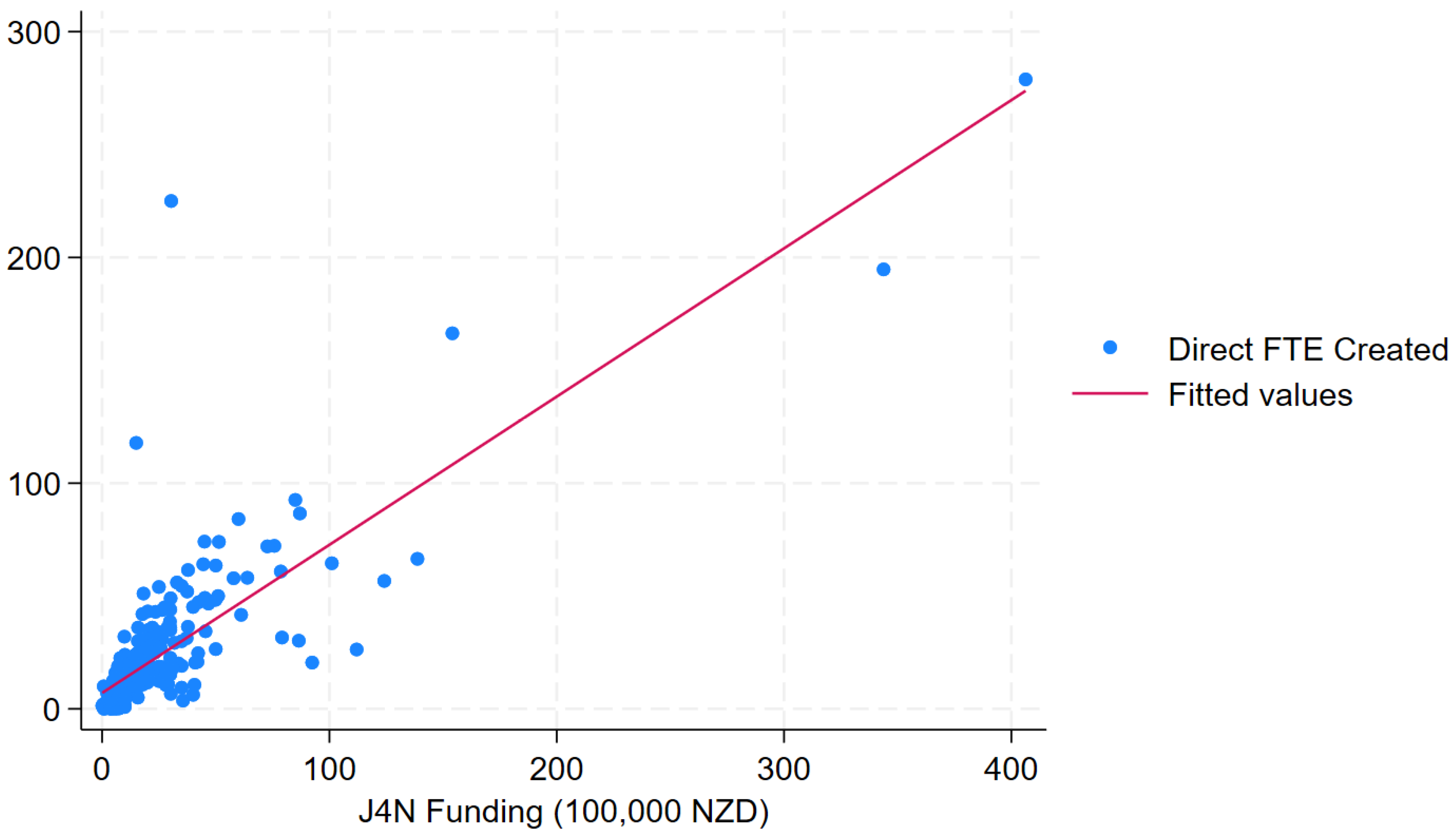
Table 1 summarises descriptive statistics for direct employment (FTEs created) and project funding across the 359 J4N projects. On average, projects created 19.54 FTEs, with a wide range of outcomes (0.02–278.87), indicating substantial heterogeneity in employment creation. For funding, the average is just below NZD 2 million (19.04 hundred-thousand NZD per project), with values ranging from NZD 7112 to over NZD 40 million. Given that a portion of funding directly supports jobs, total project funding can also serve as a proxy for project scale, accounting for the wide variation in project size and investment. This implies a strong positive association between funding levels and employment outcomes, with larger-budget projects typically generating higher FTEs (A correlation test confirms a strong positive association between funding and employment (r > 0.8). This strong correlation implies that the effects of funding largely reflect the unsurprising relationship that higher funding enables greater employment. Nonetheless, including this variable is important, as it allows the effects of other contextual variables to be interpreted as influences beyond this cost and/or scale effect. See Figure A1 in the Appendix A for a visual illustration of this correlation).
(c)
Geographic distribution and socio-economic context
Employment and economic impacts of ecosystem restoration activities vary across places [5,18]. These impacts are especially important for systematically disadvantaged or deprived communities, including Indigenous peoples and local communities [28,30], as well as regions with higher unemployment [10]. Measuring geographical distribution and accounting for the socio-economic context support equitable and effective outcomes [28], help mitigate geographical bias [10], identify and capture localised benefits due to the tendency to employ local labour and materials [18], and enable assessment of distributional effect, that is how costs and benefits are disaggregated across social groups, ethnicity, class, gender, and ableism [27].
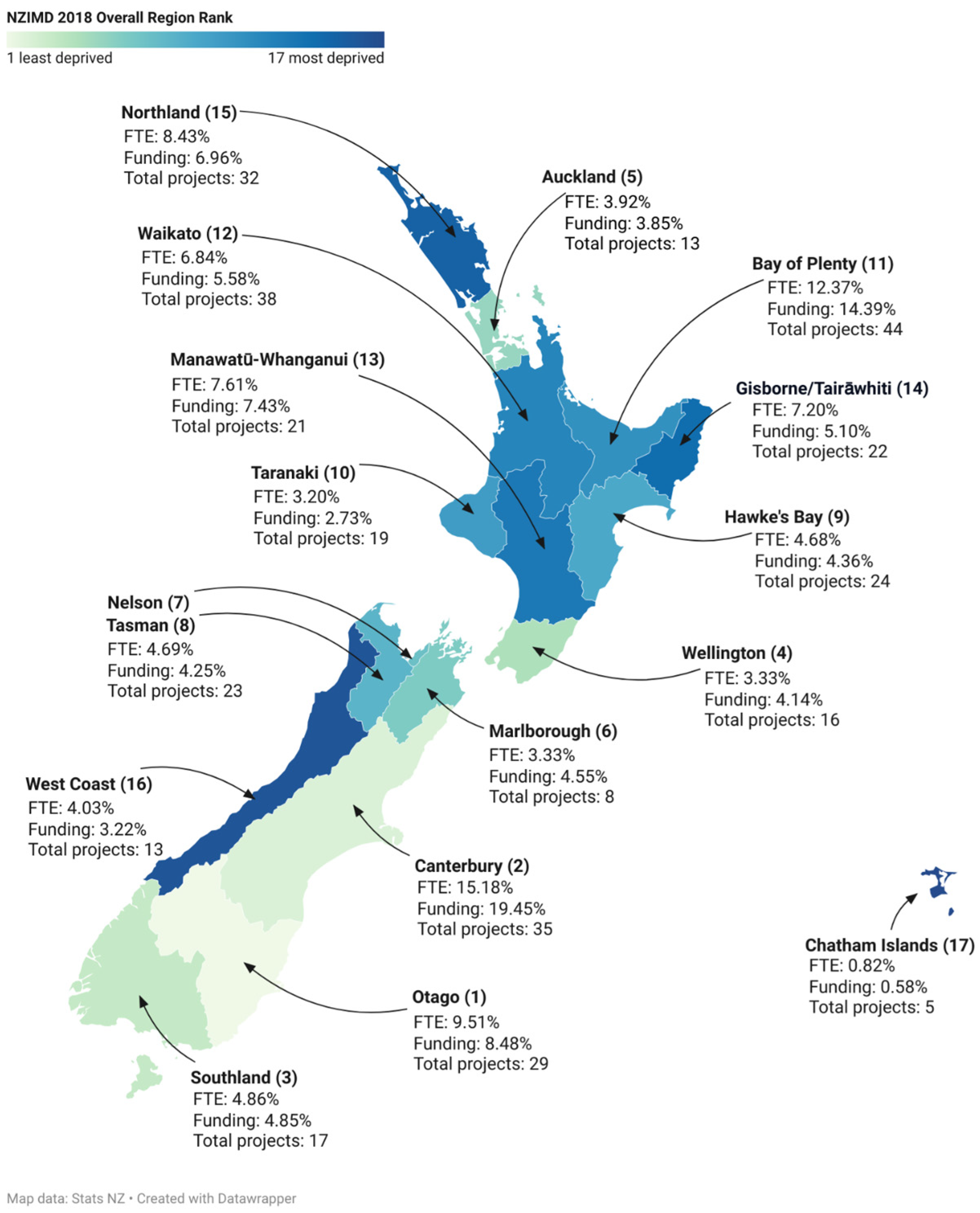
In this study, this factor is represented by the geographic region and the socio-economic deprivation ranking variable, the New Zealand Index of Multiple Deprivation (IMD) 2018 [31]. Following Löfqvist et al.’s [28] application of the Human Development Index (HDI) to indicate socio-economic context, an overall IMD ranking across seven domains of deprivation was derived for each region. (Lofqvist et al. found that, through the application of HDI (comprising three domains of income, education, and health) to global maps, around 1.4 billion people in low-HDI areas live in regions of high restoration priority [28]). The geographical region and deprivation ranking variable is measured on an ordinal scale ranging from 1 to 17, where 1 represents the least deprived and 17 the most deprived [31] (The seven domains of deprivation are employment, income, crime, housing, health, education, and access to services [31]. Ordinal relates to a scale that exhibits an order among categories but not the difference between them [32]). Figure 1 maps different regions and their associated deprivation rankings, with key data from the J4N programme to highlight the distribution of projects, the proportion of funding allocated, and employment opportunities in relation to regional socio-economic conditions.
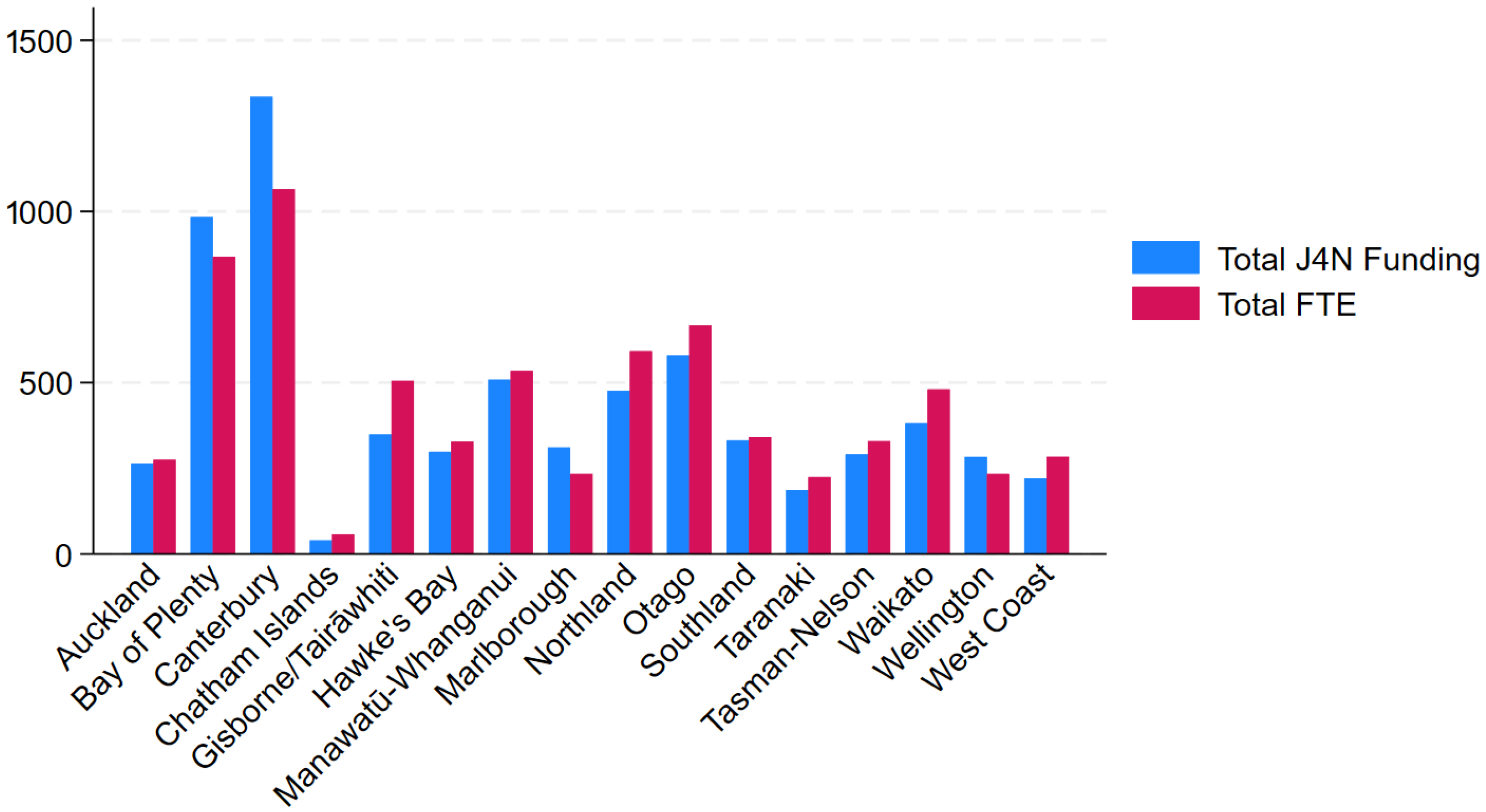
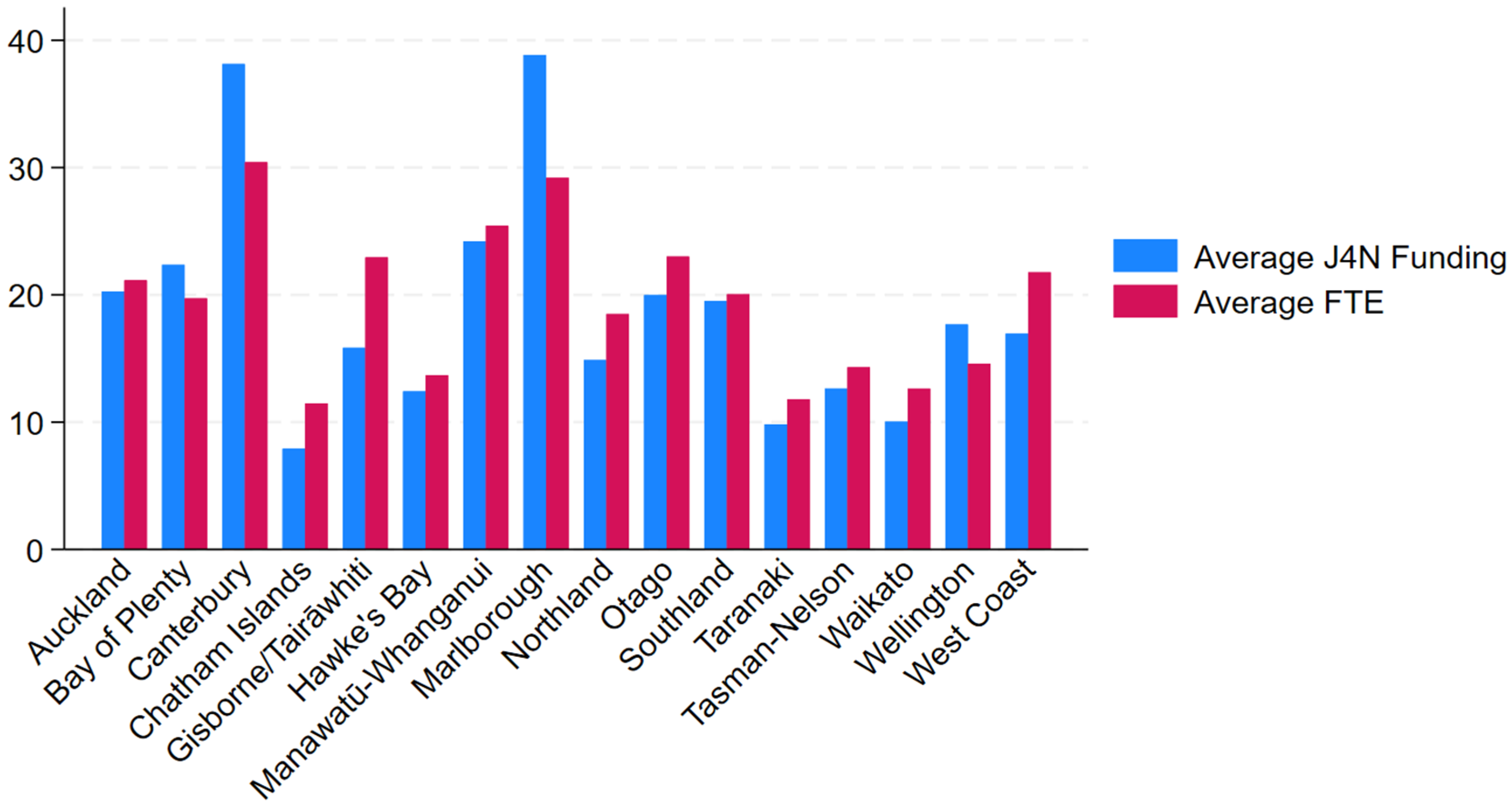
The geographic spread of the sample, shown in Figure 1, indicates that some less-deprived regions tended to receive more projects and funding, while others received comparatively less. For instance, Canterbury, despite being among the least deprived regions (IMD rank 2), accounts for one of the largest shares of J4N investment, with 35 projects. It received the highest total funding (NZD 133 million) and created the most employment (1064.810 FTEs), representing approximately 19.5% of total funding and 15.2% of total FTEs. By contrast, the Chatham Islands, the most deprived region (IMD rank 17), had the lowest funding and employment, with NZD 3.95 million across 5 projects, creating 57.36 FTEs–less than 1% of the total share of funding and FTEs. Similarly, Northland (rank 15) had 32 projects but accounted for only about 7.0% of total funding and 8.4% of FTEs, a lower share despite its higher deprivations. On average, Marlborough leads in both funding (NZD 3.88 million per project) and employment (29.196 FTEs per project), indicating comparatively efficient job creation relative to funding. Canterbury also records strong average project figures, suggesting that larger, more efficient projects tend to concentrate in less-deprived regions (These are also documented in Table A5 in the Appendix A, which presents total and average funding and employment by region, ordered by IMD rankings).
Figure 2 visually reinforces these patterns. The top panel illustrates total funding and employment, with Canterbury and Bay of Plenty dominating, while the bottom panel focuses on averages, with Canterbury and Marlborough showing more jobs relative to funding. These further suggest that overall regions with lower deprivation tend to host larger projects and secure substantial funding, likely reflecting their greater capacity for larger-scale, more impactful initiatives. For further descriptive statistics, see Table A4 in the Appendix A.
To test for statistical differences in mean employment outcomes (DV) across contextual factors (IVs), a one-way ANOVA is then employed. Relevant to policy analysis, one-way ANOVA identifies whether there is a measurable effect between, for example, geographic region and employment as the policy outcome [32,33]. Each contextual factor is tested with two individual one-way ANOVA tests, in addition to the classical Fisher’s test (The alternative Welch’s and Brown–Forsythe’s tests provide a more robust analysis of mean differences under potential violations of assumptions: homogeneity of variances, normality of residuals, and independence [33,34]). For geographic regions, the classic ANOVA indicates no significant differences across 17 regions [ F ( 15,343 ) = 1.01 ,   p = 0.442 ] . However, the robust Welch’s test suggests a marginal regional influence ( p = 0.064 ), therefore rejecting the null hypothesis ( H 0 ) (There is no difference in mean FTE outcomes across groups of an IV (region, funder, recipient, project, and duration). Refer to Table A6 in the Appendix A for full details and results).
(d)
Actors
Ecosystem restoration requires political, economic, and scientific challenges to be simultaneously addressed by multiple actors [8], including state and local governments, local communities, non-government organisations (NGOs), Indigenous peoples, and private entities [18]. In particular, community involvement is central to the long-term success of interventions but often requires capacity building (technical, administrative, and operational support) to achieve project objectives [20,35]. Although essential, capacity building relies on adequate funding, with high start-up costs that can deter private investment [28]. Despite these challenges, ecosystem restoration efforts in New Zealand rely upon iwi, community groups, NGOs, councils, and others [22]. For socially equitable and sustainable outcomes, Indigenous peoples should be involved in planning and designing such projects [6,36], particularly as their worldviews often differ from Western thinking [21].
For this study, the contextual factor of actors is represented by two variables: funding agency and funding recipient. Six government agencies administered the funding: (1) the Department of Conservation (DOC); (2) Land Information New Zealand (LINZ); (3) the Ministry for the Environment (MFE); (4) Agriculture and Investment Services (AIS); (5) Biosecurity New Zealand (BNZ); and (6) Te Uru Rākau (TUR)–NZ Forest Service. Funding recipients, following the recoding processes detailed in Table A3 in the Appendix A, are grouped into seven categories, ranging from local councils and iwi authorities to non-governmental and community-based initiatives: (1) Non-Government Organisation (NGO); (2) Māori Organisation; (3) Individual/Community; (4) District/City Council; (5) Government Organisation; (6) Company; and (7) Regional Council.
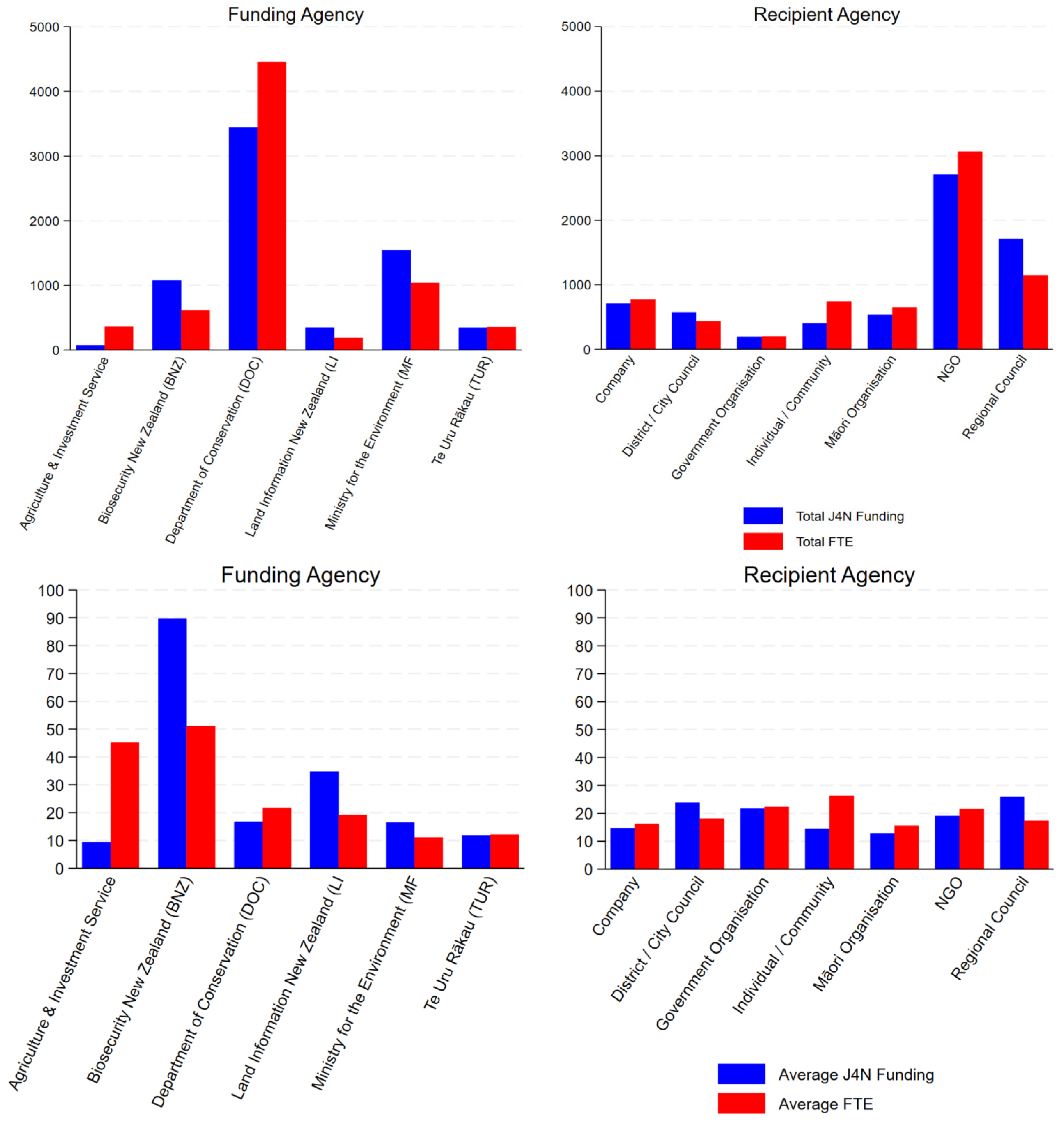
As shown in Figure 3, among funding agencies, DOC leads with the highest total funding and jobs (roughly 4500 FTEs for NZD 350 million), with an average of around 20 FTEs per NZD 2 million. Similarly, AIS, despite receiving comparatively minimal total funding, achieved the highest employment efficiency per project, generating over 40 FTEs per NZD 1 million. In contrast, BNZ, with high average funding (around NZD 9 million), created almost half an FTE per project. LINZ and MFE also recorded lower total employment, with modest average FTEs. Among funding recipients, NGOs (e.g., charitable trusts, incorporated societies) secured substantial total funding and employment (around NZD 300 million and 3000 FTEs), highlighting their central role in ecosystem restoration delivery in Aotearoa New Zealand [10,22] (Norton et al. found that ecosystem restoration in Aotearoa New Zealand is predominantly carried out by NGOs [22], with Brancalion et al. reporting that non-profit organisations created 48% of the jobs in this sector [10]). Regional Councils also achieved high total funding and jobs, but showed lower average FTEs, indicating less employment-intensive outcomes. Individual/community recipients, despite moderate total funding, created the highest average jobs per project (around 30 FTEs for NZD 1.5 million), reflecting strong employment capability in community-focused initiatives. Government, Māori organisations, and companies maintained balanced total and average ratios, while district and city councils generated lower average FTEs relative to funding.
Linking these findings with the ANOVA results, one-way tests reveal mixed effects of actors on employment creation. Across the six funding agencies, the mean FTE differs significantly [ F ( 5,353 ) = 7.63 ,   p < 0.001 ] , with Welch’s robust test confirming this ( F = 6.07 ,   p = 0.000 ) . Post hoc Bonferroni and Tukey tests further indicate that projects funded by MFE and TUR generated significantly fewer jobs than those administered by AIS and BNZ. By contrast, for the seven funding recipients, the ANOVA finds no statistically significant differences in employment creation [ F ( 6,352 ) = 0.78 ,   p = 0.59 ] , with robust tests lending further support. Overall, these findings align with the patterns observed in Figure 3’s bottom panels.
(e)
Ecosystem response types
To enable studies to be compared and contribute to the understanding of benefits and costs, an analysis of ecosystem restoration investment should identify, for direct employment, both the type of ecosystem [29] and the type of restoration intervention [5]. In this study, the contextual factor of restoration activity is represented by the ecosystem restoration response type variable. Each observation within the J4N programme sample had one or more activity types, as listed in the first column in Table 2. In accordance with the TEER standard framework (see Table A2), these activity types are classified as a direct biophysical response (DBR), an enabling and instrumental response (EIR), or a combination of the two. DBR projects are those centred on ecological restoration activities (e.g., planting, pest control), whereas EIR projects involve improving capabilities (e.g., public education, community capacity building). Therefore, this IV consists of three categories: (1) DBR only, (2) EIR only, and (3) DBR and EIR.
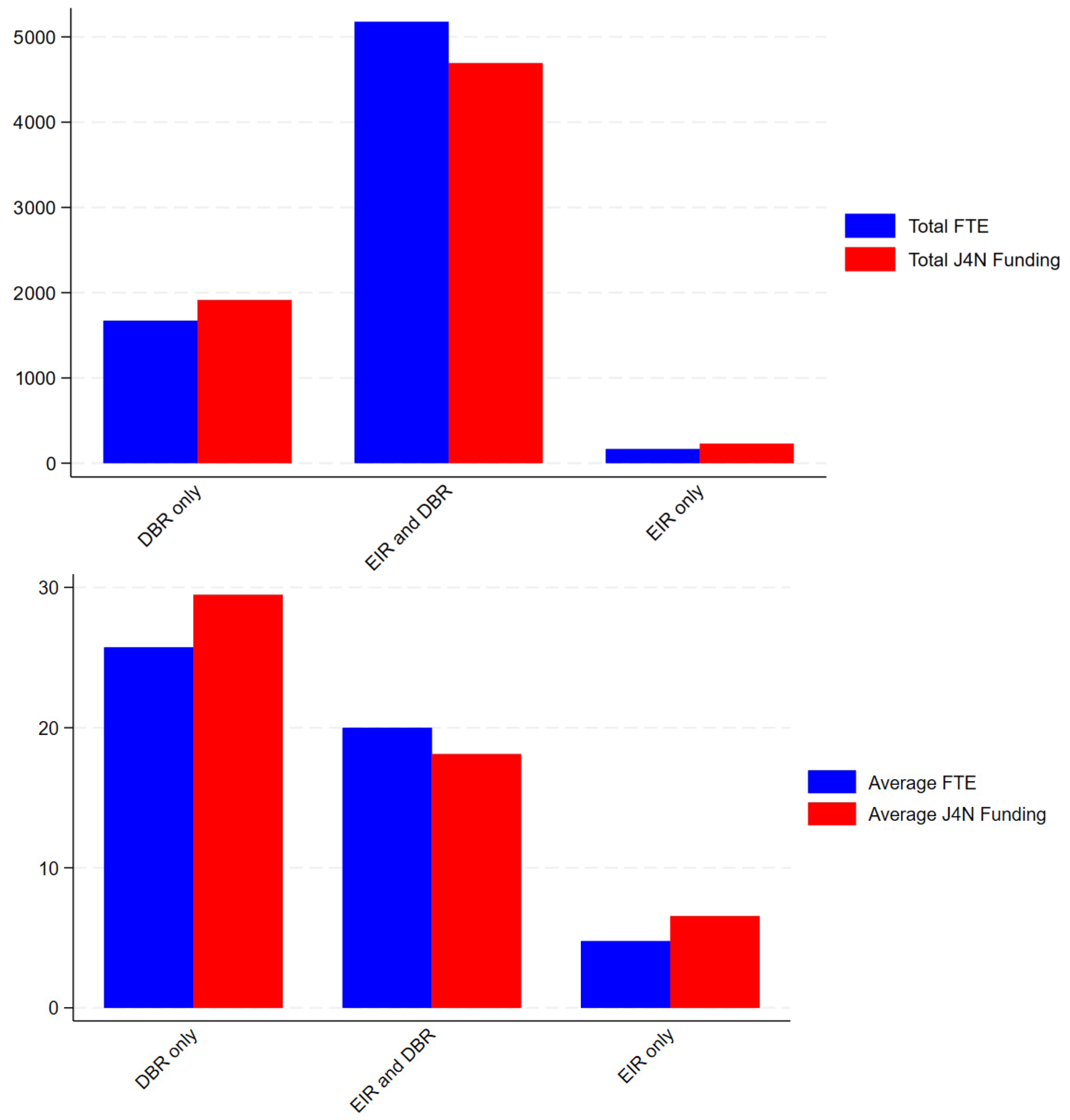
Figure 4 illustrates the distribution of total and average FTEs and J4N funding across the three project types. In the top graph (totals), combined EIR and DBR projects received the most funding and created the highest employment, while in the bottom graph (averages), DBR-only projects achieved the highest funding and jobs per project, reflecting strong employment intensity. EIR-only projects recorded the lowest totals and averages, consistent with their nature. Differences in FTEs across project types are statistically confirmed through classical and robust one-way ANOVA tests. Consistent with the visual patterns in Figure 4, the results show significant overall differences [ F ( 2,356 ) = 6.95 ,   p = 0.001 ] . Further, post hoc Bonferroni and Tukey tests reveal that “EIR only” projects produced significantly lower mean FTEs than both “DBR only” and “EIR and DBR” projects, while no significant difference is observed between the latter two.
(f)
Duration
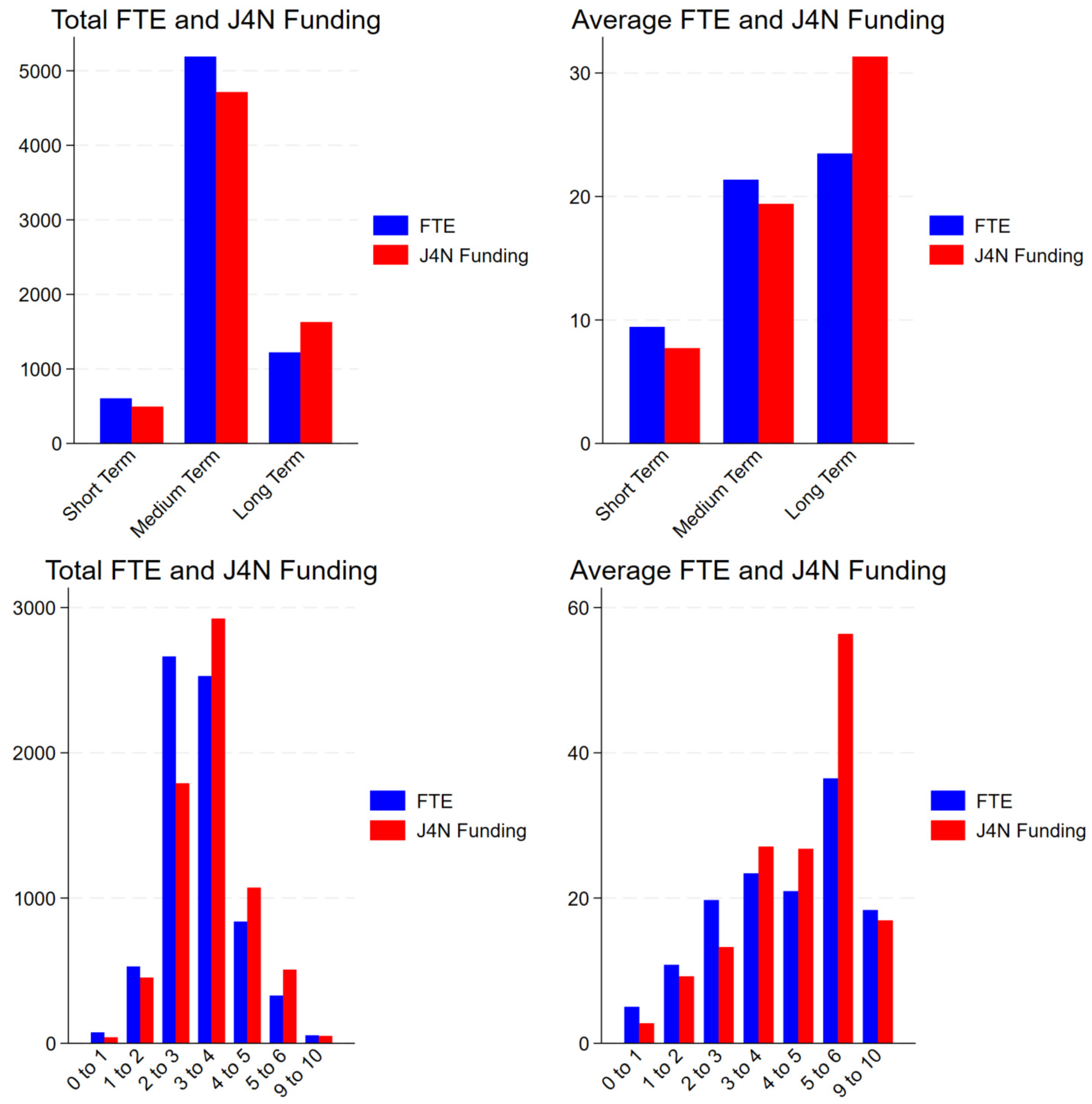
This variable represents the duration factor identified in the literature [5], with the original data, measured in estimated years and months, first classified into three broad categories: short-term (0 to 2 years), medium-term (2 to 4 years), and long-term (4+ years). For more detailed analysis, these categories are further broken down into six specific ranges: (1) 0–1 year, (2) 1–2 years, (3) 2–3 years, (4) 3–4 years, (5) 5–6 years, and (6) 9–10 years (1 year and 0 months were included in the 0 to 1 year range. There were no projects within the sample with a duration range of 6 to 7, 7 to 8, or 8 to 9 years). As shown in Figure 5 below, medium-term projects lead in both total employment and funding, capturing nearly two-thirds of the J4N funding, with 2–3- and 3–4-year projects driving the most job creation within the programme (left panels). However, when accounting for the number of projects (right panels), it is the long term that commands the highest average FTE and funding, particularly those lasting 5–6 years. Medium-term projects maintain a relatively balanced distribution of resources overall, while short-term projects consistently record the lowest figures across both metrics, reflecting fewer resources and investments involved.
When statistically tested to examine whether project duration is significantly associated with differences in direct employment outcomes, an ANOVA corroborates the visual patterns: both the classical Fisher’s and Welch’s tests reveal significant overall differences between the groups [ F 2,356 = 5.51 ,   p = 0.0044   and F = 13.42 ,   p < 0.001 ). Subsequent post hoc comparisons confirm the earlier graphical evidence, showing that medium- and long-term projects produced significantly higher mean FTEs than short-term projects. However, no significant difference is observed between medium- and long-term projects.
Table 3 summarises all variables used in this study, with descriptive statistics and ANOVA results provided in the Appendix A, Table A4 and Table A6, respectively.

2.2. Method

The methods utilised for this study build on prior work and the data availability of the J4N programme, using government expenditure and reported employment outcomes. To date, quantitative research in this area has largely been limited to basic descriptive and simple inferential statistics [18,23], highlighting the need for further statistical analysis to rigorously test causal relationships and quantify impacts [32]. Therefore, following Brancalion (2022) [10], who used linear regressions to examine whether employment creation was associated with state-level GDP in Brazil, a three-stage linear OLS regression strategy is implemented to assess how J4N funding and contextual factors influence direct employment (FTEs) in Aotearoa New Zealand. Each stage progressively increases model complexity and employs heteroskedasticity–robust standard errors (Huber–White) to ensure valid inference and more precise estimates [37]. Below, each model stage and its corresponding regression equation are specified:
y i = α + i = 1 n 1 γ i Z i + ε
    y i = α + β 1   x + i = 1 n 1 γ i Z i + ε
y i = α + β 1   x + i = 1 n 1 γ i Z i + i = 1 n 1 δ i ( x · Z i ) + ε
In all three equations, y i is DV, representing employment outcomes, measured in the number of FTEs. The five contextual factors of region, funding agency, funding recipient, ecosystem restoration response type, and duration, are represented by vector   Z . These categorical variables and their combined effects are captured by the summation term ( i = 1 n 1 γ i ) through dummy coding. The main IV in Equations (2) and (3) is J4N funding ( x ), with   β 1 indicating the magnitude of its effects on employment. Equation (3) introduces i = 1 n 1 ( x · Z i ) to capture the interactions between funding and contextual factors. Their effects are also represented by i = 1 n 1 δ i through dummy coding of the categorical variables. The rest of the model remains the same as Equation (2). Finally, α   denotes the intercept and ε the error term.
The baseline model (Equation (1)) is first estimated to test the association between contextual factors and the outcome variable, serving to validate the prior ANOVA results (The models’ specifications are built on the ANOVA results, in that they identify which categorical variables significantly affect the DV. Their robustness is then tested with Stage 1 regression models, including only those variables that significantly predict employment). Equation (2) then examines the direct impact of J4N funding on job creation while controlling for significant contextual factors from Stage 1. Lastly, the full model (Equation (3)) with interaction terms tests whether the funding effect on employment is moderated by any of these factors. Stage 3 thus accounts for any nuanced contextual differences, providing a more complete view of both direct and context-dependent effects. Following this, a marginal analysis is conducted to visualise the relationship and derive policy implications. This hierarchical design allows us to assess the incremental explanatory power of funding beyond contextual factors while mitigating the risk of confounding. All analyses are performed using Stata 18 MP (All data, codes, and Stata do files are available upon request).

3. Results

The results are presented in three parts. Table 4 reports the baseline models (Stage 1) where the impact of contextual factors on FTEs is estimated both separately and jointly. This mirrors multifactor ANOVA tests in a regression framework but with greater flexibility [38]. (If the ANOVA shows significant differences in mean FTEs across categories, Stage 1 models should reflect these effects, allowing us to estimate and compare the effects of contextual factors on employment, while controlling for other variables). The organisation of the results addresses: (i) which contextual factors are significantly related to FTEs (Columns 1–5), and (ii) whether these factors collectively explain meaningful variance in employment (Column 6). In what follows, the focus is on the joint specification (Column 6), with the separate models (Columns 1–5) serving as baseline and robustness checks that mirror the multifactor ANOVA in a regression framework [38]. Consistent with the one-way ANOVA, regional dummies show no strong cross-regional differences relative to Bay of Plenty aside from a marginally negative effect for the Chatham Islands in the full model, suggesting limited regional variation in FTEs once other factors are controlled. (In all regression models, the largest category within each variable serves as the reference group).
In Column (2), the funding agency model shows that projects funded by MFE and TUR are associated with significantly lower FTEs ( 10.56 and 9.44 , respectively) compared to the reference group (DOC), while AIS, BNZ, and LINZ show no significant differences, consistent with the ANOVA results on between-agency variation. In contrast, recipient type shows no robust differences once other factors are controlled, apart from the borderline negative effects for Company and Māori Organisation, which disappear in the joint specification. This suggests that, relative to NGOs, the type of recipient has no robust effect on FTEs once other factors are controlled (The F-statistic for the Column (3) model is insignificant ( F = 0.78 ,   p = 0.3715 ), indicating a weak relationship between the two variables, and is therefore omitted from the Stage 2 analysis). Turning to Column (4), “EIR only” projects are linked to 15.23 fewer FTEs ( p < 0.01 ) compared to the “EIR & DBR” reference, whereas “DBR only” projects do not differ significantly. These results align with the ANOVA pattern, where only EIR projects yield significantly lower FTEs than the other two categories.
The regression models using project duration (Columns 5 and 6) show that, while short-term projects produce approximately 8–12 fewer FTEs than the reference group (medium-term), long-term ones tend to generate more in the full model. Similarly, when duration is expressed in yearly bands, projects lasting 0–1 and 1–2 years systematically generate fewer FTEs than medium-term projects, whereas some longer projects (4–5 and 9–10 years) yield higher FTEs relative to the 2–3-year baseline, corroborating the ANOVA evidence that project length matters for employment. When all contextual factors are simultaneously included (Column 6), many of the individual effects persist (except for funding recipients), with the factors identified in the initial ANOVA tests collectively explaining about 20% of the variance in direct employment. Overall, the Stage 1 results, together with the ANOVA (Table A6), indicate that regions, funding agency, project type, and duration are important factors to include in subsequent analyses.
The stage 2 analysis examines the main effect of J4N funding on FTE, evaluating whether it has a statistically significant impact on employment after accounting for the contextual factors identified in Stage 1. Table 5 presents the results. In what follows, the focus is on the full specification with all contextual controls (Column 6), and earlier columns serving as robustness checks. In the simplest specification (Column 1), funding shows a highly significant and positive relationship with employment, which is consistent with the idea that larger projects support more jobs. The coefficient is 0.66, indicating that for each additional NZD 100,000 of government investment, employment increases by 0.66 FTEs ( p < 0.01 ). The model explains 65% of the variance in FTEs, far more than any of the contextual factors alone in Stage 1, highlighting the importance of funding as the primary predictor of the DV. The coefficient remains highly consistent across all six models, ranging between 0.65 and 0.7, confirming that project cost heavily influences employment outcomes.
Adding regional controls (Column 2) shows that most dummies remain statistically insignificant, except for Gisborne/Tairāwhiti ( β = 7.52 ,   p < 0.05 ) . Together with the slight change in R-squared, these results suggest that regional variation offers limited additional explanatory power for FTEs across both islands once we account for funding (The 16 regions were also categorised into North and South Islands. However, the results remained insignificant, confirming no substantial regional differences in employment). Introducing funding agencies in Column (3), however, reveals that projects funded by BNZ, LINZ, MFE, and TUR produce significantly lower FTEs relative to DOC. Among these, BNZ has a coefficient of −21.84 ( p < 0.01 ), indicating that jobs created under this agency are substantially lower than those funded by DOC, holding everything else constant. The model’s R 2   of 73% highlights the importance of funding agencies for employment once funding is controlled for.
Column (4) of Table 5 adds the TEER restoration project type. Both DBR- and EIR-only projects are negatively associated with FTEs relative to the baseline, but the effect is only statistically significant for EIR-only projects (7.7 fewer FTEs). This finding is consistent with Stage 1 and earlier ANOVA tests that this type of project is less effective for job creation. Column (5) presents the project duration coefficients. Controlling for funding, both short- and long-term projects generate fewer jobs compared to those of medium duration (the reference). The year-by-year analysis further supports this finding: very short (<2 years) and long (4+ years) projects are less effective in creating employment, thus reinforcing that project length affects employment outcomes, even after accounting for funding. Finally, Model (6) combines funding and all contextual factors in one comprehensive specification, albeit noting one potential concern. That is, because recipients were excluded from the Stage 2 analysis; regions might also need to be omitted. To address this, Model 6 is re-estimated without regional controls. The results are found to be highly consistent with those reported in Table 6. (Full estimation results are reported in Table A7 of Appendix A). The results are highly consistent with those observed earlier. Funding remains robust and highly significant, establishing itself as the key driver of employment. Most contextual factors retain their earlier effects, with only minor adjustments, as expected (Incorporating a key covariate like funding that captures substantial outcome variance refines other coefficients via reducing omitted variable bias [39]. A variance inflation factor (VIF) test was computed after each regression to check for multicollinearity among IVs. The mean VIFs were around one across all models, indicating negligible collinearity [40]). The full model explains 74% of the variance in FTE, indicating a stronger model fit over Stage 1 and confirming that funding is central, while contextual factors provide additional, but more modest, explanatory power.
Stage 3 augments the models with interactions between J4N funding and each contextual factor to test for moderation effects. That is, whether the impact of funding on employment varies by region, funding agency, project type, or duration. These interaction terms, when significant, highlight where funding creates the most jobs per dollar and where it struggles to do so, confirming heterogeneity in the funding–FTE relationship (If the interaction terms are not jointly significant and do not improve the model fit ( Δ R 2 ) when going from Stage 2 to Stage 3, a simpler model (without interactions) suffices, implying that J4N’s effect is uniform across contexts). Table 6 presents the results of these interaction models, reporting the funding’s main effect and all interaction terms, while suppressing the main effects of contextual factors for brevity. The substantive interpretation relies on the full interaction model (Column 5), with earlier columns isolating each interaction block and acting as robustness checks. Consistent with Table 5, the first-row estimations show funding’s main effects (0.64–1.00) that are positive and highly significant across all five models.
In the model where region moderates (Column 1), positive and significant interaction terms ( + 1.11 ,   p < 0.01 ) for certain regions like the Chatham Islands indicates that funding creates more FTEs there (over one additional FTE per NZD 100,000) compared to the baseline region, Bay of Plenty (The baseline J4N effect (i.e., main effect) corresponds to the reference group’s effect in each model). Elevated funding returns are also observed in Gisborne/Tairāwhiti, Taranaki, Tasman–Nelson, Canterbury, Waikato, and West Coast. These positive interactions suggest that restoration projects in these regions were especially effective at converting funding into jobs, over and above the effect in the Bay of Plenty. However, for Manawatū-Whanganui, the effect is negative (0.3–0.4 fewer FTEs per NZD 100,000), indicating a smaller impact than Bay of Plenty. Most other regions, such as Auckland, show no significant interactions, meaning their funding effects are broadly similar to those of Bay of Plenty, once other factors are controlled.
Column (2) examines how the effect of funding on job creation differs by agencies administering the projects (relative to DOC). As shown, AIS stands out with a strong positive interaction ( + 6.5 ,   p < 0.01 ), meaning that each NZD 100,000 invested through this agency generates 6.5 more FTEs than comparable DOC projects. This effect persists in the full interaction model, suggesting AIS-funded projects were especially labour-intensive or otherwise effective at translating investment into employment (In the full model, only interactions that remain significant are interpreted, as these reflect the unique moderating contribution). In contrast, projects funded by BNZ and LINZ yield between 0.5–0.7 fewer FTEs per unit of investment, with significantly negative interactions, consistent with relatively capital-intensive portfolios where spending creates fewer direct jobs [41]. Interactions for other funders (MFE and TUR) appear negative but not statistically significant in the full model.
Column (3) shows that the funding–FTE relationship does not differ significantly across TEER project types: the interactions for DBR- and EIR-only projects are insignificant, indicating that funding works about the same in these groups as it does in the baseline projects (EIR and DBR) (An important limitation of the J4N dataset is that it does not include a direct measure of project scale (e.g., hectares of habitat restored, number of plantings). The omission of a precise project scale means some observed effects of, for example, regions, could partly reflect underlying differences in project scale. While project budget (funding), duration, and project types are already included as rough proxies for project scale (on average, projects with larger budgets or longer durations and certain types tend to create more FTES), these may not fully capture the scope of on-ground work. Therefore, a new variable is created based on the number of restoration activities within a project, project range, as a proxy for project breadth. To refine this proxy into a measure of scale, project range is further multiplied by a three-level budget category (small, medium, and large) for each project, yielding project size. Projects that involve a wider range of activities and have larger budgets are thus represented as larger in scale. The Stage 2 and 3 models are re-estimated with these two new variables (see Table A8, Appendix A). The results are highly consistent with the original models (Table 5 and Table 6), indicating the robustness of the main findings). By contrast, the next set of interactions (duration × funding) shows that both short- and long-term projects produce significantly lower employment returns to funding (Column 4). These patterns strengthen in the full model (Column 5), with the long-term effect becoming even more pronounced. In other words, medium-length projects (2–3 years) appear to be the most effective at converting funding into jobs, with all else equal, reinforcing the importance of project duration in the J4N programme (The year-by-year interaction analysis reveals several of the shorter and longer duration bands with negative interaction coefficients, meaning lower job payoffs per funding compared to 2–3-year projects).
Overall, Stage 3 indicates that J4N funding’s employment effects are heterogeneous: they are amplified in certain regions (notably the Chatham Islands, Taranaki, and Gisborne/Tairāwhiti) and significantly higher for projects under specific agencies (AIS), but comparatively lower for very short- and long-term projects. The rise in R 2   values from Stage 2 suggests greater explanatory power of the full model, further supporting this non-uniformity and highlighting opportunities for more tailored policy interventions that target high-return regions, agencies, and project durations.

4. Discussion

Across all specifications, our analysis reveals that government funding is the primary driver of direct employment: as the input that directly purchases labour, it unsurprisingly exhibits a strong positive association with jobs. This is in line with international evidence on the employment stimulus from ecological restoration [10,17,18,41] and with evaluations of J4N that highlight the central role of restoration funding in generating short-term employment in Aoteoroa New Zealand [42,43]. The more substantive policy question, therefore, is not whether funding matters, but under which conditions it generates more jobs per dollar and how programme design can shift projects towards high-return configurations.
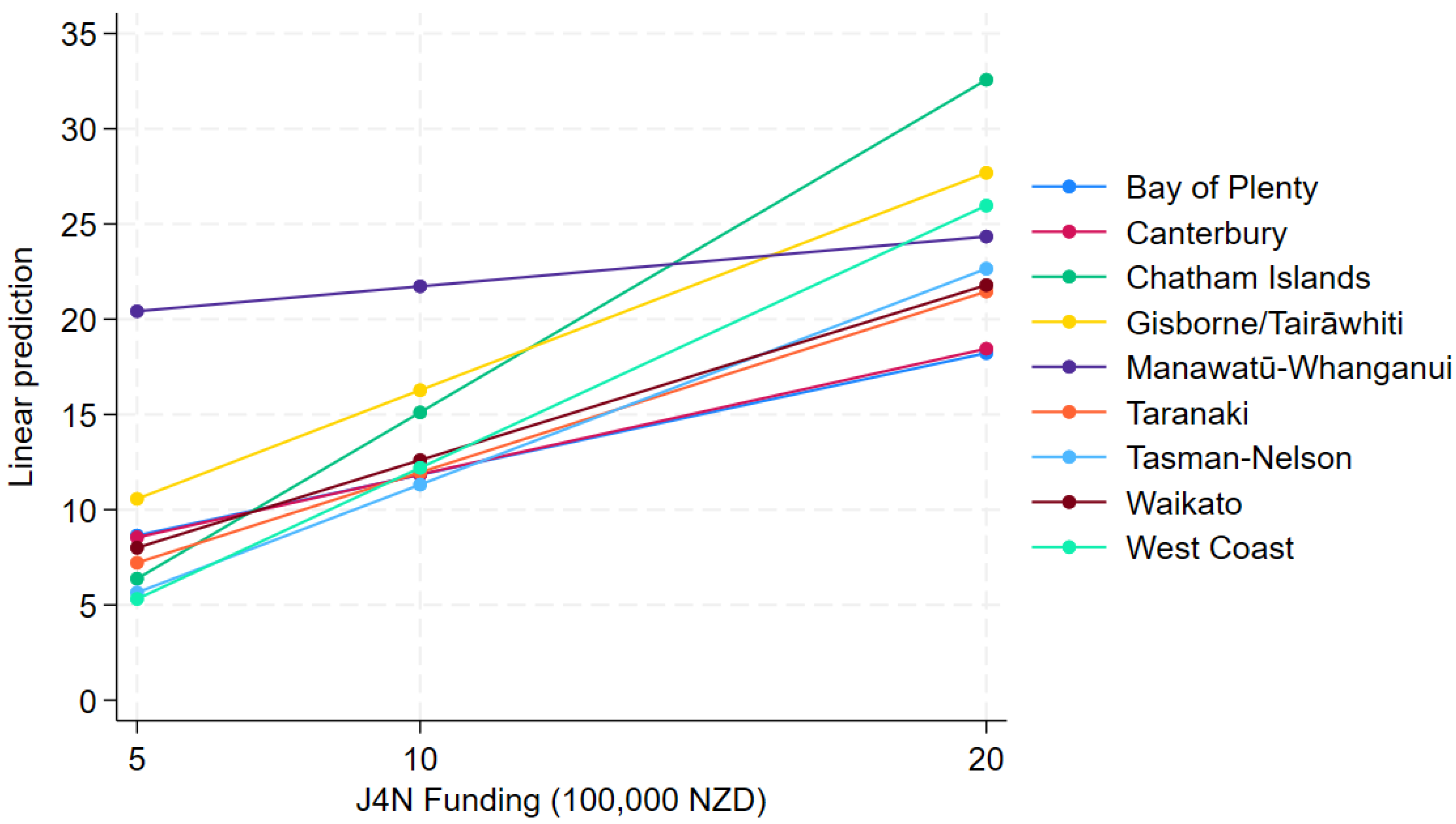
At the regional level, Stage 2 analysis found no notable employment differences across Aotearoa New Zealand’s 16 regions, once funding was controlled, but Stage 3 interactions reveal geographic heterogeneity in funding returns. Some regions like the Chatham Islands (0.75), Gisborne/Tairāwhiti, and West Coast (0.35), display higher marginal effects per NZD 100,000 of investment (Figure A2 in the Appendix A), disproportionately benefiting from additional funding. These regions often face higher deprivation according to the IMD 2018 ranking, and J4N evaluations note that funding was explicitly targeted towards regions and communities most affected by COVID-19 and long-standing economic disadvantages [42,43], suggesting that spatially targeted funding could maximise job creation and improve equity. They are also relatively remote and have thinner labour markets and fewer alternative employment opportunities. As a result, restoration funding in these locations is more likely to be channelled into on-the-ground work (such as track building, erosion control, or pest management) rather than capital-intensive upgrades, which helps explain the higher FTE returns per dollar [42].
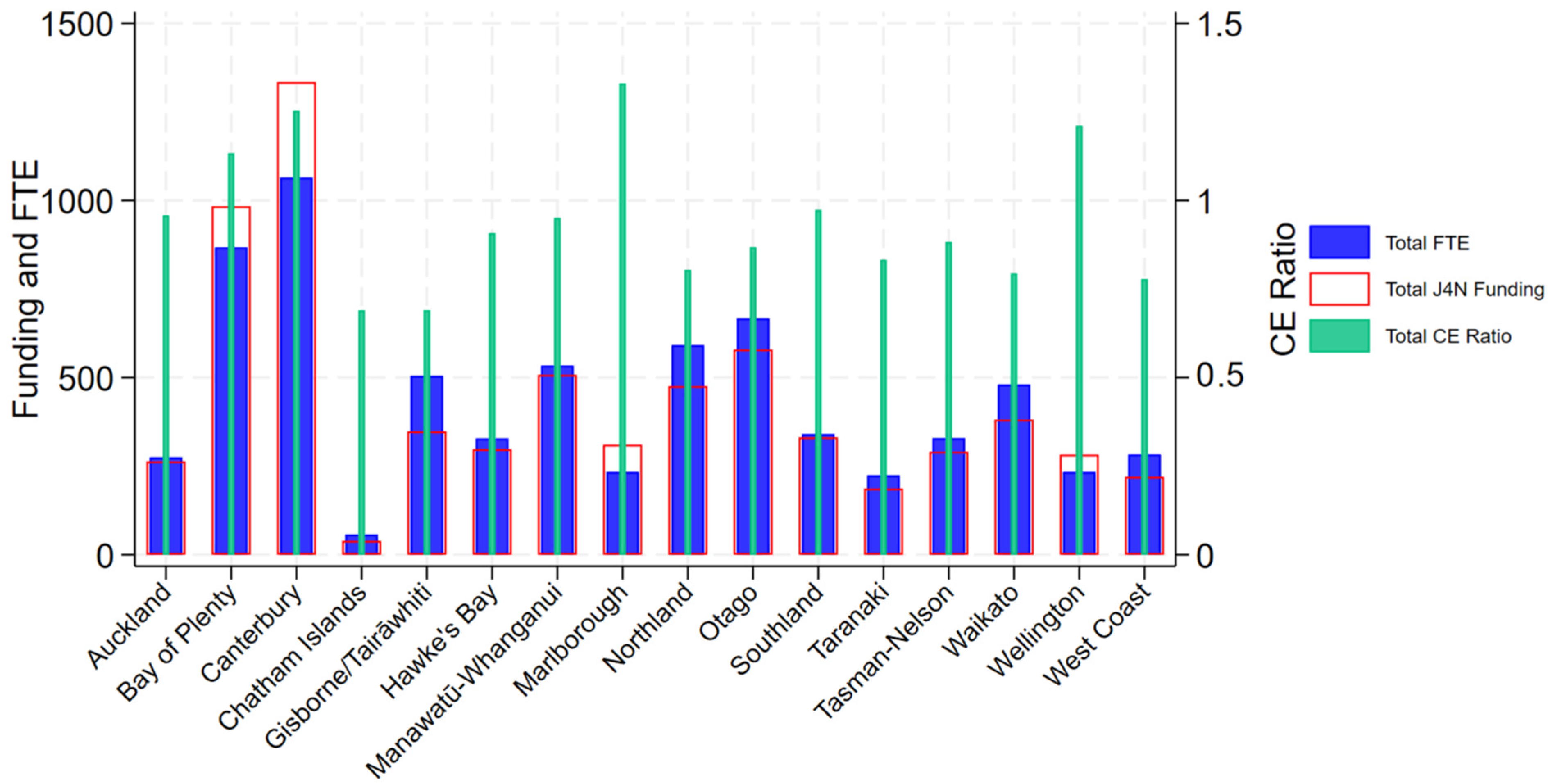
Therefore, targeted regional development policies are warranted, particularly in socio-economically weaker areas, as “one size fits all” funding may be suboptimal for generating jobs and improving the cost-effectiveness of public expenditure. There is considerable regional variation in the cost-effectiveness (CE) of job creation, measured by dollars spent per FTE. Regions such as the Chatham Islands, Gisborne/Tairāwhiti, and West Coast have the lowest CE ratio, about 0.75 (NZD 75,000 per FTE), indicating higher employment efficiency even with less funding. In contrast, some less-deprived regions, including Marlborough, Canterbury, and Wellington, exhibit higher CE ratios of over 1.25 (roughly NZD 125,000 per FTE. Further details are provided in Figure A3 in Appendix A). In practice, this highlights the importance of directing a larger share of restoration funds to high-deprivation, high-return regions, for economic benefit. In addition, such programmes also ensure that project pipelines in these areas are supported in an ongoing way (for example, through co-design with local and Māori organisations and technical assistance), thereby building community capacity for current and future project development [21,44].
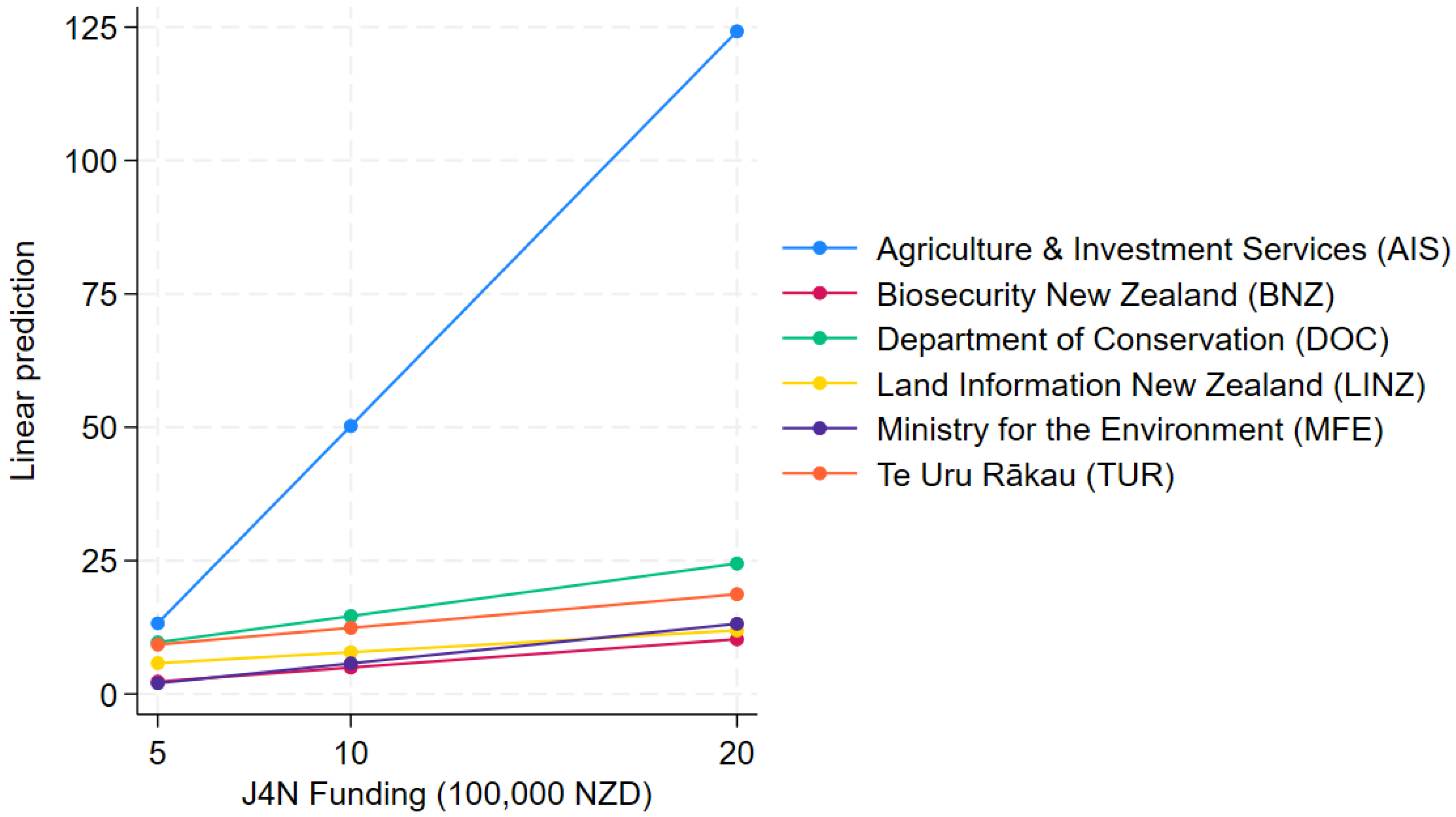
For actors, the results vary significantly by funding agencies, but not by recipient organisations. Negative main effects (Stage 2) and interactions (Stage 3) for agencies like BNZ and LINZ indicate lower employment intensity compared to DOC, whereas strong positive interactions for AIS reveal substantially higher marginal returns (Figure A4 in the Appendix A). This stark contrast highlights portfolio design differences, as whatever approach AIS took in project selection or execution was highly effective in generating employment, and is therefore worth emulating. However, too better understand BNZ and LINZ underperformance, their project portfolios should be evaluated, as their funded projects may be more capital-intensive with valuable long-term outcomes (environmental infrastructure, capacity building) that simply did not create as many immediate jobs as those of AIS. Therefore, a conditional funding strategy (channelling more funding towards agencies with proven high job multipliers versus providing more support to lower-return ones) is needed to address these institutional differences.
Given their distinct mandates, agencies such as BNZ and LINZ are likely to fund more capital- or technology-intensive activities (e.g., surveillance infrastructure, mapping, or specialist equipment), whereas AIS and DOC portfolios appear more concentrated in labour-intensive fieldwork and nature-based employment initiatives [42,43,45,46]. While our data do not allow us to reconstruct project-level management choices, the pattern suggests two concrete levels for future programmes: (i) strengthening employment-related criteria in the project selection and contracting guidelines of low-return agencies (for example, minimum labour content, explicit training components, or requirements for on-the-ground restoration tasks) and (ii) codifying and disseminating the portfolio practices of higher-return agencies like AIS so that other funders can systematically adopt similar design features [43,44]. In this way, agencies with currently lower FTE returns can improve their outcomes rather than simply receiving less funding. In doing so, the J4N programme can boost its job impact without necessarily increasing total spending.
By project type, the lack of significant interactions suggests that the marginal impact of government funding is broadly consistent across restoration projects. However, the strong negative main effect for EIR-only projects in Stage 2 stands out, showing systematically lower job creation (around 5–8 fewer FTEs) compared to projects with DBR components. This reflects the lower labour intensity of EIR-only projects, which often involve more planning, infrastructure, or equipment, whereas biodiversity restoration or conservation work, such as pest control, planting, and other DBR activities, are more hands-on and typically maintain decent job creation rates [47]. This pattern is consistent with J4N reporting that field-based weed, pest, and planting projects employed substantial numbers of local workers, whereas planning and governance projects tended to support smaller professional teams [42]. This does not mean EIR-only projects should be avoided, but rather that policymakers should bundle them with job-creating components to achieve a balanced portfolio of environmental and employment objectives, especially when reducing unemployment is a co-equal goal, as in the post-COVID J4N recovery programme. The current J4N programme already aligns with this goal with only 3.35% of funding is allocated to EIR-only projects. The majority supports DBR or combined EIR and DBR projects that generate the bulk of FTEs, demonstrating a clear bias toward labour-intensive environmental work. (See Table A5 in the Appendix A for further details). In practice, planning-heavy EIR projects (such as strategy development, mapping, or education campaigns) could be paired with DBR workstreams (nursery operations, planting, and pest control) within the same funding package, so that each tranche of funding supports both long-term enabling functions and immediate employment opportunities.
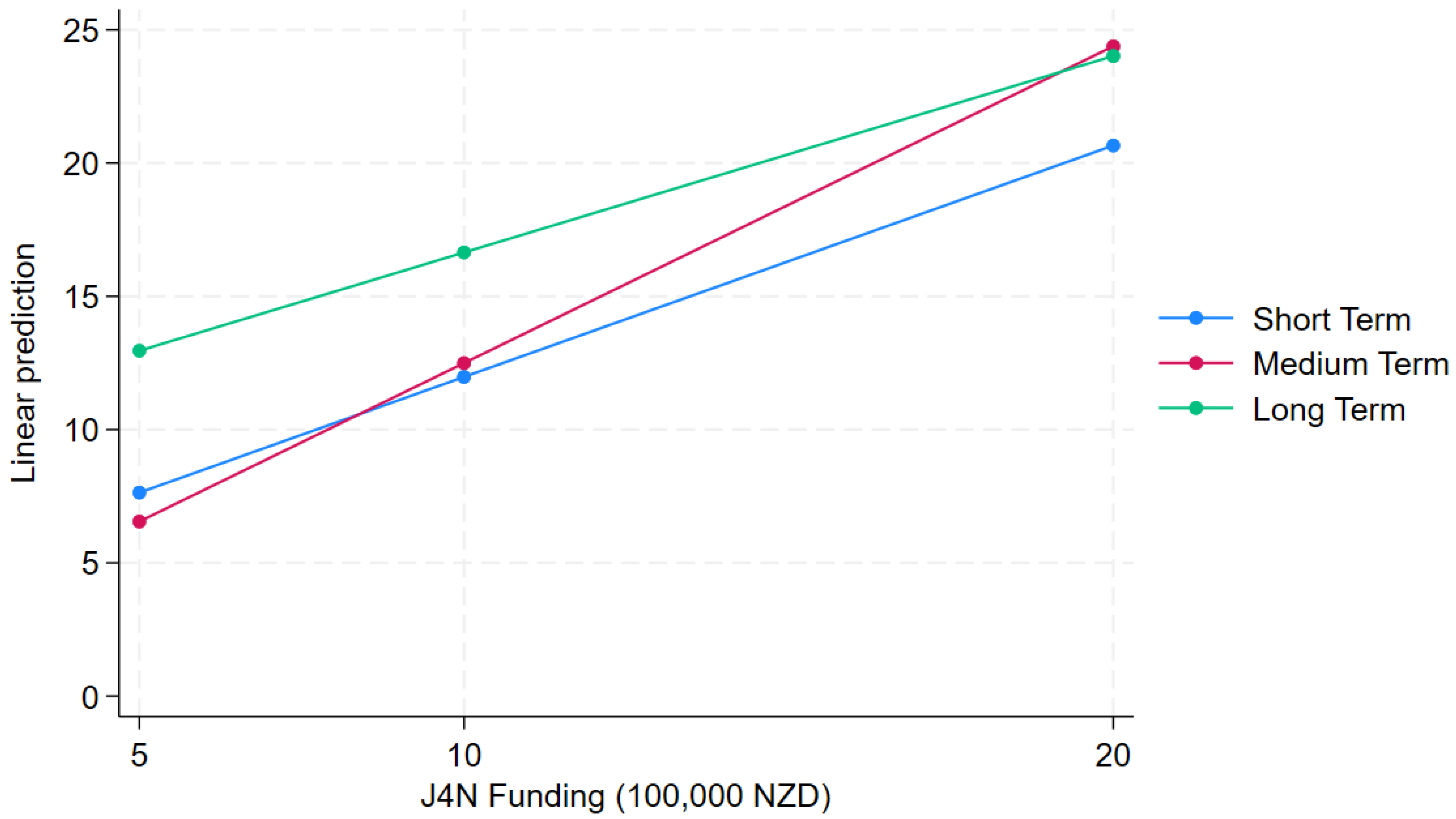
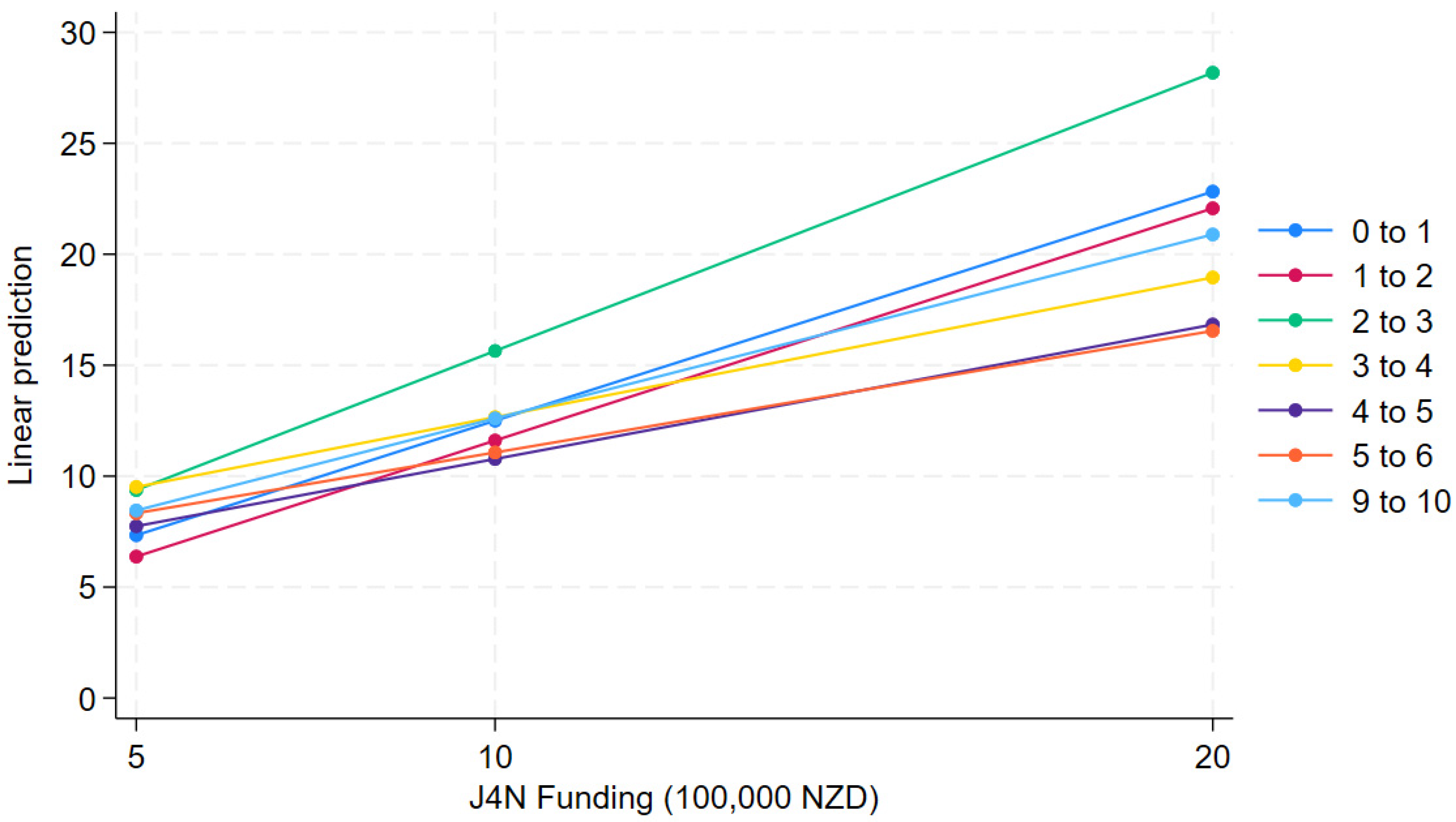
In terms of duration, Stage 2 and 3 estimations show that medium-duration projects, particularly those completed within 2–3 years, appear to be the most employment-efficient horizon. They are long enough to ramp up and sustain jobs, but not so long that projects risk diminishing new hires over time [10]. Therefore, a policy implication is to structure funding agreements around 2–3-year horizons to maximise both economic and environmental impacts. Figure A5 (in Appendix A) visually shows this pattern: marginal effects for very short- and long-term projects (under 2 years and over 4 years) are less steep than for medium-term ones. Projects outside this optimal window may still maintain employment efficiency if longer projects are broken into phased milestones and short-term ones are bundled into sequences to keep workers continuously engaged. Case-study evidence from South Westland suggests that models which provide continuity of nature-based work access seasons and years and share workers between tourism and conservation are particularly effective in sustaining local employment and skills [48]. In operational terms, this suggests (i) avoiding a proliferation of very short contracts that create “stop-start” employment, and instead using linked sequences of medium-term projects, and (ii) where long-term restoration commitments are necessary, structuring them as a series of 2–3-year funding phases tied to clear ecological and employment milestones [43,45].
Our project-level administrative data do not contain detailed information on implementation practices within individual projects (e.g., specific task mixes, supervision models, or training content). As such, the mechanisms we identify operate at the level of regions, agencies, project types, and duration). However, overall, our findings highlight the need for a dynamic funding model that adapts to contextual factors such as region, actors, and duration to maximise impact. High-impact contexts (Chatham Islands, AIS, and medium-duration projects) serve as best-case scenarios to emulate, and policies should aim to replicate their success factors in lower-impact settings to deliver robust employment outcomes in communities that need them most, especially in a post-crisis economic recovery context [11,27,43].

5. Conclusions

Ecosystems in Aotearoa New Zealand continue to face degradation, despite the economy’s reliance on natural capital. Motivated by the international literature showing that employment opportunities from ecosystem restoration can bolster political legitimacy and public support for government investment [6,8,10,11], this study provides the first nationwide analysis of job creation potential from government-funded restoration projects under the Jobs for Nature (J4N) programme. Empirical results demonstrated that government funding is the key driver of employment creation in these projects, irrespective of various contextual factors. Quantitatively, every additional NZD 100,000 of investment generated roughly 0.7 FTEs on average, and funding alone explained the majority of variance in employment across J4N projects. Specifically, the Stage 3 analysis enabled evidence-based adjustments, suggesting a more nuanced funding strategy: one that accounts for regional disparities, leverages the strengths of certain agencies, emphasises labour-rich activities, and optimises project timelines to deliver more robust economic and environmental outcomes. In essence, this study supports ecosystem restoration as a value-generating opportunity for a low-emissions, sustainable economy.
That said, the results of this study have some limitations. First, the analysis relied on employment data primarily based on estimated FTEs (as provided by the source) rather than actual FTEs. This, while enabling meaningful inferences and valuable insights to be drawn, means the findings are subject to the accuracy of the estimated values. Second, the duration data reflects the project’s lifetime and not the duration of employment, which may be temporary or seasonal (in which people are only hired for part of a project or during peak planting periods). The literature on ecosystem restoration recognises that such projects consist of multiple phases, such as planning, implementation, and monitoring, which can vary in duration and labour profiles [5]. So, potential direct employment, whether temporary or permanent, may not be continuous throughout a project [10,18]. The J4N programme, however, does not track FTE duration, their distribution across project stages, or the proportion of permanent employment, which is important for ongoing monitoring [35]. Therefore, the results of this study should be interpreted with caution, as the direct employment effects may be overestimated.
Future work would benefit from data on FTE job years (i.e., one FTE job lasting one year) per unit of investment to provide greater clarity and improve comparability by standardising the employment metric as highlighted by Chausson et al. [27]. Collecting such data at recommended intervals via the TEER initiative, to account for the various stages of a project lifetime [5], would allow for better tracking of how employment accumulates across each phase of restoration projects. Another limitation of this study, stemming from the J4N dataset, is the lack of data on the physical or ecological scale and quality of each restoration project. Direct metrics, such as area restored or indices of restoration quality, could not be controlled for in the model. As a result, some of the variation in jobs created that has been attributed to contextual factors, such as geographical region, may actually reflect differences in project scale or quality. Future research should collect and incorporate standardised measures of project extent and/or quality to further refine estimates of employment impacts.
Lastly, it should be noted that the J4N programme was implemented as a COVID-19 response, which likely influenced the mix of projects and recipients. Certain project types or specific funding recipients may be over-represented, as they might not have applied for funding if the pandemic had not occurred. Therefore, caution is warranted in generalising these results to non-crisis initiatives. Prioritising projects solely for job creation can be misleading, as employment in restoration represents an investment cost, and any arguments for funding should be coupled with evidence of positive net environmental and social outcomes. Policymakers should therefore consider employment outcomes as a secondary criterion, after ecological and social benefits, to enhance political and community support for restoration programmes, particularly in regions needing economic stimulus. Combining employment outcomes with estimates of each project’s socio-ecological benefits would provide a more holistic basis for policy decisions. Nonetheless, the central insight of this study remains: investing in ecological restoration can produce significant employment benefits. With careful targeting and evidence-informed programme design, as exemplified here, future restoration initiatives can simultaneously advance environmental goals and provide meaningful employment, reinforcing the value of nature-based solutions in economic recovery and beyond.

Author Contributions

Conceptualisation, T.S.; Methodology, M.S. and T.S.; Software, M.S.; Validation, M.S., T.S., and J.C.; Formal Analysis, M.S.; Investigation, M.S. and T.S.; Resources, T.S. and J.C.; Data Curation, M.S. and T.S.; Writing—Original Draft Preparation, M.S. and T.S.; Writing—Review and Editing, M.S., T.S. and J.C.; Visualisation, M.S. and T.S.; Supervision, M.S. and J.C.; Project Administration, M.S. and T.S. All authors have read and agreed to the published version of the manuscript.

Funding

This research received no external funding.

Institutional Review Board Statement

Not applicable.

Informed Consent Statement

Not applicable.

Data Availability Statement

The original data used in this study were downloaded from and are openly available at https://mfenz.shinyapps.io/Jobs_For_Nature_Map/ (accessed on 16 November 2024). The data and code supporting the results and discussion of this article will be made available by the corresponding author on request.

Conflicts of Interest

The authors declare no conflicts of interest.

Appendix A

Table A1. Example of the J4N dataset used for data analysis.
AgencyProject_IDStatusDurationFunding Recipient CategoryRegionJ4N FundfteProject_Intent
AISMPIAIS008Completed2 years,
6 months
CommunityOtago361,7762.32Ecosystem Restoration, Freshwater Restoration, Pest Control Plants
TUR1BT-01841Completed3 years,
0 months
CompanyManawatu-Whanganui420,1437.7Ecosystem Restoration, Freshwater Restoration
DOCJFN0046In delivery4 years,
2 months
Government OrganisationCanterbury5,105,40050Capability Development, Pest Control Animals
TUR1BT-02093In delivery9 years,
9 months
CompanyCanterbury1,882,50518Ecosystem Restoration, Freshwater Restoration
Note: The table provides a snapshot of the original J4N dataset. The first column, agency, indicates the funding agency responsible for allocating funds to the recipient. The second column, project_ID, represents the unique identification number assigned to each J4N project, along with the project name and description. The third column specifies whether the project is in progress or completed. The fourth column, duration, records the length of the project, expressed in years and months. The fifth column details the type of recipient agency and its name. The sixth column, region, identifies the project’s location, with latitude and longitude coordinates. The seventh column indicates the project funding provided by the J4N programme. The eighth column, fte, represents the estimated FTE positions created for the project. Finally, the last column describes the purpose of the funding and the intended project outcomes. The ecosystem restoration activity type is derived from project_intent for each project.
Table A2. TEER standard framework application to the J4N programme.
TEER ConceptConcept Summary DescriptionJ4N Programme Concept Equivalent
Intervention unitArea of land, over which the same restoration intervention or combination of restoration interventions is appliedProject ID and latitude and longitude coordinates
Restoration intervention“Enabling and instrumental responses” (e.g., community consultations) and “direct biophysical responses” (e.g., enrichment planting)Project intent (ecosystem restoration response type)
Baseline and Context-related variablesKey environmental (e.g., level of degradation), socio-economic (e.g., local income, gender equality), and legal dimensions (e.g., land tenure type) that
(1) characterise the project’s context and baseline and
(2) might significantly impact its costs and potential benefits.
Contextual variables of geographic region, agency, and funding recipient (actors), project intent (ecosystem restoration response type) and duration.
ExpenditureExpenditure categories, including paid and unpaid labour, project assets, services, and third-party contracts, are recorded at the project level and not specific to an intervention unit.J4N funding (costs) allocated per Project ID.
Detailed breakdown of cost data is not available.
Benefits(1) benefits with a market value and
(2) other environmental and social benefits (includes employment).
Direct employment effects (expressed in FTE).
Note: The table illustrates the application of the TEER framework to the J4N programme, showing how key TEER concepts are operationalised in this context. The framework provides a standardised approach to reporting the costs and benefits of ecosystem restoration, while the J4N programme applies these principles to structure data collection and reporting for restoration projects in Aotearoa New Zealand. Each TEER concept is paired with its closest J4N dataset variable to support alignment in data analysis. TEER concepts and descriptions are adapted from Bodin et al. [5], with J4N equivalents assigned by the authors. In cost–benefit terms, job creation is a supporting argument for restoration, not a substitute for the broader environmental and social benefits.
Table A3. Recoding of funding recipients.
Original Funding Recipient CategoryCountRe-Coded toFinal Funding Recipient CategoryCount
Charity1NGO1 Non-Government Organisation (NGO)142
Charitable Trust104
Incorporated Society29
Non-government Organisation8No re-coding
Māori Landowner3Māori Organisation2 Māori Organisation42
Māori Organisation39No re-coding
Individual3Individual/Community3 Individual/Community28
Community25Individual/Community
Government Organisation9No re-coding4 Government Organisation9
District Council16District/City Council5 District/City Council24
City Council 8District/City Council
Company48No re-coding6 Company48
Regional Council66No re-coding7 Regional Council66
Note: The table shows the recoding of recipient organisations. Löfqvist et al. [28] define an NGO as operating independently from government with a social or environmental mission. Accordingly, categories such as Charity (n = 1), Charitable Trust (n = 104), and Incorporated Society (n = 29) were re-coded as NGO. Combined with the existing 8 observations of NGO, this yielded a total count of 142 in the NGO category. The category Māori landowner (n = 3) was recoded as Māori Organisation and merged with the existing 39 observations, resulting in a total of 42 in this category. Individual and Community were combined into Individual/Community, and District Council and City Council into District/City Council. Regional Council was kept separate from District/City Council due to its distinct statutory responsibilities (e.g., regional councils manage rivers and floods, whereas district/city councils do not). No other re-coding was carried out.
Table A4. Descriptive statistics.
Contextual VariableGroups/CategoriesObs.MeanStd. Dev.MinMax
Region1 Otago2923.0143.120.02225
2 Canterbury3530.4248.470.4278.87
3 Southland1720.0513.633.7647.3
4 Wellington1614.5921.950.0892.6
5 Auckland1321.1514.460.554
6 Marlborough829.230.78372.23
7–8 Nelson–Tasman2314.3117.460.9684.12
9 Hawke’s Bay2413.6710.080.531.5
10 Taranaki1911.810.90.8348.32
11 Bay of Plenty4419.7237.470.09194.7
12 Waikato3812.649.410.545.14
13 Manawatū-Whanganui2125.4425.144117.87
14 Gisborne/Tarāwhiti2222.9520.180.2774
15 Northland3218.4914.20.1849
16 West Coast1321.7722.030.861.54
17 Chatham Islands511.475.475.0619.5
Funding AgencyAIS845.2183.10.02225
BNZ1254.173.799.4287.87
DOC20621.6323.640.83194.7
LINZ1019.1218.72.0564.53
MFE9411.0713.70.0858.1
TUR2912.196.46327
Funding RecipientIndividual/Community2826.3546.310.02225
Company4816.1415.360.192.6
District/City Council2418.1720.160.2772.23
Government Organisation922.3721.120.8361.54
Māori Organisation4215.5311.52260.9
NGO14221.5826.450.08194.7
Regional Council6617.4135.40.25278.87
TEER Project TypeDBR only6525.7145.10.02278.87
EIR only354.768.110.0836.68
EIR and DBR25919.9922.310.25194.7
Project DurationShort-term (0 to 2 years)649.4413.240.2557.87
Medium-term (2 to 4 years)24321.3629.330.2278.87
Long-term (4+ years)5223.4829.242.85194.7
Note: The table presents descriptive statistics for contextual factors, including region, funding agency, funding recipient, TEER project type, and project duration.
Table A5. Distribution of employment (FTE) and funding by contextual factors.
Contextual VariableGroups/CategoriesProjectsTotal FTE% of FTETotal J4N Funding% of J4N Funding
RegionOtago29667.399.51%57,944,8498.48%
Canterbury351064.8115.18%133,000,00019.52%
Southland17340.814.86%33,185,2124.85%
Wellington16233.523.33%28,282,9604.14%
Auckland13274.993.92%26,349,3943.85%
Marlborough8233.573.33%31,076,8444.45%
Nelson–Tasman23329.185.06%29,075,6914.54%
Hawke’s Bay24328.294.68%29,812,7844.36%
Taranaki19224.173.20%18,672,7312.73%
Bay of Plenty44867.8512.37%98,368,34614.39%
Waikato38480.176.84%38,141,0675.58%
Manawatū-Whanganu21534.147.61%50,821,5107.43%
Gisborne/Tarāwhiti22504.857.20%34,864,1095.10%
Northland32591.678.43%47,612,2826.97%
West Coast13283.024.03%22,036,7383.22%
Chatham Islands557.360.82%3,958,0330.58%
Funding AgencyAIS8361.655.15%7,612,4291.11%
BNZ12613.168.74%107,535,15915.73%
DOC2064455.5063.51%344,111,31850.33%
LINZ10191.172.72%34,817,0005.10%
MFE941040.8614.84%155,112,06122.69%
TUR29353.455.04%34,486,9955.04%
Funding RecipientIndividual/Community28737.8710.52%40,427,1295.91%
Company48774.9411.05%70,755,70810.35%
District/City Council24436.136.22%57,321,5548.38%
Government Organisation9201.362.88%19,521,7742.86%
Māori Organisation42652.199.30%53,469,0467.82%
NGO1423063.9943.67%270,940,79139.63%
Regional Council661149.3116.38%171,238,95825.05%
TEER Project TypeDBR only651671.3023.82%191,519,57028.01%
EIR only35166.572.37%22,907,4643.35%
EIR and DBR2595177.9273.80%469,247,92868.64%
Project DurationShort Term (0 to 2 years)64604.248.61%49,338,2507.21%
Medium Term (2 to 4 years)2435190.8173.99%471,407,57468.96%
Long Term (4 to 10 years)521220.7417.4%162,929,13723.83%
Note: The table presents the key characteristics of the sample and the distribution of the dependent variable (employment) across groups of each contextual factor (independent variable). The first and second columns list the independent variables and their categories. The third column reports the number of projects in each category. The fourth and fifth columns show the total FTE jobs generated by the projects in each group and the percentage of total FTE across the sample. The sixth and seventh columns present the corresponding measures for J4N funding, including the share of the overall programme budget (NZD 683,674,962) allocated to each group. All funding figures are in 2019 New Zealand dollars. As no data is available on the date when funding was allocated to a specific project, it has not been adjusted for inflation and is likely underestimated, given inflation rose during the programme period from approximately 1.5% in June 2020 to a peak of 7.2% in September 2022 [49].
Table A6. One-way ANOVA results for FTE (DV) and the contextual factors (IV).
VariablesdfF-Statp-ValuePost-Hoc
Region151.010.442
Actor: Funding Agency57.630.000 ***MFE–AIS
TUR–AIS
DOC–BNZ
MFE–BNZ
TUR–BNZ
MFE–DOC
Actor: Funding Recipient60.780.590
Project Type of Ecosystem Restoration26.950.001 ***DBR only–EIR only
EIR and DBR–EIR only
Project Duration25.510.0044Medium Term–Short Term
Long Term–Short Term
Note: The table presents the results of a one-way ANOVA test using the classical Fisher’s test, examining the relationship between the continuous dependent variable (number of FTEs created) and the groups of a single categorical independent variable: region, funder, recipient, project type, and duration [33]. In the table, variables refer to the contextual factors; df shows the degrees of freedom; F-stat is the ANOVA test statistic; p-value indicates significance levels; and post hoc summarises significant pairwise differences using Bonferroni and Tukey adjustments. Robust tests of Brown–Forsythe’s and Welch’s are also conducted to account for potential violations of assumptions. Post hoc pairwise comparisons are then employed to identify which groups differ significantly. When the p-value is below the threshold, the alternative hypothesis ( H 1 ) that there is a significant difference in mean FTE outcomes across groups of an independent variable, is accepted. Significant levels are: *** p < 0.01.
Table A7. Stage 2 OLS regression results (full model with and without region).
with RegionWithout Region
(1)(2)
J4N Funding0.7 ***0.7 ***
(0.06)(0.06)
Funding Agency [DOC]
AIS30.1328.57
(24.6)(24.86)
BNZ−21.27 ***−22.18 ***
(8.2)(7.72)
LINZ−15.22 ***−16.14 ***
(3.68)(3.39)
MFE−9.03 ***−8.96 ***
(1.36)(1.31)
TUR−5.05−6.28 *
(3.45)(3.43)
Project Type [EIR and DBR]
DBR only−1.42−0.39
(3.42)(3.48)
EIR only−5.1 ***−5.82 ***
(1.43)(1.17)
Duration [Medium Term]
Short Term−3.95 **−3.55 **
(1.8)(1.58)
Long Term−2.13−1.93
(2.18)(1.86)
_cons9.7 ***11.23 ***
(2.06)(1.06)
Observations359359
R-squared0.740.73
Note: The dependent variable in both models is employment outcomes. The first column presents full model estimations, including region (as in Table 6), and the second column shows the same estimations without region. Reference group for each variable is in brackets. Robust standard errors are in parentheses. Significant levels are: *** p < 0.01, ** p < 0.05, * p < 0.1.
Table A8. OLS regression results (full models with project range and project size).
Main EffectMain EffectInteraction with J4N FundingMain EffectMain EffectInteraction with J4N Funding
(1)(2)(3)(4)(5)(6)
J4N Funding0.65 ***0.69 ***0.88 ***0.62 ***0.66 ***0.9 ***
(0.04)(0.06)(0.16)(0.04)(0.06)(0.14)
Project Range1.95 ***1.55 ***0.02
(0.32)(0.44)(0.03)
Project Size 0.89 ***0.93 ***0.24
(0.14)(0.2)(0.16)
Region [Bay of Plenty]
Auckland 1.98−0.14 0.22−0.17
(3.71)(0.21) (3.36)(0.2)
Canterbury 1.620.23 ** 1.230.22 **
(3.53)(0.1) (3.32)(0.1)
Chatham Islands −2.640.77 *** −1.320.63 **
(3.25)(0.22) (3.02)(0.26)
Gisborne/Tairāwhiti 4.76 *0.27 ** 3.230.24 *
(2.87)(0.14) (2.47)(0.13)
Hawke’s Bay −1.520.1 −2.720.01
(2.77)(0.18) (2.75)(0.2)
Manawatū-Whanganui 1.6−0.29 ** 0.36−0.29 **
(4.93)(0.12) (4.87)(0.12)
Marlborough 3.270.04 4.060.03
(4.6)(0.1) (4.44)(0.1)
Northland 2.620.18 1.430.12
(2.47)(0.14) (2.28)(0.15)
Otago 1.490.02 0.810
(5.05)(0.09) (4.85)(0.09)
Southland 2.530.09 1.740.06
(3.15)(0.16) (2.9)(0.15)
Taranaki −1.260.48 *** −1.150.46 ***
(2.49)(0.15) (2.33)(0.16)
Tasman–Nelson 3.030.3 *** 2.760.28 **
(2.92)(0.11) (2.79)(0.12)
Waikato 1.550.33 1.610.27
(2.38)(0.21) (2.33)(0.23)
Wellington −0.39−0.01 −1.27−0.02
(2.93)(0.08) (2.74)(0.08)
West Coast 5.640.37 ** 5.450.33 *
(3.96)(0.19) (3.84)(0.19)
Funding Agency [DOC]
AIS 29.456.52 *** 29.966.49 ***
(24.34)(0.96) (23.88)(0.95)
BNZ −18.45 **−0.5 *** −16.58 **−0.51 ***
(8.04)(0.16) (7.41)(0.16)
LINZ −14.58 ***−0.65 *** −14.55 ***−0.66 ***
(3.65)(0.15) (3.8)(0.15)
MFE −8.61 ***−0.09 −8.6 ***−0.1
(1.41)(0.12) (1.41)(0.12)
TUR −3.6−0.24 −2.92−0.27
(3.26)(0.24) (3.13)(0.23)
Project Type [EIR and DBR]
DBR only 0.970.04 1.910.05
(3.57)(0.15) (3.46)(0.15)
EIR only −0.52−0.32 0.63−0.31
(1.94)(0.32) (1.89)(0.3)
Project Duration [Medium Term]
Short Term −3.21 *−0.33 *** −1.96−0.34 ***
(1.66)(0.11) (1.45)(0.1)
Long Term −3.47−0.43 *** −5.37 **−0.41 ***
(2.37)(0.06) (2.56)(0.06)
_cons0.343.363.611.192.692.68
(1.24)(2.81)(2.88)(0.85)(2.59)(2.18)
Observations359359359359359359
R-squared0.670.740.910.680.760.92
Contextual FactorsNoYesYesNoYesYes
Note: The dependent variable in all models is employment outcomes. Columns (1)–(2) correspond to the Stage 2 analysis (Table 5), where the main effect of funding is first estimated with project range only and, then, with project range and all other contextual variables included simultaneously. Column (3) extends Column (2) by incorporating the interaction effects between funding and all contextual factors (represents Stage 3 analysis in Table 6). Columns (4)–(6) present analogous models for project size. Reference group for each variable is in brackets. Robust standard errors are in parentheses. Significant levels are *** p < 0.01, ** p < 0.05, * p < 0.1.
Figure A1. Correlation between FTE and J4N funding. Note: The figure shows a strong positive linear relationship between direct FTE created (y-axis) and J4N funding (x-axis). Projects with higher funding tend to create more employment, though most projects involve smaller funding and so generate fewer jobs, as indicated by the concentration of observations (blue dots) near the lower end of both axes. A few large-scale projects with very high funding (NZD 30–40 million) and FTE creation (>200) deviate from this cluster. While there is some variability around the fitted regression line (red line), it effectively captures the overall positive trend between FTE and the allocated funding.
Sustainability 18 00611 g0a1
Figure A2. Marginal effect of funding by region. Note: The x-axis shows the amount of funding in increments of 5, 10, and 20 (NZD 100,000), and the y-axis shows the predicted FTE values at these three funding levels. The steeper slope for the Chatham Islands (green line) indicates that every additional funding leads to a much greater increase in FTE compared to other regions. Gisborne/Tairāwhiti and West Coast (yellow and teal lines) also show above-average slopes, whereas Manawatū-Whanganui (purple line) has flatter slopes, indicating a lower job payoff per funding in that area.
Sustainability 18 00611 g0a2
Figure A3. FTE, funding, and cost-effectiveness ratio across regions. Note: The left axis shows J4N funding (in NZD 100,000s) and the number of FTEs created (solid blue and red rectangles) across regions (x-axis). The right axis shows the CE ratio for each region, defined as the funding required per one FTE worker. It can be measured by C E r a t i o = P / J , where P is programme expenditure (J4N funding) and J is the number of FTE jobs created throughout the project [50]. The CE ratio (green line) indicates which regions convert funding into employment efficiently [51]. Higher ratios correspond to lower cost-effectiveness.
Sustainability 18 00611 g0a3
Figure A4. Marginal effect of funding by the funding agency. Note: The x-axis shows the amount of funding in increments of 5, 10, and 20 (NZD 100,000), and the y-axis shows the predicted FTE values at these three funding levels. Due to strong positive interaction, additional funding yields dramatically higher FTE outcomes for AIS (blue line). However, other agencies like LINZ (yellow) and BNZ (red) show flatter slopes, indicating fewer jobs per unit of investment.
Sustainability 18 00611 g0a4
Figure A5. Marginal effect of funding by duration. Note: The x-axes show the amount of funding in increments of 5, 10, and 20 (NZD 100,000), and the y-axes show the predicted FTE values at these three funding levels. The broad duration chart (top) highlights that medium-term projects (red line) deliver higher marginal FTEs, while short-term (blue) and very long projects (green) show relatively flatter slopes, indicating fewer jobs per additional funding. The detailed chart (bottom) further shows that 2–3-year projects (green line) outperform other durations in FTE creation, as evidenced by their steeper slope.
Sustainability 18 00611 g0a5aSustainability 18 00611 g0a5b

References

  1. Ministerial Inquiry into Land Uses in Tairawhiti and Wairoa. Outrage to Optimism: Report of the Ministerial Inquiry into Land Uses Associated with the Mobilisation of Woody Debris (Including Forestry Slash and Sediment in Tairāwhiti/Gisborne District and Wairoa District). 2023. Available online: https://environment.govt.nz/what-government-is-doing/areas-of-work/land/ministerial-inquiry-into-land-use/ (accessed on 17 March 2025).
  2. McMillan, A.; Dymon, J.; Jolly, B.; Shepherd, J.; Sutherland, A. Rapid Assessment of Land Damage—Cyclone Gabrielle (LC4292). 2023. Available online: https://environment.govt.nz/assets/Rapid-assessment-of-land-damage-Cyclone-Gabrielle-Manaaki-Whenua-Landcare-Research-report.pdf (accessed on 10 August 2024).
  3. Mirzabaev, A.; Wuepper, D. Economics of ecosystem restoration. Annu. Rev. Resour. Econ. 2023, 15, 329–350. [Google Scholar] [CrossRef]
  4. Blignaut, J.; Aronson, J.; de Wit, M. The economics of restoration: Looking back and leaping forward. Ann. N. Y. Acad. Sci. 2014, 1322, 35–47. [Google Scholar] [CrossRef]
  5. Bodin, B.; Garavaglia, V.; Pingault, N.; Ding, H.; Wilson, S.; Meybeck, A.; Gitz, V.; d’Andrea, S.; Besacier, C. A standard framework for assessing the costs and benefits of restoration: Introducing the Economics of Ecosystem Restoration. Restor. Ecol. 2022, 30, e13515. [Google Scholar] [CrossRef]
  6. Chami, R.; Cosimano, T.; Fullenkamp, C.; Nieburg, D. Toward a nature-based economy. Front. Clim. 2022, 4, 855803. [Google Scholar] [CrossRef]
  7. Barbier, E.B. The policy implications of the Dasgupta Review: Land use change and biodiversity. Environ. Resour. Econ. 2022, 83, 911–935. [Google Scholar] [CrossRef] [PubMed]
  8. Kedward, K.; Zu Ermgassen, S.; Ryan-Collins, J.; Wunder, S. Heavy reliance on private finance alone will not deliver conservation goals. Nat. Ecol. Evol. 2023, 7, 1339–1342. [Google Scholar] [CrossRef]
  9. Abbott, A.; Jones, P. The cyclicality of government environmental expenditure: Political pressure in economic upturns and in recessions. J. Environ. Econ. Policy 2023, 12, 209–228. [Google Scholar] [CrossRef]
  10. Brancalion, P.H.S.; De Siqueira, L.P.; Amazonas, N.T.; Rizek, M.B.; Mendes, A.F.; Santiami, E.L.; Rodrigues, R.R.; Calmon, M.; Benini, R.; Tymus, J.R.C.; et al. Ecosystem restoration job creation potential in Brazil. People Nat. 2022, 4, 1426–1434. [Google Scholar] [CrossRef]
  11. O’Callaghan, B.; Yau, N.; Hepburn, C. How stimulating is a green stimulus? The economic attributes of green fiscal spending. Annu. Rev. Environ. Resour. 2022, 47, 697–723. [Google Scholar] [CrossRef]
  12. Perera, C.; McDougall, A. Integrating Job Creation into Cost-Benefit Analysis. SGS Economics & Planning. 2019. Available online: https://sgsep.com.au/projects/integrating-job-creation-into-cost-benefit-analysis (accessed on 19 October 2025).
  13. Allan, B.; Lewis, J.I.; Oatley, T. Green industrial policy and the global transformation of climate politics. Glob. Environ. Politics 2021, 21, 1–19. [Google Scholar] [CrossRef]
  14. Gallagher, K.S.; Oh, S. Job creation and deep decarbonization. Oxf. Rev. Econ. Policy 2023, 39, 765–778. [Google Scholar] [CrossRef]
  15. Stokes, L.C.; Warshaw, C. Renewable energy policy design and framing influence public support in the United States. Nat. Energy 2017, 2, 17107. [Google Scholar] [CrossRef]
  16. Aronson, J.; Blignaut, J.N.; Milton, S.J.; Le Maitre, D.; Esler, K.J.; Limouzin, A.; Fontaine, C.; De Wit, M.P.; Mugido, W.; Prinsloo, P.; et al. Are socioeconomic benefits of restoration adequately quantified? A meta-analysis of recent papers (2000–2008) in Restoration Ecology and 12 other scientific journals. Restor. Ecol. 2010, 18, 143–154. [Google Scholar] [CrossRef]
  17. Edwards, P.E.T.; Sutton-Grier, A.E.; Coyle, G.E. Investing in nature: Restoring coastal habitat blue infrastructure and green job creation. Mar. Policy 2013, 38, 65–71. [Google Scholar] [CrossRef]
  18. BenDor, T.K.; Livengood, A.; Lester, T.W.; Davis, A.; Yonavjak, L. Defining and evaluating the ecological restoration economy. Restor. Ecol. 2015, 23, 209–219. [Google Scholar] [CrossRef]
  19. Shrestha, A.; Mehmood, S.R. Economic impacts of the Shortleaf-Bluestem community restoration project. J. For. 2018, 116, 505–512. [Google Scholar] [CrossRef]
  20. Peters, M.A.; Hamilton, D.; Eames, C. Action on the ground: A review of community environmental groups’ restoration objectives, activities and partnerships in New Zealand. N. Z. J. Ecol. 2015, 39, 179–189. Available online: https://www.jstor.org/stable/26198709 (accessed on 14 September 2024).
  21. Makey, L.; Awatere, S. He mahere pāhekoheko mō Kaipara moana–Integrated ecosystem-based management for Kaipara Harbour, Aotearoa New Zealand. Soc. Nat. Resour. 2018, 31, 1400–1418. [Google Scholar] [CrossRef]
  22. Norton, D.A.; Young, L.M.; Byrom, A.E.; Clarkson, B.D.; Lyver, P.O.; McGlone, M.S.; Waipara, N.W. How do we restore New Zealand’s biological heritage by 2050? Ecol. Manag. Restor. 2016, 17, 170–179. [Google Scholar] [CrossRef]
  23. Waitangi Tribunal. Ko Aotearoa Tenei: A Report into Claims Concerning New Zealand Law and Policy Affecting Māori Culture and Identity. Legislation Direct. 2011. Available online: https://waitangitribunal.govt.nz/news/ko-aotearoa-tenei-report-on-the-wai-262-claim-released (accessed on 12 June 2024).
  24. Dasgupta, P.; Levin, S. Economic factors underlying biodiversity loss. Philos. Trans. R. Soc. B Biol. Sci. 2023, 378, 20220197. [Google Scholar] [CrossRef]
  25. Ministry for the Environment. Contracted Projects Funded by Jobs for Nature Programme. Data Set. Available online: https://mfenz.shinyapps.io/Jobs_For_Nature_Map/ (accessed on 16 November 2024).
  26. Chair Cabinet Environment Committee. Jobs For Nature Progress Update—Cabinet Environment Committee. Available online: https://environment.govt.nz/assets/publications/CAB_-_188_-_Jobs_for_Nature_progress_update1.pdf (accessed on 29 November 2024).
  27. Chausson, A.; Smith, A.; O’Callaghan, B.; Mori-Clement, Y.; Zapata, F.; Seddon, N. Can nature-based solutions support economic recovery? A review of reviews on the economic outcomes of NbS. EarthArXiv 2023. [Google Scholar] [CrossRef]
  28. Löfqvist, S.; Garrett, R.D.; Ghazoul, J. Incentives and barriers to private finance for forest and landscape restoration. Nat. Ecol. Evol. 2023, 7, 707–715. [Google Scholar] [CrossRef]
  29. Batini, N.; Di Serio, M.; Fragetta, M.; Melina, G.; Waldron, A. Building back better: How big are green spending multipliers? Ecol. Econ. 2022, 193, 107305. [Google Scholar] [CrossRef]
  30. Seddon, N.; Smith, A.; Smith, P.; Key, I.; Chausson, A.; Girardin, C.; House, J.; Srivastava, S.; Turner, B. Getting the message right on nature-based solutions to climate change. Glob. Change Biol. 2021, 27, 1518–1546. [Google Scholar] [CrossRef]
  31. The University of Auckland. Health Geography and Deprivation: Maps. Available online: https://hgd.auckland.ac.nz/maps/ (accessed on 11 December 2024).
  32. Berman, E.; Wang, X. Essential Statistics for Public Managers and Policy Analysts, 4th ed.; CQ Press: Washington, DC, USA, 2018. [Google Scholar] [CrossRef]
  33. Field, A.; Field, Z.; Miles, J. Discovering Statistics Using R.; Sage Publications Ltd.: Thousand Oaks, CA, USA, 2012. [Google Scholar]
  34. Delacre, M.; Leys, C.; Mora, Y.L.; Lakens, D. Taking parametric assumptions seriously: Arguments for the use of Welch’s F-test instead of the classical F-test in one-way ANOVA. Int. Rev. Soc. Psychol. 2019, 32, 1–12. [Google Scholar] [CrossRef]
  35. Herbohn, J.; Ota, L.; Gregorio, N.; Chazdon, R.; Fisher, R.; Baynes, J.; Applegate, G.; Page, T.; Carias, D.; Romero, C.; et al. The community capacity curve applied to reforestation: A framework to support success. Philos. Trans. R. Soc. B Biol. Sci. 2022, 378, 20210079. [Google Scholar] [CrossRef]
  36. Löfqvist, S.; Kleinschroth, F.; Bey, A.; De Bremond, A.; Defries, R.; Dong, J.; Fleischman, F.; Lele, S.; Martin, D.A.; Messerli, P.; et al. How social considerations improve the equity and effectiveness of ecosystem restoration. BioScience 2022, 73, 134–148. [Google Scholar] [CrossRef]
  37. Bianchi, F.; Piolatto, M.; Marengoni, A.; Squazzoni, F. Structure of personal networks and cognitive abilities: A study on a sample of Italian older adults. Soc. Netw. 2023, 74, 71–77. [Google Scholar] [CrossRef]
  38. Cottingham, K.L.; Lennon, J.T.; Brown, B.L. Knowing when to draw the line: Designing more informative ecological experiments. Front. Ecol. Environ. 2005, 3, 145–152. [Google Scholar] [CrossRef]
  39. Cinelli, C.; Hazlett, C. Making sense of sensitivity: Extending omitted variable bias. J. R. Stat. Society. Ser. B Stat. Methodol. 2020, 82, 39–67. Available online: https://www.jstor.org/stable/26895067 (accessed on 23 December 2025). [CrossRef]
  40. O’Brien, R.M. A caution regarding rules of thumb for variance inflation factors. Qual. Quant. 2007, 41, 673–690. [Google Scholar] [CrossRef]
  41. BenDor, T.K.; Lester, T.W.; Livengood, A.; Davis, A.; Yonavjak, L. Estimating the size and impact of the ecological restoration economy. PLoS ONE 2015, 10, e0128339. [Google Scholar] [CrossRef] [PubMed]
  42. Ministry for the Environment. Jobs for Nature Programme Benefits Report 2022 (Publication No. ME 1690). 2022. Available online: https://environment.govt.nz/assets/publications/Jobs-for-Nature-programme-benefits-report.pdf (accessed on 20 November 2025).
  43. Ministry for the Environment. Jobs for Nature Programme: Interim Evaluation 2023 (ME 1776). 2023. Available online: https://environment.govt.nz/assets/publications/Jobs-for-Nature-programme-interim-evaluation-2023.pdf (accessed on 20 November 2025).
  44. Allen + Clarke. Evaluation of Jobs for Nature—Ministry for the Environment (Year 3 Evaluation Report). 2025. Available online: https://environment.govt.nz/assets/publications/J4N-evaluation-year-3-report.pdf (accessed on 20 November 2025).
  45. Department of Conservation. Jobs for Nature: Lessons Learned—Summary Report. 2023. Available online: https://www.doc.govt.nz/globalassets/documents/our-work/jobs-for-nature/publications/jfn-lessons-learned-summary-report-a3.pdf (accessed on 21 November 2025).
  46. Department of Conservation. Jobs for Nature: Sustaining the Gains—Summary Report. 2023. Available online: https://www.doc.govt.nz/globalassets/documents/our-work/jobs-for-nature/publications/jfn-sustaining-the-gains-summary-report.pdf (accessed on 21 November 2025).
  47. Pandit, R.; Parrotta, J.; Anker, Y.; Coudel, E.; Díaz Morejón, C.F.; Harris, J.; Karlen, D.L.; Kertész, Á.; Mariño De Posada, J.L.; Ntshotsho Simelane, P.; et al. Chapter 6: Responses to halt land degradation and to restore degraded land. In The IPBES Assessment Report on Land Degradation and Restoration; Montanarella, L., Scholes, R., Brainich, A., Eds.; Secretariat of the Intergovernmental Science-Policy Platform on Biodiversity and Ecosystem Services: Bonn, Germany, 2018; pp. 435–528. Available online: https://www.fs.usda.gov/research/publications/misc/94828_2018_pandit.pdf (accessed on 22 November 2025).
  48. Allen + Clarke. South Westland Jobs for Nature Outcomes Assessment: Evaluation Report. Ministry of Business, Innovation and Employment. 2023. Available online: https://www.mbie.govt.nz/immigration-and-tourism/tourism/tourism-covid-19-recovery/tourism-industry-transformation-plan/phase-1-better-work-he-mahere-tiaki-kaimahi/work-undertaken/south-westland-jobs-for-nature-outcomes-assessment (accessed on 20 November 2025).
  49. Reserve Bank of New Zealand. Inflation. 2024. Available online: https://www.rbnz.govt.nz/monetary-policy/about-monetary-policy/inflation (accessed on 30 October 2024).
  50. Roy, A.S.; Wong, G. Direct job creation programs: Evaluation lessons on cost-effectiveness. Can. Public Policy Anal. Polit. 2000, 26, 157–169. [Google Scholar] [CrossRef]
  51. Scott, C.; Baehler, K.J. Adding Value to Policy Analysis and Advice; University of New South Wales Press Ltd.: Sydney, Australia, 2010. [Google Scholar]
Figure 1. Employment (FTE) and J4N funding by region and IMD deprivation ranking. Note: The map shows the 2018 NZ IMD rankings across regions involved in the J4N programme, ranging from 1 (least deprived) to 17 (most deprived) based on seven domains of deprivation. Nelson and Tasman are combined into a single region with 23 total projects in the J4N dataset, despite appearing separately in the IMD. The map also displays project counts, FTEs, and funding shares for each region. Created by the authors with data sourced from Stats NZ.
Sustainability 18 00611 g001
Figure 2. Distribution of total and average J4N funding and FTE by regions. Note: The top and bottom panels show the distribution of total and average employment (FTE) and J4N funding across regions. Funding (blue bars) is expressed in units of NZD 100,000, and FTEs (red bars) are counts. Bars are shown side-by-side to compare patterns within and across categories.
Sustainability 18 00611 g002aSustainability 18 00611 g002b
Figure 3. Distribution of total and average J4N funding and FTE by actors (funding and recipient agencies). Note: Distribution of total and average FTE and funding by funders (left) and recipients (right). Funding (blue) is expressed in units of NZD 100,000, and FTEs (red) are counts. Bars are shown side-by-side to compare patterns within and across categories.
Sustainability 18 00611 g003
Figure 4. Distribution of total and average J4N funding and FTE by project type. Note: Distribution of total and average FTE and funding across three TEER-classified project types: DBR, EIR, and a combination of both. Funding (red bar) is expressed in units of NZD 100,000, and FTEs (blue) are counts. Bars are shown side-by-side to compare patterns within and across categories.
Sustainability 18 00611 g004
Figure 5. Distribution of total and average J4N funding and FTE by duration (terms and years). Note: Distribution of total and average FTE and funding (in NZD 100,000s) across project durations, shown in three broad categories (top graphs) and yearly intervals (bottom graphs). Within each duration category, blue bars represent FTE, and red bars represent J4N funding.
Sustainability 18 00611 g005
Table 1. Descriptive statistics.
VariableObsMeanStd. Dev.MinMax
Direct Employment 35919.54327.5120.02278.87
J4N Funding35919.0438733.82810.07112406.31184
Note: Direct employment is measured as the number of FTE jobs created per project, and J4N funding is measured in units of NZD 100,000s per project.
Table 2. Ecosystem restoration activity and response types in the J4N programme.
J4N Ecosystem Restoration Activity TypeJ4N DescriptionUnitTEER
Response Classification
(1) Ecosystem RestorationProjects that aim to deliver terrestrial and marine ecosystem restoration. Typically involves plantings, pest control, addressing pollution, afforestation, and/or other biodiversity-related activities not focused on riparian areas, lakes, and wetlands.CountDBR
(2) Freshwater RestorationProjects that aim to deliver restoration of freshwater and estuarine ecosystems, including rivers and streams, riparian areas, lakes, and wetlands.CountDBR
(3) Animal pest control Projects that aim to deliver pest control for animals. CountDBR
(4) Plant pest control Projects that aim to deliver pest control for plants CountDBR
(5) Historical or Cultural Heritage RestorationProjects where an area has significant historical or cultural heritage components to the work, e.g., a pa site.CountEIR
(6) Capability DevelopmentProjects that aim to deliver formal training.CountEIR
(7) Recreation EnhancementProjects focused on enhancing an area for recreation activities. Includes track building, huts, or making areas more accessible for visitors.CountEIR
(8) Regulatory Implementation Projects that aim to assist with implementing regulatory change (e.g., National Policy Statements). CountEIR
Note: The table presents the classification of ecosystem restoration activities under the J4N programme, including their descriptions, measurement units, and corresponding classifications based on the TEER framework (DBR, EIR, or combined).
Table 3. Study variables.
VariableTypeRangeDefinition
Dependent variable
Direct employment (FTE)Continuous0.02–278.87Represents the number of FTE jobs created over the lifetime of a project that is attributed to the J4N programme only.
Independent variables
Costs
(J4N funding)
Continuous0.07112–406.31184Represents the amount allocated to each funding recipient (in NZD 100,000). Refer to Table 1 and Figure A1 for further details and visual illustrations.
Geographic region CategoricalOtago (1); Canterbury (2); Southland (3); Wellington (4); Auckland (5); Marlborough (6); Nelson–Tasman (7–8); Hawke’s Bay (9); Taranaki (10); Bay of Plenty (11); Waikato (12); Manawatū-Whanganui (13); Gisborne/Tarāwhiti (14); Northland (15); West Coast (16); and Chatham Islands (17).Represents the geographic regions where J4N funding is allocated, along with their associated socioeconomic deprivation (NZ IMD 2018 ranking [31]). Refer to Figure 1 and Figure 2 for further details and illustrations.
Funding agencyCategorical(1) Department of Conservation (DOC); (2) Land Information New Zealand (LINZ); (3) Ministry for the Environment (MFE); (4) Agriculture and Investment Services (AIS); (5) Biosecurity New Zealand (BNZ); and (6) Te Uru Rākau (TUR)–NZ Forest Service.Represents a government agency (actor) administering J4N funding. Refer to Figure 3 for visual details.
Funding recipientCategorical(1) Non-Government Organisation (NGO); (2) Māori Organisation; (3) Individual/Community; (4) Government Organisation; (5) District/City Council; (6) Company; and (7) Regional Council.Represents a type of organisation (actor) receiving J4N funding. Refer to Figure 3 for visual details.
TEER ecosystem restoration response typeCategorical(1) Direct biophysical response (DBR) only; (2) Enabling and instrumental response (EIR) only; and (3) DBR and EIR.Represents the type of ecosystem restoration response in accordance with the TEER standard framework. Refer to Table 2 and Figure 4 for further details and illustrations.
Project durationCategorical(1) Short-term (0 to 2 years); (2) Medium-term (2 to 4 years); and (3) Long-term (4+ years).Represents the duration of projects categorised as short-, medium-, or long-term. Refer to Figure 5 for visual details.
Note: The table lists all variables used in the empirical analysis, indicating their names, types (continuous or categorical), ranges, and definitions. Variables included in this study comprise direct FTEs (DV) and a full set of IVs, which include project costs (funding) and contextual factors such as region, funder, recipient, project type, and project duration.
Table 4. Stage 1 OLS regression results (contextual factors only).
(1)(2)(3)(4)(5)(6)
Region [Bay of Plenty]
Auckland1.43 −0.56
(6.94) (7.6)
Canterbury10.7 7.11
(10.04) (10.78)
Chatham Islands−8.25 −14.17 *
(6.14) (7.3)
Gisborne/Tairāwhiti3.22 2.56
(7.15) (8.11)
Hawke’s Bay−6.05 −6.09
(6.07) (6.15)
Manawatū-Whanganui5.71 0.35
(7.91) (7.96)
Marlborough9.47 6.18
(11.88) (12.12)
Northland−1.23 −2.05
(6.25) (6.32)
Otago3.29 −4.13
(9.87) (8.64)
Southland0.32 −5.91
(6.59) (7.71)
Taranaki−7.93 −8.73
(6.23) (7.32)
Tasman–Nelson−5.41 −5.95
(6.78) (8.56)
Waikato−7.09 −8.62
(5.92) (6.39)
Wellington−5.13 −4.54
(7.89) (8.21)
West Coast2.05 −0.76
(8.29) (8.86)
Funding Agency [DOC]
AIS 23.58 27.58
(27.76) (27.14)
BNZ 29.47 28.34
(20.63) (21.43)
LINZ −2.51 −5.34
(5.89) (6.44)
MFE −10.56 *** −15.04 ***
(2.18) (3.95)
TUR −9.44 *** −11.86 *
(2.04) (6.21)
Recipient Agency [NGO]
Company −5.43 * −2.12
(3.15) (3.18)
District/City Council −3.41 −6.01
(4.64) (5.1)
Government Organisation 0.8 −2.31
(7.07) (7.1)
Individual/Community 4.78 −1.87
(8.96) (4.34)
Māori Organisation −6.05 ** −6.52
(2.85) (4.1)
Regional Council −4.16 0.37
(4.91) (2.94)
Project Type [EIR and DBR]
DBR only 5.72 −3.7
(5.74) (5.86)
EIR only −15.23 *** −9.2 ***
(1.94) (2.98)
Duration [Medium Term]
Short Term −11.92 ***−7.86 ***
(2.5)(2.86)
Long Term 2.1113.66 **
(4.45)(6.29)
_cons19.72 ***21.63 ***21.58 ***19.99 ***21.36 ***28 ***
(5.71)(1.66)(2.23)(1.39)(1.89)(7.92)
Observations359359359359359359
R-squared0.040.10.010.040.030.19
Note: The dependent variable in all models is employment outcomes. Columns (1)–(5) show the effect of a single contextual factor on FTEs, with the last column (6) including all contextual variables simultaneously. Reference group for each factor is in brackets. Robust standard errors are in parentheses. Significant levels are *** p < 0.01, ** p < 0.05, * p < 0.1.
Table 5. Stage 2 OLS regression results (J4N funding and contextual factors).
(1)(2)(3)(4)(5)(6)
J4N Funding0.66 ***0.66 ***0.7 ***0.65 ***0.66 ***0.7 ***
(0.04)(0.05)(0.06)(0.04)(0.04)(0.06)
Region [Bay of Plenty]
Auckland 2.81 0.97
(4.01) (3.84)
Canterbury 0.29 1.19
(3.39) (3.55)
Chatham Islands 1.27 −2.03
(2.1) (3.02)
Gisborne/Tairāwhiti 7.52 ** 6.79 **
(3.1) (3.32)
Hawke’s Bay 0.51 −0.81
(2.15) (2.75)
Manawatū-Whanganui 4.5 1.76
(6.07) (4.95)
Marlborough −1.4 2.43
(5.42) (4.49)
Northland 3.7 2.92
(2.49) (2.57)
Otago 4.86 1.36
(7.61) (5.07)
Southland 2.19 1.41
(3.15) (3.11)
Taranaki 0.34 −1.17
(1.9) (2.52)
Tasman–Nelson 0.99 3.11
(2.82) (2.92)
Waikato 1.04 1.82
(1.88) (2.4)
Wellington −2.04 −0.23
(3.14) (3.07)
West Coast 5.61 4.37
(4.08) (3.88)
Funding Agency [DOC]
AIS 28.64 30.13
(25.66) (24.6)
BNZ −21.84 *** −21.27 ***
(7.19) (8.2)
LINZ −15.26 *** −15.22 ***
(3.19) (3.68)
MFE −10.41 *** −9.03 ***
(1.18) (1.36)
TUR −6.05 *** −5.05
(0.98) (3.45)
Project Type [EIR and DBR]
DBR only −1.67 −1.42
(3.84) (3.42)
EIR only −7.7 *** −5.1 ***
(1.34) (1.43)
Duration [Medium Term]
Short Term −4.23 ***−3.95 **
(1.39)(1.8)
Long Term −5.74 ***−2.13
(2.04)(2.18)
_cons7.04 ***4.98 ***9.87 ***8.2 ***8.6 ***9.7 ***
(0.87)(1.43)(0.91)(0.75)(1.17)(2.06)
Observations359359359359359359
R-squared0.650.660.730.660.660.74
Note: The dependent variable in all models is employment outcomes. Columns (1)–(5) include the effect of funding and one contextual factor on FTEs, with the last column (6) including funding and all contextual variables simultaneously. Reference group for each factor is in brackets. Robust standard errors are in parentheses. Significant levels are: *** p < 0.01, ** p < 0.05.
Table 6. Stage 3 OLS regression results (J4N funding and contextual factors with interactions).
(1)(2)(3)(4)(5)
J4N Funding0.64 ***0.73 ***0.7 ***0.69 ***1.00 ***
(0.1)(0.13)(0.1)(0.05)(0.05)
Region × J4N Funding
Auckland−0.16 −0.14
(0.28) (0.23)
Canterbury0.02 0.23 **
(0.1) (0.1)
Chatham Islands1.11 *** 0.75 ***
(0.22) (0.2)
Gisborne/Tairāwhiti0.5 *** 0.36 ***
(0.18) (0.11)
Hawke’s Bay0.53 *** 0.13
(0.2) (0.17)
Manawatū-Whanganui−0.38 * −0.29 **
(0.21) (0.11)
Marlborough−0.08 0.05
(0.16) (0.1)
Northland0.31 0.2
(0.27) (0.15)
Otago0.05 0.03
(0.28) (0.09)
Southland−0.17 0.1
(0.21) (0.17)
Taranaki0.31 *** 0.46 ***
(0.11) (0.15)
Tasman–Nelson0.49 * 0.3 ***
(0.26) (0.1)
Waikato0.28 0.36 *
(0.18) (0.2)
Wellington0.35 ** 0.03
(0.17) (0.07)
West Coast0.74 *** 0.34 *
(0.19) (0.18)
Funding Agency × J4N Funding
AIS 6.77 *** 6.54 ***
(0.94) (0.96)
BNZ −0.07 −0.55 ***
(0.14) (0.15)
LINZ −0.22 −0.68 ***
(0.17) (0.15)
MFE −0.15 −0.09
(0.2) (0.12)
TUR −0.01 −0.28
(0.19) (0.24)
Project Type × J4N Funding
DBR only −0.09 0.0
(0.12) (0.14)
EIR only −0.18 −0.42
(0.32) (0.3)
Duration × J4N Funding
Short Term −0.35 ***−0.32 ***
(0.07)(0.11)
Long Term −0.14 **−0.45 ***
(0.06)(0.06)
_cons5.45 ***9.35 ***7.33 ***7.93 ***3.96 *
(1.4)(1.92)(1.57)(1.06)(2.04)
Observations359359359359359
R-squared0.690.850.660.670.91
Contextual FactorsYesYesYesYesYes
Note: The dependent variable in all models is employment outcomes. Columns (1)–(4) include the effect of funding, and its interaction with one contextual factor on FTE, with the last column (5) including funding, and its interaction with all contextual variables simultaneously. Reference group for each factor is in brackets. Robust standard errors are in parentheses. Significant levels are: *** p < 0.01, ** p < 0.05, * p < 0.1.
Disclaimer/Publisher’s Note: The statements, opinions and data contained in all publications are solely those of the individual author(s) and contributor(s) and not of MDPI and/or the editor(s). MDPI and/or the editor(s) disclaim responsibility for any injury to people or property resulting from any ideas, methods, instructions or products referred to in the content.