1. Introduction
The environmental impact of agricultural practices has become a critical area of study in the context of global sustainability and climate change mitigation. Among these practices, the cultivation of herbaceous crops, widely grown for food, feed, and industrial purposes, plays a significant role due to their extensive land use and input requirements [
1,
2]. A key factor influencing the environmental footprint of these crops is irrigation, which directly affects water consumption, energy use, and soil health but, on the other hand, also affects crop productivity. As freshwater resources become increasingly scarce, assessing the environmental impact of different irrigation strategies has gained urgency [
3].
Traditional irrigation methods, such as surface or flood irrigation, often lead to significant water losses. In contrast, advanced techniques like drip or sprinkler systems enhance water-use efficiency but may require greater energy inputs or infrastructure investments. Thus, a comprehensive evaluation of the environmental performance of crop cultivation should take into account the type of irrigation system used and its interactions with local environmental conditions. Understanding these dynamics is crucial for fostering sustainable agricultural practices that balance productivity with environmental responsibility. Among various crops, maize stands out for its high water demand, primarily due to its high productivity.
Environmental impacts associated with maize green silage (chopped maize) production have become a key area of research, especially in regions such as Northern Italy’s Po Valley, where irrigation and fertiliser use are widespread. In this study, surface and drip irrigation were selected because they represent the two extremes of irrigation efficiency that are realistically relevant for maize cultivation in the Po Valley: surface irrigation is the most widespread but least efficient method, whereas drip irrigation presents the highest efficiency and the greatest potential for reducing water consumption. The severe 2022 drought and recurring water shortages have highlighted the vulnerability of maize production under climate change. In this context, drip irrigation, especially when supported by on-farm wells, allows farmers to use substantially lower water volumes while maintaining yields, making it a credible alternative to traditional surface irrigation. Life Cycle Assessment (LCA), originally developed for industrial processes, is increasingly applied to agricultural systems [
4,
5] and, with regard to specific aspects of crop cultivation, such as fertigation of maize in Italy [
6] and different crop rotation systems [
7].
Defined by ISO standards 14040/14044 [
8,
9], LCA allows the evaluation of the potential environmental impacts associated with a product, a process, or a system, as well as the identification of the sub-processes, production factors consumed, or emissions into the environment that are mainly responsible for the different environmental effects.
Previous LCA studies on maize cultivation have compared irrigation methods [
6,
10,
11], such as pivot, drip, surface, and hose methods, reporting trade-offs among impact categories. Despite the growing literature on maize LCA in different contexts [
12,
13,
14,
15], a direct comparative assessment of surface vs. drip irrigation methods for maize green silage is still missing. Furthermore, the combined influence of irrigation and fertilisation practices on a broad spectrum of impact categories, such as climate change, human toxicity, eutrophication, and fossil resource use, has yet to be comprehensively examined.
Therefore, the present study aims to fill this gap by applying LCA to assess the environmental performance of surface and drip irrigation methods for maize green silage. In detail, the aim of the study is to assess the environmental impacts of two different maize irrigation methods, considering a representative farm located in Northern Italy; surface (flood) irrigation and drip irrigation were considered. Through LCA, the potential environmental impacts related to irrigation and to maize cultivation were quantified. The study provides a robust, site-specific, and direct comparative assessment (in the Po Valley, Northern Italy) of the trade-offs between water efficiency and resource intensity of the two methods, offering robust evidence to guide sustainable irrigation strategies in intensive maize systems.
To our knowledge, this is the first study applying the EF 3.1 method and a single-score assessment to directly compare surface and drip irrigation for maize green silage in a temperate, intensively irrigated system, including explicit contribution and uncertainty analyses.
2. Materials and Method
In this study, LCA was applied to assess the potential environmental impacts of different irrigation methods on maize cultivation, following ISO 14040 and 14044 standards and the Product Category Rules for Arable and Vegetable Crops [
16].
2.1. Goal and Scope Definition
The goal of this study is to compare two different irrigation methods during maize irrigation. For this purpose, the potential environmental impacts of maize silage production were evaluated, identifying the less impactful irrigation method. In addition, for each method as well as for the whole maize cultivation system, a contribution analysis was carried out; consequently, the share of impacts related to irrigation, as well as to all other field operations and inputs or outputs, was quantified.
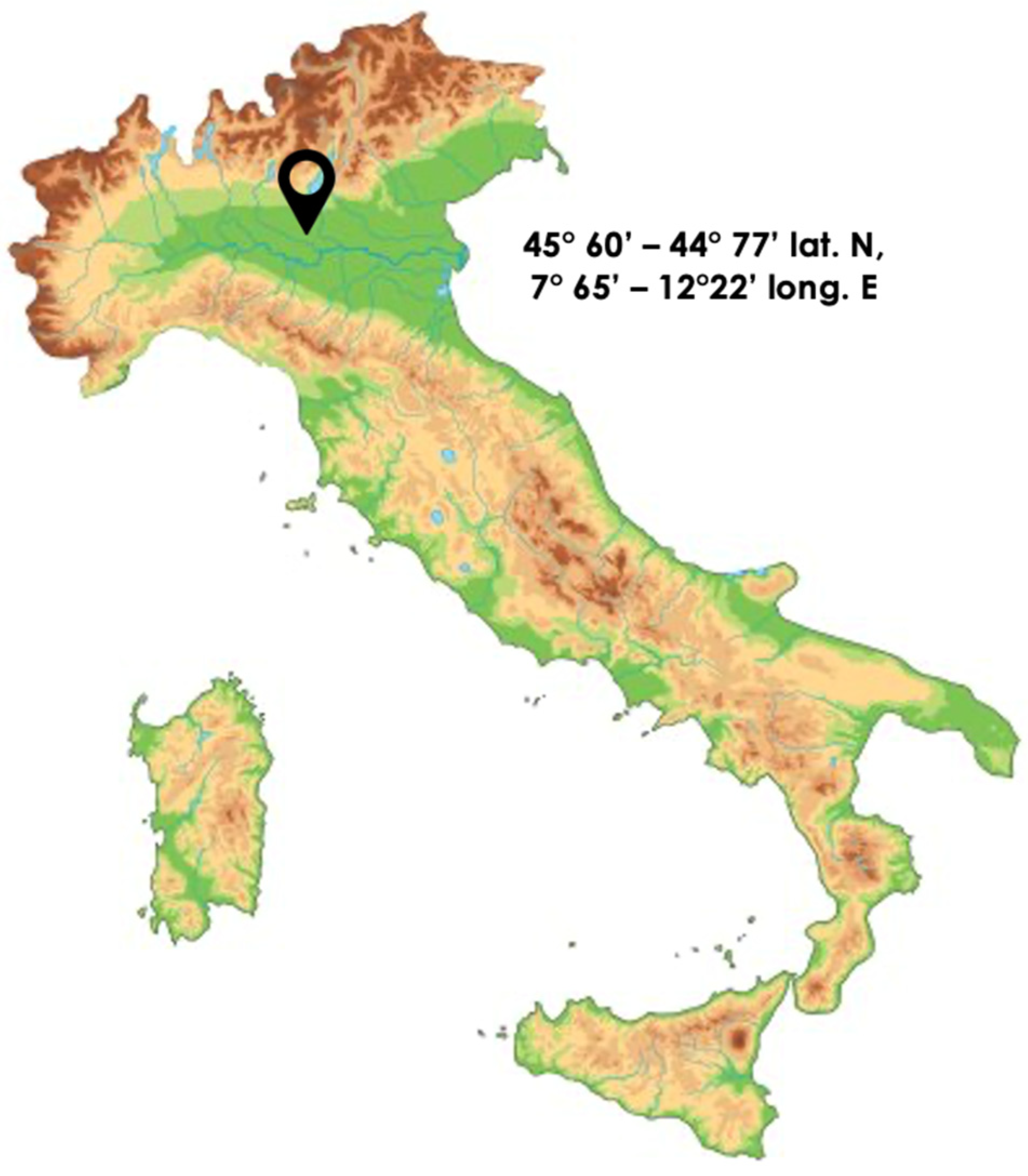
The geographical scope of the study, defining the specific geographical areas or regions covered by the study, refers to the Po Valley area,
Figure 1 (45°60′–44°77′ lat. N, 7°65′–12°22′ long. E).
The climate of this area is transitional between Mediterranean and Central European climates (Koeppen’s Cfb). The precipitation regime has two minima (in summer and winter) and two maxima (in spring and fall), which are partially opposite to the evapotranspirational demand of the atmosphere, which reaches its maximum in summer. The temporal scope refers to the 2024 growing season, which can be considered representative of typical weather conditions in the Po Valley area.
The outcomes of the study can be considered representative for maize-growing areas characterised by fertile soils, a temperate climate, and cultivation practices that fully satisfy crop water requirements and rely on irrigation.
The study is intended to support evidence-based decision-making by identifying the more sustainable irrigation practice in terms of water and resource efficiency, energy use, and cumulative energy demand, thereby contributing to the optimisation of water management strategies in intensive agricultural systems.
2.2. Functional Unit
The functional unit defines the function provided by the system and it is the reference for comparing environmental impacts. In this study, in agreement with previously carried out LCA studies focusing on maize cultivation [
6,
17,
18], a mass-based functional unit was selected. Specifically, 1 ton of maize green silage (or chopped maize) with a dry matter content of 35% was considered. Both irrigation scenarios assume the same maize yield and dry matter content (35% DM), as observed in the reference farm during the 2024 growing season.
2.3. System Boundary
Regarding the system boundary, a “
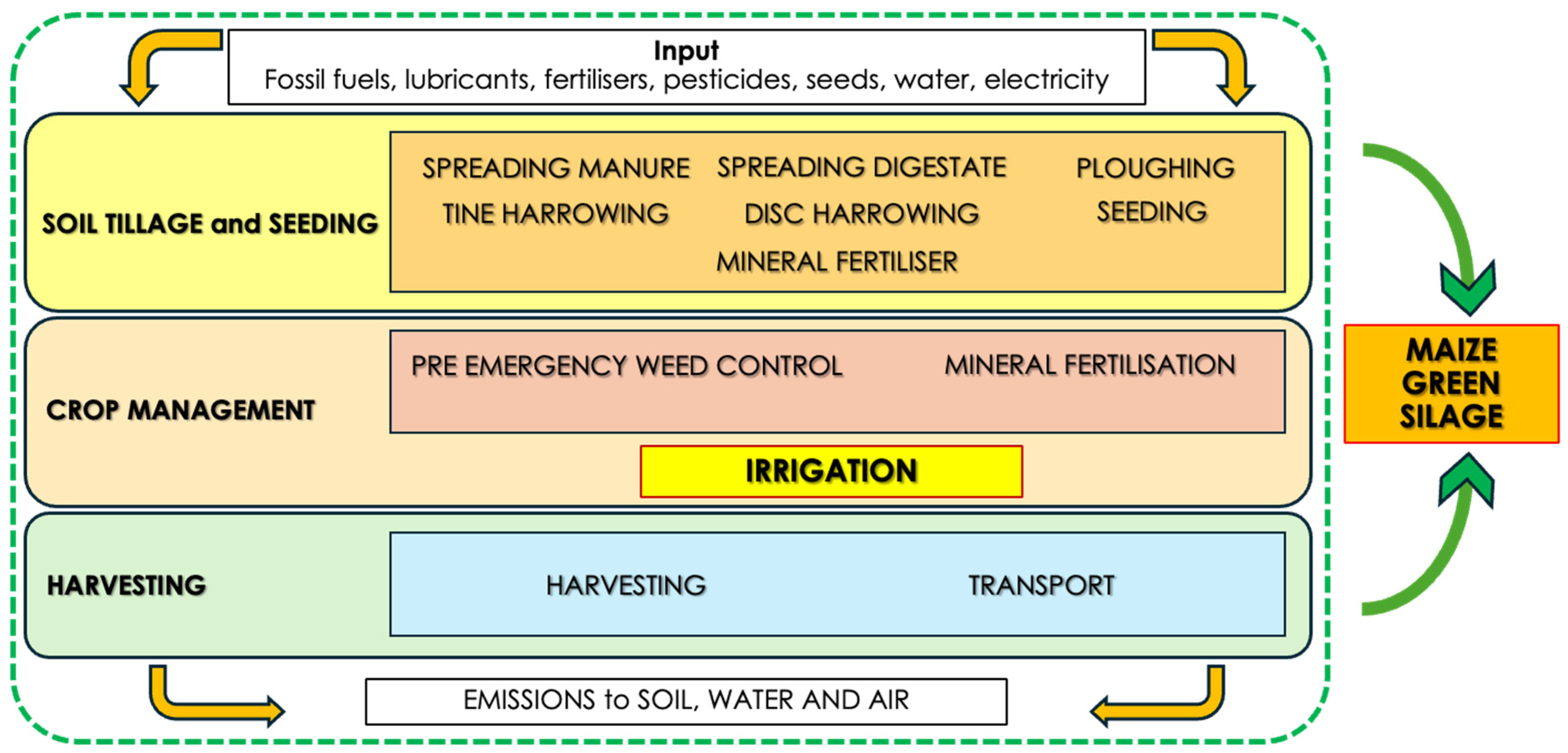
from cradle-to-farm-gate” perspective was considered. Consequently, all field operations carried out from soil preparation to harvesting and the transport of chopped maize to the farm were included (
Figure 2). All field operations carried out after the transport of chopped maize to the farm (e.g., ensiling, distribution, use, and end-of-life) were excluded from the system boundary because they are not affected by the irrigation method used.
Regarding production factors, the system boundary considers the manufacturing of seeds, fertilisers, pesticides, fuels, and energy, as well as the different capital goods (e.g., machinery and infrastructure); for the latter, maintenance and disposal were also included in the boundary.
Concerning emissions, the following were considered: (i) emission of pollutants due to fuel combustion during mechanisation, (ii) emission of nitrogen (ammonia, nitrogen monoxide, dinitrogen protoxide, nitrate) and phosphorous (phosphate) due to fertiliser applications, and (iii) emissions of the active ingredients of the applied pesticides.
Considering that the whole maize plant is harvested and that the basal part of the stem (about 10–12 cm in height) remains in the field and is buried, the system does not present multifunctionality. Consequently, neither system expansion nor allocation was carried out.
Both irrigation scenarios (surface and drip) refer to the same representative farm located in the Po Valley, under the same soil and climate conditions and during the same growing season in 2024. All agronomic operations and inputs not related to irrigation (amount of seeds, fertilisers, pesticides, use of machinery, diesel consumption, harvesting, and transport) are the same in both cultivation systems, reflecting the actual management of the reference farm. The only difference between the two scenarios is the irrigation method, including the related infrastructure, energy requirements, and water volumes. This approach ensures that any differences in environmental performance can be attributed to the irrigation technique.
2.4. Inventory Data Collection
The inventory data were built considering both primary and secondary data. Regarding primary data, information regarding cultivation practices (timing and number of repetitions, use of machinery, application of different agricultural inputs such as seeds, fertiliser, pesticides, and fuels) was obtained directly from farmers.
Table 1 shows the main primary inventory data.
The impact of mechanisation was modelled considering diesel consumption, machinery characteristics, and annual use. Fuel consumption was estimated based on required power and operating capacity [
19].
Regarding secondary data, the following applies:
- -
The emissions related to fuel combustion in the internal combustion engines of tractors and harvesters were estimated considering fuel consumption, working time, and specific emission factors for different pollutants (CO2, NOX, PM, and unburned hydrocarbons).
- -
Nitrogen (nitrate, ammonia, nitrogen monoxide, and nitrous oxide) and phosphorus (phosphate) emissions were calculated according to [
20], considering the amount of fertilisers applied and its nutrient content, timing and temperature during application, type of incorporation into the soil, infiltration rate, soil characteristics (e.g., texture and pH), precipitations in the days after application, and nutrient content of crop residues. The study field is characterised by a silty loam soil with 1.8% soil organic matter (farm data) and a uniform slope below 1%, typical of irrigated maize systems in the Po Valley. These conditions influence water percolation and nitrate mobility and justify the use of default Brentrup emission factors for this soil category. The results obtained are shown in
Table S1 (Supplementary Materials).
- -
Pesticide emissions were estimated following [
21], with 90% dispersion to soil, 9% to air, and 1% to water, according to the PCRs for agricultural crops [
22].
- -
Background data on the production of fertilisers, seeds, pesticides, fuels, energy, and agricultural equipment were obtained from the Ecoinvent v3.9 database [
23,
24].
Table 2 reports the main technical data of the two irrigation methods. Irrigation efficiency, expressing the ratio between the water absorbed by maize and the water supplied through irrigation, was retrieved from [
25].
The term ‘mass (kg)’ refers to the total mass of the irrigation infrastructure, amortised over the expected lifetime of each component. The term ‘water consumption (m3 ha−1)’ refers to the total gross seasonal water consumption used for irrigation per hectare.
Irrigation water was abstracted from a surface water canal operated by the local irrigation consortium. No groundwater pumping was required. Therefore, the water input was modelled as surface freshwater withdrawn without additional energy for extraction, in line with local practice. The irrigation canals are supplied by surface water originating from alpine and pre-alpine lakes and mountain reservoirs, whose storage levels depend on winter precipitation, particularly snow accumulation, and subsequent meltwater contributions to rivers feeding the irrigation network.
Operational information on irrigation practices was collected directly on the study farm and reflect the typical operational conditions of the Po Valley. Surface irrigation involves three irrigation events during the season. Water was pumped from the irrigation canal using a centrifugal hydro pump powered by a 154.5 kW New Holland tractor operating at 540E PTO (power take-off). Each irrigation turn covered approximately 12 ha over a maximum duration of 8 h, with an irrigation interval of 12 days. The total gross water volume applied was around 4000 m3 ha−1 across the three events, consistent with the low application efficiency of surface irrigation.
Drip irrigation used the same surface canal as a water source, but without rotation scheduling: thanks to an agreement with the irrigation consortium, water was continuously available, allowing frequent low-volume applications instead of large periodic inputs. A small diesel-powered tractor (67 kW) operated the pump feeding a reusable PVC main hose (10 cm diameter, 200 m length). From this line, single-use self-compensating drip laterals (16 mm diameter, 30 cm emitter spacing, nominal discharge 0.87 L h−1) were installed, with one lateral serving every two maize rows (row spacing 75 cm; in-row spacing 17 cm). The one year lifetime assumed for drip irrigation refers to the thin-wall drip tapes, which are replaced annually in the local farming context. Reusable components (e.g., main PVC hoses and filters) are amortised over multiple years and contribute marginally to the total infrastructure mass. Drip irrigation was applied 2–3 times per week to maintain soil moisture near field capacity and avoid percolation losses. The total seasonal water volume distributed through drip irrigation was approximately 1680 m3 ha−1.
These operational details reflect the contrasting management logics of the two systems: large, infrequent applications dictated by irrigation turns for surface irrigation versus small, frequent applications enabled by continuous availability for drip irrigation. This difference is consistent with the irrigation efficiencies reported in
Table 2 and reflects realistic field conditions in the study area.
2.5. Life Cycle Impact Assessment (LCIA)
The inventory data was characterised using the Environmental Footprint 3.1 (adapted) V1.00 characterisation factors, together with the EF 3.1 normalisation and weighting method [
26]. Background processes were modelled using Ecoinvent v3.9 with the cut-off system model.
The following impact categories (
Table 3) were considered:
3. Results and Discussion
3.1. Absolute Environmental Results
Table 4 reports the comparison between the absolute environmental impacts of the maize green silage produced with the two evaluated irrigation methods: drip and surface irrigation. Overall, surface irrigation outperforms drip irrigation in 14 out of the 15 impact categories considered, while drip irrigation shows a clear advantage only for water use. The magnitude of the differences is highly impact-specific: for most categories, the variation is small (below 5%), whereas for human toxicity (cancer and non-cancer) and resource use (minerals and metals) the difference exceeds 30%, pointing to structurally different resource and material requirements between the two systems.
In 14 out of 15 evaluated impact categories, surface irrigation shows better environmental results with respect to drip irrigation, while the latter presents better performance only for water use. Compared to drip irrigation, for surface irrigation the impact reduction ranges from −0.18% for marine eutrophication to −61% for human toxicity (non-cancer). The details are as follows:
- -
for 6 out of the 15 considered impact categories, the reduction is between 0% and −5%;
- -
for another 6 out of the 15 impact categories, the reduction is between −5% and −30%;
- -
for only 2 out of the 15 impact categories, the reduction is >30% (human toxicity, cancer and non-cancer).
Regarding the comparison of the environmental impact of maize green silage production using the two irrigation systems, different variations can be identified among the different impact categories:
For climate change and cumulative energy demand, surface irrigation shows a lower impact (about −9% and −15%, respectively). These differences are mainly associated with lower diesel consumption and the lower embedded energy of the simpler infrastructure required for surface irrigation. Although drip irrigation reduces the water volume thanks to more precise water distribution, in this specific case the higher number of field operations for system installation and removal, together with the production of plastic components, offsets these potential benefits.
Similar results were found by [
6], who reported that the environmental advantage of fertigation via drip or pivot systems strongly depends on the balance between reduced fertiliser losses and increased infrastructure and energy requirements.
More generally, the climate change results per functional unit are of the same order of magnitude as those reported for intensive maize systems in Europe, where fertiliser-related emissions typically dominate the GHG profile, and irrigation mainly affects climate change through pumping energy and infrastructure requirements. In this respect, the considered irrigation efficiencies (40% for surface vs. 95% for drip) are consistent with Po Valley conditions and explain why drip irrigation achieves a clear water use advantage while not necessarily improving climate change performance when additional energy and material needs are accounted for.
The relatively small differences (≤2%) observed for acidification and marine and terrestrial eutrophication indicate that the irrigation method plays a minor role compared with nitrogen fertilisation and related emissions. This finding is in line with previous LCA studies on maize and other herbaceous crops, which identified nitrogen management as the dominant driver of acidification and eutrophication, independently of the irrigation method [
13,
27,
28].
Conversely, with drip irrigation, human toxicity (cancer and non-cancer) and mineral and metal resource use increase due to the higher material intensity of this method. Drip irrigation requires pumps, filters, distribution units, and large amounts of plastic pipes, often combined with brass, steel, and other metals. The manufacture and end-of-life of these components substantially contribute to toxicity-related categories and mineral resource depletion. Trade-offs between water use and material and energy consumption of advanced irrigation systems (drip and sprinkler) have been reported in other contexts [
10,
11,
29].
Our findings are consistent with studies showing that moving from surface irrigation systems to drip irrigation can introduce additional burdens linked to pumping and infrastructure. In particular, the higher material intensity of drip systems (plastics and metallic components) can shift part of the impact towards resource use and toxicity-related, even when water withdrawals decrease substantially. This supports the interpretation of a water–materials/energy trade-off already highlighted in the water–energy–environment nexus literature and suggests that mitigation options for drip irrigation should prioritise material durability/reuse, recycling, and low-carbon energy supply for pumping.
The only impact category where drip irrigation clearly outperforms surface irrigation is water use, with a 58% impact reduction. Water use is expressed as water deprivation (m3 deprived) according to the EF 3.1 method and does not represent simple volumetric water withdrawal. This difference is due to the higher irrigation efficiency (95% vs. 40%). From a water-scarcity perspective, this result is highly relevant, as it suggests that drip irrigation may be preferable in regions or years characterised by limited water availability, even if it entails higher burdens in other impact categories.
Overall, the absolute results reveal a clear trade-off: surface irrigation minimises energy- and material-related impacts, whereas drip irrigation drastically reduces water consumption. The environmental preference between the two options therefore depends on the local relevance of water scarcity versus other environmental pressures. This aspect is further explored through the single-score assessment (
Section 3.2) and the contribution and sensitivity analyses (
Section 3.3 and
Section 3.4).
It should be noted that in this case study, irrigation relied exclusively on surface water from canal distribution, with no groundwater pumping. Consequently, the water use impact category reflects only consumptive freshwater use (evaporation and crop transpiration), as defined in EF 3.1, and is therefore independent of the water source. In agricultural systems where groundwater is abstracted, the environmental profile may differ substantially: pumping energy requirements would increase climate change and cumulative energy demand, while groundwater depletion could become an additional hotspot. Studies comparing surface and groundwater irrigation have shown that groundwater-based systems tend to exhibit higher energy and environmental burdens, especially when combined with pressurised irrigation technologies such as drip irrigation [
10,
29]. These considerations reinforce the importance of contextualising irrigation LCA results according to local hydrological conditions.
3.2. Single-Point Environmental Footprint 3.1 (Adapted) V1.00/EF 3.1 Normalisation and Weighting Set
The “Single-point Environmental Footprint 3.1 (adapted) v1.00/EF 3.1 normalisation and weighting set” was used to obtain a single score for each irrigation method.
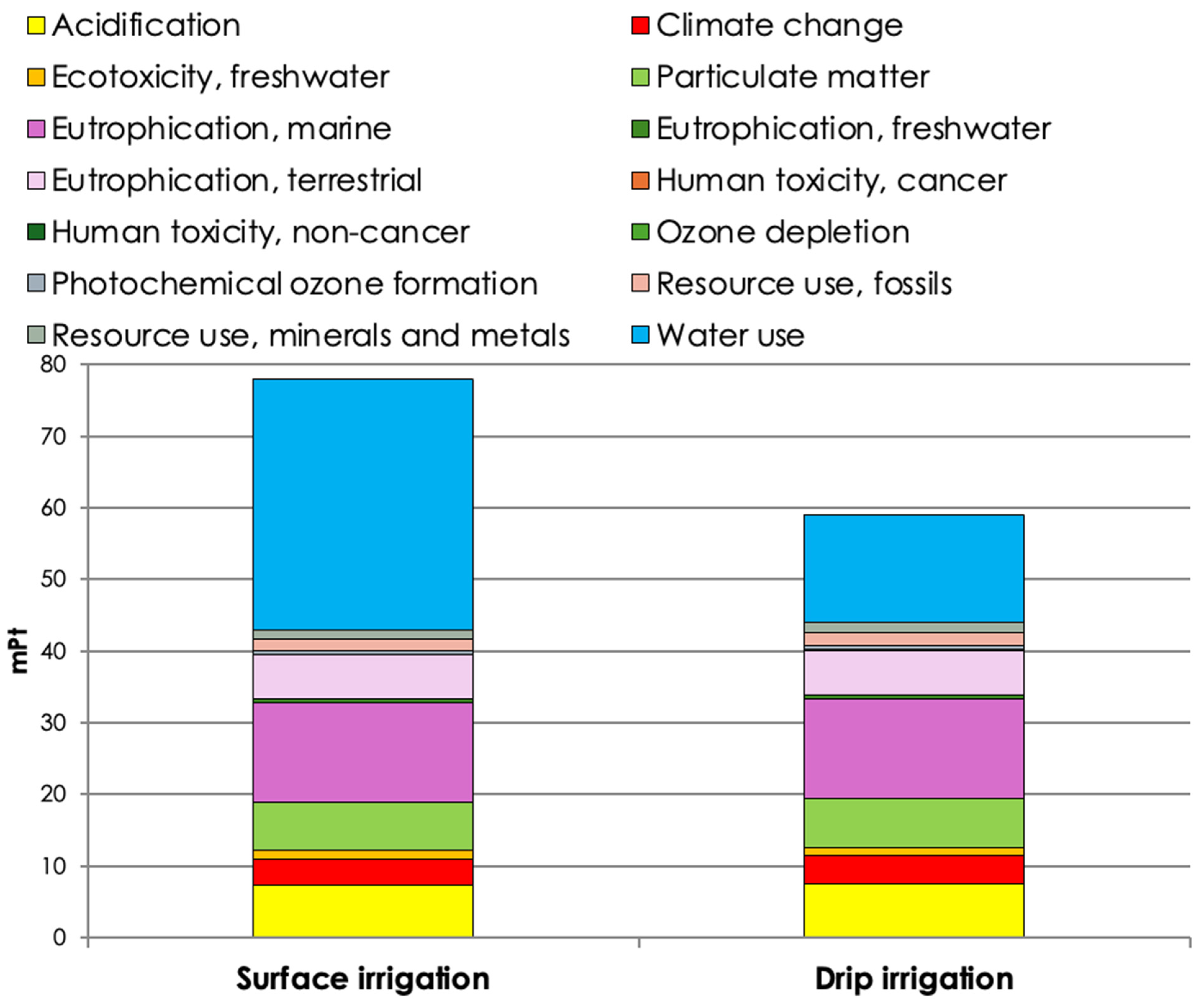
Surface irrigation has a higher single-score value than drip irrigation (
Figure 3), with a total score of around 75 points compared with approximately 55 points for drip irrigation. The largest contribution to the surface irrigation score comes from the water use category (35 mPt), reflecting the substantially higher water consumption associated with this technique.
Drip irrigation shows a lower single-score value in the water-related categories but shows relatively higher contributions for the impact categories associated with resource use (minerals and metals) and human toxicity. This result is consistent with the intensive use of plastic materials, as already mentioned in
Section 3.1.
While drip irrigation shows a higher score for the impact categories related to the production and disposal of plastic material, thanks to the lower water consumption, the overall single-score is more favourable. This result supports the conclusion that drip irrigation, despite some resource-related burdens, offers better environmental results when a single-score indicator is considered.
3.3. Contribution Analysis
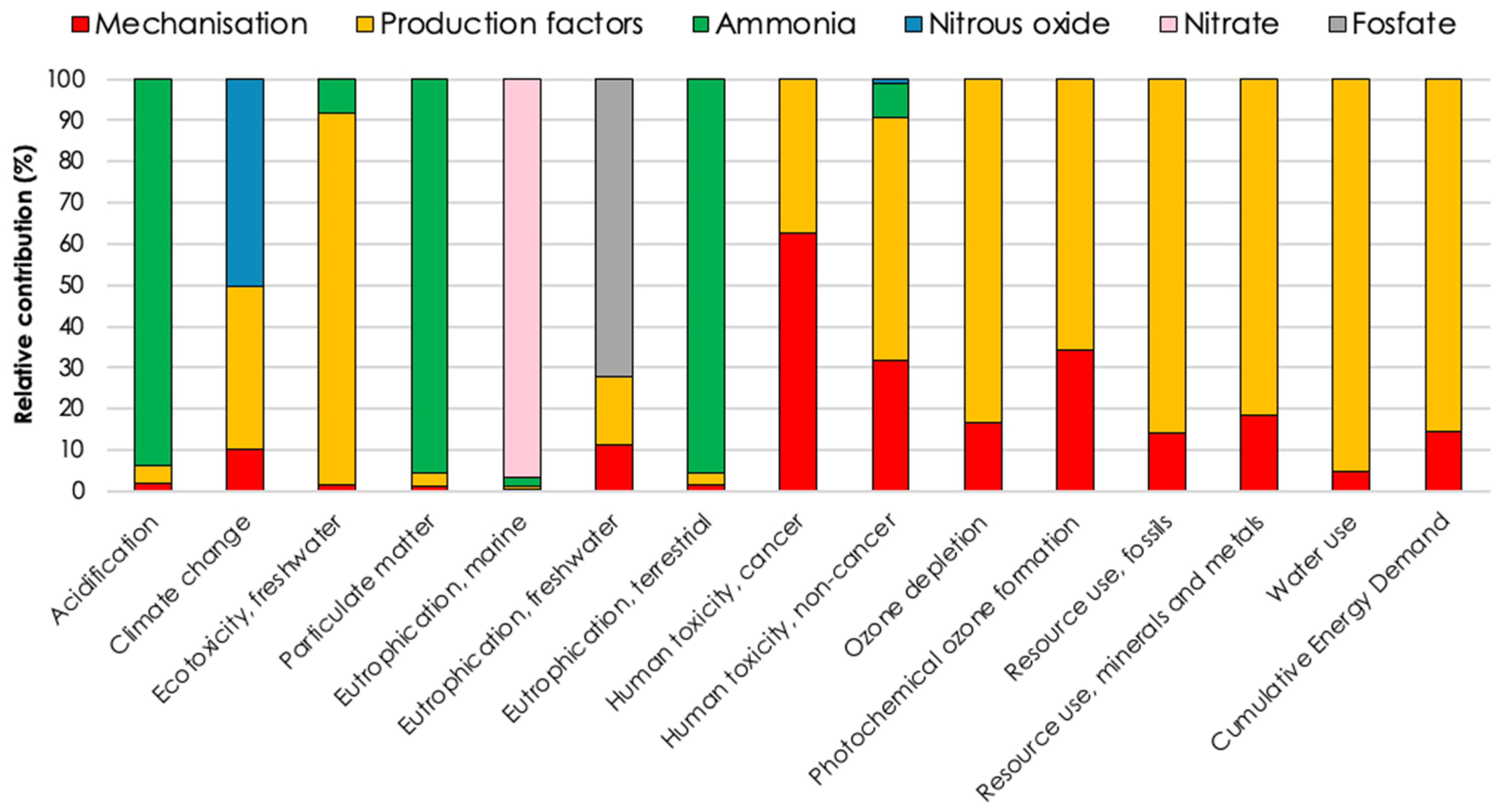
Figure 4 shows the relative contributions (%) regarding the maize green silage (or chopped maize) production, excluding the contribution of irrigation. The latter is reported in
Figure 5.
The label “mechanisation” includes the manufacture, maintenance, and disposal of agricultural machinery. Among these, tractors, followed by machinery for soil tillage (plough and harrow), are the main contributors, while machinery for other operations (e.g., sowing and plant protection treatments) play a less relevant role. Tractors and machinery for soil tillage have the highest mass and embodied material and energy requirements, which explains their dominant share across most impact categories. In contrast, seeding and spraying equipment contribute to a much smaller extent due to their lower mass and shorter operating time. These findings are consistent with previous LCAs of cereal systems showing that primary tillage operations and tractor manufacturing are major hotspots in mechanisation-related impacts [
13,
14]. The diesel category includes both consumption and emissions, while the pesticides heading includes production, use, and emissions.
The full detailed contribution breakdown (including tractor, agricultural machinery, diesel fuel use, fertilisers, pesticides, and all direct emissions) is provided in
Supplementary Table S3 (Supplementary Materials). This table reports the contribution of each process as a percentage of the total impact.
The results of the contribution analysis of maize cultivation (irrigation excluded) show the following:
- -
Climate change: the main contributors are emissions of nitrous oxide (50.25%) resulting from the application of nitrogen fertilisers, while diesel use and related emissions (20.92%) and mechanisation (10.26%, mainly due to the use of self-propelled harvesters) also play non-negligible roles.
- -
Acidification, particulate matter, and eutrophication (terrestrial, marine, and freshwater): ammonia (mainly due to volatilisation) is the main contributor responsible for acidification (93.65%), particulate matter (95.63%), and terrestrial eutrophication (95.59%), while nitrate leaching is the key contributor responsible for marine eutrophication (96.56%), and phosphate (related to soil particle run-off) dominates freshwater eutrophication (72.33%).
- -
Ecotoxicity freshwater: about 80% of the impact is related to the emissions of pesticide active ingredients, suggesting a significant impact of chemical crop management.
- -
Human toxicity (cancer and non-cancer): the impact is mainly related to fertiliser manufacture (such as urea), with a significant contribution from mechanisation (62.82% for HT-c and 31.84% for HT-nc) due to the use and consumption of tractors and operating machines.
- -
Photochemical ozone formation: the main culprits are emissions linked to diesel combustion in tractor engines and self-propelled shredders (46.06%), together with mechanisation (34.32%), referring the use (construction, use, and end-of-life) of the machines previously mentioned.
- -
Resource use (fossils, minerals, and metals): fertilisers (56.08% in RUF and 80.56% in RUMM), due to the use of mineral fertiliser during seeding (180 kg/ha of 24-30-0) and, to a lesser extent, mechanisation (14.15 in RUF and 18.44% in RUMM), mainly caused by self-propelled shredders, and the use of diesel fuel (28.84% in RUF), are the main hotspots.
- -
Water use: when water consumption for irrigation is not considered, impacts are almost entirely related to the production of fertilisers (93.08%).
- -
Cumulative energy demand: diesel (28.21%), mechanisation (14.48%), and fertilisers (55.48%, mainly due to nitrogen fertiliser consumption) are the main contributors.
- -
Overall, the contribution analysis highlights the key role of nitrogen emissions (ammonia, nitrate, and nitrous oxide) in determining environmental impacts on water and air quality and provides useful indications for identifying mitigation strategies. Mitigation strategies refer to possible interventions in fertilisation through the adoption of variable-rate fertilisation or the valorisation of organic fertilisers (digestate or livestock slurries), and in mechanisation through the use of tractors and latest-generation operating machines that respect the latest emission limitations.
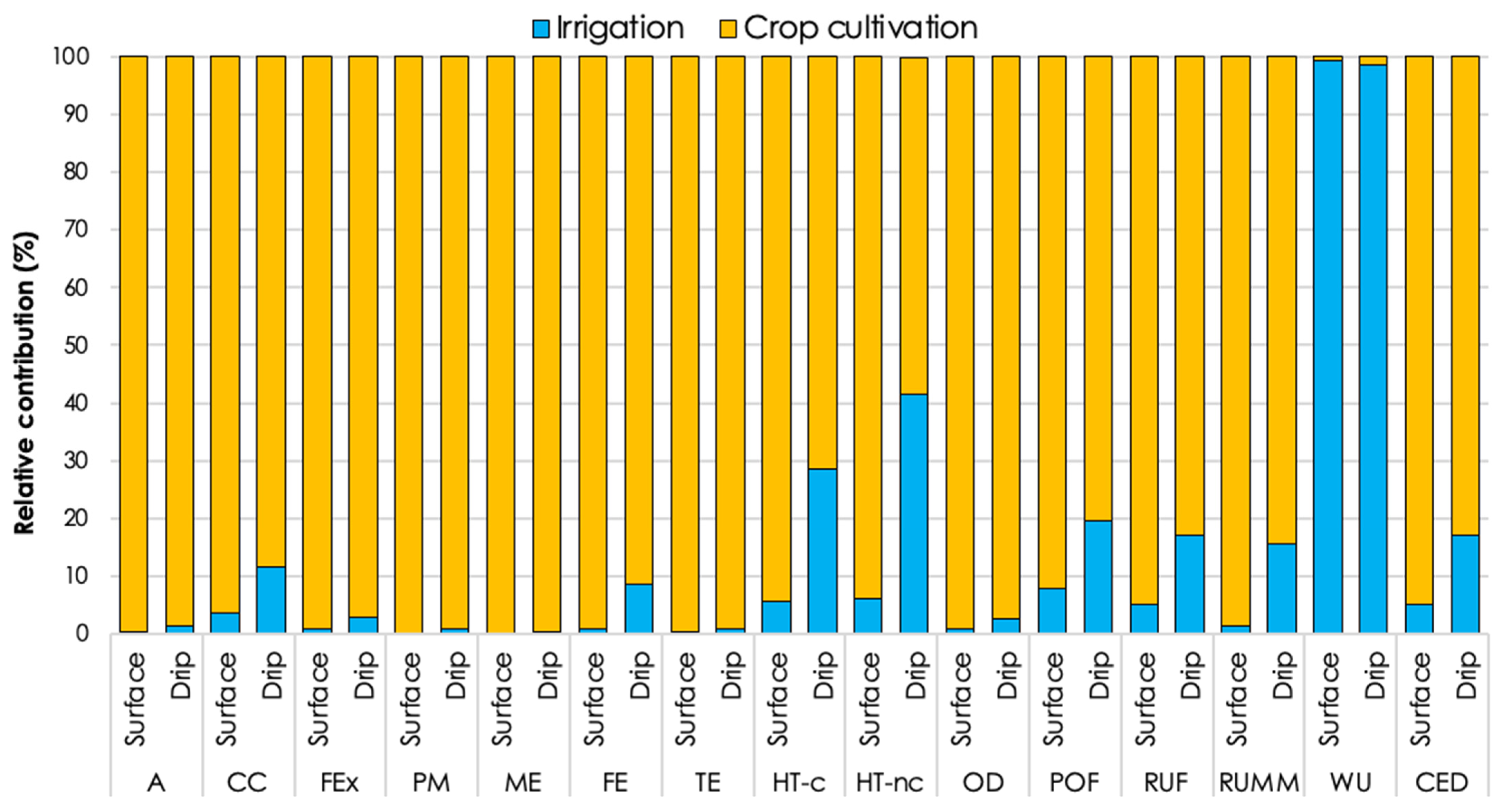
To better highlight the contribution of the irrigation method,
Figure 5 shows the relative contributions (%) considering only two labels: the irrigation method and crop cultivation, including all the other inputs and emission sources.
Drip irrigation presents a contribution lower than 20% for 13 of the 15 evaluated impact categories and plays a significant role only in human toxicity cancer and non-cancer (29% and 41.5%, respectively). This result is mainly due to the use of plastic and metallic materials to produce components such as water extraction pumps, filtration units, and distribution systems.
For surface irrigation, the contribution is always < 10%, except in the water use category, where it is 99%.
Crop cultivation is the main contributor to environmental impacts, with shares ranging from a minimum of 0.55% in surface irrigation in the water use category to a maximum of 99.90% in marine eutrophication, again in surface irrigation; the impact is greater than 50% in 14 out of the 15 impact categories evaluated.
The main differences between the two irrigation methods are related to climate change (3.7% surface vs. 11.6% drip), HT-c (5.6% surface vs. 28.5% drip), HT-nc (6.2% surface vs. 41.4% drip), POF (7.8% surface vs. 19.6% drip), RUF (5.0% surface vs. 17.1% drip), RUMM (1.3% surface vs. 15.5% drip), and CED (5.0% surface vs. 17.1% drip). These differences are the same as those highlighted in the analysis of absolute results in paragraph 3.1 and the analysis of the relative contributions in paragraph 3.3.
The absolute results and relative contributions obtained in this study are consistent with findings reported in the previous literature on the Life Cycle Assessment of open-field herbaceous crop systems, supporting the validity and robustness of the methodological approach adopted.
3.4. Sensitivity Analysis and Uncertainty Analysis
To test the robustness of the achieved environmental results, sensitivity and uncertainty analyses were carried out. In detail, sensitivity analyses considered different methodological choices (i.e., characterisation method) and variations in key parameters (i.e., yield), while uncertainty analyses focused on data selection from databases, model imprecision, and data variability.
3.4.1. Sensitivity Analysis Results
A sensitivity analysis was carried out as follows:
- -
The characterisation method; in detail, the ReCiPe 2016 Midpoint (H) [
30] v1.08 method with the World (2010) H normalisation set was considered.
Table S4 (Supplementary Materials) reports the achieved results. A direct comparison between the environmental results achieved using the two LCIA methods cannot always be drawn because different impact categories and units of measure are considered. Despite this, most of the results obtained are consistent in terms of identifying the best/worst scenario and the main factors contributing to the impact.
- -
The yield, which was carried out because this parameter is the main driver of the environmental results of crop cultivation [
27,
28,
29] and can greatly vary over the years depending on temperature, rainfall, wind, hailstorms, soil fertility, and plant pest and diseases attacks. In detail, a yield variation of ±30% was considered.
Table S5 (Supplementary Materials) reports the results of the sensitivity analysis on yield. The impact variation ranges from −23.08% to +30.01% for all impact categories except for marine eutrophication, where it ranges from −30.39% to +39.53%. Considering that the amount of fertiliser applied is constant but nutrient uptake by plant increases with higher yield, nitrogen leaching decreases, leading to a reduction in marine eutrophication. In contrast, when yield decreases, nutrient uptake also decreases, causing increased nitrogen leaching that is greater than the percent yield change. For the other impact categories, as expected, environmental impacts increase and decrease proportionally to the magnitude of the yield variation.
The combined effect of yield variation and irrigation efficiency can be interpreted as follows. Yield changes primarily scale impact results per functional unit across all categories, whereas irrigation efficiency selectively affects water-use-related impacts. When yields are reduced (e.g., under drought stress), the environmental impact per ton of maize silage increases for both irrigation systems; however, the relative advantage of drip irrigation in reducing water use becomes more pronounced under water-limited conditions. Conversely, when yields are high and water availability is not limiting, the benefits of higher irrigation efficiency diminish, and the additional energy and material requirements of drip irrigation play a more prominent role in determining overall environmental performance. This interaction highlights that the environmental preference between surface and drip irrigation is strongly context-dependent and influenced by both yield and water scarcity.
- -
To test the influence of infrastructure lifetime, a sensitivity analysis was carried out by increasing the lifespan of the drip irrigation system from one year (baseline) to three and five years. The results (
Supplementary Table S6) indicate that a longer lifespan significantly lowers the contribution of drip irrigation to human toxicity (three years: HT-c −12.5% and HT-nc −28.1%; five years: HT-c −16.0% and HT-nc −35.8%) and resource use (three years: RUF −4.8% and RUMM −9.3%; five years: RUF −5.8% and RUMM −11.5%) impact categories, confirming the strong dependence of these impacts on infrastructure amortisation.
3.4.2. Uncertainty Analysis
The results of the uncertainty analysis on the comparison between cultivation practices considering the two irrigation methods, reported in
Figure S3, show low uncertainty for 11 of the 15 evaluated impact categories. On the other hand, uncertainty is considerable for all toxicity-related impact categories, mainly due to the significant uncertainty of the characterisation factors of pesticide active ingredients. In the Monte Carlo simulation, all foreground parameters related to fertiliser use, diesel consumption, irrigation energy, and material inputs (e.g., plastic components for drip systems) were treated as stochastic variables. Following common LCA practice, log-normal distributions were applied to technosphere flows and emissions with strictly positive values, while normal distributions were assigned to parameters that may vary symmetrically around a mean (e.g., fuel use and fertiliser doses). No correlations between parameters were imposed, and background processes derived from EF 3.1/Ecoinvent retained their pedigree matrix-based uncertainties. For toxicity categories (HT-c, HT-nc, and FEx), several Monte Carlo iterations produced values very close to zero, causing numerical instability (extremely high or undefined coefficients of variation). This behaviour is a known limitation of toxicity modelling in LCIA and does not reflect negative emissions or physically meaningful values. All negative results in the raw simulations were artefacts due to the rounding of values centred around zero. Given this behaviour and the structural uncertainty in toxicity characterisation models, the comparative results for HT-c, HT-nc, and FEx should be interpreted with caution, and no strong conclusions should be drawn for these endpoints.
4. Conclusions
LCA was applied to compare the environmental performances of surface and drip irrigation methods for maize green silage production in the Po Valley, Northern Italy. Results show that surface irrigation performs better in 14 out of 15 impact categories, with the most significant reductions for human toxicity (cancer and non-cancer), resource use (fossils, minerals, and metals), and cumulative energy demand. These results are primarily due to lower diesel consumption (and related exhaust emissions from tractor and harvester engines), but also to differences in the materials (i.e., plastic) consumed by the irrigation methods themselves. Despite this, drip irrigation shows a considerably lower impact in water use, showing a 58% lower impact due to higher irrigation efficiency. The single-score evaluation highlights that the differences between the two irrigation methods are predominantly related to water use, identifying drip irrigation as the most promising irrigation method in future contexts characterised by water shortages during the growing season. While these results are specific to the 2024 growing season and to the agronomic context considered, they provide several practical insights for improving the environmental sustainability of irrigated maize systems.
First, the environmental burden of drip irrigation could be reduced through the use of recycled materials for drip lines and fittings, the adoption of multi-year reusable components, and improved end-of-life management (collection and recycling schemes).
Second, the energy demand associated with pumping can be mitigated by adopting photovoltaic-powered pumping units, which would significantly reduce climate- and energy-related impacts, especially in farms currently relying on diesel-powered pumps.
Third, drip systems offer the opportunity to integrate fertigation, which can improve nitrogen use efficiency and reduce nitrogen losses (NH3 volatilisation, N2O emissions, and nitrate leaching), thereby lowering impacts in several impact categories (acidification, eutrophication, and climate change).
Fourth, the adoption of smart irrigation scheduling, based on soil moisture sensors, real-time meteorological data, or IoT-based decision-support systems, can reduce over-irrigation and improve the precision of water applications. Digital modelling tools can help farmers anticipate crop water needs under extreme weather conditions and support strategic farm-level planning.
Finally, even for surface irrigation, environmental improvements are possible. These include optimising field levelling, enhancing canal efficiency, reducing conveyance losses, and improving timing and distribution within irrigation shifts.
The research outcomes are in agreement with previous LCA studies and emphasise the importance of optimising both irrigation strategies and crop management practices to reduce environmental impacts in intensive maize cultivation systems.
It should be acknowledged that the results of this study are limited to the specific regional context of the Po Valley, to the 2024 growing season, and to the maize variety considered, and therefore may not be directly generalizable to other geographical areas, years, or crop cultivars.
Future research should compare a larger number of irrigation methods over a longer time frame, across a greater number of farms, and with different yields among the scenarios considered. It should also aim to improve the efficiency of irrigation methods and assessing long-term field and irrigation performance to further refine environmental impact mitigation strategies.