1. Introduction
Improving agricultural productivity while reducing environmental pressure is a central challenge for sustainable development. Agriculture remains a cornerstone of global food security and rural livelihoods, particularly in low- and middle-income countries, yet it is also a major source of greenhouse gas (GHG) emissions and environmental degradation. Reconciling productivity growth with climate mitigation and environmental sustainability in agriculture is therefore essential for achieving multiple Sustainable Development Goals (SDGs), including SDG 2 (Zero Hunger), SDG 12 (Responsible Consumption and Production), and SDG 13 (Climate Action).
A large body of literature has examined the relationship between economic growth and environmental pressure through the lens of the Environmental Kuznets Curve (EKC), which posits that environmental degradation initially increases with income before declining at higher levels of development [
1]. However, growing empirical evidence has questioned the universality and policy relevance of this hypothesis [
2], particularly in sector-specific contexts such as agriculture. Unlike manufacturing or services, agricultural production is shaped by biological processes, land-use constraints, and heterogeneous technologies, which complicate the relationship between economic growth and environmental outcomes [
3,
4].
In response, recent research has increasingly focused on the concept of decoupling, defined as the weakening or reversal of the link between economic output and environmental pressure. In agriculture, decoupling is commonly assessed through changes in emission intensity—greenhouse gas emissions per unit of agricultural value added—rather than absolute emission levels. Empirical studies suggest that partial decoupling has occurred in some countries and regions, driven by technological change, efficiency improvements, and structural transformation [
3,
4].
At the same time, a growing body of evidence indicates that agricultural decoupling is highly uneven across countries. Cross-country analyses reveal substantial heterogeneity in emission intensity trajectories, even among economies with similar income levels or productivity growth rates [
5,
6]. These findings imply that productivity growth alone does not guarantee environmental efficiency gains and that national policy frameworks, technological diffusion, and land-use practices play a decisive role [
7].
Recent contributions further emphasize the need to situate agricultural decoupling within broader planetary and social constraints. Research on planetary boundaries highlights that global food systems must operate within climate, land, and biodiversity limits, making uneven mitigation performance in agriculture a critical global concern [
8,
9,
10]. In parallel, studies on climate and inequality show that environmental pressures and mitigation capacities are distributed highly unevenly across countries and populations, with disproportionately high burdens borne by vulnerable regions [
11,
12].
Despite these advances, important gaps remain in the literature. First, most existing studies focus on average trends or representative cases, paying limited attention to how environmental performance is distributed across countries. As a result, it remains unclear whether observed global progress reflects convergence toward sustainable practices or masks persistent and widening disparities. Second, relatively little is known about whether differences in agricultural emission intensity arise primarily between income groups or from heterogeneity within them. This distinction is crucial, as it determines whether global inequality is driven mainly by structural development gaps or by country-specific factors operating within similar income levels.
Addressing these gaps requires analytical tools that explicitly account for inequality. The Theil index, a member of the Generalized Entropy class, is particularly well suited for this purpose because it allows total inequality to be consistently decomposed into between-group and within-group components [
13]. This property enables a direct assessment of whether disparities in agricultural emission intensity are primarily attributable to differences across income groups or to heterogeneity within them.
Building on recent work linking agricultural productivity, emissions, and inequality [
14,
15], this study examines global decoupling patterns in agriculture through an explicit inequality lens. Using harmonized cross-country data from the World Bank and Our World in Data covering up to 175 countries over the period 1990–2020, the analysis investigates (i) country-level relationships between productivity growth and emission intensity, (ii) the evolution of global inequality in agricultural emission intensity, and (iii) the decomposition of this inequality by World Bank income groups.
This study makes three main contributions. First, it provides a comprehensive global assessment of agricultural decoupling that highlights substantial heterogeneity across countries and income groups. Second, it documents persistent and fluctuating inequality in agricultural emission intensity, demonstrating that global averages conceal deep and enduring disparities. Third, by decomposing inequality, it shows that nearly all observed disparities arise within income groups rather than between them, underscoring the dominant role of country-specific policies, technologies, and structural conditions.
By shifting the focus from average decoupling outcomes to their distributional structure, this study contributes to ongoing debates on sustainable agricultural transitions, climate mitigation, and inequality. The findings suggest that achieving environmentally sustainable agriculture requires not only productivity-enhancing strategies but also targeted efforts to reduce within-group disparities in emission intensity, thereby aligning agricultural development with both climate objectives and equity considerations.
2. Data and Methods
2.1. Data Sources and Variable Construction
This study combines multiple internationally harmonized datasets to examine global patterns of agricultural productivity, greenhouse gas (GHG) emissions, and their distribution across countries. All statistical analyses were conducted using R (version 4.5.2, The R Project for Statistical Computing,
https://cran.r-project.org/). An overview of all variables used in the analysis, including definitions, measurement units, and data sources, is provided in
Table 1.
Agricultural productivity is measured as agricultural value added per worker and is obtained from the World Bank’s World Development Indicators. Agricultural greenhouse gas emissions are drawn from the sectoral emissions database compiled by Our World in Data, which reports emissions associated with agricultural activities such as livestock production, crop cultivation, and land management.
National GDP and the share of agriculture in GDP are also sourced from the World Bank. Agricultural value added is calculated by multiplying total GDP by agriculture’s share of GDP. Agricultural emission intensity is then constructed as the ratio of agricultural greenhouse gas emissions to agricultural value added. This indicator captures emissions per unit of agricultural economic output and is widely used in studies of environmental efficiency and decoupling [
16,
17].
All monetary variables are expressed in constant prices to ensure intertemporal comparability. The resulting dataset covers up to 175 countries over the period 1990–2020, although country coverage varies across years due to data availability, particularly for agricultural emissions in earlier periods. To address potential compositional bias, both unbalanced and balanced samples are used in the analysis, as discussed in
Section 2.5.
Countries are classified into income groups based on the World Bank’s annual income classification. This time-varying classification avoids imposing a fixed development status on countries whose income levels have changed over time, an issue highlighted in recent studies of structural change and inequality [
18].
The study period (1990–2020) was selected based on data availability and comparability. Agricultural emissions data become sufficiently comprehensive from the early 1990s onward, while observations after 2020 are affected by disruptions associated with the COVID-19 pandemic. Restricting the analysis to this period ensures consistency in measurement and minimizes the influence of short-term shocks.
2.2. Measuring Inequality: The Theil Index
To quantify cross-country inequality in agricultural emission intensity, this study employs the Theil index (GE(1)), a member of the generalized entropy family of inequality measures. The Theil index is defined as:
where
denotes agricultural emission intensity in country
,
is the global mean, and
is the number of countries.
The Theil index is particularly suitable for this analysis for three reasons. First, it is scale invariant and sensitive to disparities in the upper tail of the distribution, which is important given the presence of countries with very high emission intensity. Second, it allows for consistent comparison across years with differing country coverage. Third, and most importantly, it is perfectly decomposable into between-group and within-group components [
13].
Entropy-based inequality measures have become standard tools in analyses of global inequality and environmental performance [
19,
20,
21]. In the context of agriculture, they are particularly useful for assessing whether observed improvements reflect convergence across countries or mask persistent structural disparities.
Income groups are used as an analytical benchmark rather than as a normative classification. The objective is not to imply that income alone determines environmental performance, but to assess whether global inequality primarily reflects differences across development levels or heterogeneity within them. Alternative classifications—such as climatic zones, production systems, or farm-size structures—represent important directions for future research.
2.3. Decomposition by Income Group
Total inequality in agricultural emission intensity is decomposed into between-income-group and within-income-group components. The between-group component captures differences in average emission intensity across World Bank income groups, while the within-group component reflects dispersion among countries belonging to the same income category.
Formally, total inequality can be expressed as:
where
represents inequality attributable to differences in group means, and
represents the weighted sum of inequality within each group.
This decomposition allows an explicit assessment of whether global inequality in agricultural emission intensity is primarily driven by broad development differences—consistent with income-based narratives of sustainability transitions—or by heterogeneity within income groups. Previous studies have shown that within-group disparities often dominate total inequality in environmental outcomes, reflecting country-specific technological, institutional, and policy factors rather than income levels alone [
22,
23].
By applying this decomposition annually, the analysis tracks how the structure of inequality evolves over time and whether periods of declining average emission intensity are associated with convergence or divergence across countries.
2.4. Decoupling Analysis
To examine decoupling dynamics directly, changes in agricultural productivity and emission intensity are analyzed at the country level. Following the decoupling literature, productivity growth is measured as the logarithmic change in agricultural value added per worker, while changes in emission intensity are measured as the logarithmic change in agricultural emission intensity over the same period [
24,
25].
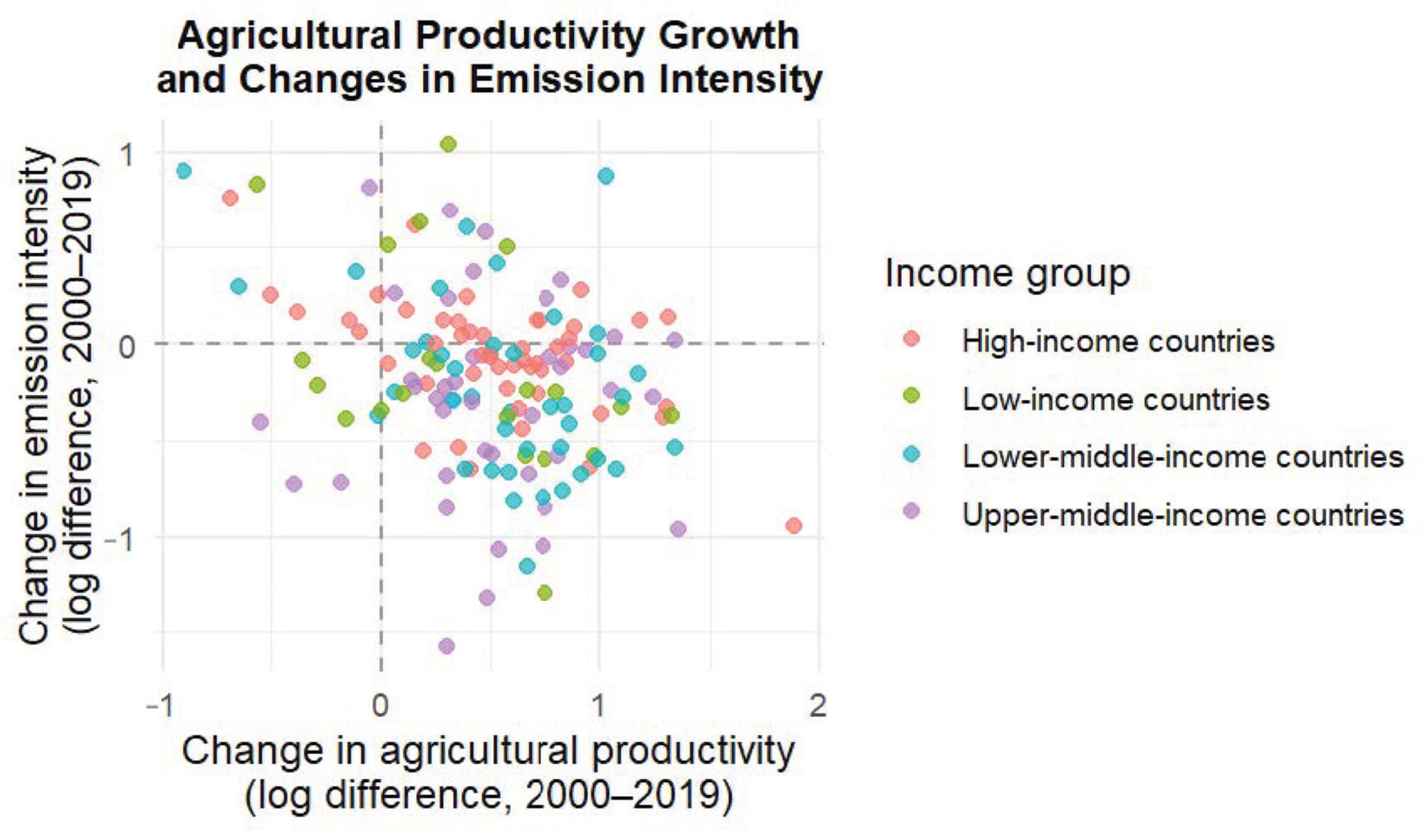
Scatter plots are used to visualize country-level decoupling patterns, distinguishing cases of relative decoupling—where productivity increases while emission intensity declines—from cases in which productivity growth is accompanied by rising emissions. Countries are further differentiated by income group to assess whether decoupling outcomes cluster by development level or display substantial heterogeneity within groups.
This descriptive approach complements the inequality analysis by linking distributional outcomes to underlying growth–environment relationships, an approach increasingly adopted in studies of agricultural sustainability and climate mitigation [
26].
2.5. Robustness and Sample Selection
Because country coverage increases over time, particularly after the early 2000s, inequality measures are computed only for years with a minimum of 30 countries. In addition, robustness checks are conducted using a balanced sample of countries with observed emission intensity in both 2000 and 2019.
This balanced-sample analysis ensures that observed trends are not driven by changes in sample composition or by the entry of countries with extreme values, thereby reinforcing the robustness of the main findings.
3. Results: Decoupling Patterns
Table 2 presents summary statistics for agricultural productivity, greenhouse gas emissions, and emission intensity across countries. The wide dispersion observed in emission intensity already points to substantial cross-country heterogeneity in environmental performance, even before considering temporal dynamics.
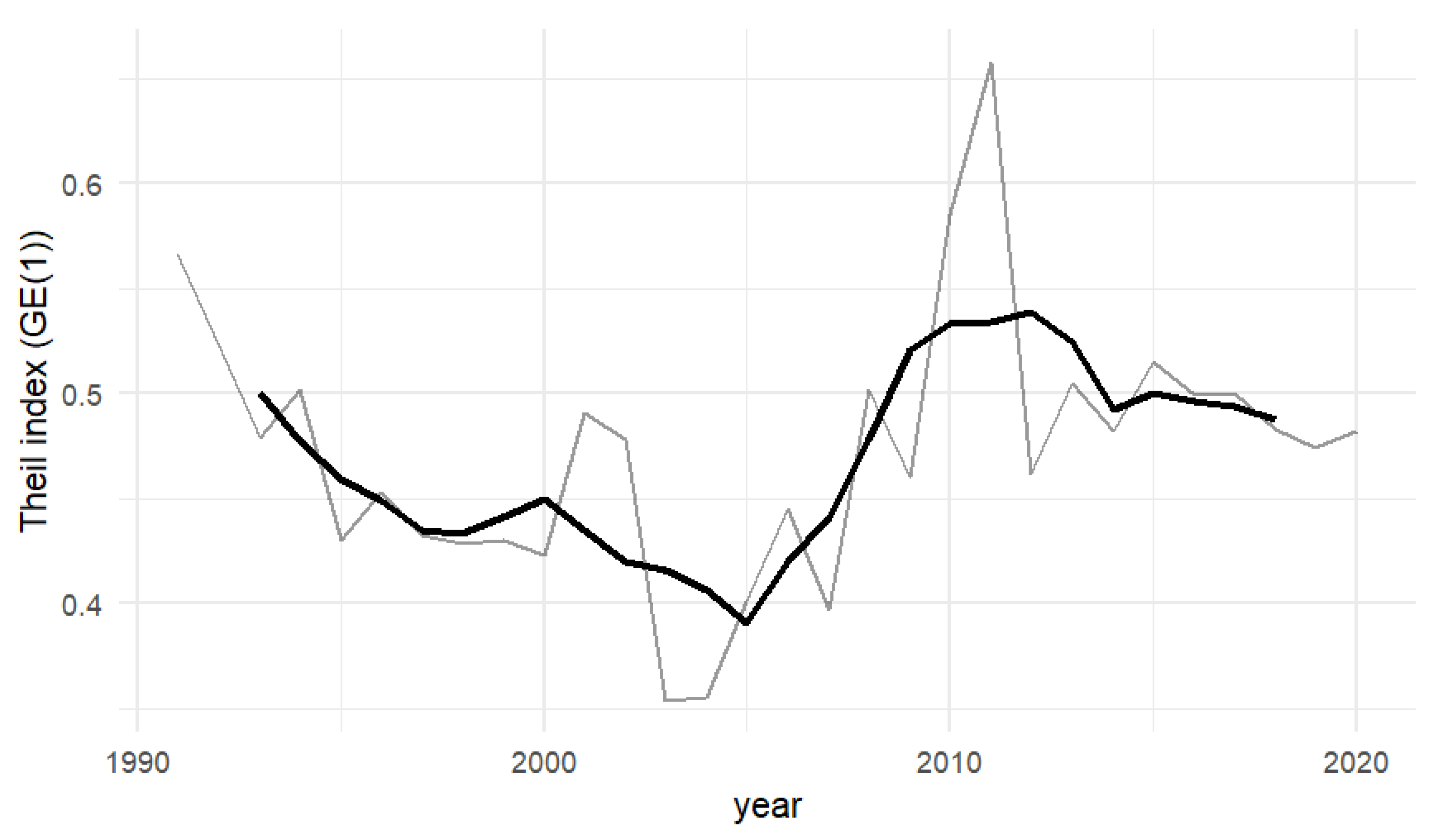
Table 3 reports the level and evolution of global inequality in agricultural emission intensity as measured by the Theil index. The results indicate that inequality remains persistently high over time and exhibits considerable year-to-year variation, with no evidence of sustained convergence. This persistent dispersion is consistent with the heterogeneous decoupling patterns illustrated in
Figure 1, where countries with similar productivity growth trajectories experience markedly different changes in emission intensity. Together, these findings suggest that productivity growth alone does not guarantee improvements in environmental efficiency. Rather, they reflect the complex and uneven nature of agricultural decoupling, underscoring the limitations of simple income- or growth-based explanations such as those implied by the Environmental Kuznets Curve hypothesis [
1,
7].
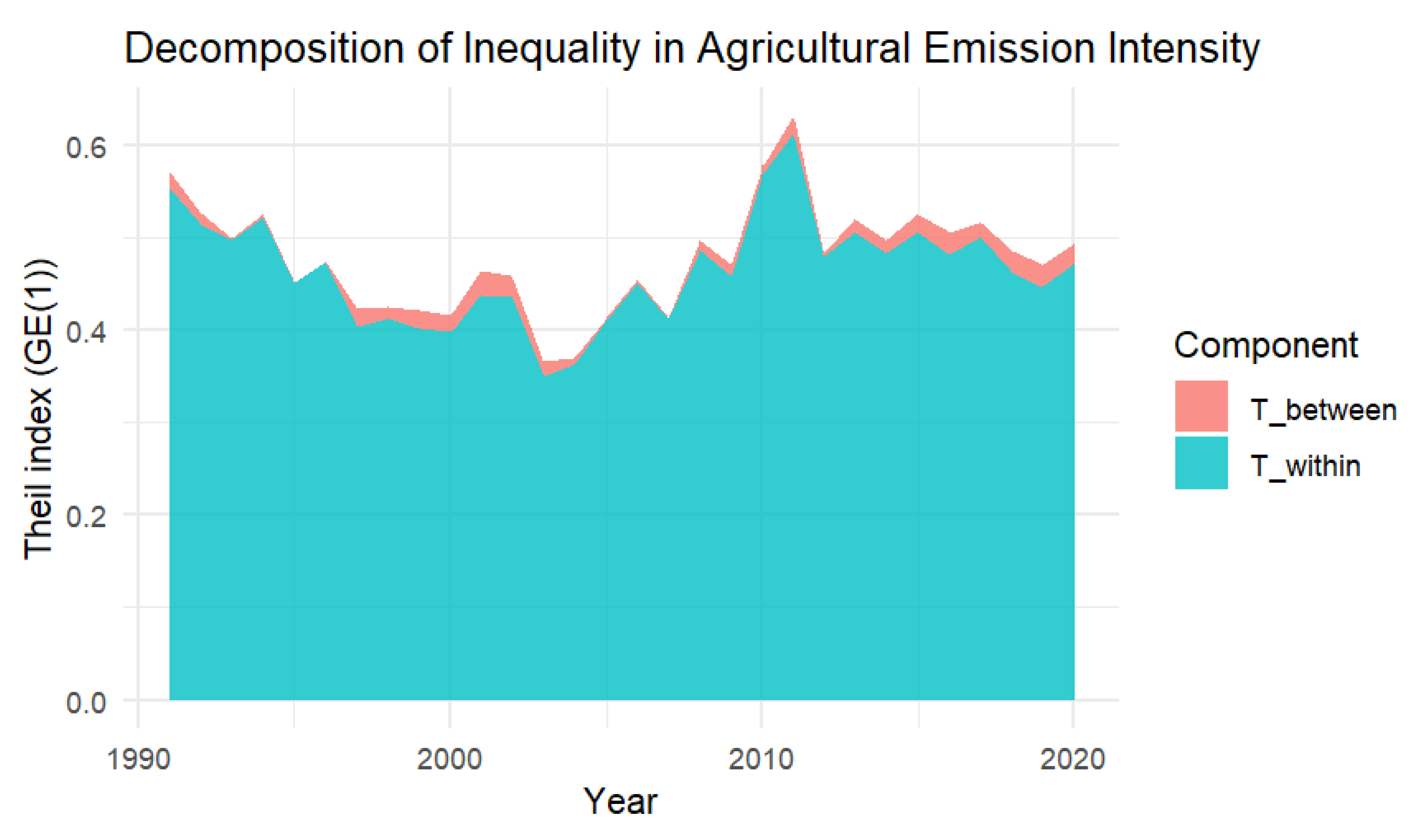
Table 4 reports the decomposition of inequality in agricultural emission intensity by income group. The results show that inequality remains overwhelmingly driven by within-income-group disparities, which account for approximately 99% of total inequality over the period 2000–2019. In contrast, differences between income groups contribute only marginally to overall inequality.
This finding highlights that disparities in agricultural emission intensity are primarily shaped by heterogeneity among countries at similar income levels, rather than by broad differences between income categories. Such a pattern underscores the dominant role of country-specific policies, technologies, and production structures in shaping environmental performance.
Table 5 presents robustness checks comparing results obtained from the full (unbalanced) sample with those from a balanced sample including only countries observed in both 2000 and 2019. Although the average level of inequality differs slightly between samples, the dominance of within-income-group disparities remains unchanged. In both cases, inequality in agricultural emission intensity remains high, and the dominance of within-group disparities persists. This confirms that the main findings are not driven by changes in country coverage over time and that the observed inequality patterns reflect structural characteristics rather than data composition effects.
3.1. Productivity Growth and Emission Intensity Change
Figure 1 plots country-level changes in agricultural productivity against changes in emission intensity between 2000 and 2019. A considerable number of countries fall within the quadrant characterized by rising productivity and declining emission intensity, indicating that partial decoupling has occurred in many cases.
However, the dispersion of observations is pronounced. Countries with similar rates of productivity growth display widely different trajectories of emission intensity, ranging from substantial reductions to marked increases. This heterogeneity indicates that productivity growth alone is insufficient to ensure environmental efficiency gains. Instead, sustained decoupling appears to depend on a combination of factors, including technological adoption, policy interventions, and improvements in land and input management practices [
7].
Disaggregating the results by income group further reinforces this interpretation. Countries within the same income category are widely scattered across all quadrants of the decoupling space, suggesting that income level does not uniquely determine decoupling outcomes. These patterns motivate a closer examination of inequality in emission intensity across countries.
3.2. Global Inequality in Agricultural Emission Intensity
Figure 2 illustrates the evolution of global inequality in agricultural emission intensity from 1990 to 2020, as measured by the Theil index. The trajectory is characterized by substantial fluctuations rather than a clear monotonic trend. Inequality declined modestly during the 1990s and early 2000s but subsequently increased, remaining at a relatively high level in recent years.
These fluctuations occur alongside a steady expansion in country coverage, reflecting improvements in data availability over time. Even in the most recent period—when more than 170 countries are included—the Theil index remains elevated, indicating persistent and substantial disparities in emission intensity across countries.
Overall, these results suggest that global improvements in average emission intensity have not been accompanied by sustained convergence. Instead, the agricultural sector exhibits a pattern of partial and unstable decoupling, in which progress in some countries coexists with stagnation or deterioration in others. This pattern underscores the uneven distribution of mitigation efforts and highlights the challenges facing coordinated global climate action in agriculture.
3.3. Decomposition of Inequality by Income Group
Figure 3 decomposes total inequality in agricultural emission intensity into between- and within-income-group components. The results show that nearly all observed inequality—approximately 99 percent throughout the study period—is attributable to disparities within income groups rather than differences between them.
This dominance of within-group inequality is consistent with findings in the broader inequality literature, where heterogeneity within comparable economic strata often accounts for the majority of overall inequality [
13]. In the context of agriculture, this implies that countries at similar levels of economic development can exhibit markedly different environmental performance.
The limited contribution of between-group inequality suggests that income level alone provides little explanatory power for understanding global patterns of agricultural emission intensity. Instead, variation in national policies, technological adoption, institutional capacity, and production practices appears to play a far more decisive role. The pronounced fluctuations in total inequality over time are therefore primarily driven by changes in within-group heterogeneity rather than shifts between income groups, reinforcing the central argument that uneven decoupling is fundamentally a country-specific phenomenon.
4. Robustness Checks
To assess the robustness of the main findings, several additional analyses were conducted. First, a balanced sample analysis was performed using only countries for which agricultural emission intensity data were available for both 2000 and 2019. This approach mitigates potential bias arising from changes in country coverage over time and ensures that observed trends are not driven by the entry or exit of countries with extreme values.
Second, potential distortions related to the COVID-19 pandemic were explicitly considered. Because agricultural production, trade flows, and input use were substantially disrupted in 2020, the main analyses were re-estimated using alternative samples that exclude pandemic-affected observations. The results remain qualitatively unchanged across specifications, indicating that the central findings are not driven by short-term shocks or exceptional events.
Overall, these robustness checks confirm that the persistence of inequality in agricultural emission intensity and the dominance of within-group disparities are stable features of the data rather than artifacts of sample composition or temporary disturbances.
5. Discussion
This study provides new evidence on the uneven nature of decoupling between agricultural productivity growth and greenhouse gas emission intensity at the global level. While many countries have achieved productivity gains alongside declining emission intensity, the results demonstrate that such improvements have not translated into convergence in environmental performance. Instead, inequality in agricultural emission intensity remains persistently high and is overwhelmingly driven by disparities within income groups rather than between them.
5.1. Rethinking Decoupling in Agriculture
The finding that productivity growth does not automatically lead to lower emission intensity aligns with a growing body of literature questioning simple growth-based narratives of environmental improvement. Early contributions, such as Stern (2004) [
1], emphasized the non-linear and unstable nature of the Environmental Kuznets Curve, particularly when structural and technological factors are not explicitly considered. The present results reinforce this critique by showing that countries with similar productivity growth trajectories often experience markedly different environmental outcomes.
Recent empirical studies support this interpretation. Kamyab et al. [
27] demonstrate that structural change within agriculture plays a decisive role in shaping emission trajectories, while Avenyo and Tregenna [
28] show that productivity gains in developing countries are frequently accompanied by rising carbon intensity in the absence of targeted technological upgrading. These findings are consistent with the evidence presented here, where substantial dispersion in emission-intensity changes is observed even among fast-growing agricultural producers.
Taken together, the results suggest that productivity growth alone is insufficient to ensure environmental improvement. Instead, the direction and quality of growth—shaped by technology, policy, and institutional context—are central to understanding decoupling outcomes.
5.2. Inequality as a Central Feature of Agricultural Sustainability
A key contribution of this study lies in shifting attention from average decoupling trends to their distributional structure. By applying the Theil index, the analysis shows that global inequality in agricultural emission intensity has remained both high and volatile over the past three decades. Importantly, approximately 99% of total inequality is attributable to disparities within income groups rather than differences between them.
This pattern echoes broader insights from the inequality and climate literature. Cevik and Jalles [
29] argue that climate-related inequalities are increasingly driven by heterogeneity within countries and income categories rather than by simple North–South divides. Similarly, Czyżewski et al. [
30] show that environmental efficiency in agriculture varies widely among countries at comparable income levels, reflecting differences in institutional quality, policy design, and access to clean technologies.
The present findings therefore suggest that income level alone is an inadequate proxy for environmental performance in agriculture. Instead, country-specific factors—such as regulatory frameworks, extension systems, land-use practices, and innovation capacity—play a dominant role in shaping emission intensity.
5.3. Technology, Innovation, and Policy Heterogeneity
The dominance of within-group inequality highlights the critical role of technological diffusion and policy heterogeneity in shaping agricultural decoupling. As argued by Gugler et al. [
31], environmental outcomes depend not merely on productivity growth but on the direction of technological change and the incentives governing its adoption. OECD assessments similarly emphasize that productivity-enhancing innovations can either mitigate or exacerbate environmental pressures depending on accompanying regulatory and institutional frameworks [
7].
Recent empirical evidence further supports this conditional relationship. Lenaerts et al. [
32] show that countries achieving relative decoupling tend to combine productivity growth with explicit mitigation policies and investments in low-emission practices. In contrast, Sarkar et al. [
33] find that input-intensive growth strategies often increase emissions despite rising output.
These contrasting pathways are clearly reflected in the present analysis. Countries within the same income group frequently exhibit divergent trajectories, underscoring the importance of national policy choices. For example, Vietnam—classified as a lower-middle-income country—has made notable progress in decoupling agricultural growth from emissions through the promotion of Climate-Smart Agriculture, particularly the adoption of Alternate Wetting and Drying techniques in rice cultivation [
34,
35]. In contrast, other countries at similar income levels remain reliant on input-intensive expansion models associated with rising emissions (Zhao et al., 2024, Leon & Izumi, 2022) [
15,
36].
A similar pattern is observed in China, where a decline in agricultural emission intensity since the mid-2010s coincides with policies aimed at limiting chemical fertilizer use and promoting precision agriculture [
37]. These cases illustrate that the dominance of within-group inequality is not a statistical artifact but reflects the decisive role of institutional capacity, technological diffusion, and policy orientation.
5.4. Agriculture Within Planetary and Social Boundaries
Beyond emission efficiency, recent research emphasizes the need to situate agricultural development within broader planetary and social constraints. Rockström et al. [
10] argue that sustainable food systems must operate within planetary boundaries, implying that productivity gains alone are insufficient unless accompanied by systemic changes in land use, dietary patterns, and supply chains.
From a social perspective, Abi Deivanayagam et al. (2023) [
38] highlight how uneven progress in reducing agricultural emissions can exacerbate climate-related health risks, particularly in vulnerable regions. These perspectives reinforce the relevance of the inequality-based approach adopted in this study. Persistent disparities in emission intensity indicate that some countries remain locked into environmentally intensive agricultural systems, limiting the feasibility of global mitigation efforts and undermining progress toward the Sustainable Development Goals.
5.5. Implications for Global Climate and Development Policy
The findings carry several important policy implications. First, they caution against interpreting aggregate indicators of decoupling as evidence of sustainable progress. Global or regional averages can obscure substantial heterogeneity and mask persistent structural inequalities.
Second, the predominance of within-group inequality suggests that international policy frameworks should move beyond income-based classifications and adopt more granular, context-specific approaches. Targeted support for technology transfer, capacity building, and institutional strengthening is likely to be more effective than uniform productivity-oriented interventions.
Finally, the results underscore the importance of integrated policy strategies that simultaneously address productivity, environmental sustainability, and equity. As demonstrated by Hong et al. (2021) [
39] and Liu et al. (2023) [
40], land-use intensity and management practices play a central role in determining emission outcomes, highlighting the need for coordinated approaches that align agricultural development with climate mitigation objectives.
6. Conclusions
This study examined global patterns of agricultural productivity and greenhouse gas emission intensity from an inequality perspective. Using harmonized data for up to 175 countries over the period 1990–2020, the analysis investigated cross-country variation in decoupling outcomes, the evolution of inequality in agricultural emission intensity, and the relative contributions of between- and within-income-group disparities.
By shifting the focus from average trends to the distributional structure of environmental performance, the study provides new insights into the uneven nature of agricultural decoupling. The results show that, although many countries have achieved productivity growth alongside declining emission intensity, such improvements have not translated into convergence across countries. Instead, inequality in agricultural emission intensity remains persistently high.
A central finding is that nearly all observed inequality—approximately 99 percent—is driven by disparities within income groups rather than differences between them. This result challenges income-based narratives of sustainability transitions and underscores the limited explanatory power of development level alone. Rather, the findings highlight the decisive role of country-specific factors, including policy design, technological adoption, institutional capacity, and agricultural management practices, in shaping environmental outcomes.
From a policy perspective, these results suggest that achieving sustainable agriculture requires more than productivity-enhancing strategies. Effective climate mitigation in the agricultural sector depends on targeted interventions that promote the diffusion of low-emission technologies, strengthen institutional capacity, and address structural constraints specific to national contexts. Without such efforts, global progress toward climate and development goals is likely to remain uneven and fragile.
Future research could extend this analysis by incorporating spatial dependence, dynamic convergence frameworks, and alternative grouping schemes based on agroecological or institutional characteristics. Such extensions would further clarify the mechanisms underlying uneven decoupling and provide deeper insights into how policy design, technological diffusion, and institutional development can jointly support sustainable agricultural transitions.