Article

A Conditional Value-at-Risk-Based Bidding Strategy for PVSS Participation in Energy and Frequency Regulation Ancillary Markets


1
Anhui Province Key Laboratory of Renewable Energy Utilization and Energy Saving, Hefei University of Technology, Hefei 230009, China
2
State Grid Anhui Electric Power Research Institute, Hefei 230061, China
*
Author to whom correspondence should be addressed.
Sustainability 2026, 18(2), 1122; https://doi.org/10.3390/su18021122
Submission received: 3 November 2025 / Revised: 7 January 2026 / Accepted: 20 January 2026 / Published: 22 January 2026

Abstract

As the participation of photovoltaic–storage systems (PVSS) in the energy and frequency regulation ancillary service markets continues to increase, the market risks caused by photovoltaic output uncertainty will directly affect photovoltaic integration efficiency and the provision of system flexibility, thereby having a significant impact on the sustainable development of power systems. Therefore, studying the risk decision-making of PVSS in the energy and frequency regulation markets is of great importance for supporting the sustainable development of power systems. First, to address the issue where the existing studies regard PVSS as a price taker and fail to reflect the impact of bids on clearing prices and awarded quantities, this paper constructs a market bidding framework in which PVSS acts as a price-maker. Second, in response to the revenue volatility and tail risk caused by PV uncertainty, and the fact that existing CVaR-based bidding studies focus mainly on a single energy market, this paper introduces CVaR into the price-maker (Stackelberg) bidding framework and constructs a two-stage bi-level risk decision model for PVSS. Finally, using the Karush–Kuhn–Tucker (KKT) conditions and the strong duality theorem, the bi-level nonlinear optimization model is transformed into a solvable single-level mixed-integer linear programming (MILP) problem. A simulation study based on data from a PV–storage power generation system in Northwestern China shows that compared to PV systems participating only in the energy market and PVSS participating only in the energy market, PVSS participation in both the energy and frequency regulation joint markets results in an expected net revenue increase of approximately 45.9% and 26.3%, respectively. When the risk aversion coefficient, β, increases from 0 to 20, the expected net revenue decreases slightly by about 0.4%, while CVaR increases by about 3.4%, effectively measuring the revenue at different risk levels.

1. Introduction

In recent years, the installed capacity of renewable energy sources such as photovoltaic (PV) and wind power in power systems has been continuously increasing [1,2]. Due to the pronounced intermittency and variability of photovoltaic (PV) generation, as its penetration continues to increase, the power system’s demand for flexibility resources such as frequency regulation and reserves keeps rising, and frequency deviations and PV curtailment risks become more prominent. This, in turn, reduces the renewable energy utilization efficiency and increases system operating costs, thereby hindering the sustainable development of power systems. To address these challenges, on the one hand, coordinated operation of PV and energy storage can smooth output fluctuations and reduce forecasting error- and deviation-related costs, thereby improving PV integration. On the other hand, promoting PV–storage systems to participate in the energy market and frequency regulation ancillary service markets can provide fast-responding, clean flexibility resources, alleviate regulation pressure, and enhance operational reliability. Meanwhile, market-based revenue mechanisms can strengthen the long-term investment and operational viability of PV–storage projects, thereby advancing power-system sustainability in terms of emissions reduction, economic efficiency, and supply reliability. With the continuous expansion of the commissioning scale of centralized PV–storage plants and the accelerated large-scale integration of aggregators and virtual power plants, the marginal regulating role of photovoltaic–storage systems (PVSS) in ancillary services such as frequency regulation has become increasingly prominent. During tightly constrained periods such as rapid net-load ramping, scarcity of regulation resources, and localized congestion, the strategic bidding and output adjustments of PVSS have exerted a non-negligible influence on the prices and awarded outcomes in the energy and frequency regulation markets. Therefore, treating PVSS as price takers in electricity markets—as in many previous studies—makes it difficult to capture the feedback effects of bids on clearing prices and awarded quantities, thereby biasing optimal bidding strategies, revenue distributions, and tail-risk assessments. In addition, due to the intermittency and uncertainty of PV generation, PVSS may face substantial decision-making risks when bidding in the energy and frequency regulation ancillary markets, which can significantly affect their market revenues. Hence, investigating risk-aware decision-making for PVSS participating as price-makers in the energy and frequency regulation ancillary markets is of great importance.
Regarding the bidding strategies of PVSS in electricity spot markets, several studies have been conducted. Reference [3] analyzed the carbon reduction potential of PV–storage systems and proposed a bidding model for their participation in electricity markets. Reference [4] proposes a joint bidding and operation method for photovoltaic battery systems participating simultaneously in the energy and secondary reserve (SRM) markets. However, PVSS is treated as a price taker, making it difficult to capture the feedback effects of PVSS’s strategic bidding on clearing prices and awarded quantities. Reference [5] focuses on the participation of virtual power plants (VPPs) in electricity markets and develops a spot market clearing model that is specifically designed for VPPs. By introducing a flexible bidding mechanism, the model enables VPPs to fully demonstrate their operational flexibility, thereby enhancing their competitiveness and market value recognition within the power market. However, these strategies mainly focus on participation in the energy market, while research on bidding strategies for the frequency regulation ancillary service market remains limited.
In recent years, the potential of renewable energy, such as PV, to participate in frequency regulation markets has been increasingly explored [6,7,8,9]. Several scholars have investigated the bidding strategies of PVSS and other renewable systems in both the energy and ancillary markets. Reference [10] proposes an optimal bidding model for wind-storage systems in the day-ahead energy and frequency regulation markets but does not explicitly capture the feedback effects of the participants’ bids on clearing prices and awarded quantities. Reference [11] develops an operational strategy based on robust model predictive control and constructs a multi-period bi-level robust optimization model to maximize the joint profits of PVSS in the energy and auxiliary service markets, considering multiple constraints and uncertainties. However, its solution is typically based on the price taker assumption and lacks a characterization of the bidding behavior of price setters under market power conditions and its impact on the clearing results. Reference [12] investigated the integration of PV battery storage systems with heat pumps for power-to-heat coupling in central Europe. The study highlighted the potential of integrated homes to facilitate sector coupling and enhance the utilization of renewable energy by participating in the negative frequency restoration reserve market. Reference [13] considers the characteristics of photovoltaic–storage and grid frequency fluctuations, proposing a bidding strategy based on AGC and establishing a multi-time-scale optimization model. However, the economic coupling relationship under the energy-frequency regulation joint clearing mechanism and its impact on the clearing results are still not sufficiently discussed. Overall, the above studies provide valuable theoretical references for PVSS participation in the joint energy and frequency regulation markets. However, there is still room for further development in the areas of clearing feedback characterization, price-maker modeling, and the economic coupling analysis of joint clearing. Specifically, modeling PVSS as a price taker in the electricity market fails to effectively capture the cross-market capacity allocation between energy and frequency regulation and overlooks the actual impact of PVSS on market price formation and social welfare distribution. Therefore, considering PVSS as a price-maker in the joint energy and frequency regulation markets would provide a more comprehensive reflection of its role and impact in the market.
Nevertheless, the randomness and uncertainty of PV generation output remain key obstacles limiting PVSS market penetration. The bidding behavior in electricity markets shares similarities with portfolio investment behavior in finance, and extensive research has been conducted on risk measurement and evaluation in electricity markets. References [14,15] introduced the value-at-risk (VaR) method into electricity market risk analysis. Reference [16] employed the conditional value-at-risk (CVaR) method to quantify the impact of price uncertainty on microgrid revenues and developed a two-stage model for day-ahead and real-time markets. Reference [17] proposed an optimal bidding model for a “renewable energy + storage” plant in the day-ahead market based on CVaR, considering renewable generation uncertainty and price volatility. Reference [18] constructed a two-stage CVaR-based risk-averse model for a virtual power plant (VPP) and derived its optimal bidding strategy in the energy market. Reference [19] developed a leader–follower game-based bidding model between a VPP and electric vehicle clusters, using CVaR to evaluate the trade-off between profit and uncertainty. Furthermore, Reference [20] extended the analysis to include reserve capacity markets and proposed a two-stage risk decision model for VPP participation in the energy and reserve markets. However, the above studies mostly focus only on the risk issues associated with market participants’ involvement in the energy market. The risk issues related to PVSS’s participation in the joint clearing of the energy and frequency regulation auxiliary markets require further research and analysis.
To address the shortcomings of the existing studies in characterizing price-making behavior, modeling the coupled clearing of the energy and frequency regulation markets, and quantifying tail risk, this paper proposes a two-stage, bi-level, risk decision-making model in which a PVSS acts as a price-maker and participates simultaneously in the energy market and the frequency regulation ancillary market. CVaR is incorporated into the upper-level model, extending it from conventional settings that mostly adopt a single-level formulation or focus on a single energy market to a price-maker-oriented, bi-level, two-stage risk decision framework, thereby comprehensively evaluating the impacts of different risk-aversion coefficients on the PVSS bidding strategy and revenue distribution. To tackle the computational complexity of the bi-level nonlinear model, a reformulation approach based on the Karush–Kuhn–Tucker (KKT) conditions and the strong duality theorem is developed to transform the bi-level optimization problem into a solvable equivalent formulation. The proposed two-layer two-stage framework was validated using data from a photovoltaic–storage power generation system in Northwestern China, demonstrating its ability to mitigate potential risks and enhance profits by optimizing the PVSS bidding strategy. The main research in this paper is as follows:
(1) A market bidding framework is established for PVSS acting as a price-maker in energy and frequency regulation markets, providing a reference for market pricing mechanisms.
(2) To address the risks arising from photovoltaic uncertainty in PVSS bidding decisions in electricity markets, this paper embeds CVaR into a price-maker-oriented, bi-level, two-stage framework. The upper level constructs a two-stage risk decision model for PVSS participation in the energy and frequency regulation markets, based on CVaR: in the first stage, a joint bidding model for the energy and frequency regulation markets is developed to account for PV output uncertainty and tail risk; in the second stage, an optimal operation model is formulated under different scenarios of PV output and regulation activation, coordinating battery charging/discharging and regulation capacity allocation to obtain risk-averse optimal operating outcomes. The lower level determines the clearing prices and awarded quantities through the joint clearing of the energy and frequency regulation markets, thereby systematically quantifying the impacts of different risk-aversion coefficients on the optimal bidding strategy and the revenue distribution.
(3) To address the computational complexity of the bi-level nonlinear optimization model, the KKT conditions and strong duality theorem are employed to transform it into a single-level linear problem, thereby improving computational efficiency while ensuring solution accuracy.

2. Market Bidding Framework

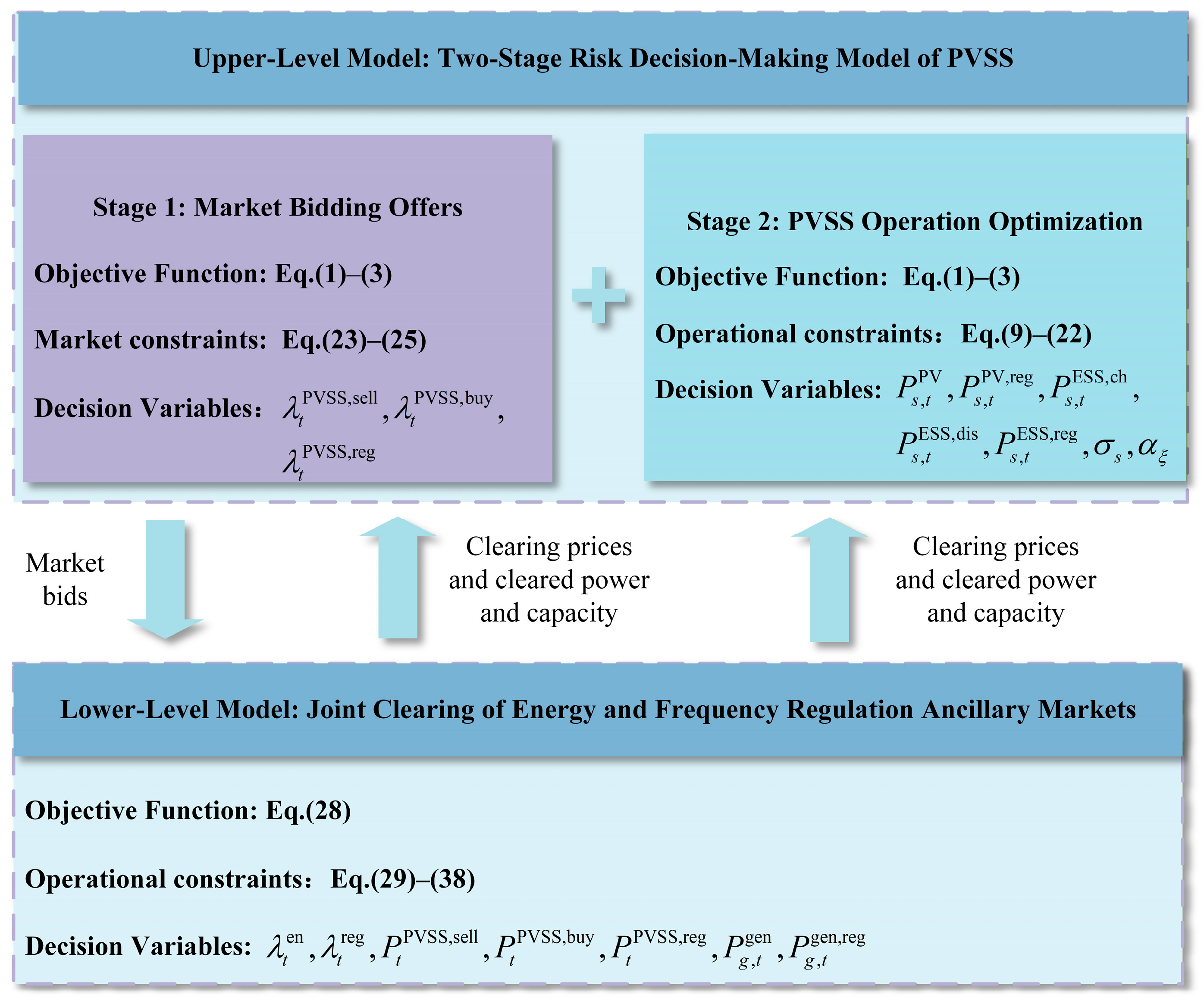
This section constructs a market bidding framework for PVSS’s participation in the energy and frequency regulation auxiliary markets. The PVSS described in this paper refers to a photovoltaic–storage system formed by a photovoltaic power station after configuring energy storage that is suitable for its own capacity. The energy storage can provide power when photovoltaic output is insufficient and store power when photovoltaic output exceeds demand, thereby smoothing fluctuations in photovoltaic generation. On this basis, the photovoltaic and storage system will participate in the energy and frequency regulation auxiliary markets by bidding its surplus generation capacity. Therefore, this paper treats PVSS as a market participant in the energy and frequency regulation auxiliary market bidding. Considering that in the past, distributed photovoltaic–storage systems were often small in scale and participated in market bidding as price takers, as PVSS scales up, its role in flexible markets such as frequency regulation services becomes more prominent. Due to the local and scarce nature of the products, the limited number of participants, and the potential for regional segmentation caused by network constraints, the bids for marginal flexibility resources have a greater impact on clearing prices. PVSS, relying on the fast power adjustment capability of energy storage, may become a marginal frequency regulation provider during certain periods. Especially when multiple PVSS form aggregated bids through aggregators or virtual power plants, their bidding strategies will have a considerable impact on market clearing prices and distribution results. Therefore, this paper constructs a bi-level optimization framework based on price-makers for PVSS’s participation in the energy and frequency regulation auxiliary services market. The lower-level optimization model focuses on maximizing social welfare, conducting joint market clearing for PVSS, other generation companies, and power retailers across both the energy and ancillary service markets. The decision variables primarily include the clearing prices of the two markets, the buying and selling power of PVSS, and the regulation capacity provided by each market participant.
Through this bi-level optimization framework, PVSS can make comprehensive and strategic decisions for participating in both the energy and frequency regulation markets. The overall bi-level optimization model for energy and ancillary service markets is illustrated in Figure 1.

3. Upper-Level Decision Model

3.1. Market Revenue Maximization

The PVSS can both sell and purchase energy in the energy market and sell regulation capacity in the frequency regulation ancillary service market. The upper-level optimization model includes a two-stage objective function. In the first stage, the objective is to maximize the expected market revenue of PVSS, which consists of the following: (1) the revenue obtained from selling electricity in the energy market and (2) the revenue earned from providing frequency regulation services. In the second stage, the objective is to minimize the internal operating cost of PVSS, including the cost of photovoltaic generation and curtailed operation, the charging/discharging loss cost of the energy storage system, and the regulation cost. The overall objective function is expressed as Equation (1).
F total = F rev + s π s F cost , s
F rev = t λ t en P t PVSS , sell P t PVSS , buy Δ t + t λ t reg P t PVSS , reg + λ t mil κ t reg P t PVSS , reg Δ t
F cos , s = t C PV · P s , t PV + C ab _ PV · P s , t PV , reg + C ESS P s , t ESS , ch η ESS , ch + P s , t ESS , dis η ESS , dis + κ t reg P s , t ESS , reg Δ t
where F rev represents the total revenue of the PVSS from the energy and frequency regulation markets; λ t en denotes the clearing price of the energy market at time t; P t PVSS , sell and P t PVSS , buy represent the power sold to and purchased from the energy market at time t, respectively; Δ t is the time interval; λ t reg and λ t mil denote the clearing prices of regulation capacity and regulation mileage, respectively, at time t; κ t reg represents the regulation capacity utilization rate; P t PVSS , reg denotes the regulation capacity provided by the PVSS at time t; F s represents the PVSS market revenue under scenario s; C PV denotes the photovoltaic generation cost; P s , t PV is the PV power output under scenario s at time t; C ab _ PV denotes the cost of curtailed PV generation; P s , t PV , reg represents the regulation capacity provided by the PV system under scenario s at time t; C ESS denotes the loss coefficient of the energy storage system during charging and discharging; P s , t ESS , ch and P s , t ESS , dis represent the charging and discharging power of the ESS at time t under scenario s, respectively; and η ESS , ch and η ESS , dis denote the charging and discharging efficiencies, respectively.

3.2. Risk Measure Based on Conditional Value-at-Risk

Risk measurement is a method originating from the financial sector that is used to evaluate the likelihood and potential impact of specific risks [21]. Among various risk assessment tools, the VaR and CVaR theories have been widely applied in modern financial risk management [22]. Considering that the high uncertainty of PV generation has a significant influence on the decision-making of PVSS in both the energy and frequency regulation markets, selecting an appropriate risk evaluation approach becomes essential.
Although VaR describes the quantile characteristic of potential portfolio losses under a given confidence level, it only represents the maximum tolerable loss at that confidence level and fails to capture potential losses beyond this quantile. Consequently, VaR has limitations in identifying tail risks—that is, extreme losses occurring in the tail of the probability distribution—which may lead to an underestimation of the overall risk [23].
In contrast, CVaR measures the conditional expected loss beyond the VaR threshold, providing a more comprehensive representation of tail risk characteristics. By accounting for the magnitude of extreme losses in the tail region, CVaR effectively compensates for the deficiencies of VaR in tail risk measurement and enhances the accuracy and robustness of risk assessment.
V CVaR ξ = 1 1 ξ f ( x , y ) V VaR ξ ( x ) f ( x , y ) ρ ( y ) d y
where V CVaR ξ denotes the conditional value at risk at a confidence level of ξ . Considering that the function V VAR ξ ( x ) is difficult to solve directly, a transformation function F ξ ( x , α ) is derived to obtain the value of V CVaR ξ .
F ξ ( x , α ) = α + 1 1 ξ [ f ( x , y ) α ] +   ρ ( y ) d y
where [ f ( x , y ) α ] + denotes max { f ( x , y ) α , 0 } , and α represents the VaR. In general, the transformation function F ξ ( x , α ) is discretized using Equation (6).
F ˜ ξ ( x , α ) = α + 1 m ( 1 ξ ) k = 1 m f x , y k α +
where y k denotes the k-th sample of the random variable y, and m represents the total number of samples. Thus, V CVaR ξ = min F ˜ ξ ( x , α ) . In this model, the CVaR value of the PVSS can be obtained accordingly.
ϕ ξ = α ξ + 1 1 ξ s π s σ s
F s α ξ σ s 0 , σ s 0 s
where ϕ ξ denotes the CVaR of the PVSS revenue, α ξ represents the VaR of the PVSS revenue, and σ s refers to the PVSS revenue.

3.3. Constraints of the Upper-Level Model

(1) Energy constraint
P s , t PV + P s , t PV , reg P s , t PV , real
P s , t PV P s , t PV , reg 0
P s , t ESS , dis P s , t ESS , ch + P s , t ESS , reg P ESS MAX
P s , t ESS , dis P s , t ESS , ch P s , t ESS , reg P ESS MAX
where P s , t PV denotes the power provided by the PV system of the PVSS to the energy market under scenario s at time t. P s , t PV , reg and P s , t ESS , reg represent the regulation capacities provided by the PV system and the energy storage system of the PVSS to the frequency regulation ancillary service market under scenario s at time t, respectively. P s , t PV , real denotes the actual PV power output of the PVSS under scenario s at time t. P s , t ESS , ch and P s , t ESS , dis represent the charging and discharging power of the ESS in the PVSS under scenario s at time t, respectively. P ESS MAX denotes the maximum allowable charging/discharging power of the ESS in the PVSS.
(2) Energy storage state constraints
0 P s , t ESS , ch P ESS MAX χ s , t ESS , ch
0 P s , t ESS , dis P ESS MAX χ s , t ESS , dis
χ s , t ESS , ch + χ s , t ESS , dis 1
S O C s , 0 = S O C s , T
S O C s , t + 1 = S O C s , t P s , t ESS , dis Δ t η ESS , dis + η ESS , ch P s , t ESS , ch Δ t
S O C min S O C s , t S O C max
where χ s , t ESS , ch and χ s , t ESS , dis denote the binary variables representing the charging and discharging states of the energy storage system under scenario s at time t, respectively. When χ s , t ESS , ch = 1 and χ s , t ESS , dis = 0 , the energy storage operates in the charging mode; conversely, when χ s , t ESS , ch = 0 and χ s , t ESS , dis = 1 , it operates in the discharging mode. S O C m a x and S O C m i n represent the upper and lower bounds of the state of charge (SOC) of the energy storage system, respectively. S O C s , t indicates the SOC of the energy storage system under scenario s at time t, while S O C s , 0 and S O C s , T denote the SOC at the beginning and the end of the scheduling period in scenario s, respectively.
(3) Frequency Regulation Capacity Constraints
P t PVSS , reg = P s , t PV , reg + P s , t ESS , reg
P s , t PV , reg 0
P s , t ESS , reg 0
The frequency regulation capacity provided by the PVSS mainly originates from the regulation capabilities of photovoltaic generation and energy storage systems.
(4) Constraints on the Power Purchase and Sale of the PVSS
P t PVSS , sell P t PVSS , buy = P s , t PV + P s , t ESS , dis P s , t ESS , ch
(5) PVSS Bidding Constraints
0 λ t PVSS , sell λ max PVSS , en
0 λ t PVSS , buy λ max PVSS , en
0 λ t PVSS , reg λ max PVSS , reg
where λ t PVSS , sell , λ t PVSS , buy , and λ t PVSS , reg denote, respectively, the selling price, buying price, and regulation capacity bid of the PVSS at time t; λ max PVSS , en and λ max PVSS , reg represent the maximum bidding prices of PVSS in the energy market and frequency regulation market, respectively.
The bi-stage risk decision model for PVSS participation in the energy and frequency regulation markets can therefore be formulated as shown in Equation (26), based on the above analysis.
max ( F total + β ϕ ξ )
where β denotes the risk-aversion coefficient (0–100), reflecting the decision maker’s attitude toward market risk; a higher β implies a more conservative strategy, while a lower β indicates a greater risk tolerance. ξ denotes the confidence level (0.65–0.95), which defines the reliability of the CVaR-based risk assessment in the upper-level bi-stage model.
We characterize PV output uncertainty, using a scenario-based method. Bidding decisions for a PVSS participating in the energy market and the frequency-regulation ancillary services market are formulated as a two-stage, risk-averse model. The first stage comprises scenario-invariant decisions—energy-market bid prices λ t PVSS , sell and λ t PVSS , buy , and the regulation-market bid price λ t PVSS , reg . The second stage specifies, for each scenario s, dispatch and capacity decisions, including PV output P s , t PV , ESS discharge/charge power P s , t ESS , dis and P s , t ESS , ch , and the available regulation capacity. The complete set of upper-level decision variables is summarized in Equation (27).
X = λ t PVSS , sell , λ t PVSS , buy , λ t PVSS , reg , P s , t PV , P s , t PV , reg , P s , t ESS , ch , P s , t ESS , dis , P s , t ESS , reg , σ s , α ξ

4. Joint Clearing Model of the Lower-Level Energy and Frequency Regulation Markets

At present, well-established electricity spot markets such as CAISO and ERCOT adopt a joint clearing mechanism for energy and frequency regulation ancillary service markets [24,25,26]. Therefore, this section formulates the lower-level objective function based on the joint clearing approach. During the market clearing process, both PVSS and conventional generation companies are allowed to participate in market bidding.

4.1. Objective Function

The market operator clears the energy and frequency regulation ancillary service markets jointly, aiming to maximize social welfare based on the generation bids submitted by all power producers. Accordingly, the lower-level objective function is formulated to minimize the total market operation cost, which consists of two components: the cost or revenue associated with purchasing or selling electricity from the PVSS and other conventional generators in the energy market, and the cost of procuring frequency regulation capacity from these participants in the ancillary service market, as expressed in Equation (28).
F = t g λ g , t gen P g , t gen + λ t PVSS , sell P t PVSS , sell λ t PVSS , buy P t PVSS , buy + λ t PVSS , reg P t PVSS , reg + λ t mil κ t reg P t PVSS , reg + g λ g , t gen , reg P g , t gen , reg + λ t mil κ t reg P g , t gen , reg Δ t
where λ g , t gen and λ g , t gen , reg denote the bidding prices submitted by generator g at time t in the energy market and regulation capacity market, respectively; P g , t gen and P g , t gen , reg represent the power output and regulation capacity provided by generator g at time t, respectively.

4.2. Constraints of the Lower-Level Model

(1) Power Balance Constraint
P t PVSS , sell P t PVSS , buy + g Ω g ( n ) P g , t g e n = P t l t   : ρ t e n
where P g , t e n denotes the output power of generator g at time t; P n , t l represents the load demand at node n and time t; and ρ t e n is the dual variable associated with the power balance equality constraint.
(2) Regulation Capacity Balance Constraint
P t PVSS , reg + g Ω g P g , t gen , reg = P s y s , t reg g Ω g   : ρ t r e g
where P s y s , t r e g denotes the system regulation capacity requirement at time t; P t PVSS , reg represents the regulation capacity provided by the PVSS at time t under scenario s; and ρ t r e g is the dual variable associated with the regulation capacity balance equality constraint.
(3) Conventional Generator Constraints
P g , t g e n , min P g , t g e n P g , t g e n , max : μ _ g , t g e n , μ ¯ g , t g e n
P g , t g e n + P g , t g e n , r e g P g , t e n , max : ν ¯ g , t g e n
P g , t g e n , min P g , t g e n P g , t g e n , r e g : ν _ g , t g e n
0 P g , t g e n , r e g P g , max g e n , r e g : μ _ g , t g e n , r e g , μ ¯ g , t g e n , r e g
where P g , t g e n , max and P g , t g e n , min denote the maximum and minimum output power of generator g, respectively; μ _ g , t g e n and μ ¯ g , t g e n represent the dual variables associated with Equation (31); P g , t g e n , r e g denotes the regulation capacity provided by generator g at time t; ν ¯ g , t g e n and ν _ g , t g e n are the dual variables corresponding to Equations (32) and (33), respectively; P max g e n , r e g represents the upper bound of the regulation capacity provided by generator g; and finally, μ _ g , t g e n , r e g and μ ¯ g , t g e n , r e g denote the dual variables associated with Equation (34).
(4) PVSS Operation Constraints
P t PVSS , sell 0 : μ _ t PVSS , sell
P t PVSS , sell + P t PVSS , reg P max PVSS : μ ¯ t PVSS , sell
0 P t PVSS , buy P max PVSS , buy : μ _ t PVSS , buy , μ ¯ t PVSS , buy
0 P t PVSS , reg P max PVSS , reg : μ _ t PVSS , reg , μ ¯ t PVSS , reg
where P max PVSS denotes the maximum allowable power output of the PVSS; μ _ t PVSS , sell is the dual variable associated with Equation (36); P max PVSS , reg represents the maximum allowable regulation capacity of the PVSS; μ ¯ t PVSS , sell is the dual variable corresponding to Equation (36); μ _ t PVSS , buy and μ ¯ t PVSS , buy are the dual variables associated with Equation (37); and μ _ t PVSS , reg and μ ¯ t PVSS , reg are the dual variables corresponding to Equation (38).
The set of decision variables for the lower-level joint clearing model is defined in Equation (39). The clearing prices of the energy and frequency regulation markets, λ t en and λ t reg , are obtained as the outcomes of the lower-level clearing process and are subsequently transmitted to the upper-level model to determine the PVSS revenues in both markets.
Y = λ t en , λ t reg , P t PVSS , sell , P t PVSS , buy , P t PVSS , reg , P g , t gen , P g , t gen , reg
The energy market clearing price λ t en and the regulation capacity clearing price λ t reg , obtained from the lower-level market, satisfy the following conditions:
λ t en Δ t = ρ t en
λ t r e g Δ t = ρ t r e g

5. Bi-Level Model Transformation Method Based on KKT Conditions and Strong Duality Theorem

5.1. Restructuring of the Bi-Level Optimization Framework

For bi-level optimization problems, a commonly used approach is to transform the problem into a single-level formulation by applying the KKT conditions [27,28,29,30]. In the upper-level model, the decision variables—such as the PVSS’s electricity buying and selling prices—are treated as known coefficients in the lower-level objective function. Therefore, the lower-level model can be regarded as a convex continuous optimization problem, which allows for transformation, using the KKT conditions.
Subsequently, the Big-M method and the strong duality theorem are applied to linearize the complementary slackness constraints and nonlinear terms in the resulting single-level model. The detailed steps for transforming the bi-level model into a single-level form are as follows:
  • Step 1: Construct the Lagrangian function of the lower-level model, as shown in Appendix A, Equation (A2);
  • Step 2: Derive the stationarity conditions by taking the partial derivatives of the Lagrangian function, as shown in Appendix A, Equation (A3);
  • Step 3: Formulate the complementary slackness conditions for the lower-level inequality constraints, as given in Appendix A, Equation (A4).
By applying the KKT conditions, the bi-level optimization model is transformed into a single-level equivalent model, as expressed in Equation (42).
max   F total + β ϕ ξ
The constraints are defined as follows:
  • Upper-level constraints: These are given in Equations (9)–(25).
  • Lower-level constraints: These include the equality constraints in Equations (29) and (38), and the transformed inequality constraints shown in Equations (A3) and (A4).

5.2. Linearization of the Objective Function

In the current objective function, there exist bilinear terms involving the multiplication of two variables, such as λ t en P t PVSS , sell , λ t en P t PVSS , buy , and λ t reg P t PVSS , reg . These nonlinear terms prevent the model from being directly solved by standard optimization solvers; therefore, linearization is required. The detailed linearization process is provided in Appendix A, Equations (A6)–(A7).
max   F total + β ϕ ξ F total = P t l ρ t e n + P s y s , t reg ρ t r e g g Ω g ( P g , t g e n , max μ ¯ g , t g e n P g , t g e n , min μ _ g , t g e n ) g Ω g P g , t e n , max ν ¯ g , t g e n g Ω g P g , t g e n , min ν _ g , t g e n g Ω g P g , max g e n , r e g μ ¯ g , t g e n , r e g g λ g , t gen P g , t gen g λ g , t gen , reg P g , t gen , reg + λ t mil κ t reg P g , t gen , reg t C PV P s , t PV + C ab _ PV P s , t PV , reg + C ESS P s , t ESS , ch η ESS , ch + P s , t ESS , dis η ESS , dis + κ t reg P s , t ESS , reg Δ t
After the above process, the objective function is transformed from Equation (42) into Equation (43), converting the original nonlinear objective function into a single-layer linear problem. Therefore, in the numerical computation, the integrated model in Equation (43) is solved directly. Equation (43) combines the original physical and market constraints (Equations (1)–(25)) with the KKT conditions and strong duality equivalence of the lower-level clearing problem (Equations (26)–(41)), ensuring that all results in Section 6 correspond to the same set of key equations and assumptions.

6. CVaR-Based Trading Decision Model for PVSS Participating in the Energy and Frequency Regulation Markets

This paper proposes a bidding strategy for PVSS participating in the energy and frequency regulation auxiliary markets, based on CVaR. The method combines a bi-level risk decision model and uncertainty modeling, effectively assessing market revenue issues under different levels of risk aversion.

6.1. Data Processing and Scenario Generation

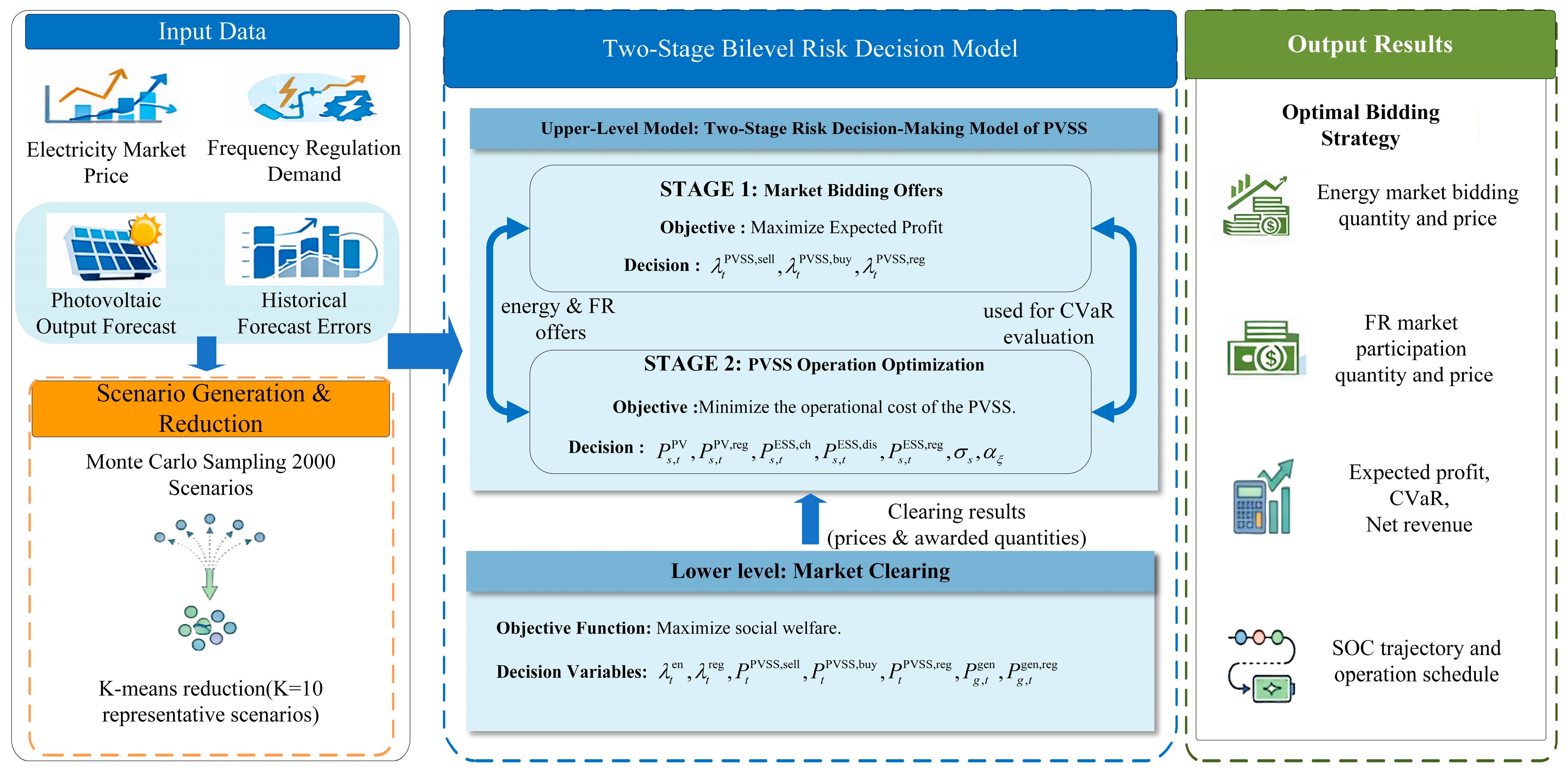
In order to consider the uncertainty of photovoltaic output, multiple PV output scenarios are generated using the Monte Carlo sampling method. It is assumed that the PV forecast error follows a normal distribution, with the error parameters set based on historical data. Then, the K-means clustering algorithm is applied to the PV output data to perform clustering, and 10 representative scenarios are selected. These scenarios reflect different weather conditions and market fluctuations. The specific steps for scenario generation are as follows:
1. Photovoltaic data division: To simulate the randomness of PV output, historical PV output data and forecast errors are first collected. It is assumed that the PV forecast error follows a normal distribution, with the standard deviation of the error dynamically changing according to the level of PV output. The formula is as follows (44):
σ t = σ min + σ max σ min 1 P ^ t P max
where σ t denotes the standard deviation of the forecast error at time period t, P ^ t represents the forecasted photovoltaic (PV) power output at time t, and P max denotes the maximum installed capacity of the PV system.
2. Scenario generation: In each time period, 2000 photovoltaic output scenarios are generated using the Monte Carlo method. Each scenario is generated according to the following formula:
P t , n = P ^ t 1 + ε t , n
where P t , n denotes the scenario-based power output of the n-th scenario at time period t, and ε t , n represents the random error generated by the error model at time t in scenario n.
3. Scenario reduction: The 2000 photovoltaic output scenarios are reduced to 10 representative scenarios (K = 10), using the K-means clustering algorithm. The 24 h photovoltaic output data are used as the feature vector during clustering, and each scenario is standardized. The distance metric used is the Euclidean distance. Initialization is performed using k-means++, with a maximum of 300 iterations and 20 repetitions of initialization. The final cluster centroids are selected as the representative scenarios, and the probability of each representative scenario is calculated:
π k = C k N
where π k denotes the probability of the k-th representative scenario, C k represents the k-th cluster, and N = 2000 denotes the total number of scenarios.

6.2. Risk Modeling and Bidding Decision

In order to control risk and maximize the market revenue of PVSS, this paper uses conditional value-at-risk (CVaR) as a risk measurement tool. CVaR is embedded into the bi-level decision model during the bidding decision process. In the upper-level optimization model, the potential risks of PVSS’s participation in the energy and frequency regulation auxiliary service markets are considered, based on the uncertainty of photovoltaic output. By coordinating the optimization of photovoltaic output and energy storage charging and discharging power, the aim is to reduce the operating costs of PVSS in the electricity market. The decision variables in the upper-level model include the following: PVSS’s bidding prices in the energy and frequency regulation markets, photovoltaic output, energy storage charging and discharging power, SOC (state of charge) intervals, bidding prices in the energy and frequency regulation markets, and frequency regulation capacity demand and call rates. With these decision variables, the model can effectively balance the interaction between photovoltaic and storage systems, optimize market participation strategies, and reduce risks induced by uncertainty. The objective of the lower-level optimization model is to maximize social welfare by jointly clearing the energy and frequency regulation auxiliary services of PVSS, other power generation companies, electricity retailers, and other market participants. The decision variables in the lower-level model include the following: clearing prices in both markets, PVSS’s buying and selling power, and the frequency regulation capacity provided by each market participant. Through the bi-level optimization framework, the model can more comprehensively assess PVSS’s bidding strategy and participation behavior in the energy and frequency regulation auxiliary service markets. To solve the bi-level nonlinear optimization problem in the proposed model, this paper uses the Karush–Kuhn–Tucker (KKT) conditions and strong duality theorem for an equivalent transformation, converting it into a single-layer linear optimization problem. The bidding strategy process of PVSS participating in the energy and frequency regulation auxiliary markets based on conditional value-at-risk is shown in Figure 2.

7. Results and Discussion

7.1. Case Study Design

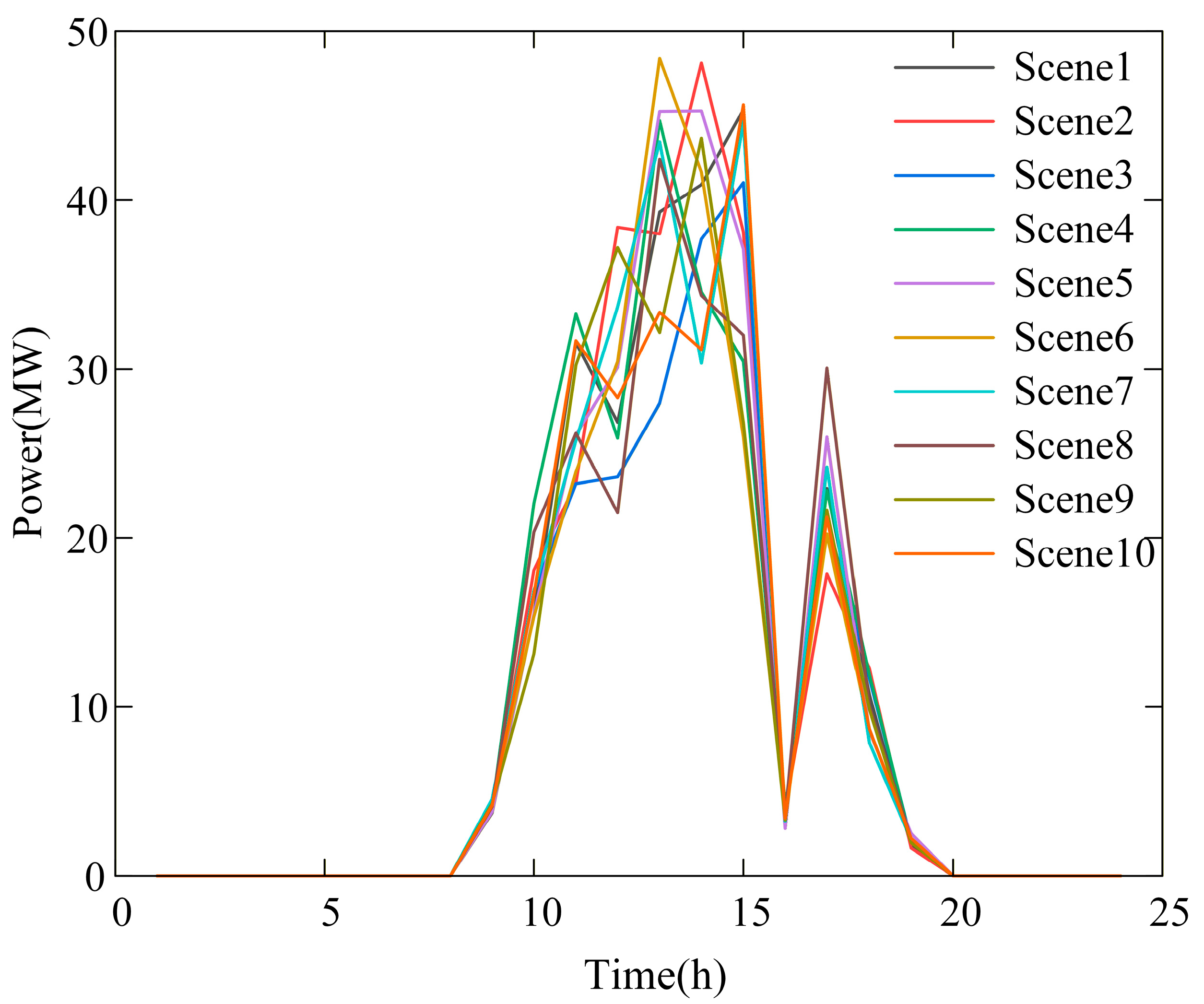
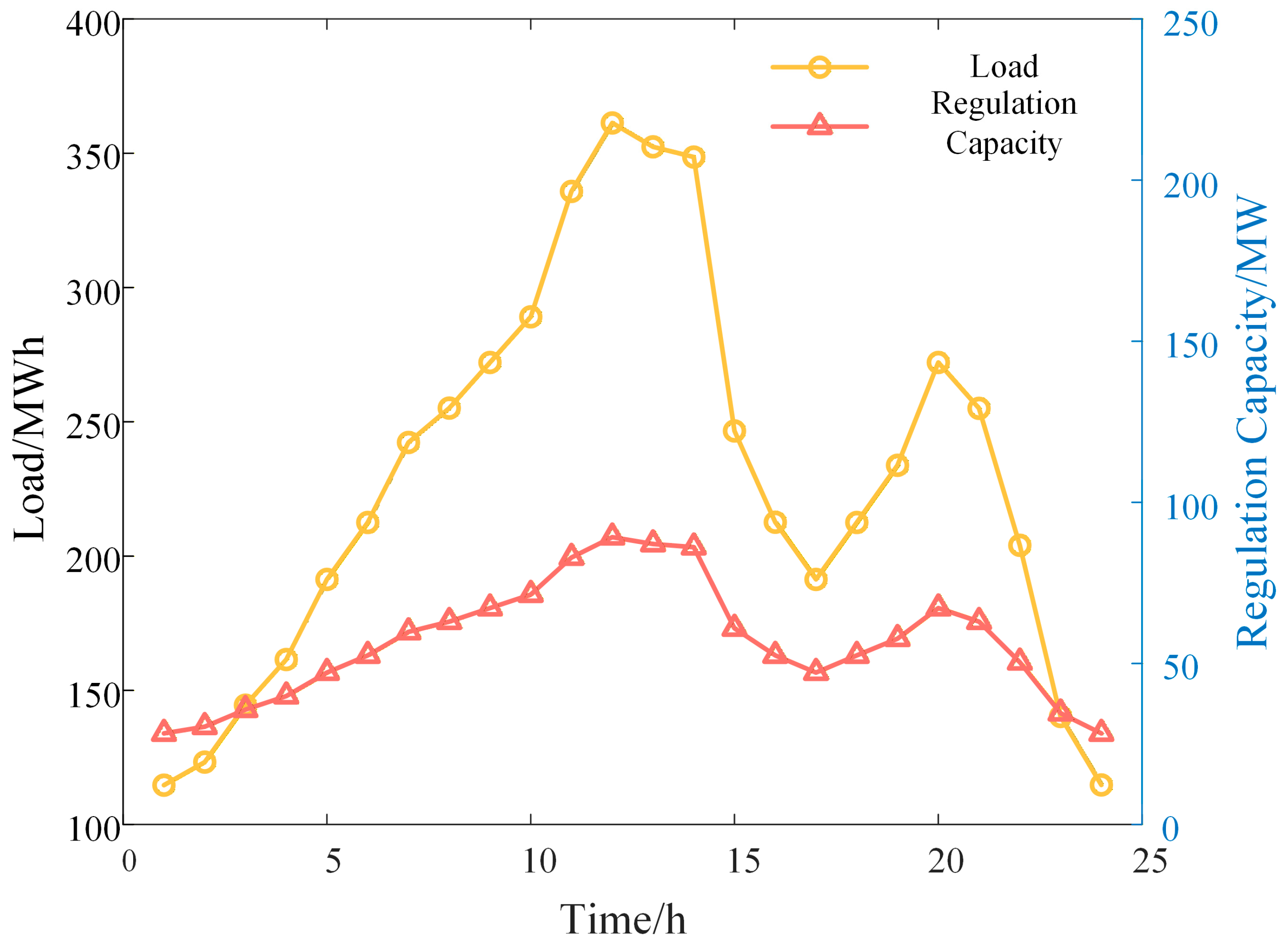
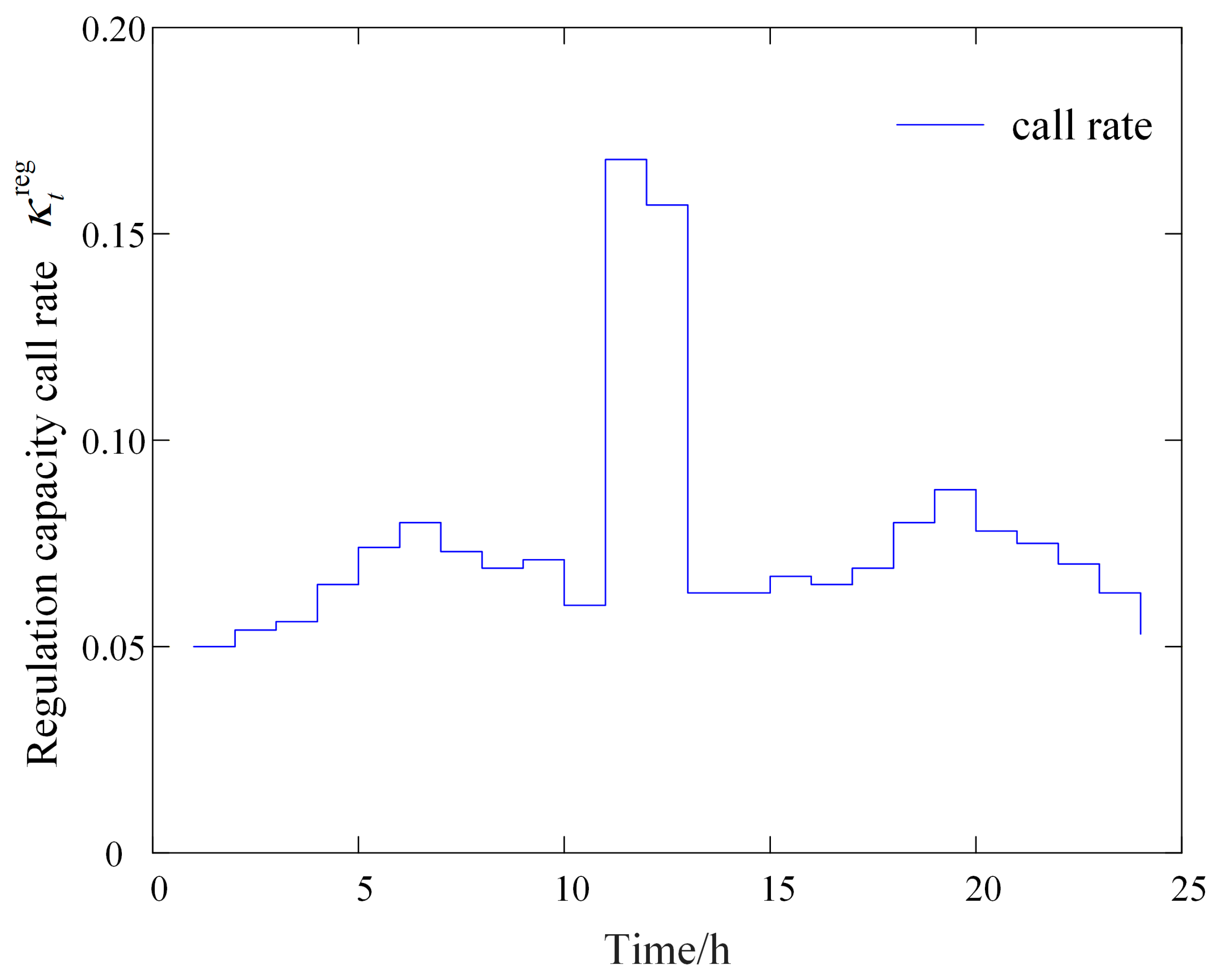
This section conducts simulations using data from a photovoltaic–storage power generation system in Northwestern China. The PV forecast error is assumed to follow a normal distribution with a variance of 0.1. Photovoltaic output scenarios are generated via Monte Carlo sampling and then reduced using K-means clustering. The reduced PV output scenarios are shown in Figure 3, and the corresponding scenario probabilities are reported in Table 1. The PVSS parameters are given in Table 2. The conventional generation resources in the system are uniformly denoted as Generators 1–4, representing four traditional generating units participating in the joint clearing of the energy and frequency regulation markets. Their main parameters include generation limits, regulation capacity, and energy and regulation bids, as listed in Table 3. Together with the PVSS, these units constitute the supply-side resource set in the lower-level joint clearing model, which is used to determine the clearing prices in the energy market and the frequency regulation market, as well as the awarded energy and regulation capacities of each participant. The regulation capacity requirement is set to 5% of the load, as shown in Figure 4. The regulation deployment ratio is illustrated in Figure 5 [30]. The peak at 12:00 mainly corresponds to the midday peak of commercial, industrial, and public loads, while the peak at 20:00 is associated with residential demand, coinciding with the evening peak. Since regulation demand is set proportionally to the load, it varies synchronously with load peaks. The PV curtailment cost is set to 85.22 USD/MWh, and the storage loss cost is set to 11.82 USD/MWh. The model is implemented in MATLAB R2023b (MathWorks, Natick, MA, USA) and solved using the CPLEX solver (IBM ILOG CPLEX Optimization Studio 22.1, IBM, Armonk, NY, USA). The computations are performed on a computer equipped with an Intel Core i7-12700 (2.10 GHz) processor (Intel Corporation, Santa Clara, CA, USA).

7.2. Market Revenue Analysis

7.2.1. Economic Analysis of the Energy and Frequency Regulation Markets

To verify the economic effectiveness of the proposed bidding strategy for the energy and frequency regulation ancillary markets, three simulation schemes are designed under the condition of risk neutrality (β = 0).
Scheme 1: Only the PV system participates in the energy market without participating in the frequency regulation market.
Scheme 2: The PVSS participates solely in the energy market without frequency regulation.
Scheme 3: The PVSS participates in both the energy and frequency regulation ancillary markets.
By optimizing and solving the model under the above three schemes, the revenue of PVSS participating in the energy market, the revenue from the frequency regulation ancillary market, the operating cost of the PVSS, and the total internal revenue of the PVSS are obtained and summarized in Table 4. The operating cost of the PVSS includes both the maximum value and the expected value, where the maximum value refers to the maximum operating cost of the PVSS among all possible scenarios, and the expected value refers to the average operating cost across multiple scenarios.
According to Table 4, when only the PV system participates in the energy market, the energy market revenue reaches USD 9781.57. After integrating the energy storage system, the revenue increases to USD 11,767.65. Although the PVSS incurs a higher operating cost than the standalone PV system, its net profit in the energy market still increases by USD 743.79, demonstrating that the combined PV–storage configuration effectively enhances market profitability.
Furthermore, when participating in the frequency regulation market, the PVSS’s energy market revenue decreases by USD 351.80, but the regulation market revenue reaches USD 1717.80. This indicates that under the energy balance condition, the PVSS can provide frequency regulation services to the power market and obtain additional profit. The operational costs of Schemes 2 and 3 are relatively similar because the cost of the regulation capacity is incurred only when the capacity is called upon. Overall, the results confirm that PVSS participation in both the energy and frequency regulation markets leads to higher total revenue compared with participating in the energy market alone.

7.2.2. Clearing Results of the Bi-Level Bidding Strategy

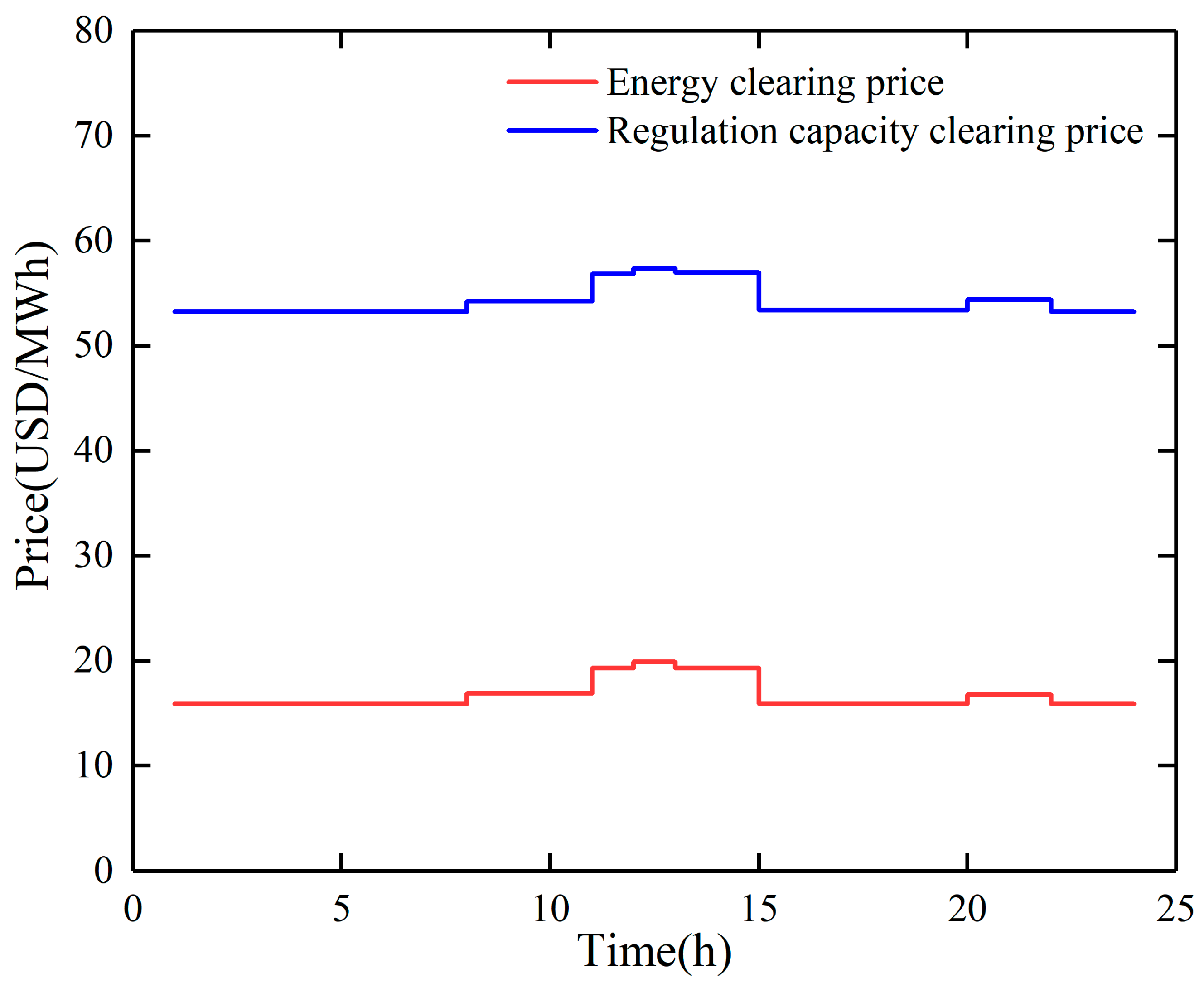
Under the condition of no risk consideration (β = 0), this section analyzes the clearing results of the proposed bi-level optimization model to validate its effectiveness. The clearing prices of the energy and frequency regulation markets are shown in Figure 6.
As observed from Figure 6, the clearing price trends of the energy and frequency regulation markets are generally consistent. According to the load demand and regulation requirement curves, when both load and regulation demand increase, the energy price rises correspondingly; conversely, when load and regulation demand decrease, both energy and regulation capacity prices decline. This reflects the supply–demand balance of the market. Between 00:00–07:00 and 22:00–24:00, the energy market price stabilizes at 53.26 USD/MWh, which is identical to the maximum bid of Generator 1, indicating that during these hours, market demand is adequately met, and most of the load is supplied by Generator 1 while other generators operate at minimum output levels. During 08:00–16:00, as PV generation increases and load demand peaks, the energy price rises to its maximum of 58.23 USD/MWh.
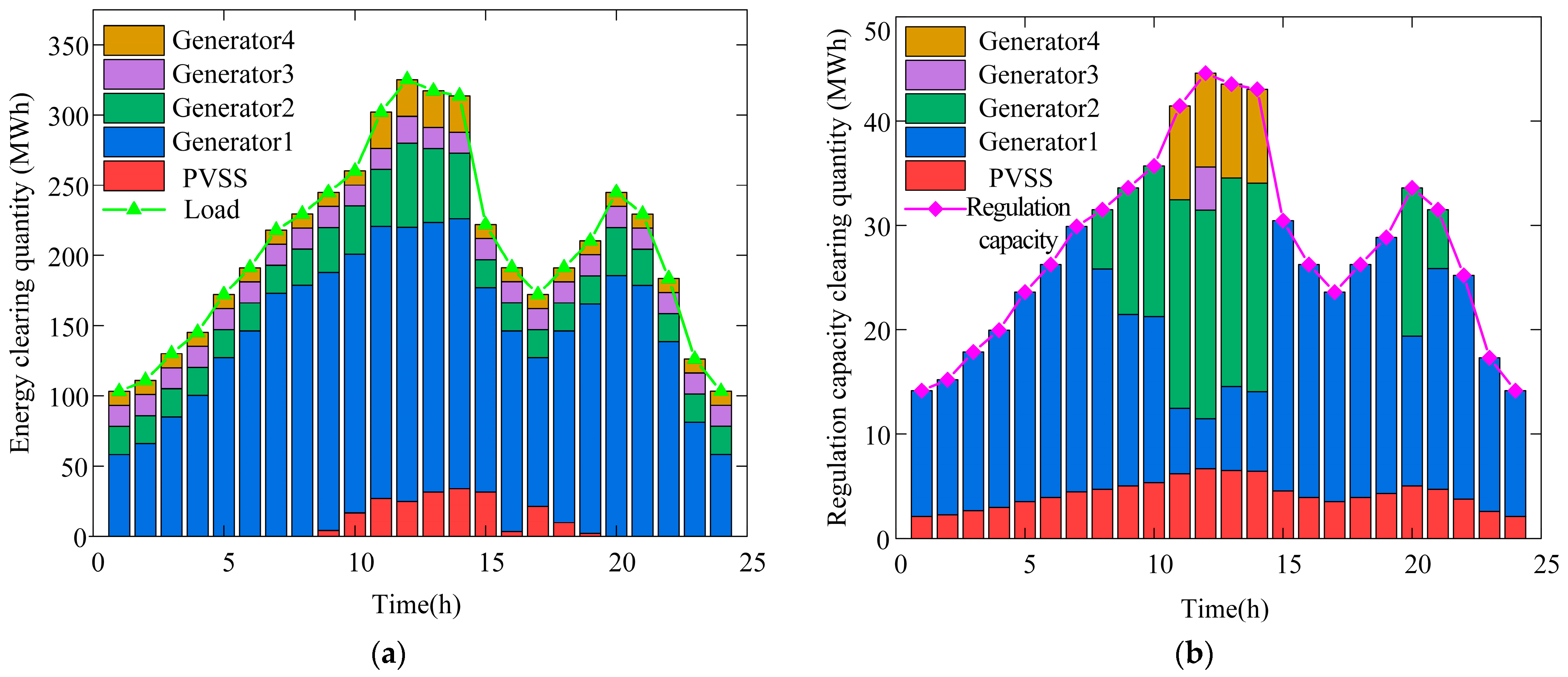
To further illustrate the operational behavior of the PVSS under the proposed bi-level bidding strategy, Figure 7 presents the clearing results of PVSS in both markets.
As shown in Figure 7a, Generator 1 supplies most of the system’s load throughout the day, while Generator 2 contributes additional power during peak hours. Generators 3 and 4 operate at near-minimum output, except at around noon (≈12:00), when their generation increases slightly. This is because Generators 3 and 4 submit relatively higher energy and regulation prices than Generators 1 and 2, resulting in lower clearing quantities. Meanwhile, the PVSS sells its PV output during daytime hours, and the total power output from all generators and the PVSS together satisfies the system power balance. As shown in Figure 7b, the PVSS provides regulation capacity throughout the day, primarily through the energy storage system, since cost occurs only when regulation capacity is activated. In contrast, PV-based regulation requires curtailment costs, making it less economical. When the regulation demand increases, the regulation capacity provided by Generator 1 decreases, redirecting more of its capacity to the energy market. Because Generator 2 offers a lower regulation bid, its regulation capacity supply increases, whereas Generator 3, with the highest regulation price, provides the least regulation capacity.

7.3. Risk Analysis

To verify that the proposed risk-based decision-making model can effectively enhance the PVSS’s risk control capability under photovoltaic (PV) output uncertainty, three simulation schemes were designed under a confidence level of ξ = 0.9. These schemes illustrate the PVSS performance under different levels of risk aversion, and the corresponding results of market revenue and CVaR values are summarized in Table 5.
Scheme 1: β = 0, indicating that the decision maker considers only market revenue without accounting for risk.
Scheme 2: β = 0.5, representing a balanced decision that considers both market revenue and risk.
Scheme 3: β = 20, indicating a strong aversion to risk, where the decision maker prioritizes risk mitigation over revenue maximization.
As shown in Table 5, the PVSS market revenue in Scheme 1 is higher than in the other two schemes, although its operating cost is also the highest. This suggests that when the decision-maker neglects PV output uncertainty, the PVSS can achieve higher short-term returns at the expense of increased volatility and operational cost. When the risk aversion level increases, the PVSS tends to utilize more energy storage capacity to buffer the fluctuations in PV output. By comparing Schemes 1 and 2, it is observed that when the decision maker starts considering risk, the system operating cost becomes more stable, maintaining relatively low cost variations across scenarios. This demonstrates improved cost predictability and risk management performance.
Furthermore, comparing Schemes 2 and 3 reveals that both market revenue and CVaR values remain nearly unchanged. This indicates that when β increases beyond a certain point, the system may have reached a risk-avoidance saturation, and the PVSS bidding strategy has already converged to an optimal risk management state. Further increasing β only results in marginal adjustments without significant performance improvement.
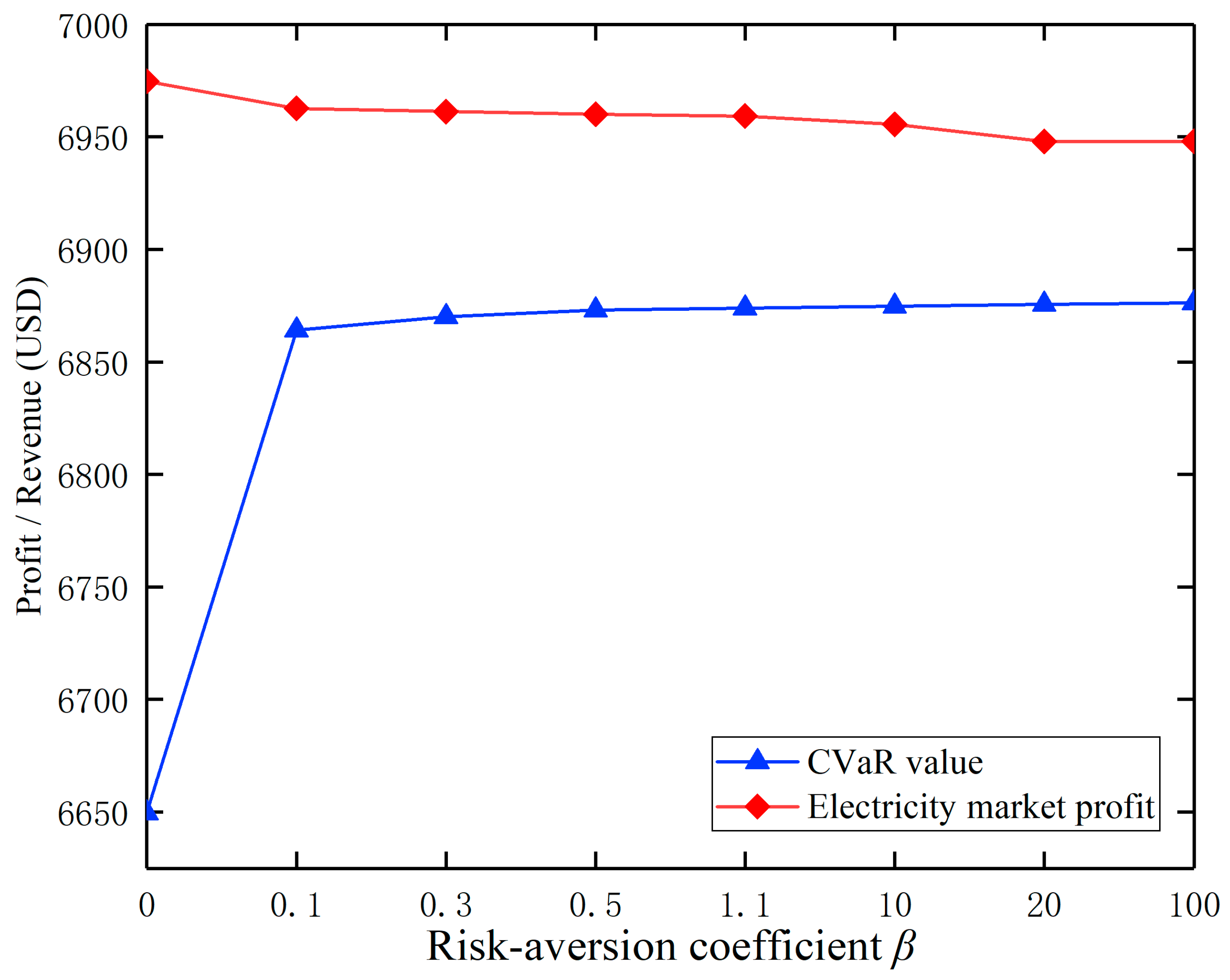
Based on the above three schemes, this section conducts a sensitivity analysis on the risk aversion coefficient, β, adopted in the proposed model. Figure 8 illustrates the revenue–risk trade-off of the PVSS under different levels of risk aversion. As β gradually increases, the electricity market revenue of the PVSS decreases, while the CVaR value correspondingly increases. As shown in Table 6, compared with the case of β = 0, when β = 20, the revenue decreases from 6974.72 USD to 6948.02 USD, representing a reduction of approximately 0.38%, whereas the CVaR increases from 6649.48 USD to 6875.59 USD, corresponding to an increase of about 3.4%. When β ≥ 20, both the revenue and CVaR tend to stabilize, and further increases in β have a negligible impact on the results, indicating that the PVSS has adopted an optimal bidding strategy under the given photovoltaic output conditions. From an engineering perspective, β can be regarded as a risk preference adjustment parameter, allowing the PVSS to achieve a significant reduction in risk at the expense of only a minor loss in revenue by selecting an appropriate level of risk aversion. However, excessively large values of β yield limited marginal improvements in risk mitigation. If further risk reduction is required, more effective approaches typically include improving the forecasting accuracy or increasing the energy storage capacity.

7.4. Computational Accuracy and Efficiency Analysis

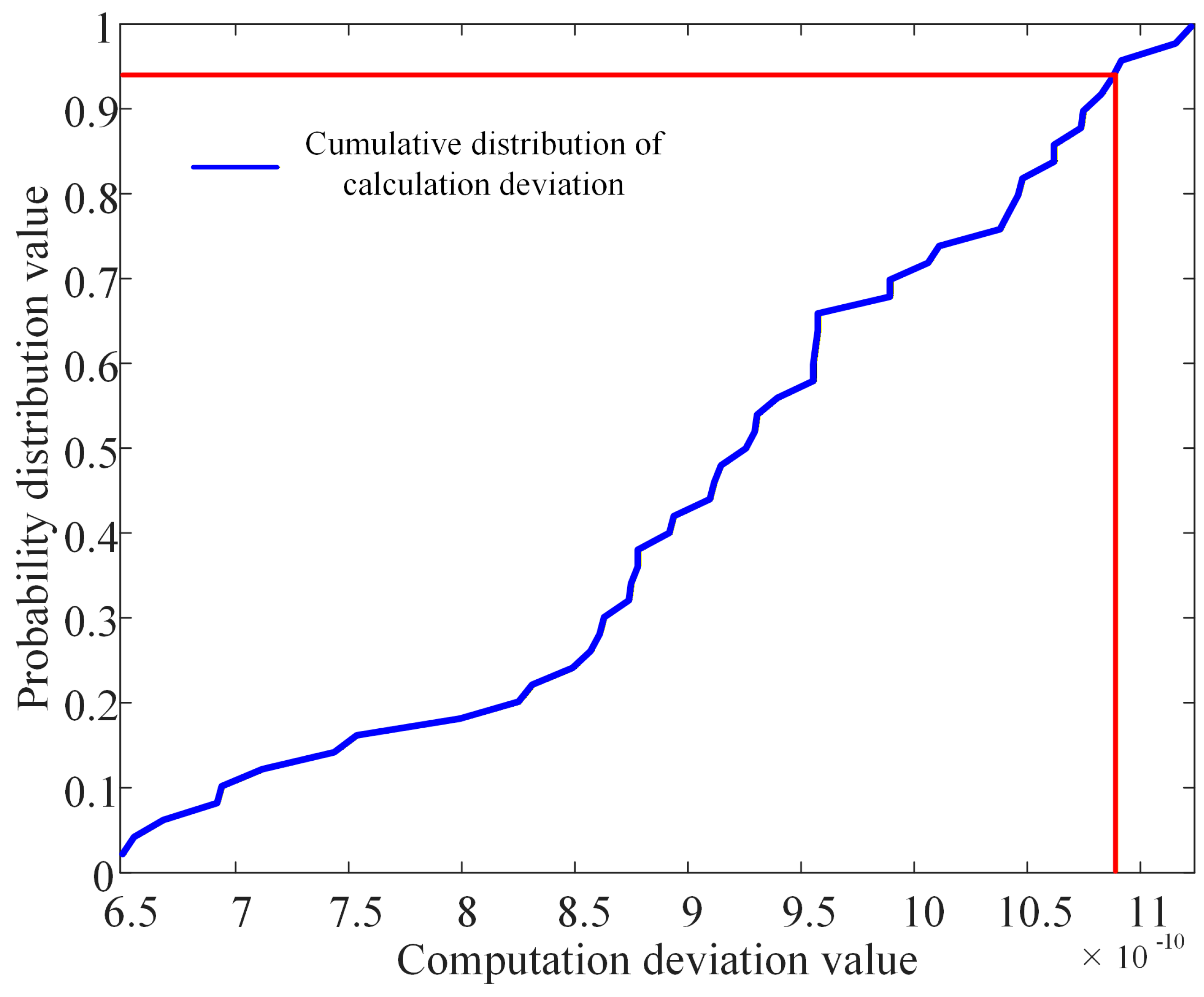
To further validate the accuracy and efficiency of the proposed bi-level optimization model solved via the KKT conditions and strong duality theorem, comparative experiments were conducted across 50 scenarios. The objective function values obtained through the KKT–duality transformation were compared with those derived from the original bi-level model, and the probability distribution of the deviations is shown in Figure 9.
As illustrated in Figure 9, the maximum deviation between the transformed and original objective function values is 6.64 × 10⁻¹⁰, and 95% of the deviations fall below 10.89 × 10⁻¹⁰. These results confirm that the linearized single-level model derived from the KKT and duality-based transformation maintains high computational precision.
The transformed model contains 2023 variables, including 555 binary variables and 2546 simplified constraints. Using MATLAB in combination with the CPLEX solver, the optimization process completes within 0.23 s (248.71 ticks), which fully satisfies the real-time clearing requirements of the electricity market.

8. Conclusions

To address the decision-making risks brought by photovoltaic uncertainty in PVSS bidding decisions for the energy and frequency regulation ancillary markets, CVaR theory is introduced into the upper-level model. A two-stage risk decision model for PVSS is proposed, along with a bi-level bidding model. To solve the computational complexity issues faced by PVSS in electricity market bidding decisions, a method based on the KKT conditions and strong duality theorem is proposed to solve the bi-level nonlinear optimization model, significantly improving the computational efficiency while ensuring accuracy. The main conclusions are as follows:
(1) PVSS participation in both the energy and frequency regulation markets yields higher overall revenue compared with participating in the energy market alone. Through the bi-level optimization model, the PVSS can act as a price-maker, determining market clearing prices and obtaining optimal economic benefits.
(2) As the risk aversion coefficient increases, PVSS revenue gradually decreases while the CVaR value rises, indicating a trade-off between profit and risk exposure. Therefore, decision-makers should select appropriate bidding strategies according to their individual risk tolerance levels.
(3) The solution method for the bi-level model proposed in this paper has a maximum computational deviation of 6.64 × 10⁻¹⁰ and a computation time of 0.23 s, meeting the clearing time requirements of the electricity market.
The method used in this paper enables PVSS to optimize its trading strategy when participating in the energy and frequency regulation ancillary service markets, thereby mitigating potential risks and increasing its own revenue, which promotes the sustainable development of power systems. However, this method does have certain limitations. On the one hand, the model relies on the joint clearing or coordinated pricing setup for energy and frequency regulation, and the conclusions may vary under different market designs and settlement rules. On the other hand, modeling PVSS as a price-maker is primarily applicable to periods with relatively large resource scales, scarce frequency regulation resources, or tight system constraints. To ensure computational efficiency, the storage model uses linear or piecewise-linear approximations and does not explicitly consider more complex characteristics, such as temperature effects, SOC-dependent efficiency, and battery degradation. Future work will focus on improving the modeling of the storage system, enhancing computational efficiency, and extending the framework to more complex market designs and multi-agent competitive environments, in order to better support renewable energy integration and the sustainable development of power systems.

Author Contributions

Conceptualization, X.W.; formal analysis, K.L.; investigation, X.W.; resources, H.W., B.X., and J.D.; validation, X.W.; writing—original draft preparation, X.W.; writing—review and editing, X.W., K.L., H.W., B.X., and J.D.; supervision, X.W. and K.L.; project administration, H.W.; funding acquisition, H.W. All authors have read and agreed to the published version of the manuscript.

Funding

This work was supported by the Science and Technology Project of State Grid Anhui Corporation of China under Grant B3120524001L.

Institutional Review Board Statement

Not applicable.

Informed Consent Statement

Not applicable.

Data Availability Statement

The data presented in this study are available upon request from the corresponding author.

Acknowledgments

The authors would like to thank the anonymous reviewers for their constructive comments, which helped to improve the quality of this paper.

Conflicts of Interest

Authors Xiaoming Wang. Bin Xu and Jinjin Ding were employed by the company State Grid Anhui Electric Power Research Institute. The remaining authors declare that the research was conducted in the absence of any commercial or financial relationships that could be construed as a potential conflict of interest.

Appendix A

The process of transforming the bi-level model into a single-level model is as follows: (1) Lagrangian of the lower-level model.
L = f ( x ) + λ H ( x ) + μ G ( x ) H ( x ) = 0 G ( x ) 0 λ , μ 0
where f ( x ) denotes the objective function of the lower-level primal problem; H ( x ) the equality constraints of the lower-level model; G ( x ) the inequality constraints of the lower-level model; λ is the Lagrange multiplier associated with the equality constraints; and μ is the Lagrange multiplier associated with the inequality constraints. The Lagrangian function of the lower-level objective is expressed in Equation (A2).
L = f ( x ) ρ t e n ( P t PVSS , sell P t PVSS , buy + g Ω g P g , t g e n P t l ) ρ t r e g ( P t PVSS , reg + g Ω g P g , t gen , reg P s y s , t reg ) g Ω g ( n ) μ ¯ g , t g e n ( P g , t g e n , max P g , t g e n ) g Ω g μ _ g , t g e n ( P g , t g e n P g , t g e n , min ) g Ω g ν ¯ g , t g e n ( P g , t e n , max P g , t g e n P g , t g e n , r e g ) g Ω g ν _ g , t g e n ( P g , t g e n P g , t g e n , r e g P g , t g e n , min ) g Ω g μ _ g , t g e n , r e g P g , t g e n , r e g g Ω g μ ¯ g , t g e n , r e g ( P g , max g e n , r e g P g , t g e n , r e g ) μ _ t PVSS , sell P t PVSS , sell μ ¯ t PVSS , sell ( P max PVSS P t PVSS , sell P t PVSS , reg ) μ _ t PVSS , buy P t PVSS , buy μ ¯ t PVSS , buy ( P max PVSS , buy P t PVSS , buy ) μ _ t PVSS , reg P t PVSS , reg μ ¯ t PVSS , reg ( P max PVSS , reg P t PVSS , reg )
(2) Lagrangian stationarity constraints.
The derivatives of the above Lagrangian function L, with respect to the variables of the lower-level model, are obtained as follows:
d L d P t PVSS , sell = λ t PVSS , sell Δ t ρ t e n μ _ t PVSS , sell + μ ¯ t PVSS , sell = 0 d L d P t PVSS , buy = λ t PVSS , buy Δ t + ρ t e n μ _ t PVSS , buy + μ ¯ t PVSS , buy = 0 d L d P t PVSS , reg = λ t PVSS , r e g Δ t ρ t r e g μ _ t PVSS , reg + μ ¯ t PVSS , reg = 0 d L d P g , t gen = λ g , t g e n Δ t ρ t e n μ _ g , t g e n + μ ¯ g , t g e n ν _ g , t g e n + ν ¯ g , t g e n = 0 d L d P t gen , reg = ( λ g , t gen , reg + λ t mil κ t reg ) Δ t ρ t r e g + ν _ g , t g e n + ν ¯ g , t g e n μ _ t gen , reg + μ ¯ t gen , reg = 0
where ρ t e n and ρ t r e g denote the dual variables associated with the equality constraints of the lower-level model for the energy market and the regulation market, respectively.
(3) Complementary slackness conditions.
0 P g , t g e n , max P g , t g e n μ ¯ g , t g e n 0 0 P g , t g e n P g , t g e n , min μ _ g , t g e n 0 0 P g , t e n , max P g , t g e n P g , t g e n , r e g ν ¯ g , t g e n 0 0 P g , t g e n P g , t g e n , r e g P g , t g e n , min ν _ g , t g e n 0 0 P g , max g e n , r e g P g , t g e n , r e g μ ¯ g , t g e n , r e g 0 0 P g , t g e n , r e g μ _ g , t g e n , r e g 0 0 P max PVSS P t PVSS , sell P t PVSS , reg μ ¯ t PVSS , sell 0 0 P t PVSS , sell μ _ t PVSS , sell 0 0 P max PVSS , buy P t PVSS , buy μ ¯ t PVSS , buy 0 0 P t PVSS , buy μ _ t PVSS , buy 0 0 P max PVSS , reg P t PVSS , reg μ ¯ t PVSS , reg 0 0 P t PVSS , reg μ _ t PVSS , reg 0
where that the product of the expressions on both sides equals zero. For any pair of expressions satisfying 0 a b 0 , this complementary relationship can be linearized into the following equivalent form.
a 0 b 0 a M Z b M ( 1 Z )
where M denotes a sufficiently large positive constant and Z is a Boolean variable.
In the current objective function, there exist terms involving the multiplication of two variables, which prevent a direct solution by the solver. Therefore, a linearization process is required. The specific steps are as follows:
(1) Apply the strong duality theorem to transform the lower-level objective function into its dual form, as shown in Equation (A6).
F = P t l   ρ t e n + P s y s , t reg ρ t r e g g Ω g ( P g , t g e n , max μ ¯ g , t g e n P g , t g e n , min μ _ g , t g e n ) g Ω g P g , t e n , max ν ¯ g , t g e n g Ω g P g , t g e n , min ν _ g , t g e n g Ω g P g , max g e n , r e g μ ¯ g , t g e n , r e g P max PVSS μ ¯ t PVSS , sell P max PVSS , buy μ ¯ t PVSS , buy P max PVSS , reg μ ¯ t PVSS , reg
(2) Substitute Equations (40) and (41) into the objective function Equation (28) and apply the stationarity constraints from Equation (A3) to obtain Equation (A7).
F = t ρ t en P t PVSS , sell P t PVSS , buy + t ρ t reg P t PVSS , reg + λ t mil κ t reg P t PVSS , reg + g λ g , t gen P g , t gen + g λ g , t gen , reg P g , t gen , reg + λ t mil κ t reg P g , t gen , reg P max PVSS μ ¯ t PVSS , sell P max PVSS , buy μ ¯ t PVSS , buy P max PVSS , reg μ ¯ t PVSS , reg

References

  1. Clean Energy Market Monitor—March 2024—Analysis. Available online: https://www.iea.org/reports/clean-energy-market-monitor-march-2024 (accessed on 28 October 2025).
  2. Masson, G.; Jäger-Waldau, A.; Kaizuka, I.; Lindahl, J.; Donoso, J.; de L’Epine, M. A Snapshot of the Global PV Market and Industry. In Proceedings of the 2025 IEEE 53rd Photovoltaic Specialists Conference (PVSC), Montreal, QC, Canada, 8–13 June 2025; pp. 0508–0510. [Google Scholar]
  3. Wang, J.; Jin, X.; Jia, H.; Tostado-Véliz, M.; Mu, Y.; Yu, X.; Liang, S. Joint Electricity and Carbon Sharing with PV and Energy Storage: A Low-Carbon DR-Based Game Theoretic Approach. IEEE Trans. Sustain. Energy 2024, 15, 2703–2717. [Google Scholar] [CrossRef]
  4. González-Garrido, A.; Saez-de-Ibarra, A.; Gaztañaga, H.; Milo, A.; Eguia, P. Annual Optimized Bidding and Operation Strategy in Energy and Secondary Reserve Markets for Solar Plants with Storage Systems. IEEE Trans. Power Syst. 2019, 34, 5115–5124. [Google Scholar] [CrossRef]
  5. Wang, Y.; Li, T.; Li, Y.; Shao, N.; Wang, Y. Spot Market Clearing Model and Flexibility Premium Assessment Method Considering Flexible Regulation of Virtual Power Plants. IEEE Access 2024, 12, 53855–53870. [Google Scholar] [CrossRef]
  6. Saxena, P.; Singh, N.; Pandey, A.K. Self-Regulated Solar PV Systems: Replacing Battery via Virtual Inertia Reserve. IEEE Trans. Energy Convers. 2021, 36, 2185–2194. [Google Scholar] [CrossRef]
  7. Dreidy, M.; Mokhlis, H.; Mekhilef, S. Inertia Response and Frequency Control Techniques for Renewable Energy Sources: A Review. Renew. Sustain. Energy Rev. 2017, 69, 144–155. [Google Scholar] [CrossRef]
  8. Pourmousavi, S.A.; Saha, T.K. Evaluation of the Battery Operation in Ramp-Rate Control Mode within a PV Plant: A Case Study. Sol. Energy 2018, 166, 242–254. [Google Scholar] [CrossRef]
  9. Maluenda, M.; Córdova, S.; Lorca, Á.; Negrete-Pincetic, M. Optimal Operation Scheduling of a PV-BESS-Electrolyzer System for Hydrogen Production and Frequency Regulation. Appl. Energy 2023, 344, 121243. [Google Scholar] [CrossRef]
  10. He, G.; Chen, Q.; Kang, C.; Xia, Q.; Poolla, K. Cooperation of Wind Power and Battery Storage to Provide Frequency Regulation in Power Markets. IEEE Trans. Power Syst. 2017, 32, 3559–3568. [Google Scholar] [CrossRef]
  11. Chen, W.; Qiu, J.; Zhao, J.; Chai, Q.; Dong, Z.Y. Bargaining Game-Based Profit Allocation of Virtual Power Plant in Frequency Regulation Market Considering Battery Cycle Life. IEEE Trans. Smart Grid 2021, 12, 2913–2928. [Google Scholar] [CrossRef]
  12. Angenendt, G.; Merten, M.; Zurmühlen, S.; Sauer, D.U. Evaluation of the Effects of Frequency Restoration Reserves Market Participation with Photovoltaic Battery Energy Storage Systems and Power-to-Heat Coupling. Appl. Energy 2020, 260, 114186. [Google Scholar] [CrossRef]
  13. Wang, H.; Ding, C.; Fan, G.; Bian, J.; Yu, G.; Xin, C. Photovoltaic and storage system participating in the electricity market based on AGC zoning control. Power Syst. Prot. Control 2023, 51, 121–131. [Google Scholar] [CrossRef]
  14. Jie, B.; Qin, X.; Wang, Z. Research on Optimized Purchasing Strategy and Risk Management in Electricity Market. In Proceedings of the 2018 China International Conference on Electricity Distribution (CICED), Tianjin, China, 17–19 September 2018; pp. 2714–2717. [Google Scholar]
  15. Xie, M.; Hu, X.; Ke, S.; Cheng, P.; Liu, M. Vine-Copula Based Dynamic Risk VaR Assessment Method for Operation Profit and Loss of Generation Companies. Autom. Electr. Power Syst. 2019, 43, 39–45, 52. [Google Scholar]
  16. Guo, H.X.; Gao, R.; Yang, P. Two-stage Dispatch of Microgrid Based on CVaR Theory Under Electricity Spot Market. Power Syst. Technol. 2019, 43, 2665–2674. [Google Scholar] [CrossRef]
  17. Yang, B.; Tang, W.; Wu, F.; Wang, H.L.; Sun, W.Q. Day-ahead market bidding strategy for “renewable energy + energy storage” power plants considering conditional value-at-risk. Power Syst. Prot. Control. 2022, 50, 93–100. [Google Scholar] [CrossRef]
  18. Vahedipour-Dahraie, M.; Rashidizadeh-Kermani, H.; Shafie-Khah, M.; Catalão, J.P.S. Risk-Averse Optimal Energy and Reserve Scheduling for Virtual Power Plants Incorporating Demand Response Programs. IEEE Trans. Smart Grid 2021, 12, 1405–1415. [Google Scholar] [CrossRef]
  19. Li, X.; Qin, W.; Jing, X.; Zhu, Z.; Lu, R.; Han, X. Joint Optimization for Virtual Power Plant Participating in Main and Auxiliary Markets Considering Uncertain Risks and Multi-agent Coordination. Power Syst. Technol. 2024, 48, 4553–4567. [Google Scholar] [CrossRef]
  20. Wang, J.; Xu, J.; Wang, J.; Ke, D.; Liao, S.; Sun, Y.; Wu, Y. Bi-level Stochastic Optimization for A Virtual Power Plant Participating in Energy and Reserve Market Based on Conditional Value at Risk. Power Syst. Technol. 2024, 48, 2502–2510. [Google Scholar] [CrossRef]
  21. Brandtner, M. Conditional Value-at-Risk, Spectral Risk Measures and (Non-)Diversification in Portfolio Selection Problems—A Comparison with Mean–Variance Analysis. J. Bank. Financ. 2013, 37, 5526–5537. [Google Scholar] [CrossRef]
  22. Fieberg, C.; Liedtke, G.; Zaremba, A.; Cakici, N. A Factor Model for the Cross-Section of Country Equity Risk Premia. J. Bank. Financ. 2025, 171, 107373. [Google Scholar] [CrossRef]
  23. Ahmadi, M.; Rosolia, U.; Ingham, M.D.; Murray, R.M.; Ames, A.D. Risk-Averse Decision Making Under Uncertainty. IEEE Trans. Autom. Control. 2024, 69, 55–68. [Google Scholar] [CrossRef]
  24. Gomez, T.; Herrero, I.; Rodilla, P.; Escobar, R.; Lanza, S.; de la Fuente, I.; Llorens, M.L.; Junco, P. European Union Electricity Markets: Current Practice and Future View. IEEE Power Energy Mag. 2019, 17, 20–31. [Google Scholar] [CrossRef]
  25. Wang, Y.; Li, Y.; Yang, Y.; Gao, Z.; Dehghanian, P.; Yang, D.; Ding, Z. Aggregated Operation Scheme for Distributed Photovoltaic and Energy Storage System Enabling Multi-Service Provision. IEEE Trans. Ind. Appl. 2024, 60, 2409–2421. [Google Scholar] [CrossRef]
  26. Fooladivanda, D.; Xu, H.; Domínguez-García, A.D.; Bose, S. Offer Strategies for Wholesale Energy and Regulation Markets. IEEE Trans. Power Syst. 2018, 33, 7305–7308. [Google Scholar] [CrossRef]
  27. Chen, S.; Ye, Z. Double-Layer Optimization and Benefit Analysis of Shared Energy Storage Investment Considering Life-Cycle Carbon Emission. Sustainability 2024, 16, 10403. [Google Scholar] [CrossRef]
  28. Wang, J.; Lan, J.; Wang, L.; Lin, Y.; Hao, M.; Zhang, Y.; Xiang, Y.; Qin, L. Voltage Hierarchical Control Strategy for Distribution Networks Based on Regional Autonomy and Photovoltaic-Storage Coordination. Sustainability 2024, 16, 6758. [Google Scholar] [CrossRef]
  29. Luo, S.; Chen, C.; Qiu, W.; Ma, J.; Yang, L.; Lin, Z. Bi-Layer Optimal Planning of Rural Distribution Network Based on KKT Condition and Big-M Method. Energy Rep. 2021, 7, 637–644. [Google Scholar] [CrossRef]
  30. Rahbari-Asr, N.; Chow, M.-Y. Cooperative Distributed Demand Management for Community Charging of PHEV/PEVs Based on KKT Conditions and Consensus Networks. IEEE Trans. Ind. Inform. 2014, 10, 1907–1916. [Google Scholar] [CrossRef]
Figure 1. Bi-level optimization model of PVSS in energy and ancillary service markets.
Sustainability 18 01122 g001
Figure 2. Bidding strategy process of PVSS participation in energy and frequency regulation auxiliary markets, based on conditional value-at-risk.
Sustainability 18 01122 g002
Figure 3. Photovoltaic output scenarios.
Sustainability 18 01122 g003
Figure 4. Load and regulation capacity demand.
Sustainability 18 01122 g004
Figure 5. Regulation capacity call rate curve.
Sustainability 18 01122 g005
Figure 6. Clearing price results for energy and regulation market.
Sustainability 18 01122 g006
Figure 7. Energy and regulation market clearing capacity results: (a) energy market clearing results and (b) frequency regulation ancillary market clearing results.
Sustainability 18 01122 g007
Figure 8. PVSS revenues and CVaR values under different risk coefficients.
Sustainability 18 01122 g008
Figure 9. Cumulative probability distribution curve for calculation deviations.
Sustainability 18 01122 g009
Table 1. Typical prediction scenarios and probabilities.
Scene12345678910
Probability0.1100.0540.2610.0120.0240.0940.0690.0010.1900.185
Table 2. PVSS parameters.
ParametersPVSS
Photovoltaic installed capacity (MW)120
Energy storage capacity (MWh)30
Maximum charging/discharging power (MW)10
SOC range0.1~0.9
Charging/discharging efficiency0.95
Energy purchase bid range (USD/MWh)0.0~56.81
Energy sale bid range (USD/MWh)0.0~71.01
Regulation capacity bid range (USD/MW)0.0~18.46
Table 3. Parameter setting of conventional units.
ParameterGenerator 1Generator 2Generator 3Generator 4
Maximum generation output (MW)200805035
Minimum generation output (MW)30201510
Maximum regulation capacity (MW)3020139
Regulation capacity bid (USD·MW−1)15.6214.2017.0416.33
Energy bid (USD·MWh−1)53.2656.8159.7956.10
Table 4. Comparison of revenues under different scenarios.
ScenariosEnergy Market Revenue (USD)Regulation Market Revenue (USD)PV–Storage Operation CostNet Revenue/(USD)
Maximum Value (USD)Expected Value (USD)
19781.575138.765001.854779.72
211,767.656405.346244.145523.51
311,415.851717.806484.026158.936974.72
Table 5. Revenues and costs of PVSS under different risk strategies.
ScenariosRisk-Aversion Coefficient β Market Revenue (USD)PV–Storage Operation CostCVaRNet Revenue (USD)
Maximum Value (USD)Expected Value (USD)
1013,133.656484.026158.936649.486974.72
20.513,016.766145.016056.386873.036960.09
32012,996.026120.446048.006875.596948.02
Table 6. PVSS revenue and CVaR values under different risk aversion coefficients.
βElectricity Market Profit (USD)CVaR Value (USD)Revenue Change
Relative to β = 0
CVaR Change
Relative to β = 0
06974.726649.4800
0.16962.656864.22−0.17%3.23%
0.36961.236870.05−0.19%3.32%
0.56960.096873.03−0.21%3.36%
1.16959.246873.88−0.22%3.37%
106955.556874.73−0.27%3.39%
206948.026875.59−0.38%3.40%
1006948.026876.15−0.38%3.41%
Disclaimer/Publisher’s Note: The statements, opinions and data contained in all publications are solely those of the individual author(s) and contributor(s) and not of MDPI and/or the editor(s). MDPI and/or the editor(s) disclaim responsibility for any injury to people or property resulting from any ideas, methods, instructions or products referred to in the content.