Review

Advancements in Solar Tracking: A Comprehensive Review of Image-Processing Techniques

1
Department of Mechanical Engineering, Faculty of Engineering, University of Balamand, Al Koura P.O. Box 100, Lebanon
2
Department of Computer Engineering, Faculty of Engineering, University of Balamand, Al Koura P.O. Box 100, Lebanon
*
Author to whom correspondence should be addressed.
Sustainability 2026, 18(2), 1117; https://doi.org/10.3390/su18021117
Submission received: 27 November 2025 / Revised: 4 January 2026 / Accepted: 13 January 2026 / Published: 21 January 2026

Abstract

Solar energy is a widely available renewable source suitable for diverse applications, including residential, industrial and aerospace sectors. To maximize energy capture, solar tracking systems adjust panels to maintain perpendicular alignment with sunlight. Various tracking techniques are employed to adjust these trackers, such as sensors, predefined algorithms, deep learning, and image-processing techniques. Image processing-based trackers have gained prominence for their precision and accuracy. This approach uses cameras as sensors to capture real-time sky images and analyze them to detect the sun and its coordinates, orienting solar panels toward its center. This technology can be integrated with other techniques to enhance energy output with high accuracy, minimal tracking error, and low maintenance requirements. This review examines computer vision methods used in solar tracking systems, synthesizing findings from 26 studies published between 2009 and 2024. The paper discusses main system components, methods utilized, and results obtained. Findings demonstrate that the robustness and accuracy of these tracking systems have increased compared to other tracking systems, while tracking error has decreased.

1. Introduction

In recent years, significant concerns have emerged regarding global climate change, primarily driven by the combustion of fossil fuels such as coal, oil, and gas for energy production. Emissions must be reduced by 50% by 2030, to attain net-zero emissions by 2050. To meet this target, reliance on fossil fuels must decrease, and resources should be allocated to clean, sustainable, and reliable alternatives [1]. Renewable energy sources including wind, biomass, and hydropower, which are environmentally friendly during operation, should be adopted to replace fossil fuels. In 2023, renewable electricity capacity additions reached an estimated 507 gigawatts, representing a nearly 50% increase compared to 2022 [2]. Among these sources, solar energy is the most abundant. The Earth’s surface receives tens of thousands of terawatts (TW) of solar radiation [3,4,5]. Photovoltaic (PV) systems convert direct sunlight into electrical energy [6]. These systems offer several advantages, including simple design, minimal maintenance requirements, and reduced CO2 emissions [5]. Moreover, PV systems are adaptable to various power scales, producing electricity at outputs ranging from microwatts to megawatts, autonomously without external power sources or infrastructure. Consequently, PV systems are installed in numerous applications, such as solar home systems, satellites, spacecraft, remote structures, and large-scale power plants [7]. Due to this wide range of applications, the photovoltaic industry continues to grow annually [8]. Photovoltaic panels increase power output in proportion to the amount of solar energy they receive. When sunlight strikes PV panels perpendicularly, maximum solar energy is captured at that angle throughout the day [9,10]. However, due to the Earth’s rotation, sunlight reaches the panels from different angles during the day, causing variations in energy capture, which also depends on the orientation of the fixed panel. This issue is resolved by employing sun tracker systems [11], which are designed to orient photovoltaic panels and solar concentrating systems toward solar radiation. A sun tracker system is a mechanical setup that follows the trajectory of the sun’s trajectory during the day to enhance energy efficiency and power output [12]. Theoretically, solar radiation collection can be increased by 41% using a dual-axis sun tracker, whereas for fixed systems, the actual energy production increase ranges from 10% to 45% [13].
There are various classifications and types of solar trackers [14,15,16,17,18,19]. Additionally, several technological advancements have been implemented to enhance these trackers and optimize energy capture from solar power. Common advancements include Light Dependent Resistor sensors [20,21], Machine Learning and Deep Learning techniques [22], and image-processing techniques. However, most available reviews focus solar tracking classifications and types, creating a notable gap in the literature regarding the integration of these advancements. None of the previous reviews provide a thorough review on solar tracker using computer vision and image-processing-based systems. Image-processing techniques offer advantages over traditional methods and other advancements in the field. Computer vision algorithms enable accurate, real-time solar tracking, improving precision and efficiency in positioning solar panels for maximum energy capture. Additionally, these algorithms adapt to changing environmental conditions, ensuring continuous energy production. This has motivated us to conduct a literature review on image-processing techniques used to rotate a solar tracker system. This review aims to provide insight for researchers studying computer vision-based solar tracking. The primary goal of this systematic literature review is to explore different stages of computer vision for solar tracking, including image capturing, image filtering, binarization, data analysis, sun’s coordinates, control unit, and mechanical setup. In addition, methods used in conjunction with computer vision, such as LDRs and machine learning, will also be presented.
Furthermore, computer vision–based solar tracking is increasingly relevant for practical applications beyond small-scale prototypes. Industrial scenarios include utility-scale solar farms, where precise alignment improves overall energy yield; concentrated photovoltaic (CPV) systems and heliostat fields, where even minor angular errors significantly affect optical concentration; and smart buildings with building-integrated photovoltaics (BIPV), which require dynamic orientation to optimize daylight and energy generation. Additionally, off-grid installations such as telecom stations and IoT nodes benefit from autonomous, low-maintenance tracking solutions. These examples highlight the growing need for robust, adaptive tracking technologies that can operate reliably under diverse environmental and operational conditions.
In addition, recent advancements in solar tracking have increasingly utilized image processing to overcome limitations of traditional sensor-based and algorithmic methods. Conventional approaches, such as light-dependent resistors (LDRs) and astronomical algorithms, often suffer from reduced accuracy under cloudy conditions, sensor drift, and require frequent calibration. In contrast, computer vision techniques enable robust sun localization by extracting visual features directly from sky images, ensuring real-time adaptability and higher precision even in complex environments. Studies have shown that integrating image processing with hybrid models and advanced algorithms significantly improves tracking accuracy, energy yield, and reliability across diverse applications, from large-scale solar farms to mobile solar stations. These advantages underscore the growing importance of image-processing-based solar tracking systems, motivating this comprehensive review of their methodologies, performance, and future directions.
The structure of this paper is organized into five sections: Section 1 provides the introduction. Section 2 explores the classifications and types of various solar tracking methods. Section 3 presents a literature review of computer vision techniques and discusses the results and the limitations. Lastly, Section 4 concludes the paper.

2. Solar Tracker Classifications and Types

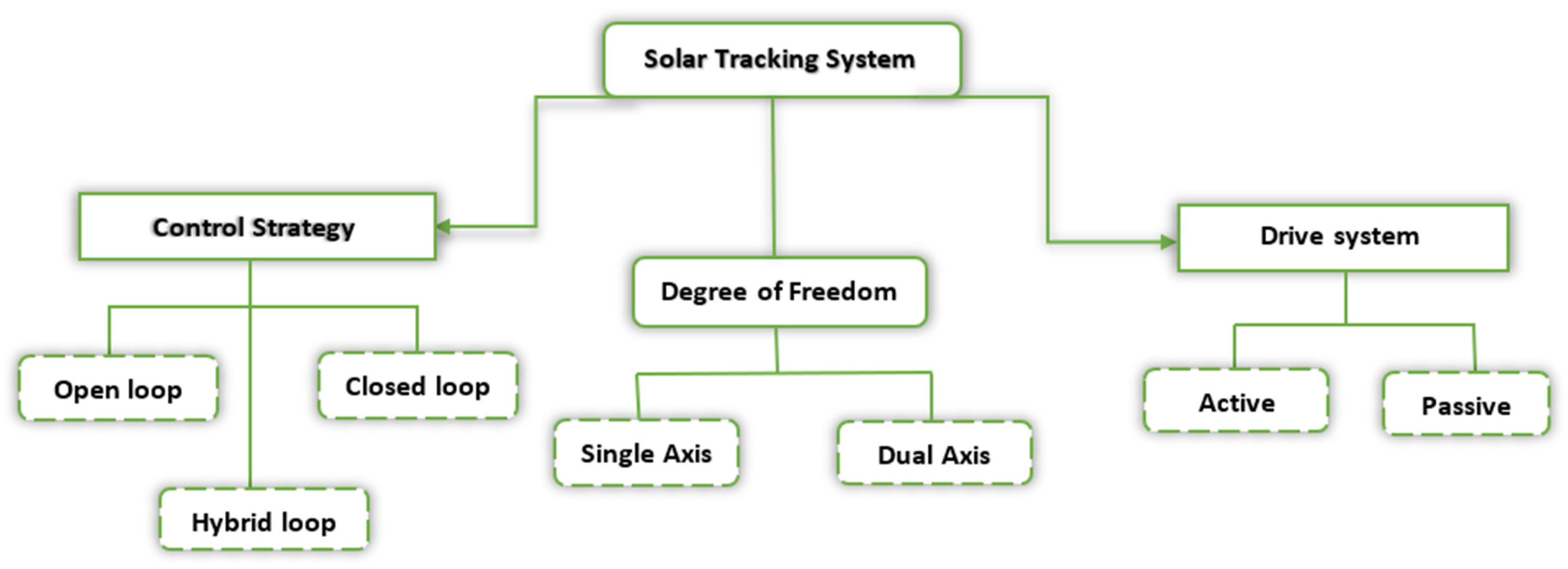
Solar alignment mechanisms can be classified into various sub-types based on factors like control strategy, drive systems, and degrees of freedom.

2.1. Based on Control Strategy

2.1.1. Open-Loop Solar Tracker

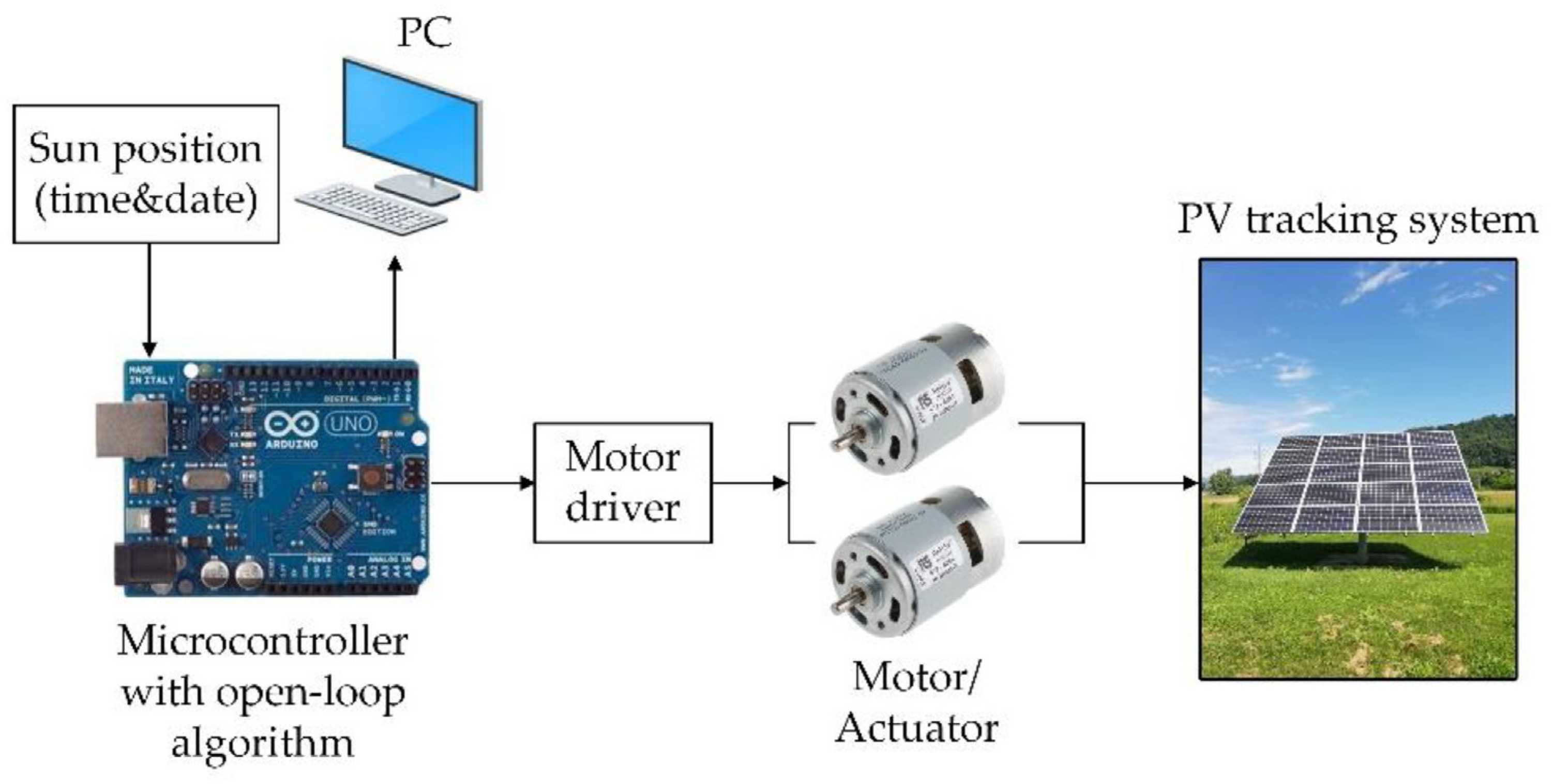
In an open-loop solar tracking system, solar panels are oriented along a predetermined path based on parameters such as time, date, geographical location, and solar position calculations. These systems do not rely on real-time feedback from sensors to adjust the panels. Instead, they operate autonomously using input data such as time, day, month, and year, to locate the sun [23]. The open-loop strategy can be applied to both dual and single axis (SA) trackers. Rinaldi et al. (2016) [24] designed a SA solar tracker that operates with an open loop control system using mechanical components like servo motors attached to bike wheels. The system features an Android-based application that monitors temperature and provides optimal angle inputs to maximize the power output of the photovoltaic panel. As a result, average power output was 21.50 watt, showing 25% gain compared to a fixed solar system [24]. Yang et al. (2017) [25] developed an automatic dual open loop tracking system that uses a 1400 × 1500 mm2 Fresnel lens. Sunlight is directed toward Stirling engine’s heating head, capturing solar thermal energy to power the engine. The system employs a GPS module (EM-406A) along with a real-time clock (RTC) module to identify its location and current time, saving this information in a microprocessor (AT89S52). The microprocessor issues control commands to a motor driver (EXD5014M) to operate stepper motors, which adjust the tracker’s azimuth and altitude angles via a gear assembly. One stepper motor moves the tracker horizontally to follow the azimuth angle, while another moves it vertically to follow the altitude angle [25]. Alexandru (2013) [26] presented an innovative open-loop tracking approach for a dual-axis equatorial photovoltaic (PV) system. This method considers the tracking system as a perturbation affecting the DC motors, aiming to regulate these motors through torques calculated from the system’s dynamic model. The design, modeling, and optimization were performed using MATLAB/Simulink and ADAMS 2010 software. To ensure robustness, including resistance to wind disturbances, the system was tested on a physical prototype. The key innovation lies in treating the tracking mechanism as a disturbance to improve motor control [26]. A schematic representation of the system is shown in Figure 1.

2.1.2. Closed-Loop Solar Tracker

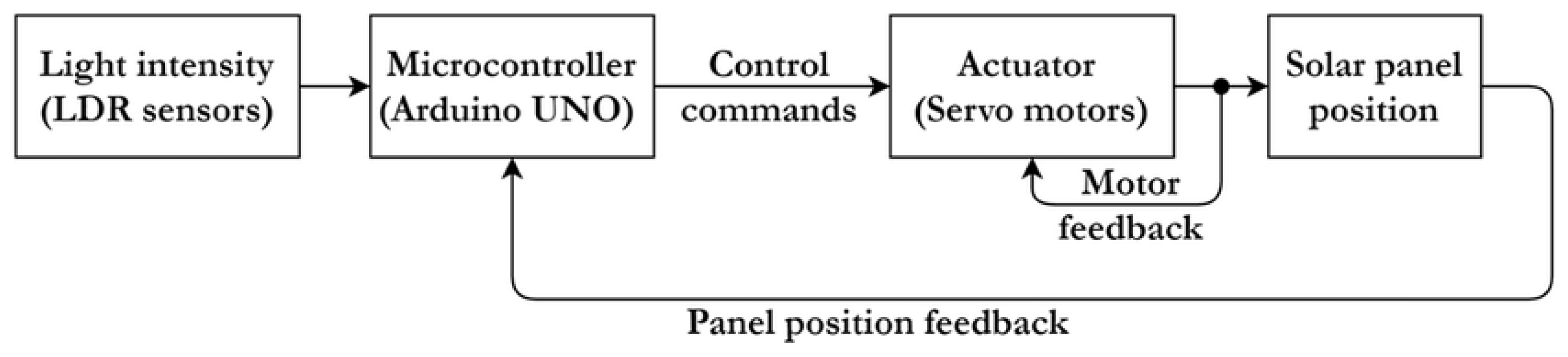
In a closed-loop solar tracking system, solar panels are tilted based on real-time sensor feedback that determines the sun’s location. This feedback loop enables accurate alignment with the sun’s rays, optimizing energy capture efficiency. By detecting variations in solar intensity or angle of incidence, the control system adjusts the position of the panels to optimize performance. Saldivar-Aguilera et al. (2023) [28] designed a novel one-axis for parabolic trough collectors, utilizing a dual Closed-loop control algorithm. Signals from a photodiode-based solar sensor and a shadow-based visual device are combined to provide feedback. The traditional closed-loop control with photosensors had solar tracking errors (STE) of ±0.82°, while the suggested dual control system reduced this to ±0.11°. This new dual control method achieved a reduction in STE of up to 80%, resulting in a 15% improvement in average thermal efficiency compared to the single feedback control method [28]. Clifford and Eastwood (2004) [29] developed the Solar Position Algorithm (SPA) to compute solar zenith and azimuth angles with exceptional precision (better than 0.0003°) for dates between 1950 and 2050. The algorithm accounts for Earth’s orbital parameters, atmospheric refraction, and time corrections, and was implemented in C for efficiency. SPA is recommended for high-accuracy solar tracking, resource assessment, and performance modeling in photovoltaic and thermal systems. Complementing this, a novel, low-cost solar tracker designed for equatorial regions was introduced, using aluminum/steel bimetallic strips for passive activation and a viscous damper for control. Computer modeling predicts up to 23% efficiency improvement over fixed panels, and experimental results confirm excellent agreement with simulations [29]. Tarazona-Romero et al. (2022) [30] examined three different control strategies: open-loop, closed-loop, and hybrid loop, using formal concept analysis (FCA) to highlight their unique attributes. The study found that 34.38% of studies used open-loop, 45.31% used Closed-loop, and 20.31% utilized hybrid-loop strategies, concluding that Closed-loop algorithms work best for photovoltaic systems. Hybrid-loop algorithms show promise but require further technological development. Open-loop algorithms have limitations and higher tracking errors but could be improved with GPS integration [30]. A schematic presentation of a closed-loop tracker system is presented in Figure 2.

2.2. Based on Drive System

2.2.1. Passive System

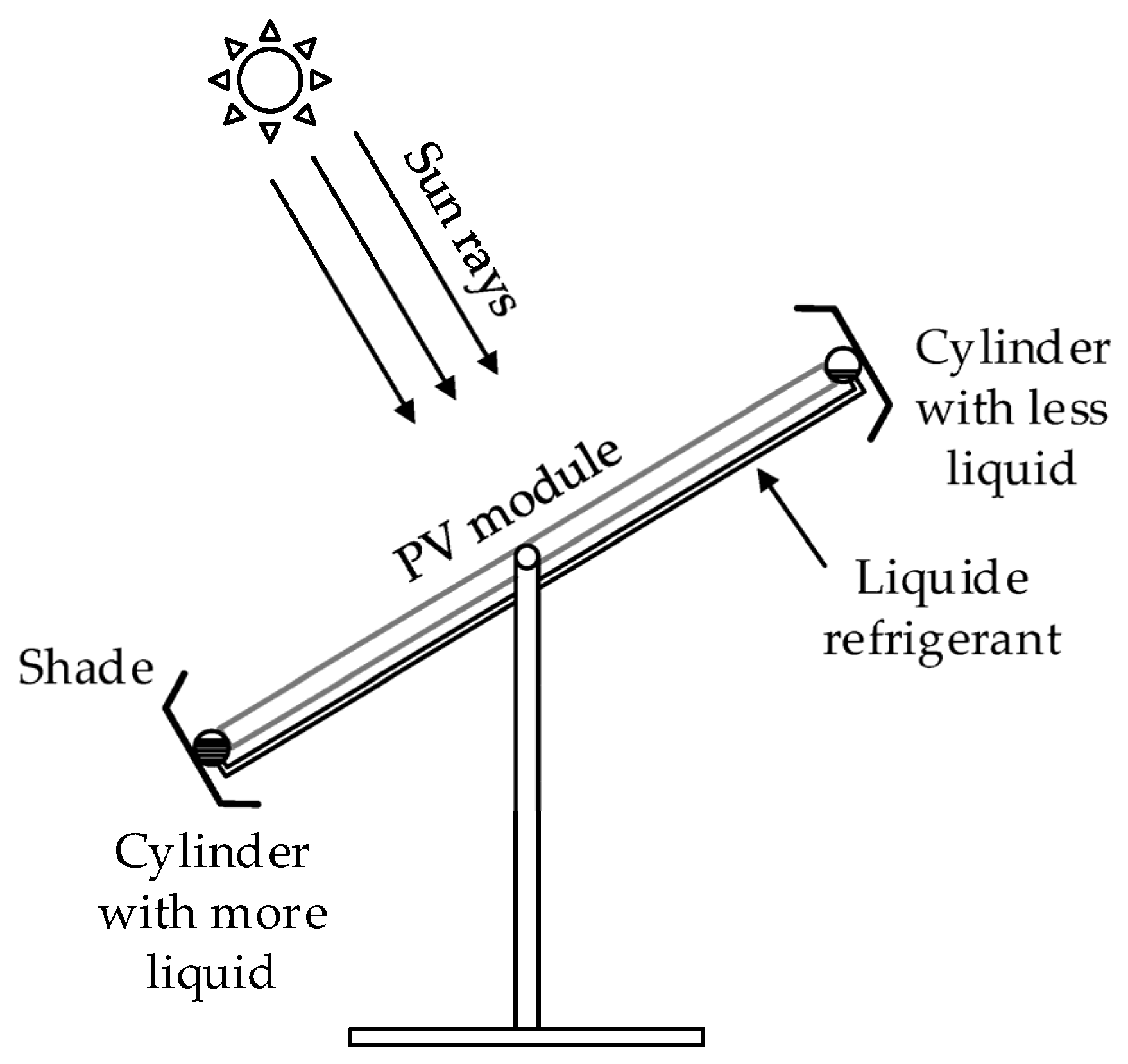
This system operates on principles such as thermal expansion and uses actuating elements made from low-boiling-point gases or shape memory alloys. These actuators move the panel when sunlight is not distributed evenly, restoring balance by using heat to expand gases or shape memory alloys. Differential heating causes the fluid on one side to expand and move toward the cooler side, tilting the panel due to an unbalanced gravitation force until balanced illumination is reached. This approach moves the panels without the need of mechanical drives [17]. Figure 3 represents the mechanism used for a passive solar tracker system.
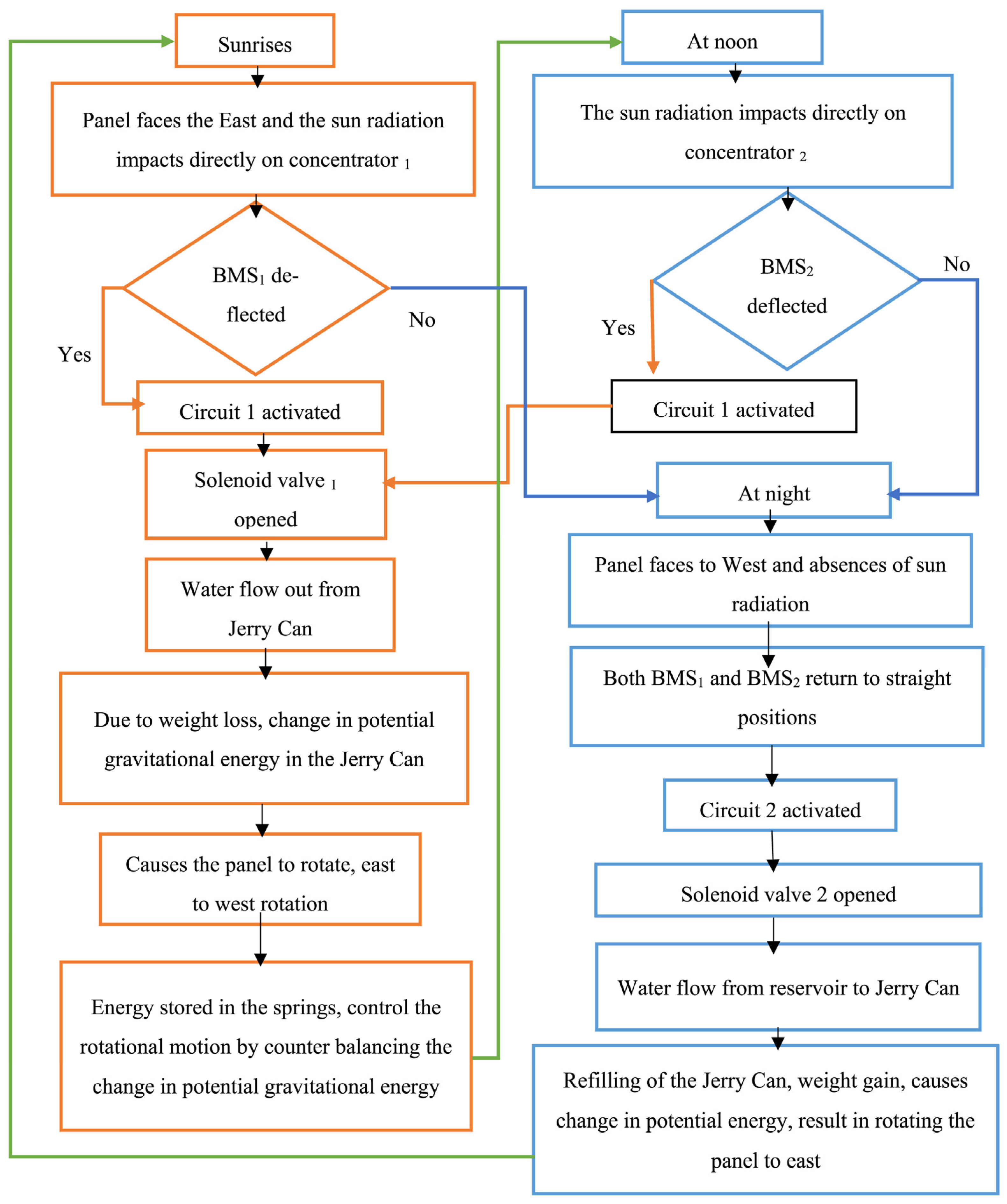
Alemayehu et al. [31] developed a passive solar tracking system that remains unaffected by changes in nighttime ambient temperatures. Due to the potential energy difference created by the weight and spring force, the system can return to its eastern position. The system consists of several components, including an aluminum/copper bimetallic strip that regulates water flow based on solar radiation deflection. The water flow system includes a 20 L Jerry can, solenoid valves with a 2 L/h flow rate, a 600 L reservoir, and a brass spring that regulates the panel’s rotation speed. The system’s performance was evaluated against a conventional system using three key metrics: power density, power output, and energy collection. The proposed tracker delivered a daily average power output of 70–120 W, outperforming the fixed system by 47 W per unit area, and achieved a 24.86% increase in energy collection efficiency. It also provided a cost saving of $71.75 per unit area and operated at 96.4% accuracy relative to an ideal tracker [31]. Figure 4 shows the design diagram used by Alemayehu for his passive solar tracking system.
Brito et al. [32] developed a passive solar tracker with multiple axes that tracks the sun’s azimuthal movement during daylight hours. This tracker relies on the differential thermal expansion of three long vertical strips positioned in different orientations. Its components include a solar panel, three strips, a lever mechanism, a mast, and a traction system. The researchers used various modeling methods—mathematical, kinetic, and finite element modeling—to analyze the system’s behavior, select optimal parameters for the lever, and verify that the system remains within the elastic range, using software like Simscape Multibody Module and NASTRAN. They built a prototype for testing, which demonstrated a 28% improvement in energy efficiency over fixed panel [32]. Sánchez et al. [33] designed a dual passive solar tracker. One degree of freedom operates using the concept of the thermal expansion properties of a bimetallic strip made from steel and aluminum, while the second degree of freedom is adjusted manually. The prototype consists of bimetallic strips, a threaded bar, a sun concentrator, a base, a rotation axis, a damper, a chassis, a variable declination mount, and a slider. This study concluded that a torque of 0.138 Nm is required to initiate the tracker’s motion [33].

2.2.2. Active System

This system determines the sun’s position using mechanical devices that receive feedback to orient the panel according to the magnitude and direction of the data. This type of system is more accurate than passive systems and provides a higher increase in efficiency [34]. Chin et al. [35] presented a wall-mounted East-to-West axis active solar tracker. Using MATLAB and Simulink software, the system was developed, modeled, and tested under a constant load. The components include a PV panel, charger, servo motor, two LDRs, a battery, a microcontroller, and an external load. The structural design was modeled using SolidWorks to illustrate the integration of mechanical and electrical systems. Key components include LDR sensors that measure sunlight intensity and send signals to the microcontroller for PV panel rotation, a pulley-chain system, servo motor, bracket, lead-acid battery, voltage regulator, and solar charge controller to ensure proper voltage levels. Component modeling was based on datasheets or experimental data. The system achieved 20% higher power efficiency compared to a fixed panel [35]. Indrasari et al. developed an active DA solar tracker utilizing the horizon coordinate system. The prototype included an Arduino Uno as the control system, two servo motors for panel movement, a PLX-DAQ program for data monitoring, an ACS-712 current sensor, and a DC voltage sensor to measure output voltage. Another active solar tracker based on sensors was built to compare it with the proposed system. In comparison to other active solar panels, this device’s output power increases by 83.89% [36]. Ghosh et al. designed an automatic single-axis active solar tracking system using an MCU node. The mechanical and electrical systems included a light sensor (LDR), an L293D motor driver, a solar panel, a DC motor, and a serial monitor. It used light intensity measurements to track sunlight and collect data on power output under various weather conditions. Data was collected from both LDRs used in this study over different days and varying environmental conditions. The system showed its ability to maintain its peak voltage for long periods, improving the output. However, it was limited by the utilization of a 5V solar panel with a single-axis tracking mechanism [37].

2.3. According to the Degree of Freedom

The DOF of a solar tracker refers to the number of independent movements or axes along which it can adjust its orientation to track the sun. SA and DA are the two primary configurations.

2.3.1. Single Axis

This system allows rotation on a SA, either vertically or horizontally. It provides up to 30% improvement in power output efficiency compared to stationary panels [38,39]. Single-axis trackers are divided into four categories based on rotation direction:
  • North–South single-axis tracking: Trackers rotate around a horizontal axis oriented north–south.
  • East–West single-axis tracking: Trackers rotate along a horizontal axis oriented east–west.
  • Vertical-axis single-axis tracking: Trackers rotate around a vertical axis with the PV panel tilted optimally.
  • Inclined East–West (IEW-SA) tracking: Trackers adjust their rotation axis from horizontal at an optimal angle in the east–west orientation [40].
Li et al. (2011) [41] examined the effectiveness of a vertical SA tracking system in optimizing solar panel optical performance, comparing it with fixed and DA systems. They evaluated annual solar gain using a mathematical method for fixed and tracked panels based on monthly horizontal radiation data. The findings indicated that the performance of the vertical-axis tracker had an almost linear relationship with the site’s latitude and local climate conditions. The vertical-axis tracker collected 96% of the maximum annual radiation achieved by the DA tracker, highlighting its efficiency. In regions with high solar availability, this system achieved a 28% increase in energy collection compared to conventional panels tilted at the ideal annual angle; in regions with lower solar availability, it achieved a 16% increase [41]. Huang and Sun (2007) [42] proposed a three-position single-axis solar tracking PV module with a low concentration ratio reflector. This solar tracker rotates the panel to three fixed positions: morning, noon, and afternoon. The design analysis indicated that the ideal stopping angle β is 50° for the first two fixed positions compared to the third. This angle is twice the best switching angle, which determines the appropriate time for adjusting the module’s position. These angles are independent of latitude. The system generated 24.5% more power than a fixed panel for latitudes below 50°. Adding low-concentration (2X) reflectors-X represents the reflectors concentration ratio-to the design increased power generation by about 23%, resulting in a total power increase of approximately 56%. Additionally, market fluctuations have reduced flat-plate PV modules prices by 20% to 30% [42]. Kuttybay et al. (2020) [43] compared two control strategies for a SA solar tracker—algorithm-based, and light sensor (LDR)-based—along with a fixed panel under various weather conditions. The performance of both the manufactured schedule-based SA solar tracker and the LDR-based solar tracker was analyzed. Results showed that the schedule-based SA solar tracker was 4.2% more efficient than the LDR-based tracker, showing better performance in different conditions, and 57.4% more efficient than a stationary panel set at the optimal tilt angle [43].

2.3.2. Dual Axis

This second type of solar tracking has two axes of rotation, enabling it to follow the sun’s position along both horizontal and vertical axes. It is considered the most efficient and effective solar tracking technique for collecting solar energy and enhancing overall system performance [44,45]. This system is 8 to 12% more efficient than single-axis systems [40].
Pawar et al. (2021) [46] designed and simulated a standalone, automated DA solar tracking system centered on a microcontroller, integrating a low-cost solar sensor using Proteus ISIS 7.6 software. A solar monitoring detector measures sunlight and updates the motor’s position, displaying it on a small LCD screen. The system tracks the sun using four light-dependent resistors (LDRs) that detect sunlight from different angles. These sensors are linked to the ATmega328P microcontroller, which analyzes the data to optimize panel positioning. The LDRs measure sunlight both horizontally and vertically, allowing the microcontroller to adjust the panel’s angle in small steps (22.5°) to maintain alignment with the sun. The design was tested through Proteus simulation using both 4 and 8 LDRs to evaluate tracking accuracy. The simulation demonstrated efficient motor rotation for optimal sunlight capture. The system is highly energy-efficient, consuming less than 50 mA and 500 mW during operation, with sensor current consumption below 0.5 mA, indicating excellent power efficiency and cost-effectiveness, and yielding a 40% increase in efficiency [46].
Shang and Shen (2023) [47] designed a simple DA solar tracking system. The mechanical structure consists of solar panel components, supporting members, gears, motors, photodiodes, power storage units, and control modules. Panel orientation is adjusted by a motor regulated by a microcontroller that receives signals from all integrated components. A battery stores energy to supply connected devices. They implemented a photoelectric tracking method that relies on outputs from photoresistors positioned at the four vertices of the solar panel. These signals are converted to digital form using an analog/digital circuit before being sent to the MCU. Additionally, a PID controller regulates motor position adjustments periodically. The overall radiation received by the solar panels was analytically evaluated and compared with a fixed system under identical conditions. An experimental case study over five days validated the system’s performance, showing a 24.6% increase in energy production compared to a 30° tilted fixed panel [47].
Fathabadi (2016) [48] proposed a sensorless DA tracking system regulated by maximum power point tracking (MPPT). In this design, the PV panel acts as the sensor in a closed-loop system. The MPPT controller calculates maximum output power and adjusts the panel’s position accordingly. The system was analyzed theoretically and tested experimentally. Its structure includes two stepper motors for azimuth and altitude adjustments, stepper motor drivers, an MPPT controller, a DC/PWM converter for power regulation using a MOSFET, and the PV module. Results showed a tracking error of 0.11°, lower than the 0.15° error in sensor-based systems and the 0.4° error in other sensorless PV systems. Energy efficiency improved by 28.8–43.6%, depending on the season [48].
Table 1 illustrates classifications of all solar trackers in this study with their key performance and output, and Figure 5 is a block diagram that represents a summary of the different conventional solar tracking systems.

3. Computer Vision-Based Solar Tracking System

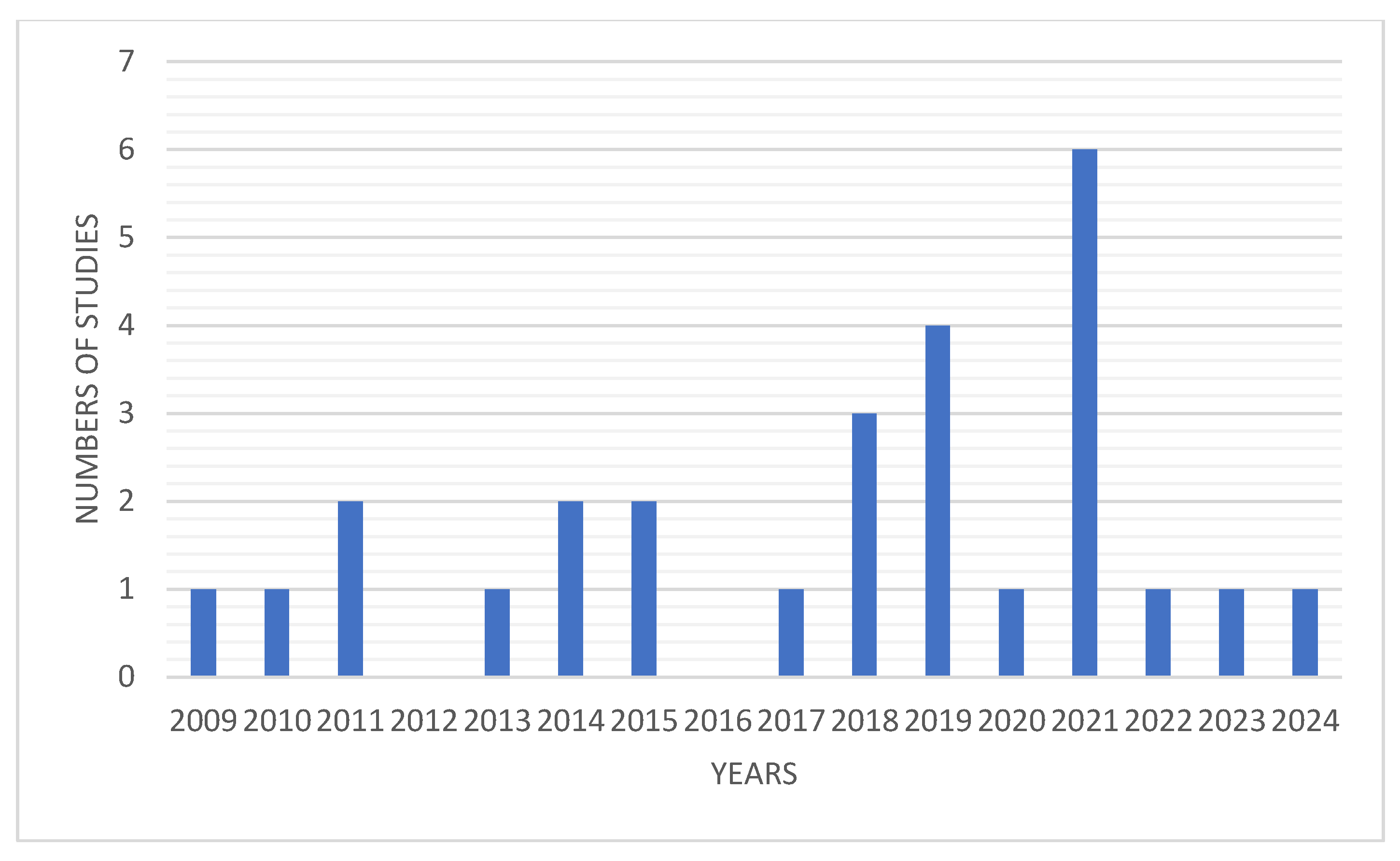
These systems apply image-processing algorithms to maintain solar panels’ alignment with the sun by continuously adjusting their orientation throughout the day. They rely on cameras as sensors to capture live images of the sky, accurately detecting the sun’s position and identifying its centroid coordinates. Consequently, the camera’s resolution affects the system’s effectiveness. Such systems typically consist of three units: data acquisition, control, and mechanical units. The operation of an image-processing-based solar tracker generally follows a structured workflow. First, a camera captures real-time images of the sky, serving as the primary sensor for sun detection. These images undergo preprocessing, including filtering to remove noise and thresholding to enhance contrast for better feature extraction. Next, the system performs segmentation to isolate the region of interest, usually the brightest area corresponding to the sun. After segmentation, sun detection and centroid calculation are carried out to determine the sun’s precise coordinates within the image frame. These coordinates are then transmitted to the control unit, which computes the required orientation adjustments. Finally, the motor actuation stage executes these commands, rotating the solar panel along its axes to maintain optimal alignment with the sun. This workflow ensures accurate, real-time tracking and maximizes energy capture efficiency. Figure 6 illustrates the number of studies that have addressed this method in recent years, showing a peak in 2021 with six studies published. This trend highlights a significant rise in focus on this innovative approach to solar tracking.
Arturo and Alejandro (2010) [49] developed a solar tracker that employs an image-processing method. The system uses an inexpensive webcam with a welding mask polarized filter to prevent saturation of the charge-coupled device (CCD) under intense solar radiation. Additionally, the filter enables real-time pre-binarization of the image, which accelerates the process of locating the sun. MATLAB software is used to run the processing technique and implement it on a two-degree-of-freedom electromechanical device for testing. The results show that the accuracy achieved was higher than 0.1°, and performance was unaffected by weather conditions; sun location detection takes 1/32 s [49].
Han et al. (2011) [50] designed a dual-axis solar tracker based on an image sensor. The system uses a pinhole to project divergent sun rays onto a receiving screen, creating a sunspot, which an image sensor captures and processes to calculate the sun’s azimuth and elevation for alignment and tracking. Image processing is performed using wave-door tracking (electronic gating and edge/center algorithms) or correlation tracking (comparing detected and pre-stored images). A digital signal processor handles image processing and control, stores data for debugging, and interfaces with a PC for real-time display of sunspot images and solar height [50].
R. Abd Rahim et al. (2014) [51] presented an image-processing-based solar tracker that uses a webcam as the core sensor, with a Raspberry Pi hosting its functionality. The Raspberry Pi is a credit-card-sized single-board computer developed in the United Kingdom by the Raspberry Pi Foundation with the intention of promoting the teaching of basic computer science in schools. There are two model which both model are similar except for model B have the Ethernet, 2 USB ports and 512 MB SDRAM. Both models can run a Linux operating system. The model used in this project is model B. The system consists of two motors, a webcam, and a Raspberry Pi as major hardware components. The processing technique converts a 24-bit color image to an 8-bit grayscale image using OpenCV module for faster processing. The grayscale image is then converted to a binary image, which helps detect shapes like the sun by adjusting brightness thresholds across different image regions. Signals transmitted by the Raspberry Pi to the motors depend on the sun’s appearance in the image. If no sun is detected, the motors keep moving until it is found. Once detected, the Raspberry Pi rotates the pan and tilt motors to center the sun in the image and holds that position for 10 min, creating a closed-loop system. This method demonstrates effective solar tracking and is easy to implement under various weather conditions [51].
Yoo et al. (2014) [52] proposed a dual-axis solar tracker that combines GPS and image-processing technologies. The system first calculates the sun’s azimuth and altitude using astronomical estimates based on longitude, latitude, and time obtained from GPS. To minimize tracking errors, the system integrates data from a camera sensor to accurately center the sun. Additionally, an algorithm determines weather conditions: if it is sunny, both methods are applied; if cloudy, the system relies solely on GPS. Results demonstrated high robustness and accuracy [52].
El Kadmiri et al. (2015) [53] designed an omnidirectional computer vision-based solar tracker capable of 180° horizontal and 200° vertical rotation. The system consists of four main units: an acquisition module using a catadioptric camera to capture sky images; a control unit with a processing module that calculates the sun’s spherical coordinates; a command circuit that drives the motors; and a dual-axis mechanical system with a photovoltaic panel. Two experiments compared the designed system’s power generation and daily output with those of a conventional system. Results showed at least a 30% increase in power output and an accuracy of 0.175 rad. The system offers three advantages: its wide viewing angle eliminates the need for supervised initialization, it can track the sun regardless of geographic location, and it improves energy efficiency through real-time tracking [53].
Suryanto et al. (2021) [54] provided an image processing-based DA solar tracker. This system utilizes simple methods and low-cost hardware for sun-tracking. A Raspberry Pi calculates the brightest area in the captured image. Simple processing is applied for filtering and thresholding values. This system was experimentally tested on September 28–30, 2019, in Semarang City. The results showed robustness and applicability on a larger scale [54].
AbdollahPour et al. (2018) [55] proposed a dual-axial tracker that functions by examining images of a shadow cast by a bar. The system consists of three main units: a computer unit that transmits signals to the motors, an image-processing unit that captures, transmits, and analyzes shadow images to extract angles, and a solar panel monitoring and control system that adjusts the panel’s tilt angle and height. The system primarily uses two stepper motors for rotation, an Arduino Uno board as the microcontroller to send signals to the motors, electronic circuits, a webcam, and a shadow-casting device. The investigation showed that the tracker maintained the panel aligned perpendicular to the incoming irradiation, Achieving an accuracy of approximately ±2° in solar tracking. This system functions globally, regardless of its original configuration, and maximizes solar energy collection by maintaining the panel’s perpendicular alignment with the irradiation source [55].
Garcia-Gil et al. (2019) [56] suggested a DA solar tracker dependent on image-processing technology. This system receives its input as panoramic images captured by a fish-eye camera (ALLSKY 340C). These images are first converted to grayscale, followed by threshold-based segmentation to isolate the brightest region in the binary image. The system then identifies the center of this bright area and calculates its pixel coordinates. To determine the required tracking angles, these pixel coordinates are transformed into a 2D plane. Two case studies, one conducted on a sunny day and the other on a cloudy day, validated the system’s effectiveness. Results showed that the tracker is not only precise and robust but also simple to implement. A key advantage of this system is that it does not rely on hardware like GPS, photoresistors, or other complex electronic components [56].
El Jaouhari et al. (2019) [57] designed an automatic DA solar tracker that depends on image-processing techniques. This tracker is equipped with a fisheye lens digital camera, providing a 360° horizontal and 180° vertical field of view, ensuring no-blind zones. Testing was conducted under diverse weather conditions, including sunny, cloudy, and foggy days. Real-time tracking is carried out regardless of spatiotemporal coordinates. The proposed system achieved a 32% increase in power production relative to a fixed panel [57].
Rahmawati et al. (2020) [58] presented a DA solar panel position control system based on image processing. This technique relied on the shadow image of a rod object of a 4 cm bolt that creates a shadow when exposed to light. The servo motor is driven by an input angle formed due to a light incident, controlling both the panel and an acrylic plate. Key hardware components consist of a webcam to capture shadow images of the bolt, an acrylic plate with the bolt secured at its center, and a microcontroller responsible for controlling the servo motor’s motion. Images from the webcam are captured in Red-Green-Blue (RGB) format, converted to grayscale, then to binary, and finally processed using Otsu segmentation. After image processing, the shadow angle is calculated using trigonometric formulas. This prototype was tested at angles ranging from 0° to 57° over 90 min to obtain azimuth and altitude values of the sun. The system achieved an accuracy of 95% for azimuth (x-axis) calculations and 96% for altitude (y-axis) calculations [58].
Nie et al. (2021) [59] discussed the challenge of accurately predicting solar power output due to weather fluctuations. The study highlights the use of sky images and convolutional neural networks (CNNs) as an effective method for predicting solar power generation. However, it notes a problem: datasets of sky images are often imbalanced, with more photos of overcast skies are collected to balance dataset. The authors experimented with various resampling and data augmentation techniques to rebalance the dataset and improve model performance. The best resampling approach, augmentation techniques, and oversampling rate were determined using three-stage greedy search. Key findings indicate that balancing the dataset significantly improves model performance, reducing errors by an average of 4% for current solar output prediction (nowcasting). However, balancing the dataset does yield much improvement for forecasting, that is, projecting output 15 min in advance. The optimal approach involves oversampling cloudy images, with higher rates producing better results [59].
In scenarios involving haze, fog, or smoke, conventional staged restoration pipelines amplify noise after dehazing. U2D2Net addresses this by jointly performing unsupervised dehazing and denoising in a single network, leveraging a transmission-aware module, a Mean/Max Sub-Sampler, and a region-similarity fusion strategy. This unified approach presented by Ding et al. (2024) improves PSNR and SSIM while preserving edge details, resulting in cleaner inputs for sun detection and centroid estimation [60].
Chukwunweike et al. (2024) [61] presented MATLAB-based method for image processing in automatic solar panels to improve their performance. A digital camera that captures real-time images was utilized; these images were then analyzed through different stages such as filtering, edge detection, and centroid calculation. MATLAB 2024 software was used for image acquisition, preprocessing, edge detection, tracking the sun, cleanup, and object detection. The implementation of MATLAB advances efficiency and effectiveness of solar panels [61].
While image processing-based trackers offer superior accuracy, they introduce trade-offs in computational cost, hardware complexity, and energy consumption compared to simpler sensor-based systems. LDR-based trackers are low-cost and energy-efficient, requiring minimal processing and calibration, but they lack robustness under variable lighting conditions. Classical vision-based systems demand moderate computing resources (e.g., Raspberry Pi or similar SBCs) and consume more power due to continuous image acquisition and processing. AI-enhanced trackers, while highly accurate and resilient under adverse conditions, require edge hardware accelerators and higher energy budgets, making them less suitable for ultra-low-power or off-grid applications without optimization. These trade-offs highlight the importance of selecting a tracking approach based on deployment scale, environmental conditions, and available power resources.

3.1. Integration of Computer Vision with Sensors

To improve the accuracy of solar tracking systems, many studies have integrated sensors with image-processing methods. These approaches combine real-time data from light sensors, weather sensors, and orientation sensors with sophisticated image-processing algorithms to ensure optimal solar panel alignment.
Rezagholizadeh et al. (2009) [62] developed a two-axis solar tracking system based on an image-processing technique that uses images of a bar shadow to precisely align the solar dish with the sun’s position for optimal performance. This system does not depend on geographical location, initial configuration, or starting time. The mechanical setup includes a fixed bar and a flat screen, which track the bar shadow using a digital camera. The electronic setup includes two 12V DC motors responsible for controlling altitude and azimuthal displacement. Both motors are controlled by an AVR microcontroller with a photosensor to measure light intensity. The circuit of this system operates in two modes: normal mode when the microcontroller transmits an 8-bit light intensity measurement to the computer and the motors remain inactive, and interrupt mode where the computer sends a command to activate the motors based on light intensity data. The software system takes input data from the camera, sensors, and electronic circuit. The motors rotate to decrease the shadow length if the light intensity falls in the range of the threshold value. Pixel analysis was used to determine the direction and length of the shadow. To prevent errors caused by other objects, the system compares the RGB code of the shadow with the average RGB code of the screen. If the minimum RGB code is higher than the screen’s average, it indicates no real shadow. The two-axis tracking system operates independently of the initial setup, start time, and location, adjusting photovoltaic solar surfaces, telescopes, and electromagnetic wave sources efficiently with self-adjusting and energy-saving features [62].
Yan et al. (2011) [63] presented a sun smart tracking method using image-processing technology that relies on a camera to capture images of shadows cast by a straight line. The principle used is solarium, which measures time by using the sun’s shadow. This method calculates the sun’s elevation and direction angles to improve the orientation of solar collecting systems. The process involves two lines: AO, a straight line set in the vertical plane representing the reference, and BO, the shadow line formed by the sun’s shadow. The elevation angle is calculated from the lengths of lines OA and OB, while the slope of the shadow line BO determines the direction angle. The orientation of the suggested system is adjusted based on these angles. Images are captured and converted to a binary format, then processed using the Hough transform to identify lines and their intersection points. This enables the calculation of the angles required for positioning solar energy collectors. MATLAB 7.0.1 software is used for image processing, including noise reduction and line detection [63].
Lee et al. (2013) [64] designed a sun position sensor based on image processing, along with an algorithm that accurately determines the sun’s location. In the design of this sensor, a reflecting-type Cassegrain telescope was used to enlarge and reflect the sun image to filter out noises and errors, ensuring optimal tracking precision and viewing angle. To validate the performance of the suggested sensor and the tracking algorithm, a sun image tracking platform was built consisting of an image-based sun position sensor and tracking controller, complemented by a sun image simulator that generates simulated solar images. After conducting seven experiments, the study concluded that integrating a high-resolution webcam with 15× telescope provided the best tracking accuracy. The solar tracking system’s accuracy was within 0.04°, with a threshold set to 5 pixels [64].
Sohag et al. (2015) [65] proposed a method that uses both image processing and sensors at the same time. The solar panel is tilted according to data collected from LDR sensors and analyzed images of the sun. The results showed performance enhancement and efficiency improvement against traditional systems [65].
Ruelas et al. (2017) [66] developed an image-based solar position sensor that detects the relative azimuth error and the elevation of the targeted solar surface. This sensor is suitable for use on radiometric stations, parabolic trough collectors, parabolic dishes, and PV panels, and it is designed to withstand difficult weather conditions. This cylindrical sensor is assembled of a filter, plastic cover, lens, vision sensor (Pixy), battery, PCB with sensors and microcontroller, and a clamping base. The sensor’s electronic circuit includes an 8-bit Atmega2560 microcontroller with 2256 KB of flash memory, operating at a 5V working voltage and a temperature range of −10 °C to 85 °C. It includes a 16 MHz oscillator, a 5V regulator, a capacitor network to reduce noise, and a voltage conversion stage that steps down from 5V to 3.3V for the pressure and inertial sensors. The sun’s position is identified using image-processing techniques through a Pixy vision sensor, which is driven by an ARM-Cortex NXPLPC4330 processor. The detection strategy involves capturing the sun’s image through a filter, configuring the Pixy sensor via Pixymon software to identify the sun as a clear object, and sending its pixel position to a microcontroller via the i2c protocol. The study concluded that the vision sensor can accurately measure the sun’s position with errors ranging from 0.0258° to 0.2396°, viewing angles from 12° to 75°, and uncertainties from 0.2% to 1.55%, which can be improved to less than 0.01°, with accuracy unaffected by temperature or solar radiation changes [66].
S. Ahmed and Chauhan (2018) [67] developed a DA solar tracker that combines the characteristics of both passive and active tracking. The proposed system integrates an open-loop (feed-forward) control system in conjunction with a Closed-loop (negative-feedback) system. The passive component of the system depends on the SG2 sun-tracking algorithm, which simplifies the Solar Position Algorithm by using GPS data for input. The active component, on the other hand, uses the concept of machine vision, with a cheap webcam serving as a sensor to follow the sun’s position in real time. To validate the approach, they built and tested an experimental prototype. The solar tracker consists of three main parts: the data acquisition unit, which collects data through both a GPS module and a webcam; the control unit, made up of a computer and an Arduino board; and the mechanical unit, which uses servo motors to adjust the tracker on two axes. This technique demonstrates higher reliability than standard active trackers, especially in situations where the sun is not clearly visible. The design brings together the strengths of both passive and active tracking, offering a straightforward yet effective solution that addresses the limitations of existing systems [67].
R. Ahmed (2021) [68] proposed a dual solar tracker featuring computer vision and photosensors for optimal daylighting, seamlessly integrating two feedback mechanisms to ensure precise solar tracking. Employing real-time image processing through a Raspberry Pi controller and an ATmega128 microcontroller, the system incorporates a camera, electronic circuits, photosensors and stepper motors. The solar tracker’s performance was validated through rigorous testing using optical fiber cable for indoor illumination [68].
M. Adnan et al. (2021) [69] developed an image processing-based automatic two axis tracking system. The suggested system includes both electrical and mechanical components. The first is responsible for generating electricity from the panel using a solar panel, charge controller, battery, inverter, transformer, DC loads, and AC loads. The mechanical part, responsible for moving the panels, is composed of motor drivers, stepper motors, an ATmega328p microcontroller from Microchip Technology Inc., Chandler, AZ, USA, and the drive system. The mechanical system was simulated using Proteus, while MATLAB was employed to process captured images and convert them into digital signals, enabling the system to follow the sun location. In addition, a Raspberry Pi chipset is utilized since processing MATLAB code requires significant CPU power. The program aims to identify the coordinates of both the origin point and the sun, which enables calculating the direction needed to move the motors to align the sun’s center with the origin. A prototype of this system was developed using a lightweight polyurethane board [69].
Kumar et al. (2021) [70] proposed an efficient solar tracking system utilizing vision sensors, digital image processing (DIP), and light-dependent resistors (LDRs), implemented in C++. Their system consists of LDR sensors, a microcontroller, a camera for image processing, and servo motors controlled by an Arduino UNO. The system worked on two stages: initially, the LDR sensors detect solar intensity to orient the panel, followed by image tracking to refine its position based on the camera (image sensor) that converts an RGB image to a grayscale image, which speeds up processing and reduces algorithmic complexity. After conversion, the image is contrast-starched, and noise is removed using a Gaussian filter. This dual stage tracking strategy improves accuracy [70].

3.2. Integration of Computer Vision and AI

Numerous studies have integrated artificial intelligence (AI) and deep learning (DL) methodologies with image-processing techniques.
Syafa’ah et al. (2018) [71] developed a DA system that combines image-processing techniques with high-precision encoders to achieve precise hardware responses. They employed a Sliding Mode Controller (SMC) with a Proportional Integral Derivative (PID) sliding surface, which supports stability against different disturbances. The researchers tested their method using both software simulations and real-world hardware experiments, using LabVIEW for simulation and validation, and Vision Assistant for image processing. Their hardware validation showed impressive accuracy, with the solar panel system tracking the sun’s position in elevation with 2.622% error (0.03007°) and in azimuth with 0.244% error (0.00893°). These results confirms the system’s ability to precisely track the sun’s movement in both elevation and azimuth directions [71].
Beyond visible-spectrum tracking, infrared (IR) imaging has been explored to improve robustness under low-texture and high-noise conditions. Zhang et al. (2022) [72] introduced Deep-IRTarget, which employs a dual-domain backbone combining frequency-domain saliency extraction (via Hypercomplex Infrared Fourier Transform) and spatial CNN feature maps, integrated through a Resource Allocation model with channel and position attention. This approach achieved notable improvements in mAP across MWIR, BITIR, and WCIR datasets, demonstrating its potential for solar tracking under adverse conditions such as haze or low illumination [72].
Carballo et al. (2019) [73] implemented an innovative solar tracking methodology by integrating deep learning with the TensorFlow framework. For maximum speed and accuracy, the system uses pretrained models such as “SSD Mobile Net V1” to identify the Sun and its target with accuracy. This supports both embedded and mobile implementations, highlighting the versatility of the proposed system. TensorFlow enables flexible implementation by supporting diverse neural networks, thereby enhancing accuracy in solar tracking. Additionally, the integration of pretrained models significantly reduces training time, contributing to an overall improvement in tracking precision [73].
Carballo et al. (2019) [74] designed a new solar tracking system (STS) based on computer vision and deep learning techniques. Convolutional neural networks (CNN) were used in this system for object detection and tracking. Raspberry Pi hardware was selected since it is low-cost and suitable for this approach. To test the system, the hardware was installed on a heliostat in the CESA tower at the Plataforma Solar de Almería (PSA). Two sets of images were captured: one with the heliostat directed at the sun, and the other with it aimed at a white target. This system is highly adaptable and cost-effective, functioning independently of technology type, system size, location, and time. It is resilient to common aiming issues like wind and pedestal tilt and enhances control with its advanced detection features. By integrating a low-cost microprocessor, it provides increased autonomy, reduces costs, and supports closed-loop control when combined with traditional methods, ultimately improving system performance and flexibility [74].
Kumar et al. (2021) [75] proposed a solar positioning system that relies on GPS, artificial neural network (ANN) and image processing (IP). GPS is used to determine the sun’s azimuth angle by providing latitude, date, longitude, and time. Image processing is employed to obtain an image of the sun, from which the sun’s centroid is computed. The best tracking point is then obtained by comparing the sun’s centroid with the GPS quadrate. Situations and weather conditions are monitored through AI decision-making using IP algorithms. Experimental data stored on the cloud are used to examine and validate the advanced adaptation offered by the system. Compared to a stable system (SS) and a two-axis solar following system (TASF), the proposed system increases power gain by 59.21% and 10.32%, respectively. The IoT-based Two-axis solar following system (IoT-TASF) achieves a 0.20° reduction in azimuth angle error due to its reduced tracking accuracy [75].
Lorilla and Barroca (2022) [76] introduced a new method for controlling a solar tracking system (STS) using machine vision. The prototype incorporates an AI-based computing board. Its primary goal is to follow the sun’s centroid in real time with high adaptability, especially under challenging conditions such as low irradiation caused by cloud cover. Notably, the STS functions independently, removing the need for manual configuration of location-specific spatiotemporal data. The data acquisition stage for solar position uses a high-resolution camera with a 180° field of view, integrated with an adaptive control method to manage the electrical inputs to the two servo motors responsible for pan and tilt movements. The control unit uses the NVIDIA Jetson Nano Development Kit-B01 AI-Computing Board and enables autonomous deployment of the tracker. Measured results showed impressive accuracy of the proposed tracker in sun centroid tracking, with deviations of 0.23° and 0.66° for azimuth (Az, γ) and elevation (El, α, respectively, using the Solar Position Algorithm (SPA), in comparison to 0.59° and 0.65, respectively, with the commercial solar tracker, STR-22G [76].
Zeghoudi and Benmouiza (2023) [77] proposed a hybrid control method of heliostats used in solar tracking systems to achieve optimal orientation. This approach combines image-processing techniques (IPT) and artificial neural networks (ANN). The proposed method integrates both open and closed-loop controls, with the closed-loop control using feedback from the CCD camera to determine the heliostat angle and locate the sun’s center. The second approach relies on an open-loop system that uses an astronomical formula to estimate the paths of heliostats, with artificial neural networks applied and no feedback involved. The approach used in this paper relies on the presence and the size of the sun in the web camera. If the weather is cloudy and the sun cannot be detected in the solar image or its size is less than 75%, the ANN is used to execute the estimation of the solar position in the procedure. Otherwise, image-processing techniques are used, utilizing MATLAB software to obtain the sun’s center and find the azimuth and height of the heliostat. Real color images are converted into grayscale images and then to binary images to identify the sun’s round form, thereby improving solar tower efficiency [77].
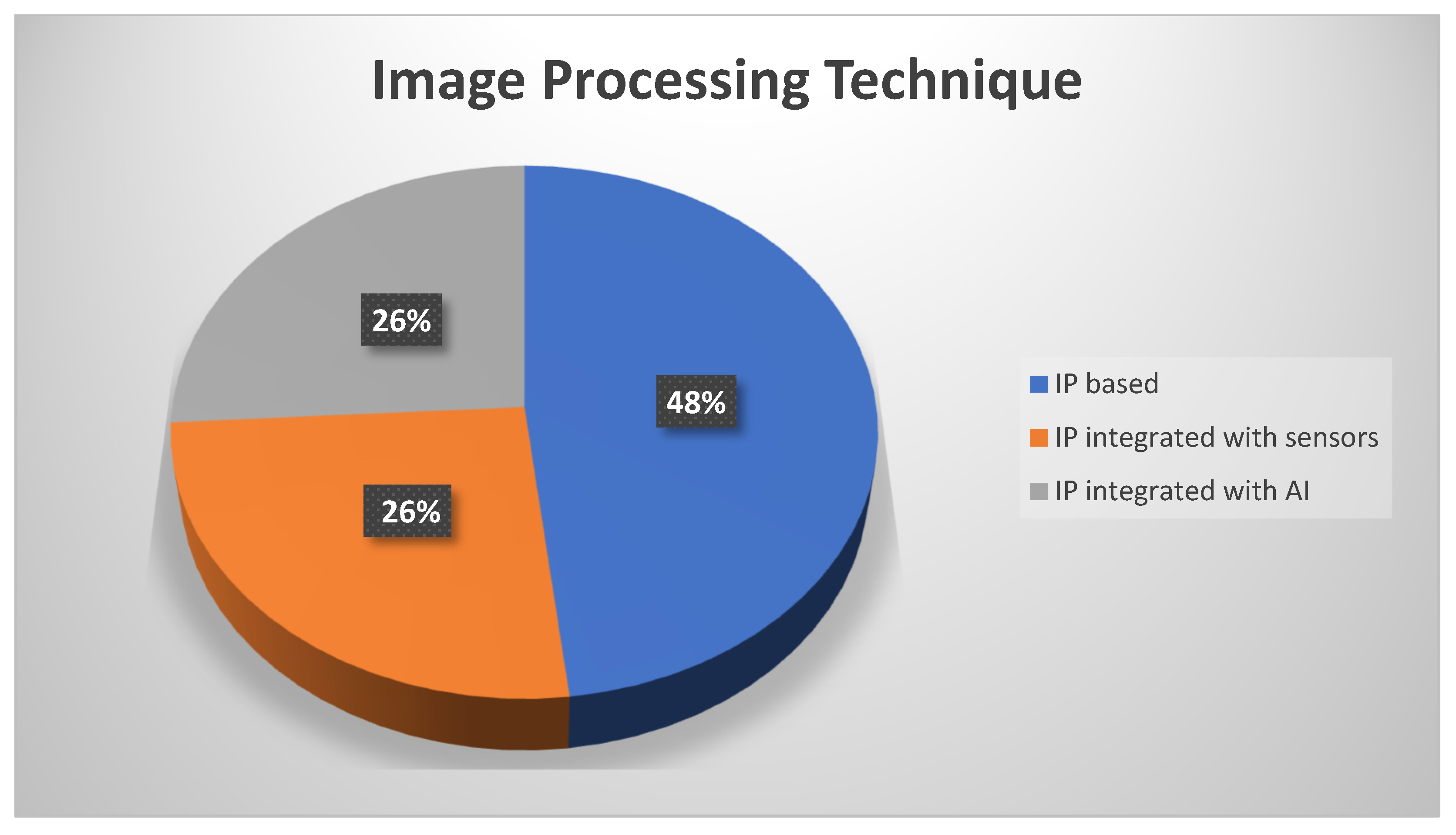
In summary, 48% of the studies discussed and presented image-processing techniques, while 26% focused on IP integrated with sensor techniques, and the remaining studies focused on IP integrated with AI, as shown in Figure 7.
While image processing-based solar trackers demonstrate strong numerical performance, real-world deployment introduces practical challenges that must be considered. Camera degradation due to prolonged UV exposure, thermal cycling, and humidity can affect image quality and sensor reliability. Outdoor conditions such as dust accumulation, rain spots, and glare reduce contrast and complicate sun detection, requiring periodic cleaning and protective coatings. Lighting variations caused by cloud transients or low solar elevation further challenge threshold-based algorithms, making adaptive exposure control and HDR imaging essential. Additionally, maintenance costs and the energy overhead of continuous image acquisition must be factored into total cost of ownership. These practical issues are compounded by resource trade-offs: LDR-based trackers are low-cost and energy-efficient but less robust under variable lighting; classical vision-based systems require moderate computing resources and power; while AI-enhanced trackers offer superior accuracy and resilience under adverse conditions, they demand higher computational capacity and energy budgets. Deep learning models outperform classical approaches because they learn illumination-invariant features, handle occlusions and noise, and leverage temporal patterns across frames, enabling accurate sun detection even under cloudy or low-contrast conditions. These factors highlight the need for careful design choices balancing accuracy, cost, and operational reliability.
Table 2 shows all image processing-based solar tracker studies conducted in this paper, highlighting the methodology used, components, and key performance and results. Note that the reported performance metrics are presented as stated in the original studies. Due to variations in error definitions, experimental conditions, and evaluation criteria, these results are not normalized and should be interpreted qualitatively rather than as direct comparisons.
To provide a clearer synthesis of the reviewed studies, Table 3 summarizes key performance metrics across different solar tracking approaches, including tracking accuracy, error margin, processing speed (FPS), and energy efficiency gains.

3.3. Practical Implementation Challenges

Despite strong quantitative performance, field deployment introduces practical constraints:
  • Optics and enclosure durability: Long-term exposure to UV, heat cycles, and humidity can induce lens haze, sensor drift, and seal degradation. Weatherproof enclosures (IP65+) and thermal management mitigate these effects [49,50,51,52,53,66].
  • Dust/soiling and precipitation: Particulate deposition and rain spots degrade image contrast; periodic cleaning, hydrophobic coatings, and lens hoods reduce maintenance burden [55].
  • Lighting dynamics: Blooming/glare near solar noon, rapid cloud transients, and low-contrast conditions challenge threshold-based segmentation; auto-exposure/HDR, adaptive thresholding, and learned detectors improve robustness [73,74,75,76].
  • Calibration and alignment: Mechanical drift necessitates periodic re-calibration of camera extrinsics and pan-tilt mechanisms; software routines and fiducial-based checks help maintain accuracy.
  • Operational costs: Maintenance cycles (cleaning, re-sealing), power budget of compute and actuation, and spares/logistics should be included in TCO estimates. Hybrid schemes that fall back to SPA/MPPT reduce actuation and energy use [48].
These considerations explain divergences between lab metrics and field performance and motivate hybrid and edge-optimized designs.

3.4. Scalability and Limitations Challenges

While most reviewed systems focus on single-panel or small-scale prototypes, scalability to large solar farms introduces additional challenges and opportunities. Vision-based tracking can be implemented at the row or sub-array level, supported by cooperative control strategies to maintain alignment across distributed trackers. Edge computing reduces latency and bandwidth requirements, while cloud-based aggregation enables fleet-level analytics and predictive maintenance. These approaches allow image-processing techniques to scale efficiently, improving overall energy yield and operational reliability in utility-scale installations. It is important to note that the reviewed studies adopt different error definitions, experimental setups, and evaluation protocols, which limits direct comparability of reported results. This lack of standardization highlights the need for unified benchmarking frameworks and common performance metrics in future research to enable rigorous cross-study evaluation.
Furthermore, despite significant advancements, image processing-based solar tracking systems face several unresolved challenges. Environmental factors such as fog, heavy clouds, and dust accumulation can degrade image quality and tracking accuracy. Long-term outdoor exposure leads to lens aging and sensor drift, requiring periodic calibration and maintenance. Energy consumption and thermal constraints of edge AI hardware remain critical for off-grid deployments. Furthermore, the absence of standardized data sets and benchmarking protocols limits fair comparison across different algorithms. Cybersecurity and reliability concerns also arise in networked multi-tracker systems, especially for large-scale solar farms. Addressing these gaps will require robust hardware designs, adaptive algorithms, and collaborative efforts to establish open datasets and performance metrics for future research.

4. Conclusions

Solar tracking systems play a critical role in maximizing photovoltaic energy output by maintaining optimal alignment with the sun. This review has investigated the integration of IPT in solar tracking systems, showing their major effect on improving the efficiency and accuracy of solar energy capture. Solar tracking systems are essential for maximizing the energy output of photovoltaic panels by maintaining ideal positioning relative to the Sun throughout the day. Among various tracking methods, image processing-based systems stand out due to their high precision and adaptability to changing environmental conditions.
However, despite these advancements, several limitations persist. Current systems lack standardized datasets and unified benchmarking protocols, making cross-study comparisons difficult. Practical challenges include reduced reliability under extreme weather, dust accumulation, and low-light conditions, as well as high computational demands and hardware costs that hinder scalability for large solar farms and off-grid applications. These constraints underscore the need for lightweight algorithms, cost-effective embedded vision platforms, and autonomous calibration mechanisms.
The reviewed studies, covered from 2009 to 2024, demonstrate that image-processing techniques, when combined with other technologies such as deep learning and light-dependent resistors (LDRs), notably improve the performance of solar trackers. These systems typically involve capturing real-time images of the sky or shadows, which are then processed to determine the sun’s location. The integration of computer vision and artificial intelligence further enhances the robustness and accuracy of these systems, making them more reliable and efficient.
Key findings from the literature indicate that image processing-based solar trackers offer several advantages over traditional methods. They provide real-time tracking with minimal errors, adapt well to various weather conditions, and require less maintenance. Additionally, these systems can be integrated with other advancements to further optimize energy capture and reduce costs.
Looking ahead, future research should prioritize scalability and resilience. Promising directions include edge-based vision tracking for real-time control with minimal latency, multi-sensor fusion combining visible and infrared imaging for improved robustness, and digital twin frameworks for predictive maintenance and cooperative control in large-scale deployments. Additionally, developing standardized datasets and evaluation metrics will be essential for fair performance comparison and accelerated innovation. Addressing these gaps will enable AI-driven adaptive tracking solutions that balance accuracy, cost, and energy efficiency, paving the way for practical and sustainable solar tracking technologies.
In summary, the integration of image processing in solar tracking systems signifies a notable improvement in renewable energy technology. By using the precision and adaptability of computer vision, these systems can substantially improve the efficiency of solar panels, advancing a more sustainable and reliable energy future.

Author Contributions

Conceptualization, J.R. and R.I.; methodology, C.L.; formal analysis, J.R., C.L. and N.S.; investigation, J.H.; resources, C.L.; data curation, J.H. and C.L.; writing—original draft preparation, J.H.; writing—review and editing, J.R., C.L., R.I. and N.S.; supervision, J.R. and C.L.; project administration, J.R.; funding acquisition, N.S. All authors have read and agreed to the published version of the manuscript.

Funding

This research received no external funding. APC is funded by the University of Balamand.

Institutional Review Board Statement

Not applicable.

Informed Consent Statement

Not applicable.

Data Availability Statement

No new data were created or analyzed in this study. Data sharing is not applicable to this article.

Conflicts of Interest

The authors declare no conflicts of interest.

References

  1. Renewable Energy—Powering a Safer Future, United Nation. Available online: https://www.un.org/en/climatechange/raising-ambition/renewable-energy (accessed on 15 March 2024).
  2. Renewables 2023 Analysis and Forecast to 2028, International Energy Agency. January 2024. Available online: https://www.iea.org/reports/renewables-2023/electricity (accessed on 15 March 2024).
  3. Thirugnanasambandam, M.; Iniyan, S.; Goic, R. A review of solar thermal technologies. Renew. Sustain. Energy Rev. 2010, 14, 312–322. [Google Scholar] [CrossRef]
  4. Crabtree, G.W.; Lewis, N.S. Solar energy conversion. Phys. Today 2007, 60, 37–42. [Google Scholar] [CrossRef]
  5. Parida, B.; Iniyan, S.; Goic, R. A review of solar photovoltaic technologies. Renew. Sustain. Energy Rev. 2011, 15, 1625–1636. [Google Scholar] [CrossRef]
  6. Al-Ezzi, A.S.; Ansari, M.N. Photovoltaic Solar Cells: A Review. Appl. Syst. Innov. 2022, 5, 67. [Google Scholar] [CrossRef]
  7. Ukoba, K.; Yoro, K.O.; Eterigho-Ikelegbe, O.; Ibegbulam, C.; Jen, T.C. Adaptation of solar energy in the Global South: Prospects, challenges and opportunities. Heliyon 2024, 10, e28009. [Google Scholar] [CrossRef]
  8. Jäger-Waldau, A. European Photovoltaics in worldwide comparison. J. Non-Cryst. Solids 2006, 352, 1922–1927. [Google Scholar] [CrossRef]
  9. Azam, M.S.; Bhattacharjee, A.; Hassan, M.; Rahaman, M.; Aziz, S.; Shaikh, M.A.; Islam, M.S. Performance enhancement of solar PV system introducing semi-continuous tracking algorithm based solar tracker. Energy 2024, 289, 129989. [Google Scholar] [CrossRef]
  10. Tudorache, T.; Kreindler, L. Design of a solar tracker system for PV power plants. Acta Polytech. Hung. 2010, 7, 23–39. [Google Scholar]
  11. Verma, B.D.; Gour, A.; Pandey, D.M. Review Paper on Solar Tracking System for Photovoltaic Power Plant. Int. J. Eng. Res. Technol. (IJERT) 2020, 9, 160–166. [Google Scholar]
  12. Sumathi, V.; Jayapragash, R.; Bakshi, A.; Akella, P.K. Solar tracking methods to maximize PV system output—A review of the methods adopted in recent decade. Renew. Sustain. Energy Rev. 2017, 74, 130–138. [Google Scholar] [CrossRef]
  13. Cotfas, D.T.; Cotfas, P.A. Multiconcept Methods to Enhance Photovoltaic System Efficiency. Int. J. Photoenergy 2019, 2019, 1905041. [Google Scholar] [CrossRef]
  14. Kuttybay, N.; Mekhilef, S.; Koshkarbay, N.; Saymbetov, A.; Nurgaliyev, M.; Dosymbetova, G.; Orynbassar, S.; Yershov, E.; Kapparova, A.; Zholamanov, B.; et al. Assessment of solar tracking systems: A comprehensive review. Sustain. Energy Technol. Assess. 2024, 68, 103879. [Google Scholar] [CrossRef]
  15. Kumba, K.; Upender, P.; Buduma, P.; Sarkar, M.; Simon, S.P.; Gundu, V. Solar tracking systems: Advancements, challenges, and future directions: A review. Energy Rep. 2024, 12, 3566–3583. [Google Scholar] [CrossRef]
  16. Ayamolowo, O.; Manditereza, P. Investigating the Potential of Solar Trackers in Renewable Energy Integration to Grid. J. Phys. Conf. Ser. 2022, 1, 012031. [Google Scholar] [CrossRef]
  17. Racharla, S.; Rajan, K. Solar tracking system—A review. Int. J. Sustain. Eng. 2017, 10, 72–81. [Google Scholar]
  18. Musa, A.; Alozie, E.; Suleiman, A.; Ojo, J.A.; Imoize, A.L. A Review of Time-Based Solar Photovoltaic Tracking Systems. Information 2023, 14, 211. [Google Scholar] [CrossRef]
  19. Hafez, A.Z.; Yousef, A.M.; Harag, N.M. Solar tracking systems: Technologies and trackers drive types—A review. Renew. Sustain. Energy Rev. 2018, 91, 754–782. [Google Scholar] [CrossRef]
  20. Boukdir, Y.; Omari, H.E. Novel high precision low-cost dual axis sun tracker based on three light sensors. Heliyon 2022, 8, e12412. [Google Scholar] [CrossRef]
  21. Hamza, K.; Hamid, M.; Imane, L.; Karima, S. Study and realization of a control system prototype for a two-axis LDR-based solar tracker. In Proceedings of the 7th International Conference on Mathematics and Computers in Sciences and Industry, Athens, Greece, 22–24 August 2022; pp. 131–138. [Google Scholar] [CrossRef]
  22. Phiri, M.; Mulenga, M.; Zimba, A.; Eke, C.I. Deep learning techniques for solar tracking systems: A systematic literature review, research challenges, and open research directions. Sol. Energy 2023, 262, 111803. [Google Scholar] [CrossRef]
  23. Mi, Z.; Chen, J.; Chen, N.; Bai, Y.; Fu, R.; Liu, H. Open-loop solar tracking strategy for high concentrating photovoltaic systems using variable tracking frequency. Energy Convers. Manag. 2016, 117, 142–149. [Google Scholar] [CrossRef]
  24. Rinaldi, R.; Aprillia, B.S.; Ekaputri, C.; Reza, M. Design of Open Loop Single Axis Solar Tracker System. IOP Conf. Ser. Mater. Sci. Eng. 2016, 982, 012016. [Google Scholar] [CrossRef]
  25. Yang, C.-K.; Cheng, T.-C.; Cheng, C.-H.; Wang, C.-C.; Lee, C.-C. Open-loop altitude-azimuth concentrated solar tracking system for solar-thermal applications. Sol. Energy 2017, 147, 52–60. [Google Scholar] [CrossRef]
  26. Alexandru, C. A Novel Open-Loop Tracking Strategy for Photovoltaic Systems. Sci. World J. 2013, 2013, 205396. [Google Scholar] [CrossRef] [PubMed]
  27. Seme, S.; Štumberger, B.; Hadžiselimović, M.; Sredenšek, K. Solar Photovoltaic Tracking Systems for Electricity Generation: A Review. Energies 2020, 13, 4224. [Google Scholar] [CrossRef]
  28. Saldivar-Aguilera, T.Q.; Valentín-Coronado, L.M.; Peña-Cruz, M.I.; Diaz-Ponce, A.; Dena-Aguilar, J.A. Novel closed-loop dual control algorithm for solar trackers of parabolic trough collector systems. Sol. Energy 2023, 259, 381–390. [Google Scholar] [CrossRef]
  29. Clifford, M.J.; Eastwood, D. Design of a novel passive solar tracker. Sol. Energy 2004, 77, 269–280. [Google Scholar] [CrossRef]
  30. Tarazona-Romero, B.E.; Plata-Pineda, E.J.; Sandoval-Rodriguez, C.L.; Ascanio-Villabona, J.A.; Lengerke-Péreza, O. Evaluation of control strategies applied in small-scale photovoltaic solar tracking systems: A review. IOP Conf. Ser. Mater. Sci. Eng. 2022, 1253, 012017. [Google Scholar] [CrossRef]
  31. Alemayehu, M.; Admasu, B.T. Passive solar tracker using a bimetallic strip activator with an integrated night return mechanism. Heliyon 2023, 9, e18174. [Google Scholar] [CrossRef]
  32. Brito, M.C.; Pó, M.; Pereira, D.; Simões, F. Passive solar tracker based in the differential thermal expansion of vertical strips. J. Renew. Sustain. Energy 2019, 11, 043701. [Google Scholar] [CrossRef]
  33. Perez Sánchez, M.A.; Balam Tamayo, D.; Cruz Estrada, R.H. Design and Construction of a Dual Axis Passive Solar Tracker, for Use on Yucatám. Energy Sustain. 2010, 54686, 1341–1346. [Google Scholar] [CrossRef]
  34. Awasthi, A.; Shukla, A.K.; Sr, M.M.; Dondariya, C.; Shukla, K.N.; Porwal, D.; Richhariya, G. Review on sun tracking technology in solar PV system. Energy Rep. 2020, 6, 392–405. [Google Scholar] [CrossRef]
  35. Chin, C.S.; Babu, A.; McBride, W. Design, modeling and testing of a standalone single axis active solar tracker using MATLAB/Simulink. Renew. Energy 2011, 36, 3075–3090. [Google Scholar] [CrossRef]
  36. Indrasari, W.; Fahdiran, R.; Budi, E.; Jannah, L.L.; Kadarwati, L.V. Active Solar Tracker Based on The Horizon Coordinate System. J. Phys. Conf. Ser. 2018, 1120, 012102. [Google Scholar] [CrossRef]
  37. Ghosh, J.; Dey, N.; Das, P. Active Solar Tracking System Using Node MCU. In Proceedings of the 2019 International Conference on Computing, Power and Communication Technologies (GUCON), Greater Noida, India, 27–28 September 2019; pp. 924–928. [Google Scholar]
  38. Abdallah, S.; Badran, O.O. Sun tracking system for productivity enhancement of solar still. Desalination 2008, 220, 669–676. [Google Scholar] [CrossRef]
  39. Mahendran, M.; Ong, H.L.; Lee, G.C.; Thanikaikumaran, K.; My, E. An experimental comparison study between single-axis tracking and fixed photovoltaic solar panel efficiency and power output: Case study in east coast Malaysia. In Proceedings of the Sustainable Development Conference, Bangkok, Thailand, 21–23 July 2013. [Google Scholar]
  40. Mohaimin, A.H.; Uddin, M.R.; Hashim, H.; Tuah, N.; Zahari, M.R. Design and Fabrication of Single-Axis and Dual-Axis Solar Tracking Systems. In Proceedings of the IEEE Student Conference on Research and Development (SCOReD), Selangor, Malaysia, 26–28 November 2018; pp. 1–4. [Google Scholar] [CrossRef]
  41. Li, Z.; Liu, X.; Tang, R. Optical performance of vertical single-axis tracked solar panels. Renew. Energy 2011, 36, 64–68. [Google Scholar] [CrossRef]
  42. Huang, B.J.; Sun, F.S. Feasibility study of one axis three positions tracking solar PV with low concentration ratio reflector. Energy Convers. Manag. 2007, 48, 1273–1280. [Google Scholar] [CrossRef]
  43. Kuttybay, N.; Saymbetov, A.; Mekhilef, S.; Nurgaliyev, M.; Tukymbekov, D.; Dosymbetova, G.; Meiirkhanov, A.; Svanbayev, Y. Optimized Single-Axis Schedule Solar Tracker in Different Weather Conditions. Energies 2020, 13, 5226. [Google Scholar] [CrossRef]
  44. Ferdaus, R.A.; Mohammed, M.A.; Rahman, S.; Salehin, S.; Mannan, M.A. Energy Efficient Hybrid Dual Axis Solar Tracking System. J. Renew. Energy 2014, 12, 629717. [Google Scholar] [CrossRef]
  45. Attalage, R.A.; Reddy, T.A. Annual collectible energy of a two-axis tracking flat-plate solar collector. Sol. Energy 1992, 48, 151–155. [Google Scholar] [CrossRef]
  46. Pawar, P.; Pawale, P.; Nagthane, T.; Thakre, M.; Jangale, N. Performance enhancement of dual axis solar tracker system for solar panels using proteus ISIS 7.6 software package. Glob. Transit. Proc. 2021, 2, 455–460. [Google Scholar] [CrossRef]
  47. Shang, H.; Shen, W. Design and Implementation of a Dual-Axis Solar Tracking System. Energies 2023, 16, 6330. [Google Scholar] [CrossRef]
  48. Fathabadi, H. Novel high accurate sensorless dual-axis solar tracking system controlled by maximum power point tracking unit of photovoltaic systems. Appl. Energy 2016, 173, 448–459. [Google Scholar] [CrossRef]
  49. Arturo, M.M.; Alejandro, G.P. High–Precision Solar Tracking System. In Proceedings of the World Congress on Engineering 2010, London, UK, 30 June–2 July 2010; Volume 2, pp. 844–846. Available online: https://www.iaeng.org/publication/WCE2010/WCE2010_pp844-846.pdf (accessed on 8 May 2025).
  50. Han, C.; Lv, Y.; Hao, Y.; Jin, J. A Solar Ray Automatic Tracking Device Based on Image Sensor. In Proceedings of the 30th Chinese Control Conference, Yantai, China, 22–24 July 2011; pp. 5187–5190. [Google Scholar]
  51. Rahim, R.A.; Zainudin, M.N.S.; Ismail, M.M.; Othman, M.A. Image-based Solar Tracker Using Raspberry Pi. J. Multidiscip. Eng. Sci. Technol. (JMEST) 2014, 1. Available online: https://www.jmest.org/wp-content/uploads/JMESTN42350280.pdf (accessed on 8 May 2025).
  52. Yoo, J.; Yeonsik, K.; Song, B.; Song, J. Solar tracking system experimental verification based on GPS and vision sensor fusion. J. Autom. Control. Eng. 2014, 2, 417–421. [Google Scholar] [CrossRef]
  53. El Kadmiri, Z.; El Kadmiri, O.; Masmoudi, L.; Bargach, M.N. A Novel Solar Tracker Based on Omnidirectional Computer Vision. J. Sol. Energy 2015, 149852. [Google Scholar] [CrossRef]
  54. Suryanto, A.; Hudallah, N.; Andrasto, T.; Adhiningtyas, C.F.; Khusniasari, S.A. Dual-axis solar tracking system based on Raspberry Pi imaging. IOP Conf. Ser. Earth Environ. Sci. 2021, 700, 012016. Available online: https://iopscience.iop.org/article/10.1088/1755-1315/700/1/012016 (accessed on 9 May 2025). [CrossRef]
  55. AbdollahPour, M.; Golzarian, M.R.; Rohani, A.; Zarchi, H.A. Development of a machine vision dual-axis solar tracking system. Sol. Energy 2018, 169, 136–143. [Google Scholar] [CrossRef]
  56. Garcia-Gil, G.; Ramirez, J.M. Fish-eye camera and image processing for commanding a solar tracker. Heliyon 2019, 5, e01398. [Google Scholar] [CrossRef]
  57. El Jaouhari, Z.; Zaz, Y.; Moughyt, S.; El Kadmiri, O.; El Kadmiri, Z. Dual-Axis Solar Tracker Design Based on a Digital Hemispherical Imager. ASME J. Sol. Energy Eng. 2019, 141, 011001. [Google Scholar] [CrossRef]
  58. Rahmawati, D.; Priharti, W.; Mardiana, M.I. A prototype of solar panel position control system based on image processing. IOP Conf. Ser. Mater. Sci. Eng. 2020, 830, 032045. [Google Scholar] [CrossRef]
  59. Nie, Y.; Zamzam, A.S.; Brandt, A. Resampling and data augmentation for short-term PV output prediction based on an imbalanced sky images dataset using convolutional neural networks. Sol. Energy 2021, 224, 341–354. [Google Scholar] [CrossRef]
  60. Ding, B.; Zhang, R.; Xu, L.; Liu, G.; Yang, S.; Liu, Y.; Zhang, Q. U2D2Net: Unsupervised Unified Image Dehazing and Denoising Network for Single Hazy Image Enhancement. IEEE Trans. Multimed. 2024, 26, 202–217. [Google Scholar] [CrossRef]
  61. Chukwunweike, J.; Adeniyi, S.A.; Ekwomadu, C.C.; Oshilalu, A. Enhancing Green Energy Systems with Matlab Image Processing: Automatic Tracking of Sun Position for Optimized Solar Panel Efficiency. Int. J. Comput. Appl. Technol. Res. 2024, 13, 62–72. [Google Scholar] [CrossRef]
  62. Arbab, H.; Jazi, B.; Rezagholizadeh, M. A computer tracking system of solar dish with two-axis degree freedoms based on picture processing of bar shadow. Renew. Energy 2009, 34, 1114–1118. [Google Scholar] [CrossRef]
  63. Yan, C.; Chaowei, S.; Jingjing, C.; Shuguang, Q.; Lidong, W. Sun Smart Tracking Methods Based on Image Processing. In Proceedings of the International Symposium on Computer Science and Society, Kota Kinabalu, Malaysia, 16–17 July 2011; pp. 193–195. [Google Scholar] [CrossRef]
  64. Lee, C.-D.; Huang, H.-C.; Yeh, H.-Y. The Development of Sun-Tracking System Using Image Processing. Sensors 2013, 13, 5448–5459. [Google Scholar] [CrossRef]
  65. Sohag, H.A.; Hasan, M.; Khatun, M.; Ahmad, M. An accurate and efficient solar tracking system using image processing and LDR sensor. In Proceedings of the 2nd International Conference on Electrical Information and Communication Technologies (EICT), Khulna, Bangladesh, 10–12 December 2015; pp. 522–527. [Google Scholar] [CrossRef]
  66. Ruelas, A.; Velázquez, N.; Villa-Angulo, C.; Acuña, A.; Rosales, P.; Suastegui, J. A Solar Position Sensor Based on Image Vision. Sensors 2017, 17, 1742. [Google Scholar] [CrossRef]
  67. Ahmed, S.; Chauhan, I. Development of a Hybrid Active-Passive Solar Tracker Using GPS Tracking and Image Processing. J. Environ. Nanotechnol. 2018, 7, 9–15. [Google Scholar] [CrossRef]
  68. Ahmed, R.; Oh, S.J.; Mehmood, M.U.; Kim, Y.; Jeon, G.; Han, H.J.; Lim, S.H. Computer vision and photosensor based hybrid control strategy for a two-axis solar tracker—Daylighting application. Sol. Energy 2021, 224, 175–183. [Google Scholar] [CrossRef]
  69. Adnan, M.; Ashiq, A.A.L.; Sivadeep, P.R.; Akshay, G.; Simi, R. Automatic dual-axis solar tracker system using Image Processing. Int. J. Adv. Res. Ideas Innov. Technol. 2021, 7. Available online: https://www.academia.edu/69402387/Automatic_dual_axis_solar_tracker_system_using_Image_Processing (accessed on 18 June 2025).
  70. Kumar, K.; Varshney, L.; Ambikapathy, A.; Ali, I.; Rajput, A.; Bhatnagar, A.; Omar, S. Vision based solar tracking system for efficient energy harvesting. Int. J. Power Electron. Drive Syst. (IJPEDS) 2021, 12, 1431. [Google Scholar] [CrossRef]
  71. Syafa’ah, L.; Fauziyah, L.; Has, Z. Robust and Accurate Positioning Control of Solar Panel System Tracking based Sun Position Image. In Proceedings of the Electrical Engineering Computer Science and Informatics, Malang, Indonesia, 16–18 October 2018; Volume 5. [Google Scholar]
  72. Zhang, R.; Xu, L.; Yu, Z.; Shi, Y.; Mu, C.; Xu, M. Deep-IRTarget: An Automatic Target Detector in Infrared Imagery Using Dual-Domain Feature Extraction and Allocation. IEEE Trans. Multimed. 2022, 24, 1735–1749. [Google Scholar] [CrossRef]
  73. Carballo, J.A.; Bonilla, J.; Berenguel, M.; Fernández-Reche, J.; García, G. Machine learning for solar trackers. AIP Conf. Proc. 2019, 2126, 030012. [Google Scholar] [CrossRef]
  74. Carballo, J.A.; Bonilla, J.; Berenguel, M.; Fernández-Reche, J.; García, G. New approach for solar tracking systems based on computer vision, low cost hardware and deep learning. Renew. Energy 2019, 133, 1158–1166. [Google Scholar] [CrossRef]
  75. Kumar, K.; Varshney, L.; Ambikapathy, A.; Mittal, V.; Prakash, S.; Chandra, P.; Khan, N. Soft computing and IoT based solar tracker. Int. J. Power Electron. Drive Syst. 2021, 12, 1880–1889. [Google Scholar] [CrossRef]
  76. Lorilla, F.M.A.; Barroca, R.B. Flexible Dynamic Sun Tracking System (STS) Employing Machine Vision Control Approach. Int. J. Renew. Energy Res. (IJRER) 2022, 12, 685–691. [Google Scholar]
  77. Zeghoudi, A.; Benmouiza, K. Solar power heliostat control using image processing technology and artificial neural networks. J. Eur. Syst. Autom. 2023, 56, 165–171. [Google Scholar] [CrossRef]
Figure 1. Open-loop solar tracker [27].
Sustainability 18 01117 g001
Figure 2. Schematic of Closed-loop tracker system [30].
Sustainability 18 01117 g002
Figure 3. Mechanism of passive solar tracker system [27].
Sustainability 18 01117 g003
Figure 4. System design diagram [31].
Sustainability 18 01117 g004
Figure 5. Block diagram for different solar tracking types.
Sustainability 18 01117 g005
Figure 6. Image-processing technique-based solar tracker studies over the last few years.
Sustainability 18 01117 g006
Figure 7. Percentage of IP techniques used in recent studies.
Sustainability 18 01117 g007
Table 1. Comparison table between different solar tracker types.
No. Control
Strategy
Drive SystemDegree of FreedomOutput & PerformanceReferences
1Open loopActiveDual axis
  • Power output: 21.50 W
  • 25% increase
Rinaldi et al. [24]
2Open loopActiveDual axis
  • Increased stability
  • Torque reduction
  • Improved efficiency
Yang et al. [25]
3Open loopActiveDual axis
  • Good stability
  • Robustness performance
Catalin Alexandru [26]
4Closed loopActiveDual axis
  • Tracking error: 0.21° (78% less than the simple control 0.97°)
  • Increase accuracy
  • Enhanced Reliability
  • Improved Robustness
Saldivar-Aguilera et al. [28]
5Closed loopPassiveSingle Axis
  • Predicted efficiency gain of up to 23% over fixed-position panels
  • Experimental results confirmed excellent agreement with model
Clifford et al.
[29]
6Closed loop--
  • most suitable for photovoltaic systems
Tarazona-Romero et al. [30]
7-PassiveSingle axis
  • 24.86% higher energy
  • 96.4% higher accuracy
  • Cost effective
  • Additional 47 W per unit area
  • Average daily power output: 70–120 W
Alemayehu et al. [31]
8-PassiveMultiple axis
  • 28% Energy efficiency
Brito et al. [32]
9-PassiveDual axis
  • Cost reduction
Sánchez et al. [33]
10Closed loopActive Single axis
  • 20% higher power efficiency
Chin et al. [35]
11Closed loopActive Dual axis
  • 83.89% output power increment
Indrasari et al. [36]
12Closed loop ActiveSingle axis
  • Maintained its peak voltage for extended periods
Ghosh et al. [37]
13-ActiveSingle axis
  • Maximum annual collectible radiation: 96% of dual axis
  • 28% improvement in energy output against fixed systems
Li et al. [41]
14Closed loopActiveSingle axis
  • Generated 24.5% more power compared to a fixed panel for latitudes below 50°.
  • Price reduction: 20–30%.
  • Approximately 56% increase, by adding low-concentration (2X) reflectors
Huang and Sun [42]
15Open/Closed loop ActiveSingle axis
  • Schedule based solar tracker was 4.2% more efficient from LDRs, and 57.4% from fixed panel
Kuttybay et al. [43]
16Closed loopActiveDual axis
  • Consumes less than 50 mA and 500 mW while operating, sensor draws less than 0.5 mA
  • 40% increase in efficiency
  • Cost effectiveness
Pawar et al. [46]
17Closed loopActiveDual axis
  • 24.6% more energy than a 30° tilted fixed panel
Shang et al. [47]
18Closed loopActiveDual axis
  • 0.11° tracking error
  • 28.8–43.6% increase in energy efficiency
  • Cost effectiveness
Hassan [48]
Table 2. Comparison of all image processing-based solar trackers.
No.YearDegree of FreedomImage-Processing MethodSensors/Hardware/Software UsedKey Findings/ResultsReference
12009Dual
  • A digital camera captures images of the bar shadow cast on a flat screen. The position and length of the shadow provide critical information about the sun’s location relative to the solar dish.
  • The system uses RGB (Red, Green, Blue) color coding to differentiate the shadow from other objects.
  • System operates in two modes: normal and interrupt
  • Telescopic Bar
  • Camera
  • Solar dish
  • Simple to operate
  • No geographic dependency
  • Self-adjusting, energy-efficient operation in cloudy conditions.
  • Useful for telescopes in astronomical studies, such as photographing solar eclipses safely.
  • Can track electromagnetic wave sources across various frequency bands.
Rezagholizadeh
[62]
22010Dual
  • Image processing was performed using MATLAB.
  • Webcam
  • Polarized filter
  • MATLAB
  • Accuracy of 0.1°
  • Takes 1/32 s to find sun
  • Not affected by temperature nor humidity
Arturo and Alejandro [49]
32011-
  • Camera captures images of shadows cast by a straight line.
  • Principle used is solarium, length of lines OA and OB were used to find elevation angle and direction angle.
  • Camera
  • Track sun easily and correctly
Yan [63]
42013-
  • Implementing a sun position sensor based on image and the algorithm to detect the center of the sun.
  • High resolution webcam
  • Cassegrain type telescope
  • concave mirror
  • lens (ND400)
  • infrared filter lens (760 nm)
  • accuracy of 0.04°
  • threshold set to 5 pixels
Lee [64]
52014Dual
  • Image processing hosted by Raspberry Pi.
  • Raspberry-Pi
  • webcam
  • Simple implementation
  • Works very well
  • Maximum harvesting of solar energy
R Abd Rahim et al. [51]
62014Dual
  • GPS and image-processing technique
  • GPS
  • Camera
  • High precision
  • Robustness
Yoo et al. [52]
72015Dual
  • Image capture and analyzation of the sky
  • Spherical coordinate of the sun
  • Catadioptric camera
  • Spherical mirror
  • 30% to 135% increase in the power generation
  • 0.175 rad accuracy
El Kadmiri [53]
82015-
  • Usage of LDR sensors and a webcam to track the sun
  • LDR sensors
  • Webcam
  • Increased efficiency
Sohag [65]
92017-
  • Image vision-based solar position sensor
  • Capture of sky images
  • Camera
  • Filter
  • Lens
  • PCB with sensors and microcontroller
  • Pixymon software
  • Measurement accuracies: 0.0258 to 0.2396
  • Viewing angles: 12° to 75°
  • Uncertainty: 0.2% to 1.55%
  • Achievable accuracy: less than 0.01
  • Focus error precision: 0 to 0.0426
Ruelas [66]
102018Dual
  • Capture of the shadow cast by a bar
  • The ratio of the shadow length to the height of the object.
  • The angle between the shadow and the north.
  • Webcam
  • Bar
  • Accuracy of ±2°
  • Low energy consumption of 0.08%
  • Low cost for implementing
AbdollahPour
[55]
112018Dual
  • Traits of a passive and active tracker
  • The passive component depends on SG2 sun-tracking algorithm which uses GPS data for input.
  • The active one uses the machine vision.
  • SG2 algorithm
  • Low-cost webcam
  • Reliability
  • Effectiveness
  • Advantages of both active and passive.
Chauhan [67]
122018Dual
  • IP
  • High-precision encoders
  • SMC-PID controller
  • Camera
  • Accuracy improvement in elevation with 0.026% and error 0.03°
  • In azimuth with 0.00244% and error 0.008°
Syafa’ah [71]
132019Dual
  • Camera captures hemispherical sky images.
  • Digital camera
  • Fisheye lens with a wide field of view.
  • Increase in power by 32% compared to a fixed panel.
El Jaouhari [57]
142019-
  • Integration of DL and Image processing.
  • Using an open-source machine learning framework.
  • Capture images and a neural model training was performed.
  • TensorFlow framework
  • SSD MobilenET v1
  • Heliostat
  • Camera
  • Improvement in tracking precision, speed, and accuracy.
Carballo [73]
152019Dual
  • Image-processing technique
  • Experimental studies in different weathers
  • a fisheye cam SBIG AllSky-340
  • one input
  • reliability and simplicity
  • independency of GPS and Photo resistance
Gerardo Garcia-Gil [56]
162019-
  • IP and CNN
  • Raspberry hardware
  • Heliostat
  • Camera
  • Pretrained network Alexnet
  • Independent of technology, size, location, time
  • Resists aiming errors (wind, tilt)
  • Cloud, shadow, and block detection
  • Measures atmospheric attenuation
  • Concentrated solar radiation monitoring
  • Cost-effective with low-cost hardware
  • Supports closed-loop control
Jose A. Carballo [74]
172020Dual
  • Capture shadow images of a bolt
  • Angle of the shadow was calculated using trigonometric formula
  • 4 cm Bolt
  • Webcam
  • 0.95 Azimuth accuracy
  • 0.96 Altitude accuracy
Rahmawati [58]
182021-
  • A data augmentation method, utilizing a constant number of sample points, was implemented to improve the sky image datasets under overcast skies.
  • Computer vision and convolutional neural networks
  • fish-eye camera
  • For nowcast can effectively enhance model performance
Nie [59]
192021Dual
  • Feedback from photosensors and captures images
  • Locate sun’s coordinates
  • Camera
  • Photosensors
  • Raspberry PI 4 and ATmega 128
  • Fresnel Lens
  • Reliability
  • Fine control
  • Avoid wind and cloud disturbance
Ahmed [68]
202021Dual
  • Capture of images and processed by MATLAB.
  • Find sun’s coordinates
  • Camera
  • Efficiency is increased
Adnan [69]
212021-
  • Dual control strategy was developed by using LDRs and image processing using C++
  • Capture of images and analyzation
  • Camera
  • LDR sensors
  • Effectiveness and accuracy
Kumar [70]
222021Dual
  • Vision camera utilized for live monitoring
  • Gathers solar data using digital sensors and GSM technology.
  • Leverages IoT and microcontroller technology to automate solar tracking based on readings and algorithms derived from the system.
  • Camera
  • GPS
  • IoT Agent
  • 59.21% power gain compared to stable system.
  • 10.32% power gain compared to two axis solar tracking system.
  • 0.22° reduction error in azimuth angle
Kumar [75]
232021Dual
  • Image Processing
  • Raspberry Pi
  • Camera
  • Welding glass
  • More robust
  • Applicable on larger scale
Suryanto et al. [54]
242022Dual
  • Features an AI-based computing board (NVIDIA Jetson AI-Computing Board) for autonomous operation.
  • A high-resolution camera with a 180° field of view is used to acquire solar position data.
  • High resolution camera
  • GPS module,
  • gyroscope
  • accelerometer
  • azimuth accuracy is 0.23°
  • altitude accuracy was 0.66°
Lorilla [76]
252023Dual
  • Takes advantage of both open and closed loop controls.
  • Image-processing techniques (IPT) and artificial neural networks (ANN).
  • CCD camera
  • astronomical formula
  • Solar tower efficiency improved
Zeghoudi and Benmouiza [77]
262024-
  • Digital camera
  • MATLAB software to find sun’s coordinates
  • MATLAB 2024 software
  • Increases panel efficiency and effectiveness
Chukwunweike [61]
Table 3. Comparative table summarizing key metrics between different solar tracking systems.
System TypeTracking AccuracyError Margin (°)Processing Speed (FPS)Energy Efficiency Gain
Fixed Solar PanelNot Applicable (N/A)N/AN/ABaseline
LDR-Based Solar TrackerModerate±0.8–1.0Real-time (sensor-based)+20–25%
Image Processing-Based TrackerHigh±0.1–0.210–15 FPS (Raspberry Pi/SBC)+30–35%
Hybrid (LDR + Image Processing)Very High±0.05–0.110–15 FPS+35–40%
AI-Enhanced Vision Tracker (CNN/DL)Very High<±0.055–10 FPS (due to heavy computation)+40%+
Disclaimer/Publisher’s Note: The statements, opinions and data contained in all publications are solely those of the individual author(s) and contributor(s) and not of MDPI and/or the editor(s). MDPI and/or the editor(s) disclaim responsibility for any injury to people or property resulting from any ideas, methods, instructions or products referred to in the content.