Article

Research on the Complex Network Structure and Spatiotemporal Evolution of Interprovincial Virtual Water Flows in China

School of Business, Suzhou University of Science and Technology, Suzhou 215009, China
*
Author to whom correspondence should be addressed.
Sustainability 2026, 18(2), 1090; https://doi.org/10.3390/su18021090
Submission received: 26 November 2025 / Revised: 8 January 2026 / Accepted: 16 January 2026 / Published: 21 January 2026
(This article belongs to the Section Sustainable Water Management)

Abstract

Water resources constitute a foundational strategic resource, and the efficiency of their spatial allocation profoundly impacts national sustainable development. This study integrates multi-regional input–output modeling, complex network analysis, and exploratory spatiotemporal data analysis methods to systematically examine the patterns, network structures, and spatiotemporal evolution characteristics of virtual water flows across 30 Chinese provinces from 2010 to 2023. Findings reveal the following: Virtual water flows underwent a three-stage evolution—“expansion–convergence–stabilization”—forming a “core–periphery” structure spatially: eastern coastal and North China urban clusters as input hubs, while East–Northeast–Northwest China served as primary output regions; The virtual water flow network progressively tightened and segmented, evidenced by increased network density, shorter average path lengths, and enhanced clustering coefficients and transitivity. PageRank analysis reveals significant Matthew effects and structural lock-in within the network; LISA time paths indicate stable spatial structures in most provinces, yet dynamic characteristics are prominent in node provinces like Guangdong and Jiangsu. Spatiotemporal transition analysis further demonstrates high overall system resilience (Type0 transitions accounting for 47%), while abrupt transitions in provinces like Hebei and Liaoning are closely associated with national strategies and industrial restructuring. This study provides theoretical and empirical support for establishing a coordinated allocation mechanism between physical and virtual water resources and formulating differentiated regional water governance policies.

1. Introduction

The United Nations World Water Development Report 2023 indicates that approximately 3 billion people worldwide face seasonal water shortages [1], while “virtual water flows” embedded in commodity trade have become a key pathway to alleviate regional water supply-demand imbalances. By transporting water-intensive products from resource-abundant to water-scarce regions through trade, water resources can be “reallocated across regions.” As a fundamental resource for human survival and development, water is also a crucial indicator of national economic progress [2], and water scarcity has emerged as a major constraint on regional development [3]. China, one of the world’s largest nations with the most uneven spatiotemporal distribution of water resources, faces particularly acute challenges. Clarifying the spatiotemporal patterns, network structures, and evolutionary dynamics of interprovincial virtual water flows is not only central to understanding China’s “hidden allocation” mechanism for water resources but also a critical prerequisite for coordinated water-resource, economic, and ecological governance under the dual carbon goals.
In recent years, scholars worldwide have conducted extensive research on virtual water, establishing a solid theoretical and methodological foundation. On one hand, research on virtual water accounting and macro pattern analysis has centered on multi-regional input–output (MRIO) models, exploring virtual water flow (VWF) patterns at multiple scales: Shen et al. [4] systematically assessed inter-agglomeration VWFs in China and developed a virtual water trade compensation index, revealing uneven effects on regional water stress; Liu et al. [5] applied the SWAT model to analyze crop VWFs in the Yellow River Basin at dual scales, identifying key net outflow/inflow areas and improved water-saving benefits; Ban et al. [6], Huang et al. [7] and Liang et al. [8] have advanced resilience assessment by constructing VWF networks at city and interprovincial levels, respectively, uncovering small-world characteristics and the co-evolution of connectivity and vulnerability; Qian et al. [9] established a multi-objective optimization model to quantify the dominant influence of transport costs and consumption structure on grain VWFs, confirming persistent north-to-south flows; and Liu et al. [10] integrated physical and virtual water dimensions to propose a comprehensive water stress indicator, assessing the mixed alleviation effects of the South-to-North Water Diversion Project and VWFs. On the other hand, as a mature tool for studying complex systems, complex network analysis has been widely combined with input–output theory to explore the topological characteristics of implicit resource networks. To clarify the core terminology underlying such network construction, we define the “edge”—a fundamental element of resource flow networks: In complex network studies focused on resource flows, an “edge” is broadly defined as the transfer-based association between two nodes, representing the directional or undirectional flow relationship of substances/resources between them [11]. For interprovincial virtual water networks specifically, existing studies have standardized the definition of an “edge”: it refers to the directional virtual water transfer relationship between two provinces [4,9]. In energy research, Gao et al. [11], Sun et al. [12], Tang et al. [13] and Chen et al. [14] constructed embodied energy flow networks at interprovincial, intersectoral, and global trade scales, respectively, verifying the universality of small-world properties and agglomeration features; in carbon emission research, Jiang et al. [15], Wang et al. [16] and Hong et al. [17] explored the structural evolution of global and Chinese carbon transfer networks. Additionally, studies on spatiotemporal dynamics have focused on water footprints and VWF patterns across scales: Long et al. [18] and El-Marsafawy et al. [19] explored the spatiotemporal changes in agricultural water footprints in the Tarim River Basin and Egypt’s Nile Valley, respectively; Mao et al. [20] quantified wheat water footprint patterns across five scales in China; and Arrien et al. [21] and Tamea et al. [22] investigated crop VWFs in Argentina and global agricultural trade, respectively—though these studies lack quantitative analysis of the spatiotemporal evolution and spatial agglomeration of interprovincial VWF inflows/outflows, as well as in-depth exploration of the stability of local spatial structures.
Despite these advances, existing research suffers from three critical limitations that underscore the necessity of the present study. First, most studies predominantly focus on static flow descriptions or isolated network metrics, failing to reveal the resilience of network topology and the hierarchical influence of key nodes—this limits insights into system stability and impedes refined water resource management. To mitigate this deficiency, the study transcends traditional static analyses by integrating complex network metrics to decipher network structures and key hubs, while applying exploratory spatiotemporal data analysis (ESTDA), including LISA time paths and spatiotemporal transitions to quantify dynamic evolution and system resilience. Second, most previous studies [4,6,7] were completed by 2017 or did not cover the early 14 Five-Year Plans, missing key policy phases such as the COVID epidemic in the late 13-Year Plan, and the early stages of the 14-Year Plan, which focused on resilience or urban agglomeration rather than inter-provincial long-term dynamics. As a result, it has not been able to capture the recent policy-driven evolution of the VWF. Addressing this gap, the study compiles continuous VWF sequence data spanning 2010–2023, updating input–output tables via the RAS method to enhance data timeliness and continuity, which enables the capture of the latest dynamics under dual policy and market drivers. Third, methodological fragmentation plagues existing research, as studies often rely on a single approach—either MRIO for flow accounting or exploratory spatial data analysis for static pattern identification—lacking an integrated framework that links flow accounting, network structure, and spatiotemporal dynamics. To overcome this shortcoming, the study establishes a tripartite “calculation-analysis-evolution” research system by synergizing MRIO modeling, complex network analysis, and ESTDA, realizing a progressive analytical chain from flow quantification to network structure interpretation and further to spatiotemporal resilience assessment. This research enriches theories of VWF network analysis and spatiotemporal evolution, while practically identifying policy- and market-driven key nodes and evolutionary patterns. It provides scientific support for optimizing the “South-to-North Water Diversion + virtual water trade” coordination mechanism and formulating differentiated regional water governance policies.

2. Model Construction and Data Sources

This study integrates China’s multi-regional input–output tables from 2010, 2012, 2015, and 2017 into a unified 27-sector system based on the industry classification in the China Statistical Yearbook, ensuring consistent sector definitions. To eliminate price fluctuation effects, the current-price tables for each year were converted into constant-price tables using 2017 as the base year. Building on this foundation, the Residual Adjustment System (RAS) method was applied. The RAS adjustment process was iterated multiple times with a convergence criterion set at a relative error of less than 3%, ensuring the reliability and comparability of the estimated tables. This approach combined core indicators—including provincial-level value-added, total output, and final use data by industry for the period 2010–2023—to estimate missing years (2011, 2013, 2014, 2016, 2018–2023) into 2017 constant-price multi-regional input–output tables, thereby constructing a continuous, comparable-price input–output table series covering 2010–2023. To systematically examine the evolution of virtual water flows under national strategic frameworks, this study selected six pivotal years for in-depth analysis: 2010 (the baseline year of the 12th Five-Year Plan), 2012 (mid-term of the 12th Five-Year Plan), 2015 (conclusion of the 12th Five-Year Plan), 2017 (mid-term of the 13th Five-Year Plan), 2020 (end of the 13th Five-Year Plan period), and 2023 (midpoint of the 14th Five-Year Plan period), aiming to balance data authority with representativeness of evolutionary trends.

2.1. Construction of a Multi-Region Input–Output Model

Currently, academia primarily employs multi-region input–output models to account for virtual water, following this fundamental modeling approach [9,10]: First, construct the domestic inter-provincial and inter-sectoral intermediate input matrix Zd (dimension: 810 × 810). Then, construct the diagonal matrix X ^ using the total output vector X, and calculate the domestic direct consumption coefficient matrix Ad based on this:
Z d = A d X 1 ^
Furthermore, the Leontief inverse matrix is used to derive the full consumption coefficient matrix B, reflecting the complete economic interdependence among sectors across provinces:
B = I A d 1
In the equation, I is an 810 × 810 unit matrix. Regarding water use structure, the direct water use coefficient is defined as w:
  w = W i k X i k , i = 1 , , 30 ; k = 1 , , 27
In the equation, wik denotes the water consumption (m3) of sector k in province i, and xik represents the total output (10,000 yuan) of sector k in province i. Arranging wik into a 1 × 810 row vector w, the total water coefficient vector is v:
v = w B
In the equation, v is a row vector of size 1 × 810, where element vik represents the total water consumption (m3/10,000 yuan) required for the final product of unit k in sector i of province i. Based on this, the inter-provincial-sectoral virtual water flow matrix E is constructed:
E = v ^ Y d
In the formula, v ^ is the diagonal matrix with v as its diagonal elements, Yd is the domestic final use matrix (dimension: 810 × 30), and E is the inter-provincial sector virtual water flow matrix. Further aggregating the sector dimension yields the inter-provincial virtual water flow matrix:
F i j = k = 1 27 E i k j , i , j = 1 , , 30
Among these, E i k j represents the virtual water flow (m3) from sector k in province i to province j, while Fij denotes the total virtual water flow from province i to province j. These values constitute the elements of the interprovincial virtual water flow matrix F (dimension: 30 × 30). Ultimately, the total outflow and total inflow of virtual water for each province are defined as:
W F out i = j i F i j
W F in i = j i F j i

2.2. Construction of Complex Network Analysis Models

By ranking the edge weights in China’s initial virtual water transfer network from 2010 to 2023, it was found as found that nearly 40% of the edges annually transferred approximately 80% of the total virtual water volume during the study period. Consequently, over 60% of the weak connections were filtered out. Filtering weak connections has three key scientific reasons: first, it is consistent with the power law distribution inherent in resource trade networks—where a small number of edges dominate the total flow—which is consistent with mainstream complex network analysis practices [23,24]. Second, retaining only the edges of the main chain that drive the virtual water flow ensures clarity of core–periphery structure and topological features to accurately identify key nodes and evolutionary trends—a core goal of this study. Treating China’s 30 provinces as nodes, interprovincial virtual water transfer relationships as network edges, and corresponding provincial virtual water transfer volumes as edge weights, we obtained the original directed weighted network model of interprovincial virtual water transfers [23]. To reveal the topological characteristics of the interprovincial virtual water association network, we introduced overall network metrics (network density, transitivity, clustering coefficient, and average shortest path) and individual network metrics (weighted in-degree and weighted out-degree) [24]. The specific meanings and calculation methods of these metrics are shown in Table 1. Table 2 provides the definitions and corresponding unit descriptions for the formulas cited in Table 1.
PageRank is a link analysis algorithm that assigns numerical weights to elements within a set of hyperlinks. Within virtual water flow association networks, it can evaluate the relative importance of nodes based on inter-provincial link relationships. Its calculation formula is as follows [25]:
PR i = c j B i PR j N j
In the formula, PR(i) represents the PageRank value of province i, and Bi denotes the number of provinces connected to province i. c is a constant used for normalization, ensuring that the sum of PR values for all nodes equals 1. PR(j) represents the PageRank value of province j, and Nj denotes the degree of province j.

2.3. Exploratory Spatio-Temporal Data Analysis

ESTDA (Exploratory Spatiotemporal Data Analysis) is a collection of methods and visualization techniques that integrate the temporal dimension into exploratory spatial data analysis (ESDA). It effectively reveals the spatial dependencies and spatial heterogeneity of geographic features, as well as their evolution over time [20]. Building upon complex network analysis that clarifies static topological structures, the ESTDA framework aims to transcend the limitations of static descriptions, delving deeper into the dynamic processes and inherent resilience of system evolution. This study first employs the LISA Time Path method to map the spatiotemporal trajectories of local spatial connectivity states across provinces. By quantifying evolution speed and directional complexity through relative length and curvature dimensions, it visually depicts the dynamic evolution paths of virtual water flow patterns. Subsequently, LISA’s spatio-temporal transition analysis is employed to examine the transition patterns of local spatial types from a probabilistic perspective. The stability and disturbance resistance of the overall system structure are assessed through spatio-temporal flow and spatio-temporal cohesion indices. This ultimately establishes a comprehensive analytical chain for the virtual water flow system—from static structure identification to dynamic evolution characterization, culminating in system resilience assessment. This provides a more holistic basis for understanding the long-term evolutionary patterns of water resource spatial allocation [26].

2.3.1. LISA Time Path

LISA Time Path Analysis focuses on the geometric trajectories of provincial LISA coordinate shifts within Moran’s I scatter plots. Through dynamic tracking mechanisms, it reveals the interlinked migration patterns of virtual water flows and their spatial lag effects over time [27], thereby intuitively illustrating the spatiotemporal coordination and dynamic evolution characteristics of each province’s total virtual water inflow/outflow [28]. This method quantifies the dynamics of local spatial structures through two core indicators, calculated as follows:
Γ i = n × t = 1 T 1 d L i , t , L i , t + 1 i = 1 n t = 1 T 1 d L i , t , L i , t + 1
D i = t = 1 T 1 d L i , t , L i , t + 1 d L i , , L i , T
In the formula, n denotes the number of provinces; T represents the time interval; Li,t indicates the coordinate of province i in the Moran’s I scatter plot for year t; d(Li,t, Li,t+1) and d(Li,t, Li,T), respectively, denote the displacement distance of province i from year t to t + 1 and the displacement distance from year t to the final year. The relative length Γi characterizes the fluctuation degree of province i’s local spatial structure during the observation period. A larger Γi indicates that province i’s total inflow/outflow of virtual water exhibits an unstable local spatial structure, meaning its movement path in Moran’s I scatter plot becomes increasingly unstable over time. The curvature Di represents the complexity of the evolutionary direction of province i’s local spatial structure. A higher Di indicates that the changes in total inflow/outflow of virtual water in province i are more significantly influenced by neighboring provinces. Conversely, a lower Di suggests greater stability.

2.3.2. LISA Spacetime Transition

LISA Spatiotemporal Transition embeds attributes such as movement distance, direction, and clustering of provinces within specific time intervals from Moran’s I scatter plots into traditional Markov chains. This approach quantifies the probabilistic characteristics of local spatial association types undergoing transitions across continuous time periods [29,30]. Following Rey and Janikas’ research [31], spatiotemporal transitions are defined as four distinct types, as detailed in Table 3.
Building upon this foundation, the overall stability of virtual water spatial patterns is assessed at the system level by calculating the Spatial Fluidity (SF) and Spatial Cohesion (SC) indices [32]:
S F = F 1 , t + F 2 , t m
SC = F 0 , t + F 3 , t m
p = 1 i p i , i K
In the formula, F0,t, F1,t, F2,t and F3,t represent the number of provinces experiencing Type0, Type1, Type2, and Type3 transitions, respectively, during the period from year t to t + 1; m denotes the total number of provinces potentially undergoing transitions. Higher Spatiotemporal Flow (SF) values indicate more active changes in local spatial relationships within the system, while higher Spatiotemporal Cohesion (SC) values signify greater stability in the overall system pattern. This study employs spatiotemporal transition analysis to assess the resilience of China’s interprovincial virtual water flow spatiotemporal system from 2010 to 2023, determining whether it remains in a stable equilibrium state or is undergoing a process of intense restructuring. p denotes the relative mobility rate, and pi,i represents the diagonal elements of the spatiotemporal transition matrix. With K = 4, p = 0 indicates no provinces transitioned; p = 1 indicates all provinces transitioned; and the closer p approaches 1, the more intense the provincial transitions.

2.4. Data Sources and Analytical Tools

2.4.1. Data Sources

The MRIO tables for 2012, 2015, and 2017 are sourced from the CEADS database, while the 2010 table utilizes findings from Liu Weidong’s research team. MRIO tables for the remaining years from 2010 to 2023 were estimated using the RAS method [33,34], covering 30 provinces (excluding Tibet, Hong Kong, Macao, and Taiwan due to data gaps). Direct industrial water consumption was aggregated into three categories: total water use for primary and secondary industries was sourced from the China Water Resources Bulletin (2010–2023), with sector-specific proportions derived from the industrial water structure breakdown in the China Environmental Statistics Yearbook; Water consumption in the service sector was calculated using the “proportional allocation method”—based on the intermediate input share of the “water production and supply sector” in the input–output tables for service sub-sectors, combined with the total water consumption of the service sector in each province (urban domestic water consumption minus urban residential domestic water consumption). Finally, using 2017 as the price base year, deflation was applied to value-based indicators such as intermediate flows and total output in the MRIO table using National Bureau of Statistics price indices (agricultural production price index for agriculture, PPI for industry, and residential service price index for services). This ensures temporal and spatial comparability of data from 2010 to 2023 [34].

2.4.2. Analytical Tools

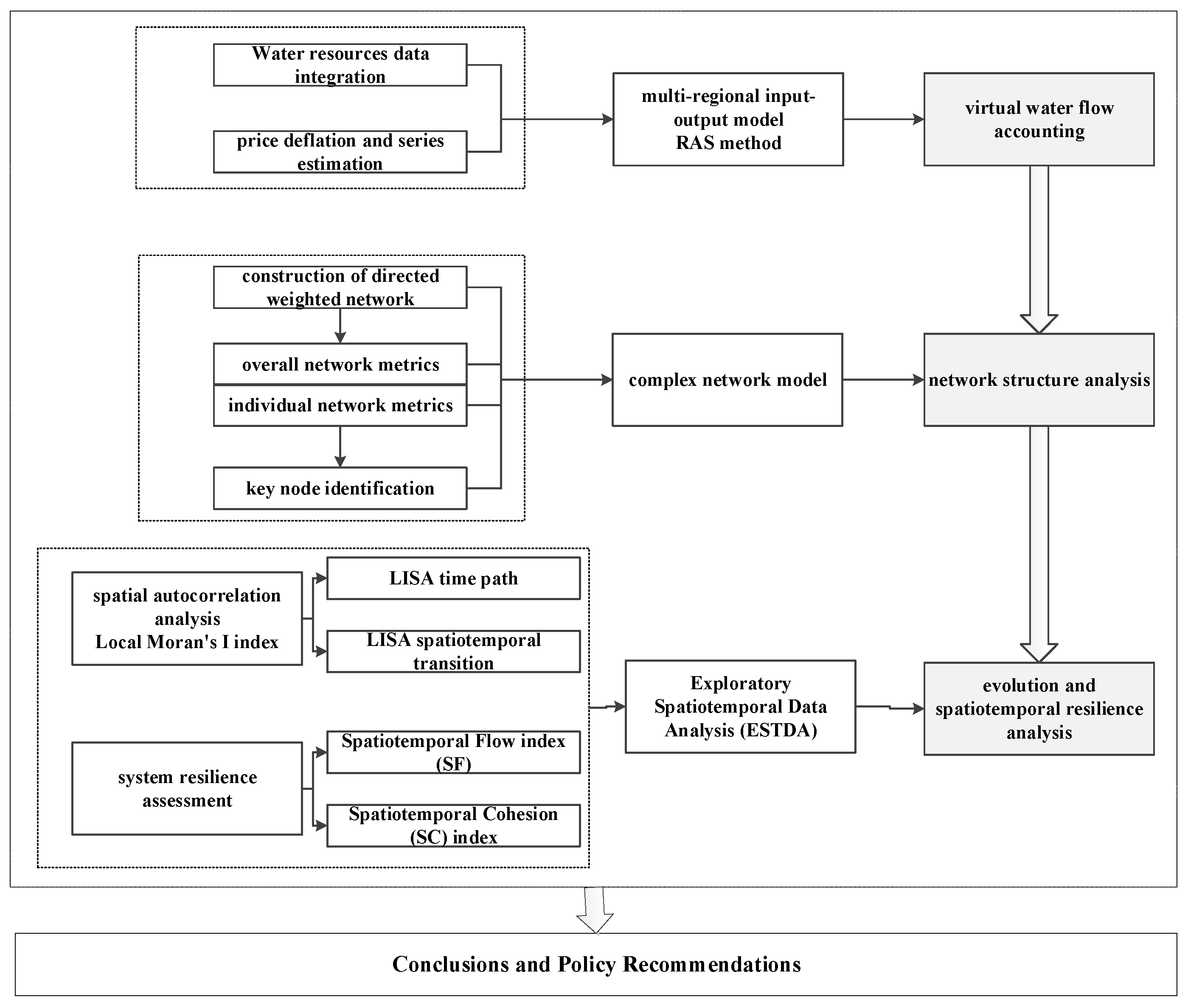
A suite of specialized software and programming environments was employed to support the study’s analytical framework. For virtual water flow accounting and basic calculations, including the computation of the interprovincial virtual water flow matrix, analysis of PageRank values, and calculation of relative length and curvature of LISA time paths, programming was implemented in MATLAB (R2021a). Complex network analysis was conducted using Gephi (0.9.2) software, a dedicated tool for complex network research. Spatial autocorrelation analysis, which involves identifying local spatial association types (HH, HL, LH, LL) and calculating the Local Moran’s I index, was completed using GeoDa (1.20) software, a widely applied tool in spatial statistical analysis. For visualization, Figure 2 (chord diagram of interprovincial virtual water flows) and Figure 5 (bubble diagram of weighted in-degree/out-degree and PageRank values of each province) were plotted using OriginPro (2022), while Figure 6 and Figure 7 (spatial distribution maps of relative length and curvature) were generated based on the ArcGIS Pro (3.0) platform, utilizing its spatial analysis and cartographic functions. The technical roadmap of this study is presented in Figure 1.
Figure 1. Technical Roadmap.
Sustainability 18 01090 g001

3. Results and Analysis

3.1. Analysis of Interprovincial Virtual Water Flow Patterns in China

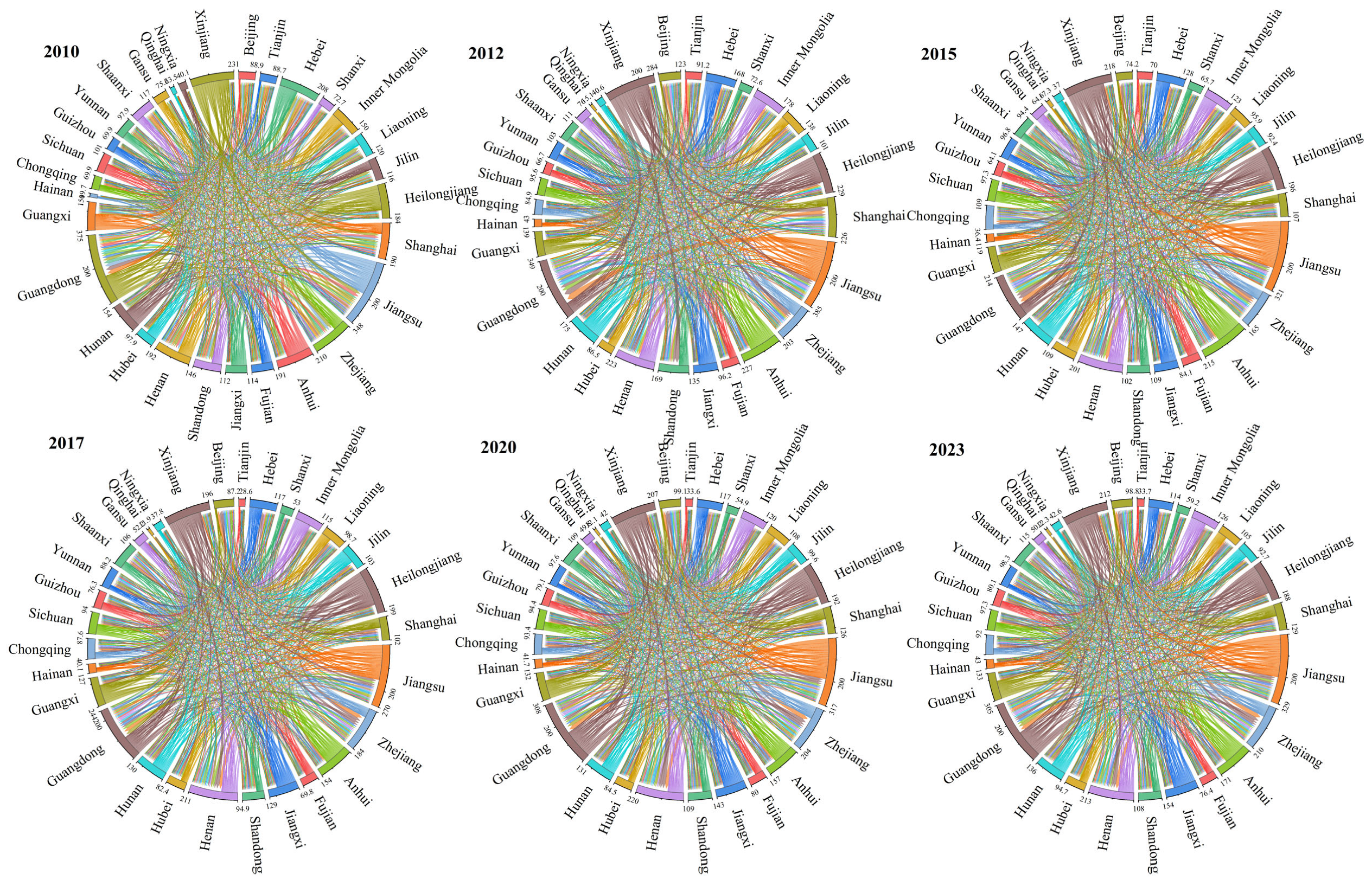
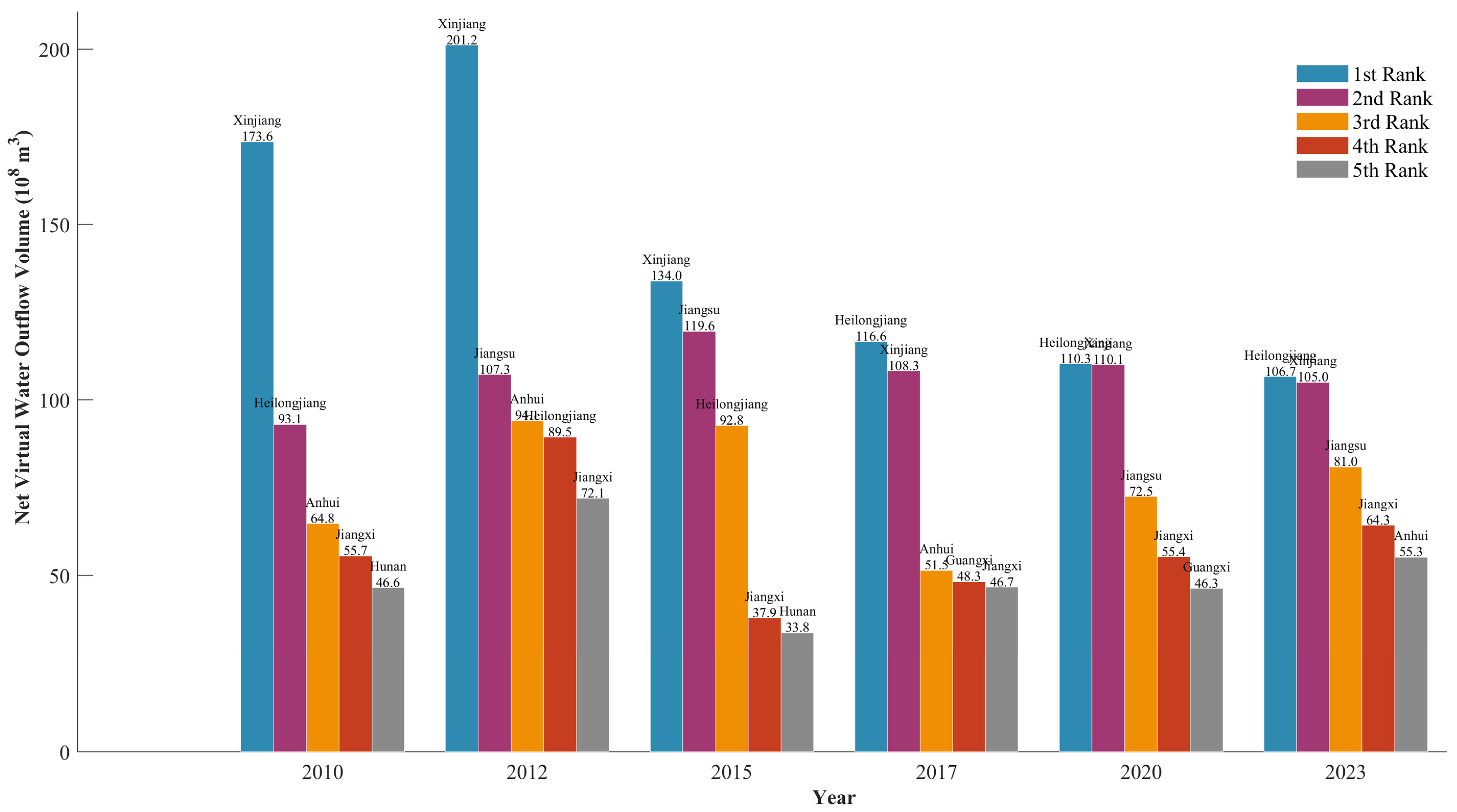
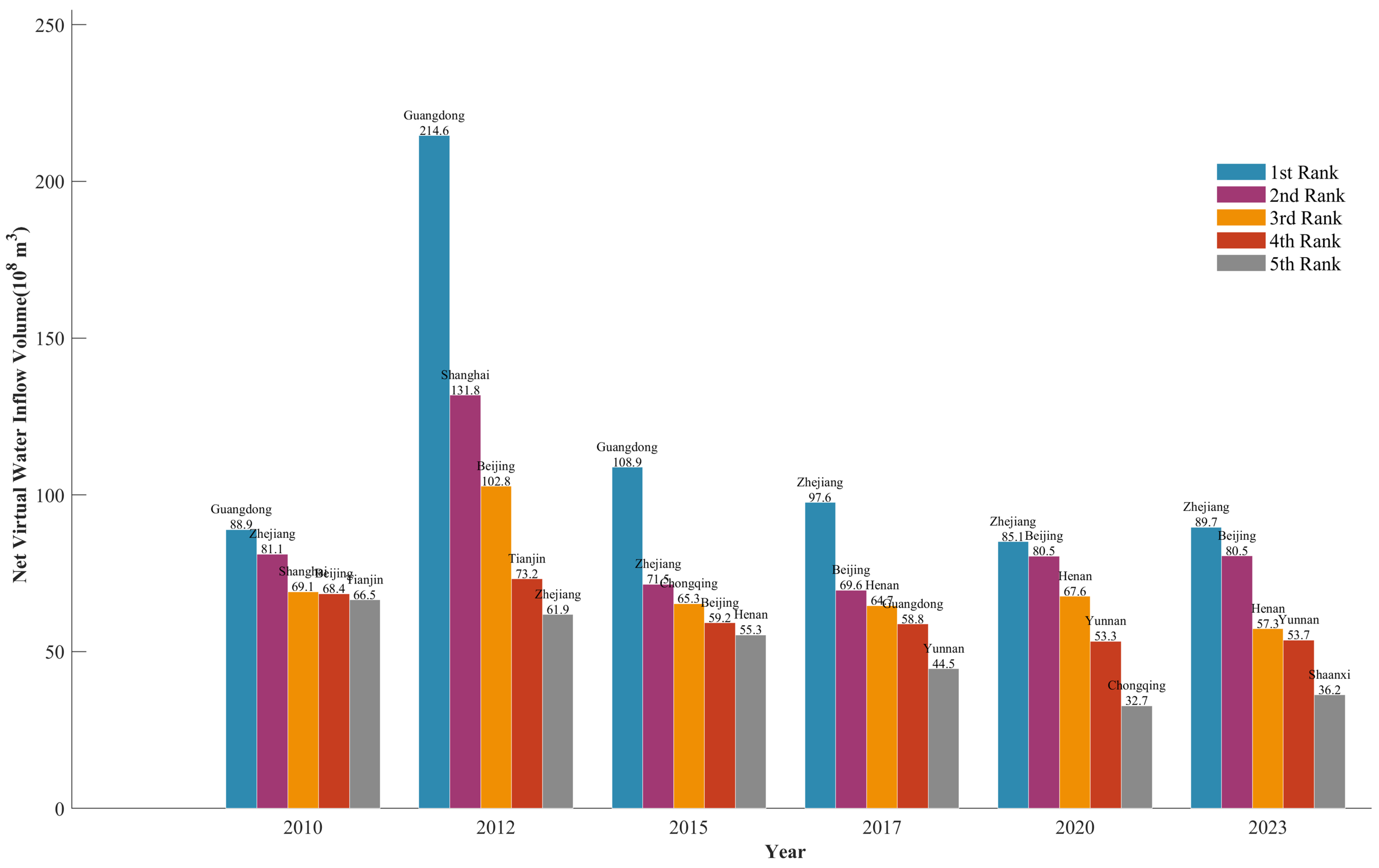
The virtual water flow matrix for China’s 30 provinces from 2010 to 2023 was calculated and summarized based on Equations (1) to (8). The rows and columns were aggregated to obtain the total inflow and outflow of virtual water for the 30 provinces across six years. Specific numerical results are presented in Table A1, and the visual network of interprovincial virtual water flows is shown in Figure 2. In order to present the changes in flow volume more clearly, Figure 3 and Figure 4 illustrate the top five provinces in terms of net outflow and net inflow of virtual water from 2010 to 2023.
Figure 2. Interprovincial Virtual Water Flow String Diagram.
Sustainability 18 01090 g002
Figure 3. Bar Chart of the Top Five Provinces in Terms of Virtual Water Net Outflow from 2010 to 2023.
Sustainability 18 01090 g003
Figure 4. Bar Chart of the Top Five Provinces in Terms of Virtual Water Net inflow from 2010 to 2023.
Sustainability 18 01090 g004
From the temporal evolution of total virtual water flows, both total inflows and outflows exhibited a pattern of “periodic fluctuations followed by structural optimization” from 2010 to 2023, closely aligning with the phased implementation of China’s water resource regulation policies. The period from 2010 to 2015 constituted an “expansion phase,” during which the national average total outflow of virtual water increased from 8.2 billion cubic meters to 9.15 billion cubic meters, while the average total inflow rose from 6.87 billion cubic meters to 7.51 billion cubic meters. This acceleration in regional economic integration was driven by the introduction of regional cooperation policies during the 12th Five-Year Plan period. Expanded interprovincial trade scale drove increased virtual water flows. For instance, Jiangsu’s total virtual water outflow surged from 18.82 billion cubic meters in 2010 to 24.59 billion cubic meters in 2012, representing a 30.7% increase. Xinjiang’s total virtual water outflow rose from 20.21 billion cubic meters in 2010 to 24.24 billion cubic meters in 2012, an increase of 20%. From 2015 to 2020, the period entered a “policy regulation phase.” Influenced by the 13th Five-Year Plan’s dual-control policy on water resource consumption volume and intensity, the flow scale tended to converge. The national average total outflow of virtual water decreased to 8.526 billion cubic meters, while the average total inflow of virtual water decreased to 7.23 billion cubic meters. High water-consuming provinces experienced a significant contraction in total outflow. For instance, Hebei’s total virtual water outflow decreased from 10.21 billion cubic meters in 2010 to 5.66 billion cubic meters in 2020, a 44.5% decline. The period from 2020 to 2023 represents a “Stabilization and Optimization Phase,” during which the average total inflow and outflow of virtual water stabilized at 7.36 billion cubic meters and 8.74 billion cubic meters, respectively, with fluctuations below 5%. This reflects the synergistic balance between post-pandemic economic recovery and water resource management. For example, Guangdong’s total outflow of virtual water decreased from 14.43 billion cubic meters in 2020 to 13.87 billion cubic meters in 2023, a 3.8% decline, demonstrating a shift in virtual water flows from a “scale-oriented” to an “efficiency-oriented” approach.
From a regional perspective, the spatial differentiation of total virtual water outflow and inflow exhibits distinct characteristics, revealing a “core–periphery” structure that is highly correlated with provincial resource endowments and industrial structures. Provinces with high virtual water outflows form a tripartite pattern spanning East China, Northeast China, and Northwest China: In 2023, Jiangsu Province in East China recorded a total virtual water outflow of 20.51 billion cubic meters, while Anhui Province reached 11.29 billion cubic meters. These regions have long served as core virtual water exporters, primarily driven by manufacturing and high-value-added agriculture. In 2023, Heilongjiang Province in Northeast China recorded a total outflow of virtual water at 14.72 billion cubic meters, while Jilin Province reached 5.48 billion cubic meters. As major grain-producing regions, agricultural water consumption underpins stable virtual water exports. Heilongjiang maintained an average annual virtual water outflow of 14.99 billion cubic meters from 2010 to 2023, with fluctuations of only 7.3% during the study period, reflecting the rigid export characteristics of virtual water driven by grain production. In 2023, Xinjiang in Northwest China recorded a total outflow of virtual water at 15.87 billion cubic meters. Leveraging its specialty agriculture (e.g., cotton, forest fruits), Xinjiang consistently ranked among the top regions for outflow volume. Its average total virtual water outflow from 2010 to 2023 reached 17.83 billion cubic meters, establishing it as the primary virtual water export hub in Northwest China. Provinces with high virtual water inflow are highly concentrated in eastern coastal regions and core urban clusters in North China. In 2023, Guangdong in South China recorded a total virtual water inflow of 16.6 billion cubic meters. As China’s largest economy, its average inflow from 2010 to 2023 reached 18.64 billion cubic meters, consistently ranking first nationally. Its massive population and industrial demands drive substantial virtual water inflows; In East China, Zhejiang Province recorded 14.97 billion cubic meters of virtual water inflow in 2023, while Shanghai reached 7.23 billion cubic meters. Leveraging industrial synergy within the Yangtze River Delta, their total inflow volumes have shown steady growth. In North China, Beijing’s virtual water inflow totaled 8.96 billion cubic meters in 2023, and Tianjin’s reached 2.51 billion cubic meters. As megacities with limited water resources, Beijing and Shanghai exhibit pronounced virtual water import-export imbalances. Beijing’s average annual virtual water inflow from 2010 to 2023 reached 8.6 billion cubic meters—9.4 times its average annual outflow (916 million cubic meters)—demonstrating a classic “strong inflow, weak outflow” pattern.
From the dynamic evolution of key provinces, the coupling effects between the role of virtual water flows and policy interventions or industrial transformation are significant in some regions. For instance, Henan—a major agricultural and industrial province in central China—saw its total virtual water inflow rise from 11.39 billion cubic meters in 2010 to 14.39 billion cubic meters in 2020, marking a 26.4% increase. This figure slightly decreased to 13.49 billion cubic meters in 2023. This shift correlates with industrial demand spurred by the “Central Plains Economic Zone” initiative and partial relief of physical water pressure from the South-to-North Water Diversion Project’s Central Route, demonstrating synergy between virtual water inflows and physical water allocation. Chongqing, a municipality in western China, saw its total virtual water inflow peak at 8.69 billion cubic meters in 2015—a 101.0% increase from 4.32 billion cubic meters in 2012. Subsequently, it declined to 6.22 billion cubic meters in 2023, closely aligning with Chongqing’s process of receiving industrial transfers from the east around 2015 and its subsequent industrial upgrading. Additionally, western provinces like Qinghai and Ningxia consistently maintain a low inflow-low outflow pattern. Qinghai’s average total inflow from 2010 to 2023 was only 940 million cubic meters, while its average total outflow was just 630 million cubic meters. This reflects their smaller economic scale and low trade connectivity, with a pronounced “path dependence” effect in virtual water flows.

3.2. Topological Characteristics and Key Node Identification in Virtual Water Flow Network Structures

Network metrics for the period 2010–2023 were calculated using Gephi software, with specific results presented in Table 4. The evolution of the network structure was systematically analyzed across four dimensions—network density, average shortest path length, clustering coefficient, and transitivity—and combined with key milestones from China’s 12th, 13th, and 14th Five-Year Plans to reveal the phased evolution patterns of the network structure driven by policy interventions.
During the 12th Five-Year Plan period (2010–2015), network density showed a sustained upward trend, rising from 0.392 to 0.479 with an average annual growth rate of approximately 3.5%. This reflects strengthened virtual water trade linkages driven by deepened regional economic cooperation and increased interprovincial trade activity during this phase. Entering the 13th Five-Year Plan period, network density experienced a notable correction between 2016 and 2017, declining from 0.453 in 2016 to 0.423 in 2017, subsequently fluctuating within a narrow range between 0.420 and 0.424. This shift is closely associated with the dual-control policy on water resources (a water-specific policy limiting total volume and intensity) implemented during the 13th Five-Year Plan period, which partly imposed structural constraints. It also aligns with concurrent factors, including macroeconomic slowdown and supply-side structural reform (a general industrial policy unrelated to water, e.g., capacity reduction in steel/cement), while the later COVID-19 pandemic had no impact on this phase, jointly driving the network from “broad expansion” toward “quality optimization.” The average shortest path length showed an overall shortening trend throughout the study period, decreasing from 1.679 in 2010 to 1.537 in 2023, demonstrating continuous improvements in virtual water flow efficiency. During the mid-to-late 12th Five-Year Plan period (2012–2015), the average path length fluctuated slightly (1.521 → 1.525), reflecting structural reorganization in regional cooperation. By 2016, the early stage of the 13th Five-Year Plan, the average path length further decreased to 1.500, indicating the gradual emergence of infrastructure improvements and logistics system optimizations in facilitating interprovincial virtual water flows. By the early 14th Five-Year Plan period (2021–2022), this indicator stabilized between 1.549 and 1.552, marking the network efficiency entering a high-level steady phase. Throughout the study period, the average clustering coefficient exhibited a sustained upward trend, rising from 0.624 in 2010 to 0.694 in 2023—an increase of approximately 11.2%—indicating continuously strengthening local clustering within the virtual water flow network. Specifically, during the Twelfth Five-Year Plan period, the clustering coefficient increased from 0.624 to 0.685, reflecting the initial formation of regional bloc structures. During the 13th Five-Year Plan period, it further increased from 0.649 in 2016 to 0.685 in 2020, indicating strengthened internal connections within urban agglomerations. After entering the 14th Five-Year Plan period, this indicator fluctuated narrowly within the high range of 0.694–0.695, suggesting a mature and stable network structure. The transmissibility indicator also showed a steady upward trend throughout the study period, rising from 0.750 in 2010 to 0.772 in 2023. During the 12th Five-Year Plan period, transmissibility increased from 0.750 to 0.804, indicating enhanced reciprocity in interprovincial virtual water flows. A slight decline occurred during the 13th Five-Year Plan period, dropping to 0.772 in 2020, reflecting adaptive adjustments in network structure under policy regulation. In the early stages of the 14th Five-Year Plan, this indicator fluctuated between 0.772 and 0.785, indicating that the network’s triangular closure and stability remain at a high level under the new policy environment.
The evolution trajectories of the four indicators reveal that the structural development of China’s interprovincial virtual water flow network exhibits distinct characteristics corresponding to key policy phases, showing clear phased response patterns. During the 12th Five-Year Plan period, the network was primarily characterized by scale expansion and strengthened connectivity, with simultaneous increases in network density, clustering coefficient, and transmissibility. During the 13th Five-Year Plan period, guided by dual-control policies, network density moderated while clustering coefficient and transmissibility continued to rise, reflecting a shift from quantitative growth to qualitative improvement in virtual water flows. In the early stages of the 14th Five-Year Plan, all indicators stabilized, indicating the network structure has entered a phase of high-level optimization, with simultaneous enhancements in the efficiency and stability of spatial water resource allocation.

3.3. Combined with PageRank Analysis

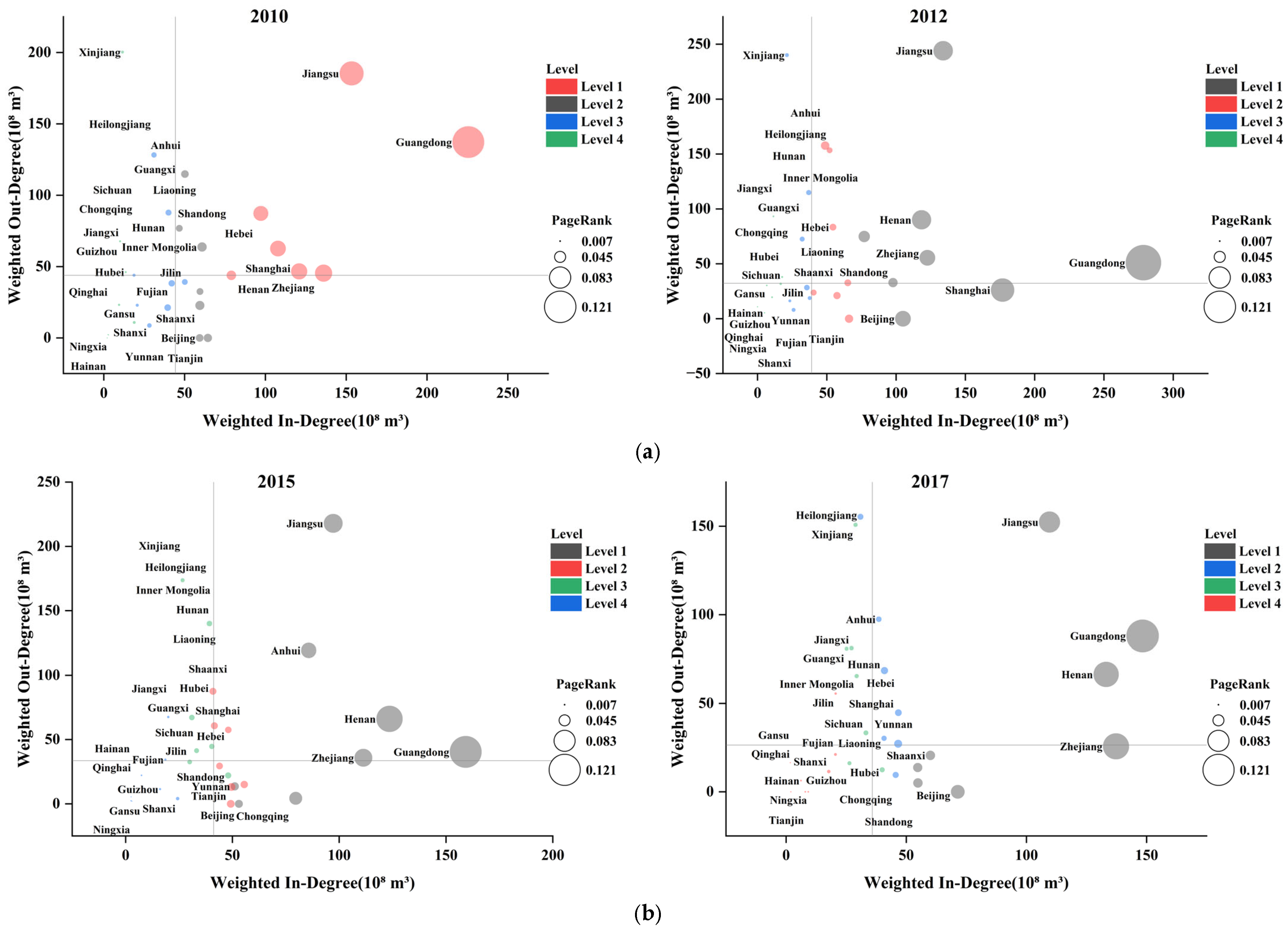
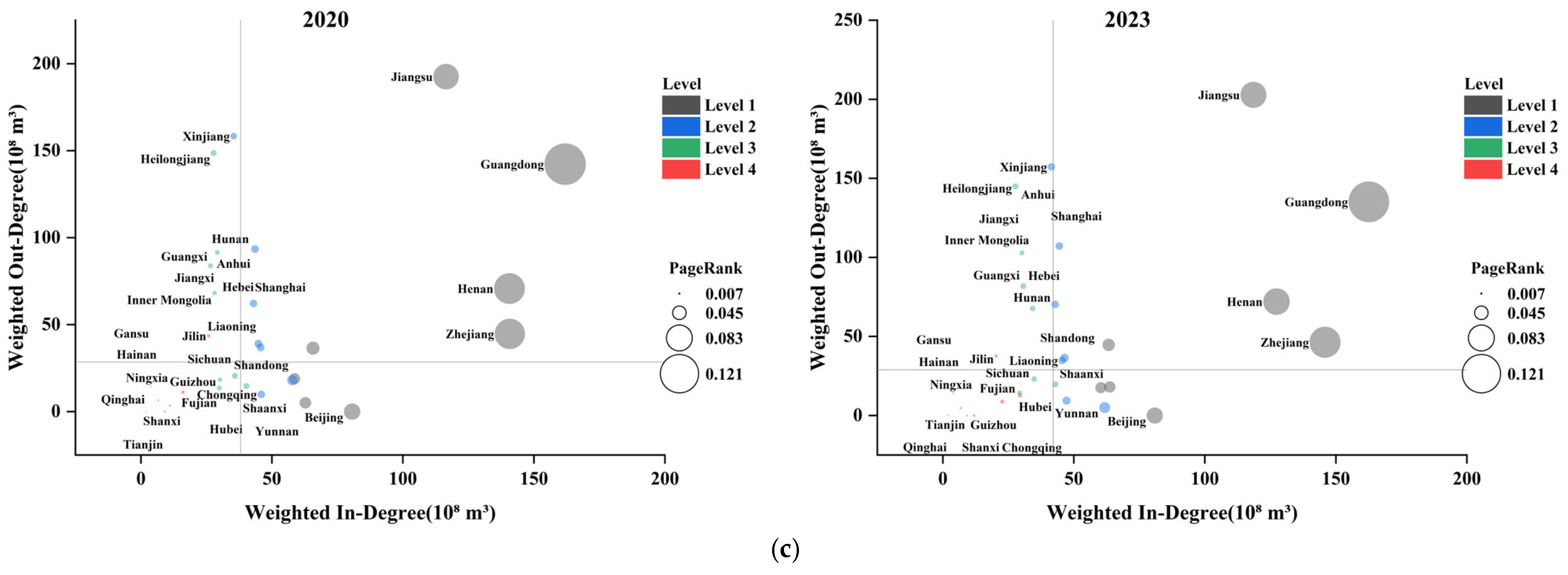
Based on interprovincial virtual water trade data from six representative years spanning 2010–2023, this study examines the evolution patterns of the network’s overall structure at the macro level (due to the removal of 60% of weak links as described in Section 2.2). Beijing and Tianjin exhibit zero weighted out-degree in multiple years. By integrating weighted in-degree, weighted out-degree, and PageRank values (indicating node influence), we reveal the systemic characteristics and spatial dependency patterns of virtual water flows [22]. Figure 5a, Figure 5b, and Figure 5c, respectively, display the weighted in-degree, weighted out-degree, and PageRank values for provinces during the periods 2010–2012, 2015–2017, and 2020–2023, respectively. The median (to mitigate the influence of extreme values) serves as the central point, while PageRank values are categorized into four tiers using quartiles to identify provinces with greater influence and special status.
Examining the evolution of the overall network structure from a macro perspective reveals that the virtual water trade network exhibits pronounced structural asymmetry. This asymmetry manifests not only in significant disparities in flow volumes across provinces but also in a stable and entrenched “core–periphery” spatial pattern. Provinces with substantial virtual water flows are highly concentrated in a few coastal and economically developed regions. Guangdong, Jiangsu, Zhejiang, Henan, and Shanghai have long dominated both inflows and outflows (with PageRank values around 0.1). Taking 2023 as an example, the weighted in-degree sum of the top five provinces by PageRank accounted for an extremely high proportion of the national total, revealing an extremely uneven distribution of flows. Conversely, provinces like Qinghai, Gansu, Ningxia, and Hainan consistently exhibit extremely low virtual water flows. Their weighted in-degree and out-degree values approach zero or remain negligible in multiple years, with PageRank values persistently below 0.01. These provinces remain marginalized within the network, exhibiting minimal participation. Over the fourteen-year observation period, despite short-term fluctuations in rankings for individual provinces—such as Henan rising from 4th to 2nd place in 2015—the composition of provinces in the network’s core and peripheral layers remained relatively stable. It is evident that core provinces exhibit persistently high PageRank values, while peripheral provinces struggle to achieve substantial breakthroughs. This reflects the network structure’s strong path dependency and lock-in effects, with the core–periphery structure tending toward increasing solidification.
The core logic behind PageRank’s preference for consumption-oriented hubs is that it measures node influence based on two key factors—“number of incoming links” and “importance of incoming nodes” [25]—rather than mere outflow volume. Consumption hubs like Guangdong and Zhejiang receive inflows from numerous production hubs and corridor nodes, and these multi-source connections, supported by important nodes, boost their influence values. In contrast, resource-rich supply provinces such as Xinjiang and Heilongjiang have large outflows but few incoming links—their virtual water mostly flows to a limited number of consumption hubs, resulting in limited connections with high-influence nodes. This explains why high outflow does not equal strong PageRank influence: the algorithm prioritizes the breadth and quality of incoming connections over one-way supply capacity. From the perspective of systematic differentiation in node functional roles, provinces within the network cluster into distinct categories based on their functions, forming a clear spatial division of labor. Consumption-oriented hubs in eastern coastal regions like Guangdong, Zhejiang, and Shanghai possess substantial virtual water absorption capacity, coupled with significant outflows, yet exhibit overall net inflows. With exceptionally high PageRank values, they serve as absolute centers of the network, aggregating and redistributing virtual water resources through powerful economic attraction, thereby dictating overall flow directions. Another category, including production-supply hubs like Jiangsu, Xinjiang, Heilongjiang, and Inner Mongolia, is characterized by high out-degree and medium-to-low in-degree, making them primary net exporters of virtual water. Jiangsu maintains a high PageRank value due to its massive economic scale. In contrast, agriculturally resource-rich regions like Xinjiang and Heilongjiang, despite their substantial exports, exhibit relatively low PageRank values, suggesting limitations in their network influence as upstream suppliers. Additionally, some central provinces like Anhui, Hubei, and Hunan function as corridor nodes with relatively balanced in-degree and out-degree, exhibiting moderate PageRank values. They serve as transit points connecting core consumption areas with resource-producing regions within the network. Isolated nodes such as Qinghai, Gansu, and Hainan, however, remain at the periphery of the network system due to their minimal virtual water trade volume and low influence. Spatially, consumption hubs are highly concentrated in the Yangtze River Delta, Pearl River Delta, and Beijing-Tianjin-Hebei metropolitan areas. Production supply hubs predominantly cluster in resource-rich regions of Northeast and Northwest China. Corridor nodes are concentrated in central areas, while isolated nodes are scattered across the west. Collectively, this forms a distinct geographic structure progressing from core regions through transitional zones to peripheral areas.
During the evolution of the network, the Matthew Effect has continuously intensified, with the attractiveness and influence of core provinces remaining robust despite fluctuations. Although provinces like Henan and Chongqing experienced brief ranking surges in 2015, the PageRank values of core provinces such as Guangdong, Jiangsu, and Zhejiang have largely stabilized at high levels, indicating a persistent concentration of network resources toward dominant nodes. On the other hand, Beijing and Tianjin exhibited zero weighted out-degree in multiple years, highlighting the high external dependency of consumption nodes. Their water security relies almost entirely on external inputs, constituting a systemic risk that cannot be ignored. Regional policies such as the Central Plains Economic Zone plan and the Chengdu–Chongqing urban cluster development may trigger short-term data fluctuations, yet they struggle to fundamentally alter provinces’ long-term relative positions within the network. This demonstrates the formidable resilience of network structures shaped by macroeconomic geography and resource endowments, where policy shocks often yield only temporary impacts.
Figure 5. (a): Provincial Virtual Water Weighted Outflow/Inflow Ratios and PageRank Values, 2010–2012. (b): Provincial Virtual Water Weighted Outflow/Inflow Ratios and PageRank Values, 2015–2017. (c): Provincial Virtual Water Weighted Outflow/Inflow Ratios and PageRank Values, 2020–2023. Note: The gray cross lines (the “cross” structure) are drawn with the as the central point, dividing the coordinate plane into four quadrants. This division is designed to highlight the network status of each province in the virtual water flow network, and the median is adopted here to avoid interference from extreme values.
Sustainability 18 01090 g005aSustainability 18 01090 g005b

3.4. Spatio-Temporal Dynamics of Virtual Water Inflows and Outflows Across Chinese Provinces

The aforementioned virtual water flow network analysis reveals the static structural characteristics of virtual water flows from the perspectives of overall topology and key nodes. To further explore the dynamic evolution of its spatial correlation patterns, this study employs an Exploratory Spatio-Temporal Data Analysis (ESTDA) framework. It systematically characterizes the spatio-temporal dynamics of total inflow and outflow of virtual water across Chinese provinces from 2010 to 2023, examining both spatio-temporal pathways and spatio-temporal transitions. To characterize the local spatial dynamics of China’s provincial virtual water outflows and inflows from 2010 to 2023, we first identified the local spatial association types (HH/HL/LH/LL) for each province in each year using the local Moran’s I index (significance level p < 0.05) based on the Rook adjacency spatial weight matrix, and extracted the LISA coordinates for each province. Building upon this foundation, LISA time paths were constructed. The dynamic nature of local spatial structures was quantified using relative length (Γᵢ) and curvature (Dᵢ) to trace provincial evolutionary trajectories.

3.4.1. Spatio-Temporal Dynamics of Virtual Water Flow Between Chinese Provinces

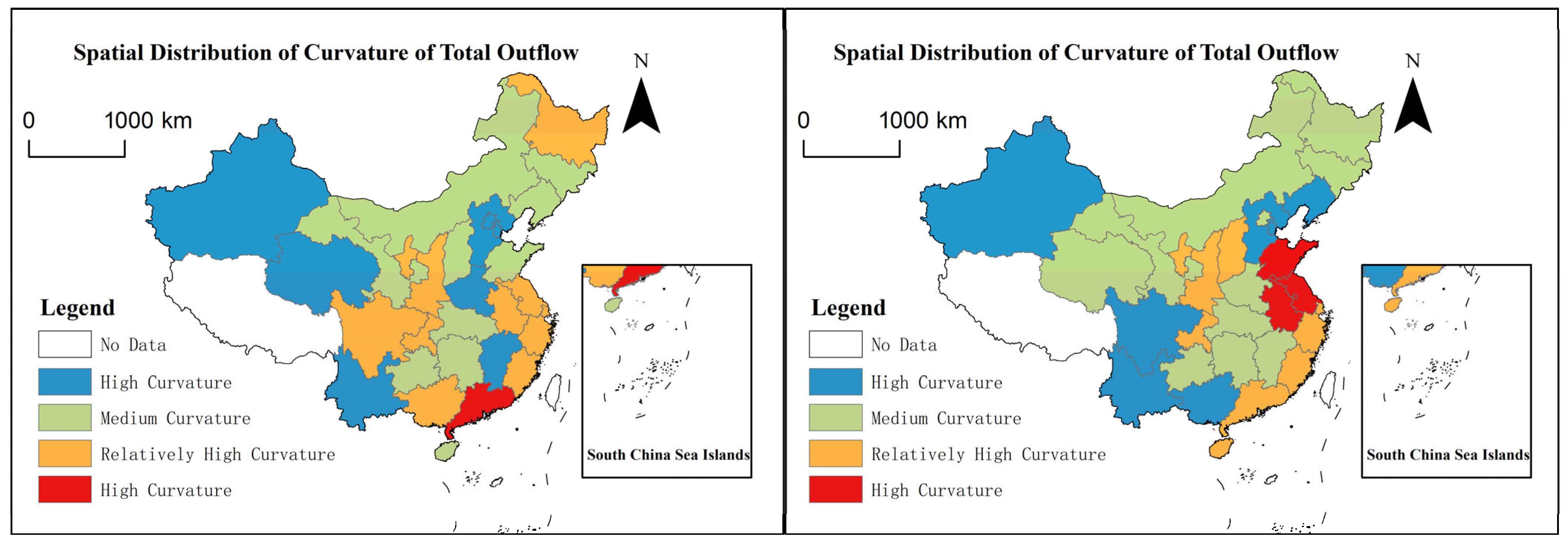
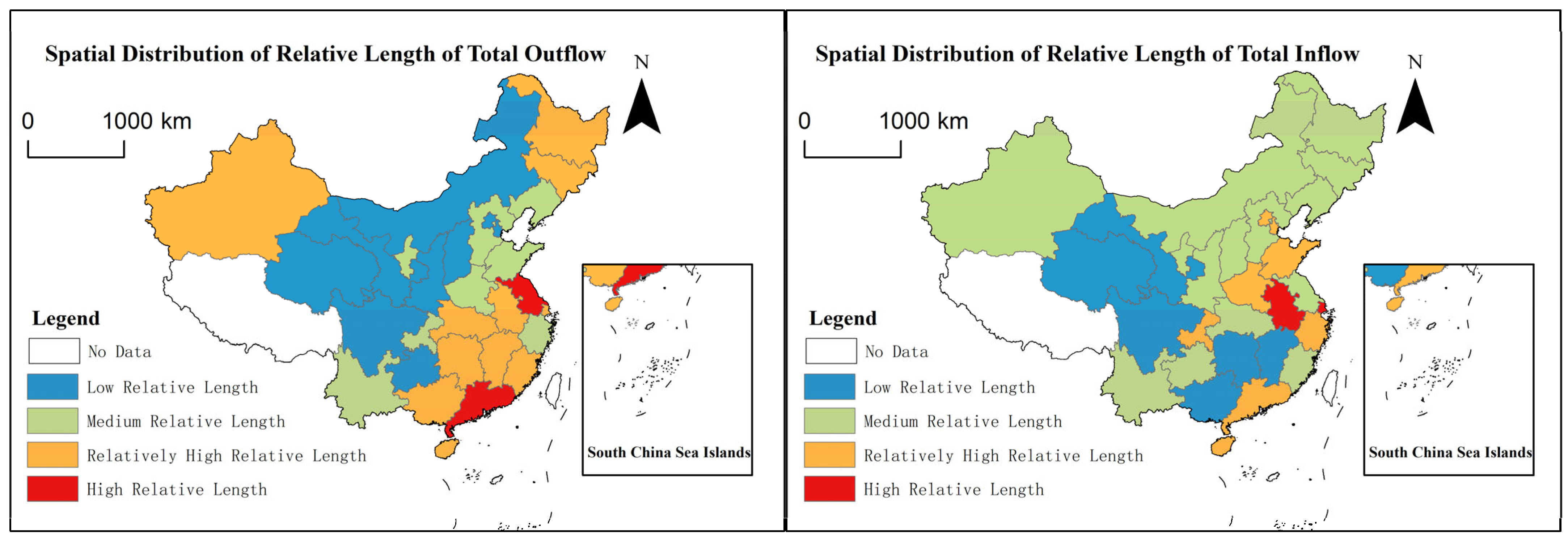
Using Equations (10) and (11), the relative length and curvature of total virtual water inflows and outflows were calculated for six time points between 2010 and 2023. These values were categorized into four classes using ArcGIS’s natural breakpoint method: low relative length, medium relative length, higher relative length, and high relative length. The spatial distribution maps of relative length and curvature for Chinese provinces, visualized from the calculated results, are shown in Figure 6 and Figure 7.
(1)
The temporal dynamics of virtual water outflow are significantly higher than those of inflow
In terms of relative length, the overall dynamics of total virtual water outflow are stronger, with specific values shown in Table 5. The average relative length at the outflow end is 1.02, while that at the inflow end is 0.95. This indicates that spatial structural adjustments on the “production side” of virtual water are more active than those on the “consumption side.” This aligns with China’s regional industrial transfer and resource allocation optimization processes, where adjustments in production layout directly drive the restructuring of virtual water outflow patterns. Provinces with high relative length and high curvature are concentrated in the transition zone between North China and Central China. These regions are predominantly major agricultural provinces or industrial bases, where virtual water outflows are susceptible to policy and climate influences, and spatial relationships are unstable. Provinces with high relative length also include economically vibrant coastal provinces like Guangdong and Zhejiang, likely due to trade structure upgrading and shifts in resource demand sources. Provinces with medium-to-low relative length and curvature are predominantly located in Northwest, North, and Southwest China. These regions exhibit single resource endowments and fixed economic structures, resulting in highly stable virtual water flow pathways. This spatial differentiation stems from the long-term interplay of natural endowments, national strategies, regional industrial policies, and market forces. Comparing LISA time paths with PageRank values reveals that provinces with high PageRank hub status also exhibit high relative length and curvature. This indicates active local spatial restructuring at network core nodes, demonstrating a positive correlation between “network centrality” and “spatiotemporal dynamics.” It reveals that core nodes serve not only as flow hubs but also as primary drivers of spatial pattern evolution.
(2)
Identification of Spatiotemporal Dynamic Characteristics in Key Provinces
From the outflow perspective, provinces such as Guangdong (3.50), Jiangsu (2.32), Fujian (1.80), and Heilongjiang (1.69) exhibit exceptionally high relative lengths, indicating a significant restructuring of their virtual water output patterns. Notably, Guangdong’s relative length value far exceeds that of other provinces, closely linked to industrial transformation and upgrading in the Pearl River Delta region and adjustments in its virtual water output structure. Provinces like Guangdong (29.58), Ningxia (11.69), Anhui (6.09), and Guangxi (6.07) exhibit exceptionally high curvature values. Guangdong’s curvature of 29.58 indicates an extremely convoluted virtual water export pathway, strongly influenced by spatial dependency effects from neighboring provinces. From the inflow perspective, provinces like Shanghai (2.71), Anhui (1.98), Chongqing (1.80), and Zhejiang (1.68) exhibit higher relative lengths. This indicates substantial shifts in the spatial linkage patterns of these regions as virtual water importers, reflecting adjustments in consumption demand structures and source locations. Provinces such as Shandong (8.18), Anhui (6.68), and Jiangsu (6.04) exhibit higher curvature values. As hubs for virtual water imports, the shifts in consumption patterns within these regions are influenced by complex regional interactions.
(3)
Spatial–Temporal Evolutionary Differences in Regional Agglomeration Patterns
The Yangtze River Delta region (Shanghai, Jiangsu, Zhejiang) and the Pearl River Delta region (Guangdong) exhibit high dynamism at both the outflow and inflow ends, reflecting these economically developed areas’ pivotal role as core hubs within the virtual water flow network and their ongoing spatial restructuring processes. These regions serve as both major consumption centers for virtual water and key nodes for the export of virtual water associated with technology-intensive products. Central provinces like Henan, Hubei, and Hunan exhibit moderate relative length and curvature, indicating gradual adjustments in their virtual water flow patterns during the process of receiving industrial transfers from the east, with relatively stable spatial structural changes. Western provinces like Guizhou, Shaanxi, and Gansu exhibit low relative lengths (most below 0.7) and moderate curvature, reflecting strong stability and path dependence in their virtual water flow patterns, with relatively slow spatial restructuring. The distribution of highly dynamic provinces aligns closely with China’s key regions for industrial restructuring. The high relative length values of coastal provinces like Guangdong and Jiangsu directly reflect the spatiotemporal effects of their “replacing old industries with new ones” industrial policies, where virtual water exports have shifted from water-intensive traditional industries to low-water-consumption high-tech industries. The relatively stable spatiotemporal trajectory in central China reflects the consolidation and reinforcement of these regions’ role as hubs for virtual water “production and transmission” under the strategy to promote the rise in central China. Their spatial patterns maintain relative stability amid ongoing optimization.
Figure 6. Spatial Distribution of Total Inflow/Total Outflow Curvature.
Sustainability 18 01090 g006
Figure 7. Spatial Distribution of Relative Lengths of Total Outflow/Total Inflow.
Sustainability 18 01090 g007

3.4.2. Temporal-Spatial Migration Analysis

Based on the spatiotemporal transition matrix of local Moran’s I for China’s provincial-level total inflow and outflow of virtual water from 2010 to 2023, this study employs a probabilistic approach to deeply analyze the evolutionary characteristics and systemic resilience of virtual water flow patterns. Table 6 presents the spatio-temporal transition matrix of China’s provincial-level total inflow and outflow of virtual water from 2010 to 2023. Based on this matrix, we further examine the spatio-temporal evolution of spatial association patterns in China’s provincial-level virtual water flows.
The spatio-temporal transition matrix reveals that Type0 accounts for the highest proportion in both total outflow and total inflow of virtual water, reaching 47% in each case. This finding indicates that during the five observation periods from 2010 to 2023, nearly half of the provinces maintained stable local spatial association types, demonstrating a strong path-dependent characteristic in the spatial pattern of virtual water flows. Type2 accounted for 38% of total virtual water inflows and 39% of total outflows, significantly higher than Type1’s 6% and 4%, respectively. This distribution pattern reveals a key phenomenon: the spatial reorganization of virtual water flows manifests more as collective adjustments within neighboring environments than isolated changes in individual provinces, reflecting characteristics of regional co-evolution. Spatio-temporal cohesion (SC = 0.56) in total virtual water outflows significantly exceeded spatio-temporal flow (SF = 0.44), indicating robust stability in the local spatial structure of virtual water production. This resilience likely stems from the relative fixity of agricultural production patterns and water-intensive industries, endowing virtual water export patterns with strong spatial inertia. Total virtual water inflows similarly exhibit SC (0.57) > SF (0.43), though Type3 accounts for a slightly higher proportion than outflows (11% vs. 9%), reflecting relatively more active spatial pattern adjustments at the consumption end. This moderate fluidity likely correlates closely with economic development levels, consumption structure upgrades, and dynamic adjustments in trade partnerships.
The relative mobility rates for both total outflow and total inflow of virtual water were 0.17. This low value indicates that China’s interprovincial virtual water spatial patterns did not undergo drastic, disruptive restructuring between 2010 and 2023, but rather were characterized primarily by incremental, marginal adjustments. This evolutionary pattern aligns with the gradual nature of China’s water resource management systems and economic restructuring. HH-type clusters exhibited strong stability, with maintenance probabilities exceeding 70% for both total outflow and inflow, reflecting the core stability of virtual water flow patterns. The “lock-in effect” was pronounced in LL-type clusters: the retention probabilities for low-low aggregation reached 0.92 (total outflow) and 0.91 (total inflow), indicating a more solidified spatial linkage pattern in cold-spot regions. The relatively low mobility rate (p = 0.17) aligns closely with the continuity of China’s regional development strategies during the 12th and 13th Five-Year Plans. The incremental adjustment of virtual water flow patterns reflects the synchronized advancement of water resource allocation optimization and coordinated regional economic development.

4. Research Findings and Policy Recommendations

4.1. Research Findings

This study systematically examines the interprovincial virtual water flows in China from 2010 to 2023 by integrating multi-regional input–output modeling, complex network analysis, and exploratory spatiotemporal data analysis. The principal findings are as follows:
(1)
The scale of virtual water flows exhibited a distinct three-phase evolution: an “expansion phase” (2010–2015) that accompanied deepened regional integration, a “policy regulation phase” (2015–2020) characterized by convergence, which corresponded to the period of the dual-control policy on water resources, and a “stabilization and optimization phase” (2020–2023). Spatially, a stable “core–periphery” structure emerged, with eastern coastal and North China urban clusters acting as primary input hubs, and East, Northeast, and Northwest China serving as key output regions.
(2)
Corresponding to these flow dynamics, the virtual water flow network became progressively tighter and more segmented. Key topological metrics indicated enhanced connectivity and efficiency: network density and transitivity increased, while the average shortest path length decreased. The rising clustering coefficient signaled the formation of tightly knit regional subgroups. PageRank analysis revealed significant Matthew effects and structural lock-in, with core provinces (Guangdong, Jiangsu, Zhejiang) maintaining dominant influence while peripheral provinces (Qinghai, Gansu) remained marginalized.
(3)
LISA time path analysis indicated that while most provinces exhibited stable local spatial structures, certain key nodes (Guangdong, Jiangsu) demonstrated high spatiotemporal dynamism, characterized by elevated relative length and curvature. This suggests their heightened sensitivity to policy adjustments, industrial transformation, and regional interactions.
(4)
The system demonstrated considerable overall resilience. LISA spatiotemporal transition analysis showed that Type0 transitions (no change in local spatial type) accounted for 47% of all observations. The fact that Type2 transitions significantly outnumbered Type1 (own change) underscores that spatial reorganization is often a coordinated process within regional neighborhoods, rather than an isolated provincial phenomenon.

4.2. Policy Recommendations

Based on the above findings, the following policy recommendations are proposed to optimize the spatial allocation of water resources and enhance the sustainability of virtual water flows:
(1)
Implement Node-Specific Management within the Virtual Water Network. Governance should be tailored to the distinct functions of different network nodes. For core consumption hubs (Guangdong, Zhejiang), promote demand-side management and industrial upgrading towards lower water-intensity sectors. For major production-supply hubs (Xinjiang, Heilongjiang), strengthen ecological compensation and water-saving incentives to ensure the sustainability of their virtual water exports. This approach addresses the observed functional differentiation and structural lock-in.
(2)
Adopt Differentiated Regional Strategies Based on Spatiotemporal Dynamics. For highly dynamic provinces (Guangdong, Jiangsu), establish real-time monitoring and early warning systems to preempt risks from sudden shifts in virtual water pathways. For stable, low-dynamic western provinces, policies should focus on overcoming path dependence by fostering specialized industries and improving regional connectivity to integrate them more effectively into the national network.
(3)
Enhance Institutional Resilience through Market-Government Coordination. Deepen the reform of water rights trading and cross-regional ecological compensation mechanisms. Establishing a virtual water compensation framework at the basin and regional levels can help clarify the responsibilities of producers and consumers, creating a fairer virtual water trade order. This aligns with the finding that systemic resilience is high but can be bolstered by addressing the inherent external dependencies of consumption hubs.
(4)
Integrate Virtual Water Flows into Major Regional Development Strategies. In national strategies like the Yangtze River Delta integration and the Guangdong-Hong Kong-Macao Greater Bay Area development, industrial planning should explicitly account for the evolution of virtual water flow patterns. Encouraging technological spillovers and industrial cooperation from eastern to central and western regions can help improve water use efficiency nationwide, thereby mitigating the spatial imbalances identified in the “core–periphery” structure.

Author Contributions

All authors contributed to the study concept and design. Conceptualization, validation, methodology, and supervision, Q.S.; software, investigation, data curation, and writing—original draft preparation, H.C.; resources, writing—review and editing, and visualization, C.Y. All authors have read and agreed to the published version of the manuscript.

Funding

This research was funded by National Social Science Fund of China, Major Project “Theoretical and Practical Research on Synergistic Advancement of Carbon Reduction, Pollution Control, Green Expansion, and Economic Growth” (24ZDA094); National Social Science Fund General Project: “Research on the Three-Dimensional Interlinkages and Synergistic Regulation of Industry-Related Water-Energy-Carbon Full Footprints in New-Era China” (22BJY130); Major Philosophy and Social Science Research Project of Jiangsu Universities: “Research on the Complex Interconnections and Coordinated Advancement of the Digital Economy and High-Quality Development in the Yangtze River Delta in the New Era” (2022JSZDA094); Jiangsu Provincial Federation of Philosophy and Social Sciences (JSPA), Major Applied Research Project “Research on Coordinating Carbon Footprint Certification and Green Electricity Traceability to Promote Green Productivity Development in Jiangsu Province” (24WTA-011); Jiangsu Province “Blue Project” for Universities (JS20240081).

Institutional Review Board Statement

Not applicable.

Informed Consent Statement

Not applicable.

Data Availability Statement

Data used in this study are available from the corresponding author upon reasonable request.

Conflicts of Interest

The authors declare no conflicts of interest.

Appendix A

Table A1. Total Interprovincial Virtual Water Inflows/Outflows.
RegionTotal Outflow of Virtual WaterTotal Inflow of Virtual Water 108 m3
201020122015201720202023201020122015201720202023
Beijing10.210.07.58.89.39.178.7112.766.778.489.889.6
Tianjin11.19.08.47.08.58.677.682.261.621.625.125.2
Hebei102.195.266.157.956.653.4106.073.062.459.560.860.6
Shanxi23.228.726.623.523.622.249.543.939.129.431.337.0
Inner Mongolia77.289.469.572.677.977.472.588.553.642.642.548.6
Liaoning45.855.443.446.151.749.174.683.152.652.656.656.4
Jilin50.248.646.665.658.254.966.152.145.837.541.437.8
Heilongjiang138.5159.1144.2157.8150.9147.245.469.751.441.240.640.6
Shanghai60.646.937.945.152.457.1129.7178.768.656.973.472.3
Jiangsu188.2245.9220.2155.7194.7205.2159.4138.7100.6114.8122.2124.2
Zhejiang64.270.446.543.359.660.0145.3132.2118.0140.9144.7149.7
Anhui128.0160.4121.6102.699.9113.063.266.393.351.056.957.7
Fujian55.642.249.037.537.933.158.454.035.132.342.143.4
Jiangxi83.9103.773.587.899.0109.328.231.635.641.143.645.0
Shandong55.556.540.631.339.437.390.3112.461.763.669.371.0
Henan77.997.673.173.176.377.7113.9125.5128.4137.8143.9135.0
Hubei62.948.953.730.732.139.535.037.655.151.752.355.2
Hunan100.1121.690.673.171.276.853.552.956.856.560.059.3
Guangdong143.167.252.892.6144.3138.7232.0281.8161.6151.5163.8166.1
Guangxi88.685.373.687.489.289.261.854.045.339.142.843.6
Hainan11.922.820.321.222.022.37.820.216.218.919.720.7
Chongqing32.641.721.628.930.329.737.343.286.958.763.062.2
Sichuan57.354.852.747.041.744.043.440.744.747.052.753.3
Guizhou39.937.630.634.732.534.930.029.133.541.646.645.2
Yunnan43.845.032.221.822.122.354.157.664.766.475.576.0
Shaanxi43.238.432.136.938.739.373.572.762.369.570.575.5
Gansu42.053.342.034.831.430.633.722.722.617.418.519.6
Qinghai11.46.77.13.13.02.912.18.410.18.89.09.4
Ningxia25.231.426.614.818.116.314.99.210.423.024.026.3
Xinjiang202.1242.4176.0152.2158.3158.728.541.342.043.948.253.7

References

  1. United Nations Educational, Scientific and Cultural Organization. The United Nations World Water Development Report 2023; United Nations: New York, NY, USA, 2023. [Google Scholar]
  2. Graham, N.T.; Hejazi, M.I.; Kim, S.H.; Davies, E.G.R.; Edmonds, J.A.; Miralles-Wilhelm, F. Future changes in the trading of virtual water. Nat. Commun. 2020, 11, 3632. [Google Scholar] [CrossRef]
  3. Jones, E.R.; Bierkens, M.F.P.; van Vliet, M.T.H. Current and future global water scarcity intensifies when accounting for surface water quality. Nat. Clim. Change 2024, 14, 629–635. [Google Scholar] [CrossRef]
  4. Shen, M.; Fan, Y.; Fang, C. Virtual water network evolution and its uneven effects on water stress across China’s urban agglomerations. J. Clean. Prod. 2025, 526, 146692. [Google Scholar] [CrossRef]
  5. Liu, J.; Zi, T.; Wang, L.; Cao, X. Analysis of crop virtual water flow at dual scales in yellow river basin based on the SWAT model. Sci. Rep. 2025, 15, 29435. [Google Scholar] [CrossRef] [PubMed]
  6. Ban, Q.; Tian, G.; Xia, Q.; Chen, Y.; Zhao, Q.; Wan, X. Resilience assessment of city-level virtual water flow network in the Yellow River Basin, China. Sustain. Cities Soc. 2025, 130, 106529. [Google Scholar] [CrossRef]
  7. Huang, H.; Zhuo, L.; Wu, Y.; Liu, Y.; Ji, X.; Wu, P. Resilience assessment of interprovincial crop virtual water flow network in China. Agric. Water Manag. 2025, 312, 109456. [Google Scholar] [CrossRef]
  8. Liang, X.; Long, A.; Han, X.; Lai, X.; Meng, Y. Analysis of agricultural water security based on network invulnerability: A case study in China’s virtual water trade networks. Water Resour. Res. 2024, 60, e2023WR036497. [Google Scholar] [CrossRef]
  9. Qian, H.; Engel, B.A.; Tian, X.; Sun, S.; Wu, P.; Wang, Y. Evaluating drivers and flow patterns of inter-provincial grain virtual water trade in China. Sci. Total Environ. 2020, 732, 139251. [Google Scholar] [CrossRef]
  10. Liu, J.; Li, M.; Wu, M.; Luan, X.; Wang, W.; Yu, Z. Influences of the south–to-north water diversion project and virtual water flows on regional water resources considering both water quantity and quality. J. Clean. Prod. 2020, 244, 118920. [Google Scholar] [CrossRef]
  11. Gao, C.; Su, B.; Sun, M.; Zhang, X.; Zhang, Z. Interprovincial transfer of embodied primary energy in China: A complex network approach. Appl. Energy 2018, 215, 792–807. [Google Scholar] [CrossRef]
  12. Sun, X.; An, H.; Gao, X.; Jia, X.; Liu, X. Indirect energy flow between industrial sectors in China: A complex network approach. Energy 2016, 94, 195–205. [Google Scholar] [CrossRef]
  13. Tang, X.; Wang, X.Y.; Feng, L. The driving force of water resource stress change based on the STIRPAT model: Take Zhangye City as a case study. Sci. Cold Arid. Reg. 2021, 13, 337–348. [Google Scholar]
  14. Chen, B.; Li, J.S.; Wu, X.F.; Han, M.Y.; Zeng, L.; Li, Z.; Chen, G.Q. Global energy flows embodied in international trade: A combination of environmentally extended input–output analysis and complex network analysis. Appl. Energy 2018, 210, 98–107. [Google Scholar] [CrossRef]
  15. Jiang, M.; Gao, X.; Guan, Q.; Hao, X.; An, F. The structural roles of sectors and their contributions to global carbon emissions: A complex network perspective. J. Clean. Prod. 2019, 208, 426–435. [Google Scholar] [CrossRef]
  16. Wang, X.; Yu, J.; Song, J.; Di, X.; Wang, R. Structural evolution of China’s intersectoral embodied carbon emission flow network. Environ. Sci. Pollut. Res. 2021, 28, 21145–21158. [Google Scholar] [CrossRef] [PubMed]
  17. Hong, J.; Tang, M.; Wu, Z.; Miao, Z.; Shen, G.Q. The evolution of patterns within embodied energy flows in the Chinese economy: A multi-regional-based complex network approach. Sustain. Cities Soc. 2019, 47, 101500. [Google Scholar] [CrossRef]
  18. Long, A.; Yu, J.; Deng, X.; He, X.; Gao, H.; Zhang, J.; Ren, C.; Du, J. Understanding the spatial-temporal changes of oasis farmland in the Tarim River Basin from the perspective of agricultural water footprint. Water 2021, 13, 696. [Google Scholar] [CrossRef]
  19. El-Marsafawy, S.M.; Mohamed, A.I. Water footprint of Egyptian crops and its economics. Alex. Eng. J. 2021, 60, 4711–4721. [Google Scholar] [CrossRef]
  20. Mao, Y.; Liu, Y.; Zhuo, L.; Wang, W.; Li, M.; Feng, B.; Wu, P. Quantitative evaluation of spatial scale effects on regional water footprint in crop production. Resour. Conserv. Recycl. 2021, 173, 105709. [Google Scholar] [CrossRef]
  21. Arrien, M.M.; Aldaya, M.M.; Rodriguez, C.I. Water footprint and virtual water trade of maize in the province of Buenos Aires, Argentina. Water 2021, 13, 1769. [Google Scholar] [CrossRef]
  22. Tamea, S.; Tuninetti, M.; Soligno, I.; Laio, F. Virtual water trade and water footprint of agricultural goods: The 1961–2016 CWASI database. Earth Syst. Sci. Data Discuss. 2020, 13, 2025–2051. [Google Scholar] [CrossRef]
  23. Cheng, Y.; Zhao, L.; Yi, H.; Wang, C.; Wang, K.; Zhen, J. What network roles affect the decline of the embodied carbon emission reduction pressure in China’s manufacturing sector foreign trade? J. Clean. Prod. 2024, 449, 141771. [Google Scholar] [CrossRef]
  24. Du, R.; Zhang, M.; Zhang, N.; Liu, Y.; Dong, G.; Tian, L.; Kong, Z.; Ahsan, M. Evaluation of key node groups of embodied carbon emission transfer network in China based on complex network control theory. J. Clean. Prod. 2024, 448, 141605. [Google Scholar] [CrossRef]
  25. Wang, Y.; Deng, Y.; Ren, F.; Zhu, R.; Wang, P.; Du, T.; Du, Q. Analysing the spatial configuration of urban bus networks based on the geospatial network analysis method. Cities 2020, 96, 102406. [Google Scholar] [CrossRef]
  26. Liu, X.; Jin, X.; Luo, X.; Zhou, Y. Quantifying the spatiotemporal dynamics and impact factors of China’s county-level carbon emissions using ESTDA and spatial econometric models. J. Clean. Prod. 2023, 410, 137203. [Google Scholar] [CrossRef]
  27. Vagnini, C.; Vieira, L.C.; Longo, M.; Mura, M. Chasing net zero: An exploratory space-time analysis of European regions’ industrial carbon emissions. J. Environ. Manag. 2025, 391, 126466. [Google Scholar] [CrossRef] [PubMed]
  28. Gui, D.; He, H.; Liu, C.; Han, S. Spatio-temporal dynamic evolution of carbon emissions from land use change in Guangdong Province, China, 2000–2020. Ecol. Indic. 2023, 156, 111131. [Google Scholar] [CrossRef]
  29. Rey, S.J. Spatial empirics for economic growth and convergence. Geogr. Anal. 2001, 33, 195–214. [Google Scholar] [CrossRef]
  30. Elhorst, J.P. Matlab software for spatial panels. Int. Reg. Sci. Rev. 2014, 37, 389–405. [Google Scholar] [CrossRef]
  31. Rey, S.J.; Janikas, M.V. STARS: Space-time analysis of regional systems. In Handbook of Applied Spatial Analysis: Software Tools, Methods and Applications; Springer: Berlin/Heidelberg, Germany, 2009; pp. 91–112. [Google Scholar]
  32. Tang, X.; Qu, W.; Zhang, J.; Li, G.; Zhang, X.; Yang, S.; Song, X.; Zhao, M.; Han, R. Driving mechanism of urban expansion in the Bohai Rim urban agglomeration from the perspective of spatiotemporal dynamic analysis. Sci. Rep. 2024, 14, 31191. [Google Scholar] [CrossRef]
  33. Jackson, R.; Murray, A. Alternative input-output matrix updating formulations. Econ. Syst. Res. 2004, 16, 135–148. [Google Scholar] [CrossRef]
  34. Cai, H.; Wang, Z.; Zhu, Y. Understanding the structure and determinants of intercity carbon emissions association network in China. J. Clean. Prod. 2022, 352, 131535. [Google Scholar] [CrossRef]
Table 1. Network Metric Definitions and Calculation Methods.
Network MetricsFormula for Calculation Meaning
Network Density D = L N N 1 (9)Reflects the density of connections between nodes in a network. Here, L represents the actual number of edges in the network, N denotes the total number of nodes, and N (N − 1) signifies the maximum possible number of relationships.
Clustering Coefficient C = 1 N i = 1 N 2 E i k i k i 1 (10)Reflects the local clustering tendency of the network. Higher values indicate the presence of multiple closely connected trade groups. Ei is the actual number of edges between neighbors of node i, and ki is the degree of node i.
Average Shortest
Path Length
L = 2 N N 1 i j d i j (11)Measuring the overall efficiency of virtual water flow. A shorter path implies fewer intermediary stages in resource circulation. dij is the number of edges in the shortest path from node i to node j.
Transitivity T = 3 × N u m b e r   o f   T r i a n g l e s N u m b e r   o f   c o n n e c t e d   t r i p l e s (12)Measuring closed-loop structures within networks. Higher values indicate stronger reciprocity and stability within the network.
Weighted
In-Degree
W I D i in = j i F j i (13)This indicator quantifies the scale of a province as a virtual water inflow hub. Higher values indicate greater external dependency. Fij represents the volume of virtual water flowing from province j to province i.
Weighted
Out-Degree
W I D i out = j i F i j (14)Quantify the scale of provinces as virtual water export hubs. Higher values indicate stronger external supply capacity. Fij represents the virtual water flow from province i to province j.
Table 2. Notations, Definitions and Units Corresponding to Equations in Table 1.
NotationDefinitionUnit
DNetwork DensityDimensionless
L1The actual number of edges in the networkDimensionless (Count)
NTotal number of nodesDimensionless (Count)
CClustering CoefficientDimensionless
EiThe actual number of edges between neighbors of node iDimensionless (Count)
kiDegree of node i (number of edges)Dimensionless (Count)
L2Average Shortest Path LengthDimensionless (Count)
dijThe number of edges in the shortest path from node i to node jDimensionless (Count)
TTransitivityDimensionless
FjiVirtual water flow from province j to province i108 m3
FijVirtual water flow from province i to province j108 m3
W I D i i n Weighted In-degree of node i108 m3
W I D i o u t Weighted Out-degree of node i108 m3
Table 3. Types of Spacetime Transitions.
TypeMeaning
Type0Neither the province itself nor any of its neighboring provinces experienced a transition in any of the local types.
Type1A certain province undergoes a transition, but the types of its neighboring provinces remain unchanged.
Type2A certain province remains unchanged in its own classification, but its neighboring provinces undergo a transition.
Type3The province itself and its neighboring provinces have all undergone a type of transition.
Note: Dimensionless (categorical type).
Table 4. Overall Network Characteristics.
YearNumber of EdgesNetwork DensityAverage Shortest Path LengthAverage Clustering CoefficientTransitivity
20103410.3921.6790.6240.750
20113460.3981.6850.6080.785
20123630.4471.5210.6530.785
20133700.4561.5010.6720.807
20143710.4571.4950.6630.807
20153890.4791.5250.6850.804
20163680.4531.5000.6490.790
20173680.4231.5580.6680.800
20183680.4231.5520.6760.785
20193670.4221.5560.6770.775
20203660.4211.5540.6850.772
20213670.4221.5520.6670.772
20223690.4241.5490.6950.784
20233650.4201.5370.6940.772
Note: The units and attribute definitions of the indicators in this table correspond to the notation specifications detailed in Table 2.
Table 5. Spatiotemporal Dynamics Comparison of Virtual Water Outflow and Total Inflow.
IndicatorVirtual Water Outflow AverageAverage Virtual Water Inflow
Relative Length1.020.95
Curvature5.242.69
Table 6. Spacetime Transition Matrix.
2010–2023 Spatiotemporal Transition Matrix of Provincial-Level Virtual Water Inflows/Outflows in China Using Local Moran’s I
ElementsYear t/Year t + 1HHLHLLHLTypeQuantityProportionSFSCp
Total outflow of virtual waterHH0.760.050.000.19Type0710.470.440.560.17
LH0.020.860.110.00Type190.06
LL0.020.060.920.00Type2570.38
HL0.160.000.060.78Type3130.09
Total inflow of virtual waterHH0.700.110.000.19Type0700.470.430.570.17
LH0.080.920.000.00Type160.04
LL0.000.040.910.05Type2580.39
HL0.030.030.130.80Type3160.11
Disclaimer/Publisher’s Note: The statements, opinions and data contained in all publications are solely those of the individual author(s) and contributor(s) and not of MDPI and/or the editor(s). MDPI and/or the editor(s) disclaim responsibility for any injury to people or property resulting from any ideas, methods, instructions or products referred to in the content.