Digital Transformation and Public Value in Sustainable Governance: The Role of Taiwan’s Smart City Mobile Payment Platform in Development, Digital Service, and Citizen Engagement

Abstract
1. Introduction
2. Literature Review
2.1. The Current Development Status of Smart Cities in Taiwan
2.2. Analysis of Classic International Smart City Cases
- (1)
- Denmark: Copenhagen is recognized as one of the world’s most sustainable cities, pursuing the ambitious goal of becoming the first carbon-neutral capital. This relies on integrated smart technologies including smart grids that incorporate wind, solar, and other renewable energy sources to significantly reduce fossil fuel dependence [16]. City buildings feature intelligent energy management systems for real-time monitoring and usage adjustment. The intelligent transportation system utilizes IoT sensors and data analytics to optimize public transit routes and traffic signals, complemented by comprehensive bicycle networks and smart parking systems that reduce congestion and emissions. This success demonstrates close integration of technology with sustainability goals through robust policy support and broad citizen participation (City of Copenhagen, 2021), indicating that smart city construction requires comprehensive frameworks beyond technological innovation alone.
- (2)
- Spain: Barcelona, Spain’s second-largest city, deployed IoT sensors to monitor water usage and detect leaks in real time, enabling rapid repairs and reducing water waste by 25% since implementation [17]. AI technology further predicts water demand during drought seasons by analyzing historical data and weather forecasts, proactively adjusting allocation for supply stability [2]. These measures not only improve water efficiency but enhance climate resilience, positioning Barcelona as a global model for smart water resource management.
- (3)
- Taiwan: Since 1998, Taiwan has built digital government infrastructure, with local governments prioritizing smart cities by applying automation and intelligent technologies atop digital networks. Urban IoT and cloud computing centers integrate comprehensive resources across government, city, society, and enterprises—including geographical, infrastructural, social, economic, medical, educational, tourism, and human resources—for effective spatial allocation. This transitions from device-specific usage to seamless public integration, enabling anytime-anywhere personalized services via smart devices. Such governance promotes local economic development [18], enhances efficiency [19], increases civic participation [20], and secures top international digital governance rankings after over 20 years [21].
2.3. The Current Status of Digital Finance and Mobile Payment APP Promotion by Local Governments in Taiwan
2.4. Advantages and Promotional Achievements of the Target City’s Platform
- (1)
- Integration of municipal mobile services: Modern essentials have shifted from keys, wallets, and cash to mobile phones. Public sectors must proactively adapt by offering technology-friendly services that enhance the smart city environment. The “Mobile Payment APP” excels here, providing citizens with new options for daily shopping and consumption while establishing digital payment tools for government fees and business transactions. The public sector’s high credibility, objectivity, and non-profit nature rapidly builds trust, helping citizens and businesses adopt new transaction models.
- (2)
- Provision of commercial district transaction platform: Taiwan hosts 1.59 million SMEs (over 98% of enterprises), employing 9.2 million workers (80% of the national workforce) [17]. Despite strong product competitiveness, SMEs often lack unified technological platforms to connect limited resources and coordinate promotion efforts. The “Mobile Payment APP” addresses this by leveraging government resources to provide SMEs of all sizes with digital marketing platforms. Its functions facilitate consumer-SME interactions, simplify small-amount transactions, and boost efficiency through integrated digital tools, resolving resource constraints and aligning operations with future technological development to enhance commercial district resilience and sustainability.
- (3)
- Provision of instant municipal information: While local governments maintain various communication channels, they lack integrated single-window platforms for effective citizen engagement. The “Mobile Payment APP” uses digital bonuses as incentives, supporting both citizen-initiated information seeking and government policy push notifications. This dual approach strengthens policy publicity, synchronizes municipal rewards with communication, and enhances policy dissemination timeliness and overall government promotional effectiveness.
- (4)
- Promotional achievements: System data shows 48,745 registered members (average age ~40 years), with highest concentrations in the 41–50 and 31–40 age groups [22]. From July 2022 to February 2023, seven municipal departments’ marketing events drove substantial usage: NTD 1.8 million in Digital City Tokens, NTD 1.455 million in coupons, and 3717 ticket purchases, demonstrating strong traffic generation and consumer engagement. Internationally, the APP competed against entries from the UK, US, Brazil, Canada, Spain, Japan, China, and Singapore, winning the 2023 IIA “Service and Solution Category” prize, 2023 WITSA Smart City Grand Prize, 2023 IDC Asia-Pacific/Taiwan dual championship, and 2024 ASOCIO Smart City Public Sector Grand Prize. These awards recognize its carbon footprint tracking, decarbonization rewards, and alignment with global net-zero objectives.
2.5. Research Gap and the Context of Taiwan
3. Related Work Materials and Methods
3.1. Survey Questionnaire and Statistical Analysis
- Part I: User’s APP usage experience.
- Part II: User’s perceived importance of the “Mobile Payment APP” functions.
- Part III: User’s satisfaction level regarding the use of the “Mobile Payment APP” functions.
- Part IV: Respondent’s basic information, including gender, age group, residence, and occupation.
- (1)
- Survey target: The survey targets are general citizens. Respondents were asked to complete the usage experience and user interface satisfaction questionnaire. The questionnaire distribution methods included dispensing during related promotional events and utilizing the existing questionnaire platform within the “Mobile Payment APP”.
- (2)
- Data analysis: After the questionnaires are collected, relevant statistical analyses are conducted to understand the respondents’ perspectives. The following statistical analysis methods are adopted: descriptive statistics, reliability and validity analysis, t-test, and IPA.
3.2. Questionnaire Design and Scale Development
3.3. In-Depth Practical Interviews
3.4. Data Collection and Sample Profile
4. Data Analysis and Results
4.1. Analysis of User Experience and Preferences for the “Mobile Payment APP”
4.2. Analysis of Function Usage Patterns and Perceived Utility
4.3. Importance and Satisfaction Analysis of Mobile Payment APP
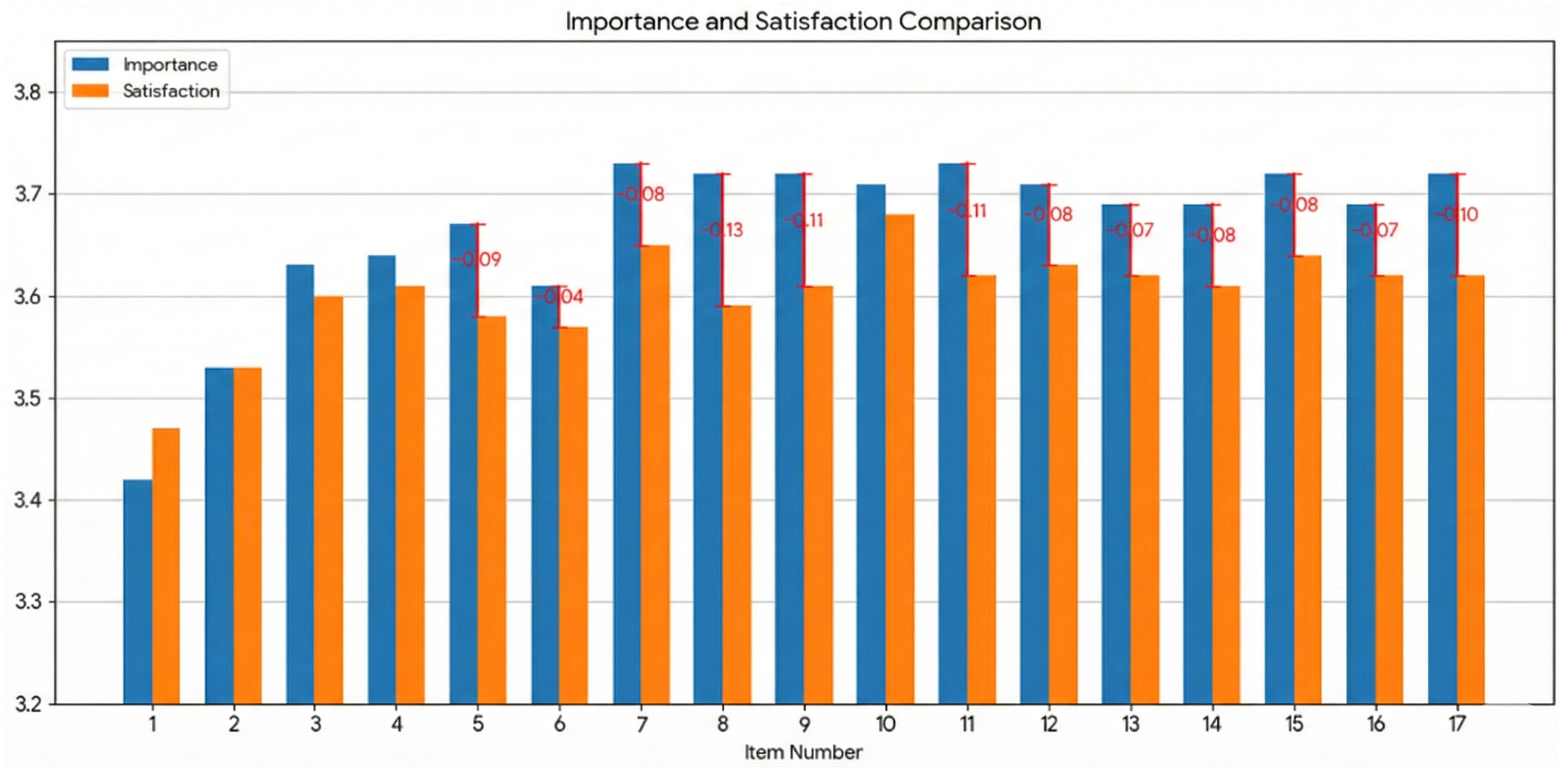
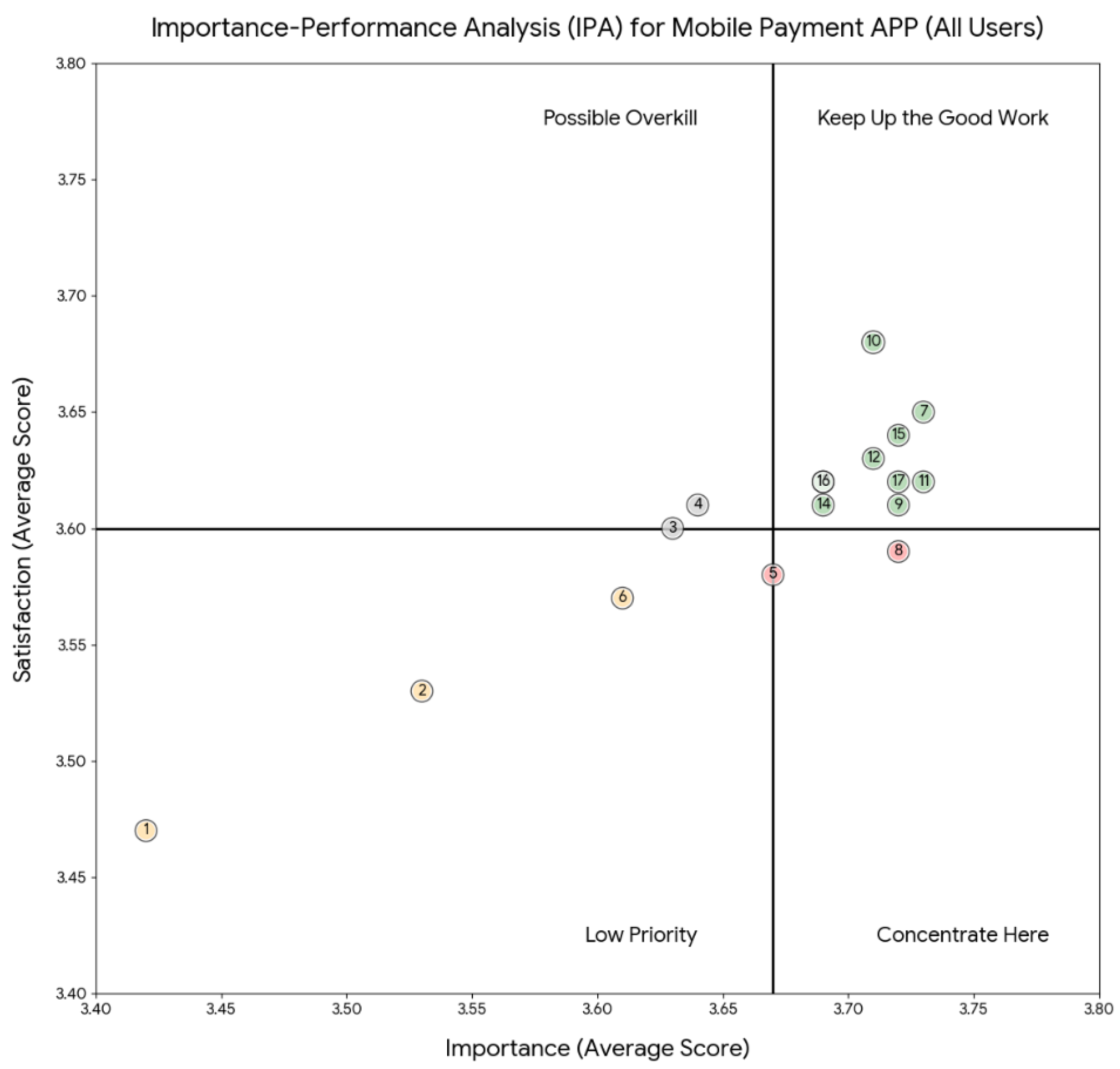
- Overall gaps: The analysis revealed noticeable gaps between importance and satisfaction for attributes including preferential merchant information, invoice section, digital city token or coupon collection activities, the number of affiliated merchants for digital city tokens or coupons, proactive notification of promotional event information, preferential merchant information search, payment function, credit card binding operation, convenience of switching between different functions, operational speed of functions, and problem reporting function. In all these cases, the average scores indicate that importance exceeded satisfaction, highlighting a perceived usage gap for these functions among respondents.
- Largest discrepancies: Following the above, the largest discrepancies, in descending order, were found in the number of affiliated merchants for digital city tokens or coupons, preferential merchant information search, proactive notification of promotional event information, and preferential merchant information. This suggests that users highly value the quantity and information regarding preferential merchants but feel insufficiently satisfied, possibly due to an inadequate number or variety of merchants, or inconvenient provision/searching of merchant information.
- Highest rated items:
- ○
- The top two highest-rated attributes for importance were “Digital City Token” and “Coupon Collection Activities” (noted twice in the source, implying high importance for this category).
- ○
- The top three highest-rated attributes for satisfaction were “Digital City Token Transfer Function,” “Operational Speed of Functions,” and “Payment Function.”
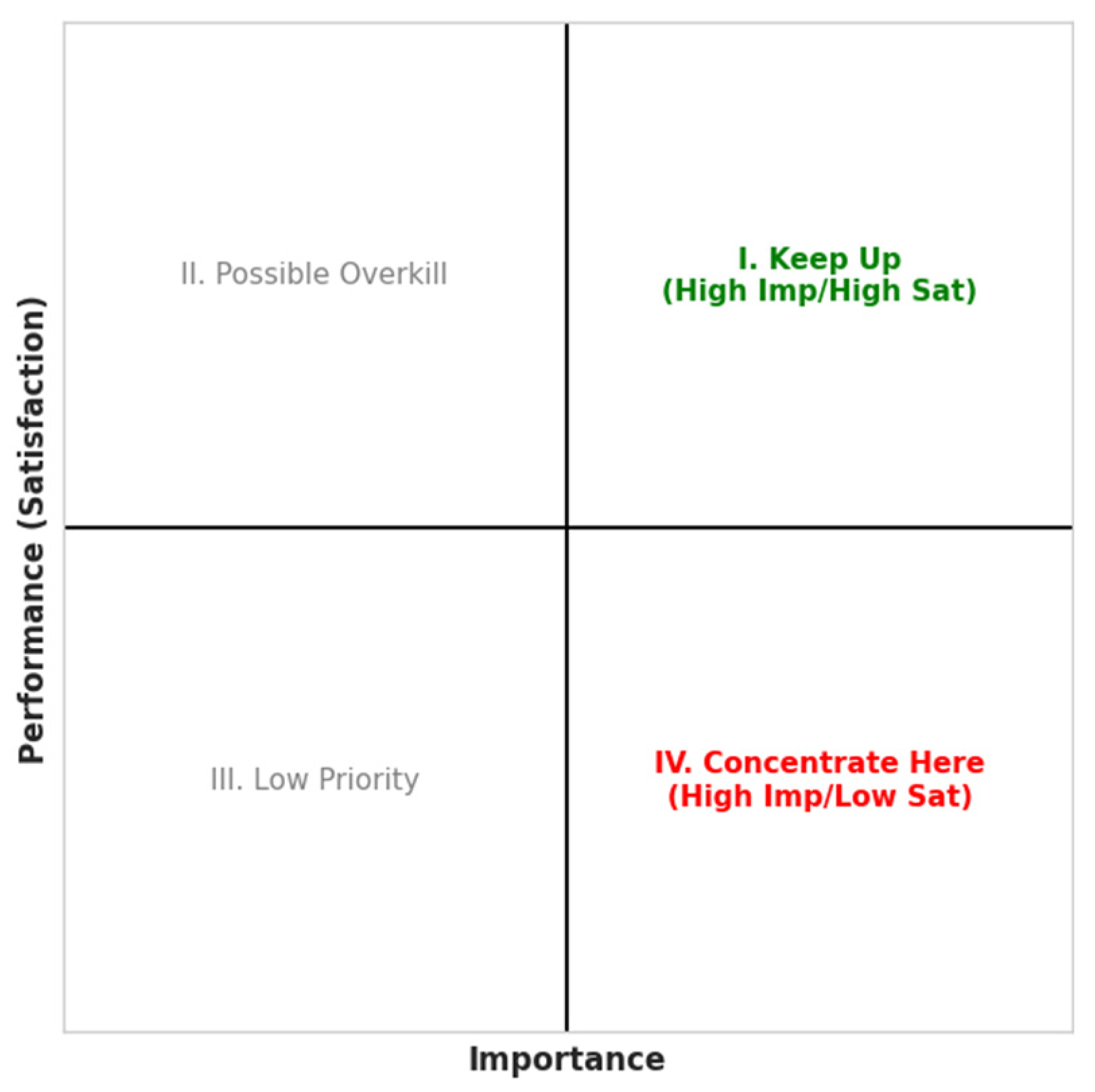
- Quadrant I (Keep Up the Good Work): A total of 10 items, specifically, New Taipei Token or Coupon Collection Activities, Proactive Notification of Discount Activities, New Taipei Token Transfer Feature, Discount Merchant Information Inquiry, Payment Functionality, Credit Card Binding Operation, Ease of Switching Between Different Functions, Function Operation Speed, Problem Reporting Feature, and Usability of Functions.
- Quadrant II (Possible Overkill): A total of two items, specifically, Transaction Record Inquiry and Municipal Reward/Claim Information.
- Quadrant III (Low Priority): A total of three items, specifically, Information Searching, Function Categorization, and Invoice/Receipt Area.
- Quadrant IV (Concentrate Here): A total of two items, specifically, Discount Merchant Information, and Number of Partner Merchants for New Taipei Token or Coupons.
4.4. Qualitative Interview Findings
4.4.1. Mechanism for Driving Net-Zero and Sustainable Goals
4.4.2. Bridging the Gap in Digital Public Services
4.4.3. Supporting SME Digital Resilience
5. Discussion
5.1. Integrating Sustainability into Smart Governance
5.2. Bridging the Gap Between Smart Utopia and Reality
5.3. Breaking Silos Through Digital Infrastructure
5.4. Fostering Digital Resilience in Local Commerce
5.5. Addressing Service Gaps and User Experience
6. Conclusions and Recommendations
6.1. Conclusions
6.2. Recommendations for Policy and Practice in Taiwan
- Integrate Mobile Payments with Long-Term Care Services—Taiwan’s rapidly aging population and declining birth rate demand innovative policy responses to mitigate social and healthcare burdens. Local governments should integrate municipal payment applications into long-term care systems, enabling seamless payments for elderly services, health insurance, and medical appointments. This enhances platform adoption, user retention, and alignment with “aging in place” policy objectives, fostering inclusive digital welfare ecosystems.
- Enhance SME Digital Transformation through Targeted Incentives—SMEs account for over 80% of Taiwan’s workforce but face resource constraints in digital adoption. Governments should link subsidies and training programs to mobile payment ecosystems like “City Token,” reducing entry barriers for businesses. This bolsters local competitiveness, revitalizes commercial districts, and expands merchant networks for sustainable smart city growth.
- Institutionalize Carbon Footprint Incentives for Net-Zero Goals—Taiwan’s net-zero ambitions require bridging policy with citizen action through practical tools. City apps should embed real-time carbon tracking and Digital City Token rewards, allowing users to monitor emissions from consumption, transport, and energy use. This creates a positive feedback loop, promoting low-carbon behaviors and enhancing policy implementation effectiveness.
- Foster Participatory Governance through Interactive Mechanisms—Shallow civic engagement hinders responsive governance in digital platforms. Implement real-time feedback dashboards for visible citizen input; organize hackathons and workshops for policy co-creation with businesses and academia, prioritized via voting; and integrate Taiwan’s MyData model for privacy-protected data authorization in analysis. These steps build transparency, trust, and collaborative decision-making.
- Establish Cross-Departmental Coordination to Overcome Administrative Barriers—Platform expansion in Taiwan is frequently hindered by administrative silos across different bureaus. Establishing a formal cross-departmental coordination mechanism is imperative. A dedicated task force should be empowered to integrate resources across transportation, environmental protection, and economic development departments. This ensures that the mobile payment ecosystem is supported by a unified administrative framework, reducing friction and maximizing operational efficiency.
6.3. Limitations and Future Research
- Sample bias: The survey employed convenience sampling within the APP, meaning respondents were already users of the platform. Consequently, the views of “non-users” or those who refused to adopt the technology are underrepresented. Future research should target non-users to understand barriers to adoption (e.g., digital divide).
- Single case limitation: The study focuses on a single municipality in Taiwan. While representative of high-density Asian cities, the findings may not be fully generalizable to rural areas or cities with different digital infrastructures. Comparative studies across multiple regions would validate these findings.
- Cross-sectional design: The data represents a snapshot in time. As the APP evolves and policies change, user satisfaction may shift. Longitudinal studies are recommended to track the long-term impact of digital tokens on citizen behavior change and actual carbon emission reductions.
Funding
Institutional Review Board Statement
Informed Consent Statement
Data Availability Statement
Acknowledgments
Conflicts of Interest
References
- United Nations, Department of Economic and Social Affairs, Population Division. World Urbanization Prospects: The 2018 Revision; United Nations: New York, NY, USA, 2018. Available online: https://population.un.org/wup/assets/WUP2018-Report.pdf (accessed on 26 October 2025).
- Chen, M.-K. A Sustainable Future for Smart Cities: Integrating Technology and Environmental Protection. Interdiscip. Res. Mon. 2025, 10, 23–36. Available online: https://www.airitilibrary.com/Article/Detail/P20220622001-N202507170008-00003 (accessed on 30 October 2025).
- Leu, J.-H.; Lin, B.-C.; Liao, Y.-Y.; Gan, D.-Y. Smart city development in Taiwan. IET Smart Cities 2021, 3, 93–103. [Google Scholar] [CrossRef]
- Chang, I.-C.C.; Jou, S.-C.; Chung, M.-K. Provincialising smart urbanism in Taipei: The smart city as a strategy for urban regime transition. Urban Stud. 2021, 58, 559–580. [Google Scholar] [CrossRef]
- Lin, Y.-F. Creating universal value with AI: From smart cities to universal smart living circles. Taiwan Econ. Rev. 2025, 23, 58–63. [Google Scholar]
- Bosco, G.; Riccardi, V.; Sciarrone, A.; D’Amore, R.; Visvizi, A. AI-driven innovation in smart city governance: Achieving human-centric and sustainable outcomes. Transform. Gov. People Process Policy 2024. Epub ahead of printing. [Google Scholar] [CrossRef]
- Kumar, S.; Verma, A.K.; Mirza, A. Artificial intelligence-driven governance systems: Smart cities and smart governance. In Digital Transformation, Artificial Intelligence and Society; Springer: Singapore, 2024; pp. 73–90. [Google Scholar] [CrossRef]
- Administration for Digital Industries; Ministry of Digital Affairs. Taiwan Smart City Development Project: Emerging and Cross-Domain—Industry Counseling. Administration for Digital Industries: Taipei, Taiwan, 2024. Available online: https://moda.gov.tw/en/ADI/industry-counseling/interdisciplinary/1219 (accessed on 16 December 2025).
- Huang, G.-H. Exploring Taiwan’s smart city development through the lens of Intelligent Urbanism. Land Issues Res. Quartely 2015, 14, 113–116. Available online: https://www.airitilibrary.com/Article/Detail?DocID=a0000011-201509-201510210017-201510210017-113-116 (accessed on 26 October 2025).
- Benninger, C. Principles of intelligent urbanism: The case of the new Capital Plan for Bhutan. Ekistics 2001, 69, 39–65. [Google Scholar] [CrossRef]
- MIC. Smart Cities Group, Cambridge, MA. Available online: http://smartcities.media.mit.edu/frameset.html (accessed on 7 February 2015).
- Chen, Y.-H.; Tso, C.-T. Next generation urban development trends: Low carbon smart cities. Taiwan Econ. Res. Mon. 2011, 34, 67–74. [Google Scholar] [CrossRef]
- Caragliu, A.; Del Bo, C.; Nijkamp, P. Smart City Policies and Urban Growth. Tinbergen Inst. Discuss. Pap. 2011, 10, 133. [Google Scholar]
- Harrison, C.; Eckman, B.; Hamilton, R.; Hartswick, P.; Kalagnanam, J.; Parikh, J.; Parikh, P. Foundations for smarter cities. IBM J. Res. Dev. 2010, 54, 1–16. [Google Scholar] [CrossRef]
- Batty, M. Big data, smart cities and city planning. Dialogues Hum. Geogr. 2013, 3, 274–279. [Google Scholar] [CrossRef]
- European Commission. European Innovation Partnership on Smart Cities and Communities; European Commission: Brussels, Belgium, 2020.
- Bakıcı, T.; Almirall, E.; Wareham, J. A Smart City Initiative: The Case of Barcelona. J. Knowl. Econ. 2013, 4, 135–148. [Google Scholar] [CrossRef]
- Utary, S. Smart Community Governance Dalam Program Geopark NgaraiSianok di Kota Bukitting. J. Adm. Kebijak. Publik 2019, 3, 109–124. [Google Scholar]
- Coe, A.; Paquet, G.; Roy, J. E-governance and smart communities: A social learning challenge. Soc. Sci. Comput. Rev. 2001, 19, 80–93. [Google Scholar] [CrossRef]
- Anthopoulos, L.; Fitsilis, P. From Online to Ubiquitous Cities: The Technical Transformation of Virtual Communities; Springer: Berlin/Heidelberg, Germany, 2009; pp. 360–372. [Google Scholar]
- Huang, Y.-C.; Huang, T.-Y. Do Citizens Cross the Digital Barrier? A Longitudinal Analysis of Digital Governance Services. Manag. Inf. Comput. 2022, 29, 335–368. [Google Scholar]
- Chen, H.H. Usability study of digital finance application interfaces. J. Ind. Des. 2023, 50, 24–29. Available online: https://www.airitilibrary.com/Article/Detail?DocID=20714963-N202404250001-00005 (accessed on 26 October 2025).
- Editorial Department. Interview with Director Hu Zehua of the Financial Market Development and Innovation Department: Financial innovation—Only innovation leads to sustainability. Account. Res. Mon. 2025, 2025, 62–65. Available online: https://www.airitilibrary.com/Article/Detail/P20160621002-N202503110010-00009 (accessed on 26 October 2025).
- Alsabbagh, A.A.A. Evaluating the quality of delivery service from the customer’s point of view using the importance-performance matrix. Int. J. Prof. Bus. Rev. 2023, 8, e01742. [Google Scholar] [CrossRef]
- Anthopoulos, L.G.; Reddick, C.G. Understanding electronic government research and smart city: A framework and empirical evidence. Inf. Polity 2016, 21, 99–117. [Google Scholar] [CrossRef]
- Meijer, A.; Rodriguez, M.A. Smart Governance For Sustainable Cities: Findings from a Systematic Literature Review. J. Urban Technol. 2019, 26, 3–27. [Google Scholar] [CrossRef]
- Feng, H.-Y.; Fahn, R.-L.; Lee, Y.-C. A Mixed Methods Research on the Planning of Hakka Village Trail from the Perspective of Tourists’ Motivation, Happiness, and Willingness to Revisit—The Case of Zaoqiao, Miaoli. Leis. Ind. Res. 2021, 19, 16–35. [Google Scholar] [CrossRef]
- Umair, M. A Framework for Understanding, Communicating and Evaluating User Experience Potentials. Master’s Thesis, Technical University of Munich, Munich, Germany, 2015. Available online: https://mediatum.ub.tum.de/doc/1276443/1276443 (accessed on 26 October 2025).
- Martilla, J.A.; James, J.C. Importance-Performance Analysis. J. Mark. Res. 1997, 14, 77–79. [Google Scholar] [CrossRef]
- Matzler, K.; Hinterhuber, H.H.; Baumgartner, M.; Renzl, B. The relationship between customer satisfaction and stock market performance. J. Serv. Res. 2004, 7, 7–19. [Google Scholar]
- Chen, X.; Osman, M.Z.; Lee, S.N.; Zhu, J. Analysis Service Quality of Private Undergraduate Universities in Guangdong, China Using SERVQUAL and IPA Methods. Qual. Quant. 2025, 59, 1123–1145. [Google Scholar] [CrossRef]
- Lakkoju, S. Importance-Performance Analysis of Service Quality in Higher Education: A Case Study. Qual. Assur. Educ. 2014, 22, 390–405. [Google Scholar]
- Simpson, G.D.; Patroni, J.; Teo, A.C.; Chan, J.K.L.; Newsome, D. Importance-performance analysis to inform visitor management at marine wildlife tourism destinations. J. Tour. Futures 2020, 6, 165–180. [Google Scholar] [CrossRef]
- Michael, R.; Evans, K.-S.; Chon, K. Formulating and Evaluating Tourism Policy Using Importance-Performance Analysis. J. Hosp. Tour. Res. 1989, 13, 320–329. [Google Scholar] [CrossRef]
- Hair, J.F.; Anderson, R.E.; Tatham, R.L.; Black, W.C. Multivariate Data Analysis, 5th ed.; Prentice-Hall: Englewood Cliffs, NJ, USA, 1998. [Google Scholar]
- Fornell, C.; Larcker, D.F. Evaluating structural equation models with unobservable variables and measurement error. J. Mark. Res. 1981, 18, 39–50. [Google Scholar] [CrossRef]
- Fesenko, T.; Avdiushchenko, A.; Fesenko, G. Smart City: Information-Analytical Developing Model (The Case of the Visegrad Region). Sustainability 2025, 17, 6640. [Google Scholar] [CrossRef]
- Prihatmanto, A.S.; Andrian, R.; Sunindyo, W.D.; Sutriadi, R. Transforming Public Services: A Systematic Review of Smart Government Frameworks, Architectures, and Implementation Challenges. IEEE Access 2024, 12, 135799–135810. [Google Scholar] [CrossRef]
- Desai, A.; Manoharan, A.P. Institutionalising Collaborative Governance to Manage Digital Platforms and Digital Public Infrastructure: A Case of India’s National Payment Corporation of India. In The Art of Digital Governance: Navigating Platforms and AI Revolution; Kim, Y., Ahn, M.J., Eds.; Springer: Cham, Switzerland, 2025; pp. 149–166. [Google Scholar] [CrossRef]
- Reichental, T. The Next Age of Cities: The Future of Urban Life; Wiley: Hoboken, NJ, USA, 2020; ISBN 9781119679943. [Google Scholar]
- Chien, T.-W. Why are people reluctant to use digital government? A Discussion on Q Methodology. Manag. Inf. Comput. 2023, 12, 64–73. [Google Scholar] [CrossRef]
- Zheng, Z.; Xie, S.; Dai, H.-N.; Chen, X.; Wang, H. Blockchain challenges and opportunities: A survey. Int. J. Web Grid Serv. 2018, 14, 352–375. [Google Scholar] [CrossRef]
- Zhu, Y.; Peng, Y.; Xin, L.; Zhang, X. Public demand and optimization of smart government service platform from the perspective of service life cycle based on the Kano model: A Chinese case study. PLoS ONE 2025, 20, e0319707. [Google Scholar] [CrossRef] [PubMed]




| Family Name | Job Title | Organization |
|---|---|---|
| Chen | Director | The Target City Government |
| Niu | Section Member | The Target City Government |
| Chen | CEO | Mobile Payment APP Development Company |
| Yu | Sales Specialist | Mobile Payment APP Development Company |
| Lin | Chairman | The Target City Commercial District Federation |
| Wang | Chairman | Pingxi Charm Commercial District |
| Lin | Professor | Dean, College of Information, University of Science and Technology |
| Items | Total | |||
|---|---|---|---|---|
| Importance | Satisfaction | Gap | ||
| 1 | Information Searching | 3.42 | 3.47 | 0.05 |
| 2 | Function Categorization | 3.53 | 3.53 | 0.00 |
| 3 | Transaction Record Inquiry | 3.63 | 3.60 | −0.03 |
| 4 | Municipal Reward Info | 3.64 | 3.61 | −0.03 |
| 5 | Discount Merchant Info | 3.67 | 3.58 | −0.09 |
| 6 | Invoice/Receipt Area | 3.61 | 3.57 | −0.04 |
| 7 | Token/Coupon Collection Activity | 3.73 | 3.65 | −0.08 |
| 8 | No. of Partner Merchants | 3.72 | 3.59 | −0.13 |
| 9 | Proactive Notification of Offers | 3.72 | 3.61 | −0.11 |
| 10 | Token Transfer Feature | 3.71 | 3.68 | −0.03 |
| 11 | Discount Merchant Info Inquiry | 3.73 | 3.62 | −0.11 |
| 12 | Payment Functionality | 3.71 | 3.63 | −0.08 |
| 13 | Credit Card Binding | 3.69 | 3.62 | −0.07 |
| 14 | Ease of Function Switching | 3.69 | 3.61 | −0.08 |
| 15 | Function Operation Speed | 3.72 | 3.64 | −0.08 |
| 16 | Problem Reporting Feature | 3.69 | 3.62 | −0.07 |
| 17 | Overall Function Usability | 3.72 | 3.62 | −0.10 |
| Overall Average | 3.67 | 3.60 | ||
Disclaimer/Publisher’s Note: The statements, opinions and data contained in all publications are solely those of the individual author(s) and contributor(s) and not of MDPI and/or the editor(s). MDPI and/or the editor(s) disclaim responsibility for any injury to people or property resulting from any ideas, methods, instructions or products referred to in the content. |
© 2025 by the author. Licensee MDPI, Basel, Switzerland. This article is an open access article distributed under the terms and conditions of the Creative Commons Attribution (CC BY) license.
Share and Cite
Chang, C.-C. Digital Transformation and Public Value in Sustainable Governance: The Role of Taiwan’s Smart City Mobile Payment Platform in Development, Digital Service, and Citizen Engagement. Sustainability 2026, 18, 63. https://doi.org/10.3390/su18010063
Chang C-C. Digital Transformation and Public Value in Sustainable Governance: The Role of Taiwan’s Smart City Mobile Payment Platform in Development, Digital Service, and Citizen Engagement. Sustainability. 2026; 18(1):63. https://doi.org/10.3390/su18010063
Chicago/Turabian StyleChang, Che-Cheng. 2026. "Digital Transformation and Public Value in Sustainable Governance: The Role of Taiwan’s Smart City Mobile Payment Platform in Development, Digital Service, and Citizen Engagement" Sustainability 18, no. 1: 63. https://doi.org/10.3390/su18010063
APA StyleChang, C.-C. (2026). Digital Transformation and Public Value in Sustainable Governance: The Role of Taiwan’s Smart City Mobile Payment Platform in Development, Digital Service, and Citizen Engagement. Sustainability, 18(1), 63. https://doi.org/10.3390/su18010063