Article

Price-Calibrated Network Loss–Carbon Emission Co-Optimization for Radial Active Distribution Networks via DistFlow-Based MISOCP Reconfiguration


1
School of Energy and Electrical Engineering, Qinghai University, Xining 810016, China
2
Qinghai Key Lab of Efficient Utilization of Clean Energy, Qinghai University, Xining 810016, China
*
Author to whom correspondence should be addressed.
Sustainability 2026, 18(1), 544; https://doi.org/10.3390/su18010544
Submission received: 9 December 2025 / Revised: 29 December 2025 / Accepted: 2 January 2026 / Published: 5 January 2026
(This article belongs to the Special Issue Sustainable Management for Distributed Energy Resources)

Abstract

Active distribution networks (ADNs) with high DER penetration require coordinated decisions to ensure voltage security, limit losses, and support low-carbon targets. However, most reconfiguration-centric studies prioritize loss/cost and rarely integrate carbon pricing and emission accounting into a unified framework with verifiable optimality. This study develops a DistFlow-based mixed-integer second-order cone programming (MISOCP) model that co-optimizes feeder reconfiguration and resource active/reactive dispatch under a price-calibrated loss–emission objective. The framework coordinates PV/WT generation, MTs, aggregated PHEVs (V2G), and reactive-support devices (SVCs and switched capacitor banks (CBs)) and is solved by commercial CPLEX to global optimality for the SOCP-relaxed problem. On the IEEE 33-bus feeder, device coordination reduces losses from 0.203 MW to 0.0382 MW (81.18%) and CO2 emissions from 2.3872 to 0.3433 tCO2 (85.62%), while reducing operating cost from CNY 354.9357 to CNY 56.6271 (84.05%). Enabling reconfiguration further reduces losses to 0.0205 MW (89.90%), emissions to 0.2580 tCO2 (89.19%), and operating cost to CNY 37.4677 (89.44%), while keeping voltages within 0.99–1.01 p.u. Relative to device-only operation, reconfiguration yields 46.34% loss reduction, 24.85% emission reduction, and 33.83% operating-cost reduction. The mixed-integer optimality gap is ~10−7, and the solution quality for the original non-convex model depends on the tightness of the SOCP relaxation, which is numerically tight in the cases we studied. These results show interpretable technical and environmental gains via coordinated dispatch and topology control in radial ADNs at scale.

1. Introduction

Active distribution networks (ADNs) increasingly operate with high penetrations of distributed generation (DG), exacerbating distribution-level challenges in power-flow management and voltage regulation [1]. Inverter-interfaced resources, in particular, call for advanced Volt/VAR optimization and coordinated voltage control subject to network constraints [2].
Distribution network reconfiguration (DNR) alters the open/closed status of sectionalizing and tie switches to reshape power-transfer corridors in radial feeders; it was initially proposed for loss reduction and load balancing [3]. Decarbonization targets are reshaping operational priorities beyond classical goals such as loss minimization and voltage compliance. Recent studies have incorporated carbon-related objectives or carbon-cost mechanisms into distribution-level scheduling and optimization to jointly improve energy efficiency and carbon performance [4,5]. Carbon-aware operation has also been integrated with topology decisions via reconfiguration-dispatch frameworks, highlighting the role of DNR in low-carbon operation [6].
Given an emission factor (or carbon price), network losses require additional active-power supply. This additional supply increases emissions and carbon costs, motivating joint loss–emission optimization [5,6]. With high DG penetration, voltage and thermal-limit violations can trigger renewable curtailment or corrective actions, undermining both operational efficiency and renewable utilization [1]. These couplings motivate coordinated topology-dispatch decisions instead of optimizing device control or dispatch under a fixed topology. This need is particularly acute when DG injections reverse branch-flow directions and redistribute corridor loading [7,8,9].
From a device-control perspective, inverter-interfaced DG can provide reactive-power support. For example, PV inverters can be scheduled for reactive compensation to reduce losses [10]. Coordinated voltage control has also been studied to improve ADN voltage profiles [11] and enable Volt/VAR optimization with smart PV inverters [2]. Feeder reconfiguration provides another degree of freedom by reshaping power-transfer corridors while enforcing radiality. Accordingly, coordinated reconfiguration with active/reactive dispatch has been extensively studied using solver-based formulations [7,8,9]. Operational flexibility is further enhanced by soft open points (SOPs) [12], energy storage systems (ESSs) for resilience [13], dispatchable micro gas turbines (MTs) [14,15,16], and aggregated plug-in hybrid/electric vehicles (PHEVs/EVs) providing vehicle-to-grid (V2G) services [17].
Regarding solution strategies, heuristic, metaheuristic, and learning-based methods have been applied to DG/CB allocation and reconfiguration problems [18,19,20,21,22,23,24]. In parallel, solver-based mathematical programming can handle high-fidelity reconfiguration problems with strict radiality/connectivity requirements and operational constraints. Recent mixed-integer second-order cone programming (MISOCP) studies extend reconfiguration to coordinated active network management and SOP-enabled dispatch [7,8,9]. Dynamic and scenario-based reconfiguration has also been developed to capture spatiotemporal variability [25,26]. Related MISOCP formulations further incorporate stability-aware intentional splitting and asset constraints, such as transformer dynamic thermal rating (DTR), in ADN-oriented optimization [27,28]. Nevertheless, under strict radiality and connectivity constraints, a unified carbon-aware topology-dispatch framework that enables transparent loss–emission trade-off assessment remains underexplored, which motivates this work [4,5,6].
This paper develops a solver-based, carbon-aware topology-dispatch coordination framework for radial ADNs. Specifically, we formulate a DistFlow-based MISOCP model that co-optimizes feeder reconfiguration and multi-resource active/reactive (P/Q) dispatch while enforcing strict radiality and connectivity. We also report second-order cone programming (SOCP) relaxation tightness and mixed-integer optimality gaps to enable transparent, reproducible assessments of both loss reduction and emission mitigation.
Research Objective: This work develops a price-calibrated loss–emission co-optimization model for radial ADNs to reduce network losses and carbon emissions by coordinating feeder reconfiguration and multi-resource P/Q dispatch under explicit electricity and carbon prices. To clarify the scope, we address the following research questions:
RQ1: How can network-loss and carbon-emission objectives be unified under explicit electricity and carbon prices to yield a unit-consistent, economically interpretable scalar objective?
RQ2: Under strict radiality and connectivity constraints, how can feeder reconfiguration be co-optimized with coordinated P/Q dispatch of heterogeneous resources in a tractable MISOCP formulation?
RQ3: How can solution credibility be strengthened in carbon-aware reconfiguration studies by reporting SOCP relaxation tightness and mixed-integer optimality gaps, enabling reproducible loss–emission trade-off assessment?
The main contributions are summarized as follows:
  • A price-calibrated loss–emission objective integrating electricity and carbon prices to quantify losses and associated emissions under a unified economic metric;
  • A DistFlow-based MISOCP formulation that couples SOCP-relaxed branch-flow constraints with tight switch–flow linking under strict radiality/connectivity requirements;
  • Coordinated multi-resource dispatch modeling (including DG P/Q outputs, flexible resources, and reactive-support devices) jointly optimized with feeder topology;
  • A transparent evaluation protocol reporting SOCP relaxation tightness and mixed-integer optimality gaps for reproducible assessment of loss reduction and emission mitigation.
A broader literature review and a detailed gap analysis are provided in Section 2 (Background of Research).

2. Background of Research

2.1. Policy-Driven Low-Carbon Development and the Innovation Channel

Low-carbon development is driven not only by engineering choices but also by policy instruments that steer cities and firms toward cleaner production and higher eco-efficiency. Empirical evidence from low-carbon city construction and pilot programs indicates that green technology innovation is a key channel through which policy interventions improve ecological performance and carbon outcomes. Specifically, ecological efficiency in low-carbon city construction has been assessed through the lens of green technology innovation, highlighting an innovation-led pathway to sustainability improvement [29]. Policy evaluations further suggest that low-carbon pilot city programs can materially reduce city-level carbon intensity [30]. At the firm level, low-carbon pilot policies are associated with stronger green innovation, suggesting that regulatory and market signals can stimulate technology upgrading and cleaner operational decisions [31]. Complementary evidence indicates that innovation responses reflect both governmental action and public engagement, reinforcing a multi-actor governance pathway for low-carbon transition [32].
From a power systems perspective, these findings motivate carbon-aware distribution operation. Distribution networks constitute the “last-mile” infrastructure through which urban decarbonization targets translate into realized operational outcomes. Operating decisions in active distribution networks (ADNs)—losses, voltage compliance, curtailment, and dispatch—directly shape the realized carbon footprint. Accordingly, embedding carbon-aware metrics into ADN operation can be viewed as a system-level counterpart to the policy-driven low-carbon transition observed at city and firm scales [29,30,31,32].

2.2. Carbon-Aware Operation of Active Distribution Networks

At the distribution level, low-carbon operation is typically modeled by augmenting classical objectives (e.g., loss/cost minimization and voltage compliance) with carbon-related terms, including carbon prices, carbon trading costs, or explicit emission objectives and constraints. Representative studies investigate carbon emission reduction-oriented operation optimization for self-healing and active distribution networks [4] and propose low-carbon economic dispatch strategies that incorporate multiple flexible loads [5]. Carbon-aware operation has also been integrated with topology decisions via multi-stage paradigms (e.g., day-ahead reconfiguration followed by real-time optimization), highlighting the value of reconfiguration under emission-aware criteria [6].
Credible carbon-aware dispatch requires a consistent emission accounting basis. Grid emission factors (e.g., national or regional averages) are widely used to map energy procurement to CO2 emissions in distribution-level studies [33,34]. Under this modeling approach, network losses require additional upstream active-power supply and therefore increase emissions. This creates a direct coupling between loss reduction and emission mitigation and motivates integrated loss–emission optimization at the ADN level [5,6].

2.3. Flexibility Resources and Network Devices Supporting Low-Carbon Operation

The feasibility and effectiveness of carbon-aware ADN operation depend on controllable devices and flexible resources. Inverter-interfaced DG can provide reactive-power capability to support voltage regulation and reduce losses. PV-inverter reactive-power compensation has been reported to reduce system losses [10]. Coordinated voltage control and Volt/VAR optimization frameworks have also been developed to improve voltage profiles under network constraints [2,11]. Topology-control and power-routing devices, such as soft open points (SOPs), further enhance operational flexibility in distribution networks [12].
Beyond network devices, flexible resources also influence the loss–emission trade-off. Energy storage systems (ESSs) can be configured to enhance operational resilience and flexibility [13]. Micro gas turbines (MTs) provide dispatchability and fast load-following capability, and their roles in energy transition and low-carbon pathways have been widely discussed [14,15,16]. Aggregated plug-in hybrid/electric vehicles (PHEVs/EVs) providing vehicle-to-grid (V2G) services can act as distributed storage to support peak shaving and system flexibility [17]. These developments motivate integrated optimization frameworks that coordinate multi-resource active/reactive (P/Q) dispatch with network topology decisions under engineering constraints and low-carbon objectives.

2.4. Topology–Dispatch Coordination via Distribution Network Reconfiguration

Feeder reconfiguration remains a key mechanism for reshaping radial power-transfer corridors and improving operational performance. The seminal branch-exchange method established the foundation for loss reduction and load balancing via distribution network reconfiguration (DNR) in radial systems [3]. Building on this foundation, recent research has increasingly focused on coordinated topology-dispatch optimization under strict radiality/connectivity requirements and operational constraints. Recent studies have examined (i) dynamic network reconfiguration coordinated with active network management [7], (ii) tractability-oriented variants based on MISOCP-to-MILP linearization [8], and (iii) coordinated active/reactive power optimization with dynamic reconfiguration and SOP-enabled flexibility [9].
To address temporal variability and uncertainty, dynamic and scenario-based reconfiguration models have been developed. Examples include feeder-specific dynamic reconfiguration for load balancing [25] and scenario-based dynamic reconfiguration under typical wind–solar–load scenarios [26]. In related ADN-oriented optimization contexts, MISOCP formulations incorporate stability-aware intentional splitting [27] and asset constraints such as transformer dynamic thermal rating (DTR) under high PV penetration [28]. Collectively, these works suggest that solver-based mixed-integer convex programming—particularly MISOCP—offers a systematic path to high-fidelity topology–dispatch coordination under engineering constraints.
For comparison, Table 1 summarizes representative topology–dispatch coordination studies in ADNs (including feeder reconfiguration and related topology-control extensions) in terms of objectives, methods, and key constraints/features.
Three observations emerge from Table 1. First, in terms of objectives, most studies focus on classical operational targets—renewable penetration maximization [7], loss minimization [8], and operating-cost minimization [9]—whereas extensions emphasize specific engineering goals such as stability-aware splitting [27], DTR-based asset constraints [28], and resilience enhancement via ESS configuration [13]. Second, methodologically, MISOCP is the dominant backbone for topology–dispatch coordination under network constraints [7,9,25,26,27,28]. Tractability-enhancing variants include MISOCP-to-MILP linearization [8] and scenario-based formulations that capture uncertainty and spatiotemporal variability [26]. Third, regarding constraints and modeling features, the literature has evolved from basic operational constraints with explicit radiality to richer engineering considerations, including SOP-enabled flexibility [9], island stability constraints [27], DTR-based asset constraints [28], contingency-oriented resilience modeling [13], and multilevel balancing with ESS-coordinated reconfiguration [25].

2.5. Solution Methodologies: Heuristic/Learning-Based Approaches Versus Solver-Based Optimization

Solution strategies for distribution planning, allocation, and reconfiguration span heuristic and metaheuristic methods, learning-based approaches, and solver-based mathematical programming. Metaheuristics have been widely used for DG placement/siting and combined DG-capacitor planning [18,19], whereas heuristic approaches have been applied to active/reactive power allocation problems [20]. Recent learning-based and hybrid methods have also been reported for topology optimization and radial reconfiguration. Examples include learning-based topology optimization [21], fast heuristic reconfiguration [22], hybrid genetic frameworks with neighborhood learning components [23], and reconfiguration with shunt capacitors in smart distribution settings [24].
In parallel, solver-based formulations—particularly MISOCP-based reconfiguration—provide a structured way to enforce strict radiality/connectivity and operational constraints and to enable transparent comparisons across cases and modeling assumptions [7,8,9,25,26]. This is particularly important when carbon-aware objectives are introduced because emission accounting and loss calculations require physically consistent, constraint-feasible operating points [5,6].

2.6. Research Gaps and Working Hypotheses

Despite substantial progress, several gaps motivate this work. First, although carbon-aware ADN scheduling and low-carbon optimization have been studied [4,5,6], carbon pricing and emission modeling are rarely integrated into reconfiguration-centric topology–dispatch formulations in a unified and transparent manner, especially under strict radiality and connectivity constraints. Second, despite advances in MISOCP-based topology–dispatch coordination [7,8,9,25,26], reporting practices that enable reproducible loss–emission trade-off assessment—such as convex-relaxation tightness and mixed-integer optimality gaps—remain uneven across studies. Third, as flexibility resources become increasingly heterogeneous (e.g., inverter-based DG, SOPs, ESSs, MTs, and V2G fleets) [2,10,11,12,13,17], integrated frameworks that co-optimize feeder topology and multi-resource P/Q dispatch under explicit electricity and carbon prices remain underexplored. Based on these gaps, this work develops a price-calibrated, carbon-aware topology–dispatch co-optimization framework and a DistFlow-based MISOCP formulation for radial ADNs, together with a transparent evaluation protocol for loss reduction and emission mitigation.
Working hypotheses (optional for “background” framing):
H1. 
Under explicit electricity and carbon prices, price-calibrated scalarization enables unit-consistent, economically interpretable joint optimization of network losses and emissions, improving the comparability of loss–emission trade-offs across cases [4,5,6].
H2. 
Under strict radiality/connectivity constraints, jointly optimizing feeder topology and multi-resource P/Q dispatch in a solver-based MISOCP framework yields a better loss–emission trade-off than topology-fixed scheduling, provided that solution credibility is supported by reporting relaxation tightness and mixed-integer optimality indicators [7,8,9,25,26].

3. Materials and Methods

All simulations and optimizations were implemented in MATLAB R2024b (The MathWorks, Inc., Natick, MA, USA) with YALMIP (version 20250626) and solved using IBM ILOG CPLEX Enterprise Server (64-bit) 12.10.0 (IBM, Armonk, NY, USA). No commercial materials were used in this study.

3.1. Problem Formulation and Branch-Flow (DistFlow) Equations

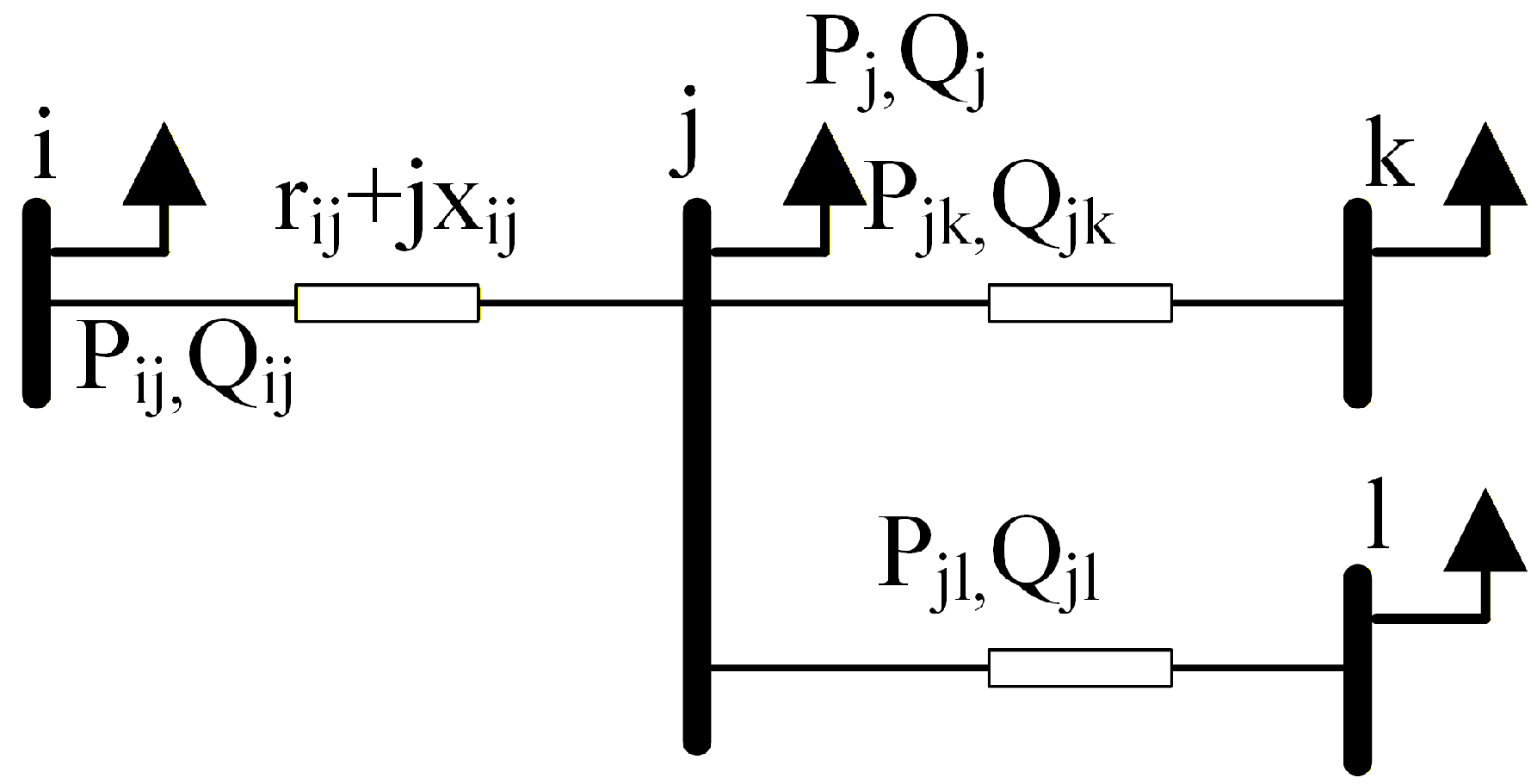
We fix notation using a minimal radial feeder (see Figure 1). Positive flows follow the arrow direction; the diagram defines P ij   ,   Q ij   ,   r ij   ,   x ij , and I ij 2 referenced in Equations (1)–(3).
The DistFlow form of the power flow equation is as follows:
For any node j,
I ij 2   = ( P ij ) 2 + ( Q ij ) 2 ( U i ) 2
P ij I ij 2 r ij + P j = k   ϵ   u ( j ) P jk Q ij I ij 2 x ij + Q j = k   ϵ   u ( j ) Q jk
For the branch ij,
( U j ) 2   = ( U i ) 2   2 ( r ij P ij + x ij Q ij )   + ( ( r ij ) 2   + ( x ij ) 2 ) I ij 2
In Equation (1), I ij 2 denotes the square of the current magnitude of branch ij, P ij and Q ij denote the active and reactive power at the front end of branch ij, respectively, and U i denotes the voltage magnitude at node i. In Equation (2), u(j) denotes the set of all branches, with j as the parent node. In Equation (2), r i j and x i j denote the resistance and reactance of branch ij, respectively. P j and Q j are the net active and reactive power injections at node j, respectively. In Equation (3), U j denotes the voltage magnitude at node j. The rest of the parameters are the same as above.
The net active and reactive power injections at bus j are given by
P j   = P j , DG P j , load Q j   = Q j , DG   + Q j , RA Q j , load
In Equation (4), P j , DG and Q j , DG denote the total active and reactive power generated by all distributed energy resources (DERs) connected to bus j .   P j , load and Q j , load represent the active and reactive power demands at bus j , and Q j , RA denotes the reactive power provided by reactive compensation devices such as shunt CB or SVC.
To explicitly distinguish different types of DERs, the aggregated DER injections at bus j are decomposed as follows:
P j , DG   =   P j PV   +   P j WT   +   P j MT   +   P j PHEV Q j , DG   =   Q j PV   +   Q j WT   +   Q j MT
In Equation (5), P j PV and Q j PV , P j WT and Q j WT , and P j MT and Q j MT denote the active and reactive power outputs of the photovoltaic units, wind turbines and micro-turbine installed at bus j , respectively. P j PHEV is the aggregated active power of the PHEV charging station connected to bus j , where P j PHEV   >   0 corresponds to vehicle-to-grid (V2G) discharging and P j PHEV   <   0 corresponds to grid- to-vehicle (G2V) charging. In other words, a positive value of P j P H E V denotes net power injected into the grid, where a negative value denotes net power absorbed from the grid by the vehicles. In this work, PHEV is assumed not to exchange reactive power with the grid, and thus Q j PHEV   =   0 . For buses without a certain type of DER, the corresponding terms in Equation (5) are set to zero.

3.2. Objective Function: Price-Calibrated Loss–Emission Minimization

The first objective of the proposed model is to minimize the total active-power loss of the distribution network. Let P i denote the active-power loss of branch i , and let N b r c denote the total number of branches. The network-loss objective is written as
f loss ( x ) = i = 1 N brc P i
In Equation (6), f loss ( x ) denotes the total active-power loss of the distribution network, where x represents the vector of optimization (decision) variables, P i represents the active-power loss of branch i , and N brc denotes the number of branches.
To explicitly account for environmental impacts, we quantify carbon emissions using emission factors for (i) electricity imported from the upstream grid and (ii) on-site MTs. Specifically, the upstream grid emission factor is denoted by γgrid and is set to 0.6093 tCO2/MWh based on an official emission factor dataset for electricity generation [33,34]. The MT emission factor is denoted by γMT and is set to 0.645 tCO2/MWh according to the U.S. EPA technology characterization for microturbines (electric-only emissions intensity) [34,35]. Under these definitions, the total carbon emissions of the distribution network are modeled as
f C O 2 ( x ) = γ G r i d P 0 + i N M T γ M T P i , M T
In Equation (7), f C O 2 ( x ) denotes the hourly CO2 emissions (tCO2/h) of the distribution network at operating point x (i.e., Δ t   =   1 h for the single-period study). P 0 is the active power imported from the upstream grid at the root node, and P i M T is the active-power output of the MT unit at bus i . The set N M T collects all buses equipped with MT units. The parameters γ g r i d and γ M T denote the carbon-emission factors of the upstream grid and the MT units, respectively, expressed in tCO2/MWh and set to 0.6093 tCO2/MWh and 0.645 tCO2/MWh in this paper. With emission factors in tCO2/MWh and powers in MW, Equation (7) directly yields emissions in tCO2 /h. PVs, WT, CB, SVC, and PHEV charging/discharging are assumed to cause no direct carbon emissions at the operation stage and therefore do not contribute to f C O 2 ( x ) .
To couple the technical and environmental objectives, the active-power loss and CO2 emissions are aggregated into an economic cost. Let c e (RMB/MWh) denote the electricity price and c c   (RMB/tCO2e) denote the carbon price. In this paper, national-level values are adopted: c e   =   620 RMB/MWh (i.e., 0.62 RMB/kWh) and c c   =   95.96 RMB/tCO2 [36]. The hourly operating cost associated with a given point x is defined as
C ( x ) =   c e   f loss ( x ) +   c c   f CO 2 ( x )
In Equation (8), accordingly, C ( x ) represents the hourly operating cost (RMB/h) associated with network losses and CO2 emissions.
For optimization purposes, a dimensionless scalar objective is constructed from the loss and emission terms. Let f l o s s b a s e and f C O 2 base denote the baseline (Case 1) network loss and CO2 emissions reported in Section 3.1; they serve as the normalization denominators in Equation (9). The scalar objective minimized in this paper is
F ( x )   = w 1 f loss ( x ) f loss base + w 2 f CO 2 ( x ) f CO 2 base
In Equation (9), the two normalized terms characterize the relative variations of network losses and CO2 emissions with respect to the baseline operating condition.
Based on the monetary contributions of the two components in the baseline condition, the weighting coefficients are defined as
w 1 = c e   f loss base c e   f loss base + c c   f CO 2 base   ,   w 2 = c c   f CO 2 base c e   f loss base + c c   f CO 2 base
In Equation (10), the two coefficients satisfy w 1   +   w 2 = 1 , implying that the weights in (9) are not arbitrarily selected but are determined by the relative economic impact of network losses and CO2 emissions in the baseline operating condition. Therefore, w 1 and w 2 are computed after obtaining the baseline values in Case 1, ensuring that the trade-off in Equation (9) is calibrated by the relative baseline monetary contributions of losses and emissions.

3.3. Branch-Flow (DistFlow) Equations and Operating Constraints

3.3.1. DistFlow Current Constraints

In this paper, the topology of the distribution network is optimized under radiality and connectivity constraints. Assuming that all switches in this system are closed, the problem of reconfiguring its topology is equivalent to the problem of choosing some of them to be disconnected. Therefore, the DistFlow model is extended by introducing a binary variable α ij to characterize the status of each branch, where α ij   =   1 indicates that branch ( i ,   j ) is closed (connected) and α ij   =   0 indicates that branch ( i ,   j ) is open (disconnected). The current equations are processed to obtain the following DistFlow current equations suitable for distribution network reconfiguration:
For any node j,
I ij   2 = ( P ij ) 2 + ( Q ij ) 2 ( U i ) 2   ,   α ij = 1
α ij ( P ij I ij   2 r ij )   + P j   = k   ϵ   u ( j ) α jk P jk α ij ( Q ij I ij   2 x ij )   + Q j   = k   ϵ   u ( j ) α jk Q jk
For the branch ij,
( U j ) 2   = ( U i ) 2   2 ( r ij P ij + x ij Q j )   + ( ( r ij ) 2 + ( x ij ) 2 ) I ij   ,   α ij = 1
The meanings of the variables in Equations (11)–(13) are consistent with those in Equations (1)–(3). However, the resulting DistFlow formulation with binary variables remains nonlinear and non-convex, so further processing is required to obtain a tractable optimization model. Initially, the equivalent transformation is conducted using the following equation:
U i sqr   =   U i 2 I ij sqr   =   I ij 2
In Equation (14), the branch-current expression is rewritten in terms of squared voltages, and power flows to facilitate the subsequent SOC relaxation.
Then, Equations (11)–(13) can be transformed into
I ij sqr   = ( P ij ) 2 + ( Q ij ) 2 U i sqr ,   α ij   = 1
α ij ( P ij I ij sqr r ij )   + P j   = k   ϵ   u ( j ) α jk P jk α ij ( Q ij I ij sqr x ij )   + Q j   = k   ϵ   u ( j ) α jk Q jk
U j sqr = U i sqr   2 ( r ij P ij + x ij Q ij ) + ( ( r ij ) 2 + ( x ij ) 2 ) I ij sqr   ,   α ij = 1
In order to resolve the issue that Equation (17) is only applicable to closed branches, it is relaxed using the big M method, where M is a large positive number:
U j sqr     M ( 1 α ij )   +   U i sqr     2 ( r ij P ij + x ij Q ij )   +   ( ( r ij ) 2 + ( x ij ) 2 ) I ij sqr U j sqr     M ( 1 α ij )   +   U i sqr     2 ( r ij P ij + x ij Q ij )   +   ( ( r ij ) 2 + ( x ij ) 2 ) I ij sqr

3.3.2. Node Voltage and Branch Current Constraints

The branch current constraint is enforced through the binary variable α i j , which ensures that the current of an open branch is 0, while the current of a closed branch is restricted within its admissible range. However, for a closed branch, the current can be confined to the safety domain. The branch current constraint can be expressed as follows:
0     I ij sqr     α ij ( I ij max ) 2
The voltage of each node should also be limited to the security domain, denoted as follows:
U r sqr   =   1 ( U i min ) 2     U i sqr     ( U i max ) 2
In Equations (19) and (20), I i j m a x represents the maximum current permitted to pass through the branch ij, U r s q r is the root node voltage squared, in this instance for the per-unit value, which has been set to 1; U i min and U i max represent the minimum and maximum values of the node voltage, respectively.

3.3.3. Power Constraint

In order to suppress the influence of the power fluctuation of the active distribution network on the transmission network, the power constraints of the root node of the distribution network need to be taken into account, that is,
P r min     P r     P r max Q r min     Q r     Q r max
In Equation (21), P r is the power into the distribution network from the root node. P r min and P r max are the lower and upper bounds of active power set by the control center, respectively. The constraints of reactive power can be calculated similarly.

3.3.4. PV Output Constraints

P i , PV min     P i , PV     P i , PV max Q i , PV   = P i , PV tan φ PV
In Equation (22), P i , PV and Q i , PV denote the active and reactive outputs of the PV unit at bus i , respectively. Considering the flexibility of the inverter interface, P i , PV is treated as a decision variable within [ P i , PV min ,   P i , PV max ] , respectively. In addition, the inverter apparent-power rating is enforced by the capability constraint P i , PV 2   +   Q i , PV 2     S i , PV 2 , where S i , PV denotes the apparent-power limit of the PV inverter. Here, Q   >   0 indicates reactive power injection (capacitive), and Q   <   0 indicates reactive power absorption (inductive).

3.3.5. WT Output Constraints

P i , WT min     P i , WT     P i , WT max Q i , WT   = P i , WT tan φ WT
In Equation (23), P i , WT and Q i , WT denote the active and reactive outputs of the WT unit at bus i , respectively. Considering the flexibility of the inverter interface, P i , WT is treated as decision variables within [ P i , WT min ,   P i , WT max ] , respectively. In addition, the inverter apparent-power rating is enforced by the capability constraint P i , WT 2   +   Q i , WT 2     S i , WT 2 , where S i , WT denotes the apparent-power limit of the WT inverter. Here, Q   >   0 indicates reactive power injection (capacitive) and Q   <   0 indicates reactive power absorption (inductive).

3.3.6. MT Output Constraints

P i , MT min     P i , MT     P i , MT max , i   ϵ   N MT Q i , MT   = P i , MT tan φ MT
In Equation (24), P i , MT and Q i , MT denote the active and reactive outputs of the MT unit at bus i , respectively. Considering the flexibility of the inverter interface, P i , MT is treated as decision variables within [ P i , MT min ,   P i , MT max ] , respectively. In addition, the inverter apparent-power rating is enforced by the capability constraint P i , MT 2   +   Q i , MT 2     S i , MT 2 , where S i , MT denotes the apparent-power limit of the MT inverter. Here, Q   >   0 indicates reactive power injection (capacitive) and Q   <   0 indicates reactive power absorption (inductive). P i , MT   min represents the minimum stable generation of the MT unit, which is used to emulate critical loads requiring uninterrupted supply.

3.3.7. CB Output Constraints

The CB compensates for reactive power differently depending on the input capacity, and the switching gear is a discrete variable:
Q i , CB   min     Q i , CB         Q i , CB max λ Q i , CB step   =   Q i , CB 0     λ     n λ   ϵ   N *
In Equation (25), Q i , CB step is the reactive power that is compensated by the CB in each step, Q i , CB is the total reactive power that is compensated by the CB in the λ steps, and n is the maximum step of the CB.

3.3.8. PHEV Aggregator Constraints

PHEV connected to the distribution network are modeled at the aggregation level. For each selected bus, i   ϵ   Ω PHEV , the aggregated PHEV cluster, is represented as a controllable active power injection P i , PHEV within a feasible range [37,38]:
P i , PHEV min     P i , PHEV     P i , PHEV max
In Equation (26), P i , P H E V > 0 corresponds to net discharging to the grid (V2G mode), while P i , P H E V < 0 represents net charging from the grid (G2V mode). Following common steady-state distribution network studies that treat aggregated EV/PHEV charging as a controllable active-power injection under (near) unity power factor, the reactive-power exchange of the aggregated PHEV interface is neglected and set to zero, assuming near-unity power factor operation [37,38]. Notably, this work focuses on single-period steady-state optimization. Hence, the inter-temporal SOC dynamics and plug-in/connection stochasticity of individual vehicles are not explicitly modeled. The aggregated PHEV flexibility is parameterized by the feasible active-power envelope [ P i , PHEV min , P i , PHEV max ] , which represents the fleet availability (or aggregator commitment) at the considered operating snapshot.
Q i , PHEV   = 0
This assumption keeps the proposed MISOCP formulation compact and computationally tractable, while allowing the study to isolate the loss–emission impacts of active-power flexibility. In this work, voltage/reactive-power support is primarily provided by dedicated compensation devices (SVC/CB) and Var-capable DG inverters. We note that multi-period energy coupling (e.g., SOC dynamics) and four-quadrant charger capability can be incorporated by adding inter-temporal energy-balance constraints and apparent power limits; such extensions are left for future work.

3.3.9. SVC Output Constraints

Q i , SVC min     Q i , SVC     Q i , SVC max
In Equation (28), Q i , SVC represents the actual reactive power output of the SVC. Q i , SVC min and Q i , SVC max are the lower and upper limits of outputs for SVCs.

3.3.10. Radiality and Connectivity Constraints

ij   ϵ   N b r a n c h α ij = N bus 1 β ij   + β ji   = α ij i = 1 N bus β ij = 1 β 11 = 0
In Equation (29), Nbranch is the number of branches of the power system, Nbus is the number of nodes of the power system. α ij is a binary variable indicating branch status: α ij   =   1 for a closed (connected) branch and α ij   =     0 for an open (disconnected) branch. β ij is an auxiliary 0–1 variable that takes 1 when i is the parent node of j, otherwise it takes 0. The remaining nodes, except the root node, have one and only one parent node. β ij   =   1 means that the root node has no parent.
In summary, the decision variables of the loss-minimization problem include the active and reactive power outputs of DER units ( P j PV ,   Q j PV ;   P j WT ,   Q j WT ;   P j MT ,   Q j MT ;   P j PHEV ), the reactive power outputs of continuous and discrete compensation devices ( Q j CB ,   Q j SVC ), and the binary variables α ij and β ij related to branch status and parent-child relationships. The resulting model is a typical mixed-integer nonlinear and non-convex optimization problem, which is NP-hard.

3.4. SOC Relaxation and MISOCP Reformulation

The mixed-integer DistFlow-based distribution network reconfiguration model developed in Section 2.3 is nonlinear and non-convex because it contains the quadratic equality in Equation (15), which links branch power flows, squared voltages and squared currents. Equation (16) is bilinear in the squared voltage and the squared current of each branch and therefore makes the overall optimization problem non-convex. To address this issue, we apply second-order cone (SOC) relaxation to Equation (15) and the associated nonconvex DistFlow constraints. After this relaxation, together with the Big-M constraints that couple branch-status binary variables with branch currents, the overall model becomes a convex MISOCP formulation that can be efficiently solved by commercial solvers such as CPLEX to global optimality for the SOCP-relaxed problem.
First, the quadratic equality in Equation (15) is relaxed into the following quadratic inequality:
P ij 2   +   Q ij 2     U i 2 I ij 2 , ( i , j )   ϵ   E
In Equation (30), the original equality in Equation (15) is replaced by an inequality that enlarges the feasible region but preserves the physical meaning that the squared apparent power of each branch does not exceed the product of the sending-end squared voltage and squared current. Under the non-negativity conditions U i 2     0 and I ij 2     0 , inequality (30) can be rewritten in the following equivalent second-order cone (SOC) form:
2 P ij 2 Q ij I ij sqr U i sqr 2     I ij sqr   +   U i sqr
In Equation (31), the left-hand side denotes the Euclidean norm of a three-dimensional vector constructed from the branch active power, the branch reactive power and the difference between the squared voltage and squared current, and the right-hand side denotes their sum. Equation (31) is a standard rotated second-order cone constraint directly supported by modern conic solvers.
Collecting the scalar objective function F ( x ) defined in Equation (9), which aggregates the normalized network-loss term and the normalized CO2-emission term, the DistFlow power-balance equations in Equations (15)–(17), the node-voltage and branch-current limits in Equations (19) and (20), the power-balance and device-operation constraints of DG, PHEV, CB and SVC units in Equations (21)–(28), the radiality and connectivity constraints in Equation (29), the Big-M linking constraints in Equation (18) that couple branch-status binary variables with branch currents, and the SOC constraints in Equation (31), the overall optimization problem can be compactly written as:
min x , α , β F ( x )
Subject to the reconfiguration-aware DistFlow constraints (Equations (15), (16) and (18)), the operational limits of branch currents and node voltages (Equations (19) and (20)), the root-node power limits (Equation (21)), the DER and device constraints (Equations (22)–(28)), the radiality/connectivity constraints (Equation (29)), and the SOC constraints (Equations (31)).
In Equation (32), F ( x ) is the aggregated objective consisting of the loss component f loss ( x ) and the CO2-emission component f CO 2 ( x ) combined according to Equation (9). The vector x collects all continuous decision variables, and α and β are the binary variables related to branch status and other switchable elements. The objective F ( x ) is linear in the decision variables, and all nonlinear DistFlow constraints have been relaxed into SOC form through Equations (30) and (31). Therefore, Equation (32) defines a MISOCP model that can be efficiently solved to global optimality, with respect to the relaxed feasible set, by commercial solvers such as CPLEX. Note that this global optimality guarantee holds for the SOCP-relaxed MISOCP; the solution quality for the original non-convex formulation is contingent on the tightness (exactness) of the SOC relaxation, which is assessed in Section 5.5.3.

3.5. Loss Data Calibration, Auditing, and Measurement-And-Verification (M&V) Workflow

3.5.1. Verified Data Sources for Loads and Power Factors

To extend loss-reduction claims beyond benchmark feeders, field deployment should be parameterized using verified measurements within a clearly defined electrical boundary. A practical instrumentation set includes (i) feeder-head meters reporting voltage/current, P/Q, and energy, (ii) downstream sub-metering at major load centers/process units, and (iii) power-quality analyzers providing pf   =   cos φ and harmonic indices [39]. Such instrumented measurements are routinely used to characterize power factor-related operating conditions and to validate loss-related performance at the equipment/facility level [37].
In this study, the IEEE-33 [39] benchmark adopts standardized nodal demands. For real facilities, the same optimization inputs are constructed from the measured data using the mapping rules below.

3.5.2. Mapping Measurements to Optimization Inputs

When node-level (P, Q) records are available, nodal injections are set directly from the measurements. When only the active power and power factor are measured, the reactive demand is inferred via
pf = cos φ = P P 2 + Q 2 Q = Ptan ( arccos ( pf ) )
If only feeder-head measurements exist, nodal demands can be allocated using sub-metering proportions and operating statistics (e.g., process schedules), yielding (i) representative snapshots for single-period studies or (ii) time-averaged values over a selected audit window. In our IEEE-33 benchmark, reactive demands are explicitly specified by the test feeder data; hence, the nodal power factors are implicitly determined by the given (P, Q).

3.5.3. Loss Calculation and Auditing (Cross-Checks)

A.
Model-consistent loss accounting (DistFlow-aligned).
Consistent with the DistFlow variables used in this work, the squared branch current on line i j is denoted by I ij   2 , and the line resistance is r ij . The instantaneous active loss on line i j is
p ij loss = r ij I ij   2
Accordingly, the feeder technical loss is obtained by summing over all lines:
P loss = ij r ij I ij   2
If branch-flow quantities are available (either from calibrated power-flow solutions or from the optimization outputs), I ij   2 can be evaluated in the same DistFlow-consistent form used in the model:
I ij   2   =   P ij 2 + Q ij   2 U i   2
where U i 2 is the squared voltage magnitude at the sending node and P ij ,   Q ij are the branch active/reactive power flows.
Over an audit window of length T aud with sampling interval Δ t , the corresponding energy loss estimate is
E loss PF k = 1 N P loss ( k ) Δ t , N = T aud Δ t
B.
Energy-balance audit layer (metering cross-check).
To reconcile model-based loss estimates with measured quantities and detect systematic bias (e.g., incomplete metering, load allocation errors, or parameter mismatch), an energy-balance check is performed within the same accounting boundary:
E loss EB     E in E del
Here E in is the incoming feeder-head energy, and E del is the net delivered energy aggregated from downstream metering over the same window (including net exports and storage terms when applicable under the chosen boundary). A persistent deviation between E loss PF and E loss EB flags the need to revise boundary definitions, metering coverage, load allocation, or network parameters.
C.
Statistics-based loss auditing (loss factor).
For compact reporting over variable operating conditions, an audit loss factor can be defined as
LF = E loss P loss max T aud
where P loss max is the maximum observed (or estimated) loss within the audit window. Industrial energy-audit studies report practical loss-analysis procedures combining deterministic accounting and statistics-based evaluations (e.g., RMS-current and load-duration-characteristic methods), which can serve as an external validation tool for distribution-network loss models [38].

3.5.4. Post-Implementation Measurement of Predicted Loss Reduction

After implementing the recommended dispatch and/or reconfiguration actions on a real feeder, the same metering and auditing procedure should be repeated over a post-implementation window with consistent boundaries and comparable operating conditions. The model-predicted and measured loss reductions can be reported as follows:
Δ E loss pred   =   E loss , base PF     E loss , post PF Δ E loss meas   =   E loss , base EB     E loss , post EB
When operating conditions differ (e.g., load level or production throughput), normalization should be applied consistently (e.g., comparable load bands or loss reduction per unit delivered energy) The prediction-measurement discrepancy can be quantified by
ε abs = | Δ E loss meas Δ E loss pred | , ε rel = ε abs | Δ E loss meas |
Reporting Δ E loss pred , Δ E loss meas , and ( ε abs ,   ε rel ) provides an auditable evidence chain linking the optimization outputs to practical energy-efficiency outcomes and informs future refinement of operational constraints and targets.

4. Results

To obtain a tractable formulation, the nonconvex branch-flow equality (Equation (15)) is relaxed into the rotated SOC constraints (Equation (31)); together with the Big-M line-status linking constraints (Equation (18)) and the radiality/connectivity constraints (Equation (29)), the problem is reformulated as a MISOCP (Equation (32)) and solved by CPLEX. The original feasible region is relaxed into a wider feasible region, and then the problem to be solved in the relaxed feasible region has strong convexity. Continuous relaxation becomes convex (SOC constraints), and the overall problem is a mixed-integer convex conic program solved with CPLEX to global optimality for the relaxed MI model (within solver tolerances). Unless otherwise stated, Case 1 is taken as the baseline operating condition. All percentage changes in network losses and CO2 emissions reported in this section are computed with respect to Case 1.
The model is implemented in MATLAB with /YALMIP (version 20250626) and solved using CPLEX IBM ILOG CPLEX Enterprise Server (64-bit) 12.10.0 on an AMD Ryzen 7 6800H @ 3.20 GHz with 16 GB RAM (Windows 11, MATLAB R2024b).
This paper presents a comparative analysis of network losses and voltage distributions in three distinct scenarios. The first scenario involves the standard IEEE33 node model in Case 1. The second scenario involves an unreconfigured IEEE33 distribution network that has been enhanced by the incorporation of distributed power supply and reactive power compensation devices in Case 2. The third scenario encompasses a topologically reconfigured distribution network derived from Case 2. These scenarios are then obtained, compared, and analyzed, respectively.

4.1. Case 1: Baseline (IEEE-33, Original Topology)

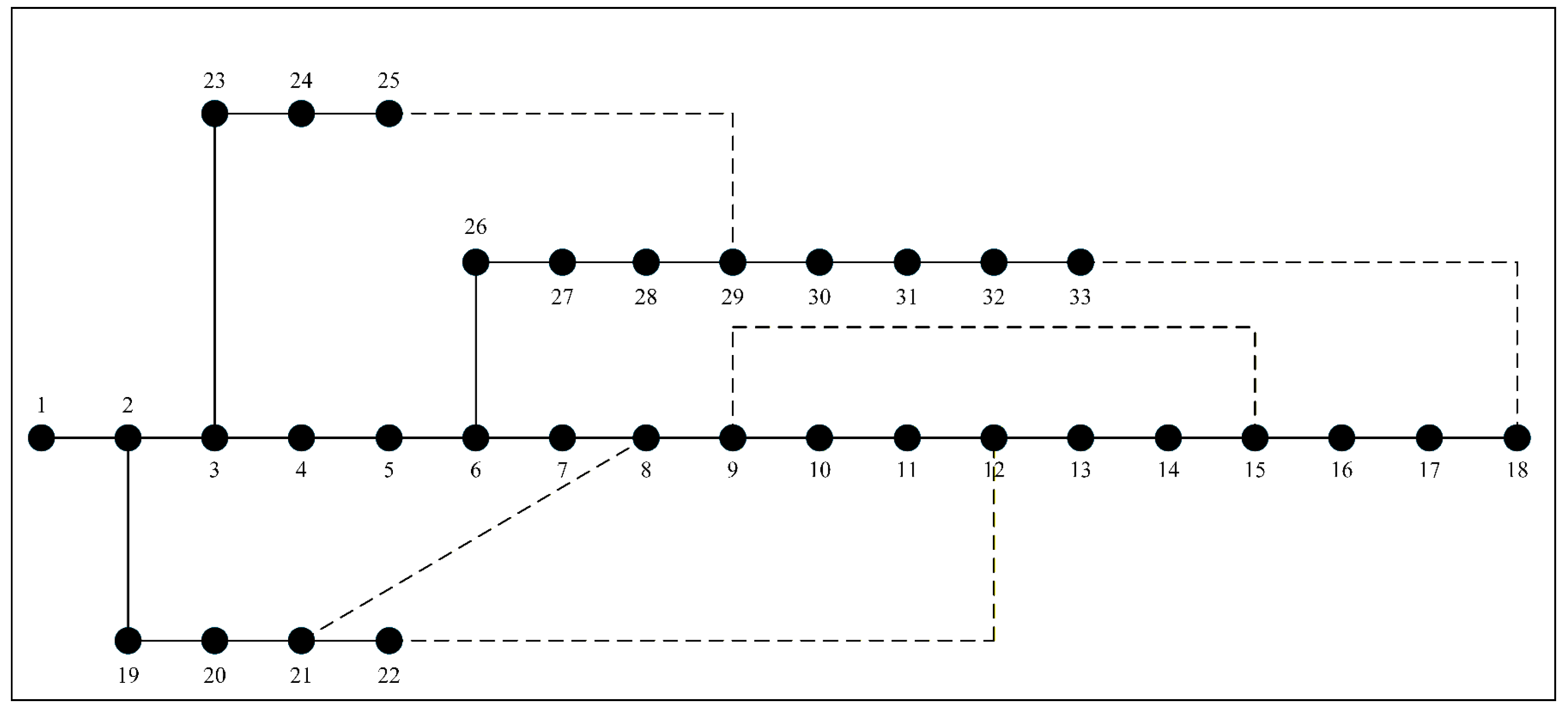
The IEEE 33-bus radial distribution feeder considered in this study is shown in Figure 2. The network comprises 32 normally closed branches and five tie switches. The base voltage is 12.66 kV, and the three-phase power base is 10 MVA. The aggregate system load is 3715 + j2300 kVA. The active and reactive power demands at each bus, together with the impedance of each branch, are summarized in Table 2 and are used throughout all subsequent case studies.
The branch parameters and nodal P/Q loads reported in Table 2 follow the standard IEEE 33-bus benchmark feeder (i.e., publicly available benchmark test data rather than field measurements) [3]. All case studies are evaluated under a single steady-state snapshot; no time-series profiles or stochastic scenarios are considered in this work. The DER/device capability bounds used in Cases 2 and 3 are specified in the corresponding case description/tables.
Using the DistFlow model developed in Section 2, the baseline operating condition of this network (without distributed energy resources or topology reconfiguration) yields a total active-power loss of 0.203 MW. The maximum and minimum per-unit bus voltages are 1.000 and 0.913, respectively, indicating a pronounced voltage drop towards the downstream buses and relatively high technical losses in the original radial configuration.
The environmental performance of the same operating point is quantified by the carbon-emission model in Equation (7). With a grid emission factor of 0.6093 tCO2/MWh, the corresponding hourly CO2 emission of the baseline condition is 2.3872 tCO2. These two quantities are taken as the reference values f loss base   =   0.203   MW   ,   f CO 2 base   =   2.3872   tCO 2 in Equation (9), and are used to compute the weighting coefficients w 1 and w 2 in Equation (10). In Cases 2 and 3, all improvements in loss reduction and emission mitigation are evaluated relative to this baseline operating condition.

4.2. Case 2: Devices Only (DG/SVC/CB; No Reconfiguration)

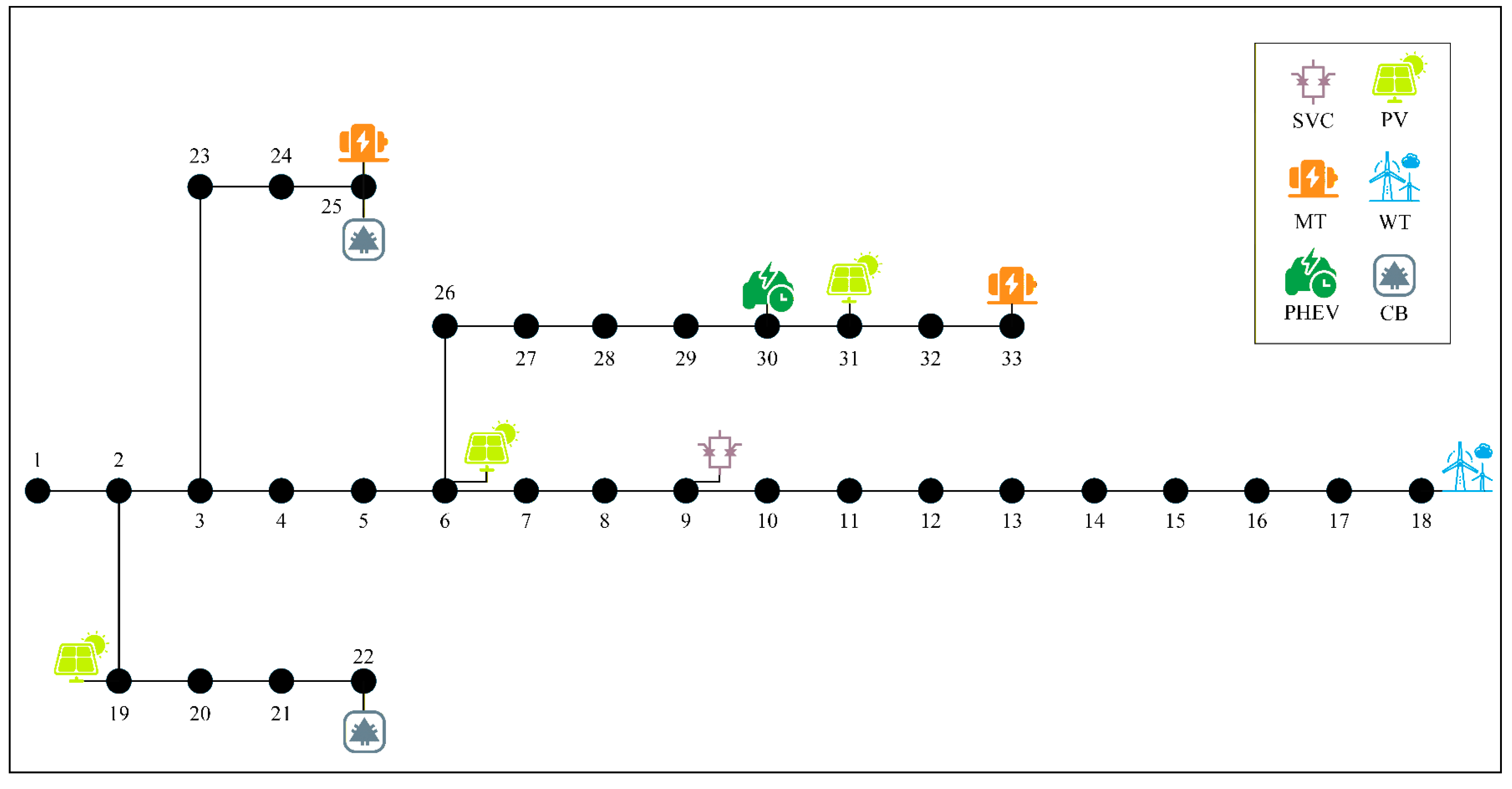
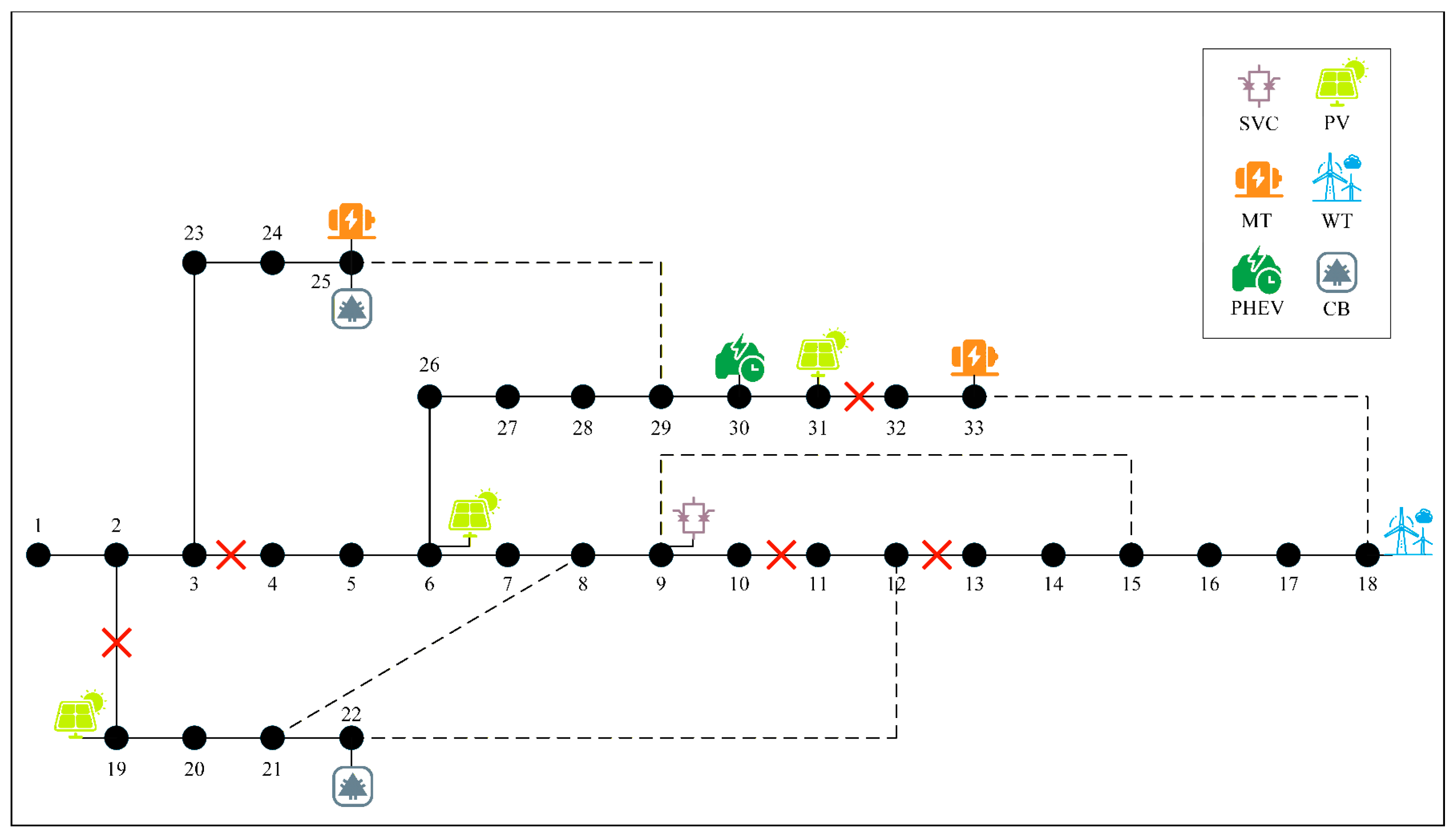
The model is predicated on the standard IEEE33 node model, with the addition of distributed power sources, PV and wind turbines, as well as reactive power compensation devices (see Figure 3). The integration of these components has the potential to reduce power losses during transmission, mitigate system network losses, and enhance voltage quality.
In Case 2, the IEEE 33-bus feeder is equipped with DERs and reactive compensation devices (Figure 3) while maintaining the original radial topology (i.e., tie switches are not used). All DER and device inputs in Case 2 correspond to a single steady-state snapshot rather than time-series measurements. The PV/WT availability and the operating limits of MT, aggregated PHEV, SVC, and CB are scenario settings specified as capacity/feasibility bounds (i.e., synthetic benchmark assumptions for reproducible evaluation), and the optimizer determines the final dispatch within these limits. Therefore, the intervals reported below represent rated/available capacities and operational constraints (including the minimum-supply requirement for the critical-load MT at bus 33). PV units are installed at buses 6, 19, and 31, and their active- power outputs are optimized within the availability limits. P PV   ϵ   [ 0 ,   0.8 ] MW.WT generation is connected at bus 18 with P WT , 18   ϵ   [ 0 , 0.6 ] MW. MT units are placed at buses 33 and 25; to emulate critical loads such as hospitals and factories that require uninterrupted supply, the MT at bus 33 is enforced with a minimum output, P MT , 33   ϵ   [ 0.4 ,   1.4 ] MW, while the MT at bus 25 operates within P MT , 25   ϵ   [ 0 ,   1.4 ] MW. This modeling choice reflects practical operating requirements at bus 33, which represents critical facilities (e.g., hospitals and industrial plants) that cannot tolerate supply interruptions; therefore, the MT at bus 33 is enforced to remain online via the minimum-output constraint within the specified operating range.
For inverter-interfaced PV/WT and MT units, both active and reactive powers are optimized within their admissible ranges. Reactive capability is limited by the device apparent-power rating (i.e., P g 2   +   Q g 2     S g 2 for inverter-interfaced unit g ), consistent with the constraints in Section 2.3. A PHEV aggregator is connected at bus 30 and modeled as a controllable active-power injection within [−0.6, 0.6] MW (V2G/G2V), operating at unity power factor (zero reactive exchange). Shunt capacitor banks are installed at buses 22 and 25 with a step size of 0.1 MVar and a maximum of 3 steps, and their discrete switching steps are optimized. An SVC is installed at bus 9 with a continuous reactive range of [−0.3, 0.3] MVar. The voltage security limits are set to 0.99–1.01 p.u. Note that the above intervals specify operating limits (availability and minimum-supply constraints); the final dispatch values reported in Table 3 are optimization results and may lie on the bounds.
In that case, we first disregard the use of the tie switch branch and the power system is simplified as shown below:
The model (see Figure 4) is optimized using CPLEX. The total network loss is 0.0382 MW and the corresponding CO2 emission is 0.3433 tCO2. The voltage constraints are active at both ends of the admissible range, with Vmax = 1.0100 p.u. at bus 33 and Vmin = 0.9900 p.u. at bus 25, indicating a tight voltage operating band in Case 2. A detailed cross-case voltage-profile comparison is provided in Case 3.
The results of active power and reactive power from PV, wind turbines, and reactive power from reactive compensation devices are presented in Table 3:
Table 3 reports the optimized device setpoints. Several variables lie on their bounds due to device availability limits and minimum-output constraints, while the unequal PV dispatch across buses is mainly shaped by the tight voltage band and the near-zero grid purchase condition in Case 2.
To interpret the optimal setpoints in Table 3, we checked which constraints are tight at the Case 2 optimum. The branch current limits are not binding (the maximum current utilization is only 0.0398), while the voltage limits are tight with Vmax at bus 33 (1.0100 p.u.) and Vmin at bus 25 (0.9900 p.u.). Moreover, the root-bus active power exchange is numerically close to zero (Pgrid ≈ 0 within solver tolerance), implying a near-zero grid purchase condition. Under this regime, additional PV injection at the distal lateral around buses 29–30–31 tends to intensify backfeeding (reverse power flow is observed on lines 29–30 and 30–31), which provides a smaller marginal loss-reduction benefit and may tighten local operating limits. Therefore, PV at bus 31 becomes the marginal PV unit and is curtailed earlier than PV units at buses 6 and 19 in the optimal solution.

4.3. Case 3: Device-Topology Co-Optimization (Reconfiguration + Device Dispatch)

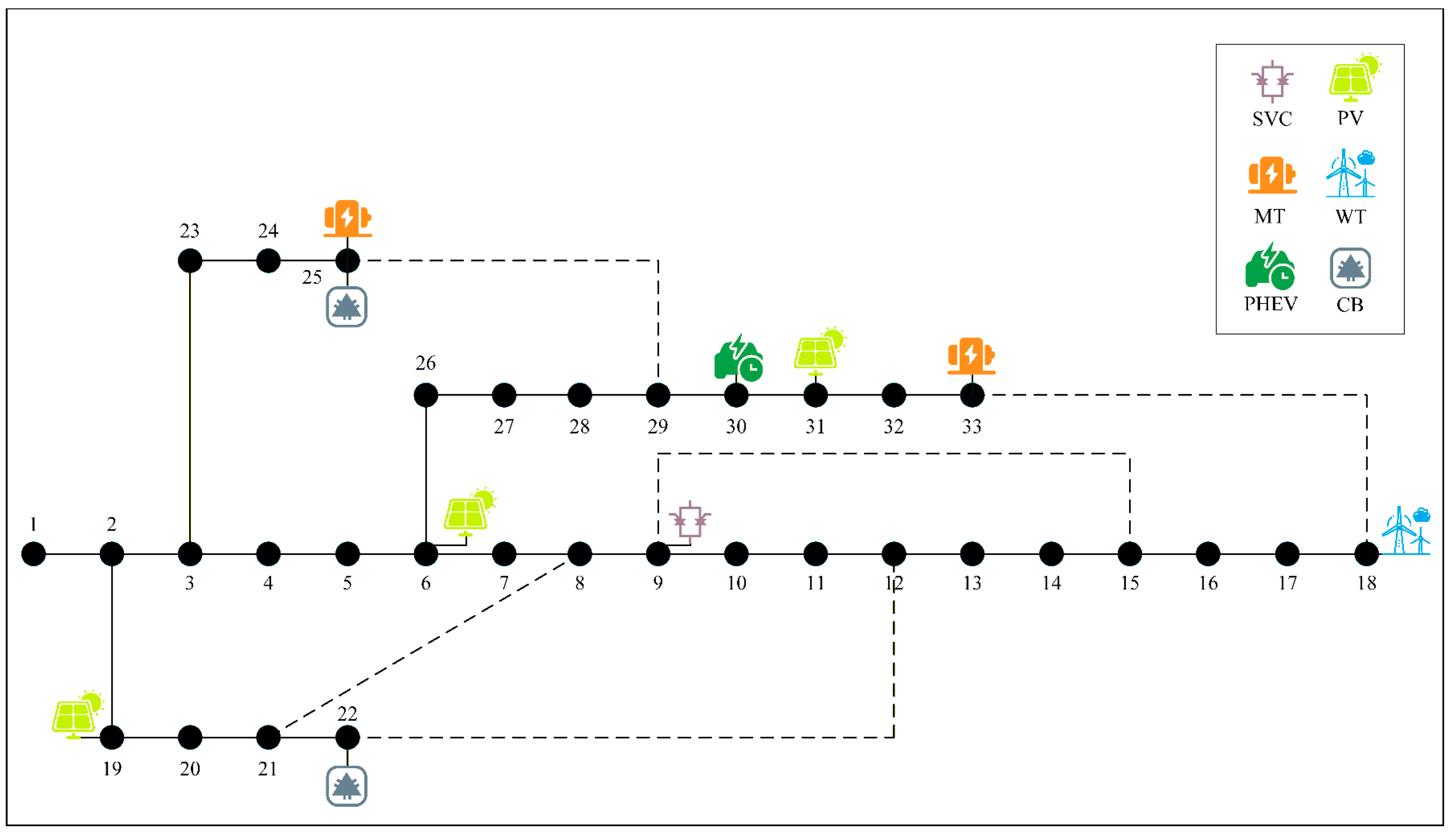
With the addition of distributed power sources and reactive power compensation devices, the introduction of the opening and closing variable αij is considered to modify the topology by changing the branch opening and closing states while maintaining the radiality and connectivity of the distribution network, thus further reducing network losses (see Figure 5).
The current calculation for the IEEE 33 distribution network model to be after reconfiguration a network loss of 0.0205 MW and a total CO2 emission of 0.2580 tCO2, and the open/closed status of branches can also be known as follows:
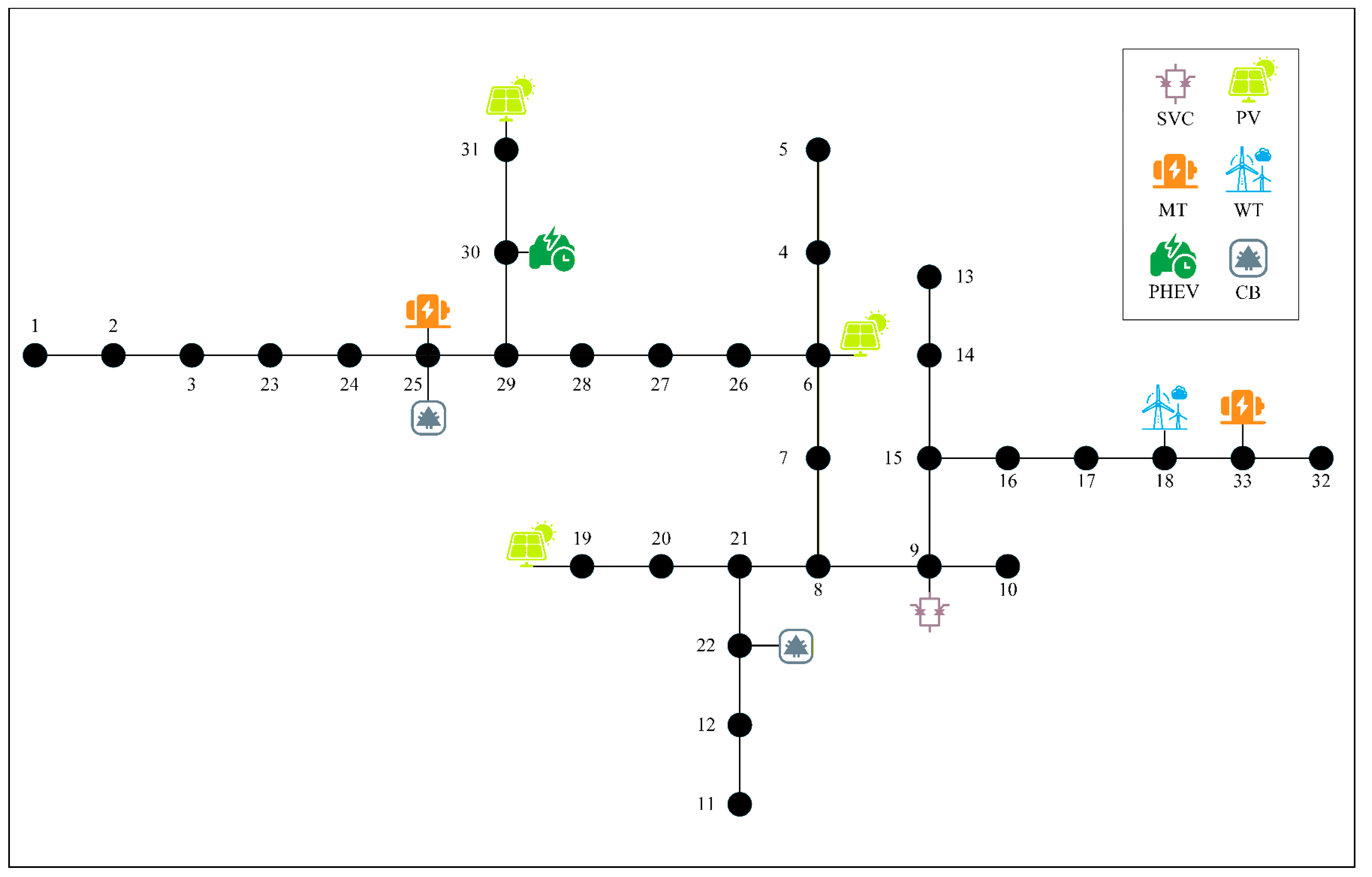
The distribution network diagram was redrawn to make it easier to observe its radiality and connectivity, as shown in Figure 6 below:
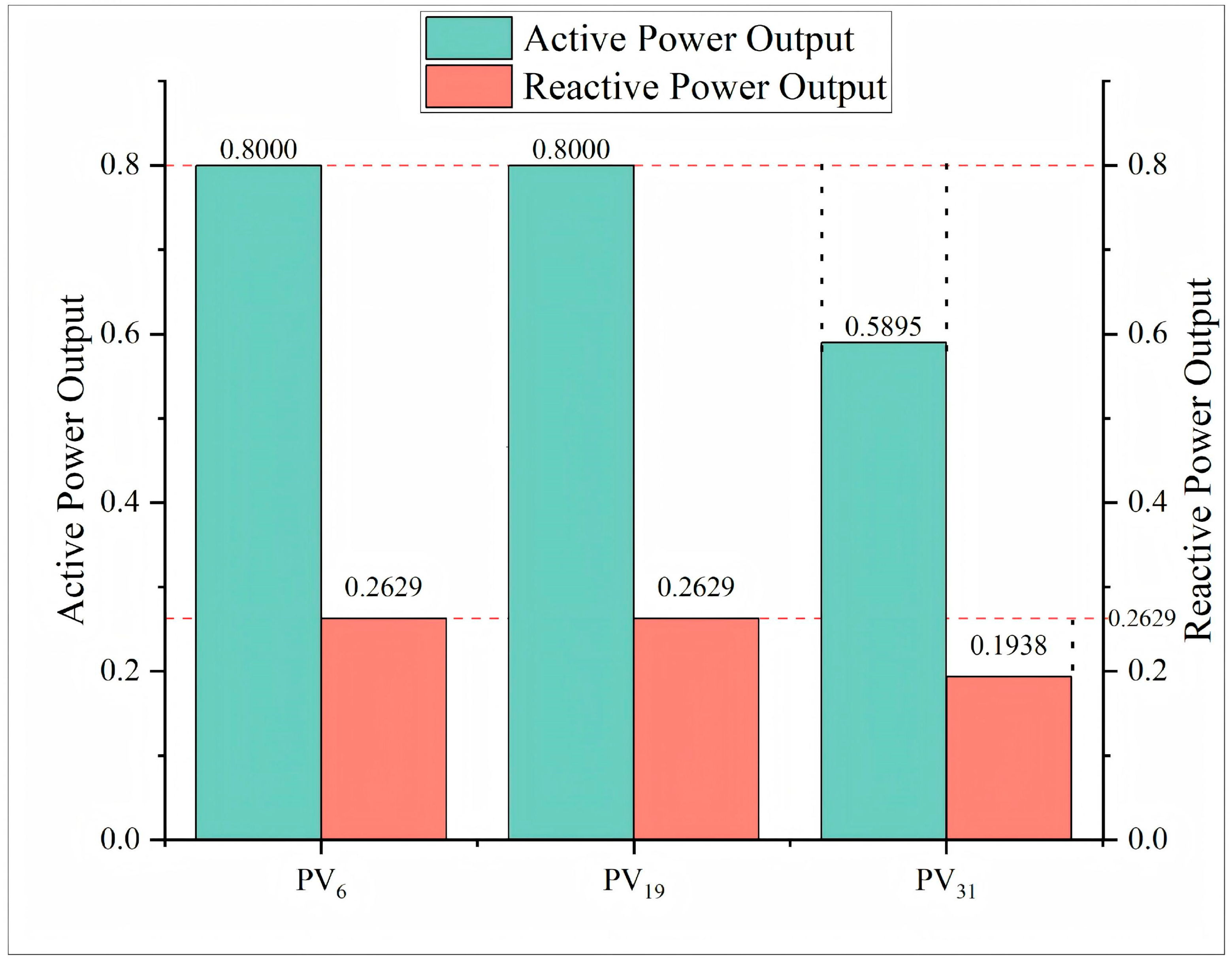
Figure 6 shows that the reconfiguration reshapes the main power-transfer corridors and makes bus 6 a hub connecting several major downstream branches (toward buses 4–5, 7-12/22, 13-18/33/32, and the 8-21-19 lateral). Consequently, injections at electrically central buses (PV at buses 6 and 19) bring a larger system-wide marginal benefit: they reduce upstream transfers on multiple segments simultaneously and help maintain voltage feasibility in weak areas (Vmin = 0.9900 p.u. at bus 13). By contrast, PV31 together with the PHEV aggregation at bus 30 lies on the short lateral 29-30-31; further injection on this lateral mainly increases backfeeding toward bus 29 (reverse power flows occur on lines 29–30 and 30–31), which offers a smaller marginal loss-reduction benefit and may tighten local voltage feasibility. This explains why PV6 and PV19 operate at their upper bounds (0.8 MW), while PV31 is curtailed (0.5895 MW) in Case 3.
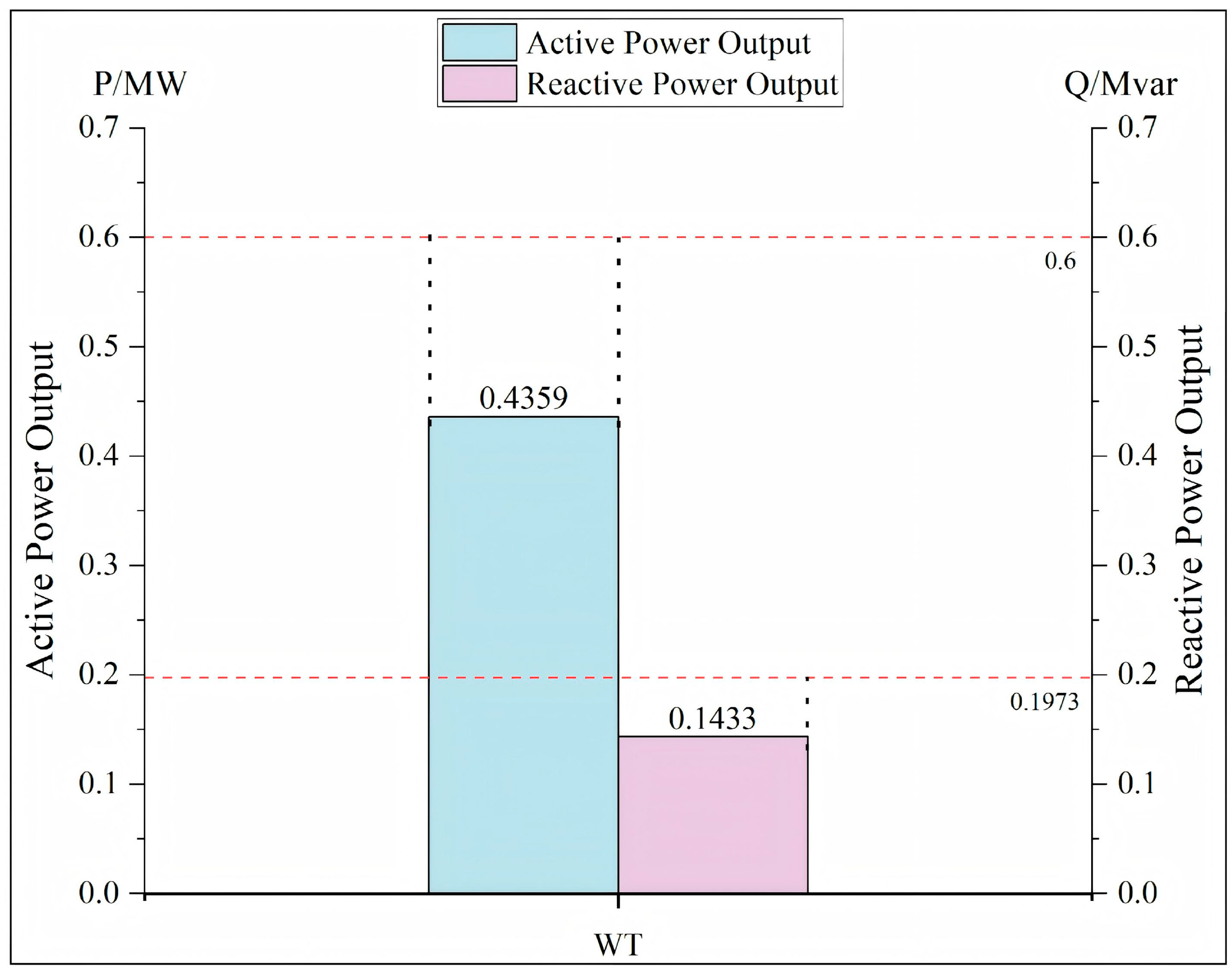
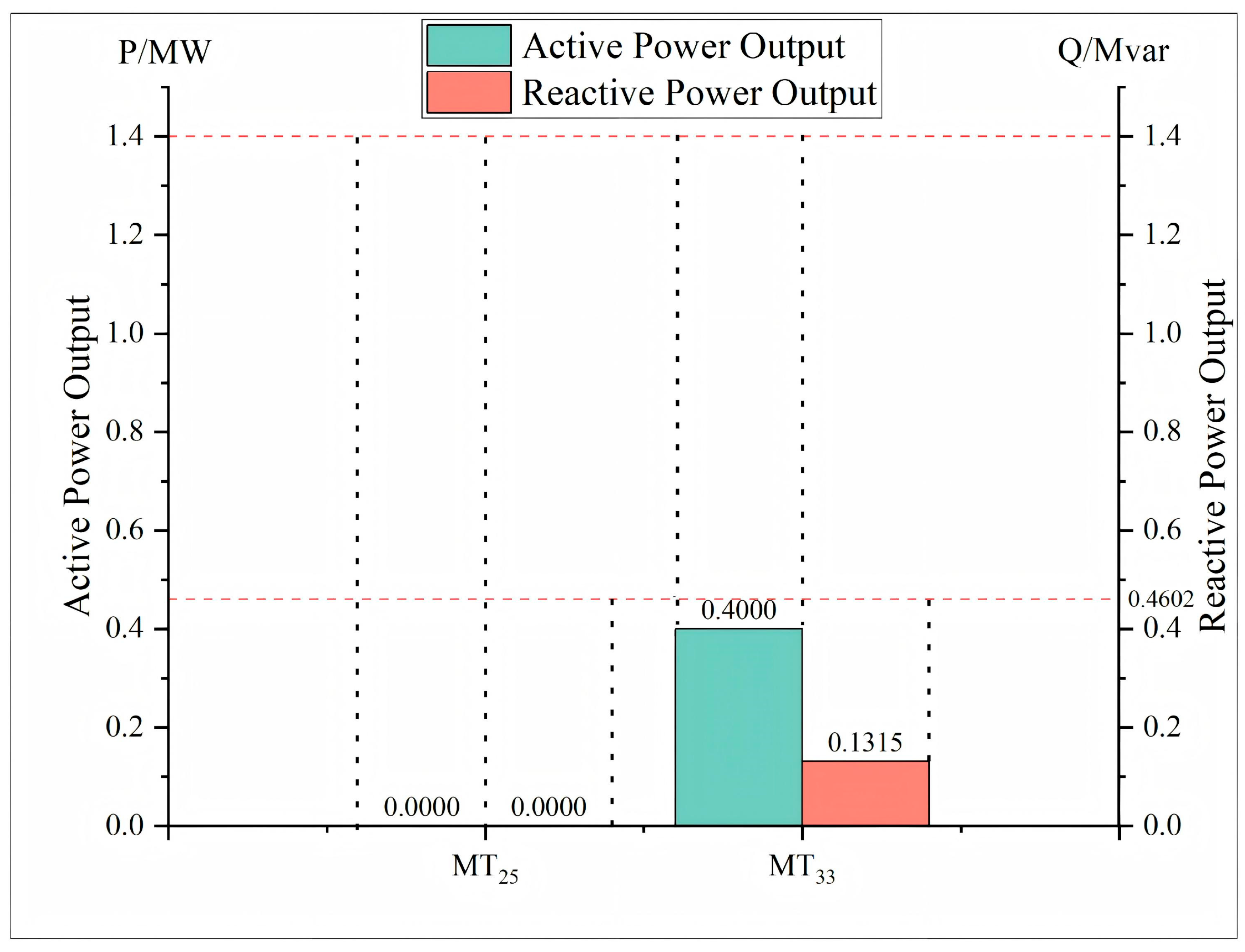
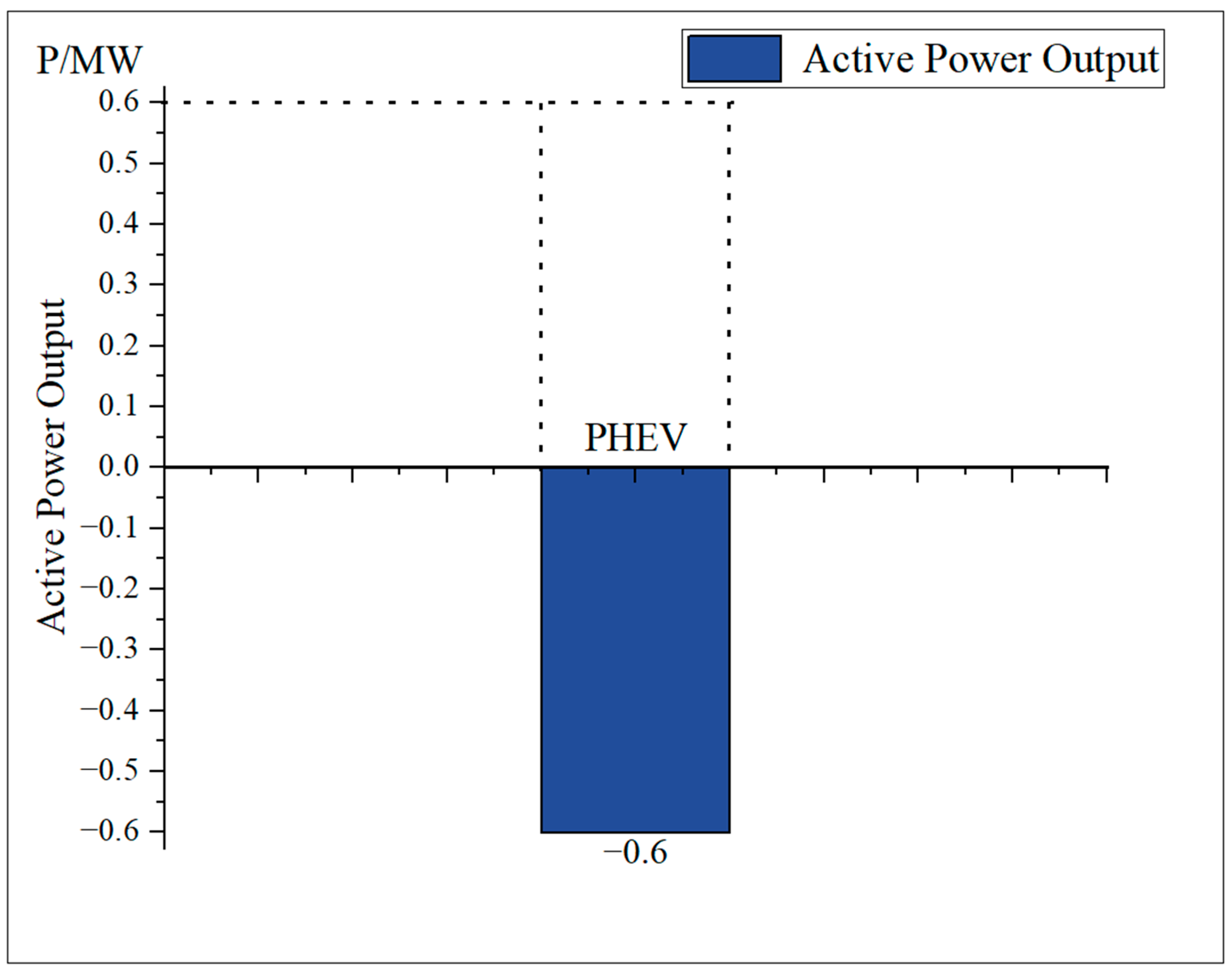
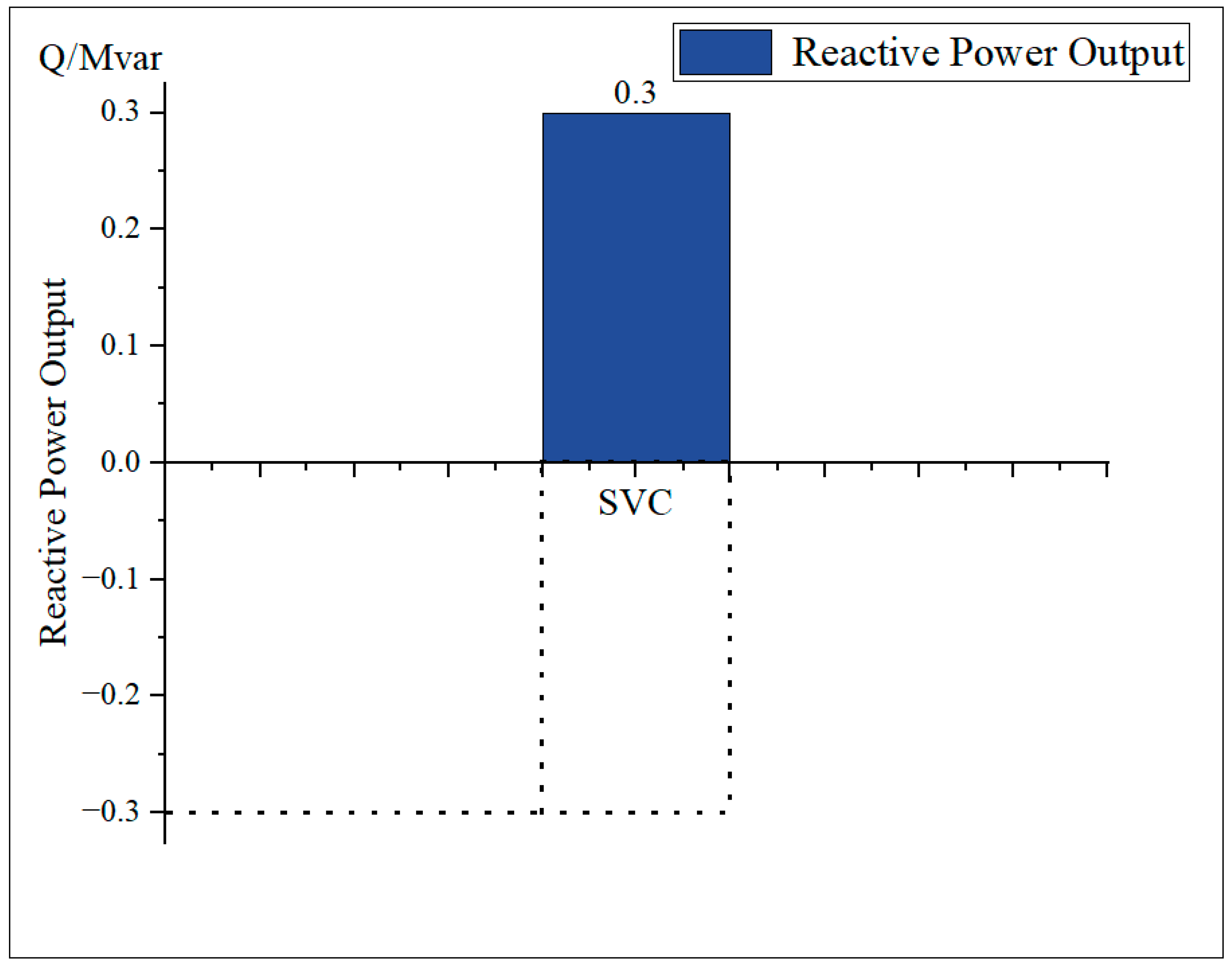
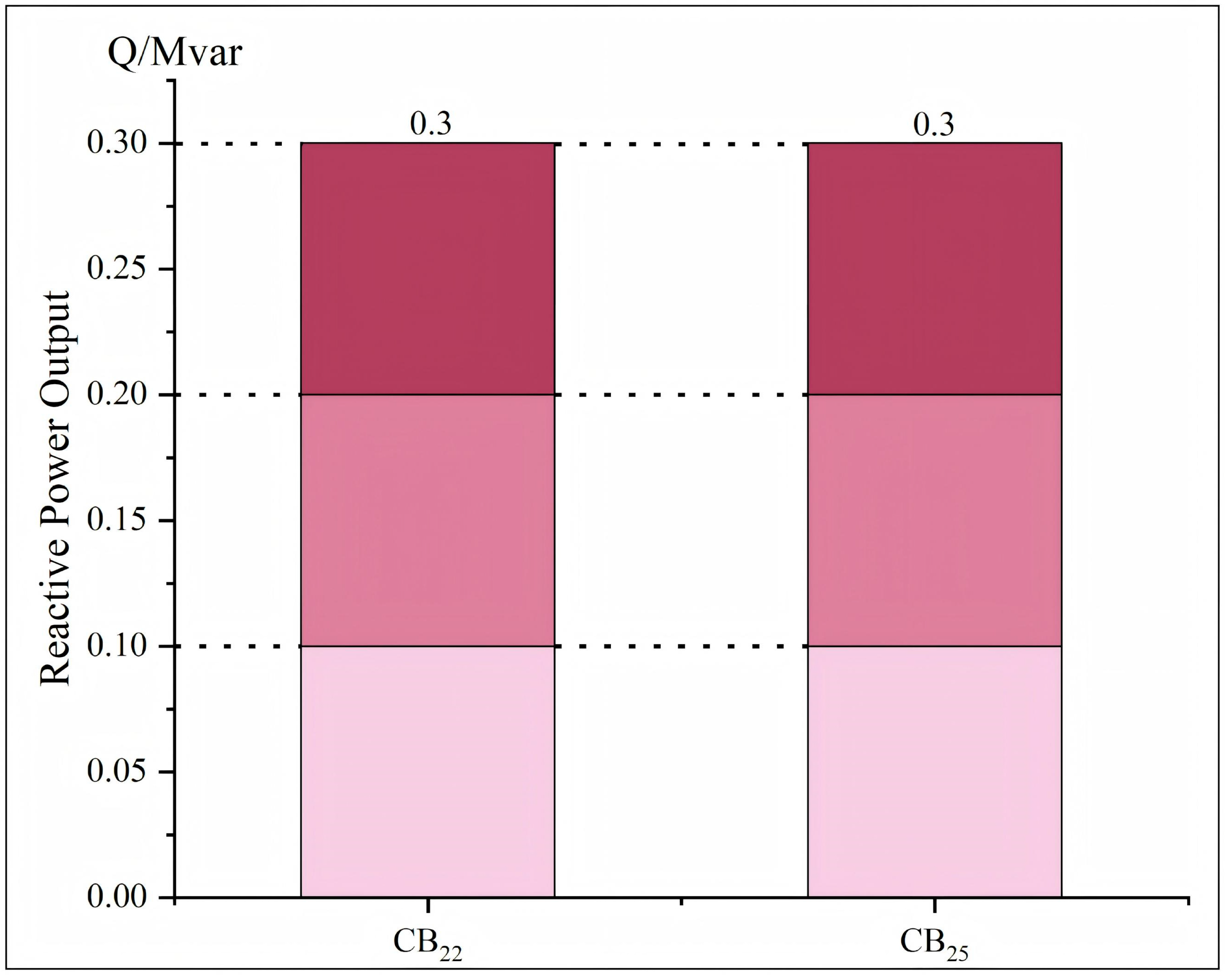
The same “location + marginal impact” rationale is consistent with the other setpoints. The WT at bus 18 is electrically remote and mainly serves the end-area demand locally, yielding an effective reduction in upstream transfers (WT = 0.4359 MW). The MT at bus 33 is subject to a must-run minimum output and therefore stays at its lower bound (0.4 MW), while MT25 is not dispatched (0 MW) in this case. The PHEV aggregator is scheduled at its charging bound (−0.6 MW), jointly coordinating with PV/WT/MT to keep the root-bus active power exchange numerically close to zero (Pgrid ≈ 0 within solver tolerance). Regarding voltage/reactive-power support, in this snapshot the PHEV is modeled at near-unity power factor, and the dedicated compensators (SVC at bus 9 and CBs at buses 22 and 25) are dispatched to their upper limits (0.3 MVar each) to maintain voltages within the tight band. Meanwhile, branch-current limits are far from binding (max current utilization ≈ 0.0027), indicating that the Case 3 solution is primarily shaped by voltage feasibility and the allocation of local reactive support rather than ampacity constraints.
The PV, WT, SVC, CB, MT, and PHEV outputs of the model following topological reconfiguration optimization are presented below (see Figure 7, Figure 8, Figure 9, Figure 10, Figure 11 and Figure 12):
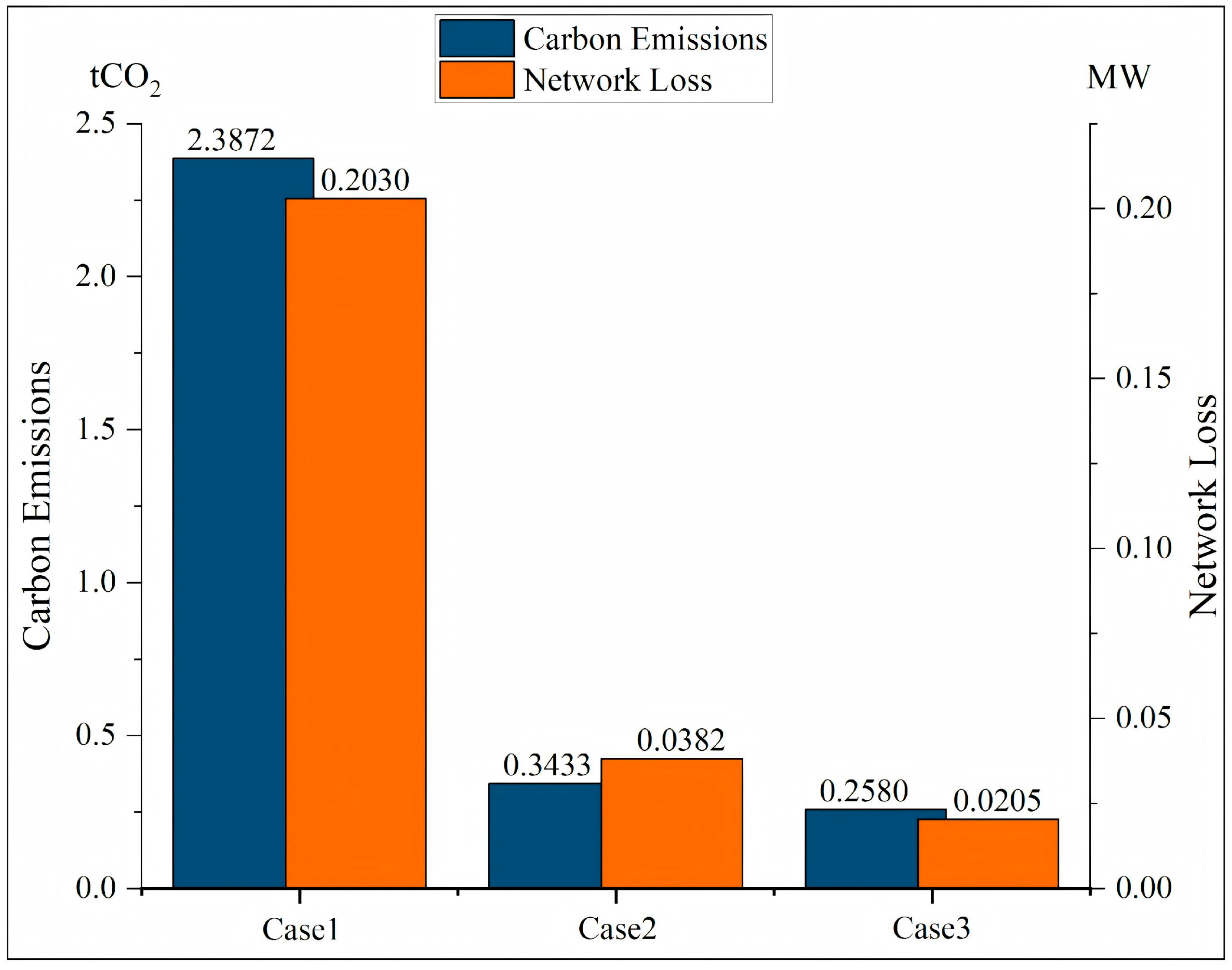
As illustrated in Figure 13, a comparative analysis of the network losses and CO2 emissions for the three models is presented:
As shown in Figure 13, compared with the baseline (Case 1), the network loss is reduced from 0.2030 MW to 0.0382 MW in Case 2 (81.18% reduction) and further to 0.0205 MW in Case 3 (89.90% reduction). Meanwhile, the CO2 emission decreases from 2.3872 tCO2 to 0.3433 tCO2 in Case 2 (85.62% reduction) and to 0.2580 tCO2 in Case 3 (89.19% reduction). Relative to Case 2, Case 3 achieves an additional 46.34% reduction in network loss and 24.85% reduction in CO2 emission.
As shown in Figure 13, compared with the baseline (Case 1), the network loss is reduced from 0.2030 MW to 0.0382 MW in Case 2 (81.18% reduction) and further to 0.0205 MW in Case 3 (89.90% reduction). Meanwhile, the CO2 emission decreases from 2.3872 tCO2 to 0.3433 tCO2 in Case 2 (85.62% reduction) and to 0.2580 tCO2 in Case 3 (89.19% reduction). In addition, the operating cost C ( x ) decreases from CNY 354.9357 in Case 1 to CNY 56.6271 in Case 2 (84.05% reduction) and further to CNY 37.4677 in Case 3 (89.44% reduction). Relative to Case 2, Case 3 achieves an additional 46.34% reduction in network loss, 24.85% reduction in CO2 emission, and 33.83% reduction in C ( x ) .
To further contextualize the claimed improvements beyond the internal Case 1–3 comparison, we benchmarked the proposed MISOCP against representative metaheuristics (Genetic Algorithm (GA), Differential Evolution (DE), Gray Wolf Optimizer (GWO), Artificial Bee Colony (ABC), Tabu Search (TS), and Teaching-Learning-Based Optimization (TLBO)) and the classical reconfiguration heuristic Branch Exchange on the same test system under Case 3. For stochastic metaheuristics, the results are averaged over 10 independent runs with different random seeds under the same stopping criterion. As summarized in Table 4, the proposed MISOCP achieves the best overall objective value ( C ( x ) = 37.4677 ) while remaining computationally competitive (8.46 s). In addition, we report a loss-only MISOCP variant as a baseline with a different scalarization objective, which yields a lower loss ( f l o s s = 0.0103 MW) but substantially higher emissions ( f C O 2 = 1.2349 tCO2 ) , leading to a much worse overall objective ( C ( x ) = 124.8870 ) . This comparison further supports the necessity of the proposed loss-carbon co-optimization under carbon-aware objectives.
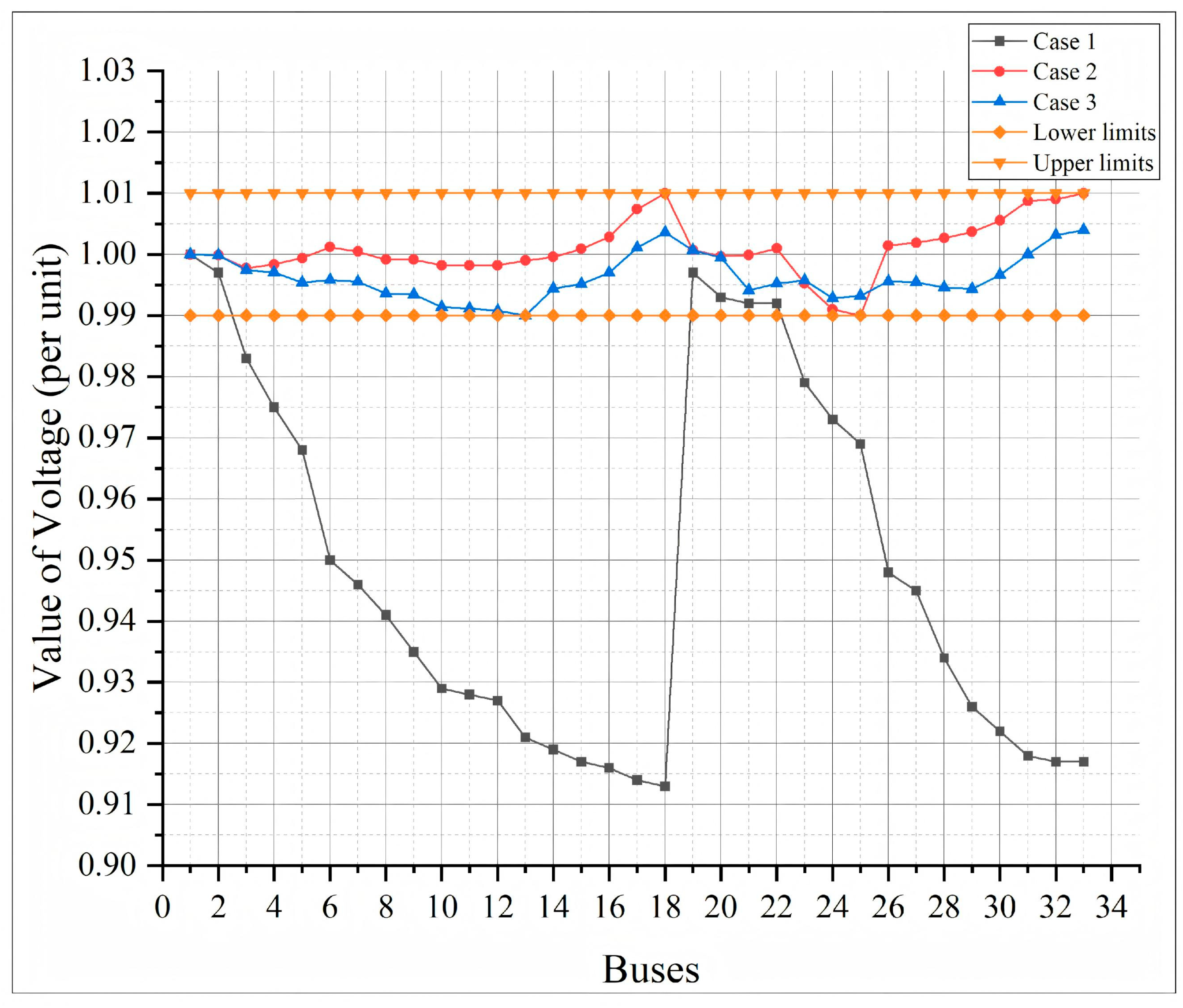
Figure 14 illustrates the voltage distributions for the three cases:
As shown in Figure 14, the node voltages in Case 3 remain within the safety limits. Moreover, compared with Case 1, the voltage profile is significantly improved, supporting safe and stable system operation.
To provide a quantitative assessment of voltage quality beyond the visual comparison in Figure 14, we compute voltage-deviation indices over all load buses (buses i = 2 , , 33 , excluding the slack bus). Let V i denote the per-unit voltage magnitude at bus i and V r e f = 1.0 p.u. The absolute voltage deviation index (VDI) and the squared voltage deviation index are defined as
VDI abs = i = 2 33 | V i V ref | , VDI sq = i = 2 33 ( V i V ref ) 2
In addition, we report the maximum absolute deviation and the voltage spread as
MaxAbsDev = max i = 2 , , 33 | V i V ref | , Range = V max V min
where V max   =   max i = 2 , , 33 V i and V m i n = m i n i = 2 , , 33 V i .  Table 5 summarizes these metrics for the three cases. Compared with Case 1, Case 2 dramatically reduces both VDI abs and VDI sq and, and Case 3 further improves voltage quality by tightening the voltage spread and reducing deviation indices, confirming that the voltage-profile enhancement in Figure 14 is quantitatively significant.
As summarized in Table 5, voltage-quality improvements are not only visible in Figure 14 but also quantitatively significant across multiple deviation metrics. Case 2 markedly tightens the voltage profile compared with the baseline. Specifically, the voltage spread (Range) decreases from 0.08400 to 0.02852, i.e., a 66.05% reduction. Consistently, the deviation indices drop sharply: VDI abs decreases from 1.69900 to 0.18021 (89.39% reduction), and VDI sq decreases from 0.11680 to 0.001614 (98.62% reduction). The average and RMS deviations are also reduced by nearly one order of magnitude (MAD: 0.053094 0.0056316,89.39 % ; RMS: 0.060415 0.0071027 , 88.24 % ) while the worst-case deviation (MaxAbsDev) drops from 0.08700 to 0.01528 (82.44%). These results indicate that coordinated DER and reactive-support dispatch under the fixed topology effectively suppresses both average and worst-case voltage deviations.
Enabling reconfiguration (Case 3) further enhances voltage quality, albeit with a smaller but still meaningful marginal gain relative to Case 2. The voltage spread is reduced from 0.02852 to 0.01242 (56.45%), and the worst-case deviation decreases from 0.01528 to 0.00985 (35.54%). Moreover, RMS deviation drops from 0.0071027 to 0.0058146 (18.14%)and MAD from 0.0056316 to 0.0049272 ( 12.51 % ) , suggesting a further tightening of the voltage profile around 1.0 p.u. In terms of deviation indices,   V D I s q decreases by 32.96% (0.001614→0.001082), while VDI a b s exhibits a modest reduction of 12.51% (0.18021→0.15767), indicating that reconfiguration primarily mitigates the remaining squared (energy-weighted) deviations and extreme deviations rather than uniformly shifting all buses. Overall, Table 5 confirms that device coordination delivers the dominant improvement, and topology reconfiguration provides additional refinement, yielding a tighter voltage spread and lower worst-case deviation while maintaining all bus voltages within the prescribed limits.
From an operational standpoint, RMS and MAD reflect the system-wide voltage-quality level (i.e., the typical deviation over all buses), whereas MaxAbsDev captures the weakest bus security margin that is most relevant to undervoltage risk at remote/end-of-feeder locations. The pronounced reductions in RMS/MAD from Case 1 to Case 2 indicate that reactive support and DER dispatch primarily improve the “average” voltage quality by reducing reactive circulation and branch currents, thereby alleviating voltage drops along the feeder. By contrast, the additional improvement from Case 2 to Case 3 is more evident in Range and MaxAbsDev, suggesting that reconfiguration mainly refines the remaining extreme deviations by reshaping power transfer paths and relieving locally stressed branches, which improves the voltage of the most vulnerable buses without requiring uniformly larger reactive injections.

4.4. Relaxation Tightness and Gap Analysis

To verify the tightness of the SOC relaxation in Equations (30) and (31), the gap after relaxation was calculated using the following equation:
Devi   =   I ij sqr ( P ij ) 2   +   ( Q ij ) 2 U i sqr
The maximum value of the relaxation gap is defined in terms of the infinite parameter as follows:
Devi max   =   I ij sqr ( P ij ) 2 + ( Q ij ) 2 U i sqr
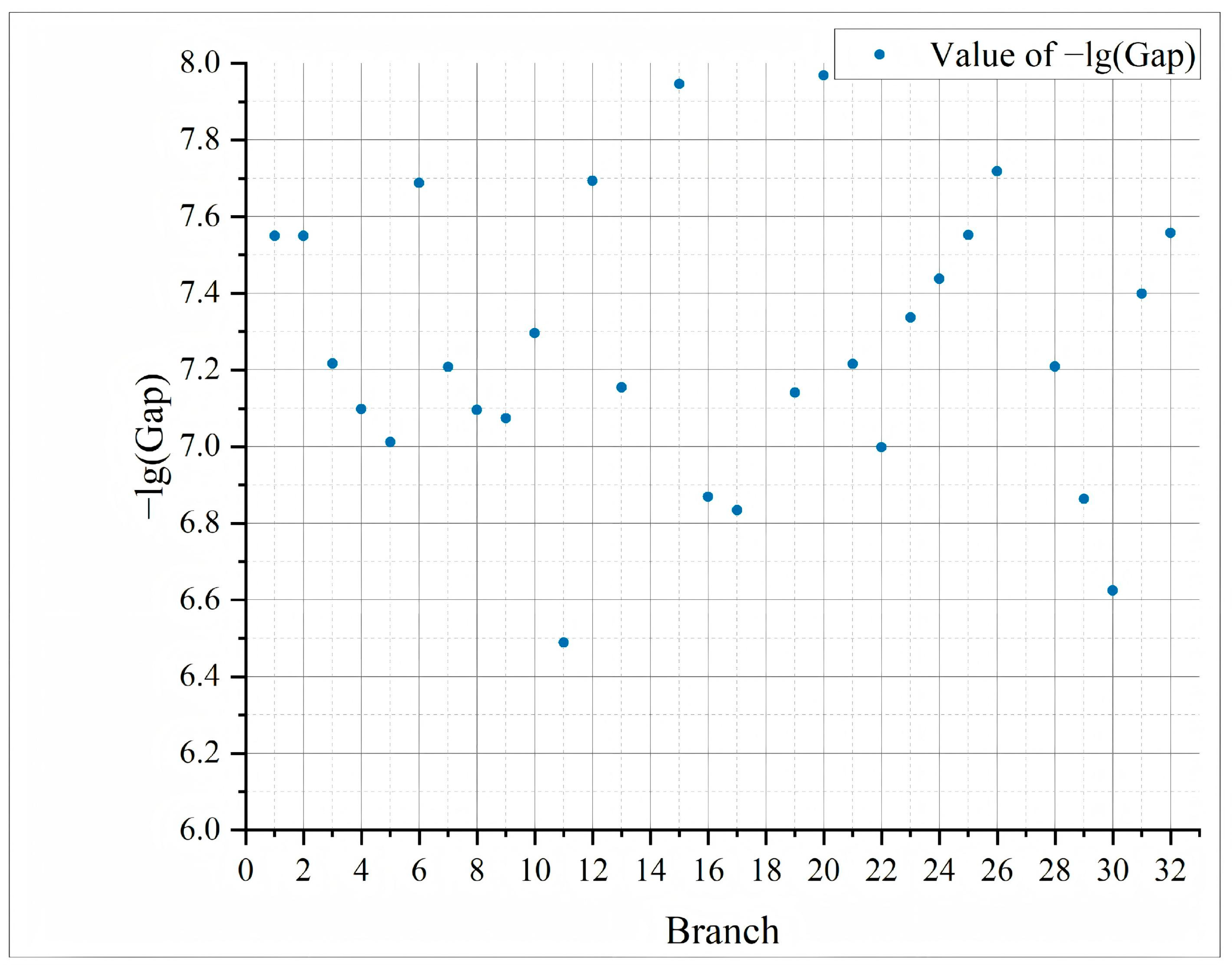
As illustrated in Figure 15, the distribution of gaps subsequent to SOC relaxation is presented:
As shown in Figure 15, the relaxation tightness of the MISOCP formulation is evaluated by the branch-wise deviation (gap) between the squared-current variable and its DistFlow counterpart, i.e., Devi max in Equation (36). Each marker corresponds to one feeder branch, and a smaller gap indicates tighter SOC relaxation and better physical consistency between the relaxed solution and the original nonconvex power-flow relations. For a more intuitive visualization, we plot −lg(Gap) rather than Gap itself: taking the base −10 logarithm compresses the dynamic range of very small gap values, and the negative sign ensures that larger plotted values correspond to smaller gaps (i.e., tighter relaxation). The consistently high −lg(Gap) values across branches therefore confirm that the SOC relaxation remains numerically tight under the reconfigured topology, supporting the reliability of the obtained MISOCP solution.

4.5. Sensitivity and Pareto Analyses

4.5.1. Sensitivity Analysis with Respect to the Weight Coefficient w 1

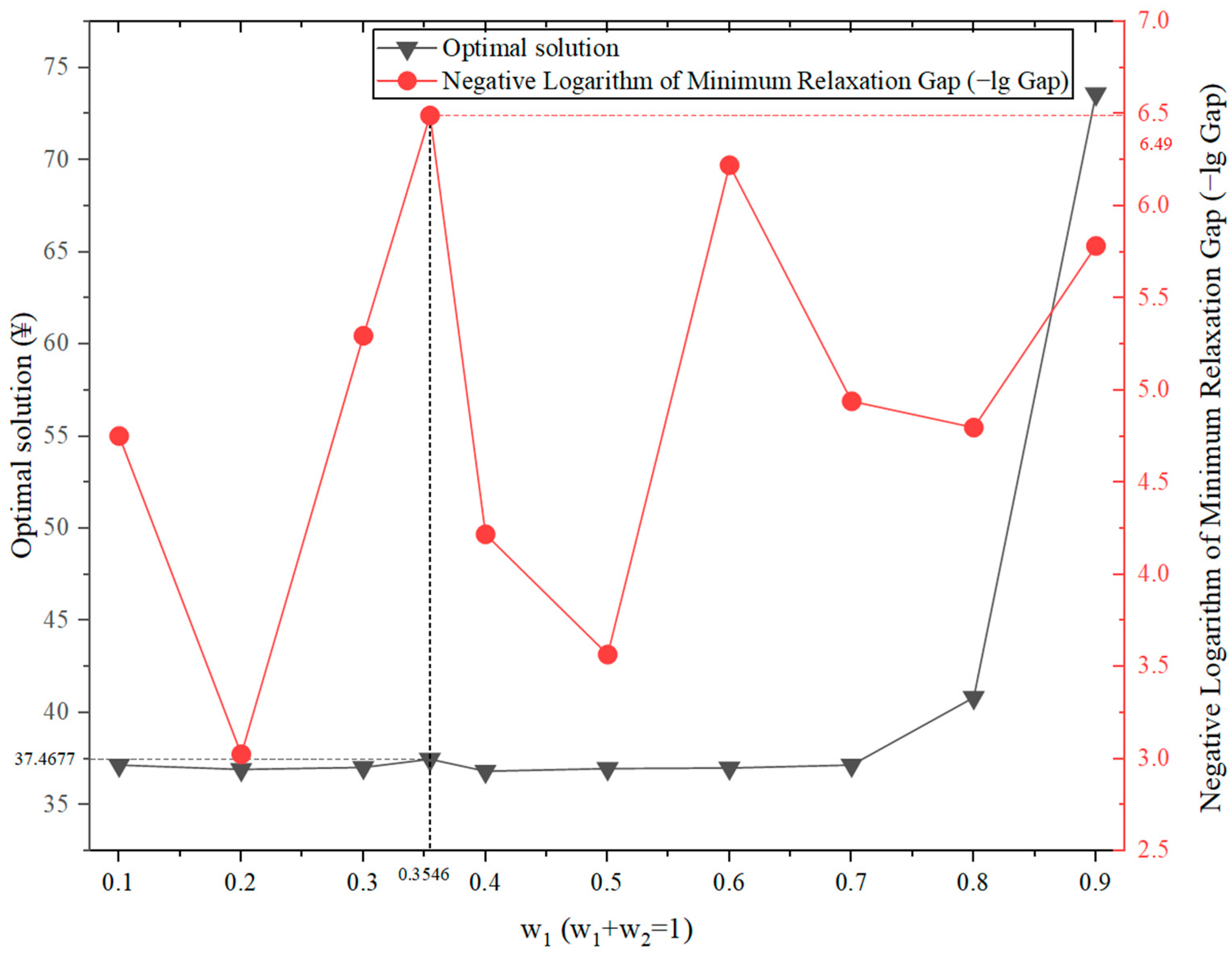
The Case 3 objective adopts a price-calibrated weighted-sum formulation, in which the relative preference between loss reduction and carbon emission mitigation is governed by w 1 (with w 2 =   1 w 1 ) . In the baseline setting, the calibrated weight is w 1 * = 0.3546 . To assess the robustness of this calibration, we conduct a one-at-a-time sensitivity study by sweeping w 1 from 0.1 to 0.9 (and updating w 2 accordingly) while keeping the Case 3 network model, DER placements, operating limits, and reconfiguration constraints unchanged. For each weight, we solve Case 3 MISOCP and record (i) the optimal monetized objective value and (ii) the SOC relaxation tightness measured by the gap metric defined in Equation (36). The results are summarized in Figure 16.
In Figure 16, the optimal objective remains almost unchanged over a broad interval of w 1 (approximately 0.1–0.7), forming a clear plateau around CNY 37.4–37.5. This indicates that, under the Case 3 constraint set, the optimal dispatch/topology decisions are robust to moderate preference shifts rather than being driven by fine-tuning of the weight. Only when the weighting becomes strongly loss-dominant ( w 1 0.8 ) does the objective deteriorate markedly—most prominently at w 1 = 0.9 —suggesting that extreme preferences push the solution toward an unfavorable end of the trade-off surface. Importantly, the calibrated choice w 1 * = 0.3546 lies well within the stable region and yields an objective value of 37.4677 CNY. Meanwhile, the SOC tightness indicator stays high across the sweep; at w 1 * l g ( G a p m i n ) 6.49 (gap on the order of 10 7 ) , supporting that the reported operating point is backed by a numerically tight relaxation.

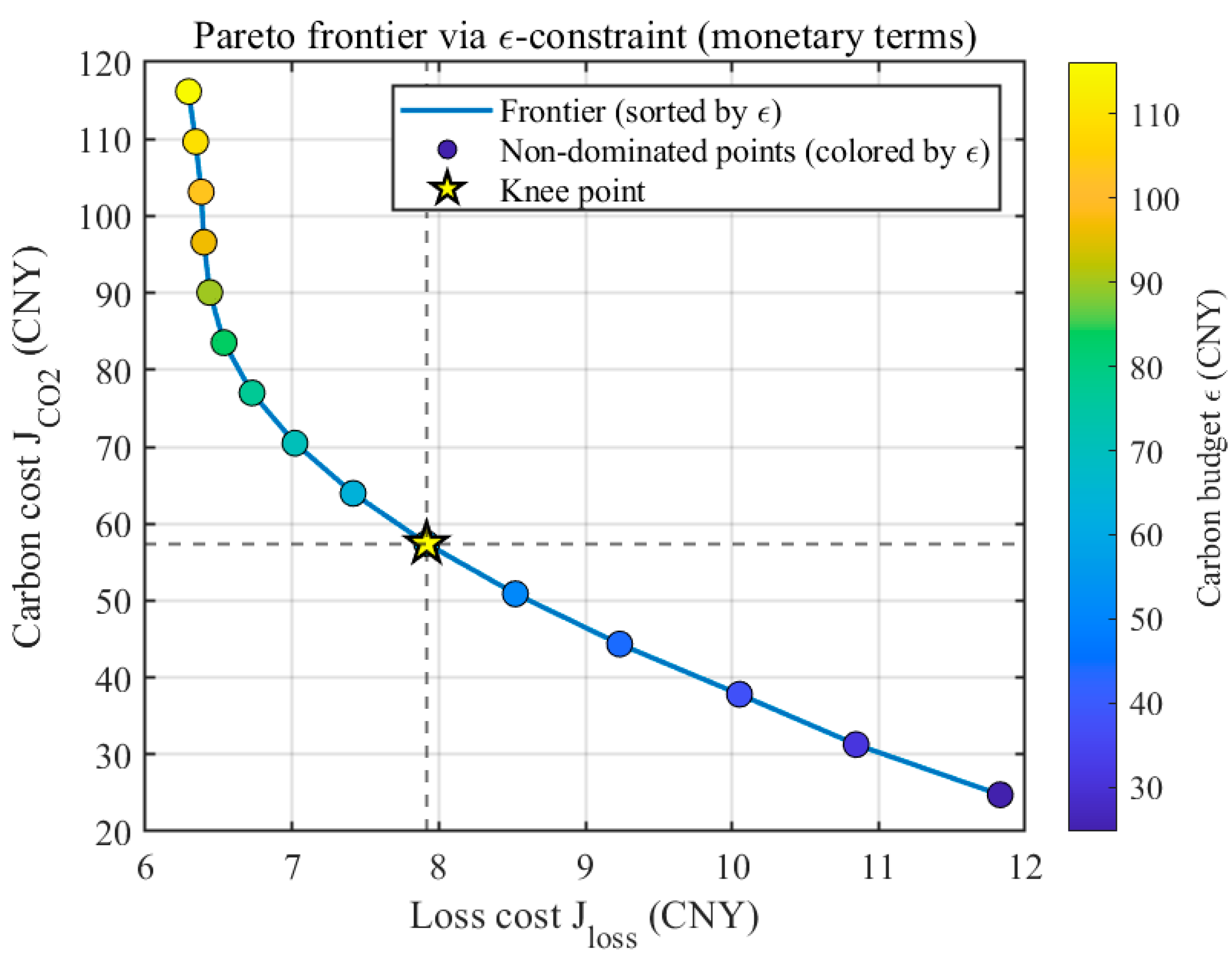
4.5.2. Pareto Frontier Construction via the ε -Constraint Method

The weighted-sum formulation in Case 3 yields a single compromise operating point for a prescribed ( w 1 , w 2 ) . To expose the full trade-off structure and quantify the marginal exchange between loss-related and carbon-related costs, we further construct the Pareto frontier using the ε - constraint method. In monetary terms, we denote the two criteria as the loss cost J l o s s and the carbon cost J C O 2 , both expressed in CNY under the same price calibration.
To determine a meaningful sweep range without ad hoc tuning, we first compute the two extreme solutions by solving the original MISOCP with (i) m i n J l o s s and (ii) m i n J C O 2 . Let J C O 2 m i n be the ninimum achievable carbon cost and let J C O 2 ( L m i n ) be the carbon cost attained at the minimum-loss solution. The Pareto set is then generated by sweeping a carbon-cost budget ε ϵ [ J C O 2 m i n , J C O 2 ( L m i n ) ] and solving the parametric MISOCP:
min x , y   J loss ( x , y ) s . t . J CO 2 ( x , y )     ε ,   ( x , y )   ϵ   Ω
where Ω is the feasible set induced by the proposed reconfiguration-aware DistFlow constraints, device operating limits, and radiality/operational requirements. In implementation, a small secondary term is added to the objective, i.e., min ( J l o s s + η J C O 2 ) with η 1 , to break ties and eliminate degeneracy under the same ε . The resulting feasible points from the ε -scan are postprocessed via dominance filtering: a solution is retained as Pareto-optimal if it is not dominated in the ( J l o s s , J C O 2 ) plane. This produces a set of non-dominated solutions that approximate the Pareto frontier shown in Figure 17.
In Figure 17, the obtained frontier exhibits the expected monotonic trade-off: tightening the carbon budget (smaller ε ) shifts the optimum toward lower J CO 2 at the expense of higher J loss , whereas relaxing ε reduces J loss while increasing J CO 2 . More importantly, the frontier is strongly nonlinear, indicating a pronounced diminishing-return behavior: near the low-loss end, further reductions in J loss require rapidly increasing carbon-cost penalties; near the low-carbon end, additional reductions in J C O 2 incur steep loss-cost increases. To obtain a representative compromise point, we identify a knee solution on the Pareto set using the closest-to-utopia criterion: after minmax normalization of J l o s s and J C O 2 over the non-dominated set, the knee point is selected as the solution minimizing the Euclidean distance to the utopia point ( m i n J l o s s ,   m i n J C O 2 ) . The marked knee point in Figure 17 lies in the transition region where the marginal rate of substitution starts to deteriorate sharply and thus represents a high-efficiency compromise before entering the inefficient extremes. This Pareto characterization complements the price-calibrated weighted-sum solution by providing an explicit policy-sensitivity map: different carbon-budget stringency levels correspond to different operating points along the same frontier while preserving the same physical and reconfiguration constraints.

4.5.3. SOC Relaxation Tightness Along the Pareto Frontier

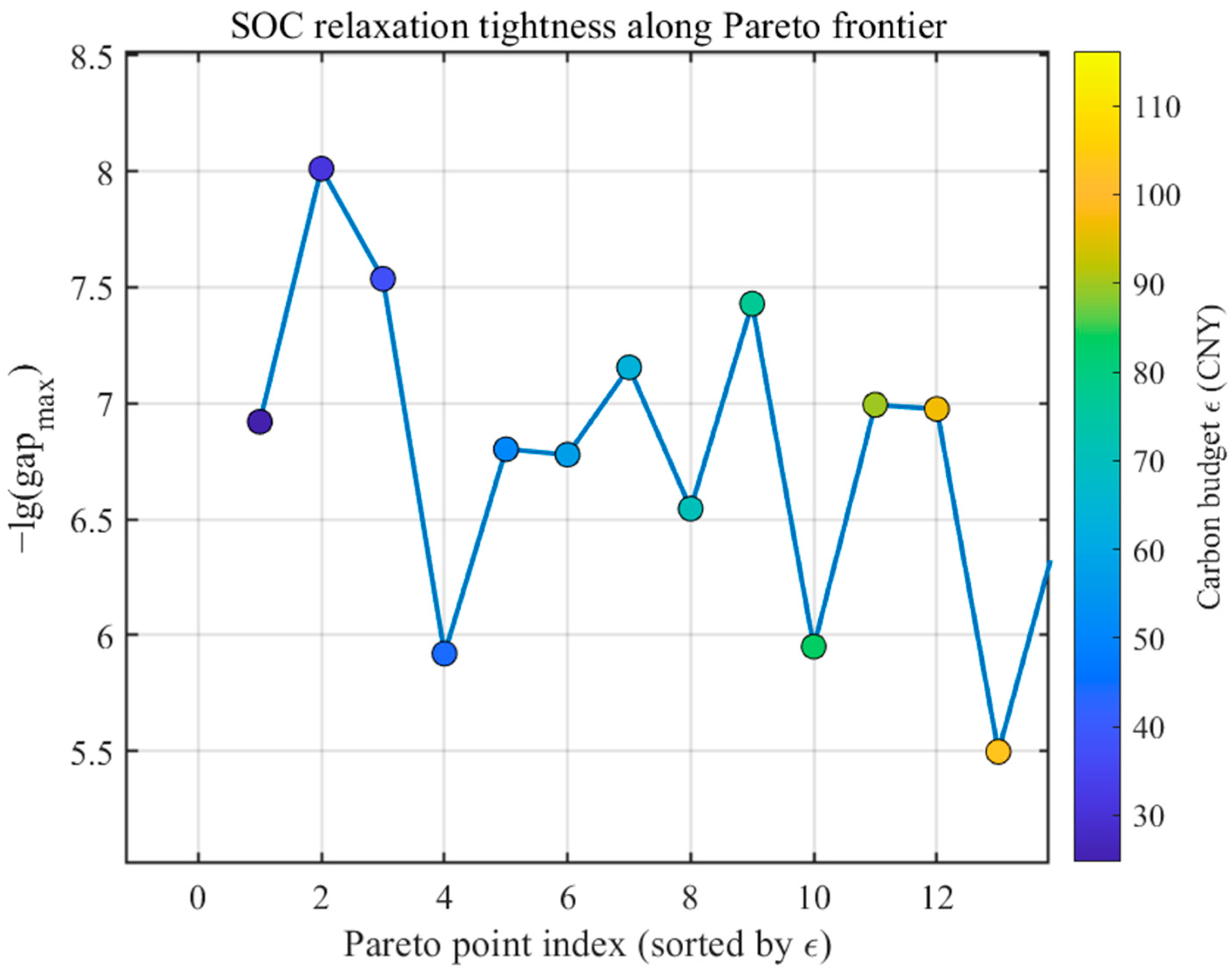
The Pareto frontier in Figure 17 is informative only if the underlying solutions are physically meaningful and not artifacts introduced by convex relaxation. Therefore, we further assess the tightness of the SOC relaxation for each non-dominated Pareto solution. Following the gap definition in (34), we compute, for every Pareto point, the worst-case relaxation gap across all branches (and time periods, if applicable), denoted as g a p m a x , and report the tightness indicator l g ( g a p m a x ) . Larger l g ( g a p m a x ) values imply tighter relaxations, i.e., smaller violations between the relaxed SOC representation and the corresponding exact equality.
In Figure 18, the SOC relaxation remains consistently tight across the entire Pareto set. The indicator l g ( g a p m a x ) stays predominantly within the range of approximately 6–7.5, with only a few points exhibiting moderate dips while still maintaining small gaps (the minimum is around 5.5). This behavior indicates that no Pareto solution suffers from abnormally loose relaxations and that the obtained frontier is not driven by relaxation-induced distortions. Consequently, the curvature and knee behavior observed in Figure 17 can be attributed to genuine operational trade-offs under the proposed reconfiguration-aware MISOCP model, rather than numerical artifacts.

5. Discussion

The present study develops a DistFlow-based MISOCP framework that co-optimizes the active and reactive power dispatch of multiple distributed resources with feeder reconfiguration under a price-calibrated loss–emission objective. Applied to the IEEE 33-bus feeder, the proposed approach reduces network losses by ~89% and CO2 emissions by ~89% relative to the baseline, while keeping all bus voltages within the specified limits. These results suggest that the coordinated dispatch of distributed resources, reactive support, and topology reconfiguration can jointly deliver substantial technical and environmental benefits in active distribution networks.

5.1. Interpretation of Coordinated Device and Topology Decisions

The three-case analysis clarifies the relative contributions of device coordination and topology reconfiguration. Comparing Cases 1 and 2 shows that introducing PV, WT, and MT units, PHEV aggregation, SVC, and shunt capacitors-while keeping the original topology-already yields substantial reductions in losses, emissions, and operating cost (loss: from 0.2030 MW to 0.0382 MW, 81.18%; CO2: from 2.3872 tCO2 to 0.3433 tCO2, 85.62%; C(x): from CNY 354.9357 to 56.6271, 84.05%). Physically, local generation and reactive compensation reduce upstream imports, shorten effective transfer paths, and suppress reactive circulation; together, these effects lower branch currents and thus I2R losses. The minimum bus voltage increased from 0.913 p.u. in the baseline to 0.990 p.u. in the device-only case, indicating that properly dispatched inverter-based DG and static compensation can effectively support end-of-feeder voltages, consistent with prior studies on Var-capable PV inverters and coordinated voltage control [10,11].
The transition from Case 2 to Case 3 further highlights the marginal value of topology reconfiguration. With identical device capability bounds, reconfiguration reshapes power-flow paths so that loads are served more locally, reducing loading on previously stressed branches. The additional 46.34% reduction in losses, 24.85% reduction in CO2, and 33.83% reduction in operating cost C(x) achieved by Case 3 relative to Case 2 indicate that feeder switching can unlock residual efficiency gains beyond device-side control alone. This behavior aligns with classical branch-exchange reconfiguration [3] but is here realized within a rigorous MISOCP formulation that jointly optimizes continuous P/Q decisions and discrete line-status variables.
The results also clarify the roles of individual resources. At the reported operating point, PV and WT primarily displace upstream active-power imports and provide local reactive support, whereas MT units supply dispatchable power but also contribute to emissions due to their nonzero emission factors [34]. The PHEV aggregator acts as a controllable active-power resource within a symmetric power range, offering additional flexibility to balance local supply and demand without direct emissions in the model. The SVC and CB shape the voltage profile by injecting or absorbing reactive power at critical buses. That all devices operate within their admissible ranges in both Cases 2 and 3 indicates that the scalarized objective-parameterized by electricity and carbon prices-produces dispatch solutions that satisfy engineering limits while aligning technical performance with emissions outcomes.

5.2. Validity of the MISOCP Formulation

From an optimization perspective, the numerical behavior of the proposed MISOCP model is consistent with the expected properties of SOC-relaxed DistFlow formulations. Replacing the quadratic branch-flow equalities with second-order cone constraints yields a convex relaxation that generally enlarges the feasible set while retaining key physical bounds on branch apparent power and current limits. In our case studies, the empirical distribution of SOC relaxation gaps, together with a final mixed-integer optimality gap on the order of 10−7, indicates that the relaxation is numerically tight for the IEEE 33-bus feeder under the considered operating conditions and that the relaxation is numerically tight for the IEEE 33-bus feeder under the considered operating conditions. The reported solutions are globally optimal for the SOCP-relaxed MISOCP. When the relaxation is tight, this optimum is also consistent with the original non-convex formulation; otherwise, it provides a lower bound and a high-quality candidate solution (see Section 4.5.3). Similar observations have been reported for DistFlow-based SOCP/MISOCP models in microgrids (MGs) and ADN settings when voltage magnitudes and branch currents stay within typical operating ranges [27].

5.3. Comparison with Existing Work

The proposed framework relates to several strands of prior research. First, numerous studies have addressed DG placement and sizing or DG-capacitor coordination under a fixed topology using heuristic or evolutionary algorithms, typically targeting loss minimization and voltage-profile improvement [18,19,20]. While these approaches are effective for exploring large design spaces, they usually do not model feeder reconfiguration and provide limited optimality guarantees. In contrast, the present work follows a mathematical programming paradigm that explicitly integrates discrete switching actions into the OPF formulation and exploits conic optimization to obtain solutions with solver-reported optimality certificates for the relaxed mixed-integer model.
Second, voltage and Var control with high penetration of inverter-interfaced resources has been widely studied. Prior work shows that Var-capable PV inverters and coordinated voltage controllers can reduce losses and improve voltage profiles [10,11]. The current results reinforce these findings by demonstrating that coordinated dispatch of PV, WT, MT units, and reactive support devices can nearly eliminate undervoltage conditions on the IEEE 33-bus feeder. At the same time, our results indicate that residual losses and emissions remain sensitive to network topology, motivating coordinated device topology optimization rather than device-only control.
Third, feeder reconfiguration has evolved from classical branch-exchange heuristics [3] to metaheuristics [23,24] and learning-based methods [21]. These lines of work emphasize scalability and speed, but DG dispatch and reactive resources are sometimes treated in a simplified manner. Recent MISOCP-based formulations, including models for SOP-enabled operation, dynamic reconfiguration, ESS coordination, and uncertainty handling, have shown that convex relaxations combined with binary decisions can capture realistic operating constraints while remaining computationally tractable [9,25,26]. Compared with these studies, the present work contributes a unified formulation that explicitly co-optimizes active and reactive power across multiple resource types (PV, WT, MT, aggregated PHEVs, SVC, and CB) under a combined loss–emission objective calibrated by electricity and carbon prices. This complements most existing MISOCP reconfiguration models, which focus primarily on loss or cost and only occasionally include explicit CO2 accounting.
Lastly, incorporating environmental metrics into distribution-level optimization connects our study to broader work on low-carbon operation and asset management. For example, DTR-aware dispatch and resilience-oriented ESS planning have been embedded into OPF/MISOCP formulations to capture temperature-dependent asset constraints and reliability considerations [28,31]. Our approach complements these developments by directly modeling carbon emissions from grid imports and MT units using explicit emission factors, enabling the transparent quantification of emission reductions attributable to coordinated DER dispatch and reconfiguration [33,34].

5.4. Significance and Implications

The proposed framework has both methodological and practical implications. Methodologically, it shows that a relatively compact MISOCP model built on DistFlow equations can simultaneously accommodate multiple resource types, radiality and connectivity constraints, and an economically meaningful scalarized objective. The normalization by baseline loss and emission levels, combined with price-based weights, provides a systematic way to tune the trade-off between technical and environmental performance without introducing arbitrary parameters. This strategy could be adapted to other multi-criteria objectives in distribution systems, such as balancing losses, reliability indices, and switching operations.
From a practical standpoint, the case study suggests that distribution utilities operating feeders similar to the IEEE 33-bus system could achieve substantial loss and emission reductions by coordinating DG, reactive devices, and sectionalizing switches through optimization-based decision support. The quantitative improvements observed in voltage profiles and emissions illustrate how such tools can support grid codes that increasingly emphasize voltage quality and decarbonization targets. Moreover, the explicit modeling of PHEV aggregation indicates a pathway to harnessing flexible demand as a controllable resource in distribution-level carbon mitigation, in line with emerging electrification trends.

5.5. Limitations and Future Improvements

Despite these strengths, several limitations should be acknowledged.

5.5.1. Single-Period Snapshot and Conceptual Multi-Period Extension

The analysis is conducted for a single-period steady-state snapshot on a single test feeder. Hence, temporal coupling induced by load evolution, renewable variability, and PHEV mobility is not modeled, which may affect the absolute magnitude of the loss- and emission-reduction benefits in practical operation. Nevertheless, the comparative insights into device coordination versus topology reconfiguration remain informative under the studied conditions.
Conceptual multi-period extension. A direct extension is to introduce a time index t   ϵ   T =   { 1 , , T } with a discretization step Δ t (e.g., Δ t = 1 h for   T = 24 , or Δ t = 15 min for   T = 96 in a typical-day setting), and replicate the reconfiguration-aware DistFlow constraints, voltage limits, branch-current limits, and device operating constraints for each t . l n particular, the reconfiguration enabled DistFlow equations (e.g., Equations (11)–(13)) can be extended by appending the time index to { P ij , t ,   Q ij , t ,   U i , t ,   I ij , t } and the binary line-status variables { a ij , t } . To preserve the tractable MISOCP structure period-wise, the same squared-variable transformation as in Equation (14) can be applied for each t :
U i , t sqr = U i , t 2 , I ij , t sqr = I ij , t 2 , ( i , j ) , t
In Equation (46), t T denotes the time index and Δ t is the discretization step (e.g., 1 h or 15 min). U i , t s q r and I i , j , t s q r are the squared-voltage and squared-current variables at time t , defined consistently with the single-period transformation (i.e., U i , t s q r = U i , t 2 and I i , j , t s q r = I i , j , t 2 for each ( i , j ) and t ).
Therefore, the subsequent SOC relaxation can be enforced at every time step.
Time-varying profiles can be incorporated through exogenous parameters ( P L , i , t ,   Q L , i , t ) and renewable availability limits, e.g.,.
0     P i , PV , t     P i , PV , t max , 0     P i , WT , t     P i , WT , t max , i , t
In Equation (47), P L , i , t and Q L , i , t are the time-varying active and reactive load demands at bus i and time t , treated as exogenous inputs (e.g., typical daily profiles or scenario data). P i , PV , t and P i , WT , t denote the dispatched active powers of PV and WT at bus i and time t , respectively, and P i , PV , t max and P i , W T , t m a x represent their time-dependent availability limits.
min t T ( w 1 f t loss + w 2 f t C O 2 ) ( orminE [ ] under   scenarios )
In Equation (48), f t loss and f t C O 2 denote the loss and carbon-emission components evaluated at time t , defined in the same manner as the single-period case but indexed by t . The weights w 1 and w 2 follow the same definition as in the main objective; the multi-period objective aggregates the per-period contributions over T (or in expectation when scenarios are used).
This enables the assessment of daily/annual impacts under realistic variability.
PHEV charging dynamics and reactive-power capability (future work). In the current single-period model, the aggregated PHEV is represented as active-power flexibility (i.e., the t -indexed model degenerates to a single snapshot) and is typically simplified by setting Q i , PHEV = 0 . This abstraction does not capture inter-temporal energy coupling (SOC dynamics, charging/discharging efficiencies, and availability windows) or the reactive-power support that can be provided by gridtied charging interfaces. In a multi-period formulation, charging/discharging dynamics can be introduced with a connection window δ i , t   ϵ   { 0 , 1 } [40].
P i , PHEV , t =   P i , t dis P i , t ch , 0     P i , t ch     δ i , t P ¯ i ch , 0     P i , t dis     δ i , t P ¯ i dis , E i , t + 1 =   E i , t +   η ch P i , t ch Δ t 1 η dis P i , t dis Δ t , E i min     E i , t     E i max
In Equation (49), To describe inter-temporal PHEV energy coupling, the aggregated PHEV at bus i and time t is decomposed into charging and discharging powers P i , t ch     0 and P i , t dis     0 , with the net active power P i , PHEV , t =   P i , t dis     P i , t ch . δ i , t ϵ { 0 , 1 } is a connection/availability indicator (1 if the aggregated PHEV is connected and controllable at time t ; 0 otherwise), which enforces the connection window via the bounds 0     P i , t ch     δ i , t P ¯ i ch and 0   P i , t dis     δ i , t P ¯ i dis , where P ¯ i c h and P ¯ i dis are the charging/discharging power limits. E i , t denotes the aggregated energy state (SOC-related energy) of PHEVs at bus i and time t , bounded by E i m i n E i , t E i m a x . η ch and η dis are the charging and discharging efficiencies, and Δ t is the time-step length used in the energy update.
To improve realism regarding reactive power, one may further allow Q i , PHEV , t     0 and enforce a converter capability limit (and optional power-factor requirements), e.g.,
( P i , PHEV , t ) 2   + ( Q i , PHEV , t ) 2     ( S i , PHEV max ) 2 δ i , t , i , t ,
In Equation (50), to improve realism in reactive-power support, Q i , PHEV , t denotes the reactive power provided/absorbed by the grid-tied PHEV charging interface at bus i and time t . S i , PHEV max is the apparent-power capability (rating) of the aggregated PHEV converter, and the inequality enforces a converter capability limit (optionally complemented by power-factor requirements if needed) whenever the PHEV is connected (i.e., gated by δ i , t ).
Together with simple bounds Q i , PHEV   min     Q i , PHEV , t     Q i , PHEV max (or equivalently a minimum power-factor constraint). These extensions enable a more realistic assessment of how SOC-constrained charging schedules and reactive support jointly contribute to voltage regulation under time-varying renewable/load conditions.
Overall, these refinements mainly affect the temporal allocation of flexibility and reactive support among controllable resources and may change the optimal setpoints of SVC/CB and inverter-interfaced DERs. However, they do not alter the applicability of the proposed co-optimization framework or the qualitative conclusions on the value of coordinated dispatch and topology control.

5.5.2. Deterministic Uncertainty Treatment and Robustness-Oriented Extensions

In this study, uncertainties are treated deterministically. In real-world settings, forecast errors in PV/WT generation, load demand, and stochastic PHEV availability can meaningfully affect the operational resilience of a dispatch-and-reconfiguration strategy optimized for point forecasts. In particular, a deterministic optimal solution may (i) lose feasibility under adverse realizations (e.g., voltage violations or branch overloading when renewable output drops or load increases), (ii) degrade performance (higher losses and emissions than predicted due to corrective redispatch or increased upstream imports), and (iii) increase operational burden by triggering more frequent corrective switching actions, which may conflict with practical operating policies and accelerate device wear. Here, “resilience” is interpreted in an operational sense, i.e., the ability to remain feasible and maintain acceptable voltage/thermal margins under forecast errors. As a lightweight first step, resilience can be quantified by stress-testing the deterministic optimal solution under a small set of adverse deviations (e.g., ±10% load increase, PV/WT shortfall, and reduced PHEV availability) and reporting feasibility/constraint-violation rates as well as worst-bus voltage and branch-loading margins.
A natural extension is to embed uncertainty directly into the proposed MISOCP structure. Promising directions include (1) scenario-based stochastic MISOCP, which optimizes expected performance (or a risk measure) while enforcing network and device constraints across representative scenarios; (2) robust or adjustable-robust formulations, which hedge against worst-case realizations within bounded uncertainty sets and allow limited recourse policies for redispatch; (3) chance-constrained programming, which enforces voltage and current limits with a prescribed violation probability to balance reliability and efficiency; and (4) distributionally robust optimization based on ambiguity sets to account for limited or biased forecast data. These extensions would enable a more rigorous evaluation of reliability–efficiency–emission trade-offs and quantify the operational robustness of the proposed coordinated dispatch and topology control under uncertainty.

5.5.3. Switching Costs, Wear, and Reliability-Related Metrics

The study neglects switching costs and reliability-related metrics, as well as the potential wear associated with frequent reconfiguration. In practice, switching operations are subject to operational policies and device wear and tear, and the obtained topology can be interpreted as being applied over a relatively stable operating interval. Future multi-period extensions can explicitly model switching actions by introducing (i) switching-count limits, (ii) minimum on/off duration (or hysteresis) constraints, and/or (iii) a switching-cost (wear) penalty that discourages frequent status changes, e.g., t ( i , j ) c sw | α ij , t α ij , t 1 | , thereby balancing steady-state efficiency gains against switching operations. IIncluding explicit penalties for switching operations, reliability indices, or asset constraints would provide a more comprehensive assessment of trade-offs among efficiency, reliability, and equipment utilization, consistent with asset-aware and resilience-oriented OPF/reconfiguration modeling [13,28].

5.5.4. Simplified Carbon-Emission Coefficients and Environmental Realism

The carbon-emission model is simplified to linear coefficients for grid imports and MT outputs. While sufficient for benchmarking relative improvements under fixed emission factors, this abstraction does not capture time-varying marginal emission factors or upstream constraints. Coupling distribution-level optimization with dynamic emission-factor models or regional carbon-accounting frameworks would further strengthen the environmental interpretation of the results.

5.5.5. Real-Feeder Validation with In-Kind Operational Data

The present study is conducted on a standard benchmark feeder using representative profiles, which provides a transparent and reproducible testbed but does not fully reflect the heterogeneity and operational constraints of real distribution networks. As an important next step, future work will validate the proposed framework on utility feeders using in-kind operational data, including feeder models and switch configurations, time-stamped load and DER measurements, and operational limits from utility records. Practical validation will focus on assessing solution feasibility under field conditions, quantifying the gap between predicted and measured loss/emission reductions, and examining the implementability of recommended switching and setpoint actions under utility operating policies. Such real-feeder studies would substantially strengthen the practical value and transferability of the proposed approach.

5.6. Summary and Outlook

In summary, the MISOCP-based framework presented demonstrates that jointly optimizing DG dispatch, reactive support, and radial topology under a price-calibrated loss–emission objective can substantially enhance both technical efficiency and environmental performance in active distribution networks. Future research should focus on multi-period, uncertainty-aware, and three-phase extensions, as well as the integration of switching costs and reliability indicators, to bridge the gap between feeder-level case studies and deployment in real distribution system operation.

6. Conclusions

In this paper, the IEEE 33 model with distributed power supply and reactive power compensation devices is improved by introducing open and closed variables aij for topology reconfiguration. Concurrently, the constraints of the established model are relaxed by second-order cones, and the model is transformed into the MISOCP model. Ultimately, the solver-optimal solution within prescribed tolerances is obtained by employing the commercial solver CPLEX. In comparison with the original two models, the model is distinguished by its good computational tractability and optimality, and further reduction of network losses and carbon emissions is achieved while maintaining the voltage quality. This finding demonstrates that the proposed topology reconfiguration method and optimization strategy can enhance the operation efficiency of the power system while achieving more economical and low-carbon operation and maintaining system stability. Applied to the IEEE 33-bus feeder, the proposed approach reduces total active-power losses from 0.203 MW (baseline) to 0.0382 MW with device coordination and to 0.0205 MW with coordination plus topology reconfiguration-corresponding to 81.18% and 89.90% reductions relative to baseline—while the associated CO2 emissions decrease from 2.3872 tCO2 (baseline) to 0.3433 tCO2 and 0.2580 tCO2 (85.62% and 89.19% reductions), and the operating cost C(x) decreases from CNY 354.9357 (baseline) to CNY 56.6271 and CNY 37.4677 (84.05% and 89.44% reductions), with bus voltages maintained within 0.99–1.01 p.u. and the final MISOCP optimality gap remaining on the order of 10−7. However, despite the model proposed in this paper achieving favorable results in terms of performance, there are still several aspects that can be further improved and extended. Future studies may wish to consider the introduction of time-phased or seasonal fluctuations in renewable energy sources, such as photovoltaic and wind power, to explore multi-time system operation and increase the applicability of the system model.

Author Contributions

Conceptualization, Z.L., Y.W. and Y.S.; methodology, Z.L., Y.W. and Y.S.; software, Z.L. and X.G.; validation, Z.L. and X.G.; formal analysis, Z.L.; investigation, Z.L. and X.G.; resources, Y.W. and Y.S.; data curation, Z.L. and X.G.; writing—original draft preparation, Z.L.; writing—review and editing, Y.W., Y.S. and Z.L.; visualization, Z.L.; supervision, Y.W. and Y.S.; project administration, Y.W. and Y.S.; funding acquisition, Y.S. All authors have read and agreed to the published version of the manuscript.

Funding

This research was funded by the Basic Research Project of Qinghai Province, grant number 2024-ZJ-725. The APC was funded by the Basic Research Project of Qinghai Province (2024-ZJ-725).

Institutional Review Board Statement

Not applicable.

Informed Consent Statement

Not applicable.

Data Availability Statement

The data supporting the findings of this study are available within the article.

Acknowledgments

The authors thank colleagues at the School of Energy and Electrical Engineering, Qinghai University, for insightful discussions and technical assistance provided during this work.

Conflicts of Interest

The authors declare no conflicts of interest. The funders had no role in the design of the study; in the collection, analyses, or interpretation of data; in the writing of the manuscript; or in the decision to publish the results.

Abbreviations

The following abbreviations are used in this manuscript:
ADNActive distribution network
DERDistributed energy resource
DGDistributed generation
DNRDistribution network reconfiguration
OPFOptimal power flow
DistFlowDistribution flow model
SOCSecond-order cone
SOCPSecond-order cone programming
MISOCPMixed-integer second-order cone programming
MILPMixed-integer linear programming
MIPMixed-integer programming
PVPhotovoltaic (generation)
WTWind turbine (generation)
MTMicroturbine
PHEVPlug-in hybrid electric vehicle
V2GVehicle-to-grid
G2VGrid-to-vehicle
SVCStatic var compensator
CBSwitched capacitor bank
ESSEnergy storage system
SDNSnowflake distribution network
LOLLoss-of-life (transformer)
APCArticle processing charge
p.u.Per unit
CO2Carbon dioxide
CPLEXIBM ILOG CPLEX Optimizer
YALMIPYet Another LMI Parser
GAGenetic Algorithm
DEDifferential Evolution
GWOGrey Wolf Optimizer
ABCArtificial Bee Colony
TSTabu Search
TLBOTeaching–Learning-Based Optimization

References

  1. Coster, E.J.; Myrzik, J.M.A.; Kruimer, B.; Kling, W.L. Integration issues of distributed generation in distribution grids. Proc. IEEE 2010, 99, 28–39. [Google Scholar] [CrossRef]
  2. Long, Y.; Kirschen, D.S. Bi-Level Volt/VAR Optimization in Distribution Networks With Smart PV Inverters. IEEE Trans. Power Syst. 2022, 37, 3604–3613. [Google Scholar] [CrossRef]
  3. Baran, M.E.; Wu, F.F. Network reconfiguration in distribution systems for loss reduction and load balancing. IEEE Trans. Power Deliv. 1989, 4, 1401–1407. [Google Scholar] [CrossRef]
  4. Huang, W.; Chen, G.; Jiang, X.; Xiao, X.; Chen, Y.; Liu, C. Research on Self-Healing Distribution Network Operation Optimization Method Considering Carbon Emission Reduction. Processes 2025, 13, 1850. [Google Scholar] [CrossRef]
  5. Yao, X.; Zhang, K.; Liu, C.; Zhu, T.; Zhou, F.; Li, J.; Liu, C. Optimal Low-Carbon Economic Dispatch Strategy for Active Distribution Networks with Participation of Multi-Flexible Loads. Processes 2025, 13, 2972. [Google Scholar] [CrossRef]
  6. Jia, T.; Yang, G.; Yao, L. The Low-Carbon Path of Active Distribution Networks: A Two-Stage Model from Day-Ahead Reconfiguration to Real-Time Optimization. Energies 2024, 17, 4989. [Google Scholar] [CrossRef]
  7. Li, C.; Miao, S.; Li, Y.; Zhang, D.; Ye, C.; Liu, Z.; Li, L. Coordinating dynamic network reconfiguration with ANM in active distribution network optimisation considering system structure security evaluation. IET Gener. Transm. Distrib. 2019, 13, 4355–4363. [Google Scholar] [CrossRef]
  8. Zhu, J.; Zhou, Y.; Dong, X.; Zhou, L.; Zhu, Q.; Yuan, Y. Mixed-Integer Linear Programming Based Distribution Network Reconfiguration Model Considering Reliability Enhancement. CSEE J. Power Energy Syst. 2025, 11, 1336–1346. [Google Scholar] [CrossRef]
  9. Li, C.; Dai, Y.; Wang, P.; Xia, S. Active and reactive power coordinated optimization of active distribution networks considering dynamic reconfiguration and SOP. IET Renew. Power Gener. 2025, 19, e12814. [Google Scholar] [CrossRef]
  10. Vlahinić, S.; Franković, D.; Komen, V.; Antonić, A. Reactive power compensation with pv inverters for system loss reduction. Energies 2019, 12, 4062. [Google Scholar] [CrossRef]
  11. Cagnano, A.; De Tuglie, E.; Bronzini, M. Multiarea voltage controller for active distribution networks. Energies 2018, 11, 583. [Google Scholar] [CrossRef]
  12. Lou, C.; Yang, J.; Li, T.; Vega-Fuentes, E. New phase-changing soft open point and impacts on optimising unbalanced power distribution networks. IET Gener. Transm. Distrib. 2020, 14, 5685–5696. [Google Scholar] [CrossRef]
  13. Chen, L.; Jiang, Y.; Zheng, S.; Deng, X.; Chen, H.; Islam, R. A two-layer optimal configuration approach of energy storage systems for resilience enhancement of active distribution networks. Appl. Energy 2023, 350, 121720. [Google Scholar] [CrossRef]
  14. Weerakoon, A.H.S.; Assadi, M. Micro Gas Turbines in the Global Energy Landscape: Bridging the Techno-Economic Gap with Comparative and Adaptive Insights from Internal Combustion Engines and Renewable Energy Sources. Energies 2024, 17, 5457. [Google Scholar] [CrossRef]
  15. Banihabib, R.; Assadi, M. The Role of Micro Gas Turbines in Energy Transition. Energies 2022, 15, 8084. [Google Scholar] [CrossRef]
  16. Banihabib, R.; Assadi, M. A Hydrogen-Fueled Micro Gas Turbine Unit for Carbon-Free Heat and Power Generation. Sustainability 2022, 14, 13305. [Google Scholar] [CrossRef]
  17. Ru, J.; Gillott, M.; Shipman, R. Vehicle-to-Grid (V2G) Research: A Decade of Progress, Achievements, and Future Directions. Energies 2025, 18, 6148. [Google Scholar] [CrossRef]
  18. Sultana, S.; Roy, P.K. Oppositional krill herd algorithm for optimal location of distributed generator in radial distribution system. Int. J. Electr. Power Energy Syst. 2015, 73, 182–191. [Google Scholar] [CrossRef]
  19. Biswas, P.P.; Mallipeddi, R.; Suganthan, P.; Amaratunga, G.A. A multiobjective approach for optimal placement and sizing of distributed generators and capacitors in distribution network. Appl. Soft Comput. 2017, 60, 268–280. [Google Scholar] [CrossRef]
  20. Bayat, A.; Bagheri, A. Optimal active and reactive power allocation in distribution networks using a novel heuristic approach. Appl. Energy 2019, 233–234, 71–85. [Google Scholar] [CrossRef]
  21. Han, T.; Hill, D.J. Learning-based topology optimization of power networks. IEEE Trans. Power Syst. 2022, 38, 1366–1378. [Google Scholar] [CrossRef]
  22. Harsh, P.; Das, D. A simple and fast heuristic approach for the reconfiguration of radial distribution networks. IEEE Trans. Power Syst. 2023, 38, 2939–2942. [Google Scholar] [CrossRef]
  23. Jo, S.; Oh, J.-Y.; Lee, J.; Oh, S.; Moon, H.S.; Zhang, C.; Gadh, R.; Yoon, Y.T. Hybrid Genetic Algorithm With k-Nearest Neighbors for Radial Distribution Network Reconfiguration. IEEE Trans. Smart Grid 2023, 15, 2614–2624. [Google Scholar] [CrossRef]
  24. Sadeghi, S.; Jahangiri, A.; Shamim, A.G. Optimal reconfiguration of a smart distribution network in the presence of shunt capacitors. Electr. Eng. 2023, 106, 603–614. [Google Scholar] [CrossRef]
  25. Luo, F.; Wu, X.; Wang, Z.; Duan, J. A dynamic reconfiguration model and method for load balancing in the snow-shaped distribution network. Front. Energy Res. 2024, 12, 1361559. [Google Scholar] [CrossRef]
  26. Sun, G.; Chen, G.; Liu, R.; Lin, S.; Wang, X. Dynamic reconfiguration of distribution network considering typical wind −Solar-Load joint scenarios. Int. J. Electr. Power Energy Syst. 2025, 172, 111121. [Google Scholar] [CrossRef]
  27. Zhou, Y.; Hu, W.; Min, Y.; Zheng, L. Active splitting strategy searching approach based on MISOCP with consideration of power island stability. J. Mod. Power Syst. Clean Energy 2019, 7, 475–490. [Google Scholar] [CrossRef]
  28. Li, Y.; Wang, Y.; Chen, Q. Optimal dispatch with transformer dynamic thermal rating in adns incorporating high PV penetration. IEEE Trans. Smart Grid 2021, 12, 1989–1999. [Google Scholar] [CrossRef]
  29. Du, M.; Antunes, J.; Wanke, P.; Chen, Z. Ecological efficiency assessment under the construction of low-carbon city: A perspective of green technology innovation. J. Environ. Plan. Manag. 2021, 65, 1727–1752. [Google Scholar] [CrossRef]
  30. Ren, Y.-S.; Liu, P.-Z.; Klein, T.; Sheenan, L. Does the low-carbon pilot cities policy make a difference to the carbon intensity reduction? J. Econ. Behav. Organ. 2023, 217, 227–239. [Google Scholar] [CrossRef]
  31. Pei, F.; Wang, P. The impact of the low-carbon city pilot policy on green innovation in firms. Front. Environ. Sci. 2022, 10, 987617. [Google Scholar] [CrossRef]
  32. Pan, Q.; Zhao, S. The impact of low-carbon city pilot policy on urban green technology innovation: Based on government and public perspectives. PLoS ONE 2024, 19, e0306425. [Google Scholar] [CrossRef] [PubMed]
  33. International Energy Agency (IEA). Emissions Factors 2024. Available online: https://www.iea.org/data-and-statistics/data-product/emissions-factors-2024 (accessed on 2 December 2025).
  34. Chen, F.; Lei, J.; Liu, Z.; Xiong, X. A Comparative Study on the Average CO2 Emission Factors of Electricity of China. Energies 2025, 18, 654. [Google Scholar] [CrossRef]
  35. U.S. Environmental Protection Agency (US EPA). Catalog of CHP Technologies: Section 5. Technology Characterization—Microturbines. 2015. Available online: https://www.epa.gov/sites/default/files/2015-07/documents/catalog_of_chp_technologies_section_5._characterization_-_microturbines.pdf (accessed on 2 December 2025).
  36. Qiu, Y.; Zhou, S.; Gu, W.; Zhang, X.-P. Analysis of China’s Electricity Price and Electricity Burden of Basic Industries under the Carbon Peak Target before 2030. CSEE J. Power Energy Syst. 2024, 10, 481–491. [Google Scholar]
  37. Zheng, C.; Chen, F.; Xi, Z.; Guo, G.; Yang, X.; Chen, C. A Resilience Entropy-Based Framework for V2G Charging Station Siting and Resilient Reconfiguration of Power Distribution Networks Under Disasters. World Electr. Veh. J. 2025, 16, 532. [Google Scholar] [CrossRef]
  38. You, S.; Hu, J.; Ziras, C. An Overview of Modeling Approaches Applied to Aggregation-Based Fleet Management and Integration of Plug-in Electric Vehicles. Energies 2016, 9, 968. [Google Scholar] [CrossRef]
  39. IEEE Std 1459-2010; IEEE Standard Definitions for the Measurement of Electric Power Quantities under Sinusoidal, Nonsinusoidal, Balanced, or Unbalanced Conditions. IEEE Standards Association: Piscataway, NJ, USA, 2010.
  40. Kisacikoglu, M.C.; Kesler, M.; Tolbert, L.M. Single-Phase On-Board Bidirectional PEV Charger for V2G Reactive Power Operation. IEEE Trans. Smart Grid 2014, 6, 767–775. [Google Scholar] [CrossRef]
Figure 1. A 4-node radial test system and variable definitions for the DistFlow model.
Sustainability 18 00544 g001
Figure 2. IEEE 33 distribution network.Bus numbers (1–33) indicate node indices.
Sustainability 18 00544 g002
Figure 3. Modified IEEE 33 distribution network with DER and reactive power compensation devices. Bus numbers (1–33) indicate node indices; icons denote device locations (PV, WT, MT, PHEV, SVC, and CB).
Sustainability 18 00544 g003
Figure 4. Modified IEEE 33-bus distribution network with DER and reactive power compensation devices. Bus numbers (1–33) indicate node indices; solid lines denote closed branches in the radial operating topology, while dashed lines denote normally open tie-switch branches. Icons indicate device locations (PV, WT, MT, PHEV, SVC, and CB).
Sustainability 18 00544 g004
Figure 5. Branch switching actions in the IEEE 33-bus distribution network reconfiguration. Bus numbers (1–33) indicate node indices. Solid lines denote branches kept closed in the reconfigured radial topology. Dashed lines denote tie-switch branches considered for reconfiguration (25–29, 9–15, 12–22, 18–33, and 7–20). The red “×” marks denote opened branches in the final reconfigured topology (2–19, 3–4, 10–11, 12–13, and 31–32). Icons indicate device locations (PV, WT, MT, PHEV, SVC, and CB).
Sustainability 18 00544 g005
Figure 6. IEEE 33-bus distribution network after topological reconfiguration with DER and reactive power compensation devices. Bus numbers (1–33) indicate node indices; solid lines denote closed branches in the radial operating topology, while dashed lines denote normally open tie-switch branches. Icons indicate device locations (PV, WT, MT, PHEV, SVC, and CB).
Sustainability 18 00544 g006
Figure 7. PV active and reactive power outputs.
Sustainability 18 00544 g007
Figure 8. WT active and reactive power outputs.
Sustainability 18 00544 g008
Figure 9. MT active and reactive power outputs.
Sustainability 18 00544 g009
Figure 10. PHEV active power outputs.
Sustainability 18 00544 g010
Figure 11. SVC reactive power outputs.
Sustainability 18 00544 g011
Figure 12. CB reactive power outputs.
Sustainability 18 00544 g012
Figure 13. Network losses and carbon emissions for three cases.
Sustainability 18 00544 g013
Figure 14. Voltage distribution for the three cases.
Sustainability 18 00544 g014
Figure 15. Relaxation gap scatterplot of IEEE 33 after topology reconfiguration.
Sustainability 18 00544 g015
Figure 16. Validation of the price-calibrated weighting: objective value and SOC-relaxation tightness versus w 1 .
Sustainability 18 00544 g016
Figure 17. Pareto frontier obtained via the ε-constraint method in monetary terms.
Sustainability 18 00544 g017
Figure 18. SOC relaxation tightness along the Pareto frontier. Values of −lg(gap_max) are plotted against the Pareto point index (sorted by ε); marker colors denote the carbon budget ε (CNY).
Sustainability 18 00544 g018
Table 1. Topology–dispatch coordinated optimization in ADNs.
ReferenceObjective FunctionOptimization MethodConstraints
[7]Maximization of renewable penetrationMISOCPOperational; radial
[8]Minimization of power losses (ZIP load)MILP (linearized from MISOCP)Operational; ZIP→ZP; radial
[9]Minimization of daily operating costMISOCP (with SOP)Voltage/thermal; SOP; radial
[13]Resilience via ESS configurationTwo-layer bilevel optimizationOperational; contingencies; fixed topology
[25]Loss + load balance; ESS-coordinated (SDN)MISOCP (SOCP relax + Big-M)SDN; multilevel balance; reconfiguration; ESS
[26]Cost (loss/switch/curtail) under uncertaintyMISOCPScenarios; spatiotemporal RES-load
[27]Active splitting (island stability)MISOCPStatic/transient stability; operational
[28]Operating cost & transformer LOL minimizationMISOCPDTR; operational; fixed topology
Table 2. The load of each bus and the impedance of each branch in modified IEEE 33.
Node iNode jBranch Circuit Impedance (Ω)The Load of Node j (kVA)
120.0922 + j0.047100 + j60
230.493 + j0.251190 + j40
340.366 + j0.1864120 + j80
450.3811 + j0.194160 + j30
560.819 + j0.70760 + j20
670.1872 + j0.6188200 + j100
780.7114 + j0.2351200 + j100
891.03 + j0.7460 + j20
9101.044 + j0.7460 + j20
10110.1966 + j0.06545 + j30
11120.3744 + j0.123860 + j35
12131.468 + j1.15560 + j35
13140.5416 + j0.7129120 + j80
14150.591 + j0.52660 + j10
15160.7463 + j0.54560 + j20
16171.289 + j1.72160 + j20
17180.732 + j0.57490 + j40
2190.164 + j0.156590 + j40
19201.5042 + j1.355490 + j40
20210.4095 + j0.478490 + j40
21220.7089 + j0.937390 + j40
3230.4512 + j0.308390 + j50
23240.898 + j0.7091420 + j200
24250.896 + j0.7011420 + j200
6260.203 + j0.103460 + j25
26270.2842 + j0.144760 + j25
27281.059 + j0.933760 + j20
28290.8042 + j0.7006120 + j70
29300.5075 + j0.2585200 + j600
30310.9744 + j0.963150 + j70
31320.3105 + j0.3619210 + j100
32330.341 + j0.530260 + j40
8212 + j2
9152 + j2
12222 + j2
18330.5 + j0.5
25290.5 + j0.5
Table 3. Active and reactive power output table.
NodeLoading DeviceGearActive Output (MW)Reactive Output (MVar)
6PVNone0.80.2629
19PVNone0.78900.2593
31PVNone0.47530.1562
18WTNone0.55660.1830
9SVCNoneNone0.3000
22CB3None0.3
25CB3None0.3
30PHEVNone0.6000None
25MTNone0.13230.0435
33MTNone0.40.1315
Table 4. Benchmark comparison of MISOCP and baseline algorithms in Case 3.
MethodC(x) (CNY) f loss (x) (MW) f C O 2 (x) (tCO2)Running Time (s)
MISOCP37.46770.02050.25808.46
GA41.00550.02260.281320.13
DE38.95130.02280.258677.99
GWO40.38980.02430.263924.45
ABC38.03600.02120.259433.60
TS39.76170.02420.258035.55
TLBO37.97330.02130.258138.58
MISOCPonly for loss124.88700.01031.23496.29
Branch Exchange43.97910.01780.343310.51
Table 5. Quantifies Figure 14 using VDI abs and VDI sq .
CaseRange VDI abs VDI sq MADRMSMaxAbsDev
Case 10.084001.699000.116800.0530940.0604150.08700
Case 20.028520.180210.0016140.00563160.00710270.01528
Case 30.012420.157670.0010820.00492720.00581460.00985
Disclaimer/Publisher’s Note: The statements, opinions and data contained in all publications are solely those of the individual author(s) and contributor(s) and not of MDPI and/or the editor(s). MDPI and/or the editor(s) disclaim responsibility for any injury to people or property resulting from any ideas, methods, instructions or products referred to in the content.