Article

Achieving Isobenefit Urbanism in the Central Urban Area of Megacities, Taking Beijing as a Case Study: The Core Area of the Capital


1
Department of Urban and Rural Planning, School of Landscape Architecture, Beijing Forestry University, Haidian District, Beijing 100083, China
2
Beijing Municipal Institute of City Planning & Design, Xicheng District, Beijing 100083, China
3
Center for Human-Oriented Environment and Sustainable Design, The Shenzhen University, Shenzhen 518060, China
4
Faculty of Architecture, The University of Hong Kong, Hong Kong 999077, China
*
Author to whom correspondence should be addressed.
Sustainability 2026, 18(1), 542; https://doi.org/10.3390/su18010542
Submission received: 19 November 2025 / Revised: 18 December 2025 / Accepted: 26 December 2025 / Published: 5 January 2026
(This article belongs to the Section Sustainable Urban and Rural Development)

Abstract

Rapid development and scale expansion of cities are the core characteristics of the urbanization process, which effectively promote the formation of agglomeration economies, infrastructure sharing, and social mobility improvement. However, it also brings various negative effects such as unequal public services, traffic congestion, and environmental pollution. The principle of isobenefit urbanism proposes that walking accessibility of various service facilities is an important indicator for measuring whether a city is livable, fair, and sustainable. This study specifically examines the impacts of environmental factors on the implementation of isobenefit urbanism in the central urban area of Beijing, a megacity. By obtaining open-source data and performing ArcGIS (10.8.1) analysis, using 183 blocks in Beijing’s core area, we normalized Strava pedestrian heat by road area and regressed it on 12 built environment indicators. The final model (R = 0.650, R2 = 0.422, and adjusted R2 = 0.381) identifies five significant predictors: block area (β = 0.215, p = 0.001) and average building height (β = 0.299, p = 0.012) are positively associated with walking heat, while building density (β = −0.235, p = 0.003), intersection density (β = −0.321, p < 0.001), and average distance to bus stop (β = −0.196, p = 0.003) are negatively associated. Land use mix and facility supply show positive but nonsignificant effects after controls. These estimates provide actionable levers for isobenefit urbanism in megacity cores.

1. Introduction

As a product of the development of the times, megacities (with a population exceeding 10 million) face many challenges in achieving sustainable development goals [1], such as large-scale population mobility, housing and transportation pressures, shortages of public service facilities, and ecological environment governance [2]. These challenges are not merely spatial or technical in nature but are also rooted in increasing social differentiation and governance complexity in high-density urban contexts. At present, cities are transitioning from the era of rapid expansion in urban construction to the era of high-quality development in urban renewal [3]. How to build livable cities in the future is thought provoking.
The United Nations Sustainable Development Goal (SDG) 11 aims to make cities and human settlements fair, accessible, resilient, and sustainable [4]. Throughout the theory of urban planning, scholars have proposed concepts such as “Walkable Neighborhoods,” “15-Minute Cities,” and “Isobenefit Urbanism.” The central idea behind these concepts is to create a more livable, equitable, and sustainable urban environment. The main viewpoints revolve around land use mix, public service facility density, and street connectivity, emphasizing how to improve the walkability of cities. In megacities undergoing a transition from incremental expansion to high-quality renewal, sustainability challenges increasingly extend beyond physical space and infrastructure provision. Profound changes in urban social structure—such as population densification, diversified daily demands, and uneven access to public services—have intensified spatial inequalities at the neighborhood scale. At the same time, a central challenge of urban governance lies in coordinating institutionalized planning and administrative systems with residents’ everyday spatial use and mobility practices. Under high-density conditions, traditional sector-based governance frameworks often struggle to respond to fine-grained and dynamic daily demands.
In this context, planning concepts centered on walkability and spatial proximity offer more than a physical design solution. They provide an integrative framework that helps reconcile institutional planning structures with residents’ daily mobility and space use patterns, thereby contributing simultaneously to spatial efficiency, social equity, and governance capacity through the reconfiguration of relationships between daily activities, public services, and the pedestrian environment.
Isobenefit urbanism is a relatively new method of urban development that shapes the form of cities [5], first proposed by Professor Luca Dach in 2013. The concept is to adjust the urban form and structure to form pedestrian units connected by public transportation, so that every resident can walk one mile from home to daily activity places such as workplaces, convenient facilities (shops, entertainment facilities, medical facilities, cultural facilities, etc.), green spaces, etc. [6]. This concept emphasizes equitable access to daily activities and public services through walkable urban environments, offering a systematic response to the intertwined spatial, social, and governance challenges of contemporary megacities. By emphasizing equitable access to daily activities and public services through walkable environments, isobenefit urbanism provides a systematic framework for addressing the intertwined spatial, social, and governance challenges faced by contemporary megacities.
The term “homo-urbanicus”, proposed by Professor Liang Henian in 2012, is also based on a humanistic perspective, defined as “people who rationally choose to settle down and pursue opportunities for spatial contact”. The purpose of urban people’s travel is to pursue a better life. The fundamental concept lies in the balance between self-preservation and coexistence [7]. The starting point of urban planning under this concept is to provide basic conditions for the self-existence of urban residents and to seek balance for their coexistence. Compared to small-scale cities, megacities occupy a central position in the global and national urban systems, and their role goes far beyond simple economies of scale. They reshape spatial, economic, and social structures through multidimensional system functions and are key actors in human response to challenges such as climate change and technological revolution [8]. Therefore, this article selects megacities to explore the practical value of isobenefit urbanism in development in order to further enhance its theoretical role.
However, this framework implicitly assumes that once an appropriate urban form and service configuration are established, spatial equity within a one-mile walking radius will be naturally reflected in residents’ everyday pedestrian use.
While walkability, 15-minute city frameworks, and new urbanism converge on human-scale accessibility, fewer studies empirically examine whether the spatial equity assumed by isobenefit urbanism is reflected in actual pedestrian behavior, particularly under megacity conditions. In historic urban cores characterized by conservation constraints, fixed street patterns, and uneven pedestrian demand shaped by tourism and leisure activities, it remains unclear whether the one-mile isobenefit principle translates into equitable pedestrian use in practice. Beijing’s historic core therefore provides a critical context for examining this conceptual gap. By assessing pedestrian walking intensity using Strava heatmap data as an upper-bound proxy, this study evaluates the applicability and limitations of isobenefit urbanism in megacity cores and refines its theoretical implications under constrained urban conditions.
Beijing is one of the ten megacities in China, and there are significant differences between its central urban area and the peripheral underdeveloped areas [9]. The urban functions of the central urban area are more concentrated, various facilities are more complete, and the development direction is more mature [10]. However, at the same time, the problems of traffic congestion, difficulty in parking motor vehicles, air pollution, and poor walking environment brought about by rapid motorization have hindered the realization of high-quality stock development in central urban areas. Adhering to the concept of organic renewal and the need for cultural protection in the old city [11], the central urban area of Beijing attaches great importance to improving pedestrian friendliness and returning space and road rights to slow-moving people, thereby reducing motor vehicle travel and promoting the construction of a green and livable city [12]. Currently, there have been initial results [13]. The one-mile spatial equity principle of isobenefit urbanism assumes evenly distributed pedestrian access, yet this assumption is difficult to realize in Beijing’s historic core, where inherited street patterns and conservation constraints limit pedestrian connectivity. In Beijing, issues related to pedestrian safety, accessibility, and uneven distribution of daily facilities are closely intertwined with the challenges of refined urban governance and cross-sector coordination in high-density environments. We integrate isobenefit urbanism with current debates in walkability planning, 15-minute cities, new urbanism, social equity, and human-scale design. Focusing on spatial equity in pedestrian access as a shared concern across these planning perspectives, this study examines whether this theoretical expectation is reflected in the actual spatial distribution of pedestrian walking activity in Beijing’s historic core.

1.1. Theory of Urban Planning for Sustainable Development

Over the years, urban planning theories have served as the basis for urban development policies and tools for analyzing urban space, guiding cities to achieve coordinated economic, social, and environmental development [14]. Each development stage has its representative theories, as shown in Table 1. From the late 19th century to the early 20th century, Howard’s Garden City Theory, Le Corbusier’s Radiant City Theory, and Soria Y Mata’s Linear City Theory were among the first to propose concepts for modern urban planning [15,16,17]. In the mid-20th century, many scholars discussed urban development models, such as satellite city theory, broadacre city, neighborhood units, and organic dispersion theory [18,19,20,21]. In the late 20th century, as critical thinking about past urban planning deepened, social equity and environmental protection became increasingly important, making sustainable development theory [22] the underlying principle of planning actions, which continues to this day. Entering the 21st century, scholars have actively discussed how to build more livable cities. The concept of “Walkable Neighborhoods” indicates that through community planning based on high density, proximity to facilities, and street connectivity, walkability and urban vitality can be improved [23]. The “15-Minute City” emphasizes that residents should be able to meet their basic needs—living, working, business, healthcare, education, and entertainment—within a 15 min walk (or bike ride) [24].
The concept of “Isobenefit Urbanism” can be seen as a part of the currently controversial “x-minute city” family, whose core idea is to not consider the size of the city but only its form, structure, and relationship with natural land. Every resident can reach the main daily service places, workplaces, city centers, and nature within a one-mile walking distance. It advocates maintaining the same number of residents in an ordinary city/megacity, shaping a walkable, car-free, low-carbon, connected, compact, and multifunctional urban form, thereby generating the same or even larger economic benefits without consuming a large amount of urban agglomeration costs [6]. It means a car-free city society with significant advantages in reducing air and noise pollution, commuting time, saving space, aesthetics, and, ultimately, physical and mental health. Although this concept leans towards creating a utopian, visionary living environment, its consideration for sustainable development cannot be denied. The four principles it proposes are as follows [25]:
  • Each citizen reaches, within roughly 1 mile, (a) workplaces, daily needs, and a centrality; (b) a green area;
  • (a) Buildings are “close” to each other for at least 1 continuous sq. km.; (b) green areas are continuously interconnected.

Table 1. Theoretical review of sustainable urban planning.
Year (Author)TermConcept
1898
(Ebenezer Howard)
Garden cityA cluster of garden cities linked by road and rail, orbiting a central city in a polycentric dominant core model; each garden city is a multifunctional town of cottages, mixing services, residences, workplaces, and amenities all reachable within less than 1 mile [26].
1929
(Clarence Perry)
Neighborhood unitWithin quarter-mile pedestrian unit, one reaches shops, schools, parks, community institutions, rapid transit, and arterial streets [27].
1970s–1980s
(Leon Krier)
Urban quarter10 min or quarter-mile walking neighborhood within which residents can do their daily activities (dwelling, working, or leisure) [28].
2013
(Luca S. D’Acci)
Isobenefit urbanismIt defined as equal benefits across urban spaces covering walkable workplaces, amenities, nature, and services and is a libertarian paternalistic approach to planning. It is a morphogenetic code designed to promote a walking city where one can reach green space, shops, amenities, services, and places of work within a 1-mile distance from their home [29].
2014
(Plan Melbourne (2014–2050))
20-minuteneighborhoodIt involves simultaneous efforts in public transportation, living service facilities, education and medical facilities, urban planning, green environment, and community building to improve the livability of the city [30].
2016
(Carlos Moreno)
15-minute cityThe core premise of the concept is that critical urban services and amenities should be reachable within 15 min of walking or cycling from a residence [31].

1.2. Built Environment Walkability Research

Research on the walkability of the built environment has gone through different developmental stages.
In the early stages, scholars were committed to exploring theoretical concepts and research frameworks. In the 1990s, scholar Cervero [32] proposed the “3Ds” theory in the field of transportation planning, which selected three indicators starting with the letter “D”—density, diversity, and design—to construct a quantitative evaluation system for the built environment. With the development of research, two elements, destination accessibility and distance to transit of the public transportation system, have also been proposed by scholars, constructing a more comprehensive theoretical system of the “5Ds” built environment [33]. Influenced by Cervero’s “3Ds” theory, the term “walkability” was proposed in 2003 in research on the theory of built environment effects on residents’ travel behavior [34]. Subsequently, scholars from different fields explored the concept of walkability, the correlation between built environment walkability, and the influencing factors of built environment walkability. For example, Southworth [35] proposed that built environment walkability is influenced by six criteria. The U.S. Department of Transportation [36] believed that walkability is the level of support for walking travel in an area, which needs to comprehensively consider walking facilities, road conditions, land use, community environment, and the comfort of walking.
As research deepened, scholars were no longer satisfied with discussing influencing factors. Different tools, methods, and new perspectives were used and developed for accurate measurement of walkability, and a large number of built environment evaluation studies were conducted, forming a series of highly recognized and strongly promoted walkability measurement methods [37]. In 2001, the UK Transport Laboratory (TRL) and Transport for London (TFL) jointly developed the Pedestrian Environment Review System (PERS), which can quickly determine the reasonableness of pedestrian facility supply and the level of service [38]. Based on qualitative evaluation, the space in the streets and pedestrian satisfaction are surveyed and quantified, thereby strengthening the objectivity in the decision-making process, systematically evaluating pedestrian needs, and making timely improvements [39]. In 2002, the Neighbor Environment Walkability Scale (NEWS) originated in the United States’ public health field, with broader evaluation content, including community housing types, walking spaces, community aesthetics, and many other aspects [40]. The walkability scale can set up a more diverse evaluation system based on the preferences of different regions and characteristics of groups for walking conditions to meet the needs of different cultural backgrounds and different groups for walking environments [41]. With the development of network technology, in 2007, American researchers proposed the Walk Score method, which calculates the decay of walking distance and population proportion factors through overlay calculation, and developed a website (www.walkscore.com) [42]. In the implementation process, the Walk Score is divided into point Walk Score and area Walk Score at two levels, representing specific spaces and macro-scales, respectively [43]. In addition, specific methods include Web GIS analysis tools, walking calculators, street ranking, accessibility analysis, etc.
Subsequently, scholars applied measurement methods and research on built environment and walkability entered a vigorous development stage [44], with a large number of studies based on empirical exploration and improvement of evaluation and measurement methods. Some scholars, by using or constructing suitable walking evaluation systems for study areas, conducted evaluation studies on urban built environments. For example, Li et al. [45] selected the Shichahai area in Beijing, and from the aspects of street space, facilities, and activities, used environmental psychology and the AHP hierarchical analysis method to establish a walking pleasure evaluation system, scoring the satisfaction of various types of streets in the Shichahai area. Di et al. [46] established a comprehensive evaluation framework for urban street space quality, constructing an evaluation from the aspects of block space form, street road functional attributes, usage behavior, and space quality style in the central urban area of Shanghai.
In addition, more research has been conducted on the impact mechanism of built environment indicators on walkability, covering methods from small-scale field measurement [47,48] and recording to the use of big data for information collection and more efficient correlation analysis [49,50].

2. Materials and Methods

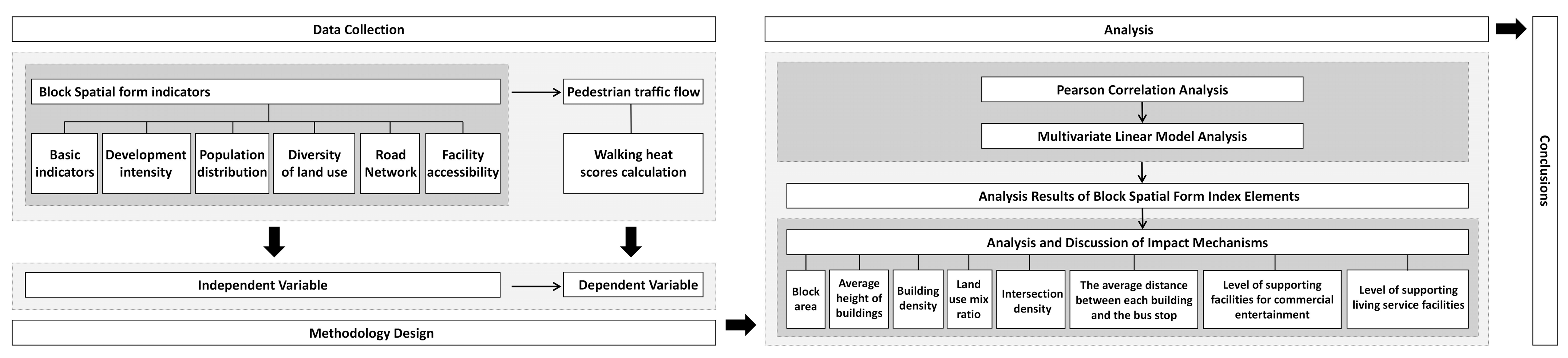
The research flow chart is illustrated in Figure 1.

2.1. Study Area

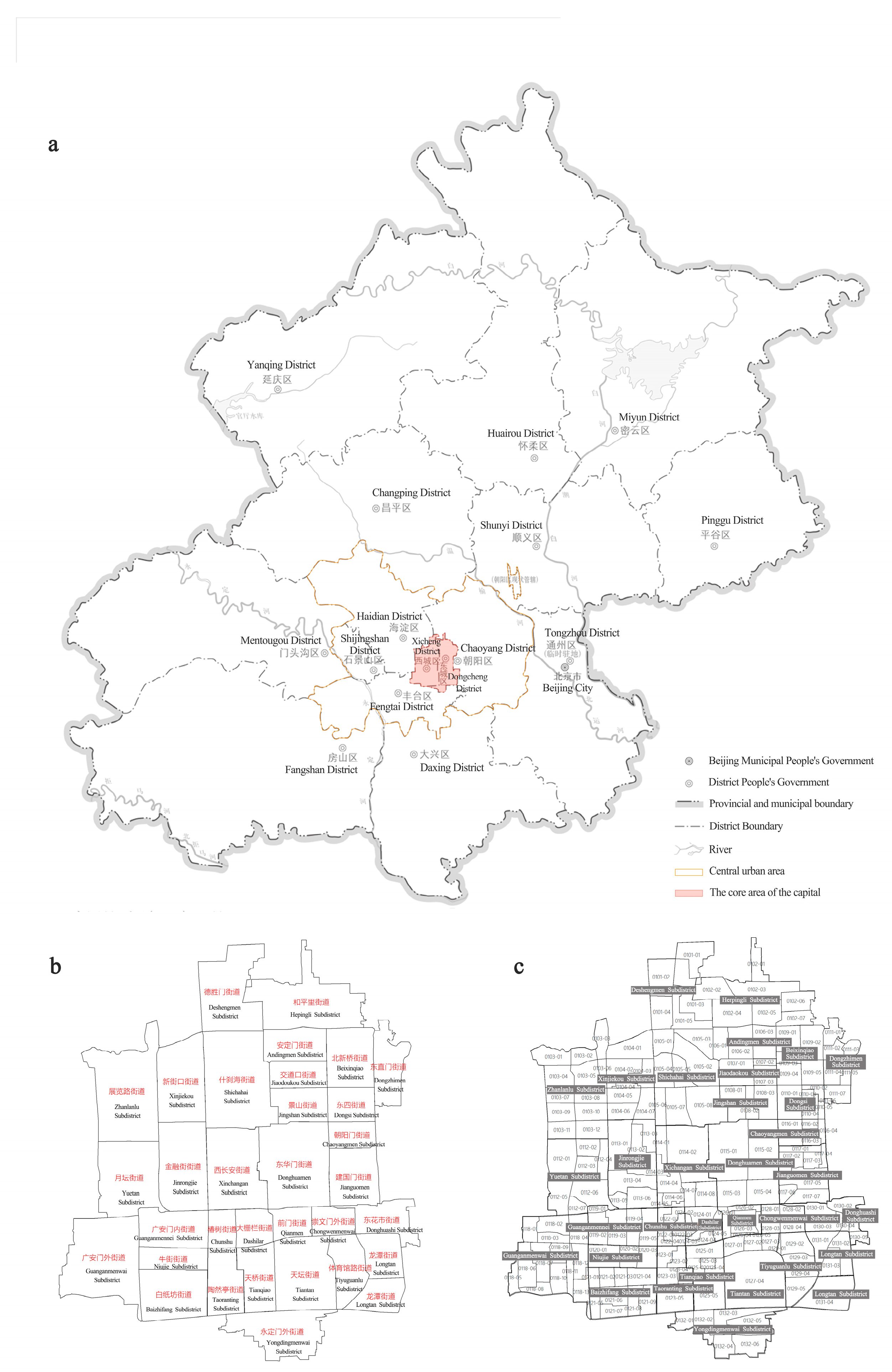
The central urban area of Beijing includes six administrative districts: Xicheng District, Dongcheng District, Haidian District, Chaoyang District, Fengtai District, and Shijingshan District. This paper selects Dongcheng District and Xicheng District as the research objects, which can also be collectively referred to as the core area of the capital. They are important areas for the protection of historical and cultural cities and the display of the national capital image [51]. According to the division standards of the “Controlled Detailed Planning of the Core Area of the Capital (Block Level)”, the two administrative districts are divided into 32 subdistricts and 183 blocks (Figure 2), each with an area of about 0.4–1 square kilometers. Blocks are functional boundaries defined based on a combination of road red lines, property rights, and urban functional layout, in conjunction with street jurisdiction and community administrative boundaries. Dividing blocks can better guide subsequent planning and implementation [52].

2.2. Street Types and Target Population Characteristics

Beijing’s Street Governance and Urban Renewal Design Guidelines classify core-area streets into five functional types: traffic oriented, comprehensive service, living service, tranquil passage, and special feature. This study focuses on comprehensive service and special feature streets because they feature commercial, cultural, and public facilities that support daily activities and already accommodate high pedestrian volumes. Improving walkability on these streets can better meet travel, rest, and social needs while encouraging walking over motorized transport.
Each street type serves distinct community groups. Comprehensive service streets serve working-age employees, consumers, and students with higher education levels seeking efficient, destination-oriented routes. Special feature streets attract tourists and visitors motivated by sightseeing, whose behavior depends on wayfinding and streetscape quality. These functional differences reflect varying education levels, mobility resources, trip purposes, and risk perceptions, essential for understanding heterogeneous built environment responses.
Focusing on these three street types clarifies our target populations. At the individual level, Strava data captures active adults walking. At the household level, living service street improvements benefit nearby residents making daily trips within 400–800 m of home. At the small-group level, comprehensive service street interventions (wider sidewalks and mid-block crossings) serve workers, students, and friends commuting or socializing, while special feature street measures (rest areas, wayfinding, and traffic calming) target tourist groups. At the area level, we aggregate indicators to blocks (0.4–1 km2) and sub-districts, the scales at which renewal funds and management are organized.

2.3. Index Framework

Based on the “3Ds” and “5Ds” frameworks, this paper reviews indicators from previous studies [53,54,55] and constructs an index framework across six dimensions: basic indicators, development intensity, population distribution, land use diversity, road network, and facility accessibility (Table 2).
This framework aligns with isobenefit urbanism principles, which emphasize equitable health benefits from active travel through accessible destinations, connected infrastructure, and diverse activity opportunities. Our indicators operationalize these principles: land use diversity and facility accessibility measure destination range and proximity for daily trips; road network metrics capture connectivity and safety; and development intensity and population distribution reflect spatial concentration enabling short-distance walking. Stratifying by street type (comprehensive service, living service, and special feature) allows us to identify which built environment configurations generate comparable benefits across different community groups, the core aim of isobenefit urbanism in pedestrian planning.
Drawing on the “3Ds” and “5Ds” frameworks and isobenefit urbanism principles, we propose the following hypotheses for Beijing’s heritage core context: (H1) Vertical development intensity (building height) will positively correlate with walking heat by concentrating services and improving legibility, while horizontal density (building coverage) may negatively correlate due to compressed public space in traditional hutong areas. (H2) Greater land use mix will positively correlate with walking heat by enabling trip chaining. (H3) In heritage-constrained contexts with high traffic volumes and preserved street patterns, intersection density may negatively correlate with walking heat due to increased vehicular conflicts and signal delays, contrasting with conventional New Urbanism assumptions. (H4) Greater facility supply will positively correlate with walking heat by offering more walkable destinations. (H5) Shorter distances to transit stops will positively correlate with walking heat by reducing last-mile barriers. These context-sensitive hypotheses acknowledge that isobenefit mechanisms may operate differently in conservation-constrained megacity cores compared to greenfield or renewal-based developments.

2.4. Data Acquisition and Processing

In this study, the dependent variable in Table 2 is the heat data of pedestrian flow, and the independent variable is the spatial form indicators of each block. The specific acquisition and processing methods are as follows:

2.4.1. Strava Heat Data

This paper uses publicly available data from the Strava website as the source of pedestrian flow data. Among many crowdsourced data sources, Strava, as the largest location-based social software LBS (https://www.strava.com/), has more than 95 million users worldwide, with a monthly user growth rate of 20,000 and about 800 million behavior data generated in one month. Users of Strava only need to carry smart terminal devices to record their travel information. After Strava removes users’ personal information, it maps the Strava activity data to the OpenStreetMap (OSM) map through aggregation and superposition, thereby visually displaying the global pedestrian data through a heat map effect at a fine spatial resolution that can be precise to a single footpath. The heat map on the Strava official website is updated monthly, showing the “heat” of public activities aggregated in the past year.
In previous studies, scholars at home and abroad have conducted extensive research on urban pedestrian travel using Strava data. For example, McArthur and Hong [64] used Strava data to study the relationship between cycling travel and road network connectivity. Jiang et al. [65] took central London as the research object and revealed the correlation between the built environment and running activities at both macro- and micro-scales. Yang et al. [66] evaluated the correlation between macro- and micro-environments and resident activities by combining the distribution of bicycle lanes and slow-moving lanes in central Chengdu. Sun [67] analyzed the characteristics of urban high-frequency cycling paths, and Zhao et al. [68] studied the relationship between residential street spatial characteristics and Strava pedestrian flow. The above research proves that it is feasible to use Strava data to study urban slow-moving environments.
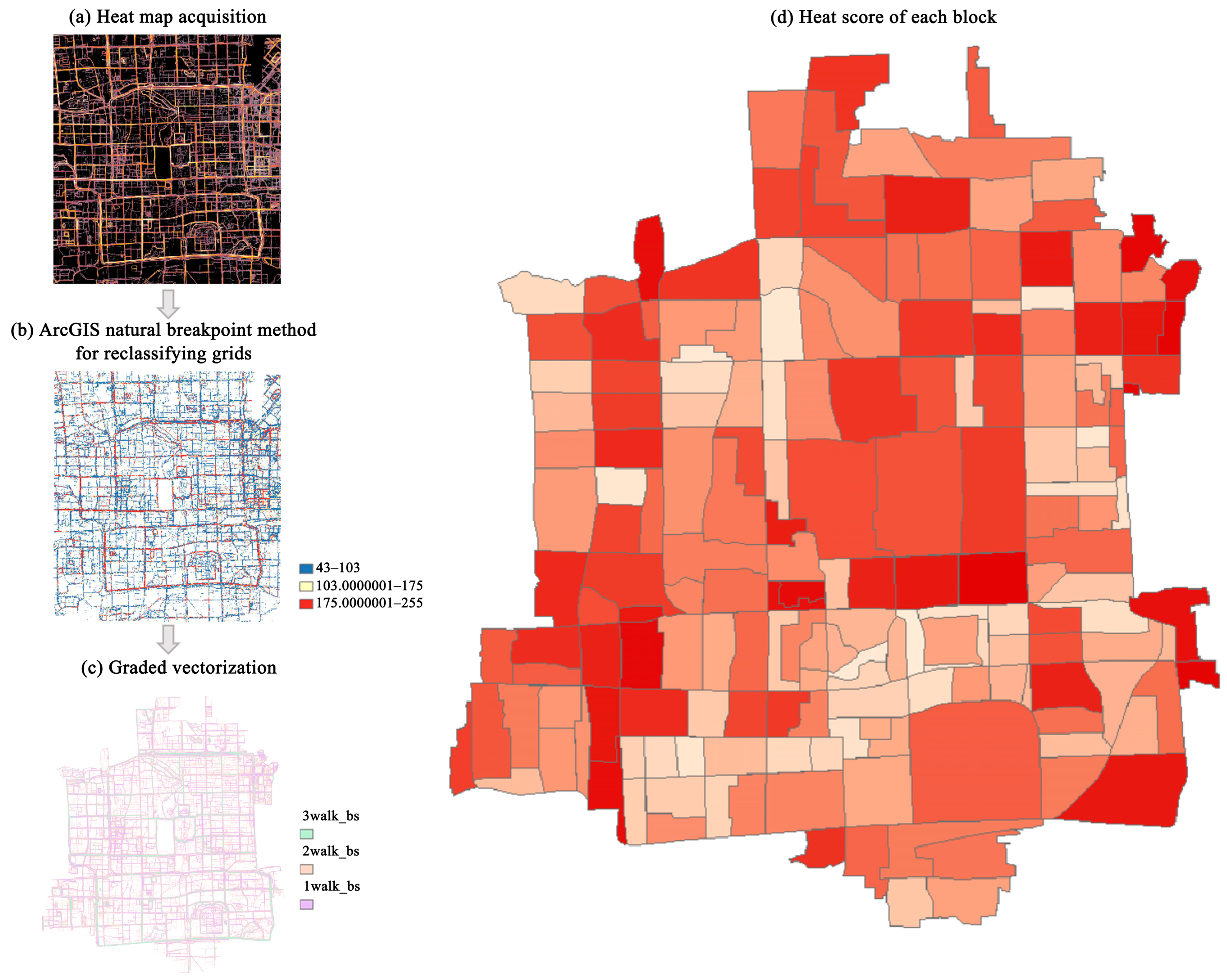
On 15 March 2023, this study obtained a pedestrian heatmap of the core area of the capital from the Strava website. The brighter the area on the heatmap, the higher the frequency of use of the road. In order to quantify the walking heat scores of each block, the obtained heatmap is first reclassified using ArcGIS, and the raster image is converted into a vector image. According to the natural discontinuity grading method, thermal information is divided into three levels, and a total of approximately 280,000 vectorized data points are obtained. Then, using ArcGIS’s computational geometry function, the occupied area of different levels of thermal information is calculated separately, and scores are assigned according to the corresponding 1, 2, and 3 levels of thermal information. Finally, the Strava heat score is calculated for each block.
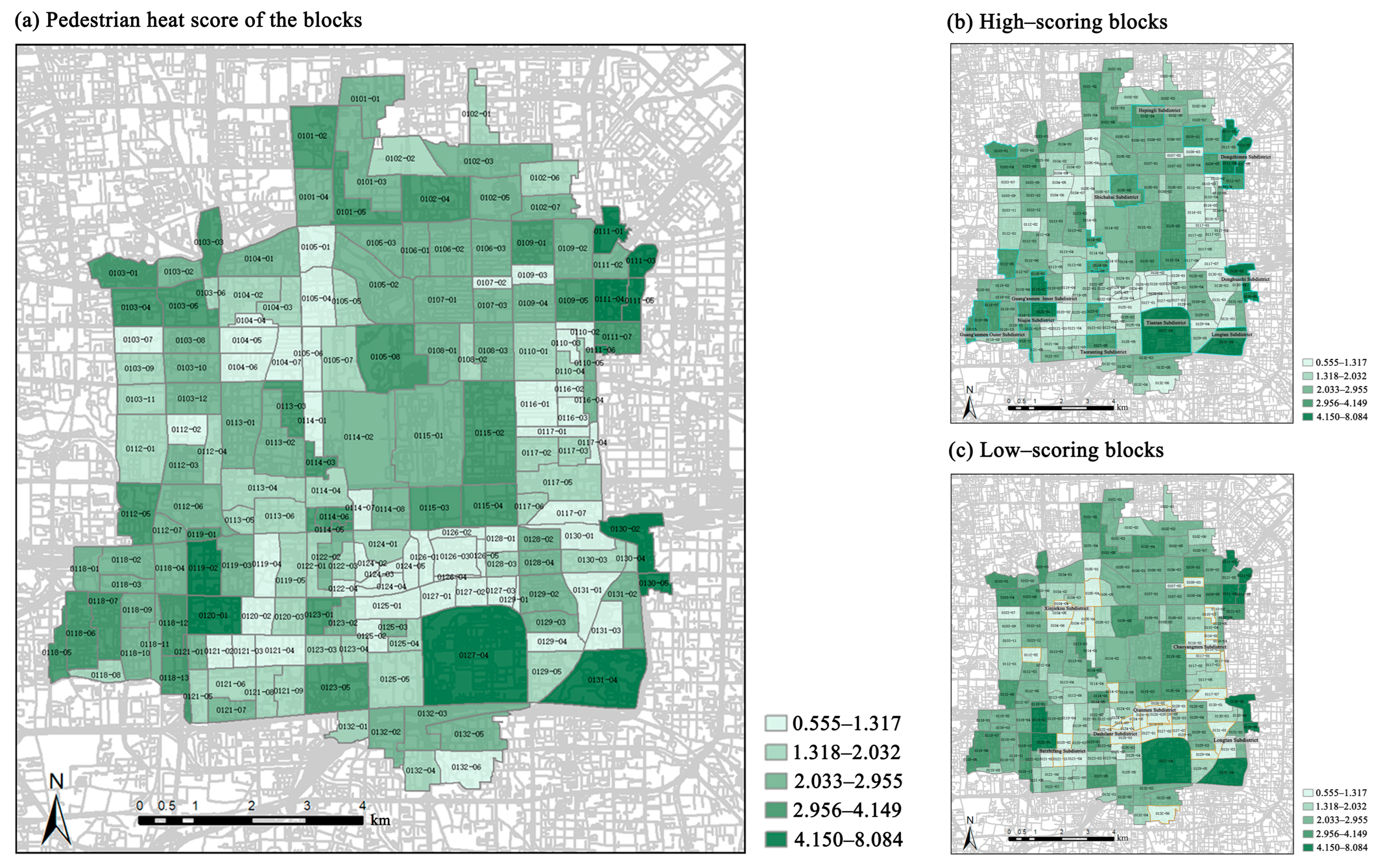
Since the heat map relies on the road network information of the OSM website as the base map, this study also uses OSM to calculate the road area to eliminate the impact of road network area on walking heat scores. First, the length of roads in each block is calculated, and the width of each road is assigned according to the different levels of roads, thereby calculating the total area of the road network (road width assignment is based on partial on-site measurements, Baidu Street View images, and the “Urban Road Space Planning and Design Specification” [69]. Finally, the Strava score of each block is divided by the road area of each block, ultimately obtaining the walking heat score of each block (Figure 3).
Formula summary: Walking heat score of the block = Strava heat score/total road area of the block.

2.4.2. Block Spatial Form Data

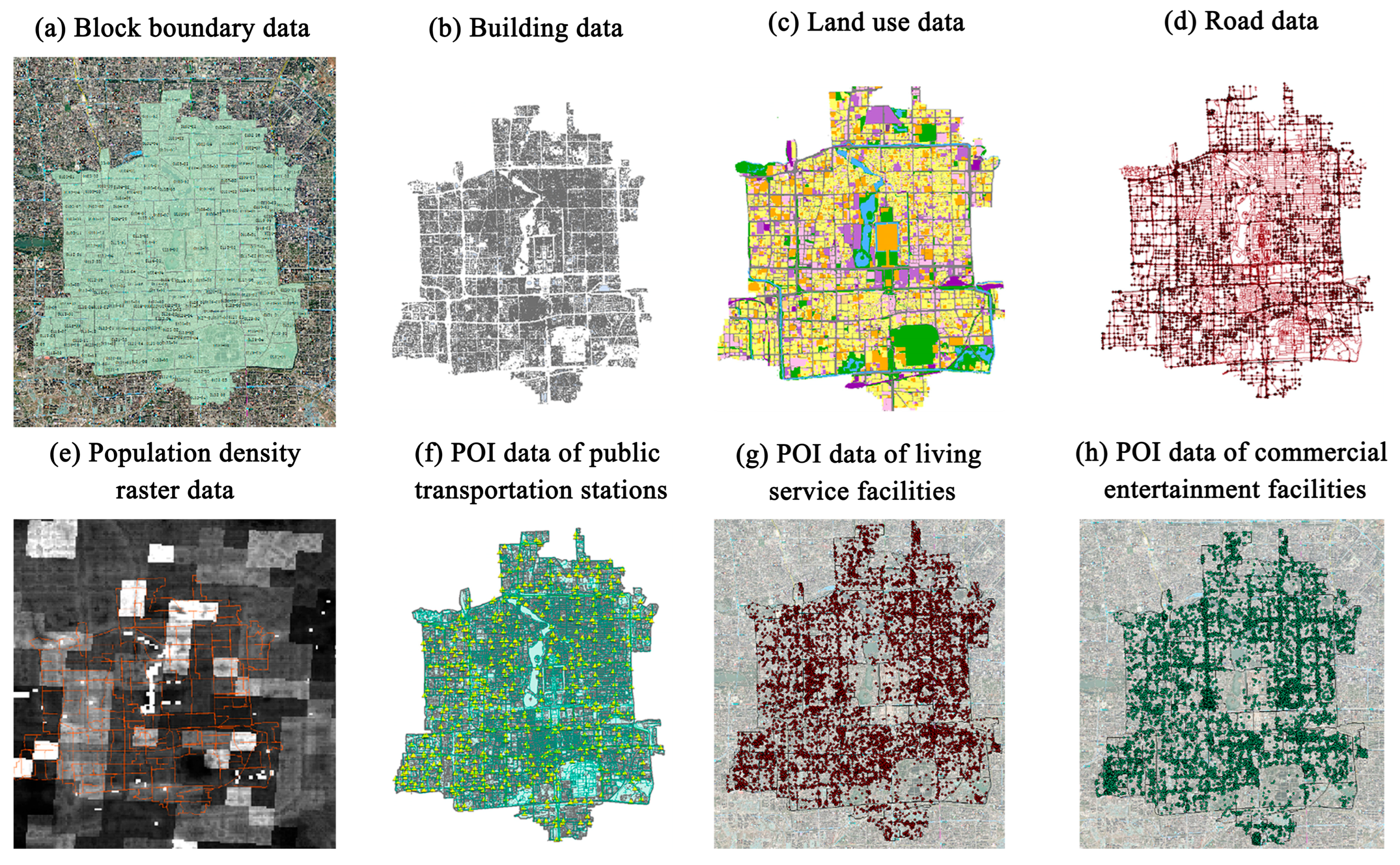
Block boundary: The block boundary is defined by the “Controlled Detailed Planning of the Core Area of the Capital Function,” vectorizing the 183 blocks of the eastern and western cities and using geometric calculation functions to calculate the area and perimeter of each plot.
Building data: Building information is obtained from the open data website of Gaode Map (https://lbs.amap.com/). The data includes the number of building floors and the base area of buildings. Building data is used to further calculate the average building height, building area, and building floor area ratio.
Land use data: The land use nature map published in the “Controlled Detailed Planning of the Core Area of the Capital Function” is classified and vectorized in the GIS according to different land use natures, and then the mixed degree of land use functions in different blocks is calculated through mixed entropy operation.
Road data: Road network information with road level classification in the eastern and western cities is captured from the OSM website (https://www.openstreetmap.org/). First, the road network information is manually verified and processed, and on this basis, the density of road intersections is calculated after single-line processing and breaking.
Population data: Population distribution data for Beijing in 2020 is obtained from the data disclosure website World Pop (https://hub.worldpop.org/). After processing into raster objects, the population quantity of each block is calculated through regional analysis operation in the spatial analysis of ArcGIS, and the error is corrected according to the statistical yearbook to ultimately obtain the population density index data for each block.
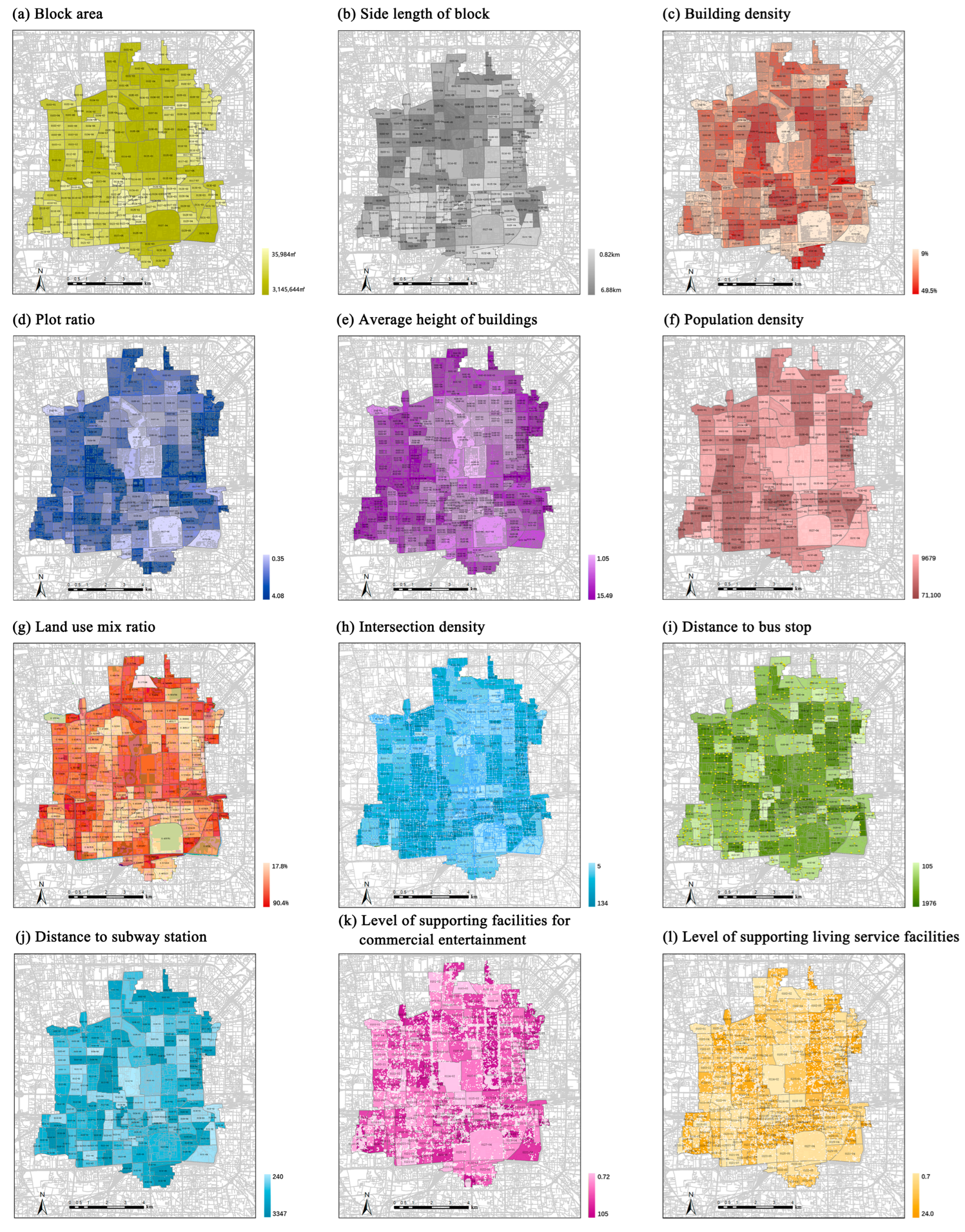
POI data: On 19 December 2022, POI data from Gaode Map was scraped, with coordinates in GCJ-02, which was then processed to convert the Coordinate Reference System (CRS) for further operation. The obtained POI data is imported into GIS, and the OSM road network previously processed is used in ArcGIS to build a network dataset. Based on this, an OD cost matrix is calculated to determine the average distance of each block to subway stations and bus stations. The OD cost matrix is a tool used to calculate the minimum cost path between multiple starting points and multiple destination points. It can help us analyze the travel time, cost, or distance between different locations in order to evaluate the level of transportation convenience and accessibility within the region. Secondly, the POI data is operated with population quantity data to obtain the supporting level of commercial and entertainment facilities as well as living service facilities in each block (Figure 4).

2.4.3. Data Error Analysis

It should be noted that due to experimental and data influences, this study will also produce certain errors.
We acknowledge Strava’s demographic skew toward adults aged 25–44, under-representing elderly, low-income groups, women, and children (<13) (https://www.strava.com/heatmap, accessed on 19 December 2022). The findings thus reflect the walking patterns of active, digitally connected adults rather than the entire population, especially when interpreting equity-related implications. Strava users skew toward active adults aged 25–44 and leisure-oriented recording, likely under-representing older adults, low-income groups, women, children, and utilitarian trips (commuting and errands). Accordingly, the observed walking heat distribution should be read as a fitness- and leisure-weighted surface—an upper bound of environmental walking potential—rather than a population-average of all walking. Blocks featuring scenic parks, waterfronts, heritage corridors, and iconic commercial streets (e.g., Shichahai, Tiantan, and Wangfujing) are prone to over-representation because they attract recreational users and tourists who are more likely to log activities, while everyday residential areas with routine, need-based walking (school escorts, eldercare, and short errands) and weaker smartphone adoption may be under-represented. This composition effect can inflate apparent hotspots near destination clusters and bias built environment associations toward features appealing to recreational users (blue–green corridors, landmark routes, and visually legible streets) while attenuating the measured influence of proximity to essential services (wet markets, clinics, and bus feeders) in non-touristic neighborhoods. To mitigate bias, we aggregate 12 months of data to smooth event pulses and normalize by road area at the block scale to temper the dominance of a few popular segments. For equity-critical decisions (e.g., school routes and eldercare access), the results should not be used in isolation; they should be triangulated with on-site pedestrian counts, community surveys, and administrative datasets (e.g., school/clinic catchments and OD) before prioritization. These steps reduce but do not eliminate the sports- and event-driven selection effects inherent to Strava data. However, compared to traditional questionnaire surveys and other walking or cycling recording software, Strava data has three advantages that make it the preferred tool for studying urban residents’ travel behavior.
Firstly, as a data source for sampling surveys, Strava data has a wide coverage and strong authenticity. Strava can provide globally accessible and street level accurate walking or cycling behavior data, filling the gap of other localized cycling or running applications (such as Cyclemeter, RiderLog, etc.) that are often limited to specific regions or user groups [70]. And the data comes from users’ actual exercise behavior (such as GPS trajectory, time, speed, distance, etc.), avoiding recall bias or subjective beautification problems in traditional questionnaire surveys. Secondly, data structuring facilitates analysis. Strava provides organized and aggregated anonymous behavioral data (such as routes, frequency, time, etc.) for direct use in research or policy analysis (www.strava.com). Thirdly, the data has a certain richness. Existing validation studies support the utility of crowdsourced fitness data for urban walkability research. Nowadays, many cyclists habitually upload their commuting activities to Strava and have a “commuter” tag to indicate this [71]. So, to some extent, it can weaken its limitations as a sports data recording software. Therefore, some scholars have analyzed the commuting routes of residents (such as bicycle commuters) by analyzing Strava’s cycling or running routes to assist in studying the demand for non-motorized transportation in cities [64].
At the same time, since the initial data of block pedestrian heat obtained is in tiff format of raster files, converting TIFF rasters to vector polygons can introduce minor artifacts via pixel aggregation and boundary smoothing. Because our analyses emphasize relative ranking across blocks and use a three-class natural breaks (Jenks) scheme for heat intensity, results are comparatively robust to small perturbations at the pixel level. This approach ensures each class represents qualitatively different pedestrian activity levels observable in Beijing’s urban landscape, from sporadic walking in low-density areas to intensive foot traffic at transit hubs and commercial corridors. We employed linear proportional weighting rather than exponential schemes because our analysis examines the full walkability spectrum rather than just extremes, and linear weights preserve the continuous nature of original heatmap data while enabling categorical analysis, and this approach avoids introducing unsupported scaling assumptions. We conducted sensitivity tests by shifting the Jenks thresholds by ±10%; the Spearman rank correlation of block rankings remained >0.92 across all variants, indicating that our principal findings are stable with respect to raster-to-vector conversion effects and classification cut points.
Our built environment and POI datasets are timestamped December 2022, while Strava heat represents an approximately 12-month aggregation ending March 2023. In the historic core, urban form changes are slow due to conservation controls. Using 2023 high-resolution satellite imagery for spot checks, we identified visible morphology changes in fewer than 3% of blocks, mostly small additions or facade updates. We excluded five blocks undergoing substantial renovation and re-estimated the models; coefficient signs and statistical significance remained unchanged, supporting a negligible impact of temporal misalignment for the remaining 178 blocks.

3. Results

3.1. Identification and Analysis of Block Walking Heat Scores

The blocks with the highest walking heat scores are distributed in Dongzhimen, Hepingli, Donghuashi, Tiantan, Longtan, Taoranting, Guang’anmennei, Guang’anmenwai, Shichahai, and other subdistricts. The subdistricts with lower walking heat scores are mainly concentrated in Xinjiekou, Chaoyangmen, Baizhifang, Qianmen, and Dashilar subdistricts. Using statistical data tools, the frequency distribution of walking scores for each block can be obtained, and most blocks score between 1 and 2 points, with few blocks scoring above 4 points (Figure 5).

3.2. Analysis of Block Spatial Form Indicators

3.2.1. Basic Indicators

According to the division of blocks in the “Controlled Detailed Planning of the Core Area of the Capital,” the area and side length of each block can be obtained through statistical analysis using data vectorization and ArcGIS’s geometric calculation function. At present, each block in the core area is about 0.4–3 square kilometers in area, and the block perimeter is about 0.8–7 km. Most of the blocks are divided into an area of 0.5–1 square kilometers. At this scale, the block can provide people with a rich range of daily life services to meet the needs of the elderly and children who are not convenient to travel far. Some of the blocks with larger areas and longer perimeters in the core area are mainly due to the presence of cultural relics, cultural protection units, and natural water systems, such as the Tiantan, Forbidden City, and Shichahai areas (Figure 6).

3.2.2. Development Intensity

The characteristics of development intensity are composed of three evaluation indicators—building density, building floor area ratio, and building height—reflecting the overall construction and development of the block and the degree of building enclosure.
As shown in Figure 6, most of the blocks in the core area have a building density between 20 and 40%, with an average building density of 26.8%. The blocks with higher building density mainly belong to Dashilar Subdistrict, Jiaodaokou Subdistrict, Xinjiekou Subdistrict, Jianguomen Subdistrict, and other areas. These areas are mostly traditional historical and cultural areas, with smaller overall building scales, presented in a more compact and orderly form, making the building density higher. The building floor area ratio mainly concentrates between 0.4 and 2.8, and the average building height is between 1 and 15 floors, with most blocks’ average building height between 2 and 9 floors. The overall distribution of building floor area ratio and average height shows a distribution characteristic of being higher around and lower in the middle (Figure 6). The blocks in Jinrongjie Subdistrict, Jianguomen Subdistrict, Donghuamen Subdistrict, Chongwenwai Subdistrict, and Xichang’anjie Subdistrict have higher building floor area ratios, which is related to the overall demolition of the old city and the construction of new areas in the core area during the renovation. The newly built buildings in these areas are generally several times the volume of traditional buildings and are mainly multi-layered or high rise, making the building floor area ratio higher. The blocks in Donghuamen Subdistrict, Tiantan Subdistrict, Shichahai Subdistrict, Beixinqiao Subdistrict, Xichang’anjie Subdistrict, and other subdistricts have lower overall development intensity values. The building height is also affected by the core area’s requirement to retain landscape sightlines and height limits around historical buildings, and the average height of buildings near the Central Axis and historical and cultural protection areas is lower.

3.2.3. Population Distribution

By calculating the ratio of the relative population to the area of each block, the population density value of each block is obtained. The population density value describes the density of the population in each block and also reflects the degree of land intensity. At present, the overall distribution of population density in the core area of the capital shows a characteristic of being higher in the west and lower in the east (Figure 6). The blocks with lower population density are located in Donghuamen, Tiantan, Jianguomen, Andingmen, and other subdistricts. The blocks in Andingmen, Guang’anmennei, Niujie, Baizhifang, Chongwenmen, and other subdistricts are relatively more densely populated.

3.2.4. Land Use Diversity

The land use mixing degree can reflect the degree of mixed use of different types of land in the block. The larger the value, the more diversified the land use in the block, and the more balanced the distribution of different types of functions. At present, the average value of land use diversity in each block of the core area of the capital is 63% (Figure 6). The blocks with lower land use diversity are located in Xinjiekou Subdistrict, Taoranting Subdistrict, Baizhifang Subdistrict, Zhanlanlu Subdistrict, Xinbeiqiao Subdistrict, and Tiantan Subdistrict. The blocks with higher land use diversity are located in Guang’anmennei Subdistrict, Guang’anmenwai Subdistrict, Niujie Subdistrict, Hepingli Subdistrict, Longtan Subdistrict, etc. In addition, it can be seen from the figure that there is a large difference in land use diversity between different blocks in the same street jurisdiction; the blocks near the water area of Shichahai Subdistrict have higher land use diversity, while other blocks have lower land use diversity.

3.2.5. Road Network

Intersection density affects the accessibility and reachability of roads. This paper uses intersection density (number of intersections/study area) to represent the characteristics of the road network. Due to the different road conditions in cultural relic protection areas and commercial areas, the intersection density in the core area shows a distribution characteristic of being higher in the southwest and lower in the northeast (Figure 6). Among them, the blocks in Tiantan, Andingmen, Jiaodaokou, Dashilar, Dongsi, Qianmen, Xinjiekou, and other subdistricts have lower intersection density, while the blocks in Chaoyangmen, Jianguomen, Jinrongjie, Guang’anmennei, and other subdistricts have higher intersection density.

3.2.6. Facility Accessibility

The accessibility of public service facilities can affect the travel distance of residents and thus influence their choice of travel mode. At present, the average distance of each building in the core area to the bus station is 940 m. Among them, some blocks in Dongsi Subdistrict, Donghuashi Subdistrict, Xinjiekou Subdistrict, and Xinbeiqiao Subdistrict have a longer average distance from bus stations, while the blocks in Jianguomen Subdistrict, Baizhifang Subdistrict, Dongzhimen Subdistrict, and Chunshu Subdistrict are closer to bus stations. In terms of the distance to subway stations, the blocks closer to subway stations are located in Guang’anmennei, Beixinqiao, and Longtan Subdistricts, while some blocks in Guang’anmenwai Subdistrict, Chaoyangmen Subdistrict, and Chunshu Subdistrict are farther away from subway stations (Figure 6).
From the perspective of the supporting level of commercial and entertainment facilities, the blocks in Jinrongjie Subdistrict, Donghuamen Subdistrict, Qianmen Subdistrict, Guang’anmenwai Subdistrict, Zhanlanlu Subdistrict, and Andingmen Subdistrict have a higher number of POIs per thousand people, which is in line with the current commercial layout plan in Beijing. These blocks have international consumer experience areas such as Wangfujing, Xidan Financial Street, and Qianmen and have tourist areas with high heat such as Nanluoguxiang business district and Longfusi area dynamic consumption circle. In comparison, some blocks in Taoranting and Hepingli Subdistricts have fewer commercial and entertainment facilities. In terms of the supporting level of living service facilities, the living blocks in Niujie Subdistrict, Jingshan Subdistrict, Donghuamen Subdistrict, Andingmen Subdistrict, and Guang’anmenwai Subdistrict, which are mainly residential functions, have higher matching levels, while some blocks in Xichang’anjie Subdistrict, Hepingli Subdistrict, Zhanlanlu Subdistrict, Tiantan Subdistrict, and Baizhifang Subdistrict have relatively fewer (Figure 6).

3.3. Analysis of Influencing Factors

3.3.1. Correlation Analysis

This study used Pearson correlation analysis in SPSS 25.0. Pearson correlation coefficient is commonly used to measure the correlation between two continuous variables, which need to follow a bivariate normal distribution.
The correlation analysis results between the spatial form indicators of the block and the pedestrian travel heat score in this study are shown in Table 3. Among them, the value of the correlation coefficient r is between −1 and 1, which represents the strength and direction of the correlation between variables. When r > 0, it indicates a positive correlation between two variables, and when r < 0, it indicates a negative correlation between the two variables. The closer the absolute value of r approaches 1, the stronger the correlation between the two indicator factors. The p-value is a significant value, and when the p-value is less than 0.05, it indicates that r is significant and has statistical significance. When the p-value is less than 0.01, it indicates that r is extremely significant.
According to the analysis results, block area (r = 0.277), average building height (r = 0.332), and commercial and entertainment facility indicators (r = 0.246) have a significantly positive correlation with pedestrian travel heat, while land use mix (r = 0.188) and living service facility indicators (r = 0.183) have a significant positive correlation with pedestrian travel heat. Building density (r = 0.382) and intersection density (r = 0.236) are significantly negatively correlated, and the average distance to bus stations (r = 0.176) is significantly negatively correlated.

3.3.2. Multiple Linear Model Analysis

Through Pearson correlation analysis, we have identified block spatial form indicators that are correlated with walking heat scores. Next, regression analysis will be conducted using a multiple linear model in SPSS 25.0 to determine the degree of influence of the above indicators on the walking heat scores. The analysis results are shown in Table 4.
There are multiple indicators in the regression calculation results, with a focus on the significant relationship between the independent and dependent variables through p-values and beta values. When p < 0.05, it indicates that the independent variable has a significant impact on the dependent variable. When p < 0.01, it indicates that the independent variable has an extremely significant impact on the dependent variable. The standardized coefficient β represents both positive and negative aspects of the impact relationship. When the β value is positive, it indicates that the independent variable has a positive impact on the dependent variable; When the β value is negative, it indicates that the independent variable has a negative impact on the dependent variable. In addition, R, R2, and adjusted R2 reflect the degree of fit of the model; the D-W value is used to test the autocorrelation of the sequence (Table 5).
In the case where all independent variables have passed the variance inflation factor (VIF) collinearity diagnosis, the influence of multiple independent variables on walking behavior is considered simultaneously to reveal their complex relationship with walking heat scores. By analyzing the regression coefficients, we can understand the relative impact of each independent variable on the dependent variable.
According to the regression analysis results, block area (p = 0.001) and average building height (p = 0.012) have a significant positive impact on pedestrian travel heat, while building density (p = 0.003) and intersection density (p = 0.000), and the distance to bus stations (p = 0.003) have a significant negative impact.

4. Discussion

Below, we will analyze the impact mechanisms of eight block spatial form indicators that affect pedestrian travel, interpreting coefficients through isobenefit mechanisms: accessibility and amenity mix reduce generalized travel cost and enable trip chaining; environmental comfort and safety increase route utility; and in heritage settings, “safe, internal permeability” can substitute for high intersection counts.
The block area indicator has a significant positive impact on pedestrian travel.
The positive association between block area and pedestrian heat should be interpreted as contextual rather than prescriptive. In Beijing’s historic core, larger blocks frequently host flagship cultural attractions, major parks, and established commercial districts and have historically received greater investment in pedestrian facilities (e.g., wider sidewalks, safer crossings, and landscape improvements). At the same time, a good block street interface facility allows pedestrians to experience different morphological characteristics of the street interface during slow travel and triggers their activities such as watching, stopping, sitting, and talking [72]. The observed correlation therefore reflects the co-location of functions and resources rather than an inherent effect of “large size” improving walkability. In other words, correlation does not imply causation.
Consistent with isobenefit urbanism, human-scale blocks and fine-grained pedestrian permeability are more critical for everyday access and equitable benefits than block size per se. For legacy large blocks, we recommend internal subdivision strategies—mid-block pedestrian passages, pocket parks, and mixed-use infill—to recreate the fine-grained, human-scale access patterns typical of traditional hutong areas without compromising heritage or safety objectives. This recommendation flows directly from the tested mechanism: if the correlation arises from amenity co-location, then interventions should enhance internal connectivity and distribute services more evenly within large blocks, thereby extending isobenefit access to edge residents.
The average building height has a significant positive impact on pedestrian travel, while building density has a significant negative impact.
The average building height in the core area is closely related to renewal and construction activities. In the core area, taller buildings are often newly built multi-layer residential buildings and office buildings, which means that blocks with higher average building floors can provide more facilities and services and generate more necessary commuting travel, such as Jinrongjie Subdistrict, Guang’anwai Subdistrict, etc., so it significantly increases walking heat. In addition, building height can also shape the urban landscape, and high-rise buildings often have significant landmarks, which can also enrich the sense of hierarchy of the city, making the city’s outline more colorful, which helps to enhance people’s cognition of the city, thus significantly promoting people’s willingness to choose pedestrian travel [58].
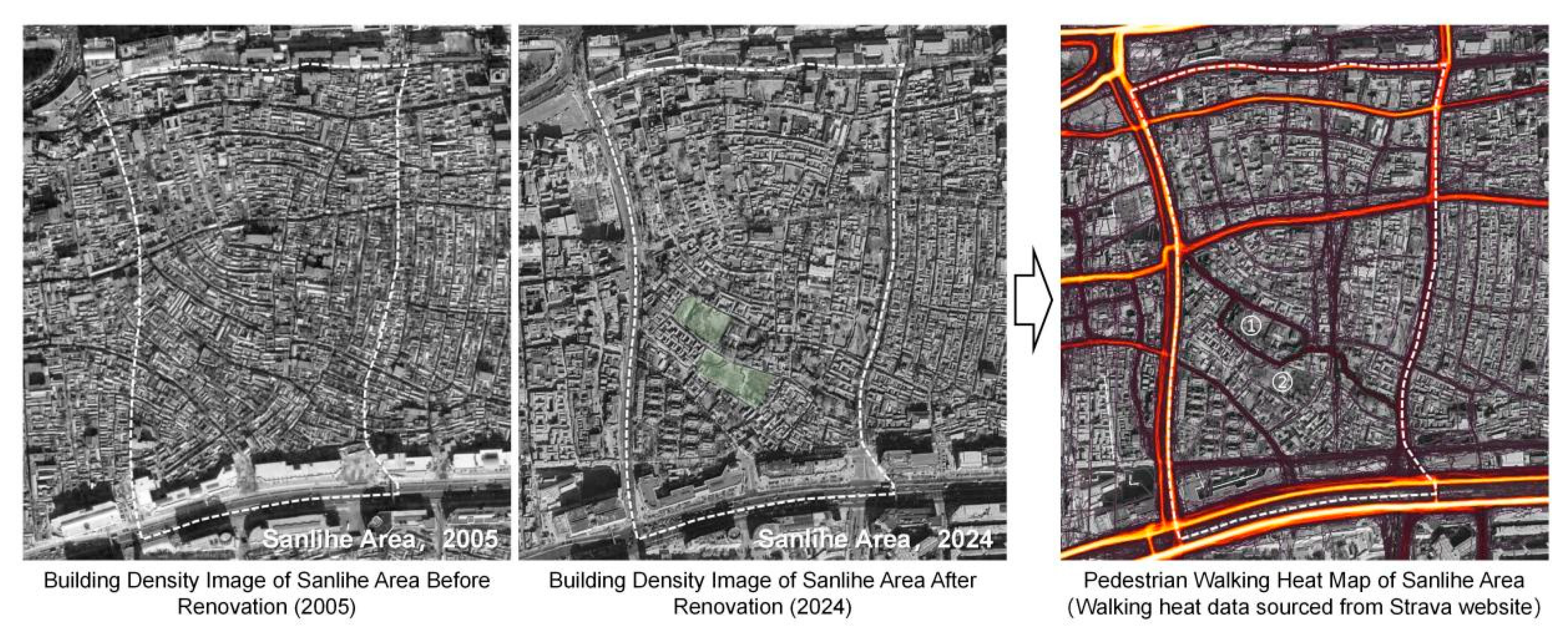
To further illustrate the negative correlation between building density and walking heat scores in Beijing’s core area, we present a case study of the Sanlihe Area, a typical traditional hutong neighborhood (Figure 7). The area underwent comprehensive environmental renovation and building transformation beginning in 2006. As shown in the comparative building density images, the 2005 pre-renovation condition exhibited extremely high building density characteristic of traditional hutong districts, with densely packed low-rise structures creating a congested urban fabric. By 2024, post-renovation imagery reveals a significant reduction in building density, with the strategic introduction of green spaces and public activity areas (marked as zones ① and ②).
The crowd density heat map demonstrates that pedestrian activity concentrates notably around these newly created public spaces, particularly in zones ① and ②, validating our statistical findings. This case exemplifies the paradox of building density in historic core areas: while high building density indicates concentrated population, it simultaneously correlates with low actual development intensity (predominantly single-story traditional courtyard houses), compressed public spaces, limited recreational amenities, and, consequently, reduced pedestrian comfort and walking willingness [53]. The Sanlihe renovation demonstrates that strategic density reduction, coupled with public space enhancement, can significantly improve walking heat scores. This confirms that in the context of Beijing’s core area, building density exhibits a significant negative impact on pedestrian travel, contrary to conventional urban planning assumptions that universally associate higher density with increased walkability.
Land use mix is positively correlated with pedestrian travel.
The land use mix reflects the degree of mixed use of different types of land in the block. A higher land use mix indicates that different types of land are more closely organized within a block, and land use is more efficient and intensive, which is more in line with the design concept of job–housing balance [73,74] and also makes it more convenient for people to obtain different services and reduce commuting distances, thus reducing the dependence on motorized transportation [60]. The positive influence of active ground-floor frontages and mixed land use is most pronounced on comprehensive service streets, where multi-story commercial and cultural facilities generate dense, purpose-driven pedestrian flows. Mechanistically, land use diversity enables trip chaining—linking work, errands, and leisure within a single walking circuit—thereby reducing the generalized cost of accessing multiple destinations. Empirically, our finding confirms that blocks approaching balanced residential–commercial–office ratios exhibit higher Strava heat, controlling for other factors. zoning reforms should permit mixed use by right in heritage cores, incentivizing ground-floor retail, co-working hubs, and childcare facilities within predominantly residential hutong areas to unlock latent walking demand.
The non-significant effects of land use mix (β = 0.030, p = 0.628) and facility supply (commercial: β = 0.138, p = 0.091; living services: β = 0.130, p = 0.139) after controlling for other variables warrant careful interpretation. Unlike findings from Western contexts where these typically emerge as strong walkability predictors, three contextual factors may explain these results in Beijing’s core: First, the near-universal presence of ground-floor retail and services across the study area creates limited variance: most blocks already achieve functional mixing, reducing its discriminatory power. Second, Strava’s user demographics (active adults aged 25–44) preferentially capture recreational and fitness walking rather than utilitarian trips to grocery stores or clinics, attenuating the measured influence of necessity-based amenities. Third, in heritage districts where tourist flows dominate certain corridors, landmark appeal and streetscape quality may overshadow the proximity effects of everyday services. These explanations suggest that while land use diversity and facility access remain theoretically important for isobenefit urbanism, their empirical manifestation depends heavily on measurement scales, user populations, and local spatial configurations.
Intersection density has a significant negative impact on pedestrian travel heat.
Intersection density is an important indicator in urban planning and transportation [59], reflecting the density and complexity of the traffic network in each block. In this analysis, dense road intersections will reduce pedestrian travel heat. The negative or weak association of intersection density with walking heat can be attributed to several context-specific mechanisms in Beijing’s heritage core. First, conservation-limited fine-grain networks add conflict points without providing safe crossings, as historic street patterns lack modern pedestrian infrastructure. Second, traffic exposure at multi-leg junctions deters pedestrians due to increased vehicular conflicts and longer crossing distances. Third, tourist activity clusters around landmark axes where intersections are fewer but mid-block passages and traffic calming measures are better developed. The current high traffic flow in the core area means dense intersections increase traffic interference for pedestrians, such as increasing the time pedestrians wait for traffic lights, interrupting the continuity of pedestrian travel rhythm, and reducing the overall experience of pedestrian travel. This refines isobenefit expectations: in heritage cores, conflict-free crossings and mid-block connectivity matter more than raw intersection counts.
Empirical studies of pedestrian delay tolerance in Chinese cities provide quantitative support for this mechanism. Research at Beijing signalized intersections found that most pedestrians can tolerate waiting up to 50 s, beyond which non-compliance rates increase sharply [75]. Field observations in our study area revealed that blocks with high intersection density (>15 intersections/km2) frequently impose signal wait times of 60–90 s at multi-phase junctions, exceeding established tolerance thresholds. A Shanghai study further demonstrated that pedestrian tolerance decreases significantly at median refuge islands (50 s maximum) compared to continuous curbside waiting (90 s maximum), suggesting that multiple interrupted waits at dense intersection networks impose greater psychological costs than fewer but longer single waits [76]. Given that signal duration in the core area often exceeds 70 s during peak hours to accommodate vehicular flows, the negative correlation between intersection density and walking heat reflects cumulative delay burdens that discourage pedestrian activity, particularly for recreational and discretionary trips captured in Strava data.
The positive influence of active ground-floor frontages and mixed land use is most pronounced on comprehensive service streets, where multi-story commercial and cultural facilities generate dense, purpose-driven pedestrian flows.
The average distance of each building from the bus station has a significant negative impact on pedestrian travel, while the support levels of commercial and entertainment facilities and living service facilities are positively correlated with pedestrian travel.
The distance to the bus station is closely related to solving the “last-mile” problem of travel, which indicates that residents are more likely to choose to walk to the bus station and then use public transportation if they can easily access it [56]. The core idea of isobenefit urbanism is to enable people to conveniently access any daily service location through the close connection between walking, cycling, and public transportation networks. Therefore, improving the combination of public transportation facilities and pedestrian networks is undoubtedly a positive and important measure to reduce motor vehicle travel and promote low-carbon development. On special feature streets, proximity to public transport and visual enclosure from historic buildings exert stronger positive effects on walking, reflecting the behavior of tourists and visitors who depend on transit access and are highly responsive to environmental quality.
The support levels of commercial and entertainment facilities and living service facilities are positively correlated with pedestrian travel [63]. Commercial facilities, such as shopping centers, restaurants, and movie theaters, and living service facilities, such as supermarkets, pharmacies, and banks, are often the destinations for pedestrian travel, and blocks with higher facility distribution density are often accompanied by a livelier block atmosphere and richer activities, which encourages people to walk to the area for leisure, socializing, and cultural activities. Reasonably designing multifunctional service facilities to increase the vitality and attractiveness of the neighborhood is an important supplement to the “central area” emphasized by the principle of isobenefit urbanism. The central area should have a rich and diverse range of service facilities that can be easily accessed by walking, cycling, or public transportation, thereby contributing to achieving fair access to social services.
Our findings align with isobenefit urbanism’s four principles while revealing context-specific refinements necessary for heritage-constrained megacity cores (Table 6.).
P1 (1-mile access to facilities) is supported by building height (β = 0.299, p = 0.012), shorter bus distance (β = −0.196, p = 0.003), and directionally positive land use mix and facility supply, confirming that vertical density near transit enhances accessibility. However, weak facility significance suggests that infrastructure quality and traffic safety mediate proximity effects in heritage cores. P2 (green access) and P4 (green networks) manifest where walking heat clusters along waterfront greenways, ring parks, and heritage corridors, yet this concentrates in tourist zones rather than uniformly across residential areas, exposing equity limitations. P3 (compact, continuous compact fabric) requires reconceptualization: negative coefficients for building density (β = −0.235, p = 0.003) and intersection density (β = −0.321, p < 0.001) reveal that high horizontal coverage compresses public space, while dense intersections increase conflicts. These findings demonstrate that quality compactness—safe permeability, vertical mixed-use, and conflict-free crossings—matters more than quantity metrics like coverage ratios or intersection counts.
Three adaptive strategies emerge: (1) internal micro-subdivision via mid-block passages and living streets addresses P1 and P3 without adding vehicular intersections; (2) nearby embedding of daily functions through ground-floor mixed-use and time-shared facilities strengthens P1 incrementally; and (3) integrated pocket park–green lane networks advance P2 and P4 by achieving equitable nature access beyond tourist zones. This study empirically tests isobenefit urbanism’s transferability to heritage-constrained reality, demonstrating that its equity goals remain valid but spatial prescriptions require context-sensitive recalibration. The negative density and intersection coefficients reveal boundary conditions where conventional walkability mechanisms invert due to preservation constraints and traffic conflicts, indicating that future implementations should prioritize quality compactness and incremental interventions over quantity metrics and comprehensive restructuring.

5. Conclusions

This study focuses on the core areas of capital in China and examines how built environment factors influence pedestrian travel behavior, with the aim of assessing the applicability of isobenefit urbanism in Beijing’s central urban area. Given the high-density development patterns, complex governance structures, and limited land resources characterizing megacity core areas in China, the applicability of normative urban theories requires careful contextual examination. In this regard, isobenefit urbanism is not treated as a prescriptive spatial model but instead as an analytical framework to interrogate the relationship between spatial accessibility, built environment attributes, and everyday pedestrian activity.
Based on a framework of urban spatial form indicators categorized into six elements and twelve specific variables, this study analyzed walking heat and morphological characteristics across 183 blocks using multi-source data and ArcGIS techniques. The results identify eight spatial form indicators that show statistically significant associations with pedestrian activity intensity, providing an empirical basis for evaluating walkability-oriented planning concepts in high-density contexts, as shown in the Table 7.
While isobenefit urbanism advocates for equal spatial access through a uniform redistribution of urban services, the empirical findings of this study suggest that such an idealized configuration is difficult to fully realize in megacity core areas. Structural constraints, including high land development intensity, rigid functional zoning, and limited opportunities for large-scale spatial restructuring, significantly restrict the implementation of comprehensive isobenefit patterns.
Nevertheless, certain principles embedded within the theory remain applicable when interpreted selectively. The observed associations between walking activity and specific built environment indicators—such as facility proximity, street connectivity, and localized spatial continuity—indicate that incremental and place-based interventions can still contribute to a more balanced pedestrian environment. In this sense, isobenefit urbanism functions less as a replicable spatial blueprint and more as a heuristic framework for identifying inequalities and guiding targeted spatial optimization within existing urban fabrics.
Taken together, these findings suggest that the value of isobenefit urbanism in Beijing’s core area does not lie in achieving a uniform redistribution of urban functions but rather in using empirical evidence on pedestrian activity to identify where and how spatial access is uneven. Differences in walking intensity across blocks are closely linked to facility proximity, land use mix, development intensity, and pedestrian network quality, indicating that planning interventions need to be targeted rather than uniform. By clearly linking empirical findings, spatial form characteristics, and planning responses within Beijing’s existing regulatory and policy framework, this study is relevant both for academic discussions on walkability theory in megacity cores and for block- and street-level planning practice in Beijing’s historic areas.

5.1. Planning Update Suggestions

The spatial analysis shows that blocks in the study area differ mainly in facility con-centration, pedestrian network conditions, and environmental continuity. These differences provide a direct empirical basis for formulating differentiated planning strategies under shared isobenefit principles.
This planning approach resonates with Beijing’s historic core policy framework, including the Controlled Detailed Planning of the Capital Core Area (Block Level), the Beijing Historic City Conservation Plan, organic renewal guidelines, and pedestrian-oriented street improvement initiatives such as the Pedestrian and Bicycle Transport System Demonstration City Implementation Plan. Rather than merely aligning with existing policies, the study highlights a feedback loop whereby empirical findings inform planning practice and, in turn, can guide mid-term policy evaluations or revisions of block-level control plans. By linking pedestrian activity with facility proximity, land use mix, development intensity, and network continuity, the analysis demonstrates how policy objectives and site-specific conditions can mutually inform each other under heritage conservation constraints.
This recommendation is directly supported by the empirical results, which show that both living service facility density and commercial entertainment facilities are positively correlated with pedestrian heat, indicating that closer spatial proximity between daily functions and pedestrian networks significantly enhances walking activity. Building upon the urban texture of Beijing’s old city, it is encouraged to embed community commercial, cultural, sports, and other functions into the same building or block [77,78], such as the “community life complex” or “symbiotic courtyard” model; the 30th courtyard of Yu’er Hutong in Nanluogu Lane is a typical “symbiotic courtyard”, where a library, cultural and creative space, and convenient service outlets have been integrated to fulfill hutong residents’ expectations for better daily life on the “last mile” while simultaneously preserving traditional architectural form and improving supporting living facilities (https://ghzrzyw.beijing.gov.cn/). It not only protects and enhances the traditional architectural style but also improves the supporting living facilities for residents. In terms of pedestrian network connectivity, attention should be paid to the coordinated consideration and construction between the pedestrian network system and the layout of public transportation stations [79]. If bus stops are set up in densely populated living and commercial areas to reduce the distance for people to walk and connect, while optimizing pedestrian bus connections, clear pedestrian guidance signs, barrier free passages, wind and rain corridors, and other facilities should be set up within 600 m around rail transit stations and bus hubs to achieve seamless “door-to-door” connection (www.mohurd.gov.cn).
While larger blocks currently coincide with higher pedestrian heat in the study area, this reflects existing concentrations of destinations and superior pedestrian infrastructure, not a general design principle to favor large blocks. Planning practice should prioritize human-scale urban form—approximately 400–800 m perimeter blocks—supported by a continuous, legible pedestrian network. For existing large blocks, an “internal micro-subdivision + functional mixing + pedestrian permeability” approach is recommended: introduce mid-block links, enhance internal public spaces, and embed daily services through mixed-use infill to raise isobenefit at the human scale rather than increasing block size. These measures align empirical findings with normative goals of equitable access and pedestrian-oriented development.
Mixed land use redevelopment in the capital’s core functional area should emphasize functional diversity while avoiding excessive development intensity.
The empirical analysis shows that land use mix is positively associated with pedestrian heat, whereas building density exhibits a negative relationship, implying that functional integration contributes to walkability only when development intensity is properly controlled within high-density contexts. Based on the analysis results of this study, as well as the “Controlled Detailed Planning of the Core Area of the Capital (Block Level)” and the “Guiding Opinions on the Mixed Use of Construction Land Functions in Beijing (Trial)” released in 2023, it is necessary to guide the mixed development of residential, commercial, office, and entertainment functions within individual blocks; the Longfu Cultural Block project, through its phased renewal strategy focusing, respectively, on building quality improvement, subway-linked patch development, and historical texture protection, has successfully revitalized the area into a new landmark combining living, vitality, and multifunctional urban roles (https://www.bjdch.gov.cn/). At present, Longfu Cultural Block has successfully risen to become a new landmark in Beijing, with significant appeal as a living place, vitality center, and functional node.
Improving the continuity of blue–green spaces should be a priority for enhancing walkability in Beijing’s old city.
The study demonstrates that pedestrian heat is higher in blocks adjacent to parks, cultural scenic areas, waterfront spaces, and ring-road greenways, while intersection density is negatively correlated with walking activity, collectively suggesting that spatial continuity and environmental quality are more influential than fragmented nodal supply. There are abundant historical, cultural, and landscape resources within the core functional area of the capital, such as along Chang’an Avenue, the six seas and eight water systems, royal residences, and cultural heritage sites; the Sanlihe renewal project integrates water systems, hutongs, green landscapes, residential buildings, and historical elements into a continuous blue–green network, enhancing residents’ exposure to greenery while strengthening the cultural atmosphere of Beijing’s old city. The improvement of the green landscape in Sanlihe is an excellent case of renewal practice. This update is based on the historical and cultural characteristics of the Qianmen area in Beijing, with a focus on addressing the integration of rivers with the surrounding urban living environment. Taking Sanlihe as the main line and Hu Tongxin’s new life as the main theme, the elements of hutongs, water systems, green landscapes, residential buildings, historical culture, etc., are organically integrated together (https://ghzrzyw.beijing.gov.cn/). While restoring the blue–green ecological space, emphasis is placed on the integration of architecture and green space, which not only enhances residents’ sense of happiness of being exposed to greenery but also strengthens the cultural atmosphere of Beijing’s old city. In addition, the renovation of small parks and micro green spaces in the neighborhood can effectively supplement urban green spaces and enhance the fair sharing of green ecological spaces.

5.2. Limitations and Future Research

Strava data capture revealed pedestrian preferences, specifically where people choose to walk for exercise and exploration, but may undercount obligatory short-distance trips. Future work should integrate mobile signaling data or street-level video counts to validate findings for under-represented demographics. Additionally, stratified surveys, field observations, and weighting recalibration are needed to better represent elderly, low-income, and female populations.
Integrate passive sensing and surveys to calibrate equity weights; test generalizability in other conservation-heavy megacity cores; and evaluating interventions (crossings and internal passages) via before–after designs is necessary.
An important limitation is the absence of comparative evaluation with other major Chinese cities. Cross-city comparison would reveal how isobenefit patterns vary among different urban typologies. However, no comparable studies using consistent methodologies exist across Chinese cities. The lack of standardized crowdsourced data and harmonized metrics challenges rigorous comparison, limiting our ability to determine whether findings are context specific or generalizable. Multicity comparative evaluation remains a promising future direction.
This study did not formally test for multicollinearity among independent variables or assess spatial autocorrelation in regression residuals. Built environment characteristics often co-evolve in urban contexts, potentially inflating or suppressing some coefficient estimates. Additionally, the spatial contiguity of our 183 blocks likely creates dependence structures that violate OLS independence assumptions, potentially underestimating standard errors. Future research should employ variance inflation factor diagnostics, test residuals using Moran’s I, and consider spatial regression models (spatial lag or spatial error models) to address these issues. While we believe core findings—particularly the counterintuitive negative effects of building density and intersection density—reflect genuine relationships given their theoretical unexpectedness, coefficient magnitudes and significance levels should be interpreted cautiously pending more rigorous spatial econometric analysis.
Road areas were estimated by assigning standard widths to OSM road classifications due to the unavailability of precise cadastral road boundary data in Beijing’s core area. This introduces uncertainties, as actual road widths vary along segments and OSM classifications may not uniformly match standard categories, particularly in heritage hutong areas. While this affects absolute walking heat density values, we believe impact on regression findings is limited because relative rankings across blocks remain largely preserved, and estimation errors are unlikely systematically correlated with built environment independent variables. Future research with access to official road geometry datasets or high-resolution remote sensing could refine this normalization.

Author Contributions

Conceptualization, C.Y. and Y.Z.; methodology, C.Y. and S.S.Y.L.; software, Y.Z.; validation, C.Y. and S.S.Y.L.; formal analysis, Y.Z.; investigation, Y.Z.; resources, Y.Z.; writing—original draft preparation, Z.L., X.W. and Q.H.; writing—review and editing, X.W., Q.H. and S.S.Y.L.; visualization, Z.L.; supervision, C.Y.; funding acquisition, C.Y. All authors have read and agreed to the published version of the manuscript.

Funding

This paper was supported by the National Natural Science Foundation of China (No.: 51708030).

Institutional Review Board Statement

Since the data and research methods used in this study do not involve research on human subjects, there will be no adverse effects on the psychological health of the participants. And the data collected in the study is completely anonymous and does not attempt to identify any specific individuals or sensitive groups, which complies with the ethical standards stipulated in the relevant guidelines and regulations such as the Declaration of Helsinki. Therefore, this study obtained ethical approval from the author’s institution (Human Study Ethics Committee of Beijing Forestry University, decision of 21 October 2025). The approval number is BJFUPSY-2025-070.

Informed Consent Statement

This study obtained all the information in the walking heat map of Dongcheng District and Xicheng District in Beijing from the Strava website on 15 March 2023. The subjects belong to Strava users and have agreed to Strava’s privacy service policy when registering and logging in. Therefore, the crowdsourced data obtained in this study has been anonymized by Strava. Because Strava users are not representative of vulnerable groups (children, many older adults, and low-income residents), we explicitly caution against using these results alone to prioritize interventions that may inadvertently amplify inequities. Where critical equity decisions are involved (e.g., school routes and eldercare access), we recommend supplementing Strava-derived patterns with on-site pedestrian counts, community surveys, and administrative datasets before implementation.

Data Availability Statement

The original contributions presented in this study are included in the article. Further inquiries can be directed to the corresponding author.

Conflicts of Interest

The authors declare no conflicts of interest.

References

  1. Mackay, B.R.; Shaker, R.R. A Megacities Review: Comparing Indicator-Based Evaluations of Sustainable Development and Urban Resilience. Sustainability 2024, 16, 8076. [Google Scholar] [CrossRef]
  2. Tang, X.; Yan, X.; Yang, M.; Geng, Y. Coupling Coordination of Innovative Smart City, High-quality Economic Development, and Environment Quality—Evidence from Chinese Mega-cities. World Surv. Res. 2024, 12, 17–30. [Google Scholar] [CrossRef]
  3. Wang, F.; Zeng, X.; Zhang, C. Master plan implementation in the era of urban regeneration. City Plan. Rev. 2024, 48, 15–20. [Google Scholar]
  4. Franco, S. Sustainable cities and communities: The road towards SDG 11. TeMA—J. Land Use Mobil. Environ. 2022, 15, 341–344. [Google Scholar] [CrossRef]
  5. D’Acci, L.S. Michele Voto, Morphogenesis of Isobenefit urbanism: Isobenefit-cities simulator. SoftwareX 2023, 23, 101408. [Google Scholar] [CrossRef]
  6. D’Acci, L. A new type of cities for livable futures: Isobenefit Urbanism morphogenesis. J. Environ. Manag. 2019, 246, 128–140. [Google Scholar] [CrossRef]
  7. Leung, H.-L. Further discussion on homo-urbanicus: Human-based urbanization. City Plan. Rev. 2014, 38, 64–75. [Google Scholar]
  8. Lv, X. Suggestions and Measures for Resilience Planning and Construction of Mega Cities. Beijing Plan. Rev. 2025, 2025, 34–37. [Google Scholar]
  9. Yang, F.; Zhao, Z.; Hu, Z. Evolution path and positioning suggestions for rural area functions on the edge of megacities. Trans. Chin. Soc. Agric. Eng. 2024, 40, 276–285. [Google Scholar] [CrossRef]
  10. Qiu, C.; Qiu, N.; Zhang, T. The Spatial Patterns and Effect of Built Environment on Greenway Use Intensity Based on Active Travel: Evidence from the Central Urban Area of Beijing. Chin. Landsc. Archit. 2023, 39, 83–89. [Google Scholar] [CrossRef]
  11. Li, Q.; Zhang, J.; Lv, S. Study on the perceived quality of pedestrian space in the Beijing cultural exploration route based on structural equation model: A case study of the Forbidden City–Peking University Red Building–Wangfujing path. Tradit. Chin. Archit. Gard. 2024, 6, 108–112. [Google Scholar]
  12. Zhao, Y. Discussion on the Traffic Demands & Optimization Countermeasure of Building a Slow Traffic Friendly City: A Case Study of the Street Crossing Demands & Footbridge Construction in Beijing. China Munic. Eng. 2024, 5, 26–29+157–158. [Google Scholar] [CrossRef]
  13. Fang, B.; Ran, L. Beijing slows down travel in the central urban area. Beijing Bus. Dly. 2023, 001142. [Google Scholar] [CrossRef]
  14. Huang, W. The Transformation and Development of Urban Planning Theory under Communicative Rationality. In Beautiful China, Co-Construction, Co-Governance and Sharing, Proceedings of the 2024 China Urban Planning Annual Conference, Hefei, China, 7–9 September 2024; Urban Planning History and Theory; China Academy of Urban Planning and Design: Beijing, China, 2024; pp. 242–248. [Google Scholar] [CrossRef]
  15. Mirkov, A.Ž. Ebenezer Howard’s Garden cities. Sociologija 2007, 49, 313–332. [Google Scholar] [CrossRef]
  16. Irwin, A.C. Radiant City and Capital of Desire: Images of the City in Le Corbusier and Andre Breton. Ph.D. Dissertation, University of California, Berkeley, CA, USA, 1990. [Google Scholar]
  17. Moncayo, J. The organic language of Arturo Soria: The antecedent of ecological urban planning. Cuad. Proy. Arquit. 2020, 30, 117–120. [Google Scholar] [CrossRef]
  18. Li, W. The emergence and evolution of satellite city theory and its implications for China’s new urbanization. Rev. Econ. Res. 2014, 2014, 4–8. [Google Scholar] [CrossRef]
  19. Watson, J.M. The Suburbanity of Frank Lloyd Wright’s Broadacre City. J. Urban Hist. 2019, 45, 1006–1029. [Google Scholar] [CrossRef]
  20. Lawhon, L.L. The Neighborhood Unit: Physical Design or Physical Determinism? J. Plan. Hist. 2009, 8, 111–132. [Google Scholar] [CrossRef]
  21. Hao, X.; Zhang, M. Summary organic evacuation theory Saarinen. Shanxi Archit. 2014, 40, 21–22. [Google Scholar] [CrossRef]
  22. Shi, L.; Han, L.; Yang, F.; Gao, L. The Evolution of Sustainable Development Theory: Types, Goals, and Research Prospects. Sustainability 2019, 11, 7158. [Google Scholar] [CrossRef]
  23. Moudon, A.V.; Lee, C.; Cheadle, A.D.; Garvin, C.; Johnson, D.; Schmid, T.L.; Weathers, R.D.; Lin, L. Operational definitions of walkable neighborhood: Theoretical and empirical insights. J. Phys. Act. Health 2006, 3, S99–S117. [Google Scholar] [CrossRef]
  24. Moreno, C.; Allam, Z.; Chabaud, D.; Gall, C.; Pratlong, F. Introducing the “15-Minute City”: Sustainability, Resilience and Place Identity in Future Post-Pandemic Cities. Smart Cities 2021, 4, 93–111. [Google Scholar] [CrossRef]
  25. D’Acci, L.S.; Banister, D.; White, R.W. Liveable urban forms: Planning, self-organisation, and a third way (Isobenefit urbanism). Humanit. Soc. Sci. Commun. 2024, 11, 578. [Google Scholar] [CrossRef]
  26. Howard, E. To-Morrow: A Peaceful Path to Real Reform; Swan Sonnenschein: London, UK, 1898. [Google Scholar]
  27. Perry, C.A. The Neighbourhood Unit (Monograph I); Neighborhood and Community Planning of the Regional Survey of New York and Its Environs; Committee on Regional Plan of New York and Its Environs: New York, NY, USA, 1929; Volume 7. [Google Scholar]
  28. Léon, K. The City Within the City. A + U Tokyo 1977, 69–152, Reprint in Archit. Des. 1984, 54, 70–105. [Google Scholar]
  29. D’Acci, L. Simulating future societies in Isobenefit Cities: Social isobenefit scenarios. Futures 2013, 54, 3–18. [Google Scholar] [CrossRef]
  30. The State of Victoria Department of Environment, Land, Water & Planning. Living Locally—20-Minute Neighborhood Pilot Program Fact Sheet; The State of Victoria Department of Environment, Land, Water & Planning: Melbourne, Australia, 2019. Available online: https://www.planning.vic.gov.au/__data/assets/pdf_file/0021/653223/20MN-fact-sheet-updated-2021-FEB.pdf (accessed on 7 September 2025).
  31. Pozoukidou, G.; Angelidou, M. Urban Planning in the 15-Minute City: Revisited under Sustainable and Smart City Developments until 2030. Smart Cities 2022, 5, 1356–1375. [Google Scholar] [CrossRef]
  32. Cervero, R.; Kockelman, K. Travel Demand and the 3Ds: Density, Diversity, and Design. Transp. Res. Part D Transp. Environ. 1997, 2, 199–219. [Google Scholar] [CrossRef]
  33. Ewing, R.; Cervero, R. Travel and the Built Environment: A Meta-Analysis. J. Am. Plan. Assoc. 2010, 76, 265–294. [Google Scholar] [CrossRef]
  34. Saelens, B.E.; Sallis, J.F.; Frank, L.D. Environmental correlates of walking and cycling: Findings from the transportation, urban design, and planning literatures. Ann. Behav. Med. 2003, 25, 80–91. [Google Scholar] [CrossRef]
  35. Southworth, M.F. Designing the Walkable City. J. Urban Plan. Dev. 2005, 131, 246–257. [Google Scholar] [CrossRef]
  36. U.S. Department of Transportation. Pedestrian Road Safety Audit Guidelines and Prompt Lists; Federal Highway Administration (FHWA): Washington, DC, USA, 2007. Available online: https://highways.dot.gov/safety/data-analysis-tools/rsdp/rsdp-tools/pedestrian-road-safety-audit-guidelines-and-prompt-lists (accessed on 8 September 2025).
  37. Huang, J.; Hu, G. Comparison and Thinking of the Walkability Measure Methods on Urban Built Environment. J. Hum. Settl. West China 2016, 31, 67–74. [Google Scholar] [CrossRef]
  38. Davies, A.; Clark, S. Identifying and Prioritising Walking Investment through the PERS Audit Tool. In Proceedings of the Walk21, 10th International Conference for Walking, New York, NY, USA, 7–9 October 2009. [Google Scholar]
  39. Deng, Y.; Chen, Q.; Guo, X. General Review of the Studies of Walkability Assessment and Its Applications in Planning. Mod. Urban Res. 2018, 2018, 101–107. [Google Scholar] [CrossRef]
  40. Rosenberg, D.; Ding, D.; Sallis, J.F.; Kerr, J.; Norman, G.J.; Durant, N.; Harris, S.K.; Saelens, B.E. Neighborhood Environment Walkability Scale for Youth (NEWS-Y): Reliability and Relationship with Physical Activity. Prev. Med. 2009, 49, 213–218. [Google Scholar] [CrossRef]
  41. Liu, J.; Wang, D.; Wang, H.; Zhu, W. Assessment Tools for Foreign Urban Walking Environment. Mod. Urban Res. 2015, 11, 27–33. [Google Scholar] [CrossRef]
  42. Yu, C.; Wu, P. Review of Urban Green Space Walkability Assessment Method. Chin. Landsc. Archit. 2018, 34, 18–23. [Google Scholar] [CrossRef]
  43. Lu, Y.; Wang, D. Walkability measuring in America and its enlightenment. Urban Plan. Int. 2012, 27, 10–15. [Google Scholar] [CrossRef]
  44. Nie, X.; Chen, Y.; Chen, Z. Research review of the walkability and measurement development of built environment. South. Archit. 2022, 210, 88–98. [Google Scholar] [CrossRef]
  45. Li, C.; Huang, Z.; Zhu, S. Survey and evaluation of pedestrian pleasure in Shichahai District of Beijing. Planner 2014, 30, 112–118. [Google Scholar] [CrossRef]
  46. Di, D.; Jiang, Y.; Ye, D.; Ye, Y. Street space quality evaluation supported by new urban science: The central district of Shanghai. Planners 2021, 37, 5–12. [Google Scholar] [CrossRef]
  47. Millington, C.; Thompson, C.W.; Rowe, D.; Aspinall, P.; Fitzsimons, C.; Nelson, N.; Mutrie, N. Development of the Scottish Walkability Assessment Tool (SWAT). Health Place 2009, 15, 474–481. [Google Scholar] [CrossRef] [PubMed]
  48. Harvey, C.; Aultman-Hall, L.; Troy, A.; Hurley, S.E. Streetscape skeleton measurement and classification. Environ. Plan. B Urban Anal. City Sci. 2017, 44, 668–692. [Google Scholar] [CrossRef]
  49. Kim, S.; Park, S.; Lee, J.S. Meso- or micro-scale? Environmental factors influencing pedestrian satisfaction. Transp. Res. Part D Transp. Environ. 2014, 30, 10–20. [Google Scholar] [CrossRef]
  50. Ji, X.; Zhang, K. Quantitative study on walkability based on urban spatial morphology: Taking Chengdu Shaocheng area as an example. J. Xi’an Univ. Archit. Technol. (Nat. Sci. Ed.) 2020, 52, 563–571. [Google Scholar] [CrossRef]
  51. Wang, T.; Gao, S.; Lu, X.; Li, D. Quantitative evaluation method of street spatial quality from the perspective of locality: Taking the core area of the capital as an example. In Spatial Governance for High Quality Development, Proceedings of the 2020 China Urban Planning Annual Conference, Chengdu, China, 25-27 September 2021; 05 Application of New Urban Planning Technologies; Beijing City Quadrant Technology Co., Ltd.: Beijing, China, 2021; pp. 58–69. [Google Scholar] [CrossRef]
  52. Zhang, X.; Peng, S.; Han, L.; Xia, M. Protection and renewal of Xizongbu Block in Jianguomen Street, Dongcheng District, Beijing. Beijing Plan. Rev. 2022, 3, 127–131. [Google Scholar]
  53. Saelens, B.E.; Sallis, J.F.; Black, J.B.; Chen, D. Neighborhood-based differences in physical activity: An environment scale evaluation. Am. J. Public Health 2003, 93, 1552–1558. [Google Scholar] [CrossRef]
  54. Frank, L.D.; Andresen, M.A.; Schmid, T.L. Obesity relationships with community design, physical activity, and time spent in cars. Am. J. Prev. Med. 2004, 27, 87–96. [Google Scholar] [CrossRef] [PubMed]
  55. Frank, L.D.; Schmid, T.L.; Sallis, J.F.; Chapman, J.; Saelens, B.E. Linking objectively measured physical activity with objectively measured urban form—Findings from SMARTRAQ. Am. J. Prev. Med. 2005, 28, 117–125. [Google Scholar] [CrossRef]
  56. Cervero, R.; Sarmiento, O.L.; Jacoby, E.; Gomez, L.; Neiman, A.; Qian, Y. Influences of Built Environments on Walking and Cycling: Lessons from Bogotá. Urban Transp. China 2016, 14, 83–96. [Google Scholar] [CrossRef]
  57. Wei, D.; Yu, B.; Yang, L. Effects of the Community-level Built Environment on the Elderly’s Walking Time and Improvement Strategies: A Case Study of Chengdu. New Archit. 2024, 2024, 98–103. [Google Scholar] [CrossRef]
  58. Xu, L.; Shi, Q. Walking Activity Quality and Built Environment: Take Three Commercial Streets in Shanghai as Examples. Shanghai Urban Plan. Rev. 2017, 1, 17–24. [Google Scholar]
  59. Nyunt, M.S.Z.; Shuvo, F.K.; Eng, J.Y.; Yap, K.B.; Scherer, S.; Hee, L.M.; Chan, S.P.; Ng, T.P. Objective and subjective measures of neighborhood environment (NE): Relationships with transportation physical activity among older persons. Int. J. Behav. Nutr. Phys. Act. 2015, 12, 108. [Google Scholar] [CrossRef]
  60. Yu, Z.; Fei, Y.; Wen, X.; Zhang, Q. Analysis of the Influence of Built Environment on Walking Intensity—A Case Study of Central Urban Area of Nanjing. J. Transp. Eng. 2025, 25, 38–44, 73. [Google Scholar] [CrossRef]
  61. Huang, X.; Cao, X.; Duan, J.; Ma, R. The influence of urban transit and built environment on walking. Acta Geogr. Sin. 2020, 75, 1256–1271. [Google Scholar] [CrossRef]
  62. Liu, J.; Zhou, J.; Xiao, L.; Yang, L. Effects of the built environment on pedestrian commuting to work and school: The Hong Kong case, China. Prog. Geogr. 2019, 38, 807–817. [Google Scholar] [CrossRef]
  63. Jiang, Y.; Zhen, F.; Sun, H.; Wang, W. Research on the influence of urban built environment on daily walking of older adults from a perspective of health. Geogr. Res. 2020, 39, 570–584. [Google Scholar] [CrossRef]
  64. McArthur, D.P.; Hong, J. Visualizing where commuting cyclists travel using crowdsourced data. J. Transp. Geogr. 2019, 74, 233–241. [Google Scholar] [CrossRef]
  65. Jiang, H.; Dong, L.; Qiu, B. How Are Macro-Scale and Micro-Scale Built Environments Associated with Running Activity? The Application of Strava Data and Deep Learning in Inner London. ISPRS Int. J. Geo-Inf. 2022, 11, 504. [Google Scholar] [CrossRef]
  66. Yang, L.; Yu, B.; Liang, P.; Tang, X.; Li, J. Crowdsourced Data for Physical Activity–Built Environment Research: Applying Strava Data in Chengdu, China. Front. Public Health 2022, 10, 2296–2565. [Google Scholar] [CrossRef]
  67. Sun, Y. Research on Characteristics of Urban High-Frequency Cycling Routes and Design Strategy Based on Open Data. Master’s Thesis, Harbin Institute of Technology, Harbin, China, 2021. [Google Scholar] [CrossRef]
  68. Zhao, X.; Zhao, R.; Hou, Y.; Bian, Q. Research on the Correlation Between Spatial Characteristics of Residential Streets and Walking Flow Based on Multi-Source Open Data. Archit. J. 2020, 110–114. [Google Scholar]
  69. DB11/T 1116-2024; Urban Road Space Planning and Design Specification. Beijing Municipal Commission of Planning and Natural Resources and Beijing Municipal Administration for Market Regulation: Beijing, China, 2024.
  70. Heesch, K.C.; Langdon, M. The usefulness of GPS bicycle tracking data for evaluating the impact of infrastructure change on cycling behavior. Health Promot. J. Aust. 2016, 27, 222–229. [Google Scholar] [CrossRef]
  71. Haworth, J. Investigating the potential of activity tracking app data to estimate cycle flows in urban areas. In Proceedings of the XXIII ISPRS Congress, Prague, Czechia, 12–19 July 2016; pp. 515–519. [Google Scholar] [CrossRef]
  72. Sun, T.; Xu, K.; Du, Y. The Essence of Urban Streets: Coupling Relationship between Pedestrian Path and Its Interface with Buildings. Time Archit. 2017, 42–47. [Google Scholar] [CrossRef]
  73. Chen, L.; Yang, X.; Li, L.; Chen, L.; Zhang, Y. The Natural and Socioeconomic Influences on Land-Use Intensity: Evidence from China. Land 2021, 10, 1254. [Google Scholar] [CrossRef]
  74. Niu, Q.; Tang, M.; Liang, X.; Yang, X. Exploring the stimulus factors on the residential relocation of workers experiencing work–residence separation in new towns: An empirical research based on the combination of multiple-source big and small data in Wuhan. Sci. Geogr. Sin. 2024, 44, 2134–2143. [Google Scholar] [CrossRef]
  75. Lu, S.; Wang, H.; Liu, X. Traffic congestion management decision support based on traffic distribution. J. Transp. Inf. Saf. 2009, 27, 69–71. [Google Scholar]
  76. Liu, G. Research on pedestrians’ waiting time at signal-controlled intersections. China Saf. Sci. J. 2009, 19, 159–166. [Google Scholar]
  77. Huang, K. Research on Walkability of Basic Public Service Facilities Based on Walking Index. Master’s Thesis, Jiangxi Normal University, Nanchang, China, 2023. [Google Scholar] [CrossRef]
  78. Zhang, R.; Yang, C.; Zhou, C.; Yang, J. Research on the evaluation system of urban road public service facilities based on pedestrian walking experience. Constr. Sci. Technol. 2017, 66–69. [Google Scholar] [CrossRef]
  79. Huang, J.; Wang, L.; Jia, X.; Dong, S.; Wu, Y. An evaluation of walking path selection and optimization of street spaces on the principles of transit-friendliness. Urban Plan. Forum 2021, 87–93. [Google Scholar] [CrossRef]
Figure 1. Research flow chart.
Sustainability 18 00542 g001
Figure 2. Study area: (a) location of the core area of the capital; (b) 32 subdistricts in the core area of the capital; (c) 183 blocks in the core area of the capital.
Sustainability 18 00542 g002
Figure 3. The calculation process of the walking heat score.
Sustainability 18 00542 g003
Figure 4. Block Study Data Analysis.
Sustainability 18 00542 g004
Figure 5. Walking heat scores by block.
Sustainability 18 00542 g005
Figure 6. Analysis of block spatial form indicators.
Sustainability 18 00542 g006
Figure 7. Historical imagery and crowd density heat map analysis of Sanlihe area.
Sustainability 18 00542 g007
Table 2. Index framework.
Element CategoryIndexDefinition and Measurement MethodsUnitData Acquisition
Independent variable—measurement framework for spatial form indicators of blocksBasic indicators [56]Block areaUse ArcGIS computational geometry tools to measure the area of vectorized data in blocks.km2ArcGIS analysis based on the block boundaries defined in the “Controlled Detailed Planning of the Core Area of the Capital (Block Level)”
Side length of blockUse ArcGIS computational geometry tools to calculate the perimeter of vectorized data in blocks.km
Development intensityPlot ratio [57]The ratio of total building area to total land area in the study area.Big data acquisition and on-site research
Building density [53]The ratio of the base area of above ground buildings to the total land area in the study area.%
Height [58]The average number of floors of buildings in the study area.floor
Population distributionPopulation density [59]The ratio of population to total land area in the study area.people/km2Big data acquisition and ArcGIS analysis
Diversity of land useLand use mix ratio [60]Study the current land use dissimilarity index (entropy value) within the study area.
Mixed =∑i = 1 NPiln Pi/ln N;
in the formula: Pi is the ratio of the area of the i-th type of land use to the area of the corresponding partition, and N represents the types of different land use types.
%ArcGIS analysis based on the block boundaries defined in the “Controlled Detailed Planning of the Core Area of the Capital (Block Level)”
Road networkIntersection density [61]The ratio of the number of intersections in the study area to the total land area.number/km2Big data acquisition
Facility accessibilityDistance to bus stop [32]Take the average distance from all buildings to the nearest bus (subway) station based on the road path.mBig data acquisition and ArcGIS analysis
Distance to subway station [62]Big data acquisition and ArcGIS analysis
Level of supporting facilities for commercial entertainment [63]The number of POIs allocated to every thousand people.
POI is an abbreviation for “Point of Interest” and can represent facility points such as shops, hospitals, or stations.
number/thousand peopleBig data acquisition and ArcGIS analysis
Level of supporting living service facilities [63]Big data acquisition and ArcGIS analysis
Dependent variable—walking heat scoreWalking heat scoreThe ratio of the Strava score to the road area for each block.scoreBig data acquisition and ArcGIS analysis
Table 3. Correlation analysis between block spatial form indicators and walking heat scores.
Indicator CategoryIndicator NameCorrelation Coefficient
r
Significance
p
Direction
Basic indicators of the blockBlock area0.277 **0.000+
Side length of block0.0410.578
Development intensityBuilding density0.382 **0.000
Floor area ratio0.0550.463+
Average height of buildings0.332 **0.000+
Population distributionPopulation density0.0280.704
Diversity of land useLand use mix ratio0.188 *0.011+
Road networkIntersection density0.236 **0.001
Facility accessibilityAverage distance to bus stop0.176 *0.017
Average distance to subway station0.0240.746
Level of supporting facilities for commercial entertainment0.246 **0.001+
Level of supporting living service facilities0.183 *0.013+
* p < 0.05; ** p <0.01. The plus sign (+) indicates a positive correlation, and the minus sign (−) indicates a negative correlation.
Table 4. Multivariate linear regression analysis of block spatial form indicators and walking heat scores.
Independent VariableNon-Standardized CoefficientStandardized CoefficienttSignificance
(p)
Collinearity Statistics
BStandard ErrorBetaVIF
Block area0.0000.0000.2153.2790.0011.261
Building density−4.6371.563−0.235−2.9660.0031.842
Average height of buildings0.1250.0500.2992.5260.0124.122
Land use mix ratio0.3580.7380.0300.4850.6281.132
Intersection density−0.0130.003−0.321−4.8790.0001.275
Average distance to bus stop0.0000.000−0.196−2.9750.0031.278
Level of supporting facilities for commercial entertainment0.0200.0120.1381.7010.0911.931
Level of supporting living service facilities0.0420.0280.1301.4850.1392.245
Note: The dependent variable is the walking heat score.
Table 5. Model summary b.
ModelRR2Adjusted R2Error in Standard EstimationD-W
10.650 a0.4220.3810.97993068931.685
a The independent variables. b The dependent variable is the walking heat score.
Table 6. Built environment indicators and their alignment with isobenefit urbanism principles.
Indicator (β, p)Linked Principle (s)DirectionMechanismDesign Cues
Block area
(+, p = 0.001)
P1, P2PositiveLarge blocks co-locate parks/attractions but hinder fine-grain accessAdd through-passages, pocket parks, and 200–300 m convenience services; avoid enlarging blocks
Average height of buildings
(+, p = 0.012)
P1, P3PositiveVertical density boosts services and legibilityModerate clustering (6–12 floors) at transit; activate ground floors; heritage: courtyard reuse
Building density
(−, p = 0.003)
P3, P4NegativeHigh coverage compresses public/green space and comfortSubtract to improve: pocket greens; modest vertical infill (2–3 floors); green pedestrian lanes
Land use mix ratio
(β = 0.030, p = 0.628; r = 0.188, p = 0.011)
P1Weak positiveEnables trip-chaining; dampened by Strava/leisure biasMake mixed use by right; embed daily services/childcare; time sharing (schools and canteens)
Intersection density
(−, p < 0.001)
P3NegativeMore delays/conflicts in heritage traffic contextFewer but better junctions; mid-block crossings; living/shared streets; internal permeability
Average distance to bus stop
(−, p = 0.003)
P1NegativeShorter last mile enables walk–transit–walkGreen transit corridors with ≥3 m sidewalks, shade; micro-shuttles (200–300 m stops) on large blocks
Level of supporting facilities for commercial entertainment
(β = 0.138, p = 0.091; r = 0.246, p = 0.001)
P1Weak positiveAnchors centrality and street lifeNodes every 200–300 m; ≥50% daily services in tourist streets; flexible evening/weekend markets
Level of supporting living service facilities
(β = 0.130, p = 0.139; r = 0.183, p = 0.013)
P1Weak positiveSupports necessity walking; saturation effectsNetwork-based 15 min coverage; ground-floor siting; mobile/pop-up services where needed
Table 7. Summary of factors affecting walking heat.
Element CategoryIndexEffect
Basic indicatorsBlock areaPositive correlation
Development intensityBuilding densityNegative correlation
HeightPositive correlation
Diversity of land useLand use mix ratioPositive correlation
Road networkIntersection densityNegative correlation
Facility accessibilityDistance to bus stopNegative correlation
Level of supporting facilities for commercial entertainmentPositive correlation
Level of supporting living service facilitiesPositive correlation
Disclaimer/Publisher’s Note: The statements, opinions and data contained in all publications are solely those of the individual author(s) and contributor(s) and not of MDPI and/or the editor(s). MDPI and/or the editor(s) disclaim responsibility for any injury to people or property resulting from any ideas, methods, instructions or products referred to in the content.