Article

Performance Evaluation and Model Validation of Conventional Solar Still in Harsh Summer Climate: Case Study of Basrah, Iraq

by
Mohammed Oudah Khalaf
1,*,
Mehmed Rafet Özdemir
1 and
Hussein Sadiq Sultan
2
1
Department of Mechanical Engineering, Faculty of Engineering, Marmara University, 34854 Maltepe, Turkey
2
Department of Mechanical Engineering, Faculty of Engineering, Basrah University, Basrah 61004, Iraq
*
Author to whom correspondence should be addressed.
Sustainability 2026, 18(1), 479; https://doi.org/10.3390/su18010479
Submission received: 8 November 2025 / Revised: 5 December 2025 / Accepted: 9 December 2025 / Published: 2 January 2026

Abstract

Freshwater scarcity is a critical global challenge, particularly in arid and semi-arid regions like southern Iraq. This study evaluates the thermal and distillate performance of a conventional single-slope solar still under extreme summer conditions in Basrah, Iraq. The objective is to analyze and validate a coupled theoretical–experimental model for predicting temperature fields and freshwater productivity. The model incorporates transient energy and mass balance equations with temperature- and salinity-dependent thermophysical properties. Experiments were conducted using brackish water from the Shatt al-Arab River (salinity: 5.2 g/kg), and measured temperatures and productivity were compared against simulations over a 24-h period. Strong agreement was achieved between experimental and theoretical results, with R 2 > 0.90 for temperature predictions and R 2 = 0.985 for hourly productivity. Maximum hourly yield reached 0.46 L / m 2 , with a total daily productivity of 3.5 L / m 2 , The daily thermal efficiency was found to be 26.90% experimentally and 28.20% theoretically. A positive linear relation between the thermal gradient ( T w T g ) and hourly productivity was also established. The findings confirm the reliability of the developed model and highlight the potential of solar distillation as a sustainable freshwater source for high-temperature regions.

1. Introduction

Global freshwater scarcity continues to intensify, particularly across arid and semi-arid regions where rainfall is limited and groundwater reserves are highly saline. Conventional desalination systems, although technologically mature, remain heavily dependent on fossil fuels and centralized infrastructure, making them environmentally unsustainable and economically burdensome for remote communities. Recent studies have therefore emphasized the need for decentralized, low-cost, and renewable-water production technologies capable of operating under harsh climatic conditions [1,2]. Among these technologies, solar stills (SSs) remain attractive due to their simplicity, minimal maintenance requirements, and ability to operate solely on solar energy [3,4].
While the passive single-slope solar still (SSSS) is the most widely used configuration, its major limitation is low productivity, typically ranging between 2 and 5 L/m2·day under typical weather conditions [5]. This has driven extensive research toward enhancing heat and mass transfer processes through novel passive and active modification techniques. Recent advancements include geometric redesigns double slope, stepped, pyramid, tubular, hemispherical, and conical stills, which have shown meaningful productivity gains due to improved evaporation–condensation dynamics [3,6]. For instance, El-Maghlany et al. [6] experimentally compared three designs and observed daily yields of 5.80 L/m2·day for conical stills, outperforming conventional single-slope systems.
Another major research direction involves the incorporation of conductive structures such as tubes, parabolic fins, and metallic inserts to intensify heat absorption and distribution. Kaviti et al. [1] reported that coupling copper tubes and parabolic fins increased annual distillate yield by nearly 58% compared with a baseline still. Similarly, stepped stills enhanced with magnetic rings or micro-charcoal loading exhibited over 100% productivity improvement due to increased convective and radiative heat transfer [2]. These modifications demonstrate that relatively simple structural changes can significantly improve thermodynamic performance without major increases in system complexity.
In parallel, advanced materials have emerged as a transformative pathway for elevating still efficiency. Nanofluids (e.g., CuO, Al2O3, TiO2) enhance solar absorption and thermal conductivity, resulting in higher evaporation rates. Zanganeh et al. and Sahota et al. reported productivity improvements between 20 and 32% using selective nanocoatings and nanoparticle-enhanced working fluids [5]. Tubular solar stills modified with γ-Al2O3 nanocoatings demonstrated up to 60% thermal efficiency and significantly lower cost per liter (0.10 USD/L), highlighting the economic feasibility of nanotechnology-based enhancements [7].
Complementary efforts have focused on thermal energy storage using phase change materials (PCMs) to extend night-time productivity. Studies have shown performance gains between 50 and 233% when using paraffin wax, metal-oxide nano-PCM composites, gravel, pebble stones, or hybrid PCM-wick systems [8]. Hybridization with thermoelectric modules (TEMs) has also shown promise in increasing evaporation (heating mode) or enhancing condensation (cooling mode), with reported productivity enhancements exceeding 200–600% in optimized configurations [5]. While these enhancements provide valuable technical insights, many introduce additional energy inputs, high material costs, or fabrication complexity that can hinder real-world deployment in low-income regions.
Table 1 summarizes a selection of recent studies (2021–2025) that illustrate the range and efficacy of enhancement techniques applied to solar stills. The table includes various still configurations, such as tubular, pyramid, spherical, and stepped designs, as well as experimental investigations and review articles. Each entry highlights the specific modification employed and the corresponding improvement in productivity or thermal efficiency.
As summarized in Table 1, numerous studies have attempted to enhance solar still performance using fins, magnets, tubular designs, thermal storage materials, hybridization with collectors, and other strategies. These modifications have indeed led to significant improvements in productivity under certain controlled experimental conditions and constant water properties, in addition to a significant increase in cost. However, most of these studies focus on modified configurations rather than evaluating the baseline performance of a conventional single-slope solar still under extreme climatic conditions. In particular, there is a scarcity of works that combine detailed transient heat-mass transfer modeling with experimental data for a conventional still in an environment characterized by high ambient temperatures and intense solar radiation conditions typical of southern Iraq. Thus, there is a clear need to provide a rigorous validation of a conventional still’s performance under such harsh conditions, to define a reliable baseline before deploying more complex modifications. The present study aims to fill this gap by conducting such a combined experimental–theoretical investigation.
Despite significant progress in enhancing solar still productivity through geometric, material, and hybrid modifications, most prior studies have been performed on modified or hybrid systems operating under moderate climatic conditions, and most of them were experimental without mathematical analysis. Many enhancement strategies involve additional material costs, complex fabrication, or require controlled experimental environments, all of which limit scalability and reduce the feasibility of deployment in resource-constrained or remote regions. This creates a critical knowledge gap: the natural performance potential of conventional solar stills under genuinely extreme climates remains insufficiently documented, despite being the conditions where such systems are most urgently needed.
Addressing this problem statement is particularly relevant for regions like southern Iraq, where ambient temperatures routinely exceed 45 °C, solar radiation is intense, and water sources such as the Shatt al-Arab River exhibit variable salinity, with increased salinity in summer due to low river water levels and drought. Evaluating solar stills under these environmental stresses is essential for establishing realistic performance expectations and for identifying cost-effective design improvements suitable for harsh climates.
In this context, the present work conducts a combined experimental and theoretical investigation of a conventional single-slope solar still operating under the harsh summer climate of Basrah, Iraq. The still was fed with brackish water from the Shatt al-Arab River to emulate field-relevant salinity conditions. A transient heat and mass transfer model was developed to predict temperature distributions and hourly freshwater productivity. A key novelty of this study lies in the incorporation of temperature and salinity dependent correlations for specific heat capacity, density, and latent heat of vaporization. Unlike previous models that assume constant thermophysical properties (e.g., C p = 4.18 kJ / kg · ° C , ρ = 1000 kg / m 3 , L h = 2260 kJ / kg ), the present approach accounts for dynamic variations in fluid properties driven by extreme ambient heating and brine concentration.
This methodological advancement significantly improves the predictive accuracy of evaporation–condensation modeling under extreme conditions, where temperatures often exceed 45 °C and salinity can vary widely. The results not only provide insight into the natural performance capabilities of traditional solar still designs but also address a critical research gap by combining rigorous experimental validation with advanced variable-property theoretical modeling. The ultimate aim is to establish a reliable baseline for future optimization and guide the development of cost-effective enhancement strategies suitable for deployment in similarly harsh environments.
Despite significant progress, a persistent gap remains in validating solar-still performance under actual field conditions using real-time meteorological data, particularly in regions experiencing extreme temperatures such as southern Iraq. As many published studies use averaged climatic data or assume constant environmental boundary conditions, which can mask the real diurnal variability of solar radiation, ambient temperature, and humidity factors that strongly affect evaporation–condensation dynamics in field-deployed solar stills [22,23]. As highlighted in recent reviews and by the present study’s motivation, authentic experimental evaluation combined with transient modeling is essential for understanding system performance under the extreme weather patterns characteristic of Middle Eastern climates [4,6].
Given this context, the present study experimentally investigates a conventional single-slope basin solar still installed in Basrah, Iraq, integrating hourly real-time weather data from an on-site CURCONSA FT0300 meteorological station. A temperature- and salinity-dependent transient model is developed and validated using field measurements, with the following objectives:
  • Develop and validate a temperature- and salinity-dependent transient heat mass transfer model for a conventional single-slope solar still;
  • Quantify the influence of solar radiation, ambient temperature, water depth, and wind speed on evaporative productivity;
  • Compared the measured productivity against recent literature to identify practical pathways for improvement.
The findings presented herein contribute a realistic and scientifically robust performance baseline for solar stills operating under extreme climatic conditions and highlight the importance of variable property modeling and localized real-time data for accurate system prediction and future design optimization.
This study also aligns with broader global sustainability objectives as framed by the United Nations Sustainable Development Goals (SDGs). In particular, it contributes to SDG 6 (Clean Water and Sanitation) by demonstrating a decentralized, low energy option for freshwater production in arid regions, to SDG 7 (Affordable and Clean Energy) by relying exclusively on solar energy as a renewable thermal source; and to SDG 13 (Climate Action) by offering a desalination approach that does not depend on fossil fuel-based power. In this way, the proposed solar still concept addresses interconnected water energy climate challenges in a manner that is both environmentally and socially sustainable.
This paper is organized into six main sections to systematically present the study’s objectives, methodologies, theoretical background, experimental analysis, and final conclusions. In Section 1 (Introduction), we outline the motivation, background, and significance of the study, along with the key research questions and objectives. Section 2 (Materials and Methods) describes the experimental setup, instrumentation, procedures, and materials used to conduct the study, ensuring reproducibility and clarity in the research methodology. Section 3 (Theoretical Analyses) provides the underlying theoretical framework and models used to interpret the physical phenomena involved, offering a deeper understanding of the mechanisms at play. Section 4 (Uncertainty Analysis of Experimental Measurements) addresses the precision and reliability of the measurements through a detailed uncertainty analysis, which is essential for validating the experimental outcomes. Section 5 (Results and Discussion) presents and interprets the results obtained from both theoretical and experimental approaches, including comparisons, graphical representations, and in-depth discussion. Finally, Section 6 (Conclusions) summarizes the main findings, highlights the contributions of the study, and suggests directions for future work.

2. Materials and Methods

2.1. Solar Still Design and Experimental Setup

The experimental study was carried out in Basrah, Iraq (30.5° N, 47.8° E), during the peak summer period (August 2025), under extreme climatic conditions characterized by high solar irradiance and ambient temperatures. A conventional single-slope basin solar still was designed and fabricated using locally available materials for cost-effectiveness and practical deployment.
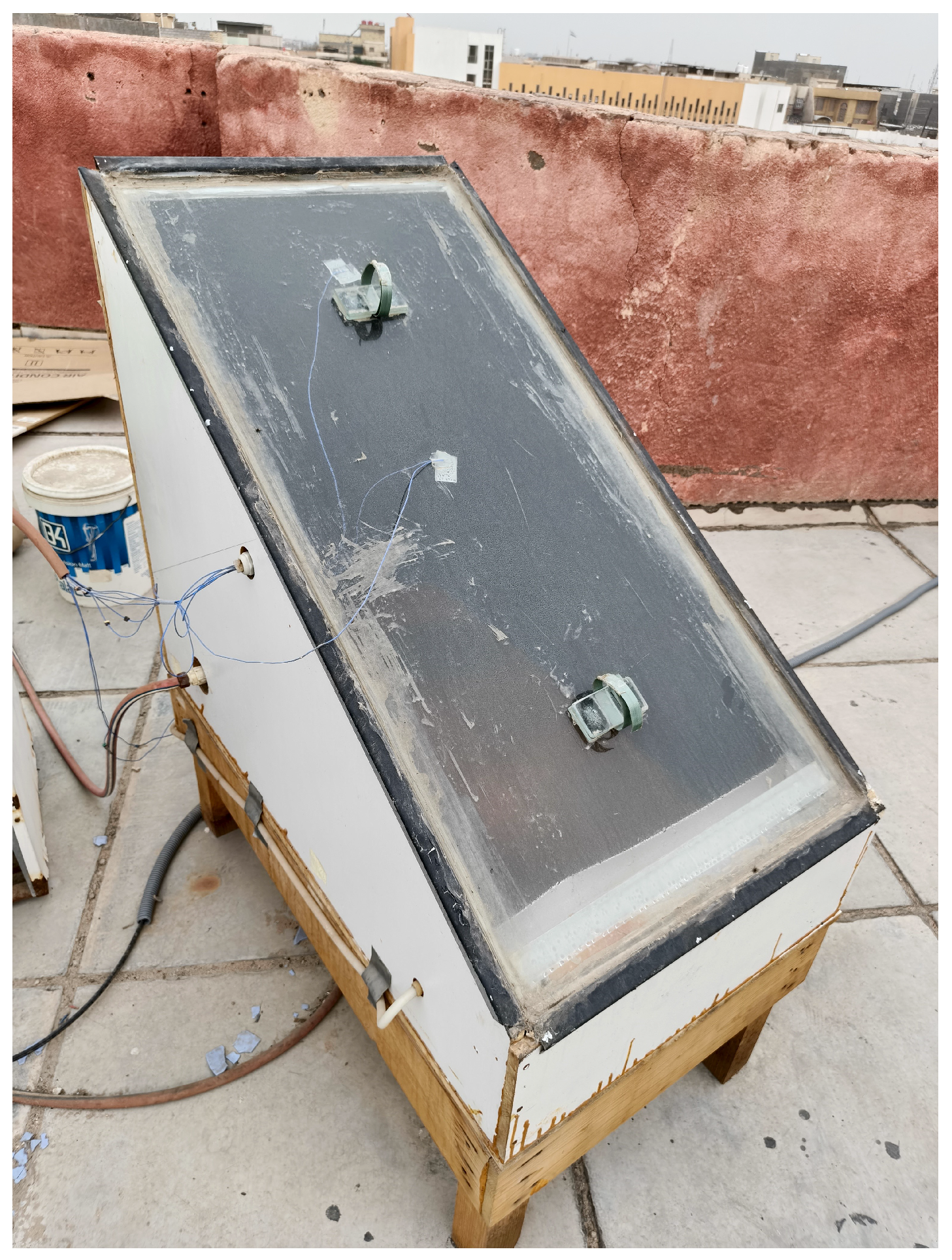
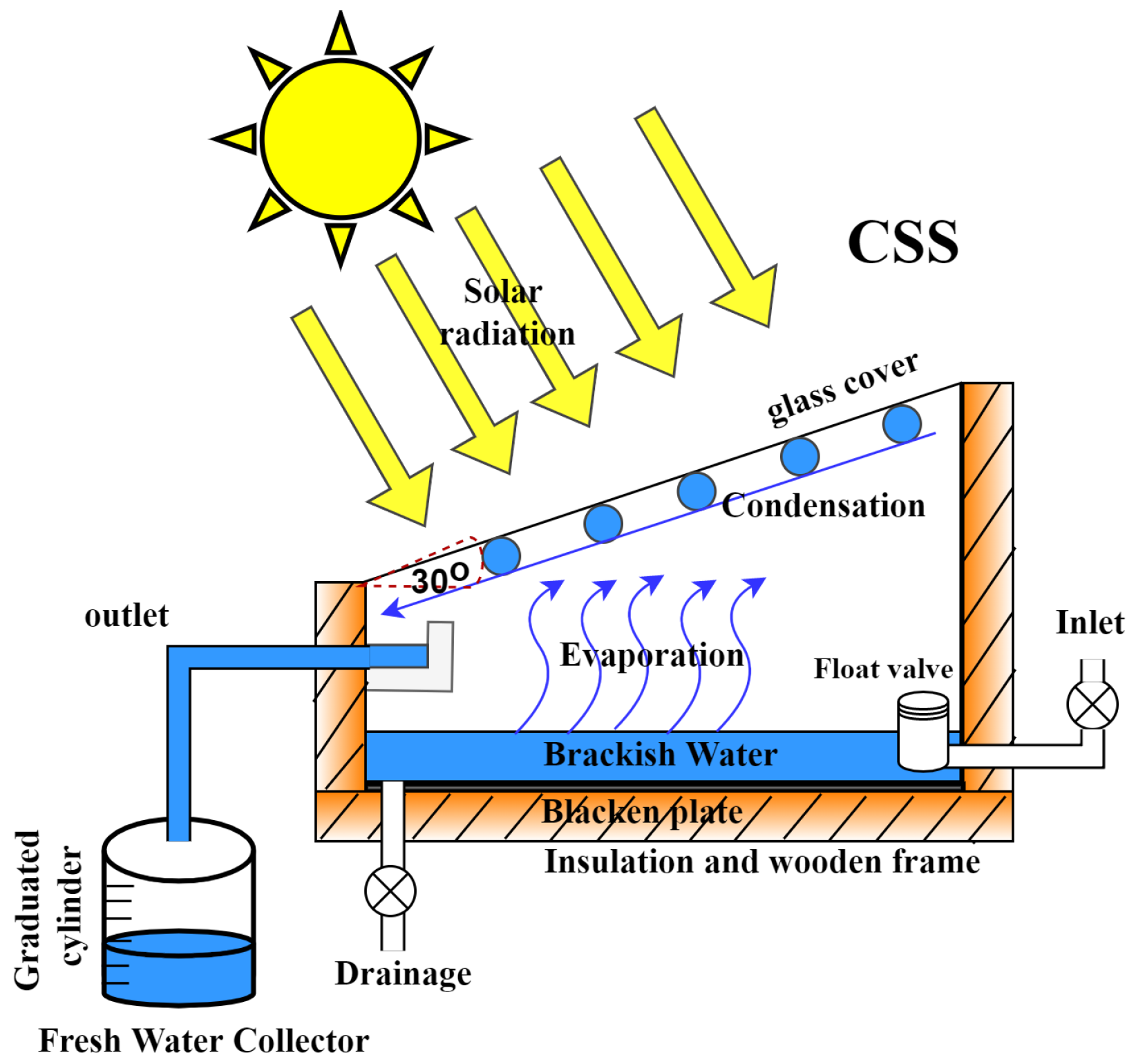
The overall design was based on best practices reported in prior experimental works [24,25,26], with geometric and material choices adapted to maximize solar capture and minimize heat losses under local conditions. The schematic of the system is shown in Figure 1, and a photograph of the experimental setup is provided in Figure 2.
The basin was constructed from a 1 mm thick galvanized steel sheet with internal dimensions of 1 m × 0.50 m × 0.20 m, resulting in a basin surface area of 0.5 m2. This size was selected to ensure manageable thermal inertia while allowing sufficient data resolution over a 24 h period. To maximize solar energy absorption, the basin interior was coated with matte black heat-resistant paint, which minimizes reflection losses [24].
The selection of a 30° inclination angle for the 4 mm thick transparent glass cover was based on the latitude of Basrah, ensuring optimal solar incidence throughout the year. This angle also facilitates smooth condensate runoff into the distillate collection channel, which was constructed using a half-section PVC pipe fixed along the lower edge of the glass [25].
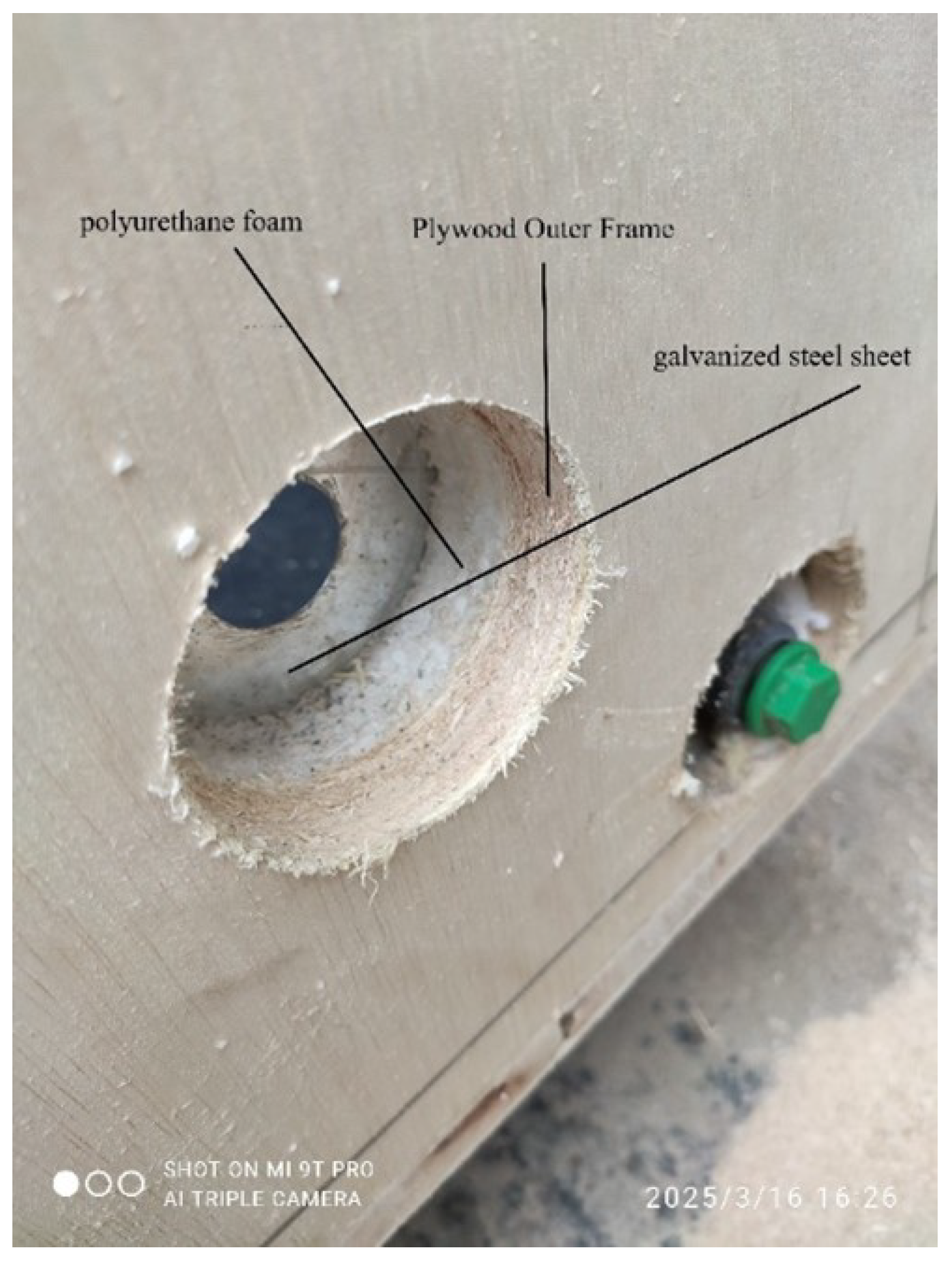
Thermal insulation of the basin was achieved through a dual-layer strategy (Figure 3). Expanded polystyrene (EPS) foam boards (2–3 cm thick) were applied to the base and sidewalls, followed by polyurethane foam injection to fill remaining voids, then he basin was enclosed within a wooden plywood frame (19 mm thick), which served as the external structural casing. This approach was guided by previous studies recommending minimized conductive losses through the structure [27].
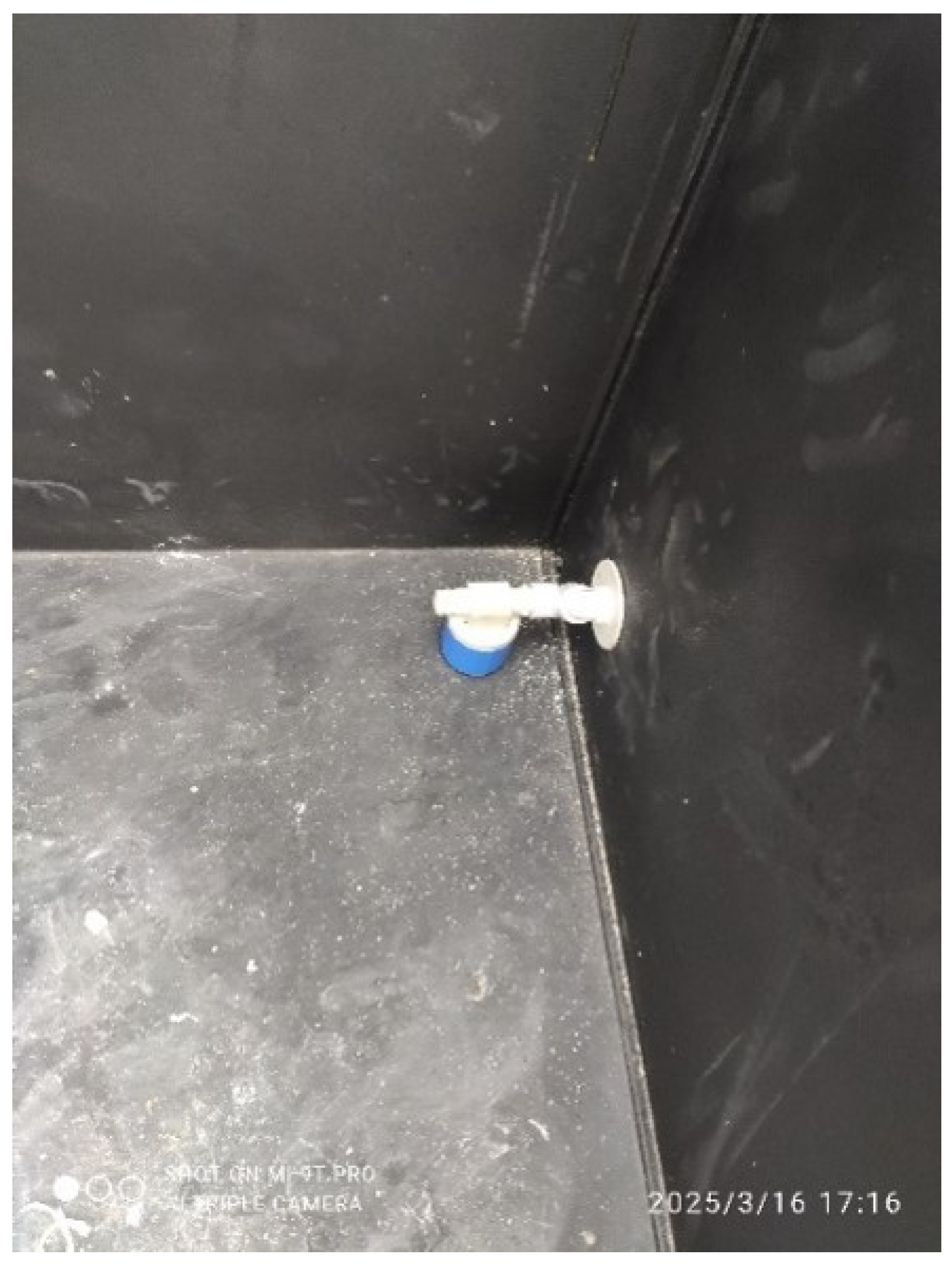
To maintain a stable water depth of 2 cm, identified in the literature as optimal for maximizing evaporation rates while minimizing heat capacity effects, a mechanical float valve was installed (Figure 4). This ensured a constant feed water level despite diurnal evaporation fluctuations. The selected water depth range was further informed by prior sensitivity analyses demonstrating that shallower depths yield higher thermal gradients and productivity [24,28].
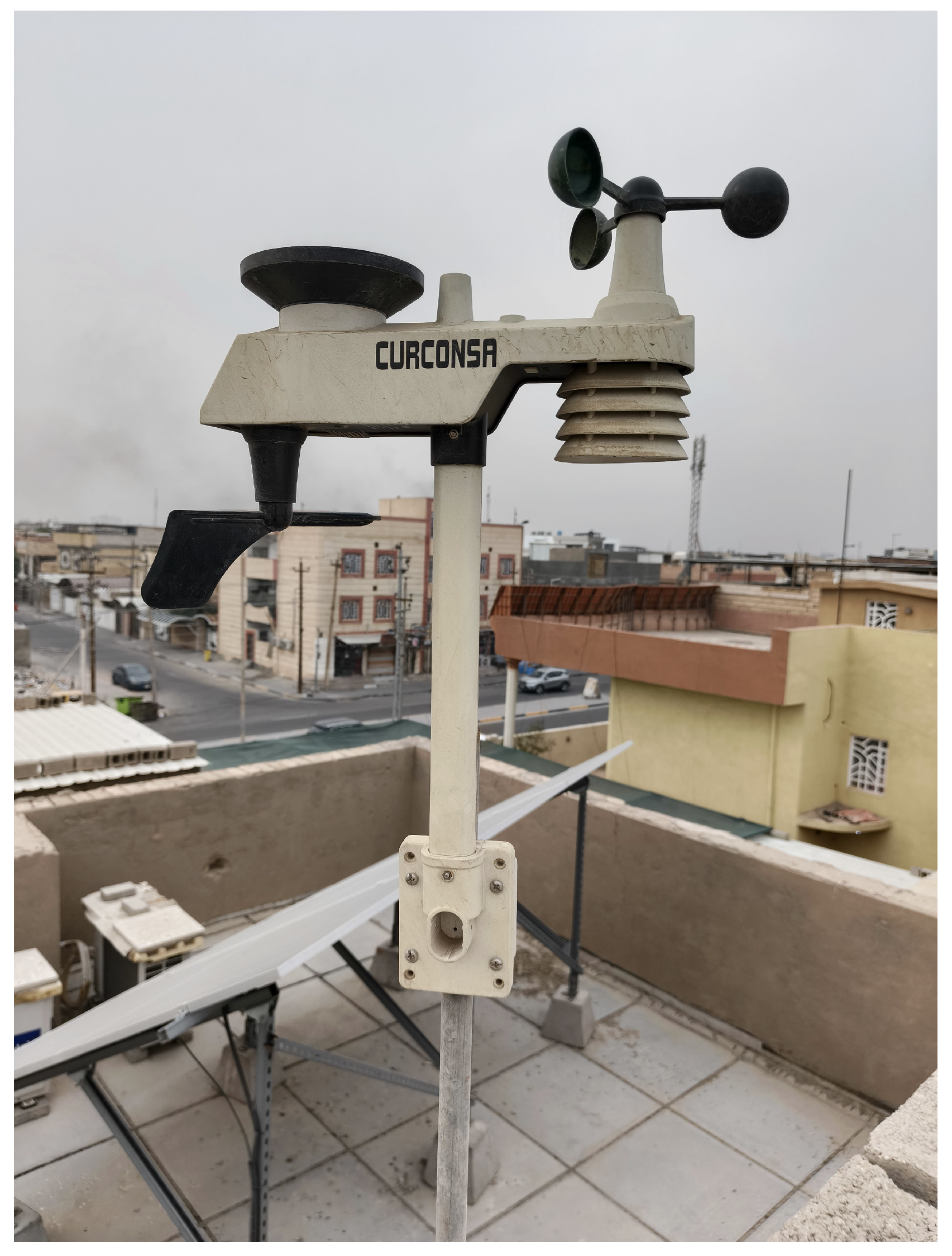
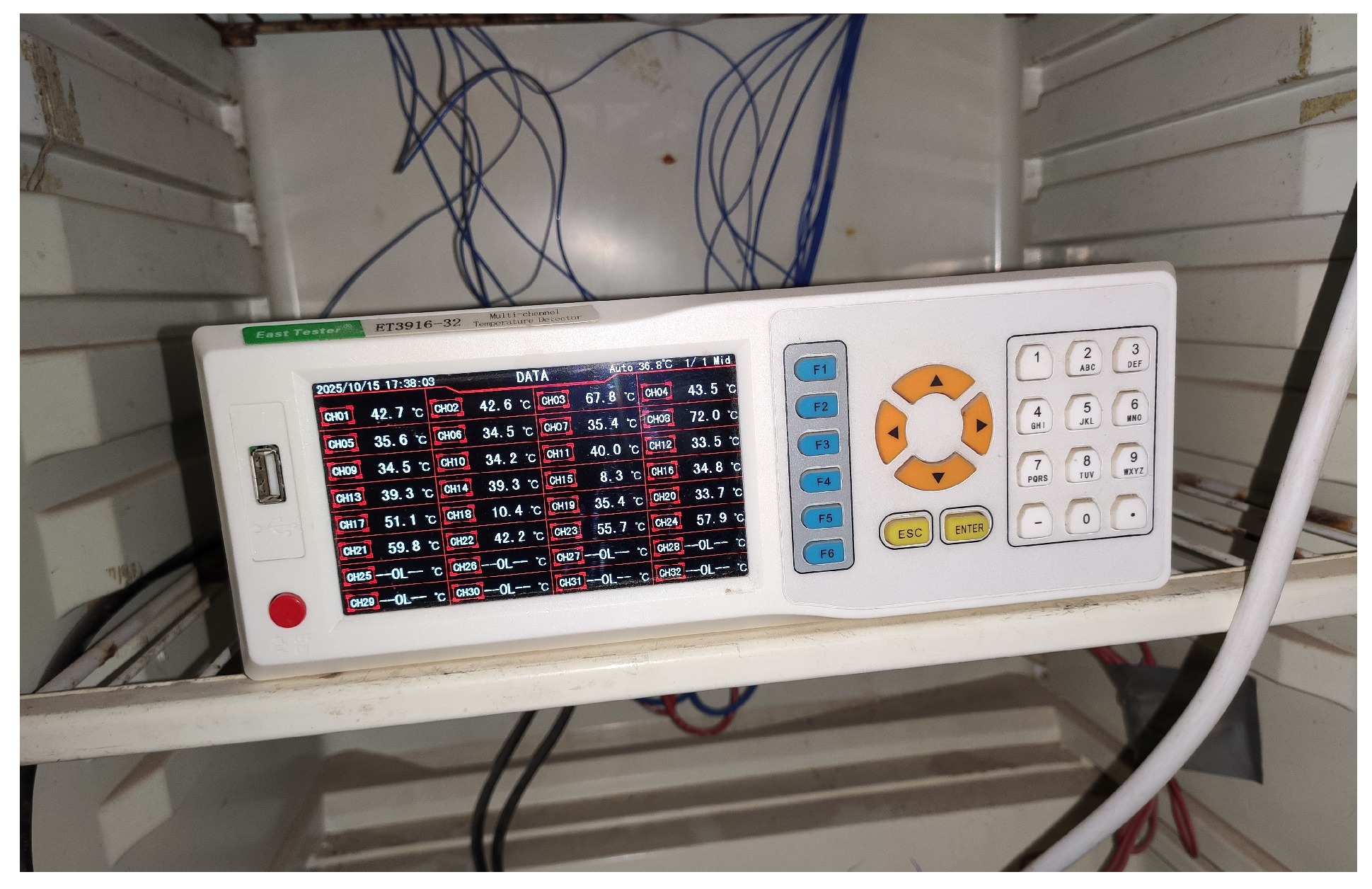
Environmental parameters such as solar radiation, ambient temperature, humidity, wind speed, and pressure were continuously recorded using a CURCONSA FT0300 weather station (CURCONSA, Shenzhen, China) installed beside the still Figure 5. Basin water temperature ( T w ), liner temperature ( T b ), and glass cover temperature ( T g ) were logged using an ET3916-32 channel multi-logger (East Tester, Hangzhou, China) with Type-K thermocouples. The placement of sensors and monitoring instruments is illustrated in Figure 6.
This experimental configuration ensured high-fidelity measurements aligned with local climatic inputs, offering reliable validation data for the transient thermal model developed in MATLAB R2025a. The design decisions were thus based on a combination of established experimental guidelines, site-specific optimization, and performance-oriented enhancements to facilitate future scalability and modeling accuracy.

2.2. Instrumentation and Data Acquisition

Accurate monitoring of both the internal thermal behavior of the solar still and the surrounding environmental conditions was ensured through a dual instrumentation approach: a multichannel data logger and a professional weather station.

2.2.1. Multichannel Temperature Data Logger

A 32-channel data logger (Model: ET3916-32) (Figure 6) was used to continuously record thermal parameters within the solar still system. Measurements were logged at 1-minute intervals and stored in CSV format, as seen on the logger interface (Figure 6). The following locations were monitored with Type-K thermocouples: (more than one measurement point for each part was taken; see Figure 2)
  • Basin water temperature ( T w )
  • Basin liner temperature ( T b )
  • Inner and outer glass cover temperatures ( T i g , T o g )
Each thermocouple was calibrated prior to installation. The system was programmed to begin logging data automatically each morning, saving file outputs named according to the timestamp.
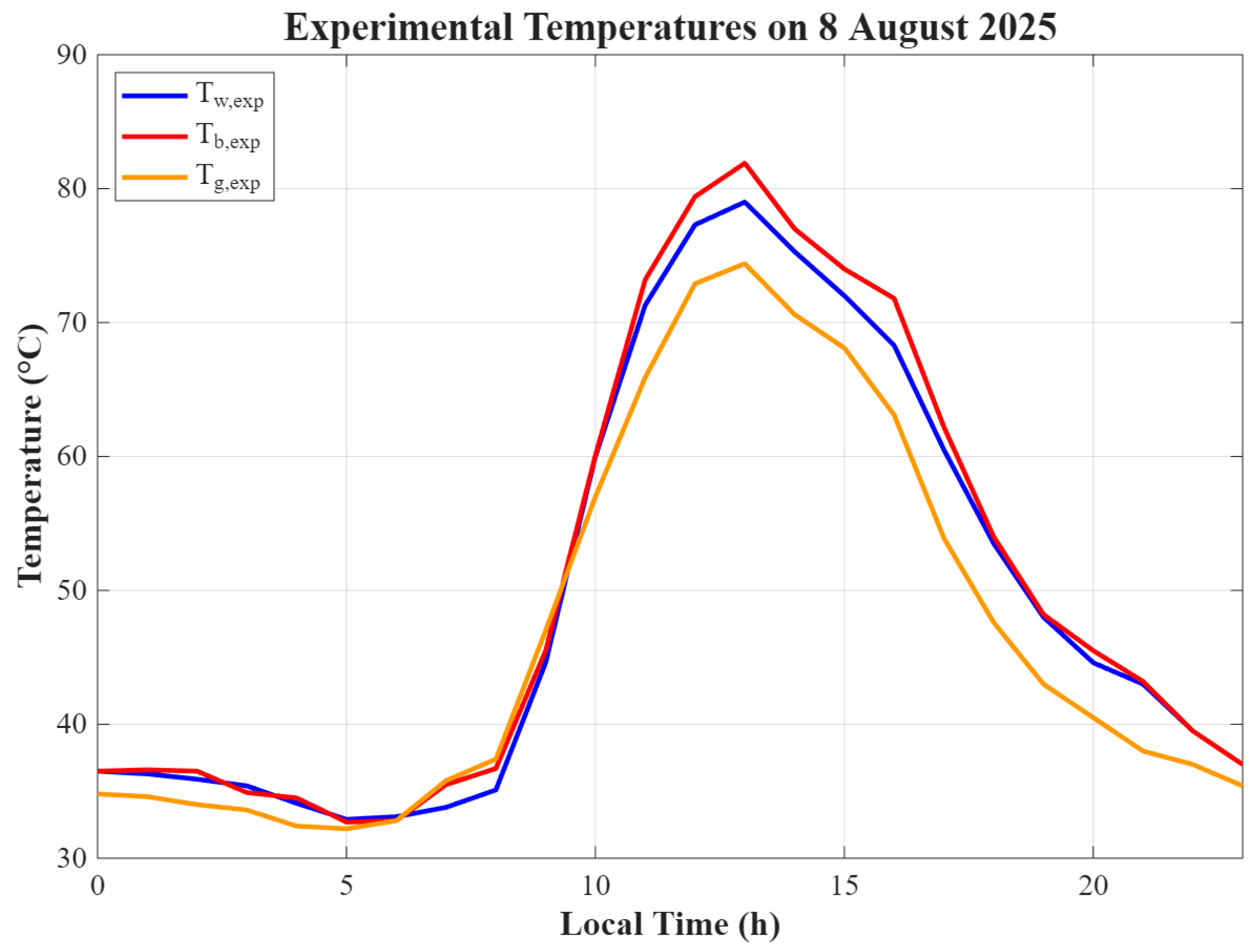
The temperature variations inside the still during the experiment are summarized in Table 2 and Figure 7, where the basin water ( T w ), basin liner ( T b ), and glass cover ( T g ) showed clear diurnal fluctuations with peak values of 79 °C, 81.9 °C, and 74.4 °C, respectively, around solar noon (13:00 h). These results validate the expected thermal gradient driving the evaporation condensation cycle.

2.2.2. Weather Monitoring Station

To capture ambient meteorological conditions, a CURCONSA FT0300 WiFi professional weather station (Figure 5) was installed adjacent to the experimental setup. The station continuously monitored ambient temperature, wind speed, solar radiation, relative humidity, and barometric pressure. Data were wirelessly transmitted and logged in real time for all test days (1–8 August 2025).
To further support experimental accuracy, an indoor wireless receiver module was used to monitor live environmental readings throughout each test day. The receiver, part of the CURCONSA FT0300 weather station, provided real-time updates on the following:
  • Outdoor and indoor temperature;
  • Relative humidity;
  • Wind speed and direction;
  • Solar radiation (W/m2);
  • Dew point temperature;
  • Atmospheric pressure (hPa);
  • UV index;
  • Rainfall accumulation (0.0 mm recorded during all clear days and Basrah summer).
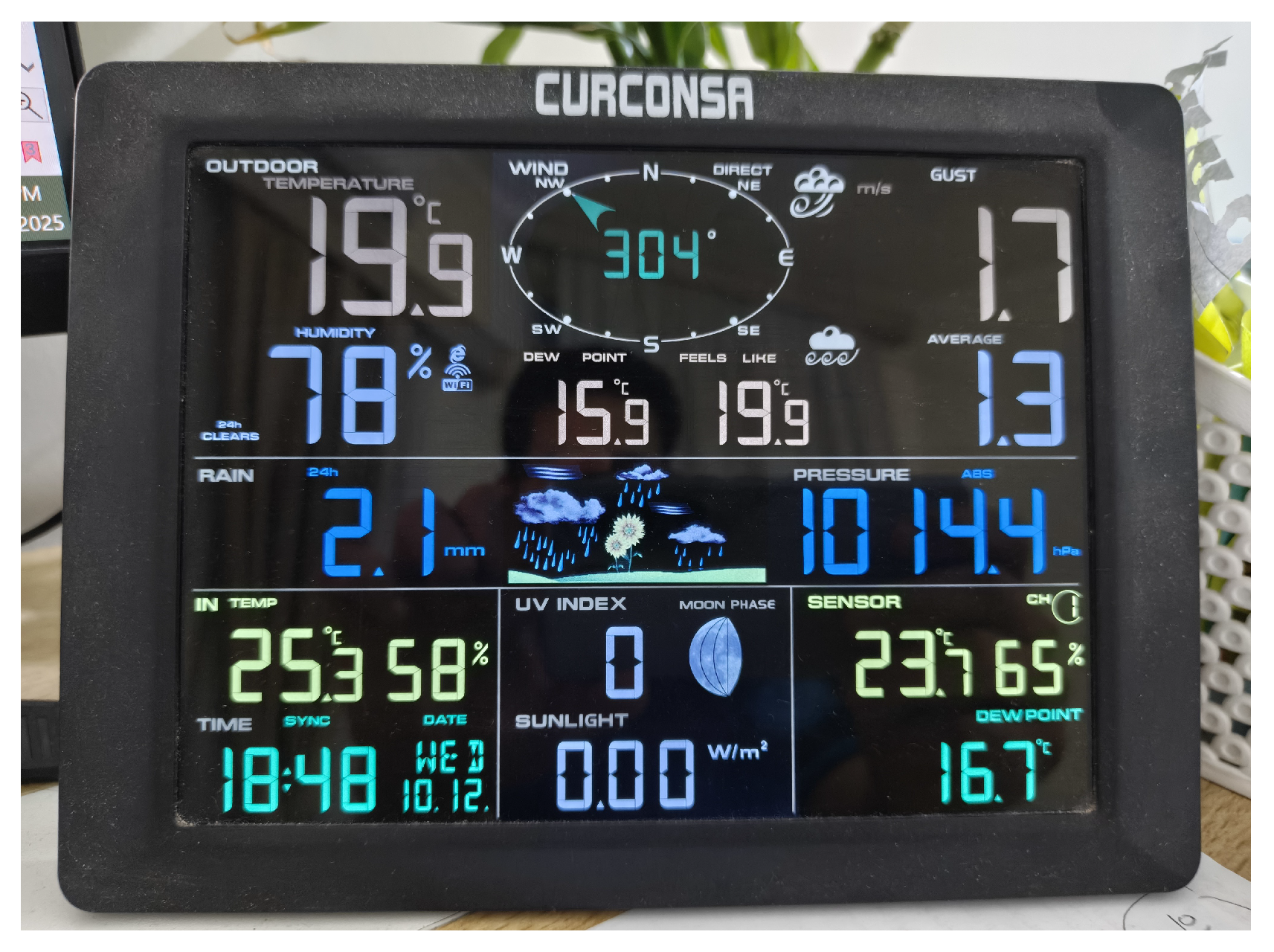
As shown in Figure 8, during one experimental day, show recording screen of the weather station.
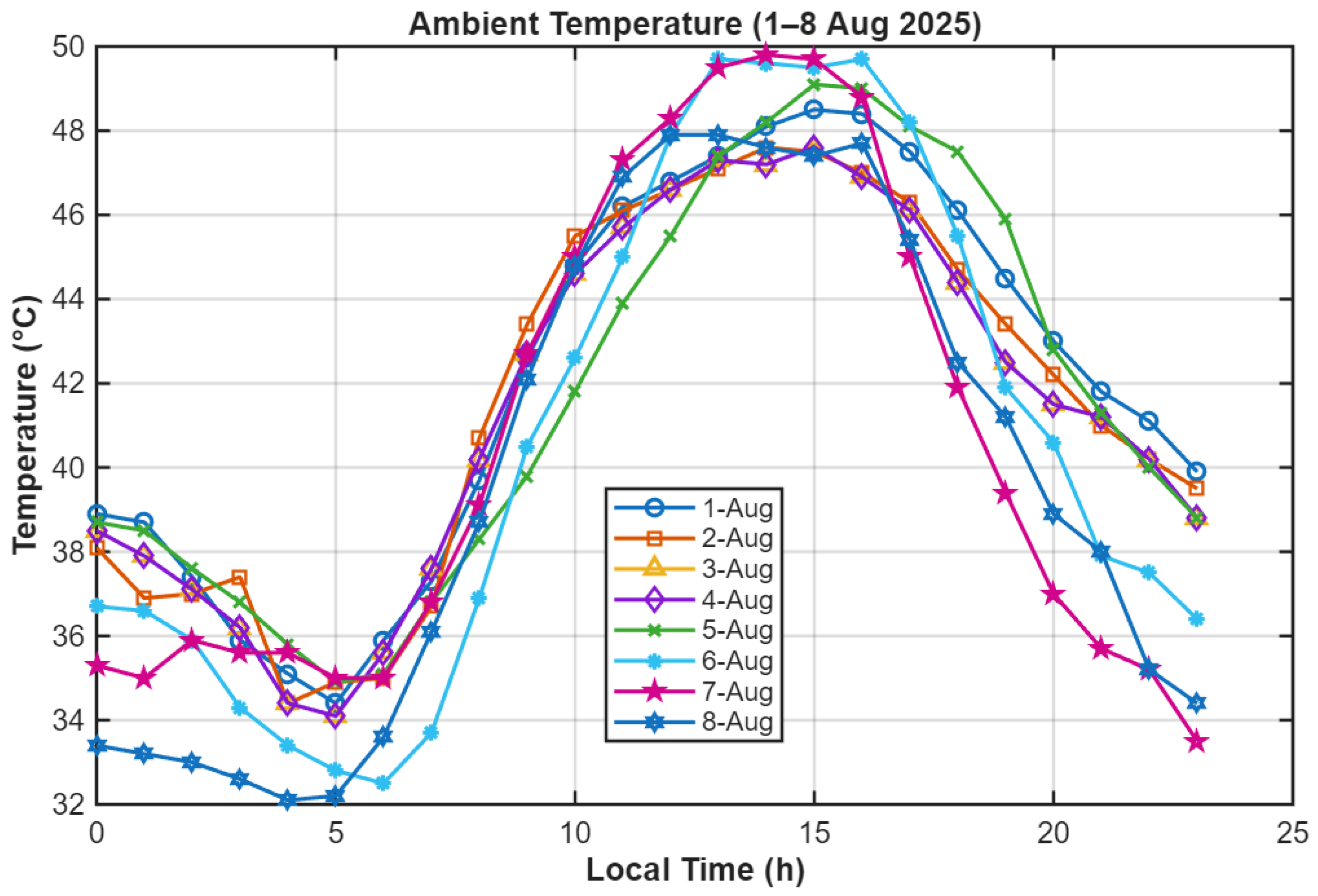
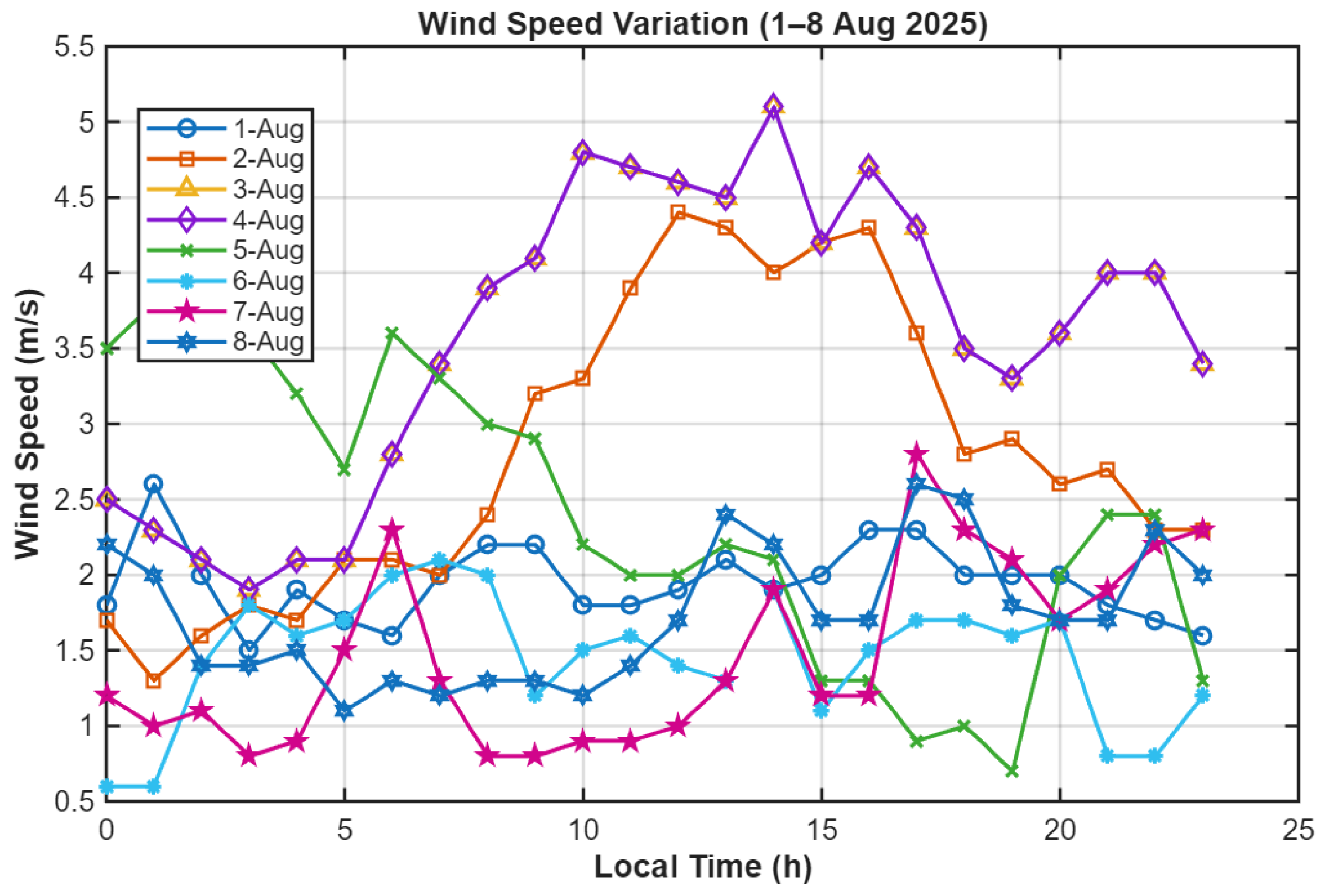
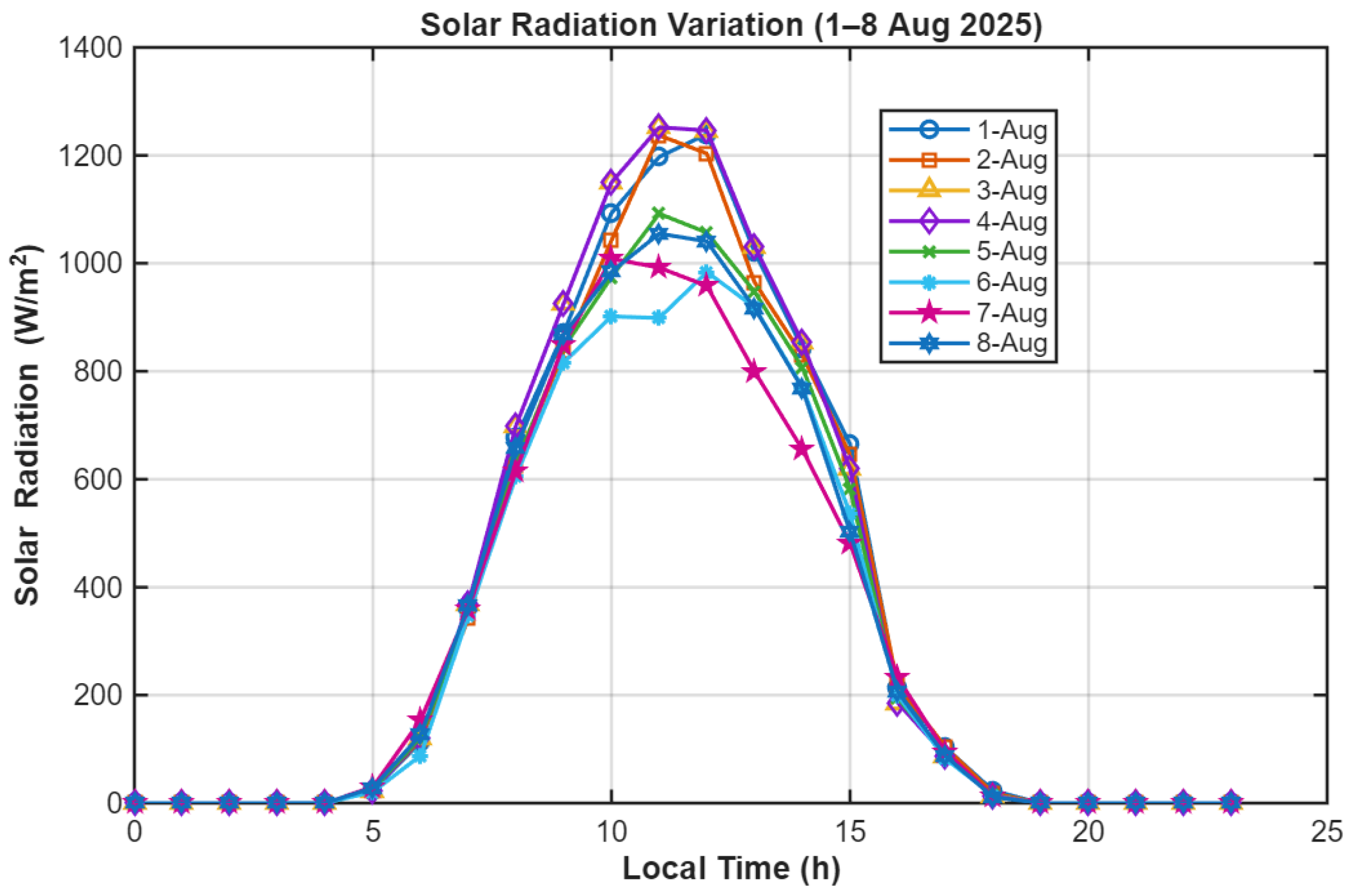
Representative ambient variations are shown in Figure 9, Figure 10 and Figure 11:
  • Figure 9 (Ambient temperature): Daily maximum values ranged between 47 and 50 °C, with nighttime cooling to 32–35 °C.
  • Figure 10 (Wind speed): Wind fluctuated between calm (≈1 m/s) and gusts exceeding 10 m/s, strongly influencing external convective heat transfer at the glass surface.
  • Figure 11 (Solar radiation): Solar irradiance peaked between 1200 and 1250 W/m2, consistent with clear-sky summer conditions in Basrah.
Figure 9. Diurnal variation in ambient temperature during 1–8 August 2025 in Basrah.
Sustainability 18 00479 g009
Figure 10. Diurnal variation in wind speed during 1–8 August 2025 in Basrah.
Sustainability 18 00479 g010
Figure 11. Diurnal variation in solar radiation during 1–8 August 2025 in Basrah.
Sustainability 18 00479 g011
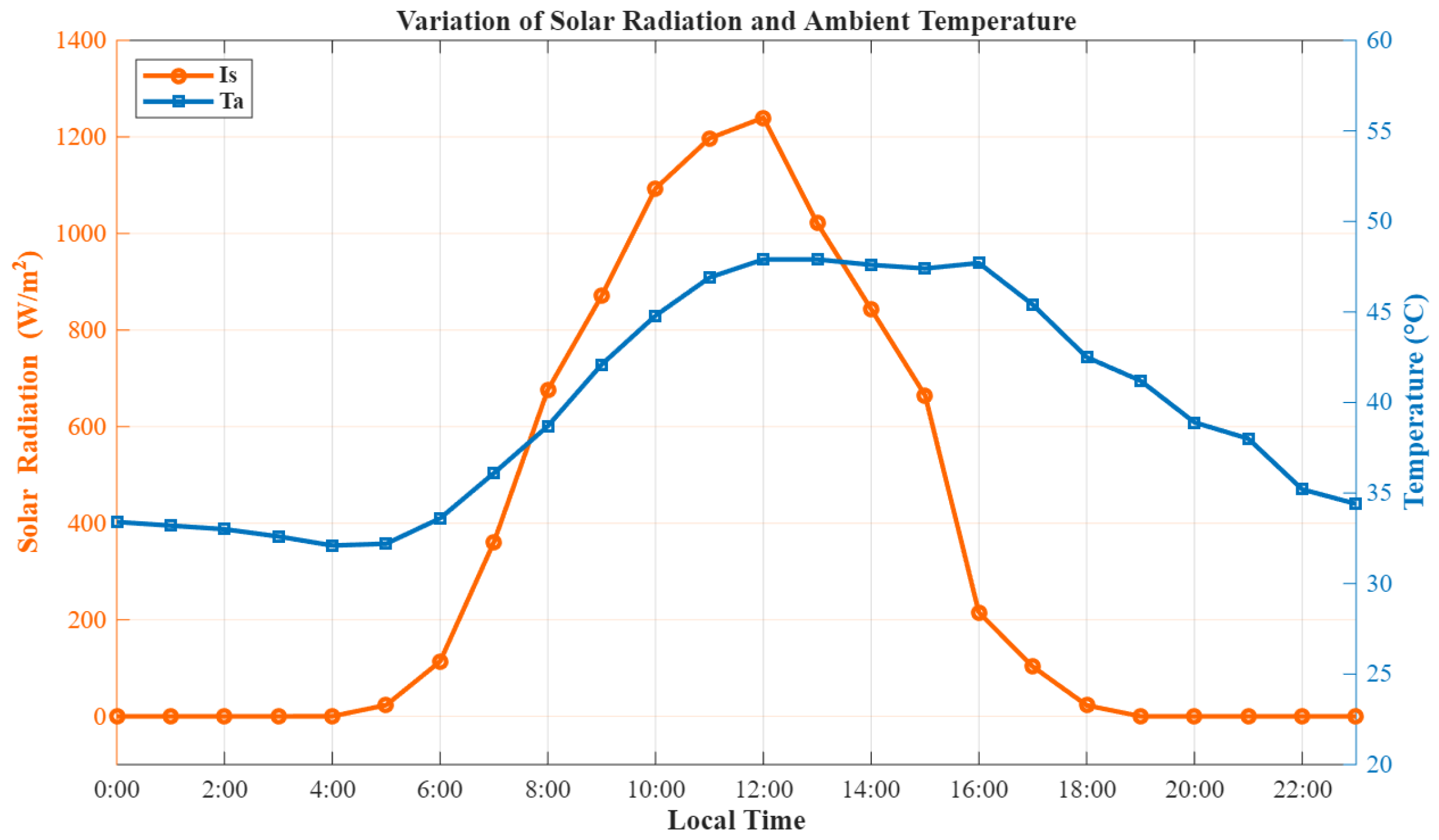
On 8 August 2025, a detailed hourly meteorological dataset was recorded (Table A1, Figure 12). Solar radiation exceeded 1200 W/m2 at noon, while ambient temperatures reached ∼48 °C with low relative humidity (∼20%). This highlights the severe climatic stress under which the still was evaluated, ensuring realistic and locally relevant performance assessment.
By synchronizing the logger outputs with the weather station records, the study ensured high-fidelity coupling between internal system response and external forcing variables. The combined dataset (Figure 7, Figure 8, Figure 9, Figure 10, Figure 11 and Figure 12) allowed correlation of water/glass temperatures with ambient drivers such as solar radiation intensity and wind speed fluctuations, forming the foundation for the theoretical model validation presented in the next section. To support the reliability of these measurements, the specifications, accuracy ranges, and resolution details of all key instruments used for thermal and productivity measurements are summarized in Table 3.

2.3. Operational Conditions

The experimental campaign was carried out on 8 August 2025 in Basrah, Iraq (30.5° N, 47.8° E), a region characterized by intense solar radiation, high ambient air temperatures, and very low relative humidity during summer months. The test was conducted under clear sky conditions, ensuring that the system was exposed to the natural diurnal variation in meteorological parameters.
Climatic data, including solar radiation, wind speed, ambient temperature, humidity, and atmospheric pressure, were continuously recorded using a professional CURCONSA FT0300 WiFi weather station (Figure 5), installed adjacent to the still. Peak solar irradiance exceeded 1050 W/m2 around noon, while ambient air temperatures approached ∼48 °C, with relative humidity dropping below 20%. Wind speeds fluctuated between calm conditions and gusts exceeding 5 m/s, directly affecting external convective heat transfer at the glass surface. Similar ranges of operational conditions have been reported as critical factors in governing freshwater yield in solar distillation systems [25,27].
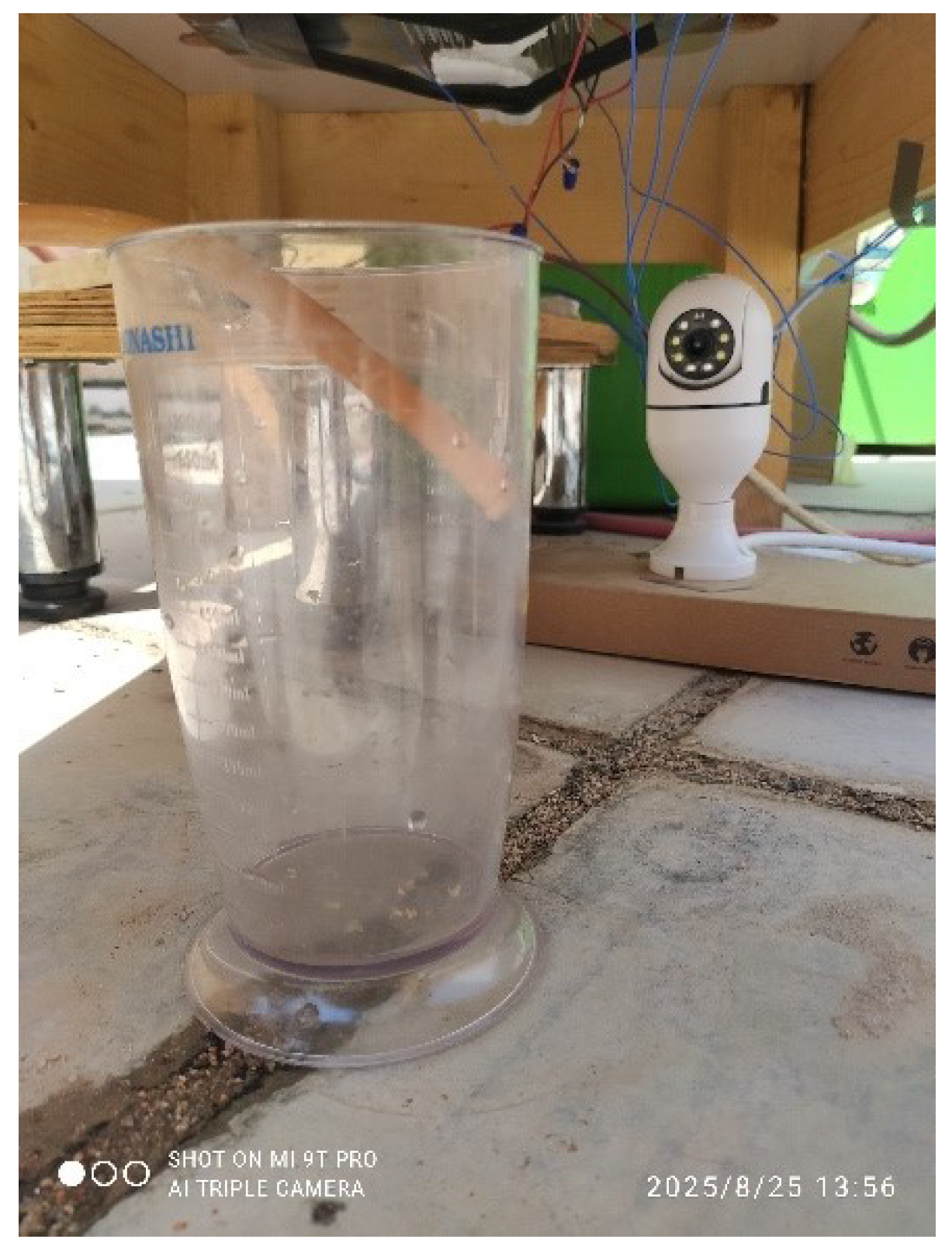
The brackish water was sourced daily from the Shatt al-Arab River, with salinity measured at 5.2 g/kg (5200 ppm). The basin was flushed and refilled before each test, and the water level was maintained via a float valve at 2.0 cm to ensure consistent thermal loading. Salinity variation during a single test day was negligible and thus treated as constant for modeling purposes. The water level inside the basin was maintained at a constant depth of 2 cm throughout the experiment to ensure uniform thermal conditions. Hourly experimental values of basin water temperature ( T w ), basin liner temperature ( T b ), and glass cover temperature ( T g ), along with distillate output ( P d ), were recorded using a calibrated multichannel data logger and a graduated cylinder, with visual monitoring supported by a camera, as illustrated in Figure 13.
This study was carried out during a one-week period in August in Basrah, Iraq, characterized by clear sky, hot, and arid summer weather. Consequently, the validation primarily reflects the behavior of the solar still under clear sky peak summer conditions, and the results may not fully capture its performance under cloudy, more humid, or highly variable meteorological situations; future work should therefore examine a broader range of climatic scenarios to improve generalizability.
To complement the field data, a theoretical model based on heat and mass transfer balance equations was developed in MATLAB. This model was driven by the same hourly weather inputs recorded on 8 August 2025, enabling a direct comparison between predicted and measured performance. Such validation under real, location-specific operational conditions is crucial, as reliance on generalized climatic data may lead to significant deviations in predicted freshwater productivity [5,26].

3. Theoretical Analyses

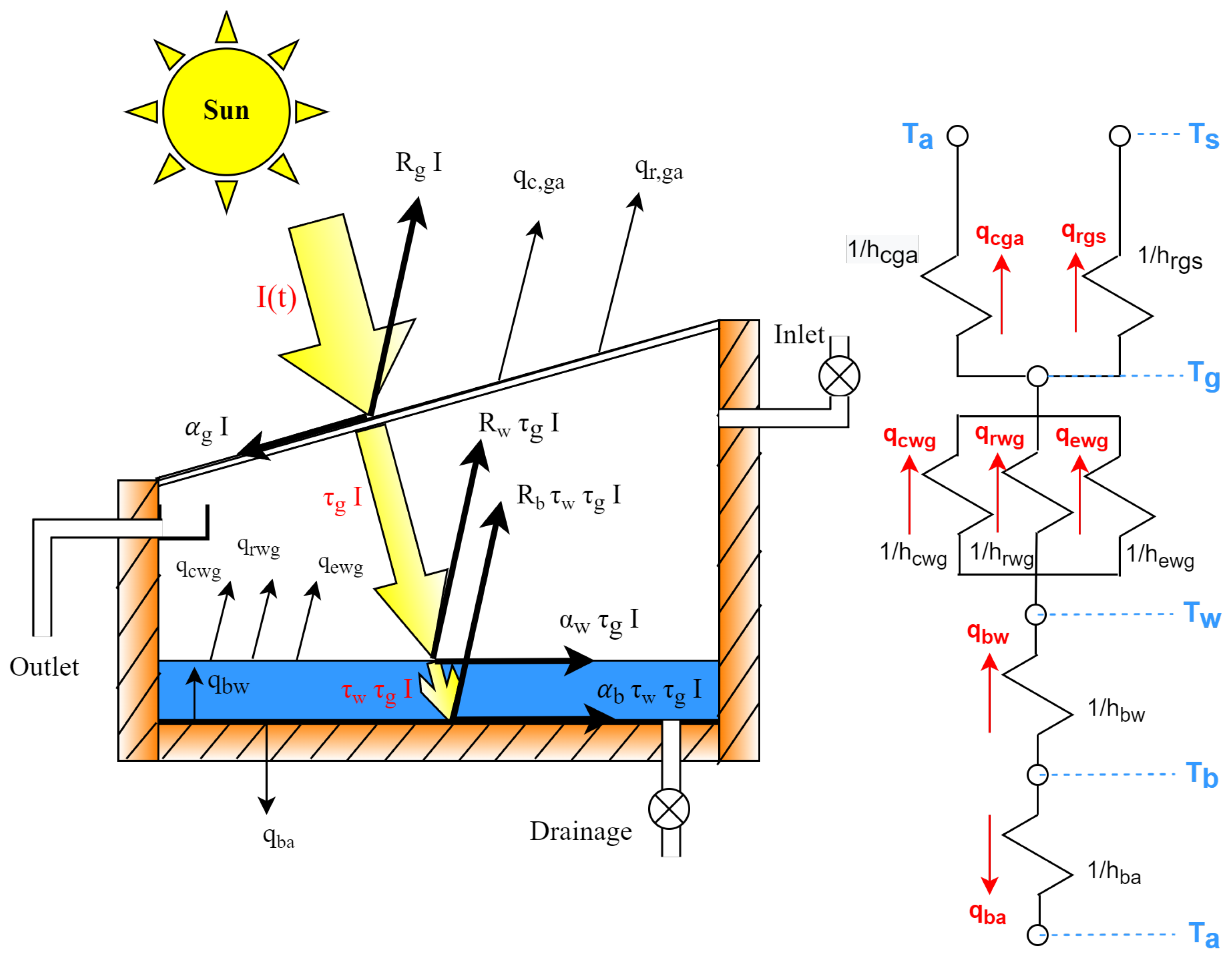
The thermal performance of a basin-type solar still is primarily governed by transient heat transfer processes, as temperatures, solar input, and heat fluxes vary continuously with time. Figure 14 illustrates the overall energy interactions inside the still, including the incident solar radiation, absorption, reflection, and the complex convective, radiative, and evaporative exchanges occurring between the basin water, basin liner, glass cover, and the surrounding environment. A mathematical model was developed to describe these processes using energy balance equations applied to three main components: basin water, basin liner, and glass cover. These balances account for absorbed solar radiation, thermal storage, interfacial heat transfer, and evaporative condensation mechanisms. The governing equations were solved using MATLAB, enabling the prediction of temperature profiles, heat transfer rates, and freshwater productivity. Model predictions were later validated against experimental data . Similar heat mass transfer approaches have been widely adopted in basin still modeling [24,29].
The following assumptions were made while writing the energy balance equations:
  • There is no vapor leakage in the solar still;
  • The water mass in the solar still basin is assumed to be constant;
  • The temperature gradient along water mass depth is negligible;
  • The heat capacities of the glass cover and the insulating materials (sides and bottom) are considered negligible in comparison with that of the basin water;
  • The thermal contact resistance between the basin liner and the basin water is assumed negligible due to the shallow water depth (2.0 cm), the relatively thin galvanized steel liner, and the direct contact between them. The corresponding convective heat-transfer coefficient at this interface is evaluated using standard Nusselt number correlations for natural convection above a horizontal heated surface, which leads to closely matched temperature profiles for the basin liner and basin water, particularly during peak irradiance.

3.1. Mathematical Model for Thermal Analysis

The thermal performance of the solar still was analyzed by developing a mathematical model based on the first law of thermodynamics. Energy balance equations were applied to the three principal components: basin liner (absorber plate), basin water, and glass cover to predict their transient temperature profiles [14,25,30,31,32,33,34,35].

3.1.1. Glass Cover

The glass cover gains energy from absorbed solar radiation and from the basin water through convection, radiation, and evaporation. This energy is partly stored in the cover and partly dissipated to the surroundings via convection and radiation to the ambient air [25,30,31,32]:
α g I ( t ) + q t w g = q t g a
q t w g = q c w g + q r w g + q e w g
q t g a = q c g a + q r g a
α g I ( t ) A g + h t w g ( T w T g ) A w = h t g a ( T g T a ) A g
Equation (4) is the transient energy balance on the glass cover, linking absorbed solar radiation, heat gained from the basin water (by convection, evaporation, and radiation), and heat lost to the ambient air; it is used to determine the glass temperature ( T g ), which directly affects the driving temperature difference ( T w T g ) and thus condensation.
  • The convective heat transfer from the basin water to the glass cover is given by [30]
    q c w g = h c w g ( T w T g )
    where the convective heat transfer coefficient h c w g is determined using Dunkle’s relation [32,35]:
    h c w g = 0.884 ( T w T g ) + ( P w P g ) ( T w + 273.15 ) 268.9 × 10 3 P w 1 / 3
    Equation (6) uses Dunkle’s correlation for the convective heat transfer coefficient between the water surface and glass ( h c w g ), characterizing natural convection inside the still as a function of temperature and vapor pressure differences; this is essential for estimating the convective component of evaporative heat transfer.
    The partial vapor pressures of water and glass surfaces are calculated as
    P w = exp 25.317 5144 T w + 273
    P g = exp 25.317 5144 T g + 273
  • The evaporative heat transfer from the basin water surface to the glass cover is given by [30]
    q e w g = h e w g ( T w T g )
    where the evaporative heat transfer coefficient h e w g is defined as
    h e w g = 16.273 × 10 3 · h c w g · P w P g T w T g
    Equation (10) defines the evaporative heat transfer coefficient h e w g , relating it to the convective coefficient ( h c w g ) and vapor pressure gradient. It directly governs the evaporative heat flux and is therefore the key relation for predicting hourly distillate productivity.
  • The radiative heat transfer between the water surface and the surface of the glass cover is given by [25,31]
    q r w g = h r w g ( T w T g )
    The radiative heat transfer coefficient h r w g is calculated as
    h r w g = ε eff σ ( T w + 273 ) 2 + ( T g + 273 ) 2 ( T w + T g + 546 )
    Equation (12) gives the radiative heat transfer coefficient ( h r w g ) between the basin water and glass, capturing long wave radiation exchange, this term becomes increasingly important at the elevated temperatures encountered under Basrah’s summer conditions and complements the convective and evaporative pathways.
    The effective emissivity ε eff is given by
    ε eff = 1 ε w + 1 ε g 1 1
  • Top Losses from Glass to Ambient: Total heat loss from the glass cover to the ambient air is composed of convective and radiative losses [25,31,33,34,35]:
    q t g a = q c g a + q r g a
    q c g a = h c g a ( T g T a )
    The convective heat transfer coefficient h c g a is defined piecewise depending on wind speed V w :
    h c g a = 2.8 + 3.0 V w , if V w 5 m / s 5.7 + 3.8 V w , if V w > 5 m / s
    q r g a = h r g a ( T g T sky )
    h r g a = ε g σ ( T g + 273 ) 4 ( T sky + 273 ) 4 T g T sky
    T sky = 0.0552 T a 1.5

3.1.2. Basin Water

The basin water absorbs transmitted solar radiation and heat conducted from the absorber plate. The gained energy is stored in the water mass and simultaneously transferred to the glass cover by convection, radiation, and evaporation, driving the evaporation–condensation process [14,30]:
α w τ g I ( t ) + q c b w = m w C w d T w d t + q t w g
Equation (19) is the transient energy balance of the basin water, accounting for absorbed solar energy, heat exchange with the basin and glass, and internal thermal storage, solving this equation provides the time evolution of water temperature ( T w ), which controls evaporation and freshwater yield.
The conducted heat transfer from the basin plate to the water is given by
q c b w = h c b w ( T b T w )

3.1.3. Basin Liner (Absorber Plate)

The absorber plate captures solar radiation and transfers a portion of it to the basin water through convection, while storing some internally. The remaining heat is lost to the external environment via conduction and convection through the insulation and external surfaces. The energy balance for the absorber plate is expressed as [14,25,32,34,35]
α b τ g τ w I ( t ) A b = q c b w + q t b a
The heat lost from the basin plate to the ambient surroundings is given by
q t b a = h t b a ( T b T a )
The overall heat loss coefficient from the basin liner and side walls to the ambient environment, denoted as h t b a , is determined using
h t b a = L ins K ins + 1 h b a 1
where h b a is the combined radiative and convective heat transfer coefficient between the outer surface of the insulation and the ambient air:
h b a = h r b a + h c b a
h b a = 5.7 + 3.8 × V w

3.2. Distillate Production and Efficiency

The freshwater yield, expressed in L/m2, is calculated using the following relation [14,30,32,33]:
m e w = q e w g h f g × 3600 = h e w g ( T w T g ) V × 3600
The cumulative freshwater yield over a 24-h period is given by
M e w = i = 1 24 m e w
Moreover, the instantaneous thermal efficiency of the solar still is expressed as [32,34]
η s t = ( m e w · h f g ) ( I s ( t ) · A b · 3600 )

3.3. Thermophysical Properties of Water and Seawater

The thermophysical properties of saline water, including latent heat of vaporization ( L h ), specific heat capacity ( C p ), and density ( ρ ), play a critical role in accurately modeling evaporation and condensation processes in basin-type solar stills. Unlike earlier works that assumed constant property values (e.g., C p = 4.18 k J   k g −1   ° C −1 , ρ = 1000 k g / m 3 , L h = 2260 k J   k g −1 ) [25,36], the present study employs temperature- and salinity-dependent correlations derived from reliable thermophysical datasets.
The adoption of variable property correlations provides greater accuracy under the extreme summer temperatures (40–80 °C) and high salinity levels typical of Basrah’s brackish feedwater. This approach improves the predictive performance of the theoretical model compared with constant-property assumptions, especially when evaluating evaporation–condensation fluxes [37,38]. The governing correlations are summarized in Table 4.

4. Uncertainty Analysis of Experimental Measurements

The accuracy of evaluating the solar still’s performance hinges critically on the precision of the measured variables: basin water temperature, basin liner temperature, glass cover temperature, ambient temperature, solar irradiance, wind velocity, and the collected distillate volume. As in all experimental work, these measurements carry uncertainties stemming from instrument limitations, calibration errors, reading resolution, and procedural methodology. These uncertainties are typically expressed in relative or percentage form and are propagated through derived calculations (e.g., using the root-sum-square method) to estimate combined uncertainty [40,41].
In this study, measurements were obtained using calibrated sensors: Type-K thermocouples (for basin and glass temperatures), a pyranometer (for solar radiation), a cup anemometer (for wind speed), and a graduated beaker (for distillate volume). The measurement ranges, stated accuracies, and estimated percentage uncertainties for each device are tabulated in Table 5. We estimated the combined uncertainty by propagating individual instrument uncertainties using the root-sum-of-squares method, as recommended in standard guides [42]. The overall (expanded) uncertainty in key performance outputs was found to be within ± 8 % to ± 12%, which is broadly consistent with uncertainty levels reported in similar solar still experiments [43,44].

5. Results and Discussion

5.1. Thermal Performance (Tw, Tb, Tg: Experimental vs. Theoretical)

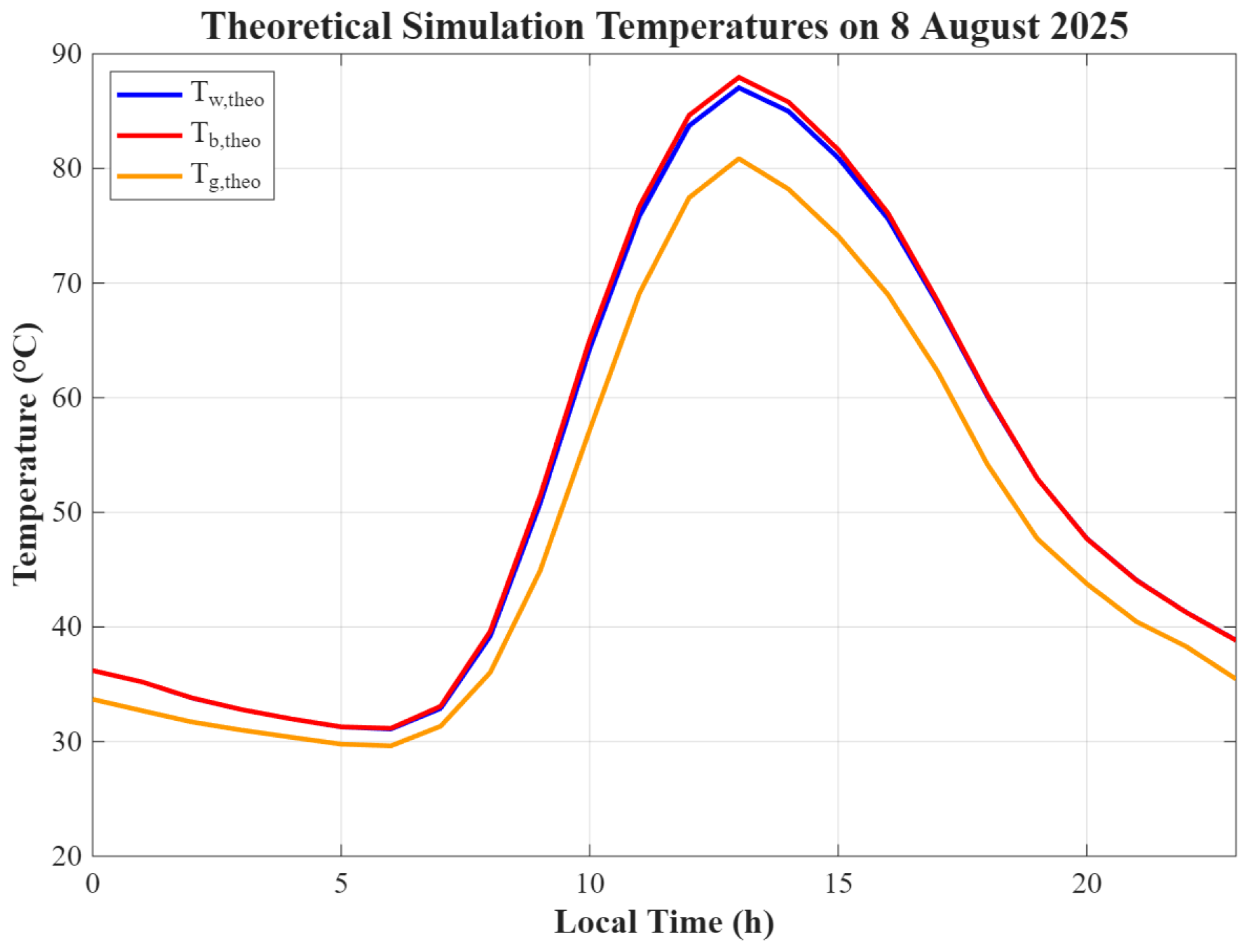
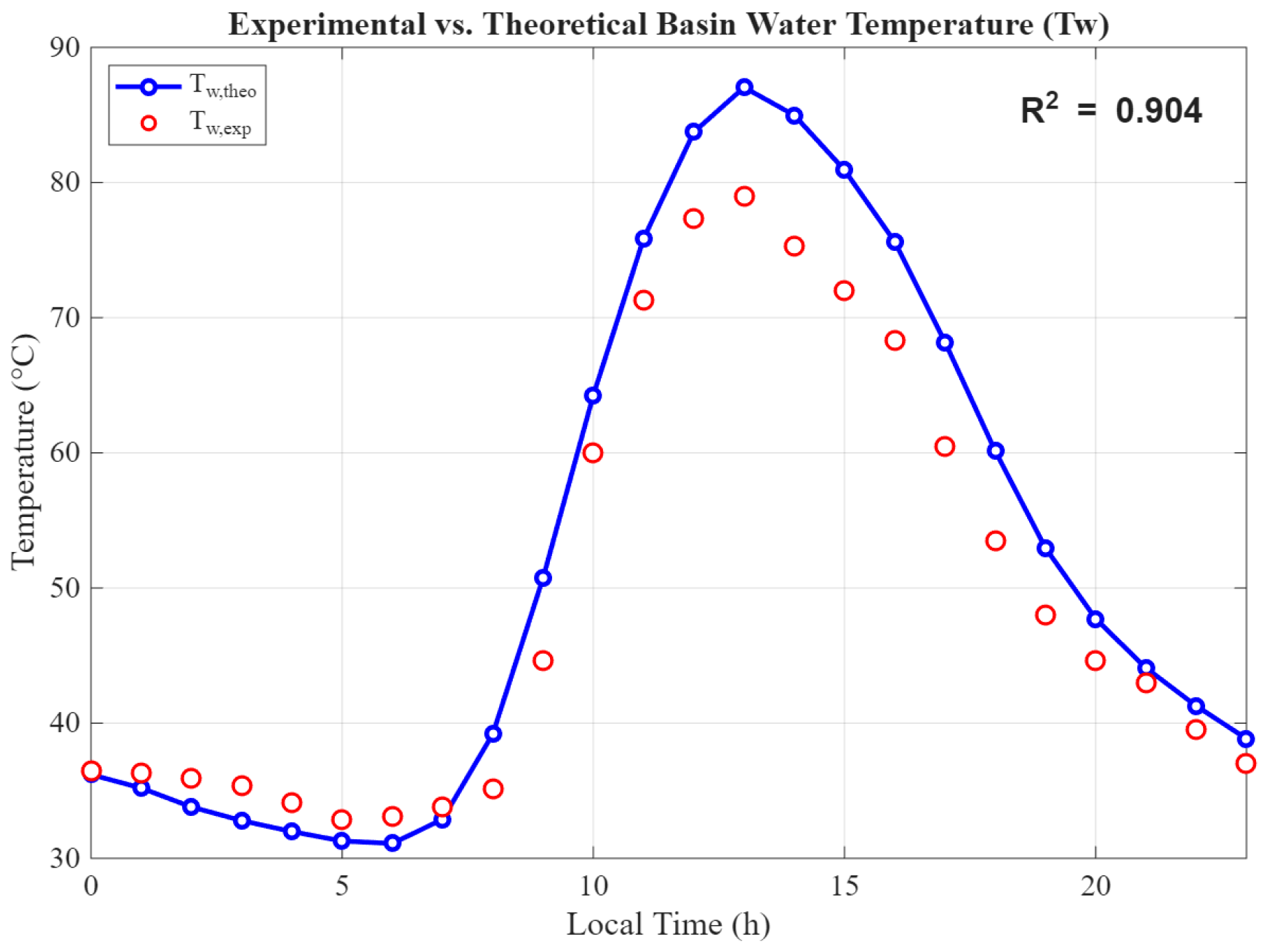
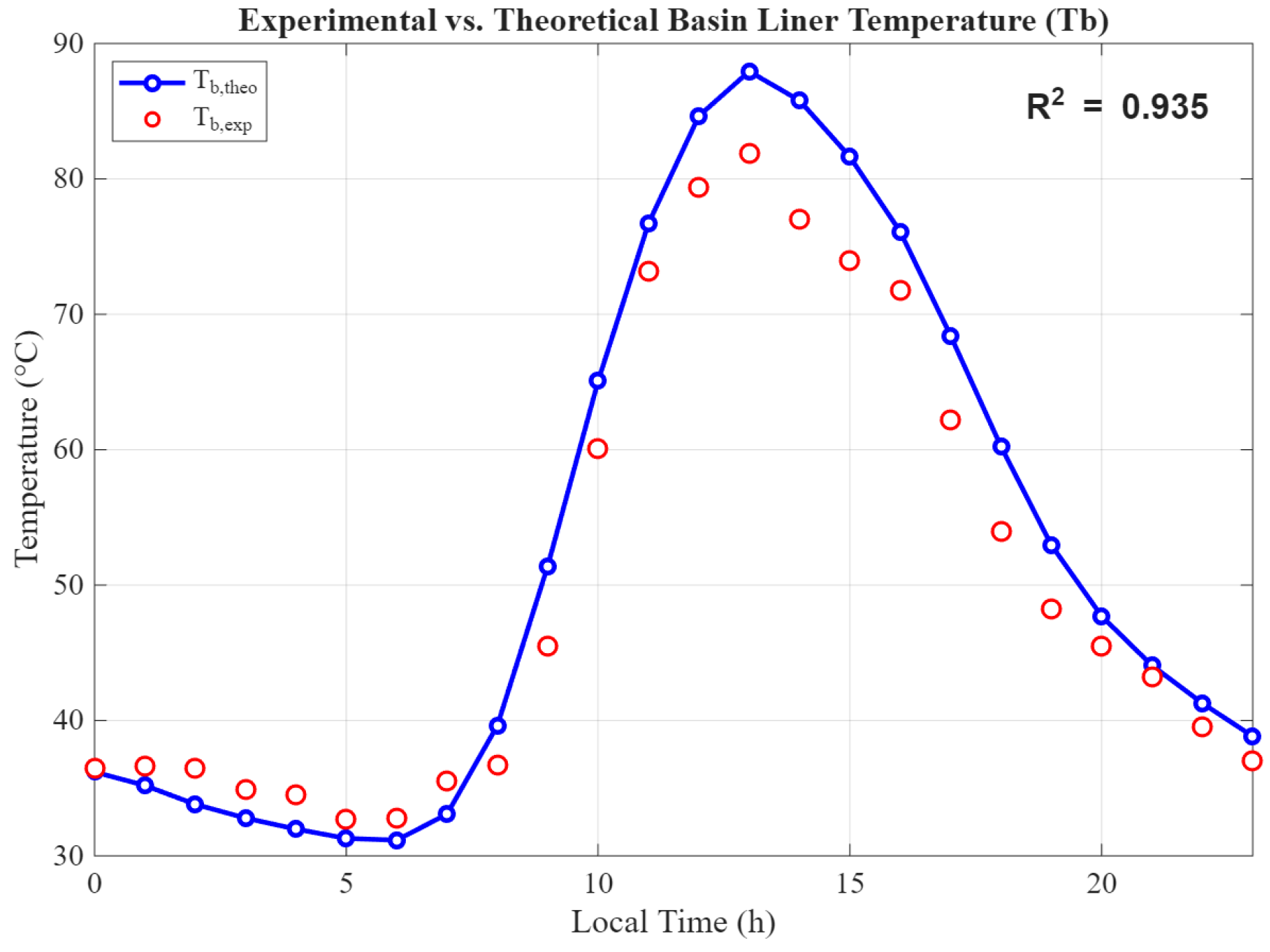
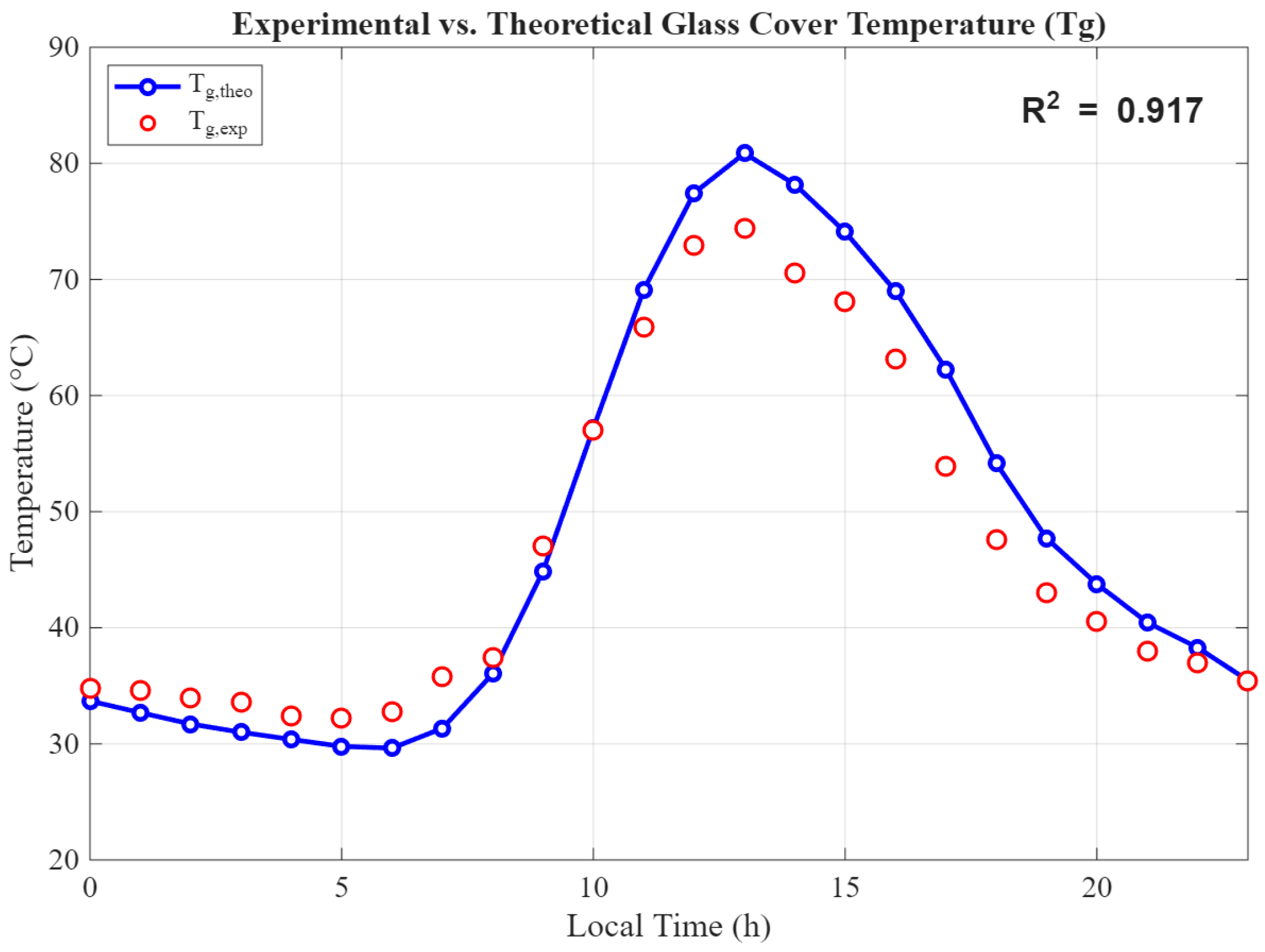
Figure 7 and Figure 15 compare the theoretical and experimental variations of basin water temperature (Tw), basin liner temperature (Tb), and glass cover temperature (Tg) for 8 August 2025. The experimental results exhibit a clear diurnal pattern, with temperatures rising sharply after sunrise, peaking near solar noon, and gradually declining toward evening. Maximum values were recorded at 13:00 h, reaching 79 °C for Tw, 81.9 °C for Tb, and 74.4 °C for Tg, consistent with the expected thermal gradient that drives evaporation–condensation in basin-type solar stills.
The theoretical predictions followed a similar diurnal trend but produced slightly higher peak temperatures, reaching 87.0 °C for Tw, 87.9 °C for Tb, and 80.9 °C for Tg at 13:00 h. Although the overall agreement between experimental and theoretical values is strong, minor deviations were observed, particularly during the late afternoon and evening. These discrepancies can be attributed to external convective disturbances caused by fluctuating wind conditions (as seen in Figure 10) and unmodeled heat losses through structural components [45].
To quantify model accuracy, statistical error metrics were evaluated. The RMSE values were 5.0 °C for T w , 4.3 °C for T b , and 4.2 °C for T g , while the corresponding MAPE values were 7.7%, 6.9%, and 7.3%, respectively. The coefficients of determination were R 2 = 0.904 ( T w ), 0.935 ( T b ), and 0.917 ( T g ), confirming good agreement between the simulated and measured temperature fields under the harsh summer climate of Basrah.
These relatively low error values confirm that the proposed heat balance model implemented in MATLAB reliably captures the transient thermal behavior of the system under Basrah’s extreme summer climate. The findings are in line with previous works where similar modeling approaches achieved <15% deviation between theoretical and measured values [25,26].
Overall, the strong correlation between experimental and theoretical results validates the applicability of the developed model and ensures that it can be reliably used for predictive performance analysis of conventional basins still under comparable climatic conditions.
Figure 7, Figure 15, Figure 16, Figure 17 and Figure 18 and Table A2 collectively demonstrate the thermal response of the solar still under Basra’s extreme summer conditions. The experimental data (Figure 7) clearly confirm the diurnal heating–cooling cycle, while the theoretical results (Figure 15) replicate this pattern with high fidelity. Direct comparisons for each component basin water (Figure 16), basin liner (Figure 17), and glass cover (Figure 18) highlight the model’s ability to capture both the magnitude and timing of temperature peaks, with deviations remaining within acceptable error margins. Table A2 provides the complete experimental and theoretical dataset, which forms the foundation for the productivity analysis in the following section. By validating the transient thermal behavior, confidence is established in applying the model to predict hourly and cumulative freshwater yield, as discussed in Section 5.2.

5.2. Productivity Analysis (Hourly and Cumulative Water Yield)

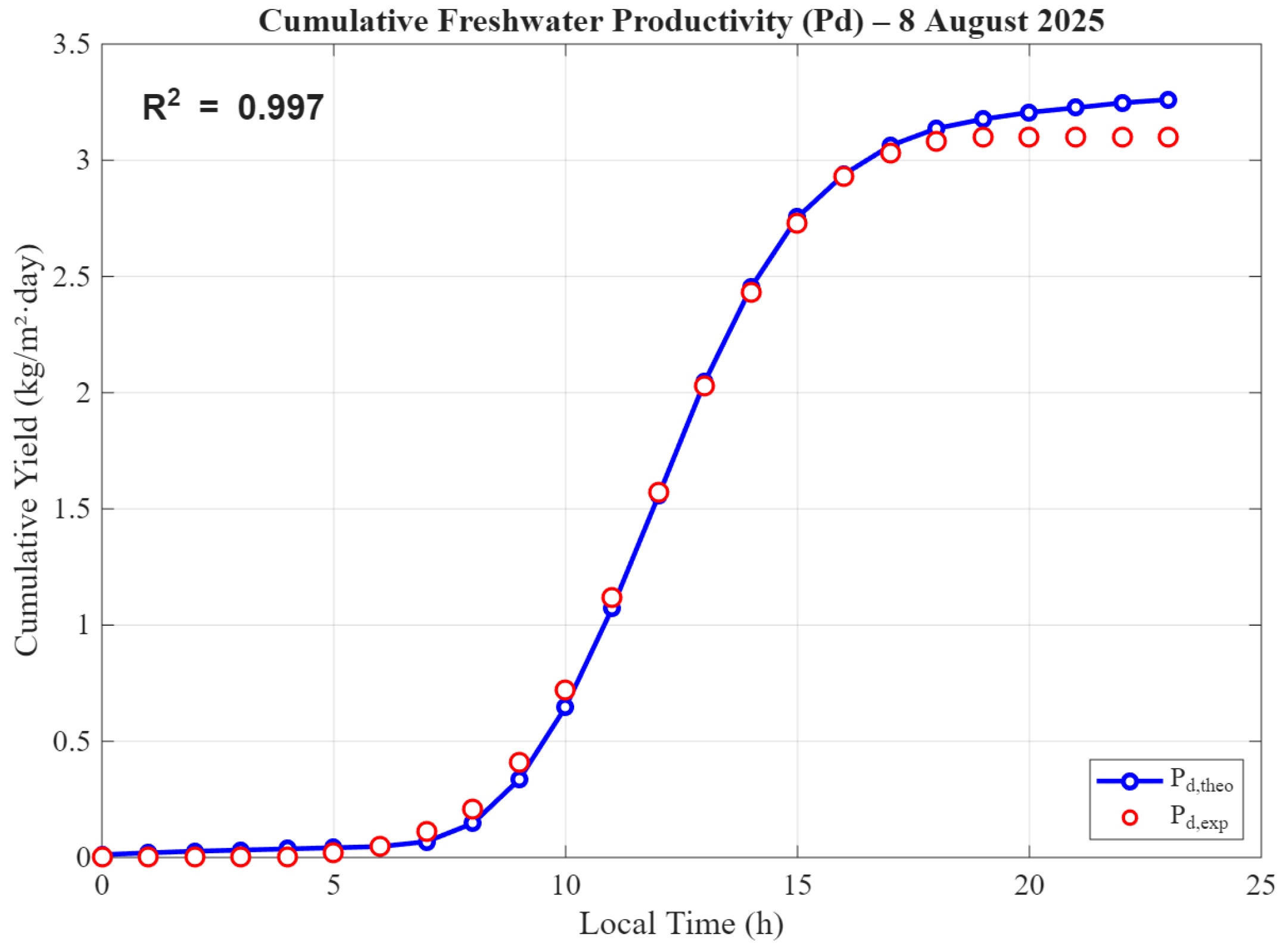
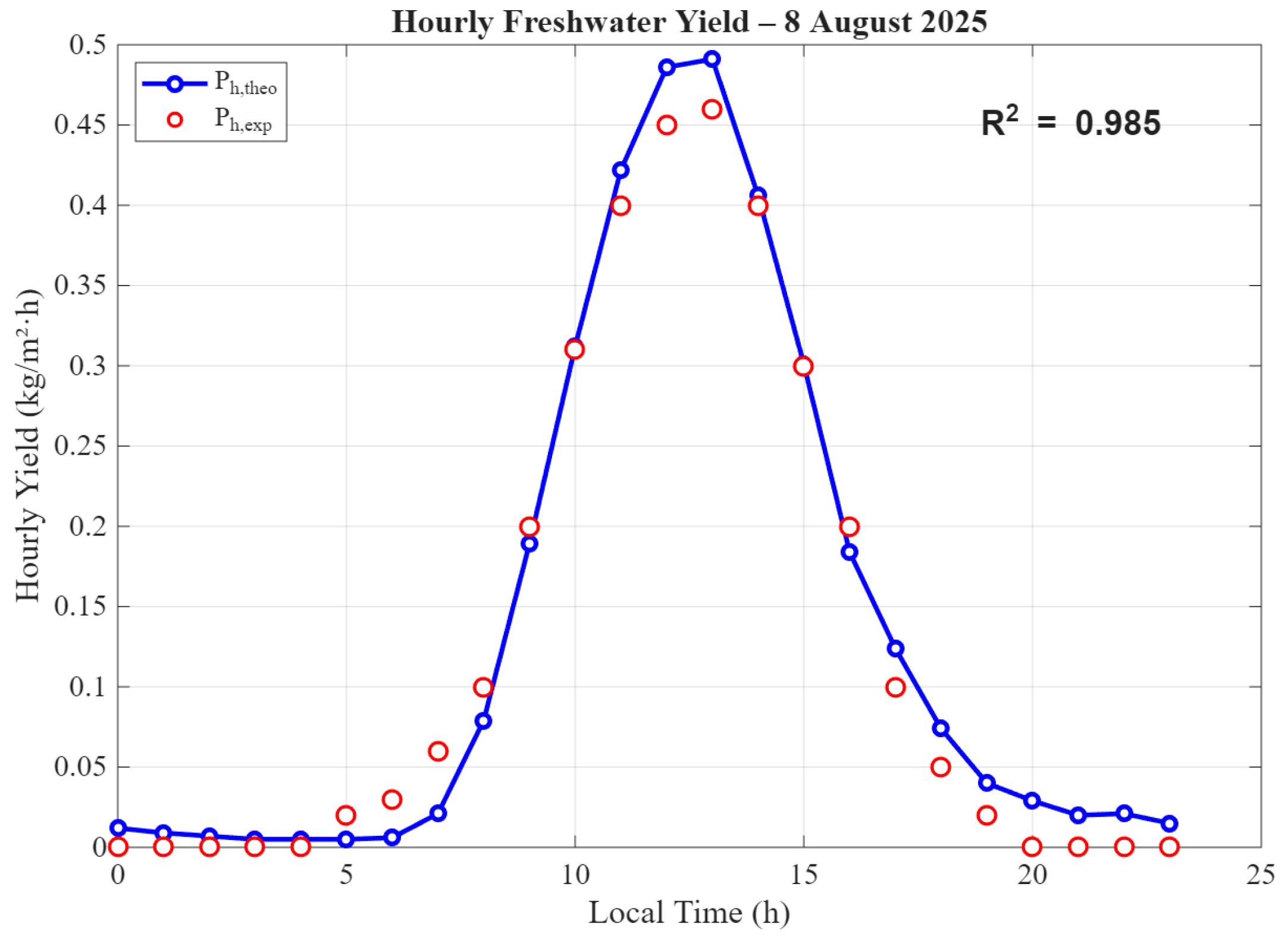
The cumulative and hourly freshwater productivity obtained experimentally and theoretically for 8 August 2025 are presented in Figure 19 and Figure 20, and summarized in Table A3. As seen in the results, freshwater production started gradually after sunrise, with no measurable output during the early morning hours (0:00–4:00 h). Distillate collection began around 7:00 h, and increased significantly between 9:00 h and 14:00 h, coinciding with the period of maximum solar radiation and highest basin water temperatures.
In the mid to late afternoon (approximately 15:00–16:00 h), the sharp decline in hourly productivity is attributed to the combined effect of reduced solar incidence, a weakened internal thermal gradient ( T w T g ) , and enhanced convective heat losses, rather than to any shading or unaccounted mechanisms. The experimental setup (Figure 2) confirms that the still was installed on an unobstructed rooftop near Basrah University, with full solar exposure throughout the day. Local meteorological conditions (global solar radiation, wind speed, ambient temperature, relative humidity, and pressure) were continuously recorded by the CURCONSA FT0300 weather station placed adjacent to the still, while basin water, basin liner, and glass cover temperatures were monitored using the ET3916 multichannel data logger (Figure 5 and Figure 6). In the model, the external glass to ambient convective coefficient h g a is implemented as a wind speed dependent term, so that rising afternoon wind speeds increase top and bottom losses just as solar irradiance and ( T w T g ) begin to decay. Consequently, the net energy balance becomes increasingly dominated by heat losses, leading to a rapid reduction in evaporation rate and hence the observed drop in hourly freshwater productivity.
Experimentally, the system produced a total daily yield of 3.10 L/m2·day, while the theoretical model estimated 3.261 L/m2·day, indicating that the model slightly overpredicts the actual performance. The hourly productivity curves also demonstrate good agreement, with peak experimental productivity reaching 0.46 L/m2·h at midday compared with a theoretical peak of 0.491 L/m2·h. After 16:00 h, both experimental and theoretical yields declined sharply, with negligible production recorded after sunset.
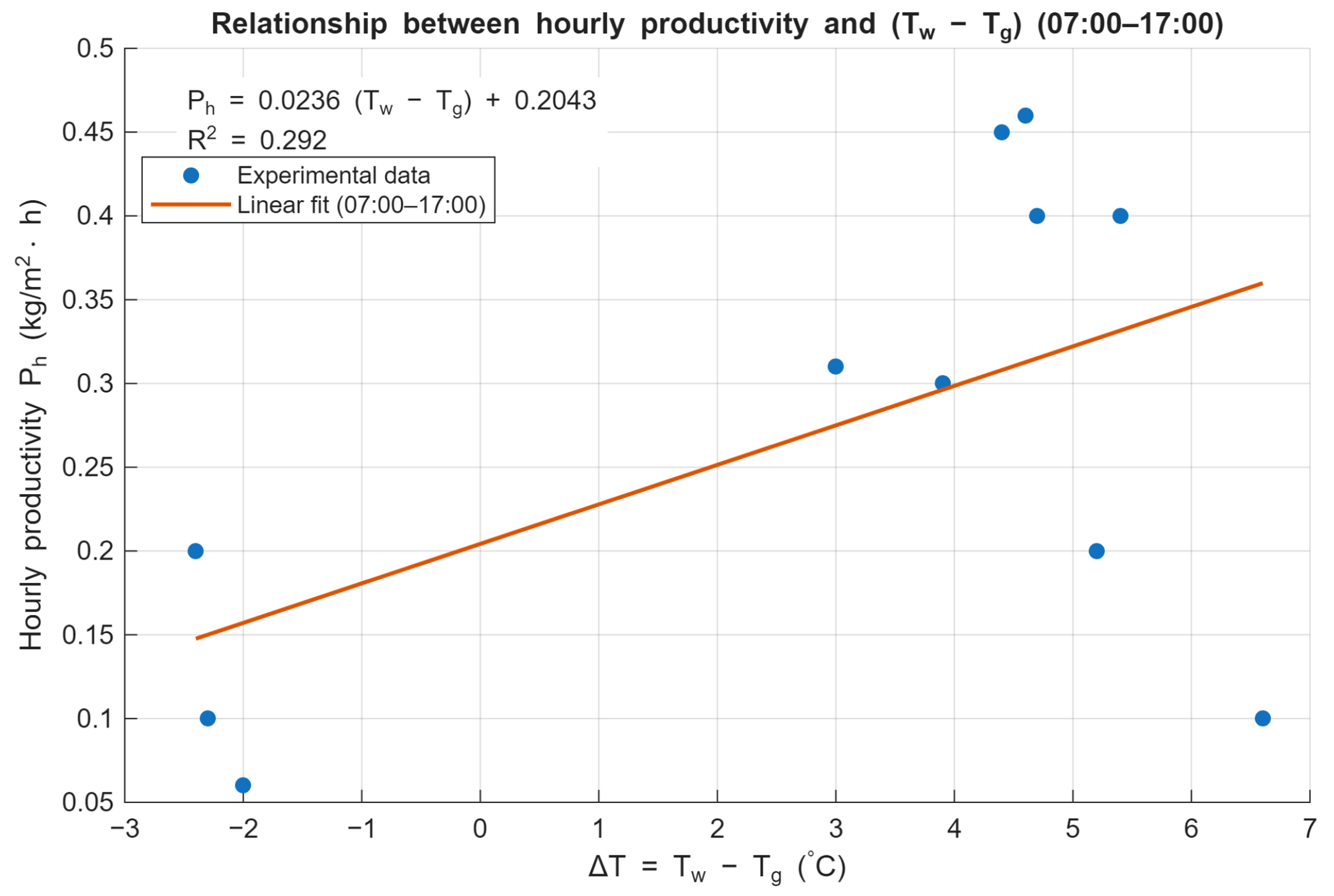
To further assess the role of the thermal driving force for condensation, Figure 21 presents a scatter plot of the experimental hourly productivity P h versus the temperature difference between the basin water and glass cover, ( T w T g ) , for the effective operating period 07:00–17:00 h. A simple linear regression of these daytime data yields
P h , exp ( kg / m 2 · h ) = 0.0236 ( T w T g ) + 0.2043 ,
with ( T w T g ) in °C and a coefficient of determination of R 2 0.29 . The positive slope confirms that larger temperature differences generally promote higher condensation rates and freshwater yield by increasing the vapor pressure gradient between the water surface and the glass cover. The moderate value of R 2 indicates that the temperature difference alone does not fully determine the instantaneous productivity, which is also strongly affected by solar irradiance, ambient temperature, and wind speed. For comparison, a full day fit (including night-time hours with essentially zero productivity and small ( T w T g ) ) retains a positive slope but yields a lower coefficient of determination ( R 2 0.10 ); therefore, the daytime correlation shown in Figure 21 is more representative of the still’s actual operating behavior.
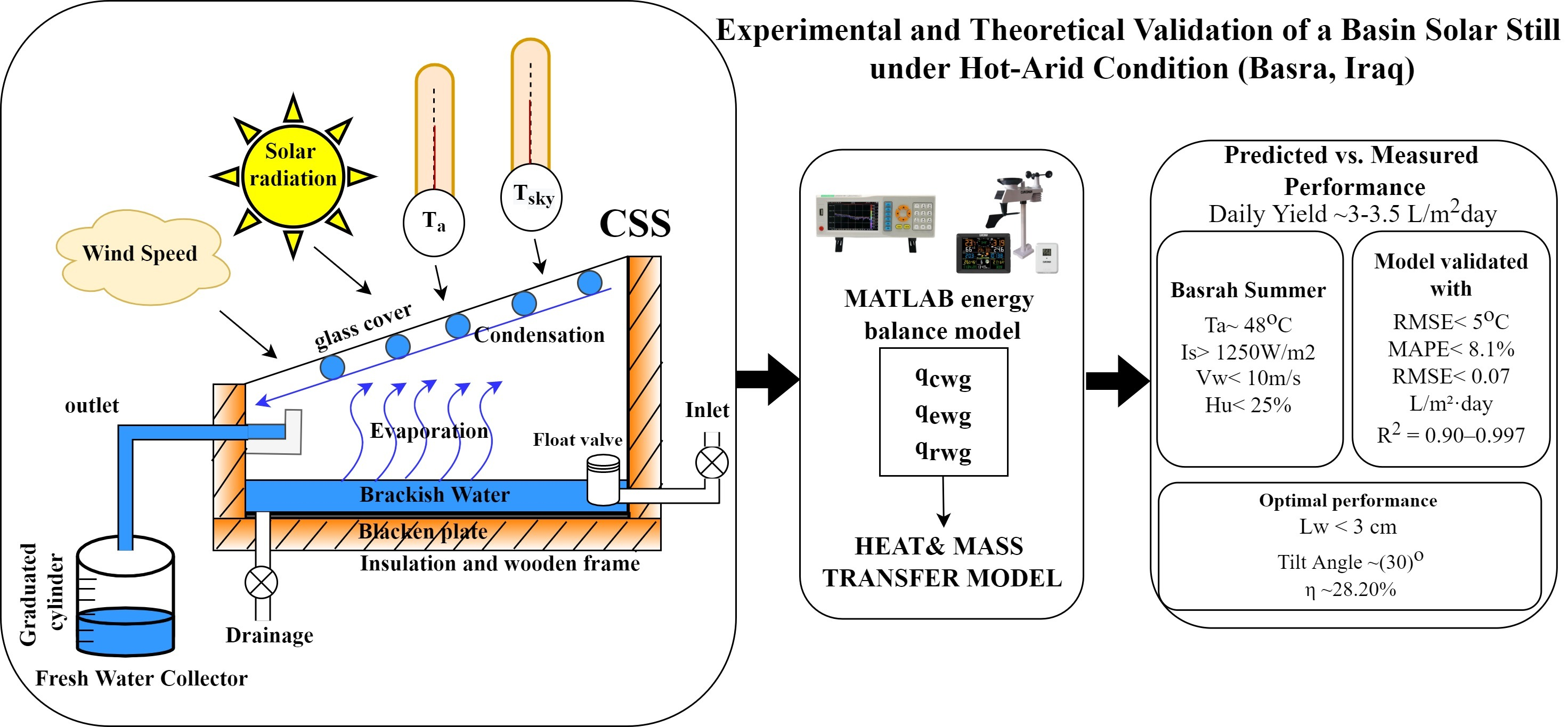
Error analysis further quantifies the agreement between the model and the measurements. Over the full 24 h period, the root mean square error (RMSE) values were 0.07 L/m2·day for cumulative productivity and 0.02 L/m2·h for hourly productivity, with coefficients of determination of R 2 = 0.997 and R 2 = 0.985 , respectively. The corresponding mean absolute percentage errors (MAPE) over the full day were 12.8% for cumulative productivity and 29.9% for hourly productivity. These relatively high percentage errors are mainly associated with the very early morning and late evening hours, when the experimental yield is close to zero and even small absolute differences translate into large relative deviations. When the analysis is restricted to the effective operating period of the still, the MAPE values decrease substantially: for 07:00–17:00 h the MAPE is 9.6% (cumulative) and 13.3% (hourly), and for the narrower high-irradiance window 08:00–17:00 h it further reduces to 6.8% (cumulative) and 8.1% (hourly). These values confirm that the model reproduces the main operating period of the still with good accuracy, while the larger full-day MAPE mainly reflects the mathematical sensitivity of the metric at very low production rates rather than a significant physical mismatch between theory and experiment.
Overall, the close alignment between theoretical and experimental data demonstrates that the developed heat and mass transfer model not only reproduces the thermal response of the system but also provides accurate predictions of distillate yield. This strengthens its applicability for performance forecasting and design optimization in hot–arid regions such as Basrah. These validated productivity results provide a robust basis for investigating the influence of external climatic drivers, which are analyzed in Section 5.3.

5.3. Effect of Climatic Parameters (Solar Radiation, Wind Speed, Tilt Angle of Glass Cover, and Water Level)

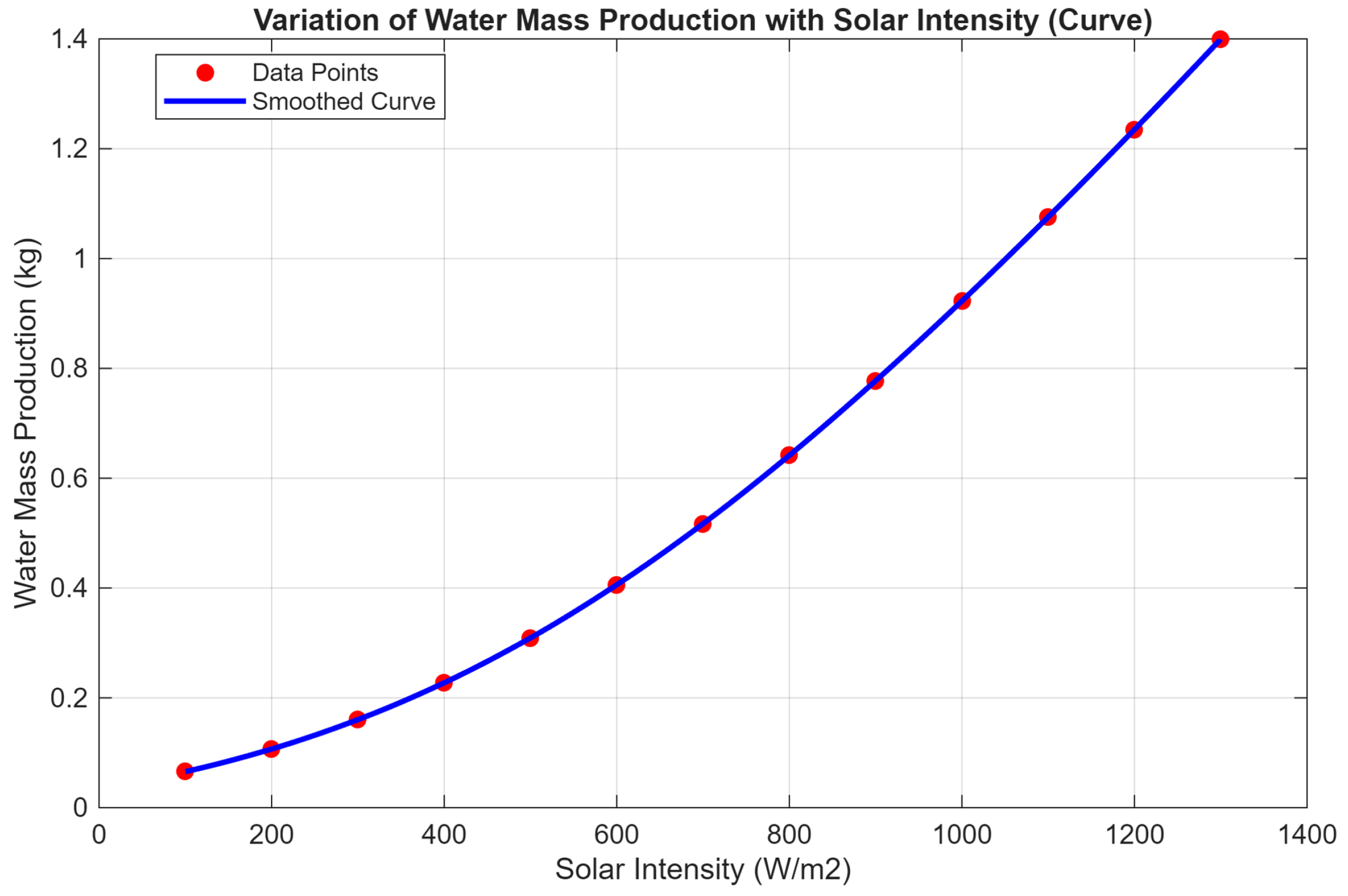
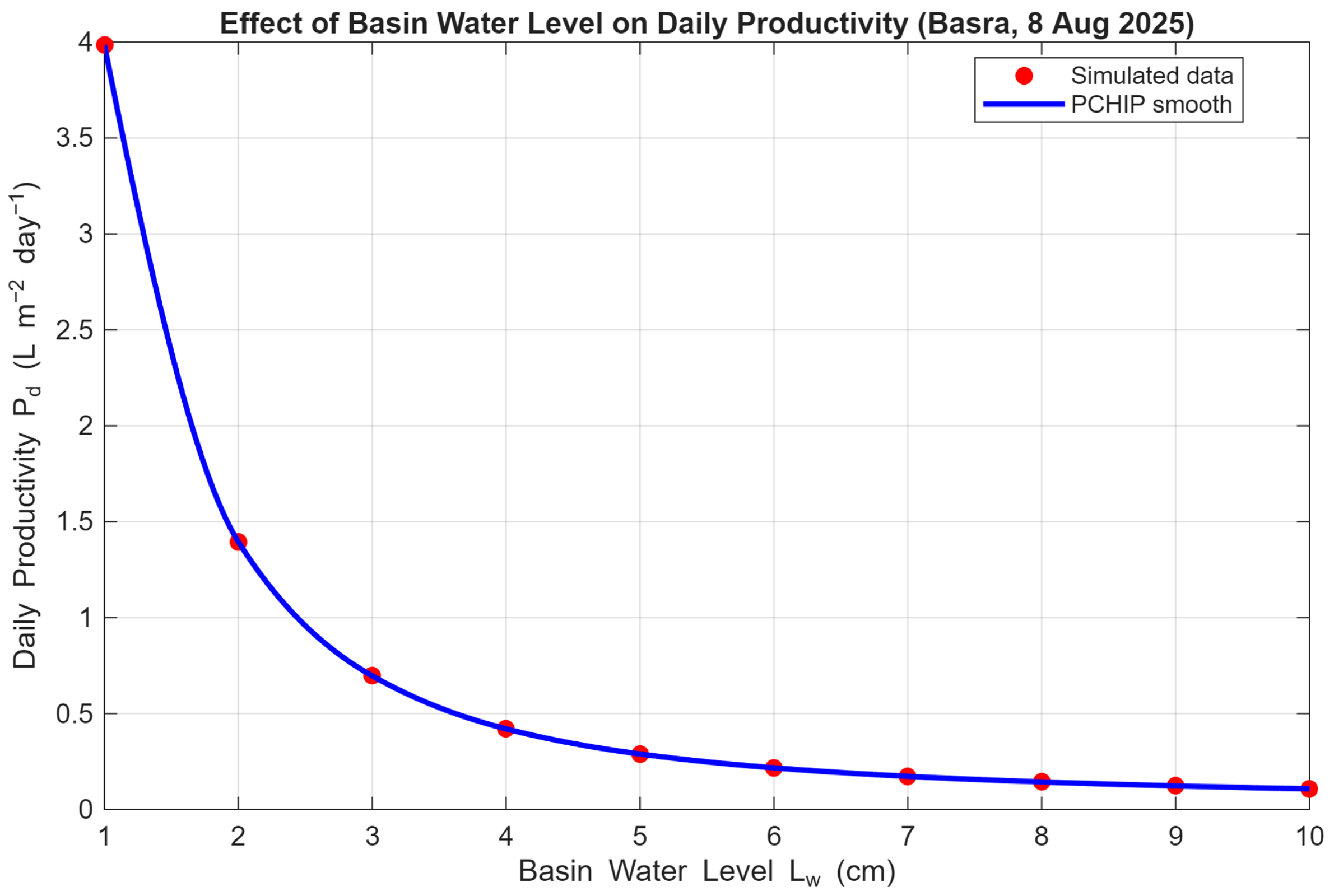
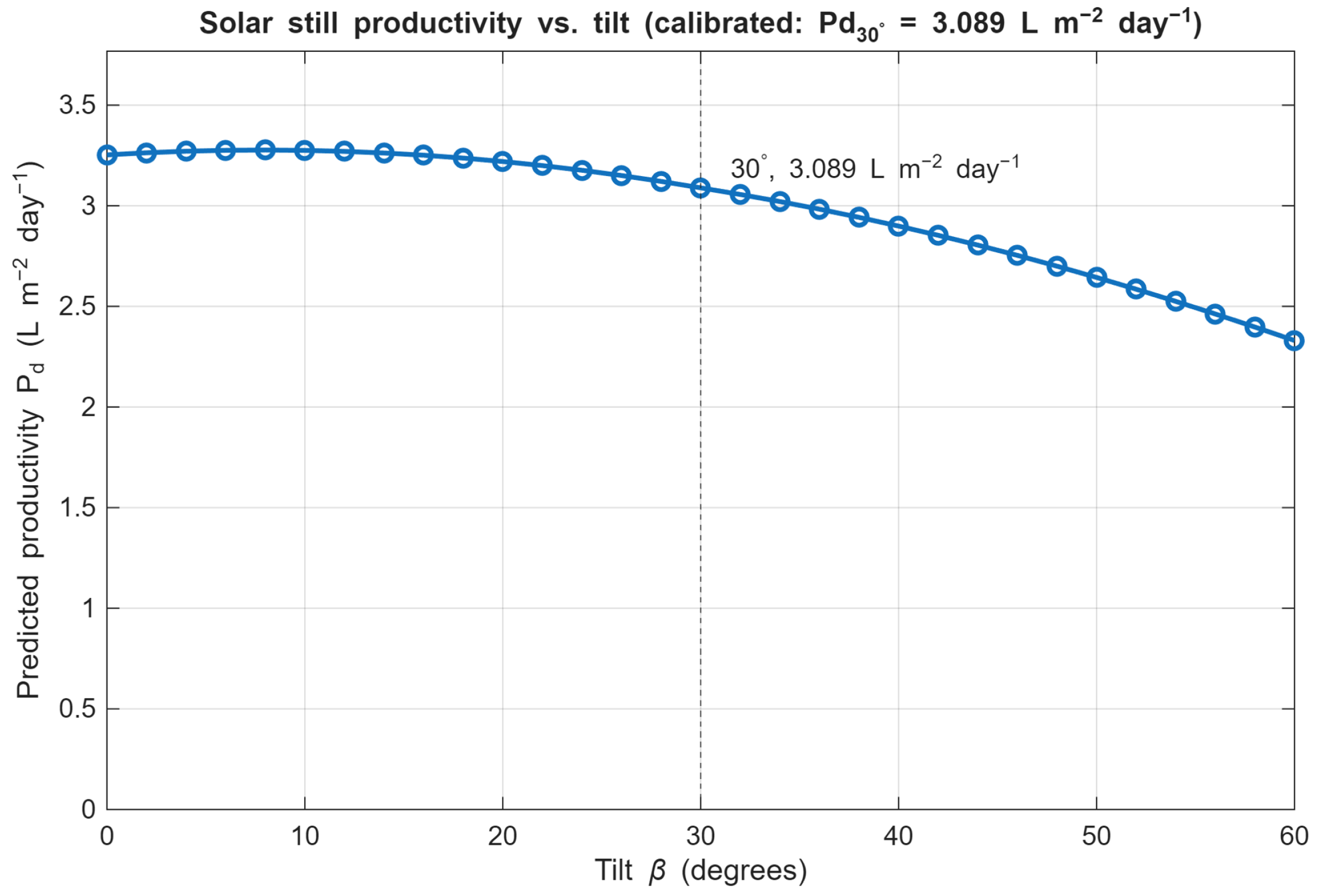
The productivity of a solar still is strongly influenced by climatic variables and design parameters, including solar radiation intensity, wind speed, glass cover tilt angle, and basin water level. Figure 22, Figure 23, Figure 24 and Figure 25 summarize the effect of each parameter under Basrah’s climatic conditions on 8 August 2025.

5.3.1. Effect of Solar Radiation

Figure 22 shows the variation in water mass production with solar intensity. A strong positive correlation is observed: productivity rises nearly quadratically with increasing solar radiation, with maximum yield exceeding 1.4 kg when radiation approaches 1300 W/m2. This is consistent with prior findings where higher irradiance increases basin water temperature, enhancing evaporation and condensation rates [24,26]. The trend indicates that solar intensity is the dominant driver of freshwater yield in Basrah’s summer conditions.

5.3.2. Effect of Basin Water Level

Figure 23 illustrates the influence of water depth (Lw) on daily productivity. As the basin depth increases from 1 cm to 10 cm, productivity decreases sharply, with maximum productivity (∼4 L/m2·day) at 1 cm and stabilizing near 0.2 L/m2·day beyond 8–10 cm. This behavior arises from the thermal inertia of thicker water layers, which require more energy to heat, delaying temperature rise and reducing evaporation rates. Similar results have been reported by El-Sebaii et al. [25], who concluded that shallow basin depths (<3 cm) optimize solar still performance in hot climates.

5.3.3. Effect of Tilt Angle of Glass Cover

Figure 24 presents the effect of cover tilt on predicted daily productivity. At the baseline tilt of 30°, corresponding to Basrah’s latitude, productivity reached ∼3.1 L/m2·day. The curve indicates that productivity remains nearly constant between 15° and 30° but decreases gradually beyond 35°, dropping below 2.5 L/m2·day at 60°. This decline is attributed to a reduction in transmitted solar radiation through the glass as the angle deviates from the optimal orientation, along with less effective condensate drainage at higher tilts. These results align with recommendations in solar still design literature, which often suggest that the glass inclination should approximately match the local latitude to maximize solar capture [46,47,48].
In practical terms, choosing a tilt near Basrah’s latitude (≈30.5° N) keeps the cover more directly exposed to midday solar radiation over most of the year, enhancing the transmitted energy and, consequently, the evaporation–condensation process.

5.3.4. Effect of Wind Speed

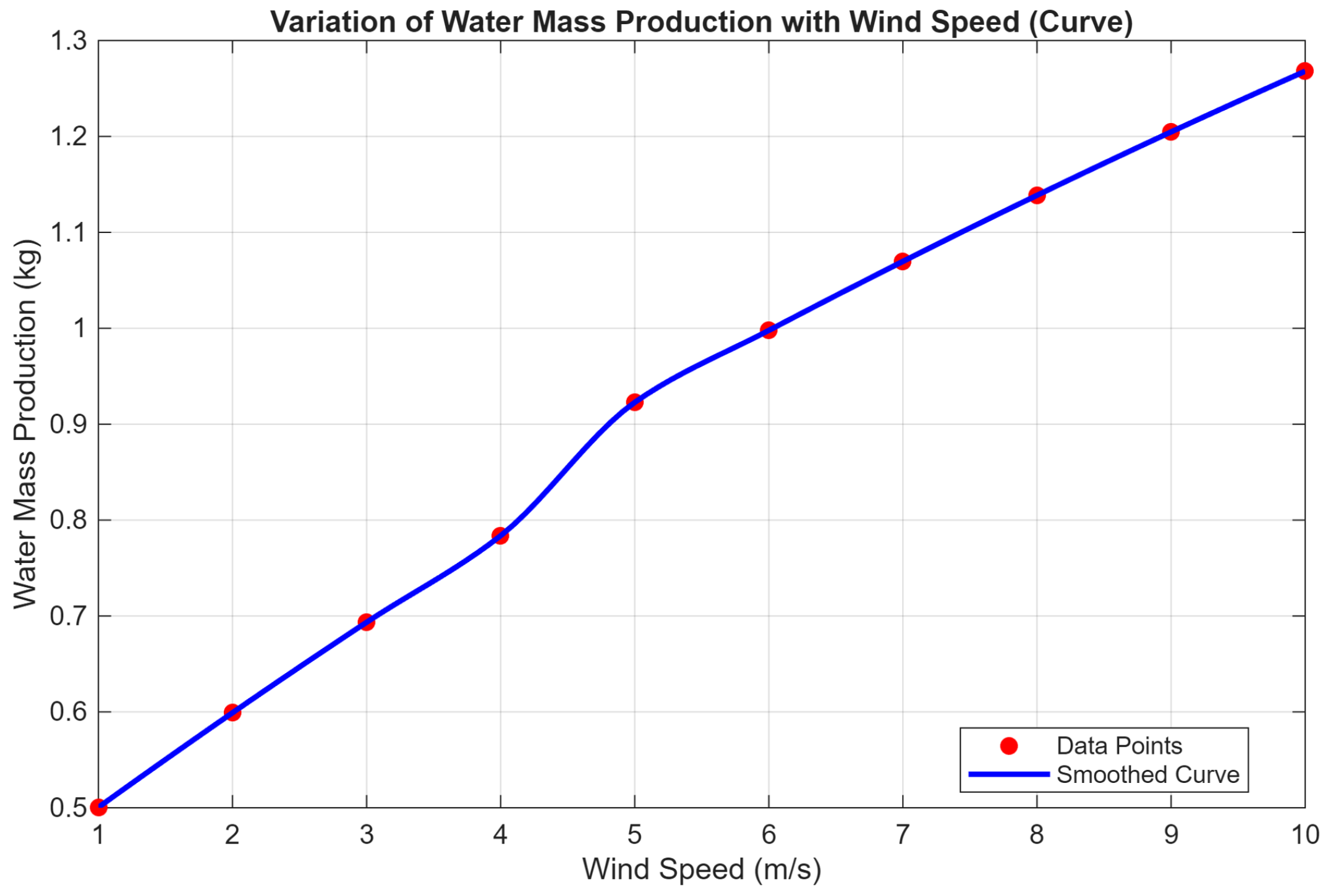
Figure 25 shows the relationship between wind speed and water mass production. A nearly linear increase is observed between 1 m/s and 10 m/s, with production rising from ∼0.5 kg to ∼1.25 kg. Higher wind speeds enhance external convective heat transfer, cooling the outer glass surface, which in turn improves condensation efficiency inside the still. This trend agrees with reported findings that moderate wind enhances distillate output, though excessively high wind may increase convective losses from the glass cover.
Wind speed influences the solar still’s performance through its effect on external convective heat transfer. At moderate wind speeds (approximately 3–5 m/s), cooling of the glass cover enhances the internal temperature difference ( T w T g ) , promoting vapor condensation and increasing productivity. However, at higher wind speeds, the external convective heat transfer coefficient h g a increases sharply, which can lead to excessive heat loss from the glass surface to the ambient air, reducing the energy retained within the system and potentially lowering evaporation rates. Thus, the influence of wind speed is not strictly linear, and there is an optimal range that depends on local climatic conditions.

5.4. Comparison with the Literature

The comparative results presented in Table 6 demonstrate that the productivity of the conventional solar still tested in Basrah (3–3.5 L/m2·day) is in close agreement with values reported for other hot arid and semi-arid regions. For example, similar ranges have been documented in Egypt (2.8–3.6 L/m2·day) [25], Gulf countries such as Oman and Kuwait (2.5–3.2 L/m2·day) [27], and parts of India (2.0–3.0 L/m2·day) [26]. The slightly higher productivity observed in Basrah compared with India and Oman can be attributed to the combination of higher solar radiation intensities (>1200 W/m2 at noon) and extremely low relative humidity (<25%) during the summer season, which strongly enhance evaporation and condensation rates.
To enhance cross-regional comparability, a climate-normalized index was also considered, defined as the daily distillate yield divided by the corresponding daily incident solar energy (L/m2·MJ). As summarized in Table 6, the present system in Basrah achieved a normalized productivity in the range of 0.121–0.141 L/m2·MJ, which is comparable to or slightly better than many other conventional passive basin stills reported for arid and semiarid climates. By contrast, enhanced configurations incorporating phase change materials or active heating modes generally attain higher absolute and normalized productivities, but at the cost of increased complexity and investment. The climate-normalized values therefore indicate that, under real desert conditions, the relatively simple conventional design examined in this study utilizes the available solar resource efficiently.
These findings confirm that conventional single-slope basins still remain highly effective under the severe summer conditions of Basrah, producing yields that are competitive with or even slightly higher than those obtained in other regions. Moreover, the alignment of experimental and theoretical predictions (validated with RMSE and MAPE analysis) further supports the reliability of the developed thermal model for predictive performance assessment. Overall, this comparative analysis reinforces the relevance of conventional basin solar stills as a sustainable and practical solution for freshwater generation in arid and semi-arid climates.

6. Conclusions and Research Implications

This work presented an integrated experimental and numerical investigation of a conventional single-slope basin solar still operating under the severe summer conditions of Basrah, Iraq. Continuous measurements from an on-site weather station were used to drive and validate a transient heat and mass transfer model that accounts for the dependence of saline water properties (latent heat, density, and specific heat) on both temperature and salinity. Incorporating variable properties rather than assuming constant values resulted in a closer match between simulation and experiment and provides a more realistic description of the physical processes inside the still.
The comparison between model predictions and measurements for basin water, basin liner, and glass-cover temperatures ( T w , T b , and T g ) showed coefficients of determination of approximately R2 = 0.90–0.94, with root mean square errors around 4–5 °C. For freshwater production, the model reproduced both cumulative and hourly yields with high accuracy, achieving RMSE values of 0.07 L/m2·day and 0.02 L/m2·h, and R 2 = 0.997 and R 2 = 0.985 , respectively. When the analysis was restricted to the main operating period of the still, the mean absolute percentage error for cumulative and hourly productivity decreased to single-digit or low double-digit values, indicating that the proposed model captures the dominant behavior of the system during its effective working hours.
Under the local climatic conditions, the still produced 3.1–3.5 L/m2 of distilled water per day, with a peak hourly yield of about 0.46 L/m2·h. These values are associated with the combination of high solar irradiance (exceeding 1200 W/m2 at midday), elevated ambient temperatures (up to 48 °C), and very low relative humidity (below 25 %), which together promote strong evaporation and condensation. The daily thermal efficiency was found to be 26.90% experimentally and 28.20% from the model, with hourly efficiency peaking near solar noon. A clear linear relationship between distillate yield and the temperature difference ( T w T g ) confirmed the importance of maintaining a sufficient thermal driving force between the basin water and glass cover. The chosen glass inclination of 30°, close to the latitude of Basrah, was also shown to be suitable for enhancing incident solar radiation and effective condensate collection.
A parametric study demonstrated that solar radiation intensity is the most influential factor governing productivity, followed by basin water depth, glass cover tilt angle, and wind speed. The best performance occurred for shallow water depths (less than 3 cm) and tilt angles close to the local latitude, in line with design recommendations reported in the literature. Overall, the results indicate that simple, conventional basin stills, when properly designed and tuned to local conditions, remain a practical and low-cost option for decentralized freshwater production in hot, arid regions. The validated model can be used as a design and optimization tool for similar climates beyond southern Iraq.
At the same time, the study has several limitations that should be recognized. The experimental campaign was carried out on clear sky days during peak summer, so the influence of cloudy periods, dust events, or other seasons was not examined. Long-term effects, such as salt accumulation, which are important for real deployments, were not assessed over extended operation. In addition, the thermal properties of the insulation and structural elements were treated as constant, whereas they may change with temperature, aging, and moisture content. These simplifications are reasonable for establishing a controlled benchmark but should be relaxed in subsequent work aimed at long-term field performance.
The thermal conductivity of the bottom insulation was assumed constant in the numerical model, based on nominal manufacturer data at 25 °C. However, insulation materials generally exhibit temperature-dependent behavior, and their thermal resistance may decrease at elevated temperatures. While sensitivity analysis suggested a limited impact on total productivity under the present operating conditions, this simplification may introduce modeling error in systems operating at higher base temperatures or using alternative insulation types.
Building on the results obtained, several directions for future research emerge. One promising avenue is the development of hybrid configurations that incorporate phase change materials, nanofluids, or thermoelectric elements to increase energy utilization while retaining the simplicity of the basic basin design. Multi-stage or cascading arrangements that reuse latent heat or recover vapor in successive stages could raise total freshwater output without proportionally enlarging the footprint. Another opportunity lies in adaptive or smart designs, such as seasonally adjustable cover tilt, variable water depth control, or simple tracking mechanisms, to improve performance across different seasons and locations.
Further studies should also address long-term operation using real feedwater, with particular attention to water quality, scaling, and fouling processes, as well as cleaning and maintenance requirements. Finally, to support large-scale dissemination, detailed techno-economic analyses are needed, including life cycle costs, payback period, and sensitivity to local prices and climate. In summary, this study provides a rigorously validated reference case for a conventional solar still under extreme arid conditions and offers a basis for future design, optimization, and deployment of low-cost desalination technologies in water-stressed regions.


7. Future Work

Future investigations on hybrid and thermoelectric-assisted solar stills should concentrate on improving materials, configurations, and system integration to further enhance water yield and reduce overall cost. One promising direction is the design of advanced condensation surfaces, for example, using alternative cover materials or functional coatings with higher thermal conductivity and tailored wetting properties to promote rapid droplet formation and removal. The integration of thermoelectric (TE) modules also requires systematic optimization, including the number, spatial arrangement, and power control strategy, so that a strong temperature difference between the evaporation and condensation zones can be maintained with minimal electrical input. Additional gains may be achieved by modifying the optical and thermal characteristics of the basin, such as applying nanostructured or selectively absorbing layers in combination with antifog or superhydrophobic cover treatments to increase both solar absorption and condensate collection.
On the modeling side, future work should employ detailed numerical tools such as computational fluid dynamics and transient thermal simulations to analyze coupled heat and mass transfer in hybrid configurations under different climatic and geometric scenarios prior to prototyping. Enhanced condenser cooling concepts, including solar-powered refrigeration units or nanofluid-based external condensers, could be particularly beneficial in very hot regions like Basrah, where maintaining a low glass cover temperature is challenging. Finally, replacing conventional glass with lightweight, transparent polymeric or composite materials may lower fabrication costs, improve portability, and make solar still technology more accessible for remote and low-income communities.

Author Contributions

M.O.K. and H.S.S., validation, visualization, resources, formal analysis, software, writing—original draft and investigation; M.R.Ö. and H.S.S., supervision, methodology, and writing—review and editing; M.O.K., M.R.Ö. and H.S.S., writing—review and editing. All authors have read and agreed to the published version of the manuscript.

Funding

This research received no external funding.

Institutional Review Board Statement

Not applicable.

Informed Consent Statement

Not applicable.

Data Availability Statement

The original contributions presented in this study are included in the article. Further inquiries can be directed to the corresponding author.

Conflicts of Interest

The authors declare no conflicts of interest.

Abbreviations

The following symbols and abbreviations are used in this manuscript:
AArea (m2)aAmbient
C p Specific heat capacity (J/kg·K)bBasin liner
hHeat transfer coefficient (W/m2·K)cConvective
h f g Latent heat of vaporization (J/kg)dDaily
I ( t ) Intensity of solar radiation (W/m2)eEvaporative
KThermal conductivity (W/m·K)expExperimental
LInsulation thickness (m)effEffective
L h Latent heat of vaporization (J/kg)gGlass
mMass (kg)insInsulation
m ˙ e w Hourly freshwater yield (L/m2/h)rRadiative
M e w Total daily freshwater yield (L/m2/day)tTime
MAPEMean Absolute Percentage ErrortheoTheoretical
PPartial pressure (N/m2)wWater
P d Cumulative freshwater productivityqHeat flux (W/m2)
P d h Hourly freshwater yield (L/m2/h) α Absorptivity
QHeat transfer (W) ε Emissivity
RMSERoot Mean Square Error ρ Density (kg/m3)
TTemperature (K, °C) σ Stefan–Boltzmann constant
(5.6697 × 10⁻⁸ W/m2·K4)
V w Wind velocity (m/s) η Energy efficiency
τ Transmissivity

Appendix A. Statistical Error Metrics

The statistical performance indicators used to evaluate the agreement between the experimental and theoretical results are defined as follows:
RMSE = 1 n i = 1 n X exp , i X theo , i 2
MAPE = 100 n i = 1 n X exp , i X theo , i X exp , i
These two indicators quantify the deviation between measured and predicted values, where RMSE reflects the absolute magnitude of the error and MAPE expresses the average relative error as a percentage.
It is important to note that the conventional definition of MAPE is highly sensitive when the experimental value in the denominator is very small. In the present study, the hourly freshwater yield is negligible during the night and in the early morning/late evening, so small absolute differences between measured and predicted productivity (on the order of 0.01–0.02 L/m2·h) can correspond to very large percentage errors. For this reason, MAPE was evaluated not only over the entire 24 h cycle but also over restricted daytime intervals. The interval 07:00–17:00 represents the full period during which the still is actively producing water, whereas 08:00–17:00 corresponds to the core high-irradiance hours with the most practical relevance for sizing and design. Reporting MAPE for these intervals (9.6% and 13.3% for 07:00–17:00; 6.8% and 8.1% for 08:00–17:00, for cumulative and hourly productivity, respectively) provides a more representative measure of model performance during effective operation, while the 24 h values are retained for completeness and transparency.

Appendix B

Table A1. Hourly meteorological data recorded on 8 August 2025 at the experimental site using the CURCONSA FT0300 weather station (Figure 5).
TimeTemp (°C)RH (%)Pressure (hPa)Wind (m/s)Gust (m/s)DirRain (mm/h)Solar Radiation (W/m2)UV Index
0:0033.477.5998.72.23.3S000
1:0033.279.8998.42.03.0NW000
2:0033.081.3998.31.43.3S000
3:0032.682.3998.31.43.0SE000
4:0032.182.0998.61.52.3S00.10
5:0032.281.0999.11.12.0SSE028.20.4
6:0033.674.8999.61.33.0SSE0126.80.8
7:0036.164.81000.11.22.3SSW0366.01.6
8:0038.753.51000.51.22.0SW0658.72.6
9:0042.137.01000.71.33.3ESE0868.73.5
10:0044.826.21000.61.23.6ENE0984.54.6
11:0046.922.81000.41.44.0SSE01055.15.0
12:0047.920.0999.71.74.3S01040.54.9
13:0047.919.3999.32.45.0SSW0916.94.2
14:0047.620.5998.92.23.6S0768.43.4
15:0047.421.3998.91.92.6SE0503.52.0
16:0047.719.5998.81.74.0SSW0206.21.5
17:0045.422.5998.72.65.3S087.30.7
18:0042.533.0998.72.53.6SW011.20.3
19:0041.237.5999.31.83.0S000
20:0038.944.51000.01.42.3SSE000
21:0038.046.21000.71.76.9E000
22:0035.260.21001.02.34.3SE000
23:0034.470.21001.02.03.6S000
Table A2. Experimental and theoretical temperature data (basin water T w , basin liner T b , and glass cover T g ) for 8 August 2025, Basrah.
Time (h) T w (theo) T b (theo) T g (theo) T w (exp) T b (exp) T g (exp)
036.2036.2033.6936.536.534.8
135.2035.2032.6936.336.634.6
233.8033.8131.7135.936.534.0
332.7932.7931.0035.434.933.6
431.9831.9830.3834.134.532.4
531.2831.2929.7832.932.732.2
631.1031.1629.6333.132.832.8
732.8933.0831.3433.835.535.8
839.2139.6336.0435.136.737.4
950.7551.4144.8844.645.547.0
1064.2765.0657.2060.060.157.0
1175.8476.7069.1171.373.265.9
1283.7384.6477.4577.379.472.9
1387.0487.9480.8679.081.974.4
1484.9885.7978.1975.377.070.6
1580.9281.6374.0972.074.068.1
1675.6176.1068.9968.371.863.1
1768.1968.4262.2760.562.253.9
1860.1360.2454.1853.554.047.6
1952.9652.9647.7148.048.243.0
2047.7247.7043.7744.645.540.5
2144.0844.0640.4643.043.238.0
2241.2841.2738.2939.539.537.0
2338.8538.8335.4637.037.035.4
Table A3. Experimental vs. theoretical cumulative and hourly productivity values ( P d ) of the solar still on 8 August 2025.
Local Time (h)Cumulative Production (L/m2/day)Hourly Yield (L/m2)
P d , theo P d , exp P h , theo P dh , exp
00.0120.0000.0120.000
10.0200.0000.0090.000
20.0270.0000.0070.000
30.0320.0000.0050.000
40.0370.0000.0050.000
50.0420.0200.0050.020
60.0470.0500.0060.030
70.0680.1100.0210.060
80.1470.2100.0790.100
90.3360.4100.1890.200
100.6480.7200.3120.310
111.0711.1200.4220.400
121.5561.5700.4860.450
132.0482.0300.4910.460
142.4542.4300.4060.400
152.7552.7300.3010.300
162.9392.9300.1840.200
173.0633.0300.1240.100
183.1373.0800.0740.050
193.1773.1000.0400.020
203.2063.1000.0290.000
213.2263.1000.0200.000
223.2473.1000.0210.000
233.2613.1000.0150.000

References

  1. Kaviti, A.K.; Teja, M.; Madhukar, O.; Teja, P.B.; Aashish, V.; Gupta, G.S.; Sivaram, A.; Sikarwar, V.S. Productivity Augmentation of Solar Stills by Coupled Copper Tubes and Parabolic Fins. Energies 2023, 16, 6606. [Google Scholar] [CrossRef]
  2. Kaviti, A.K.; Akkala, S.R.; Sikarwar, V.S. Productivity enhancement of stepped solar still by loading with magnets and suspended micro charcoal powder. Energy Sources Part A 2021, 47, 2006371. [Google Scholar] [CrossRef]
  3. Ahmed, M.M.Z.; Younes, M.M.; Sharshir, S.W.; Elashmawy, M. The latest advances in solar still desalination systems: Analyzing different geometric configurations. Sol. Energy Mater. Sol. Cells 2025, 286, 113573. [Google Scholar] [CrossRef]
  4. Hosseinifard, F.; Salimi, M.; Amidpour, M. Evaluating economic feasibility and machine learning-driven prediction for solar still desalination in Iran. Results Eng. 2025, 25, 103823. [Google Scholar] [CrossRef]
  5. Khalaf, M.O.; Özdemir, M.R.; Sultan, H.S. A Comprehensive Review of Solar Still Technologies and Cost: Innovations in Materials, Design, and Techniques for Enhanced Water Desalination Efficiency. Water 2025, 17, 20734441. [Google Scholar] [CrossRef]
  6. El-Maghlany, W.M.; Attia, M.E.H.; Kabeel, A.E.; Elazab, M.A.; Hidouri, A.; Moharram, N.A. Comparative experimental study on the performance of single-slope, hemispherical, and conical solar stills. Arch. Thermodyn. 2025, 46, 187–197. [Google Scholar] [CrossRef]
  7. Kaviti, A.K.; Mudavath, N.; Sikarwar, V.S. Optimising Tubular Solar Still Performance with Gamma Aluminium Nanocoatings. Processes 2025, 13, 2413. [Google Scholar] [CrossRef]
  8. Ashok, R.; Sakthivel, T.G. A complete review of augmenting solar desalination efficiency with PCMs. Results Eng. 2025, 25, 104421. [Google Scholar] [CrossRef]
  9. Abu-Zeid, M.A.-R.; Askalany, A.A.; Hassan, H.; Elmaihy, A. Performance Enhancement of Solar Still Unit Using v-Corrugated Basin, Internal Reflecting Mirror, Flat-Plate Solar Collector and Nanofluids. Sustainability 2024, 16, 655. [Google Scholar] [CrossRef]
  10. Hammoodi, K.A.; Dhahad, H.A.; Alawee, W.H.; Omara, Z.M. Enhancement of Pyramid Solar Still Productivity Through Wick Material and Reflective Applications in Iraqi Conditions. Desalin. Water Treat. 2023, 10, 1548–1556. [Google Scholar] [CrossRef]
  11. El-Gazar, E.F.; Yousef, M.S.; Elshaer, A.M.; Khattab, M.A.; Mouneer, T.A.; Hawwash, A.A. Enhancing solar still performance with hybrid nanofluid: A comprehensive assessment of energy, exergy, economics, and environmental impact using a novel fractional model. Environ. Dev. Sustain. 2024, 24, 1–28. [Google Scholar] [CrossRef]
  12. Murali, G.; Ramani, P.; Murugan, M.; Elumalai, P.V.; Goud, N.U.R.; Prabhakar, S. Improved solar still productivity using PCM and nano-PCM composites integrated energy storage. Sci. Rep. 2024, 14, 15609. [Google Scholar] [CrossRef] [PubMed]
  13. El-Gazar, E.F.; Hassan, H.; Rabia, S.I.; Zahra, W.K. Study of the impact of using hybrid nanofluid and saline water preheating on the performance of both integrated solar still and photovoltaic panel using fractional modeling. Eur. Phys. J. Plus 2021, 136, 717. [Google Scholar] [CrossRef]
  14. Jam, R.F.; Gholizadeh, M.; Deymi-Dashtebayaz, M.; Khanjani, S.; Dartoomi, N. Experimental investigation of the thermoelectric and double-glazed glass effects on the performance of a solar still. Appl. Therm. Eng. 2024, 246, 122898. [Google Scholar] [CrossRef]
  15. Nasir, M.; Afaneh, D.; Abdallah, S.; Saleet, H. Novel Design of Hybrid Single Slope Solar Distiller with Photovoltaic Powered Thermoelectric System. J. Sustain. Dev. Energy Water Environ. Syst. 2024, 12, 1–23. [Google Scholar] [CrossRef]
  16. Sahu, R.; Tiwari, A.C. Experimental investigation for performance enhancement of single-slope solar still using nanofluids under winter conditions. Desalin. Water Treat. 2023, 304, 1–11. [Google Scholar] [CrossRef]

  17. Zanganeh, P.; Goharrizi, A.S.; Ayatollahi, S.; Feilizadeh, M.; Dashti, H. Efficiency improvement of solar stills through wettability alteration of the condensation surface: An experimental study. Appl. Energy 2020, 268, 114923. [Google Scholar] [CrossRef]
  18. Suraparaju, S.K.; Natarajan, S.K. Sustainability assessment of single slope solar still with glass cover cooling using naturally available fibers. Environ. Prog. Sustain. Energy 2022, 41, e13840. [Google Scholar] [CrossRef]
  19. Hameed, H.G. Experimentally evaluating the performance of single slope solar still with glass cover cooling and square cross-section hollow fins. Case Stud. Therm. Eng. 2022, 40, 102547. [Google Scholar] [CrossRef]
  20. Akkala, S.R.; Kaviti, A.K. Impact of different fins designs on performance of solar still desalination system: A review. Environ. Dev. Sustain. 2024, 26, 19257–19298. [Google Scholar] [CrossRef]
  21. Kaviti, A.K.; Siva Prasad, M.; Naga Teja, V.B.V.; Sikarwar, V.S. Synergistic Impact of Magnets and Fins in Solar Desalination: Energetic, Exergetic, Economic, and Environmental Analysis. Processes 2024, 12, 2554. [Google Scholar] [CrossRef]
  22. Ayoobi, A.; Ramezanizadeh, M. A Detailed Review Investigating the Mathematical Modeling of Solar Stills. Front. Energy Res. 2022, 10, 879591. [Google Scholar] [CrossRef]
  23. Kumar, R.; Mishra, D.R.; Dumka, P. Development of a Novel Film Condensation-Based Heat Transfer Model to Estimate the Productivity of Conventional Solar Still. J. Sol. Energy Res. 2024, 9, 2102–2114. [Google Scholar]
  24. Kabeel, A.E.; El-Agouz, S.A. Review of researches and developments on solar stills. Desalination 2011, 276, 1–12. [Google Scholar] [CrossRef]
  25. El-Sebaii, A.A.; Al-Ghamdi, A.A.; Al-Hazmi, F.S.; Faidah, A.S. Thermal performance of a single basin solar still with PCM as a storage medium. Appl. Energy 2009, 86, 1187–1195. [Google Scholar] [CrossRef]
  26. Panchal, H.N.; Patel, S. An extensive review on different design and climatic parameters to increase distillate output of solar still. Renew. Sustain. Energy Rev. 2017, 69, 750–758. [Google Scholar] [CrossRef]
  27. Chaichan, M.T.; Kazem, H.A. Water solar distiller productivity enhancement using concentrating solar water heater and phase change material (PCM). Case Stud. Therm. Eng. 2015, 5, 151–159. [Google Scholar] [CrossRef]
  28. Bhaisare, A.; Hiwarkar, A.; Sakhare, A.; Ukey, S.; Purty, S.; Wasnik, U.; Katekar, V. Brackish water distillation for gore Wada water treatment plant using solar energy-Case study. World J. Eng. Res. Technol. 2019, 5, 198–215. [Google Scholar]
  29. Singh, D.B.; Tiwari, S.; Kumar, S. Sensitivity Analysis in Solar Systems. In Fundamentals and Innovations in Solar Energy; Springer: Singapore, 2021; pp. 341–365. [Google Scholar]
  30. Agrawal, A.; Rana, R.S.; Srivastava, P.K. Heat transfer coefficients and productivity of a single slope single basin solar still in Indian climatic condition: Experimental and theoretical comparison. Resour.-Effic. Technol. 2017, 3, 466–482. [Google Scholar]
  31. Nazari, S.; Safarzadeh, H.; Bahiraei, M. Experimental and analytical investigations of productivity, energy and exergy efficiency of a single slope solar still enhanced with thermoelectric channel and nanofluid. Renew. Energy 2019, 135, 729–744. [Google Scholar] [CrossRef]
  32. Tiwari, G.N.; Tiwari, A. Handbook of Solar Energy; Springer Science: Singapore, 2016. [Google Scholar]
  33. Shukla, S.K.; Sorayan, V.P.S. Thermal modeling of solar stills: An experimental validation. Renew. Energy 2005, 30, 683–699. [Google Scholar] [CrossRef]
  34. Velmurugan, V.; Deenadayalan, C.K.; Vinod, H.; Srithar, K. Desalination of effluent using fin type solar still. Energy 2008, 33, 1719–1727. [Google Scholar] [CrossRef]
  35. Dev, R.; Tiwari, G.N. Characteristic equation of a passive solar still. Desalination 2009, 245, 246–265. [Google Scholar] [CrossRef]
  36. Zurigat, Y.H.; Abu-Arabi, M.K. Modelling and performance analysis of a regenerative solar desalination unit. Appl. Therm. Eng. 2004, 24, 1061–1072. [Google Scholar] [CrossRef]
  37. Sharqawy, M.H.; Lienhard, J.H.; Zubair, S.M. Thermophysical properties of seawater: A review of existing correlations and data. Desalin. Water Treat. 2010, 16, 354–380. [Google Scholar] [CrossRef]
  38. IOC; SCOR; IAPSO. The International Thermodynamic Equation of Seawater–2010: Calculation and Use of Thermodynamic Properties; Intergovernmental Oceanographic Commission, IOC Manuals and Guides No. 56. UNESCO: Paris, France, 2010. Available online: http://www.teos-10.org/pubs/TEOS-10_Manual.pdf (accessed on 15 September 2025).
  39. Roquet, F.; Madec, G.; McDougall, T.J.; Barker, P.M. Accurate polynomial expressions for the density and specific volume of seawater using the TEOS-10 standard. Ocean Model. 2015, 90, 29–43. [Google Scholar] [CrossRef]
  40. JCGM. Evaluation of Measurement Data–Guide to the Expression of Uncertainty in Measurement; International Organization for Standardization: Geneva, Switzerland, 2008. [Google Scholar]
  41. Taylor, B.N.; Kuyatt, C.E. Guidelines for Evaluating and Expressing the Uncertainty of NIST Measurement Results; NIST Technical Note 1297. US Department of Commerce, Technology Administration, National Institute of Standards and Technology: Gaithersburg, MD, USA, 1994. [Google Scholar]
  42. Brown, E. Understanding and Expressing Measurement Uncertainty Associated with DC and Low Frequency Metrology; Quality Systems Lab: Boca Raton, FL, USA, 2013. [Google Scholar]
  43. Bhargva, M.; Yadav, A. Experimental comparative study on a solar still combined with evacuated tubes and a heat exchanger at different water depths. Int. J. Sustain. Eng. 2020, 13, 218–229. [Google Scholar] [CrossRef]
  44. Yuvaperiyasamy, M.; Senthilkumar, N.; Deepanraj, B. Experimental and theoretical analysis of solar still with solar pond for enhancing the performance of sea water desalination. Water Reuse 2023, 13, 620–633. [Google Scholar] [CrossRef]
  45. Chaichan, M.T.; Kazem, H.A. Thermal storage comparison for variable basement kinds of a solar chimney prototype in Baghdad-Iraq weathers. Int. J. Appl. Sci. (IJAS) 2011, 2, 12–20. [Google Scholar]
  46. Khalifa, A.J.N. On the effect of cover tilt angle of the simple solar still on its productivity in different seasons and latitudes. Energy Convers. Manag. 2011, 52, 431–436. [Google Scholar] [CrossRef]
  47. Soulayman, S. Optimum Tilt Angle and Maximum Possible Solar Energy Gain at High Latitude Zone. J. Sol. Energy Res. 2016, 1, 25–35. [Google Scholar]
  48. Kupiec, K.; Król, B. Optimal Collector Tilt Angle to Maximize Solar Fraction in Residential Heating Systems: A Numerical Study for Temperate Climates. Sustainability 2025, 17, 6385. [Google Scholar] [CrossRef]
  49. Nafey, A.S.; Abdelkader, M.; Abdelmotalip, A.; Mabrouk, A.A. Solar still productivity enhancement. Energy Convers. Manag. 2001, 42, 1401–1408. [Google Scholar] [CrossRef]
  50. Ahmed, H.M.; Alfaylakawi, K.A. Productivity enhancement of conventional solar stills using water sprinklers and cooling fan. J. Adv. Sci. Eng. Res. 2012, 2, 168–177. [Google Scholar]
  51. Sampathkumar, K.; Arjunan, T.V.; Pitchandi, P.; Senthilkumar, P. Active solar distillation—A detailed review. Renew. Sustain. Energy Rev. 2010, 14, 1503–1526. [Google Scholar] [CrossRef]
  52. Abdul-Wahab, S.A.; Al-Damkhi, A.M.; Al-Hinai, H.; Dev, R.; Tiwari, G.N. Experimental study of an inverted absorber solar still. Desalin. Water Treat. 2010, 19, 249–254. [Google Scholar] [CrossRef]
  53. Sonnendecker, P.; Marais, H.; Adu-Awuku, E. Performance of a Simple Basin Solar Still Under the South African Climate: A Baseline Study; Technical Report WRC 2727/1/20; Water Research Commission: Pretoria, South Africa, 2020. [Google Scholar]
  54. Islam, M.M.; Uddin, S.A.; Islam, Z.; Hossain, M.I. An experimental study on small scale sea water desalination unit through solar power in Cox’s Bazar, Bangladesh. J. Bangladesh Agric. Univ. 2013, 11, 165–170. [Google Scholar] [CrossRef]
  55. Kabeel, A.E.; Abdelaziz, G.B.; El-Said, E.M. Experimental investigation of a solar still with composite material heat storage: Energy, exergy and economic analysis. J. Clean. Prod. 2019, 231, 21–34. [Google Scholar] [CrossRef]
  56. Bataineh, K.M.; Abu Abbas, M. Theoretical and experimental investigations on single slope solar still. Desalin. Water Treat. 2021, 214, 338–346. [Google Scholar] [CrossRef]
  57. Murugavel, K.K.; Chockalingam, K.K.; Srithar, K. Progresses in improving the effectiveness of the single basin passive solar still. Desalination 2008, 220, 677–686. [Google Scholar] [CrossRef]
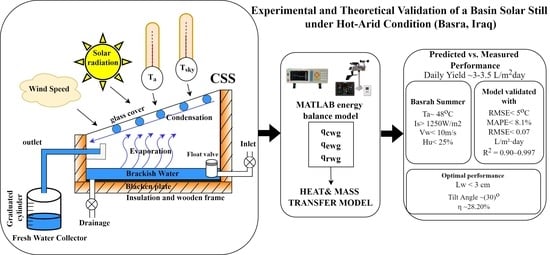
Figure 1. Schematic diagram of the conventional single-slope solar still (CSS), illustrating the main components and processes.
Sustainability 18 00479 g001
Figure 2. Photograph of the experimental single-slope solar still installed in Basrah, showing the wooden insulated frame, glass cover inclined at 30°, and temperature sensors fixed at selected locations for thermal performance monitoring.
Sustainability 18 00479 g002
Figure 3. Cross-sectional view of the solar still wall showing construction layers: galvanized steel basin liner, polyurethane foam insulation, and outer plywood casing.
Sustainability 18 00479 g003
Figure 4. Installed float valve inside the basin to maintain a constant water level during solar still operation.
Sustainability 18 00479 g004
Figure 5. Installed automatic weather station for measuring solar radiation, wind speed, and climatic parameters in Basrah/work location.
Sustainability 18 00479 g005
Figure 6. Multichannel data logger (32-channel) used for continuous recording of temperature and solar still parameters.
Sustainability 18 00479 g006
Figure 7. Experimental temperature variation in Tw, Tb, and Tg during daytime hours in Basrah.
Sustainability 18 00479 g007
Figure 8. Digital weather station console displays real-time ambient parameters (like temperature, humidity, wind, solar radiation, and pressure).
Sustainability 18 00479 g008
Figure 12. Diurnal variation in solar radiation and ambient temperature on 8 August 2025 in Basrah, as measured by the CURCONSA FT0300 weather station.
Sustainability 18 00479 g012
Figure 13. Graduated cylinder and camera recorded measurement of distillate yield in the experimental solar still setup.
Sustainability 18 00479 g013
Figure 14. Energy balance schematic of a single-slope solar still, showing incident solar radiation, absorption, reflection, and internal/external heat transfer mechanisms between basin water, liner, glass cover, and environment.
Sustainability 18 00479 g014
Figure 15. Theoretical simulation results of basin water (Tw,theo), basin liner (Tb,theo), and glass cover (Tg,theo) temperatures on 8 August 2025.
Sustainability 18 00479 g015
Figure 16. Experimental vs. theoretical basin water temperature (Tw) variation over 24 h on 8 August 2025, illustrating strong agreement with minor afternoon deviations.
Sustainability 18 00479 g016
Figure 17. Experimental vs. theoretical basin liner temperature (Tb) variation over 24 h on 8 August 2025, showing close correlation with small discrepancies due to unmodeled losses.
Sustainability 18 00479 g017
Figure 18. Experimental vs. theoretical glass cover temperature (Tg) variation over 24 h on 8 August 2025, confirming good model accuracy with slight underestimation in late hours.
Sustainability 18 00479 g018
Figure 19. Experimental and theoretical cumulative freshwater productivity (Pd) of the solar still on 8 August 2025 in Basrah.
Sustainability 18 00479 g019
Figure 20. Experimental and theoretical hourly freshwater yield of the solar still on 8 August 2025 in Basrah.
Sustainability 18 00479 g020
Figure 21. Relationship between experimental hourly freshwater productivity ( P h ) and the temperature difference between basin water and glass cover ( T w T g ) during daytime operation (07:00–17:00 h).
Sustainability 18 00479 g021
Figure 22. Variation in water mass production with solar radiation intensity under Basrah’s summer conditions.
Sustainability 18 00479 g022
Figure 23. Effect of basin water depth (Lw) on daily productivity (Pd) of the solar still in Basrah.
Sustainability 18 00479 g023
Figure 24. Predicted productivity of the solar still as a function of glass cover tilt angle, calibrated for Basrah on 8 August 2025.
Sustainability 18 00479 g024
Figure 25. Variation in water mass production with wind speed for the solar still under Basrah’s summer climate.
Sustainability 18 00479 g025
Table 1. Summary of major recent studies (2021–2025) employing novel enhancement techniques in various solar still configurations.
Author(s), Year Solar Still TypeNovel Technique/ModificationKey Performance Findings
Kaviti et al., 2023 [1]Double-slope SSCopper tubes + parabolic fins57.8% annual productivity improvement
Kaviti et al., 2021 [2]Stepped SSMagnets + micro charcoal loading104.5% yield increase; enhanced heat transfer
Ahmed et al., 2025 [3]Multiple geometries (pyramid, stepped, tubular)Comparative geometric modificationsModified hemispherical SS achieved 7.6 L/m2/day
El-Maghlany et al., 2025 [6]Conical, hemispherical, single-slope SSShape optimizationConical SS highest yield: 5.80 L/m2/day
Kaviti et al., 2025 [7]Tubular SS γ -Al2O3 nanocoating (5–15%)5% coating produced 2.571 L/m2; CPL = 0.10 USD/L
Ashok & Sakthivel, 2025 [8]Single-slope SSPCM integration; nano-PCM53–233% rise depending on PCM type
Hosseinifard et al., 2025 [4]Basin SSML-prediction optimization6.76 L/m2/day predicted for high-irradiation regions
Khalaf et al., 2025 [5]Single-slope SSVariable-property modeling + real climate data3–4 L/m2/day; validated transient model
Abu-Zeid et al., 2024 [9]CSSv-corrugated, reflecting mirror, solar collector and Al2O3 nanofluidsPd increased up to ∼104%
Hammoodi et al., 2023 [10]Pyramid SSWick materials + reflectors122% yield enhancement; thermal efficiency rise to 53% compared with 34.5% in CPSS
El-Gazar et al., 2024 [11]SS with nanofluidAl2O3–water-nanofluiddaily productivity 27.2% (summer), 21.7% (winter)
Murali et al., 2024 [12]Single-slope SSPCM and nano-PCMproductivity increased by 60.37% and efficiency by 68.29%
El-Gazar et al., 2021 [13]SS + PV panelnanofluid (Al2O3–CuO/water) + water preheating7.126 kg/m2·day, exergy efficiencies 60%
Jam et al., 2024 [14]Double-glazed SS, TEM coolingThermoelectric cooling + double-glazingproduction 570%, energy 137%, exergy 215%
Nasir et al., 2024 [15]Hybrid SS (PV/T + TEM)Thermoelectric coolingproductivity 672% improvement
Sahu and Tiwari, 2023 [16]Single-slope SShybrid Al2O3–SiO2 nanofluidsefficiency increased 20.63–30.27% (≈47% relative gain)
Zanganeh et al., 2020 [17]single-slope SSNanocoated condensation surface (Si or TiO2 nanoparticle coatings)20% increase in productivity due to improved condensation
Suraparaju and Natarajan, 2022 [18]Single-slope SSGlass-cover cooling using naturally available banana and jute fibersGlass temperature 23–28% and daily yield 2.23–3.18 L/m2 (≈43% gain)
Hameed, 2022 [19]Single-slope SSwater-spray cooling + square hollow finsFins alone gave 40% productivity gain; fins with cooling increased by 61.3%
Akkala & Kaviti, 2024 [20]Multiple SS configurations (single-slope, tubular)various fin geometries (circular, rectangular, square, pin-fins)productivity varies 0.58–7.5 kg/m2, thermal efficiency 57.69% for circular fins.
Kaviti et al., 2024 [21]Modified SS (parabolic-fin)Combined magnets + parabolic fins for enhanced heat absorption20% increase in yield; improved energy/exergy efficiency 30.49% and 8.85%
Table 2. Hourly variation in experimental temperatures recorded inside the solar still.
Time (h) T w , exp (°C) T b , exp (°C) T g , exp (°C)
036.536.534.8
136.336.634.6
235.936.534.0
335.434.933.6
434.134.532.4
532.932.732.2
633.132.832.8
733.835.535.8
835.136.737.4
944.645.547.0
1060.060.157.0
1171.373.265.9
1277.379.472.9
1379.081.974.4
1473.377.070.6
1572.074.068.1
1668.371.863.1
1760.562.253.9
1853.554.047.6
1948.048.243.0
2044.645.540.5
2143.043.238.0
2239.539.537.0
2337.037.035.4
Table 3. Specifications, accuracy, and sampling details of instruments used for thermal and productivity measurements in the solar still experiments.
QuantityInstrument/Channel RangeResolutionAccuracy
T w (Basin water temperature)ET3916 32 + Type K TC−50–200 °C0.1 °C±0.5 °C (post cal.)
T b (Basin liner temperature)ET3916 32 + Type K TC (3 pts)−50–200 °C0.1 °C±0.5 °C
T g (Glass temperature, in/out)ET3916 32 + Type K TC (3 pts)−50–200 °C0.1 °C±0.5 °C
T a (Ambient air temperature)CURCONSA FT0300 (thermistor)−40–70 °C0.1 °C±0.3 °C
G (Solar radiation)CURCONSA FT0300 (pyranometer)0–2000 W/m20.1 W/m2±5% of reading
V (Wind speed, avg.)CURCONSA FT0300 (anemometer)0.3–50 m/s0.1 m/s±0.2 m/s
Wind directionCURCONSA FT0300 (vane)0–360°±3°
R H (Relative humidity)CURCONSA FT0300 (capacitive)0–100%1%±3% RH
PressureCURCONSA FT0300 (barometer)540–1100 hPa0.1 hPa±1 hPa
Distillate volumeGraduated cylinder0–1000/5000 mL1 mL±1 mL
A b (Basin area, norm.)Steel ruler (1 m × 0.5 m)1 mm≈±0.3%
Table 4. Thermophysical property correlations of saline water implemented in the solar still model [37,38,39].
PropertyCorrelation/EquationVariablesValid Range
Latent heat of vaporization, L h (kJ/kg) L h ( T ) = 2499.57 2.2049 T 2.304 × 10 3 T 2 T: Temperature (°C)0–100 °C
Specific heat capacity of seawater, C p (kJ/kg·°C) C p ( T , S ) = a 0 + a 1 T + a 2 T 2 + a 3 T 3 + S ( b 0 + b 1 T + b 2 T 2 ) 1000 T: Temperature (°C), S: Salinity (g/kg)0–120 °C, 0–120 g/kg
Density of seawater,
ρ (kg/m3)
ρ = f ( T , S , P ) , based on the TEOS-10 equation of state (TEOS-10 libraries)T: Temperature (°C), S: Salinity (g/kg), P: Pressure (≈1 atm)0–100 °C, 0–70 g/kg
Table 5. Derived relative uncertainties of key measured quantities under Basrah operating conditions.
Quantity (Typical Value)Absolute UncertaintyRelative Uncertainty
T w 79   ° C (midday)±0.5 °C±0.63%
T b 82   ° C ±0.5 °C±0.61%
T g 74   ° C ±0.5 °C±0.68%
T a 48   ° C ±0.3 °C±0.63%
G 1240 W / m 2 ±5% of reading±5.0%
V w 3.0 m / s (avg)±0.2 m/s±6.7%
R H 20 % (midday)±3% RH±3 pp (absolute)
Pressure 1000 hPa ±1 hPa±0.1%
Distillate 600 mL / h (peak)±1 mL±0.17%
Basin area A b = 0.5 m 2 ±0.3%±0.3%
Table 6. Comparison of daily productivity of conventional basin-type solar stills under different climatic conditions reported in the literature and in the present study.
Region, TypeProductivity Range (L/m2·day)Climate and NotesNormalized Productivity (L/m2·MJ)
Basrah, Iraq, Present study3.1–3.5Hot arid summer, high solar radiation, low humidity0.121–0.141
Suez,Egypt, Exp [49]2.5–3.2Coastal arid desert, clear summer0.10–0.13
Kuwait, Exp [50]2.8–3.2Hot coastal desert, clear sky0.10–0.13
India, Exp [51]2.0–3.0Tropical–subtropical; monsoon affected climate0.095–0.14
Delhi, India, Exp [30]2.2–2.9Subtropical /semiarid climate, clear sky0.10–0.14
Delhi, India, Theo [30]4.4–5.3Subtropical/semiarid climate0.21–0.25
Muscat, Oman, Theo [52]3.5–4.0typical clear-sky daily0.14–0.18
Gauteng, South Africa, Exp [53]1.4–3.6Subtropical/semi-arid0.06–0.16
Cox’s Bazar, Bangladesh, Exp [54]0.95–1.06Coastal riverine-tropical monsoon0.05–0.06
Egypt, Theo [55]3.5–6.6Hot arid, clear sky0.14–0.27
Irbid, Jordan, Theo [56]2.6–4.2Eastern Mediterranean /semi-arid climate0.12–0.21
Tamil Nadu, India, Exp [57]4.0–5.0Tropical–semiarid coastal0.16–0.20
Disclaimer/Publisher’s Note: The statements, opinions and data contained in all publications are solely those of the individual author(s) and contributor(s) and not of MDPI and/or the editor(s). MDPI and/or the editor(s) disclaim responsibility for any injury to people or property resulting from any ideas, methods, instructions or products referred to in the content.