
Biosorption Potential of Ganoderma lucidum Biomass for Cd(II) Remediation: Adsorption Kinetics and Isotherm Studies

Abstract
1. Introduction
2. Materials and Methods
2.1. Chemicals
2.2. Structural and Nutritional Characterization of GLHP
2.3. Pretreatment of GLHP
2.4. Batch Adsorption Study
2.5. Fixed-Bed Column Adsorption Study
2.6. Percolation Adsorption Study
2.7. Determination of Cd by AAS
2.8. Determination of Heavy Metals in GLHP by ICP-MS
2.9. Adsorption Data Study
2.10. Adsorption Kinetics
2.11. Adsorption Isotherms
3. Results and Discussion
3.1. Determination of Heavy Metals in GLHP
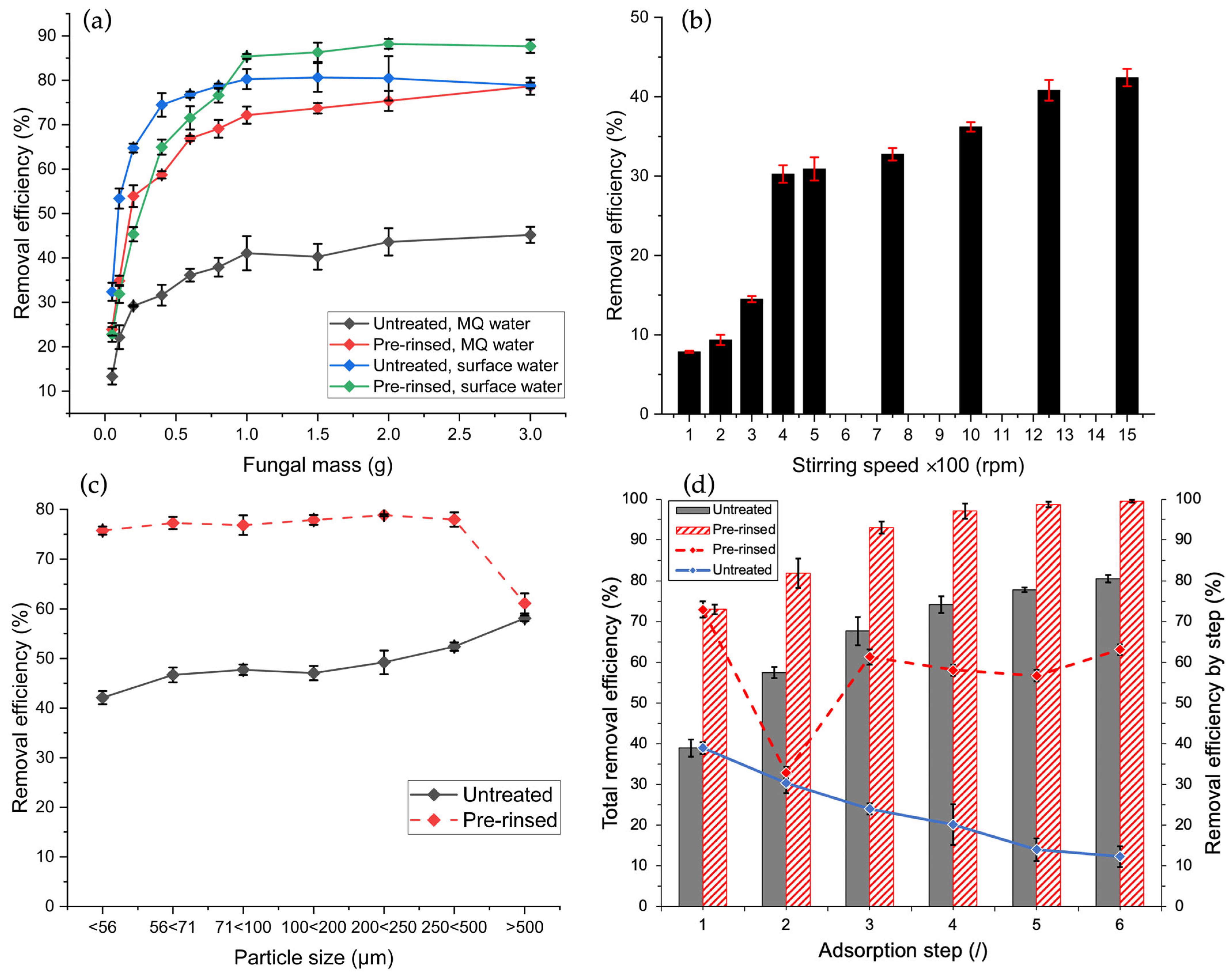
3.2. Batch Adsorption Study
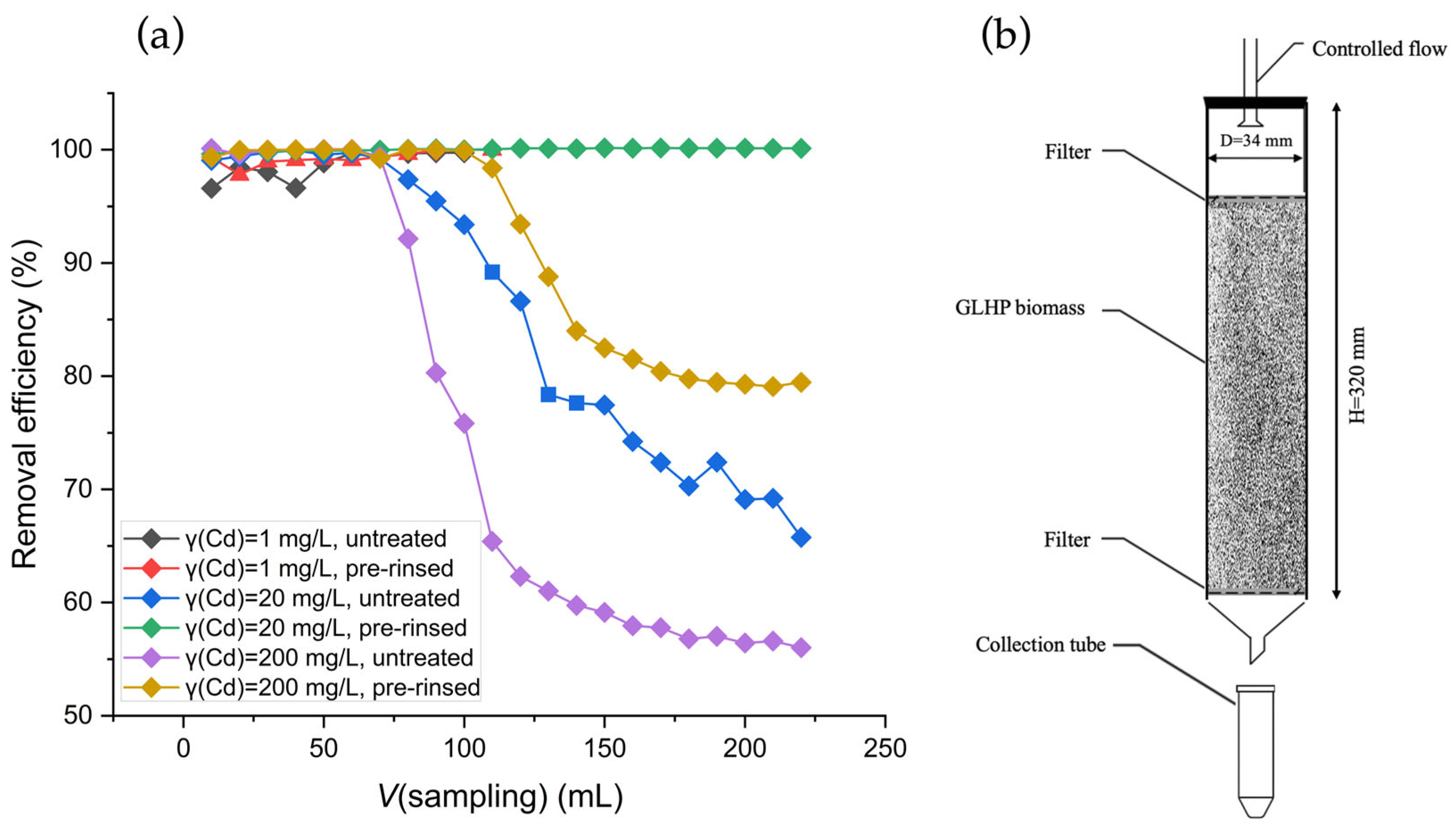
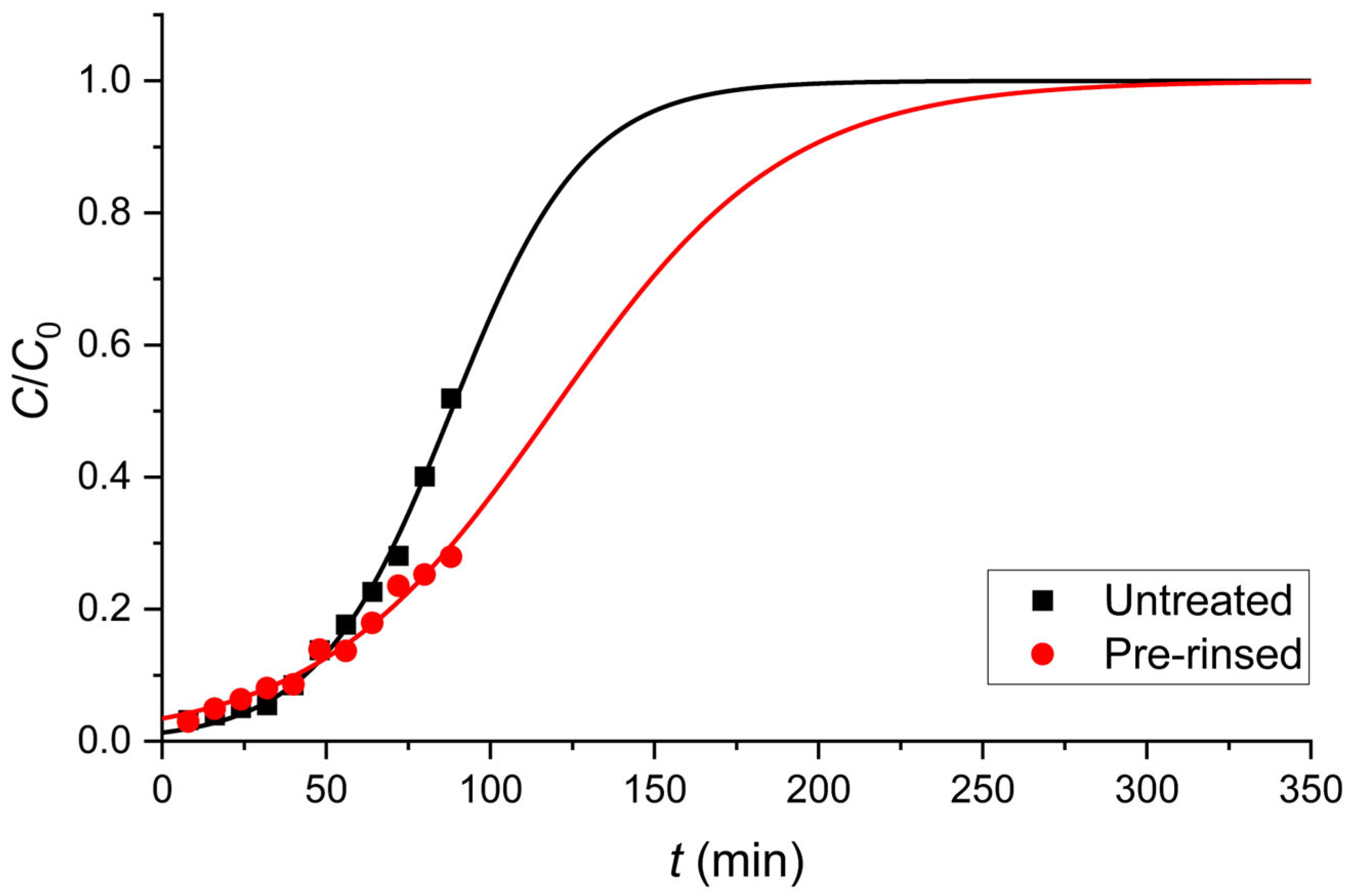
3.3. Fixed-Bed Column Adsorption
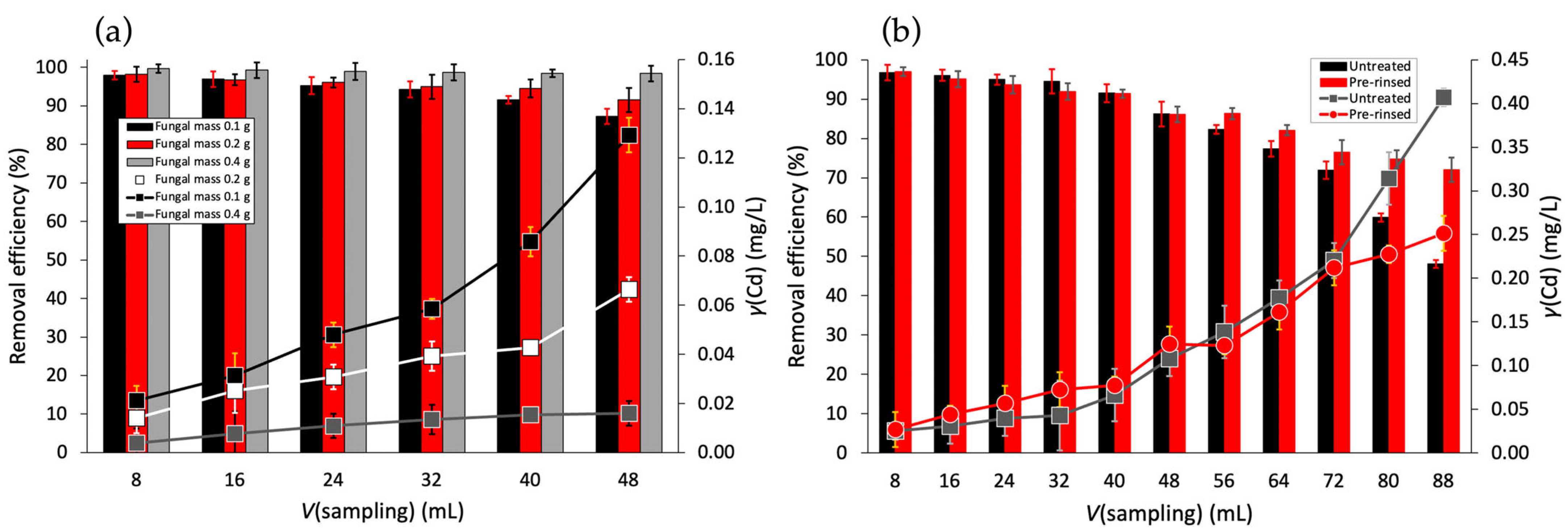
3.4. Percolation Adsorption Study
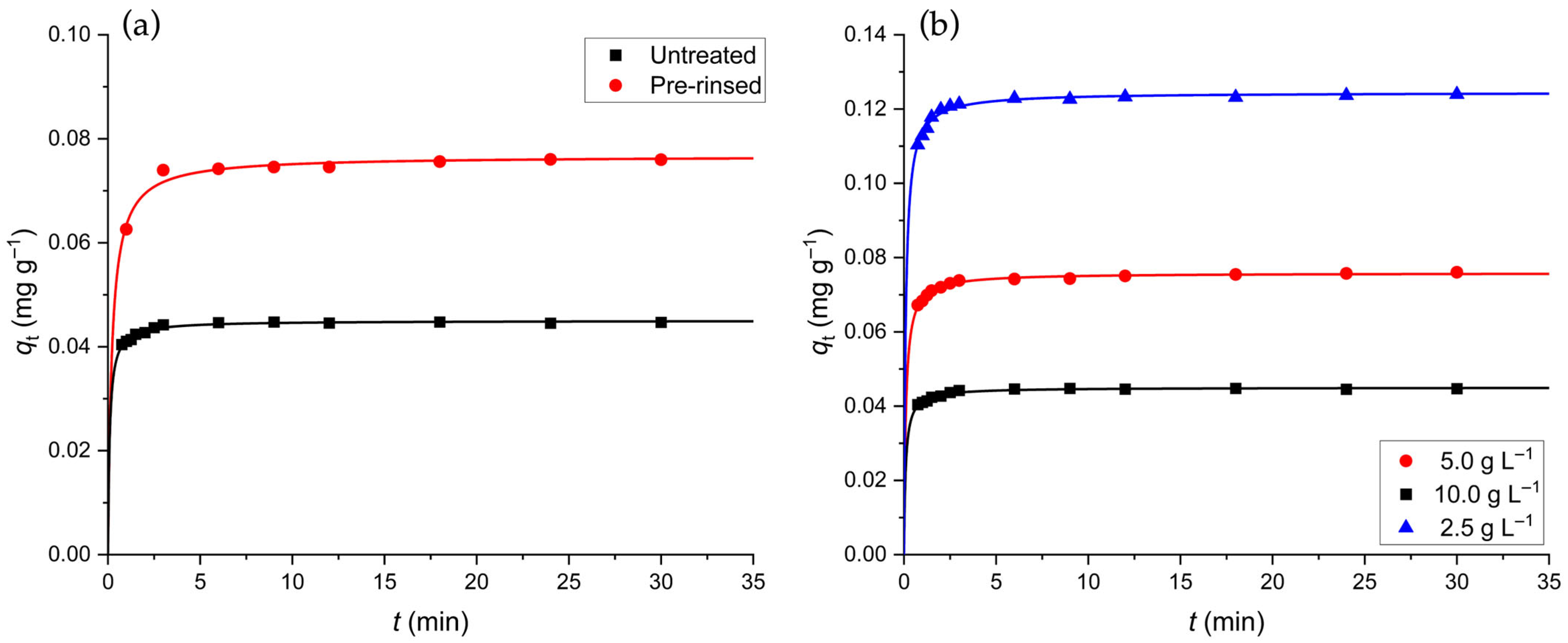
3.5. Adsorption Kinetics
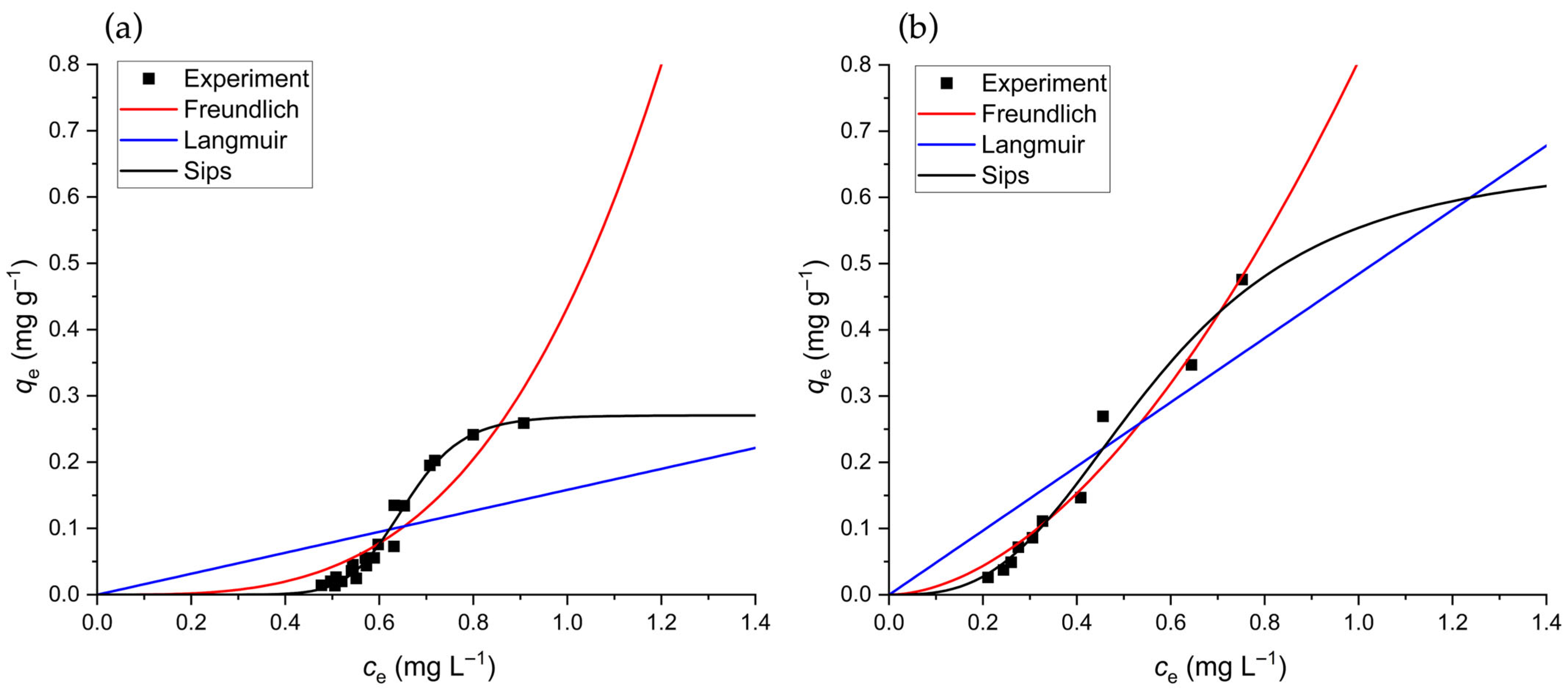
3.6. Adsorption Isotherms
4. Conclusions
Supplementary Materials
Author Contributions
Funding
Institutional Review Board Statement
Informed Consent Statement
Data Availability Statement
Acknowledgments
Conflicts of Interest
References
- Mishra, S.; Bharagava, R.N.; More, N.; Yadav, A.; Zainith, S.; Mani, S.; Chowdhary, P. Heavy metal contamination: An alarming threat to environment and human health. In Environmental Biotechnology: For Sustainable Future; Springer: Berlin/Heidelberg, Germany, 2018; pp. 103–125. [Google Scholar]
- Das, S.; Sultana, K.W.; Ndhlala, A.R.; Mondal, M.; Chandra, I. Heavy metal pollution in the environment and its impact on health: Exploring green technology for remediation. Environ. Health Insights 2023, 17, 11786302231201260. [Google Scholar] [CrossRef]
- Say, R.; Yilmaz, N.; Denizli, A. Removal of heavy metal ions using the fungus Penicillium canescens. Adsorpt. Sci. Technol. 2003, 21, 643–650. [Google Scholar] [CrossRef]
- Kapoor, A.; Viraraghavan, T. Fungal biosorption—An alternative treatment option for heavy metal bearing wastewaters: A review. Bioresour. Technol. 1995, 53, 195–206. [Google Scholar]
- Dhankhar, R.; Hooda, A. Fungal biosorption—An alternative to meet the challenges of heavy metal pollution in aqueous solutions. Environ. Technol. 2011, 32, 467–491. [Google Scholar] [CrossRef]
- Abd El-wahaab, B.; El-Shwiniy, W.H.; Alrowais, R.; Nasef, B.M.; Said, N. Adsorption of Lead (Pb(II)) from Contaminated Water onto Activated Carbon: Kinetics, Isotherms, Thermodynamics, and Modeling by Artificial Intelligence. Sustainability 2025, 17, 2131. [Google Scholar] [CrossRef]
- Burakov, A.E.; Galunin, E.V.; Burakova, I.V.; Kucherova, A.E.; Agarwal, S.; Tkachev, A.G.; Gupta, V.K. Adsorption of heavy metals on conventional and nanostructured materials for wastewater treatment purposes: A review. Ecotoxicol. Environ. Saf. 2018, 148, 702–712. [Google Scholar] [CrossRef]
- Xu, G.-R.; An, Z.-H.; Xu, K.; Liu, Q.; Das, R.; Zhao, H.-L. Metal organic framework (MOF)-based micro/nanoscaled materials for heavy metal ions removal: The cutting-edge study on designs, synthesis, and applications. Coord. Chem. Rev. 2021, 427, 213554. [Google Scholar] [CrossRef]
- Kowalik-Klimczak, A. Removal of Heavy Metals from Galvanic Industry Wastewater: A Review of Different Possible Methods. Sustainability 2025, 17, 8562. [Google Scholar] [CrossRef]
- Baldrian, P. Interactions of heavy metals with white-rot fungi. Enzyme Microb. Technol. 2003, 32, 78–91. [Google Scholar] [CrossRef]
- Bibbins-Martínez, M.; Juárez-Hernández, J.; López-Domínguez, J.Y.; Nava-Galicia, S.B.; Martínez-Tozcano, L.J.; Juárez-Atonaľ, R.; Cortés-Espinosa, D.; Díaz-Godinez, G. Potential application of fungal biosorption and/or bioaccumulation for the bioremediation of wastewater contamination: A review. J. Environ. Biol. 2023, 44, 135–145. [Google Scholar] [CrossRef]
- de Wet, M.M.; Brink, H.G. Lead Biosorption Characterisation of Aspergillus piperis. Sustainability 2021, 13, 13169. [Google Scholar] [CrossRef]
- Fomina, M.; Gadd, G.M. Biosorption: Current perspectives on concept, definition and application. Bioresour. Technol. 2014, 160, 3–14. [Google Scholar] [CrossRef]
- Karimi, K.; Shafiei, M.; Kumar, R. Progress in physical and chemical pretreatment of lignocellulosic biomass. In Biofuel Technologies: Recent Developments; Springer: Berlin, Germany, 2013; pp. 53–96. [Google Scholar]
- Javaid, A.; Bajwa, R.; Manzoor, T. Biosorption of heavy metals by pretreated biomass of Aspergillus niger. Pak. J. Bot. 2011, 43, 419–425. [Google Scholar]
- Akar, T.; Tunali, S. Biosorption characteristics of Aspergillus flavus biomass for removal of Pb (II) and Cu (II) ions from an aqueous solution. Bioresour. Technol. 2006, 97, 1780–1787. [Google Scholar] [CrossRef]
- Kapoor, A.; Viraraghavan, T. Biosorption of heavy metals on Aspergillus niger: Effect of pretreatment. Bioresour. Technol. 1998, 63, 109–113. [Google Scholar] [CrossRef]
- Pino, G.H.; De Mesquita, L.M.S.; Torem, M.L.; Pinto, G.A.S. Biosorption of cadmium by green coconut shell powder. Miner. Eng. 2006, 19, 380–387. [Google Scholar] [CrossRef]
- Kumar, M.; Puri, A. A review of permissible limits of drinking water. Indian J. Occup. Environ. Med. 2012, 16, 40–44. [Google Scholar] [CrossRef] [PubMed]
- Satarug, S.; Garrett, S.H.; Sens, M.A.; Sens, D.A. Cadmium, environmental exposure, and health outcomes. Cien. Saude Colet. 2011, 16, 2587–2602. [Google Scholar] [CrossRef] [PubMed]
- Kubier, A.; Wilkin, R.T.; Pichler, T. Cadmium in soils and groundwater: A review. Appl. Geochem. 2019, 108, 104388. [Google Scholar] [CrossRef]
- Gao, Y.; Zhou, S.; Jiang, W.; Huang, M.; Dai, X. Effects of Ganopoly® (A ganoderma lucidum polysaccharide extract) on the immune functions in Advanced-Stage cancer patients. Immunol. Investig. 2003, 32, 201–215. [Google Scholar] [CrossRef]
- Xu, Y.; Zhang, X.; Yan, X.-H.; Zhang, J.-L.; Wang, L.-Y.; Xue, H.; Jiang, G.-C.; Ma, X.-T.; Liu, X.-J. Characterization, hypolipidemic and antioxidant activities of degraded polysaccharides from Ganoderma lucidum. Int. J. Biol. Macromol. 2019, 135, 706–716. [Google Scholar] [CrossRef]
- Chen, L.; Wang, X.; Sun, J.; Xue, J.; Yang, X.; Zhang, Y. Structural characteristics of a heteropolysaccharide from Ganoderma lucidum and its protective effect against Alzheimer’s disease via modulating the microbiota-gut-metabolomics. Int. J. Biol. Macromol. 2025, 297, 139863. [Google Scholar] [CrossRef]
- Lu, J.; He, R.; Sun, P.; Zhang, F.; Linhardt, R.J.; Zhang, A. Molecular mechanisms of bioactive polysaccharides from Ganoderma lucidum (Lingzhi), a review. Int. J. Biol. Macromol. 2020, 150, 765–774. [Google Scholar] [CrossRef]
- Bernard, A. Cadmium & its adverse effects on human health. Indian J. Med. Res. 2008, 128, 557–564. [Google Scholar]
- Jelen, Ž.; Svetec, M.; Majerič, P.; Kapun, S.; Resman, L.; Čeh, T.; Hajra, G.; Rudolf, R. Contaminants in the Soil and Typical Crops of the Pannonian Region of Slovenia. Sustainability 2024, 16, 8678. [Google Scholar] [CrossRef]
- Gluhar, S.; Jez, E.; Lestan, D. The use of zero-valent Fe for curbing toxic emissions after EDTA-based washing of Pb, Zn and Cd contaminated calcareous and acidic soil. Chemosphere 2019, 215, 482–489. [Google Scholar] [CrossRef] [PubMed]
- Bizjak, M.Č.; Pražnikar, Z.J.; Kenig, S.; Hladnik, M.; Bandelj, D.; Gregori, A.; Kranjc, K. Effect of erinacine A-enriched Hericium erinaceus supplementation on cognition: A randomized, double-blind, placebo-controlled pilot study. J. Funct. Foods 2024, 115, 106120. [Google Scholar] [CrossRef]
- Tan, K.L.; Hameed, B.H. Insight into the adsorption kinetics models for the removal of contaminants from aqueous solutions. J. Taiwan Inst. Chem. Eng. 2017, 74, 25–48. [Google Scholar] [CrossRef]
- Keberle, H. The biochemistry of desferrioxamine and its relation to iron metabolism. Ann. N. Y. Acad. Sci. 1964, 119, 758–768. [Google Scholar] [CrossRef] [PubMed]
- Ho, Y.-S.; McKay, G. Pseudo-second order model for sorption processes. Process Biochem. 1999, 34, 451–465. [Google Scholar] [CrossRef]
- Plazinski, W.; Rudzinski, W.; Plazinska, A. Theoretical models of sorption kinetics including a surface reaction mechanism: A review. Adv. Colloid Interface Sci. 2009, 152, 2–13. [Google Scholar] [CrossRef]
- Bullen, J.C.; Saleesongsom, S.; Gallagher, K.; Weiss, D.J. A revised pseudo-second-order kinetic model for adsorption, sensitive to changes in adsorbate and adsorbent concentrations. Langmuir 2021, 37, 3189–3201. [Google Scholar] [CrossRef] [PubMed]
- Revellame, E.D.; Fortela, D.L.; Sharp, W.; Hernandez, R.; Zappi, M.E. Adsorption kinetic modeling using pseudo-first order and pseudo-second order rate laws: A review. Clean. Eng. Technol. 2020, 1, 100032. [Google Scholar] [CrossRef]
- Dal, M.C.; Onursal, N. Two new linearized equations derived from the pseudo-second-order kinetic model. Desalin. Water Treat. 2023, 308, 183–189. [Google Scholar] [CrossRef]
- Tran, H.N. Applying linear forms of pseudo-second-order kinetic model for feasibly identifying errors in the initial periods of time-dependent adsorption datasets. Water 2023, 15, 1231. [Google Scholar] [CrossRef]
- Eaton, J.W.; Bateman, D.; Hauberg, S. GNU Octave Version 4.2.1 Manual: A High-Level Interactive Language for Numerical Computations. 2017. Available online: https://docs.octave.org/octave-4.2.0.pdf (accessed on 11 November 2025).
- Foo, K.Y.; Hameed, B.H. Insights into the modeling of adsorption isotherm systems. Chem. Eng. J. 2010, 156, 2–10. [Google Scholar] [CrossRef]
- Freundlich, H. Über die adsorption in lösungen. Z. Phys. Chem. 1907, 57, 385–470. [Google Scholar] [CrossRef]
- Langmuir, I. The constitution and fundamental properties of solids and liquids. Part I. Solids. J. Am. Chem. Soc. 1916, 11, 2221–2295. [Google Scholar] [CrossRef]
- Keren, Y.; Borisover, M.; Bukhanovsky, N. Sorption interactions of organic compounds with soils affected by agricultural olive mill wastewater. Chemosphere 2015, 138, 462–468. [Google Scholar] [CrossRef]
- Sohn, S.; Kim, D. Modification of Langmuir isotherm in solution systems—Definition and utilization of concentration dependent factor. Chemosphere 2005, 58, 115–123. [Google Scholar] [CrossRef]
- Azizian, S.; Eris, S. Adsorption isotherms and kinetics. In Interface Science and Technology; Elsevier: Amsterdam, The Netherlands, 2021; Volume 33, pp. 445–509. ISBN 1573-4285. [Google Scholar]
- Azizian, S.; Eris, S.; Wilson, L.D. Re-evaluation of the century-old Langmuir isotherm for modeling adsorption phenomena in solution. Chem. Phys. 2018, 513, 99–104. [Google Scholar] [CrossRef]
- Chen, S.; Yue, Q.; Gao, B.; Li, Q.; Xu, X.; Fu, K. Adsorption of hexavalent chromium from aqueous solution by modified corn stalk: A fixed-bed column study. Bioresour. Technol. 2012, 113, 114–120. [Google Scholar] [CrossRef]
- Amin, F.; Talpur, F.N.; Balouch, A.; Afridi, H.I.; Khaskheli, A.A. Efficient entrapping of toxic Pb (II) ions from aqueous system on a fixed-bed column of fungal biosorbent. Geol. Ecol. Landsc. 2018, 2, 39–44. [Google Scholar] [CrossRef]
- Makrigianni, V.; Giannakas, A.; Hela, D.; Papadaki, M.; Konstantinou, I. Adsorption of methylene blue dye by pyrolytic tire char in fixed-bed column. Desalin. Water Treat. 2017, 65, 346–358. [Google Scholar] [CrossRef]
- González-López, M.E.; Laureano-Anzaldo, C.M.; Pérez-Fonseca, A.A.; Arellano, M.; Robledo-Ortíz, J.R. A discussion on linear and non-linear forms of Thomas equation for fixed-bed adsorption column modeling. Rev. Mex. Ing. Quím. 2021, 20, 875–884. [Google Scholar] [CrossRef]
- Guo, X.; Wang, J. Comparison of linearization methods for modeling the Langmuir adsorption isotherm. J. Mol. Liq. 2019, 296, 111850. [Google Scholar] [CrossRef]
- Yan, F.; Chu, Y.; Zhang, K.; Zhang, F.; Bhandari, N.; Ruan, G.; Dai, Z.; Liu, Y.; Zhang, Z.; Kan, A.T. Determination of adsorption isotherm parameters with correlated errors by measurement error models. Chem. Eng. J. 2015, 281, 921–930. [Google Scholar] [CrossRef]
- Sharif, S.; Mustafa, G.; Munir, H.; Weaver, C.M.; Jamil, Y.; Shahid, M. Proximate composition and micronutrient mineral profile of wild Ganoderma lucidum and four commercial exotic mushrooms by ICP-OES and LIBS. J. Food Nutr. Res 2016, 4, 703–708. [Google Scholar]
- Tham, L.X.; Matsuhashi, S.; Kume, T. Responses of Ganoderma lucidum to heavy metals. Mycoscience 1999, 40, 209–213. [Google Scholar] [CrossRef]
- Hussien, Z.G. Chemical content study in Ganoderma lucidum commercial products. System 2022, 1, 2. [Google Scholar] [CrossRef]
- Deng, L.-Z.; Mujumdar, A.S.; Zhang, Q.; Yang, X.-H.; Wang, J.; Zheng, Z.-A.; Gao, Z.-J.; Xiao, H.-W. Chemical and physical pretreatments of fruits and vegetables: Effects on drying characteristics and quality attributes–a comprehensive review. Crit. Rev. Food Sci. Nutr. 2019, 59, 1408–1432. [Google Scholar] [CrossRef]
- Osman, A.I.; El-Monaem, E.M.A.; Elgarahy, A.M.; Aniagor, C.O.; Hosny, M.; Farghali, M.; Rashad, E.; Ejimofor, M.I.; Lopez-Maldonado, E.A.; Ihara, I. Methods to prepare biosorbents and magnetic sorbents for water treatment: A review. Environ. Chem. Lett. 2023, 21, 2337–2398. [Google Scholar] [CrossRef]
- Song, W.; Xu, J.; Gao, L.; Zhang, Q.; Tong, J.; Ren, L. Preparation of freeze-dried porous chitosan microspheres for the removal of hexavalent chromium. Appl. Sci. 2021, 11, 4217. [Google Scholar] [CrossRef]
- Hubbard, B.R.; Putman, L.I.; Techtmann, S.; Pearce, J.M. Open source vacuum oven design for low-temperature drying: Performance evaluation for recycled PET and biomass. J. Manuf. Mater. Process. 2021, 5, 52. [Google Scholar] [CrossRef]
- Huang, C.P.; Westman, D.; Quirk, K.; Huang, J.P. The removal of cadmium (II) from dilute aqueous solutions by fungal adsorbent. Water Sci. Technol. 1988, 20, 369–376. [Google Scholar] [CrossRef]
- Gutiérrez, M.; Verlicchi, P.; Mutavdžić Pavlović, D. Study of the influence of the wastewater matrix in the adsorption of three pharmaceuticals by powdered activated carbon. Molecules 2023, 28, 2098. [Google Scholar] [CrossRef] [PubMed]
- Guillossou, R.; Le Roux, J.; Mailler, R.; Pereira-Derome, C.S.; Varrault, G.; Bressy, A.; Vulliet, E.; Morlay, C.; Nauleau, F.; Rocher, V. Influence of dissolved organic matter on the removal of 12 organic micropollutants from wastewater effluent by powdered activated carbon adsorption. Water Res. 2020, 172, 115487. [Google Scholar] [CrossRef]
- Wang, Y.; Li, J.; Xu, L.; Xu, Q.; Wu, D.; Ai, Y.; Li, D.; Liu, W.; Qu, J.; Wang, L. The effect and spectral response mechanism of dissolved organic matter (DOM) in Pb (II) adsorption onto biochar. J. Environ. Chem. Eng. 2023, 11, 111115. [Google Scholar] [CrossRef]
- Jebri, S.; Jaouadi, M.; Khattech, I. Precipitation of cadmium in water by the addition of phosphate solutions prepared from digested samples of waste animal bones. Desalin. Water Treat. 2021, 217, 253–261. [Google Scholar] [CrossRef]
- Klun, B.; Starin, M.; Novak, J.; Putar, U.; Korošin, N.Č.; Binda, G.; Kalčíková, G. Biofilm formation on polyethylene and polylactic acid microplastics in freshwater: Influence of environmental factors. J. Environ. Chem. Eng. 2025, 13, 118689. [Google Scholar] [CrossRef]
- Cerar, S.; Urbanc, J. Carbonate chemistry and isotope characteristics of groundwater of Ljubljansko Polje and Ljubljansko Barje aquifers in Slovenia. Sci. World J. 2013, 2013, 948394. [Google Scholar] [CrossRef]
- Li, X.; Zhang, Q.; Yang, B. Co-precipitation with CaCO3 to remove heavy metals and significantly reduce the moisture content of filter residue. Chemosphere 2020, 239, 124660. [Google Scholar] [CrossRef]
- Zhao, W.; Xu, Y.; Gu, L.; Zhu, M.; Yang, P.; Gu, C.; Liu, Z.; Feng, X.; Tan, W.; Huang, Q. Elucidating Phosphate and Cadmium Cosorption Mechanisms on Mineral Surfaces with Direct Spectroscopic and Modeling Evidence. Environ. Sci. Technol. 2024, 58, 20211–20223. [Google Scholar] [CrossRef] [PubMed]
- AjayKumar, A.V.; Darwish, N.A.; Hilal, N. Study of various parameters in the biosorption of heavy metals on activated sludge. World Appl. Sci. J. 2009, 5, 32–40. [Google Scholar]
- Al-Ghouti, M.A.; Al-Absi, R.S. Mechanistic understanding of the adsorption and thermodynamic aspects of cationic methylene blue dye onto cellulosic olive stones biomass from wastewater. Sci. Rep. 2020, 10, 15928. [Google Scholar] [CrossRef] [PubMed]
- Rozman, U.; Kalčíková, G.; Marolt, G.; Skalar, T.; Gotvajn, A.Ž. Potential of waste fungal biomass for lead and cadmium removal: Characterization, biosorption kinetic and isotherm studies. Environ. Technol. Innov. 2020, 18, 100742. [Google Scholar] [CrossRef]
- Ho, Y.-S. Second-order kinetic model for the sorption of cadmium onto tree fern: A comparison of linear and non-linear methods. Water Res. 2006, 40, 119–125. [Google Scholar] [CrossRef]
- Simić, M.; Petrović, J.; Šoštarić, T.; Ercegović, M.; Milojković, J.; Lopičić, Z.; Kojić, M. A mechanism assessment and differences of cadmium adsorption on raw and alkali-modified agricultural waste. Processes 2022, 10, 1957. [Google Scholar] [CrossRef]
- Musah, M.; Azeh, Y.; Mathew, J.; Umar, M.; Abdulhamid, Z.; Muhammad, A. Adsorption kinetics and isotherm models: A review. Caliphate J. Sci. Technol. 2022, 4, 20–26. [Google Scholar] [CrossRef]
- Wang, J.; Guo, X. Adsorption isotherm models: Classification, physical meaning, application and solving method. Chemosphere 2020, 258, 127279. [Google Scholar] [CrossRef]
- Patel, H. Comparison of batch and fixed bed column adsorption: A critical review. Int. J. Environ. Sci. Technol. 2022, 19, 10409–10426. [Google Scholar] [CrossRef]
- Desta, M.B. Batch sorption experiments: Langmuir and Freundlich isotherm studies for the adsorption of textile metal ions onto teff straw (Eragrostis tef) agricultural waste. J. Thermodyn. 2013, 2013, 375830. [Google Scholar] [CrossRef]
- Febrianto, J.; Kosasih, A.N.; Sunarso, J.; Ju, Y.-H.; Indraswati, N.; Ismadji, S. Equilibrium and kinetic studies in adsorption of heavy metals using biosorbent: A summary of recent studies. J. Hazard. Mater. 2009, 162, 616–645. [Google Scholar] [CrossRef]
- Chen, X.; Hossain, M.F.; Duan, C.; Lu, J.; Tsang, Y.F.; Islam, M.S.; Zhou, Y. Isotherm models for adsorption of heavy metals from water-A review. Chemosphere 2022, 307, 135545. [Google Scholar] [CrossRef] [PubMed]
- de Vargas Brião, G.; Hashim, M.A.; Chu, K.H. The Sips isotherm equation: Often used and sometimes misused. Sep. Sci. Technol. 2023, 58, 884–892. [Google Scholar] [CrossRef]
- Al-Ghouti, M.A.; Da’ana, D.A. Guidelines for the use and interpretation of adsorption isotherm models: A review. J. Hazard. Mater. 2020, 393, 122383. [Google Scholar] [CrossRef]
- Omitola, O.B.; Abonyi, M.N.; Akpomie, K.G.; Dawodu, F.A. Adams-Bohart, Yoon-Nelson, and Thomas modeling of the fix-bed continuous column adsorption of amoxicillin onto silver nanoparticle-maize leaf composite. Appl. Water Sci. 2022, 12, 94. [Google Scholar] [CrossRef]
- Sankararamakrishnan, N.; Kumar, P.; Chauhan, V.S. Modeling fixed bed column for cadmium removal from electroplating wastewater. Sep. Purif. Technol. 2008, 63, 213–219. [Google Scholar] [CrossRef]
- Sharma, K.R.; Giri, R.; Sharma, R.K. Lead, cadmium and nickel removal efficiency of white-rot fungus Phlebia brevispora. Lett. Appl. Microbiol. 2020, 71, 637–644. [Google Scholar] [CrossRef]
- Moreno Rivas, S.C.; Armenta Corral, R.I.; Frasquillo Félix, M.d.C.; Islas Rubio, A.R.; Vazquez Moreno, L.; Ramos-Clamont Montfort, G. Removal of cadmium from aqueous solutions by Saccharomyces cerevisiae–alginate system. Materials 2019, 12, 4128. [Google Scholar] [CrossRef]
- Abdul-Talib, S.; Tay, C.C.; Abdullah-Suhaimi, A.; Liew, H.H. Fungal Pleurotus ostreatus biosorbent for cadmium (II) removal in industrial wastewater. J. Life Sci. Technol. 2013, 1, 65–68. [Google Scholar] [CrossRef]
- Khamesy, S.J.; Hamidian, A.H.; Atghia, O. Identification of the fungi absorbing heavy metals isolated from waste deposits of zinc factories. Mycol. Iran. 2016, 3, 65–73. [Google Scholar]
- Waqar, R.; Kaleem, M.; Iqbal, J.; Minhas, L.A.; Haris, M.; Chalgham, W.; Ahmad, A.; Mumtaz, A.S. Kinetic and equilibrium studies on the adsorption of lead and cadmium from aqueous solution using Scenedesmus sp. Sustainability 2023, 15, 6024. [Google Scholar] [CrossRef]
- Lekshmi, R.; Rejiniemon, T.S.; Sathya, R.; Kuppusamy, P.; Al-Mekhlafi, F.A.; Wadaan, M.A.; Rajendran, P. Adsorption of heavy metals from the aqueous solution using activated biomass from Ulva flexuosa. Chemosphere 2022, 306, 135479. [Google Scholar] [CrossRef]
- Shokoohi, R.; Salari, M.; Molla Mahmoudi, M.; Azizi, S.; Ghiasian, S.A.; Faradmal, J.; Faraji, H. The sorption of cationic and anionic heavy metal species on the biosorbent of Aspergillus terreus: Isotherm, kinetics studies. Environ. Prog. Sustain. Energy 2020, 39, e13309. [Google Scholar] [CrossRef]
- Lu, N.; Hu, T.; Zhai, Y.; Qin, H.; Aliyeva, J.; Zhang, H. Fungal cell with artificial metal container for heavy metals biosorption: Equilibrium, kinetics study and mechanisms analysis. Environ. Res. 2020, 182, 109061. [Google Scholar] [CrossRef]
- Isawi, H. Using zeolite/polyvinyl alcohol/sodium alginate nanocomposite beads for removal of some heavy metals from wastewater. Arab. J. Chem. 2020, 13, 5691–5716. [Google Scholar] [CrossRef]
- Pournara, A.D.; Margariti, A.; Tarlas, G.D.; Kourtelaris, A.; Petkov, V.; Kokkinos, C.; Economou, A.; Papaefstathiou, G.S.; Manos, M.J. A Ca2+ MOF combining highly efficient sorption and capability for voltammetric determination of heavy metal ions in aqueous media. J. Mater. Chem. A 2019, 7, 15432–15443. [Google Scholar] [CrossRef]
- Wu, J.; Wang, T.; Zhang, Y.; Pan, W.-P. The distribution of Pb (II)/Cd (II) adsorption mechanisms on biochars from aqueous solution: Considering the increased oxygen functional groups by HCl treatment. Bioresour. Technol. 2019, 291, 121859. [Google Scholar] [CrossRef] [PubMed]



| Element | w (µg g−1) | RSD (%) | Element | w (µg g−1) | RSD (%) |
|---|---|---|---|---|---|
| Ca | 13,900 | 1.74 | Mo | 0.374 | 1.35 |
| P | 5080 | 0.36 | Ba | 0.183 | 1.08 |
| K | 3730 | 0.72 | Co | 0.111 | 1.57 |
| Mg | 2470 | 0.61 | Ga | 0.099 | 2.48 |
| Fe | 115 | 0.48 | Sn | 0.065 | 1.38 |
| Na | 72.2 | 0.91 | V | 0.062 | 2.86 |
| Zn | 48.1 | 0.35 | Cd | 0.038 | 5.71 |
| Al | 30.6 | 0.80 | Li | 0.034 | 3.48 |
| Mn | 20.4 | 0.23 | As | 0.021 | 4.14 |
| Cu | 13.1 | 0.40 | Sb | 0.008 | 1.05 |
| Sr | 10.8 | 0.50 | Cs | 0.008 | 6.65 |
| Ni | 4.40 | 0.56 | Be | <LOQ | / |
| Cr | 3.75 | 0.36 | Te | <LOQ | / |
| Ti | 1.89 | 3.66 | Se | <LOQ | / |
| Rb | 1.60 | 0.92 |
| Pretreatment Method | Cd(II) Removal Efficiency (%) |
|---|---|
| Untreated GLHP (control) | 41.1 |
| Drying (40 °C) | 41.5 |
| Drying (120 °C) | 44.3 |
| Vacuum, freeze-drying | 44.5 |
| Freeze-drying | 50.3 |
| Pseudo-First-Order (PFO) Kinetics | ||||
| (mg g−1) | (min−1) | |||
| Untreated | 0.0441 ± 0.0003 | 2.9 ± 0.2 | 0.6883 | 2.2 × 10⁻⁴ |
| Pre-rinsed | 0.0750 ± 0.0003 | 1.79 ± 0.07 | 0.9724 | 5.1 × 10⁻⁵ |
| Pseudo-Second-Order (PSO) Kinetics | ||||
| qe (mg g−1) | (g mg−1 min−1) | |||
| Untreated | 0.0450 ± 0.0001 | 10.8 ± 0.7 | 0.9619 | 2.7 × 10⁻⁵ |
| Pre-rinsed | 0.0766 ± 0.0005 | 4.8 ± 0.5 | 0.9515 | 9.5 × 10⁻⁵ |
| Revised Pseudo-Second-Order (rPSO) Kinetics | ||||
| qe (mg g−1) | (L g−1 min−1) | |||
| Untreated | 0.0451 ± 0.0002 | 0.7 ± 0.1 | 0.9575 | 3.0 × 10⁻⁵ |
| Pre-rinsed | 0.0757 ± 0.0003 | 3.7 ± 0.5 | 0.9881 | 2.2 × 10⁻⁵ |
| Sips Isotherm | |||||
| (mg g−1) | (L mg−1) | ||||
| Untreated | 0.27 ± 0.01 | 10.7 ± 0.9 | 1.53 ± 0.02 | 0.9770 | 0.046 |
| Pre-rinsed | 0.7 ± 0.2 | 3.0 ± 0.7 | 1.7 ± 0.4 | 0.9740 | 0.026 |
| Thomas Model | |||||
| q0 (mg g−1) | (L mg−1 min−1) | ||||
| Untreated | 0.345 ± 0.004 | 0.063 ± 0.003 | 0.9919 | 0.018 | |
| Pre-rinsed | 0.53 ± 0.01 | 0.031 ± 0.002 | 0.9786 | 0.012 | |
| (Bio)sorbent | Removal Efficiency/ Sorption Capacity | c(Cd(II)) [mg/L] | (Bio)sorbent Amount | pH | Adsorption Time | Reference |
|---|---|---|---|---|---|---|
| Ganoderma lucidum (pre-rinsed) | 85.4%/0.53 mg g−1 | 1.0 | 2.0 g | 5 | 6 min | This work |
| Phlebia brevispora | 91.6% | 23.6 | 6.7 g | 6 | 168 h | [83] |
| Saccharomyces cerevisiae | 83% | 10 | 1.5 g | 6 | 60 min | [84] |
| Pleurotus ostreatus | 85% | 10 | 0.5 g | 6 | 10 min | [85] |
| Aspergillus fumigatus | 37.6%/0.28 mg g−1 | 10 | 0.04 mg | 5 | 480 min | [86] |
| Scenedesmus sp. | 83% | 100 | 1.0 g | 7 | 60 min | [87] |
| Ulva flexuosa | 94.8% | 40 | 0.4 g | 4 | 30 min | [88] |
| Aspergillus terreus | 94% | 20 | 1.0 g | 7 | 90 min | [89] |
| Phanerochaete chrysosporium | 96% | 50 | 4 g | 7 | 240 min | [90] |
| Zeolite/polyvinyl alcohol/sodium alginate nanocomposite beads | 99.2% | 25 | 20 g L−1 | 6 | 120 min | [91] |
| Ca-MOF | 220 mg g−1 | 1.0 | 50 mg | 7 | 2 min | [92] |
| Biochar | 75.8% | 150 | 20 mg | 6 | 24 h | [93] |
Disclaimer/Publisher’s Note: The statements, opinions and data contained in all publications are solely those of the individual author(s) and contributor(s) and not of MDPI and/or the editor(s). MDPI and/or the editor(s) disclaim responsibility for any injury to people or property resulting from any ideas, methods, instructions or products referred to in the content. |
© 2026 by the authors. Licensee MDPI, Basel, Switzerland. This article is an open access article distributed under the terms and conditions of the Creative Commons Attribution (CC BY) license.
Share and Cite
Kralj, T.; Gregori, A.; Lukšič, M.; Marolt, G. Biosorption Potential of Ganoderma lucidum Biomass for Cd(II) Remediation: Adsorption Kinetics and Isotherm Studies. Sustainability 2026, 18, 448. https://doi.org/10.3390/su18010448
Kralj T, Gregori A, Lukšič M, Marolt G. Biosorption Potential of Ganoderma lucidum Biomass for Cd(II) Remediation: Adsorption Kinetics and Isotherm Studies. Sustainability. 2026; 18(1):448. https://doi.org/10.3390/su18010448
Chicago/Turabian StyleKralj, Tia, Andrej Gregori, Miha Lukšič, and Gregor Marolt. 2026. "Biosorption Potential of Ganoderma lucidum Biomass for Cd(II) Remediation: Adsorption Kinetics and Isotherm Studies" Sustainability 18, no. 1: 448. https://doi.org/10.3390/su18010448
APA StyleKralj, T., Gregori, A., Lukšič, M., & Marolt, G. (2026). Biosorption Potential of Ganoderma lucidum Biomass for Cd(II) Remediation: Adsorption Kinetics and Isotherm Studies. Sustainability, 18(1), 448. https://doi.org/10.3390/su18010448