Article

Interactive Stress and Synergistic Response of Ecological Security and Environmental Carrying Capacity in the Yangtze River Delta Urban Agglomeration

College of Geographic Science and Tourism, Jilin Normal University, Siping 136000, China
*
Author to whom correspondence should be addressed.
Sustainability 2026, 18(1), 443; https://doi.org/10.3390/su18010443 (registering DOI)
Submission received: 1 December 2025 / Revised: 20 December 2025 / Accepted: 26 December 2025 / Published: 2 January 2026

Abstract

Against the backdrop of national policies promoting coordinated regional development and ecological civilization construction, the contradiction between ecological security and environmental carrying capacity in the Yangtze River Delta urban agglomeration has become increasingly prominent. However, the interaction mechanisms between these two systems remain insufficiently explored. This study constructs a comprehensive evaluation indicator system for ecological security and environmental carrying capacity in the Yangtze River Delta. A double exponential function is employed to examine the intensity of interaction pressure and reveal their nonlinear relationship. The coupling coordination model is applied to assess coordinated development trends, while a vector autoregression (VAR) model is used to identify the dynamic response relationships among system variables. The results indicate that the overall levels of both systems have improved, with core areas maintaining a leading position and southeastern, northeastern, and western regions remaining in a catching-up stage, accompanied by low-level convergence. Regional coordination exhibits a positive temporal evolution from imbalance to coordination, while its spatial pattern evolves from core dominance toward multi-regional convergence. Significant regional heterogeneity is observed in shock responses, with peripheral cities facing stronger industrial restructuring pressures showing greater ecological volatility. Overall, the dynamic interaction between ecological security and environmental carrying capacity demonstrates a stage-specific transition from mutual constraint to mutual promotion. This study provides empirical support for ecological restoration and regional sustainable development policymaking.

1. Introduction

As the rapid urbanization process of the Yangtze River Delta urban agglomeration continues to develop, the overexploitation of urban resources has had negative impacts on the ecological environment of cities and the entire region [1]. As important issues for socio-economic harmony and green development, ecological security (ES) and environmental carrying capacity (ECC) have been successively proposed [2,3,4]. Ecological security and environmental carrying capacity involve multiple definitions and remain a multifaceted category [5,6,7]. The concept of carrying capacity originates from mechanics, referring to the maximum load an object can withstand without causing any damage [8]. The essence of carrying capacity is to serve sustainable development, so the concept of carrying capacity has been extended to specific fields, such as water resource carrying capacity [9,10], land carrying capacity [11], resource-environment carrying capacity [12], and ecosystem carrying capacity [13,14].
Urban environmental carrying capacity focuses on the supply of natural resources and the response of the urban environment [15]. Since the 21st century, China’s urbanization process has made rapid progress. However, under the backdrop of persistent imbalance between human survival needs and natural resource supply, this has led to a large number of severe global ecological and environmental issues, which may have exceeded the environmental carrying capacity threshold. The concept of ecological security has emerged in response [16,17].
Although ecological security and environmental carrying capacity are often used interchangeably in the literature, they differ in their theoretical focus. Environmental carrying capacity, as an extension of carrying capacity, refers to the threshold that an environmental system can withstand human activities within a certain period, within a certain range, and under certain natural environmental conditions, without causing qualitative changes in the structure of the environmental system or damaging its functions [8], emphasizing threshold effects and resource-environment constraints [18]. In contrast, Ecological security focuses on supply-demand balance rather than environmental conditions themselves [16,17,18,19]. Clearly, ecological security and environmental carrying capacity are closely related, with ecological security directly influenced by environmental carrying capacity.
Research on ecological security at the international level is relatively scarce, with most studies concentrated in China. Ecological security research primarily focuses on assessment and pattern construction. First, efforts in ecological security assessment are gradually intensifying [20], though a unified and comprehensive assessment system and methodology have yet to be established [21]. Assessments primarily employ qualitative, semi-quantitative, and quantitative methods [22,23], primarily analyzing the distribution of pollutants, assessing regional ecological and environmental dynamics, and employing flexible and common evaluation methods such as principal component analysis, analytic hierarchy process, the ecological footprint method, grey relational analysis, the entropy-weighted element evaluation method, and the TOPSIS evaluation method [24,25,26]. In terms of ecological safety evaluation scales, studies at the provincial level [27], municipal level [28], and county level [29] are more common. Additionally, studies at the urban agglomeration level [30] and the Yellow River Basin [31] have also been studied. Currently, ecological security assessment still has certain limitations, such as unclear ecological security classification levels, uncertain driving factors, and insufficient assessment systems. Secondly, ecological security research has gradually shifted from single ecological security assessment to more complex ecological security patterns and ecosystem services research [32,33,34]. The construction of ecological security patterns has gradually formed a relatively mature theoretical framework with a three-stage operational framework, source identification–resistance surface construction–corridor extraction [35], but it still has certain limitations. Therefore, some scholars have revised the three stages based on this theoretical framework. For example, ref. [36] identified ecological sources based on ecosystem service assessments and used nature reserve data to refine them; when constructing resistance surfaces, both natural and human factors were considered, and the Analytic Hierarchy Process (AHP) was used for weight allocation.
Research on environmental carrying capacity is more extensive. When conducting environmental carrying capacity assessments, scholars from various countries typically combine environmental carrying capacity with single or multiple environmental factors for analysis, specifically focusing on elements such as water, land, and air [15]. Ref. [37] analyzed the environmental carrying capacity of urban settlements, examining environmental carrying capacity from the perspectives of settlement carrying capacity and water resources. Based on the results of environmental carrying capacity assessments, they analyzed changes in settlement carrying capacity and predicted whether future water demand for population growth would be supported over the next 20 years. Ref. [38] analyzed the comprehensive carrying capacity of land and its spatio-temporal evolution characteristics. Numerous scholars have conducted extensive empirical studies at different spatial scales, including cities, urban agglomerations [39], and river basins [21]. The assessment methods used in these studies exhibit a certain degree of consistency with those employed in ecological safety assessments. These studies primarily focus on evaluating the current state of environmental carrying capacity and its future trends. Additionally, some researchers have explored the synergistic response analysis between urbanization and environmental carrying capacity, which has to some extent promoted the interdisciplinary integration of ecology, urban studies, and tourism geography [40,41]. However, research on environmental carrying capacity still faces issues of conceptual ambiguity. Therefore, researchers have attempted to distinguish between research objects and elements and classify the elements of carrying capacity research based on the theories of authoritative scholars.
Research on ecological security and environmental carrying capacity primarily focuses on the mechanisms of their interaction. In terms of ecological security and environmental carrying capacity, scholars have established an ecological security framework based on ecological carrying capacity, analyzed changes in ecological carrying capacity and their driving mechanisms, evaluated ecological environmental carrying capacity research from an ecological security perspective [42], and assessed ecological carrying capacity and ecological security in ecological engineering zones [43].
In summary, few domestic and international scholars have simultaneously explored ecological security and environmental carrying capacity. When assessing the sustainability of different regions, some studies focus solely on environmental carrying capacity [5], while others focus solely on ecological security [36]. The primary reason for this phenomenon is unclear definitions. Therefore, before exploring the relationship between ecological security and environmental carrying capacity, it is essential to define these concepts. Environmental carrying capacity should be considered a prerequisite for determining the safety of an environmental system, while ecological security focuses on human survival needs. In addition to comprehensive assessment methods, identifying the relationship between ECC and ES is critical. However, research identifying the relationship between environmental carrying capacity and ecological security at the scale of the Yangtze River Delta urban agglomeration, based on dual exponential functions and the VAR dynamic response perspective, remains relatively scarce. Ecological security and environmental carrying capacity are complementary concepts that together form the foundation for ecosystem health and sustainable development. This paper, therefore, clarifies the definitions of ecological security and environmental carrying capacity and their interrelationship. To some extent, this study fills the research gap in the interrelationship between ecological security and environmental carrying capacity, providing references for ecological protection and environmental management. This study provides scientific guidance for future research on the coordinated development of ecological security and environmental carrying capacity in urban agglomerations, contributing to the sustainable development of the Yangtze River Delta region. Additionally, it offers valuable insights and references for ecological construction and regulation in other inter-provincial economic circles.

2. Research Scope, Data Sources, and Evaluation Index System

2.1. Study Area

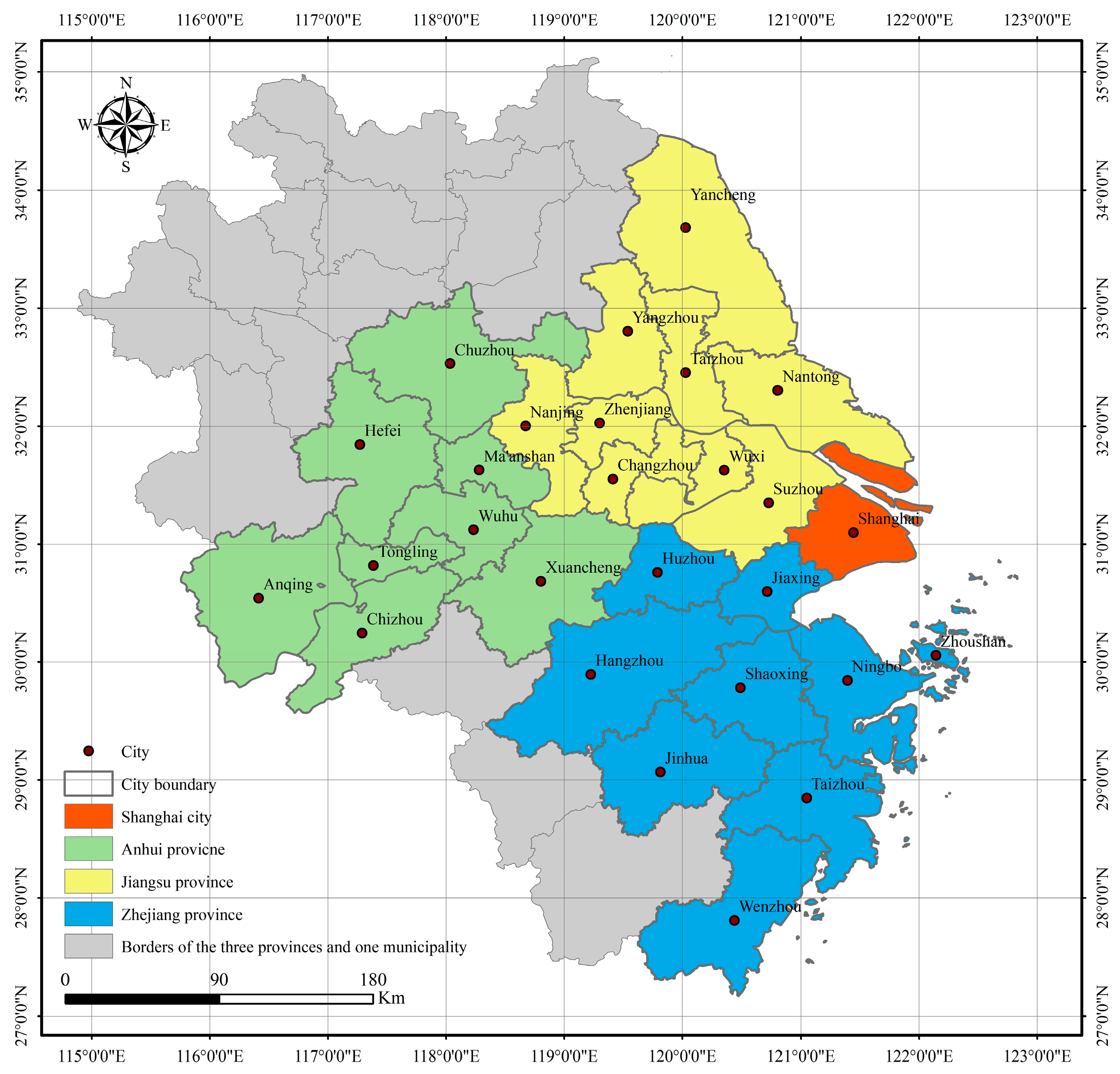
The Yangtze River Delta urban agglomeration spans four provinces and municipalities—Jiangsu, Zhejiang, Shanghai, and Anhui—and is the most urbanized region in China. According to the scope outlined in the 2019 Yangtze River Delta Regional Integration Development Plan Outline (https://www.gov.cn/zhengce/2019-12/01/content_5457442.htm) accessed on 3 October 2024, 27 cities within the Yangtze River Delta have been designated as regional core areas. These include eight cities in Anhui Province, nine cities in Jiangsu Province, nine cities in Zhejiang Province, and Shanghai (Figure 1). The Yangtze River Delta urban agglomeration is located at the intersection of the Yangtze River Economic Belt and the Belt and Road Initiative, holding a pivotal position in multiple fields such as economy, science and technology, transportation, and international exchanges. While experiencing rapid economic development, the regional ecological environment has been severely threatened by a series of unreasonable natural and human-induced disturbances, such as soil erosion, acid rain pollution, and blue-green algae blooms in Lake Taihu, which have to some extent reduced the region’s ecological security level and hindered its sustainable development. By analyzing the stress factors and their synergistic response relationships, this study provides scientific guidance for future research on the coordinated development of ecological security and environmental carrying capacity in urban agglomerations, contributing to the sustainable development of the Yangtze River Delta region. Additionally, it offers valuable insights and references for ecological construction and regulation in other interprovincial economic circles.

2.2. Data Sources and Processing

In this study, due to the availability of data, the administrative scale chooses the city scale. The data in this paper is divided into two parts: vector data and attribute data. Vector data is mainly vector boundary data, which comes from the following: 1 million basic geographic information data of the National Geographic Information Resource Directory Service System (https:///www.webmap.cn/); elevation data and attribute data comes from the geospatial data cloud (https://www.gscloud.cn/), which is obtained by cutting vector data in the study area. The index data of ecological security and environmental carrying capacity come from the China Urban Statistical Yearbook (https://www.stats.gov.cn/zs/tjwh/tjkw/tjzl/202302/t20230220_1913734.html (accessed on 3 October 2024)), the China Environmental Statistical Yearbook (https://www.stats.gov.cn/sj/ndsj/ (accessed on 3 October 2024)), the Anhui Statistical Yearbook, the Jiangsu Statistical Yearbook, the Zhejiang Statistical Yearbook, and the Shanghai Statistical Yearbook from 2008 to 2022.

2.3. Evaluation Index System

The European Environment Agency (EEA, 1999) improved the PSR model and constructed the most representative DPSIR model. The DPSIR model added two new categories, “driving forces” (D) and “impacts” (I), to improve the logical framework of the model, which has been widely used in ecological security assessments [44,45]. In this paper, the index system of ecological security level is constructed by the driving force–pressure–state–impact–response (DPSIR) model, and the indexes related to human activities are emphasized in the selection. The comprehensive index system of environmental carrying capacity is constructed from five dimensions: resources, environment, society, economy, and potential, as shown in Table 1. Using the comprehensive level index method, we calculated the overall level of ecological security and environmental carrying capacity for the Yangtze River Delta urban agglomeration from 2008 to 2022.

3. Research Methods

3.1. Comprehensive Evaluation Model

The ecological security level and environmental carrying capacity index are measured by a multi-objective comprehensive linear weighting method, and the formula is as follows:
f ( x ) = i = 1 m a i × x i
g ( x ) = j = 1 n b j × y j
where f ( x ) represents the comprehensive index of ecological security; g ( x ) represents the comprehensive index of environmental carrying capacity; a i and b i , respectively, represent the weights of each index of ecological security and environmental carrying capacity; and x i and y i represent the standardized value of each index. In specific applications, firstly, the range transformation method is used to preprocess the original data to eliminate the dimensional and magnitude differences among the data. The entropy method [46] is used to calculate the weight of each index, because it can avoid the subjectivity of artificial weight distribution. The weighting method is used to calculate the comprehensive development level index of ecological security and environmental carrying capacity.

3.2. Interactive Stress Model

According to the interactive stress theory, there is a complex interactive stress relationship between ecological security and environmental carrying capacity, and ecological security is directly affected by environmental carrying capacity. When the pressure of human activities on the environment exceeds the carrying capacity of the environment, the ecosystem may be destroyed, which leads to a threat to ecological security. When active adjustment measures are brought into play to improve the level of environmental carrying capacity, the contradiction of the compound system is alleviated, and a new round of the vicious–virtuous circle is staged again [47]. Therefore, under the interactive stress effect of ecological security and environmental carrying capacity, it follows the rhythmic development mechanism of multiple “S” curve combinations. Ref. [48] found that there is a logarithmic curve relationship between urbanization level and economic development through empirical research. Others explored the double exponential function model between the urbanization level and the ecological environment according to the interactive model. The mathematical expression of the model is as follows:
Z = m n ( 10 y b a p ) 2
where Z represents the environmental carrying capacity index; y   represents the ecological security index; and m ,   n ,   a ,   b ,   a n d   p represent the non-negative undetermined parameter. This double exponential interaction curve presents the rhythmic evolution law of the combination of multiple compound “S” curves during the whole gradual change process. Parameters m, n, a, b, and p are non-negative undetermined parameters. The value of m indicates the degree of environmental degradation when the double-exponential curve reaches its inflection point. Since all standardized indicator values are treated as better when larger during data processing, a smaller m value signifies increased sensitivity of the environmental system to external pressures and a higher degree of environmental degradation. Parameter n characterizes the sensitivity of the ecological security system to changes in environmental carrying capacity pressures. When n is small, ecological security becomes more vulnerable to external disturbances. Greater deterioration in environmental carrying capacity pressures will exert a more pronounced negative impact on ecological security status. The value of b reflects the magnitude of the inflection point on the double-exponential curve; the larger the value, the higher the ecological safety level at the inflection point. the larger the value, the higher the ecological safety level at the inflection point [49].
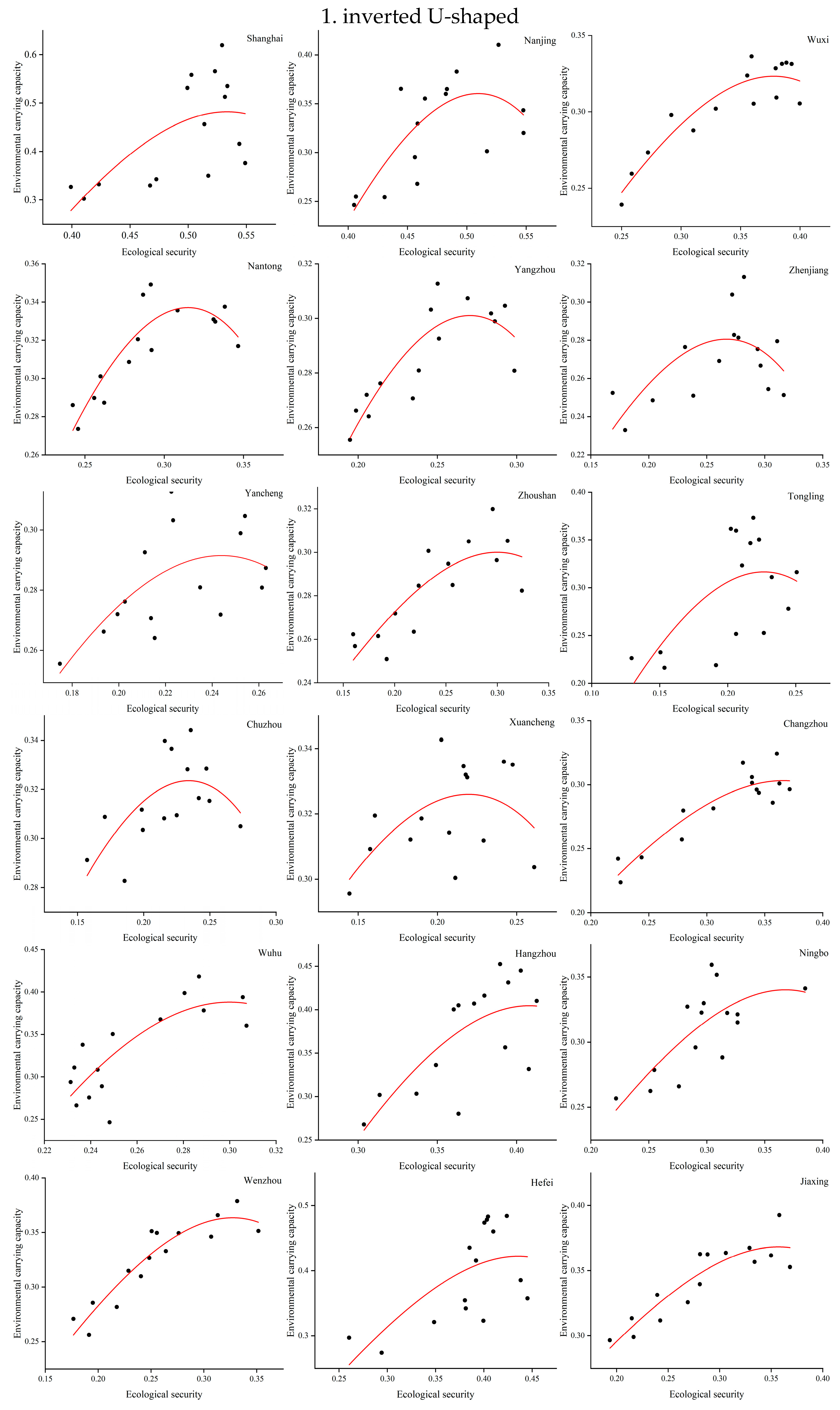
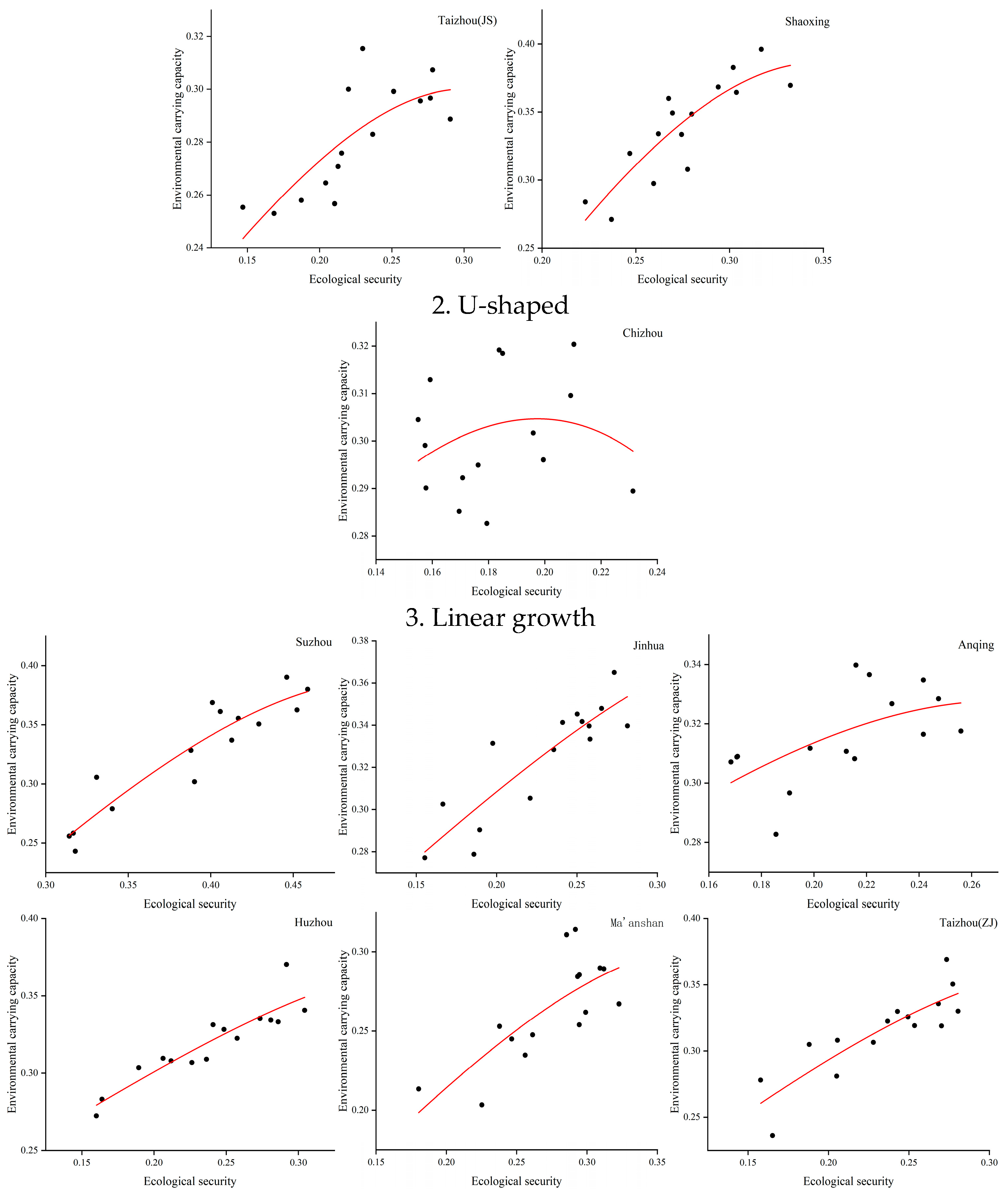
Using logarithmic curve equations and inverted U-curve equations, the ecological security index and environmental carrying capacity index of the Yangtze River Delta urban agglomeration were fitted and solved using MATLAB 7.0 software. Based on the R-square (coefficient of determination) and Adjusted R-square (corrected coefficient of determination) metrics, the fitting results for both the logarithmic curve and inverted U-curve equations across the 27 cities were satisfactory. Subsequently, using the derived logarithmic and inverted U-shaped relationship equations, dual-index relationship equations for the ecological security system and environmental carrying capacity system of the Yangtze River Delta urban agglomeration from 2008 to 2022 were deduced. The unit root test illustrating their interrelationship is shown in Table A1 in Appendix A.

3.3. Coupling Coordination Degree Model

The coupling degree can reflect the degree of interrelation and mutual influence among subsystems as a whole. However, the coupling degree cannot fully reflect the synergistic effect and overall efficiency among different systems. Therefore, the coupling coordination degree is introduced to quantitatively describe the coordinated development level between systems [50]. In this paper, the coupling coordination degree model of ecological security and environmental carrying capacity is constructed as follows:
C = f ( x ) × g ( y ) ( f ( x ) + g ( y ) ) 2
T = α f ( x ) + β g ( y )
D = C × T
where f ( x ) and g ( y )   represent the comprehensive index of ecological security and environmental carrying capacity; C   represents the coupling degree index of the composite system; T represents the development degree index; and α and β represent the undetermined weight of each subsystem. This paper holds that ecological security and environmental carrying capacity consider the mutual auxiliary development of the two systems, so they have the same status, so the α and β are 0.5 [51,52].
In order to analyze and compare the coordinated development and dynamic evolution characteristics of ecological security and environmental carrying capacity in the Yangtze River Delta urban agglomeration, referring to the research results of [53,54], the coordinated development types of ecological security and environmental carrying capacity are divided into three main categories and eight subcategories. This paper doubles the distribution range of severe imbalance and high-quality coordination, respectively. According to the synchronization difference of system development level, the difference between ecological security and environmental carrying capacity is within the threshold range, indicating the balanced development of the system ( f ( x ) = g ( y ) ); It is divided into three categories: environmental carrying lag ( f ( x ) < g ( y ) ), ecological security lag ( f ( x ) > g ( y ) ) and system balanced development [52]. In this paper, the threshold range is set as [0–0.1]. To sum up, the coordinated development types of ecological security and environmental carrying capacity are divided into 24 subcategories, as shown in Table 2.
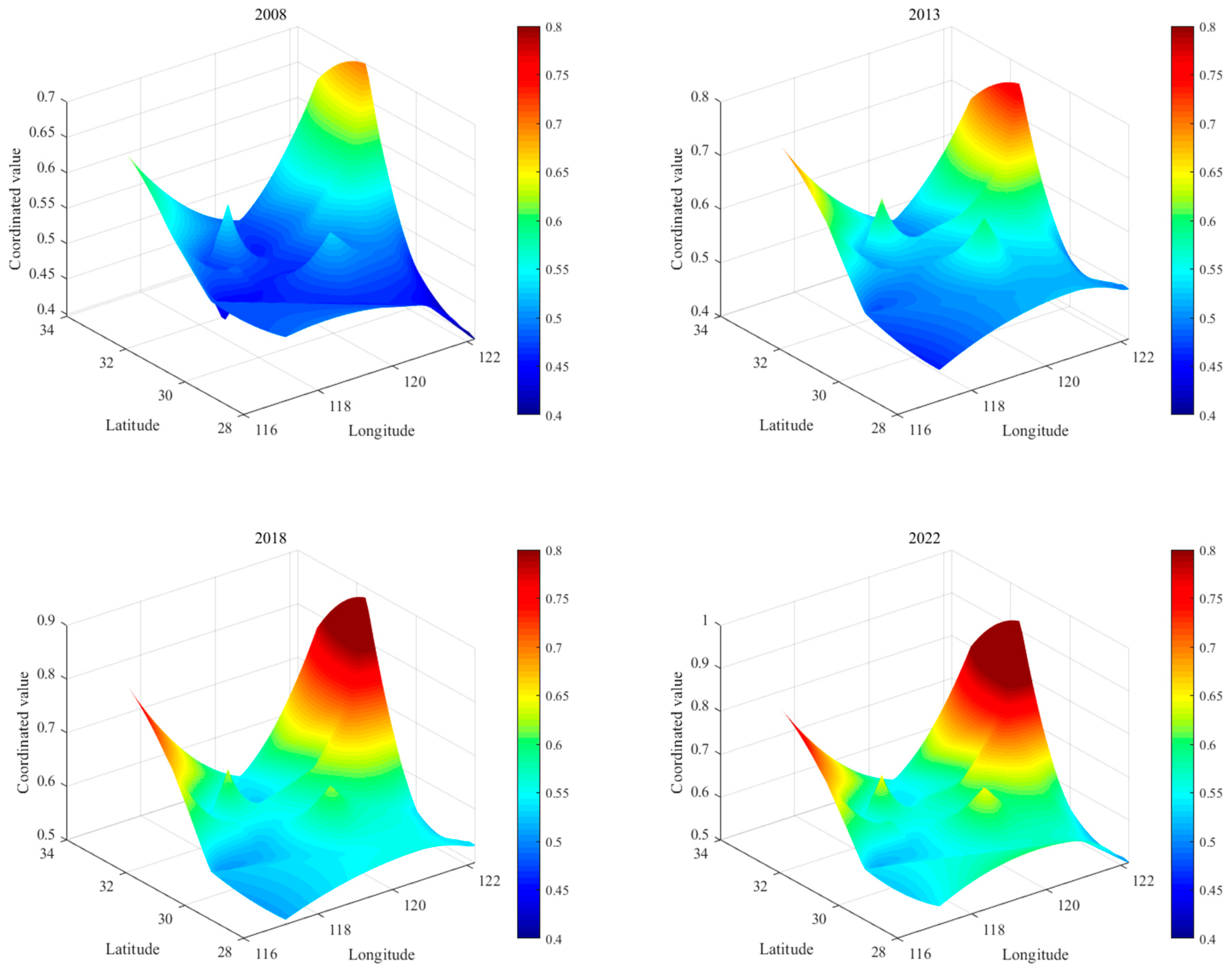
ArcGIS 10.8 software was employed to spatially visualize the spatiotemporal evolution patterns of ecological security and environmental carrying capacity coupling coordination levels. Kriging interpolation using MATLAB R2018b captured the spatial continuity and heterogeneity of coordination levels, enabling three-dimensional visualization to intuitively interpret spatial interaction patterns and regional variations. Origin software generated a type-proportion map revealing structural changes and long-term trends in coordination patterns throughout the study period.

3.4. VAR Model

The VAR model is a vector autoregressive model, which is mainly used to detect the dynamic relationship between joint endogenous variables [55]. The model and construction are as follows:
y i = λ 1 y 1 + λ 2 y 2 + λ p y p + μ i
In the formula: y represents the VAR model of each province in the Yangtze River Delta urban agglomeration; λ represents the coefficient vector; p represents the lag order of the model; and μ i represents the white noise error of the model. In the VAR model, the impulse response function is mainly used to explain the interaction effect and the degree of impact of ecological security on environmental carrying capacity.
Using EViews 10, we applied first-order differencing to the ecological security and environmental carrying capacity data of 27 cities in the Yangtze River Delta urban cluster, determined the optimal lag order, and conducted AR view tests. We generated the difference variables using EViews’ Generate Series function and incorporated the processed, stationary variables into the VAR model for estimation. The results of the unit root test are presented in Table A2 in Appendix A.

4. Results and Analysis

4.1. Interactive Stress Effect of Ecological Security and Environmental Carrying Capacity

4.1.1. Comprehensive Horizontal Characteristics

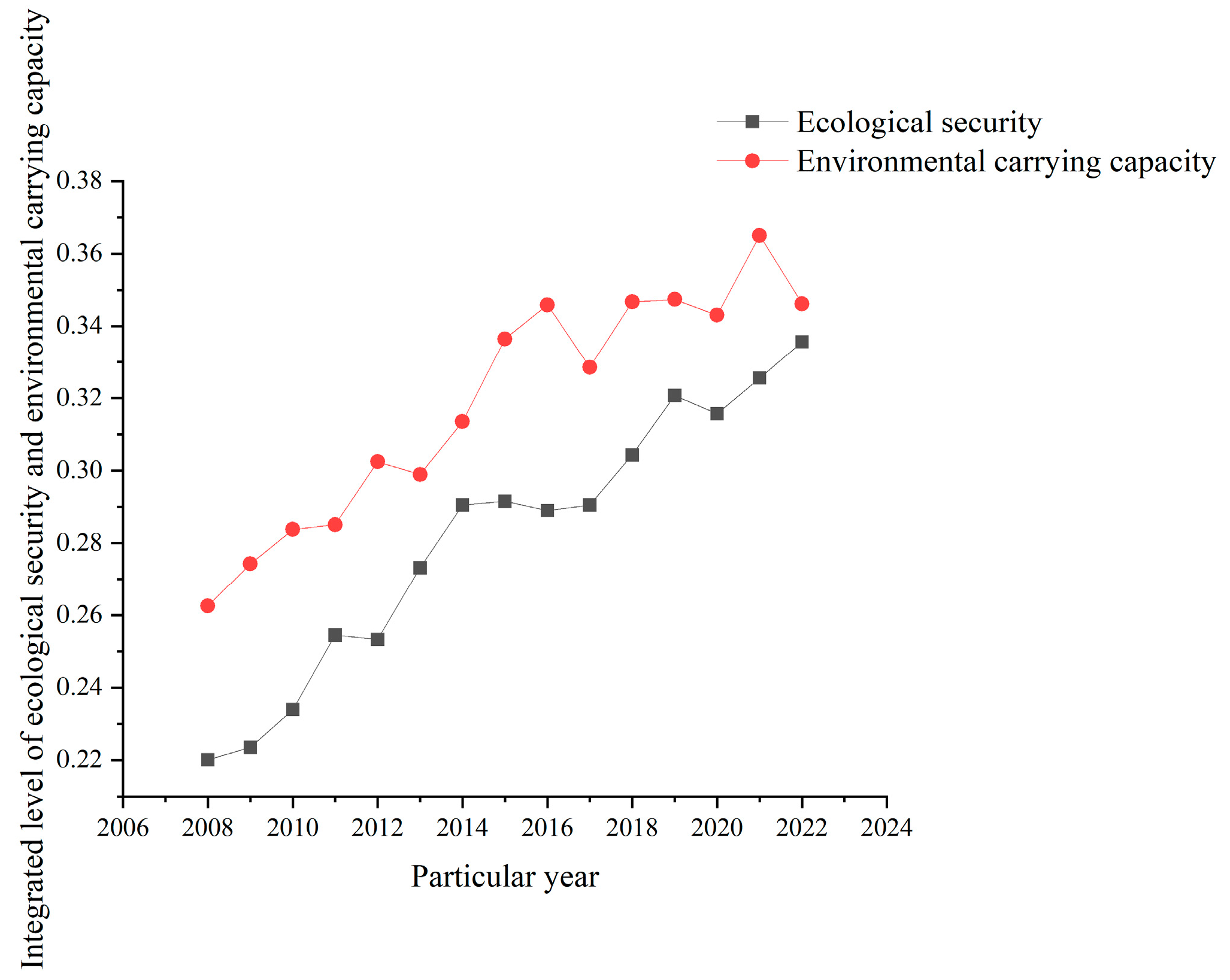
In the Yangtze River Delta urban agglomeration from 2008 to 2022, the ecological security and environmental carrying capacity of the Yangtze River Delta urban agglomeration showed an overall upward trend from 2008 to 2022. Specifically, the ecological security level rose from 0.220 in 2008 to 0.336 in 2022, with an average annual growth rate of 2.85%. The level of environmental carrying capacity increased from 0.263 in 2008 to 0.346 in 2022, with an increase of 31.56%. However, there were apparent fluctuations in the process. The ecological security level of central cities is in a “leading” position, reflecting the outstanding advantages of central cities in infrastructure, economic development, and ecological civilization construction. Over time, the ecological security level of the northeastern, western, and southeastern cities has been improved. The gap with the central region has narrowed, which shows that the central and western regions have promoted the continuous improvement of urban ecological security levels under the influence of policy-driven, economic, and industrial development, ecological governance, and other factors. From the comprehensive index of environmental carrying capacity, the overall level of environmental carrying capacity has improved during the observation period, and the level of carrying capacity has shown signs of decline from 2018 to 2020. The rapid advancement of urbanization has put tremendous pressure on the environment (Figure 2).

4.1.2. Solution of the Interactive Stress Relationship and Curve Fitting

Based on the principle that a smaller non-negative parameter value m indicates more severe environmental degradation, the analysis focuses on the bottom 15 cities with the smallest m values: Ningbo > Nantong > Anqing > Xuancheng > Chuzhou > Wuxi > Tongling > Chizhou > Changzhou > Ma’anshan > Yangzhou > Taizhou > Zhoushan > Yancheng > Zhenjiang. Most cities in the west and northeast, along with select cities in the central and southeastern regions, face significant pressure on environmental carrying capacity when the dual-index curve for ecological security and environmental carrying capacity reaches an inflection point. Once environmental carrying capacity exceeds the threshold, ecological security becomes more vulnerable to threats. This indicates that cities with a mix of advanced manufacturing and traditional industries—such as Wuxi, Changzhou, Ningbo, Nantong, Zhenjiang, Yangzhou, and Taizhou—though possessing a solid economic foundation, have long relied on equipment manufacturing, chemicals, textiles, and heavy industry. Consequently, their resource consumption and pollution emissions per unit of output remain relatively high. Resource-based cities like Ma’anshan and Tongling exhibit high industrial dependence on mineral resources and metallurgy, making them susceptible to the “resource curse.” Their environmental systems offer limited buffering capacity for economic activities, resulting in lower m values within the model. Ecologically constrained cities, such as Anqing, Xuancheng, Chuzhou, Chizhou, Yancheng, and Zhoushan, face a mismatch between environmental governance capacity and development pace during industrial transfer and industrialization. Their ecosystems are more vulnerable to disruption.
When the non-negative indeterminate parameter n is small, the level of ecological security is more susceptible to external disturbances. and the greater the deterioration in environmental carrying capacity pressure. The 15 cities with the lowest n values were selected for in-depth analysis: Shaoxing > Hefei > Wuxi > Wenzhou > Ningbo > Changzhou > Suzhou > Jiaxing > Anqing > Zhoushan > Taizhou > Ma’anshan > Taizhou > Jinhua > Huzhou. Cities in central, southeastern, northeastern, and western regions exhibit more pronounced responses in their ecological security systems to changes in environmental carrying capacity pressures. This indicates that core cities like Suzhou, Wuxi, Changzhou, Ningbo, and Hefei—characterized by large economic scales and high population concentrations—demonstrate heightened sensitivity to carrying capacity pressures despite relatively advanced ecological governance. Under high-density development, their ecological security remains vulnerable to such pressures. Manufacturing-intensive cities like Shaoxing, Jiaxing, Jinhua, Taizhou, and Wenzhou, characterized by manufacturing-dominated industrial structures and private-sector economies with high resource consumption intensity, face heightened vulnerability to environmental pressures during rapid development. Coastal functional cities such as Zhoushan, Ningbo, and Taizhou, serving port logistics, energy storage/transportation, and port-adjacent industries, experience concentrated regional development intensity and significant ecosystem stress.
The non-negative parameter b value reflects the magnitude of the inflection point on the double-exponential curve. The higher the value, the higher the ecological security level at the inflection point. The 15 cities with the highest b values were selected for in-depth analysis: Changzhou > Hefei > Taizhou > Jinhua > Yancheng > Ma’anshan > Ningbo > Yangzhou > Nantong > Hangzhou > Taizhou > Wenzhou > Shaoxing > Wuhu > Tongling. Cities in the northeast, southeast, and select central and western regions generally lie within the Yangtze River Delta, characterized by high economic activity intensity and extensive development. This indicates that under prolonged high-intensity development, ecological security levels decline to relatively low ranges before reaching inflection points, resulting in lower b values in the model. When a city simultaneously exhibits low values for m, n, and b, it indicates not only a high degree of environmental degradation and strong sensitivity of the ecological security system, but also that the ecosystem reaches its inflection point at a low security level. This suggests that potential ecological risks possess cumulative and amplifying characteristics (Figure 3).

4.2. Synergistic Response Analysis of Ecological Security Level and Environmental Carrying Capacity

4.2.1. Temporal and Spatial Evolution Characteristics of Synergistic Effect

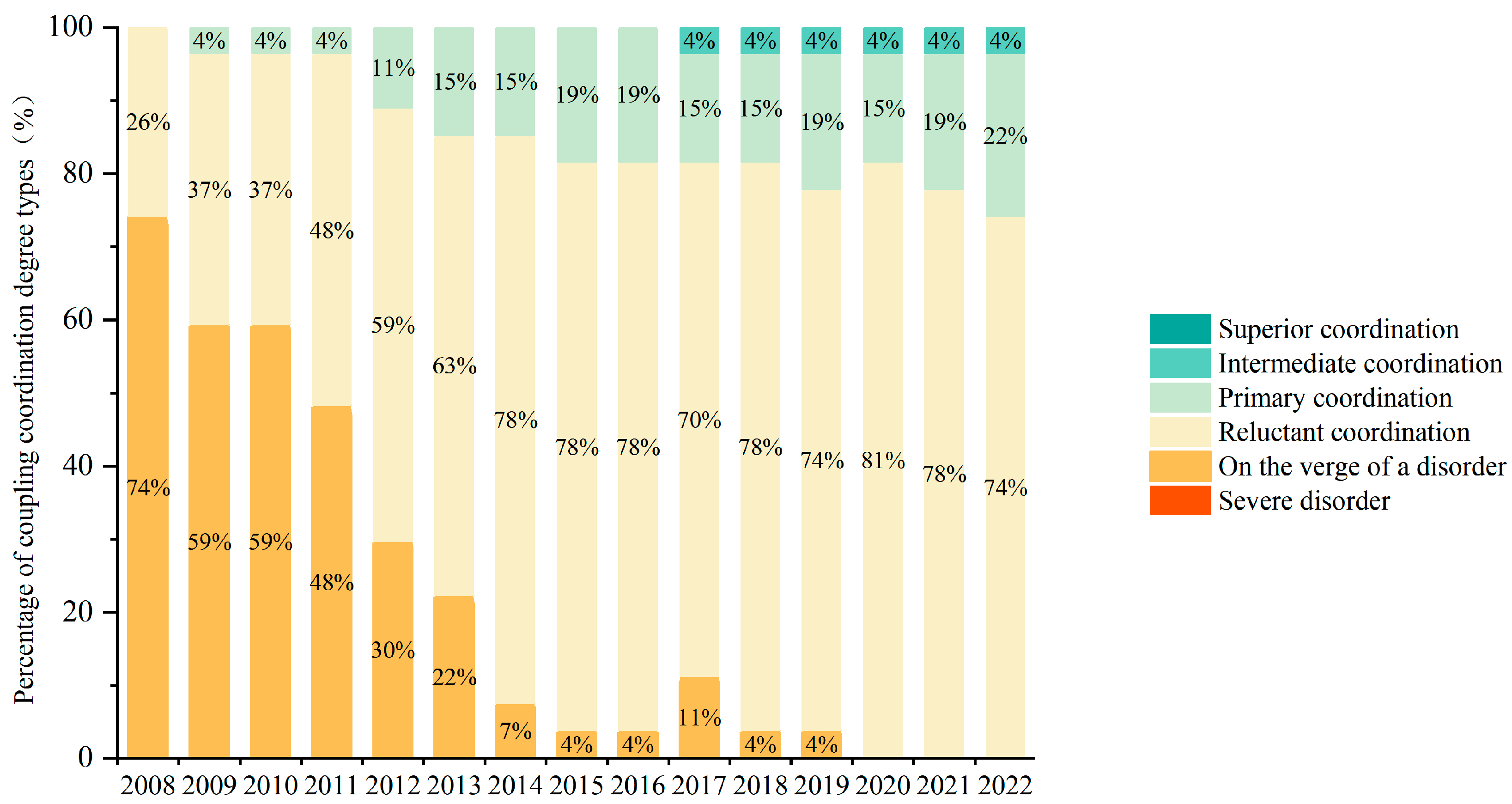
As shown in Figure 4, during 2008–2022, the endangered imbalance gradually changed from a strong type to a micro-potential type with time, and the proportion of endangered imbalance was zero in 2020. Reluctant coordination occupied the dominant position of the coupling coordination type of ecological security and environmental carrying capacity in the Yangtze River Delta urban agglomeration, and the primary coordination showed a slowly increasing trend with time. In contrast, the intermediate coordination maintained a relatively stable proportion from 2017 to 2022. In 2009–2010, the proportion of near-maladjustment (59%), reluctant coordination (37%), and primary coordination (4%) remained unchanged. 2011–2015 is the period of “moving towards coordination.” During this period, the type of coupling coordination degree has an upward evolution trend, and the number of cities on the verge of imbalance has decreased. The years 2015–2022 represent the period of “coordinated development,” during which the proportion of primary coordination and intermediate coordination has steadily increased, and the proportion of imbalance types became 0% in 2020.
From the synchronous situation of relative development of the system (Table 3), the main types of coordination effect of the Yangtze River Delta urban agglomeration are ecological security lag type and system balanced development type, which indicates that there is still room for improvement in ecological security development of the Yangtze River Delta urban agglomeration during the study period. In 2008, Yancheng in the northeast lagged in environmental carrying capacity; Huzhou and Jiaxing in central China lagged in environmental carrying capacity; Anqing, Chuzhou, and Chizhou in the west lagged in environmental carrying capacity; and Xuancheng in the southeast has a lagging type of environmental carrying capacity. During the study period, the coordination situation developed towards equilibrium as a whole. From the changing trend, from 2008 to 2022, Wuxi, Changzhou, Suzhou, Nantong, Yangzhou, Zhenjiang, Hangzhou, Ningbo, Shaoxing, Hefei, and Ma’anshan developed in a balanced way, while other cities lagged in ecological security. By 2019, except for Nanjing, Wuhu, Tongling, and Chizhou, which are lagging in ecological security, environmental carrying, environmental carrying, and environmental carrying, respectively, other cities have changed into systematic, balanced development. To sum up, the synergistic effect type of the Yangtze River Delta urban agglomeration is gradually changing from an environmental bearing lag type to a system balanced development type.

4.2.2. Spatial Distribution Characteristics

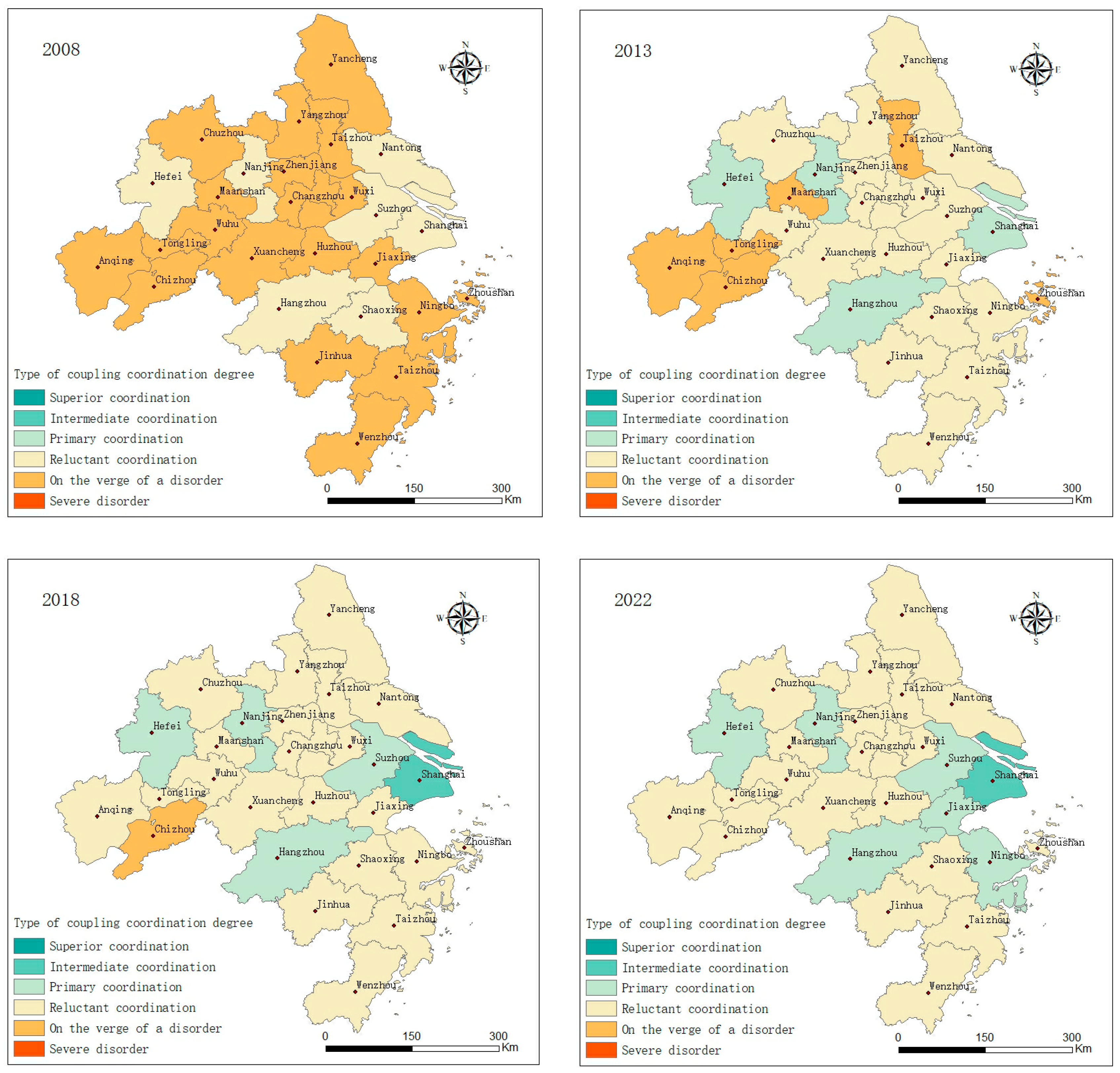
Spatially, the coupling coordination degree of ecological security and environmental carrying capacity of the Yangtze River Delta urban agglomeration evolves to a higher level as a whole, and apparent spatial differentiation appears in local areas. The specific characteristics are as follows: (1) In 2008, Shanghai, Nantong, Suzhou, Nanjing, Hangzhou, Shaoxing and Hefei were in the stage of reluctantly coordinated development, and from 2008 to 2022, all cities in the central triangle changed from being on the verge of a disorder to coordinated development, among which Shanghai rose to the intermediate coordination stage, while Suzhou and Jiaxing changed to primary coordination. Ningbo and Hangzhou in the southeast have risen to the primary coordination stage. Northeastern cities have risen from being on the verge of a disorder to primary coordination. Cities on the verge of a disorder in western China have risen to the primary coordination stage. From the perspective of coordination type, quantity, and speed, the spatial distribution of “high in the central triangle” is stable. (2) The spatial structure characteristics of “collapse” in the western region of urban agglomeration are remarkable. In 2008, all cities in the western region were on the verge of disorder, and from 2008 to 2022, Anqing, Tongling, Chizhou, Wuhu, Ma’anshan, Xuancheng, and Chuzhou entered the stage of reluctant coordination. Although the overall coordination of the western region has been continuously improved during the investigation period, there is still a gap compared with the central region. The spatial structure characteristics of “the fall of the western region” are evident. (3) The urban agglomeration shows the spatial pattern of “balance in northeast and central China and imbalance in the southeast.” In 2018 and 2022, the four cities in Northeast China all belong to the reluctant coordination type, which indicates that the distribution of coordination types in Northeast China is relatively consistent, the rhythm of coordination evolution is relatively synchronous, and the spatial “balanced” pattern is prominent. Because of the high degree of coupling coordination between cities near the middle triangle and the low degree far away, the southern region generally presents the characteristics of an unbalanced spatial distribution (Figure 5).
From the perspective of spatial differentiation, the collaborative level of the Yangtze River Delta urban cluster exhibits a dynamic evolutionary pattern characterized by “central regions taking the lead, with southeastern, northeastern, and western regions gradually catching up”. In 2008, the central region took the lead in achieving synergistic development in ecological security and environmental carrying capacity, manifesting as a “solitary peak” pattern centered on Nanjing. Meanwhile, western Jiangsu, the northeast, and the southeast regions, constrained by heavy industrial structures and relatively insufficient environmental governance capabilities, collectively formed a “contiguous low valley” pattern.
With the continuous advancement of the Yangtze River Delta integration strategy, core cities gradually enhanced synergies between ecological security and environmental carrying capacity through industrial upgrading and improved environmental governance. Nanjing and Hangzhou saw significant increases in their coordination levels between 2008 and 2022. Leveraging their respective strengths in technological innovation, modern service industry clusters, and environmental policy implementation, they evolved into two high-value cores in the central and southeastern regions. Meanwhile, the western region has seen gradually easing ecological pressures through industrial transformation and infrastructure improvements, leading to a noticeable rebound in coordination levels. The original “contiguous low-valley” pattern has been broken, with the spatial disparity between the central and western regions continuously narrowing.
By 2022, the central and southeastern regions formed a contiguous peak spatial pattern in terms of coordination levels, indicating that the coordinated development of ecological security and environmental carrying capacity has evolved from single-core to multi-center coordination. This process reflects the dynamic optimization trend of the coordinated development pattern in the Yangtze River Delta urban cluster, driven by the combined effects of regional industrial restructuring, enhanced environmental governance capabilities, and the aggregation and diffusion of factors (Figure 6).

4.3. Interactive Response Analysis of Ecological Security Level and Environmental Carrying Capacity

Impulse Response Relationship

1.
Unit Root Test
First, unit root tests were conducted on each series in the model to ensure the stationarity of the research data. Variables exhibiting non-stationarity in the original series underwent first-order differencing. The ADF-Frisher test results indicate that the urban agglomerations in the Yangtze River Delta exhibit non-stationary series, while the remaining cities are first-order integrated stationary series. The PP test results show that Changzhou’s environmental carrying capacity is a stationary series, while the other cities are first-order integrated stationary series. Therefore, first-order differencing was applied to the original series variables (Table A2 in Appendix A).
2.
Determination of Optimal Lag Order
For each city, the lag order of the VAR model was tested using the AIC, SC, and HQ information criteria. Results indicate that most cities achieve optimal performance at a lag of one. To ensure comparability across cities and avoid overfitting in small samples, this study ultimately employs a lag-one VAR model uniformly for all cities.
3.
AR Roots Test
The test results indicate that the reciprocals of all roots in the VAR model are less than one, with all roots lying within the unit circle. The VAR model is stable, ensuring the validity of impulse responses and variance decomposition.
4.
Pulse Response Analysis
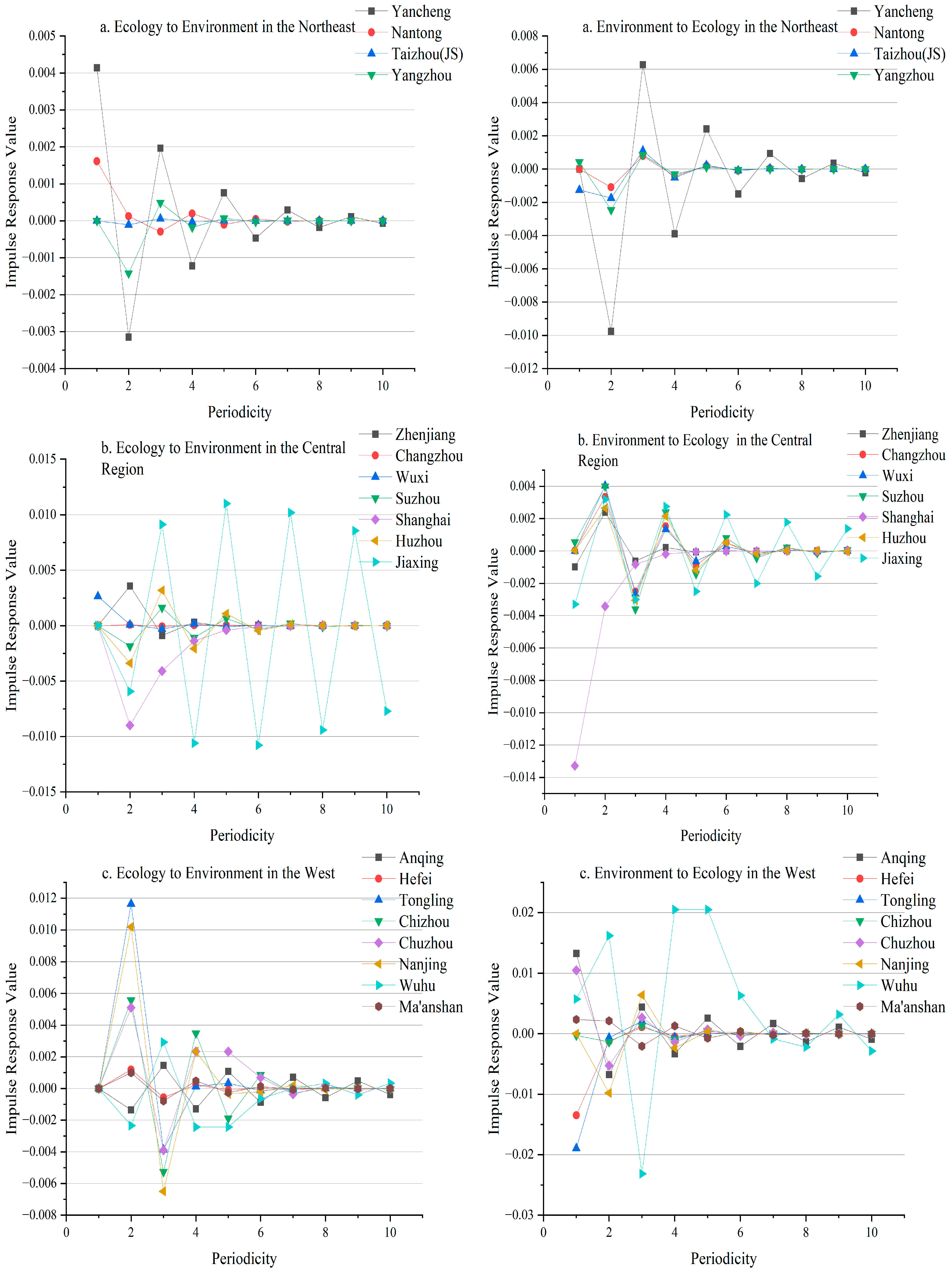
In the Northeast region, Yancheng City exhibits the most pronounced response to environmental carrying capacity shocks. Its response rapidly rises to a positive peak of approximately 0.005 in the first period, then gradually declines, converging to zero around the tenth period. This indicates that enhanced carrying capacity can be swiftly translated into ecological benefits. Nantong City exhibited a trend consistent with Yancheng City, transitioning from positive promotion to gradual stabilization. Overall, both demonstrated positive impacts, indicating that China’s ecological security exerts a positive promotional effect on the stability of environmental carrying capacity in the current period. In Taizhou (JS) and Yangzhou, ecological security initially suppressed environmental carrying capacity, with curves stabilizing by the third period. This indicates low sensitivity of current ecological security levels to carrying capacity changes, reflecting a “lagging but persistent” response relationship. Regarding the degree of environmental carrying capacity response to ecological security, Yancheng City exhibited the most pronounced pattern. Its response values fluctuated significantly and remained negative in the early stages, gradually increasing and stabilizing later. Overall, this represents a pattern of initial suppression followed by promotion. Nantong City, Taizhou (JS), and Yangzhou City showed relatively consistent trends, oscillating between positive and negative values in the early stages before gradually stabilizing later.
In the central region, Jiaxing City exhibited the most pronounced response to environmental carrying capacity levels in terms of ecological security. Jiaxing’s maximum value reached 0.011, subsequently dropping to a minimum of −0.011, and then continuing along an “M”-shaped response trajectory. This indicates that Jiaxing’s overall ecological security fluctuates in tandem with environmental carrying capacity levels. Suzhou, Huzhou, and Shanghai exhibited consistent patterns: a pronounced negative response in the short term (Periods 1–3), followed by a gradual recovery, ultimately converging toward zero in the long term. Zhenjiang and Wuxi consistently exhibited a trend from promotion to stabilization. Regarding the degree of ecological security response to environmental carrying capacity levels, Shanghai showed the most pronounced response. Its response remained in the negative range during the first six periods before gradually converging to zero. This indicates that as China’s economic hub, Shanghai’s ecological restoration and protection efforts require short-term sacrifices in “economic carrying capacity.” Jiaxing exhibits an “M”-shaped fluctuation pattern, though the amplitude of these fluctuations is gradually narrowing. This suggests that while Jiaxing’s “ecological security-environmental carrying capacity” system continues to oscillate between ‘conservation’ and “development,” its internal regulatory mechanisms are diminishing the magnitude of each fluctuation, moving the system toward a new equilibrium point. Zhenjiang City’s early environmental carrying capacity initially suppressed ecological security, but this suppression gradually weakened and later shifted to a promoting effect, converging around the fourth phase. Changzhou, Wuxi, Suzhou, and Huzhou exhibited consistent fluctuation trends: their influence levels increased slowly from the initial phases (1–3) and ultimately converged toward a very small positive response value. Overall, these cities showed positive impacts, indicating that during the study period, the impact of ecological security levels on their environmental carrying capacity levels was not yet significant.
In the western region, the response of ecological security to environmental carrying capacity levels shows similar fluctuation trends in Tongling, Nanjing, Wuhu, Chuzhou, Hefei, and Ma’anshan. This indicates that after being impacted by environmental carrying capacity levels, ecological security exhibits a positive response, with the degree of positive reaction first increasing and then decreasing. Subsequently, the positive impact leads to negative effects on ecological security, which gradually stabilizes near zero in the later stages. Anqing and Wuhu exhibit relatively consistent trends, oscillating between positive and negative values in the early stages before gradually stabilizing. Regarding the response intensity of ecological security to environmental carrying capacity levels, Wuhu City shows the most pronounced fluctuations, with a peak value of 0.021 followed by a decline to 0.006, after which it gradually stabilizes. Anqing, Chuzhou, and Maanshan exhibited fluctuating positive and negative response values in the early stages, with the amplitude of fluctuations gradually decreasing after the fourth period, indicating minimal impact from ecological security levels. Hefei, Tongling, Chizhou, and Nanjing exhibited negative response values in the initial phase (1–3), followed by positive fluctuations after the third phase, gradually stabilizing in the later period. This indicates that their environmental carrying capacity levels were relatively less impacted by ecological security fluctuations during the study period.
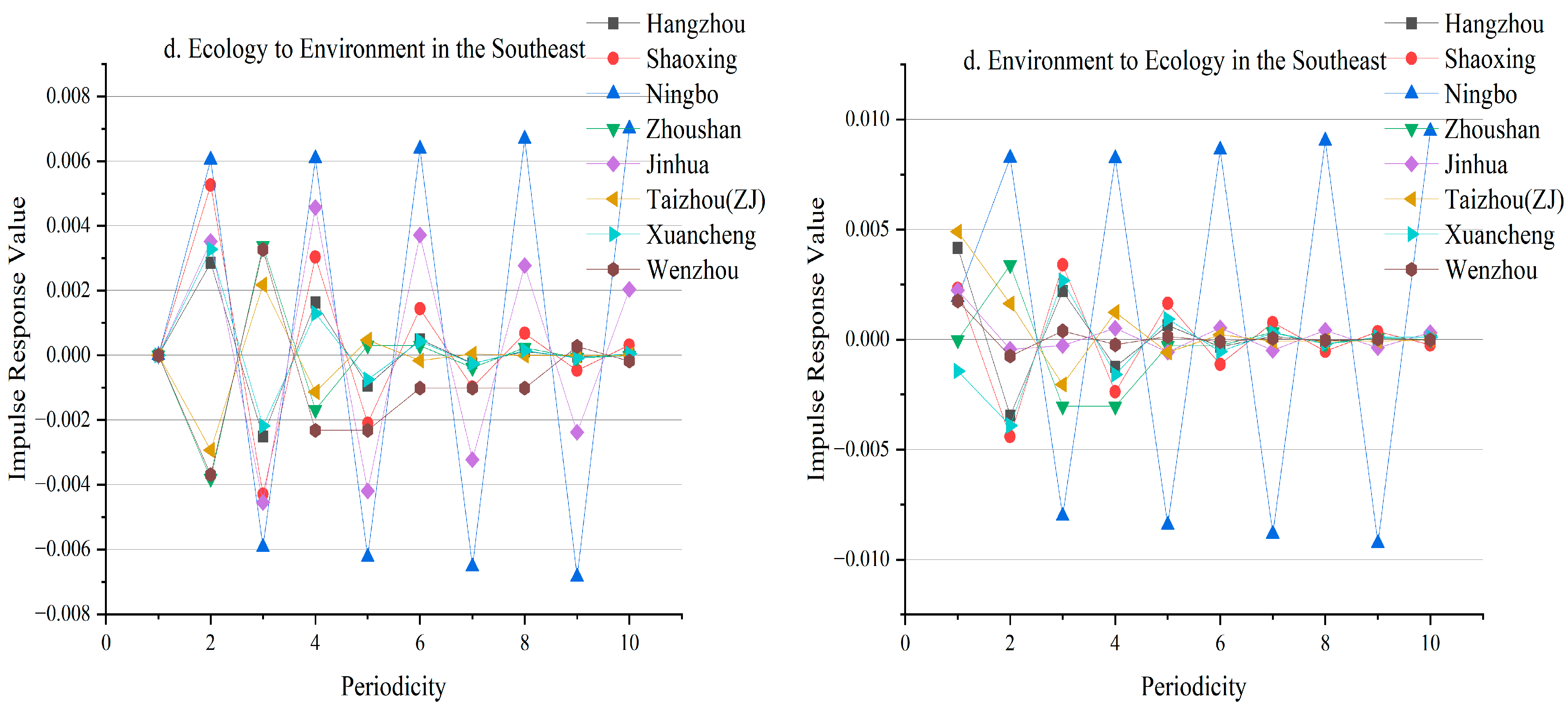
In the southeastern region, regarding the response of ecological security to environmental carrying capacity levels, Ningbo, Shaoxing, Jinhua, Xuancheng, and Hangzhou initially exhibited impulse response values (1–3) between positive and negative ranges. Subsequently, the fluctuation intensity in Shaoxing, Jinhua, Xuancheng, and Hangzhou gradually diminished over time, indicating their reduced susceptibility to environmental carrying capacity impacts. In contrast, Ningbo and Jinhua maintained fluctuating patterns between positive and negative values, reflecting Ningbo’s exceptionally robust economic development momentum and immense pressure to expand environmental carrying capacity. As a key hub in central Zhejiang, Jinhua’s fluctuations may stem from the diversity of its industrial restructuring. Even subtle shifts in market forces could cause the system output to oscillate between positive and negative values, preventing the formation of a stable synergistic relationship. Taizhou (ZJ), Wenzhou, and Zhoushan exhibit an ecological security trajectory that first inhibits, then promotes, environmental carrying capacity before stabilizing. Regarding the response of environmental carrying capacity to ecological security, Ningbo’s environmental carrying capacity follows an “M”-shaped response pattern, indicating overall fluctuations in tandem with ecological security levels. The response values for Taizhou (ZJ), Hangzhou, Shaoxing, Jinhua, Wenzhou, and Zhoushan exhibit relatively consistent fluctuations: first promoting, then weakening the promoting effect, and finally stabilizing. Xuancheng’s environmental carrying capacity level responds to ecological security by first inhibiting, then weakening the inhibitory effect, and finally stabilizing (Figure 7).

5. Conclusions

The overall levels of ecological security and environmental carrying capacity have improved during the study period; however, significant spatial heterogeneity persists among cities. The coordination level exhibits a clear spatial gradient, forming a dynamic pattern characterized by “central leadership with southeastern, northeastern, and western areas gradually catching up.” Core cities such as Nanjing and Hangzhou have evolved into stable high-value centers, while several peripheral cities, although showing improvement, remain at relatively lower coordination levels.
The interaction between ecological security and environmental carrying capacity is found to be nonlinear and city-specific. Different evolutionary patterns—including inverted U-shaped, U-shaped, and linear growth trajectories—reflect variations in development stages, industrial structures, and environmental governance capacities. The VAR analysis further reveals that the interaction between the two systems is dynamic and exhibits time-lag effects. Environmental carrying capacity exerts a relatively direct influence on ecological security, while the response of ecological security to external shocks shows gradual adjustment rather than instantaneous change, highlighting the inherent inertia of the coupled system.
These findings suggest that improving regional sustainability requires differentiated and targeted policy strategies. Cities with persistently low coordination levels should prioritize reducing environmental pressure and strengthening governance capacity, whereas high-coordination cities should focus on maintaining long-term stability and preventing rebound effects associated with economic expansion. Overall, advancing coordinated development in the Yangtze River Delta depends on aligning industrial upgrading, environmental regulation, and regional cooperation according to local conditions.

6. Discussion

Compared with previous studies that often rely on static indicators or single-method approaches, this study integrates multiple analytical tools to capture both the structural and dynamic dimensions of coordination. While the overall trend of improvement aligns with findings from other regional studies, the classification of evolutionary trajectories and the identification of lag effects provide additional evidence on how coordination processes unfold over time. From a policy perspective, the necessity of differentiated strategies should be emphasized. Cities exhibiting inverted U-shaped patterns or persistently low coordination levels should prioritize alleviating environmental pressures and enhancing governance effectiveness. Meanwhile, cities with stable growth should focus on maintaining coordination to prevent rebound effects from economic expansion. Regional cooperation mechanisms should also account for these differences, avoiding a one-size-fits-all approach. For cities where ECC exerts a significant shock effect on ES, policy interventions should prioritize stabilizing environmental carrying capacity before pursuing ecological performance enhancement. Several limitations should be acknowledged. First, the indicator system, although comprehensive, may not fully capture all dimensions of ecological security and environmental carrying capacity due to data constraints. Second, the temporal resolution of the data limits the ability to detect short-term fluctuations and policy shocks. Future research could incorporate higher-frequency data, spatial econometric models, or cross-regional spillover analyses to further elucidate the mechanisms of coordinated development.

Author Contributions

Methodology, C.X.; Software, C.X.; Validation, M.C.; Resources, P.C. and C.X.; Data curation, P.C. and C.X.; Writing—original draft, M.C.; Writing—review & editing, M.C.; Visualization, C.X.; Supervision, P.C.; Project administration, P.C.; Funding acquisition, P.C. All authors have read and agreed to the published version of the manuscript.

Funding

Jilin Provincial Department of Science and Technology Project: (No:20250801117FG).

Institutional Review Board Statement

Not applicable.

Informed Consent Statement

Not applicable.

Data Availability Statement

The raw data provided in the study are publicly available in the China Urban Statistical Yearbook (2008–2022) (https://www.stats.gov.cn/zs/tjwh/tjkw/tjzl/202302/t20230220_1913734.html (accessed on 3 October 2024)); the China Environmental Statistical Yearbook (https://www.stats.gov.cn/sj/ndsj/ (accessed on 3 October 2024)); the geospatial data cloud (https://www.gscloud.cn/ (accessed on 3 October 2024)).

Conflicts of Interest

The authors declare no conflict of interest.

Appendix A

Table A1. Double exponential fitting function of ecological security and environmental carrying capacity.
City NameDouble Exponential Curve Fitting Function m n a b p R 2
Shanghai Z = 0.4821 4.3284 [ 10 ( y 0.7836 / 0.5851 ) 0.9606 ] 2 0.48213.12840.58510.78360.96060.4258
Nanjing Z = 0.3604 3.5265 [ 10 ( y 0.8053 / 0.5890 0.8595 ] 2 0.36043.52650.58900.80530.85950.5425
Wuxi Z = 0.3233 1.8431 [ 10 ( y 0.7635 / 0.5163 0.7970 ] 2 0.32331.84310.51630.76350.79700.8607
Changzhou Z = 0.3032 1.4865 [ 10 ( y 0.7543 / 0.5130 0.7971 ] 2 0.30321.48650.51300.75430.79710.8489
Suzhou Z = 0.3879 1.3179 [ 10 ( y 0.7830 / 0.5846 0.8971 ] 2 0.38791.31790.58460.78300.89710.8758
Nantong Z = 0.3371 4.4700 [ 10 ( y 0.7360 / 0.4877 0.7780 ] 2 0.33714.47000.48770.73600.77800.7958
Yancheng Z = 0.2915 3.6266 [ 10 ( y 0.7462 / 0.4463 0.7050 ] 2 0.29153.62660.44630.74620.70500.3945
Yangzhou Z = 0.3011 3.2521 [ 10 ( y 0.7408 / 0.4609 0.7348 ] 2 0.30113.25210.46090.74080.73480.7501
Zhenjiang Z = 0.2806 2.6744 [ 10 ( y 0.8483 / 0.4002 0.6553 ] 2 0.28062.67440.40020.84830.65530.4352
Taizhou(JS) Z = 0.3001 1.1491 [ 10 ( y 0.7503 / 0.4756 0.7459 ] 2 0.30011.14910.47560.75030.74590.6136
Hangzhou Z = 0.4046 3.6125 [ 10 ( y 0.7261 / 0.5154 0.9328 ] 2 0.40463.61250.51540.72610.93280.5176
Ningbo Z = 0.3401 1.6500 [ 10 ( y 0.7427 / 0.5090 0.8286 ] 2 0.34011.65000.50900.74270.82860.5593
Wenzhou Z = 0.3635 1.7531 [ 10 ( y 0.7172 / 0.4829 0.8441 ] 2 0.36351.75310.48290.71720.84410.8757
Jiaxing Z = 0.3682 1.2870 [ 10 ( y 0.7581 / 0.5067 0.7834 ] 2 0.36821.28700.50670.75810.78340.8169
Huzhou Z = 0.3701 0.7502 [ 10 ( y 0.7696 / 0.5371 0.8054 ] 2 0.37010.75020.53710.76960.80540.8384
Shaoxing Z = 0.3861 2.2833 [ 10 ( y 0.7026 / 0.4853 0.9080 ] 2 0.38612.28330.48530.70260.90800.7521
Jinhua Z = 0.3832 0.8423 [ 10 ( y 0.7479 / 0.5294 0.8331 ] 2 0.38320.84230.52940.74790.83310.7728
Zhoushan Z = 0.3000 1.2523 [ 10 ( y 0.7823 / 0.4558 0.7223 ] 2 0.30001.25230.45580.78230.72230.6993
Taizhou(ZJ) Z = 0.3635 1.0462 [ 10 ( y 0.7255 / 0.5044 0.8503 ] 2 0.36351.04620.50440.72550.85030.7390
Hefei Z = 0.4221 1.9085 [ 10 ( y 0.7512 / 0.5433 0.8899 ] 2 0.42211.90850.54330.75120.88990.4240
Wuhu Z = 0.3880 5.6947 [ 10 ( y 0.6664 / 0.4513 0.9529 ] 2 0.38805.69470.45130.66640.95290.6555
Ma’anshan Z = 0.3022 1.0753 [ 10 ( y 0.7441 / 0.5189 0.8368 ] 2 0.30221.07530.51890.74410.83680.5801
Tongling Z = 0.3166 3.8220 [ 10 ( y 0.6500 / 0.4271 0.8831 ] 2 0.31663.82200.42710.65000.88310.4040
Anqing Z = 0.3278 1.2550 [ 10 ( y 0.7568 / 0.4641 0.7043 ] 2 0.32781.25500.46410.75680.70430.3742
Chuzhou Z = 0.3236 3.2121 [ 10 ( y 0.7746 / 0.4252 0.6773 ] 2 0.32363.21210.42520.77460.67730.4301
Chizhou Z = 0.3047 4.2605 [ 10 ( y 2.9762 / 0.0034 0.4911 ] 2 0.30474.26050.00342.97620.49110.0670
Xuancheng Z = 0.3260 2.8625 [ 10 ( y 0.9400 / 0.3175 0.5997 ] 2 0.32602.86250.31750.94000.59970.3046
Table A2. Unit root test results.
PartitionCityVariableADF-Fisher
Statistics
Thresholdp ValueConclusionVariablePP-Fisher
Statistics
Thresholdp ValueConclusion
1%5%10% 1%5%10%
NortheastYanchengES−1.975−4.004−3.099−2.6900.293Non-StabilityES−1.907−4.004−3.099−2.6900.320Non-Stability
ΔES−4.169−4.297−3.213−2.7480.012StabilityΔES−16.496−4.057−3.120−2.7010.000Stability
ECC−1.348−4.004−3.100−2.6910.576Non-StabilityECC−1.097−4.004−3.099−2.6900.685Non-Stability
ΔECC−4.848−4.058−3.112−2.7010.003StabilityΔECC−10.22−4.058−3.120−2.7010.000Stability
NantongES−0.011−4.004−3.098−2.6900.942Non-StabilityES0.608−4.004−3.099−2.6900.984Non-Stability
ΔES−5.360−4.058−3.112−2.7010.001StabilityΔES−5.482−4.058−3.120−2.7010.001Stability
ECC−2.054−4.004−3.099−2.6900.263Non-StabilityECC−2.075−4.004−3.099−2.6900.256Non-Stability
ΔECC−4.091−4.058−3.120−2.7010.009StabilityΔECC−4.098−4.058−3.120−2.7010.009Stability
TaizhouES1.235−4.200−3.175−2.7290.996Non-StabilityES0.267−4.004−3.099−2.6900.967Non-Stability
ΔES−4.843−4.122−3.145−2.7140.003StabilityΔES−4.819−4.058−3.120−2.7010.003Stability
ECC−1.719−4.004−3.099−2.6900.401Non-StabilityECC−1.627−4.004−3.099−2.6900.444Non-Stability
ΔECC−4.512−4.058−3.120−2.7010.005StabilityΔECC−5.024−4.058−3.120−2.7010.002Stability
YangzhouES−0.130−4.004−3.099−2.6900.928Non-StabilityES0.336−4.004−3.099−2.6900.971Non-Stability
ΔES−4.136−4.297−3.212−2.7480.013StabilityΔES−4.009−4.058−3.120−2.7010.011Stability
ECC−1.943−4.004−3.099−2.6900.305Non-StabilityECC−1.928−4.004−3.099−2.6900.311Non-Stability
ΔECC−3.519889−4.058−3.120−2.7010.025StabilityΔECC−3.470−4.058−3.120−2.7010.028Stability
Central sectionZhenjiangES−1.269−4.121−3.145−2.7140.202Non-StabilityES−2.308−4.004−3.099−2.6900.183Non-Stability
ΔES−5.715−4.015−3.254−2.6210.002StabilityΔES−4.712−4.058−3.120−2.7010.003Stability
ECC−2.121−4.004−3.099−2.6900.240Non-StabilityECC−2.132−4.004−3.099−2.6900.236Non-Stability
ΔECC−3.285−4.058−3.120−2.7010.038StabilityΔECC−3.285−4.058−3.120−2.7010.038Stability
ChangzhouES−1.423−4.004−3.099−2.6900.541Non-StabilityES−2.272−4.004−3.099−2.6900.193Non-Stability
ΔES−4.110−4.058−3.120−2.7010.009StabilityΔES−4.119−4.058−3.120−2.7010.009Stability
ECC−2.926−4.122−3.145−2.7140.071Non-StabilityECC−4.056−4.004−3.099−2.6900.009Stability
ΔECC−4.973−4.058−3.120−2.7010.002StabilityΔECC
WuxiES−3.056−4.122−3.145−2.7140.058Non-StabilityES−2.505−4.004−3.099−2.6900.1350Non-Stability
ΔES−4.564−4.058−3.120−2.7010.004StabilityΔES−4.625−4.058−3.120−2.7010.004Stability
ECC−3.239−4.058−3.120−2.7010.041Non-StabilityECC−2.845−4.004−3.099−2.6900.077Non-Stability
ΔECC−4.125−4.054−3.089−2.6900.002StabilityΔECC−3.838−4.058−3.120−2.7010.015Stability
SuzhouES−0.668−4.058−3.120−2.7010.822Non-StabilityES−1.840−4.004−3.099−2.6900.348Non-Stability
ΔES−6.635−4.058−3.120−2.7010.000StabilityΔES−5.482−4.058−3.120−2.7010.001Stability
ECC−1.393−4.004−3.099−2.6900.411Non-StabilityECC−1.840−4.004−3.099−2.6900.348Non-Stability
ΔECC−4.251−4.058−3.120−2.7010.007StabilityΔECC−5.482−4.058−3.120−2.7010.001Stability
ShanghaiES−1.697−4.004−3.099−2.6900.411Non-StabilityES−1.714−4.004−3.099−2.6900.403Non-Stability
ΔES−2.308−2.755−1.971−1.6040.0254StabilityΔES−6.126−4.122−3.145−2.7140.000Stability
ECC0.004−4.122−3.145−2.7140.941Non-StabilityECC0.146−4.004−3.099−2.6900.958Non-Stability
ΔECC−3.335−4.122−3.145−2.7140.037StabilityΔ2ECC−3.873−4.122−3.145−2.7140.015Stability
HuzhouES−2.343−4.122−3.145−2.7140.175Non-StabilityES−2.292−4.004−3.099−2.6900.187Non-Stability
ΔES−4.387−4.058−3.120−2.7010.006StabilityΔES−4.642−4.058−3.120−2.7010.004Stability
ECC−0.999−4.122−3.145−2.7140.717Non-StabilityECC−2.151−4.004−3.099−2.6900.230Non-Stability
ΔECC−5.911−4.297−3.213−2.7480.001StabilityΔECC−7.886−4.058−3.120−2.7010.000Stability
JiaxingES−0.250−4.200−3.175−2.7290.904Non-StabilityES−0.817−4.004−3.099−2.6900.783Non-Stability
ΔES−4.211−4.297−3.213−2.7480.011StabilityΔES−15.986−4.058−3.120−2.7010.000Stability
ECC−1.612−4.058−3.120−2.7010.449Non-StabilityECC−1.826−4.004−3.099−2.6900.354Non-Stability
ΔECC−6.021−4.058−3.120−2.7010.000StabilityΔECC−6.021−4.058−3.120−2.7010.000Stability
WestAnqingES−1.332−4.004−3.099−2.6900.584Non-StabilityES−1.113−4.004−3.099−2.6900.679Non-Stability
ΔES−5.292−4.058−3.120−2.7010.001StabilityΔES−9.458−4.058−3.120−2.7010.000Stability
ECC−1.144−4.004−3.099−2.6900.891Non-StabilityECC−1.959−4.004−3.099−2.6900.892Non-Stability
ΔECC−5.426−4.058−3.120−2.7010.001StabilityΔECC−4.561−4.004−3.099−26900.002Stability
HefeiES−2.701−4.200−3.175−2.7290.104Non-StabilityES−2.631−4.004−3.099−2.6900.110Non-Stability
ΔES−8.776−4.200−3.175−2.7290.000StabilityΔES−3.741−4.058−3.120−2.7010.017Stability
ECC−1.096−4.004−3.099−2.6900.686Non-StabilityECC−1.688−4.004−3.099−2.6900.415Non-Stability
ΔECC−5.026−4.058−3.120−2.7010.002StabilityΔECC−5.456−4.058−3.120−2.7010.001Stability
TonglingES−1.645−4.004−3.099−2.6900.435Non-StabilityES−1.606−4.004−3.099−2.6900.454Non-Stability
ΔES−3.659−4.058−3.120−2.7010.020StabilityΔES−3.650−4.058−3.120−2.7010.020Stability
ECC−0.813−4.058−3.120−2.7010.781Non-StabilityECC−1.141−4.004−3.099−2.6900.667Non-Stability
ΔECC−5.828−4.058−3.120−2.7010.001StabilityΔECC−5.974−4.058−3.120−2.7010.000Stability
ChizhouES 1.551−4.058−3.120−2.7010.998Non-StabilityES1.349−4.004−3.099−2.6900.997Non-Stability
ΔES−4.547−4.058−3.120−2.7010.004StabilityΔES−4.505−4.058−3.120−2.7010.005Stability
ECC−3.005−4.122−3.145−2.7140.063Non-StabilityECC−1.611−4.004−3.099−2.6900.603Non-Stability
ΔECC−3.439−4.297−3.212−2.7480.036StabilityΔECC−4.652−4.058−3.120−2.7010.006Stability
ChuzhouES−1.666−4.004−3.099−2.6900.426Non-StabilityES−1.604−4.004−3.099−2.6900.454Non-Stability
ΔES−4.595−4.058−3.120−2.7010.004StabilityΔES−4.808−4.058−3.120−2.7010.003Stability
ECC−1.717−4.004−3.099−2.6900.017Non-StabilityECC−1.754−4.004−3.099−2.6900.016Non-Stability
ΔECC−4.568−4.012−3.145−2.7140.001StabilityΔECC−4.845−4.058−3.099−2.6900.003Stability
NanjingES−2.103−4.004−3.099−2.6900.246Non-StabilityES−2.087−4.004−3.099−2.6900.252Non-Stability
ΔES−3.362−4.058−3.120−2.7010.033StabilityΔES−3.362−4.058−3.120−2.7010.033Stability
ECC−0.649−4.058−3.120−2.7010.823Non-StabilityECC−1.074−4.004−3.099−2.6900.695Non-Stability
ΔECC−5.322−4.058−3.120−2.7010.001StabilityΔECC−6.446−4.058−3.120−2.7010.000Stability
WuhuES0.051−4.122−3.145−2.7140.946Non-StabilityES−1.424−4.004−3.099−2.6900.540Non-Stability
ΔES−4.578−4.122−3.1452.7140.005StabilityΔES−12.952−4.058−3.120−2.7010.000Stability
ECC−1.278−4.004−3.099−2.6900.608Non-StabilityECC−1.701−4.004−3.099−2.6900.409Non-Stability
ΔECC−4.313−4.297−3.212−2.7480.010StabilityΔECC−5.533−4.058−3.120−2.7010.001Stability
Ma’anshanES−1.764−4.004−3.099−2.6900.381Non-StabilityES−1.561−4.004−3.099−2.6900.475Non-Stability
ΔES−5.500−4.058−3.120−2.7010.001StabilityΔES−5.617−4.058−3.120−2.7010.001Stability
ECC−2.038−4.004−3.099−2.6900.269Non-StabilityECC−2.167−4.004−3.099−2.6900.225Non-Stability
ΔECC−4.349−4.297−3.213−2.7480.010StabilityΔECC−6.502−4.058−3.120−2.7010.000Stability
SoutheastHangzhouES−2.488−4.122−3.1452.7140.142Non-StabilityES0.615−2.741−1.968−1.6040.837Non-Stability
ΔES−2.717−2.792−1.978−1.6020.012StabilityΔES−5.996−2.755−1.971−1.6040.000Stability
ECC 2.058−2.741−1.969−1.6040.985Non-StabilityECC3.102−2.741−1.968−1.6040.998Non-Stability
ΔECC−3.445−2.755−1.971−1.6040.002StabilityΔECC−3.443−2.755−1.971−1.6040.002Stability
ShaoxingES 1.612−2.741−1.968−1.6040.967Non-StabilityES−3.169−4.200−3.175−2.7290.051Non-Stability
ΔES−3.080−2.755−1.971−1.6040.005StabilityΔES−4.162−4.122−3.145−2.7140.010Stability
ECC 2.269−2.755−1.971−1.6040.989Non-StabilityECC−2.765−4.004−3.099−2.6900.088Non-Stability
ΔECC−4.162−4.122−3.145−2.7140.010StabilityΔECC−7.631−4.058−3.120−2.7010.000Stability
NingboES−1.202−4.004−3.099−2.6900.642Non-StabilityES−1.076−4.004−3.099−2.6900.693Non-Stability
ΔES−2.572−2.755−1.971−1.6030.015StabilityΔES−2.567−2.755−1.971−1.6040.015Stability
ECC 3.265−2.755−1.971−1.6040.998Non-StabilityECC−1.478−4.004−3.099−2.6900.515Non-Stability
ΔECC−6.691−2.755−1.971−1.6030.000StabilityΔECC−11.693−4.058−3.120−2.7010.000Stability
ZhoushanES0.524−4.122−3.145−2.7140.980Non-StabilityES1.3378−4.004−3.099−2.6900.997Non-Stability
ΔES−4.877−4.217−3.282−2.6010.005StabilityΔES−16.379−4.058−3.120−2.7010.000Stability
ECC0.311−2.741−1.968−1.6040.761Non-StabilityECC−1.657−4.004−3.098−2.6900.430Non-Stability
ΔECC−4.405−4.058−3.120−2.7010.006StabilityΔECC−4.536−4.058−3.120−2.7010.005Stability
JinhuaES−1.416−4.004−3.099−2.6900.544Non-StabilityES−1.539−4.004−3.099−2.6900.486Non-Stability
ΔES−6.628−4.058−3.120−2.7010.000StabilityΔES−6.142−4.058−3.120−2.7010.000Stability
ECC−2.160−4.122−3.145−2.7140.228Non-StabilityECC−2.130−4.004−3.099−2.6900.237Non-Stability
ΔECC−8.826−4.058−3.120−2.7010.000StabilityΔECC−8.826−4.058−3.120−2.7010.000Stability
TaizhouES−1.789−4.122−3.145−2.7140.673Non-StabilityES−2.505−4.004−3.099−2.6900.135Non-Stability
ΔES−4.452−4.122−3.145−2.7140.000StabilityΔES−4.608−4.058−3.120−2.7010.004Stability
ECC−2.458−4.058−3.120−2.7010.147Non-StabilityECC−2.563−4.004−3.099−2.6900.062Non-Stability
ΔECC−6.030−4.058−3.120−2.7010.000StabilityΔECC−4.528−4.058−3.120−2.7010.003Stability
XuanchengES−0.941−4.058−3.120−2.7010.740Non-StabilityES3.435−2.741−1.968−1.6040.999Non-Stability
ΔES−13.550−4.122−3.145−2.7140.000StabilityΔES−4.069−2.755−1.971−1.6040.001Stability
ECC−2.602−4.004−3.099−2.6900.116Non-StabilityECC0.111−2.741−1.968−1.6040.702Non-Stability
ΔECC−3.003−2.755−1.971−1.6030.006StabilityΔECC−2.780−2.755−1.971−1.6040.010Stability
WenzhouES3.270−2.741−1.968−1.6040.999Non-StabilityES1.566−4.004−3.099−2.6900.998Non-Stability
ΔES−5.189−4.058−3.120−2.7010.002StabilityΔES−5.189−4.058−3.120−2.7010.002Stability
ECC−2.038−4.122−3.145−2.7140.269Non-StabilityECC−2.392−4.004−3.099−2.6900.161Non-Stability
ΔECC−6.101−4.058−3.120−2.7010.000StabilityΔECC−6.512−4.058−3.120−2.7010.000Stability

References

  1. Ohl, C.; Krauze, K.; Grünbühel, C. Towards an understanding of long-term ecosystem dynamics by merging socio-economic and environmental research: Criteria for long-term socio-ecological research sites selection. Ecol. Econ. 2007, 63, 383–391. [Google Scholar] [CrossRef]
  2. Fu, J.; Zang, C.; Zhang, J. Economic and resource and environmental carrying capacity trade-off analysis in the Haihe River basin in China. J. Clean. Prod. 2020, 270, 122271. [Google Scholar] [CrossRef]
  3. Zhao, Y.; Feng, Y.; Liu, Q.; Mo, Y.; Zhuo, S.; Zhou, P. Ecological Security Assessment Based on Sensitivity, Connectivity, and Ecosystem Service Value and Pattern Construction: A Case Study of Chengmai County, China. Sustainability 2025, 17, 10724. [Google Scholar] [CrossRef]
  4. Zhao, Y.Z.; Zou, X.Y.; Cheng, H.; Jia, H.K.; Wu, Y.Q.; Wang, G.Y.; Zhang, C.L.; Gao, S.Y. Assessing the ecological security of the Tibetan plateau: Methodology and a case study for Lhaze County. J. Environ. Manag. 2006, 80, 120–131. [Google Scholar] [CrossRef]
  5. Świąder, M. The implementation of the concept of environmental carrying capacity into spatial management of cities: A review. Manag. Environ. Qual. Int. J. 2018, 29, 1059–1074. [Google Scholar] [CrossRef]
  6. Xiao, D.; Chen, W. On the basic concepts and contents of ecological security. Ying Yong Sheng Tai Xue Bao=J. Appl. Ecol. 2002, 13, 354–358. [Google Scholar]
  7. Zhang, H.; Xu, E. An evaluation of the ecological and environmental security on China’s terrestrial ecosystems. Sci. Rep. 2017, 7, 811. [Google Scholar] [CrossRef]
  8. Zeng, W. Environmental Carrying Capacity Theory, Methods, and Applications; Chemical Industry Press: Beijing, China, 2014. [Google Scholar]
  9. Zhou, X.-Y.; Zheng, B.; Khu, S.-T. Validation of the hypothesis on carrying capacity limits using the water environment carrying capacity. Sci. Total Environ. 2019, 665, 774–784. [Google Scholar] [CrossRef]
  10. Zeng, R.; Zhang, K.; Zeng, W.; Ma, J. Research on the early-warning method of water environment carring capacity based on BP neural network: A case study of Beiyunhe River Basin. Acta Sci. Circumstantiae 2021, 41, 2005–2017. [Google Scholar]
  11. Wang, S.; Zhang, Y.; Fan, J.; Zhang, H.; Fang, H. Comprehensive sustainability indicator for land resource-carrying capacity in a farming-pastoral region. Remote Sens. 2023, 15, 3726. [Google Scholar] [CrossRef]
  12. Shi, W.; Sun, Y.; Wang, J.; Lin, X. Spatial-temporal coordination analysis between resource-environmental carrying capacity and social development under multifunctional pointing in Fujian. Acta Ecol. Sin. 2025, 45, 4803–4817. [Google Scholar]
  13. Costanza, R.; Daly, L.; Fioramonti, L.; Giovannini, E.; Kubiszewski, I.; Mortensen, L.F.; Pickett, K.E.; Ragnarsdottir, K.V.; De Vogli, R.; Wilkinson, R. Modelling and measuring sustainable wellbeing in connection with the UN Sustainable Development Goals. Ecol. Econ. 2016, 130, 350–355. [Google Scholar] [CrossRef]
  14. Peng, J.; Du, Y.; Liu, Y.; Hu, X. How to assess urban development potential in mountain areas? An approach of ecological carrying capacity in the view of coupled human and natural systems. Ecol. Indic. 2016, 60, 1017–1030. [Google Scholar] [CrossRef]
  15. Xu, X. A Study on the Transformation of Old Neighborhoods in Beijing from the Perspective of Environmental Carrying Capacity: Shichahai Area as a Case Study. Archit. Sci. Eng. 2024, 3, 14–20. [Google Scholar]
  16. Cheng, C.; Liu, Y.; Chen, Y.; Liu, Y.; Zhang, Y.; Shen, S.; Yang, R.; Xu, Z.; Hong, Y. Diagnosing cropland’s allowable range and spatial allocation in China’s typical mountainous plateau area: An evaluation framework based on ecological carrying capacity. Sci. Total Environ. 2019, 685, 1255–1268. [Google Scholar]
  17. Zhang, W.; Du, C.; Shi, Y.; Liu, X. Study on the Evolution of Landscape Patterns in Industrial Cities Based on the Evaluation of Ecological Security Levels—A Case Study of Haining City. Sustainability 2025, 17, 9539. [Google Scholar] [CrossRef]
  18. Shi, S.; Hu, B.; Yan, Y.; Li, X.; Zhou, K.; Tang, C.; Xie, B. Dynamic evolution of the ecological carrying capacity of poverty-stricken karst counties based on ecological footprints: A case study in Northwestern Guangxi, China. Int. J. Environ. Res. Public Health 2020, 17, 991. [Google Scholar] [CrossRef]
  19. Chu, X.; Deng, X.; Jin, G.; Wang, Z.; Li, Z. Ecological security assessment based on ecological footprint approach in Beijing-Tianjin-Hebei region, China. Phys. Chem. Earth Parts A/B/C 2017, 101, 43–51. [Google Scholar]
  20. Ye, X.; Zou, C.; Liu, G.; Lin, N.; Xu, M. Main research contents and advances in the ecological security pattern. ACTA Ecol. Sin. 2018, 38, 3382–3392. [Google Scholar]
  21. Li, Y.; Cao, M. Spatial and Temporal Evolution of Urban Comprehensive Carrying Capacity and Its Influencing Factors in the Yellow River Basin. Ecol. Econ. 2022, 38, 72–88. [Google Scholar]
  22. Gutiérrez, L.; Garbisu, C.; Ciprián, E.; Becerril, J.M.; Soto, M.; Etxebarria, J.; Madariaga, J.M.; Antigüedad, I.; Epelde, L. Application of ecological risk assessment based on a novel TRIAD-tiered approach to contaminated soil surrounding a closed non-sealed landfill. Sci. Total Environ. 2015, 514, 49–59. [Google Scholar]
  23. Jahandari, A. Pollution status and human health risk assessments of selected heavy metals in urban dust of 16 cities in Iran. Environ. Sci. Pollut. Res. 2020, 27, 23094–23107. [Google Scholar] [CrossRef]
  24. Liu, S.; Xu, L.; Zhang, J. Spatiotemporal change of land ecological security in Xinjiang. ACTA Ecol. Sin. 2019, 39, 3871–3884. [Google Scholar]
  25. Xiao, L.; Deng, Q.; Lin, Y.; Mao, Y.; Liu, J. Dynamic Analysis on Multifunctionality of Land Use and Obstacle Factors in Jiangxi Province Based on Weight TOPSIS Model. Bull. Soil Water Conserv. 2020, 40, 176–183. [Google Scholar]
  26. Li, Z.; Wang, S.; Ma, L.; Jiang, A. Evaluation of Land Ecological Security and Influencing Factors in Yimeng Mountain Area Based on Entropy Weight Matter Element Model. Chin. J. Soil Sci. 2021, 52, 425–433. [Google Scholar]
  27. Zhao, C.; Wu, S.; Yang, L.; Wu, Y.; Xiao, P.; Xu, J.; Liu, Y. Evaluating ecological conservation effectiveness of security patterns under multiple scenarios: A case study of Hubei Province. Ecol. Indic. 2024, 166, 112528. [Google Scholar] [CrossRef]
  28. Yu, S. Evaluation of Ecological Security of River Valley Type Cities Based on PSR Modeling—Taking Lanzhou City as an Example. Intell. Build. Smart City 2025, 5, 126–129. [Google Scholar] [CrossRef]
  29. Zeng, W.; He, Z.; Bai, W.; He, L.; Chen, X.; Chen, J. Identification of ecological security patterns of alpine wetland grasslands based on landscape ecological risks: A study in Zoigê County. Sci. Total Environ. 2024, 928, 172302. [Google Scholar] [CrossRef]
  30. Wu, T.; Lu, S.; Ding, Y. Ecological security evaluation system integrated with circuit theory for regional ecological security pattern construction: A coordinated study of Chang-Zhu-Tan metropolitan area in China. Land 2025, 14, 257. [Google Scholar] [CrossRef]
  31. Luo, X.; Le, F.; Zhang, Y.; Zhang, H.; Zhai, J.; Luo, Y. Multi-scenario analysis and optimization strategy of ecological security pattern in the Weihe river basin. J. Environ. Manag. 2024, 366, 121813. [Google Scholar] [CrossRef]
  32. Liu, X.; Su, Y.; Li, Z.; Zhang, S. Constructing ecological security patterns based on ecosystem services trade-offs and ecological sensitivity: A case study of Shenzhen metropolitan area, China. Ecol. Indic. 2023, 154, 110626. [Google Scholar] [CrossRef]
  33. Ding, T.; Chen, J.; Fang, L.; Ji, J. Identifying and optimizing ecological security patterns from the perspective of the water-energy-food nexus. J. Hydrol. 2024, 632, 130912. [Google Scholar] [CrossRef]
  34. Wu, S.; Zhao, C.; Yang, L.; Huang, D.; Wu, Y.; Xiao, P. Spatial and temporal evolution analysis of ecological security pattern in Hubei Province based on ecosystem service supply and demand analysis. Ecol. Indic. 2024, 162, 112051. [Google Scholar] [CrossRef]
  35. Cao, C.; Luo, Y.; Xu, L.; Xi, Y.; Zhou, Y. Construction of ecological security pattern based on InVEST-Conefor-MCRM: A case study of Xinjiang, China. Ecol. Indic. 2024, 159, 111647. [Google Scholar] [CrossRef]
  36. Dang, Z.; Hu, B.; Gao, C.; Wen, S.; Ren, J.; Liang, Y. Construction and Optimization of the Ecological Security Pattern of Pinglu Canal Economic Zone Based on the InVEST-Circuit Theory Model. Land 2025, 14, 1103. [Google Scholar] [CrossRef]
  37. Rahman, A.; Ramli, I.; Irwansyah, M.; Achmad, A. Prediction of Settlement Growth in Meulaboh Urban Area (MUA) and Its Implication for Carrying Capacity. In Proceedings of the IOP Conference Series: Earth and Environmental Science, 2022, Banda Aceh, Indonesia, 9–10 August 2022; p. 012086. [Google Scholar]
  38. Wu, Z.; Su, Y.; Xiong, M. Land comprehensive carrying capacity and spatio-temporal analysis of the guangdong-Hong Kong-Macau Greater Bay Area. Front. Environ. Sci. 2022, 10, 964211. [Google Scholar] [CrossRef]
  39. Wang, Z.; Zhu, D.; Wang, L. The Evaluation of Urban Comprehensive Carrying Capacity of Beijing-Tianjin-Hebei Urban Agglomeration Under Regional Collaboration. J. Cap. Univ. Econ. Bus. 2018, 20, 73–81. [Google Scholar]
  40. Wang, Z.; Chen, Q. Study on the Verification and Coordination Effect of the Interactive Stress of Tourism Industry and Ecological Environment in the Yangtze River Economic Belt. Resour. Environ. Yangtze Basin 2021, 30, 2581–2594. [Google Scholar]
  41. Li, Z.; Feng, X.; Zuo, W.; Xia, Z. Interactive stress effect and collaborative response of urban resilience level and tourism environmental carrying capacity: A case study of the Yangtze River Economic Belt. Sci. Geogr. Sin. 2024, 44, 660–669. [Google Scholar] [CrossRef]
  42. Qiu, J. Analysis of Ecological Environmental Carrying Capacity of Yidu City Based on Ecological Security Perspective. Anhui Agric. Sci. Bull. 2017, 23, 90–93. [Google Scholar] [CrossRef]
  43. Zhang, Y.; Fan, J.; Wang, S. Assessment of ecological carrying capacity and ecological security in China’s typical eco-engineering areas. Sustainability 2020, 12, 3923. [Google Scholar] [CrossRef]
  44. Nathwani, J.; Lu, X.; Wu, C.; Fu, G.; Qin, X. Quantifying security and resilience of Chinese coastal urban ecosystems. Sci. Total Environ. 2019, 672, 51–60. [Google Scholar] [CrossRef]
  45. Ruan, W.; Li, Y.; Zhang, S.; Liu, C.-H. Evaluation and drive mechanism of tourism ecological security based on the DPSIR-DEA model. Tour. Manag. 2019, 75, 609–625. [Google Scholar] [CrossRef]
  46. Zhao, B.; Huang, J.; Li, Z.; Li, J.; Zhou, C. Comprehensive evaluation and influencing factor analysis of urban ecological water security in Gansu Province based on AHP-entropy method. Bull. Soil Water Conserv. 2023, 43, 167–173+213. [Google Scholar] [CrossRef]
  47. Huang, J.; Fang, C. Analysis of coupling mechanism and rules between urbanization and eco-environment. Geogr. Res. 2003, 22, 211–220. [Google Scholar]
  48. Zhou, Y. On the necessity of the urban developingstrategy of stages. Acta Geogr. Sin. 1984, 39, 359–368. [Google Scholar]
  49. Sun, T.; Sun, B.; Xue, J. Research on Interactive Stress and Coupling Coordination between Urban-Rural Integration and Eco-environment of Urban Agglomerations in Yellow River Basin. J. N. China Univ. Water Resour. Electr. Power Nat. Sci. Ed. 2025, 46, 10–22. [Google Scholar] [CrossRef]
  50. Gao, K.; Zhou, F. Analysis of Coupling Coordination Degree of Industrial Economic Development in Xizang. J. Plateau Agric. 2025, 9, 133–140. [Google Scholar] [CrossRef]
  51. Wang, Q.; Mao, Z.; Xian, L.; Liang, Z. A study on the coupling coordination between tourism and the low-carbon city. Asia Pac. J. Tour. Res. 2019, 24, 550–562. [Google Scholar] [CrossRef]
  52. Wang, Z.; Liang, L.; Zhu, X. Examining the coordination effect and interactive stress between tourism economy and ecoenvironment in the Tibetan Plateau. J. Geo-Inf. Sci. 2019, 21, 1352–1366. [Google Scholar] [CrossRef]
  53. Li, Y.; Li, H.; Shen, B. Dynamic Evolution and Spatial Coupling Characteristics of Construction Land Allocation and Urban Economic Resilience. Econ. Geogr. 2024, 44, 91–100. [Google Scholar] [CrossRef]
  54. Zhao, X.; Shuai, H. Spatio-temporal Evolution and Influencing Factors Analysis of Carbon Emission Intensity and New Urbanization Level Coupling Coordination in the Chengdu-Chongqing Urban Agglomeration. J. Nat. Sci. Hunan Norm. Univ. 2024, 48, 37–46. Available online: https://oversea.cnki.net/KCMS/detail/detail.aspx?dbcode=CJFD&dbname=CJFDLAST2025&filename=HNSZ202501005&uniplatform=OVERSEA&v=xkItqKGJegsCNiU2g3CtH0PPxh_OWVWwAiRGmFr-1DtRdzBeNDUjkzw2sTz2FCv6 (accessed on 3 October 2024).
  55. Li, P.; Zhang, J. Research on the Long-term and Short-term Dynamic Relationship Between Carbon Forestry Development and Economic Growth—Based on the Provincial Panel Data of China in 1998–2010. J. Nat. Resour. 2013, 28, 1835–1845. [Google Scholar] [CrossRef]
Figure 1. Map of the study area.
Sustainability 18 00443 g001
Figure 2. Comprehensive level characteristics of ecological security and environmental carrying capacity.
Sustainability 18 00443 g002
Figure 3. Double exponential curve fitting of ecological security and environmental carrying capacity of the Yangtze River Delta urban agglomeration.
Sustainability 18 00443 g003aSustainability 18 00443 g003b
Figure 4. Proportional relationship between coupling coordination degree types of ecological security and environmental carrying capacity in the Yangtze River Delta urban agglomeration.
Sustainability 18 00443 g004
Figure 5. Spatial evolution of coupling coordination degree between ecological security and environmental carrying capacity in 2008, 2013, 2018, and 2022.
Sustainability 18 00443 g005
Figure 6. Kriging interpolation simulation of synergy level between safety level and environmental carrying capacity of the Yangtze River Delta urban agglomeration.
Sustainability 18 00443 g006
Figure 7. Impulse response relationship between ecological security and environmental carrying capacity of the Yangtze River Delta urban agglomeration. Ecology-to-Environment is the impulse response of ecological security to environmental carrying capacity, and Environment-to-Ecology is the impulse response of environmental carrying capacity to ecological security.
Sustainability 18 00443 g007aSustainability 18 00443 g007b
Table 1. Comprehensive index system of ecological security and environmental carrying capacity.
Target LayerCriterion LayerIndicator LayerMeaning and Characterization of IndicatorsIndex Weight
Ecological securityDriving force (D)D1—GDP per capita Characterize the regional economic development0.0492 (+)
D2—Night Light IndexRepresenting the degree of population aggregation to cities0.1269 (+)
D3—Natural population growth rateRepresenting the trend of population growth0.0263 (−)
D4—Proportion of agriculture, forestry, animal husbandry, and fishery in regional GDPReflect the scale of agricultural production0.0772 (+)
Pressure (P)P2—Population densityRepresenting the distribution of population0.0570 (−)
P3—Density (intensity) of land development Reflect the regional land use degree and its cumulative carrying density0.1016 (−)
P6—Per capita daily domestic water consumption in urban areas Characterize the water pressure of residents0.0429 (−)
State (S)S1—Proportion of tertiary industryCharacterize the state of industrial structure0.0308 (+)
S2—Per capita disposable income of urban residents Indicate the state of economic consumption level0.0525 (+)
S3—Per capita disposable income of rural residents Indicate the state of economic consumption level0.0566 (+)
S4—Per capita road area Representing the average road area occupied by each resident in a city0.0321 (+)
Impact (I)I1—Per capita park green areaReflect the quality of resources in the Yangtze River Delta region0.0278 (+)
I2—Green coverage rate of built-up areaReflect the quality of resources in the Yangtze River Delta region0.0144 (+)
I3—Proportion of construction landReflect the state of urban construction0.0750 (−)
Response (R)R1—Excellent rate of environmental quality Indicate regional policy governance0.0155 (+)
R2—Doctors per 10,000 population (persons)It shows the regional medical level and social response0.0330 (+)
R3—Harmless treatment rate of domestic garbageIndicate the residents’ life response0.0131 (+)
R4—Number of students in ordinary colleges and universities Long-term and indirect response capacity0.1516 (+)
R5—Comprehensive utilization rate of industrial solid wasteIndicates the regional response to ecological security0.0163 (+)
Environmental
carrying capacity
ResourcesAverage annual temperatureCharacterize the situation of atmospheric resources0.0308 (−)
Average annual precipitationUrban precipitation status0.0571 (+)
Normalized Vegetation Index Urban ecological renewal ability0.0305 (+)
Available construction land area per capita Status of urban planning and development0.0370 (+)
Energy consumption per 10,000 yuan of GDP Energy consumption per unit GDP of a city0.0166 (−)
EnvironmentDischarge of industrial wastewater Urban environmental pollution pressure0.0227 (−)
Industrial sulfur dioxide emissionsUrban environmental pollution pressure0.0158 (−)
Industrial soot emissionsUrban environmental pollution pressure0.0215 (−)
Centralized treatment rate of industrial sewageResponse of urban pollution remediation0.0197 (+)
SocietyUrbanization rateDegree of economic development0.0481 (−)
Number of hospital beds per 1000 people Indicate the level of public construction0.0745 (+)
EconomyGDP indexUrban economic scale0.0298 (+)
Investment in fixed assetsSocial investment level0.0961 (+)
potentialProportion of investment in educationLevel of investment in education0.0500 (+)
The proportion of investment in scientific research and developmentInvestment level of science and technology0.0780 (+)
Expenditure on energy conservation and environmental protection (10,000)Environmental protection investment level0.2062 (+)
Medical security level Medical security level0.1656 (+)
Table 2. Principle of the classification of the coupling and coordinated development types.
Main CategoryDegree of
Coordinated
Development, D
Subcategory f ( x ) and g ( y ) ContrastSubcategoryCategory
Coordination type (acceptable
interval)
0.80   <   D ≤ 1.00Superior
coordination
f ( x ) g ( y ) > 0.1 Ecological security lags behindI1
| f ( x ) g ( y ) |     0.1 Balanced development of systemI2
g ( y ) f ( x ) > 0.1 Environmental bearing lagI3
0.70   <   D ≤ 0.80Intermediate
coordination
f ( x ) g ( y ) > 0.1 Ecological security lags behindII1
| f ( x ) g ( y ) |     0.1 Balanced development of systemII2
g ( y ) f ( x ) > 0.1 Environmental bearing lagII3
0.60   <   D ≤ 0.70Primary
coordination
f ( x ) g ( y ) > 0.1 Ecological security lags behindIII1
| f ( x ) g ( y ) |     0.1 Balanced development of systemIII2
g ( y ) f ( x ) > 0.1 Environmental bearing lagIII3
Transition type (transition
interval)
0.50   <   D ≤ 0.60Reluctant
coordination
f ( x ) g ( y ) > 0.1 Ecological security lags behindIV1
| f ( x ) g ( y ) |     0.1 Balanced development of systemIV2
g ( y ) f ( x ) > 0.1 Environmental bearing lagIV3
0.40   <   D ≤ 0.50On the verge of a disorder f ( x ) g ( y ) > 0.1 Ecological security lags behindV1
| f ( x ) g ( y ) |     0.1 Balanced development of systemV2
g ( y ) f ( x ) > 0.1 Environmental bearing lagV3
Offset type
(unacceptable
interval)
0.30   <   D ≤ 0.40Mild disorder f ( x ) g ( y ) > 0.1 Ecological security lags behindVI1
| f ( x ) g ( y ) |     0.1 Balanced development of systemVI2
g ( y ) f ( x ) > 0.1 Environmental bearing lagVI3
0.20   <   D ≤ 0.30Intermediate
disorder
f ( x ) g ( y ) > 0.1 Ecological security lags behindVII1
| f ( x ) g ( y ) |     0.1 Balanced development of systemVII2
g ( y ) f ( x ) > 0.1 Environmental bearing lagVII3
0   <   D ≤ 0.20Severe disorder f ( x ) g ( y ) > 0.1 Ecological security lags behindVIII1
| f ( x ) g ( y ) |     0.1 Balanced development of systemVIII2
g ( y ) f ( x ) > 0.1 Environmental bearing lagVIII3
Table 3. Coordinated development types of ecological security and environmental carrying in the Yangtze River Delta urban agglomeration from 2008 to 2022.
Vintage200820092010201120122013201420152016201720182019202020212022
ShanghaiIII1III2III1II1II2
NanjingIV1III1III2III1
WuxiV2IV2III2IV2III2
ChangzhouV2IV2
SuzhouIV2III2
NantongIV2
YanchengV3V2V3V2IV2IV3IV2
YangzhouV2IV2
ZhenjiangV2IV2
TaizhouV2V3V2IV2
HangzhouIV2III2
NingboV2IV2III2IV2III2
WenzhouV2IV2IV3IV2III2
JiaxingV3IV2III2IV2III2
HuzhouV3IV2V3IV2
ShaoxingIV2III2IV2
JinhuaV3V2V3IV3IV2IV3IV2
ZhoushanV2V3V2IV2
TaizhouV2V3V2IV3IV2
HefeiIV2III2
WuhuV2IV2IV3IV2IV3IV2IV3IV2
Ma’anshanV2IV2V2IV2
TonglingV2IV2IV3V3IV2IV3
AnqingV3V2V3V2IV3V2IV3IV2
ChuzhouV3V2IV2IV3V2IV3IV2
ChizhouV3V2IV3V3IV2
XuanchengV3V2V3IV3IV2
Note: Different colors indicate variations in coordination degree subtypes (Roman numerals).
Disclaimer/Publisher’s Note: The statements, opinions and data contained in all publications are solely those of the individual author(s) and contributor(s) and not of MDPI and/or the editor(s). MDPI and/or the editor(s) disclaim responsibility for any injury to people or property resulting from any ideas, methods, instructions or products referred to in the content.