
Review

Farm-Level Operational Monitoring in Smart Agriculture: Review and Classification Framework
by
Gohar Gulshan Mahmood
,
Pasqualina Sacco
*,
Giovanni Carabin
and
Fabrizio Mazzetto
Faculty of Agricultural, Environmental and Food Sciences, Free University of Bozen-Bolzano, Piazza Università 5, 39100 Bolzano, Italy
*
Author to whom correspondence should be addressed.
Sustainability 2026, 18(1), 419; https://doi.org/10.3390/su18010419 (registering DOI)
Submission received: 27 November 2025 / Revised: 22 December 2025 / Accepted: 29 December 2025 / Published: 1 January 2026
(This article belongs to the Special Issue Agricultural Engineering for Sustainable Development)

Abstract

Modern agriculture faces increasing demands for productivity, sustainability, and real-time operational control, driven by challenges such as input overuse, climate variability, and environmental compliance. Operational monitoring systems have emerged as a critical tool to address these challenges by providing continuous, data-driven insights into field operations like tillage, planting, and spraying. However, the academic and practical understanding of operational monitoring remains fragmented, lacking a unified framework to integrate machine-level sensing, data processing, and decision-making. This paper introduces a classification scheme and conceptual framework for operational monitoring in precision agriculture, aiming to bridge this gap. The framework delineates the data–information flow from data acquisition to the execution of actions resulting from informed decisions, distinguishing between real-time control and strategic analysis. Additionally, the proposed classification categorizes operational monitoring into three functional roles, material accounting, logistics accounting, and predictive maintenance, aligned with the conceptual model of farm ontology. By synthesizing technological advancements in positioning systems, sensors, and data management, this study provides a structured approach for designing and deploying operational monitoring. The findings contribute to systematic thinking in farm information systems, supporting smarter, more responsive agricultural practices. Future research should explore the integration of AI and edge computing to further optimize operational monitoring and decision-making in agriculture.

1. Introduction

Modern agriculture is increasingly shaped by the rising demand for productivity, sustainability, and real-time operational control [1,2,3]. Agricultural field operations, such as tillage, planting, spraying, fertilization, and harvesting, have grown more complex with the introduction of advanced technologies. These operations must be executed with high levels of precision to address challenges such as input overuse, rising operational costs, climate variability, and pressure for environmental compliance [4,5]. Also, environmental factors have introduced complexities into agricultural operations; for example, changes in climate patterns necessitate more adaptive management strategies, altering when and how farmers perform their operations [6,7]. As agriculture transitions from traditional practices to highly mechanized and digitally supported systems, there is a growing need to closely monitor and manage operational activities that occur across the farm [8,9,10]. This shift requires the availability of reliable operational data both for monitoring purposes and to be used in decision-making at later stages [11,12].
One of the central responses to this complexity is the development and application of operational monitoring systems [13,14]. These systems are designed to continuously observe how operations are carried out [15], which can be beneficial for assessing performance even in real-time and can provide data that can inform decisions at both tactical and strategic levels. Rather than relying solely on planned tasks or operator logs, operational monitoring (OM) allows the actual execution of tasks to be quantified and evaluated through sensor-based and automated data acquisition systems, resulting in better decision-making [16]. This capability is increasingly vital as farms expand in scale [17] and machinery fleets become more diverse and technologically advanced [18]. The goal is no longer just to complete field tasks but to ensure that these tasks are performed in ways that optimize input use [19], reduce cost and environmental impact [20,21], and maximize efficiency.
Despite its growing importance, the concept of operational monitoring is still poorly unified in the academic literature and practical applications. The existing research tends to approach it from fragmented perspectives. Some studies focus on the technological elements, such as individual sensor types, GNSSs, or identification protocols, while others concentrate on broader themes like automation, digital twins, or decision support systems. While these studies offer valuable insights, they often overlook the complete view of operational monitoring as a structured, layered system. As a result, practitioners and researchers lack a framework that links machine-level sensing, data processing, inference, and decision execution into a single operational loop. With the increasing integration of smart technologies such as IoT, edge computing, and AI, the role of operational monitoring is evolving rapidly, but the frameworks and classifications needed to understand and design these systems at scale remain underdeveloped.
Given these challenges, there is a pressing need to reframe operational monitoring not just as a collection of tools, but as a structured management function within farm information system and smart farming. This includes developing conceptual models that define its components, workflows, and operational logic in a way that reflects both the physical processes of farming and the digital infrastructure that supports it. This paper addresses the gap by pursuing two objectives. First, it introduces a conceptual scheme that outlines the flow of data from field-level acquisition through processing and interpretation to decision execution. This model highlights the interrelationships between system components and distinguishes between real-time control systems and those aimed at strategic analysis. Second, it proposes a structured classification of operational monitoring systems based on their purpose and functional roles within agricultural operations. This classification provides a practical framework for understanding how various monitoring systems contribute to broader farm management goals.
The needs of farms vary greatly, depending, for example, on their size, production system, geographical area, and investment possibilities. For this reason, even practitioners in the sector complain about the limitations of information systems or, in general, overly standardized smart agriculture solutions, which often fail to capture the particularities and needs of individual farms. A clear vision of the technological possibilities, together with the purposes of use, allows the design of a monitoring system suited to the specific needs of different farms. As an example, the operational monitoring system described here has been implemented in several case studies by the authors, showing the algorithms’ satisfactory ability to correctly recognize working times and estimate other parameters such as consumption and coverage [22]. In terms of efficiency, ref. [23] reports promising results from a case study in which, in addition to increasing transparency towards stakeholders with non-material returns and greater accuracy in business decisions, they also found a 63% reduction in grain losses and a 15% reduction in administrative costs.
By focusing specifically on operational monitoring rather than general digital agriculture, this study contributes to the growing need for systematic thinking in the design and deployment of farm information systems. It provides a reference point for researchers, technology developers, and agricultural practitioners seeking to improve the transparency, functionality, and effectiveness of their monitoring frameworks. Ultimately, it aims to support the development of smarter, more responsive agricultural systems that can address both current challenges and future demands.

2. Definitions and Scope of Operational Monitoring

In the evolving landscape of digital agriculture, several overlapping concepts are frequently used, often interchangeably, but each serves a distinct function within the broader smart farming ecosystem. To provide conceptual clarity, it is essential to frame the role of operational monitoring within the more general framework of the Farm Management Information System (FMIS); together with the latter, it can be used to provide information for precision agriculture (PA).

2.1. Farm Management Information System

Any digital application supporting farming systems’ decisional process should be essentially addressed through the FMIS.
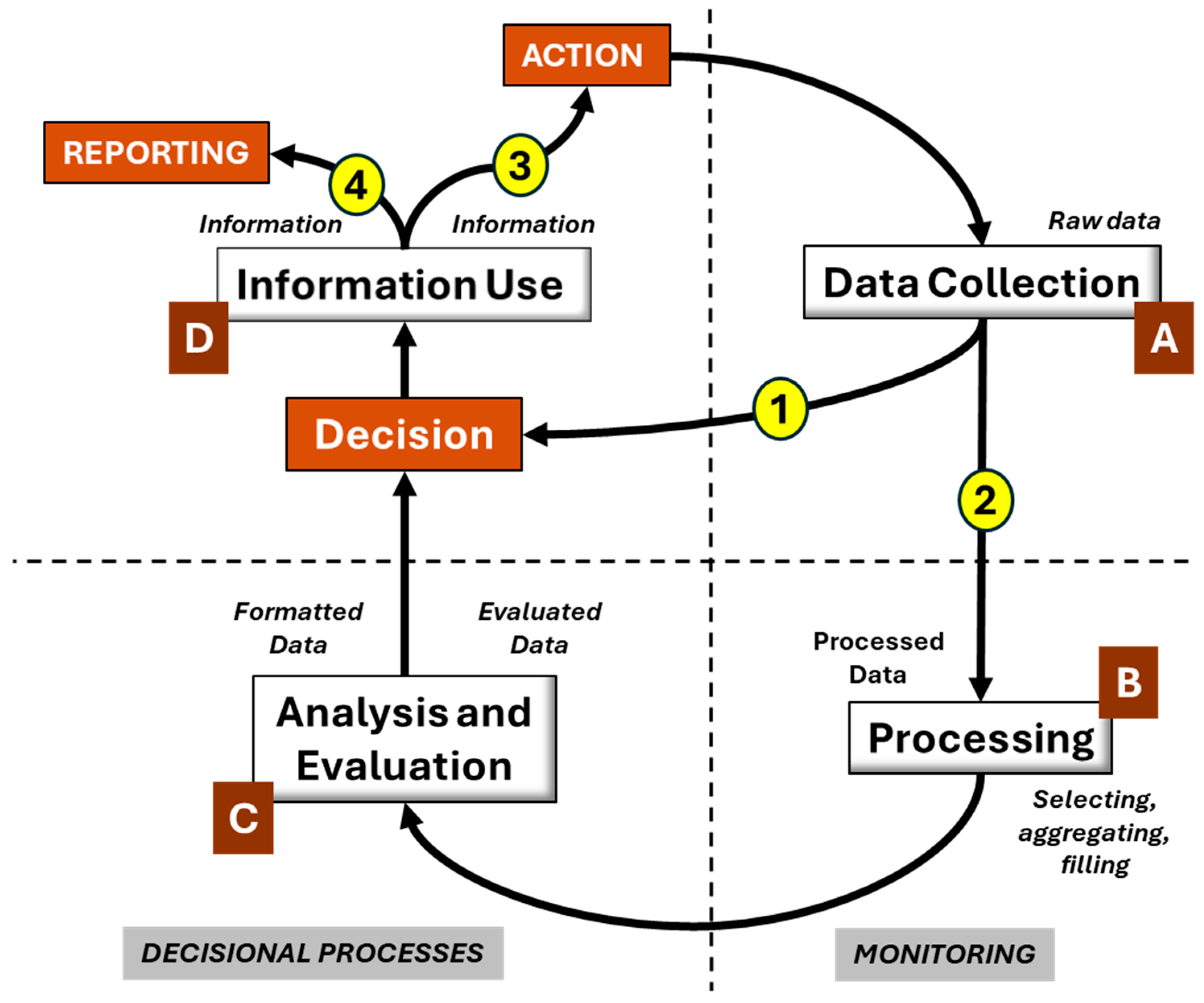
It serves as an infrastructure platform that enables farmers and other decision-makers to store, manage, and analyze data and information for strategic and operational purposes. As defined by Sørensen et al. [24], an FMIS is a system for collecting, processing, storing, and disseminating data in the form of usable information to support farm operations. Fountas et al. [25] added that FMIS plays an important role in reducing costs, maintaining quality, and complying with agricultural standards. FMIS supports long-term planning, regulatory compliance, and traceability, often integrating outputs from PA tools and operational systems. The conceptual structure is shortly achieved in Figure 1, adapted from Mazzetto et al. [26]; following this approach, monitoring is a part of FIMS’s data–information life cycle. Any monitoring activity includes the stage of data collection (phase A). Data treatment (phase B) requires data interpretation to convert raw data into intelligible information to be used in decision-making processes. These can be very simple and focused to support real-time control (path 1), or more sophisticated to be later used together with any related data storage (path 2). The monitoring activity related to FMIS can be classified as follows: (1) environmental monitoring, (2) production monitoring, (3) operational monitoring. Below is a brief description of each.

2.2. Environmental Monitoring

Environmental monitoring (EM) is aimed at observing variables, usually physical and chemical, that characterize the environment in which production activities take place (e.g., soil and meteorological variables, etc.). Gathering information about external environmental conditions is crucial, especially for planning or prompt corrective action. While these conditions cannot usually be controlled, processes can be made more resilient to them. Better information improves how farm activities interact with the environment.

2.3. Production Monitoring

Production monitoring (PM) deals with providing information on the characteristics of the biological entities involved in the farm’s production processes. For example, for crops, it collects data on phenological and nutritional conditions, plant health, and production yields, providing useful information for more precise crop management. Very often, this type of monitoring is considered as the basis of PA, as it provides detailed information on crop behavior and allows for targeted planning and execution of activities.

2.4. Operational Monitoring

OM involves real-time data collection, describing how production processes are carried out. The aim is to provide a time scale register of the process sequence, with any details of the materials or energy consumption and generation involved, thus reconstructing the historical memory of farm activities. In the case of field operations, such as spraying, seeding, or harvesting, the identification of the workplace assumes an essential role. In the case of stationary processes, including storage facilities, OM can even be related to the monitoring of the flows of materials stored there. Whatever the case, OM requires the use of identification systems to detect all agents involved in a process, including power units, implements, and workplaces [26], and the achieved information has the purpose of supporting either immediate or deferred actions. As anticipated above, the first case concerns fully automated decision-making processes that develop along path 1 in Figure 1 (direct connection between phases A and D). The second case concerns the use of information in decisions deferred over time, with the necessary archiving of operational details (decision-making path articulated along the entire sequence of phases A, B, C, and D).

2.5. Precision Agriculture

Precision agriculture is defined by the International Society for Precision Agriculture as a management strategy that gathers, processes, and analyzes temporal, spatial, and individual plant and animal data and combines it with other information to support management decisions according to the estimated variability for improved resource use efficiency, productivity, quality, profitability, and sustainability of agricultural production [27]. It operates across the entire production system and draws on multiple technologies, including sensors, GNSS, remote sensing, and Variable Rate Technology (VRT), to make site-specific decisions. PA also implies tasks related both to the planning and implementation of optimized actions based on an integrated analysis of historical data, which are usually linked to the definition of different types of prescriptive scopes.
As such, PA is usually supported by data coming from EM and PM. OM can integrate the application of PA, performing a monitoring of the conditions which PA operation is expected to provide. The combined use of PA and FMIS can be seen as the implementation of processes supported by what is known as implementation-driven smart agriculture.

2.6. Data–Information Approach in Operational Monitoring

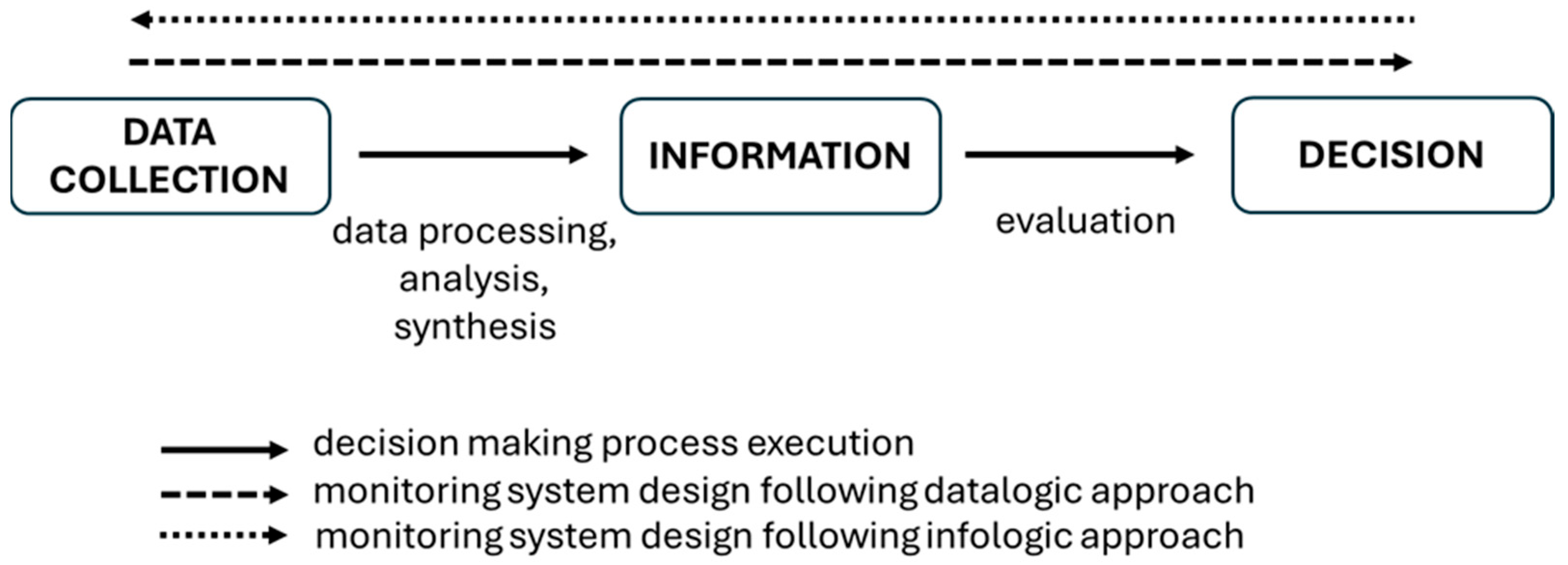
Every decision-making process, when carried out, i.e., in its execution phase, follows a very specific logic: the decision is made on the basis of various criteria in accordance with the decision-making objective and the information available, together with the decision-maker’s ability to interpret that information. In turn, the information comes from various sources, such as summaries of raw data processing that describe certain aspects of the system being decided upon and the surrounding environment. The logical and temporal flow of the decision-making process is therefore data–information–decision. However, in recent years, there has been much debate about the usefulness of data acquired without a specific purpose, to the extent that a special term has been coined: dark data. Such data can give rise to unnecessary economic and environmental costs without bringing any benefits, as the information that can be obtained from it is not in line with users’ needs. This problem has been encountered several times by professionals working in the smart agriculture sector (Arvatec, Rescaldina (MI), Italy, personal communication, 2025). It follows that, by extending the concept of resource efficiency to the resource of “data”, the design of monitoring and, in particular, data acquisition can follow an approach that is more focused on the decision objective, according to the principle of “necessary and sufficient”: the data necessary and sufficient for the purpose are collected. Defining this type of approach as infological, it can be considered as an alternative to an approach that can be defined as datalogical in the design of monitoring systems, as seen in Figure 2 [28].
Mazzetto et al. [29] presented a conceptual distinction between these two approaches that differ primarily in the design and purpose of data collection and processing. In the datalogical approach, data collection is designed with the goal of collecting a large volume of data, across many variables, to have the most reliable picture of the monitored system. Subsequent stages involve processing and evaluating this raw data to extract useful information and support decision-making. The information comes out from the patterns present in the raw data, without “forcing” any schema; for example, within the datalogical approach, a farm might be equipped with a wide array of sensors measuring soil moisture, air temperature, humidity, tractor position, leaf wetness, and even livestock movements, without any specific decision objective in mind. The resulting large dataset is then analyzed retrospectively to identify potential patterns or correlations, with the expectation that useful insights for management decisions will emerge from the data. While this method can yield valuable insights, it also risks inefficiencies by generating datasets that include irrelevant or redundant information for the decision-making scope at hand. This can increase the computational load, storage demands, and complexity of analysis without necessarily improving decision outcomes. On the other hand, the design of a monitoring system according to the infological approach begins with a clear definition of the decision that needs to be made, followed by an assessment of the specific information required and sufficient to support that decision. The raw data collection is then targeted precisely to generate the information necessary to satisfy the original decision objective. This approach ensures that data acquisition is purpose driven. By avoiding unnecessary data streams, the infological approach enhances system efficiency and responsiveness.
In today’s agriculture, when a lot of raw data could be available on farms, it is important to collect only useful data to keep the focus on not just data collection but on delivering actionable information. With the focus on OM, Mazzetto et al. [26] emphasized that any monitoring activity should be rooted, at the design level, in the infological perspective to ensure that system architecture, sensor integration, and data flows are meaningfully aligned with the operational decisions that must be supported in the field.

3. Operational Monitoring Within the Conceptual Farm Ontology Framework

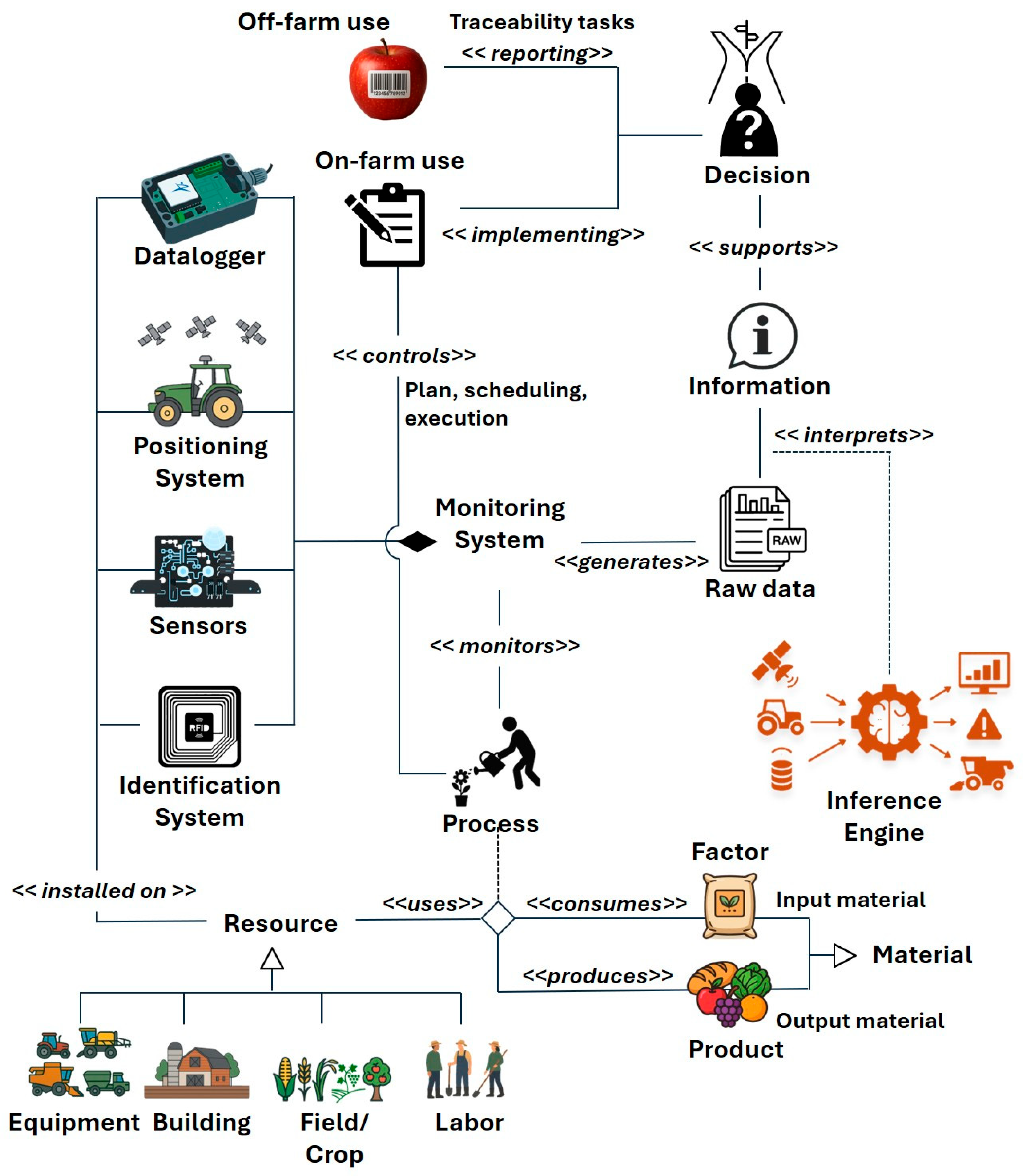
Sacco et al. [30] defined farm ontology (FO) as a structured conceptual model for representing all aspects of a farming system. Figure 3 gives an overall picture of the main entities of FO, with a focus on OM. FO addresses the complexity of modern agricultural operations by integrating both structural elements (what a farm has) and functional elements (what a farm does) within a unified framework. FO categorizes farm activities into hierarchical decision levels—strategic (designing and investments, strategic planning), management (tactical planning, resource allocation, reporting, and analysis), and operational (carrying out elementary actions—energy, materials, and competences for the execution)—and supports both planning (ex ante) and monitoring (ex post) processes. This comprehensive approach allows for simulation, automation, traceability, and certification, thereby enhancing the overall decision-making capability in agriculture. At the core of FO is the concept of farm configuration, which defines the structural composition of the farm. Farm configuration is composed of two primary classes of assets: resources and materials. Resources are reusable elements that are not consumed during operations but are essential for task execution (e.g., land, tractors, implements, labor, and buildings). Materials, on the other hand, include both inputs (which are consumed during processes, such as fuel, fertilizers, and seeds) and outputs (products generated through farm operations). Outputs are further classified as main products, destined for sale or distribution, and byproducts, which can be reused within the farm system (e.g., manure as fertilizer). To fully realize the potential of an FMIS based on the FO framework, especially for assessing ex post performance (i.e., the actual performance of farm operations), a robust mechanism for data collection is required. This is where OM becomes essential. The data gathered through OM feeds into the ex post performance layer of FO, enabling the estimation of performance indicators and efficiency indexes. These metrics allow a comparison between what was planned (ex ante performance) and what was achieved (ex post performance), thereby supporting the evaluation of operational efficiency, environmental impact, and resource optimization.

4. Framework of Operational Monitoring

According to Mazzetto et al. [29], any operational monitoring system is fundamentally composed of four core components: (1) a positioning system, (2) sensors, (3) an identification system, and (4) a datalogging system. Values read from sensors are associated with a timestamp and georeferenced to generate and record the raw data. As shown in Figure 3, these components are “installed on” any of the resources as per the requirement of data collection. The monitoring system “monitors” the process; a process “uses” resources and “consumes” materials (input and output) in the farm. Through this data collection, the measuring system “generates” raw data and sends it to the inference engine, which “interprets” and transform it into information. The inference engine in this case is the set of all the data processing, analysis, and synthesis algorithms that transform raw data into information. The reliability of this part of the process, in addition to the instrumental reliability, often also depends on the need for the interpretation of information in a consistent context with the farm and the further use of the information itself. This information then “supports” the decision, which can be for both or either one of two: off-farm applications or on-farm applications. The former addresses “reporting” (traceability), while the latter enables “automation” in terms of planning, scheduling, and execution.
In this general scheme, the inference engine refers to the set of algorithms that transform raw data into information, as well as any algorithms that support the evaluation of information. These algorithms must be defined during the design phase of the monitoring system, or better still during the design phase of the farm information system which the monitoring system will be integrated into. An example of an inference engine related to the implementation of the framework described here can be found in [31].
While, from a design perspective, the proposed framework aims to highlight the role of individual elements, their specific characteristics will depend on the application and therefore on the monitoring system to be implemented. Specific characteristics include, for example, the working range and accuracy of the sensors, the precision of the positioning system, the memory and data transmission capacity, the computing power of the IT devices, and the sensitivity and reliability of the algorithms that constitute the inference engine. Uncertainty must also be designed according to the purpose. For example, in cases involving real-time and automated actions, a level of intervention managed on the basis of maximum uncertainty (lower risk in the event of incorrect estimation) must be maintained. In the case of actions such as the automatic filling of field registers, it is possible to opt for a confirmation mode and the possibility of a review of activities by the farmer. From a case study in which a prototype implementation of the framework described here was used with the components described in [31] by monitoring positions alone (tractor equipped with GNSS), algorithms can reconstruct kinematic behavior in the field with an over 90% reliability if a digital map of the fields of the farm is provided. In the case of inference engines that combine multiple operational monitoring solutions with data fusion approaches (monitoring of slurry storage facilities integrated with monitoring of spreading equipment), highly accurate and reliable results can also be obtained thanks to the availability of details on the materials distributed. As reported by [29], in these cases, complete spreading records can be obtained automatically with estimates of nitrogen loads per hectare, but the reliability of recognizing the operation performed cannot exceed 50%. This increases as components are added to the monitoring system: once the functional sites are known (e.g., barrel refilling, material unloading silos), reliability rises to 60% and increases further if the system is supplemented by an identification code transmitter on the operating machines as well.

4.1. Classification of Operational Monitoring

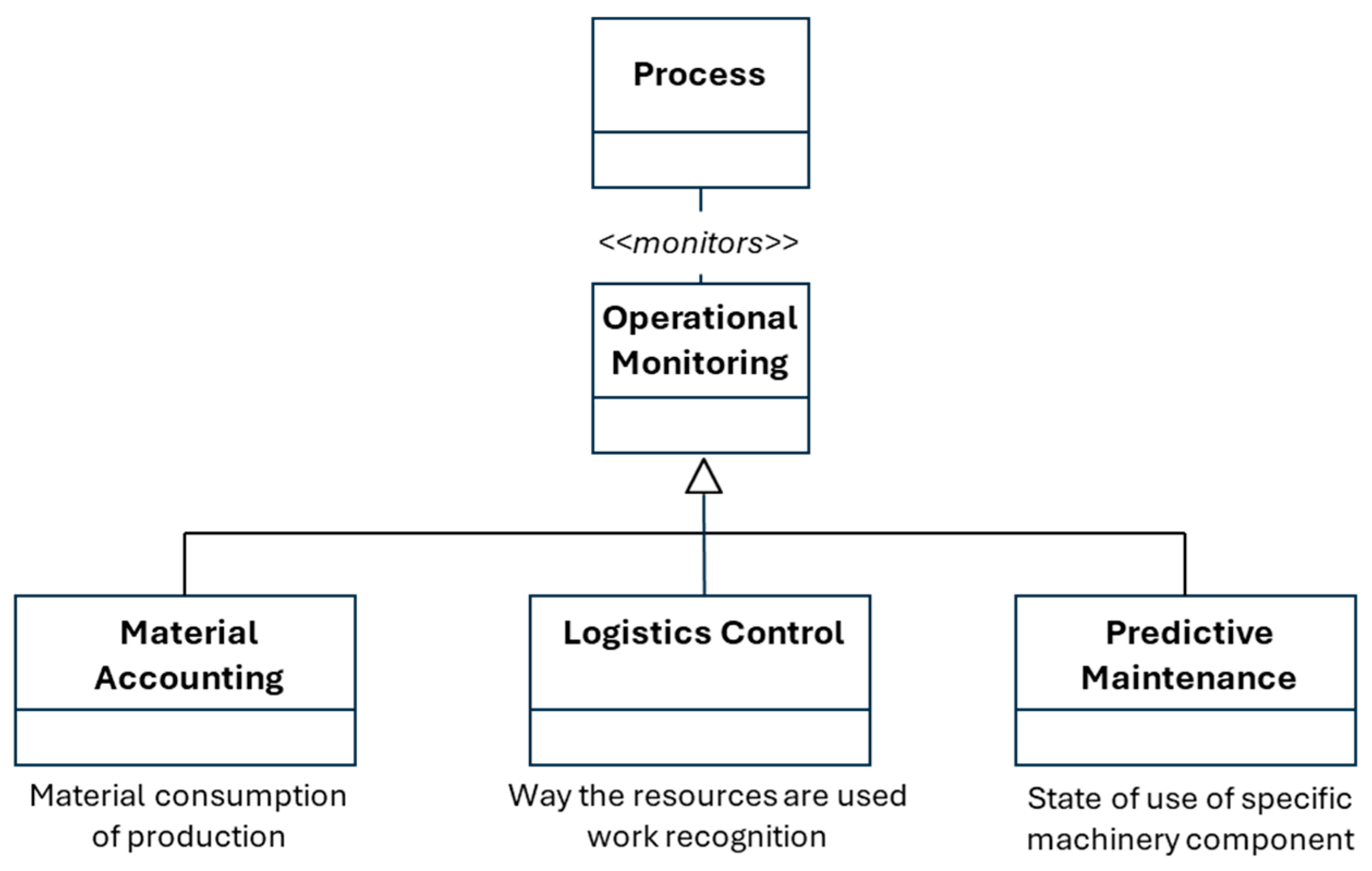
In this section, the authors introduce the following different categories of OM as shown in Figure 4: material accounting, logistics control, and predictive maintenance. These categories align closely with the key FO entities (such as process, resource, material, and action) and provide a comprehensive framework for analyzing farm operations both in real-time and retrospectively.
  • Material accounting (material consumption of production) involves the monitoring of materials, defined in the FO as assets consumed (inputs) or generated (outputs) during a farm process. This includes the use of seeds, fertilizers, pesticides, and energy sources. Through scheduled and monitored activities, the amount, timing, and spatial deployment of these materials can be evaluated. This classification supports performance evaluations by comparing planned versus actual input applications, which are essential for traceability, sustainability, and cost-efficiency.
  • Logistics control (use of resources) refers to the observation of how resources (assets that are available at the farm) are mobilized and scheduled. This includes farm machinery used in process execution. Monitoring logistics focuses on tasks like route optimization and fleet coordination. This category also supports performance evaluation, enabling benchmarking and helping to meet production goals under specific resource constraints.
  • Predictive maintenance (state of use of specific components of machine/implements) addresses the condition monitoring of critical machinery parts such as PTO shafts, crankshafts, or hydraulic actuators. These are farm assets that require continuous observation for vibration, temperature, wear, and stress signals. The goal is not immediate process control but rather the prediction of failure or degradation to enable the scheduling of preventive interventions. This predictive capability enhances long-term machinery availability, operational continuity, and externalities reduction.
Each of these classes ultimately feeds into the broader task of performance evaluation, an ontology-defined concept that quantifies how well the farm behaves in relation to targeted goals. The performance can be viewed from both ex ante and ex post perspectives. For example, during a monitored activity, operational data from sensors and positioning systems are collected and interpreted by inference engines to assess whether the farm actions are progressing according to the scheduled process and nominal plan.
Moreover, this classification supports two distinct types of data acquisition in the monitoring logic:
  • For input accounting and logistics, the OM system collects real-time data during ongoing processes. This includes quantities of materials and energy used (e.g., fertilizers, fuel) and resource movement (e.g., machinery routes, timing).
  • For predictive maintenance, the OM system records sensor data related to the functioning of specific machine components (e.g., PTO, engine vibration). This historical data may later be used by downstream analytical or inference systems to develop predictive models for maintenance planning and alert systems.
It is important to emphasize that OM itself does not perform any evaluation or decision-making. It ensures that raw data is collected accurately and, for automated OM, in real time, serving as a foundational layer for later stages such as processing, modeling, and decision support. By aligning OM with the semantic structure of FO, this classification not only enhances conceptual clarity but also enables a better integration with FMIS, decision support systems, and automation tools. It provides a foundational framework for transforming raw operational data into actionable insights, supporting both immediate control and long-term strategic planning in smart agriculture.
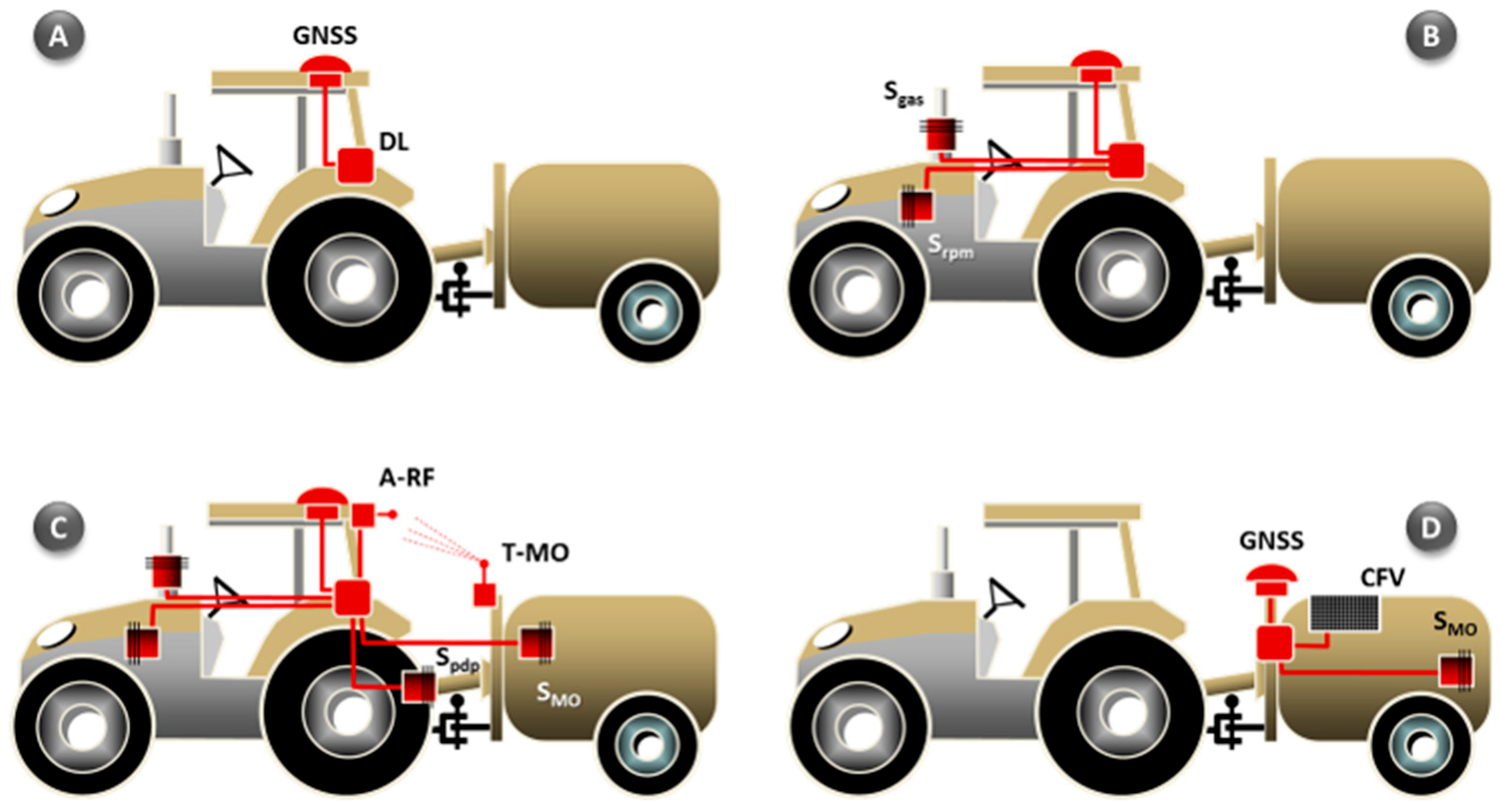
Building on this perspective, the effectiveness of OM also depends on the way monitoring solutions are integrated and deployed within the farming system. As shown in Figure 5, in relation to application architectures (the way monitoring is embedded in the farm structure), operational monitoring can be (a) partial, when it involves the recording of a limited number of farm operations, or (b) global, when all company activities are monitored. With regard to system architectures (the setup methods on individual vehicles), solutions can be (a) tractor-oriented, when the central unit of the acquisition system is installed on board the tractor, or (b) implement-oriented, when it is installed on the operating machine. To understand this, on a smaller scale, when the data logger is installed on the tractor, all implements attached and in operation can be recorded, resulting in a global form of monitoring. Conversely, when the data logger is installed directly on an individual implement, only the activity of that specific machine is captured, corresponding to a partial monitoring approach. With respect to Figure 5, possible construction architectures of data acquisition systems for the automation of operational monitoring could be a tractor-oriented approach with different degrees of complexity, from solution A, with the only position system, through to solution B, which considers the possibility of having sensors for some aspects of tractor operation (engine rpm, exhaust gas temperature, PTO), to solution C, which extends the object of monitoring to the whole tractor-implement coupling including an identification system for the autonomous recognition of operations performed and eventually sensors on implements. Solution D, instead, proposes an implement-oriented approach with solutions for the proper energy supply. The tractor-oriented approach should be preferred if there is a need to generate information related to the tractor’s performance.
In any case, for practical implementation, it is advisable to focus on solutions with automatic activation, so that the recording system is triggered automatically when the vehicle begins operation (for example, through vibration sensors). With manual activation, the requirement of completeness and the reliability of the collected data, which operational monitoring is intended to guarantee, would be at risk. To provide clarity on the classification framework proposed in this study, Table 1 presents some research studies published in recent years, categorized according to the defined OM classifications.

4.2. Components of Operational Monitoring

As described earlier, operational monitoring consists of four components; the following sections provide an overview of the current technologies employed in each of OM’s components.

4.2.1. Positioning Systems

Positioning technologies form a foundational component of OM systems in agriculture, enabling the spatial tracking and coordination of machinery activities with increasing levels of precision. Among these technologies, the Global Navigation Satellite System (GNSS) is the most employed, providing geospatial data essential for better machinery operativity, assisting automatic or autonomous field operations and supporting logistical decision-making related to path planning and coverage optimization. While standard GNSS receivers typically offer meter-level accuracy, advanced correction techniques such as Real-Time Kinematic (RTK) GNSSs significantly enhance positioning precision, achieving accuracy within a few centimeters by applying differential corrections from base stations or reference networks [41,42,43]. Infrastructure improvements, such as the Italian Space Agency’s national GNSS network of 46 base stations, have expanded the availability of RTK services across Europe, facilitating multi-constellation access to GPS, GLONASS, Galileo, and BeiDou signals [44]. Alongside this, compact and cost-effective RTK receivers are now available, further promoting their adoption in practical farm settings [43].
Other GNSS-based methods, such as Precise Point Positioning (PPP), eliminate the need for local base stations by applying satellite orbit and clock corrections, although they typically involve longer convergence times [45]. To balance the trade-offs between infrastructure dependency and accuracy, hybrid approaches like PPP–RTK have been introduced, leveraging both global and local correction data to achieve rapid and precise positioning [46].
In addition to GNSS-based systems, several non-GNSS positioning technologies are increasingly relevant in agricultural environments where satellite signals may be weak or obstructed. These include Ultra-Wideband (UWB) systems, Visual Simultaneous Localization and Mapping (Visual SLAM), and Inertial Navigation Systems (INSs), each offering complementary capabilities for positioning in GNSS-denied or structured environments such as greenhouses, orchards, or hilly terrain.
Table 2 provides a comparative overview of both the GNSS and non-GNSS positioning technologies currently utilized in operational monitoring, highlighting their working principles, accuracy potential, field suitability, and implementation considerations.
From the literature cited in Table 2, it is shown that GNSS-based techniques remain the backbone of outdoor positioning, yet their effectiveness varies substantially depending on the required accuracy, field conditions, and operational constraints. PPP, for instance, offers global and infrastructure-free positioning with sub-decimeter potential but continues to suffer from long convergence times, which limit its use in real-time operational monitoring; however, emerging services such as Galileo HAS and PPP-AR are rapidly reducing latency and may make PPP increasingly attractive for autonomous tractors in large-scale farming. SBAS and multi-constellation GNSS provide cost-effective solutions for guidance tasks, though their meter-level accuracy remains insufficient for high-precision operations like variable-rate spraying or seed placement. By contrast, RTK networks delivered through permanent GNSS base stations represent the current state of the art for centimeter-level accuracy, though their reliance on stable mobile internet and subscription services may constrain adoption in remote rural areas. Non-GNSS alternatives such as UWB positioning and Visual SLAM show a promising performance in GPS-denied environments, particularly in orchards, vineyards, or greenhouses, yet high setup costs, sensitivity to environmental conditions, and computational demands limit large-scale deployment. Sensor fusion approaches, combining INS/IMU and dead reckoning with GNSS, mitigate signal degradation under canopies or in hilly terrain, but drift remains a persistent technical challenge without continuous GNSS re-correction. Future trends point toward hybrid positioning systems based on a single onboard GNSS receiver, integrating multi-constellation signals, low-cost IMUs, and emerging satellite-based correction services, enabling more robust, scalable, and autonomous operational monitoring across diverse cropping systems without a reliance on local base stations.

4.2.2. Sensors in Data Acquisition

Sensors are essential components in OM systems, serving as the interface between physical processes and digital interpretation. Functioning as transducers, sensors detect variations in physical or chemical quantities, such as pressure, temperature, flow, or motion, and convert them into electrical signals for processing and analysis [67]. In computerized systems, these analog signals are typically digitized either within the sensor or via an external control or logging unit, enabling real-time data recording and control. The diversity and task-specific nature of sensors in agricultural operations make them central to precision and efficiency. Table 3 highlights some recent studies that demonstrate how sensors are applied across different operational contexts to support data-driven monitoring and control.
  • The application of sensors can be carried out in a single mode or according to a data fusion approach. As far as the systems based on a single sensor is concerned, the following aspects apply:
  • They rely on individual sensing technologies, such as ultrasonic transducers, pressure sensors, encoders, or thermocouples.
  • They are characterized by a low cost, high strength, and simple integration into existing machinery.
  • They provide measurements of single parameters, which limits their ability to capture complex data.
  • Their measurement accuracy can be affected by variable environmental conditions (e.g., temperature, dust, vibration).
  • They often require frequent calibration and fine tuning to adapt to specific machines and operating conditions.
  • As far as the systems based on a sensor fusion approach the following aspects apply:
  • They combine multiple sensing modalities (e.g., GNSS, IMU, optical, LiDAR, mechanical sensors) to generate higher accuracy and richer information.
  • They improve reliability by compensating for disturbances caused by soil heterogeneity, machine vibration, and changing surface conditions.
  • They enable advanced measurements such as tillage depth estimation, wheel slip detection, and spraying and seeding performance monitoring.
  • They are technically more complex and computationally demanding, often requiring advanced data processing and fusion algorithms.
  • They have higher implementation costs compared to single-sensor solutions.
Future advances are expected in AI-based sensor fusion algorithms, IoT-based wireless connectivity, affordable LiDAR and vision systems, and standardized data structures to support seamless integrations into farm information systems.

4.2.3. Identification System

Radio-Frequency Identification (RFID) technology is often used to record details about each object individually (such as identification number and type of object). RFID-based systems consist of tags attached to objects (such as machinery, livestock, or tools) and readers that capture tag data wirelessly. These systems allow for the real-time tracking of equipment usage, inventory management, and process monitoring. RFID tags can be of two types, i.e., active and passive tags, the former ones have a built-in battery to transmit their own signal over a long range, while the latter ones rely on energy from RFID readers’ signals to power themselves and transmit data over shorter distances. RFID readers are used for gathering data from RFID tags using radio waves. Tags can store a small amount of data, including special identification numbers. For smart agriculture, tags may store some identification data of the soil, crop, or location [79]. Wasson et al. [80] integrated RFID into IoT-based systems for monitoring crops and explained that sensors attached to RFID tags can measure parameters such as soil moisture, temperature, and nutrient levels, while the unique tag ID links this data to specific field zones. RFID readers then wirelessly collect both identification and sensor data and transmit them to a central system for processing. Based on this information, automated actions can be triggered, such as activating irrigation when moisture levels are low and shutting it off once requirements are met. Furthermore, in the context of farm machinery, RFID tags can be employed to detect the activation of implements; in this setup, RFID tags are affixed to the implements, while the datalogger is installed on the prime mover. When an implement is engaged in operation, the RFID tag registers its activity and communicates with the datalogger, thereby confirming and recording that the implement is in use. Some RFIF technologies being used in agriculture are listed in Table 4 with their advantages, limitations, and applications in agriculture.
The RFID technologies summarized in Table 4 provide a clear picture of the current state and future trends of RFID technology. Passive RFID remains the most cost-effective option for basic implement and asset identification, but its limited read range and dependence on manual or close-proximity scanning restrict its use to simple tracking tasks. Fixed UHF systems extend automation by enabling unattended event logging but still suffer from signal distortion caused by metal surfaces and moisture-rich environments common in agriculture. Active and semi-passive RFID introduce greater functionality through longer read ranges and onboard sensing capabilities, offering promising opportunities for machine usage detection, environmental monitoring, and enhanced logistics. These systems are constrained by higher costs, battery maintenance requirements, and complex integration. The most advanced architecture, RFID combined with IoT or wireless sensor networks, enables real-time visibility and interoperability with farm management platforms, but requires reliable connectivity and good cybersecurity frameworks. Overall, the trend shifts toward hybrid RFID–IoT systems that support automated data acquisition across machinery, livestock, and supply chains. Future advancements will likely focus on improving read reliability near metal surfaces, extending tag lifetime, and developing standardized communication frameworks to ensure a seamless integration across diverse agricultural operations.
As concerns the integration of RFID in agricultural machinery, some challenges must be always taken into consideration, essentially due to the presence of relevant metal masses. Indeed, mounting RFID systems on tractors and implements often results in poor read performance due to interference from large metal surfaces, electromagnetic noise from engine electronics, and physical obstructions. Metal components such as the chassis and hydraulic parts reflect or absorb radio waves, creating dead zones and detuning antennas, while engine ignition systems introduce EMI, which disrupts UHF signals. To mitigate these issues, specialized on-metal tags and high-gain antennas should be used, combined with strategic placement, keeping antennas 30–50 cm from metal surfaces and tilting them 15–30° to reduce multipath interference caused by signal reflections that lead to duplicate or ghost reads. Positioning antennas on non-metallic parts wherever possible further improves reliability. Reader settings can be optimized by carefully increasing power within regulatory limits and enabling frequency hopping or time multiplexing. Finally, conducting site surveys to identify optimal mounting locations away from electronics ensures a consistent performance in agricultural environments.

4.2.4. Datalogging System

The dataloggers are responsible for collecting the data generated by the other three components of the measuring system. In addition, they generate timestamps associated with recorded events and transfer the resulting data into a database for storage and further processing. Different types of dataloggers can be employed depending on the specific monitoring requirements of the farm and the nature of the resources to which they are connected. During operations, the datalogger continuously collects data from different RFID tags and stores it in its internal memory. Depending on the system configuration, the stored data can either be periodically downloaded for offline analysis or transmitted in real time to external servers or cloud platforms. This transmission may rely on various communication protocols and channels, such as Wi-Fi, Bluetooth, cellular networks, or LoRaWAN, chosen according to farm connectivity and data volume requirements. Such flexibility in data management ensures both local backup and remote accessibility, enabling timely processing, integration with decision-support systems, and long-term storage for operational analysis.
Examples of the dataloggers used in agricultural monitoring include standalone dataloggers with onboard memory, which store data locally for later retrieval, and wireless dataloggers, which transmit information through short- or long-range protocols, such as ZigBee and LoRaWAN, and IoT-enabled dataloggers, which are directly integrated with cloud platforms for real-time monitoring and decision support [93,94]. These categories illustrate the technological diversity available, from simple memory-based systems to advanced IoT architectures, allowing farmers and researchers to match the datalogger type to the connectivity and operational needs of the farm. Table 5 provides some available datalogger technologies in agriculture.
CAN-BUS and ISOBUS network logging are the most reliable and high-resolution sources of machine performance information, offering continuous access to engine, PTO, hydraulic, and operational state variables, but the challenge of decoding proprietary manufacturer signals and managing large, complex datasets limits their accessibility for secondary functions such as the system operative monitoring applications. Commercial systems such as FPDat II demonstrate how standardized onboard computers can simplify operational monitoring by providing validated, ready-to-use productivity indicators, though their restricted flexibility and reliance on predefined signals make them less adaptable for experimental studies. Vision-based embedded logging represents the latest advancement, enabling real-time weed detection, selective spraying, and treatment documentation, but these systems are highly sensitive to environmental variability and computational demands, and often lack fine-grained actuator-level logs. These technologies show a shift toward integrated platforms where machine data, GNSS, vision systems, and automated decision protocols converge to support precision agriculture. Future innovation is expected to focus on standardized machine data access for the easy handling of data from different machines.

4.3. Data Processing and Management

After collecting operational data in the field, multiple transmission pathways are available to transfer it into a farm repository. The most common and convenient method today is wireless data transfer via cellular (e.g., 4G/5G) or satellite networks, using on-board Data Transfer Units (DTUs) as part of an IoT-enabled cloud platform. For instance, such DTUs can relay CAN-bus and ISO 11783 [105] data to a cloud server every second, with average packet loss rates reported as low as 0.4% [13]. Once uploaded, data are automatically saved into structured repositories, like relational databases or a more complete data warehouse, where they become accessible for visualization, analysis, and integration with farm management systems. In scenarios with limited or no cellular coverage, offline transfer using USB flash drives or SD cards is a good alternative. Modern third-party devices, such as the OneSoil modem (Freienbach, Switzerland), allow farm machinery data to be downloaded manually, transported, and then uploaded to cloud-based platforms through a desktop interface, reducing manual effort and ensuring the timely availability of operational data even in remote areas [106]. Additionally, hybrid edge–fog–cloud architectures are becoming increasingly popular. On-board edge devices perform preliminary filtering and aggregation, while fog gateways located near the field handle local analytics and buffering. Only processed summaries or alerts are transmitted to the cloud, optimizing bandwidth usage and reducing latency [107,108,109]. These tiered systems not only allow for robust data transfer but also enhance real-time responsiveness and operational resilience on modern farms.

5. Data Privacy and Security

As mentioned in the previous paragraphs, nowadays, monitoring systems are largely related to IoT technologies. Like other smart farming technologies, OM innovations also encounter significant challenges. One of the key challenges is the concerns over data security and privacy, doubts surrounding data ownership and governance, and resistance among stakeholders due to cultural and operational aspects [110]. In today’s digital era, these data privacy concerns have become increasingly complex. Farmers now face issues of data asymmetry and a lack of transparency regarding how Agricultural Technology Providers (ATPs) collect, store, and utilize their operational data [111]. To facilitate fair data sharing across sectors, the EU adopted the Data Act, which will enter into force in 2025. The EU Code of Conduct on agricultural data sharing, set up by a group of associations from the EU agri-food chain, provides guidance on the use of agricultural data, particularly the rights to their access and use. This will enable the trustworthy sharing of agricultural data between private stakeholders and public authorities [112].
Another critical issue is farmers’ awareness of the value of their data. If farmers are unaware of what data they are sharing, obtaining their consent becomes ethically problematic. In this context, a study by Wiseman et al. [113] found that 74% of farmers did not fully understand the terms and conditions related to data collection in agreements with service providers, highlighting a substantial gap in awareness and informed consent. Given these challenges, it is crucial to implement advanced data privacy techniques during data collection and transmission. Unauthorized access to sensitive operational data, especially by competitors, could have serious consequences for a farmer’s business. Table 6 outlines current data privacy techniques and their applications in agriculture.

6. Conclusions and Future Recommendations

As farms grow in complexity and scale, the need to observe and understand how operations unfold in real time has never been greater. This paper presented a structured perspective on OM, not just as a collection of tools, but as a deliberate system designed to capture, log, and structure process-level data during on-field activities. By distinguishing OM from broader concepts like PA and FMIS, we clarified its specific role as the eyes and ears of smart farming. We explored the four fundamental components of OM, positioning systems, sensors, identification technologies, and datalogging systems, and how they work together to feed data into FMIS. These tools form the foundation upon which meaningful insights and informed decisions can eventually be built. The proposed classification, covering input accounting, logistics, and predictive maintenance, offers a practical framework to better design, apply, and interpret monitoring systems in agricultural settings. It also contributes to improved efficiency, traceability, and resource management at the farm level.
Looking ahead, there are several opportunities to further develop this field. Ensuring compatibility between monitoring systems from different vendors remains a challenge, and future research should prioritize the development of open communication standards and interoperable data formats. As technologies like edge, fog, and cloud computing become more accessible, there is also a growing need to support distributed data processing while preserving reliability and efficiency. Additionally, the integration of artificial intelligence holds exciting potential, especially in enabling predictive capabilities and real-time responses to operational anomalies.

Author Contributions

Conceptualization, G.G.M., P.S. and F.M.; methodology, G.G.M., P.S. and F.M.; formal analysis, G.G.M., P.S. and F.M.; investigation, G.G.M.; writing—original draft preparation, G.G.M.; writing—review and editing, P.S., G.C. and F.M.; supervision, P.S., G.C. and F.M.; funding acquisition, F.M. All authors have read and agreed to the published version of the manuscript.

Funding

This study was carried out within the Agritech National Research Center and received funding from the European Union Next-GenerationEU (Piano Nazionale di Ripresa e Resilienza (PNRR)—Missione 4, Componente 2, Investimento 1.4—D.D. 1032 17/06/2022, CN00000022). This manuscript reflects only the authors’ views and opinions; neither the European Union nor the European Commission can be considered responsible for them.

Institutional Review Board Statement

Not applicable.

Informed Consent Statement

Not applicable.

Data Availability Statement

As a review article, the data come from a thorough analysis of the reported and cited literature.

Conflicts of Interest

The authors declare no conflicts of interest.

References

  1. Karunathilake, E.M.B.M.; Le, A.T.; Heo, S.; Chung, Y.S.; Mansoor, S. The Path to Smart Farming: Innovations and Opportunities in Precision Agriculture. Agriculture 2023, 13, 1593. [Google Scholar] [CrossRef]
  2. Emami, M.; Almassi, M.; Bakhoda, H.; kalantari, I. Agricultural Mechanization, a Key to Food Security in Developing Countries: Strategy Formulating for Iran. Agric. Food Secur. 2018, 7, 24. [Google Scholar] [CrossRef]
  3. Li, M.; Liu, Y.; Huang, Y.; Wu, L.; Chen, K. Impacts of Risk Perception and Environmental Regulation on Farmers’ Sustainable Behaviors of Agricultural Green Production in China. Agriculture 2022, 12, 831. [Google Scholar] [CrossRef]
  4. Shamshiri, R.R.; Weltzien, C.; Hameed, I.A.; Yule, I.J.; Grift, T.E.; Balasundram, S.K.; Pitonakova, L.; Ahmad, D.; Chowdhary, G. Research and Development in Agricultural Robotics: A Perspective of Digital Farming. J. Agric. Biol. Eng. 2018, 11, 1–14. [Google Scholar] [CrossRef]
  5. Feuerbacher, A.; Luckmann, J. Labour-Saving Technologies in Smallholder Agriculture: An Economy-Wide Model with Field Operations. Aust. J. Agric. Resour. Econ. 2023, 67, 56–82. [Google Scholar] [CrossRef]
  6. White, K.E.; Cavigelli, M.A.; Bagley, G. Legumes and Nutrient Management Improve Phosphorus and Potassium Balances in Long-Term Crop Rotations. Agron. J. 2021, 113, 2681–2697. [Google Scholar] [CrossRef]
  7. Gadanakis, Y.; Bennett, R.; Park, J.; Areal, F.J. Evaluating the Sustainable Intensification of Arable Farms. J. Environ. Manag. 2015, 150, 288–298. [Google Scholar] [CrossRef] [PubMed]
  8. Gagliardi, G.; Lupia, M.; Cario, G.; Gaccio, F.C.; D’angelo, V.; Cosma, A.I.M.; Casavola, A. An Internet of Things Solution for Smart Agriculture. Agronomy 2021, 11, 2140. [Google Scholar] [CrossRef]
  9. Wang, P.; Yue, M.; Yang, L.; Luo, X.; He, J.; Man, Z.; Feng, D.; Liu, S.; Liang, C.; Deng, Y.; et al. Design and Test of Intelligent Farm Machinery Operation Control Platform for Unmanned Farms. Agronomy 2024, 14, 804. [Google Scholar] [CrossRef]
  10. Mahfuz, S.; Mun, H.S.; Dilawar, M.A.; Yang, C.J. Applications of Smart Technology as a Sustainable Strategy in Modern Swine Farming. Sustainability 2022, 14, 2607. [Google Scholar] [CrossRef]
  11. Cravero, A.; Pardo, S.; Galeas, P.; López Fenner, J.; Caniupán, M. Data Type and Data Sources for Agricultural Big Data and Machine Learning. Sustainability 2022, 14, 16131. [Google Scholar] [CrossRef]
  12. Hasan, S.H.; Hasan, S.H.; Khan, U.A.; Hasan, S.H. Containerized Deep Learning in Agriculture: Orchestrating GoogleNet with Kubernetes on High Performance Computing. Concurr. Comput. 2024, 36, 8116. [Google Scholar] [CrossRef]
  13. Zhang, F.; Zhang, W.; Luo, X.; Zhang, Z.; Lu, Y.; Wang, B. Developing an IoT-Enabled Cloud Management Platform for Agricultural Machinery Equipped with Automatic Navigation Systems. Agriculture 2022, 12, 310. [Google Scholar] [CrossRef]
  14. Bouhachlaf, L.; Benslimane, O.; El Hajjaji, S. Monitoring Soil Elements for Irrigation Management Using Internet of Things (IoT) Sensors. World Water Policy 2023, 9, 756–766. [Google Scholar] [CrossRef]
  15. Golubev, I.G. Digitalization and Use of Artificial Intelligence Technologies in Technical Modernization of the Agro-Industrial Complex. In Proceedings of the IV International Scientific and Practical Conference “Sustainable Development and Green Growth on the Innovation Management Platform”, Kaliningrad, Russia, 27–28 May 2021. [Google Scholar] [CrossRef]
  16. Celicourt, P.; Rousseau, A.N.; Gumiere, S.J.; Camporese, M. Agricultural Hydroinformatics: A Blueprint for an Emerging Framework to Foster Water Management-Centric Sustainability Transitions in Farming Systems. Front. Water. 2020, 2, 586516. [Google Scholar] [CrossRef]
  17. Kopiks, N.; Viesturs, D.; Rucins, A. Changes in Technical Support on Farms of Latvia. In Proceedings of the 17th International Conference on Engineering for Rural Development, Jelgava, Lativa, 23–25 May 2018. [Google Scholar] [CrossRef]
  18. Yagi, H.; Hayashi, T. Machinery Utilization and Management Organization in Japanese Rice Farms: Comparison of Single-Family, Multifamily, and Community Farms. Agribusiness 2021, 37, 393–408. [Google Scholar] [CrossRef]
  19. DeBoe, G.; Deconinck, K.; Henderson, B.; Lankoski, J. Reforming Agricultural Policies Will Help to Improve Environmental Performance. EuroChoices 2020, 19, 30–35. [Google Scholar] [CrossRef]
  20. Lu, L. Remote Monitoring System of Digital Agricultural Greenhouse Based on Internet of Things. SCPE 2023, 24, 1–9. [Google Scholar] [CrossRef]
  21. Mat, I.; Kassim, M.R.M.; Harun, A.N.; Yusoff, I.M. Smart Agriculture Using Internet of Things. In Proceedings of the IEEE Conference on Open Systems, Langkawi, Malaysia, 21–22 November 2018. [Google Scholar] [CrossRef]
  22. Mazzetto, F.; Gallo, R.; Importuni, P.; Petrera, S.; Sacco, P. Automatic filling of the register of field activities, from challenge into reality. Chem. Eng. Trans. 2017, 58, 667–672. [Google Scholar] [CrossRef]
  23. Bordiyanu, I.; Nurekenova, E.; Mambetkaziyev, A.; Baikenov, Z.; Nepshina, V. Assessing the efficiency of management information systems in agrarian companies. Sci. Horiz. 2025, 28, 102–114. [Google Scholar] [CrossRef]
  24. Sørensen, C.G.; Pesonen, L.; Bochtis, D.D.; Vougioukas, S.G.; Suomi, P. Functional Requirements for a Future Farm Management Information System. Comput. Electron. Agric. 2011, 76, 266–276. [Google Scholar] [CrossRef]
  25. Fountas, S.; Carli, G.; Sørensen, C.G.; Tsiropoulos, Z.; Cavalaris, C.; Vatsanidou, A.; Liakos, B.; Canavari, M.; Wiebensohn, J.; Tisserye, B. Farm Management Information Systems: Current Situation and Future Perspectives. Comput. Electron. Agric. 2015, 115, 40–50. [Google Scholar] [CrossRef]
  26. Mazzetto, F.; Gallo, R.; Riedl, M.; Sacco, P. Proposal of an Ontological Approach to Design and Analyse Farm Information Systems to Support Precision Agriculture Techniques. In Proceedings of the IOP Conference Series: Earth and Environmental Science, 1st Workshop on Metrology for Agriculture and Forestry, Ancona, Italy, 1–2 October 2018. [Google Scholar] [CrossRef]
  27. International Society of Precision Agriculture (ISPA). Precision Agriculture Definition. 2025. Available online: https://www.ispag.org/resource_display/?id=1712&title=Precision+Agriculture+Definition (accessed on 23 June 2025).
  28. Cesco, S.; Sambo, P.; Borin, M.; Basso, B.; Orzes, G.; Mazzetto, F. Smart Agriculture and Digital Twins: Applications and Challenges in a Vision of Sustainability. Eur. J. Agron. 2023, 146, 126809. [Google Scholar] [CrossRef]
  29. Mazzetto, F.; Gallo, R.; Sacco, P. Reflections and Methodological Proposals to Treat the Concept of “Information Precision” in Smart Agriculture Practices. Sensors 2020, 20, 2847. [Google Scholar] [CrossRef]
  30. Sacco, P.; Gallo, R.; Mazzetto, F. Farm Ontology: A System Thinking Approach for Planning and Monitoring Farm Activities. In Proceedings of the 3rd LeNS World Distributed Conference, Milano, Italy, Mexico City, Mexico, Beijing, China, Bangalore, India, Curitiba, Brasil, Cape Town, South Africa, 3–5 April 2019; Available online: https://hdl.handle.net/10863/10827 (accessed on 10 September 2025).
  31. Sacco, P.; Gallo, R.; Mazzetto, F. Data analysis and inference model for automating operational monitoring activities in Precision Farming and Precision Forestry applications. In Proceedings of the IOP Conf. Series: Earth and Environmental Science, Ancona, Italy, 1–2 October 2019. [Google Scholar] [CrossRef]
  32. Xie, C.; Zhang, D.; Yang, L.; Cui, T.; He, X.; Du, Z. Precision Seeding Parameter Monitoring System Based on Laser Sensor and Wireless Serial Port Communication. Comput. Electron. Agric. 2021, 190, 106429. [Google Scholar] [CrossRef]
  33. Sun, J.; Zhang, Y.; Zhang, Y.; Li, P.; Teng, G. Precision Seeding Compensation and Positioning Based on Multisensors. Sensors 2022, 22, 7228. [Google Scholar] [CrossRef] [PubMed]
  34. Mirzakhaninafchi, H.; Singh, M.; Dixit, A.K.; Prakash, A.; Sharda, S.; Kaur, J.; Nafchi, A.M. Performance Assessment of a Sensor-Based Variable-Rate Real-Time Fertilizer Applicator for Rice Crop. Sustainability 2022, 14, 11209. [Google Scholar] [CrossRef]
  35. Sanchez, P.R.; Zhang, H. Evaluation of a CNN-Based Modular Precision Sprayer in Broadcast-Seeded Field. Sensors 2022, 22, 9723. [Google Scholar] [CrossRef]
  36. Júnior, D.C.; Barbosa, B.H.G.; Marques Filho, A.C.; Volpato, C.E.S.; de Paula, F.O.; Andrade, D.H.C.; Fontes, G.H.O.; Magalhães, R.R.; Ferreira, D.D. Embedded System for Real-Time Monitoring of Agricultural Tractors Slipping and Fuel Consumption. Eng. Agríc. 2024, 44, e20240038. [Google Scholar] [CrossRef]
  37. Vahdanjoo, M.; Zhou, K.; Sørensen, C.A.G. Route Planning for Agricultural Machines with Multiple Depots: Manure Application Case Study. Agronomy 2020, 10, 1608. [Google Scholar] [CrossRef]
  38. Zangina, U.; Buyamin, S.; Abidin, M.S.Z.; Mahmud, M.S.A. Agricultural Rout Planning with Variable Rate Pesticide Application in a Greenhouse Environment. Alex. Eng. J. 2021, 60, 3007–3020. [Google Scholar] [CrossRef]
  39. Wang, X.; Cao, Y.; Fang, W.; Sheng, H. Vibration Test and Analysis of Crawler Pepper Harvester under Multiple Working Conditions. Sustainability 2023, 15, 8112. [Google Scholar] [CrossRef]
  40. Artiomov, N.; Antoshchenkov, R.; Antoshchenkov, V.; Ayubov, A. Innovative approach to agricultural machinery testing. In Proceedings of the International Conference on Engineering for Rural Development, Jelgava, Latvia, 26–28 May 2021. [Google Scholar] [CrossRef]
  41. Enge, P.K. The Global Positioning System: Signals, Measurements, and Performance. Int. J. Wireless. Inf. Netw. 1994, 1, 83–105. [Google Scholar] [CrossRef]
  42. Fredericton, R.B.; Teunissen, P.J.G.; Montenbruck, O. Introduction to GNSS. In Global Navigation Satellite Systems; Teunissen, P.J.G., Montenbruck, O., Eds.; Springer: Cham, Switzerland, 2017; pp. 3–24. [Google Scholar]
  43. United States Department of Transportation. Evaluation of Low-Cost, Centimeter-Level Accuracy OEM GNSS Receivers. 2018. Available online: https://rosap.ntl.bts.gov/view/dot/35402 (accessed on 6 October 2025).
  44. Agenzia Spaziale Italiana (ASI). The Italian Space Agency Completes the New National GNSS Frame Network. 2021. Available online: https://www.asi.it/en/2021/11/the-italian-space-agency-completes-the-new-national-gnss-frame-network/ (accessed on 12 June 2025).
  45. EBYTE, IoT Application Expert. 2025. Available online: https://www.cdebyte.com/news/788#a6 (accessed on 12 June 2025).
  46. Li, X.; Huang, J.; Li, X.; Shen, Z.; Han, J.; Li, L.; Wang, B. Review of PPP–RTK: Achievements, Challenges, and Opportunities. Satell. Navig. 2022, 3, 28. [Google Scholar] [CrossRef]
  47. Elsheikh, M.; Iqbal, U.; Noureldin, A.; Korenberg, M. The Implementation of Precise Point Positioning (PPP): A Comprehensive Review. Sensors 2023, 23, 8874. [Google Scholar] [CrossRef]
  48. Nijak, M.; Skrzypczyński, P.; Ćwian, K.; Zawada, M.; Szymczyk, S.; Wojciechowski, J. On the Importance of Precise Positioning in Robotised Agriculture. Remote Sens. 2024, 16, 985. [Google Scholar] [CrossRef]
  49. Kowalczyk, W.Z.; Hadas, T. A Comparative Analysis of the Performance of Various GNSS Positioning Concepts Dedicated to Precision Agriculture. Rep. Geod. Geoinform. 2024, 117, 11–20. [Google Scholar] [CrossRef]
  50. Walter, T. Satellite-Based Augmentation Systems (SBASs). In Position, Navigation, and Timing Technologies in the 21st Century: Integrated Satellite Navigation, Sensor Systems, and Civil Applications, 1st ed.; Morton, Y.T.J., Van Diggelen, F., Spilker, J.J., Jr., Parkinson, B.W., Lo, S., Gao, G., Eds.; Wiley-IEEE Press: Hoboken, NJ, USA, 2020; pp. 277–306. [Google Scholar] [CrossRef]
  51. EU Agency for the Space Programme, What is SBAS? EU Agency for the Space Programme. 2025. Available online: https://www.euspa.europa.eu/eu-space-programme/egnos/what-sbas (accessed on 5 July 2025).
  52. Choy, S.; Kuckartz, J.; Dempster, A.G.; Rizos, C.; Higgins, M. GNSS Satellite-Based Augmentation Systems for Australia. GPS. Solut. 2017, 21, 835–848. [Google Scholar] [CrossRef]
  53. Kandil, I.; Awad, A.; El-Mewafi, M. Role of Multi-Constellation GNSS in the Mitigation of the Observation Errors and the Enhancement of the Positioning Accuracy. Int. J. Geoinform. 2023, 19, 25–35. [Google Scholar] [CrossRef]
  54. Ansari, K.; Bae, T.S.; Seok, H.W.; Kim, M.S. Multiconstellation Global Navigation Satellite Systems Signal Analysis over the Asia-Pacific Region. Int. J. Satell. Commun. Netw. 2021, 39, 280–293. [Google Scholar] [CrossRef]
  55. Poluzzi, L.; Tavasci, L.; Vecchi, E.; Gandolfi, S. Impact of Multiconstellation on Relative Static GNSS Positioning. J. Surv. Eng. 2021, 147, 2. [Google Scholar] [CrossRef]
  56. Radočaj, D.; Plaščak, I.; Heffer, G.; Jurišić, M. A Low-Cost Global Navigation Satellite System Positioning Accuracy Assessment Method for Agricultural Machinery. Appl. Sci. 2022, 12, 693. [Google Scholar] [CrossRef]
  57. Pini, M.; Marucco, G.; Falco, G.; Nicola, M.; De Wilde, W. Experimental Testbed and Methodology for the Assessment of RTK GNSS Receivers Used in Precision Agriculture. IEEE Access 2020, 8, 14690–14703. [Google Scholar] [CrossRef]
  58. Elsanhoury, M.; Makela, P.; Koljonen, J.; Valisuo, P.; Shamsuzzoha, A.; Mantere, T.; Elmusrati, M.; Kuusniemi, H. Precision Positioning for Smart Logistics Using Ultra-Wideband Technology-Based Indoor Navigation: A Review. IEEE Access 2022, 10, 44413–44445. [Google Scholar] [CrossRef]
  59. Xie, K.; Zhang, Z.; Zhu, S. Enhanced Agricultural Vehicle Positioning through Ultra-Wideband-Assisted Global Navigation Satellite Systems and Bayesian Integration Techniques. Agriculture 2024, 14, 1396. [Google Scholar] [CrossRef]
  60. Macario Barros, A.; Michel, M.; Moline, Y.; Corre, G.; Carrel, F. A Comprehensive Survey of Visual SLAM Algorithms. Robotics 2022, 11, 24. [Google Scholar] [CrossRef]
  61. Islam, R.; Habibullah, H.; Hossain, T. AGRI-SLAM: A Real-Time Stereo Visual SLAM for Agricultural Environment. Auton. Robot. 2023, 47, 649–668. [Google Scholar] [CrossRef]
  62. Iasechko, M.; Shelukhin, O.; Maranov, A.; Lukianenko, S.; Basarab, O.; Hutchenko, O. Evaluation of the Use of Inertial Navigation Systems to Improve the Accuracy of Object Navigation. Int. J. Comput. Sci. Netw. Secur. 2021, 21, 71. [Google Scholar] [CrossRef]
  63. Mahdi, A.E.; Azouz, A.; Abdalla, A.E.; Abosekeen, A. A Machine Learning Approach for an Improved Inertial Navigation System Solution. Sensors 2022, 22, 1687. [Google Scholar] [CrossRef]
  64. Ding, F.; Zhang, W.; Luo, X.; Zhang, Z.; Wang, M.; Li, H.; Peng, M.; Hu, L. Design and Experiment for Inter-Vehicle Communication Based on Dead-Reckoning and Delay Compensation in a Cooperative Harvester and Transport System. Agriculture 2022, 12, 2052. [Google Scholar] [CrossRef]
  65. Qian, L.; Lin, X.; Niu, X.; Huang, Q.; Li, L.; Guo, G.; Wang, Z.; Chen, R. Avnet: Learning Attitude and Velocity for Vehicular Dead Reckoning Using Smartphone by Adapting an Invariant EKF. Satell. Navig. 2025, 6, 15. [Google Scholar] [CrossRef]
  66. Fasiolo, D.T.; Scalera, L.; Maset, E.; Gasparetto, A. Towards Autonomous Mapping in Agriculture: A Review of Supportive Technologies for Ground Robotics. Rob. Auton. Syst. 2023, 169, 104514. [Google Scholar] [CrossRef]
  67. Mazzetto, F.; Riedl, M.; Sacco, P. Sistemi informativi aziendali ed agricoltura di precisione. In Agricoltura di Precisione: Metodi e Tecnologie per Migliorare l’Efficienza e la Sostenibilità dei Sistemi Colturali; Casa, R., Ed.; Edagricole: Milano, Italy, 2017; pp. 9–42. [Google Scholar]
  68. Kim, Y.S.; Kim, T.J.; Kim, Y.J.; Lee, S.D.; Park, S.U.; Kim, W.S. Development of a Real-Time Tillage Depth Measurement System for Agricultural Tractors: Application to the Effect Analysis of Tillage Depth on Draft Force during Plow Tillage. Sensors 2020, 20, 912. [Google Scholar] [CrossRef]
  69. Quilloy, E.; Ramoso, J.P.; Eusebio, R.; Fajardo, A.; Menguito, J.J. Design and Development of a Low-Cost Fuel Consumption Meter for the Performance Testing of Agricultural Machinery. Phil. J. Agric. Biosyst. Eng. 2022, 18, 37–54. [Google Scholar] [CrossRef]
  70. Bietresato, M.; Calcante, A.; Mazzetto, F. A Neural Network Approach for Indirectly Estimating Farm Tractors Engine Performances. Fuel 2015, 143, 144–154. [Google Scholar] [CrossRef]
  71. Hensh, S.; Tewari, V.K.; Upadhyay, G. A Novel Wireless Instrumentation System for Measurement of PTO (Power Take-off) Torque Requirement during Rotary Tillage. Biosyst. Eng. 2021, 212, 241–251. [Google Scholar] [CrossRef]
  72. Al-Shammary, A.A.G.; Caballero-Calvo, A.; Fernández-Gálvez, J. Evaluating the Performance of a Novel Digital Slippage System for Tractor Wheels Across Varied Tillage Methods and Soil Textures. Agriculture 2024, 14, 1957. [Google Scholar] [CrossRef]
  73. Zhao, X.; Zhai, C.; Wang, S.; Dou, H.; Yang, S.; Wang, X.; Chen, L. Sprayer Boom Height Measurement in Wheat Field Using Ultrasonic Sensor: An Exploratory Study. Front. Plant. Sci. 2022, 13, 1008122. [Google Scholar] [CrossRef]
  74. Bhalekar, D.G.; Parray, R.A.; Mani, I.; Kushwaha, H.; Khura, T.K.; Sarkar, S.K.; Lande, S.D.; Verma, M.K. Ultrasonic Sensor-Based Automatic Control Volume Sprayer for Pesticides and Growth Regulators Application in Vineyards. Smart. Agric. Technol. 2023, 4, 100232. [Google Scholar] [CrossRef]
  75. Chowdhury, M.; Thomas, E.V.; Jha, A.; Kushwah, A.; Kurmi, R.; Khura, T.K.; Sarkar, P.; Patra, K. An Automatic Pressure Control System for Precise Spray Pattern Analysis on Spray Patternator. Comput. Electron. Agric. 2023, 214, 108287. [Google Scholar] [CrossRef]
  76. Bai, S.; Yuan, Y.; Niu, K.; Shi, Z.; Zhou, L.; Zhao, B.; Wei, L.; Liu, L.; Zheng, Y.; An, S.; et al. Design and Experiment of a Sowing Quality Monitoring System of Cotton Precision Hill-Drop Planters. Agriculture 2022, 12, 1117. [Google Scholar] [CrossRef]
  77. Zhang, L.; Zhu, X.; Huang, J.; Huang, J.; Xie, J.; Xiao, X.; Yin, G.; Wang, X.; Li, M.; Fang, K. BDS/IMU Integrated Auto-Navigation System of Orchard Spraying Robot. Appl. Sci. 2022, 12, 8173. [Google Scholar] [CrossRef]
  78. D’Antonio, P.; Mehmeti, A.; Toscano, F.; Fiorentino, C. Operating Performance of Manual, Semi-Automatic, and Automatic Tractor Guidance Systems for Precision Farming. Res. Agr. Eng. 2023, 69, 179–188. [Google Scholar] [CrossRef]
  79. Palazzi, V.; Vaglioni, G.U.; Alimenti, F.; Mezzanotte, P.; Roselli, L. Leaf-Compatible Autonomous RFID-based Wireless Temperature Sensors for Precision Agriculture. In Proceedings of the IEEE Topical Conference on Wireless Sensors and Sensor Networks, Orlando, FL, USA, 20–23 January 2019. [Google Scholar] [CrossRef]
  80. Wasson, T.; Choudhury, T.; Sharma, S.; Kumar, P. Integration of RFID and sensor in agriculture using IOT. In Proceedings of the IEEE International Conference on Smart Technologies for Smart Nation, Bengaluru, India, 17–19 August 2017. [Google Scholar] [CrossRef]
  81. Ruiz-Garcia, L.; Lunadei, L. The Role of RFID in Agriculture: Applications, Limitations and Challenges. Comput. Electron. Agric. 2011, 79, 42–50. [Google Scholar] [CrossRef]
  82. Monarca, D.; Rossi, P.; Alemanno, R.; Cossio, F.; Nepa, P.; Motroni, A.; Gabbrielli, R.; Pirozzi, M.; Console, C.; Cecchini, M. Autonomous Vehicles Management in Agriculture with Bluetooth Low Energy (BLE) and Passive Radio Frequency Identification (RFID) for Obstacle Avoidance. Sustainability 2022, 14, 9393. [Google Scholar] [CrossRef]
  83. Zhang, J.; Periaswamy, C.G.; Mao, S.; Patton, J. Standards for Passive Uhf RFID. GetMobile Mob. Comput. Commun. 2020, 23, 10–15. [Google Scholar] [CrossRef]
  84. Rennane, A.; Benmahmoud, F.; Tayeb Cherif, A.; Touhami, R.; Tedjini, S. Design of Autonomous Multi-Sensing Passive UHF RFID Tag for Greenhouse Monitoring. Sens. Actuators. A. Phys. 2021, 331, 112922. [Google Scholar] [CrossRef]
  85. Grepow, Active RFID Tags Battery Guide|Grepow. 2025. Available online: https://www.grepow.com/blog/rfid-tags-battery-guide.html (accessed on 6 October 2025).
  86. Lowry Solutions, Active RFID Tags: A Comprehensive Guide to Types, Battery Life, and Applications. 2025. Available online: https://lowrysolutions.com/blog/what-is-an-active-rfid-tag-explaining-the-types-and-battery-life/ (accessed on 6 October 2025).
  87. Solar, H.; Beriain, A.; Berenguer, R.; Sosa, J.; Montiel-Nelson, J.A. Semi-Passive UHF RFID Sensor Tags: A Comprehensive Review. IEEE Access 2023, 11, 135583–135599. [Google Scholar] [CrossRef]
  88. Computype, RFID and the Differences in Passive, Semi-Passive, and Active Tags. 2025. Available online: https://computype.com/blog/rfid-and-the-difference-in-passive-semi-passive-and-active-tags/?srsltid=AfmBOoq8YeodXeGAUXYDKrKJHCSTILWzwq2jsmGLlX7TvLgDbcengNTp (accessed on 6 October 2025).
  89. Solar, H.; Beriain, A.; Rezola, A.; Del Rio, D.; Berenguer, R. A 22-m Operation Range Semi-Passive UHF RFID Sensor Tag with Flexible Thermoelectric Energy Harvester. IEEE Sens. J. 2022, 22, 19797–19808. [Google Scholar] [CrossRef]
  90. Landaluce, H.; Arjona, L.; Perallos, A.; Falcone, F.; Angulo, I.; Muralter, F. A Review of Iot Sensing Applications and Challenges Using RFID and Wireless Sensor Networks. Sensors 2020, 20, 2495. [Google Scholar] [CrossRef]
  91. Mezzanotte, P.; Palazzi, V.; Alimenti, F.; Roselli, L. Innovative RFID Sensors for Internet of Things Applications. IEEE J. Microw. 2021, 1, 55–65. [Google Scholar] [CrossRef]
  92. Costa, F.; Genovesi, S.; Borgese, M.; Michel, A.; Dicandia, F.A.; Manara, G. A Review of Rfid Sensors, the New Frontier of Internet of Things. Sensors 2021, 21, 3138. [Google Scholar] [CrossRef]
  93. Eze, V.H.U.; Okafor, W.O.; Odo, J.I.; Ugwu, C.N.; Ogenyi, O.F.C.; Edozie, E. A Critical Assessment of Data Loggers for Farm Monitoring: Addressing Limitations and Advancing Towards Enhanced Weather Monitoring Systems. Int. J. Educ. Sci. Technol. Eng. 2023, 6, 55–67. [Google Scholar] [CrossRef]
  94. Singh, R.K.; Aernouts, M.; De Meyer, M.; Weyn, M.; Berkvens, R. Leveraging LoRaWAN Technology for Precision Agriculture in Greenhouses. Sensors 2020, 20, 1827. [Google Scholar] [CrossRef]
  95. Mattetti, M.; Maraldi, M.; Lenzini, N.; Fiorati, S.; Sereni, E.; Molari, G. Outlining the Mission Profile of Agricultural Tractors through CAN-BUS Data Analytics. Comput. Electron. Agric. 2021, 184, 106078. [Google Scholar] [CrossRef]
  96. Boland, H.M.; Burgett, M.I.; Etienne, A.J.; Stwalley, R.M., III. An Overview of CAN-BUS Development, Utilization, and Future Potential in Serial Network Messaging for Off-Road Mobile Equipment. In Technology in Agriculture; Ahmad, F., Sultan, M., Eds.; IntechOpen: London, UK, 2021. [Google Scholar]
  97. Spencer, G.; Torres, P.M.B. New Can Bus Communication Modules for Digitizing Forest Machines Functionalities in the Context of Forestry 4.0. IEEE Access 2023, 11, 9058–9066. [Google Scholar] [CrossRef]
  98. Götz, K.; Kusuma, A.; Dörfler, A.; Lienkamp, M. Agricultural Load Cycles: Tractor Mission Profiles from Recorded GNSS and CAN Bus Data. Data Brief. 2025, 60, 111494. [Google Scholar] [CrossRef]
  99. Mologni, O.; Lahrsen, S.; Roeser, D. Automated Production Time Analysis Using FPDat II Onboard Computers: A Validation Study Based on Whole-Tree Ground-Based Harvesting Operations. Comput. Electron. Agric. 2024, 222, 109047. [Google Scholar] [CrossRef]
  100. Tam, B.E.; Eude, T.; Lebel, L.; Giguère, P. Toward a Digital Twin to Improve the Training and Performance of Forestry Operators. Int. J. For. Eng. 2025, 36, 237–247. [Google Scholar] [CrossRef]
  101. Lahrsen, S.; Mologni, O.; Liu, Z.; Röser, D. Preliminary Validation of Automated Production Analysis of Feller Buncher Operations: Integration of Onboard Computer Data with LiDAR Inventory. Eur. J. For. Res. 2024, 143, 1819–1833. [Google Scholar] [CrossRef]
  102. Digital Sense, Exploring Embedded Vision: How It Works and Why It Matters? 2025. Available online: https://www.digitalsense.ai/blog/what-is-embedded-vision (accessed on 6 October 2025).
  103. TechNexion, Embedded Vision—Elevating Outcomes in Precision Farming. 2025. Available online: https://www.technexion.com/resources/embedded-vision-elevating-outcomes-in-precision-farming/ (accessed on 6 October 2025).
  104. Paturkar, A.; Gupta, G.S.; Bailey, D. Overview of Image-Based 3D Vision Systems for Agricultural Applications. In Proceedings of the International Conference on Image and Vision Computing, Christchurch, New Zealand, 4–6 December 2017. [Google Scholar] [CrossRef]
  105. ISO 11783-1:2017; International Organisation for Standards. Tractors and Machinery for Agriculture and Forestry — Serial Control and Communications Data Network. Part 1: General Standard for Mobile Data Communication. ISO: Geneva, Switzerland, 2017.
  106. OneSoil, How to Quickly and Cheaply Receive Data from Any Agricultural Machinery. 2025. Available online: https://blog.onesoil.ai/en/onesoil-modem?utm_source=chatgpt.com (accessed on 6 July 2025).
  107. Singh, A.K.; Balabaygloo, B.J.; Bekee, B.; Blair, S.W.; Fey, S.; Fotouhi, F.; Gupta, A.; Jha, A.; Martinez-Palomares, J.C.; Menke, K.; et al. Smart Connected Farms and Networked Farmers to Improve Crop Production, Sustainability and Profitability. Front. Agron. 2024, 13, 66. [Google Scholar] [CrossRef]
  108. He, Q.; Zhao, H.; Feng, Y.; Wang, Z.; Ning, Z.; Luo, T. Edge Computing-Oriented Smart Agricultural Supply Chain Mechanism with Auction and Fuzzy Neural Networks. J. Cloud. Comput. 2024, 13, 66. [Google Scholar] [CrossRef]
  109. Saiwa, Cloud Computing in Agriculture|The Future of Farming. 2025. Available online: https://saiwa.ai/sairone/blog/cloud-computing-in-agriculture-1/ (accessed on 13 October 2025).
  110. Idoje, G.; Dagiuklas, T.; Iqbal, M. Survey for Smart Farming Technologies: Challenges and Issues. Comput. Electr. Eng. 2021, 92, 107104. [Google Scholar] [CrossRef]
  111. Jayashankar, P.; Nilakanta, S.; Johnston, W.J.; Gill, P.; Burres, R. IoT Adoption in Agriculture: The Role of Trust, Perceived Value and Risk. J. Bus. Ind. Mark. 2018, 33, 804–821. [Google Scholar] [CrossRef]
  112. European Union, Digitalising the EU Agricultural Sector. 2025. Available online: https://digital-strategy.ec.europa.eu/en/policies/digitalisation-agriculture (accessed on 19 August 2025).
  113. Wiseman, L.; Sanderson, J.; Zhang, A.; Jakku, E. Farmers and Their Data: An Examination of Farmers’ Reluctance to Share Their Data through the Lens of the Laws Impacting Smart Farming. NJAS Wagening. J. Life Sci. 2019, 90–91, 100301. [Google Scholar] [CrossRef]
  114. Guodong, W.; Quanxing, H.; Xu, L.; Hui, Q.; Bowen, G. Differential Privacy-Enhanced Blockchain-Based Quality Control Model for Rice. Smart Agric. 2024, 6, 149–159. [Google Scholar] [CrossRef]
  115. Amiri-Zarandi, M.; Dara, R.A.; Duncan, E.; Fraser, E.D.G. Big Data Privacy in Smart Farming: A Review. Sustainability 2022, 14, 9120. [Google Scholar] [CrossRef]
  116. Dembani, R.; Karvelas, I.; Akbar, N.A.; Rizou, S.; Tegolo, D.; Fountas, S. Agricultural Data Privacy and Federated Learning: A Review of Challenges and Opportunities. Comput. Electron. Agric. 2025, 232, 10048. [Google Scholar] [CrossRef]
  117. Li, L.; Fan, Y.; Tse, M.; Lin, K.Y. A Review of Applications in Federated Learning. Comput. Ind. Eng. 2020, 149, 106854. [Google Scholar] [CrossRef]
  118. Ramprasath, J.; Nishath, M.M.; Varunkarthick, S.; Gowtham, G. Secured Data Transaction for Agriculture Harvesting Using Blockchain Technology. In Proceedings of the ViTECoN 2023—2nd IEEE International Conference on Vision Towards Emerging Trends in Communication and Networking Technologies, Vellore, India, 5 May 2023. [Google Scholar] [CrossRef]
  119. Nandhini, S.; Sivakumar, S.D.; Palanichamy, N.V.; Anandhi, V.; Balasubramanian, P.; Vasanthi, R. Determinants of Blockchain Technology Adoption in Agricultural Supply Chain. Int. J. Agricult. Stat. Sci. 2024, 20, 211. [Google Scholar] [CrossRef]
  120. Gupta, A.; Agarwal, A.K. Blockchain Solutions for Decentralized Supply Chain Management: Challenges and Innovations. In Proceedings of the 4th International Conference on Technological Advancements in Computational Sciences, Tashkent, Uzbekistan, 13–15 November 2024; IEEE: Piscataway, NJ, USA, 2024. [Google Scholar] [CrossRef]
  121. Spanaki, K.; Karafili, E.; Despoudi, S. AI Applications of Data Sharing in Agriculture 4.0: A Framework for Role-Based Data Access Control. Int. J. Inf. Manag. 2021, 59, 102350. [Google Scholar] [CrossRef]
  122. Zaidi, T.; Usman, M.; Aftab, M.U.; Aljuaid, H.; Ghadi, Y.Y. Fabrication of Flexible Role-Based Access Control Based on Blockchain for Internet of Things Use Cases. IEEE Access 2023, 11, 106315–106333. [Google Scholar] [CrossRef]
  123. Chukkapalli, S.S.L.; Piplai, A.; Mittal, S.; Gupta, M.; Joshi, A. A Smart-Farming Ontology for Attribute Based Access Control. In Proceedings of the 2020 IEEE 6th International Conference on Big Data Security on Cloud (BigDataSecurity 2020), International Conference on High Performance and Smart Computing (HPSC 2020) and International Conference on Intelligent Data and Security (IDS 2020), Baltimore, MA, USA, 25–27 May 2020. [Google Scholar] [CrossRef]
  124. Zhou, I.; Tofigh, F.; Piccardi, M.; Abolhasan, M.; Franklin, D.; Lipman, J. Secure Multi-Party Computation for Machine Learning: A Survey. IEEE Access 2024, 12, 53881–53899. [Google Scholar] [CrossRef]
  125. Zhang, R.; Li, X. Edge Computing Driven Data Sensing Strategy in the Entire Crop Lifecycle for Smart Agriculture. Sensors 2021, 21, 7502. [Google Scholar] [CrossRef] [PubMed]
  126. O’Grady, M.J.; Langton, D.; O’Hare, G.M.P. Edge Computing: A Tractable Model for Smart Agriculture? Artif. Intell. Agric. 2019, 3, 42–51. [Google Scholar] [CrossRef]
  127. Zhang, X.; Cao, Z.; Dong, W. Overview of Edge Computing in the Agricultural Internet of Things: Key Technologies, Applications, Challenges. IEEE Access 2020, 8, 141748–141761. [Google Scholar] [CrossRef]
  128. Taji, K.; Ghanimi, F. Enhancing Security and Privacy in Smart Agriculture: A Novel Homomorphic Signcryption System. Results. Eng. 2024, 22, 102310. [Google Scholar] [CrossRef]
  129. Kulalvaimozhi, V.P.; Alex, M.G.; Peter, S.J. A Novel Homomorphic Encryption and an Enhanced DWT (NHE-EDWT) Compression of Crop Images in Agriculture Field. Multidimens. Syst. Signal. Process. 2020, 31, 367–383. [Google Scholar] [CrossRef]
  130. López Delgado, J.L.; Álvarez Bermejo, J.A.; López Ramos, J.A. Homomorphic Asymmetric Encryption Applied to the Analysis of IoT Communications. Sensors 2022, 22, 8022. [Google Scholar] [CrossRef]
Figure 1. Schematic representation of conceptual methods of data information life cycle. It is divided into the 4 phases (A, B, C and D). The black arrows indicate the data-flow paths: (1) automation in real time use of information, (2) management with deferred use of information, (3) on farm use of information, i.e., planning new actions on production process, (4) off farm use of information, i.e., traceability tasks.
Sustainability 18 00419 g001
Figure 2. Conceptual flow of datalogic and infologic approaches in monitoring system design.
Sustainability 18 00419 g002
Figure 3. Graphical representation of a monitoring system’s integration into a farm. The monitoring system is shown as a collection of technological components (at the left of the schema) that are installed on the farm’s resources. The labels specify the type of relation between entities of the farming system.
Sustainability 18 00419 g003
Figure 4. Proposed classification of operational monitoring.
Sustainability 18 00419 g004
Figure 5. Possible construction architectures of data acquisition systems for the automation of operational monitoring. (AC): tractor-oriented (global) approaches. (D): implement-oriented (partial) approach. DL = data logger; GNSS = receiver for satellite positioning system; SX = sensors; T-MO = transmitter of the identification code of the operating machine (RF); A-RF = receiver that identifies the transmitted codes; CFV = photovoltaic cells.
Sustainability 18 00419 g005
Table 1. Recent studies on agricultural machinery categorized by monitoring purpose.
ClassificationPurposeTechnology UsedFarm ActivityReference
Input accountingPrecision seeding parameter monitoring using wireless communicationLaser sensorsSeeding[32]
Addressing variations in seeding spacing during turns in potato and corn plantersIMU, GNSSSeeding[33]
On-the-go sensing for variable-rate fertilizer applicationHand-held crop sensor (Laser N sensor)Fertilizer application[34]
To reduce spray volume in broadcast-seeded fields by detecting weeds vs. crops; log targeting accuracy and spray volume reduction in operationAn RGB camera + CNN, low-power vision computing device; logged frame rate, detection bounding boxesOrchard sprayer[35]
Tractor slippage and fuel consumption in real timeEncoders, fuel flow meterFuel consumption[36]
LogisticsRoute planning optimization for manure truckGNSS + Simulated Annealing AlgorithmMulti-stop route optimization[37]
Robot-based intelligent navigation and pesticide delivery optimizationVehicle Routing Problem (VRP) algorithm + VRTAutonomous route and input management[38]
Predictive maintenanceAssessment of chassis vibration under various harvesting conditionsVibration sensorsHarvester chassis frame condition[39]
Monitoring of multiple aspects of agricultural machinesGyroscopes, acceleration sensors and magnetometers, a navigation receiver, rotation speed sensors,
electronic dynamometers, analog and discrete inputs, a fuel flow sensor and wheel dynamics sensors)
Diagnostic and operational control[40]
Table 2. Positioning system technologies in operational monitoring.
TechnologyDescription and UseAdvantagesLimitationsApplication in AgricultureReferences
PPP (Precise Point Positioning)Uses satellite corrections; estimation of tropospheric (e.g., via Galileo HAS, PPP-AR) to achieve sub-decimeter level accuracy without a base station.No need for local base station; global coverage.Slower convergence (more than 20 min); less accurate than RTK in short durations.
It is not suitable for real-time applications because of the slower convergence.
Used in autonomous tractors in large fields.[47,48,49]
SBAS (Satellite-Based Augmentation Systems)Uses satellites like EGNOS (EU) and WAAS (USA) to improve GPS signal accuracy.Low-cost; improves standard GPS to 1 m accuracy.Not sufficient for precision planting/spraying.Guidance for non-critical applications (e.g., tillage, field scouting).[50,51,52]
Multi-constellation GNSS (GPS + Galileo + GLONASS + BeiDou)Combines signals from multiple satellite systems to enhance signal strength and reliability.Better performance under tree canopy or urban shadow.Alone, accuracy is still limited (1–3 m).Used in tractors for consistent navigation in hilly or forested areas.[53,54,55]
Local GNSS Base Station NetworksUses permanent base stations (e.g., CROPOS, SAPOS) for RTK corrections via NTRIP.Highly accurate (2–3 cm); more stable than individual base stations.Requires mobile internet (NTRIP client) subscription.Common in Europe, e.g., Germany, Croatia.[56,57]
UWB (Ultra-Wideband) PositioningIndoor/short-range radio positioning system using UWB beacons.High precision (10 cm); useful in greenhouses or orchards.Expensive setup; limited range (100 m).Prototype testing in orchards/covered fields.[58,59]
Visual SLAM (Simultaneous Localization and Mapping)Use cameras and visual landmarks to estimate machine position.Useful in GPS-denied environments; adaptable.Sensitive to lighting/visual occlusion; complex processing.Research stage; tested in orchards and vineyards.[60,61]
Inertial Navigation System (INS)/IMU IntegrationCombines accelerometers and gyros to estimate position when GNSS is weak.Fills GNSS gaps (e.g., under trees, tunnels).Drift accumulates over time without correction.Often fused with GNSS in high-end tractors.[62,63]
Dead Reckoning (for autonomous moving vehicles)Non-GNSS method used for autonomous movement of vehicles.
Uses IMUs, gyroscopes, accelerometer, and heading sensors.
Works without reliance on external satellite signals.Error accumulates (drift) over time and distance.
Heading errors (magnetometer interference, sensor misalignment) can degrade performance.
Can be used if GNSS is blocked (under tree canopy).[64,65,66]
Table 3. Sensors employed in agricultural machinery monitoring: types, functions, and applications.
Farm ActivityMeasured ParameterSensor TypeReference
Land preparationTillage depth Sensor fusion using linear potentiometer, inclinometer, and optical distance sensor[68]
Tractor usageFuel (diesel and gasoline) consumption Fuel meter with data logging capacity [69]
Instant torque (Nm),
Brake specific fuel consumption (BSFC, g/kWh)
Exhaust gas temperature sensor (K-type thermocouple), motor oil temperature sensor (K-type thermocouple)[70]
PTO / engine speed (RPM) and PTO torque (used to compute PTO power); The speed measurement is used to detect running engine/PTO rateInductive proximity sensor/encoder and torque transducer [71]
Wheel slip rate (percentage difference between actual and theoretical travel distance)Laser distance sensor (LiDAR module) integrated into a Novel Digital Slippage System (NDSS) for tractor wheels[72]
SprayingBoom height / detection of deviationUltrasonic transducer[73]
Boom height (distance between boom/ nozzle and target surface)Ultrasonic sensor and infrared proximity sensor [74]
Measurement of spray pressure for automatic pressure controlPressure sensor [75]
SeedingSeeding quantityLaser sensor[32]
Real-time monitoring of cotton precision seeding operationFiber optic sensor, color code sensor [76]
Route planningPath tracking Inertial measurement unit (IMU)[77]
Effective work area, overall working time, effective field capacity, field efficiency, overlapped/missed area, fuel consumption, herbicide spray solution rate, product usage, turning/idle timesGNSS with RTK corrections, semi-automatic auto-steer, steering angle sensor, integrated virtual terminal [78]
Table 4. RFID technologies in operational monitoring.
TechnologyDescription and UseAdvantages Limitations Application in AgricultureReferences
Passive RFID tags with handheld readersLow-cost tags attached to implements, tools, or containers. Data collected when read by handheld RFID devices to monitor asset identity, usage, and location.Inexpensive, no battery required, long life, simple deployment.Short reading range (a few cm to meters depending on frequency); required manual or proximity reading.Tracking agricultural implements, seed bags, livestock tags; verifying which implement is attached to a tractor.[81,82]
Passive UHF RFID with fixed readersTags mounted on equipment, animals, or storage units; antennas/readers fixed at gates or machine entry points log events automatically.Automated identification without human intervention; long read ranges (up to 10 m with UHF); scalable to many tags.Metal and water can interfere with signals; require careful antenna placement; not continuous tracking; only event based.Monitoring livestock movement through gates; logging when implements enter/leave storage; tracking produce bins.[83,84]
Active RFID tags (battery powered)Tags transmit signals periodically; can store sensor data (temperature, vibration). Used to monitor assets over larger ranges.Longer range (tens to 100 m); supports sensor integration; real-time event logging possible.Higher cost; limited battery life; maintenance required (battery replacement).Monitoring livestock herds, logging machine-tool vibration (implement usage), container/environmental conditions during transport.[85,86]
Semi-passive RFID (sensor-enabled tags)Tags powered by a small battery for sensor operation but rely on reader’s energy for communication. Can monitor microclimate variables.Combine low energy with ability to log sensor data (temperature, humidity, vibration).Range is limited compared to active RFID, higher cost than passive tags.Monitoring cold chain for agricultural produce; tracking microclimate in storage/greenhouses; implement vibration logging.[87,88,89]
RFID integrated with IoT /wireless sensor networksRFID tags/readers connected to gateways using Wi-Fi, LoRa, or cellular networks. Supports real-time monitoring and cloud integration.Real-time visibility; scalable; enables integration with farm management systems; supports decision-making dashboards.Higher infrastructure cost; requires stable connectivity; data security/privacy concerns.Real-time implement identification in smart farming fleets; livestock monitoring integrated with IoT dashboards; logistics of produce.[90,91,92]
Table 5. Datalogger technologies in operational monitoring.
TechnologyDescription and UseAdvantages Limitations Application in AgricultureReferences
CAN-BUS/ISOBUS DataloggingExtraction of machine operating data directly from the tractor.
Parameters such as engine rpm, PTO speed, hydraulic use, and machine states are logged continuously and analyzed to define mission profiles.
High-resolution, accurate data from built-in sensors; standardized communication protocols; continuous operation logging.Requires access to machine CAN; decoding proprietary messages can be difficult; produces large datasets needing preprocessing.Operational monitoring of tractors for task classification, workload profiling, and fuel efficiency studies.[95,96,97,98]
Onboard Computers (FPDat II)Commercial onboard computer integrated with GNSS and internal sensors. Records ignition status, movement, and machine activity to estimate productive vs. non-productive time in field operations.Robust, validated device for long-term monitoring; automatically processes productivity metrics; suitable for large fleets.Limited to predefined signals (ignition, motion, GNSS); less flexible for custom research measurements.Productivity monitoring of forestry harvesters and agricultural tractors; time and efficiency studies.[99,100,101]
Vision-based Embedded LoggingEmbedded systems with RGB cameras process images using CNN models.
The system detects weeds vs. crops and controls spraying modules while recording detection outputs and treatment coverage.
Links image detections directly with spray actions; supports precision input use; semi-real-time monitoring of field operations.Sensitive to environmental factors (lighting, dust); computationally demanding; reported spray reduction is based on aggregated measurements rather than nozzle-by-nozzle logs.Precision spraying in broadcast-seeded crops, reducing pesticide use and evaluating operational performance.[35,102,103,104]
Table 6. Recent studies on data privacy in agriculture.
Data Privacy Technique Advantage Application in Agriculture Technology Maturity LevelReferences
Differential PrivacyProtects individual or machine-level data by injecting controlled noise into datasets before sharing or analysis.Used when sharing anonymized machine usage logs, application rates, or GPS tracks with research organizations or industry platforms.Mature—widely used in data anonymization for cloud platforms and farm data sharing.[114,115]
Federated LearningAllows collaborative machine learning without transferring raw data to a central server, preserving local data privacy.Training models for predictive maintenance, field productivity analytics, or pest detection across multiple farms without data exposure.Emerging—actively researched and tested in agricultural equipment diagnostics.[116,117]
Blockchain-Based Access ControlEnables secure and traceable logging of data access and ownership using decentralized ledgers. Farmers can control who accesses specific operation logs.Sharing equipment telemetry, contract farming records, or usage logs with OEMs, co-ops, and insurers under smart contracts.Medium—proof-of-concept trials in precision agriculture; potential for broader adoption.[115,118,119,120]
Role-Based Access Control (RBAC)Implements permission layers based on user roles, limiting access to only what is necessary for each user type.Farm management platforms where only the operator can see spray coverage while only the manager sees financial data.Widely adopted—standard in modern farm software and telemetry dashboards.[121,122,123]
Secure Multi-Party Computation (SMPC)Enables joint analysis (e.g., benchmarking) across farms or equipment without revealing private datasets.Comparing fuel efficiency or usage time across contractors or brands without directly sharing raw logs.Research-stage—used in agrifood supply chains but limited in machinery applications.[124]
Edge Computing with Data MinimizationProcesses sensitive data directly on the machine (tractor, sprayer, harvester), transmitting only essential summaries.Field operations where machines compute KPI metrics (e.g., fuel/hour, area covered) locally and only send summaries to the cloud.Medium—detailed studies are currently lacking, while there is potential for growth and adoption.[125,126,127]
Homomorphic EncryptionAllows encrypted data to be processed without needing to decrypt it, offering full data privacy during cloud computations.Used in theoretical models where encrypted yield maps or economic data are analyzed securely in third-party environments.Early research—promising but computationally intensive; not yet practical at farm scale.[128,129,130]
Disclaimer/Publisher’s Note: The statements, opinions and data contained in all publications are solely those of the individual author(s) and contributor(s) and not of MDPI and/or the editor(s). MDPI and/or the editor(s) disclaim responsibility for any injury to people or property resulting from any ideas, methods, instructions or products referred to in the content.