
From Law to Carbon: How Legal Origin Influences Environmental Policy and CO2 Emissions?

 , and
, and
Abstract
1. Introduction
2. Literature Review
3. Materials and Methods
3.1. Data Sources
3.2. Variables
- Environmental policy stringency (derived from CAPMF composite indicators).
- Carbon dioxide (CO2) emissions (from WDI).
3.3. Country Classification
3.4. Statistical Techniques
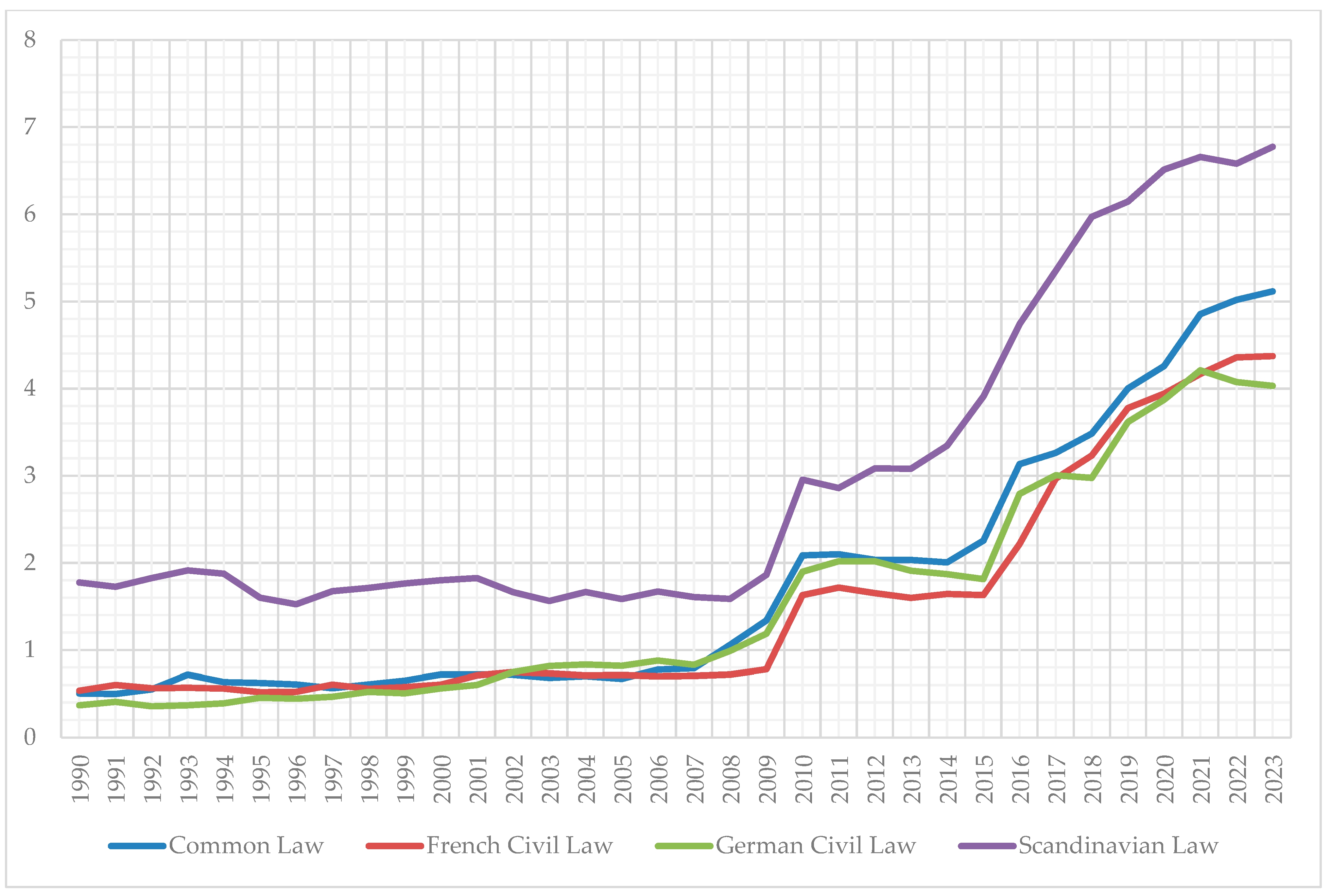
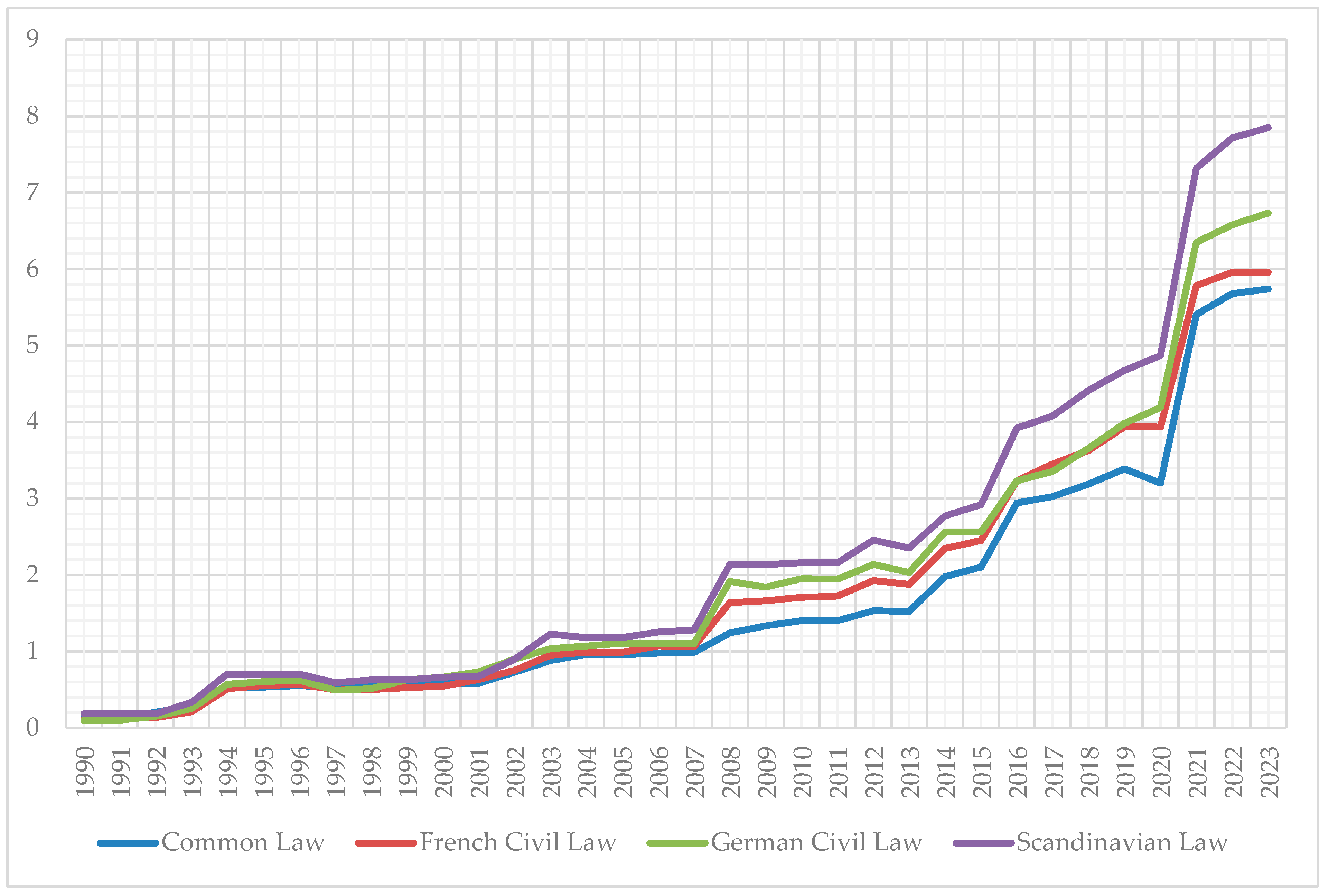
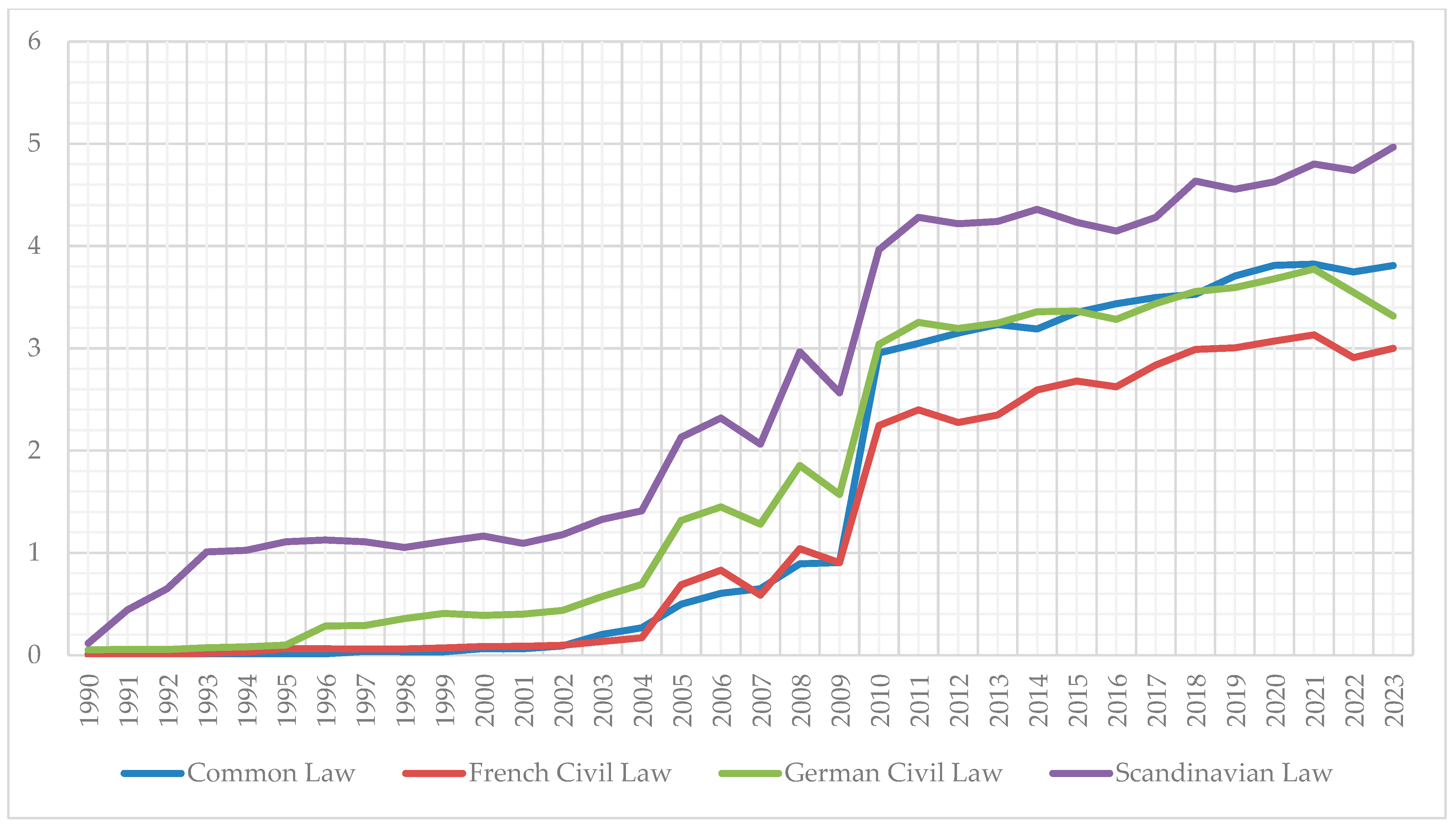
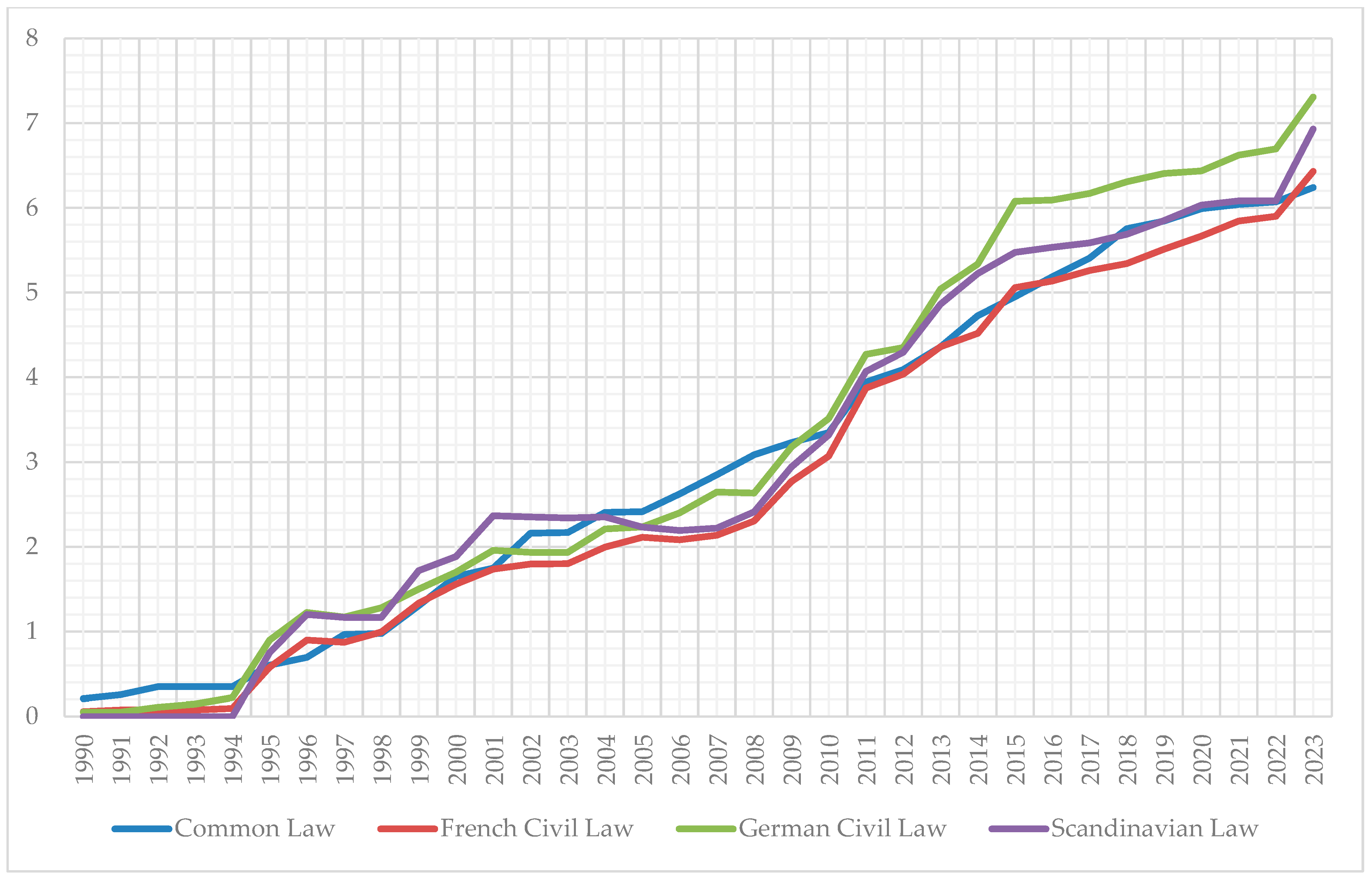
- Descriptive analysis was used to identify temporal trends and cross-country patterns in environmental policy stringency and CO2 emissions.
- ANOVA and post hoc LSD (Least Significant Difference) tests were applied to compare group means across legal traditions and assess statistical significance of observed differences.
4. Results
5. Discussion
6. Limitations and Further Research
7. Conclusions
Author Contributions
Funding
Institutional Review Board Statement
Informed Consent Statement
Data Availability Statement
Acknowledgments
Conflicts of Interest
Appendix A. Legal Origin Countries’ Classification

| English Common Law | French Civil Law | German Civil Law | Scandinavian Law |
|---|---|---|---|
| UK Irland Canada US Australia New Zealand India South Africa Saudi Arabia Israel | France Spain Portugal Italy Netherlands Belgium Luxemburg Switzerland Estonia Latvia Lithuania Romania Greece Turkey Russia Indonesia Mexico Costa Rica Columbia Peru Brazil Chile Argentina Malta | Germany Poland Austria Czech Republic Slovak Republic Hungary Bulgaria Slovenia Croatia China Korea Japan | Norway Sweeden Finland Denmark Iceland |
Appendix B. Climate Actions and Policies Measurement Framework
| Sector | Market-Based Instruments | Non Market-Based Instruments |
|---|---|---|
| Electricity |
|
|
| Transport |
|
|
| Buildings |
|
|
| Industry |
|
|
| Agriculture |
|
|
| LULUCF |
|
|
| Waste |
|
|
GHG emission targets
|
Public RD&D expenditure
|
Fossil fuel production policies
|
Climate governance
|
Climate finance
|
International co-operation
|
International public finance
|
GHG emissions data and reporting
|
References
- Pistor, K. Legal ground rules in coordinated and liberal market economies. In Corporate Governance in Context: Corporations, States, and Markets in Europe, Japan, and the US; Hopt, K.J., Wymeersch, E., Kanda, H., Baum, H., Eds.; Oxford University Press: Oxford, UK, 2006; pp. 3–39. [Google Scholar] [CrossRef]
- La Porta, R.; Lopez-de-Silanes, F.; Shleifer, A. The Economic Consequences of Legal Origins. J. Econ. Lit. 2008, 46, 285–332. [Google Scholar] [CrossRef]
- Rajan, R.G.; Zingales, L. The Great Reversals: The Politics of Financial Development in the Twentieth Century. J. Financ. Econ. 2003, 69, 5–50. [Google Scholar] [CrossRef]
- Roe, M.J. Juries and the Political Economy of Legal Origin. J. Comp. Econ. 2007, 35, 294–308. [Google Scholar] [CrossRef]
- Wang, P.; Xu, X. Green finance and energy efficiency improvement: The role of green innovation and industrial upgrading. Innov. Green Dev. 2025, 4, 100200. [Google Scholar] [CrossRef]
- Gupta, R. Socioeconomic challenges and its inhabitable global illuminations. Socecon. Chall. 2017, 1, 81–85. [Google Scholar] [CrossRef]
- Sotnyk, I.; Wenjuan, D.; Chortok, Y.; Yevdokymov, A.; Yang, Y. Enhancing efficiency and sustainability: Green energy solutions for water supply companies. Ekon. Rozvyt. Syst. 2024, 6, 53–62. [Google Scholar] [CrossRef]
- Wang, F.; Wong, W.-K.; Wang, Z.; Albasher, G.; Alsultan, N.; Fatemah, A. Emerging pathways to sustainable economic development: An interdisciplinary exploration of resource efficiency, technological innovation, and ecosystem resilience in resource-rich regions. Resour. Policy 2023, 85, 103747. [Google Scholar] [CrossRef]
- Koziuk, V.; Dluhopolskyi, O.; Hayda, Y.; Ivashuk, Y.; Shymanska, O.; Voznyi, K.; Dluhopolska, T. The Ecological Dimension of the Welfare State: Monograph; Kozyuk, V., Ed.; Lira-K: Kyiv, Ukraine, 2019; 224p, Available online: https://dspace.wunu.edu.ua/handle/316497/36455 (accessed on 2 September 2025).
- Koziuk, V.; Dluhopolskyi, O.; Hayda, Y.; Klapkiv, Y. Does education quality drive ecological performance? Case of high and low developed countries. Glob. J. Environ. Sci. Manag. 2019, 5, 22–32. [Google Scholar] [CrossRef]
- Markina, L.; Kovach, V.; Vlasenko, O. Analysis of the world market of waste management. Technol. Audit Prod. Reserves 2024, 3, 36–43. [Google Scholar] [CrossRef]
- Porter, M.E.; Van der Linde, C. Toward a new conception of the environment competitiveness relationship. J. Econ. Perspect. 1995, 9, 97–118. [Google Scholar] [CrossRef]
- Benatti, N.; Groiss, M.; Kelly, P.; Lopez-Garcia, P. Environmental regulation and productivity growth in the euro area: Testing the Porter hypothesis. J. Environ. Econ. Manag. 2023, 126, 102995. [Google Scholar] [CrossRef]
- Albrizio, S.; Kozluk, T.; Zipperer, V. Environmental policies and productivity growth: Evidence across industries and firms. J. Environ. Econ. Manag. 2017, 81, 209–226. [Google Scholar] [CrossRef]
- Hille, E.; M’obius, P. Environmental policy, innovation, and productivity growth: Controlling the effects of regulation and endogeneity. Environ. Resour. Econ. 2019, 73, 1315–1355. [Google Scholar] [CrossRef]
- Benatti, N.; Groiss, M.; Kelly, P.; Lopez-Garcia, P. The Impact of Environmental Regulation on Clean Innovation: Are There Crowding Out Effects? ECB Working Paper; European Central Bank (ECB): Frankfurt, Germany, 2024; pp. 1–57. Available online: https://www.ecb.europa.eu/pub/pdf/scpwps/ecb.wp2946~844af1ac30.en.pdf (accessed on 2 September 2025).
- Mani, M.; Fredriksson, P. Trade Integration and Political Turbulence: Environmental Policy Consequences; IMF Working Paper; International Monetary Fund: Washington, DC, USA, 2001; Available online: https://ideas.repec.org/p/imf/imfwpa/2001-150.html (accessed on 25 November 2025).
- Fredriksson, P.; Mani, M. The Rule of Law and the Pattern of Environmental Protection; IMF Working Paper; International Monetary Fund: Washington, DC, USA, 2002; pp. 1–27. Available online: https://www.imf.org/external/pubs/ft/wp/2002/wp0249.pdf (accessed on 2 September 2025).
- Shapiro, J. Institutions, Comparative Advantage, and the Environment. Rev. Econ. Stud. 2025, 92, 4152–4193. [Google Scholar] [CrossRef]
- Glaeser, E.; Shleifer, A. Legal origins. Q. J. Econ. 2002, 117, 1193–1230. [Google Scholar] [CrossRef]
- La Porta, R.; Lopez-de-Silanes, F.; Shleifer, A.; Vishny, R.W. Law and Finance. J. Political Econ. 1998, 106, 1113–1155. [Google Scholar] [CrossRef]
- Hayek, F. The Constitution of Liberty; The University of Chicago Press: Chicago, IL, USA, 1960; Available online: https://books.google.com.ua/books?id=ENQjPm-S7UEC&printsec=frontcover&redir_esc=y#v=onepage&q&f=false (accessed on 2 September 2025).
- La Porta, R.; Lopez-de-Silanes, F.; Pop-Eleches, C.; Shleifer, A. Judicial checks and balances. J. Political Econ. 2004, 112, 445–470. [Google Scholar] [CrossRef]
- La Porta, R.; Lopez-de-Silanes, F.; Shleifer, A. Law and finance after a decade of research. In Handbook of the Economics of Finance; Constantinides, G.M., Harris, M., Stulz, R.M., Eds.; Elsevier: Amsterdam, The Netherlands, 2013; Volume 2, pp. 425–491. [Google Scholar] [CrossRef]
- La Porta, R.; Lopez-de-Silanes, F.; Shleifer, A. What Works in Securities Laws? J. Financ. 2006, 61, 1–32. [Google Scholar] [CrossRef]
- La Porta, R.; Lopez-de-Silanes, F.; Shleifer, A.; Vishny, R.W. Agency problems and dividend policies around the world. J. Financ. 2000, 55, 1–33. [Google Scholar] [CrossRef]
- La Porta, R.; Lopez-de-Silanes, F.; Shleifer, A.; Vishny, R.W. Investor protection and corporate governance. J. Financ. Econ. 2000, 58, 3–27. [Google Scholar] [CrossRef]
- La Porta, R.; Lopez-de-Silanes, F.; Shleifer, A.; Vishny, R.W. Legal Determinants of External Finance. J. Financ. 1997, 52, 1131–1150. [Google Scholar] [CrossRef]
- La Porta, R.; Lopez-de-Silanes, F.; Shleifer, A.; Vishny, R.W. The Quality of Government. J. Law Econ. Organ. 1999, 15, 222–279. [Google Scholar] [CrossRef]
- Armour, J.; Deakin, S.; Sarkar, P.; Siems, M.; Singh, A. Shareholder protection and stock market development: An empirical test of the legal origins hypothesis. J. Empir. Leg. Stud. 2009, 6, 343–380. [Google Scholar] [CrossRef]
- Djankov, S.; McLiesh, C.; Shleifer, A. Private Credit in 129 Countries. J. Financ. Econ. 2007, 84, 299–329. [Google Scholar] [CrossRef]
- Fredriksson, P.; Wollscheid, J. Legal Origin and Climate Change Policies in Former Colonies. Environ. Resour. Econ. 2015, 62, 309–327. [Google Scholar] [CrossRef]
- Fredriksson, P.; Wollscheid, J. Legal Origins and Environmental Policies: Evidence from OECD and Developing Countries. Lett. Spat. Resour. Sci. 2018, 11, 369–375. [Google Scholar] [CrossRef]
- Bradford, A.; Chilton, A.S.; Linos, K.; Weaver, A. The global dominance of European competition law over American antitrust law. J. Empir. Leg. Stud. 2019, 16, 731. Available online: https://scholarship.law.columbia.edu/faculty_scholarship/2513 (accessed on 2 September 2025). [CrossRef]
- Bradford, A. The Brussels Effect: How the European Union Rules the World; Oxford University Press: Oxford, UK, 2020. [Google Scholar] [CrossRef]
- Bradford, A.; Chilton, A.; Linos, K. The gravity of legal diffusion. Univ. Chic. Leg. Forum 2024, 2023, 2. Available online: https://chicagounbound.uchicago.edu/uclf/vol2023/iss1/2 (accessed on 2 September 2025). [CrossRef]
- Bradford, A.; Chang, Y.-C.; Chilton, A.; Garoupa, N. Do legal origins predict legal substance? J. Law Econ. 2021, 64, 225–262. [Google Scholar] [CrossRef]
- Dobbin, F.; Simmons, B.A.; Garrett, G. The global diffusion of public policies: Social construction, coercion, competition, or learning? Annu. Rev. Sociol. 2007, 33, 449–472. [Google Scholar] [CrossRef]
- Bodea, C.; Hicks, R. International finance and central bank independence: Institutional diffusion and the flow and cost of capital. J. Politics 2015, 77, 268–284. [Google Scholar] [CrossRef]
- Romelli, D. The political economy of reforms in central bank design: Evidence from a new dataset. Econ. Policy 2022, 37, 641–688. Available online: https://www.economic-policy.org/wp-content/uploads/2021/10/9104_Romelli.pdf (accessed on 2 September 2025). [CrossRef]
- Romelli, D. Trends in Central Bank Independence: A De-Jure Perspective; Bocconi University Working Paper; Bocconi University: Milan, Italy, 2024; p. 217. Available online: https://repec.unibocconi.it/baffic/baf/papers/cbafwp24217.pdf (accessed on 2 September 2025).
- Oto-Peralies, D.; Romero-Avila, D. Legal Reforms and Economic Performance: Revisiting the Evidence; World bank Development Report Background paper; World Bank: Geneva, Switzerland, 2017; pp. 1–109. Available online: https://thedocs.worldbank.org/en/doc/193351485539892515-0050022017/original/WDR17BPRevisitingLegalOrigins.pdf (accessed on 2 September 2025).
- MMutarindwa, S.; Schäfer, D.; Stephan, A. Differences in African banking systems: Causes and consequences. J. Inst. Econ. 2021, 17, 561–581. [Google Scholar] [CrossRef]
- Acemoglu, D.; Johnson, S.; Robinson, J.A. Reversal of fortunes: Geography and institutions in the making of the modern world income distribution. Q. J. Econ. 2002, 117, 1133–1192. [Google Scholar] [CrossRef]
- Acemoglu, D.; Johnson, S.; Robinson, J.A. The colonial origins of comparative development: An empirical investigation. Am. Econ. Rev. 2001, 91, 1369–1401. [Google Scholar] [CrossRef]
- Acemoglu, D.; Robinson, J. Unbundling Institutions. J. Political Econ. 2005, 113, 949–995. [Google Scholar] [CrossRef]
- Becchetti, L.; Ciciretti, R.; Conzo, P. Legal Origins and Corporate Social Responsibility. Sustainability 2020, 12, 2717. [Google Scholar] [CrossRef]
- Kurbus, B.; Rant, V. A Legal Origin Perspective on Corporate Rating Disagreement. Res. Int. Bus. Financ. 2025, 74, 102702. [Google Scholar] [CrossRef]
- Glaeser, E.; Shleifer, A. The Rise of the Regulatory State. J. Econ. Lit. 2003, 41, 401–425. [Google Scholar] [CrossRef]
- Huang, J.; Lu, H.; Du, M. Regional Differences in Agricultural Carbon Emissions in China: Measurement, Decomposition, and Influencing Factors. Land 2025, 14, 682. [Google Scholar] [CrossRef]
- Bai, Z.; Wang, T.; Xu, J.; Li, C. Can Agricultural Productive Services Inhibit Carbon Emissions? Evidence from China. Land 2023, 12, 1313. [Google Scholar] [CrossRef]
- Tan, S.; Liu, G. A low carbon management model for regional energy economies based on blockchain technology. Heliyon 2023, 9, e19966. [Google Scholar] [CrossRef] [PubMed]
- Sotnyk, I.; Kurbatova, T.; Kubatko, O.; Prokopenko, O.; Prause, G.; Kovalenko, Y.; Trypolska, G.; Pysmenna, U. Energy security assessment of emerging economies under global and local challenges. Energies 2021, 14, 5860. [Google Scholar] [CrossRef]
- OECD. Climate Actions and Policies Measurement Framework (CAPMF); Organisation for Economic Co-Operation and Development: Paris, France, 2025; Available online: https://www.oecd.org/climate-action/ipac/capmf (accessed on 2 September 2025).
- Nachtigall, D.; Lutz, L.; Cárdenas Rodríguez, M.; Haščič, I.; Pizarro, R. The Climate Actions and Policies Measurement Framework: A Structured and Harmonised Climate Policy Database to Monitor Countries’mitigation Action; Environment Working Paper; OECD: Paris, France, 2022; p. 203. Available online: https://one.oecd.org/document/ENV/WKP(2022)15/en/pdf (accessed on 2 September 2025).
- World Bank Data. World Development Indicators (WDI). The World Bank 2025. Available online: https://databank.worldbank.org/source/world-development-indicators (accessed on 2 September 2025).
- Kopp, R.J. The United Nations Framework Convention on Climate Change after 20 Years: Is There a Better Way Forward? Resources. 2011. Available online: https://www.resources.org/common-resources/the-united-nations-framework-convention-on-climate-change-after-20-years-is-there-a-better-way-forward/ (accessed on 2 November 2025).
- United Nations. United Nations Framework Convention on Climate Change. 1992. Available online: https://unfccc.int/files/essential_background/background_publications_htmlpdf/application/pdf/conveng.pdf (accessed on 2 November 2025).


| № | Regulation | Characteristics |
|---|---|---|
| 1. | Regulatory style and state intervention | Common Law systems traditionally rely on market-supporting institutions and more decentralized regulatory frameworks. This may lead to lighter-touch environmental regulation but stronger compliance when rules are actually in place. Civil Law systems, by contrast, typically grant the state a more active role in directing economic and social outcomes, which can translate into more comprehensive and prescriptive environmental regulations. |
| 2. | Enforcement capacity and judiciary independence | Common Law countries generally exhibit higher judicial independence and more robust enforcement mechanisms. This institutional environment enhances the credibility of environmental rules and increases the likelihood that firms comply. Civil Law systems may implement broader regulatory frameworks but face comparatively weaker enforcement, which can dilute policy effectiveness. |
| 3. | Protection of property rights and investor expectations | Stronger property rights in Common Law systems can create tension between economic freedoms and environmental mandates. The need to safeguard investment expectations may limit the scope or stringency of environmental interventions unless these are well justified and carefully designed. Civil Law frameworks, where property rights are balanced more explicitly against collective interests, may facilitate more interventionist environmental policies. |
| 4. | Administrative traditions and bureaucratic capacity | Civil Law systems often rely on hierarchical and rule-based administrative structures, which can support the rollout of large-scale environmental programs but may also introduce rigidity. Common Law systems’ more flexible, case-based administrative practices can enhance policy adaptability but may produce uneven implementation across regions. |
| Dependent Variables | Effect | SS | DF | MS | F | p |
|---|---|---|---|---|---|---|
| Stringency of Sectoral Policies (1990–2023) | Legal Origin | 12.7 | 3 | 4.21 | 1.38 | 0.252 |
| Stringency of Sectoral Policies (2010–2023) | Legal Origin | 7.14 | 3 | 2.38 | 5.83 | 0.002 |
| Stringency of Cross-Sectoral Policies (1990–2023) | Legal Origin | 50.89 | 3 | 16.96 | 7.38 | 0.001 |
| Stringency of International Policies (1990–2023) | Legal Origin | 7.18 | 3 | 2.39 | 0.71 | 0.547 |
| Stringency of International Policies (2010–2023) | Legal Origin | 11.06 | 3 | 3.69 | 1.22 | 0.312 |
| Common Law | French Law | German Law | Scandinavian Law | |
|---|---|---|---|---|
| Stringency of Sectoral Policies (2010–2023) | ||||
| Common Law | 0.1257 | 0.4049 | 0.0141 | |
| French Law | 0.1257 | 0.0202 | 0.0001 | |
| German Law | 0.4049 | 0.0202 | 0.0952 | |
| Scandinavian Law | 0.0141 | 0.0001 | 0.0952 | |
| Stringency of Cross-Sectoral Policies (1990–2023) | ||||
| Common Law | 0.5121 | 0.5665 | 0.0008 | |
| French Law | 0.5121 | 0.9343 | 0.0001 | |
| German Law | 0.5665 | 0.9343 | 0.0001 | |
| Scandinavian Law | 0.0008 | 0.0001 | 0.0001 | |
| Dependent Variables | Effect | SS | DF | MS | F | p |
|---|---|---|---|---|---|---|
| Stringency of Market-based instruments of Sectoral Policies (1990–2023) | Legal Origin | 34.61 | 3 | 11.54 | 5.01 | 0.0025 |
| Stringency of Non-market-based instruments of Sectoral Policies (1990–2023) | Legal Origin | 3.27 | 3 | 1.09 | 0.23 | 0.874 |
| Common Law | French Law | German Law | Scandinavian Law | |
|---|---|---|---|---|
| Stringency of Market-based instruments of Sectoral Policies (1990–2023) | ||||
| Common Law | 0.4439 | 0.5959 | 0.0044 | |
| French Law | 0.4439 | 0.1960 | 0.0004 | |
| German Law | 0.5959 | 0.1960 | 0.0192 | |
| Scandinavian Law | 0.0044 | 0.0004 | 0.0192 | |
| Stringency of Non-market-based instruments of Sectoral Policies (1990–2023) | ||||
| Common Law | 0.6974 | 0.6646 | 0.9115 | |
| French Law | 0.6974 | 0.4113 | 0.6171 | |
| German Law | 0.6646 | 0.4113 | 0.7471 | |
| Scandinavian Law | 0.9115 | 0.6171 | 0.7471 | |
| Dependent Variables | Effect | SS | DF | MS | F | p |
|---|---|---|---|---|---|---|
| Carbon dioxide (CO2) emissions (total) excluding LULUCF (% change from 1990) | Legal Origin | 44,805.35 | 3 | 14,935.12 | 229.49 | <0.0001 |
| Carbon dioxide (CO2) emissions (total) excluding LULUCF per capita (t CO2e/capita) | Legal Origin | 242.06 | 3 | 80.69 | 101.02 | <0.0001 |
| Common Law | German Law | French Law | Scandinavian Law | |
|---|---|---|---|---|
| Carbon dioxide (CO2) emissions (total) excluding LULUCF (% change from 1990) | ||||
| Common Law | <0.0001 | <0.0001 | <0.0001 | |
| German Law | <0.0001 | <0.0001 | <0.0001 | |
| French Law | <0.0001 | <0.0001 | <0.0001 | |
| Scandinavian Law | <0.0001 | <0.0001 | <0.0001 | |
| Carbon dioxide (CO2) emissions (total) excluding LULUCF per capita (t CO2e/capita) | ||||
| Common Law | <0.0001 | <0.0001 | <0.0001 | |
| German Law | <0.0001 | <0.0001 | 0.8786 | |
| French Law | <0.0001 | <0.0001 | <0.0001 | |
| Scandinavian Law | <0.0001 | 0.8786 | <0.0001 | |
Disclaimer/Publisher’s Note: The statements, opinions and data contained in all publications are solely those of the individual author(s) and contributor(s) and not of MDPI and/or the editor(s). MDPI and/or the editor(s) disclaim responsibility for any injury to people or property resulting from any ideas, methods, instructions or products referred to in the content. |
© 2026 by the authors. Licensee MDPI, Basel, Switzerland. This article is an open access article distributed under the terms and conditions of the Creative Commons Attribution (CC BY) license.
Share and Cite
Koziuk, V.; Hayda, Y.; Dluhopolskyi, O.; Wołowiec, T.; Sabat, A. From Law to Carbon: How Legal Origin Influences Environmental Policy and CO2 Emissions? Sustainability 2026, 18, 416. https://doi.org/10.3390/su18010416
Koziuk V, Hayda Y, Dluhopolskyi O, Wołowiec T, Sabat A. From Law to Carbon: How Legal Origin Influences Environmental Policy and CO2 Emissions? Sustainability. 2026; 18(1):416. https://doi.org/10.3390/su18010416
Chicago/Turabian StyleKoziuk, Viktor, Yuriy Hayda, Oleksandr Dluhopolskyi, Tomasz Wołowiec, and Anna Sabat. 2026. "From Law to Carbon: How Legal Origin Influences Environmental Policy and CO2 Emissions?" Sustainability 18, no. 1: 416. https://doi.org/10.3390/su18010416
APA StyleKoziuk, V., Hayda, Y., Dluhopolskyi, O., Wołowiec, T., & Sabat, A. (2026). From Law to Carbon: How Legal Origin Influences Environmental Policy and CO2 Emissions? Sustainability, 18(1), 416. https://doi.org/10.3390/su18010416