
Article

Constraints on Youth Participation in Evening Schools: Empirical Evidence from Shenyang, China

Jangho Architecture College, Northeastern University, Shenyang 110169, China
*
Author to whom correspondence should be addressed.
Sustainability 2026, 18(1), 413; https://doi.org/10.3390/su18010413 (registering DOI)
Submission received: 4 November 2025 / Revised: 10 December 2025 / Accepted: 11 December 2025 / Published: 1 January 2026

Abstract

In recent years, youth evening schools have proliferated across China as a novel public cultural practice, serving as an important platform for youth development, lifelong learning, and youth-friendly urban initiatives. Existing research has predominantly focused on macro-policy, organizational arrangements, and social outcomes, while studies centered on youth participants remain are limited. In particular, empirical inquiry into the motivational and formative mechanisms underlying youth participation is insufficient. Drawing on Leisure Constraint Theory and the Theory of Planned Behavior, this study employs structural equation modeling to examine the key constraints on youth participation and test the mediating role of attitudinal perception. A questionnaire survey of 215 youth participants in Shenyang, China, provides the empirical basis for the analysis. Results indicated that intrapersonal, interpersonal, structural, and experiential constraints all negatively affect participation behavior. In contrast, attitudinal perception exerts a significant positive influence. Furthermore, these constraints collectively suppress youth participation indirectly by attenuating attitudinal perception, with structural constraints exhibiting the strongest mediation effect via this pathway. Notably, intrapersonal constraints not only intensify structural constraints by reinforcing interpersonal constraints, but also directly exacerbate them. This finding challenges the unidirectionality of hierarchical constraint models by revealing a bidirectional reinforcement loop: intrapersonal and structural constraints reciprocally amplify one another, bypassing constraint negotiation processes and suppressing participation intentions at their source. Based on these results, we draw out the theoretical and practical implications and suggest directions for future research.

1. Introduction

As an emerging form of evening-time education, youth evening schools have proliferated in Shenyang and nationwide in recent years, becoming vital platforms for youth evening learning, social interaction, and skill development [1]. Distinct from the traditional model of evening schools focused on academic remediation, the contemporary “youth evening school” serves as a public service platform. It offers interest-based, non-academic, and low-cost short-term courses and activities for young people between 18 and 45 years of age, utilizing their leisure time such as evenings and weekends.
At present, academic discourse surrounding interest-oriented youth evening schools remains in its nascent stage, yet it has begun to coalesce around several core issues. These include analyses of their nature and social functions, examinations of their emergence in relation to contemporary contextual drivers, and discussions of their operational models and governance mechanisms [2,3,4,5]. Existing scholarship has largely approached the topic from macro-policy, organizational, or social-impact perspectives. However, research that adopts the standpoint of youth participants themselves remains underdeveloped. There is a notable paucity of systematic inquiry into the underlying motivations and formative mechanisms driving youth engagement, and a comprehensive theoretical framework for explaining these phenomena has yet to be established.
Therefore, this study aims to systematically identify and analyze the key constraints affecting young people’s participation in youth evening schools, focusing on the following five dimensions:
(1)
Intrapersonal Constraints, which encompass individual-level barriers such as time availability, financial resources, safety concerns, and self-efficacy perceptions;
(2)
Interpersonal Constraints, referring to participation limitations stemming from social factors such as family support and peer influence;
(3)
Structural Constraints, relating to objective supply-side conditions, including geographical location, transportation accessibility, and the adequacy of internal and external facilities;
(4)
Experiential Constraints, involving the impact of instructors’ professional competence, the alignment between course content and participant expectations, and other factors influencing continued engagement. It is important to clarify that within this model, teaching quality is operationalized and measured strictly through the subjective experiences and satisfaction levels reported by participants. It is not treated as an objective or systemic feature of service provision. This distinction serves to separate clearly between externally verifiable structural conditions and internally perceived experiential factors;
(5)
Attitudinal Perception, which focuses on examining how an individual’s subjective valuation of evening schools—such as perceptions of personal development, psychological and cultural leisure benefits, and social relationship building—not only directly affects participation behavior, but may also mediate or moderate the relationship between other constraint factors and participation.
By constructing and validating this multidimensional constraint model, this study aims to uncover the mechanisms behind youth participation in evening schools and broaden the theoretical perspectives in this research area. These findings thereby provide an empirical foundation and systematic strategic insights for optimizing the design of evening school services and enhancing their sustainable appeal.
The study consists of six sections: Following the introduction, Section 2 reviews Leisure Constraint Theory and the Theory of Planned Behavior within a theoretical framework, elaborates on core conceptual elements, formulates research hypotheses, and develops a conceptual model. Section 3 details the research subjects, questionnaire-based survey, and data analysis techniques. Section 4 and Section 5 present empirical findings and discussions, respectively. The final section summarizes conclusions, identifies limitations and future directions, and offers policy recommendations and practical implications.

2. Theoretical Background and Research Hypotheses

2.1. Theoretical Lens

This section first reviews the literature on Leisure Constraints Theory, Theory of Planned Behavior, and related models to clarify the intrinsic relationship between constraints and youth participation in evening school activities. Building on this foundation, it further elaborates on the integration pathways of these theories within the present research model. It systematically explains the key components of the model construction and their theoretical basis.

2.1.1. A Literature Review on Leisure Constraints Theory

Leisure Constraints Theory (LCT) aims to explain the multi-level barriers to individuals’ engagement in leisure pursuits. Initially, this theory was based on a binary framework, which held that participation behavior is determined solely by the presence or absence of constraints. However, it has since evolved into an explanatory paradigm focusing on the dynamic interplay between limiting factors and individual preferences [6,7]. Among these, the three primary dimensions proposed by Jackson (1991) and other scholars—encompassing intrapersonal, interpersonal, and structural constraints—have become a widely used analytical foundation in this field [8].
In adult education contexts, these constraints exhibit a threefold differentiation: intrapersonal constraints primarily manifest as psychophysiological barriers, including cognitive resource depletion caused by work-related fatigue and self-efficacy deficits; interpersonal constraints center on participation resistance stemming from family role conflicts and the isolating dilemma of lacking peer support systems [9]; structural constraints involve institutional and material limitations such as inadequate accessibility to educational resources and irreconcilable work–study time conflicts [10].
As a core theory in leisure studies, the theory of leisure constraints has informed a wide range of empirical research across diverse populations and cultural contexts. In recent years, the deepening of research on leisure constraints in specific contexts has provided a key reference for this study:
First, research on leisure constraints in abnormal situations has gradually emerged. For example, the COVID-19 pandemic has prompted scholars to examine the profound impact of sudden public health events on leisure behavior. Li et al. (2022) used the Macau Light Festival as a case study to explore changes in the public’s perception of leisure constraints during the pandemic [11]; Alexandris et al. (2022) combined the Theory of Planned Behavior with Leisure Constraint Theory to analyze the behavioral patterns of fitness club members following pandemic lockdowns [12]; Humagain & Singleton (2021) employed focus groups to identify tourists’ driving factors, limiting barriers, and adaptive responses regarding outdoor leisure engagement amid pandemic restrictions [13]; Du et al. (2021) examined the role of technology and data analytics in negotiating leisure restrictions [14]. These studies not only identified novel constraints but also illuminated shifts in individual motivations and adaptive behaviors during exceptional periods, infusing theoretical frameworks with a dynamic evolutionary perspective. This dynamic negotiation perspective provides significant insights into understanding how contemporary urban youth balance their night-time study commitments under a high-intensity work pace.
Second, the tourism and outdoor recreation fields continue to deepen discussions on participant constraints. Stodolska et al. (2020) proposed a new model of leisure constraints for racialized communities, expanding the cultural applicability of existing theories [15]. Such research provides empirical foundations for destination marketing, service optimization, and strategy development. For instance, by identifying typical constraints faced by tourists, managers can strategically enhance tourism products and services (e.g., improving transportation access, providing detailed information) to alleviate potential visitors’ concerns and increase participation rates. Therefore, to enhance young people’s willingness to participate, the design of night-time education services must identify and address structural barriers related to commuting, information access, and other areas.
Third, the sports and fitness leisure sector focuses on constraint mechanisms specific to certain demographics. Marshall et al. (2024) analyzed structural factors influencing women’s willingness to withdraw from community sports [16]; Coşkun & Dilmaç (2024) compared generational differences in leisure motivation, self-efficacy, and perceived constraints between Generation Z and Millennials, reflecting the deepening application of the life course perspective in leisure research [17]. In summary, recent research in sports and fitness leisure has broadened the understanding of participation barriers across groups such as women and youth, and has begun to examine the growing impact of technology on leisure behavior. This enables the development of targeted intervention strategies to encourage the public to address barriers and promote proactive participation in fitness leisure activities.
Fourth, the health and well-being domain increasingly emphasizes the impact of constraints on psychological states. Zhou et al. (2022) used Ningbo park users as a case study to reveal the association between leisure constraints and mental health, expanding the theory’s application in public health [18]. This finding indicates that evening schools serve not only as pathways for skill enhancement but also as social mechanisms for psychological regulation among youth populations; however, the cumulative effects of constraints may significantly undermine their potential well-being benefits.
Overall, LCT reveals that constraints are not just objective barriers but dynamic processes shaped by social structures. Applied to Shenyang’s youth evening school participation, LCT identifies three key obstacles: time scarcity, weak social support, and limited course resources and transport access. Furthermore, this study introduces “experiential constraints” as a supplementary dimension to reflect the inhibitory effect of past negative experiences on the willingness to continue participation.

2.1.2. A Literature Review on the Theory of Planned Behavior

The Theory of Planned Behavior (TPB) is one of the core theoretical frameworks in social psychology used to study individual behavioral decision-making. The Theory of Planned Behavior (TPB) was developed by Ajzen (1988, 1991; Ajzen & Fishbein 2005) [19,20,21] as an extension of the Theory of Reasoned Action (TRA) [22,23]. Its key innovation is the incorporation of “perceived behavioral control,” which significantly expands the theory’s explanatory power regarding behaviors that are not fully voluntary [24].
The core constructs of the Theory of Planned Behavior (TPB) posit that behavioral intention is determined by three core constructs: behavioral attitude, subjective norm, and perceived behavioral control. Behavioral intention is the most direct psychological antecedent of actual action. Although perceived behavioral control indirectly shapes behavior through intention, it can also determine behavior directly when there is a strong alignment between perceived and actual control conditions [20].
The predictive validity of the Theory of Planned Behavior (TPB) has received substantial support from extensive empirical research and meta-analyses. A meta-analysis by Armitage and Conner (2001) found that the theory accounts for a substantial portion of the variance of both behavioral intentions and participation behaviors [25]. A systematic review by McEachan et al. (2011) [26] in the health behavior domain further confirmed the utility of the TPB model. However, the review found that the model typically explains a smaller proportion of the variance in participation behaviors than in behavioral intentions [26]. Sheeran (2002) [27] termed this phenomenon the “intention–behavior gap” and examined the underlying mediating and moderating mechanisms. To enhance the theory’s explanatory power for complex real-world behaviors, subsequent studies expanded the TPB in multiple directions [27]. For instance, Ouellette and Wood (1998) incorporated “past behavior/habit” into the model to capture the influence of automated behavioral components [28]; Conner and Armitage (1998) introduced the “moral norms” variable in studies of morally relevant behaviors [29]; Gollwitzer and Sheeran (2006) proposed “implementation intentions” as a moderating mechanism between intention and behavior, enhancing behavioral implementation by establishing specific situation–behavior linkages [30].
The Theory of Planned Behavior (TPB) demonstrates broad applicability and ongoing evolutionary vitality in applied research. In recent years, its application has expanded to multiple domains of social behavior analysis, such as consumer behavior, health behavior, exercise behavior, resource recycling behavior, job-seeking behavior, healthcare management, marketing management, and investment decision-making.
Within health promotion, TPB-based research on vaccine hesitancy has revealed differential influences of attitudes, subjective norms, and perceived behavioral control across diverse cultures and social groups [31,32,33]. Digital health intervention studies have enhanced the theory’s explanatory power regarding behavioral persistence and intervention adherence by incorporating variables such as implementation intention, user experience, and self-regulation [34,35].
In sports and leisure domains, studies have further integrated contextual factors such as gender, exercise type, and climate awareness. Findings indicate subjective norms exert a dominant influence on behavioral intentions, whereas attitudes emerge as the key driver of intention formation. Specific groups (e.g., problem exercisers) are more susceptible to normative pressure [36,37,38]. Kim and Kang (2021) revealed that negative self-evaluations triggered by rumination indirectly promote leisure participation through the mediating effects of attitudes and perceived behavioral control [39]. Whether young people participate in evening school depends not only on their personal interests but also on the evaluations of their colleagues, friends, or family regarding their attendance.
In environmental behavior research, scholars have expanded TPB’s explanatory scope by incorporating identity and normative activation variables. For instance, Zhao and Huangfu (2023) and Savari et al. (2023) found that training intensity amplifies behavioral intention through the sequential mediation of identity and positive emotion; this reveals an affective mechanism pathway within the TPB framework [40,41]. This pathway is particularly significant for understanding the appeal of evening schools: if the courses can stimulate young people’s sense of identity while providing enjoyment, they may go beyond utilitarian considerations and create a stronger behavioral drive.
This study seeks to apply the TPB not only to predict whether young people plan to attend evening school, but also to reveal how they weigh values, social expectations, and feasibility under multiple real-world constraints, ultimately translating intention into action. Given that night-time learning requires active investment of time and effort, whether individuals perceive it as “valuable”, “supported”, and “feasible” will directly influence their participation decisions. Specifically, this study positions “attitude perception” as a central mediating variable, aiming to test that external constraints or internal obstacles do not directly block behavior but indirectly suppress intentions and actual participation by weakening young people’s recognition of the value of evening school.

2.1.3. Key Model Components

Drawing upon the preceding review of Leisure Constraint Theory and Theory of Planned Behavior, this study constructs an integrated analytical framework to systematically examine the factors constraining evening school participation among Shenyang’s youth population. Within this theoretical model, actual participation behavior serves as the core dependent variable across both theoretical systems, representing the ultimate manifestation of youth engagement in evening school activities. The three typical constraints from Leisure Constraint Theory—intrapersonal constraints, interpersonal constraints, and structural constraints—manifest in the evening school participation context as: scarcity of individual disposable time, weakness of social support networks, and adequacy of evening school facilities and course resources. To further refine the measurement dimensions of constraints, this study introduces “experiential constraints” as a supplementary variable. This reflects young people’s subjective perceptions and satisfaction levels during participation, effectively expanding upon traditional structural constraints. Additionally, the model designates “attitudinal perception” as a mediating variable. This variable operates through dual path attributes: it is shaped by all four constraint factors while simultaneously exerting a direct effect on actual participation behavior, forming the core psychological link for analyzing youth participation mechanisms.
A.
Intrapersonal Constraints
Within the theoretical framework of leisure constraints, intrapersonal constraints refer to internal psychological and physiological factors that influence individual participation in leisure activities. These manifest as a lack of interest, poor health, insufficient skills, or social concerns, directly limiting young people’s willingness and ability to participate in evening school learning.
Existing research consistently indicates that intrapersonal constraints exert a significant negative influence on actual participation behavior [7,9,11,13,15,16,42,43,44,45]. Furthermore, they often serve as antecedent variables that influence the perception and coping mechanisms for other types of constraints. According to the hierarchical model of leisure constraints [9,46,47,48], intrapersonal constraints form the foundational layer of the constraint system, primarily influencing internal cognitive and decision-making processes. Research further indicates that an individual’s ability to employ cognitive or behavioral negotiation strategies to address interpersonal or structural barriers largely depends on their intrinsic motivation and self-efficacy levels [46]. Thus, internal constraints may also ultimately inhibit actual participation by amplifying individuals’ perception of interpersonal and structural barriers [9]. Gilbert and Hudson (2000) further revealed in their study of non-skiers that individuals develop negative attitudes toward an activity due to perceived excessive difficulty, perceived risks, or mismatched self-image—all internal constraints—thereby reinforcing their tendency to refrain from participation [42].
B.
Interpersonal Constraints
Interpersonal constraints focus on how the interactive relationship between individuals and their social environment influences leisure participation behavior. This manifests specifically through factors such as scheduling conflicts among co-participants, insufficient emotional support or practical cooperation from key groups like family or friends, all of which may impose potential limitations on an individual’s participation intention.
In the context of evening school learning, if young people lack the necessary social support or face explicit opposition from relatives and friends, their participation frequency and persistence can suffer significantly. Existing research indicates that interpersonal constraints not only intensify individuals’ perception of structural limitations, making their hindering effects more pronounced [9], but also directly negatively impact actual participation behavior [7,9,11,13,15,16,42,43,44,45].
C.
Structural Constraints
Structural constraints refer to objective limitations imposed by external environmental conditions on individual participation behaviors. Within the context of this study, this dimension manifests specifically through factors such as the geographical location and transportation accessibility of evening schools, the adequacy of facility equipment, the comfort of learning spaces, the diversity of course content, and the professional competence of teaching staff. These external conditions are typically beyond individual subjective control but exert a critical influence on young people’s behavioral choices regarding evening school participation.
Existing research consistently indicates a marked inverse correlation between structural constraints and actual participation behavior [7,9,11,13,15,16,42,43,44,45].
D.
Experiential Constraints
Experiential constraints refer to subjective psychological barriers that individuals form during activity participation, stemming from past experiences or immediate perceptions. Such constraints significantly influence sustained participation willingness and satisfaction. In this study context, they manifest as factors such as youth groups’ prior adverse evening school experiences and unfavorable evaluations of teaching quality and course content, all of which may diminish their motivation for continued engagement.
As a crucial supplement to traditional structural constraints, the introduction of experiential constraints contributes to a deeper understanding of the psychological mechanisms underlying youth participation. Reed et al. (2025) found in their study on Gen Z’s involvement in metaverse leisure activities that experiential constraints not only significantly affect participation willingness but also reduce individuals’ confidence in employing negotiation strategies to overcome usage barriers, further validating the critical role of subjective experiential perceptions in behavioral decision-making [49].
E.
Attitudinal Perception
Attitudinal perception refers to young individuals’ positive or negative evaluations of evening school participation, as reflected in recognition of its educational value, interest in course content, and anticipated learning outcomes. According to the Theory of Planned Behavior, attitudinal perception is a key antecedent variable that predicts behavioral intention. In this study model, it functions as a mediating mechanism that is constrained by various limiting factors while directly influencing actual participation behavior.
Empirical research consistently shows that attitudinal perception directly promotes actual participation behavior [20,29,50,51,52], a finding consistent with its established role as a core psychological variable in how individuals cope with leisure constraints [12]. Concurrently, Han et al. (2017) demonstrated that leisure constraints adversely affect attitudinal perception [43]. While Li (2015) sought to examine the mediating role of attitudes in tourism revisit behavior, the study did not find statistically significant results, suggesting this relationship may vary across contexts [53].
F.
Participation behavior
Participation behavior refers to the specific participation patterns exhibited by youth groups during evening school learning, observable and measurable through dimensions such as participation frequency, duration, and engagement level. As the ultimate dependent variable in this study, participation behavior serves both as the validation anchor for the theoretical model and as the core objective in empirical analysis aimed at systematic explanation and effective promotion.

2.2. Research Hypotheses

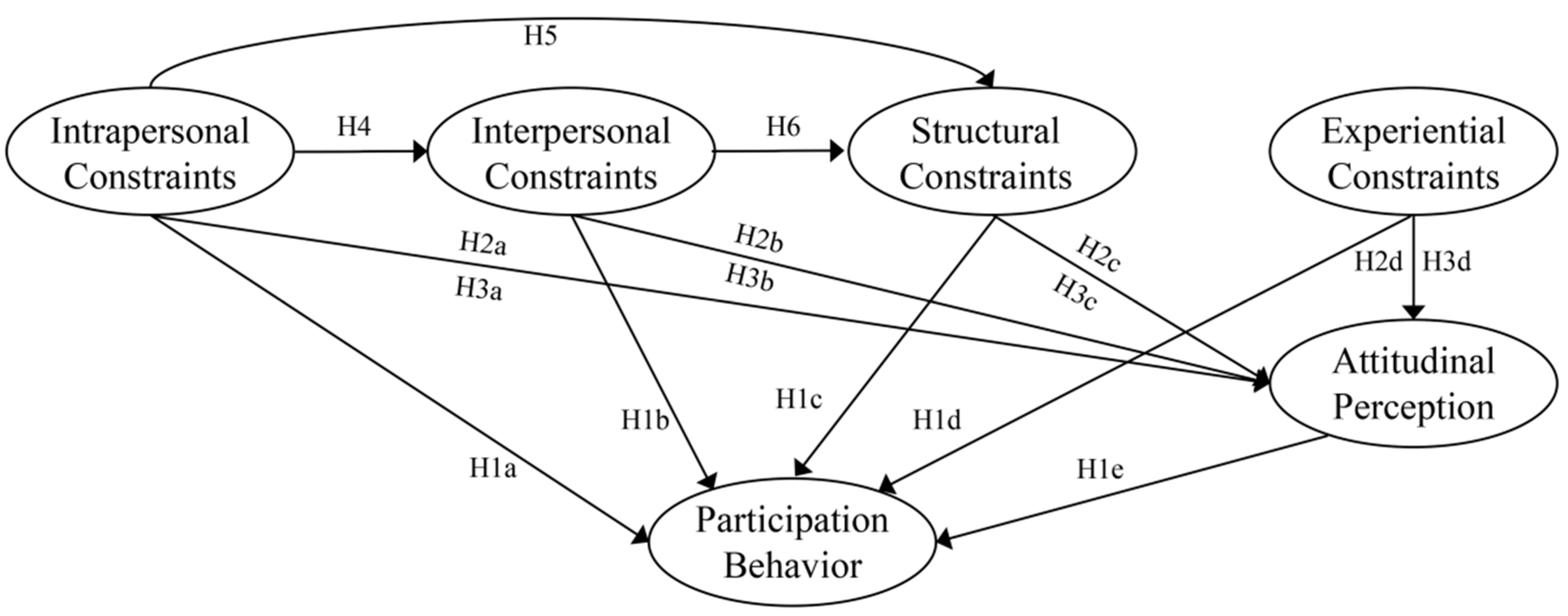
Drawing from the conceptual underpinnings of the literature mentioned above, the research hypotheses (H) articulate the constraints on youth participation in evening schools, the interrelationships among these factors, and the mediating role of attitudinal perception, as presented below (see Figure 1):
H1a/b/c/d. 
Intrapersonal constraints (a), interpersonal constraints (b), structural constraints (c), and experiential constraints (d) are negatively related to participation behavior.
H1e. 
Attitudinal perception is positively associated with participation behavior.
H2a/b/c/d. 
Intrapersonal constraints (a), interpersonal constraints (b), structural constraints (c), and experiential constraints (d) are negatively related to attitudinal perception.
H3a/b/c/d. 
Attitudinal perception mediates the H1a effect (a), H1b effect (b), H1c effect (c) and H1d effect (d).
H4. 
Intrapersonal constraints are positively associated with interpersonal constraints.
H5. 
Intrapersonal constraints positively influence structural constraints.
H6. 
Interpersonal constraints have a positive effect on structural constraints.
Based on the aforementioned assumptions, this study aims to systematically reveal how constraints influence young people’s participation in evening schools through both direct pathways and indirect pathways mediated by attitudinal perceptions, and further clarify the intrinsic relationships among different dimensions of constraints. On this basis, the research seeks to provide empirical evidence for optimizing the urban night education supply system, particularly by proposing targeted improvement directions in areas such as alleviating time pressure, strengthening social support, enhancing course accessibility, and improving the learning experience.

3. Materials and Methods

3.1. Study Area

This study employed a combination of online searches (including platforms such as Baidu Maps, Douyin, and Xiaohongshu), literature review, and field investigations to gather information on 40 youth evening schools within Shenyang City, Liaoning Province. Among these, Heping District, as the core urban area of Shenyang, features concentrated higher education resources and a high density of young residents. It hosts 8 youth evening schools, ranking second in the city in terms of quantity, surpassed only by Shenhe District. Additionally, Institution A within this district serves as the flagship pilot site for Shenyang’s inaugural youth evening school program, making it highly representative. Hunnan District, characterized as an emerging development area with a substantial youth population, presently operates seven evening schools, thereby ranking third citywide in terms of quantity. Given that Heping District and Hunnan District represent Shenyang’s traditional mature area and emerging development area, respectively, both were selected as key research areas for this study. This approach facilitates a manageable research scope while enabling a systematic analysis of the developmental status and participation mechanisms of youth evening schools, viewed from the perspective of varying stages of urban development.
Based on these regional selections, four representative youth evening schools were chosen as specific research subjects: Institution A and Institution B in Heping District, Institution C at Kaisa Plaza, and Institution D in Hunnan District (Table 1).

3.2. Sample Selection Criteria

The target population of this study comprises young learners aged 18–45 who have participated in or are currently participating in youth evening school courses in Shenyang. The sample selection followed the following criteria: (1) have actually participated in at least one evening school course; (2) possess the ability to complete the questionnaire independently; (3) cover different types of evening schools (government-led and enterprise-operated) as well as different urban districts (established areas and emerging areas) to ensure diversity in terms of institutional attributes and spatial background.

3.3. Questionnaire Design

Based on the constructed theoretical framework, this study designed a structured questionnaire. Items designed to measure dimensions including intrapersonal constraints, interpersonal constraints, experiential constraints, and attitudinal perception, were primarily adapted from existing empirical research within the field of leisure constraint theory [54,55,56,57,58]. The items measuring participation behavior and structural constraints dimensions—including transportation constraints, supporting facilities, and interior facilities—tailored to the spatial distribution characteristics of evening schools in Shenyang and the context of China’s basic education policies. Structural constraints focus on the evening school space level, as it serves as a fixed educational venue where the physical environment directly limits youth participation. Among these, transportation limitations address external accessibility issues, supporting facilities reflect the adequacy of the surrounding environment, and internal facilities pertain to the physical conditions within the evening school. Together, these three elements form a complete ‘space–environment–facility’ constraint chain. The precise formulation of the items is presented in Table 2.
The initial questionnaire comprised 52 items covering both personal characteristics and structural equation model variables. All variables in the model were measured using a five-point Likert scale, with response options ranging from 1 (strongly disagree) to 5 (strongly agree). To enhance semantic clarity and content validity, the study first conducted in-depth interviews with six respondents and performed a pilot test. Based on feedback, we revised the wording of some items to improve clarity and removed 6 items with low reliability. This resulted in a final questionnaire comprising 46 items, plus one additional question soliciting suggestions for evening school development.

3.4. Implementation

Data collection was conducted from June to September 2024. The study employed a stratified convenience sampling strategy to conduct on-site surveys at the four aforementioned representative youth evening schools. Specifically, the institutions were first stratified by type to ensure diversity in institutional characteristics and spatial contexts. Subsequently, field visits were made to these four youth evening schools, and surveys were alternately conducted across multiple course sessions in each school. Paper questionnaires were distributed to students who were either participating in or had just completed the courses, either before or after class.
During the distribution of the questionnaire, the researchers proactively explained the purpose of the study and obtained the informed consent of the respondents. The target group was clearly defined as young learners who had participated in or were currently participating in youth evening school courses. The aim was to analyze, through the questionnaire survey, the constraints this group overcame during their participation and to identify areas for future improvement. To minimize selection bias as much as possible, the researchers invited all eligible attendees present in each session to participate, rather than selecting specific individuals, thereby enhancing the representativeness of the sample within feasible limits. A total of 240 questionnaires were distributed, yielding 215 valid responses following a comprehensive validity screening process.
While the effective sample size of N = 215 slightly falls below some conventional thresholds, rigorous a priori power analysis using G*Power 3.1 demonstrates sufficient statistical power for structural equation modeling. Under the criteria of α = 0.05, target power = 0.80, effect size f2 = 0.15, and 12 predictive paths in the measurement model, the critical threshold for adequate power was determined as N = 177. As the actual sample size exceeds this benchmark by 21.3%, the study maintains robust statistical validity for confirmatory factor analysis (CFA) and structural equation modeling (SEM).

3.5. Analysis Techniques

The statistical analysis was conducted across four phases using SPSS 27.0 and AMOS 24.0. Firstly, a descriptive frequency analysis was employed to characterize the personal attributes of the respondents. Secondly, the 52 original items underwent estimation using Cronbach’s alpha coefficients. This step included performing an exploratory factor analysis (EFA) to extract dimensions. Before this, the Kaiser–Meyer–Olkin (KMO) and Bartlett’s test of sphericity were used to verify the appropriateness of conducting EFA. Cronbach’s alpha coefficients and the item-total correlations were also computed to evaluate both the reliability and validity of the measures. Thirdly, a confirmatory factor analysis (CFA) was performed to evaluate the consistency of the relationship between the structural factors and the measurement items identified in the EFA above, and to ascertain the presence of cross-validity. Finally, structural equation modelling (SEM) was used to test the proposed conceptual model of the impacts on participation behavior.

4. Results

4.1. Respondents Characteristics

A total of 240 paper questionnaires were distributed, with 225 returned, yielding a response rate of 93.75%. Among these, 215 were valid, representing a validity rate of 95.56%. As shown in Table 3, the sample exhibited a gender balance with 55.8% female and 44.2% male respondents. Age distribution was dominated by the 26–30 cohort (34.42%), followed by 18–25 (33.02%), collectively underscoring the youth-centric demographic. Occupational composition revealed corporate employees as the largest subgroup (28.37%), trailed by the government/institution staff (19.530%). Marital status analysis indicated 75.8% single respondents, aligning with the typical life stage profile of youth populations. Educational attainment was notably high, with 93.5% having attained at least associate degrees (72.1% bachelor/associate, 21.4% postgraduate). Crucially, 42.3% reported high need (‘quite need’ or ‘very much need’) for evening school participation, evidencing robust intrinsic motivation among this cohort.
This sample structure not only aligns with the service positioning of Youth Evening Schools as targeted institutions for young populations, but also simultaneously encompasses representative youth subgroups across educational backgrounds, employment statuses, and life stages. This configuration establishes a robust empirical foundation for investigating the interplay between leisure constraints, socio-structural barriers, and participation behaviors.
Regarding course pricing, 52.6% of respondents preferred the 0–50 RMB per hour range. For location preferences, 54.0% hoped evening classes would be established near residential communities. Additionally, 89.8% indicated an acceptable maximum one-way commute time of 30 min or less. Regarding willingness to participate in evening classes, approximately 40% of respondents expressed a strong inclination to participation again.

4.2. Exploratory Factor Analysis and Reliability Analysis

This study analyzed the factors constraining evening school participation among young adults in Shenyang, employing a questionnaire consisting of 46 items. After reliability testing, 9 non-compliant items were excluded, leaving 37 items for subsequent analysis. KMO and Bartlett’s sphericity tests were conducted on the retained items. Results showed a KMO value of 0.904 (>0.80) and a Bartlett test probability of 0.000 (<0.05), indicating suitability for exploratory factor analysis.
Given that this study incorporates both established scales and items independently developed for the research context, it is essential to first assess whether these combined items capture distinct underlying dimensions. Exploratory factor analysis (EFA) serves this purpose, offering a means to examine latent factor structures without imposing strong a priori assumptions.
The exploratory factor analysis outcomes are summarized in Table 2. All item factor loadings surpassed the minimum standard of 0.40, with values exceeding 0.7. A total of 8 factors were extracted, collectively accounting for 71.059% of the total variance—higher than the 60% threshold typically required in sociological research, indicating strong explanatory power of the factor structure.
Regarding reliability, Cronbach’s α coefficients across all dimensions ranged from 0.81 to 0.92 (see Table 3), all exceeding the acceptable threshold of 0.60. Validity testing revealed that the correlation coefficients between each measurement item and the overall items ranged from 0.59 to 0.82, significantly exceeding the 0.30 threshold. This indicates that the scale possesses good internal consistency and construct validity, making exploratory factor analysis reasonable and acceptable.
Based on the content covered by each factor, Factors 1 through 8 were named as follows: Intrapersonal Constraints, Interpersonal Constraints, Structural Constraints (including Transportation Constraints, Supporting Facilities, Interior Facilities), Experiential Constraints, Attitudinal Perception, and Participation Behavior.

4.3. Confirmatory Factor Analysis

Prior to testing the structural hypotheses, the adequacy of the measurement model required formal evaluation. The confirmatory factor analysis (CFA) was performed to ensure that the observed variables were suitable indicators of their respective latent constructs and that the constructs themselves were empirically distinct.
Based on the model fit results in Table 4, the chi-square-to-degrees-of-freedom ratio (CMIN/DF) = 1.424, falling within the 1–3 range; the root mean square error of approximation (RMSEA) = 0.045, meeting the excellent criterion of <0.05; additionally, the incremental fit index (IFI), Tucker–Lewis index (TLI), and comparative fit index (CFI) all achieved excellent levels above 0.9. Nearly all indicators met the thresholds established by scholars, indicating that this conceptual model is statistically acceptable.
As presented in Table 4, all model fit indices either meet or surpass the recommended academic thresholds, thereby indicating a strong alignment between the theoretical model and the observed data, and establishing statistical acceptability. Specifically:
The Chi-Square/Degrees of Freedom ratio (CMIN/DF) was 1.424, falling within the ideal range of 1–3;
The Root Mean Square Error of Approximation (RMSEA) was 0.045, below the excellent standard of 0.05;
The incremental fit index (IFI), Tucker–Lewis index (TLI), and comparative fit index (CFI) all surpassed the critical threshold of 0.9, demonstrating the model’s excellent fit quality.
Drawing from the confirmatory factor analysis results presented in Table 5, the convergent validity and composite reliability of each dimension of the scale were subsequently examined following the establishment of overall model fit. The analysis process obtained standardized factor loadings for each observed item on its corresponding latent variable through the validated CFA model. Then it calculated the average variance extracted (AVE) and composite reliability (CR) for each dimension using the formula.
Results indicate that composite reliability (CR) for all dimensions ranged from 0.82 to 0.92, exceeding the acceptable threshold of 0.70. Average variance extracted (AVE) fell between 0.56 and 0.73, satisfying the validity requirement of exceeding 0.50. These findings demonstrate that the scale’s eight dimensions demonstrate robust convergent validity and internal consistency.
According to the discriminant validity test results displayed in Table 6, the standardized correlation coefficients between each pair of dimensions are consistently lower than the square root of their respective average variance extracted (AVE) value. This observation indicates that the scale demonstrates robust discriminant validity across its dimensions.
The independent development of items assessing structural constraints and participation behavior necessitated a more rigorous examination. The Variance Inflation Factor (VIF) was used to examine potential multicollinearity issues among items. The examination results showed that the VIF values for all items within each dimension ranged from 1.56 to 3.09, all of which are below the common threshold of 5. Thus, multicollinearity among the items within each dimension is not a concern.
Due to the self-reported nature of the data in this study, common method bias (CMB) might be a potential concern. To mitigate potential sources of CMB, during the administration of questionnaires to young adults, participants were assured of the anonymity and confidentiality of their responses. It was emphasized that the data would be used solely for scientific research purposes. Furthermore, Harman’s single-factor test was employed to assess CMB. Results indicated that eight factors with eigenvalues greater than 1 emerged from the unrotated factor analysis, and the first factor accounted for 34.14% (<40%) of the total variance. Therefore, it can be concluded that common method bias did not significantly affect the results of this study.

4.4. Structural Model and Hypothesis Testing

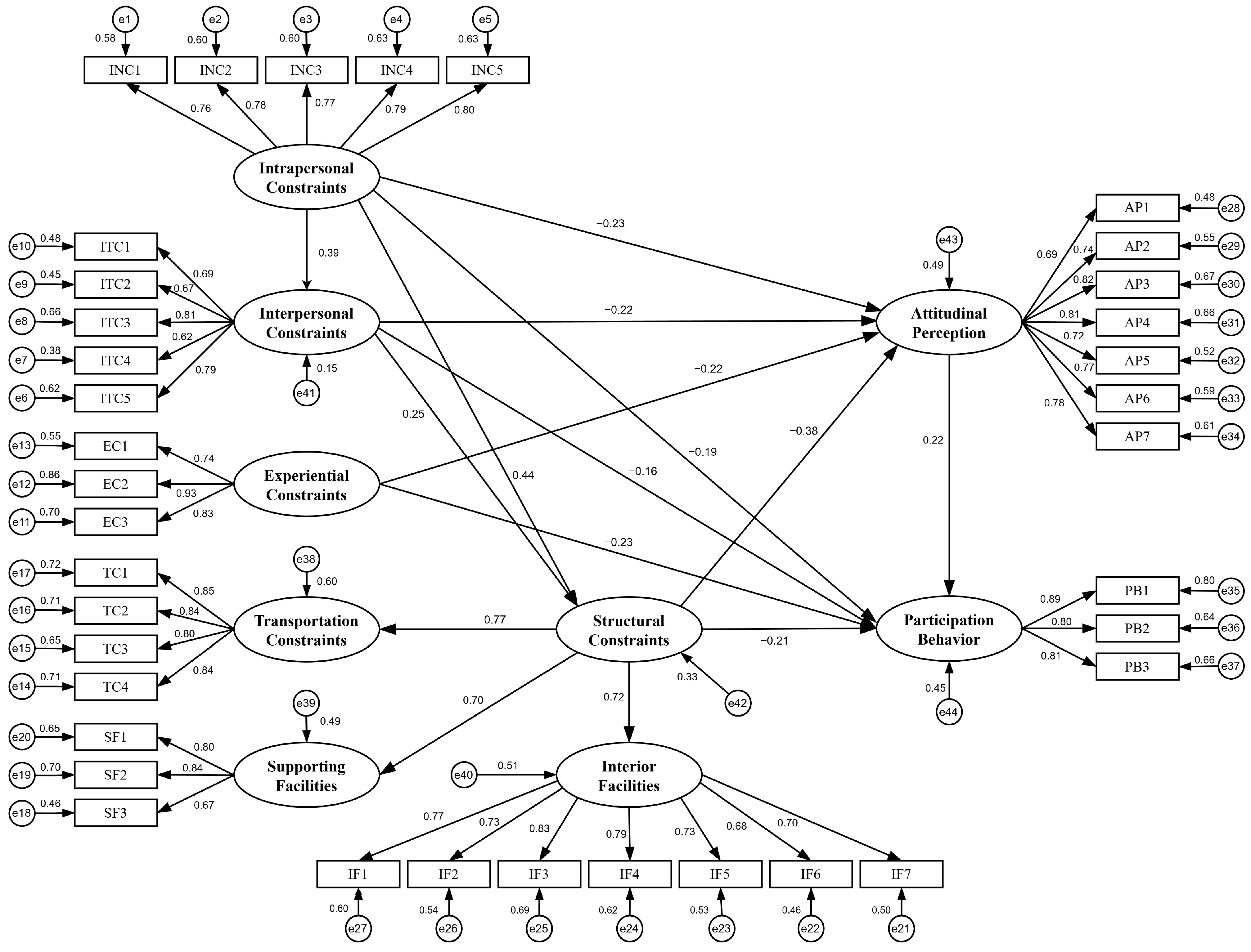
Following confirmatory factor analysis, this study further conducted overall model fit testing for the structural model. Results indicate that all fit indices meet academic acceptance criteria: the chi-square/degrees of freedom ratio (CMIN/DF) was 1.594, falling within the ideal range of 1–3; Root Mean Square Error of Approximation (RMSEA) was 0.053, below the critical threshold of 0.08; the Incremental Fit Index (IFI), Tucker–Lewis Index (TLI), and Comparative Fit Index (CFI) were 0.926, 0.919, and 0.925, respectively, all exceeding the excellent threshold of 0.9. Based on these results, the structural model demonstrates acceptable fit quality. All research hypotheses proposed in the model were validated through parameter sign direction, standardized coefficient values, and their significance levels. Detailed causal relationships among variables and path coefficient estimates are presented in Table 7 and Figure 2.
The first set of hypotheses (H1a–H1e) focused on direct factors influencing youth participation in evening schools. The analysis revealed the following: H1a proposed that intrapersonal constraints negatively affect actual participation behavior, with a path coefficient of −0.19 (p < 0.05), confirming the hypothesis; Hypothesis H1b posits that interpersonal constraints negatively affect actual participation behavior, with a path coefficient of −0.16 (p < 0.05), supporting the hypothesis; Hypothesis H1c suggests that structural constraints negatively impact actual participation behavior, with a path coefficient of −0.23 (p < 0.05), yielding a significant result and confirming the hypothesis; H1d proposes that experiential constraints negatively affect actual participation behavior, with a path coefficient of −0.21 (p < 0.001), confirming the hypothesis; H1e hypothesizes that attitudinal perception positively influence actual participation behavior, with a path coefficient of 0.22 (p < 0.05), confirming the hypothesis.
The second set of hypotheses (H2a–H2d) focused on factors constraining young people’s attitudinal perception toward evening school participation. Structural equation modeling results revealed the following: H2a posited that intrapersonal constraints negatively affect attitudinal perception, with a path coefficient of −0.23 (p < 0.01), supporting the hypothesis.
Hypothesis H2b posits that interpersonal constraints exert a negative impact on attitudinal perception, with a path coefficient of −0.22 (p < 0.05), supporting the hypothesis; Hypothesis H2c suggests that structural constraints negatively influence attitudinal perception, with a path coefficient of −0.22 (p < 0.001), yielding significant results and confirming the hypothesis; H2d proposes that experiential constraints negatively affect attitudinal perception, with a path coefficient of −0.38 (p < 0.001), supporting the hypothesis.
The third set of hypotheses (H3a–H3d) examined the mediating role of attitudinal perception between various constraints and actual participation behavior. Conventional mediation tests entail strict distributional assumptions and exhibit limited statistical power in small samples. To test the mediating role of attitude more robustly, the Bootstrap method was adopted. This technique generates confidence intervals through extensive repeated resampling with replacement, circumventing reliance on normality assumptions. Consequently, it yields more robust and precise estimates of mediation effect significance, thereby mitigating the risk of Type II errors attributable to methodological constraints.
Bootstrap mediation analysis results (Table 8) indicate: H3a proposes that intrapersonal constraints indirectly influence Participation Behavior through attitudinal perception, with a mediation effect of −0.05 (p < 0.05), accounting for 20.39% of the total effect, thus validating the hypothesis; Hypothesis H3b posits that interpersonal constraints exert an indirect effect on Participation Behavior through attitudinal perception. The mediation effect was −0.05 (p < 0.05), accounting for 22.06% of the total effect, confirming the hypothesis; H3c: Structural constraints indirectly influence Participation Behavior through attitudinal perception. The mediation effect was −0.10 (p < 0.05), accounting for 27.83% of the total effect. The hypothesis is supported. H3d proposes that experiential constraints indirectly influence participation behavior through attitudinal perception, with a mediation effect of −0.04 (p < 0.05), accounting for 16.92% of the total effect. The hypothesis is supported. In summary, attitudinal perception exerts a significant mediating effect between the negative influence of intrapersonal, interpersonal, structural, and experiential constraints and actual participation in evening school.
Hypotheses 4 through 6 (H4–H6) specifically addressed the underlying connections that link various types of constraints. Structural equation modeling results revealed the following: H4 posited that intrapersonal constraints positively influence interpersonal constraints, with a path coefficient of 0.39 (p < 0.001), supporting the hypothesis; H5 posited that intrapersonal constraints positively influence structural constraints, with a path coefficient of 0.44 (p < 0.001), supporting the hypothesis; H6 suggested that interpersonal constraints positively affect structural constraints, with a path coefficient of 0.25 (p < 0.01), confirming the hypothesis. The above results indicate a progressive influence pathway among the three types of constraints: intrapersonal constraints not only directly affect interpersonal and structural constraints but also indirectly amplify perceptions of structural constraints through interpersonal constraints.

5. Discussion

This study systematically examines the factors constraining youth participation in evening school. Data were collected using a mixed-methods approach, combining in-depth interviews and questionnaires. Empirical testing involved exploratory factor analysis, confirmatory factor analysis, and structural equation modeling. The empirical results (Figure 2) reveal that youth participation in evening school is significantly influenced by four primary constraints: intrapersonal, interpersonal, structural, and experiential.
The findings corroborate that intrapersonal, interpersonal, and structural constraints all exert significant negative effects on actual participation behavior, consistent with existing literature [7,9,11,13,15,16,42,43,44,45]. Specifically, when youth encounter dual pressures related to time and finances, or are limited by their own capabilities and health status, their frequency and consistency of evening school attendance significantly diminish. Furthermore, within the context of evening school participation, the absence of like-minded peers with compatible schedules additionally compromises their motivation for sustained engagement. Moreover, structural constraints further impede youth participation willingness, primarily manifesting as geographically remote evening school locations, transportation inconveniences, inadequate supporting facilities, and insufficient comfort in the learning environment.
Research findings indicate that experiential constraints exert a significant negative influence on young people’s actual participation in evening schools, consistent with recent related studies [59,60]. As a new variable introduced within the leisure constraint theory framework, experiential constraints expand the explanatory dimensions beyond structural constraints, specifically reflecting young individuals’ subjective perceptions and experiential satisfaction during evening school participation. This type of constraint emerges after youth enroll in evening school; when actual learning experiences fail to meet their expectations or generate positive psychological satisfaction, it significantly reduces their willingness and frequency of continued participation.
This study further validated the partial mediating mechanism of attitudinal perception within the relationship between constraint factors and actual participation behavior. Results indicate that the four constraint factors not only directly negatively influence youth evening school participation but also indirectly inhibit participation by reducing perceived attitude levels. This finding deepens the understanding of psychological mediation pathways within leisure constraint theory. In contrast, prior research has preliminarily explored the relationship between leisure constraints and attitudes [12,42,43], while other studies have attempted to examine the mediating role of attitudes between constraints and behavioral intentions [53]. Consistent with Han et al. (2017), this study confirms the negative impact of leisure constraints on attitudinal perception [43]. However, regarding the validation of mediating effects, our findings diverge from those of Li (2015) [53]. This discrepancy likely stems from two key differences:
First, the research subjects and behavioral attributes differ fundamentally. Li (2015) [53] focused on tourists’ travel decision-making behavior, which is characterized by high freedom, strong leisure attributes, and low participation constraints. When faced with restrictions, individuals are more likely to abandon the behavior directly rather than negotiate through attitude adjustment. In contrast, this study examines evening school participation, which carries explicit self-improvement goals and social investment attributes. When confronted with constraints, young participants tend to maintain their willingness to participate by re-evaluating their value perceptions of evening school, thereby positioning attitude as the pivotal mediator influencing behavior under such constraints.
Second, differences exist in the construction of theoretical models. Li (2015)’s [53] model incorporates “travel motivation” as a core predictor variable, which significantly explains attitudes and partially attenuates the indirect pathway through which constraints influence behavior via attitudes. This study omits the motivation variable, focusing instead on the independent explanatory power of constraints on attitudes and behavior. This approach fully highlights the effect of attitudes as the sole mediating variable.
The observed partial, rather than full, mediation aligns with the perspective of the Theory of Planned Behavior [20]. TPB posits attitude as a primary predictor of behavioral intentions. But when external barriers are substantial, diminished control and low self-efficacy compromise perceived behavioral control, enabling it to directly predict behavior [20,25,26]. Consequently, comparable intrapersonal, interpersonal, and structural constraints can exert independent direct effects on participation, even when attitudes are influenced. This interplay highlights that attitude is one crucial component in a broader network, thereby partially mediating the relationship between constraints and behavior.
Analysis revealed significant variations in the strength of partial mediating effects across constraint types. Structural constraints, notably, exhibited a significantly stronger indirect effect on participation via attitude compared to other constraints. This finding reveals differential psychological pathways, suggesting structural constraints more profoundly shape attitudes before influencing actual participation. When individuals perceive significant external barriers, these objective difficulties directly foster feelings of frustration or futility, shaping negative attitudes towards participation. This aligns with TPB’s perceived behavioral control, where resource limitations diminish perceived feasibility and desirability [20]. This direct influence on attitude, driven by practical impossibility, mediates avoidance behavior.
Beyond findings on the main model pathways, this study also yields noteworthy results regarding the intrinsic relationships among constraints. Intrapersonal constraints exerted significant positive effects on both interpersonal and structural constraints, consistent with Yang (2018) [61]. Consistent with hierarchical theories of leisure constraints [9,46,47,48], Intrapersonal Constraints function as a precursor, elevating sensitivity to perceived external constraints: when youth encounter more pronounced psychological, capability, or physical barriers, their perception of insufficient social support and inadequate external environments is correspondingly amplified.
Notably, this study confirms the positive influence of interpersonal constraints on structural constraints, whereas Yang (2018) did not support this pathway in their research on leisure behaviors among urban newcomers [61]. This discrepancy likely stems from differences in research contexts and behavioral attributes. The leisure activities examined by Yang (2018) [61] were voluntary and non-institutionalized, allowing individuals to mitigate interpersonal constraints by adjusting activity formats or participation methods, thereby weakening the link between interpersonal and structural constraints. In contrast, evening school participation—as an institutionalized, goal-oriented educational activity—demands higher requirements for time coordination, spatial accessibility, and curriculum suitability. When youth encounter peer time conflicts or insufficient social support, they perceive structural issues like unreasonable scheduling, inconvenient transportation, or inadequate facilities more acutely, thereby strengthening the positive association between these two types of constraints.
Furthermore, the experiential constraint variable introduced in this study may further strengthen the intrinsic link between interpersonal and structural constraints. Negative participation experiences frequently interact synergistically with external conditions such as a lack of social interaction and inadequate supporting facilities, thereby reinforcing the perceived interdependence of multiple constraint factors.
This study partially validates Crawford et al.’s hierarchical model of leisure constraints within an institutionalized educational context [9,46,47,48]. However, its central contribution challenges the model’s unidirectional sequential hypothesis. Our findings demonstrate dual pathways from intrapersonal to structural constraints. First, an indirect path operates via interpersonal mediation. Second, a direct path exists and remains robust even after accounting for interpersonal constraints. This suggests internal barriers can directly intensify adverse perceptions of structural resources without interpersonal intermediation. These patterns corroborate Jackson et al.’s (1993) seminal critique of hierarchical model unidirectionality [46].
Furthermore, this cross-level direct effect reveals a feedback inhibition mechanism. Adverse perceptions of structural resources may reciprocally reinforce intrapersonal self-limiting cognitions. This feedback inhibition operates through two psychological mechanisms. First, sustained exposure to perceived structural constraints fosters learned expectations of failure, which become internalized as stable dispositional barriers. Second, to maintain cognitive consistency, individuals transform external attributions into internal ones, thereby reinforcing self-imposed limitations. This creates a bidirectional reinforcement loop between intrapersonal and structural constraints. Such dynamics align with Jackson et al.’s proposition that anticipation of structural constraints function as an intrapersonal (antecedent) constraint [46]. Individuals may suppress participation intentions at their source, circumventing negotiation processes entirely. These findings reveal the context-dependent applicability of hierarchical models. Within institutionalized educational contexts, constraints form an interactive network rather than a linear sequence.
Based on the empirical findings of this study, the theory of leisure constraints is supplemented and deepened in three aspects: theoretical expansion, dimensional enrichment, and methodological integration.
(1) This study refines leisure constraints theory by identifying a bidirectional reinforcement loop between intrapersonal and structural constraints that challenges hierarchical models’ unidirectionality. Empirical evidence reveals an indirect pathway via interpersonal constraints and a robust direct pathway. The latter initiates feedback inhibition, wherein perceptions of structural constraints reciprocally reinforce self-limiting cognitions through the internalization of failure expectations and attributions. The resulting cycle systematically circumvents negotiation processes, suppressing participation intentions at their source.
(2) This study introduces “experiential constraints” as an independent dimension and refines structural constraints measurement for evening schools. On one hand, experiential constraints significant negative impact on youth participation in institutionalized, educational leisure settings. This dimension breaks the traditional linear logic of “constraint-to-nonparticipation,” extending the theory’s focus beyond pre-participation barriers to include post-participation experiential feedback mechanisms influencing sustained behavior. It deepens our understanding of the dynamic process of constraint negotiation. On the other hand, within the specific context of evening schools, this study expanded the measurement of structural constraints, detailing their manifestations in facilities, curricula, and faculty resources.
(3) By incorporating the Theory of Planned Behavior into leisure constraint research, this study confirms that attitudinal perception partially mediates the relationship between all four constraint factors and actual participation behavior. Of particular note, structural constraints manifested a markedly stronger indirect influence on participation via attitudinal perception relative to other constraint types. The findings demonstrate the explanatory potential of theoretical integration for behavioral mechanisms. However, the explanatory power of attitudes within the model falls below expectations based on typical TBT frameworks. This suggests that in semi-structured leisure activities like evening school, individual decision-making is not solely driven by attitudes but is also directly and significantly constrained by limiting factors. This finding indicates that future research should develop integrated models incorporating additional psychological and contextual variables to more comprehensively reveal the complex interplay among attitudes, constraints, and behavior.

6. Conclusions

This study systematically examined the constraints influencing youth participation in evening school among Shenyang’s young population. By integrating Leisure Constraints Theory with the Theory of Planned Behavior, we constructed and validated a theoretical model of youth participation tailored to evening school education settings.
The findings indicate the following: (1) All four types of constraints—intrapersonal, interpersonal, structural, and experiential—exerted significant negative effects on actual evening school participation. At the same time, positive attitudinal perceptions effectively promoted participation, forming a distinct motivational driving effect. (2) These constraints not only directly inhibited participation but also produced indirect negative effects by weakening individuals’ attitudinal perceptions, demonstrating that attitudes play a key mediating role between constraints and behavior. Furthermore, this study validated the hierarchical transmission mechanism within leisure constraint theory [9,46,47,48]. Empirical findings reveal that perceived internal constraints significantly amplify the perceived intensity of interpersonal and structural constraints, while interpersonal constraints also exert a positive driving effect on structural constraints. This demonstrates progressive and cumulative effects among constraint factors, providing new empirical evidence for understanding the intrinsic pathways of interaction among multiple constraints.
This study makes several distinct and substantial contributions to the existing body of literature on leisure constraints and participation behavior, particularly in institutionalized, education-oriented leisure settings. It addresses critical gaps by offering novel theoretical expansions, dimensional enrichments and integrated methodological insights, with the applicability for diverse contexts.
First, this study’s key theoretical contribution is the identification of a bidirectional reinforcement loop between intrapersonal and structural constraints that challenges the unidirectional, sequential hypothesis of hierarchical models. Our findings reveal dual pathways: an indirect route mediated by interpersonal constraints and a robust direct pathway. This direct effect triggers feedback inhibition: perceptions of structural deficiency reciprocally strengthen intrapersonal self-limiting cognitions by internalizing failure expectations and converting external attributions into internal ones. This process generates a self-sustaining cycle that systematically suppresses participation intentions at their source, bypassing constraint negotiation processes and transforming constraints from a negotiable hierarchy into a cognitive trap. These dynamics suggest that constraints form an interactive network rather than a linear sequence in institutionalized educational contexts.
Second, this study innovatively introduces and empirically validates “experiential constraints” as an independent dimension within the leisure constraint framework. Traditional models primarily focuses on static barriers before participation. This novel dimension reveals how negative experience after participation—such as inadequate facilities, subpar teaching quality, or unengaging course content—significantly diminish young adults’ willingness for sustained engagement in evening schools. This finding indicates the critical influence of individuals’ subjective perceptions during participation on subsequent behavioral decisions. It not only deepens our understanding of the “constraint-negotiation–re-engagement” dynamic process but also expands the theory’s explanatory scope to encompass continuous behavioral decisions shaped by subjective feedback. Moreover, it offers a more refined and contextually specific understanding of structural constraints. By contextualizing the youth evening school setting, this study broadened the measurement of structural constraints to include concrete indicators such as facility conditions, curriculum design, and instructor quality, providing a more practice-oriented measurement tool for future research.
Third, this study makes a significant theoretical integration by incorporating the Theory of Planned Behavior into the leisure constraint framework. It confirms that attitudinal perception partially mediates the relationship between the four types of constraints and actual participation behavior. The results reveal that structural constraints exhibit a significantly more robust indirect effect on participation through attitude compared to other constraints. Structural constraints profoundly shape negative attitudes by fostering frustration and futility from practical impossibility. However, the explanatory power of attitude in semi-structured, educational context is less dominant than typically predicted by TPB. Individual behavior is not solely driven by attitude but is also directly and significantly constrained by limiting factors. This underscores the need for future integrated models that better account for the complex interplay of direct constraints, attitudinal perceptions, and other psychological variables in shaping participation, thereby advancing the leisure constraint theory with a more holistic perspective on behavioral formation.
Finally, while this study focused on urban youth evening schools in China, its findings hold broader applicability to similar contexts. They inform strategies for other urban East Asian cities (e.g., Seoul, Tokyo), diverse Chinese regions, and institutionalized educational or vocational programs like adult education and professional training.
Based on this empirical analysis of constraints affecting youth evening school participation, the following policy recommendations are proposed across three dimensions—spatial resource integration, curriculum service optimization and operational model innovation—to enhance evening schools’ appeal and sustainable development:
Firstly, prioritize optimizing facility layout and spatial functions to mitigate structural barriers. The research demonstrates that structural constraints, such as remote locations, transportation inconveniences, or inadequate facilities, not only directly impede participation but also most profoundly shape negative attitudes. Thus, governments and institutions must strategically locate teaching sites conveniently for youth commuters, potentially within commercial or community hubs. For existing venues, accessibility can be significantly improved through the provision of dedicated evening parking facilities and the coordination of extended public transportation operating hours. Simultaneously, encourage commercial districts and community-based evening schools to adopt the “Evening School Plus” integrated model. Combine light dining, reading spaces, and self-study functions to create multifaceted social learning environments, thereby alleviating both interpersonal and structural limitations caused by single-purpose facilities.
Secondly, optimize course offerings and service experiences to alleviate experiential constraints. The findings indicate that experiential constraints, emerging after enrollment due to unmet expectations or lack of positive satisfaction, significantly reduce continued participation willingness. These factors are critical barriers after engagement, profoundly shaping emotional and cognitive evaluations. Operators ought to enhance program alignment with youth cultural preferences by proactively developing innovative, engaging, and practical programs including digital art, virtual reality (VR) creation, and emerging sports trends. Concurrently, efforts should be made to strengthen instructor selection and professional development support, improve teaching quality management mechanisms, and enhance service responsiveness and participant satisfaction through streamlined course selection and scheduling processes, as well as the establishment of online interactive communities. These measures will systematically improve the overall learning experience for young participants.
Finally, innovate operational mechanisms to address intrapersonal constraints, acknowledging their foundational and cascading influence on other barriers. Intrapersonal constraints negatively impact participation directly and influence attitude. Crucially, these internal barriers act as precursors, amplifying perceptions of insufficient social support and inadequate external environments, thereby cascading into stronger interpersonal and structural constraints. To counter the time and financial pressures commonly faced by young adults, government-led evening schools should maintain their public service orientation and expand access to affordable courses. Operators should investigate more adaptable learning arrangements, such as implementing weekend-exclusive sessions, promoting hybrid online–offline instructional models, or segmenting protracted courses into short-term, modular units. This enhances accessibility and adaptability, effectively alleviating participation barriers related to time coordination and financial burdens for young people.
While achieving certain theoretical advances, this study retains several limitations requiring further refinement. First, the sampling strategy limits external validity and restricts comprehensive identification of participation barriers. The sample primarily comprised highly educated urban residents already engaged in evening school programs. This demographic focus restricts the generalizability of findings to diverse youth cohorts, including marginalized rural-to-urban migrants and low-income populations.
A more fundamental sampling concern is the systematic bias toward retention rather than initial entry. By exclusively sampling existing participants, our findings inherently reflect constraints affecting continued participation rather than barriers preventing enrollment among the broader youth population. This approach inherently excludes youth deterred by cost prohibitions, geographic inaccessibility, limited awareness of program availability, or severe time poverty—factors that likely constitute primary barriers to initial enrollment. Consequently, our analysis may have overemphasized constraints affecting “willingness to participate again” while systematically underrepresenting pivotal barriers in the initial decision-making process. This limitation weakens the empirical identification of constraints on initial participation among the wider target population.
Third, temporal limitations prevent complete revelation of dynamic mechanisms. While cross-sectional data effectively test static relationships between variables, they struggle to depict the continuous evolution of “perceived constraints → participation decision → experiential feedback → willingness to participate again.” This constrains in-depth analysis of the formation and transformation mechanisms underlying youth participation behavior.
Future research should expand boundary conditions through multi-city stratified sampling with measurement invariance testing across demographic subgroups. This approach will enhance generalizability and comprehensively identify initial and sustained participation determinants across heterogeneous populations.

Author Contributions

Conceptualization, S.L. and J.Y.; methodology, S.L. and C.D.; software, R.Y.; validation, S.L. and R.Y.; formal analysis, S.L. and R.Y.; investigation, J.Y., C.D. and J.L.; resources, J.Y., C.D. and J.L.; data curation, J.Y., C.D. and J.L.; writing—original draft preparation, S.L., R.Y. and J.Y.; writing—review and editing, S.L. and R.Y.; visualization, R.Y.; supervision, S.L.; project administration, S.L.; funding acquisition, S.L. All authors have read and agreed to the published version of the manuscript.

Funding

This work was funded by the Liaoning Planning Fund Project of Philosophy and Social Science, Liaoning Provincial Office of Social Science Planning, grant number: No. L20CGL004.

Institutional Review Board Statement

Ethical review and approval were waived for this study due to the Article 32 of “Measures for the Ethical Review of Life Sciences and Medical Research Involving Humans” in China. (For details of the “Measures”, please refer to the official website of the National Health Commission of the People’s Republic of China. The link is as follows: https://www.nhc.gov.cn/qjjys/c100016/202302/6b6e447b3edc4338856c9a652a85f44b.shtml [accessed on 3 December 2025]).

Informed Consent Statement

Informed consent was obtained from all subjects involved in the study.

Data Availability Statement

The original contributions presented in this study are included in the article. Further inquiries can be directed to the corresponding author.

Conflicts of Interest

The authors declare no conflicts of interest.

References

  1. Lan, A. What makes evening school so appealing to young people? Pop. Trubune 2024, 40–42. Available online: https://paper.people.com.cn/rmlt/html/2024-07/15/content_26080728.htm (accessed on 10 December 2025). (In Chinese).
  2. Communist Youth League of China. A Historical Review of “Evening Schools” and Reflections on Establishing Youth Evening Schools; Communist Youth League of China: Beijing, China, 2024; pp. 53–59. (In Chinese) [Google Scholar]
  3. Zhuo, C. Youth Evening School—Illuminating Trendy “Eveninglife”. Chongqing CPPCC News, 9 May 2024; p. 004, (In Chinese). [Google Scholar] [CrossRef]
  4. Weiwei, P.; Siyi, Y. Youth Evening School Launches a New “Evening” for Young People. Changde Daily, 13 June 2024; p. 003, (In Chinese). [Google Scholar] [CrossRef]
  5. Tongzgou, H. Innovating the Youth Evening School Model to Build a New Engine for Guiding Youth Ideology; Communist Youth League of China: Beijing, China, 2024; pp. 30–31. (In Chinese) [Google Scholar]
  6. Lin-ying, S.; Lan, L.; Yan, Q.; Pingping, W. Characteristics and prospect of foreign leisure constraints research: Based on the literature analysis of Journal of Leisure Research, Leisure Sciences, and Journal of Park and Recreation Administration. J. Subtrop. Resour. Environ. 2014, 9, 35–44, 95. (In Chinese) [Google Scholar]
  7. Crawford, D.W.; Godbey, G. Reconceptualizing barriers to family leisure. Leis. Sci. 1987, 9, 119–135. [Google Scholar] [CrossRef]
  8. Jackson, E.L. Toward an understanding of the constraints on leisure. J. Leis. Res. 1991, 23, 283–296. [Google Scholar]
  9. Crawford, D.W.; Godbey, G.; Jackson, E.L. A hierarchical model of leisure constraints. Leis. Sci. 1991, 13, 309–320. [Google Scholar] [CrossRef]
  10. Mannell, R.C.; Kleiber, D.A. A Social Psychology of Leisure; Venture Publishing: State College, PA, USA, 1997. [Google Scholar]
  11. Li, X.; Liu, J.; Su, X.; Xiao, Y.; Xu, C. Exploration of Leisure Constraints Perception in the Context of a Pandemic: An Empirical Study of the Macau Light Festival. Front. Psychol. 2022, 13, 822208. [Google Scholar] [CrossRef]
  12. Alexandris, K.; Karagiorgos, T.; Ntovoli, A.; Zourladani, S. Using the Theories of Planned Behaviour and Leisure Constraints to Study Fitness Club Members’ Behaviour after COVID-19 Lockdown. Leis. Stud. 2022, 41, 247–262. [Google Scholar] [CrossRef]
  13. Humagain, P.; Singleton, P.A. Exploring Tourists’ Motivations, Constraints, and Negotiations Regarding Outdoor Recreation Trips during COVID-19 through a Focus Group Study. J. Outdo. Recreat. Tour. Res. Plan. 2021, 36, 100447. [Google Scholar] [CrossRef]
  14. Du, J.; Floyd, C.; Kim, A.C.H.; Baker, B.J.; Sato, M.; James, J.D.; Funk, D.C. To Be or Not to Be: Negotiating Leisure Constraints with Technology and Data Analytics amid the COVID-19 Pandemic. Leis. Stud. 2021, 40, 561–574. [Google Scholar] [CrossRef]
  15. Stodolska, M.; Shinew, K.J.; Camarillo, L.N. Constraints on Recreation Among People of Color: Toward a New Constraints Model. Leis. Sci. 2020, 42, 533–551. [Google Scholar] [CrossRef]
  16. Marshall, S.; Mcneil, N.; Seal, E.-L.; Nicholson, M. Understanding the Constraints Shaping Women’s Intentions to Stop Playing Community Sport. Leis. Sci. 2024, 1–21. [Google Scholar] [CrossRef]
  17. Coşkun, G.; Dilmaç, E. Leisure Behavior Through the Life Span: Leisure Constraints, Motivation, and Self-Efficacy Among Gen Z and Millennials. Loisir Et Société/Soc. Leis. 2024, 47, 439–467. [Google Scholar] [CrossRef]
  18. Zhou, B.; Huang, M.; Li, C.-L.; Xu, B. Leisure Constraint and Mental Health: The Case of Park Users in Ningbo, China. J. Outdo. Recreat. Tour. Res. Plan. 2022, 39, 100562. [Google Scholar] [CrossRef]
  19. Ajzen, I. Attitudes, Personality, and Behavior; Open University Press: Milton Keynes, UK, 1988; pp. 228–233. [Google Scholar]
  20. Ajzen, I. The theory of planned behavior. Organ. Behav. Hum. Decis. Process. 1991, 50, 179–211. [Google Scholar] [CrossRef]
  21. Ajzen, I.; Fishbein, M. The influence of attitudes on behavior. In The Handbook of Attitudes; Albarracín, D., Johnson, B.T., Zanna, M.P., Eds.; Erlbaum: Mahwah, NJ, USA, 2005; pp. 173–221. [Google Scholar]
  22. Fishbein, M. An investigation of the relationships between beliefs about an object and the attitude toward that object. Hum. Relat. 1963, 16, 233–240. [Google Scholar] [CrossRef]
  23. Fishbein, M.; Ajzen, I. Belief, Attitude, Intention, and Behavior: An Introduction to Theory and Research; Addison–Wesley: Reading, MA, USA, 1975; pp. 21–50. [Google Scholar]
  24. Duan, W.; Jiang, G. A review of the theory of planned behavior. Adv. Psychol. Sci. 2008, 16, 315–320. [Google Scholar]
  25. Armitage, C.J.; Conner, M. Efficacy of the Theory of Planned Behaviour: A Meta-Analytic Review. Br. J. Soc. Psychol. 2001, 40, 471–499. [Google Scholar] [CrossRef] [PubMed]
  26. McEachan, R.R.C.; Conner, M.; Taylor, N.J.; Lawton, R.J. Prospective Prediction of Health-Related Behaviours with the Theory of Planned Behaviour: A Meta-Analysis. Health Psychol. Rev. 2011, 5, 97–144. [Google Scholar] [CrossRef]
  27. Sheeran, P. Intention—Behavior relations: A conceptual and empirical review. Eur. Rev. Soc. Psychol. 2002, 12, 1–36. [Google Scholar] [CrossRef]
  28. Ouellette, J.A.; Wood, W. Habit and Intention in Everyday Life: The Multiple Processes by Which Past Behavior Predicts Future Behavior. Psychol. Bull. 1998, 124, 54–74. [Google Scholar] [CrossRef]
  29. Conner, M.; Armitage, C.J. Extending the Theory of Planned Behavior: A Review and Avenues for Further Research. J. Appl. Soc. Psychol. 1998, 28, 1429–1464. [Google Scholar] [CrossRef]
  30. Gollwitzer, P.M.; Sheeran, P. Implementation Intentions and Goal Achievement: A Meta-Analysis of Effects and Processes. In Advances in Experimental Social Psychology; Zanna, M.P., Ed.; Elsevier Academic Press Inc: San Diego, CA, USA, 2006; Volume 38, pp. 69–119. [Google Scholar] [CrossRef]
  31. Liu, C.-C.; Ling, J.; Zahry, N.R.; Liu, C.; Ammigan, R.; Kaur, L. Using the Theory of Planned Behavior to Determine COVID-19 Vaccination Intentions and Behavior among International and Domestic College Students in the United States. PLoS ONE 2024, 19, e0293130. [Google Scholar] [CrossRef]
  32. Wolff, K. COVID-19 Vaccination Intentions: The Theory of Planned Behavior, Optimistic Bias, and Anticipated Regret. Front. Psychol. 2021, 12, 648289. [Google Scholar] [CrossRef]
  33. Shmueli, L. Predicting Intention to Receive COVID-19 Vaccine among the General Population Using the Health Belief Model and the Theory of Planned Behavior Model. BMC Public Health 2021, 21, 804. [Google Scholar] [CrossRef]
  34. Sy, B.K. SEM Approach for TPB: Application to Digital Health Software and Self-Health Management. In Proceedings of the 2017 International Conference on Computational Science and Computational Intelligence, Las Vegas, NV, USA, 14–17 December 2017; Arabnia, H.R., Deligiannidis, L., Tinetti, F.G., Tran, Q.N., Yang, M.Q., Eds.; IEEE: New York, NY, USA, 2017; pp. 1660–1665. [Google Scholar] [CrossRef]
  35. Naslund, J.A.; Aschbrenner, K.A.; Kim, S.J.; McHugo, G.J.; Unutzer, J.; Bartels, S.J.; Marsch, L.A. Health Behavior Models for Informing Digital Technology Interventions for Individuals with Mental Illness. Psychiatr. Rehabil. J. 2017, 40, 325–335. [Google Scholar] [CrossRef]
  36. Braksiek, M.; Thormann, T.F.; Wicker, P. Intentions of environmentally friendly behavior among sports club members: An empirical test of the theory of planned behavior across genders and sports. Front. Sports Act. Living 2021, 3, 657183. [Google Scholar] [CrossRef]
  37. Hwang, S.; Lee, J.; Jang, D. Climate Change Awareness and Pro-Environmental Intentions in Sports Fans: Applying the Extended Theory of Planned Behavior Model for Sustainable Spectating. Sustainability 2024, 16, 3246. [Google Scholar] [CrossRef]
  38. Wang, X.; Won, D.; Jeon, H.S. Predictors of Sports Gambling among College Students: The Role of the Theory of Planned Behavior and Problem Gambling Severity. Int. J. Environ. Res. Public Health 2021, 18, 1803. [Google Scholar] [CrossRef]
  39. Kim, Y.-J.; Kang, S.-W. An Analysis of the Relationship between the Modified Theory of Planned Behavior and Leisure Rumination of Korean Employees. Int. J. Environ. Res. Public Health 2021, 18, 320. [Google Scholar] [CrossRef]
  40. Zhao, B.; Huangfu, X. The More Training, the More Willingness? A Positive Spillover Effect Analysis of Voluntary Behavior in Environmental Protection. Sustainability 2023, 15, 10069. [Google Scholar] [CrossRef]
  41. Savari, M.; Damaneh, H.E.; Damaneh, H.E.; Cotton, M. Integrating the Norm Activation Model and Theory of Planned Behaviour to Investigate Farmer Pro-Environmental Behavioural Intention. Sci. Rep. 2023, 13, 5584. [Google Scholar] [CrossRef]
  42. Gilbert, D.; Hudson, S. Tourism Demand Constraints—A Skiing Participation. Ann. Touris. Res. 2000, 27, 906–925. [Google Scholar] [CrossRef]
  43. Han, H.; Meng, B.; Kim, W. Emerging Bicycle Tourism and the Theory of Planned Behavior. J. Sustain. Tour. 2017, 25, 292–309. [Google Scholar] [CrossRef]
  44. Luong, T.-B.; Ho, C.-H. Leisure Constraints and Participant Intention among Vietnamese Migrant Laborers in Taiwan: The Role of Leisure Motivation and Cross-Cultural Adaptation. J. Leis. Res. 2025, 56, 822–850. [Google Scholar] [CrossRef]
  45. Xu, Y.; Zhang, H.; Tian, Y.; Xia, X.; Chen, X.; Yang, Y.; Zhang, J. When Technology Meets Heritage: A Moderated Mediation of Immersive Technology on the Constraint-Satisfaction Relationship. Curr. Issues Tour. 2022, 25, 632–649. [Google Scholar] [CrossRef]
  46. Jackson, E.L.; Crawford, D.W.; Godbey, G. Negotiation of leisure constraints. Leis. Sci. 1993, 15, 1–11. [Google Scholar] [CrossRef]
  47. Hubbard, J.; Mannell, R.C. Testing Competing Models of the Leisure Constraint Negotiation Process in a Corporate Employee Recreation Setting. Leis. Sci. 2001, 23, 145–163. [Google Scholar] [CrossRef]
  48. White, D.D. A Structural Model of Leisure Constraints Negotiation in Outdoor Recreation. Leis. Sci. 2008, 30, 342–359. [Google Scholar] [CrossRef]
  49. Reed, K.B.; Hemmings-Jarrett, K.; Elangovan, S. Negotiating equitable metaleisure participation: Developing a theoretical framework for Gen Z’s constraint navigation in the metaverse. World Leis. J. 2025, 67, 512–531. [Google Scholar] [CrossRef]
  50. Albarracín, D.; Johnson, B.T.; Fishbein, M.; Muellerleile, P.A. Theories of Reasoned Action and Planned Behavior as Models of Condom Use: A Meta-Analysis. Psychol. Bull. 2001, 127, 142–161. [Google Scholar] [CrossRef]
  51. Bamberg, S.; Moeser, G. Twenty Years after Hines, Hungerford, and Tomera: A New Meta-Analysis of Psycho-Social Determinants of pro-Environmental Behaviour. J. Environ. Psychol. 2007, 27, 14–25. [Google Scholar] [CrossRef]
  52. Si, H.; Shi, J.; Tang, D.; Wen, S.; Miao, W.; Duan, K. Application of the Theory of Planned Behavior in Environmental Science: A Comprehensive Bibliometric Analysis. Int. J. Environ. Res. Public Health 2019, 16, 2788. [Google Scholar] [CrossRef] [PubMed]
  53. Li, H. Interaction of Domestic Tourists’ Travel Needs and Behavior: Empirical Research on Travel Career Pattern, Perceived Constraints, Attitude, and Revisit Intention. Master’s Thesis, Zhejiang University, Hangzhou, China, 2015. (In Chinese). [Google Scholar]
  54. Kun, W. Middle-Aged Group Leisure Sports in Shanxi Limiting Factors Characteristics and Its Relationship with Behavior Research. Master’s Thesis, Shanxi Normal University, Taiyuan, China, 2015. (In Chinese). [Google Scholar]
  55. Zhou, Z. A Study on the Behavior Mechanism of Leisure Physical Exercise of the Elderly—The Construction of the Intermediary Effect Model of Leisure Restriction. Master’s Thesis, Hunan University of Science and Technology, Xiangtan, China, 2020. (In Chinese). [Google Scholar] [CrossRef]
  56. Li, M. Study on the Restrictive Factors of Women’s Participation Inmarathon in Taiyuan—Take the 2019 TaiyuanInternational Marathon as an Example. Master’s Thesis, Shanghai University of Sport, Shanghai, China, 2020. (In Chinese). [Google Scholar] [CrossRef]
  57. Zhou, W. Study on Influencing Factors of Outdoor Sports Tourism of College Students in Shanghai from the perspective of Leisure Restriction Theory. Master’s Thesis, Shanghai University of Sport, Shanghai, China, 2021. (In Chinese). [Google Scholar] [CrossRef]
  58. Ling, Y. A Study on the Constraint Factors and Strategies of Shanghai University Students Participate in Floorball. Master’s Thesis, Shanghai University of Sport, Shanghai, China, 2021. (In Chinese). [Google Scholar] [CrossRef]
  59. Tong, L. Research on the Influence Mechanism of College Students’ Participation in Ice and Snow Sports Tourism in Changchun from the Perspective of Leisure Constraint Theory. Master’s Thesis, Jilin Sport University, Changchun, China, 2023. (In Chinese). [Google Scholar]
  60. Ni, J. Influence of Motivation and Constraints on Behavioral Intentions of Amateur Sailing Event Participants. Master’s Thesis, Shanghai University of Sport, Shanghai, China, 2022. (In Chinese). [Google Scholar] [CrossRef]
  61. Yang, D.; Zhang, X. The impact of urban social adaptability on new urban residents’ leisure constraints: A case study of Guangzhou. Urban Probl. 2018, 97–103. (In Chinese) [Google Scholar] [CrossRef]
Figure 1. Hypothesized relationships among the constraints of participation behavior.
Sustainability 18 00413 g001
Figure 2. Results of the Equation Model.
Sustainability 18 00413 g002
Table 1. Overview of Representative Youth Evening Schools.
Institution TypeInstitution NameDaytime FunctionService AreaCore FeaturesRepresentative CoursesEvening School Operations
Hours
Daily Average Foot TrafficFee StandardAddress
Public Cultural Venues
(Government-led)
Institution ASenior University, Office2.5 kmGovernment funding and resource support; professional instructors; curriculum emphasizes traditional culture and foundational skills; affordable pricing; substantial foot traffic.Tai Chi, Baduanjin, Vocal Music, Yoga, Classical Dance, Chinese Painting, Peking Opera, Street Dance, Guzheng, Photography, etc.Tuesdays and Fridays, 7:00 PM–8:30 PMApprox. 100 participants ¥500/12 sessions Heping District, Shenyang
Public Cultural Venue
(Government-led)
Institution BChildren’s Training, Office Space2.5 kmSimilar public cultural resource allocation; Primarily traditional culture and skill-based courses; Stable foot traffic.Gu Zheng, Digital Piano, Ballet Posture, Classical Dance, Intangible Cultural Heritage, Paper-cutting, Stage Performance, Recitation, etc. Tuesdays, Wednesdays, Fridays
7:00 PM–8:30 PM
Approximately 60 participants¥500/12 sessions Heping District, Shenyang
Commercial District Embedded (Independently Operated by Enterprise)Institution CBookstore
Operations
1.5 kmCourses are innovative and trendy, with a comfortable environment; they offer a mixed-use concept (shopping/reading/learning), but pricing is on the high side. Coffee latte art, short video editing, business planning, lifestyle photography, voice training, entrepreneurship salons, etc.Daily
6:30 PM–8:30 PM
Approx. 45 participantsVariable pricing (average ¥400/6 sessions)Heping District, Shenyang
Community-based (independently operated by the enterprise)Institution DSenior
University
1 kmExcellent community accessibility; currently in trial operation phase with low foot traffic and affordable pricingGu Zheng, Piano, Vocal Music, Fitness, Softball, Yoga, Modeling, etc.Daily
7:00 PM–8:30 PM
Approx. 10 participants¥500/12 sessionsHunnan District, Shenyang
Table 2. Overview of exploratory factor analysis and reliability analysis.
MeasuresFactor
Loadings
Item-Total CorrelationMean
(S.D.)
1. Intrapersonal Constraints (α = 0.89)
I don’t have free time to attend evening school. (INC1)0.710.712.67 (1.08)
I consider attending evening school to be too wasteful of money. (INC2)0.730.722.60 (1.13)
I’m concerned about safety issues after attending evening school. (INC3)0.730.712.54 (1.05)
My own abilities (such as my capacity to absorb new knowledge or handle pressure) prevent me from attending evening school. (INC4)0.770.732.40 (1.14)
My physical condition prevents me from attending evening school. (INC5)0.800.742.18 (1.07)
2. Interpersonal Constraints (α = 0.84)
My friends (family or colleagues) have different interests than I do. (ITC1)0.740.623.01 (1.05)
I cannot find suitable companions to attend evening school with. (ITC2)0.740.622.98 (1.16)
No one around me is interested in evening school. (ITC3)0.800.713.02 (1.02)
My peers’ free time doesn’t align with mine. (ITC4)0.720.592.97 (1.09)
No one can tell us how to attend evening school. (ITC5)0.730.683.25 (1.16)
3. Structural Constraints
3.1 Transportation Constraints (α = 0.90)
Distance from evening school to bus stops, subway stations, etc. (TC1)0.750.792.99 (1.16)
Uneven distribution and insufficient number of shared bicycle and electric scooter stations around the evening school. (TC2)0.780.783.11 (1.16)
Poor walkability around evening schools. (TC3)0.810.773.13 (1.05)
Poor location and insufficient number of parking lots around evening school. (TC4)0.770.793.28 (1.16)
3.2 Supporting Facilities (α = 0.82)
Lack of commercial amenities around the evening school. (SF1)0.750.672.88 (1.19)
Lack of dining options near the evening school. (SF2)0.780.722.96 (1.22)
Lack of recreational and entertainment facilities near evening schools. (SF3)0.760.603.09 (1.17)
3.3 Interior Facilities (α = 0.90)
The internal environment of the evening school (noise reduction, greening, etc.) is average. (IF1)0.720.713.06 (1.18)
Spatial functionality (recreational, social spaces, etc.) is limited. (IF2)0.720.683.12 (1.16)
Poor spatial hygiene and cleanliness. (IF3)0.790.773.21 (1.26)
Insufficient quantity and poor quality of space facilities and equipment (lighting, desks/chairs, musical instruments, etc.). (IF4)0.800.753.11 (1.21)
Insufficient number of restrooms and changing rooms. (IF5)0.730.693.02 (1.22)
Insufficient storage facilities. (IF6)0.710.653.11 (1.14)
Poor classroom soundproofing. (IF7)0.800.693.13 (1.19)
4. Experiential Constraints (α = 0.87)
I am dissatisfied with the instructor. (EC1)0.830.702.60 (1.13)
Did not experience enjoyment during participation. (EC2)0.760.812.77 (1.20)
During participation, the expected goals were not achieved. (EC3)0.770.762.71 (1.16)
5. Attitudinal Perception (α = 0.92)
I believe participating in evening school is a worthwhile activity. (AP1)0.740.694.04 (1.00)
I believe attending evening school is to satisfy personal interests and hobbies as well as the need for personalized development. (AP2)0.720.734.09 (0.93)
I believe attending evening school serves as a form of relaxation and a way to relieve work and life pressures. (AP3)0.730.793.80 (1.12)
I believe attending evening school is for creating leisure and entertainment, enriching my cultural life outside of work. (AP4)0.750.793.91 (1.04)
I believe attending evening school is for making friends, interacting with peers, and improving social skills. (AP5)0.720.713.80 (1.09)
I believe attending evening school is to improve and demonstrate my learning skills. (AP6)0.760.753.80 (1.06)
I believe attending evening school is to foster a healthy lifestyle environment with family (friends, colleagues). (AP7)0.780.773.64 (1.14)
6. Participation behavior (α = 0.89)
I will continue to participate in evening school actively. (PB1)0.760.823.43 (1.07)
I will be able to overcome difficulties and distractions to continue attending evening school in the future. (PB2)0.770.763.40 (1.08)
I will actively recommend people around me to participate in evening school. (PB3)0.730.773.28 (1.07)
Extraction Method: Principal Component Analysis, eigen values > 1; Rotation Method: Varimax with Kaiser Normalization; Cronbach’s α for scale reliability; Item-total correlation for scale validity; Five-point scale, ranging from 1 to 5 (higher score indicates higher agreement). INC: intrapersonal constraints; ITC: interpersonal constraints; TC: transportation constraints; SF: supporting facilities; IF: interior facilities; EC: experiential constraints; AP: attitudinal perception; PB: participation behavior. S.D.: Standard Deviation.
Table 3. Distribution of Respondent Characteristics.
VariableCategoryFrequencyPercentage (%)
GenderMale9544.2
Female12055.8
Age GroupUnder 1820.93
18–25 years old7133.02
26–30 years old7434.42
31–40 years old3918.14
Over 40 years old2913.49
OccupationGovernment/Institution Staff4219.53
Corporate Employee6128.37
Young Freelancer219.77
Young Self-Employed2310.70
Young Unemployed/Job-seeking156.98
Students3214.88
Others219.77
Marital StatusSingle16375.8
Married without children125.6
Married with children3817.7
Divorced20.9
Widowed00.0
Education LevelJunior High School or Lower20.9
Senior High School/Vocational School125.6
Associate/Bachelor’s Degree15572.1
Master’s Degree or Higher4621.4
Need for Evening SchoolNo Need209.3
Minimal Need3817.7
Moderate Need6630.7
Considerable Need3616.7
Extreme Need5525.6
Table 4. Model Fit Statistics.
IndicatorReference StandardObserved Value
CMIN/DF1–3: Excellent, 3–5: Good1.424
RMSEA<0.05 is excellent, <0.08 is good0.045
IFI>0.9 is excellent, >0.8 is good0.948
TLI>0.9 is excellent, >0.9 is good0.942
CFI>0.9 is excellent, >0.10 is good0.948
Table 5. Overall Confirmatory Factor Analysis for the Measurement Model.
DimensionMeasurement ItemConstruct Loadings Composite Reliability (CR)Average Variance Explained (AVE)
Intrapersonal ConstraintsINC10.77 (***)0.890.61
INC20.79 (***)
INC30.77 (***)
INC40.79 (***)
INC50.79 (***)
Interpersonal ConstraintsITC10.69 (***)0.840.52
ITC20.67 (***)
ITC30.81 (***)
ITC40.62 (***)
ITC50.79 (***)
Transportation ConstraintsTC10.85 (***)0.900.70
TC20.84 (***)
TC30.80 (***)
TC40.85 (***)
Supporting FacilitiesSF10.78 (***)0.820.60
SF20.87 (***)
SF30.67 (***)
Interior FacilitiesIF10.77 (***)0.900.56
IF20.73 (***)
IF30.83 (***)
IF40.79 (***)
IF50.73 (***)
IF60.68 (***)
IF70.71 (***)
Experiential ConstraintsEC10.73 (***)0.870.70
EC20.93 (***)
EC30.83 (***)
Attitudinal PerceptionAP10.72 (***)0.920.62
AP20.76 (***)
AP30.84 (***)
AP40.83 (***)
AP50.75 (***)
AP60.79 (***)
AP70.80 (***)
Participation BehaviorPB10.91 (***)0.890.73
PB20.82 (***)
PB30.84 (***)
INC: intrapersonal constraints; ITC: interpersonal constraints; TC: transportation constraints; SF: supporting facilities; IF: interior facilities; EC: experiential constraints; AP: attitudinal perception; PB: participation behavior. Significance level: *** p < 0.001.
Table 6. Discriminant Validity Test Results for Each Dimension.
DimensionIntrapersonal ConstraintsInterpersonal ConstraintsTransportation ConstraintsSupporting FacilitiesInterior FacilitiesExperiential ConstraintsAttitudinal PerceptionParticipation Behavior
Intrapersonal Constraints 0.61
Interpersonal Constraints0.390.52
Transportation constraints0.490.340.70
Supporting Facilities0.220.320.490.60
Interior Facilities0.400.250.550.550.56
Experiential Constraints0.600.400.440.33 0.340.70
Attitudinal perception−0.59−0.51−0.54−0.47 −0.39−0.560.62
Participation Behavior−0.58−0.49−0.43−0.49 −0.38−0.570.630.73
Square root of AVE0.780.720.840.77 0.750.840.790.85
Table 7. Hypothesis Testing Results.
PathPath CoefficientStandard Errort-ValueResult
H1a: Intrapersonal Constraints → Participation Behavior−0.19 (*)0.09−2.27Accepted
H1b: Interpersonal Constraints → Participation Behavior−0.16 (*)0.08−2.13Accepted
H1c: Structural Constraints → Participation Behavior−0.23 (*)0.12−2.05Accepted
H1d: Experiential Constraints → Participation Behavior−0.21 (***)0.06−3.56Accepted
H1e: Attitudinal Perception → Participation Behavior0.22 (*)0.132.26Accepted
H2a: Intrapersonal Constraints → Attitudinal Perception−0.23 (**)0.07−2.78Accepted
H2b: Interpersonal Constraints → Attitudinal Perception−0.22 (*)0.05−2.92Accepted
H2c: Structural Constraints → Attitudinal Perception−0.38 (***)0.04−3.56Accepted
H2d: Experiential Constraints → Attitudinal Perception−0.22 (***)0.09−3.86Accepted
H4: Intrapersonal Constraints → Interpersonal Constraints0.39 (***)0.074.89Accepted
H5: Intrapersonal Constraints → Structural Constraints0.44 (***)0.094.69Accepted
H6: Interpersonal Constraints → Structural Constraints0.25 (**)0.072.80Accepted
Significance level: *** p < 0.001, ** p < 0.01, * p < 0.05.
Table 8. Results of Mediating Effect Tests.
PathEffect SizeRelative Effect SizeMediation Effect
Mediation EffectDirect EffectTotal EffectMediation Effectp
H3a: Intrapersonal Constraints → Attitudinal Perception → Participation Behavior−0.05−0.20−0.2620.39%0.03
H3b: Interpersonal Constraints → Attitudinal Perception → Participation Behavior−0.05−0.16−0.2022.06%0.04
H3c: Structural Constraints → Attitudinal Perception → Participation Behavior−0.10−0.25−0.3527.83%0.02
H3d: Experiential Constraints → Attitudinal Perception → Participation Behavior−0.04−0.22−0.2616.92%0.03
Disclaimer/Publisher’s Note: The statements, opinions and data contained in all publications are solely those of the individual author(s) and contributor(s) and not of MDPI and/or the editor(s). MDPI and/or the editor(s) disclaim responsibility for any injury to people or property resulting from any ideas, methods, instructions or products referred to in the content.