
Exploring the Progression of Sustainable Development Goals in Saudi Arabia: A Comparative Examination During and After COVID-19 Period

 ,
,  , , ,
, , ,  and
and
Abstract
1. Introduction
2. Literature Review
2.1. Saudi Arabia’s SDGs and COVID-19
2.2. Theoretical Framework
2.3. Prior Research on COVID-19 and SDGs
2.3.1. Financial Effects of COVID-19
2.3.2. Socioeconomic Effects of COVID-19
2.3.3. Health Effects of COVID-19
2.3.4. Environmental Effects of COVID-19
3. Methodology
3.1. Study Design
3.2. Sampling and Participants
3.3. Recruitment Procedure and Selection Criteria
3.3.1. Recruitment Procedure
3.3.2. Inclusion Criteria
- Professional Role and Expertise
- (a)
- People who work or have worked for the government, NGOs, universities, or businesses that are working on programs connected to sustainability.
- (b)
- SDGs policymakers, researchers from government teams, or those working in national or local level projects/programs that support the Saudi Vision 2030.
- Relevance to Sustainable Development Goals
- (a)
- Respondents with expertise in one or more SDGs, especially those emphasized in Saudi Arabia, such as clean energy, sustainable cities, education, economic growth, climate action, and health.
- (b)
- Respondents working on projects related to COVID-19 to promote sustainable development.
- Experienced Executives During and Post COVID-19
- (a)
- The interviewees who were actively involved in SDGs-related work throughout the COVID-19 era and/or the recovery phase that followed
- Geographical Representation
- (a)
- Individuals from different parts of Saudi Arabia to get a range of opinions.
- Availability and willingness
- (a)
- Availability and willingness to participate, understand the study’s purpose, and be available for a scheduled interview session (in-person or virtual).
3.3.3. Exclusion Criteria
- (a)
- People who were not directly or indirectly involved in sustainable development projects or policy procedures.
- (b)
- Those who were not willing or able to give informed consent or who did not have enough experience linked to the research.
3.4. Data Collection
3.5. Method of Analysis
- Familiarization with the Data: Three authors independently read all transcripts to develop a deep understanding of the material. This stage involved initial note-taking, the identification of recurrent ideas, and familiarization with the tone, content, and contextual elements of the interviews.
- Generating Initial Codes: Manual, open coding was conducted line-by-line. Researchers assigned gerund-based or concept-driven codes such as “adapting regulations,” “facing funding constraints,” and “reinforcing social equity.” These initial codes were generated inductively from the raw data and were organized using NVivo 14.0 to ensure traceability and systematic coding.
- Searching for Themes: The team grouped related codes and identified preliminary themes. This process involved mapping conceptual linkages and clustering codes based on content overlap or shared meaning.
- Reviewing Themes: The team held multiple “compare and contrast” sessions to refine and validate the themes across all transcripts. This review occurred in two steps:
- o
- Step 1: Verifying the consistency between coded extracts and their assigned themes.
- o
- Step 2: Assessing whether the thematic structure accurately represented the overarching narrative of the full dataset. Misclassified or ambiguous codes were reassigned when necessary.
- Defining and Naming Themes: Themes were honed once identified, becoming distinctly defined and tagged to reveal their character of significance and research applicability [152]. The final product consisted of four core themes and sixteen subthemes, each synthesizing key characteristics of participant perspectives.
- Producing the Report: Finalized themes were supported by narrative synthesis and illustrative quotes chosen for their clarity, depth, and representativeness [158]. The findings were contextualized using existing literature to support triangulation and interpretation [58]. This integration allowed for the construction of a coherent analytical narrative, blending participant insights with theoretical perspectives [159].
- Theme 1: Financial Effects During and Post-COVID-19
- Theme 2: Socioeconomic Effects During and Post-COVID-19
- Theme 3: Health Effects During and Post-COVID-19
- Theme 4: Environmental Effects During and Post-COVID-19
3.6. Trustworthiness and Validity
- Triangulation: Coding and theme development were conducted collaboratively by multiple researchers. Each transcript was reviewed independently by at least two team members. Discrepancies in coding were discussed and resolved through consensus.
- External Validation: Three external experts—two researchers unaffiliated with the project and one SDGs practitioner—were invited to review the codes and emerging themes. Their feedback helped identify potential analytical blind spots and confirmed the coherence of the theme construction process.
- Member Checking: A preliminary summary of the analysis was shared with three participants (two men and one woman) for validation. All participants affirmed that the identified themes accurately reflected their experiences. No revisions were requested.
- Audit Trail: All coding procedures, team meeting notes, and analytical decisions were systematically documented. NVivo software logs served as a comprehensive and auditable record of code assignment and theme development.
- Reflexivity: Researchers maintained critical awareness of their positionality throughout the study. Regular meetings were held to examine interpretive assumptions. This was especially important when analyzing culturally nuanced narratives or discussing policy-sensitive issues.
4. Results
4.1. Participant Summary
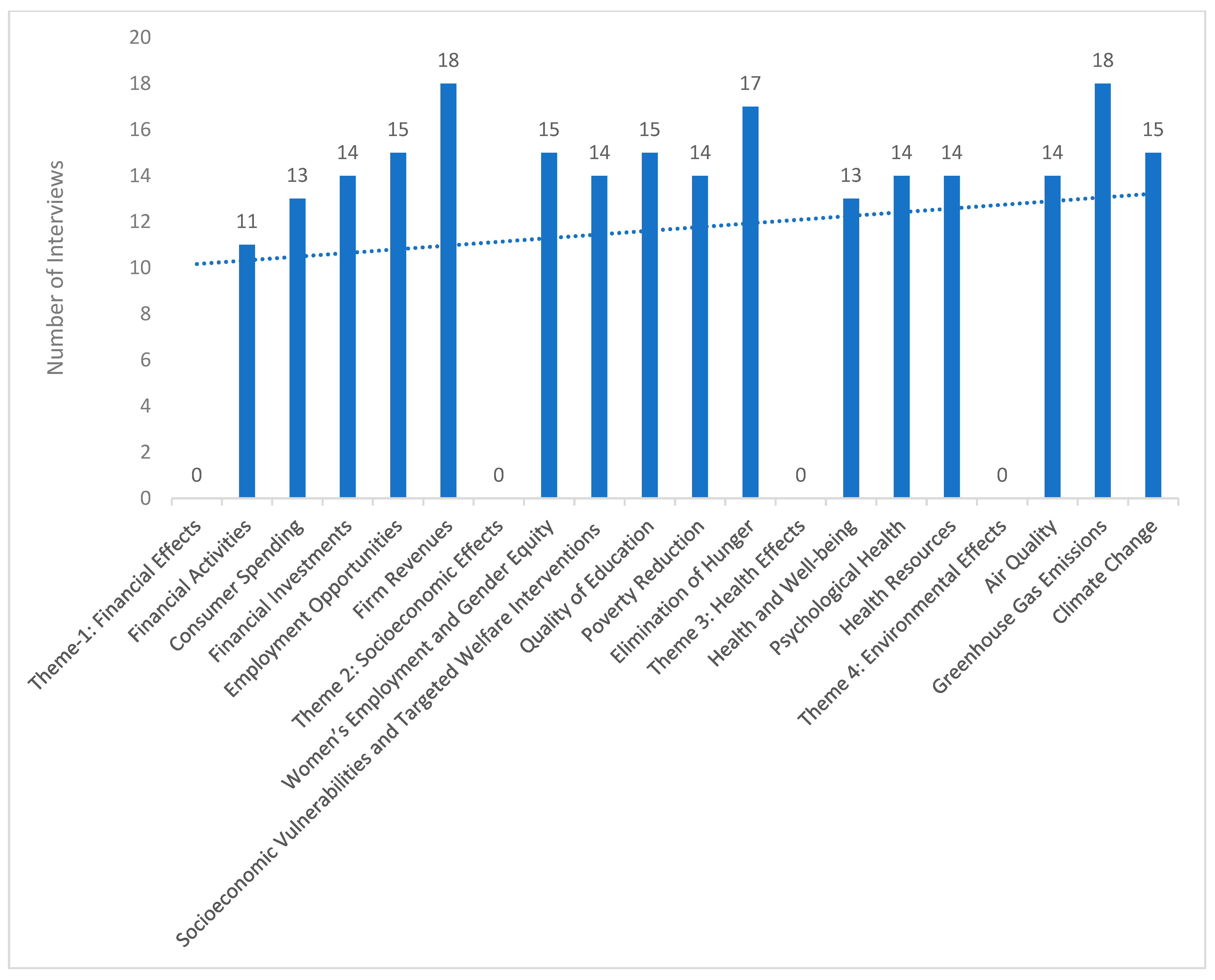
4.2. Saturation Assessment
4.3. Thematic Analysis
4.3.1. Financial Effects (SDG 8)
Financial Activities
Consumer Spending
Financial Investments
Employment Opportunities
Firm Revenues
4.3.2. Socioeconomic Effects (SDGs 1, 2, 4, 5, 10)
Women’s Employment and Gender Equity
Socioeconomic Vulnerabilities and Targeted Welfare Interventions
Quality of Education
Poverty Reduction
Elimination of Hunger
4.3.3. Health Effects (SDG 3)
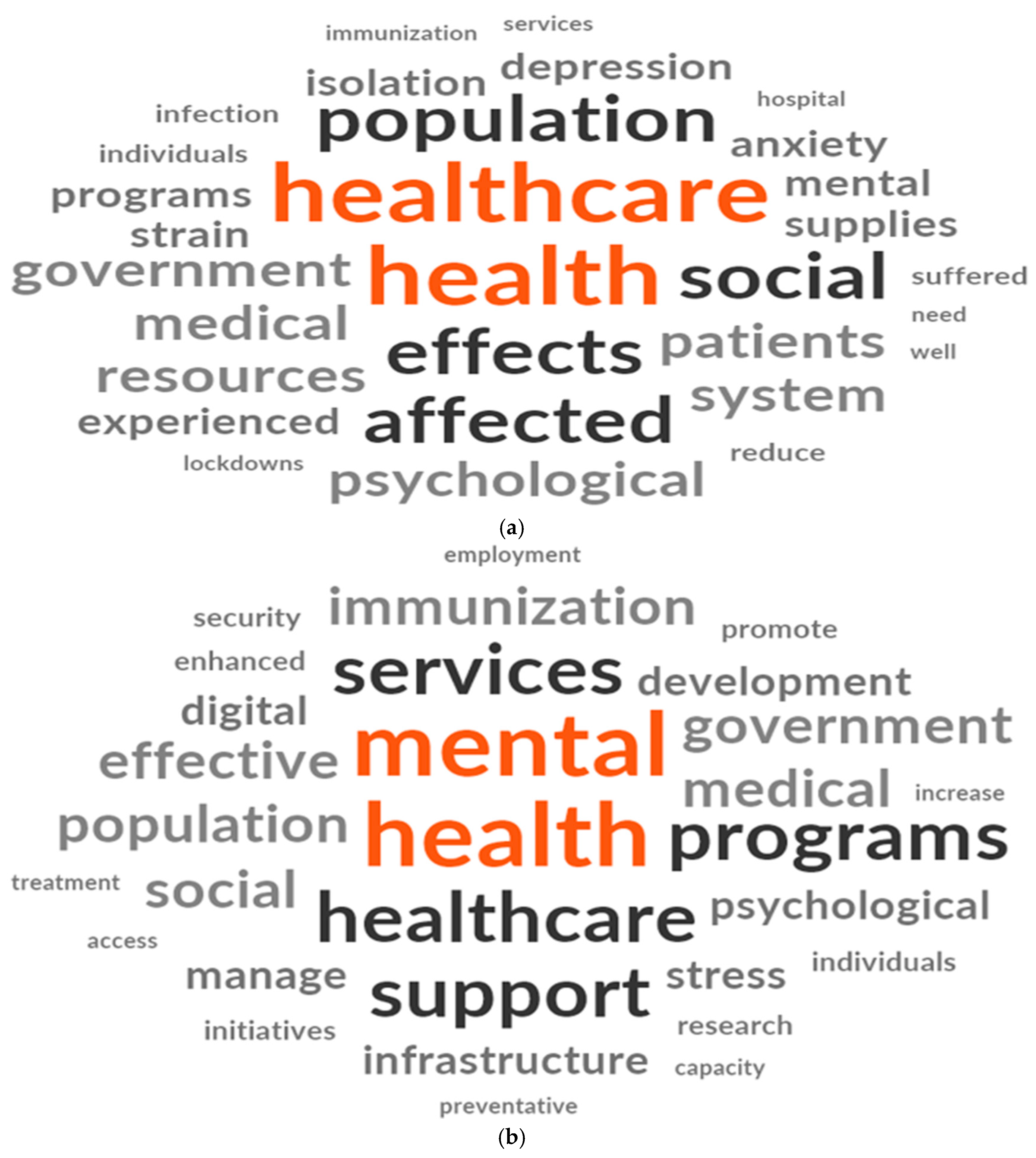
Health and Well-Being
Psychological Health
Health Resources
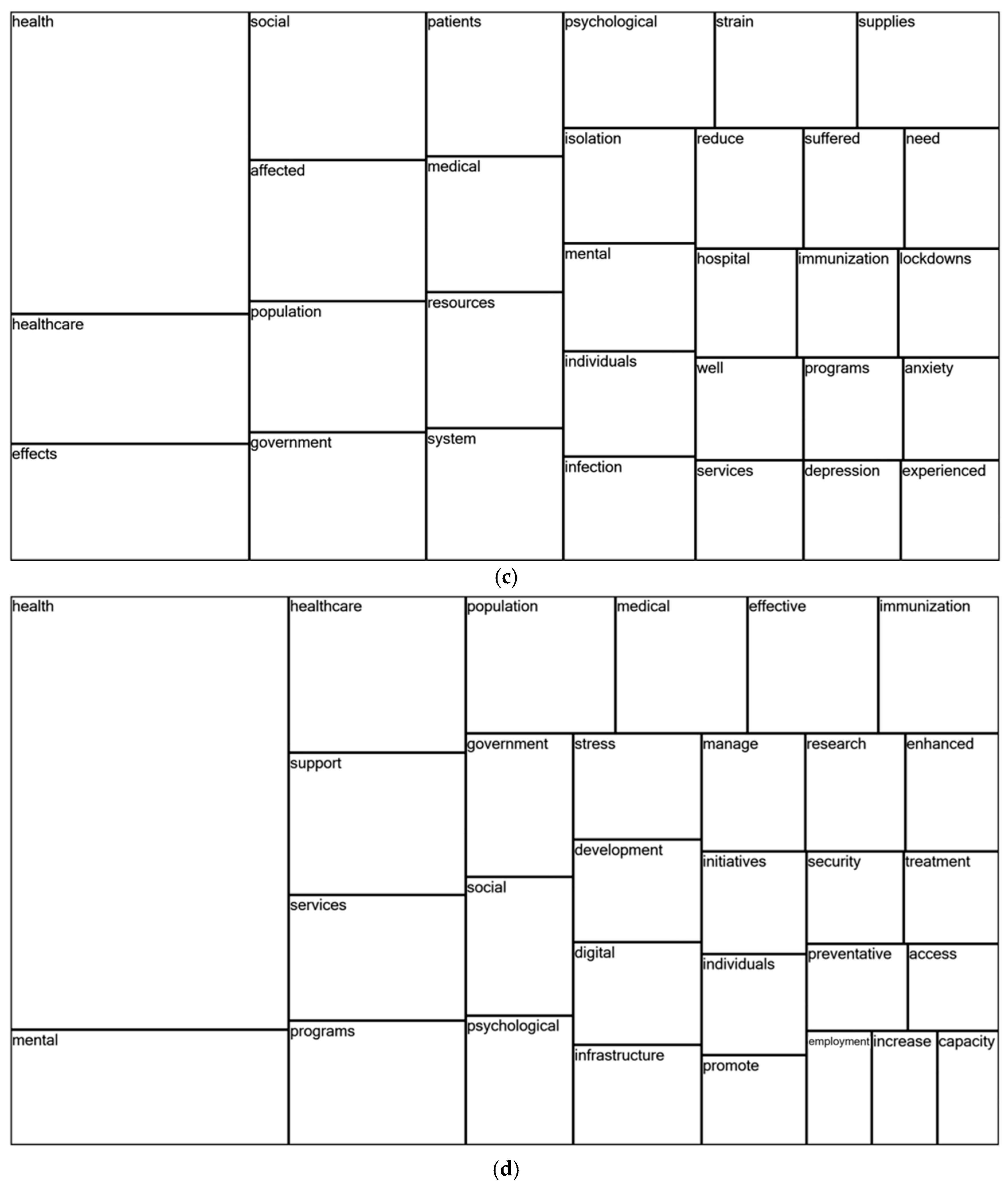
4.3.4. Environmental Effects (SDG 13)
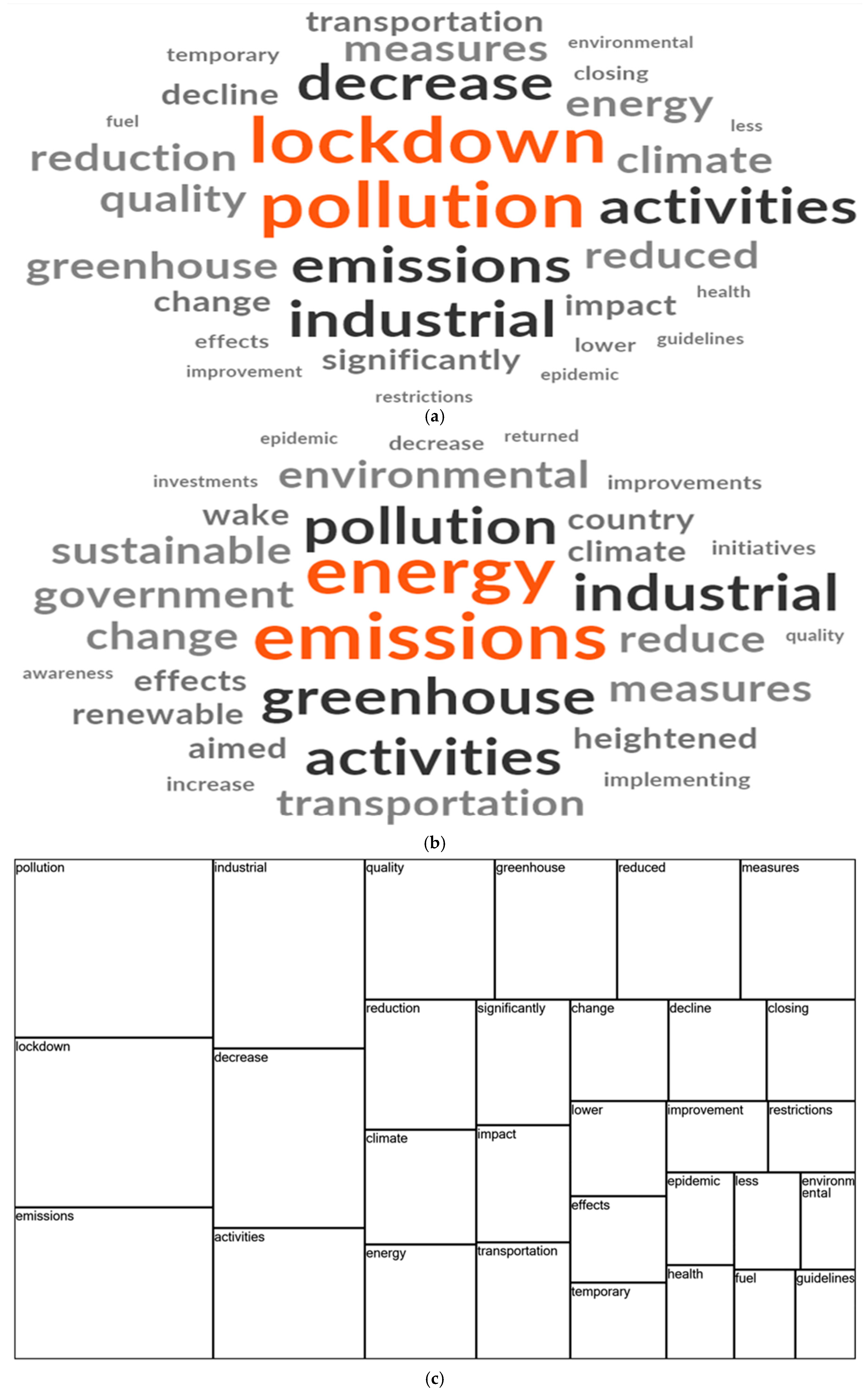
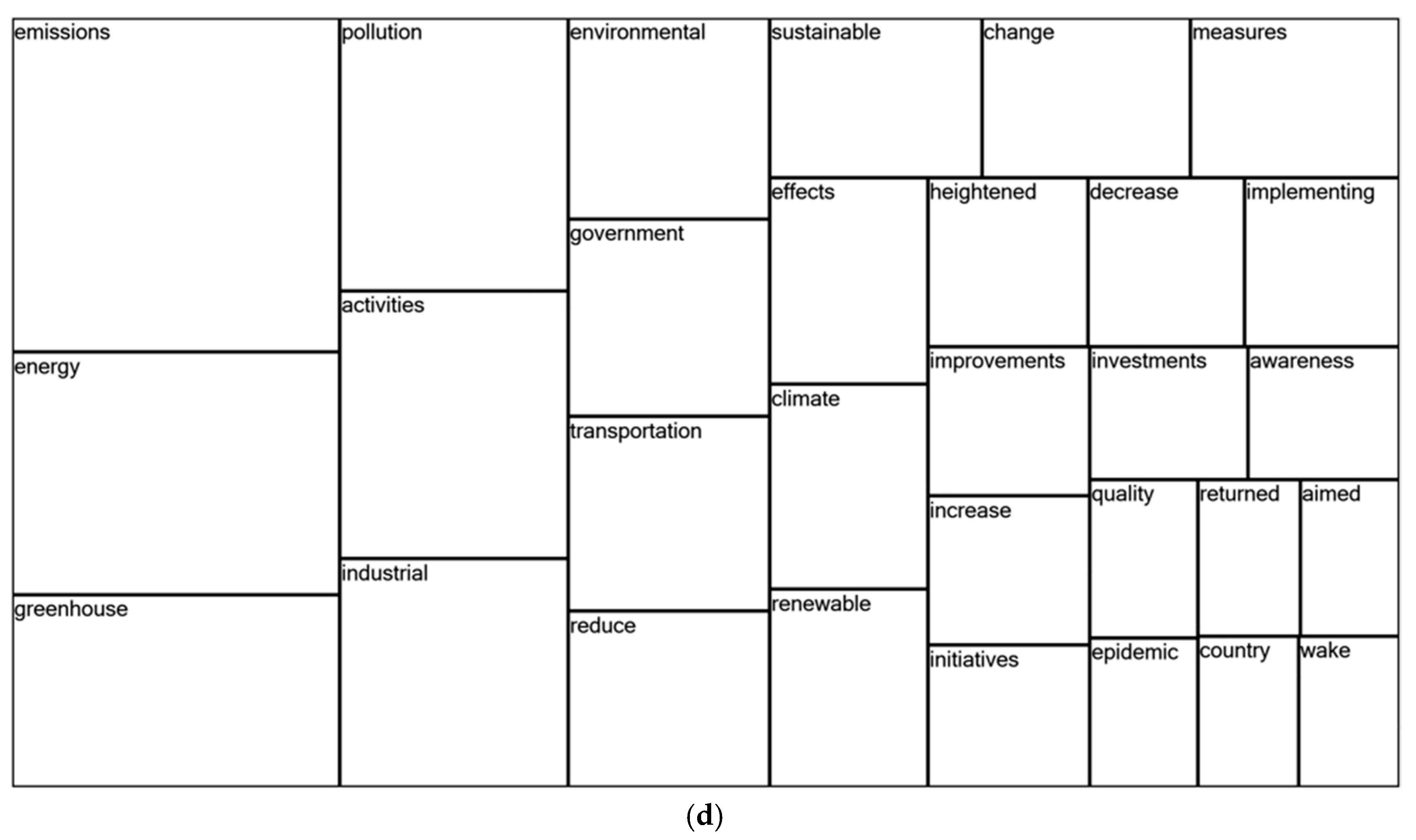
Air Quality
Greenhouse Gas Emissions
Climate Change
4.3.5. Cross-Thematic Linkages
5. Discussion
5.1. Financial Effects During and Post-COVID-19
5.2. Socioeconomic Effects During and Post-COVID-19
5.3. Health Effects During and Post-COVID-19
5.4. Environmental Effects During and Post-COVID-19
5.5. Practical Implications
5.6. Theoretical Contributions
5.7. Limitations and Scope for Future Research
6. Conclusions
Author Contributions
Funding
Institutional Review Board Statement
Informed Consent Statement
Data Availability Statement
Conflicts of Interest
References
- United Nations Sustainable Development Goals (SDGs). Available online: https://unric.org/en/united-nations-sustainable-development-goals/ (accessed on 27 February 2025).
- Shulla, K.; Voigt, B.-F.; Cibian, S.; Scandone, G.; Martinez, E.; Nelkovski, F.; Salehi, P. Effects of COVID-19 on the Sustainable Development Goals (SDGs). Discov. Sustain. 2021, 2, 15. [Google Scholar] [CrossRef]
- IMF Achieving the Sustainable Development Goals Will Require Extraordinary Effort by All. Available online: https://blogs.imf.org/2021/04/29/achieving-the-sustainable-development-goals-will-require-extraordinary-effort-by-all/ (accessed on 27 February 2024).
- Baker, S.; Bloom, N.; Davis, S.; Terry, S. COVID-Induced Economic Uncertainty; National Bureau of Economic Research: Cambridge, MA, USA, 2020. [Google Scholar]
- Baker, S.; Farrokhnia, R.A.; Meyer, S.; Pagel, M.; Yannelis, C. How Does Household Spending Respond to an Epidemic? Consumption During the 2020 COVID-19 Pandemic; Oxford Academic: Cambridge, MA, USA, 2020. [Google Scholar]
- KPMG. Economic Implications of COVID-19 on Saudi Arabia. Available online: https://assets.kpmg.com/content/dam/kpmg/sa/pdf/2020/economic-implications-of-covid-19.pdf (accessed on 27 December 2025).
- Abubakar, A.A.; Al-Mamary, Y.H.; Preet Singh, H.; Singh, A.; Alam, F.; Agrawal, V. Exploring Factors Influencing Sustainable Human Capital Development: Insights from Saudi Arabia. Heliyon 2024, 10, e35676. [Google Scholar] [CrossRef]
- Alam, F.; Singh, H.P.; Singh, A.; Al-Mamary, Y.H.; Abubakar, A.A.; Agrawal, V. Human Capital Spending and Its Impact on Economic Growth in Saudi Arabia: An NARDL Approach. Sustainability 2025, 17, 4639. [Google Scholar] [CrossRef]
- Singh, H.P.; Singh, A.; Alam, F.; Agrawal, V. Impact of Sustainable Development Goals on Economic Growth in Saudi Arabia: Role of Education and Training. Sustainability 2022, 14, 14119. [Google Scholar] [CrossRef]
- Alam, F.; Singh, H.P.; Singh, A. Economic Growth in Saudi Arabia through Sectoral Reallocation of Government Expenditures. Sage Open 2022, 12, 1–13. [Google Scholar] [CrossRef]
- Alotaibi, N.S. The Significance of Digital Learning for Sustainable Development in the Post-COVID19 World in Saudi Arabia’s Higher Education Institutions. Sustainability 2022, 14, 16219. [Google Scholar] [CrossRef]
- Wajid, H.A. The Role of Saudi Arabian Higher Education Institutions in Sustainable Development: Participation, Framework Alignment, and Strategic Insights. Sustainability 2025, 17, 2530. [Google Scholar] [CrossRef]
- Qi, Y.; Shi, X.; Chen, Y.; Shen, Y. Country-Level Evenness Measure in Assessing Progress towards Sustainable Development Goals (SDGs). Humanit. Soc. Sci. Commun. 2024, 11, 1117. [Google Scholar] [CrossRef]
- Leveson, N.G. Applying Systems Thinking to Analyze and Learn from Events. Saf. Sci. 2011, 49, 55–64. [Google Scholar] [CrossRef]
- Althaqafi, T. The Impact of Coronavirus (COVID-19) On the Economy in the Kingdom of Saudi Arabia: A Review. Int. J. Bus. Manag. Rev. 2020, 8, 34–40. [Google Scholar] [CrossRef]
- Qwaider, S.; Al-Ramadan, B.; Shafiullah, M.; Islam, A.; Worku, M.Y. GIS-Based Progress Monitoring of SDGs towards Achieving Saudi Vision 2030. Remote Sens. 2023, 15, 5770. [Google Scholar] [CrossRef]
- Ahmed, E.M.; Elfaki, K.E.; Alamin, Y.M.M.; Abdel-Aziz, M.S.-E.; Elmoustafa, A.M.G. Digitalization and Climate Change Spillover Effects on Saudi Digital Economy Sustainable Economic Growth. Fudan J. Humanit. Soc. Sci. 2025, 18, 687–723. [Google Scholar] [CrossRef]
- Worldometer COVID-19 Coronavirus Pandemic. Available online: https://www.worldometers.info/coronavirus/ (accessed on 3 July 2025).
- Ferrari, M. Saudi Arabia Records Highest-Ever Number of New Daily COVID-19 Cases. Available online: https://english.alarabiya.net/coronavirus/2022/01/12/Saudi-Arabia-records-highest-ever-number-of-new-daily-COVID-19-cases (accessed on 28 December 2024).
- Alyami, M.H.; Naser, A.Y.; Orabi, M.A.A.; Alwafi, H.; Alyami, H.S. Epidemiology of COVID-19 in the Kingdom of Saudi Arabia: An Ecological Study. Front. Public Health 2020, 8, 506. [Google Scholar] [CrossRef]
- Alharbi, R. Impact of COVID-19 on Saudi Arabia’s Economy: Evidence from Macro-Micro Modelling. PSU Res. Rev. 2024, 8, 167–178. [Google Scholar] [CrossRef]
- Sayed, S.H.; Aldailami, D.A.; Abd El Aziz, M.M.; Elsayed, E.A. Perceived Telehealth Usability for Personalized Healthcare Among the Adult Population in Saudi Arabia: A Cross-Sectional Study in the Post-COVID-19 Era. Healthcare 2025, 13, 62. [Google Scholar] [CrossRef]
- Krstić, M.; Filipe, J.A.; Chavaglia, J. Higher Education as a Determinant of the Competitiveness and Sustainable Development of an Economy. Sustainability 2020, 12, 6607. [Google Scholar] [CrossRef]
- McKibbin, W.; Fernando, R. The Global Macroeconomic Impacts of COVID-19: Seven Scenarios. Asian Econ. Pap. 2021, 20, 1–30. [Google Scholar] [CrossRef]
- Yiming, W.; Xun, L.; Umair, M.; Aizhan, A. COVID-19 and the Transformation of Emerging Economies: Financialization, Green Bonds, and Stock Market Volatility. Resour. Policy 2024, 92, 104963. [Google Scholar] [CrossRef]
- Alsuhaibani, W.; Houmes, R.; Wang, D. The Evolution of Financial Reporting Quality for Companies Listed on the Tadawul Stock Exchange in Saudi Arabia: New Emerging Markets’ Evidence. Emerg. Mark. Rev. 2023, 55, 101009. [Google Scholar] [CrossRef]
- Algaissi, A.A.; Alharbi, N.K.; Hassanain, M.; Hashem, A.M. Preparedness and Response to COVID-19 in Saudi Arabia: Building on MERS Experience. J. Infect. Public. Health 2020, 13, 834–838. [Google Scholar] [CrossRef]
- Khan, A.A.; Alahdal, H.M.; Alotaibi, R.M.; Sonbol, H.S.; Almaghrabi, R.H.; Alsofayan, Y.M.; Althunayyan, S.M.; Alsaif, F.A.; Almudarra, S.S.; Alabdulkareem, K.I.; et al. Controlling COVID-19 Pandemic: A Mass Screening Experience in Saudi Arabia. Front. Public. Health 2021, 8, 606385. [Google Scholar] [CrossRef]
- Amamou, M.; Ben-Ahmed, K. Managing the COVID-19 Pandemic in Thirty-Two Policy Measures in Saudi Arabia: A Mixed-Methods Analysis. J. Infect. Public. Health 2023, 16, 1650–1658. [Google Scholar] [CrossRef]
- Singh, H.P.; Alwaqaa, M.A.M. The Educational Technology’s Impact on Youth Creativity and Innovation: A Case of Ha’il Region of Saudi Arabia. Rev. Amazon. Investig. 2023, 12, 144–154. [Google Scholar] [CrossRef]
- Singh, H.P.; Alodaynan, A.M.M. The Role of Educational Technology in Developing the Cognitive and Communicative Skills of University Students: A Saudi Arabian Case. Int. J. Adv. Appl. Sci. 2023, 10, 157–164. [Google Scholar] [CrossRef]
- Singh, H.P.; Aziz, A.A. Impact of Intelligent Learning Assistants on Creativity of University Students: A Self-Determination Theory Perspective. Future Bus. J. 2025, 11, 122. [Google Scholar] [CrossRef]
- Alhamad, S.H.; Bani Hani, S.I.; Dakhli, A.C.; Almahayreh, A.S. The Effectiveness of Applying the Economic and Technological Dimensions of the Kingdom of Saudi Arabia’s Vision 2030 to Achieve the Competitive Advantage of the Hail Region. Front. Energy Res. 2024, 12, 1337349. [Google Scholar] [CrossRef]
- Parveen, M. Challenges Faced by Pandemic COVID-19 Crisis: A Case Study in Saudi Arabia. Challenge 2020, 63, 349–364. [Google Scholar] [CrossRef]
- Nurunnabi, M. Recovery Planning and Resilience of SMEs during the COVID-19: Experience from Saudi Arabia. J. Account. Organ. Change 2020, 16, 643–653. [Google Scholar] [CrossRef]
- Havrlant, D.; Darandary, A.; Muhsen, A. Early Estimates of the Impact of the COVID-19 Pandemic on GDP: A Case Study of Saudi Arabia. Appl. Econ. 2021, 53, 1317–1325. [Google Scholar] [CrossRef]
- AlFattani, A.; AlMeharish, A.; Nasim, M.; AlQahtani, K.; AlMudraa, S. Ten Public Health Strategies to Control the COVID-19 Pandemic: The Saudi Experience. IJID Reg. 2021, 1, 12–19. [Google Scholar] [CrossRef]
- Saudi National Portal Sustainable Development. Available online: https://my.gov.sa/en/content/sdgportal#section-3 (accessed on 27 December 2025).
- Chen, S.; Guo, L.; Xie, Y.; Dong, D.; Saber, R.; Alluhidan, M.; Alamri, A.; Alfaisal, A.; Alazemi, N.; Al-Farsi, Y.M.; et al. Government Responses to the COVID-19 Pandemic of the Gulf Cooperation Council Countries: Good Practices and Lessons for Future Preparedness. Glob. Health Res. Policy 2024, 9, 10. [Google Scholar] [CrossRef]
- Almohaimeed, F.A.; Abouelnour, K.A. The Role of Food Processing in Sustaining Food Security Indicators in the Kingdom of Saudi Arabia. Economies 2025, 13, 84. [Google Scholar] [CrossRef]
- Farhah, N.S. Assessing the Impact of Tech-Driven Solutions to Manage COVID-19 in Saudi Arabia: Insights from Health Information Technology Professionals. Front. Public Health 2024, 12, 1413263. [Google Scholar] [CrossRef]
- Arab News Education Takes Biggest Chunk of Saudi Public Spending in 2022. Available online: https://www.arabnews.com/node/1986011/business-economy (accessed on 27 February 2024).
- Al-Youbi, A.O.; Al-Hayani, A.; Rizwan, A.; Choudhry, H. Implications of COVID-19 on the Labor Market of Saudi Arabia: The Role of Universities for a Sustainable Workforce. Sustainability 2020, 12, 7090. [Google Scholar] [CrossRef]
- Singh, H.P.; Alshammari, K. Impacts of Digital Technology-Enabled Personalized and Adaptive Learning on Student Learning Performance: A TOE Framework for Saudi Arabia. Int. Trans. J. Eng. Manag. Appl. Sci. Technol. 2021, 12, 1–12. [Google Scholar] [CrossRef]
- Alshathry, S.; Alojail, M. Evaluating Post-Pandemic Undergraduate Student Satisfaction with Online Learning in Saudi Arabia: The Significance of Self-Directed Learning. Appl. Sci. 2024, 14, 8889. [Google Scholar] [CrossRef]
- Saudi Gazette Full Text of Saudi Arabia’s Vision 2030. Al Arabiya English. Available online: https://english.alarabiya.net/en/perspective/features/2016/04/26/Full-text-of-Saudi-Arabia-s-Vision-2030.html (accessed on 7 July 2024).
- Alghamdi, S.; Shaheen, R. The Demographical and Economic Factors Affecting Female Labor Force Participation in Saudi Arabia. J. Infrastruct. Policy Dev. 2024, 8, 3844. [Google Scholar] [CrossRef]
- Alhajri, M.F.; Jamil, R.; Abdalla, E.M.E.; Alqahtany, A.; Almazroua, S.; Al-Gehlani, W.A.G. Status of Wastewater Treatment and Reuse in Saudi Arabia and Its Forecasting for the Year 2035. Appl. Water Sci. 2025, 15, 167. [Google Scholar] [CrossRef]
- Leber, A.M. Saudization in a “Saudi First” Kingdom. Asian Pac. Migr. J. 2025, 34, 83–108. [Google Scholar] [CrossRef]
- Guerrero, A.; Lara-Galera, A.; Alcaraz Carrillo de Albornoz, V.; Arévalo Sarrate, C. Determinant Features to Reduce the Infrastructure Gap in Saudi Arabia under a Public–Private Partnership Scheme. Buildings 2024, 14, 699. [Google Scholar] [CrossRef]
- AlQahtani, A.I.; Salama, K.F.; Alwadei, M.M.; Aljassim, M.T.; Alsaif, A.S.; Al-Warthan, M.; AlMulla, A.A. Air Quality Levels in the Industrial City of Jubail, Saudi Arabia. Front. Environ. Eng. 2024, 3, 1483568. [Google Scholar] [CrossRef]
- Alnor, N.H.A. Corporate Governance Characteristics and Environmental Sustainability Affect the Business Performance among Listed Saudi Company. Sustainability 2024, 16, 8436. [Google Scholar] [CrossRef]
- AlAjlan, A. COVID-19 and Its Impact on the Hotel Industry in Saudi Arabia. Available online: https://www.lexology.com/library/detail.aspx?g=68a6e9d3-3489-41cc-a2c5-adcf53afe666 (accessed on 26 December 2025).
- Bordoff, J. The 2020 Oil Crash’s Unlikely Winner: Saudi Arabia. Available online: https://www.energypolicy.columbia.edu/research/op-ed/2020-oil-crash-s-unlikely-winner-saudi-arabia (accessed on 27 February 2025).
- Aldhmadi, B.K.; Almutairi, Y.M.; Elmelegy, R.I.; Ferchichi, M.M. A Predictive Strategy to Mitigate the Impact of the COVID-19 Pandemic on the Saudi Economy. Int. J. Adv. Appl. Sci. 2024, 11, 192–219. [Google Scholar] [CrossRef]
- Wilkinson, L.A. Systems Theory. In Encyclopedia of Child Behavior and Development; Springer: Boston, MA, USA, 2011; pp. 1466–1468. [Google Scholar]
- Coccia, M. World-System Theory: A Sociopolitical Approach to Explain World Economic Development in a Capitalistic Country. J. Econ. Political Econ. 2018, 5, 459–465. [Google Scholar]
- Blanco-Murcia, L.; Moreno-Cruz, J. The Role of Care in Creating Narratives for Sustainability. Sustain. Sci. 2025, 20, 1863–1881. [Google Scholar] [CrossRef]
- Mukarram, M. Impact of COVID-19 on the UN Sustainable Development Goals (SDGs). Strateg. Anal. 2020, 44, 253–258. [Google Scholar] [CrossRef]
- Mani, Z.A.; Goniewicz, K. Transforming Healthcare in Saudi Arabia: A Comprehensive Evaluation of Vision 2030’s Impact. Sustainability 2024, 16, 3277. [Google Scholar] [CrossRef]
- Coccia, M. Sources of Technological Innovation: Radical and Incremental Innovation Problem-Driven to Support Competitive Advantage of Firms. Technol. Anal. Strat. Manag. 2017, 29, 1048–1061. [Google Scholar] [CrossRef]
- Thoradeniya, T.; Jayasinghe, S. COVID-19 and Future Pandemics: A Global Systems Approach and Relevance to SDGs. Glob. Health 2021, 17, 59. [Google Scholar] [CrossRef]
- Chakraborty, I.; Maity, P. COVID-19 Outbreak: Migration, Effects on Society, Global Environment and Prevention. Sci. Total Environ. 2020, 728, 138882. [Google Scholar] [CrossRef]
- Pangestu, M.E. For the Poorest Countries, the Full Danger from Coronavirus Is Only Just Coming into View. Available online: https://blogs.worldbank.org/voices/poorest-countries-full-danger-coronavirus-only-just-coming-view (accessed on 27 February 2024).
- Ang, L.; Hernández-Rodríguez, E.; Cyriaque, V.; Yin, X. COVID-19’s Environmental Impacts: Challenges and Implications for the Future. Sci. Total Environ. 2023, 899, 165581. [Google Scholar] [CrossRef]
- Shi, P.; Ye, T.; Wang, Y.; Zhou, T.; Xu, W.; Du, J.; Wang, J.; Li, N.; Huang, C.; Liu, L.; et al. Disaster Risk Science: A Geographical Perspective and a Research Framework. Int. J. Disaster Risk Sci. 2020, 11, 426–440. [Google Scholar] [CrossRef]
- UNDP COVID-19 and the SDGs: How the ‘Roadmap for Humanity’ Could Be Changed by a Pandemic. Available online: https://featured.undp.org/covid-19-and-the-sdgs/ (accessed on 27 December 2025).
- Mormina, M.; Müller, B.; Caniglia, G.; Engebretsen, E.; Löffler-Stastka, H.; Marcum, J.; Mercuri, M.; Paul, E.; Pfaff, H.; Russo, F.; et al. Where to after COVID-19? Systems Thinking for a Human-Centred Approach to Pandemics. Humanit. Soc. Sci. Commun. 2024, 11, 733. [Google Scholar] [CrossRef]
- Wallerstein, I. The Rise and Future Demise of the World Capitalist System: Concepts for Comparative Analysis. Comp. Stud. Soc. Hist. 1974, 16, 387–415. [Google Scholar] [CrossRef]
- Jones, C. The Credit Crunch: Short-Term UK Housing Market Correction or Long-Term Tipping Point? Int. J. Hous. Policy 2016, 16, 70–90. [Google Scholar] [CrossRef]
- Haleem, A.; Javaid, M.; Vaishya, R. Effects of COVID-19 Pandemic in Daily Life. Curr. Med. Res. Pr. 2020, 10, 78–79. [Google Scholar] [CrossRef]
- Jutz, R. The Role of Income Inequality and Social Policies on Income-Related Health Inequalities in Europe. Int. J. Equity Health 2015, 14, 117. [Google Scholar] [CrossRef]
- World Bank COVID-19 Intensifies the Urgency to Expand Sustainable Energy Solutions Worldwide. Available online: https://www.worldbank.org/en/news/press-release/2020/05/28/covid-19-intensifies-the-urgency-to-expand-sustainable-energy-solutions-worldwide (accessed on 27 December 2025).
- Ludvigson, S.; Ma, S.; Ng, S. COVID-19 and The Macroeconomic Effects of Costly Disasters; National Bureau of Economic Research: Cambridge, MA, USA, 2020. [Google Scholar]
- OECD. COVID-19 in Africa: Regional Socio-Economic Implications and Policy Priorities. Available online: https://www.oecd.org/content/dam/oecd/en/publications/reports/2020/05/covid-19-and-africa-socio-economic-implications-and-policy-responses_5fe8298b/96e1b282-en.pdf (accessed on 27 December 2025).
- Ozili, P. COVID-19 in Africa: Socio-Economic Impact, Policy Response and Opportunities. Int. J. Sociol. Soc. Policy 2020, 42, 177–200. [Google Scholar] [CrossRef]
- Komarov, V.V.; Litvina, N.I.; Ananyeva, E.V.; Djshchanova, A.I. Negative Impact of COVID-19 on World Economy Development. Econ. Labor Manag. Agric. 2020, 13–18. [Google Scholar] [CrossRef]
- Das, G.; Bag, A. Effect of COVID-19 in Worldwide Economy with a View to India: A Comprehensive Study. Strad. Res. 2020, 7, 237–246. [Google Scholar] [CrossRef]
- Tran, B.X.; Nguyen, H.T.; Le, H.T.; Latkin, C.A.; Pham, H.Q.; Vu, L.G.; Le, X.T.T.; Nguyen, T.T.; Pham, Q.T.; Ta, N.T.K.; et al. Impact of COVID-19 on Economic Well-Being and Quality of Life of the Vietnamese During the National Social Distancing. Front. Psychol 2020, 11, 565153. [Google Scholar] [CrossRef]
- Barro, R.; Ursúa, J.; Weng, J. The Coronavirus and the Great Influenza Pandemic: Lessons from the “Spanish Flu” for the Coronavirus’s Potential Effects on Mortality and Economic Activity; Cambridge, MA, USA, 2020. [Google Scholar]
- Carlsson-Szlezak, P.; Reeves, M.; Swartz, P. Understanding the Economic Shock of Coronavirus. Available online: https://hbr.org/2020/03/understanding-the-economic-shock-of-coronavirus (accessed on 27 February 2024).
- Fornaro, L.; Wolf, M. COVID-19 Coronavirus and Macroeconomic Policy. Available online: https://bse.eu/research/working-papers/COVID-19-coronavirus-and-macroeconomic-policy (accessed on 27 February 2024).
- Bonadio, B.; Huo, Z.; Levchenko, A.; Pandalai-Nayar, N. Global Supply Chains in the Pandemic; National Bureau of Economic Research: Cambridge, MA, USA, 2020. [Google Scholar]
- Binder, C. Coronavirus Fears and Macroeconomic Expectations. Rev. Econ. Stat. 2020, 102, 721–730. [Google Scholar] [CrossRef]
- Elenev, V.; Landvoigt, T.; Van Nieuwerburgh, S. Can the Covid Bailouts Save the Economy? National Bureau of Economic Research: Cambridge, MA, USA, 2020. [Google Scholar]
- Xu, S.; Liu, Q.; Lu, X. Shock Effect of COVID-19 Infection on Environmental Quality and Economic Development in China: Causal Linkages (Health Economic Evaluation). Env. Dev Sustain. 2021, 24, 9102–9117. [Google Scholar] [CrossRef] [PubMed]
- Hong, T.-H. Confucianism and COVID-19 Pandemic Economic Crisis in the East Asia. Koreanische Z. Fuer Wirtsch. 2021, 39, 57–76. [Google Scholar] [CrossRef]
- Zweifel, P. The COVID-19 Crisis: A Public Choice View. Econ. Aff. 2020, 40, 395–405. [Google Scholar] [CrossRef]
- Gupta, S.; Montenovo, L.; Nguyen, T.; Rojas, F.L.; Schmutte, I.; Simon, K.; Weinberg, B.; Wing, C. Effects of Social Distancing Policy on Labor Market Outcomes; Wiley Online Library: Hoboken, NJ, USA, 2022. [Google Scholar]
- Farboodi, M.; Jarosch, G.; Shimer, R. Internal and External Effects of Social Distancing in a Pandemic; National Bureau of Economic Research: Cambridge, MA, USA, 2020. [Google Scholar]
- Coibion, O.; Gorodnichenko, Y.; Weber, M. The Cost of the COVID-19 Crisis: Lockdowns, Macroeconomic Expectations, and Consumer Spending. J. Econ. Behav. Organ. 2024, 229, 106846. [Google Scholar] [CrossRef]
- Gagnon, J.E.; Kamin, S.B.; Kearns, J. The Impact of the COVID-19 Pandemic on Global GDP Growth. J. Jpn. Int. Econ. 2023, 68, 101258. [Google Scholar] [CrossRef]
- Yang, L. From Isolation to Revival: Trade Recovery amid Global Health Crises. Glob. Health 2024, 20, 38. [Google Scholar] [CrossRef]
- Behera, C.; Rath, B.N.; Mishra, P.K. The Impact of Monetary and Fiscal Stimulus on Stock Returns during the COVID-19 Pandemic. J. Asian Econ. 2024, 90, 101680. [Google Scholar] [CrossRef]
- Clemente-Suárez, V.J.; Rodriguez-Besteiro, S.; Cabello-Eras, J.J.; Bustamante-Sanchez, A.; Navarro-Jiménez, E.; Donoso-Gonzalez, M.; Beltrán-Velasco, A.I.; Tornero-Aguilera, J.F. Sustainable Development Goals in the COVID-19 Pandemic: A Narrative Review. Sustainability 2022, 14, 7726. [Google Scholar] [CrossRef]
- Chetty, R.; Friedman, J.N.; Stepner, M.; Alatas, H.; Baker, C.; Barnhard, H.; Bell, M.; Bruich, G.; Chelidze, T.; Chu, L.; et al. The Economic Impacts of COVID-19: Evidence from a New Public Database Built Using Private Sector Data. Q. J. Econ. 2024, 139, 829–889. [Google Scholar] [CrossRef]
- Zhang, H.; Luo, W.-Q.; Yang, S.; Yu, J. Impact of COVID-19 on Economic Recovery: Empirical Analysis from China and Global Economies. Econ. Change Restruct. 2023, 56, 57–78. [Google Scholar] [CrossRef]
- Zhao, W.; Yin, C.; Hua, T.; Meadows, M.E.; Li, Y.; Liu, Y.; Cherubini, F.; Pereira, P.; Fu, B. Achieving the Sustainable Development Goals in the Post-Pandemic Era. Humanit. Soc. Sci. Commun. 2022, 9, 258. [Google Scholar] [CrossRef]
- Mehta, P. Work from Home—Work Engagement amid COVID-19 Lockdown and Employee Happiness. J. Public. Aff. 2021, 21, e2709. [Google Scholar] [CrossRef]
- Rouh, J.; Dalati, S.; Bich, M.A. Investigating the Perceived Comparison of Work from Office vs. Work from Home during COVID-19: An Empirical Study. J. Serv. Innov. Sustain. Dev. 2021, 2, 53–59. [Google Scholar] [CrossRef]
- Adams-Prassl, A.; Boneva, T.; Golin, M.; Rauh, C. Inequality in the Impact of the Coronavirus Shock: Evidence from Real Time Surveys. J. Public. Econ. 2020, 189, 104245. [Google Scholar] [CrossRef]
- Coibion, O.; Gorodnichenko, Y.; Weber, M. Labor Markets During the COVID-19 Crisis: A Preliminary View; National Bureau of Economic Research: Cambridge, MA, USA, 2020. [Google Scholar]
- Forsythe, E.; Kahn, L.; Lange, F.; Wiczer, D. Labor Demand in the Time of COVID-19: Evidence from Vacancy Postings and UI Claims; National Bureau of Economic Research: Cambridge, MA, USA, 2020. [Google Scholar]
- Naji, A. The Repercussions of COVID-19 On the Field of Education. J. Qual. Educ. 2020, 10, 1–21. [Google Scholar] [CrossRef]
- Lawrence, A.W.; Ihebuzor, N.; Lawrence, D.O. Macro-Level Studies of Direct and Indirect Relationships between SDG 4 and the 16 SDGS. Mod. Econ. 2020, 11, 1176–1194. [Google Scholar] [CrossRef]
- Alipour, J.-V.; Falck, O.; Schüller, S. Germany’s Capacities to Work from Home. Available online: https://www.iza.org/publications/dp/13152/germanys-capacities-to-work-from-home (accessed on 26 February 2024).
- Papanikolaou, D.; Schmidt, L.D.W. Working Remotely and the Supply-Side Impact of COVID-19; National Bureau of Economic Research: Cambridge, MA, USA, 2020. [Google Scholar]
- Dreger, C.; Gros, D. Lockdowns and the US Unemployment Crisis. Econ. Disaster Clim. Chang. 2021, 5, 449–463. [Google Scholar] [CrossRef]
- Alieva, K. COVID-19 Pandemic: Problems of Ensuring Gender Equality. Am. J. Soc. Sci. Educ. Innov. 2021, 03, 315–324. [Google Scholar] [CrossRef]
- Yasar, D.F.C.; Yirmibesoglu, G. Evaluation of the Economic Impacts of COVID-19 in the Context of Gender Equality. Gaziantep Univ. J. Soc. Sci. 2020, 19, 780–792. [Google Scholar] [CrossRef]
- Profeta, P. Gender Equality and Public Policy during COVID-19. CESifo. Econ. Stud. 2020, 66, 365–375. [Google Scholar] [CrossRef]
- Mukhtar, K.; Javed, K.; Arooj, M.; Sethi, A. Advantages, Limitations and Recommendations for Online Learning during COVID-19 Pandemic Era. Pak. J. Med. Sci. 2020, 36, S27–S31. [Google Scholar] [CrossRef]
- Matsieli, M.; Mutula, S. COVID-19 and Digital Transformation in Higher Education Institutions: Towards Inclusive and Equitable Access to Quality Education. Educ. Sci. 2024, 14, 819. [Google Scholar] [CrossRef]
- Filho, W.L.; Brandli, L.L.; Lange Salvia, A.; Rayman-Bacchus, L.; Platje, J. COVID-19 and the UN Sustainable Development Goals: Threat to Solidarity or an Opportunity? Sustainability 2020, 12, 5343. [Google Scholar] [CrossRef]
- Martínez-Martínez, O.A.; Reyes-Martínez, J.; Mideros Mora, A.I.; Sánchez Pilco, A.C.; Rodríguez Salme, C.L. Labor Markets during COVID-19: Gaps and Challenges in Latin America. Front. Sociol. 2024, 9, 1372404. [Google Scholar] [CrossRef]
- Singh, A.; Singh, H.P.; Alam, F.; Agrawal, V. Role of Education, Training, and E-Learning in Sustainable Employment Generation and Social Empowerment in Saudi Arabia. Sustainability 2022, 14, 8822. [Google Scholar] [CrossRef]
- Hossain, M.; Hossain, M.A. COVID-19 and Gender Gap in Labor Market Recovery: Evidence from Nigeria. J. Afr. Econ. 2025, 34, 387–403. [Google Scholar] [CrossRef]
- Ngongolo, K.; Gayo, L. Synergistic Impact of COVID-19 and Climate Change on Agricultural Resilience and Food Security in Sub-Saharan Africa. Discov. Agric. 2024, 2, 41. [Google Scholar] [CrossRef]
- Goldstein, J.R.; Lee, R.D. Demographic Perspectives on the Mortality of COVID-19 and Other Epidemics. Proc. Natl. Acad. Sci. USA 2020, 117, 22035–22041. [Google Scholar] [CrossRef]
- Lin, P.Z.; Meissner, C. A Note on Long-Run Persistence of Public Health Outcomes in Pandemics; National Bureau of Economic Research: Cambridge, MA, USA, 2020. [Google Scholar]
- Brodeur, A.; Grigoryeva, I.; Kattan, L. Stay-at-Home Orders, Social Distancing, and Trust. J. Popul. Econ. 2021, 34, 1321–1354. [Google Scholar] [CrossRef]
- Brodeur, A.; Cook, N.; Wright, T. On the Effects of COVID-19 Safer-at-Home Policies on Social Distancing, Car Crashes and Pollution. J. Env. Econ. Manag. 2021, 106, 102427. [Google Scholar] [CrossRef]
- Dhiman, G. The Effects of Coronavirus (COVID-19) on the Psychological Health of Indian Poultry Farmers. Coronaviruses 2021, 2, 131–132. [Google Scholar] [CrossRef]
- Field, T.; Poling, S.; Mines, S.; Diego, M.; Bendell, D.; Veazey, C. Boredom and Psychological Problems during a COVID-19 Lockdown. Arch. Health Sci. 2020, 1, 1–8. [Google Scholar] [CrossRef]
- Chatterji, P.; Li, Y. Effects of the COVID-19 Pandemic on Outpatient Providers in the US.; National Bureau of Economic Research: Cambridge, MA, USA, 2020. [Google Scholar]
- Padmanabhanunni, A.; Pretorius, T.B. The Unbearable Loneliness of COVID-19: COVID-19-Related Correlates of Loneliness in South Africa in Young Adults. Psychiatry Res. 2021, 296, 113658. [Google Scholar] [CrossRef]
- American Medical Association Managing Mental Health during COVID-19. Available online: https://www.ama-assn.org/delivering-care/public-health/managing-mental-health-during-COVID-19 (accessed on 26 February 2024).
- Liu, L.; Moon, H.R.; Schorfheide, F. Panel Forecasts of Country-Level COVID-19 Infections; National Bureau of Economic Research: Cambridge, MA, USA, 2020. [Google Scholar]
- Gaind, K.S. Mental Health and Healthcare in Canada during the COVID-19 Epidemic: A Social Perspective. World Soc. Psychiatry 2020, 2, 106. [Google Scholar] [CrossRef]
- Hossain, M. COVID-19 and Gender Differences in Mental Health in Low- and Middle-Income Countries: Young Working Women Are More Vulnerable. SSM Ment. Health 2021, 1, 100039. [Google Scholar] [CrossRef]
- Mushtaq, B. COVID-19 Effect on Mental Health. J. Addict. Res. 2020, 4, 1–2. [Google Scholar] [CrossRef]
- Mendoza, R.N.C.; Lara, T.M.; Rodríguez, N.M.P.; Guevara, P.Y.S. Harmful Effects of COVID-19 on Mental Health and Its Social Repercussions. Int. J. Orthop. Res. 2021, 4, 1–5. [Google Scholar] [CrossRef]
- Jiloha, R. COVID-19 and Mental Health. Epidemiol. Int. 2020, 05, 7–9. [Google Scholar] [CrossRef]
- Nalbandian, A.; Sehgal, K.; Gupta, A.; Madhavan, M.V.; McGroder, C.; Stevens, J.S.; Cook, J.R.; Nordvig, A.S.; Shalev, D.; Sehrawat, T.S.; et al. Post-Acute COVID-19 Syndrome. Nat. Med. 2021, 27, 601–615. [Google Scholar] [CrossRef]
- Domènech-Montoliu, S.; Puig-Barberà, J.; Pac-Sa, M.R.; Vidal-Utrillas, P.; Latorre-Poveda, M.; Del Rio-González, A.; Ferrando-Rubert, S.; Ferrer-Abad, G.; Sánchez-Urbano, M.; Aparisi-Esteve, L.; et al. Complications Post-COVID-19 and Risk Factors among Patients after Six Months of a SARS-CoV-2 Infection: A Population-Based Prospective Cohort Study. Epidemiologia 2022, 3, 49–67. [Google Scholar] [CrossRef]
- Sharma, N. Green Fungus Now a Major Threat After Covid Recovery. Available online: https://economictimes.indiatimes.com/industry/healthcare/biotech/healthcare/green-fungus-now-a-major-threat-after-covid-recovery/articleshow/83966502.cms?from=mdr (accessed on 15 September 2024).
- Davis, H.E.; McCorkell, L.; Vogel, J.M.; Topol, E.J. Long COVID: Major Findings, Mechanisms and Recommendations. Nat. Rev. Microbiol. 2023, 21, 133–146. [Google Scholar] [CrossRef]
- Wang, H.; Paulson, K.R.; Pease, S.A.; Watson, S.; Comfort, H.; Zheng, P.; Aravkin, A.Y.; Bisignano, C.; Barber, R.M.; Alam, T.; et al. Estimating Excess Mortality Due to the COVID-19 Pandemic: A Systematic Analysis of COVID-19-Related Mortality, 2020–2021. Lancet 2022, 399, 1513–1536. [Google Scholar] [CrossRef]
- Zaninotto, P.; Iob, E.; Di Gessa, G.; Steptoe, A. Recovery of Psychological Wellbeing Following the COVID-19 Pandemic: A Longitudinal Analysis of the English Longitudinal Study of Ageing. Aging Ment. Health 2025, 29, 651–659. [Google Scholar] [CrossRef]
- Allen, R.E.; Hochard, K.D.; Kannangara, C.; Carson, J. The Road to Recovery: A Two-Year Longitudinal Analysis of Mental Health Among University Students During and After the COVID-19 Pandemic. Behav. Sci. 2024, 14, 1146. [Google Scholar] [CrossRef]
- Hu, M.; Chen, Z.; Cui, H.; Wang, T.; Zhang, C.; Yun, K. Air Pollution and Critical Air Pollutant Assessment during and after COVID-19 Lockdowns: Evidence from Pandemic Hotspots in China, the Republic of Korea, Japan, and India. Atmos. Pollut. Res. 2021, 12, 316–329. [Google Scholar] [CrossRef]
- Cicala, S.; Holland, S.; Mansur, E.; Muller, N.; Yates, A. Expected Health Effects of Reduced Air Pollution from COVID-19 Social Distancing. Atmosphere 2021, 12, 951. [Google Scholar] [CrossRef]
- Li, C.; Shang, H.; Cui, Z.; Dai, Z.; Ma, Z. COVID-19 as a Factor Influencing Air Quality? A City Study in China. Aerosol Air Qual. Res. 2021, 21, 210080. [Google Scholar] [CrossRef]
- Rana, R.H.; Keramat, S.A.; Gow, J. A Systematic Literature Review of the Impact of COVID-19 Lockdowns on Air Quality in China. Aerosol Air Qual. Res. 2021, 21, 200614. [Google Scholar] [CrossRef]
- Wang, M.; Liu, F.; Zheng, M. Air Quality Improvement from COVID-19 Lockdown: Evidence from China. Air Qual. Atmos. Health 2021, 14, 591–604. [Google Scholar] [CrossRef]
- Wan, S.; Cui, K.; Wang, Y.-F.; Wu, J.-L.; Huang, W.-S.; Xu, K.; Zhang, J. Impact of the COVID-19 Event on Trip Intensity and Air Quality in Southern China. Aerosol Air Qual. Res. 2020, 20, 1727–1747. [Google Scholar] [CrossRef]
- Xu, K.; Cui, K.; Young, L.-H.; Hsieh, Y.-K.; Wang, Y.-F.; Zhang, J.; Wan, S. Impact of the COVID-19 Event on Air Quality in Central China. Aerosol Air Qual. Res. 2020, 20, 915–929. [Google Scholar] [CrossRef]
- Xu, K.; Cui, K.; Young, L.-H.; Wang, Y.-F.; Hsieh, Y.-K.; Wan, S.; Zhang, J. Air Quality Index, Indicatory Air Pollutants and Impact of COVID-19 Event on the Air Quality near Central China. Aerosol Air Qual. Res. 2020, 20, 1204–1221. [Google Scholar] [CrossRef]
- Zhang, J.; Cui, K.; Wang, Y.-F.; Wu, J.-L.; Huang, W.-S.; Wan, S.; Xu, K. Temporal Variations in the Air Quality Index and the Impact of the COVID-19 Event on Air Quality in Western China. Aerosol Air Qual. Res. 2020, 20, 1552–1568. [Google Scholar] [CrossRef]
- Hoy, Z.X.; Leong, J.F.; Woon, K.S. Post-COVID-19 Pandemic and the Paris Agreement: A Socioeconomic Analysis and Carbon Emissions Forecasting in Developed and Developing Countries. Clean. Technol. Env. Policy 2024, 26, 1537–1551. [Google Scholar] [CrossRef]
- Hartmann, L.; Walz, Y.; Clelland, D.; Esquivel-Rodriguez, C.; Riganti, P.; Vicarelli, M.; Renaud, F.G. A Conceptual Framework for a Post-COVID-19 Green Recovery of the Blue Economy. Mar. Policy 2025, 171, 106446. [Google Scholar] [CrossRef]
- Braun, V.; Clarke, V. Using Thematic Analysis in Psychology. Qual. Res. Psychol. 2006, 3, 77–101. [Google Scholar] [CrossRef]
- Ahmed, S.K. How to Choose a Sampling Technique and Determine Sample Size for Research: A Simplified Guide for Researchers. Oral. Oncol. Rep. 2024, 12, 100662. [Google Scholar] [CrossRef]
- Stratton, S.J. Population Research: Convenience Sampling Strategies. Prehosp Disaster Med. 2021, 36, 373–374. [Google Scholar] [CrossRef]
- Rosen, R.K.; Gainey, M.; Nasrin, S.; Garbern, S.C.; Lantini, R.; Elshabassi, N.; Sultana, S.; Hasnin, T.; Alam, N.H.; Nelson, E.J.; et al. Use of Framework Matrix and Thematic Coding Methods in Qualitative Analysis for MHealth: The FluidCalc App. Int. J. Qual. Methods 2023, 22, 10. [Google Scholar] [CrossRef]
- Brewis, J. The Ethics of Researching Friends: On Convenience Sampling in Qualitative Management and Organization Studies. Br. J. Manag. 2014, 25, 849–862. [Google Scholar] [CrossRef]
- Byrne, D. A Worked Example of Braun and Clarke’s Approach to Reflexive Thematic Analysis. Qual. Quant. 2022, 56, 1391–1412. [Google Scholar] [CrossRef]
- Fereday, J.; Muir-Cochrane, E. Demonstrating Rigor Using Thematic Analysis: A Hybrid Approach of Inductive and Deductive Coding and Theme Development. Int. J. Qual. Methods 2006, 5, 80–92. [Google Scholar] [CrossRef]
- Pearson, H.; Myall, M.; Darlington, A.-S.; Gibson, F. The Approach and Application of Analysing Inductive and Deductive Datasets: A Worked Example Using Reflexive Thematic Analysis. Qual. Res. Psychol. 2025, 22, 842–886. [Google Scholar] [CrossRef]
- Buus, N.; Perron, A. The Quality of Quality Criteria: Replicating the Development of the Consolidated Criteria for Reporting Qualitative Research (COREQ). Int. J. Nurs. Stud. 2020, 102, 103452. [Google Scholar] [CrossRef]
- Ahmed, S.K. Sample Size for Saturation in Qualitative Research: Debates, Definitions, and Strategies. J. Med. Surg. Public Health 2025, 5. [Google Scholar] [CrossRef]
- Hennink, M.M.; Kaiser, B.N.; Marconi, V.C. Code Saturation Versus Meaning Saturation. Qual. Health Res. 2017, 27, 591–608. [Google Scholar] [CrossRef]
- Guest, G.; Namey, E.; Chen, M. A Simple Method to Assess and Report Thematic Saturation in Qualitative Research. PLoS ONE 2020, 15, e0232076. [Google Scholar] [CrossRef]
- Hagaman, A.K.; Wutich, A. How Many Interviews Are Enough to Identify Metathemes in Multisited and Cross-Cultural Research? Another Perspective on Guest, Bunce, and Johnson’s (2006) Landmark Study. Field Methods 2017, 29, 23–41. [Google Scholar] [CrossRef]
- Hennink, M.; Kaiser, B.N. Sample Sizes for Saturation in Qualitative Research: A Systematic Review of Empirical Tests. Soc. Sci. Med. 2022, 292, 114523. [Google Scholar] [CrossRef]
- Rahimi, S.; Khatooni, M. Saturation in Qualitative Research: An Evolutionary Concept Analysis. Int. J. Nurs. Stud. Adv. 2024, 6, 100174. [Google Scholar] [CrossRef]
- Dokas, I.; Oikonomou, G.; Panagiotidis, M.; Spyromitros, E. Macroeconomic and Uncertainty Shocks’ Effects on Energy Prices: A Comprehensive Literature Review. Energies 2023, 16, 1491. [Google Scholar] [CrossRef]





| Interviewees | Gender | Organizational Position | Organization | Type of Industry | Product and Service |
|---|---|---|---|---|---|
| INT-1 | Male | Medical Doctor | Hail Cluster | Healthcare | Medical |
| INT-2 | Male | HR Manager | Elseif Development Company | Healthcare | Medical equipment |
| INT-3 | Male | Business Development and Partnerships Specialist | Ministry of Environment, Water, and Agriculture | Service | Environment, water, and agriculture service |
| INT-4 | Male | Senior Manager | ELM Company | Digital Service | Digital products and consultancy services |
| INT-5 | Male | Warehouse Manager | AJA Pharma | Healthcare | Medical |
| INT-6 | Male | Sports Portfolio Director | National Center for Privatization and PPP | Service | Private sector participation and investments |
| INT-7 | Male | Manager | Nesma Airlines | Airlines Industry | Flights |
| INT-8 | Male | Information Systems Specialist | Najran General Hospital | Healthcare | Medical |
| INT-9 | Male | Cinema Manager | Empire Cinemas, Hail | Entertainment | Movies |
| INT-10 | Male | Director of Information Technology | Technical College of Tourism and Hotel Management in Hail | Education | Information technology services and cybersecurity |
| INT-11 | Male | General Administrative | Al Rajhi Bank | Banking sector | Banking and financing services |
| INT-12 | Male | Administrative | Hail Principality | Public Sector | Follow-up on the development in all sectors in Hail Region |
| INT-13 | Male | Hospital Manager | Health Holding Company | Healthcare | Therapeutic medical services |
| INT-14 | Female | HR Executive | Sfanah Charity Organization for Health Service | Non-Profit Organization | Bear the medical expenses of low-income patients |
| INT-15 | Female | Assistant Professor | University of Hail (UoH) | Education (Information Systems) | IT Education |
| INT-16 | Female | Assistant Professor | University of Hail (UoH) | Education (Information Systems) | IT Education |
| INT-17 | Female | Assistant Director | Medical Referral Center, Riyadh | Healthcare | Medical referral |
| INT-18 | Female | Supervisor | Ministry of HR and Social Development | Service | HR and social development |
| INT-19 | Female | Apps Developer | Apple Developer Academy, Riyadh | Service | App development |
| Themes/Subthemes | Interviewees | ||||||||||||||||||
|---|---|---|---|---|---|---|---|---|---|---|---|---|---|---|---|---|---|---|---|
| INT-1 | INT-2 | INT-3 | INT-4 | INT-5 | INT-6 | INT-7 | INT-8 | INT-9 | INT-10 | INT-11 | INT-12 | INT-13 | INT-14 | INT-15 | INT-16 | INT-17 | INT-18 | INT-19 | |
| Theme-1: Financial Effects | |||||||||||||||||||
| Financial Activities | x | x | x | x | x | x | x | x | x | x | x | ||||||||
| Consumer Spending | x | x | x | x | x | x | x | x | x | x | x | x | x | ||||||
| Financial Investments | x | x | x | x | x | x | x | x | x | x | x | x | x | x | |||||
| Employment Opportunities | x | x | x | x | x | x | x | x | x | x | x | x | x | x | x | ||||
| Firm Revenues | x | x | x | x | x | x | x | x | x | x | x | x | x | x | x | x | x | x | |
| Theme 2: Socioeconomic Effects | |||||||||||||||||||
| Women’s Employment and Gender Equity | x | x | x | x | x | x | x | x | x | x | x | x | x | x | x | ||||
| Socioeconomic Vulnerabilities and Targeted Welfare Interventions | x | x | x | x | x | x | x | x | x | x | x | x | x | x | |||||
| Quality of Education | x | x | x | x | x | x | x | x | x | x | x | x | x | x | x | ||||
| Poverty Reduction | x | x | x | x | x | x | x | x | x | x | x | x | x | x | |||||
| Elimination of Hunger | x | x | x | x | x | x | x | x | x | x | x | x | x | x | x | x | x | ||
| Theme 3: Health Effects | |||||||||||||||||||
| Health and Well-being | x | x | x | x | x | x | x | x | x | x | x | x | x | ||||||
| Psychological Health | x | x | x | x | x | x | x | x | x | x | x | x | x | x | |||||
| Health Resources | x | x | x | x | x | x | x | x | x | x | x | x | x | x | |||||
| Theme 4: Environmental Effects | |||||||||||||||||||
| Air Quality | x | x | x | x | x | x | x | x | x | x | x | x | x | x | |||||
| Greenhouse Gas Emissions | x | x | x | x | x | x | x | x | x | x | x | x | x | x | x | x | x | x | |
| Climate Change | x | x | x | x | x | x | x | x | x | x | x | x | x | x | x | ||||
| Themes/Subthemes | Definitions | Files * | Code References from Themes/Subthemes | Illustrative Codes | |
|---|---|---|---|---|---|
| During-COVID-19 | Post-COVID-19 | ||||
| Theme 1: Financial Effects | The result of a financial choice or event, which can be good or bad. | ||||
| Financial Activities | Involve receiving, paying back, or giving out money to help a business run and grow. | 11 | 26 | 28 | Respondent 16 observed, “The financial sector has taken steps to increase its stability and attract investors.” In the words of Respondent 1, “The expenditures by consumers in Saudi Arabia increased due to the restarting of economic activities.” |
| Consumer Spending | The total amount spent on products and services for personal and household usage. | 13 | 24 | 29 | Respondent 14 commented, “The COVID-19 pandemic caused economic activity to stagnate, which hurt consumer spending.” Respondent 18 noted, “Social distancing was found to have the greatest influence on post-purchase shopping experience.” |
| Financial Investments | involves buying stocks, bonds, or mutual funds to make money. | 14 | 30 | 33 | Respondent 17 noted, “The stock market returns dropped as COVID-19 cases increased.” Respondent 16 stated, “Saudi Arabia has significantly increased its investments in renewable energy projects.” |
| Employment Opportunities | A job lets people use their skills and experience to help a company prosper. | 15 | 29 | 27 | Respondent 19 estimated that “Up to 1.2 million people could lose their jobs in 2020.” In the words of Respondent 1, “The educational institutes and daycare centers started functioning normally in Saudi Arabia, and it reduced pressure on the Saudi women, and they could spend more time on employment opportunities, rather than childcare.” |
| Firm Revenues | A company’s revenue comes from its operations. | 18 | 25 | 28 | Respondent 17 noted, “Firms with online platforms fared better than traditional businesses.” As per respondent 19, “Rebuilding cushion on the fiscal and external accounts has assumed added importance in light of the global slowdown in economic activity.” |
| Theme 2: Socioeconomic Effects | Events, policies, and technological advances affect a community’s economic and social elements. | ||||
| Women’s Employment and Gender Equity | Equal rights, responsibilities, and opportunities in all areas of life, including employment, education, and leadership. | 15 | 30 | 27 | Respondent 18 stated, “Many Saudi women own small businesses working from home… but their access to resources is limited.” Respondent 16 observed, “Online education and training programs have given women the opportunity to improve their employability.” |
| Socioeconomic Vulnerabilities and Targeted Welfare Interventions | Poverty and social instability increase due to economic shocks, health crises, and inequality. Targeted welfare programs help individuals overcome significant challenges and improve their future prospects. | 14 | 27 | 31 | Respondent 18 explained, “Low-income families faced disproportionate challenges.” In the words of respondent 9, “The status of the weaker section has improved in the post-pandemic.” |
| Quality of Education | Education that helps students fulfil their potential and become responsible citizens by imparting them with essential knowledge, skills, and values. | 15 | 33 | 29 | Respondent 16 stated, “Mental health and well-being became serious issues.” As per respondent 13, “Support networks, including mentorship and tutoring programs, have been established in Saudi educational institutions in the wake of COVID-19 to assist students who fell behind during the pandemic.” |
| Poverty Reduction | Includes economic and humanitarian initiatives to permanently end poverty. | 14 | 22 | 20 | Respondent 19 stated, “Low-income migrant workers are particularly vulnerable.” In the words of respondent 6, “In the aftermath of the COVID-19 pandemic, there has been a heightened focus on generating employment opportunities, particularly for Saudi citizens, as part of the Vision 2030 government initiative.” |
| Elimination of Hunger | To provide safe, nutritious, and sufficient food to everybody, food insecurity, poverty, and climate change must be addressed. | 17 | 29 | 31 | Respondent 18 noted, “Urban and rural households were affected differently by food price surges.” As per respondent 4, “In post-COVID-19, economic activities increased, household income improved, and employment rate increased in Saudi Arabia. This has a favorable influence on the objective of eradicating hunger (SDG2) in Saudi Arabia.” |
| Women’s Employment and Gender Equity | Equal rights, responsibilities, and opportunities in all areas of life, including employment, education, and leadership. | 15 | 30 | 27 | Respondent 18 stated, “Many Saudi women own small businesses working from home… but their access to resources is limited.” Respondent 16 observed, “Online education and training programs have given women the opportunity to improve their employability.” |
| Theme 3: Health Effects | Health effects are defined as the physical or physiological changes in an individual’s body resulting from exposure to a specific substance or condition. | ||||
| Health and Well-being | Include physical, mental, and social aspects of existence. | 13 | 27 | 23 | Respondent 3 stated, “Saudi Arabian healthcare personnel experienced extreme strain during COVID-19, which resulted in burnout.” Respondent 17 stated, “The healthcare system was overwhelmed.” |
| Psychological Health | It focuses on mental, emotional, social, and behavioral health, which are all important parts of total health. | 14 | 27 | 26 | Respondent 18 remarked, “Depression, anxiety, and stress became more common.” In the words of respondent 1, “The lifting of lockdown enabled people to have a better social life, which had a positive impact on their mental well-being.” |
| Health Resources | Health-improving tools, services, and materials for individuals and communities | 14 | 24 | 29 | Respondent 17 stated, “There was a shortage of medical and nursing practitioners.” Respondent 9 stated, “Health systems’ shortcomings were exposed by the COVID-19 pandemic, which prompted investments in post-pandemic infrastructure.” |
| Theme 4: Environmental Effects | An environmental effect is any change, good or bad, that an action has on the quality, processes, or natural resources of the environment. | ||||
| Air Quality | Air quality refers to the clarity and healthfulness of the air, which depends on the number of contaminants present. | 14 | 23 | 24 | Respondent 14 noted, “We saw a clear improvement in urban air quality during the lockdown.” In the words of respondent 9, “Following the COVID-19 pandemic, there has been a surge in funding for air quality monitoring infrastructure to enhance the precision and immediacy of pollution level data.” |
| Greenhouse Gas Emissions | Gases that absorb and radiate Earth’s infrared radiation help maintain atmospheric heat. | 18 | 28 | 31 | Respondent 19 remarked, “GHG emissions dropped, especially from transport and energy sectors.” In the words of respondent 2, “The stringent lockdown measures decreased activities, resulting in a reduction in air pollution in Saudi Arabia.” |
| Climate Change | Long-term changes in weather and temperature are collectively referred to as climate change. | 15 | 30 | 26 | Respondent 11 remarked, “COVID-19 highlighted how quickly the environment can respond to human behavior.” As per respondent 7, “The sky was clear in major cities, and the harmful effects of climate change were not visible in Saudi Arabia.” |
Disclaimer/Publisher’s Note: The statements, opinions and data contained in all publications are solely those of the individual author(s) and contributor(s) and not of MDPI and/or the editor(s). MDPI and/or the editor(s) disclaim responsibility for any injury to people or property resulting from any ideas, methods, instructions or products referred to in the content. |
© 2025 by the authors. Licensee MDPI, Basel, Switzerland. This article is an open access article distributed under the terms and conditions of the Creative Commons Attribution (CC BY) license.
Share and Cite
Singh, H.P.; Singh, A.; Alam, F.; Agrawal, V.; Al-Mamary, Y.H.; Abubakar, A.A. Exploring the Progression of Sustainable Development Goals in Saudi Arabia: A Comparative Examination During and After COVID-19 Period. Sustainability 2026, 18, 406. https://doi.org/10.3390/su18010406
Singh HP, Singh A, Alam F, Agrawal V, Al-Mamary YH, Abubakar AA. Exploring the Progression of Sustainable Development Goals in Saudi Arabia: A Comparative Examination During and After COVID-19 Period. Sustainability. 2026; 18(1):406. https://doi.org/10.3390/su18010406
Chicago/Turabian StyleSingh, Harman Preet, Ajay Singh, Fakhre Alam, Vikas Agrawal, Yaser Hasan Al-Mamary, and Aliyu Alhaji Abubakar. 2026. "Exploring the Progression of Sustainable Development Goals in Saudi Arabia: A Comparative Examination During and After COVID-19 Period" Sustainability 18, no. 1: 406. https://doi.org/10.3390/su18010406
APA StyleSingh, H. P., Singh, A., Alam, F., Agrawal, V., Al-Mamary, Y. H., & Abubakar, A. A. (2026). Exploring the Progression of Sustainable Development Goals in Saudi Arabia: A Comparative Examination During and After COVID-19 Period. Sustainability, 18(1), 406. https://doi.org/10.3390/su18010406