


A Multi-Dimensional Intelligence Framework to Explain Sustainable Employee Productivity

 ,
,  , , and
Abstract
1. Introduction
2. Literature Review
2.1. Employee Productivity, Its Management, and Sustainable Development
2.2. Types of Intelligence and Stages of the Employee Life Cycle
2.3. Five-Factor Model of Employee Intelligence and the Six Stages of the Life Cycle
- (1)
- At the stage of recruitment, the suitability of the professional qualities of the future employee to the chosen position is determined. An investigation is conducted of the employee’s prior work experience, reasons for leaving, dissatisfaction at the former workplace, and motivation for changing jobs, as well as their professional competencies and psychological traits. The interaction between an employee and an enterprise is based on both psychological and economic interdependence, which includes key expectations from both sides. Crucial factors are the socio-psychological, organizational, cultural, technological, and economic characteristics of the profession, as well as the alignment of the chosen field with the employee’s abilities, skills, and motivation.
- (2)
- At the stage of socialization, the employee is familiarized with the team, goals, and rules of the company. Socialization involves understanding one’s social role within the team and the ability to work collaboratively while maintaining individuality.
- (3)
- At the stage of working, employees directly perform their tasks. Work activity is a structured sequence of goal-oriented operations/functions in time and space performed by individuals united within a labor organization. From an economic perspective, it is a process aimed at achieving both employee and organizational objectives.
- (4)
- At the stage of training and evaluation, the professional development, training, and certification of employees take place. Staff development is a critical prerequisite for enterprise success, as the obsolescence of employees’ knowledge and skills negatively affects its performance.
- (5)
- At the stage of professional realization and growth, the employee moves to the next stage of career development. At this stage, the concept of career advancement becomes essential. The career opportunities motivate employees to increase their productivity and engage in self-development. Employees are more likely to remain within an organization when their career goals align with the company’s management strategies.
- (6)
- At the last stage of the life cycle, the employee either moves to another place of work or ends his/her employment, i.e., retires. Depending on the reason for ending the employment—forced dismissal, desire to change the career or workplace, taking a career break, or starting a business—the root causes may include unmet needs or reaching a new stage of personal and professional development. At this stage, it is essential to analyze the motives behind this decision, as the loss of a valuable employee may cost much more than investments in their retention and motivation. It is also necessary to ensure all conditions are in place to comply with confidentiality agreements.
3. Materials and Methods
3.1. Preparing the Data and Performing Visualization Analysis
- Emotional intelligence (EQ)—The adapted MSCEIT V2.0 test;
- Social intelligence (SQ)—The test of Guilford & O’Sullivan;
- Vital Energy Quotient or Vital Quotient (VQ)—The method of O. Chekhova;
- Physical intelligence (PQ)—The method of calculating biological age;
- Cognitive intelligence (IQ)—The classic Eysenck Personality Test.
3.2. Correlation and Regression Analysis of Productivity–Intelligence Relationships
3.3. Principal Component Analysis of Intelligence-Dominated Profiles
4. Results
5. Discussion
6. Limitations and Future Research Directions
- PCA adequacy depends on the strength and structure of intercorrelations; therefore, stage-specific solutions may be statistically weak when KMO values are low, and Bartlett’s test is not significant, which limits the reliability of dominant profile interpretation.
- The stability of stage-specific PCA results is sensitive to small-stage subsample sizes, so profiles derived for some stages should be treated as exploratory and validated with larger samples.
- The main limitations of the regression models are sensitivity to multicollinearity among intelligence predictors, potential instability of coefficients in small-stage subsamples, and the risk that omitted contextual factors at the firm or job level may bias estimated associations if not explicitly controlled.
- The study’s main limitations also include the use of the proposed methodology only at Ukrainian construction companies and a limited sample of employees.
7. Conclusions
Author Contributions
Funding
Institutional Review Board Statement
Informed Consent Statement
Data Availability Statement
Acknowledgments
Conflicts of Interest
Appendix A

| Stens | 1 | 2 | 3 | 4 | 5 | 6 | 7 | 8 | 9 |
| IQ | |||||||||
| Range | 0–17 | 18–34 | 35–52 | 53–70 | 71–88 | 89–106 | 107–124 | 125–142 | 143–160 |
| EQ | |||||||||
| Range | 0.00–0.110 | 0.111–0.220 | 0.221–0.330 | 0.331–0.440 | 0.441–0.550 | 0.551–0.660 | 0.661–0.770 | 0.771–0.880 | 0.881–0.990 |
| SQ | |||||||||
| Range | 0–6 | 7–12 | 13–18 | 19–25 | 26–31 | 32–37 | 38–43 | 44–49 | 50–55 |
| PQ | |||||||||
| Range | 2.00–1.78 | 1.77–1.56 | 1.55–1.34 | 1.33–1.12 | 1.11–0.9 | 0.89–0.68 | 0.67–0.46 | 0.45–0.23 | 0.22–0.00 |
| VQ | |||||||||
| Range | 0.0–0.10 | 0.11–0.20 | 0.21–0.30 | 0.31–0.40 | 0.41–0.50 | 0.51–0.60 | 0.61–0.70 | 0.71–0.80 | 0.81–0.90 |
| Enterprise | Employee * | Productivity (Number of Projects) | IQ (Stens) | EQ (Stens) | SQ (Stens) | PQ (Stens) | VQ (Stens) |
|---|---|---|---|---|---|---|---|
| Stage 1 | |||||||
| A (Bodex LLC) | A6 | 2 | 4 | 4 | 4 | 7 | 8 |
| B (Spetsbudservice LLC) | B5 | 10 | 9 | 8 | 5 | 3 | 7 |
| B (Spetsbudservice LLC) | B6 | 1 | 4 | 4 | 4 | 5 | 4 |
| C (Eco House Holding Company PJSC) | C4 | 3 | 5 | 5 | 5 | 7 | 7 |
| D (Teton Development LLC) | D2 | 6 | 6 | 6 | 6 | 4 | 5 |
| D (Teton Development LLC) | D9 | 11 | 8 | 9 | 6 | 6 | 8 |
| E (Galgazotherm PJSC) | E7 | 8 | 7 | 9 | 7 | 6 | 7 |
| F (Thermobud Kyiv PE) | F10 | 2 | 5 | 4 | 4 | 8 | 5 |
| G (More Form LLC) | G3 | 8 | 8 | 8 | 7 | 3 | 4 |
| G (More Form LLC) | G18 | 7 | 7 | 9 | 6 | 5 | 4 |
| Stage 2 | |||||||
| A (Bodex LLC) | A4 | 5 | 7 | 2 | 8 | 4 | 6 |
| A (Bodex LLC) | A7 | 4 | 6 | 6 | 4 | 7 | 2 |
| B (Spetsbudservice LLC) | B4 | 2 | 5 | 5 | 5 | 4 | 4 |
| B (Spetsbudservice LLC) | B11 | 9 | 6 | 7 | 8 | 8 | 8 |
| C (Eco House Holding Company PJSC) | C9 | 5 | 5 | 4 | 6 | 4 | 6 |
| D (Teton Development LLC) | D7 | 4 | 8 | 4 | 3 | 3 | 3 |
| D (Teton Development LLC) | D8 | 14 | 6 | 8 | 9 | 6 | 8 |
| D (Teton Development LLC) | D11 | 8 | 3 | 7 | 9 | 5 | 9 |
| D (Teton Development LLC) | D12 | 10 | 3 | 9 | 8 | 8 | 8 |
| D (Teton Development LLC) | D18 | 5 | 4 | 6 | 6 | 7 | 6 |
| E (Galgazotherm PJSC) | E1 | 6 | 8 | 6 | 5 | 7 | 6 |
| E (Galgazotherm PJSC) | E6 | 5 | 6 | 4 | 5 | 5 | 5 |
| E (Galgazotherm PJSC) | E8 | 13 | 2 | 8 | 7 | 3 | 8 |
| E (Galgazotherm PJSC) | E16 | 11 | 1 | 8 | 9 | 4 | 9 |
| E (Galgazotherm PJSC) | E17 | 10 | 6 | 7 | 7 | 1 | 9 |
| F (Thermobud Kyiv PE) | F4 | 1 | 6 | 4 | 3 | 9 | 3 |
| F (Thermobud Kyiv PE) | F7 | 7 | 3 | 6 | 5 | 8 | 6 |
| F (Thermobud Kyiv PE) | F13 | 2 | 5 | 2 | 4 | 4 | 5 |
| F (Thermobud Kyiv PE) | F14 | 5 | 6 | 7 | 6 | 3 | 5 |
| G (More Form LLC) | G14 | 8 | 4 | 7 | 8 | 7 | 7 |
| Stage 3 | |||||||
| A (Bodex LLC) | A1 | 5 | 7 | 5 | 6 | 4 | 2 |
| A (Bodex LLC) | A2 | 4 | 9 | 6 | 6 | 8 | 4 |
| A (Bodex LLC) | A12 | 11 | 6 | 4 | 7 | 9 | 8 |
| B (Spetsbudservice LLC) | B1 | 6 | 7 | 5 | 7 | 7 | 6 |
| C (Eco House Holding Company PJSC) | C1 | 6 | 8 | 7 | 6 | 6 | 6 |
| D (Teton Development LLC) | D1 | 7 | 4 | 7 | 4 | 6 | 6 |
| D (Teton Development LLC) | D10 | 11 | 3 | 8 | 8 | 8 | 7 |
| D (Teton Development LLC) | D16 | 11 | 7 | 9 | 3 | 9 | 3 |
| E (Galgazotherm PJSC) | E9 | 1 | 5 | 4 | 5 | 3 | 4 |
| E (Galgazotherm PJSC) | E13 | 4 | 5 | 3 | 9 | 5 | 8 |
| F (Thermobud Kyiv PE) | F9 | 4 | 3 | 4 | 2 | 7 | 3 |
| G (More Form LLC) | G2 | 13 | 7 | 7 | 1 | 8 | 5 |
| G (More Form LLC) | G4 | 5 | 5 | 6 | 3 | 4 | 3 |
| G (More Form LLC) | G6 | 7 | 6 | 8 | 8 | 6 | 7 |
| G (More Form LLC) | G7 | 4 | 4 | 4 | 6 | 6 | 9 |
| G (More Form LLC) | G15 | 9 | 6 | 7 | 5 | 8 | 4 |
| G (More Form LLC) | G16 | 2 | 3 | 3 | 8 | 4 | 2 |
| Stage 4 | |||||||
| A (Bodex LLC) | A5 | 11 | 3 | 9 | 2 | 5 | 5 |
| A (Bodex LLC) | A10 | 9 | 6 | 3 | 7 | 7 | 8 |
| A (Bodex LLC) | A11 | 6 | 3 | 3 | 7 | 6 | 4 |
| B (Spetsbudservice LLC) | B3 | 12 | 7 | 7 | 6 | 5 | 6 |
| B (Spetsbudservice LLC) | B8 | 13 | 7 | 8 | 6 | 6 | 4 |
| B (Spetsbudservice LLC) | B12 | 12 | 8 | 7 | 7 | 8 | 7 |
| C (Eco House Holding Company PJSC) | C5 | 14 | 6 | 9 | 5 | 3 | 5 |
| C (Eco House Holding Company PJSC) | C6 | 12 | 5 | 8 | 3 | 2 | 7 |
| D (Teton Development LLC) | D3 | 12 | 9 | 8 | 6 | 4 | 6 |
| D (Teton Development LLC) | D4 | 8 | 6 | 5 | 7 | 4 | 5 |
| D (Teton Development LLC) | D15 | 10 | 5 | 5 | 4 | 9 | 6 |
| E (Galgazotherm PJSC) | E2 | 11 | 5 | 7 | 8 | 8 | 5 |
| E (Galgazotherm PJSC) | E3 | 9 | 4 | 8 | 8 | 5 | 5 |
| E (Galgazotherm PJSC) | E14 | 2 | 4 | 4 | 4 | 7 | 4 |
| F (Thermobud Kyiv PE) | F1 | 5 | 3 | 4 | 3 | 6 | 4 |
| F (Thermobud Kyiv PE) | F2 | 7 | 5 | 5 | 7 | 3 | 7 |
| F (Thermobud Kyiv PE) | F6 | 12 | 8 | 8 | 6 | 6 | 5 |
| G (More Form LLC) | G8 | 8 | 6 | 6 | 4 | 7 | 8 |
| G (More Form LLC) | G12 | 14 | 8 | 8 | 9 | 7 | 7 |
| G (More Form LLC) | G17 | 12 | 7 | 8 | 1 | 9 | 6 |
| G (More Form LLC) | G20 | 3 | 2 | 4 | 4 | 6 | 5 |
| Stage 5 | |||||||
| A (Bodex LLC) | A3 | 10 | 7 | 6 | 7 | 7 | 7 |
| A (Bodex LLC) | A9 | 14 | 9 | 7 | 3 | 8 | 9 |
| A (Bodex LLC) | A13 | 5 | 1 | 5 | 3 | 6 | 6 |
| A (Bodex LLC) | A14 | 9 | 4 | 6 | 5 | 3 | 6 |
| B (Spetsbudservice LLC) | B2 | 10 | 9 | 7 | 8 | 8 | 5 |
| B (Spetsbudservice LLC) | B9 | 9 | 6 | 7 | 6 | 7 | 5 |
| C (Eco House Holding Company PJSC) | C2 | 8 | 4 | 8 | 8 | 5 | 6 |
| C (Eco House Holding Company PJSC) | C3 | 5 | 6 | 5 | 2 | 3 | 3 |
| C (Eco House Holding Company PJSC) | C8 | 10 | 8 | 7 | 3 | 7 | 5 |
| D (Teton Development LLC) | D6 | 14 | 8 | 8 | 5 | 7 | 7 |
| D (Teton Development LLC) | D13 | 13 | 8 | 8 | 7 | 4 | 7 |
| D (Teton Development LLC) | D14 | 9 | 8 | 6 | 5 | 2 | 8 |
| E (Galgazotherm PJSC) | E4 | 6 | 6 | 5 | 7 | 6 | 4 |
| E (Galgazotherm PJSC) | E5 | 4 | 4 | 4 | 7 | 5 | 3 |
| E (Galgazotherm PJSC) | E11 | 9 | 7 | 5 | 4 | 3 | 6 |
| E (Galgazotherm PJSC) | E12 | 14 | 9 | 8 | 9 | 8 | 8 |
| F (Thermobud Kyiv PE) | F3 | 5 | 4 | 5 | 7 | 9 | 3 |
| F (Thermobud Kyiv PE) | F8 | 10 | 8 | 8 | 5 | 5 | 7 |
| F (Thermobud Kyiv PE) | F11 | 11 | 8 | 9 | 5 | 3 | 6 |
| G (More Form LLC) | G1 | 9 | 7 | 7 | 4 | 2 | 5 |
| G (More Form LLC) | G5 | 14 | 8 | 7 | 2 | 8 | 8 |
| G (More Form LLC) | G10 | 13 | 9 | 8 | 4 | 7 | 6 |
| G (More Form LLC) | G11 | 7 | 6 | 5 | 2 | 5 | 4 |
| G (More Form LLC) | G13 | 6 | 4 | 4 | 7 | 3 | 3 |
| G (More Form LLC) | G19 | 6 | 5 | 3 | 7 | 5 | 4 |
| Stage 6 | |||||||
| A (Bodex LLC) | A8 | 7 | 6 | 5 | 3 | 6 | 4 |
| B (Spetsbudservice LLC) | B7 | 3 | 6 | 5 | 7 | 4 | 3 |
| B (Spetsbudservice LLC) | B10 | 11 | 6 | 7 | 6 | 8 | 7 |
| C (Eco House Holding Company PJSC) | C7 | 8 | 4 | 6 | 8 | 6 | 6 |
| D (Teton Development LLC) | D5 | 11 | 6 | 7 | 3 | 7 | 8 |
| D (Teton development LLC) | D17 | 14 | 1 | 7 | 6 | 8 | 9 |
| D (Teton Development LLC) | D19 | 5 | 5 | 4 | 9 | 6 | 5 |
| E (Galgazotherm PJSC) | E10 | 4 | 4 | 4 | 5 | 4 | 5 |
| E (Galgazotherm PJSC) | E15 | 9 | 7 | 6 | 4 | 6 | 6 |
| F (Thermobud Kyiv PE) | F5 | 2 | 9 | 8 | 4 | 3 | 3 |
| F (Thermobud Kyiv PE) | F12 | 14 | 4 | 5 | 6 | 9 | 9 |
| G (More Form LLC) | G9 | 8 | 2 | 5 | 2 | 6 | 6 |
References
- Pujianto, S. Effectiveness of Employee Training and Development in Increasing Productivity and Innovation in Multinational Companies. Glob. Int. J. Innov. Res. 2024, 2, 2245–2256. [Google Scholar] [CrossRef]
- Noe, R.A. Employee Training and Development. McGraw-Hill. 2010. Available online: https://www.academia.edu/111032460/Employee_Training_and_Development (accessed on 9 January 2025).
- Utami, F.N.; Lubis, F.R.A.; Rahman, H.Y. Determinants of Manufacturing Industry Labor Productivity in Indonesia (Case Study of 2018–2022). In An Integrated Social Science, Technology, and Innovation for Empowering Society 5.0, Proceedings of International Conference on Management and Business Innovation for Empowering Society, Online, September 2024; Universitas Ahmad Dahlan: Yogyakarta, Indonesia, 2024; Volume 1, Available online: https://seminar.uad.ac.id/index.php/ICOMBIES/article/view/14457/5401 (accessed on 9 January 2025).
- Barasa, L. An Empirical Study on the Influence of Internal and External Factors on Port Enterprise Employee Performance: A Case Study in Indonesia. J. ETA Marit. Sci. 2023, 11, 290–303. [Google Scholar] [CrossRef]
- OECD. OECD Compendium of Productivity Indicators 2023; OECD Publishing: Paris, France, 2023. [Google Scholar] [CrossRef]
- OECD. OECD Compendium of Productivity Indicators 2024; OECD Publishing: Paris, France, 2024. [Google Scholar] [CrossRef]
- Goleman, D. Emotional Intelligence: Why It Can Matter More than IQ; Bantam Books: New York, NY, USA, 1995; Available online: https://learnsteer.sasnaka.org/wp-content/uploads/2022/07/Emotional%20Intelligence%20Why%20it%20Can%20Matter%20More%20Than%20IQ%20%28Daniel%20Goleman%29%20%28z-lib.org%29.pdf (accessed on 9 January 2025).
- Bradberry, T.; Greaves, J. Emotional Intelligence 2.0. TalentSmart. 2009. Available online: https://www.academia.edu/45269018/Travis_Bradberry_Jean_Greaves_Emotional_Intelligence_2_0_TalentSmart_2009_1 (accessed on 9 January 2025).
- Roback, A.A. Intelligence and Intellect. J. Philos. 1922, 19, 325–330. [Google Scholar] [CrossRef]
- Sternberg, R.J. Beyond IQ: A Triarchic Theory of Human Intelligence; Cambridge University Press: Cambridge, UK, 1985; Available online: https://psycnet.apa.org/record/1985-97046-000 (accessed on 9 January 2025).
- Nonaka, I.; Takeuchi, H. The Knowledge-Creating Company: How Japanese Companies Create the Dynamics of Innovation; Oxford University Press: New York, NY, USA, 1995; 284p. [Google Scholar]
- Chernobai, L.I.; Shiron, Y.O.; Basiy, I.T. Theoretical Aspects of Forming an Individual Five-Factor Model of Employee Intelligence. In Behavioral Economics: From Theory to Practice; 2022; Volume 6, pp. 251–264. Available online: https://financial.lnu.edu.ua/wp-content/uploads/2022/11/PovedinkovaEKONOMIKA-2022-1.pdf (accessed on 9 January 2025).
- Shiron, Y.O. Socio-Psychological Management of an Enterprise. Ph.D. Thesis, Lviv Polytechnic National University, Lviv, Ukraine, 2024. Available online: https://lpnu.ua/sites/default/files/2024/radaphd/27005/disert-shiron.pdf (accessed on 9 January 2025).
- Chernobai, L.I.; Shiron, Y.O. Systematization of Socio-Psychological Management Methods Based on the Employee Life Cycle. Int. Sci. J. “Internauka” Ser. Econ. Sci. 2021, 7, 18–29. [Google Scholar] [CrossRef]
- Melnyk, M.; Ivaniuk, U.; Leshchukh, I.; Halkiv, L. The sustainable development and resilience of socio-economic system: Conceptualization and diagnostics of problems in conditions of global challenges and shocks. Int. J. Sustain. Dev. Plan. 2023, 18, 1035–1043. [Google Scholar] [CrossRef]
- Naveed, A.; Wang, C. Innovation and Labour Productivity Growth Moderated by Structural Change: Analysis in a Global Perspective. Technovation 2022, 119, 102554. [Google Scholar] [CrossRef]
- Zhu, M.; Liang, C.; Yeung, A.C.L.; Zhou, H. The Impact of Intelligent Manufacturing on Labor Productivity: An Empirical Analysis of Chinese Listed Manufacturing Companies. Int. J. Prod. Econ. 2024, 267, 109070. [Google Scholar] [CrossRef]
- Aziri, J. Employee Motivation Incentives and Their Impact on the Organization’s Productivity. Texila Int. J. Manag. 2019, 5, 1–6. [Google Scholar] [CrossRef]
- Kuswati, Y. The Effect of Motivation on Employee Performance. Bp. Int. Res. Crit. Inst. 2020, 3, 995–1002. [Google Scholar] [CrossRef]
- Ptashchenko, O.; Chernobay, L.; Malykhina, S.; Verezomska, I.; Yaremchuk, S. Problems and Prospects of Application of Strategies of Personnel Management of International Companies in Ukrainian Business Practice. Financ. Credit. Act. Probl. Theory Pract. 2022, 1, 406–414. [Google Scholar]
- Slivinski, L.; Donoghue, E.; Chadwick, M.; Ducharme, F.A.; Gavin, D.W.; Lorimer, A.; McSheffrey, R.; Miles, J.; Morry, G. The Wholistic Competency Profile: A Model; Staffing Policy and Program Development Directorate, Public Service Commission of Canada: Ottawa, ON, Canada, 1996; Available online: https://www.researchgate.net/publication/305379157_The_Wholistic_Competency_Profile_A_Model_LW_Slivinski_Jennifer_Miles_1997_6_parts (accessed on 9 January 2025).
- Wijayanto, B.K.; Riani, A.L. The Influence of Work Competency and Motivation on Employee Performance. Society 2021, 9, 83–93. [Google Scholar] [CrossRef]
- Kim, J.; Jung, H.-S. The Effect of Employee Competency and Organizational Culture on Employees’ Perceived Stress for Better Workplace. Int. J. Environ. Res. Public Health 2022, 19, 4428. [Google Scholar] [CrossRef] [PubMed]
- Kim, Y.E.; Loayza, N.V.; Meza Cuadra Balcazar, C.M. Productivity as the Key to Economic Growth and Development; Research & Policy Briefs 2016, 3; World Bank Group: Washington, DC, USA, 2016; Available online: http://documents.worldbank.org/curated/en/314741472533203058 (accessed on 9 January 2025).
- Foláyan, M.O.; Amalia, R.; Kemoli, A.; Ayouni, I.; Nguweneza, A.; Duangthip, D.; Sun, I.G.; Virtanen, J.I.; Masumo, R.M.; Vukovic, A.; et al. Scoping Review on the Link between Economic Growth, Decent Work, and Early Childhood Caries. BMC Oral Health 2024, 24, 77. [Google Scholar] [CrossRef] [PubMed]
- Beltozar-Clemente, S.; Iparraguirre-Villanueva, O.; Pucuhuayla-Revatta, F.; Sierra-Liñan, F.; Zapata-Paulini, J.; Cabanillas-Carbonell, M. Contributions of the 5G Network with Respect to Decent Work and Economic Growth (Sustainable Development Goal 8): A Systematic Review of the Literature. Sustainability 2023, 15, 15776. [Google Scholar] [CrossRef]
- Rozlan, N.Z.; Subramaniam, G.A. The Impact of Flexible Working Arrangements on Millennials: A Conceptual Analysis. Int. J. Acad. Res. Bus. Soc. Sci. 2020, 7, 938–948. [Google Scholar] [CrossRef]
- Zhang, J.H.; Ramke, J.; Jan, C.; Bascaran, C.; Mwangi, N.; Furtado, J.M.; Yasmin, S.; Ogundo, C.; Yoshizaki, M.; Marques, A.P.; et al. Advancing the Sustainable Development Goals Through Improving Eye Health: A Scoping Review. Lancet Planet. Health 2022, 6, e270–e280. [Google Scholar] [CrossRef]
- Hrinchenko, H.S.; Nehodov, S.S.; Mazorchuk, K.K.; Hrinchenko, V.V.; Trishch, Y.V. Qualimetric Assessment of Sustainable Development Indicators: Goal 8. Decent Work and Economic Growth. Metrol. Inf.-Meas. Technol. 2024, 32, 14–28. [Google Scholar] [CrossRef]
- Kiziloglu, M.; Dluhopolskyi, O.; Koziuk, V.; Vitvitskyi, S.; Kozlovskyi, S. Dark personality traits and job performance of employees: The mediating role of perfectionism, stress, and social media addiction. Probl. Perspect. Manag. 2021, 19, 533–544. [Google Scholar] [CrossRef]
- Kızıloğlu, M.; Kircaburun, K.; Özsoy, E.; Griffiths, M.D. Work addiction and its relation with dark personality traits: A cross-sectional study with private sector employees. Int. J. Ment. Health Addict. 2024, 22, 2056–2072. [Google Scholar] [CrossRef]
- Lubis, A.Y.; Tjahjono, H.K.; Wahyuningsih, R.S.H. Literature Review of the Connection between Emotional Intelligence and Employee Performance in Organizations. Multidiscip. Rev. 2023, 6, e2023048. [Google Scholar] [CrossRef]
- Parra-Martinez, F.A.; Desmet, O.A.; Wai, J. The Evolution of Intelligence: Analysis of the Journal of Intelligence and Intelligence. J. Intell. 2023, 11, 35. [Google Scholar] [CrossRef]
- Mate, C. Influence of Leadership, Intellectual Ability, and Work Environment on Employee Performance. J. Bus. Manag. Econ. Dev. 2023, 1, 17–25. [Google Scholar] [CrossRef]
- Turner, B.O.; Marinsek, N.; Ryhal, E.; Miller, M.B. Hemispheric Lateralization in Reasoning. Ann. N. Y. Acad. Sci. 2015, 1359, 47–64. [Google Scholar] [CrossRef]
- Gardner, H. Frames of Mind: The Theory of Multiple Intelligences; Basic Books: New York, NY, USA, 1983; Available online: https://dspace.sxcjpr.edu.in/jspui/bitstream/123456789/720/1/Howard%20Gardner%20-%20Frames%20of%20Mind_%20The%20Theory%20of%20Multiple%20Intelligences-Basic%20Books%20%282011%29%20%281%29.pdf (accessed on 9 January 2025).
- Soebyakto, B.B.; Ming, C.W. An Empirical Testing of Intelligence, Emotional and Spiritual Quotients Quality of Managers Using Structural Equation Modeling. Int. J. Indep. Res. Stud. 2012, 1, 1–12. [Google Scholar]
- Gage, T.; Smith, C. Leadership Intelligence: Unlocking the Potential for School Leadership Effectiveness. South Afr. J. Educ. 2016, 36, 9. [Google Scholar] [CrossRef]
- Effendi, M. Correlation between Adversity Quotient (AQ) with IQ, EQ, and SQ among Polytechnic Students Using Rasch Model. Indian J. Sci. Technol. 2016, 9, 1–8. [Google Scholar] [CrossRef]
- Cass, P. The Key Quality of a Leader Is Energy, Not Intelligence. 2010. Available online: https://www.management.com.ua/notes/vq_management.html?print (accessed on 9 January 2025).
- Albrecht, K. Social Intelligence: The New Science of Success; John Wiley & Sons: Hoboken, NJ, USA, 2009; Available online: https://www.asecib.ase.ro/mps/Social%20Intelligence_The%20New%20Science%20of%20Success%20%5b2006%5d.pdf (accessed on 9 January 2025).
- Green, W.M.; Leonard, E. Leadership and Leadership Intelligence. J. Sch. Leadersh. 2019, 29, 14–45. [Google Scholar] [CrossRef]
- Biswas, R. Adversity Quotient (A.Q): A Review of Related Literature Along with Literature Matrix. Int. J. Res. Anal. Rev. 2018, 5, 936–958. Available online: https://www.researchgate.net/publication/342241355_Adversity_Quotient_AQ_A_Review_of_Related_Literature_along_with_Literature_Matrix (accessed on 9 January 2025).
- Baharun, H.; Adhimah, S. Adversity Quotient: Complementary Intelligence in Establishing Mental Endurance Santri in Pesantren. J. Ilm. Islam Futur. 2019, 19, 128. [Google Scholar] [CrossRef]
- Snyder, A.; Mitchell, J.; Bossomaier, T.; Gerry, P. The Creativity Quotient: An Objective Scoring of Ideational Fluency. Creat. Res. J. 2004, 16, 415–420. [Google Scholar] [CrossRef]
- Siphai, S. Influences of Moral, Emotional and Adversity Quotient on Good Citizenship of Rajabhat University’s Students in the Northeast of Thailand. Acad. J. 2015, 10, 2413–2421. [Google Scholar] [CrossRef]
- Thiengkamol, N. Model of IQ, MQ and Environmental Education Affecting Environmental Behavior. Silpakorn Univ. J. Soc. Sci. Humanit. Arts 2015, 17, 215–238. [Google Scholar] [CrossRef]
- Kamil, N.S.S.N.; Musa, R.; Sahak, S.Z. Examining the Role of Financial Intelligence Quotient (FiQ) in Explaining Credit Card Usage Behavior: A Conceptual Framework. Procedia-Soc. Behav. Sci. 2014, 130, 568–576. [Google Scholar] [CrossRef]
- Gladka, O.; Fedorova, V.; Dohadailo, Y. Development of conceptual bases of the employee life cycle within an organization. Bus. Theory Pract. 2022, 23, 39–52. [Google Scholar] [CrossRef]
- Marinković, D.; Stojadinović, Z.; Ivanišević, N. Work cycle-based scheduling. Građevinar 2013, 65, 993–1002. [Google Scholar] [CrossRef]
- Smither, L. Managing Employee Life Cycles to Improve Labour Retention. Leadersh. Manag. Eng. 2003, 3, 19–23. [Google Scholar] [CrossRef]
- Shyam, B.R.; Ramachandra Gowda, N.A. Comparative Study of Dynamic Nature of Product Life Cycle Stimulating Employee Life Cycle. Adarsh J. Manag. Res. 2015, 8, 21–24. [Google Scholar] [CrossRef]
- Verive, J.M.; DeLay, N. Measuring Telework ROI: Metrics Based on the Employee Life Cycle. World Work. J. 2006, 15, 6–15. Available online: http://www.telecommutingadvantage.com/pdfs/news_and_research/Measuring_Telework_ROI___Metrics_Based_on_the_Employee_Life_Cycle[1].pdf (accessed on 9 January 2025).
- Tuomi, A.; Ascenção, M.P. Algorithmic Control Across the Employee Lifecycle. In Information and Communication Technologies in Tourism 2024, Proceedings of the ENTER 2024 International eTourism Conference, Izmir, Türkiye, 17–19 January 2024; Berezina, K., Nixon, L., Tuomi, A., Eds.; Springer Proceedings in Business and Economics; Springer: Cham, Switzerland, 2024. [Google Scholar] [CrossRef]
- World Health Organization. Constitution of the World Health Organization 1948. Available online: https://www.who.int/about/governance/constitution (accessed on 9 January 2025).
- Mehmood, A.; Siddique, H.M.A.; Ali, A. Impact of Health on Worker Productivity: Evidence from South Asia. Bull. Bus. Econ. 2022, 11, 1–8. Available online: https://bbejournal.com/index.php/BBE/article/view/365/1267 (accessed on 9 January 2025).
- Tompa, E. The Impact of Health on Productivity: Empirical Evidence and Policy Implications. In The Review of Economic Performance and Social Progress 2002: Towards a Social Understanding of Productivity; McGill-Queen’s University Press: Montreal, QC, Canada, 2002; Volume 22, pp. 181–202. Available online: http://www.csls.ca/repsp/2/emiletompa.pdf (accessed on 9 January 2025).
- Dormont, B.; Martins, J.O.; Pelgrin, F.; Suhrcke, M. The Impact of Health on Productivity and Growth. In Ageing, Health, and Productivity: The Economics of Increased Life Expectancy; Oxford University Press: Oxford, UK, 2010; pp. 73–94. [Google Scholar] [CrossRef]
- Capio, C.M.; Sit, C.H.P.; Abernethy, B. Physical Well-Being. In Encyclopedia of Quality of Life and Well-Being Research; Michalos, A.C., Ed.; Springer: Dordrecht, The Netherlands, 2014. [Google Scholar] [CrossRef]
- Serdyuk, L.Z. Structure and Function of Psychological Well-Being of an Individual. Current Issues of Psychology. Collection of Scientific Papers of the H.S. Kostiuk Institute of Psychology of the National Academy of Pedagogical Sciences of Ukraine. 2017, 17, 124–133. Available online: https://lib.iitta.gov.ua/id/eprint/709129/1/%D0%A1%D0%B5%D1%80%D0%B4%D1%8E%D0%BA%201.pdf (accessed on 9 January 2025).
- Danylchenko, T. Subjective Social Well-Being as a Psychological Phenomenon. Psychol. Prospect. J. 2016, 28, 93–107. [Google Scholar] [CrossRef]
- Beci, E.L.; Ryan, R.M. Self-determination theory: A macrotheory of human motivation, development, and health. Can. Psychol./Psychol. Can. 2008, 49, 182–185. [Google Scholar] [CrossRef]
- Nix, G.A.; Ryan, R.M.; Manly, J.B.; Deci, E.L. Revitalization through Self-Regulation: The Effects of Autonomous and Controlled Motivation on Happiness and Vitality. J. Exp. Soc. Psychol. 1999, 35, 266–284. [Google Scholar] [CrossRef]
- Chernobay, L.; Shyron, Y. The Essence of Labor Activity Motivation and Types of Motives. Current State and Prospects for the Development of Economics, Finance, Accounting, Management, and Law: Collection of Abstracts from the International Scientific and Practical Conference (May 11, 2019, Poltava); CFEND: Poltava, Ukraine, 2019; pp. 46–48. Available online: https://www.economics.in.ua/2019/05/7.html (accessed on 9 January 2025).
- Japor, E.J. Organizational career growth: Literature review and future agenda. Int. J. Bus. Adm. Stud. 2021, 7, 12–24. [Google Scholar] [CrossRef]
- Chernobay, L.; Karska, E.; Shiron, Y. Employees’ Types of Intelligence Assessment Method in Accordance with the Elements of the Five-Factor Model Considering Life Cycle Stage. Econ. Entrep. Manag. 2022, 9, 26–33. [Google Scholar] [CrossRef]
- Shiron, Y.O. MSCEIT Emotional Intelligence Test: Description, Validation, and Adaptation. Halytskyi Econ. Bull. 2022, 74, 141–151. [Google Scholar] [CrossRef]
- O’Sullivan, M.; Guilford, J. Six Factors of Behavioral Cognition: Understanding Other People. J. Educ. Meas. 1975, 12, 255–271. [Google Scholar] [CrossRef]
- Yoon, S.I.; Park, H.Y.; Chung, S.Y.; Kim, J.W. Development and validation of the Integrative Vitality Scale. Front. Public Health 2024, 12, 1452068. [Google Scholar] [CrossRef]
- Mykhaliuk, Y.L.; Cherepok, O.O.; Malakhova, S.M. Biological Age and Quantitative Assessment of Human Physical Health Levels: Textbook. ZDMU. 2013. Available online: http://dspace.zsmu.edu.ua/bitstream/123456789/2842/1/MyhaljukJeL13_Biolog_vtkorfi_zdlj.pdf (accessed on 9 January 2025).
- Zelinskyi, S.E. Theoretical and Methodological Foundations of Comprehensive Assessment of Civil Servants: Monograph; NAPA: Kyiv, Ukraine, 2016. Available online: https://center.kr-admin.gov.ua/monog.pdf (accessed on 9 January 2025).
- YouControl. LLC PTP “Bodeks”. Available online: https://youcontrol.com.ua/catalog/company_details/36248962/ (accessed on 23 March 2025).
- YouControl. LLC Spetsbudservice. Available online: https://youcontrol.com.ua/catalog/company_details/31704427/ (accessed on 23 March 2025).
- YouControl. PJSC “Holding Company ‘EKO DIM’”. Available online: https://youcontrol.com.ua/catalog/company_details/05393518/ (accessed on 23 March 2025).
- YouControl. LLC “Teton Development”. Available online: https://youcontrol.com.ua/catalog/company_details/41856489/ (accessed on 23 March 2025).
- YouControl. PE “Termobud Kyiv”. Available online: https://youcontrol.com.ua/catalog/company_details/33699440/ (accessed on 23 March 2025).
- YouControl. PJSC “Halgazoterm”. Available online: https://youcontrol.com.ua/ru/catalog/company_details/30336068/ (accessed on 23 March 2025).
- YouControl. LLC “More Form”. Available online: https://youcontrol.com.ua/catalog/company_details/43118238/ (accessed on 23 March 2025).
- Zherlitsyn, D. Financial Data Analysis Using Python; Mercury Learning and Information: Berlin, Germany, 2024. [Google Scholar] [CrossRef]
- Tabachnick, B.G.; Fidell, L.S. Using Multivariate Statistics, 7th ed.; Pearson: London, UK, 2019. [Google Scholar]
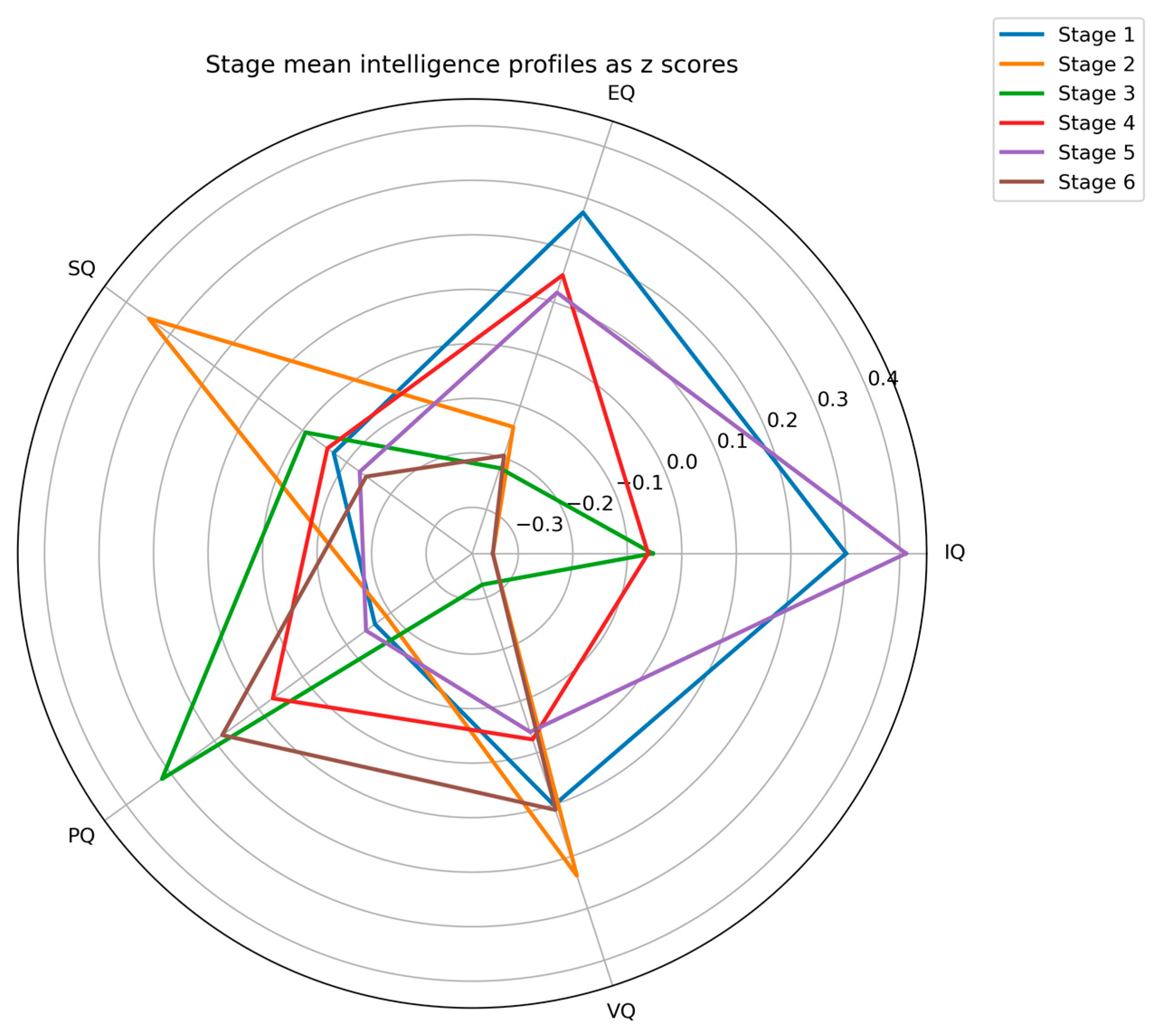
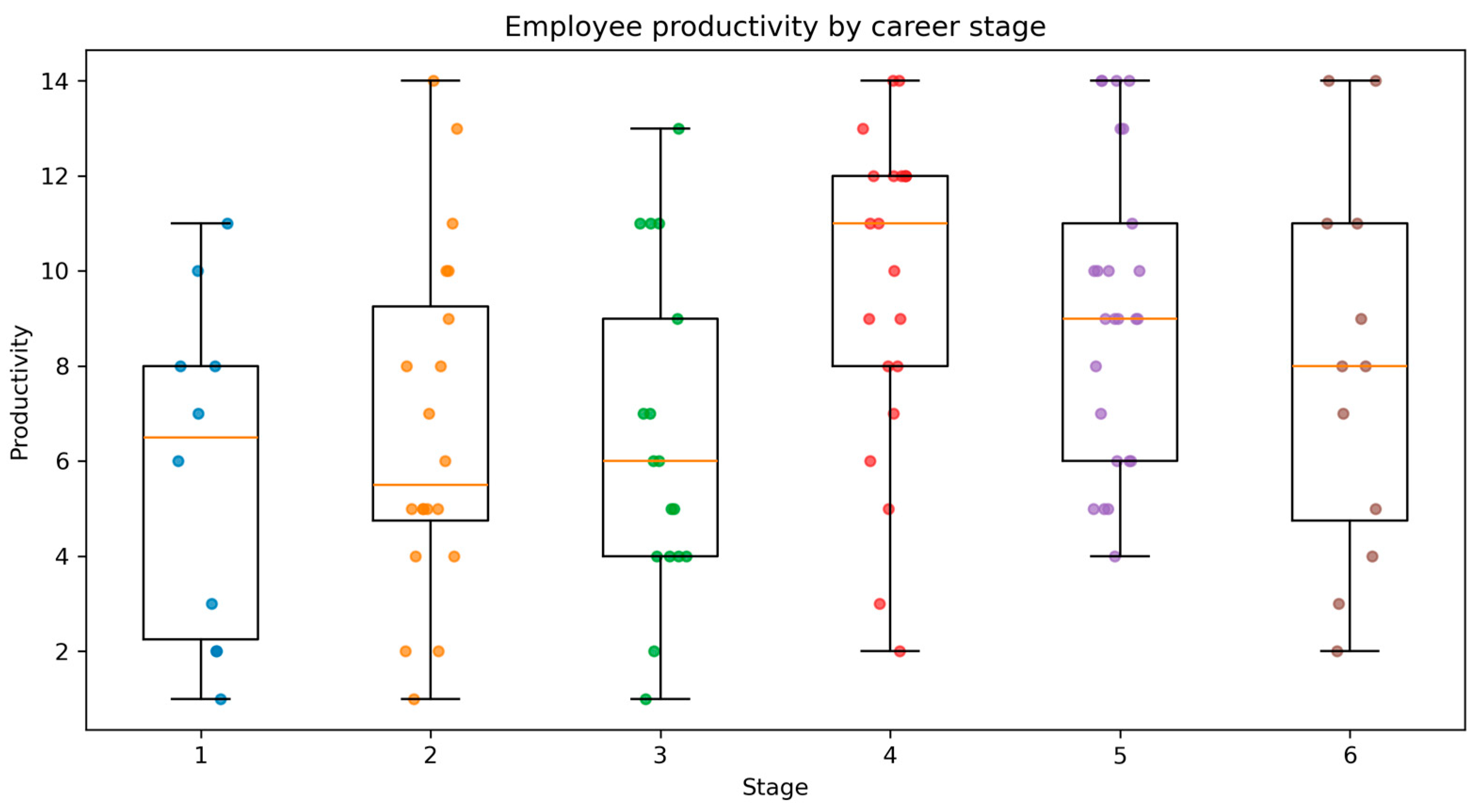
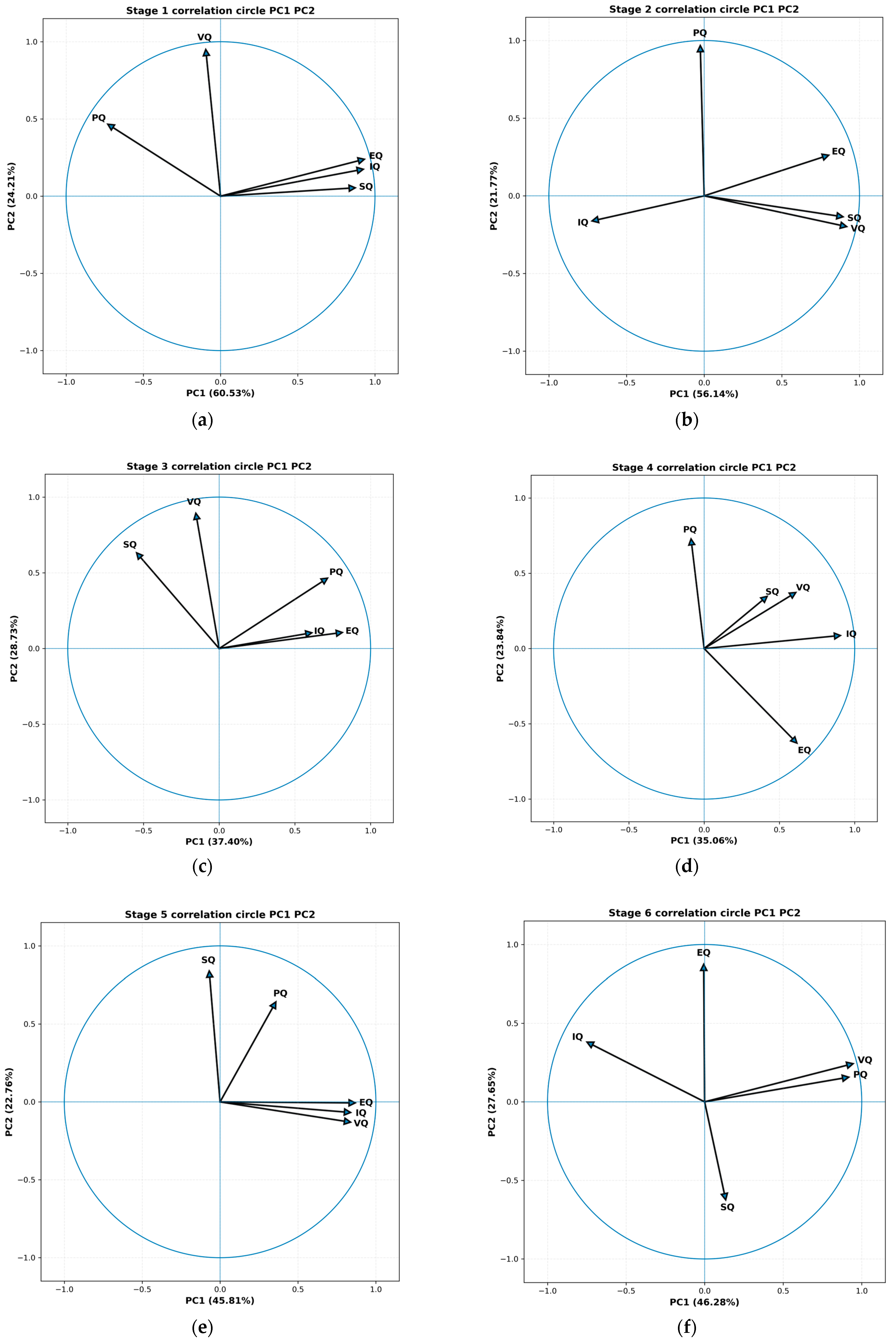
| Stage | n | Type of Intelligence | ||||
|---|---|---|---|---|---|---|
| IQ | EQ | SQ | PQ | VQ | ||
| Full sample | 105 | 0.287 ** | 0.689 *** | 0.103 | 0.196 * | 0.537 *** |
| Stage 1 | 10 | 0.958 *** | 0.924 *** | 0.734 * | −0.547 | 0.239 |
| Stage 2 | 20 | −0.446 * | 0.780 *** | 0.780 *** | −0.093 | 0.828 *** |
| Stage 3 | 17 | 0.214 | 0.655 ** | −0.255 | 0.778 *** | 0.231 |
| Stage 4 | 21 | 0.716 *** | 0.812 *** | 0.166 | −0.069 | 0.299 |
| Stage 5 | 25 | 0.797 *** | 0.784 *** | −0.078 | 0.313 | 0.818 *** |
| Stage 6 | 12 | −0.499 | 0.246 | −0.063 | 0.951 *** | 0.952 *** |
| Model | Intercept | IQ | EQ | SQ | PQ | VQ | AdjR2 | AIC |
|---|---|---|---|---|---|---|---|---|
| Full sample best AIC | −5.55 *** | 0.22 | 1.10 *** | 0.22 | 0.74 *** | 0.61 | 478.68 | |
| Full sample pruned | −3.60 *** | 1.19 *** | 0.74 *** | 0.59 | 481.68 | |||
| Stage 1 best AIC | −8.03 ** | 1.28 * | 0.57 | 0.34 | 0.95 | 25.97 | ||
| Stage 1 pruned | −6.44 ** | 1.94 *** | 0.91 | 31.88 | ||||
| Stage 2 best AIC | −3.88 * | 0.80 ** | 0.96 ** | 0.78 | 80.39 | |||
| Stage 2 pruned | −3.88 * | 0.80 ** | 0.96 ** | 0.78 | 80.39 | |||
| Stage 3 best AIC | −4.45 ** | 0.68 | 1.11 * | 0.67 | 74.38 | |||
| Stage 3 pruned | −2.64 | 1.43 *** | 0.58 | 77.52 | ||||
| Stage 4 best AIC | −1.26 | 0.75 ** | 1.05 ** | 0.77 | 83.24 | |||
| Stage 4 pruned | −1.26 | 0.75 ** | 1.05 ** | 0.77 | 83.24 | |||
| Stage 5 best AIC | −3.14 * | 0.56 ** | 0.51 | 0.17 | 0.78 ** | 0.87 | 83.05 | |
| Stage 5 pruned | −1.31 | 0.75 *** | 0.99 *** | 0.83 | 87.63 | |||
| Stage 6 best AIC | −5.41 ** | 0.28 | −0.18 | 1.30 ** | 0.82 * | 0.96 | 31.00 | |
| Stage 6 pruned | −5.07 *** | 2.15 *** | 0.90 | 42.16 |
| Principal Component | Explained Variance (%) | Cumulative Explained (%) | Factor Variable–Component Correlations | ||||
|---|---|---|---|---|---|---|---|
| IQ | EQ | SQ | PQ | VQ | |||
| PC1 | 30.10 | 30.10 | 0.40 | 0.76 | 0.43 | 0.24 | 0.72 |
| PC2 | 24.46 | 54.56 | 0.75 | 0.37 | −0.57 | −0.16 | −0.41 |
| PC3 | 20.62 | 75.18 | −0.09 | −0.05 | −0.45 | 0.90 | 0.07 |
| PC4 | 14.09 | 89.27 | 0.39 | −0.27 | 0.51 | 0.31 | −0.35 |
| PC5 | 10.73 | 100.00 | −0.33 | 0.47 | 0.14 | 0.10 | −0.43 |
| Stage | KMO | Bartlett’s Test p-Value | PC1 Variance (%) | PC2 Variance (%) | PCs and Core Factor (Variable Correlations) * | |
|---|---|---|---|---|---|---|
| PC1 | PC2 | |||||
| 1 | 0.59 | 0.01 | 60.53 | 24.21 | EQ (+0.93), IQ (+0.92), SQ (+0.87), PQ (−0.73) | VQ (+0.95), PQ (+0.47) |
| 2 | 0.71 | <0.001 | 56.14 | 21.77 | VQ (+0.92), SQ (+0.89), EQ (+0.80), IQ (−0.72) | PQ (+0.97) |
| 3 | 0.51 | 0.27 | 37.40 | 28.73 | EQ (+0.81), PQ (+0.72), IQ (+0.61), SQ (−0.55) | VQ (+0.89), SQ (+0.63), PQ (+0.46) |
| 4 | 0.35 | 0.16 | 35.06 | 23.84 | IQ (+0.91), EQ (+0.62), VQ (+0.61), SQ (+0.42) | PQ (+0.73), EQ (−0.63) |
| 5 | 0.70 | <0.001 | 45.81 | 22.76 | EQ (+0.87), IQ (+0.84), VQ (+0.84) | SQ (+0.84), PQ (+0.64) |
| 6 | 0.47 | 0.02 | 46.28 | 27.65 | VQ (+0.95), PQ (+0.92), IQ (−0.75) | EQ (+0.87), SQ (−0.62) |
Disclaimer/Publisher’s Note: The statements, opinions and data contained in all publications are solely those of the individual author(s) and contributor(s) and not of MDPI and/or the editor(s). MDPI and/or the editor(s) disclaim responsibility for any injury to people or property resulting from any ideas, methods, instructions or products referred to in the content. |
© 2025 by the authors. Licensee MDPI, Basel, Switzerland. This article is an open access article distributed under the terms and conditions of the Creative Commons Attribution (CC BY) license.
Share and Cite
Shyron, Y.; Chernobay, L.; Zherlitsyn, D.; Dluhopolskyi, O.; Bogacki, S.; Horbal, N. A Multi-Dimensional Intelligence Framework to Explain Sustainable Employee Productivity. Sustainability 2026, 18, 368. https://doi.org/10.3390/su18010368
Shyron Y, Chernobay L, Zherlitsyn D, Dluhopolskyi O, Bogacki S, Horbal N. A Multi-Dimensional Intelligence Framework to Explain Sustainable Employee Productivity. Sustainability. 2026; 18(1):368. https://doi.org/10.3390/su18010368
Chicago/Turabian StyleShyron, Yuliia, Liana Chernobay, Dmytro Zherlitsyn, Oleksandr Dluhopolskyi, Sylwester Bogacki, and Natalia Horbal. 2026. "A Multi-Dimensional Intelligence Framework to Explain Sustainable Employee Productivity" Sustainability 18, no. 1: 368. https://doi.org/10.3390/su18010368
APA StyleShyron, Y., Chernobay, L., Zherlitsyn, D., Dluhopolskyi, O., Bogacki, S., & Horbal, N. (2026). A Multi-Dimensional Intelligence Framework to Explain Sustainable Employee Productivity. Sustainability, 18(1), 368. https://doi.org/10.3390/su18010368

