Article

Prioritization of Emergency Strengthening Schemes for Existing Buildings After Floods Based on Prospect Theory


1
School of Urban Economics and Management, Beijing University of Civil Engineering and Architecture, Beijing 100044, China
2
School of Architecture and Urban Planning, Beijing University of Civil Engineering and Architecture, Beijing 100044, China
3
School of Physical Education, Xi’an University of Architecture and Technology, Xi’an 710055, China
4
School of Education Sciences, Shaanxi Xueqian Normal University, Xi’an 710061, China
*
Author to whom correspondence should be addressed.
Sustainability 2026, 18(1), 363; https://doi.org/10.3390/su18010363 (registering DOI)
Submission received: 26 November 2025 / Revised: 23 December 2025 / Accepted: 25 December 2025 / Published: 30 December 2025

Abstract

The impacts of flooding on people’s livelihoods are profound. Therefore, the rapid restoration of safe conditions in existing buildings post-flood, through rational and effective emergency strengthening, constitutes a most urgent priority. Focusing on the specific challenges of flood-induced damage to buildings, coupled with the constraints of limited resources and time-sensitive conditions after a disaster, this study established an indicator system for prioritizing emergency strengthening schemes for existing buildings after floods. A dedicated prioritization model is developed by integrating Prospect Theory and a combination weighting method. The application of this model to a practical engineering case verifies its feasibility and effectiveness. The results demonstrate that the proposed model can rationally and efficiently select the optimal scheme, thereby providing new insights for the quantitative selection of optimal emergency strengthening schemes for existing buildings after floods. This study also highlights the model’s transferability to different disaster scenarios, while its limitations were discussed and future research directions outlined.

1. Introduction

1.1. Research Background

Flooding is one of the most frequent and devastating natural disasters worldwide, characterized by its high occurrence rate and extensive impact [1]. It poses severe threats to human life, property security, and socio-economic development. Due to its complex geographical and climatic conditions, China is particularly prone to flooding. In recent years, global climate change has led to more frequent, intense, and widespread extreme rainfall events. This trend has further increased the complexity and uncertainty of flood risks. In September 2021, the Ministry of Housing and Urban-Rural Development issued two documents: the Emergency Preparedness Plan for Rural Housing Safety in Flood Disasters and the Guidelines for Emergency Safety Assessment of Rural Housing in Flood-Affected Areas (Interim) [2]. These documents require that any housing affected by flooding—if it leads to localized geological hazards in or around the village—must undergo a safety assessment. This emphasizes the need for scientific and rational approaches to ensure the safe restoration of existing buildings after flood disasters.
In recent years, natural disasters have shown increasingly evident coupling and cascading effects on a global scale. Existing buildings subjected to flooding may experience a range of serious structural and functional problems. These issues can range from cracks and deformation to complete collapse. In particular, the sequential or simultaneous occurrence of floods and earthquakes significantly exacerbates both the extent of damage to building structures and the difficulty of restoration. These issues can range from cracks and deformation to complete collapse. In particular, the sequential or simultaneous occurrence of floods and earthquakes significantly exacerbates both the extent of damage to building structures and the difficulty of restoration. Flooding can lead to soil softening and liquefaction, thereby undermining the overall stability of buildings. If an earthquake occurs under such conditions, structural damage tends to accumulate in a nonlinear manner and may even trigger progressive collapse [3]. Such multi-hazard coupling not only complicates post-disaster building safety assessments but also imposes higher demands on emergency reinforcement measures. These requirements include the need for solutions to address both water damage and seismic damage, while balancing short-term emergency response with mid-to-long-term seismic performance restoration. Therefore, when developing an optimization model for post-flood emergency reinforcement plans, it is essential to account for the specific demands arising from such multi-hazard scenarios, thereby enhancing the model’s robustness and applicability.
In summary, during the post-disaster emergency phase, the most critical task is to restore the basic safety and usability of damaged structures as efficiently and effectively as possible. Conducting rapid and scientific emergency strengthening of damaged existing buildings is a critical measure for preventing secondary disasters [4], shortening the recovery period, and stabilizing social order. Guided by Prospect Theory, this research addresses this core issue by creating a scientific, efficient, and reliable decision-support framework to identify optimal emergency strengthening schemes for existing buildings after floods.

1.2. Literature Review

International research on the impact of flooding on the built environment has matured into a well-established field. Scholars have conducted in-depth studies across various dimensions, including urban planning, building vulnerability assessment, refined simulation, and community response. The focus has expanded from traditional engineering-based flood control to the multidisciplinary domain of resilience construction, which integrates social, ecological, and technical systems. Scholars Amjad Ali et al. [5] conducted research from the perspectives of urban planning and differences in building vulnerability. The former demonstrated the necessity of proactively incorporating building-scale economic loss assessments into development plans by integrating the Hazus flood loss model with the Envision Tomorrow planning tool. The latter constructed a multi-component vulnerability index, revealing how different building types show distinct vulnerability patterns due to variations in their physical characteristics and locations. It concludes that flood protection retrofitting should be implemented in a differentiated manner.
International scholars have also studied building adaptability from a community response perspective. José Lourenço Neves [6] analyzed flood resilience strategies for buildings in Mozambique through a bottom-up, community-led approach. His research outlines two key debates in post-disaster reconstruction concerning “technology-led versus community-led” methods. The first is whether flood resilience should emphasize government-driven engineering solutions or community-based indigenous knowledge. The second is whether flood protection resources should focus more on critical infrastructure or on ordinary housing. Neves argues that these debates reflect a growing trend toward pluralistic co-governance in disaster risk management.
An analysis of global trends and current research shows that flood resilience in buildings is relatively mature in developed countries. These nations have successfully developed and applied a range of technical tools, assessment methods, and community participation models. They have gained extensive experience across three related areas: urban planning, architectural design, and community-led disaster prevention. As a result, they have built strong operational frameworks for building-level flood resilience, well adapted to their own social and technical conditions. Their experience provides valuable insights and lessons that we can study and adapt for our own national context.
Given the adverse impact of flooding on the safety of existing buildings, domestic scholars have also carried out related research focused on these effects. For example, Xiao Shiyun et al. [7,8,9] investigated the impact of floods on existing structures through a range of experimental methods. Ren Weizhen [10] and Guo Xiaoyang [11] used numerical simulations to study in depth the flood resistance of rural buildings under flood conditions, providing useful references for future flood-resilient architectural design. Zhen Yiwei et al. [12] examined the failure characteristics and influencing factors of existing buildings under flooding, proposing corresponding flood mitigation strategies. Li Gang et al. [13] developed a performance assessment method to evaluate the multi-hazard resilience of riverside building clusters under successive earthquake-flood events. This method can predict damage in such clusters and serves as a reference for regional multi-hazard risk screening. Liu Shuguang et al. [14] developed flood vulnerability curves for rural buildings, enabling flood risk assessment and providing a scientific basis for flood prevention and disaster reduction.
A review of existing research indicates that while numerous scholars have studied the impact of floods on buildings—primarily through theoretical analysis, laboratory experiments, and numerical simulations—fewer have focused on emergency reinforcement methods for existing structures within the short time window immediately after a flood disaster. Furthermore, existing research on strengthening schemes for buildings currently focuses mainly on applying mathematical methods for decision-making. These include fuzzy decision theory [15], improved TOPSIS [16,17], weighted correlation methods [18], analytic hierarchy process (AHP) [19], numerical analysis [20], and cobweb models [21]. In contrast, research on prioritizing emergency strengthening schemes remains relatively limited.
Current research by domestic and international scholars has examined the impact of floods on buildings from multiple perspectives. This includes experimental analysis of hydrodynamic forces, numerical simulation of flood resistance, damage prediction under multi-hazard coupling effects, and flood vulnerability assessment. From causative mechanisms to mitigation strategies, these studies have built a substantial foundation of theoretical and technical knowledge. This knowledge provides important support for flood-resilient design and long-term resilience improvement.
However, a systematic review of the literature shows that most existing research focuses on either the “pre-disaster prevention” or “during-disaster response” phases or concentrates on long-term resilience planning and advanced modeling. In contrast, research on the rapid selection of strengthening and safety restoration schemes for existing buildings in the “post-disaster emergency phase” remains notably scarce.
Owing to the unique and complex nature of post-disaster emergency situations, a significant gap remains in research on rapid decision-making for the emergency reinforcement of existing buildings within the short time window following a flood. This gap arises mainly from two factors. First, existing research primarily focuses on long-term flood resilience planning, pre-disaster preventive reinforcement, or detailed post-disaster loss simulation, while often neglecting rapid decision-making under the resource-limited conditions typical of post-disaster contexts. Second, most current studies on reinforcement scheme decision-making rely on static mathematical models, which do not adequately account for key variables in post-disaster emergency scenarios, such as time pressure, psychological factors, and dynamic resource allocation.
Emergency reinforcement decision-making following floods constitutes a fundamentally different process—one characterized by high risk, intense time pressure, and highly ambiguous information, and is thus a typical “bounded rationality” decision-making process. Therefore, rather than merely applying existing MCDM methods, this study develops a decision-making framework specifically tailored for post-disaster emergency scenarios by purposefully integrating behavioral decision theory and fuzzy information processing techniques. Therefore, this study integrates Prospect Theory [22] and a combined weighting method [23] to develop a model for prioritizing emergency strengthening schemes. The aim is to provide quantitative and adaptive decision support for the safety restoration of existing buildings. The core value of prospect theory lies in its use of a value function and a decision weighting function to quantitatively characterize the decision-maker’s irrational risk perception and preferences under emergency conditions. This enables the model to more realistically simulate and reflect the actual psychological processes of post-disaster decision-makers—something that traditional rational models cannot achieve.
During the post-disaster emergency phase, accurate data for assessing building damage and predicting the effectiveness of response plans are often unavailable, necessitating greater reliance on experts’ experience-based qualitative judgments. This study employs triangular fuzzy numbers to quantify such linguistic evaluations. This approach effectively accommodates and processes such uncertainties, transforming experts’ subjective and vague judgments into a computable mathematical form. Consequently, even under information-deficient emergency conditions, the process of solution optimization can still proceed systematically and scientifically.
In summary, the innovation of this model (Prospect Theory + Triangular Fuzzy Numbers + Combined Weighting MCDM) lies not in inventing new algorithms, but in constructing a dedicated analytical framework with greater descriptive and explanatory power for the specific, complex decision-making problem of “post-flood building emergency reinforcement.” It modifies decision logic through behavioral theory, addresses information gaps via fuzzy mathematics, and balances optimization criteria through combined weighting. Thereby, it provides an important supplement and contextualized extension to existing MCDM methods in emergency management applications.

1.3. Research Objectives and Significance

Current research on the impact of floods on existing buildings has continuously expanded and deepened, leading to significant findings. However, studies on post-flood emergency strengthening of buildings have mainly focused on material- and component-level repair techniques, while systematic research on the scientific decision-making and comparative selection among multiple schemes under emergency conditions remains notably underdeveloped. Existing prioritization models for emergency strengthening schemes are largely based on the assumption of perfect rationality, making it difficult for them to accurately capture the bounded rationality of decision-makers in post-disaster situations. They also often fail to adequately address the inherent ambiguity and uncertainty in evaluation information. As a result, research on strengthening existing buildings—especially emergency strengthening after floods—remains scarce. Therefore, developing a prioritization model that fully incorporates the characteristics of flood emergency decision-making, while integrating decision psychology [24], fuzzy mathematics [25], and optimization theory [26], is both an urgent practical need in engineering and an important theoretical endeavor for advancing the scientific framework of emergency management.
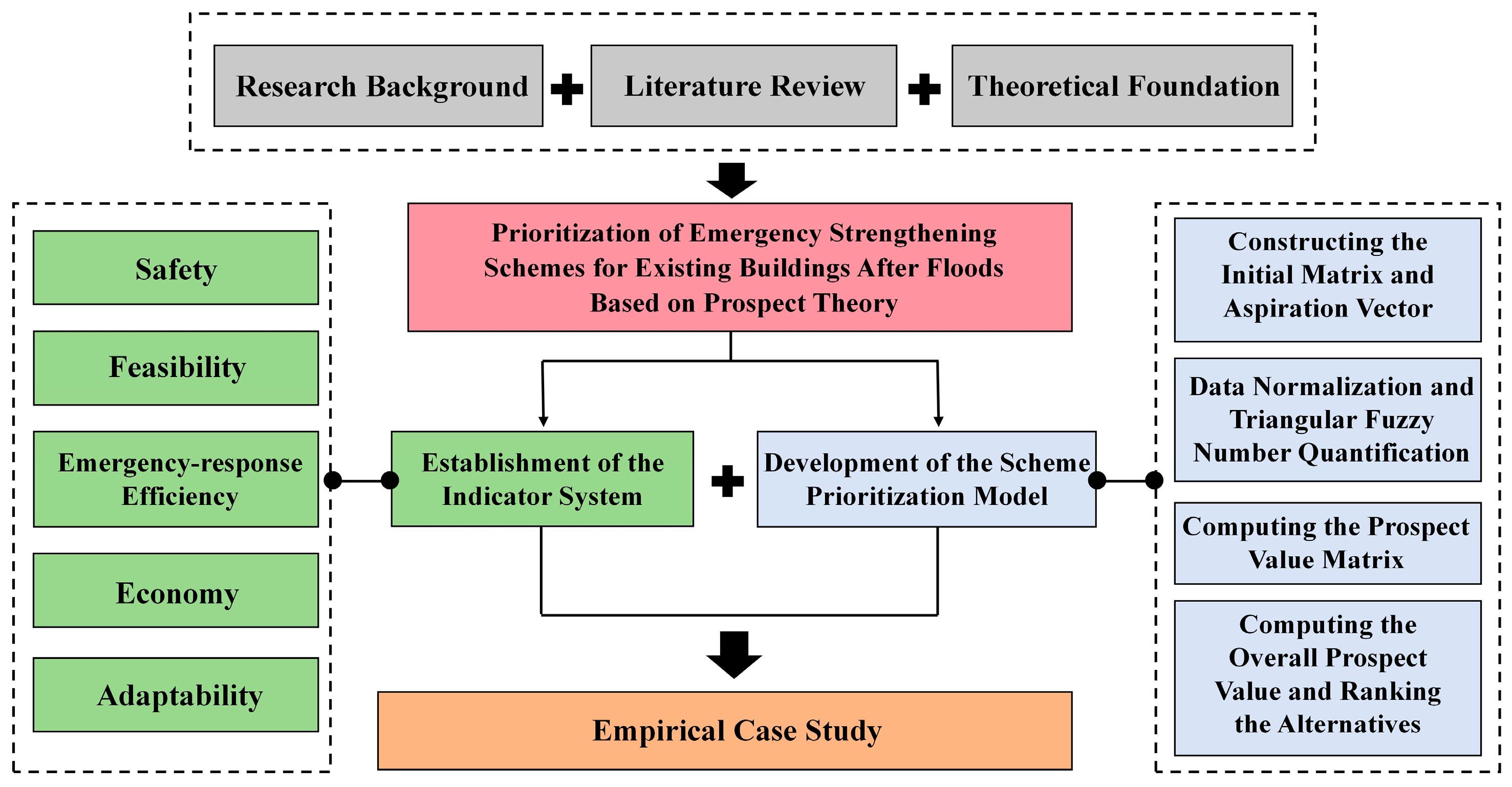
In summary, to support the swift recovery of affected populations and the systematic emergency reinforcement of existing buildings within a limited timeframe, this study focuses on the post-flood conditions of building damage, resource constraints, and time pressure. It develops a model for prioritizing emergency reinforcement schemes. The research systematically examines typical failure modes and safety impact mechanisms of various existing buildings under flood conditions, identifying key factors influencing the selection of emergency measures. It also builds a tailored indicator system for emergency decision-making, which includes structural safety, timeliness, economic efficiency, and social impact. Prospect Theory is incorporated to reflect the psychological and behavioral traits of decision-makers under risk and uncertainty. At the same time, a combination weighting method is used to balance subjective expert judgment with objective data-driven assessment, improving the model’s interpretability and adaptability. The model is then tested and validated through a representative case study, resulting in a transferable and practical decision-making method. This work provides both theoretical support and a practical tool for rapid, orderly post-disaster building safety restoration. The research process is illustrated in Figure 1.
By integrating Prospect Theory with multi-criteria decision-making methods, this study enhances the descriptive ability and predictive validity of emergency decision models under uncertain conditions. It provides a fresh interdisciplinary perspective for advancing emergency management theory. Moreover, by facilitating the rapid and safe restoration of existing buildings, the research helps reduce secondary disaster risks and strengthens overall community disaster resilience. This has practical significance for improving comprehensive disaster prevention and mitigation capacity in both urban and rural areas across the country.

2. Materials and Methods

2.1. Establishment of the Indicator System

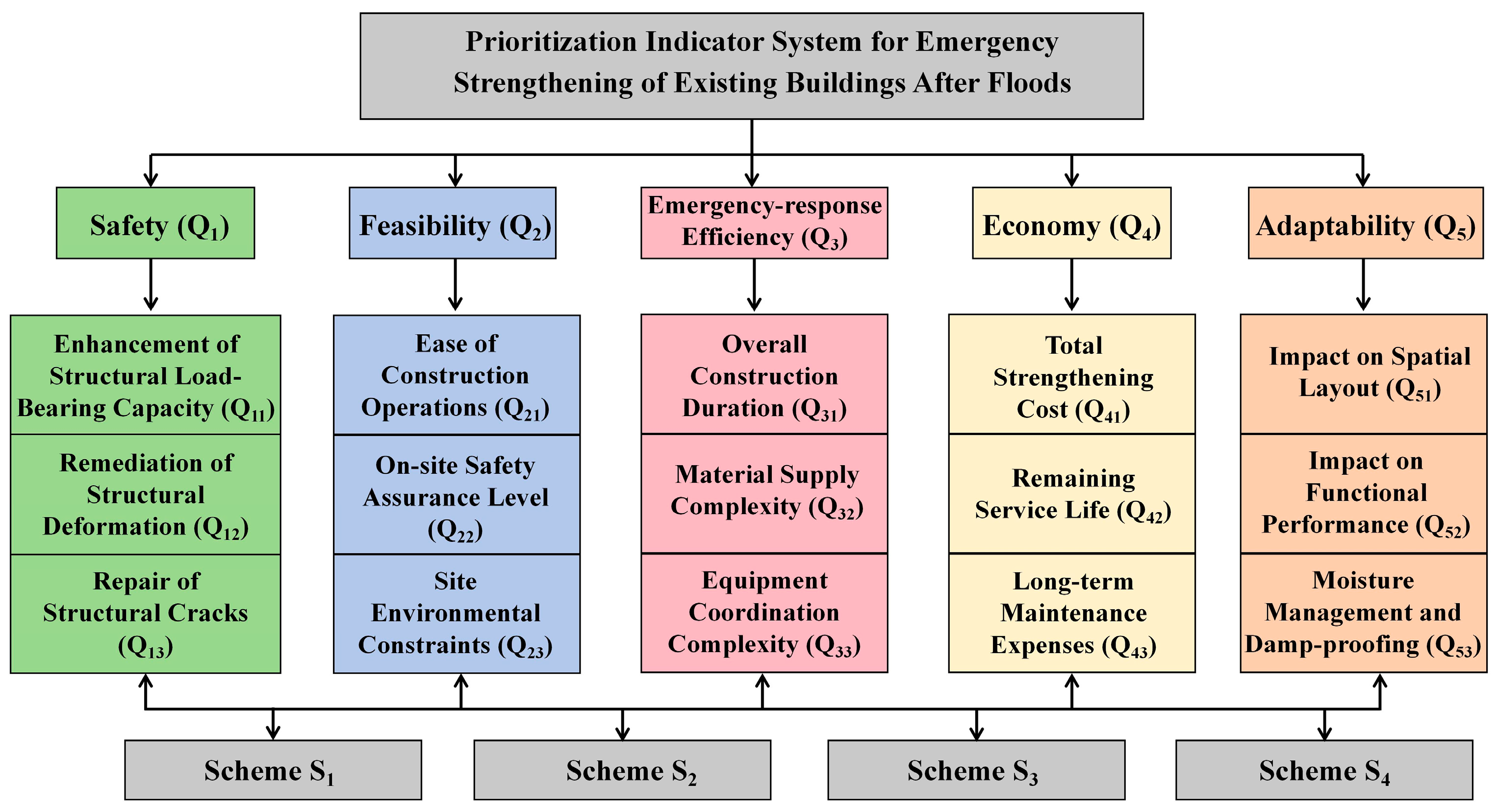
Establishing a scientific and rational indicator system is a critical step in prioritizing options. It directly determines the quality of the outcomes. To ensure the scientific validity and practical utility of the indicator system, this study adopted an interdisciplinary collaborative approach to construct the evaluation framework. In addition to researchers, an expert panel was formed, comprising 10 professionals with extensive practical experience, including structural engineers, construction technicians, emergency management personnel, and community disaster prevention practitioners. Through multiple rounds of the Delphi method and focus group discussions, the selection and hierarchical structuring of indicators were jointly determined. This process fully integrated theoretical research outcomes with practical engineering experience, ensuring that the indicator system not only reflects the technical requirements for post-flood building safety recovery but also aligns with the practical constraints of emergency resource allocation and on-site construction conditions. Guided by relevant theory, this study develops an indicator system tailored to the research. It comprehensively considers the damage mechanisms of floods on existing buildings [27], as well as the time sensitivity and resource limitations of emergency scenarios [28]. The construction process follows the principles of scientific rigor, representativeness, and practical operability. The system is structured across five dimensions: Safety [29], Feasibility [30], Emergency-response Efficiency [31], Economy [32], and Adaptability [33]. The resulting framework includes 5 first-level indicators and 15 s-level indicators, as detailed in Figure 2.
The safety dimension focuses on structural damage to existing buildings caused by flooding. It assesses three key aspects: improving structural load-bearing capacity [34], repairing structural deformation [35], and fixing building cracks [36]. According to the Emergency Preparedness Plan for Rural Housing Safety in Flood Disasters and the Guidelines for Emergency Safety Assessment of Rural Housing in Flood-Affected Areas (Interim) [2], a clear requirement is to assess structural damage—including bearing capacity, deformation, cracks, and the feasibility of repairs. Meanwhile, provisions related to construction safety and environmental impact in standards such as the Code for Seismic Design of Buildings [37] provide the basis for indicators within the safety dimension. This dimension is primarily concerned with the effectiveness of strengthening measures in restoring and improving the load-bearing capacity of both the building as a whole and its key components. Structural deformation treatment assesses a scheme’s ability to correct existing deformation and control further deformation in the future. Cracking is the most common form of structural damage following floods. Cracks allow moisture and harmful substances to enter, accelerating corrosion of reinforcement and material deterioration. The crack repair dimension evaluates a scheme’s effectiveness in addressing different types of cracks. An effective scheme should not only seal and reinforce visible cracks but also enhance load-bearing performance to prevent further propagation, ultimately restoring structural integrity and waterproofing.
The feasibility dimension is a core criterion for evaluating whether a scheme can be practically implemented. It is assessed across three aspects: ease of construction [38], level of on-site safety [39], and site-specific constraints [40]. Ease of construction directly determines a scheme’s implementation efficiency and final quality, forming the basis of its technical feasibility. On-site safety assurance concerns the protection of personnel and the structure during construction, a prerequisite for any emergency intervention. Site constraints—including spatial limits, resource availability, and environmental or social impacts—define the practical boundaries for implementation. In July 2025, a severe flood struck Chengde, Hebei Province, causing extensive damage to rural houses. In Longhua County’s Shanqian Village, one resident’s home was located in a narrow alleyway. Post-disaster emergency plans highlighted that constructing traditional brick-concrete structures in such confined spaces would require extensive wet work on-site, making material transport and construction highly challenging. After extensive deliberation, the parties involved ultimately opted for the “EPS modular construction” solution [41]. The selection process prioritized the feasibility of the solutions. In terms of construction difficulty, the modular components are lightweight and feature a relatively simple assembly process, effectively addressing the challenges of traditional construction in confined spaces. Regarding on-site safety, the streamlined procedures reduce high-risk operations such as working at heights and heavy material handling, thereby enhancing overall construction safety. The core strength of this solution lies in its direct response to the most critical environmental constraint: the inability of large machinery to access the site. This demonstrates that under extreme limitations, the solution itself must adapt to the environment. Therefore, the feasibility dimension is indispensable in the selection of emergency reinforcement solutions.
The emergency-response dimension assesses a scheme’s ability to be executed quickly under extreme time and resource constraints. This is determined by three interrelated factors: construction duration [42], material availability [43], and equipment coordination [44]. Specifically, construction duration measures response speed directly. The scheme should feature streamlined processes and parallel tasks to minimize time. Material availability refers to whether key building materials can be sourced locally or deployed rapidly, reducing supply chain risks. Equipment coordination affects mechanization efficiency. Methods that rely less on large or complex machinery and are easy to mobilize and operate are preferred in post-disaster conditions. An extensive review of building damage and repair cases from major floods in recent years—such as the 2020 floods in the Yangtze River Basin [45] and the 2021 extreme rainstorm in Henan [46]—reveals that common causes of repair failure or poor outcomes include disruption of material supply, inability to deploy large equipment, and secondary damage resulting from lack of follow-up maintenance. Therefore, the three indicators within the emergency dimension are interlinked, forming a holistic system that ensures reinforcement work can be efficiently advanced within the golden rescue window [47].
The economic dimension evaluates the life-cycle cost-effectiveness of a scheme. Its assessment covers three key factors: total strengthening cost [48], remaining service life [49], and long-term maintenance expenses [50]. The total strengthening cost, including all direct and indirect investment, represents the initial economic threshold for implementation. Remaining service life reflects the durability of the strengthening effect and is directly tied to the long-term value of the investment. Long-term maintenance expenses determine the ongoing costs during the building’s operational phase. Together, these three elements create a comprehensive framework for evaluating economic efficiency. The aim is to identify an optimal solution that balances reasonable initial investment, extended service life, and low long-term maintenance costs. The economic dimension extends far beyond one-time construction costs. For instance, when strengthening masonry structures after disasters, using High-Ductility Concrete (HDC) technology compared to traditional methods can reduce total reinforcement costs by approximately 30% and shorten the construction period by about 70%, thereby lowering indirect expenses. Its superior seismic performance also extends the building’s safe service life and reduces long-term maintenance costs due to the material’s high ductility.
The adaptability dimension evaluates the comprehensive impact of a scheme on a building’s long-term service quality and operational viability. It is assessed primarily through three key aspects. The impact on spatial structure determines whether the strengthening measures would significantly alter the original layout or reduce usable space [51]. The impact on functionality relates to the building’s ability to meet post-disaster operational needs, ensuring its utility is maintained or enhanced [52]. Moisture management and damp-proofing form a specific post-flood requirement, directly affecting both the health of the indoor environment and the long-term durability of the structure [53]. Together, these three aspects help ensure that the selected scheme is not only technically feasible but also enhances or preserves the building’s overall usability and service life. Taking the original demolition and reconstruction project of the Sanlihe dilapidated building in Beijing as an example, the concrete modular construction technology adopted provides a systematic solution. Firstly, in terms of spatial structure, optimized designs such as the “double-sided formwork shear wall” enhance structural safety while significantly reducing wall thickness and expanding the usable floor area. Secondly, during the factory prefabrication stage, indoor pipelines and aging-adaptive features can be integrated, enabling customized and high-quality restoration of living functions. Finally, industrialized production allows for the standardized integration of high-performance moisture barriers, fundamentally eliminating the leakage and mildew issues common in old houses and effectively addressing damp-proofing [54]. This case demonstrates that an advanced emergency reinforcement solution can simultaneously optimize all core aspects of applicability within a single process.

2.2. Model Formulation

2.2.1. Prospect Theory

Prospect Theory was first formulated by Kahneman and Tversky in 1979 [55]. Grounded in the premise of “bounded rationality,” it captures the subjective risk preferences of decision-makers. Its core principle involves determining the prospect value through a combination of a value function and a weighting function [56,57], expressed mathematically as:
V = i = 1 k ( π ( p i ) · v ( Δ x i ) )
V—the overall prospect value.
v(Δxi)—the value function, which reflects the subjective value assigned to outcome Δxi.
π(pi)—the weighting function, which transforms the objective probability pi into a decision weight.
Based on the research of Kahneman and Tversky, a novel value function was proposed. This function, which is empirically defined, takes the form of a power law:
v ( Δ t i ) = ( Δ t i ) δ Δ t i 0 φ ( Δ t i ) η Δ t i < 0
Δti—the magnitude of gains or losses, where a value ≥ 0 indicates a gain, and a value < 0 indicates a loss.
δ and η—the decision-maker’s sensitivity to gains and sensitivity to losses, respectively, with the constraints 0 < δ, η < 1.
Φ—the loss aversion coefficient. A value of φ > 1 indicates a tendency for the decision-maker to be loss-averse [58].

2.2.2. Weighting Combination Methodology

(1)
Subjective Weighting
The Analytic Hierarchy Process (AHP) [59] is employed to determine the subjective weights W′, where W′ = (w1′, w2′, …, wn′), with wj′ ≥ 0 and j = 1 n w j = 1 .
(2)
Objective Weighting
The objective weights w are determined using the entropy weighting method [16], where W = ( w 1 , w 2 ,   ,   w n ) , with w j 0 and j = 1 n w j = 1 . Among the m alternatives and n criteria, the entropy of the j-th criterion hj (hj > 0) is defined as:
h j = k i = 1 m p i j ln p i j
In the equation above, p i j = μ i j / i = 1 m μ i j , when μij = 0, μjlnμj = 0.
k as the coefficient, k = 1 / ln m . The entropy weight W″ for the i-th indicator is:
w j = ( 1 h j ) / j = 1 n ( 1 h j )
(3)
Combined Weighting
In the combined weighting calculation, the integration of subjective and objective weights is accomplished through linear weighting, without involving iterative optimization. The subjective weights are determined using the Analytic Hierarchy Process (AHP) after passing the consistency test (CR < 0.1), while the objective weights are derived directly from the entropy weight method. The combined weights are obtained by equally weighting both sets (α = β = 0.5), with no convergence threshold or iteration count set. If the subjective and objective weights differ significantly, an iterative optimization based on a quadratic programming model minimizing deviation can be introduced. In this study, however, the two sets of weights showed good agreement, so the direct weighting method was adopted to enhance decision-making efficiency.
Calculate the combined weights of each indicator by comprehensively considering the subjective and objective weight information:
w j = γ × w j + ϵ × w j
In this case, the condition γ + ε = 1 is satisfied, with both γ and ε set to 0.5.

2.2.3. Model Construction Steps

(1)
Construction of the Initial Decision Matrix and Formulation of the Aspiration Vector
The initial step involves collecting relevant data to construct the initial decision matrix: R = R i j m × n , where Rij denotes the performance rating of the i-th alternative with respect to the j-th criterion. The aspiration vector E = { E 1 , E 2 , , E n } is determined, where Ej denotes the expected value for the j-th criterion. These values are directly provided by an expert panel based on available information and projections for the future.
(2)
Normalization of Data
Since the criteria consist of two types—benefit-oriented criteria QB and cost-oriented criteria QC—and the collected data vary in nature, the data must first undergo normalization. The specific procedure is as follows:
① When the indicator values and expected value are exact numbers Q N , denote the upper and lower bounds as follows. Let: G G j + = max max { R i j } , E j j , G j = min min { R i j } , E j . The processing method is:
R j = ( R j G j ) / ( G j + G j ) , j Q B ( G j + R j ) / ( G j + G j ) , j Q C
E j = ( E j G j ) / ( G j + G j ) , j Q B ( G j + E j ) / ( G j + G j ) , j Q C
② When the indicator values and expected value are interval numbers Q I , denote the upper and lower bounds as follows. Let: G j + = max max { R y U } , E j U , G j = min min { R i j L } , E j L . The processing method is:
R j L , R j U = R i j L G j / ( G j + G j ) , R i j U G j / ( G j + G j ) , j Q B ( G j + R i j U ) / ( G j + G j ) , ( G j + R i j L ) / ( G j + G j ) , j Q C
E j L , E j U = E j L G j / G j U G j / E j U G j / G j + G j , j Q B G j   + E j U / G j + G j / G j + E j L / G j + G j , j Q c
③ When both the indicator values and the expected value are linguistic fuzzy numbers QL, they are quantified using triangular fuzzy numbers [60,61]. The specific conversion criteria are summarized in Table 1.
The normalization calculation formula for triangular fuzzy numbers is:
P i j = ( L R , M R , U R ) = ( L R i j U R i j + , M R i j U R i j + , U R i j U R i j + ) U R i j + m a x ( U R i j ) ,   j Q B
P i j = ( L R , M R , U R ) = ( L R i j L R i j , L R i j M R i j , L R i j U R i j ) L R i j m i n ( L R i j ) ,   j Q C
Considering the integration with other metric data and subsequent analysis and computation, it is then converted into a precise number using the following formula:
r i j = [ ( U R L R ) + ( M R L R ) ] / 3 + L R
Finally, after all indicator data have been normalized, they are subjected to a normalization process using the following formula:
r i j = r i j i = 1 n r i j
After the normalization process R = R i j m × n , the normalized decision matrix and the normalized desired vector are ultimately obtained E = { E 1 , E 2 , , E n } .
(3)
Calculate the Euclidean distance and the prospect value matrix.
First, compare the magnitude of Rij′ and Ej′, and there are three processing methods based on their relative values:
① When both the indicator values and the desired values are precise numbers, the magnitudes of Rij′ and Ej′ are directly compared.
② When both the indicator values and the desired values are interval numbers QI, denote S ( R - i ) = R i L + R i U / 2 , S ( E - j ) = E j L + E j U / 2 , K ( R - i j ) = R i j U R i j L   a n d   K ( E - j ) = E j U E j L . When S ( R - j ) S ( E - j ) , if S ( R - j ) > S ( E - j ) , then R j i > E j i . If S ( R - j ) < S ( E - j ) , then R i j < E j . When S ( R - j ) = S ( E - j ) , if K ( R - y ) < K ( E - j ) , then R j i > E j i ; if K ( R - y ) = K ( E - J ) , then R i j = E j ; if S ( R - j ) > S ( E - j ) , then R i j < E j .
③ When both the indicator values and the desired values are linguistic fuzzy numbers QL, if Rij > Ej, then R j > E j ; if R j < E j , then R j < E j ; otherwise, they are deemed equal.
Then, the Euclidean distance is determined using the calculation formula shown in Equation (14). After obtaining the distance D i j , the prospect value matrix V = V ( R i j i ) m × n can be established, and its calculation formula is given in Equation (15):
D j = R i j E j , j Q N [ ( R i j L E j L ) 2 + ( R i j U E j U ) 2 ] 2 , j Q I ( R j L R j L ) 2 + ( R j M E j M ) 2 + ( R j J E j J ) 2 / 3 , j Q L
V ( R i j ) = D i j δ B i j E j φ ( D i j ) η B i j < E j
Among them, Vij represents the prospect value of the j-th indicator for the i-th alternative; δ = η = 0.88 and φ = 2.25 .
(4)
Rank the alternatives
After the prospect value matrix is determined, combined with the indicator weights W = ( w 1 , w 2 , , w n ) , the comprehensive prospect value can be calculated using the following formula:
P ( Si ) j = 1 n W j × V ( R ij ) ,   i = 1 , 2 , , m
Among them, P ( S i ) represents the comprehensive prospect value of the i-th alternative. The higher the value, the more preferred the alternative.
All related numerical analyses and simulations in this study were conducted using MATLAB R2023a.

3. Results

3.1. Existing Building Overview

To test the effectiveness and applicability of the indicator system developed in this study, an existing building emergency strengthening project was selected as a case study. The project is located in an area that experienced severe flooding. Survey and statistical data show that the flood was unusually intense and widespread, inundating many residential buildings and public facilities and disrupting road networks. This caused significant disruption to residents’ daily lives and resulted in substantial direct and indirect economic losses. The target building, situated in the core affected zone, sustained noticeable damage to its main structure and certain structural components due to prolonged immersion in high water and the force of the flood.
Based on an on-site inspection and safety assessment conducted by a professional testing agency, the building was confirmed to have multiple types of structural damage. These include differential settlement of the foundation, cracks in load-bearing walls, and localized deformation of floor slabs. These defects have significantly reduced the building’s overall safety performance, creating a potential hazard. Therefore, implementing rapid, effective, and practical emergency strengthening measures to restore its basic safety and meet subsequent usage requirements has become an urgent task in post-disaster recovery.

3.2. Computation Process

All data processing, Euclidean distance calculations, construction of the prospect value matrix, and solving of the comprehensive prospect values in this study were programmed and implemented on the MATLAB R2023a platform. The algorithm, based on matrix operations and loop structures, fully automates the formula-based evaluation process, ensuring accuracy and reproducibility of the calculations. Fuzzy number conversion and normalization were implemented using custom functions in a modular manner, facilitating future extension and application of the model. The specific evaluation workflow is as follows:
(1)
Data Collection for Indicators
For data collection, qualitative indicators were determined and quantified by an expert panel using the linguistic fuzzy numbers shown in Table 1. Quantitative indicator data were obtained directly from the alternative schemes. The initially quantified values for all indicators are provided in Table 2.
(2)
Determination of the Aspiration Vector
Based on the project’s actual conditions and desired objectives and taking into account the baseline information collected from the alternative schemes, the expert panel assigned expected values for each criterion, thereby forming the aspiration vector. This vector serves as the reference point in the decision-making model, with its specific quantified values provided in Table 2.
(3)
Calculation of Euclidean Distance and Prospect Value Matrix
The Euclidean distance matrix D and the prospect value matrix V are determined step by step using the aforementioned formulas, as presented below:
D = 0.000 0.135 0.135 0.000 0.167 0.167 0.135 0.000 0.333 0.000 0.000 0.167 0.302 0.302 0.000 0.000 0.167 0.167 0.000 0.000 0.000 0.000 0.302 0.302 0.527 0.527 0.500 0.601 0.302 0.302 0.000 0.000 0.000 0.000 0.000 0.302 0.510 0.583 0.510 0.583 0.500 0.707 0.707 0.500 0.527 0.510 0.527 0.527 0.302 0.000 0.000 0.417 0.302 0.000 0.000 0.302 0.135 0.000 0.135 0.000
V = 0.000 0.171 0.171 0.000 0.465 0.465 0.171 0.000 0.856 0.000 0.000 0.465 0.784 0.784 0.000 0.000 0.465 0.465 0.000 0.000 0.000 0.000 0.784 0.784 1.281 0.569 0.543 0.639 0.784 0.784 0.000 0.000 0.000 0.000 0.000 0.784 0.553 1.400 1.244 0.622 0.543 0.737 0.737 0.543 0.569 1.244 0.569 0.569 0.784 0.000 0.000 1.043 0.784 0.000 0.000 0.784 0.171 0.000 0.171 0.000
(4)
Establishment of the Weighting Scheme
The Analytic Hierarchy Process (AHP) was employed to calculate the weights. Ten experts, including structural engineers, construction technicians, emergency management personnel, and community disaster prevention practitioners, were consulted. Using the 1–9 scale method, they assessed the relative importance between factors. Taking the first-level indicators as an example, the scoring results were compiled to establish judgment matrices for each level (Table 3).
The calculation results show that the matrix has a maximum eigenvalue λ_max = 5.142, a consistency index C.I. = 0.035, and a random consistency ratio C.R. = 0.032 (<0.1), all of which satisfy the consistency requirement.
Based on the relevant analysis of existing buildings, objective weights were calculated using the entropy weight method. Following the combined weighting process, the final weights for each indicator are as follows:
W = (0.052, 0.073, 0.094, 0.060, 0.057, 0.060, 0.086, 0.060, 0.047, 0.065, 0.060, 0.076, 0.099, 0.060, 0.052).
(5)
Determination of Comprehensive Prospect Values and Ranking of Alternatives
Finally, the comprehensive prospect values are calculated according to Equation (16), with the results presented in Table 4.
According to the results presented in Table 3, the ranking of the alternative schemes is as follows: S3 > S4 > S2 > S1. Consequently, scheme S3 is identified as the optimal solution. Subsequently, the ranking results were compared and analyzed against practical conditions through discussions with relevant experts, and a collective consensus was reached that the outcome is scientifically sound and reasonable.
It should be noted that the empirical part of this study relied on a relatively small expert panel. While multiple rounds of discussions and consistency tests were conducted to enhance the reliability of judgments, issues of limited representativeness may still exist. If the consensus among experts is overly concentrated, the resulting weight distribution may become sensitive to minority opinions, potentially affecting the model’s adaptability across different disaster scenarios. Furthermore, the conversion of linguistic fuzzy numbers relies on a predefined mapping table. Differences in experts’ interpretation of linguistic scales may introduce additional quantification errors. Therefore, when extending the decision outcomes of this study to other disaster contexts or regions, caution is advised. Calibration and validation using more expert opinions or actual case data are recommended to enhance the model’s robustness and extrapolation applicability.

3.3. Analysis of the Results

Based on the results, Scheme S1 provides a satisfactory improvement in structural load-bearing capacity regarding safety, though its crack repair performance is only moderate. In terms of feasibility, it shows moderate construction difficulty and good safety assurance but is subject to relatively high on-site constraints. For emergency-response efficiency, it has the longest construction period among all alternatives, average material availability, and faces significant challenges in equipment coordination. Economically, it is characterized by a short remaining service life and high maintenance costs. Its most notable advantage lies in adaptability, especially in achieving excellent performance in building moisture management.
Based on the evaluation results, Scheme S2 performs exceptionally well in enhancing structural load-bearing capacity under the safety dimension, with good crack repair and functional restoration. In terms of feasibility, it has moderate construction difficulty and satisfactory safety assurance, though it faces relatively high on-site constraints. Regarding emergency-response efficiency, it features a relatively short construction period and moderate material availability but encounters significant challenges in equipment coordination. Economically, it is characterized by high initial costs and a long remaining service life yet also has high maintenance costs. In adaptability, it performs well in moisture management but shows poor adaptability in environmental impact and functional restoration.
The evaluation results show that Scheme S3 performs outstandingly in safety, achieving high levels in both structural load-bearing capacity and crack remediation. In terms of feasibility, although construction difficulty is relatively high, on-site safety assurance is satisfactory and site constraints are moderate. Regarding emergency-response efficiency, the construction period is moderate; however, the scheme faces challenges in both material supply and equipment coordination. Economically, it involves medium initial costs but offers a long remaining service life and low maintenance expenses. Its most notable strength lies in adaptability, where it achieves excellent performance in building moisture management, though its performance in environmental impact and functional restoration remains average.
Evaluation results show that Scheme S4 performs steadily in the safety dimension, achieving good levels in both structural load-bearing capacity and crack remediation. In terms of feasibility, it involves relatively high construction difficulty but provides good on-site safety assurance, with only moderate site constraints. Regarding emergency-response efficiency, it has the shortest construction period among all alternatives; however, material availability is relatively limited, and equipment coordination is moderate. Economically, it has the lowest initial cost, but its remaining service life is relatively short, and maintenance expenses are high. In the adaptability dimension, it performs well in building moisture management and shows favorable environmental impact, though its functional restoration adaptability is only moderate.
In summary, a comparison of the four alternative schemes reveals that Scheme S1 has notable limitations in emergency-response efficiency and economic performance. While Scheme S2 demonstrates excellent safety performance, it involves high economic costs and considerable environmental impact. Scheme S4 offers the lowest initial cost and shortest construction period but is limited by a short remaining service life and poor long-term economic efficiency. In contrast, Scheme S3 performs strongly across multiple core dimensions—safety, adaptability, and economic efficiency—with low maintenance costs and a long service life. Although it faces some challenges in emergency-response efficiency, its overall advantages are the most pronounced among all options. Therefore, Scheme S3 is selected as the optimal solution. For the emergency strengthening of existing buildings after floods, Scheme S3 represents the most suitable approach, enabling efficient functional recovery and ensuring structural safety.

4. Discussion

4.1. Feasibility of the Proposed Model

Adaptive reuse has become a highly sustainable and resource-efficient strategy for managing aging building stock [62]. This is especially relevant after natural disasters such as floods, where the rapid restoration of building functionality—while ensuring safety—is a critical reconstruction priority. Selecting the most suitable reuse strategy is essential for effective implementation and long-term performance. Focusing on post-flood emergency strengthening scenarios, this study develops a scientific and systematic prioritization model for evaluating emergency strengthening schemes for existing buildings. By integrating multi-source information and accounting for the psychological and behavioral characteristics of decision-makers, the model offers a novel research perspective and methodological support for the quantitative, precise prioritization of emergency strengthening options.
Based on a systematic literature review and an analysis of practical emergency needs, this study develops a comprehensive indicator system for prioritizing emergency strengthening schemes. The system integrates five dimensions: Safety, Feasibility, Emergency-response Efficiency, Economy, and Adaptability. It accounts for typical flood-induced failure modes and the specific constraints of time and resources. The system includes 15 specific indicators, such as structural load-bearing capacity restoration, construction complexity, timeline control, life-cycle cost analysis, and functional integrity preservation. It comprehensively captures the key factors influencing emergency strengthening operations after disasters, demonstrating both systematic rigor and practical relevance.
To address the limitations of the perfect rationality assumption in traditional decision-making methods, this study introduces Prospect Theory. It captures decision-makers’ psychological preferences and behavioral traits under risk and uncertainty, thereby improving the model’s ability to reflect real-world decision-making. At the same time, a combination weighting method is used to integrate subjective and objective weighting factors. This effectively balances expert judgment with quantitative data, enhancing both the scientific validity and robustness of the weight assignment. Regarding data processing, given the diversity of indicator types, quantitative data are drawn directly from the alternative schemes. Qualitative indicators are quantified using triangular fuzzy numbers. This approach effectively handles imprecision and incompleteness in information, strengthening data reliability and model operability.
The application analysis of a typical engineering case demonstrates that the proposed decision-making model is both feasible and effective in real emergency scenarios. The scheme ranking results generated by the model are consistent with expert judgments, confirming its strong applicability and explanatory power. The model not only provides a practical decision-making tool for the rapid strengthening of existing buildings after floods but also offers important technical support and a theoretical foundation for quickly restoring normal living conditions and preventing secondary disasters in post-disaster recovery.

4.2. Extended Applications of the Solution Optimization Model

This study not only offers a solution to the specific problem of post-flood emergency building reinforcement, but more importantly, it provides methodological reference for broader fields such as disaster emergency management and risk decision analysis. The proposed modeling approach, which integrates behavioral science and operations research, contributes to enhancing the scientific rigor and precision of emergency dedicated prioritization for sudden public incidents, thereby supporting the advancement of the field.
This study develops a model with good cross-hazard adaptability and transferability. By appropriately adjusting the dedicated prioritization indicator system, it can be applied to emergency reinforcement scenarios involving different types of natural disasters, such as earthquakes and windstorms. The table below takes flood, earthquake, and windstorm disasters as examples to illustrate how the five dimensions—safety, feasibility, emergency, economy, and applicability—are adjusted in terms of direction and specific content under different disaster scenarios (Table 5).
As shown in the table above, the dedicated prioritization framework (Prospect Theory + Combined Weighting + MCDM) remains stable, requiring only adjustments to the underlying indicators based on specific disaster characteristics. For example, earthquake scenarios need to incorporate “construction risk during aftershocks” and “structural health monitoring,” [63] while windstorm scenarios emphasize “safety of high-altitude operations” and “timeliness of wind speed warning response [64].” This flexibility demonstrates that the model can be extended into a theoretical prototype for a multi-hazard emergency decision support system, providing a methodological tool for building a comprehensive urban-rural disaster prevention and resilience framework.

4.3. Future Research Directions

This study validated the model’s effectiveness through a typical flood case. To enhance its general applicability and persuasiveness, future work should include systematic validation with multiple case studies, covering different disaster scenarios, building types, and regional contexts. Furthermore, parameter sensitivity analysis should be conducted to examine the decision robustness of the model under variations in key parameters.
Additionally, comparative experiments with traditional decision-making methods such as AHP and TOPSIS can be conducted using the same case set to clarify the relative advantages and applicability boundaries of the proposed model in emergency scenarios. Simultaneously, the scale and background diversity of expert panels should be expanded, and the model’s potential for cross-hazard application in scenarios such as earthquakes and windstorms should be explored. This will facilitate the evolution of the decision-making framework from a theoretical model into a more adaptive and generalizable emergency decision support tool.
While this study has preliminarily validated the model’s effectiveness through a typical case, systematic verification across a wider range of disaster scenarios, building types, and decision-making contexts remains necessary. Future work should focus on multi-case comparisons, parameter sensitivity analysis, comparative experiments with other methods, and improving expert consensus mechanisms to enhance the model’s robustness, applicability, and decision-support capability. The solution optimization model developed in this research primarily addresses reinforcement option selection during the post-disaster emergency response phase. In the broader context of water-related disaster risk management in built-up areas, machine learning methods have demonstrated strong predictive and simulation capabilities, offering important support for pre-disaster prevention and contingency planning. For example, Chen et al. [65] employed an ensemble learning model to assess the flood vulnerability of Shanghai’s urban villages under long-term SSP-RCP scenarios. The results indicated that suburban growth areas and eco-agricultural zones exhibit relatively high vulnerability. Separately, Jang et al. [66] proposed a machine learning-based flood forecasting method using a random forest algorithm. By utilizing historical rainfall data, one-dimensional drainage system simulations, and two-dimensional flood analysis, the model was trained to predict flood patterns under various rainfall events. This approach provides faster and more reliable flood forecasting, serving as a valuable tool for real-time urban flood management and emergency decision-making. These studies demonstrate the deepening application of machine learning in disaster prediction. In the future, such technologies could be integrated with the emergency decision-making model developed in this study to form a “prediction-response” closed loop, thereby further enhancing the intelligence level of integrated urban-rural disaster prevention systems.

5. Conclusions

This study focuses on prioritizing emergency strengthening schemes for existing buildings in complex post-flood scenarios. These scenarios are defined by tight resource constraints, high time pressure, and uncertain decision-making information. The research carries out theoretical development, model construction, and empirical validation, resulting in a systematic decision-making methodology and practical toolset. Through a refinement of the entire research process, an indicator system for optimizing reinforcement solutions in emergency scenarios was developed. Based on the typical damage patterns caused by floods to building structures and the urgent requirements for post-disaster recovery, an evaluation framework consisting of 15 specific indicators was established across five dimensions: safety, feasibility, emergency response, economy, and applicability. This system comprehensively covers the key factors influencing emergency reinforcement decision-making.
The findings of this study not only offer a solution for the specific challenge of emergency post-flood building strengthening but also provide a methodological reference for broader fields such as disaster emergency management and risk-informed decision analysis. The proposed modeling approach integrates behavioral science with operations research, demonstrating significant value for enhancing the scientific rigor and precision of emergency decision-making in public incidents. The study proposes an emergency decision-making model that integrates prospect theory and a combined weighting method. This model moves beyond traditional rational decision-making assumptions by using prospect theory to characterize decision-makers’ psychological behavior under risk and uncertainty. It also employs a combined weighting approach to integrate subjective and objective weights, thereby enhancing the model’s adaptability and explanatory power in emergency contexts. To handle mixed qualitative, quantitative, and interval-based information, triangular fuzzy numbers and normalization methods are introduced, which effectively improve the reliability of information processing.
The effectiveness and practicality of the model were validated through a real-world case. Taking a typical flood-damaged building as an example, four alternative reinforcement solutions were comprehensively evaluated and ranked. The results showed strong agreement with expert judgment, demonstrating the model’s feasibility and advantage in supporting rapid, science-based decision-making. At the theoretical and methodological level, this study provides systematic decision support for post-flood emergency building reinforcement, covering the complete process from indicator development and model design to case validation.
The model and methodology developed in this study offer considerable potential for further development. In practical terms, they can be adapted to emergency decision—making for other natural disasters—such as earthquakes and windstorms—by adjusting the specific indicator systems, enabling cross-hazard transferability. At the theoretical level, future work could focus on incorporating dynamic information-updating mechanisms [67], multi-phase collaborative optimization [68], and group decision-making consensus methods [69]. These improvements would strengthen the model’s adaptability and decision—support capability in complex emergency environments. Such enhancements would help evolve the model from a context-specific solution toward a more universal and intelligent emergency decision-support system. This, in turn, would provide stronger support for integrated disaster prevention and mitigation frameworks.
Future research could further introduce real-time data assimilation mechanisms and multi-agent collaborative decision-making methods and explore coupling with machine learning prediction models. This would drive the evolution of emergency decision systems toward greater dynamism, intelligence, and integration, thereby providing more robust theoretical and technical support for building more resilient urban and rural disaster prevention systems.

Author Contributions

Conceptualization and Writing—original draft, W.L.; Methodology and Writing—review & editing, Q.L. (Qiuyu Li); Data Curation and Writing—review & editing, Y.S.; Formal analysis, Q.L. (Qin Li); Investigation, L.J.; Resources, Y.L. All authors have read and agreed to the published version of the manuscript.

Funding

This research was funded by the Beijing Social Science Foundation Project: No. 24JCC077, the Scientific Research Cultivation project of BUCEA: No. X24003, the Beijing Municipal Education Science “14th Five-Year Plan” 2025 Annual General Project: No. CDDB25252, the Subject of Beijing Association of Higher Education: No. MS2022276, the Research Project of Beijing University of Civil Engineering and Architecture: No. ZF16047 and the BUCEA Post Graduate Innovation Project No. PG2025009.

Institutional Review Board Statement

This study was conducted in accordance with the Declaration of Helsinki and approved by the Institutional Review Committee of Beijing University of Civil Engineering and Architecture (2108510024690) on 15 November 2025.

Informed Consent Statement

Informed consent was obtained from all subjects involved in the study. The consent forms included permission for the publication of the research findings.

Data Availability Statement

The original contributions presented in this study are included in the article. Further inquiries can be directed to the authors.

Conflicts of Interest

The authors declare no conflicts of interest. The funders had no role in the study’s design; in the collection, analyses, or interpretation of data; in the writing of the manuscript; or in the decision to publish the results.

References

  1. Liu, Y.; Fan, Z.; Xie, C.; Liu, G.; Fei, X. Study on evolvement law of urban flood disasters in China under urbanization. Hydro-Sci. Eng. 2018, 2, 10–18. [Google Scholar]
  2. Ministry of Housing and Urban-Rural Development Issues Contingency Plan for Rural Housing in Flood Disasters and Guidelines for Rural Housing Assessment in Flood-Affected Areas. Available online: https://www.mohurd.gov.cn/xinwen/gzdt/art/2021/art_304_761971.html (accessed on 6 September 2021).
  3. Özuygur, A.R. Degrading seismic performance of tall shear wall buildings under earthquake sequences. Can. J. Civ. Eng. 2025, 52, 1718–1731. [Google Scholar] [CrossRef]
  4. Chen, Y.; Hong, Y.; Huang, D.; Dai, X.; Zhang, M.; Liu, Y.; Xu, Z. Risk assessment management and emergency plan for uranium tailings pond. J. Radiat. Res. Appl. Sci. 2022, 15, 83–90. [Google Scholar] [CrossRef]
  5. Ali, A.; Ullah, W.; Khan, A.; Ullah, S.; Ali, A.; Jan, M.A.; Bhatti, A.S.; Jan, Q. Assessment of multi-components and sectoral vulnerability to urban floods in Peshawar—Pakistan. Nat. Hazards Res. 2024, 4, 507–519. [Google Scholar] [CrossRef]
  6. Neves, L.; Espling, M. The role of communities in building urban flood resilience in Matola, Mozambique. Int. J. Disaster Risk Reduct. 2025, 118, 105262. [Google Scholar] [CrossRef]
  7. Xiao, S.; Yang, L.; Yue, B.; Ge, X.; Zhu, L. Experimental study on the flow pressure of flood on rural building models with different ratios of holes. J. Shenyang Jianzhu Univ. 2010, 26, 1039–1045. (In Chinese) [Google Scholar]
  8. Xiao, S.; Yang, L.; Yue, B.; Ge, X.L.; Zhu, L.X. Experimental study on the impact of flood on rural building model. J. Disaster Prev. Mitig. Eng. 2010, 30, 235–240. (In Chinese) [Google Scholar] [CrossRef]
  9. Xiao, S.; Yue, B.; Yang, L.; Ge, X.; Zhu, L. Model experimental study of impact of flood with different heights of water on rural buildings. J. Dalian Univ. Technol. 2012, 52, 696–700. (In Chinese) [Google Scholar]
  10. Ren, W. Study on the Flood Resistance Performance of Village and Town Housing Buildings Under Flood Loads; Xi’an University of Architecture and Technology: Xi’an, China, 2022. (In Chinese) [Google Scholar]
  11. Guo, X. Flood Flow Load Experiment and Its Effect on the Numerical Simulation of Village Buildings; Dalian University of Technology: Dalian, China, 2021. (In Chinese) [Google Scholar]
  12. Zhen, Y.; Liu, S.; Zhong, G.; Zhou, Z.; Fang, Q.; Zheng, W.; Liang, J. Characterization and impact factors of the damage to village buildings by mountain torrent disasters in Wenchuan county. J. Disaster Prev. Mitig. Eng. 2022, 42, 1–11+23. (In Chinese) [Google Scholar] [CrossRef]
  13. Li, G.; Song, B.; Dong, Z.; Li, H. Study on evaluation method of anti-disaster performance of riverside buildings in mountain region under action of earthquake and flood. J. Build. Struct. 2024, 45, 164–177. (In Chinese) [Google Scholar] [CrossRef]
  14. Liu, S.; Zheng, W.; Zhong, G.; Zhen, Y.; Han, Z.; Li, Y. Flood risk assessment of rural buildings in Shouxihe basin based on vulnerability curve. J. Tongji Univ. 2024, 52, 68–76. (In Chinese) [Google Scholar]
  15. Zhang, L.; Fu, H.; Mao, C.; Zhang, H. The optimal method for scheme selection of reinforcement of reinforced concrete frame structures damaged by earthquakes. Earthq. Eng. Eng. Vib. 2017, 37, 97–107. (In Chinese) [Google Scholar] [CrossRef]
  16. Li, Q.; Liu, Y.; Zhou, F. Research on optimum selection of emergency reinforcement scheme for concrete structures after fire. J. Xi’an Univ. Archit. Technol. 2020, 52, 821–828. (In Chinese) [Google Scholar] [CrossRef]
  17. Li, Q.; Li, W. Research on optimum selection of centralized reinforcement and renovation scheme for dangerous housing in rural areas under the background of rural revitalization. Earthq. Resist. Eng. Retrofit. 2021, 43, 106–112. (In Chinese) [Google Scholar] [CrossRef]
  18. Jiang, Y.; Hao, W. Research on bridge reinforcement scheme optimization based on empowerment relational degree. J. Railw. Sci. Eng. 2016, 13, 1317–1322. (In Chinese) [Google Scholar] [CrossRef]
  19. Liang, X.; Xu, Y. Reinforcement Planning Decision of Old Bridge Based on TOPSIS-AHP Method. Adv. Mater. Res. 2014, 919–921, 426–429. [Google Scholar] [CrossRef]
  20. Lin, H.; Yang, J.; Chen, J.; Luo, Q.Q. Study of Reinforcement Scheme for Tunnel Heaving due to Excavation of Sunken Plaza over Subway Tunnels. Adv. Mater. Res. 2014, 919–921, 751–757. [Google Scholar] [CrossRef]
  21. Wu, Q.; Huan, T.; Sun, M.; Wang, L.; Wang, H. Optimization of reinforcement scheme for old reinforced concrete factory building. Oper. Res. Manag. Sci. 2022, 31, 224–230. [Google Scholar]
  22. Garg, D.; Khan, Z.; Mehra, A. Enhanced indexing using cumulative prospect theory utility function with expectile risk. Omega 2026, 139, 103444. [Google Scholar] [CrossRef]
  23. Guo, S.; Yang, X.; Yang, C.; Wu, H.-N.; Meng, F.-Y.; Chen, R.-P. Assessing subway station flood risks with a resilience Framework: Combining weighting methods and two-dimensional cloud model. Tunn. Undergr. Space Technol. 2026, 168, 107170. [Google Scholar] [CrossRef]
  24. Wu, P.; Xie, Y.; Zhou, L.; Deveci, M.; Martínez, L. Multi-source data driven decision-support model for product ranking with consumer psychology behavior. Inf. Fusion 2025, 118, 103014. [Google Scholar] [CrossRef]
  25. Shamsi, M.; Zakerinejad, M. Development of practical-mathematical policy models using Fuzzy-Likert scale: Sustainable recycling of mining tailings in the industry 4.0 era. Process Saf. Environ. Prot. 2025, 200, 107378. [Google Scholar] [CrossRef]
  26. Hassani, M.R.; Niksokhan, M.H.; Mousavi Janbehsarayi, S.F.; Nikoo, M.R. Integrated nonurban-urban flood management using multi-objective optimization of LIDs and detention dams based on game theory approach. J. Clean. Prod. 2024, 462, 142737. [Google Scholar] [CrossRef]
  27. Wu, L.; Cheng, Y.; Su, A.; Zhang, B.; Wang, Z.; Tong, J.; Li, M.; Zhang, A. Multiscale semantic segmentation and damage assessment of village houses in post-flood scenarios using an enhanced DeepLabv3 with dual attention mechanism. Adv. Eng. Inform. 2025, 68, 103759. [Google Scholar] [CrossRef]
  28. Liu, Y.; Yang, G.; Li, D.; Guan, Y.; Song, X.; Liu, G.; Fan, Z. Dual-constrained healthcare emergency facility location model under flood scenarios: A case study in the Maozhou River basin, Shenzhen, China. Prog. Disaster Sci. 2025, 28, 100473. [Google Scholar] [CrossRef]
  29. Ma, W.; Du, Y.; Wang, Y.; Chen, Q.; Jiang, H.; Cai, R.; Gu, T.; Zhang, W. Urban landscape patterns and residents’ perceptions of safety under extreme city flood disasters. Ecol. Indic. 2025, 170, 113003. [Google Scholar] [CrossRef]
  30. Mizumura, T.; Nakamura, H. Feasibility of horizontal evacuation after flooding onset and its relationship with geographical characteristics: Insights from past flood events in Japan. Int. J. Disaster Risk Reduct. 2025, 124, 105506. [Google Scholar] [CrossRef]
  31. Du, W.; Wang, J.; Liu, J.; Wang, H.; Zhou, J.; Mei, C. Optimizing emergency supply storage locations in urban flood disasters from the perspectives of cost and safety. J. Hydrol. 2025, 661, 133722. [Google Scholar] [CrossRef]
  32. Hu, L.; Zhang, Q.; Wang, G.; Singh, V.P.; Wu, W.; Fan, K.; Shen, Z. Flood disaster risk and socioeconomy in the Yellow River Basin, China. J. Hydrol. Reg. Stud. 2022, 44, 101272. [Google Scholar] [CrossRef]
  33. Yang, X.; Zhu, H.; Wan, J.; Li, Y.; Chen, Z. Adaptability-enhanced evacuation path optimization and safety assessment for subway station passengers in floods: From uncertain challenge to reliable escape. Tunn. Undergr. Space Technol. 2025, 163, 106683. [Google Scholar] [CrossRef]
  34. Xu, W.; Yan, G.; You, D.; Muhsen, S.; Elattar, S.; Ali, H.E.; Escorcia-Gutierrez, J. Creation of an advanced intelligent system for enhancing seismic and flood resilience in the design of real-time monitored structural frameworks. Structures 2025, 80, 109837. [Google Scholar] [CrossRef]
  35. Mishra, V.; Sadhu, A. Towards the effect of climate change in structural loads of urban infrastructure: A review. Sustain. Cities Soc. 2023, 89, 104352. [Google Scholar] [CrossRef]
  36. Huang, Y.; Li, Z.; Xu, S.; Yu, Z.; Hameed, A. Cause, Stability Analysis, and Monitoring of Cracks in the Gate Storehouse of a Flood Diversion Sluice. KSCE J. Civ. Eng. 2024, 28, 1411–1422. [Google Scholar] [CrossRef]
  37. Notice of the Ministry of Housing and Urban-Rural Development on Issuing the Partial Revision of the National Standard Code for Seismic Design of Buildings. Available online: https://www.mohurd.gov.cn/gongkai/zc/wjk/art/2016/art_17339_228378.html (accessed on 1 August 2016).
  38. Hernández, H.; Díaz, L.; Rodríguez-Grau, G. Examining building deconstruction: Introducing a holistic index to evaluate the ease of disassembly. Resour. Conserv. Recycl. 2025, 218, 108215. [Google Scholar] [CrossRef]
  39. Guo, K.X.; Wong, P.K.-Y.; Cheng, J.C.P.; Chan, C.-F.; Leung, P.-H.; Tao, X. Enhancing visual-LLM for construction site safety compliance via prompt engineering and Bi-stage retrieval-augmented generation. Autom. Constr. 2025, 179, 106490. [Google Scholar] [CrossRef]
  40. Huang, Y.; Yang, J.; Zhang, X.; Chen, D.; Zhang, Z.; Chen, X. Intelligent optimization of building complex layouts under multi-constraint conditions: A multi-agent modeling approach. Sustain. Cities Soc. 2025, 131, 106734. [Google Scholar] [CrossRef]
  41. The Post-Disaster Recovery and Reconstruction of Unsafe Housing in Chengde were Completed Ahead of the Scheduled Milestone. Available online: http://he.people.com.cn/BIG5/n2/2025/1019/c192235-41384280.html (accessed on 19 October 2025).
  42. Zhou, J. Multi-objective decision making study for flood construction risk analysis in civil engineering. Desalination Water Treat. 2023, 313, 331–340. [Google Scholar] [CrossRef]
  43. Min, Y.; Sheng, C.; Quddusi, M.R.; Aslam, R.W.; Mehmood, H.; Usman, S.Y.; Abdullah-Al-Wadud, M.; Liaquat, M.A.; Zulqarnain, R.M. Assessing the Cost of Hospital Building Materials: Effects of Temperature-Precipitation-Flood Dynamics on Landuse and Landcover. Rangel. Ecol. Manag. 2025, 99, 1–17. [Google Scholar] [CrossRef]
  44. Li, C.; Jia, B.; Wang, W.; Gao, J.; Solé-Ribalta, A.; Borge-Holthoefer, J. From flood-prone to flood-ready: The restoration-adaptation interplay in building resilient multimodal transport networks. Reliab. Eng. Syst. Saf. 2026, 266, 111737. [Google Scholar] [CrossRef]
  45. The Third Flood of 2020 on the Yangtze River Passed Through the Three Gorges Dam Uneventfully. Experts from the Changjiang Water Resources Commission (CWRC) Assessed That While the Flood Control Situation Was Severe, It Remained Manageable. Available online: https://www.jfdaily.com/staticsg/res/html/web/newsDetail.html?id=274342 (accessed on 29 July 2020).
  46. The Investigation Report on the July 20 Catastrophic Rainstorm Disaster in Zhengzhou, Henan Province, Was Released. Available online: https://www.mem.gov.cn/xw/bndt/202201/t20220121_407106.shtml (accessed on 21 January 2022).
  47. Li, X.; Liang, X.; Wang, X.; Wang, R.; Shu, L.; Xu, W. Deep reinforcement learning for optimal rescue path planning in uncertain and complex urban pluvial flood scenarios. Appl. Soft Comput. 2023, 144, 110543. [Google Scholar] [CrossRef]
  48. Chen, Z.; Towe, C.; He, X. Heterogeneous flood zone effects on coastal housing prices—Risk signal and mandatory costs. J. Environ. Econ. Manag. 2025, 131, 103153. [Google Scholar] [CrossRef]
  49. Liu, W.; Feng, Q.; Zhang, X.; Engel, B.A. Evaluating supply and demand relationship of urban flood regulation service and identifying priority areas for green infrastructure implementation in urban functional zones. Int. J. Disaster Risk Reduct. 2025, 126, 105640. [Google Scholar] [CrossRef]
  50. Adesina, M.; Brake, N.; Hariri Asli, H. A survey of flood warning sensor network operational and maintenance practices across the United States. Dev. Built Environ. 2025, 23, 100689. [Google Scholar] [CrossRef]
  51. Zang, Y.; Huang, J.; Wang, H. Dynamic impact assessment of urban floods on the compound spatial network of buildings-roads-emergency service facilities. Sci. Total Environ. 2024, 926, 172007. [Google Scholar] [CrossRef]
  52. Sen, M.K.; Kumar, P.; Laskar, J.I.; Dutta, S. A risk-informed approach for combined functionality analysis of buildings and road network under flooding: A case study at Silchar, India. Int. J. Disaster Risk Reduct. 2025, 130, 105845. [Google Scholar] [CrossRef]
  53. Falchi, L.; Lucéro Gomez, P.; Zendri, E. On the contribution of tidal floods on damp walls of Venice. Int. J. Disaster Risk Reduct. 2024, 110, 104609. [Google Scholar] [CrossRef]
  54. With Policy and Technology Acting as Dual Drivers, Beijing is Exploring New Pathways for the Renovation of Dilapidated and Old Buildings. Available online: https://www.cet.com.cn/xwsd/10271196.shtml (accessed on 27 October 2025).
  55. Kahneman, D.; Tversky, A. Prospect Theory: An Analysis of decision under Risk. Econometrica 1979, 47, 263–292. [Google Scholar] [CrossRef]
  56. Wang, J.; Jin, X.; Wang, X.; Li, G. Research on cross market regime switching multi-period asset allocation based on prospect theory. Chin. J. Manag. Sci. 2018, 26, 44–55. (In Chinese) [Google Scholar] [CrossRef]
  57. Wang, Y.; Que, C.; Lan, Y. Hesitant fuzzy TOPSIS multi-attribute decision method based on prospect Theory. Control Decis. 2017, 32, 864–870. (In Chinese) [Google Scholar] [CrossRef]
  58. Wang, S.H. Research on Optimization of High Speed Railway Line Scheme Based on Prospect Theory; Southwest Jiaotong University: Chengdu, China, 2018. (In Chinese) [Google Scholar]
  59. Cheng, C.; Gao, M.; Cheng, X.D. Research on operational efficiency evaluation of anti-tank missile weapon system based on combination weighting. Syst. Eng.-Theory Pract. 2018, 38, 241–251. (In Chinese) [Google Scholar]
  60. Li, W.; Li, Q.; Liu, Y.; Jia, L.; Pei, X. Multidimensional measurement and comprehensive evaluation of regeneration value of old industrial structures from the perspective of stock renewal. J. Build. Eng. 2024, 86, 108840. [Google Scholar] [CrossRef]
  61. Li, Q.; Li, W.; Cui, K. Decision-making of civil building regeneration scheme based on improved TOPSIS method. Eng. J. Wuhan Univ. 2022, 55, 160–167. (In Chinese) [Google Scholar] [CrossRef]
  62. Van Laar, B.; Greco, A.; Remøy, H.; Gruis, V.; Hamida, M.B. Towards desirable futures for the circular adaptive reuse of buildings: A participatory approach. Sustain. Cities Soc. 2025, 122, 106259. [Google Scholar] [CrossRef]
  63. Casarotti, C.; Senaldi, I.E. Advancing earthquake disaster management with earth observation data: From Copernicus gaps and challenges to requirements for tailored national-scale applications. Int. J. Disaster Risk Reduct. 2025, 131, 105903. [Google Scholar] [CrossRef]
  64. Zhou, D.; Pan, X.; Guo, J.; Sun, X.; Wang, C.; Zheng, J. Resilience quantification of offshore wind farm cluster under the joint influence of typhoon and its secondary disasters. Appl. Energy 2025, 383, 125323. [Google Scholar] [CrossRef]
  65. Chen, S.; Lin, J.; Wu, T.; Yuan, Z.; Cao, W. Assessing flood and waterlogging vulnerability and community governance in urban villages in the context of climate change: A case study of 89 urban villages in Shanghai. Sustain. Cities Soc. 2025, 126, 106377. [Google Scholar] [CrossRef]
  66. Jang, S.-D.; Yoo, J.-H.; Lee, Y.-S.; Kim, B. Flood prediction in urban areas based on machine learning considering the statistical characteristics of rainfall. Prog. Disaster Sci. 2025, 26, 100415. [Google Scholar] [CrossRef]
  67. Cheng, X.; Gan, W.; Zhang, K.; Xu, Z.; Gou, X. A dynamically updated consensus model for large-scale group decision-making driven by the evolution of public sentiment in emergencies. Inf. Fusion 2026, 126, 103484. [Google Scholar] [CrossRef]
  68. Nie, R.; Feng, Z.; Cao, S.-J. Mitigating outdoor-originated airborne radionuclides exposure utilizing existing building as hazardous shelter: Collaborative optimization of airtightness and indoor purification by a fugacity-based mathematical model. Process Saf. Environ. Prot. 2025, 204, 108122. [Google Scholar] [CrossRef]
  69. Ackermann, F.; Clifton, J.; Burton, M.; Elrick-Barr, C.; Harvey, E.; Hill, G.; Zimmerhackel, J. Harnessing model-based group decision support systems for more effective stakeholder engagement: Reflections from the field. Ocean Coast. Manag. 2025, 267, 107658. [Google Scholar] [CrossRef]
Figure 1. Research Flowchart for the Prioritization of Emergency Strengthening Schemes for Existing Buildings After Floods. Figure Source: Created by the authors.
Sustainability 18 00363 g001
Figure 2. Prioritization Indicator System for Emergency Strengthening of Existing Buildings After Floods. Figure Source: Created by the authors.
Sustainability 18 00363 g002
Table 1. Conversion of Linguistic Fuzzy Numbers and Triangular Fuzzy Numbers.
Linguistic Fuzzy NumbersTriangular Fuzzy Numbers
Extremely Poor(0.00, 0.00, 0.17)
Poor(0.00, 0.17, 0.33)
Slightly Poor(0.17, 0.33, 0.50)
Fair(0.33, 0.50, 0.67)
Slightly Good(0.50, 0.67, 0.83)
Good(0.67, 0.83, 1.00)
Extremely Good(0.83, 1.00, 1.00)
Table Source: Compiled by the authors.
Table 2. Quantitative value of initial indexes.
IndicatorsIndicator PropertiesA1A2A3A4E
Q11+(0.67, 0.83, 1.00)(0.83, 1.00, 1.00)(0.83, 1.00, 1.00)(0.67, 0.83, 1.00)(0.67, 0.83, 1.00)
Q12+(0.50, 0.67, 0.83)(0.50, 0.67, 0.83)(0.83, 1.00, 1.00)(0.67, 0.83, 1.00)(0.67, 0.83, 1.00)
Q13+(0.33, 0.50, 0.67)(0.67, 0.83, 1.00)(0.67, 0.83, 1.00)(0.50, 0.67, 0.83)(0.67, 0.83, 1.00)
Q21(0.33, 0.50, 0.67)(0.33, 0.50, 0.67)(0.17, 0.33, 0.50)(0.17, 0.33, 0.50)(0.17, 0.33, 0.50)
Q22+(0.50, 0.67, 0.83)(0.50, 0.67, 0.83)(0.67, 0.83, 1.00)(0.67, 0.83, 1.00)(0.67, 0.83, 1.00)
Q23(0.17, 0.33, 0.50)(0.17, 0.33, 0.50)(0.33, 0.50, 0.67)(0.33, 0.50, 0.67)(0.17, 0.33, 0.50)
Q31 (day(s))4030352520–50
Q32(0.33, 0.50, 0.67)(0.33, 0.50, 0.67)(0.17, 0.33, 0.50)(0.17, 0.33, 0.50)(0.17, 0.33, 0.50)
Q33(0.17, 0.33, 0.50)(0.17, 0.33, 0.50)(0.17, 0.33, 0.50)(0.33, 0.50, 0.67)(0.17, 0.33, 0.50)
Q41 (thousand CNY)90011001000800700–1200
Q42 (year(s))+2530302520–30
Q43 (thousand CNY/year)2028202510–40
Q51(0.33, 0.50, 0.67)(0.17, 0.33, 0.50)(0.17, 0.33, 0.50)(0.50, 0.67, 0.83)(0.17, 0.33, 0.50)
Q52(0.33, 0.50, 0.67)(0.17, 0.33, 0.50)(0.17, 0.33, 0.50)(0.33, 0.50, 0.67)(0.17, 0.33, 0.50)
Q53+(0.83, 1.00, 1.00)(0.67, 0.83, 1.00)(0.83, 1.00, 1.00)(0.67, 0.83, 1.00)(0.67, 0.83, 1.00)
Table Source: Compiled by the authors.
Table 3. Tier-1 Indicator Comparison Matrix.
QQ1Q2Q3Q4Q5
Q112578
Q21/21357
Q31/51/3135
Q41/71/51/312
Q51/81/71/51/21
Table Source: Compiled by the authors.
Table 4. Comprehensive prospect value and sorting of each scheme.
AlternativesS1S2S3S4
Comprehensive Prospect Value−0.349−0.0410.0180.009
Ranking4312
Table Source: Compiled by the authors.
Table 5. Examples of emergency reinforcement decision index adjustment for different disaster types.
DimensionFlood DisastersEarthquake DisastersWind Disasters
SafetyEnhancement of structural load-Bearing capacity, Remediation of structural deformation and Repair of structural cracksOverall improvement of seismic resistance level, Reinforcement of critical structural components and Seismic measures for non-structural componentsWind resistance capacity, Integrity of the building envelope system and Roof wind uplift resistance
FeasibilityEase of construction operations, On-site Safety assurance level and Site environmental constraintsConstruction risk control during aftershocks, Safe operations in unstable structures and Guarantee of escape passagewaysOperational safety under high-wind conditions, Windproof effectiveness of temporary measures and Wind-resistant securing of equipment
Emergency-response EfficiencyOverall construction duration, Material supply complexity and Equipment coordination complexityAftershock response, Secondary disaster risk mitigation and Rapid supporting capabilityTimeliness of wind speed warning response, Speed of temporary protection deployment and Restoration of post-disaster energy
EconomyTotal strengthening cost, remaining service life and long-term maintenance expensesLife-cycle cost of seismic retrofitting, Impact on insurance premiums and Benefit from reduction in future seismic lossesDirect cost of windproofing reinforcement, Long-term maintenance costs in high-frequency wind disaster zones and Wind disaster insurance-related costs
AdaptabilityImpact on spatial layout, Impact on functional performance, moisture Management and Damp-proofingBalance between structural ductility, Applicability of seismic isolation technology and Historic building preservation requirementsBuilding aerodynamic shape optimization, Watertight performance of windows and doors and Coordination of drainage systems with wind resistance design
Table Source: Compiled by the authors.
Disclaimer/Publisher’s Note: The statements, opinions and data contained in all publications are solely those of the individual author(s) and contributor(s) and not of MDPI and/or the editor(s). MDPI and/or the editor(s) disclaim responsibility for any injury to people or property resulting from any ideas, methods, instructions or products referred to in the content.