Article

Safety Support Design and Sustainable Guarantee Method for Gob-Side Roadway Along Thick Coal Seams


1
Ministry of Education Key Laboratory of Deep Mining, School of Mining Engineering, China University of Mining and Technology, Xuzhou 221116, China
2
WA School of Mines: Minerals, Energy and Chemical Engineering, Curtin University, Perth, WA 6102, Australia
3
School of Mathematics, Jiangsu Center for Applied Mathematics, China University of Mining and Technology, Xuzhou 221116, China
4
School of Petroleum, China University of Petroleum-Beijing at Karamay, Karamay 834000, China
5
Gas and Energy Transition Research Center, The University of Queensland, Brisbane, QLD 4072, Australia
*
Author to whom correspondence should be addressed.
Sustainability 2026, 18(1), 346; https://doi.org/10.3390/su18010346 (registering DOI)
Submission received: 26 November 2025 / Revised: 19 December 2025 / Accepted: 27 December 2025 / Published: 29 December 2025
(This article belongs to the Special Issue Scientific Disposal and Utilization of Coal-Based Solid Waste)

Abstract

Maintaining the stability of the mine roadway is of paramount importance, as it is critical in ensuring the daily operational continuity, personnel safety, long-term economic viability, and sustainability of the entire mining operation. Significant instability can trigger serious disruptions—such as production stoppages, equipment damage, and severe safety incidents—which ultimately compromise the project’s financial returns and future prospects. Therefore, the proactive assessment and rigorous control of roadway stability constitute a foundational element of successful and sustainable resource extraction. In China, thick and extra-thick coal seams constitute over 44% of the total recoverable coal reserves. Consequently, their safe and efficient extraction is considered vital in guaranteeing energy security and enhancing the efficiency of resource utilization. The surrounding rock of gob-side roadways in typical coal seams is often fractured due to high ground stress, intensive mining disturbances, and overhanging goaf roofs. Consequently, asymmetric failure patterns such as bolt failure, steel belt tearing, anchor cable fracture, and shoulder corner convergence are common in these entries, which pose a serious threat to mine safety and sustainable mining operations. This deformation and failure process is associated with several parameters, including the coal seam thickness, mining technology, and surrounding rock properties, and can lead to engineering hazards such as roof subsidence, rib spalling, and floor heave. This study proposes countermeasures against asymmetric deformation affecting gob-side entries under intensive mining pressure during the fully mechanized caving of extra-thick coal seams. This research selects the 8110 working face of a representative coal mine as the case study. Through integrated field investigation and engineering analysis, the principal factors governing entry stability are identified, and effective control strategies are subsequently proposed. An elastic foundation beam model is developed, and the corresponding deflection differential equation is formulated. The deflection and stress distributions of the immediate roof beam are thereby determined. A systematic analysis of the asymmetric deformation mechanism and its principal influencing factors is conducted using the control variable method. A support approach employing a mechanical constant-resistance single prop (MCRSP) has been developed and validated through practical application. The findings demonstrate that the frequently observed asymmetric deformation in gob-side entries is primarily induced by the combined effect of the working face’s front abutment pressure and the lateral pressure originating from the neighboring goaf area. It is found that parameters including the immediate roof thickness, roadway span, and its peak stress have a significant influence on entry convergence. Under both primary and secondary mining conditions, the maximum subsidence shows an inverse relationship with the immediate roof thickness, while exhibiting a positive correlation with both the roadway span and the peak stress. Based on the theoretical analysis, an advanced support scheme, which centers on the application of an MCRSP, is designed. Field monitoring data confirm that the peak roof subsidence and two-side closure are successfully limited to 663 mm and 428 mm, respectively. This support method leads to a notable reduction in roof separation and surrounding rock deformation, thereby establishing a theoretical and technical foundation for the green and safe mining of deep extra-thick coal seams.

1. Introduction

Mine roadways function as the operation’s critical arteries, responsible for essential functions such as ventilation and transport. Once collapse or deformation occurs, it will lead to production interruptions, resource waste, and even serious safety accidents. Therefore, scientifically designing and continuously maintaining the structural integrity of the roadway is an important foundation in ensuring the long-term economic benefits of mines and achieving sustainable mining strategies. It also has profound significance for the construction of safety production systems in mining areas. In China, however, thick and extra-thick coal seams constitute over 40% of the total recoverable coal reserves, playing an important role in the energy security and high-quality development of the mining industry. Major reserves of these seams are concentrated in the regions of Xinjiang, Inner Mongolia, Shaanxi, Shanxi, and other regions [1,2,3,4,5]. Three principal extraction methods are typically employed for thick coal seams: high-mining-height top-coal caving, layered extraction, and fully mechanized mining with a large mining height [6]. In China, comprehensive mechanized top-coal caving is now recognized as the primary technique employed in extra-thick coal seam extraction, even though it encounters several technical obstacles [7,8]. As the mining depth continuously increases, deep coal seams face a “three-high” environment—high ground temperatures, high water pressure, and high in situ stress—posing greater challenges for roadway support and mining safety. Intensified strata pressure behavior is detected in fully mechanized caving operations when extracting ultra-thick coal seams, mainly resulting from the high mining intensity and substantial seam thickness. Consequently, rock strata displacement is induced across an expanded and broader range. Moreover, significant disturbances are imposed on the mining roadway during longwall extraction, which are dominated by the front abutment stress from the advancing longwall face integrated with the side abutment stress generated by neighboring goaf zones. The operational safety and production efficiency of fully mechanized caving operations under such geological conditions are significantly affected by asymmetric entry deformation, primarily induced by severe surrounding rock failure and associated deformations [9,10,11,12,13]. Furthermore, the deformation and failure mechanisms observed in these roadways are distinct from those encountered in conventional-thickness coal seam mining.
Comprehensive studies have been performed examining the deformation characteristics and evolutionary patterns of rock masses surrounding roadways in thick-seam mining environments. Via full-scale geomechanical modeling experiments [14], the influence scope of the abutment pressure during working face extraction was quantified [15]. A simulation-based analysis of plastic zone evolution in thick coal seam roadways revealed that an increase in roadway height is directly proportional to the expansion of both shear and tensile plastic zones in the surrounding rock [16]. As the mining depth and height increase, the surrounding rock is subjected to more severe deformation [17]; meanwhile, roadway deformation is further intensified by elevated in situ stress conditions [18]. The effectiveness of deformation control in surrounding rock is governed by the support structure and its mechanical characteristics. By analyzing the support stress field of anchor cable combined support, the reasonable anchorage length for the control of surrounding rock deformation was determined [19,20,21]. The deformation magnitude within the rock mass of a mining roadway is additionally determined by the width of coal pillars. The characterization of rock mass deformation under varying protective pillar geometries was achieved through a comparative assessment of displacement patterns, stress profiles, and strain responses in thick seam mining conditions [22,23,24]. Another critical element affecting mining roadways’ surrounding rock movement is the dynamic abutment pressure from the advancing face. By examining the stress distribution within the roadway floor strata, the control mechanism for rockburst during goaf roadway excavation has been elucidated [25]. The principle that hard rock roof subsidence exceeds two-rib deformation was established through the analysis of stress distribution patterns and plastic zone development after the excavation of roadways [26]. Furthermore, studies have verified that mining-induced lateral stress originating from adjacent panels creates vertical fractures in roof strata. This process causes overlying coal and gangue interlayers to displace toward the neighboring goaf along weak structural planes [27], thereby modifying the mechanical response of the rock mass.
The deformation and failure processes of surrounding rock have been investigated. According to the stress distribution in stopes after thick coal seam working face mining, roadways are arranged in stress relief zones, with the rational layout of roadway positions and coal pillar widths, which can effectively avoid severe roadway deformation [28]. In addition, the in-depth analysis of the surrounding rock strength and structural features in mining roadways allows for the optimized design of support structures and parameters for such roadways [29]. An asymmetric support system utilizing highly prestressed bolts and prestressed cables has been developed to counteract the asymmetrical rock mass configuration and non-uniform stress patterns characteristic of roadways subjected to strong mining disturbances [30,31,32]. Rock deformation in roadways caused by extra-thick coal seam extraction can be effectively controlled through the combined use of hydraulic fracturing technology and serpentine energy-absorbing bolt supports [33]. Based on the theories of pressure arch and combined arch support, a mechanical model of the anchored composite bearing body was established, the support scheme was optimized, and roadway deformation was effectively controlled [34,35]. An optimized support system integrating an anchor net, high-prestress anchor cable, bolt, and shotcrete facilitated the successful maintenance of entry stability under thick-seam mining conditions [36]; bolt-sprayed concrete with steel arch reinforcement significantly enhanced the load-bearing capacity of adjacent rock masses and inhibited their deformation [37]; and by improving traditional U-shaped steel supports, a composite support system consisting of pregrouting, anchor net-sprayed concrete, an inverted arch structure, U-shaped steel supports, and high–low-pressure deep–shallow hole reinforcement grouting was proposed, which addresses large roof deformation in loose thick coal seam roadways [38]. A novel type of mechanical yielding steel prop with a long shrinkage distance and a highly stable load capacity has been proposed by several academics. Field demonstrations indicate that this novel mechanical yielding steel prop possesses excellent yielding behavior and maintains high constant resistance, thereby allowing the successful management of deformation in surrounding rock masses [39,40,41,42].
In summary, multiple investigators have introduced practicable methods for controlling surrounding rock deformation in roadways and established an integrated technical system for mining entries, derived from failure mechanisms identified during high-production top-coal caving processes within thick to ultra-thick coal deposits. However, previous investigations have predominantly centered on symmetrical deformation in roadways’ surrounding rock, while insufficient research attention has been directed toward the asymmetric deformation process and green safety support techniques for gob-side entries. The study of asymmetric deformation mechanisms and green safety control technologies for gob-side roadways under intense mining disturbances in deep extra-thick coal seams is crucial to advancing the coal industry’s development in a safe, efficient, and environmentally friendly manner.

2. Mechanical Roof Model for Gob-Side Roadway Subjected to Mining Disturbances

2.1. Mechanical Roof Model Construction

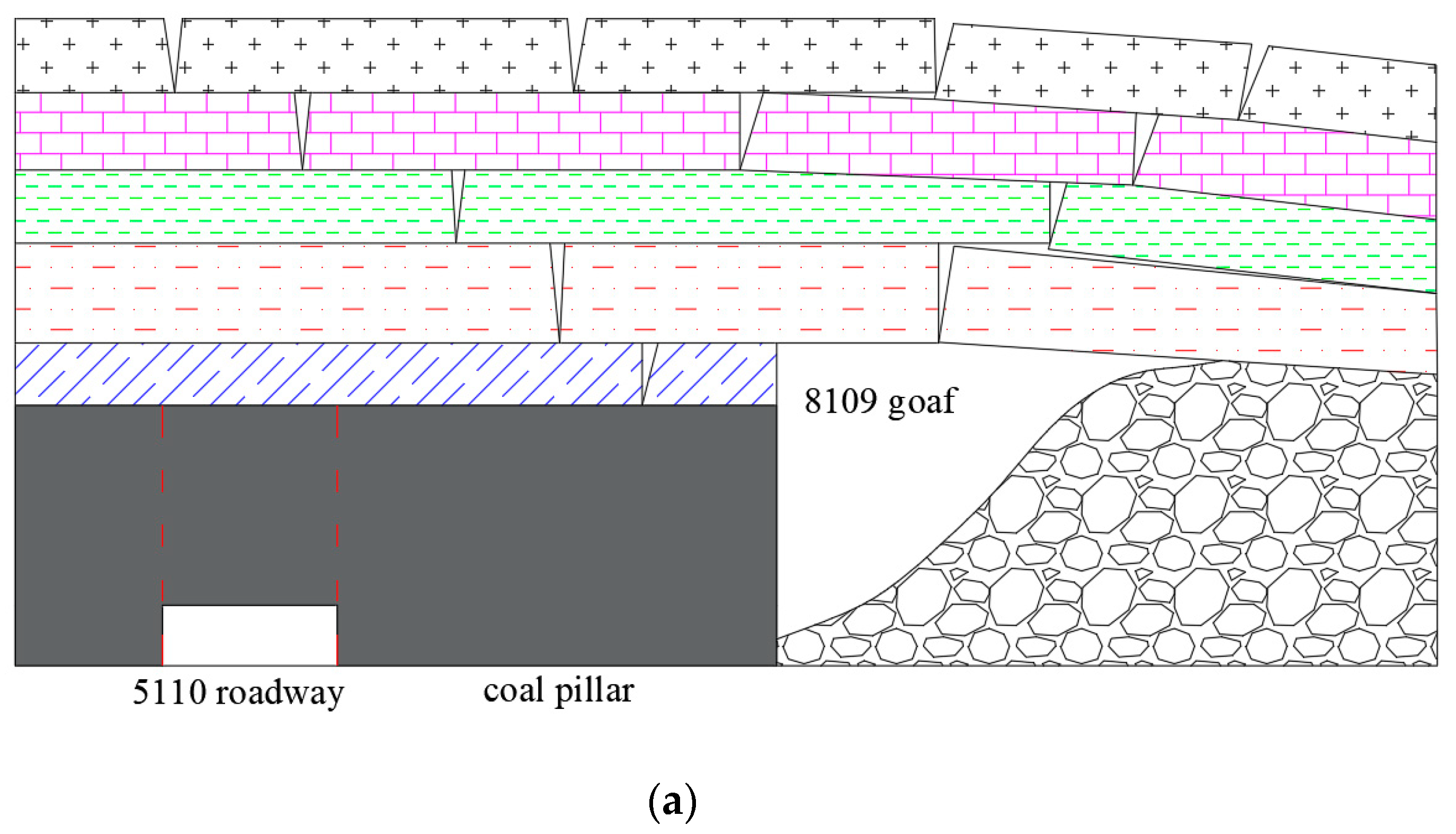
After the mining of the 8109 working face, the roof undergoes caving and fracture, gradually forming an upward cantilever structure. This process continues until the fallen broken rock fragments support the fractured roof to form an articulated structure, which further sustains the overlying fractured rock strata and gradually develops upward into a masonry structure. The load of this masonry structure acts on the immediate roof. Due to the large thickness of the coal seam, it can be regarded as an elastic foundation that provides a support reaction to the immediate roof. This support reaction, together with the load of the masonry structure and the load of the rock strata overlying the immediate roof, acts on the immediate roof collectively. Based on the cantilever beam and masonry beam theories, the model can be simplified to an elastic foundation beam model [43,44], presented schematically in Figure 1.

2.2. Mechanical Analysis of Immediate Roof

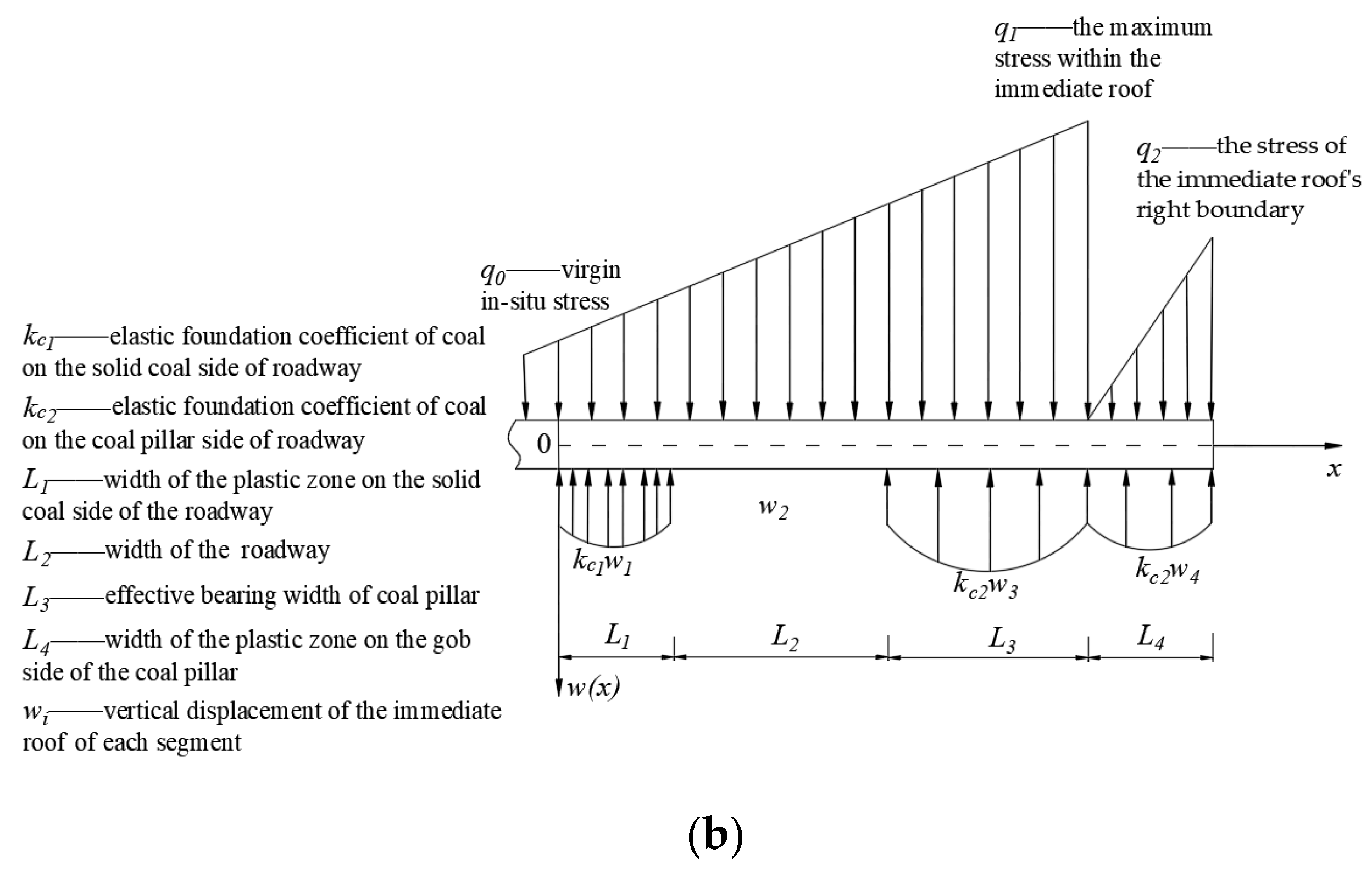
In the model, L1 represents the width of the plastic zone on the solid coal side of the roadway, which can be calculated by Equation (1) [45]; L2 represents its width, measuring 5.4 m; L3 + L4 denotes the total extent of the coal pillar, measuring 38 m; L4 is defined as the width of the plastic zone on the gob side of the coal pillar; q0 corresponds to the virgin in situ stress; q1 represents the maximum stress within the immediate roof; q2 corresponds to the stress value at the immediate roof’s right boundary; kc1 and kc2 represent the coefficients of the elastic foundation for the coal mass; and w(x) represents the vertical displacement of the immediate roof.
L 1 = λ m 2 tan φ
A lateral pressure coefficient λ of 0.39 and a coal seam thickness m of 14.7 m were adopted for the model. Substituting these parameters yields L1 = 5.05 m.
L 4 = λ m 2 tan φ ln ( k γ H 0 + C / tan φ C / tan φ + P / λ )
A value of 2.247 is established for the stress concentration factor k, with the bulk density γ set at 25 kN/m3; H0 is the buried depth, 465 m; P is characterized as the bearing capacity provided by the coal rib, set as 1 MPa. Substituting the parameters into Equation (2) [46,47] yields L4 = 5.74 m, so L3 = 32.26 m.
q1(x) and q2(x) are simplified as straight lines; combined with the coordinates of the two endpoints, the solution is obtained, and it can be derived that
q 1 q 0 L 1 + L 2 + L 3 x + q 0 = q 1 ( x )
q 2 L 4 ( x L 1 + L 2 + L 3 ) = q 2 ( x )

2.3. Mechanical Calculation

Combined with the elastic foundation beam model in Figure 1, the deformation behavior of the immediate roof within the interval [0, L1 + L2 + L3 + L4] is governed by the following differential equation, derived from beam theory:
E I d 4 w 1 ( x ) d x 4 + k c 1 w 1 ( x ) = q 1 ( x ) 0 x L 1 E I d 4 w 2 ( x ) d x 4 = q 1 ( x ) L 1 x L 1 + L 2 E I d 4 w 3 ( x ) d x 4 + k c 2 w 3 ( x ) = q 1 ( x ) L 1 + L 2 x L 1 + L 2 + L 3 E I d 4 w 4 ( x ) d x 4 + k c 2 w 4 ( x ) = q 2 ( x ) L 1 + L 2 + L 3 x L 1 + L 2 + L 3 + L 4
Taking the characteristic coefficients β = k c 1 4 E I 4 and β 1 = k c 2 4 E I 4 , according to the solution principle of elastic foundation beams, the following is the general answer to the equation:
ω 1 ( x ) = q 1 q 0 L 1 + L 2 + L 3 x + q 0 k c 1 + e β x A 1 cos ( β x ) + B 1 sin ( β x ) + e β x C 1 cos ( β x ) + D 1 sin ( β x ) 0 x L 1 ω 2 ( x ) = 1 24 q 0 L 1 x 4 + 1 24 q 0 L 2 x 4 + 1 24 q 0 L 3 x 4 1 120 x 5 q 0 + 1 120 x 5 q 1 E I ( L 1 + L 2 + L 3 ) + A 2 x 3 6 + B 2 x 2 2 + C 2 x + D 2 L 1 x L 1 + L 2 ω 3 ( x ) = q 1 q 0 L 1 + L 2 + L 3 x + q 0 k c 2 + e β 1 x A 3 cos ( β 1 x ) + B 3 sin ( β 1 x ) + e β 1 x C 3 cos ( β 1 x ) + D 3 sin ( β 1 x )   L 1 + L 2 x L 1 + L 2 + L 3 ω 4 ( x ) = q 2 L 4 ( x L 1 L 2 L 3 ) k c 2 + e β 1 x A 4 cos ( β 1 x ) + B 4 sin ( β 1 x ) + e β 1 x C 4 cos ( β 1 x ) + D 4 sin ( β 1 x )   L 1 + L 2 + L 3 x L 1 + L 2 + L 3 + L 4
The interrelation among angular rotation θ , bending moment M , shear force Q , and vertical displacement w ( x ) at any beam cross-section can be described as follows:
θ ( x ) = d w ( x ) d x ,   M ( x ) = E I d 2 w ( x ) d x 2 ,   Q ( x ) = E I d 3 w ( x ) d x 3
The solution is derived through the implementation of the model’s continuity and boundary constraints, where the terminal sections are modeled as a fixed support and a cantilever configuration, respectively.
ω 1 ( 0 ) = 0 , θ 1 ( 0 ) = 0 , ω 1 ( L 1 ) = ω 2 ( L 1 ) , θ 1 ( L 1 ) = θ 2 ( L 1 ) , M 1 ( 0 ) = M 2 ( 0 ) , Q 1 ( 0 ) = Q 2 ( 0 ) ω 2 ( L 1 + L 2 ) = ω 3 ( L 1 + L 2 ) , θ 2 ( L 1 + L 2 ) = θ 3 ( L 1 + L 2 ) , M 2 ( L 1 + L 2 ) = M 3 ( L 1 + L 2 ) , Q 2 ( L 1 + L 2 ) = Q 3 ( L 1 + L 2 ) ω 3 ( L 1 + L 2 + L 3 ) = ω 4 ( L 1 + L 2 + L 3 ) , θ 3 ( L 1 + L 2 + L 3 ) = θ 4 ( L 1 + L 2 + L 3 ) , M 3 ( L 1 + L 2 + L 3 ) = M 4 ( L 1 + L 2 + L 3 ) Q 3 ( L 1 + L 2 + L 3 ) = Q 4 ( L 1 + L 2 + L 3 ) , M 4 ( L 1 + L 2 + L 3 + L 4 ) = 0 , Q 4 ( L 1 + L 2 + L 3 + L 4 ) = 0
By combining Equation (8) and substituting specific engineering parameters, we can solve for the parameters of each section: A1, B1, C1, D1, A2, B2, C2, D2, A3, B3, C3, D3, A4, B4, C4, D4. From these, the deflection and stress at various positions of the top beam can be obtained.

2.4. Case Study

Based on the geological conditions and field measurements from the 8110 and 8109 working faces, the 8109 working face has an extent of 207 m and features a burial depth of 465 m; the immediate roof thickness h = 9.13 m; E = 60 GPa; the elastic foundation coefficient of the coal mass in section L1, kc1 = 1.7 × 10⁶ N/m3; the elastic foundation coefficient of the coal pillar kc2 = 8 × 10⁷ N/m3; the in situ stress q0 = 11.625 MPa; the peak stress of the immediate roof q1 = 26.12 MPa; and the stress at the right end of the immediate roof q2 = 25.86 MPa. Based on the above parameters, the values of A1, B1, C1, D1, A2, B2, C2, D2, A3, B3, C3, D3, A4, B4, C4, D4 under the condition of a primary mining disturbance can be obtained, as shown in Table 1.
(1)
Deformation analysis of first mining roadway
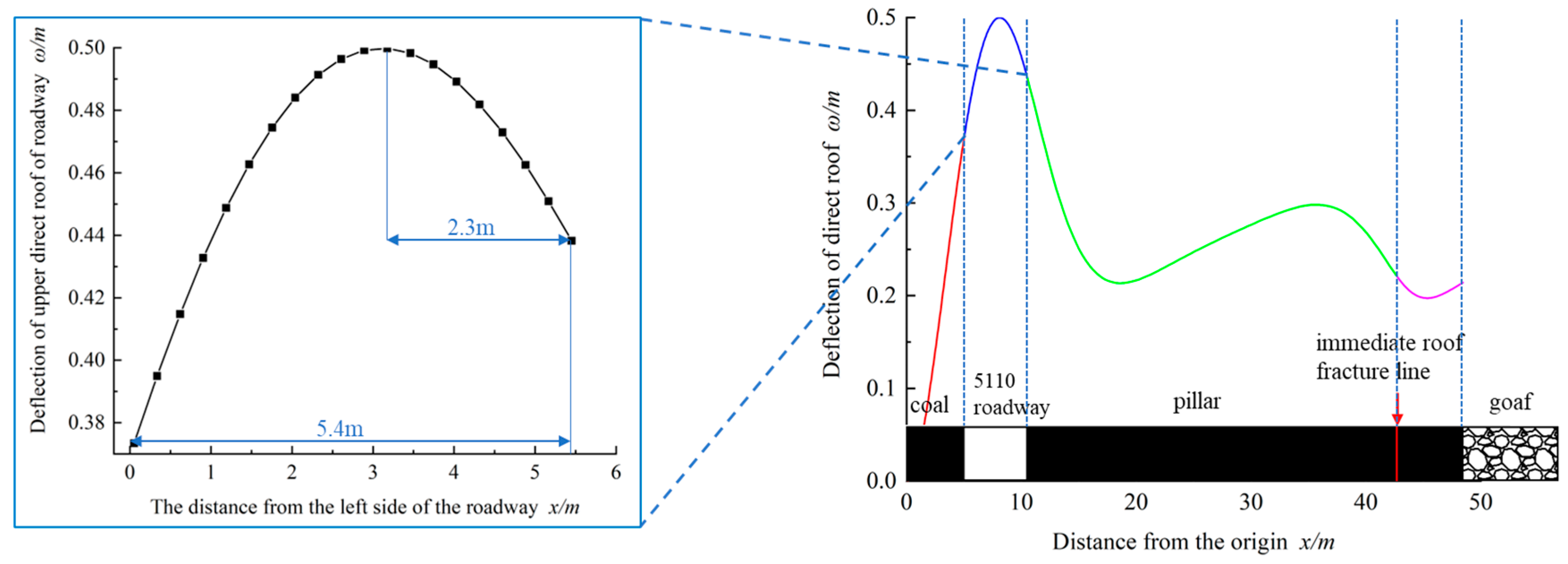
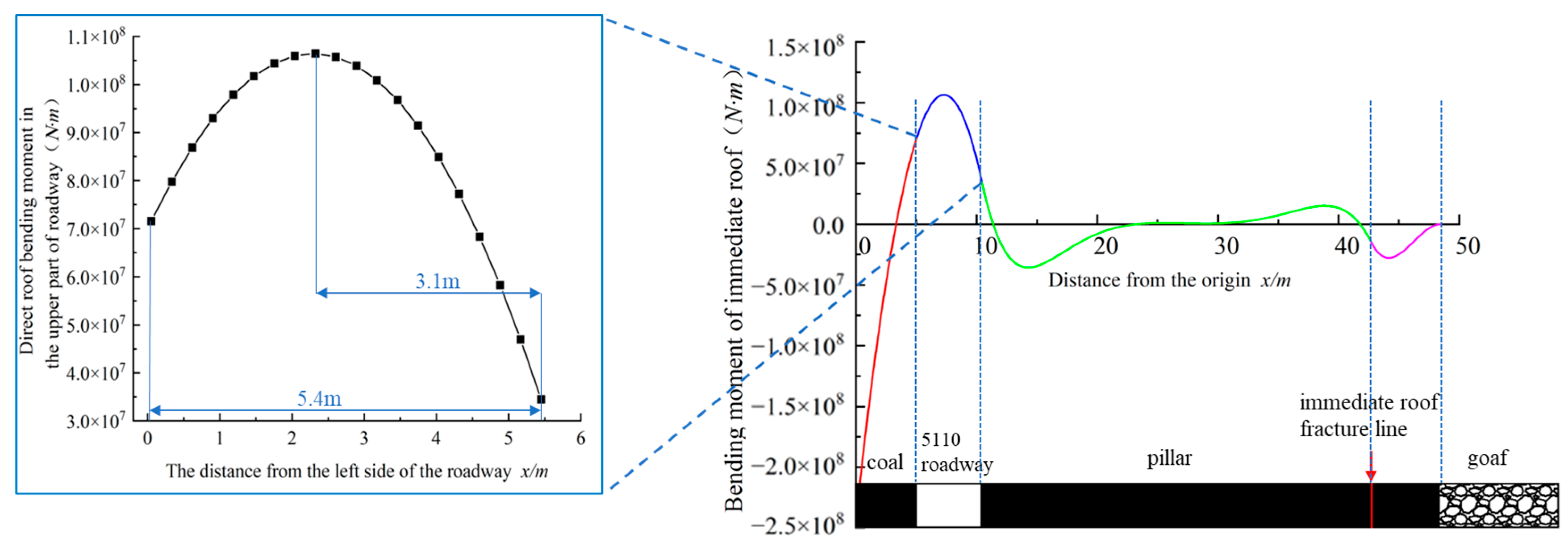
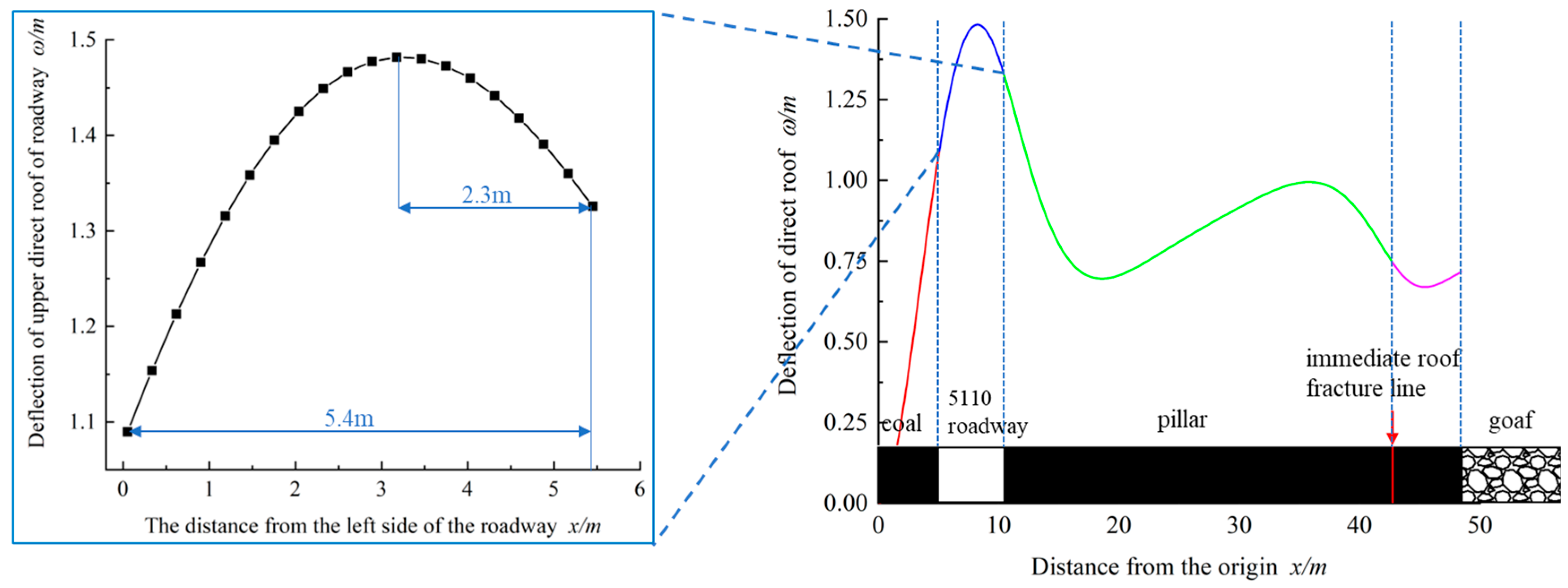
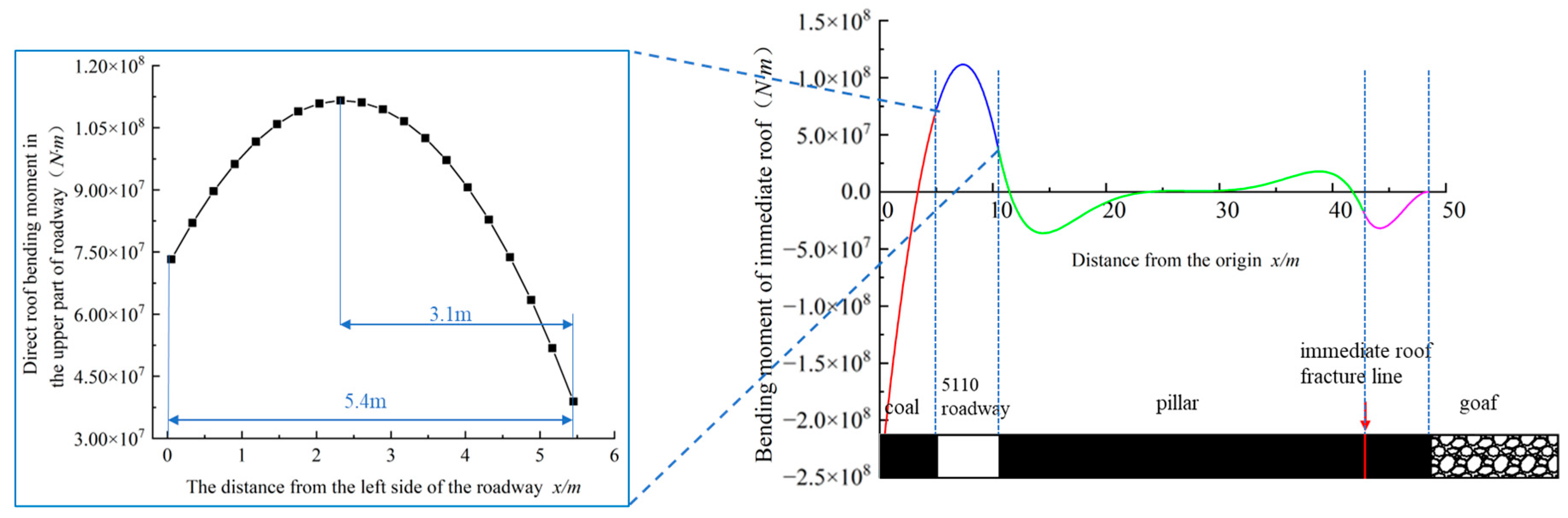
Through the substitution of the parameters into Equations (6)–(8), the functional dependencies of the deflection and bending moment on position x within the interval [0, L1 + L2 + L3 + L4] are determined and graphically represented. The specific deflection and bending moment are shown in Figure 2 and Figure 3.
As can be seen from Figure 2, the roadway’s upper portion exhibits more pronounced settlement in the immediate roof compared to other regions, with the maximum displacement measured 3 m from the left rib, positioned to the right of the central axis. In particular, this sinking has a peak value of 0.5 m and resembles a downward-opening parabola. The overlying immediate roof strata are significantly influenced by asymmetric deformation resulting from extraction operations in the neighboring 8109 working face The minimal settlement of 0.37 m is observed in the left upper sidewall region, whereas the right upper sidewall exhibits a subsidence magnitude of 0.44 m.
As can be seen from Figure 3, a decreasing-then-increasing pattern is exhibited by the bending moment variation in the immediate roof between the coordinate origin and the roadway’s left rib. A heterogeneous distribution was observed for the bending moment in the immediate roof of the upper roadway segment, with a peak value of 105 MN·m occurring in the elevated region. Elevated bending moments are recorded in roof strata adjacent to the roadway’s left sidewall. For the immediate roof spanning from the right rib to the coal wall, the bending moment varies between 0 MN·m and 50 MN·m. At the coordinate origin, the immediate roof experiences a peak bending moment of 250 MN·m. Potential failure may exist in the roof at the position of the maximum bending moment. The immediate roof was observed to undergo bending moment fluctuations between 0 and 50 MN·m from the right rib side of the roadway to the coal wall. A peak bending moment of 250 MN·m is observed in the immediate roof at the coordinate origin.
(2)
Deformation analysis of secondary mining roadway
The immediate roof is subjected to the influence of extraction operations on adjacent working faces, with a corresponding increase observed in the stress concentration factor. Based on field measurements and numerical simulations from the mine, the stress concentration factor for the immediate roof is determined as 2.56. The corresponding parameter values are as follows: peak stress q1 = 29.76 MPa; stress at the right boundary q2 = 29.46 MPa; Young’s modulus E = 22 GPa. The elastic foundation coefficients for the coal mass in section L1 (kc1) and for the coal pillar (kc2) were defined as 0.5 × 10⁶ N/m3 and 2.7 × 10⁷ N/m3, respectively; other parameters match the engineering characteristics in the case study mentioned above. Based on the above parameters, the values of A1, B1, C1, D1, A2, B2, C2, D2, A3, B3, C3, D3, A4, B4, C4, D4 under the condition of a secondary mining disturbance can be obtained, as shown in Table 2.
Similarly, through parameter substitution into Equations (6)–(8), the functional relationships between the deflection, bending moment, and position x within the interval [0, L1 + L2 + L3 + L4] are derived and graphically represented. The specific deflection and bending moment are shown in Figure 4 and Figure 5.
It can be seen from Figure 4 and Figure 5 that the trend in the deflection curve in secondary mining matches that in primary mining. The immediate roof, under multiple disturbances, exhibits increased deflection subsidence; the deflection of the immediate roof in the roadway’s upper section peaks at approximately 1.48 m. Moreover, this subsidence shows an asymmetric pattern, with greater displacement on the right rib than the left rib. Similarly, the deformation trend of the bending moment in secondary mining is consistent with that in primary mining, and the bending moment shows no significant change compared with that in primary mining. At the origin, the immediate roof bending moment is the largest, at 250 MN·m. Similarly, the roof may fail at the position of the maximum bending moment. A non-uniform distribution pattern is manifested in the bending moment throughout the immediate roof of the upper roadway segment, where the value at the left sidewall is observed to be higher than that at the right sidewall. The maximum bending moment reaches 112 MN·m.

3. Discussion

3.1. Immediate Roof Thickness

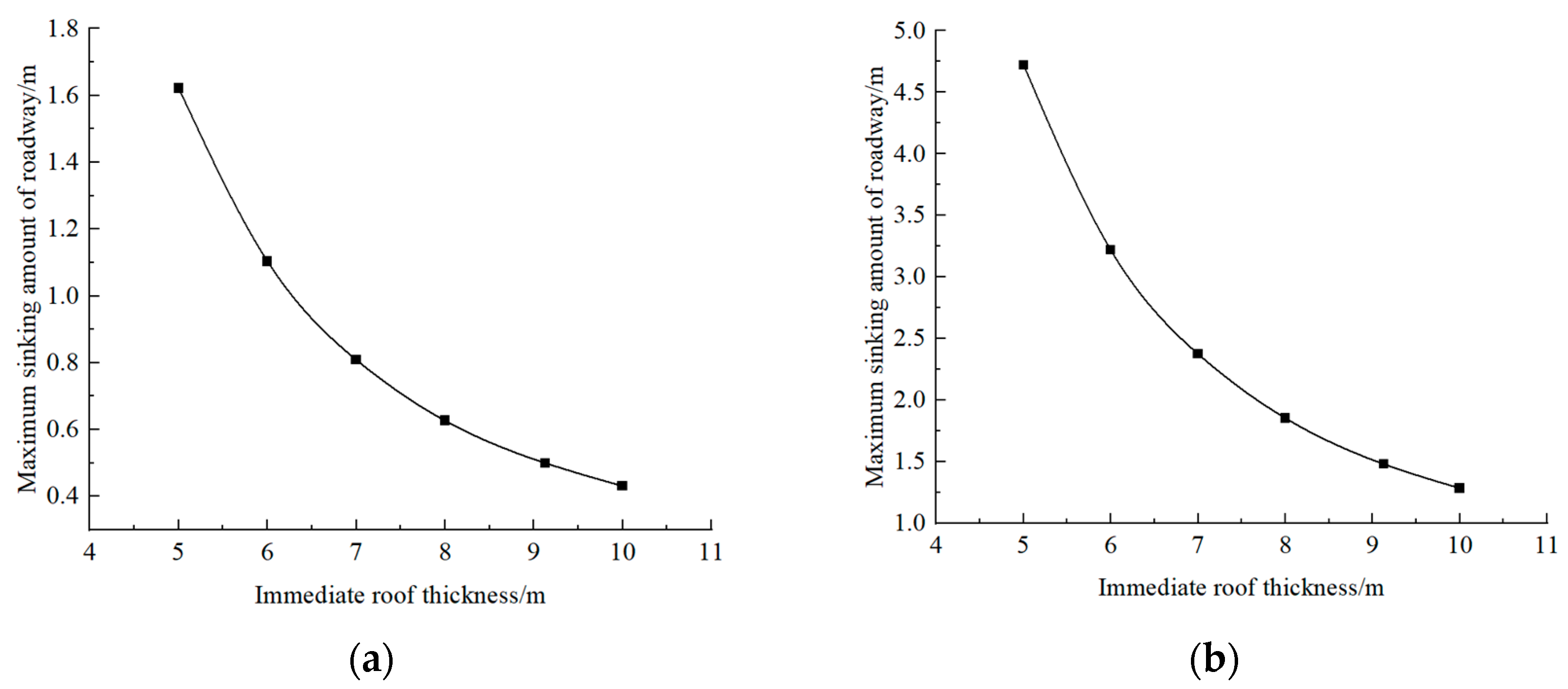
The immediate roof thickness is the key factor impacting roadway deformation. When other engineering parameters stay unchanged, modifying this thickness allows one to obtain the maximum sinking and immediate roof thickness connection curve during the roadway’s exposure to primary and secondary mining, as depicted in Figure 6.
It can be seen from Figure 6 that an inverse proportional relationship is consistently maintained between the immediate roof thickness and maximum roadway subsidence under both primary and secondary mining conditions. When the immediate roof thickness is increased from 5 m to 10 m, a reduction in peak roadway subsidence from 1.62 m to 0.43 m is observed during primary mining. Under the same thickness augmentation, the maximum settlement in secondary mining decreases from 4.73 m to 1.32 m.

3.2. Span of Roadway

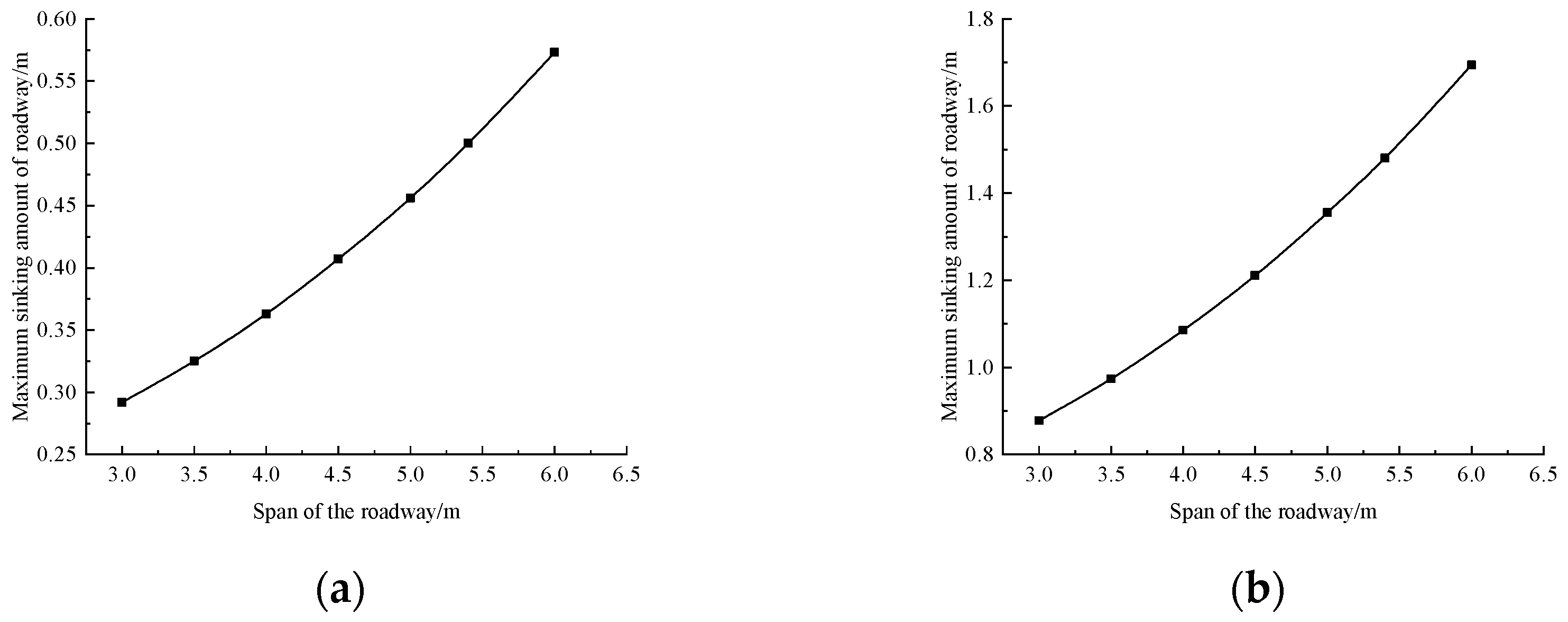
According to field experience, the span of the roadway is generally 2–6 m, and different spans of the roadway have different effects on its subsidence. With other engineering parameters unchanged, when solely varying the roadway span, the curve of the correlation between the roadway’s maximum subsidence and its span is derived, as shown in Figure 7.
It can be seen from Figure 7 that the relationship between the roadway span and maximum roadway subsidence in both primary and secondary mining is consistent and directly proportional. When the roadway span is extended from 3 m to 6 m, the maximum subsidence during primary mining rises from 0.29 m to 0.57 m. Correspondingly, under identical span augmentation conditions, the peak settlement in secondary mining rises from 0.88 m to 1.69 m.

3.3. Immediate Roof Peak Stress

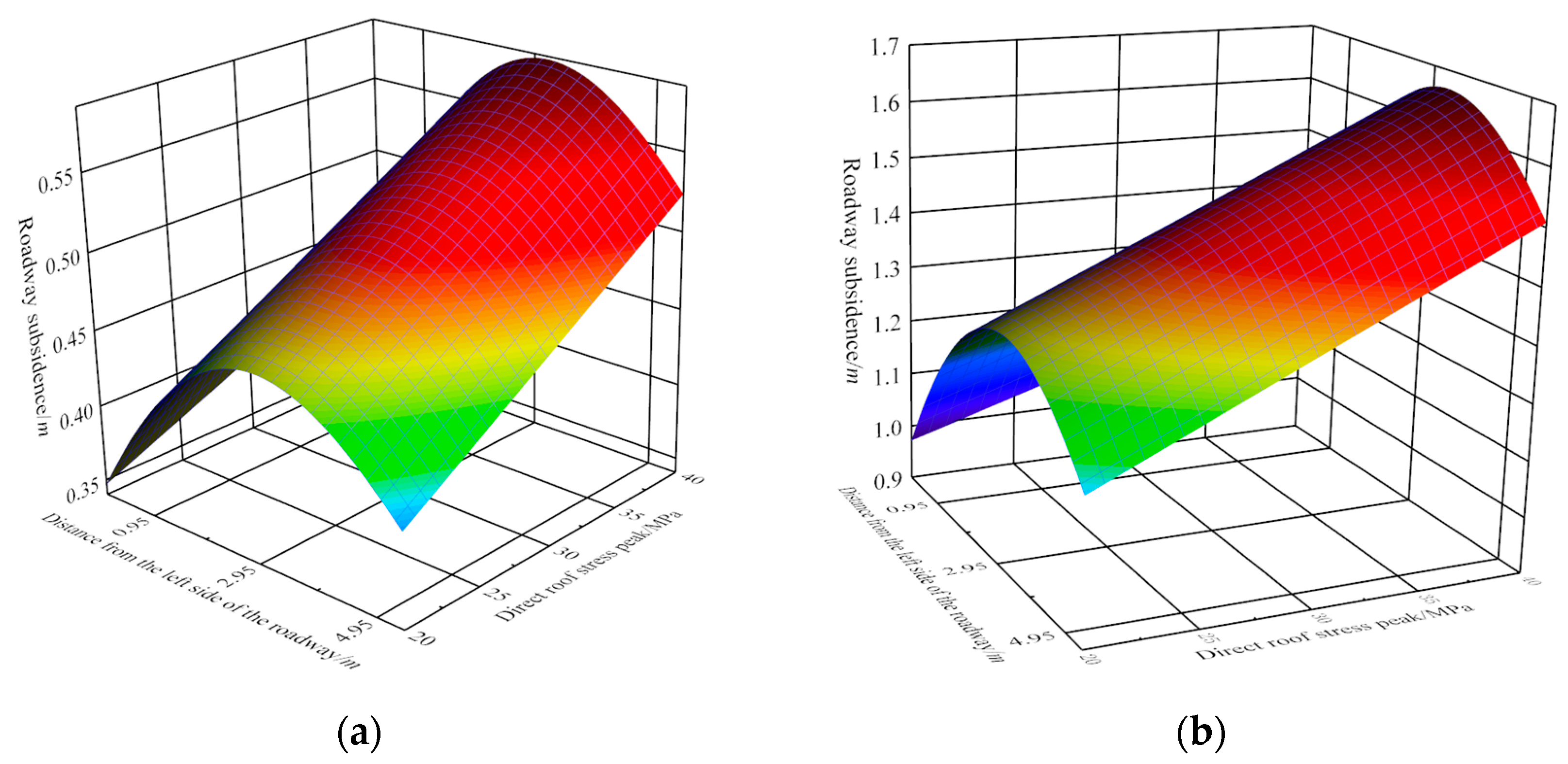
A functional correlation is derived connecting the peak stress within the immediate roof to the stress concentration coefficient, a parameter governing the roadway subsidence magnitude. With other parameters unchanged, altering the immediate roof’s peak stress (i.e., the stress concentration factor) yields the roadway subsidence variation curve, as depicted in Figure 8.
It can be seen from Figure 8 that a linear correlation is confirmed between roadway subsidence and the maximum stress of the immediate roof; the variation trend in the two remains consistent between primary mining and secondary mining. When the peak stress of the immediate roof is enhanced from 20 MPa to 40 MPa, the settlement at the roadway’s right end during primary mining increases from 0.40 m to 0.52 m. Under identical stress augmentation conditions, the settlement magnitude at the roadway’s right end during secondary mining is elevated from 1.15 m to 1.52 m.

3.4. The Stress of the Right End of the Immediate Roof

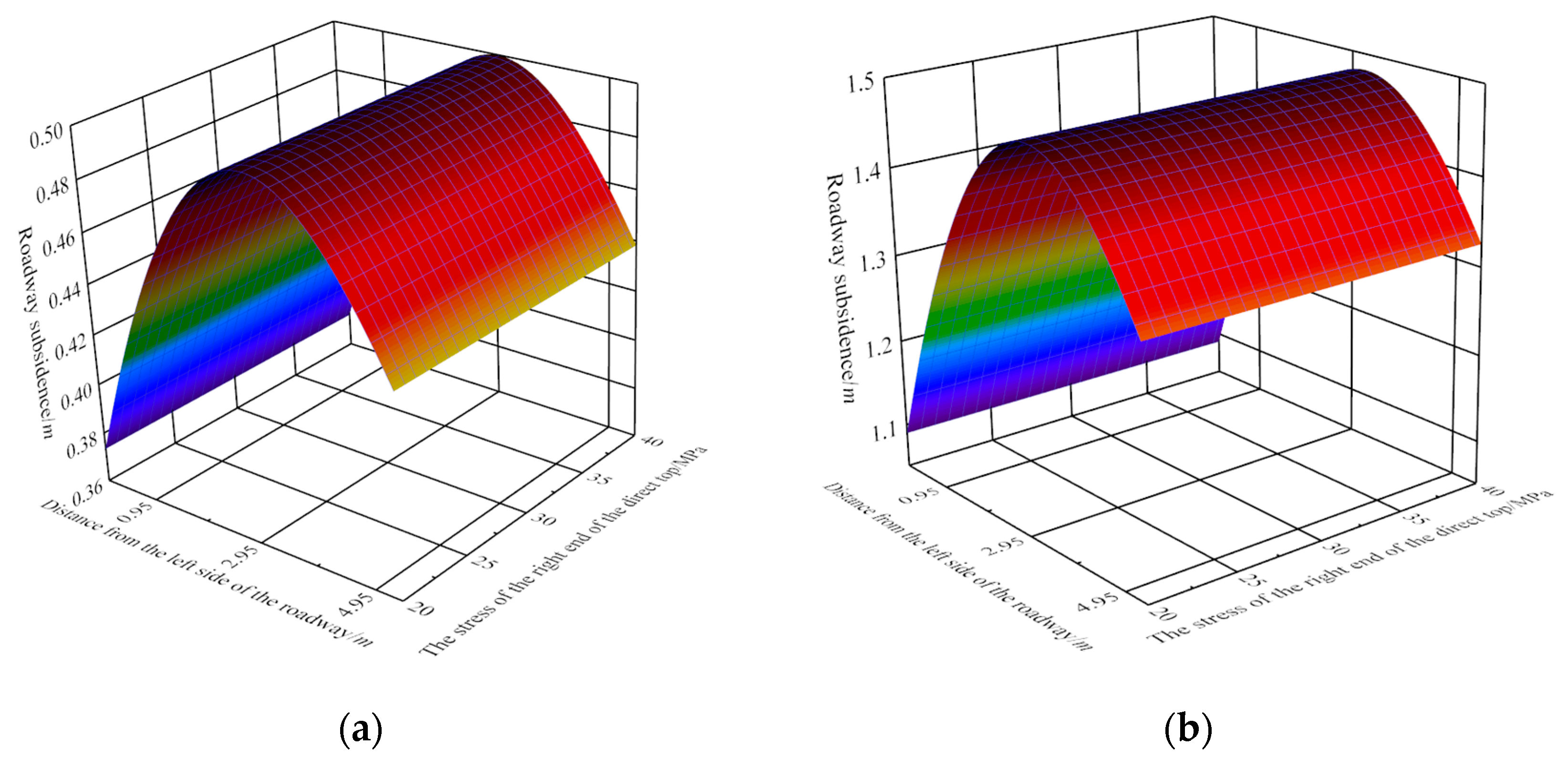
The stress state at the right extremity of the immediate roof is predominantly controlled by three key zones, namely the caving zone, fracture zone, and bending subsidence zone, with the former two being recognized as the dominant contributors. With other engineering parameters unchanged, by varying this stress, the variation curve of roadway subsidence is derived, as illustrated in Figure 9.
It can be seen from Figure 9 that the roadway subsidence exhibits no significant correlation with the stress at the right end of the immediate roof; moreover, the variation trend remains consistent between primary mining and secondary mining. During primary mining, the subsidence at the roadway’s right end remains constant at 0.44 m with increasing stress at the right end of the immediate roof; during secondary mining, the subsidence at the roadway’s right end similarly stays constant at 1.35 m with increasing stress at the right end of the immediate roof.

4. Support Design of Gob-Side Roadway Along Thick Coal Seams

4.1. Working Face Overview

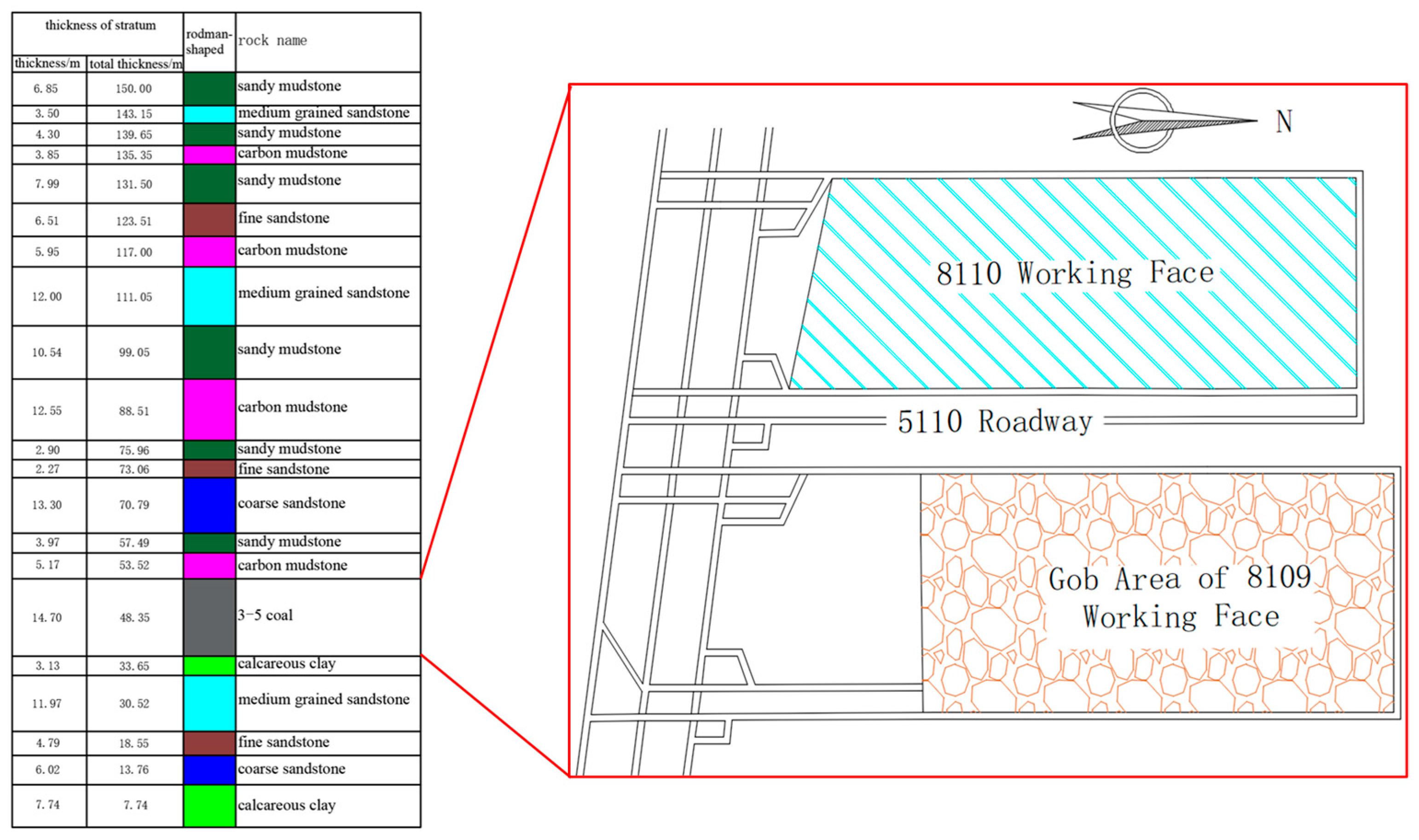
The 8110 coal mining face is situated centrally within Panel 1. Its eastern section is adjacent to the 8109 working face under mining, while the southern boundary is defined by the 1070 return air roadway connecting the belt conveyor roadway and auxiliary transport roadway. To the west lies the undeveloped 8111 working face, with the northern perimeter demarcated by the Kouquan Railway protective coal pillar. Figure 10 illustrates the spatial arrangement of the 8110 working face and 5110 roadway. The average thickness of the coal seam in the 8110 coal mining face is 14.7 m. The 8110 working face adopts the longwall retreating fully mechanized low-position top-coal caving method.

4.2. Support Design Scheme

The immediate roof subsidence in the upper part of the No. 5110 roadway exhibits an asymmetric pattern, with greater subsidence on the roadway’s right side than on the left. The geological conditions of the adjacent 8109 working face are similar to those of the 8110 working face. The support section diagram of the 8109 working face return airway is presented in Figure 11. The support design of the 5110 roadway is optimized with reference to the support design of the 8109 working face return airway, based on a mechanical constant-resistance single prop (MCRSP).
The prop achieves constant resistance characteristics by squeezing the plastic deformation of metal materials with steel balls, and it maintains a stable support force by using the physical characteristics of constant strength in the plastic stage of materials. It can provide a stable load of 200 kN–1400 kN with a small contraction distance [40,41]. Compared with hydraulic support, its working resistance is determined by the structure and material properties of the bead frame; it is not affected by the environment and installation process, the mechanical strength advantages of the prop can be fully leveraged.
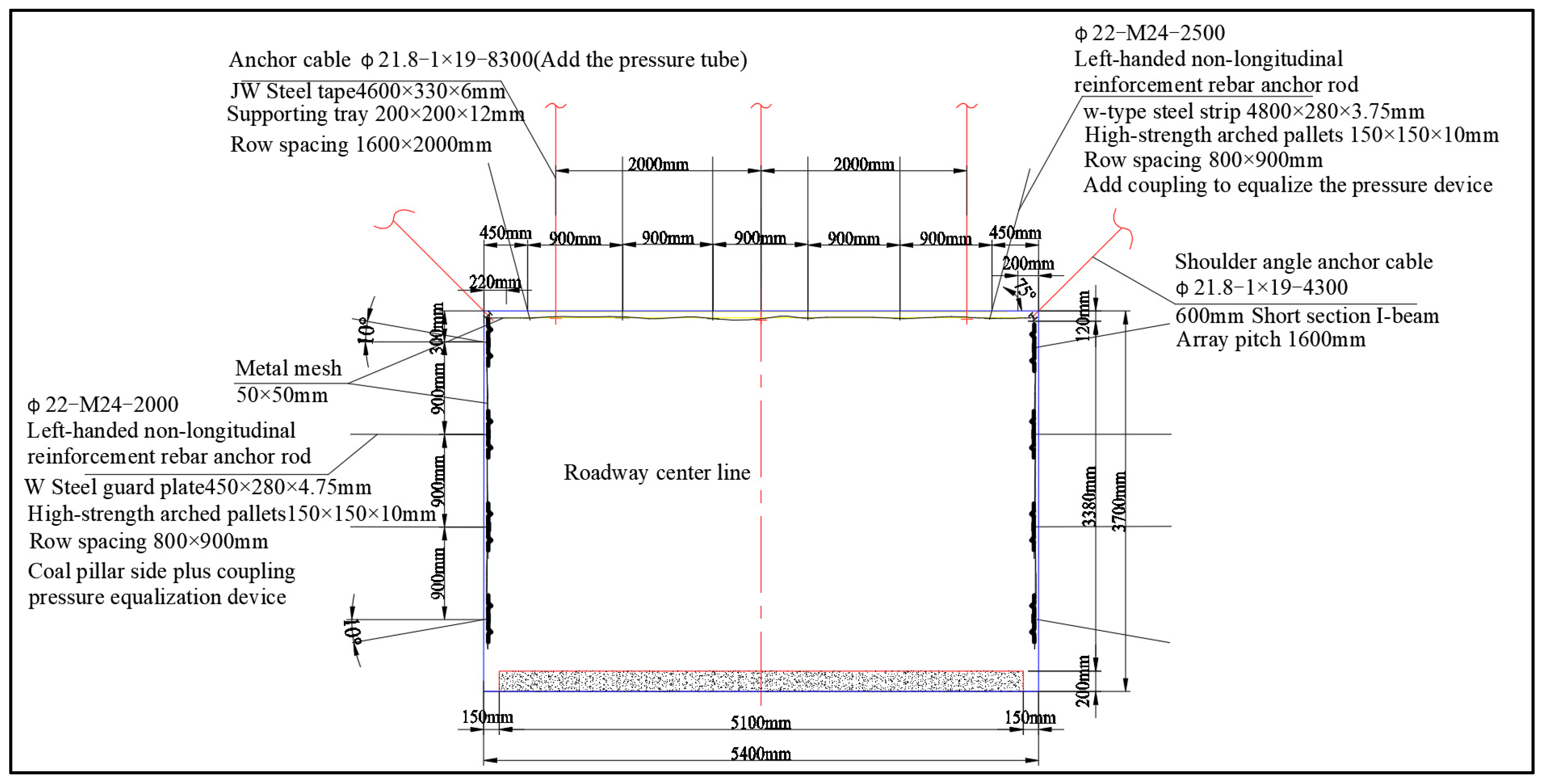
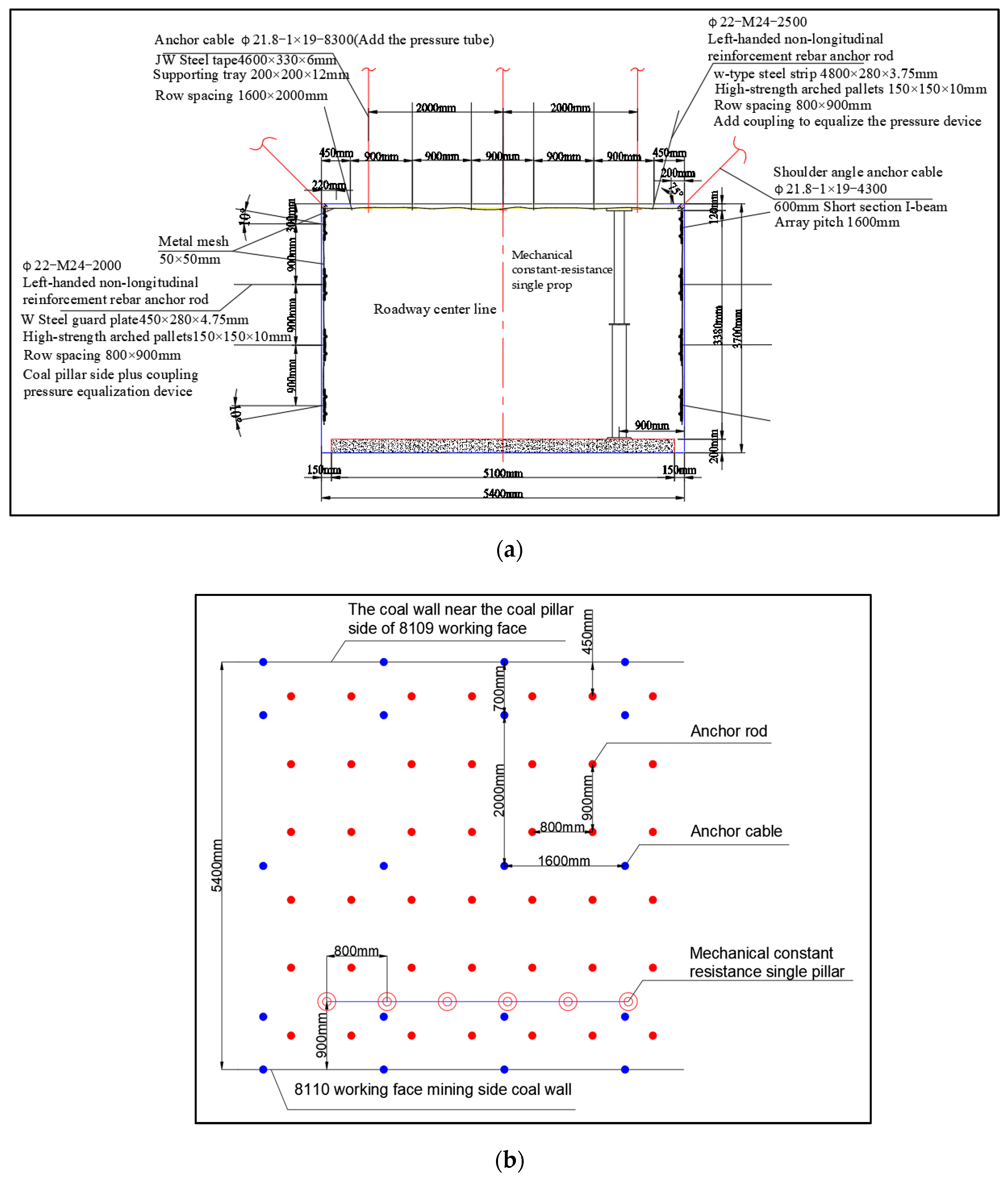
The 5110 roadway is characterized by a rectangular profile, having clear dimensions of 3.38 m in height and 5.1 m in width. It is supported by bolts, anchor cables, a metal mesh, and single mechanical props with continuous resistance. The roadway’s length is 1972 m. Its primary purposes are air return, human access, and cargo and equipment transfer. A 200-mm-thick concrete layer is applied to the roadway surface, with the corresponding support configuration for the cross-section presented in Figure 12.
The supporting scheme for the 5110 roadway employs the following specifications. (1) Roof bolting utilizes left-hand threaded steel rebars (Φ22 × 2500 mm) arranged at 900 × 800 mm spacing, with six units per row, which are interconnected using W-type steel straps. The roof anchor cable system is composed of Φ21.8 × 8300 mm steel strands installed at 2000 × 1600 mm spacing and secured with JW steel strips. The steel strips measure 4600 × 330 × 6 mm, with matching trays of 200 × 200 × 12 mm (length × width × thickness). The shoulder corners of the roof and the two coal ribs are supported by Φ21.8 × 4300 mm steel strand anchor cables. These are employed in conjunction with 600 mm short-segment I-beams serving as trays and are spaced at 1600 mm intervals. (2) For rib support in the roadway, Φ22 × 2000 mm left-handed non-longitudinal rib-threaded steel bolts are utilized. These are installed in a four-bolt-per-row arrangement with a spacing pattern of 800 × 900 mm. High-strength trays measure 150 × 150 × 10 mm, with the coal pillar rib additionally equipped with a coupling pressure relief and equalization device. (3) MCRSPs have advantages including a high supporting capacity, stable support, easy operation, and a low cost. Their spacing is maintained at 800 mm, positioned at a horizontal standoff of 900 mm relative to the sidewall of the 8110 working face. The top cap of each prop group is in flush contact with the roof steel belt. For field testing purposes, a 180 m continuous section in advance of the working face has been designated.

4.3. Monitoring Scheme

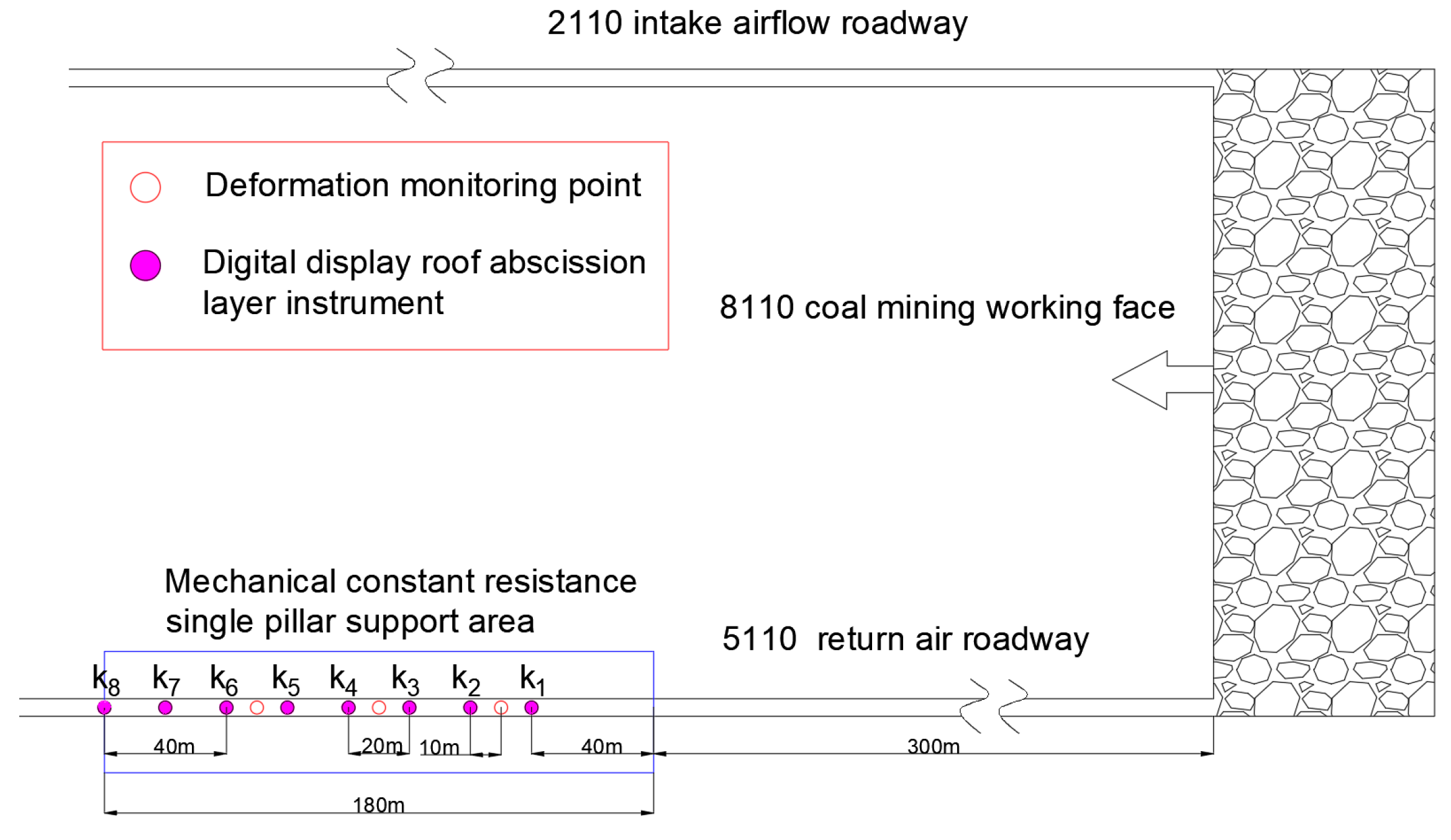
To assess the effectiveness of the proposed advanced support strategy utilizing MCRSPs, the establishment of monitoring stations was required to measure the surrounding rock surface displacement and roof separation. Three groups of monitoring stations were established, with three monitoring stations per group. Each monitoring station was equipped with two sets of roof separation indicators: the first group was designated as k1–k6, and the initial monitoring station was situated 350 m ahead of the working face. When the working face advanced to the position of the k1 roof separation indicator, the second group k2-k7 was deployed; by the same logic, the third group was designated as k3–k8. All monitoring stations employed the cross-point layout method for the installation of surface displacement monitoring instruments. A total of eight roof separation indicators were installed in the test section of the MCRSP. Shallow base points of separation sensors mainly monitor separation within the bolt anchoring range; here, the focus is on studying the variation characteristics of roof separation near anchor cable anchoring points. Considering factors such as the roadway mine pressure behavior characteristics and the coal and rock thickness, the deep base point (h2) is determined to be 7.5 m. The arrangement of the monitoring stations in the 5110 roadway is presented in Figure 13.

4.4. Monitoring Results

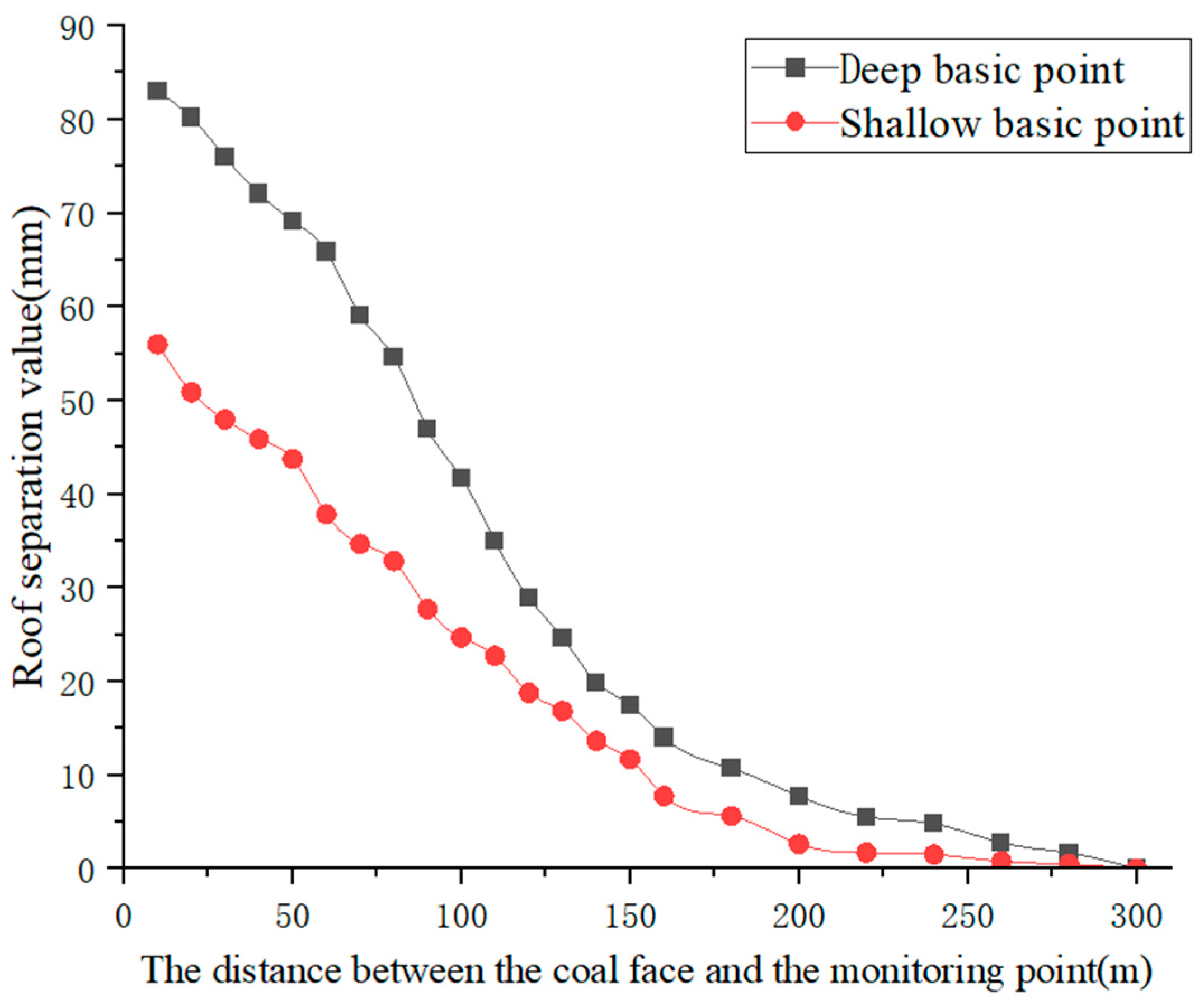
The measured data of the characteristic roof separation within the 5110 roadway are presented in Figure 14.
From the analysis of Figure 14, adopting MCRSPs significantly reduces both the overall deep and shallow separation values. This favors the preservation of roof support stability by significantly reducing the degree of mine pressure behavior in the advance support region during the vigorous mining operation on the working face. Meanwhile, the variation in roof separation between 150 and 300 m is observed to be significantly smaller than that within 150 m ahead of the advancing face. This finding indicates that the front abutment stress induced by mining activities increases as the distance between the monitoring stations and the working face diminishes. Consequently, the preventive control capability of the support system is enhanced, thereby allowing for the more effective management of substantial roof deformation.
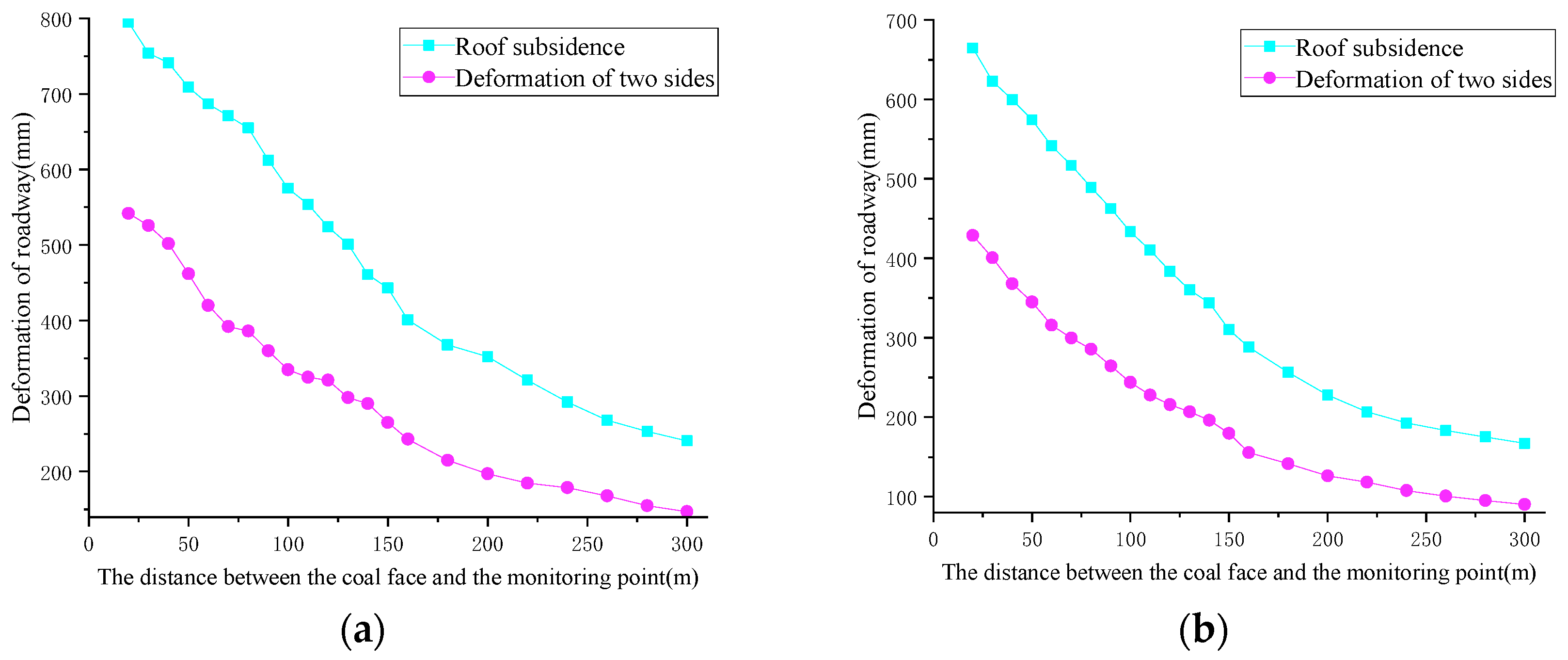
The measured deformation data for the representative rock mass in the 5110 roadway and 8109 working face return airway are provided in Figure 15.
As evidenced in Figure 15, the maximum roof subsidence of the 8109 working face return airway is 795 mm, and the maximum deformation of the roadway rib is 525 mm. After the installation of the MCRSP, the documented deformation values of the 5110 roadway comprise 168 mm of roof subsidence alongside 90 mm of rib closure. Maximum displacements of 663 mm for roof subsidence and 428 mm for rib closure are recorded, representing increases of 495 mm and 338 mm, respectively, as the monitoring location is approached by the advancing face. Concerning roof separation development, within the monitoring range of 150–300 m relative to the working face, both the rate and extent of surrounding rock mass deformation are maintained at limited levels. Within 150 m, the deformation rates of the ribs and roof accelerate, although all displacements are maintained within acceptable deformation limits for the roadway.
In summary, in the advanced test area with MCRSPs as the core, the section convergence rate of the advanced supported roadway is significantly reduced. The roadway’s maximum rib deformation and roof subsidence are 428 mm and 663 mm, respectively. Compared with the 8109 working face return airway without MCRSPs, the 5110 roadway exhibits a reduction of 132 mm in maximum roof subsidence and 117 mm in maximum rib deformation. The maximum deep separation of the 5110 roadway is 83 mm, and its maximum shallow separation is 56 mm. Field monitoring data confirm the successful stabilization of both the entry roof and adjacent rock mass under extra-thick coal seam conditions.

5. Conclusions

The asymmetric deformation mechanism and gob-side roadway control methods under strong mining conditions are systematically examined in the present study by integrating theoretical approaches with practical engineering applications within extra-thick coal seam conditions. The following are the primary conclusions:
(1) Field investigation reveals that the free side of gob-side entries subjected to intense mining activity often exhibits asymmetric failure. Typical manifestations include bolt detachment, steel strip tearing, anchor cable breakage, and the pronounced closure of the shoulder corners of the roof and the ribs on the free side.
(2) The elastic foundation beam model is established. Based on a mechanical analysis, the deflection differential equation for the immediate roof is established in this model. The analysis shows that the bending moment of the roadway’s immediate roof exhibits an initial rise followed by a decrease during both the primary and secondary mining stages, with a similar trend observed for roof deflection.
(3) Factors influencing subsidence in mining roadways under strong mining are analyzed. Under primary and secondary mining conditions, the maximum roadway subsidence is inversely proportional to the immediate roof thickness and proportional to the roadway span and its peak stress, and it has no significant correlation with the stress of the right end of the immediate top.
(4) To address the asymmetric deformation of mining roadways under strong mining, a support scheme combining bolts, anchor cables, a metal mesh, and MCRSPs (with the latter as the core) is proposed. Following the implementation of the support strategy, the 5110 roadway achieved maximum roof subsidence of 663 mm and rib displacement of 428 mm, with reductions of 132 mm and 117 mm relative to the 8109 working face return airway. Consequently, the displacement of the adjacent rock mass within mining excavation is effectively controlled.

Author Contributions

Conceptualization, P.H. and B.W.; methodology, P.H. and B.W.; software, B.W.; validation, P.H., B.W., E.T. and Z.Y.; formal analysis, P.H., B.W. and H.S.; investigation, B.W., S.M. and R.C.; resources, P.H. and B.W.; data curation, P.H. and B.W.; writing—original draft preparation, P.H. and B.W.; writing—review and editing, P.H., B.W., E.T., Z.Y., S.M. and R.C.; visualization, B.W.; supervision, P.H.; project administration, P.H.; funding acquisition, P.H. All authors have read and agreed to the published version of the manuscript.

Funding

This work was supported by the National Natural Science Foundation of China (project no. 52474111), the Fundamental Research Funds for the Central Universities (project no. 2024KYJD2001), and the 111 Project (project no. B21016).

Institutional Review Board Statement

Not applicable.

Informed Consent Statement

Not applicable.

Data Availability Statement

Dataset available on request from the authors.

Conflicts of Interest

No conflicts of interest are declared by the authors.

References

  1. Pan, W.; Zhao, Z.; Li, X.; Xu, Y.; Zhang, K. Top Coal Drawing Law for an Extra Thick Coal Seam under the Single Round Group Drawing Method. Sci. Rep. 2024, 14, 15293. [Google Scholar] [CrossRef]
  2. Jia, C.; Li, S.; Fan, C.; Luo, M.; Zhou, L.; Pu, Z.; Yang, L. Supporting Optimization of Thick Seam Roadway with Top Coal Based on Orthogonal Matrix Analysis. Sci. Rep. 2023, 13, 933. [Google Scholar] [CrossRef]
  3. Zhu, C.; Zhang, J.; Li, M.; He, Z.; Wang, Y.; Lan, Y. Effect Mechanism of Strata Breakage Evolution on Stope Deformation in Extra-Thick Coal Seams. Alex. Eng. J. 2022, 61, 5003–5020. [Google Scholar] [CrossRef]
  4. Wang, H.; Tian, C.; Liu, Y.; Li, Y.; Lu, M.; Jiao, J.; Bai, J.; Qiao, Z. Overburden Structure Fracture Evolution and Ground Pressure Behavior under Oblique Residual Coal Pillars in Thick Seam Mining. Sci. Rep. 2025, 15, 30932. [Google Scholar] [CrossRef]
  5. Chai, Y.; Wang, M.; Meng, L.; Wang, C.; Liang, Z.; Yang, Y.; Liu, J. Influence of Roof Cutting Depth on Stability of Gob Side Entry in Thick Coal Seams with a Bulky Limestone Roof. Sci. Rep. 2025, 15, 31267. [Google Scholar] [CrossRef]
  6. Li, Z.; He, X.; Dou, L.; Song, D.; Wang, G. Numerical Investigation of Load Shedding and Rockburst Reduction Effects of Top-Coal Caving Mining in Thick Coal Seams. Int. J. Rock Mech. Min. Sci. 2018, 110, 266–278. [Google Scholar] [CrossRef]
  7. Zhang, Q.; Yue, J.; Liu, C.; Feng, C.; Li, H. Study of Automated Top-Coal Caving in Extra-Thick Coal Seams Using the Continuum-Discontinuum Element Method. Int. J. Rock Mech. Min. Sci. 2019, 122, 104033. [Google Scholar] [CrossRef]
  8. Wang, H.; Wu, Y.; Jiao, J.; Cao, P. Stability Mechanism and Control Technology for Fully Mechanized Caving Mining of Steeply Inclined Extra-Thick Seams with Variable Angles. Min. Metall. Explor. 2021, 38, 1047–1057. [Google Scholar] [CrossRef]
  9. Sun, X.; Zhao, W.; Wang, J.; Jiang, M.; Shen, F.; Zhang, Y.; Miao, C. Research on Failure Mechanism and Stability Control Technology of Dynamic Pressure Roadway in Ultra-Thick Coal Seams Under a High Depth of Cover. Min. Metall. Explor. 2023, 40, 1955–1972. [Google Scholar] [CrossRef]
  10. Lu, Y.; Yan, S.; Zhou, K.; Zhang, C.; Zhou, Y. Structural Quantification of Multi-Thick Hard Roof and Strong Ground Pressure Control in Large Mining Height Stope: A Case Study. Geomech. Geophys. Geo-Energy Geo-Resour. 2025, 11, 56. [Google Scholar] [CrossRef]
  11. Zhao, C.; Li, Y.; Liu, G.; Meng, X. Mechanism Analysis and Control Technology of Surrounding Rock Failure in Deep Soft Rock Roadway. Eng. Fail. Anal. 2020, 115, 104611. [Google Scholar] [CrossRef]
  12. Qi, F.; Yang, D.; Zhang, Y.; Hao, Y. Analysis of Failure Mechanism of Roadway Surrounding Rock under Thick Coal Seam Strong Mining Disturbance. Shock Vib. 2021, 2021, 9940667. [Google Scholar] [CrossRef]
  13. Yan, H.; Li, G.; Li, Y.; Zhang, Q.; Zhu, C. Stress Evolution Characteristics of the Intensively Mining-Induced Surrounding Roadways within an Extra-Thick Coal Seam: A Case Study from the Tashan Coal Mine, China. J. Cent. South Univ. 2023, 30, 3840–3854. [Google Scholar] [CrossRef]
  14. Lan, T.; Liu, Y.; Yuan, Y.; Liu, H.; Liu, H.; Zhang, S.; Wang, S. Mine Pressure Behavior Law of Isolated Island Working Face under Extremely Close Goaf in Shallow Coal Seam. Sci. Rep. 2023, 13, 20576. [Google Scholar] [CrossRef]
  15. Li, H.; Li, D.; Wang, H.; Li, Z.; Wang, S.; Chen, C. Research on stress evolution law and failure characteristics of top coal in fully mechanized caving of extra-thick coal seams. Therm. Sci. 2023, 27, 687–695. [Google Scholar] [CrossRef]
  16. Zhang, X.; Xie, D. Support Technology of Ultra-High Roadway in Thick Coal Seam. Inf. Technol. J. 2013, 12, 4095. [Google Scholar] [CrossRef]
  17. Chai, J.; Lei, W.; Du, W.; Yuan, Q.; Zhu, L.; Zhang, D.; Li, H. Experimental Study on Distributed Optical Fiber Sensing Monitoring for Ground Surface Deformation in Extra-Thick Coal Seam Mining under Ultra-Thick Conglomerate. Opt. Fiber Technol. 2019, 53, 102006. [Google Scholar] [CrossRef]
  18. Li, W.; Guo, Y.; Liu, X.; Du, F.; Li, G.; Ma, Q. Failure Mechanisms and Reinforcement Support of Soft Rock Roadway in Deep Extra-Thick Coal Seam: A Case Study. Eng. Fail. Anal. 2024, 165, 108745. [Google Scholar] [CrossRef]
  19. Zhang, W.; Zhao, S.; Zhang, B.; Gao, W.; Zhu, Q.; Li, T.; Wang, B. An Improved Numerical Simulation Method for Rockbolt Fracture and Its Application in Deep Extra-Thick Coal Seam Roadways. Buildings 2024, 14, 2373. [Google Scholar] [CrossRef]
  20. Wang, E.; Yin, S.; Kang, Q.; Zhao, X.; Lan, Q.; Sheng, H.; Liang, H. Coupling Control Technology of Anchoring and Unloading in Deep Intense-Mining and Large-Deformation Roadway: A Case Study. Sci. Rep. 2024, 14, 12075. [Google Scholar] [CrossRef]
  21. Xiang, Z.; Zhang, N.; Qian, D.; Xie, Z.; Zhang, C.; Guo, F.; Wang, S. Failure Characteristics and Stability Control of Bolt Support in Thick-Coal-Seam Roadway of Three Typical Coal Mines in China. Shock Vib. 2021, 2021, 5589085. [Google Scholar] [CrossRef]
  22. Hao, J.; Chen, A.; Li, X.; Bian, H.; Zhou, G.; Wu, Z.; Peng, L.; Tang, J. Analysis of Surrounding Rock Control Technology and Its Application on a Dynamic Pressure Roadway in a Thick Coal Seam. Energies 2022, 15, 9040. [Google Scholar] [CrossRef]
  23. Fan, Y.; Xiao, X.; Xu, J.; Ding, X.; Wang, A.; Wang, B.; Lei, Y. Failure Characteristics and Conditions of Rock-Coal Combination Structure with Weak Layer under Dynamic and Static Stresses. Sci. Rep. 2023, 13, 12410. [Google Scholar] [CrossRef]
  24. Wang, D.; He, F.; Wu, Y.; Xu, X.; Zhang, J.; Lv, K.; Li, L.; Zhai, W.; Song, J. Study on Surrounding Rock Failure Mechanism and Rational Coal Pillar Width of the Gob-Side Coal Roadway under Influence of Intense Dynamic Pressure. Energy Sci. Eng. 2023, 11, 1716–1733. [Google Scholar] [CrossRef]
  25. Zhang, L.; Deng, Z.; Li, G.; Liu, G.; Lian, X. Research on the Technology of Unloading Pressure and Preventing Punching in Extra-Thick Coal Seams. Sci. Rep. 2025, 15, 17323. [Google Scholar] [CrossRef]
  26. Chen, J.; Yan, R.; Liu, K. Asymmetric Seformation Mechanism of Roadway at Steeply Inclined Thick Coal Seam. J. China Coal Soc. 2018, 11, 3007–3015. [Google Scholar] [CrossRef]
  27. Tan, Y.; Song, S.; Zhang, X.; Liu, X. Safety Evaluation Method of Bottom Coal Thickness in Thick Coal Seam Roadway. Sci. Rep. 2024, 14, 14812. [Google Scholar] [CrossRef] [PubMed]
  28. He, W.; He, F.; Zhao, Y. Field and Simulation Study of the Rational Coal Pillar Width in Extra-Thick Coal Seams. Energy Sci. Eng. 2020, 8, 627–646. [Google Scholar] [CrossRef]
  29. He, X.; He, S.; Cai, Y.; Xu, R.; Yang, K. Investigation on Rational Width of Coal Pillar and Roadway Support in Isolated Panel of Extra-Thick Coal Seam. Front. Earth Sci. 2023, 11, 5678. [Google Scholar] [CrossRef]
  30. Zhang, J.; Liu, L.; Yan, X.; Li, Y. Asymmetrical Support Technology for Dynamic Pressure Roadway: A Case Study from Guotun Coal Mine in China. Geotech. Geol. Eng. 2019, 37, 823–832. [Google Scholar] [CrossRef]
  31. Wang, L.; Wu, Y.; Chen, D.; Lu, W.; Sun, H.; He, Y.; Liu, K.; Zhang, Y. Study on Bearing Strength of Fiber Reinforced Polymer Anchoring Cable in Deep Roadway. Sci. Rep. 2025, 15, 4916. [Google Scholar] [CrossRef]
  32. Zhao, Y.; Zhang, N.; Wang, J. Failure Properties of Roadway with Extra-Thick Coal Seams and Its Control Techniques. Heliyon 2024, 10, e23990. [Google Scholar] [CrossRef]
  33. Ma, S.; Chen, Y. Application of Hydraulic Fracturing and Energy-Absorption Rockbolts to Improve the Stability of a Gob-Side Roadway in a 10-m-Thick Coal Seam: Case Study. Int. J. Geomech. 2017, 17, 05017002. [Google Scholar] [CrossRef]
  34. Wang, J.; Zheng, X.; Guo, X.; Xin, W.; Wang, Y.; Li, T.; Liu, L. Study on the Anchorage Mechanism and Roof Stability Control Technology of Bolts in Fractured or Weak Surrounding Rock. Sci. Rep. 2024, 14, 22906. [Google Scholar] [CrossRef]
  35. Xu, W.; Zhang, Y.; Wang, C.; Wu, X.; Zhou, J. Mechanical Characteristics and Load-Bearing Effect of Roadway Anchorage Composite Carrier. Sci. Rep. 2025, 15, 1719. [Google Scholar] [CrossRef] [PubMed]
  36. Jiang, M.; Liang, Y.; Xiao, K.; Feng, W.; Ma, J.; Ren, T.; Wang, E.; Jian, Z.; Peng, C. Failure Control of Large-Scale Exposed Tunnels under the Combined Effects of Excavation Damage and Dynamic Disturbance at a Depth of 1240 m. Sci. Rep. 2025, 15, 13307. [Google Scholar] [CrossRef]
  37. Liu, W.; Guo, Z.; Hou, J.; Chen, D. Research and Application of Support Technology for Re-Mining Roadway in Goaf under Regenerated Roof in Thick Coal Seam. Geotech. Geol. Eng. 2019, 37, 4327–4335. [Google Scholar] [CrossRef]
  38. Wu, J.; Jiao, J.; Zhou, S. Controlling Large Deformations in Soft Rock Roadways with Integrated Anchor Shotcrete and Grouting Techniques. Sci. Rep. 2024, 14, 28339. [Google Scholar] [CrossRef]
  39. Hao, Y.; Liu, C.; Wu, Y.; Pu, H.; Zhang, K.; Shen, L. Analysis of Stress and Deformation on Surrounding Rock Mass of a Trapezoidal Roadway in a Large Inclination Coal Seam and Novel High Yielding Prop Support: A Case Study. Mathematics 2023, 11, 319. [Google Scholar] [CrossRef]
  40. Hao, Y.; Wu, Y.; Chen, L.; Teng, Y. An Innovative Yielding Prop with High Stable Load Capacity and Long Shrinkage Distance in Coal Mine. Mech. Adv. Mater. Struct. 2019, 26, 1568–1579. [Google Scholar] [CrossRef]
  41. Hao, Y.; Wu, Y.; Chen, Y.; Li, P.; Chen, L.; Zhang, K. An Innovative Equivalent Width Supporting Technology for Sustaining Large-Cross Section Roadway in Thick Coal Seam. Arab. J. Geosci. 2019, 1, 688. [Google Scholar] [CrossRef]
  42. Chen, Y.; Pu, H.; Wu, P.; Wu, H.; Wu, Y.; Hao, Y.; Goh, T.; Azmi, A.; Abdurrahman, M. Mechanical Properties Experiment of Load Capacity on a Mechanical Yielding Steel Prop (MYSP) and Its Application in Roadway Support. Sains Malays. 2020, 49, 1521–1531. [Google Scholar] [CrossRef]
  43. Wu, J.; Dong, Y.; Chen, J.; Zhang, C.; Yin, W.; Zhang, J.; Cheng, Y. Short Cantilever Rock Beam Structure and Mechanism of Gob-Side Entry Retaining Roof in Reuse Period. Shock Vib. 2020, 2020, 8835820. [Google Scholar] [CrossRef]
  44. He, F.; Li, X.; He, W.; Zhao, Y.; Xu, Z.; Li, Q. The Key Stratum Structure Morphology of Longwall Mechanized Top Coal Caving Mining in Extra-Thick Coal Seams: A Typical Case Study. Adv. Civ. Eng. 2020, 2020, 7916729. [Google Scholar] [CrossRef]
  45. Peng, L.; Gong, K.; He, M. Research on Width Optimization of Bearing Coal Pillar Between Roadways Under the Influence of Mining on Both Sides. Appl. Sci. 2025, 15, 314. [Google Scholar] [CrossRef]
  46. Li, G.; Gao, L.; Ma, Q.; Liu, H. Research on the Optimization and Application of Coal Pillar Width in Gob-Side Entry Driving under Hard Roof Condition. Front. Earth Sci. 2025, 13, 3252. [Google Scholar] [CrossRef]
  47. Zhang, S.; Wang, X.; Fan, G.; Zhang, D.; Cui, J. Pillar Size Optimization Design of Isolated Island Panel Gob-Side Entry Driving in Deep Inclined Coal Seam-Case Study of Pingmei No. 6 Coal Seam. J. Geophys. Eng. 2018, 15, 816–828. [Google Scholar] [CrossRef]
Figure 1. Schematic diagram of elastic foundation beam model. (a) Mechanical model of lateral rock mass structure in roadway subjected to intensive mining-induced disturbance. (b) Mechanical model of immediate roof in roadway under strong mining-induced disturbance.
Sustainability 18 00346 g001aSustainability 18 00346 g001b
Figure 2. Schematic diagram of deflection in immediate roof under primary mining-induced disturbance.
Sustainability 18 00346 g002
Figure 3. Schematic diagram of bending moment in immediate roof under primary mining-induced disturbance.
Sustainability 18 00346 g003
Figure 4. Schematic diagram of deflection in immediate roof under secondary mining-induced disturbance.
Sustainability 18 00346 g004
Figure 5. Schematic diagram of bending moment in immediate roof under secondary mining-induced disturbance.
Sustainability 18 00346 g005
Figure 6. Correlation between immediate roof thickness and maximum roadway subsidence. (a) Different immediate roof thicknesses of primary mining. (b) Different immediate roof thicknesses of secondary mining.
Sustainability 18 00346 g006
Figure 7. Correlation between roadway span and peak subsidence. (a) Different roadway spans in primary mining. (b) Different roadway spans in secondary mining.
Sustainability 18 00346 g007
Figure 8. Correlation between immediate roof peak stress and roadway maximum subsidence. (a) Different immediate peak stresses in primary mining. (b) Different immediate peak stresses in secondary mining.
Sustainability 18 00346 g008
Figure 9. Correlation between stresses at the immediate roof’s right boundary and roadway peak settlement. (a) Different stresses at the immediate roof’s right boundary in primary mining. (b) Different stresses at the immediate roof’s right boundary in secondary mining.
Sustainability 18 00346 g009
Figure 10. Layout of 8110 working face and location of 5110 roadway.
Sustainability 18 00346 g010
Figure 11. Schematic diagram of support for the 8109 return airway cross-section.
Sustainability 18 00346 g011
Figure 12. Schematic diagram of support for the 5110 roadway cross-section. (a) Cross-section of the roadway support. (b) Top view of the roadway support.
Sustainability 18 00346 g012
Figure 13. Layout of 5110 roadway monitoring stations.
Sustainability 18 00346 g013
Figure 14. Monitoring results of roof separation.
Sustainability 18 00346 g014
Figure 15. Deformation amount of roadway surrounding rock. (a) Deformation amount of 8109 working face return airway. (b) Deformation amount of 5110 roadway.
Sustainability 18 00346 g015
Table 1. Values of each parameter under primary mining disturbance.
ParameterValueParameterValue
A1−1.108576445A3−2.798967026 × 10⁻⁷
B1−1.778252148B31.069552682 × 10−6
C1−5.729658849C3−4.258497447
D1−4.784780412D30.3500647795
A2−0.02465497438A4−1.463236397 × 10⁻⁷
B20.06482739171B4−1.863819017 × 10⁻⁷
C2−0.002508585205C45908.246130
D20.003443258021D4−20,590.54016
Table 2. Values of each parameter under secondary mining disturbance.
ParameterValueParameterValue
A1−4.481831084A3−1.295558220 × 10⁻⁷
B1−6.678577499B34.688674899 × 10−6
C1−18.76816892C3−11.84333667
D1−16.33654787D31.404507918
A2−0.06952172843A4−8.612502016 × 10⁻⁷
B20.1858131510B4−6.452261355 × 10⁻⁷
C2−0.005853456872C42375.512883
D20.008037926520D4−57,268.17548
Disclaimer/Publisher’s Note: The statements, opinions and data contained in all publications are solely those of the individual author(s) and contributor(s) and not of MDPI and/or the editor(s). MDPI and/or the editor(s) disclaim responsibility for any injury to people or property resulting from any ideas, methods, instructions or products referred to in the content.