Article

Sustainable Innovation Through University–Industry Collaboration: Exploring the Quality Determinants of AI Patents


1
Graduate School of Management of Technology, Sungkyunkwan University, Suwon 16419, Republic of Korea
2
Department of Systems Management Engineering, Sungkyunkwan University, 2066 Seobu-ro, Jangan-gu, Suwon 16419, Republic of Korea
*
Author to whom correspondence should be addressed.
Sustainability 2026, 18(1), 333; https://doi.org/10.3390/su18010333 (registering DOI)
Submission received: 10 November 2025 / Revised: 22 December 2025 / Accepted: 25 December 2025 / Published: 29 December 2025

Abstract

Artificial intelligence (AI) is a core technology driving the Fourth Industrial Revolution and serves as a foundation for sustainable technological competitiveness. Despite the rapid growth of AI-related patent filings in Korea, the overall quality of these patents remains relatively low. This study examines the determinants of patent quality in university–industry (UI) collaboration and investigates how firms’ R&D capability moderates this relationship. Using 90,782 AI patents filed with the Korean Intellectual Property Office (KIPO) between 2013 and 2023, the Patent Quality Index (PQI) was constructed by integrating forward citations, patent-family size, and the number of claims through min–max normalization. Regression analyses reveal that UI collaboration per se has no significant average effect on PQI, but firms with stronger R&D capability achieve higher patent quality through collaboration. In addition, greater collaboration depth and accumulated prior experience significantly enhance PQI, while the negative effect of technological cognitive distance is mitigated by absorptive capacity. These findings demonstrate that sustainable innovation outcomes depend not merely on the quantity of collaboration but on the synergy between qualitative collaboration structures and internal R&D capabilities. By linking open innovation theory with absorptive capacity, this study provides empirical evidence for fostering sustainable innovation ecosystems in which universities and firms co-create technological value.

1. Introduction

Artificial intelligence (AI) has emerged as a pivotal enabler of innovation and competitiveness across industries in the Fourth Industrial Revolution. Advanced AI techniques—such as machine learning, deep learning, and natural language processing—are transforming how firms conduct research, develop products, and create knowledge [1,2]. At the core of this transformation lies university–industry collaboration (UIC), which bridges applied technologies with basic research and serves as a long-term mechanism for addressing emerging technological challenges [3,4].
With the acceleration of AI-driven innovation, joint research and patent applications between universities and firms have increased rapidly. AI patents arising from UI collaboration serve not only to protect technological achievements but also as a major means of commercialization [5,6]. However, although the number of AI patent filings in Korea has rapidly increased, the overall quality level remains below that of major advanced economies [1,7]. This overemphasis on quantity increases costs without ensuring qualitative innovation or sustainable competitiveness, thereby weakening the long-term resilience of the national innovation system.
Accordingly, researchers have increasingly emphasized the need for objective assessment of patent quality. The Patent Quality Index (PQI) has been developed as a composite measure that integrates forward citations, patent-family size, and the number of claims to capture both technological significance and market impact [8,9]. This multidimensional index complements the limitations of single indicators and provides a robust analytical framework for qualitative patent evaluation [1,10].
High-quality AI patents are not one-off achievements but serve as fundamental assets for sustainable innovation, fostering both technological advancement and long-term economic and societal benefits. Therefore, identifying the structural and contextual determinants of patent quality in UI collaboration has important academic and policy implications for building a sustainable innovation ecosystem.
In this regard, patent quality provides a meaningful lens for evaluating sustainable innovation outcomes. Sustainable innovation requires the continuous accumulation of technological knowledge that is both original and commercially relevant, enabling firms to maintain long-term competitiveness in rapidly evolving AI domains. Because PQI reflects the technological significance, applicability, and market potential of AI inventions, understanding its determinants within university–industry collaboration offers important insight into how collaborative knowledge production contributes to sustained innovation performance. Prior studies have shown that patents involving universities tend to exhibit higher citation intensity and economic value [11,12], and that such UIC often generates higher-quality outcomes than inter-firm cooperation [13].
Despite this growing interest, most prior studies have examined general technological fields or specific industries, with limited quantitative analyses applying PQI to the AI domain [14,15]. Moreover, few have jointly explored both structural (breadth and depth) and contextual (cognitive distance and prior collaboration) factors, moving beyond a mere binary classification of collaboration [16].
This study empirically investigates a longitudinal quantitative analysis of all AI patents filed with the Korean Intellectual Property Office (KIPO) between 2013 and 2023 to explore the determinants of AI patent quality from a long-term innovation perspective. The dependent variable is PQI, and the independent variables include UI participation, collaboration breadth and depth, technological cognitive distance, and prior collaborative experience. Corporate R&D capability (absorptive capacity) is specified as a moderating variable to capture how firm capabilities influence these relationships.
Industry sector, AI subfield, university research capability, and application year are included as control variables. The analysis employs multiple regression (OLS) models, complemented by logistic regression and additional tests using individual PQI components. All variables are operationalized based on prior studies, and PQI values are normalized using the Min–Max method by year and technology field. Data processing and statistical analyses are performed in Python 3.12 with fixed-effects specifications.
Through this research design, the study aims to answer the following question:
Research Question (RQ): What factors determine the quality of AI patents generated through university–industry collaboration, and how does corporate R&D capability influence this relationship to achieve sustainable innovation performance?
Although the study examines multiple structural and contextual characteristics of university–industry collaboration, these elements collectively address a single overarching research question: how collaborative partnerships and firm-level capabilities shape the quality of AI patents. The six hypotheses (H1–H6) do not represent independent research questions but are operational extensions of this central inquiry, enabling a systematic examination of the mechanisms through which UIC influences patent quality and how these effects vary with corporate R&D capability. This integrated framing ensures that the empirical design remains aligned with one coherent research objective.
To reinforce this conceptual alignment, the study adopts an integrated analytical structure in which the empirical models correspond directly to the overarching research question. Model 1 evaluates the baseline effect of UIC participation and the capability-dependent role of corporate R&D across the full population of AI patents. Model 2 then focuses exclusively on UIC patents to identify the structural (breadth and depth) and contextual (cognitive distance and prior experience) mechanisms through which collaboration affects patent quality. Together, these two complementary models form a coherent and sequential empirical strategy that operationalizes the central research objective and ensures consistency between the theoretical framework and methodological design of the study.
Building on this integrated analytical structure, the unified dataset and regression framework employed in this study provide the empirical basis for analyzing how UIC participation and firm-level R&D capability jointly influence AI patent quality. This approach enables a systematic examination of capability-dependent collaboration effects and offers an empirical foundation for sustainable growth pathways in AI-based innovation and for future policy and strategic decision-making in innovation management.
The remainder of this paper is organized as follows: Section 2 presents the theoretical background and hypothesis development; Section 3 describes the research methodology; Section 4 reports the empirical results; Section 5 discusses the main findings and implications; and Section 6 concludes the study with its limitations and suggestions for future research.

2. Theoretical Background and Hypothesis Development

2.1. University–Industry Collaboration (UIC) and the Innovation Ecosystem

University–industry collaboration (UIC) combines the complementary strengths of firms and universities to jointly develop and diffuse new knowledge and technologies, thereby broadening innovation both in depth and scope [4,17]. In knowledge-intensive sectors such as artificial intelligence (AI) and biotechnology, UIC enhances firms’ technological competitiveness and strengthens the sustainability of the national innovation system (NIS) [18,19,20].
Beyond one-way technology transfer, UIC has evolved into multiple collaborative forms—including co-patenting, joint research centers, and technology-based spin-offs—that promote continuous knowledge exchange. Within the open innovation paradigm, firms absorb scientific knowledge from universities and integrate it with internal capabilities to maximize innovation outcomes [3,21,22]. In parallel, the Triple Helix framework emphasizes that dynamic interactions among universities, industries, and governments provide a robust foundation for technological innovation [23].
In the AI domain—where the gap between academic research and industrial application remains wide—robust UIC networks are essential for facilitating commercialization and ensuring continuous technological diffusion [1,2,5]. Intel’s open collaborative research model illustrates how university partnerships can accelerate the industrialization of core technologies [24]. In Korea, institutional mechanisms such as technology licensing offices (TLOs), university holding companies, and university–affiliated research firms have collectively fostered sustainable platforms for technology investment and commercialization [25,26,27].
Overall, UIC acts as a crucial catalyst for both qualitative and quantitative innovation.
Through joint research and mutual learning, it enhances technological diversity and increases the probability of producing high-quality patents [12,28]. Consequently, UIC operates as an institutional bridge linking knowledge productivity with industrial value creation within the national innovation system [29,30,31].

2.2. Definition and Significance of Patent Quality and the Patent Quality Index (PQI)

Patent quality is a multidimensional construct that reflects the originality, economic significance, and legal breadth of technological innovation [8,9,32]. Since no single indicator can fully capture these dimensions, researchers commonly employ proxy measures such as forward citations, patent-family size, and the number of claims [1,33,34].
  • Forward citations indicate a patent’s technological influence and the extent of knowledge diffusion [35,36,37].
  • Patent-family size shows the number of jurisdictions in which an invention is protected, and thus its commercial value and international scope [38,39].
  • Number of claims reflects the breadth of legal protection and the complexity of technological articulation [9,40].
The Patent Quality Index (PQI) integrates the three indicators through Min–Max normalization by year and technological field. Values closer to 1 represent higher patent quality [1,41]. Compared with individual indicators, the PQI is less sensitive to distributional skewness and allows for meaningful cross-field comparisons, which explains its widespread adoption in both academic and policy-oriented research [42].
In this study, context, forward citations serve as a proxy for the technological influence and knowledge diffusion of a patent, indicating the extent to which subsequent innovations build upon its underlying technical contribution. Patent-family size captures the international or commercial value of a patent by reflecting the applicant’s willingness to seek protection across multiple jurisdictions, which is typically associated with higher expected market returns. Min–max normalization is applied to ensure comparability across years and technology fields, as citation counts and family sizes vary widely by time and technological domain. This procedure places all component indicators on a common 0–1 scale and prevents any single indicator from dominating the composite PQI.
The PQI used in this study is grounded in well-established patent-value research, which consistently identifies forward citations, family size, and the number of claims as the three most robust and conceptually distinct indicators of technological impact, market diffusion, and legal breadth, respectively [8,33,35]. This composite index has been widely employed in empirical studies across innovation management, technology policy, and patent evaluation, and is therefore not a newly constructed metric but a standardized framework that synthesizes the multidimensional nature of patent quality.
Beyond its role as a patent-value indicator, PQI also captures attributes that are central to sustainable innovation. Sustained technological competitiveness requires the continuous accumulation of high-impact, commercially relevant, and legally robust knowledge assets, as emphasized in prior studies on AI innovation and university–industry linkages [1,11,12]. Because PQI integrates indicators of technological influence (citations), market reach (family size), and legal breadth (claims), it reflects the enduring innovation potential of an invention rather than short-lived incremental novelty [41,42]. Accordingly, PQI serves as an appropriate proxy for evaluating whether university–industry collaboration generates innovations that contribute to long-term technological sustainability.
Building on this perspective, the present study adopts PQI as the focal outcome variable because it offers an integrative measure of the technological significance, market relevance, and legal robustness of AI inventions—dimensions identified in prior patent-value research as central to long-term innovation potential [8,33,35]. Unlike short-term output metrics such as patent counts, PQI reflects the cumulative and enduring value embedded in collaborative technological development, consistent with evidence that university–industry linkages enhance the depth and applicability of innovation outcomes [11,12,13]. Positioning PQI within this broader innovation framework allows the empirical analysis to directly examine how specific features of university–industry collaboration, together with firms’ absorptive capacity, translate into higher-quality and more sustainable AI patent performance.
Empirical findings regarding the relationship between UIC and PQI remain mixed. Some studies report that patents involving universities exhibit higher quality than firm-only patents [11,43,44]. For instance, Belderbos et al. [12] and Briggs [45] found that co-owned university patents outperform others in both citation impact and economic value, indicating that the integration of academic knowledge with industrial application enhances innovation quality. Conversely, Bacchiocchi and Montobbio [46] and Joo [47] observed that the effect varies depending on industry and collaboration type. Joo [47] also noted that while university patent citations and protection scope positively affect commercialization potential, contextual factors such as government support or ownership structure do not exert a significant influence [48]. Taken together, prior evidence suggests that the impact of UIC on PQI is heterogeneous, varying according to structural and contextual conditions. Accordingly, this study posits the following hypothesis:
H1. 
AI patents filed through university–industry collaboration exhibit higher patent quality (PQI) than those filed exclusively by firms.

2.3. Structural Factors of University–Industry Collaboration

The outcomes of university–industry collaboration (UIC) are determined not only by its occurrence but also by the way it is structured and sustained. Two key structural attributes—collaboration breadth (partner diversity) and collaboration depth (relational continuity)—define the network configuration and shape the dynamics of trust, knowledge exchange, and technological integration [29,49]. Prior theoretical and empirical studies have shown that these network structures significantly affect coordination efficiency and learning performance [50,51]. Building on these insights, this study conceptually explores how the breadth and depth of UIC may influence patent quality (PQI).

2.3.1. Collaboration Breadth (Partner Diversity)

Collaboration breadth is defined as the extent to which multiple organizations jointly participate in a single innovation activity, reflecting both the number and diversity of partners. Engaging with a wider range of partners allows participants to access heterogeneous technological and industrial knowledge bases, fostering novel recombinations and breakthrough innovations [12,16].
Consistent with open innovation theory, broader external search breadth increases knowledge diversity and recombinative potential, thereby enhancing innovation outcomes [3,52,53,54]. Nevertheless, excessive partner diversity may cause decision-making delays, communication overload, and coordination difficulties, which, in turn, can hinder overall innovation efficiency [49,55]. Therefore, the relationship between collaboration breadth and innovation performance is expected to exhibit an inverted U-shape, as the marginal benefits of partner diversity diminish beyond an optimal point [49].
H2. 
Collaboration breadth exhibits an inverted-U relationship with the patent quality index (PQI) in AI patents.

2.3.2. Collaboration Depth (Relational Continuity)

Collaboration depth is defined as the frequency and longevity of repeated cooperation between the same university–firm partners. Repeated collaboration builds trust and mutual understanding, thereby reducing coordination barriers and enhancing the efficiency of knowledge transfer [56,57,58]. Over time, such enduring relationships foster social capital [59], consolidate organizational routines, and reinforce absorptive and combinative capabilities [60,61,62]. However, excessive reliance on specific partners may constrain external knowledge inflows, thereby diminishing innovation novelty and adaptability [63,64]. Based on these arguments, the following hypothesis is proposed:
H3. 
Greater collaboration depth is positively associated with the patent quality index (PQI) of AI patents.

2.4. Contextual Factors of University–Industry Collaboration

Beyond structural characteristics, the outcomes of university–industry collaboration (UIC) are also influenced by the technological and organizational contexts of the participating entities [65,66,67,68,69]. Variations in technological relatedness, accumulated collaborative experience, and organizational capabilities can lead to heterogeneous outcomes, even when structural conditions are similar. Accordingly, this study concentrates on two key contextual factors—technological cognitive distance (TCD) and prior collaboration experience—while controlling for university research capability, industry sector, AI subfield, and application year.

2.4.1. Technological Cognitive Distance (TCD)

Technological cognitive distance (TCD) is defined as the extent of dissimilarity between the technological knowledge bases of collaborating universities and firms [70,71].
When the cognitive distance is small, mutual understanding and coordination become easier; however, opportunities for novel knowledge recombination are limited. Conversely, excessive distance hinders communication and constrains absorptive learning [72].
The optimal cognitive distance hypothesis argues that innovation performance reaches its peak at an intermediate level of distance [61,70].
Empirical evidence supports this curvilinear relationship: Petruzzelli [61] found that university–industry co-patents with moderate technological similarity achieved the highest citation counts, while Zhao and Cui [5] observed that the patent quality index (PQI) also peaks at an intermediate distance between partners. Accordingly, this study proposes the following hypothesis:
H4. 
The patent quality index (PQI) of AI patents is maximized when the technological cognitive distance (TCD) between university and firm partners is at a moderate level.

2.4.2. Prior Collaboration Experience (Accumulated Ties)

Prior collaboration experience is defined as the accumulated history of joint research and co-patenting between university–firm partners [57,73,74]. Uzzi [51] argued that repeated collaborations embed partners in trust-based networks that facilitate coordination and knowledge exchange. Similarly, Bruneel et al. [58] and Hoang and Rothaermel [62] found that prior experience reduces collaboration barriers and enhances joint R&D performance. Such accumulated relationships build relational capital and strengthen organizational learning, which in turn improves the quality of innovation outcomes [58]. Based on these discussions, the following hypothesis is proposed:
H5. 
Greater prior university–industry collaboration experience enhances the patent quality index (PQI) of AI patents.
To isolate the net effects of collaboration factors, the following variables are included as controls: (1) University research capability, measured by indicators of research infrastructure, human resources, and performance [12,43,75]; (2) Industry sector, defined using KSIC and WIPO classifications (dummy variables) [49,76]; (3) AI subfield, defined according to the WIPO AI taxonomy to capture technological heterogeneity [1,76]; and (4) Application year, included as year fixed effects to account for temporal variations [12]. These control variables ensure that the empirical analysis isolates the independent effects of UIC-related factors on patent quality. Detailed operational definitions and measurement methods for these control variables are presented in Section 3.2.

2.5. Corporate R&D Capability (Moderating Factor)

Corporate R&D capability is defined as a firm’s long-term ability to absorb, integrate, and apply external knowledge [77]. Under technological uncertainty, a high level of absorptive capacity enables firms to interpret, transform, and exploit external scientific knowledge more effectively, thereby conditioning the impact of university–industry collaboration (UIC) on innovation outcomes [24,78,79,80]. Firms possessing strong internal R&D capability can transform external scientific knowledge into applied technologies, thereby securing sustainable competitive advantage [68]. In AI-intensive industries, this capability determines the extent to which firms can leverage UIC to enhance the quality and technological depth of their patents [5]. Based on the absorptive capacity framework, this study proposes that the influence of UIC factors on patent quality may vary depending on firms’ internal R&D capability.
H6. 
Corporate R&D capability moderates the relationships between university–industry collaboration factors on the patent quality index (PQI) of AI patents.
Together, these six hypotheses provide an integrated theoretical foundation for analyzing how university–industry collaboration (UIC) affects AI patent quality. The next section presents the research model and methodology used to test these hypotheses empirically.

3. Research Methodology

3.1. Conceptual Research Model

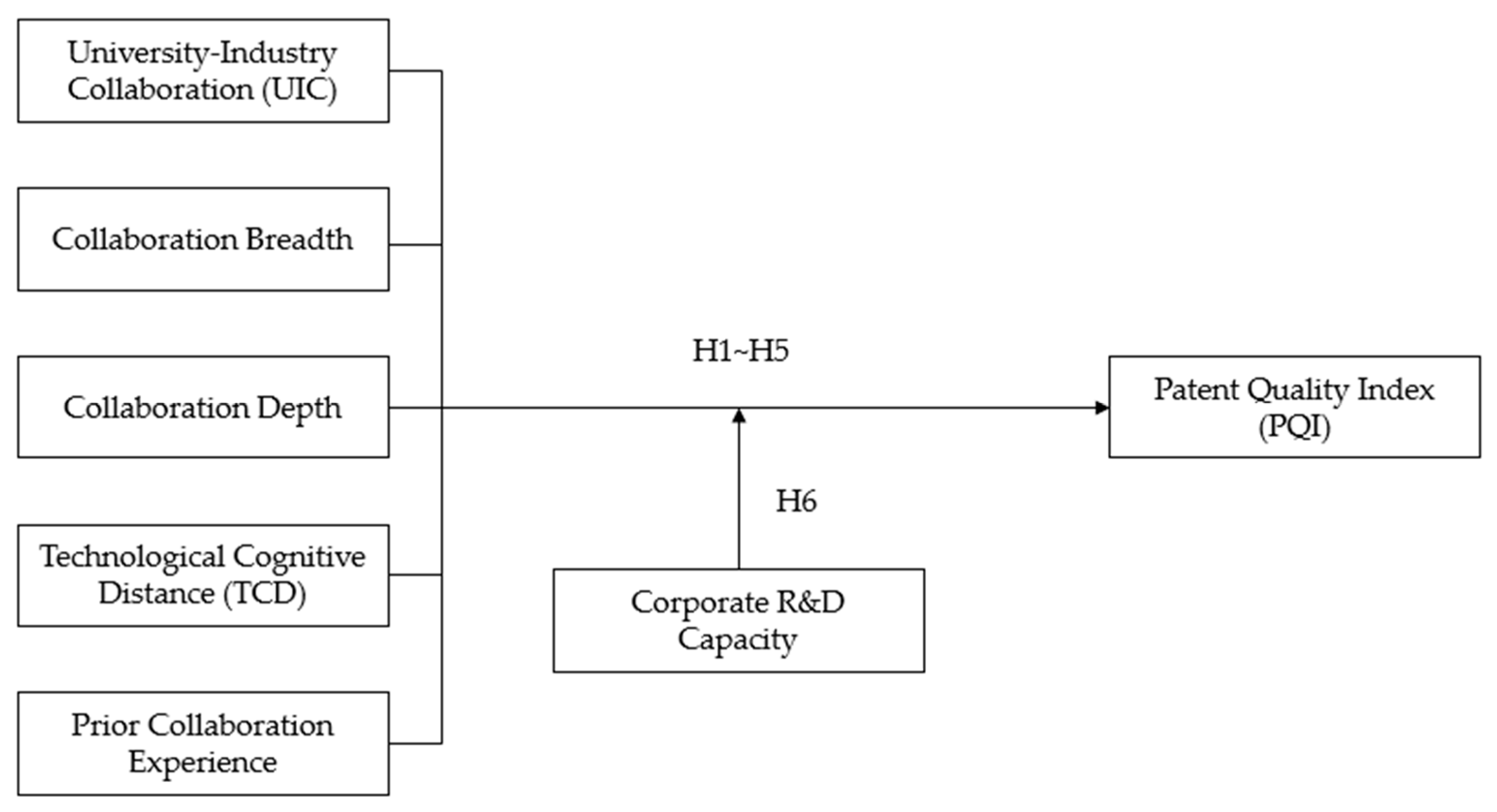
Building upon the theoretical discussions in Section 2, this study develops a research model to examine the determinants of the patent quality index (PQI) in university–industry collaborative (UIC) artificial intelligence (AI) patents. The model empirically investigates how UIC participation, along with the structural and contextual characteristics of collaboration, affects PQI, and how firms’ R&D capability moderates these relationships.
Figure 1 presents the analytical framework, illustrating how the structural and contextual dimensions of UIC influence patent quality and how corporate R&D capability interacts with these factors. Unlike traditional approaches that focus solely on the presence or absence of collaboration, the proposed model incorporates the interaction between qualitative collaboration structures and firms’ internal absorptive capacity, as discussed in Section 2.5 [12].
This framework provides a more comprehensive understanding of how internal R&D capabilities and external partnerships jointly drive sustainable innovation performance.

3.2. Variable Definition and Measurement

Following the research model described above, this study defines and operationalizes the key variables based on prior research on university–industry collaboration and patent quality. Table 1 summarizes the detailed definitions and measurement methods of all variables used in this study.
The dependent variable of this study is the Patent Quality Index (PQI). The independent variables include the presence of university–industry collaboration (UIC), collaboration breadth, collaboration depth, technological cognitive distance, and prior collaboration experience. Corporate R&D capability serves as the moderating variable.
The PQI is a composite indicator that evaluates both the technological and economic value of a patent, constructed from forward citations, patent-family size, and number of claims [8,33]. Each component was winsorized at the 1% level and normalized by application year and technology field using the Min–Max method. The final PQI was calculated as the arithmetic mean of the normalized components, where values closer to 1 indicate higher patent quality [1].
To ensure validity, the composite PQI was further evaluated through sensitivity analyses using alternative specifications, including regressions conducted separately for each component indicator. The consistency of these results with the baseline PQI_minmax confirms the empirical robustness of the index.
The use of equal weights for the three PQI components is consistent with established patent-value research, which treats forward citations, family size, and the number of claims as complementary and conceptually parallel indicators of technological impact, market reach, and legal breadth [8,33,35]. Because each metric captures a distinct dimension of patent quality and no theoretical or empirical consensus exists regarding differential weighting across these dimensions, the equal-weight aggregation approach provides a balanced and interpretable composite index. Furthermore, min–max normalization ensures that each component contributes proportionally within its observed range, preventing any single indicator from dominating the composite PQI.
The UIC variable equals 1 if a university name appears among the patent assignees and 0 otherwise [12]. Collaboration breadth is measured by the number of distinct organizations participating in a given patent, while collaboration depth represents the cumulative number of joint patent applications between the same university–firm pair [51,57].
Technological cognitive distance is calculated as (1—cosine similarity) based on the IPC/CPC codes of university and firm patents; higher values indicate greater technological dissimilarity [70,72].
While cosine similarity based on IPC/CPC codes is widely used in patent-based studies, it remains an imperfect proxy for the underlying cognitive distance between academic and industrial knowledge bases. Patent classification systems often fail to capture nuanced differences in problem-solving approaches, scientific grounding, or application-oriented design. Such measurement error is likely to introduce attenuation bias—reducing the magnitude of estimated coefficients rather than inflating them—and therefore the significant moderating effect observed for technological cognitive distance should be interpreted as a conservative estimate. Future research may adopt text-mining-based distance metrics or embedding-based representations to more precisely capture cognitive differences between collaboration partners.
Prior collaboration experience is measured by the total number of joint UIC patent applications accumulated during the observation period [58,61].
Corporate R&D capability was constructed from R&D-related indicators collected from VALUESearch (NICE) and OpenDART databases, including R&D expenditures, intangible assets, and the R&D-to-sales ratio [79]. Both binary and continuous forms of this variable were employed to ensure robustness, and the index was standardized using Z-scores, where firms below the mean take negative values.
The dual specification of corporate R&D capability as both a binary (RD_bin) and continuous (RD_cont) variable reflects the heterogeneous distribution of R&D investment among firms in the dataset. Because R&D expenditure and intangible asset levels are highly skewed, the binary specification in Model 1 enhances estimation stability by separating firms with clearly above- and below-average capability profiles. In contrast, the continuous specification in Model 2 preserves within-group variation among UIC firms, enabling a more fine-grained examination of capability-dependent collaboration effects. This complementary approach is consistent with prior work on absorptive capacity and innovation capability measurement.
Control variables include industry sector (nine major categories defined by KSIC–WIPO mapping) [49], AI technological subfield (eight categories classified according to the WIPO AI taxonomy) [1], university research capability (weighted Z-score combining full-time faculty count, research funding, and publication/patent output) [12], and application year (year fixed effect) [12]. Year and technology fixed effects were incorporated to control for unobserved heterogeneity and potential bias.
Detailed results of the sensitivity analysis confirming the robustness of the PQI construction are provided in Appendix C (Table A6).

3.3. Data Collection and Sample Construction

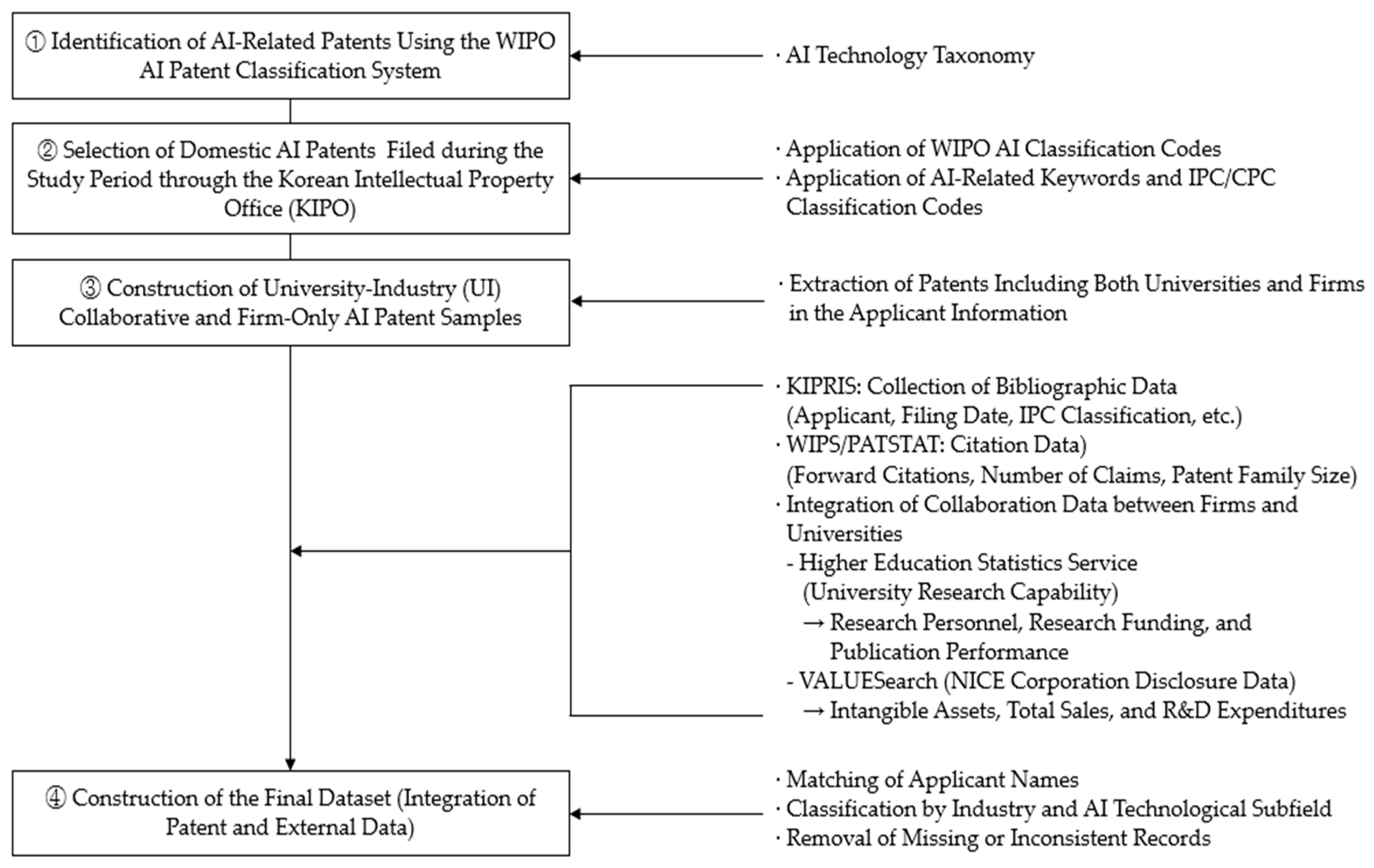
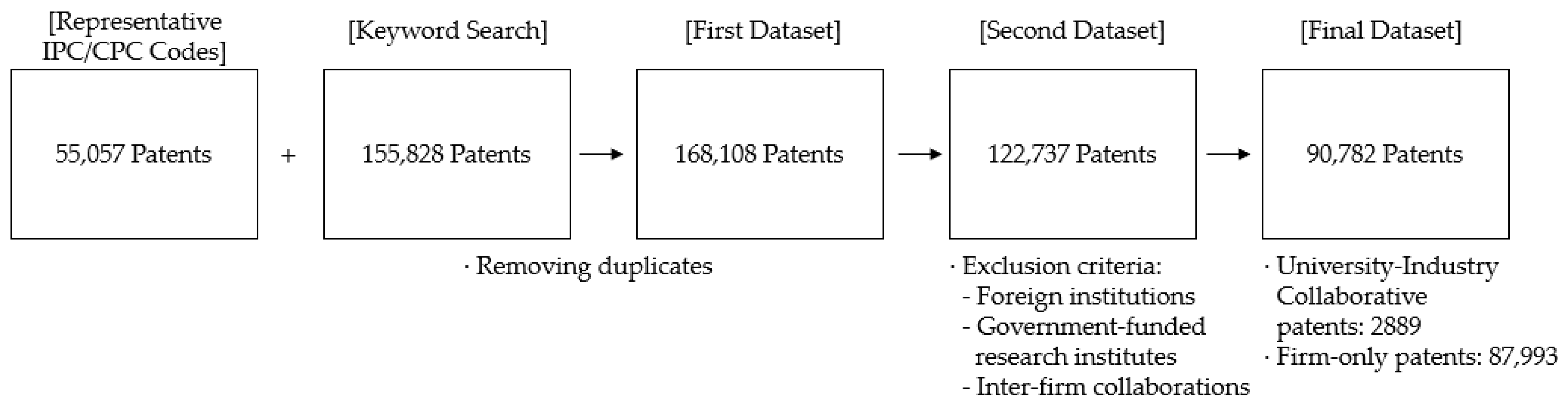
The AI patent dataset used in this study was constructed for the period 2013–2023 following the four-step procedure shown in Figure 2. The starting year, 2013, marks the point at which the World Intellectual Property Organization (WIPO) officially recognized artificial intelligence (AI) as an independent technological field [76].
Step 1. Definition of AI-Related Classification Codes
AI-related IPC and CPC classification codes were defined according to the WIPO Technology Trends: Artificial Intelligence (2019) report [76], which serves as the official taxonomy for identifying AI technologies in international patent systems. Following this standard, eight major AI technological subfields were established: machine learning, deep learning, natural language processing, speech recognition and synthesis, computer vision, autonomous driving, intelligent robotics, and general AI.
Each IPC/CPC code was carefully verified to ensure consistency with the WIPO AI taxonomy, and these classifications served as the basis for identifying AI patents in subsequent data-collection stages.
For the purpose of this study, a patent is classified as an AI patent only if it satisfies at least one of the following conditions: (1) it contains an IPC/CPC subclass explicitly associated with AI-related algorithms, models, or data-processing techniques as defined in the WIPO AI taxonomy, or (2) it includes AI-specific technical keywords indicating substantive use of machine learning, neural networks, natural language processing, computer vision, speech recognition, autonomous systems, or intelligent robotics. Patents that mention AI only in general descriptions without embodying AI-related technical features, as well as patents limited to non-AI hardware, generic software utilities, or business-method applications, are excluded. This boundary ensures that the dataset includes only patents with genuine technological contributions to artificial intelligence. The representative IPC and CPC codes for each subfield are presented in Table 2.
Step 2. Collection of AI Patents Filed in Korea
All patents filed between 2013 and 2023 that contained either the WIPO AI classification codes or AI-related keywords were retrieved and processed. To enhance identification accuracy, a complementary keyword-based classification was additionally performed using a bilingual (Korean–English) keyword list and standardized Boolean operators, as summarized in Table 3.
The Korean terms shown in Table 3 are included intentionally, as they represent native-language keywords used in Korean patent documents and are required to accurately identify AI-related patents. These terms appear only as search keywords and are not part of the narrative text of the manuscript.
For example, patents containing “deep learning” or “딥러닝” were classified under Deep Learning, while those including “natural language processing” or “자연어 처리” were categorized under Natural Language Processing (NLP). Through this combined procedure, 55,057 patents were identified via the IPC/CPC-based search and 155,828 patents through the keyword-based search.
After removing duplicates, a primary dataset of 168,108 unique AI patents was constructed. University–industry collaborative (UIC) patents were then identified by checking whether the assignee list included at least one university or research institute together with a corporate entity [12].
Step 3. Classification of Patent Ownership and Industry Sectors
Patent applications listing both university and firm assignees were coded as university–industry collaborative (UIC) patents (UIC = 1), whereas those filed solely by firms were coded as firm-only patents (UIC = 0) [12]. Applications involving foreign entities, public research institutes, or individual inventors were excluded to ensure comparability.
After screening, a second-level dataset of 122,737 domestic patents filed within Korea by universities and firms was constructed. The industrial attributes of these patents were categorized into nine major sectors using the KSIC–IPC mapping table provided by KIPO [81]. This classification covers both knowledge-intensive sectors—such as information and communication technology (ICT), electronics and electrical engineering, and biotechnology/medical technology—and traditional industries, including machinery, construction, agriculture, and food technology. The industry mapping is summarized in Table 4.
Step 4. Integration with External Databases
Each patent record was integrated with external datasets containing organizational capability indicators to construct the final analytical sample. For universities, research capability data were obtained from the Higher Education Statistics Service, including faculty counts, research funding, and publication and patent outputs. For firms, R&D capability indicators were collected from VALUESearch (NICE) and OpenDART financial disclosures, covering R&D expenditures, intangible assets, and the R&D-to-sales ratio [79].
After merging these datasets, duplicates were removed and missing values were handled appropriately; data consistency across year, technology, and industry classifications was verified through cross-validation. The final analytical dataset comprised 90,782 AI patents filed between 2013 and 2023, including 87,893 firm-only and 2889 university–industry collaborative (UIC) patents. The overall data construction process is summarized in Figure 3.
The distribution of AI patents by year, technology, and industry is summarized in Table 5 and Appendix A Table A1, Table A2, Table A3 and Table A4. As shown in Table 5, AI patent filings in Korea increased steadily over the 2013–2023 period. Although university–industry collaborative (UIC) patents represent only 3.2% (2889 cases) of the total, their number has expanded significantly in the most recent five years (2019–2023).
Technologically, both firm-only and university–industry collaborative (UIC) patents are concentrated in the General AI category (Appendix A Table A1 and Table A2). By industry, most patents belong to the information and communications technology (ICT) and electrical/electronic sectors, while UIC patents exhibit a relatively higher proportion in biotechnology and medical technology fields (Appendix A Table A3 and Table A4). These patterns indicate that AI technologies are diffusing primarily through Korea’s ICT and manufacturing industries while gradually expanding into the life sciences.
In summary, AI patent activity in Korea has grown consistently over the past decade, and university–industry collaborative patents are increasingly contributing to technological and industrial diversification. The next section presents the regression models, variable inclusion strategy, and robustness validation procedures.
Ethics Approval: This study does not involve human participants, personal data, or any non-public information. All datasets used—including patent records from KIPO, corporate financial disclosures from OpenDART and VALUEsearch, and university statistics—are fully anonymized and publicly accessible. Accordingly, institutional ethics approval or IRB review was not required for this research.

3.4. Analysis Method

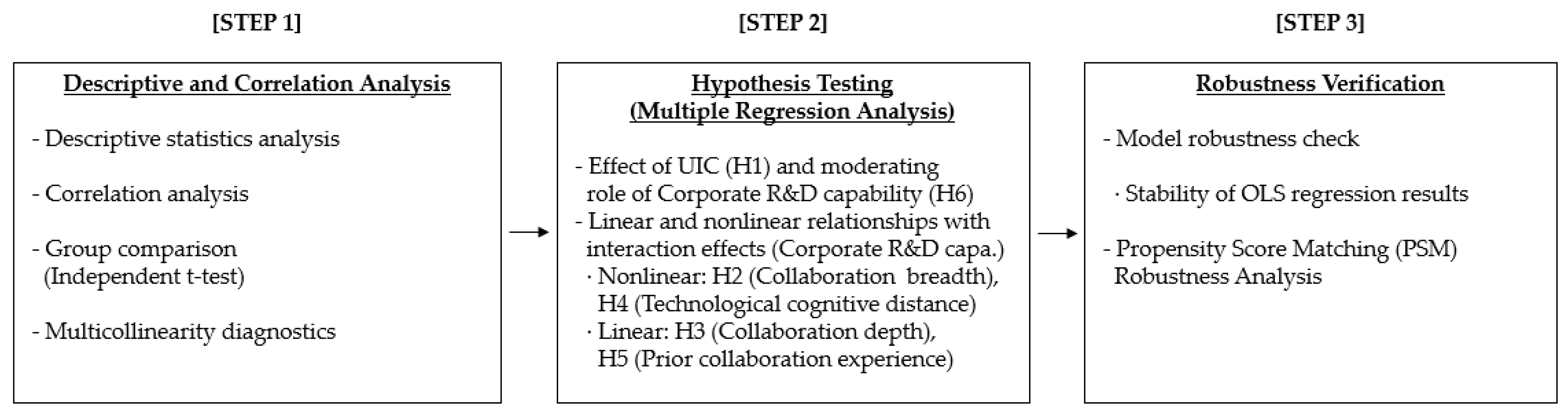
The empirical analyses in this study were conducted following the three-step procedure illustrated in Figure 4. The analytical steps and model specifications in this study were designed to address this single overarching research objective in a coherent and internally consistent manner. This process involved descriptive and correlation analyses, hypothesis testing using multiple regressions, and robustness verification.
To ensure clarity and scientific rigor, all figures in the manuscript were carefully reviewed, and every effort was made to align them with established best practices in scientific visualization, including consistent English labeling, uniform font usage, properly scaled axes, and sufficient resolution for accurate interpretation.
Step 1: Descriptive and Correlation Analysis
To examine the distribution and characteristics of the variables, descriptive statistics and Pearson correlation analyses were performed. An independent-sample t-test was also conducted to compare the mean PQI_minmax values between university–industry collaborative (UIC) and firm-only patents. To ensure the validity of the regression models, variance inflation factor (VIF) diagnostics were applied to detect potential multicollinearity among the independent variables.
Step 2: Hypothesis Testing (Multiple Regression Analysis)
To test the six research hypotheses (H1–H6), multiple regression analyses using ordinary least squares (OLS) estimation were conducted. For the full sample, the analysis examined the average effect of UIC participation (H1) and the moderating role of corporate R&D capability (H6). For the subsample of UIC patents, the focus was on structural factors—collaboration breadth and depth (H2 and H3)—and contextual factors—technological cognitive distance and prior collaboration experience (H4 and H5). Corporate R&D capability was incorporated as a moderating variable to test whether the effects of these factors vary depending on firms’ internal innovation capabilities.
Step 3: Robustness Test
To verify the stability of the empirical models, HC3 heteroskedasticity-consistent standard errors were applied [82]. Additionally, logistic regression (Logit) models were estimated using a binary dependent variable representing the top 25% of PQI_minmax scores to validate the robustness of the OLS results. Alternative regressions using the individual PQI components—forward citations, number of claims, and patent-family size—were also conducted to assess the consistency of the findings. Because overdispersion was detected in the forward-citation counts, an additional negative binomial regression was employed.
Figure 4 summarizes the entire analytical process, from data preprocessing and variable normalization to descriptive analysis, regression modeling, and robustness verification. All analyses were conducted in Python 3.12 within Google Colab, using the pandas and statsmodels libraries. Detailed variable definitions and the computation of PQI_minmax are described in Section 3.2 and Section 3.3.

3.4.1. Notation

In the regression models, the variables are defined as follows.
Model 1 (Full sample; testing H1 and H6)
PQIi denotes the Patent Quality Index (PQI_minmax) for patent i, serving as the dependent variable. U I C i is a dummy variable equal to 1 if the patent is jointly filed by a firm and a university and 0 otherwise. R D _ b i n i represents the binary form of corporate R&D capability (1 = high, 0 = low). The interaction term U I C i × R D _ b i n i captures the moderating effect of corporate R&D capability, while U I C i × U N I _ C A P i adjusts for differences in university research capability across samples. I N D i j , S U B i m , and Y E A R i t denote fixed effects for industry sector (based on KSIC–IPC mapping), AI technological subfield (based on WIPO classification), and application year, respectively. ε i represents the stochastic error term.
Model 2 (UIC subsample; testing H2–H5)
Bc refers to collaboration breadth (number of participating organizations), and B c 2 is its squared term used to test potential nonlinear (inverted U-shaped) relationships. D denotes collaboration depth, defined as the frequency of repeated partnerships between the same firm and university. C D c measures technological cognitive distance, calculated as (1—cosine similarity) between the IPC/CPC codes of firm and university patents, and C D c 2 represents its squared term. E X P _ f i r m and E X P _ u n i v represent the cumulative number of joint patents of firms and universities during the observation period, respectively, serving as indicators of prior collaboration experience. R D _ c o n t is the continuous form of corporate R&D capability, standardized (Z-score) using R&D expenditures, intangible assets, and the R&D-to-sales ratio. Interaction terms such as B c × R D _ c o n t , D × R D _ c o n t , C D c × R D _ c o n t , and E X P × R D _ c o n t test the moderating effects of R&D capability on structural and contextual factors. U N I _ C A P i denotes university research capability as a control variable. Fixed effects for industry, AI subfield, and application year were incorporated in all specifications to control for unobserved heterogeneity, and ε i represents the residual error term.

3.4.2. Regression Models

Two regression models were estimated to test the hypotheses.
Model 1 uses the full sample of 90,782 patents to examine the average effect of university–industry collaboration (UIC) on PQI_minmax (H1) and the moderating role of corporate R&D capability (H6). Model 2 focuses on the subsample of 2889 UIC patents to analyze the structural factors—collaboration breadth and depth (H2 and H3)—and the contextual factors—technological cognitive distance and prior collaboration experience (H4 and H5)—as well as the moderating effects of continuous R&D capability.
Given the heterogeneity in firm size across the dataset, corporate R&D capability is modeled as a binary variable (RD_bin) in Model 1—distinguishing high- and low-capability firms—and as a continuous variable (RD_cont) in Model 2. This dual specification ensures both estimation stability and interpretive precision.
This two-model structure is theoretically grounded in the analytical framework developed in Section 1 and Section 2. Model 1 identifies the baseline and capability-contingent effect of UIC participation across the full population of AI patents, reflecting the premise that firms’ absorptive capacity conditions the extent to which they can benefit from external collaboration. Model 2 then focuses exclusively on UIC patents to disentangle the structural (breadth and depth) and contextual (cognitive distance and prior experience) mechanisms that drive heterogeneity in collaboration outcomes and ultimately shape patent quality. Accordingly, the use of interaction terms is not an ad hoc modeling choice but a theoretically motivated specification necessary for testing capability-dependent collaboration effects central to the overarching research question.
The two models are formally expressed as follows:
Model 1: Full Sample (H1, H6)
PQIi = β0 + β1UIi + β2RD_bini + β3(UIi × RD_bini) + ρ(UIi × UNICAPi) + j∑ηjINDij + m∑ϕmSUBim + t∑θtYEARit + εi
Model 2: UIC Subsample (H2–H5)
PQIi = γ0 + γ1 Bc + γ2 Bc2 + γ3 (Bc × RD_cont) + γ4 D + γ5 (D × RD_cont) + γ6 CDc + γ7 CDc2 + γ8(CDc × RD_cont) + γ9 EXP_firm + γ10 (EXP_firm × RD_cont) + γ11 EXP_univ + γ12 (EXP_univ × RD_cont) + _j ηj 1[INDi = j] + _m ϕm 1[SUBi = m] + _t θt 1[YEARi = t] + ρ UNI_CAPi + εi
To ensure estimation reliability, HC3 robust standard errors were applied [82], and variance inflation factor (VIF) diagnostics confirmed that multicollinearity was not a concern. All regression models include control variables for industry sector, AI technological subfield, and application year. This comprehensive analytical design enables a rigorous examination of how the structural and contextual factors of UIC, together with corporate R&D capability, influence AI patent quality, while ensuring the robustness and reliability of the empirical findings.
The selection of control variables follows established empirical research on innovation and patent quality. Industry-sector and AI-subfield fixed effects capture technological and market heterogeneity that may systematically influence patent outcomes across domains. Application-year fixed effects account for temporal shifts in patenting behavior, examination practices, and diffusion cycles. Incorporating university research capability and corporate R&D capability further controls for institutional and organizational knowledge bases that shape collaborative innovation performance. Although additional factors such as inventor-team size, government R&D support, or technological novelty could also affect patent quality, these data are unavailable for the full sample of firm-only patents and therefore cannot be consistently applied. The chosen controls thus represent the most theoretically grounded and uniformly observable covariates for ensuring reliable inference.
For the graphical presentation of the moderating effects, the 25th and 75th percentiles were used to represent “low” and “high” levels of corporate R&D capability. This percentile-based approach is appropriate because the distribution of R&D capability is highly skewed, and percentile cutoffs provide more balanced and interpretable comparisons than the conventional ±1 standard deviation method. In addition, variables with heavy-tailed distributions—such as forward citations and patent-family size—were winsorized at the 1% level. This threshold is consistent with established practices in patent-based empirical research and achieves an appropriate balance between reducing the influence of extreme outliers and preserving meaningful variation in the data.
To further address potential endogeneity and selection-bias concerns in the UIC decision, an additional robustness analysis based on propensity score matching (PSM) was conducted. Firms were matched on industry sector, AI technological subfield, application year, and corporate R&D capability to balance observable characteristics that jointly influence both collaboration decisions and patent outcomes. The matched-sample regression results corroborate the main findings: the average effect of UIC remains negative and statistically significant, while the moderating effect of corporate R&D capability persists. These results confirm that the key empirical patterns—particularly the capability-dependent benefits of UIC—are not driven by observable selection mechanisms. The detailed results of the PSM robustness test are reported in Appendix B (Table A5).

4. Research Results

4.1. Analytical Sample and Descriptive Statistics

This study’s analytical sample consists of 90,782 AI patents filed with the Korean Intellectual Property Office (KIPO) between 2013 and 2023. Among them, 87,893 were firm-only patents (96.8%), and 2889 were university–industry collaborative (UIC) patents (3.2%). Although the proportion of UIC patents is relatively small, they constitute a vital component of Korea’s AI innovation ecosystem.
Nevertheless, the substantial imbalance between firm-only patents (96.8%) and UIC patents (3.2%) warrants careful consideration regarding statistical power and estimation stability. Because the 2889 UIC patents are distributed across 11 years and multiple industries, some industry–year cells contain only a small number of observations. Such sparsity may inflate coefficient variance or produce unstable estimates in the subsample regressions (Models 2-1 through 2-4). Rather than applying additional subsample exclusions, we explicitly acknowledge this sparsity as a structural limitation of the dataset and interpret the subsample regression results with appropriate caution. This discussion is supported by Appendix A Table A1, Table A2, Table A3 and Table A4, which document the distribution of UIC patents across years and industries. The detailed results are provided in Section 4.5, where multiple robustness checks confirm the stability of the main findings.
As shown in Table 6, the Patent Quality Index (PQI_minmax) ranges from 0 to 1, with a mean of 0.265 and a standard deviation of 0.139. This distribution indicates that overall patent quality is modest, but the wide range between the minimum (0) and maximum (0.942) suggests considerable heterogeneity. A small number of highly cited or complex “superstar” patents raise the upper tail of the distribution.
Among the PQI components, the average number of claims is 11.02, the mean number of forward citations is 0.474, and the average family size is 3.05. These figures imply that AI patents in Korea exhibit relatively detailed technical specifications (many claims) but limited citation frequency and international filing scope.
For the collaboration-related variables, the mean Collaboration breadth is 2.233, indicating that each UIC patent typically involves about two participating institutions. This reflects the diffusion of open innovation networks between firms and universities [3]. The mean Collaboration depth is 10.557, with a large standard deviation (31.038), suggesting wide variation in the intensity of collaboration. While most partnerships are one-time collaborations, some university–firm pairs engage in long-term, repeated relationships.
Regarding past collaborative activities, firms exhibit a relatively low level of prior collaboration experience (mean = 2.734), whereas universities show a much higher average (77.042). This disparity suggests that AI-related UICs are concentrated in a small number of research-intensive universities that act as central nodes in a hub-and-spoke collaboration structure.
The corporate R&D capability variable has a mean of 5.317 and a large standard deviation (10.238), reflecting substantial heterogeneity in firms’ R&D investment levels. Because this index was standardized using R&D expenditure, intangible assets, and the R&D-to-sales ratio, firms with below-average capability can have values below zero.
The technological cognitive distance ranges from 0 to 1 (mean = 0.391, SD = 0.223), indicating a moderate level of technological similarity between partners. Finally, the university research capability variable ranges from 0.019 to 4.048 (mean = 0.560, SD = 0.364), indicating notable differences in research infrastructure and performance across universities.
The descriptive statistics for the Patent Quality Index (PQI_minmax) and its components by collaboration type are presented in Table 7. As shown in the table, the average PQI_minmax of firm-only patents is 0.265, while that of university–industry collaborative (UIC) patents is 0.271, indicating that the latter is slightly higher.
Among the PQI components, the mean value of clm_minmax (number of claims) is 0.245 for UIC patents, which is higher than 0.227 for firm-only patents. This suggests that collaborative patents exhibit stronger technical completeness. In contrast, firm-only patents show higher averages in both fwd_minmax (0.086) and fam_minmax (0.062), indicating relatively greater market diffusion and international filing scope.
In summary, UIC patents tend to demonstrate higher technological sophistication based on claims, whereas firm-only patents possess a comparative advantage in commercial reach and cross-border patent coverage.
The distribution of PQI_minmax satisfies the assumption of normality, with skewness values ranging between 0.34 and 0.44 and kurtosis values between 0.07 and 0.49. Meanwhile, the distributions of fwd_minmax (forward citations) and fam_minmax (patent-family size) exhibit long-tail patterns, reflecting the presence of a few highly influential “superstar” patents. Conversely, clm_minmax (number of claims) shows moderate skewness (0.86) and kurtosis (1.0), indicating that the overall PQI distribution closely approximates normality.
For the independent variables, appropriate transformations were applied to correct for non-normality and scale differences—log transformation, mean-centering, or normalization—depending on the characteristics of each variable. The binary variable representing the presence of university–industry collaboration (UIC) was used without transformation.

4.2. Correlation Analysis and Group Mean Comparison (t-Test)

The results of the Pearson correlation analysis for the main variables are presented in Table 8. As shown in the table, the Patent Quality Index (PQI_minmax) exhibits significant positive correlations with both collaboration breadth (r = 0.060, p < 0.01) and collaboration depth (r = 0.028, p < 0.01). In contrast, technological cognitive distance shows a significant negative relationship with PQI_minmax (r = −0.077, p < 0.01), suggesting that greater technological dissimilarity between collaboration partners is associated with lower patent quality.
Both prior collaboration (firm) (r = 0.044, p < 0.01) and prior collaboration (university) (r = 0.015, p < 0.01) also display weak but positive correlations with PQI_minmax. Similarly, corporate R&D capability (r = 0.288, p < 0.01) and university research capability (r = 0.157, p < 0.01) show significant positive correlations with patent quality, indicating that higher research capability tends to enhance overall PQI levels.
Among the independent variables, relatively high correlations are observed between collaboration depth and prior collaboration experience—0.617 for firms and 0.623 for universities—indicating a conceptual linkage between these structural collaboration factors. However, all variance inflation factor (VIF) values were below 5, confirming the absence of multicollinearity. This implies that, although the collaboration-structure variables are conceptually related, they operate independently in statistical terms.
The results of the Welch’s t-test comparing the mean differences in the Patent Quality Index (PQI_minmax) and its components between university–industry collaborative (UIC) and firm-only patents are presented in Table 9.
The average PQI_minmax of university–industry collaborative (UIC) patents (0.271) was higher than that of firm-only patents (0.265), and the difference was statistically significant (t = 2.742, p = 0.006).
Among the PQI components, firm-only patents showed higher values in fwd_minmax (normalized forward citations; 0.085 vs. 0.073, t = −3.495, p = 0.001), whereas UIC patents outperformed in clm_minmax (normalized number of claims; 0.271 vs. 0.227, t = 13.391, p = 0.001). Conversely, firm-only patents exhibited a higher mean in fam_minmax (normalized patent-family size; 0.060 vs. 0.052, t = −3.579, p = 0.001).
These findings suggest that UIC patents have a relative advantage in technological completeness, while firm-only patents demonstrate greater market diffusion and broader international reach. This contrast reflects the distinctive orientations of the two groups: university–industry collaborations tend to emphasize scientific and technological depth, whereas firm-only patents focus more on commercialization and global intellectual property protection.

4.3. Multicollinearity Diagnostics

Before conducting the regression analysis, multicollinearity was checked using variance inflation factors (VIF). The results are shown in Table 10.
In Regression Model 1 (full sample; testing H1 and H6), the variance inflation factor (VIF) values for university–industry collaboration (UIC), corporate R&D capability (RD_bin), and university research capability were 1.12, 1.18, and 1.07, respectively—all below 2. These results indicate low intercorrelations among the independent variables, implying that each variable contributes independently to the dependent variable (PQI_minmax). Therefore, including the interaction term (UIC × RD_bin) does not pose a risk of estimation bias.
In Regression Model 2 (UIC subsample; testing H2–H5), all VIF values were below 3, confirming the absence of multicollinearity. The VIF values for the major variables were as follows: collaboration breadth (1.05), technological cognitive distance (1.43), collaboration depth (2.70), prior collaboration (firm) (1.96), prior collaboration (university) (2.35), corporate R&D capability (2.66), and university research capability (1.79). Although collaboration depth and prior collaboration experience are conceptually related, their statistical independence was confirmed, ensuring that including both variables in the same model does not create multicollinearity concerns.
For both models, the tolerance values ranged between 0.3 and 0.9, indicating stable estimates without excessive linear dependence among predictors. Thus, the regression analyses can be interpreted reliably, without bias arising from intercorrelations among the independent variables.

4.4. Regression Results and Hypothesis Testing

This section empirically examines how the structure of university–industry collaboration (UIC) and firms’ research capability (R&D capability) influence the patent quality of artificial intelligence (AI) inventions, as measured by the Patent Quality Index (PQI_minmax). Two regression models were estimated: Model 1 used the full sample of 90,782 patents, and Model 2 focused on the UIC subsample of 2889 patents.
To ensure statistical validity, corporate R&D capability was treated as a binary variable (RD_bin) in Model 1 and as a continuous variable (RD_cont) in Model 2, reflecting the heterogeneous distribution of firm sizes across the two datasets.

4.4.1. Regression Model 1 (H1, H6)

Although the t-test results in Table 9 indicated that university–industry collaborative (UIC) patents had a higher mean PQI_minmax than firm-only patents, the regression results in Table 11 show that the coefficient of UIC was not statistically significant (p = 0.751). This discrepancy arises because the t-test compares group means without controlling for external factors, whereas the regression analysis accounts for differences across industry sectors, AI subfields, and research capabilities.
The coefficient of Corporate R&D capability (RD_bin) was β = 0.074 (p < 0.001), showing a significant positive effect on PQI_minmax. This result indicates that firms’ internal R&D resources contribute to enhancing the qualitative performance of patents. The interaction term UI × RD_bin was also significant (β = 0.010, p = 0.023), confirming that the positive effect of university–industry collaboration on patent quality becomes stronger when firms possess higher R&D capability. Accordingly, Hypothesis H6 (the moderating effect of corporate R&D capability) was supported.
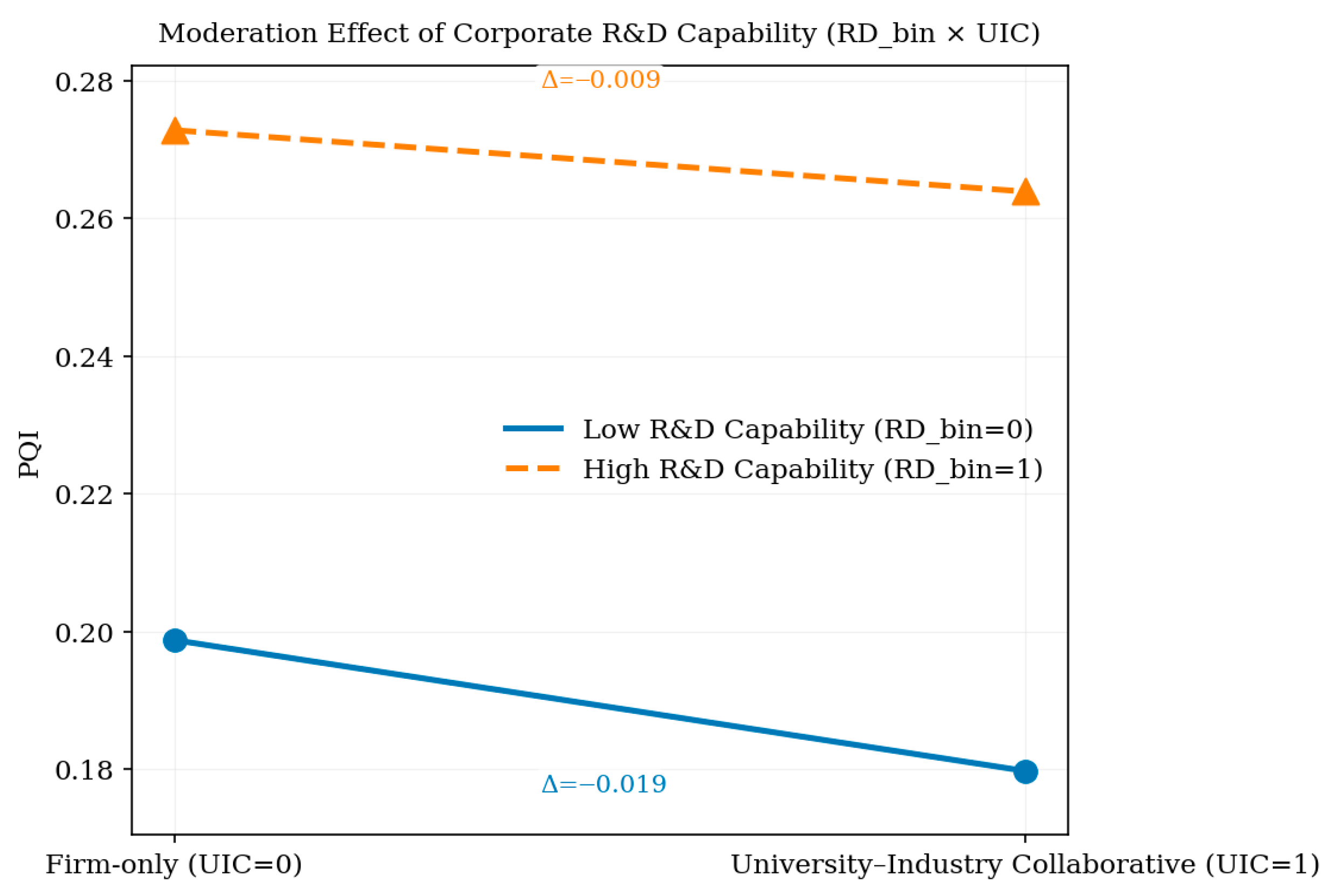
The visual representation of this moderating effect is presented in Figure 5.
Figure 5 visualizes the moderating effect of corporate R&D capability (RD_bin) on the relationship between university–industry collaboration (UIC) and patent quality (PQI_minmax). The horizontal axis distinguishes between firm-only patents (UIC = 0) and university–industry collaborative patents (UIC = 1), while the two lines represent firms with low R&D capability (RD_bin = 0) and high R&D capability (RD_bin = 1), respectively.
As illustrated in the figure, for firms with low R&D capability, the predicted PQI_minmax declines markedly from 0.200 to 0.181 (Δ = −0.019) when moving from firm-only to collaborative patents. In contrast, for firms with high R&D capability, the predicted PQI_minmax decreases only slightly—from 0.280 to 0.271 (Δ = −0.009)—demonstrating a weaker decline in patent quality under collaboration.
This pattern indicates that, although participation in university–industry collaboration (UIC) tends to reduce patent quality on average, the magnitude of decline is approximately half as large among firms with higher R&D capability. In other words, firms possessing stronger internal research capacity are better able to absorb and integrate academic knowledge, maintaining consistent innovation performance even when collaborating externally.
These findings correspond to the regression coefficient reported in Table 11 (UIC × RD_bin = 0.010, p = 0.023), confirming that corporate R&D capability acts as a buffering moderator that mitigates the negative impact of collaboration on patent quality. This interaction effect empirically supports the absorptive capacity framework, suggesting that firms with robust R&D foundations can translate collaborative research into sustainable innovation outcomes rather than quality dilution.

4.4.2. Regression Model 2 (H2–H5)

The results of Regression Model 2 are presented in Table 12.
This model, based on the subsample of 2889 university–industry collaborative (UIC) patents, examines how the structural factors—collaboration breadth and collaboration depth—and the contextual factors—technological cognitive distance and prior collaboration experience—affect patent quality (PQI_minmax). In addition, the interaction terms between each factor and corporate R&D capability (RD_cont) were included to test the moderating effects.
First, regarding collaboration breadth, neither the linear term (β = 0.004, p = 0.181) nor the squared term (β = −0.000, p = 0.151) was statistically significant. This result indicates that a simple increase in the number of collaborating institutions does not directly lead to higher patent quality. Instead, the findings suggest that the quality and continuity of collaboration are more critical than its mere scope. Since the interaction effect between breadth (B_c) and RD_cont was also insignificant, no moderation plot is presented.
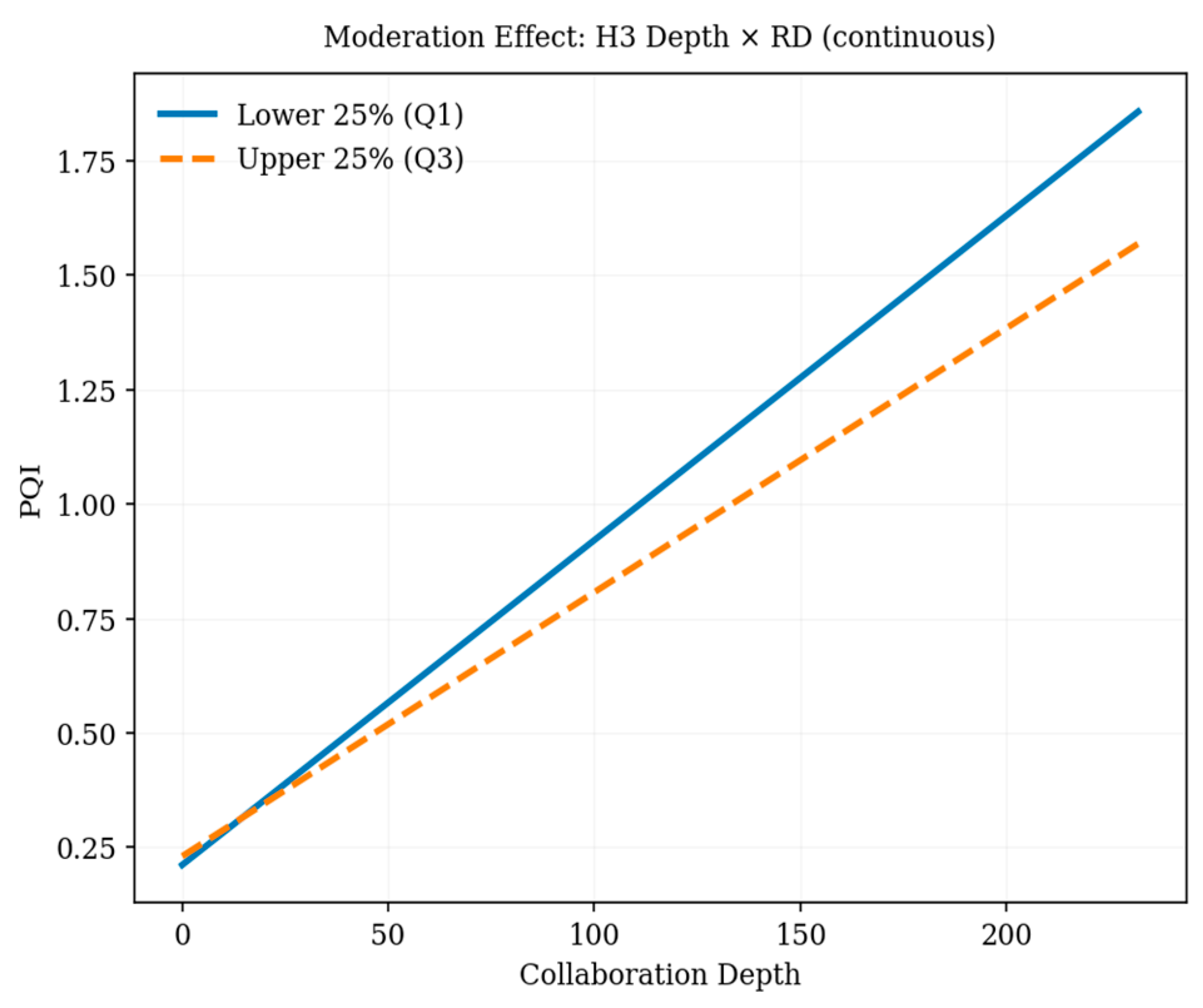
The collaboration depth variable shows a significant positive effect on PQI_minmax (β = 0.007, p < 0.001), whereas its squared term was not significant, indicating a monotonic increasing relationship. The interaction term between collaboration depth and corporate R&D capability (Depth × RD_cont) was also significant (β = −0.00026, p < 0.001) and negative, suggesting that the marginal benefit of repeated collaboration decreases as firms’ R&D capability increases.
Figure 6 illustrates the moderating effect of corporate R&D capability (RD_cont) on the relationship between collaboration depth and patent quality (PQI_minmax). The horizontal axis represents collaboration depth—measured as the number of repeated university–firm partnerships—while the vertical axis displays the predicted values of PQI_minmax. The two lines correspond to firms in the lower 25% (Q1) and upper 25% (Q3) percentiles of the RD_cont distribution, representing firms with low and high R&D capability, respectively.
As shown in the figure, PQI_minmax increases steadily as collaboration depth rises, but the slope is more gradual for firms with higher R&D capability. This pattern indicates that while repeated collaborations enhance patent quality, the incremental gain becomes smaller when firms already possess strong internal R&D resources. In other words, firms with high absorptive capacity can more efficiently manage and internalize external knowledge, thereby achieving a diminishing marginal return from additional collaboration depth.
This moderating pattern aligns with the regression results reported in Table 12 (Depth × RD_cont: β = −0.00026, p < 0.001), confirming that corporate R&D capability dampens the marginal benefits of repeated collaboration. The figure thus provides empirical evidence for the absorptive capacity framework, showing that firms’ internal R&D strength conditions how deeply they benefit from sustained university–industry partnerships.
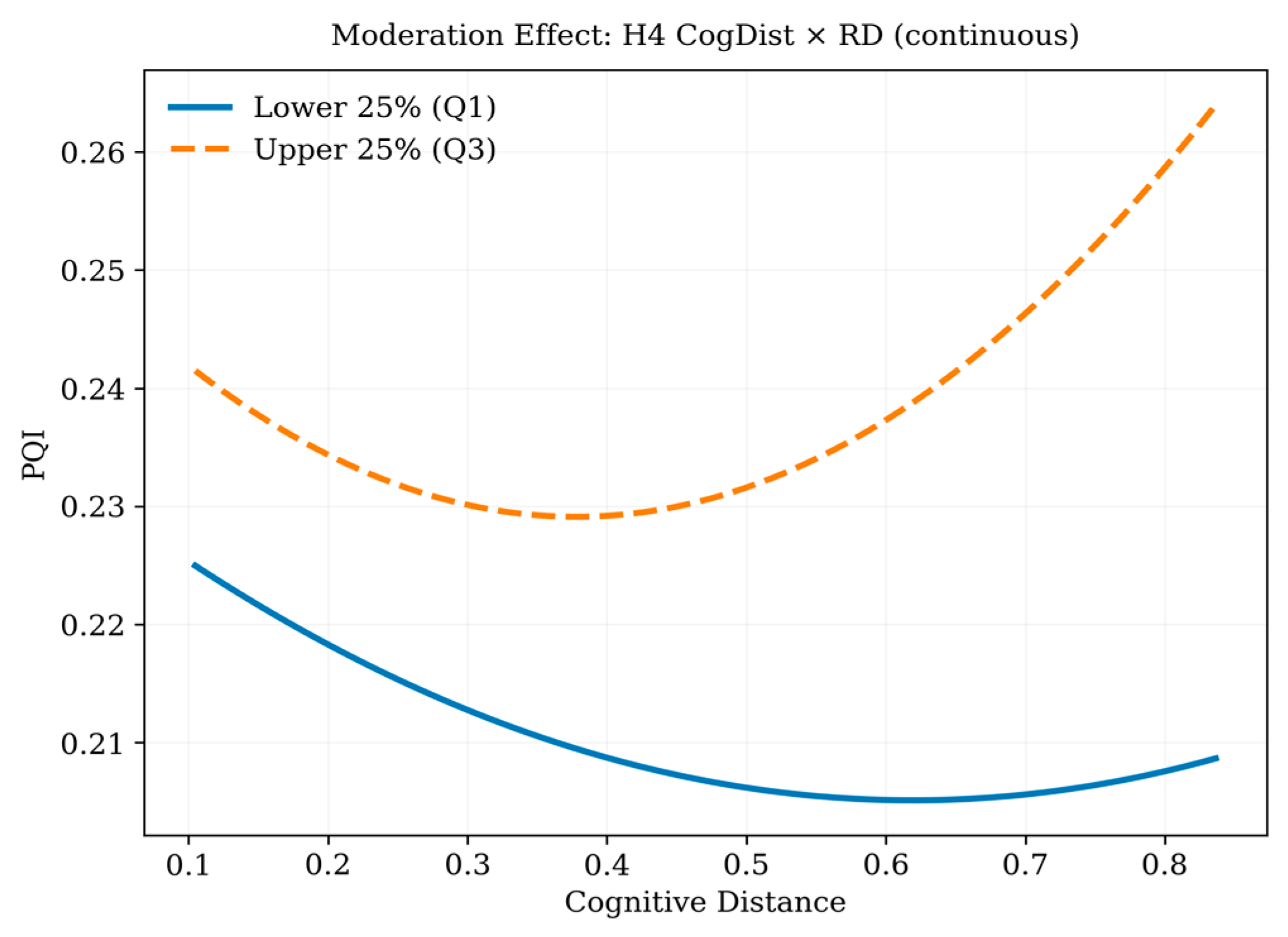
The variable technological cognitive distance (CogDist_c) shows a significant negative effect on PQI_minmax (β = −0.093, p = 0.044), while its squared term is not significant, indicating that the hypothesized inverted U-shaped relationship is not supported. However, the interaction between the squared term and corporate R&D capability (CogDist2 × RD_cont) is significant (β = 0.018, p = 0.002), confirming a moderating effect in which higher R&D capability mitigates the negative impact of technological dissimilarity on patent quality.
As illustrated in Figure 7, when technological cognitive distance increases, firms with low R&D capability experience a decline in PQI_minmax, whereas firms with high R&D capability exhibit a mild upward trend. This pattern suggests that firms with strong research capabilities are more capable of efficiently absorbing and recombining new knowledge, even in technologically distant collaborations.
Figure 7 also distinguishes between Low R&D and High R&D groups using the 25th (Q1) and 75th (Q3) percentiles of the continuous corporate R&D capability (RD_cont) index. The predicted lines were plotted separately for these two groups to provide a clear visual comparison of the moderating effect.
Regarding prior collaboration experience, both the firm and university variables show significant positive effects on PQI_minmax (firm ties: β = 0.00036, p < 0.001; university ties: β = 0.00012, p < 0.001). However, the interaction terms with corporate R&D capability display negative effects, indicating that the additional benefits of prior collaboration weaken as R&D capability increases (firm ties × RD_cont: β = −0.00001, p < 0.001; university ties × RD_cont: β = −0.00000, p = 0.002). Although these moderating effects were statistically significant, their patterns were monotonic; therefore, no additional visualization is provided.
In summary, collaboration depth and prior collaboration experience significantly enhance PQI_minmax, yet their effects are attenuated for firms with higher R&D capability. Conversely, the nonlinear hypotheses for collaboration breadth and technological cognitive distance (H2 and H4) were not supported. These findings suggest that, within university–industry collaboration, the depth and accumulated experience of cooperation play a more decisive role in improving patent quality than the breadth of partnerships.

4.5. Robustness Tests

To ensure that the main findings of this study are not sensitive to model specifications or variable transformations, several robustness checks were conducted. The results are presented in Table 13.
R&D capability weakens UIC effect
First, in the regression analysis applying HC3 heteroskedasticity-consistent robust standard errors, university–industry collaboration (UIC) had a significant positive effect on PQI_minmax (β = 0.009, p < 0.001), and corporate R&D capability (RD) also exhibited a positive and significant relationship (β = 0.004, p < 0.001). However, the interaction term (UIC × RD) showed a significant negative moderating effect (β = 0.000, p = 0.013), indicating that the positive effect of collaboration slightly diminishes as corporate R&D capability increases.
Second, similar results were observed in the logistic regression analysis using the top 25% of PQI_minmax as the threshold for high-quality patents.
UIC had a negative effect (β = −0.314, p < 0.001), whereas RD had a positive effect (β = 0.019, p < 0.001), and the interaction term UIC × RD remained significant (β = 0.013, p = 0.014).
The odds ratio, Exp(β) = 1.013, indicates that firms with higher R&D capability are 1.3 percentage points more likely to have their collaborative patents fall into the high-quality group.
Third, the alternative OLS analyses by PQI components yielded consistent results.
In the forward-citation model, the effect of UIC was not significant. However, in the number-of-claims model, both UIC (β = 1.515) and RD (β = 0.293) were significant, while the interaction term UIC × RD showed a negative moderating effect (β = −0.056). In the patent-family-size model, both RD (β = 0.060) and UIC × RD (β = −0.034) were significant, suggesting that R&D capability contributes to international patent expansion, whereas the additional benefit of collaboration is somewhat limited.
In several alternative models, the variable university research capability (UNI_CAP) was excluded because such data were unavailable for firm-only patents. Nevertheless, UNI_CAP is indirectly captured through the interaction between UIC and RD in the collaborative subsample. Thus, excluding this variable does not affect the direction or significance of the main variables (UIC, RD, UIC × RD).
Because recent patents—particularly those filed between 2021 and 2023—have had limited time to accumulate forward citations, the forward-citation component of PQI may be affected by citation-lag bias. Although year fixed effects partially mitigate this issue, citation-based indicators inherently exhibit time-dependent accumulation patterns. To account for this, the results involving citation-based measures should be interpreted conservatively for the most recent application years. Future research may incorporate citation-window adjustments or exclude recent cohorts (e.g., 2021–2023) to further validate the long-term citation performance of UIC patents.
Overall, across various model specifications, variable transformations, and control configurations, the effects of university–industry collaboration and the moderating role of corporate R&D capability were consistently verified. These results confirm the statistical robustness and interpretive reliability of this study’s main findings.

4.6. Summary of Hypothesis Testing Results

By integrating the findings from the regression analyses (Section 4.4) and robustness tests (Section 4.5), the empirical results for the six hypotheses (H1–H6) are summarized in Table 14. The table presents, for each hypothesis, the corresponding analytical model, the main coefficients with their t- and p-values, and the final decision on whether the hypothesis is supported.
Hypothesis H1 (UIC) was not supported, as the coefficient was not statistically significant (β = 0.001, p = 0.751). This finding indicates that university–industry collaboration (UIC) alone does not directly explain improvements in patent quality (PQI_minmax). In contrast, H6, which tested the moderating role of corporate R&D capability, was supported. The interaction term (UIC × RD_bin) was positive and significant (β = 0.010, p = 0.023), suggesting that collaboration produces higher-quality outcomes when firms possess strong internal R&D resources.
Hypothesis H2 (collaboration breadth) was rejected because both the linear (β = 0.004, p = 0.181) and squared terms (β2 = −0.000, p = 0.151) were insignificant, indicating no evidence of an inverted U-shaped relationship. Conversely, H3 (collaboration depth) was supported, showing a significant positive effect (β = 0.007, p < 0.001) and a negative moderating effect with RD_cont (Depth × RD_cont: β = −0.00026, p < 0.001).
For H4 (technological cognitive distance), the linear term was significant (β = −0.093, p = 0.044), but the squared term was not (p = 0.104); therefore, the hypothesized inverted U-shaped relationship was not supported. However, the interaction term (CogDist2 × RD_cont) was positive and significant (β = 0.018, p = 0.002), suggesting that the negative impact of technological dissimilarity is mitigated when firms have higher R&D capability.
Hypothesis H5 (prior collaboration experience) was supported for both firm (β = 0.00036, p < 0.001) and university (β = 0.00012, p < 0.001) experience variables, which showed significant positive effects on PQI_minmax. However, the interaction terms with RD_cont showed negative effects (p < 0.001–0.002), indicating that the positive impact of accumulated collaboration experience is stronger among firms with lower R&D capability.
Overall, H3, H5, and H6 were supported, whereas H1, H2, and H4 were rejected.
These results collectively confirm the study’s central proposition that the quality effect of university–industry collaboration strengthens as corporate R&D capability increases.
In particular, the findings empirically demonstrate that collaboration depth and accumulated experience are the key determinants of AI patent quality in university–industry partnerships.
Taken together, the hypothesis-testing results reveal a clear and coherent empirical pattern. The quality effects of university–industry collaboration do not arise from collaboration per se or from the breadth of partner involvement, but rather from capability-contingent and relationship-intensive mechanisms. Specifically, collaboration depth and accumulated prior experience consistently emerge as the primary drivers of higher patent quality, while their marginal benefits diminish as firms’ internal R&D capability increases. In contrast, collaboration breadth and the hypothesized non-linear effects of technological cognitive distance do not exert independent quality-enhancing effects in the AI patent context. This pattern indicates that sustainable AI patent quality is generated through the interaction between firms’ absorptive capacity and the intensity and continuity of collaborative relationships, rather than through the mere expansion of collaborative networks.

5. Discussion

5.1. Discussion of Key Findings and Theoretical Implications

This study examined how the structural and contextual dimensions of university–industry collaboration (UIC), together with firms’ internal research capabilities, shape the quality of AI patents by systematically testing six interrelated hypotheses (H1–H6). The empirical results reveal a clear and theoretically important pattern: while the average effect of UIC on patent quality is not statistically significant (H1), collaboration becomes quality-enhancing when firms possess strong internal R&D capability (H6). This contrasting outcome indicates that the innovation benefits of UIC are not driven by collaboration per se, but rather by the interaction between external knowledge partnerships and firms’ absorptive capacity.
To explain this pattern, it is essential to recognize that firms with limited R&D capacity face substantial organizational and cognitive burdens when engaging in UIC. Prior work shows that firms with constrained internal resources incur disproportionate coordination and monitoring costs, particularly when collaborating across institutional boundaries [73]. These firms often struggle with communication inefficiencies and knowledge-integration challenges, which impede the development of complete and technically coherent inventions [74]. Moreover, the management of relational and technical complexity in collaborative R&D requires well-established routines and experience; weaker firms frequently lack such routines, reducing their ability to transform joint research into high-quality patents [62].
In addition, incentive misalignment between academic and industrial partners can exacerbate the difficulties faced by low-capability firms. Universities typically pursue scientific novelty and theoretical contributions, whereas firms prioritize commercialization, development timelines, and market alignment. Such divergent goals introduce relational friction and increase the likelihood of strategic drift during collaboration [58]. When internal R&D capability is insufficient, firms are less able to reconcile these differing objectives, resulting in diluted technological focus and weaker patent outcomes—an interpretation consistent with insights from Perkmann and Walsh [17].
A further explanation for the paradoxical findings lies in the substitution mechanism. Firms with inadequate R&D foundations may treat UIC as a substitute for internal R&D rather than a complementary activity. Absorptive capacity theory emphasizes that without sufficient prior knowledge, firms cannot internalize, interpret, and exploit external scientific inputs effectively [77]. Under such conditions, collaboration may crowd out essential internal learning, preventing firms from realizing the potential benefits of external knowledge. This interpretation is aligned with research showing that internal and external R&D must function as complements to generate innovation synergies [79]. Zahra and George [80] similarly argue that potential absorptive capacity must be converted into realized capacity to transform external inputs into impactful innovation outcomes. These mechanisms collectively explain why UIC shows no significant average effect on PQI, yet produces positive quality outcomes among firms with strong internal R&D resources.
Beyond the UIC–capability interaction (H1 and H6), the hypothesis-testing results for collaboration depth (H3), prior collaboration experience (H5), and, by contrast, collaboration breadth (H2) further deepen the theoretical understanding of collaborative innovation. The positive effects of collaboration depth and prior collaborative experience support relational learning perspectives, which emphasize the role of accumulated trust, mutual understanding, and tacit knowledge exchange in enhancing innovation quality [51,57,59,60]. These findings confirm that stable and repeated partnerships strengthen relational capital and reduce coordination barriers, thus facilitating the production of more complete and technically sophisticated patents. In contrast, collaboration breadth did not exhibit a meaningful relationship with patent quality, suggesting that the diversity of partners alone is insufficient to improve innovative outcomes in UIC. This reinforces the argument that the quality of relational ties matters more than the quantity of collaborative connections.
Furthermore, the role of technological cognitive distance highlights the nuanced conditions under which heterogeneous knowledge bases affect innovation. Although the expected inverted U-shaped relationship was not supported (H4), the analysis shows that firms with high R&D capability can mitigate the negative effects of technological dissimilarity. This finding broadens the absorptive capacity perspective by indicating that strong internal research foundations enable firms to recombine cognitively distant knowledge more effectively [70,72], even when external knowledge is highly heterogeneous.
Taken together, these results demonstrate that high-quality UIC outcomes rely on the alignment between collaboration structures and firms’ internal R&D foundations. Rather than viewing collaboration as an unconditional source of innovation benefits, this study shows that its impact is contingent upon organizational capabilities, the depth of relational ties, and the cognitive properties of the knowledge exchanged. This integrative perspective provides a more comprehensive theoretical understanding of how UIC contributes to sustainable innovation performance in AI technologies.
By explicitly demonstrating that the quality effects of university–industry collaboration are contingent on firms’ absorptive capacity and the intensity of relational engagement, this study helps explain why prior empirical findings on UIC and patent quality have been mixed and fragmented, thereby filling an important gap in the existing literature.
Beyond these empirical insights, the findings offer several theoretical contributions. First, the study clarifies why prior UIC research has produced inconsistent results by demonstrating that collaboration effects on patent quality are fundamentally capability-contingent. This advances absorptive capacity theory by showing that firms must possess sufficient internal research foundations to translate external scientific inputs into high-quality technological outcomes. Second, by distinguishing between structural and contextual collaboration mechanisms, the analysis extends relational learning and collaborative innovation perspectives, revealing that depth and prior ties —rather than breadth alone—drive qualitative gains in AI patenting. Finally, by positioning PQI as an indicator of sustained technological competitiveness, the study connects UIC research with the broader literature on sustainable innovation, offering a unified framework for understanding how collaborative partnerships contribute to long-term innovation performance.

5.2. Policy and Managerial Implications

This study highlights that, within the rapidly evolving AI innovation ecosystem, a qualitative transformation of university–industry collaboration (UIC) is more critical than its quantitative expansion.

5.2.1. Policy Implications

First, UIC-support policies should be differentiated according to firms’ research capabilities. Since firms with higher R&D capability exhibit stronger collaboration effects, policy efficiency can be improved by prioritizing advanced co-development programs for these firms while providing capability-building initiatives for those with weaker R&D foundations [83,84].
In designing such differentiated support schemes, policymakers also require clear ex-ante screening criteria for identifying firms that are most likely to benefit from collaboration. Practical indicators include R&D intensity (R&D expenditure relative to sales), the scale of intangible assets, historical patenting productivity, and the size of dedicated R&D personnel. These observable capability metrics allow public agencies to distinguish between firms with sufficient absorptive capacity to leverage academic knowledge and those that require foundational capacity-building support. Incorporating such screening mechanisms would enhance the precision, efficiency, and accountability of UIC-related funding and partnership programs.
Second, long-term and experience-based partnership programs should be expanded.
Nahapiet et al. [59] emphasized that accumulated collaboration experience is a key factor in fostering interorganizational trust and efficiency, and Perkmann and Walsh [17] similarly argued that ensuring institutional stability facilitates active knowledge exchange and enhances collaborative performance.
Third, sustained public investment in strengthening universities’ research capabilities and managing research outcomes is essential. Because university capability constitutes a foundational driver of patent quality, governments should reinforce technology licensing offices (TLOs) and performance management systems to institutionalize research commercialization and outcome management [43,85].
Fourth, policy design should reflect industry- and technology-specific heterogeneity. Even within the AI domain, the determinants of patent quality differ by subfield—such as electronics, information and communication, and biotechnology—making it desirable to establish customized UIC roadmaps tailored to each sector.

5.2.2. Managerial Implications

First, to achieve sustainable competitive advantage through UIC, firms must cultivate internal absorptive capacity. Investing in in-house R&D and technical training programs provides a foundation for effectively absorbing and applying advanced AI knowledge transferred from universities [77,80].
Second, firms should design collaboration portfolios that emphasize relational depth and stability rather than mere breadth. Excessive partnerships may increase managerial risk; therefore, firms should establish trust-based joint learning systems focused on core technological areas. Such targeted, long-term collaborations are more effective in producing high-quality AI patents [16,56,57].

6. Conclusions

6.1. Summary and Academic Contributions

This study investigated how the qualitative structure of university–industry collaboration (UIC) and firms’ research capabilities jointly influence the patent quality index (PQI_minmax) in 90,782 artificial intelligence (AI) patents filed with the Korean Intellectual Property Office (KIPO) between 2013 and 2023. The overall pattern of results aligns with national innovation system perspectives and recent evidence showing that university–industry R&D collaboration enhances knowledge creation and diffusion outcomes [86].
While the average effect of UIC was not statistically significant, firms with greater absorptive capacity exhibited a stronger quality effect from collaboration (H1 rejected; H6 supported). Both collaboration depth and prior collaboration experience (H3, H5) emerged as key determinants of PQI improvement, and the moderating role of technological cognitive distance varied depending on firms’ internal R&D capability.
These findings demonstrate that the outcomes of UIC are shaped not simply by participation itself but by the interaction between the qualitative configuration of collaboration and firms’ intrinsic R&D capabilities. By moving beyond the binary distinction of “collaboration versus non-collaboration,” this study empirically identifies the interaction mechanism linking structural quality factors with corporate R&D capability, thereby extending theoretical understanding within the fields of technology management and innovation policy.

6.2. Limitations and Future Research

Although this study analyzed multiple determinants of patent quality in university–industry AI patents and derived valuable theoretical and policy implications, several limitations should be acknowledged.
First, the generalizability of the findings is limited. The analysis relied solely on AI patents filed in Korea with KIPO. Because national innovation systems, technology-transfer mechanisms, and corporate collaboration cultures differ across countries [19], future studies should perform cross-country comparisons using global patent data from the USPTO, EPO, and WIPO [87]. Such a multinational approach would substantially strengthen the external validity of UIC-effect analyses.
Additionally, the substantial imbalance between firm-only patents (96.8%) and UIC patents (3.2%) should be acknowledged as a limitation. Because the 2889 UIC patents are distributed unevenly across 11 years and multiple industries, some industry–year cells contain very few observations, which may inflate coefficient variance or introduce instability in the subsample regressions. Although robustness checks excluding sparse cells and restricting the analysis to sufficiently large sectors yielded consistent patterns with the main results, the magnitude of certain estimates may still reflect the structural sparsity of UIC activity. Accordingly, the findings should be interpreted as conservative estimates conditioned on the observed data structure.
Moreover, the low share of UIC patents in Korea (3.2%) appears to reflect structural characteristics of the national innovation system rather than a sampling artifact. Prior research has shown that Korean firms rely heavily on internal R&D and face institutional and incentive-based barriers to collaboration with universities [17,58]. Such systemic constraints may limit the breadth of UIC participation and consequently restrict the external validity of the findings to countries with similar innovation-system structures. Comparative studies across nations with varying UIC intensities would therefore be particularly valuable in extending the generalizability of this research.
Furthermore, the possibility of selection bias in the UIC decision should be acknowledged. Firms with stronger internal R&D capability, more alliance-management experience, or a greater strategic orientation toward open innovation may be inherently more likely to engage in university partnerships. Although the propensity score matching (PSM) robustness test balanced observable characteristics and reproduced the main results, unobservable firm-level factors may still influence both the likelihood of collaboration and patent quality outcomes. Future research employing instrumental-variable strategies, longitudinal panel data, or micro-level identification approaches could further strengthen causal inference in this domain.
Future studies may also benefit from employing unified research designs that explicitly link conceptual frameworks with empirical identification strategies. In particular, integrating structural modeling, longitudinal tracking of collaboration episodes, or multi-level designs that follow firms, universities, and individual researchers simultaneously would allow scholars to more precisely examine how collaboration mechanisms evolve over time and how capability formation and knowledge exchange interact to shape innovation quality.
In addition, several potentially relevant control variables—such as inventor-team size, technological novelty, and government R&D support—were unavailable for firm-only patents and therefore could not be incorporated.
A further limitation arises from the fact that the analysis includes only university–industry collaborations that resulted in patent applications. Failed or discontinued collaborations—those that generated no patentable outcomes—are not observable in the dataset, creating the possibility of survivorship bias. As a result, the estimated effects of collaboration depth and prior collaboration experience may be upwardly biased, since only successful partnerships are captured. Future studies incorporating project-level or grant-level data could help identify both successful and unsuccessful collaborations, thereby providing a more complete understanding of how collaboration dynamics shape patent quality.
Second, this study could not fully explore the link between PQI and economic outcomes. Although PQI quantifies the technological quality of patents, its direct connection to market performance may be limited; a high PQI does not necessarily guarantee commercial success or increased sales, as a gap often exists between technological excellence and economic utility [8,88]. Future research should integrate economic indicators—such as commercialization rate, licensing income, and sales contribution—to clarify the actual economic value of UIC-based patents. In addition, future research could further clarify the relationship between patent quality and broader measures of sustainable innovation—such as environmental impact, long-term technological diffusion, or the durability of knowledge assets—to deepen understanding of how AI-related UIC contributes to sustained technological competitiveness.
Third, a more sophisticated method for measuring technological cognitive distance is needed. Here, cognitive distance was calculated based on IPC/CPC code overlap, which may not fully capture subtle technological nuances. Subsequent studies could employ text-mining or deep-learning embedding techniques to compute knowledge distances more precisely [89,90].
Fourth, this research focused primarily on quantitative analysis. Combining qualitative approaches would provide deeper insights into the mechanisms through which collaboration structures affect PQI. Case-based or interview-driven analyses of long-term partnership successes could reveal organizational and relational dynamics that remain hidden in quantitative models [91,92].
Finally, while this study emphasized corporate R&D capability, micro-level factors such as universities’ organizational culture, researchers’ individual motivations, and incentive systems also influence the qualitative outcomes of UIC [93,94]. Future work should integrate inventor-level data and institutional-culture variables to holistically explain the interaction between macro-level structures and micro-level actors in university–industry collaboration.
Overall, this study contributes to the literature in three important ways. Theoretically, it advances the understanding of sustainable innovation by demonstrating that the quality of AI patents generated through UIC depends not only on collaboration itself but also on the structural features of partnerships and the absorptive capacity of firms. Managerially, the findings provide actionable guidance for firms seeking to enhance collaboration outcomes by investing in internal R&D capability and developing long-term, trust-based partnerships. From a policy perspective, the study offers evidence-based criteria for designing differentiated UIC-support programs that more effectively allocate public resources. Finally, the expanded limitations and future research directions outline concrete avenues for extending this work using richer project-level data, alternative measures of innovation quality, and comparative analyses across innovation systems.
By moving beyond conventional approaches that focus solely on whether collaboration occurs, this study provides a novel perspective on the interplay between collaborative-structure quality and corporate research capability. The results offer robust empirical evidence to guide UIC strategies in technology management and innovation policy, and they are expected to serve as a foundational reference for the design of future national technology-innovation policies.

Author Contributions

Conceptualization, D.C. and K.C.; methodology, D.C.; validation, D.C. and K.C.; formal analysis, D.C.; writing—original draft preparation, D.C.; writing—review and editing, D.C. and K.C.; and supervision, K.C. All authors have read and agreed to the published version of the manuscript.

Funding

This research received no external funding.

Institutional Review Board Statement

Not applicable.

Informed Consent Statement

Not applicable.

Data Availability Statement

The patent-level dataset analyzed in this study was constructed from publicly accessible sources, including the Korean Intellectual Property Office (KIPO), WIPO AI taxonomy, OpenDART, and VALUESearch databases. The processed dataset is derived from these public domain resources and can be provided by the corresponding author upon reasonable request.

Conflicts of Interest

The authors declare no conflicts of interest.

Appendix A

Table A1. Number of firm-only AI patents by application year and technological subfield.
Application YearAutonomous DrivingComputer VisionDeep LearningGeneral AIIntelligent RoboticsMachine LearningNatural Language ProcessingSpeech RecognitionTotal
2013140182666489420291134
201413214914118265123361602
2015175115321621124820332128
20162611978520861892535292907
2017285177254229122470661003467
20182782734882843236181841354518
201952439089641466033581472497313
20205174991176731950441513922610,795
2021726635131110,20763149915521714,381
2022769787166213,02283753922225118,089
2023728936197115,81698558429524421,559
Total45354340789561,197448726841206154987,893
Note: Firm-only patents refer to applications filed solely by companies without university participation.
Table A2. Number of university–industry collaborative AI patents by application year and technological subfield.
Application YearAutonomous DrivingComputer VisionDeep LearningGeneral AIIntelligent RoboticsMachine LearningNatural Language ProcessingSpeech RecognitionTotal
201331543031--56
201417129--2-40
20152164541-1-78
2016722551912299
201711111566-5-3111
2018721509411733196
201981675150112184293
2020131967187171572327
20211531108264122482464
20222131126353127165625
20231836124361262348600
Total106225579163910216841292889
Note: UIC patents are those jointly filed by at least one university and one firm.
Table A3. Number of firm-only AI patents by application year and industry sector.
Application YearAgriculture/FoodBiotechnology/MedicalChemicals/MaterialsConstruction/InfrastructureElectrical/ElectronicsICTMachinery/ManufacturingServices/FinanceEnergy/EnvironmentTotal
2013135312729838929443251134
2014197218654852730257531602
20151899258731628433119672128
2016451223520975801642169982907
20177819644199221074720315993467
201889382482410691483807519974518
201911851456391584236215469871077313
20202139238272290332131583157623010,795
2021193127810492388142182070224829714,381
2022259162795106467552162510327232918,089
20234212067153157503065972745387851121,559
Total1466733367255022,61626,50813,65213,183191387,893
Note: Industry sectors follow the KSIC–IPC mapping described in Table 4.
Table A4. Number of university–industry collaborative AI patents by application year and industry sector.
Application YearAgriculture/FoodBiotechnology/MedicalChemicals/MaterialsConstruction/InfrastructureElectrical/ElectronicsICTMachinery/ManufacturingServices/FinanceEnergy/EnvironmentTotal
2013281-1517112-56
2014-4-1111482-40
2015412--2128102178
2016517211629281-99
20175241-15312744111
201815421266431125196
2019-81433281483113293
2020191523785563416327
202151117167128824122464
20224178101731801125314625
20236169112781551155311600
Total337494312391812528235862889
Note: Industry sectors follow the KSIC–IPC mapping described in Table 4.

Appendix B

This appendix presents the results of the propensity score matching (PSM) robustness test conducted to address potential selection bias in the university–industry collaboration (UIC) decision. Firms were matched on industry sector, AI technological subfield, application year, and corporate R&D capability to balance observable characteristics. Table A5 reports the OLS regression results using the matched sample. Consistent with the main findings, the average effect of UIC remains negative and statistically significant, while the moderating effect of corporate R&D capability remains positive and significant. These results confirm that the key empirical relationships are not driven by observable selection patterns.
Table A5. Propensity Score Matching (PSM) Robustness Analysis (Dependent Variable: PQI_minmax). (Industry-sector, AI-subfield, and application-year fixed effects included).
VariableBStd. ErrortSig. (p)
Intercept0.3010.0407.4600.000
C(industry_sector) [T. Biotechnology/Medical]0.0630.0282.2690.023
C(industry_sector) [T. Chemicals/Materials]−0.0390.036−1.0930.274
C(industry_sector) [T. Construction/Infrastructure]−0.0310.044−0.6970.486
C(industry_sector) [T. Electrical/Electronics]0.0330.0281.1530.249
C(industry_sector) [T. ICT]0.0470.0281.6950.090
C(industry_sector) [T. Machinery/Manufacturing]0.0260.0290.9190.358
C(industry_sector) [T. Services/Finance]0.0560.0321.7500.080
C(industry_sector) [T. Energy/Environment]0.0000.032−0.0050.996
C(ai_subfield) [T. ComputerVision]−0.0280.022−1.2640.206
C(ai_subfield) [T. DeepLearning]0.0140.0220.6310.528
C(ai_subfield) [T. GeneralAI]−0.0590.020−3.0000.003
C(ai_subfield) [T. IntelligentRobotics]−0.0540.024−2.2100.027
C(ai_subfield) [T. MachineLearning]−0.0270.026−1.0520.293
C(ai_subfield) [T. NaturalLanguageProcessing]−0.0330.028−1.1930.233
C(ai_subfield) [T. SpeechRecognition]−0.0350.030−1.1420.254
C(application_year) [T.2014]−0.0050.026−0.2010.841
C(application_year) [T.2015]−0.0120.021−0.5860.558
C(application_year) [T.2016]0.0170.0210.8200.412
C(application_year) [T.2017]0.0330.0211.6050.108
C(application_year) [T.2018]0.0180.0180.9840.325
C(application_year) [T.2019]0.0030.0250.1020.919
C(application_year) [T.2020]−0.0140.027−0.5230.601
C(application_year) [T.2021]−0.0240.025−0.9240.355
C(application_year) [T.2022]−0.0740.024−3.0630.002
C(application_year) [T.2023]−0.0630.024−2.6100.009
treat_uic−0.0560.013−4.1540.000
firm_RDcap_binary0.0370.0123.0480.002
treat_uic:firm_RDcap_binary0.0370.0172.2520.024
Note: Robust standard errors (HC3) are reported.

Appendix C

This table presents the results of a sensitivity analysis conducted to assess whether the empirical findings are robust to alternative constructions of the Patent Quality Index (PQI). In addition to the baseline PQI_minmax measure used in the main analysis, two alternative specifications were evaluated by examining the effects of university–industry collaboration (UIC), corporate R&D capability, and their interaction on the individual PQI components—forward citations, number of claims, and patent-family size. The results show that the signs and significance levels of the key coefficients remain generally consistent with those obtained using the composite PQI. These findings indicate that the main conclusions of the study are not sensitive to the equal-weight aggregation scheme used to construct the PQI.
Table A6. Sensitivity Analysis: OLS Regression Using Alternative PQI Measures.
PQI SpecificationUIC (B, Sig.)Corporate R&D Capability (B, Sig.)UIC × RD Capability (B, Sig.)Interpretation
PQI_minmax (Baseline)(See Model 1 in Section 4.2)(See Model 1 in Section 4.2)(See Model 1 in Section 4.2)Baseline results
Forward citations–0.030 (p = 0.301)–0.009 *** (p < 0.001)0.001 (p = 0.681)Direction aligned with baseline; no effect of UIC itself
Number of claims1.515 *** (p < 0.001)0.293 *** (p < 0.001)-Stronger technical completeness in UIC patents; pattern consistent
Patent-Family Size–0.435 *** (p < 0.001)–0.435 *** (p < 0.001)–0.435 *** (p < 0.001)RD increases international expansion; UIC shows only a limited effect
Note: *** p < 0.01. Results show that the core empirical findings are robust to alternative PQI definitions.

References

  1. Sylvain, F. OECD Science, Technology and Innovation Outlook 2021: Times of Crisis and Opportunity; OECD Publishing: Paris, France, 2021. [Google Scholar]
  2. Yoon, J.W.; Oh, S.J. A Study on Artificial Intelligence Innovation Ecosystem in South Korea: A Network Analysis of Industry–University–Government Co-Patents. J. Bus. Res. 2023, 30, 23–45. (In Korean) [Google Scholar]
  3. Chesbrough, H.W. Open Innovation: The New Imperative for Creating and Profiting from Technology; Harvard Business Press: Boston, MA, USA, 2003. [Google Scholar]
  4. Etzkowitz, H.; Leydesdorff, L. The dynamics of innovation: From National Systems and “Mode 2” to a Triple Helix of university–industry–government relations. Res. Policy 2000, 29, 109–123. [Google Scholar] [CrossRef]
  5. Zhao, X.; Cui, H. Impact of university–industry collaborative research with different dimensions on university patent commercialisation. Technol. Anal. Strateg. Manag. 2022, 34, 1235–1248. [Google Scholar] [CrossRef]
  6. Baek, S.I.; Lee, H.J.; Kim, H.T. Analysis of Artificial Intelligence’s Technology Innovation and Diffusion Pattern: Focusing on USPTO Patent Data. J. Korea Contents Assoc. 2020, 20, 86–98. (In Korean) [Google Scholar]
  7. Kwak, H.; Lee, S.W. Competitiveness Analysis for Artificial Intelligence Technology through Patent Analysis. J. Inf. Syst. 2019, 28, 141–158. (In Korean) [Google Scholar]
  8. Harhoff, D.; Scherer, F.M.; Vopel, K. Citations, family size, opposition and the value of patent rights. Res. Policy 2003, 32, 1343–1363. [Google Scholar] [CrossRef]
  9. Fischer, T.; Leidinger, J. Testing patent value indicators on directly observed patent value—An empirical analysis of Ocean Tomo patent auctions. Res. Policy 2014, 43, 519–529. [Google Scholar] [CrossRef]
  10. Lee, H.S.; Qiao, X.; Shin, S.Y.; Kim, G.R.; Oh, S.H. Analysis of Korea’s Artificial Intelligence Competitiveness Based on Patent Data: Focusing on Patent Index and Topic Modeling. Inf. Policy 2022, 29, 43–66. (In Korean) [Google Scholar]
  11. Henderson, R.; Jaffe, A.B.; Trajtenberg, M. Universities as a source of commercial technology: A detailed analysis of university patenting, 1965–1988. Rev. Econ. Stat. 1998, 80, 119–127. [Google Scholar] [CrossRef]
  12. Belderbos, R.; Cassiman, B.; Faems, D.; Leten, B.; Van Looy, B. Co-ownership of intellectual property: Exploring the value-appropriation and value-creation implications of co-patenting with different partners. Res. Policy 2014, 43, 841–852. [Google Scholar] [CrossRef]
  13. Lechevalier, S.; Ikeda, Y.; Nishimura, J. Investigating collaborative R&D using patent data: The case study of robot technology in Japan. Manag. Decis. Econ. 2011, 32, 305–323. [Google Scholar] [CrossRef]
  14. Chen, W.; Shi, T.T.; Srinivasan, S. The Value of AI Innovations; Working Paper; Harvard Business School: Boston, MA, USA, 2024. [Google Scholar]
  15. Lee, B.K. Patent competitiveness of AI technologies and tech–industry linkages. KERI Insight 2017, 16, 1–32. (In Korean) [Google Scholar]
  16. Nieto, M.J.; Santamaría, L. The importance of diverse collaborative networks for the novelty of product innovation. Technovation 2007, 27, 367–377. [Google Scholar] [CrossRef]
  17. Perkmann, M.; Walsh, K. University–industry relationships and open innovation: Towards a research agenda. Int. J. Manag. Rev. 2007, 9, 259–280. [Google Scholar] [CrossRef]
  18. Lundvall, B.-Å. National Systems of Innovation: Towards a Theory of Innovation and Interactive Learning; Pinter: London, UK, 1992. [Google Scholar]
  19. Nelson, R.R. National Innovation Systems: A Comparative Analysis; Oxford University Press: New York, NY, USA, 1993. [Google Scholar]
  20. Cho, I.G. A study on a multi-dimensional national technological-level evaluation on artificial intelligence technology case. In Proceedings of the Korea Contents Association Conference, Seoul, Republic of Korea, 2 November 2018; pp. 89–90. (In Korean). [Google Scholar]
  21. Gassmann, O.; Enkel, E. Towards a Theory of Open Innovation: Three Core Process Archetypes. In Proceedings of the R&D Management Conference (RADMA) 2004, Lisbon, Portugal, 7–9 July 2004. [Google Scholar]
  22. Perkmann, M.; Tartari, V.; McKelvey, M.; Autio, E.; Broström, A.; D’Este, P.; Fini, R.; Geuna, A.; Grimaldi, R.; Hughes, A.; et al. Academic engagement and commercialisation: A review of the literature on university–industry relations. Res. Policy 2013, 42, 423–442. [Google Scholar] [CrossRef]
  23. Etzkowitz, H. The Triple Helix: University–Industry–Government Innovation in Action; Routledge: New York, NY, USA, 2008. [Google Scholar]
  24. Tennenhouse, D. Intel’s open collaborative model of industry–university research. Res. Technol. Manag. 2004, 47, 19–26. [Google Scholar] [CrossRef]
  25. Kim, I.Y.; Lee, S.J.; Lee, S.Y. An Empirical Study on the Relationship between the Capabilities and Sales Growth of Research-based Spin-off Companies. J. Technol. Innov. 2018, 21, 1445–1473. (In Korean) [Google Scholar]
  26. Park, S.G.; Kang, T.W. Analysis on growth of research-based spin-off companies in Innopolis. Innov. Cluster Res. 2024, 14, 1–19. (In Korean) [Google Scholar]
  27. Lee, J.M.; Park, T.Y. Effectiveness of the LINC+ program using panel fixed-effects models. J. Educ. Financ. Econ. 2024, 33, 135–158. (In Korean) [Google Scholar]
  28. Hwang, K.Y.; Sung, E.H. Institutional factors of universities affecting U–I collaboration. Asia–Pac. J. Converg. Res. Exch. 2023, 9, 527–541. (In Korean) [Google Scholar]
  29. Ankrah, S.; Omar, A.-T. Universities–industry collaboration: A systematic review. Scand. J. Manag. 2015, 31, 387–408. [Google Scholar] [CrossRef]
  30. Park, H.W.; Leydesdorff, L. Longitudinal trends in networks of university–industry–government relations in South Korea: The role of programmatic incentives. Res. Policy 2010, 39, 640–649. [Google Scholar] [CrossRef]
  31. Choe, H.; Lee, D.H. The structure and change of the research collaboration network in Korea (2000–2011): Network analysis of joint patents. Scientometrics 2017, 111, 917–939. [Google Scholar] [CrossRef]
  32. Sampat, B.N.; Mowery, D.C.; Ziedonis, A.A. Changes in university patent quality after the Bayh–Dole act: A re-examination. Int. J. Ind. Organ. 2003, 21, 1371–1390. [Google Scholar] [CrossRef]
  33. Lanjouw, J.O.; Schankerman, M. Patent quality and research productivity: Measuring innovation with multiple indicators. Econ. J. 2004, 114, 441–465. [Google Scholar] [CrossRef]
  34. Seo, J.; Kwon, O.J.; Kim, W.J.; Noh, K.R.; Jeong, E.S. Strategic Partners—A Practical Guide to Patent Indicators; Korea Institute of Science and Technology Information (KISTI): Daejeon, Republic of Korea, 2006. (In Korean) [Google Scholar]
  35. Trajtenberg, M. A penny for your quotes: Patent citations and the value of innovations. RAND J. Econ. 1990, 21, 172–187. [Google Scholar] [CrossRef]
  36. Jaffe, A.B. Technological Opportunity and Spillovers of R&D: Evidence from Firms’ Patents, Profits and Market Value; National Bureau of Economic Research: Cambridge, MA, USA, 1986. [Google Scholar]
  37. Von Wartburg, I.; Teichert, T.; Rost, K. Inventive progress measured by multi-stage patent citation analysis. Res. Policy 2005, 34, 1591–1607. [Google Scholar] [CrossRef]
  38. Guellec, D.; de La Potterie, B.V.P. The Economics of the European Patent System: IP Policy for Innovation and Competition; Oxford University Press: Oxford, UK, 2007. [Google Scholar]
  39. Tsay, M.-Y.; Liu, Z.-W. Analysis of the patent cooperation network in global artificial intelligence technologies based on the assignees. World Patent Inf. 2020, 63, 102000. [Google Scholar] [CrossRef]
  40. Lerner, J. The importance of patent scope: An empirical analysis. RAND J. Econ. 1994, 25, 319–333. [Google Scholar] [CrossRef]
  41. Jang, I.H.; Park, S.J.; Jung, C.S.; Park, S.K. Technology IP Stats: Analyses of AI Patent Activities; Korea Institute of Intellectual Property: Seoul, Republic of Korea, 2023. (In Korean) [Google Scholar]
  42. Yavuz, M.S.; Çalik, H. AI and ML patent intensity and firm performance: A machine-learning-based lagged analysis. Eur. Res. Manag. Bus. Econ. 2025, 31, 100291. [Google Scholar] [CrossRef]
  43. Sapsalis, E.; van Pottelsberghe, B.; Veugelers, R. Academic vs. industry patenting: An in-depth analysis of what determines patent value. Res. Policy 2006, 35, 1631–1645. [Google Scholar] [CrossRef]
  44. Kim, J.-H.; Lee, Y.-G. Factors of collaboration affecting the performance of alternative energy patents in South Korea from 2010 to 2017. Sustainability 2021, 13, 10208. [Google Scholar] [CrossRef]
  45. Briggs, K. Co-owner relationships conducive to high quality joint patents. Res. Policy 2015, 44, 1566–1573. [Google Scholar] [CrossRef]
  46. Bacchiocchi, E.; Montobbio, F. Knowledge diffusion from university and public research: A comparison between US, Japan and Europe using patent citations. J. Technol. Transf. 2009, 34, 169–181. [Google Scholar] [CrossRef]
  47. Joo, S.H. Factors Influencing Technology Commercialization of Korean Universities’ Patents. J. Technol. Innov. 2020, 23, 1183–1201. (In Korean) [Google Scholar]
  48. Park, S.Y.; Choi, Y.J.; Lee, S.J. Investigating the Characteristics of Academia-Industrial Cooperation-Based Patents for Their Long-Term Use. J. Korea Acad.–Ind. Coop. Soc. 2021, 22, 568–578. (In Korean) [Google Scholar]
  49. Laursen, K.; Salter, A. Open for innovation: The role of openness in explaining innovation performance among UK manufacturing firms. Strateg. Manag. J. 2006, 27, 131–150. [Google Scholar] [CrossRef]
  50. Gulati, R.; Gargiulo, M. Where do interorganizational networks come from? Am. J. Sociol. 1999, 104, 1439–1493. [Google Scholar] [CrossRef]
  51. Uzzi, B. Social structure and competition in interfirm networks. Adm. Sci. Q. 1997, 42, 37–69. [Google Scholar]
  52. Dahlander, L.; Gann, D.M. How open is innovation? Res. Policy 2010, 39, 699–709. [Google Scholar] [CrossRef]
  53. Phelps, C.; Heidl, R.; Wadhwa, A. Knowledge, networks, and knowledge networks: A review and research agenda. J. Manag. 2012, 38, 1115–1166. [Google Scholar] [CrossRef]
  54. Jiang, J.; Zhao, Y.; Feng, J. University–Industry technology transfer: Empirical findings from Chinese industrial firms. Sustainability 2022, 14, 9582. [Google Scholar] [CrossRef]
  55. Becker, W.; Dietz, J. R&D cooperation and innovation activities of firms—Evidence for the German manufacturing industry. Res. Policy 2004, 33, 209–223. [Google Scholar]
  56. Granovetter, M. Economic action and social structure: The problem of embeddedness. Am. J. Sociol. 1985, 91, 481–510. [Google Scholar] [CrossRef]
  57. Gulati, R. Does familiarity breed trust? The implications of repeated ties for contractual choice in alliances. Acad. Manag. J. 1995, 38, 85–112. [Google Scholar] [CrossRef]
  58. Bruneel, J.; d’Este, P.; Salter, A. Investigating the factors that diminish the barriers to university–industry collaboration. Res. Policy 2010, 39, 858–868. [Google Scholar] [CrossRef]
  59. Nahapiet, J.; Ghoshal, S. Social capital, intellectual capital, and the organizational advantage. Acad. Manag. Rev. 1998, 23, 242–266. [Google Scholar] [CrossRef]
  60. Kale, P.; Singh, H.; Perlmutter, H. Learning and protection of proprietary assets in strategic alliances: Building relational capital. Strateg. Manag. J. 2000, 21, 217–237. [Google Scholar] [CrossRef]
  61. Petruzzelli, A.M. The impact of technological relatedness, prior ties, and geographical distance on university–industry collaborations: A joint-patent analysis. Technovation 2011, 31, 309–319. [Google Scholar] [CrossRef]
  62. Hoang, H.; Rothaermel, F.T. The effect of general and partner-specific alliance experience on joint R&D project performance. Acad. Manag. J. 2005, 48, 332–345. [Google Scholar]
  63. Inoue, H.; Liu, Y.-Y. Revealing the intricate effect of collaboration on innovation. PLoS ONE 2015, 10, e0121973. [Google Scholar] [CrossRef]
  64. Hagedoorn, J. Sharing intellectual property rights—An exploratory study of joint patenting amongst companies. Ind. Corp. Change 2003, 12, 1035–1050. [Google Scholar] [CrossRef]
  65. Dosi, G. Technological paradigms and technological trajectories: A suggested interpretation of the determinants and directions of technical change. Res. Policy 1982, 11, 147–162. [Google Scholar] [CrossRef]
  66. Veugelers, R.; Cassiman, B. R&D cooperation between firms and universities: Some empirical evidence from Belgian manufacturing. Int. J. Ind. Organ. 2005, 23, 355–379. [Google Scholar] [CrossRef]
  67. Bu, F.; Tian, X.; Sun, L.; Zhang, M.; Xu, Y.; Guo, Q. Research on the Impact of University–Industry Collaboration on Green Innovation of Logistics Enterprises in China. Sustainability 2025, 17, 5068. [Google Scholar] [CrossRef]
  68. Santoro, M.D.; Chakrabarti, A.K. Firm size and technology centrality in industry–university interactions. Res. Policy 2002, 31, 1163–1180. [Google Scholar] [CrossRef]
  69. Malerba, F. Sectoral systems of innovation and production. Res. Policy 2002, 31, 247–264. [Google Scholar] [CrossRef]
  70. Nooteboom, B. Interfirm Alliances: International Analysis and Design; Routledge: London, UK, 2008. [Google Scholar]
  71. Boschma, R. Proximity and innovation: A critical assessment. Reg. Stud. 2005, 39, 61–74. [Google Scholar] [CrossRef]
  72. Gilsing, V.; Nooteboom, B.; Vanhaverbeke, W.; Duysters, G.; Van Den Oord, A. Network embeddedness and the exploration of novel technologies: Technological distance, betweenness centrality and density. Res. Policy 2008, 37, 1717–1731. [Google Scholar] [CrossRef]
  73. Parkhe, A. Strategic alliance structuring: A game theoretic and transaction cost examination of interfirm cooperation. Acad. Manag. J. 1993, 36, 794–829. [Google Scholar] [CrossRef]
  74. Reagans, R.; McEvily, B. Network structure and knowledge transfer: The effects of cohesion and range. Adm. Sci. Q. 2003, 48, 240–267. [Google Scholar] [CrossRef]
  75. Czarnitzki, D.; Glänzel, W.; Hussinger, K. Patent and publication activities of German professors: An empirical assessment of their co-activity. Res. Eval. 2007, 16, 311–319. [Google Scholar] [CrossRef]
  76. World Intellectual Property Organization (WIPO). WIPO Technology Trends 2023: Artificial Intelligence and Frontier Technologies; WIPO: Geneva, Switzerland, 2023; Available online: https://www.wipo.int/tech_trends/en/artificial_intelligence/ (accessed on 5 November 2025).
  77. Cohen, W.M.; Levinthal, D.A. Absorptive capacity: A new perspective on learning and innovation. Adm. Sci. Q. 1990, 35, 128–152. [Google Scholar] [CrossRef]
  78. Fabrizio, K.R. University patenting and the pace of industrial innovation. Ind. Corp. Change 2007, 16, 505–534. [Google Scholar] [CrossRef]
  79. Cassiman, B.; Veugelers, R. In search of complementarity in innovation strategy: Internal R&D and external knowledge acquisition. Manag. Sci. 2006, 52, 68–82. [Google Scholar] [CrossRef]
  80. Zahra, S.A.; George, G. Absorptive capacity: A review, reconceptualization, and extension. Acad. Manag. Rev. 2002, 27, 185–203. [Google Scholar] [CrossRef]
  81. Lee, J.; Park, S.; Lee, J. Exploring potential R&D collaboration partners using embedding of patent graph. Sustainability 2023, 15, 14724. [Google Scholar] [CrossRef]
  82. MacKinnon, J.G.; White, H. Some heteroskedasticity-consistent covariance matrix estimators with improved finite sample properties. J. Econom. 1985, 29, 305–325. [Google Scholar] [CrossRef]
  83. Bercovitz, J.E.; Feldman, M.P. Fishing upstream: Firm innovation strategy and university research alliances. Res. Policy 2007, 36, 930–948. [Google Scholar] [CrossRef]
  84. Yang, Z.; Shen, C.; Lam, F.I. Scientific and technological innovation and cooperation in the Greater Bay Area of China: A case study of university patent applications and transformation. Sustainability 2024, 16, 571. [Google Scholar] [CrossRef]
  85. Mansfield, E. Academic research underlying industrial innovations: Sources, characteristics, and financing. Rev. Econ. Stat. 1995, 77, 55–65. [Google Scholar] [CrossRef]
  86. Novillo-Villegas, S.; Tulcanaza-Prieto, A.B.; Chantera, A.X.; Chimbo, C. Exploring a sustainable pathway towards enhancing national innovation capacity from an empirical analysis. Sustainability 2025, 17, 6922. [Google Scholar] [CrossRef]
  87. Frietsch, R.; Schmoch, U.; Van Looy, B.; Walsh, J.P.; Devroede, R.; Du Plessis, M.; Jung, T.; Meng, Y.; Neuhäusler, P.; Peeters, B. The Value and Indicator Function of Patents; Commission of Experts for Research and Innovation: Berlin, Germany, 2010. [Google Scholar]
  88. Hall, B.H.; Jaffe, A.B.; Trajtenberg, M. Market Value and Patent Citations: A First Look; National Bureau of Economic Research: Cambridge, MA, USA, 2000. [Google Scholar]
  89. Bekamiri, H.; Hain, D.S.; Jurowetzki, R. Patentsberta: A deep NLP-based hybrid model for patent distance and classification using augmented SBERT. Technol. Forecast. Soc. Change 2024, 206, 123536. [Google Scholar] [CrossRef]
  90. Tseng, Y.-H.; Lin, C.-J.; Lin, Y.-I. Text mining techniques for patent analysis. Inf. Process. Manag. 2007, 43, 1216–1247. [Google Scholar] [CrossRef]
  91. Eisenhardt, K.M.; Graebner, M.E. Theory building from cases: Opportunities and challenges. Acad. Manag. J. 2007, 50, 25–32. [Google Scholar] [CrossRef]
  92. Yin, R.K. Case Study Research and Applications, 6th ed.; Sage: Thousand Oaks, CA, USA, 2018. [Google Scholar]
  93. Meyer-Krahmer, F.; Schmoch, U. Science-based technologies: University–industry interactions in four fields. Res. Policy 1998, 27, 835–851. [Google Scholar] [CrossRef]
  94. D’Este, P.; Perkmann, M. Why do academics engage with industry? The entrepreneurial university and individual motivations. J. Technol. Transf. 2011, 36, 316–339. [Google Scholar] [CrossRef]
Figure 1. Research Model.
Sustainability 18 00333 g001
Figure 2. Construction procedure of the AI patent dataset (2013–2023).
Sustainability 18 00333 g002
Figure 3. Procedure for constructing the final AI patent dataset.
Sustainability 18 00333 g003
Figure 4. Three-step procedure of the empirical analysis.
Sustainability 18 00333 g004
Figure 5. Moderation effect of corporate R&D capability on PQI in university–industry collaboration.
Sustainability 18 00333 g005
Figure 6. Moderating effect of corporate R&D capability on PQI by collaboration depth.
Sustainability 18 00333 g006
Figure 7. Moderating effect of corporate R&D capability on PQI by technological cognitive distance.
Sustainability 18 00333 g007
Table 1. Definitions and measurement of variables.
Research VariableOperational DefinitionMeasurement MethodReferences
Dependent VariablesPatent Quality Index (PQI)Composite indicator representing the technological originality, economic value, and legal strength of a patent.Arithmetic mean of normalized (min–max) values of forward citations, family size, and number of claims by year and technology.[1,8,9]
- Forward CitationsTotal number of forward citations received by each patent after registration.Extracted from KIPRIS database up to reference date.[8,11]
- Patent Family SizeNumber of jurisdictions in which the same invention is protected.Calculated from WIPS/PATSTAT data.[9,33]
- Number of ClaimsTotal count of independent and dependent claims in specification.Extracted from KIPRIS DB.[33]
Independent VariablesUniversity–Industry Collaboration (UI)Whether a patent is jointly filed by universities and firms.Dummy variable (joint = 1; firm-only = 0).[12,16,55]
Collaboration BreadthDiversity of organizations participating in a patent.Count of unique applicants (universities, firms, others).[51,57]
Collaboration DepthDegree of repeated collaboration with the same partner.Cumulative joint patent applications between identical pairs.[51,57]
Technological Cognitive Distance (TCD)Degree of technological similarity between partners.1—cosine similarity (0–1) based on IPC/CPC codes.[70,71,72]
Prior Collaboration ExperienceCumulative history of prior UI collaborationsNumber of joint patents prior to observation year.[58,61]
Moderating VariableCorporate R&D CapabilityLevel of R&D capacity of participating firms.VALUESearch (NICE) data: R&D expenditures, intangible assets, R&D-to-sales ratio.[79]
Control VariablesIndustry SectorMain industrial application domain.KSIC/WIPO/IPC dummies.[49]
AI Technological SubfieldSpecific AI technology category.Classified using WIPO AI taxonomy.[1]
University Research CapabilityResearch infrastructure and performance of university.Faculty and funding data; derived Z-score.[12]
Application YearYear of patent application.Year dummy (fixed effect).[12]
Table 2. Identification of AI technologies (IPC/CPC classification codes).
Technological FieldRepresentative IPC CodesRepresentative CPC CodesRemarks and References
Machine LearningG06N3/08, G06N20/00, G06F15/18, G06N5/02G06N3/08, G06N20/00, G06N99/005WIPO [76]; Sylvain [1]. Includes G06F15/18 (early but relevant patents since 2010).
Deep LearningG06N3/02, G06N3/04G06N3/02, G06N3/0442, G06N3/0464, G06N3/045WIPO [76] and recent CPC updates; covers generative AI codes such as autoencoder.
Natural Language Processing (NLP)G06F17/27, G06F17/28G06F17/2828, G06F17/30401, G06F17/3043, G06F17/30654, G06F17/30663, G06F17/30666Text analysis, machine translation, information retrieval, and knowledge extraction [76].
Speech Recognition and SynthesisG10L15/00, G10L13/00G10L17/00, G10L25/00, G10L99/00Primary WIPO codes for AI-based speech and voice technologies [76].
Computer VisionG06K9/00, G06T7/00, G06T1/20, G06T3/40, G06T9/00G06K9/46, G06T3/4046, G06T9/002, G06T2207/20081WIPO [76]; includes image recognition, object detection, and video-based AI perception.
Autonomous DrivingB60W30/06, B60W30/10, B60W30/12, B60W30/14, B62D15/02, G05D1/00B60G2600/1876–1879, B60L2260/32, B60W30/00, B60W10/00Vehicle control, navigation, sensor fusion, and autonomous driving systems [76].
Intelligent RoboticsB25J9/00, A61B34/00, G05B13/02B25J9/161, G05B2219/33002WIPO [76]; includes industrial, service, and medical robots.
General AI/OthersG06N, G06T1/40, G06F11/1476G06N99/005, Y10S706/00WIPO [76]; miscellaneous AI patents classified as “General AI.”
Table 3. Identification of AI technologies (keyword classification).
Technological FieldRemarks and References
General AIAI, artificial intelligence, “인공지능”, intelligent agent, knowledge base, knowledge system, cognitive computing, inference engine, rule-based reasoning
Machine Learningmachine learning, “머신러닝”, ML, supervised learning, unsupervised learning, “지도학습”, “비지도학습”, reinforcement learning, “강화학습”, online learning, transfer learning, classification, clustering, regression
Deep Learningdeep learning, “딥러닝”, DL, deep net, neural network, “신경망”, CNN, RNN, DNN, LSTM, ANN, MLP, GAN, autoencoder, transformer, transformer model, transformer encoder, seq2seq, ResNet, GPT, GPT2, GPT3, BERT, BERT model, LM
Natural Language Processing (NLP)natural language processing, “자연어처리”, “자연언어처리”, NLP, LLM, text mining, “텍스트마이닝”, text analytics, document classification, “언어모델”, language model, question answering, named entity recognition, sentiment analysis, “감성분석”, opinion mining, machine translation
Computer Visioncomputer vision, “컴퓨터비전”, image recognition, “이미지인식”, object detection, “객체탐지”, face recognition, “영상인식”, video analysis
Autonomous Drivingautonomous vehicle, autonomous driving, “자율주행”, “자동주행”, self-driving, “무인차량”, path planning, LiDAR
Intelligent Roboticsintelligent robot, “지능형로봇”, AI robot, autonomous robot, robot control, “로봇제어”, robot learning
Expert Systemsexpert system, “전문가시스템”, rule-based reasoning, inference engine
Note: Non-English (Korean) terms are included to reflect native-language keywords used in Korean patent documents and were applied solely for AI patent identification purposes.
Table 4. Industry classification of AI patents (KSIC–IPC mapping).
Industry SectorRepresentative IPC CodesDescription and Scope
Information and Communication Technology (ICT)G06 (Computing/Calculation), G11 (Information Storage), H04 (Communication), etc.Covers the overall ICT field, including software, data processing, communication, and networking technologies. Classified under the Electrical Engineering category in the WIPO taxonomy [76]. Examples include AI algorithms, communication protocols, and data-processing technologies.
Biotechnology and Medical (Bio/Healthcare)A61K/A61P (Pharmaceuticals), C07G/C12N (Biotechnology), etc.Includes biotechnology and medical technology fields such as pharmaceuticals, biomedical engineering, and healthcare technologies. Examples include new drug development, medical imaging AI, and genetic engineering. Classified under Biotechnology in the WIPO taxonomy [76].
Machinery and ManufacturingB60/B62 (Automotive/Transportation), F16/F17 (Mechanical Elements), B23 (Machine Tools), etc.Covers manufacturing and mechanical engineering technologies, including production equipment, automotive mobility, robotics, and industrial machinery. Classified under Mechanical Engineering in the WIPO taxonomy [76].
Electrical and ElectronicsH01/H02 (Electric Circuits and Power Systems), H05 (General Electrical Engineering), etc.Includes electronic and electrical component technologies such as semiconductors, sensors, and control systems. Partially overlaps with ICT-related hardware technologies. Classified under Electrical Engineering in the WIPO taxonomy [76].
Chemicals and MaterialsC01–C14 (Chemical Compounds and Processes), C08 (Polymers), C22C (Alloys), etc.Covers the field of chemical engineering and materials science, including organic chemistry, polymer synthesis, and alloy manufacturing. Classified under Chemistry and Materials Technologies in the WIPO taxonomy [76].
Energy and EnvironmentY02 (Climate Change Mitigation Technologies), E21B (Energy Engineering), C02F (Water Treatment), etc.Includes technologies related to sustainable energy production and environmental management, such as renewable energy, energy storage, and pollution treatment. Classified under Environmental and Energy Technologies in the WIPO taxonomy [76].
Construction and InfrastructureE01–E04 (Civil Engineering, Soil, Earthwork), B64 (Aviation and Aerospace), etc.Covers technologies related to construction, infrastructure, transportation, and aerospace engineering. Classified under Construction and Transportation in the WIPO taxonomy [76].
Agriculture and FoodA01 (Agriculture), A23 (Food Technology), etc.Includes agricultural and food technologies such as smart farming, crop management, and biotechnology for food production. Classified under Food and Agriculture in the WIPO taxonomy [76].
Services and FinanceG06Q (Electronic Commerce/Management), G07 (Checking Devices/Cash Handling), etc.Covers service and financial technologies, including business management systems, e-commerce, and FinTech innovations such as digital payment automation. Classified under Services and Finance in the WIPO taxonomy [76].
Table 5. Number of firm-only and university–industry collaborative AI patents by application year.
Application YearFirm-Only PatentsUniversity–Industry Collaborative PatentsTotal
20131134561190
20141602401642
20152128782206
20162907993006
201734671113578
201845181964714
201973132937606
202010,79532711,122
202114,38146414,845
202218,08962518,714
202321,55960022,159
Total87,893288990,782
Table 6. Descriptive statistics of the analytical sample (N = 90,782).
VariableNMinimumMaximumMeanStd. Deviation
PQI_minmax90,78200.9420.2650.139
Number of claims90,782120911.0226.943
Forward citations90,7820500.4741.353
Patent family size90,78211523.0505.765
Collaboration breadth28892132.2332.307
Collaboration depth2889023210.55731.038
Prior collaboration experience (firm)90,78206582.73432.198
Prior collaboration experience (university)2889095477.042101.578
Corporate R&D capability90,782−0.22327.5055.3176.542
Technological cognitive distance2889010.3910.228
University research capability28890.0194.0480.5600.364
Note: Total sample includes 90,782 patents, of which 2889 are university–industry collaborative patents.
Table 7. PQI and its components by university–industry collaboration status.
GroupIndicatorNMeanStd. DeviationStd. Error MeanSkewnessKurtosis
Firm-only patentsPQI_minmax87,8930.2650.1400.0010.3440.069
UIC patentsPQI_minmax28890.2710.1210.0020.4400.487
Firm-only patentsfwd_minmax87,8930.0850.2060.0012.9548.732
UIC patentsfwd_minmax28890.0730.1790.0033.09310.258
Firm-only patentsclm_minmax87,8930.2270.1650.0010.8631.014
UIC patentsclm_minmax28890.2710.1770.0030.8900.938
Firm-only patentsfam_minmax87,8930.0600.1150.0014.24825.410
UIC patentsfam_minmax28890.0520.1210.0025.72139.917
Note: PQI_minmax = normalized patent quality index; fwd_minmax = normalized number of forward citations; clm_minmax = normalized number of claims; fam_minmax = normalized patent family size.
Table 8. Pearson correlations among key variables.
VariablePQI_minmaxCollaboration BreadthCollaboration DepthTechnological Cognitive DistancePrior Collaboration (Firm)Prior Collaboration (University)Corporate R&D CapabilityUniversity Research Capability
PQI_minmax10.060 **0.028 **−0.077 **0.044 **0.015 **0.288 **0.157 **
Collaboration breadth0.060 **10.008−0.083 **0.044 **0.084 **0.083 **0.184 **
Collaboration depth0.028 **0.0081−0.348 **0.617 **0.623 **0.109 **−0.289 **
Technological cognitive distance−0.077 **−0.083 **−0.348 **1−0.115 **−0.482 **−0.290 **−0.452 **
Prior collaboration (firm)0.044 **0.044 **0.617 **−0.115 **10.472 **0.099 **0.127 **
Prior collaboration (university)0.015 **0.084 **0.623 **−0.482 **0.472 **10.042 **0.515 **
Corporate R&D capability0.288 **0.083 **0.109 **−0.290 **0.099 **0.042 **10.253 **
University research capability0.157 **0.184 **−0.289 **−0.452 **0.127 **0.515 **0.253 **1
Note: ** p < 0.01.
Table 9. Welch’s t-test results for PQI and its components by collaboration type.
VariableFirm-Only MeanUIC MeanMean Difference (UIC−Firm)tp-ValueLevene FLevene Sig.
PQI_minmax0.2650.2710.0062.7420.006125.5370.001
fwd_minmax0.0850.073−0.012−3.4950.00136.3210.001
clm_minmax0.2270.2710.04513.3910.00113.4550.001
fam_minmax0.0600.052−0.008−3.5790.00122.4170.001
Note: According to the Levene’s test results, the assumption of equal variances was rejected in most cases. Therefore, the Welch’s t-test results were used for interpretation.
Table 10. Multicollinearity diagnostics (VIF). (a) Regression Model 1—Full sample (H1, H6). (b) Regression Model 2—UIC subsample (H2–H5).
(a)
VariableToleranceVIF
(Constant)0.2154.656
UI (University–industry collaboration)0.8911.123
Corporate R&D capability0.8461.182
University research capability0.9351.070
(b)
VariableToleranceVIF
(Constant)0.06814.700
Collaboration breadth0.9541.049
Collaboration depth0.3702.703
Technological cognitive distance0.6991.431
Prior collaboration (firm)0.5121.955
Prior collaboration (university)0.4262.350
Corporate R&D capability0.3762.661
University research capability0.5571.794
Note: Dependent variable: PQI_minmax; Control variables: industry sector, AI subfield, and application year; Tolerance = 1/VIF. The VIF of the constant term is not interpreted as a diagnostic indicator.
Table 11. Regression Model 1: Effect of university–industry collaboration and moderating role of corporate R&D capability. Dependent variable: PQI_minmax (N = 90,782; full sample).
VariableModel 1–1
(UI only)
Model 1–2
(UI + RD_bin)
Model 1–3
(UI + RD_bin + Interaction)
University–industry collaboration (UI)0.001 (p = 0.751)−0.016 *** (p < 0.001)−0.019 *** (p < 0.001)
Corporate R&D capability (RD_bin)-0.074 *** (p < 0.001)0.074 *** (p < 0.001)
UI × RD_bin (Interaction term)--0.010 ** (p = 0.023)
University research capability (Control)-0.016 *** (p < 0.001)0.015 *** (p < 0.001)
Industry sector (Control)IncludedIncludedIncluded
AI subfield (Control)IncludedIncludedIncluded
Application year (Control)IncludedIncludedIncluded
Constant0.288 *** (p < 0.001)0.288 *** (p < 0.001)0.288 *** (p < 0.001)
R2/Adj. R20.093/0.0920.147/0.1470.147/0.147
F-statistic (Significance)361.03 (p < 0.001)614.77 (p < 0.001)594.09 (p < 0.001)
Note: ** p < 0.05, *** p < 0.01; All models include control variables for industry sector, AI subfield, and application year. Corporate R&D capability (RD_bin) is treated as a binary variable.
Table 12. Regression Model 2: Effects of collaboration structure on PQI and interaction with corporate R&D capability. Dependent variable: PQI_minmax (N = 2889; UIC subsample).
VariableModel 2–1 (H2: Collaboration Breadth)Model 2–2 (H3: Collaboration Depth)Model 2–3 (H4: Technological Cognitive Distance)Model 2–4 (H5: Prior Collaboration Experience)
Collaboration breadth (Breadth_c)0.00446 (p = 0.181)---
Collaboration breadth2 (Breadth_sq)−0.00037 (p = 0.151)---
Breadth × RD−0.00007 (p = 0.775)---
Breadth2 × RD0.00002 (p = 0.460)---
Collaboration depth (Depth)-0.00709 *** (p < 0.001)--
Depth × RD-−0.00026 *** (p < 0.001)--
Technological cognitive distance (CogDist_c)--−0.09298 ** (p = 0.044)-
Technological cognitive distance2 (CogDist_sq)--0.07509 (p = 0.104)-
CogDist × RD--−0.00646 * (p = 0.099)-
CogDist2 × RD--0.01812 *** (p = 0.002)-
Prior collaboration (firm) (Corp ties)---0.00036 *** (p < 0.001)
Prior collaboration (university) (Univ ties)---0.00012 *** (p < 0.001)
Corp ties × RD---−0.00001 *** (p < 0.001)
Univ ties × RD---−0.00000 *** (p = 0.002)
Corporate R&D capability (RD_cont)0.00374 *** (p < 0.001)0.00377 *** (p < 0.001)0.00377 *** (p < 0.001)0.00382 *** (p < 0.001)
University research capability (UNI_CAP)0.02677 *** (p < 0.001)0.02384 *** (p < 0.001)0.02584 *** (p < 0.001)0.01587 ** (p = 0.047)
Constant0.21268 *** (p < 0.001)0.21601 *** (p < 0.001)0.24175 *** (p < 0.001)0.24638 *** (p < 0.001)
R2/Adj. R20.189/0.1800.213/0.2050.197/0.1880.237/0.229
F-statistic (Significance)25.5 (p < 0.001)31.4 (p < 0.001)25.8 (p < 0.001)34.1 (p < 0.001)
Note: * p < 0.10, ** p < 0.05, *** p < 0.01; All models include control variables for industry sector, AI subfield, and application year. Corporate R&D capability (RD_cont) is treated as a continuous variable.
Table 13. Results of robustness tests. (a) Robust standard errors (HC3, dependent variable = PQI_minmax). (b) Logistic regression (Dependent variable: PQI_high, top 25%). (c) Alternative analysis by PQI components (OLS).
(a)
VariableBStd. ErrortSig. (p)
University–industry collaboration (UI)0.0090.0033.605<0.001 ***
Corporate R&D capability (RD)0.0040.000107.699<0.001 ***
UI × RD (Interaction term)0.0000.000−2.4870.013 **
(b)
VariableBS.E.Wald (z2)Sig. (p)Exp(B)
University–industry collaboration (UI)−0.3140.06920.407<0.001 ***0.731
Corporate R&D capability (RD)0.0190.001518.815<0.001 ***1.019
UI × RD (Interaction term)0.0130.0056.0410.014 **1.013
(c)
Dependent VariableVariableBtSig. (p)Interpretation Summary
Forward citationsUI−0.030−1.0330.301No significant effect of collaboration itself
RD−0.009−28.528<0.001 ***Higher R&D capability → fewer forward citations ↓
UI × RD0.0010.4120.681No moderating effect
Number of claimsUI1.51511.228<0.001 ***UIC patents contain more claims ↑
RD0.293156.617<0.001 ***Higher R&D capability → more claims ↑
UI × RD−0.056−5.477<0.001 ***R&D capability slightly weakens UIC effect
Patent family sizeUI−0.435−4.806<0.001 ***UIC patents have slightly smaller families ↓
RD0.06041.798<0.001 ***Higher R&D capability → larger family size ↑
UI × RD−0.034−7.583<0.001 ***R&D capability weakens UIC effect
Note: ** p < 0.05, *** p < 0.01. ↑ and ↓ indicate the direction of the estimated effect (positive and negative, respectively).
Table 14. Summary of empirical results by hypothesis.
HypothesisExpected EffectAnalytical ModelKey ResultsConclusion
H1UIC patents have significantly higher PQI_minmax than firm-only patents.Model 1
(Full sample, RD_bin)
UI β = 0.001 (p = 0.751) → Not significantRejected
(No significant mean effect of collaboration presence)
H2Collaboration breadth has an inverted U-shaped relationship with PQI_minmax.Model 2–1
(UIC subsample, RD_cont)
Breadth_c β = 0.00446 (p = 0.181); Breadth_sq β = −0.00037 (p = 0.151) → Both not significantRejected
(No evidence of inverted U-shape)
H3Collaboration depth positively affects PQI_minmax.Model 2–2
(UIC subsample, RD_cont)
Depth β = 0.00709 *** (p < 0.001) positive and significant;
Depth × RD_cont β = −0.00026 *** (p < 0.001) negative and significant
Supported
(Depth increases PQI_minmax, but effect weakens with higher RD_cont)
H4Technological cognitive distance has an inverted U-shaped relationship with PQI_minmax.Model 2–3
(UIC subsample, RD_cont)
CogDist_c β = −0.09298 ** (p = 0.044); CogDist_sq not significant (p = 0.104);
CogDist_sq × RD_cont β = 0.01812 *** (p = 0.002) significant
Rejected
(Inverted U-shape not supported, but curvilinear moderating effect exists)
H5Prior collaboration experience increases PQI_minmax.Model 2–4
(UIC subsample, RD_cont)
Corp ties β = 0.00036 *** (p < 0.001); Univ ties β = 0.00012 *** (p < 0.001) positive and significant;
Ties × RD_cont significant negative (p < 0.001–0.002)
Partially supported
(* Experience improves PQI_minmax, but effect weakens with higher RD_cont)
H6The effect of university–industry collaboration is stronger for firms with higher R&D capability.Model 1–3
(Full sample, RD_bin)
UI × RD_bin β = 0.010 ** (p = 0.023) positive and significantSupported
(Collaboration effect enhanced in high-R&D group)
Note: * p < 0.10, ** p < 0.05, *** p < 0.01.
Disclaimer/Publisher’s Note: The statements, opinions and data contained in all publications are solely those of the individual author(s) and contributor(s) and not of MDPI and/or the editor(s). MDPI and/or the editor(s) disclaim responsibility for any injury to people or property resulting from any ideas, methods, instructions or products referred to in the content.