Article

Open Municipal Markets as Networked Ecosystems for Resilient Food Systems

1
Urban Planning Area, Department of Architecture and Building Engineering, Universitat de Girona, 17004 Girona, Spain
2
School of Geography, University of Leeds, Leeds LS2 9JT, UK
*
Author to whom correspondence should be addressed.
Sustainability 2026, 18(1), 328; https://doi.org/10.3390/su18010328 (registering DOI)
Submission received: 30 July 2025 / Revised: 22 November 2025 / Accepted: 17 December 2025 / Published: 29 December 2025

Abstract

This study advances the reconceptualization of Open municipal markets (OMMs) as networked ecosystems that connect food producers, vendors and citizenship across rural and urban contexts, sustaining short food supply chains and reinforcing territorial resilience through the interplay of mobility and embeddedness. Aimed at understanding OMMs as components of a broader, networked and adaptable food ecosystem, the research introduces a new methodology that builds on existing scholarship framing markets as relational and mobile spaces. It contributes to the literature by integrating these perspectives into an ecosystemic lens. By applying a mobility-based approach, the research shifts attention from static views of markets to their dynamic and circulatory nature, highlighting their role in fostering more sustainable and socially rooted food systems. Focusing on 105 OMMs in the Province of Girona (Spain), the research combines spatial analysis and data analysis of 300 surveys completed by 300 stallholders to examine how mobility practices shape market dynamics. The paper provides a new methodology of market stallholders and types of markets as well as four key indicators (recurrence, variety, closeness and rootedness) to assess stallholder activity and territorial embeddedness. These findings reveal that stallholders, particularly producers, connect rural production with urban consumption through flexible and multi-scalar circuits. The paper advocates for ecosystem-based urban food planning that harnesses stallholder mobility to strengthen territorial cohesion and food sovereignty, positioning OMMs as strategic public facilities for resilient and socially responsible food systems.

1. Introduction

1.1. The Role of Open Municipal Markets in Urban Food Systems

This article debates the role of open municipal markets (OMMs) within the food supply chain (FSC), proposing a methodological framework to reconceptualize them as networked ecosystem through a multi-scalar approach. In relation to OMMs, FSCs offer insights into evolving relationships between rural production and urban consumption [1]. Urban food systems are increasingly strained by globalization, climate change and shifting consumer behaviours, thus widening the gap between production and consumption and reinforcing concerns over transparency [2,3]. These pressures intersect with global environmental challenges that are closely linked to dominant food production and consumption patterns [4,5,6]. While initiatives such as the Milan Urban Food Policy Pact [7], C40 Cities and ICLEI have begun to reorient urban agendas toward food system sustainability [8], the specific contribution of OMMs to food provisioning and FSC resilience remains underexplored, particularly in rural and peri-urban contexts. Furthermore, agroecological and resilient food system perspectives emphasize the need for territorially embedded food networks that reinforce direct producer–consumer relations and context-specific adaptive capacities [9,10].
Existing research has recognized the contribution of OMMs to both urban and regional development, variously framing them as public services [11,12,13] or underrecognized public spaces [14]. Academic attention has increasingly focused on farmers’ markets and AFNs [15,16,17], leaving traditional OMMs comparatively overlooked [18,19]. This study highlights their broader potential as places delivering multiple essential services beyond food provisioning and commerce, involving multiple stakeholders and functioning as critical nodes within territorial FSCs, where material and intangible flows are contingent and relational to each other [20]. As decentralized alternatives to centralized, industrialized food systems, OMMs reinforce interconnectivity and interdependence between producers and consumers across both local and global food networks [21], and act as connective spaces reducing distance between stallholder communities [22]. Yet they are frequently perceived as secondary services [23] or reduced to retail functions and fixed locations, often overlooking the relational production of space [24,25]. Their capacity to strengthen large-scale rural–urban linkages in small and medium-sized cities and contribute to the relocalization of supra-municipal food supply chains remains underdeveloped due to the absence of coordinated strategies and a shared approach across municipalities.
The reconceptualization of OMMs advanced in this study advocates for understanding these markets through a dynamic and fluid approach [26] grounded in territorialized social relations [27], rather than understanding them as fixed spaces. Inspired by the so-called ‘new mobilities paradigm’ or ‘mobility turn’ [28], the study centres stallholder mobility within a relational interpretation of OMMs as networked ecosystems. Territorial dynamics critically shape food systems by structuring production–distribution geographies, mediating the relational proximity of actors and guiding the governance processes that support localized food practices [29,30]. To do so, the research builds on the following three complementary theoretical perspectives, which emerge from different backgrounds (human and time-space geography and ethnography) to provide a coherent theoretical basis by repositioning OMMs as ecosystems structured through vendor mobility patterns.
Massey’s relational approach to space [31] challenges static, place-bound interpretations, and can be used to reframe markets as “articulated moments” within wider networks of social relations, where vendors emerge as key agents of transformation. This perspective underscores the dynamic constitution of place through mobility, offering a useful lens for interpreting OMMs not as isolated facilities but as nodes embedded in multi-scalar territorial systems. Massey’s understanding of place identity [32] stresses not only how it emerges from what happens within a locality, but also how it is shaped through its differentiated relations with the outside world. Dahinden et al. [33] have applied Massey’s relational approach to the study of markets to understand how the trajectories of local practices and economies are inseparable from the multiple connections they maintain with other places. If (market) places are defined by their relations to other spaces [34], the network ecosystem approach allows systematic examination of how such relations shape mobility and resilience.
From a time-space geographical approach, Nordin’s research on non-sedentary trade in the Paris region [35] and subsequent analyses of itinerant and open-air markets [36] further advance this relational view by demonstrating the multiple roles that markets play, as beyond their economic function, markets operate as spaces of circulation, sociability and cultural exchange, reflecting a wide diversity of practices that connect producers, vendors and consumers. Stallholders can then be reconceptualized following Urry’s [37] work as circulating entities with ‘multiple ‘connections’ of immediate presence and intermittent absence at a distance’.
Furthermore, MMP et al. [25] provide a mobility-centred perspective showing how markets are continuously produced and reproduced as public spaces, understood not as fixed locations but as dynamic processes shaped by constant flows of people, practices, goods and encounters [26]. These authors describe markets “as the temporary and relative immobile emplacements of continuously unfolding relations between different sites and diverse mobilities across these sites” [26] p. 3. Based on vendor mobilities, they explore how markets are produced by translocal relations and mobility practices, with ‘translocality’ being a useful analytic denoting connectivity, place and mobility [38], while also capturing the cross-boundary movements that shape market functioning as core socio-spatial dynamics rather than peripheral aspects [39].
Based on these theoretical approaches on the fluid nature of OMMs [33], this study proposes an innovative methodology to capture a dynamic understanding of markets as evolving systems. The central argument of this paper is that, by adopting a mobility lens and methodology, OMMs can be evidenced as complex and networked ecosystems that are deeply embedded in the territory and contribute significantly to the sustainability and resilience of the FSC.

1.2. The Case Study: OMM Ecosystem in the Province of Girona, Spain

The Province of Girona, located in north-eastern Catalonia (Spain), constitutes a pertinent case study for analysing the dynamics of OMMs in rural and semi-rural contexts. Ninety-three of the province’s 221 municipalities host at least one OMM, with the total number of markets in the province being 105. In cases where municipalities host more than one OMM, we considered them as different markets when they are held in distinct urban locations, regardless of the day of the week on which they take place. These markets encompass both food and non-food products. The province offers a particularly illustrative case due to its territorial diversity and an OMM ecosystem that plays a crucial role in bridging urban and rural communities.
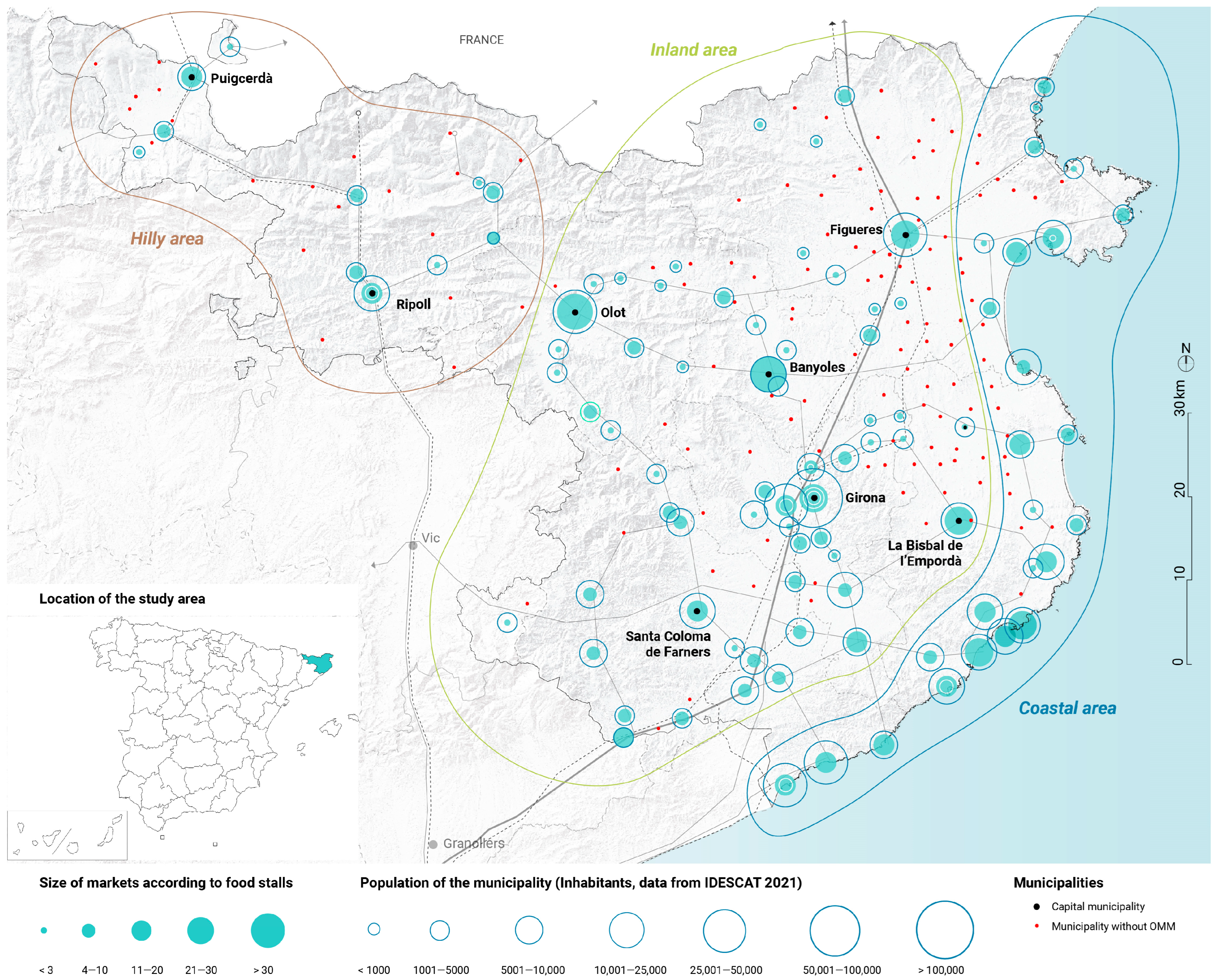
Previous research over the last decade by government sources [40], and Fava and Carrasco-Bonet [41], reveals an increase in the number of OMMs across the province. This expansion has contributed to a more extensive territorial distribution of markets, enhancing the capillarity and reach of the network through a heterogeneity of contexts in which OMMs operate (Figure 1). Nevertheless, OMMs in the Province of Girona face further structural challenges like generational turnover among vendors, e-commerce, increasing presence of supermarkets, declining sales in the aftermath of the COVID-19 pandemic and a fragmented market structure. These factors hinder the development of a shared vision for agroecological transition and limit the capacity of OMMs to foster inclusive and resilient food systems, especially in small urban areas, thereby weakening both local and broader support mechanisms [11].

2. Materials and Methods

2.1. Methodological Framework

To examine how markets are constituted through translocal relations and mobility practices, the study applies a quantitative approach to the food component of 105 OMMs surveyed between February 2022 and October 2023. Food vendors across these markets are heterogeneous, either offering self-produced goods or reselling food items. From a food supply chain perspective, quantitative analysis enables comparisons across territorial contexts by identifying measurable indicators of distribution, such as stallholders’ diversity, frequency and spatial proximity of market attendance. These indicators were derived by mapping weekly market circuits and analysing vendor mobility patterns, which were spatialized using geographic information systems (QGIS 3.40).
Methodologically, the research was structured into three interrelated phases:
  • Phase 1: Sample selection, data collection and processing. Markets were characterized and selected to reflect diversity in size, the municipal profile, tourism intensity and levels of institutional support.
  • Phase 2: Development and refinement of a set of indicators to define key metrics and to group markets into functional geographical areas. These facilitated a comparative analysis of how OMMs operate as logistical and social nodes, highlighting their role in enhancing proximity-based distribution.
  • Phase 3: Data analysis and spatial analysis implementing the proposed indicators.

2.2. Phase 1: Data Collection and Markets Characterization

2.2.1. Data Collection

Our dataset consists of 300 surveys to stallholders conducted during the fieldwork that also included direct observations of 61 selected OMMs. To select the 61 OMMs, we set a 95% confidence level and 10% precision, applying the principle of maximum indetermination with the market as the unit of analysis. For a population of n = 105 markets, the minimum required sample was n = 51. Markets were selected using Excel’s random function (RAND), subject to two criteria: inclusion of all markets in capital municipalities, and representation of diversity by geographical area and market size. The initial result was rechecked to ensure that all known cases of interest were included.
Surveys focused on the origin of the products sold (distinguishing between purchased, self-produced and elaborated goods) and the corresponding percentages. Additional questions gathered information on the stallholders’ places of residence and, where applicable, production sites; the specific geographic origin of local products; and the full list of markets attended throughout the week. In order to prevent double-counting and response rate inflation, entries with duplicated similar responses in crucial fields (age, municipality of residence, name of association, markets visited during the week, type of stallholder and type of products sold) were discarded.

2.2.2. Focusing on Stallholders

Within the local food supply chain, stallholders constitute a key node in the system across multiple territorial scales, thereby extending their influence beyond individual urban boundaries. Their non-sedentary nature implies inherently mobility patterns that reveal ways to engage with the territory in distinct economic, spatial and social ways. The research proposes three types of vendors:
  • Resellers (R) commercialize products acquired from intermediaries such as wholesale markets (e.g., MercaBarcelona, MercaGirona or MercaVallès) or directly from specialized suppliers.
  • Producer-resellers (PR) offer a combination of purchased and self-produced goods, with the latter accounting for up to 60% of the total number of products sold.
  • Producers (P) primarily sell their own harvest, representing 60% or more of the products available at their stall.
Within the same markets, the reseller category remains relatively stable throughout the year, the composition of the other two categories tends to fluctuate seasonally: for instance, during the winter months, many producers increase their reliance on intermediary-sourced products in order to maintain customer loyalty and ensure continuity of supply.
By examining stallholders’ weekly market routes and classifying them according to production type, this research identifies distinct spatial and distributional patterns that connect production zones with urban demand. These findings contribute to a deeper understanding of the flexible socio-economic infrastructure underpinning short food supply chains.

2.2.3. Characterization of Market Types

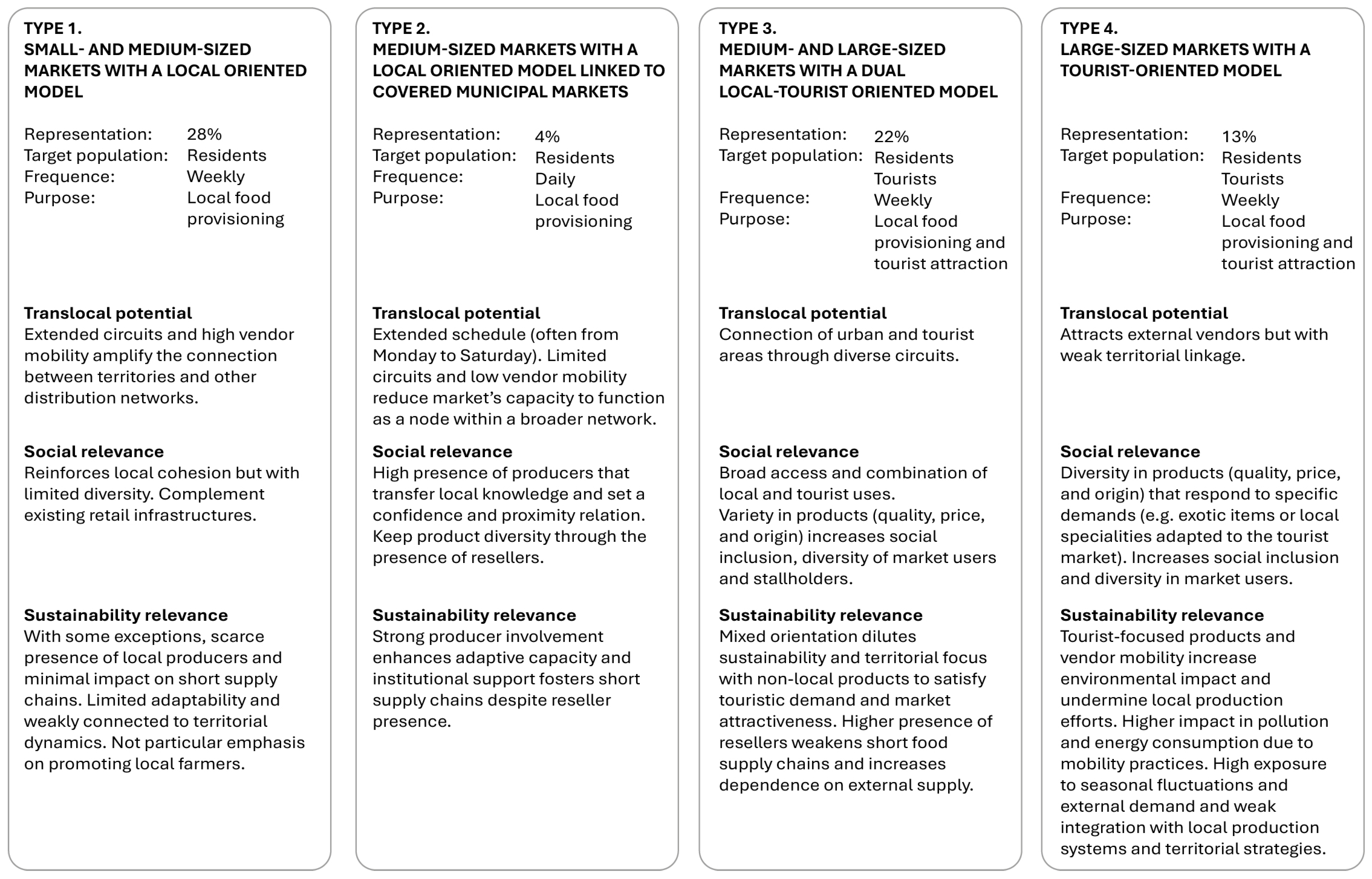
The OMM ecosystem in the Province of Girona encompasses a wide range of market models with distinct features depending on their location and territorial context. Our research identified a distinct typology of markets that we have used in the analysis (Figure 2), which have an influence in terms of resilience, social inclusion and territorial embeddedness [10,14,42] offers different possibilities according to this categorization.
Their spatial distribution is as follows: Type 1 spreads across the province, demonstrating both the food provisioning role and the capillary capacity of the ecosystem. Types 2 and 4 are commercial attractor nodes and are mostly concentrated in coastal areas, where seasonal tourism contributes to the revalorization and marketing of local food products, while Type 3 is distributed across the province, particularly in capital municipalities and other locations that are attractive to tourists.

2.3. Phase 2: Determining Market Mobility Indicators

The research proposes four interrelated indicators to capture how OMMs contribute to the sustainability of local food supply chains by revealing patterns of vendor mobility and immobility, spatial coverage, activity and engagement taking into consideration the variation in OMM types and/or vendor types. These indicators operationalize the relational and mobility-oriented perspective outlined above, thus translating key theoretical insights into measurable dimensions of how OMMs function as dynamic, networked ecosystems. They were developed inductively, drawing inspiration from Zazo-Moratalla’s foodshed framework [43] but tailored to the dynamics of OMMs, combining the analysis of vendors’ individual mobility with a network approach [44]. The thresholds proposed for each indicator emerged from empirical analysis and were refined to capture meaningful distinctions in levels of embeddedness and functionality, rather than being derived from statistical clustering.
  • Recurrence refers to the number of days per week that stallholders are active in markets; this indicator helps in assessing the intensity of their engagement and may also suggest whether they perform roles beyond vending. It provides insight into their dependency on the local market system and their potential contribution to consistent, place-based food provisioning. This resonates with relational theories of place, as the repeated presence of vendors reinforces the continuous socio-spatial production of markets. Recurrence is classified as Low (up to three days), Medium (four days) or High (five or more days per week).
  • Variety captures the number of different markets each stallholder attends within a given week, highlighting the geographical scope of their distribution strategy. It is particularly relevant for understanding how vendors circulate products across multiple urban and peri-urban areas, thereby enhancing territorial access to food and reinforcing decentralized supply networks. Variety is categorized as Low (up to three different markets), Medium (four) or High (five or more markets per week). This reflects the multi-scalar relationality emphasized in mobility studies, thus showing how OMMs operate across interconnected urban and peri-urban sites.
  • Closeness measures the degree of spatial proximity between markets, indicating the strength of inter-market connections derived from the stallholders’ mobility patterns. It enables the identification of zones with high concentrations of overlapping vendor activity, where synergies or shared logistics may emerge. Such proximities can be interpreted as opportunities to foster more efficient and cooperative supply infrastructures at the regional level. Three levels of closeness are identified according to the market relations shared between a specific number of vendors: Low (1–3 vendors), Medium (4–6 vendors) and High (7–9 vendors). This indicator also allows a complementary analysis of immobility patterns for stallholders who only work in one single market, thus complementing the rootedness and engagement approach. Such proximities materialize the networked nature of markets to illustrate how vendor flows generate inter-market ties.
  • Rootedness reflects the spatial relationship between stallholders’ places of residence and the markets they attend. This indicator is particularly significant for producers, as it reveals the extent to which markets are anchored in local productive territories and how they may contribute to reinforcing urban–rural linkages and resilience within a sustainable food system framework. Considering 10–20 km radius as the typical range of territorial proximity [45,46], the level of rootedness is categorized as Low (% of vendors from ≤10 km is <30% and mean distance > 25 km), Medium (% of vendors from ≤10 km is between 30 and 60% and/or mean distance between 15 and 25 km) or High (% of vendors from ≤10 km is >60% and mean distance < 15 km). This indicator captures the territorial anchoring stressed in agri-food scholarship and links mobility to place-based resilience [44].

2.4. Phase 3: Data Analysis and Spatial Analysis

Two complementary analytical approaches were employed to understand the mobility patterns of market vendors and their spatial engagement: statistical and spatial analysis. Vendor mobility was conceptualized as a multidimensional phenomenon combining both temporal and geographical dimensions of market participation. Depending on the case, the analyses were conducted either by the type of stallholder or by type of market, because both variables condition mobility patterns in different ways.
The statistical methods addressed the indicators of variety and recurrence, which capture the temporal intensity and frequency of participation. Statistical analysis was based on cross-tabulating vendor categories with each indicator in contingency tables, thus providing a descriptive overview of distribution patterns. The primary database contained 300 vendors categorized by type (P, PR and R) and by recurrence and variety levels. Differences between types were tested using the Chi-square (χ2) test of independence. To evaluate potential relationships between indicators, Spearman’s rank correlation coefficient (ρ) was computed to measure the strength and direction of monotonic associations.
The indicators of closeness and rootedness were analysed using spatial methods, as they describe the geographical scope and territorial anchoring of vendors’ activities. Spatial analysis was performed using Geographical Information Systems to both measure and visualize functional territorial linkages among OMMs based on vendors’ weekly mobility patterns. Two primary databases were integrated: (a) a table of markets containing geographic coordinates and market typologies, and (b) a relational table of 1.232 vendor–market records (based on the database of 300 surveyed stallholders) listing weekly attendance and vendor category. Both datasets were linked using a shared market identifier.
For the closeness analysis, vendors’ weekly mobility routes were reconstructed using the ‘Points to Path’ algorithm in QGIS 3.40, grouping market visits by vendor identifier and sorting them by weekday. Functional connections between markets were derived through a virtual layer SQL query that identified all market pairs (A–B) visited by the same stallholders. The number of shared vendors was computed through the COUNT(DISTINCT) operation, which produced a weighted line network representing market interconnections. Line width and colour were scaled according to the number and type of shared connections. Vendors attending only one market were mapped separately as immobile nodes using concentric symbols differentiated by vendor type. This workflow was replicated for each market category to enable comparative visualization of mobility structures.
For the rootedness analysis, the geographic distance between each vendor’s municipality of residence and the markets they attended was calculated using coordinate-based distance functions in QGIS. These values were visualized and classified into proximity ranges using graduated symbology and point-displacement renderers. This yielded four comparative maps corresponding to the main market types. Descriptive statistics (arithmetic mean, standard deviation, total number of vendors) were computed for each category to quantify territorial rootedness, allowing comparison of proximity and mobility–immobility patterns, as well as providing a quantitative assessment of spatial embeddedness within the regional market system.

3. Analysis and Results

3.1. Understanding Vendors’ Mobility Patterns

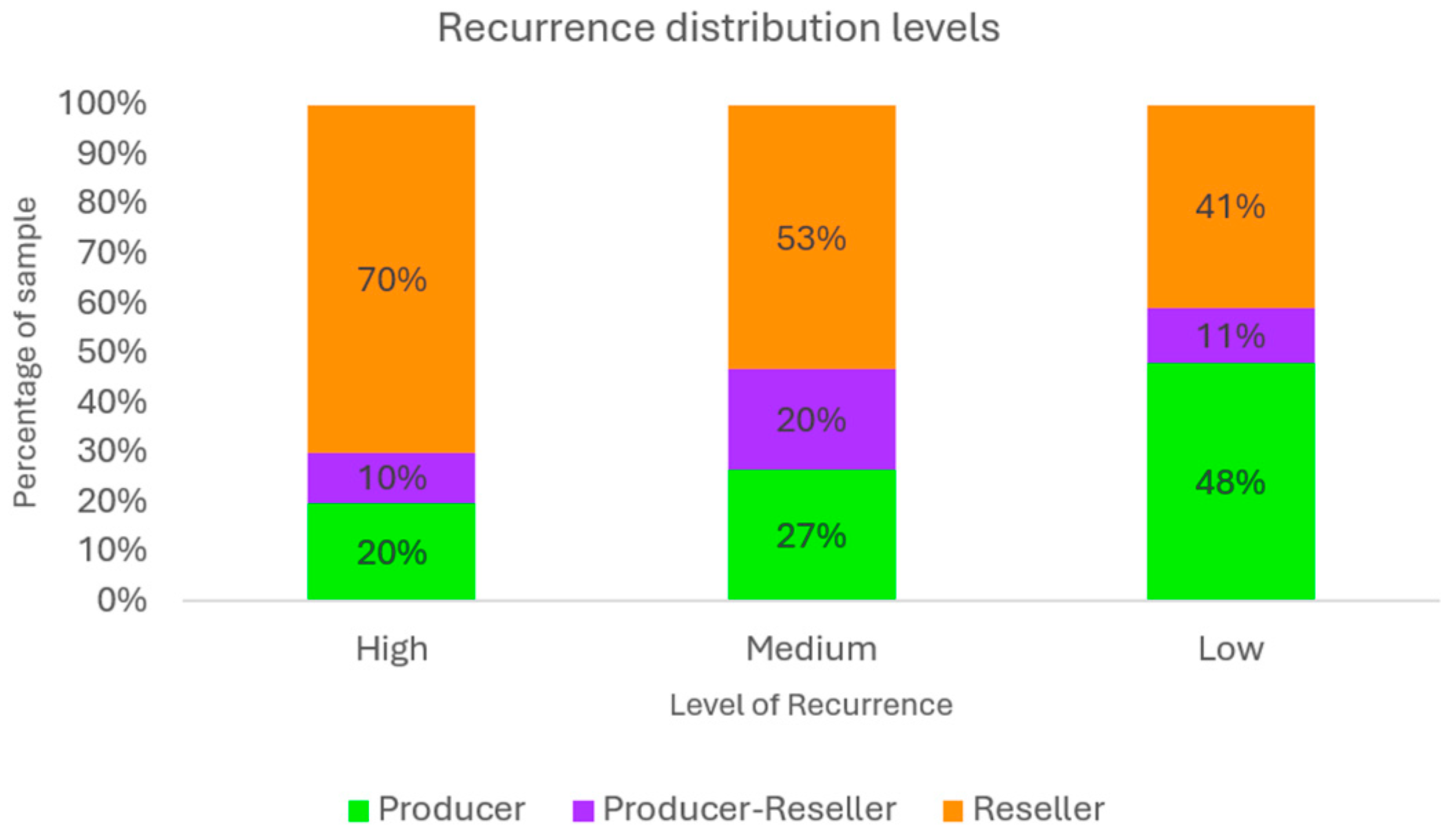
Resellers tend to exhibit intensive mobility across multiple markets, with the 70% having a high level of recurrence. Their primary role as retailers fosters a consistent and frequent presence, reflecting a business model centred on regular customer engagement within the OMM system. In contrast, when resellers show lower levels of recurrence (41%), it is typically due to the need to balance market activity with other employment or a strategic focus on larger, more profitable and well-established markets. Conversely, producers generally demonstrate lower recurrence levels in a 47%, reflecting more localized and stable participation patterns. Their participation is often constrained by agricultural responsibilities, which limit their availability for frequent market attendance. The producer-reseller group remains marginal across all levels (10–20%). A chi-square test confirmed that this association is statistically significant (χ2 = 26.80, p = 0.0000218), thus demonstrating that recurrence level is not randomly distributed across vendor types. These results indicate that market mobility is strongly conditioned by vendor profile, with resellers engaging in wider spatial circuits, while producers tend to remain rooted in fewer, more consistent market locations (Figure 3).
These variations underscore how different occupational roles and time commitments shape participation and mobility patterns in local food distribution systems, offering valuable insights into the sustainability and operational dynamics of short food supply chains.
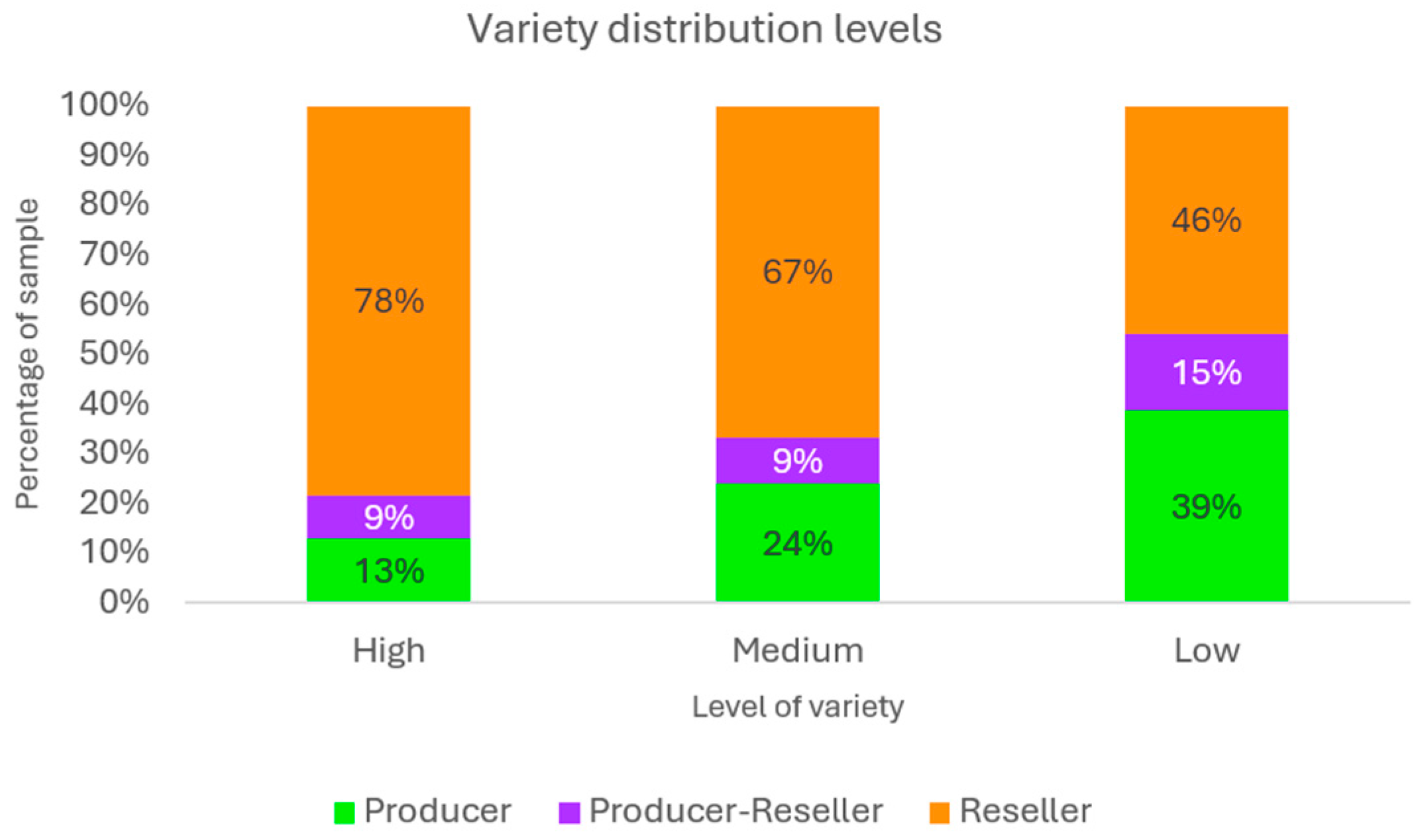
The patterns observed in the distribution of variety (Figure 4) indicate that resellers consistently show the highest levels of variety, as they are concentrated in the High (78%) and Medium categories (67%). This is the group most likely to operate across several different markets, thus reflecting greater operational flexibility and mobility. Resellers generally achieve higher levels of variety by attending four or five different markets per week; however, in municipalities where the same market is held multiple times per week, resellers may exhibit lower variety. In such cases, decisions are often shaped by strong user loyalty and a deep familiarity with the local environment, which can prompt resellers to prioritize markets where they have a well-established customer base. Qualitative data gathered from the surveys also suggest that, in these cases, cooperation among stallholders tends to be stronger due to the existence of well-established social ties among them.
In contrast, producers are predominantly located in the low variety level (39%), which indicates that they tend to participate in fewer and more stable markets. Among the respondents who reported attending only one market, usually producers, this choice is often linked to the high profitability of specific markets or their involvement in daily ones. For example, markets of Type 2 benefit from supportive local policies that promote proximity products and prioritize local producers, allowing vendors to attend markets from Monday to Saturday.
Producer–resellers remain a marginal and relatively stable group across the three categories, with no substantial variation in their diversification patterns.
The chi-square test confirmed that the distribution of vendor type differs significantly across variety levels (χ2 = 23.96, p < 0.001), which indicates an association between the degree of market diversification and the type of vendor. Spearman’s rank correlation also shows a significant and negative association between vendor type and variety level (Spearman’s ρ < 0, p < 0.001), which suggests that higher diversification is characteristic of resellers, whereas producers tend to operate in fewer markets.
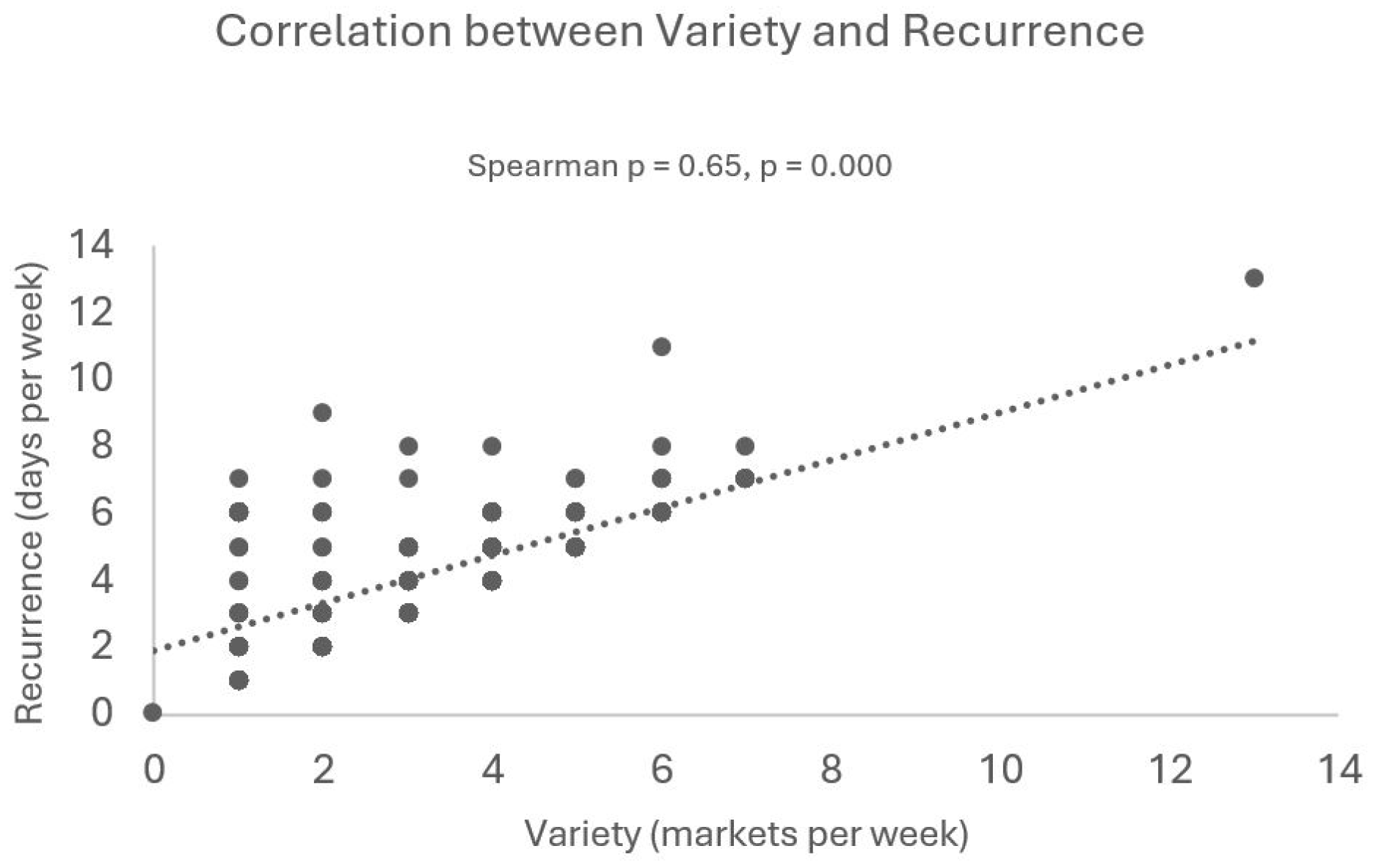
The relationship between variety and recurrence shows a strong and positive monotonic association (Spearman ρ = 0.65, p < 0.001). The dispersion pattern (Figure 5) suggests that vendors who attend more distinct markets also adopt more intensive weekly schedules, while low-variety vendors concentrate mainly in low-to-intermediate recurrence levels. In consequence, variety and recurrence capture complementary dimensions of vendor mobility linked to spatial diversification and temporal intensity, but their correlation confirms that both behaviours tend to co-occur, thus determining specific mobility strategies within the market system according to the type of vendor.

3.2. Potential Relationships Between Markets

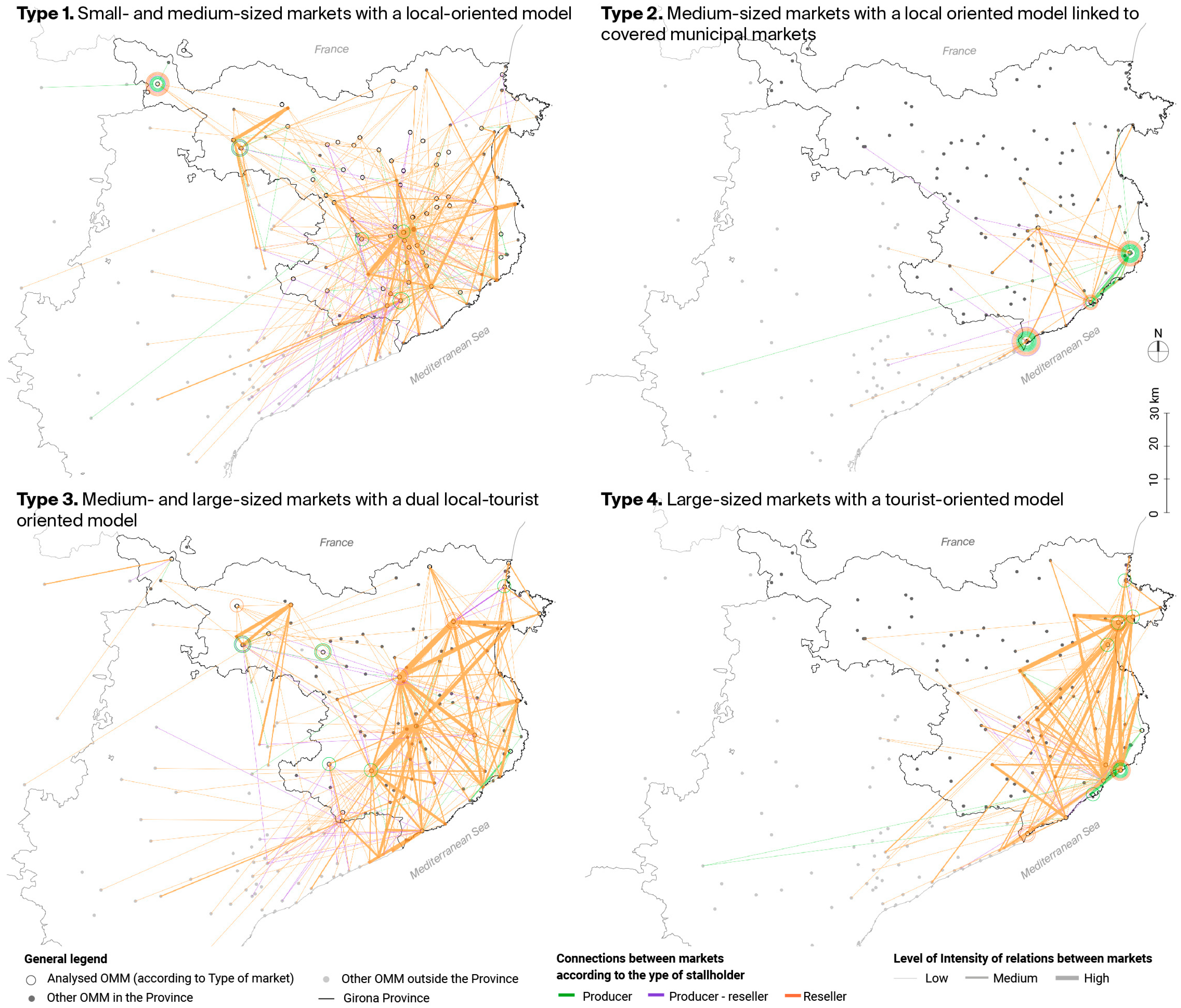
Substantial differences in relational accessibility across market types were identified (Table 1, Figure 6). All types show a predominance of weak ties and distinct territorial distribution of connections. This low level of intensity is consistent with the high diversity of stallholders, who exhibit varying levels of recurrence and variety. To understand the potential relationships between markets, this analysis focuses on the medium and high intensity values.
Type 1 markets are the most spatially dispersed and generate the largest number of connections (NC = 447). The high coefficient of variation (CV = 0.65) reflects heterogeneous mobility patterns that combine nearby relations with long-distance routes (maximum 115.6 km). Despite this broad reach, only a small proportion of routes correspond to stable exchanges, with few medium and high intensity ties (2.8% and 0.2%, respectively). These results characterize Type 1 markets as a capillary, yet fragmented network largely driven by resellers, who often extend their activity beyond the province.
Type 2 markets present a contrasting configuration, involving only four markets and 78 connections. They show the smallest median distance (21.8 km) and the highest variability (CV = 0.85) reflecting two coexisting strategies: strongly localized producer-driven links and occasional long-distance routes by resellers (up to 133.9 km, the system’s maximum). Producers play a distinctive role in shaping proximity-based relational patterns and forming short-distance connections between neighbouring markets or even immobility patterns, operating in a single market. This results in very low medium and high intensity ties (1% and 0%, respectively). Their predominance creates a structured, local relational proximity, while resellers contribute sporadic long-distance connections.
Type 3 markets exhibit a polycentric and intermediate network with several territorial attraction nodes. Travel distances are more homogeneous (Std.D = 18.80; CV = 0.63), which is consistent with the maps (Figure 6) showing multiple nodes linked by moderately dense flows rather than a single dominant hub. These markets have the highest level of intensity (0.5%), thus showing their potential to support cooperation through stronger translocal vendor networks.
Type 4 shows the highest medium-intensity level (7.3%) and high levels of variability in terms of travelled distance (Std.D = 22.75; CV = 0.74), thus demonstrating a potential cooperation pattern between these markets, because they share the same context and typology (tourist-oriented model). The analysis for this type also highlights mobility and strategic immobility patterns associated principally with producers and located in areas close to those with similar characteristics in the case of Type 2.

3.3. Urban–Rural Linkages Through Vendor Mobility Patterns

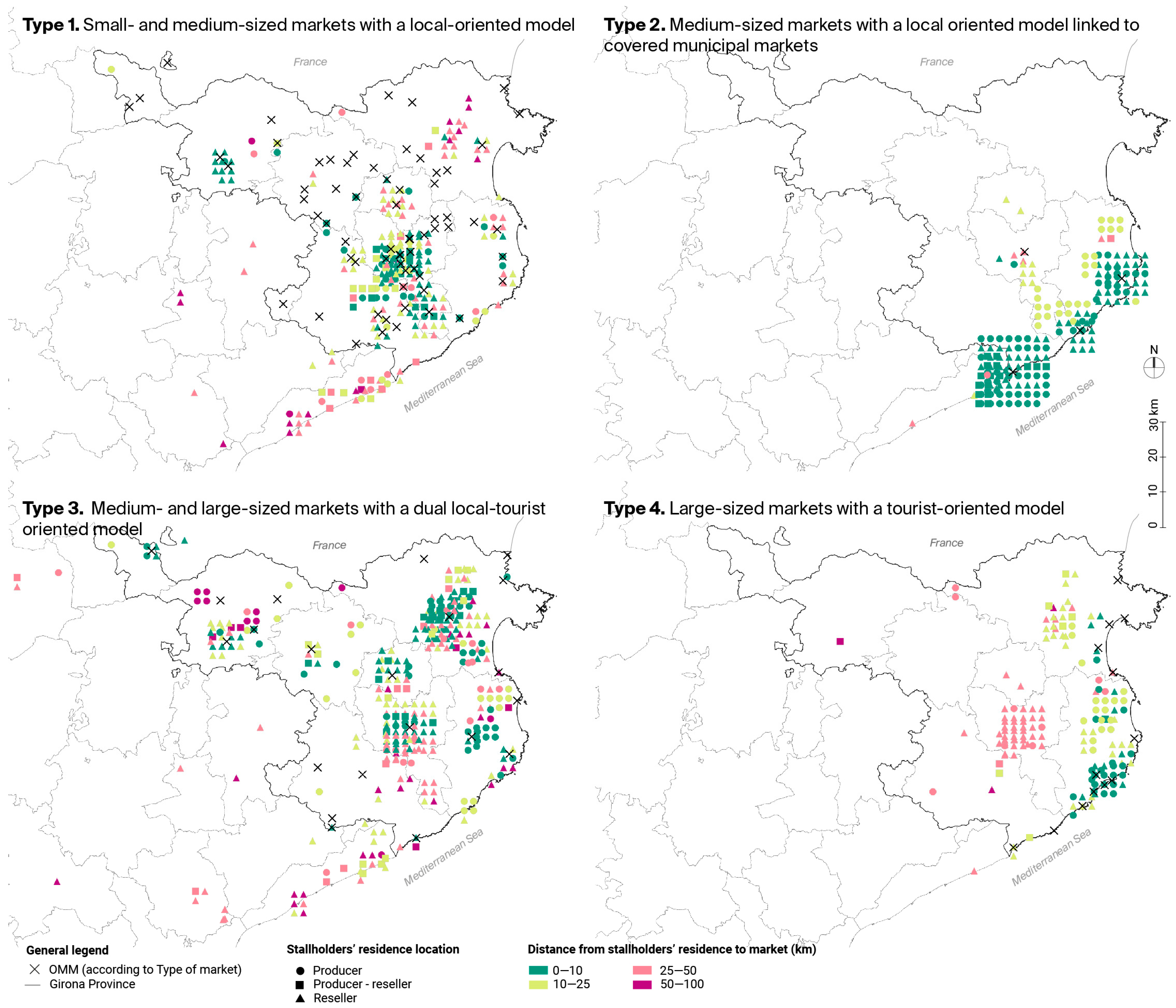
The rootedness analysis reveals distinct territorial configurations in the relationship between stallholders’ residence and market locations (Table 2, Figure 7). For each market type, the maps display the residential location of the stallholders who operate in those markets, and the symbology differentiates their profile and distance range to the market.
Markets associated with covered markets (Type 2) display the highest level of territorial rootedness. Vendors are strongly concentrated around the markets, with 77% residing within 10 km and an average distance of only 5 km. The spatial clustering visible on the map confirms a tight local vendor base, which indicates that these markets are deeply embedded in their surrounding food systems with stallholders that develop patterns of greater immobility, contributing to the reinforcement of urban–rural linkages avoiding intermediaries. In contrast, markets oriented towards tourism and seasonal population flows (Type 4) show the lowest rootedness. Only 20% of stallholders live within 10 km, and one third travel 25–50 km to reach the market. The concentration of markets on the coastline and the wider geographical spread of vendors reveal a more mobile and extra-local stallholder profile, which is consistent with a tourism-driven model.
The other market groups fall in an intermediate position. Both Type 1 and Type 3 markets present medium levels of rootedness, with mean distances of 19 km and 23 km, respectively, and around 35–36% of vendors living within 10 km. Although Type 1 shows more localized clusters around small and medium-sized towns, Type 3 appears more spatially dispersed, with a large proportion of stallholders traveling from 10 to 50 km. These configurations indicate hybrid dynamics that combine local provisioning with wider regional attraction.

4. Discussion and Conclusions

This study provides a new methodology to reframe food provisioning through mobility relationships in distribution [44], focusing on the relational spaces they produce. In OMMs, stallholder movements generate fluid socio-spatial dynamics that reconfigure how food circulates, preventing concentration [21] and fostering more localized food economies rooted in the landscape [25]. These mobility-driven configurations influence the degree of territorialization in food systems [47,48], depending on the prominence of locally sourced products [49]. By placing mobility at the core of the analysis, this research brings urban food planning into closer alignment with the lived, everyday geographies of distribution. This approach resonates with Massey’s understanding of space as relational and continuously constituted through movement, interaction and negotiation [32]. It also highlights the multifunctional character of OMMs as inclusive public spaces where economic exchange, social integration, cultural interaction and ecological awareness converge [50]. Recognizing their intermediary role as networked ecosystems [29], especially in low-connectivity rural areas, OMMs help to improve territorial equity in food provision.
Methodologically, the study advances a mobility-centred operationalization of OMM functioning. By translating stallholder mobility into four indicators (recurrence, variety, closeness and rootedness), this research provides an empirical toolbox that captures the relational embeddedness of markets and their contribution to the resilience of SFSCs. The indicators developed here reveal OMMs as dynamic socio-spatial systems shaped by the mobility patterns of stallholders. Their combined use provides a scalable analytical framework that can be applied across contexts to assess the sustainability performance of territorial food systems. It is through repeated, cross-cutting mobilities that markets become functionally interconnected to form an ecosystem where flows structure the system. This perspective helps reveal the organizational logics that static market analyses are unable to capture.
Critical food studies such as the AFN approach [13,14,15] have focused on the role of food producers and farmers’ markets as the primary agents in relocalizing FSCs and reconnecting producers and consumers. There has been less attention on OMMs in these studies; however, as they do not necessarily trade on agroecologically or locally produced food and also distribute food from wholesalers, we argue that OMMs show a more complex reality where multiple vendor types coexist, thus giving rise to diverse commercial strategies and more intricate provisioning circuits [51]. These heterogeneous practices shape how producers, resellers and consumers interact [35,36]. The results show that mobility patterns are strongly associated with vendor type, although not in a rigid manner: depending on market type and commercial strategies [33], resellers tend to undertake extensive and flexible spatial circuits that create translocal connections across the province, while producers generally maintain more localized and temporally constrained patterns, which contributes to the relocalization of local-regional food chains [52,53]. These contrasts reveal that OMMs support heterogeneous mobility patterns that coexist within the same system, combining proximity, regularity, adaptation and diversification. These mobility patterns also reveal a network of markets that transcends administrative boundaries and remains largely invisible to conventional planning frameworks [54].
The multi-dimensional analysis demonstrates that stallholder mobility, along with strategic immobility, is crucial for understanding how markets operate when examined through a relational and networked perspective [44]. The strong correlation between recurrence and variety suggests that mobility intensity and diversification are co-produced strategies, not isolated behaviours. Producers’ lower recurrence and variety levels do not indicate disengagement but rather reflect structural tensions inherent to balancing production schedules with distribution responsibilities. These findings reinforce the idea of stallholder mobility as a spatial practice that underpins the viability and resilience of local food systems. All vendor types contribute to shaping food systems adapted to their territorial contexts, albeit in different ways. This understanding allows OMMs to be conceptualized as relational public facilities capable of strengthening territorial cohesion, supporting agroecological transitions and advancing circular economic models [55]. They possess the capacity to strengthen the relational proximity [56] and to affect the entire population, regardless of socio-economic status, gender, age or ethnicity.
These insights are particularly relevant in rural areas such as the Province of Girona, where many small municipalities lack the capacity to sustain municipal markets and where urban centres have progressively weakened their connections with surrounding productive landscapes. In these contexts, stallholder mobility emerges as a key mechanism for repairing fragmented urban–rural linkages and sustaining SFSCs.
The results concerning closeness show that vendor mobility produces differentiated forms of relational proximity among markets, which positions OMMs as interconnected nodes within broader territorial food systems. Weekly routes create recurring links between specific markets, reflecting the type of social embeddedness identified by Hinrichs [57] in SFSCs. These connections encourage shared logistics, coordinated scheduling and informal knowledge exchange, dynamics recognized by Sonnino and Marsden [58] as central to territorially embedded food networks. Although weak ties predominate, the presence of medium- and high-intensity relations suggests potential for cooperative infrastructures, including shared distribution routes and synchronized market calendars. Such relational proximities strengthen system resilience by enabling adaptability, redundancy and multi-sited interdependence, all of which are fundamental to resilient food systems [59].
Rather than positioning embeddedness and mobility as opposing dynamics, they should be understood as complementary forces, as the former promotes continuity, trust and territorial specificity, which aligns with calls for food sovereignty grounded in local control over food systems [60,61,62], while the latter enables diversity, outreach and adaptive redistribution, thus contributing to the resilience of food supply chains by buffering spatial and temporal disruptions [63,64]. The results of the rootedness analysis reveal how markets are anchored within their productive hinterlands and highlight their contribution to reinforcing urban–rural linkage, an essential dimension of sustainable food systems. High levels of vendor residence near markets enhance place-based provisioning and ecological embeddedness [57], thus supporting the trust, transparency and quality conventions associated with SFSCs [15]. Conversely, markets with lower rootedness still play a strategic role by extending territorial reach and reducing dependence on long-distance chains. In both scenarios, vendor mobility shapes the degree of territorial embeddedness of markets and contributes to resilience by maintaining diverse linkages across scales of production, circulation and consumption.
Overall, this study identifies two key vulnerabilities highlighted in the resilience literature: the erosion of urban–rural ties and the growing physical and informational distance between production and consumption. The mobility patterns observed here show that OMMs address both challenges: producer-rooted markets reinforce place-based ties and enable food and knowledge circulation, while reseller networks extend regional linkages and contribute to the capillarity of the system. By making producer–consumer encounters more frequent and visible, OMMs shorten both supply chains and informational gaps, thus strengthening the social and territorial foundations of resilience. The findings also demonstrate that the networked ecosystem perspective is a necessary analytical shift: OMMs operate as relational facilities whose functioning emerges from the connections stallholders create across space and time. Recognizing this networked character allows researchers and policymakers to identify coordination patterns, territorial complementarities and resilience mechanisms that remain invisible when markets are treated as discrete units.
To conclude, although this study focuses on the Province of Girona, several findings are transferable to other contexts where open-air and municipal markets play a part in food provisioning. Understanding stallholder mobility as a driver of resilience, the role of OMMs in maintaining SFSCs and the territorial embeddedness of vendors offers a comparative lens for studying market ecosystems across diverse socio-spatial settings, from Mediterranean regions to parts of Latin America, Africa and Asia. By conceptualizing OMMs as networked ecosystems rather than static infrastructures, the study contributes to international debates on food sovereignty, urban–rural linkages and territorial cohesion, thus aligning with global sustainability goals.

5. Limitations and Future Lines of Research

First, OMMs represent a system in constant flux across time and space. Stallholders, as the primary agents shaping these markets, may vary due to personal circumstances (e.g., illness) or economic decisions (e.g., prioritizing seasonal coastal markets or occasional fairs). Consequently, the study provides a “snapshot” based on a year-long survey rather than a longitudinal perspective. A follow-up study would be valuable to capture seasonal dynamics more precisely and verify patterns such as the preference of some stallholders for coastal markets in summer, with potential repercussions for inland markets.
Second, the analysis would benefit from comparative data across different regional or national contexts, which could help situate the case of Girona within broader dynamics and identify shared trends. In addition, consumer perspectives were not included due to resource constraints, even though their mobility patterns and connections with resellers would provide an important complementary dimension.
Finally, the research did not incorporate an intersectional perspective. Although certain patterns intuitively suggest a correlation between particular types of stalls and migrant stallholders, this dimension was not systematically studied. Future research would benefit from addressing this gap, as well as from integrating consumer behaviour and cross-regional comparisons, in order to provide a more comprehensive understanding of OMMs as evolving socio-spatial systems.

Author Contributions

Conceptualization, M.C.-B. and N.F.; methodology, M.C.-B. and N.F.; formal analysis, M.C.-B.; investigation, M.C.-B.; data curation, M.C.-B.; writing—original draft preparation, M.C.-B. and N.F.; writing—review and editing, M.C.-B., N.F. and S.G.; visualization, M.C.-B.; supervision, N.F. and S.G.; funding acquisition, N.F. All authors have read and agreed to the published version of the manuscript.

Funding

Data collection was supported by the PECT Girona Sustainable Food System project (2021–2023), funded by the Generalitat de Catalunya and co-financed by the European Regional Development Fund (ERDF/FEDER) (PR15-019289). Data analysis and manuscript preparation were supported by the European Union’s Horizon Europe research and innovation programme under Grant Agreement No. 101182261 (REDESIGN—tRansformativE fooD valuE Systems reshapInG resilient urban laNdscapes).

Institutional Review Board Statement

The study was conducted in accordance with the Declaration of Helsinki and approved by the Ethics and Biosafety Committee for Research at the University of Girona (protocol code CEBRU00021-22; 5 December 2022).

Informed Consent Statement

Informed consent was obtained from all subjects involved in the study.

Data Availability Statement

The original data presented in the study are openly available in CORA. Repositori de Dades de Recerca.

Acknowledgments

We appreciate the participation of the stallholders involved in the OMM who shared their time and experience with us, as well as the people interviewed during the research process. The fieldwork was carried out with the help and contribution of the student Roberto Cubas during his Architecture Degree, and junior architects who helped with the urban analysis of the visited OMM, namely Xavier Busquets and Èric Guerrero. We also thank Anna Roca Torrent for her constructive comments and insights.

Conflicts of Interest

The authors declare no conflicts of interest.

Abbreviations

The following abbreviations are used in this manuscript:
OMMsopen municipal markets
FSCfood supply chain
AFNsalternative food networks

References

  1. Marsden, T.K.; Banks, J.; Bristow, G. Food supply chain approaches: Exploring their role in rural development. Sociol. Rural. 2000, 40, 424–438. [Google Scholar] [CrossRef]
  2. Nas, J.L.; Komisar, J.D. The integration of food and agriculture into urban planning and design practices. In Sustainable Food Planning: Evolving Theory and Practice; Viljoen, A., Wiskerke, J.S.C., Eds.; Wageningen Academic Publishers: Wageningen, The Netherlands, 2012; pp. 47–58. [Google Scholar] [CrossRef]
  3. Török, Á.; Kovács, S.; Maró, G.; Maró, Z.M. Understanding the relevance of farmers’ markets from 1955 to 2022: A bibliometric review. J. Agric. Food Res. 2024, 16, 101108. [Google Scholar] [CrossRef]
  4. Menconi, M.E.; Stella, G.; Grohmann, D. Revisiting global food production and consumption patterns by developing resilient food systems for local communities. Land Use Policy 2022, 119, 106210. [Google Scholar] [CrossRef]
  5. Galli, A.; Iha, K.; Halle, M.; El Bilali, H.; Grunewald, N.; Eaton, D.; Capone, R.; Debs, P.; Bottalico, F. Mediterranean countries’ food consumption and sourcing patterns: An ecological footprint viewpoint. Sci. Total Environ. 2017, 578, 383–391. [Google Scholar] [CrossRef]
  6. Capone, R.; Bottalico, F.; Ottomano Palmisano, G.; El Bilali, H.; Dernini, S. Food systems sustainability, food security and nutrition in the Mediterranean region: The contribution of the Mediterranean diet. Encycl. Food Secur. Sustain. 2019, 2, 176–180. [Google Scholar] [CrossRef]
  7. Milan Urban Food Policy Pact. 2015. Available online: https://www.milanurbanfoodpolicypact.org/wp-content/uploads/2020/12/Milan-Urban-Food-Policy-Pact-EN.pdf (accessed on 30 July 2025).
  8. Moragues-Faus, A. The emergence of city food networks: Rescaling the impact of urban food policies. Food Policy 2021, 103, 102107. [Google Scholar] [CrossRef]
  9. Schipanski, M.E.; MacDonald, G.K.; Rosenzweig, S.; Chappell, M.J.; Bennett, E.M.; Kerr, R.B.; Blesh, J.; Crews, T.; Drinkwater, L.; Lundgren, J.G.; et al. Realizing Resilient Food Systems. BioScience 2016, 66, 600–610. [Google Scholar] [CrossRef]
  10. Lucas, A.; Moruzzo, R.; Granai, G. Farmers’ Markets Contribution to the Resilience of the Food Systems. Agric. Food Econ. 2024, 12, 50. [Google Scholar] [CrossRef]
  11. Fava, N.; Carrasco I Bonet, M.; Garrido I Puig, R. The role of public administrations in promoting open municipal markets. Urban Agric. Region Food Syst. 2022, 7, e20028. [Google Scholar] [CrossRef]
  12. Nicolosi, A.; Fava, N.; Marciano, C. Consumers’ preferences for local fish products in Catalonia, Calabria and Sicily. In New Metropolitan Perspectives. ISHT 2018. Smart Innovation Systems and Technologies; Calabrò, F., Della Spina, L., Bevilacqua, C., Eds.; Springer: Cham, Switzerland, 2019; Volume 101, pp. 103–112. [Google Scholar] [CrossRef]
  13. Taylor, M.; González, S.; Waley, P.; Wilkinson, R. Developing Markets as Community Hubs for Inclusive Economies: A Best Practice Handbook for Market Operators; Report; University of Leeds: Leeds, UK, 2022; Available online: https://eprints.whiterose.ac.uk/id/eprint/193068/ (accessed on 16 December 2025).
  14. Watson, S. The magic of the marketplace: Sociality in a neglected public space. Urban Stud. 2009, 46, 1577–1591. [Google Scholar] [CrossRef]
  15. Renting, H.; Marsden, T.K.; Banks, J. Understanding alternative food networks: Exploring the role of short food supply chains in rural development. Environ. Plan. A 2003, 35, 393–411. [Google Scholar] [CrossRef]
  16. Edmonds, A.M.; Carsjens, G.J. Markets in municipal code: The case of Michigan cities. Sustainability 2021, 13, 4263. [Google Scholar] [CrossRef]
  17. Oñederra-Aramendi, A.; Begiristain-Zubillaga, M.; Malagón-Zaldua, E. Who is feeding embeddedness in farmers’ markets? A cluster study of farmers’ markets in Gipuzkoa. J. Rural Stud. 2018, 61, 22–33. [Google Scholar] [CrossRef]
  18. Taylor, M.; González, S. Retail market futures: Retail geographies from and for the margins. In Contemporary Economic Geographies; Bristol University Press: Bristol, UK, 2024. [Google Scholar] [CrossRef]
  19. González, S. Contested marketplaces: Retail spaces at the global urban margins. Prog. Hum. Geogr. 2020, 44, 877–897. [Google Scholar] [CrossRef]
  20. Seale, K. Markets, Places, Cities; Routledge: London, UK, 2016. [Google Scholar]
  21. McGreevy, S.R.; Rupprecht, C.D.D.; Niles, D.; Wiek, A.; Carolan, M.; Kallis, G.; Kantamaturapoj, K.; Mangnus, A.; Jehlička, P.; Taherzadeh, O.; et al. Sustainable Agrifood Systems for a Post-Growth World. Nat. Sustain. 2022, 5, 1011–1017. [Google Scholar] [CrossRef]
  22. Oteros-Rozas, E.; Ravera, F.; García-Llorente, M. How does agroecology contribute to the transitions towards social-ecological sustainability? Sustainability 2019, 11, 4372. [Google Scholar] [CrossRef]
  23. Gonzalez, S.; Waley, P. Traditional retail markets: The new gentrification frontier? Antipode 2013, 45, 965–983. [Google Scholar] [CrossRef]
  24. Massey, D. Geography on the agenda. Prog. Hum. Geogr. 2001, 25, 5–17. [Google Scholar] [CrossRef]
  25. MMP; Van Eck, E.; Watson, S.; Van Melik, R.; Breines, M.; Dahinden, J.; Jónsson, G.; Lindmäe, M.; Madella, M.; Menet, J.; et al. Moving marketplaces: Understanding public space from a relational mobility perspective. Cities 2022, 127, 103721. [Google Scholar] [CrossRef]
  26. Van Melik, R.; Spierings, B. Researching public space. From place-based to process-oriented approaches and methods. In Companion to Public Space; Mehta, V., Palazzo, D., Eds.; Routledge: London, UK, 2020; pp. 16–26. [Google Scholar]
  27. González, S. (Ed.) Contested Markets Contested Cities; Routledge: London, UK, 2018. [Google Scholar]
  28. Sheller, M.; Urry, J. The new mobilities paradigm. Environ. Plan. A 2006, 38, 207–226. [Google Scholar] [CrossRef]
  29. Gómez-Escoda, E.; Moncusí, D. Measuring food supply through closeness and betweenness: Halls and open-air markets in Metropolitan Barcelona. Urban Plan. 2025, 10, 1–18. [Google Scholar] [CrossRef]
  30. Recine, E.; Preiss, P.V.; Valencia, M.; Zanella, M.A. The indispensable territorial dimension of food supply: A view from Brazil during the COVID-19 pandemic. Development 2021, 64, 282–287. [Google Scholar] [CrossRef]
  31. Massey, D. Power-Geometry and a Progressive Sense of Place. In Mapping the Futures: Local Cultures, Global Change; Bird, J., Curtis, B., Putnam, T., Tickner, L., Eds.; Routledge: London, UK, 1993; pp. 59–69. [Google Scholar]
  32. Massey, D. For Space; Sage: London, UK, 2005. [Google Scholar]
  33. Dahinden, J.; Jónsson, G.; Menet, J.; Schapendonk, J.; van Eck, E. Placing regimes of mobilities beyond state-centred perspectives and international mobility: The case of marketplaces. Mobilities 2023, 18, 635–650. [Google Scholar] [CrossRef]
  34. Darling, J. Thinking beyond place: The responsibilities of a relational spatial politics. Geogr. Compass 2009, 3, 1938–1954. [Google Scholar] [CrossRef]
  35. Nordin, C. Marchés, Commerçants, Clientèle: Le Commerce Non Sédentaire de la Région Parisienne. Étude de Géographie Humaine. Ph.D. Thesis, University of Gothenburg, Göteborg, Sweden, 1983. (In French). [Google Scholar]
  36. Nordin, C.; Troin, J.; Chaze, M. Commerce Ambulant et Marchés. Bull. Soc. Géogr. Liège 2016, 66, 59–63. [Google Scholar]
  37. Urry, J. Connections. Environ. Plan. D Soc. Space 2004, 22, 27. [Google Scholar] [CrossRef]
  38. Poku-Boansi, M.; Blija, D.K.; Anin-Yeboah, O.Y.A.; Asibey, M.O.; Amponsah, O. The place of translocal networks in inclusive city development: A systematic review. Urban Gov. 2024, 4, 340–350. [Google Scholar] [CrossRef]
  39. Greiner, C.; Sakdapolrak, P. Translocality: Concepts, applications and emerging research perspectives. Geogr. Compass 2013, 7, 373–384. [Google Scholar] [CrossRef]
  40. Gabinet Ecos. Llibre Blanc dels Mercats No Sedentaris de Catalunya; Generalitat de Catalunya: Barcelona, Spain, 2005. [Google Scholar]
  41. Fava, N.; Carrasco Bonet, M.; ​​​​Roca i Torrent, A. Informe Els Mercats No Sedentaris a la Província de Girona: Una Oportunitat per la Transició Alimentària? Universitat de Girona. 2022. Available online: http://hdl.handle.net/10256/24177 (accessed on 30 July 2025).
  42. Morales, A. Public markets as community development tools. J. Plan. Educ. Res. 2009, 28, 426–440. [Google Scholar] [CrossRef]
  43. Zazo-Moratalla, A.; Troncoso-González, I.; Moreira-Muñoz, A. Regenerative food systems to restore urban–rural relationships: Insights from the Concepción metropolitan area foodshed (Chile). Sustainability 2019, 11, 2892. [Google Scholar] [CrossRef]
  44. Raton, G.; Raimbert, C. Livrer en circuits courts: Les mobilités des agriculteurs comme révélateur des territoires alimentaires émergents. Étude de cas dans les Hauts-de-France. Géocarrefour 2019, 93. [Google Scholar] [CrossRef]
  45. Ilbery, B.; Maye, D. Alternative (shorter) food supply chains and specialist livestock producers in the Scottish–English borders. Environ. Plan. A 2005, 37, 823–844. [Google Scholar] [CrossRef]
  46. Renting, H.; Schermer, M.; Rossi, A. Building food democracy: Exploring civic food networks and newly emerging forms of food citizenship. Int. J. Socio. Agric. Food 2012, 19, 289–307. [Google Scholar]
  47. Rastoin, J.-L. Les systèmes alimentaires territorialisés: Le cadre conceptuel. J. Resolis 2015, 4, 11–13. [Google Scholar]
  48. Marino, D.; Mastronardi, L.; Giannelli, A.; Giaccio, V.; Mazzocchi, G. Territorialisation dynamics for Italian farms adhering to alternative food networks. Bull. Geogr. Socio-Econ. Series 2018, 40, 113–131. [Google Scholar] [CrossRef]
  49. Hendrickson, M.; Heffernan, W. Opening spaces through relocalization: Locating potential resistance in the weaknesses of the global food system. Sociol. Rural. 2002, 42, 347–369. [Google Scholar] [CrossRef]
  50. Navarro, A. Le marché de plein vent alimentaire, un lieu en marge du commerce de détail alimentaire français? Géocarrefour 2019, 93. [Google Scholar] [CrossRef]
  51. Morales, A. On farmers markets as wicked opportunities. Sustainability 2021, 13, 6108. [Google Scholar] [CrossRef]
  52. Turner, B.; Hope, C. Ecological connections: Reimagining the role of farmers’ markets. Rural Soc. 2014, 23, 175–187. [Google Scholar] [CrossRef]
  53. Svenfelt, Å.; Carlsson-Kanyama, A. Farmers’ markets: Linking food consumption and the ecology of food production? Local Environ. 2010, 15, 453–465. [Google Scholar] [CrossRef]
  54. van Eck, E.; Schapendonk, J. Moving Behind the Scenes of Public Space: The Differentiation of Market Traders’ Routinized Mobilities. Soc. Cult. Geogr. 2024, 26, 79–99. [Google Scholar] [CrossRef]
  55. Sonnino, R. Food system transformation: Urban perspectives. Cities 2023, 134, 104164. [Google Scholar] [CrossRef]
  56. Enthoven, L.; Van den Broeck, G. Local food systems: Reviewing two decades of research. Agric. Syst. 2021, 193, 103226. [Google Scholar] [CrossRef]
  57. Hinrichs, C.C. Embeddedness and local food systems: Notes on two types of direct agricultural market. J. Rural. Stud. 2000, 16, 295–303. [Google Scholar] [CrossRef]
  58. Sonnino, R.; Marsden, T. Beyond the divide: Rethinking relationships between alternative and conventional food networks in Europe. J. Econ. Geogr. 2006, 6, 181–199. [Google Scholar] [CrossRef]
  59. Folke, C.; Carpenter, S.R.; Walker, B.; Scheffer, M.; Chapin, T.; Rockström, J. Resilience thinking: Integrating resilience, adaptability and transformability. Ecol. Society 2010, 15, 20. [Google Scholar] [CrossRef]
  60. Wittman, H.; Desmarais, A.A.; Wiebe, N. (Eds.) Food Sovereignty: Reconnecting Food, Nature and Community; Fernwood Publishing: Halifax, NS, Canada, 2010. [Google Scholar]
  61. Marsden, T.; Morley, A. Sustainable Food Systems: Building a New Paradigm; Routledge: Oxford, UK, 2014. [Google Scholar]
  62. Vittersø, G.; Torjusen, H.; Laitala, K.; Tocco, B.; Biasini, B.; Csillag, P.; de Labarre, M.D.; Lecoeur, J.-L.; Maj, A.; Majewski, E.; et al. Short Food Supply Chains and Their Contributions to Sustainability: Participants’ Views and Perceptions from 12 European Cases. Sustainability 2019, 11, 4800. [Google Scholar] [CrossRef]
  63. Toth, A.; Rendall, S.; Reitsma, F. Resilience food systems: A qualitative tool for measuring food resilience. Urban Ecosyst. 2016, 19, 19–43. [Google Scholar] [CrossRef]
  64. Sonnino, R.; Marsden, T.; Moragues-Faus, A. Relationalities and convergences in food security narratives: Towards a place-based approach. Trans. Inst. Br. Geogr. 2016, 41, 477–489. [Google Scholar] [CrossRef]
Figure 1. Relationship between municipal population and food stall distribution, contrasting high-concentration areas with municipalities lacking markets. Three geographical areas (hilly, inland and coast) are distinguished illustrating how settlement patterns and accessibility shape the spatial distribution and size of open municipal markets across the province. Concentric white circles indicate more than one market of different size for the same location.
Sustainability 18 00328 g001
Figure 2. Market types: Contributions to translocality and social and sustainability relevance (inclusion, resilience and territorial embeddedness) in the Province of Girona.
Sustainability 18 00328 g002
Figure 3. Graphic of recurrence distribution level according to the type of vendor.
Sustainability 18 00328 g003
Figure 4. Graphic of variety distribution level indicator.
Sustainability 18 00328 g004
Figure 5. Graphic of the dispersion pattern between variety and recurrence.
Sustainability 18 00328 g005
Figure 6. Closeness comparative maps according to type of market, showing the routes made by stallholders represented at different levels of intensity, demonstrating the interrelation potential between markets. Concentric circles indicate stallholders that only operate in one single market.
Sustainability 18 00328 g006
Figure 7. Rootedness comparative maps. Each map shows the location of the OMM of that type and stallholders’ residence locations.
Sustainability 18 00328 g007
Table 1. Descriptive statistics: Closeness for the four types of markets analysed.
Distance VariablesIntensity Levels
Type MNMNCMinMaxMeanMedianStd.DCVLowMedHigh
1674470.18115.6128.6325.4218.620.6597%
(435)
2.8%
(11)
0.2%
(1)
24780.19133.9125.0321.8021.400.8599%
(77)
1%
(1)
0%
(0)
3213640.1889.1429.6426.1718.800.6394.5%
(344)
5%
(18)
0.5%
(2)
4132190.00124.0030.8128.0022.750.7492.7%
(203)
7.3%
(16)
0%
(0)
Distance variables: Type M = Type of market; NM = Number of markets; NC = Number of connections between markets; Min = Minimum Distance (in km); Max = Maximum Distance (in km); Mean = Mean Distance (in km); Median = Median; Std.D = Standard Deviation; CV = Coefficient of Variation. Intensity levels: Low = up to 3 stallholders; Med = 4–7 stallholders; High = 8–9 stallholders.
Table 2. Descriptive statistics for each type of market and level of rootedness. Type_M = Type of market; N_V = Number of vendors.
Type_M≤10 km10–25 km25–50 km>50 kmTotal
N_V%N_V%N_V%N_V%N_VMean (km)Level of
Rootedness
19235%8131%6625%218%26019.25Medium
214677%3519%74%11%1895.34High
312736%9025%9326%4713%35723.53Medium
43520%5431%5833%2916%17620.36Low
Disclaimer/Publisher’s Note: The statements, opinions and data contained in all publications are solely those of the individual author(s) and contributor(s) and not of MDPI and/or the editor(s). MDPI and/or the editor(s) disclaim responsibility for any injury to people or property resulting from any ideas, methods, instructions or products referred to in the content.