A Study on the Impact of Gamified Online Instructional Models on Green Behavior Intention in Sustainable Laboratory Safety Education

Abstract
1. Introduction
2. Literature Review and Hypothesis Formulation
2.1. Green Behavior Intention in Sustainable Laboratory Safety Education
2.2. Gamified Instruction
2.2.1. Instructional Media and Information Processing Theory
2.2.2. Instructional Model
2.2.3. Interaction Effect
2.3. Conservation Motivation Theory and Decision Factors
3. Research Methods
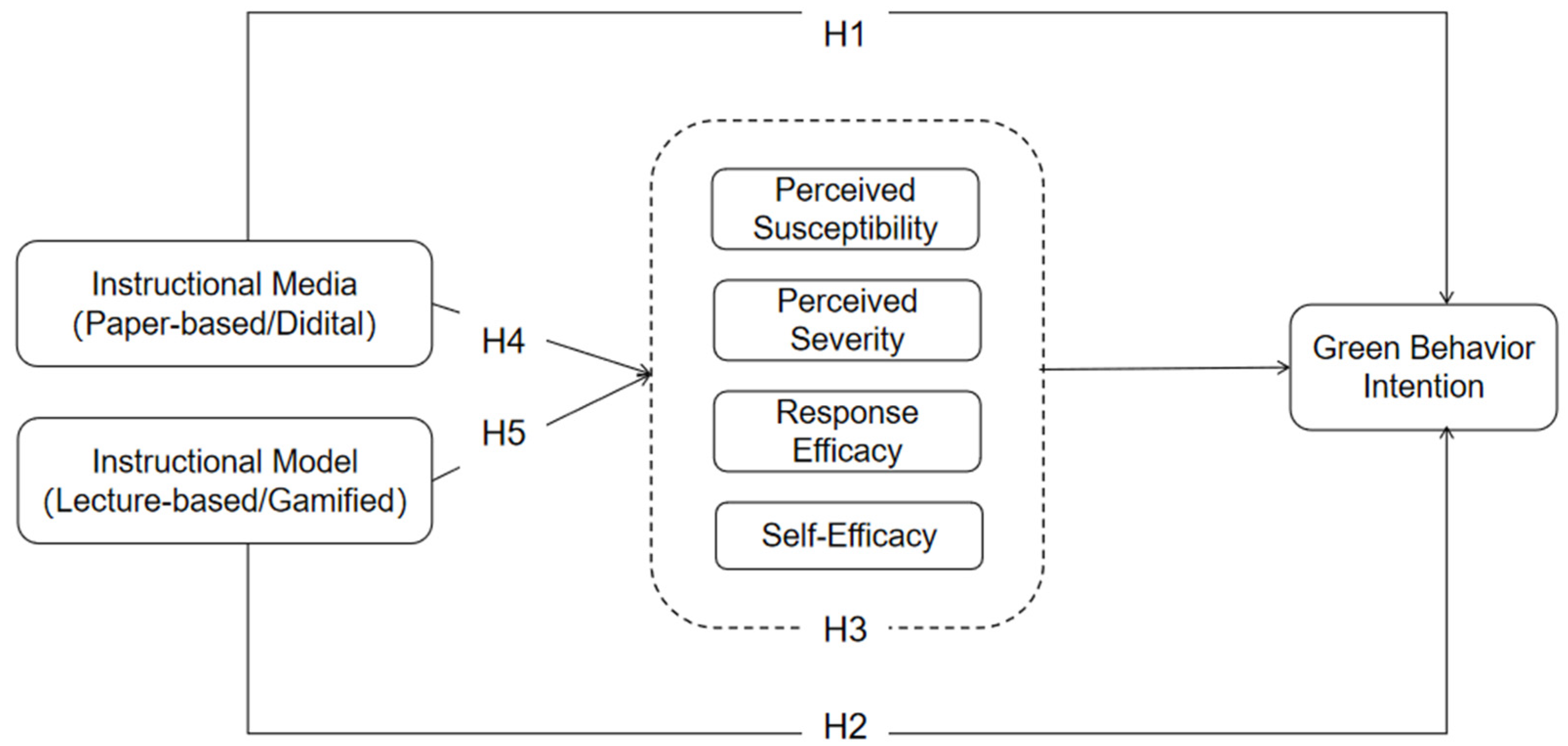
3.1. Experimental Design
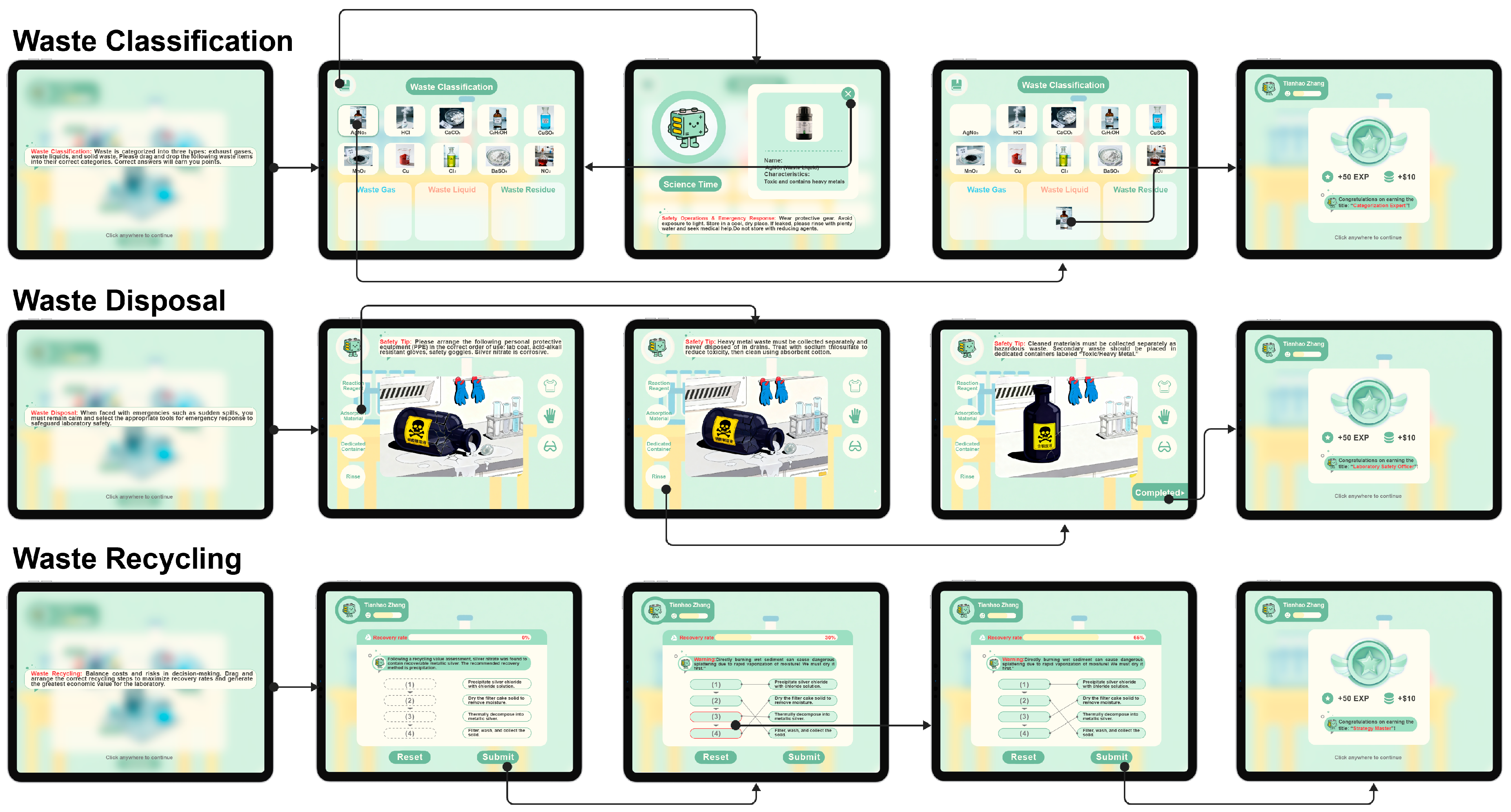
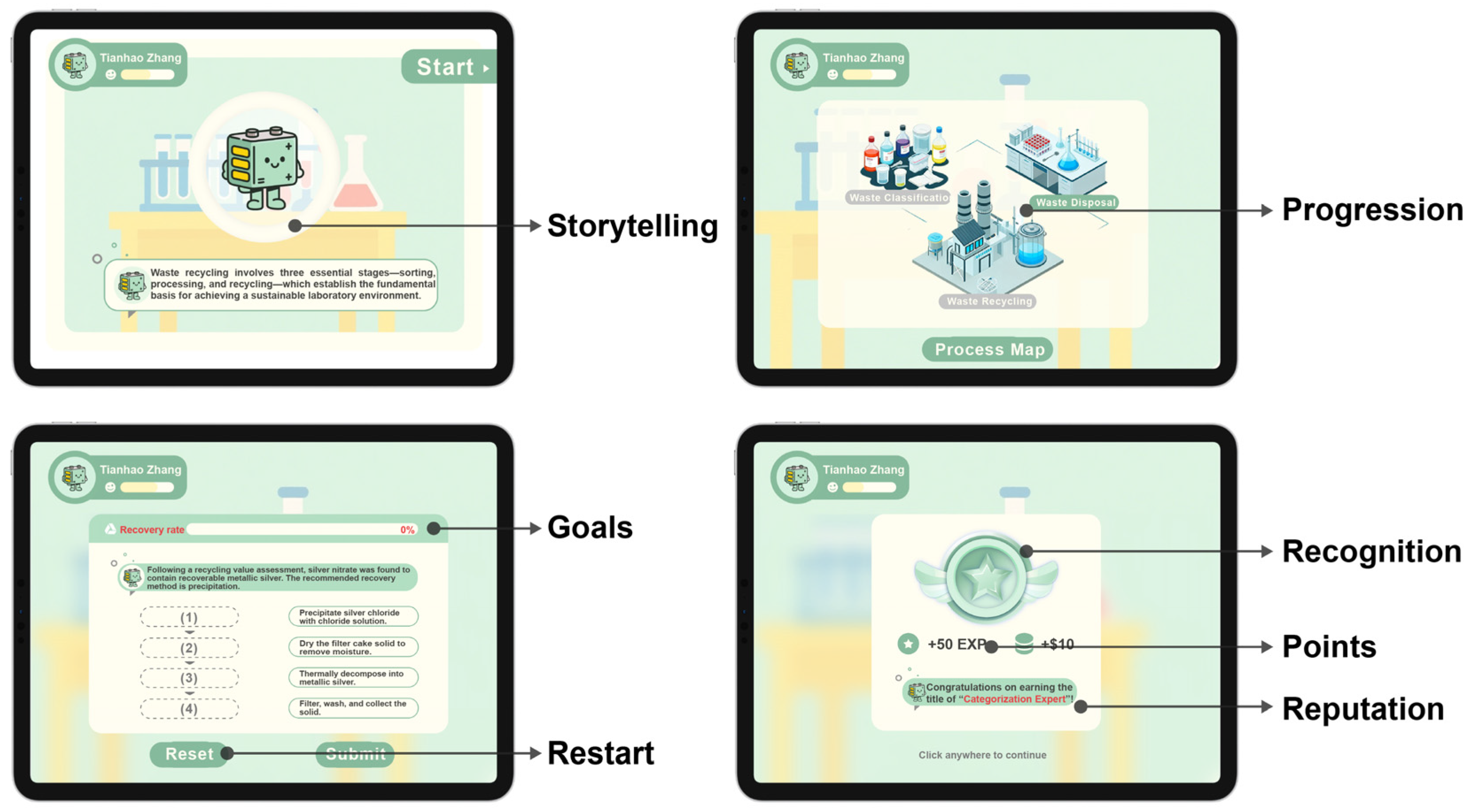
3.2. Experimental Material Design
3.3. Variable Measurement and Scale Design
3.4. Experimental Tasks and Procedures
4. Research Findings
4.1. Descriptive Statistics
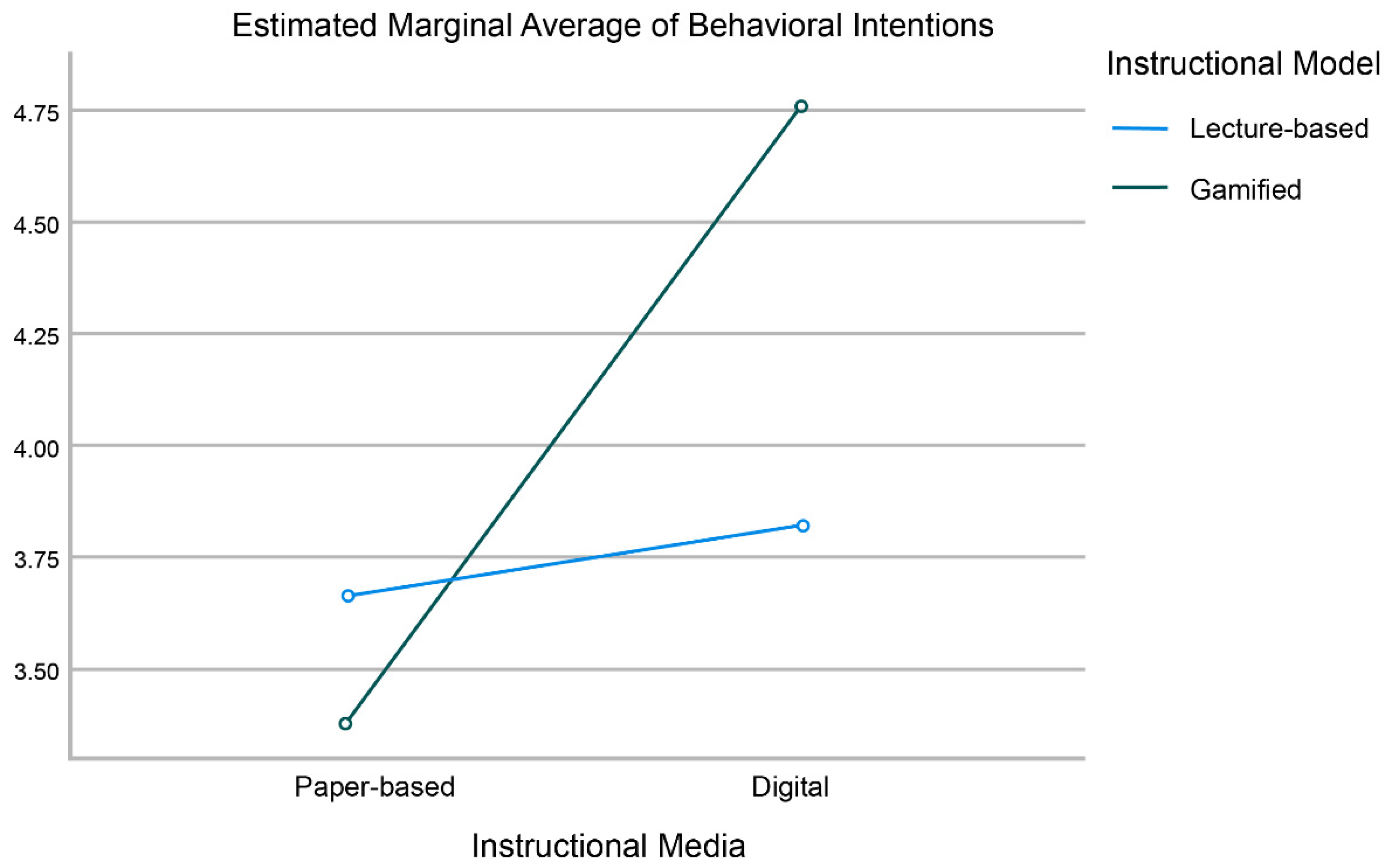
4.2. Effects of Instructional Media and Instructional Model on Green Behavior Intentions
4.3. Mediating Role of Protective Motivation Decision Factors
5. Discussion
5.1. Key Findings
5.2. Theoretical and Practical Implications
6. Conclusions
- (1)
- The experimental focus was on sustainable laboratory safety education; the external validity of the findings requires validation in other educational contexts.
- (2)
- While this study examines the direct impact of gamified instruction on students’ green behavior intentions, the process may be influenced by individual differences among students. Personal factors such as prior gaming experience, learning preferences, and digital literacy may serve as moderating variables that affect students’ behavioral intentions. By ensuring random assignment of participants to groups, this study maintains an approximate normal distribution of individual characteristics within groups, thereby minimizing such influences.
- (3)
- Two primary limitations exist in the experimental design: First, no non-intervention control group was established. The current 2 × 2 factorial design aims to compare the relative effectiveness of four active teaching strategies, a common approach in comparative studies in educational technology [88]. However, future research should incorporate a control group to more reliably assess the net effect of the teaching strategies themselves after controlling for factors such as pretest interference. Another limitation is that the intervention lasted relatively briefly (5–8 min). While this aligns with the focused, immediate model of microlearning [89], it may be insufficient to trigger deep learning, and observed effects could partially stem from novelty effects [90]. Therefore, future studies should adopt longitudinal designs, such as tracking students’ intentions and behaviors throughout an entire semester in actual experimental courses, to examine the persistence of effects.
Author Contributions
Funding
Institutional Review Board Statement
Informed Consent Statement
Data Availability Statement
Acknowledgments
Conflicts of Interest
Abbreviations
| PMT | Protection Motivation Theory |
| TPB | Theory of Planned Behavior |
| CLT | Cognitive Load Theory |
| ICL | Intrinsic Cognitive Load |
| ECL | Extraneous Cognitive Load |
| GCL | Germane Cognitive Load |
References
- Li, Y.; Tan, H.; Zhuang, Z.; Chen, S.; Hu, Y. Status and Characteristics of Energy Consumption of Campus Scientific Research Buildings. Build. Energy Effic. 2015, 7, 85–89. [Google Scholar] [CrossRef]
- Brendel, S.; Fetter, É.; Staude, C.; Vierke, L.; Biegel-Engler, A. Short-Chain Perfluoroalkyl Acids: Environmental Concerns and a Regulatory Strategy under REACH. Environ. Sci. Eur. 2018, 30, 9. [Google Scholar] [CrossRef] [Scilit]
- Bai, M.; Liu, Y.; Qi, M.; Roy, N.; Shu, C.-M.; Khan, F.; Zhao, D. Current Status, Challenges, and Future Directions of University Laboratory Safety in China. J. Loss Prev. Process Ind. 2022, 74, 104671. [Google Scholar] [CrossRef] [Scilit]
- Schulz, W.G. Fighting lab fires. Chem. Eng. News 2005, 83, 34–35. [Google Scholar] [CrossRef] [Scilit]
- Xu, W. Sustainability Education Through Digital Platforms: Evaluating Digital Tools for Eco-Conscious Behavior Promotion. Pak. J. Life Soc. Sci. 2025, 23, 1425–1446. [Google Scholar] [CrossRef] [Scilit]
- Bhute, V.J.; Inguva, P.; Shah, U.; Brechtelsbauer, C. Transforming Traditional Teaching Laboratories for Effective Remote Delivery—A Review. Educ. Chem. Eng. 2021, 35, 96–104. [Google Scholar] [CrossRef] [Scilit]
- Alraimi, K.M.; Zo, H.; Ciganek, A.P. Understanding the MOOCs Continuance: The Role of Openness and Reputation. Comput. Educ. 2015, 80, 28–38. [Google Scholar] [CrossRef] [Scilit]
- Wang, W. The Evolution of MOOCs and Their Influence on Higher Education. Jiangsu High. Educ. 2013, 2, 53–57. [Google Scholar] [CrossRef]
- Tiwari, S.; Kumar, L. Online Education- Benefit or Misuse:A Systematic Literature Review. Int. J. Res. Trends Innov. 2023, 8, 621–627. [Google Scholar]
- Ismail, G.A.; Aldous, S.M. Digital Innovation in Green Learning: Ensuring Safety While Fostering Environmental Stewardship. In Legal Frameworks and Educational Strategies for Sustainable Development; Alqodsi, E., Abdallah, A., Eds.; IGI Global Scientific Publishing: Hershey, PA, USA, 2025; pp. 307–336. [Google Scholar] [CrossRef] [Scilit]
- Zeng, J.; Parks, S.; Shang, J. To learn scientifically, effectively, and enjoyably: A review of educational games. Hum. Behav. Emerg. Technol. 2020, 2, 186–195. [Google Scholar] [CrossRef] [Scilit]
- Tokac, U.; Novak, E.; Thompson, C.G. Effects of Game-based Learning on Students’ Mathematics Achievement: A Meta-analysis. Comput. Assist. Learn. 2019, 35, 407–420. [Google Scholar] [CrossRef] [Scilit]
- Gampell, A.V.; Gaillard, J.C.; Parsons, M.; Le Dé, L.; Hinchliffe, G. Participatory Minecraft Mapping: Fostering Students Participation in Disaster Awareness. Entertain. Comput. 2024, 48, 100605. [Google Scholar] [CrossRef] [Scilit]
- Naderi, S.; Moafian, F. The Victory of a Non-Digital Game over a Digital One in Vocabulary Learning. Comput. Educ. Open 2023, 4, 100135. [Google Scholar] [CrossRef] [Scilit]
- Deng, L.; Wu, S.; Chen, Y.; Peng, Z. Digital Game-based Learning in a Shanghai Primary-school Mathematics Class: A Case Study. Comput. Assist. Learn. 2020, 36, 709–717. [Google Scholar] [CrossRef] [Scilit]
- Ajzen, I. The Theory of Planned Behavior. Organ. Behav. Hum. Decis. Process. 1991, 50, 179–211. [Google Scholar] [CrossRef] [Scilit]
- Kothe, E.J.; Ling, M.; North, M.; Klas, A.; Mullan, B.A.; Novoradovskaya, L. Protection Motivation Theory and Pro-environmental Behaviour: A Systematic Mapping Review. Aust. J. Psychol. 2019, 71, 411–432. [Google Scholar] [CrossRef] [Scilit]
- How to Green Your Lab. Available online: https://mygreenlab.org/how-to-green-your-lab/ (accessed on 10 November 2025).
- Withers, J.H.; Freeman, S.A.; Kim, E. Learning and Retention of Chemical Safety Training Information: A Comparison of Classroom versus Computer-Based Formats on a College Campus. J. Chem. Health Saf. 2012, 19, 47–55. [Google Scholar] [CrossRef] [Scilit]
- Johnson, V.A.; Ronan, K.R.; Johnston, D.M.; Peace, R. Evaluations of Disaster Education Programs for Children: A Methodological Review. Int. J. Disaster Risk Reduct. 2014, 9, 107–123. [Google Scholar] [CrossRef] [Scilit]
- Rey-Becerra, E.; Barrero, L.H.; Ellegast, R.; Kluge, A. The Effectiveness of Virtual Safety Training in Work at Heights: A Literature Review. Appl. Ergon. 2021, 94, 103419. [Google Scholar] [CrossRef] [Scilit] [PubMed]
- Pekdag, B. Video-Based Instruction on Safety Rules in the Chemistry Laboratory: Its Effect on Student Achievement. Chem. Educ. Res. Pract. 2020, 21, 953–968. [Google Scholar] [CrossRef] [Scilit]
- Camel, V.; Maillard, M.-N.; Descharles, N.; Le Roux, E.; Cladière, M.; Billault, I. Open Digital Educational Resources for Self-Training Chemistry Lab Safety Rules. J. Chem. Educ. 2021, 98, 208–217. [Google Scholar] [CrossRef] [Scilit]
- Zhu, B.; Feng, M.; Lowe, H.; Kesselman, J.; Harrison, L.; Dempski, R.E. Increasing Enthusiasm and Enhancing Learning for Biochemistry-Laboratory Safety with an Augmented-Reality Program. J. Chem. Educ. 2018, 95, 1747–1754. [Google Scholar] [CrossRef] [Scilit]
- Fishbein, M.; Ajzen, I. Belief, Attitude, Intention, and Behavior: An Introduction to Theory and Research; Addison-Wesley Pub. Co.: Reading, MA, USA, 1975. [Google Scholar]
- Savari, M.; Khaleghi, B. Application of the Extended Theory of Planned Behavior in Predicting the Behavioral Intentions of Iranian Local Communities toward Forest Conservation. Front. Psychol. 2023, 14, 1121396. [Google Scholar] [CrossRef] [Scilit]
- Phan Hoang, T.T.; Kato, T. Measuring the Effect of Environmental Education for Sustainable Development at Elementary Schools: A Case Study in Da Nang City, Vietnam. Sustain. Environ. Res. 2016, 26, 274–286. [Google Scholar] [CrossRef] [Scilit]
- Sultan, M.T.; Sharmin, F.; Badulescu, A.; Stiubea, E.; Xue, K. Travelers’ Responsible Environmental Behavior towards Sustainable Coastal Tourism: An Empirical Investigation on Social Media User-Generated Content. Sustainability 2020, 13, 56. [Google Scholar] [CrossRef] [Scilit]
- Dagiliūtė, R.; Liobikienė, G.; Minelgaitė, A. Sustainability at Universities: Students’ Perceptions from Green and Non-Green Universities. J. Clean. Prod. 2018, 181, 473–482. [Google Scholar] [CrossRef] [Scilit]
- Correia, E.; Sousa, S.; Viseu, C.; Leite, J. Using the Theory of Planned Behavior to Understand the Students’ pro-Environmental Behavior: A Case-Study in a Portuguese HEI. Int. J. Sustain. High. Educ. 2022, 23, 1070–1089. [Google Scholar] [CrossRef] [Scilit]
- Wu, J.; Ma, P. Knowledge Flow Research in MOOC Platform Based on Super Network. Libr. Inf. 2015, 6, 97–106. [Google Scholar] [CrossRef]
- Werbach, K.; Hunter, D. For the Win: How Game Thinking Can Revolutionize Your Business; Wharton Digital Press: Philadelphia, PA, USA, 2012. [Google Scholar]
- Koivisto, J.; Hamari, J. The Rise of Motivational Information Systems: A Review of Gamification Research. Int. J. Inf. Manag. 2019, 45, 191–210. [Google Scholar] [CrossRef] [Scilit]
- Hamari, J.; Koivisto, J. Why do people use gamification services? Int. J. Inf. Manag. 2015, 35, 419–431. [Google Scholar] [CrossRef] [Scilit]
- Deterding, S.; Dixon, D.; Khaled, R.; Nacke, L. From Game Design Elements to Gamefulness: Defining “Gamification”. In Proceedings of the 15th International Academic MindTrek Conference: Envisioning Future Media Environments, Tampere, Finland, 29–30 September 2011; Association for Computing Machinery: Tampere, Finland, 2011; pp. 9–15. [Google Scholar] [CrossRef] [Scilit]
- Surendeleg, G.; Murwa, V.; Yun, H.-K.; Kim, Y.S. The Role of Gamification in Education–a Literature Review. Contemp. Eng. Sci. 2014, 7, 1609–1616. [Google Scholar] [CrossRef] [Scilit]
- Wang, M.; Zheng, X. Using Game-Based Learning to Support Learning Science: A Study with Middle School Students. Asia-Pac. Educ. Res. 2021, 30, 167–176. [Google Scholar] [CrossRef] [Scilit]
- Ho, S.-J.; Hsu, Y.-S.; Lai, C.-H.; Chen, F.-H.; Yang, M.-H. Applying Game-Based Experiential Learning to Comprehensive Sustainable Development-Based Education. Sustainability 2022, 14, 1172. [Google Scholar] [CrossRef] [Scilit]
- Newell, A.; Simon, H.A. Human Problem Solving; Prentice-Hall: Upper Saddle River, NJ, USA, 1972. [Google Scholar]
- Delgado, P.; Vargas, C.; Ackerman, R.; Salmerón, L. Don’t Throw Away Your Printed Books: A Meta-Analysis on the Effects of Reading Media on Reading Comprehension. Educ. Res. Rev. 2018, 25, 23–38. [Google Scholar] [CrossRef] [Scilit]
- Rutten, N.; Van Joolingen, W.R.; Van Der Veen, J.T. The Learning Effects of Computer Simulations in Science Education. Comput. Educ. 2012, 58, 136–153. [Google Scholar] [CrossRef] [Scilit]
- He, K. Constructivist Instructional Models, Instructional Methods, and Instructional Design. J. Beiiing Norm. Univ. (Soc. Sci.) 1997, 5, 74–81. [Google Scholar]
- Joyce, B.; Calhoun, E. Models of Teaching, 10th ed.; Routledge: New York, NY, USA, 2024. [Google Scholar]
- Kay, R.; MacDonald, T.; DiGiuseppe, M. A comparison of lecture-based, active, and flipped classroom teaching approaches in higher education. J. Comput. High. Educ. 2019, 31, 449–471. [Google Scholar] [CrossRef] [Scilit]
- Barblett, L.; Knaus, M. Learning Through Play in Early Childhood Education. In Encyclopedia of Teacher Education; Peters, M., Ed.; Springer: Singapore, 2019; pp. 1–5. [Google Scholar] [CrossRef] [Scilit]
- Hattie, J.; Timperley, H. The Power of Feedback. Rev. Educ. Res. 2007, 77, 81–112. [Google Scholar] [CrossRef] [Scilit]
- Liu, C.-H.; Horng, J.-S.; Chou, S.-F.; Yu, T.-Y.; Huang, Y.-C.; Ng, Y.-L.; Lin, J.-Y. How Big Data Applications and Digital Learning Change Students’ Sustainable Behaviours—the Moderating Roles of Hard and Soft Skills. Interact. Learn. Environ. 2024, 32, 6751–6773. [Google Scholar] [CrossRef] [Scilit]
- Chittaro, L.; Sioni, R. Serious games for emergency preparedness: Evaluation of an interactive vs. a non-interactive simulation of a terror attack. Comput. Hum. Behav. 2015, 50, 508–519. [Google Scholar] [CrossRef] [Scilit]
- Zhang, L.; Shang, J. A Theoretical Study on Game-based Learning from the Perspective of Learning Experiences. E-Educ. Res. 2018, 6, 11–20, 26. [Google Scholar] [CrossRef]
- Colan, C.C.; Peralta, D.B.; Flores, R.V.; Morales Gomero, J.C. Gamification in Occupational Safety Training: A Systematic Literature Review. In Proceedings of the International Conference on Industrial Engineering and Operations Management, Houston, TX, USA, 12–15 June 2023. [Google Scholar] [CrossRef] [Scilit]
- Fernández Galeote, D.; Rajanen, M.; Rajanen, D.; Legaki, N.-Z.; Langley, D.J.; Hamari, J. Gamification for Climate Change Engagement: A User-Centered Design Agenda. In Proceedings of the 26th International Academic Mindtrek Conference, Tampere, Finland, 3–6 October 2023; pp. 45–56. [Google Scholar] [CrossRef] [Scilit]
- Sweller, J. Element Interactivity and Intrinsic, Extraneous, and Germane Cognitive Load. Educ. Psychol. Rev. 2010, 22, 123–138. [Google Scholar] [CrossRef] [Scilit]
- Sweller, J. Cognitive Load Theory. In Psychology of Learning and Motivation; Elsevier Academic Press: Amsterdam, The Netherlands, 2011; Volume 55, pp. 37–76. [Google Scholar] [CrossRef] [Scilit]
- Chang, S.L.; Ley, K. A Learning Strategy to Compensate for Cognitive Overload in Online Learning: Learner Use of Printed Online Materials. J. Interact. Online Learn. 2006, 5, 104–117. [Google Scholar]
- Al-Khresheh, M.H. The Cognitive and Motivational Benefits of Gamification in English Language Learning: A Systematic Review. Open Psychol. J. 2025, 18. [Google Scholar] [CrossRef] [Scilit]
- Rogers, R.W. A Protection Motivation Theory of Fear Appeals and Attitude Change1. J. Psychol. 1975, 91, 93–114. [Google Scholar] [CrossRef] [Scilit]
- Rogers, R.W. Cognitive and Physiological Processes in Fear Appeals and Attitude Change: A Revised Theory of Protection Motivation. In Social Psychophysiol: A Sourcebook; Cacioppo, J.T., Petty, R.E., Eds.; Guilford Press: New York, NY, USA, 1983; pp. 153–176. [Google Scholar]
- Milne, S.; Sheeran, P.; Orbell, S. Prediction and Intervention in Health-Related Behavior: A Meta-Analytic Review of Protection Motivation Theory. J Appl. Soc. Pyschol 2000, 30, 106–143. [Google Scholar] [CrossRef] [Scilit]
- Floyd, D.L.; Prentice-Dunn, S.; Rogers, R.W. A Meta-Analysis of Research on Protection Motivation Theory. J. Appl. Soc. Pyschol 2000, 30, 407–429. [Google Scholar] [CrossRef] [Scilit]
- Rippetoe, P.A.; Rogers, R.W. Effects of Components of Protection-Motivation Theory on Adaptive and Maladaptive Coping with a Health Threat. J. Personal. Soc. Psychol. 1987, 52, 596–604. [Google Scholar] [CrossRef] [PubMed]
- Plotnikoff, R.C.; Higginbotham, N. Protection Motivation Theory and Exercise Behaviour Change for the Prevention of Heart Disease in a High-Risk, Australian Representative Community Sample of Adults. Psychol. Health Med. 2002, 7, 87–98. [Google Scholar] [CrossRef] [Scilit]
- Prentice-Dunn, S.; Rogers, R.W. Protection Motivation Theory and preventive health: Beyond the Health Belief Model. Health Educ. Res. 1986, 1, 153–161. [Google Scholar] [CrossRef] [Scilit]
- Rogers, R.W.; Prentice-Dunn, S. Protection Motivation Theory. In Handbook of Health Behavior Research 1: Personal and Social Determinants; Plenum Press: New York, NY, USA, 1997; pp. 113–132. [Google Scholar]
- Wurtele, S.K.; Maddux, J.E. Relative Contributions of Protection Motivation Theory Components in Predicting Exercise Intentions and Behavior. Health Psychol. 1987, 6, 453–466. [Google Scholar] [CrossRef] [PubMed]
- Taylor, S.E.; Thompson, S.C. Stalking the elusive “vividness” effect. Psychol. Rev. 1982, 89, 155–181. [Google Scholar] [CrossRef]
- Faghani, A.; Bijani, M.; Valizadeh, N. What Makes Students of Green Universities Act Green: Application of Protection Motivation Theory. Int. J. Sustain. High. Educ. 2024, 25, 838–864. [Google Scholar] [CrossRef] [Scilit]
- Janmaimool, P. Application of Protection Motivation Theory to Investigate Sustainable Waste Management Behaviors. Sustainability 2017, 9, 1079. [Google Scholar] [CrossRef] [Scilit]
- Maddux, J.E.; Rogers, R.W. Protection Motivation and Self-Efficacy: A Revised Theory of Fear Appeals and Attitude Change. J. Exp. Soc. Psychol. 1983, 19, 469–479. [Google Scholar] [CrossRef] [Scilit]
- Chen, M.-F. Extending the Protection Motivation Theory Model to Predict Public Safe Food Choice Behavioural Intentions in Taiwan. Food Control 2016, 68, 145–152. [Google Scholar] [CrossRef] [Scilit]
- Jensen, J.L.; Sørensen, E.B. Recreation, Cultivation and Environmental Concerns: Exploring the Materiality and Leisure Experience of Contemporary Allotment Gardening. Leis. Stud. 2020, 39, 322–340. [Google Scholar] [CrossRef] [Scilit]
- Cox, D.N.; Koster, A.; Russell, C.G. Predicting Intentions to Consume Functional Foods and Supplements to Offset Memory Loss Using an Adaptation of Protection Motivation Theory. Appetite 2004, 43, 55–64. [Google Scholar] [CrossRef] [Scilit]
- Landers, R.N.; Armstrong, M.B. Enhancing Instructional Outcomes with Gamification: An Empirical Test of the Technology-Enhanced Training Effectiveness Model. Comput. Hum. Behav. 2017, 71, 499–507. [Google Scholar] [CrossRef] [Scilit]
- Toda, A.M.; Oliveira, W.; Klock, A.C.; Palomino, P.T.; Pimenta, M.; Gasparini, I.; Shi, L.; Bittencourt, I.; Isotani, S. A Taxonomy of Game Elements for Gamification in Educational Contexts: Proposal and Evaluation. In Proceedings of the 2019 IEEE 19th International Conference on Advanced Learning Technologies (ICALT), Maceio, Brazil, 15–18 July 2019; pp. 84–88. [Google Scholar] [CrossRef] [Scilit]
- Lin, C.; Zheng, K.; Man, S.S. Risk Perception Scale for Laboratory Safety: Development and Validation. Int. J. Ind. Ergon. 2025, 105, 103689. [Google Scholar] [CrossRef] [Scilit]
- Hartmann, P.; Apaolaza, V.; D’Souza, C.; Barrutia, J.M.; Echebarria, C. Environmental Threat Appeals in Green Advertising: The Role of Fear Arousal and Coping Efficacy. Int. J. Advert. 2014, 33, 741–765. [Google Scholar] [CrossRef] [Scilit]
- Schwarzer, R.; Jerusalem, M. General Self-Efficacy Scale. In Measures in Health Psychology: A User’s Portfolio. Causal and Control Beliefs; Weinman, J., Wright, S., Johnston, M., Eds.; NFER-NELSON: Windsor, UK, 1995; pp. 35–37. [Google Scholar] [CrossRef] [Scilit]
- Zhang, J.X.; Schwarzer, R. Measuring Optimistic Self-Beliefs: A Chinese Adaptation of the General Self-Efficacy Scale. Psychol. Int. J. Psychol. Orient 1995, 38, 174–181. [Google Scholar]
- Larson, L.R.; Stedman, R.C.; Cooper, C.B.; Decker, D.J. Understanding the Multi-Dimensional Structure of pro-Environmental Behavior. J. Environ. Psychol. 2015, 43, 112–124. [Google Scholar] [CrossRef] [Scilit]
- Mayer, R.E. Multimedia Learning, 2nd ed.; Cambridge University Press: Cambridge, UK, 2009. [Google Scholar] [CrossRef] [Scilit]
- Sailer, M.; Homner, L. The Gamification of Learning: A Meta-Analysis. Educ. Psychol. Rev. 2020, 32, 77–112. [Google Scholar] [CrossRef] [Scilit]
- Ma, C. College Students’ Intention to Adopt Protective Health Behaviors during Pandemic. J. Res. 2022, 2, 17–33, 117–118. [Google Scholar] [CrossRef]
- Witte, K. Putting the Fear Back into Fear Appeals: The Extended Parallel Process Model. Commun. Monogr. 1992, 59, 329–349. [Google Scholar] [CrossRef] [Scilit]
- O’Neill, S.; Nicholson-Cole, S. “Fear Won’t Do It”: Promoting Positive Engagement With Climate Change Through Visual and Iconic Representations. Sci. Commun. 2009, 30, 355–379. [Google Scholar] [CrossRef] [Scilit]
- Bandura, A. Self-Efficacy: The Exercise of Control; W H Freeman: New York, NY, USA, 1997. [Google Scholar]
- Van Valkengoed, A.M.; Steg, L.; Perlaviciute, G. The Psychological Distance of Climate Change Is Overestimated. One Earth 2023, 6, 362–391. [Google Scholar] [CrossRef] [Scilit]
- Hornik, J.; Cherian, J.; Madansky, M.; Narayana, C. Determinants of Recycling Behavior: A Synthesis of Research Results. J. Socio-Econ. 1995, 24, 105–127. [Google Scholar] [CrossRef] [Scilit]
- Gifford, R. The Dragons of Inaction: Psychological Barriers That Limit Climate Change Mitigation and Adaptation. Am. Psychol. 2011, 66, 290–302. [Google Scholar] [CrossRef] [Scilit]
- Mayer, R.E.; Johnson, C.I. Adding Instructional Features That Promote Learning in a Game-Like Environment. J. Educ. Comput. Res. 2010, 42, 241–265. [Google Scholar] [CrossRef] [Scilit]
- Monib, W.K.; Qazi, A.; Apong, R.A. Microlearning beyond Boundaries: A Systematic Review and a Novel Framework for Improving Learning Outcomes. Heliyon 2025, 11, e41413. [Google Scholar] [CrossRef] [Scilit] [PubMed]
- Cheong, C.; Filippou, J.; Cheong, F. Towards the Gamification of Learning: Investigating Student Perceptions of Game Elements. J. Inf. Syst. Educ. 2014, 25, 233–244. [Google Scholar]



| Variable Type | Variable Name | Measurement Item | Source |
|---|---|---|---|
| Mediating Variable Mediating Variable | Perceived Vulnerability | If I carelessly place flammable chemicals (such as ethanol) near heat sources (such as computers), I believe I would be at risk of fire or burns. If I handle corrosive or toxic chemical waste while wearing damaged protective clothing or gloves, I believe harmful substances will come into contact with my skin and cause injury. Suppose I enter an unclassified or chemically contaminated waste disposal area wearing only a vest, bare chest, or flip-flops. In that case, I believe chemical splashes or physical impacts could injure me. | Chaohui Lin et al. [74] |
| Perceived Severity | During chemical reagent handling, I did not handle them with care but instead tossed reagent bottles carelessly, leading to broken bottles, spills, and chemical burns that contaminated soil or water. When handling discarded chemical reagents, I did not wear protective gloves and touched them directly with my bare hands, which directly caused chemical burns, poisoning, or allergic reactions. Drinking or eating while handling waste resulted in accidental ingestion of toxic chemicals and cross-contamination of waste systems. | Chaohui Lin et al. [74] | |
| Reaction Efficiency | When handling discarded chemical reagents, I did not wear protective gloves and touched them directly with my bare hands, which directly caused chemical burns, poisoning, or allergic reactions. | Hartmann et al. [75] | |
| Strict adherence to waste classification and disposal protocols significantly reduces the risk of environmental contamination and safety incidents in laboratory settings. | |||
| Self-efficacy | I am confident in my ability to safely and correctly handle common waste emergencies in the laboratory. | Zhang, J.X. & Schwarzer, R. [77] | |
| Even when encountering waste with complex composition or unclear labelling, I am confident in my ability to determine its classification and disposal method using my knowledge. | |||
| When handling potentially hazardous waste, I remain calm and perform safe recovery operations in accordance with standard procedures. | |||
| For a given type of laboratory waste, I can identify multiple options and select the most environmentally friendly and safest disposal and recycling solution. | |||
| Dependent Variable | Green Behavior Intent | I will prioritize purchasing and using environmentally friendly laboratory reagents or energy-efficient laboratory equipment. | Lincoln R. L et al. [78] |
| I will prioritize purchasing and using environmentally friendly laboratory reagents or energy-efficient laboratory equipment. | |||
| I will prioritize purchasing and using environmentally friendly laboratory reagents or energy-efficient laboratory equipment. |
| Hypothesis | Path | Effect Type | β | Bootstrap 95% CI |
|---|---|---|---|---|
| H4a–H4d | MED → GBI | Total | 0.7565 | [0.5384, 0.9747] |
| MED → GBI | Direct | 0.2078 | [−0.0602, 0.4758] | |
| MED → PV → GBI | Indirect | 0.0000 | [−0.1026, 0.0175] | |
| MED → PS → GBI | Indirect | 0.5410 | [0.2862, 0.8123] | |
| MED → RE → GBI | Indirect | 0.0021 | [−0.0199, 0.0288] | |
| MED → SE → GBI | Indirect | 0.0057 | [−0.0881, 0.1069] | |
| H5a–H5d | MOD → GBI | Total | 0.3093 | [0.0658, 0.5528] |
| MED → GBI | Direct | 0.0828 | [−0.1464, 0.312 0] | |
| MOD → PV → GBI | Indirect | 0.0005 | [−0.0248, 0.0228] | |
| MOD → PS → GBI | Indirect | −0.1032 | [−0.2373, 0.0373] | |
| MOD → RE → GBI | Indirect | 0.0003 | [−0.0171, 0.0178] | |
| MOD → SE → GBI | Indirect | 0.3290 | [0.1774, 0.4927] |
Disclaimer/Publisher’s Note: The statements, opinions and data contained in all publications are solely those of the individual author(s) and contributor(s) and not of MDPI and/or the editor(s). MDPI and/or the editor(s) disclaim responsibility for any injury to people or property resulting from any ideas, methods, instructions or products referred to in the content. |
© 2025 by the authors. Licensee MDPI, Basel, Switzerland. This article is an open access article distributed under the terms and conditions of the Creative Commons Attribution (CC BY) license.
Share and Cite
He, W.; Cai, Y.; Sun, X. A Study on the Impact of Gamified Online Instructional Models on Green Behavior Intention in Sustainable Laboratory Safety Education. Sustainability 2026, 18, 315. https://doi.org/10.3390/su18010315
He W, Cai Y, Sun X. A Study on the Impact of Gamified Online Instructional Models on Green Behavior Intention in Sustainable Laboratory Safety Education. Sustainability. 2026; 18(1):315. https://doi.org/10.3390/su18010315
Chicago/Turabian StyleHe, Wei, Yao Cai, and Xinxin Sun. 2026. "A Study on the Impact of Gamified Online Instructional Models on Green Behavior Intention in Sustainable Laboratory Safety Education" Sustainability 18, no. 1: 315. https://doi.org/10.3390/su18010315
APA StyleHe, W., Cai, Y., & Sun, X. (2026). A Study on the Impact of Gamified Online Instructional Models on Green Behavior Intention in Sustainable Laboratory Safety Education. Sustainability, 18(1), 315. https://doi.org/10.3390/su18010315