1. Introduction
The intensifying effects of climate change are manifesting through increasingly frequent, severe, and prolonged extreme weather events. Among these, heatwaves have emerged as some of the most disruptive phenomena for energy systems, given their simultaneous impact on electricity supply, demand, and infrastructure integrity. Southern Europe—and Portugal in particular—is highly exposed to this threat. Historical heatwaves in 2003, 2017, and 2022 revealed significant vulnerabilities in energy system resilience during extreme temperature events [
1]. Climate projections from the Intergovernmental Panel on Climate Change (IPCC) indicate that this trend will worsen over the coming decades, with scenarios such as SSP5-8.5 projecting temperature increases exceeding 3.5 °C across many inland regions of Portugal by the end of the century [
2,
3]. The IPCC SSP5-8.5 scenario represents a high-emission pathway characterized by fossil-fuel-driven economic growth and limited climate mitigation, leading to an estimated global mean temperature rise of about 4–5 °C by 2100. It is commonly used to assess upper-bound climate impacts on energy systems and infrastructure.
As part of its national strategy to reduce carbon emissions, Portugal has made substantial investments in renewable energy, with solar power assuming an increasingly important role in the national electricity mix. By 2025, installed solar photovoltaic (PV) capacity had reached approximately 6 GW [
4]. This rapid expansion, supported by policy instruments under the National Energy and Climate Plan (PNEC 2030) [
5], positions PV as a cornerstone of Portugal’s clean-energy transition. However, PV systems—particularly those based on crystalline silicon technologies—are known to be sensitive to elevated operating temperatures. During heatwaves, high cell temperatures significantly reduce conversion efficiency, with temperature coefficients typically ranging between −0.3% and −0.5% per °C. These thermal losses often coincide with peak electricity demand driven by extensive air-conditioning use, producing a critical mismatch between generation and consumption.
Despite its growing importance, few studies have quantified the direct effects of elevated temperatures on PV performance in Portugal. Existing works tend to focus on general climate impacts or monthly averages, which lack the temporal and spatial resolution required for site-specific analysis and planning. This gap highlights the need for a detailed, location-based assessment of PV vulnerability to heat extremes.
This study addresses that need by evaluating the influence of rising ambient temperatures on the technical performance and economic return of photovoltaic systems in mainland Portugal. It focuses on three large-scale PV power plants located in climatically diverse regions—Amareleja (Alentejo), Alcoutim (Algarve), and Tábua (Central Portugal)—and employs hourly meteorological data from the Photovoltaic Geographical Information System (PVGIS).
The main objectives are to:
Quantify the impact of increasing ambient temperatures on PV performance by applying five established temperature models (NOCT, Faiman, PVSyst, NOCT (SAM), and Sandia) to long-term meteorological data for three representative Portuguese solar power plants.
Simulate energy yield and revenue variations under uniform warming scenarios of +2 °C and +5 °C, consistent with observed heatwave conditions and IPCC mid- to late-century climate projections.
Assess the sensitivity of PV performance to model assumptions, including (i) variations in module parameters (temperature coefficient and NOCT), (ii) stochastic, non-uniform temperature perturbations reproducing realistic heatwave dynamics, and (iii) differences between two PV output models—the simplified linear temperature-corrected model and the one-diode three-parameter (1D + 3P) model.
Estimate the economic implications of temperature-induced power losses, by coupling the simulated hourly generation data with historic day-ahead electricity market prices (MIBEL) from the Portuguese TSO data hub.
Evaluate regional differences in PV vulnerability across Portugal’s diverse climatic zones and discuss the broader implications for technology design and energy policy under a warming climate.
This study provides a comprehensive quantitative assessment of how rising ambient temperatures and heatwave conditions affect PV performance and profitability in Portugal. Unlike most previous works that rely solely on simplified thermal assumptions, this paper integrates five established temperature models, a stochastic representation of heatwave variability, and both simplified and physical PV power output formulations (linear and one-diode three-parameter). The combined climatic, technical, and economic analysis offers new insights into the resilience of large-scale PV systems under future warming scenarios, supporting evidence-based adaptation strategies for technology design and energy policy.
Although this study does not introduce new PV temperature or power-output models, it makes several original contributions to the literature. First, it provides a systematic sensitivity analysis of PV performance using multiple established temperature models and PV power formulations within a unified framework. Second, it explicitly contrasts uniform temperature-increase scenarios with stochastic perturbations designed to emulate heatwave dynamics, highlighting the nonlinear amplification of performance losses during extreme events. Third, it integrates technical performance modelling with historical electricity market prices to quantify revenue impacts, bridging the gap between engineering performance assessment and economic relevance. Finally, the analysis scales plant-level effects to national-level implications, offering policy-relevant insights into the long-term vulnerability of photovoltaic generation to increasing heatwave frequency.
The paper is structured as follows.
Section 2 presents a concise literature review on the effects of climate change on PV performance, with emphasis on temperature-dependent efficiency losses and modelling approaches. It highlights recent advances in PV temperature modelling and identifies research gaps related to heatwave impacts and economic assessments.
Section 3 describes the methodological framework, including the selection of case-study sites, PV module specifications, meteorological datasets, and simulation assumptions. It details the five temperature models and two PV output power models used, as well as the construction of uniform and stochastic temperature scenarios.
Section 4 discusses and compares the main results, analyzing the technical and economic consequences of temperature rise, and exploring the sensitivity of outcomes to model parameters and formulations.
Section 5 summarizes the principal conclusions, identifies the study’s limitations, and suggests directions for future work, including mitigation and adaptation strategies such as improved thermal management, advanced materials, and optimized system design.
2. Literature Review
The performance of PV systems under high-temperature conditions has become a critical research topic as heatwaves grow more frequent and intense across Southern Europe. Numerous studies have examined how elevated temperatures influence PV conversion efficiency, reliability, and, consequently, the stability of power systems. However, detailed regional analyses remain limited—particularly for Portugal, where solar penetration is increasing and heat extremes are intensifying. This section reviews relevant literature on (i) climate-related heatwave trends, (ii) the thermal sensitivity of PV systems, (iii) modelling approaches for temperature-dependent performance, and (iv) emerging mitigation strategies.
2.1. Climate Change and Heatwaves
According to the Portuguese Institute for Sea and Atmosphere (IPMA), a heatwave is defined as a period in which the daily maximum temperature exceeds the 90th percentile of historical values for at least six consecutive days [
6].
The ongoing rise in global temperature, primarily driven by anthropogenic greenhouse-gas emissions, is amplifying the frequency, intensity, and duration of heatwaves worldwide. The IPCC identifies Southern Europe, including Portugal, as a climate-change hotspot, where warming is expected to intensify under all emissions scenarios [
2]. These projections are based on Shared Socioeconomic Pathways (SSPs), which combine assumptions about future emissions, development trends, and policy action. The number on each pathway refers to the expected level of radiative forcing, the net energy imbalance in the Earth’s atmosphere, measured in watts per square metre (W/m
2) by 2100: SSP1-2.6: A low-emissions scenario with strong mitigation efforts, leading to 2.6 W/m
2 of radiative forcing and limited warming; SSP3-7.0: A fragmented world with weak climate policies, resulting in 7.0 W/m
2 and moderately high warming; SSP5-8.5: A fossil fuel–driven development path, producing 8.5 W/m
2 and severe global temperature increases.
A recent high-resolution study by Carvalho (2024) [
3] uses Coupled Model Intercomparison Project Phase 6 (CMIP6) climate projections to evaluate future temperature trends across Portugal. Under the SSP3-7.0 scenario for 2046–2065, daily maximum temperatures are projected to increase by +1.5 °C. By the end of the century (2081–2100), under SSP5-8.5, increases could reach +3.5 °C in many regions. The number of hot days (Tmax > 30 °C) is expected to rise by 35–40 days per year, while very hot days (Tmax > 40 °C) could increase by 12–15 days annually. Additionally, the frequency of tropical nights (Tmin > 20 °C) may grow by up to 50 nights per year, particularly in inland areas [
3]. These detailed projections confirm that Portugal could face a substantial increase in thermal extremes, with interior regions such as Alentejo and the upper Douro being especially vulnerable to this event.
2.2. Heatwaves and Power Systems
Heatwaves represent a growing challenge for electricity systems, affecting both the demand and supply sides. While much of the literature has focused on increased cooling demand and network stress during extreme temperature events, recent studies highlight that generation technologies are also directly impacted by elevated ambient temperatures. In particular, temperature-sensitive renewable technologies such as PV systems experience systematic efficiency and power-output reductions during heatwave periods, linking system-level heatwave impacts with technology-specific performance degradation.
Extreme heat events affect the entire energy system—generation, transmission, and demand. Multiple studies have reported that heatwaves can reduce the thermal efficiency of power plants by 0.3% to 6% per degree Celsius, depending on the plant type and cooling system configuration [
7,
8]. Nuclear plants, for instance, may experience losses of 0.5% per °C, with values exceeding 2% per °C during severe events [
9]. Operational disruptions are also documented, including curtailments, shutdowns, and increased production costs [
10]. Under intense heat stress, some plants have had to reduce load or halt operations entirely due to water temperature constraints and equipment stress.
Wind generation often declines during these periods due to the dominance of stationary high-pressure systems, large- scale atmospheric patterns characterized by sinking air, clear skies, and weak surface winds, which inhibit vertical air movement and reduce pressure gradients, resulting in calm conditions unfavourable for wind turbine operation. A study by Molina et al. [
11] quantified this phenomenon in Southern Europe, showing that during heatwaves, wind power production decreased by up to 30.8% while electricity demand increased between 3.5% and 10.6%, depending on the country. In Portugal specifically, wind power generation often presents negative anomalies during heatwaves, highlighting a critical mismatch between renewable supply and peak cooling demand. The combination of reduced wind energy availability and increased electricity demand creates significant challenges for maintaining power system stability during extreme heat events.
Hydropower generation is also impacted by heatwaves, primarily due to reduced water availability and elevated water temperatures. Extended periods of high temperatures are often associated with drought conditions, which lower reservoir levels and reduce inflow to hydroelectric facilities [
12]. These constraints are especially relevant in southern regions of Portugal where hydrological stress is becoming increasingly frequent due to climate change. As hydropower remains one of the country’s major renewable sources, its vulnerability during extreme heat events poses a systemic risk to energy security.
The transmission and distribution infrastructure of power systems is also significantly affected by extreme heat conditions. Elevated ambient temperatures place considerable thermal stress on the physical components of the grid, affecting both performance and reliability.
One of the most immediate impacts is on overhead conductors, which expand as temperatures rise. This thermal expansion increases line sag, reducing the clearance between conductors and the ground or surrounding vegetation. Excessive sag can create public safety risks and heighten the likelihood of short circuits and wildfires, particularly in areas with dense vegetation. Additionally, as conductors heat up, their electrical resistance increases, leading to greater energy losses and reduced transmission efficiency [
13].
Transformers, which are essential for voltage regulation and load balancing, are also vulnerable to overheating. Higher ambient temperatures reduce their cooling capacity and can push them closer to their thermal design limits. Sustained heat exposure accelerates insulation degradation and oil breakdown, shortening equipment lifespan and increasing the likelihood of thermal overloads. Protection relays may trigger emergency shutdowns to prevent catastrophic failures, removing key assets from the network during critical periods.
These stresses on the grid infrastructure are particularly dangerous when they coincide with the simultaneous increase in electricity demand. As the load on the grid spikes and infrastructure capability declines, system operators face the growing challenge of maintaining grid stability. Without appropriate thermal management strategies, such as dynamic line rating, predictive maintenance, and adaptive grid control, the risk of cascading failures increases. A local failure, if not contained, can quickly escalate into regional blackouts, with severe social and economic consequences. In response to these risks, operators may be forced to implement emergency measures, such as load shedding, grid reconfiguration, or high-cost energy imports.
Such multi-sectoral impacts intensify supply–demand imbalances at times when electricity demand peaks because of cooling loads. Within this broader context, PV systems—though abundant in solar resource—suffer thermal efficiency losses that partially offset high irradiance gains. This dual effect is particularly relevant in Portugal, where clear skies and elevated ambient temperatures often coincide.
These system-level impacts of heatwaves provide the broader context for examining how temperature extremes affect PV performance and economic outcomes, which is the focus of the following sections.
2.3. Heat Impact on Photovoltaic Systems
PV performance degrades as cell temperature increases, reducing open-circuit voltage and overall power output. Typical temperature coefficients for crystalline-silicon modules range between −0.3% and −0.5% per °C. During heatwaves, module temperatures can exceed 60 °C, leading to power losses of 10–15%, depending on ventilation and mounting conditions.
Choobineh et al. [
14] developed an optimal energy management framework for distribution networks exposed to heatwaves, showing that strategic scheduling of loads and distributed energy resources can reduce grid stress by up to 20%. Their model accounts for the reduction in performance of components such as transformers and power lines at higher temperatures, reflecting the importance of considering thermal losses in PV systems during extreme weather conditions.
Shen et al. [
15] proposed a risk determination framework for urban electricity networks using a network-flow approach based on real-time. Their study highlighted how extreme heat can amplify stress across transmission nodes and substations, underscoring the relevance of spatial vulnerability mapping, a method potentially transferable to regional PV performance analysis.
Añel et al. [
16], in a climate-focused study, assessed the impacts of both cold and heatwaves on energy production across Europe. While they did not focus specifically on PV systems, their findings confirmed widespread reductions in generation efficiency, particularly in thermal plants, during temperature extremes. Their work also shows how important it is to connect extreme weather events, like heatwaves, with real impacts on how energy systems perform, such as changes in output, efficiency, or reliability of the whole energy production infrastructure.
Further supporting these conclusions, Shen et al. [
15] developed a detailed analysis of the vulnerability of power grids under heat stress in Beijing. They used a visualized network approach to assess energy flow during heatwaves, finding that node-level instability in high-voltage transmission and distribution systems can trigger system-wide performance degradation.
While the available literature provides important insights as to how extreme heat affects power system infrastructure, most of these studies focus primarily on transmission and distribution networks rather than on photovoltaic technologies. They tend to analyze issues such as line losses, transformer stress, and system stability under thermal conditions. For example, Panteli and Mancarella [
17], in 2015, examined how extreme weather reduces the resilience of power systems by stressing thermal limits and increasing the risk of cascading failures. However, these studies do not typically address the specific performance and economic impacts of heatwaves on PV systems.
Despite these insights, few studies quantify PV-specific efficiency and revenue losses at the site scale, especially in Portugal, where high irradiance coexists with frequent summer temperature spikes. Addressing this gap requires detailed hourly simulations combining local meteorological and market data—an approach pursued in this study.
2.4. Mitigation and Adaptation Strategies
The adverse impact of high temperatures on photovoltaic performance has prompted growing interest in technologies and strategies that enhance system resilience. As climate change unwinds the frequency and intensity of heatwaves, it ensures, at the same time, the sustained efficiency of solar systems, becoming, therefore, a key consideration in system design and energy policy. This section explores emerging PV technologies, infrastructure adaptations, and operational strategies aimed at minimizing thermal losses and improving the robustness of PV installations under elevated temperature conditions. One of the most researched approaches to reducing the impact of heat on PV panels is cooling. Cooling strategies can be broadly categorized into passive and active methods.
Passive cooling relies on design features and materials to manage heat without external energy input. Examples include elevated mounting systems that promote natural airflow under the panels, the use of high-emissivity coatings, and the incorporation of phase change materials (PCMs). PCMs can absorb excess heat during the hottest part of the day and release it gradually as temperatures fall, effectively stabilizing module temperature. Velmurugan et al. [
18] reported that PCM integration, particularly when combined with thermal collectors, can reduce panel temperatures by up to 28 °C and improve power output by 4.42–5.39%. Similarly, Ali [
19] highlighted that standalone PCMs can enhance PV efficiency by 20%, with even greater gains when PCMs are combined with water.
Active cooling systems enhance thermal regulation of PV modules by introducing fluid- based heat removal techniques. These include both liquid and nanofluid-based methods, particularly within photovoltaic-thermal (PVT) hybrid configurations. Such systems simultaneously lower cell temperatures and enable thermal energy recovery for secondary uses like water or space heating. According to Ali [
19], nanofluid-based PVT systems have demonstrated PV efficiency enhancements exceeding 60%, primarily due to the superior thermal conductivity of nanoparticles compared to conventional coolants. However, the implementation of nanofluids introduces challenges such as higher system complexity, risk of particle agglomeration, and increased operational costs. Despite these limitations, active cooling remains a promising strategy, especially for high-efficiency or utility-scale applications where the performance gains can justify the added investment.
Microchannel and minichannel heat sinks embedded in module frames enable compact, efficient cooling. These can be paired with smart absorbers and thermally adaptive materials, forming part of next-generation integrated PV solutions [
20].
Floating photovoltaic (FPV) systems, installed on water bodies such as reservoirs and canals, benefit from the natural cooling effect of the underlying water surface. This cooling can significantly reduce module temperatures by up to 14.5 °C in some cases and leads to measurable gains in electrical output. Field tests in both temperate (Netherlands) and tropical (Singapore) climates have shown yield increases of up to 3–6%, depending on configuration and environmental conditions [
21]. In Portugal, FPV has been adopted in hybrid configurations, such as the Alto Rabagão Dam installation, which combines solar and hydropower infrastructure. In addition to performance gains, FPV systems help conserve land and can reduce water evaporation, making them a multifunctional solution for integrated renewable energy deployment.
In parallel with cooling-based mitigation strategies, emerging photovoltaic technologies with intrinsically lower temperature coefficients offer an additional pathway to reduce performance degradation during heatwaves. Advanced crystalline silicon technologies such as heterojunction (HJT) and TOPCon, as well as thin-film PV technologies (e.g., CdTe and CIGS), typically exhibit lower temperature sensitivity compared to conventional mono-crystalline silicon modules. However, these technologies often involve higher investment costs, increased manufacturing complexity, or lower market penetration at utility scale. As a result, standard crystalline silicon modules remain the dominant choice for large-scale PV deployment in Southern Europe. Nevertheless, the results of this study indicate that even moderate reductions in the temperature coefficient of power could substantially mitigate long-term revenue losses under future warming scenarios, highlighting the relevance of these emerging technologies as potential adaptation options.
Smart inverter controls and solar tracking technologies reduce peak-hour solar load by dynamically adjusting energy output and orientation. Maximum Power Point Tracking (MPPT) systems equipped with temperature feedback loops further enhance PV efficiency under high- temperature conditions [
22]. Building-integrated photovoltaics (BIPV) not only contributes to electricity generation but also provides passive shading, lowering indoor temperatures and reducing the need for air conditioning [
23]. When combined with passive cooling measures, such as reflective roofing, green facades, and thermally responsive materials, these strategies can significantly decrease the sensitivity of electricity demand to heatwaves and support urban climate resilience.
Energy storage systems play a key role in enhancing grid resilience by decoupling electricity generation from consumption patterns. Battery Energy Storage Systems (BESS) can store surplus solar energy that was generated during midday and discharge it during peak evening hours, helping to stabilize the grid and reduce dependence on flexible but high-cost peaking generation units. In parallel, demand-side flexibility measures, such as time-of-use tariffs and automated load management, allow consumers to shift consumption to off-peak periods, further increasing system efficiency and adaptability.
Despite the potential of these technologies, high capital costs, especially for advanced materials, remain a barrier. Hybrid systems require skilled labour, maintenance, and environmental risks—for example, PCMs disposal—that must be addressed. Scalability depends on adapting solutions to local climate, infrastructure, and regulation.
Policy must actively support these innovations through targeted financial incentives, simplified permitting processes, pilot initiatives, and enforceable efficiency standards. In addition, resilience metrics should be integrated into national energy planning to guide long-term infrastructure development. In conclusion, even if no single approach can address all challenges, a carefully selected combination of technologies that aligns with Portugal’s climate and energy system offers the most effective path to maintaining photovoltaic performance in a warming world.
2.5. Research Gaps
Although substantial progress has been made in understanding temperature effects on PV systems, empirical assessments under real heatwave conditions remain limited, particularly for Portugal and Southern Europe. Existing studies seldom integrate hourly meteorological data, market prices, and detailed performance models to quantify both technical and economic impacts at the plant level. This research therefore contributes by providing a site-specific, data-driven evaluation of PV performance and profitability under simulated warming scenarios, supporting the design of heat-resilient PV systems and informed national energy policy.
3. Models and Methodology
The research gaps identified in
Section 2.5, particularly the limited availability of site-specific studies combining high-resolution meteorological data, detailed PV performance modelling, and economic assessment under heatwave conditions, directly motivate the methodological framework adopted in this work. To address these gaps, the present study integrates long-term hourly meteorological data, multiple established PV temperature models, alternative PV power output formulations, and historic electricity market prices. This approach enables a consistent and reproducible assessment of both the technical and economic impacts of elevated ambient temperatures on large-scale PV systems under realistic operating conditions.
With the increasing frequency and intensity of heatwaves across Southern Europe, assessing the vulnerability of RES, especially PV, has become a vital part of climate resilience planning. In Portugal, solar energy plays an important role in the growth of national decarbonization goals; therefore, assessing the ability of PV systems to maintain efficiency under thermal stress is critical to ensure energy security, grid stability, and investment viability. Regions such as Alentejo and Algarve, which combine high solar irradiance with frequent summer heat extremes, are particularly exposed to these performance risks. In these contexts, evaluating how projected temperature increases affects photovoltaic generation is fundamental to support technical and financial planning.
3.1. Modelling Temperature Effects on PV Performance
To assess the impact of higher ambient temperatures caused by heat waves on PV power production, it is necessary to capture how ambient temperature variations affect the cell temperature. Since the PV conversion efficiency decreases as the cell temperature increases, an accurate estimation of cell temperature is essential for realistic performance modelling. Five temperature models were considered in this study, ranging from simplified empirical approaches to more physically based formulations.
3.1.1. Model 1—NOCT Model
PV temperature simplified modelling typically relates the module temperature
to ambient temperature
and plan-of-array (POA) irradiance
. The most widely used representation uses the Nominal Operating Cell Temperature (
NOCT) model originally proposed by Ross in [
24]:
where
NOCT represents the cell temperature under 800 W m
−2 irradiance, 20 °C ambient temperature, and 1 m s
−1 wind speed. This formulation assumes steady-state conditions and neglects explicit wind-speed dependence, which makes it simple but less accurate under varying cooling conditions.
3.1.2. Model 2—Faiman Model
A more refined empirical temperature model is the Faiman model [
25] described by:
where
W m
−2 K
−1 is the default heat loss coefficient (convection + radiation without wind),
W m
−2 K
−1 is the default wind-dependent cooling coefficient and
is the wind speed at 10 m height.
The Faiman model is based on an empirical linearization of the module energy balance under steady-state conditions. It assumes that the absorbed solar energy not converted into electricity is dissipated through convection and radiation, and that both mechanisms can be approximated by a combined heat transfer coefficient that depends linearly on wind speed.
3.1.3. Model 3—PVSyst Model
A very similar model to Faiman’s is the default model in PVSyst software [
26,
27]:
where
is the module efficiency at STC, given in the datasheet,
is an empirical correction factor and
W m
−2 K
−1 represents an average combined heat loss factor under typical field conditions. The main difference to Faiman’s is the multiplicative factor
, which accounts for the fact that a small portion of irradiance is converted into electricity rather than being dissipated as heat.
3.1.4. Model 4—SAM Model
The System Advisor Model (SAM), developed by the U.S. National Renewable Energy Laboratory (NREL) [
28,
29], adopts a modified NOCT-based formulation that introduces additional correction terms to account for the fraction of irradiance converted into electricity, radiative and convective losses, and wind-speed-dependent cooling
where
is a combined coefficient representing transmittance and absorptance effects (default 0.9). The wind speed multiplicative coefficient
adjusts the wind speed from the standard 10 m measurement height to module level, valid for installations up to one story high.
3.1.5. Model 5—Sandia Model
The Sandia model, also known as the SAPM (Sandia Array Performance Model) temperature model [
30], is the default used in the PV Performance Modeling Collaborative (PVPMC):
The constant values depend on the module construction and materials as well as on the mounting configuration of the module. For glass/cell/glass module type mounted on open rack, the default parameters are and . This model is purely empirical but has been validated over a wide range of climatic conditions.
3.2. PV Power Output Models
The accurate estimation of PV power output under varying environmental conditions requires models that capture the dependence of module performance on irradiance and temperature. In this section, two PV power output models are presented and compared: the simplified linear formulation with temperature correction and the more detailed one-diode and three-parameter physical model.
3.2.1. Linear with Temperature-Corrected PV Power Output Model
The module DC output power
is then computed using the temperature coefficient of power
(%/°C) [
31]:
With being the standard test conditions (STC) irradiance, equal to 1000 W/m2 and the peak-power, i.e., the DC output power at STC (irradiance equal to 1000 W/m2 and cell temperature equal to 25 °C). This model is known as linear with temperature correction model.
Advanced approaches, such as the one-diode or three-parameter models, more accurately represent the diode saturation current and ideality factor, enabling improved prediction under variable irradiance and temperature conditions.
3.2.2. One-Diode and Three-Parameter PV Power Output Model
The one-diode and three-parameter (1D + 3P) model represents the electrical behaviour of a PV module using three physically meaningful parameters. The diode ideality factor () characterizes the dominant recombination mechanisms within the p–n junction and influences the slope of the current–voltage curve near the open-circuit voltage. The reverse saturation current () governs the exponential dependence of the diode current on voltage and temperature and is the main driver of voltage degradation at high cell temperatures. The short-circuit current () represents the photocurrent generated by incident irradiance and increases approximately linearly with both irradiance and cell temperature. In this study, all three parameters are derived directly from manufacturer datasheet values under STC, rather than being obtained through curve fitting or experimental calibration.
For comparison purposes, this study also implemented the one-diode and three-parameter (1D + 3P) PV model [
32,
33], a well-established physical approach that provides improved accuracy over linear models by explicitly representing semiconductor behaviour. The model is defined by three parameters—the diode ideality factor (
), the reverse saturation current (
), and the short-circuit current (
)—which can be derived directly from manufacturer datasheet values under Standard Test Conditions (STC, denoted by the superscript
):
where
is the maximum power voltage,
is the open-circuit voltage,
is the thermal voltage,
is the maximum power current and
is the short-circuit current, all at STC. The third parameter is the STC short-circuit current that is retrieved directly from the datasheet.
The influence of the irradiance and cell temperature is incorporated into the three parameters through:
where
is the number of cells of the module (given in the datasheet),
eV is the crystalline silicon band-gap and
is the short-circuit current temperature coefficient (also given in the datasheet).
The three parameters of the 1D + 3P model are fully determined through the analytical expressions provided in this section. At STC, the diode ideality factor and the reverse saturation current are obtained from Equations (7) and (8), respectively, while the short-circuit current is taken directly from the manufacturer datasheet. The influence of irradiance and module temperature on these parameters is then accounted for through Equations (9)–(11), which describe, respectively, the temperature and irradiance dependence of the diode ideality factor, the reverse saturation current, and the short-circuit current. This formulation enables direct implementation of the 1D + 3P model without the need for numerical fitting or experimental calibration.
The DC output is given by:
where
The equation to compute the maximum power voltage,
, is written in an appropriate way to be solved by the Gauss iterative method—
is the iteration number. To dramatically speed up the iterative process to a single iteration, an educated initial guess,
is computed by:
Which results from assuming that the maximum power current changes with irradiance and temperature in the same way the short-circuit current does.
It should be noted that, in the absence of experimental validation data, it is not possible to rigorously assess the accuracy of this model relative to the simplified temperature-corrected linear approach. Therefore, both models are used for comparative and sensitivity purposes rather than for absolute performance benchmarking.
3.3. Methodology
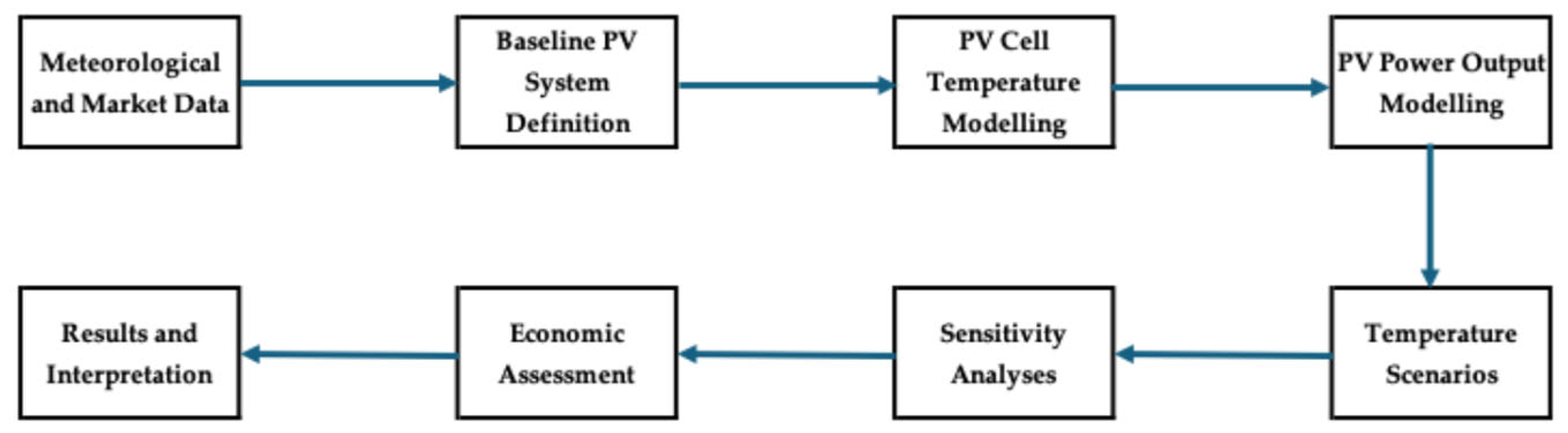
This study adopts a combined analytical and simulation-based approach to assess the impact of elevated ambient temperatures on PV energy production in mainland Portugal. The methodology consists of five main stages:
Selection of representative solar plants.
Specification of the reference PV module and estimation of system size.
Acquisition of meteorological data from PVGIS.
Simulation of power output under reference and elevated temperature.
Evaluation of the economic impacts of heat waves.
3.3.1. Selection of Representative Solar Plants
This case study focuses on three operational utility-scale PV installations located in distinct climatic regions of mainland Portugal, selected to reflect the country’s geographical and meteorological diversity:
Amareleja (Beja) [
34]—located in the hot, dry Alentejo interior, a region that regularly experiences record-breaking summer temperatures and prolonged heat waves.
Alcoutim (Faro) [
35]—situated in the interior eastern Algarve, characterized by dry conditions and high solar exposure throughout the year.
Tábua (Coimbra) [
36]—located in central Portugal, representing a temperate inland climate with moderate summer conditions.
By quantifying the performance losses and economic implications under controlled warming scenarios, this case study contributes to understanding how heat waves may affect the future performance and profitability of large-scale PV assets in Portugal and similar Mediterranean environments.
3.3.2. Specification of the Reference PV Module and Estimation of System Size
The simulations were based on the Jinko Solar JKM570M-7RL4-V PV module [
37]. The Jinko Solar JKM570M-7RL4-V module was selected as a representative utility-scale crystalline silicon PV technology, with electrical and thermal characteristics typical of modern large-scale installations in Portugal, allowing the results to be interpreted as technology-representative rather than manufacturer-specific. The main electrical and thermal parameters extracted from the manufacturer’s datasheet are presented in
Table 1.
The number of PV modules in each installation (
) is (see
Table 2).
3.3.3. Acquisition of Meteorological Data from PVGIS
Meteorological and solar radiation data were retrieved from the Photovoltaic Geographical Information System (PVGIS) [
38] for each site.
The following configuration was applied:
Solar radiation database: SARAH3
Mounting type: fixed system
Tilt and azimuth: optimized for maximum annual yield
PV technology: crystalline silicon
System losses: 14% (default PVGIS input assumption)
The period of analysis was set from 2009 to 2023, i.e., 15 years of hourly data. The variables extracted were:
: PV system power (W)
: Global irradiance on the inclined plane (POA) (W/m2)
: 2 m air temperature (degrees Celsius)
: 10 m total wind speed (m/s)
We exemplify the data retrieved from PVGIS with the case of Amareleja power plant.
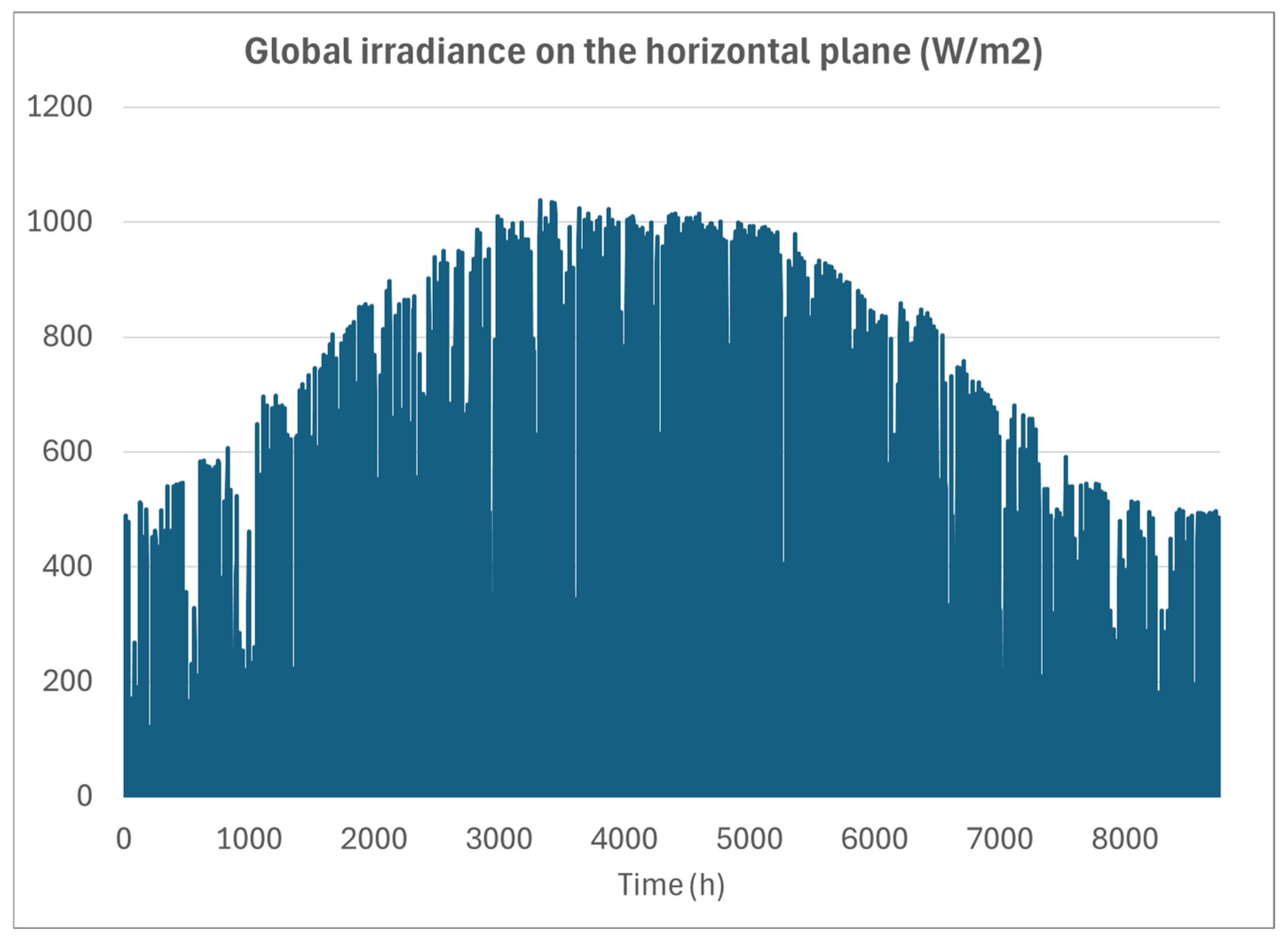
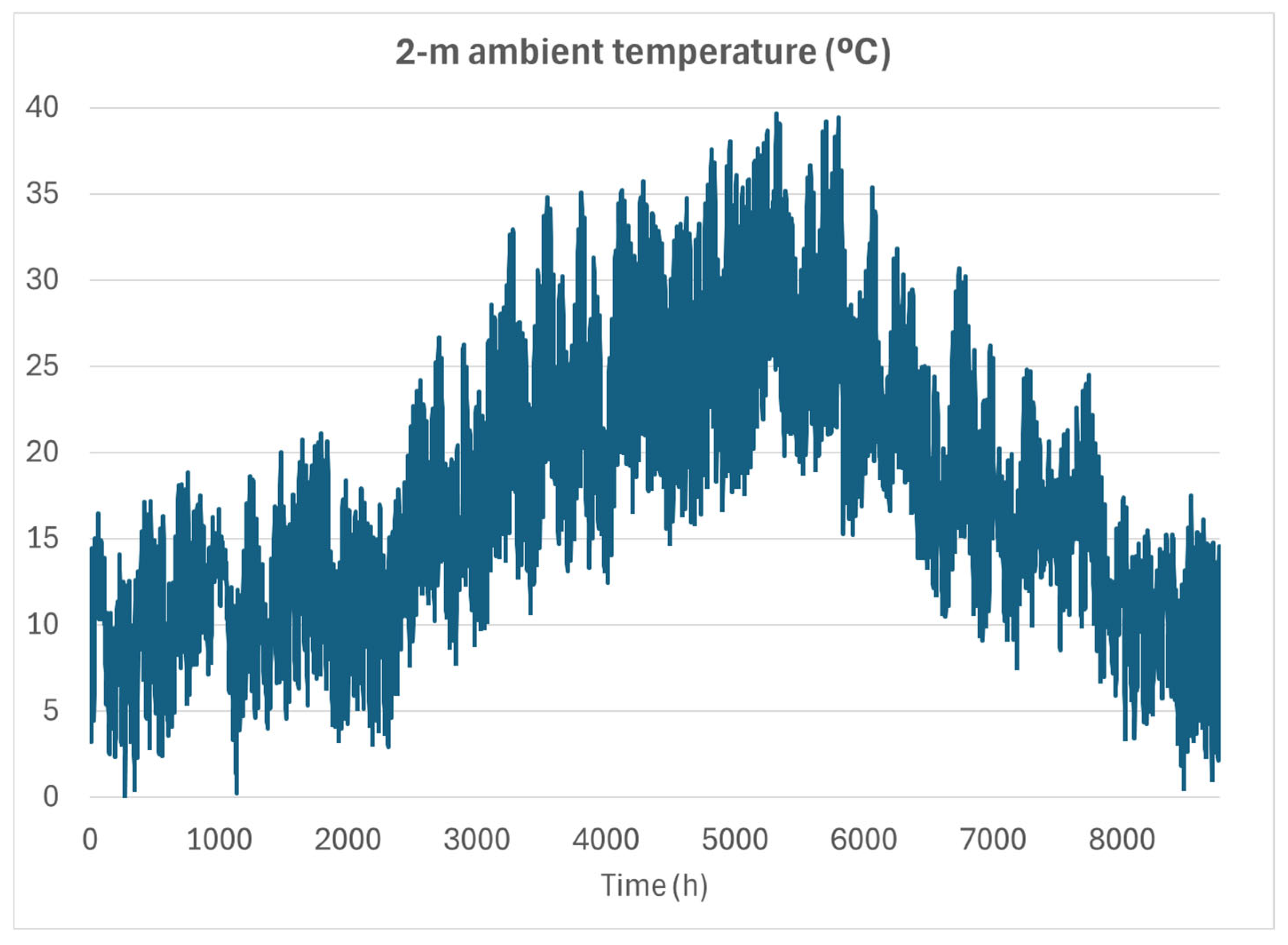
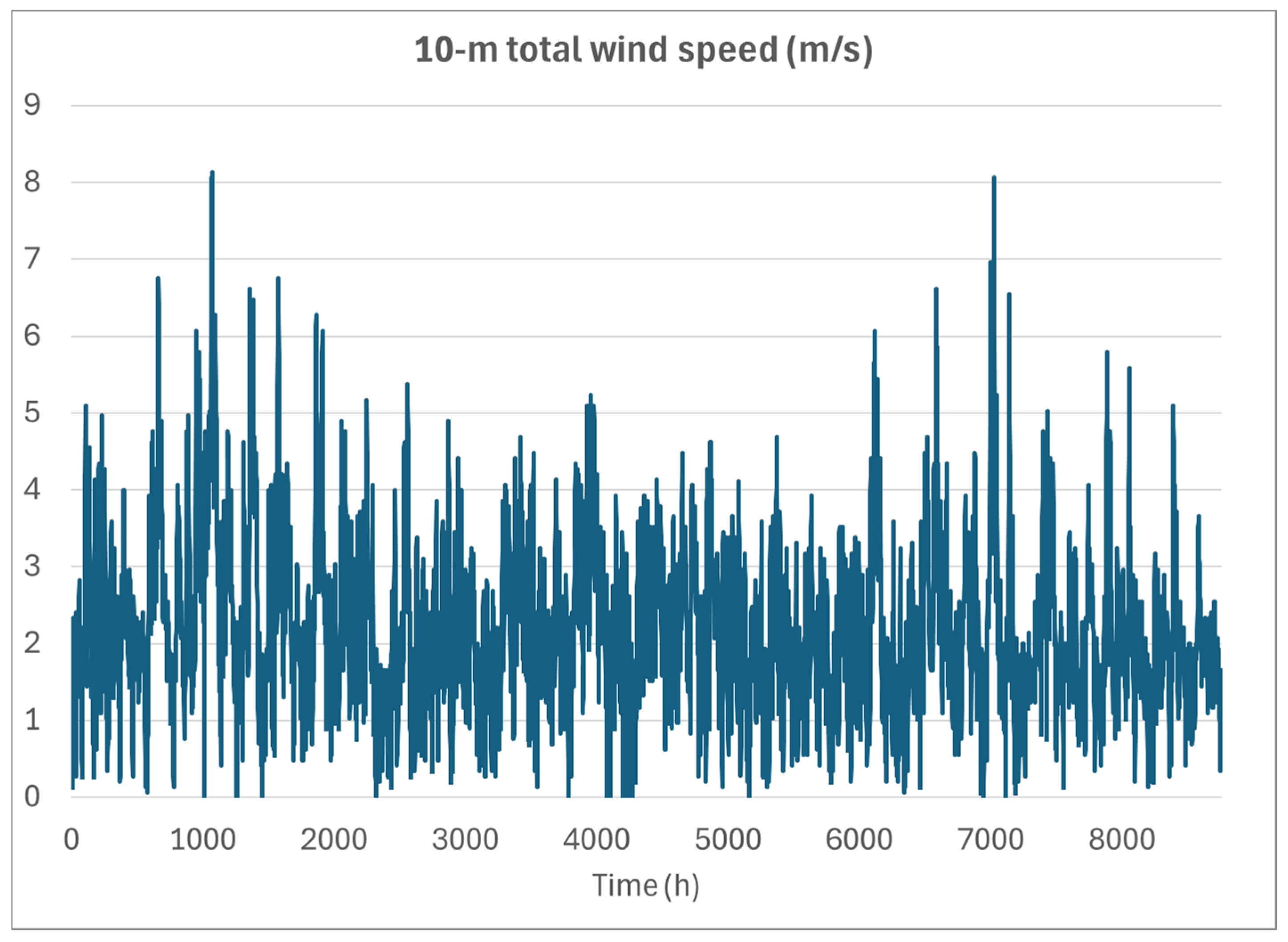
Figure 1,
Figure 2 and
Figure 3 show the global irradiance on the horizontal plan, ambient temperature and wind speed, respectively, for typical meteorological year (TMY) at Amareleja.
The irradiance profile (
Figure 1) exhibits the expected seasonal pattern, with maximum values during summer and minimal irradiance during winter, reflecting the high solar potential of southern Portugal. The ambient temperature (
Figure 2) follows a similar seasonal trend, with average winter temperatures around 10–15 °C and summer peaks frequently above 35 °C, confirming the region’s hot and dry Mediterranean climate. Wind speed (
Figure 3) remains relatively low throughout the year, mostly between 1 and 3 m/s, with occasional gusts above 7 m/s. This combination of high irradiance, elevated summer temperatures, and modest wind speeds is representative of Amareleja’s conditions and makes it an ideal site for evaluating the thermal sensitivity of photovoltaic systems during heat-wave events.
3.3.4. Simulation of Power Output Under Reference and Elevated Temperature
The linear temperature-corrected PV performance model (Equation (6)) was used to compute the DC power output, subsequently adjusted to account for overall system losses through the Performance Ratio (PR). These losses include both fixed and additional modelled components:
Fixed losses: inverter efficiency, shading, mismatch, wiring, and nameplate rating uncertainty.
Additional modelled losses: temperature losses (reduced efficiency for PV cell temperatures above 25 °C), angle-of-incidence and reflection losses, spectral and irradiance-dependent effects, as well as availability and snow losses (negligible in the Portuguese context).
The PR values reported by PVGIS were adopted for each location: Amareleja: 76.93%, Alcoutim: 77.33%, and Tábua: 78.31%. These factors represent the combined impact of all losses on the final AC energy yield and were applied to the simulated outputs to ensure consistency with PVGIS reference conditions.
The cell temperature was calculated using each one of the five temperature models (Equations (1)–(5)) from the real ambient temperature given by PVGIS (baseline: scenario 0). Then, two scenarios were considered for the ambient temperature rising:
To represent the thermal stress associated with moderate and severe heat-wave conditions, the ambient temperature was artificially increased by +2 °C and +5 °C (scenarios 1 and 2, respectively) relative to the reference dataset. These increments are consistent with the range of temperature anomalies observed during recent Portuguese heat waves (2003; 2017; 2022) and with mid- to late-century projections under IPCC SSP5-8.5 scenarios. To focus specifically on the influence of temperature, a simplified simulation framework was applied, using uniform increases in ambient temperature rather than modelling complex heatwave patterns. This choice allowed a clear and consistent comparison across scenarios and helped highlight the sensitivity of PV systems to higher temperatures.
A three-fold sensitivity analysis was also conducted to evaluate the robustness of the results and the influence of key modelling assumptions. In the first part, the PV module parameters were varied within their typical extreme ranges to assess the influence of physical uncertainties. Specifically, the temperature coefficient of power was tested between −0.3%/°C and −0.4%/°C, and the NOCT between 43 °C and 47 °C. These values represent realistic bounds for commercial crystalline silicon modules and allow quantifying the sensitivity of model outputs to parameter selection.
In the second part, a stochastic perturbation was introduced to the ambient temperature time series to reproduce non-uniform temperature variations that more accurately reflect the behaviour of real heat waves. Random anomalies were generated from a normal distribution with a mean increase of +2 °C (+5 °C) and a standard deviation of 0.8 °C, with perturbations amplified by up to 40% during the summer months (June–September) to simulate the greater frequency and intensity of extreme thermal events.
Finally, in the third part, the one-diode and three-parameter (1D + 3P) model was introduced as a comparative benchmark to the simplified linear temperature-corrected model. This physically based formulation accounts for the temperature dependence of the diode saturation current and the irradiance dependence of the short-circuit current, providing a more fundamental representation of PV performance under variable environmental conditions. Its inclusion in the sensitivity analysis enables assessing the deviation between empirical and physics-based approaches, particularly under high-temperature and low-irradiance operating conditions. Although both models showed consistent trends, the 1D + 3P model provides additional insight into the physical mechanisms underlying thermal efficiency losses.
Finally, it should be mentioned that PVGIS could not be used to perform the simulations, because PVGIS does not allow user defined input data with increased ambient temperatures. Therefore, the models used had to be coded.
3.3.5. Evaluation of the Economic Impacts of Heat Waves
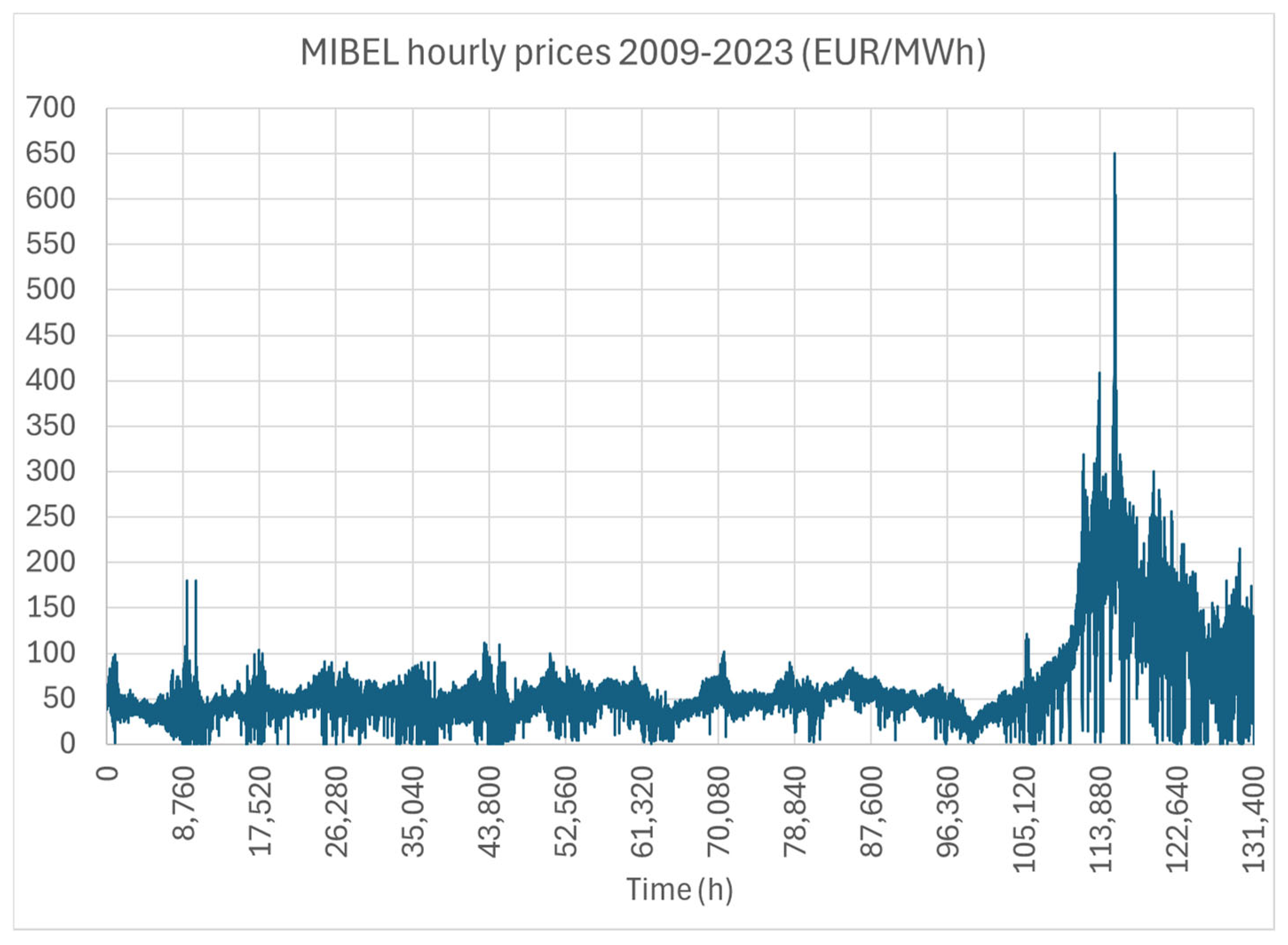
To assess the economic impact of reduced PV output under elevated temperature conditions, hourly historic day-ahead electricity prices (EUR/MWh) from the Iberian Electricity Market (MIBEL) from the period 2009–2023 were retrieved from the REN (Portuguese Transmission System Operator (TSO)) Data Hub [
39]. These prices were used in combination with the simulated hourly power output to estimate the revenue generated by each solar power plant under baseline and warming scenarios.
Figure 4 illustrates the evolution of hourly day-ahead electricity prices in the Iberian Electricity Market (MIBEL) between 2009 and 2023. For most of the period, prices remained relatively stable, oscillating typically between 30 and 70 EUR/MWh, reflecting the moderate volatility of the Iberian wholesale market. Occasional short-lived spikes occurred due to temporary system imbalances or seasonal demand peaks, but a structural shift in market behaviour is evident after 2021. The sharp and sustained price increase observed between 2021 and 2023 coincides with the European energy crisis triggered by post-pandemic recovery, natural gas supply constraints, and geopolitical tensions. During this period, several hourly prices exceeded 400 EUR/MWh, with extreme peaks approaching 600–650 EUR/MWh. This unprecedented volatility significantly alters the economic performance of PV systems, increasing the potential financial impact of even small changes in energy output caused by heat-wave conditions.
Figure 5 shows the methodological framework adopted in this study.
4. Results and Discussion
Section 4 follows a sequential analysis strategy. Multiple temperature models are first jointly considered to assess the sensitivity of PV performance and revenue impacts to temperature-model assumptions. After demonstrating that inter-model differences are limited, subsequent subsections focus on a single representative temperature model (NOCT (SAM)) to avoid redundancy while maintaining result robustness.
It should be noted that extreme temperature events such as heatwaves do not alter the fundamental power generation mechanism of PV systems, which remains governed by the photovoltaic effect. Elevated temperatures primarily reduce conversion efficiency through well-established thermal effects, which are captured by standard temperature models. Consequently, the analysis focuses on performance degradation under extreme operating conditions rather than on the emergence of alternative generation mechanisms.
4.1. Baseline Scenario 0
The results of the baseline scenario 0, computed after PVGIS output, are displayed in
Table 3. We recall that the utilization factor is
and
.
As expected, the southern sites of Amareleja and Alcoutim show superior energy production compared to Tábua, due to higher solar irradiance and longer sunshine duration. Alcoutim presents the highest capacity factor (18.4%), confirming the strong solar potential of the Algarve interior. Amareleja performs similarly, with a CF of 18.1%, while Tábua, located in central Portugal under milder climatic conditions, exhibits a lower CF of 16.7%. The average selling price remains relatively uniform across sites (~60 EUR/MWh), resulting in revenues that scale proportionally with production. These baseline results establish the performance reference for evaluating the technical and economic impacts of higher ambient temperature scenarios in subsequent sections.
Under identical boundary conditions, the five temperature models developed in this study were applied to the three selected PV power plants. The resulting deviations in the capacity factor relative to the PVGIS reference scenario are presented in
Table 4.
Taken together,
Table 3 and
Table 4 provide a consistent baseline reference for the subsequent warming scenarios.
Table 3 establishes the PVGIS-based energy and revenue benchmarks under current climatic conditions, while
Table 4 quantifies how alternative temperature models modify the estimated capacity factor relative to this reference. Although the absolute values differ across models, the deviations remain within a narrow range and exhibit consistent trends across the three sites. This comparison confirms that, under identical boundary conditions, the choice of temperature model introduces only moderate variability in baseline performance estimates, thereby providing a robust foundation for assessing the relative impacts of uniform and stochastic temperature increases in the following sections.
The results indicate that all five temperature models predict slightly lower capacity factors than PVGIS, with deviations ranging between −5.7% and −2.2%, depending on the model and site. The differences are more pronounced in Amareleja and Alcoutim, where higher irradiance and ambient temperatures lead to greater sensitivity of cell temperature to model assumptions. Among the tested formulations, the PVSyst and NOCT (SAM) models show the smallest deviations, suggesting that their parameterizations of convective and radiative heat losses yield results closest to PVGIS under Portuguese climatic conditions. Conversely, the NOCT and Sandia models tend to predict higher cell temperatures, resulting in slightly lower capacity factors.
It is important to emphasize that these values represent deviations, not errors, since it cannot be assumed that PVGIS predictions are intrinsically more accurate than those from the models applied here. In the absence of experimental measurements from these operating PV plants, it is not possible to objectively determine which model provides the best estimate of actual performance. Therefore, the comparison should be interpreted as a consistency check under common boundary conditions rather than as a validation exercise.
The purpose of employing multiple temperature models in this study is not to perform a direct accuracy comparison or to identify a single optimal formulation. Instead, the use of five well-established temperature models aims to assess the robustness of PV performance and revenue estimates with respect to temperature-model assumptions. By first applying all models under identical boundary conditions (
Table 4), the analysis demonstrates that differences in estimated capacity factors remain limited and consistent across sites. This confirms that temperature-induced losses are largely governed by the intrinsic thermal sensitivity of PV modules rather than by the specific temperature model employed. Based on this consistency, the NOCT (SAM) model, which shows the smallest deviation relative to PVGIS under baseline conditions, is subsequently adopted as a representative reference for the remaining sensitivity analyses, avoiding unnecessary repetition while preserving result robustness.
4.2. Scenarios 1 and 2—Uniform +2 °C (+5 °C) Ambient Temperature Increase
A uniform +2 °C (+5 °C) ambient temperature was applied to the original 15-years’ time series in each temperature model. The results obtained were compared with the results provided by each temperature model for the baseline scenario 0.
Since the hourly market price is independent of the simulated ambient temperature, the relative decrease in total energy production directly translates into an identical percentage decrease in total annual revenue. In other words, because the electricity price profile remains constant across all scenarios, the only varying factor is the quantity of energy generated. Therefore, a 1% reduction in total PV output necessarily results in a 1% reduction in total revenue, as both quantities are linearly related through the fixed price–energy multiplication.
The results obtained from the five temperature models are highly consistent, showing negligible differences in both energy yield (and capacity factor) and revenues. This confirms that, under the same meteorological and irradiance inputs, the choice of temperature model has only a minor influence on the overall performance estimates when using hourly resolution data and standard crystalline silicon parameters.
Table 5 summarizes the simulated variations in annual energy production and revenue for the three sites under the two warming scenarios. As the results provided by the five temperature models are very similar,
Table 5 shows the average revenue decrease. For reference, at Amareleja site, for a uniform temperature increase of +5 °C, the revenue decrease varies between −1.88% (NOCT model) and −1.84% (NOCT (SAM) model), with an average variation of −1.86%, which is the value shown in
Table 5.
The analysis reveals that a uniform increase of +2 °C in ambient temperature leads to an average reduction of approximately 0.74% in total energy production and revenues, while a +5 °C rise results in losses of around 1.85%. These values are consistent across the three locations—Amareleja, Alcoutim, and Tábua—reflecting the similar thermal sensitivity of the PV modules and comparable climatic conditions.
For instance, at Amareleja, the average annual revenue estimated by the NOCT (SAM) model reaches 4.22 MEUR under current conditions. When the ambient temperature is uniformly increased by +2 °C, revenues decrease to 4.19 MEUR, representing a loss of approximately 30 kEUR per year. Under the +5 °C scenario, the reduction reaches 80 kEUR, equivalent to nearly 1.9% of the baseline income.
Although these relative losses may appear modest, they become significant when scaled to the national level or to the lifetime of large utility-scale solar plants, where cumulative reductions in revenue and return on investment could be substantial. At the national level, the implications of these results become far more significant. According to the Portuguese Renewable Energy Association (APREN), the installed PV capacity in Portugal reached approximately 6.32 GW by September 2025. Considering that the 46 MWp Amareleja solar plant yields an average annual revenue of 4.22 MEUR, this corresponds to roughly 91.7 kEUR per MW per year under current climatic conditions. Extrapolating this value to the national scale results in an estimated 580 MEUR per year of total revenue from solar PV generation in Portugal. Applying the modelled temperature scenarios to this figure suggests that a uniform +2 °C rise in ambient temperature would reduce national PV revenues by approximately 0.74%, equivalent to about 4.3 MEUR per year, while a +5 °C increase would imply a loss of around 1.85%, or nearly 10.7 MEUR per year. Although these losses may seem modest as annual values, they accumulate over the 20–25-year lifetime of solar assets and represent a non-negligible erosion of economic performance in the context of large-scale energy transitions. These results reinforce that the impact of heat-related efficiency degradation, while minor at the plant level, becomes economically meaningful when aggregated across a rapidly expanding national PV fleet.
Overall, the results confirm the strong linear relationship between temperature rise and efficiency loss, as expected from the module temperature coefficient of power (−0.35%/°C). However, they also highlight that even moderate, spatially uniform increases in temperature—consistent with mid-century climate projections—can noticeably affect the economic performance of PV systems in Portugal. This underlines the importance of developing thermally resilient system designs and considering active or passive cooling strategies in future large-scale deployments.
4.3. Sensitivity Analysis to Module Parameters
Module parameters, such as the NOCT and the power temperature coefficient (
), can vary depending on the specific PV technology and manufacturer.
Table 6 presents the sensitivity of the average annual revenues to these parameters, under scenarios 1 (+2 °C) and 2 (+5 °C), for the Amareleja power plant. The results were obtained using the NOCT (SAM) temperature model combined with the linear temperature-corrected PV power model.
The results indicate that the power temperature coefficient (
) is the parameter with the strongest influence on performance degradation and economic outcome. A steeper temperature coefficient (−0.4%/°C) leads to about 35–40% larger revenue losses compared with −0.3%/°C across the two scenarios, confirming
as the dominant module parameter for thermal sensitivity. By contrast, variations in NOCT have a negligible effect on the simulated revenues. The results obtained for NOCT = 43 °C and 47 °C are practically identical to those using the reference value of 45 °C (
Table 5), suggesting that moderate uncertainties in the NOCT parameter—related to differences in mounting configuration or ventilation—do not significantly affect the results.
Overall, this sensitivity analysis confirms that among the module-level parameters, the temperature coefficient of power is the most relevant source of uncertainty when modelling PV performance under heat-wave conditions. Accurate characterization of this parameter and the selection of modules with lower temperature coefficients are therefore essential for improving the thermal resilience and profitability of PV systems in southern Europe.
4.4. Sensitivity Analysis to Stochastic Perturbations
The uniform temperature rising (scenarios 1 and 2) provide a simple and consistent way to evaluate the average sensitivity of PV performance to temperature rise. However, it also presents important limitations. A uniform increase does not realistically represent the temporal dynamics of heat waves, which are typically short-term events characterized by abrupt and localized temperature anomalies, often lasting from a few days to weeks and concentrated in the summer months. Moreover, applying the same temperature increment to all hours of the year neglects the correlation between high ambient temperature and high solar irradiance, which tends to amplify performance losses in real conditions. As a result, the uniform method yields nearly linear and predictable reductions in energy output, determined primarily by the temperature coefficient of power, without reflecting the actual variability and extremity of heat events.
Heatwaves are inherently transient and irregular phenomena, characterized by short-term temperature anomalies that are temporally clustered and typically concentrated during summer periods. While uniform temperature-increase scenarios provide a transparent way to assess average sensitivity to warming, they do not capture the temporal variability and intermittency that define real heatwave events. To bridge this gap without resorting to full climate-model simulations, a stochastic perturbation approach is adopted in this study. By superimposing random temperature anomalies with a prescribed mean increase and variance (seasonally amplified during summer months) the method reproduces key statistical characteristics of heatwaves, such as non-uniformity, temporal concentration, and coincidence with high-irradiance periods. This approach offers a computationally simple, reproducible, and data-driven way to evaluate the influence of realistic thermal variability on PV performance and revenues.
To obtain a more realistic representation of thermal stress, a stochastic perturbation was introduced to the ambient temperature time series. In this alternative approach, each hourly temperature value is increased by a random anomaly, generated from a normal distribution with a mean of +2 °C and +5 °C and a standard deviation of 0.8 °C. Additionally, the anomalies corresponding to the summer months (June–September) were amplified by up to 40%, representing the greater frequency and intensity of heat waves during this period. This method preserves the overall average warming of approximately +2 °C (+5 °C) while introducing random short-term fluctuations that better capture the erratic nature of extreme temperature events. As a consequence, the simulated impacts on PV performance and revenues are no longer strictly proportional to the mean temperature increase, allowing for a more nuanced assessment of PV system vulnerability under realistic heatwave scenarios.
The stochastic temperature perturbations considered in this study are introduced as a sensitivity tool rather than as a calibrated representation of heatwave climatology. The random fluctuations are generated around a prescribed mean temperature increase, with a controlled variance and seasonal amplification during summer months, to reflect the intermittent and clustered character of heatwave events. No assumption is made regarding a specific probability distribution of extreme temperatures, nor is the approach intended to reproduce the frequency or duration of historical heatwaves. Similar stochastic perturbation frameworks are commonly used in sensitivity and robustness analyses to assess system responses to short-term variability when detailed climate-model outputs are not required or available. The objective here is therefore to evaluate the robustness of PV performance and revenue impacts under non-uniform temperature conditions, rather than to perform a probabilistic climate risk assessment.
The analysis was conducted for the Amareleja site for all five temperature models. As all the temperature models provided similar results,
Table 7 shows the average revenue decrease. For instance, for a stochastic perturbation with a mean of +5 °C, the revenue decrease varied between −2.03% (NOCT model) and −2.00% (PVSyst and NOCT (SAM) models), with an average of −2.01%, which is the value represented in
Table 7.
The results obtained under the stochastic perturbation approach are broadly consistent with those of the uniform temperature-rise scenarios, though they reveal slightly higher performance losses, particularly under the +5 °C case. As shown in
Table 7, the average reduction in annual revenues for the Amareleja site reached −0.80% for a mean temperature increase of +2 °C and −2.01% for +5 °C. These values are marginally higher than those obtained with the uniform approach (
Table 5), where the corresponding decreases were −0.74% and −1.86%.
This modest divergence is expected. In the stochastic approach, the random and seasonally weighted temperature anomalies introduce short-term thermal peaks that coincide with periods of high irradiance. Because PV cell temperature and irradiance are positively correlated, these simultaneous extremes exacerbate efficiency losses beyond the linear response predicted by the uniform method. In other words, while the average temperature increase remains the same, the higher instantaneous values during summer days amplify thermal stress and reduce the power output disproportionately.
Nevertheless, the deviations between the uniform and stochastic approaches remain limited (below 0.2 percentage points for +2 °C and 0.15 percentage points for +5 °C), confirming the overall robustness of the PV performance models. These small differences also reflect the fact that the Portuguese climate—although subject to intense but short-lived heat waves—rarely experiences prolonged temperature anomalies strong enough to cause large annual impacts on PV production.
From a practical standpoint, the results indicate that for long-term energy-yield assessments, the simpler uniform-temperature approach provides sufficiently accurate estimations of average losses. However, when the focus is on assessing operational resilience during extreme events or for short-term dispatch and cooling design, stochastic perturbation methods offer a more realistic representation of the transient thermal stress to which PV modules are exposed.
4.5. Sensitivity Analysis to the PV Output Power Model
The 1D + 3P model presented in
Section 3.2 was applied to evaluate the influence of the PV power output model on the estimated revenue decrease for the Amareleja power plant under uniform temperature increases of +2 °C and +5 °C. The NOCT (SAM) temperature model was used to compute the corresponding cell temperature. The results obtained are shown in
Table 8.
The results derived from the 1D + 3P model show significantly higher sensitivity to temperature increases than those obtained with the linear temperature-corrected model. For comparison, the average revenue reduction predicted by the linear model was −0.74% for +2 °C and −1.86% for +5 °C (
Table 5), whereas the 1D + 3P model indicates losses approximately three times greater.
This amplified response arises because the 1D + 3P model explicitly captures the nonlinear dependence of the diode saturation current on cell temperature and short-circuit current on cell temperature and irradiance. As temperature increases, the reverse saturation current grows exponentially, causing a pronounced drop in maximum power voltage and, consequently, in the maximum power output. At the same time, the modest increase in short-circuit current with temperature does not compensate for the voltage loss, resulting in a net decrease in output power. Since this effect is inherently nonlinear, the resulting loss in energy yield cannot be represented accurately by a constant temperature coefficient, as assumed in the linear model. These results clearly show that relying exclusively on simplified empirical models can lead to an underestimation of temperature-induced performance losses—particularly under extreme heat scenarios typical of southern Portugal.
5. Conclusions
This study assessed the impact of rising ambient temperatures and heatwave conditions on the technical and economic performance of large-scale PV systems in mainland Portugal. Using fifteen years of hourly meteorological data and electricity market prices, five established temperature models (NOCT, Faiman, PVSyst, NOCT (SAM), and Sandia) were compared under uniform and stochastic warming scenarios, complemented by a sensitivity analysis of module parameters and PV power output formulations.
The results show that under uniform temperature increases of +2 °C and +5 °C, consistent with IPCC mid- to late-century projections, annual energy yield and revenue decline by approximately 0.7% and 1.9%, respectively, across the three representative sites (Amareleja, Alcoutim, and Tábua). When stochastic temperature perturbations were introduced to reflect realistic heatwave dynamics, the corresponding losses increased slightly to about 0.8% and 2.0%, confirming that extreme, short-term thermal events have a modest but measurable cumulative effect. Sensitivity analysis revealed that varying the temperature coefficient of power between −0.3%/°C and −0.4%/°C changes the predicted losses by roughly 30%, while varying NOCT within 43–47 °C has negligible influence.
Comparison between the linear temperature-corrected and the physical 1D + 3P models showed that the simplified approach slightly underestimates losses, as the 1D + 3P formulation predicts decreases of about −2.4% and −6.1% for +2 °C and +5 °C, respectively. This stronger sensitivity arises from its explicit representation of the nonlinear temperature dependence of the diode saturation current, which amplifies power degradation at higher cell temperatures.
Although these losses may appear small at the plant level, they become significant at the national scale: for Portugal’s installed PV capacity of 6.3 GW, a 2% revenue loss corresponds to roughly 90 million EUR annually. Such findings highlight the economic relevance of thermal effects under climate warming and the need for adaptive design and operation strategies.
This study does not aim to identify a single optimal temperature model for specific regions. Instead, it adopts a sensitivity-based approach using multiple established temperature formulations to assess the robustness of PV performance and revenue impacts under warming and heatwave conditions. The results show that, although different models yield varying absolute estimates, the relative magnitude and trends of temperature-induced losses remain consistent across locations. This confirms that the main conclusions are not driven by the choice of a particular temperature model, but rather by the underlying thermal sensitivity of PV systems under extreme temperature events. Accordingly, the selection of a temperature model for operational or planning purposes should remain site-specific and guided by data availability and validation requirements, rather than inferred from generalized regional classifications.
Future work should focus on incorporating spatially resolved temperature and irradiance projections, integrating cooling technologies and material innovations, and validating model predictions against measured PV plant data. The methodology proposed here provides a reproducible framework for evaluating the resilience of PV systems under future climate scenarios and can be readily extended to other regions and technologies.