Article

Environmental Regulation and Urban Ecological Welfare Performance in China: Evidence from the Key Cities for Air Pollution Control Policy


1
School of Finance, Anhui University of Finance and Economics, Bengbu 233030, China
2
School of Economics, Ocean University of China, Qingdao 266100, China
3
School of Economic and Trade, Zhongnan University of Economics and Law, Wuhan 430073, China
*
Author to whom correspondence should be addressed.
Sustainability 2026, 18(1), 284; https://doi.org/10.3390/su18010284 (registering DOI)
Submission received: 9 November 2025 / Revised: 10 December 2025 / Accepted: 19 December 2025 / Published: 26 December 2025
(This article belongs to the Section Health, Well-Being and Sustainability)

Abstract

Sustainable urban development is a critical pathway to harmonize economic growth, environmental protection, and public well-being, playing a vital role in addressing air pollution. The Key Cities for Air Pollution Control (KCAP) policy is a representative mandatory environmental regulation aligned with sustainable development principles. It aims to promote economic stability, environmental sustainability, and public welfare, thereby fostering harmonious coexistence between humans and nature. This study treats the KCAP policy as a policy-induced quasi-natural experiment and applies a two-stage Data Envelopment Analysis (DEA) model to evaluate the ecological welfare performance (EWP) of 207 Chinese cities from 2007 to 2023. The results show that KCAP policy significantly improved EWP by 1.33 percentage points. Spatial spillover analysis reveals heterogeneous impacts: no significant effect within 30 km, a negative effect between 30 and 70 km, and a positive effect at 70–80 km. Mechanism analysis indicates that labor misallocation weakens policy effectiveness, whereas stronger market-oriented regulation enhances it. The policy effects are more pronounced in heavily polluted regions, old industrial bases, and large city centers. These findings provide theoretical and policy insights for advancing equitable ecological welfare in the context of dynamic development.

1. Introduction

With the intensification of global environmental challenges, air pollution has emerged as a major obstacle to the sustainable development of socio-economic systems. Achieving sustainable urban and infrastructure development requires the integration of environmental protection and sustainability principles into all aspects of urban planning and construction. The international community widely adopts the United Nations Sustainable Development Goals (SDGs), proposed in 2015, as a guiding framework. In particular, the 78th session of the UN General Assembly reaffirmed the importance of SDG 11, which focuses on sustainable cities and infrastructure development. SDG 11 aims to promote inclusive, resilient, and sustainable urban development policies and practices, with a strong emphasis on ensuring universal access to basic services, affordable housing, efficient transportation systems, and green public spaces. This goal provides both a strategic framework and a global consensus for advancing urban regeneration and the green transformation of urban infrastructure. The plan imposed stricter regulatory interventions on 47 cities across major regions, including the Beijing-Tianjin-Hebei region, the Yangtze River Delta, and the Pearl River Delta, thereby initiating a distinctive and systematic approach to environmental regulation with Chinese characteristics. The implementation of this policy provides valuable quasi-natural experimental conditions for studying the implications of environmental governance for city-level economic development and ecosystem integrity. After the implementation of the KCAP policy, related research first focused on its emission reduction effect. Among them, several scholars have employed high-resolution satellite sensing datasets to estimate the temporal evolution of PM2.5 concentrations across China, and further estimated the annual average PM2.5 concentrations in China from 2001 to 2015, confirming that long-term exposure levels exhibited a declining trend during the implementation of the KCAP policy [1,2,3]. On this basis, to obtain more accurate estimates of pollution exposure, the study population was assessed using a combination of field observations, satellite remote sensing data, and chemical transport models, along with optimized PM2.5 estimators and exposure–response functions [4]. The findings indicate that while China’s environmental regulations have partially mitigated the air pollution crisis, further emission reductions remain essential to lower pollution exposure risks and safeguard public health. Based on observational data from January 2013 to January 2016, the Weather Research and Forecasting (WRF) model, coupled with the CALPUFF air quality modeling system, was employed to systematically examine the cross-regional transport dynamics of SO2, NOX, PM2.5, and PM10 across the Beijing–Tianjin–Hebei region during winter [5]. It is found that since the implementation of the KCAP policy in 2013, the emissions of most cities have shown a downward trend, but the emissions of Zhangjiakou, Chengde, and Baoding have rebounded. In addition, the transport relationship between the recipient city and the source city has also changed significantly. Finally, ozone source apportionment in China has been systematically reviewed in many studies, drawing on observational data [6]. Overall, existing analyses have primarily focused on evaluating the impact of KCAP policies on public health and regional air quality, yet systematic exploration of their role in promoting coordinated regional development while enhancing ecological welfare performance (EWP) remains insufficient.
In recent years, increasing attention from both academia and policymakers has been directed toward the growth of EWP. This interest has given rise to a range of comprehensive index systems designed to measure green development, ecological consumption, and sustainable welfare output, thereby providing a framework for assessing improvements in human well-being through the lens of ecological efficiency [7]. Building upon the traditional efficiency-oriented economic framework, the concept of EWP incorporates environmental constraints—specifically the boundaries of natural capital—and integrates the dimension of social welfare with a central emphasis on ecological justice, which provides a more comprehensive perspective to reflect the increment of economic growth and its green quality, and can be used as an important reference to lead high-quality economic growth [8]. It is essential to recognize that in 2008, the global ecological footprint had reached 1.5 times the biosphere’s capacity to support sustainable human activity, indicating that there is a significant deficit in anthropogenic utilization of natural resources, and the carrying pressure of ecosystems continues to increase. In this context, promoting EWP is regarded as the key path to promoting the transformation of sustainable development and will become the core goal of future policy design. Furthermore, assessing the effects of KCAP policy on EWP is of substantial applied value for formulating policy programs to promote the balanced interaction between human development and ecological systems. Consequently, this paper aims to systematically explore the causal pathways between KCAP policies and EWP from a novel perspective. It further investigates, at the spatial level, whether the positive spillover effects or the negative siphoning effects of KCAP policies on neighboring cities’ EWP predominate. The research framework of this paper is shown in Figure 1.
The key added value of this study lies in the following four areas: (1) Introducing the environmental dimension into the traditional human development index (HDI) framework, constructing a more comprehensive EWP evaluation system, and utilizing a two-stage DEA framework to assess EWP across cities, thus expanding the paradigm of quantitative research on EWP. (2) The geographically mediated externalities of the KCAP policy are systematically tested. The analysis reveals that KCAP policy has no notably detrimental siphon effect on the EWP of neighboring cities within 30 km, but it has a pronounced negative influence on the 30–70 km zone. At the same time, this policy has markedly enhanced the EWP of cities in the range of 70–80 km. (3) Through the analysis of regulatory effect, two key mechanisms are identified, namely, the distortion of labor allocation and the intensity of market-driven pollution control regulation. The former plays a negative regulatory role, while the latter shows a positive regulatory effect, which offers a novel conceptual framework for explaining the path of policy influence. (4) The spatial heterogeneity of policy effect is further revealed: KCAP policy exerts a substantial influence on promoting EWP in regions burdened by intense air pollution, historically industrialized cities, and municipalities with large populations.
This paper is structured as follows: Section 1 discusses the research context, fills the gaps in the existing literature, and expounds the underlying the rationale and aims of the study; Section 2 provides a comprehensive analysis of the existing literature and constructs the study’s theoretical framework and its preconditions in detail; Section 3 expounds construction of the empirical model and determination of explanatory variables; Section 4 elaborates on the econometric results and discusses them; Section 5 concludes the paper by synthesizing the key results and offering policy suggestions.

2. Literature Review and Hypotheses

2.1. Literature Review

To explore the contribution of KCAP policy to changes in EWP, it is vital to design a scientific and systematic EWP measurement approach. The current research defines and analyzes EWP from many angles. Theoretically, EWP is regarded as a key indicator for assessing the relationship among ecosystem public service provision, ecological pressure, and societal well-being [9]. With the continuous advancement of related research, the connotation of EWP has also deepened, and gradually evolved into a variety of definitions: It has been first defined as a manifestation of social and economic services in the literature; Since then, some scholars have defined EWP as the efficiency of converting environmental pressure into human welfare, in which the former is operationalized through life expectancy and the latter is reflected by ecological footprint, EWP has been further defined as the efficiency of transforming ecological resource use into human well-being, which was measured by HDI and ecological footprint (EF), respectively [10,11,12]. However, the single index method has the problem of oversimplification, and it is difficult to fully reflect the multi-dimensional characteristics of EWP. Therefore, some studies try to introduce multiple indicators to build a comprehensive evaluation system to achieve a comprehensive measurement of EWP. The network DEA model has been widely applied to assess the EWP level in the Yangtze River Delta region. The estimation results reveal that city-level EWP is low, with notable spatial heterogeneity among cities [13]. The Super-SBM model has been widely used to analyze spatial variations in China’s EWP, revealing that the central region exhibits significantly lower EWP values compared to the eastern region [14]. With the continuous evolution of measurement methods, the existing research mainly discusses the influence mechanism of EWP from economic factors, the urbanization process, and policy regulation. In the dimension of socio-economic structure, the influence of income inequality on EWP has been analyzed in various studies, which show that income inequality notably restricts improvements in EWP [15]. In the field of urbanization, the interrelationship between new urbanization and EWP has been explored in multiple studies, which reveal that although their coupling has progressed from initial coordination to an intermediate stage, EWP development still lags behind urbanization levels [16]. In terms of policy regulation, based on China’s ecological compensation policy for air quality improvement, research has examined its influence on EWP, revealing that improvements in resource allocation efficiency and energy structure adjustment significantly boost EWP [17]. Another study shows that research on the national demonstration policy for low-carbon urbanization has revealed that it drives EWP growth through industrial structure adjustment and the promotion of innovation-driven development [18].
However, the ongoing scholarly inquiry on KCAP policy is chiefly concerned with its impact, focusing on air quality improvements and health protection. For example, research using DID and PSM-DID models evaluated the impact of the KCAP policy on air quality and demonstrated that the policy significantly decreased concentrations of fine particles and SO2 emissions in the targeted pilot regions [19]. The implementation of the policy has been shown to promote continuous improvements in air quality, resulting in substantial reductions in mortality and potential years of life lost, thereby underscoring its significant health benefits [20]. The study found that although the KCAP policy has generally improved PM2.5 concentrations in key areas, regions such as Northern China and Henan continue to experience severe pollution pressure [21]. Another study evaluated the evolution of air quality after the adoption of the KCAP policy using arithmetic mean and percentile methods, and indicated that pollution risks still persist in some areas [22].
Nevertheless, the systematic research on the KCAP policy and EWP is still relatively scarce. In the context of China’s rapid economic growth, the problem of air pollution has shown a marked deterioration in economically developed areas [23]. Sustained contact with particulate-laden air not only seriously threatens residents’ health [24], but also may lead to a series of economic losses, such as labor loss [25], declining stock returns, and increasing environmental costs [26,27]. Therefore, as a typical mandatory environmental regulation policy, the KCAP policy not only improves environmental quality, but also its mechanism on EWP needs to be further explored.

2.2. Hypotheses

Although KCAP policy serves as a critical driver of urban sustainable development, how to customize the policy path according to the characteristics of different cities so as to maximize EWP is still an important topic that needs in-depth study. In light of the preceding literature, the following hypotheses are proposed:
As the economy experiences rapid growth in China, the problems of energy consumption and air pollution are getting worse. As the earliest dedicated environmental governance plan for air quality in China, the Action Plan for Air Pollution Prevention clearly classifies the Beijing-Tianjin-Hebei region and its neighboring provinces, along with the Yangtze River Delta and the Pearl River Delta as key control areas, promotes regional coordinated control, and requires policymakers across all levels are expected to target major pollution sources by concentrating efforts on key areas, industrial emitters, and specific pollutants with customized control actions [28,29].
The core goal of KCAP policy is to coordinate the dual tasks of macroeconomic growth and atmospheric pollution mitigation. With the sustained economic growth and the expansion of fiscal revenue, it has provided strong support for urban ecological governance and infrastructure construction, and effectively improved the quality of the urban ecological environment. In the process of economic restructuring, the country gradually got rid of its dependence on energy-intensive and high-emission industries, shifting focus to green and high-technology sectors. Under the joint action of policy guidance and financial support, the green industry is booming, which drives the growth of green employment and realizes the synergistic improvement in economic benefits and ecological benefits.
At the level of pollution control, the government fosters corporate engagement in environmental stewardship by encouraging higher levels of investment and adopting cleaner production technologies by formulating and strictly implementing emission standards. The improvement in environmental quality has significantly improved the overall quality of residents’ living conditions, reduced the incidence of respiratory diseases, expanded the urban ecological leisure space, and improved the EWP of the city from multiple dimensions.
Hypothesis 1:
KCAP policy promotes the development of urban EWP.
Improving the distortion of labor allocation and triggering resource redistribution is one of the key mechanisms for KCAP policy to achieve policy effectiveness [30]. At the level of economic development, the KCAP policy effectively alleviates the mismatch of factors by optimizing labor allocation, promoting the transformation of the underlying forces of economic expansion, and contributing significantly to the transformation toward high-quality regional economic performance [31]. With respect to innovation capacity, the KCAP policy enhances urban green technology development and promotes structural shifts toward environmentally friendly industries, improves the efficiency of resource allocation, contributes to regional coordinated development, and drives employment growth [32]. On the level of residents’ living conditions and overall well-being, research shows that state-led ecological regulation helps improve workers’ skill levels and job satisfaction, thus improving the quality of life, enhancing social equity and happiness, and finally enhancing regional EWP [33].
Hypothesis 2a: 
KCAP policies drive EWP in their regions by reducing distortions in the distribution of labor.
Market-driven environmental regulation is the core means of KCAP policy to provide economic incentives. KCAP policy can improve green total factor productivity by motivating enterprises to engage in eco-innovative activities [34], thus achieving a steady increase in carbon productivity and helping low-carbon economic transformation [35]. This process also promotes technological progress and industrial structure upgrading [36]. KCAP policy improves the performance of ecological governance through a market incentive mechanism, and then improves the regional EWP level.
Hypothesis 2b: 
The KCAP policy drives the host region’s EWP by enhancing market-oriented environmental regulation.
To sum up, we expect a negative impact on H2a (DID × labor < 0) and a positive impact on H2b (DID × Regu > 0). KCAP policy achieves simultaneous development of the economy, ecological improvement, and livelihood improvement by reducing distortions and strengthening market-oriented environmental regulation.
The causes of temporal and spatial heterogeneity mainly come from the differences in industrial composition, demographic concentration, stage of economic development, and spatial location [37]. Existing theoretical studies have pointed out that location-oriented policies often show significant regional and group heterogeneity effects in the actual implementation process [38]. On the premise that enterprises and residents are highly mobile, the beneficiaries of the policy are not completely limited to residents in the target area. More crucially, when the real estate market lacks supply elasticity, the policy may cause residents’ income and living costs to rise simultaneously, thus weakening the expected welfare improvement outcomes resulting from the policy [39]. Further research shows that the effect of the policy depends to a great extent on residents’ preference for commuting mode and living form [40]; When preferences tend to be the same, it may even lead to a net loss of overall social welfare. In addition, policy subsidies are often capitalized as an increase in land value and rent, which makes the holders of land and housing assets become the main beneficiaries, while it is difficult for low-income groups to obtain corresponding dividends. Geographical location factors also serve as a critical determinant of the policy’s effectiveness. Research shows that regions closer to the market often exhibit more significant policy outcomes when implementing location-oriented policies [41].
As a typical location-oriented policy, the KCAP policy also shows significant spatial and temporal heterogeneity in promoting EWP. Regional heterogeneity and spatial spillover are considered as the key mechanisms to promote the growth of EWP [42]. Given the variations in resource endowments, stages of economic development, and institutional environments across regions, the impact of the KCAP policy on urban EWP exhibits pronounced spatial and temporal heterogeneity.
Hypothesis 3: 
The driving effect of KCAP policy on urban EWP has significant spatial and temporal heterogeneity.

3. Description of Model Specification and Variables

3.1. Model Specification

(1)
As major cities targeted by air pollution control initiatives are set up in batches, referring to a previous study, this paper utilizes a progressive DID method to account for temporal variations in policy implementation. The specification is as follows [43]:
E W P i t = β 0 + β 1 D I D i t + λ Z i t + ν i + μ t + ε i t
In Equation (1), i = 1 , 2 , , 207 denotes the city, and t = 2007 , 2008 , , 2023 denotes the year. The dependent variable E W P i t represents the EWP of city i in year t . The variable D I D i , t is the difference-in-differences estimator. Z i t denotes a vector of control variables that account for other factors affecting EWP. If city i is designated as a key city for air pollution prevention in year t , then D I D i t = 1 for that city i from year t onward; otherwise, D I D i t = 0 . A significantly positive coefficient β 1 on DIDit would confirm Hypothesis 1, implying that KCAP enhances urban EWP.
(2)
Using the event study method, we estimate KCAP’s dynamic effects:
E W P i t = α 0 + k 5 , k 1 5 α k D i t k + λ Z i t + ν i + μ t + ε i t
In Equation (2), D i t k represents a series of event-time dummies associated with the timing of KCAP policy implementation. Let y I denote the year in which city i was designated as a key city under the KCAP policy, and define k = t y i . For k 5 , we set D i t 5 = 1 , and 0 otherwise. Similarly, for k = 4 , , 4 , D i t k = 1 when the condition is met, and 0 otherwise. For k 5 , D i t 5 = 1 , and 0 otherwise. In our empirical analysis, we use k = 1 , representing one year prior to policy implementation, as the reference period in the event study framework. Therefore, the dummy D i t 1 is omitted from Equation (2). By examining the economic and statistical significance of the coefficients α k , we assess KCAP’s dynamic effects over time.
(3)
Following the previous study, we model the spatial heterogeneity of KCAP effects [44]:
E W P i t = β 0 + β 1 D I D i t + s = 30 160 δ s N i t s + λ Z i t + ν i + μ t + ε i t
Equation (3) extends Equation (1) by introducing a set of new control variables N i t s , where s denotes the geographical distance (in kilometers, s 0 ) between cities. The spherical distance between any two cities is used to measure s . Specifically, N i t s = 1 if there is at least one KCAP-designated city located within the distance interval ( s 30 , s ] from city i in year t; otherwise, N i t s = 0 . As an illustrative case, N i t 30 indicates whether a KCAP-designated city is located within a 30 km radius of city i in year t. The coefficient δ s on N i t s measures the spillover effect of the KCAP policy on the EWP of neighboring cities. By comparing the economic and statistical significance of the coefficients δ s across different thresholds, we evaluate the spatial heterogeneity of KCAP policy effects.

3.2. Variable Description

3.2.1. EWP

The one-stage DEA model makes it difficult to show the marginal contribution of individual nodes within the system to overall efficiency. In order to solve this “black box” problem, a two-stage DEA model was proposed, which can decompose the productive efficiency of each subprocess and achieve the overall efficiency [45]. With the help of this method, this paper constructs a two-stage DEA model incorporating consumption, education, healthcare, and environmental benefits. Assuming constant returns to scale, the model decomposes total efficiency along the ecology–economy–welfare chain, overcoming the traditional DEA’s limitation of assessing only overall macro-level input-output, provides an analysis tool for identifying efficiency bottlenecks and policy intervention points, and can strengthen the reliability of the total efficiency measurement results. The construction of this model allows us to understand the composition and influencing factors of efficiency on a more detailed level, and gives more powerful support for relevant decisions.
To accurately measure input and output indicators at each stage, on the input side, we adopt the internationally recognized environmental assessment framework [46], treating resource consumption and pollution emissions as the core pressures exerted by socioeconomic activities on natural systems. The fundamental logic lies in the fact that socioeconomic activities are essentially subsystems dependent on and subordinate to natural ecosystems [47]. Therefore, the “inputs” of economic growth encompass not only man-made capital and human capital, but more fundamentally, the depletion and degradation of natural capital. Achieving final economic and social welfare outputs inevitably requires investing in and consuming natural capital, with costs manifesting as resource depletion and environmental degradation. Moreover, treating pollutants such as sulfur dioxide and industrial wastewater as direct inputs represents a widely adopted and effective methodological choice. This aligns with the DEA model’s inherent logic that “less input is better,” eliminating the need for complex model extensions [48].
In the intermediate process, this study employs economic development level as the key intermediate variable linking inputs to final outputs. Economic development level serves as the pivotal link between resource utilization and final well-being [49], with per capita GDP and per capita fiscal revenue serving as its proxy indicators. While the traditional HDI has achieved landmark accomplishments in measuring human development, it exhibits limitations in reflecting environmental sustainability and broader well-being. Consequently, the international community has continuously sought to refine and expand the HDI by incorporating environmental factors such as carbon emissions [50]. Based on this, this paper aims to construct a multidimensional HDI encompassing economic welfare, social welfare, and environmental welfare as an output indicator. This approach seeks to provide a more comprehensive assessment of a region’s overall development level, specifically covering consumption levels, educational attainment, healthcare, and environmental benefits. The detailed indicator framework for this model is demonstrated in Table 1. This study examines data from 207 Chinese cities spanning the period 2007 to 2023. The raw data for the EWP input-output indicators are sourced from the China Urban Statistical Yearbook, the China Urban Construction Statistical Yearbook, and the National Economic and Social Development Statistical Bulletins of various prefecture-level cities. Per capita GDP data were deflated using the per capita GDP index with 2006 as the base year. Per capita retail sales of consumer goods were converted to constant 2006 prices via the Consumer Price Index. To eliminate scale effects, all indicators were calculated at the per capita level, with minor missing data supplemented through interpolation.
When solving the efficiency values corresponding to the eco-economic transformation stage (L1) and the phase of translating economic gains into welfare outcomes (L2), it is considered that the input of energy factors is closely related to environmental pollution, and environmental pollution is closely related to residents’ health. In L1, it mainly measures the conversion efficiency from ecological input to economic output, targeting improvements in the allocation efficiency of environmental resources and promoting its efficient conversion into economic results; In L2, it measures the conversion efficiency of economic output to social welfare, aiming at evaluating the output capacity of economic resources to residents’ welfare. Through the setting of the network structure, the dynamic transmission path and efficiency bottleneck between ecology, economy, and welfare can be more comprehensively reflected. The conversion formula is as follows:
EWP = E 1 × E 2
Compared to traditional evaluation methods such as the Entropy Weighted TOPSIS approach, DEA’s advantage lies in its ability to operate without pre-specifying production functions, thereby circumventing subjective assumption biases. Furthermore, it efficiently handles the complex relationships between multiple input and output indicators, enabling more accurate measurement of the EWP system. However, conventional DEA models, such as the SBM Model for non-desired outputs, can only calculate the final efficiency of the system, overlooking the transmission effects of sub-stage efficiencies within the actual production process on overall efficiency. To address this limitation, this paper constructs a network two-stage DEA model. This model can fully demonstrate the effectiveness of inputs and outputs in both sub-stages of EWP and the interconnections between the two stages, thereby accurately measuring EWP values.
Suppose a population of n decision-making units(DMUs), each functioning under homogeneity assumptions. And each D M U i = ( i = 1 , 2 , n ) are broken down into two stages. Among them, x i j = ( x i 1 , x i 2 , x i m ) T j = 1 , 2 , m denotes the input vector of D M U i input variable at L1; z i d = ( z i 1 , z i 2 , x i r ) T d = 1 , 2 , r represents the intermediate variable of D M U i , serving as the output of stage L1 and the input of stage L2; z i k = ( z i 1 , z i 2 , x i p ) T k = 1 , 2 , p represents the output variable of D M U i in L2.
L1 applies an input-oriented DEA-CCR model:
m i n E 1 = j = 1 m w j x i j + β 1 d = 1 r φ d z i d s . t .   d = 1 r φ d z i d j = 1 m w j x i j + β 1 1 , i 1 , n w j , φ d 0 , β 1 R
L2 applies an output-oriented DEA-CCR model:
m a x E 2 = k = 1 p v k y i k β 2 d = 1 r φ d z i d s . t .   k = 1 p v k y i k β 2 d = 1 m φ d z i d 1 , i 1 , n v k , φ d 0 , β 2 R

3.2.2. Core Explanatory Variables

KCAP’s effect is identified using the DID estimator as the key variable. We construct an interaction term variable (DID) defined as the product of a treatment group dummy (Treati) and a post-policy period dummy (Postt). Specifically, Treati for pilot cities and 0 for non-pilot cities. Postt for years after policy implementation and 0 for years prior. According to the actual policy timeline, the first cohort of designated pilot cities began implementation in 2007 (DID = 1 from 2007 onward), the second batch in 2013, the third in 2018, and the fourth in 2023. For non-pilot cities, DID = 0 throughout the study period (2007–2023). A complete list of cities by batch is provided in Appendix A. This coding strategy accounts for the staggered implementation of the KCAP policy across different city cohorts and fully leverages non-pilot cities as controls, thereby facilitating a sounder evaluation of the policy outcome on EWP.

3.2.3. Control Variables

To accurately estimate the net effects of core variables on multidimensional well-being outcomes, this study controls for a series of variables proven to have significant impacts: urban registered population per million inhabitants (People) and urbanization level (Urban), thereby capturing agglomeration economies and demographic structure effects [51]. We also controlled for the share of primary industry in GDP (Primary), representing the stage of economic development and industrial structure characteristics [52]. Fiscal decentralization (Fisdecentra) was used to assess the impact of local government fiscal autonomy on resource allocation and development orientation [53]. We use the number of employees in leasing and business services per 10,000 people (Number) and goods exports per 100 billion yuan (Export) as proxy variables for measuring regional high-end human capital and market vitality [54]. Rail passenger volume per 10 million people (Passenger) and telecommunications revenue per 10 billion yuan (Revenue) were used to measure physical and digital infrastructure levels, respectively [55]. Science expenditure per 10 billion yuan (Tec) captured variations in government innovation investment [56].

3.2.4. Mediating Variables

The study employs data covering 207 Chinese cities from 2007 to 2023 for empirical analysis, and systematically evaluates the mediating mechanism linking the KCAP policy to changes in EWP. In order to describe the action path of policy effect more comprehensively, this paper introduces two moderating variables. First, the strength of market-oriented environmental governance mechanisms. This measure captures the intensity of environmental investment by calculating the share of industrial pollution control expenditure in regional GDP, which reflects the intensity of local government’s resource investment in environmental governance and its ability to guide market behavior, thus revealing the mechanism of KCAP policy affecting EWP through the market-oriented regulation path. Second, the degree of labor allocation distortion. This variable is measured by the relative labor distortion coefficient, calculated as follows: ① Set up the Cobb–Douglas production function (C–D production function) and take the logarithm to obtain lnYit = c + αlnKit + βlnLit + εit, the marginal product of their labor is βYit/Lit. ② Assuming the price of labor is w, the relative distortion coefficient for labor is calculated based on the deviation between the marginal output of the factor and its price. distLit = |βYit/wit Lit − 1|. Its aim is to elucidate the role of labor market allocation efficiency in shaping productivity within the macroeconomic system. Inefficient labor allocation will lead to an expansion in the scope of resource misallocation, thereby creating structural barriers that constrain the sustained improvement in urban economic productivity.

4. Results and Discussions

4.1. Descriptive Statistics

Table 2 shows the descriptive statistical results. The upper bound of the dependent variable EWP is 0.3811, and the minimum value is 0.0014, indicating that there is a significant difference in EWP among sample cities.

4.2. Baseline Regression

Table 3 reports results from formula (1): Model (1) includes only the DID term with city and year fixed effects; Model (2) adds full controls. Table 3 shows a significantly positive DID coefficient at the 1% level, suggesting that the key city policy notably improves local EWP. The estimated controls are consistent with prior studies, supporting model robustness. According to Model (2) in Table 3, following selection as pilot cities for key air pollution control initiatives, the pilot cities exceeded the sample mean by approximately 25.88% (0.0133 × 100%/0.0514). This indicates that the implementation of the KCAP policy has led to a relatively significant increase in the EWP levels of the pilot cities’ populations, further confirming that environmental regulatory policies play a crucial role in advancing improvements across multiple dimensions, including environmental health, economic development, and social welfare. Therefore, the driving effect of KCAP policy revealed by Hypothesis 1 on regional EWP is statistically and economically significant.

4.3. Spatiotemporal Heterogeneity Test

(1)
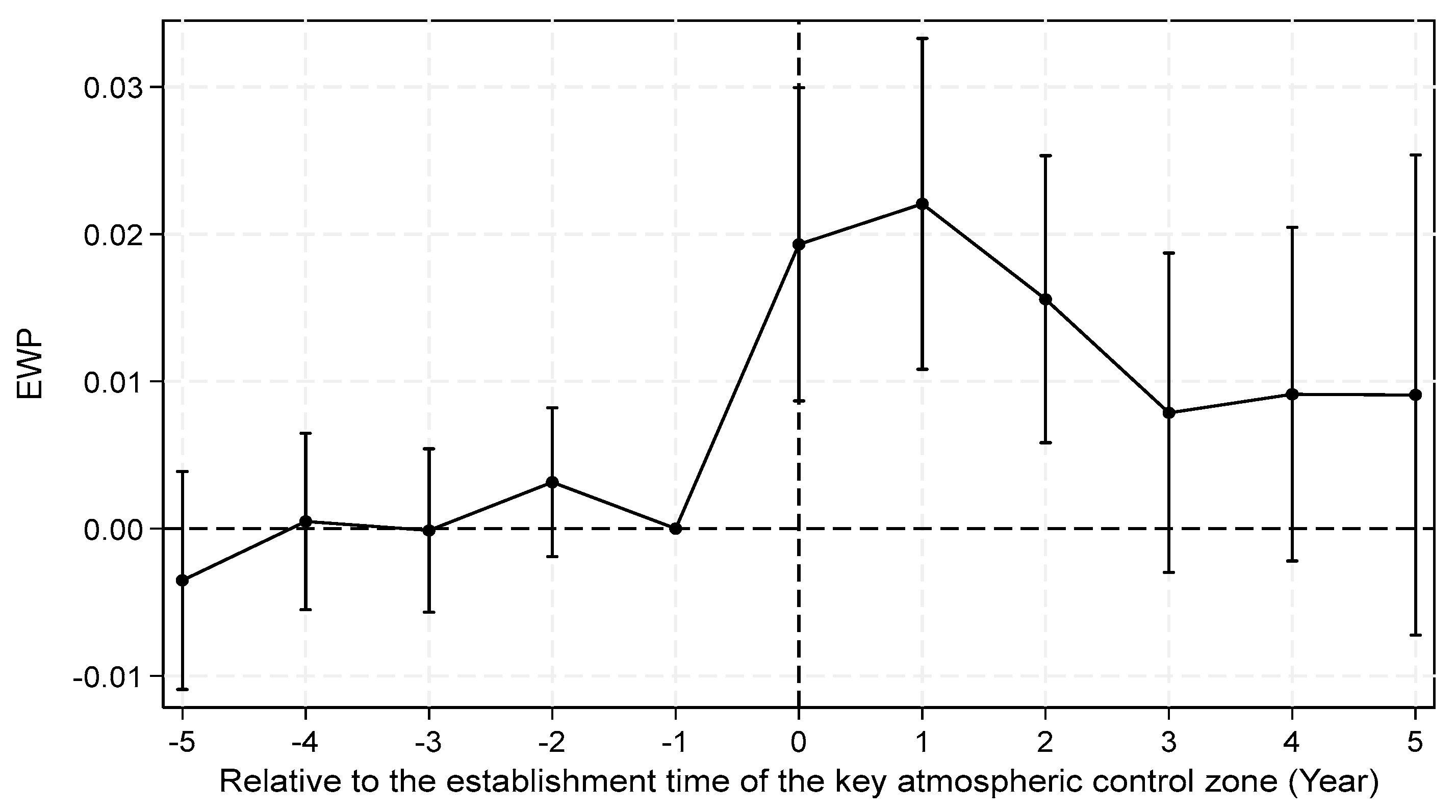
Time heterogeneity test: To verify the dynamic change characteristics of the KCAP policy’s driving effect on urban EWP as hypothesized in Hypothesis 3, Figure 2 presents the time trend of the coefficient of variable D k in Equation (2) at the 95% confidence level. The results show that, in the first two years after the policy implementation, the promoting effect of the KCAP policy on EWP was significantly positive; however, after two years, this effect gradually weakened and tended to be insignificant. This indicates that the driving effect of the KCAP policy on urban EWP has short-term timeliness, and its long-term impact has not been sustained. In the early stage of policy implementation, local governments, under the pressure of strict supervision and assessment, tended to respond quickly through short-term measures such as concentrating on shutting down highly polluting enterprises and strengthening industry emission control. However, as the inspection period comes to an end and the intensity of supervision weakens, the focus of local governance may shift towards economic growth and investment attraction, leading to a decrease in the intensity of environmental protection law enforcement and a subsequent decline in the effectiveness of pilot policies. From the perspective of emission reduction paths, in the early stage, low-cost emission reduction can be achieved by eliminating backward production capacity, promoting the rapid improvement in urban EWP. However, long-term reliance on this model will lead to insufficient impetus for industrial structure upgrading and make it difficult to support the continuous improvement in EWP. Furthermore, without a market-based pricing mechanism, long-term incentive policies, and public participation channels, the environmental protection behaviors of enterprises and residents are mostly short-term passive cooperation, making it difficult to form a stable green development model and further hindering the improvement in EWP.
(2)
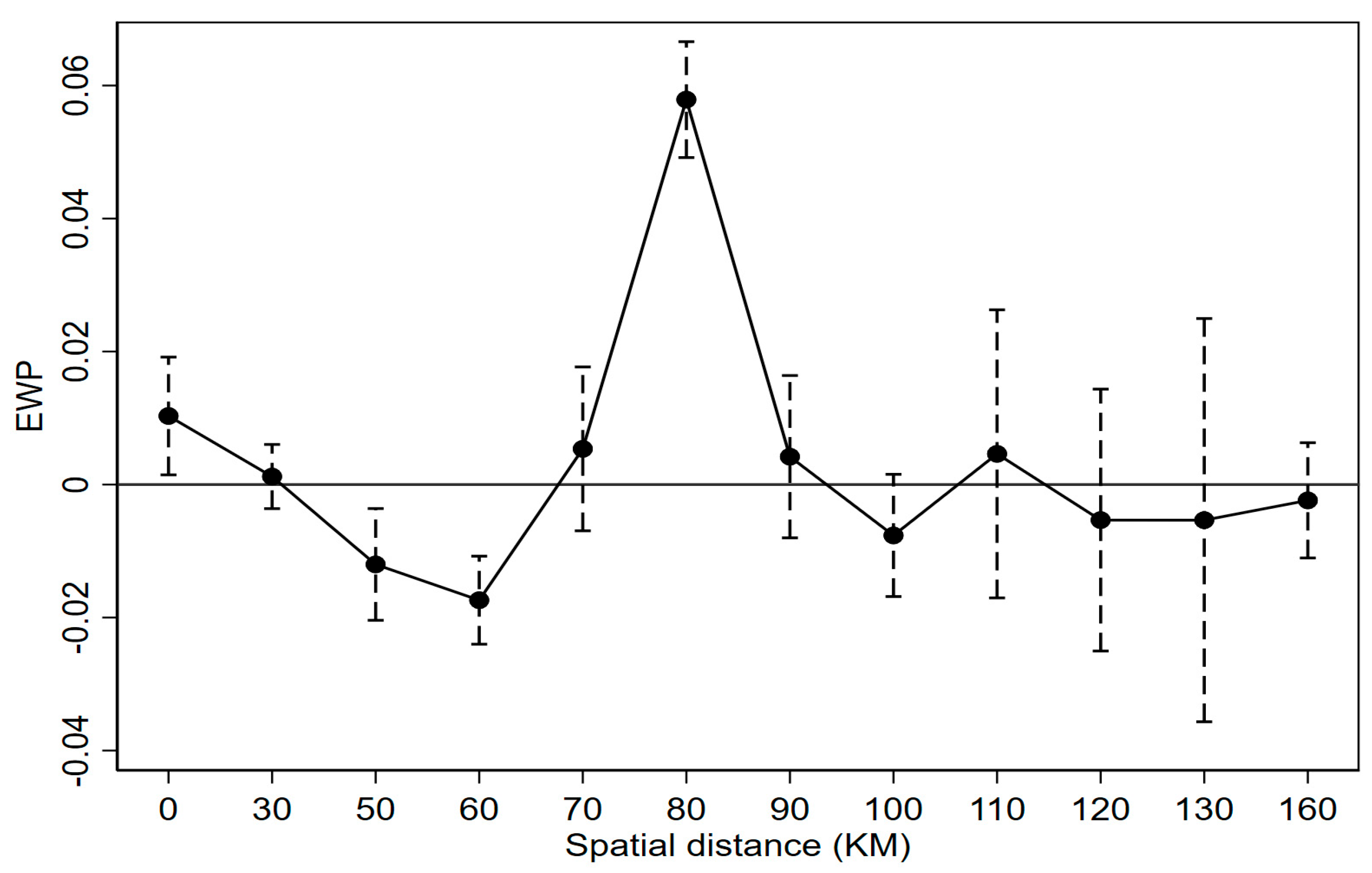
Spatial heterogeneity test: Figure 3 plots the estimated coefficients of from Ns from Equation (3) with 95% confidence intervals to illustrate how the implications of the KCAP policy on adjacent cities’ EWP differ across geographic distances. The results reveal a “∽” type trend: As proximity to KCAP cities decreases, the policy-induced positive external impact on neighboring cities’ EWP initially weakens, then strengthens, and eventually declines again. Among them, the agglomeration shadow area of air pollution control pilot cities is within 70 km of their own cities, which will have a significant driving effect on the surrounding cities’ EWP within 70–80 km, and after 80 km, the driving effect of air pollution control pilot cities on the surrounding cities’ EWP will become insignificant. This also verifies the spatial heterogeneity of the regional EWP driving effect of pilot cities under the air pollution control program in Hypothesis 3.
This “∽” spatial pattern is closely related to the specific economic geography of Chinese cities, behind which are the “agglomeration shadow effect” and “industrial synergy effect” within different distances. It is the dominant role of “agglomeration shadow effect” and “industrial synergy effect” within different distances. A possible explanation for this phenomenon is that when the neighboring cities are too close to the pilot city (30–70 km), the strict environmental regulations implemented by the pilot city will create a strong “crowding out effect”. On the one hand, high-energy-consuming and high-polluting firms tend to move or expand to neighboring cities with less stringent environmental regulations in order to avoid regulatory costs, which essentially transfers pollutants to the neighboring cities, thus lowering the level of social welfare in the neighboring cities. On the other hand, as the pilot city government encourages local firms to upgrade their green innovation capabilities to reduce pollution emissions, it attracts highly skilled labor from neighboring cities to migrate to the pilot city. This dual pressure of pollution transfer and brain drain together constitutes a “clustering shadow zone” that inhibits EWP in neighboring cities.
However, when the city reaches a distance of 70–80 km from the pilot city, this negative effect begins to change into a significant positive contribution. This is mainly due to the fact that this distance range is the optimal radiation range for industrial synergies. The upgrading of the industrial structure of the pilot city (e.g., the development of clean energy and environmental protection technologies) will lead to the formation of a matching green industrial chain in the neighboring cities, which will significantly improve the efficiency of ecological resource utilization in the neighboring cities through technology diffusion, supply chain integration, and knowledge spillover. For example, within city clusters such as the Yangtze River Delta and the Pearl River Delta, after the core cities have upgraded their environmental protection technologies, the small and medium-sized cities within 70–80 km of their periphery are often able to take over the relevant green manufacturing links and achieve synergistic development. This distance can effectively avoid the transfer of pollution and vicious competition in close proximity, but also can fully undertake the green technology spillover and industrial radiation of the pilot cities, thus forming a positive spatial spillover effect. If the distance is further expanded (more than 80 km), this positive spillover effect will gradually decay and eventually disappear due to the geographic isolation and the weakening of industrial linkage. Figure 3 further confirms that key air control cities form significant agglomeration shadow zones within 70 km, suppressing the EWP of neighboring cities, suggesting that the positive spillover effect may stem from the spatial redistribution of existing resource endowments. Similar mechanisms of spatial heterogeneity and resource redistribution are also found in other studies related to China’s ecological civilization construction policies, providing external corroboration for the conclusions of this paper.

4.4. Robustness Test

(1)
It is unclear whether the designation of key cities for air quality management is subject to reverse causality driven by their EWP. To test the DID assumption, we follow the previous study and construct the following risk model [57]:
l n T i t = θ 0 + θ 1 E W P i t + η X i t + ε i t
In Equation (7), T i t represents the survival time of city i in year t , and E W P i t denotes the EWP of city i in year t . X is a vector of explanatory variables that may affect whether a city is designated as a KCAP policy city, including EWP and all control variables from Equation (1). Equation (7) is estimated using an accelerated failure time (AFT) model under the assumption that T i t follows a Weibull distribution. The EWP coefficient in Table 4 is not statistically significant. This finding suggests that a city’s EWP level prior to being designated as a KCAP policy city does not significantly affect the likelihood of its selection, thereby supporting the exogeneity of the treatment assignment.
(2)
Common trend hypothesis test: A key assumption of staggered DID is parallel pre-policy EWP trends between treatment and control groups. In order to test this common trend hypothesis, this paper makes an empirical analysis by using Formula (2). According to the results in Figure 2, the coefficients of the variables before the establishment of air pollution control pilot cities are statistically insignificant, indicating no pre-policy EWP differences between groups and thereby satisfying the parallel trend assumption.
(3)
Sample selection bias is addressed via PSM-DID: Given the phased policy rollout, 50 cities selected during the sample period are defined as the treatment group. To construct a comparable control group, the PSM method is employed using 1:3 nearest-neighbor matching with replacement. The results of the test are shown in Table 5 and Table 6, where the difference in covariates for late matching is not statistically significant, confirming the balance between groups. In addition, regression estimates using the PSM-matched sample confirm that the DID coefficient continues to be significant at the 1% level.
(4)
Mitigating potential endogeneity and clustering issues: To address potential endogeneity, all control variables are lagged by one period. The L.control result in column (3) of Table 6 still shows a positive correlation at the 1% level.
(5)
IV Methodology: There may be a strong correlation between the identification of the list of model cities and the level of urban EWP, leading to a two-way causality problem and thus affecting the accuracy of the benchmark results. Therefore, to address the endogeneity issue, urban river density was used as an instrumental variable for the KCAP policy. In terms of correlation, river density is directly related to watershed area, and the larger the watershed area, the easier it is for the city to be regulated by the higher or central government, resulting in a better chance of becoming a model city. In terms of exogeneity, river density is dependent on local geographic conditions, neither of which directly affects urban EWP. In addition, given that river density data do not vary over time, this paper cross-multiplies it with a time trend term as an instrumental variable (IV_River). This paper estimates the instrumental variable results for river density. In the first stage regression, the coefficients of the instrumental variables are all statistically significant, indicating that they are strongly correlated with model city construction. On the city-level panel data, both Kleibergen-Paap rk Wald F-statistic (43.947) and Cragg-Donald Wald F-statistic (6248.97) are higher than the critical value of 16.38 at the 10% level of F, suggesting that there is no weak instrumental variable. All the above tests prove that our instrumental variables are reliable. In column (2) of Table 7, the DID coefficient is significantly positive, indicating that the KCAP policy still has a significant uplift effect on urban EWP after accounting for endogeneity issues, which is not significantly different from the benchmark regression results.
(6)
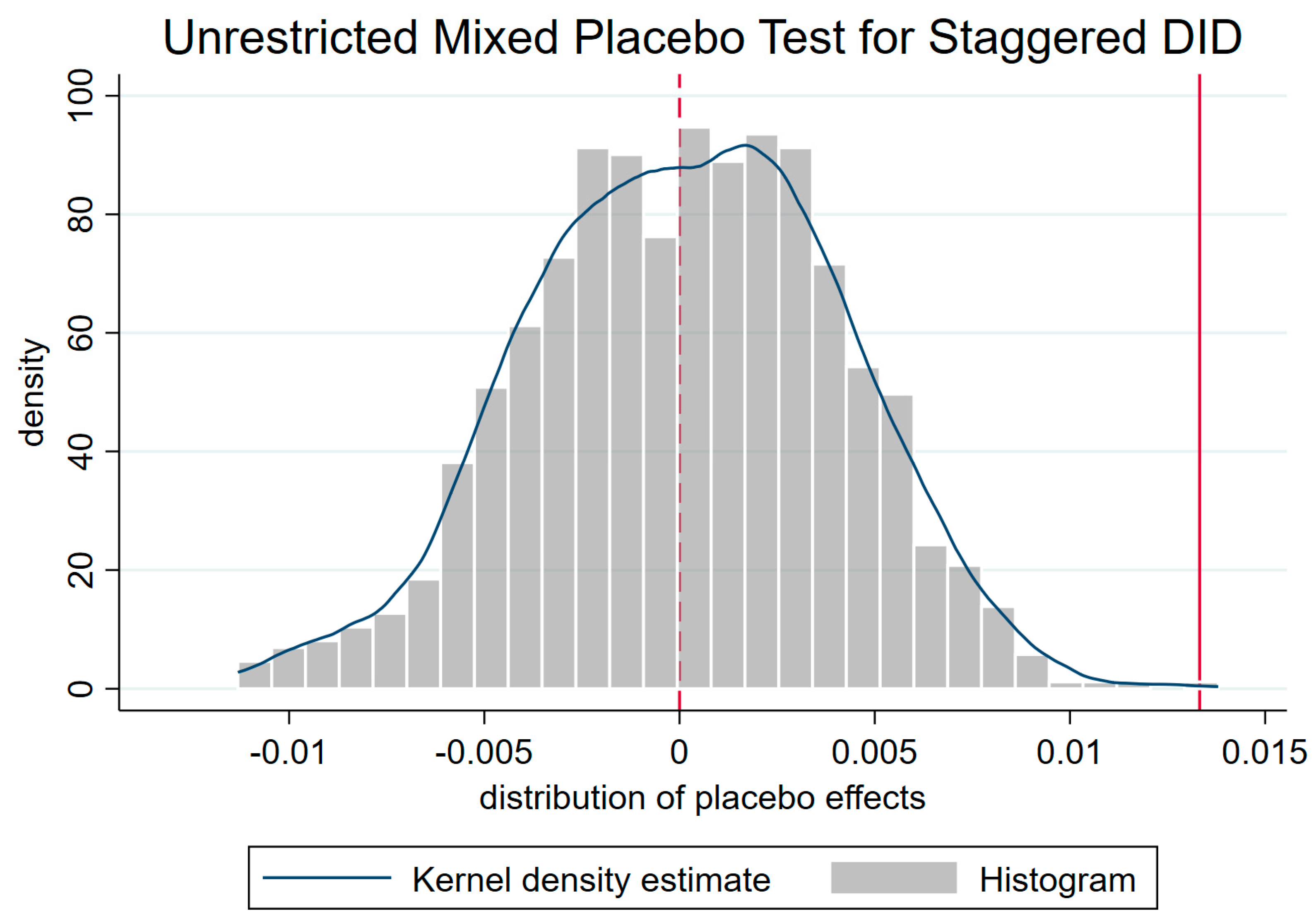
Placebo test: To further ensure that the observed policy effects are not driven by unobserved shocks or model misspecification, two placebo exercises are conducted. ① Randomized Treatment and Control Groups: We treat the original KCAP policy cities as a new control group and, holding the actual implementation years constant, randomly select an equal number ( n ) of untreated cities each year from the pool of never-treated cities to form a new treatment group. Using this pseudo-sample, we re-estimate Model (2) in Table 3. Repeating the above process 1000 times to estimate the coefficients for 1000 DID. The average placebo coefficient is 0.0074 × 10⁻⁴, far smaller than the baseline estimate of 0.0133, indicating that the true KCAP policy effect is strongly location-specific and most pronounced for the officially designated cities. ② Randomly Advancing the Policy Start Year: Keeping the set of KCAP policy cities unchanged, we randomly draw a year from the interval 2007 , t 1 for each treated city—where t is the actual implementation year—and assign this pseudo-year as the policy start date. Using the resulting pseudo-sample, we again re-estimate Model (2) and repeat procedure 1000 times. The average placebo coefficient is 0.0040 × 10⁻², roughly 99.7 percent smaller than the baseline estimate. Figure 4 illustrates the distribution of these placebo estimates and their associated p-values. The pronounced attenuation of the effect when treatment timing is randomly advanced provides compelling counterfactual evidence that the actual KCAP policy designations genuinely enhanced EWP in the treated cities. Together, these placebo tests corroborate the stability of the main estimation results and reinforce the causal interpretation of KCAP policy’s positive impact on urban EWP.
(7)
Outlier test: Table 8 tests the robustness from the following four aspects: ① According to the outliers of the modified EWP, the maximum and minimum 1% samples of EWP are truncated, and the model (1) reports the corresponding test results; ② Model (2) controls for province and year fixed effects; Model (3) adds city fixed effects; Model (4) additionally includes province-year interactions. Overall, the DID coefficient remains significant.
(8)
Accounting for the impact of other geographically targeted policy measures: The selection of KCAP is frequently shaped by multiple spatially targeted national policies. To mitigate the confounding effects of such policies, this paper identifies and controls for three primary categories of national location-oriented policy measures: ① The influence of pilot policies on peak carbon dioxide emissions. Among the 50 air pollution control pilot cities set up in this sample, 6 cities are covered by the carbon peak pilot, so their influence must be excluded. ② Two of the 50 KCAP cities also adopted the carbon trading pilot, potentially confounding its effect on local EWP. To address potential confounding, this study excludes two pilot cities that overlap with national air pollution control targets. On the basis of benchmark regression, this paper introduces two pilot policy variables as control variables, respectively, and brings the cities targeted by key national air pollution governance policies and these two pilot policies into the regression model in parallel. Table 9 shows the regression results, in which column (3) reports the regression results of strategically selected cities for environmental governance and two pilot policies. It is evident that the establishment of designated air pollution control cities significantly promotes the growth of local EWP. Accordingly, the observed increase in a host city’s EWP is attributable to its designation as a key air-pollution-control city, rather than to other contemporaneous policy measures.
EWP i t = β 0 + β 1   DID   i t + β 2   DID 01   i t + β 3   DID 02   i t + λ Z i t + ν i + μ t + ε i t
In Equation (8), D I D 01 i t and D I D 02 i t are the DID estimators for the carbon peak pilot zones and carbon emissions trading pilot zones, respectively. If city i was designated as a carbon peak pilot zone in year t , then D I D 01 i t = 1 for year t and all subsequent years; otherwise, it is 0. Similarly, if city i was designated as a carbon emissions trading pilot zone in year t , then DID02it = 1 for year t and onward; otherwise, it is 0. As shown in Table 9, the KCAP policy continues to positively affect EWP after controlling for the two pilot initiatives. This further confirms that the observed effect on EWP growth is indeed attributable to the implementation of KCAP policy, rather than being confounded by other concurrent policy interventions.

4.5. Mechanism Analysis

To further clarify whether the distortion of labor allocation and the intensity of market-driven environmental regulations would affect the promoting effect of KCAP policy on urban EWP, this paper, respectively, constructs the interaction terms reflecting the interaction between “labor allocation distortion” and KCAP policy, as well as the interaction between “market-driven environmental regulation intensity” and KCAP policy, and uses the moderation effect model for testing. The model is set as follows:
E W P i t = α + β D I D i t + γ R e g u i t + ε D I D i t × R e g u i t + λ Z i t + ν i + μ t + ε i t
E W P i t = α + β D I D i t + γ L a b o r i t + ε D I D i t × L a b o r i t + λ Z i t + ν i + μ t + ε i t
Firstly, this paper examines the possibility of market-driven environmental regulation intensity as the path for KCAP policy to promote urban EWP. The mechanism results are shown in the first and second columns of Table 10. The interaction of DID-Regu is significantly positive at the 1% level, indicating that market-driven environmental regulation has a positive moderating effect on the policy’s promotion of urban EWP growth. Market-oriented environmental regulation not only provides economic incentives but also imposes ecological constraints. On the one hand, through market mechanisms such as sewage charges and tradable sewage permits, local enterprises face higher pollution costs, and the economic returns of pollution behavior decline significantly, thereby promoting enterprises to drive technological innovation and prompting technologically backward and heavily polluting production units to exit the market. On the other hand, through policy tools such as investment subsidies, market incentive regulation promotes the entry of emerging production capacity with green attributes and new quality characteristics into the market. In this process, local enterprises can not only obtain continuous economic incentives through green innovation but also embed green technologies into daily operations and technological innovation paths, thereby improving green production efficiency. These mechanisms jointly promote the greening of urban industry and production, expand the promoting effect of KCAP policy on urban EWP, further significantly enhance urban EWP, and empirically support market-driven regulation as a key urban policy path for EWP.
Secondly, this paper studies the hypothesis that the improvement in urban EWP under the KCAP policy is partly driven by the improvement in labor allocation efficiency. The labor distortion index reflects the efficiency of labor resource allocation. When the degree of labor distortion is higher, the efficiency of labor resource allocation is lower. The third and fourth columns of Table 10 show that the coefficient of the interaction term between the policy variable (DID) and the labor allocation distortion variable (Labor) is significantly negative. Alleviating labor allocation distortion and improving the efficiency of labor resource allocation provide high-quality labor resources for new industries such as urban clean energy and environmental protection technology, and optimize the spatial and industrial allocation structure of labor resources. At the same time, this policy encourages enterprises to implement green technological innovation and production process upgrading, which improves labor productivity and effectively alleviates the problem of idle labor and resource waste caused by technological backwardness and overcapacity, presenting a typical “innovation Porter hypothesis effect”. In addition, this policy also promotes the green coordinated development trend of adjacent regions through spatial diffusion effects and attracts labor to flow orderly to regions with stronger element agglomeration capabilities, thereby alleviating the problem of resource misallocation caused by regional development imbalance and further improving the overall allocation efficiency, having a favorable impact on urban EWP. However, the alleviation of labor allocation distortion is not a single direct result of the policy, but a complex product of direct policy intervention and parallel market processes. On the one hand, the KCAP policy directly optimizes the allocation structure of labor among industries by eliminating outdated production capacity and promoting the green transformation of industrial structure. For example, in the old industrial base cities, the policy has prompted the redundant labor in traditional heavy industry sectors to transfer to the emerging environmental protection and service industries, which directly reduces the degree of labor mismatch and is a direct effect of the policy. On the other hand, there is a significant parallel process in the improvement in labor allocation. The improvement in environmental quality and urban livability brought about by the policy implementation will attract the inflow of high-quality talents, and this spatial reallocation of human capital caused by spontaneous market choices occurs in parallel with the policy objectives, but is not the result of direct intervention of the policy. Therefore, the mitigation of labor allocation distortion is a complex process of superimposed and co-evolution of policy guidance and market self-regulation, showing a typical “innovation Porter’s hypothesis effect”. In addition, the policy also drives the green synergistic development of neighboring regions through the spatial diffusion effect, attracts the orderly flow of labor to the regions with stronger factor agglomeration capacity, thus alleviating the resource mismatch problem caused by the development imbalance between regions, further improving the overall allocation efficiency, and positively affecting the urban EWP. This result provides empirical support for the claim that alleviating labor allocation distortion is an important mechanism for KCAP policy to enhance EWP.

4.6. Heterogeneity Test

To gain deeper insight into how the KCAP policy influences urban EWP, this study undertakes a comprehensive examination of its underlying transmission channels. This paper carried out a multi-dimensional heterogeneity analysis, focusing on the different policy effects under three characteristic variables: the degree of urban air pollution, whether the city falls under the category of legacy industrial cities, and the size of the city.

4.6.1. Pollution Levels: Regulatory Pressure and Innovation Potential Channels

First, based on the median air pollution level of the sample cities, the cities are divided into high and low pollution groups. Based on Porter’s hypothesis, we expect KCAP policies to be more effective in highly polluted areas. This expectation holds that stringent regulation stimulates innovation, especially in regions with high marginal costs of pollution control and high potential for efficiency gains, and the policy is more effective in forcing firms to engage in technological innovation and process reengineering.
Empirical findings: the regression results in columns (1) and (2) of Table 11 confirm this expectation; the KCAP policy has a significantly positive effect on EWP in high-pollution cities, with a regression coefficient of 0.0197, which passes the test at the 1% statistical significance level; while the regression coefficient in low-pollution cities is only 0.0087, which does not pass the test of significance, suggesting that the policy effect has a degree of pollution heterogeneity.
Deeper interpretation: This finding reveals the mechanism of “regulatory pressure” as the central driving force. In heavily polluted areas, the KCAP policy creates a strong external constraint, forcing firms to go beyond end-of-pipe management and adopt cleaner production technologies and circular economy models. This not only directly reduces pollution emissions, but more importantly, increases the productivity of resources and energy, thus significantly improving the efficiency of the “ecological-economic” transformation stage (L1) in the EWP model. At the same time, the improvement in environmental quality directly improves the health and quality of life of residents, which optimizes the output of the “economic-welfare” transformation stage (L2). In contrast, in low-pollution cities, the diminishing marginal returns to environmental improvement and the lack of policy incentives make it difficult to trigger large-scale innovation activities, and therefore less effective.

4.6.2. Industrial Base: A Channel for Structural Transformation

Second, the sample of cities is differentiated into old industrial base cities and non-old industrial base cities based on the delineation criteria provided by the State Council’s Plan on the Adjustment and Transformation of the National Old Industrial Bases (2013–2022) (see Appendix B). We predict that the effect of the policy will be stronger in old industrial bases. These cities have long been trapped in a mono-industrial structure and path dependence dominated by heavy chemical industries, and the KCAP policy, as a powerful external intervention, is expected to be a key force in breaking the lock-in and catalyzing structural transformation.
Empirical findings: as shown in columns (3) and (4) of Table 11, the implementation of the KCAP policy in old industrial base cities significantly improves the level of EWP, with a regression coefficient of 0.0287, which is significant at the 1% level; whereas, in non-old industrial base cities, the effect of the policy is only apparent at the 10% significance level (with a coefficient of 0.0099), which reflects the moderating role of differences in the industrial base on the effect of the policy. This reflects the moderating effect of the difference in industrial base on the policy effect.
In-depth explanation: the magnified policy effect of the old industrial bases is essentially a manifestation of the “structural transformation dividend”; the KCAP policy accelerates the elimination of backward production capacity that is highly polluting and energy-consuming by raising the environmental standards, forcing the reallocation of factor resources (labor and capital) from the inefficient sectors to the green and efficient sectors. This process directly touches on the “labor allocation distortion” identified in our mechanism analysis. By mitigating this distortion, the policy not only improves macroeconomic efficiency but also significantly enhances the transformation of economic output into social welfare through the creation of new green jobs and the improvement in regional development prospects (L2 stage). For example, in the old industrial bases of Northeast China, policies have not only improved the environment but also alleviated the “Rust Belt” syndrome by promoting industrial diversification, providing new impetus to enhance the overall well-being of the region.

4.6.3. City Size: Institutional Capacity and Economic Channels of Agglomeration

Finally, according to the Circular of the State Council on Adjusting the Criteria for Classifying the Size of Cities (released in November 2021), cities with an urban resident population of 5 million people or more are defined as “large cities”, and those with less than 5 million people are defined as “small cities”. Based on theories of institutional economics and urban economics, we believe that large cities will show stronger policy responses. Large cities usually have superior financial capacity, governance resources, and talent reserves, which provide institutional safeguards for the effective implementation of complex policies and the alleviation of transition pains; at the same time, the agglomeration economy formed by their dense industrial and knowledge networks can accelerate the diffusion and application of green technologies.
Empirical Findings: This is supported by the regression results in columns (5) to (6) of Table 11, where the KCAP policy has a significant positive effect on the EWP of large cities (the coefficient is 0.0238, which is significant at the 1% level), while there is no significant effect on small cities (the coefficient is 0.0054).
In-depth explanation: This differential effect highlights the key role of “institutional capacity” and “market environment”. First, the financial strength of large cities enables them to invest more in green infrastructure construction, subsidizing environmental technology R&D and social support for affected groups, which effectively strengthens the “market-oriented environmental regulation” mechanism. Second, the agglomeration of large cities provides fertile ground for policy synergies. Dense research institutions, high-tech enterprises, and green financial institutions form an innovation ecosystem that promotes knowledge spillovers and industrial synergies, enabling policies to leverage social capital far beyond direct government inputs to jointly promote EWP. On the contrary, the limited financial capacity and degree of market development of small cities may make them unable to cope with the short-term economic shocks brought by the policy, and it is difficult to fully activate the market mechanism, leading to a significant reduction in the policy effect.
The heterogeneity analysis clearly shows that the KCAP policy is not a one-size-fits-all panacea, and its success is deeply rooted in the local context. The results systematically validate our theoretical framework: policy effectiveness is ‘amplified’ or ‘dampened’ in specific institutional, economic, and industrial contexts. In regions with high regulatory pressure, urgent need for structural change, and strong institutional and market fundamentals, policies are more likely to stimulate strong synergistic effects. This finding provides important insights for fine-tuning the design of future environmental governance policies: it is important to move away from homogenized policy thinking towards a toolkit of “camera-ready” policies that can identify and adapt to local variations in order to maximize the contribution of environmental regulation to the promotion of high-quality and equitable ecological well-being.

4.7. Limitations and Future Directions

Firstly, further expand the EWP evaluation framework and methodologies. This paper employs a network two-stage DEA model to measure EWP values. Subsequent research may integrate this with hybrid data envelopment analysis models incorporating non-desirable outputs, while also incorporating elements such as green consumption behavior, levels of access to public ecological services, and residents’ subjective perceptions of well-being into the EWP system. This would enable a more comprehensive understanding of the overall impact of environmental regulation on EWP. In addition, expand data sources and methodologies. This study primarily employs econometric models such as multi-period DID. Future research may explore alternative approaches incorporating machine learning techniques. Moreover, deepen the scope of research subjects. This study focuses on the impact of the KCAP policy on EWP across 207 prefecture-level cities nationwide. Future investigations could delve into the policy’s effects and underlying mechanisms within specific urban types, such as resource-based cities. Finally, future research should further examine the spatial spillover effects and regional heterogeneity of the KCAP policy, particularly focusing on how cross-regional collaborative governance mechanisms—such as ecological compensation schemes, green industry linkages, and regional benefit-sharing arrangements—can mitigate negative siphoning effects during policy implementation while expanding positive spillover coverage.

5. Conclusions and Recommendations

5.1. Conclusions

Whether environmental regulation can release policy dividends on the basis of respecting, conforming to, and protecting nature, so as to realize the “triple dividend” of balancing growth, green development, livelihood outcomes, and then promote the continuous improvement in regional EWP, has become a core issue to be solved urgently in the process of Chinese modernization. This study employs a two-stage DEA model to rigorously evaluate EWP, treating the KCAP policy as a quasi-natural experiment. Drawing on panel data covering 207 Chinese prefecture-level cities from 2007 to 2023, the study empirically evaluates the effect of the KCAP policy on urban EWP and arrives at the following main findings:
First of all, KCAP policy has continuously improved the EWP level of pilot cities, with an average increase of about 1.33 percentage points. Secondly, KCAP policy promotes the development of EWP in surrounding areas through the spatial spillover mechanism. Specifically, KCAP policy has no significant negative siphon effect on EWP of cities within 30 km; However, in the area of 30 to 70 km, there is a significant siphon effect, which inhibits the EWP; of neighboring cities; However, in cities 70–80 km away from it, the policy effect is significantly positive, which promotes the improvement in regional ecological performance. Beyond 80 km, the spatial spillover effect weakens and eventually has no spillover impact.
Further mechanism analysis reveals that labor allocation distortion negatively moderates the relationship between the KCAP policy and EWP, which significantly inhibits the policy’s effectiveness; Conversely, the strength of market-driven regulatory mechanisms plays a facilitating role in amplifying the policy’s effect on EWP, which significantly enhances the role of policies in promoting EWP. Finally, the results of the heterogeneity test show that the KCAP policy is particularly effective in promoting EWP in areas with heavy air pollution, old industrial base cities, and cities with large populations, which reflects the differentiated mechanism of policy under different development stages and structural conditions.

5.2. Policy Recommendations

Based on the above conclusions, this paper puts forward the following policy recommendations: first, the KCAP policy, which aims at sustainable urban development, is an important part of the air environment governance system in the new era, and in view of the positive effect of the policy on enhancing EWPit should continue to follow the direction of the national air environment governance strategy, and take the core construction of consolidating the institutional foundation, improving the evaluation mechanism, strengthening the effectiveness of the supervision and focusing on the key areas as the core construction ideas. Secondly, the analysis of spatial heterogeneity shows that the KCAP policy has a significant effect on the EWP within 70–80 km, and a negative effect on the EWP in the neighboring area, negative effect on the neighboring range. Accordingly, differentiated control strategies should be implemented for the areas around the pilot cities. On the one hand, a cross-regional ecological compensation mechanism should be established within a 30–70 km, implementing fiscal transfer payments, green industrial collaboration and technical assistance to mitigate competitive externalities arising from resource contention. On the other hand, for regions within a 70–80 km radius demonstrating clear benefits, an ecological-economic synergy development system based on the ‘key city + radiation zone’ model should be constructed. This would expand policy reach through measures such as extending and supplementing industrial chains and jointly building public services. To prevent functional overlap and resource misallocation between regions, interregional KCAP policy coordination should be strengthened. This involves scientifically defining the functional roles of key cities and their surrounding areas, clarifying ecological responsibilities and industrial orientations, avoiding homogenized competition, and promoting coordinated regional EWP growth. This dual approach will achieve both regional coordination and ecological mutual benefit. In addition, to address the problem of insufficient radiation effect of pilot cities on distant cities, pilot cities should be actively promoted to build a green technology sharing system to facilitate the dissemination of successful experiences to more distant regions. Thirdly, it is necessary to pay attention to the key driving role of labor allocation optimization and market-based regulation strengthening in EWP promotion. The results of the mechanism test in this paper show that the efficient allocation of labor resources and the enhancement of market-based regulation are the core paths of KCAP policy to promote EWP improvement. Based on this, in the practice of air pollution management, government departments can give full play to the regulating role of the market’s “invisible hand” by perfecting the mechanism of labor factor allocation, strengthening the innovation of market-based regulatory tools, and constructing a differentiated system of market rewards and penalties, so as to guide the transformation of the urban environmental governance model to benign optimization and provide a quality internal and external environment for the enhancement of EWP. The quality of internal and external environment for enhancing EWP. Fourth, the heterogeneity analysis shows that the macroeconomic effect of KCAP policy is more significant in heavily polluted areas, old industrial bases and large urban centers. China needs to pay great attention to the appropriateness of policy tools and regional systematic differences in the process of building the atmospheric environmental governance system. For example, on the one hand, resource-consuming cities should strengthen the intensity of regulation, and promote the green transformation of industrial structure and the low-carbon transformation of residents’ lifestyles through policy guidance. On the other hand, pilot policy reforms can be carried out in large urban centers, and after replicable models are developed, they can be gradually extended nationwide, so as to achieve the precise allocation of resources and the effective implementation of policies. By integrating diverse incentive mechanisms with structural reforms, environmental regulatory policies can be effectively enhanced to provide sustained impetus for urban EWP outcomes. This approach will unlock technological dividends and human capital potential within the green transition, thereby comprehensively advancing high-quality, green economic and social development.

Author Contributions

Writing—original draft, Methodology, Conceptualization, Formal analysis, L.Z. Writing—Material preparation, Data collection, drawing, Y.W. Writing—review and editing, Investigation, Data curation, X.Z. Supervision, Software, R.Y. All authors commented on previous versions of the manuscript. All authors have read and agreed to the published version of the manuscript.

Funding

This research received no external funding.

Institutional Review Board Statement

Not applicable.

Informed Consent Statement

Not applicable.

Data Availability Statement

The data presented in this study are available on request from the corresponding author.

Conflicts of Interest

The authors declare no conflicts of interest.

Appendix A

Table A1. Pilot cities for policy implementation.
YearRegions
2007Directly administered municipalities: Beijing, Tianjin, Shanghai, Chongqing; Provincial capital cities: Shijiazhuang, Taiyuan, Hohhot, Shenyang, Changchun, Harbin, Nanjing, Hangzhou, Hefei, Fuzhou, Nanchang, Jinan, Zhengzhou, Wuhan, Changsha, Guangzhou, Nanning, Haikou, Chengdu, Guiyang, Kunming, Lhasa, Xi’an, Lanzhou, Xining, Yinchuan, Urumqi; Planned cities: Dalian, Qingdao, Ningbo, Xiamen, Shenzhen; Other cities: Qinhuangdao, Tangshan, Baoding, Handan, Changzhi, Linfen, Yangquan, Datong, Baotou, Chifeng, Anshan, Fushun, Benxi, Jinzhou, Jilin, Mudanjiang, Qiqihar, Daqing, Suzhou, Nantong, Lianyungang, Wuxi, Changzhou, Yangzhou, Xuzhou, Wenzhou, Jiaxing, Shaoxing, Taizhou, Huzhou, Ma’anshan, Wuhu, Quanzhou, Jiujiang, Yantai, Zibo, Tai’an, Weihai, Zaozhuang, Jining, Weifang, Rizhao, Luoyang, Anyang, Jiaozuo, Kaifeng, Pingdingshan, Jingzhou, Yichang, Yueyang, Xiangtan, Zhangjiajie, Zhuzhou, Changde, Zhanjiang, Zhuhai, Shantou, Foshan, Zhongshan, Shaoguan, Guilin, Beihai, Sanya, Liuzhou, Mianyang, Panzhihua, Luzhou, Yibin, Zunyi, Qujing, Xianyang, Yan’an, Baoji, Tongchuan, Jinchang, Shizuishan, Karamay.
2013Beijing, Tianjin, Shijiazhuang, Tangshan, Baoding, Langfang, Shanghai, Nanjing, Wuxi, Changzhou, Suzhou, Nantong, Yangzhou, Zhenjiang, Taizhou, Hangzhou, Ningbo, Jiaxing, Huzhou, Shaoxing, Guangzhou, Shenzhen, Zhuhai, Foshan, Jiangmen, Zhaoqing, Huizhou, Dongguan, Zhongshan, Shenyang, Jinan, Qingdao, Zibo, Weifang, Rizhao, Wuhan, Changsha, Chongqing, Chengdu, Fuzhou, Sanming, Taiyuan, Xi’an, Xianyang, Lanzhou, Yinchuan, Urumqi.
2018Beijing, Tianjin, Shijiazhuang, Tangshan, Langfang, Baoding, Cangzhou, Hengshui, Xingtai, Handan, Xiongan New Area, Xinji, Dingzhou, Taiyuan, Yangquan, Changzhi, Jincheng, Jinan, Zibo, Jining, Dezhou, Liaocheng, Binzhou, Heze, Zhengzhou, Kaifeng, Anyang, Hebi, Xinxiang, Jiaozuo, Puyang, Shanghai, Nanjing, Wuxi, Xuzhou, Changzhou, Suzhou, Nantong, Lianyungang, Huaian, Yancheng, Yangzhou, Zhenjiang, Taizhou, Suqian, Hangzhou, Ningbo, Jiaxing, Huzhou, Shaoxing, Zhoushan, Hefei, Wuhu, Bengbu, Huainan, Ma’anshan, Huaibei, Chuzhou, Fuyang, Suzhou, Liu’an, Bozhou, Taiyuan, Yangquan, Changzhi, Jincheng, Jinzhong, Yuncheng, Linfen, Luliang, Xi’an, Tongchuan, Baoji, Xianyang, Weinan, Yangling Agricultural Hi-Tech Industrial Demonstration Zone, Hancheng.
2023Beijing, Tianjin, Shijiazhuang, Tangshan, Qinhuangdao, Handan, Xingtai, Baoding, Cangzhou, Langfang, Hengshui, Xiongan New Area, Xinji, Dingzhou, Jinan, Zibo, Zaozhuang, Dongying, Weifang, Jining, Tai’an, Rizhao, Linyi, Dezhou, Liaocheng, Binzhou, Heze, Zhengzhou, Kaifeng, Luoyang, Pingdingshan, Anyang, Hebi, Xinxiang, Jiaozuo, Puyang, Xuchang, Luohe, Sanmenxia, Shangqiu, Zhoukou, Jiyuan, Shanghai, Nanjing, Wuxi, Xuzhou, Changzhou, Suzhou, Nantong, Lianyungang, Huai’an, Yancheng, Yangzhou, Zhenjiang, Taizhou, Suqian, Hangzhou, Ningbo, Jiaxing, Huzhou, Shaoxing, Zhoushan, Hefei, Wuhu, Bengbu, Huainan, Ma’anshan, Huaibei, Chuzhou, Fuyang, Suzhou, Liu’an, Bozhou, Taiyuan, Yangquan, Changzhi, Jincheng, Jincheng, Yuncheng, Linfen, Lvliang, Xian, Tongchuan, Baoji, Xianyang, Weinan, Yangling Agricultural Hi-Tech Industrial Demonstration Zone, Hancheng

Appendix B

The old industrial base refers to the industrial base formed by the national layout and construction during the “First Five-Year Plan”, “Second Five-Year Plan”, and “Third Front” construction periods, relying on heavy industry backbone enterprises. The basic unit of the old industrial base is the old industrial city. Based on the national industrial layout during the above-mentioned period, as well as six indicators including the original value of industrial fixed assets, total industrial output value, proportion of heavy chemical industry, number of employees and employment proportion of state-owned industrial enterprises, and non-agricultural population size in 1985, there are a total of 120 old industrial cities in China, distributed in 27 provinces (regions, municipalities), including 95 prefecture level cities, 25 municipalities directly under the central government, cities specifically designated in the state plan, and provincial capital cities. As shown in Table A2.
Table A2. List of old industrial base cities.
Range TypesCity
Prefecture-level cities (95)Hebei Province (6): Zhangjiakou, Tangshan, Baoding, Xingtai, Handan, Chengde; Shanxi Province (5): Datong, Yangquan, Changzhi, Jinzhong, Linfen; Inner Mongolia Autonomous Region (2): Baotou, Chifeng; Liaoning Province (11): Anshan, Fushun, Benxi, Jinzhou, Yingkou, Fuxin, Liaoyang, Tieling, Chaoyang, Panjin, Huludao; Jilin Province (6): Jilin, Siping, Liaoyuan, Tonghua, Baishan, Baicheng; Heilongjiang Province (6): Qiqihar, Mudanjiang, Jiamusi, Daqing, Jixi, Yichun; Jiangsu Province (3): Xuzhou, Changzhou, Zhenjiang; Anhui Province (6): Huaibei, Bengbu, Huainan, Wuhu, Ma’anshan, Anqing; Jiangxi Province (3): Jiujiang, Jingdezhen, Pingxiang; Shandong Province (2): Zibo, Zaozhuang; Henan Province (8): Kaifeng, Luoyang, Pingdingshan, Anyang, Hebi, Xinxiang, Jiaozuo, Nanyang; Hubei Province (6): Huangshi, Xiangyang, Jingzhou, Yichang, Shiyan, Jingmen; Hunan Province (6): Zhuzhou, Xiangtan, Hengyang, Yueyang, Shaoyang, Loudi; Guangdong Province (2): Shaoguan, Maoming; Guangxi Zhuang Autonomous Region (2): Liuzhou, Guilin; Sichuan Province (8): Zigong, Panzhihua, Luzhou, Deyang, Mianyang, Neijiang, Leshan, Yibin; Guizhou Province (3): Zunyi, Anshun, Liupanshui; Shaanxi Province (4): Baoji, Xianyang, Tongchuan, Hanzhong; Gansu Province (4): Tianshui, Jiayuguan, Jinchang, Baiyin; Ningxia Hui Autonomous Region (1): Shizuishan; Karamay, Xinjiang Uygur Autonomous Region (1).
Municipalities directly under the central government, cities specifically designated in the state plan, and provincial capital cities (25)Shijingshan District of Beijing, Yuantanggu District of Tianjin, Minhang District of Shanghai, Dadukou District of Chongqing, Chang’an District of Shijiazhuang, Wanbailin District of Taiyuan, Dadong District of Shenyang, Wafangdian City of Dalian, Kuancheng District of Changchun, Xiangfang District of Harbin, Yuandachang District of Nanjing, Yaohai District of Hefei, Qingyunpu District of Nanchang, Licheng District of Jinan, Zhongyuan District of Zhengzhou, Qiaokou District of Wuhan, Kaifu District of Changsha, Qingbaijiang District of Chengdu, Xiaohe District of Guiyang, Wuhua District of Kunming, Baqiao District of Xi’an, Qilihe District of Lanzhou, Chengzhong District of Xining, Xixia District of Yinchuan, and Toutunhe District of Urumqi.

References

  1. Chen, G.; Li, S.; Knibbs, L.D.; Hamm, N.A.; Cao, W.; Li, T.; Guo, Y. A machine learning method to estimate PM2.5 concentrations across China with remote sensing, meteorological, and land use information. Sci. Total Environ. 2018, 636, 52–60. [Google Scholar] [CrossRef] [PubMed]
  2. Lin, C.Q.; Liu, G.; Lau, A.K.H.; Li, Y.; Li, C.C.; Fung, J.C.H.; Lao, X.Q. High-resolution satellite remote sensing of provincial PM2.5 trends in China from 2001 to 2015. Atmos. Environ. 2018, 180, 110–116. [Google Scholar] [CrossRef]
  3. Ma, Z.; Hu, X.; Sayer, A.M.; Levy, R.; Zhang, Q.; Xue, Y.; Liu, Y. Satellite-based spatiotemporal trends in PM2.5 concentrations: China, 2004–2013. Environ. Health Perspect. 2018, 124, 184–192. [Google Scholar] [CrossRef] [PubMed]
  4. Xue, T.; Liu, J.; Zhang, Q.; Geng, G.; Zheng, Y.; Tong, D.; Hao, J. Rapid improvement of PM2.5 pollution and associated health benefits in China during 2013–2017. Sci. China Earth Sci. 2019, 62, 1847–1856. [Google Scholar] [CrossRef]
  5. Wang, Y.; Li, Y.; Qiao, Z.; Lu, Y. Inter-city air pollutant transport in The Beijing-Tianjin-Hebei urban agglomeration: Comparison between the winters of 2012 and 2016. J. Environ. Manag. 2019, 250, 109520. [Google Scholar] [CrossRef]
  6. Liu, H.; Zhang, M.; Han, X. A review of surface ozone source apportionment in China. Atmos. Ocean. Sci. Lett. 2020, 13, 470–484. [Google Scholar] [CrossRef]
  7. Zhang, S.; Zhu, D.; Shi, Q.; Cheng, M. Which countries are more ecologically efficient in improving human well-being? An application of the Index of Ecological Well-being Performance. Resour. Conserv. Recycl. 2017, 129, 112–119. [Google Scholar] [CrossRef]
  8. Feng, Y.; Zhong, S.; Li, Q.; Zhao, X.; Dong, X. Ecological well-being performance growth in China (1994–2014): From perspectives of industrial structure green adjustment and green total factor productivity. J. Clean. Prod. 2019, 236, 117556. [Google Scholar] [CrossRef]
  9. Dietz, T.; Jorgenson, A.K. Towards a new view of sustainable development: Human well-being and environmental stress. Environ. Res. Lett. 2014, 9, 031001. [Google Scholar] [CrossRef]
  10. Daly, H.E. Steady-state economics versus growthmania: A critique of the orthodox conceptions of growth, wants, scarcity, and efficiency. Policy Sci. 1974, 5, 149–167. Available online: https://www.jstor.org/stable/4603736 (accessed on 19 June 2025). [CrossRef]
  11. Dietz, T.; Rosa, E.A.; York, R. Environmentally efficient well-being: Is there a Kuznets curve? Appl. Geogr. 2010, 32, 21–28. [Google Scholar] [CrossRef]
  12. Long, X.; Yu, H.; Sun, M.; Wang, X.C.; Klemeš, J.J.; Xie, W.; Wang, Y. Sustainability evaluation based on the Three-dimensional Ecological Footprint and Human Development Index: A case study on the four island regions in China. J. Environ. Manag. 2020, 265, 110509. [Google Scholar] [CrossRef] [PubMed]
  13. Hu, M.; Sarwar, S.; Li, Z.; Zhou, N. Spatio-temporal evolution and driving effects of the ecological intensity of urban well-being in the Yangtze River Delta. Energy Environ. 2022, 33, 1181–1202. [Google Scholar] [CrossRef]
  14. Sun, X.; Zhu, S.; Guo, J.; Peng, S.; Qie, X.; Yu, Z.; Li, P. Exploring ways to improve China’s ecological well-being amidst air pollution challenges using mixed methods. J. Environ. Manag. 2024, 364, 121457. [Google Scholar] [CrossRef]
  15. Zhou, L.; Zhang, Z. Ecological well-being performance and influencing factors in China: From the perspective of income inequality. Kybernetes 2021, 52, 1269–1293. [Google Scholar] [CrossRef]
  16. Yang, J.; Li, Z.; Zhang, D.; Zhong, J. An empirical analysis of the coupling and coordinated development of new urbanization and ecological welfare performance in China’s Chengdu–Chongqing economic circle. Sci. Rep. 2024, 14, 13197. [Google Scholar] [CrossRef]
  17. Wang, C.; Ling, J.; Liu, Y.; Liu, B.; Deng, N. Can air quality ecological compensation improve environmental welfare performance? Based on the “Win–Win–Win” perspective of economy–ecology–welfare. J. Clean. Prod. 2024, 489, 144604. [Google Scholar] [CrossRef]
  18. Wang, W.; Li, D.; Zhou, S.; Han, Z. Towards sustainable development: Assessing the effects of low-carbon city pilot policy on residents’ welfare. Environ. Dev. Sustain. 2024. [Google Scholar] [CrossRef]
  19. Yu, Y.; Dai, C.; Wei, Y.; Ren, H.; Zhou, J. Air pollution prevention and control action plan substantially reduced PM2.5 concentration in China. Energy Econ. 2022, 113, 106206. [Google Scholar] [CrossRef]
  20. Huang, J.; Pan, X.; Guo, X.; Li, G. Health impact of China’s Air Pollution Prevention and Control Action Plan: An analysis of national air quality monitoring and mortality data. Lancet Planet. Health 2018, 2, e313–e323. [Google Scholar] [CrossRef]
  21. Ali, M.A.; Huang, Z.; Bilal, M.; Assiri, M.; Mhawish, A.; Nichol, J.; Leeuw, G.D.; Almazroui, M.; Wang, Y.; Alsubhi, Y. Long-term PM2.5 pollution over China: Identification of PM2.5 pollution hotspots and source contributions. Sci. Total Environ. 2023, 893, 164871. [Google Scholar] [CrossRef]
  22. Zhang, N.N.; Ma, F.; Qin, C.B.; Li, Y.F. Spatiotemporal trends in PM2.5 levels from 2013 to 2017 and regional demarcations for joint prevention and control of atmospheric pollution in China. Chemosphere 2018, 210, 1176–1184. [Google Scholar] [CrossRef] [PubMed]
  23. Hu, J.; Wang, Y.; Ying, Q.; Zhang, H. Spatial and temporal variability of PM2.5 and PM10 over the North China Plain and the Yangtze River Delta, China. Atmos. Environ. 2014, 95, 598–609. [Google Scholar] [CrossRef]
  24. Chen, X.; Shao, S.; Tian, Z.; Xie, Z.; Yin, P. Impacts of air pollution and its spatial spillover effect on public health based on China’s big data sample. J. Clean. Prod. 2016, 142, 915–925. [Google Scholar] [CrossRef]
  25. He, J.; Liu, H.; Salvo, A. Severe Air Pollution and Labor Productivity: Evidence from Industrial Towns in China. Am. Econ. J. Appl. Econ. 2019, 11, 173–201. [Google Scholar] [CrossRef]
  26. Levy, T.; Yagil, J. Air pollution and stock returns in the US. J. Econ. Psychol. 2011, 32, 374–383. [Google Scholar] [CrossRef]
  27. Spadaro, J.V.; Rabl, A. Damage costs due to automotive air pollution and the influence of street canyons. Atmos. Environ. 2001, 35, 4763–4775. [Google Scholar] [CrossRef]
  28. Cai, S.; Wang, Y.; Zhao, B.; Wang, S.; Chang, X.; Hao, J. The impact of the “air pollution prevention and control action plan” on PM2.5 concentrations in the Jing-Jin-Ji region during 2012–2020. Sci. Total Environ. 2016, 580, 197–209. [Google Scholar] [CrossRef]
  29. Wang, W.; Zhao, C.; Dong, C.; Yu, H.; Wang, Y.; Yang, X. Is the key-treatment-in-key-areas approach in air pollution control policy effective? Evidence from the action plan for air pollution prevention and control in China. Sci. Total Environ. 2022, 843, 156850. [Google Scholar] [CrossRef]
  30. Li, Z.; Wang, M.; Wang, Q. Job destruction and creation: Labor reallocation entailed by the clean air action in China. China Econ. Rev. 2023, 79, 101945. [Google Scholar] [CrossRef]
  31. Zhang, S.; Chen, C.; Nicholls, J.F.G. Measurement of labor reallocation effect in China. Technol. Forecast. Soc. Change 2023, 197, 122925. [Google Scholar] [CrossRef]
  32. Li, M.; Du, W. The impact of environmental regulation on the employment of enterprises: An empirical analysis based on scale and structure effects. Environ. Sci. Pollut. Res. 2022, 29, 21705–21716. [Google Scholar] [CrossRef]
  33. Jing, Y.; Hu, M.; Zhao, L. The effect of heterogeneous environmental regulations on the employment skill structure: The system-GMM approach and mediation model. PLoS ONE 2023, 18, e0290276. [Google Scholar] [CrossRef] [PubMed]
  34. Xie, R.H.; Yuan, Y.J.; Huang, J.J. Different types of environmental regulations and heterogeneous influence on “green” productivity: Evidence from China. Ecol. Econ. 2016, 132, 104–112. [Google Scholar] [CrossRef]
  35. Song, W.; Han, X. Heterogeneous two-sided effects of different types of environmental regulations on carbon productivity in China. Sci. Total Environ. 2022, 841, 156769. [Google Scholar] [CrossRef]
  36. Li, G.; Gao, D.; Li, Y. Impacts of market-based environmental regulation on green total factor energy efficiency in China. China World Econ. 2023, 31, 92–114. [Google Scholar] [CrossRef]
  37. Feng, T.; Du, H.; Lin, Z.; Zuo, J. Spatial spillover effects of environmental regulations on air pollution: Evidence from urban agglomerations in China. J. Environ. Manag. 2020, 272, 110998. [Google Scholar] [CrossRef]
  38. Kline, P.; Moretti, E. People, places, and public policy: Some simple welfare economics of local economic development programs. Annu. Rev. Econ. 2014, 6, 629–662. [Google Scholar] [CrossRef]
  39. Busso, M.; Gregory, J.; Kline, P. Assessing the incidence and efficiency of a prominent place based policy. Am. Econ. Rev. 2013, 103, 897–947. [Google Scholar] [CrossRef]
  40. Austin, B.A.; Glaeser, E.L.; Summers, L.H. Jobs for the Heartland: Place-Based Policies in 21st Century America; No. 24548; National Bureau of Economic Research: Cambridge, MA, USA, 2018. [Google Scholar]
  41. Briant, A.; Lafourcade, M.; Schmutz, B. Can tax breaks beat geography? Lessons from the French enterprise zone experience. Am. Econ. J. Econ. Policy 2015, 7, 88–124. [Google Scholar] [CrossRef]
  42. Rey, S.J.; Montouri, B.D. US regional income convergence: A spatial econometric perspective. Reg. Stud. 1999, 33, 143–156. [Google Scholar] [CrossRef]
  43. Wang, J. The economic impact of special economic zones: Evidence from Chinese municipalities. J. Dev. Econ. 2013, 101, 133–147. [Google Scholar] [CrossRef]
  44. Alder, S.; Shao, L.; Zilibotti, F. Economic reforms and industrial policy in a panel of Chinese cities. J. Econ. Growth 2016, 21, 305–349. [Google Scholar] [CrossRef]
  45. Kao, C.; Hwang, S.N. Efficiency decomposition in two-stage data envelopment analysis: An application to non-life insurance companies in Taiwan. Eur. J. Oper. Res. 2006, 185, 418–429. [Google Scholar] [CrossRef]
  46. Bibas, R.; Chateau, J.; Dellink, R.; Lanzi, E. Global Material Resources Outlook to 2060: Economic Drivers and Environmental Consequences; OECD Publishing: Paris, France, 2019. [Google Scholar] [CrossRef]
  47. Dasgupta, P. The Economics of Biodiversity: The Dasgupta Review. HM Treasury 2021. Available online: https://www.gov.uk/government/publications/final-report-the-economics-of-biodiversity-the-dasgupta-review (accessed on 20 August 2021).
  48. Dyckhoff, H.; Allen, K. Measuring ecological efficiency with data envelopment analysis (DEA). Eur. J. Oper. Res. 2001, 132, 312–325. [Google Scholar] [CrossRef]
  49. Hickel, J. The sustainable development index: Measuring the ecological efficiency of human development in the anthropocene. Ecol. Econ. 2019, 167, 106331. [Google Scholar] [CrossRef]
  50. Togtokh, C. Time to stop celebrating the polluters. Nature 2011, 479, 269. [Google Scholar] [CrossRef]
  51. Chen, M.; Liu, W.; Chen, D. Progress of China’s new-type urbanization construction since 2014: A preliminary assessment. Cities 2018, 78, 180–193. [Google Scholar] [CrossRef]
  52. Degu, A.A.; Huluka, A.T. Does the Declining Share of Agricultural Output in GDP Indicate Structural Transformation? The Case of Ethiopia. J. Econ. Behav. Stud. 2019, 11, 54–68. [Google Scholar] [CrossRef] [PubMed]
  53. Liu, Y.; Martinez-Vazquez, J.; Wu, A.M. Fiscal decentralization, equalization, and intra-provincial inequality in China. Int. Tax Public Financ. 2016, 24, 248–281. [Google Scholar] [CrossRef]
  54. Hanson, D.H. The China Syndrome: Local Labor Market Effects of Import Competition in the United States. Am. Econ. Rev. 2013, 103, 2121–2168. [Google Scholar] [CrossRef]
  55. Kasraei, A.; Garmabaki, A.H.S.; Odelius, J.; Famurewa, S.M.; Chamkhorami, K.S.; Strandberg, G. Climate change impacts assessment on railway infrastructure in urban environments. Sustain. Cities Soc. 2023, 101, 105084. [Google Scholar] [CrossRef]
  56. Lu, Y.; Zhu, S. Digital economy, scientific and technological innovation, and high-quality economic development: A mediating effect model based on the spatial perspective. PLoS ONE 2022, 17, e0277245. [Google Scholar] [CrossRef] [PubMed]
  57. Beck, T.; Levine, R.; Levkov, A. Big bad banks? The winners and losers from bank deregulation in the United States. J. Financ. 2010, 65, 1637–1667. [Google Scholar] [CrossRef]
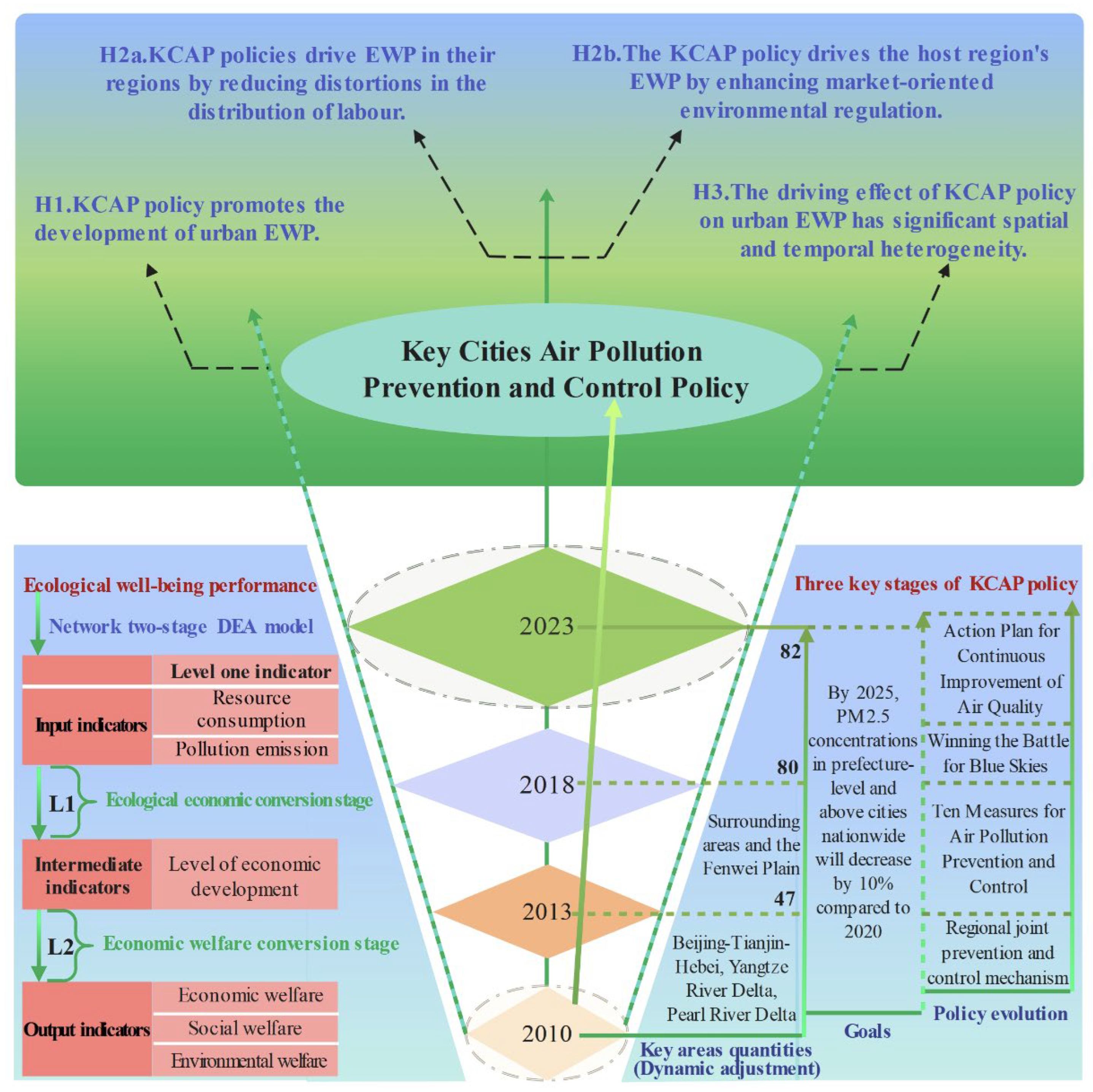
Figure 1. The conceptual framework of this paper.
Sustainability 18 00284 g001
Figure 2. Time Heterogeneity of the KCAP Policy Effect.
Sustainability 18 00284 g002
Figure 3. Spatial Heterogeneity of KCAP Policy Effect.
Sustainability 18 00284 g003
Figure 4. Distribution of pseudo policy variable estimation coefficients and corresponding p-values (repeated 1000 times).
Sustainability 18 00284 g004
Table 1. Construction of EWP Indicator System.
SystemCriterion LayerIndicator Layer
Initial investmentInput end resource consumptionEnergy consumptionPer capita electricity consumption in kilowatt-hours
Land consumptionPer capita urbanized land area/square meter
Water resource consumptionPer capita freshwater use per cubic meter
Output end pollution emissionsWastewater dischargePer capita discharge of industrial effluents/ton
Exhaust emissionsPer capita SO2 emissions from industrial sources/ton
Solid waste dischargePer person volume of urban solid waste managed/ton
Intermediate variableLevel of economic developmentPersonal incomePer person GDP/10,000 yuan
Public revenuePer person public revenue/10,000 yuan
Final outputEconomic welfareConsumption levelPer capita total retail sales of consumer goods/10,000 yuan
Number of persons with tertiary education per 10,000 people
Social welfareEducational level
Medical hygieneNumber of hospitals per 10,000 people
Hospital beds per 10,000 inhabitants
Physicians per 10,000 population
Environmental welfareEnvironmental benefitPer capita public green space/meter
Number of parks per 10,000 people
Centralized sewage treatment rate/%
Safe disposal rate of household waste/%
Table 2. Descriptive statistics of main variables.
VariableObsMeanSDMinMax
EWP35190.05140.04370.00140.3811
DID35190.11820.32290.00001.0000
People35191.92342.02100.030036.0700
Urban351946.327725.24780.0000508.1930
Fisdecentra35191.24651.52700.067620.8904
Number35191.34065.30370.0040150.4640
Export35190.38631.70340.000033.6686
Passenger35190.89812.93880.000078.3030
Primary35190.12810.07890.00200.4989
Tec35190.76772.61890.004752.8052
Revenue35193.68645.67750.000296.6959
Table 3. Baseline regression.
Variable(1)(2)
EWPEWP
DID0.0170 ***0.0133 ***
(0.0048)(0.0051)
People 0.0044 **
(0.0021)
Urban −0.0004 **
(0.0001)
Fisdecentra 0.0112 ***
(0.0030)
Number −0.0005 **
(0.0002)
Export 0.0011 *
(0.0006)
Passenger 0.0006 ***
(0.0001)
Primary −0.0426
(0.0321)
Tec 0.0007
(0.0012)
Revenue 0.0007 **
(0.0003)
Constant0.0494 ***0.0465 ***
(0.0006)(0.0062)
YearYESYES
CityYESYES
N35193519
R20.73130.7423
Note: The clustering robustness standard errors at the city level are shown in parentheses, with ***, **, and * indicating significance at the 1%, 5%, and 10% statistical levels, respectively.
Table 4. Survival Analysis Regression Results.
VariablelnT
EWP−1.0547
(0.7680)
Gec0.0000
(0.0000)
Market−0.0751
(0.0838)
People0.0869
(0.0752)
Urban−0.0066
(0.0057)
Fisdecentra−0.0804
(0.0628)
Number0.0002
(0.0075)
Export0.0155
(0.0142)
Passenger−0.0133
(0.0100)
Primary−0.1629
(0.5204)
Tec0.0298
(0.0265)
Revenue−0.0030
(0.0021)
Constant3.1445
(2.1802)
N677
Table 5. PSM-DID equilibrium test results.
VariableUnmatchedMean %reductt-testV(T)/
MatchedTreatedControl%bias|bias|tp > |t|V(C)
PeopleU3.3871.72769.5 16.310.002.56 *
M3.1003.0412.596.50.290.7710.62 *
UrbanU54.13045.28233.1 6.750.0001.37 *
M53.14752.1123.988.30.430.6680.57 *
FisdecentraU2.4721.08258.2 18.240.00010.12 *
M1.9532.011−2.595.8−0.390.6990.35 *
NumberU4.8140.87538.7 14.650.00074.58 *
M2.4402.4230.299.60.070.9470.39 *
ExportU1.2620.26943.9 11.370.0003.91 *
M0.8600.956−4.290.3−0.590.5560.46 *
PassengerU1.9830.75340.9 8.090.0001.17
M1.5661.4045.486.81.030.3041.08
PrimaryU0.0740.135−94.9 −15.290.0000.30 *
M0.0770.0745.893.81.260.2061.04
TecU2.9810.47153.3 19.310.00033.87 *
M1.7521.7140.898.50.190.8510.43 *
RevenueU7.4033.18855.2 14.640.0004.35 *
M5.8596.273−5.490.2−0.840.3990.26 *
Note: The clustering robustness standard errors at the city level are shown in parentheses, with * indicating significance at the 10% statistical levels.
Table 6. PSM-DID Regression Results.
(1)(2)(3)
VariableEWPEWPEWP
DID0.0147 ***0.0131 ***0.0134 ***
(0.0051)(0.0050)(0.0051)
People 0.00290.0329
(0.0044)(0.0457)
Urban −0.0003−0.0001
(0.0003)(0.0001)
Fisdecentra 0.0111 **0.0087 **
(0.0045)(0.0041)
Number −0.0014−0.0008
(0.0012)(0.0005)
Export 0.0012−0.0101 **
(0.0010)(0.0043)
Passenger 0.00110.0006
(0.0008)(0.0006)
Primary −0.09180.0022
(0.1445)(0.0328)
Tec 0.00010.0021 *
(0.0018)(0.0013)
Revenue 0.0011 *0.0005 *
(0.0007)(0.0003)
L.People −0.0263
(0.0446)
L.Urban −0.0005 ***
(0.0002)
L.Fisdecentra 0.0023
(0.0040)
L.Number 0.0005
(0.0006)
L.Export 0.0104 ***
(0.0036)
L.Passenger 0.0001
(0.0007)
L.Primary −0.0517 *
(0.0301)
L.Tec −0.0018 **
(0.0008)
L.Revenue 0.0003
(0.0002)
Constant0.0602 ***0.0500 ***0.0510 ***
(0.0018)(0.0164)(0.0073)
YearYESYESYES
CityYESYESYES
N110811083312
R20.77910.78890.7451
Note: The clustering robustness standard errors at the city level are shown in parentheses, with ***, **, and * indicating significance at the 1%, 5%, and 10% statistical levels, respectively.
Table 7. IV method.
Table 7. IV method.
Variable(1)(2)
DIDEWP
IV_River2.6861 ***
(0.4052)
DID 0.0103 **
(0.0048)
People−0.00360.0048 **
(0.0130)(0.0021)
Urban−0.0009−0.0004 **
(0.0008)(0.0001)
Fisdecentra0.0564 *0.0111 ***
(0.0317)(0.0030)
Number−0.0187 ***−0.0006 ***
(0.0035)(0.0002)
Export−0.00740.0009
(0.0092)(0.0007)
Passenger−0.00110.0006 ***
(0.0012)(0.0001)
Primary−0.3462−0.0438
(0.2375)(0.0319)
Tec−0.01480.0008
(0.0139)(0.0011)
Revenue0.0046 *0.0007 **
(0.0027)(0.0003)
Constant0.0811
(0.0556)
YearYESYES
CityYESYES
N35193519
R20.85480.0688
Note: The clustering robustness standard errors at the city level are shown in parentheses, with ***, **, and * indicating significance at the 1%, 5%, and 10% statistical levels, respectively.
Table 8. Outlier test results.
(1)(2)(3)(4)
VariableCorrection of EWP OutliersControl the Fixed Effects of ProvincesControl Fixed Effects of Provinces and CitiesControl the Fixed Effects of the Interaction Between Provinces and Years
DID0.0111 **0.0265 ***0.0133 ***0.0346 ***
(0.0043)(0.0057)(0.0051)(0.0087)
People0.00660.0048 ***0.0044 **0.0043 **
(0.0053)(0.0017)(0.0021)(0.0021)
Urban−0.0003 **−0.0003 ***−0.0004 **−0.0003 **
(0.0001)(0.0001)(0.0001)(0.0001)
Fisdecentra0.0094 **0.0067 *0.0112 ***0.0080
(0.0041)(0.0035)(0.0030)(0.0050)
Number−0.0020 *−0.0003−0.0005 **−0.0013
(0.0012)(0.0003)(0.0002)(0.0014)
Export0.00190.00050.0011 *0.0001
(0.0027)(0.0010)(0.0006)(0.0031)
Passenger0.00120.00000.0006 ***−0.0000
(0.0013)(0.0002)(0.0001)(0.0003)
Primary−0.04090.0494 *−0.04260.0575 *
(0.0340)(0.0254)(0.0323)(0.0297)
Tec0.0000−0.00100.0007−0.0023
(0.0016)(0.0015)(0.0012)(0.0017)
Revenue0.0007 *0.00050.0007**0.0008
(0.0004)(0.0004)(0.0003)(0.0006)
Constant0.0455 ***0.0393 ***0.0465 ***0.0372 ***
(0.0104)(0.0072)(0.0062)(0.0090)
CityYESNOYESNO
YearYESYESYESYES
ProvinceNOYESYESYES
Province×YearNONONOYES
N3519351935193434
R20.75370.42770.74230.4704
Note: The clustering robustness standard errors at the city level are shown in parentheses, with ***, **, and * indicating significance at the 1%, 5%, and 10% statistical levels, respectively.
Table 9. Excluding the impact of other location-oriented policies.
(1)(3)(4)
VariableEWPEWPEWP
DID0.0133 ***0.0133 ***0.0133 ***
(0.0051)(0.0051)(0.0051)
DID010.0006 0.0007
(0.0060) (0.0060)
DID02 −0.0009−0.0009
(0.0046)(0.0046)
People0.0044 **0.0044 **0.0044 **
(0.0021)(0.0021)(0.0021)
Urban−0.0004 **−0.0004 **−0.0004 **
(0.0001)(0.0001)(0.0001)
Fisdecentra0.0112 ***0.0112 ***0.0112 ***
(0.0030)(0.0030)(0.0030)
Number−0.0005 **−0.0005 **−0.0005 **
(0.0002)(0.0002)(0.0002)
Export0.0011 *0.00100.0010
(0.0006)(0.0006)(0.0006)
Passenger0.0006 ***0.0006 ***0.0006 ***
(0.0001)(0.0001)(0.0001)
Primary−0.0426−0.0428−0.0428
(0.0322)(0.0321)(0.0321)
Tec0.00070.00070.0007
(0.0012)(0.0012)(0.0012)
Revenue0.0007 **0.0007 **0.0007 **
(0.0003)(0.0003)(0.0003)
Constant0.0465 ***0.0465 ***0.0465 ***
(0.0062)(0.0062)(0.0062)
CityYESYESYES
YearYESYESYES
N351935193519
R20.74230.74230.7423
Note: The clustering robustness standard errors at the city level are shown in parentheses, with ***, **, and * indicating significance at the 1%, 5%, and 10% statistical levels, respectively.
Table 10. Regression Results of Mechanism Analysis.
Variable(1)(2)(3)(4)
EWPEWPEWPEWP
DID0.0133 ***0.0149 ***0.0133 ***0.0137 ***
(0.0051)(0.0050)(0.0051)(0.0051)
Regu 0.9098 *
(0.5004)
DID × Regu 5.0218 ***
(1.7573)
Labor 0.0025
(0.0016)
DID × Labor −0.0146 ***
(0.0044)
People0.0044 **0.0046 **0.0044 **0.0045 **
(0.0021)(0.0021)(0.0021)(0.0021)
Urban−0.0004 **−0.0004 ***−0.0004 **−0.0004 **
(0.0001)(0.0001)(0.0001)(0.0001)
Fisdecentra0.0112 ***0.0108 ***0.0112 ***0.0108 ***
(0.0030)(0.0031)(0.0030)(0.0030)
Number−0.0005 **−0.0006 ***−0.0005 **−0.0005 **
(0.0002)(0.0002)(0.0002)(0.0002)
Export0.0011 *0.0012 *0.0011 *0.0011 *
(0.0006)(0.0006)(0.0006)(0.0006)
Passenger0.0006 ***0.0006 ***0.0006 ***0.0006 ***
(0.0001)(0.0001)(0.0001)(0.0001)
Primary−0.0426−0.0560 *−0.0426−0.0421
(0.0321)(0.0327)(0.0321)(0.0316)
Tec0.00070.00100.00070.0008
(0.0012)(0.0011)(0.0012)(0.0012)
Revenue0.0007 **0.0007 **0.0007 **0.0007 **
(0.0003)(0.0003)(0.0003)(0.0003)
Constant0.0465 ***0.0464 ***0.0465 ***0.0454 ***
(0.0062)(0.0062)(0.0062)(0.0062)
CityYesYesYESYES
YearYesYesYESYES
N3519351935193519
R20.74230.74420.74230.7440
Note: The clustering robustness standard errors at the city level are shown in parentheses, with ***, **, and * indicating significance at the 1%, 5%, and 10% statistical levels, respectively.
Table 11. Heterogeneity Analysis Regression Results.
Explained Variable: EWPHigh Air PollutionLow Air PollutionOld Industrial Base CitiesNon-Old Industrial Base CitiesBig CitySmall City
(1)(2)(3)(4)(5)(6)
DID0.0197 ***0.00870.0287 ***0.0099 *0.0238 ***0.0054
(0.0052)(0.0072)(0.0102)(0.0060)(0.0080)(0.0064)
People0.0066 **0.0039 *−0.00400.0036−0.00620.0048 **
(0.0026)(0.0021)(0.0066)(0.0026)(0.0115)(0.0019)
Urban−0.0006 ***−0.0003 **−0.0005−0.0003 *0.0006−0.0004 ***
(0.0002)(0.0001)(0.0003)(0.0002)(0.0009)(0.0001)
Fisdecentra0.0133 ***0.0114 ***0.0191 **0.0099 ***0.0095 **0.0105 *
(0.0048)(0.0030)(0.0077)(0.0034)(0.0042)(0.0061)
Number−0.0024 **−0.0008 ***0.0016−0.0006 ***−0.0004 *0.0001
(0.0010)(0.0003)(0.0032)(0.0002)(0.0002)(0.0023)
Export0.00090.0017 ***−0.02080.0011 *0.0013−0.0222 *
(0.0026)(0.0005)(0.0139)(0.0006)(0.0008)(0.0115)
Passenger0.0005 ***0.0006 ***−0.00160.0006 ***0.0005 ***0.0005
(0.0002)(0.0001)(0.0033)(0.0001)(0.0002)(0.0020)
Primary−0.0560 *−0.0121−0.0464−0.0419−0.0356−0.0351
(0.0326)(0.0512)(0.0434)(0.0455)(0.1057)(0.0320)
Tec−0.00060.0025 **−0.00070.00120.00030.0009
(0.0014)(0.0013)(0.0037)(0.0012)(0.0014)(0.0024)
Revenue0.0010 **0.00040.0011 ***0.0006−0.00010.0014 **
(0.0004)(0.0003)(0.0004)(0.0004)(0.0004)(0.0005)
Constant0.0510 ***0.0425 ***0.0589 ***0.0479 ***0.04070.0507 ***
(0.0075)(0.0085)(0.0181)(0.0078)(0.0280)(0.0081)
Test for difference in coefficients between groups0.0050 ***0.0000 ***0.0000 ***
CityYESYESYESYESYESYES
YearYESYESYESYESYESYES
N14002119125822619452570
R20.76010.77530.73820.74690.75140.7299
Note: The clustering robustness standard errors at the city level are shown in parentheses, with ***, **, and * indicating significance at the 1%, 5%, and 10% statistical levels, respectively.
Disclaimer/Publisher’s Note: The statements, opinions and data contained in all publications are solely those of the individual author(s) and contributor(s) and not of MDPI and/or the editor(s). MDPI and/or the editor(s) disclaim responsibility for any injury to people or property resulting from any ideas, methods, instructions or products referred to in the content.