1. Introduction
The development of artificial intelligence (AI) has been a controversial process, spanning nearly seven decades since its initial proposal in the 1950s. The technology has been the subject of debate on a range of issues, including its governance and ethical norms. The advent of organizational AI adoption has given rise to two significant dilemmas pertaining to the subject and environment of AI application. The first involves the initial decision of whether to adopt AI to optimize productivity. The second challenge focuses on how to address “Artificial Stupidity (AS)”—a concept defined by Ma and Su [
1] as AI’s negative effects in initial adoption, and how to sustain and deepen AI integration to maximize long-term organizational efficiency.
As evidenced by a substantial body of excellent literature from previous eras, the initial question has been adequately addressed and corroborated by empirical evidence. From established frameworks such as the Socio-Technical Systems Framework (STS), the Technological Organizational Environment Framework (TOE), the Technology Acceptance Model (TAM), the Unified Theory of Acceptance and Use of Technology (UTAUT) [
2,
3,
4,
5], to the recently proposed TOP framework for AI adoption by organizational AI adoption technologists, there has been extensive research into the factors that contribute to the success of organizational AI adoption [
6]. These frameworks focus on whether to adopt AI but fail to address how to sustain and deepen AI integration. Furthermore, AI’s transformative role across education, healthcare, and manufacturing has been widely validated. As indicated in the most recent research report from McKinsey in 2024, the global rate of adoption for AI has reached 72%. This widespread initial adoption underscores the urgency of addressing the understudied post-adoption journey, as mere procurement does not equate to effective integration or sustainable value creation.
The second research question, namely how organizations can effectively adopt AI to maximize its effectiveness, is more challenging to answer. This is because it forms part of a larger research area, namely organizational continuous AI adoption, which has rarely been addressed in a systematic manner in the existing literature on organizational AI adoption. Furthermore, the term “organizational AI adoption” is often used interchangeably with “organizational continuous AI adoption”. The Information Systems Continuance Model (ISCM) proposed by Bhattacherjee [
7] is commonly used to establish a research framework for organizational continuous AI adoption; however, the framework only considers the key influences on organizational continuous AI adoption, and does not provide further theoretical assessment and categorization of the effects of continued adoption.
As the digitalization process accelerates, the management of some organizations in the industry, believing that they can achieve so-called “digitalization” once they have purchased and introduced AI into their organizations, is joining the wave of digital transformation to adopt AI, seeking first-mover advantages such as cost reduction, productivity improvement, and efficiency gains. In reality, however, AI transformation is a complex and lengthy journey, and it typically takes 18 to 36 months to complete a complete and effective AI transformation [
8], sometimes costing more due to the specificity of the AI system and the actual development of the organization. Therefore, mastering organizational AI adoption effectively is more of an art, and the theoretical underpinnings of this practice are not yet a mature framework, and measuring an organization’s digital progress by simple adoption or non-adoption is biased. However, organizational AI adoption has become an inevitable trend for almost all companies that are about to undergo digital transformation or have already completed it. The academic community has provided a rich array of theoretical lenses for understanding technology adoption. Classic models such as the Technology Acceptance Model (TAM) and the Technology-Organization-Environment (TOE) framework have made foundational contributions to explaining the factors influencing whether organizations adopt AI. However, this study contends that existing research suffers from a fundamental limitation: its static and cross-sectional nature. From a static perspective, models like TAM and TOE resemble taking a “static snapshot” of an organization’s AI journey, primarily focusing on pre-adoption decision factors such as perceived usefulness, technological readiness, and external pressure. They fail to address a more pertinent question: after making the initial adoption decision, how should organizations evaluate and manage their subsequent adoption process? Current literature critically lacks a dynamic framework capable of systematically assessing an organization’s sustained AI adoption level. There is an urgent need for a model that transcends the binary “yes/no” dichotomy, functioning like a “dashboard” to diagnose an organization’s stage along the path to deep AI integration and reveal the evolutionary trajectory from “immature” to “mature”. In contrast, the proposed Organizational AI Adoption Maturity (OAIAM) Model is dynamic and post-adoption-oriented. Unlike TAM and TOE which only focus on pre-adoption decision factors, or ISCM which merely lists influencing factors without outcome categorization, the OAIAM model integrates two complementary dimensions to capture staged progression and provide tailored strategic guidance. These are advantages that traditional models lack. Existing maturity models fail to capture three critical elements: the dynamic evolutionary nature of AI adoption, the synergistic effect of adoption depth and width, and clear pathways for sustained optimization. The absence of such a framework leaves management practice facing a challenge of guidance deficiency. Organizations struggle to discern: Where do we currently stand? In which direction should we strive next? What differentiated strategies should be adopted at different stages? This uncertainty frequently leads to misallocation of resources and strategic vacillation.
The theoretical justification for the dual dimensions of adoption depth and width, which are core to the OAIAM model, stems from Rogers’ Diffusion of Innovations theory [
9]. Adoption depth reflects the technological sophistication of AI, aligning with the theory’s “innovation” construct such as AI’s comparative advantage, complexity, and cognitive capabilities. Adoption width encompasses the scope of AI diffusion across organizational processes, people, and ecosystems, corresponding to the theory’s “diffusion channels” and “social system” constructs. Together, these two dimensions form a synergistic framework that overcomes the one-dimensional limitations of traditional models, enabling a comprehensive assessment of AI adoption maturity. Furthermore, sustainability is intrinsic to the OAIAM model. The transition from basic AI application to deep value co-creation directly supports organizational sustainability by fostering long-term human-machine synergy, optimizing resource utilization, and enabling adaptive innovation. Unlike static frameworks that focus on one-time adoption, this model’s dynamic structure aligns with the iterative nature of digital transformation, ensuring AI integration evolves with organizational goals and external environments to deliver sustained value.
Therefore, the core research gap identified in this study lies in the fact that existing theories fail to provide a dynamic, assessable maturity model to assist organizations in diagnosing their level of sustained AI adoption and guiding their progression from initial implementation to deep integration. To address this critical gap, this paper combines the existing organizational AI adoption framework with the organizational continuous AI adoption framework and innovatively proposes a framework for assessing the level of organizational continuous AI Adoption—the organizational AI adoption maturity model, which can be used to measure the level of organizational continuous AI adoption in order to maximize the utility of AI in business practice. Adjustments and reforms can be made to maximize the benefits of AI in business practice. The core of this model lies in constructing a continuous map illustrating the transition from “traditional AI application” to “future AI application”. Within this framework, “AI-impaired” corresponds to the rudimentary form of AI within organizations—characterised by functional limitations, low adoption rates, and underutilised efficacy. Conversely, “AI-enhanced” signifies the deep integration of AI with organizational strategy, culture, and business processes, enabling human-machine co-creation and maximising operational effectiveness. Through this dynamic visualisation, organizations can clearly pinpoint their stage within the AI adoption journey, identify progression pathways, and thereby achieve continuous evolution from “instrumental AI disability” to “strategic AI capability”. In addition, we have developed a set of application guidelines for the proposed theoretical framework, so that the industry can better explore the potential of organizational AI adoption and fully exploit the practical value of the framework.
2. Overview of Organizational AI Adoption and Continuous AI Adoption
This study focuses exclusively on the organizational level of AI adoption and continuous AI adoption, explicitly excluding individual-level behaviors (e.g., consumers or employees). Organizational AI adoption is defined as a strategic decision-making process where organizational decision-makers comprehensively evaluate the technological, strategic, and resource implications of AI, and formally introduce AI technology into core or supporting business operations for the first time. Continuous AI adoption refers to the proactive and sustained behavior of organizations to deepen AI integration, expand application scope, and optimize implementation effects after initial adoption, with the goal of achieving long-term value alignment between AI and organizational development. The difference between the two is that organizational AI adoption usually refers to the initial application of AI technology to an organization, whereas continuous AI adoption emphasizes the willingness of organizations to apply AI technology to the organization at a deeper level after the initial use of AI, and to continue to do so.
The specific definitions and connotations of the two have not yet been clearly defined in the existing literature. Therefore, there is an urgent need for both academia and industry to define a unified premise and specification for the concept of organizational AI adoption, so that the connotation of organizational continuous AI adoption can be easily understood. Jöhnk et al. [
10] note that research on organizational AI adoption and readiness is still in its infancy with no structured conceptualization, further supported by Yu et al. [
11] who highlight the fragmentation of existing AI adoption research and the need for integrated frameworks to fill knowledge gaps.
This paper argues that organizational AI adoption is a process in which organizational decision makers evaluate the implications of AI across all organizational aspects and make a final adoption decision, focusing on the organization’s initial adoption of AI technology in its business. However, to measure the relationship between organizational AI effectiveness and organizational AI adoption, it is necessary to further define the level of ongoing organizational AI adoption. In organizations, driven by internal and external factors such as organizational size, organizational type, organizational culture, AI technology complexity, policies and regulations, and employee skill levels, the level of organizational continuous AI adoption often does not depend unilaterally on the extent of AI technology diffusion in the organization, but also needs to take into account the degree of AI in the adopted AI technology.
The connotation of organizational AI adoption encompasses the following three points: (1) The entity undertaking the adoption is the organization. The organization is the primary entity vested with the responsibility of determining whether to adopt AI, the manner of its adoption, and the means of integrating the technology. It maintains active control over the process of introducing AI. The decision-making body, representing the organization’s interests, may act as a proxy for the organization in making the final decision on AI adoption based on its understanding and perception of AI. (2) The decision-making logic is strategically oriented. AI adoption decisions must be closely aligned with the organization’s long-term development goals to ensure compliance with regulatory and sustainability standards while enhancing business value and reducing operational risks. (3) The implementation involves targeted integration. AI technology is incorporated into key business processes to optimize operational efficiency, improve decision-making quality, and support organizational digital and intelligent transformation.
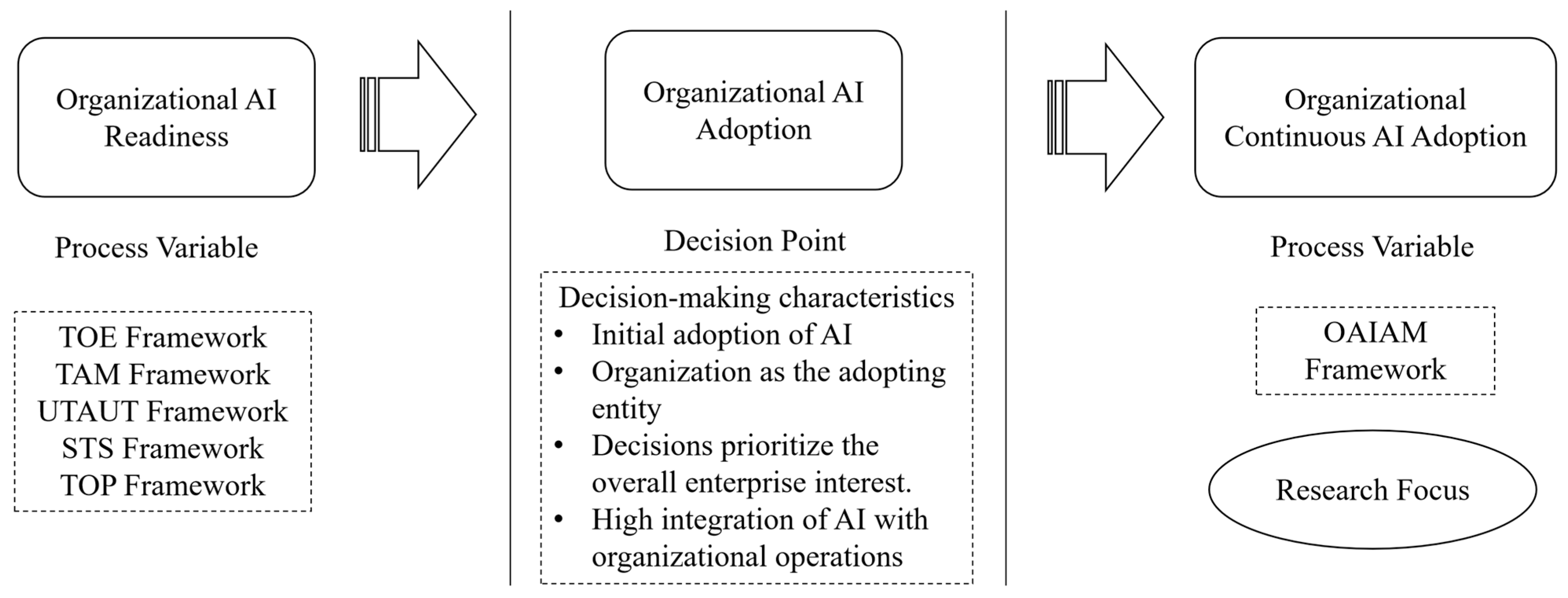
Therefore, combining the key elements of successful organizational AI adoption in existing research and the theoretical connotation of organizational AI adoption and continuous adoption summarized in this paper, we sorted out a research picture framework on organizational AI adoption [
10] (see
Figure 1), and focused our research on the stage of continuous organizational AI adoption, and assessed the level of organizational AI adoption by constructing an organizational AI adoption maturity framework. By constructing a framework of organizational AI adoption maturity to assess the level of organizational AI adoption, digital enterprises can have a complete theoretical system for self-evaluation and improvement. Simultaneously, it offers a latecomer’s advantage for newcomers by analyzing how to win in the future organizational continuous AI adoption stage, thereby enabling them to advance more effectively through the process of maturity evolution of organizational AI adoption.
3. Factors Influencing the Level of Organizational Continuous AI Adoption
Based on the ISCM and extending it to AI technologies [
7], we can deduce that there are four main influences on organizational continuous AI adoption: technology, organization, people and environment. In terms of technology, it is mainly related to the usefulness and usability of the AI technology; in terms of organization, it is mainly related to the match between the organization’s expectation of the AI system and its actual experience after using it, as well as the support and convenience of management that AI brings to the digital enterprise; in terms of people, it is mainly related to the satisfaction and acceptance of the AI system by management and employees in the organization; in terms of environment, it is related to the subjective reference and implementation costs, and so on. On the environment side, factors such as subjective references and switching costs are related to the social environment of the organization and the current economic costs.
This paper systematically sorted out existing theoretical frameworks on organizational AI adoption and continuous adoption, integrated overlapping factors across the four dimensions of technology, organization, people and environment, excluded variables that are only applicable to specific scenarios and lack generalizability, and further simplified the category of influencing factors to better measure the level of organizational continuous AI adoption. This paper extracted the two main influencing factors, namely AI adoption depth and AI adoption width, as the key variables of the model. In particular, AI adoption depth explains the technological characteristics mentioned in existing models, but is not independent of the technology itself. As a type of information technology, AI integrates other attributes such as perceived usefulness and perceived ease of use with organizations, making AI adoption a more comprehensive systematic measure of the technological dimension’s impact on organizational continuous adoption of AI [
12]. The key variable, AI adoption width, is a fully explicit concept that combines human, organizational and environmental factors. This paper bases the theoretical mapping between Rogers’ diffusion of innovation (DOI) theory and the two key variables on the intrinsic consistency between the core logic of DOI theory and the connotation of organizational continuous AI adoption [
9]. We view organizational continuous AI adoption as a basic social process of innovation diffusion, consisting of four elements, innovation, diffusion channel, time and social system and each element forms a clear theoretical connection with AI adoption depth or width [
9].
First, innovation refers to any idea, practice or object considered novel, and the subject of innovation in the ongoing adoption process of AI, i.e., AI is at the level of technological practice. With further reference to Schumpeter’s theory of innovation, which we introduce into our model, AI technology creatively destroys old productivity structures to foster the emergence of new ones that are successfully commercialized and introduced to the market, i.e., organizational AI adoption. The level of AI during the adoption process is a key variable in the continuous change during the diffusion phase of innovation, which is influenced by the characteristics of the technology, including AI’s comparative advantage, compatibility, complexity, cost-effectiveness, trialability and observability, etc. [
13]. These technological characteristics directly determine the degree of in-depth integration between AI and organizational operations, so the “innovation” element in DOI theory is specifically reflected in AI adoption depth, which measures the degree of innovation in the continuous adoption process. Therefore, we separate innovation into the key variable of AI adoption depth, which is a measure of the degree of innovation during the continuous adoption process.
Second, diffusion channels refer to the medium or pathways through which innovations are diffused. In the context of continuous organizational AI adoption, we derive different pathways that contribute to the diffusion and adoption of AI technologies in organizations and even in social systems. Factors such as competitive pressure, market uncertainty, vendor support, and government regulation at the environmental level; executive support, organizational strategy, AI readiness, and resource availability at the organizational level; and employee skill levels and motivation at the human level all influence the extent to which AI diffuses in organizations [
11]. The “diffusion channel” element in DOI theory covers these multi-level diffusion pathways, and the “social system” element which includes organizational and environmental norms, culture and structure further constrains and shapes the effectiveness of diffusion channels. Together, these two elements form the core connotation of AI adoption width, which measures the scope and extent of AI diffusion in the continuous adoption process. We therefore combine all the influences from the environmental, organizational and human aspects and use AI adoption width as a multifactorial outcome variable to measure the rate of AI diffusion.
Third, the diffusion process takes time, and different individuals or organizations adopt innovations at different rates. Moreover, the key constant variable of time runs throughout the continuous AI adoption process, and the level of AI adoption maturity an organization is at changes over time as the level of AI within the organization changes in relation to the adoption width and depth. Time acts as a contextual factor that promotes the evolution of AI adoption depth and width, and its continuity enables the dynamic adjustment of the relationship between the two key variables and the level of organizational continuous AI adoption.
Fourth, the diffusion of innovations takes place in specific social systems, where the norms, culture and structure of the system influence the diffusion of innovations. In our model, organizational continuous AI adoption is the spread and diffusion of AI in the organization and the social system as a whole, which includes not only the digital firm but also the organizational ecosystem formed by firms and their external environments, where the norms, cultures, and structures within the organizations as well as in the entire external environment influence the penetration and diffusion of AI technologies. These are the organizational and environmental influences mentioned above.
Table 1 clearly illustrates how core elements of DOI theory translate into the key variables of our model. Based on the above theoretical derivation, we propose four core propositions to clarify the relationship between the key variables and the level of organizational continuous AI adoption: Proposition 1: AI adoption depth has a positive impact on the level of organizational continuous AI adoption, and the higher the degree of technological innovation reflected by AI adoption depth, the higher the level of organizational continuous AI adoption. Proposition 2: AI adoption width has a positive impact on the level of organizational continuous AI adoption, and the wider the scope of diffusion reflected by AI adoption width, the higher the level of organizational continuous AI adoption. Proposition 3: AI adoption depth and AI adoption width have a synergistic effect on the level of organizational continuous AI adoption, and their combined effect is greater than the sum of their individual effects. Proposition 4: Time moderates the positive impacts of AI adoption depth and AI adoption width on the level of organizational continuous AI adoption, and the positive impacts are more significant as the continuous adoption time increases.
Therefore, within the framework of Diffusion of Innovations theory, the two key influencing factors of AI adoption depth and AI adoption width constitute a quadratic system. This system, designated as the Organizational AI Adoption Maturity Framework, is designed to assess an organization’s level of continuous AI adoption.
3.1. Classification of AI Adoption Depth: White-Collar AI and Blue-Collar AI
In this context, the term “AI adoption depth” usually refers to the degree of intelligence of the AI technology applied in the digital enterprise. This study employs the metaphorical classification of white-collar AI and blue-collar AI as a task-based functional differentiation framework rooted in the machine behaviour research [
14]. This classification is employed to elucidate the distinctive characteristics and application domains of these entities.
White-collar AI is defined by three core criteria: task nature involving non-standardized analytical decision-making or creative output; technological foundation relying on advanced algorithms such as machine learning and natural language processing; and value contribution focusing on knowledge creation or strategic support. It is primarily employed in knowledge-intensive fields where it can perform complex analytical and decision-making tasks. In domains such as artistic creation, design and content generation, it can generate novel solutions or works. Moreover to interact effectively with humans, white-collar AI is designed to adapt to human language communication norms and contextual requirements in line with the socio-technical interaction principles outlined in existing research. These systems typically possess extensive expertise in specific fields, such as law, finance, and healthcare, enabling them to provide specialized consultation or services.
In contrast, blue-collar AI is defined by three key criteria task nature characterized by repetitive standardized operations technological foundation based on predefined rules or robotics and value contribution focused on efficiency improvement through labor substitution. It is primarily used to describe systems that operate in operational or labor-intensive fields. These AI systems demonstrate exceptional proficiency in the execution of highly repetitive and standardized tasks, such as automation on production lines or data entry. Such systems may interact directly with the physical world, performing tasks such as handling, assembly, or cleaning. Blue-collar AI demonstrates specialized capabilities in specific domains, but these competencies are largely confined to discrete operations or tasks. The decision-making processes of these systems are based on predefined rules or algorithms, and thus do not require complex reasoning or creative thought [
14].
3.2. Classification by AI Adoption Width: Pilot, Partial Deployment, and Full Integration
The concept is relatively straightforward: in general, the broader the extent of AI adoption within an organization (that is, the greater the number of employees who utilize AI systems in business processes), the higher the level of AI adoption width within the organization, and vice versa. However, the foundation for extensive AI usage is the profound integration of AI technology with the organization’s business operations, accompanied by a relatively high level of employee acceptance of AI. In light of this understanding, we propose a categorization of AI adoption width into three stages: pilot, partial deployment, and full integration.
The pilot stage is characterized by an organization’s recognition of the positive impact of AI on its development. This is followed by the implementation of small-scale pilot projects with AI technology in specific projects or departments, with the objective of evaluating its effectiveness and feasibility. During this period, the number of users remains relatively limited, and the width of AI adoption is relatively low. Progression from the pilot stage typically depends on sufficient resource allocation for technology testing, strong executive support for cross-departmental coordination and a culture that tolerates initial experimentation and potential setbacks.
The partial deployment stage indicates that AI technology begins to be applied in multiple departments or business processes within the organization but has not yet become fully widespread. During this stage, the number of users increases, and the extent of AI usage significantly rises. Advancement to this stage is often driven by the establishment of clear governance mechanisms for AI implementation, consistent resource investment in technology scaling and a growing organizational culture of AI acceptance fostered by initial pilot successes.
The full integration stage represents a phase during which AI technology becomes a central competency of the organization, being extensively applied across nearly all business processes and decision-making. This stage is characterized by the comprehensive optimization and innovation of business processes driven by AI, with nearly all employees in the organization utilizing AI, thereby achieving a high level of AI usage. Organizations reaching this stage typically possess abundant technological and human resources, robust governance structures that integrate AI into strategic planning and a mature culture that views AI as a core enabler of organizational development.
4. Four Regions of Organizational AI Adoption Maturity
To clearly elaborate the development and validation process of the OAIAM model, this study adhered to a rigorous conceptual research methodology.
Figure 2 illustrates the entire process from theoretical foundation to model application, detailing the specific steps and the underlying design rationale.
Referencing the AI integration model proposed by Makarius et al. [
15], which categorizes human-machine interaction and the resultant socio-technical capital based on the novelty of AI (low, medium, and high levels) and its impact on incremental content changes versus radical co ntextual changes within organizations, this model provides a useful framework for classifying organizational AI adoption maturity. The degree of AI adoption maturity is classified into three levels: preliminary, moderate, and deep. The aforementioned levels are evaluated based on two dimensions: AI adoption depth and the AI adoption width within the organization.
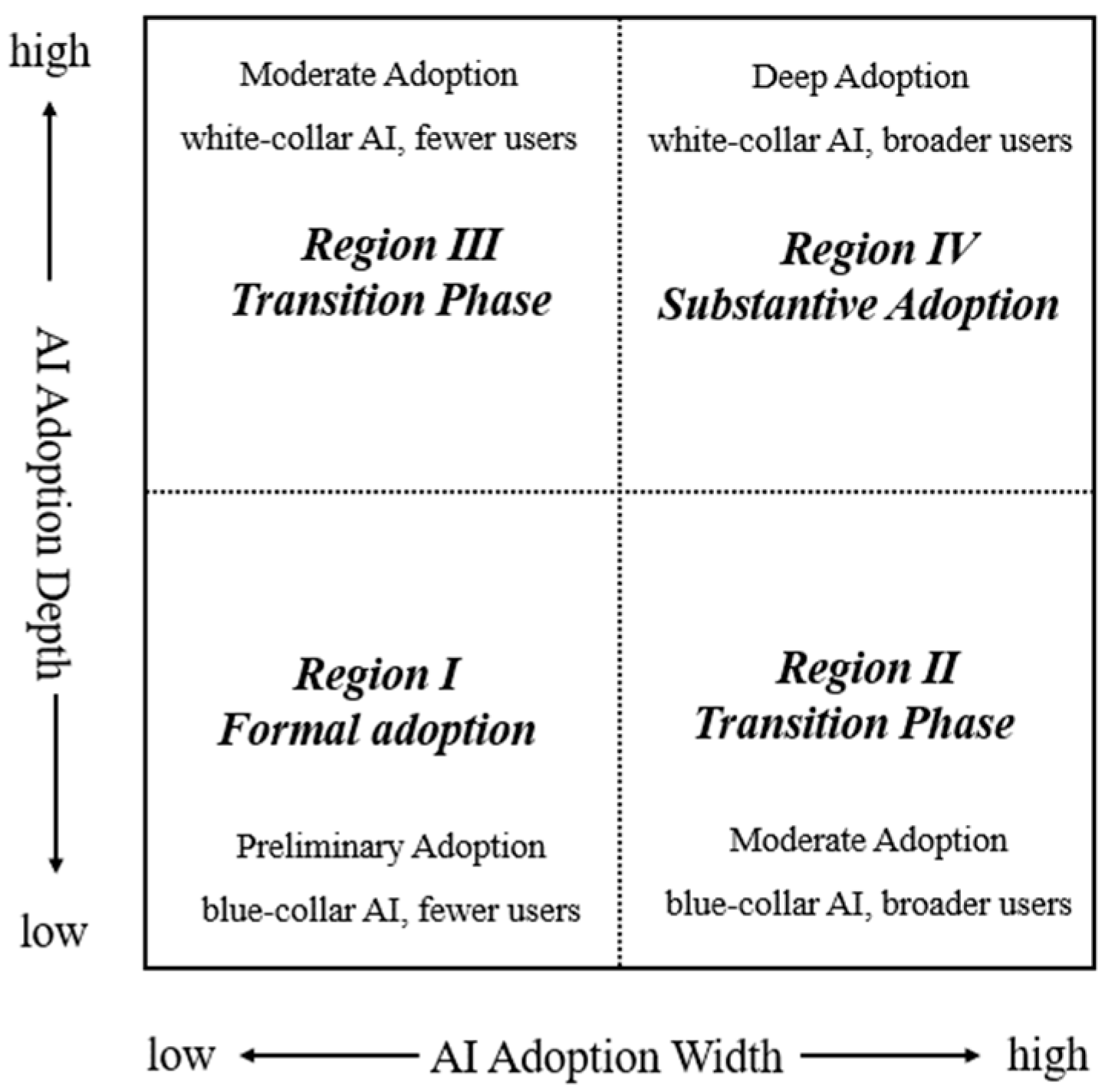
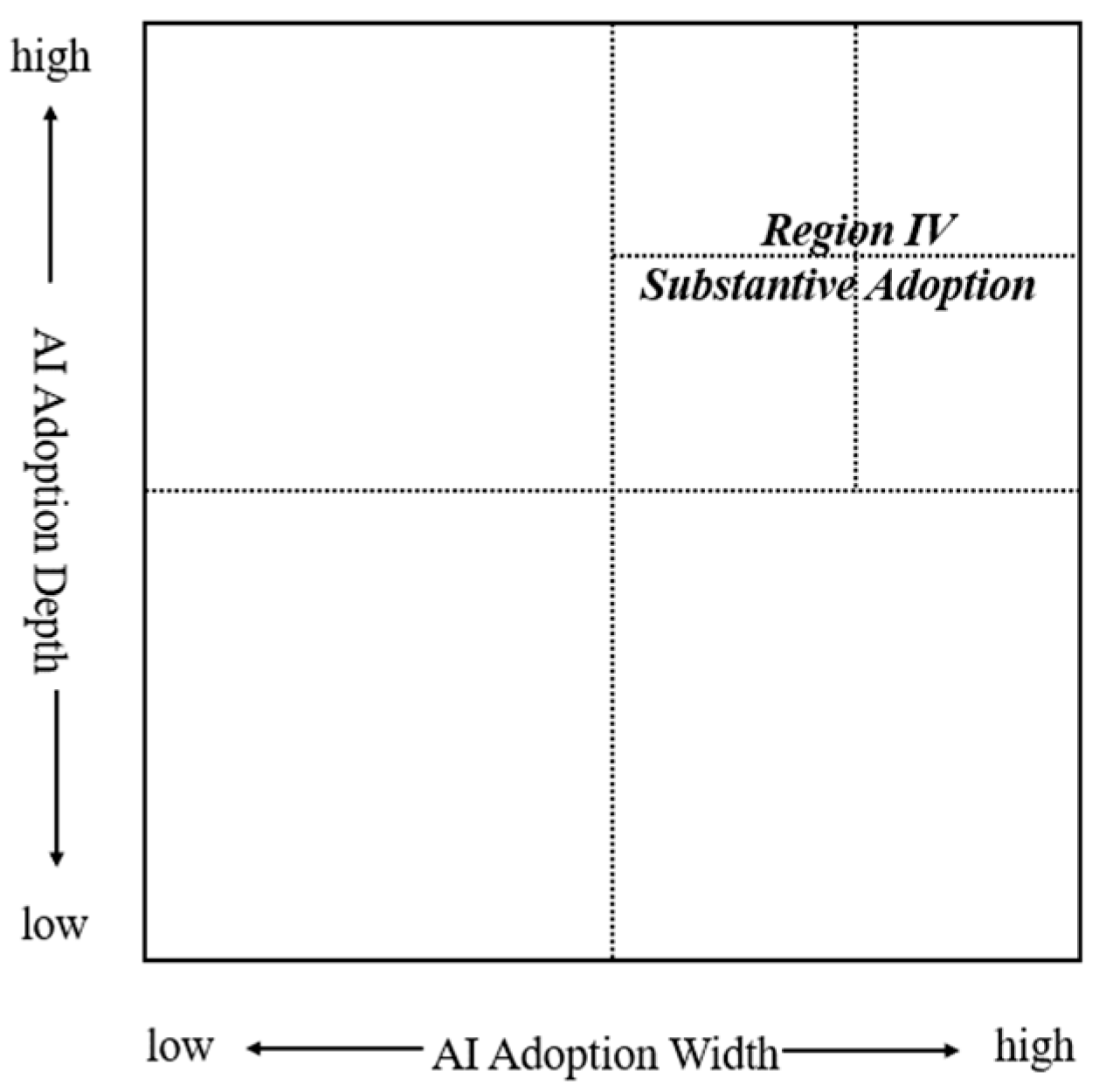
By placing each level of organizational AI adoption into a two-dimensional grid matrix, a matrix is derived that defines organizational AI adoption maturity across four distinct areas (see
Figure 3). The aforementioned matrix serves to effectively complete the classification of organizational AI adoption maturity.
4.1. Region I: Formal Adoption Stage
In accordance with the aforementioned criteria, for organizations exhibiting relatively minimal levels of AI implementation, particularly those utilizing blue-collar AI with a limited user base, this phase is designated as the preliminary adoption stage or the formal adoption stage. This stage represents the initial engagement of enterprises with the emerging technology of artificial intelligence, involving preliminary attempts and exploration. The defining characteristic of this phase is that the scope and depth of AI implementation are relatively constrained. Organizations typically commence their AI implementation with basic applications, such as automated data entry and image recognition. These involve less complexity and rely on predefined rules or algorithms, as opposed to complex reasoning or creative thinking. Such systems are manageable with respect to risk, which aligns with our previous definition of “blue-collar AI”.
In light of the dearth of experience with AI technology and the inclination toward caution, enterprises typically elect to pilot the technology in domains with minimal impact, such as customer service or supply chain management, with the objective of evaluating its initial effectiveness and potential value. Given the limited scope of AI applications, the number of employees involved is typically modest, comprising primarily technical teams or specific project group members tasked with implementing and monitoring AI systems. This suggests that the organization’s knowledge and experience with AI are still in their nascent stages, and that employees may have limited understanding and acceptance of AI. From an organizational culture perspective, it can be argued that the organization has not yet fully adapted to the introduction of AI. It is possible that employees may adopt a wait-and-see attitude towards the new technology, which could manifest as concerns and resistance. This may reflect a natural reluctance to embrace the uncertainty associated with new technology and a lack of in-depth understanding of the potential and application effects of AI [
16].
As exemplified by the initial introduction of financial software, which replaced basic manual accounting functions but required manual data entry and voucher processing, employees often refer to such systems as “artificially stupidity”—a reflection of resistance to blue-collar AI in this stage [
1].
At this juncture, the human–AI relationship is often adversarial, characterized by a struggle for control where one party dominates the other. In this dynamic, AI serves as a tool whose usability and complexity can vary. When the tool’s complexity exceeds the task’s requirement, or reaches a certain level, the effects of AI may prove counterproductive. This can result in a reduction in the level of acceptance of AI among humans. In the latter state, AI, with its automation and augmentation functions, may prove inadequate in meeting the expectations of its developers. Alternatively, it may supplant human labor through automation and intensify the pressure on employees to enhance productivity through its augmentation capabilities, thereby imposing inhumane machine standards. This human–AI conflict poses a significant risk at this stage, potentially eroding trust, impairing task efficiency, and ultimately hindering the full realization of value for both, thereby jeopardizing the evolution of organizational AI adoption maturity.
4.2. Regions II and III: Transition Phase
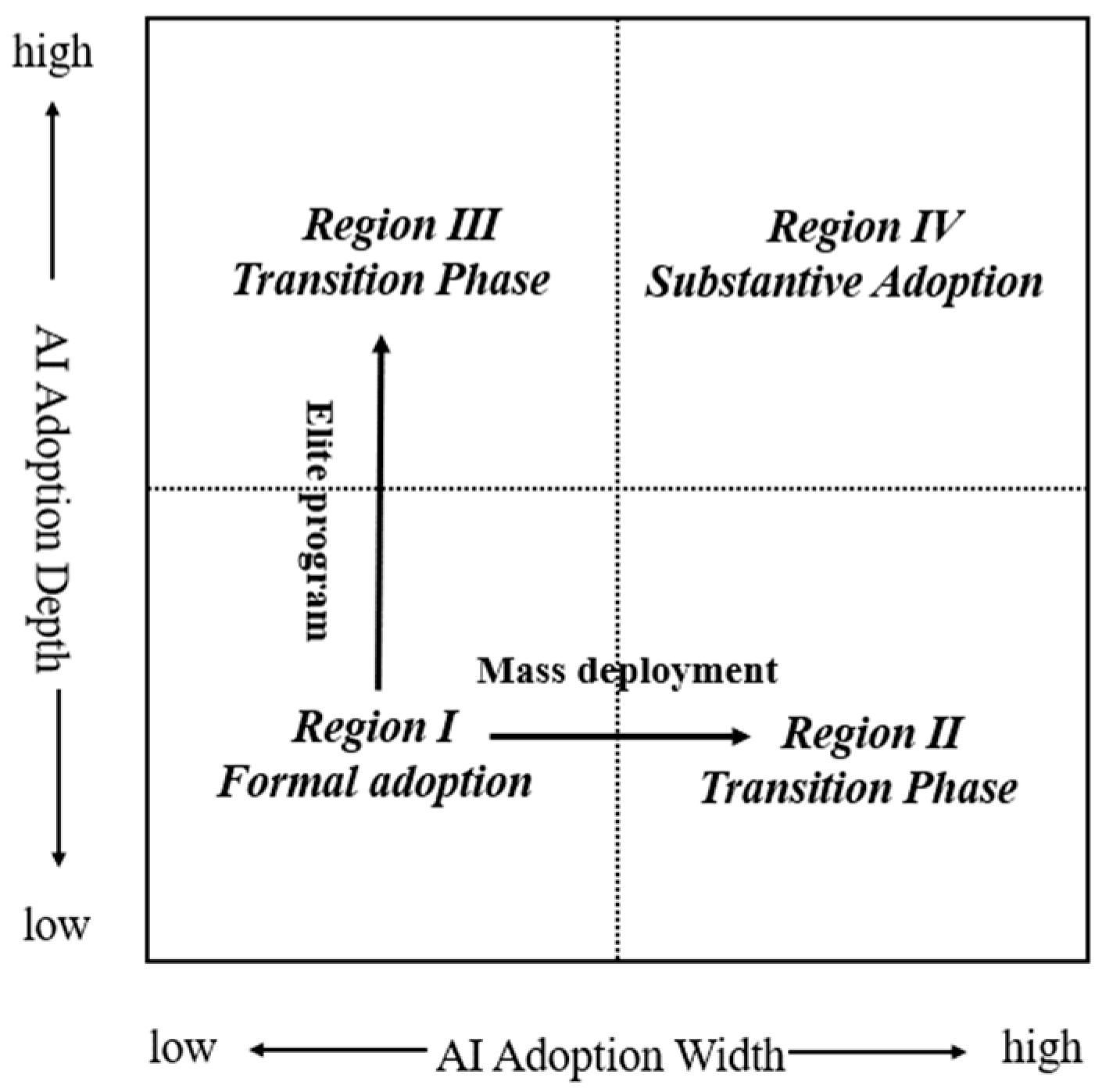
The transition phase represents a pivotal period in an organization’s AI adoption process, signifying the transition from initial experimentation with AI technologies to broader and deeper application. It is postulated that there are two principal avenues for the advancement of organizational AI adoption. The initial strategy is that of “mass deployment”, which is characterized by a significant expansion of blue-collar AI in order to increase the number of users of AI systems. This approach is distinguished by a relatively lower level of AI adoption depth, but a higher degree of AI adoption width. The second pathway is the “elite program”, which is focused on training and iterative development of AI systems to evolve into white-collar AI through targeted applications and specialized fields. This approach is distinguished by higher levels of AI adoption depth and lower adoption width (see
Figure 4).
These two pathways explicitly reflect the exploitation-exploration duality in strategic management, with their effectiveness contingent on organizational resources and contextual factors rooted in the ambidexterity-resilience research [
17]. “Mass deployment” exploits existing blue-collar AI capabilities to drive incremental innovation through standardized task optimization—aligning with the AI-enabled task characteristics (e.g., rule-based automation) identified by Verma and Singh [
18] that support efficient, iterative improvements. In contrast, the “elite program” explores new technological value to foster radical innovation in specialized domains, relying on AI-enabled knowledge characteristics such as specialization and information processing that enhance innovative work behavior [
18]. Notably, resource constraints (e.g., limited IT infrastructure or learning capabilities) tend to weaken the implementation effect of the “elite program”, explaining why resource-scarce organizations often prioritize “mass deployment” first—consistent with the finding that ambidextrous outcomes are attenuated in resource-constrained contexts [
17]. Additionally, organizational ambidexterity moderates the effectiveness of both pathways, as firms with higher ambidexterity can better balance the trade-offs between exploitation and exploration, thereby accelerating the transition to substantive adoption [
19].
In contrast to the “mass deployment” strategy, the “elite program” places a greater emphasis on the comprehensive integration of AI technologies and the advancement of innovative capabilities. In scenarios where AI is utilized to support work autonomy, complexity, specialization, and information processing, there is a notable increase in innovative behaviors. This pathway concentrates resources and expertise on specific populations and fields, thereby facilitating the comprehensive application of AI technologies in particular areas. The objective is to achieve technological breakthroughs and business innovations in these fields, thereby significantly enhancing the organization’s core competitive capabilities and innovation advantages [
18]. Nevertheless, this approach may also necessitate the establishment of more rigorous standards for employee competencies and organizational culture. Organizations must continually invest in AI system upgrades and maintenance, as well as in human resource training. The financial outlay required for training and development in the context of substantial AI adoption may experience an incremental increase in the future.
The primary distinction between the two pathways is that the “mass deployment” strategy relies on long-term employee acceptance of AI, with an emphasis on subsequent enhancements to AI systems. In contrast, the “elite program” is based on an initial investment in the development of white-collar AI systems, with the objective of extending their impact throughout the organization by addressing departments that have not yet fully adopted AI. Irrespective of the selected pathway, the transition phase represents a pivotal juncture in the AI adoption process. It is imperative that organizations conduct ongoing assessments and make necessary adjustments to their strategies during this phase to guarantee the effective implementation and continuous advancement of AI technologies.
The evolution of financial software to ERP systems illustrates this phase—ERP integrates financial and business modules, and organizations may either advance to cloud-based systems (“elite program”) or expand ERP across departments (“mass deployment”).
At this juncture, the status of AI as an object has not yet undergone a complete transformation. However, during the transition to Region II, the ease of use and multifunctional attributes of AI tools have exhibited notable improvements compared to the formal adoption phase. The acceptance of AI within the organization generally increases, as evidenced by the broader use of AI by organizational members. Conversely, during the transition to Region III, the iterative upgrading of AI reinforces the value of human involvement, particularly through collaborative human-machine decision-making and dynamic personalization, which enables the addressing of diverse issues. As a result of this process, the conflict between humans and AI gradually diminishes, and the relationship shifts from one of opposition to one of inclusion.
4.3. Region IV: Substantive Adoption Stage
In organizations where both the level of AI adoption depth and AI adoption width are high, the organization progresses to what we term the substantive adoption stage of AI. This stage is indicative of a high level of maturity and profound integration within the AI adoption process. AI technologies are not only widely applied across various business processes but are also deeply integrated with the organization’s core strategies and decision-making systems. At this juncture, the AI systems in use are capable of performing complex tasks, including advanced analytics, pattern recognition, predictive modeling, and natural language processing. This demonstrates high levels of cognitive abilities and creative thinking. Concurrently, a significant proportion of the workforce exhibits a high level of acceptance and trust in AI. When employees demonstrate trust in AI, comprehend its nature and objectives, and cultivate proficiency in its effective utilization, enhanced collaboration between humans and AI is observed [
20]. This allows employees to employ these technologies in a productive manner in their daily work, thereby fostering innovation and driving process optimization and efficiency improvements. This complementary relationship gives rise to an organizational culture in which humans and AI coexist in a harmonious manner, continuously stimulating and encouraging employees’ innovative thinking and fostering sustainable organizational behaviors. Consequently, the objective of achieving sustained adoption of AI across all organizational functions represents a key goal for any organization that has already made the decision to adopt AI. Only through comprehensive and sustained adoption can the full value of AI be realized.
At this stage, financial software becomes increasingly sophisticated and intelligent. The integration of generative AI and machine learning enables automated categorization, intelligent budget forecasting, and anomaly detection, significantly enhancing the efficiency and accuracy of financial management. Reflecting broader societal trends, the software also incorporates blockchain and digital currencies, achieving seamless integration with emerging economic models. As an advanced form of white-collar AI, these intelligent systems demonstrate specialized cognitive-like capabilities rooted in AI-enabled knowledge characteristics—including data-driven pattern recognition, context-aware decision support, and dynamic optimization of complex workflows. Beyond automating processes, they can analyze historical data and market trends to predict financial performance, generate and dynamically adjust budget plans, and support strategic decision-making through comprehensive data analysis.
During this process, humans and AI work in close collaboration, relying on each other to enhance business process upgrades and achieve overall efficiency improvements. As financial software evolves from blue-collar AI to white-collar AI, intelligent financial systems integrate with the organization’s enterprise resource planning (ERP), customer relationship management (CRM), and supply chain and procurement systems, providing a unified data platform that empowers departments. This transformation confers benefits upon employees throughout the organization, enhancing the overall rate of adoption of AI and potentially extending successful adoption cases to external value chains for other organizations to emulate. Consequently, as AI is enhanced, the value of humans is elevated, and AI becomes more standardized, ethical, and human-centered with human assistance. This marks the completion of the deep adoption transformation exemplified by financial software.
To demonstrate the analytical framework and application value of the model, representative cases from two typical stages of the OAIAM model were selected for comparative analysis. For Region I (Formal Adoption Stage), we analyzed Company A, a traditional building steel structure manufacturer. Textual analysis of its annual reports reveals that descriptions directly related to “Artificial Intelligence” are very scarce and highly specific. The core statements focus on “intelligent and automated production lines/equipment”, where the term “intelligent” primarily serves as an adjective modifying “equipment” or “production lines”. Its technological core pertains to industrial automation and robotics, falling under the typical category of “Blue-Collar AI”, which performs repetitive physical tasks such as welding and cutting. Therefore, based on the OAIAM model positioning analysis, its AI adoption depth is low. It employs highly specialized, pre-programmed automated robotics (“Blue-Collar AI”) that lack cognitive capabilities for autonomous learning and decision-making. The technical complexity is low. Simultaneously, its AI adoption width is low. These intelligent systems are confined to production and manufacturing processes, with no penetration into core management processes such as R&D, sales, finance, or human resources. Therefore, Company A is a typical case of Region I, where AI adoption is preliminary, serving as a tool for labor substitution with shallow integration into core business activities, resulting in a human-AI relationship of “operation and being operated.”
In contrast, for Region IV(Substantive Adoption Stage), Company B, operating in the financial industry-FinTech, was selected. Textual analysis of its annual reports indicates that “Artificial Intelligence” and “AI” appear frequently as keywords, with in-depth descriptions of their specific applications in core businesses. The terminology is professional and concrete, such as “AI models”, “Natural Language Processing (NLP)”, “algorithms”, and “customer profiling”, clearly pointing to “White-Collar AI” applications possessing cognitive and decision-making abilities. Consequently, based on the OAIAM model positioning analysis, its AI adoption depth is high. It extensively employs complex AI technologies like machine learning and NLP (“White-Collar AI”) for non-standardized, high-value cognitive tasks such as risk prediction and customer insight. The technical complexity is high. Furthermore, its AI adoption width is high. AI technology is comprehensively integrated into the bank’s most critical front, middle, and back-office business processes, including credit risk control, customer marketing, and operational management, serving a wide range of employees from executives and managers to frontline staff, as well as tens of millions of customers. This company is a typical case of Region IV (Substantive Adoption Stage).
We present
Table 2 to more intuitively compare the positions of the two cases within the model matrix and demonstrate the model’s utility for diagnosis.
5. OAIAM Model Assessment and Organizational AI Adoption Rate
The above model effectively distinguishes between various stages of AI adoption within organizations. However, assessing the current stage of an organization remains a new challenge. To date, comprehensive data on AI adoption at the enterprise level is relatively scarce. Many studies address this issue by utilizing raw text data from annual reports and patent documents of publicly traded companies, which contain information related to AI technology adoption. Machine learning techniques are then applied to generate AI dictionaries for text analysis, constructing organizational-level AI metrics [
21]. This paper adopts this measurement standard and utilizes a recent method for determining AI adoption rates [
22]. It identifies terminology related to the “AI perspective” through text analysis methods in the field of machine learning (including seed terms such as adoption, application, introduction, development, and intelligence, as well as extended terms like intelligent transformation, digital intelligence, intelligent language, and machine learning) [
23]. A series of tests, including empirical comparison, internal consistency reliability, variance analysis, and economic impact testing, validate the effectiveness of key indicators extracted from over 500 companies’ annual reports and their “Management Discussion and Analysis” (MD&A) sections in capturing AI adoption rates. To address potential limitations of the measurement method, this study emphasizes that the calculation of AI-related term frequency is not merely a statistical count of word occurrences but is combined with contextual validation to ensure that the identified terms truly reflect the actual application of AI in business operations rather than superficial mentions. Furthermore, the text analysis process specifically focuses on the semantic context of AI-related terms in the MD&A sections, prioritizing terms that are associated with specific business processes, strategic planning, or performance outcomes to avoid misinterpreting isolated or irrelevant terminology. To mitigate the impact of terminology inflation, the net change in term occurrences is calibrated against industry-wide averages and cross-validated with the actual AI application initiatives disclosed in the annual reports. Finally, the method for measuring organizational AI adoption rate is defined as the number of occurrences of AI-related terms in the annual report each year minus the occurrences from the previous year, yielding the net annual occurrence count. This net count is then divided by the total occurrences to obtain the organizational AI adoption rate. This metric is justified in capturing AI adoption width because the frequency and distribution of AI-related terms in annual reports and MD&A sections have been verified to correlate with the scope of AI application across organizational business processes, as supported by the empirical results from over 500 companies. A higher index value indicates broader application of AI within the organization. Similarly, this method allows for calculating AI adoption rates across different industries and organizations from recent annual reports, defining AI adoption width within the model’s vertical dimension. This facilitates a direct comparison of AI adoption levels across different industries and companies, thus improving organizational assessment and positioning.
Regarding the model’s horizontal dimension, AI adoption depth, there are currently few suitable quantitative measurement indicators. Therefore, we recommend that industry associations take the lead in establishing AI adoption depth evaluation frameworks, which integrate methodological details such as evaluation dimensions, scoring criteria, and verification procedures. The framework should be developed based on the actual AI application levels of digital enterprises within the industry, incorporating core evaluation dimensions such as technological complexity, task adaptability, and value creation capacity. The evaluation process should combine document review, on-site technical verification, and expert peer review, with clear operating guidelines for each step to ensure consistency and objectivity. The industry-wide average AI adoption depth should be updated semi-annually based on continuous data collection from member enterprises, maintaining the timeliness and accuracy of the evaluation system. This system should be determined through on-site inspections and expert reviews, with the AI average level based on actual AI levels of all digital enterprises within the industry, and should be regularly updated to maintain the accuracy of the AI adoption depth evaluation system.
6. Normative Guidelines for Managers to Apply the OAIAM Model
In light of the conceptual framework centered on AI adoption depth and width, the core constructs of the OAIAM model we put forth a set of normative guidelines aligned with the model’s staged maturity progression. These guidelines integrate the dual dimensions of AI adoption depth and width to provide organizations with targeted insights into their current AI adoption stage and evidence-based pathways for future development.
6.1. Formal Adoption Stage: Beware of “Non-Adoption Dilemma” and “Comparison Trap”
Our research posits that organizations in the Formal Adoption Stage (Region I) should prioritize validating AI’s practical value and cultivating internal acceptance to lay the groundwork for scaling both dimensions. Key actions include establishing a senior-led AI steering committee to develop a preliminary exploration roadmap, identifying high-value low-risk pilot scenarios and adopting mature SaaS-based AI tools for rapid proof-of-concept validation. Internal capacity building focuses on cultivating “AI seed users” through focused training to enhance employee acceptance and mitigate resistance.
Organizations may face the “non-adoption dilemma” rooted in skill gaps or low willingness to adopt. Skill gaps are addressed through periodic AI training while low willingness is mitigated by leveraging “Star Users” whose network influence encourages broader adoption. Additionally, organizations must avoid the “comparison trap” by embracing a learning organization mindset ensuring continuous AI capability enhancement through sustained learning rather than short-term comparisons.
In the nascent stages of AI implementation, digital enterprises must also be mindful of the “comparison trap”. In examining the relationship between AI adoption and investment, McElheran’s research on AI adoption in U.S. organizations reveals a clear trend: early adopters of AI tend to attract more investment, which in turn accelerates their AI development [
24]. Conversely, organizations that lag in AI adoption may initially experience a discrepancy with early adopters, particularly in terms of industry competitiveness. Consequently, organizations in the initial stages of AI adoption must refrain from complacency and short-term thinking. The evolution of AI adoption maturity is a continuous and gradual process. To progress to the subsequent stage, organizations must undergo a transformation into learning organizations, thereby ensuring the continuous enhancement of their AI capabilities through sustained learning.
6.2. Transition Phase: Identify the Path of Transition Region and Fill the Weakness
Organizations in the Transition Phase must select pathways aligned with resource endowments to enhance either AI adoption depth or width while laying the groundwork for synergy development. The Elite Program prioritizes deepening AI adoption depth by forming specialized teams to address strategic business challenges through agile development and data governance. The Mass Deployment pathway focuses on expanding AI adoption width by platformizing piloted tools establishing an AI Center of Excellence and cultivating departmental AI Ambassadors for organization-wide proliferation.
For organizations on the Mass Deployment pathway, existing high employee acceptance creates an opportunity to invest in AI system development to enhance adoption depth. Key measures include building a multidisciplinary AI team strengthening foundational algorithm research and upgrading technical infrastructure. For those on the Elite Program, the mature AI system provides a basis to expand adoption width. Successful white-collar AI teams serve as exemplars to educate employees communicate AI’s value and facilitate organization-wide adoption.
Conversely, an organization that elects to pursue the “elite program” route enjoys the benefit of an AI system that has already attained a considerable degree of sophistication. The next challenge is the widespread adoption of this approach. At this juncture, it is possible that internal acceptance of AI among employees may be relatively low. Given the limited number of scenarios in which AI has been deployed thus far, it is understandable that many departments may view the current transformation as something foreign. While the potential benefits of AI are clear, there is also a risk that it will increase workloads and place employees in a dynamic and complex environment filled with uncertainties [
25]. To address this issue, it would be beneficial for the organization to utilize teams or departments that have successfully and profoundly embraced white-collar AI as exemplars. These units can serve a pivotal role in educating other employees about AI, promoting the advantages of AI in organizational performance, and facilitating a gradual transition towards comprehensive AI adoption across the organization.
6.3. Substantive Adoption Stage: Maintain the Status Quo and Keep Progressing
For organizations that have reached the Substantive Adoption Stage (Region IV), the focus of action shifts from technology promotion to strategic-level deep integration and innovation leadership. Specifically, organizations need to establish a Chief AI Officer or AI governance committee at the highest management level to oversee AI strategy, ethics, and compliance. Concurrently, they should invest in cutting-edge technology research, building a technological moat through collaborations with academic institutions. Internally, organizations should implement organization-wide AI capability enhancement programs, embedding AI skills into all job responsibilities, and construct AI-driven digital twin systems to provide real-time data support for strategic decision-making. Finally, establishing a comprehensive AI application lifecycle management system ensures continuous optimization of all models in terms of performance, fairness, and sustainability, thereby achieving the normalization of human-AI collaboration and sustaining innovation under controlled risk conditions. It is recommended that organizations first conduct regular assessments of internal AI adoption depth to ensure continuous technological improvement through sustained investment that aligns with the OAIAM model’s core construct of depth enhancement. Secondly, it is essential to cultivate a culture of continuous learning within the organization. In light of the accelerated pace of AI development, it is imperative that employees, in their capacity as collaborators, maintain a state of ongoing learning in order to enhance their understanding and application of AI technologies. Thirdly, it is recommended that a long-term AI strategic plan be developed. It is incumbent upon organizational leadership to maintain a keen awareness of market dynamics, feedback, and ethical policy requirements. This necessitates a continuous adjustment of AI application strategies in order to adapt to changing environments. It is essential that the organization define its vision, goals, and mission as an AI-driven sustainable enterprise in a clear and unambiguous manner.
6.4. Practical Guidelines for Industry-Specific Oaiam Model Implementation
Building upon the conceptual framework, this study establishes normative guidelines for the Organizational AI Adoption Maturity (OAIAM) model, offering actionable insights for cross-industry AI implementation. By analyzing the interplay of industry characteristics, technology diffusion patterns, and organizational capabilities, we propose differentiated three-stage adoption pathways for fintech, manufacturing, and service sectors, each aligning with distinct strategic archetypes: elite program path (fintech), mass deployment path (manufacturing), and hybrid innovation path (services).
Fintech organizations, facing the central challenge of balancing risk governance and technological innovation, should prioritize risk-controlled AI decision engines in initial adoption (10–15% process coverage), supported by explainable AI dashboards and regulatory sandbox testing. During the transitional phase, the elite-driven path empowers algorithm engineers to deploy federated learning frameworks for cross-institutional collaboration, while algorithm ethics officers monitor model biases. At maturity, dynamic risk-pricing systems and AI governance committees ensure sustainable equilibrium between technological advancement and financial stability.
Manufacturing enterprises, characterized by human-machine synergy requirements central to Industry 4.0 maturity models, initiate adoption through visual inspection AI in quality control enhanced by AR-assisted interfaces and error compensation mechanisms. Aligned with Industry 4.0’s focus on digital integration, the mass adoption path transitions via industrial AI trainers who operationalize digital twin systems, integrating equipment data with frontline operational knowledge. Advanced stages achieve adaptive manufacturing through skill digitalization platforms that codify expert craftsmanship into AI models consistent with Industry 4.0’s pursuit of intelligent production.
Service sector adopters adopt hybrid strategies, starting with conversational AI for 20% of standardized inquiries, quantified through customer satisfaction metrics. Transitional phases leverage customer journey mapping and emotion-aware algorithms to trigger human intervention thresholds. Maturity manifests in service innovation hubs that rapidly prototype employee-driven AI solutions, complemented by resilience evaluation frameworks for dynamic demand adaptation.
Critical divergence emerges in transitional-phase technology anchors: fintech relies on federated learning for regulatory compliance breakthroughs, manufacturing leverages digital twin systems for human-machine optimization, while services employ affective computing engines for experience value reconstruction. We recommend industry-specific maturity assessment frameworks with periodic evaluation of three core dimensions—technology penetration, workforce adaptability, and business value accretion—to ensure sustainable AI adoption evolution. This guideline provides a structured yet flexible roadmap, enabling organizations to navigate AI transformation while preserving industry-specific operational DNA. The proposed matrix of strategic archetypes and phase-gated milestones offers both theoretical rigor and practical applicability across heterogeneous industrial contexts.
7. Model Extension: A Dynamic Open System Based on Relative Theories
The framework outlines the potential AI adoption maturity scenarios for various organizations, with two dimensions and four quadrant intervals. It also provides enhancement measures for those that have not yet reached the substantive (deep) adoption stage. Nevertheless, this framework is based on the widely accepted premise that attaining the substantive (deep) adoption stage represents the optimal interval for AI adoption. Attaining this quadrant may be regarded as the evolutionary threshold for an organization’s AI adoption. This perception may result in the model being deemed inapplicable in industries such as fintech, where both the degree of AI usage and the overall level of digitalization are already high.
In reality, our model is not a static or closed system; rather, it is more accurately conceptualized as a dynamic open system. From an objective standpoint, the horizontal dimension, namely the level of AI adoption depth, is a variable that is constantly expanding. The concept of AI is in a state of continuous evolution, progressing from its initial conceptualization to the development of mechanized systems and, most recently, the advent of generative AI. The advancement of AI has been an ongoing process, with the potential for further evolution. Similarly, the vertical dimension, which concerns the width of AI adoption, does not simply conclude when an organization achieves 100% AI adoption. The true extent of adoption is contextualized within the broader organizational ecosystem, which encompasses a diverse range of industries and organizations.
In the initial stages of AI implementation, it is a viable strategy to concentrate on the number of AI users within an organization. As the adoption of AI across organizational contexts matures, it becomes necessary to shift the focus from the individual organization to the broader ecosystem. This is a continuous process of diffusion. Organizations that are at the vanguard of AI adoption, upon achieving extensive internal usage, should endeavor to disseminate AI throughout other industry organizations that are connected to their value chains. Ultimately, this process of permeation should extend to encompass the entire organizational ecosystem. This continuous cycle of fission and expansion will ultimately result in a significant increase in the degree of AI usage across enterprises.
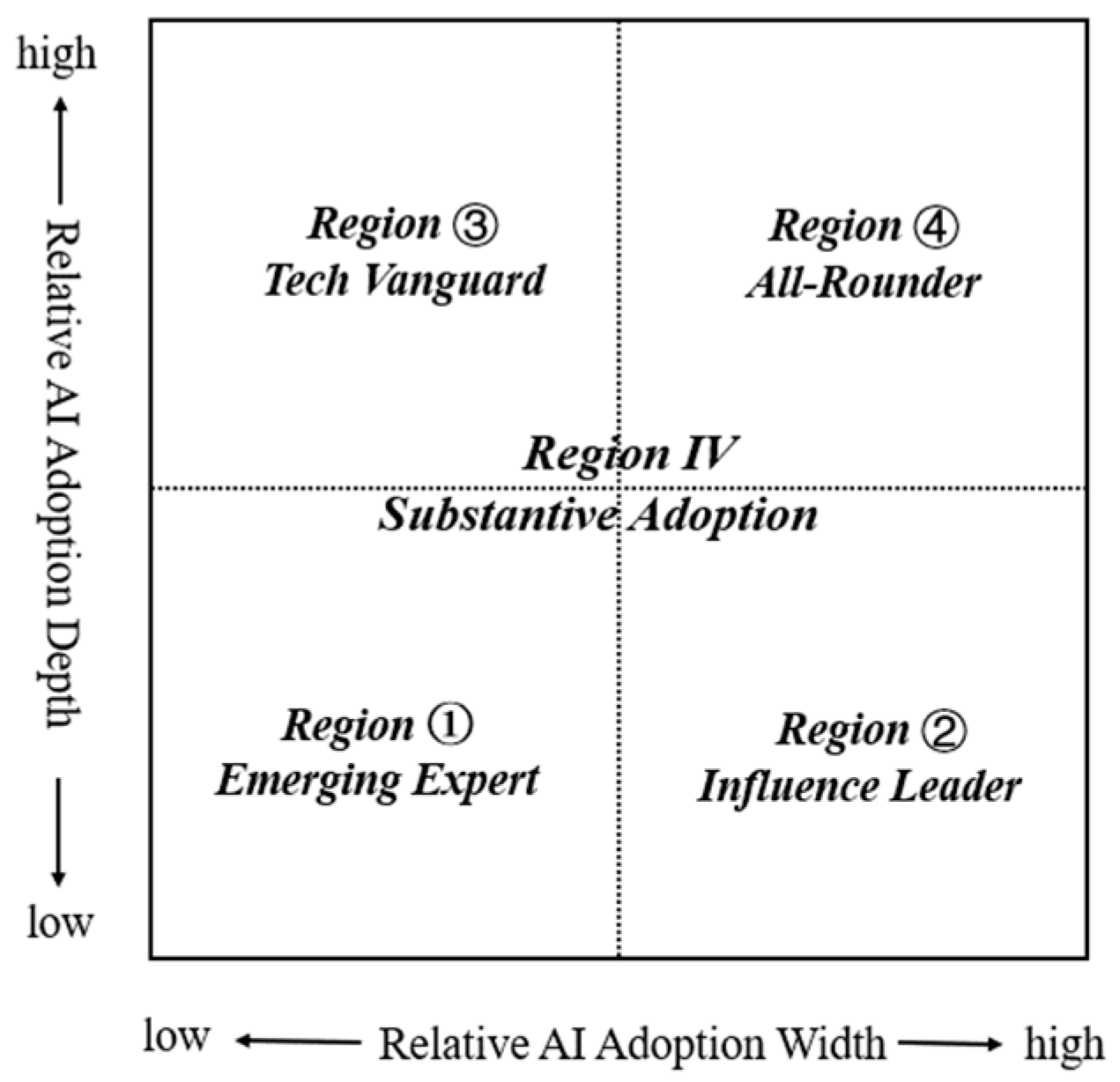
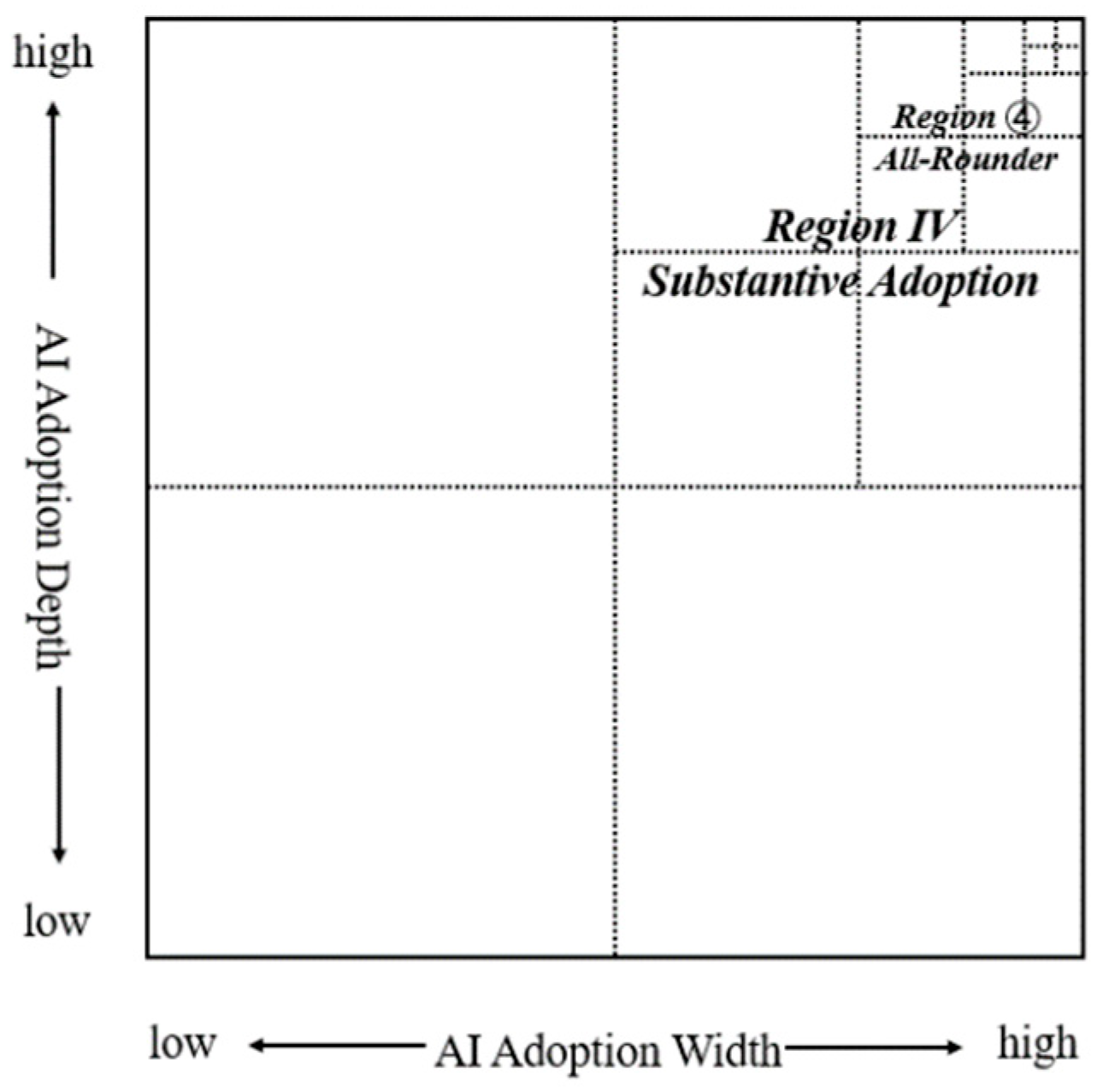
Consequently, our OAIAM model is relatively universal in addressing the current AI adoption challenges faced by the majority of companies. As previously stated, the model is equally applicable to industries such as fintech, though with specific considerations. In such cases, it is necessary to extend the existing model into an open quadrant system. For instance, in organizations where AI adoption depth is advanced and they are currently in Region IV, the substantive adoption stage, both AI adoption depth and AI adoption width are at elevated levels. To address the increasingly refined maturity assessment needs of leading organizations, reflecting the meaningful differences in AI adoption quality among enterprises at the substantive adoption stage, this region requires further subdivision based on theoretical and practical justifications. The model is designed to analyze individual units with no fixed boundaries in each dimension. The substantive adoption stage can be divided into four distinct sub-regions (see
Figure 5). These sub-regions are classified based on the relative differences in AI adoption depth and width among peer organizations, with each sub-region corresponding to a unique combination of resource allocation priorities, strategic orientation and value creation models that reflect meaningful maturity gaps. At this juncture, the distinction between formal and substantive AI adoption is no longer a primary concern. Instead, the landscape resembles a competitive arena where advanced players vie for dominance. Despite the fact that all organizations in this stage have achieved substantive adoption, there remains a discrepancy in the levels of adoption between them. In order to address this issue, we propose the introduction of the concept of relative values in the context of this stage’s division. Relative indicators refer to metrics that measure an organization’s AI adoption depth and width by comparing them with the average level of peer organizations in the same industry and maturity stage, rather than relying on absolute numerical values. We employ the same measurement dimensions as the core model to assign these relative indicators, facilitating horizontal comparison among enterprises.
Figure 5,
Figure 6 and
Figure 7 are designed based on the dual-dimensional logic of the OAIAM model and the relative indicator system, with clear methodological underpinnings.
Figure 5 visualizes the boundary expansion of the dynamic open system, illustrating how the two core dimensions of AI adoption depth and width can be continuously extended beyond the initial quadrant framework.
Figure 6 operationalizes the four sub-regions of the substantive adoption stage by mapping the combination of relative depth and width indicators, with each sub-region’s characteristics derived from the comparative analysis of typical enterprise cases in high-maturity industries.
Figure 7 demonstrates the fission and evolution mechanism of basic maturity units, which is rooted in the continuous improvement logic of organizational AI adoption and the competitive dynamics of the industry ecosystem.
In conclusion, in reference to the preceding classification method, Region IV (substantive adoption stage) is subdivided into four levels based on the comparative values of AI adoption depth and AI adoption width. These are the Emerging Expert Stage (Region ①), the Influence Leader Stage (Region ②), the Tech Vanguard Stage (Region ③), and the All-Rounder Stage (Region ④) (see
Figure 6).
Specifically, when an organization has reached the substantive adoption stage but has relatively lower AI adoption depth and AI adoption width compared to other organizations at the same stage, we define these companies as “emerging expert.” These organizations demonstrate considerable unrealized potential for enhancing the efficiency of their AI operations. In the future, these organizations may overcome internal obstacles to AI diffusion and continue to develop AI adoption depth, thereby accelerating internal AI upgrades and advancing to the “All-Rounder” stage.
As with the “Transition Stage” in the original model, organizations in the transitional period of the substantive adoption stage are divided into two categories. These are the “Tech Vanguard” and the “Influence Leader”. Organizations that exhibit relatively high levels of AI adoption depth but lower adoption width are classified as “Tech Vanguard.” These organizations demonstrate excellence in AI research and development, frequently spearheading societal innovation, cultivating a robust research environment, and attracting leading AI professionals. This allows for the seamless integration of AI into the organization. Conversely, organizations exhibiting comparatively lower levels of AI adoption depth but wider adoption are classified as “Influence Leaders”. Such companies serve as “AI KOL (AI key opinion leaders)”, facilitating the widespread adoption of AI within their own organizations and disseminating their successful experiences with AI adoption to related industries.
The “Tech Vanguard” and “Influence Leader” designations are complementary and each possesses distinct advantages. These exemplary organizations are instrumental in facilitating the adoption of AI, and they represent a crucial transitional phase for “emerging expert” to evolve into “All-Rounder”. As the designation implies, “All-Rounder” organizations have attained considerable degrees of both AI sophistication and operational scope in comparison to other organizations that have reached the advanced stage of adoption. These companies exemplify the strengths of both the “Tech Vanguard” and the “Influence Leader”, representing the optimal state of AI adoption in the substantive stage and continuously expanding the boundaries of the model.
This refinement addresses the aforementioned challenges pertaining to the application of AI, as exemplified by the experiences of fintech companies. The introduction of these new subcategories provides a more precise framework for positioning these companies and guiding their evolution in AI adoption. However, this secondary subdivision of the substantive adoption stage is not the endpoint. In light of the accelerated pace of technological advancement and the persistent digital revolution, organizations that fail to transcend boundaries, cultivate connections, or embrace cross-boundary growth will inevitably confront more uncertain and challenging sustainability issues in the future [
26].
The OAIAM model is therefore founded upon an open system devoid of any definitive endpoints or boundaries. The progression of organizational AI adoption depth and the diffusion of AI usage represent two distinct, ongoing trajectories. Therefore, regardless of whether an organization is at the substantive adoption stage or the “All-Rounder” stage, it can be considered to be in a relatively mature state of AI adoption. The model further delineates an “All-Rounder” stage, which is situated above the level of substantive adoption. This stage is then followed by an even more advanced and comprehensive new stage, which can be understood in the model as a further subdivision of the “All-Rounder” stage into new, higher-level areas. In the process of AI adoption, organizations must acknowledge the principle of continuous improvement, as they are subject to the same competitive pressures as individuals. There is always a superior alternative, and the basic units of the model continue to subdivide and evolve (see
Figure 7).
It can be reasonably asserted that the two dimensions of organizational AI adoption maturity, AI adoption depth and AI adoption width, are not only vectors extending from an origin point, but also possess direction and magnitude. As both AI adoption depth and adoption width improve, the organization’s AI adoption maturity also advances, thereby indicating the evolution of AI adoption within the organization. The aforementioned process of continual subdivision and transformation represents a crucial aspect of this evolutionary trajectory. Conversely, a decline in either AI adoption depth or adoption width will result in a regression of the organization’s AI adoption maturity to a previous state, indicating a devolution in AI adoption.
A regression in AI adoption may be attributed to multiple factors, including strategic decisions made by management, geographical influences, organizational maturity, and the organizational culture. This area represents a significant opportunity for future research. Consequently, organizations continually advance their AI adoption depth, expand the width of AI adoption, and regularly conduct self-assessments of their AI adoption maturity. By maintaining humility and adaptability in a complex organizational environment, organizations can ensure that they remain on a trajectory of progress.
8. Conclusions
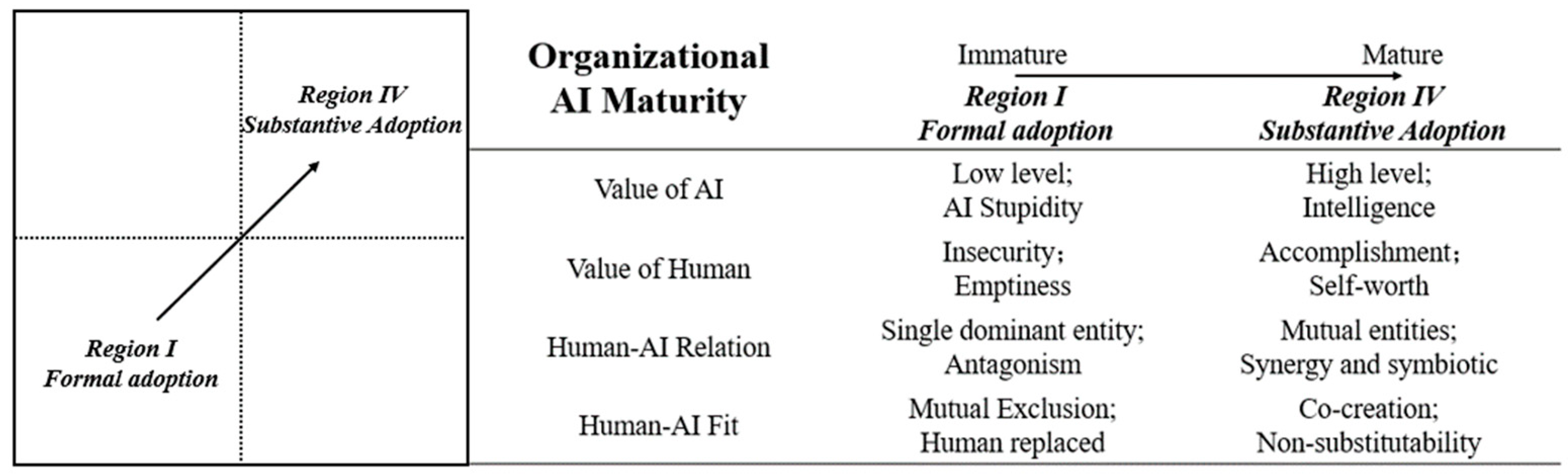
AI has emerged as a disruptive technology widely adopted by organizations, yet initial adoption alone does not guarantee value creation. The Organizational AI Adoption Maturity (OAIAM) Model synthesizes the evolutionary characteristics of organizational AI integration, addressing the critical gap in existing literature that lacks dynamic frameworks for assessing continuous adoption progression (see
Figure 8).
In its nascent stage of AI adoption, the technology’s value remains underrecognized, with applications limited to basic repetitive tasks typified by blue-collar AI and what is termed “Artificial Stupidity” [
1]. Human labor value is underutilized as AI begins to replace traditional jobs, and forced integration may lead to dehumanization, insecurity, and diminished self-worth among employees. The human–AI relationship at this stage is antagonistic, with one party dominating the other, resulting in low alignment characterized by either replacement or resistance.
At this juncture, the relationship between humans and AI is characterized by antagonism, with a single dominant entity. When humans are in a dominant position, AI is utilized as a mere tool; conversely, when AI assumes a leading role (such as robots issuing commands to human employees within organizations), it contravenes ethical principles, including Asimov’s Second Law. In both scenarios, the degree of alignment between humans and AI is low, manifesting as either AI replacing humans or humans resisting AI.
However, the transitional pathways, normative guidelines, and multi-level analysis presented in this paper indicate that enterprises have the potential to evolve into a mature stage of AI adoption. In this stage, the value of AI is manifested through high-level intelligence, as exemplified by white-collar AI. Concurrently, humans, aided by AI collaboration, will accomplish more and develop a stronger sense of self-worth. At this juncture, humans and AI become mutual entities, fostering a symbiotic relationship with a high degree of alignment. They depend on each other and are irreplaceable. AI compensates for the limitations of human creativity and efficiency, while humans enhance AI with emotional intelligence. Collectively, they achieve greater efficiency through the synergistic effect of “1 + 1 > 2.”
Existing theoretical frameworks such as TAM, TOE and ISCM focus primarily on pre-adoption decision-making or isolated influencing factors, failing to capture the dynamic, multi-stage nature of continuous AI integration or the synergistic effects of adoption depth and width. Most prior studies treat AI adoption as a discrete strategic choice, neglecting its hierarchical structure and the nuanced transitions between maturity stages. The OAIAM model fills this gap by integrating dual core dimensions of adoption depth and width, offering a systematic framework that transcends the static limitations of traditional models.
The OAIAM model delivers dual theoretical and practical contributions. Academically, it enriches organizational AI adoption literature by constructing a dynamic, stage-based framework that synthesizes maturity progression, addressing the fragmentation of existing research. Practically, it functions as an actionable self-assessment tool for enterprises to diagnose their current AI integration status and navigate transitional pathways, promoting the deep and sustainable application of AI. By linking theoretical constructs to practical implementation through stage-aligned normative guidelines and industry-specific pathways, this study enhances the validity of theoretical inferences in organizational AI research. It lays the groundwork for a more cohesive and rigorous theoretical system for the study of AI in organizations, encouraging future research to build on standardized maturity assessment and evolutionary analysis.
9. Limitations and Future Outlook
While this study offers valuable contributions, it is important to acknowledge several limitations, which also delineate clear pathways for future inquiry.
First, the conceptual model exhibits limitations in generalizability and granularity. The proposed Organizational AI Adoption Maturity (OAIAM) model serves as a foundational, generic framework. Although it differentiates the substantive adoption stage, the model lacks finer-grained dimensional divisions incorporating industry-specific characteristics, organizational size, and structural variations. This limitation potentially constrains its direct guidance value for individual enterprises. Concurrently, establishing causal links for efficacy measurement remains challenging. The core difficulty in model quantification lies in precisely isolating the genuine contribution of AI adoption to organizational performance. As firm performance results from multiple internal and external factors, relying solely on this metric fails to establish a robust causal relationship between AI investment and outcomes, potentially leading to biased assessments of technological adoption efficacy.
Furthermore, the model’s application context carries cultural limitations. Its construction primarily relies on data from domestic listed companies, with standard definitions potentially embedded within specific socio-economic and cultural environments. Given significant variations in AI adoption motivations, pathways, and challenges across different countries, regions, and firm sizes, the model’s cross-cultural applicability globally and its validity for small and medium-sized enterprises (SMEs) remain unverified. Finally, the empirical foundation requires broadening and deepening. The current theoretical framework, primarily derived from literature analysis and preliminary development, lacks support from large-scale, multi-period longitudinal empirical data and diverse corporate cases. This necessitates further testing of the model’s robustness and practical effectiveness.
Based on these limitations, future research can advance along several distinct paths. The first path involves refining and contextualizing the conceptual model. Building upon the current generic framework, researchers should introduce key variables such as industry characteristics and firm size to develop more targeted maturity sub-models. In the medium to long term, emphasis should shift towards exploring the dynamic interactions between the model’s core dimensions and potentially developing adaptive maturity assessment systems capable of dynamic adjustment based on organizational data.
The second path focuses on developing scientific efficacy measurement tools and methodologies. Future work should prioritize overcoming measurement bottlenecks by creating quantified indicator systems that directly and scientifically measure AI adoption levels and effectiveness, moving beyond singular reliance on corporate performance metrics. Utilizing panel data, matched samples, or quasi-experimental methods while rigorously controlling for other variables will enable in-depth investigation into the quantitative relationship between organizational AI maturity and true AI efficacy. This would not only provide empirical support for the model but also offer clear cost-benefit references for managerial decision-making.
The third path entails examining the model’s cross-cultural and cross-organizational applicability. Subsequent studies should apply the model to corporate samples from different countries and regions, such as North America, Europe, and Southeast Asia, to test its generalizability and identify the specific influences of socio-cultural factors on adoption pathways. Longitudinal investigations should focus particularly on the adoption patterns of SMEs, examining their unique maturity evolution paths under resource constraints, thereby refining the model to encompass a broader range of organization types.
The fourth path emphasizes strengthening empirical validation and exploring alternative standards. Future research should employ large-scale surveys, in-depth longitudinal case studies, and action research to collect rich primary data, enabling repeated verification and refinement of the model’s stage classifications, evolution mechanisms, and efficacy outcomes. Simultaneously, scholars should be encouraged to propose and test maturity criteria or alternative models diverging from this study from various theoretical perspectives, collectively advancing the construction of a more comprehensive and scientific conceptual system through academic discourse.