Article

Spatiotemporal Patterns and Driving Forces of Ecological Quality in the Yangtze River Economic Belt Using GWRR

1
College of Agriculture and Forestry Economics and Management, Lanzhou University of Finance and Economics, Lanzhou 730020, China
2
College of Statistics and Data Science, Lanzhou University of Finance and Economics, Lanzhou 730020, China
3
College of Accounting, Lanzhou University of Finance and Economics, Lanzhou 730020, China
*
Author to whom correspondence should be addressed.
Sustainability 2026, 18(1), 256; https://doi.org/10.3390/su18010256 (registering DOI)
Submission received: 17 November 2025 / Revised: 19 December 2025 / Accepted: 23 December 2025 / Published: 26 December 2025
(This article belongs to the Special Issue Environmental Planning and Governance for Sustainable Cities)

Abstract

Ecological quality (EQ) in the Yangtze River Economic Belt (YREB) has been profoundly reshaped by rapid urbanization and intensive ecological restoration over the past two decades. This study aimed to reveal the long-term spatiotemporal patterns of EQ and their driving forces at the basin scale. We constructed a 1 km, 25-year (2000–2024) Remote Sensing Ecological Index (RSEI) series using MODIS data and applied Sen’s slope, the Mann–Kendall and Hurst tests, and Geographically Weighted Ridge Regression (GWRR) to quantify trends, persistence, and spatially non-stationary driver effects. Results showed a significant overall improvement: by 2024, 69.6% of the YREB is classified as Good or Excellent EQ, with 34.6% of land showing continuous improvement and 6.4% faced persistent degradation risks. Forest and grassland cover exerted stable positive effects, while built-up expansion, population density, and GDP increasingly contribute to EQ decline, and the area dominated by urbanization-related negative coefficients expanded to 84.6% of the middle and lower reaches. The GWRR model achieved high average local R 2 (>0.92) and revealed pronounced spatial heterogeneity and multicollinearity-robust driver estimates. This study illustrates the potential of GWRR-based EQ diagnosis to support differentiated ecological governance strategies tailored to the upper, middle, and lower reaches of the YREB.

1. Introduction

Large river basins, as critical nexuses of human–environment interaction, are experiencing unprecedented ecological pressure driven by rapid population agglomeration, intensive land-use transformation, and shifting climatic conditions [1,2]. Systems such as the Mississippi, Ganges, and Nile illustrate the global ecological and socioeconomic significance of large basins [3]. Within China, the Yangtze River Economic Belt (YREB) embodies the dual challenge of sustaining rapid economic development while safeguarding ecological integrity. Spanning diverse topographies from high plateaus to coastal plains and supporting over 40% of the nation’s population and GDP [4], the YREB requires a scientifically rigorous and spatially explicit framework to diagnose long-term ecological change and its underlying drivers.
Remote sensing has become a central tool for basin-scale ecological assessment [5,6]. The Remote Sensing Ecological Index (RSEI), which integrates greenness, wetness, heat, and dryness through Principal Component Analysis (PCA), provides an efficient and objective measure of ecological quality [7,8]. Cloud-computing platforms such as Google Earth Engine (GEE) further enable the construction of long-term, large-scale RSEI time series [9]. However, most RSEI-based studies in the YREB remain primarily descriptive, focusing on spatiotemporal patterns while insufficiently addressing the mechanisms driving ecological change. Moreover, recent work has highlighted several limitations of the standard RSEI framework, including temporal instability introduced by normalization and PCA variability [10], as well as the omission of key anthropogenic pressures in complex urban settings [11]. These issues indicate that RSEI excels at identifying what ecological changes occur and where, but not why they arise, thereby necessitating dedicated driver analysis.
Identifying drivers of ecological change in large, heterogeneous basins is complicated by spatial non-stationarity and multicollinearity. Spatial non-stationarity implies that relationships between drivers and ecological outcomes vary across geographic space [12], rendering global regression approaches such as Ordinary Least Squares (OLS) inadequate [13,14]. Local regression models such as Geographically Weighted Regression (GWR) and its multiscale extension (MGWR) partially address this issue [15,16]. However, both models are highly sensitive to multicollinearity, a pervasive condition in human–environment systems where socioeconomic and land-use factors are strongly interdependent [17,18]. Preliminary diagnostics in this study indicate Variance Inflation Factor (VIF) values far exceeding 10 for several YREB predictors, suggesting that conventional OLS, GWR, and MGWR are methodologically unsuitable for producing stable and interpretable driver estimates.
To overcome these limitations, this study introduces GWRR, which incorporates a ridge penalty into the GWR framework to simultaneously address spatial non-stationarity and multicollinearity [19,20]. This dual capability makes GWRR particularly well-suited for disentangling complex and interconnected drivers of ecological change in the YREB, where spatial heterogeneity and multicollinearity co-occur. Despite its methodological advantages, applications of GWRR to basin-scale ecological quality assessment remain limited, leaving a clear research gap.
While numerous studies have mapped ecological patterns across the YREB [21], driver identification has often relied on methods that insufficiently handle multicollinearity, potentially leading to unstable or biased conclusions. To fill this gap, this study applies the GWRR model to identify spatially varying ecological drivers under strong multicollinearity. We hypothesize that, relative to OLS and GWR, GWRR will produce more stable coefficient estimates, reduce model uncertainty, and reveal clearer spatial patterns of ecological drivers—highlighting consistent positive contributions from natural vegetation and spatially concentrated negative effects associated with urbanization.
The specific objectives of this study are:
(1)
to construct a long-term (2000–2024) 1 km RSEI dataset for the YREB to quantify spatiotemporal ecological dynamics;
(2)
to apply the GWRR model to robustly identify spatially varying ecological drivers while explicitly addressing multicollinearity;
(3)
to generate evidence-based and spatially differentiated ecological governance strategies for the upper, middle, and lower reaches of the YREB.
This study makes three principal contributions. Methodologically, it introduces a multicollinearity-robust spatial modeling framework (GWRR) for ecological driver analysis. Empirically, it provides a 25-year basin-scale assessment that clarifies the mechanisms shaping ecological change across the YREB. Practically, it offers region-specific insights to support precision-oriented ecological governance and sustainable development planning.

2. Study Area and Materials

2.1. Study Area

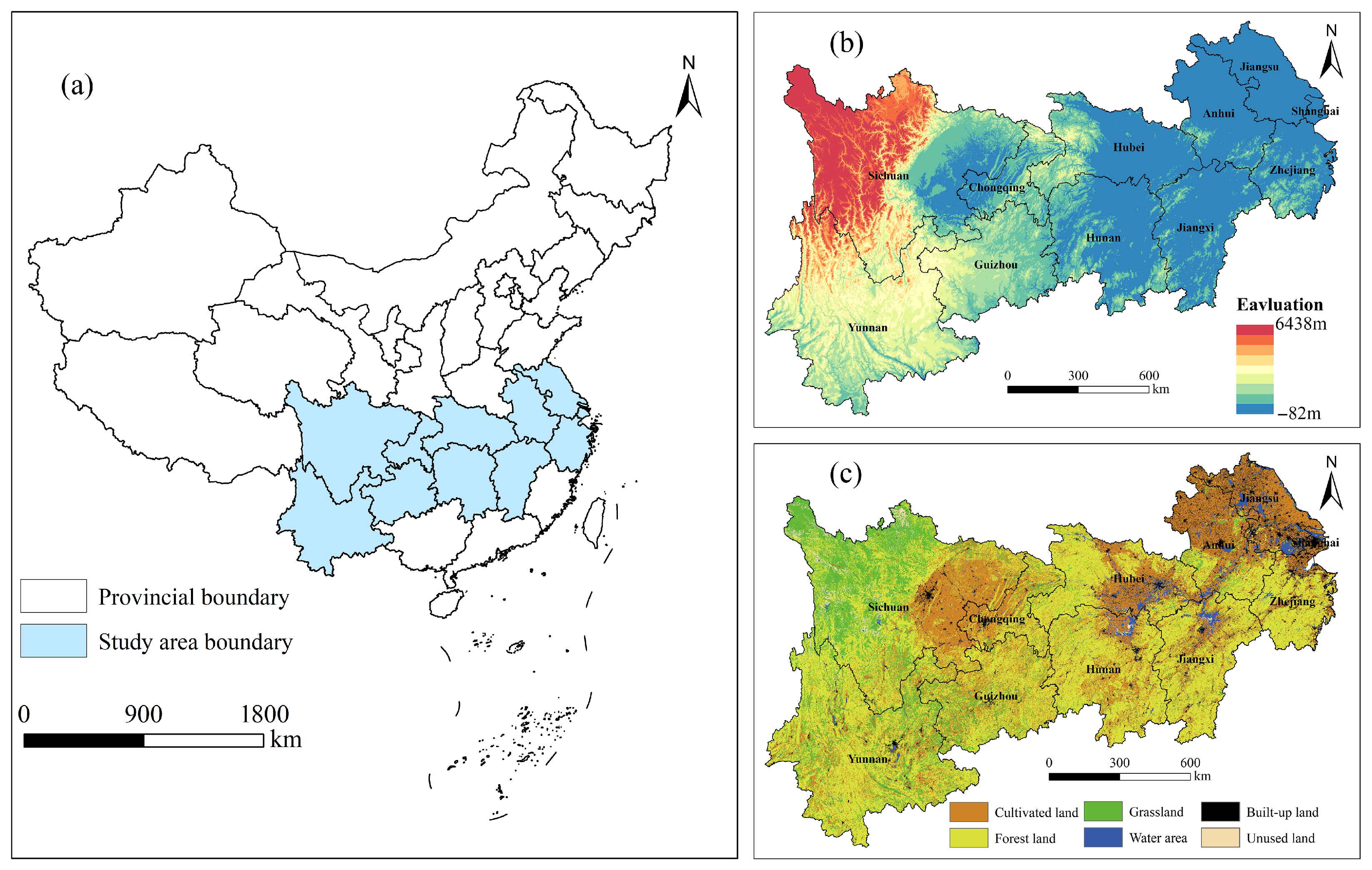
The Yangtze River Economic Belt (YREB), a national strategic development zone spanning eastern, central, and western China, serves as a critical hub for both economic vitality and ecological security, with its EQ dynamics pivotal for regional sustainable development (Figure 1a). Covering approximately 2.05 million km2 across 11 provinces and municipalities—Shanghai, Jiangsu, Zhejiang, Anhui, Jiangxi, Hubei, Hunan, Chongqing, Sichuan, Guizhou, and Yunnan—the YREB supports over 40% of China’s population and economic output [22]. Its topography exhibits a three-tiered gradient, descending from high western plateaus (up to 6138 m) to the low-lying Yangtze Delta (−82 m), resulting in diverse geomorphological patterns (Figure 1b). The upper reaches, dominated by the Yunnan-Guizhou Plateau and high-altitude canyons, form an ecological barrier; the middle reaches feature hills, basins, and lake plains; and the lower reaches encompass the globally significant Yangtze Delta. The subtropical monsoon climate shapes complex hydrothermal conditions, while land use displays pronounced spatial heterogeneity (Figure 1c): forest and grassland dominate the upper and middle reaches’ mountainous areas, cropland concentrates in the Sichuan Basin and middle-lower plains, and built-up land clusters in the Yangtze Delta, Middle Yangtze, and Chengdu-Chongqing urban agglomerations [23]. This coupling of critical ecological zones with intense human activity makes the YREB an ideal region for studying EQ driving forces.

2.2. Data Source

Data processing was conducted on the GEE platform. All raster datasets were reprojected to WGS84 and resampled to a 1 km spatial resolution to meet the analytical requirements of the GWRR model. All terrestrial pixels within the YREB were retained as modeling units ( N 2.3 million), whereas permanent water bodies were removed using the Modified Normalized Difference Water Index (MNDWI) to avoid mixing aquatic and terrestrial spectral signatures.
The RSEI was constructed from four MODIS-derived components representing greenness, wetness, heat, and dryness. NDVI and WET were extracted from the MOD13A3 monthly composite product, with annual medians computed from all 12 months to mitigate cloud contamination and reduce residual seasonality. Land Surface Temperature (LST) was derived from MOD11A2 and averaged across all valid daytime observations after applying MODIS QA-based filtering. The dryness index (NDBSI) was calculated from the Improved Built-up Index (IBI) and Bare Soil Index (BI), and annual mean compositing was applied to enhance robustness in heterogeneous urban–agricultural landscapes. All indicators were normalized using min–max scaling based on their pooled 2000–2024 value ranges to ensure interannual comparability, with 1–99% quantile clipping used to suppress extreme values.
PCA for RSEI construction was performed independently for each year using all terrestrial 1 km pixels of the YREB as the analysis domain. The sign of the first principal component (PC1) was examined annually and reversed when necessary to ensure that higher RSEI values consistently indicated better ecological conditions. The resulting RSEI values were rescaled to the [0, 1] range and categorized into five ecological quality levels. These thresholds follow widely used conventions in basin-scale RSEI applications and are adopted primarily for interpretability rather than for statistical segmentation.
Socioeconomic variables—including GDP density, population density, and nighttime lights—were obtained for 2000, 2010, and 2020. DMSP–OLS and VIIRS nighttime light data were harmonized using an invariant-region intercalibration approach [24], ensuring temporal consistency across sensors. Land-use indicators were derived from GlobeLand30 (30 m) and aggregated to 1 km resolution via pixel-mean statistics to represent proportional coverage of built-up land, cropland, and forest/grassland. Climatic drivers (annual mean temperature, total precipitation, and solar radiation) were obtained from the ERA5-Land monthly reanalysis dataset (∼9 km) and resampled to 1 km using bilinear interpolation, while such resolution harmonization inevitably introduces some local-scale uncertainties in mountainous regions, previous studies indicate that these effects do not materially influence basin-scale ecological trend characterization or spatial regression modeling.

2.3. Method

To comprehensively evaluate the spatiotemporal patterns and driving forces of EQ in the YREB, this study integrates the RSEI, Sen’s trend analysis with the Mann–Kendall (M-K) test, the Hurst Index, and the GWRR model, supported by multicollinearity diagnostics, to develop a robust analytical framework.

2.3.1. RSEI Construction

The RSEI was used to monitor EQ dynamics in the YREB and was derived from MODIS data (MOD13A3, 1 km resolution) using four indicators: the Normalized Difference Vegetation Index (NDVI), wetness (WET), Land Surface Temperature (LST), and the Normalized Difference Built-up and Soil Index (NDBSI). To eliminate scale differences among indicators and ensure comparability prior to PCA, each indicator was standardized using min–max normalization as follows:
X norm = X X min X max X min
where X norm is the standardized value, X is the raw value, and X min and X max are the minimum and maximum values, respectively. To maintain interannual comparability, the min–max scaling bounds were defined using pooled value ranges across 2000–2024 rather than year-specific ranges.
Principal Component Analysis (PCA) was conducted independently for each year using all terrestrial 1 km pixels of the YREB as the analysis domain, and the first principal component (PC1) was adopted as the RSEI baseline. The sign of PC1 was examined annually and reversed when necessary to ensure a consistent ecological interpretation throughout the study period (i.e., higher RSEI values always indicate better ecological conditions). The resulting RSEI values were rescaled to the [0, 1] range and classified into five EQ levels: Poor (0–0.2), Fair (0.2–0.4), Moderate (0.4–0.6), Good (0.6–0.8), and Excellent (0.8–1.0). Permanent water bodies were masked to avoid mixing aquatic and terrestrial spectral signatures; however, this may lead to underrepresentation of aquatic ecological contributions in some areas. Following established basin-scale ecological assessment practices, a Sen’s slope threshold of β 0.005 (or β 0.005 ) was adopted to distinguish ecologically meaningful long-term change from minor fluctuations in subsequent trend analyses.

2.3.2. Sen’s Trend Analysis and M-K Test

To quantify spatiotemporal RSEI trends, non-parametric Sen’s trend analysis and the Mann–Kendall (M-K) test were applied to address non-normal data and outliers. Sen’s slope is calculated as:
β = m e d i a n ( x k x m k m ) , k > m
where x k and x m are RSEI values for years k and m, n is the time series length, β > 0 indicates EQ improvement, and β < 0 indicates degradation. The M-K test statistic is computed as:
S = i = 1 n 1 j = i + 1 n s g n ( x j x i )
sgn ( x j x i ) = 1 , if x j x i > 0 0 , if x j x i = 0 1 , if x j x i < 0
V a r ( S ) = n ( n 1 ) ( 2 n + 5 ) t = 1 m t t ( t t 1 ) ( 2 t t + 5 ) 18
Z = S 1 V a r ( S ) , if S > 0 0 , if S = 0 S + 1 V a r ( S ) , if S < 0
where S is the test statistic, s g n is the sign function, t t is the number of ties in group t, m is the number of tied groups, and Z assesses trend significance. Results were categorized into nine classes (Table 1) [25].

2.3.3. Hurst Index and Sen’s Trend Coupling

To predict future RSEI trends, the Hurst Index was employed to assess long-term temporal dependency, coupled with Sen’s trend analysis. The Hurst Index is computed as:
R S = K · n h
where R is the range, S is the standard deviation, n is the subinterval length, h is the Hurst Index, and K is a constant. Values of h > 0.5 indicate persistence, h < 0.5 anti-persistence, and h = 0.5 randomness. Coupled with Sen’s slope ( β 0.005 or ≤−0.005), future trends were classified (Table 2) [26].

2.3.4. Multicollinearity Diagnostics

To ensure stability in GWRR parameter estimation, the Variance Inflation Factor (VIF) was used to assess multicollinearity among driving factors, calculated as:
VIF k = 1 1 R k 2
where R k 2 is the coefficient of determination obtained by regressing the k-th predictor on all remaining predictors. In general, VIF > 10 indicates severe multicollinearity, and 5 < VIF 10 indicates moderate multicollinearity. In this study, the diagnostics suggested pronounced multicollinearity in many socioeconomic and land-use predictors, with VIF > 10 for several key variables. Such collinearity may lead to unstable coefficient estimates and reduced interpretability in OLS and standard GWR. Therefore, GWRR was adopted to improve estimation stability by incorporating ridge regularization.

2.3.5. GWRR Model

The GWRR model was employed to investigate the spatial heterogeneity of EQ driving forces. By incorporating a ridge penalty into the geographically weighted regression framework, GWRR improves coefficient stability under multicollinearity while preserving spatial non-stationarity. The model is expressed as:
y i = β 0 ( u i , v i ) + k = 1 p β k ( u i , v i ) x i k + ε i
where y i denotes the RSEI at pixel i, ( u i , v i ) are geographic coordinates, β k ( u i , v i ) are spatially varying regression coefficients, x i k is the k-th predictor at pixel i, and ε i is the error term. Parameters were estimated using locally weighted least squares with ridge regularization.
Spatial weights were specified using an adaptive bisquare kernel:
w i j = 1 d i j b 2 2 , d i j b ; w i j = 0 , d i j > b
where w i j is the weight assigned to pixel j in the local regression centered at pixel i, d i j is the distance between pixels i and j, and b is the adaptive bandwidth. The spatial bandwidth was selected through preliminary sensitivity testing to balance local coefficient stability and computational feasibility for the multi-million-pixel dataset. The ridge parameter λ was optimized using three-fold cross-validation (RidgeCV) on a spatially stratified random subsample of approximately 50,000 pixels; the selected λ was then applied globally across all local regressions.
Model implementation was performed using a customized Python 3.11 workflow based on NumPy 1.26, SciPy 1.11, scikit-learn 1.3, and rasterio 1.3, with cKDTree-accelerated spatial indexing to improve computational efficiency. Parallel computation was employed to further enhance performance. Compared with standard GWR, GWRR yields more stable coefficient estimates and improved interpretability in the presence of multicollinearity while retaining the ability to capture spatial heterogeneity, although slight oversmoothing may occur in densely urbanized environments due to adaptive kernel weighting.

3. Results

3.1. Spatiotemporal Patterns of Ecological Quality

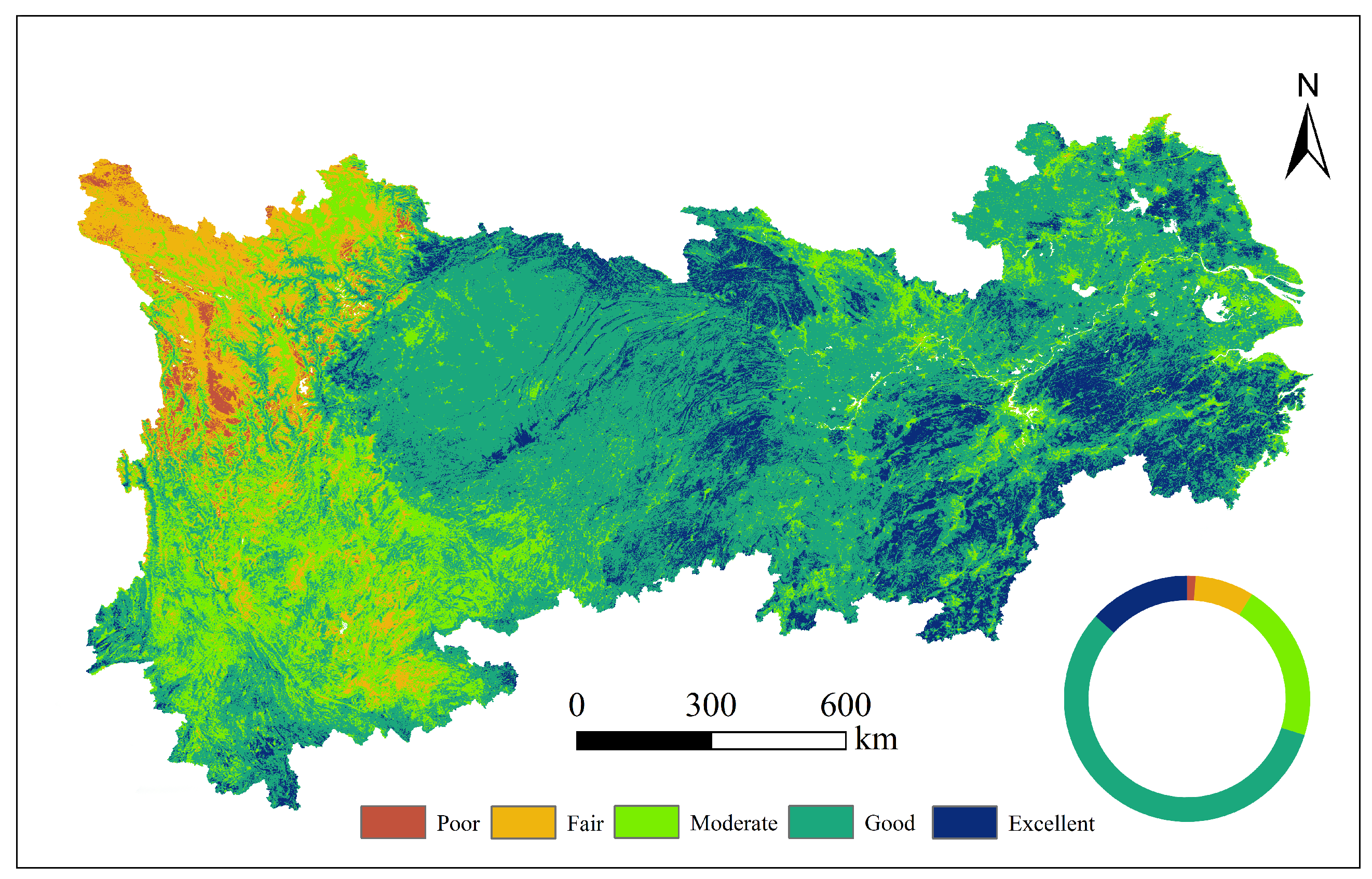
The 2000–2024 average spatial pattern of EQ in the YREB shows pronounced regional differentiation (Figure 2). Overall, EQ exhibits a distinct “southeast high, northwest low” gradient, with high-value areas (Good and Excellent grades) mainly distributed in the southeastern and central–southern mountainous and hilly regions (e.g., southern Hunan–Jiangxi and southern Zhejiang–northern Fujian), as well as parts of the middle and lower Yangtze plains and lake districts. Moderate-value areas (Moderate grade) are widespread across the Jianghan Plain, the periphery of Dongting Lake, and the Poyang Lake basin. Low-value areas (Poor and Fair grades) are concentrated in northwestern high-elevation zones (e.g., the northwestern Sichuan Plateau and the northwestern Yunnan Plateau). In addition, the cores of major urban agglomerations, including the Yangtze River Delta and the Chengdu–Chongqing region, exhibit spatially clustered low-value patches.
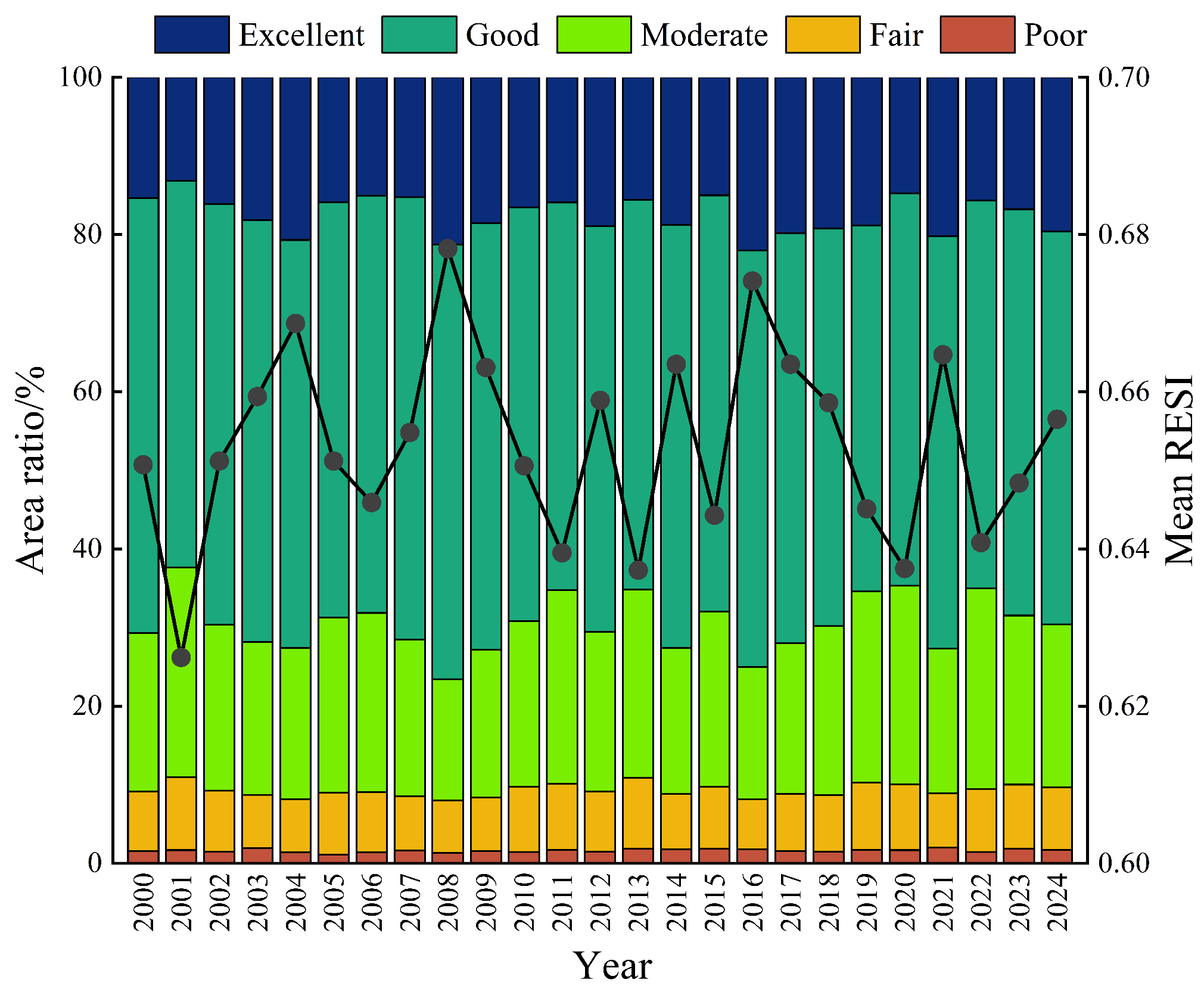
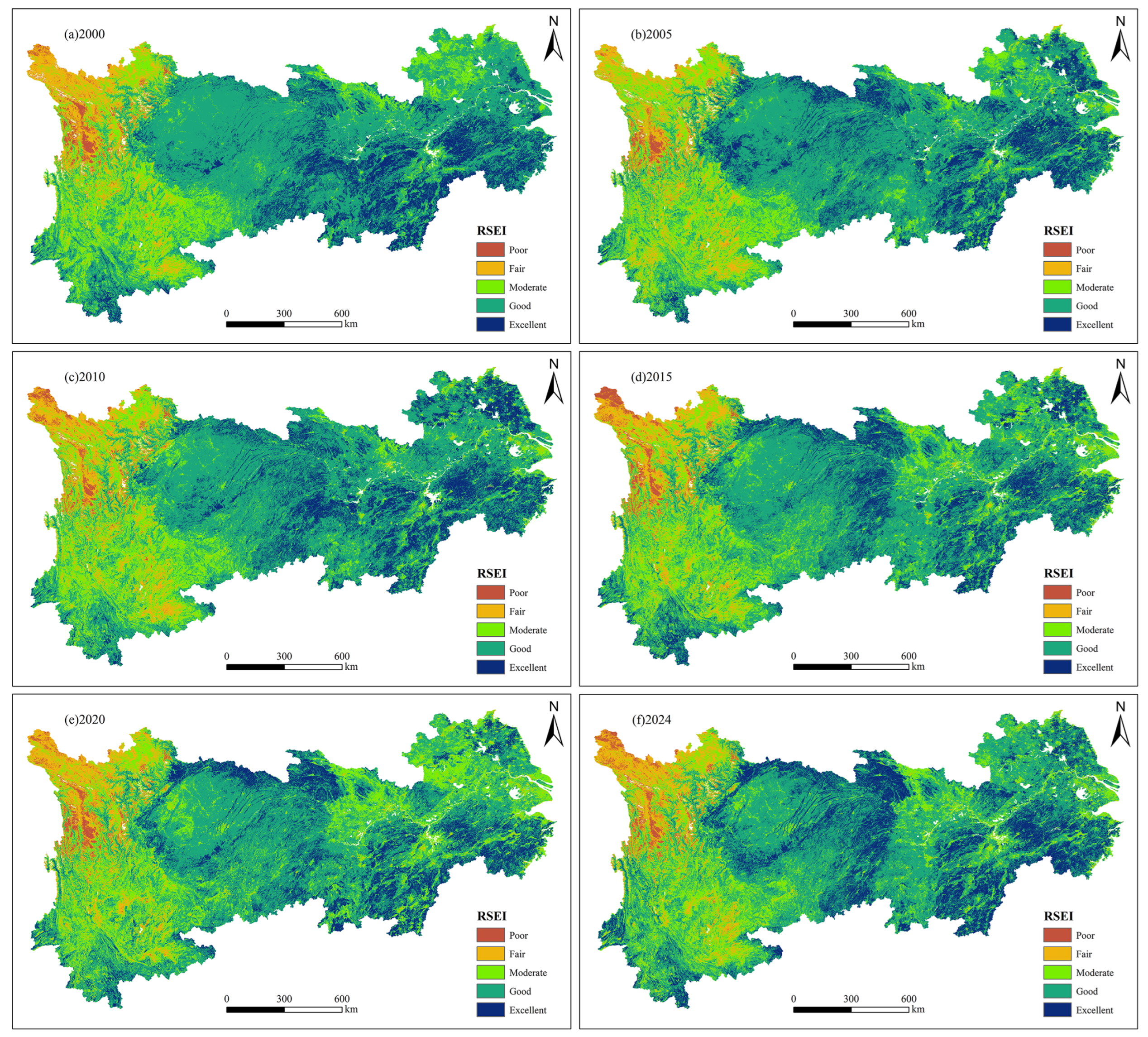
Temporally, the RSEI in the YREB shows phased variations with an overall upward tendency from 2000 to 2024 (Figure 3). The basin-wide mean RSEI fluctuates between 0.6262 and 0.6782, with an average of 0.6533. The value in 2024 (0.6565) is slightly higher than that in 2000 (0.6507). Between 2000 and 2010, EQ remained relatively stable, with persistently lower values in the northwest and higher values in the southeast (Figure 4). From 2010 to 2015, the extent of Good and Excellent areas expanded, and RSEI increased in the middle and lower plains, while low-quality zones in the northwest contracted. The 2015–2020 period continued this pattern, with sustained increases in southeastern Excellent areas and notable Moderate-to-Good transitions in the middle reaches. From 2020 to 2024, the upward trend persisted but slowed, with Poor and Fair areas decreasing to 9.64% and Good and Excellent areas rising to 69.60%. Taking 2010 as an example, the proportions of Poor, Fair, Moderate, Good, and Excellent classes were 1.43%, 8.34%, 21.05%, 52.64%, and 16.53%, respectively, indicating that more than two-thirds of the YREB was classified as Good or better. Despite the overall improvement, the spatial contrast between the northwestern high-elevation areas and the southeastern low-mountain and plain regions remains evident.

3.2. Evolution Trends and Future Projections of Ecological Quality

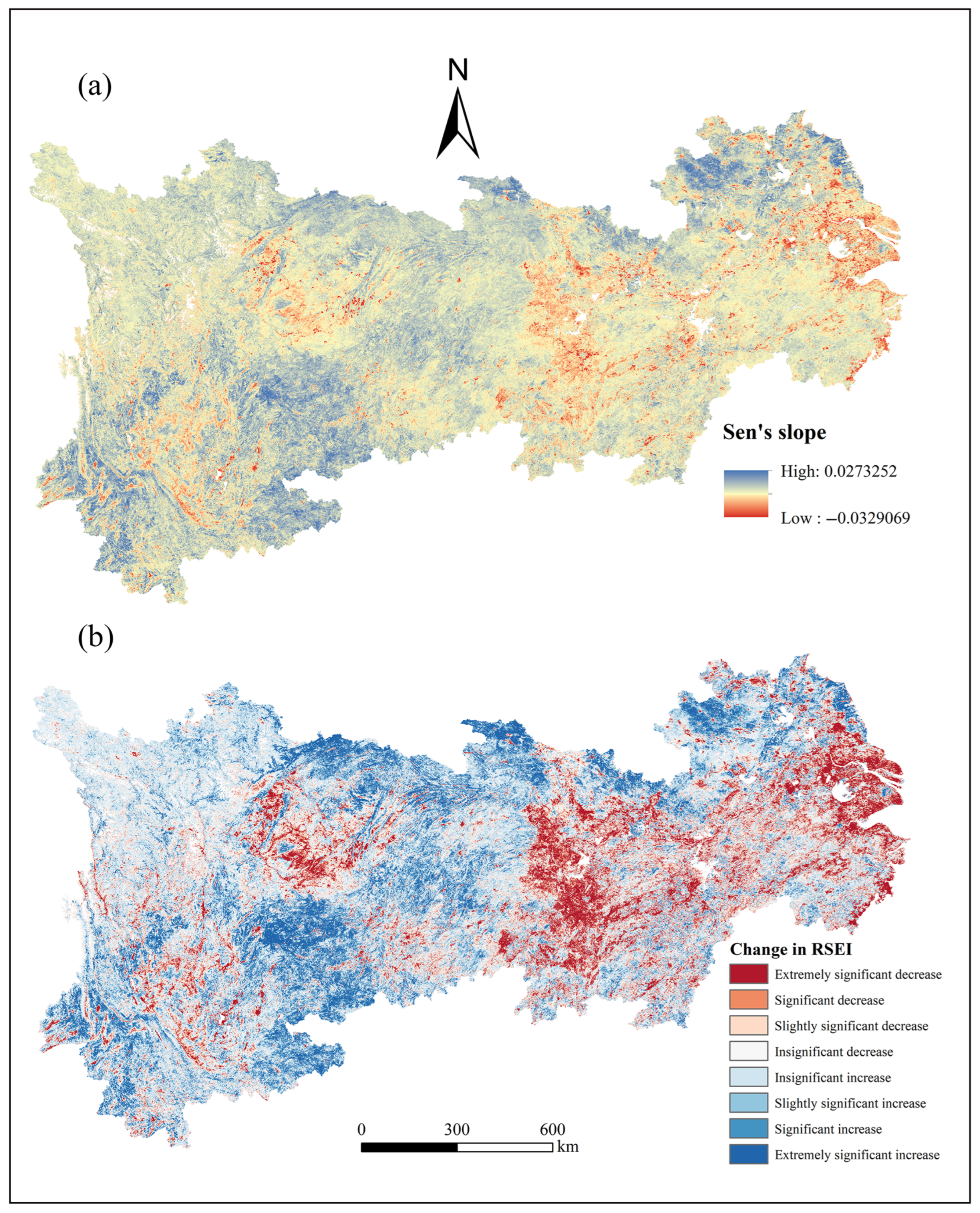
Based on Sen’s trend analysis, the spatial distribution of RSEI change rates in the YREB is shown in Figure 5a. Sen’s slope ranges from 0.032 to 0.027 with a mean of 0.003, indicating an overall upward tendency. Spatially, higher positive rates are primarily distributed in upstream mountainous areas and ecological zones of the middle Yangtze, whereas negative or weakly positive rates are concentrated in the cores of major urban agglomerations.
Coupled with the M-K test, the RSEI change classification (Figure 5b) indicates that areas with an extremely significant decrease account for 10.41%, mainly in eastern coastal urban agglomerations (e.g., the central and suburban parts of the Yangtze River Delta) and the Chengdu–Chongqing region. Areas with a significant decrease comprise 5.93%, distributed in peripheral zones of core cities and rapidly urbanizing areas such as the Wuhan urban circle and the Chang–Zhu–Tan urban agglomeration. In contrast, areas with an extremely significant increase cover 11.08%, concentrated in the mountains of the western Sichuan Basin, the northeastern Yunnan–Guizhou Plateau, the southern Qinling–Daba Mountains, and the Wuling and Mufu Mountains. Areas with a significant increase occupy 7.27%, broadly spanning the main-stem and tributary water-source conservation areas and other ecological zones. Overall, significantly increasing trends are mainly located in ecological barrier regions, while significantly decreasing trends are clustered within major urban and industrial belts.
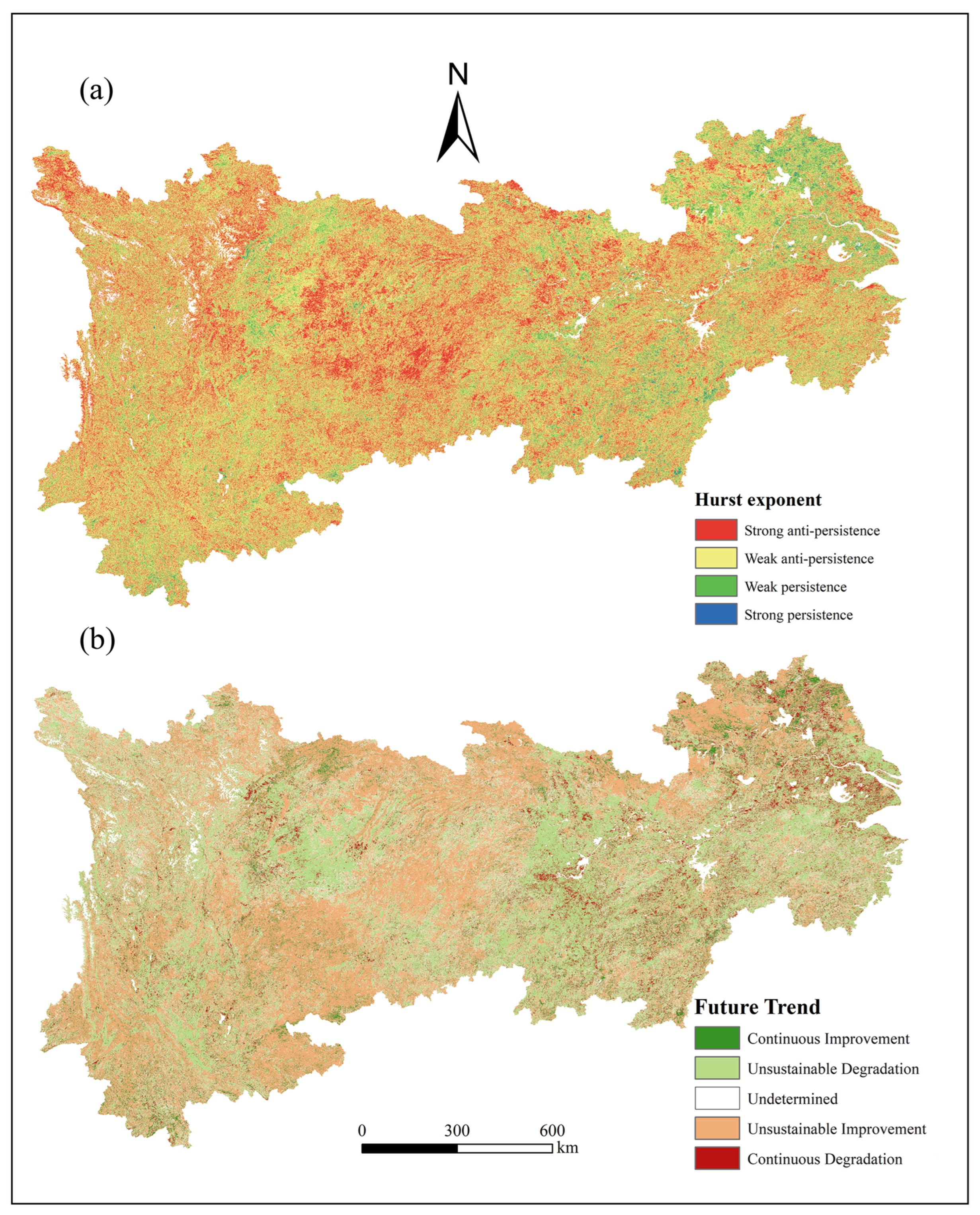
Hurst exponent analysis reveals substantial spatial heterogeneity in the persistence of RSEI evolution (Figure 6a). H values range from 0.024 to 0.953 (mean: 0.404). Strong anti-persistence areas ( H < 0.35 ) comprise 26.89%, and weak anti-persistence areas ( 0.35 H < 0.50 ) account for 59.36%, indicating that trends in these regions are more likely to reverse. Weak persistence areas ( 0.50 H < 0.65 ) account for 13.04%, and strong persistence areas ( H 0.65 ) represent 0.71%, suggesting relatively stable evolution in a limited number of areas. Anti-persistence patches are mainly distributed in the Yangtze River Delta and the Chengdu–Chongqing, Wuhan, and Chang–Zhu–Tan urbanization belts, whereas persistence patches are primarily located in upstream ecological zones.
Combining the Hurst exponent with Sen’s slope enables classification of future evolution types (Figure 6b). Continuous improvement accounts for 34.60%, unsustainable improvement for 5.80%, undetermined areas for 12.94%, unsustainable degradation for 40.27%, and continuous degradation for 6.38%. These categories show clear spatial differentiation, with continuous improvement mainly distributed in upstream ecological zones and continuous degradation concentrated in the cores of megacities and major industrial clusters.

3.3. Multicollinearity Diagnostics

Multicollinearity diagnostics were conducted prior to modeling to assess the degree of correlation among driving factors and its potential influence on coefficient stability. The VIF was computed for nine driving variables in 2000, 2010, and 2020, revealing substantial multicollinearity (Table 3). Land-use variables showed particularly high collinearity, with forest and grassland VIF values exceeding 10 in all three years (10.286, 11.573, and 10.124). Cropland VIF increased from 9.314 in 2000 to 10.582 in 2020. Socioeconomic variables and the built-up land proportion exhibited moderate VIF levels with an increasing tendency over time (e.g., GDP from 5.349 to 8.538; built-up land from 4.824 to 7.593), whereas climatic variables (annual mean temperature, total precipitation, and solar radiation) had VIF values below 3. These results suggest that coefficient estimates from non-ridge regression frameworks may be sensitive to multicollinearity in land-use and socioeconomic predictors, thereby supporting the use of ridge-regularized spatial modeling.

3.4. Model Performance Evaluation

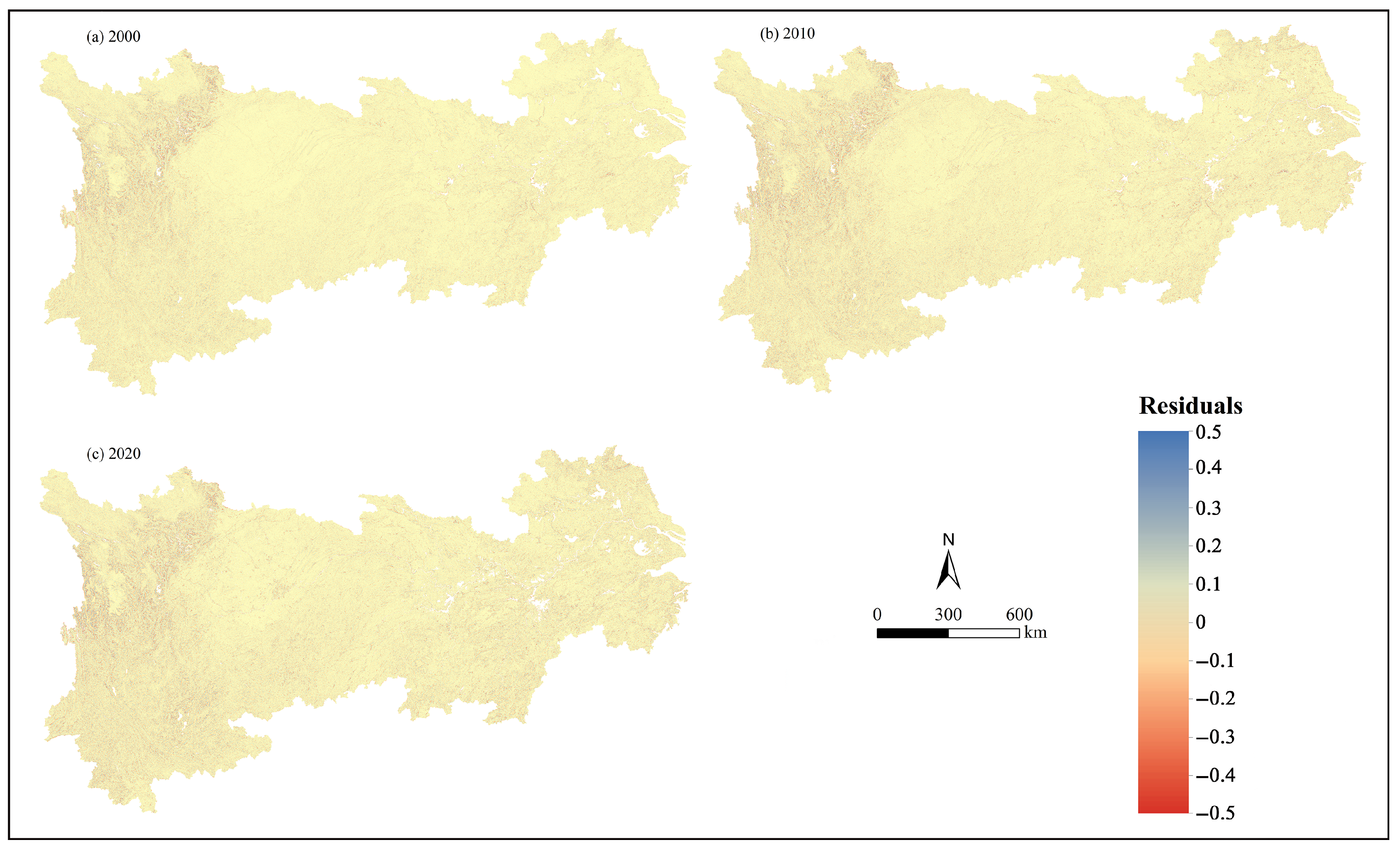
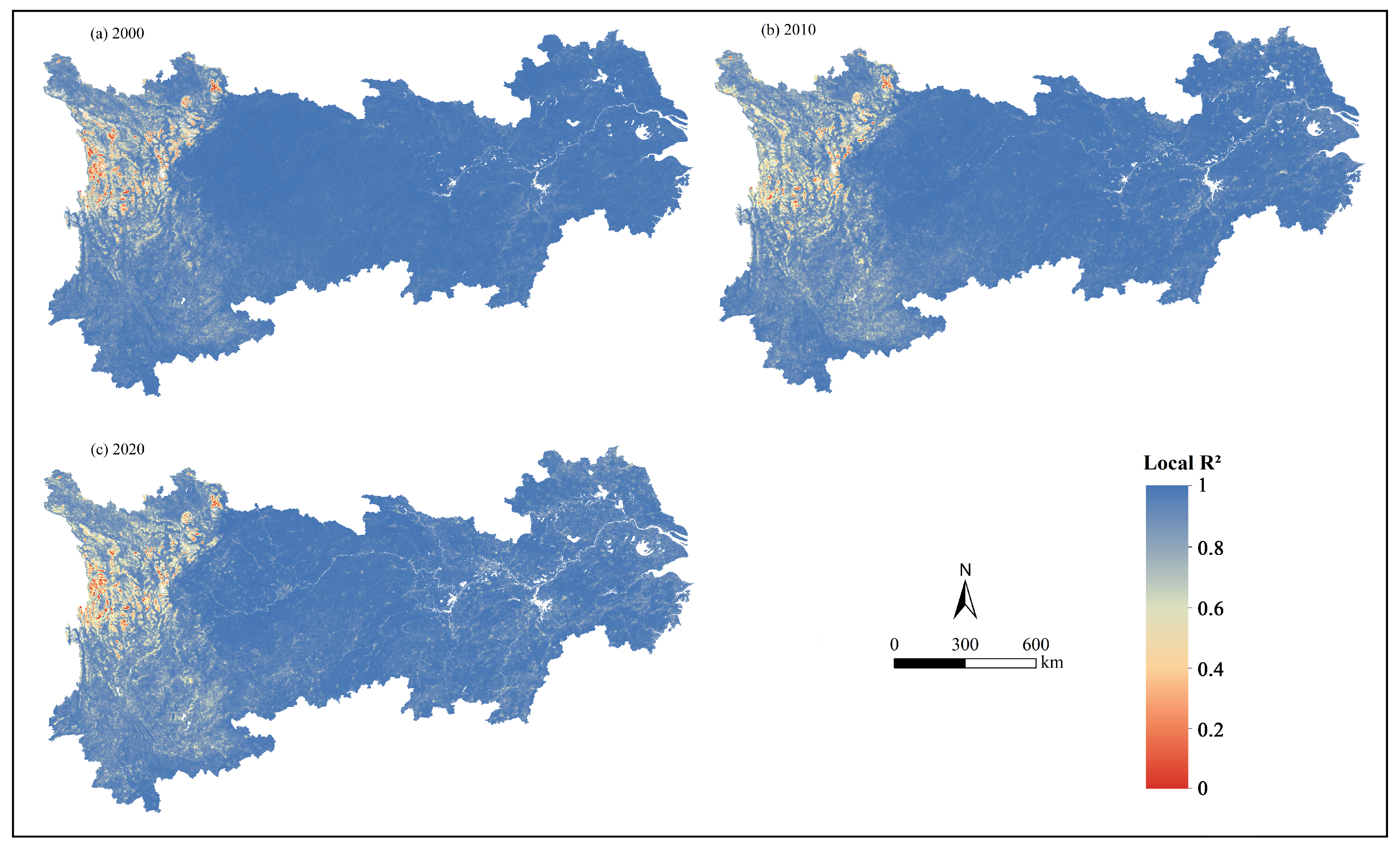
Because complete socioeconomic and land-use drivers are only available for 2000, 2010, and 2020, GWRR models were calibrated for these three benchmark years to characterize spatially heterogeneous driver–EQ relationships at representative time points. Model performance was evaluated using residual summaries and local R 2 patterns. Residuals range from −0.499 to 0.439, with a mean of −0.002 and a standard deviation of 0.019, and their spatial distribution is shown in Figure 7. The local R 2 surfaces (Figure 8) yield an average value of 0.93 across the three benchmark years. Areas with R 2 > 0.9 account for 86%, whereas areas with R 2 < 0.9 represent 14% and are mainly distributed in the mountainous regions of Sichuan and parts of Yunnan. These metrics describe model fit for the benchmark years and are not intended as a comparison with OLS or standard GWR, nor as an assessment of predictive performance.

3.5. Spatial Heterogeneity and Temporal Evolution of Driving Factors

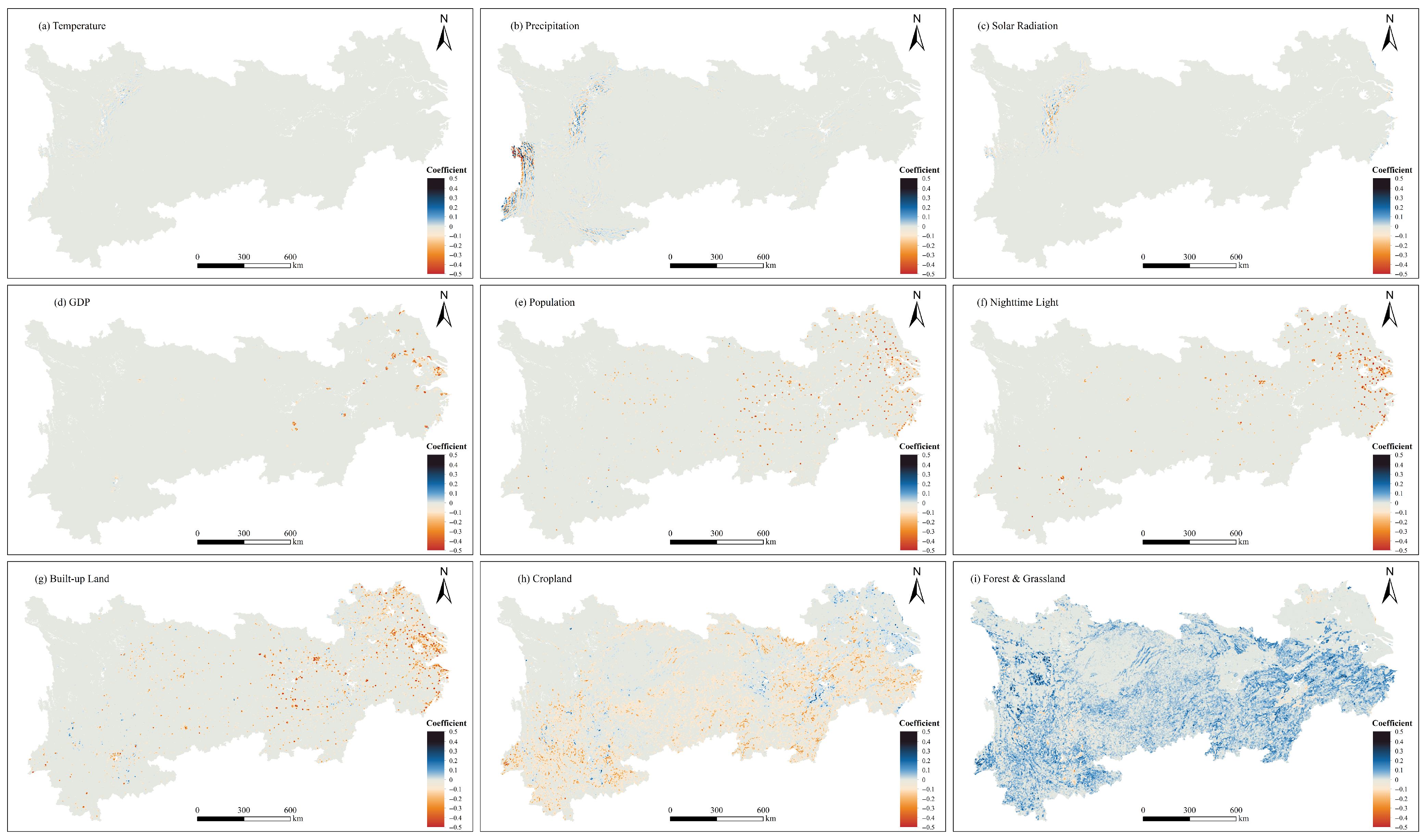
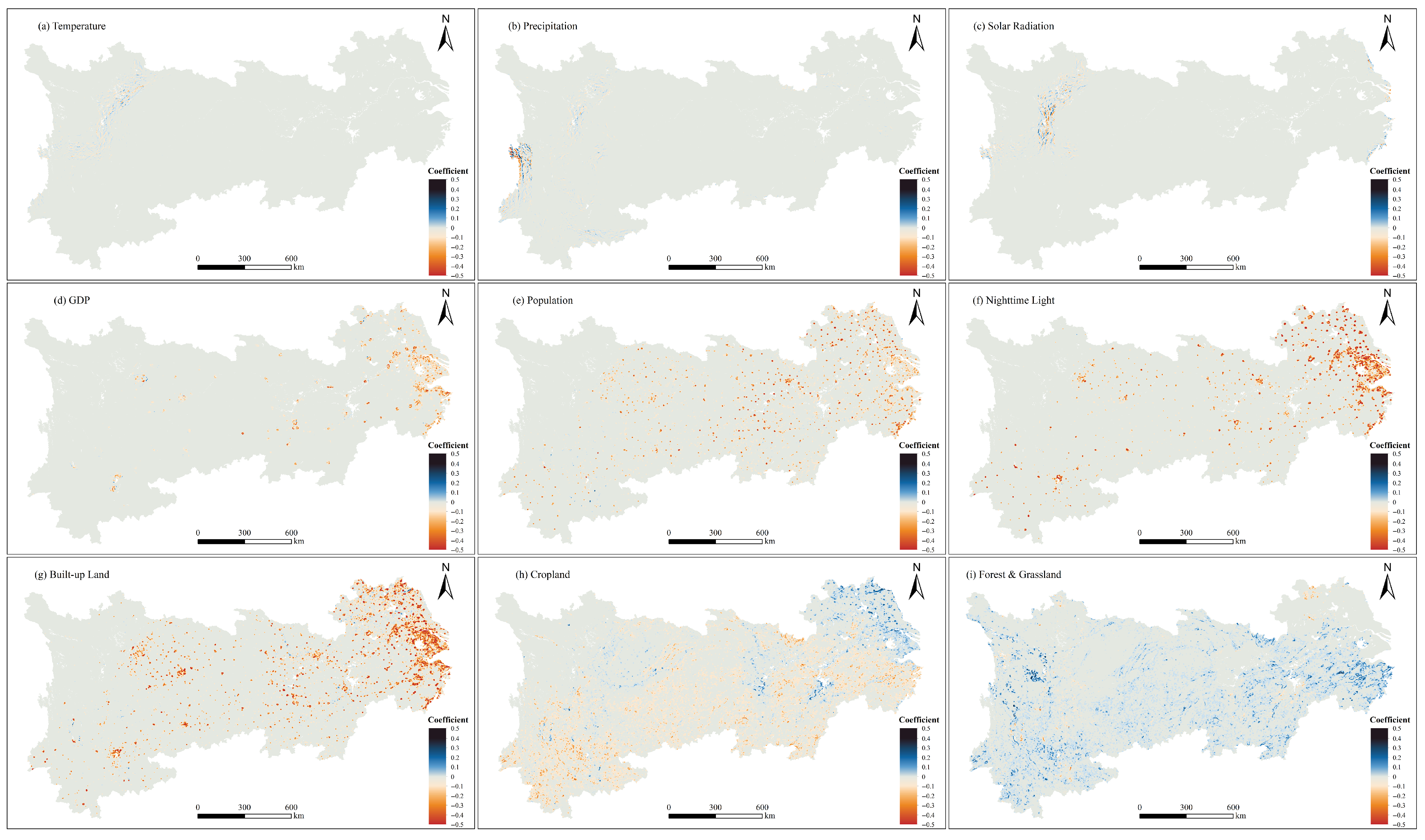
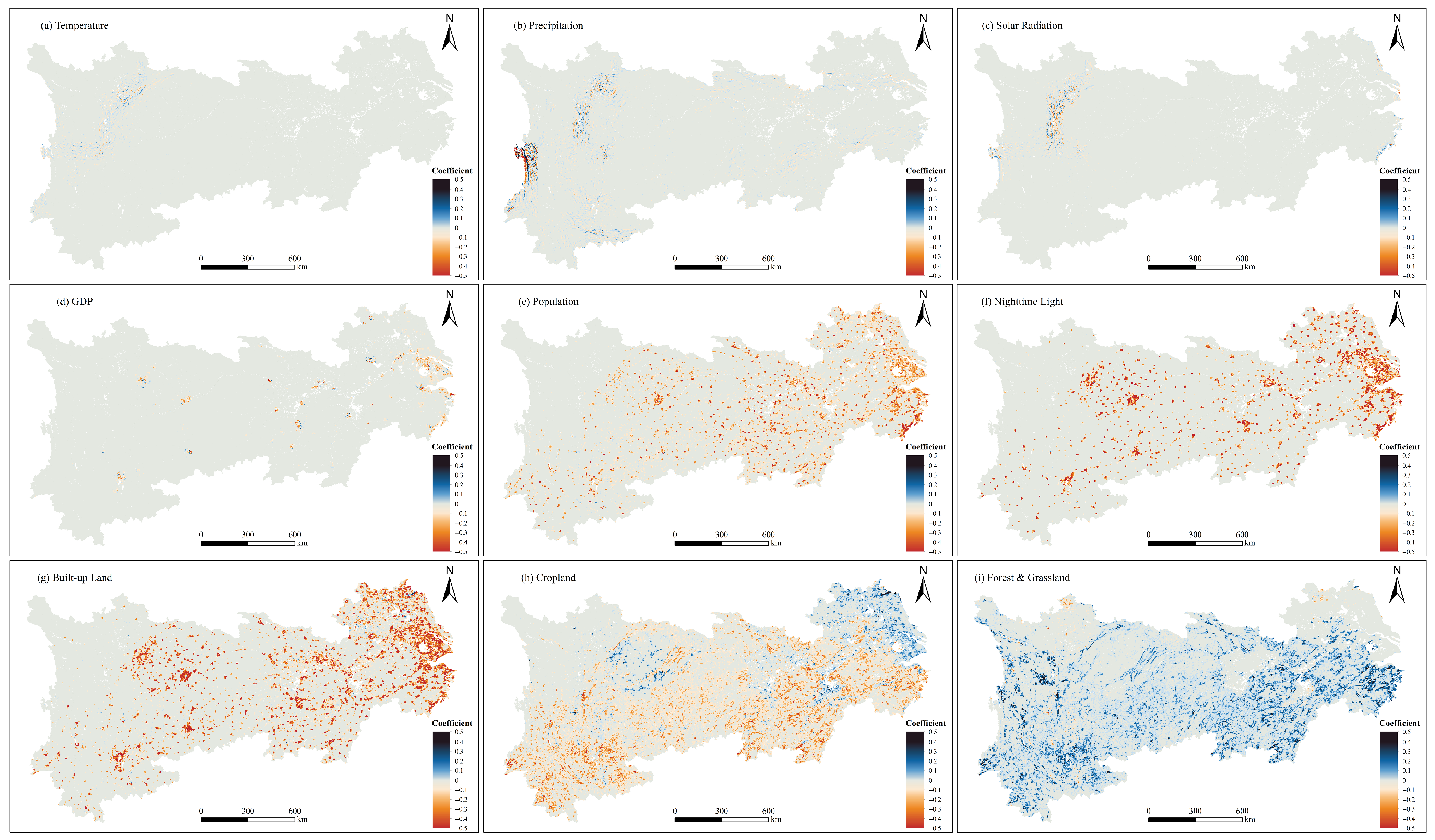
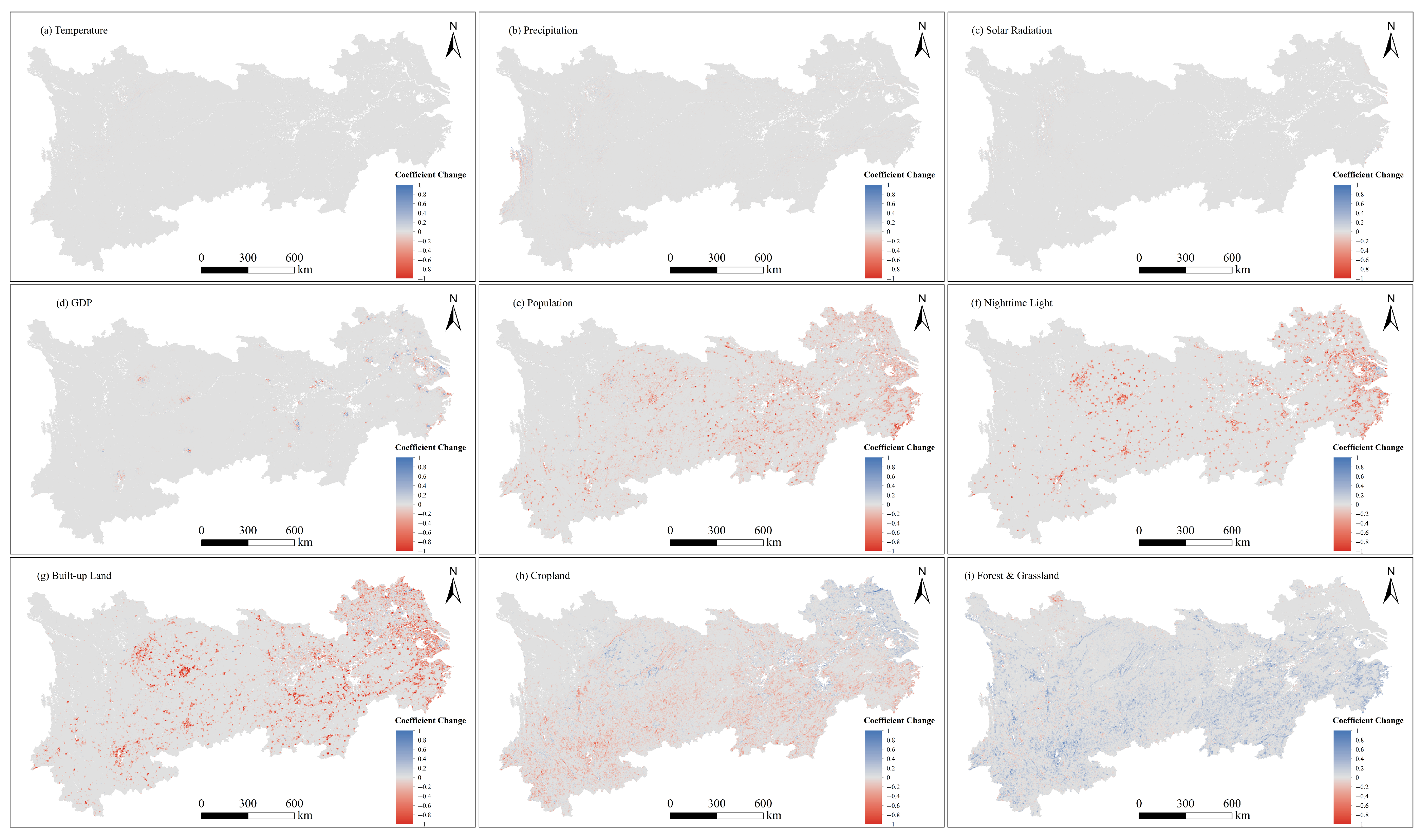
The coefficient surfaces reveal clear spatial heterogeneity in the associations between EQ and its driving factors for 2000, 2010, and 2020 (Figure 9, Figure 10 and Figure 11). Climatic variables (annual mean temperature, total precipitation, and solar radiation) exhibit coefficients close to zero across most areas, with weak positive or negative values appearing in some high-elevation regions. Socioeconomic variables (GDP, population density, and nighttime lights) show spatially coherent patterns, with predominantly negative coefficients in major urban agglomerations. Moreover, the extent of negative-coefficient areas expands from 2000 to 2020 in the Yangtze River Delta, the middle Yangtze urban agglomerations, and the Chengdu–Chongqing region. Land-use variables display stronger spatial contrasts: forest and grassland proportion is characterized by predominantly positive coefficients across major ecological zones, whereas built-up land proportion shows predominantly negative coefficients that spatially overlap with major urban agglomerations and expand over time. Cropland proportion exhibits a mosaic pattern, with negative coefficients in many intensive agricultural regions and weakly positive coefficients in some areas.

3.6. Temporal and Spatial Evolution of Dominant Driving Factors

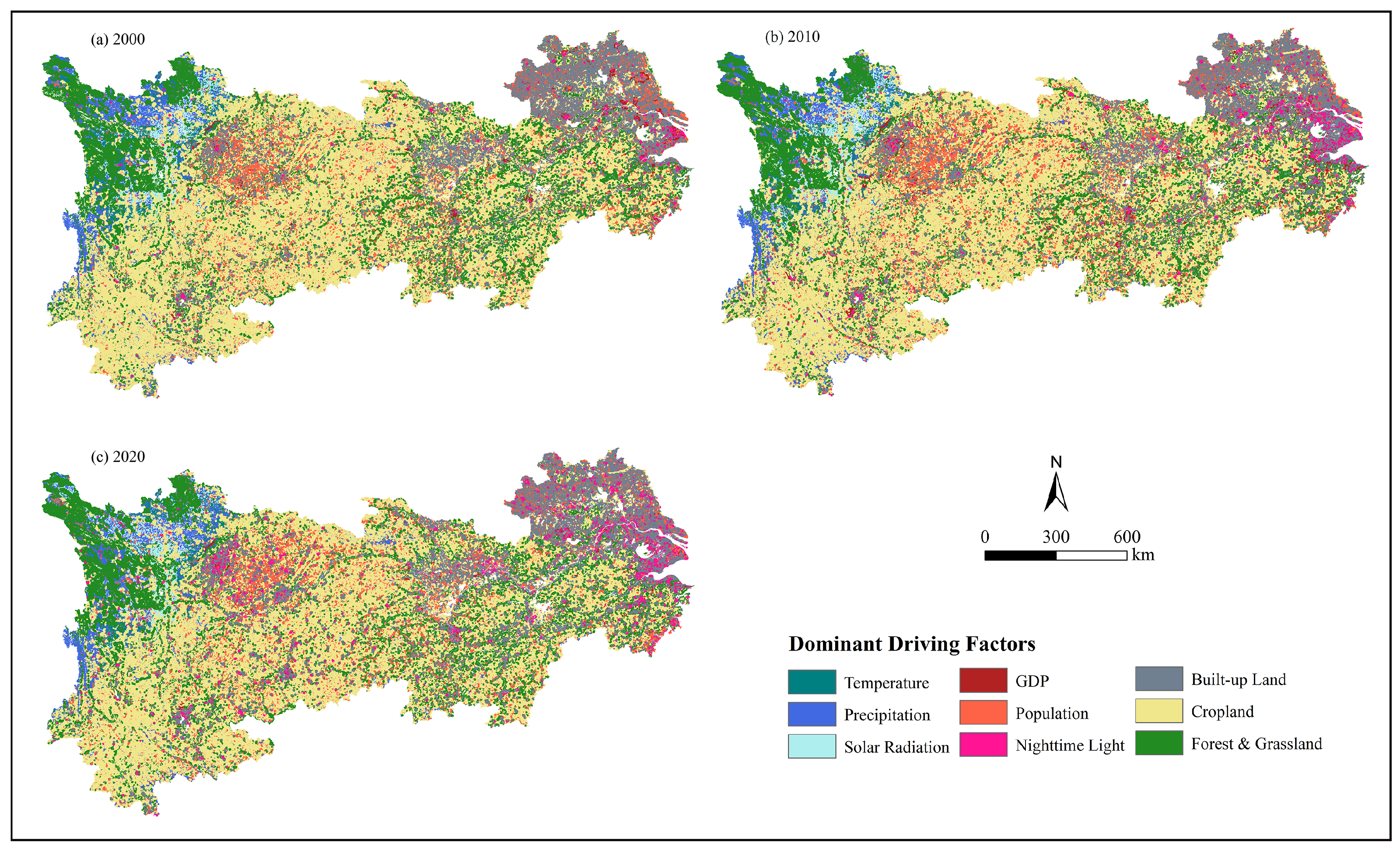
To further illustrate the temporal and spatial evolution of driving mechanisms in the YREB, we analyzed the spatial distribution of dominant driving factors for 2000, 2010, and 2020 (Figure 12). In 2000, the driving pattern exhibited clear regional differentiation: the upstream and middle-reach mountainous and hilly areas were primarily dominated by forest and grassland coverage, while the Sichuan Basin and the middle and lower plains were dominated by cropland coverage. At this stage, the influence of socioeconomic factors was relatively limited and confined to parts of urban core regions. By 2010, the pattern shifted, with urbanization-related factors (such as GDP, built-up land, and nighttime lights) gradually expanding their influence and becoming the dominant negative drivers in several urban agglomerations. In particular, in the Yangtze River Delta, the middle Yangtze, and the Chengdu–Chongqing region, areas where built-up land was the dominant factor expanded markedly. By 2020, socioeconomic factors had become dominant drivers over a much larger area, especially in the urbanized middle and lower reaches of the YREB, whereas forest and grassland coverage remained the main positive dominant factor in upstream ecological barrier zones.
Combined with the coefficient change patterns (Figure 13), the transition in dominant drivers can be further quantified. From 2000 to 2020, the absolute values of coefficients for built-up land and nighttime lights generally increased in urban expansion areas, indicating a strengthening negative association with EQ. Meanwhile, the positive influence of forest and grassland coverage was enhanced in several ecological protection zones, with coefficient magnitudes showing an upward tendency. In forest and grassland regions of the upper Yangtze River, RSEI values remained at relatively high levels throughout the study period. Overall, the driving structure in the YREB evolved from a pattern mainly governed by ecological and agricultural factors to a configuration in which ecological, agricultural, and urbanization-related factors coexist, with urbanization playing an increasingly important role in the middle and lower reaches.
Overall, the driving mechanisms in the Yangtze River Economic Belt are transitioning from a “ecological-agricultural” binary dominance to a “ecological–agricultural-urbanization” tripartite coexistence pattern, with urbanization factors expanding in the middle-lower regions, becoming the primary driver of EQ degradation. At the same time, ecological protection and restoration measures have achieved significant effects in key areas (such as upstream mountains and hills), promoting improvements in regional EQ. This temporal and spatial evolution trend provides important policy insights for ecological governance in the Yangtze River Economic Belt, namely adopting differentiated governance strategies in different regions, further strengthening ecological protection, advancing green transformation, to address the ecological challenges brought by urbanization.

4. Discussion

4.1. Intrinsic Logic of Ecological Quality Evolution in the Yangtze River Economic Belt

The YREB exhibits a non-uniform trajectory of EQ from 2000 to 2024, characterized by an overall improvement accompanied by localized degradation. The spatial juxtaposition of improvement and decline is consistent with the co-occurrence of long-term ecological restoration efforts and concentrated development in major urban agglomerations. In particular, the expansion of higher RSEI classes and the prevalence of significantly increasing trends in upstream and midstream ecological zones align with the spatial footprint of large-scale ecological programs implemented since 2000 (e.g., vegetation restoration and ecological protection initiatives), which have been widely reported to support vegetation recovery and ecosystem functioning in mountainous and ecological barrier regions [4].
At the same time, clusters of declining trends and the higher share of anti-persistent or degrading future types in metropolitan cores indicate that EQ dynamics remain highly uneven within the belt. Degradation hot spots are concentrated in the Yangtze River Delta, Chengdu–Chongqing, and the middle Yangtze urban agglomerations, where built-up land expansion and intensified socioeconomic activities spatially co-occur with lower RSEI values and negative driver coefficients. This center–periphery contrast suggests that basin-scale improvement can coexist with persistent local pressure in rapidly urbanizing regions, and that the spatial distribution of ecological costs is not homogeneous across the YREB [27].

4.2. Spatial Heterogeneity of Driving Mechanisms and the Added Value of GWRR

A central motivation of this study is that driver–EQ relationships are unlikely to be spatially stationary across a river-basin system as diverse as the YREB. Global regressions can provide a single average relationship but may obscure regional contrasts, particularly when socioeconomic and land-use variables exhibit strong multicollinearity. The GWRR framework mitigates this issue by incorporating ridge regularization into a geographically weighted specification, enabling spatially varying inference while stabilizing coefficient estimation under collinearity. This is especially relevant in the YREB context, where land-use proportions and socioeconomic intensity tend to covary across space.
The coefficient surfaces indicate clear spatial heterogeneity in driver effects. Urbanization-related variables (GDP, population density, and nighttime lights) show predominantly negative coefficients in major urban agglomerations, whereas their coefficients are weaker or closer to zero in many upstream areas. Built-up land proportion exhibits a similarly negative pattern and expands spatially from 2000 to 2020, consistent with the observed clustering of decreasing or anti-persistent EQ types in metropolitan cores. In contrast, forest and grassland proportion is characterized by predominantly positive coefficients across major ecological zones, with stronger magnitudes in upstream ecological barrier regions, matching the spatial concentration of significantly increasing trends and continuous-improvement types. Cropland shows a mosaic pattern, with negative coefficients in many intensive agricultural regions and weakly positive coefficients in some areas [4,28].
To place these findings in the broader literature, our results are consistent with recent EQ assessments in the YREB and the Yangtze River Basin that report a general improvement alongside localized deterioration in rapidly urbanizing regions [4,29]. However, this study adds two points that are less explicit in many basin-scale analyses. First, the GWRR results highlight that the negative association of urbanization-related drivers is not uniformly distributed; instead, it is spatially concentrated and expands across major urban clusters over time. Second, by regularizing the local regressions, GWRR provides more stable coefficient estimates in the presence of strong multicollinearity among socioeconomic and land-use predictors, which strengthens the interpretability of spatial contrasts in driver effects.
Finally, the climatic variables included in the GWRR models exhibit coefficients close to zero across most of the YREB. This should not be interpreted as evidence that climate is irrelevant for EQ. A more plausible explanation is that climate-sensitive signals are already embedded in key RSEI components (e.g., NDVI and LST), so the incremental explanatory contribution of aggregated temperature, precipitation, and radiation fields is limited once vegetation and surface thermal conditions are represented in the dependent index [30].

4.3. Policy Implications

The results support regionally differentiated management priorities that are explicitly aligned with observed trend classes and dominant driver patterns rather than a uniform, basin-wide prescription. In the upstream reaches, where forest and grassland coefficients are predominantly positive and continuous-improvement types occupy a large share of ecological barrier zones, priority should be given to maintaining ecological protection intensity and improving the long-term effectiveness of restoration and conservation programs. Strengthening source-area protection and consolidating vegetation recovery can help sustain the positive EQ trajectory in these regions [4,30].
In the midstream reaches, where agricultural land is extensive and EQ change types are more mixed across ecological transition zones, measures should focus on reducing pressures that co-occur with cropland-dominated areas and on maintaining the buffering capacity of wetlands and lake systems. Targeted actions may include improving agricultural practices to reduce non-point source impacts and protecting ecological corridors that connect upstream and downstream regions [28].
In the downstream reaches, where built-up land and socioeconomic intensity show spatially coherent negative coefficients and where degradation or anti-persistent types cluster in metropolitan cores and industrial belts, the empirical evidence points to the need to constrain the expansion of high-impact land conversion and to enhance urban green–blue infrastructure. Policies emphasizing compact development, ecological space protection, and transitions in energy and industrial structure are likely to be most relevant in areas identified as continuous or unsustainable degradation hot spots [31,32].

4.4. Limitations and Future Outlook

Several limitations should be acknowledged. First, the driving-factor set is restricted to nine variables, and potentially important determinants such as air and water pollution, transportation intensity, and quantitative indicators of environmental enforcement or investment could not be included due to data constraints. Incorporating these variables could improve explanatory completeness and reduce the risk of omitted-variable bias. Second, RSEI has known limitations: it captures proxies of surface ecological conditions but does not distinguish ecological functional differences between natural forests and plantation forests, and masking water bodies means that changes in aquatic ecosystems are not explicitly represented [4]. Annual PCA may also introduce variability in component weights, which can affect strict year-to-year comparability even under consistent normalization.
Third, the GWRR model itself has limitations that warrant explicit caution. Model behavior depends on the tuning of the ridge parameter λ and the bandwidth; alternative tuning strategies may yield modest differences in coefficient magnitudes and degrees of spatial smoothing. In addition, ridge regularization and adaptive kernels can oversmooth very local heterogeneity in dense urban environments, potentially reducing sensitivity to micro-scale urban patterns. Finally, the driver analysis was implemented for three benchmark years (2000, 2010, and 2020) because complete socioeconomic and land-use drivers are only available for these time points; as a result, the local coefficients represent decadal snapshots rather than annual driver dynamics.
Future work could extend this framework in several directions. Multi-scale spatial models (e.g., MGWR) may help disentangle scale-dependent effects of different drivers [33]. Coupling driver models with scenario pathways (SSPs/RCPs) could enable multi-scenario projections and risk assessments of EQ under joint climate–development trajectories [34]. In addition, focused case studies in degradation hot spots (e.g., urban fringes and intensively farmed plains) could improve process understanding and provide stronger empirical support for targeted interventions.

5. Conclusions

This study assessed EQ dynamics in the YREB from 2000 to 2024 and identified a clear pattern of overall improvement accompanied by localized and persistent degradation. By 2024, areas classified as Good and Excellent accounted for 69.6% of the YREB, while trend tests indicate that 18.35% of the region experienced significant improvement, in contrast to 16.34% showing significant degradation concentrated in major metropolitan clusters. These results underline the continued coexistence of basin-scale recovery and city-centered ecological stress.
The spatially heterogeneous driver patterns indicate that land-use and socioeconomic pressures play a stronger role than the selected climatic variables at the basin scale. Forest and grassland coverage is consistently associated with higher EQ across major ecological zones, whereas built-up land expansion and socioeconomic intensity are linked to lower EQ, especially in the middle and lower reaches. Over time, urbanization-related pressures evolve from a more localized influence to a dominant negative driver in key urban agglomerations, highlighting an expanding spatial footprint of development-related ecological stress.
Based on these findings, future governance should prioritize sustaining vegetation-based ecological barriers in the upper reaches and strengthening ecological buffering functions in agricultural transition zones, while the middle and lower reaches require more targeted measures to curb high-intensity land conversion and reduce urban ecological pressure in identified hot spots. Further work should integrate additional anthropogenic indicators (e.g., pollution and environmental investment) and explore multi-scale modeling to better capture fine-scale urban heterogeneity and improve the interpretability of local driver effects.

Author Contributions

K.L.: methodology; data curation; writing—original draft preparation; formal analysis. X.L.: methodology; writing—review and editing; funding acquisition; formal analysis. W.H.: methodology; data curation; writing—review and editing; funding acquisition. J.X.: writing—original draft preparation; writing—review and editing; formal analysis. All authors have read and agreed to the published version of the manuscript.

Funding

This research study was funded by the Gansu Province Natural Science Fund (No. 24JRRA1003), the Gansu Province Youth Doctor Support Program (No. 2025QB-055), the Lanzhou University of Finance and Economics 2025 Higher Education Research Program (No. LJY202513), and the Scientific Research Special Fund of Lanzhou University of Finance and Economics.

Institutional Review Board Statement

Not applicable.

Informed Consent Statement

Not applicable.

Data Availability Statement

The data presented in this study are openly available in Google Earth Engine (GEE) Public Data Catalog at https://developers.google.com/earth-engine/datasets/, accessed on 16 October 2025.

Conflicts of Interest

The authors declare no conflicts of interest.

References

  1. Yang, L.; Shi, L.; Li, J.; Kong, H.; Hua, D. Analysis of spatiotemporal changes and driving forces of ecological environment quality in Northwest China mining area. Sci. Rep. 2025, 15, 21273. [Google Scholar] [CrossRef]
  2. Tang, D.; Zhong, H.; Zhang, J.; Dai, Y.; Boamah, V. The effect of green finance on the ecological and environmental quality of the Yangtze River Economic Belt. Int. J. Environ. Res. Public Health 2022, 19, 12492. [Google Scholar] [CrossRef]
  3. Chang, C.H.; Erbaugh, J.T.; Fajardo, P.; Lu, L.; Molnár, I.; Papp, D.; Robinson, B.E.; Austin, K.; Cook-Patton, S.; Kroeger, T.; et al. A global evidence map of human well-being and biodiversity co-benefits and trade-offs of natural climate solutions. arXiv 2024, arXiv:2405.00079. [Google Scholar] [CrossRef]
  4. Peng, L.; Wu, H.; Li, Z. Spatial–Temporal Evolutions of Ecological Environment Quality and Ecological Resilience Pattern in the Middle and Lower Reaches of the Yangtze River Economic Belt. Remote Sens. 2023, 15, 430. [Google Scholar] [CrossRef]
  5. Ji, G.; Liao, Z.; Li, K.; Liu, T.; Feng, Y.; Han, Z. Research on the Spatiotemporal Changes and Driving Forces of Ecological Quality in Inner Mongolia Based on Long-Term Time Series. Sustainability 2025, 17, 6213. [Google Scholar] [CrossRef]
  6. Zhang, G.; Kuang, H. Urban ecosystem quality assessment based on the improved remote sensing ecological index. PeerJ 2025, 13, e19297. [Google Scholar] [CrossRef] [PubMed]
  7. Sun, F.; Dong, C.; Zhao, L.; Chen, J.; Wang, L.; Jiang, R.; Li, H. Spatiotemporal Variation and Influencing Factors of Ecological Quality in the Guangdong-Hong Kong-Macao Greater Bay Area Based on the Unified Remote Sensing Ecological Index over the Past 30 Years. Land 2025, 14, 1117. [Google Scholar] [CrossRef]
  8. Mondal, J.; Basu, T.; Das, A. Application of a novel remote sensing ecological index (RSEI) based on geographically weighted principal component analysis for assessing the land surface ecological quality. Environ. Sci. Pollut. Res. 2024, 31, 32350–32370. [Google Scholar] [CrossRef]
  9. Zhen, B.; Dang, G.; Zhu, L. Spatio-temporal changes and driving forces of ecological environment quality in northern China from 2000 to 2022. J. Geogr. Sci. 2025, 35, 763–782. [Google Scholar] [CrossRef]
  10. Zheng, Z.; Wu, Z.; Chen, Y.; Guo, C.; Marinello, F. Instability of remote sensing based ecological index (RSEI) and its improvement for time series analysis. Sci. Total Environ. 2022, 814, 152595. [Google Scholar] [CrossRef]
  11. Liu, Y.; Xiang, W.; Hu, P.; Gao, P.; Zhang, A. Evaluation of ecological environment quality using an improved remote sensing ecological index model. Remote Sens. 2024, 16, 3485. [Google Scholar] [CrossRef]
  12. Brunsdon, C.; Fotheringham, A.S.; Charlton, M.E. Geographically weighted regression: A method for exploring spatial nonstationarity. Geogr. Anal. 1996, 28, 281–298. [Google Scholar] [CrossRef]
  13. Fotheringham, A.S.; Brunsdon, C.; Charlton, M. Geographically weighted regression. In The Sage Handbook of Spatial Analysis; Sage Publications: London, UK, 2009; Volume 1, pp. 243–254. [Google Scholar]
  14. Wheeler, D.; Tiefelsdorf, M. Multicollinearity and correlation among local regression coefficients in geographically weighted regression. J. Geogr. Syst. 2005, 7, 161–187. [Google Scholar] [CrossRef]
  15. Zhang, W.; Dai, L.; Yan, Y.; Han, X.; Teng, Y.; Li, M.; Zhu, Y.; Zhang, Y. Multiscale geographically weighted regression-based analysis of vegetation driving factors and mining-induced quantification in the Fengfeng District, China. Ecol. Inform. 2024, 80, 102506. [Google Scholar] [CrossRef]
  16. Zhang, Y.; Yang, J.; Wu, W.; Tang, D. Integrating Multi-Model Coupling to Assess Habitat Quality Dynamics: Spatiotemporal Evolution and Scenario-Based Projections in the Yangtze River Basin, China. Sustainability 2025, 17, 4699. [Google Scholar] [CrossRef]
  17. Kang, W.; Oshan, T.M. Scale and Correlation in Multiscale Geographically Weighted Regression (MGWR). J. Geogr. Syst. 2025, 27, 399–424. [Google Scholar] [CrossRef]
  18. Herawati, N.; Aulia, N.; Azis, D.; Nisa, K. Comparative study in addressing multicollinearity using locally compensated ridge geographically weighted regression (LCR-GWR) and geographically weighted lasso (GWL). Int. J. Appl. Sci. Eng. Rev. 2024, 5, 36–50. [Google Scholar] [CrossRef]
  19. Adrian, F.; Yundari, Y.; Aprizkiyandari, S. Geographically Weighted Ridge Regression Modeling At the Open Unemployment Rate in West Kalimantan. J. Difer. 2023, 5, 83–95. [Google Scholar] [CrossRef]
  20. Pourmohammadi, P.; Strager, M.P.; Dougherty, M.J.; Adjeroh, D.A. Analysis of land development drivers using geographically weighted ridge regression. Remote Sens. 2021, 13, 1307. [Google Scholar] [CrossRef]
  21. Xu, J.; Jing, Y.; Yan, W. Divergent Responses of Ecological Quality Under Various Periods of Urbanization in the Yangtze River Basin of China. Sustainability 2025, 17, 2756. [Google Scholar] [CrossRef]
  22. Le, X.; Ding, X.; Zhang, J. Has Green Finance Enhanced the Ecological Resilience Level in the Yangtze River Economic Belt? Sustainability 2024, 16, 2926. [Google Scholar] [CrossRef]
  23. Xiong, Y.; Xu, W.; Lu, N.; Huang, S.; Wu, C.; Wang, L.; Dai, F.; Kou, W. Assessment of spatial–temporal changes of ecological environment quality based on RSEI and GEE: A case study in Erhai Lake Basin, Yunnan province, China. Ecol. Indic. 2021, 125, 107518. [Google Scholar] [CrossRef]
  24. Wu, J.; He, S.; Peng, J.; Li, W.; Zhong, X. Intercalibration of DMSP-OLS night-time light data by the invariant region method. Int. J. Remote Sens. 2013, 34, 7356–7368. [Google Scholar] [CrossRef]
  25. Xu, Y.; Dai, Q.Y.; Lu, Y.G.; Zhao, C.; Huang, W.-T.; Xu, M.; Feng, Y.-X. Identification of ecologically sensitive zones affected by climate change and anthropogenic activities in Southwest China through a NDVI-based spatial-temporal model. Ecol. Indic. 2024, 158, 111482. [Google Scholar] [CrossRef]
  26. Fu, J.; Wang, W.; Hunter, P.D.; Li, W.; Sun, J. Trends in normalized difference vegetation index time series in differently regulated cascade reservoirs in Wujiang catchment, China. Ecol. Indic. 2023, 146, 109831. [Google Scholar] [CrossRef]
  27. Zhang, Y.; Yi, L.; Xie, B.; Li, J.; Xiao, J.; Xie, J.; Liu, Z. Analysis of ecological quality changes and influencing factors in Xiangjiang River Basin. Sci. Rep. 2023, 13, 4375. [Google Scholar] [CrossRef]
  28. Peng, H.; Zhang, X.; Ren, W.; He, J. Spatial pattern and driving factors of cropland ecosystem services in a major grain-producing region: A production-living-ecology perspective. Ecol. Indic. 2023, 155, 111024. [Google Scholar] [CrossRef]
  29. Wang, H.; Zhang, Y.; Jia, Y.; Zhang, Q.; Yuan, J.; Yuan, Q. Influence factors of ecological environment in Wanjiang River Basin based on RSEI and CASA models. Front. Ecol. Evol. 2024, 12, 1422712. [Google Scholar] [CrossRef]
  30. Fu, J.; Liu, J.; Qin, J.; Yang, L.; Zhang, Z.; Deng, Y.; Hu, Y.; Su, B. Monitoring long-term vegetation dynamics over the Yangtze River Basin, China using multi-temporal remote sensing data. Ecosphere 2024, 15, e4809. [Google Scholar] [CrossRef]
  31. Zhang, R.; Ying, J.; Zhang, R.; Zhang, Y. Urban green and blue infrastructure: Unveiling the spatiotemporal impact on carbon emissions in China’s Yangtze River Delta. Environ. Sci. Pollut. Res. 2024, 31, 18512–18526. [Google Scholar] [CrossRef] [PubMed]
  32. Wu, R.; Yu, G.; Cao, Y. The impact of industrial structural transformation in the Yangtze River economic belt on the trade-offs and synergies between urbanization and carbon balance. Ecol. Indic. 2025, 171, 113165. [Google Scholar] [CrossRef]
  33. Wu, J.; Hou, Y.; Cui, Z. Coupled InVEST–MGWR modeling to analyze the impacts of changing landscape patterns on habitat quality in the Fen River basin. Sci. Rep. 2024, 14, 13084. [Google Scholar] [CrossRef] [PubMed]
  34. Dong, B.; Huang, T.; Tang, T.; Huang, D.; Tang, C. Impact of multi-scenario land-use changes on habitat quality evolution in the Yangtze River economic belt. Front. Environ. Sci. 2025, 12, 1516703. [Google Scholar] [CrossRef]
Figure 1. Geographic location and topographic features of the YREB: (a) The location of the YREB in China; (b) The topographic features of the YREB; (c) The land use pattern of the YREB.
Sustainability 18 00256 g001
Figure 2. Spatial distribution of the multi-year average RSEI in the YREB (2000–2024).
Sustainability 18 00256 g002
Figure 3. Annual changes in RSEI area ratios and mean values in the YREB (2000–2024).
Sustainability 18 00256 g003
Figure 4. Spatial distribution of RSEI in the YREB for selected.
Sustainability 18 00256 g004
Figure 5. Spatiotemporal trends of RSEI in the YREB: (a) Sen’s slope; (b) Mann–Kendall significance.
Sustainability 18 00256 g005
Figure 6. Sustainability and future trends of RSEI change in the YREB: (a) Hurst exponent; (b) Future trend prediction.
Sustainability 18 00256 g006
Figure 7. Spatial distribution of GWRR model residuals (2000, 2010, 2020).
Sustainability 18 00256 g007
Figure 8. Spatial distribution of GWRR model local R2 (2000, 2010, 2020).
Sustainability 18 00256 g008
Figure 9. Spatial distribution of GWRR coefficients for driving factors in 2000.
Sustainability 18 00256 g009
Figure 10. Spatial distribution of GWRR coefficients for driving factors in 2010.
Sustainability 18 00256 g010
Figure 11. Spatial distribution of GWRR coefficients for driving factors in 2020.
Sustainability 18 00256 g011
Figure 12. Spatiotemporal evolution of dominant driving factors of EQ in the YREB (2000, 2010, 2020).
Sustainability 18 00256 g012
Figure 13. Spatial distribution of the change in GWRR coefficients for driving factors (2000–2020).
Sustainability 18 00256 g013
Table 1. Classification of change trends based on Sen + M-K methods.
β ZChange Trend
β > 0 Z > 2.58 Extremely significantly increased
1.96 < Z 2.58 Significantly increased
1.65 < Z 1.96 Slightly significantly increased
Z 1.65 Non-significantly increased
β = 0 ZNo change
β < 0 Z > 1.65 Non-significantly decreased
1.96 < Z 1.65 Slightly significantly decreased
2.58 < Z 1.96 Significantly decreased
Z 2.58 Extremely significantly decreased
Table 2. Ecological Change Discrimination Matrix Based on Sen’s Slope and Hurst Index.
Sen SlopeHurst > 0.5Hurst ≤ 0.5
Sen ≥ 0.005Significant IncreaseModerate Increase
|Sen| < 0.005UndeterminedUndetermined
Sen ≤ −0.005Significant DecreaseModerate Decrease
Table 3. Variance Inflation Factor (VIF) and its inverse for selected factors.
FactorVIF (2000)1/VIF (2000)VIF (2010)1/VIF (2010)VIF (2020)1/VIF (2020)
GDP5.3490.1876.5210.1538.5380.117
Population3.5120.2855.0350.1996.5120.154
Nighttime Light5.5910.1796.1640.1628.0150.125
Temperature1.5830.6321.5110.6621.5520.644
Precipitation1.6220.6171.5490.6461.7330.577
Solar Radiation2.1880.4572.3050.4342.2170.451
Built-up Land4.8240.2076.0880.1647.5930.132
Forest & Grassland10.2860.09711.5730.08610.1240.099
Cropland9.3140.10710.0290.09910.5820.095
Disclaimer/Publisher’s Note: The statements, opinions and data contained in all publications are solely those of the individual author(s) and contributor(s) and not of MDPI and/or the editor(s). MDPI and/or the editor(s) disclaim responsibility for any injury to people or property resulting from any ideas, methods, instructions or products referred to in the content.