1. Introduction
According to data from the National Bureau of Statistics, China’s urbanization rate will reach 67% by the end of 2024, an increase of 56 percentage points from 11% in 1949, forming the world’s largest and fastest-growing urbanization process. On the one hand, the continued rapid advancement of urbanization has created more non-farm employment opportunities for farmers, resulting in a large number of farmers going to the towns to work and do business, which has greatly increased their non-farm wage incomes; on the other hand, due to public interest needs, more and more farmers, especially in urban and suburban areas, have had their land expropriated in large quantities. Currently, China implements a dual land system of urban–rural division. As the most basic livelihood guarantee for farmers, once land is requisitioned, farmers lose their low-cost way of life and development to sustain their survival and growth. In the early 1990s, the “rural-to-urban” program was introduced as a new way of resettling landless peasants into urban areas [
1]. Although farmers can receive certain economic compensation and income distribution after land expropriation, the high land expropriation compensation has given birth to the so-called “landless and unemployed rich peasants”. However, compensation and resettlement are short-term and uncertain in the future. In addition, due to the limitations of farmers’ own quality, this passive and rapid transformation into “urban residents” driven by policies can easily cause farmers’ mismatch and maladjustment in life and consumption. In recent years, there are numerous examples of “post-poverty” caused by “getting rich first” and neglecting employment in land expropriation compensation. Employment is the foundation of people’s livelihood and the basic premise and way for people to improve their lives. At the same time, employment, as an important carrier for land-expropriated farmers to integrate into cities, is also the key to the reconstruction of the production and living system of farmers. After farmers losing their land, if they do not fundamentally solve the problems of no job and no employment, it will easily lead to the decline of their living standards and the difficulty of survival and development in cities, which may not only form a huge hidden danger of social stability, but also cause a serious waste of labor resources [
2]. This paper uses “farmers to citizens” (FTC) to refer to those groups who have lost their land and completed registered residence registration status transformation due to urbanization projects [
3], aiming to focus on the transformation of their economic identity (labor force). The process of their integration into the city is not only the change in farmers’ identity into citizens but also means the change in agricultural employment or employment mode dominated by agricultural employment.
The construction of Beijing’s sub-center is an important part of the national strategy, which not only undertakes the core functions of administration, economy and culture in the capital, but also constitutes the core of the coordinated development of Beijing–Tianjin–Hebei. In 2016, when the construction of Beijing’s sub-center started substantially, a large number of farmers’ lands in Beijing suburbs was expropriated, and the number of land-expropriated “farmers to citizens” expanded rapidly. According to the statistics, in recent years the number of land-expropriated FTCs has reached more than 50,000. In 2004, the “Measures for Compensation and Resettlement of Land Expropriation for Construction in Beijing” abolished the principle of “who expropriates land, who resettles”, indicating that the land expropriation unit is no longer the main body responsible for resettlement of land-expropriated farmers. At the same time, with the orderly relief of non-capital core functions and the optimization and upgrading of industrial structure, the employment channels of rural residents are becoming narrower, the employment pressure is increasing, and the employment situation is becoming increasingly severe. From the reality of the construction of Beijing city sub-center, the employment situation of land-expropriated farmers is not very optimistic. At present, it is urgent to study an employment promotion path that not only meets the development needs of the current economic and social environment but also suits the basic circumstances of relocated farmers. This would effectively help the displaced labor force achieve employment in a relatively short period, allowing them to integrate smoothly and quickly into the new urban life system. This is of great significance for deepening the construction of Beijing’s sub-center and promoting coordinated urban–rural development.
In China, “farmers to citizens” due to land acquisition are generally considered part of the displaced rural population, and their adaptation to city life and employment issues are regarded as key social topics in the process of China’s rapid urbanization, attracting widespread attention from the academic community. If this group is not properly employed, it can easily lead to social conflicts and tensions. Employment not only provides them with short-term income but also facilitates capital accumulation and sustainable livelihoods [
4]. However, scholars generally agree that the employment situation of “farmers to citizens” due to land acquisition is extremely poor. This is reflected not only in overall low employment levels, underemployment, or unemployment, but also in the fact that those who are employed have low starting points and unstable employment, and many are unwilling to work [
5]. Their employment skills and willingness to work still need to be improved. Even if they acquire relevant skills through re-employment training, their job search abilities, professional skills, and job endurance still have no competitive advantage [
6]. They tend to be concentrated in physically demanding jobs similar to agricultural work [
7], often struggle to adapt to urban living and working environments, and in worse cases may end up idle at home, living off their savings [
8].
From the perspective of individual subjectivity, land-lost farmers are influenced by traditional employment concepts and awareness, relying on land compensation and attachment to the land, and are reluctant to leave the primary sector. This is an important reason for the employment difficulties faced by land-lost farmers [
9,
10,
11]. Objectively, older age, low education levels, lack of non-agricultural employment experience, and the absence of relevant academic qualifications or professional titles result in challenges when land-expropriated farmers transition to urban employment, such as low occupational status, poor job stability, unsatisfactory wages, and identity discrimination [
12,
13]. As a result, they do not fully transform from ‘farmers’ to ‘citizens’ in the process of urbanization and remain in a ‘floating state’ between urban and rural areas in terms of economy, society, and identity [
14], leading to social exclusion [
15]. In addition, the number of family laborers, the scale of remaining land, dividends from collective assets, and rental income also negatively affect the employment of farmers transitioning to urban residency [
16,
17]. From the perspective of social governance, inadequate publicity of employment policies, insufficient employment services by grassroots service institutions, imperfect training mechanisms, and lack of mobilization of social forces are also reasons for the employment difficulties faced by land-lost farmers [
18].
In terms of research on response strategies, due to the low labor quality of land-expropriated farmers transitioning to urban residents and their lack of social capital support, solving their employment issues primarily relies on government intervention [
19]. The government should actively explore various forms of employment placement methods, organically combining on-site placement, job recruitment placement, investment and shareholding placement, housing placement, land allocation placement, and self-employment for displaced farmers [
20,
21,
22]. Secondly, non-agricultural employment training and entrepreneurial guidance for transitioning farmers, especially rural women, are also crucial [
23,
24,
25]. It is necessary to guide displaced farmers in changing their mindset and encourage them to engage in self-employment and independent entrepreneurship along with other employment promotion measures [
26]. Experts have also proposed reforming the traditional household registration system to establish a unified urban–rural labor market [
27]; adjusting and optimizing regional industrial structures to facilitate the nearby transfer of labor [
28]; establishing and improving social support networks [
29]; increasing investment in human capital; and strengthening local basic education and vocational education [
30]. In addition, leveraging internet tools, such as fully utilizing remote education and training systems and reemployment job recruitment websites, is also conducive to improving the employment level of land-expropriated farmers transitioning to urban residents [
31].
In summary, the employment issues of rural-to-urban residents affected by land acquisition have received extensive attention and concern from both theoretical and practical perspectives. Research exists at both the macro level, with policy and theoretical analyses, and the micro level, with empirical studies on specific models. These studies provide valuable references for resolving the sustainable livelihood challenges of rural-to-urban residents and improving the systems for coordinated urban–rural development in China. However, existing research still has certain shortcomings and areas that require further study: first, there is relatively little research specifically focused on the employment of labor affected by land acquisition. Unlike “land-lost farmers,” the identity change among the rural-to-urban migrating population is irreversible, and the degree to which they shift to non-agricultural occupations profoundly affects their level of urban citizenship. Moreover, due to the strong heterogeneity in development levels across regions in China, the transition of rural-to-urban labor to non-agricultural occupations exhibits typical regional characteristics [
7], and even fewer studies have been conducted in contexts of “rapid urbanization,” such as the construction of Beijing’s sub-center. Second, most existing research focuses on answering “which factors influence employment,” but there is insufficient exploration of “how these factors function together within a systematic logical structure,” leaving the mechanisms and evolution of rural-to-urban labor employment largely in a “black box.” This study intends to integrate logistic regression with the Interpretive Structural Modeling (ISM) approach, combining quantitative identification with structural analysis. The aim is to move beyond isolated factor analysis and reveal the multi-level, hierarchical system structure influencing the employment of rural-to-urban labor affected by land acquisition. This will provide a more explanatory and mechanistic framework for understanding their employment behavior and offer targeted, practical decision-making references for government departments to effectively promote the sustainable livelihoods of “farmers to citizens”.
2. Materials and Methods
2.1. Theoretical Analysis
The employment behavior of farmers who have been relocated due to land requisition is influenced by a variety of factors. Based on existing research, this paper constructs a theoretical framework from two dimensions: first, the individual internal influencing factors of FTC, such as personal family endowment, lifestyle and employment cognition; second, external environmental factors such as policy guidance. Among them, individual characteristics reflect the heterogeneity among FTC, which indirectly affects the ability of FTC to obtain employment information, choose employment positions, maintain employment stability, etc., and then causes the differences in employment behavior of FTC. Policy guidance is the political behavior taken by the government to solve specific social problems or mediate related interests under a certain value orientation [
32]. Therefore, the policy environment faced by FTC will inhibit or promote their employment behavior to a certain extent, and it is also an important factor affecting their employment.
Personal endowment. Personal endowment is the foundation that determines an individual’s employment ability and demand, including gender, age, education level, the amount of land requisitioned, work experience before land requisition five factors. Gender differences determine the differences in agricultural division of labor. In the traditional agricultural family division of labor, women often bear more domestic care responsibilities and spend relatively more time on household work, and they may be more inclined to take care of the elderly and children at home after the transfer of farmers to citizens. It is expected that men’s employment demand will be stronger. Aging is usually accompanied by depreciation of human capital and a decline in occupational adaptability. Generally speaking, the older people are, the weaker their willingness to try to accept new things. Compared with young people, FTC takes more time to adapt to the identity change and their willingness to work declines. To a certain extent, farmers’ educational level reflects their ability to obtain information and master skills. The level of education is a key indicator for measuring the stock of human capital. The higher their educational level, the more advantages they have in terms of training knowledge mastery speed and post-adaptation speed, and the more they promote employment. In terms of the amount of land expropriated, the area of expropriated land directly affects the structure of household assets. The more land expropriated by families, the more compensation for land expropriation, the more liquidity and fixed assets obtained by land expropriated farmers, and the greater relative decline in employment demand. In terms of work experience before land acquisition, some households may reduce their labor supply due to an increase in property income, which is known as the ‘income effect.’ Individuals with non-agricultural work experience are more likely to achieve occupational mobility and have greater employment resilience in the urban labor market, and the adaptation speed of identity transformation after relocation is faster.
Lifestyle. Lifestyle reflects an individual’s behavioral preferences and consumption patterns under resource constraints, including leisure hobbies and expenditure changes after land expropriation. In terms of leisure hobbies, if the compensation and social security after land expropriation are enough to support daily living consumption, the more leisure hobbies the people have, the lower their employment demand. In addition, due to the changes in the living environment of the land-expropriated farmers, the possible living expenses include property fees, food expenses, utilities, etc., and it is considered that the people with increased expenses after land expropriation are more willing to work.
Employment awareness. Employment cognition is an individual’s subjective assessment of job opportunities and their own abilities. It includes four variables: willingness to work after land expropriation, cognition of difficulty in finding a job, whether technical training is useful or not, and whether there is willingness to start a business. In terms of employment demand, the more actively people want employment, the greater the possibility of forming employment behavior. Behavioral theory emphasizes that cognition determines attitude and attitude determines behavior. When there is a difficult cognition of the employment situation, it will hinder the emergence of employment behavior. In terms of technical training cognition, if technical training is considered useful, the FTC population will actively choose to participate in employment training, and even actively invest capital cost to participate in training, thus improving the probability of employment behavior. Entrepreneurship is one of the effective ways to achieve employment, and the employment behavior of farmers who have the willingness to start businesses has a high probability.
Government guidance. Government actions shape the employment environment for “farmers to citizens” through policy tools and institutional arrangements. It includes four variables: government training, employment policy understanding, employment policy satisfaction and social security. The training work carried out by the government not only cultivates employment skills, but also includes employment information dissemination and employment publicity, which can change the views of farmers on employment from the source. It is expected that participating in government training will have a positive impact on the employment of farmers. The higher the understanding and satisfaction of employment promotion policies, the more conducive it is for the transfer personnel to accept and implement relevant policies, which will promote their employment. Social security mainly refers to basic medical insurance and endowment insurance. According to the life course theory, comprehensive social security may to some extent reduce the urgency of employment [
33] and even lead to a phenomenon of ‘welfare dependence’, but it also provides a safety net for vulnerable groups, and its net effect requires further examination.
2.2. Variable Selection and Description Assignment
Based on the construction of the theoretical model, the dependent variable is “whether the sample farmers are employed after the transfer to citizens”, and the independent variable is “the influencing factors of the employment behavior of the FTC labor force”, including 15 factors in four aspects: farmers’ personal endowment, lifestyle, employment awareness and government guidance. The definition and description of specific variables are shown in
Table 1. It should be noted that when measuring a leisurely lifestyle, given that the average number of hobbies reported by respondents in the sample is 1.8, this study defines individuals with three or more hobbies as the ‘high leisure preference’ group (coded as 1), with the rest serving as the reference group (coded as 0). This threshold is chosen to capture those who invest significantly more in leisure activities than the average, whose time allocation patterns are more likely to have a crowding-out effect on labor supply decisions.
2.3. Data Sources and Research Methods
2.3.1. Data Sources
Lucheng Town in Tongzhou District is the core area for the administrative functions of Beijing’s sub-center. Located at the urban–rural junction management zone, the town’s shantytown renovation is among the first key projects in the construction of the Tongzhou sub-center. Large-scale land acquisition, demolition, and the resettlement of farmers transitioning to urban residents have been concentrated and first implemented here, making the changes in employment environment and adjustments in livelihood strategies faced by these transitioning workers the most intense and typical in the region. From September to November 2021, the research team conducted a survey on the labor force of rural migrant workers in Lucheng Town, focusing on personal endowment, employment behavior and life changes. The specific research subjects are male individuals aged 16 or above but under 60 years old, and female individuals aged 16 or above but under 55 years old, who have the ability to work and have been expropriated for land. Through communication with the Social Security Office of Lucheng Town, it was learned that the total approved number of this group in the town is about 3000 people. This study used a combination of stratified sampling and random sampling methods. Based on factors such as village demolition status and location conditions, three villages, Haojiafu, Xinantun, and Houbeiying, were selected. One hundred questionnaires were randomly distributed to each village, and a one-on-one interview was conducted for the questionnaire survey. To ensure the smooth progress of the survey, team members conducted a pre-survey before the formal survey began, familiarized themselves with the survey process, and held a survey symposium to train the survey members. Based on the problems encountered during the pre-survey, the survey content was adjusted in a timely manner, and key questions and questionnaire filling standards were specified to ensure the authenticity and effectiveness of the questionnaire. A total of 300 questionnaires were collected in this survey, missing and invalid samples were excluded, and 276 valid samples were collected. The effective rate of questionnaire was 92%.
The basic information of the survey sample is shown in
Table 2. Among the surveyed FTC labor force, there are 122 males and 154 females. The proportion of people under 35 years old is 20.5%, the proportion of people between 35 and 45 years old is 25.2%, and the proportion of people over 45 years old is 54.3%, indicating an aging population structure. The proportion of people with an education level below primary school is 5.8%, the proportion of people with an education level of junior high school is 42.0%, the proportion of people with an education level of high school or vocational school is 25.0%, and the proportion of people with an education level above junior college is 27.2%. The overall cultural level is not relatively high. In terms of employment status, in the survey sample, 108 people were employed after land expropriation, accounting for about 40% of the total sample, while 168 people were unemployed, accounting for about 60% of the total sample. Of the unemployed population, 69% have a willingness to work. The main reasons for wanting to work but not being employed are older age, insufficient education, and a lack of relevant professional skills. Some people are impacted by migrant workers or burdened by family factors.
2.3.2. Research Methods
Logistic model. Employment is a binary choice problem. This study uses the Binary Logistic regression method, with model parameter estimation performed using the maximum likelihood method and the Newton–Raphson iteration method, to analyze the factors affecting the employment of workers transitioning from agriculture to urban residency [
34,
35]. The model is shown in Equation (1):
In the equation, P represents the probability of employment (), is the factor that affects the employment decision of rural migrant workers in the sample area, (i = 1, 2,…, k) is the explanatory variable, is the intercept term, is the regression coefficient of the explanatory variable.
ISM model. The Interpretive Structural Modeling (ISM) method is one of the most effective methods for studying the structure and influencing factors of complex socio-economic systems. It is often used to analyze the correlation and hierarchy among factors, and construct directed graphs to express the correlation among these factors and the multi-level hierarchical structure [
36,
37,
38]. This study considers the employment behavior of rural-to-urban converted labor as a complex phenomenon influenced by multiple interacting factors. The explanatory model can effectively analyze the interactions and correlations among these factors. Therefore, the ISM model is used to analyze the path relationships among the various factors affecting the employment behavior of land-expropriated rural-to-urban converted labor and to represent them with a hierarchical structure diagram.
Assuming that there are k key influencing factors on the employment behavior of land-expropriated FTC labor force,
represents the employment behavior of the land-expropriated FTC labor force, and
represents the influencing factors on the employment behavior of the land-expropriated FTC labor force. The reachable matrix R formula is as follows in Equation (2):
Among them, represents the adjacency matrix, represents the identity matrix, 2 ≤ α ≤ k, and the power operation of the matrix follows Boolean algorithm.
The reachable matrix has a reachable set
and an antecedent set
.
represents the set of all factors in the reachable matrix that can be reached from factor
, while
represents the set of all factors that can reach factor
, namely:
Among them,
and
are the factors of the reachable matrix R, the highest-level factors are expressed by the following Formula (4):
From the original reachable matrix , the rows and columns corresponding to the factors in are deleted to obtain the matrix R’, and the operations of Formulas (2) and (3) are repeated for R’ to obtain the factors located in the second layer . By analogy, all other levels of factors are obtained.
3. Result
3.1. Data Reliability and Validity Testing
Reliability Test. To ensure the reliability of the survey data, a reliability test was conducted to guarantee that the latent variables could be measured accurately, which is crucial for the subsequent discussion of the relationships between latent variables. This study uses Cronbach’s Alpha coefficient to assess the internal consistency of observed latent variables. Generally, a Cronbach’s Alpha coefficient higher than 0.8 indicates excellent internal consistency; a coefficient between 0.6 and 0.8 indicates good internal consistency; and a coefficient below 0.6 indicates poor internal consistency. Using SPSS 22.0 for estimation, all subjective latent variables had Cronbach’s Alpha coefficients greater than 0.6, indicating good internal consistency among the measurement items. The questionnaire passed the reliability test.
Validity Test. Validity refers to the degree to which a measurement reflects the true value, testing the rationality of the measurement tools or methods. The main indicators are the KMO (Kaiser–Meyer–Olkin measure of sampling adequacy) and Bartlett’s test of sphericity. A KMO value greater than 0.9 indicates excellent validity of the observed indicators; 0.8–0.9 indicates good validity; 0.7–0.8 indicates moderate validity; 0.6–0.7 indicates fair validity; 0.5–0.6 indicates poor validity; and a KMO value below 0.5 indicates that the validity of the observed indicators is unacceptable. Using SPSS 19.0 to process the data, the KMO value of the questionnaire in this study was 0.647 (
Table 3), and the significance of Bartlett’s test of sphericity was less than 0.01, passing the 1% significance test. Thus, the survey data passed the validity test.
3.2. The Key Influencing Factors of the Employment Behavior of the Labor Force from Land Acquisition to Residence
In this study, the key influencing factors of employment behavior of land-expropriated farmers are established as a duality Logistic Model, application Stata14.0. The backward maximum likelihood method is selected, and the insignificant variables are gradually eliminated until all the variables are in 10%. At the level of statistical significance, the final estimation result is obtained. As shown in
Table 4, both the initial and final model have passed H–L goodness-of-fit test, and were statistically significant at the 1% level, indicating both the initial and final model have statistical significance. From the regression results of Model 2, it can be seen that 10 variables have entered the final model, namely gender, age, work experience, hobbies, employment demand, expenditure change, employment difficulty degree cognition, government training, policy satisfaction and social security. The above variables have statistically significant influence on the employment behavior of land-expropriated farmers and are the key influencing factors of employment behavior of land-expropriated farmers.
Personal endowment. The gender and age of farmers are significant at the 1% level, and the coefficient is negative. The regression results are consistent with expectations. On-the-spot investigation found that women bear more family responsibilities than men, need to take care of their parents, children and other family members, and it is difficult to go out for employment. This is consistent with the findings of Guo et al. [
14]: in the process of labor migration, it is usually male workers who move to cities and non-agricultural industries first. Women’s disadvantages in the labor market not only stem from traditional household division of roles but also reflect the current insufficiency of social public services (such as childcare and eldercare), making it difficult for women to balance ‘household reproduction’ and ‘market production.’ Older laborers lack market competitiveness, and many farmers say that they are not unwilling to participate in employment but are too old and lack labor skills. In addition, the age threshold of recruiting units makes it difficult to achieve employment. It highlights the difficulties faced by middle-aged and older farmers in adapting to non-agricultural jobs due to rigid skills, declining learning abilities, and weakened physical strength. Having been engaged in non-agricultural work before land expropriation has a positive impact on the employment of land expropriated farmers. The more people with non-agricultural work experience, the higher the employment possibility after land expropriation, which is consistent with expectations. The influence of education level on employment behavior is not significant, which may be related to the low education level of the sample population as a whole. The amount of land expropriated has no significant impact on the employment of the rural-to-residential labor force, probably because the land expropriation area of the sample population is generally small, and the average land expropriation area is only 0.35 ha.
Lifestyle. Hobbies and interests have a significantly negative impact on employment at the 1% level, indicating that the time and energy individuals invest in leisure activities may crowd out the time available for job searching or participating in work, thereby creating a displacement effect on employment. The regression results are consistent with expectations. Changes in spending have a significantly positive effect at the 10% level, suggesting that individuals facing increased household expenditure pressures are more inclined to actively seek work to sustain their livelihood, reflecting that the rising living costs associated with ‘urbanized living’ have become the most direct driving force for employment.
Employment awareness. Employment demand has a significantly positive effect on employment at the 1% level, indicating that the stronger an individual’s subjective demand for employment, the more likely they are to take actual actions to achieve employment. The willingness of the FTC labor force has a positive impact on employment behavior, and is significant at the 1% level; in the case of employment difficulties cognition, it is considered that people who have difficulties in finding jobs are prone to fear difficulties in employment, and the possibility of choosing employment is reduced, which is consistent with expectations. Employment training cognition and entrepreneurial willingness have no significant influence on employment behavior, which may be due to the fact that nearly half of the rural residents in the survey sample have not or are not sure to have contact with the relevant employment training information released by the government, and more than 60% of them have not participated in any form of employment training and have no entrepreneurial willingness, so they are less sensitive to employment training and entrepreneurship. It also somewhat reflects that the existing government-led technical training content may be disconnected from the trainees’ actual employability, job expectations, or market demands, causing them to recognize the ‘need to work’ but lack confidence in the ‘path to better jobs through training’.
Government guidance. Government training has a significant positive impact on employment at the 5% level, indicating that participation in government-organized employment training can effectively enhance workers’ skill levels and employment competitiveness, making it an important policy tool for promoting the reemployment of the rural-to-urban population. It can be seen from
Table 3 that the regression coefficient of the influence of participating in government training on the employment behavior of land-expropriated farmers is 0.94. This has a significant impact on employment behavior; that is, those who have participated in government-related training are more likely to be employed, and the regression results are consistent with expectations. In the field investigation, it was found that Lucheng Social Security Institute made employment policies, job information, annual training information, etc., into publicity materials and distributed them to job seekers of the rural-to-residential labor force, providing them with training and job information, tracking the training and employment situation in time, actively guiding and helping the FTC labor force to achieve employment, and achieved good results. Policy satisfaction is significantly positive at the 10% level, indicating that approval of employment policies helps enhance individual employment confidence and willingness to participate. The level of understanding of employment policies has no significant impact on employment behavior, which to some extent indicates that the government’s promotion of employment policies is insufficient. A total of 67% of the survey sample stated that they are not very familiar with the government’s policies to promote employment, reflecting the reality paradox of “effective policies but low awareness rates”. The negative impact of social security on the employment behavior of displaced farmers at the 5% level is a finding that must be carefully interpreted in the context of group characteristics. For farmers who have just lost their traditional “last resort” of land, obtaining pension and medical insurance means obtaining a crucial “safety net”. This was originally a positive measure for people’s livelihoods, but the research results warn that if the level of protection is not properly aligned with employment incentive policies, some groups may reduce their willingness to enter the competitive labor market due to meeting basic survival safety, inadvertently giving rise to a new problem of “compensation dependence”. In the survey, it was also found that some rural migrant workers believe that their social security is relatively complete, which reduces their concerns about future retirement and medical conditions, and their willingness to work is weak.
3.3. ISM Analysis of Influencing Factors of Land-Expropriated Farmers
According to
Table 4, it can be seen that there are 10 factors that affect the employment behavior of the FTC labor force, which are expressed by X1, X2, X5, X6, X7, X8, X9, X12, X14 and X15, respectively, representing gender, age, work experience, hobbies, expenditure changes, employment demand, employment difficulty, government training, policy satisfaction and social security. These 10 factors influencing employment behavior are represented as as S
i (i = 1, 2, …, 10), denoted as adjacency matrix A = (a
ij)
n×n, where
To determine the possible mutual influence relationship between any two factors among the 10 factors, this study conducted a Delphi survey on a total of 10 experts, including six scholars from research institutions studying urban and rural development and four relevant staff from municipal and district human resources and social security departments [
39]. When using the Delphi survey, individual bias in subjective judgment must be considered. Therefore, to ensure the scientific validity of the study, 70% is set as the criterion [
40], which means that a
ij = 1 is only determined when at least seven experts believe that S
i has a direct impact on S
j. Based on the above judgment criteria, we processed the survey results and created a logical structure matrix diagram of the factors that affect the employment behavior of the population who have relocated from land acquisition to rural areas. If there is a direct mutual influence or mutual premise relationship between column vector factors and row vector factors, it is labeled as 1, and if there is no such relationship, it is 0. The adjacency matrix A is obtained as follows:
According to the calculation formula, the final reachable matrix R is obtained by using Matlab 7.0 software and other related matrix calculation tools, which is shown as follows:
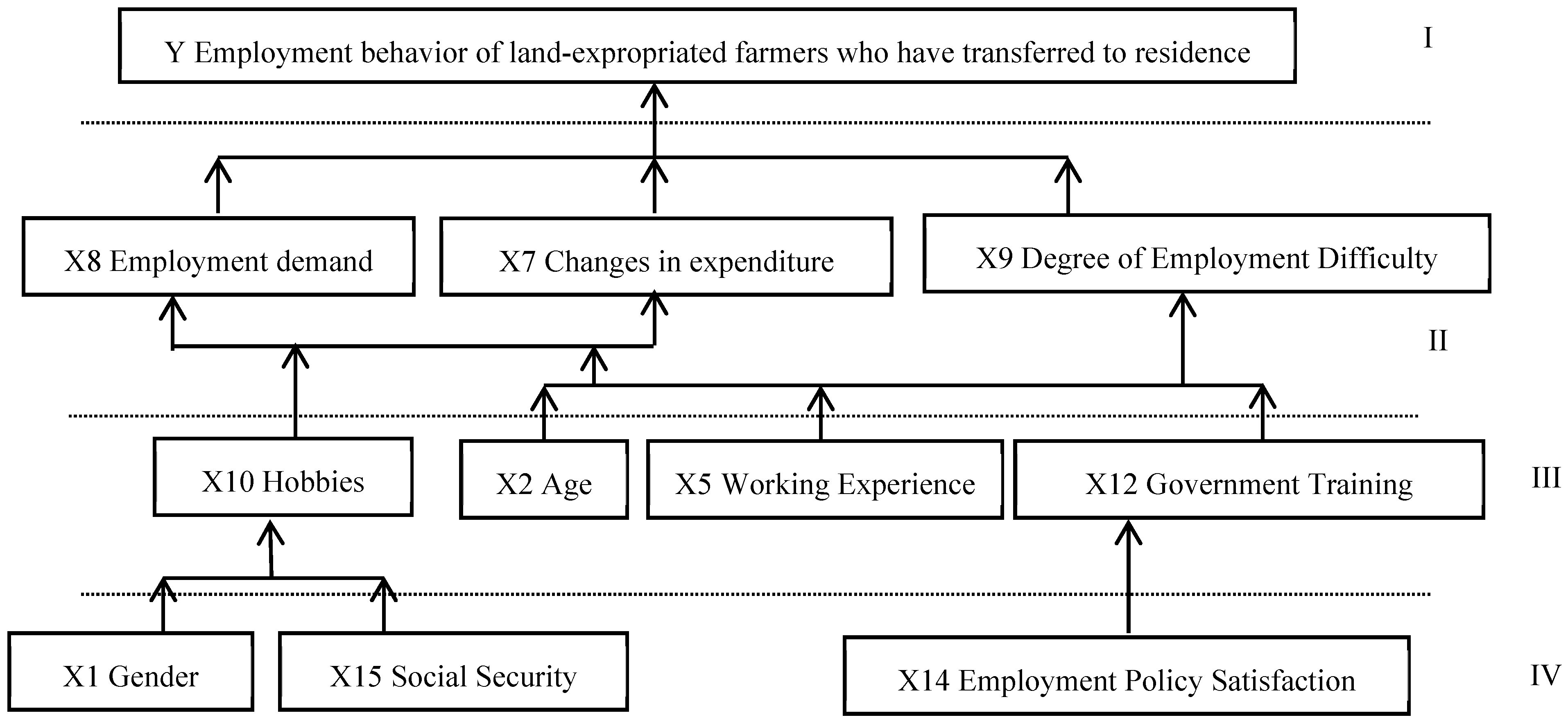
From the final reachable matrix R, Y is in the first layer, X7, X8, X9 is in the second layer, X2, X5, X6, X12 is in the third layer, and X1, X14, X15 is in the fourth layer, thus forming a hierarchical chain of influencing factors. By connecting the factors between adjacent levels with directed line segments, the correlation and hierarchical structure among the influencing factors of employment behavior of land-expropriated farmers are obtained, as shown in
Figure 1.
3.4. ISM Model Hierarchical Structure Decomposition Analysis
Based on the ISM model, three types of hierarchical influencing factors were identified: surface-level direct factors, intermediate indirect factors, and deep-rooted factors. These factors form complex causal chains, collectively influencing the employment behavior of rural-to-urban migrants displaced by land expropriation. Among them, employment demand (X8), changes in expenditure (X7), and perception of employment difficulties (X9) are surface level direct influencing factors that directly affect the employment decision-making process of rural migrant workers, reflecting the immediate response mechanism of individuals in the face of external environmental changes and serving as direct triggers for employment behavior; gender (X1), social security (X15), and employment policy satisfaction (X14) are at the bottom of the system structure and are deeply rooted influencing factors that indirectly affect surface employment behavior through multi-level paths, reflecting the profound impact of structural constraints and institutional backgrounds on individual employment choices; age (X2), interests and hobbies (X6), work experience (X5), and government training (X12) are intermediate indirect influencing factors, forming a key transmission bridge from deep factors to surface behaviors. These factors are both independent and interrelated, and their specific action path and conduction relationship show two paths. The details are as follows:
Path 1: The overall process can be summarized as an individual endowment–demand motivation pathway, specifically “gender, social security → hobbies → employment demand, expenditure changes → employment behavior.” In this pathway, gender differences and social security levels fundamentally shape the living patterns and household role divisions of “farmers to citizens”, thereby influencing their hobbies and employment demands, which directly affect their employment behavior. Based on the survey findings in the sample area, female “farmers to citizens”, due to their greater responsibility in household care, also have a wider range of hobbies, and their employment demands are generally lower than those of males. This phenomenon aligns with gender role theory, reflecting the potential regulation of employment participation by social gender structures [
41]. Meanwhile, a robust social security system reduces the absolute reliance of rural-to-urban migrants on market income and provides them with material and psychological space to pursue their hobbies, further weakening their active employment demands.
Path 2: this can be summarized as the policy perception ability cognition path, which is reflected as “employment policy satisfaction → government training participation → degree of employment difficulty cognition, expenditure changes, employment demand → employment behavior”. In this path, the sense of identification of rural migrant workers with government employment policies significantly affects their enthusiasm for participating in training, and the degree of training participation directly shapes their perception of employment market barriers, ultimately affecting their employment decisions. Low policy satisfaction or insufficient participation in training will enhance the perception of employment difficulties and inhibit their willingness to enter the labor market.
Based on the above paths, it can be seen that the employment behavior of farmers who have been relocated from land acquisition is influenced by both individual internal endowments and external institutional environment. In the deep root factors, gender represents an immutable individual attribute, while social security and policy satisfaction reflect the effectiveness of government institutional arrangements and public services. Together, they constitute the structural background that influences employment behavior. Intermediate level factors act as transmission hubs, transforming structural conditions into specific cognitive and motivational variables, ultimately driving behavioral outcomes directly through surface level factors. This structure not only reveals the complex mechanism of the synergistic effect of multiple factors on the employment behavior of rural migrant workers but also suggests that policy design needs to take into account individual differences and system support.
4. Conclusions and Suggestions
4.1. Conclusions
This study is based on field research data on the labor force of farmers who have been relocated from land acquisition in Tongzhou sub-center, Beijing. Using a binary logistic regression model and explanatory structural model (ISM), the key factors affecting their employment behavior and their underlying mechanisms were systematically analyzed. The logistic regression results indicate that 10 variables, including gender, age, work experience, interests and hobbies, employment needs, expenditure changes, perception of employment difficulties, government training, policy satisfaction, and social security, significantly affect the employment behavior of rural migrant workers. Further analysis of the hierarchical structure and transmission pathways of various factors through the ISM model reveals that these factors can be divided into three levels: surface direct factors, intermediate indirect factors, and deep root factors, forming a hierarchical influence mechanism of “structure–cognition–behavior”. Specifically, gender, social security, and policy satisfaction are at the bottom of the ISM model and are the underlying factors that affect employment behavior. The division of family roles and social structural constraints reflected by gender differences, as well as the survival security dependence implied by the level of social security, jointly shape the employment motivation and behavioral choices of rural migrant workers; policy satisfaction reflects the effectiveness of government public services and directly affects individuals’ identification and willingness to participate in employment policies. Age, interests, work experience, and government training form an intermediate transmission layer, transforming deep structural factors into specific cognitive and ability variables, which in turn affect surface-level employment demand, expenditure pressure, and perceived employment difficulties, ultimately affecting employment behavior.
4.2. Suggestions
Based on the above conclusions, the following policy suggestions are put forward:
Firstly, implement differentiated employment guidance to alleviate structural constraints. To address the inhibitory effects of deep-seated factors such as gender and social security on employment demand, refined and differentiated employment promotion strategies should be implemented. On the one hand, we will strengthen employment support for the female labor force by developing public facilities such as community childcare and elderly care services to alleviate their family caregiving burden, promote the participation of women’s federations at all levels in employment assistance, carry out skill training and job matching suitable for women’s characteristics, and enhance their market competitiveness. On the other hand, optimizing the design of the social security system can enhance employment incentives while ensuring basic living standards, and avoid weakening employment motivation due to excessively high levels of security. We can explore the implementation of an “employment-oriented” social security subsidy mechanism, providing preferential or phased subsidies for social security contributions to actively employed individuals, and achieving a positive interaction between “guaranteeing basic needs” and “promoting employment”.
Secondly, strengthen policy transmission efficiency, enhance training participation and employment confidence. According to the research results, policy satisfaction, as a deep-seated factor, indirectly affects employment behavior by influencing government training participation and employment cognition. We should further enhance the transparency and public recognition of employment policies and increase the awareness and trust of the rural migrant population in employment policies through various means such as community promotion, new media push, and typical demonstrations. In terms of training, an integrated mechanism of “demand training employment” will be established, led by streets and communities to conduct training demand surveys, and customized courses will be offered based on regional industrial development trends. Existing training funds and projects will be coordinated and integrated, and efforts will be focused on training rural migrant workers who have strong employment aspirations, poor employment skills, the greatest need for training, and the greatest need for employment. This will effectively improve the pertinence and effectiveness of training and promote employment through training. Track and evaluate the training effectiveness to ensure that the training content is effectively aligned with market positions and effectively enhance the employability and market competitiveness of participants.
Thirdly, enhance the efficiency of employment services and stimulate endogenous employment motivation. Employment demand, changes in expenditure, and perception of employment difficulties are surface-level direct factors that are easily regulated by intermediate and deep-level factors. Efforts should be made to improve the accuracy and response efficiency of employment services, and to reduce information barriers and psychological obstacles in the job-seeking process of rural migrant workers. We suggest establishing a two-way matching database of “employment intention job demand” at the street level, regularly publishing enterprise employment information, and providing personalized career guidance. For groups facing employment difficulties such as middle-aged, elderly, and low-skilled individuals, an online flexible learning platform can be developed to support them in utilizing fragmented time to enhance their skills and adapt to new forms of employment such as the gig economy and platform employment. For individuals who actively seek employment and achieve stable employment, appropriate employment stabilization subsidies or social security incentives can be provided to strengthen positive feedback on employment behavior.
Fourthly, relying on industry driven development, actively expanding employment channels. There is a causal relationship between the rapid development of the economy and the full employment of the labor force who have been relocated from land acquisition to rural areas. The emergence of a large amount of land acquisition to rural areas is the result of industrialization and urbanization. However, the fundamental path to solving the employment problem of the labor force who have been relocated from land acquisition to rural areas lies in promoting regional economic development and optimizing industrial structure, creating more adaptable employment positions. We should actively support the development of labor-intensive industries and community service industries in suburban areas and encourage small and medium-sized enterprises to play a leading role in absorbing local labor. For enterprises that hire rural migrant workers, incentive policies such as social insurance unit payment reductions and job subsidies can be implemented to reduce labor costs. At the same time, support village collectives to utilize reserved land for land acquisition, compensation funds and other resources, develop collective economic projects such as property leasing, convenient services, and simple processing, and prioritize the participation of local migrant workers in operation and management. Encourage farmers who are willing and have the conditions to start their own businesses, establish special support funds, provide entrepreneurship training, loan subsidies, and business guidance, and form a virtuous cycle of “absorbing employment through industries and driving employment through entrepreneurship”.
4.3. Research Shortcomings and Prospects
Although this study systematically revealed the influencing factors and hierarchical structure of the employment behavior of rural migrant workers who have been relocated through land acquisition by utilizing Logistic ISM, there are still limitations in the following aspects that need to be further improved in future research.
Firstly, in terms of sample selection, this study is based on survey data from Lucheng Town in Tongzhou, Beijing. Although this provides a valuable case for studying group employment issues under rapid urbanization, the unique regional background also requires caution when generalizing research conclusions to other regions. Future research can further expand the scope of the survey and include more diverse regional samples for comparative analysis in order to enhance the universality and robustness of the conclusions.
Secondly, in terms of variable selection, although the model has included multiple key variables and achieved good explanatory power, due to limitations in questionnaire design and data availability some potential important influencing factors may still be overlooked, such as family structure, individual mental health status, and social network relationships. The absence of these variables may to some extent affect the comprehensiveness of model estimation, and future research can take them into consideration to construct a more comprehensive analytical framework.
Thirdly, in terms of research methods, although the construction of the ISM has been consulted by experts to ensure logical rationality, the determination of its structural relationships still cannot completely avoid a certain degree of subjectivity. This study revealed the correlation and hierarchical structure between variables based on cross-sectional data, but there are inherent limitations in strict causal inference. In the future, panel data can be obtained through tracking surveys, or econometric methods that can better handle endogeneity can be used to more accurately identify dynamic causal effects between various factors.
Finally, the research data for this study was collected in 2021, and in recent years, the macroeconomic situation, employment market structure, and public policies may have undergone dynamic adjustments. However, the core influencing factors and their underlying mechanisms revealed in this article still have important theoretical reference value and policy implications for understanding and solving the employment problems of similar groups in the current and future periods. Subsequent research will continue to update data, which will better capture the specific impact of changes in the times on employment behavior.