
Impact of Transmission Constraints on Critical Grid Elements and Offshore Wind Power Curtailment in Lithuanian Power System

 , , , , ,
Abstract
1. Introduction
2. Literature Review
3. Methodology
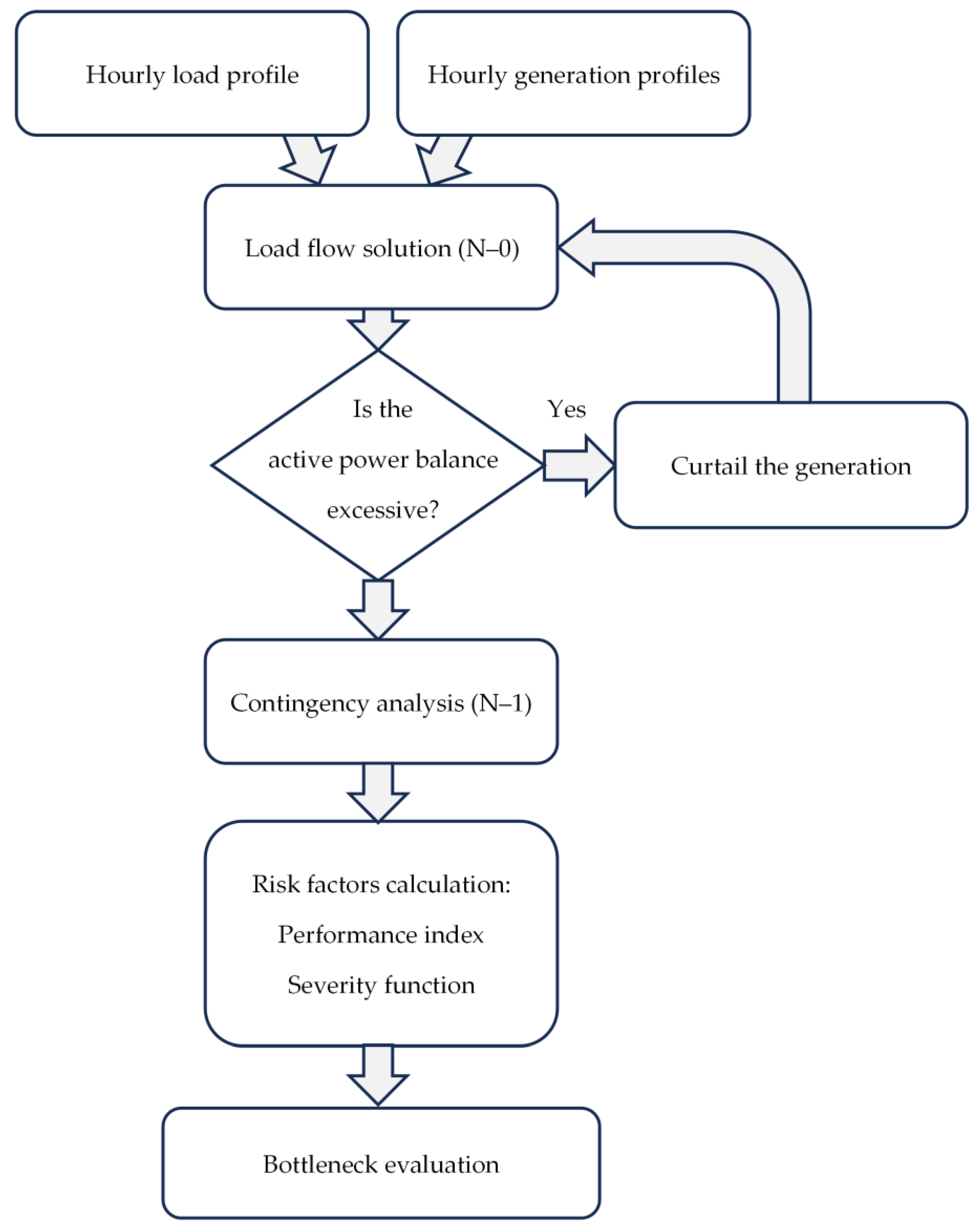
- Grid steady-state regimes after connecting a high-power wind farm. This aspect assesses the load on power lines in normal operation and N–1 contingencies.
- The overall active power balance of the power system. With high renewable penetration and overlapping solar and wind power generation, there may be a need to limit electricity production because the existing load and the ability to export electricity are insufficient.
- Short-circuit power of the power system. Modern technology wind farms require a leading synchronous energy source. Wind farms, like solar farms, can operate stably when the power of the power system is at least three times higher than the power of a specific farm [32]. Otherwise, the connection is considered very weak, and the wind farm may lose stability and disconnect, even if the thermal capacity of the power lines is sufficient.
3.1. Grid Security Assessment Using Load Flow and Contingency Analysis
3.2. Ensuring the Active Power Balance
3.3. Short-Circuit Power Assessment
4. Research Object and Scenarios
4.1. Characteristics of the Power System and Model
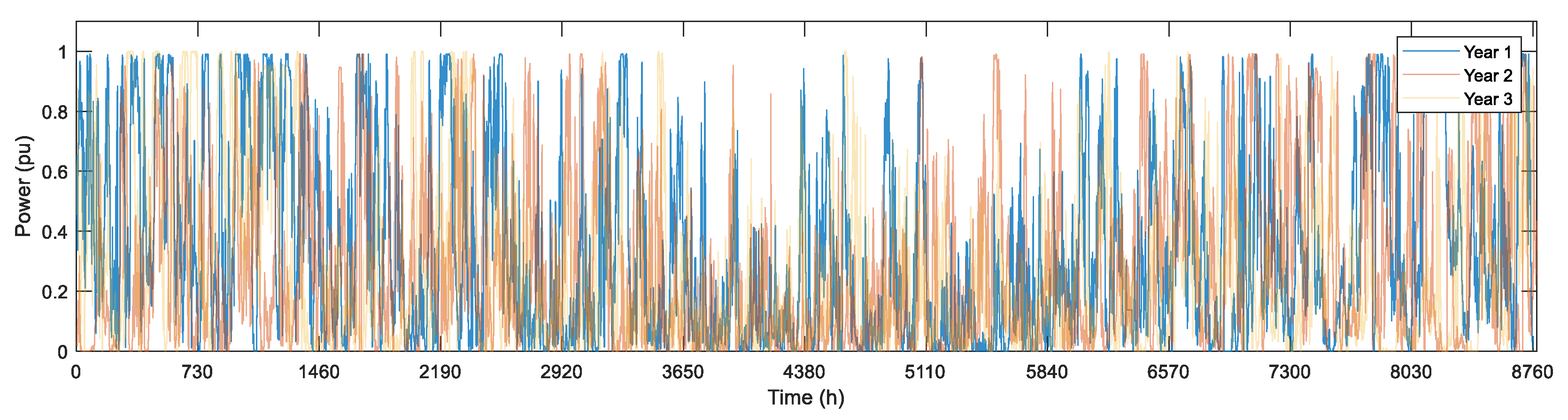
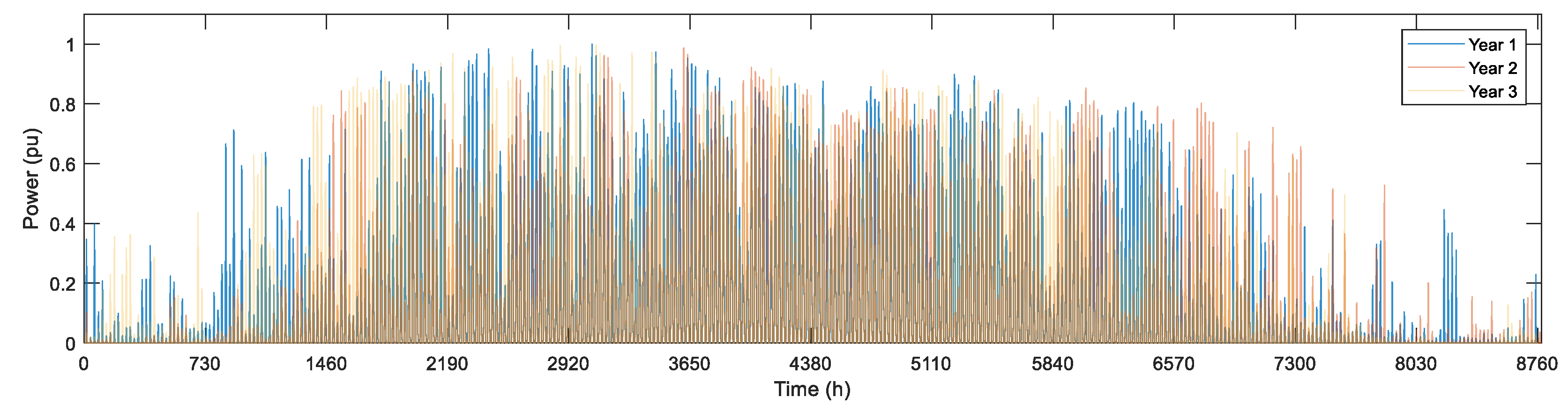
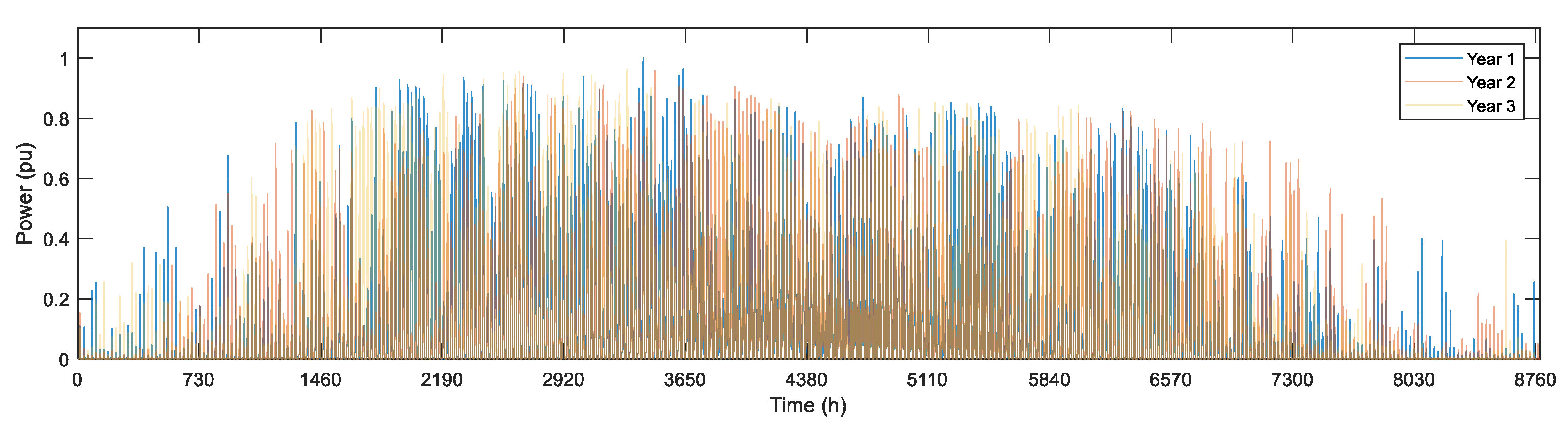
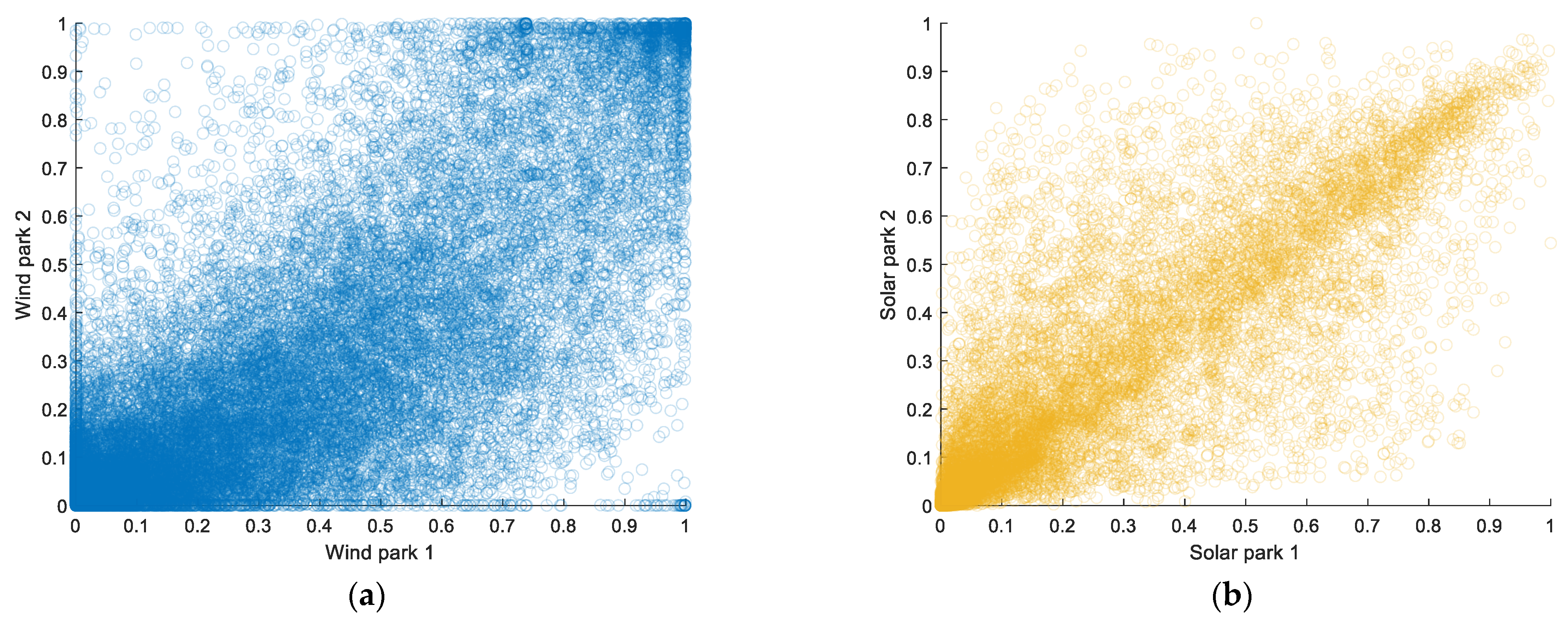
4.2. Data of Load and RES Generation
4.3. Scenarios
5. Results
5.1. Overloading Risk Analysis
5.2. Short-Circuit Power Analysis
6. Discussion on Power Curtailment Consequences and Mitigation Options
- Energy Storage Systems. Utility scale batteries (such as lithium-ion and flow batteries) and other energy storage technologies enable the storage of excess wind and solar power for later use, thus allowing to shift RES production in time. This smooths production output, reduces curtailment, and lowers associated costs [53].
- Power-to-X (P2X). Converting surplus electricity using technologies, such as Power-to-Hydrogen, Power-to-Ammonia, or Power-to-Liquids, allows the production of hydrogen, ammonia for fertilizer or fuel, and synthetic fuels like methanol or jet fuel, using hydrogen and captured CO2. These technologies can substantially reduce curtailment when operated flexibly (utilizing hours of excess production) and co-located in constrained parts of the network [54].
- Sector Coupling (Electrification of Heat, Electrification of Transport, and Electrification of Industry). RES can drive heat pumps or resistive heating for residential, commercial, or industrial heating and support smart electric vehicle (EV) charging aligned with wind generation output and power industrial processes (such as steelmaking or chemical production) with renewable electricity. Each of these processes create demand during hours of high RES generation, thus reducing surplus energy and the need for curtailment [55].
- Implementing these strategies is system-specific and depends on local conditions, network topology, grid infrastructure, and economic considerations. Combining transmission upgrades, storage, P2X technologies, and demand-side flexibility would provide the most robust solution to mitigate RES curtailment.
7. Conclusions
Author Contributions
Funding
Institutional Review Board Statement
Informed Consent Statement
Data Availability Statement
Conflicts of Interest
Abbreviations
| BESS | battery energy storage system |
| CESA | Continental Europe synchronous area |
| FACTS | flexible AC transmission system |
| HVAC | high-voltage alternating-current |
| HVDC | high-voltage direct-current |
| IPS/UPS | integrated power system/unified power system |
| OWF | offshore wind farm |
| OWPP | offshore wind power plant |
| PI | performance index |
| POI | point of interconnection |
| PP | power plant |
| RES | renewable energy sources |
| SCR | short-circuit ratio |
| STATCOM | static synchronous compensator |
References
- European Parliament and the Council. Directive (EU) 2023/2413 of the European Parliament and of the Council of 18 October 2023 amending Directive (EU) 2018/2001 on the promotion of the use of energy from renewable sources. In Official Journal of the European Union; Publications Office of the European Union: Luxembourg, 31 October 2023. [Google Scholar]
- Government of Lithuania. National Energy Independence Strategy of the Republic of Lithuania; Resolution No. XIII-1288; Seimas of the Republic of Lithuania: Vilnius, Lithuania, 2018. [Google Scholar]
- McKenna, R.; Lilliestam, J.; Heinrichs, H.U.; Weinand, J.; Schmidt, J.; Staffell, I.; Hahmann, A.N.; Burgherr, P.; Burdack, A.; Bucha, M.; et al. System impacts of wind energy developments: Key research challenges and opportunities. Joule 2025, 9, 101799. [Google Scholar] [CrossRef]
- Carta, J.A.; Cabrera Santana, P.; González Hernández, J. Wind Power Integration. In Comprehensive Renewable Energy, 2nd ed.; Letcher, T.M., Ed.; Elsevier: Oxford, UK, 2022; Volume 2, pp. 644–720. [Google Scholar] [CrossRef]
- Fernández-Guillamón, A.; Das, K.; Cutululis, N.A.; Molina-García, Á. Offshore Wind Power Integration into Future Power Systems: Overview and Trends. J. Mar. Sci. Eng. 2019, 7, 399. [Google Scholar] [CrossRef]
- Longabart, A.; Tsiatas, G.; Manuel, L. Performance Indicators for Offshore Wind Farms. In Proceedings of the Structures Congress 2011, Las Vegas, NV, USA, 14–16 April 2011. [Google Scholar] [CrossRef]
- Desalegn, B.; Gebeyehu, D.; Tamrat, B.; Tadiwose, T.; Lata, A. Onshore versus Offshore Wind Power Trends and Recent Study Practices in Modeling of Wind Turbines’ Life-Cycle Impact Assessments. Clean. Eng. Technol. 2023, 17, 100691. [Google Scholar] [CrossRef]
- Kurth, R.; Taiarol, P.; Crowther, J.; Stobart, M. 4 Challenges to Overcome When Transmitting Offshore Wind Power. Stantec. 2022. Available online: https://www.stantec.com/en/ideas/topic/energy-resources/4-challenges-to-overcome-when-transmitting-offshore-wind-power (accessed on 5 November 2025).
- Wu, D.; Seo, G.-S.; Xu, L.; Su, C.; Kocewiak, L.; Sun, Y.; Qin, Z. Grid Integration of Offshore Wind Power: Standards, Control, Power Quality and Transmission. IEEE Open J. Power Electron. 2024, 5, 583–604. [Google Scholar] [CrossRef]
- Ali, S.W.; Sadiq, M.; Terriche, Y.; Naqvi, S.A.R.; Hoang, L.Q.N.; Mutarraf, M.U.; Hassan, M.A.; Yang, G.; Su, C.L.; Guerrero, J.M. Offshore Wind Farm-Grid Integration: A Review on Infrastructure, Challenges, and Grid Solutions. IEEE Trans. Ind. Appl. 2021, 9, 102811–102827. [Google Scholar] [CrossRef]
- Mugambi, G.R.; Darii, N.; Khazraj, H.; Saborío-Romano, O.; Raducu, A.G.; Sharma, R.; Cutululis, N.A. Methodologies for offshore wind power plant dynamic stability analysis. Renew. Sustain. Energy Rev. 2025, 216, 115635. [Google Scholar] [CrossRef]
- Hu, R.; Hu, W.; Chen, Z. Review of Power System Stability with High Wind Power Penetration. In Proceedings of the 41st Annual Conference of IEEE Industrial Electronics Society (IECON 2015), Yokohama, Japan, 9–12 November 2015. [Google Scholar] [CrossRef]
- Shair, J.; Li, H.; Hu, J.; Xie, X. Power system stability issues, classifications and research prospects in the context of high-penetration of renewables and power electronics. Renew. Sustain. Energy Rev. 2021, 145, 111111. [Google Scholar] [CrossRef]
- Hatziargyriou, N.; Milanovic, J.; Rahmann, C.; Ajjarapu, V.; Canizares, C.; Erlich, I.; Hill, D.; Hiskens, I.; Kamwa, I.; Pal, B.; et al. Definition and Classification of Power System Stability—Revisited & Extended. IEEE Trans. Power Syst. 2021, 36, 3271–3281. [Google Scholar] [CrossRef]
- Sajadi, A.; Clark, K.; Loparo, K.A. Statistical Steady-State Stability Analysis for Transmission System Planning for Offshore Wind Power Plant Integration. Clean Technol. 2020, 2, 20. [Google Scholar] [CrossRef]
- Dantas, J.P.L.; Tavares, M.F.; Marques, A.J.O.; Bento, M.E.C. Analysis and Control of Voltage Stability in Offshore Wind Systems Under Small Disturbances. Energies 2025, 18, 3050. [Google Scholar] [CrossRef]
- Choi, N.; Kim, B.; Kim, D.; Park, B.; Kim, S.; Lee, B. Grid Connection Studies for Large-Scale Offshore Wind Farms Considering High Penetration of Regional Renewables. Sustainability 2022, 14, 1015. [Google Scholar] [CrossRef]
- Alves, R.; Yang, N.; Xu, L.; Egea-Àlvarez, A. Enabling Power System Restoration from Offshore Wind Power Plants in the UK. Energies 2025, 18, 436. [Google Scholar] [CrossRef]
- Qays, M.O.; Ahmad, I.; Habibi, D.; Aziz, A.; Mahmoud, T. System Strength Shortfall Challenges for Renewable Energy-Based Power Systems: A Review. Renew. Sustain. Energy Rev. 2023, 183, 113447. [Google Scholar] [CrossRef]
- Yu, L.; Sun, H.; Xu, S.; Zhao, B.; Zhang, J. A Critical System Strength Evaluation of a Power System with High Penetration of Renewable Energy Generations. CSEE J. Power Energy Syst. 2022, 8, 710–720. [Google Scholar] [CrossRef]
- Wang, L.; Hsiung, C.-T. Dynamic Stability Improvement of an Integrated Grid-Connected Offshore Wind Farm and Marine-Current Farm Using a STATCOM. IEEE Trans. Power Syst. 2011, 26, 690–698. [Google Scholar] [CrossRef]
- Wang, L.; Wang, K.-H. Dynamic Stability Analysis of a DFIG-Based Offshore Wind Farm Connected to a Power Grid Through an HVDC Link. IEEE Trans. Power Syst. 2011, 26, 1501–1510. [Google Scholar] [CrossRef]
- Sindhura, J.; Sridhar, M. Improve the Dynamic Stability of an Integrated Grid-Connected Offshore Wind Farm and Marine-Current Farm Using FACTS. Int. J. Eng. Res. Technol. 2012, 26, 690–698. [Google Scholar]
- Sharma, P.; Rese, L.; Wang, B.; Vyakaranam, B.; Shah, S. Grid Strength Analysis for Integrating 30 GW of Offshore Wind Generation by 2030 in the U.S. Eastern Interconnection: Preprint; NREL/CP-5D00-87392; National Renewable Energy Laboratory: Golden, CO, USA, 2023. Available online: https://www.nrel.gov/docs/fy24osti/87392.pdf (accessed on 3 December 2025).
- Gevorgian, V.; Shah, S.; Yan, W.; Sharma, P.; Konstantinopoulos, S.; Uppalapati, S.; Del Rosso, A. Development of Advanced Methods for Evaluating Grid Stability Impacts by HVAC- and HVDC-Interconnected Offshore Wind Power Plants. Final Report, NOWRDC Contract #154627. 2024. Available online: https://nationaloffshorewind.org/wp-content/uploads/154627_NOWRDC-Final-Report.pdf (accessed on 3 December 2025).
- Poulose, A.; Kim, S. Transient Stability Analysis and Enhancement Techniques of Renewable-Rich Power Grids. Energies 2023, 16, 2495. [Google Scholar] [CrossRef]
- Sajadi, A.; Kolacinski, R.M.; Clark, K.; Loparo, K.A. Transient Stability Analysis for Offshore Wind Power Plant Integration Planning Studies—Part II: Long Term Faults. IEEE Trans. Ind. Appl. 2018, 55, 193–202. [Google Scholar] [CrossRef]
- Sajadi, A.; Kolacinski, R.M.; Clark, K.; Loparo, K.A. Transient Stability Analysis for Offshore Wind Power Plant Integration Planning Studies—Part I: Short-Term Faults. IEEE Trans. Ind. Appl. 2019, 55, 182–192. [Google Scholar] [CrossRef]
- Pelosi, D.; Ciupageanu, D.A.; Vaccaro, A.; Barelli, L. Impact Analysis of Wind Power Generation on Steady-State and Transient Stability of a National Power System—The Romanian Case Study. Wind Energy Eng. Res. 2025, 3, 1–15. [Google Scholar] [CrossRef]
- Shewarega, F.; Erlich, I.; Rueda, J.L. Impact of Large Offshore Wind Farms on Power System Transient Stability. In Proceedings of the 2009 IEEE/PES Power Systems Conference and Exposition, Seattle, WA, USA, 15–18 March 2009. [Google Scholar] [CrossRef]
- Lu, K.-H.; Rao, Q. Enhancing the Dynamic Stability of Integrated Offshore Wind Farms and Photovoltaic Farms Using STATCOM with Intelligent Damping Controllers. Sustainability 2023, 15, 13962. [Google Scholar] [CrossRef]
- CIGRE. Connection of Wind Farms to Weak AC Networks; Technical Report No. B4.62 (Reference 671); CIGRE: Paris, France, 2016. [Google Scholar]
- Mehdizadeh, M.; Ghazi, R.; Ghayeni, M. Power System Security Assessment with High Wind Penetration Using the Farms Models Based on Their Correlation. IET Renew. Power Gener. 2018, 12, 893–900. [Google Scholar] [CrossRef]
- Hamon, C.; Perninge, M.; Söder, L. An importance sampling technique for probabilistic security assessment in power systems with large amounts of wind power. Electr. Power Syst. Res. 2016, 131, 11–18. [Google Scholar] [CrossRef]
- Kundur, P.; Paserba, J.; Ajjarapu, V.; Andersson, G.; Bose, A.; Canizares, C.; Hatziargyriou, N.; Hill, D.; Stankovic, A.; Taylor, C.; et al. Definition and classification of power system stability (IEEE/CIGRE joint task force on stability terms and definitions). IEEE Trans. Power Syst. 2004, 19, 1387–1401. [Google Scholar] [CrossRef]
- Arabali, A.; Ghofrani, M.; Etezadi-Amoli, M.; Fadali, M.S.; Moeini-Aghtaie, M. A multi-objective transmission expansion planning framework in deregulated power systems with wind generation. IEEE Trans. Power Syst. 2014, 29, 3003–3011. [Google Scholar] [CrossRef]
- Liyanage, C.; Nutkani, I.; Meegahapola, L. A Comparative Analysis of Prominent Virtual Synchronous Generator Strategies Under Different Network Conditions. IEEE Open Access J. Power Energy 2024, 11, 178–195. [Google Scholar] [CrossRef]
- Yu, L.; Zhao, B.; Wang, S.; Su, Z.; Wu, G.; Wang, T. Analysis of Transmission Distance of the MMC-HVDC Connecting Islanded Renewable Energy Generation System. In Proceedings of the 2024 6th Asia Energy and Electrical Engineering Symposium (AEEES), Chengdu, China, 28–31 March 2024; pp. 621–625. [Google Scholar] [CrossRef]
- Yu, L.; Zhao, B.; Xi, G.; Zhang, J.; Cheng, S.; Sun, W.; Ma, J.; Sun, Q. Analysis of the Influence of System Strength on Transient Overvoltage for Power Systems with Renewable Energy Sources. In Proceedings of the 2024 IEEE 3rd International Conference on Electrical Engineering, Big Data and Algorithms (EEBDA), Changchun, China, 27–29 February 2024; pp. 652–656. [Google Scholar] [CrossRef]
- Albukhari, W.M.; Liu, Y.; Till, A.; Alshuaibi, K.M. Frequency Stability Enhancement in a Fully Solar Power Grid: A Case Study on the Saudi Model. In Proceedings of the 2024 IEEE PES ISGT Conference, Washington, DC, USA, 19–22 February 2024. [Google Scholar] [CrossRef]
- Yamada, Y.; Tsusaka, A.; Nanahara, T.; Yukita, K. A Study on Short-Circuit-Ratio for an Inverter-Based Resource with Power-Voltage Curves. IEEE Trans. Power Syst. 2024, 39, 6076–6086. [Google Scholar] [CrossRef]
- Lin, Y.; Wang, B.; Guo, Q.; Zhao, H.; Sun, H. Short-Circuit Ratio and Short-Term Voltage Security Constrained Unit Commitment in High Wind Power-Penetrated Power Systems. IEEE Trans. Power Syst. 2024, 39, 5631–5644. [Google Scholar] [CrossRef]
- Miao, Y.; Zhang, X.; Peng, H.; Wang, L.; Guo, Q. Modeling and Oscillation Mechanism Analysis of Renewable Energy Base Connected into MMC-HVDC. In Proceedings of the 2023 3rd Power System and Green Energy Conference (PSGEC), Shanghai, China, 24–26 August 2023; pp. 203–209. [Google Scholar] [CrossRef]
- Alfaris, F.E. System Strength Evaluation of a Multi-terminal Power Grid Integrated a Distributed PV Generation. In Proceedings of the 2023 6th International Conference on Electrical Engineering and Green Energy (CEEGE), Grimstad, Norway, 6–9 June 2023; pp. 186–191. [Google Scholar] [CrossRef]
- ENTSO-E. ENTSO-E Transmission System Map. Available online: https://www.entsoe.eu/data/map/ (accessed on 21 October 2025).
- Litgrid, A.B. 400–110 kV Transmission Network Development Plan of Lithuanian Electricity System 2024–2033. 2024. Available online: https://www.litgrid.eu/uploads/files/dir747/dir37/dir1/13_0.php (accessed on 21 October 2025).
- Litgrid, A.B. Dashboard. Available online: https://www.litgrid.eu/index.php/dashboard/630 (accessed on 11 October 2025).
- Emblemsvåg, J. Wind energy is not sustainable when balanced by fossil energy. Appl. Energy 2022, 305, 117748. [Google Scholar] [CrossRef]
- Impram, S.; Varbak Nese, S.; Oral, B. Challenges of renewable energy penetration on power system flexibility: A survey. Energy Strategy Rev. 2020, 31, 100539. [Google Scholar] [CrossRef]
- Egli, F. Renewable energy investment risk: An investigation of changes over time and the underlying drivers. Energy Policy 2020, 140, 111428. [Google Scholar] [CrossRef]
- Yasuda, Y.; Bird, L.; Carlini, E.M.; Eriksen, P.B.; Estanqueiro, A.; Flynn, D.; Fraile, D.; Gómez Lázaro, E.; Martín-Martínez, S.; Hayashi, D.; et al. C-E (curtailment—Energy share) map: An objective and quantitative measure to evaluate wind and solar curtailment. Renew. Sustain. Energy Rev. 2022, 160, 112212. [Google Scholar] [CrossRef]
- Mangunkusumo, K.G.H.; Rizqiawan, A.; Sriyono, S.; Munir, B.S.; Pramana, P.A.; Ridwan, M. Enhancing Grid Stability in Renewable Energy Systems Through Synchronous Condensers: A Case Study on Dedieselization and Assessment Criteria Development. Energies 2025, 18, 1410. [Google Scholar] [CrossRef]
- Denholm, P.; Mai, T. Timescales of energy storage needed for reducing renewable energy curtailment. Renew. Energy 2019, 130, 388–399. [Google Scholar] [CrossRef]
- Onodera, H.; Delage, R.; Nakata, T. Systematic effects of flexible power-to-X operation in a solar- and wind-rich energy system. Energy Convers. Manag. X 2023, 17, 100416. [Google Scholar] [CrossRef]
- Kirkerud, J.G.; Nagel, N.O.; Bolkesjø, T.F. The role of demand response in the future renewable northern European energy system. Energy 2021, 235, 121336. [Google Scholar] [CrossRef]



| Characteristic | 2024 | Scenario 2027 | Scenario 2035 | |
|---|---|---|---|---|
| Installed capacity: | Thermal power plants (fossil fuels) | 1227 | 1227 | 1130 |
| Biomass/biogas/waste | 198 | 198 | 198 | |
| Hydro | 126 | 126 | 126 | |
| Solar | 1035 | 3900 | 4050 | |
| Wind onshore | 1462 | 3700 | 5320 | |
| Wind offshore | 0 | 700 1 | 2100 1 | |
| Hydro pumped storage | 900 | 1010 | 1010 | |
| Battery energy storage system (BESS) | 250 | 660 | 2000 | |
| Maximum demand | 2251 | 2790 | 4350 2 | |
| Disconnected Line | Contingency |
|---|---|
| L12 | C1 |
| L11 | C2 |
| L3 or L6 or L8 | C3 |
| L4 | C4 |
| L1 | C5 |
| L2 (L2A or L2B in Scenario 2035) | C6 |
| L7 | C7 |
| L5 | C8 |
| high-voltage direct-current (HVDC) | C9 |
| Contingency Level | Description | Short-Circuit Power (MVA) | Offshore Wind Maximum Power (MW) |
|---|---|---|---|
| N–0 | All elements are in service | 5492 | 1831 |
| N–1 | L12 | 3424 | 1141 |
| L5 | 3773 | 1258 | |
| L7 | 4305 | 1435 | |
| N–2 | L5 and L12 | 1687 | 562 |
| L5 and L7 | 2329 | 776 | |
| L7 and L12 | 2772 | 924 | |
| L12 and HVDC | 3284 | 1095 | |
| L12 and SC | 3365 | 1122 | |
| L11 and L12 | 3381 | 1127 | |
| L3 and L12 | 3424 | 1141 |
| Contingency Level | Description | Short-Circuit Power (MVA) | Offshore Wind Maximum Power (MW) |
|---|---|---|---|
| N–0 | All elements are in service | 6692 | 2231 |
| N–1 | L12 | 4747 | 1582 |
| L5 | 5156 | 1719 | |
| L31 | 5718 | 1906 | |
| L7 | 6007 | 2002 | |
| N–2 | L5 and L12 | 3118 | 1039 |
| L12 and L31 | 3609 | 1203 | |
| L5 and L7 | 3766 | 1255 | |
| L5 and L31 | 3928 | 1309 | |
| L7 and L12 | 4031 | 1344 | |
| L11 and L12 | 4415 | 1472 | |
| L12 and HVDC | 4459 | 1486 | |
| L12 and SC | 4514 | 1505 | |
| L3 and L12 | 4617 | 1539 | |
| L7 and L31 | 4965 | 1655 |
Disclaimer/Publisher’s Note: The statements, opinions and data contained in all publications are solely those of the individual author(s) and contributor(s) and not of MDPI and/or the editor(s). MDPI and/or the editor(s) disclaim responsibility for any injury to people or property resulting from any ideas, methods, instructions or products referred to in the content. |
© 2025 by the authors. Licensee MDPI, Basel, Switzerland. This article is an open access article distributed under the terms and conditions of the Creative Commons Attribution (CC BY) license.
Share and Cite
Gudziute, S.; Bobinaite, V.; Gudzius, S.; Jonaitis, A.; Konstantinaviciute, I.; Kopustinskas, V.; Vaicys, J.; Vaisnoriene, A. Impact of Transmission Constraints on Critical Grid Elements and Offshore Wind Power Curtailment in Lithuanian Power System. Sustainability 2026, 18, 235. https://doi.org/10.3390/su18010235
Gudziute S, Bobinaite V, Gudzius S, Jonaitis A, Konstantinaviciute I, Kopustinskas V, Vaicys J, Vaisnoriene A. Impact of Transmission Constraints on Critical Grid Elements and Offshore Wind Power Curtailment in Lithuanian Power System. Sustainability. 2026; 18(1):235. https://doi.org/10.3390/su18010235
Chicago/Turabian StyleGudziute, Saule, Viktorija Bobinaite, Saulius Gudzius, Audrius Jonaitis, Inga Konstantinaviciute, Vytis Kopustinskas, Jonas Vaicys, and Aistija Vaisnoriene. 2026. "Impact of Transmission Constraints on Critical Grid Elements and Offshore Wind Power Curtailment in Lithuanian Power System" Sustainability 18, no. 1: 235. https://doi.org/10.3390/su18010235
APA StyleGudziute, S., Bobinaite, V., Gudzius, S., Jonaitis, A., Konstantinaviciute, I., Kopustinskas, V., Vaicys, J., & Vaisnoriene, A. (2026). Impact of Transmission Constraints on Critical Grid Elements and Offshore Wind Power Curtailment in Lithuanian Power System. Sustainability, 18(1), 235. https://doi.org/10.3390/su18010235