Article

Sector-Specific Carbon Emission Forecasting for Sustainable Urban Management: A Comparative Data-Driven Framework


1
Nanxun Innovation Institute, Zhejiang University of Water Resources and Electric Power, Hangzhou 310018, China
2
College of Environmental Science and Engineering, Zhejiang University of Water Resources and Electric Power, Hangzhou 310018, China
3
College of Energy Environment and Safety Engineering & College of Carbon Metrology, China Jiliang University, Hangzhou 310018, China
4
Engineering Research Center of Digital Twin Basin of Zhejiang Province, Hangzhou 310018, China
5
Institute of Water Sciences, Zhejiang University of Water Resources and Electric Power, Hangzhou 310018, China
6
School of Biological Engineering, Beijing Polytechnic, Beijing 100176, China
*
Author to whom correspondence should be addressed.
Sustainability 2026, 18(1), 19; https://doi.org/10.3390/su18010019
Submission received: 14 October 2025 / Revised: 12 December 2025 / Accepted: 15 December 2025 / Published: 19 December 2025

Abstract

Accurate, high-frequency carbon emission forecasting is crucial for urban climate mitigation and achieving sustainable development goals. However, generalized models often result in lower prediction accuracy by overlooking the unique “sector specificity” of urban emission systems, namely, the different temporal patterns driven by distinct physical and economic factors across sectors. This study establishes a decision-support framework to select optimal forecasting models for distinct sectors. Using daily multi-sector carbon emission and meteorological data from Hangzhou, we evaluated 12 models across statistical, machine learning, and deep learning classes. Our three-stage design identified the best model for each sector, quantified the contribution of meteorological drivers, and assessed multi-step forecasting stability. The results indicated the lack of universality in generalized models, as no single model performed best across all sectors. A hybrid CNN-LSTM model outperformed other candidates for ground transport (R2 = 0.635), while LSTM showed better performance for industry (R2 = 0.866) and residential (R2 = 0.978) sectors. Integrating meteorological factors only improved accuracy in weather-sensitive sectors (e.g., residential) and acted as noise in others (e.g., aviation). We conclude that a sector-specific strategy is more robust than a one-size-fits-all approach for carbon emission forecasting. By resolving the specific driving mechanisms of each sector this decision-support framework provides the granular data foundation necessary for precise urban energy dispatch and targeted emission reduction policies.

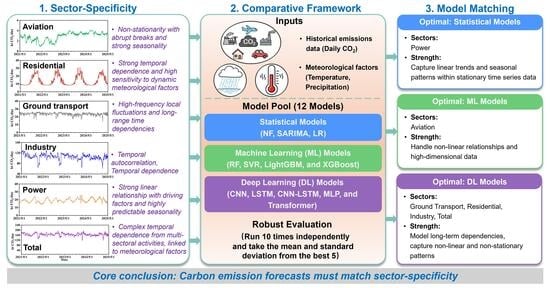
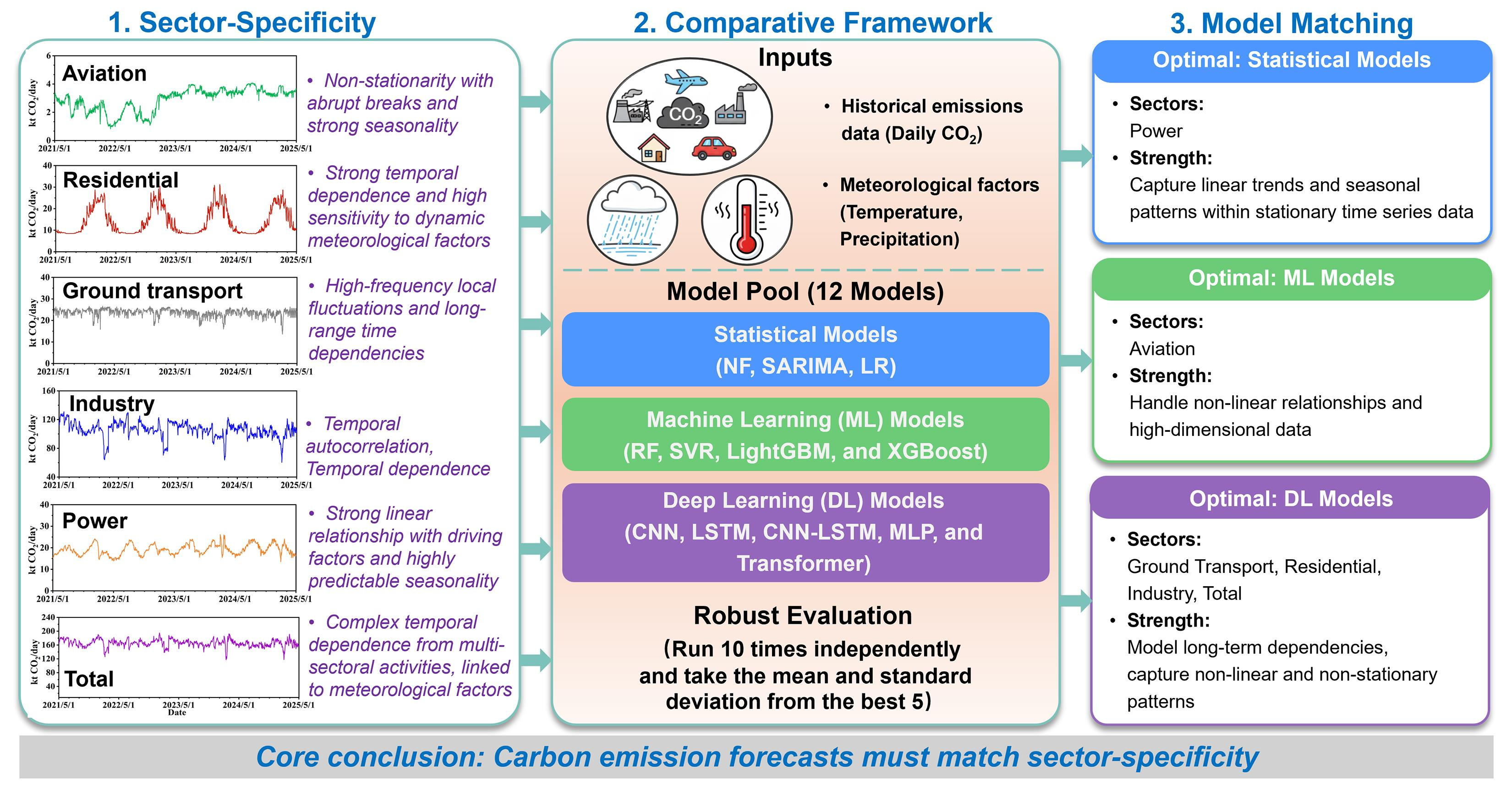
Graphical Abstract

1. Introduction

Cities now host more than half of the global population and are primary engines of economic growth, contributing 80% of the world’s Gross Domestic Product (GDP). This concentration of activity drives substantial environmental pressure, as urban areas consume two-thirds of global energy and generate over 70% of greenhouse gas (GHG) emissions (https://www.worldbank.org/en/topic/urbandevelopment/ accessed on 20 August 2025). Controlling urban emissions is therefore critical to mitigating global climate change. Accordingly, China’s national ‘dual-carbon’ pledge—to peak CO2 emissions before 2030 and achieve carbon neutrality before 2060—imposes significant requirements on city-level planning [1,2]. The development of accurate and timely carbon emission forecasting systems is thus a foundational prerequisite for achieving these climate targets.
Carbon emission forecasting methodologies are broadly divided into mechanistic and data-driven models. Mechanistic models are powerful tools for long-term policy analysis but are ill-suited for high-frequency forecasting due to their structural complexity and extensive data requirements [3]. Conversely, data-driven models learn predictive patterns directly from historical data. Early approaches used statistical models like the AutoRegressive Integrated Moving Average (ARIMA), which often fail to capture the nonlinearities inherent in emission data [4]. While machine learning (ML) techniques like Artificial Neural Networks (ANNs) improved nonlinear fitting, they have often been outperformed by more specialized architectures [5]. More recently, deep learning (DL) has achieved significant breakthroughs in time series forecasting. Long Short-Term Memory (LSTM) models, for instance, have substantially outperformed traditional neural networks by effectively capturing long-term dependencies [6]. Concurrently, Convolutional Neural Networks (CNNs) have been adapted for extract local, short-term patterns from time series data, with their inclusion in hybrid models proven to significantly reduce prediction errors [7]. This led to the development of hybrid CNN-LSTM models to leverage the strengths of both architectures [6,8,9]. The latest advancements involve the Transformer architecture, which uses attention mechanisms to dynamically weigh the importance of different time steps, enhancing the model’s ability to capture complex temporal dynamics [10].
Despite these methodological advances, a critical gap persists in their application to urban management. Many studies adopt a “one-size-fits-all” generalized approach, treating urban emissions as a homogeneous system [8]. However, urban emissions are composed of distinct sectors (e.g., residential, aviation, industry) that follow fundamentally different temporal patterns driven by different mechanisms (e.g., meteorological cycles vs. production schedules). Recent empirical evidence highlights this divergence: during the extreme 2022 heatwave in the Yangtze River Basin, while the Power emissions surged by up to 16.9% in some cities due to cooling demand, Industry emissions decreased by as much as 21.2% due to policy-driven power rationing [11]. A generalized model often averages out these specific dynamics, from a policy perspective, failing to provide the precise, sector-level intelligence required for daily grid dispatch or targeted low-carbon interventions.
The advent of near-real-time monitoring projects, such as the Carbon Monitor (https://www.carbonmonitor.org.cn/ accessed on 19 August 2025), has made high-frequency (e.g., daily) city-level CO2 emission data available, providing a foundation for developing high-resolution forecasting models [12,13]. Forecasting at a daily resolution facilitates the monitoring of transient dynamics, providing a tool for formulating short-term targets. Although macroeconomic indicators such as GDP, population, and industrialization are undoubtedly the decisive drivers of long-term (annual/decadal) emission trends, they act as relatively static constants on a daily time scale. In contrast, meteorological conditions are the main variable that causes severe short-term fluctuations. Temperature exhibits a well-documented non-linear relationship with energy consumption in the Residential, Industry and Power sectors [11,14,15,16], while precipitation potentially affecting emissions from ground transport [16,17,18,19]. Therefore, incorporating such meteorological drivers is therefore crucial for improving the accuracy of high-frequency forecasts [17].
This study addresses these limitations using a systematic, three-stage framework. First, we comprehensively evaluate a range of statistical, ML, and DL models across six distinct emission sectors (aviation, ground transport, residential, industry, power, and total) to identify the optimal model for each, reflecting the principle of ‘sector specificity’. Second, we incorporate key meteorological drivers—temperature and precipitation—into each sector’s best-performing model to quantify their contribution to predictive accuracy. Finally, we evaluate the stability of these weather-enhanced models by forecasting emissions up to 60 days ahead to test their practical value for medium-term prediction. Theoretically, this study validated that sectoral emission behaviors are heterogeneous and require specialized modeling strategies, and established a decision-support framework centered on “sectoral-specificity”.

2. Materials and Methods

2.1. Study Area

This study selects Hangzhou, a megacity in eastern China, as the research area. According to Zhejiang Provincial Bureau of Statistics (https://tjj.zj.gov.cn accessed on 15 September 2025), Hangzhou has a permanent population of 12.52 million and a GDP exceeding 2.0 trillion RMB. According to data from the Hangzhou Municipal Bureau of Statistics (https://tjj.hangzhou.gov.cn/ accessed on 15 September 2025), the proportions of the primary, secondary, and tertiary industries in Hangzhou’s GDP in 2023 were 1.7:28.3:70.0. The city has a subtropical monsoon climate with distinct seasons (hot summers/cold winters) [2,18,19]. This combination of climatic variability and economic complexity makes Hangzhou a representative case for testing sector-specific forecasting models and investigating the influence of meteorological drivers [20].

2.2. Data Sources and Preprocessing

Daily multi-sector carbon emission data from 1 January 2021 to 30 April 2025 were sourced from the Carbon Monitor dataset (https://www.carbonmonitor.org.cn/ accessed on 19 August 2025). The sectoral classification (aviation, ground transport, industry, power, residential, and total emissions (kt CO2/day)) strictly adheres to the standard taxonomy provided by the Carbon Monitor database, ensuring consistency with public benchmarks. Unlike traditional inventories based on annual statistics, the Carbon Monitor dataset consists of “near-real-time estimates” generated through an inversion framework that integrates high-frequency activity data—such as hourly power generation, real-time traffic indices, and flight trajectories—with sector-specific emission factors. While derived from models, the reliability of these data has been rigorously substantiated through multi-source cross-validation against independent observations. Specifically, the emission trends have demonstrated high consistency with physical atmospheric observations, including tropospheric nitrogen dioxide (NO2) column concentrations from satellites and surface measurements from air quality stations [21]. Furthermore, sector-specific estimation models have been calibrated against “ground truth” metrics, such as actual municipal vehicle counts and residential natural gas billing records. With validated uncertainty ranges (e.g., ± 14 % for power and ± 9.3 % for ground transport at 2 σ ), this dataset serves as a robust and scientifically credible proxy for capturing high-frequency emission dynamics [13]. Meteorological data, including daily mean temperature (°C) and cumulative precipitation (mm), were obtained from the China Meteorological Data Network (http://data.cma.cn accessed on 20 August 2025). The locations of the meteorological stations are shown in Figure 1a. Linear interpolation was used to process carbon emission and meteorological data to compensate for short-term data gaps caused by monitoring station maintenance, etc. The data was then processed into daily series with equal intervals and maintain complete temporal consistency between carbon emission and meteorological data.
The time series data are visualized in Figure 1b,c. Temperature exhibits a clear seasonal cycle, peaking in summer (July–August) and reaching a trough in winter (December–January), ranging from 2.24   ° C to 34.83   ° C , with a mean of 18.74   ° C ( S D =   8.63 ). In contrast, total carbon emissions ( m e a n = 165.95   k t C O 2 / d a y , S D = 10.82 ) display a bimodal annual pattern, with peaks in both the summer and winter months. Daily precipitation is highly variable ( m e a n = 6.77   m m ,   S D = 12.09 ) and marked by several heavy rainfall events.
A significant, recurring feature in the emissions data is a sharp decline during the annual Spring Festival holiday (late January to mid-February). These sharp drops, for instance on 12 February 2022 (120.49 kt) and 13 February 2024 (117.11 kt), are attributable to the concurrent reduction in industry production, commercial activities, and transportation during this major public holiday. The daily emission data reveal distinct temporal patterns for each sector (Figure S1). The industrial sector accounts for the largest share of carbon emissions, exceeding 50%, is characterized by a sharp “V-shaped” decline during the Spring Festival, driven by production suspensions. Based on the methodology used in the Carbon Monitor database, residential emissions refer to direct sources (e.g., gas heating), while emissions from electricity used for summer cooling are attributed to the power sector. Consequently, the residential sector exhibits a single annual peak during the colder period (October to May), driven by heating demand. The power sector, in contrast, displays a bimodal pattern with peaks in both winter and summer, driven by electricity demand for both heating and cooling. Ground transport and aviation emissions, however, remain relatively stable throughout the year. These divergent patterns confirm the heterogeneity of the emission sources and underscore the necessity of developing sector-specific forecasting models.

2.3. Correlation Analysis Between Meteorological Factors and Carbon Emissions

The response of urban carbon emissions to meteorological fluctuations exhibits significant sector specificity and complex time-lag effects. These lags are driven by seasonal variations in energy demand, infrastructural response capacity, and adaptive delays in socioeconomic activities [22]. To account for potential time lags in the effects of weather on energy consumption [23], we employed lagged Spearman correlation analysis over a 1 to 12-month period to assess the relationship between sectoral carbon emissions and two key factors: temperature and an extreme precipitation index. Furthermore, considering that local meteorological conditions can be influenced by large-scale global climate oscillations like El Niño-Southern Oscillation (ENSO) [24], for the precipitation analysis, we also applied partial correlation analysis. This approach controlled for the potential effects of global climate indices to reveal a more robust local climate–emission relationship.

2.4. Model Building

This study constructs a comprehensive evaluation framework of 12 models to systematically compare their performance across different emission sectors. To ensure the selection of models was robust and non-arbitrary, candidates were chosen to represent three fundamental methodological categories—statistical, machine learning, and deep learning—based on their proven suitability for handling specific characteristics of carbon emission data, such as seasonality, non-linearity, and long-term dependencies. Statistical models, including Seasonal AutoRegressive Integrated Moving Average (SARIMA) and Naive Forecast (NF) were included as benchmarks for their efficacy in capturing linear trends and seasonal patterns [25,26]. Machine learning models, such as Linear Regression (LR), Random Forest (RF), Support Vector Regression (SVR), Light Gradient Boosting Machine (LightGBM), and eXtreme Gradient Boosting (XGBoost), were chosen for their flexibility in modeling complex, non-linear interactions without strict stationarity assumptions [27,28]. Finally, deep learning architectures, including Long Short-Term Memory (LSTM), Convolutional Neural Network (CNN), Multilayer Perceptron (MLP), and hybrid models like CNN-LSTM, were employed for their advanced capacity to model the long-term dependencies and complex non-stationary patterns inherent in CO2 emission datasets [6,7,8,9,29]. Table 1 provides a detailed comparative analysis of these 12 models, outlining the specific rationale for their selection, their applicability to emission forecasting, and their respective pros and cons as supported by recent literature. All modeling and analysis were conducted using Python (3.13) libraries, with hyperparameter tuning performed via grid search.

2.5. Experimental Design and Performance Evaluation

2.5.1. Three-Stage Experimental Framework

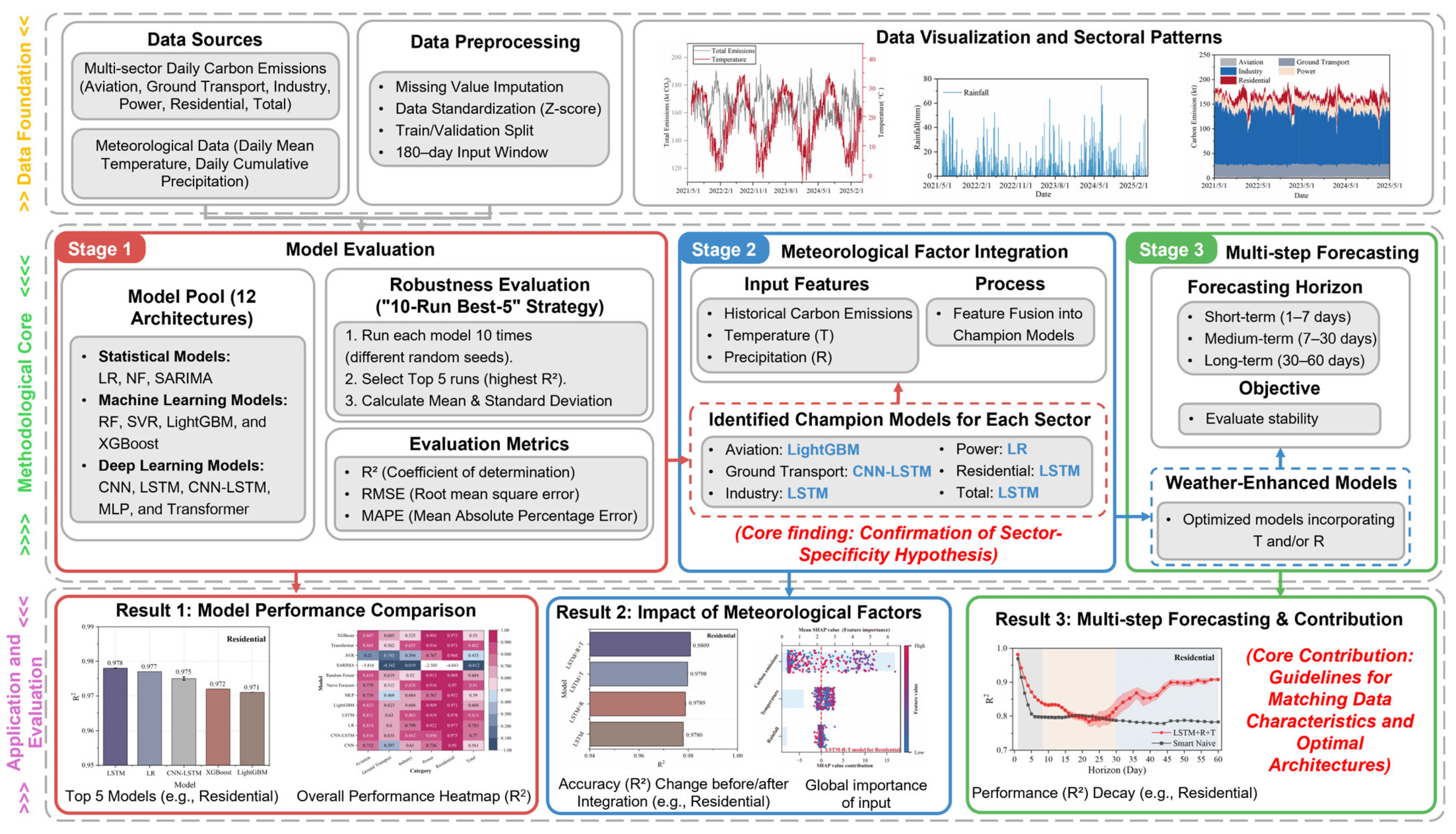
Our study employs a three-stage experimental framework to systematically evaluate the models (Figure 2). In Stage 1, we established a baseline by evaluating all candidate models on historical data to identify the optimal model for each sector. In Stage 2, we integrated meteorological factors (temperature and precipitation) into these sector-specific models to quantify their impact on predictive accuracy [31]; the contribution of each input feature was also assessed using the SHapley Additive exPlanations (SHAP) method [32]. Finally, in Stage 3, we evaluated the multi-step forecasting stability of the final optimal models, testing their ability to predict emissions up to a 60-day horizon [33].

2.5.2. Data Partitioning and Preprocessing

The dataset, covering the period from 1 June 2021, to 30 April 2025, was divided using a strict chronological split [34]. Data prior to 1 January 2024, was designated as the training set, while the subsequent data was used for validation. This approach prevents data leakage by ensuring the model is not exposed to future information during training, thus providing a robust evaluation of its forecasting performance.
For time-series models, the input length was set to 180 days to balance the model’s capture ability against the computational complexity. All input features and target variables were standardized using Z-score normalization, as listed in Equation (1).
X Z s c o r e = X μ t r a i n σ t r a i n
μ t r a i n and σ t r a i n are the mean and standard deviation of the training set, respectively. The standardization parameters are learned only from the training set and are then applied to the validation set to prevent data leakage.

2.5.3. Model Training and Performance Evaluation

For the DL models, we employed the Mean Squared Error (MSE) as the loss function, and model parameters were updated using the AdamW optimizer. AdamW is an adaptive moment estimation algorithm that incorporates decoupled weight decay, which helps to improve model generalization [35].
To prevent overfitting and enhance training efficiency, an Early Stopping strategy was applied to all DL models and gradient boosting models (LightGBM, XGBoost). With this strategy, the training process is automatically terminated if the model’s performance on the validation set does not improve for several continuous epochs. In this study, the patience value for the DL models was set to 25 in Phases 1 and 2 (30 in Phase 3), while for the gradient boosting models, it was set to 15.
We employed a suite of metrics, including Coefficient of Determination (R2), Mean Absolute Percentage Error (MAPE), and Root Mean Square Error (RMSE), to comprehensively evaluate the predictive performance of the models [8,36].
R2 measures the explanatory power of models for the target variable variance. It was calculated using Equation (2):
R 2 = 1 i = 1 n ( y i y i ^ ) 2 i = 1 n ( y i y i ¯ ) 2
MAPE measures the percentage of error relative to the true value. It was calculated using Equation (3):
M A P E = 1 n i = 1 n y i y i ^ y i × 100 %
RMSE measures the average magnitude of the difference between predicted and actual values. It was calculated using Equation (4):
R M S E = 1 n i = 1 n ( y i y i ^ ) 2
To account for the stochasticity of the training process, each model was trained 10 times with different random seeds. We selected the top five runs based on their R2 scores on the validation set. The final reported metrics R2, MAPE, RMSE, and their standard deviation (Std) were calculated from these five runs to provide a robust assessment of each model’s performance and stability.

3. Results

3.1. Model Performance Comparison

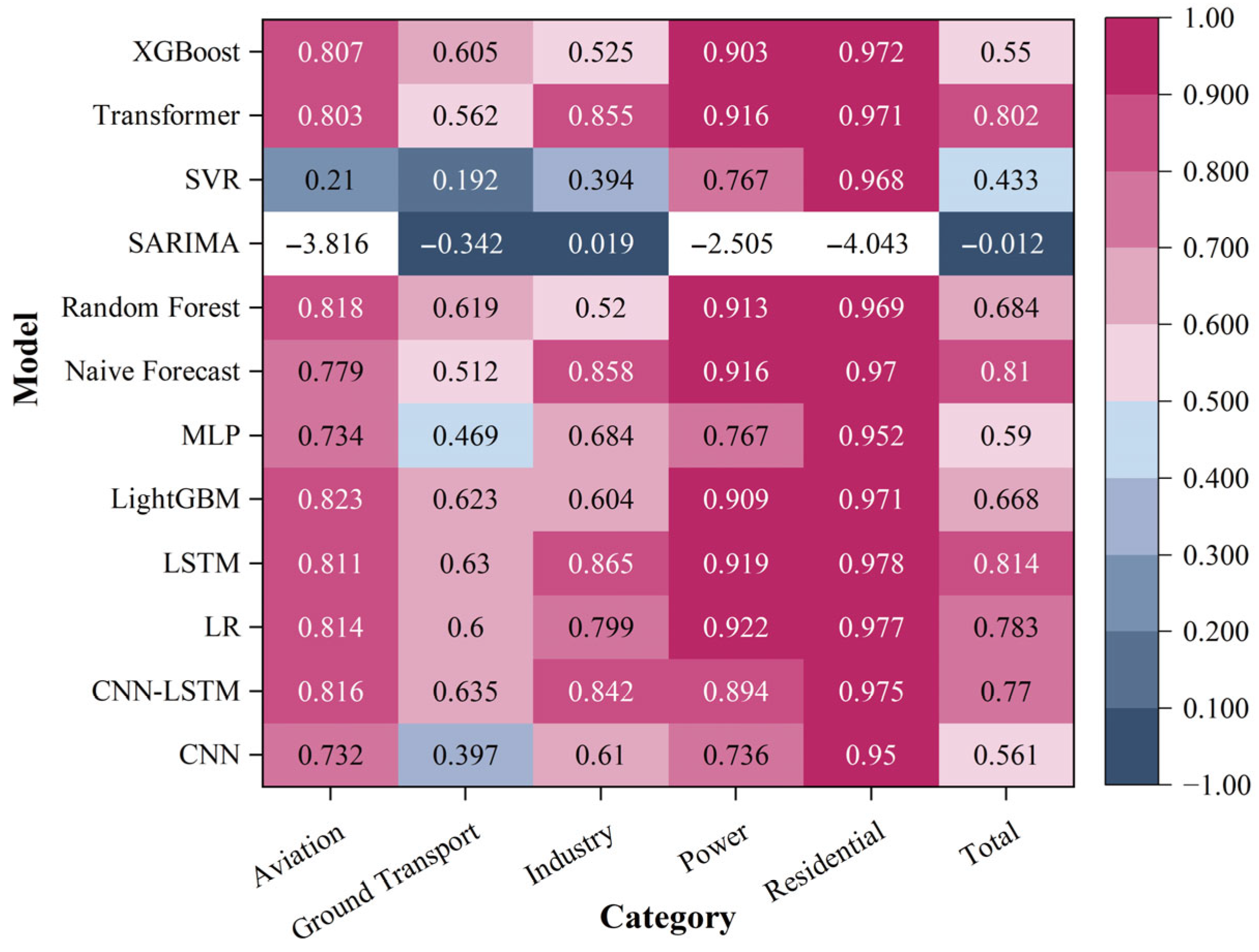
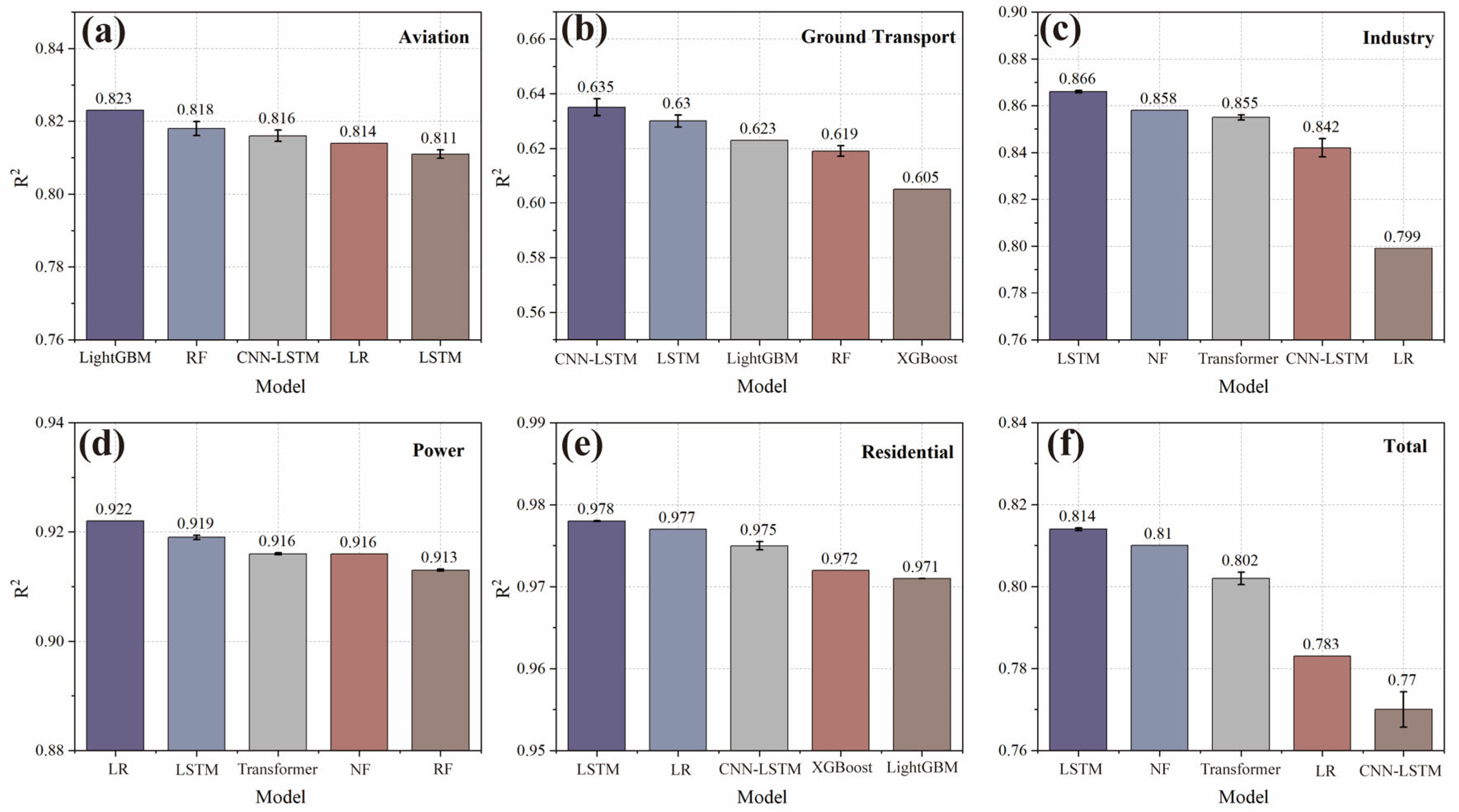
The performance of different candidate models across 6 sectors is presented in Figure 3 and Figure S2. First, DL models (e.g., LSTM, CNN-LSTM, and Transformer) consistently outperformed the statistical model (SARIMA) across all sectors. For instance, in the residential sector, the optimal LSTM model achieved an R2 of 0.978, whereas SARIMA yielded an R2 of −4.043. Predictability varied significantly across sectors. The residential and power sectors were the most predictable, with most models consistently achieving R2 values above 0.90. In contrast, the industry and ground transport sectors yielded lower R2 values (0.865 and 0.635, respectively).
As shown in Figure 4, the optimal predictive model varies by sector. For the aviation sector, the decision-tree-based LightGBM model performed best, achieving an R2 of 0.823. The hybrid CNN-LSTM model (R2 = 0.635) is particularly well-suited for ground transport sector. The LSTM model performed best for the industry, residential, and total sectors, with R2 values of 0.866, 0.978, and 0.814 respectively. For the power sector, LR performed best (R2 = 0.922).

3.2. Comprehensive Evaluation of Meteorological Influences

3.2.1. Lagged Correlation Analysis

This section quantifies the lagged relationship between meteorological factors and sectoral carbon emissions to understand the temporal dynamics of their influence. It serves primarily as a preliminary validation of physical mechanisms before the deployment of the subsequent deep learning models. Given the “black-box” nature of data-driven algorithms, it is crucial to first verify that the input dataset exhibits logical physical associations, such as the negative correlation between temperature and residential emissions driven by heating demand. This validation step ensures that the data possesses sufficient physical consistency and quality to support complex non-linear modeling.
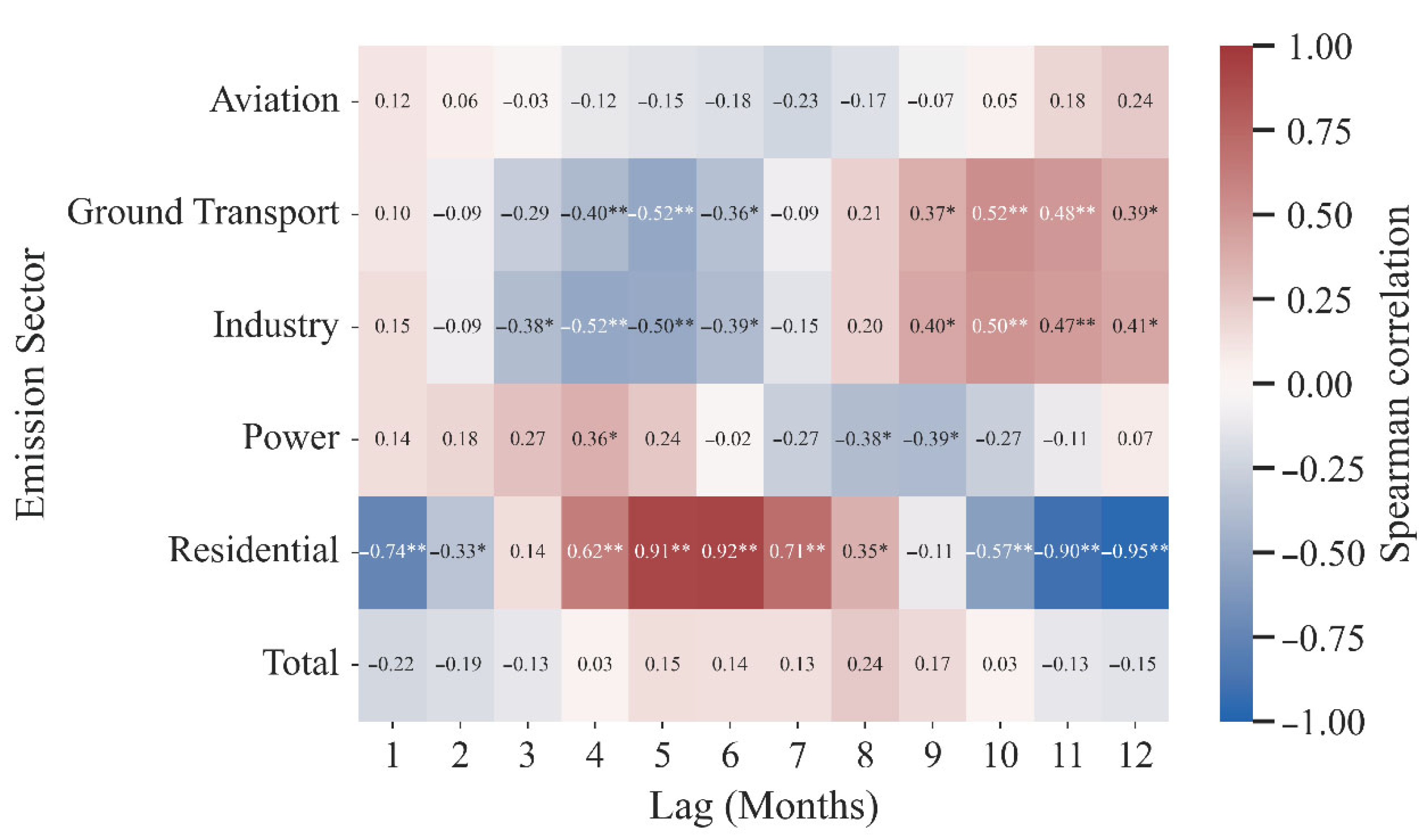
Temperature is a key meteorological factor, but its impact patterns differ significantly across sectors (Figure 5). The residential sector exhibited a strong negative correlation at 1-month and 12-month lags ( ρ = −0.74 and −0.95, respectively) and a strong positive correlation peaked at a 5- to 6-month lag ( ρ = 0.91 and 0.92, respectively). The ground transport and industry sectors showed a negative correlation at a 4- to 5-month lag and a positive correlation at a 10-month lag. The aviation sector showed the weakest correlation with temperature (all ρ < 0.25). Finally, emissions from the power sector and the total emissions are aggregates of multiple sectors with varying relationships to temperature. Their weak lagged correlations represent the net effect of these offsetting sectoral responses.
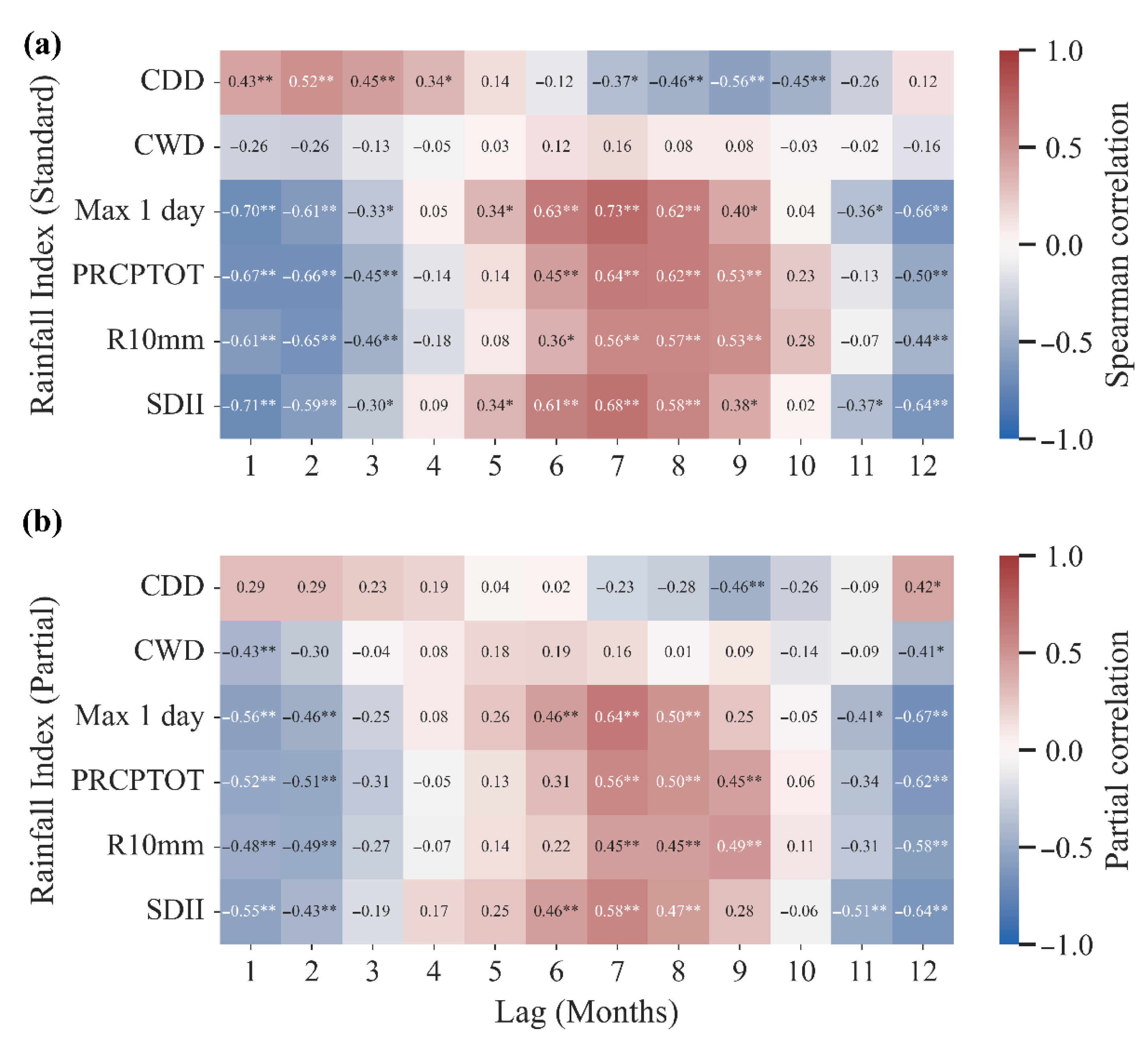
We analyzed the correlations between six extreme precipitation indices and sectoral carbon emissions, comparing standard correlations (Figure 6 and Figures S3a–S7a) with partial correlations that control for global climate indices (Figure 6 and Figures S3b–S7b). For all sectors, the correlations with extreme precipitation were weaker than those with temperature. Furthermore, the comparison between panels (a) and (b) in Figure 6 and Figure S3–S7 reveals that global climate indices did not significantly affect the local emission-precipitation relationship. The residential sector exhibited the strongest correlation (Figure 6). At short-term lags (1–2 months), precipitation indices (e.g., Max 1-day, PRCPTOT, R10mm, and SDII) showed a strong negative correlation with emissions (−0.71 < ρ < −0.59), which shifted to a strong positive correlation at mid-term lags (7–8 months) ( ρ from 0.56 to 0.73) and returned to a negative correlation at a 12-month lag ( ρ from −0.44 to −0.64).
As illustrated in Figures S3 and S4, the industry and ground transport sectors showed similar patterns, with a strong negative correlation between precipitation intensity and emissions at a 5- to 6-month lag. As with temperature, the aviation sector was largely unaffected (Figure S5), while the low net correlation for the power and total emission sectors resulted from the offsetting effects of their constituent parts (Figures S6 and S7).

3.2.2. Effect of Meteorological Factor Integration

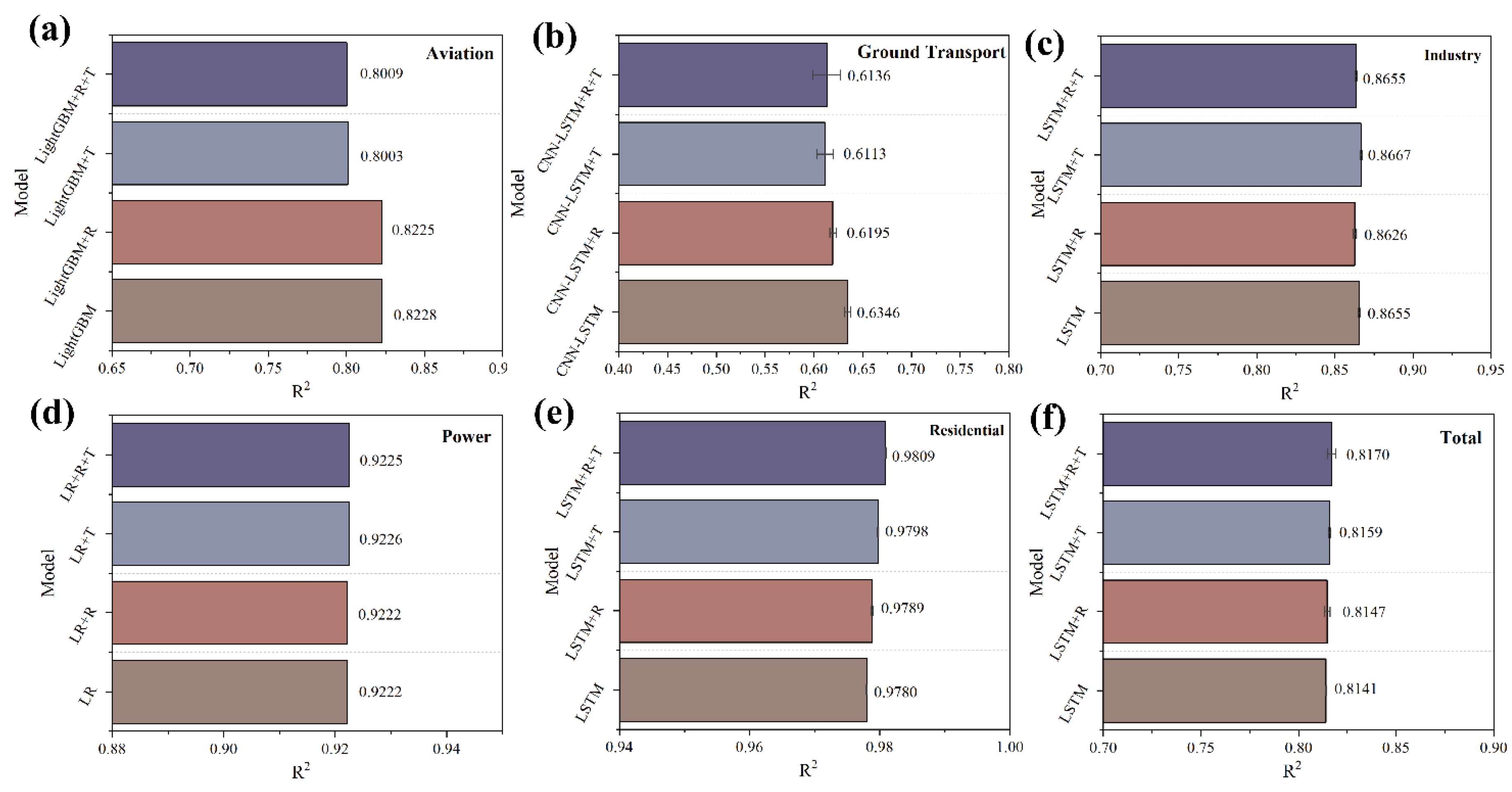
Based on the correlations between meteorological factors (temperature and precipitation) and carbon emissions (as described in Section 3.2.1), this study investigates the impact of integrating temperature and precipitation on model predictive performance. As shown in Figure 7, the integration of meteorological factors led to a decline in the predictive performance for the aviation (LightGBM) and ground transport (CNN-LSTM) sectors, with R2 values decreasing from 0.823 to 0.801 and from 0.635 to 0.614, respectively. For the residential sector, integrating either temperature or precipitation improved the LSTM model’s accuracy, and integrating both yielded the highest performance (R2 increased from 0.978 to 0.981). The integration slightly improved the predictive performance of the total carbon emission model (LSTM), but has almost no impact on the power and industry sectors.

3.2.3. Feature Contribution Analysis (SHAP)

To interpret the decision-making process of the models, we quantified the contributions of historical emissions and meteorological factors using the SHAP method [32]. SHAP provides a robust framework for model interpretation by calculating the marginal contribution (SHAP value) of each feature to a prediction [37,38]. Since the models for the aviation and ground transport sectors were not improved by meteorological data, this analysis focuses on the sectors where performance was enhanced: industry, power, residential, and total emissions. For the 180-day time-series inputs, the SHAP values for each feature were aggregated across the entire window to represent its overall impact on the model’s predictions.
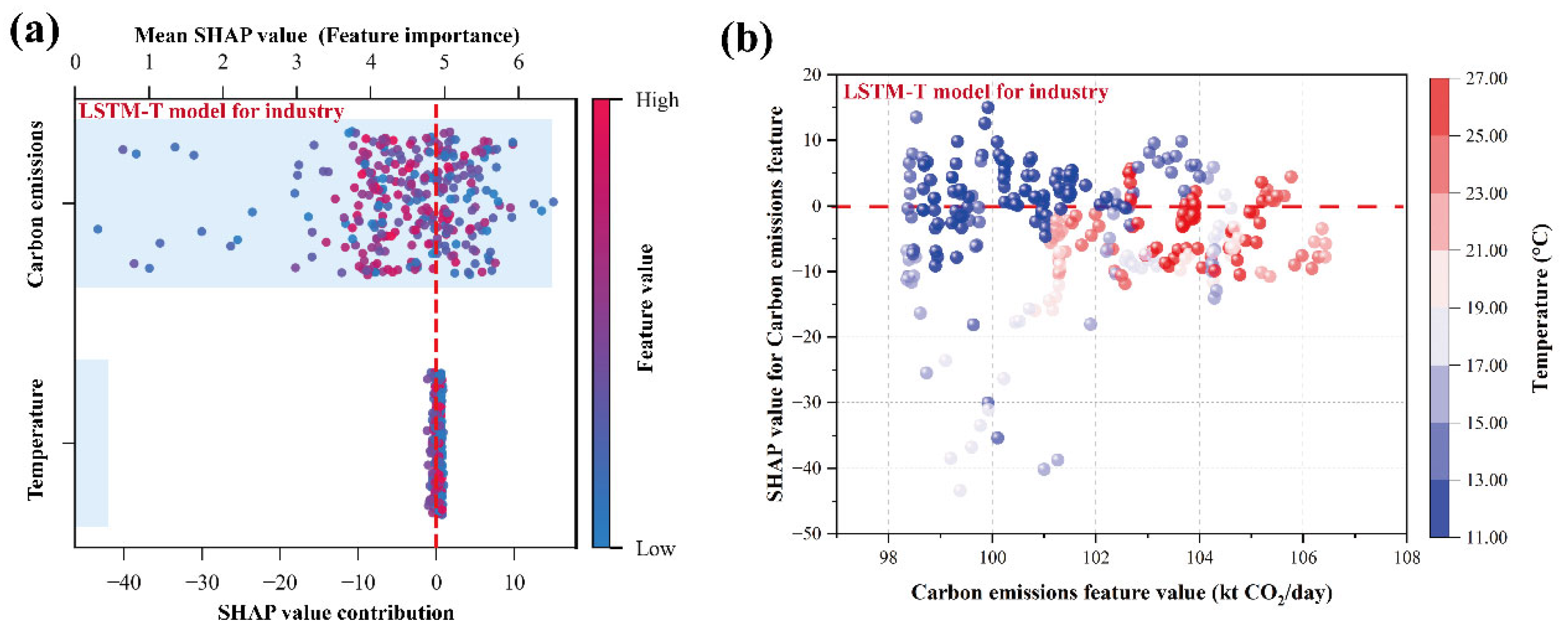
The SHAP analysis for the industry sector’s optimal model (LSTM-T) is presented in Figure 8. This analysis provides a quantitative validation of the findings established in the preceding sections. As shown in Figure 8a, historical carbon emissions were the predominant predictor (Mean SHAP = 6.46), significantly exceeding temperature (Mean SHAP = 0.43). The SHAP dependence plot (Figure 8b) showed that the combination of low historical emissions (<100 kt CO2/day) and low temperatures resulted in large negative SHAP values (as low as −40).
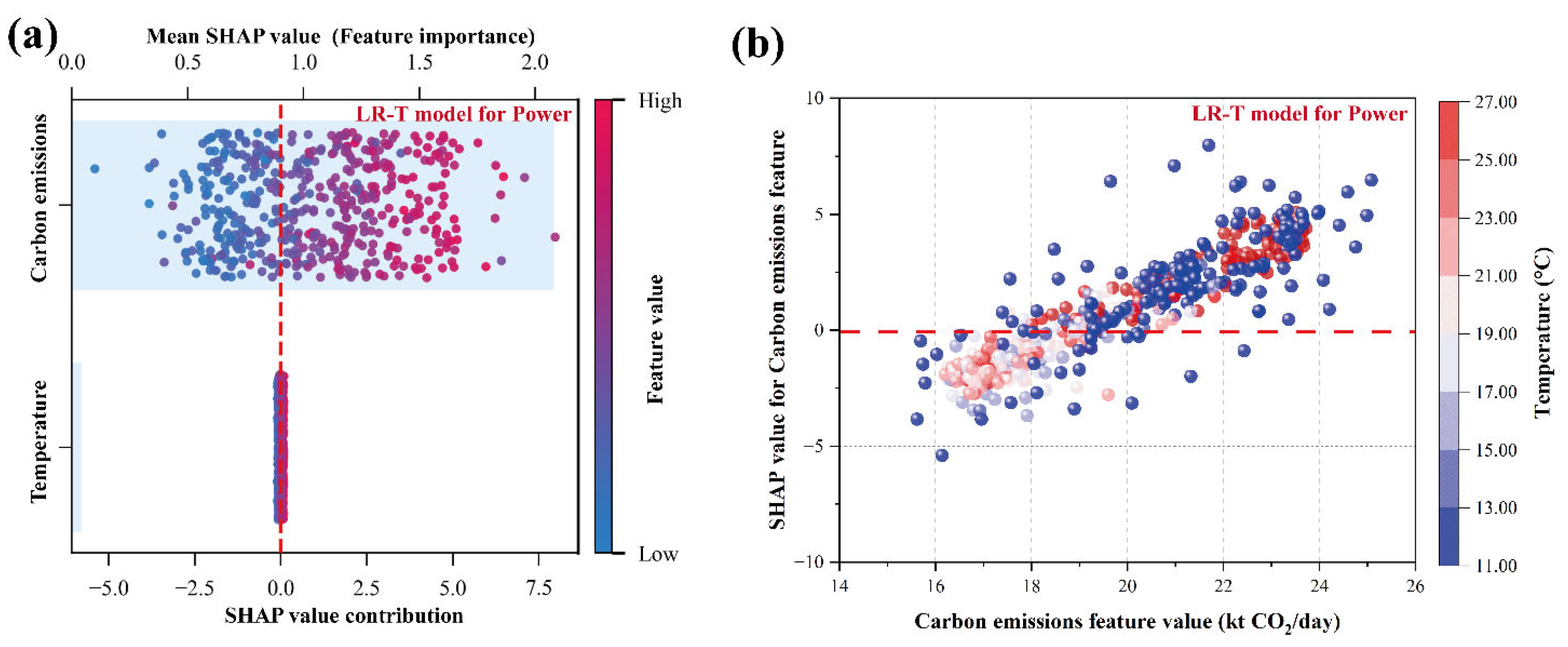
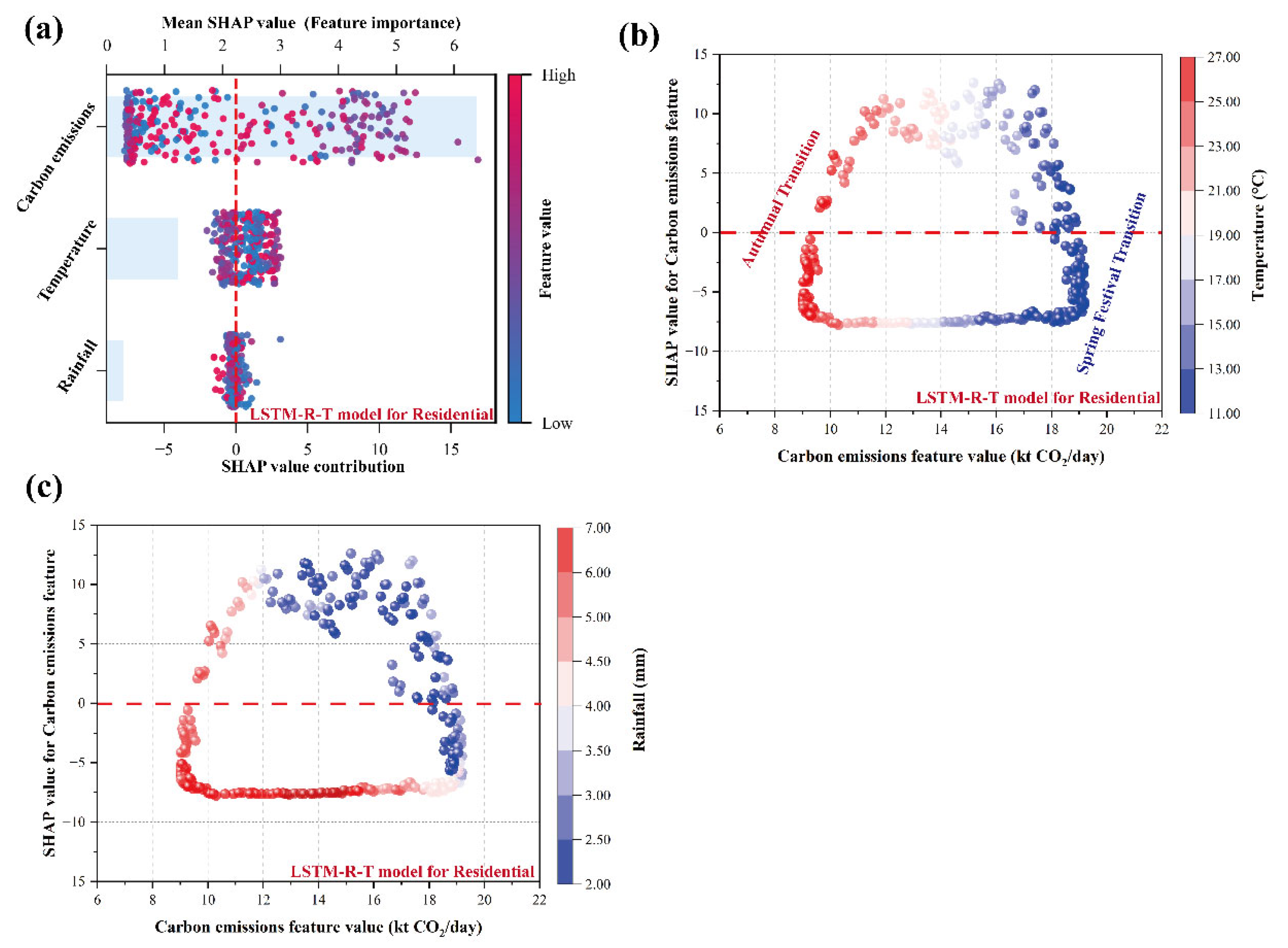
For the power sector, historical emissions had a Mean SHAP of 2.08, while temperature had a global importance of 0.04 (Figure 9a). However, the dependence plot (Figure 9b) revealed a distinct U-shaped relationship: High positive SHAP values, which drive higher emission predictions, consistently coincide with periods of either extremely high or extremely low historical temperatures. Conversely, periods of low emissions correspond to moderate temperatures. As shown in Figure 10a, historical emissions remain the primary predictor, with a Mean SHAP value of approximately 6.40. Furthermore, meteorological factors are more important for the residential sector than for the industrial and power sectors, with Mean SHAP values of 1.24 for temperature and 0.29 for rainfall. Figure 10b displayed a unique closed-loop structure. This loop is defined by two critical turning points. The first is the ‘Autumnal Transition’ in the top-left portion of the plot. Here, when historical emissions are low at approximately 10 kt CO2/day and temperatures begin to fall, the SHAP values sharply transition to become strongly positive and reach up to +12. The second turning point is the ‘Spring Festival Transition’ in the bottom-right. Conversely, when historical emissions are high at approximately 20 kt CO2/day and temperatures start to rise, the SHAP values abruptly shift to be strongly negative, dropping as low as −8. A strong seasonal association existed between emission changes and precipitation (Figure 10c). The positive SHAP value phase, corresponding to the autumn and winter seasons, is associated with a low-rainfall regime of approximately 2 to 4 mm. In contrast, the negative SHAP value phase, corresponding to the spring and summer, is linked to a high-rainfall regime of approximately 5 to 7 mm.
The SHAP analysis for total emissions, representing an aggregate of all sectors, reveals the complex superposition of different driving mechanisms (Figure 11). For total emissions, historical emissions dominated (Mean SHAP ≈ 7.76), but temperature (1.32) and rainfall (0.34) also contributed. As can be seen in Figure 11b, the highest emissions, above 164 kt CO2/day, occur in low temperatures below 18 °C. Furthermore, major socioeconomic disruptions, like holidays or lockdowns, generate strongly negative SHAP values. The rainfall dependence plot (Figure 11c) indicated a negative correlation between rainfall intensity and emission predictions.

3.3. Multi-Step Forecast Performance

To evaluate the long-term forecasting capabilities of the models, their multi-step prediction performance for horizons ranging from 1 to 60 days was examined and compared with the Smart Naive models. The Smart Naive models select the optimal result between the Naive forecast and seasonal Naive forecast models which using the value from the same day in the previous year. As illustrated in Figure 12, Figures S8 and S9, the predictive accuracy of all models declined as the forecast horizon was extended; however, the rate and pattern of the decline again exhibited significant sector specificity.
In the aviation sector (Figure 12a), the Smart Naive model was slightly superior to the LightGBM model in short-term horizons. However, in the medium term, the predictive capability of both models declined, with R2 values entering the negative range. Notably, for long-term forecasts up to a 60-day horizon, LightGBM demonstrated a marked advantage over the baseline (R2 = 0.383 vs. 0.244). For the ground transport sector (Figure 12b), the R2 value of the Smart Naive model decreased rapidly, becoming negative from day 3 onwards (R2 = −0.046). In contrast, the CNN-LSTM model maintained a relatively stable performance throughout the entire 60-day forecast horizon. In the industry sector (Figure 12c), the optimal LSTM + T model outperformed the baseline in both short- and medium-term forecasting. Specifically, on day 7, the R2 values for LSTM + T and the baseline were 0.326 and 0.115, respectively; on day 30, they were 0.070 and −0.032. Although the Smart Naive model demonstrated superior performance between days 34 and 48, the advantage of the LSTM + T model re-emerged at the 60-day horizon (R2 = 0.087 vs. −0.073). Conversely, in the power sector (Figure 12d), the performance of the LR + T model deteriorated in medium- to long-term forecasting. While LR + T was slightly superior in the short term (Day 7 R2: 0.393 vs. 0.340), its R2 became negative from day 25 onwards, dropping to −0.269 by day 60. Meanwhile, the R2 for the Smart Naive model stabilized in the range of 0.186 to 0.346. For the residential sector (Figure 12e), the LSTM-based models maintained high accuracy throughout the forecast horizon. Similarly, regarding total emissions (Figure 12f), the LSTM model consistently outperformed the baseline model across all forecast horizons.

4. Discussion

4.1. Heterogeneity in Sector-Specific Model Selection

For aviation, the superiority of the LightGBM model aligns with the fact that aviation emissions are driven by multiple, complex external factors (e.g., tourism seasons, economic conditions) rather than simple temporal continuity [39]. Tree-based ensemble methods like LightGBM is particularly effective for this type of data. Its core strength is its ability to process numerous input features and learn their non-linear interactions [40,41]. Unlike models that rely solely on sequential dependencies, LightGBM treats historical and external data as a set of inputs, giving it a distinct advantage [40,42]. This finding aligns with the review by Zhao et al. (2023), which highlights that tree-based ensemble methods often exhibit robust generalization capabilities in scenarios involving high-dimensional, non-linear socioeconomic drivers, whereas DL models may overfit without massive datasets [43]. For ground transport, the success of the CNN-LSTM model reflects the sector’s multi-scale temporal patterns [44,45]. The CNN component first acts as a feature extractor to identify local patterns, such as the shape of daily peaks. The LSTM component then processes these extracted patterns in sequence to learn their long-term relationships, such as the weekly cycle [46]. This finding is consistent with other studies demonstrating the model’s effectiveness for transport emissions [44]. The industrial emissions are driven by complex, event-driven patterns, such as the sharp decline during the Spring Festival (as discussed in Section 2.2), which are difficult for traditional models to capture [47,48]. The LSTM model (R2 = 0.866), as a neural network, uses “gating mechanisms” and “memory cells” to learn long-term dependencies from time series data [47,48,49]. This structure allows it to effectively model the annual drop during the Spring Festival. The lower predictability of emissions from the industrial and ground transportation sectors may be due to the existence of more complex and stochastic patterns influenced by non-periodic factors. In the power and residential sectors, the high predictability is attributable to their regular patterns, likely driven by seasonal heating and cooling demands (as mentioned in Section 2.2) [50]. LR performed best in the power sector (R2 = 0.922), indicating a strong linear relationship with its primary drivers where a simple model is sufficient [51,52]. In contrast, the residential sector’s stable pattern, primarily driven by winter heating, was captured with even greater precision by the more complex LSTM model (R2 = 0.978) [53]. This highlights the LSTM’s versatility, showing its architecture is effective not only for the event-driven patterns in the industrial sector but also for highly regular, climate-driven time series [48].

4.2. The Role of Meteorological Drivers

For the residential sector, lower winter temperatures directly increase heating demand, which in turn raises energy consumption and residential emissions. This establishes the fundamental negative correlation between lower temperatures and higher heating demand, with the 1-month lag attributable to building thermal inertia and the 12-month lag reflecting the variable’s strong annual cycle [54,55]. The strong positive correlation at a 5- to 6-month lag arises from teleconnections driven by large-scale climate oscillations. For example, the ENSO can cause an anomalously hot summer in a region, followed by an anomalously cold winter six months later [24]. Consequently, high emissions during the winter heating peak show a clear positive correlation with high summer temperatures from six months prior. This is primarily a statistical phenomenon arising from the inherent seasonality of both time series. Therefore, this positive correlation reflects the anti-phased seasonal cycles of temperature and residential emissions, rather than a direct causal relationship. For the industry and ground transport sectors, the negative correlation with a lag of 4–5 months, possibly due to temperature changes affecting corporate investment and inventory adjustments, leading to production delays [56]. The positive correlation with a lag of 10 months may be due to increased production in certain industrial sectors in late spring and early summer. Moreover, as Lehr et al. (2022) found that industrial electricity consumption increases by approximately 0.07% when daily average temperatures exceed 24 °C, as high summer temperatures raise emissions through increased cooling demand [57]. Because both economic activity and temperature have annual cycles, high temperatures in one summer can show a statistical positive correlation with high industrial activity and emissions during the next warm season 10 months later. The emission from aviation sector are primarily driven by macroeconomic factors and tourism seasons, resulting in the weak correlation with temperature [39]. Emissions from the power sector and the total emissions are aggregates of multiple sectors with varying relationships to temperature. Their weak lagged correlations represent the net effect of these offsetting sectoral responses. Because Hangzhou is located in a monsoon climate zone, precipitation and temperature are closely related (i.e., concurrent rainy and hot seasons), the correlation pattern between residential carbon emissions and precipitation is similar to that between emissions and temperature [58]. Severe floods can damage transport infrastructure or trigger supply chain disruptions. The persistent suppressive effect of these heavy rainfall events led to a sustained decrease in carbon emissions from the industry and ground transport sectors [59]. Therefore, emissions from these two sectors show a negative correlation with precipitation.
As established by Chandrashekar and Sahin (2014), including irrelevant or weakly correlated features can increase the model’s variance and lead to overfitting [60]. Although aviation operations are sensitive to meteorological conditions (e.g., delays caused by thunderstorms), the delayed flights usually operate within the same 24-h window, keeping the aggregate daily fuel consumption largely stable. Significant reductions in emissions only occur during rare mass cancellations (e.g., extreme typhoons), which are statistical outliers. Similar conclusions were drawn by Huo et al. (2023) in the transport sector, where they found that socio-economic factors (e.g., GDP, car ownership) were far more significant determinants than environmental variables [61]. Therefore, the emissions from aviation and ground transport sectors are primarily driven by socioeconomic activities and human mobility patterns rather than daily weather conditions [62], the weakly correlated meteorological data was likely treated as noise by the models. This, in turn, may have interfered with their ability to learn core patterns such as holiday effects and commuter rush hours [63,64]. Given that industry emission is primarily driven by production schedules and economic cycles, not daily weather, the addition of meteorological data provided no significant predictive value. Consequently, model performance remained unchanged. For the power sector, introducing meteorological data had a negligible effect on the performance of the LR model, with the R2 value remaining stable at around 0.922. This is likely because the LR model had already effectively captured the temperature-driven seasonal cycle through temporal features, making the direct temperature data redundant. Temperature and precipitation showed similar correlation patterns with the residential emission. Integrating either temperature or precipitation alone improved the accuracy of the LSTM model, and integrating both factors simultaneously led to a further increase in accuracy. This indicates that supplying the model with a strong external signal enables it to more precisely model residential energy consumption behavior driven by weather. Finally, for the total emissions, which represent a composite of all sectors, the overall performance of the LSTM model showed a modest improvement after introducing meteorological factors (R2 increased from 0.814 to 0.817). This was primarily due to the positive effect from the residential sector, whose performance gain was sufficient to offset the noise introduced by meteorological data in other sectors. It also reflects the LSTM model’s ability to effectively utilize relevant information when handling multivariate inputs [6,65].
It can be seen that the sensitivity to meteorological factors exhibits strong “sector specificity”. Meteorological data does not always act as a beneficial feature. Its value is dependent on the alignment between a specific sector’s emission patterns and its core drivers. Although weather data acts as a critical signal for the residential sector, it manifests as noise for the aviation and industry sectors. Therefore, achieving optimal forecasting performance requires not only selecting models based on the data characteristics of each sector but also carefully integrating external variables to avoid introducing noise.

4.3. Physical Interpretability of Data-Driven Models

The SHAP analysis provides physical validation for the “black-box” DL models. The SHAP analysis results for the industry sector further confirm that the performance of the LSTM-T model primarily depends on its ability to learn complex, event-driven historical data patterns within the sector. The large negative SHAP values associated with low emissions and temperatures (Figure 8b) correctly identify the production shutdowns during the Spring Festival holiday and the regional lockdowns during winter peaks of the COVID-19 pandemic [66,67,68]. The LR model used historical emissions data as the main predictor for the power sector (Figure 9a), a phenomenon that seems to contradict the established physical link between electricity demand and temperature [69]. The discrepancy is likely a statistical artifact of multicollinearity within the LR model [70]. Because both historical emissions and temperature are highly seasonal and strongly correlated, the model attributes their shared predictive variance almost exclusively to the historical emissions feature. This masks the underlying physical influence of temperature in the global SHAP analysis. However, the dependence plot (Figure 9b) illustrates this underlying influence. The distinct U-shaped relationship aligns well with established energy consumption patterns. Extreme temperatures necessitate greater energy use, primarily for air conditioning during summer and heating during winter [71]. The model has successfully captured this non-linear dynamic. Therefore, while the LR-T model primarily relies on historical emissions trends, temperature functions as a critical, physically meaningful regulator that affects the final output.
For residential sector, the SHAP analysis results collectively highlight that meteorological factor, particularly temperature, are significant and direct drivers of carbon emissions from the residential sector [72]. The strong negative correlation between emissions and temperature (Figure 10b), indicated that the direct energy consumption in the residential sector is predominantly driven by winter heating demand. This interpretation is consistent with standard carbon accounting methodologies, such as the IPCC guidelines [73]. According to these guidelines, emissions from electricity consumption for summer air conditioning are allocated to the direct emissions from the power sector, not the residential sector. Consequently, direct emissions from the residential sector are lowest during the summer, which provides a clear rationale for the negative correlation observed in the model. This finding is consistent with established physical mechanisms. The study by Santamouris et al. (2001) confirmed, through thermodynamic simulations, that elevated temperatures could double the cooling load while reducing the heating load by approximately 30% [72]. This physical mechanism aligns perfectly with the high sensitivity and non-linear negative correlation between air temperature and emissions observed in our data-driven SHAP analysis. Moreover, the loop structure in Figure 10b demonstrates that the LSTM model has identified the onset and end of heating season and adjust its predictions accordingly. Due to Hangzhou’s climate characteristics of cold and dry winters and warm and humid summers, although the relationship between residential sector carbon emissions and rainfall (Figure 10c) is similar to that between emissions and temperature, rainfall is likely only a proxy indicator for seasonal changes and related temperature variations. Therefore, rainfall’s contribution to model predictions is lower than that of temperature (Figure 10a). The negative correlation (Figure 10b) between emissions and temperature confirmed that the societal winter peak from combined heating loads surpasses the summer cooling peak. Higher rainfall consistently corresponds to lower SHAP values and suppressed predictions. This relationship likely stems from collinearity with seasonality but may also reflect physical mechanisms, such as increased hydropower generation [74] or the curtailment of outdoor economic activities during heavy rain [75].

4.4. Stability in Long-Horizon Forecasting

For the aviation sector, driven by multiple complex factors [39], while a simple model can address short-term regularities, LightGBM as an ensemble model is capable of learning the deep non-linear relationships inherent to the sector, thereby maintaining its robustness in long-term forecasting [48]. Simple baseline model (Smart Naive) is inadequate for handling the complex patterns with multiple periodicities characteristic of the ground transport sector (as detailed in Section 3.2), causing its predictive performance to decline rapidly. The hybrid architecture of the CNN-LSTM enables it to effectively deconstruct the multi-level temporal patterns of ground transport sector, with the CNN component extracting local features while the LSTM component learns long-term dependencies. This structural advantage suggests that the CNN-LSTM model has greater potential for addressing the challenges of multi-step forecasting for complex time series [44,65]. Emissions from the industry sector are characterized by pronounced aperiodic and event-driven patterns (e.g., shutdowns for the Spring Festival). The inherent ability of the LSTM architecture to capture long-term dependencies and complex patterns allows it to outperform its corresponding baseline model in long-term forecasts for the industry sector [76]. For power sector emissions, which exhibit significant cyclicality, simple baseline models independent of external variables exhibit robust effectiveness in medium- to long-term forecasting by replicating historical seasonal patterns [77]. The failure of the LR + T model illustrates the mechanism of “recursive error accumulation.” Simple regression models lack an internal state to store long-term context; thus, a small error at step t + 1 is fed back as input for t + 2, propagating exponentially [78]. In contrast, the LSTM architecture utilizes gating mechanisms (forget, input, and output gates) to selectively retain long-term dependencies and filter out short-term noise, thereby maintaining stability over extended horizons [43]. Additionally, LSTM + R + T can learn both historical periodicities and the deep non-linear relationship between temperature and residential energy consumption [48,79]. These advantages explain why LSTM-based models could maintain high accuracy in the residential sector even up to a 60-day horizon, validating their suitability for medium-term policy planning. Total emissions, as a composite of all sectoral emissions, exhibit a complex data pattern formed by the superposition of individual sector dynamics. This pattern comprises multiple signals—including periodic, aperiodic, linear, and non-linear components—making it difficult to forecast. The LSTM model is capable of learning from and distinguishing between the different dominant patterns within these mixed signals. It can partially identify and leverage the strong periodic signals from sectors such as power and residential, while not being overly influenced by the noise from sectors like industry [65]. Consequently, even in highly challenging long-term forecasting tasks, it demonstrates far superior risk-control capabilities and robustness compared to simpler models [29].

5. Conclusions

This study established a decision-support framework to address “sector specificity” in high-frequency urban carbon forecasting. By systematically evaluating 12 models across six sectors in Hangzhou, we demonstrated that generalized approaches are insufficient for accurate management. Results confirmed that optimal architectures are strictly sector-dependent. For example, CNN components were best for the short-term, cyclical patterns in ground transport, while LSTM architectures were better for the long-term dependencies in the residential and industrial sectors. Furthermore, the integration of meteorological data proved to be a double-edged sword; it significantly enhanced predictive accuracy for weather-sensitive sectors like residential and power but introduced feature noise that degraded performance for aviation and ground transport. In multi-step forecasting, LSTM-based models demonstrated superior stability over 60-day horizons, overcoming the rapid error accumulation observed in linear regression models.
These findings support differentiated decarbonization policies. For residential and power sectors, utility managers should integrate high-resolution weather data into emission forecast systems to buffer against climate-induced peak loads. Conversely, aviation and ground transport policies should prioritize schedule optimization and traffic efficiency rather than climate adaptation. For the event-driven industry sector, flexible limits that account for production volatility are superior to static ones. This approach helps cities move from general goals to specific actions tailored for each sector.
Future research needs to extend this framework to diverse geographic regions and incorporate high-frequency economic proxies, so as to address the limitations of this study.

Supplementary Materials

The following supporting information can be downloaded at https://www.mdpi.com/article/10.3390/su18010019/s1, Figure S1: Time series data of carbon daily emissions from different sectors; Figure S2: Performance metrics of the forecasting models across different sectors: (a) MAPE and (b) RMSE; Figure S3: Lagged correlation between industry carbon emissions and extreme precipitation indices: (a) Standard Spearman correlation and (b) Partial correlation controlling for global climate indices. (* denotes statistical significance at the 5% level (p < 0.05), and ** denotes statistical significance at the 1% level (p < 0.01).); Figure S4: Lagged correlation between ground transport carbon emissions and extreme precipitation indices: (a) Standard Spearman correlation and (b) Partial correlation controlling for global climate indices. (* denotes statistical significance at the 5% level (p < 0.05), and ** denotes statistical significance at the 1% level (p < 0.01).); Figure S5: Lagged correlation between aviation carbon emissions and extreme precipitation indices: (a) Standard Spearman correlation and (b) Partial correlation controlling for global climate indices. (* denotes statistical significance at the 5% level (p < 0.05)); Figure S6: Lagged correlation between power carbon emissions and extreme precipitation indices: (a) Standard Spearman correlation and (b) Partial correlation controlling for global climate indices. (* denotes statistical significance at the 5% level (p < 0.05), and ** denotes statistical significance at the 1% level (p < 0.01).); Figure S7: Lagged correlation between total carbon emissions and extreme precipitation indices: (a) Standard Spearman correlation and (b) Partial correlation controlling for global climate indices. (* denotes statistical significance at the 5% level (p < 0.05)); Figure S8: MAPE of the optimal models over different forecast horizons for each sector: (a) Aviation, (b) Ground transport, (c) Industry, (d) Power, (e) Residential, and (f) Total emissions; Figure S9: RMSE of the optimal models over different forecast horizons for each sector: (a) Aviation, (b) Ground transport, (c) Industry, (d) Power, (e) Residential, and (f) Total emissions.

Author Contributions

Conceptualization, W.H. and P.Z.; methodology, P.Z.; software, P.Z.; validation, W.H. and D.X.; formal analysis, J.H.; investigation, W.H.; resources, J.H.; data curation, P.Z.; writing—original draft preparation, W.H.; writing—review and editing, W.H.; visualization, P.Z.; supervision, D.X.; project administration, Y.Y.; funding acquisition, W.H. All authors have read and agreed to the published version of the manuscript.

Funding

This research was funded by the Nanxun Scholars Program for Young Scholars of ZJWEU (Project No. RC2023021207) and the Joint Funds of the Zhejiang Provincial Natural Science Foundation of China (Project No. LZJWZ22E090004).

Institutional Review Board Statement

Not applicable.

Informed Consent Statement

Not applicable.

Data Availability Statement

The datasets used in this work are publicly accessible as follows: the daily multi-sector carbon emission data are available at: https://www.carbonmonitor.org.cn/ (accessed on 20 August 2025); the meteorological data are available at: http://data.cma.cn (accessed on 10 April 2025).

Conflicts of Interest

The authors declare no conflicts of interest. The findings and conclusions presented in this paper are based solely on the analyzed data and do not reflect the interests of the affiliated institutions.

References

  1. Pan, X.; Wang, L.; Chen, W.; Robiou Du Pont, Y.; Clarke, L.; Yang, L.; Wang, H.; Lu, X.; He, J. Decarbonizing China’s Energy System to Support the Paris Climate Goals. Sci. Bull. 2022, 67, 1406–1409. [Google Scholar] [CrossRef] [PubMed]
  2. Shan, Y.; Guan, Y.; Hang, Y.; Zheng, H.; Li, Y.; Guan, D.; Li, J.; Zhou, Y.; Li, L.; Hubacek, K. City-Level Emission Peak and Drivers in China. Sci. Bull. 2022, 67, 1910–1920. [Google Scholar] [CrossRef] [PubMed]
  3. Zhang, Z.; Jia, J.; Guo, Y.; Wu, B.; Chen, C. Scenario of Carbon Dioxide (CO2) Emission Peaking and Reduction Path Implication in Five Northwestern Provinces of China by the Low Emissions Analysis Platform (LEAP) Model. Front. Energy Res. 2022, 10, 983751. [Google Scholar] [CrossRef]
  4. Hou, L.; Chen, H. The Prediction of Medium- and Long-Term Trends in Urban Carbon Emissions Based on an ARIMA-BPNN Combination Model. Energies 2024, 17, 1856. [Google Scholar] [CrossRef]
  5. Yang, L.-H.; Ye, F.-F.; Hu, H.; Lu, H.; Wang, Y.-M.; Chang, W.-J. A Data-Driven Rule-Base Approach for Carbon Emission Trend Forecast with Environmental Regulation and Efficiency Improvement. Sustain. Prod. Consum. 2024, 45, 316–332. [Google Scholar] [CrossRef]
  6. Ding, L.; Zhang, R.; Zhao, X. Forecasting Carbon Price in China Unified Carbon Market Using a Novel Hybrid Method with Three-Stage Algorithm and Long Short-Term Memory Neural Networks. Energy 2024, 288, 129761. [Google Scholar] [CrossRef]
  7. Sun, Y.; Qu, Z.; Liu, Z.; Li, X. Hierarchical Multi-Scale Decomposition and Deep Learning Ensemble Framework for Enhanced Carbon Emission Prediction. Mathematics 2025, 13, 1924. [Google Scholar] [CrossRef]
  8. Han, Z.; Cui, B.; Xu, L.; Wang, J.; Guo, Z. Coupling LSTM and CNN Neural Networks for Accurate Carbon Emission Prediction in 30 Chinese Provinces. Sustainability 2023, 15, 13934. [Google Scholar] [CrossRef]
  9. Ji, R. Research on Factors Influencing Global Carbon Emissions and Forecasting Models. Sustainability 2024, 16, 10782. [Google Scholar] [CrossRef]
  10. Liu, W.; Cai, D.; Nkou Nkou, J.; Liu, W.; Huang, Q. A Survey of Carbon Emission Forecasting Methods Based on Neural Networks. In Proceedings of the 2023 5th Asia Energy and Electrical Engineering Symposium (AEEES), Chengdu, China, 23 March 2023; pp. 1546–1551. [Google Scholar]
  11. Tan, J.; Wang, J.; Wang, H.; Liu, Z.; Zeng, N.; Yan, R.; Dou, X.; Wang, X.; Wang, M.; Jiang, F.; et al. Influence of Extreme 2022 Heatwave on Megacities’ Anthropogenic CO2 Emissions in Lower-Middle Reaches of the Yangtze River. Sci. Total Environ. 2024, 951, 175605. [Google Scholar] [CrossRef]
  12. Dou, X.; Hong, J.; Ciais, P.; Chevallier, F.; Yan, F.; Yu, Y.; Hu, Y.; Huo, D.; Sun, Y.; Wang, Y.; et al. Near-Real-Time Global Gridded Daily CO2 Emissions 2021. Sci. Data 2023, 10, 69. [Google Scholar] [CrossRef] [PubMed]
  13. Liu, Z.; Ciais, P.; Deng, Z.; Davis, S.J.; Zheng, B.; Wang, Y.; Cui, D.; Zhu, B.; Dou, X.; Ke, P.; et al. Carbon Monitor, a near-Real-Time Daily Dataset of Global CO2 Emission from Fossil Fuel and Cement Production. Sci. Data 2020, 7, 392. [Google Scholar] [CrossRef] [PubMed]
  14. Morakinyo, T.E.; Ren, C.; Shi, Y.; Lau, K.K.-L.; Tong, H.-W.; Choy, C.-W.; Ng, E. Estimates of the Impact of Extreme Heat Events on Cooling Energy Demand in Hong Kong. Renew. Energy 2019, 142, 73–84. [Google Scholar] [CrossRef]
  15. Zhang, M.; Chen, Y.; Hu, W.; Deng, N.; He, W. Exploring the Impact of Temperature Change on Residential Electricity Consumption in China: The ‘Crowding-out’ Effect of Income Growth. Energy Build. 2021, 245, 111040. [Google Scholar] [CrossRef]
  16. Zhang, M.; Zhang, K.; Hu, W.; Zhu, B.; Wang, P.; Wei, Y.-M. Exploring the Climatic Impacts on Residential Electricity Consumption in Jiangsu, China. Energy Policy 2020, 140, 111398. [Google Scholar] [CrossRef]
  17. Li, Y.; Sun, Y. Modeling and Predicting City-Level CO2 Emissions Using Open Access Data and Machine Learning. Environ. Sci. Pollut. Res. 2021, 28, 19260–19271. [Google Scholar] [CrossRef]
  18. Shan, Y.; Guan, D.; Hubacek, K.; Zheng, B.; Davis, S.J.; Jia, L.; Liu, J.; Liu, Z.; Fromer, N.; Mi, Z.; et al. City-Level Climate Change Mitigation in China. Sci. Adv. 2018, 4, eaaq0390. [Google Scholar] [CrossRef]
  19. Wang, K.; Zhang, H.; Bao, M.; Li, Z.; Fan, G. Climatic Characteristics of Centennial and Extreme Precipitation in Hangzhou, China. Environ. Res. Commun. 2024, 6, 85015. [Google Scholar] [CrossRef]
  20. Xia, C.; Xiang, M.; Fang, K.; Li, Y.; Ye, Y.; Shi, Z.; Liu, J. Spatial-Temporal Distribution of Carbon Emissions by Daily Travel and Its Response to Urban Form: A Case Study of Hangzhou, China. J. Clean. Prod. 2020, 257, 120797. [Google Scholar] [CrossRef]
  21. Liu, Z.; Ciais, P.; Deng, Z.; Lei, R.; Davis, S.J.; Feng, S.; Zheng, B.; Cui, D.; Dou, X.; Zhu, B.; et al. Near-Real-Time Monitoring of Global CO2 Emissions Reveals the Effects of the COVID-19 Pandemic. Nat. Commun. 2020, 11, 5172. [Google Scholar] [CrossRef]
  22. Hsiang, S. Climate Econometrics. Annu. Rev. Resour. Econ. 2016, 8, 43–75. [Google Scholar] [CrossRef]
  23. Bloom, A.A.; Bowman, K.W.; Liu, J.; Konings, A.G.; Worden, J.R.; Parazoo, N.C.; Meyer, V.; Reager, J.T.; Worden, H.M.; Jiang, Z.; et al. Lagged Effects Regulate the Inter-Annual Variability of the Tropical Carbon Balance. Biogeosciences 2020, 17, 6393–6422. [Google Scholar] [CrossRef]
  24. Stenseth, N.C.; Mysterud, A.; Ottersen, G.; Hurrell, J.W.; Chan, K.-S.; Lima, M. Ecological Effects of Climate Fluctuations. Science 2002, 297, 1292–1296. [Google Scholar] [CrossRef] [PubMed]
  25. Kour, M. Modelling and Forecasting of Carbon-Dioxide Emissions in South Africa by Using ARIMA Model. Int. J. Environ. Sci. Technol. 2023, 20, 11267–11274. [Google Scholar] [CrossRef]
  26. Kumari, S.; Singh, S.K. Machine Learning-Based Time Series Models for Effective CO2 Emission Prediction in India. Environ. Sci. Pollut. Res. 2022, 30, 116601–116616. [Google Scholar] [CrossRef]
  27. Adegboye, O.R.; Feda, A.K.; Agyekum, E.B.; Mbasso, W.F.; Kamel, S. Towards Greener Futures: SVR-Based CO2 Prediction Model Boosted by SCMSSA Algorithm. Heliyon 2024, 10, e31766. [Google Scholar] [CrossRef]
  28. Zhang, H.; Peng, J.; Wang, R.; Zhang, M.; Gao, C.; Yu, Y. Use of Random Forest Based on the Effects of Urban Governance Elements to Forecast CO2 Emissions in Chinese Cities. Heliyon 2023, 9, e16693. [Google Scholar] [CrossRef]
  29. Rajagukguk, R.A.; Ramadhan, R.A.A.; Lee, H.-J. A Review on Deep Learning Models for Forecasting Time Series Data of Solar Irradiance and Photovoltaic Power. Energies 2020, 13, 6623. [Google Scholar] [CrossRef]
  30. Özmen, E.S. Time Series Performance and Limitations with SARIMAX: An Application with Retail Store Data. Turk. Stud. 2021, 16, 1583–1592. [Google Scholar] [CrossRef]
  31. Ramachandram, D.; Taylor, G.W. Deep Multimodal Learning: A Survey on Recent Advances and Trends. IEEE Signal Process. Mag. 2017, 34, 96–108. [Google Scholar] [CrossRef]
  32. Lundberg, S.; Lee, S.-I. A Unified Approach to Interpreting Model Predictions. In Proceedings of the Advances in Neural Information Processing Systems, Long Beach, CA, USA, 4–9 December 2017; Volume 30. [Google Scholar]
  33. Ben Taieb, S.; Bontempi, G.; Atiya, A.F.; Sorjamaa, A. A Review and Comparison of Strategies for Multi-Step Ahead Time Series Forecasting Based on the NN5 Forecasting Competition. Expert Syst. Appl. 2012, 39, 7067–7083. [Google Scholar] [CrossRef]
  34. Cerqueira, V.; Torgo, L.; Mozetič, I. Evaluating Time Series Forecasting Models: An Empirical Study on Performance Estimation Methods. Mach. Learn. 2020, 109, 1997–2028. [Google Scholar] [CrossRef]
  35. Loshchilov, I.; Hutter, F. Decoupled Weight Decay Regularization. arXiv 2019, arXiv:1711.05101. [Google Scholar] [CrossRef]
  36. Sun, W.; Ren, C. Short-Term Prediction of Carbon Emissions Based on the EEMD-PSOBP Model. Environ. Sci. Pollut. Res. 2021, 28, 56580–56594. [Google Scholar] [CrossRef] [PubMed]
  37. Chen, Z.; Xiao, F.; Guo, F.; Yan, J. Interpretable Machine Learning for Building Energy Management: A State-of-the-Art Review. Adv. Appl. Energy 2023, 9, 100123. [Google Scholar] [CrossRef]
  38. Liu, Y.; Liu, Z.; Luo, X.; Zhao, H. Diagnosis of Parkinson’s Disease Based on SHAP Value Feature Selection. Biocybern. Biomed. Eng. 2022, 42, 856–869. [Google Scholar] [CrossRef]
  39. Owen, B.; Lee, D.S.; Lim, L. Flying into the Future: Aviation Emissions Scenarios to 2050. Environ. Sci. Technol. 2010, 44, 2255–2260. [Google Scholar] [CrossRef]
  40. Shobana Bai, F.J.J. A Machine Learning Approach for Carbon Di Oxide and Other Emissions Characteristics Prediction in a Low Carbon Biofuel-Hydrogen Dual Fuel Engine. Fuel 2023, 341, 127578. [Google Scholar] [CrossRef]
  41. Wu, Y.; Luo, M.; Ding, S.; Han, Q. Using a Light Gradient-Boosting Machine–Shapley Additive Explanations Model to Evaluate the Correlation between Urban Blue–Green Space Landscape Spatial Patterns and Carbon Sequestration. Land 2024, 13, 1965. [Google Scholar] [CrossRef]
  42. Esfandi, T.; Sadeghnejad, S.; Jafari, A. Effect of Reservoir Heterogeneity on Well Placement Prediction in CO2-EOR Projects Using Machine Learning Surrogate Models: Benchmarking of Boosting-Based Algorithms. Geoenergy Sci. Eng. 2024, 233, 212564. [Google Scholar] [CrossRef]
  43. Zhao, Y.; Liu, R.; Liu, Z.; Liu, L.; Wang, J.; Liu, W. A Review of Macroscopic Carbon Emission Prediction Model Based on Machine Learning. Sustainability 2023, 15, 6876. [Google Scholar] [CrossRef]
  44. Mekouar, Y.; Saleh, I.; Karim, M. GreenNav: Spatiotemporal Prediction of CO2 Emissions in Paris Road Traffic Using a Hybrid CNN-LSTM Model. Network 2025, 5, 2. [Google Scholar] [CrossRef]
  45. Xiang, J.; Ghaffarpasand, O.; Pope, F.D. Assessing the Impact of Calendar Events upon Urban Vehicle Behaviour and Emissions Using Telematics Data. Smart Cities 2024, 7, 3071–3094. [Google Scholar] [CrossRef]
  46. Rajalakshmi, V.; Ganesh Vaidyanathan, S. Hybrid CNN-LSTM for Traffic Flow Forecasting. In Proceedings of 2nd International Conference on Artificial Intelligence: Advances and Applications; Springer: Singapore, 2022. [Google Scholar]
  47. Ajala, A.A.; Adeoye, O.L.; Salami, O.M.; Jimoh, A.Y. An Examination of Daily CO2 Emissions Prediction through a Comparative Analysis of Machine Learning, Deep Learning, and Statistical Models. Environ. Sci. Pollut. Res. 2025, 32, 2510–2535. [Google Scholar] [CrossRef] [PubMed]
  48. Radha, C.; Elangovan, D. A Big Data-Driven LSTM Approach for Accurate Carbon Emission Prediction in Low-Carbon Economies. Nanotechnol. Percept. 2024, 20, 2017–2030. [Google Scholar]
  49. Wei, X.; Xu, Y. Research on Carbon Emission Prediction and Economic Policy Based on TCN-LSTM Combined with Attention Mechanism. Front. Ecol. Evol. 2023, 11, 1270248. [Google Scholar] [CrossRef]
  50. Kim, H.; Park, S.; Kim, S. Time-Series Clustering and Forecasting Household Electricity Demand Using Smart Meter Data. Energy Rep. 2023, 9, 4111–4121. [Google Scholar] [CrossRef]
  51. Kuster, C.; Rezgui, Y.; Mourshed, M. Electrical Load Forecasting Models: A Critical Systematic Review. Sustain. Cities Soc. 2017, 35, 257–270. [Google Scholar] [CrossRef]
  52. Sosa, G.R.; Falah, M.Z.; Dika Fikri, L.; Wibawa, A.P.; Handayani, A.N.; Hammad, J.A.H. Forecasting Electrical Power Consumption Using ARIMA Method Based on kWh of Sold Energy. Sci. Inf. Technol. Lett. 2021, 2, 9–15. [Google Scholar] [CrossRef]
  53. Nematirad, R.; Pahwa, A.; Natarajan, B. SPDNet: Seasonal-Periodic Decomposition Network for Advanced Residential Demand Forecasting. arXiv 2025, arXiv:2503.22485. [Google Scholar] [CrossRef]
  54. Martínez Comesaña, M.; Febrero-Garrido, L.; Troncoso-Pastoriza, F.; Martínez-Torres, J. Prediction of Building’s Thermal Performance Using LSTM and MLP Neural Networks. Appl. Sci. 2020, 10, 7439. [Google Scholar] [CrossRef]
  55. Moreno-Carbonell, S.; Sánchez-Úbeda, E.F.; Muñoz, A. Time Series Decomposition of the Daily Outdoor Air Temperature in Europe for Long-Term Energy Forecasting in the Context of Climate Change. Energies 2020, 13, 1569. [Google Scholar] [CrossRef]
  56. Chen, X.; Yang, L. Temperature and Industrial Output: Firm-Level Evidence from China. J. Environ. Econ. Manag. 2019, 95, 257–274. [Google Scholar] [CrossRef]
  57. Lehr, J.; Rehdanz, K. The Effect of Temperature on Energy Use, CO2 Emissions, and Economic Performance in German Industry. Energy Econ. 2022, 138, 107818. [Google Scholar] [CrossRef]
  58. Wang, B.; Ding, Q. Global Monsoon: Dominant Mode of Annual Variation in the Tropics. Dyn. Atmos. Ocean. 2008, 44, 165–183. [Google Scholar] [CrossRef]
  59. Liu, Y.; Song, W. Influences of Extreme Precipitation on China’s Mining Industry. Sustainability 2019, 11, 6719. [Google Scholar] [CrossRef]
  60. Chandrashekar, G.; Sahin, F. A Survey on Feature Selection Methods. Comput. Electr. Eng. 2014, 40, 16–28. [Google Scholar] [CrossRef]
  61. Huo, Z.; Zha, X.; Lu, M.; Ma, T.; Lu, Z. Prediction of Carbon Emission of the Transportation Sector in Jiangsu Province-Regression Prediction Model Based on GA-SVM. Sustainability 2023, 15, 3631. [Google Scholar] [CrossRef]
  62. Batterman, S.; Cook, R.; Justin, T. Temporal Variation of Traffic on Highways and the Development of Accurate Temporal Allocation Factors for Air Pollution Analyses. Atmos. Environ. 2015, 107, 351–363. [Google Scholar] [CrossRef]
  63. Afshar, M.; Usefi, H. Optimizing Feature Selection Methods by Removing Irrelevant Features Using Sparse Least Squares. Expert Syst. Appl. 2022, 200, 116928. [Google Scholar] [CrossRef]
  64. Ali, L.; Rahman, A.; Khan, A.; Zhou, M.; Javeed, A.; Khan, J.A. An Automated Diagnostic System for Heart Disease Prediction Based on χ2 Statistical Model and Optimally Configured Deep Neural Network. IEEE Access 2019, 7, 34938–34945. [Google Scholar] [CrossRef]
  65. Zhang, B.; Ling, L.; Zeng, L.; Hu, H.; Zhang, D. Multi-Step Prediction of Carbon Emissions Based on a Secondary Decomposition Framework Coupled with Stacking Ensemble Strategy. Environ. Sci. Pollut. Res. 2023, 30, 71063–71087. [Google Scholar] [CrossRef] [PubMed]
  66. Le Quéré, C.; Jackson, R.B.; Jones, M.W.; Smith, A.J.P.; Abernethy, S.; Andrew, R.M.; De-Gol, A.J.; Willis, D.R.; Shan, Y.; Canadell, J.G.; et al. Temporary Reduction in Daily Global CO2 Emissions during the COVID-19 Forced Confinement. Nat. Clim. Change 2020, 10, 647–653. [Google Scholar] [CrossRef]
  67. Wang, C.; Huang, X.-F.; Zhu, Q.; Cao, L.-M.; Zhang, B.; He, L.-Y. Differentiating Local and Regional Sources of Chinese Urban Air Pollution Based on the Effect of the Spring Festival. Atmos. Chem. Phys. 2017, 17, 9103–9114. [Google Scholar] [CrossRef]
  68. Zheng, B.; Geng, G.; Ciais, P.; Davis, S.J.; Martin, R.V.; Meng, J.; Wu, N.; Chevallier, F.; Broquet, G.; Boersma, F.; et al. Satellite-Based Estimates of Decline and Rebound in China’s CO2 Emissions during COVID-19 Pandemic. Sci. Adv. 2020, 6, eabd4998. [Google Scholar] [CrossRef]
  69. Mideksa, T.K.; Kallbekken, S. The Impact of Climate Change on the Electricity Market: A Review. Energy Policy 2010, 38, 3579–3585. [Google Scholar] [CrossRef]
  70. Dormann, C.F.; Elith, J.; Bacher, S.; Buchmann, C.; Carl, G.; Carré, G.; Marquéz, J.R.G.; Gruber, B.; Lafourcade, B.; Leitão, P.J.; et al. Collinearity: A Review of Methods to Deal with It and a Simulation Study Evaluating Their Performance. Ecography 2013, 36, 27–46. [Google Scholar] [CrossRef]
  71. Bessec, M.; Fouquau, J. The Non-Linear Link between Electricity Consumption and Temperature in Europe: A Threshold Panel Approach. Energy Econ. 2008, 30, 2705–2721. [Google Scholar] [CrossRef]
  72. Santamouris, M.; Papanikolaou, N.; Livada, I.; Koronakis, I.; Georgakis, C.; Argiriou, A.; Assimakopoulos, D.N. On the Impact of Urban Climate on the Energy Consumption of Buildings. Sol. Energy 2001, 70, 201–216. [Google Scholar] [CrossRef]
  73. Eggleston, H.S.; Buendia, L.; Miwa, K.; Ngara, T.; Tanabe, K. 2006 IPCC Guidelines for National Greenhouse Gas Inventories; IPCC National Greenhouse Gas Inventories Programme, Intergovernmental Panel on Climate Change (IPCC): Hayama, Kanagawa, Japan, 2006. [Google Scholar]
  74. Khaniya, B.; Priyantha, H.G.; Baduge, N.; Azamathulla, H.M.; Rathnayake, U. Impact of Climate Variability on Hydropower Generation: A Case Study from Sri Lanka. ISH J. Hydraul. Eng. 2020, 26, 301–309. [Google Scholar] [CrossRef]
  75. Hasan, A.; Baroudi, B.; Elmualim, A.; Rameezdeen, R. Factors Affecting Construction Productivity: A 30 Year Systematic Review. Eng. Constr. Archit. Manag. 2018, 25, 916–937. [Google Scholar] [CrossRef]
  76. Hewamalage, H.; Bergmeir, C.; Bandara, K. Recurrent Neural Networks for Time Series Forecasting: Current Status and Future Directions. Int. J. Forecast. 2021, 37, 388–427. [Google Scholar] [CrossRef]
  77. Zeng, A.; Chen, M.; Zhang, L.; Xu, Q. Are Transformers Effective for Time Series Forecasting? Proc. AAAI Conf. Artif. Intell. 2023, 37, 11121–11128. [Google Scholar] [CrossRef]
  78. Blazakis, K.; Katsigiannis, Y.; Stavrakakis, G. One-Day-Ahead Solar Irradiation and Windspeed Forecasting with Advanced Deep Learning Techniques. Energies 2022, 15, 4361. [Google Scholar] [CrossRef]
  79. Kong, W.; Dong, Z.Y.; Jia, Y.; Hill, D.J.; Xu, Y.; Zhang, Y. Short-Term Residential Load Forecasting Based on LSTM Recurrent Neural Network. IEEE Trans. Smart Grid 2019, 10, 841–851. [Google Scholar] [CrossRef]
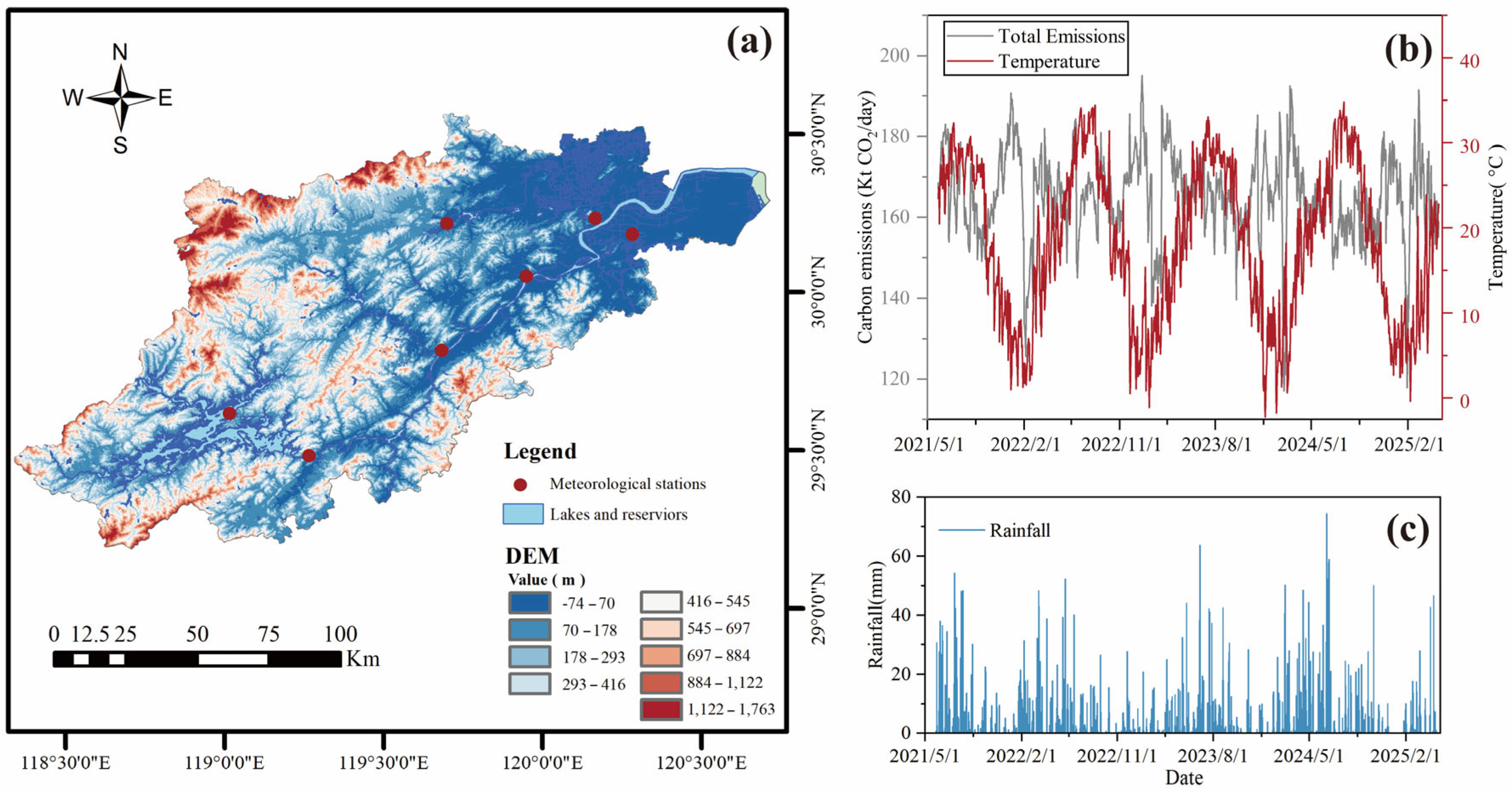
Figure 1. (a) Illustration of meteorological stations in Hangzhou; Time series data of daily (b) total carbon emissions and temperature, and (c) precipitation.
Sustainability 18 00019 g001
Figure 2. The overall research framework and workflow of the study.
Sustainability 18 00019 g002
Figure 3. Coefficient of Determination (R2) of the forecasting models across different sectors.
Sustainability 18 00019 g003
Figure 4. Coefficient of determination (R2) for the forecasting models in each sector: (a) Aviation, (b) Ground transport, (c) Industry, (d) Power, (e) Residential, and (f) Total emissions.
Sustainability 18 00019 g004
Figure 5. Lagged Spearman correlation between sectoral carbon emissions and temperature. (* denotes statistical significance at the 5% level (p < 0.05), and ** denotes statistical significance at the 1% level (p < 0.01).).
Sustainability 18 00019 g005
Figure 6. Lagged correlation between residential carbon emissions and extreme precipitation indices: (a) Spearman correlation and (b) Partial correlation controlling for global climate indices. (* denotes statistical significance at the 5% level (p < 0.05), and ** denotes statistical significance at the 1% level (p < 0.01).).
Sustainability 18 00019 g006
Figure 7. Impact of integrating meteorological factors, temperature and precipitation, on the predictive accuracy (R2) of the optimal base model for each sector: (a) Aviation, (b) Ground transport, (c) Industry, (d) Power, (e) Residential, and (f) Total emissions.
Sustainability 18 00019 g007
Figure 8. SHAP analysis results for the LSTM-T model in the industry sector. (a) SHAP summary plot displaying global feature importance (Mean SHAP Value) and the distribution of SHAP value contributions. (b) SHAP dependence plot illustrating the interaction effect between the historical carbon emissions feature and temperature.
Sustainability 18 00019 g008
Figure 9. SHAP analysis results for the LR-T model in the power sector. (a) SHAP summary plot displaying global feature importance (Mean SHAP Value) and the distribution of SHAP value contributions. (b) SHAP dependence plot illustrating the interaction effect between the historical carbon emissions feature and temperature.
Sustainability 18 00019 g009
Figure 10. SHAP analysis results for the LSTM-R-T model in the residential sector. (a) SHAP summary plot displaying global feature importance (Mean SHAP Value) and the distribution of SHAP value contributions. (b) SHAP dependence plot illustrating the interaction effect between the historical carbon emissions feature and temperature, revealing the cyclical structure of seasonal transitions. (c) SHAP dependence plot illustrating the interaction effect between the historical carbon emissions feature and rainfall.
Sustainability 18 00019 g010
Figure 11. SHAP analysis results for the LSTM-R-T model for total emissions. (a) SHAP summary plot displaying global feature importance (Mean SHAP Value) and the distribution of SHAP value contributions. (b) SHAP dependence plot illustrating the interaction effect between the historical carbon emissions feature and temperature. (c) SHAP dependence plot illustrating the interaction effect between the historical carbon emissions feature and rainfall.
Sustainability 18 00019 g011
Figure 12. Predictive accuracy (R2) of the optimal models over different forecast horizons for each sector: (a) Aviation, (b) Ground transport, (c) Industry, (d) Power, (e) Residential, and (f) Total emissions.
Sustainability 18 00019 g012
Table 1. Comparison of Carbon Emission Prediction Models.
ModelsTypeSuitabilityAdvantagesDisadvantagesRefs.
1. Seasonal AutoRegressive Integrated Moving Average (SARIMA)Traditional StatisticalSuitable for univariate time series with linear trends and seasonality.Effectively handles seasonality and linear trends.Fails to capture non-linear relationships; performance drops significantly on non-stationary data like CO2 emissions compared to AI models.[26,30]
2. Naive Forecast (NF)Used as a benchmark for evaluating the skill of advanced models, assuming future values equal current ones.Simple implementation; zero computational cost.Cannot handle trends, seasonality, or sudden changes; accuracy degrades rapidly with longer horizons.[29]
3. Linear Regression (LR)Best for scenarios where variables have clear linear relationships; often used as a baseline.Simple structure; high interpretability; low computational cost.Cannot capture complex non-linear characteristics of carbon emission data; prediction accuracy is generally lower than deep learning models.[26,28]
4. Random Forest (RF)Machine LearningSuitable for high-dimensional data and analyzing the importance of driving factors (e.g., urban governance elements).Robust against overfitting; provides interpretability via feature importance.In some univariate forecasting contexts, it may perform worse than LSTM or SARIMAX; limited ability to extrapolate trends outside training range.[26,28]
5. Support Vector Regression (SVR)Applicable to small samples, non-linear, and high-dimensional data.Strong generalization ability; handles non-linearity via kernel functions.Highly sensitive to hyper-parameters (penalty C, kernel functions) requiring optimization algorithms (e.g., SCMSSA); computationally demanding for large datasets.[27]
6. Light Gradient Boosting Machine (LightGBM)Suitable for large-scale datasets and capturing non-linear regression patterns.Fast training speed and high efficiency.Often treats time-series observations as independent instances, failing to adequately model sequential/temporal dependencies.[7]
7. eXtreme Gradient Boosting (XGBoost)Used for structured data prediction, often combined with decomposition techniques for carbon prices or emissions.High prediction accuracy; includes regularization to prevent overfitting.Complex parameter tuning; like other tree-based models, it struggles to capture long-range temporal dependencies naturally compared to RNNs.[7]
8. Long Short-Term Memory (LSTM)Deep LearningDesigned for sequential data with long-term dependencies (e.g., historical emission trends).Solves the vanishing gradient problem of RNNs; excellent for capturing long-term temporal relationships.Large number of parameters; longer training time compared to GRU or simple ML models; difficulty in extracting spatial features.[6,26,29]
9. Convolutional Neural Network (CNN)Applicable for extracting local patterns and features from spatial or grid-structured data.Excellent at feature extraction and dimensionality reduction.Lacks memory for long-term temporal dependencies; usually needs to be combined with LSTM for time-series forecasting.[6,7,8]
10. Hybrid CNN-LSTMBest for complex data requiring both local feature extraction and temporal modeling.Combines CNN’s feature extraction with LSTM’s temporal memory; generally outperforms standalone models in accuracy.Complex model structure; high computational resource consumption; longer training times.[9,29]
11. Multilayer Perceptron (MLP)Suitable for modeling non-linear mapping relationships.Better than linear regression for non-linear data.Weaker than LSTM in capturing time-series memory; prone to getting trapped in local optima; lower accuracy than hybrid models.[6,29]
12. TransformerSuitable for capturing long-range dependencies and multi-scale patterns in complex emission data.Self-attention mechanism captures global dependencies better than RNNs; supports parallel computing.Data-hungry; complex architecture requires significant tuning; risk of overfitting on small datasets.[7]
Disclaimer/Publisher’s Note: The statements, opinions and data contained in all publications are solely those of the individual author(s) and contributor(s) and not of MDPI and/or the editor(s). MDPI and/or the editor(s) disclaim responsibility for any injury to people or property resulting from any ideas, methods, instructions or products referred to in the content.