Article

Rooftop Photovoltaic Potential Estimation via Appearance-Based Availability Assessment and Multi-Orientation Integration


1
College of Civil and Transportation Engineering, Shenzhen University, Shenzhen 518060, China
2
Ministry of Natural Resources (MNR) Key Laboratory for Geo-Environmental Monitoring of Great Bay Area, Shenzhen University, Shenzhen 518060, China
3
Guangdong Key Laboratory of Urban Informatics, Shenzhen University, Shenzhen 518060, China
4
Guangzhou Shipyard International Company Limited, Guangzhou 511462, China
5
National Key Laboratory of Green and Longevity Road Engineering in Extreme Environments, Shenzhen University, Shenzhen 518060, China
*
Author to whom correspondence should be addressed.
Sustainability 2026, 18(1), 158; https://doi.org/10.3390/su18010158
Submission received: 2 November 2025 / Revised: 30 November 2025 / Accepted: 8 December 2025 / Published: 23 December 2025

Abstract

Accurately assessing rooftop photovoltaic (PV) potential requires precise identification of rooftop areas and availability. Current deep learning approaches using aerial imagery are faced with two challenges: inconsistent rooftop appearances caused by varying solar azimuths tend to mislead rooftop orientation extraction, and the existence of ancillary rooftop facilities often results in overestimation of solar potential. To tackle these challenges, a novel framework is proposed, with three components: automated extraction of rooftop areas and orientations, appearance-based estimation of rooftop availability coefficients, and PV potential calculation via a multi-orientation quantitative integration strategy. The segmentation network identifies geometric boundaries of rooftops and categorizes pitched roof segments into orientation-specific categories. High-level features of rooftop segments are then extracted from deep networks and clustered to compute availability coefficients at segment-level. Finally, the integration strategy leverages the symmetry assumption of sloped rooftops to mitigate classification errors and improve robustness in solar potential computation. Our framework is trained on the RID dataset with different category definition schemes, and estimation results are compared with solar radiation flux provided by NASA POWER. The overall relative error is less than 1%, which demonstrates the effectiveness of our framework.

1. Introduction

According to the 6th synthesis report released in Interlaken, Switzerland, by the United Nations Intergovernmental Panel on Climate Change (IPCC), unsustainable energy consumption and land use change lead to a continuous rise in global greenhouse gas emissions [1]. As a result, the global surface temperature increased by 1.1 °C during the period from 2011 to 2020, compared to pre-industrial levels in 1850–1900. To address this challenge, the “carbon neutrality” goal proposed in the Paris Agreement has become a widely accepted consensus within the international community. As one of the most abundant and cleanest renewable energy sources, solar energy plays a vital role in the global transition of energy systems [2]. Among different photovoltaic (PV) systems, urban rooftop PV is regarded as an effective solution for alleviating the growing energy and environmental challenges in urban areas [3,4,5]. However, accurately assessing rooftop PV potential is still faced with two main challenges [6]: accurately depicting rooftop areas, as well as orientations, and estimating the availability of surfaces suitable for PV deployment.
A common solution involves using existing statistical data generated by Light Detection and Ranging (LiDAR) or Digital Surface Models (DSM) [7]. While these methods can provide precise building outlines, roof slopes, and ancillary facilities for estimating solar potential at the city or district level, their large-scale application remains limited due to high data acquisition costs and complex processing requirements [8].
Characterized by wide coverage and low acquisition cost, satellite imagery is now increasingly applied in rooftop PV potential estimation. Recently, many efforts have been deployed to invent semantic segmentation models to extract urban building rooftops from large volumes of open-source satellite imagery and have achieved great progress. However, due to the lack of three-dimensional information, many satellite-based studies assume rooftops to be flat [9,10], neglecting their slopes and ancillary facilities, which leads to an underestimation of available rooftop areas and limits the model’s transferability and practical application. Therefore, methods with more general applicability and efficiency for extracting rooftop orientations and assessing available areas are needed.
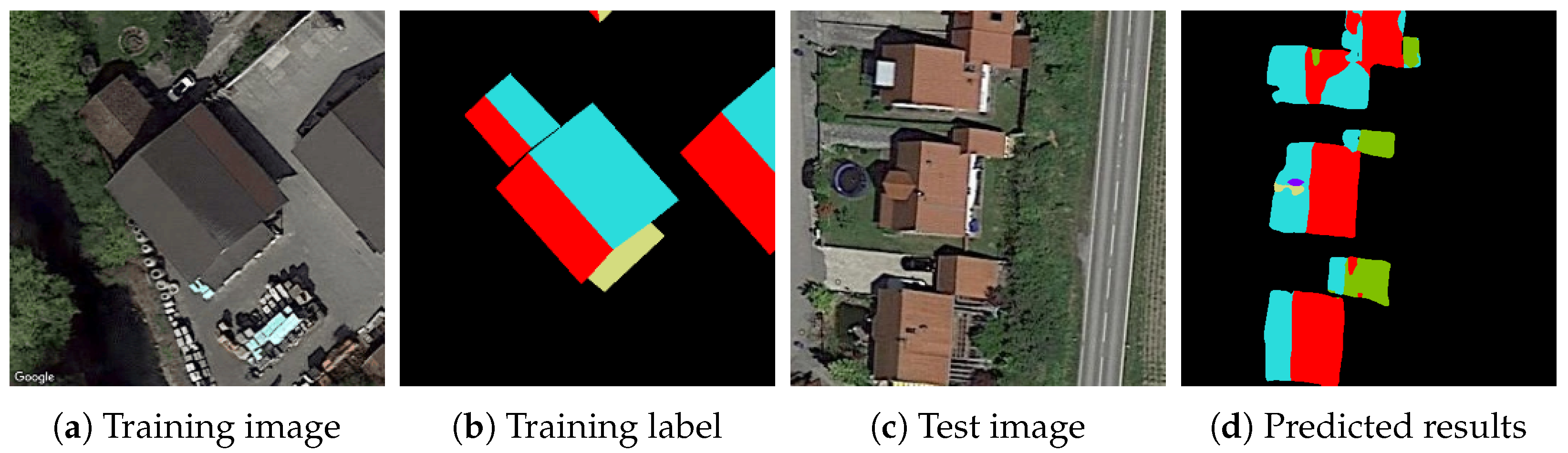
To address this issue, further studies have proposed to yield more fine-grained annotations of rooftops, such as orientations and ancillary facilities. Following this trend, researchers have attempted to classify rooftops based on building shape or architectural style [11] and land use type [12], selecting representative buildings from imagery to estimate the available coefficient for each rooftop category [13]. However, these approaches do not fully account for the physical features of rooftops, such as color and obstacles. In recent years, training networks to extract rooftop areas and orientations from aerial imagery for PV potential estimation have moved in a new direction [14]. However, the rooftop shading uncertainty caused by different solar azimuth angles leads to inaccurate orientation extraction, especially opposite orientations. This issue further reduces the accuracy and reliability of PV potential estimation (cf. Figure 1). To be more specific, when the sun is in the west, the brightness of west-facing rooftops increases (cf. Figure 1a), whereas east-facing rooftops appear brighter when the sun is in the east (cf. Figure 1c). Such color variations induced by solar azimuths may mislead the classification results of deep networks (Figure 1d).
To address the aforementioned challenges, we propose a novel framework for rooftop solar potential estimation. There are three primary contributions:
  • For low-cost and accurate rooftop PV potential estimation, we propose a framework based on high-resolution satellite imagery, which consists of three parts: automated extraction of rooftop areas and orientations, appearance-based rooftop availability coefficient estimation, and rooftop photovoltaic potential estimation using a multi-orientation quantified integration strategy.
  • To address the overestimation caused by rooftop obstacles, we propose extracting high-level feature representations of individual rooftop segments and clustering them by orientation to enable fine-grained availability estimation. Both visual and numerical results demonstrate that the estimated availability coefficients closely match actual rooftop obstructions and contribute to more accurate PV potential assessment.
  • Considering that solar azimuth variations are prone to result in rooftop orientation misidentification, we propose a multi-orientation quantitative integration strategy based on the symmetry assumption of sloped rooftops. The experimental results demonstrate its effectiveness in improving PV potential estimation accuracy.
The remainder of this paper is organized as follows. Section 2 introduces the existing research on solar potential estimation. In Section 3, the proposed framework and its three components are detailed. Then, Section 4 details the experimental setup and results to demonstrate the framework performance. Finally, Section 5 draws the conclusions.

2. Related Works

Urban rooftop PV potential estimation typically involves three main steps [15]: extracting the geometric boundaries of building rooftops, estimating the usable rooftop areas, and eventually calculating the PV potential. In this paper, we focus on the first two most challenging steps.

2.1. Urban Rooftop Area Extraction

According to data types, rooftop area estimation methods can be categorized into four directions: sampling-based, geographic information-based, 3D model-based, and satellite imagery-based methods. Sampling-based methods typically begin by calculating one or more variables related to a sample area and then apply suitable strategies to infer the available rooftop area for the entire study region [16]. For instance, Wiginton et al. [17] use census tracts as the unit of analysis and select 10 representative samples to estimate the average rooftop area per capita, leveraging the strong correlation between building and population density. While sampling-based methods can be effective in the absence of detailed rooftop data, the accuracy is limited by the quality of the national statistics.
Thus, geographic information-based methods arise and often rely on existing vectorized cadastral data and specialized software to compute rooftop areas. For example, Switzerland provides LOD2-level building cadastral data, which includes 9.6 million vector polygons and can be directly used for rooftop area calculations. OpenStreetMap (OSM) is an open-source geographic information platform that provides detailed global map data, including roads, buildings, natural features, and infrastructure. Such data have been widely applied on the global scale [12,18,19]. However, both government-provided and crowdsourced cadastral data can face challenges such as irregular update cycles and the presence of outdated or missing data in certain areas [18].
Compared to 2D data, 3D building models can deliver richer information, e.g., building height [20] and rooftop structures [21], which allow shadow change simulation for photovoltaic potential [22]. Wong et al. [23] resample high-precision digital surface model (DSM) and digital elevation model (DEM) data of Hong Kong to a 3 m resolution and utilize decision tree to classify ground, rooftop obstacles, shadows, and steep slopes for solar radiation analysis. However, due to policy or economic costs, many cities lack high-precision open-source 3D building data, which limits their wide application.
In recent years, deep learning–based approaches for rooftop extraction and orientation prediction have gained increasing attention [24]. Lee et al. [25] constructed a dataset with annotated rooftop azimuth angle classes and proposed a widely adopted end-to-end framework for predicting 3D rooftop structures. This framework directly infers rooftop geometry and azimuth angle classes from satellite imagery, achieving an average azimuth angle error of less than 10 degrees. When comparing the median estimations of usable photovoltaic installation areas, they found that the framework’s error relative to LiDAR-based methods did not exceed ±11%. Li et al. [14] pointed out that existing open-source rooftop azimuth angle datasets suffer from uneven data distributions, which adversely affect the model classification accuracy. To address this, they merged 16 azimuth angle classes into four and developed a multi-task learning network, SolarNet, which demonstrated a significant improvement in the accuracy of rooftop azimuth angle extraction.

2.2. Rooftop Availability Assessment

Since building rooftops often contain structures such as elevator shafts, chimneys, and windows that impede the installation of PV systems, rooftop availability assessment plays a significant role in rooftop solar potential calculation, and overlooking these features can result in overestimation [26]. Some studies apply deep neural networks to directly detect rooftop obstacles from satellite imagery [27]. For instance, Ren et al. [28] employ a dual U-Net architecture to identify obstacles such as rooftop vegetation, decorative structures, and external air-conditioning units. Li et al. [29] categorize rooftop superstructure obstacles into eight classes and take Google imagery as the data source. However, variations in climate and cultural context give rise to substantial diversity in rooftop complexity and obstacle types, which may limit the transferability of such models.
Another solution is to use the rooftop availability factor, defined as the ratio of the area suitable for photovoltaic installation to the total rooftop area. This factor is influenced by multiple factors, including the geographical location, climatic conditions, shading effects, and building types [30]. For instance, Zhang et al. [6] refer to previous studies and adopt a uniform rooftop availability factor of 0.35, taking into the account building function, geometric form, slope and azimuth, structural quality, economic cost, shading effects, and obstacles. Byrne et al. [16] defined rooftop availability factors for different building types in Seoul: 0.6 for commercial, industrial, and educational buildings, 0.6 for public buildings, and 0.39 for residential buildings, based on empirical data from Hong Kong.
Although such methods allow fast estimation, they simplify the calculation by assuming factors to be constant and may fail when study areas present diverse characteristics [31]. To solve this issue, sampling-based methods are proposed for more fine-grained rooftop availability assessment. For instance, the authors of [32] calculate availability factors by sampling usable rooftop areas. Mohajeri et al. [33] argue that the installation of photovoltaic systems depends on rooftop geometry and classify 10,085 buildings in Geneva, Switzerland, into six types using a support vector machine–based approach. Usable rooftop areas are then computed for each type. However, due to the differences in rooftop structure, obstacle distribution, and orientation [34], significant variations can exist within buildings of the same category. Moreover, the choice of classification criteria and the representativeness of sampled buildings can directly affect the accuracy of the rooftop availability assessment.

3. Methodology

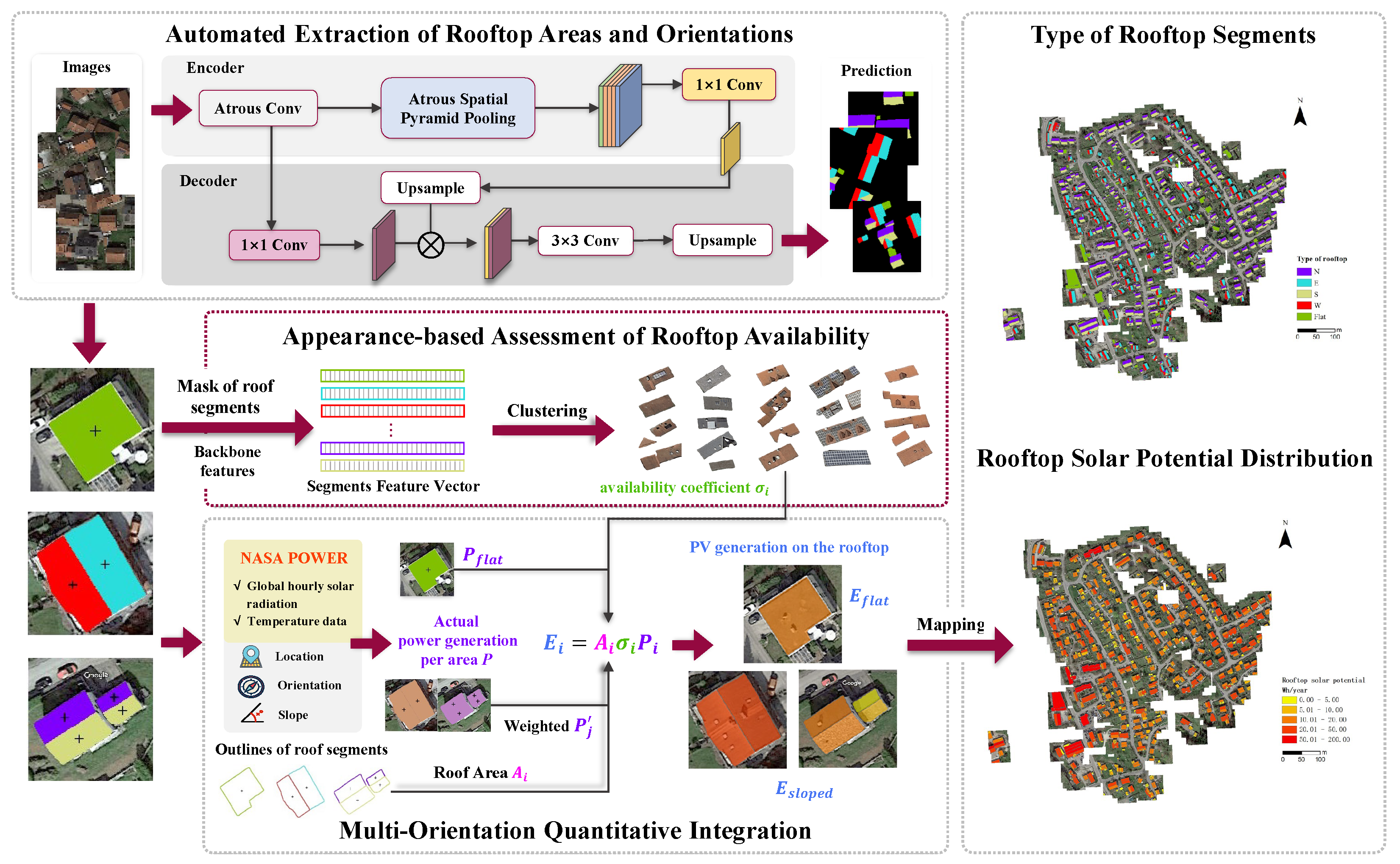
In this section, we detail three components of our framework (cf. Figure 2). First, Section 3.1 delineates the semantic segmentation networks utilized in the automated extraction of rooftop areas and orientations. Then, Section 3.2 describes the procedure of the appearance-based assessment of rooftop availability. Finally, Section 3.3 introduces the multi-orientation quantitative integration strategy designed for the final PV potential estimation.

3.1. Automated Extraction of Rooftop Areas and Orientations

Accurate extraction of rooftop areas and their orientations is essential for estimating rooftop photovoltaic (PV) potential. A critical factor in achieving this is enlarging the receptive field of semantic segmentation networks, which enhances their ability to capture broader contextual information—particularly necessary for identifying large rooftops. Conventional convolutional neural networks (CNNs) typically expand the receptive field by increasing the kernel sizes or incorporating pooling operations. However, larger kernels substantially increase the computational cost and parameter count, while pooling layers often sacrifice precise positional information and reduce sensitivity to local details, which are crucial for preserving fine rooftop edges and shapes. To address these limitations, we employ atrous convolution, which introduces a dilation rate to control the spacing between kernel elements. This mechanism effectively enlarges the receptive field without increasing the number of parameters or computational burden.
Another significant challenge is the considerable variation in rooftop size, shape, and structure. To handle this scale variability, we incorporate the Atrous Spatial Pyramid Pooling (ASPP) module. ASPP extends the idea of Spatial Pyramid Pooling (SPP) by employing multiple parallel atrous convolutional branches with different dilation rates. This design captures multi-scale contextual information efficiently without causing the information loss typically associated with downsampling.
Considering the abovementioned issues, we utilize DeepLabV3+ for rooftop area and orientation extraction. As illustrated in Figure 2, this network follows an encoder–decoder architecture. The encoder is responsible for feature extraction and undergoes successive downsampling stages to generate deep feature representations. These features are subsequently processed by the ASPP module to capture multi-scale contextual information and improve the recognition of large-scale targets. In the early stages of the encoder, high-resolution shallow features, such as edges, corners, and textures, are preserved. The decoder then restores the spatial resolution through upsampling operations and integrates these high-level features with the shallow features from the encoder network, ultimately producing precise semantic segmentation predictions.

3.2. Appearance-Based Assessment of Rooftop Availability

Rooftop superstructures, such as vents, air-conditioning units, and lightning protection equipment, prevent the installation of PV systems and result in solar potential overestimation. Moreover, rooftop appearances vary under different azimuth angles and weather conditions, making it challenging to distinguish using supervised learning methods. Hence, in this paper, we devise an unsupervised clustering approach to further cluster rooftops according to their appearances and calculate the availability coefficients correspondingly.
To be more specific, we produce high-level feature maps F of given images through the encoder of a fine-tuned segmentation network with an upsampling operation. Then, a feature representation for each rooftop segment f i can be yielded by averaging the features belonging to common segments with the following equation:
f i = 1 N i ( x , y ) M a s k i F ( x , y ) ,
where M a s k i denotes the mask region of the i-th rooftop segment, containing N i pixels, and F ( x , y ) represents the feature vector of the feature map F at position ( x , y ) . In this way, the appearance feature vector of each rooftop segment can be efficiently and effectively extracted.
During image acquisition, variations in azimuth angles lead to differences in rooftop shadow distribution. As a result, rooftops with the same orientation may exhibit significant differences in their appearance. To address this, we employ a Partitioning Around Medoids (PAM) clustering algorithm to distinguish rooftop segments that display pronounced appearance variations within the same orientation category. The procedure of PAM is as follows:
  • Initialization. For a given dataset S = { f 1 , f 2 , , f n } , select k data points from the dataset as the initial medoids.
  • Assignment. Compute distances between each data point and all medoids, and assign each point to the cluster of the nearest medoid based on proximity.
  • Update. For each cluster, compute the clustering costs J for each point except the original medoids, and select the point that minimizes the total distance as the updated medoid.
    J = m = 1 k f i C m d i s t ( f i , f m ) ,
    where C m represents the m-th cluster, f m denotes the medoid of the f-th cluster, and d i s t represents the distance computation.
  • Iteration. Repeat steps (2) and (3) until all medoids remain unchanged, or a predefined maximum number of iterations is reached.
  • Termination. The algorithm stops once the medoids stabilize, yielding the final clustering results.
Thus, rooftops are further divided into multiple subclasses, enabling a detailed analysis of their availability coefficients. To determine the optimal number of clusters for each rooftop category, we employ a combination of the Silhouette Coefficient (SC), Davies–Bouldin Index (DBI), and Calinski–Harabasz Index (CH).

3.3. Multi-Orientation Quantitative Integration for PV Potential Estimation

The estimation of rooftop solar potential typically relies on the available rooftop area, solar irradiance, and the energy conversion efficiency of the photovoltaic system. The photovoltaic power generation E p of a building rooftop can be calculated as follows:
E p = A r o o f · σ r a c · P a c t u a l ,
where E p denotes the rooftop PV potential (Wh), A r o o f represents the rooftop area ( m 2 ), σ r a c is the rooftop availability coefficient, and P a c t u a l denotes the actual power generation per unit area (Wh/ m 2 ), calculated according to [35]. For pitched rooftops, deep neural networks are prone to misclassify a roof facing a certain direction as the opposite orientation. For example, labeling a west-facing roof as east-facing, and vice versa. Considering the symmetry of pitched roofs, existing works [36] categorize rooftop orientations into three types: E–W, N–S, and flat. Inspired by this work, we quantitatively integrate rooftops with opposite orientations i and i o p (e.g., East and West) into a single category i i o p (e.g., E-W) and recalculate a weighted actual power generation per unit area, P a c t u a l , i i o p , for PV potential estimation. The calculation is given as follows:
P a c t u a l i i o p = α P a c t u a l i + β P a c t u a l i o p ,
where P a c t u a l i and P a c t u a l i o p denote P a c t u a l for orientation categories i and i o p , which is 180° opposite to the i. For example, regarding the E and its opposite orientation W in Scheme 1, as well as NE and SW in Scheme 2, P a c t u a l W E and P a c t u a l N E S W are computed as follows:
P a c t u a l E W = α E P a c t u a l E + β W P a c t u a l W , P a c t u a l N E S W = α N E P a c t u a l N E + β S W P a c t u a l S W ,
where P a c t u a l E and P a c t u a l W indicate the actual power generation per unit area for the east- and west-facing roof segments, respectively. α E and β W are weighting factors for P a c t u a l E and P a c t u a l W , respectively. P a c t u a l E W represents the weighted actual power generation for these two categories. Similarly, P a c t u a l N E and P a c t u a l S W are weighted by α N E and β S W and integrated to calculate P a c t u a l N E S W .

4. Experimental Results

4.1. Dataset

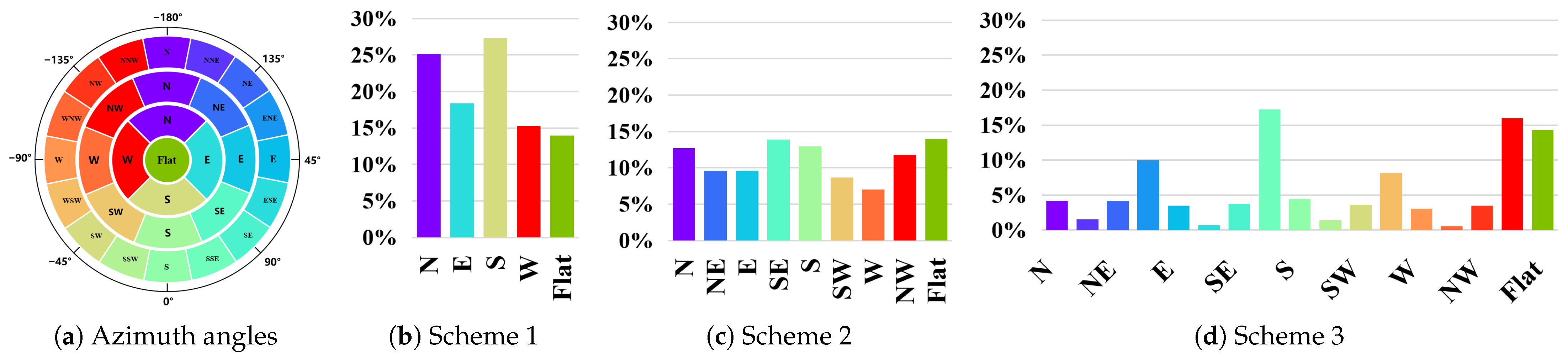
The Roof Information Dataset (RID) is a rooftop segmentation dataset composed of high-resolution, cloud-free, and wide-coverage images collected from Google Map. In total, there are 1880 images captured over Wartenberg, Germany, and rooftops are categorized into 18 classes, including 16 azimuths, flat roof (zero slope), and background. Each azimuth spans 22.5°. To balance the data distribution, we regroup 16 azimuths into 8 (North, North-east, East, South-east, South, South-west, West, North-west) and 4 (North, East, South, West), with each covering a span of 45 and 90 degrees, respectively. Figure 3 illustrates the azimuth angles defined in different schemes and data distribution in each scheme. In Scheme 3 (cf. Figure 3d), samples of the ESE, SSW, and WNW classes occupy less than 3%, while those of the SSE and NNW account for more than 15%. Additionally, the RID dataset provides vector data for the superstructures of each roof, categorized into 8 classes. These vector data will be used for computing the roof availability coefficients.

4.2. Experimental Setups

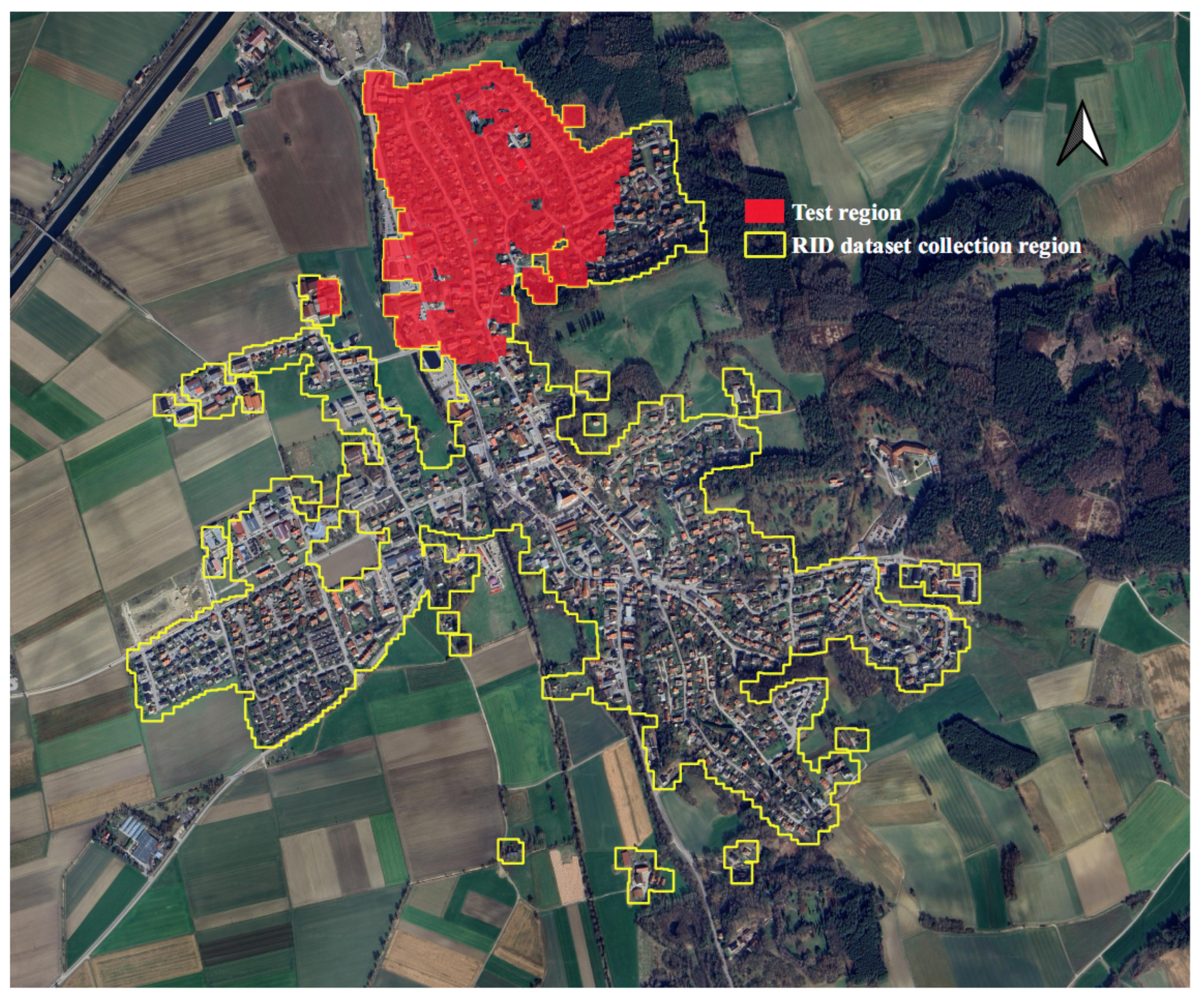
We implement rooftop segmentation networks with the MMSegmentation framework [37] built on PyTorch 1.11.0 (CUDA 11.5). Four commonly used segmentation networks, i.e., DeepLabV3+ [38], PSPNet [39], HRNet [40], and UNet [41], are evaluated in our experiments for rooftop area and orientation extraction. During training, the batch size is set to 6, and the number of iterations is 80,150. The RID dataset is split into training, validation, and test sets at a ratio of 7:2:1. To evaluate the generalization capabilities of different networks, images in the test set are all collected from the northern region (marked as red in Figure 4), while the remaining images from the southern region are selected as training samples. All experiments are conducted on a remote server running Linux CentOS 7, equipped with an NVIDIA Tesla T4 GPU with 16 GB of VRAM.

4.3. Analysis of Rooftop Area and Orientation Extraction Results

To assess the accuracy of the extracted rooftop areas and orientations, the intersection over union (IoU) and accuracy (Acc) were calculated for each rooftop orientation category using the following formulas:
I o U = T P T P + F P + F N , A c c = T P T P + F P ,
where T P , F P , and F N represent the number of true positives, false positives, and false negatives in the classification results, respectively. The mean IoU (mIoU) and mean accuracy (mAcc) were then computed by averaging over all categories.
As shown in Table 1, we evaluate the performance of popular semantic segmentation networks under three category definition schemes. As the number of categories decreased, the segmentation accuracies significantly improved, which demonstrates the importance of data distribution balance. Specifically, the mIoU and mAcc of Scheme 1 are increased by at most 28.2%/27.64% compared to Scheme 3, respectively. Although the data distribution of Scheme 2 is more balanced compared to Scheme 1 (cf. Figure 3b,c), the mIoU and mAcc of Scheme 2 are decreased by at most 7.86% and 5.59%, indicating that overdetailed rooftop category definitions may confuse segmentation networks.
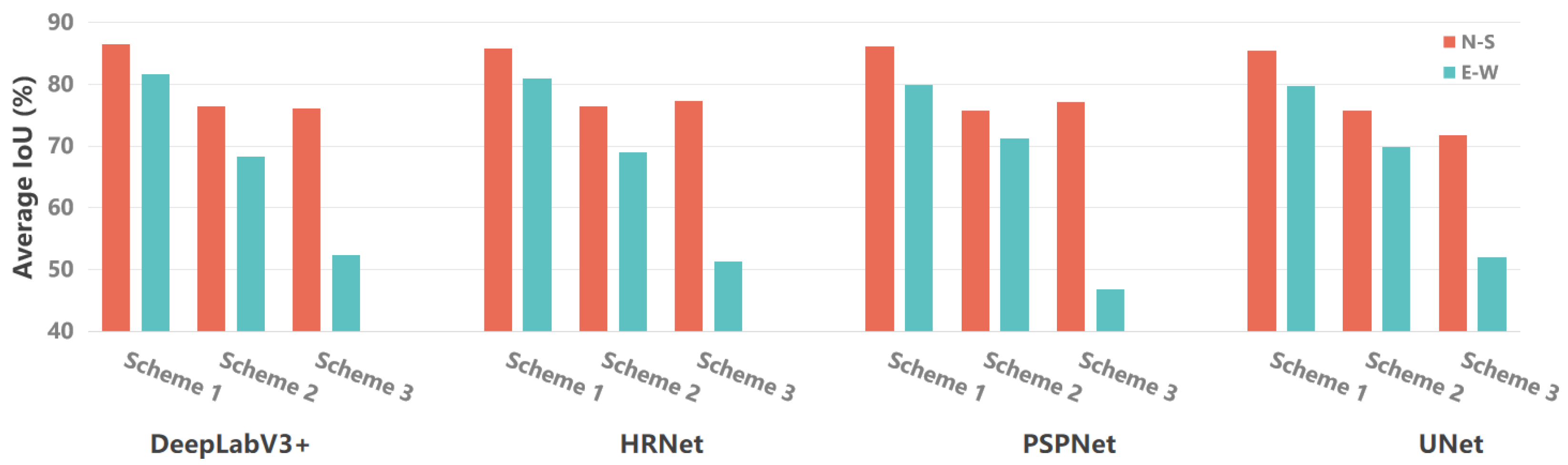
To gain deeper insight, we present the IoUs for common rooftop categories under different classification schemes in Table 2. A notable trend is the pronounced decline in extraction accuracy for east-facing (E) and west-facing (W) rooftops as the number of categories increases, whereas the IoUs for north-facing (N), south-facing (S), and flat rooftops experience only marginal decreases. For instance, when using DeepLabV3+, the IoUs for E and W decrease by 22.90% and 35.62%, respectively, in Scheme 3 compared to Scheme 1. In contrast, the IoUs for N and S decrease by merely 10.93% and 9.57%. This performance discrepancy is closely tied to the effects of the solar altitude and azimuth angles. For a more intuitive comparison, we compare average IoUs between North–South (N-S) and East–West (E-W) orientation categories in Figure 5. It can be seen that the north- and south-facing rooftops are higher than the east- and west-facing rooftops, which demonstrates that the accuracies of orientation extraction are sensitive to the solar azimuth change. Moreover, with increasing numbers of orientation categories, the accuracies are further degraded for all semantic segmentation networks, especially for east- and west-facing rooftops.
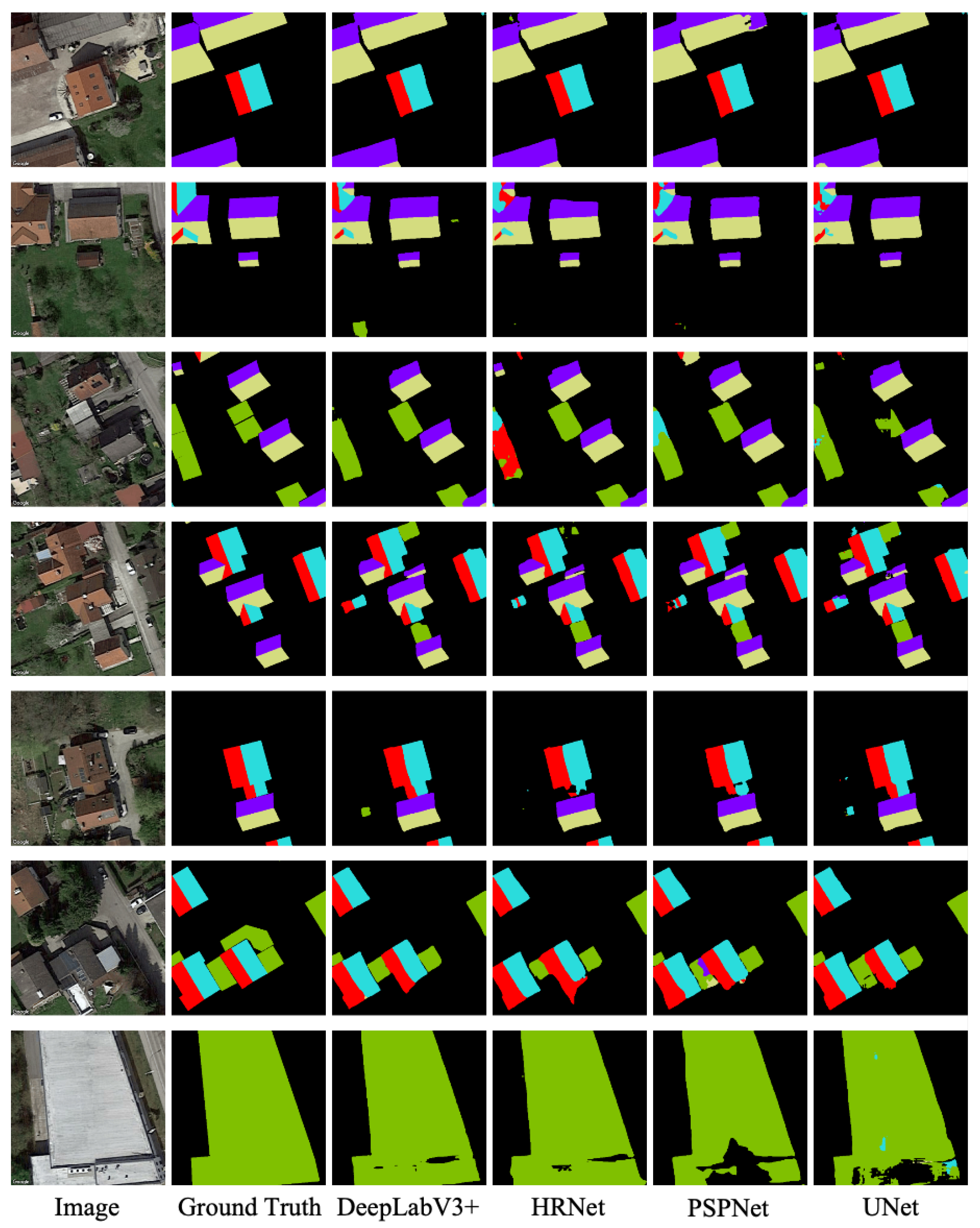
This study area is situated in the mid-latitudes of the Northern Hemisphere, where a low solar altitude angle causes north-facing rooftops to remain shadowed for prolonged periods, resulting in relatively stable apparent features. Conversely, south-facing rooftops receive abundant sunlight throughout the year, leading to consistent and discernible characteristics. In contrast, the apparent features of east-facing and west-facing rooftops exhibit significant dynamic variation due to shifts in the solar azimuth angle. Such variations challenge network capabilities to learn robust feature representations, ultimately reducing the extraction accuracy for east- and west-facing rooftops. We also report the accuracies for common rooftop categories under different classification schemes in Table 3. DeepLabV3+ maintains the highest accuracies across most categories under all three schemes, outperforming the other three networks. This is consistent with the comparisons of IoUs in Table 2. Figure 6 presents the results of different networks under Schemes 1, 2, and 3. According to our experiments, we use rooftop category definition Scheme 1 and DeepLabV3+ in the following experiments.

4.4. Analysis of Rooftop Availability Coefficient Estimation Results

Since DeepLabV3+ achieves the best performance in rooftop area and orientation extraction, we take its backbone to generate the feature representation of each rooftop segment, yielding a 960-dimensional vector for each. Considering that rooftop appearances change with azimuth angle variations, we perform appearance-based clustering for each rooftop category separately. The number of cluster centers is initialized as 4. After sufficient iterations, the PAM algorithm groups north-, east-, south-, and west-facing rooftops, along with flat rooftops, into 13, 4, 6, 6, and 7 clusters, respectively.
To evaluate the performance of PAM in this scenario, we employ superstructure labels of training samples in the RID dataset and compute rooftop availability coefficients as follows:
σ r a c i = N r o o f i N s u p e r s t r u c t u r e i N r o o f i ,
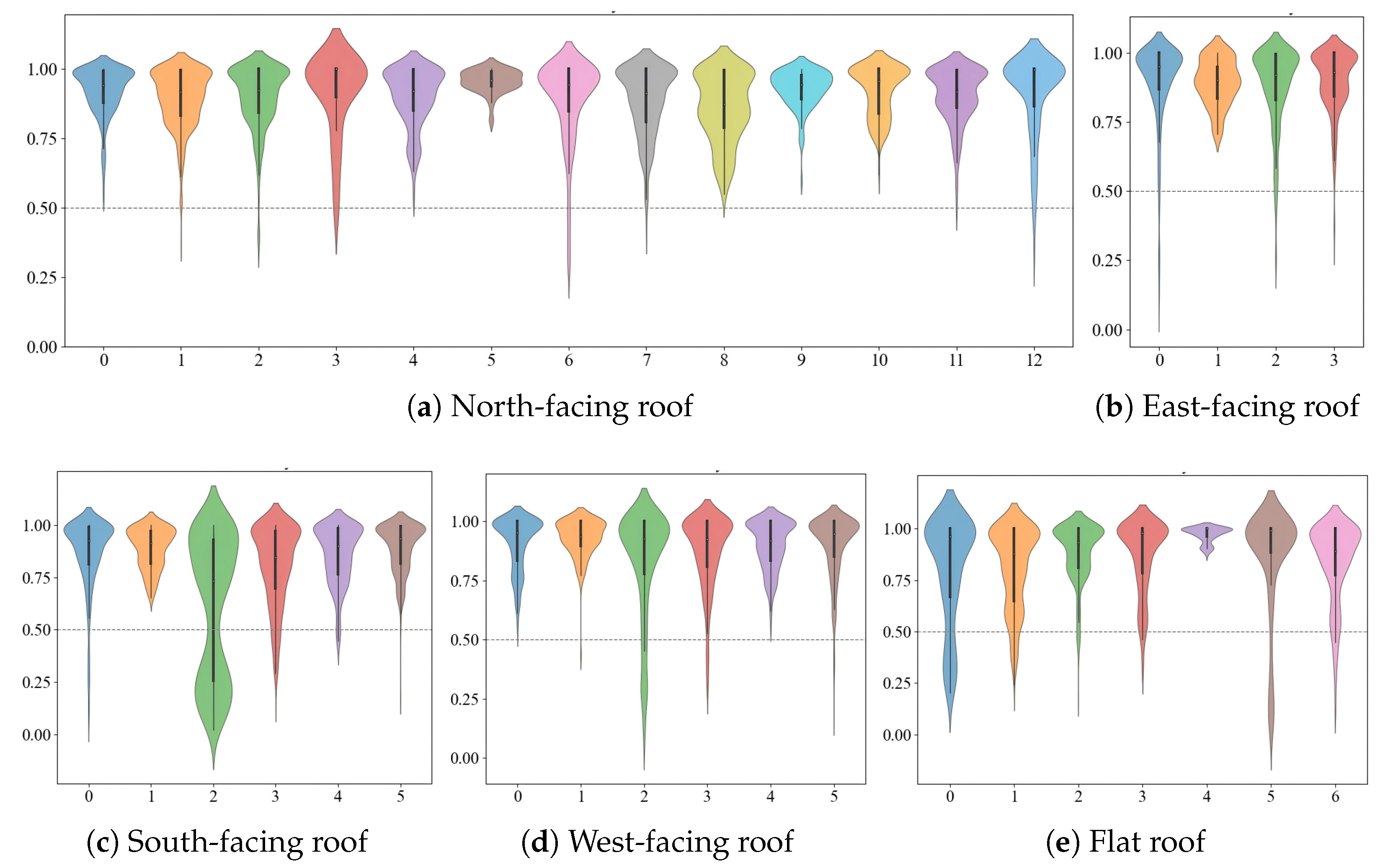
where N r o o f i and N s u p e r s t r u c t u r e i are the numbers of pixels belonging to the i-th roof segment and its obstacles. The median σ r a c is taken as the representative for each cluster in the final PV potential estimation. For an intuitive illustration, Figure 7 presents violin plots of the rooftop availability coefficients across all clusters. The results show that coefficients in most clusters are concentrated between 0.85 and 1.0, indicating that the median value serves as a representative measure for each cluster. However, Cluster 2 of the south-facing roofs exhibits a bimodal distribution with peaks near 0.9 and 0.2, as well as a high standard deviation of 0.3. We therefore split this cluster into two sub-groups at a visually determined threshold of 0.6. Roofs with coefficients below this threshold form the new Cluster 6. To validate this split, we calculate the mean and standard deviation for each new cluster. Cluster 2 now has a mean of 0.9 and a standard deviation of 0.1, while for Cluster 6 has a mean of 0.2 and a standard deviation of 0.1. This demonstrates that the two resulting groups have more concentrated distributions and share distinct consistent features.
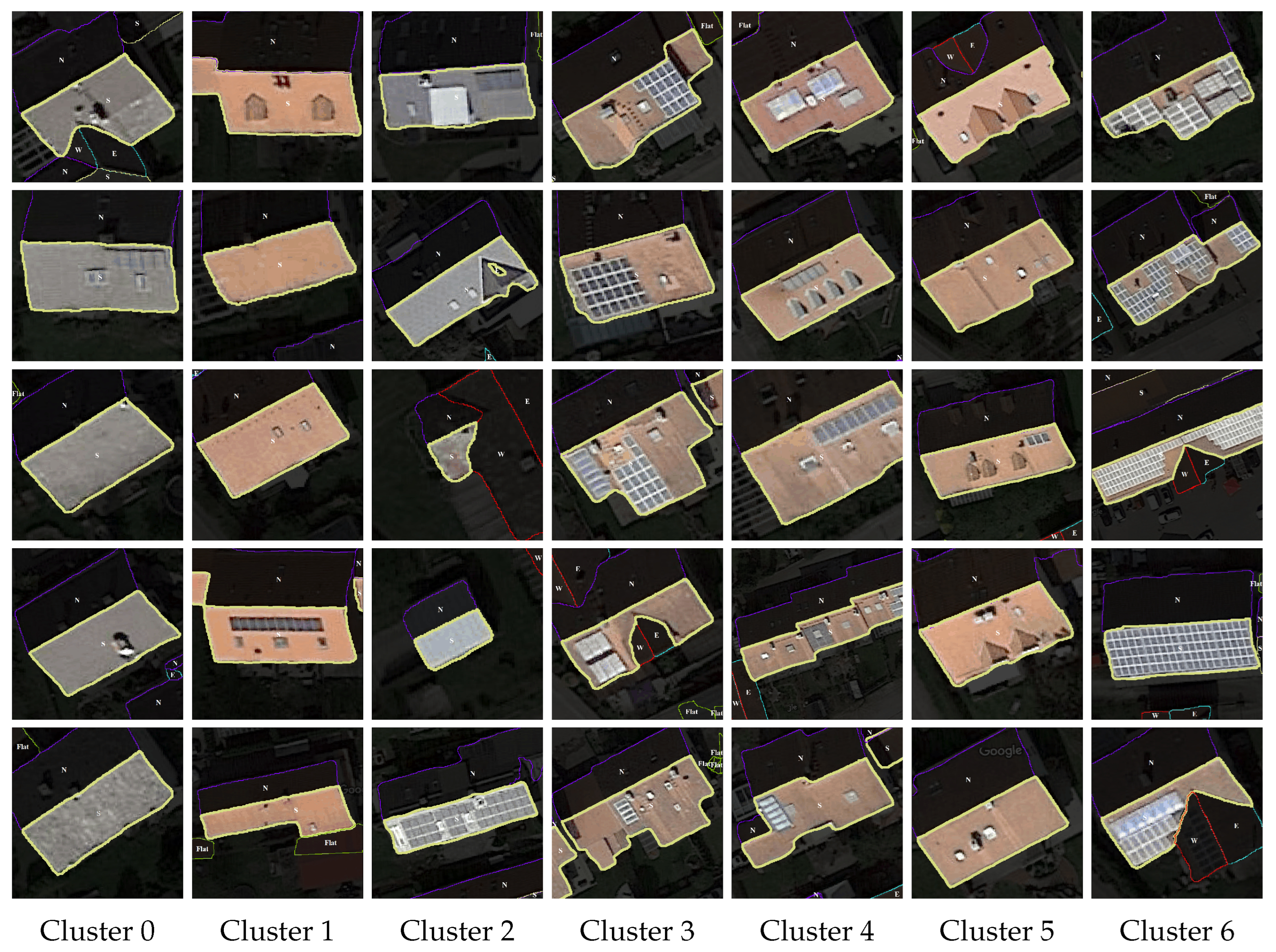
Taking south-facing rooftops as examples, Figure 8 presents five samples from each cluster. As shown, rooftops in Clusters 0 and 2 exhibit gray surfaces, while the remaining clusters feature orange surfaces. Among gray rooftops, some of those in Cluster 2 are equipped with solar panels or dormers, whereas Cluster 0 rooftops are largely free of obstructions. Regarding orange rooftops, Cluster 3 shows higher obstacle coverage compared to Clusters 1, 4, and 5. This observation aligns with the violin plot in Figure 7, where Cluster 3 demonstrates a broader distribution of coefficients below 0.75. Notably, the newly formed Cluster 6 exhibits the lowest availability coefficients, and visual inspection confirms that these rooftops are predominantly occupied by solar panels, indicating limited potential for additional PV installations in our study context.

4.5. Solar Potential Estimation Results

To evaluate the final PV potential estimation accuracy, we take global hourly solar radiation flux and temperature data from 1 January 2023 to 31 December 2023, provided by NASA Prediction Of Worldwide Energy Resources (NASA POWER) as the ground truths. The relative error is calculated to assess the estimation accuracies with the following equation:
ϵ = | E p r e E g t | E g t ,
where E p r e represents the predicted total PV potential, and E g t denotes the ground truth. Based on the distribution of rooftop slopes in the RID dataset, we set the slope to 35 degrees, which contain the majority, and the explicit azimuth angle is defined as the medium of each orientation category. Given that the building rooftops in the study area generally exhibit symmetry, the values of α and β in Equation (5) are both set to 0.5 in the absence of prior geographic knowledge. Different settings of α and β are evaluated in the following numerical experiments. Notably, east- and west-facing rooftops exhibit significant misclassification due to shadow effects, whereas the other orientations remain less affected. Therefore, we apply Equation (5) exclusively to east- and west-facing rooftops in the final PV potential estimation. For flat rooftops, the tilt angle of installed PV panels is also set to 35 degrees, which provides the best compromise for capturing maximum sunlight year-round [42], and they are assumed to receive solar radiation equivalent to that of south-facing roofs. The unit power densities of PV systems on pitched and flat rooftops are 220 Wh/ m 2 and 104 Wh/ m 2 , respectively, based on typical PV system performance (i.e., a panel measuring 1.65 m × 0.991 m produces 300 Wh of electrical output).
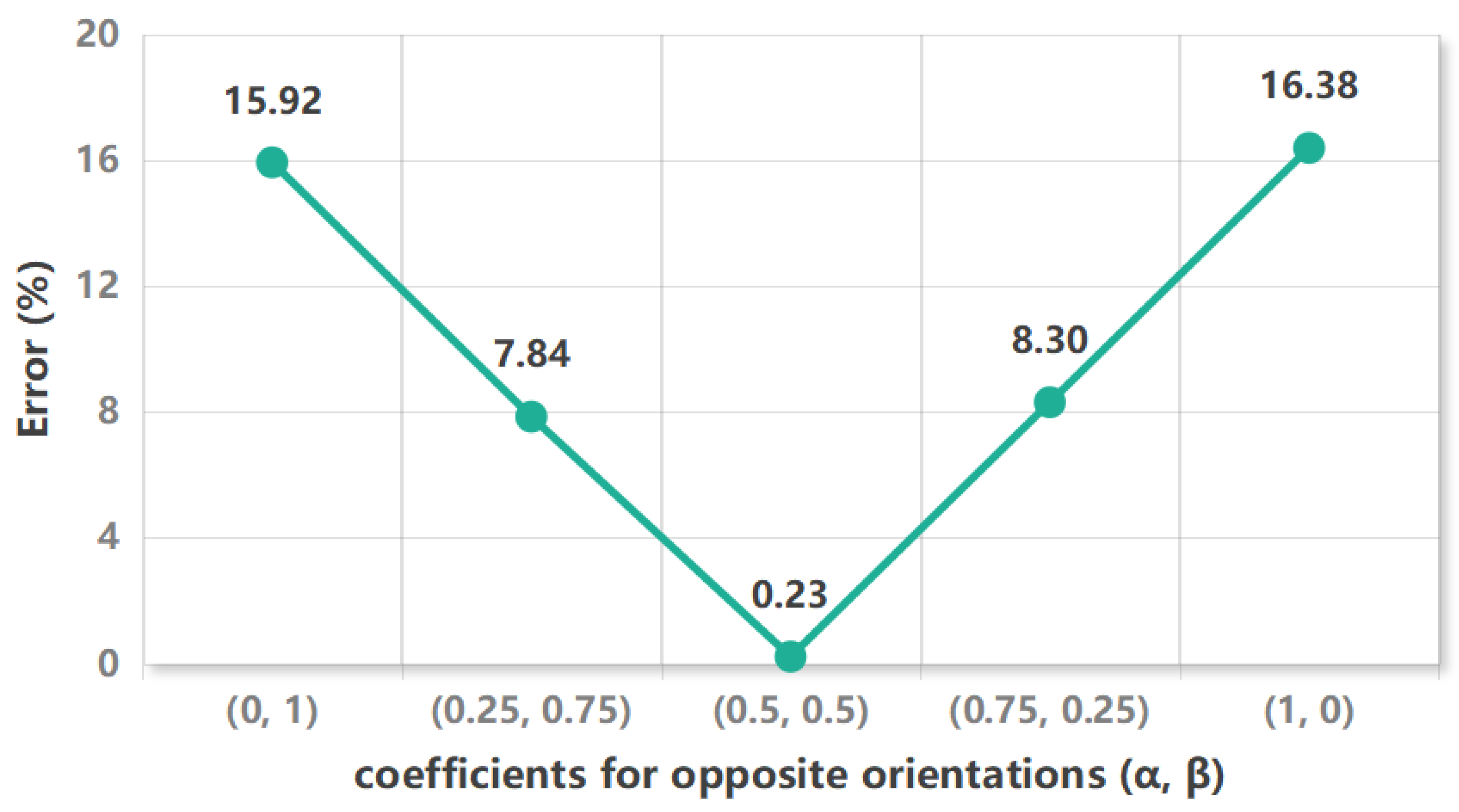
Numerical comparisons with the baseline are presented in Table 4. It can be seen that both the availability coefficient estimation and multi-orientation quantitative integration strategy contribute significantly to the high performance of our framework. The baseline method, which incorporates neither component, results in an estimation error of 17.75%. Introducing the availability estimation alone drastically reduces the error to 0.87%, underscoring its critical role in mitigating overestimation by accounting for rooftop obstructions and developed solar potential. Furthermore, integrating the multi-orientation strategy achieves the lowest error of 0.23%, validating the full framework’s effectiveness. This indicates that while the availability coefficient provides the most substantial individual improvement, the quantitative integration strategy offers a complementary refinement. The strategy effectively handles orientation-based misclassification and variability, further enhancing the precision of the solar potential calculation. Recognizing the significant impact of coefficients α and β in Equation (5) on the multi-orientation integration strategy, we evaluate five parameter settings by uniformly sampling possibilities within the valid range. As shown in Figure 9, the configuration of α = 0.5 and β = 0.5 yields optimal performance, which is consistent with our assumption that structures of sloped rooftops are often symmetric. Overall, the results confirm that the two components are synergistic and collectively essential for achieving high-fidelity fine-grained rooftop PV assessment.
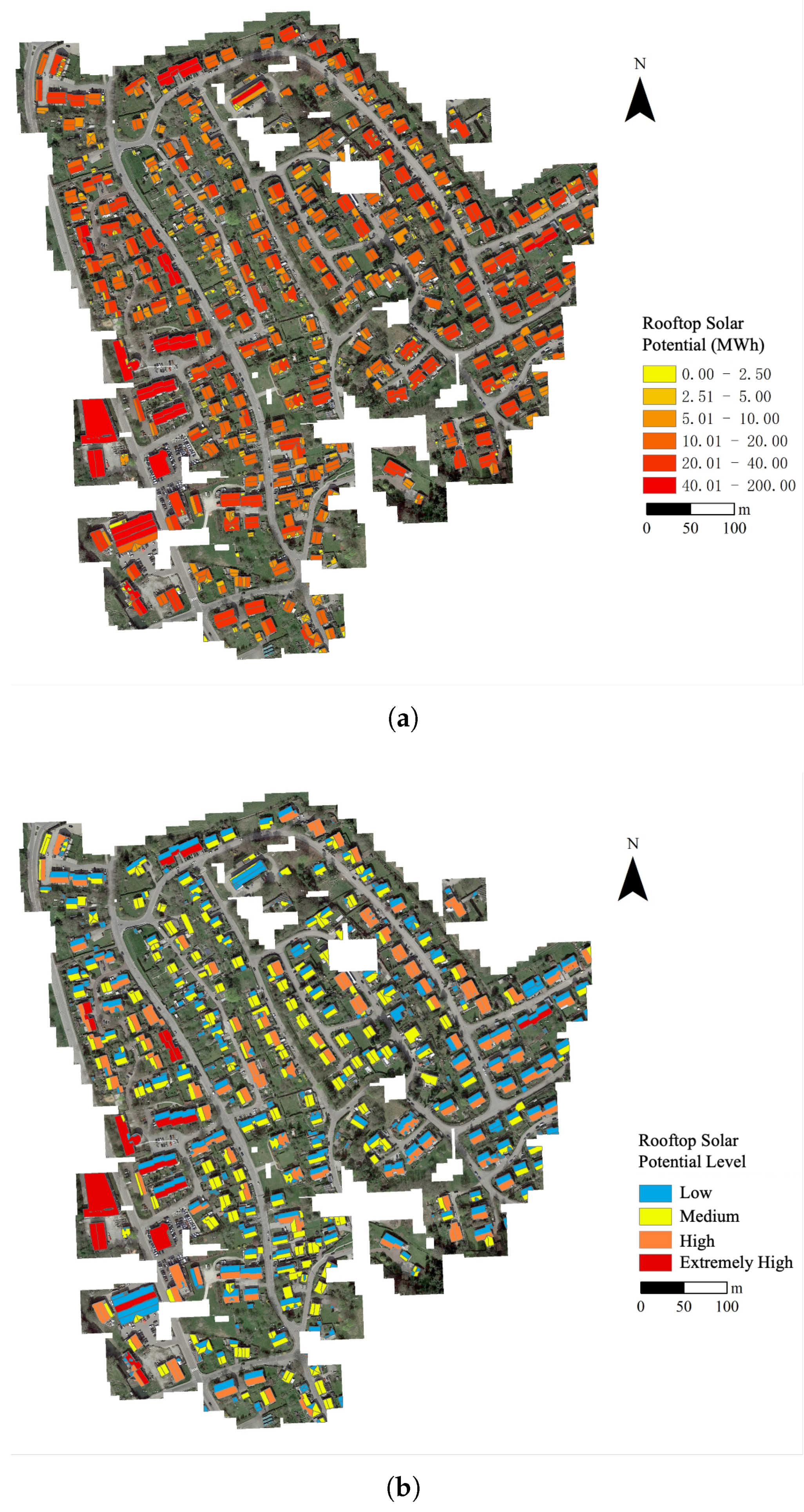
Eventually, the total annual rooftop photovoltaic power generation potential of the entire study area in 2023 is estimated to be 10.653 GWh. The solar potential estimation and leveling results of all rooftop segments in the study area are illustrated in Figure 10a and Figure 10b, respectively. As shown in Figure 10b, all rooftops with an area smaller than 5 m 2 , facing north, or having an availability coefficient lower than 0.5 are regarded as low potential. The remaining rooftops are categorized based on the PV power potential estimation results in Figure 10a, where those with an annual power generation exceeding 40 MWh are defined as having extremely high development potential, those between 20 and 40 MWh are considered high potential, and the rest are classified as medium potential. As shown, rooftops with large areas and low occupancy rates exhibit high potential for development, whereas north-, east-, and west-facing rooftops show relatively lower potential due to the geographic conditions in Wartenberg. Overall, these visual findings align well with real-world observations.

5. Conclusions

The accurate assessment of rooftop photovoltaic (PV) potential is essential for urban solar energy planning, yet existing methods often overestimate yields due to inadequate handling of orientation variability and obstructions. To address this, we propose a fine-grained solar energy assessment framework that first extracts rooftop areas and orientations automatically and then assesses rooftop availability coefficients through their appearances. Afterwards, multi-orientation quantitative integration strategy is devised to robustly compute the PV potential at the segment level. In our experiments, the framework is trained on the RID dataset, and the potential estimation results are evaluated with NASA POWER meteorological data. The numerical results demonstrate that the second and third components significantly reduce the estimation errors, and our framework achieves an overall relative error below 1%. The visual results further demonstrate that the appearance-based availability assessment accurately reflects the rooftop occupancies, while the multi-orientation integration effectively mitigates misclassifications introduced during the initial extraction phase. Future work will focus on improving segmentation under shadows, extending the approach to irregular and composite buildings, and incorporating roof slope and height via multi-source data and advanced deep learning models. Semi-supervised learning may also be introduced to enhance discrimination of texturally similar rooftop segments.

Author Contributions

Conceptualization, Y.H. and W.L.; methodology, W.L. and X.L.; software, X.L.; validation, X.L. and S.Z.; formal analysis, J.Z.; investigation, W.L. and X.L.; resources, Y.H. and J.Z.; data curation, W.L.; writing—original draft preparation, W.L.; writing—review and editing, Y.H.; visualization, W.L.; supervision, J.Z.; project administration, J.Z.; funding acquisition, Y.H. All authors have read and agreed to the published version of the manuscript.

Funding

This research was funded by the Shenzhen Science and Technology Innovation Commission (20231120191328001), the Young Scientists Fund of the Guangdong Regional Joint Fund (2023A1515110722), and the Young Scientists Fund of the National Natural Science Foundation of China (42401402).

Institutional Review Board Statement

Not applicable.

Informed Consent Statement

Not applicable.

Data Availability Statement

The original contributions presented in this study are included in the article. Further inquiries can be directed to the corresponding author.

Conflicts of Interest

Author Weiyan Lin was employed by the company Guangzhou Shipyard International Company Limited. The remaining authors declare that the research was conducted in the absence of any commercial or financial relationships that could be construed as a potential conflict of interest.

Abbreviations

The following abbreviations are used in this manuscript:
PVPhotovoltaic
IPCCIntergovernmental Panel on Climate Change
LiDARLight Detection and Ranging
DSMDigital Surface Models
OSMOpenStreetMap
CNNsConvolutional Neural Networks
SPPSpatial Pyramid Pooling
SCSilhouette Coefficient
DBIDavies–Bouldin Index
CHCalinski–Harabasz Index
RIDRoof Information Dataset

References

  1. IPCC. Climate Change 2023: Synthesis Report, Summary for Policymakers; Technical report; Intergovernmental Panel on Climate Change: Geneva, Switzerland, 2023. [Google Scholar]
  2. Liu, F.; Lv, T. Assessment of geographical distribution of photovoltaic generation in China for a low carbon electricity transition. J. Clean. Prod. 2019, 212, 655–665. [Google Scholar] [CrossRef]
  3. Song, C.; Guo, Z.; Liu, Z.; Zhang, H.; Liu, R.; Zhang, H. Application of photovoltaics on different types of land in China: Opportunities, status and challenges. Renew. Sustain. Energy Rev. 2024, 191, 114146. [Google Scholar] [CrossRef]
  4. Wang, M.; Mao, X.; Gao, Y.; He, F. Potential of carbon emission reduction and financial feasibility of urban rooftop photovoltaic power generation in Beijing. J. Clean. Prod. 2018, 203, 1119–1131. [Google Scholar] [CrossRef]
  5. Chen, H.; Chen, W. Status, trend, economic and environmental impacts of household solar photovoltaic development in China: Modelling from subnational perspective. Appl. Energy 2021, 303, 117616. [Google Scholar] [CrossRef]
  6. Zhang, Z.; Chen, M.; Zhong, T.; Zhu, R.; Qian, Z.; Zhang, F.; Yang, Y.; Zhang, K.; Santi, P.; Wang, K.; et al. Carbon mitigation potential afforded by rooftop photovoltaic in China. Nat. Commun. 2023, 14, 2347. [Google Scholar] [CrossRef] [PubMed]
  7. Bina, S.M.; Fujii, H.; Toriya, H. Innovative methodology for unlocking solar energy potential in Japanese urban areas: Drone-based DSM and roof shape analysis in Akita City. Energy Convers. Manag. 2025, 345, 120391. [Google Scholar] [CrossRef]
  8. Xu, J.; Guo, Z.; Yu, Q.; Dong, K.; Tan, H.; Zhang, H.; Yan, J. Spatiotemporal feature encoded deep learning method for rooftop PV potential assessment. Appl. Energy 2025, 394, 126171. [Google Scholar] [CrossRef]
  9. Yan, L.; Zhu, R.; Kwan, M.P.; Luo, W.; Wang, D.; Zhang, S.; Wong, M.S.; You, L.; Yang, B.; Chen, B.; et al. Estimation of urban-scale photovoltaic potential: A deep learning-based approach for constructing three-dimensional building models from optical remote sensing imagery. Sustain. Cities Soc. 2023, 93, 104515. [Google Scholar] [CrossRef]
  10. Huang, Z.; Mendis, T.; Xu, S. Urban solar utilization potential mapping via deep learning technology: A case study of Wuhan, China. Appl. Energy 2019, 250, 283–291. [Google Scholar] [CrossRef]
  11. Karteris, M.; Slini, T.; Papadopoulos, A. Urban solar energy potential in Greece: A statistical calculation model of suitable built roof areas for photovoltaics. Energy Build. 2013, 62, 459–468. [Google Scholar] [CrossRef]
  12. Pan, D.; Bai, Y.; Chang, M.; Wang, X.; Wang, W. The technical and economic potential of urban rooftop photovoltaic systems for power generation in Guangzhou, China. Energy Build. 2022, 277, 112591. [Google Scholar] [CrossRef]
  13. Rodríguez, L.R.; Duminil, E.; Ramos, J.S.; Eicker, U. Assessment of the photovoltaic potential at urban level based on 3D city models: A case study and new methodological approach. Sol. Energy 2017, 146, 264–275. [Google Scholar] [CrossRef]
  14. Li, Q.; Krapf, S.; Shi, Y.; Zhu, X.X. SolarNet: A convolutional neural network-based framework for rooftop solar potential estimation from aerial imagery. Int. J. Appl. Earth Obs. Geoinf. 2023, 116, 103098. [Google Scholar]
  15. Zhang, H.; Wang, L.; Li, Z. Assessment of Photovoltaic Utilization Potential in Urban Buildings. Build. Energy Effic. 2015, 43, 27–32. [Google Scholar]
  16. Byrne, J.; Taminiau, J.; Kurdgelashvili, L.; Kim, K.N. A review of the solar city concept and methods to assess rooftop solar electric potential, with an illustrative application to the city of Seoul. Renew. Sustain. Energy Rev. 2015, 41, 830–844. [Google Scholar] [CrossRef]
  17. Wiginton, L.; Nguyen, H.T.; Pearce, J.M. Quantifying rooftop solar photovoltaic potential for regional renewable energy policy. Comput. Environ. Urban Syst. 2010, 34, 345–357. [Google Scholar] [CrossRef]
  18. Buffat, R.; Grassi, S.; Raubal, M. A scalable method for estimating rooftop solar irradiation potential over large regions. Appl. Energy 2018, 216, 389–401. [Google Scholar] [CrossRef]
  19. Ni, H.; Wang, D.; Zhao, W.; Jiang, W.; Mingze, E.; Huang, C.; Yao, J. Enhancing rooftop solar energy potential evaluation in high-density cities: A Deep Learning and GIS based approach. Energy Build. 2024, 309, 113743. [Google Scholar]
  20. Zhang, C.; Cui, Y.; Zhu, Z.; Jiang, S.; Jiang, W. Building height extraction from GF-7 satellite images based on roof contour constrained stereo matching. Remote Sens. 2022, 14, 1566. [Google Scholar]
  21. Li, Q.; Mou, L.; Hua, Y.; Shi, Y.; Chen, S.; Sun, Y.; Zhu, X.X. 3DCentripetalNet: Building height retrieval from monocular remote sensing imagery. Int. J. Appl. Earth Obs. Geoinf. 2023, 120, 103311. [Google Scholar] [CrossRef]
  22. Peng, S.; He, J.; Liu, T.; Li, B.; Su, S.; Zhuang, J. Assessment of Distributed PV Potential on Urban Rooftops Based on Satellite Imagery. Acta Energiae Solaris Sin. 2024, 45, 517–526. [Google Scholar]
  23. Wong, M.S.; Zhu, R.; Liu, Z.; Lu, L.; Peng, J.; Tang, Z.; Lo, C.H.; Chan, W.K. Estimation of Hong Kong’s solar energy potential using GIS and remote sensing technologies. Renew. Energy 2016, 99, 325–335. [Google Scholar] [CrossRef]
  24. Boccalatte, A.; Jha, A.; Chanussot, J. Leveraging large-scale aerial data for accurate urban rooftop solar potential estimation via multitask learning. Sol. Energy 2025, 290, 113336. [Google Scholar] [CrossRef]
  25. Lee, S.; Iyengar, S.; Feng, M.; Shenoy, P.; Maji, S. Deeproof: A Data-Driven Approach for Solar Potential Estimation Using Rooftop Imagery. In Proceedings of the 25th ACM SIGKDD International Conference on Knowledge Discovery & Data Mining, Anchorage, AK, USA, 4–8 August 2019. [Google Scholar]
  26. Ren, H.; Sun, Y.; Tse, C.F.N.; Fan, C. Optimal packing and planning for large-scale distributed rooftop photovoltaic systems under complex shading effects and rooftop availabilities. Energy 2023, 274, 127280. [Google Scholar] [CrossRef]
  27. Boccalatte, A.; Chanussot, J. Quantifying urban solar potential losses from rooftop superstructures via aerial imagery and Convolutional Neural Networks. Renew. Energy 2025, 249, 123088. [Google Scholar] [CrossRef]
  28. Ren, H.; Xu, C.; Ma, Z.; Sun, Y. A novel 3D-geographic information system and deep learning integrated approach for high-accuracy building rooftop solar energy potential characterization of high-density cities. Appl. Energy 2022, 306, 117985. [Google Scholar] [CrossRef]
  29. Li, Q.; Krapf, S.; Mou, L.; Shi, Y.; Zhu, X.X. Deep learning-based framework for city-scale rooftop solar potential estimation by considering roof superstructures. Appl. Energy 2024, 374, 123839. [Google Scholar] [CrossRef]
  30. Huang, R.; Pan, D.; Liu, J.; Lan, X.; Wang, W.; Wang, X.; Peng, B. A Comprehensive Study on the Potential of Rooftop-Distributed Photovoltaics in the Pearl River Delta Urban Agglomeration. Clim. Environ. Res. 2024, 29, 317–328. [Google Scholar] [CrossRef]
  31. Qi, Z. Assessment of Rooftop Photovoltaic Potential in Urban Areas Based on ArcGIS. Master’s Thesis, Harbin Institute of Technology, Harbin, China, 2023. [Google Scholar]
  32. Lan, H.; Gou, Z.; Hou, C. Understanding the relationship between urban morphology and solar potential in mixed-use neighborhoods using machine learning algorithms. Sustain. Cities Soc. 2022, 87, 104225. [Google Scholar] [CrossRef]
  33. Mohajeri, N.; Assouline, D.; Guiboud, B.; Bill, A.; Gudmundsson, A.; Scartezzini, J.L. A city-scale roof shape classification using machine learning for solar energy applications. Renew. Energy 2018, 121, 81–93. [Google Scholar] [CrossRef]
  34. Tian, S.; Yang, G.; Du, S.; Zhuang, D.; Zhu, K.; Zhou, X.; Jin, X.; Ye, Y.; Li, P.; Shi, X. An innovative method for evaluating the urban roof photovoltaic potential based on open-source satellite images. Renew. Energy 2024, 224, 120075. [Google Scholar] [CrossRef]
  35. Mainzer, K.; Killinger, S.; McKenna, R.; Fichtner, W. Assessment of rooftop photovoltaic potentials at the urban level using publicly available geodata and image recognition techniques. Sol. Energy 2017, 155, 561–573. [Google Scholar] [CrossRef]
  36. Sun, T.; Shan, M.; Rong, X.; Yang, X. Estimating the spatial distribution of solar photovoltaic power generation potential on different types of rural rooftops using a deep learning network applied to satellite images. Appl. Energy 2022, 315, 119025. [Google Scholar] [CrossRef]
  37. Contributors, M. MMSegmentation: OpenMMLab Semantic Segmentation Toolbox and Benchmark. 2020. Available online: https://github.com/open-mmlab/mmsegmentation (accessed on 1 October 2025).
  38. Chen, L.C.; Zhu, Y.; Papandreou, G.; Schroff, F.; Adam, H. Encoder-Decoder with Atrous Separable Convolution for Semantic Image Segmentation. In Proceedings of the European Conference on Computer Vision (ECCV), Munich, Germany, 8–14 September 2018. [Google Scholar]
  39. Zhao, H.; Shi, J.; Qi, X.; Wang, X.; Jia, J. Pyramid Scene Parsing Network. In Proceedings of the IEEE Conference on Computer Vision and Pattern Recognition, Honolulu, HI, USA, 21–26 July 2017. [Google Scholar]
  40. Sun, K.; Xiao, B.; Liu, D.; Wang, J. Deep High-Resolution Representation Learning for Human Pose Estimation. In Proceedings of the IEEE/CVF Conference on Computer Vision and Pattern Recognition, Long Beach, CA, USA, 15–20 June 2019. [Google Scholar]
  41. Ronneberger, O.; Fischer, P.; Brox, T. U-net: Convolutional Networks for Biomedical Image Segmentation. In Proceedings of the Medical Image Computing and Computer-Assisted Intervention—MICCAI 2015: 18th International Conference, Munich, Germany, 5–9 October 2015; Proceedings, Part III. Springer: Cham, Switzerland, 2015. [Google Scholar]
  42. PVGIS.COM. Solar Panel Tilt Angle Calculation: Complete Guide 2025. 2025. Available online: https://pvgis.com/en/blog/solar-panel-tilt-angle-calculation (accessed on 1 October 2025).
Figure 1. Example of roof orientation misclassification. Red indicates the true/predicted west-facing rooftops, while cyan represents the true/predicted east-facing roofs. Purple and yellow denote north- and south-facing rooftops, respectively. Green and black denote flat rooftops and background.
Sustainability 18 00158 g001
Figure 2. Illustration of the overall architecture of the proposed framework. Specifically, the framework first identifies geometric boundaries of rooftops and categorizes pitched roof segments into orientation–specific categories. Next, high–level features of rooftop segments are then extracted from deep networks and clustered to compute availability coefficients at segment–level. Finally, the quantitative integration strategy leverages the symmetry assumption of sloped rooftops to mitigate the classification errors and improve the robustness in solar potential computation.
Sustainability 18 00158 g002
Figure 3. Illustration of (a) azimuth angles and (bd) three category definition schemes of the RID dataset.
Sustainability 18 00158 g003
Figure 4. Illustration of the RID dataset collection region and test region.
Sustainability 18 00158 g004
Figure 5. Comparisons of average IoUs between North–South (N-S) and East–West (E-W) orientation categories across different models and schemes.
Sustainability 18 00158 g005
Figure 6. Examples of rooftop area and orientation extraction results. Purple, cyan, yellow, and red denote north-, east-, south-, and west-facing rooftops, respectively. Green and black denote flat rooftops and background.
Sustainability 18 00158 g006
Figure 7. Violin plot of rooftop availability coefficients for all clusters in the training set. Different colors indicate different clusters in each roof type.
Sustainability 18 00158 g007
Figure 8. Samples of all seven clusters with respect to south-facing roofs in the test set. In each sample, roof segments are highlighted, while others are masked out for clear visualization.
Sustainability 18 00158 g008
Figure 9. Comparison of estimation errors under different configurations of coefficients for opposite orientations ( α , β ).
Sustainability 18 00158 g009
Figure 10. Rooftop PV estimation results of each roof segment in the study area. (a) shows estimated potential in MWh, and (b) categorizes each roof segment into different developing levels.
Sustainability 18 00158 g010
Table 1. Network performance under different category definition schemes on the RID dataset (%). The highest mIoU and mAcc are highlighted in bold.
NetworkScheme 1Scheme 2Scheme 3
mIoUmAccmIoUmAccmIoUmAcc
DeepLabV3+ [38]81.44 89.15 75.0185.0754.3363.18
HRNet [40]80.6988.7573.4184.2955.8065.94
PSPNet [39]80.3988.5772.5382.9852.4360.93
UNet [41]79.6487.7972.2783.2151.4460.66
Table 2. IoUs of common categories under different schemes on the RID dataset (%). The highest IoUs for different rooftop categories are highlighted in bold.
NetworkSchemeNSEWFlat
DeepLabV3+ [38]186.65 86.23 82.98 80.19 55.96
277.9874.9969.4467.1048.78
375.7276.6660.0844.5752.29
HRNet [40]186.3485.3282.5279.3254.11
278.0674.7371.5266.3251.03
376.8777.6457.0145.6352.31
PSPNet [39]186.4186.0381.3778.4853.50
277.6773.9375.0267.3348.89
375.0279.2351.8541.8449.25
UNet [41]185.8385.0880.9178.5750.98
277.9773.5872.0267.6147.76
372.0271.7059.5444.4947.64
Table 3. Accuracies of common categories under different schemes on the RID dataset (%). The highest accuracies for different rooftop categories are highlighted in bold.
NetworkSchemeNSEWFlat
DeepLabV3+ [38]193.92 93.04 90.97 89.1669.57
287.3282.7186.1779.8460.08
389.0389.1174.9468.4360.88
HRNet [40]193.7692.2490.3489.53 68.50
287.2583.1087.1781.0465.03
389.1487.7777.9976.7762.94
PSPNet [39]193.7992.6990.0788.7068.05
287.5381.5683.7979.8660.95
387.3889.9866.9364.9659.12
UNet [41]193.3192.2289.6788.6564.72
287.7480.0385.2879.1361.73
387.7280.3980.6170.4258.59
Table 4. Comparisons with the baseline on estimation errors in the study area.
Rooftop ExtractionAARAMOQIError ϵ
Baseline [14]17.75%
Ours without MOQI0.87%
Ours0.23%
AARA indicates the appearance-based assessment of rooftop availability. MOQI indicates the multi-orientation quantitative integration. The symbols ✓ and ✗ indicate the availability and unavailability of the corresponding module, respectively.
Disclaimer/Publisher’s Note: The statements, opinions and data contained in all publications are solely those of the individual author(s) and contributor(s) and not of MDPI and/or the editor(s). MDPI and/or the editor(s) disclaim responsibility for any injury to people or property resulting from any ideas, methods, instructions or products referred to in the content.