Article

Spatiotemporal Dynamics and Driving Mechanisms of Chlorophyll-a in Shenzhen’s Nearshore Waters: Insights from High-Frequency Buoy Observations

1
Shenzhen Lightsun Technology Co., Ltd., Shenzhen 518029, China
2
Shenzhen Ocean Development Promotion Center, Shenzhen 518067, China
3
Guangdong-Hong Kong-Macao Greater Bay Area Environmental Technology Research Center, Shenzhen Research Institute of Nankai University, Shenzhen 518063, China
*
Authors to whom correspondence should be addressed.
These authors contributed equally to this work.
Sustainability 2026, 18(1), 150; https://doi.org/10.3390/su18010150 (registering DOI)
Submission received: 28 October 2025 / Revised: 8 December 2025 / Accepted: 16 December 2025 / Published: 23 December 2025

Abstract

Chlorophyll-a (Chl-a) concentration serves as a crucial indicator for assessing phytoplankton biomass and marine ecological health. This study investigated the spatiotemporal characteristics and influencing factors of Chl-a in Shenzhen’s coastal waters using high-frequency monitoring data from 13 buoys deployed from January 2023 to January 2024. The research methodology incorporated comprehensive statistical analyses, including correlation analysis to identify relationships between Chl-a and environmental parameters and a linear mixed model, as well as stepwise regression analysis to determine the dominant factors controlling Chl-a variability across different sea areas. Results revealed distinct spatiotemporal patterns: seasonal Chl-a concentrations ranked as summer > autumn > winter > spring. Spatially, western waters (Pearl River Estuary and Shenzhen Bay) exhibited elevated levels from winter to summer, whereas the eastern Daya Bay peaked in autumn. Mechanistically, regional drivers diverged significantly. River runoff dominated Chl-a variability in the Pearl River Estuary. Temperature and runoff co-regulated dynamics in Shenzhen Bay. Wind-driven mixing and nutrients were the primary controls in Daya Bay, while oligotrophic conditions maintained low levels in Mirs Bay. Salinity and temperature were universal regulators, but nutrient limitations were region-specific, with phosphorus limitation in Shenzhen Bay and nitrogen limitation in Mirs Bay. The high-frequency buoy data effectively captured complex spatiotemporal variability, providing valuable insights for developing targeted management strategies to mitigate red tide risks and improve water quality in these coastal ecosystems.

1. Introduction

Chlorophyll-a (Chl-a), as the primary photosynthetic pigment of phytoplankton, directly reflects the biomass and growth status of phytoplankton in water [1,2]. In marine environments, Chl-a content is closely linked to primary productivity, which serves as the foundation for material cycling and energy flow in marine ecosystems [3]. On the other hand, elevated Chl-a content generally indicates vigorous algal proliferation in the water, potentially signaling the onset of eutrophication [4]. Excessive algae can reduce water transparency and dissolved oxygen (DO), disrupting aquatic biological activities and deteriorating water quality [5,6]. In recent years, coastal cities experiencing rapid urbanization and economic development have faced increasingly severe eutrophication and frequent red tides, which pose significant threats to ecological security and marine economic development [7,8,9]. Thus, Chl-a content is a critical indicator for evaluating the ecological health of inshore waters.
Shenzhen is a coastal city in Guangdong Province, China, situated on the eastern bank of the Pearl River Estuary (PRE), adjacent to Hong Kong and facing the South China Sea. Its waters comprise four major areas: the southeastern PRE, Shenzhen Bay, Mirs Bay, and Daya Bay, boasting rich fishery resources and developed coastal tourism and port industries. In recent years, Shenzhen has actively promoted the high-quality development of the marine economy and strived to build a global marine center city. Meanwhile, under the influence of intensive human activities and climate change, Shenzhen’s waters are subjected to year-round threats of red tide outbreaks [9,10,11]. Long-term monitoring of water quality in Shenzhen’s waters, particularly the dynamic changes in Chl-a and related environmental parameters, is essential for understanding the growth and decline processes of algae associated with red tide outbreaks. This monitoring will help us to decipher the mechanisms of red tide occurrence and enhance the accuracy and timeliness of red tide prediction.
In recent years, there has been considerable discussion and research on water quality and phytoplankton distribution in the Shenzhen waters. Zhang et al. [12] analyzed the seasonal variation patterns of Chl-a in Shenzhen Bay based on field data, identifying water temperature, nutrient levels, phytoplankton density, and chemical oxygen demand as the primary controlling factors. Pang et al. [13] utilized buoy monitoring data to reveal that the Chl-a content in Mirs Bay is co-regulated by land runoff, external inputs, and aquaculture activities. As a crucial channel for the Pearl River system to flow into the sea, the exploration of phytoplankton Chl-a and primary productivity in the PRE is fundamental to analyzing the marine ecological environment [14,15,16,17]. Existing studies have established that runoff volume and suspended sediment concentration in the water are the main factors affecting the spatial distribution of phytoplankton in the PRE [1,8,18,19].
Previous studies on Chl-a in Shenzhen’s waters have focused on specific periods (e.g., red tide events) or individual sea areas. Traditional ship-based observations yield limited sample data, insufficiently revealing the spatiotemporal differentiation and continuous variation in Chl-a over extensive spatial and long time-series. This study analyzes the high-frequency spatiotemporal variation characteristics of Chl-a in Shenzhen’s inshore waters and their influencing factors, based on monitoring data from 13 environmental buoys, which include meteorological, water quality, and nutrient parameters. The findings aim to provide data support and a scientific basis for the protection of the marine ecological environment and disaster warning predictions in Shenzhen through diversified big data.

2. Materials and Methods

2.1. Study Area

As a coastal city located in the northern part of the South China Sea, Shenzhen encompasses a marine area of 1145 km2 and boasts a coastline that extends for 229.96 km. Divided by the Kowloon Peninsula, Shenzhen’s coastal waters comprise eastern and western sectors: the eastern sector includes Mirs Bay and Daya Bay, while the western sector encompasses Shenzhen Bay and the Pearl River Estuary. The eastern nearshore waters connect directly to the South China Sea. Both Mirs Bay and Daya Bay are semi-enclosed drowned valley bays characterized by shallow depths, boasting abundant coastal tourism resources and favorable water quality. Mirs Bay holds the distinguished title of “Golden Coast” [20,21,22]. The western waters adjoin Lingdingyang of the PRE, where freshwater inputs from the Pearl River and Shenzhen River converge with South China Sea waters. As the primary recipient of pollutants for the Guangdong–Hong Kong–Macao Greater Bay Area, a world-class bay area with a total population exceeding 87 million in 2024 [23], its rapid economic development and urbanization have led to substantial discharges of industrial, agricultural (primarily from fertilizer use in rice cultivation and other farmlands), and domestic wastewater, resulting in comparatively poorer water quality in western waters [15,24].

2.2. Station Distribution and Data Acquisition

This study used monitoring data from January 2023 to January 2024 from 13 buoys deployed in Shenzhen’s inshore waters: 5 in Mirs Bay, 4 in Daya Bay, 3 in the eastern PRE, and 1 in Shenzhen Bay (station locations shown in Figure 1). The buoy station network was designed based on the natural division of Shenzhen’s four sea areas, taking into consideration the city’s maritime development activities, the needs of various marine-related industries, and the objectives of different marine functional zones. Particular emphasis was placed on monitoring environmentally sensitive areas, such as mariculture zones, coastal tourism areas, and regions with major pollution sources. The monitoring data from each buoy station are representative of the environmental conditions in their respective sea areas [25]. Monitoring parameters, methods, and data acquisition frequencies are listed in Table 1. All stations monitored water quality and meteorological parameters, while stations SZ1 (in Shenzhen Bay), DP2, and DP4 (in Mirs Bay) additionally monitored nutrients, including nitrite (NO2-N), nitrate (NO3-N), ammonium (NH4+-N), and reactive phosphate (PO43−-P). Inorganic nitrogen (DIN) concentration is the sum of NO2-N, NO3-N, and NH4+-N. Water quality parameters were monitored using a multiparameter water quality sonde (EXO series, YSI, Yellow Springs, OH, USA). Nutrient concentrations were measured using an in situ nutrient analyzer (WIZ, SYSTEA S.p.A., Anagni, Italy). This automated analyzer employs spectrophotometric methods that simulate manual laboratory procedures. Through a multi-channel valve and quantitative dispensing system, samples and chemical reagents are introduced into the main analysis flow path to produce colorimetric reactions. Nutrient concentrations are then determined via automated colorimetric measurement. The specific colorimetric methods applied were as follows: phosphomolybdenum blue method for phosphate, diazotization-coupling method for nitrite, N-(1-naphthyl)-ethylenediamine spectrophotometry for nitrate, and indophenol blue spectrophotometry for ammonium.
To ensure data continuity, accuracy, and reliability, regular maintenance of the buoy monitoring system was performed in accordance with relevant standards and specifications approximately every 15 to 20 days, which involves cleaning and servicing the buoy body, calibrating monitoring equipment, and inspecting communication transmission devices. Regular performance audits of monitoring equipment, on-site data comparisons, and laboratory sampling comparisons were integral components of our quality control efforts. The transmitted data underwent computer verification and manual review. Real-time monitoring data was initially screened using two primary methods: validation against the physical range of each parameter and application of the 3σ criterion. Data points failing these checks were flagged and stored in an “anomalous values” database. Subsequently, a comprehensive manual review was conducted for all data, incorporating analyses of data trends, equipment status, inter-parameter relationships, and records of actual events (e.g., storm surges, algal blooms). Values confirmed as anomalies were excluded from the dataset, whereas those verified as normal through manual calibration were reinstated as valid data points. For the handling of missing data, if data were missing at random for up to 12 consecutive records (i.e., gaps of less than 6 h), linear interpolation was applied for imputation. In cases where data were missing over extended periods due to reasons such as instrument failure, the corresponding data segments were considered invalid and excluded from subsequent analysis to avoid significant impacts on the authenticity of the dataset. In the event of equipment failure, prompt measures were implemented to repair or replace the equipment on-site.

2.3. Season Division

The “climatic season” is defined as commencing/concluding when meteorological station air temperatures exceed (or fall below) established thresholds [26]. This season-division methodology aligns closely with phenological manifestations in Eastern China and was similarly adopted in regions such as Europe [27,28,29]. Shenzhen has a subtropical monsoon climate with abundant sunshine and long summers. According to the long-term statistics of monthly sunshine hours in Shenzhen from 1991 to 2020, the average sunshine duration maintained relatively high levels from June to December. The sunshine duration in November (168.8 h) remained comparable to that in June (169.8 h) [30]. Shenzhen adopts climatically defined pentad mean temperature criteria for seasonal demarcation: spring onset commences from the first day when the 5-day running mean temperature stabilizes above 10 °C, with no subsequent drop below this threshold; summer onset initiates from the first day when both the 5-day running mean and daily mean temperatures exceed 22 °C, maintaining stability without later sub-threshold occurrences; autumn onset triggers immediately upon the first day when the 5-day running mean temperature falls to ≤22 °C and the daily mean reaches ≤22 °C; winter onset activates on the first day when both the 5-day running mean and daily mean temperatures decrease to ≤10 °C. According to climate statistics from the Shenzhen Meteorological Bureau, the city’s seasons are defined as follows: Winter (20 January to 2 February), spring (3 February to 19 April), summer (20 April to 7 November), and autumn (8 November to 19 January of the following year) [28]. For each station, seasonal mean values were calculated from all observations. Days with ≥12 h of missing/invalid data were excluded from statistics.

2.4. The Method for Analyzing the Spatiotemporal Characteristics of Chlorophyll-a

Spatiotemporal distribution maps of all parameters were generated using Ocean Data View (version: 5.5.1) and Origin software(version: 2022), with spatial distribution patterns primarily developed using the Kriging interpolation method. The effectiveness of the spatial interpolation was assessed via cross-validation by calculating the root mean square error (RMSE) between the measured values and the interpolated predicted values at all validation points.
Data statistical analysis was performed using SPSS Statistics 27 software. Spearman correlation coefficient analysis was employed to examine the correlation relationships among various parameters, while p-value < 0.05 indicates a statistically significant correlation among parameters.
This study employed a linear mixed model (LMM) to analyze the influence of environmental factors on the spatial distribution of Chl-a. The LMM comprises both fixed effects and random effects. Fixed effects are used to explain the overall expectation of the linear regression, while random effects are used to account for the influence of nested relationships within the data on this overall expectation. The general form of the model is as follows:
Y i = α + β X i + μ Z i + ε i
where Yi is the response variable, α represents the intercept, βXi represents the fixed effects, and μZi represents the random effects, which are used to characterize the response variation caused by differences in individual samples or regional categories, and εi represents the error term. In this study, the natural logarithm of Chl-a (log_Chl-a) was used as the response variable to improve its right-skewed distribution and satisfy the model’s normality assumption. Multiple observed environmental factors served as fixed effects, and the sampling station was included as a random effect. This model simultaneously reflects the overall trend of Chl-a and the individual differences among the stations. Model parameters were estimated using the Restricted Maximum Likelihood (REML) method. The Intraclass Correlation Coefficient (ICC), calculated from the variance components, was reported to evaluate the extent to which the random grouping factor explained the total variance in the data. The fitting effect of the model was evaluated using the conditional R2 (representing the proportion of variance explained by both fixed and random effects) and the marginal R2 (representing the proportion of variance explained by fixed effects alone). All the computations were conducted in R, using the package lme4 (version: R ×64 4.5.2) [31,32].
Stepwise regression analysis was used to analyze the crucial influencing factors of Chl-a in each sea area. Stepwise regression is a variable selection method for constructing multiple linear regression models, which automatically identifies predictors with significant explanatory power for the dependent variable through iterative procedures. Define the regression model as follows [33]:
Y = m 1 X 1 + m 2 X 2 + m 3 X 3 + + c 0
where Y denotes Chl-a concentration, and X1, X2, X3, … represent statistically significant predictors (e.g., water temperature, salinity, wind speed, and nutrient levels). The variables from monitoring data across sea regions undergo significance testing, retaining only significant independent variables while eliminating non-significant predictors. The coefficients m1, m2, m3, … quantify predictor impacts, with c0 as the intercept term.
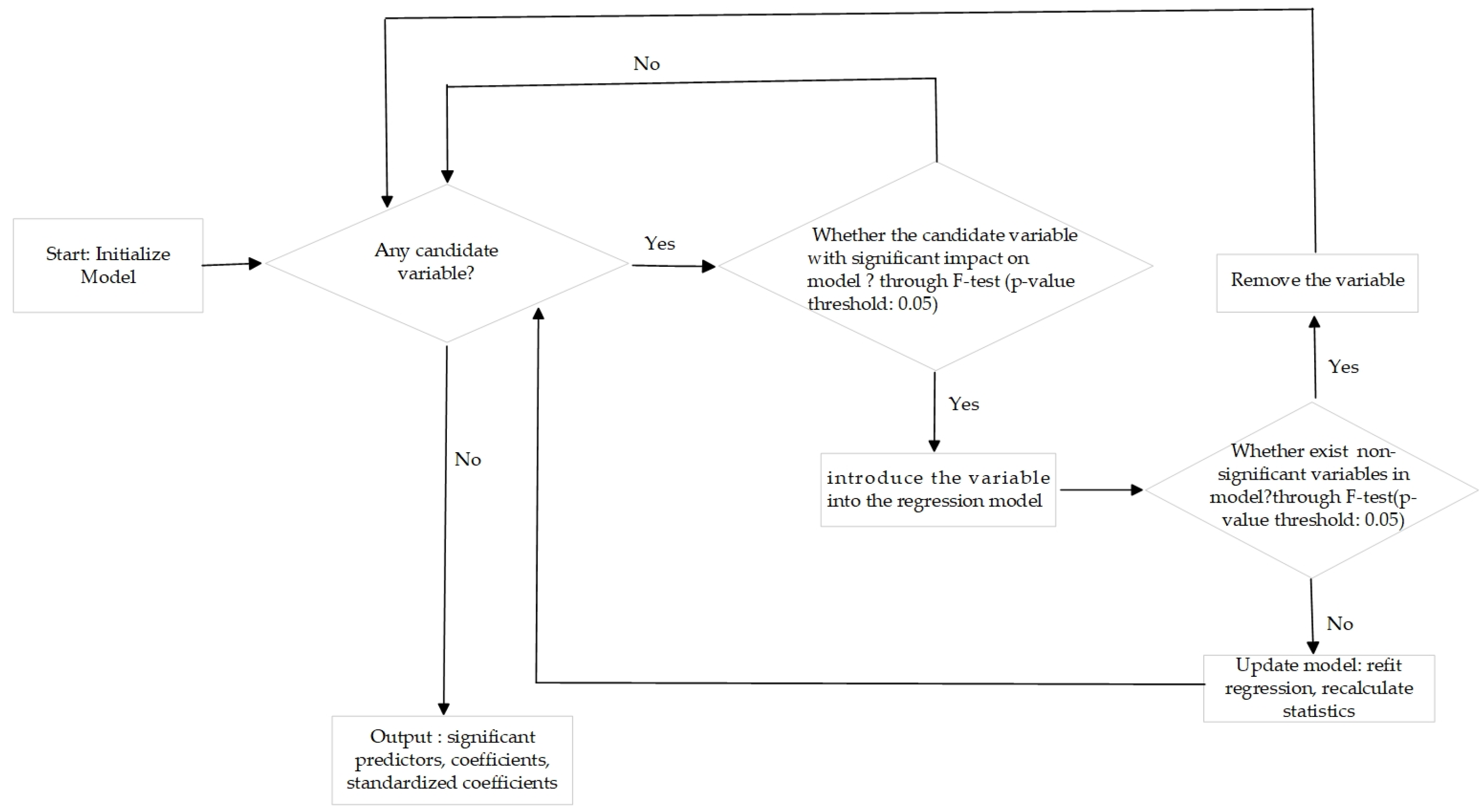
Predictor screening in stepwise regression operates through three methodological variants: forward selection, backward elimination, and bidirectional elimination [34]. This study employed bidirectional elimination to identify the variables that significantly influence Chl-a. The computational procedure is as follows: when introducing a variable into the regression model, whether this variable produces a statistically significant change in the model is first examined (via F-test, predictor inclusion threshold: partial F-test p ≤ 0.05). Following any addition, F-tests are then performed on all variables currently in the model. If the inclusion of the new variable causes any existing explanatory variable to lose statistical significance (via F-test, threshold: partial F-test p ≤ 0.05), that non-significant variable is removed. This ensures that only significant variables remain in the regression model before introducing any new candidate variable. The process iterates until both of the following conditions are satisfied: (1) no statistically significant explanatory variable can be added to the regression equation, and (2) no statistically insignificant explanatory variable remains to be eliminated from the regression equation. Final model adequacy was verified through an overall significance test. The regression equation was deemed statistically meaningful when its F-test yielded p < 0.05. The topology of the stepwise regression is shown in Figure 2. Stepwise regression analysis builds upon standard regression analysis by automatically pruning statistically insignificant independent variables while retaining significant predictors and their regression coefficients. The unstandardized coefficients serve as the model’s results, whereas the standardized coefficients eliminate dimensional effects, and their absolute values are the magnitude of the influence exerted by various factors on the dependent variable.
For the LLM and the stepwise regression analysis, the variance inflation factor (VIF) was used as an indicator to assess multicollinearity among the initial factors. A VIF value greater than 10 was considered indicative of significant multicollinearity, and such factors were excluded prior to modeling. Diagnostics for the normal distribution of random errors were performed using a histogram of residuals.

3. Results

3.1. Spatiotemporal Distribution of Monitoring Parameters

3.1.1. Chlorophyll-a

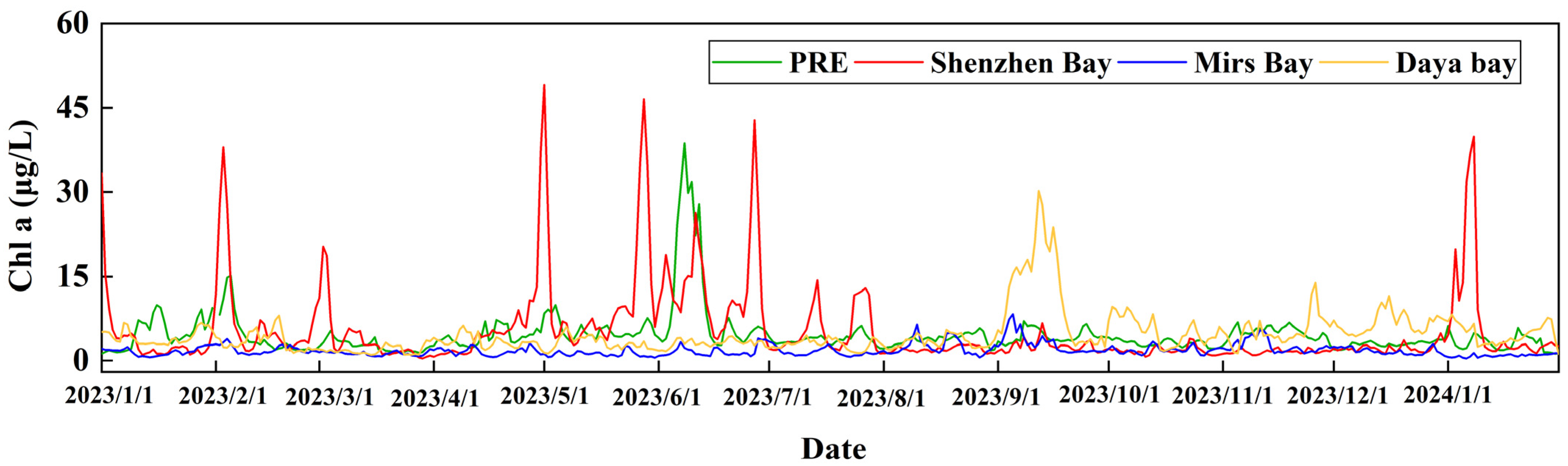
Buoy-observed Chl-a concentration statistics for Shenzhen coastal waters from January 2023 to January 2024 are presented in Table 2. The average Chl-a across the entire study area was 3.6 ± 5.5 μg/L. Average Chl-a in the PRE, Shenzhen Bay, and Daya Bay exceeded the overall average, while Mirs Bay showed lower values. Measured Chl-a content ranged as follows: 0.1–170.5 μg/L in the PRE, 0.1–101.6 μg/L in Shenzhen Bay, and 0.1–186.5 μg/L in Daya Bay, and in Mirs Bay, concentrations varied between 0.1 and 88.6 μg/L. The maximum measured values in all sub-regions occurred during summer, with the western areas (PRE and Shenzhen Bay) peaking in June and the eastern areas (Daya Bay and Mirs Bay) peaking in September.
As shown in the daily average Chl-a concentration variation (Figure 3), both the magnitude and fluctuation range of Chl-a content in the western waters exceeded those in the eastern waters from January to July 2023. Significant fluctuations occurred in Shenzhen Bay during January to March, May to July, and January 2024, with the daily average peaking at 49.1 μg/L. The PRE exhibited notable fluctuations in February and June, reaching a maximum daily average of 38.7 μg/L. In the eastern waters, Daya Bay demonstrated higher Chl-a concentrations and greater variation amplitudes than other areas from September to December, with a significant fluctuation event occurring in September. Mirs Bay maintained consistently low Chl-a content throughout the year.
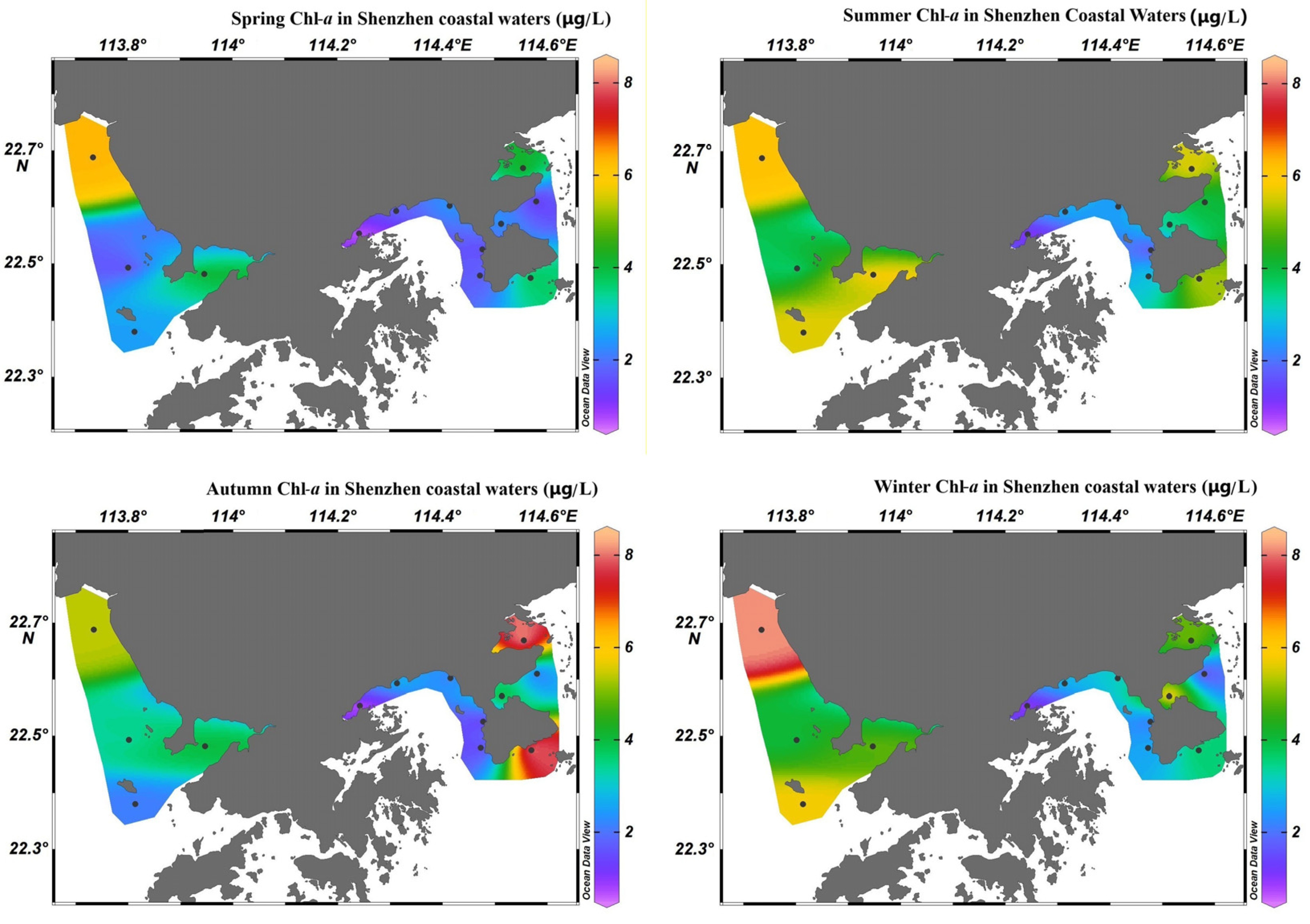
Seasonal mean distribution (Figure 4) showed an overall trend of summer > autumn > winter > spring, which is consistent with remote sensing-based studies [29]. Western waters had higher Chl-a in summer and winter, while eastern Daya Bay peaked in autumn. Mirs Bay showed minor seasonal variations, with slightly higher values in summer and winter.
Spatially, Shenzhen Bay had the highest Chl-a average, followed by Daya Bay and the PRE, with Mirs Bay being the lowest. During winter, spring, and summer, Chl-a levels in the western waters were generally higher than in the eastern waters. In autumn, Daya Bay displayed significantly higher Chl-a levels. The nearshore station ZJ1 in the PRE maintained higher Chl-a than other western stations throughout the year. ZJ3 (south of Neilingding Island) demonstrated more pronounced seasonal variations compared to other Pearl River Estuary stations, with significantly higher concentrations in summer and winter than in spring and autumn. In Daya Bay, Chl-a was markedly higher in summer and autumn than in winter and spring. Additionally, station DY2 exhibited lower concentrations than its surrounding areas year-round. In this study, the RMSE values for the spatial interpolation validation of Chl-a concentration distribution maps were 0.452, 0.386, 0.671, and 0.829 for spring, summer, autumn, and winter, respectively, proving that the Kriging interpolation method is applicable.
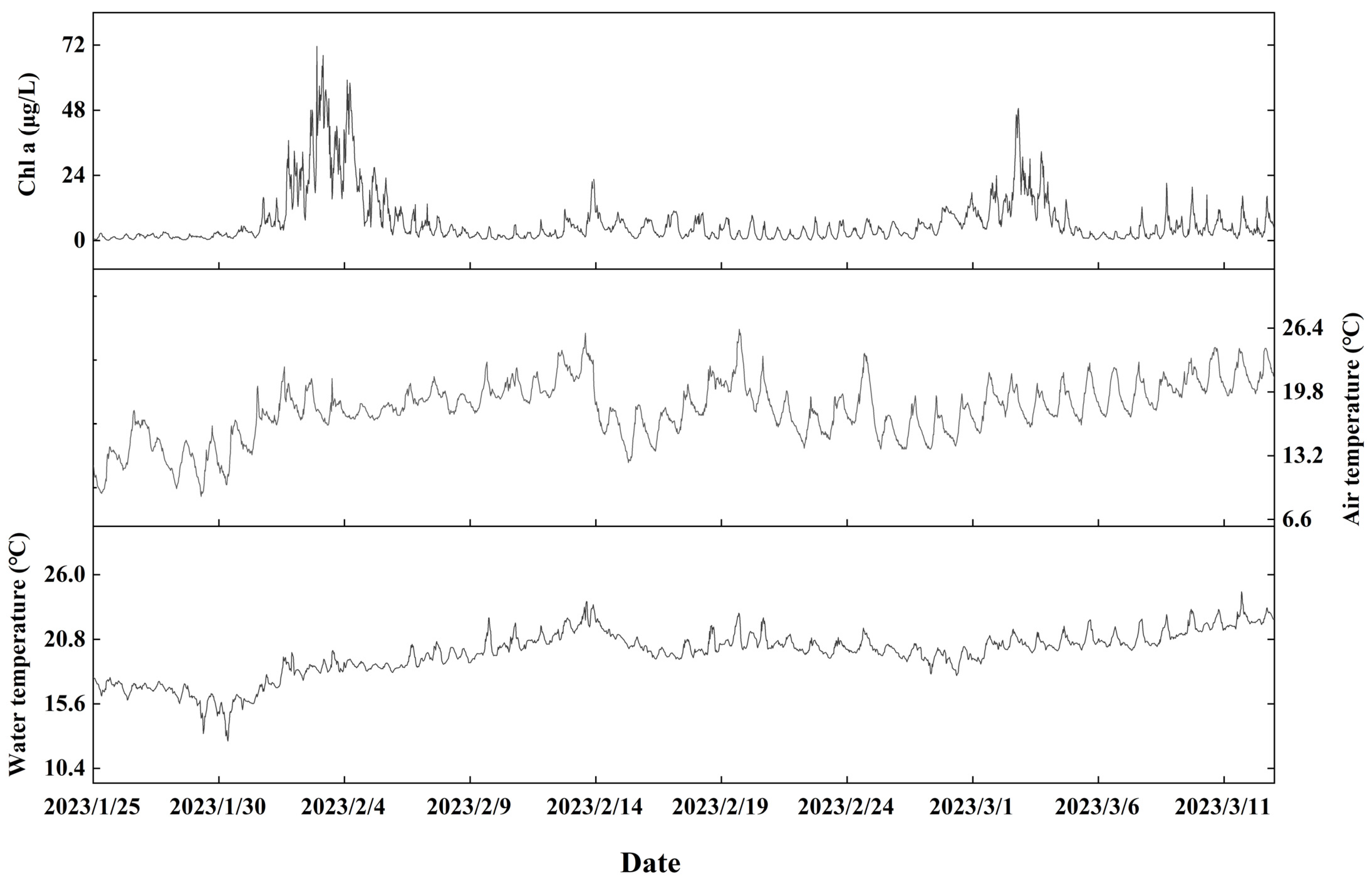
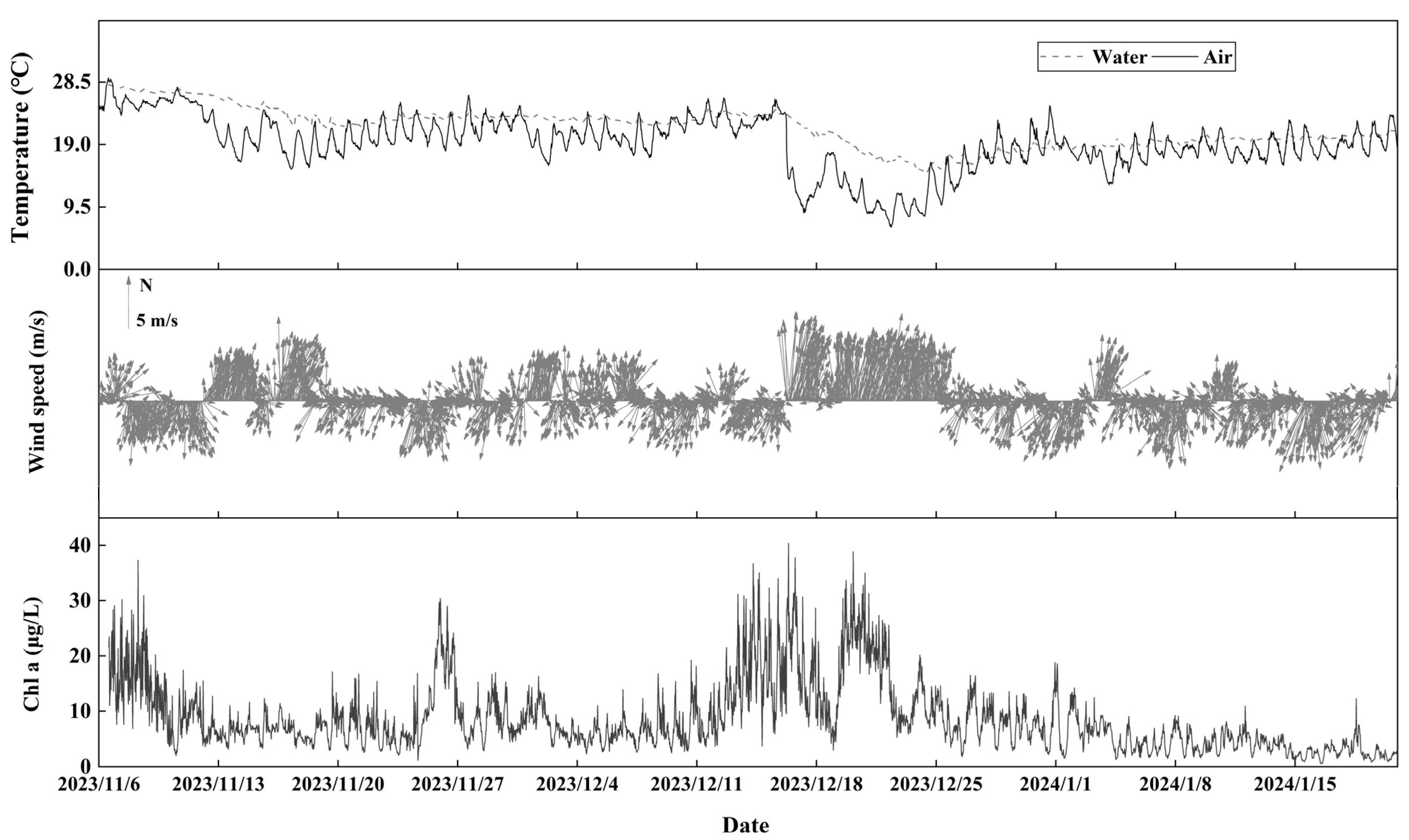
For a sharp short-term increase in Chl-a, we focused on the dynamics of its wax and wane alongside the environmental factors co-varying with Chl-a. The real-time Chl-a distributions for station SZ1 and DY1 are shown in Figure 5 and Figure 6, respectively.
At station SZ1, Chl-a concentrations remained at low levels for most of the time during the winter and early spring. Rapid growth processes were observed in early February and early March, during which decreases in both air and water temperatures were recorded.
In eastern waters, station DY1 within Daya Bay displayed significantly elevated Chl-a during autumn, with measured values detailed in Figure 6. Peak levels predominantly occurred from November to December. During the mid-December Chl-a surge, a cold air intrusion triggered abrupt thermal declines: temperatures plummeted by over 10 °C between 15 and 16 December, followed by another cooling episode from 18 to 21 December. Concurrently, wind speeds intensified while prevailing winds shifted from northerly to southerly directions.

3.1.2. Water Quality Parameters

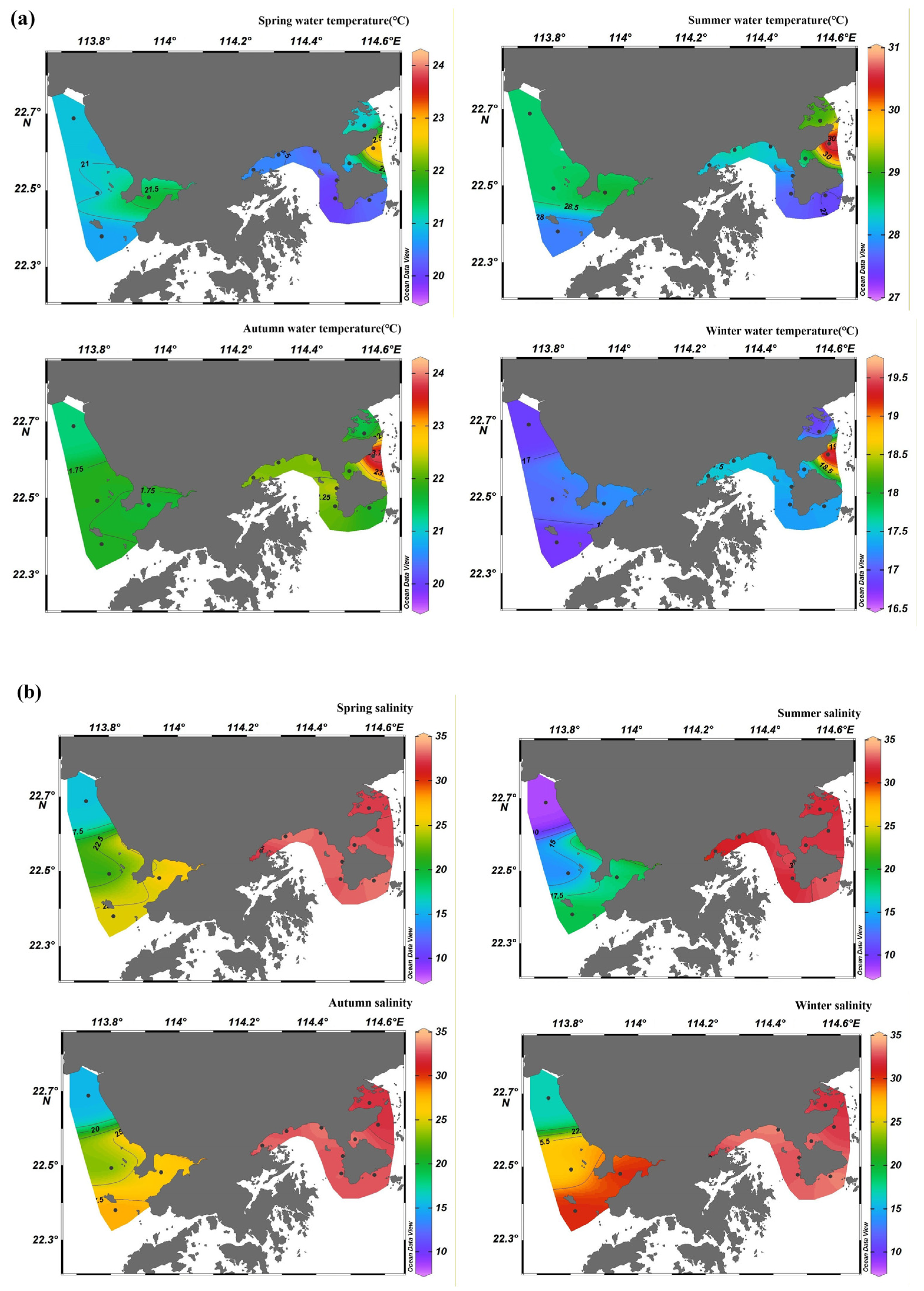
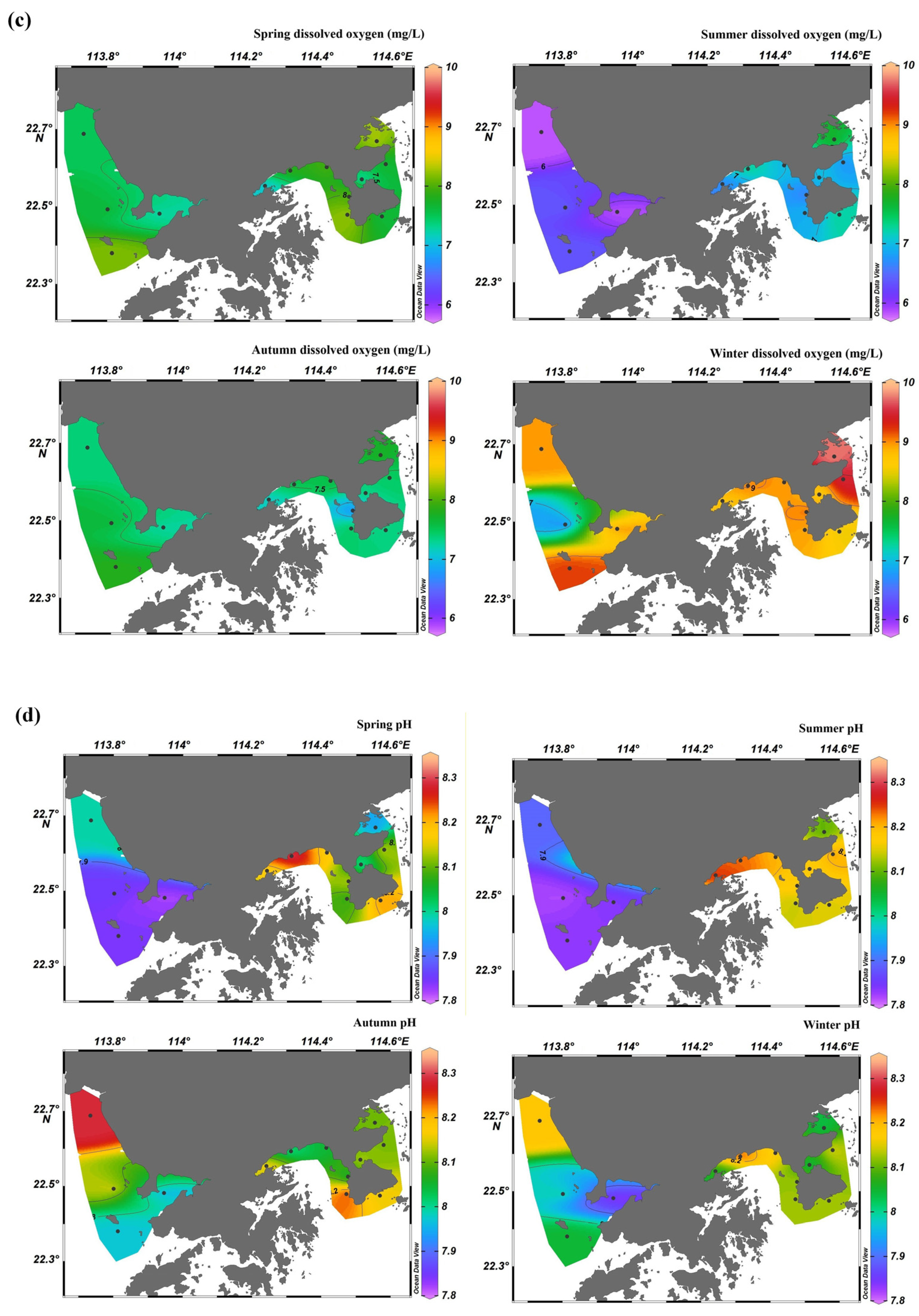
Seasonal variations in water temperature, salinity, DO, and pH are shown in Figure 4. Water temperature followed summer > autumn > spring > winter, with eastern waters significantly warmer than western. DY2 (near the Daya Bay Nuclear Power Plant outlet) had elevated temperatures year-round (Figure 7a). Salinity was higher in eastern waters, increasing from inshore to offshore, with summer values significantly lower than those in other seasons (Figure 7b). The seasonal distribution of DO concentrations generally followed winter > spring > autumn > summer. During summer and winter, DO levels in the eastern waters were higher than in the western waters, while concentrations were comparable across all regions during spring and autumn. For pH distribution, values in the eastern waters were higher than in the western waters, with autumn and winter levels generally exceeding those in spring and summer.
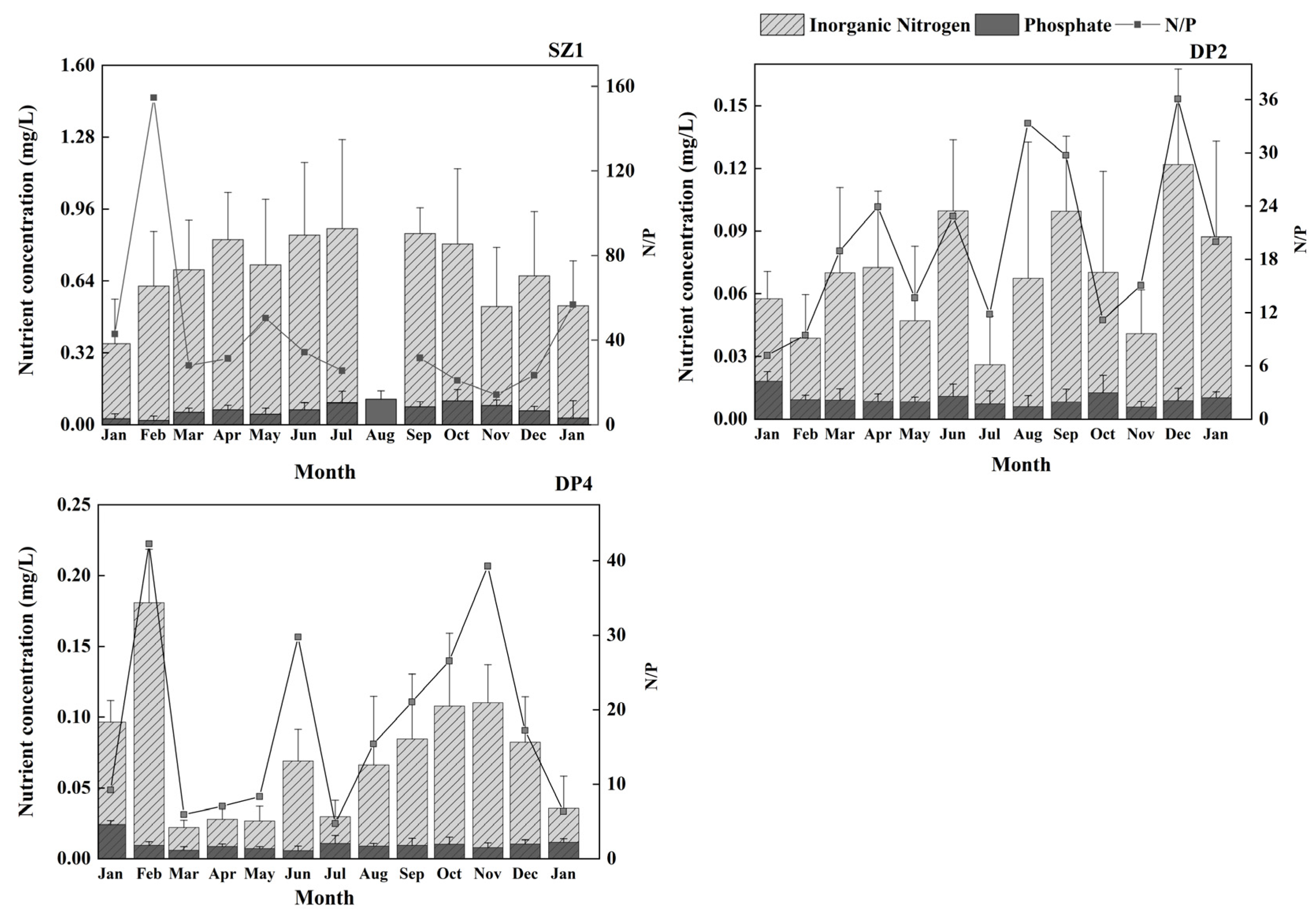
The monthly average distributions of nutrients at stations SZ1 (Shenzhen Bay), DP2, and DP4 (Mirs Bay) from January 2023 to January 2024 are shown in Figure 8. Nutrient concentrations in Shenzhen’s coastal waters exhibited a spatial pattern of higher values in the west and lower values in the east. In Shenzhen Bay, the monthly average concentration of phosphate exhibited an overall trend of initial increase followed by a decrease, peaking during the months of July and August. The concentrations were notably higher in spring and summer compared to autumn and winter. Mirs Bay stations DP2 and DP4 demonstrated significantly lower nutrient levels than Shenzhen Bay, with monthly averages of phosphate below 0.03 mg/L and inorganic nitrogen below 0.2 mg/L.

3.1.3. Meteorological Parameters

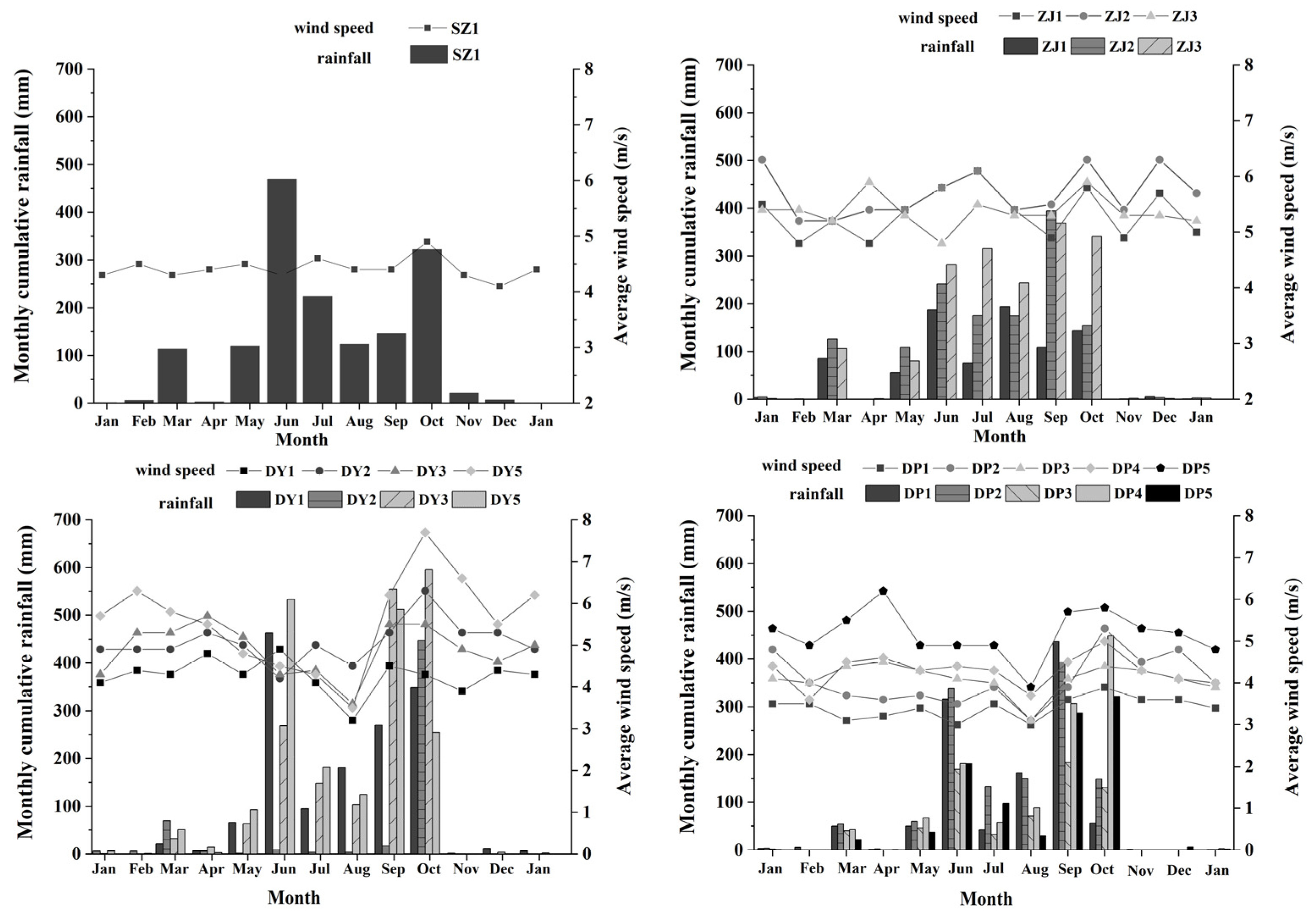
The monthly cumulative rainfall and monthly average wind speed distributions from buoy monitoring at each station are shown in Figure 9. In 2023, rainfall in Shenzhen’s coastal waters was concentrated from May to October, with June, September, and October exhibiting significantly higher cumulative rainfall than other months.
In the eastern waters, the monthly average wind speed from May to August was lower than during other months, while September and October demonstrated noticeable increases. The western waters showed little overall variation in monthly average wind speed.

3.2. Data Statistical Analysis Results

3.2.1. Correlation Analysis

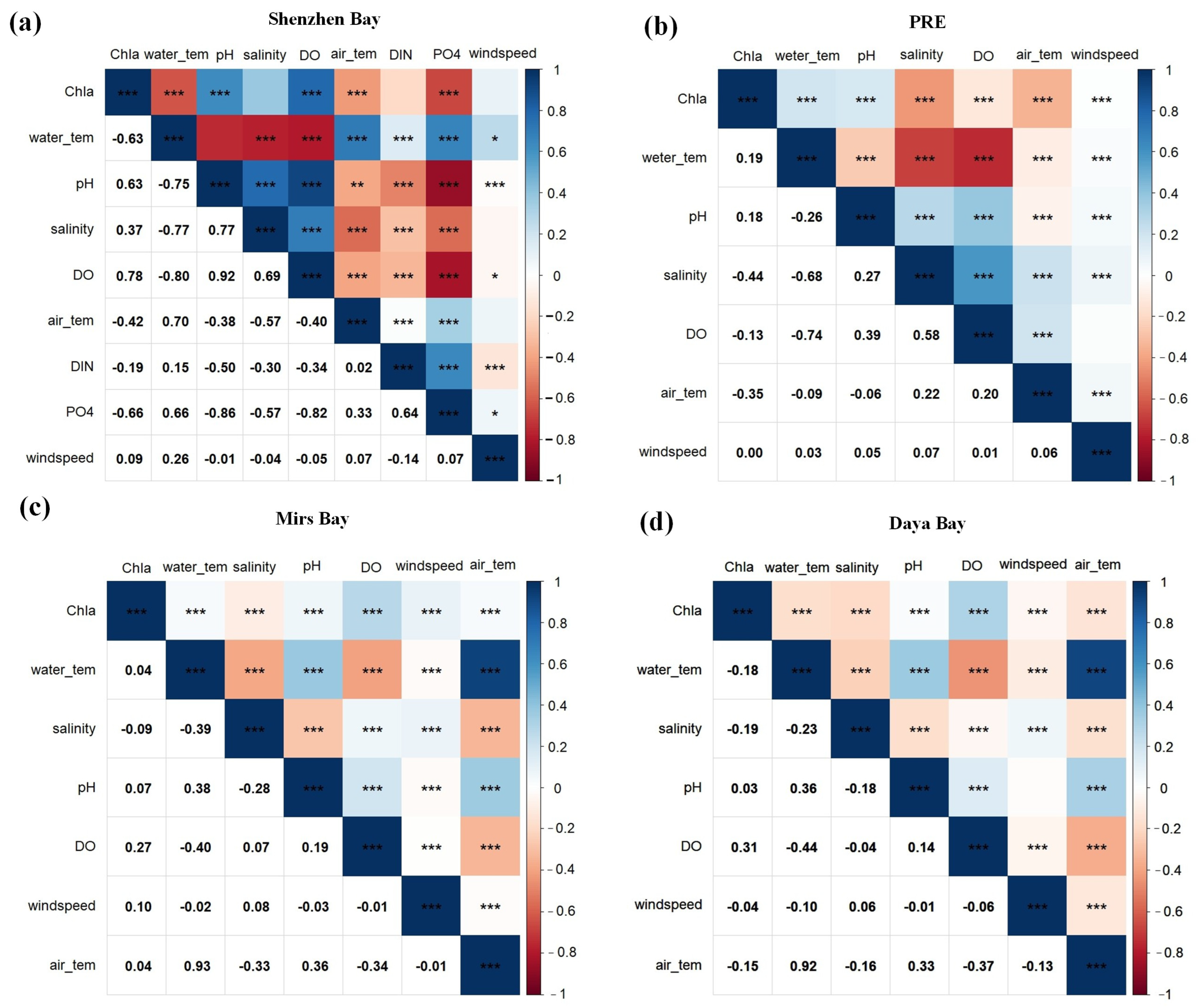
The correlation coefficients of the observed parameters for Shenzhen Bay, PRE, Mirs Bay, and Daya Bay are shown in Figure 10, with color intensity representing the absolute value of the correlation coefficients.

3.2.2. Linear Mixed Model

This study utilized two distinct datasets to construct two linear mixed effects models. Model I was constructed using the daily averaged values of observed parameters from 13 stations. Model II was built based on high-frequency measurements from three stations (SZ1, DP2, and DP4), which included nutrient observations. In those models, the log_Chl-a was the response variable, with other water quality, meteorological, and nutrient parameters as fixed explanatory variables, and the station as the random effect.
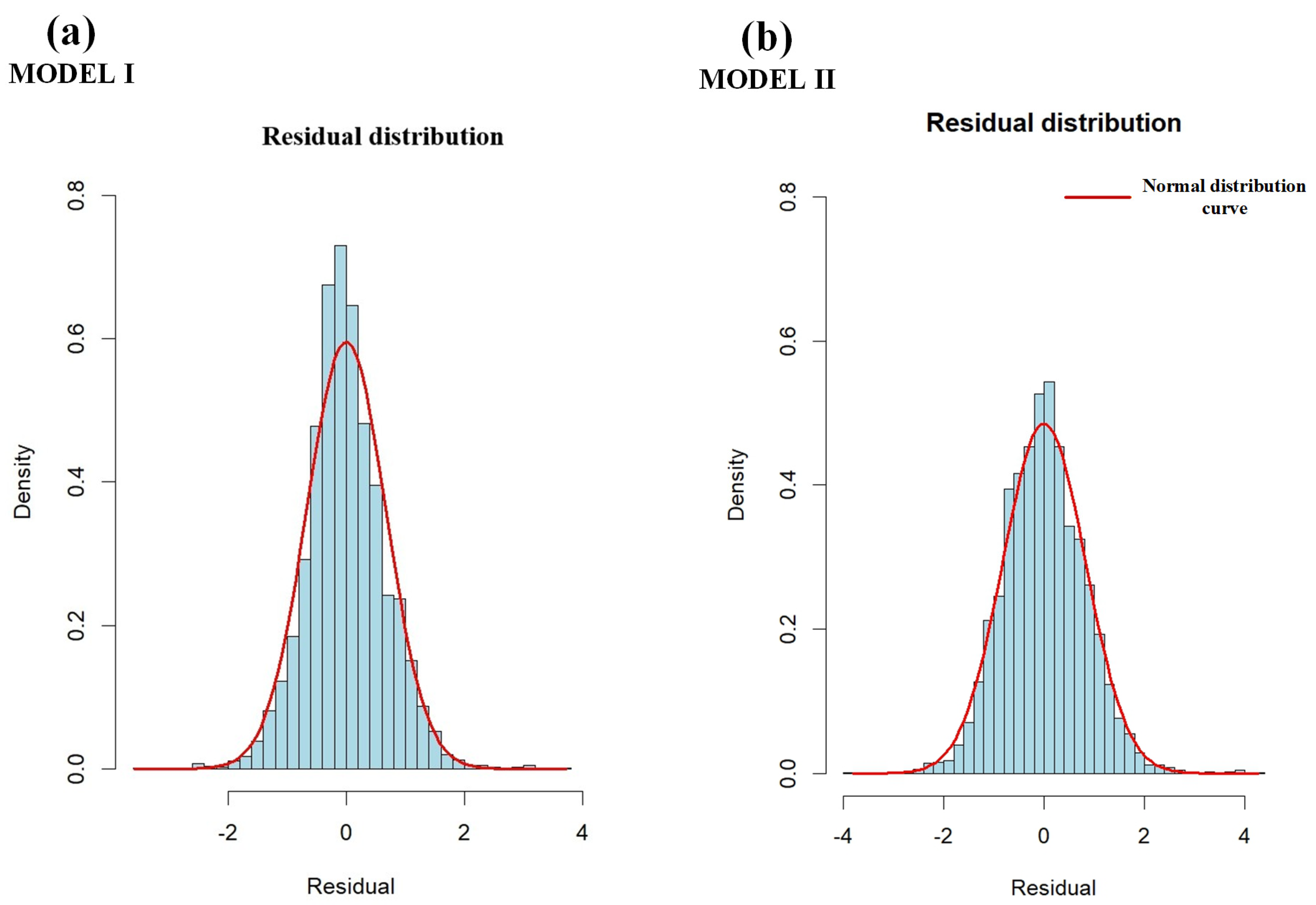
Collinearity diagnostics were performed on all variables. Significant collinearity was found only between water temperature and air temperature (VIF for air temperature = 8.3). Consequently, air temperature was excluded from both models. The parameters of the LLM are presented in Table 3. The normality diagnostics for the model residuals are shown in Figure 11.
Results of Model I showed that water temperature, pH, DO, and wind speed had significant positive correlations with Chl-a concentration, while salinity showed a significant negative correlation. All fixed effects reached statistical significance (p < 0.05). Analysis of random effects indicated significant variation in baseline Chl-a concentrations among different stations, with inter-station variation accounting for 36% of the total variance (ICC = 0.36). The conditional R2 was 0.46, indicating that the fixed and random effects together explained 46% of the variation in Chl-a. Within this, the fixed effects alone explained 15% of the variation (marginal R2 = 0.15).
Results of Model II similarly showed significant positive correlations between Chl-a concentration and water temperature, DO, and wind speed, and a significant negative correlation with salinity. Nutrient parameters were also significantly correlated with Chl-a, where the coefficients indicated that Chl-a concentration increased with higher DIN and decreasing phosphate levels. Random effects revealed differences in baseline Chl-a among stations, with inter-station variation accounting for 22% of the total variance. The conditional R2 was 0.44, meaning that the fixed and random effects collectively explained 44% of the variation in Chl-a. The fixed effects alone explained 29% of the variation.
The residual frequency histograms for Model I and Model II are presented in Figure 11. The distribution of the residuals basically meets the requirement of normality.

3.2.3. Stepwise Regression

Stepwise regression analyses were performed between Chl-a and environmental parameters across sub-regions. For Mirs Bay, DP2 station data with concurrent nutrient measurements were selected. A check for multicollinearity among the regional parameters was conducted before model fitting. As the VIF for air temperature was the only one exceeding 10, it was excluded, while all other variables had VIFs below this cutoff. The coefficients of significant predictors are presented in Table 4, where “-” denotes variables excluded during stepwise regression.
The regression equations for Shenzhen Bay (3), Pearl River Estuary (4), Mirs Bay (5), and Daya Bay (6) are expressed as follows:
log _ C h l   a = 0.194 T 0.189 S + 0.38 D O + 1.237 D I N + 0.108 W i n d + 7.047
log _ C h l   a = 0.018 T 0.55 S + 0.776 p H + 0.089 D O + 0.021 W i n d 3.676
log _ C h l   a = 0.196 S + 0.196 D O + 0.051 D I N + 5.087
log _ C h l   a = 0.038 T 1.37 S + 0.258 D O 0.005 W i n d + 4.243
where T is water temperature (°C), S is salinity, DO is dissolved oxygen concentration (mg/L), DIN and PO4 are inorganic nitrogen concentration (mg/L) and phosphate concentration (mg/L), respectively, and Wind is wind speed (m/s).
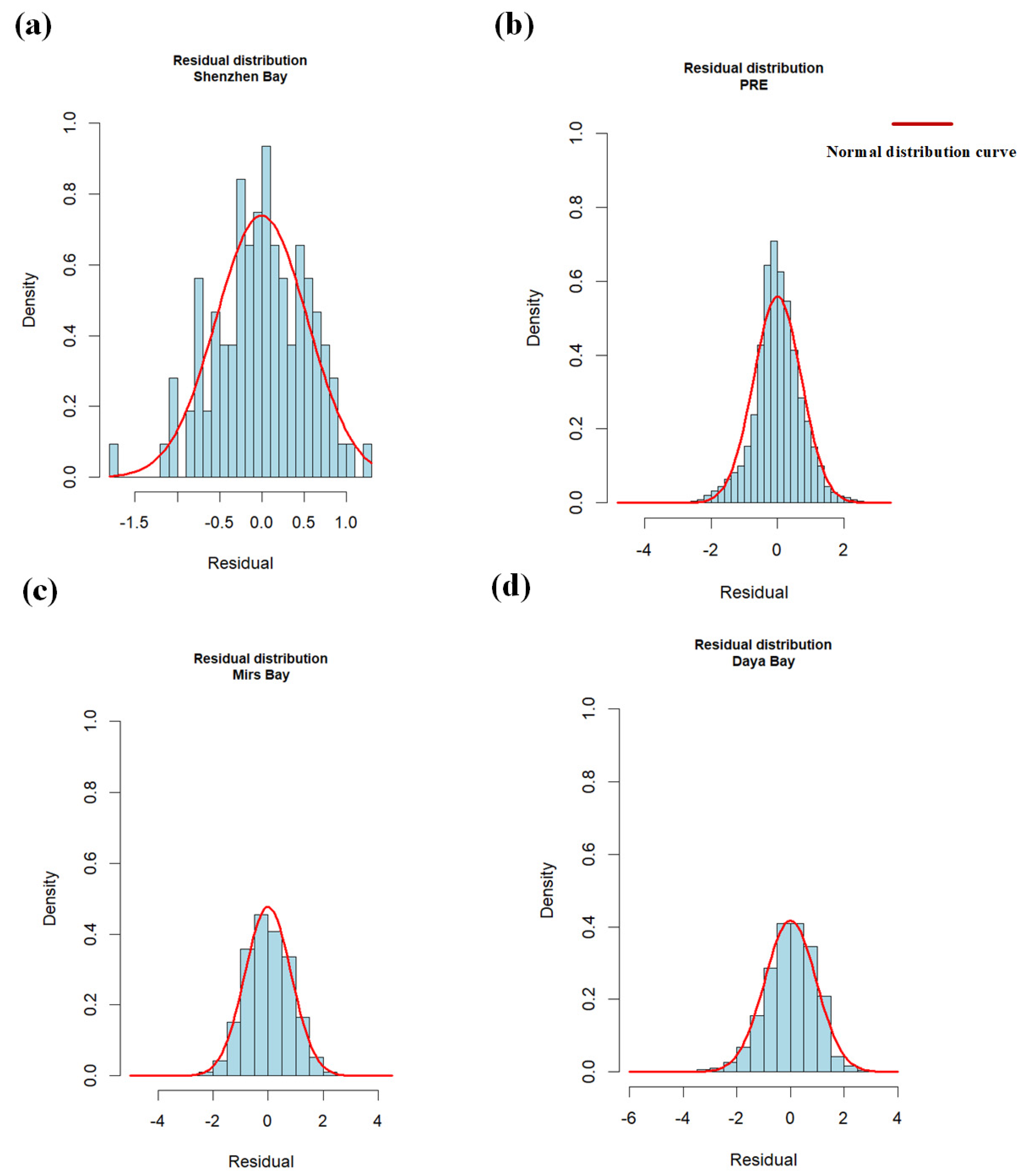
Figure 12 presents the residual distributions for Equations (3)–(5). The residuals of each model largely satisfy the normality assumption.

4. Discussion

4.1. Mechanisms Influencing Chlorophyll-a Dynamics

Seasonal variations in Chl-a in Shenzhen’s coastal waters differed across sub-regions. Compared to the open ocean [35,36,37,38], the Chl-a in nearshore areas is significantly influenced by the interactions between terrestrial and marine environments, leading to more pronounced changes [39,40,41].
The results of the LMM (Model I and Model II) indicated that Chl-a content in the Shenzhen coastal waters generally increased with rising water temperature, decreasing salinity, and increasing wind speed. In addition, higher DIN and lower phosphate levels also promote an increase in Chl-a. These factors may have synergistic effects. The rise and fall of water temperature typically reflects cyclic processes such as seasonal changes and diurnal cycles, while also being influenced by extreme events such as cold waves and water mass intrusions. Changes in water temperature are crucial for the growth and activity of marine phytoplankton. Elevated temperatures increase phytoplankton growth rates, thereby directly promoting higher Chl-a content [40]. The co-variation in salinity and temperature often reflects physical processes including runoff, tides, heavy rainfall, stratification, upwelling, and so on [42]. Wind disturbances not only affect hydrological processes, such as circulation and upwelling, but also alter suspended particulate matter levels and nutrient transport [43,44]. These processes are closely linked to biochemical activities of phytoplankton, including growth, grazing, aggregation, and dispersion [1,45,46,47]. Nutrient concentration and composition are key determinants of phytoplankton growth and reproduction [48,49]. From the results of the LMM, rising temperatures and increased rainfall during spring and summer led to higher water temperatures and lower salinity in the coastal areas. Concurrently, increased terrestrial runoff introduced abundant nutrients, while moderate wind-driven turbulence facilitated the horizontal and vertical transport of nutrients. Suitable water temperatures and ample nutrient conditions stimulated algal growth. The negative correlation between Chl-a and phosphate may reflect the rapid consumption of phosphate during the period of rapid growth of Chl-a [50]. Furthermore, the influence of station or regional differences on Chl-a concentration cannot be overlooked. Correlation analysis and stepwise regression results indicated that the response of Chl-a to changes in water temperature, salinity, and nutrient levels varies across different coastal areas.
Significant peaks in Chl-a were observed in Shenzhen Bay during winter, spring, and summer (Figure 3). Figure 5 documents two distinct episodes of rapid Chl-a increase in the winter–spring period, each preceded by a noticeable drop in both water and air temperature. In summer, high Chl-a peaks occurred more frequently due to longer daylight hours and elevated water temperatures. Statistical analysis revealed a significant negative correlation between Chl-a and temperature. However, the water temperature coefficient in the stepwise regression model was positive. This discrepancy likely reflected the coupled and interactive effects of environmental factors on Chl-a, rather than their independent influences. A significant negative correlation was found between water temperature and salinity, indicating that the bay’s thermal and saline conditions varied seasonally in concert: higher temperatures in summer coincide with increased rainfall and runoff (Figure 9), which lowers salinity (Figure 7), whereas winter conditions are characterized by low temperature and high salinity (Figure 7). The significant negative correlation between Chl-a and temperature may be attributed to the occurrence of Chl-a high peaks during the relatively cooler winter–spring months, while Chl-a levels remained low for extended periods under the consistently warm conditions from August to November (Figure 3). This pattern likely resulted in the “higher temperature, lower Chl-a” relationship captured by the Spearman correlation analysis. Correlation analysis revealed that Chl-a in Shenzhen Bay exhibited significant negative correlations with both phosphate and DIN. However, stepwise regression analysis showed a positive coefficient for DIN, while phosphate displayed no significant relationship. These results suggested that increased nutrient levels generally promote Chl-a accumulation in Shenzhen Bay, and the observed negative correlations may reflect rapid nutrient consumption during episodic pulses of Chl-a. Notably, in the regression model, the standardized coefficients for temperature and salinity were greater than those for DIN, indicating that nutrient limitation likely played a relatively minor role in controlling Chl a levels. As a semi-enclosed bay with weak hydrodynamic exchange and substantial terrestrial nutrient inputs, Shenzhen Bay consistently maintains high nutrient concentrations throughout the year [51,52], as indicated in our monitoring data (Figure 8). Furthermore, the Chl-a peaks in winter–spring and summer may originate from different phytoplankton communities, each adapted to distinct optimal environmental conditions [53]. Previous studies document the seasonal succession of dominant species in Shenzhen Bay, with water temperature and phosphate identified as the primary environmental factors influencing phytoplankton community variation [54,55,56,57,58]. Collectively, temperature regulates Shenzhen Bay’s Chl-a seasonality. Active growth periods occur January–March and May–July, featuring different dominant species. Seasonal phytoplankton community shifts influence Chl-a variation patterns.
The distribution of Chl-a in PRE exhibited higher content in summer and winter, with lower levels observed in spring and autumn in 2023. During winter, a significant increase in Chl-a was recorded at ZJ3 station located in the southern part of the estuary. The Chl-a content in the PRE showed a significant negative correlation with salinity as well as air temperature and a significant positive correlation with water temperature. Stepwise regression analysis indicated that Chl-a in the PRE was primarily influenced by salinity, temperature, and wind speed, with the standardized coefficient for salinity being significantly higher than those of the other parameters. Multiple studies confirm phytoplankton blooms in the PRE are closely aligned with positions of the salinity front [14,18,59]. In summer, freshwater influence extended seaward (Figure 7b), transporting terrestrial nutrients to waters south of PRE. Additionally, in regions with a high salinity gradient, water column stratification promoted the settling of suspended particles. This process, which deepened the euphotic layer, thereby enhanced phytoplankton growth and led to increased Chl-a content [60,61]. The PRE receives discharge from multiple rivers. During the flood season (April–October), strong plume discharge delivered abundant nutrients [14,49,62]. Concurrently, in regions with strong runoff inputs, the shorter water residence time hindered the accumulation of phytoplankton and Chl-a [1,44]. Furthermore, increased terrestrial input elevated suspended particle levels, thus reducing water transparency and potentially limiting light for phytoplankton growth [1,63,64]. In this study, summer Chl-a levels exceeded spring and autumn throughout the estuary, and nearshore areas consistently showed higher values than offshore zones. These patterns indicated that increased discharge primarily enhanced Chl-a level in the PRE, where nutrient availability likely serves as the primary driver of phytoplankton growth. During winter, ZJ3, located on the offshore side of the PRE, recorded elevated Chl-a concentrations, accompanied by higher levels of both salinity and DO compared to nearshore areas (Figure 7b,c). Enhanced wind speed and intrusion of high-salinity offshore waters promoted water mass mixing, increasing nutrients and DO, and thereby stimulating the growth of salt-tolerant phytoplankton [18,55].
In Daya Bay, significantly elevated Chl-a content was observed in autumn, particularly at station DY1 (Figure 3 and Figure 4). Real-time data indicate that the increase in Chl-a at DY1 was closely synchronized with the decrease in temperature and changes in wind patterns (Figure 6). Enhanced winds and directional shifts altered water column mixing processes, subsequently modifying nutrient supply and distribution patterns, which critically impact phytoplankton utilization efficiency [65]. Existing research corroborates that nutrient distributions in Daya Bay correlate with monsoon-induced hydrodynamic variations [66]. During autumn and winter, intensified vertical mixing exceeding that of the summer transports benthic nutrients to surface waters, thereby elevating Chl-a content [67].
Station DY2 exhibited consistently lower Chl-a content than the surrounding waters year-round. This phenomenon primarily stems from its location near the discharge outlet of the Daya Bay Nuclear Power Plant, where water temperatures remain chronically elevated [68,69]. Continuous thermal discharge reduces phytoplankton activity in this area, resulting in suppressed Chl-a [70]. Previous studies have demonstrated a contrasting impact of nuclear power plant thermal discharge on phytoplankton, which is largely dependent on the regional climatic context. In temperate seas with marked seasonality, the additional warmth can significantly enhance the growth of local phytoplankton assemblages [71]. Conversely, in tropical and subtropical waters where seasonal temperature variation is minimal, the same thermal effluents may elevate temperatures beyond optimal ranges, potentially reducing phytoplankton abundance and diversity [72,73]. Furthermore, residual chlorine in the warm coolant water from nuclear power plants is another factor that may inhibit phytoplankton growth [74,75]. This suppressive effect has been documented in studies of the Daya Bay Nuclear Power Plant [76]. At station DY3, Chl-a content during spring, summer, and autumn fell below Daya Bay’s average, yet winter values exceeded those at other stations. This pattern likely reflected thermal discharge impacts from the adjacent power plant. Station DY3 is located to the southwest of the nuclear power plant and is not within the high-temperature core of the discharge plume (Figure 7a). Previous studies utilizing remote sensing technology have noted that the thermal plume from the Daya Bay Nuclear Power Plant exhibited significant seasonal variability, primarily influenced by the temperature differential with ambient waters and the structure of the water column stratification [77,78,79]. During summer, stronger solar radiation reduces the temperature contrast between the thermal discharge and the surrounding seawater, making the surface thermal plume difficult to distinguish [76]. This study speculated that during winter, the larger temperature gradient may allow the thermal plume to extend into the adjacent cooler waters. This process could contribute to the observed increase in Chl-a concentration at station DY3 in winter. Chl-a in Mirs Bay consistently remained at relatively low levels, which is potentially attributable to its low eutrophication status [20]. Measured nutrient values indicate year-round compliance with Class I seawater quality standards of the Chinese Sea Water Quality Standard (GB 3097-1997) (DIN ≤ 0.2 mg/L, and phosphate ≤ 0.015 mg/L) [80] throughout this region. Multiple studies elucidate that Chl-a distribution in Mirs Bay is primarily governed by terrestrial inputs and hydrodynamics within the bay, which affect nutrient migration [20,81,82,83]. The Chl-a content decreases with increasing distance from the shore [13,20]. Hydrodynamic variations in Mirs Bay are predominantly tide-controlled, featuring northward flow during flood tide and southward flow during ebb tide [84]. Maximum current velocities occur in the central bay and bay mouth, while stations DP1 and DP4 exhibit weaker flow dynamics [20,84]. Consequently, the low Chl-a at DP4 may stem from both nutrient limitations and subdued hydrodynamic conditions.
Notably, nearshore station DP1 demonstrated lower Chl-a than the central and mouth areas during most observation periods in this study. This pattern may be related to shifting proportions of terrestrial nutrient inputs in recent years. Through effective governance by Shenzhen and Hong Kong authorities, Mirs Bay has achieved remarkable nutrient reduction and maintained excellent water quality [22]. However, unbalanced nutrient decreases have gradually elevated the nitrogen-to-phosphorus ratio in terrestrial inputs [20,85]. Such nutrient diminution and altered stoichiometry could substantially modify phytoplankton community structure and productivity [86]. Thus, DP1’s suppressed Chl-a may reflect these changing nutrient ratios.
Based on the preceding analysis, the implementation of seasonally adjusted and region-specific management protocols should be utilized to mitigate red tide risks and enhance water quality throughout Shenzhen’s coastal waters. For western sectors, priority should focus on monitoring temperature and nutrient fluctuations during flood-season riverine discharge surges. Given Shenzhen Bay’s chronic eutrophic status, establishing ecological buffer zones—such as seagrass beds and mangrove wetlands in suitable areas—would absorb excess nutrients and alleviate eutrophication. In eastern waters, targeted nutrient regulation should be adopted, specifically implementing “phosphorus reduction while maintaining nitrogen” strategies. This requires ensuring nitrogen levels remain above ecological thresholds while strictly restricting phosphorus discharges. Additionally, leveraging real-time buoy data to track synergistic variations in Chl-a, pH, DO, and salinity would facilitate developing algal bloom risk-forecasting models.

4.2. Spatiotemporal Variations in Chl-a in Shenzhen Coastal Waters

Chl-a in nearshore waters exhibits short-term, high-amplitude fluctuations influenced by nutrients, light availability, water transparency, and hydrodynamics. Research on its distribution patterns is significantly constrained by observation periods and methodologies. Historical investigations in Daya Bay from the 1980s to early 2000s revealed an overall increasing Chl-a trend, primarily regulated by temperature and nutrients. Notably, phytoplankton growth limitation shifted from nitrogen to phosphorus dominance [87]. MODIS satellite inversion results (2003–2014) indicated slightly higher concentrations than earlier surveys [88]. Conversely, Mirs Bay exhibited a decreasing Chl-a trend since the late 1990s [21,81,89,90]. Field surveys conducted in Shenzhen Bay during 2008 documented perennially elevated Chl-a content within the inner bay. Notably, bay-mouth Chl-a levels during spring and autumn marginally surpassed those recorded in summer and winter [12]. A comprehensive 2014 coastal investigation further corroborated higher Chl-a content in western sectors compared to eastern regions [29].
Early research established a west-high–east-low Chl-a pattern across Shenzhen waters, with seasonal variations across studies primarily controlled by temperature and nutrients. In contrast, our data witnessed more pronounced Chl-a variability in Shenzhen’s eastern waters. Mirs Bay exhibited declining concentrations relative to historical baselines, while Daya Bay showed an upward trend—particularly marked by significant autumn elevations. Western waters demonstrated a modest Chl-a increase compared to prior studies. Crucially, distinct primary controls emerged: riverine discharge and water temperature predominantly regulated western Chl-a dynamics, whereas eastern patterns were principally governed by nutrient availability and stoichiometric composition.

4.3. Limitations and Future Directions

This paper examined the spatiotemporal distribution of Chl-a and its driving mechanisms in the waters around Shenzhen. However, further data collection and analysis are still necessary, such as studies on phytoplankton communities across different seasons and sub-regions, quantitative assessments of anthropogenic impacts (e.g., tracking agricultural fertilization and industrial emissions into the sea), and experimental data on the effects of nutrients on phytoplankton growth. More comprehensive experimental analyses and mechanism validations need to be elaborated in future research.

5. Conclusions

This study investigated Chl-a distribution patterns and influencing factors across Shenzhen’s coastal waters, utilizing buoy monitoring data from January 2023 to January 2024. The principal conclusions are summarized as follows.
Chl-a content in Shenzhen’s coastal waters exhibited distinct seasonal variability, with summer levels exceeding autumn, winter, and spring values. During winter, spring, and summer, western waters consistently demonstrated higher Chl-a than eastern areas. Conversely, autumn witnessed elevated concentrations in Daya Bay relative to other regions.
In the Pearl River Estuary, Chl-a was predominantly regulated by riverine discharge. During summer flood season, seaward expansion of the salinity front drove significant Chl-a increases in the southern waters. Shenzhen Bay’s Chl-a responded primarily to temperature variations, maintaining generally low levels through autumn and winter. Summer patterns reflected the combined influences of runoff and temperature.
Daya Bay’s Chl-a responded strongly to temperature and wind field modifications, where intensified winds enhanced vertical mixing and nutrient transport, triggering autumn concentration peaks. Mirs Bay maintained relatively low Chl-a due to oligotrophic conditions and constrained hydrodynamics.
This study proposed that seasonal zoning management be deployed across Shenzhen’s coastal waters. Specifically, the western sector should prioritize monitoring temperature and nutrient fluctuations during rainy-season discharge events, whereas the eastern sector requires enhanced phosphorus–nitrogen coordinated regulation through strict phosphorus restriction while maintaining ecological nitrogen thresholds.

Supplementary Materials

The following supporting information can be downloaded at: https://www.mdpi.com/article/10.3390/su18010150/s1.

Author Contributions

Conceptualization, K.W., Y.L., and Y.C.; methodology, Y.C. and S.W.; software, S.W. and L.X.; validation, Y.C. and S.W.; formal analysis, S.W. and L.X.; data curation, K.W.; writing—original draft preparation, K.W.; writing—review and editing, Y.C.; visualization, S.W.; supervision, Y.C.; funding acquisition, K.W. All authors have read and agreed to the published version of the manuscript.

Funding

This research was funded by the Shenzhen Science and Technology Program, grant number No. KCXFZ20211020164015024.

Institutional Review Board Statement

Not applicable.

Informed Consent Statement

Not applicable.

Data Availability Statement

The data in this study originates from monitoring buoys deployed by the Shenzhen Ocean Development Promotion Center. According to the data management requirements of the Shenzhen Ocean Development Promotion Center, a portion of the data is presented in the Supplementary Materials, while additional data can be obtained by referring to the designated data administrator upon reasonable request.

Conflicts of Interest

The Shenzhen Ocean Development Promotion Center and Shenzhen Lightsun Technology Co., Ltd. have established a cooperative relationship. Shenzhen Lightsun Technology Co., Ltd. provides operational and data services for marine monitoring buoys, and the two parties jointly conduct research on the data to provide effective data support for revealing marine ecological patterns or disaster warnings. The authors declare that the research was conducted in the absence of any commercial or financial relationships that could be construed as a potential conflict of interest.

References

  1. Ma, C.; Zhao, J.; Zhang, G. Decoding the drivers of variability in chlorophyll-a concentrations in the Pearl River Estuary: Intra-annual and inter-annual analyses of environmental influences. Environ. Res. 2025, 268, 120783. [Google Scholar] [CrossRef]
  2. Lai, L.; Zhang, Y.; Han, T.; Zhang, M.; Cao, Z.; Liu, Z.; Yang, Q.; Chen, X. Satellite mapping reveals phytoplankton biomass’s spatio-temporal dynamics and responses to environmental factors in a eutrophic inland lake. J. Environ. Manag. 2024, 360, 121134. [Google Scholar] [CrossRef] [PubMed]
  3. Agarwal, V.; Chávez-Casillas, J.; Inomura, K.; Mouw, C.B. Patterns in the temporal complexity of global chlorophyll concentration. Nat. Commun. 2024, 15, 1522. [Google Scholar] [CrossRef] [PubMed]
  4. Amorim, C.A.; Moura, A.D.N. Ecological impacts of freshwater algal blooms on water quality, plankton biodiversity, structure, and ecosystem functioning. Sci. Total Environ. 2021, 758, 143605. [Google Scholar] [CrossRef] [PubMed]
  5. Mungenge, C.P.; Wasserman, R.J.; Dondofema, F.; Keates, C.; Masina, F.M.; Dalu, T. Assessing chlorophyll–a and water quality dynamics in arid–zone temporary pan systems along a disturbance gradient. Sci. Total Environ. 2023, 873, 162272. [Google Scholar] [CrossRef]
  6. Li, X.; Sha, J.; Wang, Z.-L. Chlorophyll-A Prediction of Lakes with Different Water Quality Patterns in China Based on Hybrid Neural Networks. Water 2017, 9, 524. [Google Scholar] [CrossRef]
  7. Lan, J.; Liu, P.; Hu, X.; Zhu, S. Harmful Algal Blooms in Eutrophic Marine Environments: Causes, Monitoring, and Treatment. Water 2024, 16, 2525. [Google Scholar] [CrossRef]
  8. Imai, I.; Inaba, N.; Yamamoto, K. Harmful algal blooms and environmentally friendly control strategies in Japan. Fish Sci. 2021, 87, 437–464. [Google Scholar] [CrossRef]
  9. Thiagarajan, C.; Devarajan, Y. The urgent challenge of ocean pollution: Impacts on marine biodiversity and human health. Reg. Stud. Mar. Sci. 2025, 81, 103995. [Google Scholar] [CrossRef]
  10. Ma, F.; Leng, K.; Zhou, Q.; Bi, Y.; Heng, Q. Analysis on the occurrences and evolution mechanism of HABs in Dapeng bay, Shenzhen in the last 40 years. Mar. Environ. Sci. 2021, 40, 263–271. [Google Scholar]
  11. Li, L.; Ma, F.; Zhai, X.; Yang, W.; Ye, P.; Liu, Y. Analysis on the key factors for the population evolution and early warning of harmful algal blooms based on an algal bloom in Shenzhen bay, the South China Sea. Ecol. Sci. 2022, 41, 82–89. [Google Scholar]
  12. Zhang, Y.; Zhang, J.; Zhang, C.; Zhou, K.; Sun, X. The spatial and temporal distribution of chlorophyll a and the influencing factors in Shenzhen Bay with frequent occurrence of red tide. Ecol. Environ. Sci. 2009, 18, 1638. [Google Scholar]
  13. Pang, R.; Zhou, K.; Pang, N.; Heng, Q.; Zhuang, X.; Zhou, Q. The spatial and temporal distribution characteristics of Chlorophyll-a in the coastal waters of Mirs bay. Mar. Environ. Sci. 2017, 36, 360–365. [Google Scholar] [CrossRef]
  14. Lu, Z.; Gan, J. Controls of seasonal variability of phytoplankton blooms in the Pearl River Estuary. Deep Sea Res. Part II Top. Stud. Oceanogr. 2015, 117, 86–96. [Google Scholar] [CrossRef]
  15. Niu, L.; Luo, X.; Hu, S.; Liu, F.; Cai, H.; Ren, L.; Ou, S.; Zeng, D.; Yang, Q. Impact of anthropogenic forcing on the environmental controls of phytoplankton dynamics between 1974 and 2017 in the Pearl River estuary, China. Ecol. Indic. 2020, 116, 106484. [Google Scholar] [CrossRef]
  16. Ye, H.; Yang, C.; Tang, S.; Chen, C. The phytoplankton variability in the Pearl River estuary based on VIIRS imagery. Cont. Shelf Res. 2020, 207, 104228. [Google Scholar] [CrossRef]
  17. Zeng, D.; Li, J.; Xie, L.; Ye, X.; Zhou, D. Analysis of temporal characteristics of chlorophyll a in Lingding Bay during summer. J. Trop. Oceanogr. 2022, 41, 16–25. [Google Scholar]
  18. Liu, H.; Huang, L.; Tan, Y.; Ke, Z.; Liu, J.; Zhao, C.; Wang, J. Seasonal variations of chlorophyll a and primary production and their influencing factors in the Pearl River Estuary. J. Trop. Oceanogr. 2017, 36, 81–91. [Google Scholar]
  19. Cereja, R.; Chainho, P.; Brotas, V.; Cruz, J.P.C.; Sent, G.; Rodrigues, M.; Carvalho, F.; Cabral, S.; Brito, A.C. Spatial Variability of Physicochemical Parameters and Phytoplankton at the Tagus Estuary (Portugal). Sustainability 2022, 14, 13324. [Google Scholar] [CrossRef]
  20. Dai, S.; Zhou, Y.; Li, N.; Mao, X.-Z. Why do red tides occur frequently in some oligotrophic waters? Analysis of red tide evolution history in Mirs Bay, China and its implications. Sci. Total Environ. 2022, 844, 157112. [Google Scholar] [CrossRef] [PubMed]
  21. Zhao, Y.; Chen, J.; Li, X.; Li, H.; Zhao, L. Coastal Water Clarity in Shenzhen: Assessment of Observations from Sentinel-2. Water 2023, 15, 4102. [Google Scholar] [CrossRef]
  22. Wu, K.; Xiu, B.; Cui, D.; Lu, D.; Yang, B.; Liang, S.; Zhou, J.; Huang, H.; Peng, S. Composition and distribution of nutrients and environmental capacity in Dapeng Bay, northern South China Sea. Mar. Pollut. Bull. 2024, 206, 116689. [Google Scholar] [CrossRef]
  23. Greater Bay Area. Overview. 2024. Available online: https://www.bayarea.gov.hk/sc/about/overview.html (accessed on 2 December 2025).
  24. Liu, Y.; Feng, J.; Cheng, Q.; Tsou, J.Y.; Huang, B.; Ji, C.; Yang, Y.; Zhang, Y. Investigating spatiotemporal coastline changes and impacts on coastal zone management: A case study in Pearl River Estuary and Hong Kong’s coast. Ocean Coast. Manag. 2024, 257, 107354. [Google Scholar] [CrossRef]
  25. Pang, R.; Zhou, K.; Leng, K.; Guo, X.; Wu, J.; Zhong, W. The station design and data application of buoy monitoring Network in Shenzhen sea area. Ocean Dev. Manag. 2018, 35, 49–53. [Google Scholar]
  26. GB/T 42074-2022; Climate and Climate Change. Division of Climatic Seasons. China Standards Press: Beijing, China, 2022.
  27. Lin, W.; Sun, X.; Ren, G.; Zhang, J. A review of seasonal division and change research. Prog. Geogr. 2024, 43, 826–840. [Google Scholar]
  28. Klein Tank, A.M.G.; Können, G.P. Trends in Indices of Daily Temperature and Precipitation Extremes in Europe 1946–1999. J. Clim. 2003, 16, 3665–3680. [Google Scholar] [CrossRef]
  29. Jaagus, J.; Ahas, R. Space-time variations of climatic seasons and their correlation with the phenological development of nature in Estonia. Clim. Res. 2000, 15, 207–219. [Google Scholar] [CrossRef]
  30. Mateorological Bureau of Shenzhen Municipality. Climate Profile and Seasonal Features of Shenzhen. 2024. Available online: https://weather.sz.gov.cn/qixiangfuwu/qihoufuwu/qihouguanceyupinggu/qihougaikuang/ (accessed on 12 August 2025).
  31. Bates, D.; Machler, M.; Bolker, B.; Walker, S. Fitting linear mixed-effects models using lme4. J. Stat. Softw. 2015, 67, 1–48. [Google Scholar] [CrossRef]
  32. Bernal-Rusiel, J.L.; Greve, D.N.; Reuter, M.; Fischl, B.; Sabuncu, M.R. Statistical analysis of longitudinal neuroimage data with Linear Mixed Effects models. NeuroImage 2013, 66, 249–260. [Google Scholar] [CrossRef] [PubMed]
  33. John, N.; William, W.; Michael, H.K. Stepwise Selection. In Applied Linear Regression Models; Irwin Professional Publishing: Burr Ridge, IL, USA, 1983; pp. 430–434. [Google Scholar]
  34. Yao, J. Precision Analysis and Parameter Inversion in the Stepwise Deployment of a Mixed Constellation. Open J. Stat. 2013, 3, 390–397. [Google Scholar] [CrossRef]
  35. Zhang, Y.; Chen, J.; Wang, J.; Han, Y.; Yi, L. Remote sensing inversion for net primary productivity and its spatial-temporal variability in Shenzhen coastal waters. J. Appl. Oceanogr. 2017, 36, 311–318. [Google Scholar]
  36. Chakraborty, K.; Rose, L.; Rohith, B.; Baliarsingh, S.K.; Samanta, A. Environmental controls on chlorophyll-a and dissolved oxygen variability in contrasting Basins of the Northern Indian ocean. Mar. Environ. Res. 2025, 210, 107316. [Google Scholar] [CrossRef] [PubMed]
  37. Huang, C.; Liu, Y.; Li, J.; Wang, H.; Luo, Y.; Zhang, H.; Chen, Z. Assessing the distribution of nocturnal chlorophyll-a in the Northwest Pacific Ocean using ocean color and fishery echosounder acoustic data. Ecol. Inform. 2025, 90, 103246. [Google Scholar] [CrossRef]
  38. He, J.; Christakos, G.; Cazelles, B.; Wu, J.; Leng, J. Spatiotemporal variation of the association between sea surface temperature and chlorophyll in global ocean during 2002–2019 based on a novel WCA-BME approach. Int. J. Appl. Earth Obs. Geoinf. 2021, 105, 102620. [Google Scholar] [CrossRef]
  39. Monteiro, M.C.; Jiménez, J.A.; Pereira, L.C.C. Natural and human controls of water quality of an Amazon estuary (Caeté-PA, Brazil). Ocean Coast. Manag. 2016, 124, 42–52. [Google Scholar] [CrossRef]
  40. Balkoni, A.; Sidorenko, V.; de Amorim, F.L.L.; Sarker, S.; Spence-Jones, H.C.; Rick, J.J.; van Beusekom, J.; Wiltshire, K.H. Long-Term Effects of Nutrient Shifts and Warming on Chlorophyll-a in a Temperate Coastal Environment. Estuaries Coasts 2025, 49, 13. [Google Scholar] [CrossRef]
  41. Domingues, R.B.; Anselmo, T.P.; Barbosa, A.B.; Sommer, U.; Galvão, H.M. Light as a driver of phytoplankton growth and production in the freshwater tidal zone of a turbid estuary. Estuar. Coast. Shelf Sci. 2011, 91, 526–535. [Google Scholar] [CrossRef]
  42. Cao, Z.; Dai, M.; Zheng, N.; Wang, D.; Li, Q.; Zhai, W.; Meng, F.; Gan, J. Dynamics of the carbonate system in a large continental shelf system under the influence of both a river plume and coastal upwelling. J. Geophys. Res. 2011, 116, G02010. [Google Scholar] [CrossRef]
  43. Chowdhury, K.M.A.; Jiang, W.; Liu, G.; Ahmed, M.K.; Akhter, S. Dominant physical-biogeochemical drivers for the seasonal variations in the surface chlorophyll-a and subsurface chlorophyll-a maximum in the Bay of Bengal. Reg. Stud. Mar. Sci. 2021, 48, 102022. [Google Scholar] [CrossRef]
  44. Sahwell, P.J.; Bejar, D.; Kim, D.; Solo-Gabriele, H.M. Non-traditional abiotic drivers explain variability of chlorophyll-a in a shallow estuarine embayment. Sci. Total Environ. 2024, 919, 170873. [Google Scholar] [CrossRef]
  45. Chowdhury, M.; Caballero, I.; de la Calle, I.; Laiz, I. Chlorophyll-a and suspended matter variability in a data-scarce coastal-estuarine ecosystem. Estuar. Coast. Shelf Sci. 2024, 309, 108973. [Google Scholar] [CrossRef]
  46. Mondal, I.; De, A.; Nandi, S.; Thakur, S.; Raman, M.; Jose, F.; De, T.K. Estimation of Chlorophyll-a, TSM and salinity in mangrove dominated tropical estuarine areas of Hooghly River, North East Coast of Bay of Bengal, India using sentinel-3 data. Acta Geophys. 2024, 72, 303–322. [Google Scholar] [CrossRef]
  47. Deb, S.; Chakraborty, A. Simulating the Effects of Tidal Dynamics on the Biogeochemistry of the Hooghly Estuary. IEEE J. Sel. Top. Appl. Earth Obs. Remote Sens. 2015, 8, 130–140. [Google Scholar] [CrossRef]
  48. Wei, X.; Zhao, H. Spatiotemporal distribution of chlorophyll-a concentration in the south China sea and its possible environmental regulation mechanisms. Mar. Environ. Res. 2025, 204, 106902. [Google Scholar] [CrossRef] [PubMed]
  49. Niu, L.; van Gelder, P.; Luo, X.; Cai, H.; Zhang, T.; Yang, Q. Implications of Nutrient Enrichment and Related Environmental Impacts in the Pearl River Estuary, China: Characterizing the Seasonal Influence of Riverine Input. Water 2020, 12, 3245. [Google Scholar] [CrossRef]
  50. Rajapaksha, R.; Wu, M.; Wang, Y.; Bandara, G.; Atapaththu, K.; Wang, Y. Long-term alterations of nutrient dynamics and phytoplankton communities in Daya Bay, South China Sea. Mar. Pollut. Bull. 2024, 208, 116955. [Google Scholar] [CrossRef]
  51. Huang, J.; Wang, D.; Gong, F.; Bai, Y.; He, X. Changes in Nutrient Concentrations in Shenzhen Bay Detected Using Landsat Imagery between 1988 and 2020. Remote Sens. 2021, 13, 3469. [Google Scholar] [CrossRef]
  52. Shenzhen Municipal Planning and Natural Resources Bureau. Shenzhen Municipal Marine Environmental Quality Bulletin. 2019. Available online: http://meeb.sz.gov.cn/xxgk/tjsj/ndhjzkgb/content/post_7259599.html (accessed on 30 November 2025).
  53. Huang, Y.; Cen, J.; Liang, Q.; Lu, S.; Wang, J. Study on the community structure of eukaryotic phytoplankton in the Shenzhen Bay based on high-throughput sequencing technology. J. Trop. Oceanogr. 2024, 43, 21–23. [Google Scholar]
  54. Zhang, C.; Zhou, K.; Sun, X.; Xiao, Y.; Chen, C.; Zhang, J.; Zhang, Y. Seasonal changes of the phytoplankton in Shenzhen Bay. Ecol. Environ. Sci. 2010, 10, 2445–2451. [Google Scholar]
  55. Wang, R.; Liu, X.; Wu, J.; Wai, T.; Shen, P.; Lam, P.K.S. Long-term variations of phytoplankton community in relations to environmental factors in Deep Bay, China, from 1994 to 2016. Mar. Pollut. Bull. 2020, 153, 111010. [Google Scholar] [CrossRef]
  56. Tang, T.; Chen, C.; Xie, L. Ecological Characteristics of Plankton in Shenzhen Bay. Meteorol. Environ. Res. 2019, 10, 43–45. [Google Scholar]
  57. Liu, B.; Swart, H. Impact of river discharge on phytoplankton bloom dynamics in eutrophic estuaries: A model study. J. Mar. Syst. 2015, 152, 64–74. [Google Scholar] [CrossRef]
  58. Chen, S.; Chen, H.; Tian, F.; Li, Y.; Zhang, L.; Zhang, Z.; Wang, X.; Cai, W. Community structure of phytoplankton and its relationship to environmental factors in Shenzhen Bay. Ecol. Sci. 2021, 401, 9–16. [Google Scholar]
  59. Yin, K.; Zhang, J.; Qian, P.; Jian, W.; Huang, L.; Chen, J.; Wu, M.C.S. Effect of wind events on phytoplankton blooms in the Pearl River estuary during summer. Cont. Shelf Res. 2004, 24, 1909–1923. [Google Scholar] [CrossRef]
  60. Ren, J.; Wu, J. Sediment trapping by haloclines of a river plume in the Pearl River Estuary. Cont. Shelf Res. 2014, 82, 1–8. [Google Scholar] [CrossRef]
  61. Deng, L.; Hu, S.; Chen, S.; Zeng, X.; Wang, Z.; Xu, Z.; Liu, S. Vertical distribution of suspended particulate matter and its response to river discharge and seawater intrusion: A case study in the Pearl River Estuary during the 2020 dry season. Front. Mar. Sci. 2023, 10, 2296. [Google Scholar] [CrossRef]
  62. Ke, S.; Cai, Z.; Zhang, P.; Zhang, J.; Zhang, J. Effects of river input flux on spatiotemporal patterns of total nitrogen and phosphorus in the Pearl River Estuary, China. Front. Mar. Sci. 2023, 10, 1129712. [Google Scholar] [CrossRef]
  63. Sun, Q.; Luo, W.; Dong, X.; Lei, S.; Mu, M.; Zeng, S. Landsat observations of total suspended solids concentrations in the Pearl River Estuary, China, over the past 36 years. Environ. Res. 2024, 249, 118461. [Google Scholar] [CrossRef]
  64. Harrison, P.J.; Yin, K.; Lee, J.H.W.; Gan, J.; Liu, H. Physical-biological coupling in the Pearl River Estuary. Cont. Shelf Res. 2008, 28, 1405–1415. [Google Scholar] [CrossRef]
  65. Hopkins, J.E.; Palmer, M.R.; Poulton, A.J.; Hickman, A.E.; Sharples, J. Control of a phytoplankton bloom by wind-driven vertical mixing and light availability. Limnol. Oceanogr. 2021, 66, 1926–1949. [Google Scholar] [CrossRef]
  66. Wu, M.; Wang, Y.; Sun, C.; Sun, F.; Cheng, H.; Wang, Y.; Dong, J.; Wu, J. Monsoon-driven Dynamics of water quality by multivariate statistical methods in Daya Bay, South China Sea. Oceanol. Hydrobiol. Stud. 2012, 41, 66–76. [Google Scholar] [CrossRef]
  67. Brenckman, C.M.; Parameswarappa Jayalakshmamma, M.; Pennock, W.H.; Ashraf, F.; Borgaonkar, A.D. A Review of Harmful Algal Blooms: Causes, Effects, Monitoring, and Prevention Methods. Water 2025, 17, 1980. [Google Scholar] [CrossRef]
  68. Ma, Y.; Wang, X.; Xu, X.; Liu, W.; Wang, Z.; Shi, H.; Zhang, J. Distributions Characteristics of nutrients in sea water and its ecological environment effects in Daya Bay. Environ. Monit. China 2023, 39, 110–122. [Google Scholar]
  69. Yin, J.; Wang, Y.; Xu, J.; Sun, C.; Zhang, F. Seasonal Thermocline in the Daya Bay and its Influence on the Environmental Factors of Sea water. Mar. Sci. Bull. 2006, 25, 1–8. [Google Scholar]
  70. Das, B.K.; Sarkar, D.J.; Gogoi, P.; Nandy, S.K.; Kunui, A.; Bhor, M.; Sahoo, A.K. Variation in thermal trait and plankton assemblage pattern induced by coal power plant discharge in river Ganga. Aquat. Ecol. 2024, 58, 759–773. [Google Scholar] [CrossRef]
  71. Zhang, J.; Wang, Y.; Ottmann, D.; Cao, P.; Yang, J.; Yu, J.; Lv, Z. Seasonal variability of phytoplankton community response to thermal discharge from nuclear power plant in temperate coastal area. Environ. Pollut. 2023, 318, 120898. [Google Scholar] [CrossRef] [PubMed]
  72. Li, X.; Li, B.; Sun, X. Effects of a coastal power plant thermal discharge on phytoplankton community structure in Zhanjiang Bay, China. Mar. Pollut. Bull. 2014, 81, 210–217. [Google Scholar] [CrossRef]
  73. Ye, Y.; Chen, K.; Zhou, Q.; Xiang, P.; Huo, Y.; Lin, M. Impacts of Thermal Discharge on Phytoplankton in Daya Bay. J. Coast. Res. 2018, 83, 135–147. [Google Scholar] [CrossRef]
  74. Poornima, E.; Rajadurai, M.; Rao, V.; Narasimhan, S.; Venugopalan, V. Use of coastal waters as condenser coolant in electric power plants: Impact on phytoplankton and primary productivity. J. Therm. Biol. 2006, 31, 556–564. [Google Scholar] [CrossRef]
  75. Chuang, Y.; Yang, H.; Lin, H. Effects of a thermal discharge from a nuclear power plant on phytoplankton and periphyton in subtropical coastal waters. J. Sea Res. 2009, 61, 197–205. [Google Scholar] [CrossRef]
  76. Lin, Y.; Cao, H.; Liu, M.; Qi, F.; Zhang, S.; Xu, J. The influence of thermal discharge from power plants on the biogeochemical environment of Daya Bay during high primary productivity seasons. Mar. Pollut. Bull. 2025, 211, 117408. [Google Scholar] [CrossRef]
  77. Liu, M.; Yin, X.; Xu, Q.; Chen, Y.; Wang, B. Monitoring of Fine-Scale Warm Drain-Off Water from Nuclear Power Stations in the Daya Bay Based on Landsat 8 Data. Remote Sens. 2020, 12, 627. [Google Scholar] [CrossRef]
  78. Geng, B.; Lu, L.; Cao, Q.; Zhou, W.; Li, S.; Wen, D.; Hong, M. Three-dimensional numerical study of cooling water discharge of Daya Bay Nuclear Power Plant in southern coast of China during summer. Front. Mar. Sci. 2023, 9, 1012260. [Google Scholar] [CrossRef]
  79. Jiang, R.; Wang, Y. Modeling the ecosystem response of the semi-closed Daya Bay to the thermal discharge from two nearby nuclear power plants. Ecotoxicology 2020, 29, 736–750. [Google Scholar] [CrossRef] [PubMed]
  80. GB 3097-1997; Chinese Sea Water Quality Standard. Ministry of Ecology and Environment of the People’s Republic of China: Beijing, China, 1998. Available online: http://www.mee.gov.cn/ywgz/fgbz/bz/bzwb/shjbh/shjzlbz/199807/t19980701_66499.shtml (accessed on 26 November 2025).
  81. Lo, H.W.; Yu, X.; Chen, H.; Chu, W.C.; Chung, N.M.; Lau, S.W.; Li, J.; Liang, S.; Liao, K.; Thomas, H.C.J.; et al. Tidal currents and atmospheric inorganic nitrogen contribute to diurnal variation of dissolved nutrients and chlorophyll a concentrations in Mirs Bay, Hong Kong. Reg. Stud. Mar. Sci. 2025, 81, 103941. [Google Scholar] [CrossRef]
  82. Wang, X.; Zhou, F.; Wang, Q.; Xu, S.; Chen, D.; Chen, J.; Wang, Y. Colony sizes, cell abundances, carbon contents, and intra-colony nutrient concentrations of Phaeocystis globosa from Mirs Bay, China. J. Sea Res. 2023, 192, 102356. [Google Scholar] [CrossRef]
  83. Zhang, H.; Cheng, W.; Chen, Y.; Yu, L.; Gong, W. Controls on the interannual variability of hypoxia in a subtropical embayment and its adjacent waters in the Guangdong coastal upwelling system, northern South China Sea. Ocean Dyn. 2018, 68, 923–938. [Google Scholar] [CrossRef]
  84. Harvey, M.E.; Giddings, S.N.; Pawlak, G.; Crooks, J.A. Hydrodynamic Variability of an Intermittently Closed Estuary over Interannual, Seasonal, Fortnightly, and Tidal Timescales. Estuaries Coasts 2023, 46, 84–108. [Google Scholar] [CrossRef]
  85. Ho, K. Overview of harmful algal blooms (red tides) in Hong Kong during 1975–2021. J. Oceanol. Limnol. 2022, 40, 2094–2106. [Google Scholar] [CrossRef]
  86. Gerhard, M.; Schlenker, A.; Hillebrand, H.; Striebel, M. Environmental stoichiometry mediates phytoplankton diversity effects on communities’ resource use efficiency and biomass. J. Ecol. 2022, 110, 430–442. [Google Scholar] [CrossRef]
  87. Wu, M.; Wang, Y.; Wang, Y.; Yin, J.; Dong, J.; Jiang, Z.; Sun, F. Scenarios of nutrient alterations and responses of phytoplankton in a changing Daya Bay, South China Sea. J. Mar. Syst. 2017, 165, 1–12. [Google Scholar] [CrossRef]
  88. Shen, C.; Chen, H.; Zhao, H. The satellite remotely-sensed analysis of temporal and spatial variation of surface Chlorophyll in the Daya Bay. J. Guangdong Ocean Univ. 2017, 37, 57–64. [Google Scholar]
  89. Huang, L.; Qian, H.; Li, J. Preliminary studies on the relationships between Chlorophyll a and environmental factors in Dapeng Bay. Oceanol. Limnol. Sin. 1994, 25, 197–205. [Google Scholar]
  90. Wang, X.; Cai, W. Distribution of Chlorophyll-a and its affecting factors in the waters of Dapeng Bay. Mar. Sci. Bull. 1997, 15, 32–38. [Google Scholar]
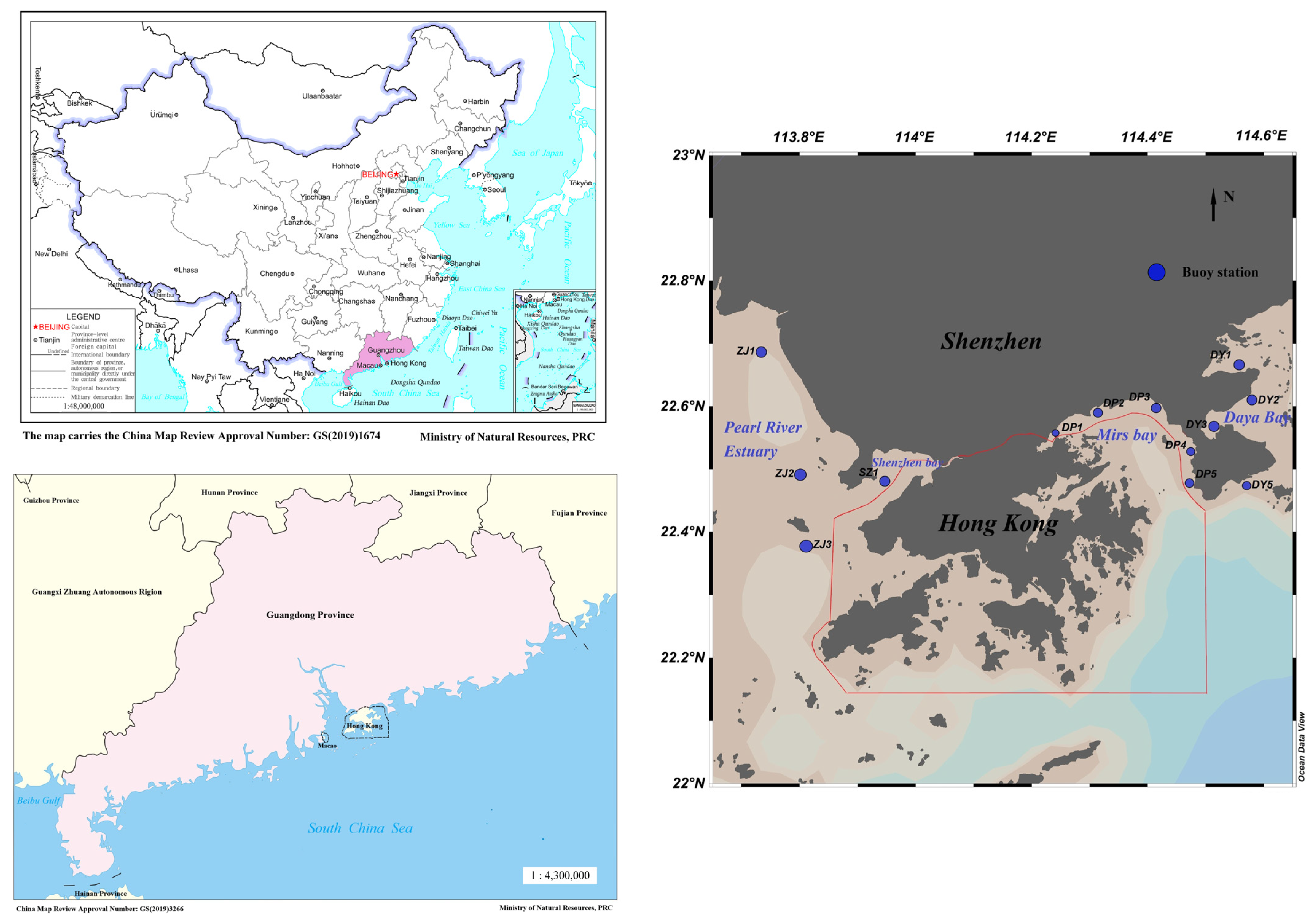
Figure 1. Study area and distribution of buoy monitoring stations.
Sustainability 18 00150 g001
Figure 2. The flow chart of bidirectional stepwise regression.
Sustainability 18 00150 g002
Figure 3. Daily average Chlorophyll-a content.
Sustainability 18 00150 g003
Figure 4. Seasonal distribution of Chlorophyll-a content. Note: black dots indicate bouy stations.
Sustainability 18 00150 g004
Figure 5. Variations in Chlorophyll-a and temperature in SZ1 station during winter and spring of 2023.
Sustainability 18 00150 g005
Figure 6. Variations in Chlorophyll-a, air temperature, and wind speed in DY1 during autumn.
Sustainability 18 00150 g006
Figure 7. Seasonal distribution of (a) water temperature, (b) salinity, (c) dissolved oxygen, and (d) pH in the coastal waters of Shenzhen. Note: black dots indicate bouy stations.
Sustainability 18 00150 g007aSustainability 18 00150 g007b
Figure 8. Monthly average distribution of phosphate and inorganic nitrogen in SZ1, DP2, and DP4.
Sustainability 18 00150 g008
Figure 9. Monthly average wind speed and monthly cumulative rainfall distribution at various stations in the coastal waters of Shenzhen.
Sustainability 18 00150 g009
Figure 10. Correlation analysis results for (a) Shenzhen Bay, (b) PRE, (c) Mirs Bay, and (d) Daya Bay. Note: Asterisks indicating significance, *** p < 0.001; and * p < 0.05.
Sustainability 18 00150 g010
Figure 11. Residual frequency histograms of linear mixed effects models.
Sustainability 18 00150 g011
Figure 12. Residual frequency histograms of stepwise regression models for (a) Shenzhen Bay, (b) PRE, (c) Mirs Bay, (d) Daya bay.
Sustainability 18 00150 g012
Table 1. Buoy monitoring data types.
Date TypeMonitoring ParametersMethodsMonitoring Frequency
Water quality parametersChl-aFluorescence methodEvery 30 min
Water temperatureThermal sensor method
SalinityConductometric analysis
DOFluorescence method
pHGlass electrode method
NutrientsSpectrophotometryEvery 4 h
Meteorological parametersAir temperatureThermal sensor methodEvery 15 min
Wind speedUltrasonic anemometer
PrecipitationCapacitive sensor method
Table 2. Statistical data on Chlorophyll-a concentration.
Sea AreaRange/(μg·L−1)Average/(μg·L−1)Seasonal Average/(μg·L−1)
SpringSummerAutumnWinter
Pearl River Estuary0. 1~170.54.2 ± 5.83.4 ± 1.65.1 ± 6.43.6 ± 3.06.0 ± 3.4
Shenzhen Bay0.1~101.65.2 ± 9.24.5 ± 6.96.3 ± 10.14.2 ± 8.94.7 ± 8.1
Mirs Bay0.1~88.61.8 ± 2.11.6 ± 1.42.1 ± 2.71.6 ± 1.72.2 ± 1.7
Daya Bay0.1~186.54.4 ± 5.73.0 ± 3.44.7 ± 7.05.7 ± 4.84.1 ± 2.9
Entire area0.1~186.53.6 ± 5.52.6 ± 3.43.9 ± 6.53.7 ± 4.53.6 ± 3.6
Table 3. Parameters of linear mixed effects model.
Fixed EffectRandom Effect and Fitting Degree
ParameterVIFEstimateStd. Errorp-ValueInterceptConditional R2Marginal R2ICC
Model IIntercept-−1.4870.5790.0100.2550.460.1560.36
water_tem3.8250.0220.0030.000
salinity1.512−0.0390.0030.000
pH2.6330.1020.0840.226
DO2.7210.2590.0140.000
windspeed1.0530.0390.0080.000
Model IIIntercept-3.3500.7820.0000.1770.440.2930.22
water_tem1.9050.0230.0040.000
salinity1.816−0.0830.0050.000
PO41.527−6.8020.6710.000
DIN1.4970.2950.0790.000
pH2.136−0.3840.0970.000
DO2.3230.3140.0130.000
windspeed1.0110.0190.0070.007
Table 4. Sequential regression coefficients of chlorophyll-a concentration and influencing factors in various sea areas.
PREShenzhen BayMirs BayDaya Bay
CoefficientSD CoefficientCoefficientSD CoefficientCoefficientSD CoefficientCoefficientSD Coefficient
Temperature−0.018−0.0930.1940.304--−0.038−0.174
Salinity−0.550−0.553−0.189−0.525−0.196−0.298−1.37−0.204
pH0.7760.229------
DO0.0890.1280.3800.7810.1960.1960.2580.232
DIN--1.2370.2040.9250.051--
Phosphate--------
Wind speed0.0210.0530.1080.127--−0.005−0.010
Constant−3.676-7.047-5.087-4.243-
R20.285 0.824 0.307 0.326
Note: SD coefficient means standardized coefficient.
Disclaimer/Publisher’s Note: The statements, opinions and data contained in all publications are solely those of the individual author(s) and contributor(s) and not of MDPI and/or the editor(s). MDPI and/or the editor(s) disclaim responsibility for any injury to people or property resulting from any ideas, methods, instructions or products referred to in the content.