1. Introduction
Achieving the SDGs requires more than isolated progress on individual targets. It depends on understanding how goals interact and how progress in one area generates ripple effects, both positive and negative, across interconnected systems [
1]. For instance, biodiversity loss and climate change are increasingly recognised as outcomes emerging from social and ecological interactions [
2], potentially impacting food security and community well-being. Analytical efforts to map SDG interactions have grown in recent years, with comprehensive overviews provided [
3,
4,
5], yet translation into practice remains limited [
6,
7]. A science-based understanding of how synergies and trade-offs emerge is critical for making the SDGs operational in real-world contexts [
8], particularly with the 2030 deadline approaching rapidly: as of 2025, only 35% of targets show adequate progress (with 18% on track and 17% making moderate progress), while 48% show insufficient progress and 18% have regressed below 2015 levels [
9].
This becomes increasingly important considering scenario-based planning frameworks [
10] and transformation-oriented strategies [
11]. Operationalizing these strategies remains a challenge [
12], as without adequate grounding in sustainability pathways, models may oversimplify system dynamics [
12].
Network science is the study of systems that can be represented as collections of interconnected entities (nodes) and their relationships (edges), using mathematical and computational tools [
13]. This formalism has proven particularly powerful for analysing complex systems with nonlinear interactions, emergent properties and multiple scales of organisation. In sustainability contexts, network science offers at least three advantages: (1) explicit representation of interdependencies that traditional reductionist approaches tend to miss, (2) identification of critical leverage points and cascading effects through centrality and connectivity analysis, and (3) quantitative assessment of system resilience and vulnerability [
14,
15].
Although network science provides valuable tools to reveal and structure such interactions, its application to sustainability challenges remains methodologically fragmented. Unlike traditional disciplinary applications where network elements and relationships are well-established, sustainability research requires integration of multiple disciplinary perspectives, such as ecological connectivity and institutional arrangements, into coherent network representations [
13]. The challenge is particularly evident in SDG research. Most network analyses treat goals, targets or indicators as abstract nodes, often without representing the mechanisms through which sustainability transformations occur [
8,
12]. In the broader literature, some studies rely on indicator correlations to define links, while others situate SDGs within governance or social–ecological systems. These differences reflect deeper theoretical questions about whether network patterns represent causes, effects or emergent properties, distinctions that shape both analytical choices and policy relevance [
13]. In a sample of 25 studies, selected via a scoping review process, its large majority abstract SDGs as targets or indicators; one specifies a multiplex structure and another links distinct SDG levels in a heterogeneous multilayer (network-of-networks) design. None of these studies model implementation actors or sectors as nodes, and no hypernetworks appear.
Translating sustainability phenomena into networks is not neutral. Abstraction requires ontological commitments about which system features matter scientifically [
14]. These decisions shape not only the network’s structure but its interpretive power, affecting what dynamics become visible and which remain hidden [
15]. Without domain grounding, representations may miss key processes or reinforce misleading simplifications.
We address the methodological gap limiting the effective use of network science in sustainability contexts. We propose a systematic framework that operationalizes the dual-theory approach proposed by Brandes [
14], requiring explicit integration of domain expertise with mathematical theory. Our approach treats network science not as a metering or visual tool, but as a structured method for rigorous analysis, one that can underpin evidence-based decision-making. By identifying methodological patterns across recent SDG studies, we show how the lack of contextual grounding weakens comparability and limits practical value. The proposed framework supports more consistent, transparent and decision-relevant applications of network science in sustainability research. This approach also enhances reproducibility by making methodological assumptions explicit and comparable across studies.
We pursue three objectives: (1) develop and validate a methodological framework for evaluating how network science is applied; (2) demonstrate its utility by analysing methodological patterns in selected SDG network studies; and (3) establish a foundation for meaningful cross-study comparisons that respect methodological compatibility and enable meta-analytical synthesis.
The scope of our analysis in objective 2 is limited to studies that examine SDG interactions through the lens of network science. Our selection excludes studies that explore broader sustainability linkages (e.g., SDGs and climate governance or resilience) unless they explicitly engage with formal network modelling [
16,
17].
The UN’s 17 Sustainable Development Goals (SDGs), supported by 169 targets and 231 indicators, establish a universal policy framework. Yet their hierarchical structure, with indicators nested under targets and targets under goals, reflects political compromise rather than scientific logic, obscuring the interconnections the 2030 Agenda deems fundamental [
18].
This has reinforced a fragmented research and policy culture where goals, targets and indicators are treated as discrete analytical units rather than parts of interdependent systems [
3,
19]. Even when linked to broader sustainability domains like food systems or ecosystem services, formal system-based methodologies are rarely applied [
20]. This pattern reflects a persistent tendency to address poverty, climate, biodiversity, and inequality as discrete agendas, despite well-documented interdependencies [
21,
22].
The SDGs exhibit the hallmarks of a complex system: multi-scale interactions, feedback loops, emergent properties, and adaptive behaviours [
23]. Consider food security (SDG 2), which emerges from interactions across multiple scales: individual dietary choices, local farming practices, regional trade networks, and global climate patterns. A complex systems network representation would capture farmers as nodes linked to land parcels, credit institutions, and markets; these local networks would connect to regional commodity flows and international trade agreements; and climate nodes would influence both production capacity and price volatility through feedback loops that operate on different timescales. In contrast, current approaches typically model Goal 2 as a single node connected to other goals through indicator correlations, obscuring the multi-actor, multi-scale processes that actually determine food outcomes.
Conventional tracking approaches, while useful for monitoring progress, cannot capture how interventions propagate across domains or aggregate to global effects, and studies linking SDGs to other sustainability agendas rarely apply formal complexity-informed analytical frameworks [
3,
20].
This analytical shortfall constrains policy design: without models that reflect the realities of implementation, decision-makers lack tools to identify leverage points, anticipate unintended consequences, or design synergistic strategies [
19,
22]. The recent growth of research on “SDG interactions” signals recognition of this need, yet many approaches remain conceptually underdeveloped and methodologically inconsistent [
3,
20].
Here, we examine SDG interactions through network models, focusing on the assumptions embedded in their construction. Network science, which centres on relationships, structures and dynamics, offers a natural lens for analysing such complexity, provided sustainability phenomena are carefully translated into network form [
15,
24]. By applying a structured, theory-grounded framework, we aim to advance both conceptual clarity and analytical rigour in the study of SDG interactions.
Despite these advances, the SDG interaction literature still lacks a methodological framework that makes ontological assumptions and modelling choices explicit, comparable, and transparent across studies. To address this gap, we propose an eight-step framework for evaluating SDG network models and apply it to a corpus of 25 peer-reviewed studies. This approach clarifies what each model represents, how representational choices structure analytical outcomes, and where methodological patterns converge or diverge. By consolidating these elements, the article establishes a clear basis for systematic comparison, evidence synthesis, and more implementation-relevant SDG network modelling.
The remainder of this article is structured as follows.
Section 2 describes the development of the ontology-based framework and outlines the procedures for identifying and coding SDG network studies.
Section 3 presents the results of applying the eight-step classification rubric to the 25 selected studies, including tier distributions and methodological patterns.
Section 4 discusses the implications of these findings for SDG research and implementation-oriented analytical design and outlines the limitations of the study.
Section 5 concludes by highlighting recommended methodological directions and proposing future research.
2. Materials and Methods
2.1. Development of the Ontology-Based Network Framework
The UN SDGs comprise 17 goals, 169 targets and 231 indicators that provide a global monitoring framework rather than a scientific model of how sustainability outcomes emerge [
9,
18]. Prior efforts to interpret this structure as a system follow three main strands: semantic or expert-based mappings of textual co-occurrence or policy narratives [
25,
26,
27,
28,
29,
30,
31,
32,
33]; indicator- or correlation-based approaches that infer interactions from statistical associations [
34,
35,
36,
37,
38,
39,
40,
41,
42,
43,
44,
45]; and network-based studies that link SDGs using formal structures from the UN hierarchy [
3,
46]. Beyond these conventional approaches, recent studies have explored multilayer network architectures [
47,
48]. These approaches provide useful descriptive insights but remain tied to the formal SDG architecture and rarely represent the actors, mechanisms or processes through which implementation occurs. This creates a persistent gap between analytical models and real-world sustainability systems, motivating the ontology-based framework developed in this study.
Existing SDG network research can be grouped into three strands. First, semantic or expert-based approaches derive connections from textual co-occurrence or policy narratives. Second, indicator-based approaches infer relationships statistically from time-series or development metrics. Third, network studies link SDGs using formal UN hierarchy structures without modelling implementation systems. While these strands advance understanding of SDG interactions, they rarely represent actors, mechanisms or implementation processes, reinforcing the methodological gap our framework seeks to address.
Network science offers tools for representing relational structures in complex systems, which is essential for analysing SDG interdependencies [
13,
24]. However, existing applications of network science to SDGs often rely on simplified abstractions that obscure underlying mechanisms, creating a persistent gap between analytical models and real-world sustainability challenges [
33].
To address this gap, we developed a framework grounded in Brandes et al. [
13], who define network science as “the study of the collection, management, analysis, interpretation, and presentation of relational data.” Their dual-theory perspective distinguishes between (1) domain-specific theories used to abstract real-world phenomena into relational concepts and (2) mathematical network theories that examine structural properties independent of substantive content. This perspective highlights that abstraction requires ontological commitments to scientifically relevant features [
13], which shape both the structure and interpretive power of resulting network models [
15].
We term this an ontology-based framework because it systematically addresses the fundamental question: “What entities and relationships constitute system we seek to model?” In philosophy of science, ontology concerns the nature of being and existence, in particular what kinds of things exist in a given domain and how they relate [
49,
50]. An ontology-based modelling framework therefore requires researchers to, using problem-domain specific theories, make explicit choices about what entities exist, how entities are bounded and aggregated, which types of relationships connect them, and how abstract representations map to real-world implementation systems.
The development of the framework followed four procedural steps:
(1) Conceptual foundations: We reviewed literature from SDG governance, systems thinking, and complex systems to identify analytical challenges associated with the SDGs’ hierarchical architecture. Unlike traditional disciplinary applications, sustainability research requires combining ecological connectivity, socio-economic processes, and institutional arrangements within coherent network representations [
13]. In SDG research specifically, most network analyses treat goals, targets, or indicators as abstract nodes without representing mechanisms of sustainability transformation [
3,
12].
(2) Integration of network science theory: To ensure conceptual rigour, we applied the Brandes et al. [
13] dual-theory framework, recognising that these decisions determine which system features become analytically visible and which remain obscured [
15].
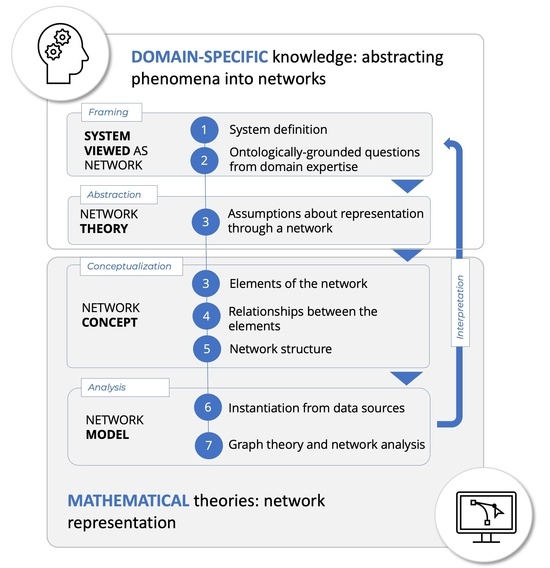
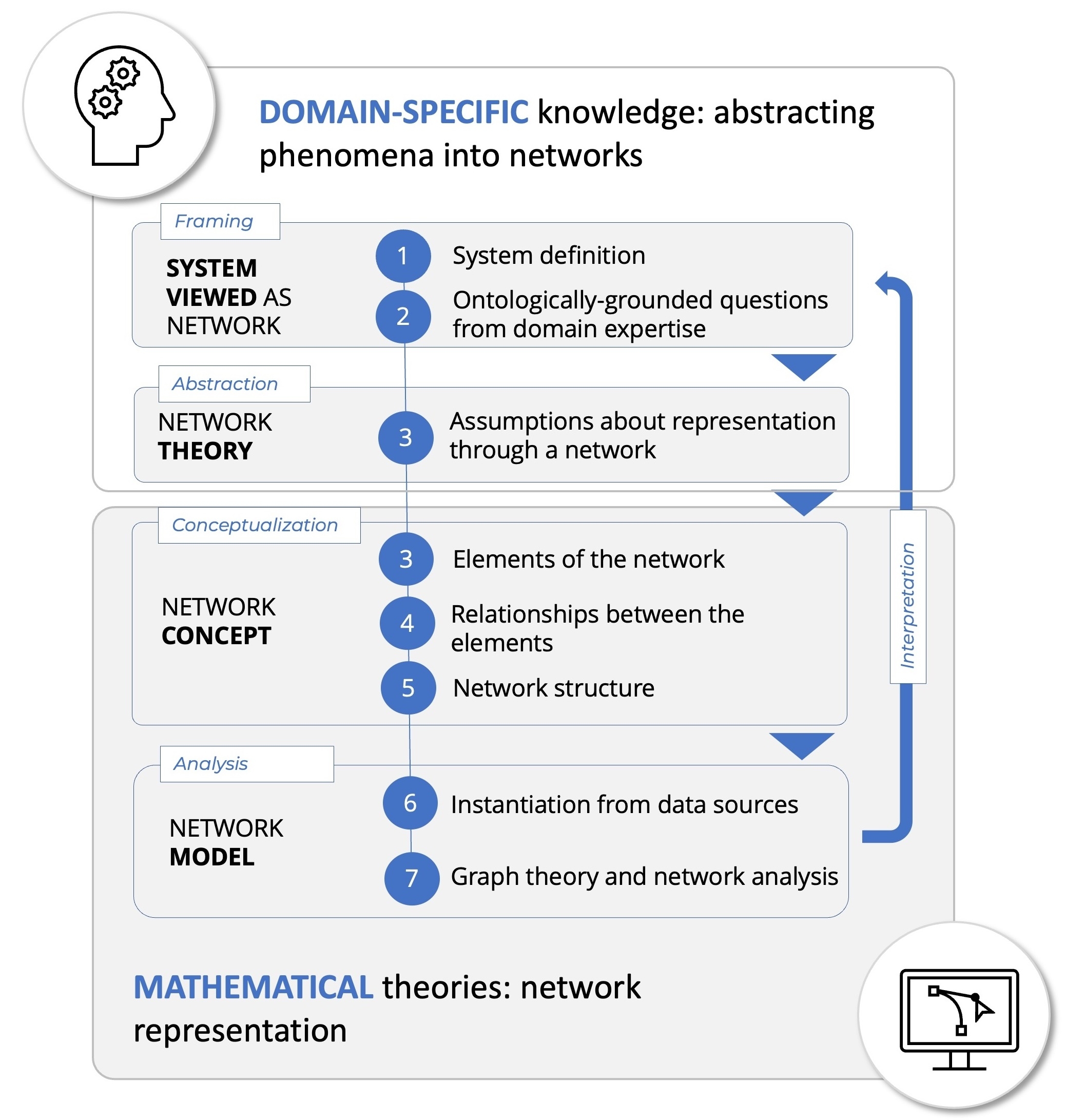
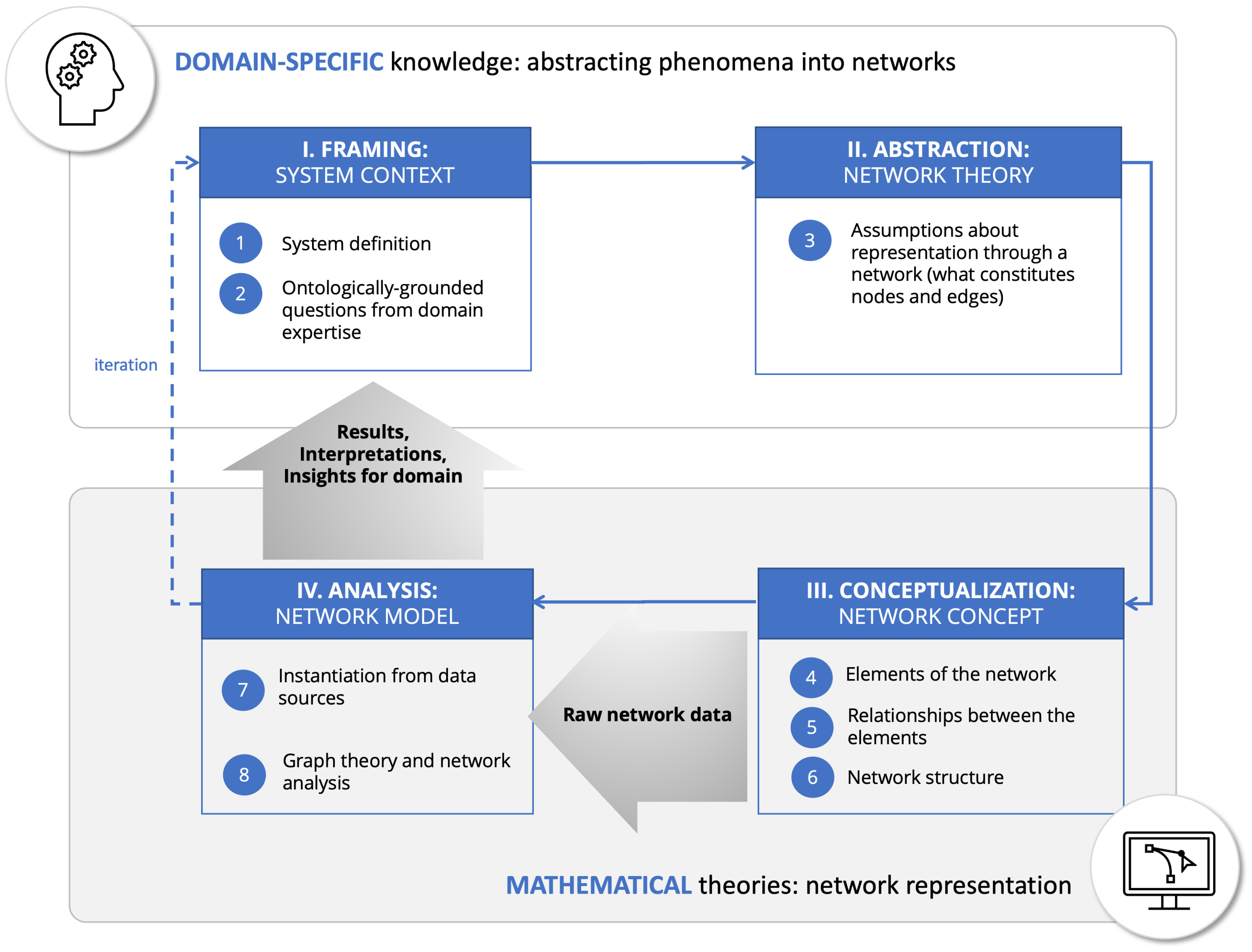
(3) Structuring methodological phases and steps: Based on these foundations, we organised the modelling process into four phases, namely Framing, Network Abstraction, Network Conceptualisation, and Network Analysis, each comprising explicit analytical steps. The framework is presented in
Figure 1.
Operationalisation. For each SDG network study, the eight analytical steps were applied as a coding protocol. Step 1 captured how the authors defined the system and its boundaries; Step 2 identified how domain assumptions shaped problem framing; Steps 3–4 documented what entities and relationships were abstracted into nodes and edges; Steps 5–6 recorded structural specifications such as directionality, weighting, and architectural form (monoplex, multiplex, multilayer); Step 7 captured the analytical techniques and metrics; and Step 8 identified how variables and data sources were mapped onto the network model. Each step was coded independently and later synthesised into the A/B/C tiers to assess transparency, integration of domain knowledge, and representational fidelity.
Phase I. Framing defines the observed phenomenon, system boundaries, and research questions:
- (1)
System definition: identifying the real-world system (s) to be analysed.
- (2)
Ontologically grounded questions: formulating research questions reflecting domain-specific assumptions about entities and relations.
Phase II. Network Abstraction translates real-world phenomena into abstract relational constructs:
- (3)
Assumptions about representation: determining what constitutes nodes and edges based on theoretical interpretation.
Phase III. Network Conceptualisation provides mathematically precise modelling specifications:
- (4)
Elements of the network: defining entities (nodes).
- (5)
Relationships between elements: specifying the nature of connections (edges).
- (6)
Network structure: selecting architectural forms (directed/undirected, weighted/unweighted, monoplex/multiplex).
Data collection (grey arrow in
Figure 1) operationalises this conceptual structure.
Phase IV. Network Analysis applies mathematical techniques to reveal system properties:
- (7)
Theory of network representation and analysis: selecting appropriate algorithms or metrics.
- (8)
Variables as network data: identifying and interpreting data elements feeding the network model.
Iteration occurs when analytical insights expose mismatches or new dynamics requiring refinement.
(4) Iterative refinement and validation.
The framework was iteratively refined through cross-reading of SDG interaction studies, comparison with methodological guidelines in network science, and pilot applications across sustainability domains including food systems, climate–biodiversity linkages, and policy networks. This ensured face validity, conceptual coherence, and broad applicability.
2.2. Identification and Selection of SDG Network Studies
We analysed 25 peer-reviewed studies applying network science to SDG interactions. The selection of these studies was made using a scoping review methodology process. This process and its details (databases, query strategies and exclusion criteria) are available as
Supplementary Materials (also available at
https://zenodo.org/records/17850647, accessed on 15 December 2025).
Our goal is not to grade individual studies, but to analyse the choices researchers make when translating sustainability phenomena into network form.
The scope of our analysis is limited to studies that examine SDG interactions through the lens of network science. Our selection excludes studies that explore broader sustainability linkages (e.g., SDGs and climate governance or resilience) unless they explicitly engage with formal network modelling [
16,
17]. Our selection builds on the state-of-the-art review by Bennich et al. [
3], which identified 70 peer-reviewed studies on SDG interactions, of which only 16% applied network analysis tools. We extend this base to include more recent methodological contributions, focusing specifically on studies where network science is applied as a formal analytical approach to SDG interlinkages.
2.3. Coding Procedure and Analytical Approach
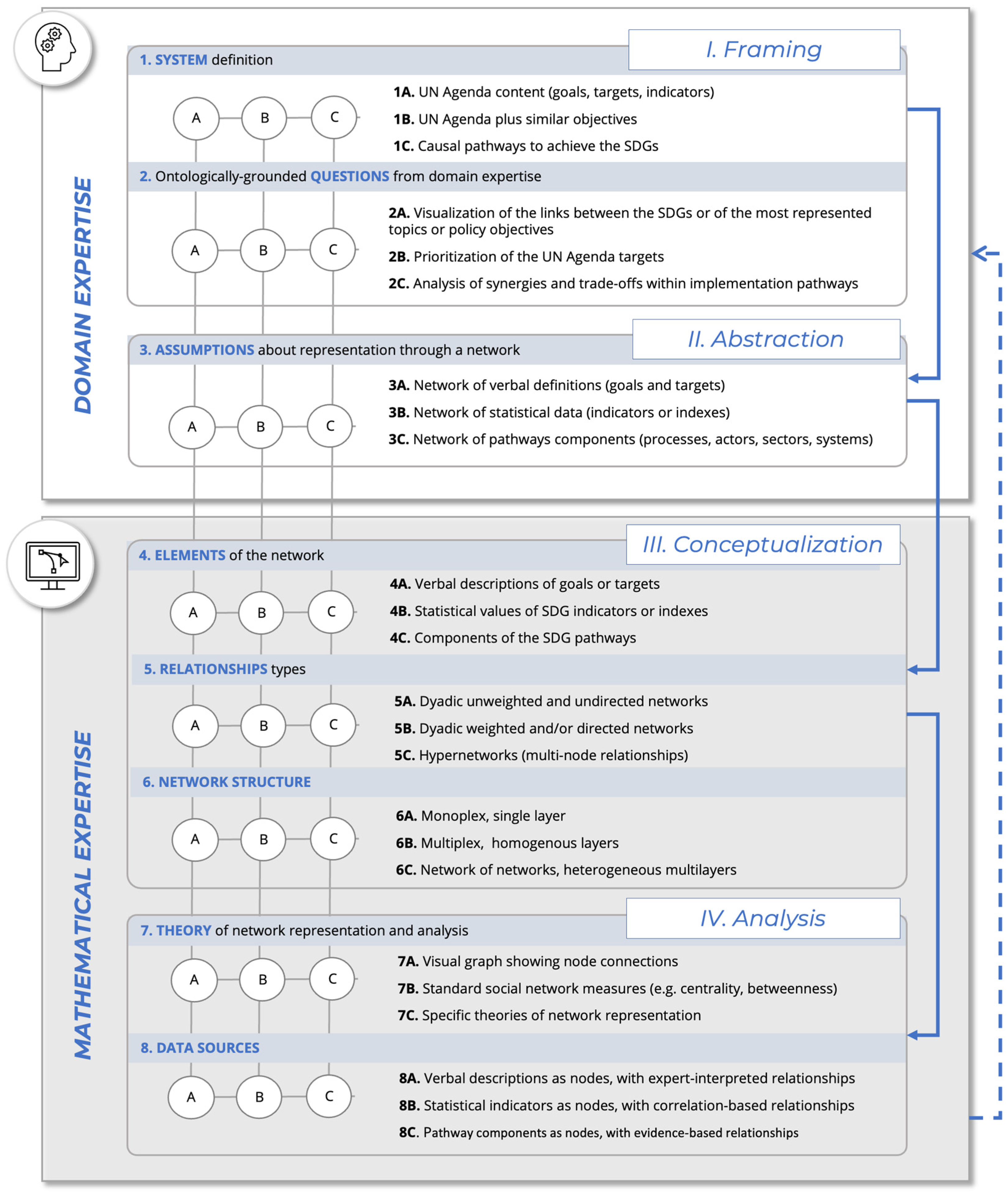
To evaluate modelling choices, we developed a coding rubric aligned with the eight analytical steps of the framework (
Figure 2). Coding captured both explicit methodological decisions and implicit assumptions.
Coding structure. Each study was coded across the four phases and eight steps: (1) System definition, (2) Ontologically grounded questions, (3) Assumptions about network representation, (4) Elements that represent system’s components, (5) Relationships between the elements, (6) Network structure, (7) Theory of network representation and analysis, and (8) Data sources. Each step was assigned a tier (A, B, or C) based on the degree of theoretical grounding, methodological transparency, and integration of domain knowledge demonstrated.
Tier classification. Three methodological tiers characterise the integration of domain knowledge and mathematical theory:
Tier A: approaches focusing on the UN Agenda content (goals, targets, indicators) with verbal descriptions and expert interpretation.
Tier B: approaches extending the UN Agenda with statistical data and correlation-based methods, incorporating standard network measures.
Tier C: approaches grounded in causal pathways, incorporating implementation components (processes, actors, sectors) with evidence-based relationships and specific network theories.
Extraction of modelling decisions. For each of the 25 studies, we systematically extracted all information relevant to the modelling choices embedded in their network designs. Extraction followed the eight analytical steps of the framework to ensure consistency and comparability across studies. For each step, we identified the specific decisions authors made, along with any explicit justifications or implicit assumptions reflected in the text.
Specifically, we recorded:
System definition (what the authors define as the SDG system, its boundaries, and units of analysis).
Problem framing (how research questions reflect assumptions about entities and relationships).
Representational assumptions (how nodes and edges are defined, including any theoretical rationale).
Node specifications (what types of entities are represented and how they are aggregated or classified).
Edge specifications (the basis for defining relationships, including directionality, weighting, and evidence criteria).
Network architecture (whether the model is monoplex, multiplex, multilayer, or otherwise structured).
Analytical techniques (algorithms, metrics, and computational procedures used to analyse the network).
Data mapping (how variables, indicators, or textual elements are converted into network inputs).
Where relevant, text was extracted verbatim to preserve the authors’ terminology, and each decision was then assigned a Tier A/B/C classification. All extracted evidence, coding notes, and tier assignments are provided in the
Supplementary Materials.
2.4. Synthesis and Pattern Identification
Coded studies were grouped into methodological archetypes based on shared characteristics in network construction approaches (semantic/expert-based vs. indicator/statistical) and architectural choices (monoplex vs. multilayer). Comparative analysis across the tier assignments enabled identification of dominant patterns, rare variants, methodological gaps, and underexplored opportunities in SDG network modelling.
3. Results
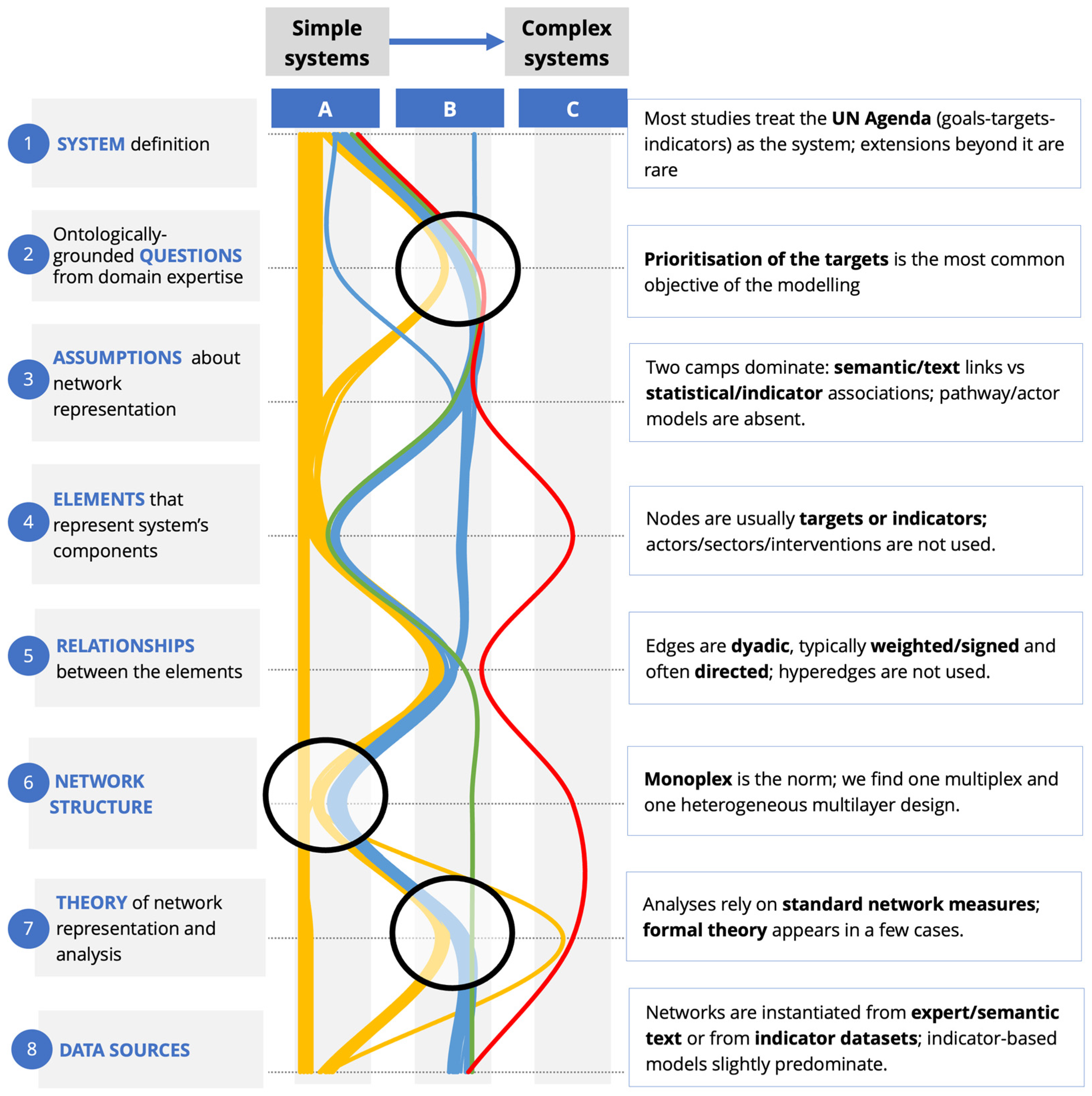
We applied our classification framework to 25 peer-reviewed studies that use network science to analyse interactions among the Sustainable Development Goals (SDGs). Analysis reveals two dominant patterns (
Figure 3): semantic/expert-based approaches (11 studies) [
25,
26,
27,
28,
29,
30,
31,
32,
33] and indicator/statistical approaches (12 studies) [
34,
35,
36,
37,
38,
39,
40,
41,
42,
43,
44,
45], along with two rare multilayer variants (one multiplex [
47] and one heterogeneous multilayer [
48]).
Beyond the qualitative characterisation of modelling patterns, the tier assignments also reveal consistent quantitative tendencies (as show in
Table 1). Across the eight analytical steps, Tier A accounts from 62% to 88% of all classifications, depending on the step. Tier B represents 12% to 36% percent of classifications, concentrated in representational assumptions, analytical techniques and data sources. Tier C appears in no more than two studies per step, representing less than 10% of the total sample for every analytical dimension. These proportions provide a quantitative confirmation of the overall pattern: most SDG network studies rely on formal UN structures with limited integration of implementation mechanisms or domain-specific theory.
A complementary overview is provided in
Table 1, which reports the distribution of studies across Tiers A, B and C for each analytical step. The pattern confirms that most studies fall into Tier A for system definition, research questions and structural specification, indicating reliance on formal SDG structures. Tier B is more common for representational assumptions and data choices, while Tier C is rare across all steps. No step shows more than two studies in Tier C, highlighting consistent gaps in mapping SDG interactions to implementation actors, mechanisms and processes.
Eleven studies (yellow line, in
Figure 3) construct semantic networks from policy texts, using expert elicitation, keyword co-occurrence, systematic literature synthesis, and text embeddings. Twelve studies (blue line, in
Figure 3) rely on indicator-based associations including correlations, Granger causality, and spatial econometrics, mostly using UN/World Bank time series. Beyond these, one study implements a multiplex architecture and another a heterogeneous multilayer “network-of-networks” linking indicators, targets and goals. Despite these differences, most papers do not explicitly justify the representational assumptions that shape how SDG interactions are abstracted and analysed.
Across all categories, a striking gap: 96% of studies lack connection to real-world SDG implementation systems. This figure reflects studies’ focus on the formal UN framework structure rather than the actors, technologies, and governance mechanisms that drive SDG implementation in practice. These representational choices have practical consequences for analytical validity and decision-making. When models treat SDG interactions as simple correlations between aggregate indicators, they cannot identify where investments might create cascading effects or where apparently separate goals share common bottlenecks. Models that abstract away from implementation actors and processes cannot reveal these system dependencies, leading to fragmented understanding that misses leverage points where coordinated capital allocation might achieve breakthrough results.
Analytically, semantic approaches rely on expert judgement or semantic proximity, which can limit replicability; indicator approaches apply statistical association without establishing causal mechanisms, which risks misinterpretation of coincident trends. Network structures are similarly constrained: all but two studies are monoplex, with no hypernetworks appearing despite sustainability challenges requiring multi-actor coordination and higher-order interactions.
4. Discussion
This analysis highlights a persistent disconnect in how network science is applied to sustainable development. While SDG interlinkages are frequently modelled, 96% of the reviewed studies focus on abstract structures rather than the mechanisms through which sustainability transformations actually occur. By contrast, implementation-grounded systems frameworks explicitly represent actors, processes, and causal delivery mechanisms, enabling analysis of how interventions propagate through real-world development systems rather than remaining at the level of abstract goal interactions [
51]. This decoupling between analytical and real-world implementation limits the usefulness of these models for decision-makers, especially those allocating capital in support of sustainable outcomes.
These methodological gaps have concrete implications for SDG implementation systems. Indicator-based networks that treat goals or targets as nodes and rely on statistical associations can overstate correlations that do not correspond to actionable levers in implementation systems. For example, country-level SDG diagnostics that use network centrality to suggest “priority goals” risk directing attention toward highly connected indicators, even when the real constraints lie in specific sectors, agencies or financing mechanisms that the model does not represent.
Similarly, semantic networks that map co-mentions of goals in policy documents can be useful for communication and narrative framing, but they do not in themselves identify which ministries, firms or communities must coordinate to realise synergies. By contrast, ontology-based designs that include implementation nodes such as institutional actors, financial instruments, and ecosystem dependencies, can reveal where coordination failures, capacity gaps or misaligned incentives block or hinder progress on multiple goals simultaneously.
These observations suggest that SDG network models limited to formal structures may support discourse, but they are poorly suited for guiding operational decisions about where and how to intervene. Our framework shows that modelling choices, often presented as neutral or technical, are in fact grounded in conceptual assumptions. These assumptions shape which dimensions of sustainability systems are brought into focus and those which remain unexamined. The widespread reliance on simplified approaches reflects not a lack of technical tools, but rather a limited conceptual framing of what network models are meant to capture. By making these foundations explicit, the framework supports more intentional and implementation-relevant design of network-based analyses.
Recent developments in social-ecological network (SEN) analysis further illustrate the potential of embracing a complex systems perspective. For example, the typology proposed by Sayles [
52] demonstrates how multiplex, multilevel, and multidimensional network structures can be used to represent the diverse relationships among actors, institutions, resources, and ecological processes. Applying similar structural richness in SDG network research would enable more accurate representation of how sustainability outcomes emerge across domains and scales. This perspective supports models that reflect not only what goals are linked, but how implementation unfolds through interacting social, institutional, and material systems.
4.1. Practical Implications
These improvements are not only relevant to academic modelling but are also critical for practical decision-making. Notably, they have potential relevance for actors engaged in implementation-oriented decision processes, such as governments, development partners and finance institutions. While our analysis does not assess current investment or lending practices, the conceptual implications are clear: analytical tools that reflect causal mechanisms and implementation dynamics are better aligned with the types of questions these actors typically confront. Models cantered on formal SDG structures may support communication and monitoring, but they are less suited for identifying leverage points, diagnosing systemic bottlenecks or anticipating cross-domain effects.
Beyond SDG network modelling, approaches such as integrated fuzzy multi-criteria decision frameworks illustrate how complex criteria and trade-offs can be structured for operational decision-making [
51,
53].
This challenge is not confined to SDG research. Similar limitations are found across domains such as climate finance, sustainable infrastructure, supply chain transitions, and nature-based solutions. In each case, network science has the potential to illuminate system dynamics, but only if it is aligned with the realities of institutional coordination and financial decision-making. The classification framework we propose offers a transferable diagnostic tool that helps assess whether models are capturing system complexity or merely replicating formal structures.
As AI-assisted meta-analysis and automated evidence synthesis become more common in investment and sustainability assessment, the risks associated with methodological opacity and structural incompatibility grow. Without transparent frameworks, combining incompatible models can lead to misleading conclusions. Our approach helps mitigate this risk by clarifying what a given network model represents, how it was constructed, and what types of questions it is suited to answer.
4.2. Limitations and Challenges
The framework also has practical limitations. Integrating domain knowledge with formal network structures, especially in Steps 2 and 4, requires sustained multidisciplinary collaboration that is often difficult to achieve. On the other hand, the eight-step structure may appear prescriptive, and some emerging approaches may not fit neatly into its four-phase design. Data constraints may also prevent studies from reaching higher-tier classifications. Finally, the assumption that greater methodological transparency and closer alignment with implementation systems improves decision relevance requires empirical validation through comparative assessment.
This study also has scope limitations. The final sample of 25 papers resulted from a Scoping-Review framework style screening of the broader SDG-network literature, with eligibility restricted to studies where SDGs or targets are modelled as explicit network nodes. This strengthens conceptual coherence but narrows the evidence base and excludes related work using bibliometrics, structural equation models, governance networks or policy analysis without formal SDG representation. Screening and coding involved interpretive judgement even with a structured rubric, and some modelling nuances may not be fully captured. The analysis also focuses only on SDG interaction networks, not other sustainability domains where network science is applied, such as climate finance, supply-chain transitions or nature-based solutions. These boundaries introduce selection effects but clarify the analytical purpose, highlighting the need for broader comparative and cross-domain validation.
5. Conclusions
Two methodological shifts are now essential. First, moving from static structural representations to process-based models that incorporate the actors, financial flows, institutional arrangements, and feedback mechanisms through which change unfolds. Second, adopting more expressive network architectures, such as multilayer and multiplex structures, to represent interdependent systems and identify points where interventions or investments may produce cascading effects.
These analytical limitations translate into missed opportunities for identifying strategic intervention. Complex systems exhibit non-linear responses where investments in specific network positions can produce disproportionate effects across multiple SDGs, yet models focused on formal goal structures rather than implementation networks cannot reveal these leverage points. Addressing this gap is increasingly relevant as sustainability planning and investment decisions require tools that capture mechanisms rather than only correlations.
For researchers, the framework offers a practical design checklist: clarifying the system under study, specifying entities and relationships, making representational choices explicit and aligning analytical techniques with sustainability theory. Publishing these modelling decisions alongside data and code would strengthen transparency and comparability across SDG network studies.
For policymakers, development agencies and financing institutions, the framework can serve as an evaluative tool. Asking whether a model explicitly represents implementation actors, institutional mechanisms and financing pathways helps distinguish descriptive correlation maps from decision-relevant process models. Incorporating such questions into analytical guidelines and commissioning processes would enhance the operational relevance of SDG network analyses.
With fewer than five years remaining to achieve the 2030 targets, the need for analytically robust and implementation-aligned approaches is clear. Models that move beyond static descriptions toward process-based and multilayer representations are likely to be more useful for decision-oriented contexts such as integrated policy design or investment planning. Descriptive models remain valuable for communication and exploratory analysis, but advancing implementation-relevant SDG network research requires closer alignment between network architectures and the mechanisms through which sustainability outcomes emerge.
Future research should build on this framework in at least three ways. First, multi-case applications across sectors and governance levels are needed to test whether the tiered classification and eight steps capture meaningful variation in SDG network practice, especially where implementation is mediated by multiple institutional layers or financing mechanisms. Second, empirical work should compare process-oriented and multilayer SDG networks with indicator-based models to assess added value for explanation, prediction and decision support. Third, the ontology-based approach should be extended beyond SDG interaction studies, for example, to climate finance, nature-based solutions and supply-chain transitions, to explore whether the disconnect between abstract goal structures and operational delivery mechanisms is specific to the SDGs or reflects broader sustainability governance challenges.