Abstract
Corporate social responsibility (CSR) and environmental, social, and governance (ESG) disclosures are critical for sustainable value creation. However, traditional evaluation methods struggle to quantify authentic performance and detect disclosure biases. In response, this study proposes an automated CSR polarity dictionary construction method that innovatively combines natural-language-processing technology and the multinomial inverse regression (MNIR) method. This method analyzes the correlations between corporate CSR reports and CSR ratings and constructs a dictionary that best reflects the CSR level of listed companies. We also used the CSR dictionary to construct a CSR disclosure level index for listed companies’ annual reports. This study reveals that CSR disclosure levels in annual reports expose manipulative disclosure practices and image management. However, this behavior has been proven to fail in generating excess returns for the company in the stock market. This phenomenon provides novel insights into corporate stock market performance management. In addition, the CSR disclosure level index is shown to effectively reflect the CSR level of enterprises in different industries and provides a theoretical reference for the social responsibility management of companies with different pollution levels. These findings facilitate efficient information release and strengthen ESG assessment frameworks through data-driven standardization.
1. Introduction
As a core component of the environmental, social, and governance framework, corporate social responsibility disclosure not only reflects a company’s commitment to sustainable development [1] but is also a key basis for the capital market to evaluate the quality of non-financial information [2]. As regulators tighten their requirements for ESG information disclosure, the regulatory requirements for the CSR disclosure reports of Chinese listed companies are constantly evolving. Since the Shanghai Stock Exchange issued the Information Disclosure Evaluation Guidelines in 2013, CSR disclosure has gradually shifted from a voluntary practice to a standardized obligation [3]. As an important indicator for measuring corporate social responsibility performance, the CSR disclosure level index is usually defined as a standardized tool for systematically evaluating the non-financial information disclosed by companies through quantitative or qualitative methods. Specifically, the CSR disclosure level index quantifies the level of corporate social responsibility fulfillment by analyzing the text content of corporate annual reports, CSR reports, and so on, combined with statistical models [4,5].
The existing CSR disclosure indices mainly face three challenges. Firstly, traditional manual scoring methods are inefficient and highly subjective, making it difficult to handle the large amount of text that requires automated processing [6]. Secondly, companies may manipulate disclosure content through “obfuscation” behavior to conceal their actual social responsibility performance and maintain their corporate image [7,8]. This problem is even more complicated in the Chinese context. For example, “strategic ambiguity” expressions (such as “actively responding to the dual carbon goals”) often appear in the annual reports of Chinese listed companies. Although such words convey positive signals, they may lack substantive action support [9]. Thirdly, the existing CSR disclosure indices mostly focus on word frequency statistics or topic classification. The underlying dictionary they rely on lacks the quantitative distinction of word polarity, meaning that they do not account for the positive or negative contribution of words to CSR ratings. Additionally, the indices fail to thoroughly integrate the dynamic relationship between text semantics and rating targets [4,10]. Therefore, in this context, constructing CSR disclosure level indicators that are both objective and explanatory represents not only a theoretical gap in academic research but also an urgent need for regulators to optimize information disclosure standards [5,11].
This research proposes a CSR disclosure level index construction method based on natural language processing and MNIR to solve the above problems. Specifically, this study applies the MNIR model to Chinese CSR text analysis for the first time. Through analyzing the statistical relationship between corporate ESG scores and the distribution of annual report terms, positive and negative words that have significant explanatory power for CSR levels are identified [12]. Compared to the traditional topic models, such as latent Dirichlet allocation (LDA), MNIR can directly quantify the marginal effect of words on the score, thereby constructing a more explanatory dictionary [13]. Based on this dictionary, we further designed a weighted disclosure index to achieve automated rating of the CSR level of corporate annual reports. In addition, we also examined the economic consequences of CSR disclosure levels, analyzing the correlations among the operating performance, stock market performance, and CSR disclosure levels of Chinese listed companies. We also grouped companies by performance (above/below the industry average) to explore the differentiated performance of “image management” motivation [14].
Then, we identified the annual trends of the CSR disclosure level indicators constructed based on the dictionary. Specifically, this study averaged the CSR disclosure level indicators by year and observed the consistency of their trends with other known indicators. The data show that the CSR disclosure level indicators constructed in this study reflect the actual CSR rating indicators and CSR market index, which indicates that the CSR indicators in this study have market value. At the same time, after averaging the CSR disclosure level indicators constructed in this study by year and by industry group, the observed industry CSR disclosure level indicators reflect the nature of the industry itself and, therefore, play an essential role in industry research.
Moreover, we used mediating effects and group regression to explore the mechanism and results of managers’ CSR disclosure manipulation behavior based on corporate image management motivation. This study found that managers of companies with poor performance tended to manipulate the CSR disclosure levels for image management, aiming to improve their market performance in the information disclosure process. However, the experimental results show that this manipulation behavior cannot improve companies’ stock market performance. In addition, we conducted a heterogeneity test on companies; that is, we divided companies into two groups—namely, high- and low-pollution industries—and explored the differences in their CSR disclosure manipulation motivations. The empirical results show that CSR disclosure manipulation is more common in companies with low pollution levels. Finally, the results of this study have proven to be robust.
The contributions of this study are reflected in three aspects: (1) At the methodological level, this study developed a CSR dictionary construction framework suitable for Chinese reports, filling the gap in word polarity quantification tools for ESG text analysis. (2) Theoretically, this study reveals negative relationships among CSR disclosure levels, operating performance, and stock returns. It verifies the “image management hypothesis”, which suggests that companies with poor performance improve their market performance through CSR disclosure manipulation [7,15,16]. (3) At the policy level, this study provides a data-driven solution for regulators to identify greenwashing behavior and optimize information disclosure standards [17].
The subsequent sections of this paper are arranged as follows: Section 2 reviews the relevant literature on CSR disclosure quality assessment and text analysis technology; Section 3 details the MNIR model and dictionary construction method; Section 4 presents the dictionary characteristics and validity test; Section 5 empirically analyzes the impact of CSR disclosure level on market performance; and Section 6 summarizes the research conclusions and policy implications.
2. Literature Review
The evaluation mechanism for CSR and ESG information disclosure has emerged as a pivotal issue of common concern in both academic circles and the capital market in recent years. As the concept of sustainable development gains prominence, the ESG framework has evolved from being a peripheral concern to a fundamental criterion for assessing corporate non-financial performance. In the last few years, CSR has received extensive attention in academia as a core component. CSR has become the predominant keyword in ESG-related research, highlighting its irreplaceable role in social responsibility [18]. With the development of ESG theory, the concept of CSR has gradually become closely linked with corporate management [19], thus providing the possibility of manipulating CSR information disclosure [20]. Therefore, the inconsistent quality of information disclosure, the subjectivity of evaluation methodologies, and the strategic manipulation by companies remain significant obstacles to the efficacy of ESG implementation. This study reviews the literature from three dimensions: ESG information disclosure and evaluation, CSR information disclosure and text analysis technology, and manipulative behaviors in CSR information disclosure with the objective of corporate image management. Finally, we identify the research gap and innovative contributions of this study.
2.1. ESG Information Disclosure and ESG Evaluation
Since the United Nations introduced the ESG concept in 2004, its meaning has evolved from a singular focus on environmental responsibility to a comprehensive framework encompassing environmental, social, and governance dimensions [21]. High-quality ESG information disclosure mitigates capital costs [22], bolsters investor confidence [23], and enhances corporate long-term value [24].
In China, the regulatory framework for ESG information disclosure is shifting from voluntary to mandatory reporting, particularly for state-owned businesses and heavily polluting sectors [25,26]. Some empirical studies have indicated that a positive correlation exists between ESG information disclosure and financial performance [27,28]. This is primarily attributed to the optimization of credit channels, the alleviation of borrowing restrictions, and enhanced stock performance following the improvement of the information disclosure regulatory framework, particularly for companies with higher-quality environmental information disclosure [29]. However, in the case of inadequate shareholder protection mechanisms, the impact of ESG information disclosure on financial performance may be minimal or insignificant [30]. Moreover, ESG information disclosure encounters the issue of greenwashing. Some companies tend to selectively disclose favorable data or employ “strategic ambiguity” in their language (e.g., “actively responding to policies”) to obscure negative performance, leading to a substantial disparity between actual practices and stated commitments [31,32].
In terms of ESG evaluation, early methods mainly relied on expert judgment and manual scoring (e.g., MSCI, S&P Global). These methods had high costs, were difficult to update in real time, lacked unclear scoring criteria, and were susceptible to subjective bias [33,34]. In addition, traditional evaluation methods, such as word frequency statistics or the LDA topic model, are limited in semantic depth and fail to quantify the dynamic impact of words on scores accurately. The underlying dictionary also lacks the capability to differentiate word polarity [35].
2.2. CSR Information Disclosure and Text Analysis Technology
Corporate social responsibility (CSR) information disclosure refers to the process by which a company publicly releases its internal activities and strategies related to social responsibility. Different from traditional financial disclosure, CSR disclosure includes not only economic statistics but also the company’s performance in environmental protection, social responsibility, and corporate governance. In recent years, CSR information disclosure has emerged as a significant metric for evaluating corporate social responsibility performance.
Existing research has pointed out that CSR disclosure is closely linked to the decision making of corporate managers. The three main areas of current research include managers’ motivations for CSR disclosure, the effects of CSR disclosures, and the attributes that influence the quality of disclosure [5]. For instance, managers’ personalities and voluntary disclosure tendencies indirectly affect the evaluation of CSR disclosure levels 6. In addition, the social, cultural, and regulatory environments significantly shape the quality of CSR disclosures [36]. Moreover, recent years have witnessed a growing research interest in the influence of corporate governance structure on CSR disclosure, with several studies demonstrating that robust corporate governance is positively correlated with higher-quality CSR disclosure [37,38].
Building on existing text analysis methods, recent methodological innovations have demonstrated that structural and content-based examination of disclosure texts provides critical insights for CSR evaluation [4]. Some scholars constructed a CSR dictionary based on the Italian language environment to analyze the content of CSR reports [39]. Although the study did not distinguish between the polarity and other attributes of words, it offered insights for this study.
The swift development of natural-language-processing technology has propelled text analysis into an automated era. NLP-driven methods now allow researchers to systematically extract semantic patterns from CSR reports, transforming qualitative disclosures into quantifiable metrics. Scholars have developed three core analytical dimensions, including topic classification [40], sentiment analysis [10], and similarity analysis [9,10], to analyze the text of CSR reports. However, LDA-based topic models frequently suffer from interpretive subjectivity and topic instability across different corpora, often generating inconsistent classification results when applied to CSR reports with overlapping sustainability themes. Sentiment analysis tools demonstrate contextual blindness in specialized domains, failing to capture CSR-specific linguistic nuances. Similarity metrics relying on surface-level textual features struggle to detect semantic equivalency in sustainability disclosures, particularly when comparing reports across industries.
In addition to traditional NLP methods, other studies have used deep learning and machine learning to assess the CSR level. Some scholars have employed large-scale pre-training models to discern topics and keywords in CSR reports and have further used deep learning to predict CSR levels [17,40]. Meanwhile, some researchers have concentrated on applying computer technology to analyze corporate social responsibility management and market mechanisms [14,41,42,43]. Although these methods have significantly advanced the automation and refinement of CSR assessment, it should be noted that they may exhibit instability and ambiguity and fail to conduct comprehensive analysis of CSR reports at a fine-grained level.
2.3. Manipulative Behaviors in CSR Information Disclosure for Image Management
Corporate social responsibility (CSR) disclosure serves as the primary medium for companies to communicate with stakeholders. The text content not only conveys information regarding social responsibility activities, but it also serves as a strategic instrument for management to execute “image management” [44]. Existing studies have identified three prevalent strategies for manipulative behaviors in CSR information disclosure: tone management [45,46,47], obfuscation [48,49], and selective emphasis [50,51,52]. Companies tend to employ these semantic manipulation methods to enhance disclosure content, aiming to shape a positive image rather than genuinely improve their social responsibility performance [53]. This phenomenon intensifies the principal–agent dilemma and may result in a distortion of resource allocation efficiency [54].
The manipulative behaviors in CSR information disclosure have been demonstrated to increase agency costs, stemming from managers’ opportunistic and self-serving objectives. The principal–agent theory posits that managers may manipulate CSR information disclosure to mitigate reputational risks and performance pressures [55], offer a rational defense for speculative behaviors [56,57], and potentially attract social investment through deceptive promises, thus misleading investors’ judgments [53]. Moreover, in times of crisis, manipulating CSR information disclosure may serve as a defensive strategy to preserve reputation and image [58].
In order to identify manipulative behaviors in CSR information disclosure with image management, scholars have extensively employed computational linguistic techniques to solve this problem. Sentiment analysis, natural language processing (NLP) technologies and machine learning models are employed to examine optimistic bias, inconsistent tone, and selective issue emphasis in CSR reports. These technical methods not only expose the phenomena of semantic whitewashing in CSR information disclosure but also elucidate how corporations dynamically modify CSR information disclosure in response to external crises or alterations in the regulatory landscape [59,60,61].
2.4. Summary
In summary, traditional ESG evaluation methods predominantly depend on expert judgment and manual scoring, which are inefficient and subjective and lack a unified standard framework. The underlying dictionary utilized in current CSR text analysis frequently inadequately quantifies the positive and negative polarity of words, making it difficult to capture the actual semantics of the disclosed content accurately. This deficiency is pronounced in the Chinese context, as companies may manipulate information through “strategic ambiguity” or “semantic whitewashing” to obscure their actual social responsibility performance. Therefore, it is challenging for traditional methods to detect image management behaviors.
While the LDA model may extract probable topics from texts, its output does not provide a quantifiable differentiation of word polarity. The topic division also exhibits a degree of uncertainty, which makes it difficult to map to specific CSR scores directly. While sentiment analysis technology may identify the emotional inclination of texts, it typically depends on predefined dictionaries and struggles to dynamically adjust to the varied and nuanced semantic shifts in corporate information disclosure materials. Deep learning techniques have advantages in capturing contextual semantics, but their models exhibit complexity, lack interpretability, and depend on extensive annotated datasets, thus constraining their widespread application in CSR evaluation.
In view of this, we selected the MNIR model because it directly models the statistical relationship between the word distribution and the CSR score to quantify the positive and negative contribution value of each word [5]. We not only developed an objective and well-defined Chinese CSR dictionary but also, more precisely, captured the semantic manipulation behavior in corporate information disclosure texts. This study further examines the relationship between the level of CSR information disclosure and market performance, offering a robust theoretical and empirical framework for analyzing the behavior of companies that conceal their actual social responsibility performance through text manipulation.
3. Data and Methodology
3.1. Research Design
In order to conduct interpretable CSR quality assessment based on CSR reports, this study adopted the statistical method proposed by [12], namely multinomial inverse regression (MNIR), facilitating text training and the construction of a CSR dictionary. MNIR is a statistical technique grounded in word frequency and word distribution, where the frequency of a word’s occurrence in a text adheres to a multinomial distribution. Due to the extensive number of words in documents, conducting forward regression may result in problems such as collinearity and overfitting. Therefore, MNIR is a viable option.
The main objective of this study is to identify the words that affect corporate CSR rating scores and to establish a corresponding CSR dictionary that facilitates the effective measurement of the CSR disclosure level in the annual reports of Chinese listed companies. Based on the linguistic structure of the corpus, this study correlates the variance in the social responsibility scores of CSR documents with the frequency distribution of the words in each document. A CSR-level label is assigned to each word, so as to identify the words that most significantly influence the CSR rating score.
This study selected the “S score” (the score pertaining to the “social” topic) from the corporate ESG score developed by the China Research Data Service Services (CNRDS) as the CSR score for each document. Referring to the MNIR model, this study quantified the influence of each word on the document’s CSR score, and ultimately created a CSR dictionary by analyzing words with high contribution scores and their corresponding scores.
According to the MNIR model in [12], this study first matched the corresponding CSR score of each document . The CSR score of each document served as the label for MNIR training, where denotes the total number of words in the document. Thus, the word frequency modeling of each document adheres to a multinomial distribution:
The j-th component of :
According to the MNIR model, is the sufficient reduction score of each word on the CSR score , and the sufficient statistics can be obtained. comprehensively represents the influence of the word composition difference in document on the CSR score , where .
Then, through the parametric construction, we determined the function such that , where generally uses a linear function or logistic function to calculate the influence of on the CSR score . In this study, we selected least square regression to determine the function . Therefore, the CSR score of each word is as follows:
Furthermore, according to the MNIR residual calculation, we differentiated between meaningful words and meaningless words. Specifically, words with a higher MNIR residual are more effective in CSR quality assessment; words with lower residual may be caused by wrong word segmentation or mixed words. After MNIR residual sorting, we selected the top N meaningful words to construct a CSR dictionary for Chinese listed companies. The higher the , the higher the CSR score of the company as indicated by the text; that is, the more frequently words with high scores appear in the text, the greater the CSR performance of the company. To the contrary, if the is negative, it means that the frequent occurrence of the word is associated with a lower CSR score, suggesting that these words may reflect poor social responsibility performance of the company.
3.2. Construction of CSR Dictionary
This study collected 14,450 CSR reports in PDF format disclosed by Chinese listed companies from 2006 to 2023. After excluding documents that were less than 2 KB in size and the unrelated revision and review documents, 11,781 CSR reports of 1951 listed companies were finally obtained. We used the jieba package for word segmentation and obtained texts with an average length of 146.42 million words per piece. This study extracted the 500 most frequent words as a proxy for the original text due to the fact that many words in the text had low informational content. We acquired 11,781 text samples, each including 500 words, and we used 48,681 unique words as text samples for analysis.
Based on the MNIR model, we calculated the scores of 48,681 words, then eliminated all personal names, geographical locations, institutional names, and both ordinal and cardinal numbers to ensure the dictionary remained highly related to CSR. Following the research methodology in [13], we selected the 300 words with the highest and lowest scores to construct a positive CSR dictionary and a negative CSR dictionary, respectively. Positive words imply higher CSR scores in the text, indicating excellent social responsibility performed by the company. Conversely, negative words denote lower CSR scores with poor social responsibility performance. Ultimately, this study developed a CSR dictionary for Chinese listed companies that comprises 600 Chinese words, including 300 positive CSR words and 300 negative CSR words. Appendix A presents detailed information on the dictionary and corresponding word scores.
In the positive CSR dictionary, the top 10 words are “electrical”, “high-speed”, “steel”, “software”, “wind power”, “medicine”, “issuer”, “poverty alleviation”, “overcome difficulties”, and “retail”. Among them, “electrical”, “high-speed”, “steel”, “software”, “wind power”, “medicine”, and “retail” are industry-related words, basically covering the seven strategic emerging industries identified by the State Council in China. “Issuer” is a functional word related to corporate management. “Poverty alleviation” and “overcome difficulties” reflect the core values advocated for in corporate culture development. In addition, the positive words also include “well-being”, “responsibility”, “farmers”, “intelligence”, “rescue”, “unity”, “countryside”, “anti-corruption”, “dual carbon”, and others, which not only reflect the core values of Chinese socialism prosperity but also reflect the friendly interaction between companies and the community environment, consistent with [62].
In the negative CSR dictionary, the 10 words with the lowest scores are “vaccine”, “disaster area”, “electrical appliances”, “earthquake”, “medicinal materials”, “climate”, “gold”, “compression”, “data security”, and “pharmaceutical industry”. Among them, “electrical appliances”, “medicinal materials”, and “pharmaceutical industry” are industry-related words. “Vaccine”, “disaster area”, “earthquake”, and “compression” show more obvious negative emotions. “Climate”, “gold”, and “data security” reflect higher risk and uncertainty, which is consistent with the findings in [63,64,65]. In addition, words such as “bribery”, “greenhouse”, “unemployment”, “money laundering”, “discrimination”, and “pollution” show significantly negative emotions and their negative impact on social responsibility.
Therefore, the CSR dictionary we constructed in this study can effectively distinguish the differences in the emotional tone of CSR levels. In order to verify the effectiveness of the CSR dictionary, we further conducted an empirical test between the CSR levels of Chinese listed companies and their market performance.
4. Results and Discussions
This section aims to measure the CSR level disclosed in the annual reports of Chinese listed companies and further explore the relationship between the CSR levels and the market performance of companies. The positive and negative CSR dictionaries constructed in Section 3 were used to quantify the text of annual reports through a weighted calculation method and calculate the CSR disclosure score of each report. The CSR disclosure scores are compared with existing ESG indicators to verify its effectiveness and representativeness.
4.1. Measurement of CSR Level Disclosed in Annual Report
The annual report of listed companies is one of the most important documents in information disclosure. Since the Shanghai Stock Exchange (Shanghai Stock Exchange: “Shanghai Stock Exchange Listed Company Information Disclosure Evaluation Measures (Trial)”) further clarified the necessity and completeness of ESG disclosure in 2013, listed companies have attached increasing importance to disclosure in the ESG field, especially the disclosure of corporate social responsibility (CSR). In order to explore the level of CSR reflected in the annual reports of listed companies, we selected 50,198 annual reports of listed companies spanning 22 years, from 2000 to 2021, covering a total of 4829 listed companies. This study used 600 CSR-related words, weighted according to the frequency of their appearance in the annual report documents, and finally obtained the CSR disclosure score for the annual report of each listed company. The specific calculation method is as follows:
where is the CSR disclosure score in the i-th annual report; denotes that the frequency of the j-th word from the CSR dictionary as recorded in the i-th annual report; is the CSR score of the j-th word in the dictionary.
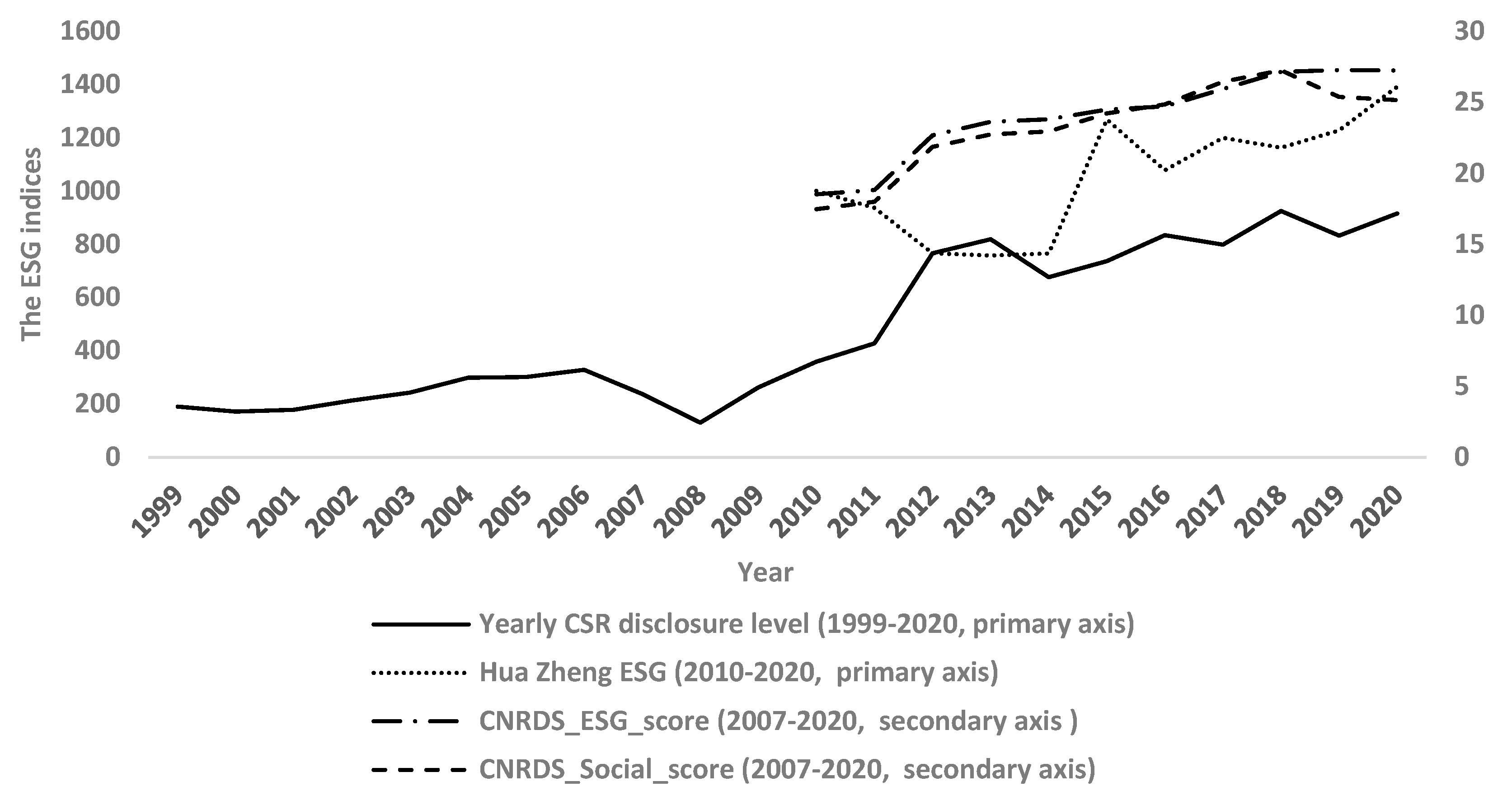
After obtaining the CSR scores of each annual report, we averaged these scores and drew a line graph (see Figure 1). Figure 1 shows that the CSR levels disclosed in the annual reports of Chinese listed companies present a continuous upward trend. This result indicates that the social responsibility performance of listed companies in information disclosure has consistently strengthened year after year. Additionally, the overall improvement of corporate social responsibility awareness in Chinese companies is in line with the increasing attention being paid to socially responsible investment and sustainable development goals in recent years.
Figure 1.
Line chart of the average CSR levels disclosed in the annual reports of listed companies from 2000 to 2020, and other ESG indicators.
In addition, this study also observed the levels of other ESG indicators. Limited by the data release years, we selected the annual average values of the Huazheng ESG Index (2010–2021), the ESG index, and the S (Social) index proposed by the CNRDS (2007–2021) for analysis. We compared these ESG indicators with the annual average CSR levels calculated from the annual reports. It was found that the annual average CSR levels obtained from the annual reports accurately reflect the trend of the ESG index and the S (Social) index evaluated by the CNRDS. In addition, we selected the annual average curve of the Huazheng ESG index as a reference. The Huazheng ESG Index is derived by weighting the market capitalization of listed companies based on their market value and ESG-rating performance. Although the Huazheng ESG Index is consistent with the overall trend of the CSR disclosure levels measured, it primarily reflects the stock prices of companies with high ESG. This is because the majority of the companies selected by Huazheng have high ESG ratings, diverging from the CSR disclosure levels conceptualized in this study. Therefore, this study subsequently explores the correlation between CSR disclosure levels and market performance.
4.2. CSR Disclosure Levels in Different Industries
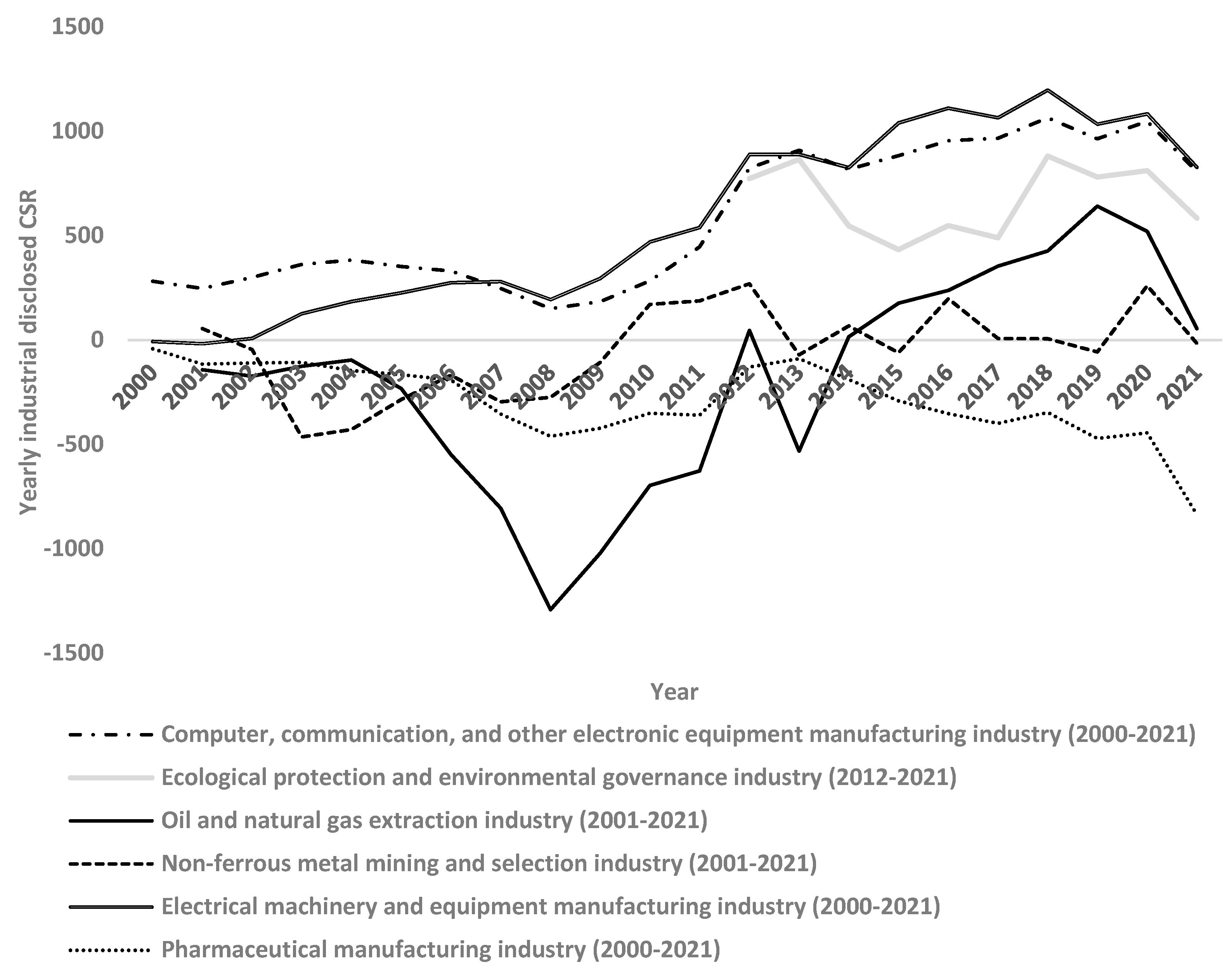
Furthermore, this study examines the CSR disclosure levels across six industries: computer communications and other electronic equipment manufacturing, ecological protection and environmental governance, oil and gas extraction, non-ferrous metal mining, electrical machinery and equipment manufacturing, and pharmaceutical manufacturing. The annual CSR disclosure levels of the above six industries are equal to the mean CSR disclosure levels of all companies within each industry for the year. Figure 2 illustrates the CSR disclosure levels of these six industries. It should be noted that the time spans for the CSR disclosure levels across the six industries evaluated in this study resulted in different numbers of listed companies.
Figure 2.
Annual CSR disclosure levels of six industries from 2000 to 2021.
As shown in Figure 2, the oil and gas extraction industry exhibited the lowest CSR disclosure level among the six industries in 2008. From 2006 to 2013, international crude oil prices exhibited significant volatility, leading to heightened business risks for enterprises and a corresponding decline in their social responsibility performance. This observation aligns with research on crude oil prices and ESG investment [66]. In 2008, the global financial crisis precipitated an economic recession and severe fluctuations in oil prices, subjecting oil and gas extraction companies to unprecedented financial pressure and a drastic decline in revenue. In response to these challenges, firms were compelled to significantly curtail non-core expenditures, prioritizing operational sustainability and debt repayment at the expense of long-term CSR investments. Concurrently, capital markets during the crisis exhibited a pronounced preference for short-term financial stability over social responsibility performance, prompting companies to reduce proactive CSR disclosures, while ESG issues were temporarily marginalized amid liquidity constraints. Moreover, the collapse in oil prices led to the suspension or cancelation of numerous exploration and production projects, thereby diminishing the scope of associated environmental and social impact assessments. Collectively, these factors culminated in the industry’s CSR disclosure levels reaching a historic low.
In addition to the oil and gas sector, the CSR disclosure levels in the pharmaceutical-manufacturing and non-ferrous-metal-smelting industries also performed poorly. We argue that the majority of these industries involve high-energy consumption and high-emission industries, such as energy and chemical industries. Their production emissions and other factors contradict the principles of environmental sustainability promoted by social responsibility. Consequently, these industries are closely associated with low CSR levels, resulting in the inclusion of words such as “medicinal materials” and “pharmaceutical industry” in the negative CSR dictionary.
The ecological protection and environmental governance industry aligns with the principles of ESG. Despite its later emergence, it has consistently excelled in corporate social responsibility. Furthermore, the rapid development of computer software and the electrical manufacturing industry has generated beneficial externalities for social activities. Therefore, words related to these industries are classified as CSR-positive words.
The CSR disclosure levels of the above six industries align with fundamental cognitive expectations and exhibit a strong correlation with industry characteristics. At the same time, the relevant words in these industries can be effectively identified using the MNIR method, demonstrating the scientific rigor and effectiveness of this method in the construction of CSR polarity dictionaries.
5. CSR Disclosure Level Manipulation and Corporate Performance
In this section, we explore the correlation between corporate operating performance and CSR disclosure levels, as well as the relationship between CSR disclosure levels and stock market return, based on the regression model and mediating effect test. Then, we explore the differences in the correlation between CSR disclosure levels and market performance across industries with different pollution levels. We conducted a heterogeneity analysis to examine if managers depend on CSR for their image management and to pursue personal excess compensation. Finally, we conducted a robustness test to provide further empirical evidence to reveal managers’ motivations for manipulating CSR disclosure to maintain their corporate image.
5.1. CSR Disclosure Levels and Corporate Business Performance
According to the trends illustrated in Section 4, we identified significant inter-group differences in the CSR disclosure levels across the six industries, with cyclical factors influencing index fluctuations. Therefore, we examined the correlation between CSR disclosure levels and corporate fundamentals, especially those belonging to different industries. We further explored how managerial self-interest, proxied by excess compensation (EC), mediates this relationship and whether the manipulation of CSR disclosure impacts market value.
5.1.1. Business Performance and CSR Disclosure Levels of Listed Companies
Prior literature suggests that CSR activities can be exploited by management to obscure poor performance or adverse conditions [44,67]. We argue that companies with a lower ROE will improve their CSR disclosure levels to mask poor operating performance. This study first conducted a correlation test between the CSR levels disclosed in the annual reports and the ROEs of listed companies in the current period. The baseline regression model is as follows:
where
- : the CSR level disclosed in the annual report of the company i in year t;
- : the return on common stockholders’ equity of the company i in year t;
- : the total assets of the company i at the end of the year t;
- : the book-to-market ratio of the company i in the current year t;
- : the asset–liability ratio of the company i in year t;
- : the dummy variable describing whether the company i is a state-owned enterprise; if the company i is a state-owned enterprise, is 1; otherwise, it is 0;
- : the number of years since the company was listed;
- : the dummy variable, which is 1 if the company i has refinancing activities, such as issuance or allotment, in the year t; otherwise, it is 0;
- : the dummy variable, which is 1 if the company i has merger and acquisition activities in the year t; otherwise, it is 0;
- : a random error term.
In addition, the regression model fixes the industry and year effects. The industry classification is based on the industry classification standard of the China Securities Regulatory Commission in 2012. A total of 34,538 valid samples were considered in the model.
Meanwhile, managers with performance-linked compensation may prioritize self-interest, leading to overinvestment in CSR to enhance their corporate image, thereby increasing agency costs and diminishing financial performance [68]. We chose managers’ excess compensation as a proxy variable for self-interest incentives to test the mediating effect.
where represents the excess compensation of managers, which is the difference between the managers’ compensation and the average compensation of managers within the same industry for that year. This variable serves as a mediating variable and is referred to as EC (excess compensation) in the following section. The other variables have been explained above. In the case where and both exhibit significance, if is significant, it indicates a partial mediating effect; conversely, if is not significant, it indicates a complete mediating effect. The detailed mediating effect regression results are presented in Table 1.
Table 1.
Empirical results of ROE and CSR disclosure levels.
We found that there was a complete mediating effect between the operating performance of the listed companies and the CSR levels disclosed in their annual reports. This effect is conveyed through the mediating variable “EC”. Consistent with the findings of [69,70], the companies with poor operating performance in the current period exhibited superior social responsibility, which is contrary to the common assumptions. At the same time, the managerial compensation of listed companies is frequently modest due to poor operating performance, while the corresponding CSR disclosure level is relatively high. It should be noted that managers are motivated to manipulate the CSR disclosure level in annual reports to secure high compensation, thereby cultivating a favorable image of the company as a “highly socially responsible organization” to conceal its unfavorable conditions.
5.1.2. Stock Market Performance and CSR Disclosure Levels of Listed Companies
Referring to [15,71], we believe that the annual report is a tool to communicate internal information of the company to the outside. The readers of the annual report are the target audience for managers to manipulate their CSR disclosure levels. CSR exhibited by listed companies may be “paid” by shareholders to obtain favorable stock market performance [15,71,72]. To test the validity of this mechanism, we further explored the correlation between the CSR disclosure levels of the listed companies and their stock market performance in the following year. The regression model is as follows:
where is the annual stock return rate of the company i in the year t. is the CSR disclosure level of the company i in the previous year t − 1. The other variables have been explained above. The regression model fixed the industry and year effects. A total of 28,459 valid samples were considered in the model. The detailed results of the regression analysis are presented in Table 2.
Table 2.
Empirical results of CSR levels and stock market performance.
After detecting the managers’ motivations to manipulate CSR disclosure, we explored whether the manipulative behaviors in CSR information disclosure can achieve the expected positive market effect. According to the results in Table 2, we found that there was a significant negative correlation between the CSR levels disclosed in the annual reports of listed companies and their stock market performance in the following year. This finding supports the theoretical view that CSR is “paid for” by shareholders [7,15,20,53]. According to the information asymmetry theory, it takes a certain amount of time for information to be reflected in the market price. The information about the current poor operation conditions took one period to permeate the market via alternative channels, resulting in investors’ negative expectations of poor operation performance being reflected in the stock market price after one period. This study contends that the manipulative behavior of managers has proven to be ineffective in achieving the anticipated outcomes. This result preliminarily confirms that the CSR level indicator developed in this study can explain stock market performance to some degree.
5.2. Heterogeneity Analysis
Based on the “List of Industry Classification Management for Environmental Audit of Listed Companies” issued by the Ministry of Environmental Protection,” (the “List of Industry Classification Management for Environmental Audits of Listed Companies” identifies 14 industries, including thermal power, steel, cement, electrolytic aluminum, coal, metallurgy, and building materials, as high-pollution industries, and other industries as low-pollution industries), this study categorized companies into high-pollution companies and low-pollution companies to analyze the differences in the correlations between their CSR disclosure levels and ROEs through grouped regression. The regression model is presented in Equation (5). The regression outcomes are presented in Table 3 below.
Table 3.
Empirical results of heterogeneity analysis.
Table 3 illustrates that the ROE of low-pollution companies exhibits a strong negative correlation with the CSR disclosure level. In contrast, the ROE of high-pollution companies has a positive correlation with the CSR disclosure level. In high-pollution industries, companies with favorable operating conditions exhibit excellent performance in corporate social responsibility compared to those with unfavorable conditions. We believe that high-pollution companies with favorable operating conditions possess greater financial resources to support the development of corporate social responsibility initiatives, whereas those with unfavorable conditions lack adequate funds and struggle to allocate insufficient resources and management capabilities to CSR efforts. Moreover, in low-pollution industries, companies exhibiting lower ROE in the current period generally have better CSR disclosure levels, so managers may rely on CSR for image management to attract investors and obtain personal excess returns.
5.3. Robustness Test
To ensure the robustness of the empirical results, we conducted a robustness test on the above samples. We classified the samples based on “stock return below the industry average performance in the current period” and “stock return above the industry average performance in the current period”. The detailed regression results are presented in Table 4.
Table 4.
Empirical results of robustness tests.
According to the empirical results, the CSR disclosure level had a significantly negative correlation with the following period’s stock returns in the companies with poor financial performance, while no significance was observed in the companies with excellent financial performance. In conjunction with the regression results presented in Table 1, it was observed that companies with poor financial performance tended to exhibit superior CSR disclosure levels in their annual reports, resulting in better market performance in the following period. This phenomenon aligns with the opportunistic behavior exhibited by managers and their motivation to manipulate disclosures [52,73]. In the case of poor financial performance, managers may be motivated to manipulate the CSR disclosure level, especially by promoting the display of social responsibility for image management 20,53, so as to obscure unfavorable financial performance [7] and strive for excess market returns. However, their manipulative behaviors fail to bring effective market returns to the company’s stock market in the next year. Therefore, the results of this study are robust.
6. Conclusions
This study used natural-language-processing technology and the MNIR method, combined with CSR rating indicators and the CSR reports of listed companies, to construct a Chinese CSR dictionary, which contains 300 positive words and 300 negative words. Based on this dictionary, we constructed the CSR indicators of the disclosure reports of Chinese listed companies, and then calculated the annual average CSR disclosure level index and industry CSR disclosure level index. This study found that the annual average CSR disclosure level showed a fluctuating upward trend, which indicates that the explanation of social responsibility activities in information disclosure by enterprises has increased year after year, and the overall level has continued to improve. In addition, the index constructed in this study is basically consistent with the trend of the existing ESG index. This proves that it has certain practical significance.
This study examined the mediating effect of self-interest motivation between corporate ROEs and CSR disclosure levels. The results show that managers are motivated to manipulate the level of CSR disclosure to maintain their corporate image when the company’s operating performance is poor. We believe that good corporate image is used to obtain high stock market returns in the next year. Therefore, we explored the correlation between the level of corporate CSR disclosure and the stock market return in the next year. However, a significant negative linear correlation existed between the CSR levels of the listed companies and their stock returns in the next year. It is worth noting that this phenomenon was particularly significant in companies with poor operating performance but not significant in companies with performance above the industry average. We believe that the information asymmetry mechanism can explain this result: when the operating performance is poor, managers may manage their corporate image through increasing the level of their CSR disclosure, thereby trying to improve their market performance. However, the information about the actual poor performance of the company in the next year is gradually diffused to the market through other channels, causing investors to develop negative market expectations and thus fail to obtain excess stock returns.
In addition, we conducted a classification heterogeneity test on the sample. We divided all the companies in the sample into two categories according to the pollution level of the industry—namely, companies in high- and low-pollution industries—and tested the correlation between their ROEs and CSR disclosure levels. We found that the companies in low-pollution industries were more likely to have engaged in CSR disclosure manipulation, while companies in high-pollution industries were more concerned about their actual CSR level. This phenomenon further illustrates that the CSR disclosure level index constructed in this study has practical significance and explanatory power. Finally, the empirical results of this study have proven to be robust.
In general, the MNIR dictionary constructed in this study effectively avoids the subjective bias of manual scoring, can directly quantify the explanatory and semantic contribution of each word in the CSR score, and overcomes the ambiguity problem of traditional topic models and deep learning methods in addressing lexical polarity. At the same time, the CSR disclosure level index constructed using this dictionary successfully identifies corporate image management behaviors based on managers’ self-interest motivations, and its empirical results have shown good robustness after multi-dimensional tests.
This study still has shortcomings in terms of exploring the specific impact mechanisms of each word on the level of CSR disclosure. In the future, these can be studied in depth from the perspectives of morphemes and semantic elements, and the impact of the information diffusion process on market reactions can be further examined. Based on the above conclusions, we recommend that regulators strengthen the monitoring of ESG- and CSR-related words in the information disclosure reports of listed companies. Investors and industry analysts should remain objective when interpreting CSR disclosure content, in order to avoid misleading interpretations caused by word selection. At the same time, promoting mandatory requirements for CSR disclosure will help to achieve fair and efficient information release and provide strong support for the construction of a more complete social responsibility assessment standard.
Author Contributions
Conceptualization, Y.L. (Yinong Liu) and H.C.; methodology, Y.L. (Yinong Liu) and Y.L. (Yanying Li); software, Y.L. (Yinong Liu); validation, Y.L. (Yinong Liu), Y.L. (Yanying Li), and H.C.; data curation, Y.L. (Yinong Liu); writing—original draft preparation, Y.L. (Yinong Liu) and Y.L. (Yanying Li); writing—review and editing, Y.L. (Yinong Liu), Y.L. (Yanying Li), and H.C.; visualization, Y.L. (Yinong Liu) and Y.L. (Yanying Li); supervision, H.C. All authors have read and agreed to the published version of the manuscript.
Funding
This research received no external funding.
Institutional Review Board Statement
Not applicable.
Informed Consent Statement
Not applicable.
Data Availability Statement
Data are contained within the article.
Conflicts of Interest
The authors declare no conflicts of interest.
Abbreviations
The following abbreviations are used in this manuscript:
| ESG | Environmental, Social, Governance |
| CSR | Corporate Social Responsibility |
| MNIR | Multinomial inverse regression |
| LDA | Latent Dirichlet Allocation |
Appendix A

Table A1.
Positive and negative CSR words in the CSR dictionary.
Table A1.
Positive and negative CSR words in the CSR dictionary.
| Chinese Meaning | Positive Words | CSR Score | Chinese Meaning | Negative Words | CSR Score |
|---|---|---|---|---|---|
| 电气 | electric | 5.235439238 | 疫苗 | vaccine | −7.71509462 |
| 高速 | high speed | 4.318568245 | 灾区 | disaster area | −7.179618983 |
| 钢铁 | steel | 4.188377093 | 电器 | electrical appliances | −4.802384926 |
| 软件 | software | 4.031842191 | 地震 | earthquake | −4.4738809 |
| 风电 | wind power | 3.376950434 | 药材 | medicinal materials | −4.015034535 |
| 医学 | medicine | 3.190805375 | 气候 | climate | −3.886457005 |
| 发行人 | issuer | 3.074498056 | 黄金 | gold | −3.768210578 |
| 脱贫 | poverty alleviation | 3.014665613 | 压缩 | compression | −3.464121787 |
| 攻坚 | overcome difficulties | 3.012960829 | 数据安全 | data security | −3.340894219 |
| 零售 | retail | 2.981262624 | 药业 | pharmaceutical industry | −3.283041007 |
| 公路 | highway | 2.815950217 | 气候变化 | climate change | −3.240787006 |
| 养殖 | farming | 2.806286455 | 纺织 | textile | −3.196856468 |
| 深耕 | deep cultivation | 2.795730658 | 通讯 | communication | −3.038191147 |
| 精准 | precision | 2.786784954 | 家电 | household appliances | −2.899968794 |
| 期货 | futures | 2.779917025 | 相关者 | related | −2.767522357 |
| 智慧 | wisdom | 2.763927811 | 公用 | public | −2.669426796 |
| 信息技术 | information technology | 2.662733401 | 本年 | this year | −2.484712074 |
| 互联网 | internet | 2.605910892 | 导致 | lead to | −2.482753065 |
| 美好生活 | happy life | 2.549043123 | 住宅 | residential | −2.482325505 |
| 扶贫 | poverty alleviation | 2.47416871 | 质量体系 | quality system | −2.474943348 |
| 轨道 | track | 2.422596975 | 规程 | regulations | −2.362860274 |
| 担当 | responsibility | 2.403452417 | 中医 | traditional Chinese medicine | −2.337672092 |
| 美好 | happiness | 2.388326668 | 完全 | completely | −2.333481231 |
| 管理方 | management | 2.240577617 | 节约型 | economical | −2.302848075 |
| 微信 | 2.237766376 | 指数 | index | −2.302681481 | |
| 旅游 | travel | 2.184467708 | 用车 | car used | −2.246912144 |
| 农村 | rural | 2.139607259 | 高产 | high yield | −2.242926717 |
| 研究院 | research institute | 2.124480868 | 医药 | medicine | −2.23320935 |
| 混合型 | hybrid | 2.024685017 | 消耗量 | consumption | −2.220650247 |
| 电站 | power station | 2.012363127 | 多样性 | diversity | −2.181649171 |
| 程度 | degree | 2.005995303 | 药品 | drug | −2.166290704 |
| 集团股份 | group shares | 1.986376961 | 本年度 | this year | −2.10812581 |
| 核电 | nuclear power | 1.96536327 | 余额 | balance | −1.968834556 |
| 定点 | fixed point | 1.916647074 | 合力 | together | −1.965313924 |
| 村民 | villagers | 1.883146504 | 救灾 | provide disaster relief | −1.908607614 |
| 坚守 | persistence | 1.877955433 | 产业园 | industrial park | −1.899893345 |
| 物流 | logistics | 1.841692092 | 中小企业 | small and medium enterprises | −1.878214881 |
| 全力 | full strength | 1.836263167 | 制订 | formulate | −1.84898863 |
| 全文 | full text | 1.787563983 | 污水处理 | wastewater treatment | −1.825049104 |
| 集成 | integrated | 1.786948643 | 理财 | financial management | −1.814960992 |
| 农户 | farmers | 1.73209381 | 技术改造 | technological transformation | −1.799564969 |
| 密度 | density | 1.69604136 | 负面 | negative | −1.783265677 |
| 国民 | national | 1.668508337 | 应对 | response | −1.754587036 |
| 交付 | deliver | 1.660472001 | 信贷 | credit | −1.753646211 |
| 智能 | intelligent | 1.58711716 | 调动 | transfer | −1.729300953 |
| 智慧 | intelligence | 1.577688043 | 捐款 | donate | −1.727857134 |
| 交通 | transportation | 1.577470732 | 电机 | motor | −1.726174819 |
| 法定 | legal | 1.536588968 | 供电 | power | −1.686079805 |
| 定制 | customized | 1.525614599 | 反应 | reaction | −1.674140215 |
| 救援 | rescue | 1.518400963 | 资源管理 | resource management | −1.66270394 |
| 初心 | original intention | 1.5147728 | 电网 | power grid | −1.652139798 |
| 格局 | pattern | 1.506256902 | 可再生 | renewable | −1.63260363 |
| 装备 | equipment | 1.483119213 | 租赁 | lease | −1.62438176 |
| 贸易 | trading | 1.482684591 | 手册 | manual | −1.622114278 |
| 管理者 | manager | 1.479946536 | 集装箱 | container | −1.615096768 |
| 发行 | issue | 1.47400242 | 小企业 | small enterprise | −1.60364027 |
| 布局 | layout | 1.466328804 | 经济效益 | economic benefits | −1.602579394 |
| 备案 | record keeping | 1.464239793 | 贿赂 | bribe | −1.595138497 |
| 人才队伍 | talent team | 1.452235042 | 变化 | change | −1.594792147 |
| 机器 | machine | 1.424160186 | 集装 | container | −1.552403009 |
| 党建 | party building | 1.424049765 | 飞行 | flight | −1.548132863 |
| 智能化 | intelligent | 1.42349092 | 煤矿 | coal mine | −1.529039983 |
| 混合 | mix | 1.421668974 | 年末 | end of the year | −1.51947605 |
| 携手 | together | 1.41614985 | 产业化 | industrialization | −1.517209852 |
| 传真 | fax | 1.406796487 | 运动会 | sports day | −1.499248788 |
| 限制 | limit | 1.404025691 | 酒店 | hotel | −1.493249783 |
| 年报 | annual report | 1.395630486 | 颗粒 | particles | −1.485475375 |
| 驱动 | drive | 1.392494081 | 装箱 | packing | −1.482992508 |
| 食品 | food | 1.39211178 | 银行 | bank | −1.454710934 |
| 高端 | high-end | 1.378767854 | 成绩 | score | −1.448666348 |
| 管控 | control | 1.357585964 | 产品质量 | product quality | −1.444239237 |
| 招募 | recruit | 1.355006158 | 决议 | resolution | −1.441349353 |
| 董事长 | chairman | 1.341113336 | 机电 | electromechanical | −1.439061328 |
| 人才培养 | talent cultivation | 1.336835165 | 友好 | friendly | −1.438013934 |
| 成就 | achievement | 1.336359135 | 对待 | treat | −1.426744895 |
| 分公司 | branch company | 1.333035913 | 温室 | greenhouse | −1.415960231 |
| 共享 | shared | 1.316201207 | 失业 | unemployment | −1.413838158 |
| 整治 | remediation | 1.292765638 | 报道 | report | −1.361252413 |
| 引领 | leading | 1.261211558 | 纳入 | inclusion | −1.360754876 |
| 公司简介 | company profile | 1.259027855 | 安全性 | security | −1.349922064 |
| 玻璃 | glass | 1.252356052 | 绿化 | greenery | −1.347303739 |
| 巩固 | consolidation | 1.223588177 | 复合 | complex | −1.343295201 |
| 课程 | course | 1.222545597 | 改进 | improve | −1.338324651 |
| 走进 | walk In | 1.21809698 | 贷款 | loan | −1.337398592 |
| 股权 | equity | 1.217353564 | 恢复 | recover | −1.322558846 |
| 方法 | method | 1.210659292 | 认识 | know | −1.319240439 |
| 网络安全 | cybersecurity | 1.185770596 | 社会各界 | all sectors of society | −1.310332291 |
| 线上 | on-line | 1.185306121 | 资管 | asset management | −1.296790955 |
| 互助 | mutual aid | 1.18462562 | 煤炭 | coal | −1.293206767 |
| 水电 | hydropower | 1.179319635 | 隐私 | privacy | −1.285804709 |
| 线下 | offline | 1.178765283 | 验证 | verify | −1.279037251 |
| 前行 | forward | 1.177474256 | 气体 | gas | −1.278221291 |
| 民营 | private | 1.172704006 | 收到 | receive | −1.254791179 |
| 上线 | go online | 1.167276365 | 生物 | biology | −1.23726249 |
| 信息化 | informatization | 1.167190339 | 人类 | human | −1.216690483 |
| 美丽 | beauty | 1.16555521 | 重要性 | importance | −1.214642559 |
| 团结 | unity | 1.157273315 | 药物 | drug | −1.214220777 |
| 控股 | holdings | 1.156793755 | 房地产 | real estate | −1.212911453 |
| 生态 | ecology | 1.155717471 | 上升 | rise | −1.203963502 |
| 党员 | party member | 1.152104073 | 灾害 | disaster | −1.198699567 |
| 商品 | commodity | 1.137818037 | 空调 | air conditioner | −1.197820051 |
| 机械 | mechanical | 1.130983171 | 审查 | review | −1.195228368 |
| 突发 | Breakout | 1.12525412 | 工伤 | work Injury | −1.194543052 |
| 生日 | birthday | 1.119790528 | 污泥 | sludge | −1.193695314 |
| 公司党委 | company party committee | 1.119213065 | 石油 | oil | −1.193252988 |
| 说明会 | information session | 1.105299058 | 潜在 | potential | −1.192066283 |
| 照明 | illumination | 1.091045764 | 老年 | elderly | −1.177011474 |
| 特种 | special | 1.088996877 | 污水 | sewage | −1.165900041 |
| 动力 | power | 1.087753357 | 物料 | materials | −1.159721923 |
| 科创 | science and technology innovation | 1.078991901 | 重组 | reorganization | −1.159104657 |
| 民生 | people’s livelihood | 1.078636885 | 毕业生 | graduate | −1.152107048 |
| 大赛 | competition | 1.070134469 | 同业 | the same business | −1.144695682 |
| 便捷 | convenient | 1.065754865 | 容量 | capacity | −1.13984069 |
| 在线 | online | 1.060800044 | 循环 | cycle | −1.138923618 |
| 持有人 | owner | 1.060330434 | 生存 | survive | −1.135677755 |
| 地址 | address | 1.060316632 | 次数 | frequency | −1.12788152 |
| 最新 | up to date | 1.050588672 | 出行 | travel | −1.124480618 |
| 关键技术 | key technologies | 1.044356306 | 护工 | nursing | −1.123064083 |
| 联盟 | alliance | 1.038737996 | 努力实现 | strive to achieve | −1.112416804 |
| 实时 | real time | 1.033397023 | 商业道德 | business ethics | −1.111870477 |
| 梦想 | dream | 1.028255386 | 机遇 | opportunity | −1.111436176 |
References
- Godfrey, P.C.; Hatch, N.W. Researching Corporate Social Responsibility: An Agenda for the 21st Century. J. Bus. Ethics 2007, 70, 87–98. [Google Scholar] [CrossRef]
- Berg, F.; Koelbel, J.F.; Pavlova, A.; Rigobon, R. ESG Confusion and Stock Returns: Tackling the Problem of Noise; National Bureau of Economic Research Working Paper Series; National Bureau of Economic Research: Cambridge, MA, USA, 2022; p. 30562. [Google Scholar] [CrossRef]
- Xu, N.; Chen, J.; Zhou, F.; Dong, Q.; He, Z. Corporate ESG and Resilience of Stock Prices in the Context of the COVID-19 Pandemic in China. Pac. Basin Financ. J. 2023, 79, 102040. [Google Scholar] [CrossRef]
- Michelon, G.; Pilonato, S.; Ricceri, F. CSR Reporting Practices and the Quality of Disclosure: An Empirical Analysis. Crit. Perspect. Account. 2015, 33, 59–78. [Google Scholar] [CrossRef]
- Tsang, A.; Frost, T.; Cao, H. Environmental, Social, and Governance (ESG) Disclosure: A Literature Review. Br. Account. Rev. 2023, 55, 101149. [Google Scholar] [CrossRef]
- Bhatia, A.; Makkar, B. CSR Disclosure in Developing and Developed Countries: A Comparative Study. J. Glob. Responsib. 2020, 11, 1–26. [Google Scholar] [CrossRef]
- Li, F. Annual Report Readability, Current Earnings, and Earnings Persistence. J. Account. Econ. 2008, 45, 221–247. [Google Scholar] [CrossRef]
- Goldstein, I.; Kopytov, A.; Shen, L.; Xiang, H. On ESG Investing: Heterogeneous Preferences, Information, and Asset Prices; National Bureau of Economic Research Working Paper Series; National Bureau of Economic Research: Cambridge, MA, USA, 2022; p. 29839. [Google Scholar] [CrossRef]
- Han, S.; Liu, Z.; Deng, Z.; Gupta, S.; Mikalef, P. Exploring the Effect of Digital CSR Communication on Firm Performance: A Deep Learning Approach. Decis. Support Syst. 2024, 176, 114047. [Google Scholar] [CrossRef]
- Kang, H.; Kim, J. Analyzing and Visualizing Text Information in Corporate Sustainability Reports Using Natural Language Processing Methods. Appl. Sci. 2022, 12, 5614. [Google Scholar] [CrossRef]
- Zhou, B.; Zhang, C. When Green Finance Meets Banking Competition: Evidence from Hard-to-Abate Enterprises of China. Pac. Basin Financ. J. 2023, 78, 101954. [Google Scholar] [CrossRef]
- Taddy, M. Multinomial Inverse Regression for Text Analysis. J. Am. Stat. Assoc. 2013, 108, 755–770. [Google Scholar] [CrossRef]
- García, D.; Hu, X.; Rohrer, M. The Colour of Finance Words. J. Financ. Econ. 2023, 147, 525–549. [Google Scholar] [CrossRef]
- Bilokha, A.; Cheng, M.; Fu, M.; Hasan, I. Understanding CSR Champions: A Machine Learning Approach. Ann. Oper. Res. 2024, 1–14. [Google Scholar] [CrossRef]
- Becchetti, L.; Ciciretti, R. Corporate Social Responsibility and Stock Market Performance. Appl. Financ. Econ. 2009, 19, 1283–1293. [Google Scholar] [CrossRef]
- Chen, S.; Han, X.; Zhang, Z.; Zhao, X. ESG Investment in China: Doing Well by Doing Good. Pac. Basin Financ. J. 2023, 77, 101907. [Google Scholar] [CrossRef]
- Gorovaia, N.; Makrominas, M. Identifying Greenwashing in Corporate-social Responsibility Reports Using Natural-language Processing. Eur. Financ. Manag. 2024, 31, 427–462. [Google Scholar] [CrossRef]
- Li, T.-T.; Wang, K.; Sueyoshi, T.; Wang, D.D. ESG: Research Progress and Future Prospects. Sustainability 2021, 13, 11663. [Google Scholar] [CrossRef]
- Fu, R.; Tang, Y.; Chen, G. Chief Sustainability Officers and Corporate Social (Ir) Responsibility. Strateg. Manag. J. 2020, 41, 656–680. [Google Scholar] [CrossRef]
- Mashayekhi, B.; Hasanzadeh, S.; Samavat, M.; Nazari, S. Corporate Social Responsibility Disclosure and Management Opportunism: The Role Moderating of Corporate Governance. Account. Audit. Rev. 2023, 30, 560–589. [Google Scholar]
- Kotsantonis, S.; Pinney, C.; Serafeim, G. ESG Integration in Investment Management: Myths and Realities. J. Appl. Corp. Financ. 2016, 28, 10–16. [Google Scholar] [CrossRef]
- Dhaliwal, D.S.; Li, O.Z.; Tsang, A.; Yang, Y.G. Voluntary Nonfinancial Disclosure and the Cost of Equity Capital: The Initiation of Corporate Social Responsibility Reporting. Account. Rev. 2011, 86, 59–100. [Google Scholar] [CrossRef]
- Clark, G.L.; Feiner, A.; Viehs, M. From the Stockholder to the Stakeholder: How Sustainability Can Drive Financial Outperformance; SSRN: Rochester, NY, USA, 2015. [Google Scholar]
- Fatemi, A.; Glaum, M.; Kaiser, S. ESG Performance and Firm Value: The Moderating Role of Disclosure. Glob. Financ. J. 2018, 38, 45–64. [Google Scholar] [CrossRef]
- Xu, D.; Liu, Y. The Impact of Environmental Information Disclosure in the “Carbon Trading Pilot” Project on the Financial Performance of Listed Enterprises in China. Sustainability 2024, 16, 8410. [Google Scholar] [CrossRef]
- Wu, L.; Liu, S.; Qi, L.; Lin, D. Mandatory Disclosure and Corporate ESG Performance: Evidence from China’s “Explanation for Nondisclosure” Requirement. Corp. Soc. Responsib. Environ. Manag. 2025, 32, 176–191. [Google Scholar] [CrossRef]
- Wang, X.; Elahi, E.; Khalid, Z. Do Green Finance Policies Foster Environmental, Social, and Governance Performance of Corporate? Int. J. Environ. Res. Public Health 2022, 19, 14920. [Google Scholar] [CrossRef]
- Xu, Y.; Zhu, N. The Effect of Environmental, Social, and Governance (Esg) Performance on Corporate Financial Performance in China: Based on the Perspective of Innovation and Financial Constraints. Sustainability 2024, 16, 3329. [Google Scholar] [CrossRef]
- Naseer, M.M.; Guo, Y.; Zhu, X. ESG Trade-off with Risk and Return in Chinese Energy Companies. Int. J. Energy Sect. Manag. 2024, 18, 1109–1126. [Google Scholar] [CrossRef]
- Shen, Y. The Impact of Environmental, Social, and Governance Factor on the Financial Performance of China’s Companies. Adv. Econ. Manag. Political Sci. 2024, 57, 129–137. [Google Scholar] [CrossRef]
- Wu, Y.; Zhang, K.; Xie, J. Bad Greenwashing, Good Greenwashing: Corporate Social Responsibility and Information Transparency. Manag. Sci. 2020, 66, 3095–3112. [Google Scholar] [CrossRef]
- Vollero, A.; Palazzo, M.; Siano, A.; Elving, W.J. Avoiding the Greenwashing Trap: Between CSR Communication and Stakeholder Engagement. Int. J. Innov. Sustain. Dev. 2016, 10, 120–140. [Google Scholar] [CrossRef]
- Halbritter, G.; Dorfleitner, G. The Wages of Social Responsibility—Where Are They? A Critical Review of ESG Investing. Rev. Financ. Econ. 2015, 26, 25–35. [Google Scholar] [CrossRef]
- Pagano, M.S.; Sinclair, G.; Yang, T. Understanding ESG ratings and ESG indexes. In Research Handbook of Finance and Sustainability; Edward Elgar Publishing: Cheltenham, UK, 2018; pp. 339–371. ISBN 1-78643-263-3. [Google Scholar]
- Kim, M.; Kim, S.; Kim, Y.; Moon, J. Analyzing the Financial Impact of ESG News Sentiment on ESG Finance Trends. In Proceedings of the 2024 International Conference on Platform Technology and Service (PlatCon), Jeju, Republic of Korea, 26–28 August 2024; IEEE: Piscataway, NJ, USA, 2024; pp. 95–100. [Google Scholar]
- Giannarakis, G. The Determinants Influencing the Extent of CSR Disclosure. Int. J. Law Manag. 2014, 56, 393–416. [Google Scholar] [CrossRef]
- Chan, M.C.; Watson, J.; Woodliff, D. Corporate Governance Quality and CSR Disclosures. J. Bus. Ethics 2014, 125, 59–73. [Google Scholar] [CrossRef]
- Fahad, P.; Rahman, P.M. Impact of Corporate Governance on CSR Disclosure. Int. J. Discl. Gov. 2020, 17, 155–167. [Google Scholar] [CrossRef]
- Zavarrone, E.; Forciniti, A. CSR & Sentiment Analysis: A New Customized Dictionary; Springer: Cham, Switzerland, 2023; pp. 466–479. [Google Scholar]
- Niveditha, R.; NS, N.K.; Parimi, M.R.; Raam, A.; Babu, S. Develop CSR Themes Using Text-Mining and Topic Modelling Techniques. In Proceedings of the 2020 IEEE International Conference on Cloud Computing in Emerging Markets (CCEM), Bengaluru, India, 6–7 November 2020; IEEE: Piscataway, NJ, USA, 2020; pp. 67–71. [Google Scholar]
- Chia, A.; Doyle, K.; Kern, M.L. Community Construals of CSR for Happiness: A Mixed-Method Study Using Natural Language. Soc. Bus. Rev. 2023, 18, 296–320. [Google Scholar] [CrossRef]
- Teoh, T.-T.; Heng, Q.K.; Chia, J.J.; Shie, J.M.; Liaw, S.W.; Yang, M.; Nguwi, Y.-Y. Machine Learning-Based Corporate Social Responsibility Prediction. In Proceedings of the 2019 IEEE International Conference on Cybernetics and Intelligent Systems (CIS) and IEEE Conference on Robotics, Automation and Mechatronics (RAM), Bangkok, Thailand, 18–20 November 2019; IEEE: Piscataway, NJ, USA, 2019; pp. 501–505. [Google Scholar]
- Huang, Z.; Liew, K.; Rahman, M. Employing Machine Learning to Deduce a Causal Link Between Corporate Social Responsibility and Financial Performance. Fluct. Noise Lett. 2023, 2440015. [Google Scholar] [CrossRef]
- Sandberg, M.; Holmlund, M. Impression Management Tactics in Sustainability Reporting. Soc. Responsib. J. 2015, 11, 677–689. [Google Scholar] [CrossRef]
- Hamza, S.; Jarboui, A. CSR or Social Impression Management? Tone Management in CSR Reports. J. Financ. Report. Account. 2021, 20, 599–617. [Google Scholar] [CrossRef]
- Pouryousof, A.; Nassirzadeh, F.; Askarany, D. Inconsistency in Managers’ Disclosure Tone: The Signalling Perspective. Risks 2023, 11, 205. [Google Scholar] [CrossRef]
- Luo, Y.; Zhou, L. Textual Tone in Corporate Financial Disclosures: A Survey of the Literature. Int. J. Discl. Gov. 2020, 17, 101–110. [Google Scholar] [CrossRef]
- Koh, K.; Li, H.; Tong, Y.H. Corporate Social Responsibility (CSR) Performance and Stakeholder Engagement: Evidence from the Quantity and Quality of CSR Disclosures. Corp. Soc. Responsib. Environ. Manag. 2023, 30, 504–517. [Google Scholar] [CrossRef]
- Doyle, J.T.; Magilke, M.J. The Timing of Earnings Announcements: An Examination of the Strategic Disclosure Hypothesis. Account. Rev. 2009, 84, 157–182. [Google Scholar] [CrossRef]
- Kanbaty, M.; Hellmann, A.; He, L. Infographics in Corporate Sustainability Reports: Providing Useful Information or Used for Impression Management? J. Behav. Exp. Financ. 2020, 26, 100309. [Google Scholar] [CrossRef]
- Nadeem, M. Board Gender Diversity and Managerial Obfuscation: Evidence from the Readability of Narrative Disclosure in 10-K Reports. J. Bus. Ethics 2022, 179, 153–177. [Google Scholar] [CrossRef]
- Leung, S.; Parker, L.; Courtis, J. Impression Management through Minimal Narrative Disclosure in Annual Reports. Br. Account. Rev. 2015, 47, 275–289. [Google Scholar] [CrossRef]
- Merkl-Davies, D.M.; Brennan, N.M. Discretionary Disclosure Strategies in Corporate Narratives: Incremental Information or Impression Management? J. Account. Lit. 2007, 27, 116–196. [Google Scholar]
- Jensen, M.C.; Meckling, W.H. The Nature of Man. J. Appl. Corp. Financ. 1994, 7, 4–19. [Google Scholar] [CrossRef]
- Yung, K.K. Value of Multinationality: Internalization, Managerial Self-interest, and Managerial Compensation. J. Bus. Financ. Account. 2002, 29, 55–75. [Google Scholar] [CrossRef]
- Muttakin, M.B.; Khan, A.; Azim, M.I. Corporate Social Responsibility Disclosures and Earnings Quality: Are They a Reflection of Managers’ Opportunistic Behavior? Manag. Audit. J. 2015, 30, 277–298. [Google Scholar] [CrossRef]
- García-Sánchez, I.-M.; Hussain, N.; Khan, S.A.; Martínez-Ferrero, J. Managerial Entrenchment, Corporate Social Responsibility, and Earnings Management. Corp. Soc. Responsib. Environ. Manag. 2020, 27, 1818–1833. [Google Scholar] [CrossRef]
- Bachmann, R.L.; Spiropoulos, H. CSR Restatements: Mischief or Mistake? J. Manag. Account. Res. 2023, 35, 21–50. [Google Scholar] [CrossRef]
- Clarkson, P.M.; Ponn, J.; Richardson, G.D.; Rudzicz, F.; Tsang, A.; Wang, J. A Textual Analysis of US Corporate Social Responsibility Reports. Abacus 2020, 56, 3–34. [Google Scholar] [CrossRef]
- Conrad, M.; Holtbrügge, D. Antecedents of Corporate Misconduct: A Linguistic Content Analysis of Decoupling Tendencies in Sustainability Reporting. Bus. Ethics Environ. Responsib. 2021, 30, 538–550. [Google Scholar] [CrossRef]
- Zheng, J.; Ng, K.C.; Zheng, R.; Tam, K.Y. The Effects of Sentiment Evolution in Financial Texts: A Word Embedding Approach. J. Manag. Inf. Syst. 2024, 41, 178–205. [Google Scholar] [CrossRef]
- Boadi, E.A.; He, Z.; Darko, D.F.; Abrokwah, E. Unlocking from Community Stakeholders, Corporate Social Responsibility (CSR) Projects for Effective Company–Community Relationship. Labor Hist. 2018, 59, 746–762. [Google Scholar] [CrossRef]
- Atsu, F.; Adams, S. Energy Consumption, Finance, and Climate Change: Does Policy Uncertainty Matter? Econ. Anal. Policy 2021, 70, 490–501. [Google Scholar] [CrossRef]
- Liang, Z.; Qamruzzaman, M. An Asymmetric Investigation of the Nexus between Economic Policy Uncertainty, Knowledge Spillover, Climate Change, and Green Economy: Evidence from BRIC Nations. Front. Environ. Sci. 2022, 9, 807424. [Google Scholar] [CrossRef]
- Benlemlih, M.; Yavaş, Ç.V. Economic Policy Uncertainty and Climate Change: Evidence from CO2 Emission. J. Bus. Ethics 2024, 191, 415–441. [Google Scholar] [CrossRef]
- Bandeira, G.L.; Trindade, D.N.; Sodario, M.; Ferronatto, G. Creating sustainable value: An ESG framework for the petroleum industry. In Proceedings of the Offshore Technology Conference Brasil, OTC, Rio de Janeiro, Brazil, 24–26 October 2023; p. D021S019R006. [Google Scholar]
- Hemingway, C.A.; Maclagan, P.W. Managers’ Personal Values as Drivers of Corporate Social Responsibility. J. Bus. Ethics 2004, 50, 33–44. [Google Scholar] [CrossRef]
- Healy, P.M.; Palepu, K.G. Information Asymmetry, Corporate Disclosure, and the Capital Markets: A Review of the Empirical Disclosure Literature. J. Account. Econ. 2001, 31, 405–440. [Google Scholar] [CrossRef]
- Buallay, A. Is Sustainability Reporting (ESG) Associated with Performance? Evidence from the European Banking Sector. Manag. Environ. Qual. Int. J. 2019, 30, 98–115. [Google Scholar] [CrossRef]
- Alareeni, B.A.; Hamdan, A. ESG Impact on Performance of US S&P 500-Listed Firms. Corp. Gov. 2020, 20, 1409–1428. [Google Scholar]
- Bhattacharyya, A.; Rahman, M.L. Mandatory CSR Expenditure and Stock Return. Meditari Account. Res. 2020, 28, 951–975. [Google Scholar] [CrossRef]
- Chen, T.; Dong, H.; Lin, C. Institutional Shareholders and Corporate Social Responsibility. J. Financ. Econ. 2020, 135, 483–504. [Google Scholar] [CrossRef]
- Williamson, O.E. Opportunism and Its Critics. Manag. Decis. Econ. 1993, 14, 97–107. [Google Scholar] [CrossRef]
Disclaimer/Publisher’s Note: The statements, opinions and data contained in all publications are solely those of the individual author(s) and contributor(s) and not of MDPI and/or the editor(s). MDPI and/or the editor(s) disclaim responsibility for any injury to people or property resulting from any ideas, methods, instructions or products referred to in the content. |
© 2025 by the authors. Licensee MDPI, Basel, Switzerland. This article is an open access article distributed under the terms and conditions of the Creative Commons Attribution (CC BY) license (https://creativecommons.org/licenses/by/4.0/).