
Article

Study on the Properties of a Polyvinyl Alcohol-Modified Ultrafine Cement Grouting Material for Weathered Zone Coal Seams

1
State Key Laboratory of Intelligent Construction and Healthy Operation and Maintenance of Deep Underground Engineering, China University of Mining and Technology, Xuzhou 221116, China
2
College of Civil Engineering and Architecture, Shandong University of Science and Technology, Qingdao 266590, China
3
College of Energy and Mining Engineering, Shandong University of Science and Technology, Qingdao 266590, China
*
Author to whom correspondence should be addressed.
Sustainability 2025, 17(24), 11341; https://doi.org/10.3390/su172411341
Submission received: 3 November 2025 / Revised: 10 December 2025 / Accepted: 12 December 2025 / Published: 17 December 2025
(This article belongs to the Topic Advances in Coal Mine Disaster Prevention Technology)

Abstract

The overlying rock in the weathering and oxidation zone has well-developed micro-fissures, making roadway roof control highly challenging. Ordinary cement slurry is hard to inject, failing to achieve effective reinforcement. By introducing admixtures like ultrafine fly ash and polyvinyl alcohol (PVA) to modify ultrafine cement, this paper developed a PVA-modified ultrafine cement-based grouting material (PVAM-UFCG). It systematically investigated the influences of various factors on the slurry’s setting time, fluidity, water separation rate, viscosity, and 28-day uniaxial compressive strength, determining the optimal mix ratio through comprehensive analysis. The results show that the water–cement ratio is the dominant factor affecting slurry viscosity, strength, and setting time; the polycarboxylate superplasticizer concentration has the most significant influence on fluidity and water separation rate; a 20% ultrafine fly ash replacement rate can optimize particle gradation and enhance long-term strength; and a 1.0% polyvinyl alcohol concentration can effectively control the water separation rate (≤5%) and improve slurry cohesiveness. Through range analysis and multi-indicator comprehensive evaluation based on the entropy weight method, the performance-balanced optimal mix ratio meeting the grouting requirements for the Weathering and Oxidation Zone was determined: a water–cement ratio of 0.6, an ultrafine fly ash replacement rate of 20%, a polyvinyl alcohol concentration of 1.0%, and a polycarboxylate superplasticizer concentration of 0.4%. This mix ratio material exhibits good permeability, stability, and appropriate reinforcement strength. The research results can provide a new material choice and theoretical basis for controlling the surrounding rock of roadways under similar geological conditions.

1. Introduction

Coal serves as the strategic cornerstone of China’s energy security, a position determined by the country’s endowment of abundant coal, its insufficient oil reserves, and its scarcity of natural gas. Despite ongoing efforts to optimize its energy structure, China remains highly dependent on coal. By the end of 2023, proven coal reserves had reached 218.57 billion tons, with raw coal output totaling 4.71 billion tons [1]. However, high-intensity mining has sharply decreased recoverable reserves in some regions, and traditional mining boundaries are limited. Nationwide, coal resources in the weathering and oxidation zone exceed the billion-ton scale, accounting for over 20% of reserves in major producing areas, such as North China and Northwest China [2]. Previously, technical bottlenecks in surrounding rock control led to these seams being mostly avoided and classified as non-mineable, resulting in inefficient resource utilization. Now, with recoverable reserves dwindling, incorporating coal seams from the Weathering and Oxidation Zone into mining plans is key to ensuring production capacity. Thus, improving resource utilization and developing a sustainable model have become central to the coal industry’s transformation and upgrading [3].
Regarding the current issue of roadway stability control in the Weathering and Oxidation Zone, there are two main measures. One is to adopt appropriate support measures [4,5,6,7]. However, due to the geological characteristics of the Weathering and Oxidation Zone, relying solely on traditional support in this zone has limitations, including high costs, poor stability, and difficult maintenance. The second one is to implement grouting reinforcement for the surrounding rock of the roadway. By virtue of grouting reinforcement technology, the structure of the surrounding rock can be improved, and its bearing capacity and long-term stability can be significantly enhanced. Given that the overlying rock strata in the Weathering and Oxidation Zone are subjected to intensified fracture dynamic evolution due to repeated mining under multiple key strata, and are prone to dynamic instabilities such as rockburst in areas of concentrated tectonic stress like folds, collectively leading to extremely complex fracturing and fracture development in the surrounding rock [8,9,10,11]; furthermore, in complex mining layouts such as simultaneous extraction of sub-level coal pillars and lower sub-seams, determining the rational location of extraction roadways significantly impacts surrounding rock stability. Such roadways are often situated in stress concentration zones or fracture development zones, making it difficult for traditional support to meet long-term stability requirements [12,13]. Moreover, the response laws of geophysical signals during coal-rock instability, microseismic-electromagnetic radiation monitoring technology for rockbursts, the regulation mechanism of liquid nitrogen on coal pore structure, and compressive and crack-resistant properties of fiber-like concrete also provide multi-dimensional technical ideas for the performance regulation of grouting materials and monitoring of reinforcement effects in weathered oxidation zones [14,15,16,17,18]. Therefore, grouting reinforcement becomes a crucial auxiliary measure. Grouting process parameters and material performance indicators are crucial factors influencing the effectiveness of grouting reinforcement. The compatibility between grouting materials and geological conditions represents a key threshold for quality control [19,20,21].
Grouting materials are divided into two categories: organic and inorganic. As the primary component of inorganic grouting materials, cement-based materials have been widely used in engineering, resulting in a significant output of cement in China. The production of cement generates significant CO2 emissions, conflicting with the concept of green development [22,23]. Polyvinyl alcohol (PVA), a high-molecular-weight polymer, can enhance the viscosity and compressive strength of cement slurry, thereby improving the stability and reliability of the cement slurry. Thus, it is regarded as an effective organic additive for reinforcing cement-based composite materials [24,25,26]. In recent years, numerous scholars have studied the strengthening effects of polyvinyl alcohol (PVA) on cement-based composites. Fan and Liu et al. [27,28] have demonstrated that the dosage of PVA affects the mechanical properties of cement-based materials. An appropriate dosage of PVA can enhance performance by forming a three-dimensional structure or promoting the hydration reaction. In contrast, an excessive dosage may reduce performance due to factors such as inhibiting hydration. Li et al. [29] have demonstrated that the synergistic effect between PVA and other fibers can significantly enhance the performance of coal-based solid waste grouting materials, highlighting the key regulatory role of fiber types on the mechanical properties of such materials. Zhou et al. [30] have shown that PVA fibers can synergistically enhance the structural compactness of modified ultrafine cement-based grouting materials when used for grouting micro-fractured rock masses. After optimizing the mix ratio, the fibers help the material form gel in the early stage and reduce porosity in the later stage, thereby counteracting the impact of micro-cracks and maintaining strength development. Lu et al. [31] have demonstrated that the synergy between PVA fibers and VAE emulsion can enhance the flexibility and crack resistance of flexible grouting materials. After optimization, the material’s fluidity increases, the elastic modulus decreases, and the drying shrinkage rate is reduced. Gan et al. [32] have found that PVA powder can prolong the setting time of magnesium ammonium phosphate cement (MAPC) and enhance its flexural strength, bond strength, and water resistance. Yao et al. [33] have shown that chemically modified PVA fibers can improve the interface strength between the fibers and cement-soil, and reduce the dosage (of PVA fibers) to minimize drying cracks. Elhadary et al. [34] and Cao et al. [35] have demonstrated that incorporating PVA fibers enables specific cementitious composite materials to achieve a balance in mechanical properties, ductility, and freeze–thaw durability. The surface modification of PVA fibers (e.g., grafting nanoparticles, specific chemical modification) can optimize the material’s flexural performance, toughness, and tensile properties, thereby improving fiber bridging and interface interaction [36,37,38]. Cong et al. [39] have noted that the orientation of PVA fibers in High Ductility Cementitious Composites (HDCC) has a significant impact: highly oriented fibers reduce the bridging capacity and deteriorate the mechanical properties. Jie et al. [40] found that the dosage of PVA affects the properties of the cement matrix: an appropriate dosage can improve these properties. In contrast, an excessive dosage is detrimental, and the mechanical properties exhibit a trend of first increasing and then decreasing. Wang et al. [41] have demonstrated that both partially hydrolyzed and fully hydrolyzed PVA can enhance the performance of cement mortar by improving adhesiveness, altering failure modes, and influencing material density, fluidity, hydration, and microstructure. The modified mortar exhibits optimized pore size distribution and higher porosity. Wang et al. [42] have demonstrated that PVA fibers can enhance the mechanical properties and durability of rubberized concrete by improving its ductility and fracture energy, while reducing permeability, thereby facilitating the recycling and utilization of waste rubber. Cao Zhengzheng et al. [43] investigated the diffusion patterns of grout in rock strata to refine the theory of grouting. The results showed that in smooth single-fracture grouting tests, the grout diffused uniformly along the radial direction. Furthermore, the faster the grouting rate, the closer to the grouting hole, and the greater the grout pressure, the higher the grout diffusion velocity. Bingchuan C et al. [44] addressed the theoretical gaps and simulation limitations in sealing karst water inrush with expansive particle grouting materials. By developing dedicated models and methods, they clarified the influence of particle swelling on grout properties, validated the advantages of the CFD-DEM model, ultimately revealed the plugging mechanism, and provided theoretical support for engineering applications. Shuling H et al. [45] focused on the limitations of existing grouting models and established a theoretical model for the diffusion of fast-setting grout in inclined rock fractures, which was subsequently validated. Their work clarified the impact of fracture characteristics on diffusion, providing a reference for determining grouting parameters in engineering practice. Zang H [46] tackled the challenge of detecting grout diffusion range by proposing magnetic forward/inverse methods. The applicability of these methods was verified, and their accuracy was optimized, providing significant support for the non-destructive testing of grouted zones.
Numerous studies have confirmed that polyvinyl alcohol (PVA) can effectively enhance the viscosity and compressive strength of grouting materials, demonstrating promising application potential in modifying cement-based grouts [47,48,49,50,51,52]. However, most of these studies have focused on the single incorporation of PVA fibers or powder, with insufficient attention paid to the synergistic regulation of particle gradation, hydration process, and the material system’s microstructure. This makes it difficult to simultaneously meet multiple requirements such as setting time, fluidity, strength, and development stability. Based on this, this study employs a multi-factor orthogonal experimental design to systematically investigate the influence of water–cement ratio, ultrafine fly ash replacement rate, PVA concentration, and polycarboxylate superplasticizer concentration on the comprehensive performance of the slurry. The aim is to establish a slurry mix design system that achieves balanced performance and geological compatibility, thereby addressing the shortcomings of existing materials in terms of penetration into fine fractures, interfacial bonding, and long-term stability. This provides a new material solution and technical basis for the safe support of roadways in the Weathering and Oxidation Zone.

2. Materials and Methods

2.1. Test Materials

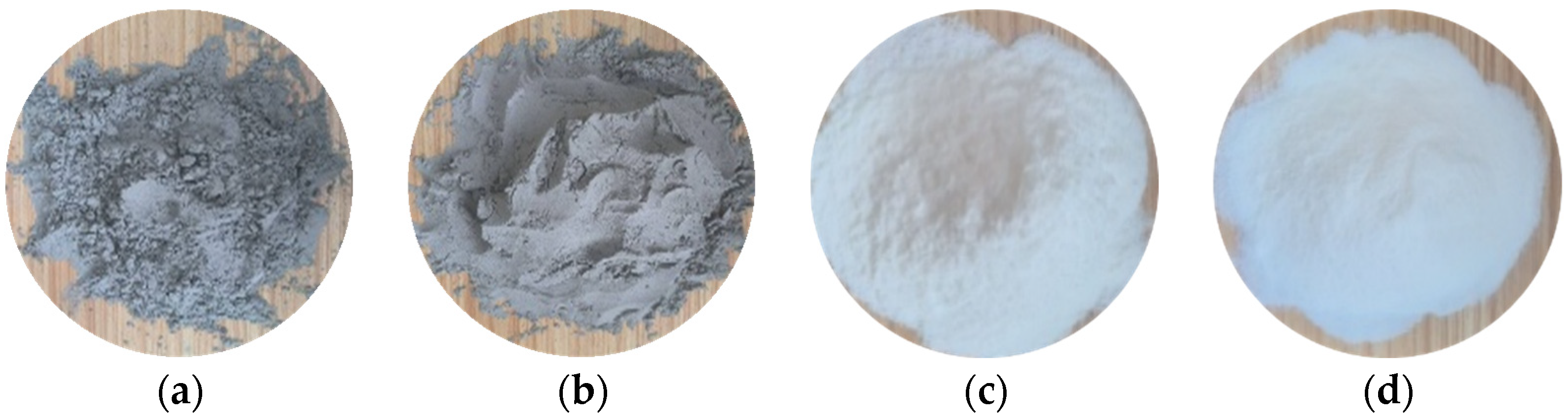
Test materials include ultrafine cement, ultrafine fly ash, polyvinyl alcohol (PVA), and polycarboxylate superplasticizer, with their appearance characteristics as shown in Figure 1.
(1)
Ultrafine cement
The ultrafine cement used in this test is the “Chaohui” brand 800-mesh ultrafine cement produced by Shanxi Huashike Innovative Materials Technology Co., Ltd. (Shanxi, China). It exhibits strong permeability and durability, is environmentally friendly, and serves as an excellent eco-friendly material. Its particle size distribution follows a normal distribution, with particles smaller than 10 μm accounting for 72% and those smaller than 20 μm accounting for at least 98%. This particle size range meets the penetration requirements for fine fractures with widths of ≤50 μm in the Weathering and Oxidation Zone, and it complements the gradation of ultrafine fly ash, resulting in good reinforcement effects for buildings with complex conditions. The specific composition is shown in Table 1.
(2)
Ultrafine fly ash
The ultrafine fly ash used in this test is the 5000-mesh product manufactured by Gongyi Borun Refractory Materials Co., Ltd. (Henan, China). It is primarily produced from coal gangue, coal reserve residues, and waste generated from coal combustion through processes such as high-temperature sintering, grinding, and screening. Its key performance parameters are as follows: activity index ≥ 75% (7 days) and ≥90% (28 days); specific surface area ≥ 1200 m2/kg; particle size distribution: D50 ≤ 5.0 μm; loss on ignition ≤ 3.0%; and water demand ratio ≤ 95%. Compared to traditional fly ash, it is finer and possesses high activity and reactivity. The specific composition is shown in Table 2.
(3)
Polyvinyl alcohol (PVA)
The polyvinyl alcohol (PVA) used in this experiment is a new type of cold-water soluble PVA powder produced by Jinzhou Baoyi Building Materials Technology Co., Ltd., (Hebei, China) and it belongs to a high-molecular-weight polymer. Adjusting the degree of polymerization and degree of hydrolysis can alter the viscosity of the slurry. Through hydrogen bonding, its molecular chains can form a three-dimensional network structure, thereby significantly improving the slurry’s viscosity and water retention. Its relevant chemical parameters are shown in Table 3.
To control the influence of the PVA dissolution process on slurry performance, all PVA solutions used in the experiments were prepared according to the following standardized procedure: Based on the mix proportion, the required mass of PVA powder was weighed and slowly added to deionized water at room temperature, while being dispersed at a mechanical stirring speed of 400 rpm to prevent agglomeration. The mixture was then heated to (90 ± 2) °C and stirred continuously at this temperature for (120 ± 10) minutes until the solution became homogeneous and transparent, with no visible particles or gel lumps. After dissolution was complete, the solution was allowed to cool naturally to room temperature (25 ± 2 °C) and then aged in a sealed container for 24 h before use, to ensure full extension and hydration of the molecular chains and to achieve a stable viscosity state.
(4)
Polycarboxylate superplasticizer
The polycarboxylate superplasticizer used in this experiment is the FK-A type, produced by Shanxi Feike New Material Technology Co., Ltd. (Shanxi, China). Its molecules generate a steric hindrance effect by adsorbing onto the surface of cement particles, significantly improving both the fluidity and strength of the concrete. Its molecular structure can be flexibly adjusted to accommodate various construction requirements, such as pumping and self-compacting, making it a key material for achieving high-strength, durable, and environmentally friendly concrete. According to the manufacturer, the FK-A type polycarboxylate superplasticizer is a pale yellow transparent liquid with a solid content of 40% ± 2%, a water reduction rate ≥ 30%, and a pH value of 6.0–7.0.

2.2. Experimental Design

(1)
Parameter Design
PVAM-UFCG is composed of multi-component compounding, and different mix ratios will affect the performance of the grouting material. Studies have shown that the water–cement ratio, ultrafine fly ash replacement rate, polyvinyl alcohol (PVA) concentration, and polycarboxylate superplasticizer concentration are the most important factors affecting the performance of PVAM-UFCG. Therefore, this paper focuses on these four factors to investigate the performance of the grouting material.
Water–Binder Ratio: The water–binder ratio refers to the mass ratio of water to binder (cementitious materials). It plays a crucial role in the physical and mechanical properties of set grouting mortar, including strength and durability. Its value directly affects the performance of the grouting material: a too low water–binder ratio results in high material density, poor fluidity, but high strength; a too high water–binder ratio leads to strong fluidity but low strength, and it is prone to layer separation and bleeding, which impairs strength and durability. Therefore, it is necessary to select an appropriate water–binder ratio according to specific requirements and performance needs. This paper selects three ratios (0.4, 0.5, and 0.6) for research purposes.
Ultrafine Fly Ash Replacement Rate: The ultrafine fly ash replacement rate refers to its proportion in the total mass of ultrafine cement and fly ash. This parameter affects the economic cost of the grouting material and the utilization rate of industrial solid waste, and can also regulate the physical properties of the solidified body. A reasonable replacement rate can enhance the mechanical properties of the grouting body and optimize its internal structure; however, excessively high or low replacement rates will weaken certain properties of the material. Therefore, this paper selects three replacement rates (20%, 30%, and 40%) to conduct research.
Polyvinyl Alcohol (PVA) Concentration: As an organic polymer additive, polyvinyl alcohol (PVA) dissolves to form a flexible film that wraps around the surfaces of fly ash and cement particles. Its addition can significantly improve the mechanical properties of the grouting material, enhance the stability and strength of the set mortar, strengthen the interfacial bonding force through physical adhesion, and inhibit microcracks caused by shrinkage during the hardening process. However, an excessively high concentration will reduce the fluidity of the slurry, which is not conducive to diffusion. Therefore, it is necessary to select an appropriate concentration. This paper selects three concentrations (0.5%, 1.0%, and 1.5%) for research purposes.
Polycarboxylate Superplasticizer (PCE) Concentration: The polycarboxylate superplasticizer (PCE) can extend the setting time, improve fluidity, and moderately enhance compressive strength. Therefore, this paper selects three polycarboxylate superplasticizer (PCE) concentrations (0.3%, 0.4%, and 0.5%) for research.
(2)
Orthogonal Experimental Design
This experiment aims to study the effects of four factors—water–binder ratio, ultrafine fly ash replacement rate, polyvinyl alcohol (PVA) concentration, and polycarboxylate superplasticizer concentration—on the performance of PVAM-UFCG, as well as to determine the optimal mix ratio. An orthogonal experiment was conducted with five performance indicators: setting time, fluidity, bleeding rate, viscosity, and 28-day uniaxial compressive strength. The experiment investigated the effect of varying mix ratios on the performance of the grouting slurry, and the optimal mix ratio was determined through a range analysis. Based on the mix ratios of the different factors identified in the previous section, the orthogonal experimental table is presented in Table 4, and the experimental scheme is outlined in Table 5.

2.3. Test Methods

The selection of the five core test indicators in this study—setting time, fluidity, water separation rate, viscosity, and 28-day uniaxial compressive strength—is based on a systematic consideration of the complete engineering process and material performance control for grouting reinforcement in the Weathering and Oxidation Zone. The particular characteristics of the surrounding rock in this zone, featuring fine and loose fractures, require the grout to possess excellent injectability, characterized by fluidity and viscosity, to ensure penetration. At the same time, it must have an appropriate setting time and high volumetric stability (water separation rate) to guarantee effective infusion and retention within the complex fracture network. The long-term load-bearing capacity (28-day uniaxial compressive strength) of the consolidated body formed after the slurry solidifies is the decisive mechanical indicator for evaluating the reinforcement effectiveness. These five indicators constitute a comprehensive performance evaluation system that covers the entire process, from slurry preparation and transportation/infusion to solidification and load-bearing, fully encompassing the key stages of engineering application. Furthermore, all testing methods adhere to national or industry-standard protocols, ensuring the scientific validity, comparability, and engineering guidance value of the evaluation results.

2.3.1. Setting Time Test

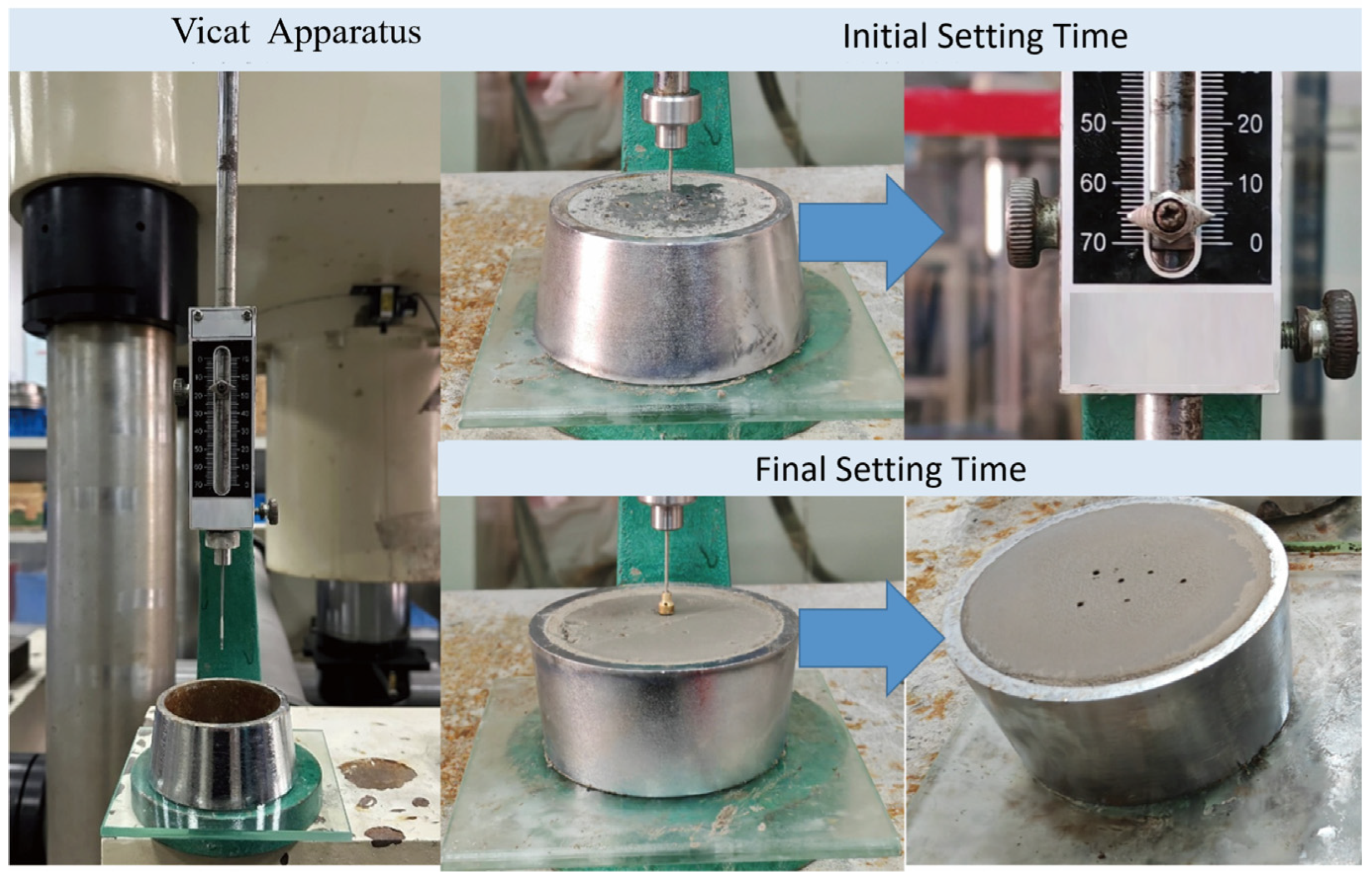
The setting process of the grouting slurry consists of two stages: initial setting and final setting. Initial setting is defined as the time when the slurry first thickens and loses fluidity; final setting refers to the time when the slurry has completely hardened and taken its shape. The test equipment includes a Vicat Apparatus, a circular mold, a glass block, a straight-edge knife, an initial setting needle, a final setting needle, and a test rod. The test is illustrated in Figure 2.
Experimental steps: Pour the mixed slurry into the circular mold, then place it in a standard curing box for curing. Remove the mold after 30 min and monitor it at 5-min intervals. Record the initial setting time when the initial setting needle vertically sinks to (4 ± 1) mm from the bottom plate. After completing the initial setting test, invert the mold and monitor at 15-min intervals. Record the final setting time when the final setting needle vertically sinks to 0.5 mm without forming an annular indentation.

2.3.2. Fluidity Test

Fluidity is a key indicator for evaluating the performance of grouting materials, as it directly affects the mechanical properties of these materials and the formation of their internal structure. Fluidity is typically defined as the diameter or distance of the slurry’s outward spreading and flowing, which reflects the consistency and viscosity characteristics of the grouting material.
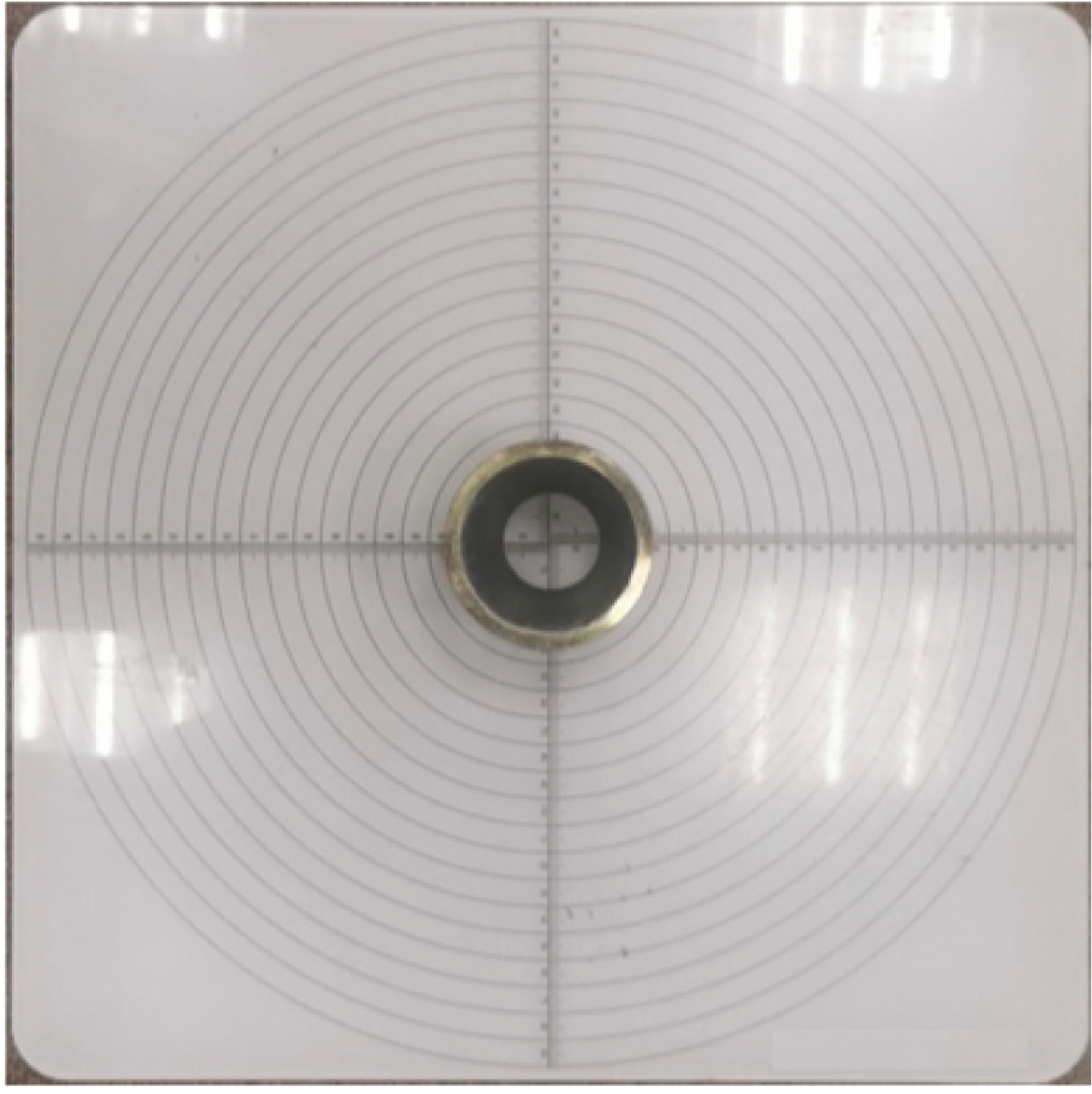
As shown in Figure 3, the experimental steps are as follows: Place the plastic plate horizontally on the ground, and place the truncated conical mold on it; mix the materials according to the mix ratio and stir uniformly for 5 min; pour the mixed slurry into the truncated conical mold, lift the mold vertically, and after letting it stand for 30 s, measure the diameters of the slurry in two orthogonal directions and take the average value.

2.3.3. Water Separation Rate Test

Water separation rate is one of the indicators for the volume stability of grouting materials. It is defined as the percentage of water separated from the material within a certain period of time, relative to the total mass of the material, reflecting the material’s internal moisture stability and its water retention capacity.
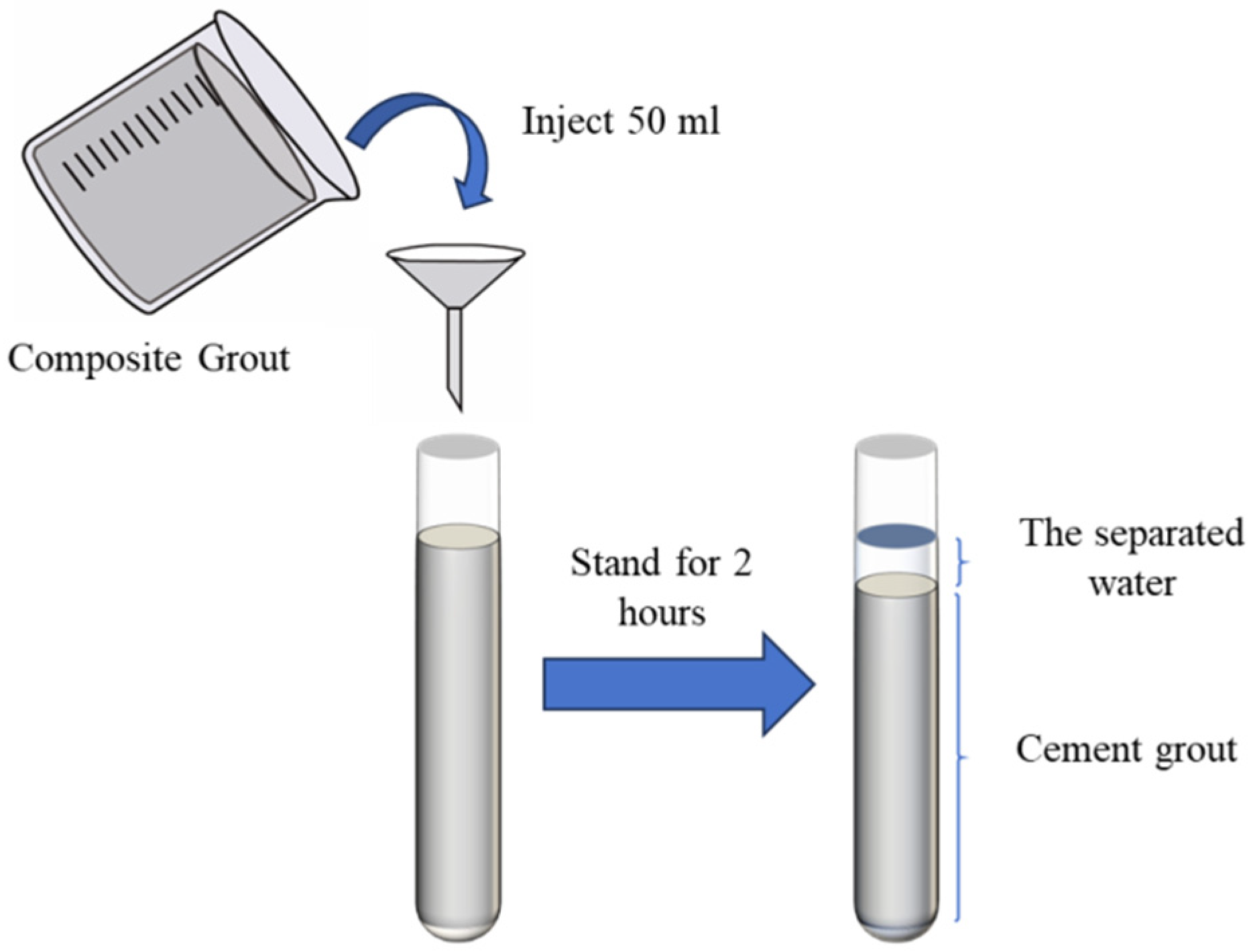
Experimental steps: As shown in Figure 4, pour the prepared slurry into a 50 mL graduated cylinder. After letting it stand for 2 h, start recording the height of the liquid level. Then record the water separation rate once every 30 min until no more water separates, and calculate the rate.

2.3.4. Viscosity Test

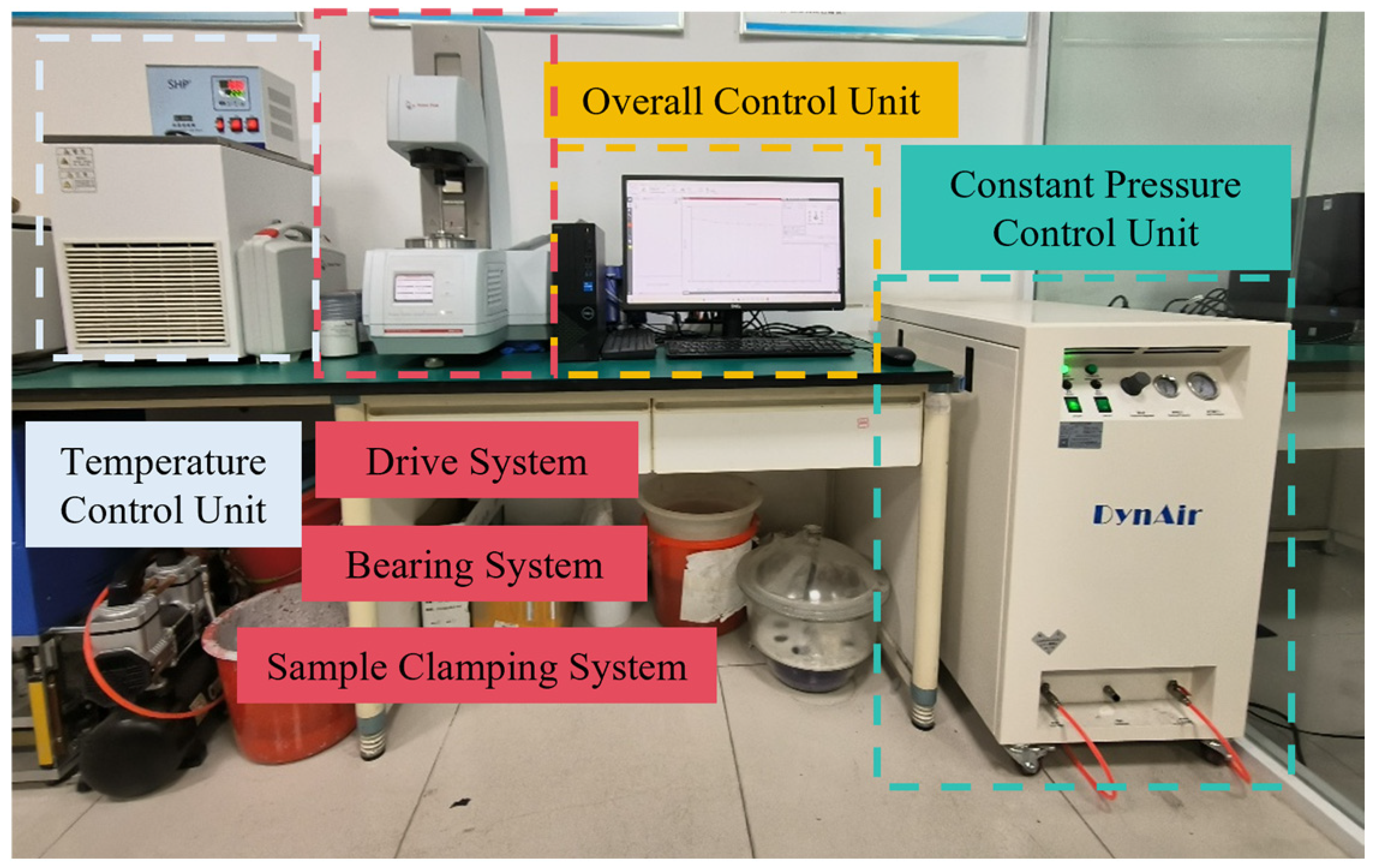
Viscosity is one of the important indicators for evaluating the quality of grouting materials. The viscosity of grouting slurry characterizes the shear resistance between flow layers when the slurry flows; its value reflects the efficiency of internal momentum transfer of the slurry, as well as the ease of its flow—specifically, the magnitude of resistance to relative flow between different internal layers of the slurry when it is subjected to external forces. The test equipment includes a rheometer MCR 302e (Anton Paar, Graz, Austria), an air compressor, an operating system, a thermostat, etc., as shown in Figure 5.
Experimental procedures: Ensure that the rheometer MCR 302e is in normal condition, preheated and calibrated, and that the prepared slurry is ready; select a suitable measurement system, install it on the rheometer, and ensure the gap is appropriate; open the RheoCompass software (Version 1.8.2), set parameters such as temperature and rotation speed, and select the measurement mode; pour the slurry into the measurement system, start the test program, and the rheometer will automatically measure the viscosity while monitoring the data stability; after the test is completed, the software will automatically record the data on changes in viscosity with time or shear rate.

2.3.5. Uniaxial Compressive Strength Test

Compressive strength is the most important property of grouting materials. It is defined as the maximum stress value that a test specimen can withstand when subjected to compression, reflecting the compressive bearing capacity of the test specimen and serving as an important guarantee for the long-term stability of the set mortar of the slurry. The test equipment used is the Shimadzu AG-X250 (Kyoto, Japan) electronic universal testing machine.
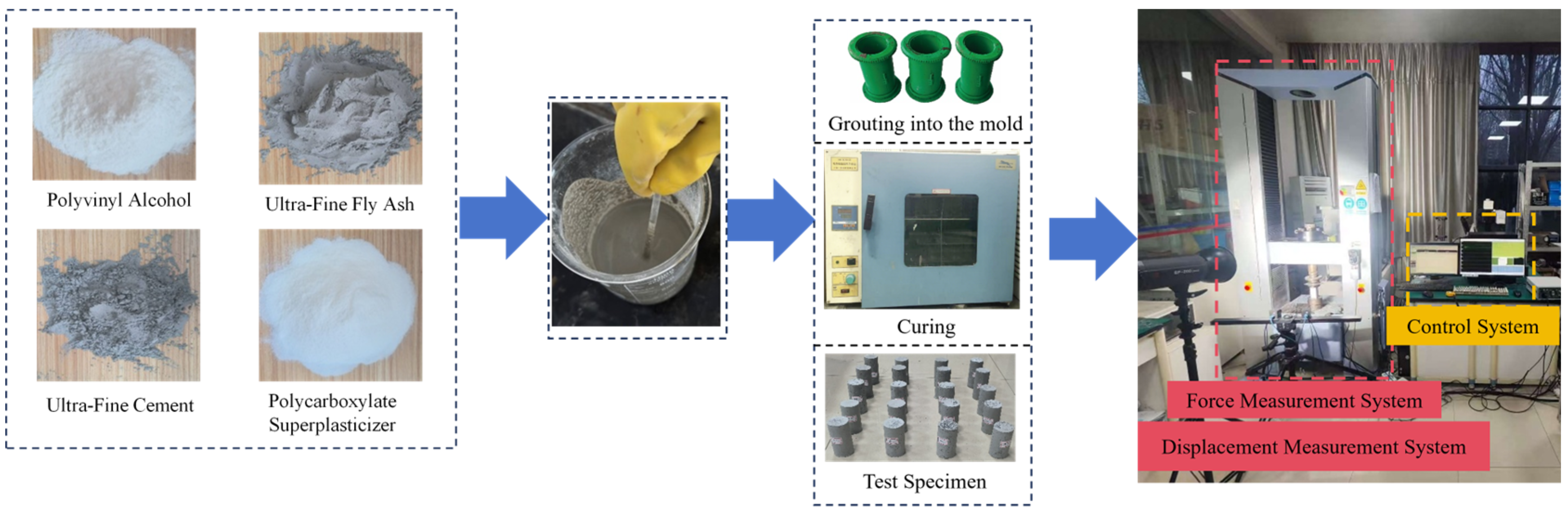
Experimental procedures: As shown in Figure 6, pour the prepared slurry into standard cylindrical molds, cure for 24 h, then demold and number the specimens; after demolding, place the specimens in a standard curing chamber and cure for another 28 days under the conditions of 90% relative humidity and 20 °C temperature; perform uniaxial compressive tests using a Shimadzu AG-X250 electronic universal testing machine, with three specimens per group, and take the average value; place the specimen between the upper and lower clamps of the testing machine, center it, and align the center lines of the three (the specimen and the upper/lower clamps) to form a straight line; load the specimen at a rate of 1 MPa/s until failure, record the failure load, pressurization phenomena, post-failure morphology of the specimen, and uniaxial compressive strength, then take the average value of the uniaxial compressive strength.

3. Results Analysis and Discussion

3.1. Results Analysis of PVAM-UFCG Slurry Performance

Based on the orthogonal experimental scheme and the aforementioned slurry performance tests, test data were obtained for the setting time, fluidity, water separation rate, viscosity, and 28-day uniaxial compressive strength of slurries with different mix ratios. The results of the orthogonal experiment are shown in Table 6.

3.1.1. Analysis of Setting Time Results

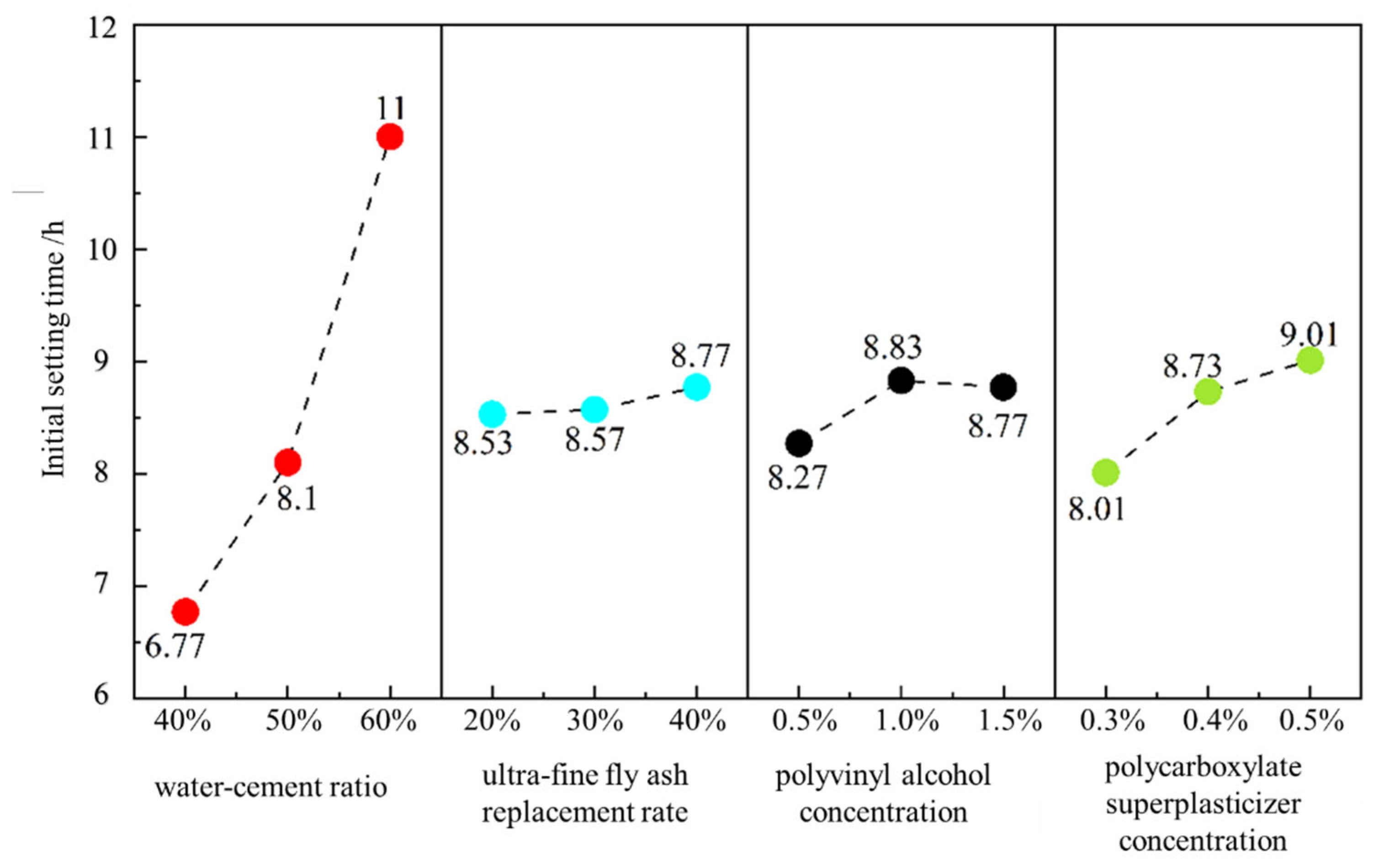
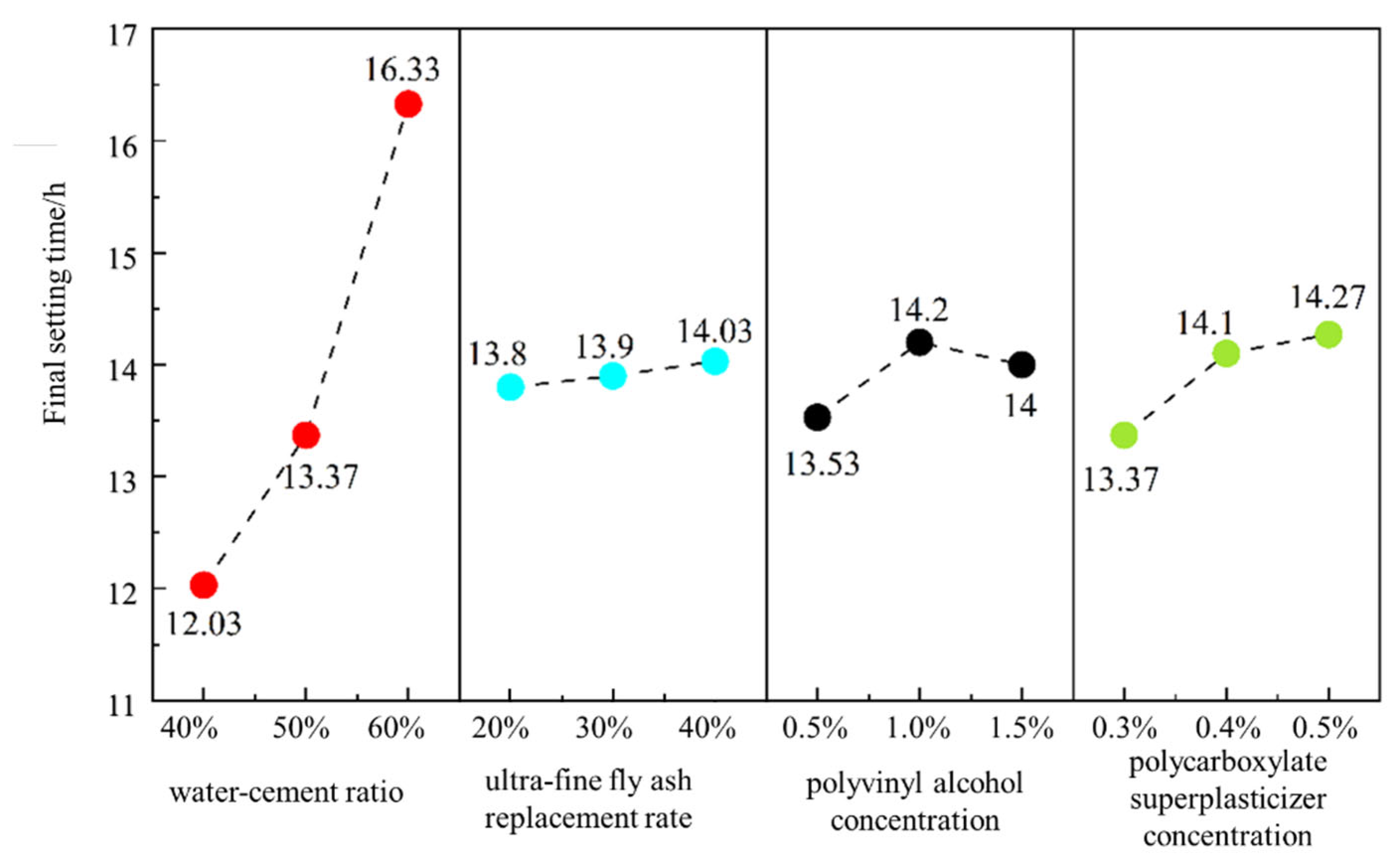
The range analysis and variance analysis for the initial setting time are presented in Table 7 and Table 8, respectively. Those for the final setting time are shown in Table 9 and Table 10. From the data in the Tables, it can be seen that the degree of influence of each test factor on the initial setting time and final setting time of the grouting material, in descending order, is: A > D > C > B. If the setting time of the grouting material is used as the evaluation criterion, A3B3C3D3 is the optimal mix ratio scheme. Based on the k-values corresponding to the levels of each factor, the fluidity effect diagrams for the levels of each factor are plotted, as shown in Figure 7 and Figure 8.
The test results indicate that the water–cement ratio, ultrafine fly ash replacement rate, PVA concentration, and polycarboxylate superplasticizer concentration have significantly different effects on the setting time. The water–cement ratio is the dominant factor, with its influence order being 0.6 > 0.5 > 0.4. Compared to a water–cement ratio of 0.4, a ratio of 0.6 prolonged the initial setting time by 62.5% and the final setting time by 35.7%. This is primarily because the increase in free water content enlarges the distance between cement particles, reduces contact frequency, and simultaneously dilutes the concentrations of ions such as Ca2+ and OH, thereby delaying the formation of the hydration product network. The polycarboxylate superplasticizer is a secondary factor. At a concentration of 0.5%, the initial and final setting times reached their maximum values of 9.01 h and 14.27 h, respectively, which are 12.5% and 6.7% longer than those at a concentration of 0.3%. Its retarding mechanism mainly stems from the steric hindrance effect formed by the adsorption of superplasticizer molecules on the surface of cement particles, inhibiting the early dissolution and hydration reactions of cement minerals, especially the rapid hydration of C3A. The influence of PVA concentration and ultrafine fly ash replacement rate is relatively weak. However, at a PVA concentration of 1.5%, the initial setting time was prolonged by 6.0% due to the physical encapsulation of particle surfaces by molecular chains and hydrogen bonding effects. In the analysis of variance, the water–cement ratio (A) has the highest F-value, exerting a highly significant influence on the final setting time. The F-values for the polycarboxylate superplasticizer (D) and PVA concentration (C) are relatively small, indicating no significant impact on the final setting time; they only play secondary regulatory roles, with their influence being weaker than that of the water–cement ratio.
The comprehensive analysis indicates that the dominant effect of the water–cement ratio on the setting time stems from its ability to alter the contact frequency between cement particles and the rate of hydration product formation by regulating the free water content. The dilution effect resulting from a high water–cement ratio not only delays the nucleation and growth of C-S-H gel but also postpones the formation of early hydration products such as ettringite, thereby significantly retarding the overall network construction process. The polycarboxylate superplasticizer further inhibits the dissolution kinetics and early hydration of cement minerals through the steric hindrance effect of its adsorption layer. Increasing its concentration can delay the occurrence time of the early hydration exothermic peak by 23–35%, creating a synergistic retarding effect in combination with an increased water–cement ratio. The slight regulatory effect of polyvinyl alcohol (PVA) supplements the resistance to water molecule migration within the slurry. Under the geological stress conditions of the Weathering and Oxidation Zone, this multi-mechanism synergistic action not only provides ample operational time for grouting work, ensuring that the slurry can uniformly diffuse into every corner of the fractured surrounding rock, but also effectively enhances the bonding stability between the slurry and the surrounding rock. This is of significant importance for ensuring the long-term stability of roadways.

3.1.2. Analysis of Fluidity Results

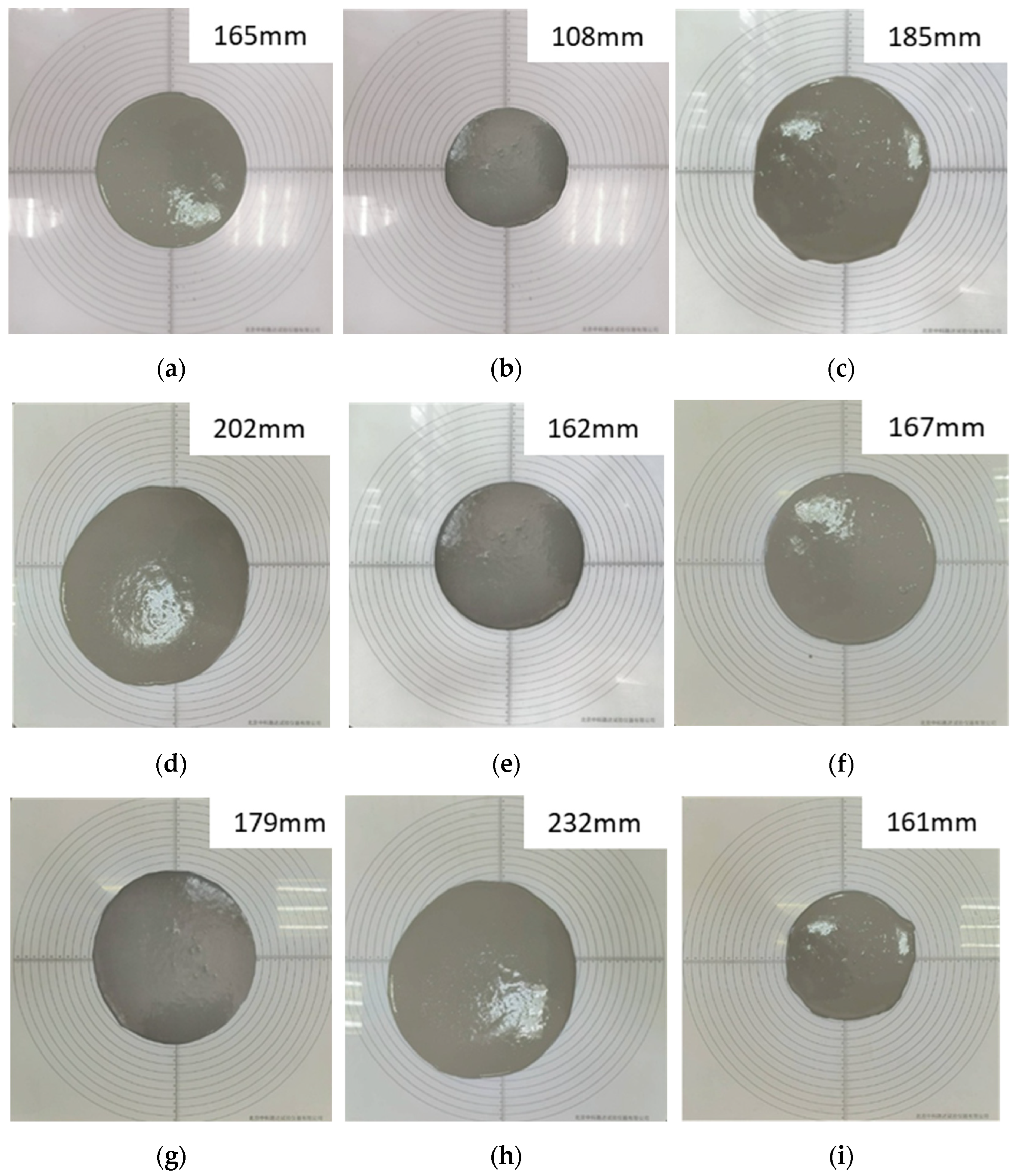
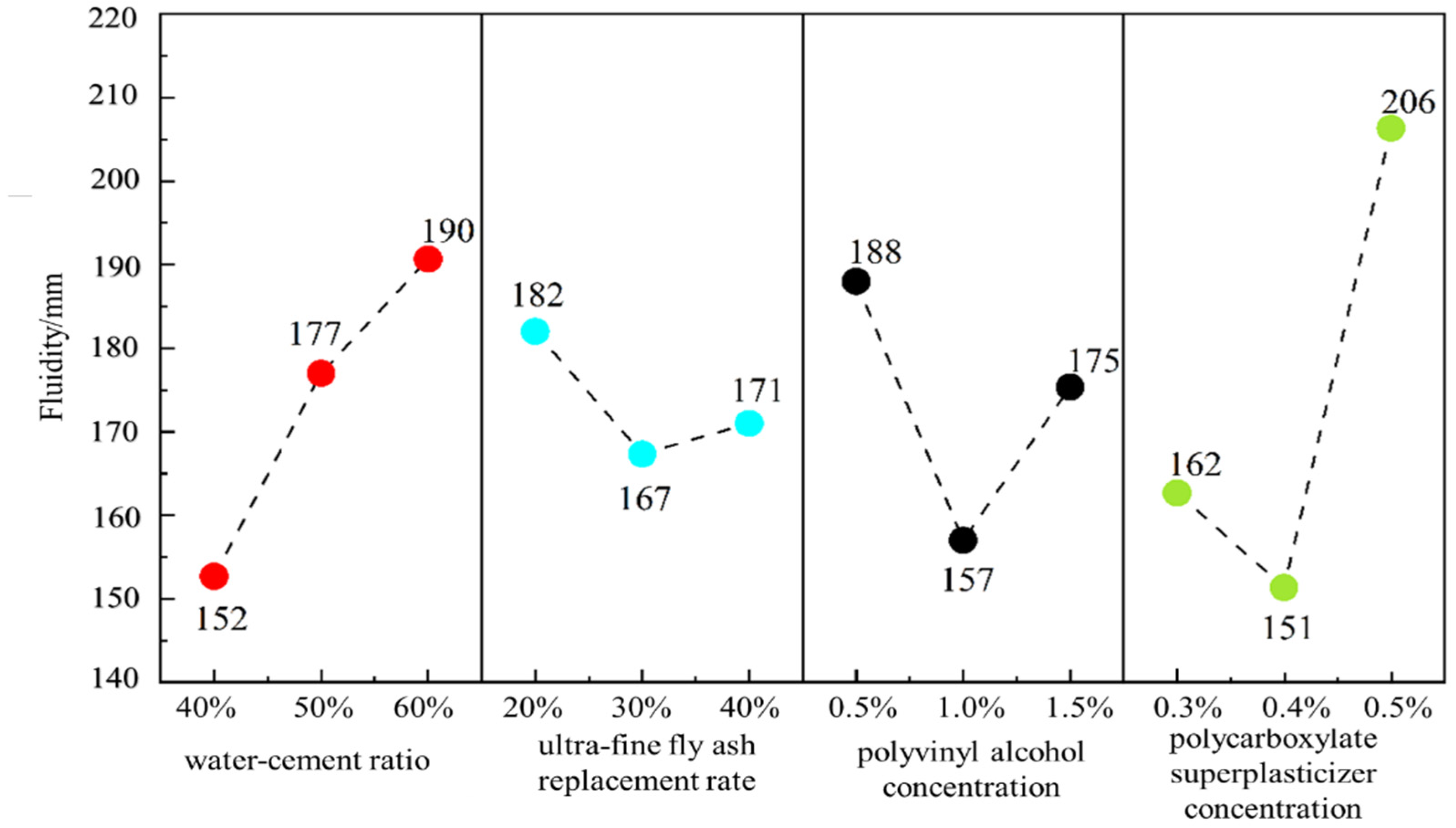
The results of the grouting material’s fluidity are shown in Figure 9, and the results of the range analysis and variance analysis are presented in Table 11 and Table 12. From the data in the Tables, it can be seen that the degree of influence of each test factor on the grouting material’s fluidity, in descending order, is: D > A > C > B. If the fluidity of the grouting material is used as the evaluation criterion, A1B1C2D2 is the optimal mix ratio scheme. Based on the k-values corresponding to the levels of each factor, the Fluidity Effect Diagrams for the levels of each factor are plotted, as shown in Figure 10.
The test results indicate significant differences in the effects of the water–cement ratio, ultrafine fly ash replacement rate, PVA concentration, and polycarboxylate superplasticizer concentration on fluidity. Among these, the polycarboxylate superplasticizer concentration is the dominant factor, with its influence in the following order: 0.5% > 0.3% > 0.4%. Fluidity shows a trend of first decreasing and then increasing as the superplasticizer concentration rises, reaching its maximum value at a concentration of 0.5%. This is primarily because polycarboxylate superplasticizers possess a “comb-like” molecular structure: their main chains adsorb onto the surface of cement particles via anionic groups. In contrast, the side chains extend to create steric hindrance. This effectively disrupts flocculated structures, releases entrapped water, and thus significantly improves particle dispersion. The water–cement ratio is a secondary factor, with its influence order being 0.4 > 0.5 > 0.6. Fluidity continuously increases with a higher water–cement ratio, confirming that increased free water content reduces the internal frictional resistance between solid particles, thereby enhancing slurry fluidity. The effects of PVA concentration and ultrafine fly ash replacement rate are relatively weak. Specifically, low PVA concentrations have a minor impact on fluidity. In contrast, at high concentrations (e.g., 1.5%), PVA molecular chains tend to form hydrogen bond networks, which increases the structural viscosity of the slurry and thereby hinders its diffusion. A low fly ash replacement rate, due to the higher fineness of its particles, helps fill voids and improve the rheological properties of the slurry. The polycarboxylate superplasticizer concentration (D) is the dominant regulatory factor affecting fluidity. Its sum of squares (5060.22) accounts for 94.2% of the total sum of squares, far exceeding those of other factors. This is because the steric hindrance effect of the superplasticizer significantly disperses cement particles and reduces internal frictional resistance. At a concentration of 0.5%, fluidity reaches 206.33 mm, representing a 36.3% increase compared to the value at a concentration of 0.4%. The F-values for the water–cement ratio (A) and PVA concentration (C) are both far below the critical significance threshold, indicating that they play only secondary regulatory roles in fluidity. Specifically, an increased water–cement ratio raises the free water content, directly reducing slurry viscosity and improving fluidity. In contrast, a high PVA concentration can form gel-like structures through molecular entanglement, thereby impeding slurry flow and reducing fluidity.
A comprehensive analysis shows that optimizing rheological properties can be achieved by balancing the dispersing effect of the superplasticizer with the slurry viscosity. The underlying mechanism is based on the following aspects: a lower water–cement ratio helps maintain the structural stability of the slurry; an appropriate superplasticizer concentration ensures adequate particle dispersion and the release of entrapped water; while controlling the PVA addition concentration prevents excessive thickening due to molecular chain entanglement. This synergistic approach collectively ensures the slurry’s ability to penetrate and diffuse within the fine fractures of the Weathering and Oxidation Zone.

3.1.3. Analysis of Water Separation Rate Results

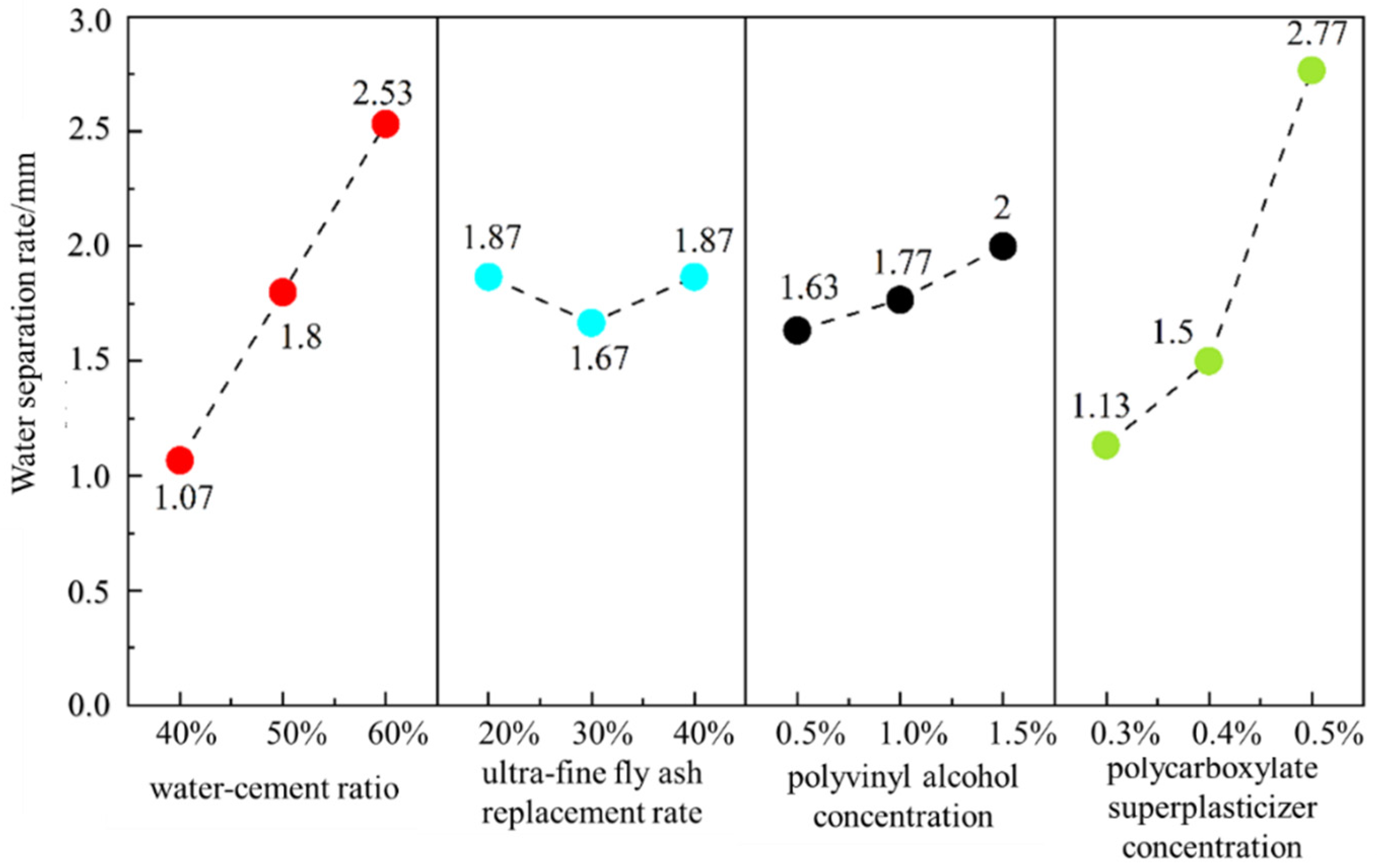
The results of the range analysis and variance analysis are presented in Table 13 and Table 14. From the data in the Tables, it can be found that the degree of influence of each test factor on the water separation rate of the grouting material, in descending order, is: D > A > C > B. If the water separation rate of the grouting material is taken as the evaluation criterion, A1B2C1D1 is the optimal mix ratio scheme. Based on the k-values corresponding to the levels of each factor, the Water Separation Rate Effect Diagrams for the levels of each factor are plotted, as shown in Figure 11.
The test results indicate that there are significant differences in the effects of the water–cement ratio, ultrafine fly ash replacement rate, PVA concentration, and polycarboxylate superplasticizer concentration on the water separation rate. Among these, the polycarboxylate superplasticizer concentration is the dominant factor, with its influence in the following order: 0.3% > 0.4% > 0.5%. The water separation rate exhibits a stepwise increase as the superplasticizer concentration rises. This is primarily because an excessive amount of superplasticizer overly disrupts the flocculated structure between cement particles, weakening their ability to encapsulate and bind water, which allows free water to rise more easily, thereby compromising slurry stability. The water–cement ratio is a secondary factor, with its influence order being 0.4 > 0.5 > 0.6. The water separation rate continuously increases with a higher water–cement ratio. At water–cement ratios of 0.5 and 0.6, the water separation rate increases by 68.2% and 136.4%, respectively, compared to that at 0.4. The mechanism lies in the fact that a high water–cement ratio significantly increases the total amount of free water in the system while also expanding the distance between solid particles. This creates interconnected water migration channels within the slurry, thereby exacerbating the tendency for solid–liquid separation and highlighting the critical role of free water content in the water retention capacity of the slurry. The effects of the ultrafine fly ash replacement rate and PVA concentration are relatively weak. Specifically, the water separation rate is the lowest at a 30% replacement rate, likely due to the optimal particle gradation and dense packing. At a PVA concentration of 0.5%, the hydrophilic hydroxyl groups partially bind free water through hydrogen bonding, resulting in an 18.5% lower water separation rate compared to that at a concentration of 1.5%. The polycarboxylate superplasticizer concentration (D) is the core dominant factor affecting the water separation rate. Its sum of squares (4.41) accounts for 55.3% of the total sum of squares. At a concentration of 0.5%, the water separation rate reaches 2.77%, representing a 144% increase compared to the rate at a concentration of 0.3%. This is attributed to its overly strong dispersing effect, which disrupts the supporting structure between particles, reduces system viscosity and foam-stabilizing capacity, and promotes the upward movement of free water. The F-value for the water–cement ratio (A) also reaches a highly significant level. When the water–cement ratio increases from 0.4 to 0.6, the water separation rate increases by 136.4%. This is mainly due to the increase in free water content and the loosening of the particle network structure, which provides the kinetic conditions for water separation.
A comprehensive analysis indicates that the influence of the water–cement ratio and superplasticizer concentration on the water separation rate stems from their synergistic regulation of slurry stability and particle suspension. An increase in the water–cement ratio directly increases the amount of mobile free water and promotes the formation of seepage channels. At the same time, excessive superplasticizer reduces interparticle forces, thereby decreasing the slurry’s structural viscosity and water retention capacity. The combined effect of these factors significantly accelerates the rate of solid–liquid separation. By optimizing the mix ratio, it is possible to maintain appropriate particle flocculation and hydration structure while ensuring fluidity. This effectively balances fluidity and stability, thereby controlling water separation and ensuring the uniform distribution of the slurry within fractures in the Weathering and Oxidation Zone, which achieves effective solidification.

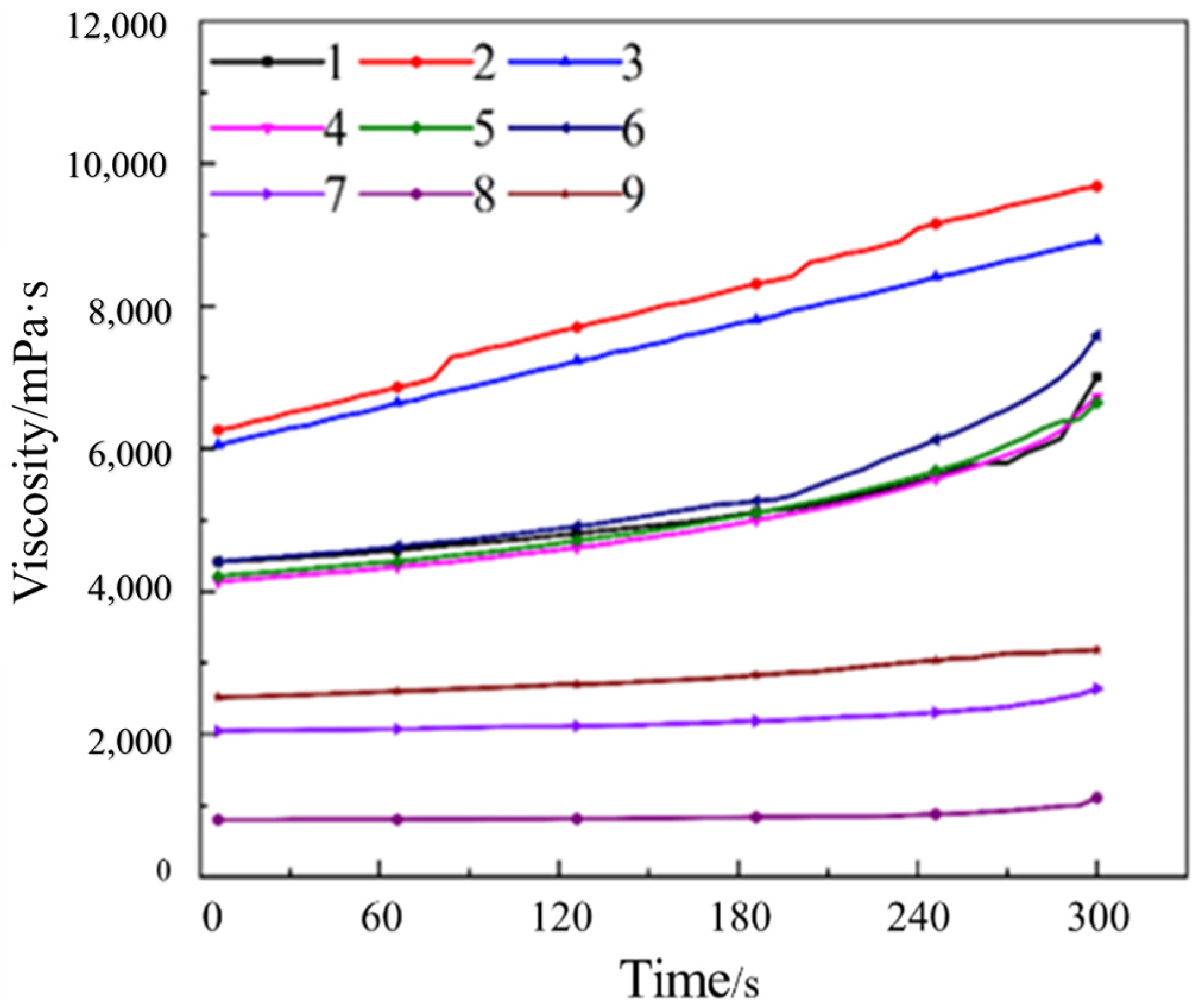
3.1.4. Analysis of Viscosity Results

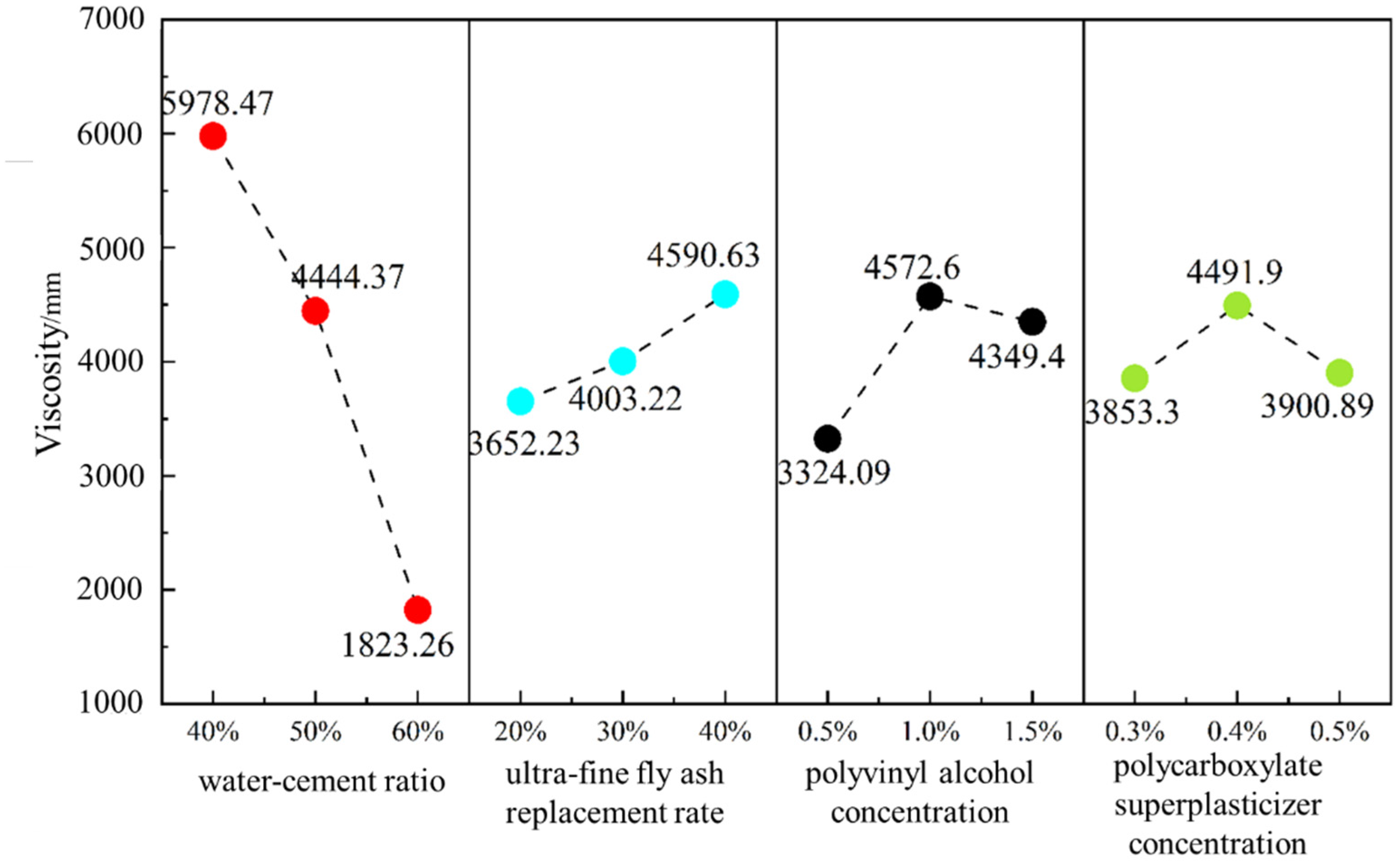
The viscosity test results graph of the grouting material is shown in Figure 12, and the results of the range analysis and variance analysis are presented in Table 15 and Table 16. From the data in the Tables, it can be seen that the degree of influence of each test factor on the viscosity of the grouting material, in descending order, is: A > C > B > D. If the viscosity of the grouting material is used as the evaluation criterion, A1B3C2D2 is the optimal mix ratio scheme. Based on the k-values corresponding to the levels of each factor, the Viscosity Effect Diagrams for the levels of each factor are plotted, as shown in Figure 13.
The test results indicate that there are significant differences in the effects of the water–cement ratio, ultrafine fly ash replacement rate, PVA concentration, and polycarboxylate superplasticizer concentration on the slurry viscosity. Among these, the water–cement ratio is the dominant factor, with its influence in the following order: 0.4 > 0.5 > 0.6. Compared to the viscosity at a water–cement ratio of 0.4, the viscosity decreases by 25.7% and 69.5% at ratios of 0.5 and 0.6, respectively. The magnitude of decrease shows an increasing trend as the water–cement ratio increases. This phenomenon originates from the direct influence of the water–cement ratio on the solid particle volume fraction in the slurry. A lower water–cement ratio implies a higher solids concentration, reduced inter-particle distance, and enhanced van der Waals forces, causing the slurry to transition from a state of better fluidity to a Bingham fluid with a distinct yield stress, which is macroscopically manifested as a significant increase in viscosity. The PVA concentration is a secondary factor, with its influence order being 1.0% > 1.5% > 0.5%. Compared to the viscosity at a concentration of 1.0%, the viscosity decreases by 27.3% and 4.9% at concentrations of 0.5% and 1.5%, respectively. This indicates that deviations from the optimal concentration lead to a reduction in thickening efficiency. The mechanism lies in the fact that PVA molecules extend and entangle with each other in water, forming a reversible physical cross-linked network that increases flow resistance. At a concentration of around 1.0%, it likely approaches its critical overlap concentration, resulting in the most significant thickening effect. The effects of the ultrafine fly ash replacement rate and polycarboxylate superplasticizer concentration are relatively weak. For the ultrafine fly ash replacement rate, the influence order is 40% > 30% > 20%. When the rate increases from 20% to 40%, the viscosity increases by 25.7%, which is related to the increased specific surface area resulting from finer particles, thereby enhancing inter-particle interactions. Regarding the superplasticizer concentration, viscosity reaches its maximum at 0.4%, which is 16.6% and 15.1% higher than at concentrations of 0.3% and 0.5%, respectively. This may be related to the dynamic balance between particle dispersion and flocculation states at specific dosage levels. Combined with the analysis of variance, the water–cement ratio (A) has a sum of squares (26,490,562.1) accounting for 83.0% of the total sum of squares, confirming it as the core regulatory factor. In contrast, the F-values for PVA concentration (C) and ultrafine fly ash replacement rate (B) are far below the critical significance threshold, indicating that they play only secondary regulatory roles in viscosity.
A comprehensive analysis indicates that the significant impact of the water–cement ratio on viscosity primarily stems from its regulatory effect on free water content and the packing state of solid particles. Excessive free water not only dilutes the interparticle forces and promotes the depolymerization of flocculated structures but also reduces the stability of the suspension system. When the water–cement ratio increases, the average distance between cement particles expands, internal frictional resistance decreases, slurry fluidity improves, and viscosity declines. Conversely, a decrease in the water–cement ratio strengthens interparticle interactions, resulting in a denser structure and a corresponding increase in viscosity. This rheological behavior is particularly critical for grouting projects in the Weathering and Oxidation Zone: an appropriate viscosity can ensure effective penetration and filling of the slurry within fine fractures, while also avoiding risks such as a sharp increase in grouting pressure or pipe blockage due to excessively high viscosity, thereby enabling precise and efficient reinforcement.

3.1.5. Analysis of Uniaxial Compressive Strength Results

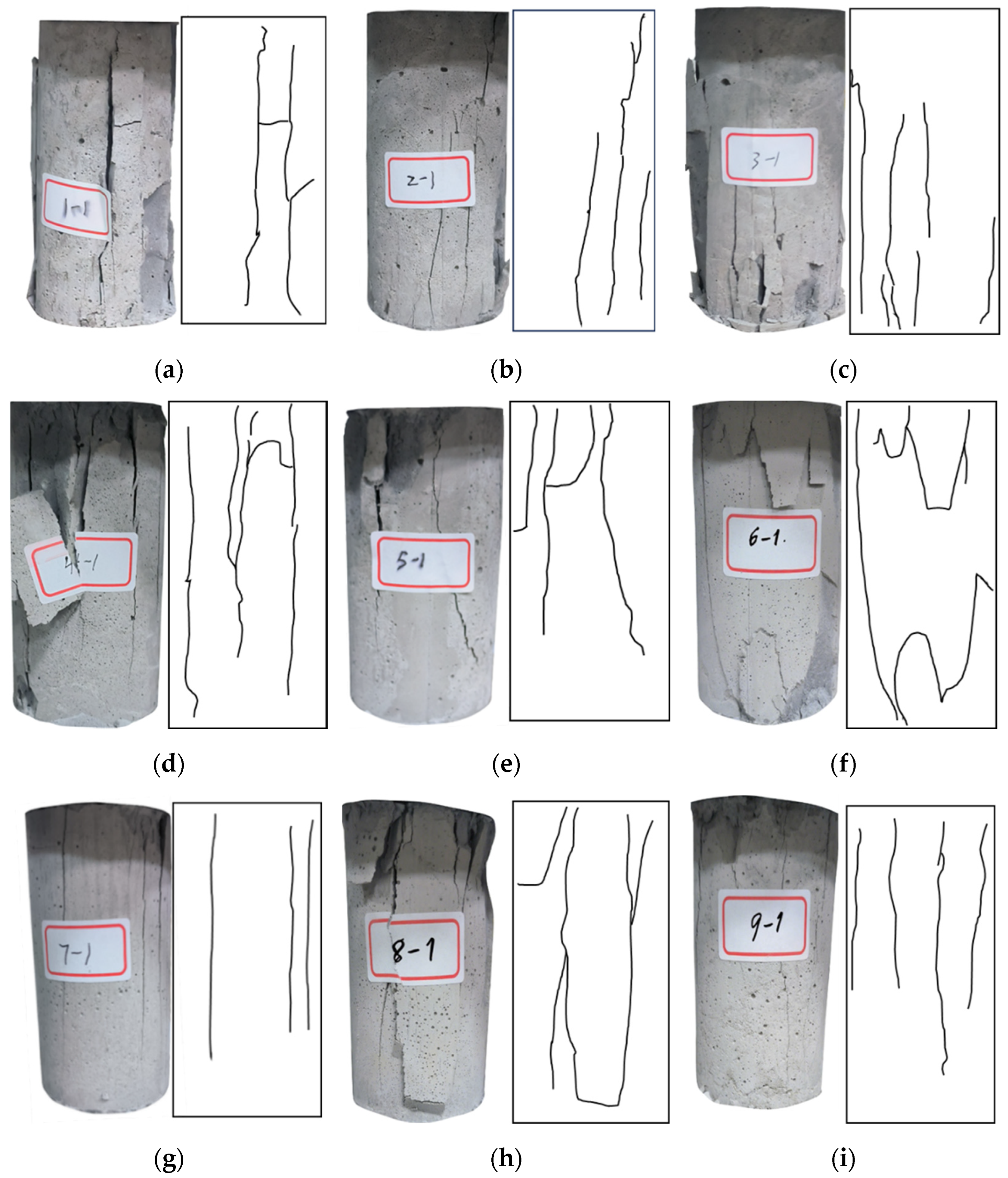
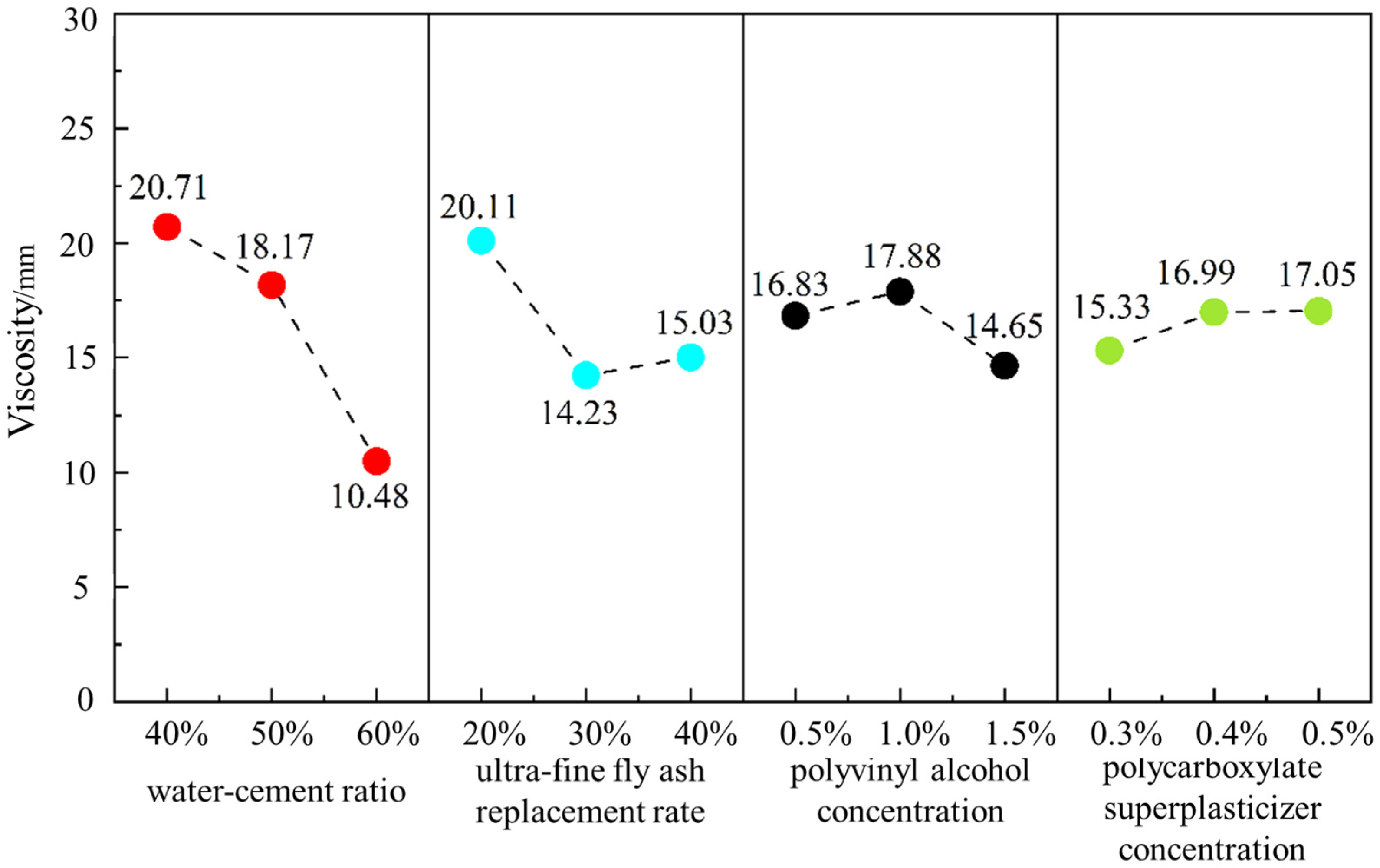
The 28-day uniaxial failure morphology diagram of the grouting material is shown in Figure 14, and the results of the range analysis and variance analysis are presented in Table 17 and Table 18. From the data in the Tables, it can be seen that the degree of influence of each test factor on the 28-day uniaxial compressive strength of the grouting material, in descending order, is: A > B > C > D. If the 28-day uniaxial compressive strength of the grouting material is used as the evaluation criterion, A1B1C2D3 is the optimal mix ratio scheme. Based on the k-values corresponding to the levels of each factor, the 28-day Uniaxial Compressive Strength Effect Diagrams for the levels of each factor are plotted, as shown in Figure 15.
Test results indicate significant differences in the effects of water–cement ratio, ultrafine fly ash replacement rate, PVA concentration, and polycarboxylate superplasticizer concentration on the 28-day uniaxial compressive strength. Among these, the water–cement ratio is the dominant factor, with its influence in the following order: 0.4 > 0.5 > 0.6. Compared to the 28-day uniaxial compressive strength at a water–cement ratio of 0.4, the strength decreases by 12.2% and 42.4% at ratios of 0.5 and 0.6, respectively, and the magnitude of decrease expands sharply as the water–cement ratio increases. This is primarily because, according to the Powers model, the theoretical water–cement ratio required for complete hydration of cement is approximately 0.42. When the actual water–cement ratio significantly exceeds this value, excess water leaves behind interconnected capillary pores upon evaporation, forming a thicker, more fragile interfacial transition zone that severely compromises the structure’s compactness. The influence order of the ultrafine fly ash replacement rate is 20% > 40% > 30%. When the replacement rate increases from 20% to 40%, the 28-day uniaxial compressive strength decreases sequentially by 29.2% and 25.3%, showing a continuous downward trend. The mechanism lies in the optimal synergistic effect of the “physical filling effect” and the “pozzolanic effect” of ultrafine fly ash at a 20% replacement rate: the ultrafine particles optimize packing density, and their active components react with the cement hydration product Ca(OH)2 to generate additional C-S-H gel, collectively refining pore size and strengthening the matrix; an excessively high replacement rate leads to strength reduction due to the relative insufficiency of the cementitious component. The influence order of the PVA concentration is 1.0% > 0.5% > 1.5%. Compared to the strength at a concentration of 1.0%, the strength decreases by 5.6% and 17.8% at concentrations of 0.5% and 1.5%, respectively, indicating that both excessively high and low concentrations lead to performance degradation. An appropriate amount of PVA can form a flexible organic film within the hardened body, bridging microcracks and inhibiting their propagation through a “fiber bridging” mechanism, thereby enhancing the material’s quasi-ductility and final strength; an excessively high concentration may interfere with the hydration process or introduce defects. The influence order of the polycarboxylate superplasticizer concentration is 0.5% > 0.4% > 0.3%. Compared to the strength at a concentration of 0.5%, the strength decreases by 9.6% and 4.1% at concentrations of 0.3% and 0.4%, respectively, indicating its relatively weak influence. Its effect on strength development is primarily indirect, achieved by improving particle dispersion and packing density. The sum of squares for the water–cement ratio (170.31) accounts for 51.4% of the total sum of squares, confirming its role as the core regulatory factor. When the water–cement ratio increases from 0.4 to 0.6, the strength decreases from 20.71 MPa to 10.48 MPa, representing a 49.8% reduction, primarily attributed to the aforementioned deterioration in pore structure and weakening of the interfacial zone. The ultrafine fly ash replacement rate (B) and PVA concentration (C) only play secondary regulatory roles in strength. The strength at a 20% fly ash replacement rate reaches 20.11 MPa, representing a 41.3% increase compared to the 30% replacement rate, resulting from the synergy between its pozzolanic activity and micro-filling effects. A PVA concentration of 1.0% enhances particle bonding and crack-bridging capacity, resulting in a 17.8% higher strength compared to the 1.5% concentration.
A comprehensive analysis indicates that the dominant effect of the water–cement ratio stems from its triple deterioration mechanism, which includes increased porosity, weakened interfacial transition zone, and inhibited hydration. Its range is 1.74 times that of the ultrafine fly ash replacement rate, and its sensitivity coefficient is significantly higher than those of other parameters. Under the complex geological conditions of the Weathering and Oxidation Zone, optimizing the water–cement ratio while synergistically leveraging the micro-aggregate and pozzolanic effects of fly ash, as well as the toughening and crack-resisting functions of polyvinyl alcohol, is key to enhancing the compressive performance and long-term stability of rock masses after grouting reinforcement.

3.2. Orthogonal Experiment Results Analysis

By conducting a four-factor, three-level orthogonal experiment, a comprehensive evaluation of the orthogonal test results was performed using the entropy weight method, taking into account multiple indicators. The entropy weight method is an objective weighting method based on information entropy, which determines weights by calculating the degree of dispersion of each indicator’s data: the greater the degree of dispersion (i.e., the greater the data variability), the smaller its information entropy, the greater its influence on the comprehensive evaluation, and thus the higher its weight.
To avoid interference from multicollinearity in weight allocation, the selected indicators should be as independent as possible. The initial setting time and final setting time exhibit a strong positive correlation, meaning the information they convey regarding setting characteristics is highly redundant. Therefore, only the initial setting time—which holds greater significance for engineering control—was retained as the representative indicator for setting performance. Following this principle, five key performance indicators from the orthogonal experiment were selected: initial setting time, fluidity, water separation rate, viscosity, and 28-day uniaxial compressive strength. A data matrix of 9 tests × 5 indicators was constructed. The range normalization method was applied to eliminate dimensional effects. Subsequently, the proportion, information entropy, and differentiation coefficient for each indicator were calculated stepwise, ultimately yielding the objective weights. Using the calculated weights, a comprehensive score was determined for each test group. The objective weights of each indicator obtained based on the entropy weight method are shown in Table 19.
Analysis of Table 19 reveals that the 28-day uniaxial compressive strength carries the highest weight (0.273), indicating that this indicator exhibits the greatest variability among different mix ratios and is the most sensitive for distinguishing between superior and inferior formulations. Viscosity has the second-highest weight (0.233), highlighting the importance of rheological properties for grouting materials. The weights for fluidity, water separation rate, and initial setting time are relatively lower, but their contributions remain significant and should not be overlooked.
Based on the calculated objective weights, a comprehensive score was determined for each experimental mix design. The results are presented in Table 20.
According to Table 20, Test 7 (Mix Ratio A3B1C2D2) achieved the highest comprehensive score (0.792), which is significantly better than other experimental schemes (exceeding the second-highest score by 0.046 points, representing a relative advantage of approximately 6.2%). The specific parameters of this mix ratio are: a water–cement ratio of 0.6, a 20% ultrafine fly ash replacement rate, a polyvinyl alcohol (PVA) concentration of 1.0%, and a polycarboxylate superplasticizer concentration of 0.4%.
Compile the analysis results of the grouting material’s setting time, fluidity, water separation rate, viscosity, and 28-day uniaxial compressive strength from the previous sections into a comprehensive analysis table, as shown in Table 21. Conduct a comprehensive analysis of each factor and its corresponding levels to ultimately determine the optimal grout mix ratio.
(1)
Water–Cement Ratio: As can be seen from Table 21, the water–cement ratio is the primary factor affecting the setting time, viscosity, and 28-day uniaxial compressive strength of the grout, and also a secondary factor influencing the water separation rate and fluidity of the grout. It exerts a multi-dimensional regulatory effect on material performance. When the water–cement ratio increases from 0.4 to 0.6, the increased free water content results in a 69.5% decrease in grout viscosity, while the water separation rate increases significantly by 136.4%. Meanwhile, a high water–cement ratio prolongs the initial setting time by 62.5% and the final setting time by 35.7%, and reduces the 28-day uniaxial compressive strength by 42.4%. Mix A1 falls into the category of “high viscosity, low fluidity” grouts, which are unable to penetrate fine fractures under field grouting conditions and require extremely high grouting pressure for injection. This may lead to secondary fracturing of the roadway surrounding rock. In contrast, the low viscosity of Mix A3 is sufficient to penetrate the fine fractures in the weathering and oxidation zone without requiring excessively high grouting pressure, thereby avoiding secondary damage to the surrounding rock. The surrounding rock in the weathering and oxidation zone is prone to weathering and disintegration on its own. The core objective of grouting is to “bind loose rock masses into an integrated whole” rather than pursuing extremely high uniaxial strength. The 28-day uniaxial compressive strength of Mix A3 is 10.48 MPa. Although lower than the 20.71 MPa of Mix A1, it far exceeds the inherent strength of the weathered and oxidized surrounding rock, fully meeting the requirements for “cementation and reinforcement.” Moreover, as free water can promote the hydration reaction at the interface between the grout and the rock surface, the bonding performance between the solidified grout body and the surrounding rock is superior when a high water–cement ratio is used. From the perspective of setting time, the initial setting time of Mix A3 is longer than that of Mix A1, allowing the grout to diffuse within the fractures before it fully hardens. Therefore, considering the above reasons, Mix A3 with a water–cement ratio of 0.6 is selected as the optimal mix proportion.
(2)
Ultra-Fine Fly Ash Replacement Ratio: As can be seen from Table 21, the ultra-fine fly ash replacement rate is a secondary factor affecting the 28-day uniaxial compressive strength. Ultra-fine fly ash synergistically enhances performance through both chemical reactions and physical filling. At a replacement rate of 20%, the 28-day uniaxial compressive strength reaches 20.11 MPa, representing a 41.3% increase compared to the 30% level. When the replacement rate is increased to 40%, although the fluidity may improve, the 28-day uniaxial compressive strength drops to 45.08 MPa, representing a 25.3% decrease. Range analysis shows that the ultra-fine fly ash replacement rate has a weaker influence on the 28-day uniaxial compressive strength than the water–cement ratio. Therefore, a 20% ultra-fine fly ash replacement rate at the B1 level is selected to achieve the optimal mix ratio.
(3)
Polyvinyl Alcohol Concentration, PVA Concentration: As can be seen from Table 21, the polyvinyl alcohol (PVA) concentration is a secondary factor affecting viscosity. PVA concentration exerts a non-linear effect on grout stability. At a concentration of 1.0%, the viscosity reaches 4572.6 mPa·s. When the concentration exceeds 1.0%, flocculent structure instability is prone to occur. PVA’s property of enhancing grout cohesion through a hydrogen bond network enables it to be an effective means to regulate water retention. Therefore, the C2 level PVA concentration of 1.0% is selected as the optimal mix ratio.
(4)
Polycarboxylate Superplasticizer (PCE) Concentration: As can be seen from Table 21, the polycarboxylate superplasticizer (PCE) concentration is the primary factor affecting fluidity and water separation rate, and also a secondary factor influencing setting time. There is a trade-off relationship between fluidity and stability for the polycarboxylate superplasticizer (PCE) concentration. At a concentration of 0.5%, the fluidity reaches 206.33 mm; however, the water separation rate increases by 144% compared with the 0.3% concentration. Excessive dispersion leads to a decrease in grout structural strength. Therefore, a compromise is made to select the D2 level PCE concentration of 0.4% as the optimal mix ratio.

4. Conclusions

This study took four factors of polyvinyl alcohol—modified ultra-fine cement-based grouting material (PVAM-UFCG)’s water–cement ratio, ultra-fine fly ash replacement rate, polyvinyl alcohol (PVA) concentration, and polycarboxylate superplasticizer (PCE) concentration—as variables, and conducted orthogonal tests with five properties of the grouting material as indicators: setting time, fluidity, water separation rate, viscosity, and 28-day uniaxial compressive strength. It examined the effects of the four factors on each of the material’s properties, and through range analysis and comprehensive analysis of the orthogonal test results, optimized a PVAM-UFCG suitable for grouting in weathered and oxidized zone roadways.
(1)
The factors influencing the setting time of the grout, ranked in descending order of their influence, are as follows: water/cement ratio > polycarboxylate superplasticizer (PCE) > polyvinyl alcohol (PVA) concentration > ultra-fine fly ash replacement rate. Among these, the water–cement ratio exerts a significant influence on the setting time; as the water–cement ratio increases, the setting time of the grout is prolonged.
(2)
The factors influencing the fluidity of the grout, ranked in descending order of their influence, are: polycarboxylate superplasticizer (PCE) concentration > water–cement ratio > polyvinyl alcohol (PVA) concentration > ultra-fine fly ash replacement rate. Among these, the PCE concentration exerts a significant influence on the grout’s fluidity. As the PCE concentration increases, the fluidity of the grout gradually increases.
(3)
The factors influencing the water separation rate of the grout, ranked in descending order of their influence, are: polycarboxylate superplasticizer (PCE) concentration > water–cement ratio > polyvinyl alcohol (PVA) concentration > ultra-fine fly ash replacement rate. Among these, the PCE concentration exerts the most significant influence on the grout’s water separation rate. However, none of the water separation rates exceeded 5%, indicating the grout remained relatively stable.
(4)
The factors influencing the viscosity of the grout, ranked in descending order of their influence, are: water–cement ratio > polyvinyl alcohol (PVA) concentration > polycarboxylate superplasticizer (PCE) concentration > ultra-fine fly ash replacement rate. Among these, the water–cement ratio exerts a significant influence on the grout’s viscosity. As the water–cement ratio increases, the viscosity of the grout gradually decreases.
(5)
The factors influencing the 28-day uniaxial compressive strength of the grout, ranked in descending order of their influence, are: water–cement ratio > ultra-fine fly ash replacement rate > polyvinyl alcohol (PVA) concentration > polycarboxylate superplasticizer (PCE) concentration. Among these, the water–cement ratio has a significant influence on the grout’s 28-day uniaxial compressive strength. As the water–cement ratio increases, the 28-day uniaxial compressive strength of the grout gradually decreases.
(6)
The optimal mix ratio proposed in this study—water–cement ratio 0.6, ultrafine fly ash replacement rate 20%, polyvinyl alcohol concentration 1.0%, and polycarboxylate superplasticizer concentration 0.4%—can comprehensively meet the grouting requirements for the weathering and oxidation zone because it stems from the synergistic effects of its components at the micro-level: The water–cement ratio regulates the free water content, ensuring slurry penetrability and operational time while influencing pore structure and the formation of the interfacial transition zone. Ultrafine fly ash optimizes particle gradation and enhances matrix denseness through its micro-filling effect and pozzolanic activity. Polyvinyl alcohol molecules significantly improve slurry stability and interfacial bonding strength by forming hydrogen bond networks that bind water and encapsulate particles. The polycarboxylate superplasticizer optimizes particle dispersion through steric hindrance effects, balancing fluidity and stability. These four components work in concert to systematically optimize macroscopic performance in terms of rheological properties, structural compactness, moisture retention, and interfacial enhancement, providing a reliable material solution for grouting reinforcement of fractured surrounding rock in the weathering and oxidation zone.
In conclusion, through comprehensive analysis and evaluation, the optimal mix ratio for PVAM-UFCG is determined as: water–cement ratio 0.6 (A3), ultrafine fly ash replacement rate 20% (B1), polyvinyl alcohol concentration 1.0% (C2), and polycarboxylate superplasticizer concentration 0.4% (D2). Under this mix ratio, the synergistic interaction of the components imparts comprehensive performance suitable for grouting fine fractures in the Weathering and Oxidation Zone through rheological regulation, structural densification, moisture stability, and interface enhancement. This provides an effective material solution for surrounding rock reinforcement under similar engineering conditions.

5. Research Limitations and Future Prospects

This study primarily focused on optimizing the mix ratio and testing performance under laboratory conditions. The applicability of its conclusions to extreme geological conditions, long-term dynamic disturbance environments, and large-scale field engineering applications remains to be verified. Future research can build upon the optimized mix ratio screened in this work by increasing experimental density to construct response surface models for key performance indicators, thereby more precisely quantifying the influence of individual factors and their interactions, and establishing digital methods for performance prediction and control. Furthermore, utilizing microscopic testing techniques such as scanning electron microscopy (SEM) and X-ray diffraction (XRD) can enable quantitative characterization of the evolution of slurry pore structures and interfacial transition zones. Concurrently, conducting grouting model tests simulating realistic in situ stress and seepage conditions, and promoting field industrial trials, will help verify and enhance the long-term durability and engineering reliability of this material system. This will provide more comprehensive theoretical and technical support for surrounding rock reinforcement under similar complex engineering conditions.

Author Contributions

Data curation, Formal analysis, Writing—original draft, Writing—review and editing: Y.W.; Supervision, Conceptualization, Writing—original draft, Writing—review and editing: L.H.; Investigation, Validation, Writing—review and editing: Y.L.; Investigation, Software, Validation, Writing—review and editing: Z.L.; Investigation, Methodology, Writing—review and editing: M.T.; Software, Visualization: B.D. All authors have made substantial contributions to this study and have read and agreed to the final published version. All authors have read and agreed to the published version of the manuscript.

Funding

The authors acknowledge financial support provided by the Natural Science Foundation of Shandong Province (No. ZR2025QC466) and the China Postdoctoral Science Foundation (No. 2023M732109).

Institutional Review Board Statement

Not applicable.

Informed Consent Statement

Not applicable.

Data Availability Statement

Data will be made available on request.

Acknowledgments

We sincerely thank the reviewers for their valuable comments, which are crucial to the improvement of our manuscripts. In addition, we are grateful for the financial support provided by the above-mentioned fund.

Conflicts of Interest

The authors declare that they have no known competing financial interests or personal relationships that could have appeared to influence the work reported in this paper.

References

  1. Zhang, J. Tectonic Evolution and Coal Seam Occurrence Regularity in Southeastern Hebei; China University of Mining and Technology Press: Xuzhou, China, 2009. [Google Scholar]
  2. Chen, S.; Li, F.; Yin, D. Experimental study on deformation failure characteristics of limestone-coal composite with different rock-coal height ratios. J. Cent. South. Univ. 2023, 54, 2459–2472. [Google Scholar] [CrossRef]
  3. Xie, H.; Wang, J.; Wang, G. New ideas of coal revolution and layout of coal science and technology development. J. China Coal Soc. 2018, 43, 1187–1197. [Google Scholar] [CrossRef]
  4. Chen, S.; Qu, X.; Liu, Y. Optimization and numerical analysis of mining roadway support parameters. Chin. J. Min. 2017, 26, 93–97,101. [Google Scholar]
  5. Jing, H.; Meng, Q.; Zhu, J. Theoretical and technical progress of stability control of broken rock zone of deep roadway surrounding rock. J. Min. Saf. Eng. 2020, 37, 429–442. [Google Scholar] [CrossRef]
  6. Xie, P.; Yan, D. Research on roof support technology of wind and oxidation zone in driving face. Coal Mine Mod. 2021, 30, 85–89. [Google Scholar] [CrossRef]
  7. Wang, D. Construction And Support Method Selection of Soft Rock with Large Section for Roof-cutting under Weathering And Oxidation Zone. Shanxi Coking Coal Sci. Technol. 2021, 45, 33–35+39. [Google Scholar] [CrossRef]
  8. Wang, Y.; Kong, D.; Wu, G.; Xiong, Y. Study on failure of roof overburden and high ground pressure control under deep repeated mining. Eng. Fail. Anal. 2026, 183, 110226. [Google Scholar] [CrossRef]
  9. Teng, T.; Li, Z.; Liu, K.; Zhu, Y.; Jia, W. Overburden Failure and Fracture Propagation Behavior Under Repeated Mining. Min. Metall. Explor. 2025, 42, 219–234. [Google Scholar] [CrossRef]
  10. Chu, C.-Q.; Bao, X.-J.; Wu, S.-C.; Nian, Y.-Y.; Xia, L.; Zhang, G. Research on the mechanical behaviour and rockburst mechanism of deep high-stress roadway excavation. Appl. Geophys. 2025, 22, 1–20, prepublish. [Google Scholar] [CrossRef]
  11. He, M.; Ren, F.; Liu, D. Rockburst mechanism research and its control. Int. J. Min. Sci. Technol. 2018, 28, 829–837. [Google Scholar] [CrossRef]
  12. Ogata, S.; Yasuhara, H. Numerical simulations for describing generation of excavation damaged zone: Important case study at Horonobe underground research laboratory. Rock. Mech. Bull. 2023, 2, 100063. [Google Scholar] [CrossRef]
  13. Chen, L.; Zhao, X.; Liu, J.; Ma, H.; Wang, C.; Zhang, H.; Wang, J. Progress on rock mechanics research of Beishan granite for geological disposal of high-level radioactive waste in China. Rock. Mech. Bull. 2023, 2, 100046. [Google Scholar] [CrossRef]
  14. Li, X.L.; Chen, S.; Liu, S.; Li, Z. AE waveform characteristics of rock mass under uniaxial loading based on Hilbert-Huang transform. J. Cent. South. Univ. 2021, 28, 1843–1856. [Google Scholar] [CrossRef]
  15. Li, X.; Chen, S.; Li, Z.; Wang, E. Rockburst mechanism in coal rock with structural surface and the microseismic (MS) and electromagnetic radiation (EMR) response. Eng. Fail. Anal. 2021, 124, 105396. [Google Scholar] [CrossRef]
  16. Li, X.; Wang, E.; Li, Z.; Liu, Z.; Song, D.; Qiu, L. Rock burst monitoring by integrated microseismic and electromagnetic radiation methods. Rock. Mech. Rock. Eng. 2016, 49, 4393–4406. [Google Scholar] [CrossRef]
  17. Liu, S.; Sun, H.; Zhang, D.; Yang, K.; Li, X.; Wang, D.; Li, Y. Experimental study of effect of liquid nitrogen cold soaking on coal pore structure and fractal characteristics. Energy 2023, 275, 127470. [Google Scholar] [CrossRef]
  18. Li, H.; Li, X.; Fu, J.; Zhu, N.; Chen, D.; Wang, Y.; Ding, S. Experimental study on compressive behavior and failure characteristics of imitation steel fiber concrete under uniaxial load imitation steel ffber concrete under uniaxial load. Constr. Build. Mater. 2023, 399, 132599. [Google Scholar] [CrossRef]
  19. Liu, Q.; Lu, C.; Liu, B. Research on the grouting diffusion mechanism and its application of grouting reinforcement in deep roadway. J. Min. Saf. Eng. 2014, 31, 333–339. [Google Scholar] [CrossRef]
  20. Tian, M.; Gao, X.; Zhang, A. Study on the deformation failure mechanism and coupling support technology of soft rock roadways in strong wind oxidation zones. Eng. Fail. Anal. 2024, 156, 107840. [Google Scholar] [CrossRef]
  21. Wang, E.; Yin, S.; Cheng, Z.; Xie, S.; Chen, L.; Kang, Q.; Duan, Y. Failure mechanism analysis of ultra-large-section soft-rock roadway in kilometer deep coal mine and its collaborative control of “grouting-anchoring-pouring”. Eng. Fail. Anal. 2025, 170, 109338. [Google Scholar] [CrossRef]
  22. Gao, F. Research status of underground grouting materials. Coal 2017, 26, 52–55. [Google Scholar]
  23. Zhao, G.; Wang, Y.; Ai, J. Development and prospect of cement-based grouting materials for coal mine. J. China Univ. Min. Technol. 2024, 53, 1–22. [Google Scholar] [CrossRef]
  24. Xue, H.; Deng, Z.; Li, J. Study on tensile properties and toughness of PVA fiber-reinforced cementitious composites. J. Zhengzhou Univ. 2009, 30, 92–95. [Google Scholar] [CrossRef]
  25. Pan, Z.; Wang, W.; Meng, S. Study on Mechanical Properties of Hybrid PVA Fibers Reinforced Cementitious Composites. J. Tongji Univ. 2015, 43, 33–40. [Google Scholar] [CrossRef]
  26. Zhang, J.; Ju, X.; Guo, Z. Tensile Properties of Fiber Reinforced Cement Composite with Different PVA Fibers. J. Build. Mater. 2009, 12, 706–710. [Google Scholar] [CrossRef]
  27. Fan, J.; Li, G. Mechanical Properties and Microstructure of Polyvinyl Alcohol (PVA) Modified Cement Mortar. China Concr. Cem. Prod. 2018, 11, 18–22. [Google Scholar] [CrossRef]
  28. Liu, B.; Yin, L.; Chen, J. Experimental Study on the Influence of PVA Content on the Performance of Grouting Material in Deep Stope. Geofluids 2021, 2021, 6684754. [Google Scholar] [CrossRef]
  29. Li, J.; Huang, Y.; Liu, Y. Mechanical properties and impermeability strength evolution of the consolidated body of fiber-modified coal-based solid wastes grouting materials. Conster Build. Mater. 2024, 450, 138556. [Google Scholar] [CrossRef]
  30. Zhou, J.; Zha, L.; Meng, S. Optimization on overall performance of Modified Ultrafine Cementitious Grout Materials (MUCG) and hydration mechanism analysis. PLoS ONE 2024, 9, e0309312. [Google Scholar] [CrossRef]
  31. Lu, H.; Dong, Q.; Yan, S. Development of flexible grouting material for cement-stabilized macadam base using response surface and genetic algorithm optimization methodologies. Constr. Build. Mater. 2023, 409, 133823. [Google Scholar] [CrossRef]
  32. Gan, X.; Zhu, Y.; Ma, K. Water resistance, mechanical properties, hydration characteristic and microstructure of magnesium ammonium phosphate cement modified by polyvinyl alcohol powder. Constr. Build. Mater. 2024, 40, 12. [Google Scholar] [CrossRef]
  33. Yao, X.; Xu, Y.; Dong, X. Assessing the desiccation crack propagation performance of cemented soil reinforced by modified polyvinyl alcohol fiber. Measurement 2024, 35, 5. [Google Scholar] [CrossRef]
  34. Elhadary, R.; Bassuoni, M.T. Nano-modified slag-based cementitious composites reinforced with basalt pellets and polyvinyl alcohol fibers. J. Sustain. Cem.-Based Mater. 2023, 12, 305–316. [Google Scholar] [CrossRef]
  35. Cao, M.; Wang, C.; Xia, R. Preparation and performance of the modified high-strength/high-modulus polyvinyl alcohol fiber/polyurethane grouting materials. Conster Build. Mater. 2018, 186, 482–489. [Google Scholar] [CrossRef]
  36. Wei, F.; Yang, F.; Wang, H. Preparation and mechanical properties of cementitious composites reinforced by modified polyvinyl alcohol fiber. J. Text. Res. 2021, 42, 53–60. [Google Scholar] [CrossRef]
  37. Sun, M.; Zhu, J.; Sun, T. Multiple effects of nano-CaCO3 and modified polyvinyl alcohol fiber on flexure-tension-resistant performance of engineered cementitious composites. Constr. Build. Mater. 2021, 303, 124426. [Google Scholar] [CrossRef]
  38. Curosu, I.; Liebscher, M.; Alsous, G. Tailoring the crack-bridging behavior of strain-hardening cement-based composites (SHCC) by chemical surface modification of poly(vinyl alcohol) (PVA) fibers. Cem. Concr. Compos. 2020, 114, 103722. [Google Scholar] [CrossRef]
  39. Ding, C.; Guo, L.; Chen, B. Orientation distribution of polyvinyl alcohol fibers and its influence on bridging capacity and mechanical performances for high ductility cementitious composites. Constr. Build. Mater. 2020, 247, 118491. [Google Scholar] [CrossRef]
  40. Fan, J.; Li, G.; Deng, S.; Wang, Z. Mechanical Properties and Microstructure of Polyvinyl Alcohol (PVA) Modified Cement Mortar. Appl. Sci. 2019, 9, 2178. [Google Scholar] [CrossRef]
  41. Wang, B.; Xing, Y. Effect of Degree of Hydrolysis of Polyvinyl Alcohol on Adhesive Properties of Cement Mortar. J. Test. Eval. 2021, 49, 1–14. [Google Scholar] [CrossRef]
  42. Wang, J.; Dai, Q.; Si, R. Investigation of properties and performances of Polyvinyl Alcohol (PVA) fiber-reinforced rubber concrete. Constr. Build. Mater. 2018, 193, 631–642. [Google Scholar] [CrossRef]
  43. Cao, Z.; Xiong, Y.; Xue, Y.; Du, F.; Li, Z.; Huang, C.; Wang, S.; Yu, Y.; Wang, W.; Zhai, M.; et al. Diffusion Evolution Rules of Grouting Slurry in Mining-induced Cracks in Overlying Strata. Rock. Mech. Rock. Eng. 2025, 58, 1–20. [Google Scholar] [CrossRef]
  44. Cheng, B.; Li, H.; Pan, G.; Deng, R.; Gong, Y.A.; Xu, S.; Zhou, K.; Zheng, Z. Study on hydrodynamic diffusion law of the swelling particle slurry in karst pipeline. Particuology 2024, 87, 218–231. [Google Scholar] [CrossRef]
  45. Huang, S.; Pei, Q.; Ding, X.; Zhang, Y.; Liu, D.; He, J.; Bian, K. Grouting diffusion mechanism in an oblique crack in rock masses considering temporal and spatial variation of viscosity of fast-curing grouts. Geomech. Eng. 2020, 23, 151–163. [Google Scholar] [CrossRef]
  46. Zang, H.; Wang, S.; Carter, P. Forward and inverse models of magnetically-susceptible grout in rock fracture grouting. Acta Geotech. 2025, 20, 1–29. [Google Scholar] [CrossRef]
  47. Lin, X.; You, Q.; Li, H. Effect of polyvinyl alcohol on bonding properties of potassium magnesium phosphate cement mortar. Fujian Constr. Sci. Technol. 2022, 1, 51–53. [Google Scholar] [CrossRef]
  48. Deng, J.; Huo, J.; Song, Y. Properties Experiment on Foamed Concrete with Polyvinyl Alcohol Fibe. China Concr. Cem. Prod. 2012, 2, 41–44. [Google Scholar] [CrossRef]
  49. Sheng, Y.; Li, S.; Dai, G. Permeability of Cutoff Walls Slurry Based on Modification of Polyvinyl Alcohol. Bull. Chin. Ceram. Soc. 2018, 37, 4050–4055. [Google Scholar] [CrossRef]
  50. Zhang, J.; Bai, P.; Yan, C. Experimental Investigation on Relations Between Impact Resistance and Tensile Properties of Cement-Based Materials Reinforced by Polyvinyl Alcohol Fibers. Appl. Sci. 2019, 9, 4434. [Google Scholar] [CrossRef]
  51. Wang, G. Innovation and Development of Safe, High-efficiency and Green Coal Mining Technology and Equipments. Coal Min. Technol. 2013, 18, 1–5. [Google Scholar] [CrossRef]
  52. Wang, S.; Liu, L.; Zhu, M. New way for green and low-carbon development of coal industry under the target of “daul-carbon”. J. China Coal Soc. 2024, 49, 152–171. [Google Scholar] [CrossRef]
Figure 1. Test Materials. (a) Ultrafine cement. (b) Ultrafine fly ash. (c) Polyvinyl alcohol (PVA). (d) Polycarboxylate superplasticizer.
Sustainability 17 11341 g001
Figure 2. Initial and Final Setting Time Test.
Sustainability 17 11341 g002
Figure 3. Fluidity Testing Equipment.
Sustainability 17 11341 g003
Figure 4. Schematic Diagram of Water Separation Rate Test.
Sustainability 17 11341 g004
Figure 5. MCR 302e Rheometer.
Sustainability 17 11341 g005
Figure 6. Flow Chart of Specimen Preparation and Strength Testing.
Sustainability 17 11341 g006
Figure 7. Effect Diagram of Initial Setting Time for Levels of Each Factor.
Sustainability 17 11341 g007
Figure 8. Effect Diagram of Final Setting Time for Levels of Each Factor.
Sustainability 17 11341 g008
Figure 9. Fluidity Test Results Graph. (a) No. 1. (b) No. 2. (c) No. 3. (d) No. 4. (e) No. 5. (f) No. 6. (g) No. 7. (h) No. 8. (i) No. 9.
Sustainability 17 11341 g009
Figure 10. Effect Diagram of Fluidity for Each Factor Level.
Sustainability 17 11341 g010
Figure 11. Effect Diagram of Water Separation Rate for Each Factor Level.
Sustainability 17 11341 g011
Figure 12. Viscosity Test Results.
Sustainability 17 11341 g012
Figure 13. Effect Diagram of Viscosity for Each Factor Level.
Sustainability 17 11341 g013
Figure 14. 28-day Uniaxial Failure Morphology Diagram. (a) No. 1. (b) No. 2. (c) No. 3. (d) No. 4. (e) No. 5. (f) No. 6. (g) No. 7. (h) No. 8. (i) No. 9.
Sustainability 17 11341 g014
Figure 15. Effect Diagram of 28-day Uniaxial Compressive Strength for Each Factor Level.
Sustainability 17 11341 g015
Table 1. Chemical Composition Table of Ultra-Fine Cement.
Chemical CompositionSiO2CaOMaOAl2O3R2O5Fe2O3
Content/%19.2661.774.213.913.350.065
Table 2. Chemical Composition Table of Ultra-Fine Fly Ash.
Chemical CompositionSiO2Al2O3SO3Fe2O3CaONa2O
Content/%45.136.81.20.854.52.14
Table 3. Chemical Parameters of Polyvinyl Alcohol.
Degree of Hydrolysis
/%
Sodium Acetate
/%
Volatile Matter
/%
Viscosity
/mpa.s
Purity
/%
Residual Acetate Ion
/%
80.20.944095.115.12
Table 4. Orthogonal Test Table.
LevelWater–Binder Ratio (A)Ultrafine Fly Ash Replacement Rate (B)PVA Concentration (C)PCE Concentration (D)
10.420%0.5%0.3%
20.530%1.0%0.4%
30.640%1.5%0.5%
Table 5. Test Scheme.
Test No.Water–Binder Ratio (A)Ultrafine Fly Ash Replacement Rate (B)PVA Concentration (C)PCE Concentration (D)
10.520%0.5%0.3%
20.530%1.5%0.4%
30.540%1.0%0.5%
40.420%1.5%0.5%
50.430%1.0%0.3%
60.440%0.5%0.4%
70.620%1.0%0.4%
80.630%0.5%0.5%
90.640%1.5%0.3%
Table 6. Results of Orthogonal Experiment.
Test NumberInitial Setting Time/hFinal Setting Time/hFluidity/mmWater Separation Rate/%Viscosity/mPa·s28-Day Uniaxial Compressive Strength/MPa
15.811.11650.3456223.61
2712.41080.66800.120.45
37.512.61852.36573.318.07
48.7142022.8432423.85
57.612.81621.24404.213.02
6813.31671.44604.917.66
711.216.61792.52070.712.86
81116.22323.2805.379.23
910.816.21611.92593.79.35
Table 7. Initial Setting Time: Range Analysis.
Evaluation ParametersWater–Cement ratio (A)Ultra-Fine Fly Ash Replacement Rate (B)Polyvinyl Alcohol Concentration (C)Polycarboxylate Superplasticizer Concentration (D)
K120.325.724.824.2
K224.325.626.526.2
K33326.326.327.2
k16.778.538.278.01
k28.18.578.838.73
k3118.778.779.01
R4.230.230.571
Primary and Secondary OrderA > D > C > B
Optimal CombinationA3B3C2D3
Table 8. Analysis of Variance for Initial Setting Time.
Source of VariationSum of Squares (SS)Degrees of Freedom (df)Mean Square (MS)F-ValueSignificance
Water–Cement Ratio (A)28.11214.06281.20Highly Significant
PVA Concentration (C)0.5820.295.80-
PCE Concentration (D)1.5620.7815.60-
Error (B combined)0.1020.05--
Total Variation3.508---
Table 9. Range Analysis of Final Setting Time.
Evaluation ParametersWater–Cement Ratio (A)Ultra-Fine Fly Ash Replacement Rate (B)Polyvinyl Alcohol Concentration
(C)
Polycarboxylate Superplasticizer Concentration
(D)
K136.141.740.640.1
K240.141.442.642.3
K34942.14242.8
k112.0313.813.5313.37
k213.3713.914.214.1
k316.3314.031414.27
R4.30.230.670.9
Primary and Secondary OrderA > D > C > B
Optimal CombinationA3B3C2D3
Table 10. Analysis of Variance for Final Setting Time.
Source of VariationSum of Squares (SS)Degrees of Freedom (df)Mean Square (MS)F-ValueSignificance
Water–Cement Ratio (A)29.07214.54363.50Highly Significant
PVA Concentration (C)0.7020.358.75-
PCE Concentration (D)1.3820.6917.25-
Error (B combined)0.0820.04--
Total Variation34.678---
Table 11. Fluidity Range Analysis.
Evaluation ParametersWater–Cement Ratio (A)Ultra-Fine Fly Ash Replacement Rate (B)Polyvinyl Alcohol Concentration
(C)
Polycarboxylate Superplasticizer Concentration
(D)
K1458546564488
K2531502471454
K3572513526619
k1152.67182188162.67
k2177167.33157151.33
k3190.67171175.33206.33
R3814.673155
Primary and Secondary OrderD > A > C > B
Optimal CombinationA1B1C2D2
Table 12. Analysis of Variance for Flow Time.
Source of VariationSum of Squares (SS)Degrees of Freedom (df)Mean Square (MS)F-ValueSignificance
Water–Cement Ratio (A)2222.8921111.456.36-
PVA Concentration (C)1457.552728.784.17-
PCE Concentration (D)5060.2222530.1114.48-
Error (B combined)349.552174.78--
Total Variation5368.228---
Table 13. Water Separation Rate Range Analysis.
Evaluation ParametersWater–Cement Ratio (A)Ultra-Fine Fly Ash Replacement Rate (B)Polyvinyl Alcohol Concentration
(C)
Polycarboxylate Superplasticizer Concentration
(D)
K13.25.64.93.4
K25.455.34.5
K37.65.668.3
k11.071.871.631.13
k21.81.671.771.5
k32.531.8722.77
R1.470.20.371.63
Primary and Secondary OrderD > A > C > B
Optimal CombinationA1B2C1D1
Table 14. Analysis of Variance for Water Separation Rate.
Source of VariationSum of Squares (SS)Degrees of Freedom (df)Mean Square (MS)F-ValueSignificance
Water–Cement Ratio (A)3.2321.6240.50Highly Significant
PVA Concentration (C)0.2120.112.75-
PCE Concentration (D)4.4122.2155.25Highly Significant
Error (B combined)0.0820.04--
Total Variation7.988---
Table 15. Viscosity Range Analysis.
Evaluation ParametersWater–Cement Ratio (A)Ultra-Fine Fly Ash Replacement Rate (B)Polyvinyl Alcohol Concentration
(C)
Polycarboxylate Superplasticizer Concentration
(D)
K117,935.410,956.79972.2711,559.9
K213,333.112,009.6713,717.813,475.7
K35469.7713,771.913,048.211,702.67
k15978.473652.233324.093853.3
k24444.374003.224572.64491.9
k31823.264590.634349.43900.89
R4155.21938.41248.51638.6
Primary and Secondary OrderA > C > B > D
Optimal CombinationA1B3C2D2
Table 16. Analysis of Variance for Viscosity.
Source of VariationSum of Squares (SS)Degrees of Freedom (df)Mean Square (MS)F-ValueSignificance
Water–Cement Ratio (A)26,490,562.1213,245,281.0534.86Significant
Ultrafine Fly Ash Replacement Rate (B)1,316,616.92658,308.451.73-
PVA Concentration (C)2,660,633.921,330,316.953.50-
Error (D merged)759,812.12379,906.05--
Total Variation31,894,218.38---
Table 17. 28-day Uniaxial Compressive Strength Range Analysis.
Evaluation ParametersWater–Cement Ratio (A)Ultra-Fine Fly Ash Replacement Rate (B)Polyvinyl Alcohol Concentration
(C)
Polycarboxylate Superplasticizer Concentration
(D)
K162.1360.3250.545.98
K254.5342.753.6550.97
K331.4445.0843.9551.15
k120.7120.1116.8315.33
k218.1814.2317.8916.99
k310.4815.0314.6517.05
R10.235.873.231.72
Primary and Secondary OrderA > B > C > D
Optimal CombinationA1B1C2D3
Table 18. Analysis of Variance for 28-Day Uniaxial Compressive Strength.
Source of VariationSum of Squares (SS)Degrees of Freedom (df)Mean Square (MS)F-ValueSignificance
Water–Cement Ratio (A)170.31285.1629.67Significant
Ultrafine Fly Ash Replacement Rate (B)60.92230.4610.61-
PVA Concentration (C)16.3228.162.84-
Error (D merged)5.7422.87--
Total Variation331.158---
Table 19. Objective Weights of Indicators Based on the Entropy Weight Method.
IndicatorInformation Entropy (ej)Coefficient of Variation (gj)Objective Weight (wj)Weight Ranking
28-day Uniaxial Compressive Strength0.9120.0880.2731
Viscosity0.9250.0750.2332
Fluidity0.9370.0630.1963
Water Separation Rate0.9510.0490.1524
Initial Setting Time0.9630.0370.1465
Table 20. Comprehensive Evaluation Scores Based on the Entropy Weight Method.
Test No.Water–Cement Ratio (A)Ultrafine Fly Ash Replacement Rate (B)PVA Concentration (C)Polycarboxylate Superplasticizer Concentration (D)Comprehensive Score (Si)Ranking
7
(A3B1C2D2)
0.620%1.0%0.4%0.7921
1
(A2B1C1D1)
0.520%0.5%0.3%0.7462
4
(A1B1C3D3)
0.420%1.5%0.5%0.7033
6
(A1B3C1D2)
0.440%0.5%0.4%0.6814
3
(A2B3C3D3)
0.540%1.0%0.5%0.6525
2
(A2B2C3D2)
0.530%1.5%0.4%0.6356
5
(A1B2C2D1)
0.430%1.0%0.3%0.6187
9
(A3B3C3D1)
0.640%1.5%0.3%0.5748
8
(A3B2C1D3)
0.630%0.5%0.5%0.5329
Table 21. Comprehensive Analysis Table.
IndicatorInitial Setting Time/hFinal Setting Time/hFluidity/mmWater Separation Rate/%Viscosity/mPa·s28-day Uniaxial Compressive Strength/MPa
Single-Indicator Optimal LevelA3B3C3D3A3B3C3D3A1B1C2D2A1B2C1D1A1B3C2D2A1B1C2D3
Single-Indicator Primary and Secondary FactorsA > D > C > BA > D > C > BD > A > C > BD > A > C > BA > C > B > DA > B > C > D
Significance TestA is significant, while C and D have a certain impactA is significant, while C and D have a certain impactD is significant, while A and C have a certain impactA and D have a certain impactA is significantA is significant, while B has a certain impact
Optimal Mix Ratio Based on Comprehensive ScoreA3B1C2D2
Disclaimer/Publisher’s Note: The statements, opinions and data contained in all publications are solely those of the individual author(s) and contributor(s) and not of MDPI and/or the editor(s). MDPI and/or the editor(s) disclaim responsibility for any injury to people or property resulting from any ideas, methods, instructions or products referred to in the content.