1. Introduction
Social mobility is a critical indicator for measuring equality of opportunity and social openness [
1]. Social mobility has become a hot topic of concern in economics, sociology, and demography because it focuses on equity, equality, and social vitality. Social mobility is generally defined as the transition of an individual, social object, or group from a lower to a higher position, such as occupational status, educational attainment, income level, and social class [
2]. Economists working on economies are concerned with income mobility, while sociologists focusing on understanding social structure have prioritized changes in occupational status [
3,
4]. Social mobility could be divided into two categories by time scale: intergenerational mobility and intragenerational mobility. Compared to intergenerational mobility, intragenerational mobility, which investigates social position changes within an individual’s own lifetime, has been discussed less. Owing to academic preferences and research simplification, intragenerational mobility has widely been measured by changes in occupational status [
5,
6]. Consequently, the term of intragenerational mobility is analogous to occupational mobility in most empirical studies. Occupational mobility, measured as transitions in occupational status or categories, has been widely discussed globally to clarify the occupational prospects of respondents [
7,
8]. However, occupational mobility cannot cover the full connotation of intragenerational mobility because it does not include income mobility without occupational changes. Therefore, livelihood mobility, which is defined as the movement of social positions (including social status and economic status) in an individual’s or household’s life cycle, has been proposed in our study. Livelihood mobility, which consists of occupational mobility and income mobility with the same occupation, is a more appropriate proxy for intragenerational mobility (
Figure 1). And the prevalent investigation of livelihood trajectories could contribute to the studies of livelihood mobility.
Occupational classification and the establishment of occupational rankings are essential prerequisites for measuring occupational mobility. Several approaches of occupational classification have been proposed in recent sociological literature; the International Standard Classification of Occupations (ISCO-08) [
4], developed by the International Labour Organization (ILO), is the most widely adopted in sociological studies. Nine main occupational groups have been established to constitute the occupational hierarchy in the ISCO-08 classification [
4,
8]. In the ILO’s ISCO-08 classification, elementary occupations and managers are at the bottom and top of a hierarchy of nine main occupational groups, respectively. And each group is horizontally disaggregated into two-and three-digit sub-categories [
4]. The method of ISCO’s nine main occupational categories is widely used in developed nations, but its direct application without adjustment in developing countries is problematic due to different socioeconomic conditions [
9]. On the other hand, classification of income hierarchies is crucial for investigating income mobility. Changes in income rankings could also indicate the livelihood mobility.
Collecting data on occupational changes or livelihood transitions during a period of decades is challenging in studies of social mobility. Two approaches to data collection have been frequently used: successive surveys at specific time intervals and retrospective investigation. The former approach can yield accurate livelihood information through continuous follow-up surveys, such as the Harvard Study of Adult Development [
10,
11]. However, the difficulty of collecting longitudinal follow-up surveys over interviewees’ entire life courses constrained the implementation of this method. In contrast, retrospective investigation by respondents’ recall can greatly reduce survey costs by requiring only a single investigation. Thus, retrospective investigation has been widely employed in global empirical studies by surveying respondents’ life courses [
3,
7,
12]. The investigation of livelihood trajectories is a novel method for collecting detailed information on livelihood transitions through life course surveys. This method examines the entire process of livelihood changes rather than several snapshots of livelihood conditions. Studies on occupational mobility often rely on cross-sectional data, comparing occupational positions at three points in time: the last occupation in the home country before emigration, the first occupation in the host country, and the occupation at the time of the interview [
13,
14]. However, these studies neglected the intermediate process of occupational mobility between the first job after migration and the current job at the time of interview. The livelihood trajectory analysis is a genuine dynamic approach and it can overcome the limitations of occupational mobility studies. The method incorporates historical aspects, patterns, and changes into an individual’s life history, and has been proposed to describe and explain individual or collective paths and patterns of livelihoods [
15]. Identification of livelihood trajectories, such as “hanging in”, “stepping up”, “dropping out”, and “stepping down”, would elucidate the trends and extent of intragenerational mobility [
16]. However, studies of livelihood trajectories are easily criticized for their excessive subjectivity and lack of quantification. Integrating these advantages of both approaches into the study of occupational mobility and livelihood trajectories is a critical direction for future research.
The determinants of social mobility have been systematically studied in sociology. Some studies have found that an extensive range of individual and family characteristics, such as gender, race, human capital, childbearing, and personality [
17], coupled with the socioeconomic conditions of one’s childhood neighborhoods, partly determine migrants’ occupational mobility [
18]. Other studies indicated that upward mobility is strongly associated with human capital recognized in destinations (including language skills, education, and skills acquired in the host country), social integration (such as marriage to local residents), and occupational status before migration [
19,
20]. Research on livelihood trajectories has become widespread in demographic research because it adopts a life-course perspective rather than relying on a few temporal snapshots. Livelihood trajectory studies have found that poor health, high healthcare costs, excessive expenses of marriages and funerals, and the loss of land and other livelihood assets are closely linked with downward mobility into poverty, while income diversification, application of new farm technologies, and accumulation of livelihood assets are important pathways out of poverty [
21,
22,
23]. However, these studies are predominantly qualitative and primarily focus on poor farmers trapped in absolute poverty. Therefore, future studies would be fundamentally enhanced by employing mixed methods that integrate quantitative and qualitative analyses to investigate the livelihood trajectories of urban residents.
China has been undergoing significant economic transformations during the past four decades. First, China experienced remarkable economic growth for over three decades since the policy of reform and opening up was enacted in 1978. The economy maintained an average annual growth rate of 9.78% between 1978 and 2021. Subsequently, the economy transitioned from high to moderate growth—a shift accelerated by the wave of anti-globalization initiated by the United States [
24], and the average annual growth rate declined to approximately 4.75% during 2020–2023. Second, the economic structure is currently undergoing a transition from mid-to-late industrialization to post-industrialization. This structural transformation is expected to drive significant changes in occupational distribution. In summary, the preceding four decades of economic growth, rapid industrialization, and urbanization have significantly improved the living standards of the residents, and numerous people have achieved upward social mobility. Meanwhile, a sharp slowdown in economic growth, accelerating adjustment of the economic structure, and persistent recession in the real estate industry in recent years have brought about enormous challenges for low- and middle-income classes. Given this context, China presents an ideal case for examining intragenerational mobility in countries which are experiencing dramatic social transition. Although numerous studies on social mobility in China have been conducted in recent years, most literature has focused on intergenerational mobility, primarily using data from the Chinese General Social Survey (CGSS) [
25,
26,
27]. In contrast, studies of intragenerational mobility based on the investigation of livelihood trajectories remain scarce in the Chinese context.
This study aims to fill this gap by investigating the livelihood trajectories of urban residents with urban household registration status (hukou) by surveying interviewees’ life courses, based on a case study of Foshan City and Guangzhou City, Guangdong Province, Southeast China. The research objectives are to: (1) identify the dominant livelihood trajectories among urban residents and quantify the proportion of respondents who are experiencing upward livelihood mobility; and (2) explore the determinants of their livelihood mobility, with a particular focus on identifying the key drivers of upward trajectories.
2. Research Methodology
Our research interest lies in assessing livelihood mobility and clarifying the determinants of livelihood mobility by analyzing interviewees’ livelihood trajectories based on a case study in Foshan City and Guangzhou City, Guangdong Province, Southeast China. Classification of livelihood trajectories based on vertical movement could illuminate interviewees’ livelihood mobility. Upward and downward livelihood trajectories indicate upward and downward mobility, respectively. Using the horizontal livelihood trajectory as the reference, the primary determinants of livelihood mobility, which have driven respondents’ livelihood trajectories towards other categories, could be expounded. The research path is shown in
Figure 2.
2.1. Study Area
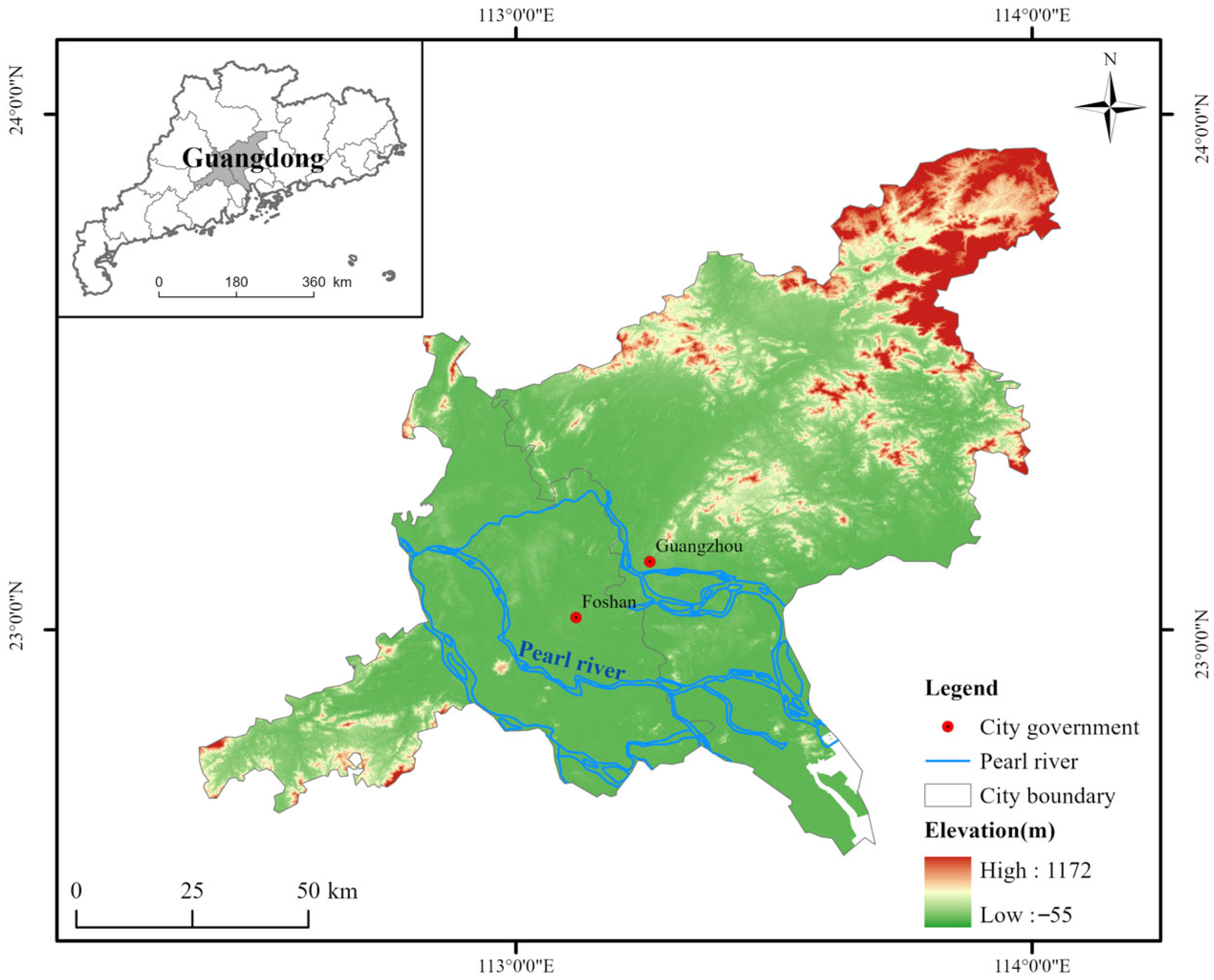
This study was conducted in the adjacent cities of Guangzhou City (22°26′ and 23°56′ N, 112°57′ and 114°03′ E), and Foshan City (22°38′ and 23°34′ N, 112°23′ and 113°24′ E), located in Guangdong Province, Southeast China (
Figure 3). Their close geographical proximity and intense socioeconomic connections have promoted the formation of the Guangzhou–Foshan Metropolitan Area [
28]. The study area, encompassing both cities, is situated in south-central Guangdong Province and constitutes the northern part of the Pearl River Delta. The combined area of Guangzhou and Foshan City is approximately 11,231 km
2. It has a subtropical marine monsoon climate with high mean precipitation and warm annual temperatures. With a total GDP of RMB 4363.187 billion in 2023 (1 USD = 7.0467 RMB in 2023), the area is one of the most important centers of manufacturing, modern service, and high-technology industry. The permanent resident population in Foshan City and Guangzhou City was 9.61 million and 18.83 million in 2023, respectively.
2.2. Data Collection
This study employed a mixed-methods approach, utilizing both questionnaire-based surveys and in-depth interviews to examine the livelihood trajectories of urban residents. Respondents who lived permanently in Guangzhou-Foshan Metropolitan Area and had urban household registration (hukou) were selected as interviewees of our survey. Random sampling was utilized to select the respondents. The sampling procedure consisted of the following stages. First, five districts (Chancheng District, Nanhai District, Shunde District, Sanshui District, and Gaoming District) in Foshan City, and three districts (Yuexiu District, Tianhe District, and Baiyun District) in Guangzhou City, have been selected as the sources of interviewees. Second, three resident communities in each district have been randomly chosen as the survey sites. Third, 3–5 respondents who are more than 35 years old in each site have been randomly selected for investigation. Finally, 75 respondents in Foshan City and 41 respondents in Guangzhou City have been selected for our survey.
The field survey was conducted from 1 May to 30 July 2023. A questionnaire was designed specifically for this investigation. To reconstruct their livelihood trajectories, interviewees were guided to recall major life events and to link these events to changes in their household livelihoods. The questionnaire comprised four sections (totaling 95 items): (1) basic information of the households, including the demographic conditions, household income, and expenditure; (2) childhood experience and original families, including family financial conditions and their impacts on respondents; (3) impacts of marriage and family formation on her/his occupations; (4) livelihood trajectories and the primary determinants. The selection of determinants was informed by previous literature and preliminary surveys. The determinants mainly encompassed four categories: individual demographic factors, family factors, values and personality, past occupations, and social capital. Many factors, such as capital and household registration (hukou system) and spatial heterogeneity, have been merged into individual demographic factors. Important determinants are largely included in the four categories. All questionnaires were finished by trained interviewers. It may take about 1–1.5 h for each interview. After eliminating 6 ineffective questionnaires, we finally gained 110 valid questionnaires. Finally, we input all the data from the questionnaires into a computer using Microsoft Office 2020 software and SPSS (Statistical Product and Service Solutions) 11.0 from the IBM Corporation.
To complement the survey data, in-depth interviews were conducted. First, 18 respondents were selected based on a typical sampling of all the interviewees. These respondents were chosen purposely to represent different incomes and occupational statuses. Second, we conducted approximately two-hour, face-to-face semi-structured interviews with these interviewees, focused on the process of livelihood trajectories, significant life events, and livelihood outcomes. All interviews were audio-recorded and transcribed verbatim, and the resulting textual data were prepared for qualitative analysis.
This study was conducted in strict accordance with recognized ethical standards and principles. Formal ethical approval for this study was granted by the Ethical clearance committee of Foshan University, People’s Republic of China. Then, approaching the respondents, we explained the purpose of the study and assured them of the anonymity, confidentiality, and privacy of the responses. All research respondents voluntarily agreed to participate in the research without any pressure. Informed consent was obtained verbally from all participants.
2.3. Model Specification
As discussed earlier (
Figure 1), intragenerational mobility contains two categories: occupational mobility and income mobility. Classification of livelihood hierarchies, which integrates occupational hierarchies with income hierarchies, is a critical step for measuring intragenerational livelihood mobility. Measurement of livelihood mobility could be accomplished by inspecting changes in livelihood hierarchies. Determinants of livelihood mobility could be clarified by using multivariate logistic regression (
Figure 2).
2.3.1. Measurement of Intragenerational Livelihood Mobility
- (1)
Occupational classification and measurement of occupational mobility
Occupational mobility, sometimes referred to as class mobility in the literature, is typically measured by tracking movements between two distinct social classes or occupational positions. In order to evaluate different levels of occupational mobility, classification of occupation is the essential premise for subsequent measurement. The International Standard Classification of Occupations (ISCO-08) has been the most widely used in the literature since 2011. Occupational changes are usually only coded as such if they are accompanied by a job change in the 1-digit or 2-digit ISCO code [
29]. Occupational mobility occurs only when occupational changes step over occupational hierarchies. Based on the 1-digit ISCO-08 [
12] and Occupational Classification of China’s National Bureau of Statistics, occupations have been divided into six categories (
Table 1): (1) Unemployed and underemployed, (2) Casual jobs (ISCO-08: 9 Elementary occupations), (3) Low-skilled blue-collar and service (ISCO-08: 5 Service and sales workers, 7 Craft and related trades workers, 8 Plant and machine operators, and assemblers), (4) Skilled workers and clerks (ISCO-08: 3 Technicians and associate professionals, 4 Clerical support workers), (5) Managers and professionals (ISCO-08: 1 Managers-Intermediate level, 2 Professionals), and (6) Senior managers (ISCO-08: 1 Managers-Senior level). Occupational changes that surpass occupational status are defined as occupational mobility, including upwards and downwards.
- (2)
Measurement of income mobility without occupational changes
Unlike intergenerational income mobility, which is often measured by the fraction of children whose earnings exceed those of their parents [
30], intragenerational income mobility within the same occupations means unconventionally significant income changes caused by a series of accidental events, including economic crisis, international trade disputes, epidemic outbreak (e.g., COVID-19), poor management, bankruptcy, the rise of new technology (e.g., AI), promotion, a substantial bonus, etc. Income thresholds of livelihood hierarchies need to be constructed. Three income thresholds are obtained based on the current average incomes of national urban residents: underclass being less than 7500 RMB m
−1, middle class being between 7500 RMB m
−1 and 15,000 RMB m
−1, and upper class being more than 15,000 RMB m
−1 at the present value for 2023. All historical income figures reported by respondents were adjusted for inflation to their 2023 equivalent value using appropriate consumer price index (CPI) data. If respondents could not recall their previous income level, subjective judgment of income status equating to one position of occupational hierarchies (
Table 1) is considered as the income status. Ultimately, intragenerational livelihood mobility could be comprehensively measured by integrating occupational mobility with income mobility within the same occupations.
Table 1.
Classification of livelihood hierarchies of urban residents in China.
Table 1.
Classification of livelihood hierarchies of urban residents in China.
| Livelihood Hierarchy | Sub-Hierarchy | Primary Livelihood Strategies | Main Occupations | Score |
|---|
| Lower-class | 1-1
Unemployed and underemployed | Unemployment and underemployment | Unemployed, menial tasks such as collecting recyclable garbage, managing sanitation, welfare dependents, etc. | 1 |
| 1-2 Casual jobs | Casual, unstable, and physically demanding employment | Odd job workers, cleaners and helpers, nursing workers, garbage and recycling collectors, sweepers, doorkeepers, etc. | 2 |
| 1-3 Low-skilled blue-collar and service | Manufacturing and service laborers | Manufacturing laborers, plant and machine operators and assemblers, warehouse keepers, service and sales workers, food processing, package/food deliverers, street vendors, landscaping workers, construction workers, etc. | 3 |
| Middle-class | 2-1 Skilled workers and clerks | Skilled workers, clerical staff, junior professionals, owners of small enterprises, and owners of individually owned businesses. | Plant technical workers, technical masters, machinery mechanics, certified cooks, drivers, beauticians, hairdressers, electricians, carpentry, clerical support workers, owners of individually owned business, owners of small enterprises, etc. | 4 |
| 2-2 Managers and professionals | Medium-high level professionals, intermediate managers of large-scale enterprises, managers of middle and small-sized enterprises, and the middle-low cadres | Science and engineering professionals, medical doctors, university and higher education teachers, other high-middle level professionals, owners of middle-size enterprises, intermediate managers of large-scale enterprises, managers of middle and small-sized enterprises, and the middle-low cadres, etc. | 5 |
| Upper-class | 3-1 Senior managers | Senior managers of large-scale enterprises, owners of large enterprises, and senior cadres in governments and public institutions | Chief executives, senior officials, legislators, principals of universities, hospital directors, administrative and commercial managers, production and specialized services managers, common services managers, etc. | 6 |
2.3.2. Classification of Livelihood Trajectories and the Multivariate Logistic Model
- (1)
Classification of livelihood trajectories
Multiple frameworks for classifying livelihood trajectories have been proposed in the recent literature. Some sociologists prefer to define livelihood trajectories based on livelihood strategies: “Hanging in”, “Stepping up”, “Dropping out”, and “Stepping down”. Others prefer to use vertical movements to define livelihood trajectories: upward, downward, and horizontal mobility [
12]. Based on the geometric configuration of livelihood trajectories, five categories of livelihood trajectories have been classified: horizontal, intro-stratum upward, stratum upgradation, downward, and zigzag mobility.
Horizontal mobility means no vertical movement in livelihood status, and zigzag mobility refers to a zigzag form of livelihood trajectories, exemplified by U-shaped or inverse U-shaped livelihood trajectories. Downward mobility means continuous downward occupation or income transition. We divided the general upward mobility into two types: intro-stratum upward mobility and stratum upgradation. The former experienced intra-class upward mobility, and the latter achieved transcending-class upward mobility, such as from the lower class to the upper class (
Table 1).
- (2)
The multivariate logistic model
A multivariate logistic model was employed to examine the determinants of respondents selecting multiple livelihood trajectories. The dependent variable is a multi-category variable that represents one category of livelihood trajectories. The variables encompass a set of socioeconomic and demographic factors measured at the individual and household levels.
The model is specified in the following equation:
denotes the probability that the i-th resident selects the livelihood trajectory of , and may be any one of the four categories: intro-stratum upward, stratum upgradation, downward, and zigzag mobility. is the probability of the reference category of no change in livelihood mobility, i.e., horizontal mobility. are the predictor variables, is the general intercept, and are the regression coefficients. For a categorical predictor, a positive sign of estimated coefficients means that the probability of selecting a certain livelihood trajectory is higher than the reference category and vice versa, keeping all other characteristics constant.
4. Discussion
The article examines urban residents’ intragenerational mobility through assessing respondents’ livelihood trajectories. The concept of livelihood trajectories expands traditional understandings of social mobility by highlighting the process of whole life courses other than comparing only certain time points. This approach of livelihood trajectory analysis proves to be a viable methodology for social mobility research through elaborately illustrating the process of respondents’ life courses. It could reveal the comprehensive process of social mobility by reconstructing and analyzing long-term mobility dynamics embedded within individual life histories, thereby providing a longitudinal perspective that cross-sectional data cannot offer [
15,
16]. Meanwhile, the concept of livelihood mobility would enrich and transcend conventional frameworks based solely on occupational or income-based analysis. Our results also demonstrated that studies of livelihood trajectories were not restricted to qualitative analysis, and quantitative research in livelihood trajectories was recommended. Therefore, studies of intragenerational social mobility based on the investigation of livelihood trajectories need to be promoted in future.
Our results focused on intragenerational livelihood mobility by observing respondents’ transition of status hierarchies, which were less discussed, possibly because of data sets being less available [
31,
32]. Most sociology studies examined inter-generational social mobility, which concentrated on vertical movements in social status or income between parents and children [
27,
30]. The results indicated that numerous respondents have experienced upward mobility and even attained promotion in social status hierarchies. Rapid economic growth, industrialization, and urbanization during the past four decades have substantially accelerated Chinese upward social mobility through dramatic transformations of occupational structure and increasing employment opportunities [
26,
27]. Many urban residents could undergo upward mobility by transcending class boundaries to higher social hierarchies. These conclusions are consistent with previous studies that discovered significant social stratification and mobility in China [
25,
33,
34] and other developing countries, such as Vietnam [
35], India [
36], and some Latin America countries [
37]. But the magnitude of upward social mobility in these studies is different, probably because of massive disparities in social institutions, stages of industrialization, economic growth, development of the labor market, research objects, earnings distribution, research periods, classification of social stratum, and temporal and spatial variations.
Meanwhile, about 41.8% of respondents’ (n = 110, the same below) livelihood status remained unchanged and 10.0% of respondents underwent downward or zigzag livelihood mobility. The polarized results implied that the benefit of socioeconomic growth has not been evenly distributed among urban residents. A series of causes, such as spatial inequality, the household registration (
hukou) system, family endowments, human capital accumulation, gender inequality, and labor market segmentation may have contributed to these outcomes [
27,
33,
34]. Urban residents who were born in rural areas were much less likely than urbanites to obtain a better education and found it difficult to get a decent salariat job after graduation [
33]. It is urgent to eliminate institutional barriers (esp. the
hukou system), and to narrow spatial inequality to promote the equality of opportunities and the resultant growing social mobility. These conclusions are consistent with previous studies that highlighted the importance of equal distribution for social mobility [
30,
33]. Macro political and socioeconomic factors, including market transition, institutional barriers (such as the household registration system), and unbalanced regional development, have been considered as shaping the opportunities and constraints of social mobility in China [
23,
26,
27].
The results demonstrated that educational attainments, personality, and hierarchies of the first occupations were key predictors of upward mobility. Higher educational attainments, a proactive personality, and a lower socioeconomic status of the first occupation are positively associated with upward mobility. These conclusions were consistent with previous studies that considered the prior level of education and further education in destination countries as key predictors of immigrants’ upward mobility [
7,
20]. Education has been widely confirmed as the most important factor in increasing intragenerational mobility [
35,
36,
37]. In most developing countries, children’s education investment has been mainly paid for by their parents. Only wealthy households could afford expensive high-quality education for their offspring. Consequently, children of the middle class and upper class could maintain and even gain upward mobility by virtue of educational advantages. Class stratification, characterized by higher inequality of opportunity and lower social mobility, would deteriorate in future. Confirming previous results [
33,
38,
39], the lower status of the first occupations implies more possibilities and space for upward mobility of crossing social classes. Positions of the first job could partly determine the following livelihood trajectories and social mobility [
20]. Entering at the bottom of the occupational hierarchy can serve as a stepping stone to more favorable positions through the subsequent accumulation of occupational skills [
38].
The results also showed that family origin and gender all have significant net effects on upward mobility. Women were found to have a lower likelihood of experiencing upward mobility compared to men. The conclusion is in accordance with some previous research [
7,
27,
38,
39], especially for those with a bad start to their working life [
27,
38,
39]. Compared to respondents whose fathers are managers and professionals, respondents whose fathers are farmers were significantly less likely to achieve stratum-upgrading mobility. In other words, people from higher social class origins would have an advantage over those from lower family origins to accomplish crossing-class upward mobility [
31]. In addition, large family size and more occupational changes are positively associated with stratum upgradation. These results revealed that occupational changes (especially voluntary ones) tended to be associated with occupational or income upward mobility [
40].
Considering the sustainability framework, it is important to maintain the long-term viability of intragenerational mobility. Our survey livelihood trajectories showed that the severe economic shock and subsequent slow economic recovery in China driven by COVID-19 and global trade protectionism brought about significant impacts on all people’s livelihoods. Policies striving for equity, justice, equality of opportunities, and inequality reduction should be highly valued. Fortunately, the Chinese central government has listed the construction of “a society characterized by common prosperity” as an important task since 2020, and it is also emphasized as a crucial mission in the recently issued “Chinese 15th Five-Year Plan for National Economic and Social Development”. It is urgent to take effective measures to avoid the occurrence of asymmetrical mobility prevalent in Latin America, where the same groups gain the most or lose the least in economy-growing eras or economy-contracting eras [
41].
5. Conclusions
This study has examined urban residents’ intragenerational mobility through a life course perspective based on a case study in Foshan City and Guangzhou City, Guangdong Province, Southeast China. Conception of livelihood mobility and livelihood trajectories have been presented to elucidate intragenerational social mobility by investigating respondents’ life courses. Drawing on detailed survey data of respondents’ livelihood trajectories, we have carefully examined the rates and determinants of livelihood mobility for Chinese urban residents in recent decades. Our study yields two main conclusions. First, there has been a massive differentiation in Chinese urban residents’ livelihood mobility during the past four decades. On the one hand, we found that 48.2% of the respondents experienced upward mobility and 33.6% of them had successfully stepped over social classes. On the other hand, the livelihood status of 41.8% of respondents remained unchanged, and 10.0% of respondents underwent downward or zigzag livelihood mobility. Second, most of the upward mobility is comprehensively driven by individual agency (e.g., educational attainments, personality, gender, age) and family endowments (e.g., parent status). That is to say, urban residents with better education, a risk-taking personality, male gender, elder generation, and high parent social status, are more likely to experience upward livelihood mobility. But the importance of initiatives of individuals for contributing to upward mobility is higher than of family endowments.
The methodology used for this study had some limitations. First, life course surveys have been utilized to depict respondents’ livelihood trajectories. The respondents may not accurately recall some detailed data from recent decades. Our interviewers may ask several times to confirm whether the data was captured correctly or not. Second, the limited sample size partly impeded some in-depth analyses. Many analyses, including two regression analyses of downward mobility and zigzag mobility, and an analysis of the age cohorts, are not implemented owing to the small sample size.
We presented several suggestions for future research on the repetition of previously discussed results. First, studies of intragenerational mobility for heterogeneous groups, such as migrant workers, high-level professionals, lower-class women, traditional farmers staying in villages, and land-lost farmers, need to be carried out in future. Second, multi-scale socioeconomic factors, especially the birthplace and workplace, need to be incorporated into the framework to clarify the primary determinants of livelihood mobility. Third, comparative studies between intragenerational mobility and intragenerational mobility, or between different research areas, or between different research periods, should be conducted in future.