Article

Sustainability: Panacea or Local Energy Injustice? A Qualitative Media Review of Newfoundland and Labrador’s Wind-to-Hydrogen Boom

by
Nicholas M. J. Mercer
Environmental Studies and Island Studies Programs, University of Prince Edward Island, 550 University Ave., Charlottetown, PE C1A 4P3, Canada
Sustainability 2025, 17(24), 11035; https://doi.org/10.3390/su172411035
Submission received: 16 October 2025 / Revised: 26 November 2025 / Accepted: 5 December 2025 / Published: 9 December 2025

Abstract

Despite vast wind energy potential, the Canadian province of Newfoundland and Labrador (NL) has historically lagged in installed capacity due to socioeconomic and technical barriers. The emergence of hydrogen as an alternative energy carrier has transformed prospects for a wind industry on the island, allowing for the possibility of exports. Since the lifting of a provincial wind energy moratorium in 2022, several companies have proposed more than 25 gigawatts (GW) of wind-to-hydrogen (W2H) capacity. Proponents and opponents differ considerably in their view on whether W2H projects will advance provincial sustainability—a debate which can be further understood through energy justice analysis. Given the current lack of empirical evidence, the study adopts a systematic review of media reports pertaining to six leading W2H projects in the province. Basic descriptive statistics (means, frequencies, etc.) are used to describe the metadata and preliminary coding process. Deductive and inductive thematic analysis are then applied to the complete dataset of online news articles (n = 112) with the support of a qualitative data management software (NVivo, Version 14). The findings build upon, challenge, and make novel contributions to several tenets of energy justice. From a distributive justice perspective, temporal variations in employment, centralization of resource revenues, and the anthropocentric nature of defined risks are highlighted. From a procedural justice perspective, social acceptance of projects, as well as the shortcomings of environmental impact assessment, are elaborated. From a recognition justice perspective, the paper demonstrates Indigenous involvement in W2H governance, yet demands an interrogation of intra- and intercommunity diversity. From a cosmopolitan justice perspective, the paper finds weak evidence of supporting vulnerable global populations through decarbonization, yet some prospects through enhancing energy security for importing countries. With respect to media reporting, the findings illustrate the outsized role of independent media in advancing evidence-based justice discourses and the central function of public media in covering rural natural resource developments. Ultimately, this study urges policymakers and private developers to ensure fair benefit distribution, deep participation, and inclusion of diverse communities during the formative stages of the W2H industry in NL and beyond.

1. Introduction

Owing to significant resource potential and proposed development activity, the Canadian province of Newfoundland and Labrador (NL) is well-positioned to inform global debates on the justice implications of ‘green hydrogen’ transitions. NL has some of the strongest potential for wind energy development in the world, with the majority of the province experiencing a mean wind speed of over 8 m/s at 80 m elevation, well above what is considered the ‘commercially viable’ threshold [1,2]. A 2009 study by Fisher et al. concluded that the province is theoretically capable of producing 117 times the amount of its 2006 electricity demand through wind energy [3]. Barrington-Leigh and Ouliaris found that the province could generate 20 per cent of the country’s 2010 energy demand by making use of only 25 per cent of its ‘high potential’ wind regions [4]. Growler Energy projected that there is over 60,000 MW of potential onshore wind capacity in the province, which is triple the amount currently installed across the entire country [1,5]. Yet despite this substantial potential, NL ranks last amongst Canada’s provinces in installed capacity, with only ~54.7 MW of wind energy [1] (Table 1).
Mercer et al. (2017) have argued that barriers to wind energy expansion in the province are complex and multifaceted, yet identified political, economic, and knowledge-related constraints as central to the challenge [6]. From a political perspective, the authors identified barriers such as Crown utility monopoly legislation for electricity generation-transmission-distribution, a deep entrenchment of large-scale hydroelectric power and fossil fuel interests, and a lack of political will/policy support for distributed renewables. From an economic perspective, a lack of domestic demand, including prohibitive export costs, as well as cost competitiveness with baseload alternatives, was critical. From a knowledge perspective, the authors expressed concerns about the lack of wind energy expertise and educational capacity available in the province.
Over eight years have passed since the publication of this study in 2017, and in this time, not a single kilowatt of wind energy capacity has been added to the provincial grid. However, in April 2022, the renewable energy landscape suddenly shifted in the province—when the provincial government announced that a provincial wind moratorium, in place since 2007, had been lifted [7]. The announcement foregrounded the importance of protecting the market for existing generation assets and brought attention to the possibilities of industrial self-generation, or export via transmission lines or the production of hydrogen and ammonia [8]. A multi-stage approval process for wind development was also announced, which consists of a Crown lands nomination process, followed by a competitive land bid process [9]. In 2024, the provincial government released a ‘Hydrogen Development Action Plan (HDAP)’ [10]. The stated goal of the plan is “the next step in enabling the development of a green hydrogen and ammonia production industry in Newfoundland and Labrador” [11] and consists of several action items across four pillars to support this goal, including: export and domestic markets; partnership, innovation, and industry support; training and jobs; and regulatory framework. The plan situates the province as an ideal host of wind-to-hydrogen (W2H) projects owing to significant renewable resource potential, strategic geographic location on the eastern edge of North America, a multitude of deep-sea ice-free ports, high freshwater and crownland availability, and a stable sociopolitical environment. The Government of N.L. has situated itself as both a proponent and regulator of hydrogen projects, raising questions of impartiality, similar to long running critiques of offshore oil and gas governance in the province [12]. This creates a need for independent analysis of potential impacts and outcomes of W2H projects.
The shift in the provincial energy landscape, i.e., from wind moratorium to championing the W2H industry, has resulted in significant private sector interest. In 2023, the provincial government announced that bids from four companies were ultimately selected through the previously discussed Crown Land Call for Bids for Wind Energy Projects [13]. These companies were granted the exclusive right to pursue development through the Crown land application and approval process, which included a referral to the provincial environmental assessment process. In addition, the province announced that further projects would be assessed on a case-by-case basis, a process that has resulted in Crown land reserves for two additional companies in 2024. Together, six leading proponents—Toqlukuti’k Wind and Hydrogen (TWK), EverWind, Exploits Valley Renewable Energy Corporation (EVREC), World Energy GH2 (WEGH2), Argentia Renewables/Pattern Energy (PE), and North Atlantic Refining Limited (NARL)—have secured over 390,000 hectares of Crown land reserves across the island of Newfoundland. Collectively, they envision building more than 25 GW of onshore wind capacity, more than 460 times Newfoundland’s current installed wind capacity, tied to large-scale hydrogen and ammonia production facilities for export [13,14,15].
Supporters of these projects have lauded a wide range of potential socioeconomic benefits, including the creation of a new export industry, revenue generation for public bodies, job creation, novel trade and investment opportunities, educational and training opportunities, rural economic development, and global decarbonization [11]. For example, the province has estimated that in a scenario where the four initial proponents were to proceed, this would have an estimated economic impact of over $200 billion throughout complete project life cycles, a treasury impact of over $11 billion, peak employment of over 11,000 full-time equivalents (FTE) during construction, and over 2250 FTEs during operations [11]. Opponents, however, have highlighted ecological risks, such as massive land-use transformation, habitat loss for plants and animals, and impacts on drinking water supply [16,17]. Socioeconomic risks have also been at the forefront of public discourse, including inadequate public consultation, lack of local benefits from export-oriented industries, and disruption of Indigenous and rural lifeways [16,17].
Given this polarized backdrop of competing claims, this paper applies a critical lens to media reporting to assess how W2H projects are facilitating energy justice—i.e., fairness and equity in renewable energy developments. Specifically, the mixed-methods paper adopts the triumvirate of energy justice tenets, utilizing basic descriptive statistics and qualitative thematic analysis of online news articles (n = 112), to argue that while hydrogen exports address NL’s historical barriers to wind energy development, they risk compounding distributive, procedural, and recognition injustices for Indigenous and rural communities throughout the province. The paper proceeds first by detailing energy justice literature with respect to ‘green’ hydrogen projects, providing a detailed overview of the media review and qualitative content analysis, a merged disclosure of findings and interpretation of critical (in)justices at play, as well as a brief conclusion.

2. Literature Review

At present, hydrogen accounts for only one per cent of global total final energy consumption [18]. Most hydrogen consumed is synthesized from fossil fuels, resulting in significant greenhouse gas emissions (approximately 9–12 kg of CO2 per kg of hydrogen produced) [19]. However, hydrogen can be produced with little or no direct CO2 emissions, if technologies such as electrolysis (green hydrogen), or carbon capture, utilization, and storage (CCUS) (blue hydrogen) are applied—although currently less than one per cent is produced using renewable energy [18,20]. ‘Low carbon’ forms of hydrogen can displace fossil fuels in hard-to-abate economic sectors (e.g., steel, aviation, shipping), industrial processes, power generation, or energy storage.
Given this significant potential, many countries in the Global North and South have identified green hydrogen as a key element in their decarbonization plans. The World Energy Council reports that 12 countries globally, as well as the E.U., have published national hydrogen strategies [21]. A further 19 countries are currently in the drafting stages of their own. This global interest fuels projections that green hydrogen will account for four per cent of total final energy consumption by 2030 [18], or as high as 12 per cent by 2050 [22].
Given this rapid scale-up of a new technology, several scholars have brought attention to the potential energy justice (EJ) implications associated with large-scale hydrogen production. While there is no universally recognized definition of EJ, several complementary conceptualizations have been put forward. For instance, Dembi describes EJ as achieving equity in social and economic domains of energy systems [18], Lindner highlights a focus on how energy transitions can cause or reinforce inequalities within a society [23], while Jenkins et al. more broadly emphasize applying justice principles across all aspects of the energy lifecycle such as policy, production, and activism [24]. This section seeks to define the three interlinked tenets of EJ (distributive, procedural, and recognition) and explain their relevance to hydrogen developments. Furthermore, emerging tenets of justice will be explored, as well as critiques of the energy justice framework, to help guide the interpretation of the primary research question.

2.1. The Triumvirate Approach of Energy Justice and Implications for Hydrogen Development

Most studies on EJ recognize three interlinked and overlapped tenets as core to the conceptual framework: distributive, procedural, and recognition justice [19,24,25]. Each of these tenets and their relevance for large-scale hydrogen production are explored in the following paragraphs.

2.1.1. Distributive Justice

Distributive justice is a spatial concept, investigating where injustices arise, or the unequal physical allocation of costs and benefits as a result of energy development [19]. A basic example would be a large-scale renewable energy facility, which can benefit sections of society in close proximity more easily than distant ones, or when an undue burden is placed on a vulnerable population through local pollution associated with power-generation [23]. Patonia has argued that in comparison to fossil fuels, green hydrogen can be produced almost anywhere as long as there is access to freshwater and renewable power [19]. Thus, the distributed nature of green hydrogen production may support more egalitarian development or equitable industrialization of the Global South—for example, by stimulating or directly resulting in technology transfer. Although Dembi notes that proper waste management and transportation emissions are some of the issues that must be accounted for in host regions to avoid inequities [18].
A larger body of research focuses on potential socioeconomic inequities associated with hydrogen projects, mainly energy access and affordability, access to employment opportunities, and risks of extractive industries and neocolonialism. Hydrogen projects are often meant for export purposes, with little benefit for locals living in energy poverty or unelectrified regions [26,27]. Even when available locally, affordability is a key concern. For example, in 2023, the levelized production costs of grey hydrogen in the E.U. were 3.76 €/kg on average, while blue hydrogen was 4.41 €/kg, and green hydrogen (e.g., electrolysis with a direct connection to a renewable energy source) cost 6.61 €/kg [28]. Another critical issue is access to employment opportunities from hydrogen developments. Women, for instance, are vastly underrepresented in the renewable energy sector—accounting for only 21% of the global wind energy workforce [29]. Critically, Ouellet-Dallaire et al. advocate for not only the consideration of gendered dimensions of project impacts, but for adopting an intersectional approach. That is, how proposed impacts are intertwined with ethnicity, race, class, age, sexuality, gender, and beyond [27]. Muller et al. determined that energy jobs in the Moroccan-occupied Western Sahara are almost exclusively allocated to Moroccan settlers [26]. Others have flagged the risks of neocolonialism, or perpetuating colonialism through resource extraction from the Global South. In other words, developmental benefits may be unevenly distributed, favouring developed nations where demand lies, over less developed nations that have been targeted as production hubs [18]. Lindner warns of a strong focus on the business interests of hydrogen proponents in the Global North, including technology exports and the procurement of cheap overseas green hydrogen, which may result in limited spillover effects for local economies [23]. Furthermore, this may delay local energy transitions by diverting attention from the prerequisites needed for domestic energy system transformation [30].
Ecological risks for producing nations have also been highlighted in the literature, mostly focusing on water scarcity and land-use/livelihood disruption. All commercialized electrolyzers run on freshwater—it is estimated that the production of one kg of hydrogen [H2] consumes about nine litres of pure freshwater [31], although for some projects supported by desalination, the estimate can be as high as 35 L [32]. In arid regions, desalination is required, which could worsen water stress and further augment the costs and energy intensity of production [19,33]. It has also been noted that H2 megaprojects require significant amounts of land to support renewable energy installations, green H2 plants, and supporting infrastructure—this may fuel displacements, land-use conflicts, and interference with people’s livelihoods [23,26].
However, these risks are not inevitable, and several scholars have put forward proposals to ensure that local communities are the main beneficiaries of development, as opposed to only absorbing the impacts. Some have argued that a significant portion of green H2 should be dedicated to domestic consumption and supporting local industries, possibly yielding greater socioeconomic outcomes [19]. Others have advocated for educational opportunities to train skilled workers and researchers in the deployment of domestic hydrogen [23]. Ouellet-Dallaire et al. call for financial benefits, such as a royalty share for host communities, to be earmarked for social services and infrastructure [27].

2.1.2. Procedural Justice

At its core, procedural justice calls on researchers to explore the ways in which decision-makers have sought to engage with communities [24]. This includes a focus on due process, as well as effective recourse through judicial and administrative remedies [34]. Throughout the literature, scholars have focused on specific traits of procedural justice, the sociopolitical context of host countries, as well as the importance of environmental and social impact assessments in advancing just outcomes.
Local knowledge mobilization, deep transparency, and enhanced institutional representation are three of the most common traits discussed with respect to procedural justice. Local knowledge mobilization refers to the ability to meaningfully impact outcomes as part of consultative processes, as opposed to more tokenistic engagement efforts, which may listen but do not act upon local knowledge [24,35]. Deep transparency involves complete information disclosure by powerful actors—including governments, regulators, and developers [18]. Knowing what information is available, as well as how to access it, is a key feature of transparency [36]. Yenneti and Day denote several insufficient attempts by authorities to convey land acquisition information to less literate segments of the population dependent on the same land base [37]. Institutional representation refers to the representation of affected stakeholder groups in formal energy-related decision-making bodies [24].
Inseparable from procedural justice, scholars have called for consideration of the broader sociopolitical context in hydrogen partner countries, including political systems, institutional stability, and status of civil rights [23]. For example, Germany has pursued hydrogen partnerships with countries in the Global South, such as Egypt and Morocco, which have shortcomings with respect to political freedom, corruption levels, and other indicators of good governance [23]. Others have warned about the strengthening of authoritarian rule via hydrogen expansion, including existing structures of patronage and rent-seeking that destabilize non-democratic regimes [23,26].
Given that green hydrogen production plans are large-scale construction projects, environmental impact assessments [EIA] are often mandated prior to commissioning [18]. These processes enable feedback from community members on the design and implementation of natural resource projects [27]. Scholars have highlighted EIA as one of the few legally binding mechanisms regulators can use to demand project amendments, maximizing positive impacts, and mitigating negative socioecological consequences [19,27]. Although it is imperative to note that EIA processes themselves are not without critique. Ouellet-Dallaire et al. developed several compelling critiques of EIA with respect to hydrogen projects [27]. Firstly, they denote how elements of the human and natural environment that are difficult to quantify, such as community well-being or spiritual and landscape aesthetic values, are often minimized within the assessment process. Secondly, they argue that EIA upholds the socioeconomic status quo by focusing on the mitigation of negative impacts, as opposed to challenging proponents to confront broader social inequities, such as gender bias and sex discrimination. Thirdly, they note a lack of cumulative effects assessment, or consideration of the impacts of several projects, with multiple proponents, on a regional basis. And fourthly, they identify how sub-national EIA often lacks financial support for local communities to hire independent experts, conduct research, and more fully participate in the process.

2.1.3. Recognition Justice

The review of the literature finds that less has been written about recognition justice and hydrogen projects relative to the other primary tenets of energy justice. This section seeks to elaborate on how recognition justice has been described in the literature, then identifies Indigenous rights and disputed territories as its main area of application.
Van Uffelen critiques at least 10 varied definitions of recognition justice and concludes that the concept is concerned with the adequate recognition of all actors through love (i.e., social arrangements), laws (i.e., actors recognizing each other’s dignity, intrinsic value, and equal moral standing), and status order (i.e., actors recognizing the value of certain cultural identities and their contributions to society) [38]. McHarg provides social arrangement examples of recognizing that segments of the population, such as the elderly or disabled people, often require greater amounts of energy to satisfy basic needs [39]. Recognition justice encompasses not only exclusion of diverse segments of society, but also disrespect, insult, and degradation that devalues some people and places relative to others [23]. A key example here is the tendency to dismiss renewable energy opposition as ‘NIMBYism’, as opposed to delving deeper into local concerns [39].
Hydrogen projects risk violating the cultural and land rights of Indigenous communities. For example, Morocco’s greatest potential for green hydrogen development lies in a disputed territory, in the Western Sahara [26]. Here, representatives for Indigenous communities striving for independence have not been included in hydrogen-related decision-making [19]. Others have warned against industrialized countries sourcing green hydrogen from economically disadvantaged nations—drawing parallels with historic natural resource extraction from colonies for the benefit of European powers [19]. As a more positive example, Ouellet-Dallaire et al. speak to a Memorandum of Understanding (MOU) signed between a hydrogen developer and a First Nation in western Newfoundland, which seeks to provide employment opportunities and industry training to band members [27]. Some have promoted the co-design of community-based renewable energy projects with historically excluded groups to enact recognition justice [26].

2.2. Emerging Tenets of Energy Justice: Limitations of the Framework

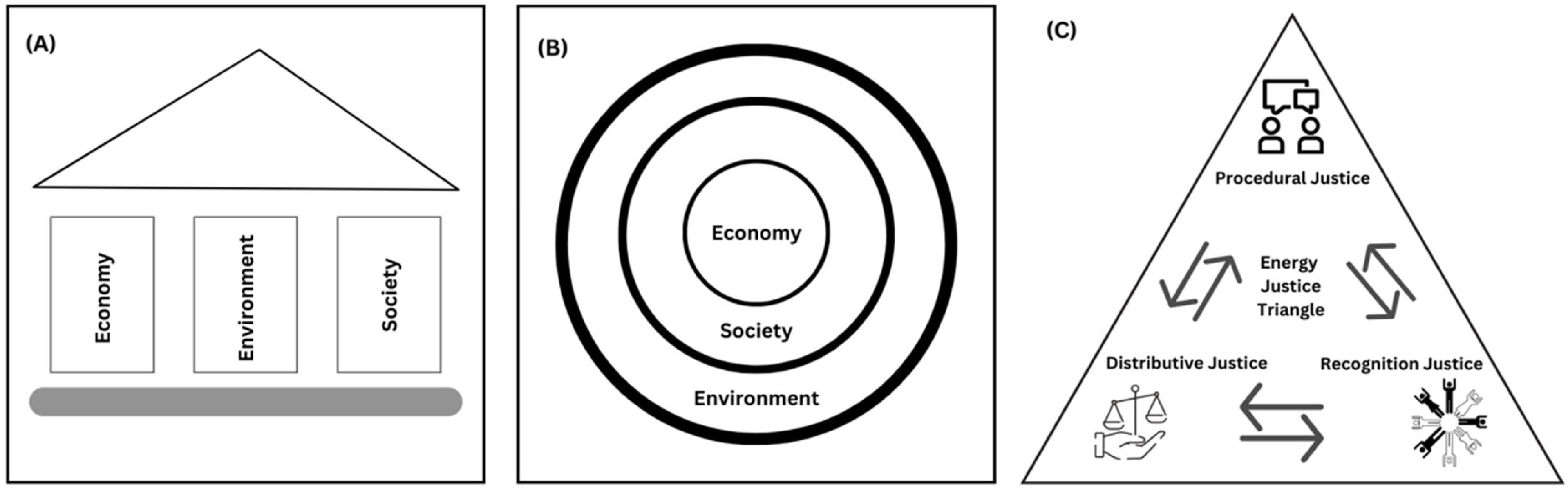
While often discussed individually, it is imperative to note that the tenets of energy justice (especially distributive, recognition, and procedural) are deeply interrelated and can reinforce or limit one another [40,41,42]. Caradonna offers a compelling parallel when critiquing the dominant ‘three pillars of sustainability model’, or encouraging balance between economic, environmental, and societal dimensions in decision-making [43] (Figure 1A). While these three variables are often presented as separate, ecological economists have argued that society and economies are supported by and cannot exist without the environment. A simple reorientation of the three pillars into a series of concentric circles emphasizes the environment as the foundation of sustainability, with nested socioeconomic systems having cascading impacts across the earth system and vice versa (Figure 1B). Similarly, the tenets of energy justice should be understood as profoundly intertwined (Figure 1C). Take, for instance, an ethnic minority which has yet to gain legal representative status (recognition justice), therefore their views are not adequately represented in decision-making (procedural justice), which results in a concentration of project risks in their traditional territory and a lack of local benefits (distributive justice).
Scholars have called for the integration of other tenets of energy justice in hydrogen research, including cosmopolitan justice, restorative justice, epistemic justice, and relational justice [19,26]. While there are instances of their application in the literature, these are limited relative to the dominant ‘triumvirate approach’. Cosmopolitan justice advocates for a global perspective, that is, transcending local boundaries and ensuring that the needs of vulnerable populations worldwide are considered in energy transitions [19]. Heffron and McCauley add restorative justice, which aims to repair the harm caused to people, society, and nature by energy-related decisions as opposed to focusing solely on the punishment of offenders [44]. Epistemic justice emphasizes the importance of valuing diverse knowledge systems in energy decision-making, or considering whose knowledge over land-use and energy production counts [19]. For example, Muller et al. warn how colonial/Eurocentric narratives of development and modernization accompanying hydrogen plans can pervert social and political realities of marginalized communities [26]. Finally, relational justice considers how resource-intensive projects interfere with human-water and human-land relations [26].
With few exceptions, the literature mainly cautions how hydrogen projects create or reinforce existing injustices. While these warnings are credible, we point towards the work of others who have argued that ‘deficits discourses’ themselves, i.e., focusing only on ‘what is wrong’, can reproduce local vulnerabilities by eroding morale, exacerbating negative stereotypes, profiteering off of manufactured victimhood, and ignoring structural or systemic roots of challenges [40]. As such, attention should also be given to community strength in the face of injustice, including local leadership, resistance, and agency, which are always present in some form. Dembi is a notable contributor here, revealing how public opposition to large-scale hydroelectricity in the past has forced better alternatives in the future [18].

2.3. The Role of Media and Energy Transitions

Horsbøl outlines the impacts of journalistic mass media on the construction of public issues, including energy issues, focusing on three key aspects: agenda setting, media framing, and provisioning of voice [45]. Firstly, the media selects topics for the public agenda, helping to focus collective attention, though scholars have noted that there is no simple causality between the media agenda and audience perception [45]. For example, Lyytimäki et al. have argued that at the technological niche scale, media can spread or screen out information, motivating or discouraging actors from adopting new technology or practices [46]. Secondly, media make topics intelligible by relating them to existing frames, discourses, genres, and narratives—helping to sustain, modify, or change these discursive structures. This inspires an area of scholarship, termed frame analysis, which fundamentally examines how an issue is made meaningful by being inscribed into certain frames [45,47]. Thirdly, the media provides a voice to certain persons and institutions, positioning them discursively within a limited range of ‘subject positions’, for example, ‘scientific expert’ or ‘protestor’. As such, some expressions appear meaningful and legitimate, while others lack these qualities [45]. Outside of these established traditions, other scholars have argued that media reports can be used as an indication of social impacts occurring in specific economic sectors, as the reports in the media reflect empirical impacts [48]. As a result, Roche et al. have argued that qualitative news media analysis can be used as an indication of social impacts occurring in a sector—allowing for inclusion and data prioritization in future studies, in combination with other literature and data sources (such as site visits, sustainability reports, or stakeholder interviews) [48]. Given the infancy of N.L.’s emerging hydrogen sector (Section 1), as well as a complete lack of empirical evidence on energy justice impacts, this study adopts the latter tradition—that is, using media as a window into social impacts of W2H projects, serving as a compelling basis for future studies based on primary data.

3. Operational Methods

Media reviews have become increasingly common in critical renewable energy studies—especially in contexts which lack empirical data, making it a useful tool for the study of W2H projects in NL [33,49]. The method allows for analysis of how a particular topic is being written about and understood by the general public [49]. Purposeful sampling is used in this media review, that is, the identification and selection of information-rich cases, allowing for the most effective use of limited resources [50]. More specifically, criterion-I sampling was used, or the identification and selection of all cases that meet predetermined criteria of importance [51]. Criteria for this study included: (a) online articles published between May of 2022 and May of 2025, a period which encompasses initial announcements of W2H projects in N.L. and commencement of data analysis for this study; and (b) specific mention of at least one of six companies proposing W2H projects in N.L., including WEGH2, EverWind, TWK, NARL, PE, or EVREC. Inclusion criteria were kept purposefully broad, including public, private, and independent sources of media, to support data triangulation, or the use of multiple data sources to cross-verify findings [52].
BOOLEAN keyword searches were conducted in the ‘Google News’ database as well as individual websites for major media outlets in NL. The primary search terms included: “hydrogen” OR “wind energy” OR “wind power” OR “green hydrogen” OR “wind-to-hydrogen” AND “Newfoundland”. Company-specific searches were also conducted with the key terms “World energy” OR “Everwind” OR “Toqlukuti’k” OR “North Atlantic Refining Limited” OR “Pattern Energy” OR “Exploits Valley Renewable Energy Corporation” AND “Newfoundland”. A total of 112 unique articles met the criterion to be included in analysis (n = 112), and metadata is presented more thoroughly in our findings (Figure 1, Figure 2, Figure 3, Figure 4 and Figure 5) (see: Spreadsheet S1) [14,16,53,54,55,56,57,58,59,60,61,62,63,64,65,66,67,68,69,70,71,72,73,74,75,76,77,78,79,80,81,82,83,84,85,86,87,88,89,90,91,92,93,94,95,96,97,98,99,100,101,102,103,104,105,106,107,108,109,110,111,112,113,114,115,116,117,118,119,120,121,122,123,124,125,126,127,128,129,130,131,132,133,134,135,136,137,138,139,140,141,142,143,144,145,146,147,148,149,150,151,152,153,154,155,156,157,158,159,160]. It is noted that Figure 1, Figure 2 and Figure 3 rely solely on basic descriptive statistics (frequencies) to help describe the metadata, i.e., the media articles collected (this includes timing of publications, source of publisher, and specific wind-to-hydrogen projects mentioned in the articles).
Thematic analysis, or searching for themes and patterns across a dataset, was the primary data analysis technique used for the study [161,162]. Specifically, deductive thematic analysis was used, where codes are generated and assigned to an existing conceptual framework—or in this case, the three primary tenets of energy justice (distributive, procedural, recognition—plus cosmopolitan justice, which featured predominantly in the dataset). Table 2 demonstrates a representation of the preliminary deductive codebook developed in NVivo (the adopted qualitative data management software), centred around the four tenets of energy justice, and the subthemes developed as part of the project literature review/conceptual framework (Section 2). While NVivo can encourage reductionist thinking (i.e., assigning a code to a single theme), it can also add codes to multiple themes concurrently, helping to encourage reflection on interconnections amongst tenets (Figure 1). All 112 articles were read systematically by the author, assigning codes within and beyond each subcategory. Inductive thematic analysis is also used, as patterns emerged which did not meet the preliminary categories included in Table 2, such as the distributive justice subtheme of ‘Financial Support for Project Developers‘, the procedural justice subtheme of ‘Social Acceptance’, and the recognition justice subtheme of ‘Reporting on Non-Status Indigenous bands’ [161].
Thematic analysis is a recursive process: moving back and forth between the six main stages of data familiarization, initial code generation, initial search for themes, revising themes, defining and naming themes, and finally, producing the final manuscript [161]. Basic descriptive statistics (e.g., frequencies) are used only to support our initial coding stages (Figure 4 and Figure 5). That is, all 112 articles were initially read to familiarize the researcher with the dataset and to generate preliminary codes, as per Braun and Clarke’s seminal framework [161]. If codes were made toward a specific tenet of energy justice, this was recorded in the Supplementary Spreadsheet (Spreadsheet S1), allowing the generation of a frequency chart (Figure 4) or to denote the presence or absence of Indigenous Peoples within the articles (Figure 5). After these initial stages, more in-depth and recursive thematic analysis occurred within NVivo Version 14. This involves searching for themes amongst compiled codes, revising and synthesizing themes, defining and naming themes, and ultimately producing the final manuscript. It is noted that developing the preliminary codebook, demonstrating evolution through inductive thematic analysis, and denoting which articles initially informed which tenets of energy justice through basic descriptive statistics are all completed as part of an audit trail, helping to improve the dependability of the study [163].
Following Ahmed [163], the researcher’s professional experience is briefly detailed to demonstrate prolonged engagement in this field of study and to transparently reflect on any potential source of bias. From an academic perspective, this includes conducting some of the earliest investigations on wind energy policy in the province [6], as well as co-leading community-engaged research on energy justice and sustainability assessment in off-grid diesel-dependent communities in NL [40,164]. The researcher has worked in a professional capacity on renewable energy files for two of three Indigenous governments in Labrador, has collaborated with environmental groups in the footprint of W2H projects, and has sat on senior policy forums on climate and energy policy in the province (e.g., Net Zero Advisory Committee, Expert Panel on Churchill Falls 2041). These diverse experiences have helped to foster an understanding of public welfare impacts via natural resource developments and revenues, as well as a critical lens on whether project impacts are aligned with local worldviews. This tension and search for balance is reflected in the project title ‘Sustainability: panacea or local energy injustice?’ and throughout the manuscript.
As the study relied solely on publicly available secondary data (online news articles), institutional research ethics approval, informed consent, and confidentiality protocols were not required. Generative Artificial Intelligence was only used for grammar and spelling checks and did not contribute to the content or the analysis of the manuscript. Primary limitations of the study include the limited time period for article inclusion, the inclusion of only online news articles, and the role of media reports in shaping public and policy perspectives. The time criteria (May 2022–May 2025) sought to include any major developments between formal announcements of projects and the time of analysis; however, it is possible that events influencing ‘energy justice’ outcomes occurred either prior to or following this window. Future research could widen the timeframe of analysis. Furthermore, the inclusion of only online news articles means that several sources of media, such as physical publications, newscasts, radio broadcasts, or podcasts, were left out of the study—possibly omitting important results. The research reveals what the media has reported on energy justice tenets, yet it cannot determine how such reports shape public and policy perceptions. Future research could integrate primary data to answer such questions. With this said, a significant amount of data was collected (n = 112), and the results serve as at least a strong initial exploratory contribution of energy justice dimensions of the six projects.

Materials: Media Article Metadata

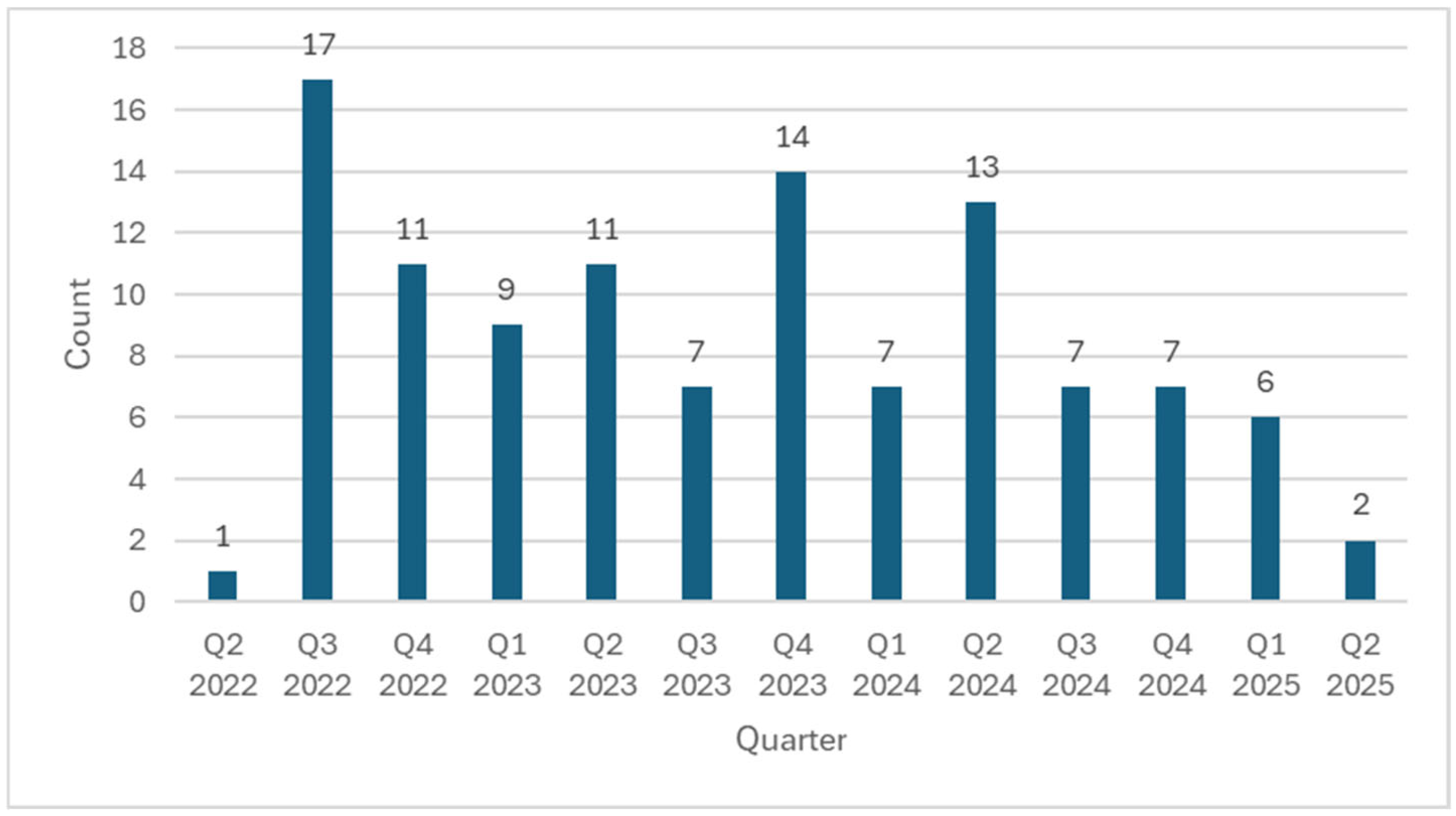
Media coverage of the six W2H projects has varied widely over time, ranging from one publication during Q2, 2022, to 17 publications during Q3, 2022 (Figure 2). The average across 13 quarters in the dataset was approximately 8.6 publications per quarter, with five quarters above average. Table 3 identifies the above-average quarters and summarizes some key events leading to peaks in media coverage.
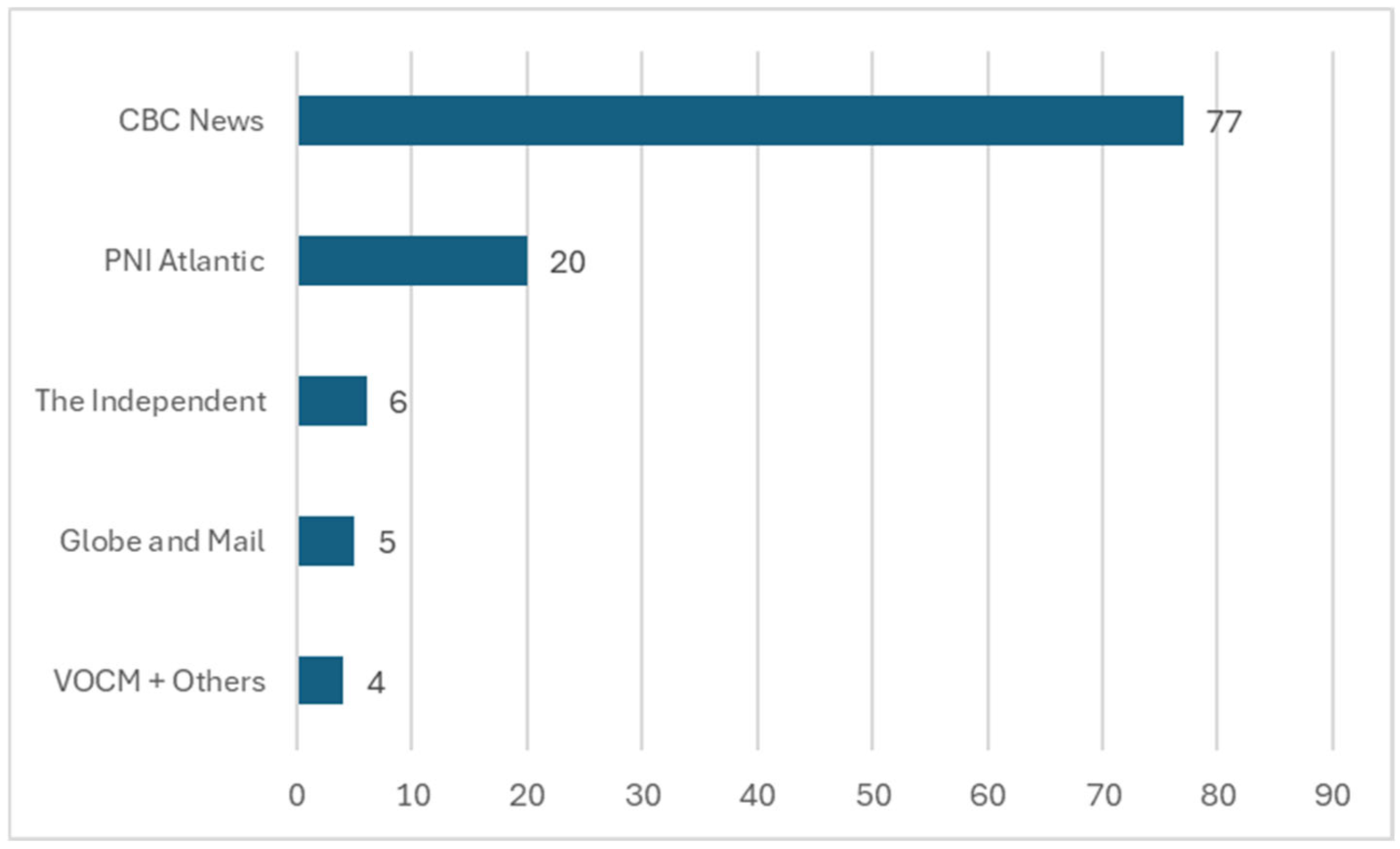
As demonstrated in Figure 3, the media review found articles published by seven unique outlets (The Category “VOCM + Others” includes two publications by ‘VOCM’, one by ‘Corporate Knights’, and one by ‘BNN Bloomberg’). CBC, Canada’s national public broadcaster, accounts for a large majority of the dataset, or approximately 69 per cent of the records. CBC maintains close to 50 stations and bureaus across Canada, with several spread across Newfoundland and Labrador’s vast geography. There are four bureaus on the island portion of the province, including Corner Brook, Grand Falls-Windsor, Gander, and St. John’s [165], meaning that there is a CBC bureau within close proximity to many of the proposed W2H sites. The findings suggest an important role for public broadcasters (such as CBC) in reporting on energy justice dynamics in sparsely populated rural and island regions, where a business case may not exist for the private sector. Combined, a multitude of private outlets, including PNI Atlantic, the Globe and Mail, VOCM, BNN Bloomberg, and Corporate Knights, account for 26% of the records. Postmedia is the parent company of PNI Atlantic News, a conglomeration of Atlantic Canadian news resources including the St. John’s Telegram in Newfoundland [166] (It is noted that Postmedia purchased ‘SaltWire Network Inc.’, a collection of 23 daily and weekly newspapers in Atlantic Canada and rebranded as ‘PNI Atlantic News’ in July of 2024, which is during the time period covered in this study.). The Independent, which alone accounts for five per cent of the records, is a not-for-profit media collective. The news source is unique in the study as it does not rely on corporate funding, unlike other media outlets that depend on it [167].
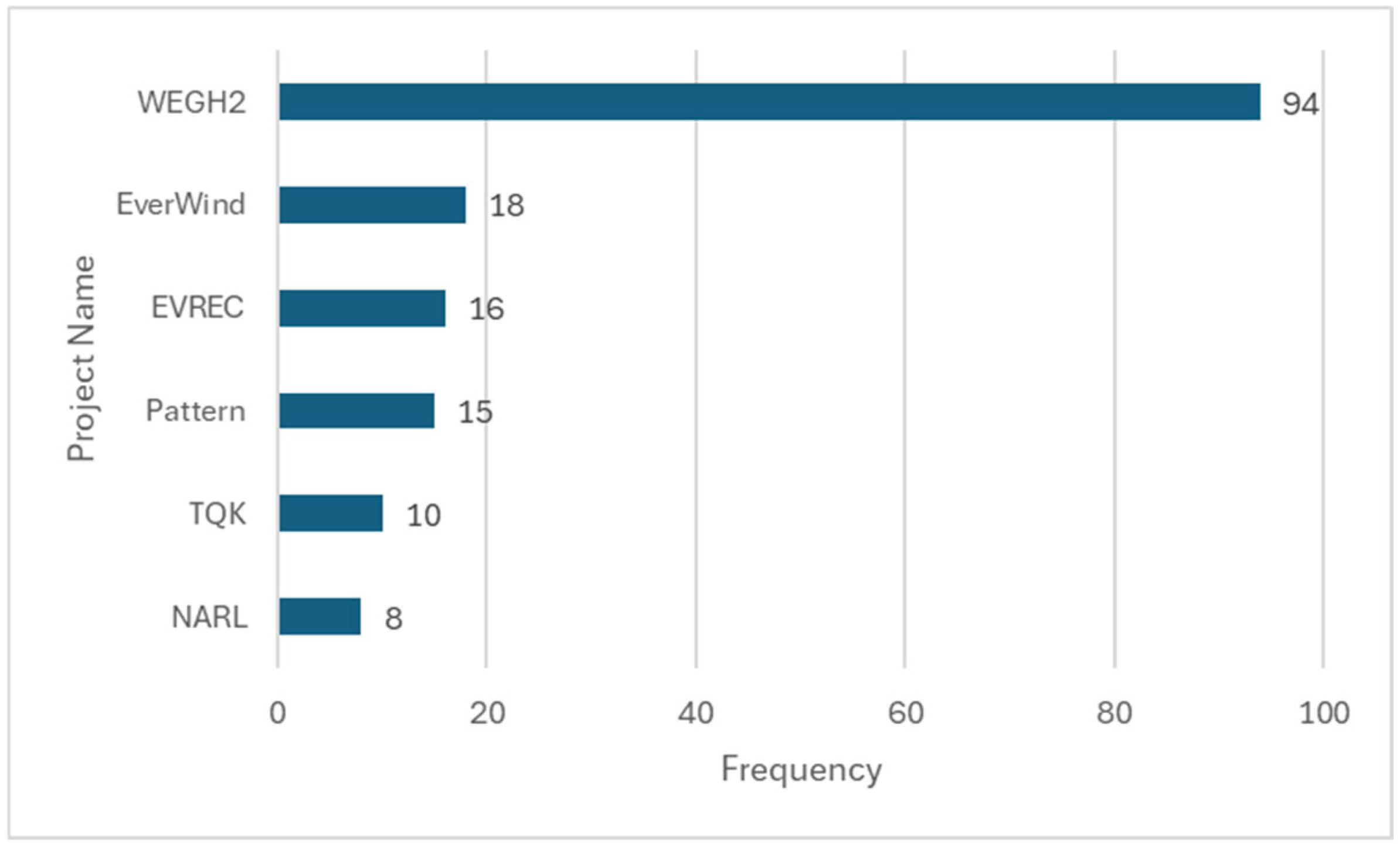
Figure 4 demonstrates which W2H projects are most often covered in the collected media reports. The data demonstrates a disproportionate focus on WEGH2, based in western Newfoundland. In fact, WEGH2 is mentioned by 94 articles, which is over five times greater than the next most frequently mentioned project, EverWind on the Burin Peninsula (n = 18). The five other projects combined are only mentioned 67 times—far less than the singular focus on WEGH2. Table 3 also provides some insight into why this is the case. For example, WEGH2 was the first project to register for (and ultimately secure) provincial environmental assessment, served as the launching site for the Canada–Germany Hydrogen Alliance, has been heavily scrutinized over potential conflicts of interests between developers and public officials, has seen several rallies both against and in favour of the project, and the company has purchased local businesses and supporting infrastructure.
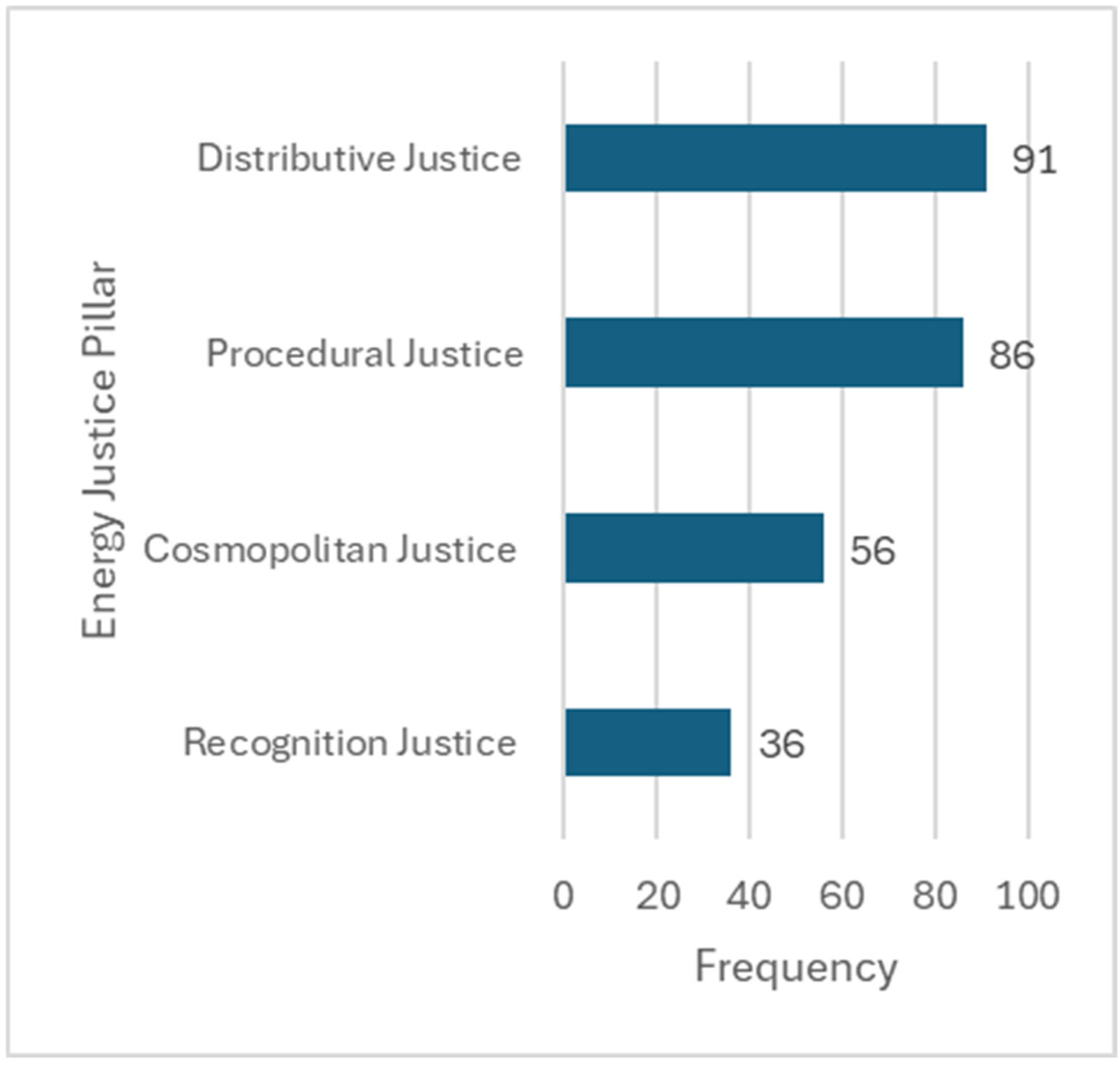
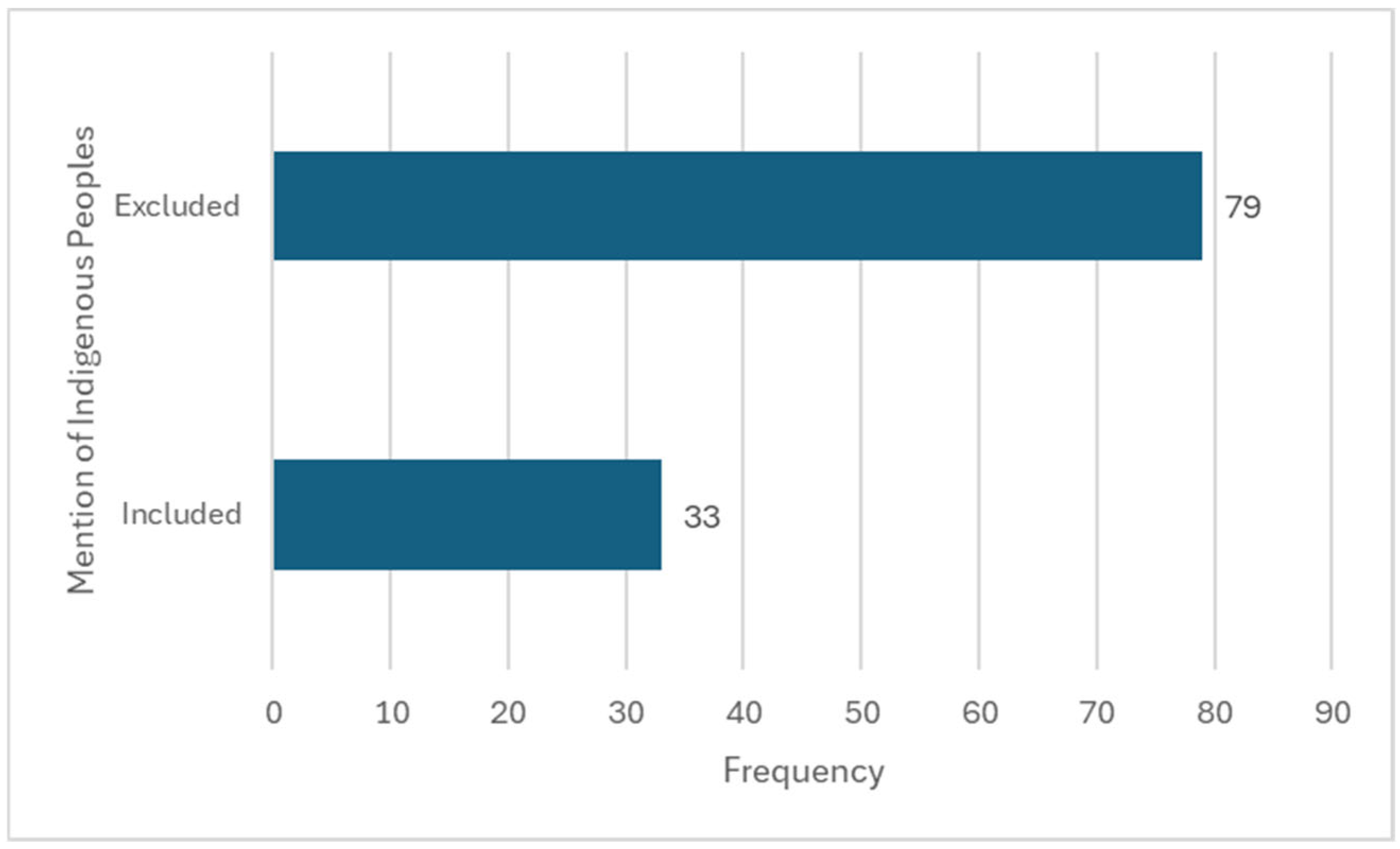
Figure 5 connects to the paper’s main research question, or ‘How wind-to-hydrogen projects in Newfoundland and Labrador are enabling or constraining energy justice?’. The frequencies here do not align with the broader media sample (n = 112), as many individual media reports engage with multiple themes of energy justice. While facets of distributive justice and procedural justice were most commonly reported on (n = 91, and n = 86, respectively), it is notable that cosmopolitan justice (n = 56) was more popular in the dataset than recognition justice (n = 36), which is frequently identified as one of three main pillars of energy justice research [24]. As such, the relative ignorance of recognition justice in W2H media reporting is a key finding of this research, which is further substantiated by the exclusion of Indigenous peoples across a large share of the dataset, who were mentioned by less than one-third of the articles (Figure 6).

4. Findings and Discussion

The following sections of the paper report on the main themes developed with respect to distributive justice (Section 4.1), procedural justice (Section 4.2), cosmopolitan justice (Section 4.3), and recognition justice (Section 4.4) emerging from the thematic analysis. Each subsection concludes with an interpretation, that is, discussing the patterns in relation to the broader literature and any emergent implications.

4.1. Distributive Justice

4.1.1. Distribution of Economic Impacts: Jobs, Capital Investment, Revenue Generation, Public Funding, and Profits

The most prominent economic benefit of W2H development mentioned across media reports was that of job creation. Media reports often cited high unemployment in rural Newfoundland as a rationale for the proposed projects. Other articles differentiate between the significant amount of employment generated during the construction phases of a W2H megaproject and the considerably lower number of long-term jobs created during operations and maintenance.
One of the main distributional tensions in the dataset concerns which segments of the population will benefit from these jobs, specifically the distinction between domestic and imported labour, as well as the gendered dimensions of employment in the energy industry. Distinctively, media reports note that all turbine manufacturing will occur outside of the province, meaning that employment opportunities available in N.L. are connected only to construction and operations. While a large number of temporary construction jobs will accompany each project, there is no guarantee that workers from host communities will be qualified and selected for these roles. Many articles note a larger provincial labour pool (i.e., from beyond host communities), but even this may become exhausted if several projects proceed concurrently, potentially risking increased costs associated with imported labour. One article proclaims, “A green energy transition will have to rely on come-from-away expertise,” while other reports suggest this can be partially mitigated by staggering projects and encouraging repatriation of skilled workers originally from NL. Some companies pledge to hire provincial workers first, to be codified through local benefits agreements, yet it is notable that no entries in our dataset consider this instrument in any detail.
One article brings attention to the acute underrepresentation of women in the energy industry. The report explains that most of the expected employment is in male-dominated roles such as construction workers, welders, electricians, and engineers. The article notes the lack of provincial policy support and targeted incentives for women to enter and remain in male-dominated trades and training programmes.
Behind job creation, intensive capital investment is the next most frequently cited potential benefit of Newfoundland’s W2H industry. Many sources qualify the substantial scale of capital investment required for a single project. Other sources note the collective impact of several projects. Several sources contend that large-scale capital investment will support existing businesses and foster the creation of spin-off industries. One article reports that even the speculative stages of a mega-project in Stephenville have supported business and housing permit growth by 30 per cent in 2024 alone. Some sources challenge the ‘spin-off’ benefit entirely, suggesting that beyond workers supporting the retail sector—especially groceries, alcohol, and gasoline—little contribution will be made to host communities.
Drawing comparisons to other extractive industries in the province, especially oil and gas, many articles stress revenue generation for provincial coffers as a potential benefit. Reporting optimistic projections by the province, in a case where four megaprojects were to proceed, would create a treasury impact of over $11 billion during the lifetime of the projects. The provincial fiscal framework supporting revenue-generation is detailed in the media, including a ‘wind electricity tax’ for in-service turbines, a water royalty payment to be paid once investment costs are covered, as well as water use fee payments to be paid upon issuance of permits. Some have criticized the water royalty scheme, given that payments are not made until capital costs are recovered, risking a scenario where royalty payments are delayed or may never materialize. The media also details crown land reserve and lease fees for project sites, noting that reserve fees for Crown lands amount to 3.5% annually of their market value, while lease fees are set at an annual 7%. Media reports note that tens of millions have already been paid to reserve hundreds of thousands of acres of Crown land.
The tax base for local governments is also expected to grow, and the company WEGH2 has pledged to pay PAPP communities whatever tax revenues it pays to the Town of Stephenville. This is in addition to a promised ‘Community Vibrancy Fund’ as part of the WEGH2 project. This unrestricted fund, to be paid across three years only if the project proceeds, will be distributed across host communities. Some sources have questioned how these funds will be shared across the communities, given that most are not incorporated municipalities and lack employees. It is the hope that revenue generation across scales will lead to enhanced public services for residents, such as health care, road improvements, and transportation infrastructure.
The media reports also detail the substantive public funding and support provided to project developers. For instance, WEGH2 previously received a $128 million ‘credit facility loan agreement’ through the Canadian government. Announced in 2022, the Clean Hydrogen Investment Tax Credit will provide 15–40% in tax reimbursements for eligible project costs, depending on the carbon intensity of the production method. These tax credits are expected to cost $5.6 billion over five years, and an additional $12.1 billion between 2028 and 2035. Furthermore, in 2023, the Canadian and German governments announced a shared $600 million auction subsidy to help bridge the gap in the ‘willingness to pay’ between Canadian producers and German off-takers. Some media reports highlight public funding as ‘strategic investments’ in the green energy sector, or as a means to incentivize private investment, while others highlight the risk of ‘subsidy harvesting’, or companies benefiting from public finance without a legitimate intention to invest. Finally, several reports note that if the corporately owned projects were to proceed, it is ultimately a small number of private investors who will benefit from profits generated.

4.1.2. Host Region Bears Ecological and Social Risks

A substantial number of sources highlight that host regions, i.e., where turbines and supporting infrastructure are built, disproportionately incur the ecological and social risks associated with the mega projects. Across the dataset, several key local ecological risks are highlighted, such as land-use transformation, impacts on plant and animal life, and freshwater consumption/degradation. From a land-use perspective, the articles note that wind farm sites will require significant land clearing and networks of new and upgraded roads to access turbine bases and to transport equipment. One article suggests that wind proponents have targeted over two million hectares of land on the island. This critique took on added importance on the Port au Port Peninsula, a small region roughly equivalent in size to the City of St. John’s, where wind development requires construction of 197 km of access roads. Land transformation disrupts wildlife habitat for species such as moose, woodland caribou, Arctic hare, and various bird species. Threats to plant life, including some rare and endangered species, are also mentioned by media reports. Across media reports, concerns are consistently expressed about impacts on and contamination of drinking water through construction activities. Abundant freshwater is required in the production of hydrogen, and some have expressed concern about the monetization of this precious resource. Others have flagged degradation of water quality as a result of developmental activities, while company officials have focused on mitigation measures.
From a social perspective, the media reports highlight possible damage to existing and regenerative industries in host regions, impacts on community infrastructure during construction periods, risks for human health, as well as degradation of traditional lifeways. A key regenerative industry covered is that of the outfitting sector, where those affected suggest that road construction and land clearing—which opens up hunting grounds and creates opportunity for predation—will disturb species such as moose. Conversely, others suggest that targeted species may be able to adapt in the long term, while private companies have raised the possibility of compensating the outfitting industry for losses in revenue. The tourism industry is also frequently mentioned, where project operations may industrialize valued landscapes and disturb visitors. Media reports detail the influx of workers and the strain that this may cause for communities and local infrastructure. Community members also face the brunt of health risks associated with the projects, such as noise pollution, spills of ammonia and other toxic substances, and increased traffic flows. Finally, the dataset highlights how the lifeways of rural and Indigenous peoples may be impacted, emphasizing traditional practices such as woodcutting and harvesting.

4.1.3. Human Resources: Educational and Demographic Impacts

Given the large number of projected jobs available, it follows that education and training may be necessary to ensure employment opportunities for Newfoundlanders and Labradorians. The College of the North Atlantic (CNA) in NL has recently established a school of sustainable development, including a one-year wind turbine technician programme at its Stephenville campus, as well as a two-year hydrogen technician diploma at its Corner Brook campus. While there were 21 students enrolled in the programmes as of 2023, others have questioned post-graduation employment prospects, given that no W2H projects are currently in operation in the province. One company in particular, WEGH2, has been vocal in offering ‘free’ training to residents within their project footprint, a pledge which they have supported through $160,000 in scholarships for students in the new programmes, and a promise to hire CNA graduates.
One notable source suggests that enrolment in these training programmes is dominated by men, and that dramatic revisions to enrolment policies and specific incentives will be required to enhance the recruitment and retention of women. The same source notes that women in the province are more likely to rely on university degrees to reach high-paying jobs, and that provincial support to the province’s only university has been cut in recent years, while the college system has seen expanded funding. Other media sources report that the Qalipu First Nation, a landless Mi’kmaw band in Newfoundland, has signed an agreement with a Netherlands-based trade school to train band members on green energy.
There are duelling claims across media reports with respect to demographic impacts. Proponents suggest that host communities will see large increases in population, a necessity in addressing ageing demographics across the province. These articles hypothesize that meaningful employment will help to retain younger generations and encourage Newfoundlanders working abroad or across Canada to return home. Conversely, opponents have suggested that projects will further exacerbate population decline, given the industrialization of rural landscapes.

4.1.4. Distributive Justice: Interpretation and Implications

A substantial number of media sources mirror the existing literature, interrogating who is employed on W2H projects, especially through the lens of gender and residency. However, the findings challenge scholars to adopt a more comprehensive lifecycle perspective on employment equity. For instance, one key source denotes that all turbine manufacturing will occur outside of NL. Significant employment is expected during construction phases, yet consideration must also be given to employment security and equity through planning, operation, and decommissioning phases, when total employment is considerably lower. Project proponents could commence this process by disclosing who has been employed on projects during their formative stages. This echoes the call of Mercer et al. [40], who argued that distributive justice should include consideration of value across temporal scales (e.g., short, medium, and long-term benefits).
Questioning the extent of spillover effects from W2H projects for host communities is not a new phenomenon [23]; however, the findings suggest a need for distributive analysis, no matter the scale of benefits. For instance, while the Town of Stephenville reports a single-year growth of 30% in housing and business permits, yet no detail is provided on who owns these businesses, or who constructs and occupies newly built houses. As such, W2H projects may simply be perpetuating the socioeconomic status quo.
The findings sit in tension with claims of some authors, who have argued that export-oriented W2H projects are mainly for the benefit of outsiders [26,27]. It is inconceivable that a jurisdiction would give its ‘natural resources’ away for free, and in an optimistic scenario, NL expects to generate several billion dollars in revenue through reported measures (e.g., wind tax, water royalty, water use fee, Crown land reserve and lease fees, etc.). The analysis does, however, point to a more granular injustice, which I term ‘revenue centralization’, or when payments are collected in a jurisdiction’s capital, and then spent on province-wide programmes and services, mainly outside of host areas (e.g., health care, education).
Media reports reveal an unstudied corporate benefit associated with W2H projects. While often framed as ‘strategic investments’ to accomplish broader policy objectives, W2H corporations in Canada benefit from billions of dollars of public finance via credit instruments, tax credits, and auction subsidies to help ‘de-risk’ their investments, and it is their private shareholders who will ultimately benefit from project profits.
Finally, while the existing literature raises the risks of water degradation and land-use transformation, these are framed predominantly as anthropocentric risks [19,26,33]. The findings highlight intrinsic risks for ecological communities in and of themselves, such as significant habitat degradation and subsequent impacts on diverse and sometimes rare plant and animal species [168]. Future studies could integrate ‘ecological justice’ as an additional energy justice tenet, or understanding the intrinsic value and integrity of ecosystem components.

4.2. Procedural Justice

4.2.1. Environmental Assessment as the Main Consultative Measure

The media reports situate the provincially legislated ‘environmental assessment’ (EA) process as the main participatory mechanism in the development of W2H projects, noting that any wind generation project greater than 1 MW is subject to EA, and that the overall goal of the EA process is to locate and mitigate environmental impacts of the projects. Media reports highlight the various stages of the assessment process, moving from initial environmental registration, a full environmental impact statement (EIS), any necessary amendments to the EIS, conditional approval/release by the regulators, and any subsequent appeals of the decision by stakeholders. The reports note that each phase of the EA process is governed by legislated timelines for regulatory review and periods for public comments. One source explains how each stage of the assessment process necessitates ‘review, input, and recommendations’ by dozens of public departments and agencies, as well as the general public, which is all ‘considered before a decision is made.’
Several critiques of EA as a participatory mechanism emerged across the dataset, centred on inadequate timelines for public review, accessibility of participation, and questions around power disparities between parties involved. With respect to timing, media reports detail how EA is innately a reactionary process for affected parties. That is, stakeholders often learn of developments and are quite often surprised by them, via announcements associated with the EA process, then must work quickly to study and formulate their responses in a legislated and restrictive timeframe. The accessibility of this process was repeatedly challenged, given that the public is given short windows to review lengthy documents, and that few have the time available amongst family and professional responsibilities to fully engage in the process. Others highlight the technical nature of EA submissions and express concern that this can discourage participation in the process.
While regulators repeatedly stress that “all public comments are considered before a decision…is made on the project,” others question who even reads public comments and express doubt that they have any power to influence decision-making. This critique, specifically the powerlessness to affect EA decision-making, seemed to be magnified by the fact that federal, provincial, and local governments struck several high-profile W2H agreements, including the Canada–German Hydrogen Alliance and Memorandums of Understanding with European ports, while the WEGH2 was still under regulatory review. Some have called for a federal EA to be applied to W2H projects in NL, which would enable groups to apply for intervenor status and research funding, which would help them confront these power differentials—although these calls were ultimately denied by the federal government.

4.2.2. Secondary Consultative Measures and Characteristics of Participation

Beyond the EA process, several other participatory measures and pledges to consult the public were described across the dataset. Many of these were specific to each project site. With respect to the WEGH2 project, the media reports mention measures such as the ‘Port au Port Project Committee’ made up of local government representatives, a company-operated community ‘engagement office’ established in Stephenville, a wind farm site visit in Ontario with residents, as well as a series of proponent-hosted community meetings in 2022 throughout the project footprint. These community meetings, however, were criticized for excluding Local Service Districts on the Peninsula, which are smaller communities without formal elected ‘councils’. Regarding the EverWind project, media reports centre on the ‘Energy Advisory Board’ (EAB), which is a coalition of local municipal leaders from many communities across the Burin Peninsula, acting as an intermediary between the proponent, local governments, and the public. While some have framed the EAB as a promotional vehicle for the project, others have countered that EAB representatives must be appointed by a town council. In the EVREC project site, media reports highlight a series of ‘public open houses’ or a ‘public information tour’ across the region in 2023.
Some other sources focus on province-wide measures, most notably the consultations held during the Crown lands nomination process, which helped inform which land areas would be opened for bids by prospective wind developers. Some media reports highlight how the Lewis Hills area in western Newfoundland, an ecologically and geologically sensitive site, was removed from the bidding stages as a result of these consultations.
Several concerns emerged across the dataset about consultative processes, including questions of the timing of stakeholder involvement, power devolution, and overall transparency. A select few sources commend developers for engaging communities proactively prior to formal regulatory review, especially across the EverWind and EVREC project sites. Conversely, the WEGH2 project was criticized for notifying and informing communities about their plans just weeks prior to their submission to the formal environmental assessment process. Proactive stakeholder engagement appears in tension with the urgency demanded by several wind developers and public officials who sought to expedite oversight and regulatory review in the name of industry competitiveness. A small number of sources dealt with questions of power, mainly the fact that inadequate pre-EA consultations make community members feel powerless in shaping outcomes, or how, in representative democracies, elected representatives may listen to the public but ultimately hold exclusive decision-making authority. Another high-level critique included a lack of accessible information about the proposed developments.
Community mistrust and cynicism of developers and public officials were touched on by media reports. Most of the reporting here centred on two potential or perceived conflicts of interest. The first involved former Premier Andrew Furey’s close personal relationship with two directors of the WEGH2. The media reports detail how the Premier vacationed at John Risley’s, the chairman of WEGH2, fishing lodge, less than a year prior to ending the province’s long-standing moratorium on onshore wind development. The second surrounded several councillors and staff from the Town of Stephenville, the host of WEGH2’s proposed ammonia/hydrogen plant, returning from an international hydrogen conference on John Risley’s private jet. While some presented the private flight as a cost-saving measure (compared to paying for commercial flights), others characterized the trip as a gift that put the travelling party in a clear position of conflict.

4.2.3. Contested Developments

The media reports give a mixed and contested view on the social acceptance of proposed wind developments. Competing claims of community opposition and support seem concentrated within the WEGH2, EVREC, and EverWind project footprints. Many have noted the sizeable opposition to the WEGH2 project on the Port au Port Peninsula, yet municipal support in the adjacent urban area of Stephenville is steadfast. Indigenous leaders close to the WEGH2 project have acknowledged community disharmony and have called for a mediation process to help resolve conflict. Still others have claimed that the opposition within these project footprints is only a ‘vocal minority’.
In some cases, the competing claims are substantiated with data. For instance, opponents cite a community-led survey which found that 84% of residents were opposed to WEGH2’s plans, while proponents cite a company-commissioned survey which found that 80% of people in western Newfoundland “support land-based wind energy.” Likewise, industry and public officials claim widespread public support for the EVREC project, while others cite a community survey which shows close to half the population is opposed.
With respect to public advocacy in support of the WEGH2 project, one rally is reported across the dataset. The media report suggests that the rally was well attended, although questions were raised with respect to the impartiality of the organizers, who claim independence, yet have been profiled in promotional videos published by the developer.
Conversely, numerous instances of organized opposition are detailed across media sources. One of the most notable events included a multi-week road blockade near a WEGH2 wind testing site in the community of Mainland during the winter of 2023. The company ultimately won an injunction against the protesters, which was enforceable by local police. The blockade gained added attention after vandalism to company equipment was discovered at the blocked work site. While authorities suggested that the suspect was not connected to the protest, the company claimed that the inability to access the worksite “created the opportunity for this equipment to be vandalized.”
Other notable oppositional events include: ‘Rally the Rock’, a campaign against mega wind-to-hydrogen projects organized by a group called Protect NL, with several rallies held across the province; an organized protest held during the signing of the Canada–Germany Hydrogen Alliance in Stephenville; protests held on the doorsteps of high-profile provincial energy conferences; and advocacy signs displayed throughout the Port au Port Peninsula. The media reports also detail digital forms of advocacy, such as online forums hosted by grassroots organizations and social media groups in the EVREC and WEGH2 project footprints, which in some cases boast hundreds of members.

4.2.4. Procedural Justice: Interpretation and Implications

Similarly to the existing literature, the media set focuses on EIA as a main component of procedural justice in W2H projects [18,19,27]. EIA has been extensively critiqued by others [27]; however, the findings demonstrate several novel, context-specific limitations of the process.
Firstly, EA is innately a reactionary process, where affected stakeholders are often taken by surprise, then forced to respond to filings according to legislated timelines. This falls short of ‘proactive involvement’ demanded by scholars of participatory justice to enable meaningful shaping of outcomes [40,169]. Secondly, while calling for funding for intervenor groups is admirable, it is worth noting that this is necessitated by the onerously technical nature of submissions, as well as the bandwidth of the public to participate, which could be addressed through non-financial mechanisms as well (accessible writing, community briefs, longer review periods, etc.). Thirdly, EIA is a dismal form of power devolution. The process often consists of comment coalitions by anonymous bureaucrats, limited or non-existent replies, and a lack of transparency on how or if comments are mobilized. This pales in comparison to shared decision-making processes, such as community co-management boards, public referenda on natural resource projects, direct democracy innovations, or a lifecycle ‘Social License to Operate’ [44,170,171].
The media set has drawn attention to a diverse array of non-EA participatory processes. It must be acknowledged that several of the critiques relevant to EA are also evident here, including engaging late in the development/design process, incomplete disclosure of information, and limited power to affect outcomes. A key takeaway is that no participatory process should ever be assessed as innately benign, and that consultative mechanisms can always be assessed according to their procedural traits.
The findings encourage reflection on social acceptance for the long-term sustainability of W2H and other mega projects. While proponents and community organizations draw on different data sources to document community acceptance/opposition, there is undoubtedly a substantive portion of the public who fiercely resist W2H development in NL, as evidenced through online organizing, rallies, targeted protests, road blockades, and displayed symbols/signage. Several scholars emphasize that social acceptance is key to the longevity of renewable energies, as protests, legal maneuvering, and social movements can cause substantive delays and topple political support for the industry [172,173,174]. As such, documented and democratic community support should be considered just as essential as securing capital investment when assessing the viability of a project.

4.3. Cosmopolitan Justice

4.3.1. Exports to European Markets

A substantive portion of the dataset conveys that NL’s W2H developments will convert hydrogen to ammonia for export to global and European markets. These efforts are highlighted by a provincial MOU to explore hydrogen-to-ammonia opportunities with the Port of Rotterdam, the largest port in Europe. However, other sources note that export plans have been slow to materialize, and only one NL developer (Pattern Energy) has signed an agreement with a foreign buyer, which itself was a preliminary letter of interest as opposed to a binding agreement. Some media reports criticize the export-oriented nature of proposed projects and suggest that limited, if any, power will be available for domestic consumption. Other reports counter that domestic demand can be scaled up while focusing on exports, or specifically mention that provincial refineries are targeted for short-term conversion to hydrogen fuel.
Several reports centre on German interest in hydrogen imports, including the establishment of a Crown Corporation that seeks to purchase green hydrogen and introduce the fuel throughout the German economy. Critical here is the Canada–Germany Hydrogen Alliance (CGHA), signed in Stephenville in 2022. The CGHA is a non-binding agreement between national governments to establish a transatlantic supply corridor and commence hydrogen shipments by 2025.

4.3.2. Global Decarbonization and European Energy Security

Numerous media reports suggest that hydrogen/ammonia exports from Newfoundland, an emissions-free fuel source upon combustion, will contribute to the global goal of confronting climate change via carbon reduction. Some reports specifically highlight how renewable energy-derived hydrogen can displace the dominance of fossil-fuel-produced hydrogen, and the specific role that hydrogen fuel can play in ‘hard to decarbonize’ industries such as shipping and aviation. Conversely, a single source mentions that W2H projects themselves can contribute to climate change via hydrogen leakages, which trigger greenhouse gas-intensive chemical reactions.
Enhanced energy security for importers is another frequently cited benefit of NL’s proposed W2H projects. Much of this discourse is targeted at European countries, which are seeking to transition away from Russian oil and gas. Many sources note the urgency of enhancing European energy security owing to Russia’s invasion of Ukraine and subsequent surges in natural gas prices and threats to energy supply.

4.3.3. Cosmopolitan Justice: Interpretation and Implications

An innovation of this study is the integration of cosmopolitan justice in the analysis of hydrogen developments [19]. By no means does the paper suggest that these global benefits should supersede local realities and risks, only that they must be considered in assessing project trade-offs (i.e., weighing the multiple benefits and risks of projects at different points in time) [175]. The impacts of renewable energy development in NL cascade far beyond provincial borders and should not be ignored. For instance, the end product (hydrogen/ammonia) of the projects is destined primarily for global/European markets, where, in ideal scenarios, it will be used to displace fossil-fuel-derived hydrogen and support decarbonization in hard-to-abate sectors. This is at best an indirect contribution to cosmopolitan justice, as the energy is meant to support consumers broadly, as opposed to specific vulnerable populations. The energy security angle, i.e., helping European countries diversify from authoritarian or volatile regimes, may have more direct contributions to cosmopolitan justice, given the vulnerabilities directly faced by European consumers [176].

4.4. Recognition Justice

4.4.1. Project Support from Indigenous Leadership: Questioning from Indigenous Membership

The two federally recognized First Nations on the island of Newfoundland, including Qalipu First Nation (QFN), as well as Miawpukek First Nation (MFN), have been positioned as active collaborators with NL’s proposed W2H projects. For context, the province of Newfoundland and Labrador is the contemporary home of four peoples of Indigenous ancestry [177]. Three of these peoples are within Labrador, including the Inuit, Innu, and the Southern Inuit of NunatuKavut, who each have unique governance contexts and varying degrees of rights and recognition. Newfoundland Mi’kmaq are found on the island portion of the province. Conne River is a reserve recognized by the federal government since 1987, and its people are represented by the Miawpukek First Nation [178]. Other people of Mi’kmaq descent live throughout central and western Newfoundland, historically represented by the Federation of Newfoundland Indians (FNI) [177]. FNI has been central to the long fight for recognition of Newfoundland Mi’kmaq since its formation in 1972, culminating in federal recognition in 2011, when Qalipu First Nation was created as a “band” under the Indian Act by Order in Council [178,179,180]. Qalipu First Nation is understood as a landless band, meaning it does not manage any government-owned reserve land [181]. Approximately 25,000 members are spread across 67 traditional communities, which are subdivided into nine electoral wards [181,182]. As such, many of the W2H projects in NL interact with Mi’kmaq communities, although they are not formally on Mi’kmaq-managed land. Numerous non-status bands continue to exist throughout the island, including those involved in the formation of FNI, offering important cultural programmes and services to members [179,183].
QFN has signed an MOU with EVREC, an MOU with WEGH2, which prioritizes band ‘oversight’ of the project, as well as a partnership agreement with Netherlands-based DOB Academy, in order to establish a wind-industry training programme for band membership. MFN has signed an MOU with ABO Energy, as well as partnership agreements with several other developers that were not successful in the province’s initial Crown land reserve process. Elected Chiefs of both First Nations attended the signing of the previously discussed CGHA, and both First Nations entered into an agreement with WEGH2 to purchase the Port of Stephenville, a site which is planned to ship hydrogen created in the province globally. One media source notes that the long-term administrative chief of MFN, Mi’sel Joe, has recently retired and is now a strategic adviser for WEGH2.
Several other Indigenous organizations are mentioned in media reporting, especially groups involved with the Newfoundland Association of Rural Mi’kmaq Nations (NARMN). For instance, Chief Jason Benwah of Benoit First Nation (BFN) has been a vocal supporter of the WEGH2 project, citing possible benefits such as economic revitalization, job creation, emissions reductions, as well as population retention and growth. One source suggests that BFN has signed an MOU with WEGH2, emphasizing independent oversight of the project. Chief Peggy White of the Three Rivers Mi’kmaw Band has supported the WEGH2 project in the hopes that job creation will help preserve Indigenous cultures. Critically, a single media report acknowledges that NARMN bands, specifically the Benoit First Nation, are non-status bands, not recognized by the federal government.
Some media reports suggest that while Indigenous leaders have supported W2H projects, this support is not based on consultation with their membership. For instance, one opponent suggested that the majority of QFN members living in the EVREC project footprint do not support the development, and that the proponent’s claims to have the support of the QFN are therefore unfounded. Leaders of bands within the NARMN seemed to acknowledge this tension when they publicly called for mediation, helping to resolve widespread conflicts within their respective communities.

4.4.2. Contested Mi’kmaw Lifeway Impacts and Teachings

There are competing claims across the dataset about the compatibility of W2H projects with Mi’kmaw culture on the island. On the supportive side, proponents claim that First Nations embrace low-carbon economic development, and that proposed projects will preserve and strengthen Indigenous cultures by preventing out-migration in search of employment. Opponents fear degradation of Indigenous cultures, including emotional and spiritual well-being. Impacts on traditional practices such as hunting, trapping, foraging, firewood gathering, as well as the ability to transmit that knowledge to younger generations, were centred across the dataset. Both sides of the debate cite the ‘7th generation principle,’ an important teaching across many Indigenous cultures, when justifying their position.

4.4.3. Misrecognition

There are instances of misrecognition shared across the media reports. Most frequently, supporters of the projects describe the views of opponents as being based on “fear,” “misinformation,” or “conspiracy theories.” Notably, these critiques are often made by those in positions of power, including the previous Minister of Industry, Energy, and Technology, as well as the previous Mayor of Stephenville, who stated, “It is a fully green entity, but sometimes people oppose it because they are not truly informed on the project.” Relatedly, community opposition is often dismissed as ‘NIMBYism,’ or simply not wanting the project in their own backyard. Finally, some present a false binary, or that by rejecting a proposed W2H project, locals are opposed to all forms of renewable energy development.

4.4.4. Recognition Justice: Interpretation and Implications

Earlier, it was demonstrated that less than one-third of included articles even mention the experiences of Indigenous peoples (n = 112), let alone other diverse segments of the population in NL (Figure 5). While ‘recognition justice’ is promoted as one of three primary tenets of the field [24], it is not permeating media reporting in NL, and perhaps public consciousness, as a result. Tellingly, themes of cosmopolitan justice, a concept highlighted by only a few scholars in the W2H industry, were more frequently discussed than recognition justice [19]. This builds on the findings of Ouellet-Dallaire et al. [27], who found a lack of meaningful attention to the W2H project’s gendered impacts in the EIA process in NL.
The earlier literature review identified community exclusion, especially for Indigenous peoples, as a feature of recognition (in)justice and hydrogen projects. The findings offer an alternative narrative, one where Indigenous organizations have been deeply involved in hydrogen development, through signing MOUs with developers, representation and participation in partnership agreements (e.g., the Canada–Germany Hydrogen Alliance), and direct employment of high-profile individuals (e.g., Chief Mi’sel Joe). However, the findings demand a deeper interrogation of Indigenous involvement in the hydrogen sector, and a recognition that Indigenous communities are not monolithic, possessing deep intercommunity and intracommunity diversity, with ramifications for their inclusion.
For instance, while elected bands have been active collaborators, substantive portions of band membership express scepticism or outright resistance to proposed activities. Several non-status Indian bands are widely represented in media reporting, yet the legal status of these entities is seldom considered. Reporting on non-status bands can shape public perceptions, but questions remain about their representational authority, or the legitimacy of agreements in which they enter. Analysis of intra- and intercommunity diversity would enable better consideration of Indigenous inclusion in hydrogen governance, including the contested ways in which sacred Indigenous teachings (i.e., the seven generations principle) are being incorporated into decision-making.
Disrespect or devaluing of local knowledge, including through characterizing resistance as mere ‘NIMBYism’, has been well established in the hydrogen justice literature [23]. Similarly, the findings show how new labels such as ‘fear’, ‘misinformation’, ‘conspiracy theories’, or presenting false dichotomies (e.g., in favour or against renewable energy) are wielded by decision-makers (e.g., mayors, cabinet ministers, etc.) to minimize local concerns.

4.5. The Importance of Independent Media in Advancing Energy Justice Narratives

As a final point of discussion, the findings draw attention to the significant role of independent media in reporting and disseminating principles of energy justice. Independent articles, especially those provided by the Independent NL, encompassed only a small portion of the overall dataset (n = 6/112). However, on numerous occasions, reports from this outlet advanced unique and evidence-based arguments that were not considered or included in more widely distributed public/private media outlets.
For example, the Independent NL was the only source to mention the potential climate warming effect of hydrogen leaks—a paramount consideration, given these projects are being advanced to decarbonize industries globally. The Independent NL was the only source to draw attention to the non-status nature of several Mi’kmaw bands within the W2H project footprints, raising important questions about representational authority and legitimacy of such groups. The Independent NL was the only source to identify that all manufacturing jobs in NL’s W2H industry would be created outside of the province. The Independent NL was the only source to question the extent of economic spinoffs as a result of energy megaprojects. In short, this small independent outlet offers profound insight into dimensions of distributive, procedural, and recognition justice—and future researchers, especially those conducting media reviews, should ensure that independent media, not only conventional sources, are centred in their analysis.

5. Conclusions

Hydrogen and ammonia exports offer the potential to resolve Newfoundland and Labrador’s long-standing structural barriers to developing a distributed renewable energy industry. While the new industry helps to overcome historical techno-economic challenges, the paper demonstrates the emergence of significant energy injustices as a result of W2H initiatives in the province. From a distributive justice perspective, W2H initiatives may offer a windfall of economic activity, although critical questions remain over who will have access to these benefits, and a realization that socioecological risks are concentrated in host communities. From a procedural justice perspective, the paper highlights the limitations of ‘environmental assessment’ as a participatory process and brings attention to mechanisms which legitimately devolve power to communities (e.g., direct democracy). Considering cosmopolitan justice, the paper finds uncompelling evidence that NL’s emerging W2H industry will specifically support vulnerable peoples globally via decarbonization, although it does identify energy security for importing nations as an area of importance. Finally, from a recognition justice lens, the paper challenges existing literature, which claims that Indigenous peoples are predominantly excluded from green hydrogen projects. Instead, the paper documents ardent supporters, profound inter and intracommunity diversity, and calls for the consideration of such complexity in future studies. In all, the paper offers a timely and cautionary case study for dozens of other nations that are developing national hydrogen strategies and seeking the rapid advancement of projects.
Given that W2H projects in NL are currently in the development/pre-production phases, with diminishing hope for commercial offtake agreements on the horizon [116], the main policy recommendation is to revisit and transform incumbent participatory mechanisms, allowing for agency within the affected communities. As discussed in this paper, the tenets of energy justice are deeply intertwined, and community autonomy may provide negotiating leverage to capture a greater share of project benefits (if that is, in fact, the desire of a community). NL is no stranger to such participatory innovation. For instance, the newly elected Premier of the Province, Tony Wakeham, has pledged to subject the re-development of the province’s largest hydroelectric asset (Churchill Falls) to a public referendum, stating boldly, “We will bring it to the people of Newfoundland and Labrador to have its say” [184]. This raises the question: do not residents in the footprint of gargantuan W2H projects also deserve a meaningful say? To ensure a ‘just energy transition’, and not simply an ‘energy transition’, policymakers must genuinely embed unique distributive mechanisms to ensure benefits for host communities (e.g., impact benefits agreements, equity stakes, host region royalties, etc.), procedural reform which helps to devolve control to communities (direct democracy, social licence to operate, community co-management boards, etc.) and develop a critical view of the nature and extent of the involvement of Indigenous peoples beyond vocal supporters.

Supplementary Materials

The following supporting information can be downloaded at: https://www.mdpi.com/article/10.3390/su172411035/s1, Spreadsheet S1: Metadata and Coding Frequencies of News Articles (n = 112) on Newfoundland and Labrador’s Wind-to-Hydrogen Projects [14,16,53,54,55,56,57,58,59,60,61,62,63,64,65,66,67,68,69,70,71,72,73,74,75,76,77,78,79,80,81,82,83,84,85,86,87,88,89,90,91,92,93,94,95,96,97,98,99,100,101,102,103,104,105,106,107,108,109,110,111,112,113,114,115,116,117,118,119,120,121,122,123,124,125,126,127,128,129,130,131,132,133,134,135,136,137,138,139,140,141,142,143,144,145,146,147,148,149,150,151,152,153,154,155,156,157,158,159,160].

Funding

This research received no external funding.

Institutional Review Board Statement

Not applicable.

Informed Consent Statement

Not applicable.

Data Availability Statement

The original contributions presented in this study are included in the article/Supplementary Material. Further inquiries can be directed to the corresponding author.

Conflicts of Interest

The author declares no conflicts of interest.

References

  1. Energy Research & Innovation Initiative. Growler Energy: Final Redacted Version. 2022. Available online: https://energyresearchinnovation.ca/wp-content/uploads/2022/10/E010_Growler-Energy-FINAL-2-Redacted-Version-POST.pdf (accessed on 14 October 2025).
  2. Center for Sustainable Systems; University of Michigan. Wind Energy Factsheet; Pub. No. CSS07-09; Center for Sustainable Systems: Ann Arbor, MI, USA, 2025; Available online: https://css.umich.edu/publications/factsheets/energy/wind-energy-factsheet (accessed on 14 October 2025).
  3. Fisher, K.; Iqbal, M.T.; Fisher, A. Small Scale Renewable Energy Resources Assessment for Newfoundland. Available online: https://www.researchgate.net/profile/M-Tariq-Iqbal/publication/347441405_Small_scale_renewable_energy_resources_assessment_for_Newfoundland/links/5fdc0eef45851553a0c6f683/Small-scale-renewable-energy-resources-assessment-for-Newfoundland.pdf (accessed on 14 October 2025).
  4. Barrington-Leigh, C.; Ouliaris, M. The renewable energy landscape in Canada: A spatial analysis. Renew. Sustain. Energy Rev. 2017, 75, 809–819. [Google Scholar] [CrossRef]
  5. Canadian Renewable Energy Association. By the Numbers; Canadian Renewable Energy Association: Ottawa, ON, Canada. Available online: https://renewablesassociation.ca/by-the-numbers/ (accessed on 14 October 2025).
  6. Mercer, N.; Sabau, G.; Klinke, A. Wind energy is not an issue for government: Barriers to wind energy development in Newfoundland and Labrador, Canada. Energy Policy 2017, 108, 673–683. [Google Scholar] [CrossRef]
  7. CBC News. NL Lifts Wind Development Moratorium. 2022. Available online: https://www.cbc.ca/news/canada/newfoundland-labrador/nl-wind-moratorium-lifts-1.6409296 (accessed on 14 October 2025).
  8. Government of Newfoundland and Labrador. Ministerial Statement—Minister Parsons Announces End of Moratorium on Wind Development. News Release. 5 April 2022. Available online: https://www.gov.nl.ca/releases/2022/iet/0405n07/ (accessed on 14 October 2025).
  9. Government of Newfoundland and Labrador. Update Provided on Wind Development Process. News Release. 26 July 2022. Available online: https://www.gov.nl.ca/releases/2022/iet/0726n04/ (accessed on 14 October 2025).
  10. Government of Newfoundland and Labrador. Minister Parsons Launches Hydrogen Development Action Plan for Newfoundland and Labrador. News Release. 14 May 2024. Available online: https://www.gov.nl.ca/releases/2024/iet/0514n01/ (accessed on 14 October 2025).
  11. Government of Newfoundland and Labrador. Hydrogen Development Action Plan; Department of Industry, Energy and Technology: St. John’s, NL, Canada. Available online: https://www.gov.nl.ca/iet/files/Hydrogen-Development-Action-Plan.pdf (accessed on 14 October 2025).
  12. Montevecchi, B. Letter: Oil Companies and the CNLOPB—A Scandalous Relationship. PNI Atlantic. 2017. Available online: https://www.saltwire.com/newfoundland-labrador/letter-oil-companies-and-the-cnlopb-a-scandalous-relationship-137380 (accessed on 26 November 2025).
  13. Government of Newfoundland and Labrador. Wind Hydrogen Projects; Department of Industry, Energy and Technology: St. John’s, NL, Canada. Available online: https://www.gov.nl.ca/iet/wind-hydrogen-projects/ (accessed on 14 October 2025).
  14. Meet the Players Behind 8 Companies Pitching Green Hydrogen Projects in N.L. Available online: https://www.cbc.ca/news/canada/newfoundland-labrador/hydrogen-companies-energy-nl-1.6859573 (accessed on 14 October 2025).
  15. Fish, Food and Allied Workers Union (FFAW). Ongoing Wind Developments. Available online: https://ffaw.ca/inshore/industry-relations/energy-industry-relations/wind/ongoing-wind-developments/ (accessed on 14 October 2025).
  16. SaltWire News. Why are Some Community Members Concerned About NL’s Proposed Wind Energy Projects? 2023. Available online: https://www.saltwire.com/newfoundland-labrador/why-are-some-community-members-concerned-about-nls-proposed-wind-energy-projects (accessed on 14 October 2025).
  17. The Independent. ‘No One is Representing Us’: Port au Port Residents Protest Outside EnergyNL Conference. Available online: https://theindependent.ca/news/no-one-is-representing-us-port-au-port-residents-protest-outside-energynl-conference/ (accessed on 14 October 2025).
  18. Dembi, V. Ensuring Energy Justice in Transition to Green Hydrogen. Electron. J. 2022. Available online: https://papers.ssrn.com/sol3/papers.cfm?abstract_id=4015169 (accessed on 2 December 2025).
  19. Patonia, A. Green hydrogen and its unspoken challenges for energy justice. Appl. Energy 2025, 377, 124674. [Google Scholar] [CrossRef]
  20. Earthjustice. Reclaiming Hydrogen for a Renewable Future: Distinguishing Oil & Gas Industry Spin from Zero-Emission Solutions. Available online: https://earthjustice.org/feature/green-hydrogen-renewable-zero-emission (accessed on 14 October 2025).
  21. World Energy Council; Electric Power Research Institute; PwC. National Hydrogen Strategies: Hydrogen on the Horizon—Ready, Almost Set, Go? World Energy Council: London, UK, 2021; Available online: https://www.worldenergy.org/assets/downloads/Working_Paper_-_National_Hydrogen_Strategies_-_September_2021.pdf (accessed on 14 October 2025).
  22. International Renewable Energy Agency (IRENA). Geopolitics of the Energy Transformation: The Hydrogen Factor; IRENA: Abu Dhabi, United Arab Emirates, 2022; Available online: https://www.irena.org/-/media/Files/IRENA/Agency/Publication/2022/Jan/IRENA_Geopolitics_Hydrogen_2022.pdf (accessed on 14 October 2025).
  23. Lindner, R. Green hydrogen partnerships with the G lobal South. Advancing an energy justice perspective on “tomorrow’s oil”. Sustain. Dev. 2023, 31, 1038–1053. [Google Scholar] [CrossRef]
  24. Jenkins, K.; McCauley, D.; Heffron, R.; Stephan, H.; Rehner, R. Energy justice: A conceptual review. Energy Res. Soc. Sci. 2016, 11, 174–182. [Google Scholar] [CrossRef]
  25. McCauley, D.A.; Heffron, R.J.; Stephan, H.; Jenkins, K. Advancing energy justice: The triumvirate of tenets. Int. Energy Law Rev. 2013, 32, 107–110. [Google Scholar]
  26. Müller, F.; Tunn, J.; Kalt, T. Hydrogen justice. Environ. Res. Lett. 2022, 17, 115006. [Google Scholar] [CrossRef]
  27. Dallaire, C.O.; Jekanowski, R.W.; Roberts, J. Left behind: A critical assessment of gender equity in Project Nujio’qonik’s environmental impact statement in the context of Newfoundland’s wind-to-hydrogen industry. Appl. Energy 2025, 394, 125964. [Google Scholar] [CrossRef]
  28. European Hydrogen Observatory. The European Hydrogen Market Landscape—November 2024; Clean Hydrogen Joint Undertaking: Brussels, Belgium, 2024; Available online: https://observatory.clean-hydrogen.europa.eu/sites/default/files/2024-11/The%20European%20hydrogen%20market%20landscape_November%202024.pdf (accessed on 14 October 2025).
  29. Cleveland, C. What Is the Status of Women in the Global Wind Energy Industry? Visualizing Energy. 2023. Available online: https://visualizingenergy.org/what-is-the-status-of-women-in-the-global-wind-energy-industry/ (accessed on 14 October 2025).
  30. Merten, F.; Krüger, C.; Scholz, A. Assessment of the Advantages and Disadvantages of Hydrogen Imports Compared to Domestic Production; Wuppertal Institute for Climate, Environment and Energy: Wuppertal, Germany, 2020; Available online: https://wupperinst.org/en/p/wi/p/s/pd/932 (accessed on 14 October 2025).
  31. Hydrogen Europe. Hydrogen Production & Water Consumption; Hydrogen Europe: Brussels, Belgium, 2020; Available online: https://hydrogeneurope.eu/wp-content/uploads/2022/02/Hydrogen-production-water-consumption_fin.pdf (accessed on 14 October 2025).
  32. Basaria, N. A First Look at Water Demand for Green Hydrogen and Concerns and Opportunities with Desalination. 2024. Available online: https://ptx-hub.org/a-first-look-at-water-demand-for-green-hydrogen-and-concerns-and-opportunities-with-desalination/ (accessed on 14 October 2025).
  33. Sadat-Razavi, P.; Karakislak, I.; Hildebrand, J. German media discourses and public perceptions on hydrogen imports: An energy justice perspective. Energy Technol. 2025, 13, 2301000. [Google Scholar] [CrossRef]
  34. Sovacool, B.K.; Dworkin, M.H. Energy justice: Conceptual insights and practical applications. Appl. Energy 2015, 142, 435–444. [Google Scholar] [CrossRef]
  35. Arnstein, S.R. A ladder of citizen participation. J. Am. Inst. Plan. 1969, 35, 216–224. [Google Scholar] [CrossRef]
  36. United Nations Economic Commission for Europe (UNECE). Convention on Access to Information, Public Participation in Decision-making and Access to Justice in Environmental Matters; UNECE: Aarhus, Denmark, 1998; Available online: https://unece.org/fileadmin/DAM/env/pp/documents/cep43e.pdf (accessed on 14 October 2025).
  37. Yenneti, K.; Day, R. Procedural (in) justice in the implementation of solar energy: The case of Charanaka solar park, Gujarat, India. Energy Policy 2015, 86, 664–673. [Google Scholar] [CrossRef]
  38. Van Uffelen, N. Revisiting recognition in energy justice. Energy Res. Soc. Sci. 2022, 92, 102764. [Google Scholar] [CrossRef]
  39. McHarg, A. Energy justice: Understanding the ‘ethical turn’in energy law and policy. In Energy Justice Energy Law; Oxford University Press: Oxford, UK, 2020; pp. 15–30. [Google Scholar]
  40. Mercer, N.; Martin, D.; Wood, B.; Hudson, A.; Battcock, A.; Atkins, T.; Oxford, K. Is ‘eliminating’ remote diesel-generation just? Inuit energy, power, and resistance in off-grid communities of NunatuKavut. Energy Res. Soc. Sci. 2024, 118, 103739. [Google Scholar] [CrossRef]
  41. Villavicencio Calzadilla, P.; Mauger, R. The UN’s new sustainable development agenda and renewable energy: The challenge to reach SDG7 while achieving energy justice. J. Energy Nat. Resour. Law 2018, 36, 233–254. [Google Scholar] [CrossRef]
  42. Ruano-Chamorro, C.; Gurney, G.G.; Cinner, J.E. Advancing procedural justice in conservation. Conserv. Lett. 2022, 15, e12861. [Google Scholar] [CrossRef]
  43. Caradonna, J.L. Sustainability: A History; Oxford University Press: Oxford, UK, 2022. [Google Scholar]
  44. Heffron, R.J.; McCauley, D. The concept of energy justice across the disciplines. Energy Policy 2017, 105, 658–667. [Google Scholar] [CrossRef]
  45. Horsbøl, A. Energy transition in and by the local media. Nord. Rev. 2013, 34, 19–34. [Google Scholar] [CrossRef]
  46. Lyytimäki, J.; Nygrén, N.A.; Pulkka, A.; Rantala, S. Energy transition looming behind the headlines? Newspaper coverage of biogas production in Finland. Energy Sustain. Soc. 2018, 8, 15. [Google Scholar] [CrossRef]
  47. Antal, M.; Karhunmaa, K. The German energy transition in the British, Finnish and Hungarian news media. Nat. Energy 2018, 3, 994–1001. [Google Scholar] [CrossRef]
  48. Roche, L.; Arendt, R.; Bach, V.; Finkbeiner, M. The social impacts of resource extraction for the clean energy transition: A qualitative news media analysis. Extr. Ind. Soc. 2023, 13, 101213. [Google Scholar] [CrossRef]
  49. Walker, C.; Alexander, A.; Doucette, M.B.; Lewis, D.; Neufeld, H.T.; Martin, D.; Masuda, J.; Stefanelli, R.; Castleden, H. Are the pens working for justice? News media coverage of renewable energy involving Indigenous Peoples in Canada. Energy Res. Soc. Sci. 2019, 57, 101230. [Google Scholar] [CrossRef]
  50. Patton, M.Q. Qualitative Research and Evaluation Methods, 3rd ed.; Sage Publications: Thousand Oaks, CA, USA, 2002. [Google Scholar]
  51. Palinkas, L.A.; Horwitz, S.M.; Green, C.A.; Wisdom, J.P.; Duan, N.; Hoagwood, K. Purposeful sampling for qualitative data collection and analysis in mixed method implementation research. Adm. Policy Ment. Health Ment. Health Serv. Res. 2015, 42, 533–544. [Google Scholar] [CrossRef] [PubMed]
  52. Gunawan, J. Ensuring trustworthiness in qualitative research. Belitung Nurs. J. 2015, 1, 10–11. [Google Scholar] [CrossRef]
  53. N.L.’s Wind-Hydrogen Hype is on Fumes, but This Placentia Bay Project Is Forging Ahead. Available online: https://www.cbc.ca/news/canada/newfoundland-labrador/wind-hydrogen-placentia-bay-1.7503543 (accessed on 2 December 2025).
  54. Stephenville Mayor, Businesses Still Hopeful as World Energy GH2 Revises Plans for Wind Project. Available online: https://www.cbc.ca/news/canada/newfoundland-labrador/world-energy-wind-pivot-1.7446984 (accessed on 2 December 2025).
  55. As N.L. Firm Pivots, Scientists Say Canada’s Green Hydrogen Dreams Are Far-Fetched. Available online: https://www.cbc.ca/news/canada/newfoundland-labrador/nl-green-hydrogen-doubts-1.7390486 (accessed on 2 December 2025).
  56. Appeals Denied for World Energy GH2’s Plans on Newfoundland’s West Coast. Available online: https://www.cbc.ca/news/canada/newfoundland-labrador/appeals-denied-world-energy-1.7258166 (accessed on 2 December 2025).
  57. Proposed Wind Project in Western Newfoundland Gets $128M Federal Development Loan. Available online: https://www.cbc.ca/news/canada/newfoundland-labrador/world-energy-federal-loan-1.7128018 (accessed on 2 December 2025).
  58. 4 Companies Advance to Next Stage of N.L.’s Wind Hydrogen Project Development. Available online: https://www.cbc.ca/news/canada/newfoundland-labrador/wind-hydrogen-finalists-1.6952322 (accessed on 2 December 2025).
  59. ‘Hype’ Meets Reality as Canada’s Plans to Export Hydrogen to Germany Stall. Available online: https://www.theglobeandmail.com/business/article-canada-germany-green-hydrogen-export/ (accessed on 2 December 2025).
  60. Newfoundland’s Smallest Green Hydrogen Project Becomes 1st to Ink Agreement with a Buyer. Available online: https://www.cbc.ca/news/canada/newfoundland-labrador/pattern-energy-argentia-renewables-offtake-agreements-1.7225407 (accessed on 2 December 2025).
  61. They’re Embracing the Energy Future in Placentia Bay, and It’s Giving This Conference a Real Spark. Available online: https://www.cbc.ca/news/canada/newfoundland-labrador/placentia-conference-energy-1.7327093 (accessed on 2 December 2025).
  62. How Newfoundland is Becoming a Green Hydrogen Hotbed. Available online: https://www.corporateknights.com/energy/newfoundland-green-hydrogen-hotbed/ (accessed on 2 December 2025).
  63. Even Without Environmental Approval, N.L.’s 1st Wind-to-Hydrogen Project Seems to Be Full Steam Ahead. Available online: https://www.cbc.ca/news/canada/newfoundland-labrador/nl-wind-hydrogen-project-traction-1.7129862 (accessed on 2 December 2025).
  64. N.L. ‘All in on Oil and Gas’ for Decades to Come, Premier Tells Energy Conference in St. John’s. Available online: https://www.cbc.ca/news/canada/newfoundland-labrador/energy-nl-conference-opening-day-1.7224049 (accessed on 2 December 2025).
  65. Wind-to-Hydrogen Projects Still in Play Across Newfoundland, as List Gets Whittled to 9. Available online: https://www.cbc.ca/news/canada/newfoundland-labrador/wind-hydrogen-projects-granted-first-stage-approval-1.6899769 (accessed on 2 December 2025).
  66. Federal Government Signs Agreement with Germany to Sell Canadian Hydrogen. Available online: https://www.cbc.ca/news/canada/newfoundland-labrador/canada-germany-hydrogen-deal-1.7146700 (accessed on 2 December 2025).
  67. If N.L. Approves Multiple Hydrogen Projects, Will There Be Enough Workers to Build Them? Available online: https://www.cbc.ca/news/canada/newfoundland-labrador/green-hydrogen-labour-demands-trades-nl-1.6868012 (accessed on 2 December 2025).
  68. Hydrogen Plant Proponent Requests Equivalent of 20% of Muskrat Falls Electricity. Available online: https://www.cbc.ca/news/canada/newfoundland-labrador/world-energy-gh2-interconnection-electricity-1.6985343 (accessed on 2 December 2025).
  69. In Megaproject-Weary Newfoundland, a Massive Hydrogen Operation Has Some on Edge. Available online: https://www.bnnbloomberg.ca/investing/commodities/2024/04/10/in-megaproject-weary-newfoundland-a-massive-hydrogen-operation-has-some-on-edge/ (accessed on 2 December 2025).
  70. World Energy GH2 Hydrogen Project Gets Provincial Approval but It Comes with Dozens of Conditions. Available online: https://www.cbc.ca/news/canada/newfoundland-labrador/wegh2-environment-approval-1.7168450 (accessed on 2 December 2025).
  71. With Eyes on an Emerging Wind Hydrogen Industry, N.L. Trade Schools Gear up to Train the Workforce. Available online: https://www.cbc.ca/news/canada/newfoundland-labrador/trade-school-wind-hydrogen-1.6976619 (accessed on 2 December 2025).
  72. Korean Company Invests US$50 Million in World Energy’s Newfoundland Hydrogen Plan. Available online: https://www.cbc.ca/news/canada/newfoundland-labrador/korean-company-buys-into-world-energy-1.6846576 (accessed on 2 December 2025).
  73. Environmental Group Disappointed After Wind-Energy Project Gets Go-Ahead from N.L. Government. Available online: https://www.cbc.ca/news/canada/newfoundland-labrador/wegh2-environmental-assessment-reactions-1.7169198 (accessed on 2 December 2025).
  74. Hundreds Rally in Stephenville in Support of Wind-to-Hydrogen Project. Available online: https://www.cbc.ca/news/canada/newfoundland-labrador/rally-wind-hydrogen-stephenville-1.7040538 (accessed on 2 December 2025).
  75. ‘Hydrogen Alliance’ Formed as Canada, Germany Sign Agreement on Exports. Available online: https://www.cbc.ca/news/canada/newfoundland-labrador/canada-germany-hydrogen-partnership-nl-1.6559787 (accessed on 2 December 2025).
  76. Canada, Germany to Sign Hydrogen Deal in N.L. Available online: https://www.cbc.ca/news/canada/newfoundland-labrador/canada-germany-hydrogen-1.6551250 (accessed on 2 December 2025).
  77. Company Proposing Multibillion-Dollar Wind-to-Ammonia Project for Central Newfoundland. Available online: https://www.cbc.ca/news/canada/newfoundland-labrador/evrec-marine-group-wind-hydrogen-ammonia-botwood-grand-falls-central-1.6754995 (accessed on 2 December 2025).
  78. Parsons, Furey in the Netherlands to ‘Sell, Sell, Sell’ Newfoundland as Hydrogen Powerhouse. Available online: https://www.cbc.ca/news/canada/newfoundland-labrador/andrew-parsons-world-hydrogen-summit-1.6838247 (accessed on 2 December 2025).
  79. N.L. Releases Wind-Hydrogen Fiscal Framework, Says Citizens Will Be ‘Primary Beneficiaries’ of Project. Available online: https://www.cbc.ca/news/canada/newfoundland-labrador/wind-hydrogen-project-fiscal-framework-1.6758195 (accessed on 2 December 2025).
  80. World Energy GH2 Wants to Sell Power to Hydro Each Winter—And Claims It Will Have Lots of It. Available online: https://www.cbc.ca/news/canada/newfoundland-labrador/world-energy-selling-power-nl-hydro-green-hydrogen-1.7055046 (accessed on 2 December 2025).
  81. Newfoundland’s Dreams of a Wind-Powered Hydrogen Future Are Starting to Take Shape. Available online: https://www.theglobeandmail.com/business/article-newfoundland-hydrogen-wind-power/ (accessed on 2 December 2025).
  82. Hydrogen Race: Pattern Energy Pulls Ahead of the Pack, Inks Deal for Private Land in Argentia. Available online: https://www.cbc.ca/news/canada/newfoundland-labrador/pattern-energy-port-of-argentia-deal-reached-1.6865547 (accessed on 2 December 2025).
  83. ‘May the Best Bid Win’: Hydro CEO Can See Hydrogen Wind Farms as Part of Future Plans. Available online: https://www.cbc.ca/news/canada/newfoundland-labrador/nl-hyrdro-jennifer-williams-green-hydrogen-wind-1.7058830 (accessed on 2 December 2025).
  84. World Energy GH2 Wind Energy Proposal Is Back Before the N.L. Government. Available online: https://www.cbc.ca/news/canada/newfoundland-labrador/wegh2-imact-statement-1.7102133 (accessed on 2 December 2025).
  85. Timeline for Massive N.L. Wind Project ‘Extremely Ambitious,’ Consultant Says. Available online: https://www.cbc.ca/news/canada/newfoundland-labrador/wind-energy-timelines-canada-germany-deal-nl-1.6558549 (accessed on 2 December 2025).
  86. Wind Energy Companies Have Their Sights on 1.6 Million Hectares of Crown Land. Available online: https://www.cbc.ca/news/canada/newfoundland-labrador/wind-energy-land-map-1.6644654 (accessed on 2 December 2025).
  87. Wind Energy Companies Can Now Bid on Nearly 1.7 Million Hectares of Crown Land in Newfoundland. Available online: https://www.cbc.ca/news/canada/newfoundland-labrador/wind-energy-crown-lands-bids-1.6685624 (accessed on 2 December 2025).
  88. Western Newfoundland Wind Project Takes Step Forward with Submission of Environmental Impact Statement. Available online: https://www.cbc.ca/news/canada/newfoundland-labrador/world-energy-gh2-wind-farm-environmental-impact-1.6944733 (accessed on 2 December 2025).
  89. Tensions High on Port au Port Peninsula over Wind-Hydrogen Megaproject. Available online: https://www.cbc.ca/news/canada/newfoundland-labrador/port-au-port-world-energy-concerns-1.6688210 (accessed on 2 December 2025).
  90. Proposed Wind Energy Project in Botwood Has Some on-the-Ground Support. Available online: https://www.cbc.ca/news/canada/newfoundland-labrador/proposed-wind-energy-project-in-botwood-has-some-on-the-ground-support-1.6765875 (accessed on 2 December 2025).
  91. Mi’kmaw Chiefs Look for Mediator Help to Solve Wind Energy Conflict. Available online: https://www.cbc.ca/news/canada/newfoundland-labrador/mi-kmaw-chiefs-mediator-wind-energy-conflict-1.6751861 (accessed on 2 December 2025).
  92. Wind Energy Developer Says Port au Port Proposal Is Just the Start. Available online: https://www.cbc.ca/news/canada/newfoundland-labrador/wind-turbines-world-energy-gh2-lewis-hills-1.6519394 (accessed on 2 December 2025).
  93. Qalipu Sign Deal with Netherlands-Based Wind Energy Training School. Available online: https://www.cbc.ca/news/canada/newfoundland-labrador/qalipu-dob-academy-world-energy-gh2-partnership-1.6839607 (accessed on 2 December 2025).
  94. N.L. Energy Minister Intends to Avoid ‘Screwups’ with Wind Energy. Available online: https://www.cbc.ca/news/canada/newfoundland-labrador/wind-energy-newfoundland-timelines-screwups-1.6585462 (accessed on 2 December 2025).
  95. Protesters in Mainland Block Road to Wind Power Test Site over Water Supply Fears. Available online: https://www.cbc.ca/news/canada/newfoundland-labrador/port-au-port-road-blockage-1.6725920 (accessed on 2 December 2025).
  96. How Does a Wind Farm Make Hydrogen? The Simple Science Behind a Big Proposal. Available online: https://www.cbc.ca/news/canada/newfoundland-labrador/hydrogen-explainer-1.6569516 (accessed on 2 December 2025).
  97. John Risley Says Delay in Wind-Hydrogen Plan is No Cause for Alarm. Available online: https://www.cbc.ca/news/canada/newfoundland-labrador/risley-government-information-gh2-1.7015632 (accessed on 2 December 2025).
  98. Wind-to-Hydrogen Project Pitched for Stephenville Area. Available online: https://www.cbc.ca/news/canada/newfoundland-labrador/risley-hydrogen-project-nl-1.6459631 (accessed on 2 December 2025).
  99. With Hydrogen Deal Set for N.L., Questions About Proposed Wind Projects Remain. Available online: https://www.cbc.ca/news/canada/newfoundland-labrador/nl-wind-projects-questions-1.6552883 (accessed on 2 December 2025).
  100. Codroy Valley Outfitter Says Wind Turbines will Scare off Moose and Destroy His Business. Available online: https://www.cbc.ca/news/canada/newfoundland-labrador/art-ryan-world-energy-1.6966848 (accessed on 2 December 2025).
  101. Decision Expected on World Energy GH2 Wind Energy Proposal. Available online: https://www.cbc.ca/news/canada/newfoundland-labrador/worldenergy-decision-1.7013601 (accessed on 2 December 2025).
  102. Why Newfoundland Is Betting Big on Wind and Hydrogen. Available online: https://www.theglobeandmail.com/business/article-newfoundland-wind-hydrogen-investment/ (accessed on 2 December 2025).
  103. Proposed Wind Farm on Port au Port Peninsula Worries Some Residents. Available online: https://www.cbc.ca/news/canada/newfoundland-labrador/port-au-port-wind-farm-project-1.6510573 (accessed on 2 December 2025).
  104. RCMP Investigating Damaged Equipment at Wind Power Project Job Site. Available online: https://www.cbc.ca/news/canada/newfoundland-labrador/rcmp-damaged-equipment-world-energy-gh2-1.6736047 (accessed on 2 December 2025).
  105. Not Enough Public Consultation on Proposed Wind-Energy Project, Says Environmental Advocate. Available online: https://www.cbc.ca/news/canada/newfoundland-labrador/not-enough-public-consultation-on-proposed-wind-energy-project-says-environmental-advocate-1.6993028 (accessed on 2 December 2025).
  106. The N.L. Government Needs to Make Women Part of the Green Transition. Available online: https://www.cbc.ca/news/canada/newfoundland-labrador/women-green-transition-opinion-1.6855562 (accessed on 2 December 2025).
  107. Port au Port Wind Project Needs More Details, Environmental Impact Statement, Rules Minister. Available online: https://www.cbc.ca/news/canada/newfoundland-labrador/port-au-port-wind-project-environmental-impact-statement-1.6543100 (accessed on 2 December 2025).
  108. Canadian Wind-Hydrogen Project Delayed One Year in Race to First European Exports. Available online: https://www.theglobeandmail.com/business/article-canadian-wind-hydrogen-project-delayed-one-year-in-race-to-first/ (accessed on 2 December 2025).
  109. ‘A Lot of Convincing to Do’: Port au Port Residents Feel Blindsided by Proposed Wind Farm. Available online: https://www.cbc.ca/news/canada/newfoundland-labrador/turbines-port-au-port-meeting-1.6513484 (accessed on 2 December 2025).
  110. Green Canadian Hydrogen Not an Immediate Solution to Germany’s Energy Worries. Available online: https://www.cbc.ca/news/canada/newfoundland-labrador/green-canadian-hydrogen-germany-1.6552712 (accessed on 2 December 2025).
  111. Furey Defends Luxury Trip to Lodge Owned by a Friend—A Billionaire with a Hydrogen Plan for Newfoundland. Available online: https://www.cbc.ca/news/canada/newfoundland-labrador/furey-lodge-trip-1.6622230 (accessed on 2 December 2025).
  112. In the Face of Doubts, Nova Scotia Remains Bullish on Green Hydrogen. Available online: https://www.cbc.ca/news/canada/nova-scotia/green-hydrogen-nova-scotia-doubts-1.7433353 (accessed on 2 December 2025).
  113. N.L.’s Hydrogen Companies Want Strict Rules to Avoid Subsidies for ‘Adulterated’ Competitors. Available online: https://www.cbc.ca/news/canada/newfoundland-labrador/hydrogen-tax-credit-canada-1.7063767 (accessed on 2 December 2025).
  114. Wind Project Will Drive People out of Port au Port Peninsula, Residents Fear. Available online: https://www.cbc.ca/news/canada/newfoundland-labrador/port-au-port-public-response-1.7034831 (accessed on 2 December 2025).
  115. Not Just an Oil Expo: Energy N.L. Conference Kicks off with Hubbub Around Hydrogen. Available online: https://www.cbc.ca/news/canada/newfoundland-labrador/energy-nl-annual-conference-day-1-hydrogen-oil-1.6858247 (accessed on 2 December 2025).
  116. Smellie, S. Newfoundland Wind-to-Hydrogen Company Eyes Data Centre as International Market Lags. CBC News. 2024. Available online: https://www.cbc.ca/news/canada/newfoundland-labrador/newfoundland-wind-to-hydrogen-company-eyes-data-centre-as-international-market-lags-1.7387847 (accessed on 26 November 2025).
  117. World Energy GH2 Buys Stephenville Port to Clear the Way for Producing and Shipping Hydrogen. Available online: https://www.cbc.ca/news/canada/newfoundland-labrador/world-energy-gh2-stephenville-port-1.6862116 (accessed on 2 December 2025).
  118. World Energy GH2 Exec Denies Conflict of Interest Involving Furey’s Fishing Trip. Available online: https://www.cbc.ca/news/canada/newfoundland-labrador/leet-world-energy-furey-conflict-1.6633185 (accessed on 2 December 2025).
  119. John Risley Doubles down on Sustainable Aviation Fuel with California Plant Expansion. Available online: https://www.cbc.ca/news/canada/newfoundland-labrador/john-risley-saf-1.7030340 (accessed on 2 December 2025).
  120. Blockades put Entire Green Hydrogen Project at Risk, World Energy GH2 Tells Court. Available online: https://www.cbc.ca/news/canada/newfoundland-labrador/nl-world-energy-gh2-court-injunction-protests-1.6744244 (accessed on 2 December 2025).
  121. World Energy GH2 Offers $10M to Port au Port Communities If Wind Project Goes Ahead. Available online: https://www.cbc.ca/news/canada/newfoundland-labrador/world-energy-gh2-funding-for-nl-communities-1.6612349 (accessed on 2 December 2025).
  122. Newfoundland and Labrador Picks Four Wind Farm Projects to Power Hydrogen Plants. Available online: https://www.theglobeandmail.com/business/article-newfoundland-and-labrador-picks-four-wind-farm-projects-to-power-2/ (accessed on 2 December 2025).
  123. Here’s Where Experts Say the Jobs in the ‘Just Transition’ to Green Energy Will Be Found. Available online: https://www.cbc.ca/news/canada/newfoundland-labrador/signal-jobs-just-transition-1.7177590 (accessed on 2 December 2025).
  124. John Risley Downplays Concerns About Flying Stephenville Town Councillors on His Private Jet. Available online: https://www.cbc.ca/news/canada/newfoundland-labrador/nl-john-risley-stephenville-delegation-private-jet-1.6671033 (accessed on 2 December 2025).
  125. Stephenville Councillors Flew Back from Conference in Germany on John Risley’s Private Jet. Available online: https://www.cbc.ca/news/canada/newfoundland-labrador/nl-stephenville-council-hydrogen-risley-private-jet-1.6666653 (accessed on 2 December 2025).
  126. Argentia Will Be ‘a First Mover of Hydrogen’ in Global Transition, Says Deputy PM. Available online: https://www.cbc.ca/news/canada/newfoundland-labrador/freeland-port-of-argentia-1.6950032 (accessed on 2 December 2025).
  127. No Crown Land, No Problem: Pattern Energy Says Wind Farm Is Full Steam Ahead in Argentia. Available online: https://www.cbc.ca/news/canada/newfoundland-labrador/pattern-energy-no-crown-lands-1.6953680 (accessed on 2 December 2025).
  128. New Conflict of Interest Questions from Opposition Around Furey, Wealthy Friends. Available online: https://www.cbc.ca/news/canada/newfoundland-labrador/furey-conflict-of-interest-1.6643371 (accessed on 2 December 2025).
  129. Canada-Germany Hydrogen Deal Could Be ‘Game Changer,’ Though Skepticism Remains. Available online: https://www.cbc.ca/news/canada/newfoundland-labrador/hydrogen-deal-canada-germany-reaction-1.6560538 (accessed on 2 December 2025).
  130. Port au Port Wind Project Needs Full Federal Assessment, Not ‘Dinky Toy’ Provincial One, Says Critic. Available online: https://www.cbc.ca/news/canada/newfoundland-labrador/hydrogen-environmental-assessement-1.6984841 (accessed on 2 December 2025).
  131. An Oversized Oil Project Has Floated Away from Argentia. So What’s Next for the Port? Available online: https://www.cbc.ca/news/canada/newfoundland-labrador/argentia-port-future-1.7534513 (accessed on 2 December 2025).
  132. Stephenville Mayor Sees Potential in World Energy GH2 Making Changes to Its Wind Energy Project. Available online: https://www.saltwire.com/newfoundland-labrador/potential-changes-possible-to-world-energy-gh2-project (accessed on 2 December 2025).
  133. Hold on to Your Gigawatts. Available online: https://theindependent.ca/commentary/energy-futures/hold-on-to-your-gigawatts/ (accessed on 2 December 2025).
  134. Appealing the Mega-Destruction of Wind-to-Hydrogen. Available online: https://theindependent.ca/commentary/appealing-the-mega-destruction-of-wind-to-hydrogen/ (accessed on 2 December 2025).
  135. More Federal Funding Needed to Export Canadian Hydrogen to Germany. Available online: https://vocm.com/2025/03/24/more-federal-funding-needed-to-export-canadian-hydrogen-to-germany/ (accessed on 2 December 2025).
  136. I Smell Cucumbers. Available online: https://theindependent.ca/commentary/i-smell-cucumbers/ (accessed on 2 December 2025).
  137. On Eve of Canada’s Green Energy Pact with Germany, N.L. Wind Farm Project Awaits Approval. Available online: https://www.cbc.ca/news/canada/newfoundland-labrador/risley-wind-project-canada-germany-1.6558513 (accessed on 2 December 2025).
  138. World Energy GH2 is Blowin’ a Gale: A Look at Green Hydrogen Production on the West Coast of Newfoundland. Available online: https://theindependent.ca/news/investigation/world-energy-gh2-is-blowin-a-gale-a-look-at-green-hydrogen-production-on-the-west-coast-of-newfoundland/ (accessed on 2 December 2025).
  139. ‘Standing up for the People who Want to Live in Rural Newfoundland’: Residents Protesting Wind Energy Projects Feel They Are Not Being Heard. Available online: https://www.saltwire.com/atlantic-canada/standing-up-for-the-people-who-want-to-live-in-rural-newfoundland-residents-protesting-wind-energy-projects-feel-they-are-not-being-heard-101005911 (accessed on 2 December 2025).
  140. ‘Exploitation of the Exploits region’: Point Leamington Resident Concerned with Long-Term Impact of Wind Energy Project. Available online: https://www.saltwire.com/newfoundland-labrador/nl-residents-concerned-exploits-wind-energy-project (accessed on 2 December 2025).
  141. LETTER: Is Newfoundland the Next Easter Island? Available online: https://www.saltwire.com/atlantic-canada/letter-is-newfoundland-the-next-easter-island-100982188 (accessed on 2 December 2025).
  142. Protect NL Takes Its Message on Wind Energy Projects Across Province. Available online: https://www.saltwire.com/atlantic-canada/protect-nl-takes-its-message-on-wind-energy-projects-across-province-100988953 (accessed on 2 December 2025).
  143. LETTER: Can’t Understand How a ‘Trojan Horse’ Development and an Immense ‘Land Grab’ Could Be a ‘Green Energy’ Solution. Available online: https://www.saltwire.com/atlantic-canada/letter-cant-understand-how-a-trojan-horse-development-and-an-immense-land-grab-could-be-a-green-energy-solution-100964786 (accessed on 2 December 2025).
  144. World Energy GH2’s Massive Newfoundland Wind Energy Project Approved by Environment Minister. Available online: https://www.saltwire.com/atlantic-canada/world-energy-gh2s-massive-newfoundland-wind-energy-project-approved-by-environment-minister-100955248 (accessed on 2 December 2025).
  145. Wind Talkers: Why Indigenous Groups Across Newfoundland and Canada are Taking the Leap into Green Energy. Available online: https://www.saltwire.com/atlantic-canada/wind-talkers-why-indigenous-groups-across-newfoundland-and-canada-are-taking-the-leap-into-green-energy-100795224 (accessed on 2 December 2025).
  146. Proposed Central Newfoundland Wind-to-Ammonia Project on Former Abitibi Land Could Mean Creation of Hundreds of Full-Time Jobs. Available online: https://www.saltwire.com/atlantic-canada/proposed-central-newfoundland-wind-to-ammonia-project-on-former-abitibi-land-could-mean-creation-of-hundreds-of-full-time-jobs-100827117 (accessed on 2 December 2025).
  147. Long May Your Big Wind Farm Draw: How Will the Proposed West Coast Wind Farm Impact the Environment? Available online: https://theindependent.ca/news/investigation/long-may-your-big-wind-farm-draw-how-will-the-proposed-west-coast-wind-farm-impact-the-environment/ (accessed on 2 December 2025).
  148. World Energy GH2’s West Coast Wind Project Gets Green Light. Available online: https://vocm.com/2024/04/09/world-energy-gh2-2-risley/ (accessed on 2 December 2025).
  149. ‘It’s Not Going to Be a Beautiful Place Anymore’: N.L. Wind Project Echoes Muskrat Falls, Says Avalon Chapter of the Council of Canadians. Available online: https://www.saltwire.com/atlantic-canada/its-not-going-to-be-a-beautiful-place-anymore-nl-wind-project-echoes-muskrat-falls-says-avalon-chapter-of-the-council-of-canadians-100950297 (accessed on 2 December 2025).
  150. Newfoundland’s Port of Argentia Reaches Deal for Proposed Wind-to-Ammonia Energy Project. Available online: https://www.saltwire.com/atlantic-canada/newfoundlands-port-of-argentia-reaches-deal-for-proposed-wind-to-ammonia-energy-project-100860484 (accessed on 2 December 2025).
  151. Braya Eyeing Chance to Use Green Hydrogen at Newfoundland Biofuel Refinery. Available online: https://www.saltwire.com/atlantic-canada/braya-eyeing-chance-to-use-green-hydrogen-at-newfoundland-biofuel-refinery-100832894 (accessed on 2 December 2025).
  152. Residents Call for Public Hearings on Controversial Wind-to-Hydrogen Project. Available online: https://theindependent.ca/news/residents-call-for-public-hearings-on-controversial-wind-to-hydrogen-project/ (accessed on 2 December 2025).
  153. Group Opposed to Port au Port Wind Project say N.L. Government Conditions not Stringent Enough. Available online: https://www.saltwire.com/atlantic-canada/group-opposed-to-port-au-port-wind-project-say-nl-government-conditions-not-stringent-enough-100956793 (accessed on 2 December 2025).
  154. Protesters Held Back by Police as Canada-EU Summit Kicks off in St. John’s Brewpub. Available online: https://www.cbc.ca/news/canada/newfoundland-labrador/canada-eu-summit-kickoff-1.7038415 (accessed on 2 December 2025).
  155. As Details About Everwind’s Burin Peninsula Project Unravel, Misinformation Becoming a Big Issue, Says Marystown Mayor. Available online: https://www.saltwire.com/atlantic-canada/as-details-about-everwinds-burin-peninsula-project-unravel-misinformation-becoming-a-big-issue-says-marystown-mayor-100925044 (accessed on 2 December 2025).
  156. Province Announced NARL Moving Forward with Wind Hydrogen Project and Hub for Hydrogen Sector. Available online: https://www.saltwire.com/atlantic-canada/province-announced-narl-moving-forward-with-wind-hydrogen-project-and-hub-for-hydrogen-sector-100981700 (accessed on 2 December 2025).
  157. TREVOR TAYLOR: Harnessing the Wind to Make Hydrogen. Available online: https://www.saltwire.com/atlantic-canada/trevor-taylor-harnessing-the-wind-to-make-hydrogen-100767314 (accessed on 2 December 2025).
  158. ABO’s Wind Project to Produce Energy Equal to Churchill Falls’. Available online: https://www.saltwire.com/atlantic-canada/abos-wind-project-to-produce-energy-equal-to-churchill-falls-100971161 (accessed on 2 December 2025).
  159. N.L. Releases Plan for Hydrogen Sector Development. Available online: https://www.saltwire.com/atlantic-canada/letter-promises-and-fears-tossed-into-the-nl-wind-turbines-100995711 (accessed on 2 December 2025).
  160. LETTER: Promises and Fears Tossed into the N.L. Wind Turbines. Available online: https://www.saltwire.com/atlantic-canada/nl-releases-plan-for-hydrogen-sector-development-100964777 (accessed on 2 December 2025).
  161. Braun, V.; Clarke, V. Using thematic analysis in psychology. Qual. Res. Psychol. 2006, 3, 77–101. [Google Scholar] [CrossRef]
  162. Braun, V.; Clarke, V. Reflecting on reflexive thematic analysis. Qual. Res. Sport Exerc. Health 2019, 11, 589–597. [Google Scholar] [CrossRef]
  163. Ahmed, S.K. The pillars of trustworthiness in qualitative research. J. Med. Surg. Public Health 2024, 2, 100051. [Google Scholar] [CrossRef]
  164. Mercer, N.; Parker, P.; Hudson, A.; Martin, D. Off-grid energy sustainability in Nunatukavut, Labrador: Centering Inuit voices on heat insecurity in diesel-powered communities. Energy Res. Soc. Sci. 2020, 62, 101382. [Google Scholar] [CrossRef]
  165. CBC News. Map. Available online: https://www.cbc.ca/newsblogs/community/editorsblog/map.pdf (accessed on 14 October 2025).
  166. Broadcast Dialogue. Online/Digital Media News 173. Available online: https://broadcastdialogue.com/online-digital-media-news-173/ (accessed on 14 October 2025).
  167. The Independent. About. Available online: https://theindependent.ca/about/ (accessed on 14 October 2025).
  168. Bouma, J.A.; Van Beukering, P.J. (Eds.) Ecosystem Services: From Concept to Practice; Cambridge University Press: Cambridge, UK, 2015. [Google Scholar]
  169. Feldpausch-Parker, D.; Endres, D. Energy democracy. In Routledge Handbook of Energy Democracy; Feldpausch-Parker, D., Endres, D., Peterson, T., Gomez, S., Eds.; Routledge: London, UK, 2021; pp. 1–14. [Google Scholar] [CrossRef]
  170. Garcia, N.A. Can direct democracy deliver an alternative to extractivism? An essay on popular consultations. Political Geogr. 2022, 98, 102715. [Google Scholar] [CrossRef]
  171. Snook, J.; Cunsolo, A.; Morris, R. A half century in the making: Governing commercial fisheries through Indigenous marine co-management and the Torngat Joint Fisheries Board. In Arctic Marine Resource Governance and Development; Springer International Publishing: Cham, Switzerland, 2018; pp. 53–73. [Google Scholar]
  172. Jaramillo-Nieves, L.; Del Río, P. Contribution of renewable energy sources to the sustainable development of islands: An overview of the literature and a research agenda. Sustainability 2010, 2, 783–811. [Google Scholar] [CrossRef]
  173. Del Rio, P.; Burguillo, M. An empirical analysis of the impact of renewable energy deployment on local sustainability. Renew. Sustain. Energy Rev. 2009, 13, 1314–1325. [Google Scholar] [CrossRef]
  174. Del Río, P.; Burguillo, M. Assessing the impact of renewable energy deployment on local sustainability: Towards a theoretical framework. Renew. Sustain. Energy Rev. 2008, 12, 1325–1344. [Google Scholar] [CrossRef]
  175. Brander, L.; van Beukering, P.J.H. Trade-offs and decision-support tools for managing ecosystem services. In Ecosystem Services: From Concept to Practice; Bouma, J.A., van Beukering, P.J.H., Eds.; Cambridge University Press: Cambridge, UK, 2015; pp. 132–160. [Google Scholar]
  176. Ah-Voun, D.; Chyong, C.K.; Li, C. Europe’s energy security: From Russian dependence to renewable reliance. Energy Policy 2024, 184, 113856. [Google Scholar] [CrossRef]
  177. Pastore, R.T. Indigenous Peoples. Newfoundland & Labrador Heritage Web Site. 1997. Available online: https://www.heritage.nf.ca/articles/indigenous/indigenous-peoples-introduction.php (accessed on 5 November 2025).
  178. CBC News Indigenous. Mi’kmaw Qalipu Identity Debate Leaves Those Impacted Looking for Self-Determined Solutions. Available online: https://www.cbc.ca/news/indigenous/mi-kmaw-qalipu-identity-1.6903592 (accessed on 5 November 2025).
  179. Qalipu Mi’kmaq First Nation. Enrolment. Qalipu.ca. Available online: https://qalipu.ca/enrolment/ (accessed on 5 November 2025).
  180. Government of Canada. Backgrounder—Creation of the Qalipu Mi’kmaq First Nation Band; Government of Canada: Ottawa, ON, Canada, 2011. Available online: https://www.canada.ca/en/news/archive/2011/09/backgrounder-creation-qalipu-mi-kmaq-first-nation-band.html (accessed on 5 November 2025).
  181. CBC News Interactive. Who Belongs in Qalipu Mi’kmaq First Nation? Available online: https://newsinteractives.cbc.ca/longform/who-belongs-in-qalipu-mikmaq-first-nation/ (accessed on 5 November 2025).
  182. Qalipu Mi’kmaq First Nation. Background. Available online: https://qalipu.ca/about/background/ (accessed on 5 November 2025).
  183. Brake, J. Chief to Explore Separation from Controversial Mi’kmaq Band. APTN News. 2018. Available online: https://www.aptnnews.ca/national-news/chief-to-explore-separation-from-controversial-mikmaq-band (accessed on 5 November 2025).
  184. Kennedy, A. Churchill Falls Referendum Will Take Deal out of Political Arena, Wakeham Says. CBC News. 2025. Available online: https://www.cbc.ca/news/canada/newfoundland-labrador/churchill-falls-referendum-will-take-deal-out-of-political-arena-wakeham-says-9.6939681 (accessed on 26 November 2025).
Figure 1. Conceptual model demonstrating interconnection. Panel (A) depicts the dominant “three pillars model of sustainability”, which treats economic, environmental, and social dimensions as separate [43]. Panel (B) shows the ecologically centred, nested model of sustainability, where socioeconomic dimensions are dependent on the environmental foundation. Panel (C) applies this logic to advance an interconnected energy justice model, where, for example, procedural and recognition failures can precede and reinforce distributive injustices.
Sustainability 17 11035 g001
Figure 2. Quarterly media coverage of NL’s wind-to-hydrogen projects (n = 112).
Sustainability 17 11035 g002
Figure 3. Frequency of publications by media outlet (n = 112).
Sustainability 17 11035 g003
Figure 4. Frequency of wind project mentions (n = 112).
Sustainability 17 11035 g004
Figure 5. Article engagement with the energy justice pillar (n = 112).
Sustainability 17 11035 g005
Figure 6. Article mention of Indigenous peoples (n = 112).
Sustainability 17 11035 g006
Table 1. Installed wind energy capacity by Canadian province (as of 31 December 2024). Data adapted from source [5].
Province: Installed Wind Capacity (As of End of 2024)
Ontario 5532 MW
Quebec 4072 MW
Alberta 2145 MW
Saskatchewan818 MW
British Columbia747 MW
Nova Scotia 620 MW
New Brunswick 397 MW
Manitoba 258 MW
Prince Edward Island 204 MW
Newfoundland and Labrador 55 MW
Table 2. Representation of the preliminary codebook developed for the project.
←Strengths-Based Analysis→
←Interconnections Amongst Principles→
(1) Distributive Justice:(2) Procedural Justice:(3) Recognition Justice:(4) Cosmopolitan Justice:(5) Monitor for Emerging Tenets (Restorative, Epistemic, Relational):
(A) Egalitarian development(A) How decision-makers engage the public(A) Recognition via social arrangements, laws, and status order(A) Global perspectives
(B) Energy access and affordability(B) Traits (knowledge mobilization, transparency, institutional representation)(B) Misrecognition (disrespect, insult, degradation)(B) Needs of vulnerable peoples beyond host regions
(C) Employment access (gender, ethnicity, etc.)(C) Sociopolitical context of host region(C) Cultural and land rights of Indigenous Peoples
(D) Neocolonialism/extractive industries(D) Environmental/social impact assessment(D) Exclusion/Inclusion of Indigenous Peoples
(E) Ecological risks (water, land-use, etc.)
(F) Mechanisms for local benefits
Table 3. Events driving high media coverage quarters.
Quarter:Key Events Leading to Media Reports:
Q3, 2022
World Energy GH2 Project registered for provincial environmental assessment in late June 2022
Canada-Germany Hydrogen Alliance signed in Stephenville, Newfoundland, in August 2022
Q4, 2022
Government of Newfoundland and Labrador completes ‘Stage One of Crown Land Call for Bids for Wind-Hydrogen Development’ in the province
Perceived conflict of interest emerges in the media around Premier Andrew Furey taking a fishing trip to a luxury lodge owned by John Risley, a friend of the Premier’s and chairman of WEGH2
Perceived conflict of interest emerges in the media around Stephenville mayor and town councillors returning from a European conference on John Risley’s private jet
Q2, 2023
Pattern Energy and the Port of Argentia reach an agreement to use private land for the development of wind turbines and an ammonia production facility
WEGH2 purchases the Port of Stephenville to serve as a shipping hub for green hydrogen and ammonia
Q4, 2023
WEGH2 grid interconnection request is publicized, demonstrating significant seasonal demand the project will place on the public grid, and surpluses that can be sold to the grid
Several rallies are held both in opposition and in support of the WEGH2 project
Government of Newfoundland and Labrador decides WEGH2 environmental impact statement requires an amendment/additional information
Q2, 2024
WEGH2 receives provincial environmental assessment approval with conditions
Source: Analysis of n = 112 news articles, as described in Section 3. See Supplementary Data File (Spreadsheet S1) for the full source list.
Disclaimer/Publisher’s Note: The statements, opinions and data contained in all publications are solely those of the individual author(s) and contributor(s) and not of MDPI and/or the editor(s). MDPI and/or the editor(s) disclaim responsibility for any injury to people or property resulting from any ideas, methods, instructions or products referred to in the content.