
Abstract
Enhancing farmers’ livelihood resilience is a cornerstone of sustainable rural development and poverty alleviation consolidation in developing countries. While tourism has emerged as a prominent rural revitalization strategy, the mediating role of tourism-induced land use transitions in building resilience—and the underlying spatial mechanisms through which these transformations operate—remains inadequately understood. This study integrates Henri Lefebvre’s spatial production theory with land systems analysis to examine how tourism-driven land use transitions influence farmers’ livelihood resilience in rural China. Using provincial panel data and three waves (2018, 2020, 2022) of nationally representative household survey data from the China Family Panel Studies (CFPS), we construct a comprehensive tourism development index emphasizing land transformation dimensions and employ panel regression models with instrumental variables and threshold analysis. The findings reveal that tourism-induced land use transitions significantly enhance farmers’ livelihood resilience through three distinct spatial mechanisms: land-based rural infrastructure investment, industrial land structure rationalization, and cultural facility land development. Importantly, this relationship exhibits a double-threshold effect with diminishing marginal returns, and the positive impact is substantially stronger in heritage-rich regions with comparative policy advantages. By establishing land use transitions as a critical spatial production pathway linking tourism to sustainable livelihood outcomes, this study advances land systems science, offering a novel theoretical framework for integrating people–nature interactions in heritage-rich rural areas and practical guidance for strategic land use planning in support of the Sustainable Development Goals (SDGs).
1. Introduction
Farmers’ livelihood resilience denotes the capacity of rural household livelihood systems to adapt to pressures, withstand shocks, and recover from adversities. Amid ongoing economic uncertainties and frequent natural disasters, insufficient livelihood resilience remains a major challenge in preventing poverty recidivism in recently poverty-alleviated regions. For instance, in 2020, natural disasters in China affected 138 million people and damaged 19,957.7 thousand hectares of crops, resulting in direct economic losses of 370.15 billion yuan. Nearly 13,000 households at risk of returning to poverty were incorporated into a new poverty monitoring system. In recent years, livelihood resilience has been widely utilized in research on rural poverty reduction and sustainable development [1], serving as a key indicator for assessing rural households’ capacity to withstand shocks [2,3] and contribute to long-term prosperity. Geographically, studies have often focused on specific micro-case areas or entire counties [4,5]. Thematically, numerous studies have investigated livelihood resilience under environmental, policy, and institutional changes, with earlier work emphasizing the impact of disasters and climate change [6,7]. Recently, scholars have begun to explore the influence of social factors [1,8,9,10,11]. Methodologically, composite index approaches are commonly adopted to measure livelihood resilience, while analytical techniques such as gray relational analysis [1], obstacle degree models [12,13], and conventional regression models [14] are frequently applied to identify influencing factors and underlying mechanisms.
The integration of tourism and poverty alleviation has emerged as a crucial industrial strategy for advancing rural revitalization [15], aimed at enhancing endogenous development momentum in newly lifted-out regions and among uplifted populations [16], increasing household incomes, and strengthening farmers’ resilience to risks. Tourism development fundamentally transforms rural land use patterns, as documented by Li et al. [17] in Erhai Lake Basin and Mao et al. [18] in Lijiang River Basin. Yet the role of these land transitions as a critical pathway to livelihood resilience remains inadequately understood [19]. As a distinctive form of cultural tourism with profound historical significance, historical heritage tourism—particularly prevalent in rural China—not only exhibits considerable potential for socio-economic development [20,21] but also plays a key role in preserving and promoting historical and cultural heritage [22,23], ensuring its spirit remains relevant. Existing research on the socio-economic impacts of tourism development, especially in heritage-rich areas, can be generally categorized into three dimensions. Economically, tourism-driven land use changes stimulate government investment and attract private capital for land infrastructure development, alleviating local fiscal constraints [24], driving growth in tourism-related land uses such as homestays and commercial facilities, and upgrading the rural industrial and spatial structure [25]. These land transitions create non-agricultural employment opportunities, diversify income sources, and enhance managerial and innovative capacities among impoverished populations, thereby contributing to both material and spiritual poverty alleviation [26]. International evidence from Indonesia similarly demonstrates that tourism-driven land use change represents a global phenomenon with significant implications for rural livelihood sustainability [19]. Socially, heritage tourism provides substantial public value through its educational functions [27], reinforcement of cultural identity [28], and cultivation of community pride [29]. Spatially, tourism development reshapes rural land functions, strengthening individual cultural identity and fostering a sense of community, helping to shape spiritual well-being, promote shared value, and significantly improve cultural life [30]. Nevertheless, the specific role of land use transitions as a mediating mechanism linking tourism development to farmers’ livelihood resilience has yet to be established from a micro-level perspective. The spatial production pathways through which this mediation occurs also remain underexplored. This paper aims to fill this gap by examining tourism-induced land use transitions as a critical spatial production pathway and decoding the operative mechanisms through which these transformations contribute to sustainable livelihood outcomes.
This study offers several important contributions to land systems science and sustainable rural development research. First, it positions land use transitions as the central analytical framework, bridging tourism development and livelihood resilience through a land systems perspective. Grounded in Henri Lefebvre’s spatial production theory and integrated with land systems analysis, this study systematically examines how tourism-induced land transitions—encompassing shifts in land allocation, changes in land management practices, and spatial reorganization—serve as critical spatial production pathways to enhancing farmers’ livelihood resilience and advancing sustainable rural development. The logical mechanisms and transmission pathways involve land-based rural investment, industrial land structure rationalization, and spatial construction of cultural facilities. Second, while existing literature has largely relied on traditional regression models that assume a linear relationship between tourism and livelihoods [31,32], emerging evidence points to possible non-linear associations [33], underscoring the need for more nuanced analytical approaches. The present study employs a threshold regression model to better capture the potential non-linear dynamics between land use transitions and livelihood outcomes. By revealing a double-threshold effect, this research advances understanding of how the intensity and scale of land transformation shape livelihood resilience in complex, stage-dependent ways, contributing to more precise policy guidance for sustainable rural development. Third, diverging from prior studies that often concentrate on individual micro-case areas or county-level analyses of livelihood resilience, this research draws on nationally representative micro-survey data to quantify the risk-coping capacity of rural households in China amid uncertainties. This approach allows for an empirical verification of the impact, mechanisms, and heterogeneity of tourism-driven land transitions on farmers’ livelihood resilience, with particular attention to heritage-rich tourism areas where land transformation has been particularly pronounced.
2. Theoretical Foundation and Research Hypotheses
2.1. Theoretical Foundation
This study is theoretically anchored in Henri Lefebvre’s [34] triadic framework of the production of space. This theory uses a spatial model to interpret social relations, arguing that capitalism capitalizes on everyday life through the “reproduction of space”. The theory posits that human practical activities continuously reconfigure material resources within spatial contexts, generating new spaces that fulfill evolving social needs. Hence, it offers a powerful explanatory tool for analyzing the spatiotemporal processes and mechanisms within regional systems, introducing a distinct “spatial” perspective on modern economic development [35,36]. In recent years, scholars have increasingly applied this framework to examine development drivers and their attendant social transformations across diverse empirical settings [37,38,39].
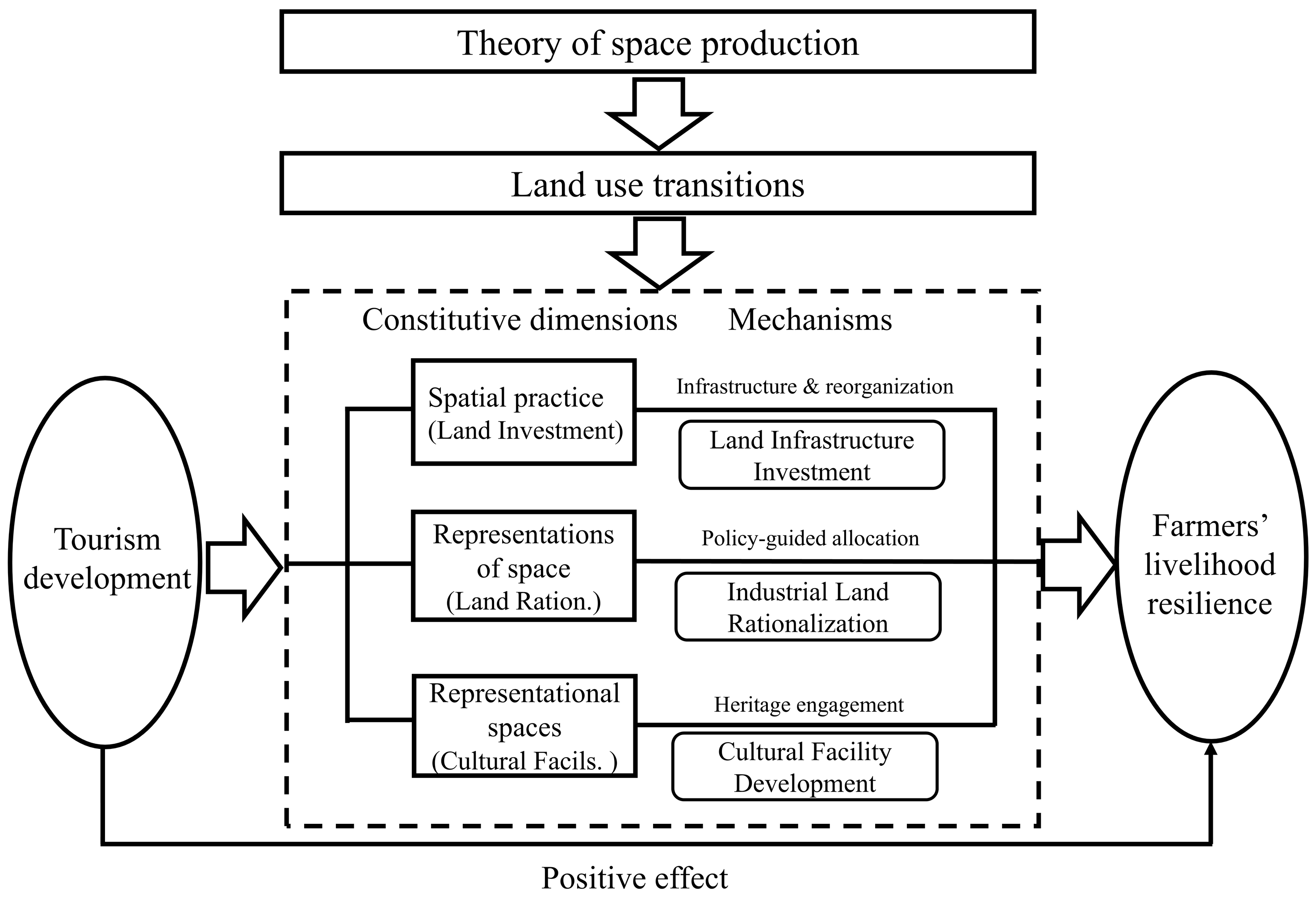
The theory of spatial production consists of three interrelated dimensions: spatial practice, representations of space, and representational spaces. Spatial practice, corresponding to the perceived dimension of space, refers to how humans shape space through material production, including utilization, control, and adaptation of the physical environment. In the context of tourism-driven rural development, this manifests as land use transitions driven by capital investment, including the conversion of agricultural land to tourism-related uses, changes in land management practices, and spatial reorganization of productive and living spaces. Empirical studies have demonstrated how tourism triggers quantitative increases in construction land demand and spatial restructuring of rural landscapes [17,18,40]. These tourism-induced land transitions lead to increased rural investment in land infrastructure and industrial restructuring, producing differentiated spatial and livelihood outcomes [41]. Representations of space belong to the conceived dimension, reflecting macro-level ideological and political conceptions of space, often advanced by governments and elites through policies, plans, and regulations. Tourism development facilitates this “institutionally dominated reproduction of space” [42,43]. Representational spaces (lived space) constitute meaningful realms constructed through everyday practices by residents and users, often materialized in cultural venues such as cultural stations. In heritage tourism contexts, practices like cultural performances and intangible heritage workshops interact with cognitive processes of heritage interpretation and identity formation, enabling continuous reproduction of meaning and fostering emotional resonance between tourists and locals [44,45,46]. These three dimensions interact synergistically, reflecting the social construction of space aimed at meeting community needs [47]. Tourism development, particularly in heritage-rich rural areas of China, has been shown to reshape rural spaces and enhance sustainable livelihoods [33]. This aligns with the broader framework of multifunctional rural development proposed by Long et al. [48], which emphasizes the multiple roles and values of rural areas beyond agricultural production. Through industrial upgrading and institutional interventions, it drives spatial reproduction that transforms material and socio-economic structures, diversifying the functions of productive and living spaces [49]. The interplay between institutional and cultural spaces underpins material differentiation, improving not only physical environments but also political–economic and cultural dimensions, thereby strengthening farmers’ buffer capacity, self-organization, and learning ability.
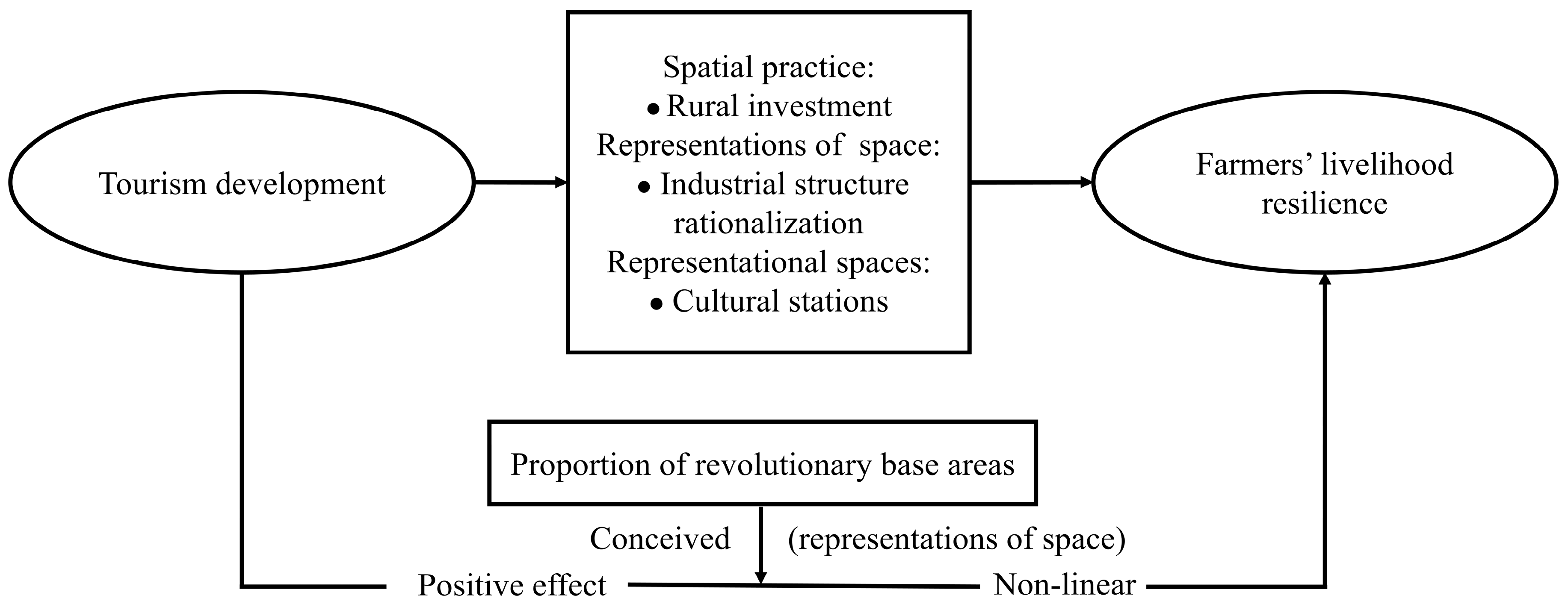
From a sustainable development perspective, this spatial production framework illuminates pathways through which land use transitions contribute not only to immediate livelihood gains but also to long-term sustainable rural development. As illustrated in Figure 1, this triadic framework highlights the multifaceted pathways through which land transitions enhance livelihood resilience and advance the Sustainable Development Goals (SDGs) in heritage-rich rural areas.
Figure 1.
Theoretical Framework: Tourism-Driven Land Use Transitions as a Spatial Production Pathway Linking Tourism Development to Farmers’ Livelihood Resilience. The framework illustrates how tourism drives land use transitions through Lefebvre’s three spatial production dimensions, which collectively enhance farmers’ livelihood resilience and contribute to sustainable rural development.
2.2. Land Use Transitions Through Tourism Development and Farmers’ Livelihood Resilience
China’s historical legacy originated in rural areas, which preserve a profound legacy of cultural heritage and memory. Historical heritage resources are predominantly located in remote rural regions where economic development remains relatively lagging due to constraints in resource access, industrial structure, and geographic isolation. These structural challenges have not only impeded high-quality economic development but also restricted the enhancement of farmers’ livelihood resilience. As an integrative industry with inherent poverty alleviation potential, tourism is widely regarded as a vital tool for rural revitalization [50].
Tourism plays a multifunctional role in rural development, extending beyond its conventional economic contributions. Economically, tourism stimulates local consumption, generates employment, and attracts external investment, thereby diversifying the rural economy beyond traditional agricultural activities. Socially, tourism facilitates cultural exchange, strengthens community identity, and enhances social capital through increased interactions between visitors and residents. Environmentally, sustainable tourism practices can promote ecological conservation and incentivize the protection of natural and cultural landscapes. This multifunctional nature enables tourism to serve as a catalyst for comprehensive rural transformation, simultaneously addressing economic diversification, social cohesion, and environmental sustainability [48,50].
Moreover, tourism development fundamentally reshapes rural land use patterns, creating natural geographic, resource-based, and economic linkages with rural livelihoods [33]. Tourism-induced land use transitions—including the transfer of rural residential land, multifunctional use of agricultural land, and spatial reorganization of rural settlements [14]—serve as critical mechanisms connecting tourism investment to livelihood outcomes. These land transitions create more employment opportunities for local households [24], improve access to infrastructure and services, and enhance the productive capacity of rural spaces. By leveraging place-based heritage tourism resources and facilitating strategic land use transitions, it becomes possible to unlock latent socio-economic benefits, diversify livelihood strategies, and ultimately strengthen local livelihood resilience [51]. From a land systems perspective, these tourism-induced spatial transformations constitute a critical pathway through which heritage resources are converted into sustainable livelihood outcomes. Accordingly, we propose the following hypothesis:
H1:
Tourism-induced land use transitions can significantly improve farmers’ livelihood resilience.
Tourism development drives land use transitions that enhance farmers’ livelihood resilience by stimulating rural investment in land infrastructure and promoting spatial–industrial restructuring and upgrading, thereby transforming the physical environment and modes of production in rural areas. Land use transitions manifest through three primary pathways: (1) increased capital investment in land infrastructure improvement, (2) rationalization of industrial land allocation and spatial structure, and (3) construction of cultural facilities that reshape rural space. Specifically, tourism generates specialized funding for local governments [52], alleviating fiscal constraints and facilitating land-based improvements in architectural aesthetics, housing layout, infrastructure, and overall living environments [53]. Furthermore, tourism-driven land transitions drive the upgrading of rural industrial structures by enhancing the role of local specialty industries through more efficient land use, increasing economic returns and adding value through improved resource utilization [54]. Tourism development encompasses food, accommodation, transportation, sightseeing, shopping, and entertainment, requiring diverse land uses. This fosters industrial diversification and rationalization while creating substantial employment opportunities in guiding, security, catering, hospitality, and other sectors. The spatial reorganization of rural land enables local farmers’ participation in these industries, providing additional income sources, strengthening economic resilience and reducing vulnerability to sector-specific shocks [55]. Moreover, the industrial upgrading spurred by land use transformation increases demand for specialized services and products [56], encouraging farmers to develop service awareness, marketing capabilities, and managerial skills. This facilitates knowledge accumulation and technical learning, enabling households to better adapt to market dynamics and gain improved access to social protection. These pathways align with Lefebvre’s spatial practice and representations of space, where material transformations and institutional governance synergistically reshape rural livelihood systems. On this basis, we propose the following hypothesis:
H2:
Rural land-based investment and industrial land structure rationalization play mediating roles in the pathway from tourism-induced land use transitions to farmers’ livelihood resilience.
Tourism development facilitates the excavation and reinterpretation of rural cultural heritage, promoting the revitalization, innovative inheritance, and value enhancement of local culture. This process strengthens cultural confidence among local residents and tourists, stimulates regional cultural consumption, and empowers innovation within the cultural industry [57]. The construction of cultural facilities represents a key dimension of tourism-induced land use transitions. As representational spaces for cultural co-creation by tourists and residents, cultural stations and heritage facilities occupy specific land parcels and reshape rural spatial organization, playing a distinctive role in converting abstract cultural capital into tangible livelihood resilience through ongoing meaning negotiation and material practice.
Curated performances and immersive experiences, including historical reenactments, generate new cultural consumption demands. For instance, following heritage-themed experiential programs at cultural stations in heritage-rich regions such as Jinggangshan, local farmers developed and sold cultural creative products annually. Furthermore, cultural stations serve as sites where modern interpretations by tourists and traditional understandings of residents interact and merge. Farmers transition from “passive recipients” to “active producers” by taking on roles such as cultural interpreters and intangible cultural heritage practitioners. In cultural stations across heritage tourism areas, trained “farmer interpreters” have reported that their role enhanced their family’s social status. Within this context, the spatial allocation of land for cultural infrastructure not only generates economic benefits but also provides psychological support and motivation, serving as a bridge linking history with the present and injecting new vitality into livelihood resilience. As representational spaces in Lefebvre’s framework, these cultural land uses embody the lived experiences of residents and tourists, transforming abstract heritage values into tangible livelihood assets through ongoing spatial practices and meaning-making processes. Thus, we propose the following hypothesis:
H3:
Cultural facility land development plays a mediating role in the pathway from tourism-induced land use transitions to farmers’ livelihood resilience.
Tourism development and associated land use transitions exhibit significant regional variation, largely attributable to disparities in policy support and resource endowments. Compared to non-heritage areas, heritage-rich regions possess stronger comparative advantages in cultural resources and receive more substantial governmental policy support [52], resulting in more effective land use planning and transformation, leading to more pronounced effects on local economic growth and farmers’ income. Since the 18th National Congress of the Communist Party of China, heritage tourism has garnered increased attention and institutional support from the central government, which has actively advanced its development through comprehensive and systematic policy design. Initiatives such as the “1+N+X” and “1258” policy frameworks have been established specifically to revitalize heritage-rich rural regions [58,59]. These policies facilitate more strategic land allocation and infrastructure investment, immediately boosting the appeal and service quality of tourism destinations, directly increasing tourist visits and raising household income levels. Consequently, the role of land use transitions in stimulating regional economies and livelihoods becomes increasingly significant [25]. Thus, we propose the following hypothesis:
H4:
The positive effect of tourism-induced land use transitions on farmers’ livelihood resilience is more substantial in regions with comparative advantages in heritage resources and policy support.
2.3. The Non-Linear Effects of Tourism-Driven Land Use Transitions on Farmers’ Livelihood Resilience
As a multidimensional activity encompassing political, cultural, and economic dimensions, heritage tourism development constitutes both a complex social phenomenon and a cross-sectoral development initiative [60]. In accordance with Butler’s tourism area life cycle theory, destinations demonstrate characteristics of non-linear systems, evolving through distinct developmental stages [61]. The growth of tourism-driven land use transitions exhibits dual economic effects—a positive multiplier effect and a negative leakage effect—which interact dynamically [62], thereby variably influencing the livelihood resilience of local households. During the initial “exploration” and “involvement” stages, policy incentives create a favorable environment for development. Local farmers engage in homestay services and agricultural product sales, gaining increased employment opportunities and diversified income sources, which significantly enhance their economic well-being. Furthermore, the “long-tail effect” of niche heritage tourism products and industrial chain expansion injects sustained vitality into the local economy. However, further development may introduce negative impacts such as land use conflicts, cultural friction, and excessive homogeneous development of resources [63]. These issues can lead to lock-in effects of rural resources, polarization, shielding, and the crowding-out of labor and farmland, ultimately diminishing households’ adaptive capacity to external changes and undermining their livelihood resilience (Figure 2). Thus, we propose:
Figure 2.
The Mechanism of Tourism-Induced Land Use Transitions on Farmers’ Livelihood Resilience. The framework shows the mediating roles of spatial practice (rural investment and industrial rationalization) and representational spaces (cultural stations), moderated by representations of space (policy support in heritage areas), with non-linear threshold effects on livelihood resilience.
H5:
Tourism-induced land use transitions exhibit a non-linear threshold effect on farmers’ livelihood resilience.
3. Research Design
3.1. Model Construction
To empirically examine the research hypotheses, this study constructs a model of the direct transmission mechanism through which tourism-induced land use transitions influence farmers’ livelihood resilience:
Here, denotes the livelihood resilience of household p in region i during period t; represents the level of tourism development with emphasis on land transformation dimensions in region i during period t; and , , , refer to the control variables, province fixed effects, time fixed effects, and random disturbance term, respectively.
To further investigate the mechanisms through which tourism-induced land use transitions influence farmers’ livelihood resilience, the following mediation models are constructed:
Here, represents the mechanism variables, including land-based rural investment, industrial land structure rationalization, and cultural facility land development influenced by tourism. Equation (3) includes both and to test the mediation effects. The definitions of the other variables remain consistent with those in Equation (1).
To examine the potential non-linear characteristic in the impact of tourism-driven land use transition dynamics on farmers’ livelihood resilience and test Hypothesis H5, the following panel threshold model is constructed:
where denotes the threshold variable, and () represents the indicator function, which takes the value of 1 when the specified condition is satisfied and 0 otherwise.
These three models (Equations (1)–(4)) enable us to systematically test Hypotheses H1–H5, examining both the direct effects and underlying mechanisms through which tourism-induced land use transitions influence farmers’ livelihood resilience.
3.2. Variable Definitions and Descriptions
3.2.1. Dependent Variable
The dependent variable in this study is farmers’ livelihood resilience. Drawing on the livelihood resilience analytical framework proposed by Speranza et al. [64] and following the approach of Zhou et al. [65], we construct a measurement index system for Chinese rural households’ livelihood resilience based on three dimensions: buffer capacity, self-organization capacity, and learning capacity. With reference to Li and Tian [66], the entropy weight method for panel data is employed to determine the weights of each dimensional indicator, and a comprehensive index method is applied to calculate the livelihood resilience index (as detailed in Table 1).
Table 1.
The livelihood resilience measurement index system of Chinese farmers.
3.2.2. Core Explanatory Variable
The core explanatory variable in this study is tourism development level, measured with a particular focus on dimensions that reflect land use transformation. Drawing on the indicator system constructed in the China Red Tourism Development Report (2022), we conduct a comprehensive analysis of nationwide heritage tourism and related industry data from 2018, 2020, and 2022, along with relevant big data. This analysis is further aligned with the guiding principles and strategic directions outlined in the 14th Five-Year Plan for National Economic and Social Development of the People’s Republic of China and the Long-Range Objectives Through the Year 2035.
Therefore, an objective evaluation of tourism development levels across provinces is conducted, with specific attention to how tourism activities drive land use transitions in rural areas. The index system established in this study encompasses four dimensions: the foundation for tourism development (including land-based infrastructure), tourism resource endowment (reflecting spatial resource distribution), innovation support for tourism development (capturing institutional and technological factors in land transformation), and the ecological environment for tourism development (representing land sustainability considerations), comprising a total of 20 specific indicators.
This composite index reflects not only tourism activity intensity but also the extent of land use transformation associated with tourism development, including infrastructure investment in rural land, spatial reorganization of agricultural areas, and functional diversification of rural land uses. The entropy weight method is applied to determine indicator weights within each dimension, and a comprehensive index method is used to calculate the tourism development index (as shown in Table 2).
Table 2.
The measurement index system of tourism development level (capturing land use transformation dimensions) in China.
3.2.3. Control Variables
Given that tourism development is not the sole determinant of farmers’ livelihood resilience, and to mitigate endogeneity issues arising from omitted variables, this study selects control variables across three levels: regional characteristics, household characteristics, and household head characteristics. At the regional level, drawing on the approaches of Liu et al. [33], we control for population aging, rural medical service level, financing convenience, industrial structure advancement, and land transfer. At the household level, we control whether the household has transferred out of land. At the household head level, we control for three variables: gender, marital status, and Communist Party membership.
3.2.4. Mediating Variables
The mediating variables in this study include rural land-based investment, industrial land structure rationalization, and cultural facility construction. Among these, rural land-based investment is measured by the total investment in fixed assets by rural households. Industrial land structure rationalization draws on the measurement approach of Wang et al. [67], utilizing the Theil index to assess the degree of industrial structure rationalization. Cultural facility construction is measured by the ratio of township cultural stations to the rural population, reflecting the spatial allocation of land for cultural infrastructure and its accessibility to local residents. Descriptive statistics for all variables are presented in Table 3.
Table 3.
Descriptive statistical results of the variables.
3.3. Data Sources
This study utilizes databases at both the micro and macro levels, incorporating indicators measured at the individual, household, and regional dimensions.
3.3.1. Individual- and Household-Level Indicators
Data are drawn from the 2018, 2020, and 2022 waves of the China Family Panel Studies (CFPS), conducted by the Institute of Social Science Survey of Peking University. The CFPS is a nationwide longitudinal survey designed to track economic and non-economic well-being among Chinese residents through data collected at the individual, household, and community levels. The sample covers approximately 95% of the total population in China (excluding Hong Kong, Macao, and Taiwan), ensuring strong national representativeness and providing robust support for research and policy analysis.
The original CFPS data underwent several processing steps: selecting relevant variables, removing erroneous observations, retaining only rural samples, computing household livelihood resilience, merging household- and individual-level variables, and winsorizing all continuous variables at the 1st and 99th percentiles. The final dataset constitutes an unbalanced panel with 12,145 observations from 6403 households over the period from 2018 to 2022.
3.3.2. Regional-Level Indicators
The number of heritage tourism-related policies issued was obtained through retrieval and compilation from the PKULaw database. Data on the number of cultural and heritage tourism enterprises were manually collected and organized by searching for newly registered enterprises each year during the measurement period, using “heritage culture and tourism” as a key business scope term, aggregated by year and province. Data on tourism technology patents were sourced from Qizhidao and the National Intellectual Property Administration. Tourism R&D expenditure was calculated as total R&D expenditure multiplied by the ratio of tourism output value to total national economic output. The numbers of movable and immovable historical and cultural relics were collected from the cultural relics bureaus of each province (autonomous region, municipality). Data on the number of heritage education demonstration bases and study education bases, national heritage tourism sites, heritage tourism routes, and national heritage tourism cases were obtained from the official websites of the culture and tourism departments of each province (autonomous region, municipality). The remaining variables were derived from the following sources: provincial and national statistical yearbooks, including the China Statistical Yearbook, China Environmental Statistical Yearbook, China Population and Employment Statistical Yearbook, China Financial Statistical Yearbook, and China Rural Statistical Yearbook, as well as provincial culture and tourism statistical yearbooks for the years 2018 to 2022.
3.4. Spatial Distribution of Key Variables
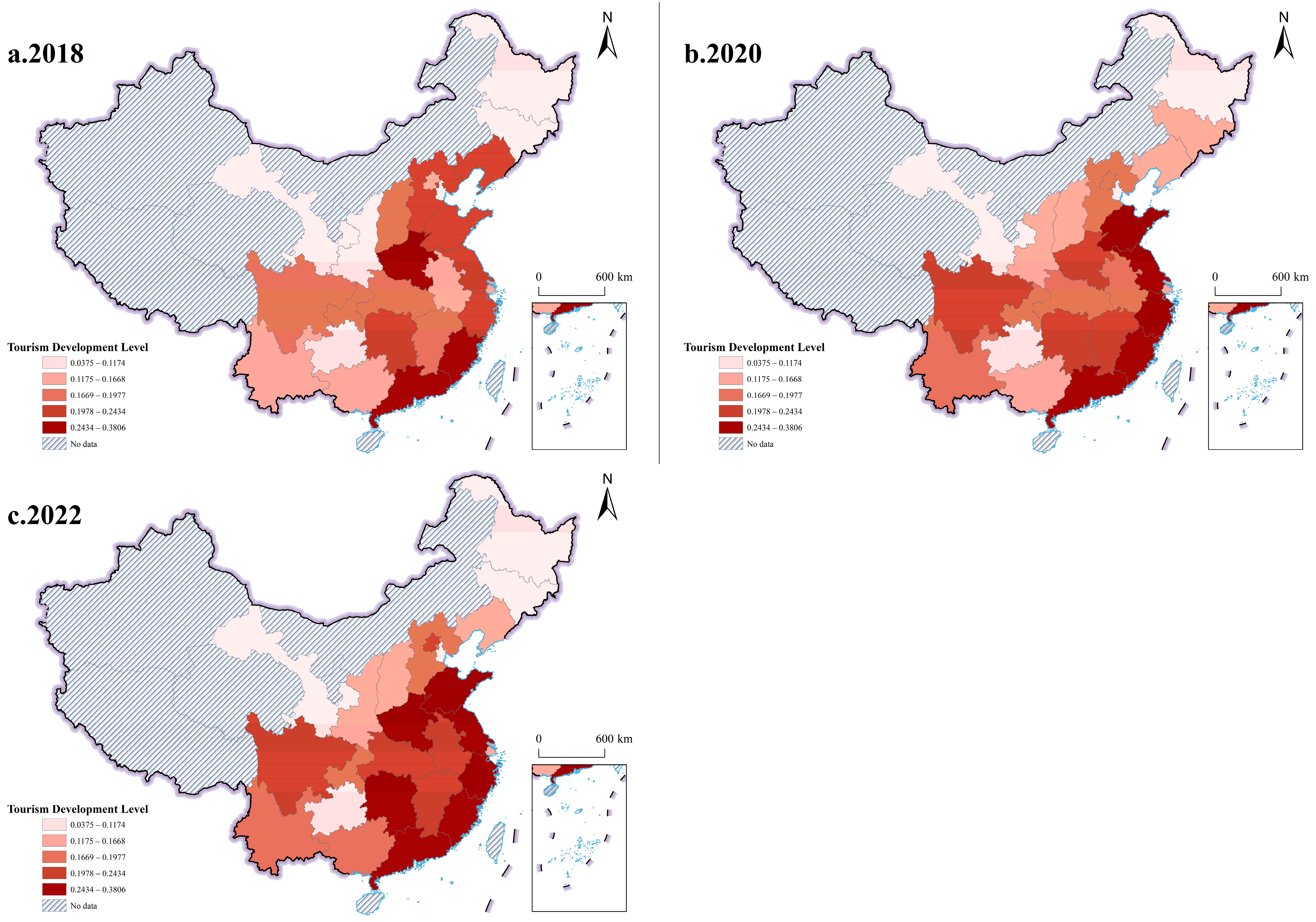
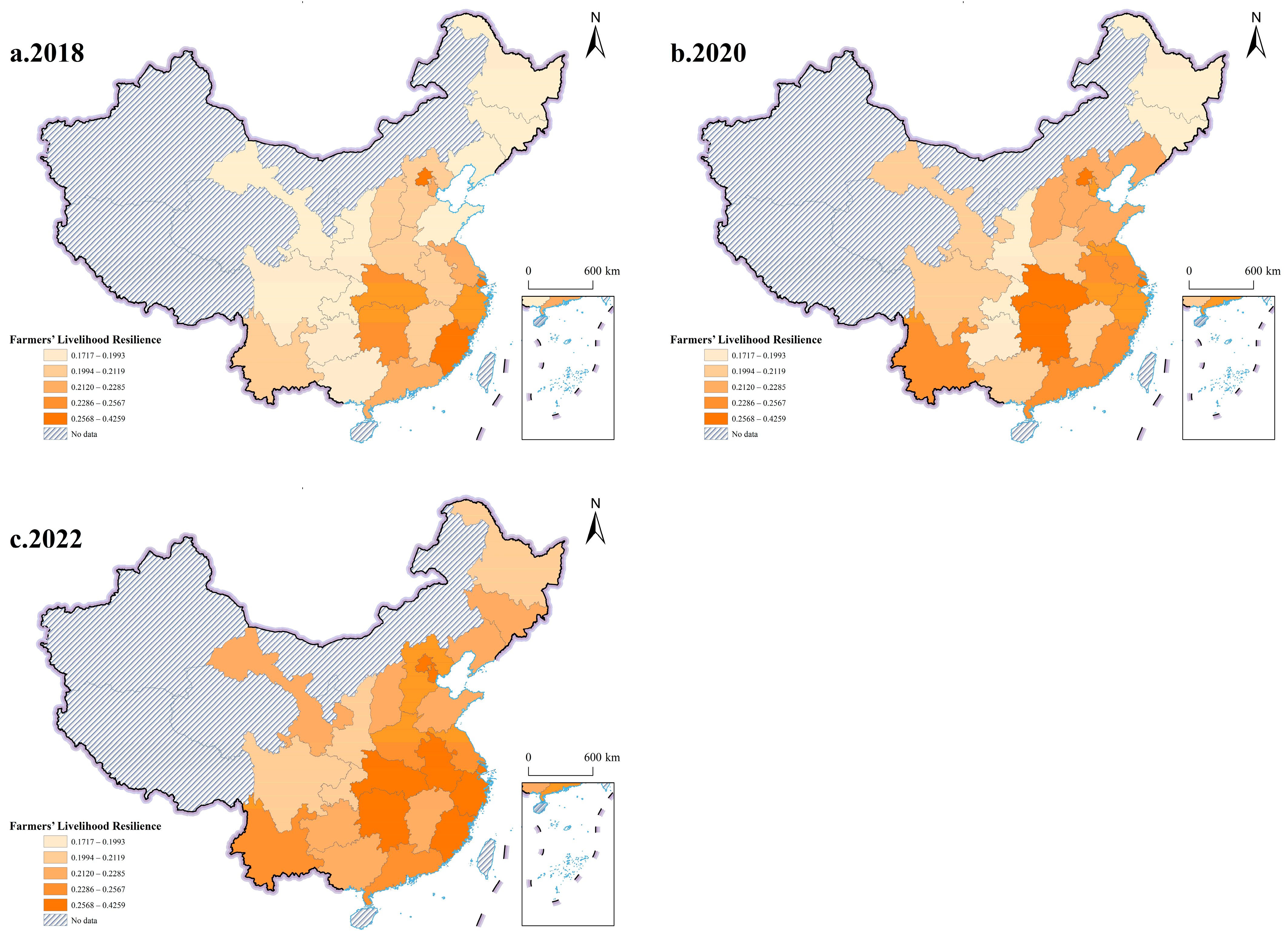
To provide spatial context for the empirical analysis, this section presents the provincial distribution of tourism development levels and farmers’ livelihood resilience across the three survey years (2018, 2020, and 2022).
Figure 3 displays the spatial distribution of tourism development levels. The maps reveal a pronounced spatial gradient. In 2018, three provinces—Fujian, Guangdong, and Henan—exhibited the highest tourism development levels (Level 5: 0.2434–0.3806), while Zhejiang, Jiangsu, Shandong, Hunan, and Liaoning were at Level 4 (0.1978–0.2434). By 2020–2022, Zhejiang, Jiangsu, and Shandong entered the highest category, indicating continuous expansion along the eastern coast. Hunan showed notable growth, reaching Level 5 by 2022. In contrast, Liaoning experienced decline from Level 4 (2018) to Level 2 (2020–2022). Western provinces such as Guizhou and Heilongjiang remained at Level 1 throughout the study period, reflecting persistent regional disparities.
Figure 3.
Spatial distribution of tourism development level across Chinese provinces (2018–2022). The index emphasizes land use transformation dimensions associated with tourism development. Darker colors indicate higher tourism development levels. Hatched areas represent provinces not included in the CFPS sample.
Figure 4 presents the spatial distribution of farmers’ livelihood resilience. Beijing and Shanghai consistently exhibited the highest resilience levels (Level 5: 0.2568–0.4259) across all three years. Several provinces demonstrated substantial improvement: Tianjin rose from Level 3 (2018) to Level 5 (2022); Anhui improved from Level 2 to Level 5; and Guizhou advanced from Level 1 to Level 3. Hunan and Hubei both reached Level 5 by 2020–2022. Notably, Fujian experienced fluctuation, declining from Level 5 (2018) to Level 4 (2020) before recovering to Level 5 (2022). These patterns suggest that livelihood resilience improvements are spreading from coastal metropolitan areas to central and western provinces.
Figure 4.
Spatial distribution of farmers’ livelihood resilience across Chinese provinces (2018–2022). The index is constructed based on buffer capacity, self-organization capacity, and learning capacity dimensions. Darker colors indicate higher livelihood resilience. Hatched areas represent provinces not included in the CFPS sample.
A comparison of the two figures reveals notable spatial correspondence between tourism development and livelihood resilience, particularly in southeastern coastal regions. Provinces with higher tourism development levels generally exhibit higher livelihood resilience, providing preliminary visual support for our hypothesis that tourism-induced land use transitions enhance farmers’ livelihood resilience (H1).
4. Results
4.1. Baseline Regression Results
Based on Equation (1), this study examines the impact of tourism development on farmers’ livelihood resilience. The results are presented in Table 4. Column (1) shows that, after controlling only for province and year fixed effects, the coefficient of tourism development is significantly positive at the 5% level, confirming that tourism development has a statistically significant positive effect on enhancing farmers’ livelihood resilience. Column (2) further incorporates control variables at the regional, household, and household head levels. The results indicate that the coefficient of tourism development remains significantly positive at the 1% level, demonstrating that its enhancing effect on livelihood resilience persists even after accounting for multiple factors related to regional characteristics, household attributes, and individual characteristics of the household head. Thus, Hypothesis H1 is supported.
Table 4.
Benchmark regression results.
4.2. Robustness and Endogeneity Tests
4.2.1. Instrumental Variable Approach
Although the empirical model incorporates controls for provincial, household, and individual characteristics that may influence farmers’ livelihood resilience, endogeneity concerns could persist due to unobserved variables or measurement limitations. To address this issue, this study employs a two-stage least squares (2SLS) regression. The interaction term between the number of founding generals in each province and the survey year is used as an instrumental variable for tourism development. The number of founding generals in a region is positively correlated with the abundance of heritage cultural narratives and memorial facilities, which enhances the potential for heritage tourism development, thereby satisfying the relevance condition. Moreover, the historical number of founding generals is unlikely to directly affect contemporary farmers’ livelihood resilience, fulfilling the exclusion restriction.
As shown in Table 5, the Kleibergen–Paap Wald F-statistic of 577.43 exceeds the Stock–Yogo critical value at the 15% level (8.96), indicating that the instrumental variable is strong and that weak instrument bias is not a concern. The results confirm that after addressing endogeneity through the 2SLS approach, the positive effect of tourism development on livelihood resilience remains statistically significant and robust.
Table 5.
Results of the instrumental variable method regression.
In summary, the two-stage instrumental variable regression supports the conclusion that tourism development has a robust and positive impact on enhancing farmers’ livelihood resilience.
4.2.2. High-Dimensional Fixed Effects
Although various characteristic variables influencing farmers’ livelihood resilience have been controlled for, unobservable subjective factors such as values and risk preferences may still introduce endogeneity into the estimates. To mitigate this bias, household fixed effects are incorporated to account for time-invariant unobserved heterogeneity at the household level. As shown in column (1) of Table 6, after controlling for time-invariant household characteristics, the coefficient on tourism development remains positive and statistically significant at the 1% level, consistent with the baseline results and robust to household-level unobserved confounders.
Table 6.
Regression results of other robustness tests.
4.2.3. Alternative Measures of the Dependent Variable
To verify the reliability and robustness of the empirical findings, this study alters the weighting approach used in constructing the livelihood resilience index. Specifically, the resilience measure is recalculated using both indicator-equal weighting and dimension-equal weighting methods. Regression results using these alternative measures are reported in columns (2) and (3) of Table 6. The coefficients of tourism development remain statistically significant at the 1% level under both weighting schemes, confirming that the main findings are consistent and not sensitive to the measurement approach.
4.2.4. Subsample Regression Below the Median
To further assess robustness, a subsample regression is conducted using only observations where livelihood resilience is below the median. This approach addresses the possibility that improvements in resilience might be driven by households with initially higher resilience. As presented in column (4) of Table 6, the effect of tourism development remains positive and statistically significant, supporting the conclusion that the results are robust across different sample selections.
5. Mechanism and Heterogeneity Analysis
5.1. Mechanism Analysis
To further investigate the underlying mechanisms through which tourism development influences farmers’ livelihood resilience, this study employs a mediation effect model to identify potential transmission channels. Following the standard three-step mediation testing procedure, we first examine the impact of tourism development on the mediating variables (columns 1, 3, and 5 in Table 7) and then test whether these mediators significantly affect livelihood resilience after controlling for tourism development (columns 2, 4, and 6 in Table 7).
Table 7.
Mediation effect model test.
As shown in columns (1), (3), and (5) of Table 7, the coefficients of tourism development are significantly positive, indicating that tourism development effectively promotes rural land-based investment, facilitates industrial land structure rationalization, and enhances cultural facility construction.
Column (2) of Table 7 shows that, after controlling for tourism development, the coefficient of rural land-based investment is positive and statistically significant at the 1% level, confirming that land-based rural investment serves as a key mechanism through which tourism development enhances livelihood resilience, consistent with Hypothesis H2. In column (4), the coefficient of industrial structure rationalization is significantly negative. Drawing on the measurement method of Wang et al. [67], a higher value of this index indicates a less rational economic structure. Thus, the negative coefficient suggests that industrial land structure rationalization is another important mechanism, supporting Hypothesis H2. Column (6) demonstrates that the coefficient for cultural stations per 10,000 people is significantly positive, indicating that cultural facility construction also mediates the relationship between tourism development and livelihood resilience, thereby validating Hypothesis H3.
These results illustrate that tourism development fosters the preservation of cultural heritage and promotes rural cultural vitality, which in turn improves farmers’ cultural literacy and mental well-being, ultimately enhancing their livelihood resilience through the transformation of rural land use patterns and spatial organization.
5.2. Threshold Effect Analysis
Given the non-linear growth characteristics of tourism destinations and the coexisting multiplier and leakage effects associated with tourism-driven land use transitions, their impact on farmers’ livelihood resilience may exhibit a non-linear relationship. To test Hypothesis H5, a threshold effect test was first conducted to determine the existence and number of thresholds. As shown in Table 8, both single- and double-threshold effects are statistically significant, while a triple threshold effect is not significant, based on 300 bootstrap replications. This clearly indicates the presence of a significant double-threshold effect in the relationship between tourism development and farmers’ livelihood resilience.
Table 8.
Threshold effect model of tourism development affecting farmers’ livelihood resilience.
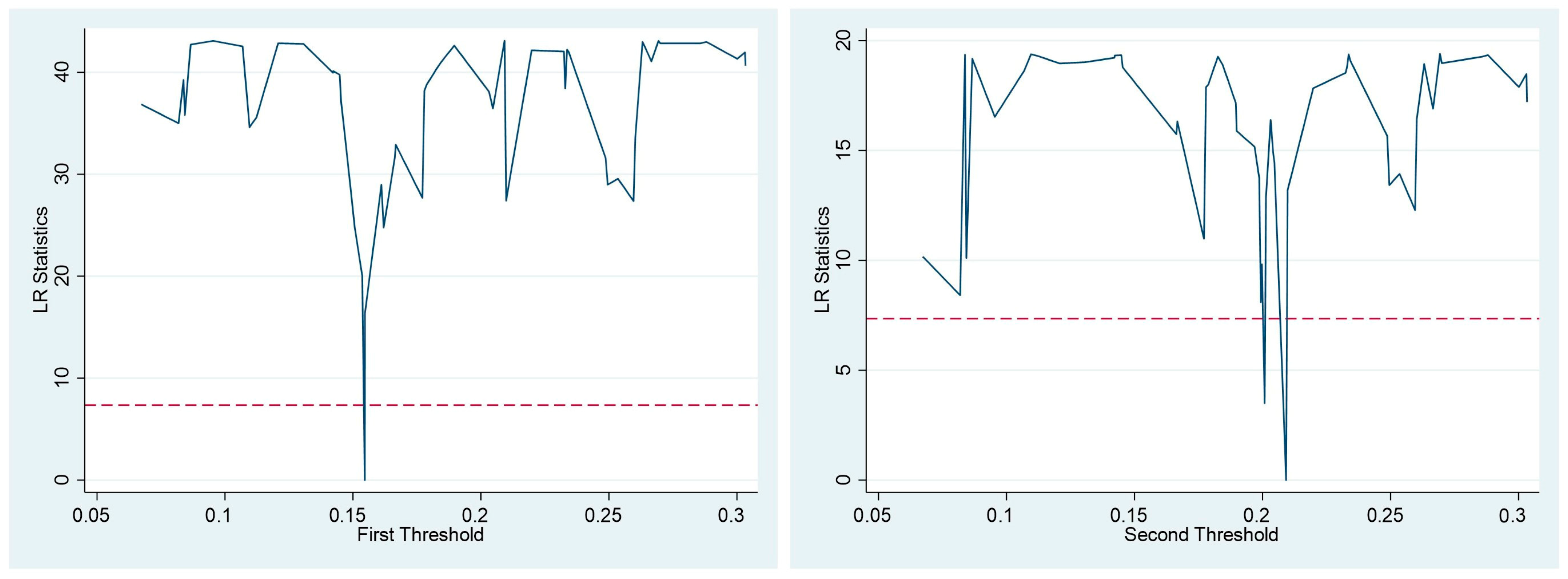
Based on the double-threshold model, Table 9 presents the regression results using tourism development level as the threshold variable. The relationship between tourism development and farmers’ livelihood resilience exhibits a double-threshold effect, characterized by an initial strengthening that becomes progressively weaker after crossing the second threshold (Figure 5). Specifically, when the level of tourism development is below the first threshold of 0.1546, it exerts a significantly positive effect on livelihood resilience with a coefficient of 0.171. When development level falls between the first threshold (0.1546) and the second threshold (0.2092), the effect remains positive and significant, though the coefficient decreases to 0.088. Once development exceeds the higher threshold of 0.2092, the positive influence further weakens, with the coefficient dropping to 0.076.
Table 9.
Estimation results of the threshold regression model.
Figure 5.
Threshold estimates and their confidence intervals.
This observed pattern indicates that in the initial phase, tourism development enhances locational attractiveness and generates economic benefits by drawing tourists and investments, which in turn raises household income and strengthens livelihood resilience. However, as development progresses, challenges such as land use conflicts, resource overuse, environmental pressure, and potential saturation of tourist interest may arise, ultimately constraining revenue growth. Furthermore, intensified competition, homogenization of tourism offerings, and the rise in alternative destinations could further erode the unique appeal and long-term viability of heritage tourism destinations [67]. Consequently, the marginal effect of tourism-driven land use transitions on improving livelihood resilience exhibits a diminishing trend as development levels increase, providing support for Hypothesis H5.
5.3. Heterogeneity Analysis
Heritage tourism resources, which constitute the foundation for tourism development in rural China, serve as vital carriers of the country’s historical legacy and culture. Spanning multiple historical periods since the Opium War in 1840, these resources include historical memorial sites, monuments, and the intangible and tangible cultural heritage embodying historical significance and patriotism [68]. Due to this historical legacy, such areas have developed comparative advantages in heritage cultural resources and are officially designated as “heritage-rich regions.” This designation reflects government decisions based on historical and contemporary needs, and a larger proportion of such areas within a province typically signals stronger policy support and greater resource allocation for heritage tourism development.
For most resource-rich heritage regions, high-quality heritage tourism development is instrumental in consolidating the gains of poverty alleviation and promoting broader socio-economic advancement. It follows that a key question arises: Is the enhancement of farmers’ livelihood resilience through tourism-driven land use transitions systematically stronger in regions endowed with these inherent comparative advantages in heritage resources and policy support?
To examine this heterogeneity, we adopt the approach of Zuo et al. [52] by classifying provinces according to whether the area of heritage-rich regions exceeds half of their total territory. As shown in Table 10, tourism development exerts a significant positive effect on farmers’ livelihood resilience in regions where heritage-rich areas account for a high proportion of the provincial territory. By contrast, in provinces where such districts cover less than half of the area, the coefficient associated with tourism development is statistically insignificant. These findings suggest that the beneficial impact of tourism-driven land use transitions is more pronounced in regions characterized by deeper heritage cultural traditions, stronger policy support, and greater resource advantages, thus providing empirical support for Hypothesis H4.
Table 10.
Results of the heterogeneity analysis.
5.4. Discussion
The findings of this study contribute to the growing body of international literature on tourism-led rural development and livelihood sustainability. This section situates our results within the broader context of global research and discusses their implications for understanding the tourism–land–livelihood nexus.
5.4.1. Tourism-Induced Land Transitions and Livelihood Resilience
Our finding that tourism-induced land use transitions significantly enhance farmers’ livelihood resilience aligns with international evidence from diverse contexts. Research from Indonesia demonstrates that tourism-driven land use change represents a global phenomenon with significant implications for rural livelihood sustainability [19]. Compared with island tourism contexts where tourism livelihoods may be more precarious, our research in heritage-rich rural China demonstrates that appropriate policy support and institutional frameworks can channel land transitions toward more sustainable livelihood outcomes. This difference may be attributed to the stronger governmental coordination and strategic land use planning characteristic of China’s heritage tourism development model.
Our results also resonate with the findings of Li et al. [17] and Mao et al. [18], who examined tourism-driven land use changes in Erhai Lake Basin and Lijiang River Basin, respectively. These studies highlighted the dual nature of tourism’s impact on rural land systems—generating both opportunities and challenges. Our research extends this work by quantifying the household-level livelihood outcomes of such transitions and identifying the specific mechanisms through which land transformation translates into enhanced resilience. Additional Chinese evidence further validates our framework: Gao and Cheng [40] constructed a tourism-driven rural spatial restructuring framework demonstrating that land consolidation serves as a direct trigger for rural revitalization, while Lin et al. [69] found that heritage certification promotes tourism growth with resilience mechanisms varying by governance quality—consistent with our heterogeneity analysis across heritage-rich and non-heritage regions.
International research from Eastern Europe further enriches this comparative perspective. In Romania, Ibanescu et al. [70] developed a mediation model demonstrating that tourism transfers resilient properties to rural destinations, with accessibility to medium-sized cities significantly influencing tourism-induced resilience within a 76 min threshold—a finding that parallels our non-linear threshold effects. The Romanian context also illustrates how post-socialist institutional transitions reshape rural landscapes through land use dynamics [71,72], resonating with China’s rural transformation trajectory as a transitional economy undergoing rapid institutional and spatial restructuring.
5.4.2. Non-Linear Threshold Effects
The double-threshold effect identified in this study aligns with Butler’s Tourism Area Life Cycle theory, which posits that tourism destinations evolve through distinct developmental stages with varying impacts on local communities [61]. Our finding that the positive effect of tourism-driven land transitions on livelihood resilience diminishes as development intensity increases reflects the theoretical prediction that destinations may experience stagnation or decline after periods of rapid growth.
This non-linear pattern also corroborates the analysis of Incera and Fernández [62], who identified coexisting multiplier and leakage effects in tourism economies. During initial development stages, the multiplier effect dominates, channeling tourism revenues into local land improvements and livelihood diversification. However, as development intensifies, leakage effects—including resource competition, land use conflicts, and external capital dominance—may erode the benefits accruing to local households. Our threshold analysis provides precise quantification of these transition points (0.1546 and 0.2092), offering actionable guidance for sustainable tourism planning.
5.4.3. Mediating Mechanisms in Comparative Perspective
The identification of three distinct mediating pathways—land-based rural investment, industrial land structure rationalization, and cultural facility construction—contributes to a more nuanced understanding of how tourism reshapes rural spaces. While previous studies have largely relied on approaches that assume a linear relationship between tourism and livelihoods [31,32], our integrated approach reveals the synergistic operation of multiple mechanisms within Lefebvre’s spatial production framework.
The role of cultural facility construction as a mediating mechanism is particularly noteworthy. Unlike studies that focus primarily on economic dimensions of tourism, our findings highlight the importance of representational spaces in building livelihood resilience. This aligns with the multifunctional rural development framework proposed by Long et al. [48], which emphasizes the multiple roles and values of rural areas beyond agricultural production.
5.4.4. Regional Heterogeneity and Policy Implications
Our heterogeneity analysis reveals that the benefits of tourism-driven land transitions are concentrated in heritage-rich regions with stronger policy support. This finding parallels international research on the uneven distribution of tourism benefits across different geographical and institutional contexts. The comparative advantage of heritage-rich regions in China reflects not only their endowment of cultural resources but also the targeted policy frameworks (such as the “1+N+X” and “1258” initiatives) that facilitate coordinated land use planning and investment.
This pattern suggests that the effectiveness of tourism as a livelihood resilience strategy depends critically on the alignment between resource endowments, institutional support, and strategic land use planning—a finding with relevance for heritage tourism development in other developing countries facing similar challenges of rural poverty and livelihood vulnerability.
6. Conclusions and Policy Implications
6.1. Summary of Findings
Based on panel data from 25 provinces for the years 2018, 2020, and 2022, this study constructed a tourism development index emphasizing land use transformation dimensions and assessed farmers’ livelihood resilience through three dimensions: buffer capacity, self-organization capacity, and learning capacity. Grounded in spatial production theory and land systems analysis, this research empirically analyzes how tourism-induced land use transitions serve as a critical pathway influencing livelihood resilience.
The findings indicate that tourism-induced land use transitions exert a significant positive impact on enhancing farmers’ livelihood resilience (β = 0.1086, p < 0.01) through three key mechanisms: (1) land-based rural investment that improves infrastructure and productive capacity, (2) rationalization of industrial land structure that promotes balanced spatial development, and (3) cultural facility construction that creates new functional spaces. This positive effect is more pronounced in heritage-rich regions with comparative policy advantages (β = 0.0566, p < 0.01), while statistically insignificant in non-heritage regions. Furthermore, the relationship exhibits a non-linear pattern with diminishing marginal returns, resulting in a double-threshold effect at tourism development levels of 0.1546 and 0.2092, with coefficients declining from 0.171 to 0.088 and then to 0.076.
6.2. Theoretical Implications
This study makes several theoretical contributions to land systems science and sustainable rural development research. First, by positioning land use transitions as the central analytical framework, this research bridges tourism development and livelihood resilience through a novel spatial production lens. The integration of Lefebvre’s triadic framework with land systems analysis provides a systematic approach to understanding how tourism reshapes rural spaces through material, institutional, and cultural dimensions. Second, the identification of a double-threshold effect advances understanding of the non-linear dynamics between land transformation intensity and livelihood outcomes, moving beyond simplistic linear assumptions prevalent in existing literature. Third, by demonstrating the differential effects across heritage-rich and non-heritage regions, this study highlights the importance of place-based contextual factors in shaping the tourism-livelihood nexus, contributing to more nuanced theorization of spatial heterogeneity in rural development processes.
6.3. Policy Implications
Based on the empirical findings, this study proposes several policy implications focused on strategic land use planning. First, given that tourism-induced land use transitions significantly enhance livelihood resilience through land-based rural investment (β = 0.0016, p < 0.1), industrial structure rationalization (β = −0.0132, p < 0.05), and cultural facility construction (β = 0.0001, p < 0.05), policy efforts should focus on facilitating strategic land allocation, broadening investment channels for land infrastructure development, and incentivizing private capital participation in heritage tourism land development projects. The spatial–industrial structure should be optimized through a “heritage tourism+” model that promotes cross-sectoral convergence while ensuring rational land allocation.
Second, the double-threshold effect (at 0.1546 and 0.2092) with diminishing coefficients (from 0.171 to 0.076) indicates that tourism-driven land use transformation must adhere to sustainable development principles, balancing land conversion intensity with carrying capacity. When tourism development exceeds the second threshold (0.2092), marginal benefits decline substantially, suggesting that strategic land use planning should prevent excessive conversion, maintain functional diversity, and ensure environmental sustainability to avoid homogeneous development patterns.
Third, given that the positive effect is statistically significant only in heritage-rich regions (β = 0.0566, p < 0.01) while insignificant in non-heritage regions, local governments should leverage the comparative advantages of heritage resources to formulate place-based development policies. Targeted policies should be introduced for heritage-rich regions, with land use planning authorities coordinating with tourism development agencies to ensure rational spatial allocation and prevent land use conflicts.
6.4. Limitations and Future Research Directions
Despite these contributions, this study has several limitations. First, regarding data quality, the reliance on self-reported CFPS responses may introduce recall bias in measuring livelihood resilience dimensions. The provincial-level measurement of tourism development versus household-level resilience assessment creates a spatial scale mismatch that may not fully capture micro-level variations in tourism intensity. The relatively short time span (2018–2022) also limits capturing long-term dynamic effects.
Second, the measurement of cultural factors presents inherent challenges. The operationalization of cultural facility construction through the ratio of township cultural stations to rural population captures quantitative accessibility but may not adequately reflect qualitative dimensions of cultural engagement. Subjective processes central to Lefebvre’s representational spaces—such as heritage interpretation and cultural identity formation—are difficult to quantify through standardized indicators.
Third, the entropy weighting method assigns weights based on data variation rather than theoretical importance, potentially resulting in weight distributions that diverge from conceptual expectations. Although robustness checks confirmed the stability of main findings, the aggregation into single indices may mask heterogeneous effects across components.
Future research could address these limitations by incorporating qualitative methods to capture cultural dimensions, utilizing higher-resolution spatial data (e.g., county-level tourism indicators), and exploring dimension-specific effects. Longitudinal studies with longer time horizons would provide deeper insights into the dynamic effects of tourism-driven land transitions on livelihood resilience.
Author Contributions
Conceptualization, L.L. and X.L.; methodology, L.L. and X.L.; software, L.L.; validation, X.L. and Y.Z.; formal analysis, L.L.; investigation, L.L. and Y.Z.; resources, X.L. and Y.Z.; data curation, L.L.; writing—original draft preparation, L.L.; writing—review and editing, X.L. and Y.Z.; visualization, L.L.; supervision, X.L.; project administration, X.L.; funding acquisition, X.L. All authors have read and agreed to the published version of the manuscript.
Funding
This work was supported by the Special Project for National Natural Science Foundation of China (Grant No. M2442008), the Planning Project of the Ministry of Education of China (Grant No. 24YJA630055), and the Qingdao Science and Technology Benefiting the People Demonstration Project (Grant No. 23-2-8-xdny-7-nsh).Technology Development (Commissioned) Project: "Development of a Technological Innovation Service System for the High-Quality Beef Cattle Full Industry Chain" (20233702030165).
Institutional Review Board Statement
Not applicable.
Informed Consent Statement
Not applicable.
Data Availability Statement
The original contributions presented in this study are included in the article. Further inquiries can be directed to the corresponding author(s).
Acknowledgments
We would like to thank the editor and the anonymous referees for their valuable comments on this paper.
Conflicts of Interest
The authors declare no conflicts of interest.
Abbreviations
The following abbreviations are used in this manuscript:
| CFPS | China Family Panel Studies |
| SDGs | Sustainable Development Goals |
| ISEI | International Socio-Economic Index |
| 2SLS | Two-Stage Least Squares |
| GIS | Geographic Information System |
| GDP | Gross Domestic Product |
| R&D | Research and Development |
| PM2.5 | Particulate Matter 2.5 micrometers or smaller |
References
- Quandt, A. Measuring livelihood resilience: The household livelihood resilience approach (HLRA). World Dev. 2018, 107, 253–263. [Google Scholar] [CrossRef]
- Wang, Y.; Zhu, H.; Wang, Y. Towards sustainable development: Understanding resilience capacity and well-being of rural households in the Dabie Mountainous Area, China. Nat. Hazards 2025, 121, 13673–13721. [Google Scholar] [CrossRef]
- Mazilu, M.; Niță, A.; Băbăț, A.; Drăguleasa, I.A.; Grigore, M. Risk and sustainable tourism resilience in the post economic crisis and COVID-19 pandemic period. Present Environ. Sustain. Dev. 2024, 18, 235–254. [Google Scholar] [CrossRef]
- Niu, J.; Zhou, Y. How rural tourism development affects farmers’ livelihood resilience: Based on comprehensive survey data of rural revitalization in China. Front. Sustain. Food Syst. 2025, 9, 1573149. [Google Scholar] [CrossRef]
- Yang, Q.; Gao, Y.; Cao, X.; Yang, J. Contributions and resistances to vulnerability of rural human settlements system in agricultural areas of Chinese loess plateau since 1980. Sustainability 2023, 15, 10948. [Google Scholar] [CrossRef]
- Kumar, S.; Mishra, K.A.; Pramanik, S.; Mamidanna, S.; Whitbread, A. Climate risk, vulnerability and resilience: Supporting livelihood of smallholders in semiarid India. Land Use Policy 2020, 97, 104729. [Google Scholar] [CrossRef]
- Zhao, X.; Xiang, H.; Zhao, F. Measurement and spatial differentiation of farmers’ livelihood resilience under the COVID-19 epidemic outbreak in rural China. Soc. Indic. Res. 2023, 166, 239–267. [Google Scholar] [CrossRef] [PubMed]
- Tang, L.; Liu, C.; Wang, Y. Unveiling the role of social networks: Enhancing rural household livelihood resilience in China’s Dabie Mountains. J. Geogr. Sci. 2025, 35, 335–358. [Google Scholar] [CrossRef]
- Wang, P.; Wang, J.; Zhu, C.; Li, Y.; Sun, W.; Li, J. Factors influencing livelihood resilience of households resettled from coal mining areas and their measurement—A case study of Huaibei City. Land 2023, 13, 13. [Google Scholar] [CrossRef]
- Liu, W.; Li, J.; Ren, L.; Xu, J.; Li, C.; Li, S. Exploring livelihood resilience and its impact on livelihood strategy in rural China. Soc. Indic. Res. 2020, 150, 977–998. [Google Scholar] [CrossRef]
- He, Y. Measurement of livelihood resilience and its influencing factors for farmers in poverty alleviation areas: A case study of Yunnan Province, China. Appl. Econ. 2025, 1–19. [Google Scholar] [CrossRef]
- Hu, C.; Dong, J. Measuring livelihood resilience of farmers and diagnosing obstacle factors under the impact of COVID-19 in Jiangsu Province, China. Front. Sustain. Food Syst. 2023, 7, 1250564. [Google Scholar] [CrossRef]
- Wu, J.; Guo, D.; Zuo, J.; Yang, J.; Liu, S. Evolution characteristics and obstacle factors of rural resilience in Chinese minority areas in the background of rural tourism and COVID-19. Sci. Rep. 2025, 15, 9493. [Google Scholar] [CrossRef] [PubMed]
- Rahman, S.; Akter, S. Determinants of livelihood choices: An empirical analysis from rural Bangladesh. J. S. Asian Dev. 2014, 9, 287–308. [Google Scholar]
- Li, H.; Nijkamp, P.; Xie, X.; Liu, J. A new livelihood sustainability index for rural revitalization assessment—A modelling study on smart tourism specialization in China. Sustainability 2020, 12, 3148. [Google Scholar] [CrossRef]
- Shi, J.; Xian, Z.; Zhu, T.; Kang, X. Research on livelihood capital, endogenous development momentum and sustainable livelihoods of relocated farmers. Int. Rev. Econ. Financ. 2025, 102, 104259. [Google Scholar] [CrossRef]
- Li, J.; Bai, Y.; Alatalo, J.M. Impacts of rural tourism-driven land use change on ecosystems services provision in Erhai Lake Basin, China. Ecosyst. Serv. 2020, 42, 101081. [Google Scholar] [CrossRef]
- Mao, X.; Meng, J.; Wang, Q. Modeling the effects of tourism and land regulation on land-use change in tourist regions: A case study of the Lijiang River Basin in Guilin, China. Land Use Policy 2014, 41, 368–377. [Google Scholar] [CrossRef]
- Lasso, A.; Dahles, H. Are tourism livelihoods sustainable? Tourism development and economic transformation on Komodo Island, Indonesia. Asia Pac. J. Tour. Res. 2018, 23, 473–485. [Google Scholar] [CrossRef]
- Zhuang, X.; Yao, Y.; Li, J. Sociocultural impacts of tourism on residents of world cultural heritage sites in China. Sustainability 2019, 11, 840. [Google Scholar] [CrossRef]
- Yang, L.; Wall, G. Heritage tourism in a historic town in China: Opportunities and challenges. J. China Tour. Res. 2022, 18, 1073–1098. [Google Scholar] [CrossRef]
- Pai, C.-H.; Zhang, Y.; Wang, Y.-L.; Li, K.; Shang, Y. Current challenges and opportunities in cultural heritage preservation through sustainable tourism practices. Curr. Issues Tour. 2025, 1–19. [Google Scholar] [CrossRef]
- Zhang, A.; Gong, Y.; Chen, Q.; Jin, X.; Mu, Y.; Lu, Y. Driving innovation and sustainable development in cultural heritage education through digital transformation: The role of interactive technologies. Sustainability 2025, 17, 314. [Google Scholar] [CrossRef]
- Zhao, S.N.; Timothy, D.J. Governance of red tourism in China: Perspectives on power and guanxi. Tour. Manag. 2015, 46, 489–500. [Google Scholar] [CrossRef]
- Liu, R. Red Tourism in Rural Beijing: The Hierarchical Governance and Grassroots Community Engagement. In Cultural Tourism in the Asia Pacific: Heritage, City and Rural Hospitality; Springer Nature: Cham, Switzerland, 2024; pp. 131–148. [Google Scholar]
- Yang, M.; Wen, J.; Jiao, M.; Xiao, L. The Impact of Integrating Agriculture and Tourism on Poverty Reduction in China’s Ethnic Minority Areas. J. Int. Dev. 2025, 37, 1082–1103. [Google Scholar] [CrossRef]
- Calderon-Fajardo, V. Future trends in Red Tourism and communist heritage tourism. Asia Pac. J. Tour. Res. 2023, 28, 1185–1198. [Google Scholar] [CrossRef]
- Gao, Z.; Guo, X. Consuming revolution: The politics of red tourism in China. J. Macromark. 2017, 37, 240–254. [Google Scholar] [CrossRef]
- Wall, G.; Zhao, N.R. China’s red tourism: Communist heritage, politics and identity in a party-state. Int. J. Tour. Cities 2017, 3, 305–320. [Google Scholar] [CrossRef]
- Liu, H.; Ma, L.; Park, K.S. The effect of the red cultural atmosphere on tourists’ subjective well-being: An application of the stimulus-organism-response model. Curr. Issues Tour. 2025, 1–20. [Google Scholar] [CrossRef]
- Stone, M.T.; Nyaupane, G.P. Protected areas, tourism and community livelihoods linkages: A comprehensive analysis approach. J. Sustain. Tour. 2016, 24, 673–693. [Google Scholar] [CrossRef]
- Shen, F.; Hughey, K.F.; Simmons, D.G. Connecting the sustainable livelihoods approach and tourism: A review of the literature. J. Hosp. Tour. Manag. 2008, 15, 19–31. [Google Scholar] [CrossRef]
- Liu, J.; Zhao, Q.H.; Wang, H. Study on the spatial effect and mechanism of rural tourism development promoting rural sustainable livelihood. J. Nat. Resour. 2023, 38, 490–510. (In Chinese) [Google Scholar] [CrossRef]
- Lefebvre, H. The Production of Space; Blackwell: Oxford, UK, 1991; pp. 31–39. [Google Scholar]
- Capello, R. Space, growth and development: A historical perspective and recent advances. In Handbook of Regional Growth and Development Theories; Edward Elgar Publishing Ltd.: Cheltenham, UK, 2019; pp. 24–47. [Google Scholar]
- McCann, P.; Van Oort, F. Theories of agglomeration and regional economic growth: A historical review. In Handbook of Regional Growth and Development Theories; Edward Elgar Publishing: Cheltenham, UK, 2019; pp. 6–23. [Google Scholar]
- Buser, M. The production of space in metropolitan regions: A Lefebvrian analysis of governance and spatial change. Plan. Theor. 2012, 11, 279–298. [Google Scholar] [CrossRef]
- Wang, P.; Tang, W.; Li, Y.; Chen, X.; Pan, W.; Wang, Y.; Li, Q.; Tian, C. Enhancement and Evolutionary Mechanism of Ethnic Rural Tourism Resilience Based on the Actor Network Theory: A Case Study of Hala New Village in Northeast China. Sustainability 2025, 17, 278. [Google Scholar] [CrossRef]
- He, W.; Gong, J.; Zeng, X. Research progress on land use and analysis of green transformation in China since the new century. Agronomy 2024, 14, 2774. [Google Scholar] [CrossRef]
- Gao, C.; Cheng, L. Tourism-driven rural spatial restructuring in the metropolitan fringe: An empirical observation. Land Use Policy 2020, 95, 104609. [Google Scholar] [CrossRef]
- Zhang, R.; Zhang, X. Spatial–Temporal differentiation and the driving mechanism of rural transformation development in the Yangtze River economic belt. Sustainability 2022, 14, 2584. [Google Scholar] [CrossRef]
- Lin, C. Red tourism: Rethinking propaganda as a social space. Commun. Crit. Cult. Stud. 2015, 12, 328–346. [Google Scholar] [CrossRef]
- Chen, C.; Lai, Y.; Huo, C. How do environmental and cultural factors shape red tourism behavioral intentions: A moderated mediation model. Front. Psychol. 2025, 16, 1566533. [Google Scholar] [CrossRef]
- Hou, Y.; Kenderdine, S.; Picca, D.; Egloff, M.; Adamou, A. Digitizing intangible cultural heritage embodied: State of the art. J. Comput. Cult. Herit. 2022, 15, 1–20. [Google Scholar] [CrossRef]
- Pei, Y.; Wen, L. Development and application of red cultural education resources based on artificial intelligence. J. Comput. Methods Sci. Eng. 2024. [Google Scholar] [CrossRef]
- Wang, S. A study on high-quality development of China’s red tourism from the perspective of ceremony sense. Int. J. Res. Stud. Educ. 2023, 12, 91–99. [Google Scholar] [CrossRef]
- Hillier, B. A theory of the city as object: Or, how spatial laws mediate the social construction of urban space. Urban Des. Int. 2002, 7, 153–179. [Google Scholar] [CrossRef]
- Long, H.; Ma, L.; Zhang, Y.; Qu, L. Multifunctional rural development in China: Pattern, process and mechanism. Habitat Int. 2022, 121, 102530. [Google Scholar] [CrossRef]
- Liao, Z.; Wang, L. Spatial differentiation and influencing factors of red tourism resources transformation efficiency in China based on RMP-IO analysis. Sci. Rep. 2024, 14, 10761. [Google Scholar] [CrossRef]
- Ma, D.; Sun, D.; Wang, Z. Exploring the rural revitalization effect under the interaction of agro-tourism integration and tourism-driven poverty reduction: Empirical evidence for China. Land 2024, 13, 60. [Google Scholar] [CrossRef]
- Qi, P.; Sun, Y.; Chen, P. Evaluation of Farmers’ Livelihood Vulnerability in Border Rural Tourism Destination and Its Influencing Factors—Take Tumen City, Yanbian Korean Autonomous Prefecture, Jilin Province, as an Example. Sustainability 2025, 17, 7942. [Google Scholar] [CrossRef]
- Zuo, B.; Gursoy, D.; Wall, G. Residents’ support for red tourism in China: The moderating effect of central government. Ann. Tour. Res. 2017, 64, 51–63. [Google Scholar] [CrossRef]
- Wang, H.; Zhang, B.; Qiu, H. How a hierarchical governance structure influences cultural heritage destination sustainability: A context of red tourism in China. J. Hosp. Tour. Manag. 2022, 50, 421–432. [Google Scholar] [CrossRef]
- Luo, H.; Sun, G.; Zhou, W.; Lian, J.; Sun, Y.; Hu, Y. Promoting Rural Revitalization via Natural Resource Value Realization in National Parks: A Case Study of Baishanzu National Park. Land 2025, 14, 298. [Google Scholar] [CrossRef]
- Anbumozhi, V. Improving the resilience of regional food value chains against climate change and natural disasters. In Vulnerability of Agricultural Production Networks and Global Food Value Chains Due to Natural Disasters; Breiling, M., Anbumozhi, V., Eds.; Economic Research Institute for ASEAN and East Asia (ERIA): Jakarta, Indonesia, 2020; pp. 153–167. Available online: https://www.eria.org/uploads/media/Books/2020-Jan/Vulnerability-of-Agricultural-Production-Networks_Full-Report.pdf (accessed on 1 October 2025).
- Lu, Y. Transforming China’s tourism industry: The impact of industrial integration on quality, performance, and productivity. J. Knowl. Econ. 2024, 15, 18116–18153. [Google Scholar] [CrossRef]
- Jing, W.; Loang, O.K. China’s cultural tourism: Strategies for authentic experiences and enhanced visitor satisfaction. Int. J. Bus. Technol. Manag. 2024, 6, 566–575. [Google Scholar]
- Ding, J. Revitalization of Old Revolutionary Base Areas: Challenges, Opportunities and Pathways. China Econ. 2024, 19, 55–84. [Google Scholar]
- Yao, S.; Cui, X.; Hou, M.; Lu, W.; Xie, Y.; Xi, Z.; Liu, C.; Shao, H.; Shan, Y. Assessing the impact of the national revitalization plan for old revolutionary base areas on green development. Sci. Rep. 2024, 14, 25506. [Google Scholar] [CrossRef]
- Gamidullaeva, L.; Vasin, S.; Tolstykh, T.; Zinchenko, S. Approach to regional tourism potential assessment in view of cross-sectoral ecosystem development. Sustainability 2022, 14, 15476. [Google Scholar] [CrossRef]
- Faulkner, B.; Russell, R. Chaos and complexity in tourism: In search of a new perspective. Pac. Tour. Rev. 1997, 1, 93–102. [Google Scholar]
- Incera, A.C.; Fernández, M.F. Tourism and income distribution: Evidence from a developed regional economy. Tour. Manag. 2015, 48, 11–20. [Google Scholar] [CrossRef]
- de Jong, L.; De Bruin, S.; Knoop, J.; van Vliet, J. Understanding land-use change conflict: A systematic review of case studies. J. Land Use Sci. 2021, 16, 223–239. [Google Scholar] [CrossRef]
- Speranza, C.I.; Wiesmann, U.; Rist, S. An indicator framework for assessing livelihood resilience in the context of social–ecological dynamics. Glob. Environ. Change 2014, 28, 109–119. [Google Scholar] [CrossRef]
- Zhou, Y.B.; Yang, J.Q. Livelihood Resilience of Rural Household and Household Educational Expectation-Empirical Analysis Basedon the Data of CFPS. J. Shanxi Univ. Financ. Econ. 2023, 45, 16–30. (In Chinese) [Google Scholar]
- Li, G.B.; Tian, Y.P. Validity Analysis of Tourism Resources Competitiveness and Tourism Development Level in Pearl River Delt. Econ. Geogr. 2019, 39, 218–224+239. (In Chinese) [Google Scholar]
- Wang, K.; Zhu, F.S.; Gan, C.; Xi, J.C. The coupling coordination relationship between industrial structure transformation and upgrade level and tourism poverty alleviation efficiency: A case study of Wuling Mountain Area. J. Nat. Resour. 2020, 35, 1617–1632. (In Chinese) [Google Scholar] [CrossRef]
- Zhang, S. The development and institutional characteristics of China’s built heritage conservation legislation. Built Herit. 2022, 6, 11. [Google Scholar] [CrossRef]
- Lin, M.; Wang, M.; Lu, Y.; Zhou, G.; Shen, W.; Yin, J.; You, J. Synergizing Conservation and Tourism Utilization in Agricultural Heritage Sites: A Comparative Analysis of Economic Resilience in Wujiang and Longsheng, China. Land 2025, 14, 796. [Google Scholar] [CrossRef]
- Ibanescu, B.; Eva, M.; Gheorghiu, A.; Iatu, C. Tourism-Induced Resilience of Rural Destinations in Relation to Spatial Accessibility. Appl. Spat. Anal. Policy 2023, 16, 1237–1254. [Google Scholar] [CrossRef] [PubMed]
- Călina, J.; Călina, A.; Vangu, G.M.; Croitoru, A.C.; Miluț, M.; Băbucă, N.I.; Stan, I. A Study on the Management and Evolution of Land Use and Land Cover in Romania During the Period 1990–2022 in the Context of Political and Environmental Changes. Agriculture 2025, 15, 463. [Google Scholar] [CrossRef]
- Drăguleasa, I.-A.; Niță, A.; Mazilu, M.; Curcan, G. Spatio-Temporal Distribution and Trends of Major Agricultural Crops in Romania Using Interactive Geographic Information System Mapping. Sustainability 2023, 15, 14793. [Google Scholar] [CrossRef]
Disclaimer/Publisher’s Note: The statements, opinions and data contained in all publications are solely those of the individual author(s) and contributor(s) and not of MDPI and/or the editor(s). MDPI and/or the editor(s) disclaim responsibility for any injury to people or property resulting from any ideas, methods, instructions or products referred to in the content. |
© 2025 by the authors. Licensee MDPI, Basel, Switzerland. This article is an open access article distributed under the terms and conditions of the Creative Commons Attribution (CC BY) license (https://creativecommons.org/licenses/by/4.0/).