Article

Study on the Matching Analysis of Urban Population–Land Spatial Distribution and the Influencing Factors of Multinomial Logistic Classification in Xinjiang

School of Economics and Management, China Tarim University, Alar 843300, China
*
Author to whom correspondence should be addressed.
Sustainability 2025, 17(23), 10822; https://doi.org/10.3390/su172310822
Submission received: 17 October 2025 / Revised: 25 November 2025 / Accepted: 30 November 2025 / Published: 3 December 2025

Abstract

As the core area of the Silk Road Economic Belt, Xinjiang still faces problems such as unbalanced development in the process of urban–rural integration, accompanied by the increasingly prominent imbalance between population flow and land resource allocation in county-level towns. Specifically, clarifying the impact of urban–rural integration development on the human–land matching relationship in Xinjiang’s county-level towns is the key to promoting coordinated regional development. This study constructs a spatial matching model and a multinomial logistic regression model to analyze the human–land relationship and the influencing factors of urban–rural integration in 83 county-level towns in Xinjiang from 2010 to 2023. The research results show that (1) from 2010 to 2023, there were significant differences in the spatial matching degree between the total amount and increase in urban population and urban land in Xinjiang’s county-level towns; the number of counties with a relatively high matching level was generally larger in northern Xinjiang than in southern Xinjiang, and the overall spatial matching degree was at a relatively low level. (2) The proportion of counties with sustained population growth and sustained land growth was the highest, reaching 49.40% and 26.51%, respectively. Counties in southern Xinjiang were mainly of the sustained-population-growth type, while counties in northern Xinjiang had more types and were scattered, and were mainly of the land-growth type as a whole. (3) Factors such as the proportion of ethnic minority population, the comparison of industrial output value, and the number of medical beds per capita had a significant impact on the spatial matching level of urban population and land in most types of counties. The types of counties in southern Xinjiang were mainly affected by factors such as the ethnic population structure and medical conditions, while the counties in northern Xinjiang were mostly affected by factors such as the level of industrial coordination and urban spatial expansion. It is suggested to implement differentiated spatial governance and enhance coordination between southern and northern Xinjiang, thereby improving the level of human–land matching and promoting the integrated development of urban and rural areas.

1. Introduction

The relationship between urban and rural areas in China has undergone an evolutionary process from “dual segmentation” to “coordinated development” and then to “integrated development” [1]. Urban–rural integration is the key to achieving high-quality development and regional coordination [2], yet it still faces issues such as unbalanced development, poor flow of factors, and unequal public services, which are particularly manifested in the phenomenon that “land urbanization” outpaces “population urbanization” [3]. Through the two-way flow of key factors such as population, land, and capital, urban–rural integration indirectly affects population agglomeration and the utilization of land resources. Its unbalanced development can lead to the waste of land resources, ecological pressure, and the exacerbation of the “semi-urbanization” phenomenon [4], resulting in an imbalance in the spatial matching between urban population and land. Therefore, coordinating the agglomeration of urban population and the allocation of land resources has become a core task of current urban–rural integration.
Existing studies have conducted effective explorations on the human–land relationship and urbanization. Specifically, the research focuses on key topics such as resource and environmental carrying capacity [5], the driving effect of land use change [6], the trade-off and assessment of ecosystem services [7], and the coupling relationship between the two [8]. Using methods like the coefficient of variation and spatial autocorrelation, scholars have revealed a series of core issues regarding the development of population urbanization and land urbanization at the county level—including agglomeration characteristics, distribution patterns, regional differences [9], and driving factors [10,11,12]—from perspectives such as evolutionary patterns, spatial agglomeration, and development models. However, there are relatively few studies on the spatial matching level between population and land, and relevant research has not paid sufficient in-depth attention to arid regions.
As a typical arid region in China, Xinjiang presents unique regional characteristics and development dilemmas in the spatial allocation of population and land resources [13,14,15]. Currently, from the perspective of urban–rural integration, there is significant imbalance in the spatial matching between urban population and urban land resources in Xinjiang counties [16,17,18,19]. This mismatch has caused multiple contradictions in the process of urban–rural integrated development: on the one hand, some resource-based counties in northern Xinjiang may experience a reverse development phenomenon of “population shrinkage but land idleness” due to industrial simplification. On the other hand, Xinjiang’s special ethnic population structure makes this problem more complex [20,21]; for example, the natural population growth rate in ethnic-minority-concentrated areas has remained at a high level for a long time, but due to constraints such as language, culture, and professional skills, the urbanization rate of the labor force is low, which exacerbates the structural contradiction in human–land relations. Therefore, it is necessary to conduct an in-depth exploration of the spatial matching level of urban population and land in Xinjiang counties and the influencing factors of urban–rural integration on them. At the same time, existing studies [22,23,24] have paid attention to the relationship between urban population and land, but they still focus on “within cities and towns” and ignore the investigation under the broader systematic background of “urban-rural integration”. Urban–rural integration implies the two-way flow of factors; it is necessary to pay attention not only to the influencing factors of urban expansion and population inflow but also to comprehensively consider aspects such as urban–rural differences, ecological space protection, and sustainable development [25].
In view of this, this study focuses on 83 county-level administrative regions in Xinjiang, taking the total amount of urban population and urban land at various time points and periods from 2010 to 2023 as the core research objects. First, a spatial matching evaluation model is constructed to clarify the matching relationship between the two. After classifying the counties based on this matching relationship, an evaluation system for the influencing factors of population–land spatial matching from the perspective of urban–rural integration is established in combination with the actual situation of Xinjiang. Finally, a multi-logistic classification regression model is used to accurately identify the key influencing factors for different types of counties. The marginal contributions of this study are as follows: First, at the theoretical level, it breaks through the analytical framework of the existing literature [24], which is mostly limited to human–land relations “within cities and towns”, and places the issue of population–land spatial matching in the systematic background of urban–rural integration. It emphasizes the comprehensive role of multi-dimensional factors, such as two-way factor flow and sustainable development, expanding the scope and content of similar studies. In addition, it responds to issues such as “uneven urbanization” [26,27] in the context of urban–rural transformation and analyzes the causes and influencing factors of such issues from the perspective of urban–rural integration. Second, when exploring the influencing factors of urban–rural integration on the matching level, compared with the relevant literature [6], this study focuses more on the Xinjiang region and considers characteristic variables, such as the proportion of ethnic minority population, providing an important theoretical sample for understanding the complexity and differences in the human–land system in ethnic regions. Third, this study focuses on the differentiated performance of specific counties, explores the respective influencing factors for each type of county, conducts a detailed analysis, and strives to explore the heterogeneous characteristics of their development-influencing factors, laying an empirical foundation for targeted policies.

2. Research Methods and Data Sources

2.1. Study Area

Xinjiang is located in the northwestern border area of China, adjacent to eight countries, with a total area of 1.6649 million square kilometers. It presents a geographical pattern of “three mountain ranges sandwiching two basins” (Figure 1), where the Tianshan Mountains separate southern Xinjiang from northern Xinjiang. Desert and Gobi areas account for 60.4% of its total area, resulting in fragile ecological conditions. Xinjiang has a temperate continental climate and faces a shortage of total water resources. As the core area of the “Silk Road Economic Belt”, its urban–rural integration is closely linked to national strategies such as the “Belt and Road” Initiative, border governance, and ethnic unity. Meanwhile, the matching status between the population and land in its county-level towns is directly related to the coordinated development of the region and the implementation of national strategies.

2.2. Construction of the Evaluation System and Selection of Influencing Factors

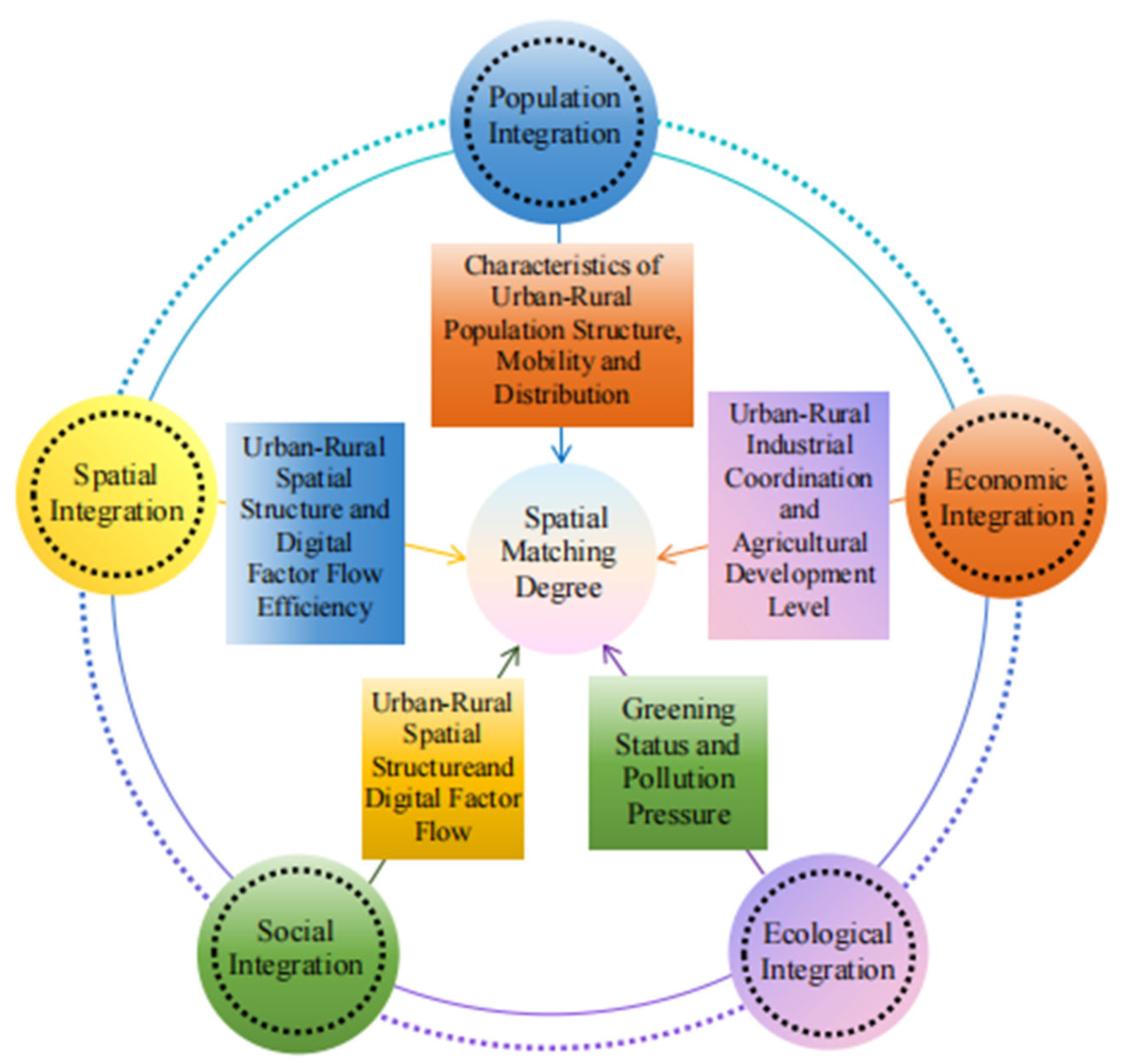
Urban–rural integration provides impetus for the dynamic adaptation between the expansion of urban population scale and the adjustment of land space supply by breaking down barriers to the flow of urban–rural factors and optimizing the pattern of resource allocation. However, at the same time, it also faces issues such as unbalanced development, which can bring about negative impacts. Based on the significance of urban–rural integration [28] and theoretical analysis, this paper identifies influencing factors from five dimensions: population integration, economic integration, social integration, ecological integration, and spatial integration [29]. See Figure 2 and Table 1 for details.
(1) Population Integration [30,31]: The proportion of rural non-agricultural labor force, the ratio of non-agricultural-to-agricultural population density, and the proportion of the ethnic minority population are selected to reflect the structure, mobility, and distribution of the urban–rural population. An increase in the proportion of non-agricultural labor force releases rural labor and promotes the agglomeration of urban population; a rise in the non-agricultural-to-agricultural population density ratio indicates the trend of population concentration in cities and towns; the rational distribution and positive interaction of ethnic minority populations contribute to enhancing the stability of urban populations [32].
(2) Economic Integration: Indicators including per capita GDP, industrial output value comparison, industrial synchronous development level, per unit area grain yield, the proportion of agriculture, forestry, animal husbandry, and fishery industries, and total agricultural machinery power per unit area are used to measure economic development, industrial structure coordination, and the level of agricultural modernization. Economic modernization and the dominance of non-agricultural industries promote urban employment [33,34] and population attraction; the level of agricultural modernization, accompanied by improved agricultural efficiency [35], releases labor and land resources to support urban expansion.
(3) Social Integration [36,37]: The ratio of urban-to-rural social consumer goods retail sales, per capita savings of residents, and per capita number of medical beds are adopted to reflect urban–rural consumption gaps, income gaps, and the level of public services. The improvement of rural residents’ income and consumption capacity helps farmers achieve stable lives in cities and towns; the improvement of public services such as medical care enhances the attractiveness of cities and towns to the population and residents’ willingness to settle down [38].
(4) Ecological Integration [39]: Urban–rural ecological greening, chemical fertilizer input intensity, and rural electricity consumption are selected to characterize ecological quality [40] and agricultural sustainability. A relatively high level of ecological greening supports the environmental capacity for urban population development and land exploitation [41]; the reduction of chemical fertilizer intensity and the increase in rural electricity consumption promote ecological protection and provide a sustainable ecological hinterland for cities and towns.
(5) Spatial Integration [42]: The ratio of crop-sown area to built-up area and the level of informatization are used to reflect the land use structure and the flow of digital factors. The coordinated ratio of agricultural land to construction land ensures food security and promotes intensive urban land use; the improvement of informatization promotes the rational distribution of urban–rural factors [43,44] and optimizes the spatial matching between population and land.

2.3. Data Sources

Based on the integrity and continuity of county-level data, counties in Xinjiang with severe data missing and specific years were excluded. A total of 83 county-level units in Xinjiang from 2010 to 2023 were selected as the research objects. Urban population data were sourced from the Xinjiang Prefecture and County Statistical Database in the EPS Database and the China County Statistical Yearbook (Township Volume). Specifically, data for 2010 and 2020 were obtained from the sixth and seventh National Population Censuses, respectively. Urban land data: considering the temporal coverage and accessibility of data, this study uses the impervious surface area from the 30 m annual land cover data of China (https://zenodo.org/records/12779975 accessed on 18 July 2025) released by Professors Yang Jie and Huang Xin from Wuhan University [45]. Influencing factor data: derived from the China County Statistical Yearbook and the Statistical Yearbooks of Prefectures and Counties in Xinjiang from 2010 to 2023. For a small number of indicators with missing data in some years, linear interpolation was used to supplement the data based on their variation trends.

2.4. Spatial Matching Evaluation Model

This study employs a spatial-matching degree-evaluation model [46] to assess the spatial coordination between urban population and land in the counties of Xinjiang, with the formula as follows:
S M D ( i , t ) = P ( i , t ) i n P ( i , t ) × ( L ( i , t ) i n L ( i , t ) ) 1 1 = A × P ( i , t ) L ( i , t ) 1                    
In Formula (1), SMD ( i , t ) represents the spatial matching index of the i-th county at time t; n is the total number of research regions (this study includes county units); P ( i , t ) and L ( i , t ) , respectively, represent the urban population size and urban land area of the i-th county at time t; A is a constant, reflecting the ratio relationship between urban land use and urban population in the various counties of Xinjiang. Among them, P ( i , t ) / L ( i , t ) actually represents the regional population agglomeration intensity, and its value has a positive correlation with population density.
According to existing research [47], SMD is divided into four levels (Table 2) to determine the matching level. The SMD ( i , t ) indicator can effectively reflect the matching status between the urban population scale and the amount of urban land at a specific time point. When SMD ≥ 0.3, it indicates that the overall matching level is relatively low and the population growth is excessively fast; when 0 ≤ SMD < 0.3 or −0.3 < SMD < 0, the matching level is relatively high; when SMD ≤ −0.3, the overall matching level is also relatively low, but the land growth is excessively fast. Furthermore, by calculating the matching index (∆ SMD ( i , t ) ) of the increase of the urban population and urban land within the research period ∆t, ∆ SMD ( i , t ) can effectively reflect the matching status between the growth of urban population scale and the expansion of urban land during a specific period. The same criteria are adopted for classification to reveal the speed coordination between population growth and land expansion in the process of urbanization (Table 3). This two-dimensional (static–dynamic) analysis method provides a quantitative tool for the research on the allocation of resource factors in the process of urbanization and helps to deeply analyze the evolution law of the human–land relationship.

2.5. Classification of County-Level Types Based on the Human–Land Matching Relationship

Based on the calculations of the Spatial Matching Degree Index (SMD) and its change amount (ΔSMD): Taking 2010 as the initial baseline year, 2010–2023 as the change process period, and 2023 as the end year, a complete time-series analysis framework is constructed. By combining the hierarchical characteristics of these three dimensions (initial period—process period—end period), the counties in Xinjiang are divided into 8 typical types (see Table 4).

2.6. Multinomial Logistic Regression Model

Multi-class logistic regression is an extension of binary models, suitable for situations where the dependent variable is a multi-class disorder. This method constructs multiple logit functions to estimate the probability of the observed object belonging to each category based on the reference category. This article uses this model to analyze the main influencing factors of different types of counties in Xinjiang. The specific formula is as follows [48,49,50]:
P i = e β 0 + β 1 x 1 + β 2 x 2 + . . . β k x k 1 + e β 0 + β 1 x 1 + β 2 x 2 + . . . β k x k
Equation (2) represents the probability that county belongs to a specific county type; e denotes the base of the natural logarithm; k is the number of input variables; β 0 , β 1 , , β k are the regression coefficients of the independent variables. The absolute value of the regression coefficient reflects the degree of influence of each indicator on the county type. In this study, the likelihood ratio test and classification accuracy are used to evaluate the significance and prediction accuracy of the indicators.

3. Results Analysis

3.1. Matching Pattern of Total Quantity and Increase in Human–Land Matching Relationship

3.1.1. Matching Status of Total Quantity at Time Points

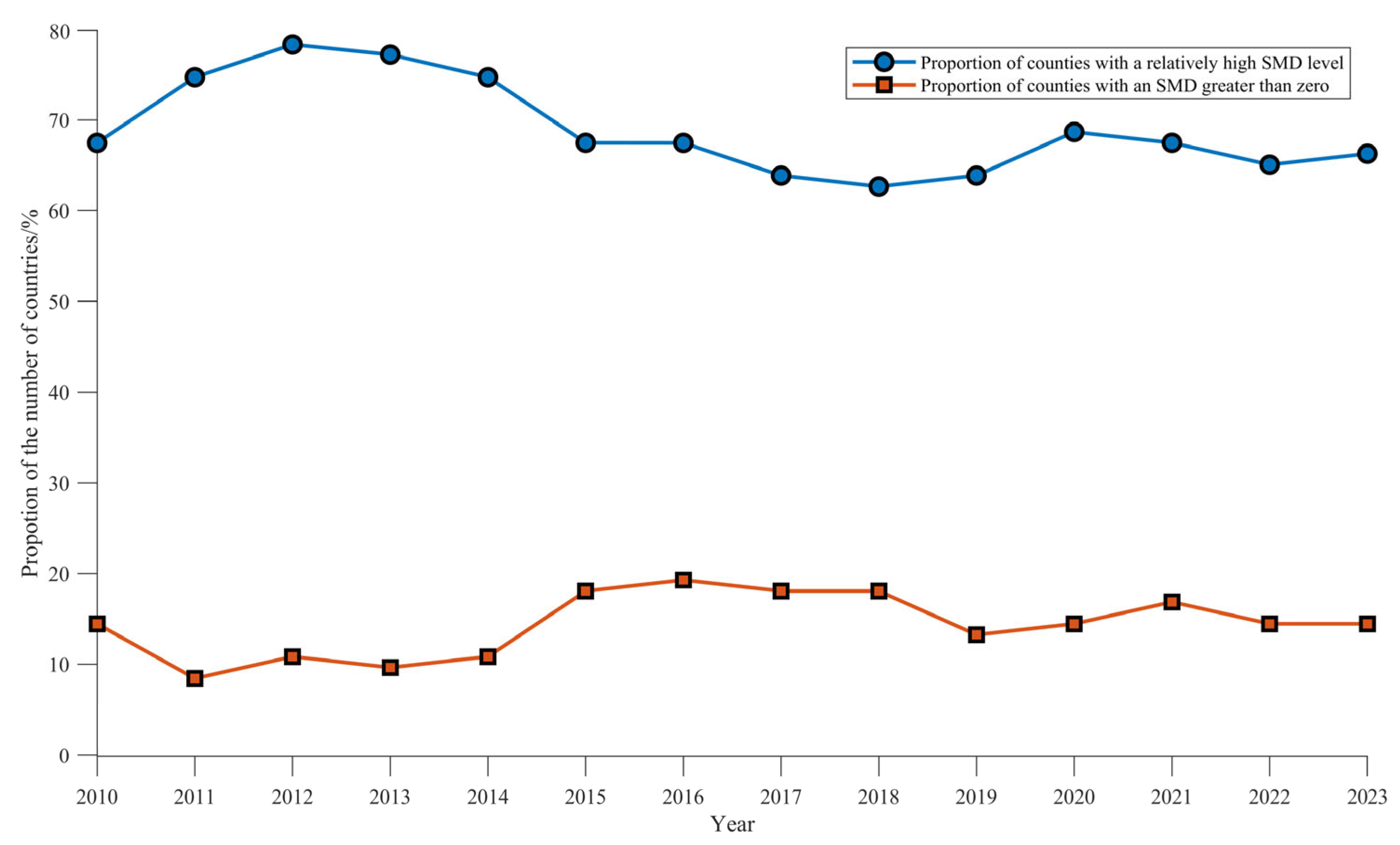
Based on the analysis of the total amount at each time point, each year from 2010 to 2023 is treated as a separate time point. During this period, the spatial matching degree of human–land relations in county-level towns of Xinjiang was generally low; on average, only 16.87% of the counties reached a relatively high matching level, though an upward trend was observed. As shown in Figure 3, 2016 marked a key juncture. Before that year, the number of counties with a high matching degree grew rapidly and peaked in 2016 (at 20.48%). After 2016, driven by poverty alleviation policies that promoted rapid land expansion, the matching degree entered a phase of fluctuating growth. In terms of spatial distribution: Counties with a high matching degree are concentrated in northern Xinjiang, where economic conditions and natural environments are relatively favorable, such as Gaochang District of Turpan and Balikun County. Counties dominated by population (with SMD > 0) are mostly distributed in areas that were influenced early by the “Aid-Xinjiang Policy,” including Kizilsu Kirghiz Autonomous Prefecture and Kashgar. Counties dominated by land (with SMD < 0) are stably distributed in regions like Turpan and Hami.

3.1.2. Matching Status of Incremental Changes in Time Periods

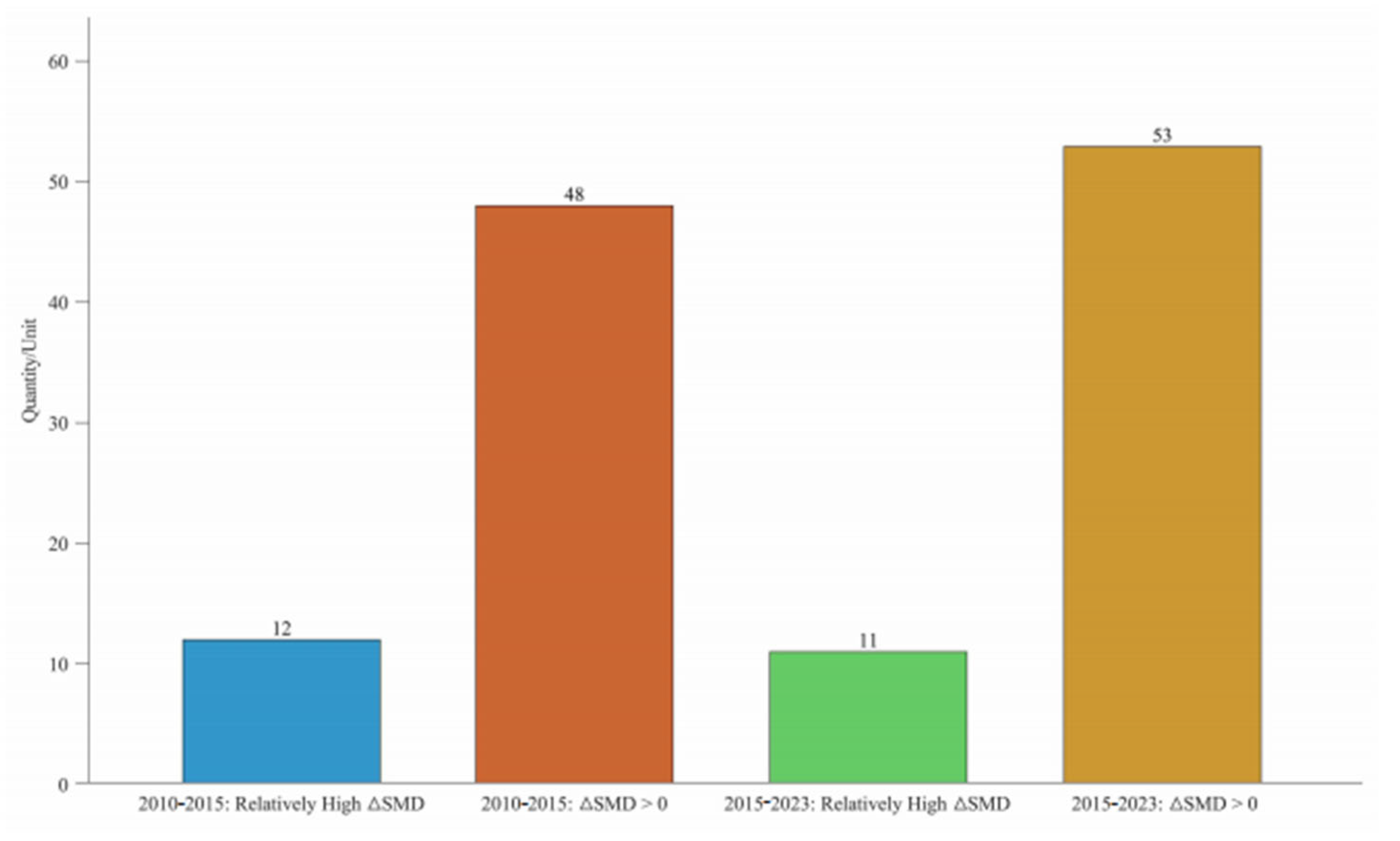
Based on the analysis of incremental changes over the period, the incremental matching degree of human–land relations (ΔSMD) in Xinjiang’s counties from 2010 to 2023 was generally at a low level and showed a downward trend. During 2010–2015, there were 12 counties with relatively high ΔSMD, accounting for 14.46% (Figure 4), which were mainly concentrated in regions such as Changji Hui Autonomous Prefecture and Aksu Prefecture; during 2015–2023, this proportion decreased slightly to 13.25%, and the spatial distribution became more scattered, with local agglomeration only formed in some areas of Bayingolin Mongol Autonomous Prefecture and Kizilsu Kirghiz Autonomous Prefecture.
From the perspective of allocation differences, the number of counties with positive ΔSMD continued to increase, which is consistent with the context of ecological protection restricting land supply and urbanization promoting population agglomeration. Counties with negative ΔSMD are concentrated in regions with a relatively solid industrial foundation such as Aksu Prefecture and Ili Kazakh Autonomous Prefecture, where population growth is constrained by ecological red lines and thus cannot match land development. In contrast, counties with positive ΔSMD are mostly found in southern Xinjiang regions supported by policies and characterized by land expansion driven by infrastructure investment that outpaces population agglomeration, as the speed of population concentration fails to keep up simultaneously.

3.2. Distribution Pattern of County Types

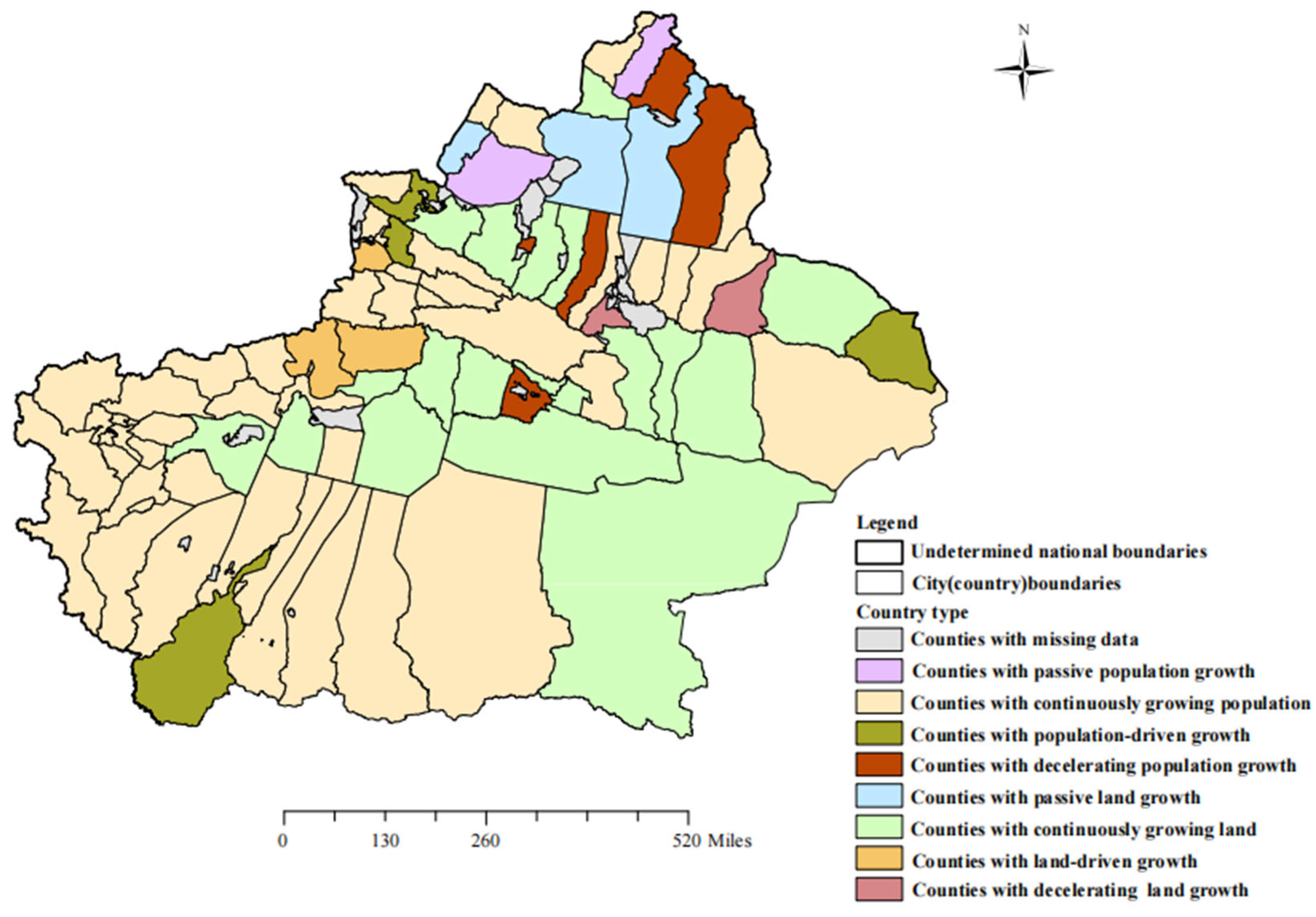
According to the classification results (Figure 5), the number of counties dominated by population growth and those dominated by land growth in Xinjiang was relatively balanced, with a slightly larger number of counties dominated by population growth overall. Counties dominated by population growth were mainly concentrated in Kashgar Prefecture, Kizilsu Kirghiz Autonomous Prefecture, Bortala Mongol Autonomous Prefecture in Southern Xinjiang, as well as Changji Hui Autonomous Prefecture and Ili Kazakh Autonomous Prefecture in northern Xinjiang. In contrast, counties dominated by land growth were mostly distributed in Aksu Prefecture and Bayingolin Mongol Autonomous Prefecture in southern Xinjiang, and Altay Prefecture and Tacheng Prefecture in Northern Xinjiang. Although there was no significant difference in the number of counties dominated by population growth or land growth between northern and southern Xinjiang, southern Xinjiang was dominated by counties with population growth, while northern Xinjiang had a more diverse range of county types and was dominated by counties with land growth overall.

3.3. Analysis of Influencing Factors and Mechanisms of Formation for Different County Types

3.3.1. Model Validation

This study takes the county-level classification results as the dependent variable and the incremental data of 18 indicators of urban–rural integration from 2010 to 2023 as the independent variable to analyze the key driving factors for the formation of different county-level types. In data processing, the independent variables were standardized to eliminate the influence of dimensionality, and VIF test was conducted to find multicollinearity (VIF greater than 5) in the proportion of agriculture, forestry, animal husbandry, and fishery and the degree of informatization. Therefore, they were excluded. The model test showed that the likelihood ratio test reached a highly significant level (p < 0.01), and the classification accuracy exceeded 89.6%, indicating a good fit of the model. The regression results show that there are significant differences in the degree and direction of influence of various indicators on different types of counties, and further analysis of their mechanisms is needed in conjunction with spatial distribution characteristics.

3.3.2. Mechanistic Analysis of Influencing Factors

(1) Population-Promoted-Growth Type and Population-Slowed-Growth Type. Counties of the population-promoted-growth type and population-slowed-growth type were few and scattered in distribution, with most located in northern Xinjiang, accounting for 12.05%. As shown in Table 5, the population-promoted-growth type counties were most positively affected by the per capita savings deposit balance of urban and rural residents, and most negatively affected by urban spatial expansion. These counties had sound economic development and a relatively high level of savings deposit balance, which reflected the accumulation of residents’ wealth and economic vitality, directly enhancing the attractiveness of the counties to the population. However, these counties had a large proportion of agriculture; urban spatial expansion, accompanied by an increase in construction land area, was detrimental to agricultural development. At the same time, rapid spatial expansion might disperse financial resources, leading to lagging public services, such as education and medical care, reducing the livability of the counties and hindering the formation of population-promoted-growth type counties.
The formation of population-slowed-growth type counties was most positively affected by per capita GDP and most negatively affected by the proportion of rural non-agricultural labor force. From the perspective of regional development characteristics, these regions had a relatively concentrated population. With the increase in per capita GDP, rigid consumption such as living costs, housing prices, and education expenditures in the region increased simultaneously. Meanwhile, the supply–demand relationship in the labor market changed, intensifying employment competition, which objectively inhibited population agglomeration and led to a slowdown in the growth rate of the urban population. A high proportion of rural non-agricultural labor force indicated that surplus agricultural labor had basically been absorbed by local secondary and tertiary industries, meaning more jobs and a larger share in other industries. This provided people with more choices and opportunities, attracting a large influx of people into cities and towns. The continuous growth of the urban population hindered the formation of population-slowed-growth type counties.
(2) Sustained-Population-Growth Type and Sustained-Land-Growth Type. Counties of the sustained-population-growth type and sustained-land-growth type accounted for the highest proportions, reaching 49.40% and 26.51%, respectively. Sustained-population-growth type counties were mostly distributed in Kashgar Prefecture, Hotan Prefecture, and Kizilsu Kirghiz Autonomous Prefecture—all located in southern Xinjiang. Their formation was most positively affected by the proportion of the ethnic minority population and most negatively affected by urban–rural land allocation. Kashgar Prefecture and Hotan Prefecture in southern Xinjiang have an extremely high proportion of an ethnic minority population. Data from the seventh National Population Census shows that the natural population growth rate in ethnic-minority-concentrated areas is significantly higher than the national average, and the population mobility in these areas is relatively low. That is, a higher proportion of the ethnic minority population is more conducive to the sustained and stable growth of the population. However, the oasis agriculture in southern Xinjiang relies on limited cultivated land. The national cultivated land red line and food security policies maintain a large proportion of crop-sown area, restricting the expansion of construction land and further compressing available space—this is not conducive to sustained population growth.
Sustained-land-growth type counties were mostly distributed in Tacheng Prefecture and Ili Kazakh Autonomous Prefecture. Their formation was most positively affected by the level of synchronized industrial development and most negatively affected by the per-hectare grain yield. Synchronized industrial development can provide stable land demand and optimize the land use structure. The coordinated advancement of agriculture, industry, and services, along with the complementary land demands of different industries, supports the sustainable growth of land. In contrast, a high per-hectare grain yield implies high agricultural benefits, making local governments and farmers more inclined to retain cultivated land rather than convert it into industrial or urban land—this directly inhibits the growth of land supply.
(3) Passive-Population-Growth Type and Slowed-Land-Growth Type. Counties of the passive-population-growth type and slowed-land-growth type accounted for the smallest proportion, with only four counties, all located in northern Xinjiang. Northern Xinjiang has a relatively high proportion of the Han population. Although a large number of people have moved in due to policy reasons in recent years, the population mobility in northern Xinjiang is generally high—resulting in very few passive-population-growth type counties. Although northern Xinjiang has a higher urbanization level and a smaller area of developable land compared to southern Xinjiang, Xinjiang’s overall urbanization rate is low and it is still in the stage of land expansion—thus, there are also very few slowed-land-growth type counties in Xinjiang. The formation of passive-population-growth type counties was most positively affected by the industrial output value ratio and most negatively affected by urban spatial expansion. All passive-population-growth type counties are dominated by agriculture; counties with an economic structure more oriented toward agriculture rely more on the improvement of agricultural development. This not only provides more jobs but also introduces relevant subsidy policies to drive the inflow of agricultural technology talents. However, urban spatial expansion is accompanied by the continuous growth of urban land, which hinders the formation of passive-population-growth type counties.
The formation of slowed-land-growth type counties was most positively affected by the total agricultural machinery power per unit area and most negatively affected by urban spatial expansion. An increase in total agricultural machinery power per unit area indicates a higher penetration rate of agricultural machinery, which reduces the demand for manual labor in agriculture, promotes the transfer of rural labor to the secondary and tertiary industries, and accelerates population agglomeration in the process of urbanization—relatively slowing down the growth rate of urban land. Similar to passive-population-growth type counties, urban spatial expansion can promote the growth of urban land, thereby inhibiting the formation of slowed-land-growth type counties.
(4) Land-Promoted-Growth Type and Passive-Land-Growth Type. Counties of the passive-land-growth type and land-promoted-growth type accounted for 7.23% of the total. Among them, passive-land-growth type counties are distributed in Altay Prefecture and Tacheng Prefecture. Their formation is most positively affected by the intensity of chemical fertilizer input. Both Altay Prefecture and Tacheng Prefecture are alpine and barren areas with relatively underdeveloped economies. A high intensity of chemical fertilizer input indicates that these areas are suitable for crop cultivation. To maintain agricultural output value, local governments invest financial and material resources in reclaimed unused land; at the same time, they convert some cultivated land unsuitable for agricultural planting into other types of land, thereby promoting land growth.
Land-promoted-growth type counties are scattered in Aksu Prefecture and Ili Kazakh Autonomous Prefecture. Their formation is most positively affected by per capita GDP and most negatively affected by the number of medical beds per capita. Per capita GDP represents the level of economic development—a higher level of economic development attracts more enterprises to settle in the counties, which drives the development of urban land and further promotes the growth of urban land.

4. Discussion

As a core hub of the “Belt and Road” Initiative and a multi-ethnic settlement area, Xinjiang exhibits unique regional characteristics in man–land matching at the county level. From a national perspective, Xinjiang faces challenges in population mobility, land development, and cultural integration driven by policy support. From a global perspective, Xinjiang shares commonalities as a peripheral region with countries along the Mediterranean coast and the five Central Asian countries, and its man–land relationship reflects the coordination dilemmas commonly encountered by developing countries. However, in academic circles, research on man–land matching in such regions has long been neglected by mainstream global urbanization studies—thus, research on Xinjiang provides new empirical evidence for understanding the sustainable development of global peripheral regions.
This study finds that the overall level of urban man–land spatial matching in Xinjiang’s counties is relatively low, which is consistent with findings from studies in other regions [47]. Driven by China’s vigorous efforts to develop Xinjiang, a large number of enterprises and resources have been introduced, leading to rapid urban land expansion. Nevertheless, due to the late start of economic development and the need for improvement in basic medical facilities and other public services, the overall capacity for population agglomeration remains insufficient. These dual factors result in a generally low level of man–land spatial matching. Meanwhile, the research indicates that the number of counties with high matching levels in northern Xinjiang is greater than that in southern Xinjiang. Firstly, northern Xinjiang outperforms southern Xinjiang in water resources, mineral resources, and transportation infrastructure, enabling it to stabilize its population more effectively. Secondly, the development of resource-based industries in northern Xinjiang has boosted the economy and improved urban land use efficiency, leading to a stable and relatively high level of urban man–land matching overall. In contrast, southern Xinjiang is dominated by counties with sustained population growth, while northern Xinjiang features diverse types with land-growth-oriented counties as the mainstay. The essence of this difference lies in the inconsistent development speeds between northern and southern Xinjiang: southern Xinjiang is in the initial stage of urban–rural integration, where population agglomeration is the core task; northern Xinjiang is in a stage of rapid development, where land optimization serves as an important pillar—thus presenting distinct county-level type characteristics.
Additionally, the study shows that factors such as industrial structure are the core driving forces for coordinating man–land relationships in most counties, which aligns with the conclusions of relevant studies [35]. However, compared with related research in other countries [51,52], this study identifies that the significant impact of the proportion of the ethnic minority population on man–land relationships is a key feature that distinguishes Xinjiang from other regions. Based on Xinjiang’s status as a multi-ethnic settlement area, the clan culture and community networks of ethnic minorities exert a stronger stickiness on population agglomeration, thereby exerting a significant influence on man–land matching relationships.

5. Recommendations and Prospects

5.1. Recommendations

(1) In response to the characteristics of population–growth–oriented county-level agglomeration in southern Xinjiang, efforts should be made to promote industrial upgrading and functional relocation in the central urban area, orderly transfer land intensive industries and supporting populations to peripheral industrial agglomeration areas, and effectively alleviate population pressure by improving public services and housing security, as well as constructing fully functional industrial new cities.
(2) Northern Xinjiang’s land-growth-oriented counties need to focus on improving land use efficiency and filling the gap in population growth through differentiated talent introduction policies, while promoting the redevelopment of inefficient land and industrial upgrading, and promoting a positive interaction between land expansion and efficiency improvement.
(3) Efforts should be made to strengthen regional coordination between southern and northern Xinjiang, encourage the extension of capital and technology from northern Xinjiang to labor-intensive industries in southern Xinjiang, improve transportation and logistics infrastructure in southern Xinjiang, promote two-way talent flow and cross-regional training and employment of labor force, and narrow the regional development gap.

5.2. Prospects

The conclusion of this study is based on the special region of Xinjiang, and its universality has certain limitations. At the same time, there is still room for expansion in the depth and breadth of variables in the existing influencing-factor system. Future research can expand the regional scope and use policy regulation as a key external variable to conduct multi-scenario simulations and dynamic evaluations, in order to predict the evolution of human–land relations under different policy paths and provide more accurate decision support for urban–rural integration governance.

6. Conclusions

(1) The overall matching degree of human land space in Xinjiang counties from 2010 to 2023 is relatively low, but it is showing an upward trend. The number of high-matching counties in northern Xinjiang is higher than that in southern Xinjiang, but southern Xinjiang performs better in incremental matching, with the population growth rate in most counties continuing to outpace land expansion.
(2) The study divides counties in Xinjiang into eight categories, with the dominant types being population growth (49.40%) and land growth (26.51%). Southern Xinjiang is mainly characterized by sustained population growth, while northern Xinjiang is characterized by more dispersed types and mainly land growth. The passive-population-growth type and land-slowing-growth type are the least common.
(3) The analysis of influencing factors shows that factors such as the proportion of ethnic minority population and the comparison of industrial output value have a significant promoting effect on the formation of population-growth-oriented counties; the level of industrial synergy and urban spatial expansion are the main factors driving the development of land-growth-oriented counties. The dimension of spatial integration exhibits the strongest explanatory power in the urban–rural integration system.

Author Contributions

Conceptualization, W.H.; methodology, W.H.; software, W.H.; resources, Q.M.; data curation, W.H.; writing—original draft preparation, W.H.; writing—review and editing, Q.M.; project administration, Q.M.; funding acquisition, Q.M. All authors have read and agreed to the published version of the manuscript.

Funding

This research was supported by The National Social Science Fund of China (Grant no. 15XJY014), and Corps Talent Support Program Backbone Talent Project (Grant no. [2023] No. 3).

Institutional Review Board Statement

Not applicable.

Informed Consent Statement

Not applicable.

Data Availability Statement

Data is contained within the article.

Conflicts of Interest

The authors declare no conflict of interest.

References

  1. Yang, Y.Y.; Bao, W.K.; Wang, Y.; Liu, Y. Measurement of urban-rural integration level and its spatial differentiation in China in the new century. Habitat Int. 2021, 117, 102420. [Google Scholar] [CrossRef]
  2. Zeng, Q.; Chen, X. Identification of urban-rural integration types in China–an unsupervised machine learning approach. China Agric. Econ. Rev. 2023, 15, 400–415. [Google Scholar] [CrossRef]
  3. Zhang, G.; Cheng, S.; Gao, Y. A visibility-based approach to manage the vertical urban development and maintain visual sustainability of urban mountain landscapes: A case of Mufu Mountain in Nanjing, China. Environ. Plan. B Urban Anal. City Sci. 2024, 51, 384–400. [Google Scholar] [CrossRef]
  4. Zhang, Z.; Hua, C.; Chen, X.L.; Song, M. The spatial impact of population semi-urbanization on sulfur dioxide emissions: Empirical evidence from China. J. Environ. Manag. 2025, 375, 124257. [Google Scholar] [CrossRef]
  5. Cai, E.; Zhang, S.; Chen, W.; Li, L. Spatio–temporal dynamics and human–land synergistic relationship of urban expansion in Chinese megacities. Heliyon 2023, 9, e19872. [Google Scholar] [CrossRef]
  6. Chen, K.; Long, H.; Liao, L.; Tu, S.; Li, T. Land use transitions and urban-rural integrated development: Theoretical framework and China’s evidence. Land Use Policy 2020, 92, 104465. [Google Scholar] [CrossRef]
  7. Yee, S.H.; Paulukonis, E.; Simmons, C.; Russell, M.; Fulford, R.; Harwell, L.; Smith, L. Projecting effects of land use change on human well-being through changes in ecosystem services. Ecol. Model. 2021, 440, 109358. [Google Scholar] [CrossRef] [PubMed]
  8. Zhu, S.; Kong, X.; Jiang, P. Identification of the human-land relationship involved in the urbanization of rural settlements in Wuhan city circle, China. J. Rural Stud. 2020, 77, 75–83. [Google Scholar] [CrossRef]
  9. Lin, W.; Wu, M.; Zhang, Y.; Zeng, R.; Zheng, X.; Shao, L.; Zhao, L.; Li, S.; Tang, Y. Regional differences of urbanization in China and its driving factors. Sci. China-Earth Sci. 2018, 61, 778–791. [Google Scholar] [CrossRef]
  10. Luan, W.; Li, X. Rapid urbanization and its driving mechanism in the Pan-Third Pole region. Sci. Total Environ. 2021, 750, 141270. [Google Scholar] [CrossRef]
  11. Wang, Z.B.; Liang, L.W.; Sun, Z.; Wang, X. Spatiotemporal differentiation and the factors influencing urbanization and ecological environment synergistic effects within the Beijing-Tianjin-Hebei urban agglomeration. J. Environ. Manag. 2019, 243, 227–239. [Google Scholar] [CrossRef]
  12. Lin, S.; Wang, S.; Marinova, D.; Zhao, D.; Hong, J. Impacts of urbanization and real economic development on CO2 emissions in non-high income countries: Empirical research based on the extended STIRPAT model. J. Clean. Prod. 2017, 166, 952–966. [Google Scholar] [CrossRef]
  13. Liu, Y.; Zhang, X.; Lei, J.; Zhu, L. Urban expansion of oasis cities between 1990 and 2007 in Xinjiang, China. Int. J. Sustain. Dev. World Ecol. 2010, 17, 253–262. [Google Scholar] [CrossRef]
  14. Wang, T.; Zhou, D.; Wang, L.; Wu, J. Urban Spatial Carrying Capacity and Sustainable Urbanization in the Middle-east Section of North Slope of Kunlun Mountains in Xinjiang, China. Chin. Geogr. Sci. 2023, 33, 426–440. [Google Scholar] [CrossRef]
  15. Cao, H. Urban–rural income disparity and urbanization: What is the role of spatial distribution of ethnic groups? A case study of Xinjiang Uyghur Autonomous Region in western China. Reg. Stud. 2010, 44, 965–982. [Google Scholar] [CrossRef]
  16. Qian, J.; Zhou, Q.; Chen, X.; Sun, B. A model-based analysis of spatio-temporal changes of the urban expansion in arid area of Western China: A case study in North Xinjiang economic zone. Atmosphere 2020, 11, 989. [Google Scholar] [CrossRef]
  17. Ariken, M.; Zhang, F.; Chan, N.W.; Kung, H.T. Coupling coordination analysis and spatio-temporal heterogeneity between urbanization and eco-environment along the Silk Road Economic Belt in China. Ecol. Indic. 2021, 121, 107014. [Google Scholar] [CrossRef]
  18. Abulimiti, M.; Simayi, Z.; Yang, S.; Chai, Z.; Yan, Y. Study of coordinated development of county urbanization in arid areas of China: The case of Xinjiang. PLoS ONE 2022, 17, e0276235. [Google Scholar] [CrossRef]
  19. Zhang, Y.; Wang, H.; Luo, K.; Wu, C.; Li, S. Study on Spatialization and Spatial Pattern of Population Based on Multi-Source Data—A Case Study of the Urban Agglomeration on the North Slope of Tianshan Mountain in Xinjiang, China. Sustainability 2024, 16, 4106. [Google Scholar] [CrossRef]
  20. Wu, J. The Rise of Ethnicity under C hina’s Market Reforms. Int. J. Urban Reg. Res. 2014, 38, 967–984. [Google Scholar] [CrossRef]
  21. Attané, I.; Courbage, Y. Transitional stages and identity boundaries: The case of ethnic minorities in China. Popul. Environ. 2000, 21, 257–280. [Google Scholar] [CrossRef]
  22. Zhang, H.; Chen, M.; Liang, C. Urbanization of county in China: Spatial patterns and influencing factors. J. Geogr. Sci. 2022, 32, 1241–1260. [Google Scholar] [CrossRef]
  23. Jiao, H.; Zhang, X.; Yang, C.; Cao, X. The characteristics of spatial expansion and driving forces of land urbanization in counties in central China: A case study of Feixi county in Hefei city. PLoS ONE 2021, 16, e0252331. [Google Scholar] [CrossRef] [PubMed]
  24. Güneralp, B.; Reba, M.; Hales, B.U.; Wentz, E.A.; Seto, K.C. Trends in urban land expansion, density, and land transitions from 1970 to 2010: A global synthesis. Environ. Res. Lett. 2020, 15, 044015. [Google Scholar] [CrossRef]
  25. Liu, M.; Li, Q.; Bai, Y.; Fang, C. A novel framework to evaluate urban-rural coordinated development: A case study in Shanxi Province, China. Habitat Int. 2024, 144, 103013. [Google Scholar] [CrossRef]
  26. Gómez Valenzuela, V.; Holl, A. Growth and decline in rural Spain: An exploratory analysis. Eur. Plan. Stud. 2024, 32, 430–453. [Google Scholar] [CrossRef]
  27. Sun, L.; Chen, J.; Li, Q.; Huang, D. Dramatic uneven urbanization of large cities throughout the world in recent decades. Nat. Commun. 2020, 11, 5366. [Google Scholar] [CrossRef] [PubMed]
  28. Zhan, L.; Wang, S.J.; Zhang, Q.; Qu, Y. Spatial path to achieve urban-rural integration development− analytical framework for coupling the linkage and coordination of urban-rural system functions. Habitat Int. 2023, 142, 102953. [Google Scholar] [CrossRef]
  29. Zeng, P.; Zeng, N.J. The temporal evolution process and spatial differentiation mechanism of urban-rural integration in China. Hum. Geogr. 2025, 40, 101–112+153. [Google Scholar] [CrossRef]
  30. Shen, H.L.; Xia, L. Research on social integration structure and path of floating population based on structural equation model: Evidence from China. Soc. Indic. Res. 2023, 165, 607–632. [Google Scholar] [CrossRef]
  31. Liao, L.; Cai, X.; Liu, L.; Sun, Z.W. Exploring heterogeneous paths of social integration of the floating population in the communities in Guangdong, China. Cities 2025, 163, 106024. [Google Scholar] [CrossRef]
  32. Fei, C.C.; Zhu, Y.Y.; Jiang, L.Y.; Zhou, H.X.; Yu, H.Y. Social integration, physical and mental health and subjective well-being in the floating population—A moderated mediation analysis. Front. Public Health 2023, 11, 1167537. [Google Scholar] [CrossRef]
  33. He, S.Y.; Chen, X.; Es, M.; Guo, Y.; Sun, K.K.; Lin, Z. Liveability and migration intention in Chinese resource-based economies: Findings from seven cities with potential for population shrinkage. Cities 2022, 131, 103961. [Google Scholar] [CrossRef]
  34. Ren, Q.; Gu, G.; Zhou, Y.; Zhang, Z. Research on the economic effect of employment structure change in heterogeneous regions: Evidence from resource-based cities in China. Econ. Res.-Ekon. Istraživanja 2022, 35, 6364–6384. [Google Scholar] [CrossRef]
  35. Cho, S.H.; Chen, Z.; Yen, S.T.; English, B.C. Spatial variation of output-input elasticities: Evidence from Chinese county-level agricultural production data. Pap. Reg. Sci. 2007, 86, 139–157. [Google Scholar] [CrossRef]
  36. Liu, B.; Qi, C.; Xue, B.; Yang, Z. Measuring urban–rural integration through the lenses of sustainability and social equity: Evidence from China. Habitat Int. 2025, 165, 103559. [Google Scholar] [CrossRef]
  37. Vergunst, P. Social integration: Social integration: Re-socialisation and symbolic boundaries in Dutch rural neighbourhoods. J. Ethn. Migr. Stud. 2008, 34, 917–934. [Google Scholar] [CrossRef]
  38. Chen, L.; Li, M.; Huang, Y. From industry to education-driven urbanization: A welfare transformation of urbanization in Chinese counties. Habitat Int. 2025, 155, 103248. [Google Scholar] [CrossRef]
  39. Zhao, W.; Jiang, C. Analysis of the spatial and temporal characteristics and dynamic effects of urban-rural integration development in the Yangtze River Delta region. Land 2022, 11, 1054. [Google Scholar] [CrossRef]
  40. Briski, E.; Langrehr, L.; Kotronaki, S.G.; Sidow, A.; Martinez Reyes, C.G.; Geropoulos, A.; Steffen, G.; Theurich, N.; Dickey, J.W.E.; Hütt, J.C.; et al. Urban environments promote adaptation to multiple stressors. Ecol. Lett. 2025, 28, e70074. [Google Scholar] [CrossRef] [PubMed]
  41. Alola, A.A.; Özkan, O.; Usman, O. Role of non-renewable energy efficiency and renewable energy in driving environmental sustainability in India: Evidence from the load capacity factor hypothesis. Energies 2023, 16, 2847. [Google Scholar] [CrossRef]
  42. Liao, G.; He, P.; Gao, X.; Lin, Z.; Huang, C.; Zhou, W.; Deng, O.; Xu, C.; Deng, L. Land use optimization of rural production–living–ecological space at different scales based on the BP–ANN and CLUE–S models. Ecol. Indic. 2022, 137, 108710. [Google Scholar] [CrossRef]
  43. Dimmick, J.; Feaster, J.C.; Ramirez, A., Jr. The niches of interpersonal media: Relationships in time and space. New Media Soc. 2011, 13, 1265–1282. [Google Scholar] [CrossRef]
  44. Song, Z.J.; Yu, L.J. A study on the generalised space of urban–rural integration in Beijing suburbs during the present day. Urban Stud. 2015, 52, 2581–2598. [Google Scholar] [CrossRef]
  45. Wu, X.Y.; Yang, S.; Yin, S.G.; Xu, H. The Characteristics and Evolution Models of Urban Construction Land Agglomeration in the Yangtze River Delta under Rapid Urbanization. Geogr. Res. 2021, 40, 1917–1934. (In Chinese) [Google Scholar]
  46. Shan, L.; Jiang, Y.; Liu, C.; Wang, Y.; Zhang, G.; Cui, X.; Li, F. Exploring the multidimensional coordination relationship between population urbanization and land urbanization based on the MDCE model: A case study of the Yangtze River Economic Belt, China. PLoS ONE 2021, 16, e0253898. [Google Scholar] [CrossRef]
  47. Ren, Y.J.; Yang, J.X.; Zhang, Z.; Zhao, Z.; Wang, J.; Wang, Y.; Gong, J. Urbanization of county in China: Differences and Influencing Factors of Spatial Matching relationship between urban population and urban land. China Land Sci. 2023, 37, 92–103. (In Chinese) [Google Scholar] [CrossRef]
  48. Lukman, A.F.; Mohammed, S.; Olaluwoye, O.; Farghali, R.A. Handling multicollinearity and outliers in logistic regression using the robust Kibria–Lukman estimator. Axioms 2024, 14, 19. [Google Scholar] [CrossRef]
  49. Dumitrescu, E.; Hué, S.; Hurlin, C.; Tokpavi, S. Machine learning for credit scoring: Improving logistic regression with non-linear decision-tree effects. Eur. J. Oper. Res. 2022, 297, 1178–1192. [Google Scholar] [CrossRef]
  50. Nieto, J.J. Solution of a fractional logistic ordinary differential equation. Appl. Math. Lett. 2022, 123, 107568. [Google Scholar] [CrossRef]
  51. Alexander, S.; Yang, B.; Hussey, O. Examining the Land Use and Land Cover Impacts of Highway Capacity Expansions in California Using Remote Sensing Technology. Transp. Res. Rec. 2025, 2679, 439–449. [Google Scholar] [CrossRef]
  52. Das, T.; Shahfahad; Naikoo, M.W.; Talukdar, S.; Parvez, A.; Rahman, A.; Pal, S.; Asgher, S.; Islam, A.R.M.T.; Mosavi, A. Analysing process and probability of built-up expansion using machine learning and fuzzy logic in English Bazar, West Bengal. Remote Sens. 2022, 14, 2349. [Google Scholar] [CrossRef]
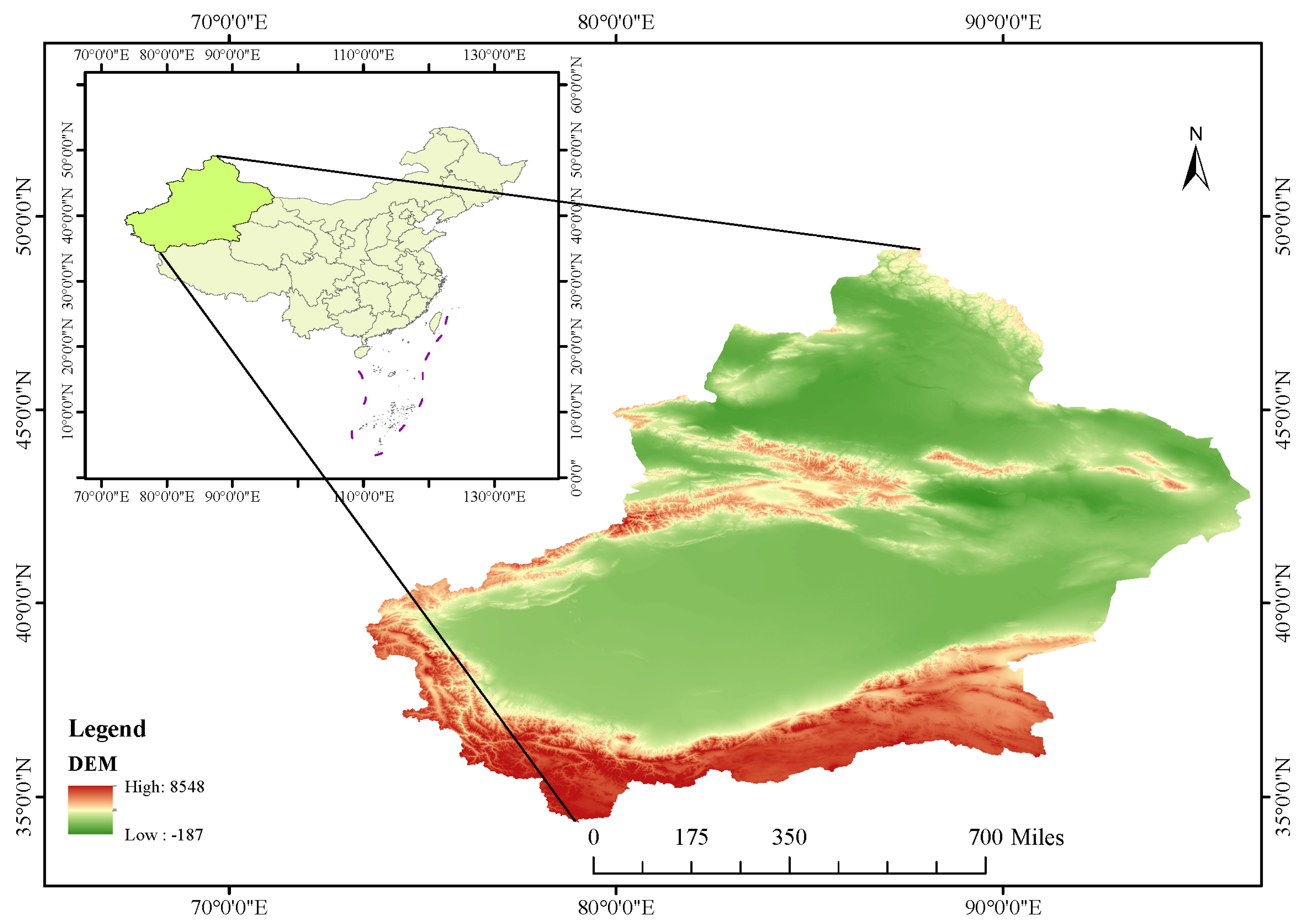
Figure 1. Geographical map of Xinjiang.
Sustainability 17 10822 g001
Figure 2. Mechanism of the impact of urban–rural integration on the human–land matching relationship.
Sustainability 17 10822 g002
Figure 3. Trend of changes in the number of SMD types in Xinjiang (2010–2023).
Sustainability 17 10822 g003
Figure 4. Bar chart of the number of counties with high ΔSMD values and ΔSMD values greater than 0 during 2010–2015 and 2015–2023.
Sustainability 17 10822 g004
Figure 5. Distribution map of different county types.
Sustainability 17 10822 g005
Table 1. Evaluation system of influencing factors on population–land spatial matching from the perspective of urban–rural integration.
Dimension LayerIndicator LayerIndicator Explanation
Population IntegrationProportion of Rural Non-Agricultural Labor Force (%)Number of Rural Non-Agricultural Employees/Total Rural Employed Population
Ratio of Non-Agricultural to Agricultural Population DensityNon-Agricultural Population Density/Agricultural Population Density
Proportion of Ethnic Minority Population (%)Ethnic Minority Population/Total Regional Population
Economic IntegrationPer Capita GDP (RMB/person)GDP/Total Regional Population
Industrial Output Value Ratio (%)Added Value of Primary Industry/(Added Value of Secondary Industry + Added Value of Tertiary Industry)
Level of Synchronized Industrial Development (%)Index of Added Value of Primary Industry/Average of Index of Added Value of Secondary Industry and Index of Added Value of Tertiary Industry
Grain Yield per Hectare (t/hm2)Total Grain Output/Sown Area of Grain Crops
Proportion of Agriculture, Forestry, Animal Husbandry and Fishery (%)Gross Output Value of Agriculture, Forestry, Animal Husbandry and Fishery/Total Regional GDP
Total Agricultural Machinery Power per Unit Area (100,000 kW/km2)Total Agricultural Machinery Power/Cultivated Land Area
Social IntegrationRatio of Urban to Rural Retail Sales of Consumer Goods (%)Total Retail Sales of Consumer Goods in Urban Areas/Total Retail Sales of Consumer Goods in Rural Areas
Per Capita Savings Deposit Balance of Urban and Rural Residents (RMB/person)Total Savings Deposits of Urban and Rural Residents/Total Population
Number of Medical Beds per Capita (bed/person)Total Number of Medical Beds/Total Regional Population
Ecological IntegrationUrban–Rural Ecological Greening Rate (%)Forest Land Area/Total Regional Area
Chemical Fertilizer Input Intensity (t/km2)Chemical Fertilizer Application Amount/Cultivated Land Area
Rural Electricity Consumption (10,000 kWh)Total Rural Electricity Consumption
Spatial IntegrationUrban–Rural Land Allocation Ratio (%)Sown Area of Crops/Built-Up Area
Urban Spatial Expansion Rate (%)Built-Up Area/Total Regional Area
Informatization Level (%)Number of Fixed Telephone Subscribers/Permanent Resident Population of the County
Table 2. Detailed classification of the matching level for the total amount of spatial matching degree between urban population and land at a specific time point.
Parameter RangeMatching Levels
SMD ≥ 0.3Positive Low
0 ≤ SMD < 0.3Positive High
−0.3 < SMD < 0Negative High
SMD ≤ −0.3Negative Low
Table 3. Detailed classification of the matching level for the total amount of spatial matching degree between urban population and land in a specific time period.
Parameter RangeMatching Levels
ΔSMD ≥ 0.3Positive Low
0 ≤ ΔSMD < 0.3Positive High
−0.3 < ΔSMD < 0Negative High
ΔSMD ≤ −0.3Negative Low
Table 4. County-level classification based on the type of urban population–land matching relationship.
County-Level TypeInitial Period-Process Period-End Period CombinationTerminal Quantitative RelationshipRelationship of Process Growth Rate
Population-Promoted-Growth TypeNegative—Positive—PositiveUrban Population > Urban LandUrban Population > Urban Land
Population-Growth-Slowing TypePositive—Negative—PositiveUrban Population < Urban Land
Population-Sustained-Growth TypePositive—Positive—PositiveUrban Population > Urban Land
Population-Passive-Growth TypeNegative—Negative—PositiveUrban Population < Urban Land
Land-Promoted-Growth TypePositive—Negative—NegativeUrban Population < Urban LandUrban Population < Urban Land
Land-Growth-Slowing TypeNegative—Positive—NegativeUrban Population > Urban Land
Land-Sustained-Growth TypeNegative—Negative—NegativeUrban Population < Urban Land
Land-Passive-Growth TypePositive—Positive—NegativeUrban Population > Urban Land
Table 5. Results of multinomial logistic regression analysis.
Population-Promoted-Growth TypePopulation-Growth-Slowing TypePopulation-Sustained-Growth TypePopulation-Passive-Growth TypeLand-Promoted-Growth TypeLand-Growth-Slowing TypeLand-Sustained-Growth TypeLand-Passive-Growth Type
Proportion of Rural Non-Agricultural Labor Force0.632−0.66 **0.1950.2370.2060.1130.1650.258
(−0.22)(−3.579)(−1.03)(0.585)(0.747)(−0.353)(0.824)(−0.711)
Ratio of Non-Agricultural to Agricultural Population Density0.348 **0.054−0.029−0.0310.022 **−0.008−0.1250.020 *
(4.053)(−0.156)(−0.084)(−0.049)(−3.051)(−0.013)(−0.349)(−1.739)
Proportion of Ethnic Minority Population−0.4170.157 **0.334 **0.112 **0.0560.3060.387 *0.087 **
(−0.122)(2.725)(−2.421)(−2.766)(−0.265)(−1.138)(1.712)(−3.219)
Per Capita GDP0.665 **0.614 *−0.3950.1140.448 **0.0420.0490.059
(−4.154)(−2.047)(−1.559)(0.255)(3.294)(−0.123)(0.226)(0.146
Industrial Output Value Ratio0.413 *0.176 **−0.1050.368 *−0.3510.020.001 **0.211 *
(1.729)(−2.657)(−0.507)(−1.767)(−1.248)(−0.055)(4.006)(−1.844)
Level of Synchronized Industrial Development0.191−0.086−0.0640.040.188 **0.134 *0.414 *−0.072
(−0.089)(−0.441)(−0.410)(−0.12)(2.862)(−1.772)(−2.086)(−0.222)
Grain Yield per Hectare0.096−0.1270.147 **0.357 *0.158−0.206−0.244 **0.246
(−0.04)(−0.558)(−2.798)(−1.778)(−0.633)(−0.695)(−3.247)(−0.616)
Total Agricultural Machinery Power per Unit Area−0.332−0.2410.194−0.212 **−0.056 *0.500 **0.125−0.25
(−0.101)(−0.930)(−0.994)(−2.817)(−0.179)(2.341)(−0.608)(−0.578)
Ratio of Urban to Rural Retail Sales of Consumer Goods0.093 **0.297 *0.1030.301 *0.214−0.3040.109 **−0.138
(−3.030)(−1.693)(−0.586)(1.706)(0.78)(1.281)(−2.592)(−0.384)
Per Capita Savings Deposit Balance of Urban and Rural Residents0.722 **0.593 **0.1190.064−0.139−0.126 **−0.1990.163
(−3.162)(2.872)(−0.507)(−0.136)(−0.393)(−2.599)(−0.805)(0.32)
Number of Medical Beds per Capita0.082 **0.1560.244 **0.312 **0.526 *0.1740.144 *0.051
(2.915)(−0.838)(−2.624)(3.181)(−1.695)(−0.618)(−1.963)(−0.181)
Urban–Rural Ecological Greening Rate0.4170.057−0.135−0.019−0.0420.099 **−0.041−0.396
(−0.130)(0.257)(0.686)(−0.054)(−0.178)(2.369)(−0.200)(−0.799)
Chemical Fertilizer Input Intensity−0.3860.2710.313 *0.0190.377 **0.0920.255 **0.514 **
(−0.145)(−0.785)(−1.704)(0.658)(−2.449)(1.325)(−2.371)(−2.484)
Rural Electricity Consumption0.061 **−0.286−0.0770.053−0.28 *0.068−0.171−0.190
(−2.424)(−1.178)(−0.382)(−0.131)(−3.027)(−0.189)(−0.810)(−0.486)
Urban–Rural Land Allocation Ratio0.476 *0.011−0.163 **0.021 **0.026−0.105−0.108 **0.034 **
(−1.876)(−0.017)(−3.290)(2.424)(−0.034)(−0.119)(−2.377)(3.029)
Urban Spatial Expansion Rate−0.101 **0.183−0.163−0.228 **0.08 **−0.196 *0.0170.068 **
(−2.744)(0.489)(−0.473)(−2.357)(3.175)(−1.684)(−0.049)(−3.122)
Intercept0.1450.3112.586 **−1.753 **−0.379−0.819 **1.682 **−1.559 **
(−0.023)(−1.479)(−15.638)(−4.291)(−1.492)(−2.831)(−9.696)(−4.077)
Note: * p < 0.05, ** p < 0.01, with z-values in parentheses.
Disclaimer/Publisher’s Note: The statements, opinions and data contained in all publications are solely those of the individual author(s) and contributor(s) and not of MDPI and/or the editor(s). MDPI and/or the editor(s) disclaim responsibility for any injury to people or property resulting from any ideas, methods, instructions or products referred to in the content.